regional tourism
pp. 28-29 · Read in the full issue
Tourism
French testing affects regional tourism
By Martin Tiffany
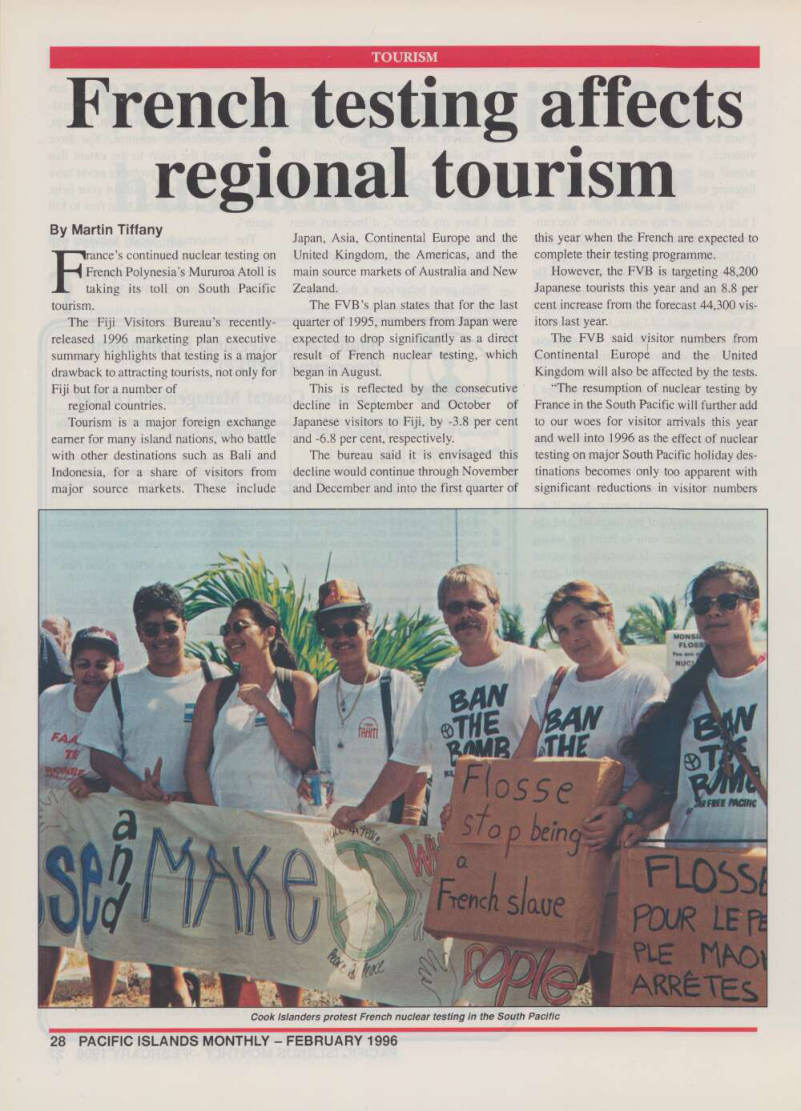
France’s continued nuclear testing on French Polynesia’s Mururoa Atoll is taking its toll on South Pacific tourism.
The Fiji Visitors Bureau’s recently released 1996 marketing plan executive summary highlights that testing is a major drawback to attracting tourists, not only for Fiji but for a number of
regional countries.
Tourism is a major foreign exchange
earner for many island nations, who battle with other destinations such as Bali and Indonesia, for a share of visitors from major source markets. These include
Japan, Asia, Continental Europe and the United Kingdom, the Americas, and the main source markets of Australia and New Zealand.
The FVB’s plan states that for the last quarter of 1995, numbers from Japan were expected to drop significantly as a direct result of French nuclear testing, which began in August.
This is reflected by the consecutive decline in September and October of Japanese visitors to Fiji, by -3.8 per cent and -6.8 per cent, respectively.
The bureau said it is envisaged this decline would continue through November and December and into the first quarter of
this year when the French are expected to
complete their testing programme.
However, the FVB is targeting 48,200 Japanese tourists this year and an 8.8 per cent increase from the forecast 44,300 vis itors last year.
The FVB said visitor numbers from Continental Europe and the United Kingdom will also be affected by the tests.
“The resumption of nuclear testing by
France in the South Pacific will further add to our woes for visitor arrivals this year and well into 1996 as the effect of nuclear testing on major South Pacific holiday des tinations becomes only too apparent with significant reductions in visitor numbers
Cook Islanders protest French nuclear testing in the South Pacific
that have been forecasted and evident in the latest arrival statistics of European travellers to Fiji,” said the bureau in its report.
The testing has affected German visitor arrivals to Fiji which dropped by over 27 per cent for September alone. Given Germany’s dominance of the make-up of the total European visitors to Fiji with a 50 per cent share, this has a direct effect on the total visitor numbers to Fiji from Continental Europe.
To this regard, the FVB have had to re forecast their expected target visitor arrivals from the previous figure of 31,800, to 30,500 to better reflect the effects of nuclear testing in the South Pacific.
The FVB said the Asian market will also be affected by the Mururoa testing.
It said there seemed little doubt the French testing had affected most of Fiji’s origin markets to some extent.
"The question is, where are the French testing nuclear devices? Answer, in the South Pacific. Where is Fiji? In the South Pacific’,” said the FVB.
The bureau also highlighted political instability, increasing crime rate and prices as hurdles to attracting tourists.
The FVB says Fiji is an expensive des tination when compared to competitors such as Bali, Guam, Saipan and Hawaii.
Also highlighted is the lack of appro
priate accommodation standards, especial
ly during peak travel periods. This is espe cially true in the upmarket, five-star range which is favoured by the Asian traveller.
The FVB said tourism’s full potential however, would only be achieved after additional accommodation of an interna tional standard, in the 200-400 room cate gory in the key demand areas is built.
FVB’s room constraints report identi fied an additional 2600 rooms were required by the year 2000 to meet the demand existing in Fiji’s major source markets. ‘‘The lack of suitable accommodation in the key areas of Denarau, Coral Coast and the Mamanuca Islands is already con straining our growth in the peak months and will continue to prevent us from max imising the full potential in our source markets until more accommodation is built. ‘‘The FVB is also supportive of a grad
ing system for hotels and resorts to be introduced as soon as practicable.”
But despite the problems, the FVB is pre dicting a record number of 339,000 visitors this year, compared to the 317,600 forecast for 1995.
It is estimated that this year’s arrivals will generate $493.7 million in foreign exchange earnings gross receipts. This excludes Air Pacific’s earnings and day visiting cruise ship passengers. If these were to be taken into account, tourism’s
foreign exchange earnings would be in
excess of half-a-billion dollars, said the
Fvb.
This reinforces tourism as being Fiji’s biggest foreign exchange earner and with growth that is forecast for tourism in the Pacific region, it has the greatest potential of any industry in Fiji and is expected to play an increasingly important role as the mainstay of the Fijian economy.
In 1994, tourism’s foreign exchange earnings at $419.6 million were over SIOO more than sugar, $278 million more than garments and S3OO million more than the remaining top export revenue earners.
South Korea is predicted to be the boom market this year, with visitors jump ing from less than 2800 in 1994, to a target of 10,400 this year.
The jump is expected following the introduction four weekly flights in late September. Korean Airlines operates three of these weekly Seoul/Nadi/Auckland ser vices while Air New Zealand operates the fourth.
For the five weeks to December 3, these four services averaged 232 passengers per week from Seoul. The FVB said it would work with the two airlines in developing the Korean market, especially the longer staying potential market segments of hon eymooners, divers, golfers and rugby play ers.
The bureau said in order for Fiji to max imise tourism, more direct air services would be required either as destination ter minators or more likely as through services to other larger destinations such as New Zealand and Australia.
The FVB says it will continue to work closely with Air New Zealand in advertis ing and promotions in all markets the air line services to Fiji.
They also say Qantas have assured
them of their increased commitment to Fiji, adding more seats under a new arrangement with Air Pacific.
This year, the FVB will concentrate on the following marketing priorities: ♦ Halt the decline in the Australian market; ♦ Improve market share in the New Zealand market; ♦ Target increased growth from North America and Japan; ♦ Maintain market share from Europe; ♦ Develop the future potential of South-east Asian markets, especially Taiwan and South Korea; ♦ Strengthen servicing of the UK and Continental Europe Inarkets.
To help attract tourists, the Fiji govern ment has added an additional $1 million to the FVB marketing grant. This brings the government’s commitment this year to the FVB to $6,626,000 of which $4,500,000 is allocated to marketing and $2,126,000 to operations.
In addition, the FVB have highlighted a number of major strengths to attract tourists. These include: ♦ Its location in relation to Australia and New Zealand - a short haul destination which can provide an exotic and overseas experience; ♦ An extensive range of accommoda tion and resort facilities and activities which will appeal to special niches; ♦ The unique Fijian culture and its friendly people; ♦ An unspoilt environment in so far as its native resources, rainforests are con cerned; ♦ English being the official language; ♦ Established tourist facilities and infrastructure; ♦ Climate.
In addition, the FVB has highlighted the following weaknesses: Limited air services and accommo dation during peak periods; ♦ Fiji’s perception as a mature market; ♦ Perception that Fiji is an old people’s destination; ♦ Limited shopping facilities; ♦ Perception that Fiji is just a beach destination; ♦ Lack of competition on air routes; ♦ Lack of development in so far as attractions are concerned. ■