Nauru’s iron might
p. 53 · Read in the full issue
By Chris Peteru
Not so long ago, sport in the Republic of Naum seemed to con sist of young men racing expen sive cars around the island.
Today, the sound of high-revving engines has largely been replaced by the clang of heavy metal plates and laboured breathing, as the republics’ growing army of weightlifters pre pare to place Nauru (population 8000) into the sporting spotlight.
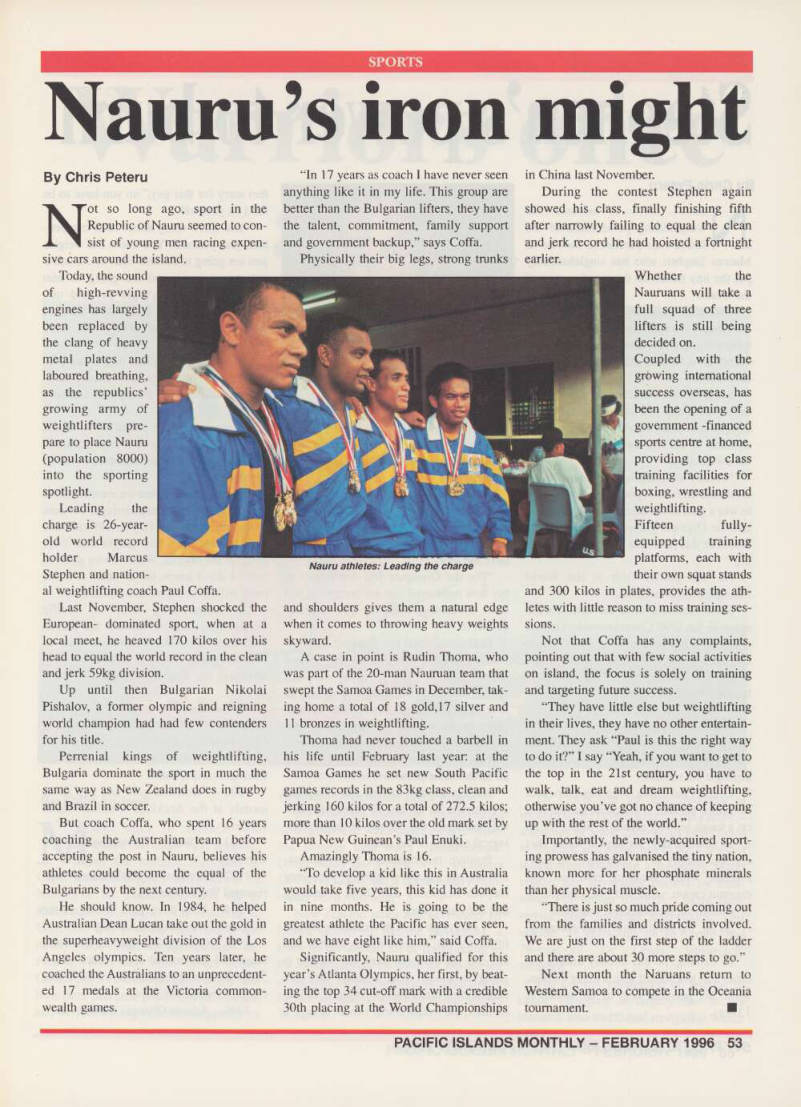
Leading the charge is 26-year old world record holder Marcus Stephen and nation
al weightlifting coach Paul Coffa.
Last November, Stephen shocked the European- dominated sport, when at a local meet, he heaved 170 kilos over his head to equal the world record in the clean
and jerk 59kg division.
Up until then Bulgarian Nikolai Pishalov, a former Olympic and reigning world champion had had few contenders for his title.
Perrenial kings of weightlifting,
Bulgaria dominate the sport in much the same way as New Zealand does in rugby and Brazil in soccer.
But coach Coffa, who spent 16 years coaching the Australian team before accepting the post in Nauru, believes his athletes could become the equal of the Bulgarians by the next century.
He should know. In 1984, he helped Australian Dean Lucan take out the gold in the superheavyweight division of the Los Angeles Olympics. Ten years later, he coached the Australians to an unprecedent ed 17 medals at the Victoria common wealth games.
“In 17 years as coach I have never seen anything like it in my life. This group are better than the Bulgarian lifters, they have the talent, commitment, family support and government backup,” says Coffa.
Physically their big legs, strong trunks
and shoulders gives them a natural edge when it comes to throwing heavy weights skyward.
A case in point is Rudin Thoma, who was part of the 20-man Nauruan team that swept the Samoa Games in December, tak ing home a total of 18 gold, 17 silver and 11 bronzes in weightlifting.
Thoma had never touched a barbell in his life until February last year: at the Samoa Games he set new South Pacific games records in the 83kg class, clean and jerking 160 kilos for a total of 272.5 kilos; more than 10 kilos over the old mark set by Papua New Guinean’s Paul Enuki.
Amazingly Thoma is 16.
“To develop a kid like this in Australia would take five years, this kid has done it in nine months. He is going to be the greatest athlete the Pacific has ever seen, and we have eight like him,” said Coffa.
Significantly, Nauru qualified for this year’s Atlanta Olympics, her first, by beat ing the top 34 cut-off mark with a credible 30th placing at the World Championships
in China last November.
During the contest Stephen again
showed his class, finally finishing fifth after narrowly failing to equal the clean and jerk record he had hoisted a fortnight earlier.
Whether the Nauruans will take a full squad of three lifters is still being decided on.
Coupled with the growing international success overseas, has been the opening of a government -financed sports centre at home, providing top class training facilities for boxing, wrestling and weightlifting.
Fifteen fully equipped training platforms, each with their own squat stands
and 300 kilos in plates, provides the ath letes with little reason to miss training ses sions.
Not that Coffa has any complaints, pointing out that with few social activities on island, the focus is solely on training and targeting future success.
“They have little else but weightlifting in their lives, they have no other entertain ment. They ask “Paul is this the right way to do it?” I say “Yeah, if you want to get to the top in the 21st century, you have to walk, talk, eat and dream weightlifting, otherwise you’ve got no chance of keeping up with the rest of the world.”
Importantly, the newly-acquired sport ing prowess has galvanised the tiny nation, known more for her phosphate minerals than her physical muscle.
“There is just so much pride coming out from the families and districts involved.
We are just on the first step of the ladder and there are about 30 more steps to go.”
Next month the Naruans return to Western Samoa to compete in the Oceania tournament. ■
Nauru athletes: Leading the charge