The Maisin’s logging
pp. 11-13 · Read in the full issue
Industry
The Maisin’s logging alternative
By Liz Thompson
For some time now there has been attention given to the resource exploitation industries which are at work in Papua New Guinea. Bougainville obviously attracted a great deal of atten tion as land owners efforts resulted in the closing of the copper mine. Now, BHP have been in the media as the extent of the pollution, caused by the lack of a tailings dam for it’s mine at OK Tedi has horrified many people. Images of the river’s dark waters in which fish float dead and stories from the villagers of the environmental impact the mine has had on their lives have caused great concern. Now, the landown ers are threatening to take BHP to court.
These two dramatic events display a marked change in attitude amongst local landowners who are no longer prepared to tolerate environmental degradation and inequitable distribution of profits made from resources taken from their land.
Certain landowner groups are now attempting to find economic alternatives to
mining or large-scale logging. There have
been efforts made in various parts of Papua New Guinea to do this already. In the Hunstein Ranges, the East Sepik Council
of Women along with WWF have attempt ed to set up eco-tourism and the production of a variety of non-timber forest products.
A new and very exciting project along similar lines is currently being set up amongst the Maisin community on the north eastern coast of the island. Between 2500 and 3000 Maisin live here on the edge of the rainforest. The forest is a source of much of their daily needs and home to many ancestral spirits. Over the past 15 years they have been approached by forestry officials and representatives of foreign logging interests to consider sell ing the rights to this land. Initially, some members of the community expressed interest. However, as awareness has increased as to the long-term effects of logging, soil erosion and land degradation, the Maisin have become more interested in developing an alternative to logging. And they have looked toward their traditional custom of producing Tapa cloth for the answer.
A declaration made at a meeting at Uiaku village in July 1994 stated that the
Maisin people; “firmly and unanimously
stand opposed to destructive large-scale industrial logging, and to agricultural
activity that entails the clearing of large areas of forest, in any part of the lands, tra ditionally held by the Maisin people”. It also declared that the Maisin people “seek to work amongst ourselves, with the peo ples whose land adjoins our own, and with the government and other parties to set up Incorporated Land Groups and establish property rights and territorial boundaries for the purpose of creating a legally man dated conservation area, such as a Conservation Area, Wildlife Management Area, National Park, or World Heritage Site, comprising and protecting in perper tutity the entirety of the Maisin lands and sea. Sylvester Moi, who is chairman of the Maisin Tapa group says, “I have witnessed the destruction of the land and social dis turbance of my home. We want to protect our environment and the place we inherit ed from our ancestors. We want to enjoy it now and for generations to come.”
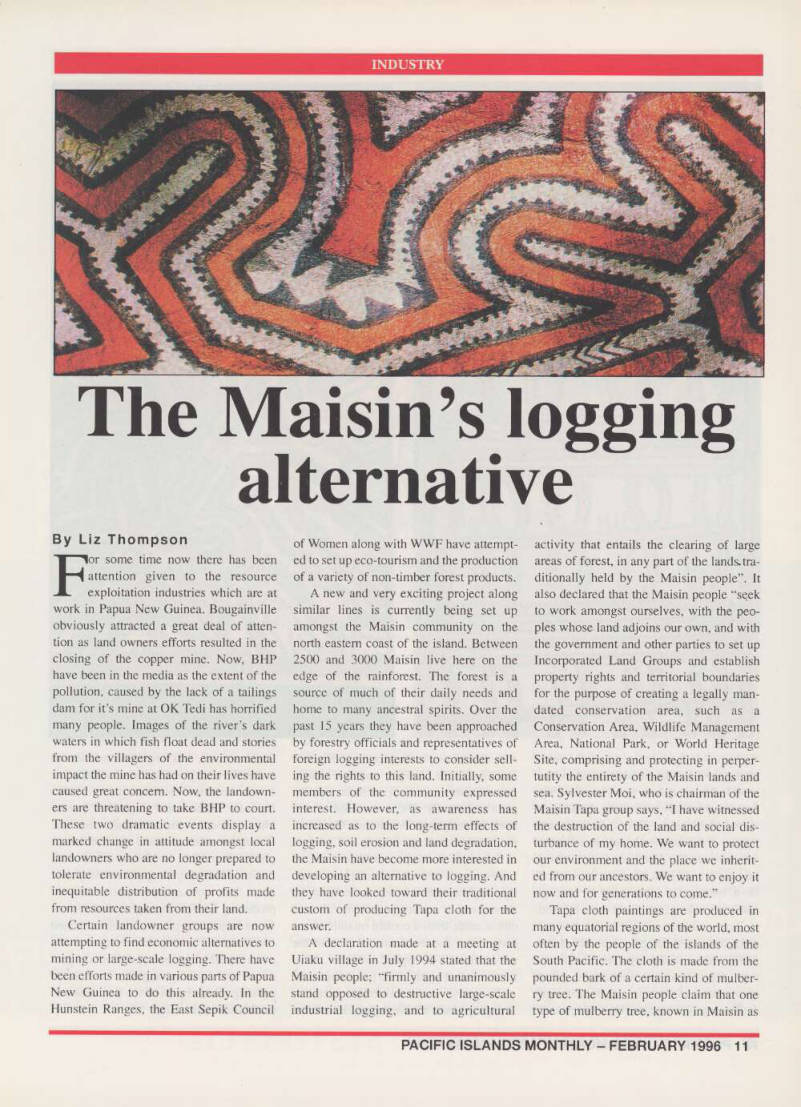
Tapa cloth paintings are produced in
many equatorial regions of the world, most often by the people of the islands of the South Pacific. The cloth is made from the pounded bark of a certain kind of mulber ry tree. The Maisin people claim that one type of mulberry tree, known in Maisin as
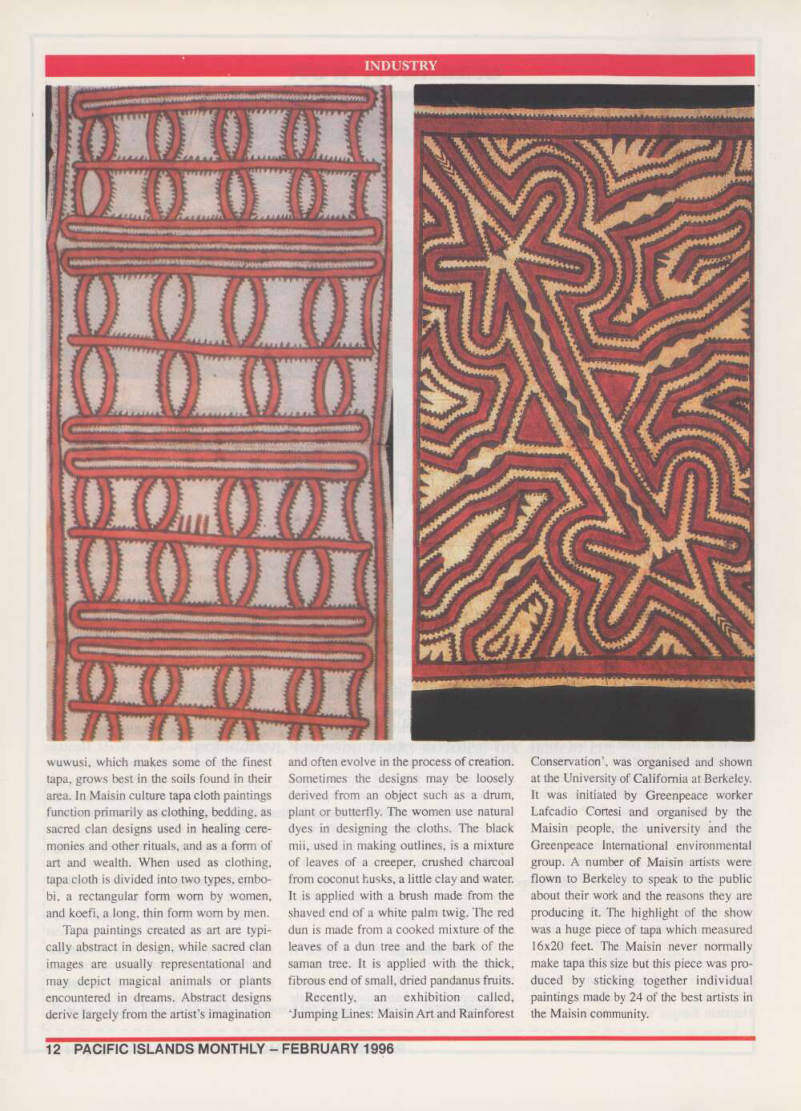
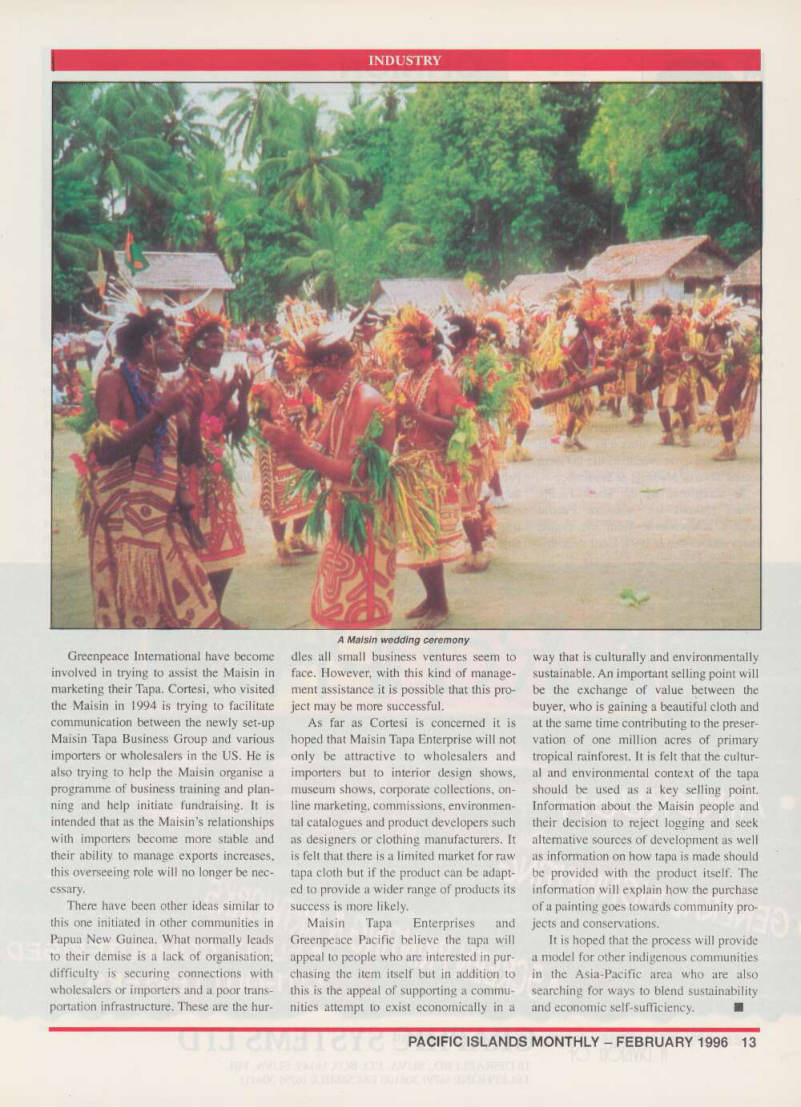
wuwusi, which makes some of the finest tapa, grows best in the soils found in their area. In Maisin culture tapa cloth paintings function primarily as clothing, bedding, as sacred clan designs used in healing cere monies and other rituals, and as a form of art and wealth. When used as clothing, tapa cloth is divided into two types, embo bi, a rectangular form worn by women, and koefi, a long, thin form worn by men.
Tapa paintings created as art are typi cally abstract in design, while sacred clan
images are usually representational and
may depict magical animals or plants encountered in dreams. Abstract designs derive largely from the artist’s imagination
and often evolve in the process of creation.
Sometimes the designs may be loosely derived from an object such as a drum, plant or butterfly. The women use natural dyes in designing the cloths. The black mii, used in making outlines, is a mixture of leaves of a creeper, crushed charcoal from coconut husks, a little clay and water.
It is applied with a brush made from the shaved end of a white palm twig. The red dun is made from a cooked mixture of the leaves of a dun tree and the bark of the saman tree. It is applied with the thick, fibrous end of small, dried pandanus fruits.
Recently, an exhibition called, ‘Jumping Lines: Maisin Art and Rainforest
Conservation’, was organised and shown at the University of California at Berkeley.
It was initiated by Greenpeace worker Lafcadio Cortesi and organised by the Maisin people, the university and the Greenpeace International environmental group. A number of Maisin artists were flown to Berkeley to speak to the public about their work and the reasons they are producing it. The highlight of the show was a huge piece of tapa which measured 16x20 feet. The Maisin never normally make tapa this size but this piece was pro duced by sticking together individual paintings made by 24 of the best artists in the Maisin community.
Greenpeace International have become involved in trying to assist the Maisin in marketing their Tapa. Cortesi, who visited the Maisin in 1994 is trying to facilitate communication between the newly set-up Maisin Tapa Business Group and various importers or wholesalers in the US. He is also trying to help the Maisin organise a programme of business training and plan ning and help initiate fundraising. It is intended that as the Maisin’s relationships with importers become more stable and their ability to manage exports increases, this overseeing role will no longer be nec essary.
There have been other ideas similar to this one initiated in other communities in Papua New Guinea. What normally leads to their demise is a lack of organisation; difficulty is securing connections with wholesalers or importers and a poor trans portation infrastructure. These are the hur
dies all small business ventures seem to face. However, with this kind of manage ment assistance it is possible that this pro ject may be more successful.
As far as Cortesi is concerned it is hoped that Maisin Tapa Enterprise will not only be attractive to wholesalers and importers but to interior design shows, museum shows, corporate collections, on line marketing, commissions, environmen tal catalogues and product developers such as designers or clothing manufacturers. It is felt that there is a limited market for raw tapa cloth but if the product can be adapt ed to provide a wider range of products its success is more likely.
Maisin Tapa Enterprises and Greenpeace Pacific believe the tapa will appeal to people who are interested in pur chasing the item itself but in addition to this is the appeal of supporting a commu nities attempt to exist economically in a
way that is culturally and environmentally sustainable. An important selling point will be the exchange of value between the buyer, who is gaining a beautiful cloth and at the same time contributing to the preser vation of one million acres of primary tropical rainforest. It is felt that the cultur al and environmental context of the tapa should be used as a key selling point.
Information about the Maisin people and their decision to reject logging and seek alternative sources of development as well as information on how tapa is made should be provided with the product itself. The information will explain how the purchase of a painting goes towards community pro jects and conservations.
It is hoped that the process will provide a model for other indigenous communities in the Asia-Pacific area who are also searching for ways to blend sustainability and economic self-sufficiency. ■
A Maisin wedding ceremony