Welcome Palau,
pp. 14-15 · Read in the full issue
Opinion
Welcome Palau, South Korea
This year, the South Pacific Forum welcomes into its fold and process es two new additions, the northern Pacific Republic of Palau and South Korea.
Palau’s membership has taken the organisation’s total membership to 16, while Korea becomes the eighth Post- Forum Dialogue Partner.
Palau’s membership was accepted by acclamation at the 26th Summit of the South Pacific Forum, hosted by the Papua New Guinea government in the northern coastal town of Madang, in September.
Its acceptance by the South Pacific Forum follows the northern Pacific nation’s independence from the United States on October 1, 1994. Until then, this
nation of 15,000 people was a Trust Territory of the United States.
What is the significance of Palau’s
membership?
For outsiders, it probably does not mean much. For the South Pacific Forum it means that, as an organisation, it has an added voice at international fora.
It also means Palau can fully partici pate in the range of regional programmes administered by the South Pacific Forum Secretariat.
Palau’s membership of the South Pacific Forum brings back memories of the 1960’s and 1970’s wh'f many island countries were on an irreversible course with political independence as their des
tiny.
From 1970 on, those countries which were yet to secure their political indepen dence never looked back. Within that decade alone, six countries gained full independence. It started with Fiji in 1970, Papua New Guinea followed in 1975, Solomon Islands and Tuvalu in 1978, Kiribati in 1979 and Vanuatu in 1980. A great decade for the region.
In fact, I can remember quite vividly what seemed an endless shuttle diplomacy in the late 1960’s through the early 1970’s between London and island countries as emerging island leaders negotiated terms of political independence with the British government.
It was not easy, but they made it. Thank goodness there was no bloodshed. And so
The Forum
Alfred
Sasako
the independence of Palau and its subse quent membership of the South Pacific Forum is one of jubilation for leaders of the Forum.
The president of Palau, His Excellency Kuiwo Nakamura, expressed it well when he spoke in response to his country’s admission last September.
He said: “It is an honour and pleasure to at last become a full-fledged member of the South Pacific Forum. Palau’s admis sion to this distinguished Forum is like coming home after a long absence from
one’s family.”
And what a growing family the South Pacific Forum is. From only seven found ing members (Australia, the Cook Islands, Fiji, Nauru, New Zealand, Tonga and Western Samoa) in 1971, it has seen a huge growth in membership in the last two decades.
True, there have been instances of squabbling here and there over the years, but what is a family without these?
In welcoming Palau, the chairperson of the South Pacific Forum and Prime Minister of Papua New Guinea, Sir Julius Chan, said that as a new member, Palau would bring new inspiration and new thinking on regional issues.
In response, President Nakamura told Forum leaders that until now, his country’s
participation in international organisations
with other members of the Pacific had been limited for historical reasons.
But now it is eager to work closely with fellow Forum members “to preserve our marine environment and resources, pro mote regional economic co-operation and
plan for the challenges we will face together in the coming century.”
President Nakamura said there was a need to build bridges between South Pacific Forum member nations and the rest of the world.
“For too long, the Pacific ocean, which defines us as an organisation, has also been a barrier separating our island nations and the rest of the world.
“As we move forward into the next millennia, we must build strong bridges between our nations which will serve our mutual interests (in) ... three areas tourism, aviation and communications.”
The Pacific as a region is beautiful.
And beauty and tranquility are a tourist’s dream. In his view, member countries of the Forum should work together to pro mote tourism on a regional basis, instead of competing against each other.
“By enhancing our regional appeal on a worldwide basis rather than competing with each other, all of our nations will ben efit,” he said.
In aviation, the president told his col leagues that Palau was currently negotiat ing with major Japanese and Taiwanese air carriers for regular direct flights to Palau from Japan and Taiwan.
“We would be willing to include other neighbouring nations in such discussions
to develop multiple-stop flights,” he said.
President Nakamura also spoke of the need to develop and share the cost of
regional communications, especially the
cost of undersea fibre optic cables and satellites.
“Because such projects are expensive,
it makes sense to work together regionally he said.
With this in mind, Palau, he said, had signed a Memorandum of Understanding (MOU) with international communication companies in Indonesia, Malaysia, Brunei and the Phillipines “to study the feasibility of a regional undersea fibre optic cable which can serve all our nations.”
His country is also exploring the possi
bility of jointly developing satellites in
both the Indian and Pacific Oceans specif
ically designed to suit regional communi
cation needs.
Also new to the Forum this year is South Korea - one of the economic giants of Asia.
South Korea became a Post-Forum Dialogue Partner la ! st September when it took part for the first time in the minister ial talks after the Madang Forum.
Established in 1989, the Post-Forum Dialogue provides a face-to-face discus sion at ministerial level on issues raised by the leaders of the Forum.
It is a two-way process. For members of the Forum it provides an opportunity to convey important decisions on major issues to members of the Post-Forum
Dialogue.
It also provides the dialogue partners with an opportunity to raise with Forum members any matters they so wish.
Although new to the Post-Forum Dialogue, to the region South Korea is not a newcomer by any means.
It has invested in many industries in many Forum Island Countries including Fiji and Papua New Guinea. In Fiji for example, South Korea’s investment was said to be valued at around Fs33 million.
In PNG, the value of South Korea’s investment in logging, fisheries and other industries is said to be even higher.
In return, South Korean products such as its famous Hyundai cars, Samsung tele vision sets, video recorders and other elec tronic gear are common in Forum Island Countries.
Its membership as a Post-Forum Dialogue Partner, no doubt, has opened up new opportunities for both sides in the areas of trade, tourism and investment.
Fiji, for instance, has already tapped into its tourism industry market with the recent introduction of Korean Airlines four flights a week through Nadi.
No doubt, others will follow suit. ■
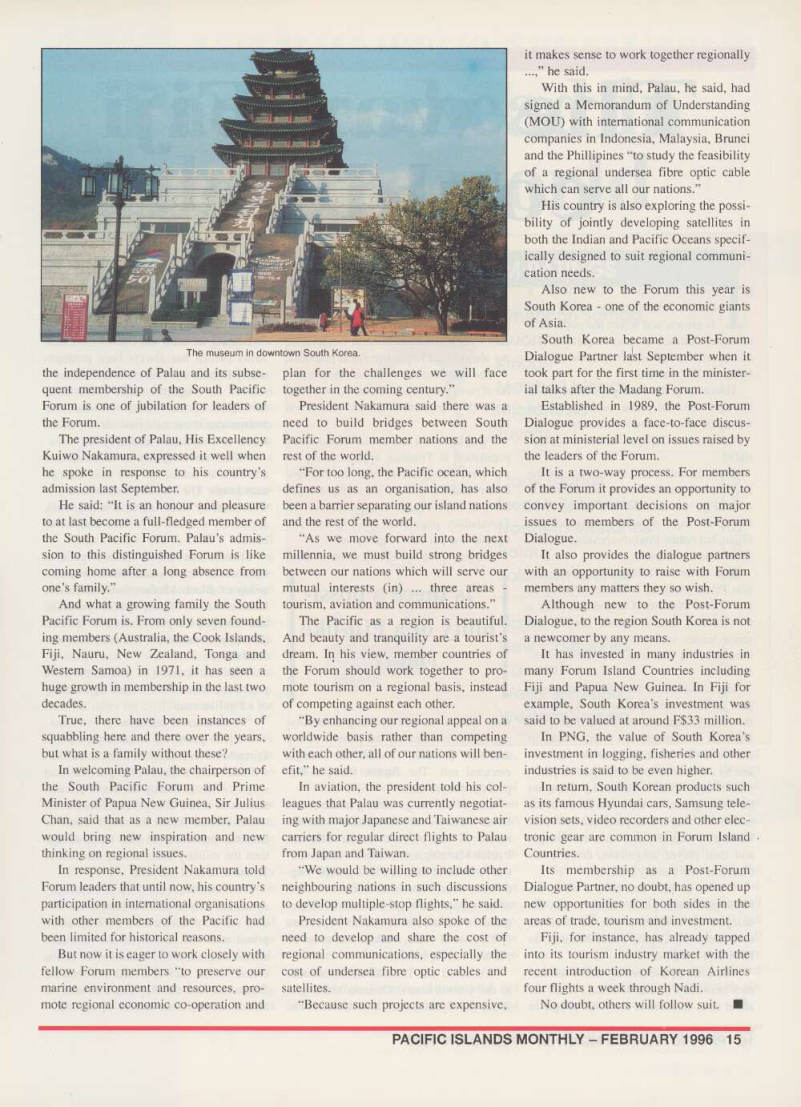
The museum in downtown South Korea.