Living
pp. 6-9 · Read in the full issue
Cover Story
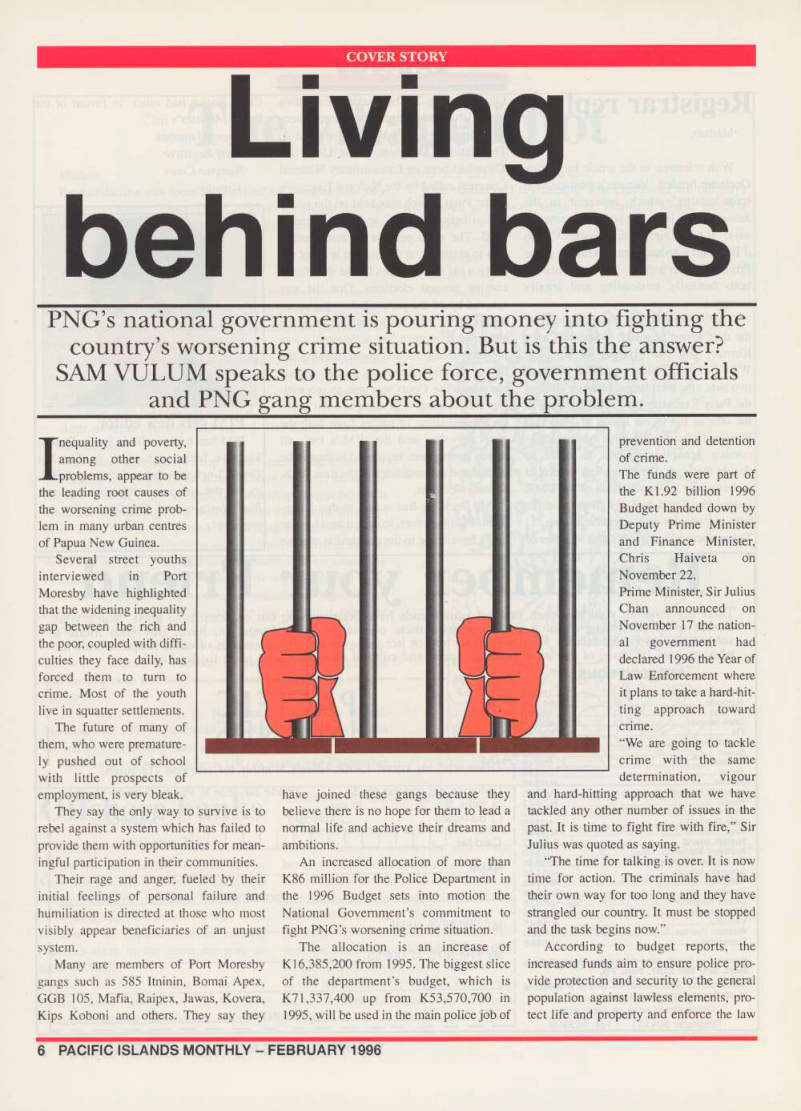
Living behind bars
PNG’s national government is pouring money into fighting the country’s worsening crime situation. But is this the answer?
SAM VULUM speaks to the police force, government officials and PNG gang members about the problem.
Inequality and poverty, among other social problems, appear to be the leading root causes of the worsening crime prob lem in many urban centres of Papua New Guinea.
Several street youths interviewed in Port
Moresby have highlighted
that the widening inequality
gap between the rich and the poor, coupled with diffi culties they face daily, has forced them to turn to crime. Most of the youth live in squatter settlements.
The future of many of them, who were premature ly pushed out of school with little prospects of employment, is very bleak.
They say the only way to survive is to rebel against a system which has failed to provide them with opportunities for mean ingful participation in their communities.
Their rage and anger, fueled by their initial feelings of personal failure and humiliation is directed at those who most visibly appear beneficiaries of an unjust system.
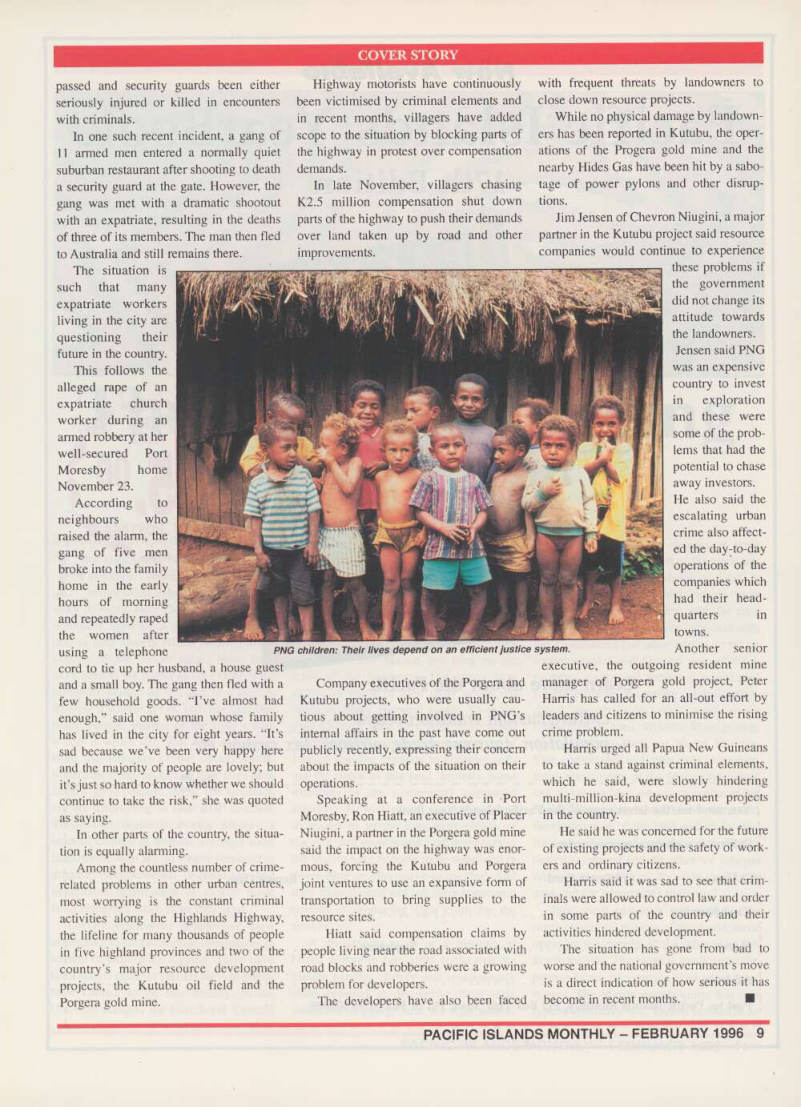
Many are members of Port Moresby gangs such as 585 Itninin, Bomai Apex, GGB 105, Mafia, Raipex, Jawas, Kovera, Kips Koboni and others. They say they
prevention and detention of crime.
The funds were part of the K 1.92 billion 1996 Budget handed down by Deputy Prime Minister and Finance Minister, Chris Haiveta on November 22.
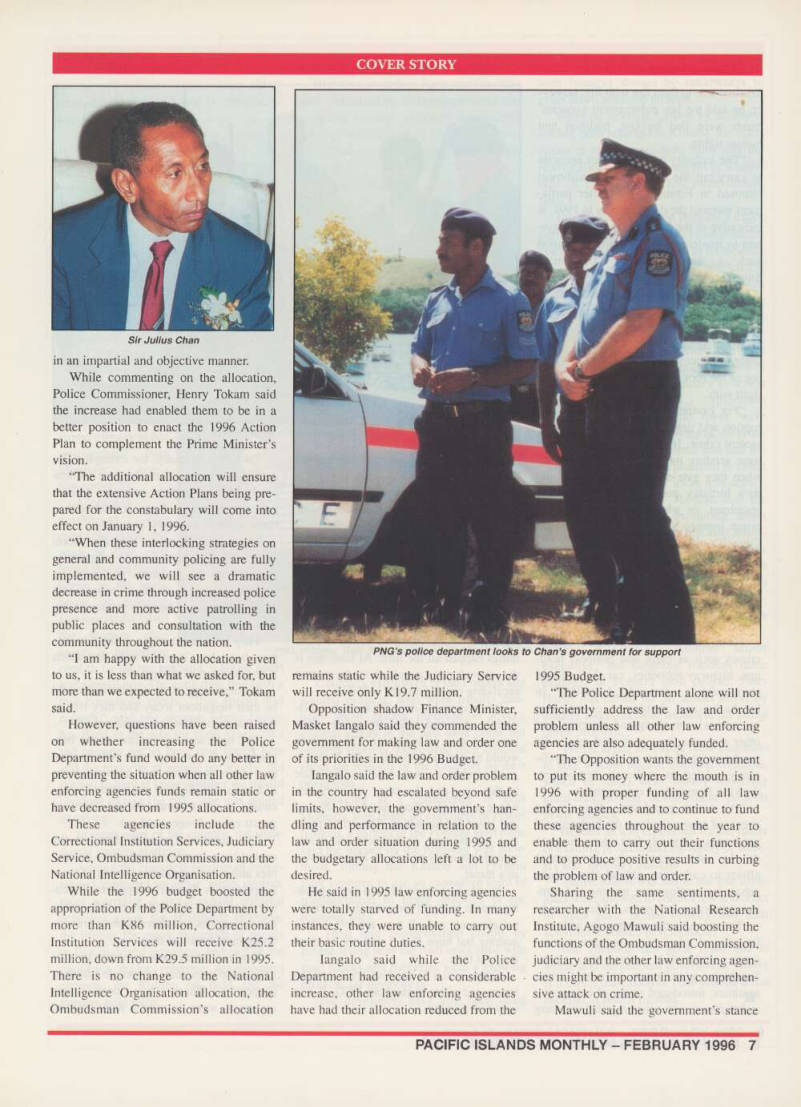
Prime Minister, Sir Julius Chan announced on November 17 the nation al government had declared 1996 the Year of Law Enforcement where it plans to take a hard-hit ting approach toward crime.
“We are going to tackle crime with the same determination, vigour
have joined these gangs because they believe there is no hope for them to lead a normal life and achieve their dreams and ambitions.
An increased allocation of more than KB6 million for the Police Department in the 1996 Budget sets into motion the National Government’s commitment to fight PNG’s worsening crime situation.
The allocation is an increase of K 16,385,200 from 1995. The biggest slice of the department’s budget, which is K 71,337,400 up from K 53,570,700 in 1995, will be used in the main police job of
and hard-hitting approach that we have tackled any other number of issues in the past. It is time to fight fire with fire,” Sir Julius was quoted as saying.
“The time for talking is over. It is now time for action. The criminals have had their own way for too long and they have strangled our country. It must be stopped and the task begins now.”
According to budget reports, the increased funds aim to ensure police pro vide protection and security to the general population against lawless elements, pro tect life and property and enforce the law
in an impartial and objective manner.
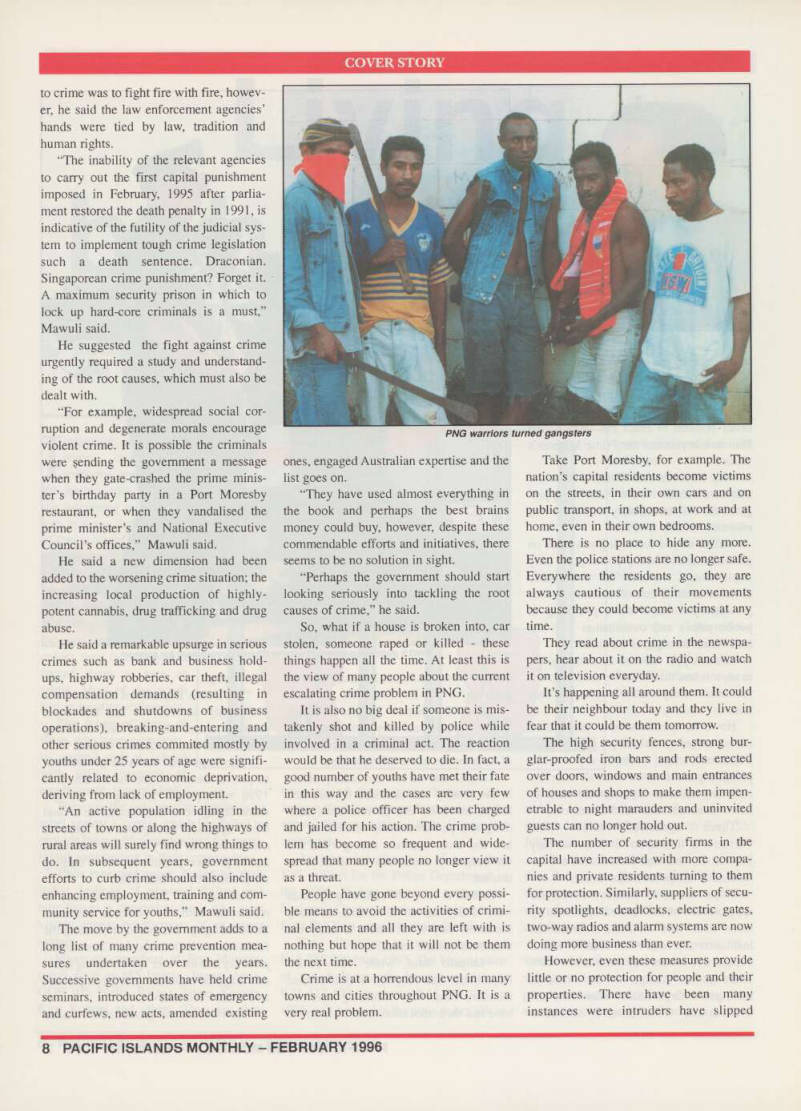
While commenting on the allocation, Police Commissioner, Henry Tokam said the increase had enabled them to be in a better position to enact the 1996 Action Plan to complement the Prime Minister’s vision.
“The additional allocation will ensure that the extensive Action Plans being pre pared for the constabulary will come into effect on January 1, 1996.
“When these interlocking strategies on general and community policing are fully implemented, we will see a dramatic decrease in crime through increased police presence and more active patrolling in public places and consultation with the
community throughout the nation.
“I am happy with the allocation given to us, it is less than what we asked for, but more than we expected to receive,” Tokam said.
However, questions have been raised on whether increasing the Police Department’s fund would do any better in preventing the situation when all other law enforcing agencies funds remain static or have decreased from 1995 allocations.
These agencies include the Correctional Institution Services, Judiciary Service, Ombudsman Commission and the
National Intelligence Organisation.
While the 1996 budget boosted the appropriation of the Police Department by more than KB6 million. Correctional Institution Services will receive K 25.2 million, down from K 29.5 million in 1995.
There is no change to the National
Intelligence Organisation allocation, the
Ombudsman Commission’s allocation
remains static while the Judiciary Service will receive only K 19.7 million.
Opposition shadow Finance Minister, Masket langalo said they commended the government for making law and order one of its priorities in the 1996 Budget. langalo said the law and order problem in the country had escalated beyond safe limits, however, the government’s han dling and performance in relation to the law and order situation during 1995 and the budgetary allocations left a lot to be desired.
He said in 1995 law enforcing agencies were totally starved of funding. In many instances, they were unable to carry out their basic routine duties. langalo said while the Police Department had received a considerable increase, other law enforcing agencies have had their allocation reduced from the
1995 Budget.
“The Police Department alone will not sufficiently address the law and order problem unless all other law enforcing agencies are also adequately funded.
“The Opposition wants the government to put its money where the mouth is in 1996 with proper funding of all law enforcing agencies and to continue to fund these agencies throughout the year to enable them to carry out their functions and to produce positive results in curbing the problem of law and order.
Sharing the same sentiments, a researcher with the National Research Institute, Agogo Mawuli said boosting the functions of the Ombudsman Commission, judiciary and the other law enforcing agen cies might be important in any comprehen sive attack on crime.
Mawuli said the government’s stance
Sir Julius Chan
PNG’s police department looks to Chan’s government for support
to crime was to fight fire with fire, howev er, he said the law enforcement agencies’ hands were tied by law, tradition and human rights.
“The inability of the relevant agencies to carry out the first capital punishment imposed in February, 1995 after parlia ment restored the death penalty in 1991, is indicative of the futility of the judicial sys
tem to implement tough crime legislation
such a death sentence. Draconian.
Singaporean crime punishment? Forget it.
A maximum security prison in which to lock up hard-core criminals is a must,”
Mawuli said.
He suggested the fight against crime urgently required a study and understand ing of the root causes, which must also be dealt with.
“For example, widespread social cor ruption and degenerate morals encourage violent crime. It is possible the criminals were pending the government a message when they gate-crashed the prime minis ter’s birthday party in a Port Moresby restaurant, or when they vandalised the prime minister’s and National Executive Council’s offices,” Mawuli said.
He said a new dimension had been added to the worsening crime situation; the increasing local production of highly potent cannabis, drug trafficking and drug abuse.
He said a remarkable upsurge in serious crimes such as bank and business hold ups, highway robberies, car theft, illegal compensation demands (resulting in blockades and shutdowns of business operations), breaking-and-entering and other serious crimes commited mostly by youths under 25 years of age were signifi cantly related to economic deprivation, deriving from lack of employment.
“An active population idling in the streets of towns or along the highways of rural areas will surely find wrong things to do. In subsequent years, government efforts to curb crime should also include enhancing employment, training and com munity service for youths,” Mawuli said.
The move by the government adds to a long list of many crime prevention mea sures undertaken over the years.
Successive governments have held crime seminars, introduced states of emergency and curfews, new acts, amended existing
ones, engaged Australian expertise and the list goes on.
“They have used almost everything in the book and perhaps the best brains money could buy, however, despite these commendable efforts and initiatives, there seems to be no solution in sight.
“Perhaps the government should start looking seriously into tackling the root causes of crime,” he said.
So, what if a house is broken into, car stolen, someone raped or killed - these things happen all the time. At least this is the view of many people about the current escalating crime problem in PNG.
It is also no big deal if someone is mis takenly shot and killed by police while involved in a criminal act. The reaction would be that he deserved to die. In fact, a good number of youths have met their fate in this way and the cases are very few where a police officer has been charged and jailed for his action. The crime prob lem has become so frequent and wide spread that many people no longer view it as a threat.
People have gone beyond every possi
ble means to avoid the activities of crimi nal elements and all they are left with is nothing but hope that it will not be them the next time.
Crime is at a horrendous level in many towns and cities throughout PNG. It is a very real problem.
Take Port Moresby, for example. The nation’s capital residents become victims on the streets, in their own cars and on public transport, in shops, at work and at home, even in their own bedrooms.
There is no place to hide any more.
Even the police stations are no longer safe.
Everywhere the residents go, they are always cautious of their movements because they could become victims at any time.
They read about crime in the newspa pers, hear about it on the radio and watch it on television everyday.
It’s happening all around them. It could be their neighbour today and they live in fear that it could be them tomorrow.
The high security fences, strong bur glar-proofed iron bars and rods erected over doors, windows and main entrances of houses and shops to make them impen etrable to night marauders and uninvited guests can no longer hold out.
The number of security firms in the capital have increased with more compa nies and private residents turning to them
for protection. Similarly, suppliers of secu
rity spotlights, deadlocks, electric gates, two-way radios and alarm systems are now doing more business than ever.
However, even these measures provide little or no protection for people and their properties. There have been many instances were intruders have slipped
PNG warriors turned gangsters
passed and security guards been either
seriously injured or killed in encounters with criminals.
In one such recent incident, a gang of 11 armed men entered a normally quiet suburban restaurant after shooting to death a security guard at the gate. However, the gang was met with a dramatic shootout with an expatriate, resulting in the deaths of three of its members. The man then fled to Australia and still remains there.
The situation is such that many expatriate workers living in the city are questioning their future in the country.
This follows the alleged rape of an
expatriate church
worker during an armed robbery at her well-secured Port Moresby home November 23.
According to neighbours who raised the alarm, the gang of five men broke into the family home in the early hours of morning and repeatedly raped the women after using a telephone
cord to tie up her husband, a house guest and a small boy. The gang then fled with a few household goods. “I’ve almost had enough,” said one woman whose family has lived in the city for eight years. “It’s sad because we’ve been very happy here and the majority of people are lovely; but it’s just so hard to know whether we should continue to take the risk,” she was quoted
as saying.
In other parts of the country, the situa
tion is equally alarming.
Among the countless number of crime related problems in other urban centres, most worrying is the constant criminal
activities along the Highlands Highway,
the lifeline for many thousands of people in five highland provinces and two of the
country’s major resource development
projects, the Kutubu oil field and the Porgera gold mine.
Highway motorists have continuously been victimised by criminal elements and in recent months, villagers have added scope to the situation by blocking parts of the highway in protest over compensation demands.
In late November, villagers chasing K 2.5 million compensation shut down parts of the highway to push their demands over land taken up by road and other improvements.
Company executives of the Porgera and Kutubu projects, who were usually cau tious about getting involved in PNG’s internal affairs in the past have come out
publicly recently, expressing their concern
about the impacts of the situation on their
operations.
Speaking at a conference in Port Moresby, Ron Hiatt, an executive of Placer Niugini, a partner in the Porgera gold mine said the impact on the highway was enor mous, forcing the Kutubu and Porgera joint ventures to use an expansive form of
transportation to bring supplies to the
resource sites.
Hiatt said compensation claims by people living near the road associated with road blocks and robberies were a growing
problem for developers.
The developers have also been faced
with frequent threats by landowners to close down resource projects.
While no physical damage by landown
ers has been reported in Kutubu, the oper ations of the Progera gold mine and the nearby Hides Gas have been hit by a sabo tage of power pylons and other disrup tions.
Jim Jensen of Chevron Niugini, a major partner in the Kutubu project said resource companies would continue to experience
these problems if the government did not change its attitude towards the landowners.
Jensen said PNG was an expensive country to invest
in exploration
and these were some of the prob lems that had the potential to chase away investors.
He also said the escalating urban crime also affect ed the day-to-day operations of the
companies which
had their head quarters in towns.
Another senior
executive, the outgoing resident mine manager of Porgera gold project, Peter Harris has called for an all-out effort by leaders and citizens to minimise the rising
crime problem.
Harris urged all Papua New Guineans to take a stand against criminal elements, which he said, were slowly hindering multi-million-kina development projects in the country.
He said he was concerned for the future of existing projects and the safety of work ers and ordinary citizens.
Harris said it was sad to see that crim inals were allowed to control law and order in some parts of the country and their activities hindered development.
The situation has gone from bad to worse and the national government’s move is a direct indication of how serious it has become in recent months. ■
PNG children: Their lives depend on an efficient justice system.