for higher goals
pp. 54-55 · Read in the full issue

Soccer
Pacific players aiming for higher goals
By Atama Raganivatu
Eight Pacific island nations featured in the draw for soccer’s World Cup at Paris on December 10th. This is a record for the region - four teams are set to make their debuts in the international sport’s premier competition - and yet many observers at the South Pacific Games last August lamented over what they perceived to be a declining standard of play.
However, South Pacific soccer’s leading administrator, Oceania Football Confederation (OFC) president Charlie Dempsey, has absolutely no doubt that progress is being made in all aspects of the sport here.
“I am very pleased with the headway being made in the region,” he said. “We are moving forward in every direction women’s soccer, youth development, the five-a-side variation, refereeing, coaching and administration, as well as the men’s senior game. The Pacific Island nations now participate in each important international
tournament open to them and are very much on the world scene.”
The island countries’ advancement has
been Dempsey’s major priority since
becoming president 13 years hgo. The Scot, who will be 75 in March, held several prominent posts with the New Zealand Football Association before devoting his energies to Oceania. He was NZFA chairman when the Kiwis qualified for the 1982 World Cup finals.
Although eager to claim positive momentum in all fields, Dempsey takes the greatest pride from the nurturing of youth soccer.
The OFC employs, on a part-time basis, five highly accomplished Australasian coaches and there are few comers of Dempsey’s vast domain that have not been visited at some stage by these soccer missionaries.
Several critics have expressed doubt about the value of the sojourns and claim that the lack of “follow-up” work erodes their effectiveness. Dempsey, though, com-
pletely dismisses such theories.
The OFC’s head coach, Kevin Fallon, does concede that players on the outlying islands are disadvantaged but attributes responsibility to their national administrat ing bodies, not the confederation. “It’s a great shame that outstanding young players in remote areas often get overlooked by local associations,” he grumbled. “We can do the spadework and identify talent, but if they are situated in areas not within their country’s domestic mainstream they aren’t given opportunities to play at a higher level and usually stagnate.”
Fallon did not name any specific coun tries but, doubtless, the Solomon Islands would have been amongst those he was referring to. The Solomons’ representative sides are invariably restricted to players attached to Honiara clubs, despite Malaita having always produced the vast majority of their gifted players. Seventy-five per cent of the 1994 Melanesia Cup winning team were Malaitans who had originally moved to the capital to seek work. One can only speculate
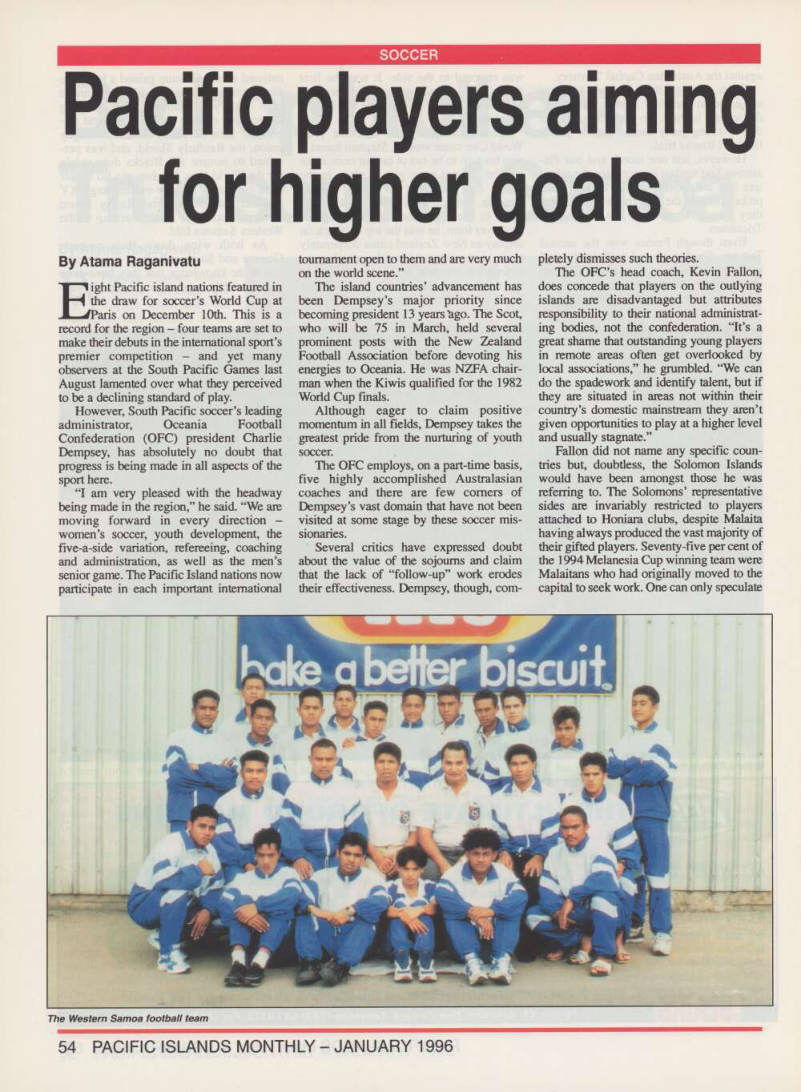
The Western Samoa football team
as to how much stronger “Sol” would be if they were to fiftld Malaitan-based Malaitans.
Dempsey claims the Solomons as one of Oceania’s greatest success stories, notwith standing their self-inflicted handicap.
“We’ve made tremendous strides there,” he trumpeted. “Australia only beat them in the 1994 World Cup through a last-minute goal.
We can also point to Tahiti recently defeat ing New Zealand and Fiji being competitive against everyone now. Only 10 years ago, those teams were losing by eight goals or more.”
The improvements of Tahiti, Solomon Islands and Fiji are undeniable. However, any gain by the smaller nations is less evi dent.
Although soccer in the Cook Islands is looked upon as little more than a means for rugby players to retain fitness between sea sons, just over 100 participate in the sport there and they were annihilated 16-0 by the Solomons at the South Pacific Games, the Cooks will feature at the World Cup draw amongst traditional international giants like Germany - who have five million active footballers to choose from.
OFC secretary Josephine King (Dempsey’s daughter) acknowledges that the Cooks risked ridicule by entering the World Cup: “I, personally, originally had doubts about their participation. My belief was that the Cooks would be wiser to spend
their money on youth development rather than a costly and possibly demoralising Cup campaign. However, we are all now happy that this venture will not be at the expense of other important areas. And, FIFA (interna tional soccer’s ruling body) is very keen for it to be involved. It is something of a flag
waving exercise.”
Dempsey too eagerly promoted the Cooks’ cause. “The entire Rarotongan soc cer community are very, very keen,” he enthused. “They receive great support from the national lottery and already have a five a-side arena better than anything in Australia or New Zealand. Moreover, they are fully entitled to be in the World Cup and feel part of the FIFA family.”
The credibility of Dempsey and his organisation depends very much upon the progress achieved by the likes of Tonga, Western Samoa and Cook Islands and it is they who benefit most from the funds FIFA allocates to Oceania.
The Scot has been responsible for dis tributing a wide variety of items to Pacific Island associations, ranging from footballs to fax machines. Apart from the improved results achieved by Tahitian, Solomon Island and Fijian national selections, the best evidence this philanthropy is bearing fruit comes in the form of players registered in the region. Their number almost doubled over the past 10 years.
FIFA is certainly satisfied with
Oceania’s endeavours. It is probable that the smallest of the world’s six regional soccer confederations (with only o.7per cent of its registered players) will, in July, gain the right to sit on all of the Zurich-based organ isation’s official committees. At the moment, Oceania has to rely upon being invited.
Dempsey believes that the acquisition of full confederation status is essential for soc cer’s continued growth in the South Seas.
“The place on FIFA’s coaching and referee ing committees that this would ensure is very, very important to us,” he stated. “Not having a voice on those has certainly been detrimental to Oceania.
“Gaining the same standing as other con federations would make us more effective in all spheres, ensure FIFA are made aware of our local problems, and considerably lift Oceania’s profile. I have approached Pele on several occasions to visit the Pacific Island nations - that would give soccer a tremendous boost - but, mainly because we aren’t fully on the map yet, he has had to decline. Attracting the soccer world’s great est personalities for promotional purposes, as well as leading international coaches, would certainly be easier if we were at the top table in Zurich. It is far from a foregone conclusion, but I believe that full confeder ation status will be achieved.”
The time to order welcoming banners for Pele may not be far away. ■