Bachop brothers:
pp. 52-53 · Read in the full issue
Profile
Bachop brothers: True sons of Samoa
By Atama Raganivatu
Western Samoan Rugby Union officials are often criticised for what detractors perceive as an overly liberal construction of who is qualified to represent their national XVs. A Tongan, a Cook Islander and numerous New Zealand-born players have worn Manu Samoa’s blue jer sey. Some knockers have even suggested that a weekend stopover in Apia is sufficient to
gain eligibility!
The crucial factor, of course, is blood and every member of the Samoan “global family” has the right to gain selection for the country they regard as their spir itual home.
The links of Graeme and Stephen Bachop to Samoa exist
through their grandmother. “We
were always aware, and proud, of the Samoan connection,”
Graeme stated during a rare interview last year. “We regard ourselves as New Zealanders, but with very important Samoan ties too.”
It was the Samoan connec tion which enabled Stephen to prove himself as an exceptional ly talented player, after most observers of New Zealand
domestic rugby had dismissed him as nothing more than a slightly-above-average performer. By the time Stephen, who is the oldest by a year, made his international debut for Western Samoa in 1991, Graeme had already spent five seasons as a Kiwi representative. Yet, their early careers had developed along parallel lines.
Both won places in the senior side of the powerful Lin wood club at Christchurch, their home city, shortly after leaving school and graduated to the
Canterbury provincial squad while in their
early 20s. In 1987, they lined up together for the New Zealand Colts (under-21) selection which defeated Australia 37-2.
But, whereas Graeme used the Colts outing as a springboard to higher honours - he was chosen for an All Blacks tour that same year and made his Test debut
against Wales at Cardiff in 1989 - Stephen’s rugby began to stagnate.
The older brother had only a handful of Canterbury appearances to his name when Western Samoa, unexpectedly, thrust him into the limelight with selection for their 1991 World Cup squad.
Stephen was a revelation in Britain as Manu Samoa swept into the quarter-finals with a breath takingly adventurous style of play. His name was included amongst most World XVs chosen after the toumament.
Nineteen-ninety-two saw him increase his number of Western Samoan caps to six before deciding to seek greater glory (and financial reward) by declaring himself available for All Blacks duty. He also left Canterbury for Otago in order to secure regular first team opportunities and, with
the southern province, Stephen thrived, He gained inclusion amongst the New Zealand squad that toured Australia in 1992 and, the following year, travelled to Britain with another All Blacks party.
There, he swelled his number of appear ances to 13. On neither excursion did he play in a Test though.
Stephen returned from the 1993 tour having established himself as understudy to the great Grant Fox. Unfortunately, Graeme’s fortunes, in contrast, were then at a low point.
Dropped from the national combina tion after their shock 14-28 loss to the World XV early in 1992, his only taste of international rugby for over two years was as a replacement flown to Australia. There he and Stephen played alongside each other for the first time, as All Blacks,
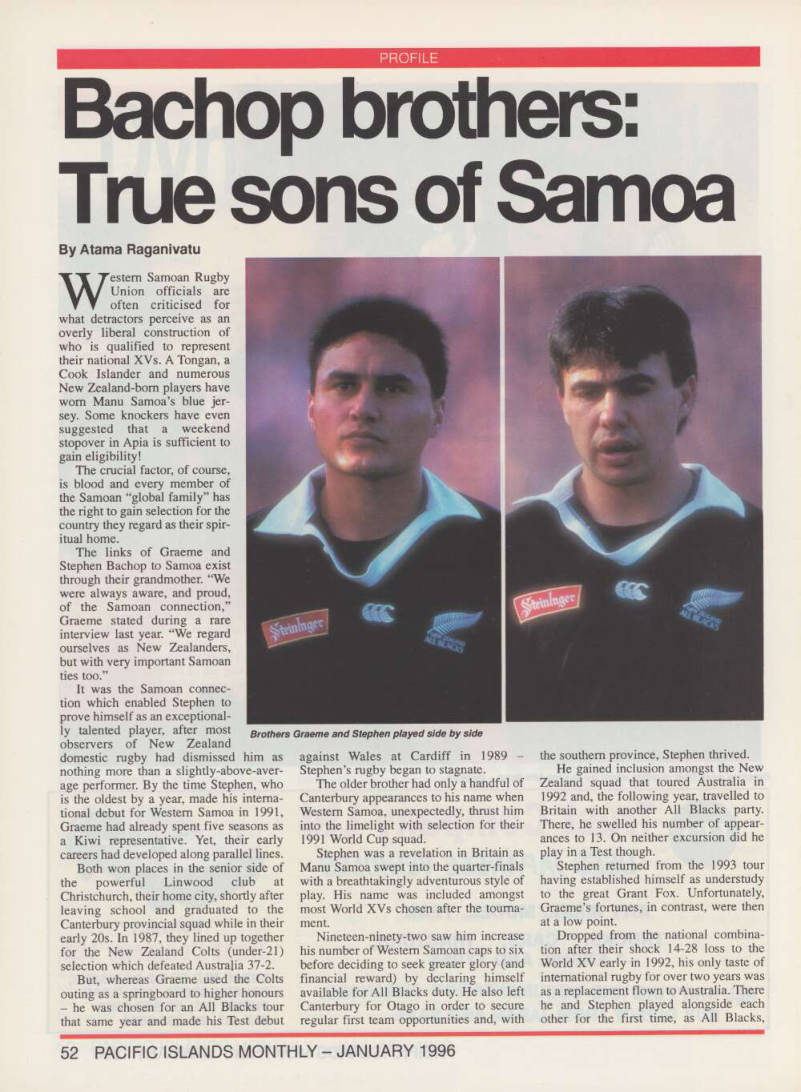
Brothers Graeme and Stephen played side by side
against the Australian Capital Territory.
Then, during 1994, Stephen too was subjected to the New Zealand selectors’ fickleness. In June, he was omitted from the 46-strong party named for the year’s final All Blacks trial.
However, just one month and one dis astrous Test against France later, the selec tors had a dramatic change of heart and picked him for the first five-eighth role as they sought revenge against the Tricolours.
Even though France won the second
Test too, Stephen played sufficiently well
to retain his place for New Zealand’s next international encounter, opposing South Africa, and, to add to his delight, Graeme
was restored to the side. It was the first time in 73 years that two brothers had appeared together in the same All Blacks backline.
Unfortunately, by the time the 1995 World Cup came around, Stephen found it was his turn to be out of favour once more and he did not even gain a place in the squad that travelled to South Africa.
Graeme, though, both appeared and rev elled in the tournament. Displaying his best-ever form, he was the top halfback on display as New Zealand came desperately close to regaining the trophy which sym bolises international rugby supremacy.
It now seems likely that neither Bachop brother will again grace the inter
national arena. Graeme gained a lucrative player-coach position with a Japanese club last year shortly after helping Canterbury capture the blue ribband tro phy of New Zealand domestic rugby union, the Ranfurly Shield, and was per mitted to resume All Blacks duty solely for the World Cup. Stephen can no longer even command a place in the Otago XV and current International Rugby Board rules preclude him from returning to the Western Samoan fold.
As both wing down their careers, Graeme and Stephen Bachop can be con tent in the knowledge that they have done much to further enrich Samoa’s rugby her itage. ■
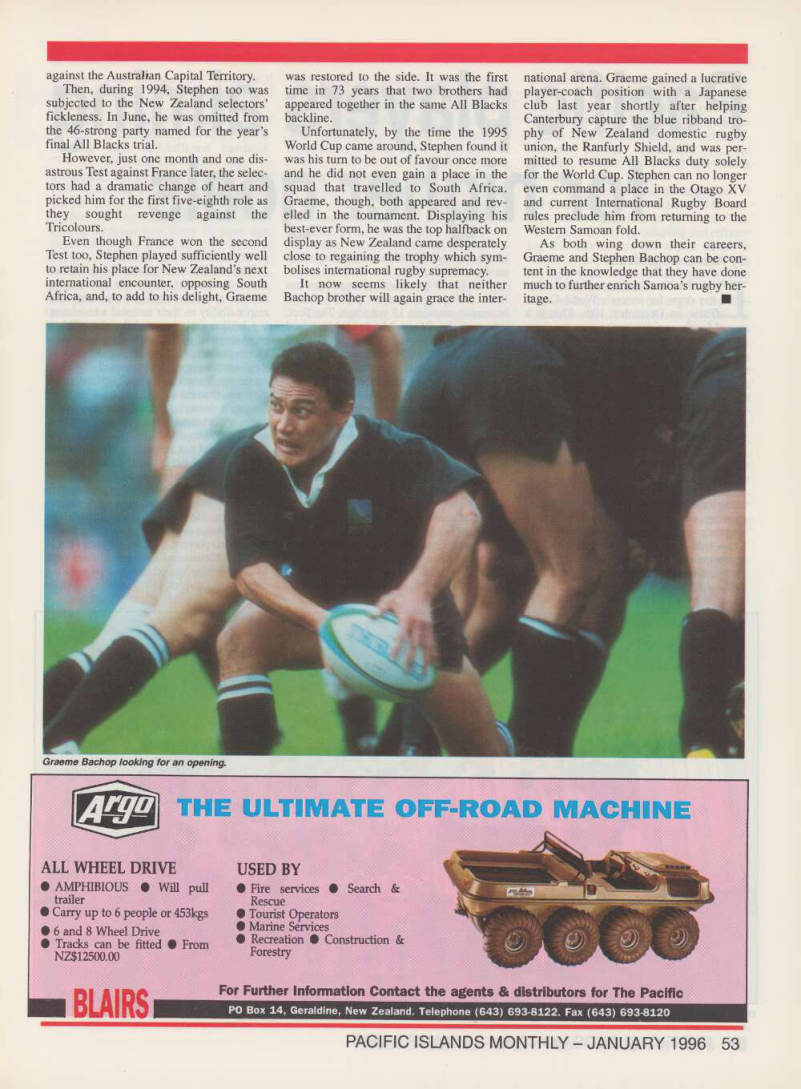
Graeme Bachop looking for an opening.