Dynamic Dymock
pp. 50-51 · Read in the full issue
Rugby
By Atama Raganivatu
Tongan rugby league player Jim
Dymock has just completed a year during which he won more honours than most sportsmen receive in a lifetime.
Dymock’s extraordinary 12 months
commenced in October last year, when he travelled to Fiji and inspired Tonga to a first-ever Pacific Cup success. His eligibil ity to represent the kingdom comes through a Tongan-bom mother. “I am hon oured to be selected,” he said at the time, “Because it means a lot to my mum.”
He certainly didn’t let his mother down.
Dymock played magnificently throughout
the two-week tournament and was particu larly influential in the final, when Fiji were hammered 34-11.
Prior to his Tongan call up, Dymock admitted he knew little about the Friendly Islands. But now, he would make an ideal spokesman for their tourist board. “Good Samaritan Beach is the closest thing to par adise on earth,” he enthused after a recent visit arranged by local rugby league offi cials. “The sunsets, the beach scenery and the tranquillity there are incredible.”
Dymock’s appreciation of Good
Samaritan Beach is understandable, for it presents a total contrast to the grim urban areas of Sydney where he spent his child hood years.
“I was bom in Paddington, but raised in Woolloomooloo - known to many people in Sydney as Struggle Street ,” Dymock says with a grin that is almost permanent.
It was in his birthplace suburb that Dymock gained the first taste of rugby league. He played for Paddington Colts as an infant before joining Zetland in Woolloomooloo. Zetland is a nursery of the famous South Sydney club and he graduated to the “Rabbitohs” youth team in 1989.
However, South Sydney subsequently
released him and it was with rivals Western Suburbs that Dymock made his debut in
the world’s toughest senior rugby league
championship, the Winfield Cup, in 1991.
The Magpies did not get the best out of Dymock. Used as little more than a batter ing ram by coach Warren Ryan, he missed half of the 1992 season with a knee injury and was then transferred to Canterbury - Bankstown (now known as the Sydney
Bulldogs).
Under the Bulldogs’ coach, Chris Anderson, all of Dymock’s many talents were cultivated. Today, he is respected for his adroit ball skills and uncanny ‘reading’ of a game, as well as the admirable brav ery, remarkable strength and exceptional work rate which had become evident at Western Suburbs. The Tongan is a classic example of a player who thrived on being
given greater responsibility.
Dymock’s first significant accolade
came during his first season as a Bulldog, when named in the Sydney City Origin representative side for their annual fixture with New South Wales Country Origin.
Nineteen-ninety-four saw him retain his place amongst the City selection and also play a major role in the Bulldogs’ surge through to that year’s Winfield Cup grand final. But, they then suffered a heavy defeat at the hands of Canberra Raiders.
Like nearly all his team-mates, Dymock did not do himself justice during Australian rugby league’s annual showpiece.
Dymock quickly overcame the one weighty disappointment of his career to spearhead Tonga’s triumph in Suva - an experience which ensured that he would be in good heart when the momentous 1995
campaign commenced.
Yet, the season could so easily have been a disastrous one for the Bulldogs. For much of the term, rugby league’s internal politics threatened to destroy their prospects.
Early in the year, the club announced they had aligned themselves with the
breakaway Super League organisation but
four of their leading players - including Dymock - then declared themselves loyal to the established Australian Rugby
League.
Internal bickering led to several dread
ful performances and the Bulldogs only
staggered into the end of season play-offs as the sixth-ranked team. However, during the finals series, Dymock and his team mates forgot all personal differences to come into their own and hot favourites Manly were downed 17-4 in a grand final performance which wiped away all memo ries of the nightmare inflicted by Canberra 12 months earlier. The huge part played by Dymock in the triumph was acknowledged when he was presented with the Man of the
Match award, the much-coveted Clive Churchill medal.
After placing the Winfield Cup win ners’ and Churchill medals in his trophy cabinet, Dymock was left with just one more assignment for 1995 - the Centenary World Cup.
Having been named captain of the Tongan side several months before, he was
eagerly anticipating wearing the
Kingdom’s red jersey in Britain. Instead, he found himself donning the green and gold of Australia after an eleventh-hour recruitment for the world champions’ 25strong travelling party.
Australia’s belated ‘poaching’ of Dymock will long remain a contentious matter. Under current international rules, the Australians do have first call upon his services. However, he was not included in their provisional squad of over 40 players and had been omitted from both the Sydney City and New South Wales repre sentative selections for 1995.
The Tongans were dismayed at the turn of events. Dymock had been the key figure in all Mate Ma Tonga’s World Cup plans from the moment they decided to enter the competition and their aggravation was
fully justified.
Dymock, though, recognised that he
had been presented with an opportunity for further glory and grabbed it.
After a disappointing start (his error led to one of the tries by which England beat Australia in the opening game), Dymock improved as the tournament progressed and was a pivotal factor in the Kangaroos overcoming their English hosts in the final at London’s historic Wembley Stadium.
And so, Tonga had its second world champion in a mainstream international sport (the first, rugby union player Viliame Ofahengaue, also achieved his success while representing Australia). The circum stances in which he was drafted into the Kangaroos side may vex Tongans and reflected glory is never totally satisfactory.
However, Dymock deserves all the prizes to have come his way and the Kingdom can take pride that yet another of their rugby-playing sons has proven himself a supreme talent.
Hopefully, that talent will serve Tonga again sometime in the future. ■
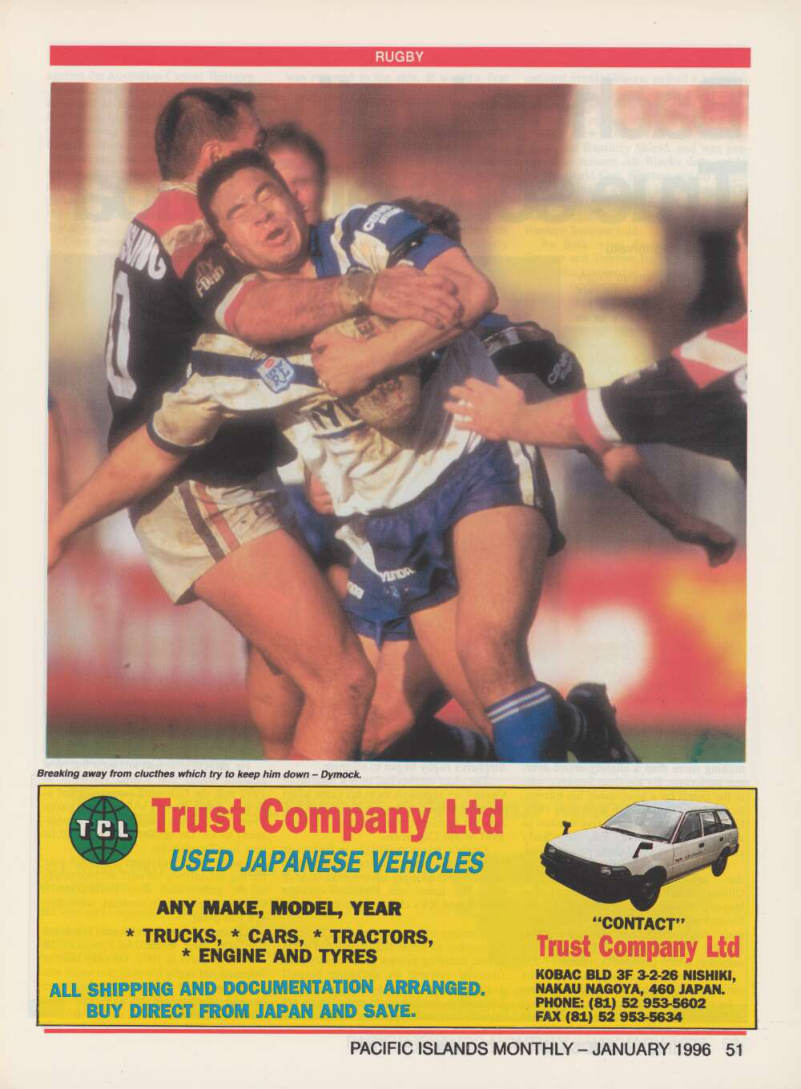
Breaking away from clucthes which try to keep him down - Dymock.