Niuatoputapu -
pp. 48-49 · Read in the full issue
Yachting
Niuatoputapu where time stands still
By Sally Andrews
Palu Nuku was riding his bicycle along the dirt road towards Hihifo when he stopped to greet us. Malo e lelei\ Of Samoan and Tongan blood, Palu chatted non-stop about his family. The exchange of information with people we meet in the islands is often fast and furi ous, sometimes slow, seldom non-existent.
The questions that are directed to us are usually: Where are you from? What is your name? What church do you belong to?
How many children do you have?
When I answer that I have no children, there is a sad response. I always smile and say, “not yet!” That usually gets a sympa thetic smirk or two. When I continue with raised eyebrows and add a hopeful
“mMaybe next year!” my interrogators
usually crack up laughing.
Hihifo is the administrative centre on Niuatoputapu, a beautiful hat-shaped island in northern Tonga surrounded with clean white sand beaches. To the north, the impressive volcanic cone of Tafahi Island sits five miles out to sea - beckoning but
prohibiting all but the most intrepid visi tors. Niuatoputapu itself is a sleepy place where time has stood still.
Life on Niuatoputapu still moves in tra ditional island fashion - mostly on foot.
Bicycles are used for inter-village visiting
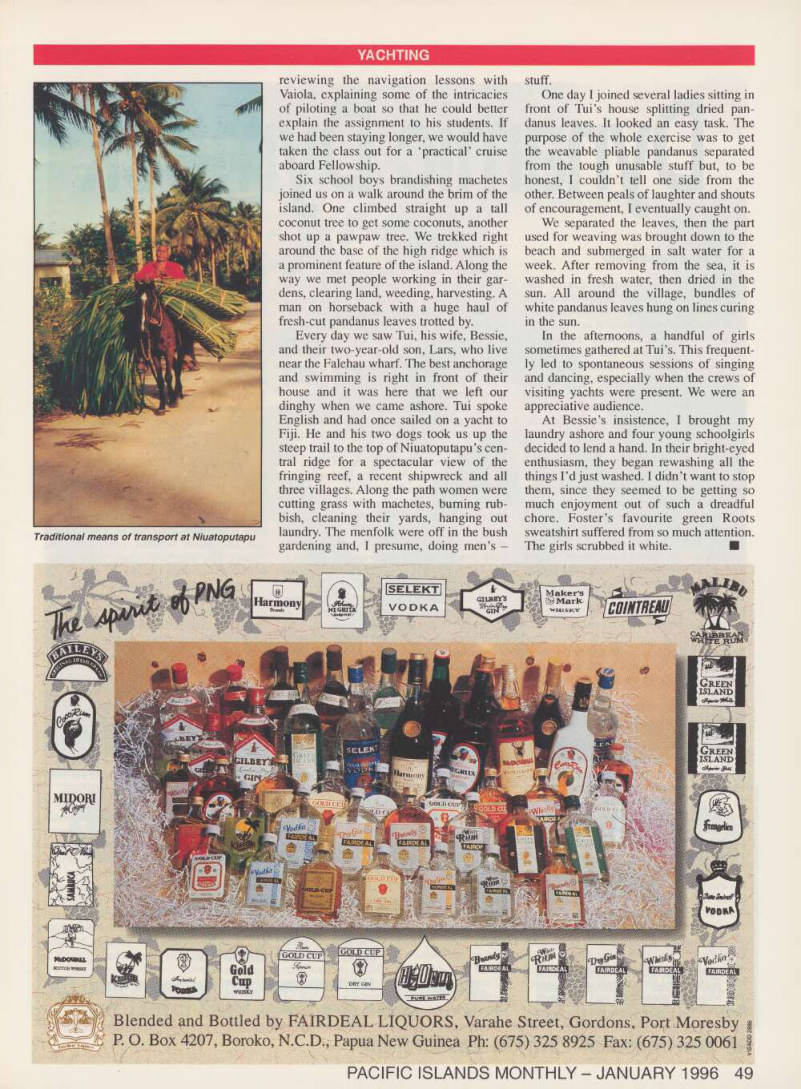
and horses transport produce from the gar dens to the village. Gaily painted wooden horse carts are used for hauling big loads and can be spotted in each village.
The women make exquisite pandanus mats, the sale of which constitutes the main source of cash on the island. The men help by cutting and collecting the green pandanus leaves from the bush and the ladies spend most of their day making mats with friends - sharing time, labour and laughter. Their hands are kept busy
soaking, rinsing, drying, cutting and weav
ing the soft pandanus fibre. The end result: High-quality pandanus mats that are sold to the local community in Tonga’s capital city, Nuku’alofa.
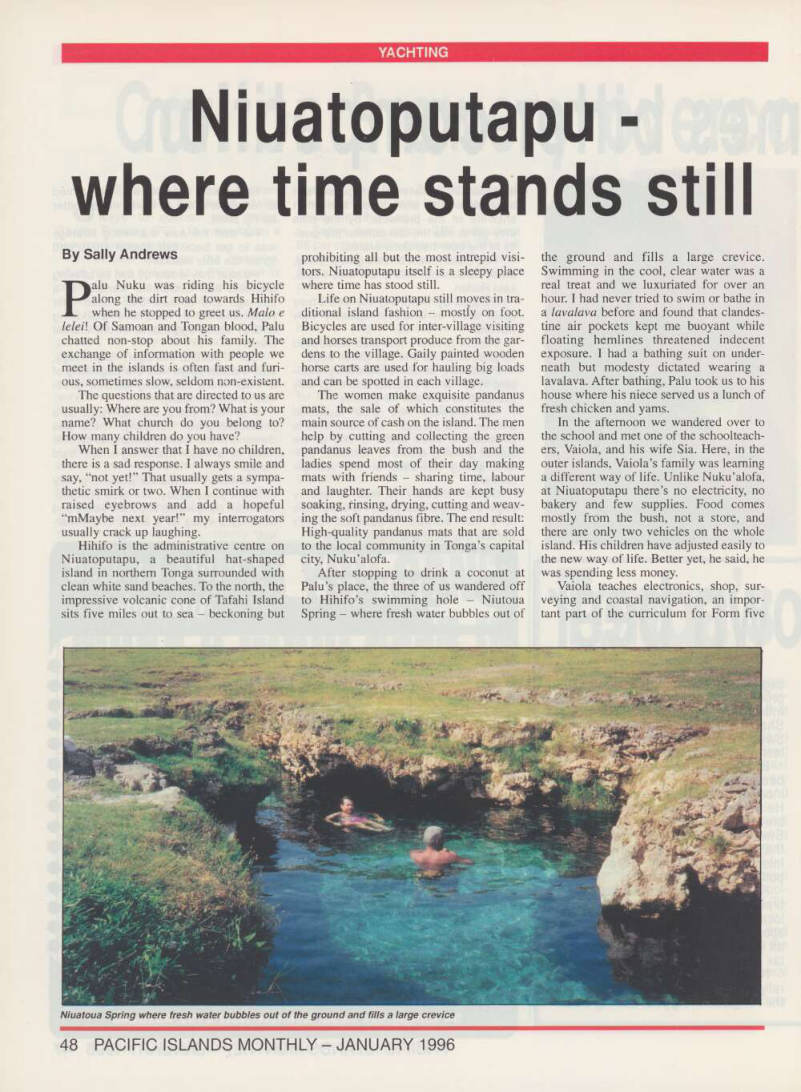
After stopping to drink a coconut at Palu’s place, the three of us wandered off to Hihifo’s swimming hole - Niutoua Spring - where fresh water bubbles out of
the ground and fills a large crevice.
Swimming in the cool, clear water was a real treat and we luxuriated for over an hour. I had never tried to swim or bathe in a lavalava before and found that clandes tine air pockets kept me buoyant while floating hemlines threatened indecent exposure. I had a bathing suit on under neath but modesty dictated wearing a lavalava. After bathing, Palu took us to his house where his niece served us a lunch of fresh chicken and yams.
In the afternoon we wandered over to the school and met one of the schoolteach ers, Vaiola, and his wife Sia. Here, in the outer islands, Vaiola’s family was learning a different way of life. Unlike Nuku’alofa, at Niuatoputapu there’s no electricity, no bakery and few supplies. Food comes mostly from the bush, not a store, and there are only two vehicles on the whole island. His children have adjusted easily to the new way of life. Better yet, he said, he was spending less money.
Vaiola teaches electronics, shop, sur veying and coastal navigation, an impor tant part of the curriculum for Form five
Niuatoua Spring where fresh water bubbles out of the ground and fills a large crevice
reviewing the navigation lessons with Vaiola, explaining some of the intricacies of piloting a boat so that he could better explain the assignment to his students. If we had been staying longer, we would have taken the class out for a ‘practical’ cruise
aboard Fellowship.
Six school boys brandishing machetes joined us on a walk around the brim of the island. One climbed straight up a tall coconut tree to get some coconuts, another shot up a pawpaw tree. We trekked right around the base of the high ridge which is a prominent feature of the island. Along the way we met people working in their gar dens, clearing land, weeding, harvesting. A man on horseback with a huge haul of fresh-cut pandanus leaves trotted by.
Every day we saw Tui, his wife, Bessie, and their two-year-old son, Lars, who live near the Falehau wharf. The best anchorage and swimming is right in front of their house and it was here that we left our dinghy when we came ashore. Tui spoke English and had once sailed on a yacht to Fiji. He and his two dogs took us up the steep trail to the top of Niuatoputapu’s cen tral ridge for a spectacular view of the fringing reef, a recent shipwreck and all three villages. Along the path women were cutting grass with machetes, burning rub bish, cleaning their yards, hanging out laundry. The menfolk were off in the bush gardening and, I presume, doing men’s -
stuff.
One day I joined several ladies sitting in front of Tui’s house splitting dried pan danus leaves. It looked an easy task. The purpose of the whole exercise was to get the weavable pliable pandanus separated from the tough unusable stuff but, to be honest, I couldn’t tell one side from the other. Between peals of laughter and shouts of encouragement, I eventually caught on.
We separated the leaves, then the part used for weaving was brought down to the beach and submerged in salt water for a week. After removing from the sea, it is washed in fresh water, then dried in the sun. All around the village, bundles of white pandanus leaves hung on lines curing in the sun.
In the afternoons, a handful of girls sometimes gathered at Tui’s. This frequent ly led to spontaneous sessions of singing and dancing, especially when the crews of visiting yachts were present. We were an
appreciative audience.
At Bessie’s insistence, I brought my laundry ashore and four young schoolgirls decided to lend a hand. In their bright-eyed enthusiasm, they began rewashing all the things I’d just washed. I didn’t want to stop them, since they seemed to be getting so much enjoyment out of such a dreadful chore. Foster’s favourite green Roots sweatshirt suffered from so much attention.
The girls scrubbed it white. ■
Traditional means of transport at Niuatoputapu