Protecting local
pp. 18-19 · Read in the full issue
Environment
Protecting local reef environments
By Liz Thompson
Reefs are probably the oldest eco system on the planet - up to 450 million years old. Coral organisms
are responsible for creating the largest
structures made by life on earth. As well as providing scuba divers with a rich world to explore, coral reefs function as a natural breakwater, protecting the land and coastal settlements from the ocean and providing natural harbours. Awareness is increasing as to the potential for a huge range of med icines for which reef animals and plants may be a source.
However, according to a report pro duced by Greenpeace, a shocking 75 per cent of the world’s reefs are dead or dying.
This tragic figure is the result of a variety of problems. These include the steady pop ulation growth and the development of a global trade in marine products.
International markets trading in marine products tend to focus on one species, which rapidly depletes the source and slowly erodes traditional fishing systems.
The use of dynamite by local fishing com munities is leaving large quantities of coral and marine life dead. Other forms of resource exploitation such as large-scale logging are also a problem. The long-term effects of logging, that is, land degradation and soil erosion, result in severe run off and siltation. Over long periods, this can have devastating effects on the marine ecology as the top soil washes into the oceans.
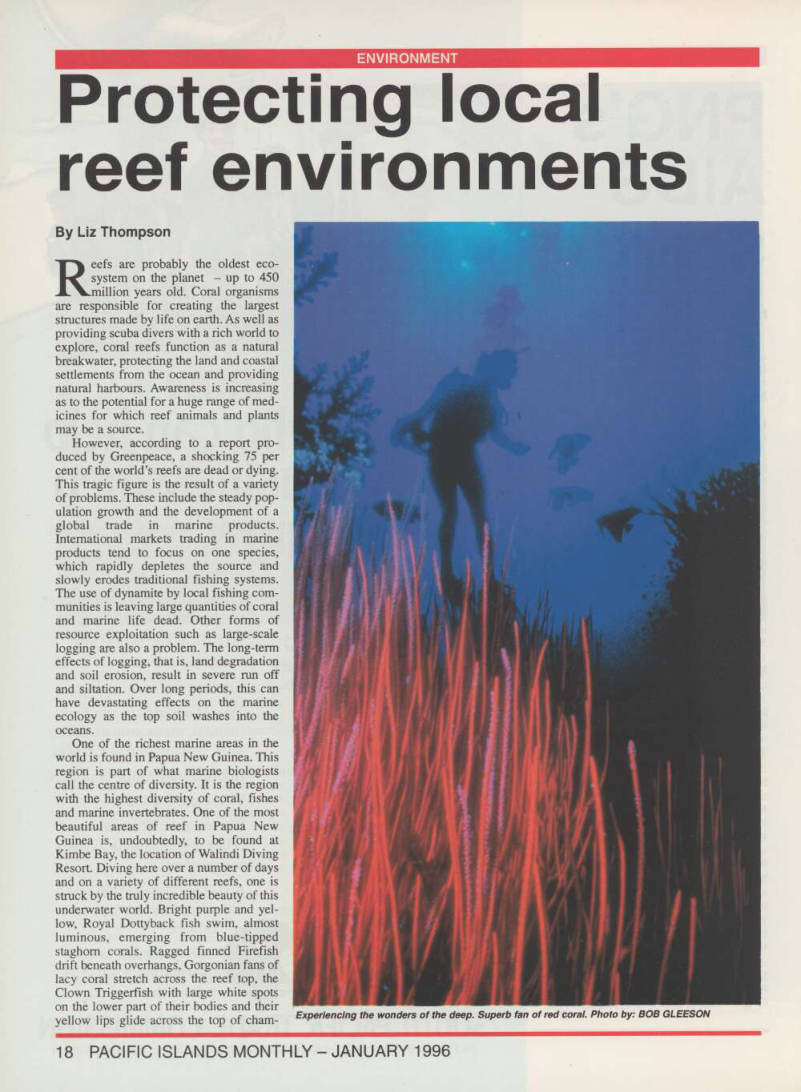
One of the richest marine areas in the world is found in Papua New Guinea. This region is part of what marine biologists call the centre of diversity. It is the region with the highest diversity of coral, fishes and marine invertebrates. One of the most beautiful areas of reef in Papua New Guinea is, undoubtedly, to be found at Kimbe Bay, the location of Walindi Diving Resort. Diving here over a number of days and on a variety of different reefs, one is struck by the truly incredible beauty of this underwater world. Bright purple and yel low, Royal Dottyback fish swim, almost luminous, emerging from blue-tipped staghorn corals. Ragged finned Firefish drift beneath overhangs, Gorgonian fans of lacy coral stretch across the reef top, the Clown Triggerfish with large white spots on the lower part of their bodies and their yellow lips glide across the top of cham-
Experiencing the wonders of the deep. Superb fan of red coral. Photo by: BOB GLEESON
pagne-coloured anemones. The extrava ganza goes on. Whichever of the numerous dive sites you descend into, it is always an extraordinary experience, abounding with colour and life.
The Nature Conservancy recently con ducted a survey of the diversity and marine resources around Walindi Diving Resort and the Kimbe Bay region and the results were remarkable.
World experts on coral and fishes were astonished at the diversity in this one small area. Over 320 species of coral were found on the reefs of Walindi - this is more than half of all the coral species in the world in this one bay. International experts on the survey considered that the reefs were amongst the most diverse they had ever seen. Over 700 species of fish were record ed during the survey and this number is expected to increase dramatically as more research is done. The total number of species may exceed 1000.
In the long term, Max and Cecily Benjamin, the owners of Walindi Diving Resort, are attempting to have the area reg istered as a marine park. This would mean
no commercial fishing, no spear fishing, no shell collecting, no aquarium collect ing, no dynamite fishing. Whilst a marine park would not involve stopping tradition al fishing rights it would attempt to raise community awareness as to the issue of marine protection.
In the meantime, however, Walindi Diving Resort has been closely involved in the establishment of a Nature Centre which is home for the Islands Regional Environmental Programme. The project is largely funded by the European Union and the land has been made available by the resort. Research facilities will be open for use by individual scientists and organisa tions, for research towards: Fish and coral identification in order to develop a more extensive data base; reef monitoring; envi ronmental conservation; and marine and terrestrial biology. % The Islands Region Environmental Programme will pursue efforts in eco forestry and eco-tourism and environmen tal awareness and education. The centre itself is being established with these basic philosophies in mind. The timber being
used to build the centre is all produced by the local villagers themselves as part of the training programme on community-based small-scale sawmilling. The timber has been cut with chainsaw mills under super vision and then dressed with relatively
simple equipment. Sago roofing is being
prepared on site and a sago treatment area has been made which will be used for the life of the building programme.
If conservation is to take place on a meaningful level it is obviously necessary to raise the awareness of the local popula tion as well as visitors. There will be a par ticular focus on developing environmen tally sensitive means for generating an income to benefit the local economy. This, it is hoped, will discourage, or render unnecessary the more destructive income generating practice of unsustainable resource exploitation such as large scale logging. The approach to environmental protection and conservation at Walindi is a thorough and wholistic one, attempting to address the issue from a number of rele vant and equally important angles. ■
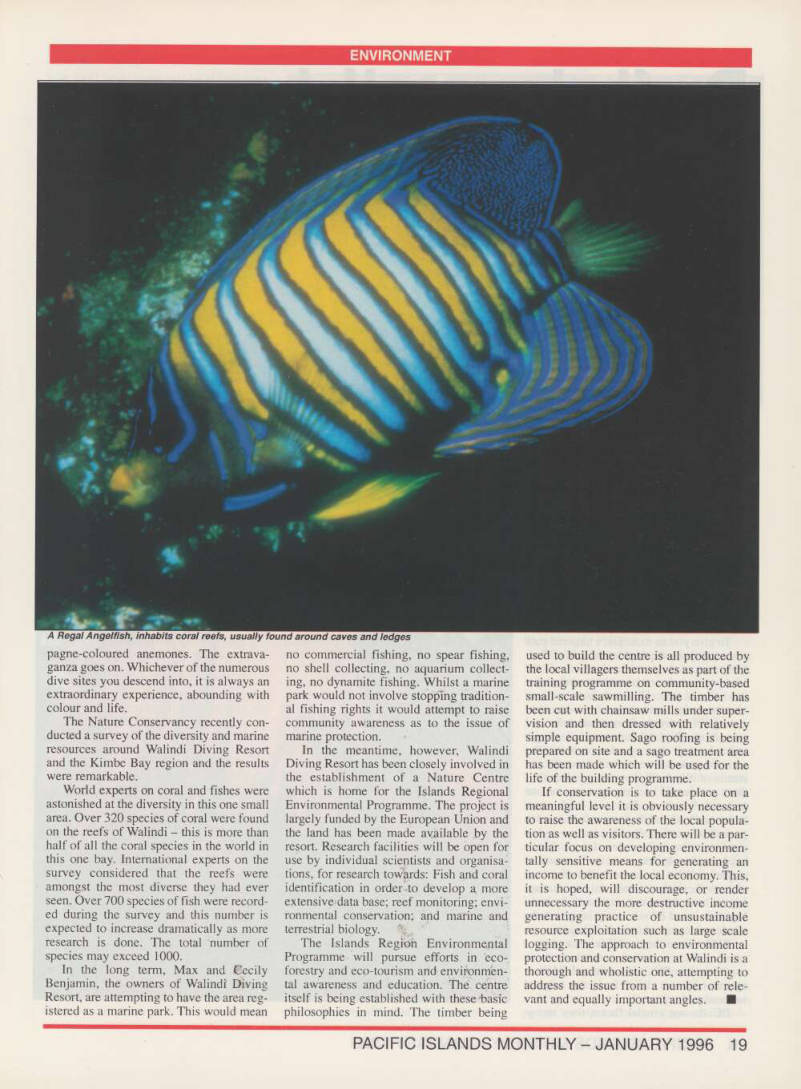
A Regal Angelfish, inhabits coral reefs, usually found around caves and ledges