Defining wilderness
pp. 20-22 · Read in the full issue
By Liz Thomson
With increasing resource exploita
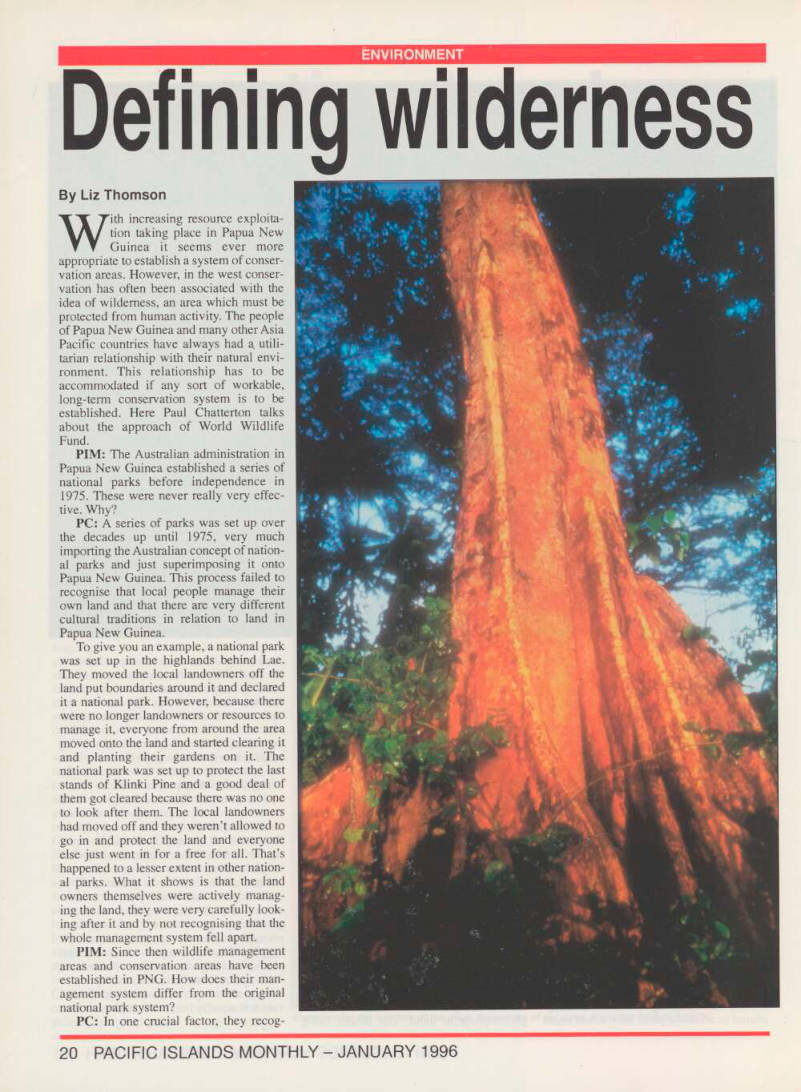
tion taking place in Papua New Guinea it seems ever more appropriate to establish a system of conser vation areas. However, in the west conser vation has often been associated with the idea of wilderness, an area which must be
protected from human activity. The people
of Papua New Guinea and many other Asia Pacific countries have always had a utili tarian relationship with their natural envi ronment. This relationship has to be accommodated if any sort of workable, long-term conservation system is to be established. Here Paul Chatterton talks about the approach of World Wildlife Fund.
PIM: The Australian administration in Papua New Guinea established a series of national parks before independence in 1975. These were never really very effec
tive. Why?
PC: A series of parks was set up over the decades up until 1975, very much importing the Australian concept of nation al parks and just superimposing it onto Papua New Guinea. This process failed to recognise that local people manage their own land and that there are very different cultural traditions in relation to land in Papua New Guinea.
To give you an example, a national park was set up in the highlands behind Lae.
They moved the local landowners off the land put boundaries around it and declared it a national park. However, because there were no longer landowners or resources to manage it, everyone from around the area moved onto the land and started clearing it and planting their gardens on it. The national park was set up to protect the last stands of Klinki Pine and a good deal of them got cleared because there was no one to look after them. The local landowners had moved off and they weren’t allowed to go in and protect the land and everyone else just went in for a free for all. That’s happened to a lesser extent in other nation al parks. What it shows is that the land owners themselves were actively manag ing the land, they were very carefully look ing after it and by not recognising that the whole management system fell apart.
PIM: Since then wildlife management areas and conservation areas have been established in PNG. How does their man agement system differ from the original
national park system?
PC: In one crucial factor, they recog-
nise local landowners and local land man agement systems in looking after land.
Today a community which wants to put its land into a conservation area, informs the government. They mark the boundaries of the conservation area. Communities set down the rules that they want, they set up a committee from their own people to look after it. Then the government rubber stamps that. So it’s very much turning the thing on its head. Throwing the responsi bility back on to the community, recognis ing that they’re already the managers and ideally giving them the resources to devel op the conservation area. Unfortunately, that doesn’t happen very often. There are many areas set up like this which have been running for 20 years now without any government intervention.
PIM: Can you talk a little about what you have discovered in your research about the nature of the relationship most Melanesian communities have with their land?
PC: As Westerners we come with a vision of the natural environment as some thing that is threatened by the industrial world. We have to protect certain areas of the natural landscape from damage by bull dozers or by pollution or by the impact of human beings. For many Papua New Guineans that’s not the case, though of course, that is changing with increased forestry and mining and so on. To help establish a conservation programme in a place like PNG, organisations like WWF have to gain a better understanding of the way in which people relate to their land.
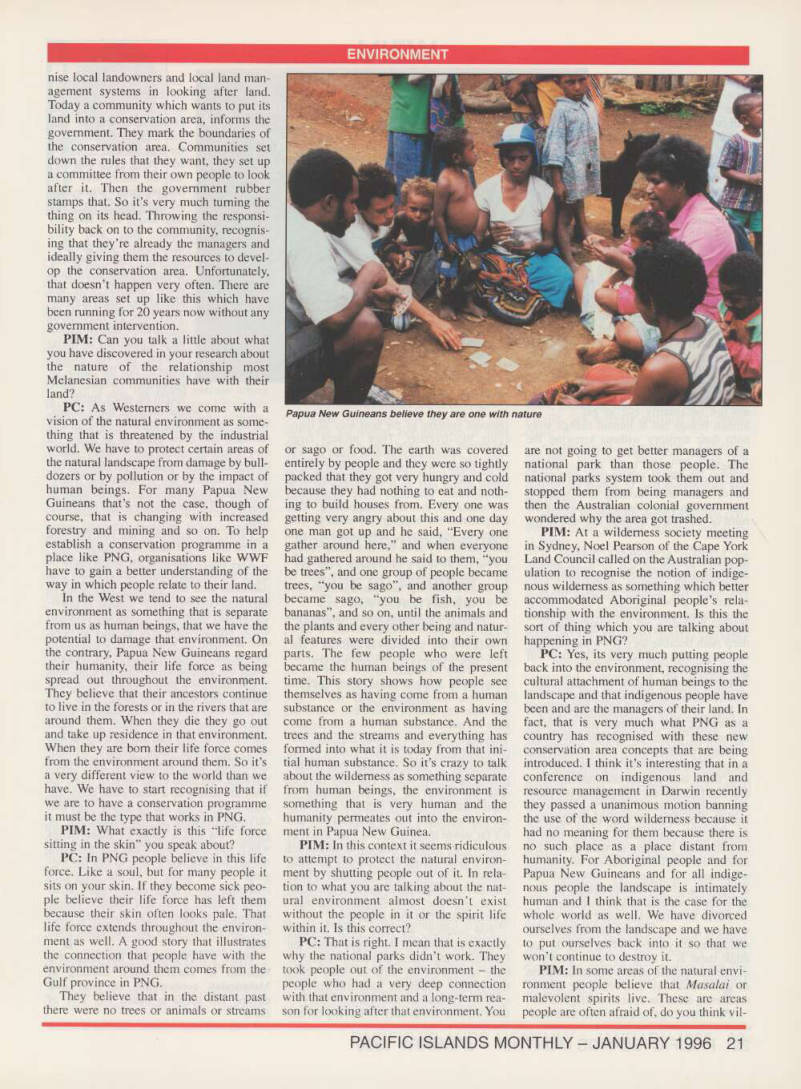
In the West we tend to see the natural environment as something that is separate from us as human beings, that we have the potential to damage that environment. On the contrary, Papua New Guineans regard their humanity, their life force as being spread out throughout the environment.
They believe that their ancestors continue to live in the forests or in the rivers that are around them. When they die they go out and take up residence in that environment.
When they are bom their life force comes from the environment around them. So it’s a very different view to the world than we have. We have to start recognising that if we are to have a conservation programme it must be the type that works in PNG.
PIM: What exactly is this “life force sitting in the skin” you speak about?
PC: In PNG people believe in this life force. Like a soul, but for many people it sits on your skin. If they become sick peo ple believe their life force has left them because their skin often looks pale. That life force extends throughout the environ ment as well. A good story that illustrates the connection that people have with the environment around them comes from the Gulf province in PNG.
They believe that in the distant past there were no trees or animals or streams
or sago or food. The earth was covered entirely by people and they were so tightly packed that they got very hungry and cold because they had nothing to eat and noth ing to build houses from. Every one was getting very angry about this and one day one man got up and he said, “Every one gather around here,” and when everyone had gathered around he said to them, “you be trees”, and one group of people became trees, “you be sago”, and another group became sago, “you be fish, you be bananas”, and so on, until the animals and the plants and every other being and natur al features were divided into their own parts. The few people who were left became the human beings of the present time. This story shows how people see themselves as having come from a human substance or the environment as having come from a human substance. And the trees and the streams and everything has formed into what it is today from that ini tial human substance. So it’s crazy to talk about the wilderness as something separate from human beings, the environment is something that is very human and the humanity permeates out into the environ ment in Papua New Guinea.
PIM: In this context it seems ridiculous to attempt to protect the natural environ ment by shutting people out of it. In rela tion to what you are talking about the nat ural environment almost doesn’t exist without the people in it or the spirit life within it. Is this correct?
PC: That is right. I mean that is exactly why the national parks didn’t work. They took people out of the environment - the people who had a very deep connection with that environment and a long-term rea son for looking after that environment. You
are not going to get better managers of a national park than those people. The national parks system took them out and stopped them from being managers and then the Australian colonial government wondered why the area got trashed.
PIM: At a wilderness society meeting in Sydney, Noel Pearson of the Cape York Land Council called on the Australian pop ulation to recognise the notion of indige nous wilderness as something which better accommodated Aboriginal people’s rela tionship with the environment. Is this the sort of thing which you are talking about happening in PNG?
PC: Yes, its very much putting people back into the environment, recognising the cultural attachment of human beings to the landscape and that indigenous people have been and are the managers of their land. In fact, that is very much what PNG as a country has recognised with these new conservation area concepts that are being introduced. I think it’s interesting that in a conference on indigenous land and resource management in Darwin recently
they passed a unanimous motion banning
the use of the word wilderness because it had no meaning for them because there is no such place as a place distant from humanity. For Aboriginal people and for Papua New Guineans and for all indige
nous people the landscape is intimately
human and I think that is the case for the whole world as well. We have divorced ourselves from the landscape and we have to put ourselves back into it so that we won’t continue to destroy it.
PIM: In some areas of the natural envi ronment people believe that Masalai or malevolent spirits live. These are areas people are often afraid of, do you think vil
Papua New Guineans believe they are one with nature
lagers might encourage log ging in these areas in the hope the malevolent spirits will be destroyed?
PC: Well yes, one of the things that comes up time and time again in PNG is that this connection with the environment is not uniform, it’s not “we the indigenous people are intimately con nected with all of our land”.
There are parts of the envi ronment that people are dead afraid of. There are places where the forest spirits live ,where people won’t go in; there are places way out in the bush that are considered dark, places of danger, places of disease. People have this term, Masalai - spirits of the deep bush that are antagonis tic to human beings. They
are not necessarily out to get human beings but if human beings stray onto their territory without knowing the rules which those spirits live by then the Masalai will make those human beings sick. And so, Papua New Guineans spend a lot of time understanding and teaching their children these rules and respecting the rules of movement through the land of the Masalai.
In terms of logging and so on in many instances people won’t want to tamper with that area because it is too dangerous and it is also too important to them as a source of goodness. But I have come across some communities who are quite happy for bulldozers to go through their deep bush because they know the bulldoz er will get sick and not them, so they will give permission for this.
PIM: Is this notion of “deep bush” almost like a notion of wilderness?
PC: In a lot of communities people believe that their pigs, their taro and other agricultural plants or animals have their origins in the deep bush. Not so much that the plants or animals have come from that area, that a wild pig has been domesticated and has become the village pig, it’s more that the spirit essence of the pig has come from that place in the deep bush. So it’s a paradox, you could almost say that there is a wilderness concept in that sense. It’s almost like medieval, biblical concept of wilderness, a place of otherness, of strangeness, of non-human beings, so very different to our concepts of wilderness.
PIM: So with your work with WWF, which is to set up a more appropriate land management system in PNG, why do you think there is a need for this? Surely if
indigenous people largely reject the notion
of wilderness they also reject the idea of separating areas for special management.
PC: We recognise traditional land man-
agement systems as the best way of man aging bio-diversity. They protect large areas of forest, they protect areas of wet lands. Ideally we would not be working in places like PNG if indigenous resource
management practices were organised.
Unfortunately, that is not happening. With the pressure for logging, for mining, with intensive agriculture, communities’ own management systems are not being recog nised. Our hope is that through establish ing conservation areas we can help them to get those traditional land management sys tems recognised in national law.
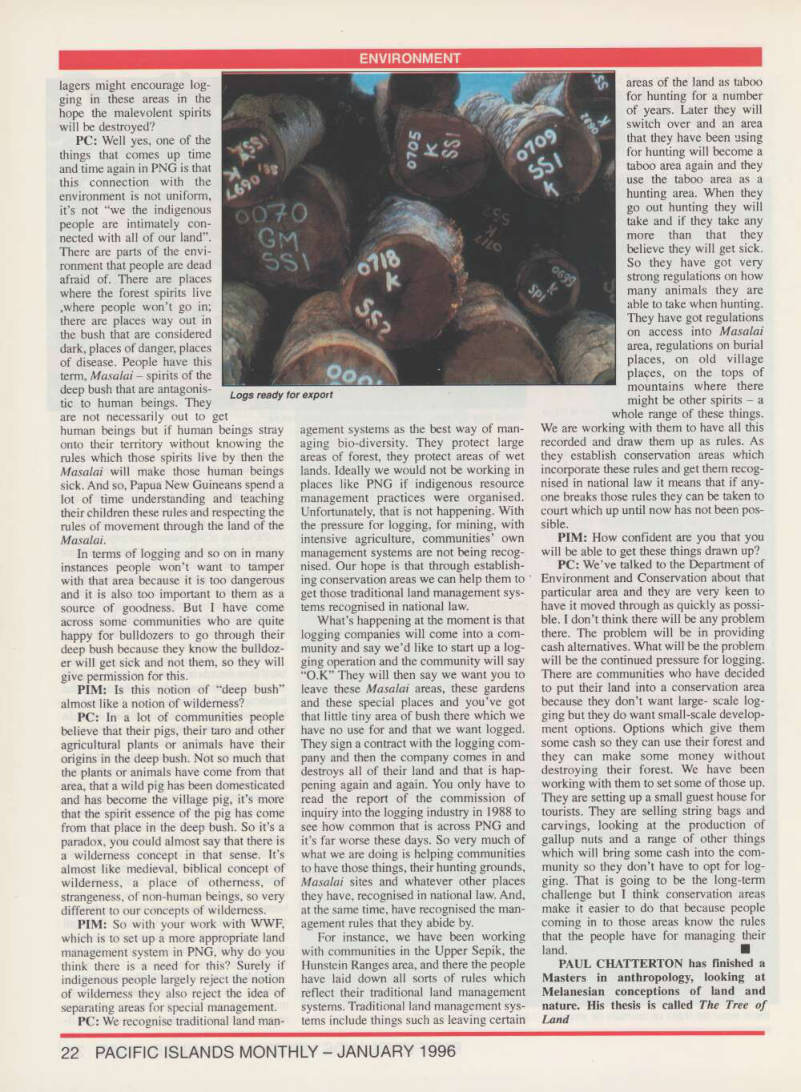
What’s happening at the moment is that logging companies will come into a com munity and say we’d like to start up a log ging operation and the community will say “O.K” They will then say we want you to leave these Masalai areas, these gardens and these special places and you’ve got that little tiny area of bush there which we have no use for and that we want logged.
They sign a contract with the logging com pany and then the company comes in and destroys all of their land and that is hap pening again and again. You only have to read the report of the commission of inquiry into the logging industry in 1988 to see how common that is across PNG and it’s far worse these days. So very much of what we are doing is helping communities to have those things, their hunting grounds, Masalai sites and whatever other places they have, recognised in national law. And, at the same time, have recognised the man agement rules that they abide by.
For instance, we have been working with communities in the Upper Sepik, the Hunstein Ranges area, and there the people have laid down all sorts of rules which reflect their traditional land management systems. Traditional land management sys tems include things such as leaving certain
areas of the land as taboo for hunting for a number of years. Later they will switch over and an area that they have been using for hunting will become a taboo area again and they use the taboo area as a hunting area. When they go out hunting they will take and if they take any more than that they believe they will get sick.
So they have got very strong regulations on how many animals they are able to take when hunting.
They have got regulations on access into Masalai area, regulations on burial places, on old village places, on the tops of mountains where there might be other spirits - a
whole range of these things, We are working with them to have all this recorded and draw them up as rules. As they establish conservation areas which incorporate these rules and get them recog nised in national law it means that if any one breaks those rules they can be taken to court which up until now has not been pos sible.
PIM: How confident are you that you will be able to get these things drawn up?
PC: We’ve talked to the Department of Environment and Conservation about that particular area and they are very keen to have it moved through as quickly as possi ble. I don’t think there will be any problem there. The problem will be in providing cash alternatives. What will be the problem will be the continued pressure for logging, There are communities who have decided to put their land into a conservation area because they don’t want large- scale log ging but they do want small-scale develop
ment options. Options which give them
some cash so they can use their forest and they can make some money without destroying their forest. We have been working with them to set some of those up.
They are setting up a small guest house for tourists. They are selling string bags and
carvings, looking at the production of
gallup nuts and a range of other things which will bring some cash into the com munity so they don’t have to opt for log ging. That is going to be the long-term challenge but I think conservation areas make it easier to do that because people coming in to those areas know the rules that the people have for managing their land. U PAUL CHATTERTON has finished a Masters in anthropology, looking at Melanesian conceptions of land and nature. His thesis is called The Tree of Land
Logs ready for export