Co-ordinating medical
pp. 14-16 · Read in the full issue
Cover Story
Co-ordinating medical aid to the Pacific
For many years Pacific islanders have been reaping the benefits of visiting sur geons from Australia. To ensure that a lot more people benefit from the sur geons, the funding organisation, AusAID, will now co-ordinate the trips to pro vide an even service to the islands based on their needs. Robert Simms reports.
Medical specialist teams sponsored by the Australian aid organisation AusAID, a common sight in hos pitals throughout the Pacific, now must apply for their project funding to a govern ment-appointed co-ordination unit within the Royal Australian College of Surgeons
(Racs).
The move to farm out this responsibili ty came because of the increasing number of funding applications being received by AusAID. Chairman of the new RACS Pacific Islands Projects (PIP) committee Dr David Theile said this change of approach will give islanders a broader range of services. “These will not depend solely on the enthusiasm of individual doc tors in Australia,” he said. “We conducted a needs analysis and consulted the local people to determine what services are required, and now have planned pro grammes that meet these needs.”
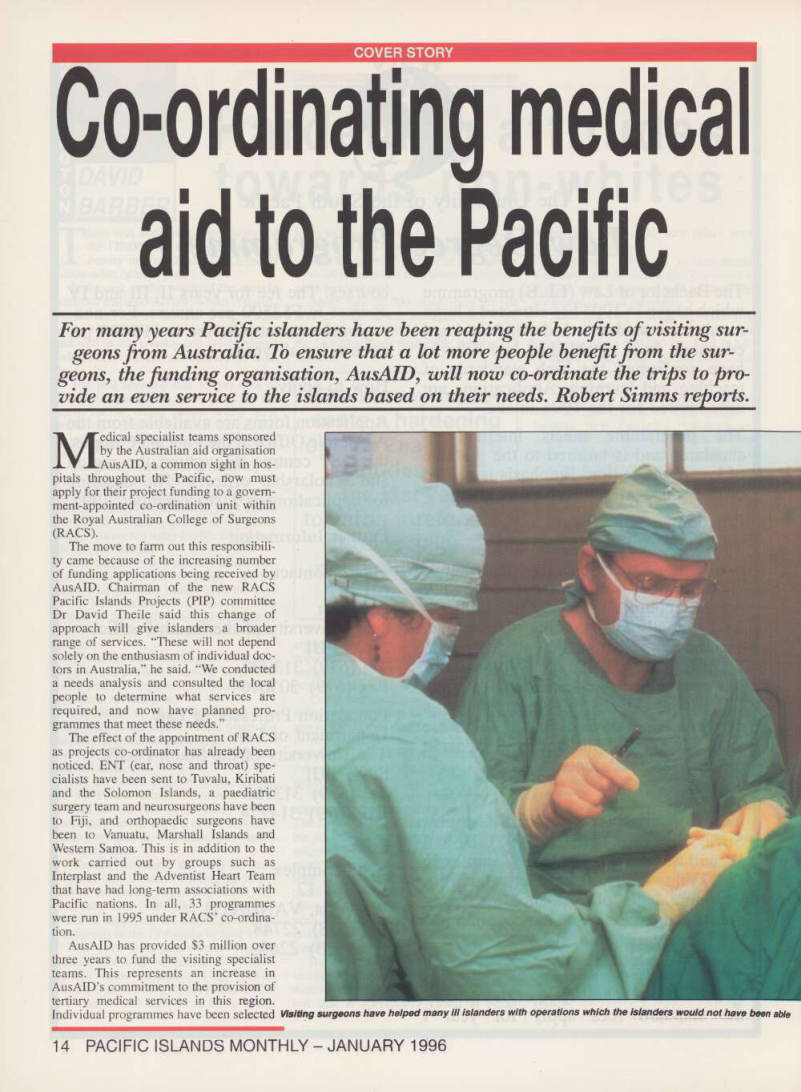
The effect of the appointment of RACS as projects co-ordinator has already been noticed. ENT (ear, nose and throat) spe cialists have been sent to Tuvalu, Kiribati and the Solomon Islands, a paediatric surgery team and neurosurgeons have been to Fiji, and orthopaedic surgeons have been to Vanuatu, Marshall Islands and Western Samoa. This is in addition to the work carried out by groups such as Interplast and the Adventist Heart Team that have had long-term associations with Pacific nations. In all, 33 programmes were run in 1995 under RACS’ co-ordina tion.
AusAID has provided $3 million over three years to fund the visiting specialist teams. This represents an increase in AusAlD’s commitment to the provision of tertiary medical services in this region.
Individual programmes have been selected
Visiting surgeons have helped many ill islanders with operations which the islanders would not have been able
that will improve the lives of the greatest number of patients. “Local doctors know months before the teams arrive to look out for patients who could be helped by the visiting surgeons,” Marion Wright, execu tive secretary of the RAGS committee said.
“Then when the team arrives, the patients can be quickly assessed and scheduled for surgery during the twoweeks the special ists are available.” Patients are not charged for the medical treatment provided by the specialists.
One casualty of the new system is ASPECT, the eye-care group.
Disagreement over the reimbursement of ongoing private practice costs in Australia while the ophthalmologists were in the islands has lead to the demise of this out standing organisation. “Our philosophies didn’t meet,” ASPECT’S executive officer, Len Slater, said. “The new system relies on volunteers, most of whom will go to the islands just once, whereas ASPECT used the same doctors each year to provide con tinuity of service. From our point of view.
the new approach is unsustainable.” The RACS-PIP committee has formed a replacement eye-care unit to take over the role of ASPECT in the Pacific.
Non-specialist groups Organisations not funded by AusAID or providing health services other than med ical specialist services are unaffected by the shift in project co-ordination. They will either continue to receive support from individuals and private groups or will apply directly to AusAID for assistance.
The Adventist Development Relief Agency (ADRA), for example, raises a large proportion of its funds through public appeals in Australia. AusAID also con tributes to its work. The agency maintain two hospitals in the Pacific, one in Enga Province of Papua New Guinea and one on
Malaita in the Solomon Islands. Each has about 120-bed capacity. ‘‘We spend about $U5355,000 in the Solomons and over SUS7IO,OOO in PNG each year staffing the hospitals and conducting clinics,” Dr Percy Harold, Medical Director of ADRA said.
"In addition to this, we have sent 7 con tainer loads of medical equipment and fur niture to government hospitals in Fiji, PNG, Solomon Islands and Vanuatu in the last 4 years.” A total of about SUS 2.4 mil lion is spent each year by ADRA in this region, the majority on health-related pro
jects.
David Vosseler, co-ordinator of the Medical Supplies and Services pro grammes of the Australian Foundation for the Peoples of Asia and the Pacific (AFAP), said his organisation is also
o afford otherwise
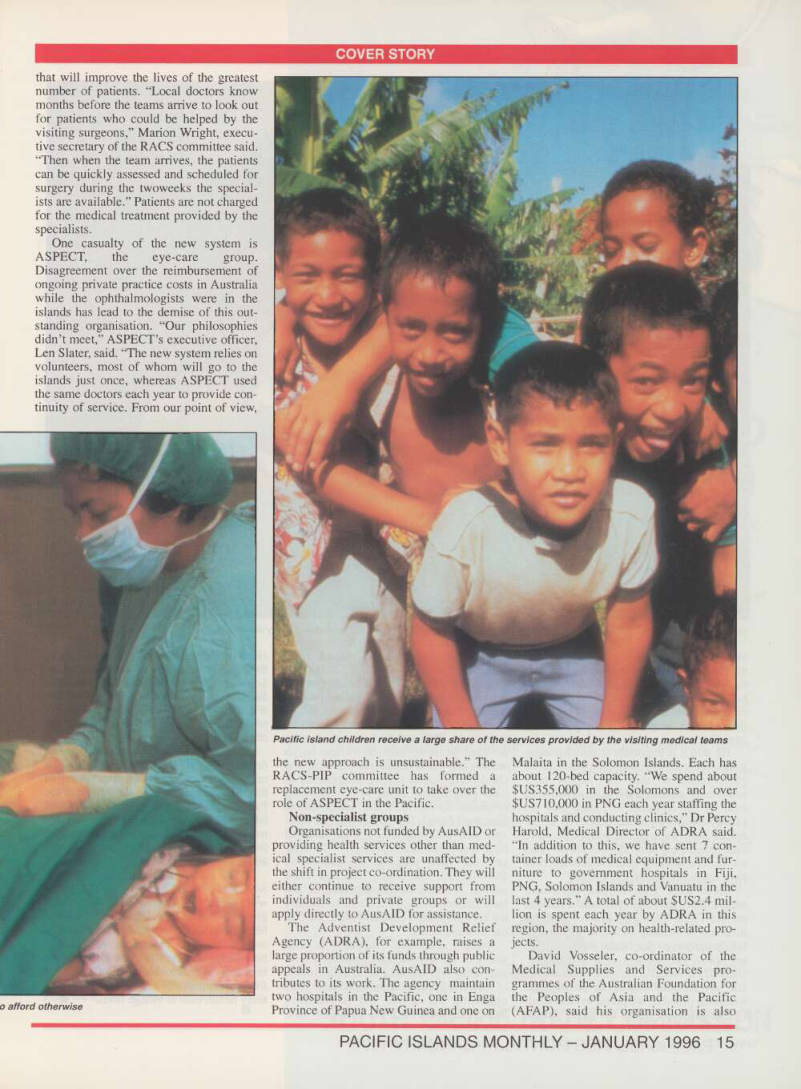
Pacific island children receive a large share of the services provided by the visiting medical teams
involved in upgrading medical facilities in the Pacific. “We are given surplus beds and equipment by 30 hospitals and nursing homes in New South Wales,” he said. “We completely refurbish these before sending them on to hospitals needing specific items.”
He said it is important to develop long term relationships with Pacific Islands governments so they can supply their needs over a number of years. “We work with the governments to ensure they get exactly what they want, and even in the colour they want it,” he said. “We have established a big network over the 30 years we’ve been working in this region and now have many projects in the islands.”
Their work goes beyond equipment supply. They are helping to build a hospital on the Fijian island of Kadavu and are involved in running nutrition and educa tion programmes for health workers. “We are not in the business of sending physi cians to the islands,” he said. “We empha sise self-sustainability in our projects, so, whenever possible, we prefer to fund local ly trained people to do the work.” In the
past, project costs have ranged from $U521,300 to as much as $U5532,000.
Initial training of Pacific health workers is often carried out by Australian personnel. The Save the Children Alliance (SCA) is one group that sends training specialists to Vanuatu, PNG and the Solomons for two or three years to provide village health worker and nurse education. Maternal and child health issues feature prominently in their programmes along with continuing emphasis on nutrition and health education. Paul Greco, Pacific Programme manager said SCA supports a wide range of large and small health projects. “Our budget for this year is in excess of $U5710,000,” he said. "Through close contact with the health departments and local communities, we are able to identify the area of greatest need and make the best use of these funds.”
Family Planning Australia is also active in the area of health worker education. They will spend close to SUS7IO,OOO of AusAID funds over the next three years upgrading the sexual and reproductive health care knowledge of community edu
cators, nurse and medical practitioners, and the skills of management personnel in the Solomon Islands, Vanuatu, Fiji, Western Samoa, Tonga and Tuvalu. Their approach is to deliver training programmes in appro priate cultural environments with a focus
on regional requirements.
These and numerous other Australian organisations spend in excess of SUSI 4.2 million each year providing direct health or health-related services to the people in the Pacific. Bringing medical specialists and educators to this region not only provides treatment to individual patients but also improves the skills of local doctors, nurses and health workers.
While medical facilities will improve in time, it is unlikely local specialist services will ever be able to cover all medical disci plines in the Pacific. However, with the help of organisations that put the care of individuals first regardless of national boundaries. Pacific Islanders will continue to receive a reasonable level of specialist medical support and a high standard of pri mary health care at village level. H
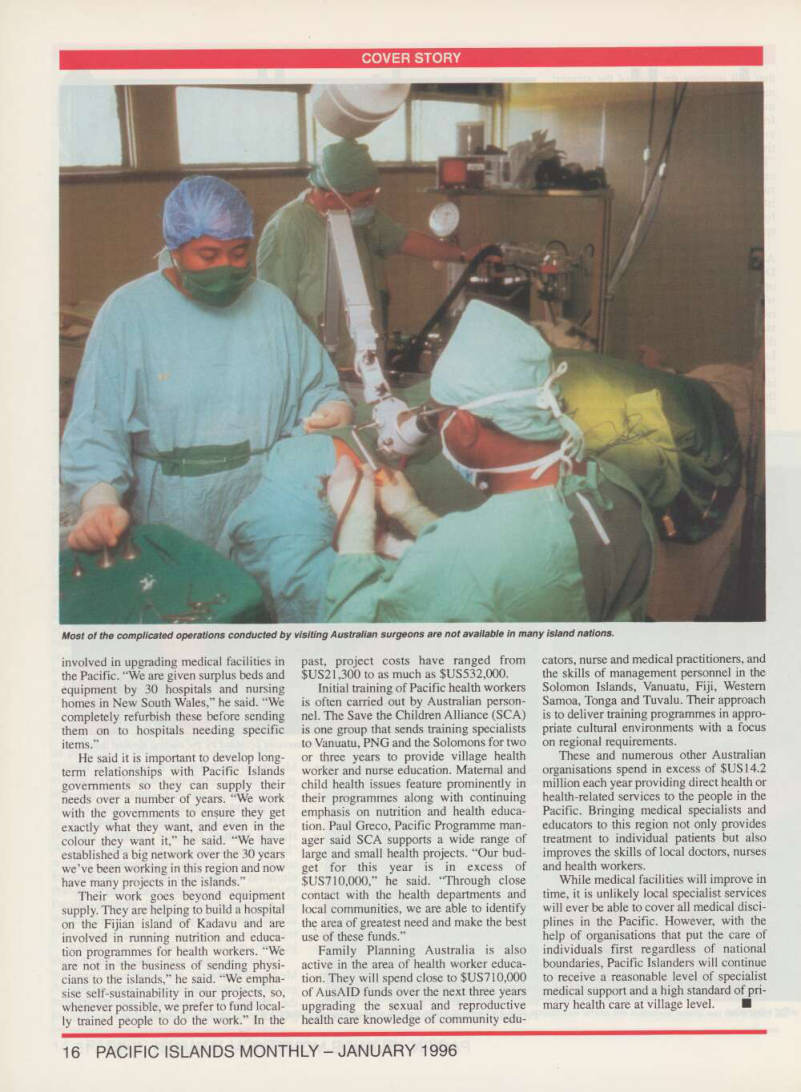
Most of the complicated operations conducted by visiting Australian surgeons are not available in many island nations.