The soaring success
pp. 29-35 · Read in the full issue


Aviation Feature
The soaring success of Air Pacific
Air Pacific is an example of how good management and strategic planning can work wonders for a company. From being technically bankrupt in thel9Bos, the company has piloted its way to success and for the second year in a row has paid dividends to its shareholders. The company’s, Chief Executive Officer, Andrew Drysdale, talks about the airline’s achievements.
The 1994/95 financial year proved to be a rather remarkable one. It marked the successful end of our first five year plan with all major objectives achieved, saw us enter the Fiji/USA route with services to Los Angeles and begin new services to Osaka. We also committed to the inauguration of services to Wellington which began early in the new financial year.
One of the most significant developments in terms of regional aviation cooperation was the joint lease of a 8737-300 with Royal Tongan Airlines and the commence ment of joint services using this aircraft.
The year also saw the introduction of a new 8767-300 ER delivered in September to replace the older model of this aircraft which had begun operations some three years ago. All costs associated with these changes have been taken up in the accounts. Given all of these factors, an operating profit for the 1994/95 year of SUS 8.418 million is most pleasing. That we have also been able to again return a divi dend to our shareholders is a matter of quiet pride amongst our people.
Having said all of that, the profit must be viewed in the context of future capital requirements. We face the need to fund a new 8767 in 1998 which will cost approxi mately SUS 124.2 million and the formula whereby Air Pacific, and for that matter Fiji, will fund this aircraft wilt need very careful consideration. 1995 marks the end of the company’s first five-year plan period and it is satisfying to report that every major target set in that plan has been achieved. What is more, the very fundamental strategic change the company has undergone during this period was completed during the recession and the worst time in aviation financial history, and yet we were able to maintain profitabil ity throughout.
With this restructuring behind us, and with the company now properly positioned to take advantage of its new strengths, we can look to the future with some degree of comfort. I take this opportunity to thank my people for their efforts in bringing us to this
point and for the dedicated loyalty they have shown to Fiji and to their company.
Elsewhere in this report we have provid ed a snap-shot of the benefits Air Pacific brings to Fiji.
Fundamentally, we are the single largest commercial cog in Fiji’s tourism industry and the country’s largest invest ment in that industry. We are also the sin gle largest supplier of cargo space for Fiji’s manufacturing and export industries.
This places a very large burden of responsibility on us which we are pleased to bear and believe we have demonstrated our ability to do so. The challenge we face is to continue to successfully play our part in Fiji’s economy. We believe we can and will do so.
Whilst the past few years have been successful, like any company, we face numerous challenges in the coming years.
There is now a critical shortage of upmar ket hotel rooms in Fiji and a serious over supply of airline capacity on the Fiji/New Zealand and Fiji/Japan routes. This has resulted in an unsatisfactory financial per formance on these two routes. Attempts to resolve this by airline-to-airline and govern ment-to-government talks have so far not been successful.
In contrast, the longstanding relation ship we have established with Qantas and the commonsense formula agreed between us for matching capacity to demand is an example of what can be done. Similarly, the airlines of the Pacific region have now begun an era of co-operation which bodes well for the future of regional aviation. The concept of seatshare pioneered by Air Pacific is now well established and moved to its next level during the year with the joint lease of a 8737 by Air Pacific and Royal Tongan Airlines. I take this opportunity to congratulate and thank the board and man agement of Royal Tongan on their strategic and commercial foresight in working with us to bring this arrangement into being. It is our belief that this agreement now sets the stage for more such alliances in the Pacific.
During the year our cabin crew numbers almost trebled with the increase in services to Los Angeles, Osaka and Wellington. We were, however, able to maintain adminis trative manpower numbers in Fiji to the same level as 10 years ago. It is our goal to hold these levels by continual review of systems and procedures, training and com puterisation. The increase in crew numbers is a factor directly related to increased fly ing, nevertheless we are currently engaged in talks with our Unions towards moderni sation of the now outdated awards with the objective of improving overall productivity.
Air Pacific remains committed to training and has demonstrated to Fiji’s tourism industry that it is possible to effectively manage a modern, high-technology com pany in Fiji with a fully localised manage ment team.
This year Air Pacific finalised a detailed review of its current long-range plan. The original five-year plan set out in 1990 is now completed and, whilst it has been updated and rolled forward each year, the time has now come for a complete review.
The thrust of our new plan will recognise that the bread and butter routes of Australia and New Zealand will become increasingly competitive and over supplied with capaci ty. We will develop strategies to ensure we
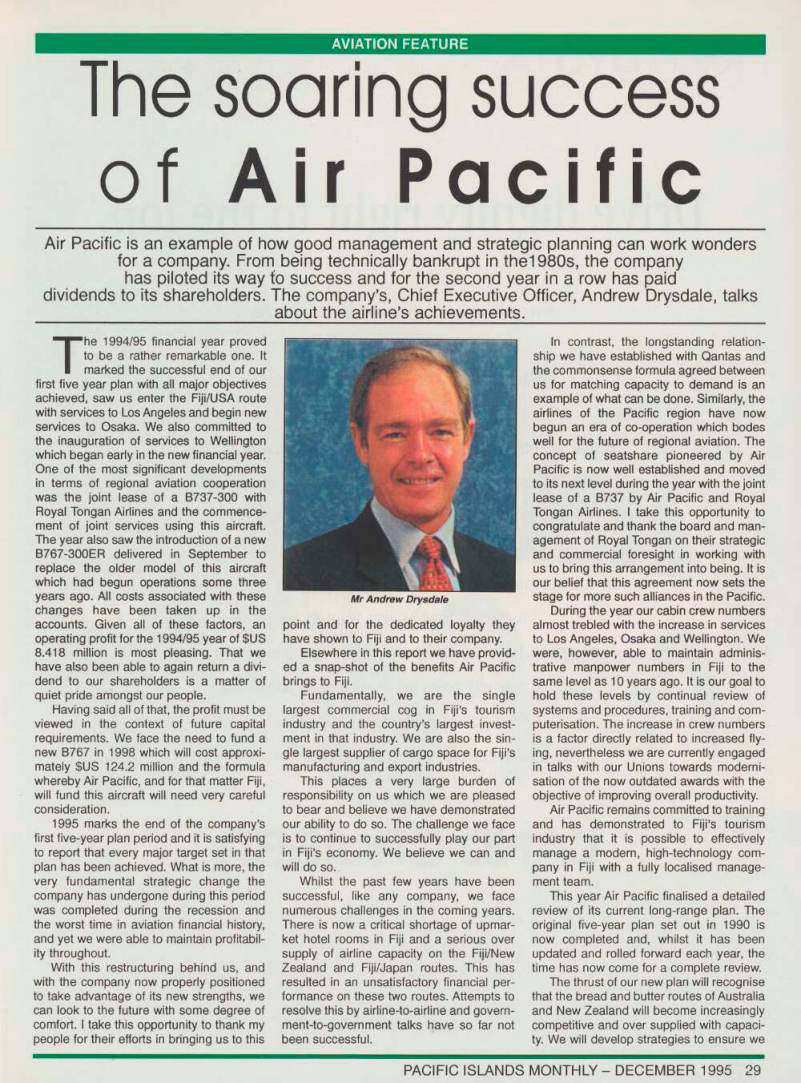
Mr Andrew Drysdale
maintain our market share in this very diffi cult environment. A major change from five years ago is that Asia is now also over-sup plied with capacity and yields are falling.
Again, strategies will be developed to ensure we hold our place in these markets and we will need to forge new and innova tive alliances to be able to do so. The thrust, however, will be to build our links to North America and beyond into Europe. To do so we will further develop the alliance with Qantas and to seek other affiliated partners beyond Los Angeles into Europe.
One aspect which will feature strongly in this plan is Fiji’s hotel room constraint. Air Pacific has already undertaken studies on the viability of constructing a new upmar ket hotel and is committed to acting as a catalyst to see this project to completion.
The past five years have seen very large strategic changes to Air Pacific. The next five years will see growth built upon this new base. We will see increasing com petition and stagnant or reducing yields. Air Pacific will respond by innovative market ing, differentiated high quality product, maximising the strategic benefit of the Nadi hub and by building a network of commer cial alliances. We are confident that the success of the past five years will continue.
An Historical Milestone
The end of this financial year saw the expiration of the Qantas Support Agreement, an alliance which was intro duced in 1984/85, when the airline was technically bankrupt, in order to ensure our continued operation.
Over the last five years this agreement has evolved into a firm, deeply-rooted but commercial business commitment by both
parties and it is pleasing that a new agree ment is now in place which continues this commercial relationship between the two companies.
Marketing
The selling of Fiji has become a major role for Air Pacific’s marketing effort in all regions. In the space of the last 12 months Air Pacific has invested in excess of SUS 48.3 million in mainstream advertising, pro motion, public relations, commission pay ments, familiarisation trips and other asso ciated marketing-related activities.
The investment obviously paid divi dends. For not only were visitor arrivals to Fiji at an all time record, total passengers carried on all international routes recorded a growth of 8.6 per cent. This result is even more pleasing when compared to the neg ative growth experienced the previous year.
The main focus of our marketing effort during the year obviously centred on the planning and subsequent launch of two new services, Los Angeles and Osaka.
North America
Following the board’s approval in December 1993, a once per week 8747 direct service to Los Angeles was launched in July. The service was specifically designed to boost dedicated North American vacationer numbers to Fiji.
Prior to the launch, nearly 70 per cent of North American traffic stopped over on the way to or from Australia and New Zealand - their main destinations.
To help achieve this objective of dedi cating holiday traffic to Fiji, a first was cre ated with appointment of the company’s only in-house tour wholesaling operation -
Air Pacific Holidays - operated by Brendan Holidays, a reputable South Pacific focused tour wholesaler based in California.
Other marketing initiatives, designed to stimulate activity and awareness of Fiji included participation in the largest-ever promotional campaign mounted by the Fiji Visitors Bureau and the local industry which saw over 30 participants from the Fiji plant visiting the major cities on the West Coast of the USA and Canada.
Australia
Australia is our most important source market. It was therefore encouraging to see this market experience a substantial turn around in the 1994/95 year.
As a result of a concerted and sustained promotional effort by the company, the Fiji Visitors Bureau and the industry in general, utilising press and television in key mar kets, a 10 per cent growth in carriage was achieved on the Australian routes. This helped creates a momentum which assist ed our performance in that market through the rest of the year, despite keen competi tion from overseas competitors and internal Australian destinations in particular.
The termination of the Qantas Support Agreement at the end of this financial year provided the opportunity for Air Pacific to conduct another review of its sales opera tion within Australia. A number of options, including self-representation using Air Pacific staff, were considered but in the end, a continuation of Qantas’ appointment as General Sales Agent, was considered to be the most cost effective solution.
New Zealand
The growth trend experienced in New
Modern jets which have helped carry Air Pacific to new destinations.
Zealand over past years continued in 1994/95 with increases coming mainly on the direct services between Auckland and Suva.
The airline’s growth, however, did not match the almost 31 per cent increase in visitor arrivals from New Zealand experi enced during the 1994 calendar year.
Market share loss was the result of addi tional capacity provided on the Nadi- Auckland route occasioned by increased through flights to Japan and North America by the competition.
This extraordinary growth in visitor arrivals is a positive development and places Fiji as the third most popular desti nation out of New Zealand.
Vfr Traffic
On both the Australian and New Zealand routes, good levels of VFR (visit ing friends and relatives) traffic was experi enced. This traffic is steadily assuming an increasing share of our carriage on the routes.
Japan
Air Pacific suffered a considerable set back in Japan with our Tokyo flights down almost 18 per cent on last year’s levels. A contributing factor to this reduction was the inability of a key market segment, honey mooners, to secure five-star accommoda tion in Fiji during peak season. In some instances overbookings resulted in clients being moved to other hotels. This influ enced some major Japanese wholesalers to seek alternative destinations for their honeymoon travellers.
A major industry campaign was launched in March of this year in Tokyo and Osaka to woo back the honeymooners and correct a misunderstanding that Fiji was continually fully booked.
The launch of the Osaka service in October added additional capacity (two 767 services per week) to the large Japan mar ket.
Additional capacity was mounted during the year by the competition, with three more flights operating out of Nagoya, pro ceeding the launch of the Osaka service.
Combined, the services created an over capacity on the Japan routes yielding a total visitor arrival increase of just 4 per cent for the year 1994.
Over the course of the year we reviewed our distribution process in Japan and our advertising agency relationship. Important changes were introduced in both areas and, effective the start of our new financial year, we will be working with a new adver tising agency partner in Japan.
Agreements
In May 1994, Air Pacific concluded a seat purchase agreement with Royal Tongan Airlines.
The Royal Tongan relationship then took a new and exciting turn shortly after the agreement was ratified when both air-
lines identified requirements for operating time on a 8737 aircraft. This led to discus sions with Ansett Worldwide Aviation Services in October, ultimately resulting in the joint leasing of a Boeing 737-300 series aircraft.
In late January of this year, a 8737-300 joined the fleet, embarking upon its maiden flight to Tonga on Saturday, January 28. On arrival in Tonga, a joint operating agree ment was signed by the chairmen of Royal Tongan Airlines and Air Pacific Limited.
A unique and distinctive feature of the aircraft is that it has Air Pacific livery on its port side and Royal Tongan colours on the starboard side.
This agreement was seen as a break through for regional air services and the beginning of an era of co-operation between regional airlines,. which should benefit struggling Pacific Island carriers.
Air Pacific: Where To From
Here?
Air Pacific has worked hard to achieve its status as a player in the world of aviation and tourism. We can now confidently stand and have our say on issues of importance to the future of our industry. Our senior executives are actively involved on boards and committees such as PATA, lATA and ASPA and are increasingly being called upon for contribution and advice.
We have positioned the airline as low cost, efficient, high quality, strategically located carrier; an entrepreneurial airline able to quickly seize opportunities when they arise.
The past five years have been spent changing Air Pacific from being a regional,
to an international airline. We’ve carefully prepared the ground work and have made ready for the next phase of growth which will primarily focus on the Northern Hemisphere.
To achieve the objectives and targets to the year 2000, strong strategic alliances will be necessary. These are now either in place or in the final stages of implementa tion.
Whilst we see our future direction clear ly, there is obviously still a very much polarised debate about the role of Air Pacific. The question continues to be asked as to whether we should focus on profit as a company or whether we exist to provide and cater for Fiji’s tourism infrastructure?
The answer is simple - without the prof its the infrastructure cannot be created and Fiji’s tourism industry will suffer.
The South West Pacific Basin is a grouping of small island nations that is becoming increasingly important to tourism flows and trends as the world seeks differ ent and more exotic holiday destinations.
Nadi, as the Hub of the Pacific, provides Air Pacific with a strong strategic position.
We are well situated geographically to han dle international traffic originating from both hemispheres and also occupy the unique position of being the logical hub for region al island traffic.
We have the product: The crews, the aircraft, the support services, the desire and above all the ability to take advantage of this unique geographical position we occupy. It bodes well for the future of Fiji’s international airline. ■
Preparing for greater heights and more destinations. Air Pacific pilots.