Fiji cashes in on chips
p. 28 · Read in the full issue
Trade
By Penny Baba
Fiji’s pine industry has increased pro duction by 30 per cent to cash in on the high international spot prices for wood chips resulting from a world shortage of paper.
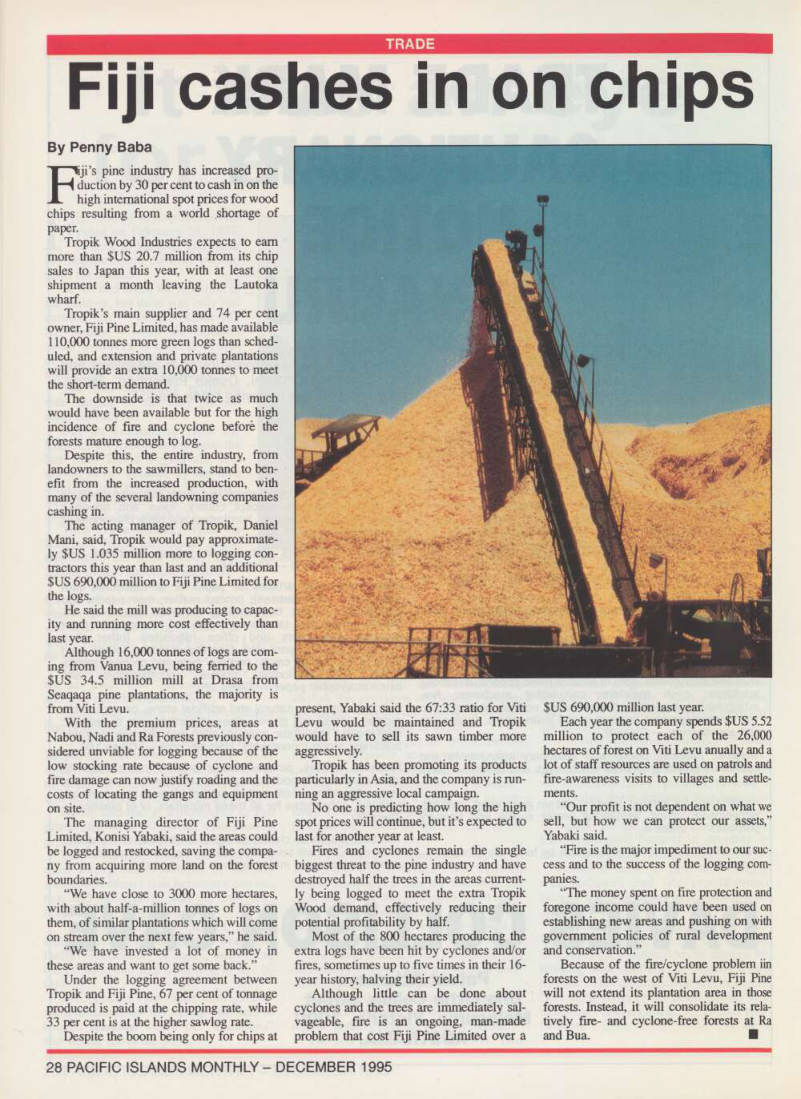
Tropik Wood Industries expects to earn more than SUS 20.7 million from its chip sales to Japan this year, with at least one shipment a month leaving the Lautoka wharf.
Tropik’s main supplier and 74 per cent owner, Fiji Pine Limited, has made available 110,000 tonnes more green logs than sched uled, and extension and private plantations will provide an extra 10,000 tonnes to meet the short-term demand.
The downside is that twice as much would have been available but for the high incidence of fire and cyclone before the forests mature enough to log.
Despite this, the entire industry, from landowners to the sawmillers, stand to ben efit from the increased production, with many of the several landowning companies cashing in.
The acting manager of Tropik, Daniel Mani, said, Tropik would pay approximate ly SUS 1.035 million more to logging con tractors this year than last and an additional SUS 690,000 million to Fiji Pine Limited for the logs.
He said the mill was producing to capac ity and miming more cost effectively than last year.
Although 16,000 tonnes of logs are com ing from Vanua Levu, being ferried to the SUS 34.5 million mill at Drasa from Seaqaqa pine plantations, the majority is from Viti Levu.
With the premium prices, areas at Nabou, Nadi and Ra Forests previously con sidered unviable for logging because of the low stocking rate because of cyclone and fire damage can now justify reading and the costs of locating the gangs and equipment on site.
The managing director of Fiji Pine Limited, Konisi Yabaki, said the areas could be logged and restocked, saving the compa ny from acquiring more land on the forest boundaries.
“We have close to 3000 more hectares, with about half-a-million tonnes of logs on them, of similar plantations which will come on stream over the next few years,” he said.
“We have invested a lot of money in these areas and want to get some back.”
Under the logging agreement between Tropik and Fiji Pine, 67 per cent of tonnage produced is paid at the chipping rate, while 33 per cent is at the higher sawlog rate.
Despite the boom being only for chips at
present, Yabaki said the 67:33 ratio for Viti Levu would be maintained and Tropik would have to sell its sawn timber more aggressively.
Tropik has been promoting its products particularly in Asia, and the company is run ning an aggressive local campaign.
No one is predicting how long the high spot prices will continue, but it’s expected to last for another year at least.
Fires and cyclones remain the single biggest threat to the pine industry and have destroyed half the trees in the areas current ly being logged to meet the extra Tropik Wood demand, effectively reducing their potential profitability by half.
Most of the 800 hectares producing the extra logs have been hit by cyclones and/or fires, sometimes up to five times in their 16year history, halving their yield.
Although little can be done about cyclones and the trees are immediately sal vageable, fire is an ongoing, man-made problem that cost Fiji Pine Limited over a
SUS 690,000 million last year.
Each year the company spends SUS 5.52 million to protect each of the 26,000 hectares of forest on Viti Levu anually and a lot of staff resources are used on patrols and fire-awareness visits to villages and settle ments.
“Our profit is not dependent on what we sell, but how we can protect our assets,”
Yabaki said.
“Fire is the major impediment to our sue cess and to the success of the logging corn
panics.
“The money spent on fire protection and foregone income could have been used on establishing new areas and pushing on with government policies of rural development and conservation.”
Because of the fire/cyclone problem iin forests on the west of Viti Levu, Fiji Pine will not extend its plantation area in those forests. Instead, it will consolidate its rela lively fire- and cyclone-free forests at Ra and Bua. ■