It was an eye
p. 26 · Read in the full issue
Cover Stories
It was an eye for an eye then
Fiji’s House of Representatives
voted on February 28, 1978, to abolish hanging and make life imprisonment the only punish ment for murder.
Seven had urged the retention of the gallows, but there was only one audible “no” - from Alliance MP KS Reddy - when the Speaker asked members to express dissent or support for a Bill to amend the Penal Code and abolish hanging.
The Bill originally proposed
that hanging be the only punish ment for murder.
But an amendment from the Minister for Labour at the time, the late Ratu David Toganivalu, and moved in his absence by the then Minister for Agriculture, late Jonati Mavoa, substituted life imprison ment as the only penalty.
Then Prime Minister, Ratu Sir Kamisese Mara, and Leader of the Opposition Jai Ram Reddy were among those supporting abolition.
Ratu Sir Kamisese who had been in favour of the “an-eye-for-an-eye” doc trine, told journalists that at the time he would have done the hang-man’s job him self, if required. “I usually do what I say” he said.
Speaking against hanging Reddy said the act itself was “grotesque, repulsive and true cold-blooded killing”.
There was “not a scrap of evidence that it serves any useful social service.”
In an interview published by The Fiji Times, the Controller of Prisons, Wally Smith, had made comments that “leaves no doubt as to the feeling of those who will be expected to do this dreadful act”.
Reddy said that as a prosecutor he had prosecuted 40 or 50 murder cases, and in private practice had defended murderers.
“The one thing which has struck me most throughout my career is the thin wedge that often exists between a convic tion and an acquittal and the enormous scope for error that exists.”
The law was an imperfect system administered by imperfect men who had a faulty recollection of facts, who were biased and who had a motive to lie, he said.
An opposing view came from govern ment backbencher KS Reddy who said to abolish hanging would be “disastrous” and would alarm the public.
Of the 27 MPs who spoke in the debate, 18 supported abolition, seven supported hanging, and two did not com mit themselves.
The abolishment of the death penalty came when a lot of confusion arose when the penalty was reintroduced in 1973.
Initially the Bill was introduced to abolish this provision and insert a section declaring: “Any person convicted of mur der shall be sentenced to death.”
The government put the Bill to parlia ment in response to complaints from judges about difficulty they had in inter preting the present penalties for murder.
As the law stood a judge had to sen tence a murderer to death if he was satis fied that there were no special reasons for not doing so.
In his Crime Commission Report in 1970, the Chief Justice, Sir Clifford Grant, complained that the law was not clear and that it was time parliament abol ished hanging completely or set down clearly when the death sentence should be
imposed.
The death sentence was restored in Fiji on January 1, 1973, after a five-year peri od of experimental suspension.
The experiment ended automatically
when a parliamentary resolution suspend
ing the penalty expired without debate.
The last execution was in 1964. Two
men, a father and his son, were sentenced to death in 1974 for murdering a neigh bour in Suva. But after two years in the death cell and appeals to the Privy Council they had the sentence changed to
life imprisonment.
The Privy Council referred the case back to the judge for reconsideration of sentence. The judge, Justice Williams, said he saw no reason for not imposing the death sentence.
But two years under sentence of death during the appeals had been “awful sus pense” and a life imprisonment should be substituted on human grounds, he said.
Another death sentence was passed in 1975 but was later set aside by the Court of Appeal on the grounds that the judge had misdirected himself in deciding in favour of it rather than the imprisonment.
Hence it came to pass that hanging was outlawed and life imprisonment became the only means of punishing mur derers.
The death sentence has since not real ly become an issue. The fact that remains is that people murdered in the days of the hanging and continue to murder in its absence. This contradicting turn of events fails the severity of the death penalty as a deterrent - the argument for capital pun ishment ■
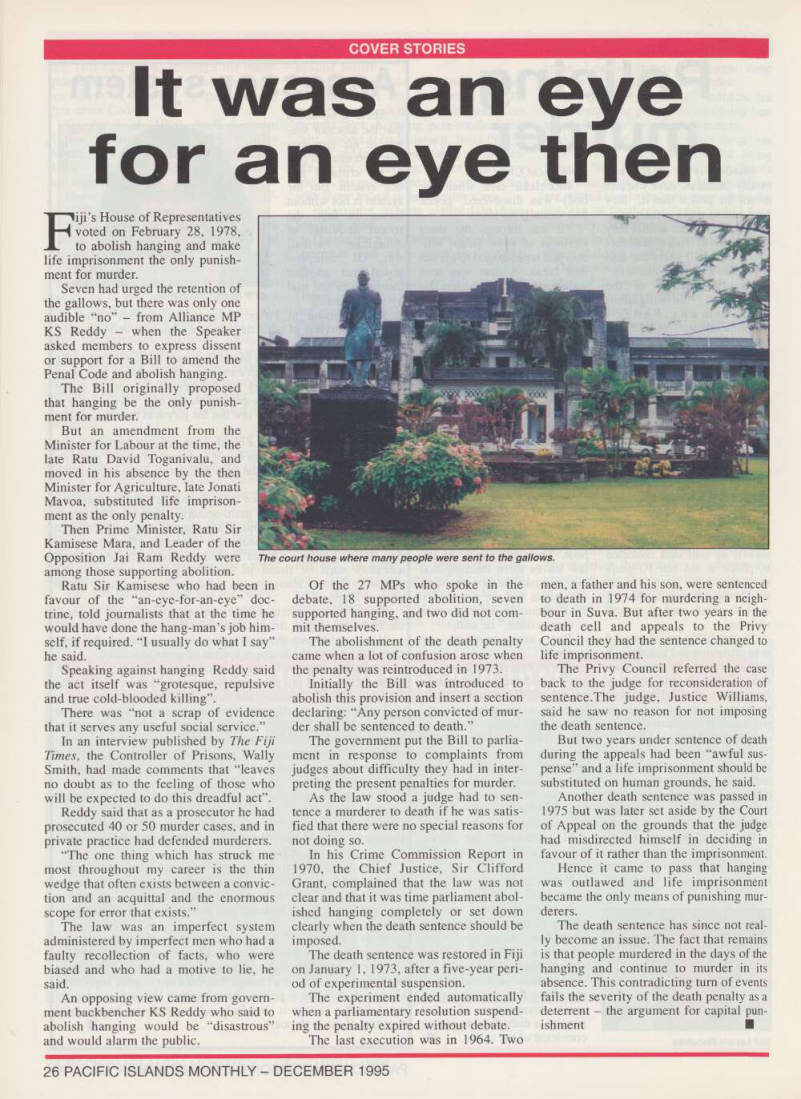
The court house where many people were sent to the gallows.