Assessor system
p. 25 · Read in the full issue
There is no doubt that the assessor sys tem or the jury sys tem is an integral part of the criminal jus tice system. But the system is not without flaws. In fact, the recent acquittal of American football star OJ Simpson posed yet another challenge to the trial by jury system.
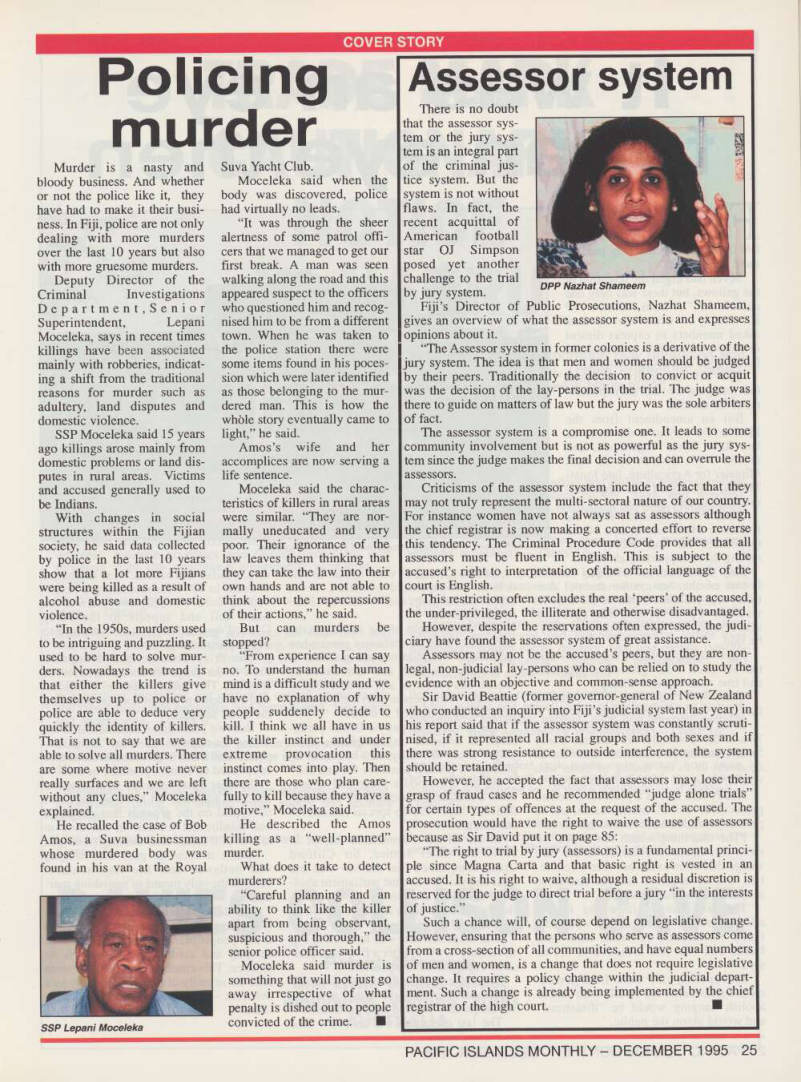
Fiji’s Director of Public Prosecutions, Nazhat Shameem, gives an overview of what the assessor system is and expresses opinions about it.
“The Assessor system in former colonies is a derivative of the jury system. The idea is that men and women should be judged by their peers. Traditionally the decision to convict or acquit was the decision of the lay-persons in the trial. The judge was there to guide on matters of law but the jury was the sole arbiters of fact.
The assessor system is a compromise one. It leads to some community involvement but is not as powerful as the jury sys tem since the judge makes the final decision and can overrule the assessors.
Criticisms of the assessor system include the fact that they may not truly represent the multi-sectoral nature of our country.
For instance women have not always sat as assessors although the chief registrar is now making a concerted effort to reverse this tendency. The Criminal Procedure Code provides that all assessors must be fluent in English. This is subject to the accused’s right to interpretation of the official language of the court is English.
This restriction often excludes the real ‘peers’ of the accused, the under-privileged, the illiterate and otherwise disadvantaged.
However, despite the reservations often expressed, the judi ciary have found the assessor system of great assistance.
Assessors may not be the accused’s peers, but they are non legal, non-judicial lay-persons who can be relied on to study the evidence with an objective and common-sense approach.
Sir David Beattie (former governor-general of New Zealand who conducted an inquiry into Fiji’s judicial system last year) in his report said that if the assessor system was constantly scruti nised, if it represented all racial groups and both sexes and if there was strong resistance to outside interference, the system should be retained.
However, he accepted the fact that assessors may lose their grasp of fraud cases and he recommended “judge alone trials” for certain types of offences at the request of the accused. The prosecution would have the right to waive the use of assessors because as Sir David put it on page 85: “The right to trial by jury (assessors) is a fundamental princi ple since Magna Carta and that basic right is vested in an accused. It is his right to waive, although a residual discretion is reserved for the judge to direct trial before a jury “in the interests
of justice.”
Such a chance will, of course depend on legislative change.
However, ensuring that the persons who serve as assessors come from a cross-section of all communities, and have equal numbers of men and women, is a change that does not require legislative change. It requires a policy change within the judicial depart ment. Such a change is already being implemented by the chief registrar of the high court. U
DPP Nazhat Shameem