Policing
p. 25 · Read in the full issue
Cover Story
Policing murder
Murder is a nasty and bloody business. And whether or not the police like it, they have had to make it their busi ness. In Fiji, police are not only dealing with more murders over the last 10 years but also with more gruesome murders.
Deputy Director of the
Criminal Investigations
Department,Senior
Superintendent, Lepani
Moceleka, says in recent times killings have been associated mainly with robberies, indicat ing a shift from the traditional reasons for murder such as adultery, land disputes and domestic violence.
SSP Moceleka said 15 years ago killings arose mainly from domestic problems or land dis putes in rural areas. Victims and accused generally used to be Indians.
With changes in social structures within the Fijian society, he said data collected by police in the last 10 years show that a lot more Fijians were being killed as a result of alcohol abuse and domestic violence.
“In the 19505, murders used to be intriguing and puzzling. It used to be hard to solve mur ders. Nowadays the trend is that either the killers give themselves up to police or police are able to deduce very quickly the identity of killers.
That is not to say that we are able to solve all murders. There are some where motive never really surfaces and we are left without any clues,” Moceleka
explained.
He recalled the case of Bob Amos, a Suva businessman whose murdered body was found in his van at the Royal
Suva Yacht Club.
Moceleka said when the
body was discovered, police
had virtually no leads.
“It was through the sheer alertness of some patrol offi cers that we managed to get our first break. A man was seen walking along the road and this appeared suspect to the officers who questioned him and recog nised him to be from a different town. When he was taken to the police station there were some items found in his poces sion which were later identified as those belonging to the mur dered man. This is how the whole story eventually came to light,” he said.
Amos’s wife and her accomplices are now serving a life sentence.
Moceleka said the charac teristics of killers in rural areas were similar. “They are nor mally uneducated and very poor. Their ignorance of the law leaves them thinking that they can take the law into their own hands and are not able to think about the repercussions of their actions,” he said.
But can murders be
stopped?
“From experience I can say no. To understand the human mind is a difficult study and we have no explanation of why people suddenely decide to kill. I think we all have in us the killer instinct and under extreme provocation this instinct comes into play. Then there are those who plan care fully to kill because they have a motive,” Moceleka said.
He described the Amos
killing as a “well-planned”
murder.
What does it take to detect murderers?
“Careful planning and an ability to think like the killer apart from being observant,
suspicious and thorough,” the
senior police officer said.
Moceleka said murder is something that will not just go away irrespective of what penalty is dished out to people convicted of the crime. ■
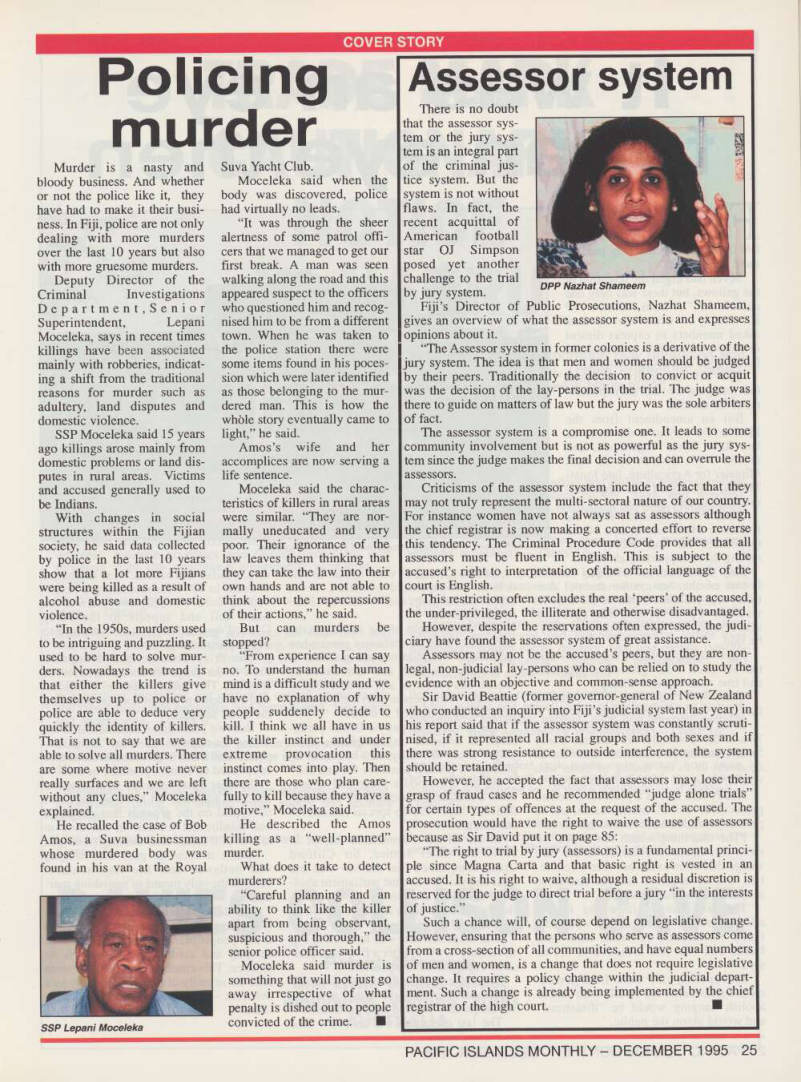
SSP Lepani Moceleka