Murder!
pp. 23-24 · Read in the full issue
Cover Stories
By Yunus Rashid
It was the perfect murder. Methodist
Church missionary and spinster
Phyllis Ada Fumivall was the princi pal of Lelean Memorial High School at Nausori - a neighbouring town of Fiji’s capital, Suva.
On December 11, 1970, she walked 50 metres from her school office to her wooden cottage where she lived alone. It was to be her last walk.
The following morning the brutalised and strangled naked body of Fumivall was found inside her bedroom by two young cleaning girls.
And the murderer was never found.
Fumivall’s horrible death was not the only unsolved murder. Two years before a Muslim priest was found with his throat slit as was a merchant’s body, repeatedly stabbed. The victims were found in their houses. Both cases remain unsolved.
And then there was the murder of Shri Sukhdeo of Sabeto located near Fiji’s sec ond city Lautoka. On February 14, 1991 Sukhdeo had travelled to Lautoka Sugar Mill in a cane truck. On his return he attended a prayer ceremony. He left the function at around 2am. Sukhdeo asked the truck driver to drop him off about 100 metres from his house.
The following morning his repeatedly stabbed body was found about 50 metres from his home. To date nobody has been convicted of the crime. The intriguing part about this case is that 24 years earli er, his father was slain in similar fashion and under similar circumstances - and chillingly, on the same date.
In a small country like Fiji with a pop ulation of 780,000 , it is hard to believe that murderers can lurk undetected in society. But this has happened and there are other cases where people have disap peared without a trace.
Then there are cases where contrary to evidence people get away with lenient sentences or even go free.
An example of a lenient sentence arose from the Outrigger murder case.
Shamshun Yasin worked at the Australia and New Zealand Banking Corporation. Her boyfriend Rajen Kumar had just returned from Western Samoa.
And on October 4, 1991, he booked room a room at the hotel and asked her over.
What exactly happened after that, nobody knows. Only Kumar’s version of the story is known.
Inside the room, Kumar said, he ques tioned Yasin about her virginity. She told Kumar that she was a virgin. The the cou ple then proceeded to have sex.
When hotel workers entered the room, they found Yasin with her wrist slashed and cord around her neck. She was lying in a pool of blood - dead.
Kumar was choking on some pesticide which he had swallowed. He was charged with Yasin’s murder.
In his confession to the police, Kumar said that during his stay in Western Samoa he was told by friends that Yasin was hav ing an affair. He said he found out that Yasin was not a virgin, got angry and killed her.
The facts pointed to a clear case of pre
meditated murder. “Malice a forethought” as is required to prove murder was present in that Kumar had prepared himself for
the killing.
However, the Director of Public Prosecutions at that time, Isikeli Mataitoga decided to reduce the charge to manslaughter in exchange for Kumar
pleading guilty. This decision played a
critical part in Kumar’s appeal. Judges at the Fiji Court of Appeal could not under stand why the charge had been reduced given the facts. Kumar’s appeal was dis missed and he continues to serve a seven year jail sentence.
Yet another example of how things could go wrong in the justice system was reflected in the 249 Waimanu Road mur
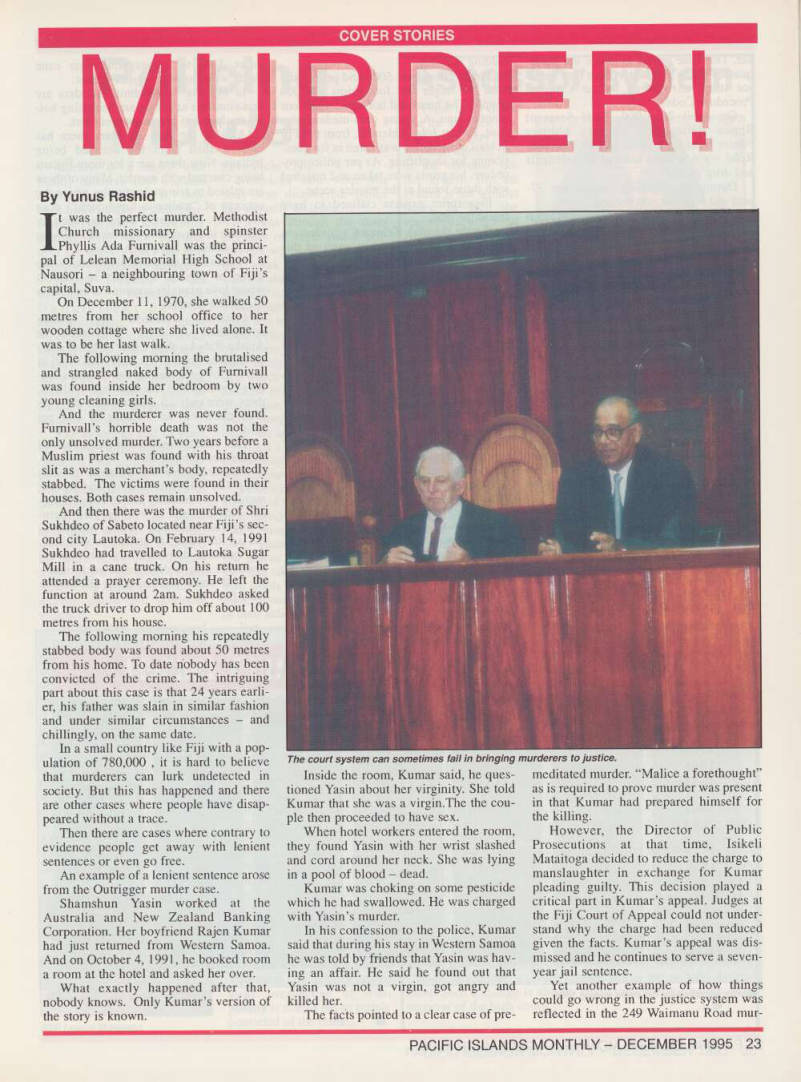
The court system can sometimes fail in bringing murderers to justice.
der. This case brings to notice the inade quacies of the assessor system (see asses sor story) as allowed by the Criminal Procedure Code.
On April 26, 1990, Staff Sergeant
Ropate Baisagale of the Fiji Military
Forces went for a drink to 249 Waimanu Road - a notorious hideout for criminals
and drug pushers.
During the drinking session the 37year-old sergeant was robbed.
Baisagale walked to his house to fetch a M-16 gun. He returned and shot dead two men he suspected of robbing him.
Baisagale is expected to come out of prison next year. Two assessors found him not guilty of murder while a third found him guilty. Faced with such verdicts, pre siding judge Justice Daniel Fatiaki over ruled the assessors and found Baisagale guilty of manslaughter. He was both an officer and a gentleman! Baisagale held a good record in the military camp and his actions were totally out of character.
But in both cases, the convicted were
punished.
In some cases people have walked free from the courts either because assessors do not understand the complexity of the case or because police fail to do their job properly or because the prosecution does not convince the assessors.
One such case was the Ram Dulare murder. On July 21, 1990, the body of Dulare, a 68-year-old bailiff, was found in his house with 15 stab wounds and a frac tured skull.
The case baffled police and the public.
No valuables seemed to be missing there was only the brutalised body of a
balding bailiff.
Police questioned 5000 and people and took the finger and foot prints of 2000 people. The break did not come until four months later. A young para-medical stu dent, Robert John Kelemeti, from the Fiji School of Medicine was taken in for ques tioning for shoplifting. As per police pro cedure, his prints were taken and matched with those found at the murder scene.
Fingerprint experts claimed to have found the man.
During the trial, Kelemeti’s confession statement read out in court narrated this story.
Kelemeti had had sexual sex with Dulare for money. On the day of the mur der, police claimed that Kelemeti said that Dulare had failed to pay him.
Angered by the old man’s treachery, police said Kelemeti mercilessly killed the man using two knives, a gallon of paint and a flower pot stand.
Kelemeti’s lawyer, Mohammed Afzal Khan, said his client had never been at the scene of the crime. The case was therefore between circumstantial evidence and Kelemeti’s denial. The assessors believed Kelemeti credible and the judge. Justice Jesuratnam, agreed with them.
Kelemeti walked out of the court a free person.
Murders in Fiji are not an uncommon thing. Court records from the 1930 s which are now in the care of the national archives, of some very gruesome mur ders. The accused persons by majority were Indians. The common factor was that murders were related to domestic vio lence and committed largely in rural
areas. Lean-to homes and sugar cane fields were popular murder scenes.
In Fiji the “whudunnit” murders are less common as police are becoming bet ter equipped to investigate murders.
Also in the past 10 years there has been a shift from the accused being Indians. Now there are a lot more Fijians being charged with murder. Many of these are related to criminal activities where the concept of “malice a forethought” does not apply. Alarmingly there has been an increase in sex-related murders in villages where children have been victims.
Meanwhile, in the Indian society the crime of passion continues to flourish where love triangles continue to be a main trigger for murders.
Statistics released by police
spokesman Assistant Superintendent
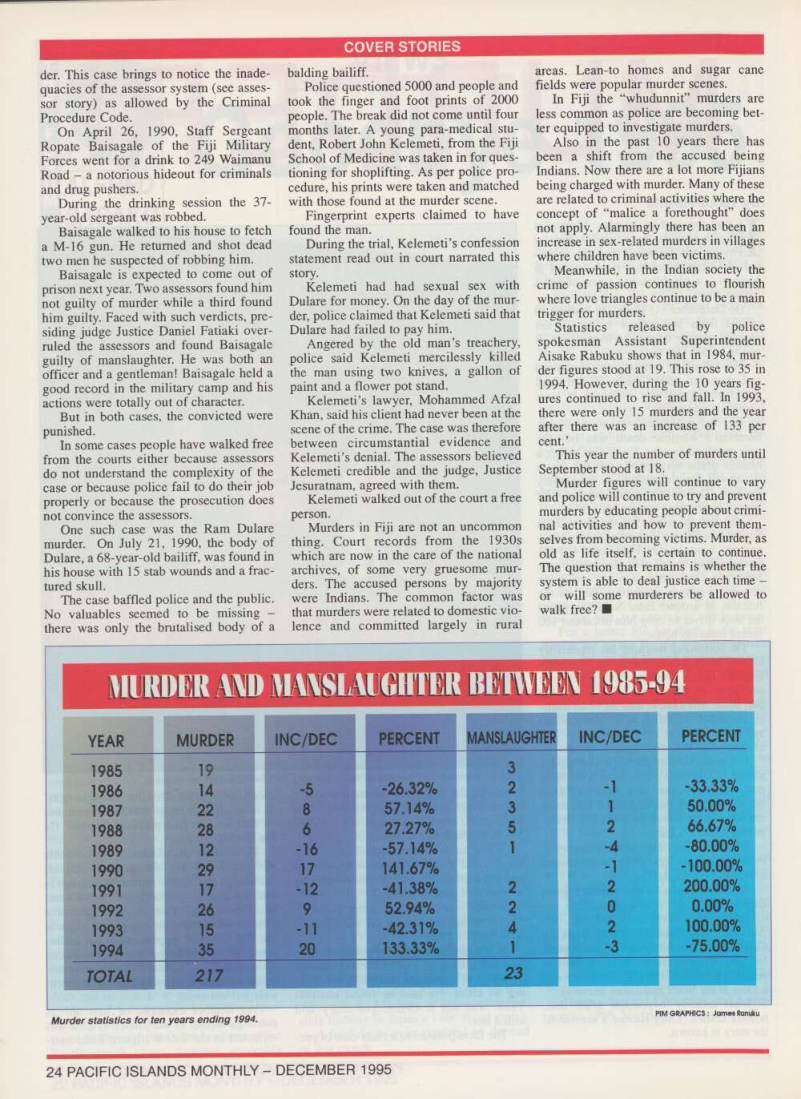
Aisake Rabuku shows that in 1984, mur der figures stood at 19. This rose to 35 in 1994. However, during the 10 years fig ures continued to rise and fall. In 1993, there were only 15 murders and the year after there was an increase of 133 per cent.’
This year the number of murders until September stood at 18.
Murder figures will continue to vary and police will continue to try and prevent
murders by educating people about crimi
nal activities and how to prevent them selves from becoming victims. Murder, as old as life itself, is certain to continue.
The question that remains is whether the system is able to deal justice each time or will some murderers be allowed to walk free? ■
PIM GRAPHICS: James Ranuku
Murder statistics for ten years ending 1994.
Murder Ud Manslaughter Between 1983-94
Year
Murder
Inc/Dec
Percent
Manslaughter
Inc/Dec
Percent
1985 19 3 1986 14 -5 -26.32% 2 -1 -33.33% 1987 22 8 57.14% 3 1 50.00% 1988 28 6 27.27% 5 2 66.67% 1989 12 -16 -57.14% 1 -4 -80.00% 1990 29 17 141.67% -1 -100.00% 1991 17 -12 -41.38% 2 2 200.00% 1992 26 9 52.94% 2 0 0.00% 1993 15 ■11 -42.31% 4 2 100.00% 1994 35 20 133.33% 1 -3 -75.00%
Total
217 23