Polynesian Airlines,
pp. 36-38 · Read in the full issue
ready for takeoff
By Chris Peteru
When Polynesian Airlines (PAL) remaining 737 crash landed at Western Samoa’s international airport late last year, it characterised the plight of the cash-strapped carrier with some accuracy.
Although the plane landed safely, it has taken 12 months before the same can be said by the airline’s management about its commercial viability.
Leading a surprise fiscal turnaround and across the board restructuring is new Chief Executive Officer (CEO) Richard Gates.
Formerly with Air New Zealand (Air NZ) he credits a team effort by PAL staff as being crucial to the airline’s pullout from a termi nal multi-million-dollar financial nosedive.
“In terms of how the company has per formed since last August, I can say without equivication, the airline is trading in the black, meeting its own debts, and making no call on the shareholders money,” he
With a working brief to get the crippled airline back on its feet financially and commercially Gates is pleased of the achievements made in such a short time.
Following a well documented management bungle, by August 1994 Polynesian had plunged at least SUS 30 million into debt, care of a flawed expansion attempt and poor decision making.
A red-faced government (the sole shareholder) who had calmly agreed to lend the airline a substantial chunk of the millions that had evaporated skyward, finally moved in with a damage control scheme to try and clean up the mess.
On the ground, Prime Minister Tofilau Eti Alesana took control of the company, appointing his deputy and finance minister, Tuilaepa Sailele, chairman of the board, in place of Aviation Minister Jack Netzler.
Shortly after the then board of directors was politely given the heave-ho, and new members appointed. General manager
Papaliitele Grant Percival who had lead the company since 1993 when Ansett Airline backed out, quietly resigned, Dozens of newly trained flight atten dants for the ill-fated expansion and some management staff were also handed redundancy notices, The cornerstone of the restructuring has been the paper transfer of the company, At a recent Press conference, Gates announced that Polynesian Airline Holdings had renamed itself Polynesian Limited, effectively isolating millions of dollars of bad debt, without hindering present opera tion.
“This new company has been cap atilised to a reasonable level not through any new injection of funds but a transfer of what the government had to inject into the old company.” said Gates, With no financial statements being made public, speculation that SUS 5.4 m dollars granted PAL under efficient man agement in Treasury s June budget, has
continued on 38
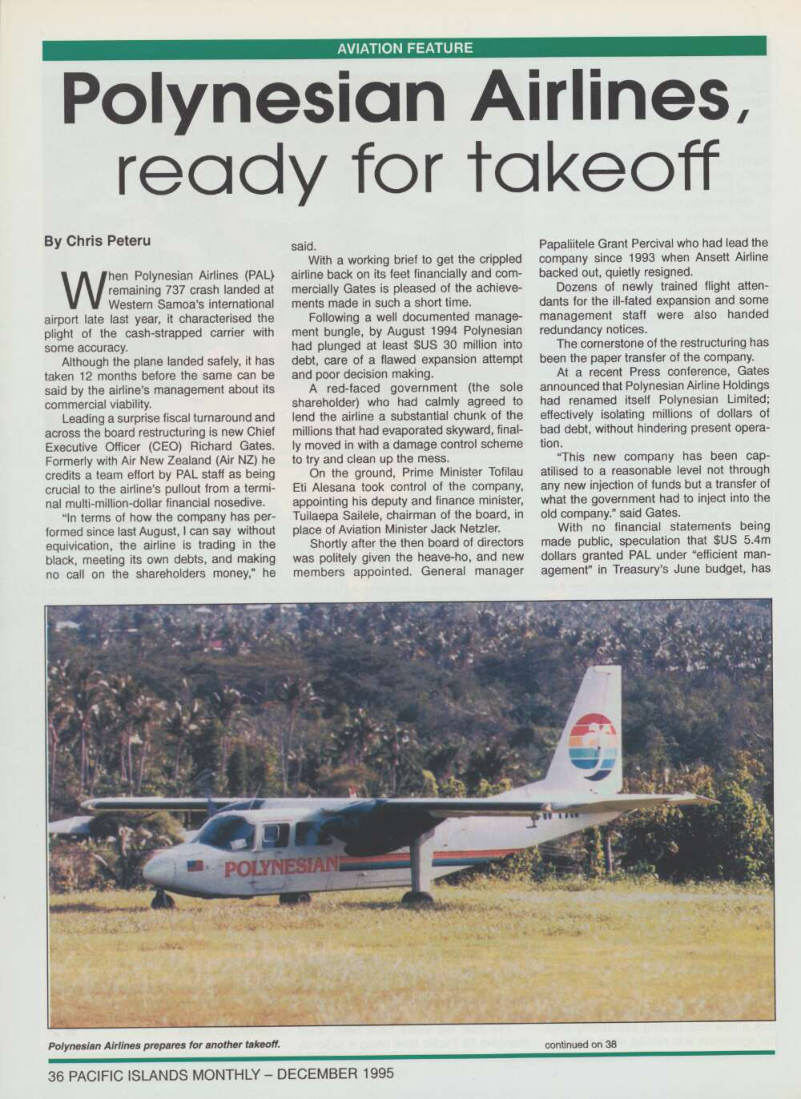
Polynesian Airlines prepares for another takeoff.
been chanelled to bankroll the fledgling Polynesian Limited.
The move also provides the government, if it wants, the option to privatise in the long term, and tidies up the financial aspects cleanly, said Gates.
Employment contracts for most of the airline’s 350 staff under the new name have been drawn up and signed. Included is improved working conditions plus their first pay rise in eight years for 170 ground staff, However, all 30 PAL pilots have so far refused to sign, citing disparities between contracts for local pilots and those bought in from overseas.
In the air two of the company’s three 737 s that had been on long-term lease from the International Lease Financing Corporation (ILFC) were returned as flight schedules were abandoned and outstanding payments on the planes to ILFC piled U p Earlier, a lease on a Kuwaiti Airlines 767 used mainly to transport horses in the Far East also fell through, losing the airline an estimated $ US 3 million dollars without having flown once under the PAL logo.
Returning to a core schedule of international flights between Apia, Australia, and New Zealand, plus regular short-haul work to neighbouring Savaii and American Samoa has paid dividends.
The northern route from Apia to Honolulu which had been axed, begins again this month.
A code-share agreement, using an Air
NZ 767 with PAL flight numbers, and cabin crew decked out in new-style uniforms is running weekly between Apia and Honolulu.
Early 1996 that service will extend through to Los Angeles, providing in revenue terms a boost for the company balance sheet, believes Gates.
“It’s a step back into the North American market in a very measured way with the least risk.”
Another deal between the two, sees PAL assisting Air NZ on the Apia/Auckland route, with additional services using the code-share system.
Significantly, the association with Air NZ, may have signalled renewed confidence in the carrier from the airline industry following last year’s spectacular debacle, The downside of that saw a fruitful partnership with Royal Tongan Airlines (RTA) collapse amidst acrimony between the two companies. RTA then took its business over to Fiji-based Air Pacific.
More Brownie points were lost, when PAL broke contract with a big New Zealand-based charter company that had arranged four charter flights in August and September last year between Brisbane and Hamilton using PAL aircraft. Air Nauru agreed to take over the flights.
Getting back on good terms with earners regionally was essential to the PAL’s future growth, said Gates.
“The re-establishment of relationships after the poor performance of Polynesian in
the past was difficult but not as difficult as I thought it would be.”
Hardware wise, an additional 19-seat Twin Otter purchased for around SUS Imil lion from an Australian company, has dou bled PAL’s short-haul capacity since it came into service several weeks ago.
Alluding to the previous managements “Lets lease another plane” mindset, Gates says, “It’s very easy to buy or lease an aeroplane but you can’t buy a market”.
In order to boost market share, PAL launched a major first up advertising cam paign, pushing a $ US 400 holiday package to Western Samoa through television and newspapers in New Zealand, and the Australian print media, Officials describe the result as “remark ably successful” generating a steady flow of new tourists into the country, With tourism seen as the way ahead in an agriculture-driven economy, co-opera tive advertising with the Western Samoa Visitors Bureau is in the pipeline with the purpose of getting more bang for the corn pany’s buck.
Few people in the industry thought PAL would survive in any form. And the Samoan Government has learnt a valuable if expen sive lesson in how not to run an airline, The one redeeming the factor is that as PAL taxis returns more confidently onto runways around the Pacific region, the country still has an opportunity to control its economic destiny. ■