and aiding swindlers
pp. 18-20 · Read in the full issue
Cover Story
Nauru: Both swindled and aiding swindlers
By David North
Two years ago the Republic of Nauru lost millions of dollars to swindlers.
Each year Nauru issues bank
licences used by swindlers conning people
in other countries.
How can booth of these situations co exist? That is a question that is puzzling a small band of law enforcement types in the United States.
Nauru’s finances - despite its phos phate wealth - were in shambles in 1993.
Not only was the government airline los ing money hand-over-fist and the cabinet had dropped SUS 3 million on a failed London musical (PIM, Nov. 1993), vari ous fast-talking smoothies had convinced Nauru officials to buy fraudulent “Prime Bank Notes”. Nauru never announced the exact size of the loss, but reports suggest ed that it was many millions of US dollars.
Meanwhile, an obscure unit of the tiny nation’s Ministry of Finance regularly col lects money as it issues licences to shell or ‘brass plaque’ banks that are operated by off-island conmen.
These banks are barred from doing any business within Nauru, so no Nauruan investors are ever hurt, but their off-island activities are totally obscured from public scrutiny by one of the world’s all-encom passing bank secrecy acts.
“Nauru won’t even tell us the names of the batiks it licenses, and Nauru never answers its mail or its faxes” complained a senior US Treasury official.
Vanuatu, Western Samoa, and Tonga are said to licence these conman banks, and Palau is thinking about it, but Nauru’s activities in this squalid field are the most notorious in the Pacific, if not in the world.
Why does it help a fraudster to have a bank license issued in Nauru?
Conmen, often based in the US Mainland, prey on people who have; a) some money to invest; b) a greedy desire for unusual rates of return; and c) little sophistication. Such potential victims, or ‘marks’, usually have heard about off shore banking, and do not know the differ ence between the closely regulated off shore banks of the Cayman Islands, in the Caribbean, for example, and the licence to-steal banks tolerated by Nauru and some other Pacific Island nations.
So conmen can talk glibly about “Prime Bank Notes” or “Bills of Exchange”, and other exotic (and fanciful) financial instru ments; and they wave their Nauruan bank licences as they weave their spell over the
gullible.
Or, in a more mundane manner - as federal court records in North Carolina show, the Nauruan licenses can be used to rob blue-collar folk of their life savings.
Donald Ray Moore, the North Carolina conman convicted on seven counts of mail and wire fraud in the Western District of North Carolina, managed to secure $1.5 million from duped investors.
He did this with few evident assets; he is small(s’2”). Black in a southern state, wears heavy glasses, speaks with a high pitched voice and has limited education.
But he also, according to his prosecutor, Bryan Whisler, has an air of earnest sin cerity, and he had purchased a Nauru bank licence for $lO,OOO. (Presumably, half the money went to Nauru, and half to a mid dleman.) Moore created a newsletter for his “Business Opportunity Club” and distrib uted it far and wide. His targets were blue collar people of limited education; his lures were low-cost loans and promises of remarkable returns on small-scale invest ments.
For example, he promised people that if they put $l5OO into one of his schemes their money would triple within 18 months.
He supported his fraudulent claims with glowing stories of his team of skilled international bankers (all make-believe) and the profits that could be made from off-shore banks.
To give his operation more of an inter national flavour he at first said that the international office of the Pioneer Development Bank (Nauru) was located in the booming Canadian oil town of
Calgary.
After the Canadian authorities got wind of his schemes and froze his Calgary bank account he switched the international office (really just a mail drop) to Grenade, in the Caribbean.
Meanwhile, he and his colleague, George Earl Landon, were hauling in the money from the gullible. They promised low-interest loans to people needing them; after the marks applied they were told that they had to put upfront “risk insurance” fees to Fidelity Assurance Guarantee,
which turned out to be a figment of the Moore-Landon imagination.
For instance, trial records show that John B Williams of Montgomery, Alabama, was told that his application for a $24,000 loan had been approved but he had to make, within 10 days, a payment of $l2OO towards a risk premium of $6OOO to get the loan processed.
Many paid such fees, but none got their loans, according to papers filed with the US District Court for the Western District of North Carolina.
This was, incidentally, what might be termed an equal opportunity fraud case; the fraudsters constituted an integrated team (Landon begin a White Virginian); the victims included both Blacks and Whites; and the con artists were convicted
by a mixed jury.
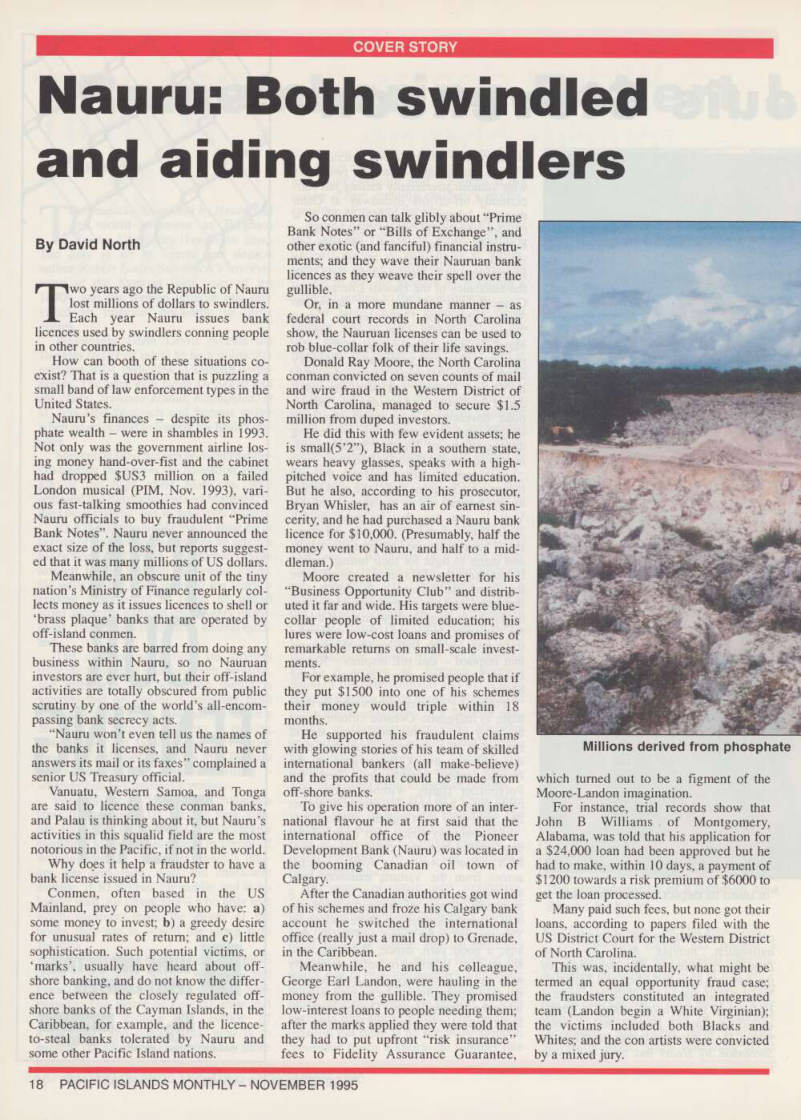
Millions derived from phosphate
Not all illicit users of Nauru bank licences are equally successful, however; in fact, there is a three-layer hierarchy of success. At the top there are the conmen who successfully defraud marks of money, but are not caught; by definition this is an invisible group. Then there are those, like Moore and Landon, who succeed in their frauds, but get caught. Finally (and law
enforcement types rarely discuss this sub population) there are the bumblers who send good money to Nauru for their licens es, but then fail to defraud anyone.
We found a couple of examples of these failures in conversations with East Coast bankers and with West Coast law-enforce ment authorities.
There is, in elegant quarters in New York City, a branch of the savvy French financial institution, Banque Indosuez. Its lawyers told me about several thwarted attempts to con bankers in mainland China.
Nauru had licensed the Jefferson Bank and Trust, Inc, and its operators, in turn, created “Bank Debenture Notes”, in the one-million to five-million range. The face of the documents indicated that Indosuez
Aval, an affiliate of the French bank, had endorsed the notes. Two officials of Indosuez Aval apparently had signed the notes.
The signatures, however, were forg eries.
Meanwhile, Jefferson had discounted the notes, making them look like bargains, and tried to sell them to Chinese banks.
The Chinese bankers, however, faxed Bank Indosuez in New York regarding their validity, and were told of the forg eries.
The lawyers for Bank Indosuez said that, to the best of their knowledge, no one had actually bought any of these phoney notes, and so the plot failed.
“Who signed the notes for Jefferson?” we asked.
The signatures, particularly after what appeared to be multiple photocopying and faxing, were inscrutable, was the answer.
The French bank reported all of the above to the US attorney’s office in Manhattan, but no one has been arrested as yet.
(continued on page 20)
mining by Nauru are now being lost to swindlers.
Meanwhile, in a run-down part of the Armenian section of Hollywood (the tinsel city has low-rent districts too), there is an office of Wellington Bank and Trust.
Maybe it still uses that name, and maybe it doesn’t California authorities are not cer tain. And maybe it is an office and maybe an apartment.
We tried several times to talk with the principal, but a young associate always fended off the calls, telling us once that his boss was on his way to Mexico City. On another occasion he said that they did not have a Nauru banking licence - though the
California State Banking Department
issued a warning indicating that the organ isation, in fact, had such a license.
While discussing Wellington, which
apparently had not successfully defrauded anyone who subsequently complained to the government, a state official waxed a
little philosophical.
“Some of these guys are delusional,” he said, using the latest California euphemism “Some of them seem to believe the things that they write and say.”
Thus Nauru has (perhaps unwittingly) pulled off the ultimate fraud. The republic had sold, in some cases, useless phoney bank licences to overseas con-artists, who, in turn, have not been able to use them to defraud others.
The successful use of island-issued shell bank licences to defraud people of their life savings is, unfortunately, not a new development. PIM devoted several pages to descriptions of various effective schemes several years ago (see the July, 1986 issue.) What galls First World law-enforce ment officers about the shell bank licenses is that while they can, sometimes (as in the case of Mr Moore), convict a license user, other licences are being issued all the time.
Understandably, they want to cut off the problem at its source.
Once these licences were issued in tiny European nations, but then the larger, neighbouring countries lobbied for the repeal of the underlying laws. Then the Caribbean, notably the Brit and ex-Brit islands, was the source of these licenses but the UK’s Home Office (Justice Department) leaned on the officials involved, and the practice ended in those areas.
Then, briefly, the same pattern appeared in the Marshalls and the Marianas, but Mainland officials soon caused the termination of the practice.
Old Problem/New Approaches. US officials now are using, or thinking about, several new approaches to the problem.
They continue to struggle with the awk ward fact that the countries that do issue the licences are off the beaten track of both US commerce and diplomacy, so some of the pressure tactics that might otherwise be used are unlikely to be successful. (Note
that there is no resident US ambassador in any of the four nations now apparently issuing these licences - Nauru, Tonga, Vanuatu, and Western Samoa; nor is one slated for Palau.) One possible new tactic, which may or may not be put into practice, is the use of the World Bank’s influence on some of the islands to end the licensing of shell banks.
Potentially this might involve Tonga,
Vanuatu and Western Samoa, all members of the World Bank and all presumably
interested in securing more assistance from this source.
We understand that the US executive director of the World Bank, who relates closely to the international wing of the US
Treasury Department, is being approached
by enforcement people from another arm of the Treasury, the Comptroller of the Currency’s Office, on this matter. PIM was told that one of the priorities of the World Bank is sensible regulation of local banks - and termination of shell bank licensing would fit into that broader objective.
Translated into island realities, that might mean that the fate of a World Bank loan or investment being discussed by island authorities and the World Bank might hinge on the nation’s bank licensing
policies.
The World Bank, however, has no influence on Nauru, as it is not a member, so that tactic cannot be used there. One Hawaiian state official, a consumer-orient
ed lawyer, knowing of Nauru’s extensive real estate holdings in the US, suggested a domestic legal approach to force Nauru to pay attention to the shell bank issue.
“If I were in private practice, and my client had lost a bundle of money to some one with a Nauru-issued shell bank licence, I would consider indicting Nauru as a co-conspirator; and then, if the swindler were convicted, I would seek to
recover damages by attaching Nauru’s
holding in the US.”
He was not sure that he could win such a case - it is tough to sue sovereign gov ernments without their consent - but he was sure it would attract Nauru’s attention.
Another approach to Nauru’s bank licensing practices would be gentler and more indirect. It seems that the island has created a new position - that of consumer protection officer, and has hired a resident of the island, Louie Louie, to protect Nauruans from consumer fraud. He, in turn, is said to be making plans to come to the US. to leam how his peers in the vari ous American states handle their jobs.
Maybe he could be persuaded to help Nauru’s image among law-enforcement
people by encouraging his island col
leagues to terminate the licensing of the shell banks ... maybe.
The Palau Situation. Back in the pre- Associated State days, when actions of the OEK (Palau’s legislature) were subject to absolute veto by the Assistant Secretary of the US Department of Interior, the OEK passed bank secrecy legislation which would have permitted the licensing of shell banks.
The Assistant Secretary vetoed the bill.
Then, last year, Palau finally worked out the quasi-independence status that FSM and the Marshalls have long enjoyed; i.e. lots of US funding, US military protec tion, but no US direction over domestic affairs.
The legislature then re-passed all the legislation that Washington had vetoed, and sent the package to the President, Kuniwo Nakamura. Clearly this was a popular act of defiance of the former colo nial power - thumbing the legislative nose at Uncle Sam - and although Nakamura had real objections to the bank secrecy bill he faced a difficult choice: he could either upset the OEK and perhaps the populace by vetoing the package, or he could sign it, and hope to modify it later.
Nakamura chose the second option and told concerned US officials that he would press for a repeal of the bank secrecy leg islation. OEK leaders made similar com ments to visiting Washington officials.
Months passed and there has been no action as yet, but there also is no indication that Palau is, in fact, issuing licences to shell banks - but it could start doing so instantly should it so desire. ■
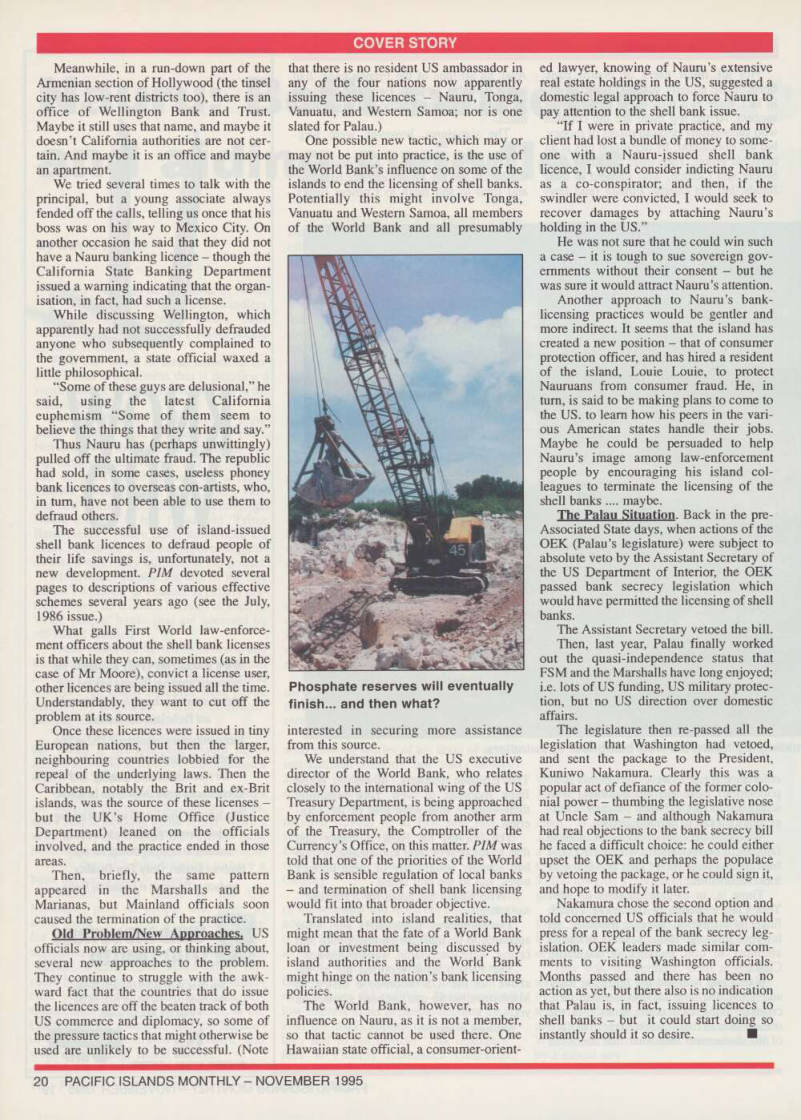
Phosphate reserves will eventually finish... and then what?