Remembering Robert L
pp. 16-17 · Read in the full issue

By Ed Rampeli
The musical, Stevenson by Heart, had its world premiere at Brigham
Young University-Hawaii in June.
The play is set in Samoa and depicts author Robert Louis Stevenson’s involve ment in the Samoan civil wars of the 1890 s, and the foreign intrigue that pro vided an imperial backdrop to these events.
Playwright Gene Levitt reveals the Tusitala (teller of tales) to be a politically engaged artist, dedicated to Samoan sover eignty. The man who wrote Dr Jekyll and Mr Hyde, Treasure Island, Kidnapped, et al, was already a rich and famous writer when he relocated to Samoa for health rea sons.
Stevenson used his pen and internation al standing to support the liberation strug gle of the high chief Mata’afa, who opposed the European-backed Malietoa, in the Great Powers’ bid to take over Samoa.
RLS is portrayed as being so gung ho in favour of indigenous rights that he ignores his fiction - and health - in order to devote himself to the Samoan nationalist cause.
He writes letter after letter to the world’s leading newspapers in order to spread word about the Samoan sovereignty move ment. This causes concern in several quar ters.
The colonial authorities are anxious over the Scotsman’s global reach, prestige, and influence. The Stevenson family is worried that his health is suffering from his political activities, and that the scribe’s devotion to Samoan freedom is making him neglect his fiction. The Stevensons aren’t the only ones nervous that Tusitala is overlooking his creative writing wherein lies this musical’s genius.
Four of Steven’s fictitious characters (five if you count Dr Jekyll’s dark side, Mr. Hyde) are nervous that if their creator continues to ignore his fiction in favour of writing political tracts, Stevenson’s liter ary star will fade. And, the characters assume, if RLS loses his public and is no longer read, his characters - who only live when someone reads the pages of the books they are in - will die along with Tusitala.
Dr Jekyll/Mr Hyde, Treasure Island pirate Long John Silver, Wiltshire and Uma (the lovers from RLS’s South Seas romance The Beach at Falesa) unite and conspire to kidnap the author of
Kidnapped. The conspirators’ goal is to
prevent Tusitala from expending any more
energy on Samoan politics and to force him to get back to writing what they - and just about everyone else - reasons is his raison d’etre: creating children’s stories, swashbucklers, and the like.
Gene Levitt’s script is deliciously witty
and satirical. Of course, since this play, like all plays, is written by a writer, Stevenson as the creator of his characters is able to foil the plotters by rewriting a different ending to their conspiracy.
The large cast is headed by Scott Holmes, star of stage and screen, in the title role. Holmes has appeared on Broadway in Godspell and Grease, and is currently seen in the TV soap opera As the World Turns Mika Tufuga-Valai of Asau, Western Samoa plays the Samoan narrator and RLS’s friend, Sa’ava. Alvina Gin-Nen from Auckland, NZ, is the archetypal South Seas sarong girl as Uma. Three scene-stealing performances are turned in
by the wickedly delightful Gary L.
Anderson as Jekyll (and Hyde!), Bill Ogilvie as Long John, and Keala Settle as the nanny Gummy.
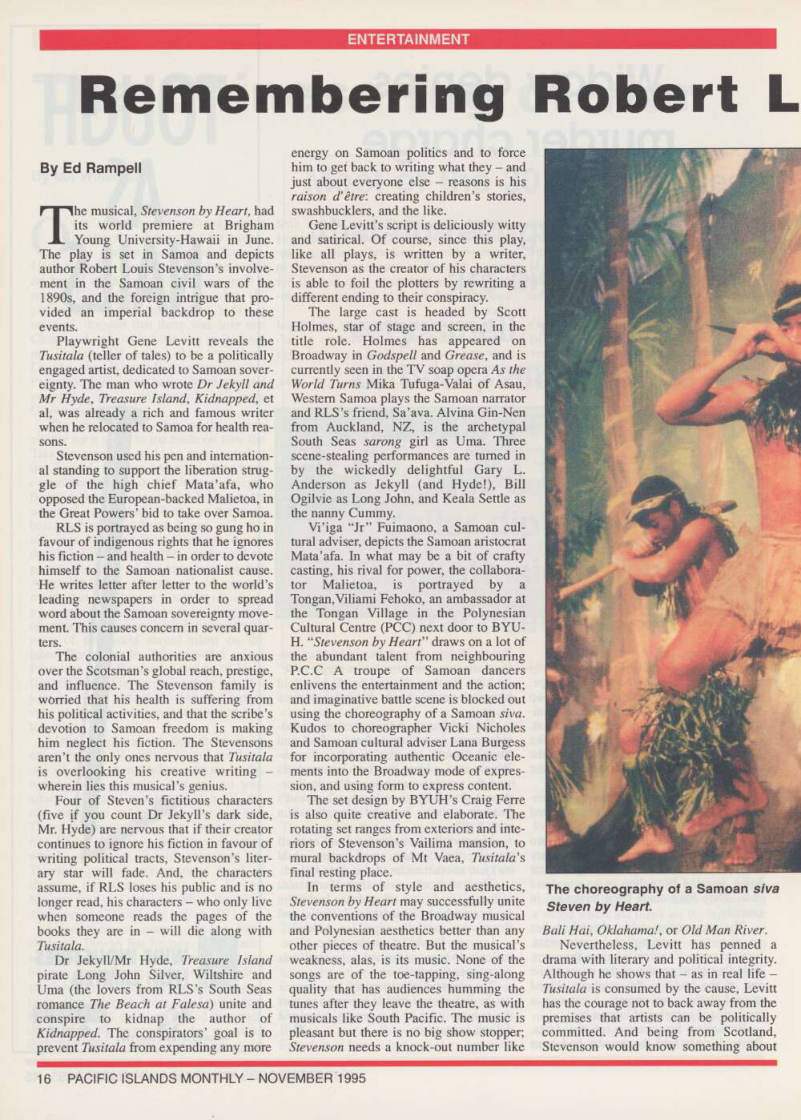
Vi’iga “Jr” Fuimaono, a Samoan cul tural adviser, depicts the Samoan aristocrat Mata’afa. In what may be a bit of crafty casting, his rival for power, the collabora tor Malietoa, is portrayed by a Tongan,Viliami Fehoko, an ambassador at the Tongan Village in the Polynesian Cultural Centre (PCC) next door to BYU- H. “ Stevenson by Heart ” draws on a lot of the abundant talent from neighbouring P.C.C A troupe of Samoan dancers enlivens the entertainment and the action; and imaginative battle scene is blocked out using the choreography of a Samoan siva.
Kudos to choreographer Vicki Nicholes and Samoan cultural adviser Lana Burgess for incorporating authentic Oceanic ele ments into the Broadway mode of expres sion, and using form to express content.
The set design by BYUH’s Craig Ferre is also quite creative and elaborate. The rotating set ranges from exteriors and inte riors of Stevenson’s Vailima mansion, to mural backdrops of Mt Vaea, Tusitala’ s
final resting place.
In terms of style and aesthetics, Stevenson by Heart may successfully unite the conventions of the Broadway musical and Polynesian aesthetics better than any other pieces of theatre. But the musical’s weakness, alas, is its music. None of the songs are of the toe-tapping, sing-along quality that has audiences humming the tunes after they leave the theatre, as with musicals like South Pacific. The music is pleasant but there is no big show stopper; Stevenson needs a knock-out number like
Bali Hai, Oklahoma!, or Old Man River.
Nevertheless, Levitt has penned a
drama with literary and political integrity.
Although he shows that - as in real life - Tusitala is consumed by the cause, Levitt has the courage not to back away from the premises that artists can be politically committed. And being from Scotland, Stevenson would know something about
The choreography of a Samoan siva Steven by Heart.
colonial conquest, as the recent Scottish nationalist movies Rob Roy and Braveheart remind us. The playwright, by the way, has been to Samoa and Tusitala' s Vailima mansion, and Levitt has quite a Hollywood track record, with TV credits including Hawaii Five-0 and Fantasy Island. He is drawn to things Pasifika, and Stevenson by Heart has been a 10-year
labour of love for this WWII veteran.
It is interesting to note that two plays with Samoan sovereignty themes ran con currently off-off-off Broadway at Oahu theatres. Johnny Kneubuhl’s Think of a Garden (starring his niece Victoria Nalani Kneubuhl who just won the 1994 Hawaii Award for Literature by the State Foundation on Culture and the Arts with the assistance of the Hawaii Literary Arts Council) dealt with that other Samoa mo Samoa champion, Mau leader Tupua Tamasese, while Stevenson depicts Mata’afa and his heroic struggle for inde pendence almost 40 years earlier. One play takes place in American Samoa, the other in Western Samoa, and both were pro duced in Hawaii, where another indige nous sovereignty movement can gain
insight and inspiration by witnessing
dramatisations of Western Samoa’s ulti mately successful fight for freedom.
Stevenson by Heart discloses the real reason why Samoans built “the road of the loving hearts” up to the summit of Mt Vaea in just one day in order to lay Tusitala to rest under “the wide and starry sky”: because he used his prestige, talent, and mana to fight for their human rights.
It’s unlikely that Stevenson’s novels were translated into Samoan in the 1890 s, and that many and that many Polynesians read his books in English. It wasn’t just a love for literature, but a love for a man who truly gave his life fighting for their cause that inspired - and still inspires - Robert Louis Stevenson’s place in their loving hearts.
Politically incorrect critics who, in their haste to indigenise Oceanic culture throw the baby out with the bath water, should remember this the next time that they thoughtlessly attack Westerners in the Pacific who fought and died for
Polynesian rights, without taking the
courageous anti-colonial stands of artists like Stevenson and Gauguin into account.
Stevenson by Heart also included the best intermission this critic (who taught RLS’s Black Arrow at Avele college, across from the Vailima mansion) ever attended, as it included live hula plus a wonderful display of Stevenson memora bilia from the Robert Van Dyke collection.
This musical is for lovers of Tusitala, the atre, a good yam, dance, Polynesia, and sovereignty. Whether or not it eventually ends up on Broadway (as Levitt hopes), the play reportedly will be revived in 1996 when the historic Hawaii Theatre in down town Honolulu is scheduled to reopen. ■
is used to depict the battle scene in