50th anniversary
pp. 23-24 · Read in the full issue
United Nations
Nuclear test clouds UN’s 50th anniversary
By lan Williams
As the 50th Assembly of the United Nations unfolded there was consid erable unity among the nations of the Pacific. Speaker after speaker lambast ed France for its nuclear tests, and each time the French delegation bounced up to take advantage of the right to reply.
They would have been better off going underground themselves and not bothering
to respond.
The French replies variously and incon sequentially said that there would be no environmental damage, and that after wards they would have an environmental impact assessment to check on the damage they said would not happen.
They even hinted insultingly that the Forum countries got aid from France, and
so they really shouldn’t complain. As New Zealand Foreign Minister Don McKinnon put it, “I don’t believe that they realise themselves how much they have alienated their otherwise good friends.”
Of course he was being diplomatic. The Rainbow Warrior incident should have reminded him of one very cogent reason why French is no longer the language of
diplomacy!
Significantly, while no one actually stood up to defend the tests, there were silences from many delegations, who, while in no way approving of the tests, did not want to cross a country that has fre quently proven to be vindictive and high handed on this matter.
Even in the group of Latin American and South Pacific countries that has been considering an explicit UN resolution con demning the tests, that type of pressure has had its effects. For various reasons, Cuba and Argentina have signalled dissent with the move. Cuba, the subject of so many
condemnatory moves by the Americans, in general does not like condemnation of anyone, on principle (except of course to condemn the US blockade).
Other countries, like many of the Europeans, want any such resolution to be so bland and toothless that, as one Pacific diplomat said scathingly, “Even we’d end
up voting against it.”
The decision on how much support there would be was going to be made at the Non-Aligned Summit in Columbia towards the end of October. As always, since the end of the Cold War, no one is sure just exactly who it is that they are not aligned with any more, and so the Forum cannot assume support there.
However, the ties built under the AOSIS, the Alliance of Small Island States, from Rio onwards, have proved lasting and useful imthe nuclear context as well.
The resolution is one of the few weapons left for the forum since New
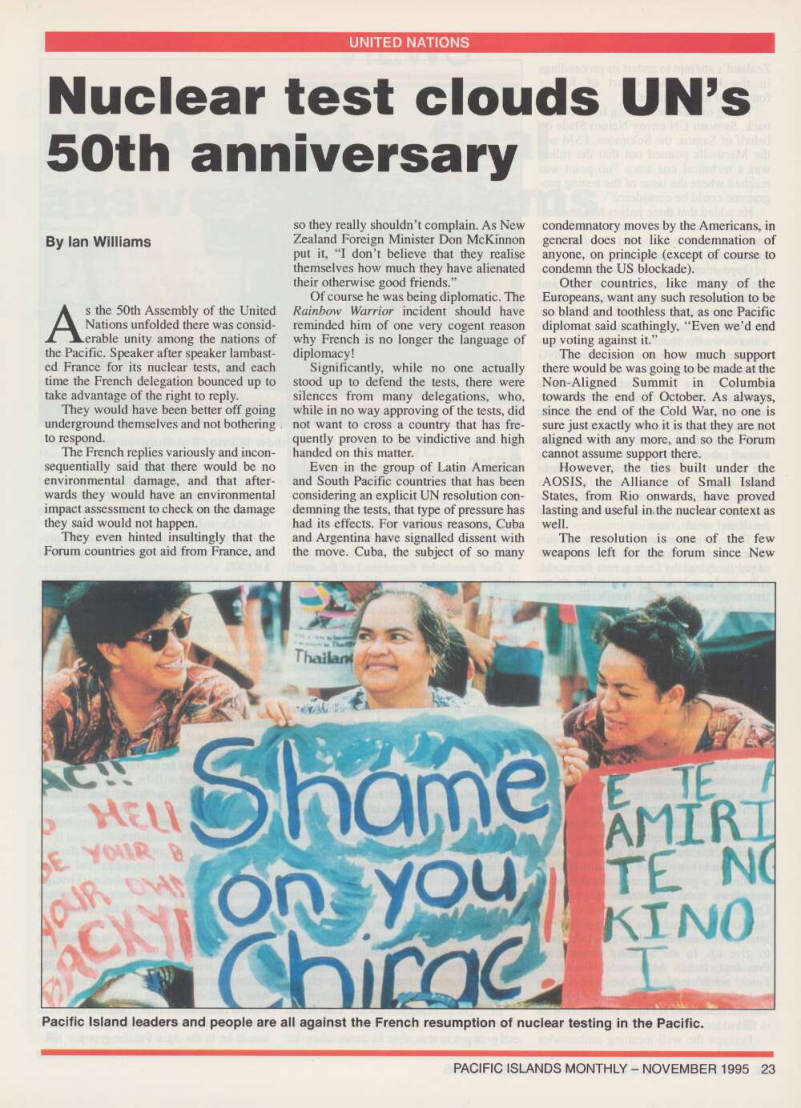
Pacific island leaders and people are all against the French resumption of nuclear testing in the Pacific.
Zealand’s attempt to restart its proceedings in the International Court of Justice foundered in September.
Trying to make something from the set back, Samoan UN envoy Neroni Slade on behalf of Samoa, the Solomons, FSM and the Marshalls pointed out that the ruling was a technical one since “no point was reached where the issue of the testing pro gramme could be considered”.
He added that three judges had vocifer ously dissented with the opinion, and even one who supported it added a codicil hop ing that the tests would stop.
Opposition to the tests was also regis tered by Caribbean, Latin American and Pacific nuclear-free-zone countries. Once again it took strong words from the Pacific to fight off an Argentinean attempt to water down the statement.
As one small token of opposition PNG Prime Minister, Sir Julius Chan, announced to a UN Press conference that as Chair of the Forum he was suspending official dialogue between France and the Forum because of the second test.
Some correspondents seemed to expect a more robust approach, but short of send ing war canoes up the Seine, the whole point of the current situation is that a strong - indeed nuclear power - is bully
ing and abusing the neighbourhood of
small and weak countries.
That is, in part at least, why on this issue, the region does have a ground swell of public sympathy from across the world.
Amusingly, a group of Australian scien tists suggested that the fragile limestone under Mururoa was highly unsuitable for such tests, and that granite was the rock of
choice for underground testing.
As they pointed out happily, France has ample supplies of granite under Corsica and on the Massif Central in the middle of the country. It seems unlikely that Paris will greet this announcement with over much enthusiasm.
As it happens, another Pacific issue was thrown into prominence in October.
Somewhere in the dusty corridors of the UN, probably somewhere near the budget less backwater where the follow up to the Barbados Small Island conference is wal lowing unnoticed, some international civil servants are supposed to be reporting on measures for the defence of small island states. Unthreatened by the bureaucratic battalions, a group of mercenaries tried to overthrow the government of the Comoros.
As it happened, the threat of French intervention was enough to persuade them to give up. In the Security Council, its President, Italian Ambassador Francesco Fulci, condemned the take-over, saying that several members had pointed out that the financing and training of mercenaries is forbidden under a 1985 UN convention.
Perhaps the well-meaning ambassador
could have reminded the envoys that very few of their countries had ratified the con vention. He might also mount a small test explosion under the departments that so assiduously neglect small island state affairs.
One reason for the neglect of the small islands is pressure on the UN budget, mostly because the US has continued to bilk on its bills. Never has the host country of the UN been so explicitly roasted by its allies and friends in the organisation.
The UN is now teetering on the edge of bankruptcy, with staff being laid off, meet ings cancelled and travel stopped.
The main reason is that the United States has unilaterally decided to delay or refuse the payments and dues that it’s con tracted for. The Europeans, who now pay over half the budget, are becoming espe
cially peeved.
However, there is a silver lining in this for the islands. While the Europeans and others do not totally accept that the US is paying too much, they do admit that some countries whose economies have expand ed rapidly in the last few decades are not paying enough, and are looking at the con tribution scale.
The British and others follow on by saying that, in fact, the members who do pay proportionately too much are the smallest states who pay the floor rate of around $lOO,OOO as Samoan Deputy Prime
Minister Tuilaepea Sailele Malielegaoi
told the General Assembly “at levels far
beyond their capacity to pay.”
In fact. Ambassador Lawrence Edward’s of the Marshalls had taken an early step towards this in June when he
tabled the issue on behalf of a group of small and poor states with “High Level working group on the financial Situation of the United Nations”.
His suggestion was to reduce the pre sent floor payment by one tenth, to about
$Lo,Ooo.
If his pleas and the whispers in the cor ridors work, it may soon be much more feasible for Tuvalu, Kiribati, Tonga and Nauru to join the organisation, enhancing the voice of the Pacific and the small islands in the United Nations; and joining in the condemnation of the nuclear tests, one presumes.
Of course, this is being supported by Australia, both in principle and because Australia is campaigning vigorously for a temporary seat on the Security Council, and any extra votes in the General Assembly would be useful.
The election will be held in a year’s time, but election fever has already gripped UN. Sweden and Australia are running on joint ticket which may not so astute a move for Canberra.
Their main opponent for one of the two seats in the “West European and Other
Group” is Portugal, whose Foreign
Minister is presiding over this year’s General Assembly giving the delegation
unlimited canvassing opportunities.
The antiquated grouping is unlikely to
change before the elections next October, but they were the subject of typically forthright comments from Don McKinnon who told Pacific journalist Mere Moimavalu, that if the boundaries were redrawn, then of course New Zealand would be in the Asia-Pacific group. ■
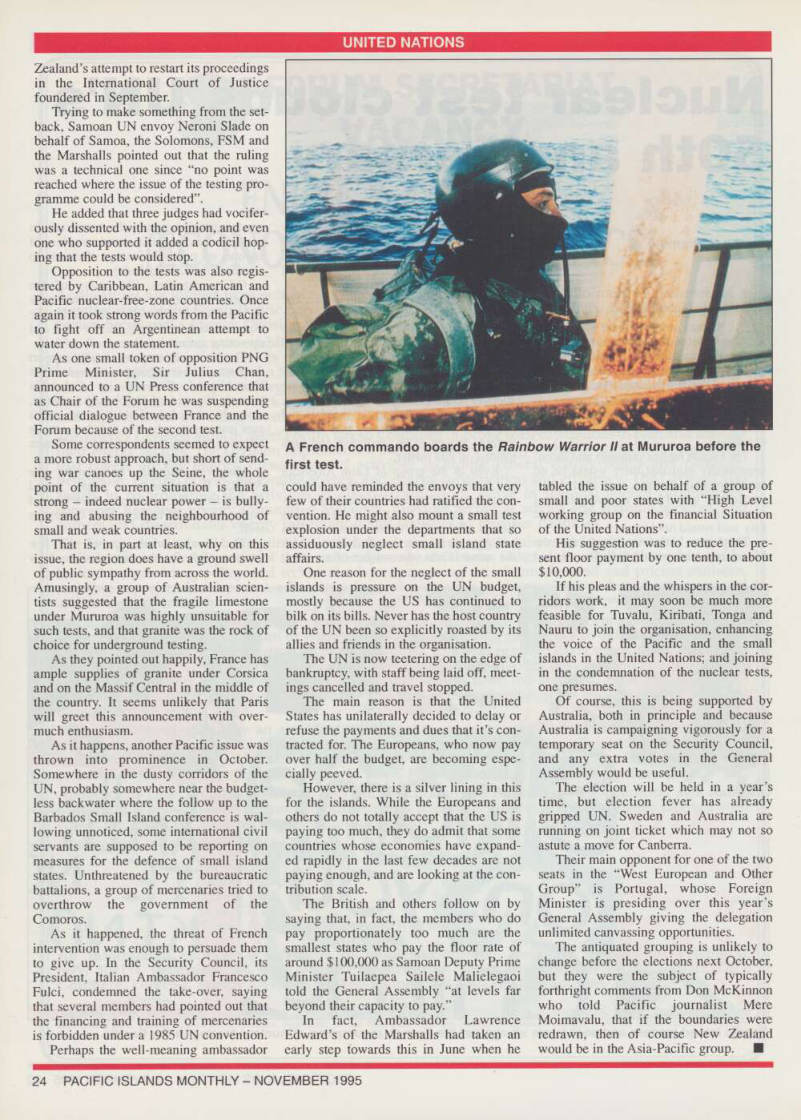
A French commando boards the Rainbow Warrior II at Mururoa before the first test.