When fighting finally stopped
pp. 35-37 · Read in the full issue

• Kiribati
For the rest of the world, World War Two had stopped except for one of Japan’s remote outposts in the Pacific
By Peter McQuarrie
By the time the Japanese surren dered in August 1945, military activities in the Gilbert and Ellice Islands had already been scaled down and the Islander’s lives had rapid ly been returning to normal.
The one exception was Banaba (Ocean Island) which was isolated from the rest of the British colony and occu pied by Japanese forces who did not for mally surrender until October, 1945.
The Ellice Islands had marked the extreme southern limit of the fighting in the Central Pacific and by August 1945 the war had long since moved thousands of miles away to the north and west towards Japan. The final Japanese attack against the Ellice Islands had been a bombing raid against Funafuti on November 18, 1943, although sighting reports of Japanese submarines in Ellice Islands’ waters continued until January 1945.
There had, however, been several wartime accidents in the Ellice Group during 1944-45. Two Royal New Zealand Air Force aircraft, on routine patrols looking for Japanese submarines and aircraft, had crashed at Funafuti.
And a whole squadron of US Marine Corsair fighters (22 planes) had been lost between Tarawa and Funafuti in January 1944.
In August of the same year a large four-engined United States Naval Transport Service seaplane crashed in Funafuti lagoon after striking the mast of an anchored ship. Twenty-two people died in this accident, among them sever al offices who had been passengers on the plane, including a rear admiral.
In the Gilbert Island, fighting had ceased when US Marines had ousted the Japanese from Abemama, Butaritari and Tarawa in November 1943. After this the main involvement of the Gilbert and Ellice Islanders in the Gilberts was in clearing up Tarawa after the horrific bat tle in Betio which cost 4820 Japanese and Korean lives and 1027 Americans. A Gilbert and Ellice Islands Labour Corps had been formed for the task. By December 1943, they had a roll of 652 men and one year later this number had risen to approximately 2000 with com panies serving in South Tarawa, Abemama, Funafuti and at Guadalcanal in the Solomon Islands.
New Zealand coast-watchers had been active in the Gilbert and Ellice Islands longer than any Allied or Japanese forces since July 1941, five months before America entered the war with the bombing of Pearl Harbour.
Seventeen coast-watchers in the Gilberts
had been killed by the Japanese at Tarawa and another seven were incar cerated in Japanese labour camps until the end of the war.
They had received much media attention in Japan as they had been the first prisoners of war to arrive there. The last of the coast watchers to leave the Gilbert and Ellice Islands had been their longest serving member. Lieutenant DL Vaughan, who departed for his home in Wellington in December 1944 after serv ing for three and a half years on Funafuti. The remaining New Zealand forces, RNZAF personnel, had all left before the end of the war.
At Banaba, Australia, British and New Zealand officials arrived to accept the Japanese surrender on October 1, 1945. They were surprised to find that there were no Islanders there and were told by the Japanese that all civilians had been evacuated to other Japanese held islands. The truth, however, was that 150
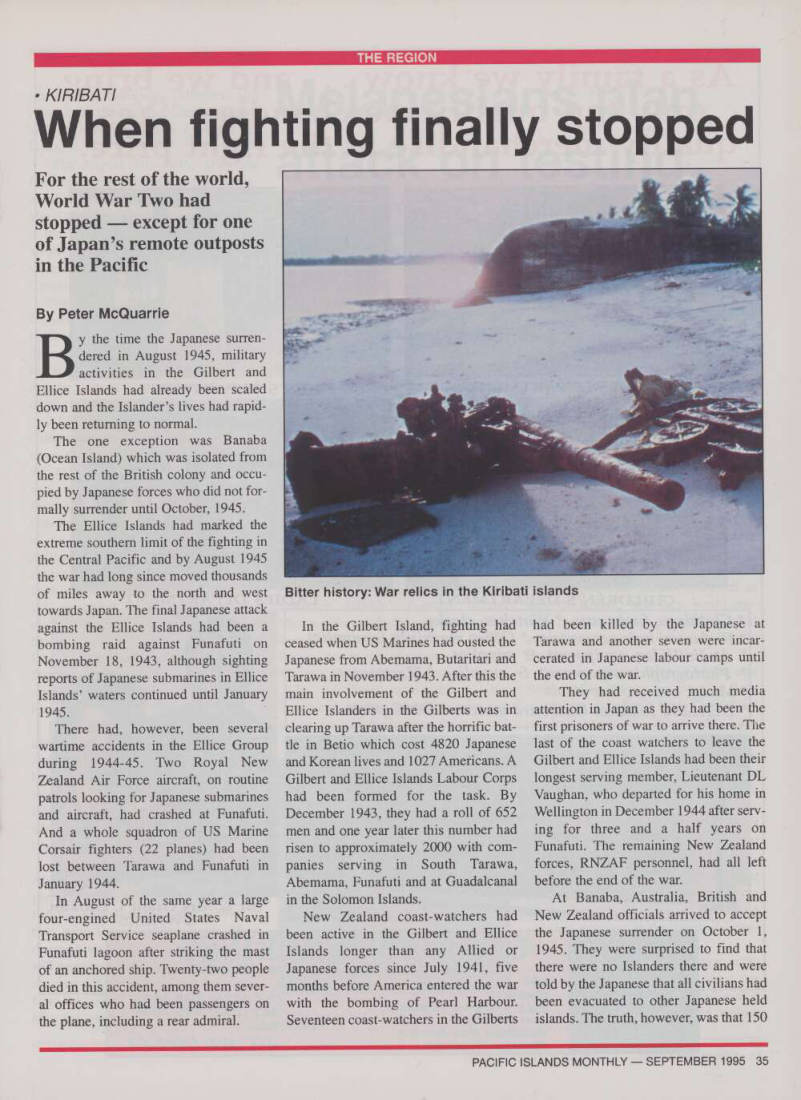
Bitter history: War relics in the Kiribati islands
young men, Banabans, Gilbertese and Ellice Islanders, had not been evacuated but had been retained to work for the
Japanese.
On August 20, 1945, after the Japanese surrender, they had been exe cuted, either because the Japanese were afraid that they would turn against them if the Allies invaded, or because they wanted to eliminate all witnesses to other Japanese atrocities which had been committed at Banaba.
There was only one survivor, a Gilbertese named Kabunare, who had hidden in a cave until he was certain that the war was over. It was largely due to his testimony that the Japanese com mander, Suzuki Naoomi, was convicted of war crimes and hanged.
After the Americans had captured the Gilbert Islands they quickly established bases there and then moved on to take the Marshall Islands in January 1944 and then attacked the important Japanese naval base at Truk in the Caroline Islands in February. By the end of the war, only a handful of American military personnel remained, engaged in communications, equipment salvage and land rehabilitation work. The graves of US personnel were opened and the remains removed to graves in the United States. In December 1945, Ellice Islanders who had been captured by the Japanese in the Gilbert Islands were returned home from Kusaie (now Kosrae), Nauru and Tarawa.
By mid-1946, Funafuti airfield was used mainly for playing sport and in June the US base there was dis-estab lished and by the end of that month there were no US personnel in the Ellice Islands. The Islanders and their British administrators were left to carry on with land rehabilitation.
America still maintained its bases on Abemana, Butaritari and Tarawa but the garrison forces were as much engaged in fishing, gardening and other hobbies as they were in any military work. Much cleaning up and land restoration work still remained to be done, however, and the last US personnel did not depart from the Gilbert Islands until three years after the war ended. A