Melanesians plan
pp. 37-38 · Read in the full issue
attack on testing
By Patrick Decloitre
THE Melanesian Spearhead Group’s ninth annual meeting, which gathered this year in Vanuatu’s northern Malekula island from August 12-15, saw officials from Vanuatu, Papua New Guinea and Solomon Islands come up with a com mon Melanesian stand about French nuclear tests.
The meeting, which took place in the tiny village of Lakatoro (200 kilometres north of Port Vila), first gathered foreign affairs, trade and commerce officials from the three member countries, who made recommendations on subjects to be discussed by their prime minsters.
The hottest issue on the agenda was the decision by France to resume nuclear testing at Mururoa Atoll this month, on which Melanesian leaders (Prime Ministers of Vanuatu Maxime Carlot, PNG Prime Minister Sir Julius Chan and Solomon Islands’ Foreign Affairs Minister Danny Phillip) adopted a com mon stand before the South Pacific Forum, due to take place this month in Madang, Papua New Guinea.
In its final communique, the Spearhead leaders decided to enter into a dialogue with France over the tests and
the dangers they pose. They protested the tests in a communique called the “Lakatoro Declaration” which reminded France of regional treaties already in force for the protection of the environ ment.
The declaration, which was made at the initiative of Vanuatu’s French-speak ing Prime Minister Maxime Carlot, however stressed the Spearhead Group’s eagerness to engage in “constructive dialogue” with the French government regarding nuclear issues.
The leaders also called on France to work with countries in the region to find a way of putting in place a policy which would ban nuclear and promote the “scientific monitoring of the effects of nuclear test” and “long-term commit ment to compensate for injuries and /or damages caused by its nuclear test pro grammes”.
The Spearhead leaders indicated in their declaration that they would pro mote their declaration at higher regional gatherings, including the South Pacific Forum.
Vanuatu, Papua New Guinea and Solomon Islands are the group’s three permanent members. New Caledonia’s pro-independence movement, the FLNKS (Kanak Socialist National Liberation Front) is an associate mem ber. Fiji (represented by Deputy Prime Minister Ratu Timoci Vesikula) is an observer.
On New Caledonia, the Spearhead Group was told that the results of recent provincial elections in the French terri tory shows that the anti-independence RPCR party (Rally for New Caledonia in the Republic) has ended up with a reduced majority in the Territorial con gress.
The leaders then called on France “to ensure that the 1998 referendum (on self-determination in New Caledonia) is held in accordance with United Nations
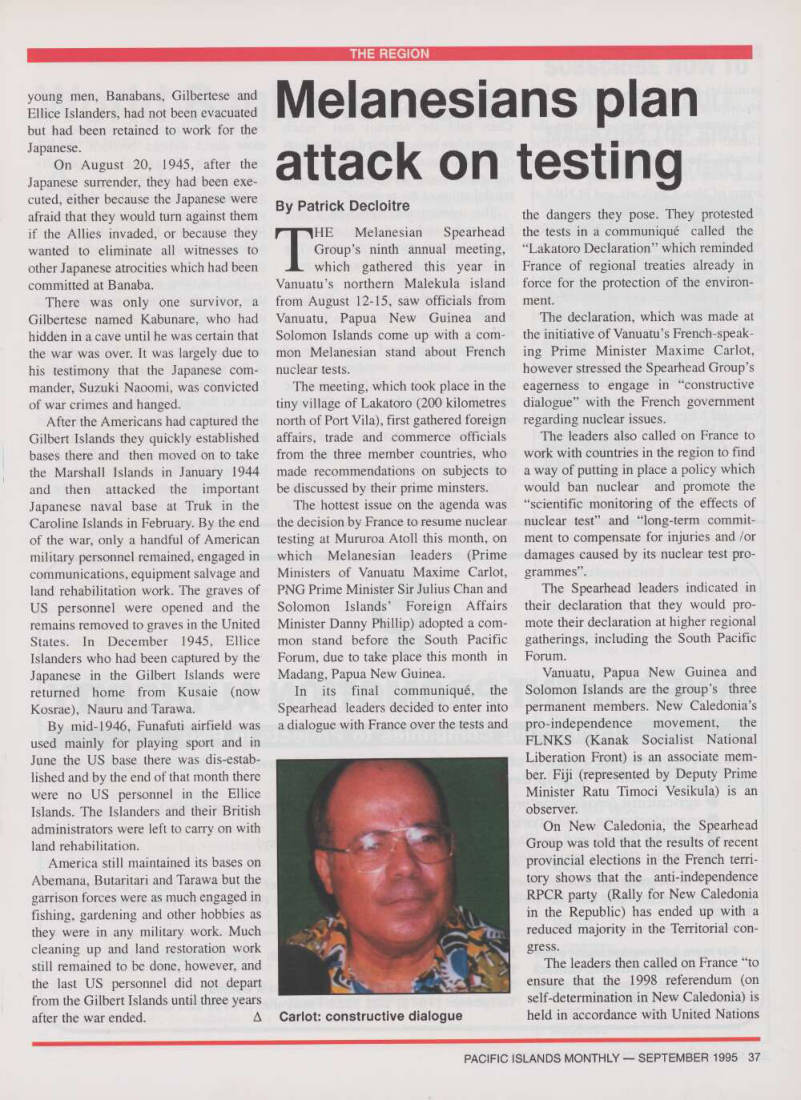
Carlot: constructive dialogue
principles and practices and with the full knowledge and observation of appropri ate international bodies, including the United Nations and the South Pacific Forum”. The leaders also agreed to con tinue their efforts in securing observer status of New Caledonia and FLNKS at the South Pacific Forum.
Amongst the PNG initiatives which were approved by the summit is the pro posal to establish a South Pacific Regional Support Unit “to facilitate infrastructure development, assist in dis aster, in mitigation and rehabilitation as well as the maintenance of peace and security in the region”.
Chan had first mentioned the idea last year after a South Pacific Regional Peacekeeping Force, consisting of Vanuatu, Tonga and Fiji troops, was sent to Boungainville with logistical support from Australia and New Zealand. The occasion was the aborted Arawa Peace conference, last October.
But Australia and New Zealand are
reluctant to maintain this force on a per manent basis. On the Bougainville issue, Chan told the summit that “much progress has been achieved in the efforts of the PNG government to restore essen tial government services and general rehabilitation of the province”.
The meeting also approved a duty free trade and economic exchange scheme between member countries. The idea is to allow a list of goods to circu late on a duty free basis.
Following up on last year’s Brisbane Forum decision to rationalise air and shipping services in the Pacific, the Spearheaders endorsed a “package of measures, including member countries participating and benefiting from the spin-off of the Sydney 2000 Olympic Games”.
Melanesian countries, which see this as an opportunity, will promote their region as a tourist destination.
In the same field, Vanuatu and Papua New Guinea signed an air services
agreement in order to allow designated airlines from both countries to fly to each others’ capital. This could result in more direct airlinks between Vanuatu and South East Asia (especially
Singapore) through PNG.
Culturally, it was also decided to approve Solomons’ proposal to create a Melanesian Arts Festival, the first of which should take place in the Solomons in 1998.
The Lakatoro summit ended earlier than planned: the final communique was in fact signed not in the northern Malekula island, but in Port Vila. The reason was that two days before the end of the summit, Vanuatu Prime Minister Maxime Carlot got sick and Lad to fly back to the capital. PNG premier Chan followed the next day and he and Carlot signed the declaration separately in Port Vila. Solomon Islands and FLNKS flew back to Port Villa and in turn signed.
The group’s next meeting will be in Papua New Guinea. A