Pacific
Islands
Monthly
Page 26
Is America leaving the Pacific?
Page 52
Little Magic Rugby’s newest heroes
■ber 1995
' ® i ■'
Elf Uuljl.
Rjjr r _. yMBPI J» - ~-m 1 1 I (niWiM rtij i
* Gr finSfc
w Vmi wmmMrn mmm^JsmaMt^M
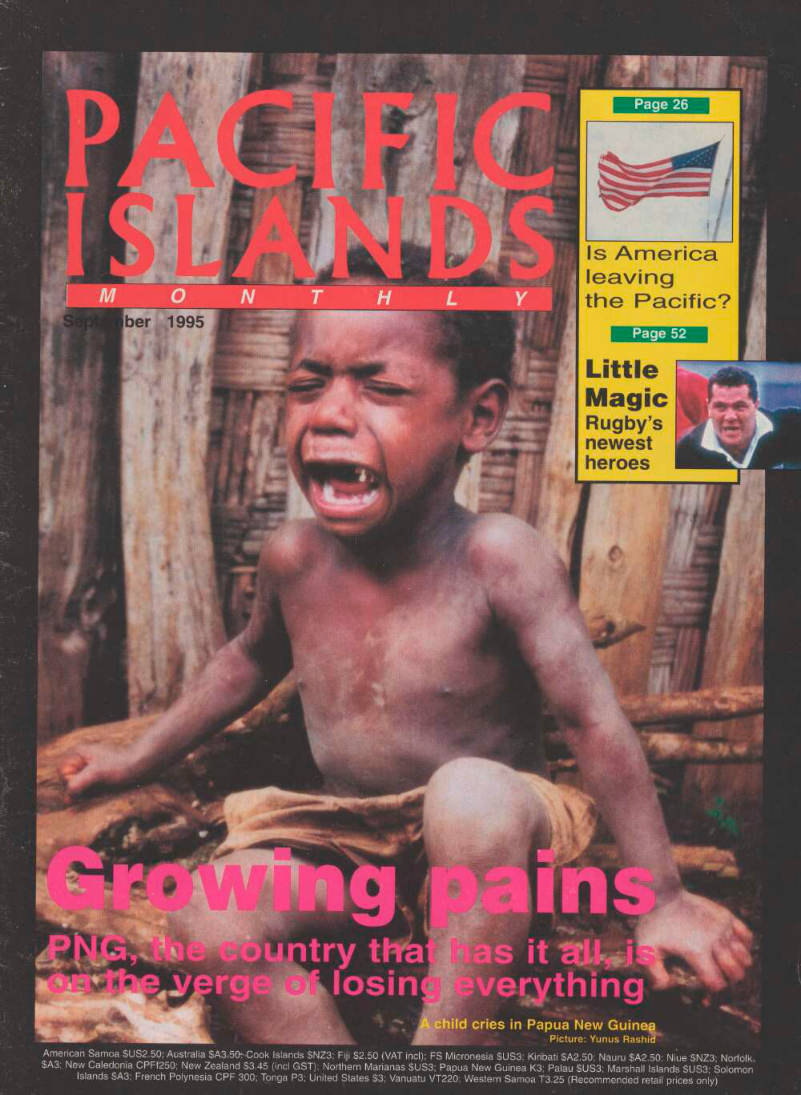
A child cries in Papua New Guinea Picture: Yunus Rashid
American Samoa SUS2.SO: Australia $A3.5Ot-Cook Islands SNZ3; Fiji $2.50 (VAT incl); FS Micronesia SUS 3; Kiribati $A2.50; Nauru 5A2.50; Niue SNZ3; Norfolk, SA3; New Caledonia CPFf2SO; New Zealand $3.45 (incl GST); Northern Marianas SUS 3; Papua New Guinea K 3; Palau SUS 3; Marshall Islands SUS 3; Solomon Islands SA3, French Polynesia CPF 300; Tonga P 3; United States $3; Vanuatu VT22O; Western Samoa T 3.25 (Recommended retail prices only)
Advertisements & other items, pp. 2-6 (1 item)
Telikom
i
Papua New Guinea in ft*# i?f«2 i r RKf »» < Hi
SPSSSPfi!
*4 'Wh % - "vt [ f • ; ~:v...„. ii [jfli Hi i KpWj ?*»■ i i
SIBs
: :UAU^UAU,
r
tt lirilllimiiilrnmiu
few as » - § r / • |: 1:3 * ■: titr '
I ituHnummmm
}-iJ W 5 It * • Telikom has set the pace in providing state-of-the-art telecommunications links within PNG and to anywhere around the world as we enter the 21st Century. For all your telecommunications needs, write to us at this address: Assistant General Manager Telikom Marketing Department P.O. Box 291 Waigani, Papua New Guinea Tel: 675 300 5564 Fax:67s 300 5540 I
TELIKOM
fioia we'ne neaiUf, tcdklmj,!
1C 1 t / \ k \ \ / *
lUSTRIES
R (Fiji) Limited G • GALVANISED AND PVC CHAINLINKTENCING • ST lAWN WIRE * SECURITY MESH • WIRE RODS • BRIG*
ID AND HT BARBED WIRE
NAILS •
PIG AND GOA
RIGHT H
San so m design
BOTSWANA H BRITISH VIRGIN ISLANDS
From the
that's
known around the world
m the provision of international services for over thirty countries, and of domestic kr these countries are here in the Pacific, an „ area of Cable and Wireless activity for more services for more than twenty. Many of than one hundred and twenty years.
Cable & wireless
The most experienced telecommunications company in the world. • Fiji Fiji International Telecommunications Limited, PO Box 59, 158 Victoria Parade, Suva. Tel: (679) 312933. • Solomon Islands Solomon Telekom Company Limited, PO Box 148, Honiara. Tel: (677) 21576. • Tonga Private Mail Bag 4, General Post Office, Nuku'alofa. Tel: (676) 23499. • Vanuatu Vanuatu Telecom Limited, PO Box 146, Port Vila. Tel: (678) 22185. • Pacific Head Office PO Box 60, Suva, Fiji Islands. Tel: (679) 311300. Fax (679) 311 Oil.
A LEONE tsOLOMON ISLANDS SOUTH AFRICA# SPAIN ST HELENA# ST KITTS AND NEVIS# ST LUCIA nv'WiAi t/iAivn MVHWF v/mwiAiwr aiwm nNvnMii nwoiu wnwNiwn , _i iru
ST VINCENT# SWEDEN# TAIWAN# THAILAND<| TONG A# TRINIDAD TURKS AND CAICOS# UNITED KINGDOM USA VANUATU YEMEN
ANGUILA ANTIGUA ASCENSION ISLAND
BAHRAIN
BELARUS BERMUDA
Telecommunications
solutions for the Pacific
aw & »# The world of Cable and Wireless encompasses to the most sophisticated international both developed countries, and those still services. developing. Countries with widely varying telecommunications needs.
Our philosophy of responding to individual needs explains why today we are And so Cable and Wireless solutions range the world's most widespread global from basic regional and local telephone systems telecommunications company, involved in MALDIVES# MONGOLIA# MONTSERRAT# PAKISTAN PHILIPPINES % PORTUGAL I RUSSIA SEYCHELLES
This is Papua New Guinea,
If you think our scenery is impressive
wait until you meet our people.
PRIMITIVE cultures? Think again. Some of our ancestors were tending irrigated market gardens thirty thousand years ago. ♦ Others devised giant multi-hulled sailing vessels to increase cargo volume on trading voyages. These Lakatois are still built each year in celebration of those epic voyages. ♦ You may also marvel at the skills needed to construct massive Haus Tambarans —buildings soaring to heights that would shame many a modern architect. ♦ Yet the most impressive fact for the jaded traveller is that so many fascinating cultures and traditions are still a part of everyday life; not something turned on for the benefit of tourists. ♦ And with over 800 languages in PNG, we probably have more ways of saying "welcome" than any other people on earth. ♦ So come to PNG for the natural, breathtaking scenery and you will quickly discover that it's our people that make PNG a truly unique destination.
For many more fascinating facts about Papua New Guinea holidays, contact your travel agent or the Papua New Guinea Tourism Promotion Authority.
PO Box 1291 Port Moresby NCD Papua New Guinea Call (675) 20 0211 Fax (675) 20 0223
PAPUA NEW GUINEA
TOURISM
Pacific
Islands
Monhtly
Vol. 65 No. 9
The News Magazine
September 1995
PUBLISHER: Brian O’ Flaherty EDITOR: Jale Moala SENIOR WRITER: Yunus Rashid
Correspondents:
David North, Ed Rampell, lan Williams, Liz Thompson,
Roman Grynberg,
Wally Hiambohn, Lisa Williams, Patrick Decloitre, Barry Markowitz.
COLUMNISTS: David Barber (Wellington), Futa Helu (Tonga), Jemima Garrett (Sydney), Alfred Sasako (The Forum).
Advertising Sales
Regional Sales - South Pacific Ashok Lai, Tel (679) 304111, 303429, Fax (679) 303809.
Sydney, Canberra: Bob Hill Media Representation, Tel (61-2) 4164245, Fax (61-2) 4165064.
Brisbane: Jane Fewings Media and Advertising Associates Tel (61-7) 378 4522, Fax (61-7) 878 1071.
Adelaide: Hastwell Williamsons Representatives, Tel (61-8) 3799522, Fax (61- 8) 3799735.
Melbourne: Brown Orr Fletcher Burrows (Aust) Pty Ltd.
Tel (61-3) 8265188, Fax (61-3) 8265644.
Auckland: McKay & Bowman, International Media Representatives Limited, Tel (64-9) 4190561, Fax (64-9) 4192243.
Japan: Universal Media Corporation, Tokyo, Tel (3) 3266626741, Cable: UNI-MEDIA Tokyo, Fax (3) 32626742.
Pacific Islands Monthly was founded 1930
(Usps 9522480).
A Fiji Times Limited production.
Cover prices are recommended retail only. Registered by Australia Post, Publication No. NBPI2IO. © Copyright Fiji Times Limited, 177 Victoria Parade, Suva, Fiji.
Tel (679) 304111, fax (670) 303809.
Pacific Islands Monthly is published monthly by Fiji Times Limited, a division of Nationwide News, 2 Holt Street, Surry Hills, Sydney, NSW 2010.
Send Address Changes To:
Pacific Islands Monthly, PO Box 1167, Suva,
Fiji.
Typeset and printed by The Fiji Times Limited, 177 Victoria Parade, Suva, Fiji.
Inside
Cover: Papua New Guinea celebrates 20 years of independence. But the country that has everything is desperately close to losing all
Changes in US policies are hitting ft * the region
magic of the Little brothers give new life to rugby
8: Letters 10: Headlines 22: Inside Mururoa: A closer look at Bomb Island 32: Tuna problems: New wage talks raise concern 35: The war ends: Fifty years later 38: The Melanesians meet 41: Pacific waves at the United Nations
Views
25: Alfred Sasako on nuclear testing 40: Futa Helu on new Tongan politics
57: Book Review 58: Neighbours: The people of the Pacific
Letters
Peace crisis THE peace crisis that is spreading throughout the earth is causing grave social consequences and the scientists of the world are probing in depth as to the cause of it.
The sale of armaments have come to an abrupt end and the unemployment rate in the anti-ballistic missile industry is alarming! Some scientists believe that a madman has poisoned the water sup plies of the world with peace germs.
Unless a solution is found soon, peace will pervade the planet and discord will be totally eliminated.
A world political crisis is imminent!
Earth is headed for a total revolution!
Can the politicians of the world stop it?
Martin Leo
Otahuhu, Auckland
Aussie aid
ROBERT Simms’ article, So who is real ly on the gaining side, (PIM July 1995) adds to an ongoing and at times vigorous debate in Australia about the sectoral focus and commercial returns in Australia’s overseas aid programme.
While Robert Simms makes a num ber of good points in his article, some of his criticisms and assertions about Australia’s aid performance in the health sector and how the assistance is deliv ered lacks objective and informed analy sis. Australia recognises that in promot ing and supporting the sustainable eco nomic development and advancement of
people in developing countries, signifi
cant resources need to be directed to both public health and population-relat ed problems. How well these problems are handled hinges in large part on coun tries establishing and implementing the right policies to cope with them. This also involves difficult choices in apply ing resources to a wide range of compet
ing priority development needs. In the 1994- Australian aid budget, Mr Gordon Bilney, Minister for Development Co-operation and Pacific Island Affairs, announced a four-year $llO million health initiative, nearly doubling AusAlD’s spending on health aid programmes in countries in South East Asia and the South Pacific. In that year over $l2 million was spent on health activities in the South Pacific region amounting to approximately 9 per cent of total Australian aid to the South Pacific. This exceeds the target of 7 per cent recommended in the World Bank’s 1993 World Development Report. Nearly $l7 million has been allocated for health-related activities in 1995- In response to requests from Pacific Island countries, these funds will be spent on a wide range of activities including a $2 million building pro gramme at the Fiji School of Medicine; a $1 million ‘Health Islands’ health pro motion programme $3 million to support the delivery of a wide range of tertiary health services to the region; a number of maternal and child health care pro jects; and development of a $lO region al vector borne disease control pro gramme.
Contrary to Robert Simms’ claim, most of these activities are integrated regionally, precisely to avoid the pitfalls he refers to lack of cohesion and frag mented programmes. For example, the vector borne disease project will assist South Pacific countries to reduce mor bidity and mortality through medical and environmental health programmes as well as vector control mechanisms across six Pacific Islands countries.
On the general issue of commercial benefits and returns to Australia from the aid programme, Australia’s aid pro grammes are effective precisely because
goods and services are generally provid
ed in fields where Australia has a com parative advantage in terms of both price and quality. It would not make sense for Australia to support projects and activi ties which other donor countries or agencies are better placed to assist. It should also be noted that AusAID has
forged strong links with a number of Australian health sector professional societies and institutions which, in many instances, have offered the services of their members to work in the South Pacific on a largely voluntary basis.
Robert Simms correctly points out that Australia does derive substantial commercial spin-offs from its aid pro grammes, but these are unforced and not, as he claims, one of Australia’s
prime objectives in providing particular
kinds of support to developing countries.
Critics who see this benefit to the Australian economy “as running con trary to the basic concept of humanitari an aid” overlook a number of other fac tors which need to be considered. These include, for example, the value derived by the recipient country from a transfer of technology, such as in-Australia scholarship programmes, as well as the more quantifiable economic and social benefits generated by physical infra structure, research programmes, and community based projects sourced from Australia. In this context, it is also worth nothing that Australia’s $1.5 billion aid programme is provided entirely in the form of grants.
Bruce Davis
Deputy Director General, Pacific and International Programs Division, Australian Agency for International Development
Rising seas
IN the article entitled, Commercial Sense or Sheer Madness, (PIM June 1995) the author states that: “The high est point on its (Marshall Island) atolls is just 10 metres above sea level. A 50metre rise in sea level would make the Marshall Islands uninhabitable, the 1994 Barbados conference of Small Island States was told by the Marshall Island Gorvemment.”
With a highest elevation of only 10 metres, a rise in sea level of 50 metres would most certainly render the Marshall Islands uninhabitable. While the error is undoubtedly a minor editori al one, I feel it would be useful to pro vide your readers with current predic
tions of sea-level rise due to climate change. Scientists working under the auspices of the Inter-governmental Panel on Climate Change (IPCC) predict that a 25-30-centimetre rise in sea-level will occur between now and the year 2050. Further increase due to global warming will lead to a rise by the year 2100 of about 50 centimetres.
While rising sea-levels are accepted by the majority of climate scientists, the exact figure does remain open to debate.
This is principally due to the uncertain ties in determining the response of the polar ice caps. The release of liquid water due to melting bought on by high er air temperatures will certainly raise sea-levels.
However, increased snowfall over the poles caused by air being warmer, but still below freezing, will store some of this water back onto the ice cap.
Unravelling this complex feed-back sys
tern will eventually resolve much of the uncertainty, but at the moment scientists have a less than perfect understanding of this particular aspect of the problem.
A rise of 50 centimetres will certain ly render much, if not all, of the small atolls of the Pacific uninhabitable.
Rather than inundation, the cause of this will have more to do with human needs for habitation.
Rising sea levels will significantly reduce the available fresh water in
underground acquifers, upon which
human life on atolls depend.
More frequent and devastating occur rences of storm surge and sea flooding,
particularly during cyclones, will affect
human settlements, coastal lagoons and coral reefs. In this way agriculture and fishing activity will be impacted to the detriment of future human survival on atolls. The impacts above, while certain ly affecting human habitation in the
Marshall Islands, are also important aspects to be considered in any proposal such as that discussed in your report.
The implications of sea-level rise will adversely influence any facility built to store nuclear waste on the atolls of the Marshall Islands. It is hoped that any decision made in this regard will take into account the effects on sea-level rise due to climate change.
Neville Koop
Meterology and Climatology Officer, South Pacific Regional Environmental Programme
Letters to the Editor LETTERS should be addressed to: The Editor, Pacific Islands Monthly, PO Box 1167, Suva, Fiji. Fax: (679) 303809. They should contain the writer’s full name, address and telephone num ber. Letters may be edited for clarity and accuracy.
Advertisements & other items, p. 8 (1 item)
Scrap Metal
Tall ingots operate from Brisbane, Australia and make frequent visits to the Pacific Islands which they have done for twenty-five years. We are buyers of Copper, Brass, Aluminium, Lead, Batteries, Battery Lead, Cable etc.
Inspection no problems.
Telephone 617 8922033 Fax 61 78922077. 112008v3
Other letters: French nuclear testing in the Pacific
From The Fiji Times in Suva PEOPLE of the Pacific worried about the French tests should con sider the following: • order the French ambassadors in their respective countries to pack and leave; • place a trade embargo on all French goods; • not service ships and planes; • stop all sporting activities with the French, including the South Pacific Games; • cancel all military and naval joint exercises previously planned; • make a joint submission to the
European Community voicing our
concern for the abhorrent French action in disregarding the wishes of Oceania; and • make a submission to the United Nations for an immediate decolonisation of the French colo nial out-posts of New Caledonia and French Polynesia.
The Kanaks and others have been
fighting for this for a long time. If these island nations become inde pendent and have self-rule then the French presence will automatically be reduced.
Handing a petition to the French Ambassador on Bastille Day will not carry much weight and will probably end up in the waste paper basket anyway. More positive action is called for.
John Leonard Dass
Lautoka, Fiji From The Solomon Star in Honiara THE city of Newcastle is Australia’s seventh largest city. It is located on Australia’s Pacific coast about 150 kilometres north of Sydney.
The people of this city have been outraged recently by the decision of the French Government to reintro duce nuclear testing in the Pacific.
Newcastle is the capital of the
Hunter Valley region of Australia in which great wine-making, world class manufacturing and essential rural production take place. It is also a centre of learning and a city proud of considerable improvements to our environment.
To have all these threatened by what we regard as a totally unneces sary action of another nation is most unwelcome.
The response of Newcastle peo ple has been one of anger and out rage that has led the City Council to take action on their behalf.
We know that we are not the only people distressed by this awful deci sion and we are aware of the consid erable effort being made around the world to have the decision reversed.
We would be pleased to hear of any action you may be taking on this matter and we urge you to consider joining with us on this approach.
John McNaughton
Lord Mayor, Newcastle.
Headlines
10 win top
study awards
MULTI-YEAR scholarships for univer sity study in the United States have been awarded after a tough competition for 10 young people from seven South Pacific nations.
More than 500 people applied for this new programme, created by Congress man Eni Hunkin Faleomavaega (D- American Samoa), and funded by the US Government.
The 10 winners will begin their stud ies later this year at the University of Hawaii, and may subsequently transfer to other institutions. The winners includ ed: Cook Islands: William Wigmore, entomology; Fiji: Arti Reddy, marine resources and Ilisapeci Vukialau, busi ness administration; Kiribati: Fred Murdock, environmental management and Kinaai Kairo, economics/agricultur al resources; PNG: Winis Map, journal ism and Andrew Kaipu geology/mining engineering; Solomon Islands, Aram Oroi, education; Tonga: Havila Saafi, environmental sciences; Western Samoa, Georgina Ainuu, natural resources.
Each student will receive full tuition, travel to and from Hawaii, and a stipend to meet living expenses. If they do well in university most will have the option of staying through a bachelor’s degree.
In the case of Wigmore, who already has one bachelors degree, he may be funded for graduate study as well.
Should the US Congress vote more funds, other competitions will be held.
Aussies join
nuclear fight
AUSTRALIA has formally supported New Zealand’s move for a speedy International Court of Justice hearing into French nuclear weapons testing in the South Pacific.
Australia’s ambassador to The Hague, Michael Tate, said both Australia and New Zealand wanted the hearing to begin in the next three weeks, before too many tests were conducted. France has
announced it would resume nuclear test ing at Mururoa Atoll in French Polynesia this month.
New Zealand has applied to the International Court to reopen its 1973 case against French testing, which was
suspended in 1974 when France announced it would conduct no more atmospheric tests. It also asked the court for an interim order requiring France to suspend testing until the main case was heard.
The bad news
on Malaria
THE World Health Organisation has admitted that it s malaria eradication programme in the Solomons failed because the administration of the pro gramme was localised too early.
Malaria is still the main killer disease in the Solomon Islands. The programme started in the 60s. The WHO Western Pacific regional director, Sang Tae Han, told journalists in Honiara the local health authority took over the pro gramme before malaria had been eradi cated.
Financial gamble
for top Samoan
AMERICAN Samoan Congressman Eni Hunkin Faleomavaega (D-AS) took a gamble with his islands’ financing in July when he supported a successful effort to eliminate a SUSI6.B million appropriation for the United States Flag islands.
Faleomavaega lined up with the islands subcommittee chair Elton Gallegly (R-CA) as the latter’s amend ment carried the day while the House of Representative voted on the massive Department of Interior budget. The Gallegly amendment wiped out funding for all Interior Department administra tion of funds for the islands (SUS3.S million) plus SUSI 3.3 million in con struction grants for American Samoa, Guam, Northern Mariana and the US Virgin Islands (in the Caribbean).
Untouched was another SUS2I million or so, the annual budget supplement for the territorial government in Pago Pago.
Faleomavaega and Gallegly want a different approach; they seek to end Interior’s oversight of the islands and the piecemeal funding of Samoan activities in exchange for a guaranteed SUS34S
million to Samoa over the next 10 years.
So they are backing a proposal to that effect (HR 1332) now wending its way through the House.
But what happens if HR 1332 dies and the Senate agrees with the House on the current version of the Interior Appropriations Bill? In Washington terms, that’s called a “down-side risk.”
Muslims support
indigenous rights
FIJI’S biggest Muslim organisation, the Fiji Muslim Feague, has called for the recognition of indigenous Fijians in the country’s Constitution.
The League made the statement in its submission to Fiji’s Constitutional Review Commission which has been tasked with reviewing the country’s five-year-old post-coup Constitution.
The League said Fiji would only be able to maintain social and economic stability if political power was in the hands of the indigenous people.
Speaking on behalf of the League, Hafiz Dean Khan, said the League understood and accepted that indigenous Fijians were seeking control to preserve their identity by having a Fijian as president chosen by the Great Council of Chiefs.
Mr Khan said Fiji’s Muslims would like separate seats in Parliament.
Another killed
in PNG brawl
A SECOND University of Papua New Guinea student is reported to have been killed last month during a party brawl in Port Moresby. Police say the 20-year-old student from Waima village in Central Province died from serious head injuries received during a fight with unknown assailants. Police said the student had gone home with a bleeding head and was then rushed to hospital where he was pronounced dead.
Meanwhile, students at the University have called for an end to the army taking part in patrols on campus following the death of a student, alleged ly after he was shot by soldiers.
Sick deal
in Hawaii
A HAWAIIAN hospital has been accused of having held hostage an ill American Samoan girl to exert unpaid bills from the patient’s country.
The Queens Hospital refused treat ment to the girl until the American Samoan government paid part of its
unsettled account. The hospital in Honolulu was described by the media in Pago Pago as having held the 17-year old hostage until a ransom of SUS 10,000 was paid.
American Samoa government trea surer Ray Pritt said the behaviour of the hospital was unethical A cheque was hand-carried to Honolulu.
Vanuatu’s
live on TV
ON its 15th independence anniver sary, Vanuatu has gone one step further in its three-year old television project: it has officially opened its first studio, making it possible from now on to broadcast live from the capital.
The new facilities inaugurated by Vanuatu Prime Minister Maxime Carlot were also the site of the first interview broadcast live in the island state. France is funding the first two stages of the project to the tune of nearly SUSI. 7 million. The new facil ity also has satellite dish facilities which enable TV blong Vanuatu to receive broadcasts from overseas.
With the introduction of new pro duction facilities for Television blong Vanuatu, Prime Minister Carlot sees the possibility of using this new tool for this year’s general election at the end of November.
“Television is already here and from the very start, I had asked that arrangements be made for the end of my term, so that candidates at the gen eral elections be given the opportunity to do a television campaign,” he said.
“It’s not only because it is election year, this was planned long ago and this is part of our programme.
“I’m doing this for the future, and for the development; Vanuatu has to follow the trend. Like all other coun tries, it now has to use television. As a means of education, as a means of pro paganda, as a means of development, religion and custom. I think it’s great, this is Vanuatu leaping forward as far as technology and development are concerned.”
tourism growth
Fiji enjoys big tourism growth
TOURISM generated $1.69 billion revenue for Fiji in the past five years far higher than any other industry in the country, said a report by the Fiji Visitors Bureau.
According to the Bureau, tourism contributed over 20 per cent of the country’s Gross Domestic Product.
Every $lOOO tourists spent in Fiji contributed $35000 to the overall econ omy. Fast year saw a record 318,000 visitors to Fiji who generated $419 mil
lion in foreign exchange. The tourism industry grew by only 2.2 per cent annually. A further 0.3 per cent increase would mean another 42,000 visitors to the country by the year 2000, generat ing $7OO million in revenue and creat ing 28,000 jobs.
The tourism industry had a 56 per cent “leakage rate” in the Sense that potential revenue went out of the coun try into foreign economies. The reduc tion of this leakage would be possible by encouraging locally-owned enter prises.
A one per cent reduction in this leak age would result in an extra $4 million a year retained in Fiji’s economy.
Mamaloni, Pitakaka told to resign
A MEMBER of the Solomon Islands Opposition, Francis Saemala, has writ ten to the Governor- General asking him and the Prime Minister to resign.
Saemala said the country faced a
serious financial crisis which could lead to civil unrest, disorder and chaos if it was not handled properly. He said the root of the problems date back to last year’s constitutional crisis which he claimed was caused by the Governor- General, Moses Pitakaka, and the Prime Minister, Solomon Mamaloni.
Saemala said the government’s finan cial situation had been deteriorating since the beginning of June.
He said amendments to the Central Bank Act, which the government had proposed, point in the direction of rule by anarchy.
Saemala said he could not see how things would improve unless there was a spirit of co-operation among various groups in parliament.
He said Pitakaka and Mamaloni must resign to maintain the integrity of the constitution and nation.
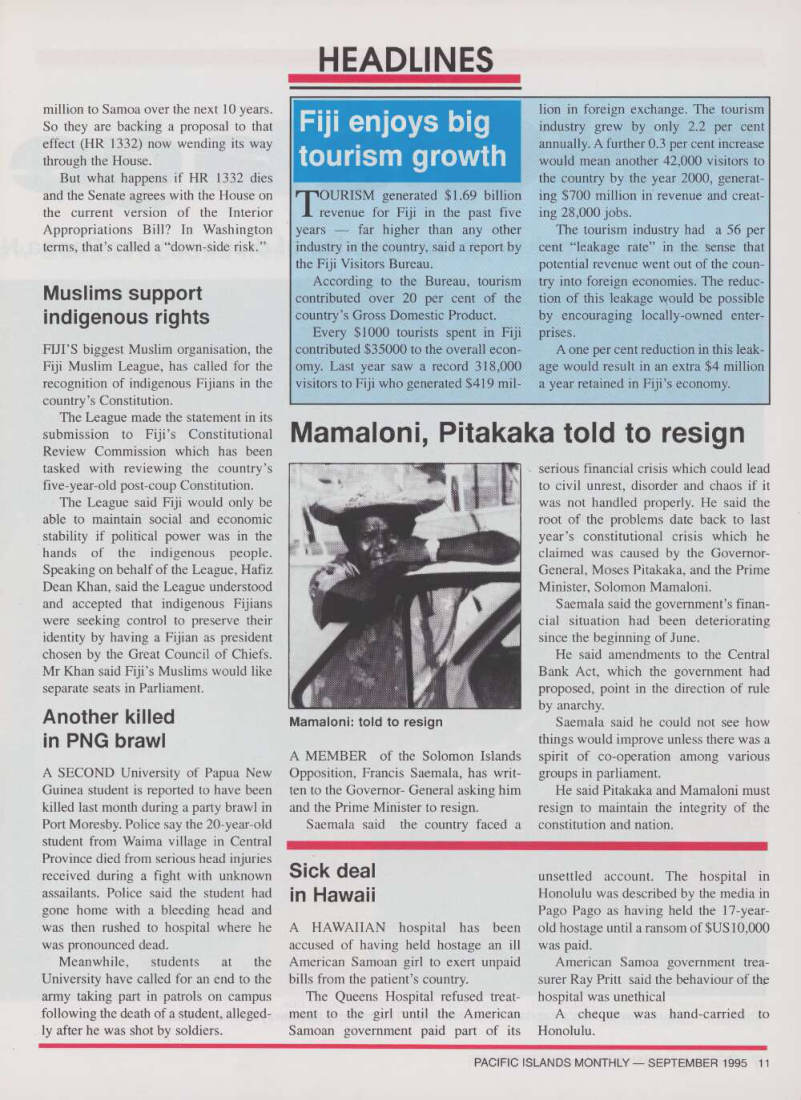
Mamaloni: told to resign
PNG's age of decline

Cover Stories
The past 20 years have been decades of discovery for Papua h
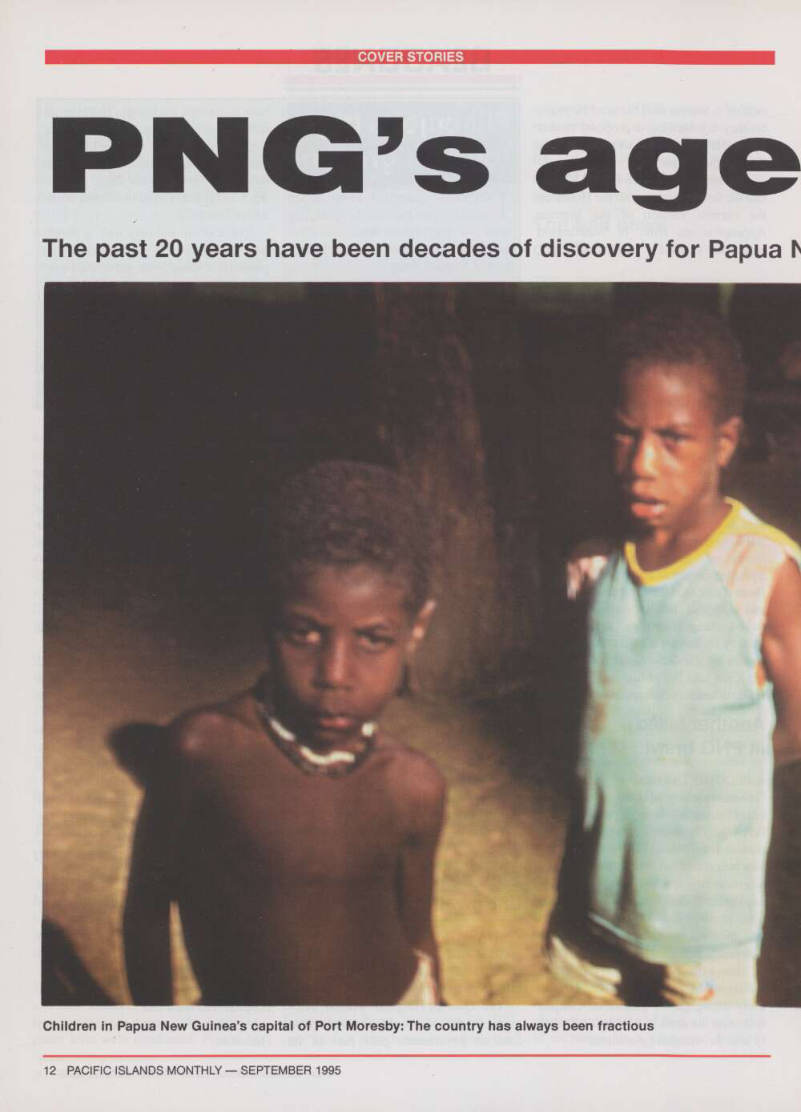
Children in Papua New Guinea’s capital of Port Moresby: The country has always been fractious
sw Guinea. It found freedom, wealth and, unfortunately, trouble
By Dr Roman Grynberg
m iVERY time I used to see this politician in parliament in K J Waigani he used to tell me, “The difference between you white men and we black men is that you are rich when you have things and we are rich when we give them away. ” At first I could not think of a good reply. It took me 10 years and then I realised that the only thing a white man can answer is “... and yes that is why we are rich and you are poor”.
When the Australians lowered their flag in September 1975 in Port Moresby, the late Sir John Guise, the first Governor-General of Papua New Guinea, noted that the flag was being lowered and not tom down.
PNG like almost the entire Pacific had shed no blood for its freedom from colonialism. The reason was that in any strict sense, PNG, much to its own cost, had never really been a colony there had been some settlers but the ‘colonial ism’ that PNG got from its erstwhile master Australia was that of buffer for a xenophobic Australia. PNG was and still remains a geo-political buffer. In the past it was a buffer against German imperialism in the Pacific and later a buffer to Asia. It has never escaped this costly role.
The Australians who colonised PNG had almost no interest in its exploitation, unlike the German, French and British colonialists who had come to dominate other parts of Melanesia after the Conference of Berlin in 1885 which divided up the Pacific into interests that still shape the direction of the region to this day.
Nothing more sadly typified the fail ure of Australian colonialism than an event in 1967, at a school on Yule island in the Gulf of Papua, when Mr Joseph Aoae, who was to be a cabinet minister in a number of post-independence gov ernments, was introduced to the assem bled students as the first Papua New Guinean to ever receive a university degree.
It was probably untrue, there have been other Papua New Guinean who also seek that title but it was close enough to the truth that showed how lit tle Australia had done for the develop ment of PNG. The ‘first’ Papua New Guinean graduate was graduating at least 50 years and sometimes a century after his African counterpart. More importantly he was graduating eight years before independence.
Australia, throughout its 70-year colonial rule over Papua and its mandate over the territory of New Guinea showed little economic interest in its ‘colonies’. It had its own extensive mar gins, its own frontiers to control and dominate and had little time or resources for what remained until the 1950 s a largely unexplored and economically irrelevant island.
PNG has always been fractious a land of 700 languages with a cultural diversity that defies simple classification and while independence came, granted by the Australians, it did not come easi ly. Twenty years ago at independence PNG was facing secession just about everywhere. In the North Solomons young Bougainvilleans wanted no part of the new PNG.
In the islands region there was also talk of secession and in Papua the young firebrand parliamentarian Josephine
Abaijah was talking of setting up a Papua nation. The political and constitutional compromises that were stitched together before independence to keep PNG as one single independent buffer for Australia has been one of the main
reasons for the failure of PNG’s effort at nation building. So what has changed?
Tod3y
PLOWING an incident where a IN cabinet minister had threatened to
have me deported from PNG or killed if I continued to write in the local press, the minister whom I was advising said “Don’t worry he has no rascal gangs but I do and if he touches you I will have him done”
There is a limit to how much anyone can blame the past for the present. On its 20th birthday, it still remains possible to point the finger South, with considerable
justification.
The Australian legacy in New Guinea is appalling. Churches, policemen but few schools. But the political situation that confronts PNG today is of PNG’s own making. But for 20 years PNG has written its own history.
Noone in PNG can today escape the basic fact of life which is that violence and the threat of violence are the most common determinants of day-to-day behaviour for most people, whether expatriate or local.
It was not so in 1975 and there are, just like in Africa many Papua New Guineans who are beginning to look back on the colonial past as almost a ‘golden age’ when it was still possible to walk the streets at night, and when there was some hope of a future. These things are long gone in Port Moresby where the streets are totally deserted after sundown and almost completely gone in the rural areas which were, just 10 years ago, rel atively immune to what was seen as an urban problem.
Ironically it was just before the 10th anniversary that the government of PNG imposed its first curfew in Port Moresby.
Since then things have gone from bad to worse. But what has caused the decline?
Criminologists argue, but a deteriorating and dispirited police force combined with growing income disparities and a local political elite that is seen by many criminals in Port Moresby as a good example that they can look down to as an appropriate role model lie very much at the heart of the problem.
If you actually speak to ‘rascals’ (when they are pointing a gun at you) they will almost invariable tell you the same story they are getting their example and sometimes their direct orders from politicians.
The fact remains that the criminal sit uation in PNG has been permitted to reach the situation that it has because the political elite will do nothing serious to halt it. In Indonesia the government has dealt with the criminal violence in
almost as violent a fashion. How is it possible that PNG the country which has it all gold oil, copper, abundant land and fish resources that are the dream of politicians in other developing countries has allowed the crime situation to deteriorate to the point no one would invest in the place?
PNG has faced over a decade of eco nomic decline directly as a result of a sit uation that could have easily been con trolled had it been attacked seriously 10 years ago. Its people suffer and its politi cians do nothing but utter platitudes and try to stay in office. The reason lies very much at the heart of the political system itself. The political system remains so unstable in PNG that no politician dare try to do anything really tough lest he loses his majority in parliament.
Once I complained bitterly to Bernard Narakobi, former Minister of Justice and recently sacked as Minister of Agriculture, that parliament had 107 parties. Narakobi who was younger and
still willing to consider criticism replied: “You have got it wrong there is only one party in PNG and its called ME Melanesian Ego”.
Therein lies the heart of PNG’s prob lems, a political elite which is commit ted to its own personal, financial and political interests and has no vision of building a nation where, at some point in the future, there is more for everyone to steal. To achieve that it would have to make tough decisions to crush the crim inal gangs it will not and has never done this. There is no quick profit, no slush funds, no back-handers in nation
building so why bother?
The problem is that the PNG political systems is simply unable to reform itself and crime is one of a multitude of seri ous problems that are not being tackled in any serious way. But if the gangs and the violence of PNG society are only one symptom of the nation’s illness, then the fuel for the disease is the sick and rapacious way it has dealt with its abun
dant natural resources.
At the very heart of PNG’s problem is the development path that it has embarked on. The mining, timber and subsequently oil wealth in PNG has cre ated a political elite with wealth and power, and an expatriate community that make it function.
But to those at the bottom of PNG society those living off Six Mile rub bish dump they cannot see and do not care about cause and effect. To them what is happening to PNG is hopeless ness and poverty which is mirrored in the mushrooming glass tower blocks of Port Moresby and in the terrified blue eyes of the rich men who scurry home before the sun sets.
The mineral wealth of PNG, despite being the envy of other nations, is its greatest curse. The reason is simple. The taxation regime in mining oil and log ging was so structured than the first ben eficiary of Porgera and Kutubu is the government. The problem is that gov
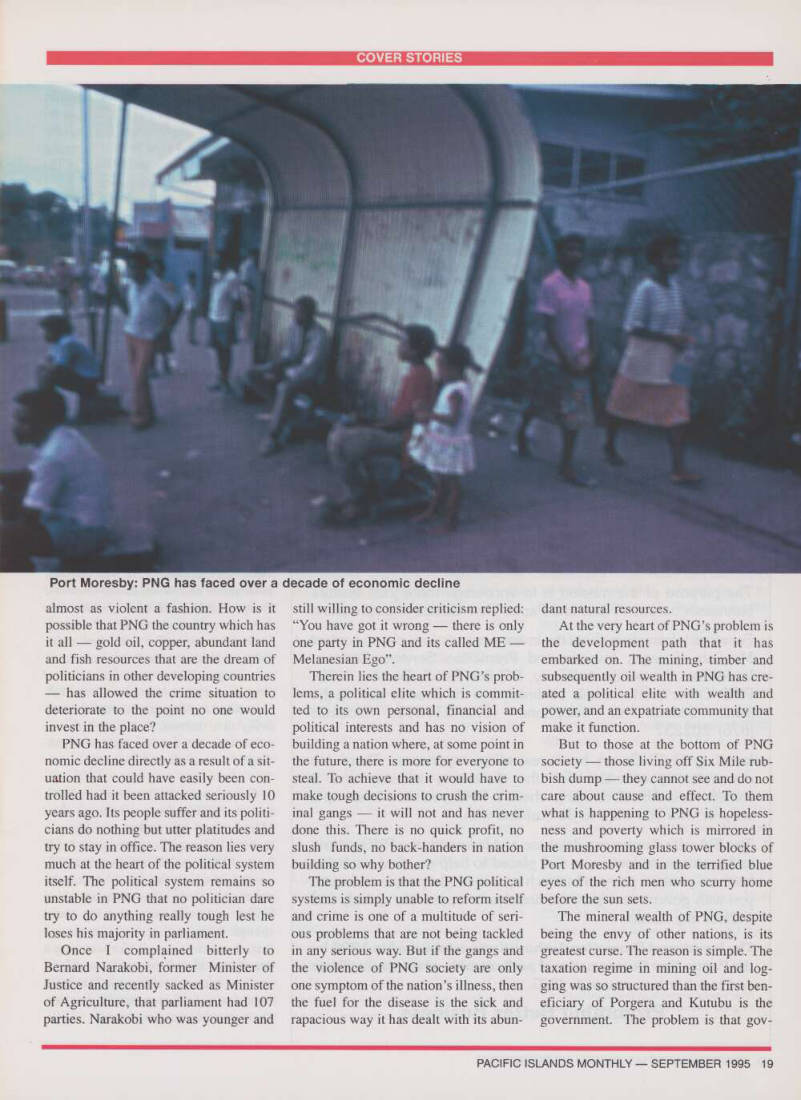
Port Moresby: PNG has faced over a decade of economic decline
emment became the first and last benefi ciary. PNG got wealth quickly those who advocated oil and mineral-based development saw this as a way of trans ferring the wealth to develop the renew able sectors of the economy i.e. forestry, agriculture and fisheries. Of course it never happened because the politicians appropriate the wealth for themselves and their projects.
The disaster is no more obvious than
in the fact that two years into what was billed as an “oil boom”, PNG is broke and in the not so loving hands of the International Monetary Fund. The coun try that had it all is now in effect broke and begging. Nothing more typifies the failure of the PNG elite to come to terms with the nation’s problems than the reform of PNG’s 19 largely corrupt and inefficient provincial government a reform which almost everyone had
agreed was essential. This sensible reform in one of the world’s most over governed nations was grabbed by the national political elite in Port Moresby as an opportunity for the national politi cians to take even more power.
The national parliament which is so discredited in the New Guinea Islands is the last place that most people place their trust. Rather than passing power from the inept provincial governments to local governments, the national gov ernment tried to make national politi cians what would in effect be governors of their provinces.
These proposal have lead to an increase in secessionist sentiments in Papua New Guinea a secessionist movement that still may one day destroy what is left of PNG.
Tomorrow Land
in Port Moresby I met a former cabinet minister at the Travelodge quite by accident. He had just recently been released from prison for having had a short affair with the Pacific politician’s favourite mistress ‘Miss Appropriation . He was advising government and he asked me whether I thought PNG should follow the Japanese path to development? I nearly choked on my coffee and after a few polite comments about the fact that it was not possible to walk the streets of Port Moresby let alone invest in it, I left.
Sometimes in Waigani you think you are living in a surreal theme park that is political fantasy land set against a back drop of an endless crime wave.
For anyone who has lived in PNG, that is outside the paranoia on Port Moresby, and has walked the ridges in the Highlands and has gone up the Sepik River, PNG remains impressed indelibly on the mind as the most spectacular nation on earth, one of breathtaking beauty-=and even more dizzying social change. While even today it remains all that, to watch it now is like watching a dear friend die of cancer so painful you just want to walk away. That is all right for a foreigner but Papua New Guineans have nowhere to mn.
So how will the nation solve its prob lem. It has lost so much that only a con genital optimist would believe that it will progress and develop without wash ing its hands in the blood of its children.
Most educated Papua New Guineans who still care for their nation and are honest enough to see it beauty, warts and all will tell you that what it needs is to clear the dual cancers of its politi cal elite and the resource companies that feed them before its people will awake from the post-independence darkness.
They will tell you that what PNG needs is a Lee Kwan Yew a benevo lent dictator. While there is no doubt that PNG is perfectly capable of throw ing up a dictator it is almost inconceiv able that, at this point in PNG’s history, he will be a progressive nation-builder like the former Prime Minister of Singapore. What PNG is like to get is not a Lee but a Marcos or a Mobutu a corrupt and murderous dictator. In fact there are a number of people in PNG who would love to fill the job descrip tion.
The problem is that history is not likely to allow PNG this solution to its internal problems. Colonialism marked PNG’s history poor education, no
forced alienation or even registration of land and none of the exploitative nation building that was so crucial to Africa.
The problem is that in the Pacific the colonialists came not to exploit as the Marxists argued, but because if they did not come some other colonialists would.
To this day PNG’s historical role as buffer to Asia dominates its future and those at the very top of the PNG politi cal structure know it well. Papua New Guineans have always argued that what would save them from a coup is the fact that the ethnic divisions within the Papua New Guinea Defence Force would destroy a coup almost before it started. However, the constraints to a military coup are not only internal. They lie as much in Canberra and Jakarta as they do in Papua or the islands. A coup in Port Moresby or even serious politi cal instability could easily result in a confrontation between Australia and Indonesia, two countries which have substantial geo-political interest in PNG. Would the Australians tolerate an Indonesian military puppet in Port Moresby? Not likely. Would the Indonesians install one? Only if they thought they could get away with it. But at the moment a large part of the
Australian forward defence strategy rests upon PNG. It is however not inconceivable that as PNG degenerates beyond the control of either Canberra, Jarkata or Port Moresby that the foreign powers would find a break-up of the country into weak but governable regions more to their long-term geo political interests than the emerging anarchy.
Things will get worse in PNG before they get better. There is no bright and immediate solution. Only ugliness awaits in the immediate future of PNG.
While this many in part be because of its colonial history, PNG as its name implies is an independent state.
And if independence for developing countries means anything at all, it is the right, within the limits set by your neighbours, to write your own history. It will only be when an elite that cares more for nation-building than immedi ate wealth arises will Papua New Guineans be able to look forward to prosperity and hope that they and their children so richly deserve. A
*Dr Grynberg served as economic advisor to Sir Michael Somare and Rabbie Namaliu along with other ministers of the PNG government.
Advertisements & other items, pp. 13-14 (2 items)
of decline
COVER STORIES
ffife/
■ , m *s n
thousand destinations in one.
You could, travel to every other place in the Pacific and still not encounter the incredible diversity that is Papua New Guinea. Explore mist-shrouded mountains lost in time. Dive in crystal-clear waters teeming with marine life. Relax at a friendly resort nestled between palm-fringed beaches and a slumbering volcano. Navigate vast rivers snaking through virgin rainforest. Be welcomed by a myriad of unique and colourful peoples, each with their own distinct cultures and traditions. m v S. 56*- Papua New Guinea. If you’re looking for your perfect
<se e
ffife/
destination in the Pacific, there’s really no reason to go anywhere else. p For further information on PNG Holidays contact your Travel Agent or the Papua New Guinea Tourism Promotion Authority pn 1 7QI NCD Panna New Guinea Call (675) 20 0202. (675) 200210 Fax (675) 200223.
Elusive dream
By Sam Valumu
AS Papua New Guinea celebrates its 20th anniversary of indepen dence this month, the joys of growing up will be tainted by the thought of the failures of successive governments to resolve the seven-year old crisis on the secessionist island of Bougainville. Violence continues to trouble the island with no hope yet in sight of a final solution.
There was hope for peace after the signing of the Honiara Agreement between Papua New Guinea Prime Minister Sir Julius Chan and Bougainville Revolutionary Army (BRA) Commander Sam Kauona on September 3 of the past year.
The signing was significant, in that it was the first time that any high-rank ing BRA representative had agreed to meet and talk peace with a PNG prime minister. In fact, both leaders declared immediate peace after the signing of the agreement. However, that was then.
Now, a year later, peace continues to be an elusive dream as the BRA lead ers continue to seek the setting up of a separate homeland on Bougainville.
Bougainville Transitional Govern ment (BTG) Premier Theodore Miriung has continually sought peace talks , but the BRA has continued to reject his overtures, saying there will be no talks while security forces remain on Bougainville. And the continuing spate of violence are strengthening that stance.
Under the terms of the most recent peace agreement, the Waigani Communique, leaders of the BTG and BRA former North Solomons
Premier Joseph Kabui, Francis Ona, Kauona, Martin Miriori, Moses Avini, Ishmael Toroama and others have been granted unconditional amnesty and pardon from prosecution for trea sonable and other offences they may have committed against the State during the crisis.
The national government said it would also lift all restrictions on travel and cancel the rewards of K 200,000 offered (by the previous Namaliu Government) for the capture and pros-
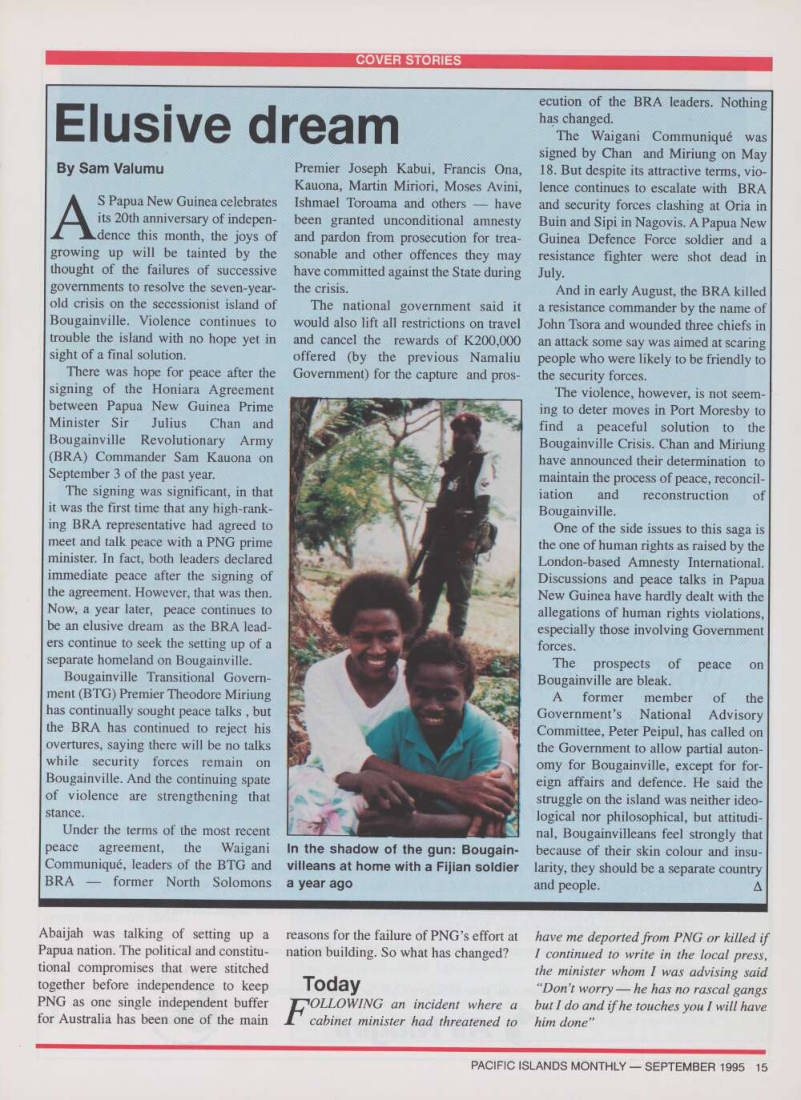
In the shadow of the gun: Bougain viileans at home with a Fijian soldier a year ago
ecution of the BRA leaders. Nothing
has changed.
The Waigani Communique was
signed by Chan and Miriung on May 18. But despite its attractive terms, vio lence continues to escalate with BRA and security forces clashing at Oria in Buin and Sipi in Nagovis. A Papua New Guinea Defence Force soldier and a resistance fighter were shot dead in
July.
And in early August, the BRA killed a resistance commander by the name of John Tsora and wounded three chiefs in an attack some say was aimed at scaring people who were likely to be friendly to the security forces.
The violence, however, is not seem ing to deter moves in Port Moresby to find a peaceful solution to the Bougainville Crisis. Chan and Miriung have announced their determination to maintain the process of peace, reconcil iation and reconstruction of Bougainville.
One of the side issues to this saga is the one of human rights as raised by the London-based Amnesty International.
Discussions and peace talks in Papua New Guinea have hardly dealt with the allegations of human rights violations, especially those involving Government forces.
The prospects of peace on Bougainville are bleak.
A former member of the Government’s National Advisory Committee, Peter Peipul, has called on the Government to allow partial auton omy for Bougainville, except for for eign affairs and defence. He said the struggle on the island was neither ideo logical nor philosophical, but altitudi nal, Bougainvilleans feel strongly that because of their skin colour and insu larity, they should be a separate country and people. A
Advertisements & other items, p. 16 (1 item)
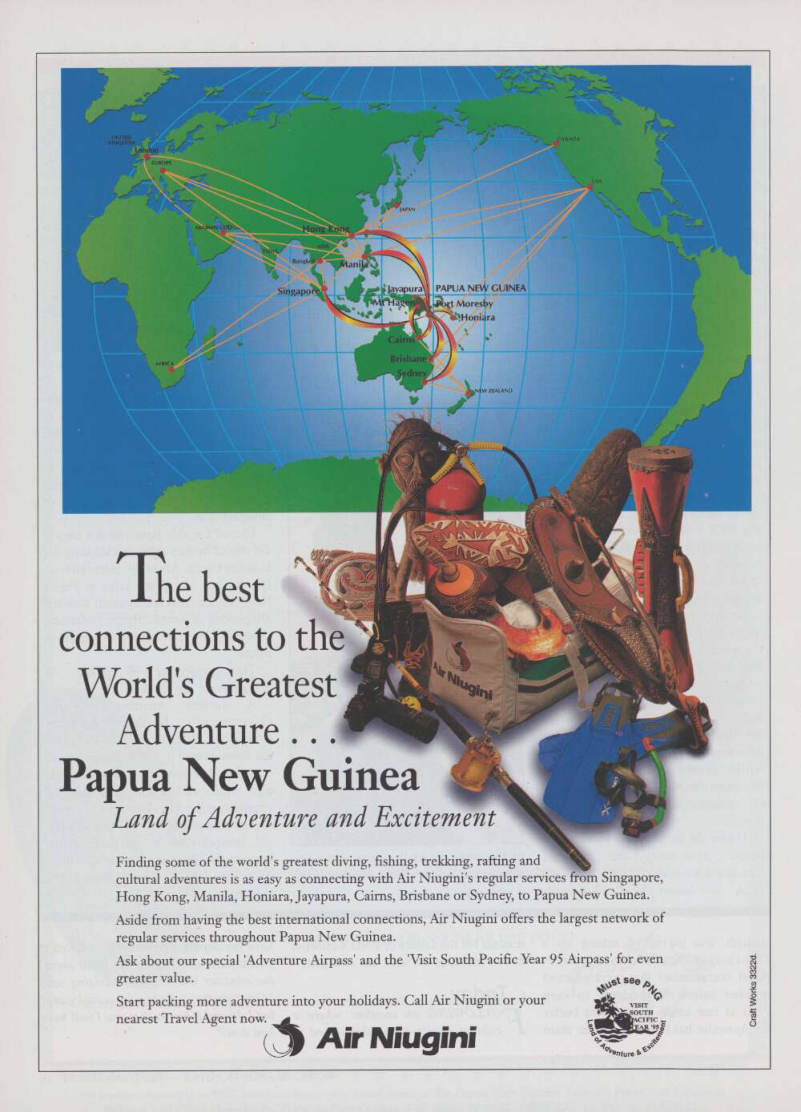
The best
v: :
Pr !!ijf
London J \ ■ Bang!
'^plani
ura\\ PAPUA NEW GUINEA
Smgapo Moresby / rns Brisbane ydney v / ES7 Nm
The best
connections to the
World's Greatest
Adventure...
Papua New Guinea
Land of Adventure and Excitement
Finding some of the world's greatest diving, fishing, trekking, rafting and cultural adventures is as easy as connecting with Air Niugini's regular services from Singapore, Hong Kong, Manila, Honiara, Jayapura, Cairns, Brisbane or Sydney, to Papua New Guinea.
Aside from having the best international connections, Air Niugini offers the largest network of regular services throughout Papua New Guinea.
Ask about our special 'Adventure Airpass' and the 'Visit South Pacific Year 95 Airpass' for even greater value.
Start packing more adventure into your holidays. Call Air Niugini or your nearest Travel Agent now.
SGe \
gVj, Q
(J Air Niugini
VISIT
SOUTH
iCIFIC .
EAR 95 &
4?
Venture «^ + °
Craft Works 3322 d.
Land
reform worries
THE Papua New Guinea govern ment is discussing the possibili ty of introducing a “land reform” system whereby landowners can register their land, then use it as collateral with banks prepared to give loans against it.
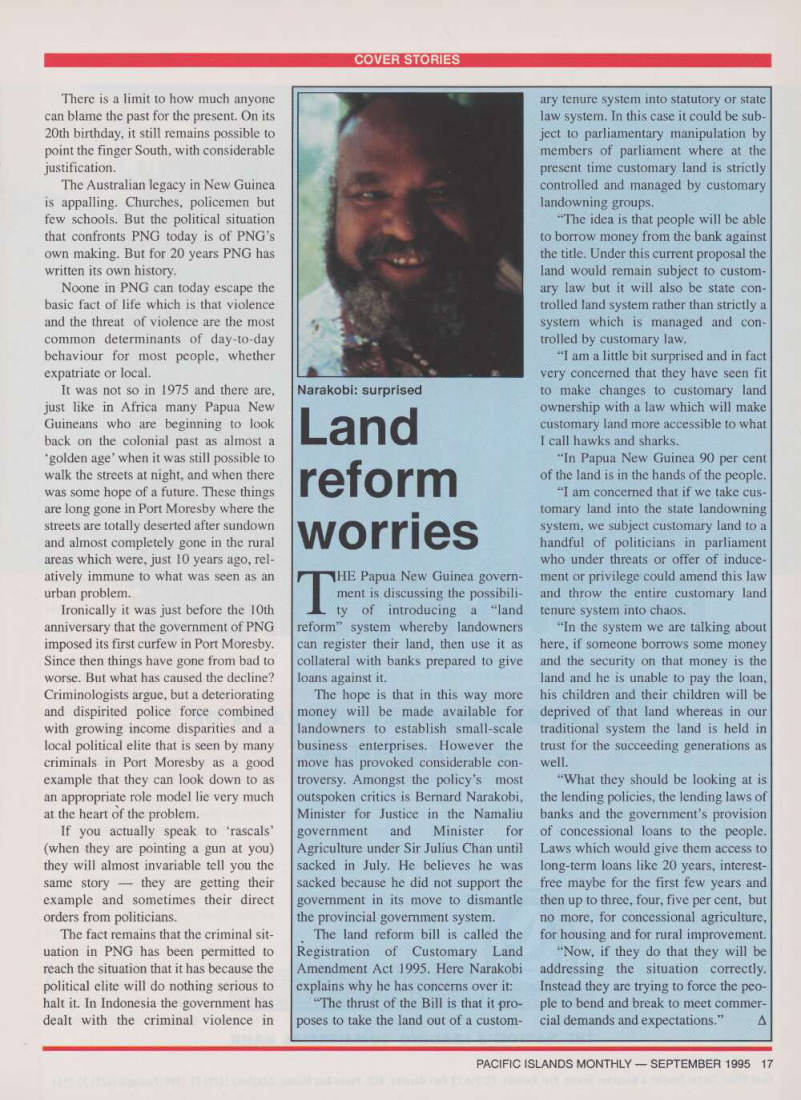
The hope is that in this way more money will be made available for landowners to establish small-scale business enterprises. However the move has provoked considerable con troversy. Amongst the policy’s most outspoken critics is Bernard Narakobi, Minister for Justice in the Namaliu government and Minister for Agriculture under Sir Julius Chan until sacked in July. He believes he was sacked because he did not support the government in its move to dismantle the provincial government system.
The land reform bill is called the Registration of Customary Land Amendment Act 1995. Here Narakobi explains why he has concerns over it: “The thrust of the Bill is that it pro poses to take the land out of a custom
ary tenure system into statutory or state law system. In this case it could be sub
ject to parliamentary manipulation by
members of parliament where at the present time customary land is strictly controlled and managed by customary landowning groups.
“The idea is that people will be able to borrow money from the bank against the title. Under this current proposal the land would remain subject to custom ary law but it will also be state con trolled land system rather than strictly a system which is managed and con trolled by customary law.
“I am a little bit surprised and in fact very concerned that they have seen fit to make changes to customary land ownership with a law which will make customary land more accessible to what I call hawks and sharks.
“In Papua New Guinea 90 per cent of the land is in the hands of the people.
“I am concerned that if we take cus tomary land into the state landowning system, we subject customary land to a handful of politicians in parliament who under threats or offer of induce ment or privilege could amend this law and throw the entire customary land tenure system into chaos.
“In the system we are talking about here, if someone borrows some money and the security on that money is the land and he is unable to pay the loan, his children and their children will be deprived of that land whereas in our traditional system the land is held in trust for the succeeding generations as well.
“What they should be looking at is the lending policies, the lending laws of banks and the government’s provision of concessional loans to the people.
Laws which would give them access to long-term loans like 20 years, interest free maybe for the first few years and then up to three, four, five per cent, but no more, for concessional agriculture, for housing and for rural improvement.
“Now, if they do that they will be addressing the situation correctly.
Instead they are trying to force the peo ple to bend and break to meet commer cial demands and expectations.” A
Narakobi: surprised
Advertisements & other items, pp. 18-20 (1 item)
Local Knowledge.
z p : >u r - I®. ; . : ; "1 I fr?. r • r ir n
EVER UNDERESTIMATE THE VALUE OF
PUA NEW GUINEA BANKING CORPORATION
THE NATION'S LEADING COMMERCIAL BANK
Head Office: Corner Douglas & Musgrave Streets, Port Moresby. PO Box 78 Port Moresby, NCD, Papua New Guinea. Telephone (675) 21 1999 Facsimile (675) 21 1954
IPA
Investment Promotion Authority
Papua New Guinea
The Investment Promotion Authority of Papua New Guinea will be leading an investment mission to Fiji in July.
The purpose of the mission is to encourage more joint venture businesses between Fijian and Papua New Guinea entrepreneurs.
For more information about the investment mission, please contact Ms Sabi Koregai, Investor and Promotion Services Division, Investment Promotion Authority, PO Box 5053, Boroko, NCD, PNG. Other queries should be directed to the director also on the same address or telephone (675) 217311, facsimile (675) 202237.
Investing in PNG can be a rewarding experience. There are numerous opportunities for the discerning investor and it sometimes is difficult deciding where in PNG you want to set up a shop or who you want to do business with.
The IPA with its growing database and links with the PNG private and government sectors, is well placed to help you find a suitable business partner, put you in touch with the right people and assist you with government permits, licences or approvals, quickly and without any hassles.
The Investment Promotion Authority was established in 1992 by the Papua New Guinea national parliament to promote, facilitate and monitor investment in PNG.
Promoting Better Business
The tourism good news
TOURISM is a grossly under exploited industry in Papua New Guinea today, says that country’s Tourism Promotion Authority. Due to the existence of rich mineral and forest resources within the country, little polit ical attention was focused towards this service industry in the past.
However, with its widely diversified geographical terrain within a small region and unique vibrant cultures, it has high potentiality to develop as a major tourism destination in the South Pacific. Papua New Guinea is a land of geographical diversity with high moun tains, low lying swamps and volcanoes.
Vast tracts of Papua New Guinea are still wild and underdeveloped.
Extremely rugged mountains, thick jungles, swamps and the sea have for centuries restricted contacts among dif ferent tribes, inhibiting the growth of a common language and contact with the outside world.
The tourism scenario in PNG is undergoing a rapid change. The govern ment established the Tourism Promotion Authority (TPA) in early 1993 to change the nature of tourism in the country. It is to operate as a stimulus for the private sector by promoting the overall tourism image of the country and by facilitating the growth and development of the industry at home.
TPA expects that there will be a sig nificant upsurge of visitors in PNG in
the near future the great majority of them being holiday-makers. However, to maintain the quality of tourism prod ucts of PNG unaffected, a sudden upsurge of international visitors may not be desirable. It ideally needs a slow but very steady process of growth main taining close link with the carrying capacity of the industry at home.
After decades of no growth, to achieve this, it is essential that the momentum and direction initiated by the TPA in the marketing and develop mental areas be maintained and enhanced. And, at the same time, struc tural bottlenecks in the areas of aviation and other infrastructural areas need to be eased. A
Mururoa’s sinking feeling
The Region
The French invited journalists to Mururoa but failed to provide all the answers
By Alfred Sasako
TWO hours by jet out of the French Polynesian capital of Papeete lies the South Pacific atolls of Mururoa and Fangataufa. They were once the idyllic Pacific paradise, perhaps with no comparison on the face of the earth clean, white sandy beach es, crystal-clear blue water and an unspoiled, undisturbed environment on a windswept outpost untouched by the outside world. Nearly 500 Polynesians live on Mururoa, the larger of the two Atolls.
More people live on other nearby islands like Torea with similar beauty and tranquillity. Sadly, for Mururoa and Fangataufa, those were the descriptions of yesteryears.
Mururoa is an oval-shaped lagoon about 600 km in length with varying width from 400 metres in the north to 1100 metres in the west. It has a natural inlet, leading into the once crystal clear blue waters synonymous with the Pacific. Coconut trees and other vegeta tion grow on the island. It has a military airport, complete with a reinforced con crete seawall around the parameter of the airport with a web of electronic devices such as satellite dishes and elec tronic gear.
Fangataufa, the smaller of the two atolls, was once a closed lagoon. It also has some vegetation and measures an average 300 metres in width. Using high explosives, the French blasted an artifi cial inlet on its northern coast. This gives the French access to the lagoon
which has been subjected to up to 150 kilotons of nuclear blasts.
Some devises that France had deto nated over the years were 10 times stronger than the atomic bomb that flat tened the Japanese city of Nagasaki, maiming tens of thousands of people at the height of the World War Two 50 years ago.
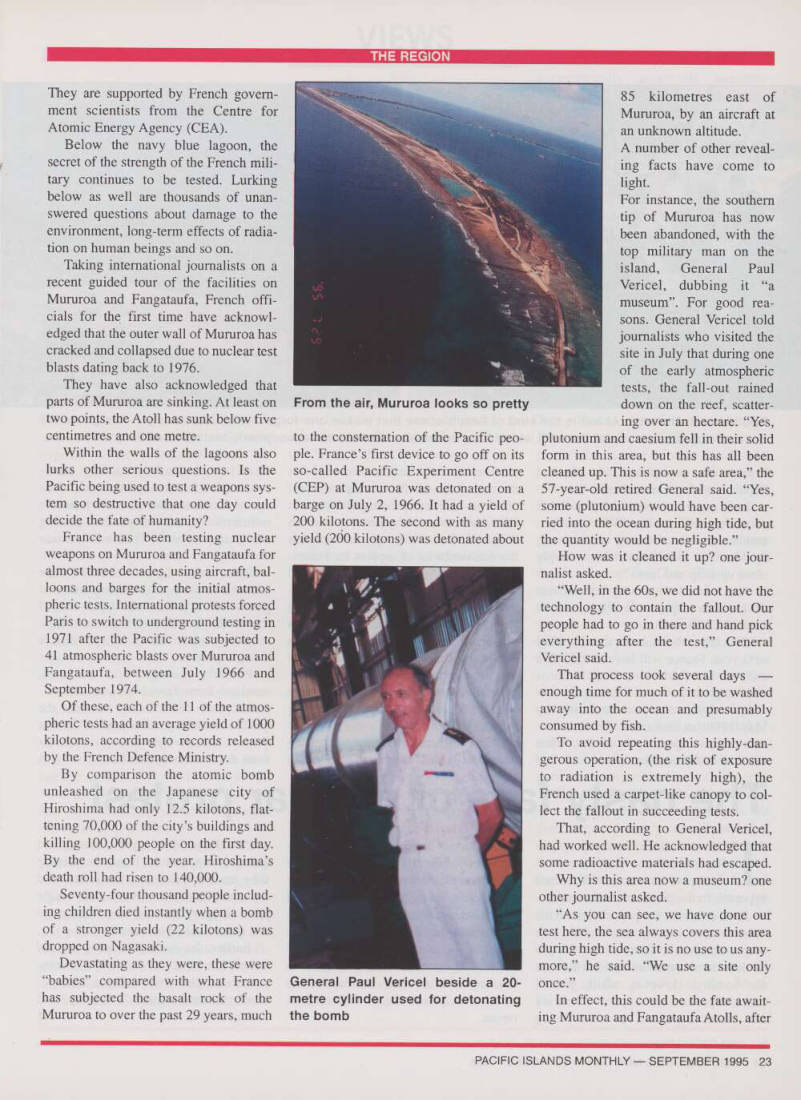
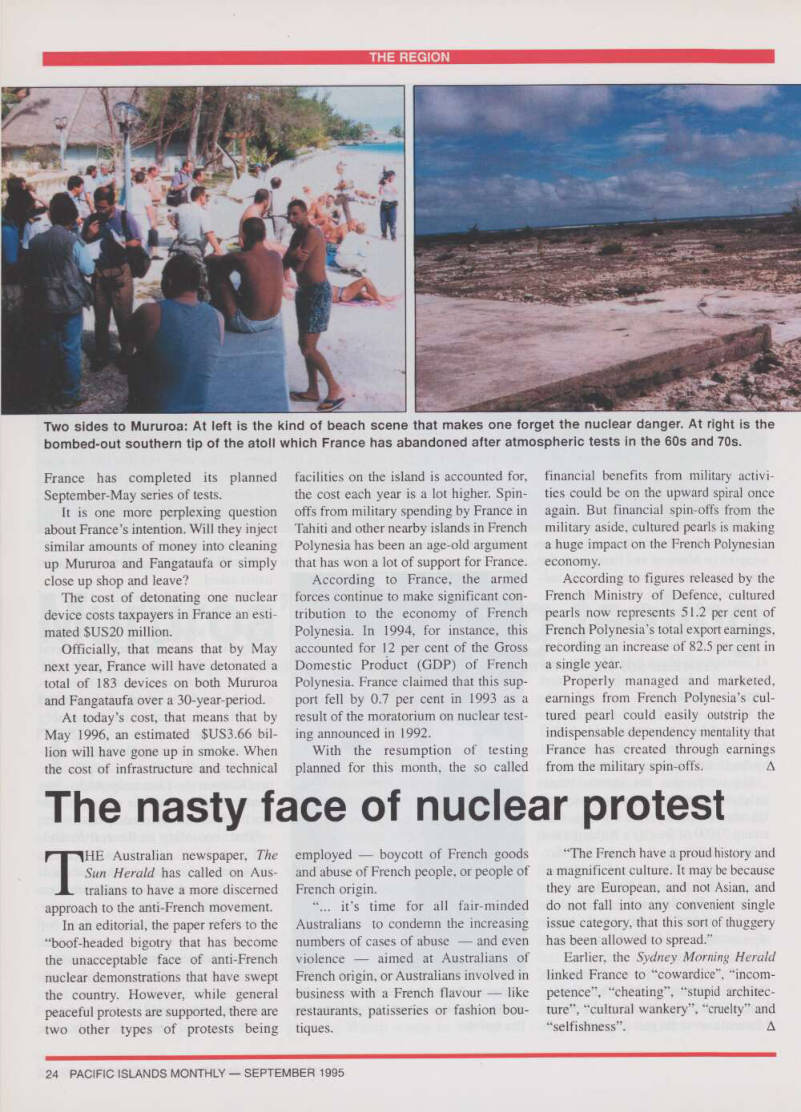
From the air, both Mururoa and Fangataufa are as idyllic as ever with some degree of innocence so synony mous with the Pacific Ocean and their people. Today, both atolls continue to display some form of innocence, except that the muzzle of the gun now guards both of them.
Up to 2000 French soldiers including members of the Foreign Legionnaires are permanently stationed on Mururoa.
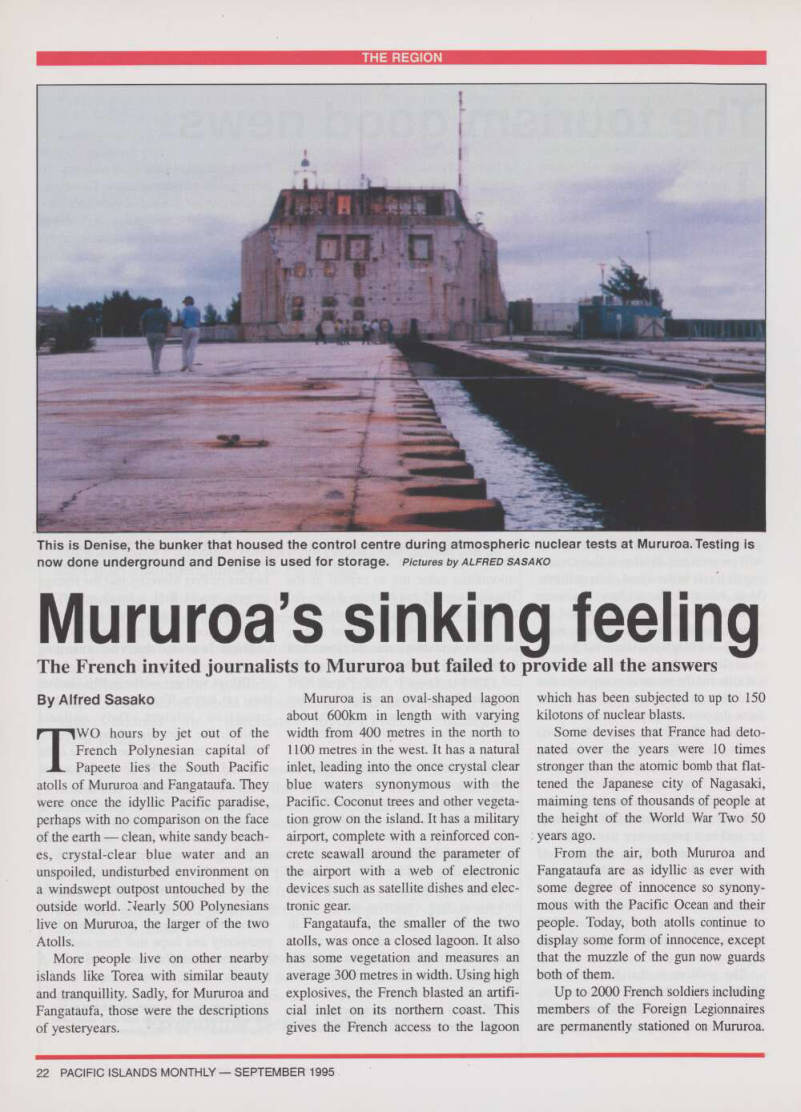
This is Denise, the bunker that housed the control centre during atmospheric nuclear tests at Mururoa. Testing is now done underground and Denise is used for storage. Pictures by ALFRED SASAKO
They are supported by French govern ment scientists from the Centre for Atomic Energy Agency (CEA).
Below the navy blue lagoon, the secret of the strength of the French mili tary continues to be tested. Lurking below as well are thousands of unan swered questions about damage to the environment, long-term effects of radia tion on human beings and so on.
Taking international journalists on a recent guided tour of the facilities on Mururoa and Fangataufa, French offi cials for the first time have acknowl edged that the outer wall of Mururoa has cracked and collapsed due to nuclear test blasts dating back to 1976.
They have also acknowledged that parts of Mururoa are sinking. At least on two points, the Atoll has sunk below five centimetres and one metre.
Within the walls of the lagoons also lurks other serious questions. Is the Pacific being used to test a weapons sys tem so destructive that one day could decide the fate of humanity?
France has been testing nuclear weapons on Mururoa and Fangataufa for almost three decades, using aircraft, bal loons and barges for the initial atmos pheric tests. International protests forced Paris to switch to underground testing in 1971 after the Pacific was subjected to 41 atmospheric blasts over Mururoa and Fangataufa, between July 1966 and
September 1974.
Of these, each of the 11 of the atmos pheric tests had an average yield of 1000 kilotons, according to records released by the French Defence Ministry.
By comparison the atomic bomb unleashed on the Japanese city of Hiroshima had only 12.5 kilotons, flat tening 70,000 of the city’s buildings and killing 100,000 people on the first day.
By the end of the year. Hiroshima’s death roll had risen to 140,000.
Seventy-four thousand people includ ing children died instantly when a bomb of a stronger yield (22 kilotons) was dropped on Nagasaki.
Devastating as they were, these were “babies” compared with what France has subjected the basalt rock of the Mururoa to over the past 29 years, much
to the consternation of the Pacific peo ple. France’s first device to go off on its so-called Pacific Experiment Centre (CEP) at Mururoa was detonated on a barge on July 2, 1966. It had a yield of 200 kilotons. The second with as many yield (200 kilotons) was detonated about
85 kilometres east of Mumroa, by an aircraft at an unknown altitude.
A number of other reveal ing facts have come to light.
For instance, the southern tip of Mururoa has now been abandoned, with the top military man on the island, General Paul Vericel, dubbing it “a museum”. For good rea sons. General Vericel told journalists who visited the site in July that during one of the early atmospheric tests, the fall-out rained down on the reef, scatter ing over an hectare. “Yes,
plutonium and caesium fell in their solid form in this area, but this has all been cleaned up. This is now a safe area,” the 57-year-old retired General said. “Yes, some (plutonium) would have been car ried into the ocean during high tide, but the quantity would be negligible.”
How was it cleaned it up? one jour nalist asked.
“Well, in the 60s, we did not have the technology to contain the fallout. Our people had to go in there and hand pick everything after the test,” General Vericel said.
That process took several days enough time for much of it to be washed away into the ocean and presumably consumed by fish.
To avoid repeating this highly-dan gerous operation, (the risk of exposure to radiation is extremely high), the French used a carpet-like canopy to col lect the fallout in succeeding tests.
That, according to General Vericel, had worked well. He acknowledged that some radioactive materials had escaped.
Why is this area now a museum? one other journalist asked.
“As you can see, we have done our test here, the sea always covers this area during high tide, so it is no use to us any more,” he said. “We use a site only once.”
In effect, this could be the fate await ing Mururoa and Fangataufa Atolls, after
From the air, Mururoa looks so pretty
General Paul Vericel beside a 20metre cylinder used for detonating the bomb
France has completed its planned September-May series of tests.
It is one more perplexing question about France’s intention. Will they inject similar amounts of money into cleaning up Mururoa and Fangataufa or simply close up shop and leave?
The cost of detonating one nuclear device costs taxpayers in France an esti mated SUS2O million.
Officially, that means that by May next year, France will have detonated a total of 183 devices on both Mururoa and Fangataufa over a 30-year-period.
At today’s cost, that means that by May 1996, an estimated $U53.66 bil lion will have gone up in smoke. When the cost of infrastructure and technical
facilities on the island is accounted for, the cost each year is a lot higher. Spin offs from military spending by France in Tahiti and other nearby islands in French Polynesia has been an age-old argument that has won a lot of support for France.
According to France, the armed forces continue to make significant con tribution to the economy of French Polynesia. In 1994, for instance, this accounted for 12 per cent of the Gross Domestic Product (GDP) of French Polynesia. France claimed that this sup port fell by 0.7 per cent in 1993 as a result of the moratorium on nuclear test ing announced in 1992.
With the resumption of testing planned for this month, the so called
financial benefits from military activi ties could be on the upward spiral once again. But financial spin-offs from the military aside, cultured pearls is making a huge impact on the French Polynesian economy.
According to figures released by the French Ministry of Defence, cultured pearls now represents 51.2 per cent of French Polynesia’s total export earnings, recording an increase of 82.5 per cent in a single year.
Properly managed and marketed, earnings from French Polynesia’s cul tured pearl could easily outstrip the
indispensable dependency mentality that
France has created through earnings from the military spin-offs. A
Two sides to Mururoa: At left is the kind of beach scene that makes one forget the nuclear danger. At right is the bombed-out southern tip of the atoll which France has abandoned after atmospheric tests in the 60s and 70s.
The nasty face of nuclear protest
THE Australian newspaper, The Sun Herald has called on Aus tralians to have a more discerned approach to the anti-French movement.
In an editorial, the paper refers to the “boof-headed bigotry that has become the unacceptable face of anti-French nuclear demonstrations that have swept the country. However, while general peaceful protests are supported, there are two other types of protests being
employed boycott of French goods and abuse of French people, or people of French origin.
“... it’s time for all fair-minded Australians to condemn the increasing numbers of cases of abuse and even violence aimed at Australians of French origin, or Australians involved in business with a French flavour like restaurants, patisseries or fashion bou tiques.
“The French have a proud history and a magnificent culture. It may be because they are European, and not Asian, and do not fall into any convenient single issue category, that this sort of thuggery has been allowed to spread.”
Earlier, the Sydney Morning Herald linked France to “cowardice”, “incom
petence”, “cheating”, “stupid architec
ture”, “cultural wankery”, “cruelty” and “selfishness”. A
The Forum
Views
France, you got it wrong
FRANCE appeared to have taken some comfort in comments attrib uted to a senior Australian scien tists during the recent South Pacific Environment Ministers’ meeting in Brisbane that its nuclear tests in the South Pacific are safe.
Australian Nuclear Science and Technology Organisations executive director Helen Garnett was quoted as saying that long-term health risks from French nuclear tests on the South Pacific atolls of Mururoa and Fangataufa were expected to be minimal. No, sir. The media only told half the story.
What the media failed to make it clear to its listeners, readers and viewers is that the comments by Professor Garnett was made on the basis of avail able data. In other words, Australian sci entists do not have up-to-date raw data to make an informed assessment on the risks nuclear testing has posed to the health of the peoples of the South Pacific, let alone their fragile environ ment, especially those closest to the test sites.
What they have is censored data, dat ing back to 1983 and 1987 when the last scientific mission visited Mururoa. They do not have data on Fangataufa which was subjected to heavier blasts from nuclear devices with yields of up to 150 kilotons. In fact, no scientific mission has ever been allowed on Fangataufa, 40km south of Mururoa Atoll.
Despite its stated policy of trans parency, France has not provided any raw data to the scientific community for many years to enable scientists to make an independent assessment on the risks and potential risks to human health and danger and potential danger to the envi ronment. It was on this basis that profes sor Garnett made her comments.
It should be emphasised that these
comments should not be seen as a licence for France to continue to use other people’s backyard as a dis posal dump for its radioactive and other waste mate rials. The French Government has an obligation to
the international community of which the Pacific’s 26 million people are part, to ensure that they too live without the fear and threat of dreaded diseases
resulting from nuclear testing.
In fact, France did acknowledge its obligation at the NPT and Extension conference in New York earlier this year.
At the conference, all nuclear weapons states including France and China pledged to exercise “utmost restraint” pending the signing next year of a truly Comprehensive Test Ban Treaty (CTBT).
France’s recent announcement to resume its 29-year-old nuclear testing programme in the South Pacific this month makes a mockery of this pledge.
It calls into question, doesn’t it, France’s
sincerity in making such pledges.
No one disputes the sovereign right
of any country to defend itself when its national interest is being threatened or perceived to be under threat. For this reason, a nation has every right to do all in its power to defend itself. Their right which, in this case amount to insecurity, is not a licence to use other people’s backyard to develop a weapons system which will one day obliterate mankind from the face of the earth.
There are far too many unanswered questions about Mururoa and Fangataufa questions that only an
internationally acceptable scientific
team with an unfettered access to raw data and site inspections of both Mururoa and Fangataufa can satisfacto
rily answer.
If French nuclear tests are safe, why does Paris enter “reservation” when it signed the South Pacific Regional Environment Programme (SPREP) Convention? Entering reservations effectively means that France will not be held responsible for any environmental disaster in the South Pacific both now and in the future, even in the event of accidental discharge of radioactive wastes into the Pacific ocean If France is truly sincere about its claim that its nuclear testing programme on Mururoa and Fangataufa is safe, then this should be cleared once and for all.
The South Pacific Environment Ministers who met in Brisbane recently proposed a number of steps that France need to take to clear its name and to restore its relations with countries in the Pacific.
They want President Chirac to revoke the decision to resume nuclear testing and to sign the protocols to the South Pacific Nuclear Free Zone Treaty, com monly known as the Treaty of Rarotonga. If France had given such support to similar nuclear treaties in Latin America and Africa, why not the
Spnzf?
As well, they called for the perma nent closure of Mururoa and Fangataufa and that France make available all data on previous testing, with a guarantee of unfettered access for scientists to data and the test sites and to undertake long term monitoring open to scrutiny.
The South Pacific Ministers have also called on President Chirac to demonstrate France’s commitment as a responsible and constructive partner in the South Pacific by declaring that “the French Government accepts full and
exclusive responsibility, including for
such remediation or compensation as may be necessary, for any adverse impacts, past, present or future, from nuclear testing on the environment and health of the peoples of the South Pacific”. A
The Forum
Alfred
Sasako
Where’s Uncle Sam?
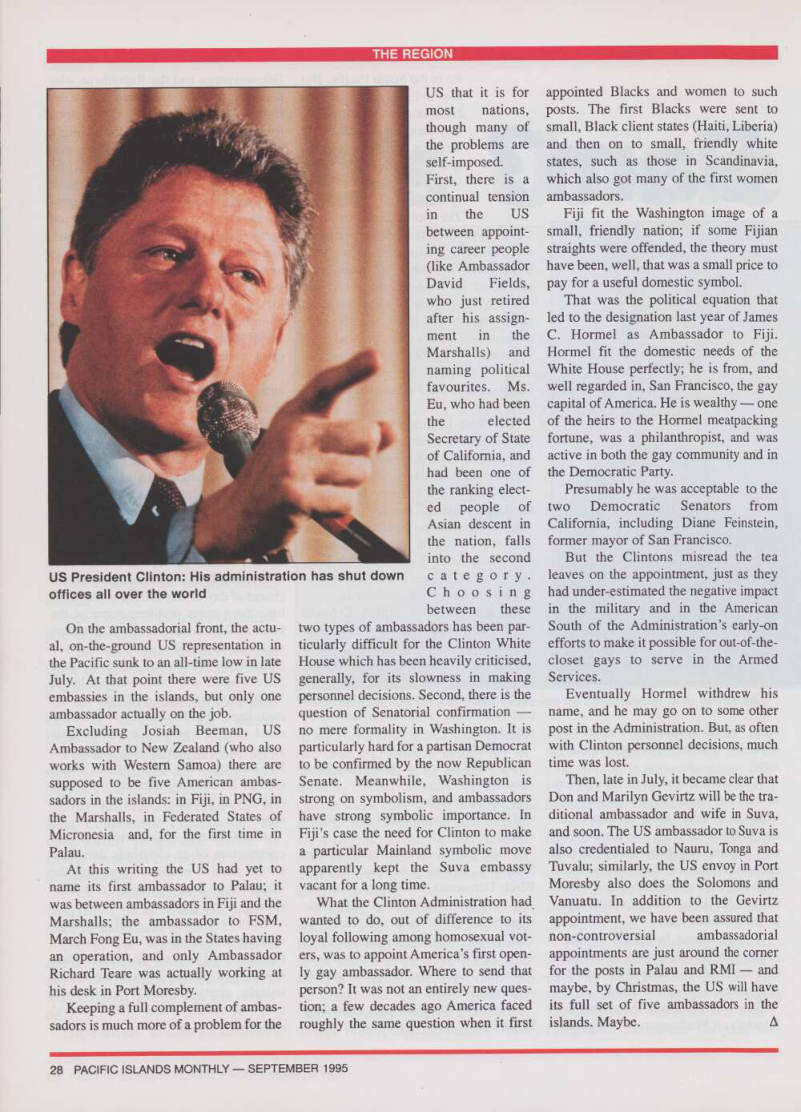
The Region
Cost cuts in the United States result in a significant absence in the Pacific. Are the small island states victims of a new swing in international politics?
By David North
IS Washington losing interest in the South Pacific? Many signs point in that direction, but one of them was reversed in late July when President Bill Clinton finally nominated California businessman Don Lee Gevirtz to be Ambassador to Fiji.
Some signs of US disinterest includ ed: • the closing of the regional USAID mission in Suva; • the closing of the small diplomatic post in Honiara; • the State Department’s renewed threat to shut down the US diplomatic post in Apia; • the Clinton Administration’s deci sion to downsize the Interior Department’s island affairs office; • the House of Representatives’ deci sion to obliterate any funding for Interior’s role in the islands; • the minimal achievements of the Joint Commercial Commission, the trade-not-aid programme started by George Bush that created high hopes in he islands; and • the Administration’s previously cited failure, for more than two years, to place an ambassador in Suva.
But as one Washington observer noted: “Hey guys, do not take it person ally Washington has lost interest in lots of things, both foreign and domes tic.”
For example, in contrast to Bush’s
strong intervention in Iraq, and his entry into Somalia, Clinton pulled out of Somalia when the gang leaders started shooting back. Neither Bush nor Clinton was willing to ride to the rescue of the Bosnian Muslims as Bush rescued the Arab princes from Saddam Hussein.
And, more to point in the Pacific, the State Department has shut down offices all over the world.
It should be remembered that on the domestic scene that Clinton defeated Democrats who really like government in the run-up to the 1992 Presidential election. Then, topping that, in November of the past year, the Democrats in the Congress lost to a col lection of Republicans ranging from
those who hate government (e.g.
Senators Jesse Helms (NC) and Phil Gramm (TX) to those who simply want to wipe out most of it (e.g. House Speaker Newt Gingrich (GA).
So, to over generalise, Washington has lost interest in the poor, in kids need ing vaccines or education, in minorities, in the unemployed and in spending money overseas. The one exception: the Republicans want to appropriate more money for guns.
Further, for the first time in decades, American politicians really feel that they have to eliminate the annual gap between income and outgo. The Reagan Administration, with some help from a complacent Democratic Congress, cut
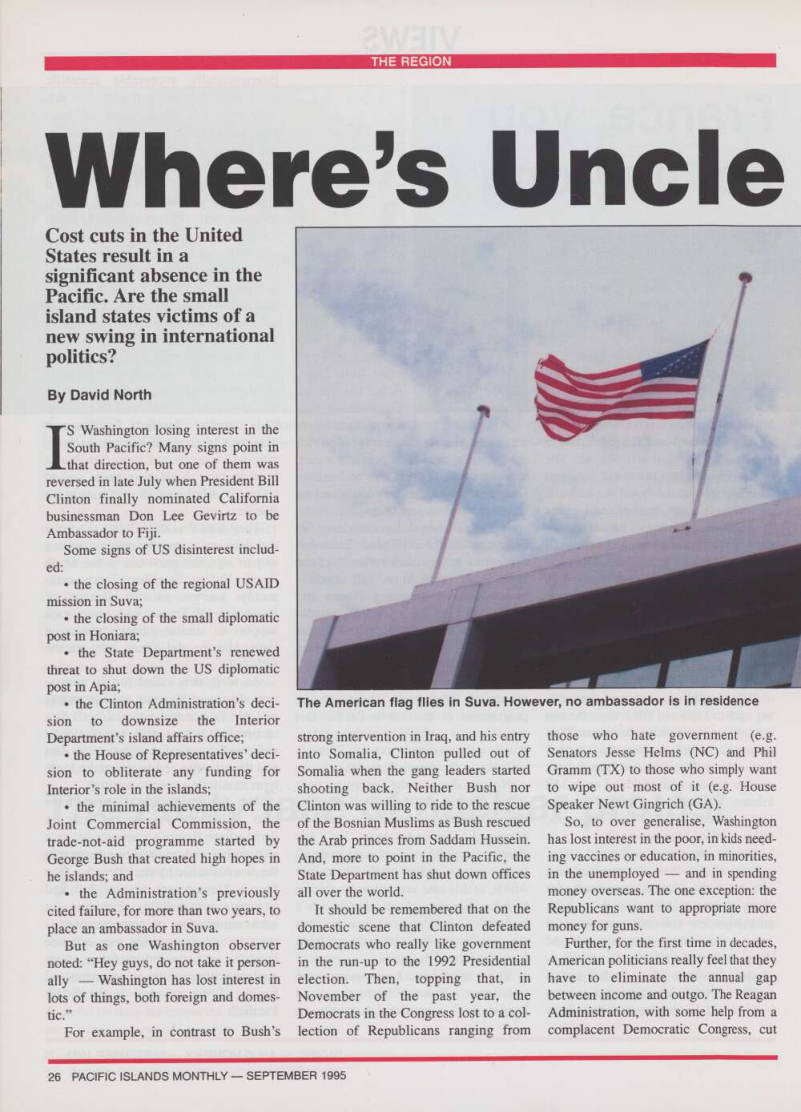
The American flag flies in Suva. However, no ambassador is in residence
taxes while spending continued to expand and the deficit soared out of
sight.
A logical response to such a problem in the other industrialised democracies would be to raise taxes; but Americans are loathe to pay for the government they get, and no politician wants to lead the way to painful fiscal sanity. Look what happened to the Democratic candi date for President, Fitx Mondale, when he tried that last year.
If taxes cannot be raised, or raised much, then spending must be reduced, and that is what is happening with US programmes all over the world.
So as a by-product of this, sometimes it looks as if Washington is losing inter
est in the South Pacific. But the events noted at the beginning of this article do not mean that some Big Decision has been made to stiff the South Pacific. Let’s look at some of the specifics.
The closed diplomatic and
USAID offices reflect fiscal restraints more than anything else. The State Department, a couple of years ago, sought to shut the charge d’affaires’ office in Apia; it was on a list of similar, small posts around the world. The only one taken off the list was Apia, and cred it for that is usually given to American Samoa’s voteless, but not powerless Congressman, Eni Faleomavaega (D AS).
The State Department was success ful, however, is shutting down an Apia type post on Mud Alley (we are not mak ing this up) in Honiara.
US flag island territory hostility to the Department of Interior has some thing to do with the funding decisions.
That distrust is akin, historically, to the way many island leaders felt 50 years ago towards Britain’s Colonial Office (which ultimately was abolished).
Further, while the British Colonial Office was a major political post, both Republican and Democratic White Houses have consistently filled the job of Assistant Interior Secretary for Territorial and International Affairs with undistinguished political figures who have been; A) not from the islands; B) members of a Mainland ethnic minority; C) often women; and D) often without useful Washington allies.
Leslie Turner, the Clinton’s Assistant Secretary, met all four criteria (she’s Black Democrat), as did her predeces sor, Stella Guerra, a Hispanic Republican from Texas. Ms Turner is said to be awaiting appointment to another political position. The non-con troversial Alan Stayman is the Acting Assistant Secretary.
This set of island attitudes toward the Department set the stage when
Faleomavaega and the Republican who heads the islands’ subcommittee in the House, Elton Gallegly (R-CA), joined forces to terminate funding for Interior’s management of the moneys that Congress votes for the islands.
The Joint Commercial Commission (JCC) was one of those hopeful compro mises that often do not go very far. Late in his first (and only term) George Bush met with the islands’ leaders in Hawaii; he wanted to do something for and with them, but did not want to spend money in the process. Further, he had deep philosophical belief in the curing quali ties of commerce generally, and interna tional trade in particular, i So the JCC was bom, and it was entrusted with island leadership; the chair was given to Sir Geoffrey Henry, Prime Minister of the Cook Islands. But with virtually no US money (just a USAID grant of $53,000), no (or invisi ble) US leadership, and Sir Henry’s own lacklustre performance, not much has been accomplished in the intervening years.
JCC does have an appropriately located office, at Hawaii’s East-West centre, and Tonga’s Steven Halapua is in charge of day-to-day activities. But there have been some problem; some of the baseline data needed to get JCC under way were expected to come from survey instruments distributed to the island government, but we were told in Washington that some of those were not completed. (Further, when we called to check on JCC’s progress it was not reas suring to leam that the US Commerce Department’s JCC specialist in Hawaii, George Dolan, had been lent to the US embassy in Bangkok “for a short tour of duty.”
JCC’s current main activity is the construction of an electronic data base on the islands’ economic potential; the work will be done one nation at a time,
starting with Fiji.
Even with fulltime staff in place, working with a perfect set of informa tion, it would be hard to increase trade much in a setting with many small islands, many political jurisdictions, long distances, and few natural resources.
On the ambassadorial front, the actu al, on-the-ground US representation in the Pacific sunk to an all-time low in late July. At that point there were five US embassies in the islands, but only one ambassador actually on the job.
Excluding Josiah Beeman, US Ambassador to New Zealand (who also works with Western Samoa) there are supposed to be five American ambas sadors in the islands; in Fiji, in PNG, in the Marshalls, in Federated States of Micronesia and, for the first time in Palau.
At this writing the US had yet to name its first ambassador to Palau; it was between ambassadors in Fiji and the Marshalls; the ambassador to FSM, March Fong Eu, was in the States having an operation, and only Ambassador Richard Teare was actually working at his desk in Port Moresby.
Keeping a full complement of ambas sadors is much more of a problem for the
US that it is for most nations, though many of the problems are self-imposed.
First, there is a continual tension in the US
between appoint
ing career people (like Ambassador David Fields, who just retired after his assign ment in the Marshalls) and naming political favourites. Ms.
Eu, who had been the elected Secretary of State of California, and had been one of the ranking elect ed people of Asian descent in the nation, falls into the second category.
Choosing between these
two types of ambassadors has been par ticularly difficult for the Clinton White House which has been heavily criticised, generally, for its slowness in making personnel decisions. Second, there is the question of Senatorial confirmation no mere formality in Washington. It is particularly hard for a partisan Democrat to be confirmed by the now Republican Senate. Meanwhile, Washington is strong on symbolism, and ambassadors have strong symbolic importance. In Fiji’s case the need for Clinton to make a particular Mainland symbolic move apparently kept the Suva embassy vacant for a long time.
What the Clinton Administration had wanted to do, out of difference to its loyal following among homosexual vot ers, was to appoint America’s first open ly gay ambassador. Where to send that person? It was not an entirely new ques tion; a few decades ago America faced roughly the same question when it first
appointed Blacks and women to such posts. The first Blacks were sent to small, Black client states (Haiti, Liberia) and then on to small, friendly white states, such as those in Scandinavia, which also got many of the first women ambassadors.
Fiji fit the Washington image of a small, friendly nation; if some Fijian straights were offended, the theory must have been, well, that was a small price to pay for a useful domestic symbol.
That was the political equation that led to the designation last year of James C. Hormel as Ambassador to Fiji.
Hormel fit the domestic needs of the White House perfectly; he is from, and well regarded in, San Francisco, the gay capital of America. He is wealthy one of the heirs to the Hormel meatpacking fortune, was a philanthropist, and was active in both the gay community and in the Democratic Party.
Presumably he was acceptable to the two Democratic Senators from California, including Diane Feinstein, former mayor of San Francisco.
But the Clintons misread the tea leaves on the appointment, just as they had under-estimated the negative impact in the military and in the American South of the Administration’s early-on efforts to make it possible for out-of-the closet gays to serve in the Armed Services.
Eventually Hormel withdrew his name, and he may go on to some other post in the Administration. But, as often with Clinton personnel decisions, much time was lost.
Then, late in July, it became clear that Don and Marilyn Gevirtz will be the tra ditional ambassador and wife in Suva, and soon. The US ambassador to Suva is also credentialed to Nauru, Tonga and Tuvalu; similarly, the US envoy in Port Moresby also does the Solomons and Vanuatu. In addition to the Gevirtz appointment, we have been assured that non-controversial ambassadorial appointments are just around the comer for the posts in Palau and RMI and maybe, by Christmas, the US will have its full set of five ambassadors in the islands. Maybe. A
US President Clinton: His administration has shut down offices all over the world
A major player waits
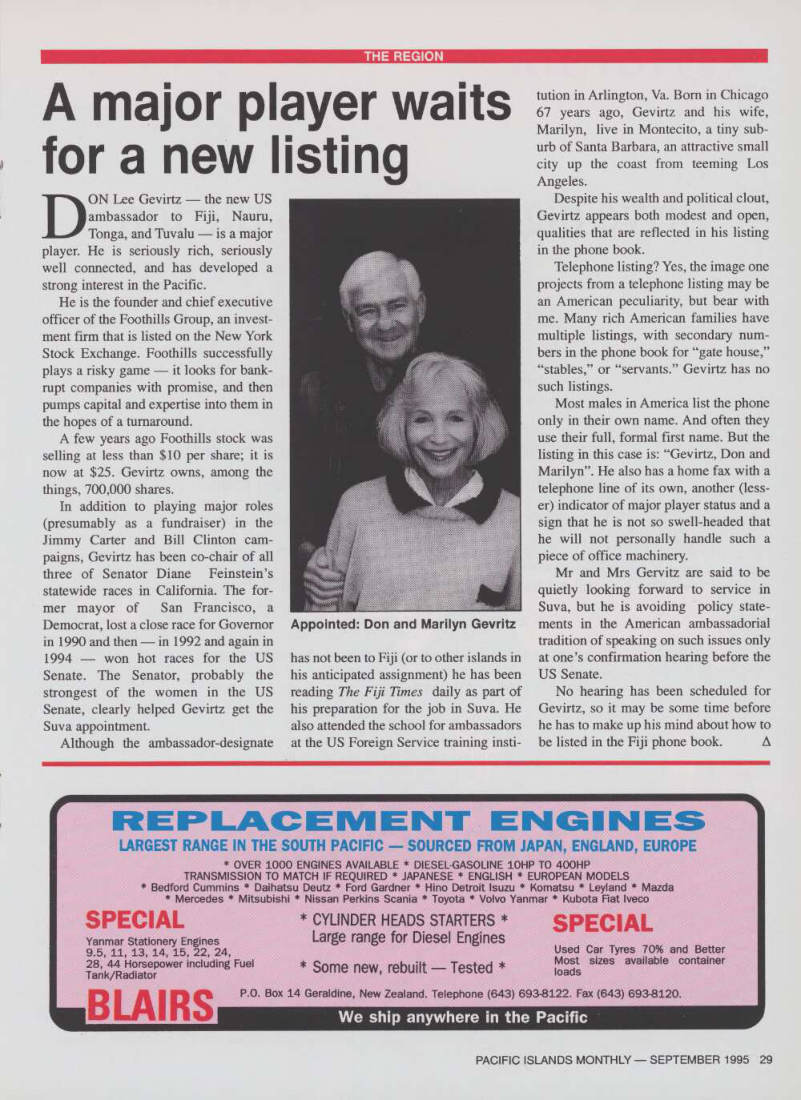
for a new listing
DON Lee Gevirtz the new US ambassador to Fiji, Nauru, Tonga, and Tuvalu is a major player. He is seriously rich, seriously well connected, and has developed a strong interest in the Pacific.
He is the founder and chief executive officer of the Foothills Group, an invest ment firm that is listed on the New York Stock Exchange. Foothills successfully plays a risky game it looks for bank rupt companies with promise, and then pumps capital and expertise into them in the hopes of a turnaround.
A few years ago Foothills stock was selling at less than $lO per share; it is now at $25. Gevirtz owns, among the things, 700,000 shares.
In addition to playing major roles (presumably as a fundraiser) in the Jimmy Carter and Bill Clinton cam paigns, Gevirtz has been co-chair of all three of Senator Diane Feinstein’s statewide races in California. The for mer mayor of San Francisco, a Democrat, lost a close race for Governor in 1990 and then in 1992 and again in 1994 won hot races for the US Senate. The Senator, probably the strongest of the women in the US Senate, clearly helped Gevirtz get the Suva appointment.
Although the ambassador-designate
has not been to Fiji (or to other islands in his anticipated assignment) he has been reading The Fiji Times daily as part of his preparation for the job in Suva. He also attended the school for ambassadors at the US Foreign Service training insti
tution in Arlington, Va. Bom in Chicago 67 years ago, Gevirtz and his wife, Marilyn, live in Montecito, a tiny sub urb of Santa Barbara, an attractive small city up the coast from teeming Los Angeles.
Despite his wealth and political clout, Gevirtz appears both modest and open, qualities that are reflected in his listing in the phone book.
Telephone listing? Yes, the image one projects from a telephone listing may be an American peculiarity, but bear with me. Many rich American families have multiple listings, with secondary num bers in the phone book for “gate house,”
“stables,” or “servants.” Gevirtz has no such listings.
Most males in America list the phone only in their own name. And often they use their full, formal first name. But the listing in this case is: “Gevirtz, Don and Marilyn”. He also has a home fax with a telephone line of its own, another (less er) indicator of major player status and a sign that he is not so swell-headed that he will not personally handle such a piece of office machinery.
Mr and Mrs Gervitz are said to be quietly looking forward to service in Suva, but he is avoiding policy state ments in the American ambassadorial tradition of speaking on such issues only at one’s confirmation hearing before the US Senate.
No hearing has been scheduled for Gevirtz, so it may be some time before he has to make up his mind about how to be listed in the Fiji phone book. A
Appointed: Don and Marilyn Gevritz
Advertisements & other items, pp. 29-31 (1 item)
Blairs
LARGEST RANGE IN THE SOUTH PACIFIC - SOURCED FROM JAPAN, ENGLAND, EUROPE * OVER 1000 ENGINES AVAILABLE * DIESEL-GASOLINE 10HP TO 400 HP TRANSMISSION TO MATCH IF REQUIRED * JAPANESE ♦ ENGLISH * EUROPEAN MODELS * Bedford Cummins * Daihatsu Deutz * Ford Gardner * Hino Detroit Isuzu * Komatsu * Leyland * Mazda * Mercedes * Mitsubishi * Nissan Perkins Scania * Toyota * Volvo Yanmar * Kubota Rat Iveco
SPECIAL
Yanmar Stationery Engines 9.5, 11, 13, 14, 15, 22, 24, 28, 44 Horsepower including Fuel Tank/Radiator
♦ CYLINDER HEADS STARTERS *
Large range for Diesel Engines
* Some new, rebuilt Tested *
SPECIAL
Used Car Tyres 70% and Better Most sizes available container loads
BLAIRS
P.O. Box 14 Geraldine, New Zealand. Telephone (643) Fax (643) 693-8120.
We ship anywhere in the Pacific
<Sg> TOYOTA
Drive dignity right to the top.
Everyone who knows cars has no doubts about Land Cruiser’s ruggedness.
Yet how many know that its luxury rivals the finest high-priced cars?
Or that it’s got more room inside than many luxury sedans?
And because it’s a Toyota, Land Cruiser’s fit and finish, attention to detail, and graceful form speak of elegance as well as spacious comfort.
Yet you still get tough ladder frames and suspension built to take you as far off road as you want to go.
With power from 4.5-litre petrol or 4.2-litre diesel engines.
And it’s carefully protected from rust to last longer.
So if you’re going right to the top, this dignified car is ready to take you.
LAND CRUISER
DISTRIBUTORS /DEALERS
AMERICAN SAMOA BURNS PHILP MOTORS PH 633-4281 COOK ISLANDS GUAM & MICRONESIA ...ATKINS KROLL, INC. PH 646-1876/9 KIRIBATI NORFOLK ISLAND BORRY’S PTY LTD. PH 22114 PAPUA NEW GUINEA SOLOMON ISLAND ELA MOTORS PH 30314 TAHITI VANUATU ASCO MOTORS PH 22341 WESTERN SAMOA...
, .PACIFIC MOTORS LTD. PH 20796
. .TARAWA MOTORS PH 21090
~ELA MOTORS PH 3229400
. .NIPPON AUTOMOTO PH 429819
..ASCO MOTORS PH 20800
FIJI ASCO MOTORS PH 384888
NEW CALEDONIA S.I.A.P. PH 275562
SAIPAN MICROL CORPORATION PH 234-591
TONGA ASCO MOTORS PH 23500
mm s : ■ msm iittiiiKliii ‘"'l® i'? if S- ■ i -1 i - / .
LAND
CRUISER
LAND CRUISER ' .
e . ■ /r* m — m < IN**; % K 9 %« K, ' iSi
Tuna’s two-ring ballet
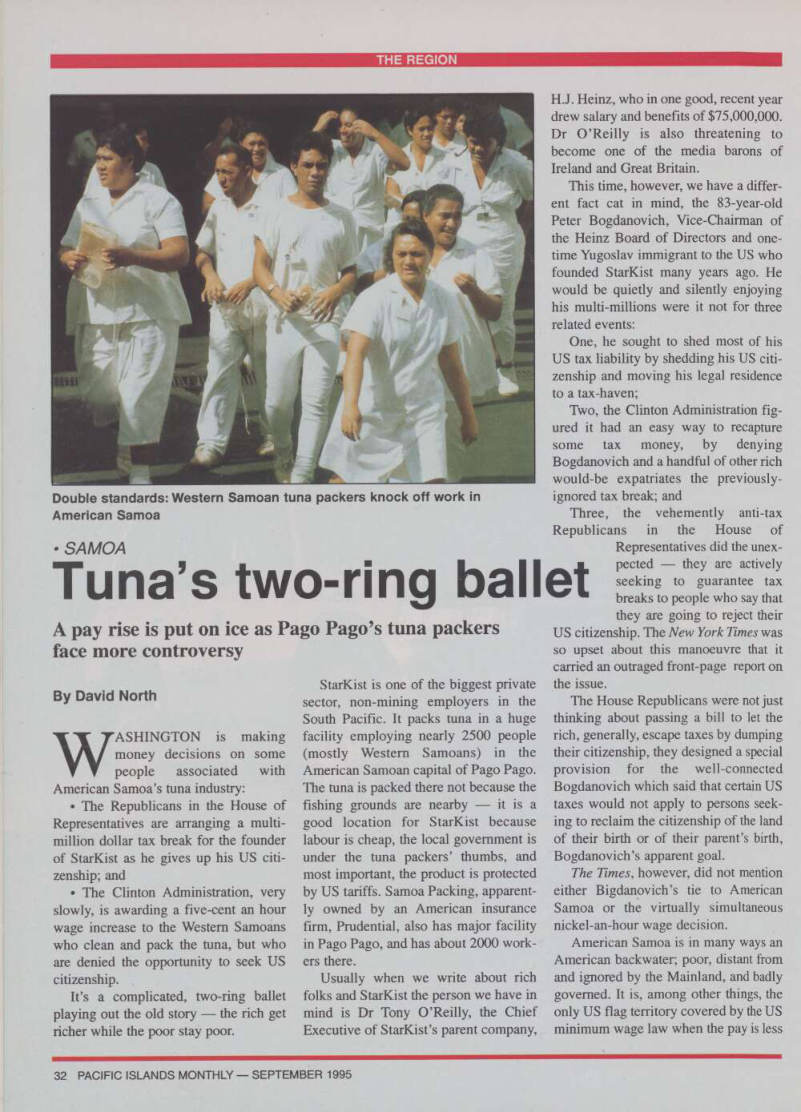

• Samoa
A pay rise is put on ice as Pago Pago’s tuna packers face more controversy
By David North
WASHINGTON is making money decisions on some people associated with American Samoa’s tuna industry: • The Republicans in the House of Representatives are arranging a multi million dollar tax break for the founder of StarKist as he gives up his US citi zenship; and • The Clinton Administration, very slowly, is awarding a five-cent an hour wage increase to the Western Samoans who clean and pack the tuna, but who are denied the opportunity to seek US
citizenship.
It’s a complicated, two-ring ballet playing out the old story the rich get richer while the poor stay poor.
StarKist is one of the biggest private sector, non-mining employers in the South Pacific. It packs tuna in a huge facility employing nearly 2500 people (mostly Western Samoans) in the American Samoan capital of Pago Pago.
The tuna is packed there not because the fishing grounds are nearby it is a good location for StarKist because labour is cheap, the local government is under the tuna packers’ thumbs, and most important, the product is protected by US tariffs. Samoa Packing, apparent ly owned by an American insurance firm, Prudential, also has major facility in Pago Pago, and has about 2000 work ers there.
Usually when we write about rich folks and StarKist the person we have in mind is Dr Tony O’Reilly, the Chief Executive of StarKist’s parent company,
H.J. Heinz, who in one good, recent year drew salary and benefits of $75,000,000.
Dr O’Reilly is also threatening to become one of the media barons of Ireland and Great Britain.
This time, however, we have a differ ent fact cat in mind, the 83-year-old Peter Bogdanovich, Vice-Chairman of the Heinz Board of Directors and one time Yugoslav immigrant to the US who founded StarKist many years ago. He would be quietly and silently enjoying his multi-millions were it not for three related events: One, he sought to shed most of his US tax liability by shedding his US citi zenship and moving his legal residence to a tax-haven; Two, the Clinton Administration fig ured it had an easy way to recapture some tax money, by denying Bogdanovich and a handful of other rich would-be expatriates the previously ignored tax break; and Three, the vehemently anti-tax Republicans in the House of
Representatives did the unex pected they are actively seeking to guarantee tax breaks to people who say that they are going to reject their
US citizenship. The New York Times was so upset about this manoeuvre that it carried an outraged front-page report on the issue.
The House Republicans were not just thinking about passing a bill to let the rich, generally, escape taxes by dumping their citizenship, they designed a special provision for the well-connected Bogdanovich which said that certain US taxes would not apply to persons seek ing to reclaim the citizenship of the land of their birth or of their parent’s birth, Bogdanovich’s apparent goal.
The Times , however, did not mention either Bigdanovich’s tie to American Samoa or the virtually simultaneous nickel-an-hour wage decision.
American Samoa is in many ways an American backwater; poor, distant from and ignored by the Mainland, and badly governed. It is, among other things, the only US flag territory covered by the US minimum wage law when the pay is less
Double standards: Western Samoan tuna packers knock off work in American Samoa
than $4.25 an hour. The minimum wage in American Samoa is set by an awk ward Mainland-Island mechanism. Six board members are appointed, half by the US Department of Labour and half by the islands’ Governor (currently AP Lutali); three of the members are from the Mainland, three from the islands; two members represent labour, two management and two the public.
The system says that four votes are needed for a raise. Historically this has meant that swing (fourth) vote is that of the public member from American Samoa, but since this member is in the Governor’s camp, raises for tuna work ers and for government workers are always very small.
The board is convened every two years, and in its latest incarnation (in June) it decided not to press toward clos ing the gap between Samoa and Mainland minimum wages. It heard the usual pleas of poverty from the flat broke American Samoan Government and from the secretive (but prosperous) tuna industry.
The latter has an option that the American Samoa Government does not it could move its gutting, cleaning and packing operation to some other island, with even more minimum wage laws. The industry keeps threatening to do so, and this keeps the American Samoa Government from doing any thing rash, like raising wages or seeking serious taxes from its principal industry.
Further, when tuna workers get sick, the Government foots the bill at the LBJ Medical Center; Congressman Eni Faleomavaega has sought, in vain, to make the industry provide its people with at least some health insurance.
It was in this setting that the six member board voted to raise the fish cleaners’ wages from $3.05 an hour to $3.10 an hour, but to soften the blow to StarKist and Samoa Packing the new, higher wage rate will not go into effect until July 1, 1996. The labour force in American Samoa, incidentally, is over whelmingly Samoan in ethnicity and language, but there is an
occupational/citizenship division.
Western Samoans, who do most of
the dirty work in the countries, cannot become US nationals.
Returning to the economic decisions, the basic wage for government workers was increased a hair more, but from a lower base. It went from the current $2.37 to $2.45 an hour, also effective in July of next year. The Government always argues that if raises are given at the bottom of the scale, then comparable adjustments will have to made for all workers at all scales.
Wage levels for a dozen other local occupations were raised a little more, (as much as 15 cents an hour) but never more than the rate suggested by the local Chamber of Commerce. The new rates, effective soon, ran from a low of $2.35 an hour for miscellaneous occupations to a higher of $3.65 for stevedoring. All occupations other than tuna and govern ment workers, are scheduled to get another raise, usually 10 cents an hour, on July 1, 1996.
The wage board, however, did show a
little foresight and courage regarding the prospect of a garment industry coming to American Samoa. Currently some entrepreneurs want to follow the Saipan precedent that is to: 1) bring garment manufacturing to an American flag island with a low-wage policy, 2) make use of “Made in USA” labels and US
tariff barriers to sell the island-made clothes in the Mainland market, 3) and then staff the operation with foreign workers brought in from still poorer locales.
A firm named after the initials of its founders, BCTC, was the most assertive of these entrepreneurs. Keeping the hearing going days longer than usual, BCTC wanted the wage board to make several concessions to the industry.
First, it asked for a new permanent cate gory of garment workers, to be paid at $2.10 an hour; also, it asked for a 6month-long training wage in the indus try at $1.85 an hour.
The six-member wage board rejected both proposals, leaving the garment occupation included in the miscella neous category. Wages for this category will rise from its earlier rate of $2.25 an hour to $2.35 an hour (as soon as the new rates can be published in a US Government periodical) and on to $2.45 next July. A
StarKist: Big employer
Advertisements & other items, pp. 33-34 (2 items)
The Region
people who can help
1 V y m A/ ■ , -' A ■ V^_/
We know
island businessmen
grow.
If you’re starting a new business or expanding an existing one, we can help.
Whether you’re looking for potential investors, want to make appropriate contacts or just need some good advice, get in touch with us at the South Pacific Trade Commission.
It’s all free of charge.
To help us do the best job for you, we’ll need to know something about yourself, your organisation and your plans.
Just send us the information indicated below. • Your name. • Position. • Company name. • Address. . Phone and Fax. • Company and/or
SOUTH PACIFIC TRADE COMMISSION
50 Park Street, Sydney 2000. Telephone (612) 283 5933 Facsimile (612) 283 5948 personal background. • IVpe of business or venture. • Projected market (domestic or international). • Results of any feasibility study. • Current status of project. • Type of assistance you seek (capital, management skills, joint venture partner, other). • Approximate value of project. • Your contribution. • Financial institutions or other organisations already
approached.
• Any other details that you consider relevant to your project.
Once you send us this information, we’ll take it from there.
SECOND HAND CONTAINERS
WHERE AND WHEN YOU WANT THEM IN THE PACIFIC If you need a flexible and safe storage space we have the ideal solution for you. Our second hand containers provide instant secure storage. Guaranteed to be wind and waterproof these containers are ideal for both temporary and longterm storage in Pacific conditions.
We can deliver to any island in the Pacific within a month and our rates have got to be the lowest you will find. All you need to do is tell us how many you want.
CONTACT:
PASCALE MARCONNET, BP 4757 NOUMEA, NEW CALEDONIA. TEL (687) 28 7450. FAX: (687) 26 3248
When fighting finally stopped
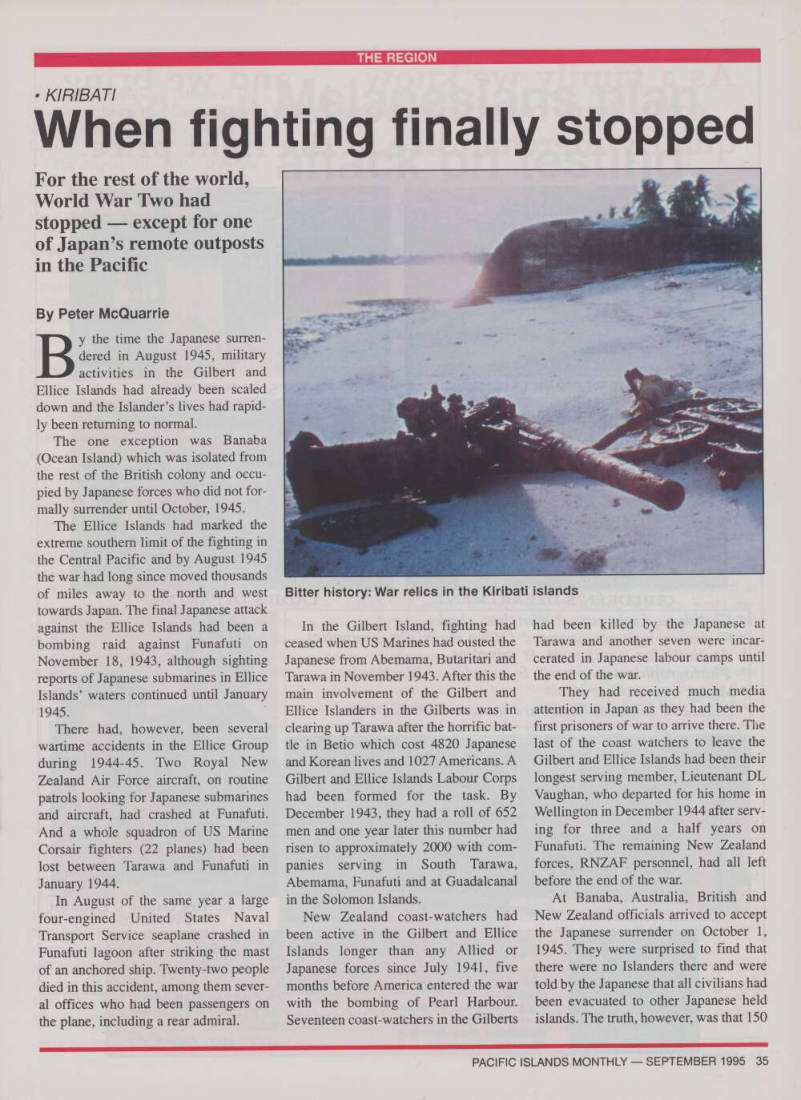

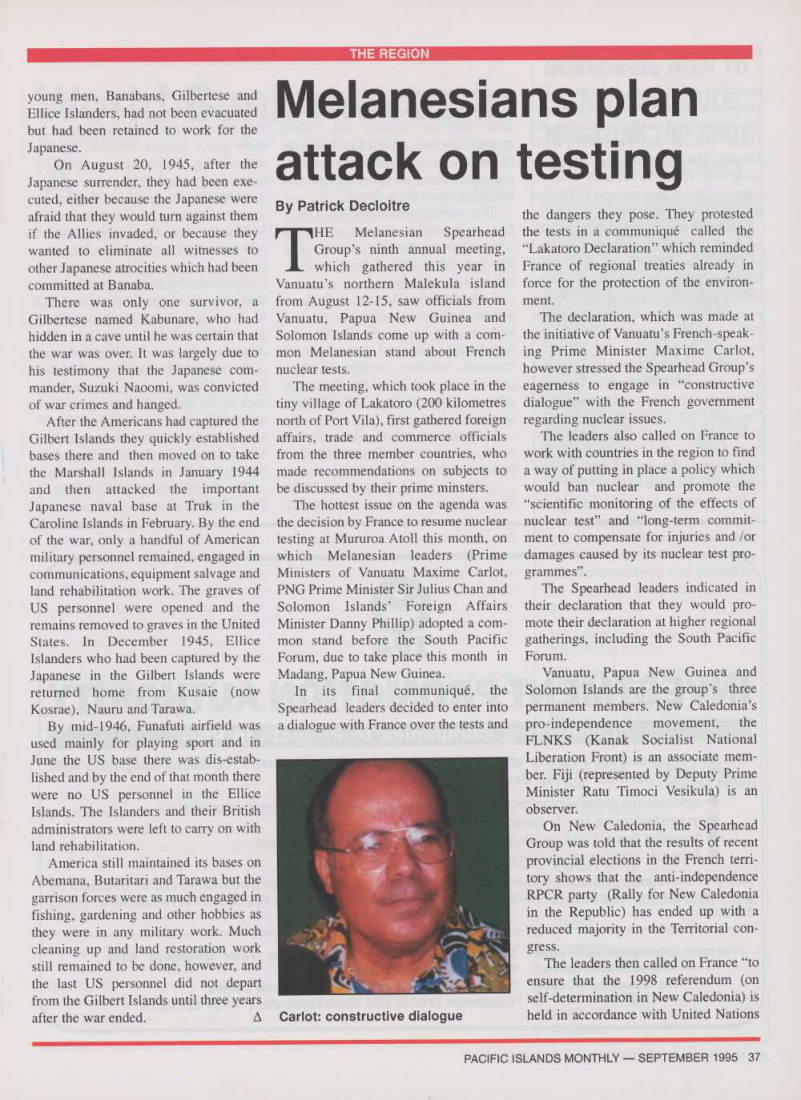
• Kiribati
For the rest of the world, World War Two had stopped except for one of Japan’s remote outposts in the Pacific
By Peter McQuarrie
By the time the Japanese surren dered in August 1945, military activities in the Gilbert and Ellice Islands had already been scaled down and the Islander’s lives had rapid ly been returning to normal.
The one exception was Banaba (Ocean Island) which was isolated from the rest of the British colony and occu pied by Japanese forces who did not for mally surrender until October, 1945.
The Ellice Islands had marked the extreme southern limit of the fighting in the Central Pacific and by August 1945 the war had long since moved thousands of miles away to the north and west towards Japan. The final Japanese attack against the Ellice Islands had been a bombing raid against Funafuti on November 18, 1943, although sighting reports of Japanese submarines in Ellice Islands’ waters continued until January 1945.
There had, however, been several wartime accidents in the Ellice Group during 1944-45. Two Royal New Zealand Air Force aircraft, on routine patrols looking for Japanese submarines and aircraft, had crashed at Funafuti.
And a whole squadron of US Marine Corsair fighters (22 planes) had been lost between Tarawa and Funafuti in January 1944.
In August of the same year a large four-engined United States Naval Transport Service seaplane crashed in Funafuti lagoon after striking the mast of an anchored ship. Twenty-two people died in this accident, among them sever al offices who had been passengers on the plane, including a rear admiral.
In the Gilbert Island, fighting had ceased when US Marines had ousted the Japanese from Abemama, Butaritari and Tarawa in November 1943. After this the main involvement of the Gilbert and Ellice Islanders in the Gilberts was in clearing up Tarawa after the horrific bat tle in Betio which cost 4820 Japanese and Korean lives and 1027 Americans. A Gilbert and Ellice Islands Labour Corps had been formed for the task. By December 1943, they had a roll of 652 men and one year later this number had risen to approximately 2000 with com panies serving in South Tarawa, Abemama, Funafuti and at Guadalcanal in the Solomon Islands.
New Zealand coast-watchers had been active in the Gilbert and Ellice Islands longer than any Allied or Japanese forces since July 1941, five months before America entered the war with the bombing of Pearl Harbour.
Seventeen coast-watchers in the Gilberts
had been killed by the Japanese at Tarawa and another seven were incar cerated in Japanese labour camps until the end of the war.
They had received much media attention in Japan as they had been the first prisoners of war to arrive there. The last of the coast watchers to leave the Gilbert and Ellice Islands had been their longest serving member. Lieutenant DL Vaughan, who departed for his home in Wellington in December 1944 after serv ing for three and a half years on Funafuti. The remaining New Zealand forces, RNZAF personnel, had all left before the end of the war.
At Banaba, Australia, British and New Zealand officials arrived to accept the Japanese surrender on October 1, 1945. They were surprised to find that there were no Islanders there and were told by the Japanese that all civilians had been evacuated to other Japanese held islands. The truth, however, was that 150
Bitter history: War relics in the Kiribati islands
young men, Banabans, Gilbertese and Ellice Islanders, had not been evacuated but had been retained to work for the
Japanese.
On August 20, 1945, after the Japanese surrender, they had been exe cuted, either because the Japanese were afraid that they would turn against them if the Allies invaded, or because they wanted to eliminate all witnesses to other Japanese atrocities which had been committed at Banaba.
There was only one survivor, a Gilbertese named Kabunare, who had hidden in a cave until he was certain that the war was over. It was largely due to his testimony that the Japanese com mander, Suzuki Naoomi, was convicted of war crimes and hanged.
After the Americans had captured the Gilbert Islands they quickly established bases there and then moved on to take the Marshall Islands in January 1944 and then attacked the important Japanese naval base at Truk in the Caroline Islands in February. By the end of the war, only a handful of American military personnel remained, engaged in communications, equipment salvage and land rehabilitation work. The graves of US personnel were opened and the remains removed to graves in the United States. In December 1945, Ellice Islanders who had been captured by the Japanese in the Gilbert Islands were returned home from Kusaie (now Kosrae), Nauru and Tarawa.
By mid-1946, Funafuti airfield was used mainly for playing sport and in June the US base there was dis-estab lished and by the end of that month there were no US personnel in the Ellice Islands. The Islanders and their British administrators were left to carry on with land rehabilitation.
America still maintained its bases on Abemana, Butaritari and Tarawa but the garrison forces were as much engaged in fishing, gardening and other hobbies as they were in any military work. Much cleaning up and land restoration work still remained to be done, however, and the last US personnel did not depart from the Gilbert Islands until three years after the war ended. A
Advertisements & other items, p. 36 (1 item)
quality merchandise at the right price."
As a family we know ... and we bring
only top quality merchandise. "Yes,
r l ' * ip*
SHOES DEPARTMENT
MEN'S DEPARTMENT
m fth . *
CHILDREN'S DEPARTMENT
LADIES DEPARTMENT
■ Clothings, footwears; * Watches, clocks
Perfumes, hair accessories * Office machines & supplies
Audio/Video equipment & supplies
Photographic equipment & supplies * Electronics
Many, many other items DEALER: Johnson Outboard motors * OMC parts I Vf. m Mr & Mrs Grant L Labaun
OWNERS
is IL EMTIEMiPMSISS
P.O. Box 957, Majuro, Marshall Islands MH 96960-0957
DBA:
Midtown Gary's Marine Supplies Hair Priority Bam Barn Bus Service mi /aq9i MakklJe Housings 011 < 692 > 625-3164
PHONE:
OH (692) 625-3133 Oil (692) 625-3965
FACSIMILE:
Melanesians plan
attack on testing
By Patrick Decloitre
THE Melanesian Spearhead Group’s ninth annual meeting, which gathered this year in Vanuatu’s northern Malekula island from August 12-15, saw officials from Vanuatu, Papua New Guinea and Solomon Islands come up with a com mon Melanesian stand about French nuclear tests.
The meeting, which took place in the tiny village of Lakatoro (200 kilometres north of Port Vila), first gathered foreign affairs, trade and commerce officials from the three member countries, who made recommendations on subjects to be discussed by their prime minsters.
The hottest issue on the agenda was the decision by France to resume nuclear testing at Mururoa Atoll this month, on which Melanesian leaders (Prime Ministers of Vanuatu Maxime Carlot, PNG Prime Minister Sir Julius Chan and Solomon Islands’ Foreign Affairs Minister Danny Phillip) adopted a com mon stand before the South Pacific Forum, due to take place this month in Madang, Papua New Guinea.
In its final communique, the Spearhead leaders decided to enter into a dialogue with France over the tests and
the dangers they pose. They protested the tests in a communique called the “Lakatoro Declaration” which reminded France of regional treaties already in force for the protection of the environ ment.
The declaration, which was made at the initiative of Vanuatu’s French-speak ing Prime Minister Maxime Carlot, however stressed the Spearhead Group’s eagerness to engage in “constructive dialogue” with the French government regarding nuclear issues.
The leaders also called on France to work with countries in the region to find a way of putting in place a policy which would ban nuclear and promote the “scientific monitoring of the effects of nuclear test” and “long-term commit ment to compensate for injuries and /or damages caused by its nuclear test pro grammes”.
The Spearhead leaders indicated in their declaration that they would pro mote their declaration at higher regional gatherings, including the South Pacific Forum.
Vanuatu, Papua New Guinea and Solomon Islands are the group’s three permanent members. New Caledonia’s pro-independence movement, the FLNKS (Kanak Socialist National Liberation Front) is an associate mem ber. Fiji (represented by Deputy Prime Minister Ratu Timoci Vesikula) is an observer.
On New Caledonia, the Spearhead Group was told that the results of recent provincial elections in the French terri tory shows that the anti-independence RPCR party (Rally for New Caledonia in the Republic) has ended up with a reduced majority in the Territorial con gress.
The leaders then called on France “to ensure that the 1998 referendum (on self-determination in New Caledonia) is held in accordance with United Nations
Carlot: constructive dialogue
principles and practices and with the full knowledge and observation of appropri ate international bodies, including the United Nations and the South Pacific Forum”. The leaders also agreed to con tinue their efforts in securing observer status of New Caledonia and FLNKS at the South Pacific Forum.
Amongst the PNG initiatives which were approved by the summit is the pro posal to establish a South Pacific Regional Support Unit “to facilitate infrastructure development, assist in dis aster, in mitigation and rehabilitation as well as the maintenance of peace and security in the region”.
Chan had first mentioned the idea last year after a South Pacific Regional Peacekeeping Force, consisting of Vanuatu, Tonga and Fiji troops, was sent to Boungainville with logistical support from Australia and New Zealand. The occasion was the aborted Arawa Peace conference, last October.
But Australia and New Zealand are
reluctant to maintain this force on a per manent basis. On the Bougainville issue, Chan told the summit that “much progress has been achieved in the efforts of the PNG government to restore essen tial government services and general rehabilitation of the province”.
The meeting also approved a duty free trade and economic exchange scheme between member countries. The idea is to allow a list of goods to circu late on a duty free basis.
Following up on last year’s Brisbane Forum decision to rationalise air and shipping services in the Pacific, the Spearheaders endorsed a “package of measures, including member countries participating and benefiting from the spin-off of the Sydney 2000 Olympic Games”.
Melanesian countries, which see this as an opportunity, will promote their region as a tourist destination.
In the same field, Vanuatu and Papua New Guinea signed an air services
agreement in order to allow designated airlines from both countries to fly to each others’ capital. This could result in more direct airlinks between Vanuatu and South East Asia (especially
Singapore) through PNG.
Culturally, it was also decided to approve Solomons’ proposal to create a Melanesian Arts Festival, the first of which should take place in the Solomons in 1998.
The Lakatoro summit ended earlier than planned: the final communique was in fact signed not in the northern Malekula island, but in Port Vila. The reason was that two days before the end of the summit, Vanuatu Prime Minister Maxime Carlot got sick and Lad to fly back to the capital. PNG premier Chan followed the next day and he and Carlot signed the declaration separately in Port Vila. Solomon Islands and FLNKS flew back to Port Villa and in turn signed.
The group’s next meeting will be in Papua New Guinea. A
Advertisements & other items, p. 38 (2 items)
The Region
Investment Promotion Authority
IPA
“Connecting Companies to Projects in PNG”
The IPA is promoting a variety of projects in the sectors listed below. PNG-based companies seek joint venture partners to help develop the projects: • agriculture (production/processing in tropical fruits and other commodities)
• manufacturing (wide variety of products)
• tourism (small and medium scale ventures across the country) • forestry (timber processing) Many of these projects have business plans prepared for perusal. Further information can be obtained by contacting the Investor and Promotion Services Division on Telephone: (+675) 321 7311 / Facsimile: (+675) 320 2237.
For more information about other Investment Promotion Authority sth Floor Investmen Haus IPA activities contact Douglas St Port Moresby The Managing Director PO Box 5053 BOROKO NCD Papua New Guinea Telephone: (+675) 321 7311 Facsimile: (+675) 3212819
World Bank moves in
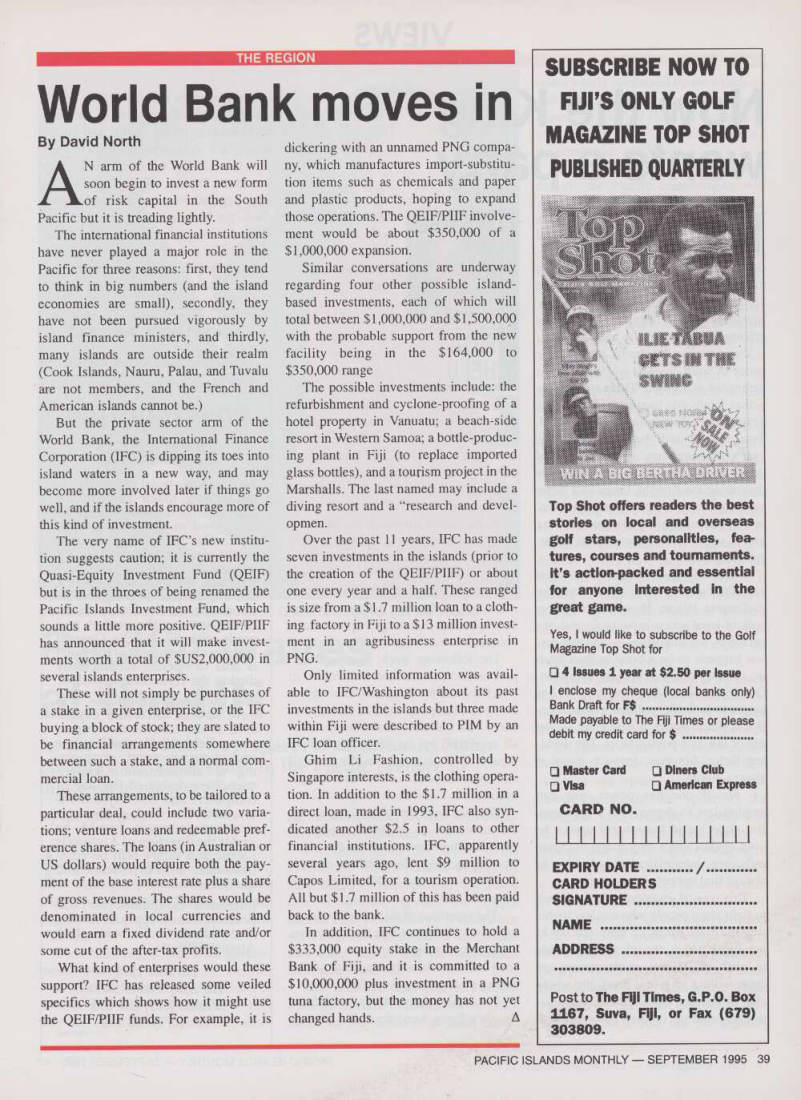
The Region
By David North
AN arm of the World Bank will soon begin to invest a new form of risk capital in the South Pacific but it is treading lightly.
The international financial institutions have never played a major role in the Pacific for three reasons: first, they tend to think in big numbers (and the island economies are small), secondly, they have not been pursued vigorously by island finance ministers, and thirdly, many islands are outside their realm (Cook Islands, Nauru, Palau, and Tuvalu are not members, and the French and American islands cannot be.) But the private sector arm of the World Bank, the International Finance Corporation (IFC) is dipping its toes into island waters in a new way, and may become more involved later if things go well, and if the islands encourage more of this kind of investment.
The very name of IFC’s new institu tion suggests caution; it is currently the Quasi-Equity Investment Fund (QEIF) but is in the throes of being renamed the Pacific Islands Investment Fund, which sounds a little more positive. QEIF/PIIF has announced that it will make invest ments worth a total of $U52,000,000 in several islands enterprises.
These will not simply be purchases of a stake in a given enterprise, or the IFC buying a block of stock; they are slated to be financial arrangements somewhere between such a stake, and a normal com mercial loan.
These arrangements, to be tailored to a particular deal, could include two varia tions; venture loans and redeemable pref erence shares. The loans (in Australian or US dollars) would require both the pay ment of the base interest rate plus a share of gross revenues. The shares would be denominated in local currencies and would earn a fixed dividend rate and/or some cut of the after-tax profits.
What kind of enterprises would these support? IFC has released some veiled specifics which shows how it might use the QEIF/PIIF funds. For example, it is
dickering with an unnamed PNG compa ny, which manufactures import-substitu tion items such as chemicals and paper and plastic products, hoping to expand those operations. The QEIF/PIIF involve ment would be about $350,000 of a
$1,000,000 expansion.
Similar conversations are underway regarding four other possible island based investments, each of which will total between $1,000,000 and $1,500,000 with the probable support from the new facility being in the $164,000 to $350,000 range The possible investments include: the refurbishment and cyclone-proofing of a hotel property in Vanuatu; a beach-side resort in Western Samoa; a bottle-produc ing plant in Fiji (to replace imported glass bottles), and a tourism project in the Marshalls. The last named may include a diving resort and a “research and devel opmen.
Over the past 11 years, IFC has made seven investments in the islands (prior to the creation of the QEIF/PIIF) or about one every year and a half. These ranged is size from a $1.7 million loan to a cloth ing factory in Fiji to a $l3 million invest ment in an agribusiness enterprise in
Png.
Only limited information was avail able to IFC/Washington about its past investments in the islands but three made within Fiji were described to PIM by an IFC loan officer.
Ghim Li Fashion, controlled by Singapore interests, is the clothing opera tion. In addition to the $1.7 million in a direct loan, made in 1993, IFC also syn dicated another $2.5 in loans to other financial institutions. IFC, apparently several years ago, lent $9 million to Capos Limited, for a tourism operation.
All but $1.7 million of this has been paid back to the bank.
In addition, IFC continues to hold a $333,000 equity stake in the Merchant Bank of Fiji, and it is committed to a $10,000,000 plus investment in a PNG tuna factory, but the money has not yet changed hands. A
Advertisements & other items, p. 39 (1 item)
Published Quarterly
SUBSCRIBE NOW TO
FIJI'S ONLY GOLF
MAGAZINE TOP SHOT
PUBLISHED QUARTERLY
litMl
iiTSiifii
wmm
. l-L-v Z'uh bL Top Shot offers readers the best stories on local and overseas golf stars, personalities, features, courses and tournaments, it’s action-packed and essential for anyone interested in the great game.
Yes, I would like to subscribe to the Golf Magazine Top Shot for □ 4 Issues 1 year at $2.50 per issue I enclose my cheque (local banks only) Bank Draft for F$ Made payable to The Fiji Times or please debit my credit card for $ □ Master Card □ Diners Club □ Visa □ American Express
CARD NO.
MIIIIIII I I I I I I I
EXPIRY DATE /
CARD HOLDERS
SIGNATURE
NAME
ADDRESS
Post to The Fiji Times, 6.P.0. Box 1167, Suva, Fiji, or Fax (679) 303809.
Tonga
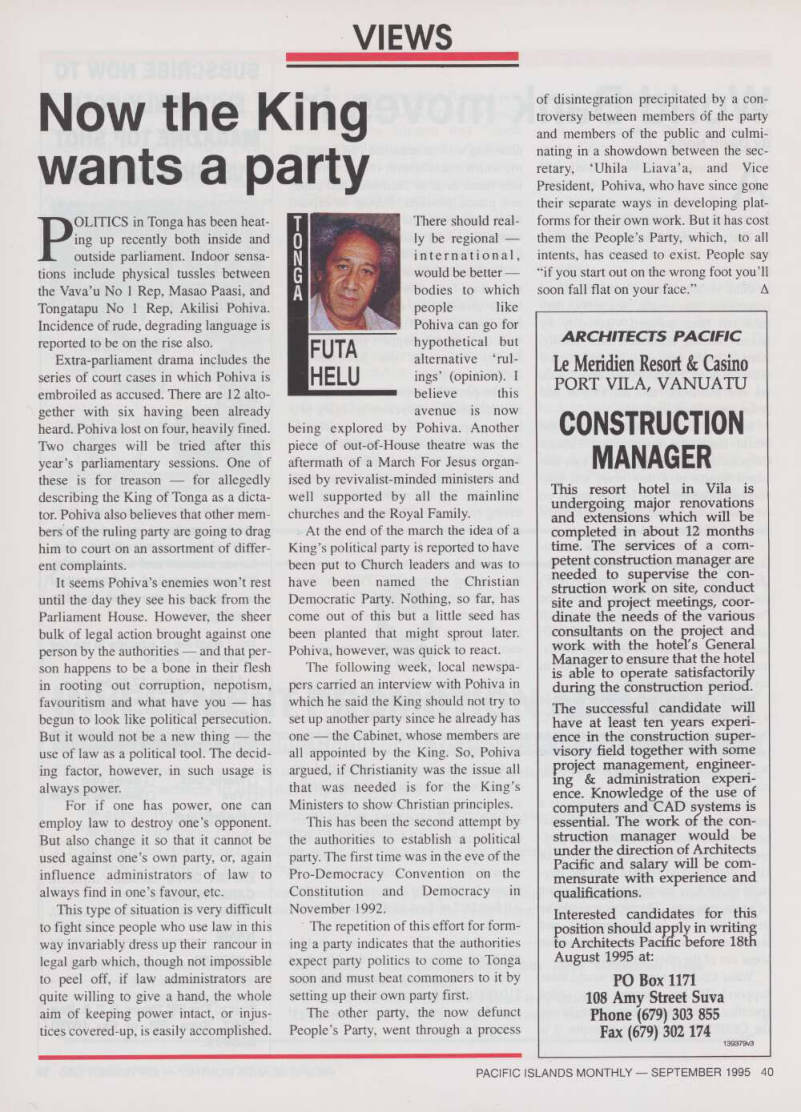
Views
Now the King wants a party
POLITICS in Tonga has been heat ing up recently both inside and outside parliament. Indoor sensa tions include physical tussles between the Vava’u No 1 Rep, Masao Paasi, and Tongatapu No 1 Rep, Akilisi Pohiva.
Incidence of rude, degrading language is reported to be on the rise also.
Extra-parliament drama includes the series of court cases in which Pohiva is embroiled as accused. There are 12 alto gether with six having been already heard. Pohiva lost on four, heavily fined.
Two charges will be tried after this year’s parliamentary sessions. One of these is for treason for allegedly describing the King of Tonga as a dicta tor. Pohiva also believes that other mem bers of the ruling party are going to drag him to court on an assortment of differ ent complaints.
It seems Pohiva’s enemies won’t rest until the day they see his back from the Parliament House. However, the sheer bulk of legal action brought against one person by the authorities and that per son happens to be a bone in their flesh in rooting out corruption, nepotism, favouritism and what have you has begun to look like political persecution.
But it would not be a new thing the use of law as a political tool. The decid ing factor, however, in such usage is always power.
For if one has power, one can employ law to destroy one’s opponent.
But also change it so that it cannot be used against one’s own party, or, again influence administrators of law to always find in one’s favour, etc.
This type of situation is very difficult to fight since people who use law in this way invariably dress up their rancour in legal garb which, though not impossible to peel off, if law administrators are quite willing to give a hand, the whole aim of keeping power intact, or injus tices covered-up, is easily accomplished.
There should real ly be regional international, would be better bodies to which people like Pohiva can go for hypothetical but alternative ‘rul ings’ (opinion). I believe this avenue is now
being explored by Pohiva. Another piece of out-of-House theatre was the aftermath of a March For Jesus organ ised by revivalist-minded ministers and well supported by all the mainline churches and the Royal Family.
At the end of the march the idea of a King’s political party is reported to have been put to Church leaders and was to have been named the Christian Democratic Party. Nothing, so far, has come out of this but a little seed has been planted that might sprout later.
Pohiva, however, was quick to react.
The following week, local newspa pers carried an interview with Pohiva in which he said the King should not try to set up another party since he already has one the Cabinet, whose members are all appointed by the King. So, Pohiva argued, if Christianity was the issue all that was needed is for the King’s Ministers to show Christian principles.
This has been the second attempt by the authorities to establish a political party. The first time was in the eve of the Pro-Democracy Convention on the Constitution and Democracy in November 1992.
The repetition of this effort for form ing a party indicates that the authorities expect party politics to come to Tonga soon and must beat commoners to it by setting up their own party first.
The other party, the now defunct People’s Party, went through a process
of disintegration precipitated by a con troversy between members of the party and members of the public and culmi nating in a showdown between the sec retary, ‘Uhila Liava’a, and Vice President, Pohiva, who have since gone their separate ways in developing plat forms for their own work. But it has cost them the People’s Party, which, to all intents, has ceased to exist. People say “if you start out on the wrong foot you’ll soon fall flat on your face.” A
Tonga
Futa
Helu
Advertisements & other items, p. 40 (1 item)
Construction
ARCHITECTS PACIFIC
Le Meridien Resort & Casino
PORT VILA, VANUATU
CONSTRUCTION
MANAGER
This resort hotel in Vila is undergoing major renovations and extensions which will be completed in about 12 months time. The services of a competent construction manager are needed to supervise the construction work on site, conduct site and project meetings, coordinate the needs of the various consultants on the project and work with the hotel's General Manager to ensure that the hotel is able to operate satisfactorily during the construction period.
The successful candidate will have at least ten years experience in the construction supervisory field together with some project management, engineering & administration experience. Knowledge of the use of computers and CAD systems is essential. The work or the construction manager would be under the direction of Architects Pacific and salary will be commensurate with experience and
qualifications.
Interested candidates for this position should apply in writing to Architects Pacific before 18th August 1995 at: PO Box 1171 108 Amy Street Suva Phone (679) 303 855 Fax (679) 302 174
at the UN
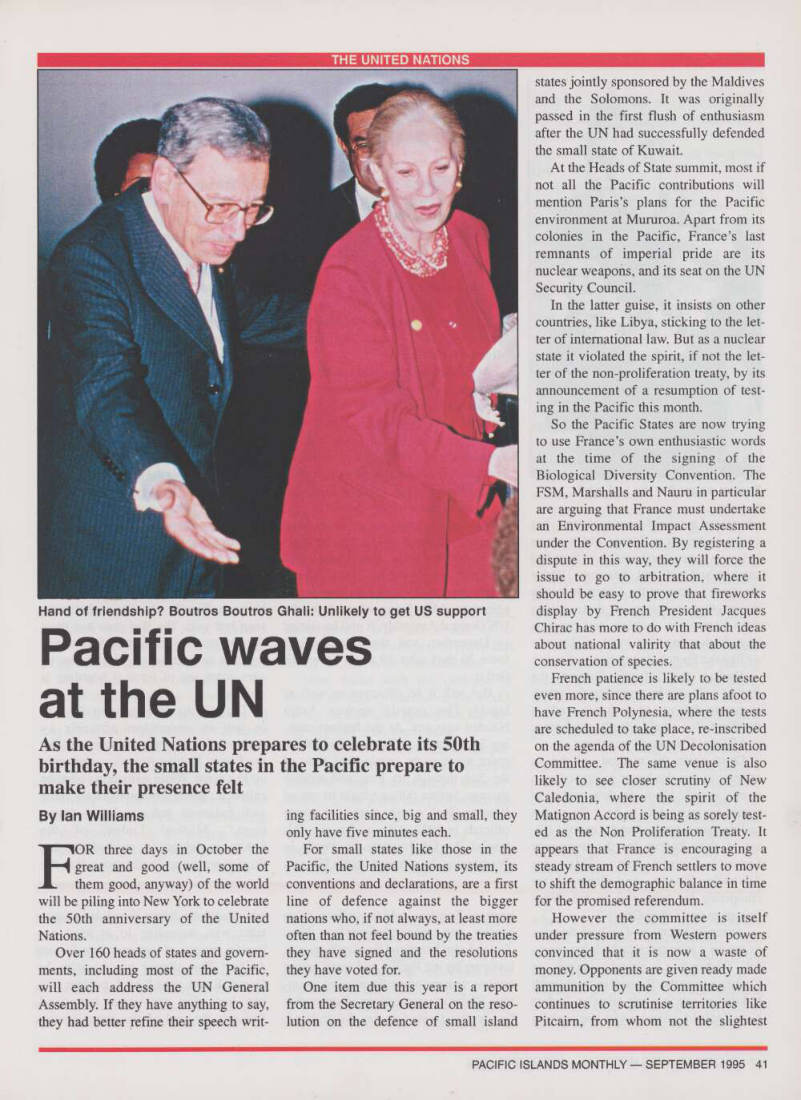
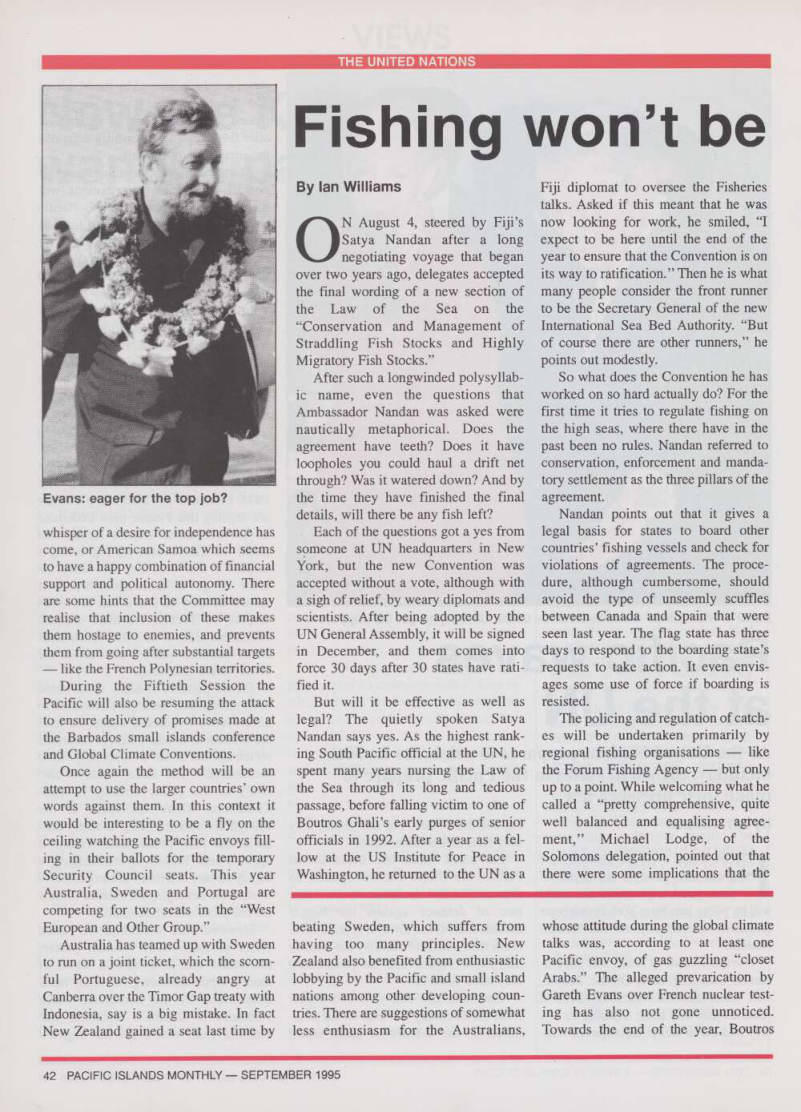
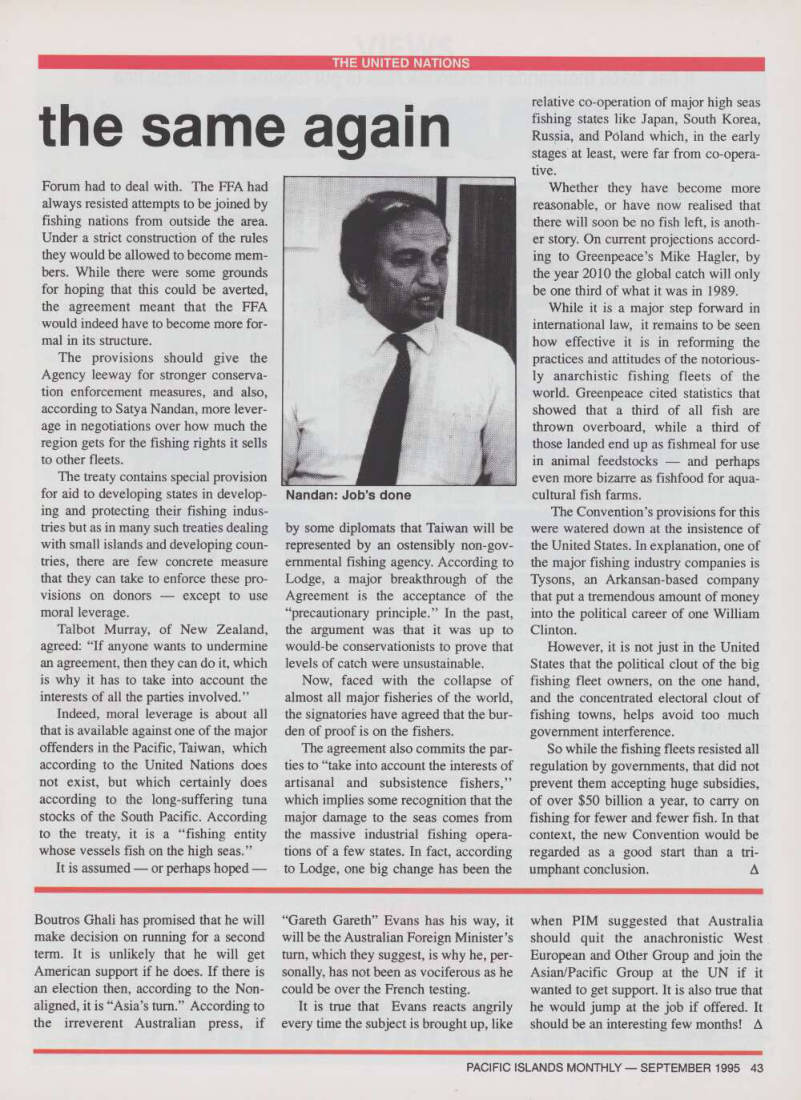
The United Nations
Pacific waves at the UN
As the United Nations prepares to celebrate its 50th birthday, the small states in the Pacific prepare to make their presence felt
By Ian Williams
FOR three days in October the great and good (well, some of them good, anyway) of the world will be piling into New York to celebrate the 50th anniversary of the United Nations.
Over 160 heads of states and govern ments, including most of the Pacific, will each address the UN General Assembly, If they have anything to say, they had better refine their speech writ
ing facilities since, big and small, they only have five minutes each.
For small states like those in the Pacific, the United Nations system, its conventions and declarations, are a first line of defence against the bigger nations who, if not always, at least more often than not feel bound by the treaties they have signed and the resolutions they have voted for.
One item due this year is a report from the Secretary General on the reso lution on the defence of small island
states jointly sponsored by the Maldives and the Solomons. It was originally passed in the first flush of enthusiasm after the UN had successfully defended the small state of Kuwait.
At the Heads of State summit, most if not all the Pacific contributions will mention Paris’s plans for the Pacific environment at Mururoa. Apart from its colonies in the Pacific, France’s last remnants of imperial pride are its nuclear weapons, and its seat on the UN Security Council.
In the latter guise, it insists on other countries, like Libya, sticking to the let ter of international law. But as a nuclear state it violated the spirit, if not the let ter of the non-proliferation treaty, by its announcement of a resumption of test ing in the Pacific this month.
So the Pacific States are now trying to use France’s own enthusiastic words at the time of the signing of the Biological Diversity Convention. The FSM, Marshalls and Nauru in particular are arguing that France must undertake an Environmental Impact Assessment under the Convention. By registering a dispute in this way, they will force the issue to go to arbitration, where it should be easy to prove that fireworks display by French President Jacques Chirac has more to do with French ideas about national valirity that about the conservation of species.
French patience is likely to be tested even more, since there are plans afoot to have French Polynesia, where the tests are scheduled to take place, re-inscribed on the agenda of the UN Decolonisation Committee. The same venue is also likely to see closer scrutiny of New Caledonia, where the spirit of the Matignon Accord is being as sorely test ed as the Non Proliferation Treaty. It appears that France is encouraging a steady stream of French settlers to move to shift the demographic balance in time for the promised referendum.
However the committee is itself under pressure from Western powers convinced that it is now a waste of money. Opponents are given ready made ammunition by the Committee which continues to scrutinise territories like Pitcairn, from whom not the slightest
Hand of friendship? Boutros Boutros Ghali: Unlikely to get US support
whisper of a desire for independence has come, or American Samoa which seems to have a happy combination of financial support and political autonomy. There are some hints that the Committee may realise that inclusion of these makes them hostage to enemies, and prevents them from going after substantial targets like the French Polynesian territories.
During the Fiftieth Session the Pacific will also be resuming the attack to ensure delivery of promises made at the Barbados small islands conference and Global Climate Conventions.
Once again the method will be an attempt to use the larger countries’ own words against them. In this context it would be interesting to be a fly on the ceiling watching the Pacific envoys fill ing in their ballots for the temporary Security Council seats. This year Australia, Sweden and Portugal are competing for two seats in the “West European and Other Group.”
Australia has teamed up with Sweden to run on a joint ticket, which the scorn ful Portuguese, already angry at Canberra over the Timor Gap treaty with Indonesia, say is a big mistake. In fact New Zealand gained a seat last time by
beating Sweden, which suffers from having too many principles. New Zealand also benefited from enthusiastic lobbying by the Pacific and small island nations among other developing coun tries. There are suggestions of somewhat less enthusiasm for the Australians,
whose attitude during the global climate talks was, according to at least one Pacific envoy, of gas guzzling “closet Arabs.” The alleged prevarication by Gareth Evans over French nuclear test ing has also not gone unnoticed.
Towards the end of the year, Boutros
Evans: eager for the top job?
Boutros Ghali has promised that he will make decision on running for a second term. It is unlikely that he will get American support if he does. If there is an election then, according to the Non aligned, it is “Asia’s turn.” According to the irreverent Australian press, if
“Gareth Gareth” Evans has his way, it will be the Australian Foreign Minister’s turn, which they suggest, is why he, per sonally, has not been as vociferous as he could be over the French testing.
It is true that Evans reacts angrily every time the subject is brought up, like
when PIM suggested that Australia should quit the anachronistic West European and Other Group and join the Asian/Pacific Group at the UN if it wanted to get support. It is also true that he would jump at the job if offered. It should be an interesting few months! A
Fishing won’t be
By Ian Williams
ON August 4, steered by Fiji’s
Satya Nandan after a long negotiating voyage that began over two years ago, delegates accepted the final wording of a new section of the Law of the Sea on the “Conservation and Management of Straddling Fish Stocks and Highly Migratory Fish Stocks.”
After such a longwinded polysyllab ic name, even the questions that Ambassador Nandan was asked were nautically metaphorical. Does the agreement have teeth? Does it have loopholes you could haul a drift net through? Was it watered down? And by the time they have finished the final details, will there be any fish left?
Each of the questions got a yes from someone at UN headquarters in New York, but the new Convention was accepted without a vote, although with a sigh of relief, by weary diplomats and scientists. After being adopted by the UN General Assembly, it will be signed in December, and them comes into force 30 days after 30 states have rati fied it.
But will it be effective as well as legal? The quietly spoken Satya Nandan says yes. As the highest rank ing South Pacific official at the UN, he spent many years nursing the Law of the Sea through its long and tedious passage, before falling victim to one of Boutros Ghali’s early purges of senior officials in 1992. After a year as a fel low at the US Institute for Peace in Washington, he returned to the UN as a
Fiji diplomat to oversee the Fisheries talks. Asked if this meant that he was now looking for work, he smiled, “I expect to be here until the end of the year to ensure that the Convention is on its way to ratification.” Then he is what many people consider the front runner to be the Secretary General of the new International Sea Bed Authority. “But of course there are other runners,” he
points out modestly.
So what does the Convention he has worked on so hard actually do? For the first time it tries to regulate fishing on the high seas, where there have in the past been no rules. Nandan referred to conservation, enforcement and manda tory settlement as the three pillars of the agreement.
Nandan points out that it gives a legal basis for states to board other countries’ fishing vessels and check for violations of agreements. The proce dure, although cumbersome, should avoid the type of unseemly scuffles between Canada and Spain that were seen last year. The flag state has three days to respond to the boarding state’s requests to take action. It even envis ages some use of force if boarding is resisted.
The policing and regulation of catch es will be undertaken primarily by
regional fishing organisations like
the Forum Fishing Agency but only up to a point. While welcoming what he
called a “pretty comprehensive, quite
well balanced and equalising agree ment,” Michael Lodge, of the Solomons delegation, pointed out that there were some implications that the
Forum had to deal with. The FFA had always resisted attempts to be joined by fishing nations from outside the area.
Under a strict construction of the rules they would be allowed to become mem bers. While there were some grounds for hoping that this could be averted, the agreement meant that the FFA would indeed have to become more for mal in its structure.
The provisions should give the Agency leeway for stronger conserva tion enforcement measures, and also, according to Satya Nandan, more lever age in negotiations over how much the region gets for the fishing rights it sells to other fleets.
The treaty contains special provision for aid to developing states in develop ing and protecting their fishing indus tries but as in many such treaties dealing with small islands and developing coun tries, there are few concrete measure that they can take to enforce these pro visions on donors except to use
moral leverage.
Talbot Murray, of New Zealand, agreed: “If anyone wants to undermine an agreement, then they can do it, which is why it has to take into account the interests of all the parties involved.”
Indeed, moral leverage is about all that is available against one of the major offenders in the Pacific, Taiwan, which according to the United Nations does not exist, but which certainly does according to the long-suffering tuna stocks of the South Pacific. According to the treaty, it is a “fishing entity whose vessels fish on the high seas.”
It is assumed or perhaps hoped
by some diplomats that Taiwan will be represented by an ostensibly non-gov ernmental fishing agency. According to Lodge, a major breakthrough of the Agreement is the acceptance of the “precautionary principle.” In the past, the argument was that it was up to would-be conservationists to prove that levels of catch were unsustainable.
Now, faced with the collapse of almost all major fisheries of the world, the signatories have agreed that the bur den of proof is on the fishers.
The agreement also commits the par ties to “take into account the interests of artisanal and subsistence fishers,” which implies some recognition that the major damage to the seas comes from the massive industrial fishing opera tions of a few states. In fact, according to Lodge, one big change has been the
relative co-operation of major high seas fishing states like Japan, South Korea, Russia, and Poland which, in the early stages at least, were far from co-opera tive.
Whether they have become more reasonable, or have now realised that there will soon be no fish left, is anoth er story. On current projections accord ing to Greenpeace’s Mike Hagler, by the year 2010 the global catch will only be one third of what it was in 1989.
While it is a major step forward in international law, it remains to be seen how effective it is in reforming the practices and attitudes of the notorious ly anarchistic fishing fleets of the world. Greenpeace cited statistics that showed that a third of all fish are thrown overboard, while a third of those landed end up as fishmeal for use in animal feedstocks and perhaps even more bizarre as fishfood for aqua cultural fish farms.
The Convention’s provisions for this were watered down at the insistence of the United States. In explanation, one of the major fishing industry companies is Tysons, an Arkansan-based company that put a tremendous amount of money into the political career of one William Clinton.
However, it is not just in the United States that the political clout of the big fishing fleet owners, on the one hand, and the concentrated electoral clout of fishing towns, helps avoid too much government interference.
So while the fishing fleets resisted all regulation by governments, that did not prevent them accepting huge subsidies, of over $5O billion a year, to carry on fishing for fewer and fewer fish. In that context, the new Convention would be regarded as a good start than a tri umphant conclusion. A
Nandan: Job’s done
Advertisements & other items, pp. 43-44 (2 items)
the same again
43
THE UNITED NATIONS
PACIFIC ISLANDS MONTHLY SEPTEMBER 1995
the same again
Yqij Tf£\Mt To 3%5Lt Om T«5 Ujck
It has taken thousands of chainlink rolls to put together this simple line. & A.sm
SSmSS&M
■lOl5
S \ BIL chainlinks are manufactured from high quality Australian Galvanised or PVC wire and produced under stringent quality control on completely automatic Japanese machines.
Our commitment to excellence does not end here. We are the only manufacturer in Fiji to be accredited with NZS 9002 A59002/1509002 certification for the manufacture of chainlink fence, barbed wire, welded mesh, bright and galvanised nails.
We are the proud winners of the coveted F.T.1.8. Exporter of the Year Award (B&l)
ISO
9002 rt
NZS
9002 twice in succession in 1993 and 1994... a recognition for our quality exports to Pacific Islands.
Experience the big difference in quality when you buy the recognised BIL brand chainlink fence.
So confident are we about our quality, that we identify every chainlink roll with a BIL label.
And what is more ... BIL brand chainlink fences are available at most of the leading hardware stores Fiji wide. Excellent technology and quality is now within everyone's reach. mK
BA INDUSTRIES LTD
P.O. Box 707, Ba, Fiji. Phone: 674966 Fax: 676700. \ « I ) 1 I I f” I , ■ . \ J i njjj .5 T I i i J. 3 YQIJ Tf£\MT TO 3%5LT OM T«5 UJCK j ADdesign
Glimmer of hope
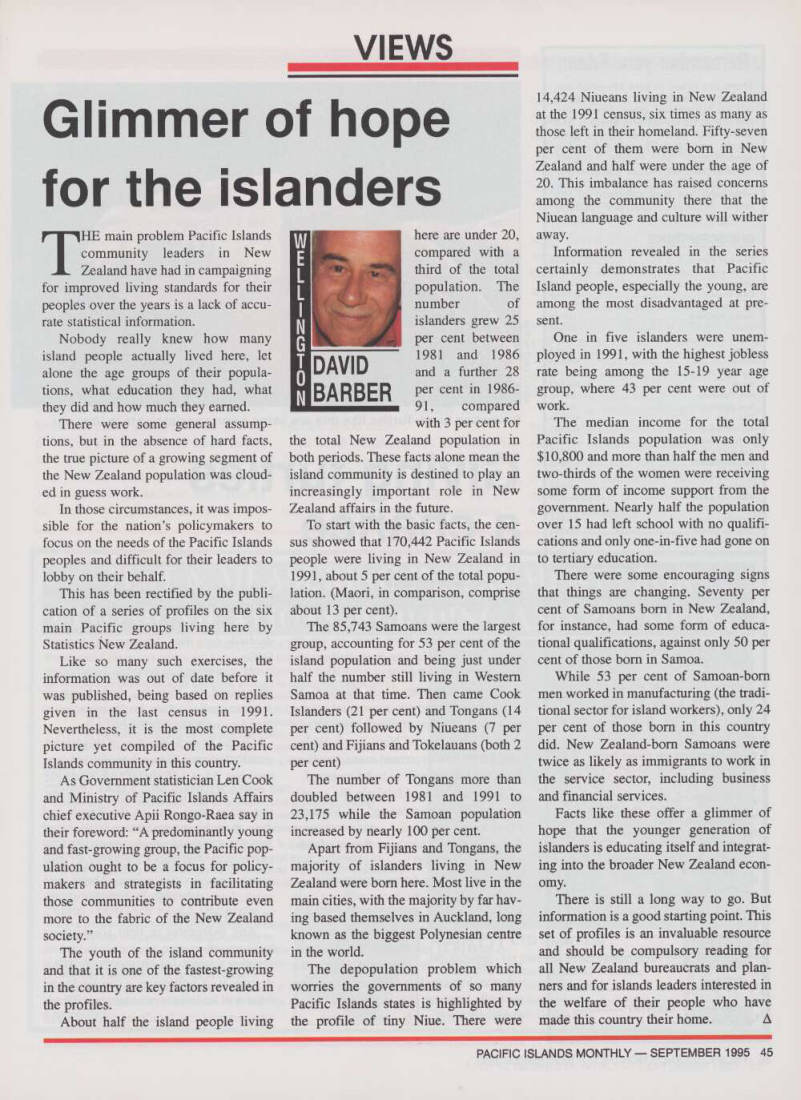
Views
Glimmer of hope for the islanders
THE main problem Pacific Islands community leaders in New Zealand have had in campaigning for improved living standards for their peoples over the years is a lack of accu rate statistical information.
Nobody really knew how many island people actually lived here, let alone the age groups of their popula tions, what education they had, what they did and how much they earned.
There were some general assump tions, but in the absence of hard facts, the true picture of a growing segment of the New Zealand population was cloud ed in guess work.
In those circumstances, it was impos sible for the nation’s policymakers to focus on the needs of the Pacific Islands peoples and difficult for their leaders to lobby on their behalf.
This has been rectified by the publi cation of a series of profiles on the six main Pacific groups living here by Statistics New Zealand.
Like so many such exercises, the information was out of date before it was published, being based on replies given in the last census in 1991.
Nevertheless, it is the most complete picture yet compiled of the Pacific Islands community in this country.
As Government statistician Len Cook and Ministry of Pacific Islands Affairs chief executive Apii Rongo-Raea say in their foreword: “A predominantly young and fast-growing group, the Pacific pop ulation ought to be a focus for policy makers and strategists in facilitating those communities to contribute even more to the fabric of the New Zealand society.”
The youth of the island community and that it is one of the fastest-growing in the country are key factors revealed in
the profiles.
About half the island people living
here are under 20, compared with a third of the total
population. The
number of islanders grew 25 per cent between 1981 and 1986 and a further 28 per cent in 1986- 91, compared with 3 per cent for
the total New Zealand population in both periods. These facts alone mean the island community is destined to play an increasingly important role in New Zealand affairs in the future.
To start with the basic facts, the cen sus showed that 170,442 Pacific Islands people were living in New Zealand in 1991, about 5 per cent of the total popu lation. (Maori, in comparison, comprise about 13 per cent).
The 85,743 Samoans were the largest group, accounting for 53 per cent of the island population and being just under half the number still living in Western Samoa at that time. Then came Cook Islanders (21 per cent) and Tongans (14 per cent) followed by Niueans (7 per cent) and Fijians and Tokelauans (both 2 per cent) The number of Tongans more than doubled between 1981 and 1991 to 23,175 while the Samoan population increased by nearly 100 per cent.
Apart from Fijians and Tongans, the majority of islanders living in New Zealand were bom here. Most live in the main cities, with the majority by far hav ing based themselves in Auckland, long known as the biggest Polynesian centre in the world.
The depopulation problem which worries the governments of so many Pacific Islands states is highlighted by the profile of tiny Niue. There were
14,424 Niueans living in New Zealand at the 1991 census, six times as many as those left in their homeland. Fifty-seven per cent of them were bom in New Zealand and half were under the age of 20. This imbalance has raised concerns among the community there that the Niuean language and culture will wither away.
Information revealed in the series certainly demonstrates that Pacific Island people, especially the young, are among the most disadvantaged at pre sent.
One in five islanders were unem ployed in 1991, with the highest jobless rate being among the 15-19 year age group, where 43 per cent were out of work.
The median income for the total Pacific Islands population was only $lO,BOO and more than half the men and two-thirds of the women were receiving some form of income support from the government. Nearly half the population over 15 had left school with no qualifi cations and only one-in-five had gone on to tertiary education.
There were some encouraging signs that things are changing. Seventy per cent of Samoans bom in New Zealand, for instance, had some form of educa tional qualifications, against only 50 per cent of those bom in Samoa.
While 53 per cent of Samoan-bom men worked in manufacturing (the tradi tional sector for island workers), only 24 per cent of those bom in this country did. New Zealand-born Samoans were twice as likely as immigrants to work in the service sector, including business and financial services.
Facts like these offer a glimmer of hope that the younger generation of islanders is educating itself and integrat ing into the broader New Zealand econ omy.
There is still a long way to go. But information is a good starting point. This set of profiles is an invaluable resource and should be compulsory reading for all New Zealand bureaucrats and plan ners and for islands leaders interested in the welfare of their people who have made this country their home. A
Wellington
David
Barber
Giving turtles
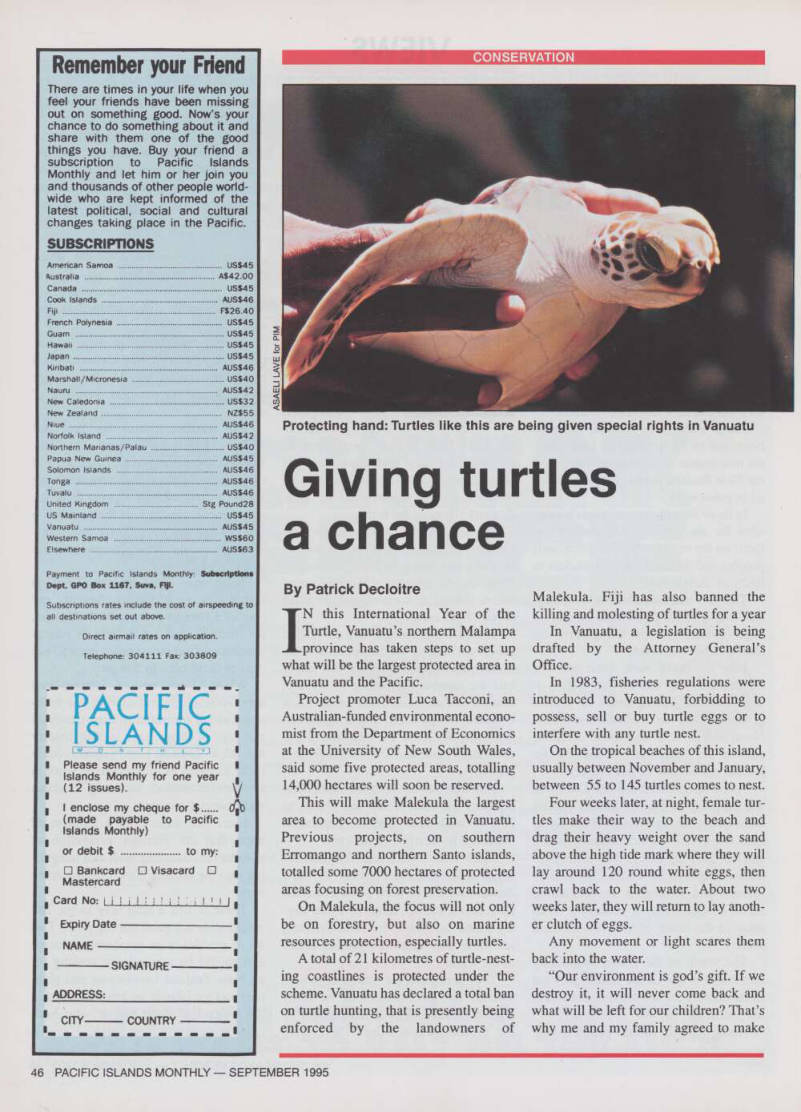

Conservation
Giving turtles a chance
By Patrick Decloitre
IN this International Year of the Turtle, Vanuatu’s northern Malampa province has taken steps to set up what will be the largest protected area in Vanuatu and the Pacific.
Project promoter Luca Tacconi, an Australian-funded environmental econo mist from the Department of Economics at the University of New South Wales, said some five protected areas, totalling 14,000 hectares will soon be reserved.
This will make Malekula the largest area to become protected in Vanuatu.
Previous projects, on southern Erromango and northern Santo islands, totalled some 7000 hectares of protected areas focusing on forest preservation.
On Malekula, the focus will not only be on forestry, but also on marine resources protection, especially turtles.
A total of 21 kilometres of turtle-nest ing coastlines is protected under the scheme. Vanuatu has declared a total ban on turtle hunting, that is presently being enforced by the landowners of
Malekula. Fiji has also banned the killing and molesting of turtles for a year In Vanuatu, a legislation is being drafted by the Attorney General’s Office.
In 1983, fisheries regulations were introduced to Vanuatu, forbidding to possess, sell or buy turtle eggs or to interfere with any turtle nest.
On the tropical beaches of this island, usually between November and January, between 55 to 145 turtles comes to nest.
Four weeks later, at night, female tur tles make their way to the beach and drag their heavy weight over the sand above the high tide mark where they will lay around 120 round white eggs, then crawl back to the water. About two weeks later, they will return to lay anoth er clutch of eggs.
Any movement or light scares them back into the water.
“Our environment is god’s gift. If we destroy it, it will never come back and what will be left for our children? That’s why me and my family agreed to make
Protecting hand: Turtles like this are being given special rights in Vanuatu
our land a protected area,” chief Timothy Nehapi, one of the traditional owners of the protected beaches, said.
Province President Frank Kenneth quoted Article 7 of the Vanuatu constitu tion, which says every individual has the fundamental right to protect national resources and the environment for the sake of the present generation and the generations to come.
“We strongly believe that conserva tion areas have to be dealt with as a mat ter of priority. We don’t want our resources loaded and unloaded in ships to Asia,” Kenneth said.
A recent South Pacific Regional Environment Programme (SPREP) study points out that in many Pacific Islands countries, turtles are hunted for food, or for their shells, or to use their oil in cosmetics. Sometimes, small turtles are captured and sold to tourist alive.
A SPREP conference held in Port Vila six years ago declared some sites in the islands of Malekula, Erromango and
Santo of “regional and international importance.” In Vanuatu, green and
hawksbill turtles have been exploited for their meat and eggs on a local level, but were not sold for cash. In south ern Tanna, turtle is even part of the tradition, and some fami lies claim to descend from them. Only those “turtle
men” are al-lowed to capture turtles in specific taboo areas.
In South Malekula, it is customary to kill turtles when the yam harvesting sea son comes.
“This is part of the culture, but tur tles are also part of the environment,”
says Vanuatu Fisheries Department Director Doresty Kenneth, who is from the same island.
“This is a nursery area for turtles, and it is particularly important to protect it, because this year is the international year of the turtle.”
Vanuatu’s director of environmental unit, Ernest Bani, confirms in some areas of Malekula, it is a tradition to eat turtles in February, when the yams roots are harvested.
“One week before February 4 each year, villagers take their canoes to sea and jump on the turtles to catch them.
Then they keep them in fenced yards until the feast takes place. Then they kill the turtles,” he said.
“This is difficult for us to prevent because this is their tradition. We can only rely on the local chiefs to pass on the message and tell their villagers to restrict the number to the very mini mum, say a maximum of 15 turtles, which is enough.” A
Tacconi: Promoter
Advertisements & other items, pp. 46-48 (2 items)
■pacific
Remember your Friend
There are times in your life when you feel your friends have been missing out on something good. Now’s your chance to do something about it and share with them one of the good things you have. Buy your friend a subscription to Pacific Islands Monthly and let him or her join you and thousands of other people worldwide who are kept informed of the latest political, social and cultural
changes taking place in the Pacific.
SUBSCRIPTIONS
American Samoa US$45 Australia A 542.00 Canada US$45 Cook Islands AUSS46 Fiji F 526.40 French Polynesia US$45 Guam US$45 Hawaii US$45 Japan US$45 Kiribati AUSS46 Marshall/Micronesia US$4O Nauru AUSS42 New Caledonia US$32 New Zealand NZ$55 Niue AUSS46 Norfolk Island AUSS42 Northern Mananas/Palau US$4O Papua New Guinea AUSS4S Solomon Islands AUSS46 Tonga AUSS46 Tuvalu AUSS46 United Kingdom Stg Pound2B US Mainland US$45 Vanuatu AUSS4S Western Samoa WS$6O Elsewhere AUSS63 Payment to Pacific Islands Monthly: Subscriptions Dept, GPO Box 1167, Suva, FIJI.
Subscriptions rates include the cost of airspeeding to all destinations set out above.
Direct airmail rates on application.
Telephone; 304111 Fax: 303809
■pacific
SLANDS
I“O»' * <■ r I
Please send my friend Pacific Islands Monthly for one year (12 issues).
I enclose my cheque for $
(made payable to Pacific
Islands Monthly)
or debit $ to my; □ Bankcard □ Visacard □ Mastercard Card No: i i I i M i ! i ! : . ! 1 i Expiry Date
NAME
SIGNATURE
ADDRESS:
CITY COUNTRY
Test & Measuring Instruments For
COMMUNICATIONS, BUILDING AND PLUMBING
CZ6OOO and CZ4OOO - PIPE & CABLE LOCATORS Buried metal pipes and cables can be located or traced using the simple, yet sophisticated, technique of impressing an identifiable electrical signal on to the service, and to have a receiver sensitive enough to detect this signal as it rediates from the service along its length. Three alternative methods are commonly used to couple the transmitted signal to the service; a) Direct electrical contact b) Inductive coupling by radiation
c) Inductive coupling by transformer action.
The CZ6OOO makes use of methods a and b. An optional clip on inductor is available to facilitate method c. Model CZ4OOO is a low priced locator which makes use of method a only.
CZIOOO - CABLE PAIR IDENTIFICATION SET
A beautifully styled instrument, this tone/search unit is used for finding conductors in multipair cable, distribution boxes, and tag strips. Features include inbuilt speaker, insulated probe tip, completely self contained.
CZ2200 Is a test set, often called a "BUTTINSKI", is a self contained, line powered, combination handset used by installers and repair technicians for telephone line testing and temporary communications. The CZ2200 is housed in an injection molded high impact polycarbonate case designed to withstand the rigours associated with craft tools.
CZ3OOO - CONTACT FAULT LOCATOR
This is a modern direct reading bridge which combines
micro-processor and precision analogue circuitry to
provide fast and accurate measurement of the location of short circuits, grounds, and crosses in underground or overhead telephone, data, or signal cables. It features direct readout of the distance to the fault, 2 & 3 wire test, and adjustable compensation for wire gauge & temperature. 2 as ss N/'-v AEGIS PTY LTD ACN 004 513 606 MELBOURNE -141 Christmas Street, Fairfield 3078 P.O. Box 1049, Thornbury Victoria 3071 Australia.
Tel: 613 9481 1422 Fax; 613 9489 4020 SYDNEY - 28/15 Valediction Rd, Kings Park, NSW 2148 Tel: 612 831 1844 Fax: 612 831 3842
ATLAS GIVES YOU THE WORLD
IN A BRIEF CASE.
With STN Atlas (Australia), you can open an Inmarsat Satcom-M briefcase terminal to the stars!
The SPI6OO-B provides a reliable digital secure satellite phone service anywhere within the Pacific, Indian and Atlantic Ocean Regions, covering about two thirds of the earth’s surface, including the Pacific Islands, Asia and Europe.
Weighing only 10.5 kg and running on batteries or 110-240 V AC, the briefcase also has an optional external wet weather antenna which can be set up permanently outside. Thus you can use the phone as an office phone (it can be connected to a PABX) or when needed as a fully portable field phone. This makes the Atlas SPI6OO-B ideal for a wide range of applications hotel communications including offshore island resorts, exploration and mining, oil and gas rigs, construction, emergency backup, independent communications for government diplomats and business executives.
With fax and data capability you have a portable office that allows you to send and receive fax and data communications no matter how remote your location, Plus, it’s backed by a world-wide sales and service network and carries a 12 month warranty.
Take advantage of this and put the world in your briefcase by calling: 612 437 4577 or Fax 612 439 7576 If you’re in the marine business we also have a maritime version with a stabilised antenna allowing voice, fax and data. Allow us to quote you a very competitive price and enjoy the luxury of dialling the world at any time and at any place. New dealerships are now available and welcomed. t*-
STN ATLAS (AUSTRALIA) Innovations in Electronics
UNIT 6, 39 HERBERT ST, ST LEONARDS, NSW 2065, AUSTRALIA.
STN ATLAS (AUSTRALIA) PTY LTD ACN 056 058 952
Aegis seeks more distributors
Advertising Feature
Talking the Pacific
AUSTRALIAN electronic equipment and component manufacturer, AEGIS, is looking for additional distributors in the Pacific and Asia.
AEGIS manufactures and supplies craft test instruments or the telecommunications industry. They also build Pipe & Cable loca tors, Earth leakage fault locators, Filtered mains conditions for the protection of small switchboards and personal computers, light ning protectors, inductors, and copper coils for many applications.
Key products include: • CZ3OOO Contact Fault Locator. This is a modern direct reading bridge which com bines micro-processor and precision ana logue circuitry to provide fast and accurate measurement of the location of short cir cuits, grounds, and crosses in underground or overhead telephone, data, or signal cables. It features direct readout of the dis tance or overhead telephone, data, or signal cables. It features direct readout of the dis tance to the fault, 2 and 3 wire test, and adjustable compensation for wire gauge and temperature. • CZIOOO Cable Pair Indentification Set.
A beautifully-styled instrument, this
tone/search unit is used for finding conduc tors in multipair cable, distribution boxes, and tag strips. Features include inbuilt speaker, insulated probe tip, completely self contained. • CZ6OOO and CZ4OOO Pipe and Cable Locators. Buried metal pipes and cables can be located or traced using the simple, yet sophisticated, technique of impressing an identifiable electronic signal on the service, and using a sensitive receiver to detect the signal as it radiates from the service along
its length.
• CZ7OOO Earth leakage fault locator.
This instrument is used extensively by Teistra (Telecom Australia), and many elec trical, gas, and water utilities to pinpoint the location of earth leakage faults due to cable damage. It is also used to locate the path and depth of buried pipes and cables. • CZ9OO Conductor Joint Resistance Test Set. This is a simple to use instrument for fast and accurate verification of jointing operations in both in-line and single ended terminations.
As well as being an integral part of all jointing operations, the CZ9OO is invaluable as an operator training aid.
• CZISIOO High Performance Mains Line Conditioner. It employs earthline filtering and transverse connected spike suppres sion varistors to protect digital equipment such as personal computers, instruments, and small telephone switchboard systems.
Approved by power authorities for use in Australia on 240 V 50Hz lines. (Enquiries for alternative power supplies are invited).
AEGIS is a distributor for Harris Dracon craft tools and test instruments. These include a comprehensive range of “Buttinski” hand held test sets, including ruggedised, data safe, and weather resis tant versions. Two “pocket” test sets include the PTSIII data safe model with traffic iden tified and frequency detection capability, and the biTS-1 ISDN Test set. Harris also makes a range of automatic impact wire termination tools with blades for many applications.
Enquiries are invited from potential users and from distributors who have the capabili ty to provide good local support to users, and should be directed to: Hugh Logie, Export Manager, Aegis Pty Ltd, 141 Christmas Street, Fairfield, Victoria, 3076, Australia. Telephone (613) 94811422, Fax (613) 94894020.
Andrew joins global growth
THE merging of the telecommunications, information technology and broadcasting and the emergence of a global village is also apparent in the South Pacific. New tech nologies and services are spreading.
ANDREW is contributing to these aspects and in the communications attenna area, it has available: • an omnidirectional I.SGHz antenna developed for point-to-multipoint concentra tors ; and • a 1.5 Earth Station Antenna suitable for TVRO or VSAT applications for satellite communication; The increased activity in the provision of
additional satellites such as PANAMSAT are an indicator of the growing services that are provided through these means. • a remotely adjustable tilt panel base station antenna is available for cellular com munications. The extremely low wind resis tance and visual impact of this antenna, together with its high performance pattern are features worth mentioning. Additionally, the broad band design covering 820 to 960 MHz allows these antennas to be used for any cellular standard. • Point on Point Microwave applications are provided through a modular 1.8 metre GRIDPAK antenna for frequencies up to 3
Ghz providing low wind resistance and low transportation costs, and a 60cm high per formance antenna utilising a reflector suit able for frequencies up to 38 Ghz. • Equipment for increasing the reliability and survivability of telecommunication installation are represented by the availabil ity of coaxial cable/waveguide pressurisa tion/dehydrator utilising the latest mem brane technology, and a coaxial connector incorporating a tuned stub cavity to provide lightening strike protection to coaxial cable inner conductors without the non-linearities and disposal problems of radioactive gaseous arrestors.
Battle of the bushes
The Land
IN the past 50 years, the South Pacific region has experienced major envi ronmental upheaval and now faces continual pressure from population growth and primary industries, such as logging, mining and agricultural activi ties.
With the growing awareness of the consequences of environmental exploitation such as soil degradation, habitat loss and climatic changes, it has become paramount that action is taken.
On a global level these problems often seem overwhelming, with the responsibility lying in the hands of gov ernment authorities and multinational corporations.
However on a grassroots level there are many ways in which individually and communally we make positive envi ronmental contributions. One of the most important ways in which we can
contribute is to protect and encourage our local indigenous environment.
With the process of development, numerous exotic and invasive species have been introduced into indigenous environments. These in the long term have had, in many instances, an extremely destructive effect on local habitats for both plant and animal life.
Indigenous gardens provide habitat for local and migratory animal species, where foreign plants collectively do not provide the correct structure for a com plicated food web or the viable ecosys tem upon which many local insects, birds, and animal species are dependent.
As a result exotic gardens are often devoid of animal life.
Within a native environment individ ual plants grow in relation to each other, as threads in a tapestry, weaving to form a whole picture. There is a visible order
and balance as if there is a collective consciousness amongst them which leads to a visible harmony and the evo lution of a plant and animal community.
This holistic sense does not appear only amongst the indigenous plants but between plants and their relationship with the environment in which they grow.
Native plants echo the qualities of the land in which they grow. There is a sen suality about vegetation which reflects the physical and from which it grows as the shapes and forms and colours of plants and trees and rocks reflect one another.
The dense greens and greys of the rainforest plants of the Pacific islands reflect the rich soils and cool rocks of the forest floor, and the splashes of vibrant colour are reflected in both the flowers of plant species and feathers of
bird species living therein. On the con trary, exotic species, without constant shaping and maintenance collide and entangle.
There is no sense of continuity but of foreign and varied natural environment and therefore their natural predators often grow uncontrollably, out compet ing native species and becoming weeds.
Weed-infested areas become an impenetrable mass and biodiversity is often diminished to the point where only the predominant weed species survives.
Another major problem with exotic gardens is that in being introduced they have different requirements to that which the environment is naturally pro viding so they require added inputs such as constant watering, fertilising and insectisiding.
Grass lawns are a classic example of environmentally destructive or con sumptive spaces. They produce nothing, are ecologically sterile yet require con stant maintenance through mowing, fer
tilising, watering and insectisiding.
During the so called green revolution in the 1970 s the World Bank and other authorities encouraged and sponsored the use of chemicals to increase crop yields through the Developing World, including the South Pacific.
Chemicals such as DDT and super phosphate were pushed by multination als as magical formula for success. We have since learnt that those chemical additives are highly destructive with phosphates entering rivers and streams causing weed infestations.
Pesticides such as DDT build up in the food chain and have led to deformi ties in both human and other species.
These chemicals also change the nature of the soil and lead to its infertility on the longer term.
Many small farmers have laid out large amounts of money to buy chemi cals from foreign companies only to find that they become dependent on them as soil fertility declines and pest species
increase by the practice of monoculture and disturbance to the natural ecosytem.
By composting and mulching, the need for undesirable chemicals is dimin ished, sustainable farming techniques replacing the energy taken from the sys tem.
Therefore it is becoming more evi dent that monoculture agricultural sys tems are non sustainable and antiquated, for they are requiring more inputs of energy than they return, thus failing the golden rule of a successful natural sys tem. The aim of a successful farm or garden is to create an environment that is self-sustaining whereby outputs do not exceed inputs.
With increasing population pressure it is no longer possible to practise shift ing agriculture bt merely slashing and burning new ground when the old plot becomes infertile. The aim must be to conserve forests and work with the land now farmed but in such a way that it is always improving. A
Advertisements & other items, pp. 50-51 (2 items)
Co., Ltd.
Tomorrow’s News TODAY As revealed in your Bible
HUMAN GOVERNMENT
SOON
TO BE REPLACED BY
DIVINE RULE
For this Free booklet write to
THE CHRISTADELPHIANS
GPO Box 881
ADELAIDE
SOUTH AUSTRALIA 5001
KYOWA
KYOWA
SHIPPING
CO., LTD.
Liner Service to Pacific Islands
FROM OJAPAN
OKOREA
OTAIWAN
O THAILAND
TO O SAIPAN
O FEDERATED STATES
OF MICRONESIA
OMARSHAL ISLANDS
©AMERICAN SAMOA
ONEW CALEDONIA
©FIJI
©HONG KONG
©SINGAPORE
©PHILIPPINES
©MALAYSIA
©INDONESIA
©GUAM
©YAP
©PALAU
©WESTERN SAMOA
©SOLOMON ISLANDS
©VANUATU
©PAPUA NEW GUINEA
HEAD OFFICE:
9th Floor, Shuwa No. 2 Shibapark Bldg., 12-7, Shiba Daimon 2-chome, Minato-ku, Tokyo 105, Japan Phone: (03(3437)2885 (Rep.) Cables: “MARIQUEEN” Tokyo Telex: 242-4651 Kyowa J.
OSAKA OFFICE:
Takasago Bldg, 1-13-16, Awaza Nishi-Ku, Osaka, Japan Phone: 06(533)5821 (Rep.) Cables: "MARIQUEEN” Osaka Telex: Ssiosa J.
FIJI VANUA LEVU
HALF AND LAND PACKAGE
Two bedroom furnished residence set in five acre natural bush land and garden with separate native style self contained bure plus five acres excellent agricultural, hoticultural lot, 20 minutes from Savusavu Phone: 850509.
THE QUALITY OF OUR
AVIONICS MAINTENANCE SERVICE
IS INSTRUMENTAL
TO YOUR SUCCESS.
For over 25 years Australia's Collins Avionics Service Centre (part of the Rockwell worldwide network) has provided an extensive range of state-of-the-art avionics services to meet the rapidly growing needs of our region.
The highest quality sales and service for air transport, general aviation and
military requirements.
Including contract maintenance; repair, overhaul and modification; technical training, consulting and skills transfer; test systems; equipment; and a 24-hour rental/exchange pool.
The Australian Service Centre is at Tullamarine in Victoria. For more information call Neil Thomson on (61 -3) 9338 0344 or fax (61 -3) 9330 3007. With Collins Avionics the sky is definitely not the limit. *l* Rockwell Avionics Collins
The Land
Little Wonders
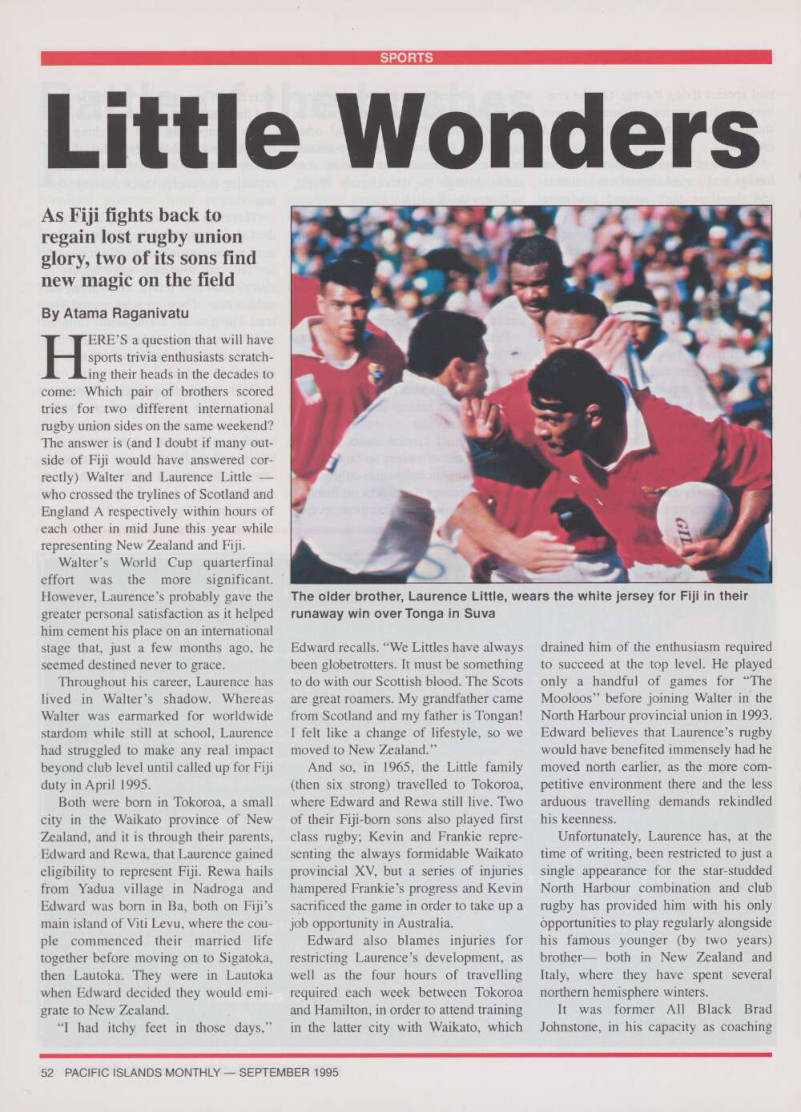
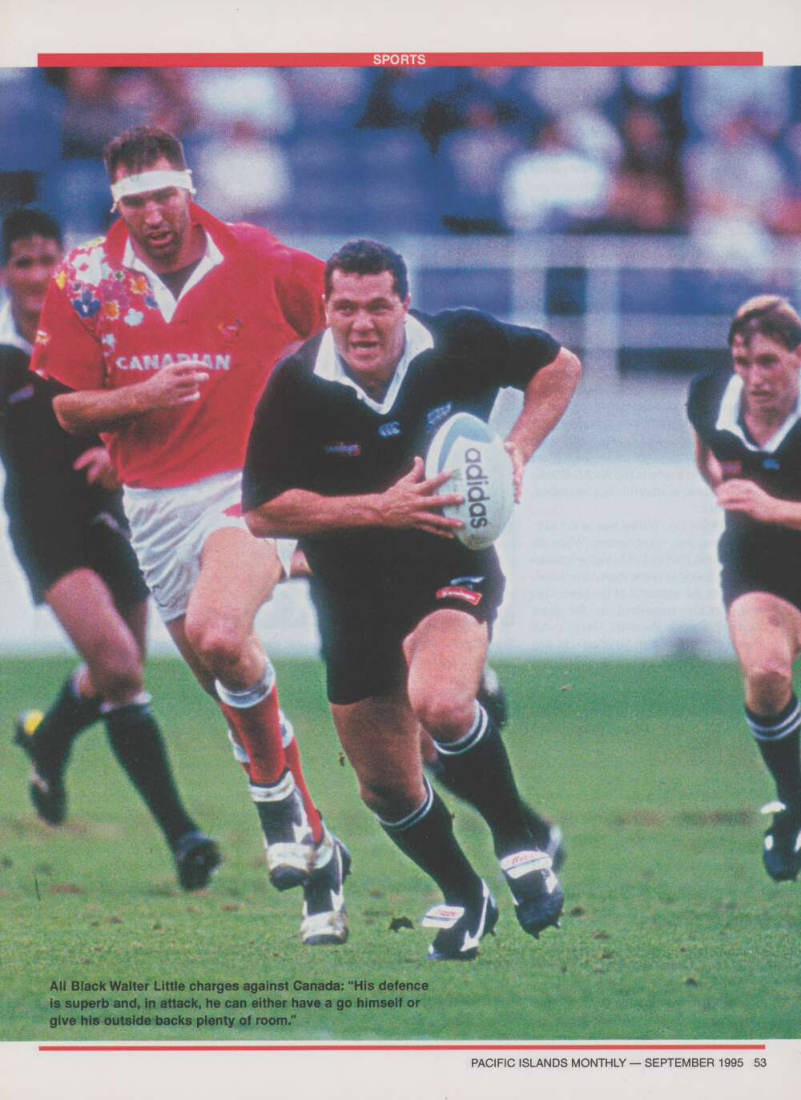
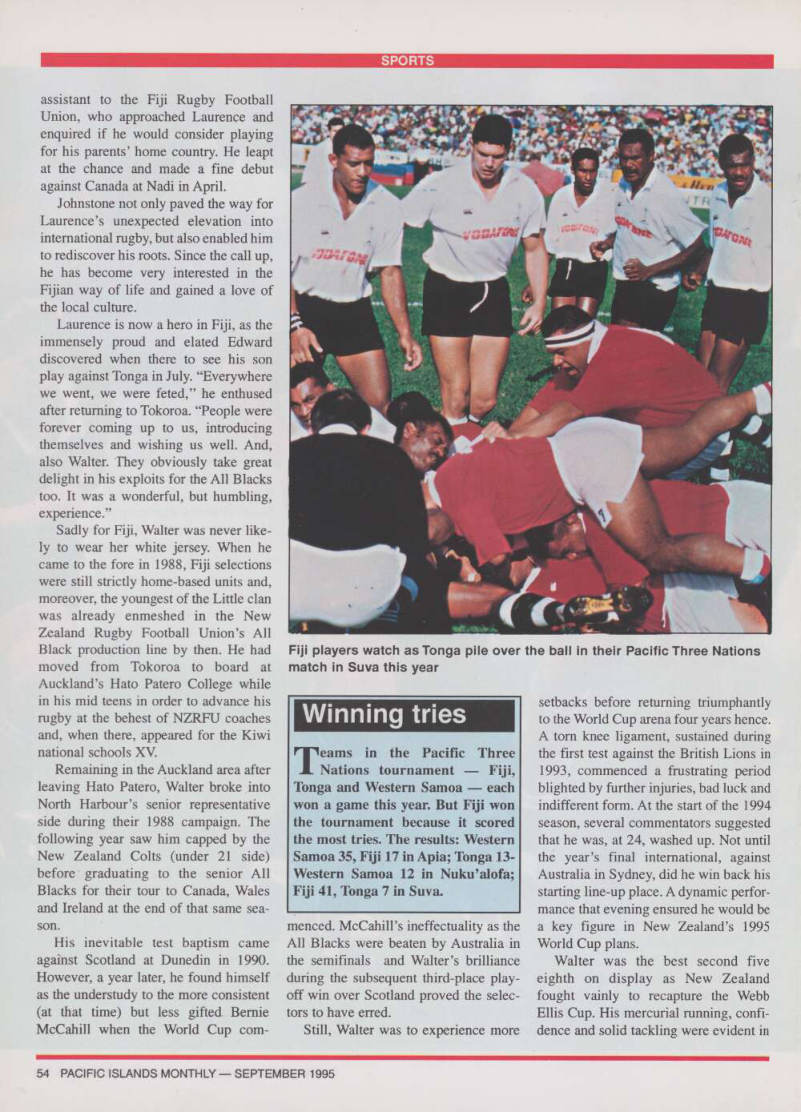
Sports
As Fiji fights back to regain lost rugby union glory, two of its sons find new magic on the field
By Atama Raganivatu
HERE’S a question that will have sports trivia enthusiasts scratch ing their heads in the decades to come: Which pair of brothers scored tries for two different international rugby union sides on the same weekend?
The answer is (and I doubt if many out side of Fiji would have answered cor rectly) Walter and Laurence Little who crossed the trylines of Scotland and England A respectively within hours of each other in mid June this year while representing New Zealand and Fiji.
Walter’s World Cup quarterfinal effort was the more significant.
However, Laurence’s probably gave the greater personal satisfaction as it helped him cement his place on an international stage that, just a few months ago, he seemed destined never to grace.
Throughout his career, Laurence has lived in Walter’s shadow. Whereas Walter was earmarked for worldwide stardom while still at school, Laurence had struggled to make any real impact beyond club level until called up for Fiji duty in April 1995.
Both were bom in Tokoroa, a small city in the Waikato province of New Zealand, and it is through their parents, Edward and Rewa, that Laurence gained eligibility to represent Fiji. Rewa hails from Yadua village in Nadroga and Edward was bom in Ba, both on Fiji’s main island of Viti Levu, where the cou ple commenced their married life together before moving on to Sigatoka, then Lautoka. They were in Lautoka when Edward decided they would emi grate to New Zealand.
“I had itchy feet in those days,”
Edward recalls. “We Littles have always been globetrotters. It must be something to do with our Scottish blood. The Scots are great roamers. My grandfather came from Scotland and my father is Tongan!
I felt like a change of lifestyle, so we moved to New Zealand.”
And so, in 1965, the Little family (then six strong) travelled to Tokoroa, where Edward and Rewa still live. Two of their Eiji-bom sons also played first class rugby; Kevin and Lrankie repre senting the always formidable Waikato provincial XV, but a series of injuries hampered Lrankie’s progress and Kevin sacrificed the game in order to take up a
job opportunity in Australia.
Edward also blames injuries for restricting Laurence’s development, as well as the four hours of travelling required each week between Tokoroa and Hamilton, in order to attend training in the latter city with Waikato, which
drained him of the enthusiasm required to succeed at the top level. He played only a handful of games for “The Mooloos” before joining Walter in the North Harbour provincial union in 1993.
Edward believes that Laurence’s rugby would have benefited immensely had he moved north earlier, as the more com petitive environment there and the less arduous travelling demands rekindled his keenness.
Unfortunately, Laurence has, at the time of writing, been restricted to just a single appearance for the star-studded North Harbour combination and club rugby has provided him with his only
opportunities to play regularly alongside
his famous younger (by two years) brother — both in New Zealand and Italy, where they have spent several northern hemisphere winters.
It was former All Black Brad Johnstone, in his capacity as coaching
The older brother, Laurence Little, wears the white jersey for Fiji in their runaway win over Tonga in Suva
All Black Walter Little charges against Canada: “His defence is superb and, in attack, he can either have a go himself or give his outside backs plenty of room."
assistant to the Fiji Rugby Football Union, who approached Laurence and enquired if he would consider playing for his parents’ home country. He leapt at the chance and made a fine debut against Canada at Nadi in April.
Johnstone not only paved the way for Laurence’s unexpected elevation into international rugby, but also enabled him to rediscover his roots. Since the call up, he has become very interested in the Fijian way of life and gained a love of the local culture.
Laurence is now a hero in Fiji, as the immensely proud and elated Edward discovered when there to see his son play against Tonga in July. “Everywhere we went, we were feted,” he enthused after returning to Tokoroa. “People were forever coming up to us, introducing themselves and wishing us well. And, also Walter. They obviously take great delight in his exploits for the All Blacks too. It was a wonderful, but humbling, experience.”
Sadly for Fiji, Walter was never like ly to wear her white jersey. When he came to the fore in 1988, Fiji selections were still strictly home-based units and, moreover, the youngest of the Little clan was already enmeshed in the New Zealand Rugby Football Union’s All Black production line by then. He had moved from Tokoroa to board at Auckland’s Hato Patero College while in his mid teens in order to advance his rugby at the behest of NZRFU coaches and, when there, appeared for the Kiwi national schools XV.
Remaining in the Auckland area after leaving Hato Patero, Walter broke into North Harbour’s senior representative side during their 1988 campaign. The following year saw him capped by the New Zealand Colts (under 21 side) before graduating to the senior All Blacks for their tour to Canada, Wales and Ireland at the end of that same sea son.
His inevitable test baptism came against Scotland at Dunedin in 1990.
However, a year later, he found himself as the understudy to the more consistent (at that time) but less gifted Bemie McCahill when the World Cup com-
menced. McCahill’s ineffectuality as the All Blacks were beaten by Australia in the semifinals and Walter’s brilliance during the subsequent third-place play off win over Scotland proved the selec tors to have erred.
Still, Walter was to experience more
setbacks before returning triumphantly to the World Cup arena four years hence.
A tom knee ligament, sustained during the first test against the British Lions in 1993, commenced a frustrating period blighted by further injuries, bad luck and indifferent form. At the start of the 1994 season, several commentators suggested that he was, at 24, washed up. Not until the year’s final international, against Australia in Sydney, did he win back his starting line-up place. A dynamic perfor mance that evening ensured he would be a key figure in New Zealand’s 1995 World Cup plans.
Walter was the best second five eighth on display as New Zealand fought vainly to recapture the Webb Ellis Cup. His mercurial running, confi dence and solid tackling were evident in
Fiji players watch as Tonga pile over the ball in their Pacific Three Nations match in Suva this year
each game he played, as was the ability to create space for the incredible Jonah Lomu and feed the gigantic Tongan with astute passes.
All players, teammates and oppo nents alike, approached in respect of this article were eager to give testimony to Walter’s prowess. Perhaps the most per tinent comment came from his long time adversary, the Australian centre Tim Horan, who said: “His defence is superb and, in attack, he can either have a go himself or give his outside backs plenty of room. He’s probably the best in the
world at his position now.” Like Laurence, Walter has dabbled with the roles of first five-eighth and centre but is now regarded as a specialist second five eighth. The pair’s personalities, though, have never changed. The words “friend ly”, “obliging”, “honest”, “shy” and “likeable” recurred frequently when speaking to people who knew the Littles before they gained fame and those close to them now.
When this feature was written, Walter’s future had become the subject of much speculation. Several Australian
rugby league clubs were reported to be offering him lucrative contracts that would secure the financial welfare of his family. According to All Black coach Laurie Mains, “He is 50-50 about it.”
Laurence, though, is certain about where his aspirations lie. Having tasted success with the Three Nations Tournament winning Fiji side, he is keen to help his adopted country continue their revival.
The name Little, then, should be on the international rugby union scene for some time yet. A
Winning tries
Teams in the Pacific Three Nations tournament Fiji, Tonga and Western Samoa each won a game this year. But Fiji won the tournament because it scored the most tries. The results: Western Samoa 35, Fiji 17 in Apia; Tonga 13- Western Samoa 12 in Nuku’alofa; Fiji 41, Tonga 7 in Suva.
Advertisements & other items, p. 54 (1 item)
Sports
Will the Maoris
come to the party?
The Maori All Blacks may want to join the rest of the Pacific. But will New Zealand politics allow them to?
By Atama Raganivatu
THE possibility of a New Zealand Maori representative team being invited to enter the South Pacific rugby union championship, alongside the established participants Fiji, Tonga and Western Samoa has again been mooted by the media in those countries and discussed informally by rugby officials there.
At face value, the concept has great merit. The Maori team would offer tough competition, they are already accepted as members of the “Pacific rugby brotherhood”, their involvement would provide the New Zealand Rugby Football Union with a means by which to make partial amends for having con spired in the South Pacific nations’ omission from the recently devised southern hemisphere professional com petitions and the newcomers would attract sufficiently large crowds to guar antee the championship’s continued financial well-being.
However, internal political consider ations may well force the NZRFU to kill the notion, should an official invita
tion to the Maori be extended. Maori sovereignty is the hottest potato in New Zealand politics at the current time and it is a vegetable with an ever-increasing temperature. The NZRFU realised long ago that providing a vehicle for Maori to characterise themselves as a separate entity is very contentious and yet they are committed to the development of Maori rugby.
The administrative body in Wellington simply does not know what to do with Maori rugby and, it must be conceded, they are caught in an invidi ous position.
The New Zealand Maori XV’s fix tures against major international touring sides provides many a past season with a highlight.
However, long tours are now a thing of the past and Maori All Black selec tions are today fielded infrequently; for occasional overseas sojourns, to meet minor touring teams or for meaningless short internal tours. Only two games have been arranged for the indigenous people’s combination this year against first division outfits King Country and Waikato in July (won 44
28 and 60 22 respectively).
Most of the great Maori rugby play ers have admitted feeling as much pride in gaining selection for the Maori All Blacks as the “authentic” All Blacks and true Kiwi rugby enthusiasts, if hav ing any sense of their national game’s great traditions, will wish to see the team play regularly and flourish.’
And, the team would most certainly flourish if pitted against South Pacific opponents. Four members of the New Zealand side that finished as runners-up at this year’s World Cup are Maoris Glenn Osborne, Zinzan Brooke, Mark Ellis and Robin Brooke. In addition, they could call upon many more high
profile players, including Eric Rush,
Arran Pene, Jamie Joseph, Norm Hewitt, Stu Forster, Norman Berryman, Slade McFarland and Kevin Nepia. The first five are All Blacks of recent years and the latter three appear destined to represent their country in the near future.
By consenting to New Zealand Maoris’ participation in the South Pacific championship, the NZRFU would prove that the remorse they dis played after agreeing to the exclusion of Tonga, Fiji and Western Samoa from
the Southern Hemisphere professional
circuit was more than just crocodile tears being shed and they are genuinely concerned about their small neigh bours’ welfare. In addition, one of their most worthwhile representative selec tions would be given a new lease of life. A
Advertisements & other items, p. 56 (1 item)
V
H m* m i k s' % .T.l -
MARKET
MAKER
a QhrinL'or When you are island-hopping in the Pacific, you need to UC6an OnnnK©r get fhere as quickly as possible. Air Marshall Islands is the first Asia-Pacific operator of the new generation, 50-seat Saab 2000 Jet Prop, flying nearly 180 mph faster than its nearest rivals and shrinking the long distances of the Pacific, entering a new era of passenger comfort and service. Saab 2000 - Market Maker
and Money Maker! NOW If! SerVICG
Saab Aircraft AB SWEDEN • TELEPHONE +46 13 182000 • FAX +46 13 18210 AUSTRALIA • +6l 2 328 1903 * FAX +6l 2 328 7253 HONG KONG * TELEPHONE +852 2810 4220 * FAX +852 2810 4135 UK * +44 1753 859991 * FAX +44 1753 858884
Below the bluff at Nikao
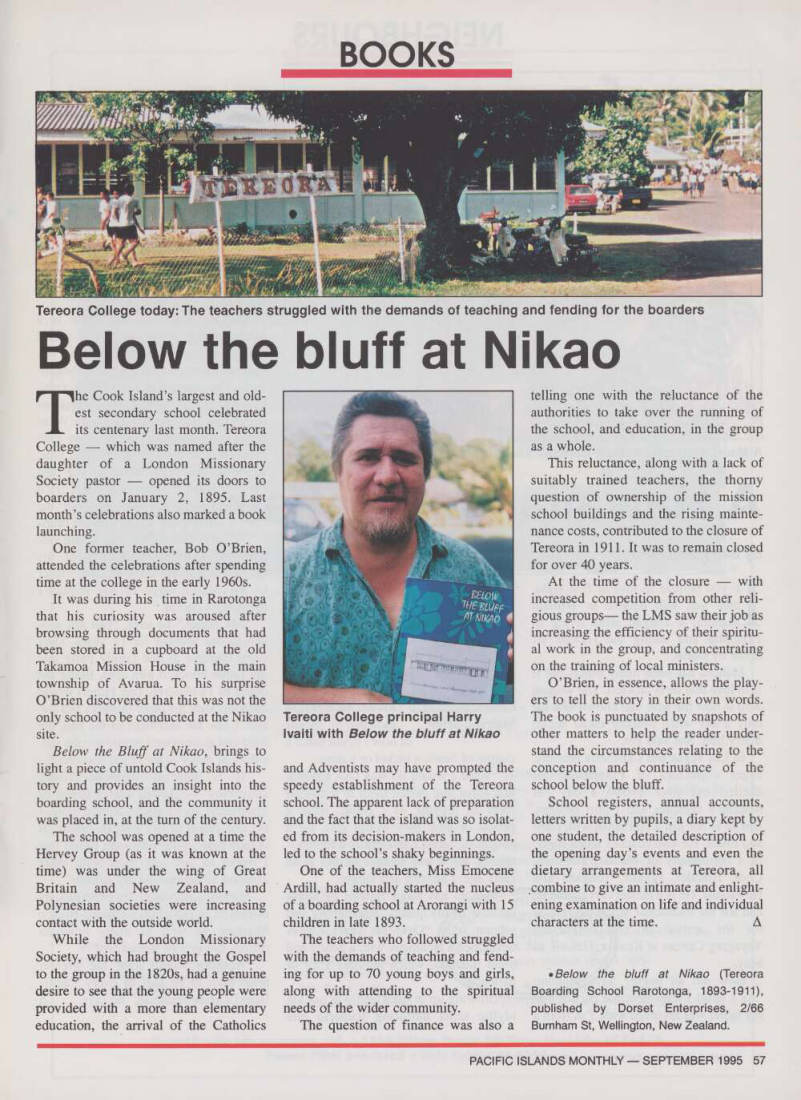
Books
The Cook Island’s largest and old est secondary school celebrated its centenary last month. Tereora College which was named after the daughter of a London Missionary Society pastor opened its doors to boarders on January 2, 1895. Last month’s celebrations also marked a book launching.
One former teacher, Bob O’Brien, attended the celebrations after spending time at the college in the early 19605.
It was during his time in Rarotonga that his curiosity was aroused after browsing through documents that had been stored in a cupboard at the old Takamoa Mission House in the main township of Avarua. To his surprise O’Brien discovered that this was not the only school to be conducted at the Nikao site.
Below the Bluff at Nikao, brings to light a piece of untold Cook Islands his tory and provides an insight into the boarding school, and the community it was placed in, at the turn of the century.
The school was opened at a time the Hervey Group (as it was known at the time) was under the wing of Great Britain and New Zealand, and Polynesian societies were increasing contact with the outside world.
While the London Missionary
Society, which had brought the Gospel
to the group in the 1820 s, had a genuine desire to see that the young people were provided with a more than elementary education, the arrival of the Catholics
and Adventists may have prompted the speedy establishment of the Tereora school. The apparent lack of preparation and the fact that the island was so isolat ed from its decision-makers in London, led to the school’s shaky beginnings.
One of the teachers, Miss Emocene Ardill, had actually started the nucleus of a boarding school at Arorangi with 15 children in late 1893.
The teachers who followed struggled with the demands of teaching and fend ing for up to 70 young boys and girls, along with attending to the spiritual needs of the wider community.
The question of finance was also a
telling one with the reluctance of the authorities to take over the running of the school, and education, in the group as a whole.
This reluctance, along with a lack of suitably trained teachers, the thorny question of ownership of the mission school buildings and the rising mainte nance costs, contributed to the closure of Tereora in 1911. It was to remain closed for over 40 years.
At the time of the closure with increased competition from other reli gious groups— the LMS saw their job as increasing the efficiency of their spiritu al work in the group, and concentrating on the training of local ministers.
O’Brien, in essence, allows the play ers to tell the story in their own words.
The book is punctuated by snapshots of other matters to help the reader under stand the circumstances relating to the conception and continuance of the school below the bluff.
School registers, annual accounts, letters written by pupils, a diary kept by one student, the detailed description of the opening day’s events and even the dietary arrangements at Tereora, all combine to give an intimate and enlight ening examination on life and individual characters at the time. A
Tereora College today: The teachers struggled with the demands of teaching and fending for the boarders
Tereora College principal Harry Ivaiti with Below the bluff at Nikao
• Below the bluff at Nikao (Tereora Boarding School Rarotonga, 1893-1911), published by Dorset Enterprises, 2/66 Burnham St, Wellington, New Zealand.
A Hawaiian love affair
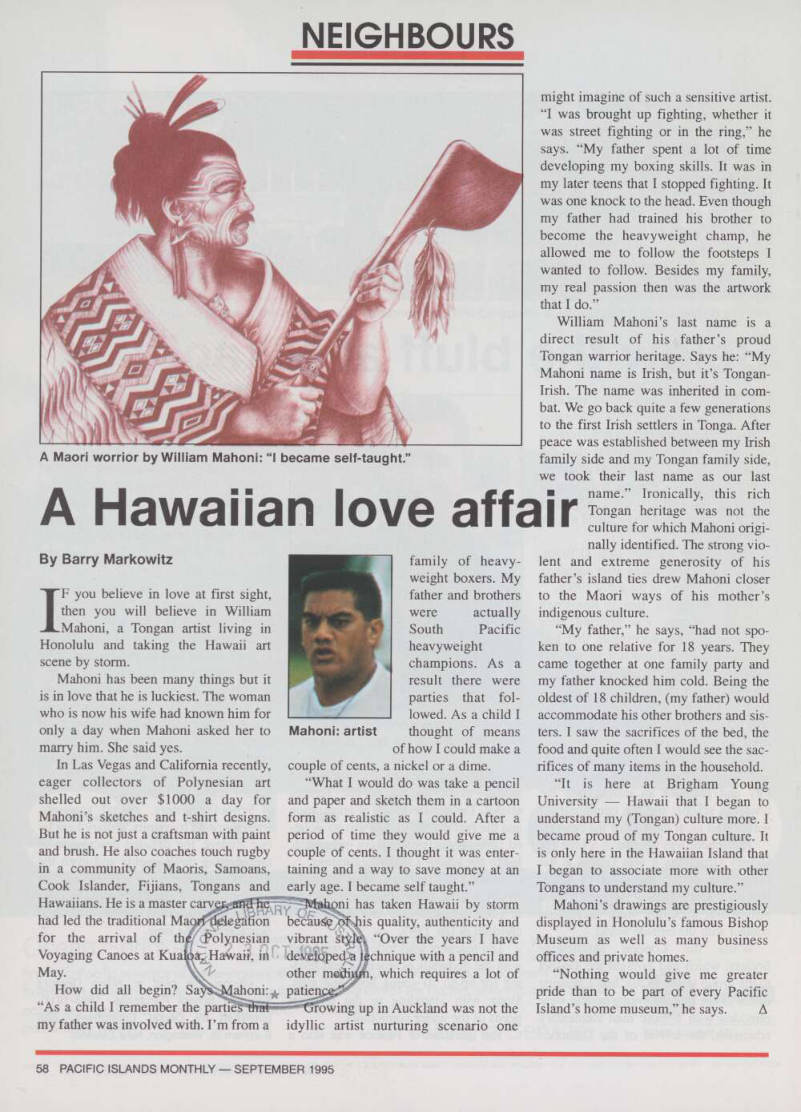
Neighbours
By Barry Markowitz
IF you believe in love at first sight, then you will believe in William Mahoni, a Tongan artist living in Honolulu and taking the Hawaii art scene by storm.
Mahoni has been many things but it is in love that he is luckiest. The woman who is now his wife had known him for only a day when Mahoni asked her to marry him. She said yes.
In Las Vegas and California recently, eager collectors of Polynesian art shelled out over $lOOO a day for Mahoni’s sketches and t-shirt designs.
But he is not just a craftsman with paint and brush. He also coaches touch rugby in a community of Maoris, Samoans, Cook Islander, Fijians, Tongans and Hawaiians. He is a master had led the traditional Maoiflfelegafion for the arrival of the. Polynesian Voyaging Canoes at in May.
How did all begin? Sayi “As a child I remember the partief*S?iF my father was involved with. I’m from a
family of heavy weight boxers. My father and brothers were actually South Pacific heavyweight champions. As a result there were parties that fol lowed. As a child I thought of means
of how I could make a couple of cents, a nickel or a dime.
“What I would do was take a pencil and paper and sketch them in a cartoon form as realistic as I could. After a period of time they would give me a couple of cents. I thought it was enter taining and a way to save money at an early age. I became self taught.”
Mahoni has taken Hawaii by storm because of his quality, authenticity and vibrant styles “Over the years I have technique with a pencil and other which requires a lot of
patience-T"
up in Auckland was not the idyllic artist nurturing scenario one
might imagine of such a sensitive artist.
“I was brought up fighting, whether it was street fighting or in the ring,” he says. “My father spent a lot of time developing my boxing skills. It was in my later teens that I stopped fighting. It was one knock to the head. Even though my father had trained his brother to become the heavyweight champ, he allowed me to follow the footsteps I wanted to follow. Besides my family, my real passion then was the artwork that I do.”
William Mahoni’s last name is a direct result of his father’s proud Tongan warrior heritage. Says he: “My Mahoni name is Irish, but it’s Tongan- Irish. The name was inherited in com bat. We go back quite a few generations to the first Irish settlers in Tonga. After peace was established between my Irish family side and my Tongan family side, we took their last name as our last
name.” Ironically, this rich Tongan heritage was not the culture for which Mahoni origi
nally identified. The strong vio lent and extreme generosity of his father’s island ties drew Mahoni closer to the Maori ways of his mother’s
indigenous culture.
“My father,” he says, “had not spo ken to one relative for 18 years. They came together at one family party and my father knocked him cold. Being the oldest of 18 children, (my father) would accommodate his other brothers and sis ters. I saw the sacrifices of the bed, the food and quite often I would see the sac rifices of many items in the household.
“It is here at Brigham Young University Hawaii that I began to understand my (Tongan) culture more. I became proud of my Tongan culture. It is only here in the Hawaiian Island that I began to associate more with other Tongans to understand my culture.”
Mahoni’s drawings are prestigiously
displayed in Honolulu’s famous Bishop Museum as well as many business offices and private homes.
“Nothing would give me greater pride than to be part of every Pacific Island’s home museum,” he says. A
A Maori worrier by William Mahoni: “I became self-taught.”
Mahoni: artist
Advertisements & other items, pp. 59-60 (1 item)
I A Lifetime Of Services
10 15 20 25 30 35 40 45 50 55 60
40 45 Grand Pacific Life Insurance offers you a lifetime of safe, secure products at very competitive rates.
Choose from a full range of products such os
• Super Ordinary Life
• Super Universal • Non-Participating Whole Life • 10-Year Level Term • Flexible Premium Annuities • Group Life Insurance
• IRAs
• Graded Premium Whole Life We've been dedicated to providing fast, personalized service for more than 35 years through local ownership and management.
That's why Grand Pacific Life is your Family i throughout the Pacific , f>ar,d Pacific lift- Insurance, Cui 35 40 45 10 15 20 25 30 35 40 45 50 55 60 O
Grand Pacific Life Insurance, Ltd.
A member of the Finance Factors Family
FEDERATED STATES
OF MICRONESIA
Actouka Executive Insurance Undenvriters P.O. Box 55, Kolonia, Pohnpei, Federated States of Micronesia 96941 Pacific Basin Insurance & General Services, Inc P.O. Box 494, Chuuk State, Federated States of Micronesia 96942
TONGA
Peseti Ma'afu Ins. & Finance, Ltd.
Private Bag 2, Taumoepeau Bldg.
Nukualofa, Tonga
GUAM
Great National Insurance Undenvriters, Inc.
P.O. Box GA, Agana, Guam 96910
AMERICAN SAMOA
Mark Solofa Pacific Insurance & Finance, Inc.
P.O. Box 3149 Pago Pago, American Samoa 96799 Pacific Financial Corporation P.O. Box AT, Agana, Guam 96910 Takagi & Associates, Inc.
GCIC Bldg., Suite 100 414 W. Soledad Ave.
Agana, Guam 96910
MARSHALL ISLANDS
Marshalls Insurance Agency P.O. Box 113, Majuro, Marshall Islands 96960
WESTERN SAMOA
Mark Solofa Pacific Insurance & Finance, Inc.
P.O. Box 3149 Pago Pago, American Samoa 96799
NORTHERN MARIANAS
Pacific Basin Insurance Undenvriters, Inc.
P.O. Box 710 Saipan, Mariana Islands 96950 Pacifica Insurance Underwriters, Inc.
P.O. Box 168, Saipan, Mariana Islands 96950 Grand Pacific Life Insurance, Ltd. *1164 Bishop Street, sth Floor, Honolulu, HI 96813 Phone: (808) 548-3363 • FAX: (808) 548-5122
*0 V 9/?
Born to run.
s The Mitsubishi Lancer: A family sedan that’s practically built to perform.
Lancer leaves the rest of its class in the dust.
Yes, it is a family sedan. Comfortable and practical.
But exciting, too, because Mitsubishi hasn’t forgotten what truly drives you: the pure pleasure of total driving performance.
Its ground-hugging chassis holds comers tight. A self-aligning multi-link suspension adjusts to the road no matter what the driving conditions. And the aggressive, fuel-efficient 16-valve SOHC engine makes Lancer eager and responsive in the passing lane.
All of this performance comes from one very simple idea—our total approach to engineering.
We believe that unless each aspect of a car is fully integrated into the overall design, the result will never exceed the sum of the parts. The difference is self-evident. Behind the wheel.
And on the road.
It is this philosophy that makes every Mitsubishi such a reassuring and rewarding driving experience Whether it’s our top-end Mitsubishi Sigma, technologically sophisticated Galant, all-weather 3000 GT sports car, or offroad 4WD Pajero... they’re all driven by the power of positive thinking.
So take the wheel of a Lancer, the family sedan that performs like a thoroughbred.
MITSUBISHI LRNCER
What Drives You.
AMERICAN SAMOA: PACIFIC MARKETING INC. P.O. Box 698, Pago Pago, Tel. 699-9140 / AUSTRALIA: MITSUBISHI MOTORS AUSTRALIA LTD. 1284 South Road, Clovelly Park, South Australia, 5042, Tel. (08) 2757297 / FUI: NIVIS MOTOR & MACHINERY CO. LTD. G.P.O. Box 150, Suva, Tel. 383411 / GUAM; TRIPLE J ENTERPRISES INC. P.O. Box 6066, Tamuning, Tel. 6469126 / NEW CALEDONIA: SOCIETE D'IMPORTATION D’AUTO DU RACIFIQUE SUD S A. P.O. Box 438, Noumea, Tel. 272-562 / NEW ZEALAND: MITSUBISHI MOTORS NEW ZEALAND LTD. Private Bag. Porirua, Tel. 237-0109 / NORFOLK ISLAND: BORRY S PTY LTD. P.O. Box 169, Taylors Road, Burnt, Tel. 2114 / PAPUA NEW GUINEA: TOBA MOTORS PLY LTD. P.O. Box 503, Port Moresby, Tel. 217-874/ SAIPAN: SAIPAN AUTOWORLD INC. P.O. Box 487, Tel. 234-7133/ SOLOMON ISLANDS: HARVEST PACIFIC LTD. G.P.O. Box 888, Honiara, Tel. 30407/TAHITI: SOPADEP S.A. B.P. 1617, Papeete, Tel. 427393/TONGA: SITANI MAFI CO., LTD. P.O. Box 83, Nukualofa, Tel. 24044 / VANUATU: SOCOMETRA VANUATU LTD. B.P. 6, Port-Vila, Tel. 2314 / WESTERN SAMOA; MOTOR DISTRIBUTORS (SAMOA) LTD. P.O. Box 576, Apia, Tel. 20957
MITSUBISHI
MOTORS
CREATING TOGETHER