Pacific


Islands
Monthly
August 1995
[_ niv
American Samoa US$2:5O; Australia A 53.50; Cook Islands NZ$3,OO; Fiji (Incl VAT) F 52.50; FS Micronesia US$3,OO; Kiribati A 52.50; Nauru A 52.50; Niue NZ$3.OO; Norfolk A 53.00: New Caledonia cpf2so; New Zealand (Incl. GST) NZ53.45; Northern Marianas US$3.OO; Papua New Guinea K 3.00; Palau US$3.OO; Marshall Islands US$3 00' Solomon Islands A 53.00; French Polynesia cpfSOO; Tonga P 3.00; United States of America US$3,OO; Vanuatu VT22O; Western Samoa T 3.25. (Recommended retail prices only)
COVER: Children of Papeete protesting
against the resumption of nuclear tests at Mururoa by the French government
Advertisements & other items, p. 2 (1 item)
Telikom
Papua New Guinea
s*f- ’ & « p fm j&tilsf r KSm * - ta * - '• ■Hi h mV- . '«•-• S* f 1 I - 4IX, :v r Be** m v : a
i Wipmnnnmr
II I; : '‘ ,
I ■:] , / o r :; • i n I m .
V.K It . : r Telikom has set the pace in providing state-of-the-art telecommunications links within PNG and to anywhere around the world as we enter the 21st Century. For all your telecommunications needs, write to us at this address: Assistant General Manager Telikom Marketing Department P.O. Box 291 Waigani, Papua New Guinea Tel: 675 300 5564 Fax:67s 300 5540
TELIKOM
How wete naaiUf, tcdhivuj,!
Pacific
Islands
Monthly
V 01.65 No 7
The News Magazine
August
PUBLISHER: Brian O’ Flaherty EDITORJaIe Moala SENIOR WRITER: Yunus Rashid GRAPHIC ARTIST: James Ranuku
Correspondents:
David North, Ed Rampell, lan Williams, Liz Thompson, Roman Grynberg, Wally Hiambohn, Lisa Williams, Patrick Decloitre, Barry Markowitz.
COLUMNISTS: David Barber (Wellington), Futa Helu (Tonga), Jemima Garrett (Sydney), Alfred Sasako (The Forum).
Advertising Sales:
• Regional Sales - South Pacific; Ashok Lai, Tel (679) 304111,303429, Fax (679) 303809. • Sydney, Canberra: Bob Hill Media Representation,Tel (61-2) 4164245, Fax (61-2) 4165064. • Brisbane; Jane Fewings Media and Advertising Associates,Tel (61-7) 378 4522, Fax (61-7) 878 1071. • Adelaide: Hastwell Williamsons Representatives,Tel (61-8) 3799522, Fax (61-8) 3799735. • Melbourne: Brown Orr Fletcher Burrows (Aust) Pty Ltd. Tel (61-3) 8265188, Fax (61-3) 8265644. • Auckland: McKay & Bowman, International Media Representatives Limited,Tel (64-9) 4190561, Fax (64-9) 4192243-Japan: Universal Media Corporation,Tokyo, Tel (3) 3266626741, Cable: UNI-MEDIA Tokyo, Fax (3) 32626742.
Founded 1930 (USPS 9522480).
A Fiji Times Limited production.
Cover prices are recommended retail only.
Registered by Australia Post, Publication No. NBPI2IO.
Copyright Fiji Times Limited, 177 Victoria Parade, Suva, Fiji. Tel (679) 304111, fax (670) 303809.
Tx Fj2124.
Pacific Islands Monthly is published monthly by Fiji Times Limited, a division of Nationwide News, 2 Holt Street, Surry Hills, Sydney,
Nsw 2010.
Send Address Changes To;
Pacific Islands Monthly, PO Box 1167, Suva, Fiji. Typeset and printed by The Fiji Times Limited, 177 Victoria Parade, Suva, Fiji.
Inside
□ Letters
□ Cover Stories
France defies world condemnation 7 Decolonise French Polynesia and New Caledonia 8 Aid or radiation 9 Is Vanuatu part of the Pacific? 10 Bowing to Paris pressure 11 No to nukes 13
□ Trial
Widow extradited for trial in Vanuatu 20 Magistrate attacks government 21
□ Opinion
David Barber 23 Alfred Sasako 25
□ Entertainment
Stars fail! in Hawaii 26
□ Review
“Tides of the Pacific” .. .27
□ Scandal
Hook, line and sinker .. .28 Fraud victims should talk 32 Masterplans to defraud 33
□ Theatre
South Sea schizophrenia 35
□ Communication
“Hello, is anybody there?” 36
□ Tourism
Focus on the travel ... .38 Pulsating Polynesia ... .39 Jewel of the Pacific ... .41 Tourism - the Pacific’s golden goose 43 Small and rich 46 Melanesians miss out on tourists 49
□ Sports
Rugby fights for survival 52 Petangue makes a comeback 55
□ Yachting
A surprise vist at a cyclone hit island 56
□ Correspondence
Letters from the Pacific 58
American
Letters To The Editor
The American Television dilemma
Sir, In the December 1994 issue of Pacific Islands Monthly, I refer to the two cover story news reports: “Fiji’s television dilemma” and “Fiji’s Media.”
Fiji’s television: I quote three sentences from the news report. • “Meanwhile, other concerns have been raised about people being “force fed” an alien culture life style.” • “What we see on television is not
something everybody here can identify
with.” • “Even the advertisements indirectly hint that the lifestyle of the people in rural areas does not conform to normal
lifestyles elsewhere.”
The above three sentences describe much of the television fare in the United States. In the USA, most television drama, comedy and advertising show a white, middle class, or upper middle class,
household or style of living in a big city or suburbs of a big city. Such portrayals are completely alien to blacks who live in ghettos such as Harlem in New York City, to Hispanics, to rural USA, etc. Further, theme programmes on financial advice, exercise, travel, health, sports, diet, cook ing, politics, etc., are pitched toward urban middle and upper-middle classes as is also most advertising on TV.
Fiji’s Media: In referring to freedom of the press, someone (whose name escapes me) once said: Freedom of the press belongs to whoever owns the press.
Robert Silberstorf,
Apartado Aereo 065629, Medellin, Antioquia, Columbia.
Chirac,

Dear Mr Chirac,
Sir, (This is an open letter which I wish to rely to Mr Jacques Chirac, the President of France, through your letter column).
Dear Mr Chirac, I write to you as one individual to another.
During the second world war many New Zealanders lost their lives fighting for the cause of a free world.
When France was overrun by the Nazi hordes New Zealanders fought on your behalf in the struggle to free France from tyranny. It is now fifty years since the cul mination of that drama.
Today we in New Zealand and our sur rounding neighbours in the South Pacific have a great desire for our children and their children to lead peaceful and healthy lives without being subject to the deadly threat of nuclear testing and the after effects of such testing. We want no part of nuclear armaments, nuclear wastes nuclear madness!
I ask you Mr Chirac, do you have any con sideration for our feelings on this issue?
Or do you prefer to dominate us by the power of your military might and powerful trade sanctions when we protest against France for testing nuclear weapons at Mururoa?
When your beloved France was overrun by Hitler’s Third Reich the French Resistance came into its own and fought tooth and nail to rid France of its oppressors. Do you expect us to do less and allow ourselves to
be oppressed by the deadly repercussions
of your nuclear testing in the South Pacific?
Must now France become the oppressor?
Must the juggernaut of Gaelic pride over ride the well being of the people of the South Pacific? Must untold numbers of children suffer the follies of nuclear radia tion sickness?
Do not tell me their is no danger in all this madness. Expediency dictates that your nuclear testing programme does not take place in La Belle France, but far, far away on the other side of the world!
Let sanity prevail and reason govern - take us into your high consideration by not resuming nuclear testing in this region!
The respect France gives to others is the same respect it will receive in return. I am sure New Zealanders and the people of the South Pacific nations would dearly love to respect you for your moral leadership and on this note I shall respectfully give you my highest consideration.
Martin Leo,
Papaku Road, Otahuhu, Auckland, New Zealand.
Advertisements & other items, pp. 4-5 (2 items)
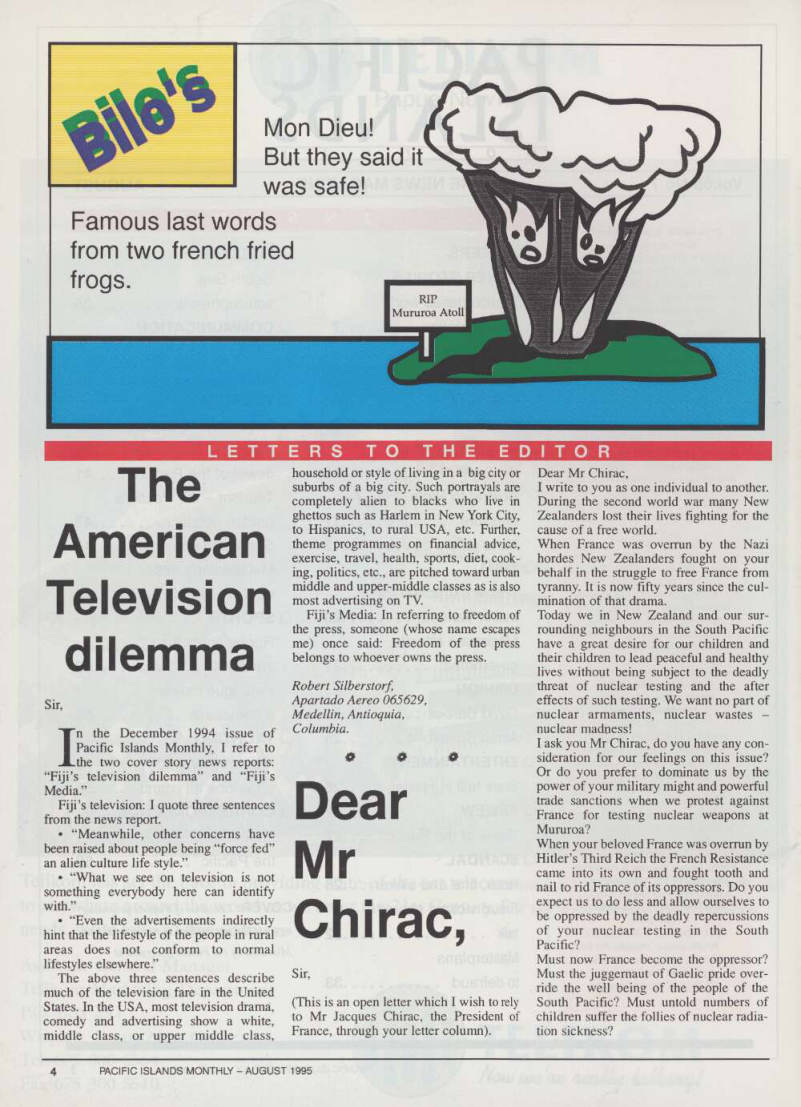
Mon Dieu!
But they said it was safe!
Famous last words from two french fried frogs. ft o /
RIP
Mururoa Atoll
Limited
Wire Industries (Fiji) Limited produce the highest quality wire and wire products in the country. Because we use only top quality imported steel. We make just about any wire product you’ll ever need, pig and goat fencing, pipework and pipe gates and fences, galvanised and PVC chainlink fencing, standard and HT barbed wire, bright hard drawn wire, security mesh, wire rods and a huge range of bright and galvanised nails pins and fasteners.
Call our sales team today on: €uva (679) 361 418 or Nadi (679) 702 280 or fax Suva (679) 361 506 or Nadi (679) 702 260 P O Box 2451 Nadi, Fiji Islands.
S 1 Dll
ID PVC CHAIN
RITY MESH • 1
KTENCING
[E RODS • BRI
M
Limited
ND HT BARBED WIRE
ANISED NAILS •
perks
Advisers and their perks
Sir, I found Alfred Sasako’s article on donor funding for developing coun tries (May, 1995) extremely useful; but wish to add three points.
Firstly, the fact that a high proportion of
the aid often goes to a consultant from the donor country itself does not necessarily mean that none of his (it is usually “his”) salary and other costs go to the recipient country. If, say, a German Adviser is appointed to Fiji for a three-year assign ment, he lives here, buys a car here, and
probably brings dependants here. In effect,
much of the money he gets remains in Fiji and only his savings may go back to Germany.
The real test is whether he carries out the Terms of Reference and effectively trains counterparts. If he does, and if it was a worthwhile project to begin with, then the donor funding has been good for Fiji.
Secondly, there is often a particular segment of the money that never reaches the developing country and that is the fee paid to the overseas firm that provides the Consultant. Possibly very few people know that if it costs, say, % 100,000 to obtain a Consultant over a particular peri od, as much as $40,000 may go to the company that “owns” him. And that part does stay overseas.
Mr Sasako writes from Forum secre tariat and I believe that this body could look at this procedure - along with the high failure rate of Consultants to the South Pacific. It should be possible for Forum to build up its register of good Consultants (more and more including experts from the Pacific) and encourage all donors to use that list, and similar sources of their own, thereby cutting out the mid dle men. In that way, excessive commis sions to “international head-hunters” could be avoided.
Finally, I come back to the issue of “donor-led” projects. One Asian country has its own plan for how Pacific airports
should develop. The European
Community is still trying to impose
Brussels-designed projects on the Region, in areas such as the environment and rural development, quite opposed to what the
countries themselves have made clear that they want. Several donors, again including the EC, attempt to push USP in certain directions. I have heard of other examples but can only report those of which I have direct experience.
Here again. Forum Secretariat is in the best position to fight for the people of the Pacific. Please ensure that every donor supports projects that are really wanted by the region. Let them all fit in to the Pacific’s long-term strategy. If that is achieved by, say, 2020 there will be no fur ther need for aid. And if any donor insists on financing projects that they want and the Region does not, then please tell them to pack their bags.
David Bryant,
Beach Road, Suva Point, Fiji.
Advertisements & other items, p. 6 (2 items)
6
PACIFIC ISLANDS MONTHLY - AUGUST 1995
LETTERS TO THE EDITOR
Largest Range In The South Pacific
INTERNATIONAL & SOUTH PACIFIC
LEGAL SERVICES
MICHAEL BULA SOLICITORS
International Lawyers
are pleased to receive instructions relating to Australian and South Pacific property, succession and commercial matters • Full corporate, representative and registered office facilities available for South Pacific clients • French spoken certified legal translations % Legal agents throughout the South Pacific and
Europe.
"PRINCES Hill Gallery", 213 Canning Street
CARLTON MELBOURNE
VICTORIA 3053 AUSTRALIA
Telephone: + 613 9 3478333 FAX: + 613 9 3471741
MBS
SCRAP METAL
Tall ingots operate from Brisbane, Australia and make frequent visits to the Pacific Islands which they have done for twenty-five years. We are buyers of Copper, Brass, Aluminium, Lead, Batteries, Battery Lead, Cable etc. Inspection no problems. Telephone 617 8922033 Fax 61 78922077.
LARGEST RANGE IN THE SOUTH PACIFIC
* OVER 1000 ENGINES AVAILABLE * DIESEL-GASOLINE 10HP TO 400 HP TRANSMISSION TO MATCH IF REQUIRED * JAPANESE * ENGLISH * EUROPEAN MODELS * Bedford Cummins * Daihatsu Deutz * Ford Gardner * Hino Detroit Isuzu * Komatsu * Leyland * Mazda * Mercedes * Mitsubishi * Nissan Perkins Scania * Toyota * Volvo Yanmar * Kubota Fiat lueco
SPECIAL
Yanmar Stationery Engines 9.5,11,13,14,15,22,24, 28,'44 Horsepower including Fuel Tank/Radiator
BLAIRS
P.O. BOX 14
GERALDINE, NEW ZEALAND
TELEPHONE: (643) 693 8122
FAX: (643) 693 8120
SPECIAL
Used Car Tyres 70% and Better Most sizes available container loads
condemnation
Cover Stories
France defies world condemnation
As if its decision to resume nuclear testing in the Pacific was not enough, France allowed its soldiers to board the Rainbow Warrior II and in an act of terrorism arrest the protesting crew members and interrogate them about their presence at Mururoa.
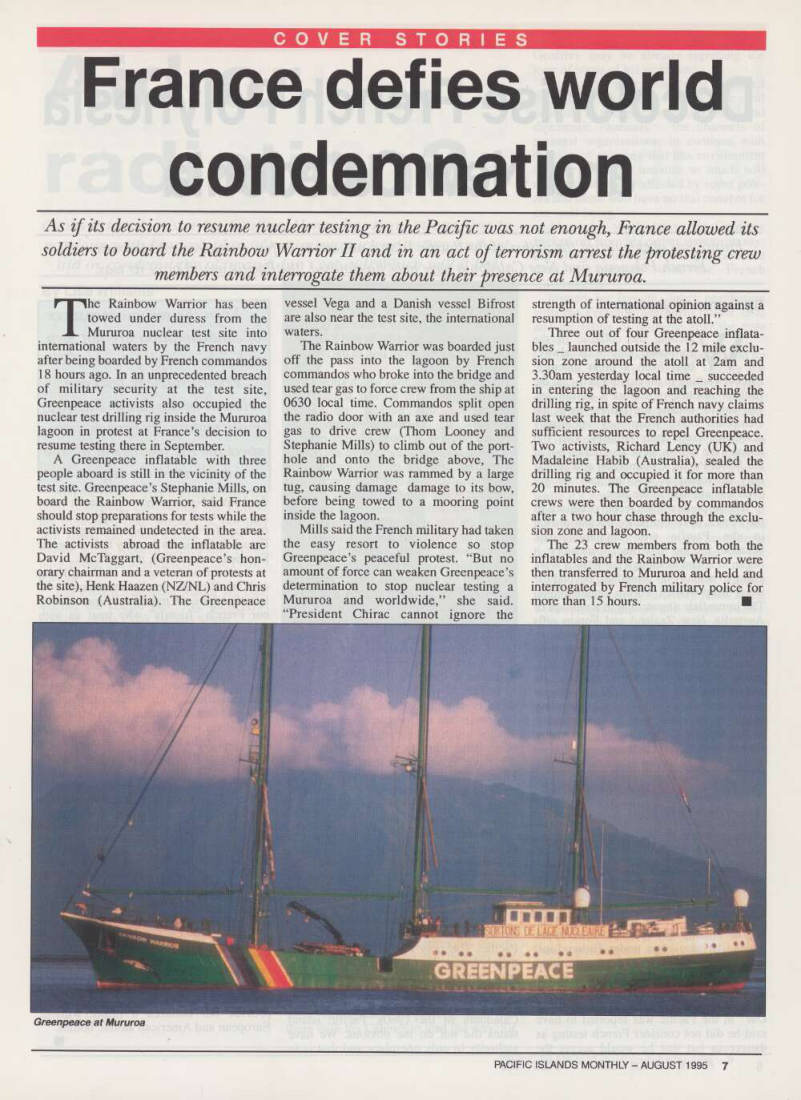
The Rainbow Warrior has been towed under duress from the Mururoa nuclear test site into intemational waters by the French navy after being boarded by French commandos 18 hours ago. In an unprecedented breach of military security at the test site, Greenpeace activists also occupied the nuclear test drilling rig inside the Mururoa lagoon in protest at France’s decision to resume testing there in September.
A Greenpeace inflatable with three people aboard is still in the vicinity of the test site. Greenpeace’s Stephanie Mills, on board the Rainbow Warrior, said France should stop preparations for tests while the activists remained undetected in the area.
The activists abroad the inflatable are David McTaggart, (Greenpeace’s honorary chairman and a veteran of protests at the site), Henk Haazen (NZ/NL) and Chris Robinson (Australia). The Greenpeace
vessel Vega and a Danish vessel Bifrost are also near the test site, the international waters.
The Rainbow Warrior was boarded just off the pass into the lagoon by French commandos who broke into the bridge and used tear gas to force crew from the ship at 0630 local time. Commandos split open the radio door with an axe and used tear gas to drive crew (Thom Looney and Stephanie Mills) to climb out of the port hole and onto the bridge above. The Rainbow Warrior was rammed by a large tug, causing damage damage to its bow, before being towed to a mooring point inside the lagoon.
Mills said the French military had taken the easy resort to violence so stop Greenpeace’s peaceful protest. “But no amount of force can weaken Greenpeace’s determination to stop nuclear testing a Mururoa and worldwide,” she said.
“President Chirac cannot ignore the
strength of international opinion against a resumption of testing at the atoll.”
Three out of four Greenpeace inflata bles launched outside the 12 mile exclu sion zone around the atoll at 2am and 3.30 am yesterday local time succeeded in entering the lagoon and reaching the drilling rig, in spite of French navy claims last week that the French authorities had sufficient resources to repel Greenpeace, Two activists, Richard Lency (UK) and Madaleine Habib (Australia), sealed the drilling rig and occupied it for more than 20 minutes. The Greenpeace inflatable crews were then boarded by commandos after a two hour chase through the exclu sion zone and lagoon.
The 23 crew members from both the inflatables and the Rainbow Warrior were then transferred to Mururoa and held and interrogated by French military police for more than 15 hours. ■
Greenpeace at Mururoa
Decolonise French Polynesia
and New Caledonia
France has openly defied the wishes of the Pacific Island nations to be free of nuclear contamination. If French Polynesia and New Caledonia were to he decolonised, the Pacific would have its way.
By Roman Grynberg
Watching the collapse of the European empire is always best from a great distance.
But even sitting in the South Pacific, at the furthest reaches of Europe’s dominions, you cannot escape the pitiless mess the Europeans make when they voluntarily disengage from their empires. Our old masters the British, have also pulled out of the South Pacific Commission and appear only interested in assuring that we get even less aid than in the past.
The responses to the recent decisions of the French to recommence nuclear testing in the Pacific was uncharacteristic because, for the first time in memory, it began to sound as though the islands were going to actually do something beyond the
usual limp-wristed Forum communique.
The immediate dispatching of a mission of Australia, New Zealand and Forum offi cials to Paris with the expected negative response has drawn immediate responses from Pacific countries. Nauru broke diplo matic relations, Australia recalled its ambassador and New Zealand, with its usual diplomatic vigour and unbending ideological commitment to lamb exports to the EU did nothing except reconsider French commercial contracts.
The only reason the French test their weapons here is that New Caledonia and French
Polynesia are colonies of
France.
The country out of step was Vanuatu which, 10 years ago under Father Lini, spearheaded the Pacific island opposition to French testing. Vanuatu’s Prime Minister Maxim Carlot Korman who is increasingly seen as France’s “Monsieur Oui” in the Pacific was reported to have said he did not consider French testing as dangerous but that he would accept the
Forum position. All the more aid to you Maxim. As the Forum works on political consensus, there is no doubt that Korman’s policy will be the weak link in the chain of
Forum opposition.
The Marshall Islands which knows well the effects of “safe nuclear testing” has condemned the nuclear testing in Mururoa. Its condemnation would be taken a bit more seriously if large parts of its political establishment were not, at the same time, bending over backwards in a desperate attempt to turn their country into a nuclear waste-dumping ground.
Even the serious measures of condem nation are not seen as being enough for some. The French nuclear tests are viewed in the South Pacific, quite rightly, as French disrespect for the feelings of all the nations in the region. The French response to our protests has been slightly less that a polite yawn. Diplomats will tell you that even if all the island states of the Pacific, including Australia and New Zealand, broke diplomatic relations and imposed trade sanctions on France, their response would be to shrug their shoulders.
In fact, if you listen to the diplomats, there is nothing we can do to France.
Diplomats are not people given to doing much - much of their job is to stop things being done. But it is not entirely true that we have no options that would hurt France. When you throw the old cliche at the French that if the testing is safe why don’t you do it in France, the French response is “we are testing it in France”.
That of course is precisely the problem.
French Polynesia is legally part of France, in the same way that Algeria was. The French used to test their nuclear weapons in Algeria in the 1950 s when it was “part of France”.
But this is not France’s problem - it is ours. We have unfinished business in the Pacific. The only reason the French test their weapons here is that New Caledonia and French Polynesia are colonies of France. But it is we who are weak because even at the height of the fighting in New Caledonia in the 1980 s, Pacific island states did not do the obvious. We have authority in only one place and that is in
Even the serious measures of condemnation are not seen
as being enough for some. The
French nuclear tests are viewed in the South Pacific, quite rightly, as French disre spect for the feelings of all the nations in the region.
the United Nations. We are a dozen votes and it is time we got to the heart of the matter of French nuclear testing - that French Polynesia is the very last vestige of European colonialism in the Pacific.
As the British flag sets in Hong Kong and the Russian empire crumbles at its Islamic edges, we must finally bid adieu to our French “friends” who treat us with such disrespect. It is time for our diplo mats to return to the UN Committee on Decolonisation and ask the UN that New Caledonia and French Polynesia be placed on the now empty list of territories for decolonisation. With President Mandela ruling a black-dominated South Africa and colonialism finished on the African conti nent, such calls have an anachronistic ring to them - they should belong to another era but regrettably they don’t.
To bring the status of French Polynesia to the UN would be the one measure that would get to the very heart of why these tests are happening here in the Pacific and not in metropolitan France. And it would simultaneously punish France for its actions.
But if we proceed in this way it will not be without cost. The French have already talked about cutting off aid. The New Zealanders would lose their lamb market, the Fijians their free Renault trucks and Vanuatu its umbilical cord to the French coffers. But if we show some seriousness maybe we will begin to bring European colonialism in the Pacific to an end and provide our children a future without European and American atomic bombs.
radiation?
Aid or radiation?
Cooks Prime Minister Sir Geoffrey Henry has two options. One to go along with France’s plan of resuming nuclear testing and get aid or condemn the plan and don’t get aid? Which will it be?
By Lisa Williams
The Cook Islands are a mere hours flight away from the islands of French Polynesia, or a few days by canoe if you take into account the latest cultural rebirth of the Pacific Voyaging Alliance two months ago, at the Taputapuatea marae in Tahiti.
But the vibrant canoeing tradition, last seen some six centuries ago, isn’t the only revival in French Polynesia - underground nuclear testing is about to make a come back.
And the silence from the neighbours has
been deafening, considering the Copoks
are undecided over whether or not they will attend the South Pacific Games this month while Western Samoa and Nauru have pulled out in protest over the French stance.
The French Polynesia Maohi are con sidered the cousin race, like their Kiwi cousins, of the Cook Islands Maori.
Across the Pacific, from countries who face less qualms about eating the same fish that swims in the Mururoa lagoons as the Tahitians, there’s been loud reaction to Chirac's announcement that nuclear test ing will resume come September at the island of Mururoa.
Meanwhile, Cook Islanders sat and watched nightly reports on overseas TV carrying widespread reaction and official condemnation from New Zealand and Australia of the French stance.
For the country’s leader, the issue has prompted a somewhat two faced approach: at one level Sir Geoffrey Henry and his Cabinet support a peace march protesting the nuclear testing, a march where he calls on church leaders to use the power of prayer in a bid to stop the testing. But at another level he won’t commit to official boycotts or anything that would make the Cook Islands protest stand out.
“Right now Paris can’t see us, right now Paris is not hearing us - but there is some body that is hearing us and he is watching over today’s activities,” he told a gathering of 2000 at the biggest protest march in the nation’s history.
“If all our people say one prayer that the good lord will touch the hearts of those in France, that they may have the courage to reverse their decision to resume the test
ing.”
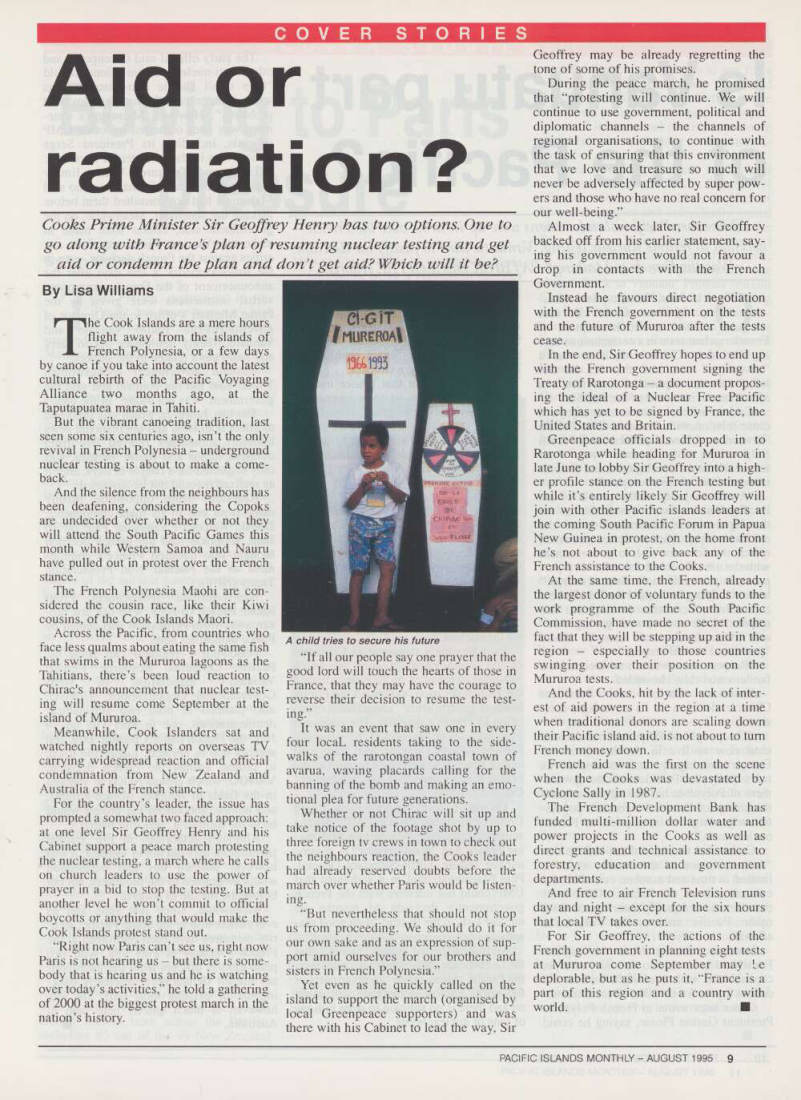
It was an event that saw one in every four locaL residents taking to the side walks of the rarotongan coastal town of avarua, waving placards calling for the banning of the bomb and making an emo tional plea for future generations.
Whether or not Chirac will sit up and take notice of the footage shot by up to three foreign tv crews in town to check out the neighbours reaction, the Cooks leader had already reserved doubts before the march over whether Paris would be listen
ing.
“But nevertheless that should not stop us from proceeding. We should do it for our own sake and as an expression of sup port amid ourselves for our brothers and sisters in French Polynesia.”
Yet even as he quickly called on the island to support the march (organised by local Greenpeace supporters) and was there with his Cabinet to lead the way, Sir
Geoffrey may be already regretting the tone of some of his promises.
During the peace march, he promised that “protesting will continue. We will continue to use government, political and diplomatic channels - the channels of regional organisations, to continue with the task of ensuring that this environment that we love and treasure so much will never be adversely affected by super pow ers and those who have no real concern for our well-being.”
Almost a week later, Sir Geoffrey backed off from his earlier statement, say ing his government would not favour a drop in contacts with the French Government.
Instead he favours direct negotiation with the French government on the tests and the future of Mururoa after the tests cease.
In the end, Sir Geoffrey hopes to end up with the French government signing the Treaty of Rarotonga - a document propos ing the ideal of a Nuclear Free Pacific which has yet to be signed by France, the United States and Britain.
Greenpeace officials dropped in to Rarotonga while heading for Mururoa in late June to lobby Sir Geoffrey into a high er profile stance on the French testing but while it’s entirely likely Sir Geoffrey will join with other Pacific islands leaders at the coming South Pacific Forum in Papua New Guinea in protest, on the home front he’s not about to give back any of the French assistance to the Cooks.
At the same time, the French, already the largest donor of voluntary funds to the work programme of the South Pacific Commission, have made no secret of the fact that they will be stepping up aid in the region - especially to those countries swinging over their position on the Mururoa tests.
And the Cooks, hit by the lack of inter est of aid powers in the region at a time when traditional donors are scaling down their Pacific island aid, is not about to turn French money down.
French aid was the first on the scene when the Cooks was devastated by
Cyclone Sally in 1987.
The French Development Bank has funded multi-million dollar water and power projects in the Cooks as well as direct grants and technical assistance to forestry, education and government
departments.
And free to air French Television runs day and night - except for the six hours that local TV takes over.
For Sir Geoffrey, the actions of the French government in planning eight tests at Mururoa come September may le deplorable, but as he puts it, “France is a part of this region and a country with world. ■
A child tries to secure his future
Is Vanuatu part
of the Pacific?
While other Pacific island nations were up in arms over the French decision to resume nuclear testing, Vanuatu tried to justify the decision.
Was the French aid talking? PATRICK DECLOFFRE reports.
On 14 June, Vanuatu prime minis ter Maxime Carlot Korman reacted to the resumption of French nuclear tests in a communique say ing President Chirac’s decision was a “sovereign” one, and that he did not believe the resumption of these tests can affect the environment of the Pacific.
Carlot, whose government enjoys a close relation with France and its Pacific Territories of New Caledonia and French Polynesia, said Vanuatu was “not favourable to the development and dissem ination of the nuclear weapon.”
“As the majority of the people of the Pacific, Vanuatu is not favourable to the development and dissemination of the nuclear weapon. Vanuatu is not concerned either, and does not wish to be concerned, with the use of nuclear force for civil pur poses, in particular in the field of energy,” he said, adding he wished the Pacific be a zone where “economic development and respect of the environment go together” and where development must be linked
“peace and mutual respect.”
“Respect of each state’s sovereignty is a fundamental rule,” he added.
However, Carlot said President Chirac’s decision is “a sovereign deci sion.”
“The people of Polynesia has decided until now to live in the framework of French sovereignty, and to respect its rules. Only the President of the govern ment of Polynesia has the right to express the choice of French Polynesia’s popula tion regarding the resumption of French nuclear tests.”
Carlot said that he did not believe that “the resumption of these tests, which is limited in time and number, can affect the environment of the Pacific. These tests therefore do not justify interference from other Pacific nations in Polynesian affairs.”
Vanuatu benefits from the highest French aid in a world to a country on a per capita basis, with over eight million US dollars a year for its 160,000 inhabitants.
Carlot later wrote to French Polynesia President Gaston Flosse, saying he could
not believe France has used its authority to
impose nuclear tests resumption against
the Polynesian government’s will. Carlot however asked the Polynesian leader to explain what is the “exact position” of French Polynesia’s government.
“I cannot believe that France uses its authority to impose its tests against the elected government of Tahiti. If such was the case, it would be a duty for all people and governments of the Pacific to support you, and I would be the first to defend the cause of mutual help among Oceanians,”
Carlot wrote.
Carlot, however, adds that if, on the contrary, the resumption of nuclear tests was made after consulting elected authori ties of French Polynesia, “other Pacific countries’ interference is limited to debat ing possible risks (of these tests) in the region.”
Carlot also said he saw it “ill-fitting” that “other Pacific countries decide what French Polynesians must think or decide for themselves.”
Paul Keating’s statement as Chairman of the South Pacific Forum, of which Vanuatu is a member, on 15 June criticized the French decision, expressed the Forum heads of governments’ “unequivocal oppo sition to France’s decision. The statement was said to be supported by Vanuatu, Foreign Affairs Director Jean Sese said end of June. Sese Vanuatu’s support to the Forum’s statement “did not contradict”
Carlot’s reaction.
On a party level, Carlot’s party, ruling Union of Moderate Parties (UMP), made a statement attacking Greenpeace and say ing France had “good reasons” to resume nuclear testing. UMP Secretary General, Pete Malsungai, said in a statement that UMP could not interfere with the French government’s decision to resume its nuclear tests in the Pacific “with good rea sons”.
Malsungai added it was “ironic” that the Greenpeace movement concentrates on the Pacific region, when “in other parts of the world, nuclear testings are still going on and there is no solution to store billions of tons of nuclear waste”.
The party official said Greenpeace and other anti-nuclear organizations should “help small Pacific dominated nations solve their economic and employment problems”. However, Malsungai’s state ment was later contested by other UMP officials, including its President Serge Vohor (who is also minister for Economic Affairs) and Treasurer Willie Jimmy (Vanuatu’s minister of Finance), who said Malsungai had not consulted them before making the statement. Meanwhile, on the government side, efforts were made to make sure Vanuatu was exempt from any critics against the French decision, even in the national media: a few days after the announcement of the French resumption, verbal instructions were given by the Prime Minister’s office to the Director of govemment-run Radio Vanuatu and Vanuatu Weekly newspaper not to carry any more news related to the subject.
Vanuatu government spokeswoman Yvette Sam did not confirm and said the government “was not aware” of the ban.
The ban, however, which was supposed to affect both local and international news bulletins sometimes relayed live from overseas radios and Radio Vanuatu, was only respected for a couple of days, after it as realized it could not be sustained.
Reactions from opposition mainly came from one of its main components, Donald Kalpoka’s Vanuaaku Pati: on 16 June, Kalpokas said the French decision brought into question France’s commit ment to the Nuclear Non Proliferation Treaty (NPT).
Newly-formed Independent Front leader Patrick Crowby, who has just bro ken away from Permission was denied by Police authorities here.
Following a regional call from the Pacific Concerns Resource Center, Vanuatu’s association of Non- Governmental Organizations, VANGO, also planned to hold two anti-nuclear demonstrations, one in Port Vila on 14 July, the French nations Bastille Day, and another one in northern Luganville town, to protest against the French decision.
VANGO, which groups NGOs in Vanuatu in the fields of religion, women’s rights, and unions, announced the protest would be in the form of a “peaceful march”.
Although authorities in Fiji granted permission, they did not in Vanuatu. It was however pointed out that permission would be granted to the protesters, but not before the middle of August.
Meanwhile, since last June and as everywhere else in the South Pacific, secu rity measures have been reinforced at the French Embassy in Port Vila, with two plain clothes officers from the metropoli tan French Gendarmerie discretely back ing up the existing local staff. The job, however, is much quieter here than in Australia. ■
Bowing to Paris
pressure
By lan Williams
The French reputation in the Pacific has never been very high in recent years, but when they
suspended nuclear testing and signed the
Matignon accords in New Caledonia, thus defusing two very explosive diplomatic issues, relations had begun to improve
again. But no longer.
President Jacques Chirac’s announce ment of a new series of nuclear tests in the Pacific was dulled slightly by China’s actual explosion within a few days of the end of the successful negotiations for the nuclear non-proliferation treaty. But at least, as several UN diplomats pointed out, the Chinese had the decency to explode their bomb in their own country rather than at the enhanced the spirit of the non proliferation treaty renewal conference at which the major complaint was the total failure of the nuclear powers to disarm as they had promised back in 1965.
The criticism was in part headed off by President Clinton’s belated adherence to an indefinite extension of the test ban treaty, and its acceptance by the others.
The nuclear powers promised that they would confirm the treat by 1996, and in the meantime “exercise utmost restraint.”.
So the French attempt to squeeze in an extra tests before finally shutting down had all the sincerity and charm of an alco holic promising to give up but after just eight more crates of brandy.
Only days after the announcement, Chirac arrived in New York on his way to the heads of state summit in Halifax, and was indeed asked why he did not follow the Chinese example and explode his bombs at home. Like Marie Antoinette, he begged he question. She wondered why starving people without bread should not eat cake. In the same spirit, the President remarked upon the lack of facilities for testing in France, as if the nuclear complex in Polynesia were a natural feature like the coral, rather than the product of decades of European indifference to the sensibilities of Pacific Islanders. As well as the diplo matic protests, Kiwi Alyn Ware handed over a letter signed by politicians and church leaders from across the Pacific, including 95 out of the 99 New Zealand
MOs to Chirac while he was in New York.
Of course, being a permanent member with a veto, and a somewhat overblown of its own importance, France has often gone its own way, but rarely with such a dis dainful thumbing of its nose at friendly nations. Secretary General Boutros Ghali, regretted the test with as much force as one could expect from someone who will
need the France vote if he is to run for a second term in office. He was “reassured that the tests would be limited in nature and would be conducted under the super vision of international monitors to ensure that there was no damage to the environ ment.”
More forcefully, and not in the least reassured, the South Pacific Forum UN Missions, with the notable exception of Vanuatu, together and individually issued
statements roundly condemning the
French action. Forum diplomats searched in vain for the ambassador of Vanuatu, who coincidentally or diplomatically was absent. Back in Vanuatu, Premier Maxim Carlot had confused the issue by deciding that French nuclear testing was an interna tional affair of France, while signing the Forum protest, but also censoring news of the row to prevent it being head in Vanuatu.
Once can’t be sure what it will do for Carlot’s future in politics in Vanuatu, but he is always assured of a warm welcome in Paris. Which is more than can be said for the Pacific Delegation that went to the French capital to register its protest. Like most of the delegations it stuck to the nuclear issue and avoided “French bash ing.” As a reward for their restraint, with in days, the French Foreign Ministry let it be known that its foreign aid cheques to protesting countries might get lost in the mail.
So what can be done? Very little, some island diplomats fear. There is talk of a
boycott of French goods, by organizations
such as the international Peace Bureau, and of course Greenpeace will be heading to the region. But memories of the Rainbow Warrior, and FRance’s unilateral breaking of its subsequent agreements show what a determined and monomaniac medium sized nation with a nuclear arse nal can do.
Papua New Guinea tried to raise the issue at the Non Aligned Movement, but with little effect. The former French colonies often seem to forget that they are no longer colonies. “So far, perhaps the only result is that one from the Pacific will vote for a French candidate for anything in the United Nations,” said one Pacific
diplomat.
That threat may become a little more potent over the next year or so. If propos als under discussion are adopted in this session, it will allow the smaller Pacific States to join the UN and vote at lesser cost. At present the minimum membership fee is just over US$lOO,OOO, which is a sizable slice of budget of nations like Kiribati or Tuvalu. If as proposed it is reduced to $lO,OOO, or even $l,OOO, it could lead to a small boost to the Pacific, and anti-nuclear vote in the organization.
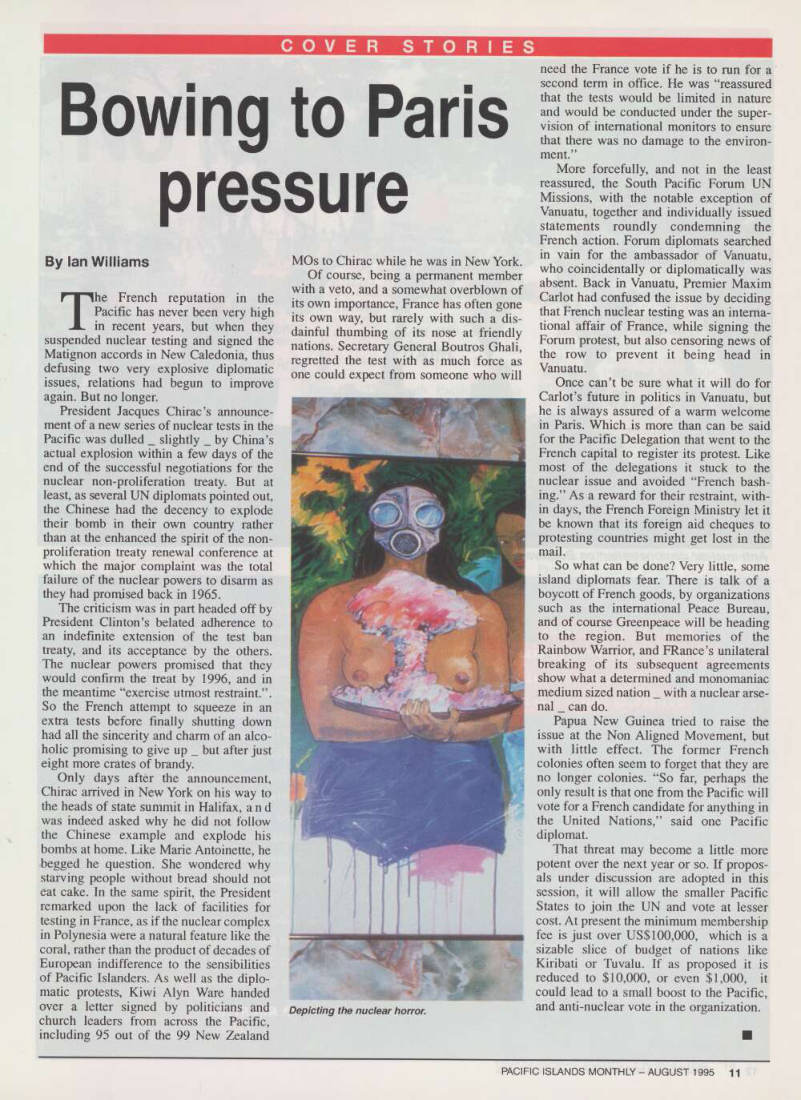
Depicting the nuclear horror.
Advertisements & other items, p. 12 (1 item)
r '•• i^gT.
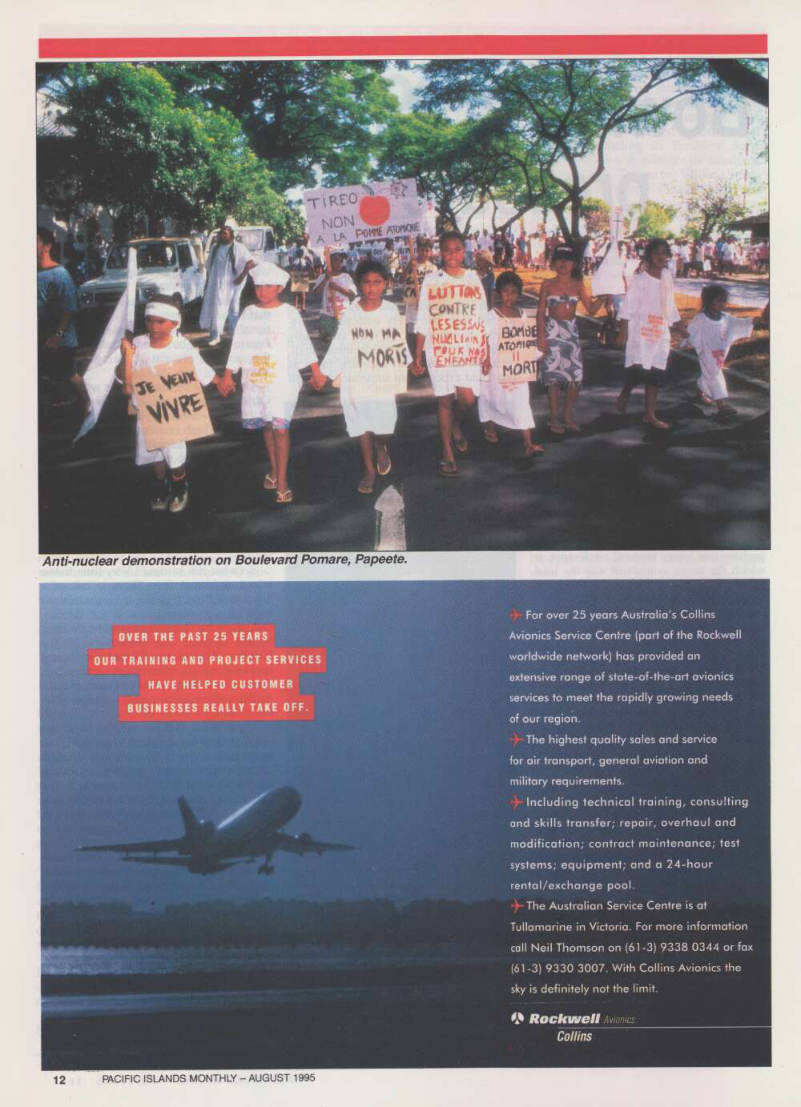
& i 'A ' m /• A 4 .■♦: r * V’ *> * jrfV •; *• t :*> ► .' V %%: ■■ . W' ■** SM lYjJt . \ *s t t &*£*** V* •* v ; & fc**< a - *»t3r wrv IKf-i i / . .* 4 s ♦. 73 *1 mm m i I <1 f.* % i ra 4*®* i “kill M Y «if!.- Anti-nuclear demonstration on Boulevard Pomare, Papeete.
OVER THE PAST 25 YEARS
OUR TRAINING AND PROJECT SERVICES
HAVE HELPED CUSTOMER
BUSINESSES REALLY TAKE OFF.
For over 25 years Australia's Collins Avionics Service Centre (part of the Rockwell worldwide network) has provided an extensive range of state-of-the-art avionics services to meet the rapidly growing needs of our region.
The highest quality sales and service for air transport, general aviation and military requirements.
Including technical training, consulting and skills transfer; repair, overhaul and modification; contract maintenance; test systems; equipment; and a 24-hour rental/exchange pool.
The Australian Service Centre is at Tullamarine in Victoria. For more information call Neil Thomson on (61-3) 9338 0344 or fax (61-3) 9330 3007. With Collins Avionics the sky is definitely not the limit.
Rockwell Avionics Collins
No to nukes
Chronology of Opposition to a resumption of Testing in the South Pacific.
May 7: Jacques Chirac is elected President of France May 8: The South Pacific Forum, in a formal statement welcoming the election President Chirac, said France’s relations with the region would be damaged if tests resumed.
The New Zealand and Australian gov ernments reiterate their opposition to a resumption of nuclear testing.
May 9: Denmark, on behalf of the five Nordic countries, issued a statement at the NPT Review and Extension Conference, calling for a continued moratorium: “The negotiations on a comprehensive test-ban treaty should be concluded as soon as possible. Until that has been accomplished all nuclear testing moratoria and agree a Comprehensive Test Ban Treaty in 1995 or 1996 at the latest.
May 12: Australia issues a formal statement welcoming the indefinite exten sion of the NPT and opposing French nuclear tests. Foreign Minister Gareth Evans said: “I repeat my appeal to the new French President to maintain the suspen sion of nuclear testing in the South Pacific...”
May 22: French Prime Minister Alain Juppe tells Parliament that France would soon be in a position to decide if it needed to resume nuclear weapons tests.
May 23: The Philippines President, Fidel Ramos, urges France to abandon any plans of resuming nuclear testing in the pacific. He said in a statement the Philippines was deeply concerned with the issue of nuclear testing in the Pacific because of the environmental damage it caused and other hazards it posed to coun tries in the area. “The Philippines calls upon France to display the sense of global responsibility that it has shown on many other occasions, by not resuming nuclear testing in the Pacific,” Ramos said.
June 6: France’s Defence Minister Charles Millon welcomes a report by a military experts panel, headed by Admiral Lanxade, recommending a resumption of nuclear testing at Mururoa. The panel said
ten tests would be ‘politically palatable’, and should occur as soon as possible.
June 6: Greenpeace announces in Paris that it is sending its ship the Rainbow Warrior to Mururoa.
June 7: The South Pacific Forum protests the suggestion that France will resume testing.
June 7: The Director of the US Arms Control and Disarmament Agency, John Holum, said the US hoped France would not resume testing. “When the world is in the process of eliminating, dramatically reducing their nuclear weapons, no coun try really needs to be modernising and updating their nuclear capabilities.”
June 7: The Fiji Government sends a diplomatic note to the French ambassador to Fiji protesting any resumption.
June 7: The Australian Federal Cabinet endorses a joint diplomatic offensive with New Zealand and other Pacific Island states to deter France from resuming. New Zealand’s Prime Minister personally rebukes the French Ambassador to New Zealand over any resumption. The leader of the Labour opposition party calls for a suspension of joint military co-operation with France in the South Pacific.
June 7 : The Foreign Affairs Minister of Chile announces that the Chilean Government will make an official protest to France about any resumption of nuclear testing and would work with other Latin American Governments to prevent further tests.
June 7: The Foreign Affairs Minister of Chile announces that the Chilean Government will make an official protest to France about any resumption of nuclear testing and would work with other Latin American Governments to prevent further tests.
June 7: The secretariat of the Nuclear Free and Independent Pacific Movement, the Pacific Concerns Resources Centre, calls for an immediate suspension of France’s South Pacific Forum Dialogue Partner status should French testing resume.
June 9: Germany’s opposition Social Democrat Party (SPD) calls on France not to resume nuclear testing, saying it would be a slap in the face for those countries which had accepted indefinite extension of the Non-Proliferation Treaty.
June 10: Chile, Ecuador and Peru, meeting at a session of the Association of American States, issued a statement urg ing France not to resume tests at Mururoa atoll. The General Secretariat of the Permanent Commission for the South pacific representing Colombia, Chile, Ecuador and Peru announces its opposi tion to further testing in the Pacific.
June 12: President Chirac presides over a meeting of the Counseil de Defense (Defence Council) during which a resumption of testing is agreed.
June 13: President Chirac announces France will resume testing at Mururoa atoll. Eight tests will take place between September 1995 and May 1996, he says, before France agrees to a comprehensive test ban treaty. The Socialist opposition oppose the decision.
June 14: A massive storm of interna tional outrage and domestic protest is pro voked by Chirac’s decision.
France’s former Socialist prime minis ter Laurent Fabius said Chirac’s decision was a “slap in the face” for the other states which agreed to extend the NPT. French Socialist leader Henri Emmanuelli called the decision a “grave error” and said there was no military need for more tests since France’s arsenal would be operational until the year 2010. The French Socialist Party has launched a nation-wide petition opposing the decision to resume tests.
Demonstrations are planned in Paris at the Place de la Bastille, Cherbourg and Caen on Tuesday. An independent French labo ratory, CRII-RAD, has challenged President Chirac to allow it to monitor the tests at Mururoa. A week of protest is planned at the Geneva Conference on Disarmament from June 27th. Famous French scientists and intellectuals have condemned the decision, saying it is a political not technical decision. In a full page article in the Liberation newspaper, Raymond Castaing (well-known for his work on radioactive waste). Professor Robert Guillaumont (professor at the University of Orsay and a specialist in plu tonium chemistry), physicist Jean-Paul Schapiro, Nobel Prize winning physicists Louis Neal and Simon Van de Meer, the President of the French Academy of Sciences, Marianne Grunburg-biologist Jacques Testard, geneticist Albert Jacquard, physicist Raymond Sene and the president of the Group of Scientists for Information on Nuclear Energy, Monique Sene opposed the decision.
Notably, a scientist from the Commisariat a L’Energie Atomique (Atomic Energy Agency), the agency
responsible for the testing programme made a public protest. Physicist Michel Cribier said he was ashamed to belong to an organisation promoting the resumption of testing. He said he would launch a spe cial appeal to other scientists at an interna tional gathering in Trieste and on electron ic mail.
Notably, a scientist from the Commisariat a L’Energie Atomique (Atomic Energy Agency), the agency responsible for the testing programme made a public protest. Physicist Michel Cribier said he was ashamed to belong to an organisation promoting the resumption of testing. He said he would launch a spe cial appeal to other scientists at an interna tional gathering in Trieste and on electron ic mail.
Australia announces it is freezing all military co-operation with France at exist ing levels.
New Zealand dismisses the French ambassador from a meeting with Foreign Minister Don McKinnon, and also freezes military co-operation. It says it does not rule out sending a NZ frigate to the test zone. The military activities being can celled include: * Planned visit by HMNZS Waikato, Endeavour and Wellington to Noumea in New Caledonia in November. * Troop and military personnel exchanges with French forces in New Caledonia in September * Visits to New Zealand by French naval vessels and aircraft. There will also be a review of military procurement activ ities involving French supplies.
The Minister of Foreign Affairs, Don McKinnon, will no longer attend the 50th anniversary of the end of the war in the Pacific commemorations planned in New Caledonia and other Ministerial contact will be reviewed.
Belgium officially condemns the deci sion to resume testing: “Belgium is deeply disillusioned by the French decision to resume nuclear testing in the Pacific Ocean. Belgium regrets the French atti tude even more because it runs counter to the spirit of the Non-Proliferation Treaty, which was signed last April in New York.
The French decision threatens to under mine the solidarity which was convened by the extension of the NPT. Belgium notes that France wants to restrict the number of nuclear tests to 8 and that it intends to sign a Comprehensive Test Ban Treaty in 1996 at the latest.” (Ministry of Foreign Affairs statement).
The United States says it ‘regrets’
France’s decision to resume testing.
Twenty one Congress representatives write to President Clinton asking him to urge President Chirac to reverse his deci sion. At a press conference after meeting President Chirac in Washington D.C., President Clinton says; “As you know, we regret the decision and we have worked
hard to try to stop the tests as a way of set ting up greater willingness to have a com prehensive test ban treaty. We have fore gone testing ourselves. But I do want to point out that the French have pledged before President Chirac came here - and he has reaffirmed that pledge, which you just heard - to achieve a comprehensive test ban treaty by next year. Also, France was very helpful in supporting the indefinite extension of the NPT.”
Sweden’s Prime Minister Ingvar Carlsson issues a formal statement, deeply regretting France’s decision to resume nuclear tests. “We have also conveyed this directly to the French government,” says prime minister Ingvar Carlsson. “The French decision is particularly disappoint ing because it comes only one month after the conference on the Non-Proliferation Treaty (NPT), where the nuclear weapons states promised to demonstrate the utmost constraint on continued nuclear testing.
The Swedish government hopes that the ongoing negotiations in Geneva on a test ban treaty are not negatively affected by France’s decision...” (Swedish Ministry of State, Press Release, June 14, 1995).
Finland’s Foreign Affairs Minister, Ms Tarja Halonen, said: “Finland regrets the decision of France to continue nuclear testing between September 1995 and May 1996.” She reminded all Comprehensive Test Ban Treaty by 1996.
Denmark’s Foreign Minister states: “It is with surprise and sincere regret that I leam that the President of France, Jacques Chirac, today has decided to carry out 8 nuclear tests within the period from September this year till May next year. In doing so, France lifts the temporary mora torium on nuclear tests it has maintained for a number of years. It is particularly regrettable because the 178 nations, including France, that have joined the Non-Proliferation Treaty (NPT) only one
month ago, agreed on a recommendation must be seen in relation to the ongoing negotiations on a treaty on a comprehen sive test ban. The French decision is also surprising because France had declared that is prepared to join such a ban. I will discuss this issue with my French col league as soon as possible. (Danish Ministry of Foreign Affairs, Press Release, June 13, 1995).
Japan’s Foreign Minister Yohei Kono told French Foreign Minister Herve de Charette by telephone on Wednesday that the French decision had “seriously betrayed” the trust of non nuclear states and the decision was disappointing. Kono told Charette that Prime Minister Tomiichi Murayama would take up the issue when he meets Chirac in Paris after the June 15- 17 Halifax summit of the G-7 countries.
Kono said Japan would also raise the ques tion during the Franco-Japanese summit in Paris next week.
Ireland protested at France’s plans. The Prime Minister, Mr Burton, and the Minister of Foreign Affairs Mr Spring, expressed “strong concern” to the French authorities. The decision would be viewed as a setback to the efforts to bring about an early and complete ban on nuclear testing, Mr Spring said. “There is still time for the French government to change its mind and I believe that they should reconsider that decision”. Mr Spring pointed out that at the recent NPT review and extension con ference in New York, the nuclear powers undertook to exercise the utmost restraint and to conclude a Comprehensive Test Ban Treaty no later than 1996. “In the light of the outcome of the conference, it is par ticularly disappointing that two nuclear powers, France and China, have decided to continue testing,” he said.
The Netherlands said it regretted France’s decision to resume nuclear tests in the Pacific and called for the earliest
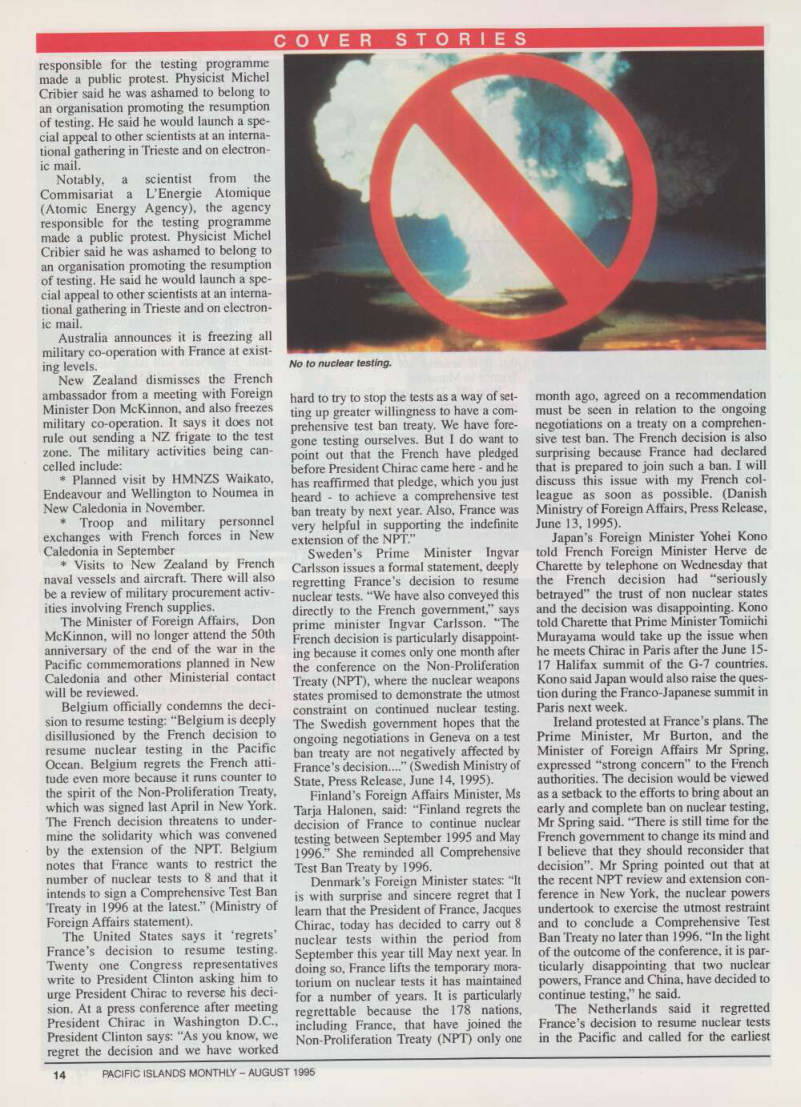
No to nuclear testing.
possible conclusion of a general nuclear test-ban treaty. The foreign ministry said in a statement that the parties to the Non- Proliferation Treaty had agreed last month that nuclear powers should exercise utmost restraint with respect to nuclear testing, pending the entry into force of a test ban treaty. “The government is of the opinion that the decision by France is at odds with this intention and continues to urge all nuclear states to refrain from con ducting nuclear tests,” it said.
Chile slammed the French decision to resume nuclear testing. A Foreign Ministry statement said: “Chile rejects France’s decision which could be a serious threat for the development of talks for a treaty ending nuclear testing which is an aspiration of highest priority for our coun try. The Chilean government makes an urgent call to the French government to reconsider this decision which would ben efit the protection of human life and the environment,” it said.
Canada urged France to reverse its decision, saying it could result in an expansion of the number of nuclear pow ers.
“Those who are nuclear powers have to agree to stop doing their testing as soon as possible,” Foreign Minister Andre Ouellet said. “This is to us absolutely crucial to ensure that there will not be a spin-off of encouraging others to do testing or to start to prepare to assemble nuclear arma ments.”
Austria expressed disappointment at France’s decision. Austrian chancellor Franz Vranitzky said it could endanger a comprehensive test ban treaty. “I regret France’s decision ... Austria has always argued for a ban on nuclear testing and we will continue with this line ... Everything must be done to ensure that France’s deci sion does not endanger the planned com prehensive nuclear testing ban treaty.”
Vranitzky spoke to French Prime Minister Alain Juppe by telephone to voice his protest.
Russia regretted France’s decision and urged President Chirac to reconsider his decision. Yeltsin’s spokesperson said; “Russia finds the announcement of the French leadership that it may conduct a series of nuclear tests in the fall regret table. If they do it, it could become a seri ous blow to the progress in nuclear disar mament that we have been watching for the past several years. We would like to hope that France would, in an appropriate way, study all the circumstances and con sequences which a realisation of the deci sion on nuclear tests will bring about,” an official statement said. Sergei Yushenkov, chairman about,” an official statement said. Sergei Yushenkov, chairman of the State Dumadefence committee, described the decision by President Jacques Chirac to authorise eight more tests at France’s
South Pacific site, as a mistake. “Russia must make the request to the French pres ident not to carry out testing, certainly not in such a quantity,” Yushenkov said.
Members of the Russian Duma, led by for mer environment Minister Nicolai Vorontsov, who are members of GLOBE
(A global parliamentarians group) con
demn further French tests.
Italy’s Foreign Ministry said the French decision to conduct eight underground test in the South Pacific from September ran counter to a moratorium on testing observed by France, Britain, Russia and the United States since 1992. But it added that Chirac’s simultaneous announcement that testing would end next May in time to sign a Comprehensive Test Ban Treaty was
positive news.
Norway urged France to change its nuclear test plans. The French decision could endanger a comprehensive test ban treaty, Foreign Minister Bjoem Tore Godal said in a statement. “The government strongly regrets the French decision to resume nuclear testing,” he said. “Norway calls on French authorities to alter the decision.
French Polynesia’s political leaders opposed the decision. A Polynesian repre sentative to the French Parliament and for mer mayor of Papeete, Jean Juventin said an alternative could have been found. “I can deny that there will be a local reaction.
As a parliamentarian I reject this decision and I will write to the president ... to express my dissatisfaction,” he said. Jackie Drollet, a Polynesian independence cam paigner, deplored the decision, and* Centrist senator Daniel Millaud dubbed the decision “perhaps the first big blunder of the president” and said a nuclear weapon simulation could have been used instead of a real test. Polynesian indepen dence leader Oscar Temaru also expressed strong opposition to a resumption of test ing and said protest action was planned.
The Cook Islands expressed concern at a resumption of French nuclear tests.
Minister of Marine Resources Tepure Tapaitau said he was “both concerned and opposed to nuclear testing resuming espe cially if research shows it will affect our waters.
The South Pacific Forum, representing 15 Pacific Island nations, condemned France’s decision. Forum Secretary General leremia Tabai said in a statement that French testing in the South Pacific would severely damage its relations with region’s island nations. “This flagrant dis regard for world and regional opinion will do considerable damage to France’s rela tions with the forum region,” Tabai said, describing the decision as a provocative act.
Luxembourg officially condemned the
resumption of French testing.
Switzerland officially protesting at
France’s decision.
Western Samoa’s Prime Minister Tofilau charged France with displaying insensitivity to South Pacific nations. “The resumption of tests in the South Pacific by France can only be interpreted as insensi tivity to the deep concerns of the South Pacific nations on the effects of nuclear testing to the environment,” Tofilau said.
European ecologists, “green” politi
cians and anti-nuclear pressure groups
joined the global chorus condemning
France for its decision to resume nuclear testing in the South Pacific. “This decision by the French President shows an appalling disregard for France’s partners within the European Union,” Green Group co-presidents Claudia Roth and Alexander Langer said at the European Parliament in Strasbourg. “Europeans do want to have their security policy defined by the narrow and totally outdated dictates of the French nuclear establishment,” they said. The German Green Party called Chirac’s announcement a return do “nuclear super power politics” and a “fatal signal to the despots of the world.”
June 15: Europe’s Parliament passed an emergency resolution condemning France’s decision to resume tests. It stated that member nations were “shocked by the decision of French President Chirac” and urged France to reconsider its decision. It also condemned the continuing nuclear tests by China and warned that if nuclear powers breach the spirit of the letter of the Nuclear Non-Proliferation Treaty (NPT), other states could follow suit.
The Europe Parliament resolution will now be forwarded to the European Council, the European Commission, to all Governments who signed the NPT and to the Chairman of the UN Conference on Disarmament in Geneva. Those voting for the resolution included the Fianna Fail conservative group, allies of the French RPR MEPs in the Parliament.
June 17: A delegation from the South Pacific Forum countries leaves for Paris to try and persuade President Chirac to reverse his decision on nuclear testing.
Statements In Favour Of A
Resumption Of Testing
Britain; “We see no reason why a limit ed programme of tests need affect the prospects of a successful negotiation of a comprehensive test ban treaty.”
Extreme-right National Front leader Jean-Marie Le Pen: “France has not sur rendered with its hands and feet bound to the dictates of foreign governments or the threats of the anti-military lobby,” Le Pen said in a statement. France should carry out however many tests it took to perfect laboratory simulation of nuclear explo sions to keep the French deterrent credible and restrict its commitment to the nuclear Non-Proliferation Treaty, which was not enforced in practice, he said. ■
Advertisements & other items, pp. 15-16 (2 items)
Cove R Stories
Looking for info?
ADVERTISEMENT
& What does PSDNP do?
Assists NGOs, government departments, regional organisations, educational institutions and other to access information on sustainable development from courses with and beyond the region. $ How is it doing this?
By giving NGOs, government departments and others the capability to access and exchange information between themselves and the rest of the world using computer.
By training in the use of computer-based communication and providing financial assistance in its operation.
By training Pacific Islanders in information repacking and assisting selected NGO’s in taking this information to communities. & Who can join the Pacific SDNP network?
The Pacific SDNP welcomes all organisations, government departments, regional programmes, non-govemmental organisations, educational institutions and professionals in the region whose work involves some aspect of sustainable development.
For further information, contact: The Pacific SDNP Secretariat, South Pacific Commission, Private Mail Bag, Suva, Fiji.
Fax: 679370021 Tel: 679 370 733 E-mail: sposuve @pactok.peg.apc.org
The Pacific Sustainable Development
Networking Programme
Do you remember the numerous times when: You were asked to write a policy paper on a topic about which you did not have the latest information?
You urgently needed the latest information on an international convention or UN conference but could not immediately access it?
You needed expert advice from a fellow professional colleague but did not know where to go?
You needed to contact an international organisation, university, and others but did not have the means?
After you had finally received the information, you wish it had not cost the earth?
These are some of the problems that the Pacific SDNP is designed to overcome. & What is the Pacific SDN Programme
(PSDNO)?
PSDNP is a regional programme of UNDP and SPC, aimed at facilitating the access of Pacific island countries to information on sustainable development.
$ Why have a Pacific SDNP?
Sound and up-to-date information on sustainable development is essential for
informed decision-making, planning, and
implementing sustainable development
programmes. The lack of access to such information is a major constraint to the effective progress of PlC’s to sustainable development. A wealth of information, however, already exists within the region and internationally. It is the PSDNP’s role to make that information accessible. & What is sustainable development information?
Sustainable development information covers abroad range of issues. It includes information on environment, such as cli-
mate change, biological diversity and
desertification: natural resources such as
population, gender, youth, health, educa-
tion and disaster reduction: economic issues including World Bank SAPS, economic forecasts and international trade: and information on clean and sustainable technologies. PSDNP facilitates access to UN documents on international conferences and conventions.
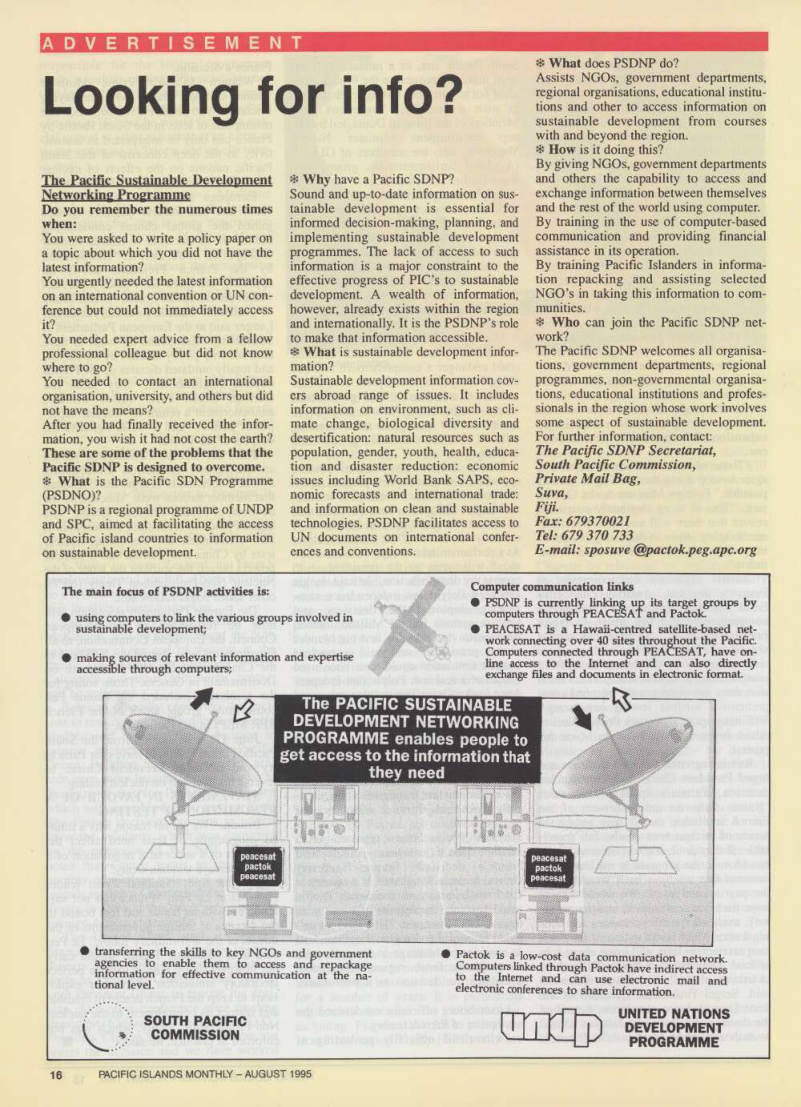
The main focus of PSDNP activities is: using computers to link the various groups involved in sustainable development; making sources of relevant information and expertise accessible through computers; Computer communication links PSDNP is currently linking up its target groups by computers through PEACESAT and Pactok. • PEACESAT is a Hawaii-centred satellite-based network connecting over 40 sites throughout the Pacific.
Computers connected through PEACESAT, have online access to the Internet and can also directly exchange files and documents in electronic format. * 0
The PACIFIC SUSTAINABLE
DEVELOPMENT NETWORKING
PROGRAMME enables people to get access to the information that
they need
* * • transferring the skills to key NGOs and government agencies to enable them to access ana repackage information for effective communication at the national level. • Pactok is a low-cost data communication network.
Computers linked through Pactok have indirect access to the Internet and can use electronic mail and electronic conferences to share information.
. SOUTH PACIFIC
y V COMMISSION
□HUP
UNITED NATIONS
DEVELOPMENT
PROGRAMME
Datec... A Partner In The Pacific

In January 1995, Datec (Fiji) Limited was appointed the regional dis tributor for AT&T communications products in Fiji, Vanuatu, Papua New Guinea and surrounding areas.
In separate contracts, AT&T Global Private Networks (GPN) appointed Datec as regional distributor of the SYSTIMAX Structured Cabling Sys tems (SCS) and AT&T Global Busi ness Communications Systems (GBCS) named Datec as the distribu tor of a range of communications sys tems and solutions.
AT&T is the world's largest com munications and computing com pany with an annual turnover in ex cess of US$75 billion and more than 340,000 employees worldwide and is investing heavily in the Asia Pacific region.
AT&T's PARTNER Plus Commu
nications Systems are designed for growing businesses that need a prac tical, easy-to-use communications system that helps to improve call handling efficiency, enhances cus tomer service and assists with con
trolling telephone costs.
The DEFINITY Switch delivers world class communications applica tions to all line sizes, from the very smallest to the largest, with either
simple or sophisticated requirements.
The switch is especially suited to en vironments where reliability of equipment is imperative such as in hospitals and hotels and to environ ments that require a high level of sys tem security such as government de partments.
According to Neville Rossiter, former Indirect Channel Manager, South Pacific, AT&T GBCS: "We see
a great market for these products in the Asia Pacific region and to access these markets we must develop alli ances with local companies capable of meeting the needs of customers in these areas.
Datec has a proven track record in the Information Technology and communications industry and we are confident that they will be an effective AT&T presence in the re
gion".
Datec (Fiji) Limited is a privately owned company which was founded in 1985 and operates in Fiji, PNG, Vanuatu, New Zealand (Auckland) and Australia (Brisbane and Cairns) with a total staff of 114 and is focused
on delivering high quality solutions
to their customers and have proven their commitment and expertise in the computing arena.
Advertisements & other items, pp. 17-19 (1 item)
PABX Solutions
AT&T
B^m The PARTNER® Plus Communications Systems Designed for growing businesses that require up to 8 lines and 24 extensions or 12 lines and 12 extensions which provide practical, flexible call management capability. This system is a cost-effective alternative letting companies connect industry-standard devices such as answering and fax machines, single-line telephones, modems and credit-card scanner, without expensive adaptors or costly dedicated lines from a telephone company.
The DEFINITY® G 3 Multimedia Messaging Switch Delivers world class communications applications to all line sizes, from 20 to 25,000 extensions and 10 to 4,000 trunks, with either simple or sophisticated requirements. The Switch is especially suited to environments where reliability of equipment is imperative and a high level of system security is required.
Distributed by DATEC (FIJI) LIMITED
ADVERTISEMENT
A new era in Global low cost mobile satellite communications
The Atlas SP-1600-M Maritime satphone has a software driven antenna, mounted on a stabilised platform. This negates the need for costly and high maintenance gyro’s. It has NMEA protocol support for connection of G.P.S navigation receivers size, weight and power consumption have been minimised so that vessels have a cost effective alternative to the big, bulky, high maintenance inmarsat- A analogue system.
Call charges using Telasira as the services provider have been cut dramatically. For Australian registered terminals, charges start from $ A 1.40 per minute off-peak (for lOhrs a day) to $A2.30 peak for all calls termi-
nating Overall Telestra provides
the cheapest Inmarsat-M charges in the world.
The Atlas SP-1600 series sat-
phones are basically, portable
international earthstations.
Using this technology you can literally by-pass the country of origins PSTN networks. Here lies its most significant advantage.
If you live in a country where the local communications network is unreliable and costly, then Inmarsat-M can provide
highly relaible communications 24 hours a day.
If you are in business, such as running a major hotel or resort, you can, integrate the Atlas SP-1600-B into a PABX and direct all overseas calls, faxes etc directly via Inmarsat-M.
Foreign embassies can maintain
communications independently
of the host country. Inmarsat-M will overcome the difficulties faced by those not well served by fixed telephone or cellular radio services.
Although power may be a problem in many remote areas, the ability of the Atlas SP-1600 satellite phone to operate from a DC power supply means that it can be left operational 24 hours a day when connected to a battery supply by a solar or thermoelectric generator.
In conclusion many industries can benefit from this new low-cost and portable system.
The applications are nearly endless. What is certain, is the guaranteed backup you get from Atlas Electronik (Australia).
With over 80 per cent of the Australian market our customers know they are buying
quality, reliability and excellent
after sales services. ■
Inmarsat, the organisa-
tion owned and financed by nearly 200 countries has operated the only globally mobile satellite for ten years.
With the development of Inmarsat- M telephone fax and data services will soon be within reach of many users.
Now the Atlas SP- 1600 ser-
vices satellite phones accessing
the Inmarsat M system makes it cost effective to install such equipment on large and small boats, or integrated in a briefcase to be carried inconspicuously by an individual. For those living in remote areas it will, for the first time provide individuals with reliable direct dial telephone fax and data communications with the world at an affordable price.
The Atlas SP-1600-H satphone is an all digital mobile satellite communications sys-
tem, originally designed for
military use. Housed in an ruggeredised Samsonite case, with a built in antenna. It weighs approximately 10.5 kilogrammes. Recently Australia’s new encryption system SPEAKEASY has been successfully interfaced with the Atlas SP-1600-D.
jOSSS^
Jjlgjii A
FIJI'S GOLF MAGAZINE
JULY 1995 VOL 1 $2.50
f s
GETS IN THE
\ Joe
GREG
NEW TOY.
WIN A BIG BERTHA DRIVER
Widow extradited for
Trial
Widow extradited for trial in Vanuatu
The trial of Luciana Picchi, charged with the murder of her husband Franco Picchi last year, will generate a lot of interest in Vanuatu because the country had never before witnessed such a violent crime. The verdict will be keenly waited.
By Patrick Decloitre
Singapore-extradited Italian widow Luciana Picchi appeared briefly for the first time on July 7 before a Vanuatu court where she was remanded in custody for 14 days after being charged for the premeditated intentional homicide of her husband last year. This month should see the real trial begin with hear ings in Supreme Court in this unprece dented criminal case which caused enor mous shock and has already prompted much passion in the island state’s capital
community.
Since last April Vanuatu authorises were seeking extradition from Singapore for an Italian woman arrested there while charged here of her husband’s intentional homicide. The case relates to the murder last November 29 of Italian builder Franco Picchi who was found dead at the bottom of a slope at the back of his pick-up truck.
The body of Franco Picchi, 51, was taken to the Vila Central Hospital morgue, where a post-mortem revealed heavy skull damage, broken neck, and ribs and wounds on the back.
Picchi’s neck had traces of strangula tion and the chest was also badly dam
aged.
Public Prosecutor John Baxter Wright who immediately went on the scene with police inspectors said there has been other cases of expatriates dying in Vanuatu in dubious circumstances but nothing as vio lence-related as this case since the island
state’s independence.
“Ni-Vanuatu usually kill with bush knives, hands and feet,” Baxter-Wright said, describing the incident as the most violent death of a foreigner in Vanuatu since independence 1980.
Since then, despite the help of Australian Federal Police detectives sent to help, the Vanuatu Police had not been able to solve the case.
However, Police confirmed last April 21 a breakthrough in the investigation when they arrested two ni-Vanuatu men
last week who confessed they had com mitted the crime in exchange of substantial amounts of money. The same week, they were charged with premeditated intention al homicide in Vanuatu Supreme Court.
The Court also issued a warrant for the arrest of the victim’s widow, Luciana Picchi, who has also been charged with the premeditated intentional homicide of her husband, but by then she had left the coun try.
Vanuatu’s attorney-general, Patrick Ellum, said at the time Luciana Picchi had been arrested on April 19 in Singapore with the help of Interpol’s international network and Australian Federal Police.
She was remanded in custody in Changi Prison.
Following Vanuatu’s request for extra dition a Court in Singapore then had to decide whether they would return Picchi.
“I think they have reasons for doing so but if Mrs Picchi wishes to fight the extra dition this will take a few more weeks,”
Ellum said.
Legal action was taken by the accused widow who has first decided to fight the extradition bid by Vanuatu authorities.
However, in a move that still leaves the Vanuatu prosecution baffled, on June 15 the Singapore court ordered Mrs Picchi’s extradition to Vanuatu to face trial for the alleged murder of her husband Franco Picchi.
“The final hearing was brought forward from July 5 after the accused’s lawyers in Singapore indicated they would no longer be opposing extradition. But Singapore regulation required two weeks before she could be escorted back to Vanuatu by police,” Ellum stated last June.
On July 6, Luciana Mari Picchi was back in Port Vila where she was first detained in the police headquarters cells.
She was also immediately interviewed by police here. Public Prosecutor John
Baxter-Wright said.
She was however allowed to see the Italian Honorary Consul in Port Vila and her lawyer, John Malcolm.
Earlier the same week, two local sus
pects in the same murder case,. George Tui and Perry Jimmy pleaded guilty to the charges of premeditated intentional homi cide before Port Vila’s magistrate’s court, which then referred the case to Supreme Court here to deliver its sentence.
However, Baxter-Wright said, state ments or affidavits will have to be obtained from the doctor who carried out the post-mortem on the corpse last November, Australian Ron Peach and Australian Federal Police investigators who were flown in to help with the case because people are no longer in Vanuatu.
Meanwhile, the case should have been referred to Supreme Court here, he added.
“I believe it will take about four weeks before prosecution can start,” he told the Court.
On the first appearance of Mrs Picchi before a Vanuatu court last July 7, Magistrate Bruce Kalotiti, who adjourned the 15-minute hearing until Friday July 21, denied release on bail for Mrs Picchi as he said the magistrate’s court does not have this power. She was remanded in custody.
The accused was not at first asked to enter a plea but the charges laid against her on April 13 this year while she was away were formally put to her.
Meanwhile, the 33-year-old Italian widow who seemed relaxed during her first appearance in court was transferred from police headquarters here to the tiny jail of the island state’s capital. She joined the only other female convict in the Vanuatu jail, Rita Carlot, who is serving a two-year sentence for misappropriation.
“If convicted, over the charge she faces the maximum penalty is life imprison ment. But that is not a mandatory penalty as in the United Kingdom. It’s a discre tionary maximum. So she could face any penalty up to life imprisonment,” Baxter-
Wright said.
There is no death penalty in Vanuatu. ■
Advertisements & other items, p. 20 (1 item)
20
RACIFIC ISLANDS MONTHLY - AUGUST 1995
Magistrate attacks
government
By Chris Peteru
The afternoon before Western Samoa's first ever sedition trial went to the Apia Magistrates Court, Human Rights Protection Party Prime Minister Tofilau Eti Alesana told
parliament member Toalepaialii
Toesulusulu were guilty.
Whether that will ever be proven is now unlikely because magistrate Richard Lussick threw out all seven sedition charges against the pair because of a lack of police evidence.
Adding to what amounted to a debacle, was confusion and finger generals office as to who was meant to present the case.
The government who until then made a great show of bringing the pair to trial have since remained tight lipped over the shock outcome in one of the most bitter
episodes in the country’s judicial history.
Last March the two former members of parliament Toalepaialii and Faamatuainu and members of the traditional Samoan pressure group representing chiefs from a number of traditional districts, were key organisers in a demonstration against the government imposed Value Added Goods and Services Tax (VAGST).
In February they were charged with the sedition offences. The police charge sheet referred to speaking “seditious words” with the intention of exciting disaffection against the government and prime minis ter. References were also made over a press statement containing seditious libel, i.e a call for a change of government.
Incredible the key prosecuting witnesses were to have been six journalists who had
been given little prior warning were
required to testify and were summoned by police the night before.
On several occasions prime minister Tofilau went on state owned television to say that the actions of the pair was an attempt to bring down the government and posed a threat to the harmony of the coun try.
Letters to the government from Human
Rights watch dog Amnesty International,
who with the World Council of Churches (WCC) and five other groups had observers in court, were politely ignored by the government. Spokesmen and finance minister Tuilaepa Sailele saying that they had not been fully informed.
But amidst jubilant scenes outside the courthouse afterwards the dismissal -
termed a hollow victory by pro- govern ment supporters- seemed to endorse the individuals constitutional right to freedom of speech (article 13), which had been the defendants catch cry all along.
“At least we can walk away with clear conscience that justice precedes every thing else in the country. I’m sure the whole country will appreciate this, we believe this is our constitutional right (to protest) and at least there is justice in this country regardless of what politicians, the government and even the prime minister thinks, you must have the guts to fight for this,” said Toalepaialii, a one time MP with the present ruling party.
“This is embarrassing for the present, embarrassing in the sense that they went all out to ensure that we go to jail. You can judge that by the speeches the prime min ister has made in parliament. Justice has been served,” said Faamatuainu. “It goes to show that they had failed to provide spe cific charges from the start.”
Police prosecutor Chief Inspector Max Wendt asked the court for an adjournment on the grounds that: • The crown prosecutor wanted the case tried in the Supreme Court as it was a “political matter.” • The prosecution wanted the case tried in the Supreme Court as it was a political matter. • The prosecution was unprepared, adding he had only received the file from the Attorney-Generals office 15 hours before.
Defense counsel Tasi Malifa opposed the application for an adjournment and asked that the case be dismissed.
In turning down the adjournment because one crown solicitor was overseas, Magistrate Lussick said there was more than one lawyer in the Attorney-General’s chambers. He asked why the case had not been delegated to another crown solicitor given there had been a four month gap since the charges were laid to prepare the case.
“This particular ground has no validity
whatsoever.”
He criticised the prosecution sugges tion that the case be heard in the Supreme Court as it was a political matter.
“This is a court of law and not a court of politics. If it is alleged by the prosecu tion that a law has been broken then this is the place to be. If this is purely a political matter it shouldn’t be in my court room.
Political strategies have no place here.”
“This is a court of law and not a court of poli tics, 99 Magistrate Richard Lussick
He accepted the circumstances that lead to the prosecution being unprepared say ing that chief inspeqtor Wendt “To use the vernacular had been left holding the buck et.
“Anyone else who has had anything to do with conducting the prosecution has made sure he has not appeared in court today.”
Still the prosecutions lack of prepara tion was entirely its own fault.
Mr Malifa told the court he had received no notice from either the police or the attorney-generals office indicating the prosecution needed more time to pre pare.
Following a 45 minute recess Wendt asked if the charges could be withdrawn.
He explained that during the recess Police Commissioner Galuvao Taniela had phoned the Attorney-General asking for a crown solicitor to appear for the state.
The Attorney-General told the Commissioner that none was available.
“Isn’t the Attorney-General a lawyer?” the magistrates asked.
Mr Lussick said if the court allowed the charges to be withdrawn the Attorney- General’s office and the police department would suffer as a result of the decision to dismiss the case.
“This is very embarrassing for the police. Comments from the magistrate reflects badly on us.
“All along we were given the under standing that this was a case that was down to be prosecuted by the Attorney- General, and all of a sudden we hear our crown prosecutor is in the Solomon Islands and none of the other attorney gen erals office is prepared to come and face the court. We consider that poor excuse.”
“I’m curious as to why they are backing down from the case,” said Galuvao.
While Tolepaialii and Faamatuainu have had their day in court, the govern ment still wiping the protest egg off its face now looks to be on a courtroom roller coaster.
The country’s Controller and Chief auditor Su’a Rimoni Ah Chong, who last year tabled a report on widespread govern
ment corruption and mismanagement
announced last month he was suing the
Prime Minister, Legislative Assembly,
government and a Commission of Inquiry in relation to that document. ■
Advertisements & other items, p. 22 (1 item)
Remember your Friend
There are times in your life when you feel your friends have been missing out on something good. Now’s your chance to do something about it and share with them one of the good things you have. Buy your friend a subscription to Pacific Islands Monthly and let him or her join you and the thousands of other people worldwide who are kept informed of the latest political, social and cultural changes taking place in the Pacific
SUBSCRIPTIONS
American Samoa US$45 Australia A 542.00 Canada US$45 Cook Islands AUSS46 Fiji F 526.40 French Polynesia US$45 Guam US$45 Hawaii US$45 Japan US$45 Kiribati AUSS46 Marshall/Micronesia US$4O Nauru AUSS42 New Caledonia US$32 New Zealand NZ$55 Niue AUSS46 Norfolk Island AUSS42 Northern Marianas/Palau US$4O Papua New Guinea AUSS4S Solomon Islands AUSS46 Tonga AUSS46 Tuvalu AUSS46 United Kingdom Stg Pound2B US Mainland US$45 Vanuatu AUSS4S Western Samoa WS$6O Elsewhere AUSS63 Payment to Pacific Islands Monthly: Subscriptions Dept, QPO Box 1167, Suva, Fiji.
Subscriptions rates include the cost of airspeeding to all destinations set out above.
Direct airmail rates on application.
Telephone: 304111 Fax: 303809
r PACIFIC ~"1
ISLANDS i
• =‘ Please send my friend Pacific Islands Monthly for one year (12 issues).
I I enclose my cheque for $ (made payable to Pacific Islands Monthly) . or debit $ to my: I □ Bankcard □ Visacard □ Mastercard I I Card No: I I I I I I I I I I I I I I I Expiry Date I
NAME
I
.SIGNATURE
j MY FRIEND'S NAME
' MY FRIEND'S ADDRESS
[ CITY COUNTRY
VISITING FELLOWSHIPS 1997, HUMANITIES RESEARCH CENTRE,
THE AUSTRALIAN NATIONAL UNIVERSITY.
Applications are invited for Visiting Fellowships in the Humanities Research Centre in 1997. Each year the Centre concentrates upon a special theme. In 1997 the theme will be 'ldentities'. The Centre intends to organise three conferences. 'Emotion in Social Life and Social Theory' (early July); 'identities and Convergences' (to be held jointly with the Research School of Pacific and Asian Studies, ANU and the Universite Francaise de Pacifique, Noumea in mid-July); and 'lndigenous Rights, Political Theory and the Reshaping of Institutions' (to be held jointly with the Research School of Social Sciences, ANU in late August). Applications from scholars working in any area of the humanities are welcomed, as a proportion of each year's Fellowships is reserved for those without special interest in the year's theme; the majority of Fellowships, however, will be awarded to those whose work is relevant to the annual theme and its conferences. Fellows are expected to work at the Centre, but are encouraged also to visit other Australian universities. Grants usually include a travel component and a weekly living allowance. Prospective applicants must obtain further particulars and application forms from the Centre Administrator, Humanities Research Centre, The Australian National University, Canberra ACT 0200 AUSTRALIA, fax. (616) 248 0054. E-mail: administration hrc @ anu. edu. au. Applications should reach the Secretary, ANU, by 31 October 1995. Ref: HRC 20.6.1.
THE UNIVERSITY IS AN EQUAL OPPORTUNITY EMPLOYER
Pacific
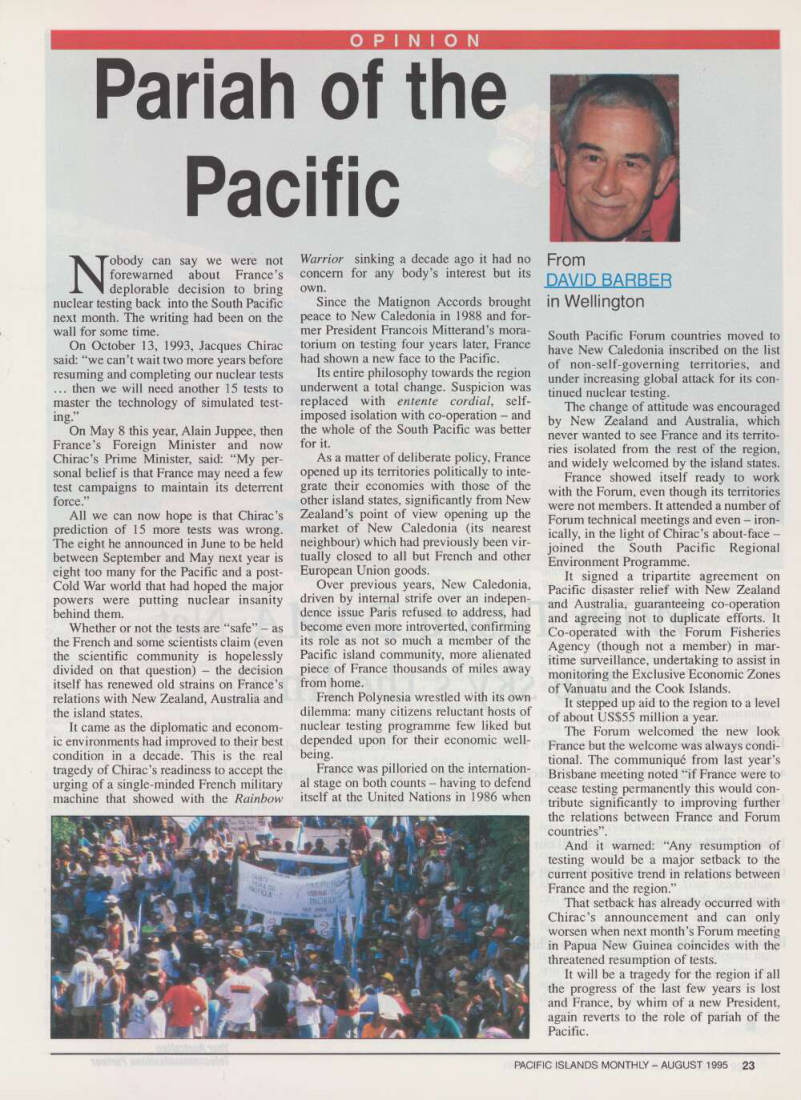
Opinion
Pariah of the Pacific
Nobody can say we were not forewarned about France’s
deplorable decision to bring
nuclear testing back into the South Pacific next month. The writing had been on the wall for some time.
On October 13, 1993, Jacques Chirac said; “we can’t wait two more years before resuming and completing our nuclear tests ... then we will need another 15 tests to master the technology of simulated test
ing.”
On May 8 this year, Alain Juppee, then France’s Foreign Minister and now Chirac’s Prime Minister, said: “My per sonal belief is that France may need a few test campaigns to maintain its deterrent force.”
All we can now hope is that Chirac’s prediction of 15 more tests was wrong.
The eight he announced in June to be held between September and May next year is eight too many for the Pacific and a post- Cold War world that had hoped the major powers were putting nuclear insanity behind them.
Whether or not the tests are “safe” - as the French and some scientists claim (even the scientific community is hopelessly divided on that question) - the decision itself has renewed old strains on France’s relations with New Zealand, Australia and the island states.
It came as the diplomatic and econom ic environments had improved to their best condition in a decade. This is the real tragedy of Chirac’s readiness to accept the
urging of a single-minded French military
machine that showed with the Rainbow
Warrior sinking a decade ago it had no concern for any body’s interest but its own.
Since the Matignon Accords brought peace to New Caledonia in 1988 and for mer President Francois Mitterand’s mora torium on testing four years later, France had shown a new face to the Pacific.
Its entire philosophy towards the region underwent a total change. Suspicion was replaced with entente cordial, self imposed isolation with co-operation - and the whole of the South Pacific was better for it.
As a matter of deliberate policy, France opened up its territories politically to inte grate their economies with those of the other island states, significantly from New Zealand’s point of view opening up the market of New Caledonia (its nearest neighbour) which had previously been vir tually closed to all but French and other
European Union goods.
Over previous years, New Caledonia, driven by internal strife over an indepen dence issue Paris refused to address, had become even more introverted, confirming its role as not so much a member of the Pacific island community, more alienated piece of France thousands of miles away from home.
French Polynesia wrestled with its own dilemma: many citizens reluctant hosts of nuclear testing programme few liked but depended upon for their economic well
being.
France was pilloried on the internation al stage on both counts - having to defend itself at the United Nations in 1986 when
South Pacific Forum countries moved to have New Caledonia inscribed on the list of non-self-governing territories, and under increasing global attack for its con tinued nuclear testing.
The change of attitude was encouraged by New Zealand and Australia, which never wanted to see France and its territo ries isolated from the rest of the region, and widely welcomed by the island states.
France showed itself ready to work with the Forum, even though its territories were not members. It attended a number of Forum technical meetings and even - iron ically, in the light of Chirac’s about-face joined the South Pacific Regional Environment Programme.
It signed a tripartite agreement on Pacific disaster relief with New Zealand
and Australia, guaranteeing co-operation
and agreeing not to duplicate efforts. It Co-operated with the Forum Fisheries Agency (though not a member) in mar itime surveillance, undertaking to assist in monitoring the Exclusive Economic Zones of Vanuatu and the Cook Islands.
It stepped up aid to the region to a level of about US$55 million a year.
The Forum welcomed the new look France but the welcome was always condi tional. The communique from last year’s Brisbane meeting noted “if France were to cease testing permanently this would con tribute significantly to improving further the relations between France and Forum countries”.
And it warned: “Any resumption of testing would be a major setback to the current positive trend in relations between France and the region.”
That setback has already occurred with Chirac’s announcement and can only worsen when next month’s Forum meeting in Papua New Guinea coincides with the threatened resumption of tests.
It will be a tragedy for the region if all the progress of the last few years is lost and France, by whim of a new President, again reverts to the role of pariah of the Pacific.
From
David Barber
in Wellington
Advertisements & other items, p. 24 (1 item)
the sky’s the limit.
- Wm - % m W ** ■ t? % JL
With Telstra DAMA-Net,
Providing world class communications to Rotuma was milestones world class domestic and international a unique challenge for Fiji Posts and Telecommunications telephone services for Rotuma, and greater cost Limited (FP&TL) and FINTEL.
Located 700 km north of Fiji and well out of range of the nearest microwave dish, DAMA-Net was an ideal solution for Rotuma’s needs.
By selecting DAMA-Net, FP&TL has achieved two effectiveness.
In fact, thanks to digital DAMA-Net, FP&TL now leads the South Pacific in remote area satellite communications.
To learn how Telstra can help put you in touch, call Graham Buddy on +6l 2 287 4320.
i^elstra
Your Australian Telecommunications Partner
Chirac is his
own worst enemy
The guessing game is over. France has told the world that it is resuming its nuclear testing pro gramme in the South Pacific, starting next month.
From September through to May next
year, France’s new president announced that his country would conduct eight tests at Mururoa Atoll in Tahitian Nui, thou sands of kilometres away from Paris.
Its stated reason was that these tests were necessary to Maintain the deterrence which is at the heart of France’s defence strategy. A cheap stunt indeed.
As the new boy in the Paris palace expected, shock, disbelief and utter con demnation greeted his announcement.
Shock, because the decision by France to resume nuclear testing has put back the clock many years, plunging the world back on the brink of the nuclear arms race and the nagging possibility of a nuclear war.
For the South Pacific, not only was the decision was one of shock and disbelief, it had dealt a major setback to the good rela tions between Pacific Island Countries and France.
For years, there was a kind of stand-off between Paris and the island governments in the Pacific including Australia and New Zealand, but relations thawed when for mer President Francois Mitterand announced a unilateral; moratorium.
Like the rest of the world, Mr Mitterand himself was shocked to hear his
predecessor announced resumption of
nuclear tests. It is our hope here in the Pacific family of nations that other nuclear states will not follow France.
France’s decision to resume nuclear testing in the South Pacific makes one wonder what matters any more these days.
As France has proven, its policy does not value its relations with other countries.
And yet in the Pacific, relationship is the closest thing to the heart of those who live in this region.
In a charged situation such as the nuclear testing issue, it is almost difficult to do anything without emotions. France, no doubt, has seen evidence of that through condemnations by governments, regional organisations, non-govemmental organisations (NGOs) both within and out side the South Pacific region.
Unfortunately, the stroke of a pen has destroyed that relations we had painstak ing built with France over the last few
years. Our value is based on trust and respect. The French decision has clearly
ignored both.
It seems clear that France has yet to leant to accept that New Caledonia, Tahiti- Nui and Wallis Futuna are not French in their entirety, that is geographically, ethi
cally and demographically.
Geographically, these island states form an integral part of the Pacific. It would have been proper if France had cho sen to test these deadly weapons system in Europe, especially in France itself.
Ethnically, the peoples who inhabit these islands are from the Pacific. Their backyard should never be used under any circumstances without their consent. In particular, for detonating a weapons sys tem whose radiation fallout result in can cer and cancer-related illnesses.
In fact, if these tests are as safe as the French make them out to be, then it is only proper that these are conducted in France itself.
Demographically, there are more peo ple with either Pacific origin, orientation or both living in these islands than indige nous Frenchman and women.
Sure, there are French-speaking people living on these islands, but so are English
speaking people.
The age-old argument that these island states are French colonies, hence Paris decides what is and what is not good for their inhabitants is not only old but out of step with fundamental changes taking
place globally. France’s dictatorial policy
in this area infringes on the very rights of the people of these islands to decide their
own destiny.
By using Mururoa Atoll for these nuclear tests, France is not only suppress ing the rights of the indigenous people there, it is denying these people the oppor tunity to decide for themselves their own destiny and how to achieve whatever that goal maybe.
It is sad indeed that France appears to be the only country to encourage depen dency rather than encourage its remaining territories in the Pacific to start thinking of doing and making decisions for them selves, including independence.
There is a positive side to all of this.
France still has time to change its mind and become a world hero. Do it now.
President Chirac. Show the world that det onating the nuke is not worth the ridicule, international condemnation and isolation
France must go through.
Show the world that you are a world leader. Show the world that France is a world leader. Show the world that you lis ten to world opinions against nuclear test
ing.
Show the world that you are a man.
President Chirac. Show the world that you can turn world opinions against your coun try into one for France. No one wants to be a loser today, your decision to resume nuclear testing in the South Pacific has already put one foot of your country the door of international defeat and isolation.
World opinions are against you and will remain so for a long time to come. You cannot afford to do that in the face of efforts to consolidate the community of nations. But you. President Chirac, can change that. Pull back that errant foot and be a hero. Let France be the hero in this game.
Give our young generation(s) and those to come to an opportunity to remember you as the President who made tough deci sions. Give them an opportunity to remem ber you as the President who has world peace at heart. Because your decision to resume nuclear testing is a threat to world peace.
True, the People’s of Republic of China has not observed any moratoriums on test ing. But adding your country to the list of countries conducting nuclear testings only increases the pulse rate of a world which is
already feeling uneasy. Your leadership
can be part of the solution to this problem.
The world stands ready to applaud or further condemn you. Show the leadership that’s lacking today and give the opportu nity to the billions of people around the world to join the French people in applauding you for reversing the initial decision to resume testing.
Mr President, the ball is in your court.
From
Alfred Sasako
at the Forum Secretariat.
Stars fall in Hawaii
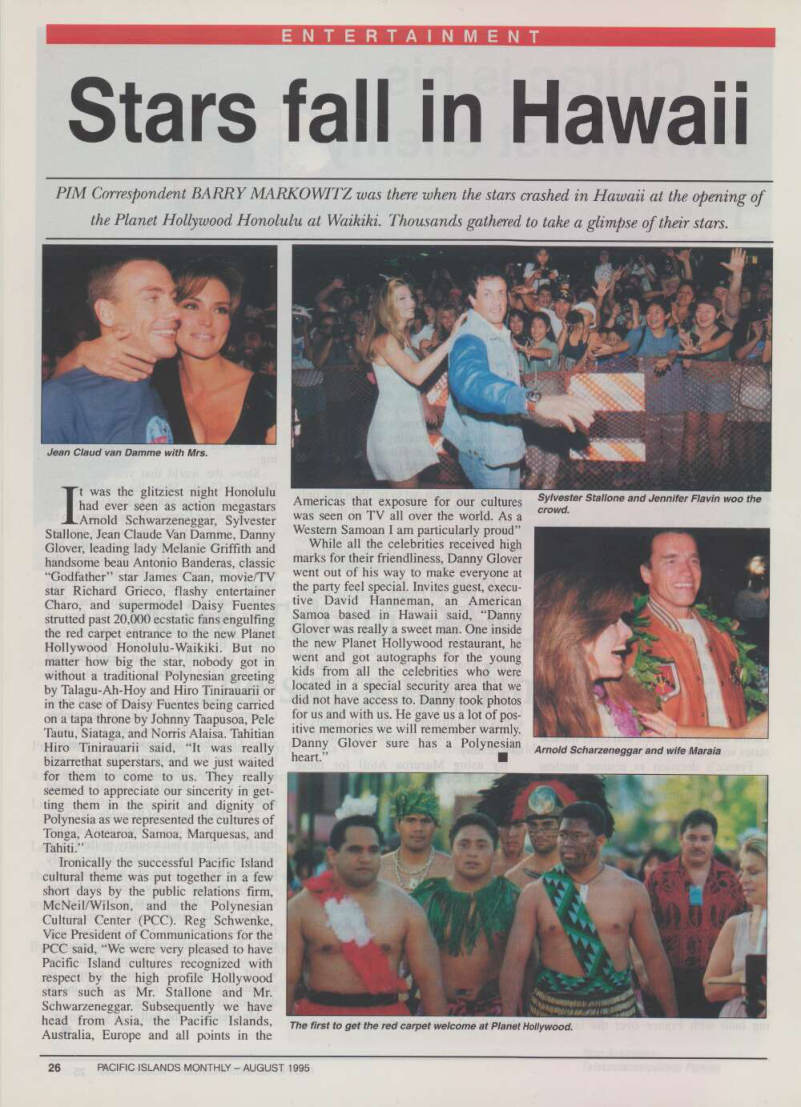
Entertainment
PIM Correspondent BARRY MARKOWITZ was there when the stars crashed in Hawaii at the opening of the Planet Hollywood Honolulu at Waikiki. Thousands gathered to take a glimpse of their stars.
It was the glitziest night Honolulu had ever seen as action rnegastars Arnold Schwarzeneggar, Sylvester Stallone, Jean Claude Van Damme, Danny Glover, leading lady Melanie Griffith and handsome beau Antonio Banderas, classic “Godfather” star James Caan, movie/TV star Richard Grieco, flashy entertainer Charo, and supermodel Daisy Puentes strutted past 20,000 ecstatic fans engulfing the red carpet entrance to the new Planet Hollywood Honolulu-Waikiki. But no matter how big the star, nobody got in without a traditional Polynesian greeting by Talagu-Ah-Hoy and Hiro Tinirauarii or in the case of Daisy Puentes being carried on a tapa throne by Johnny Taapusoa, Pele Tautu, Siataga, and Norris Alaisa. Tahitian Hiro Tinirauarii said, “It was really bizarrethat superstars, and we just waited for them to come to us. They really seemed to appreciate our sincerity in get ting them in the spirit and dignity of Polynesia as we represented the cultures of Tonga, Aotearoa, Samoa, Marquesas, and Tahiti.”
Ironically the successful Pacific Island cultural theme was put together in a few short days by the public relations firm, McNeil/Wilson, and the Polynesian Cultural Center (PCC). Reg Schwenke, Vice President of Communications for the PCC said, “We were very pleased to have Pacific Island cultures recognized with respect by the high profile Hollywood stars such as Mr. Stallone and Mr.
Schwarzeneggar. Subsequently we have head from Asia, the Pacific Islands, Australia, Europe and all points in the
Americas that exposure for our cultures was seen on TV all over the world. As a Western Samoan I am particularly proud”
While all the celebrities received high marks for their friendliness, Danny Glover went out of his way to make everyone at the party feel special. Invites guest, execu tive David Hanneman, an American Samoa based in Hawaii said, “Danny Glover was really a sweet man. One inside the new Planet Hollywood restaurant, he went and got autographs for the young kids from all the celebrities who were located in a special security area that we did not have access to. Danny took photos for us and with us. He gave us a lot of pos itive memories we will remember warmly.
Danny Glover sure has a Polynesian heart.” ■
Jean Claud van Damme with Mrs.
Sylvester Stallone and Jennifer Flavin woo the crowd.
Arnold Scharzeneggar and wife Maraia
The first to get the red carpet welcome at Planet Hollywood.
“Tides of the
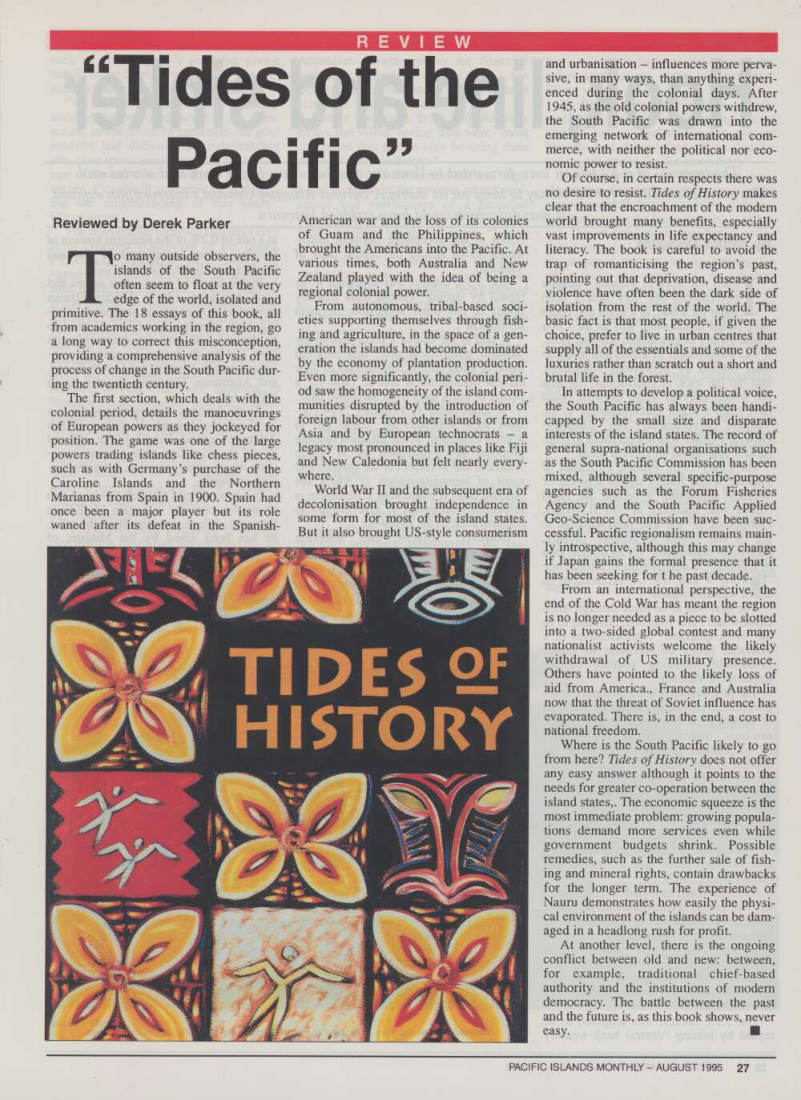
Review
“Tides of the Pacific”
Reviewed by Derek Parker
To many outside observers, the islands of the South Pacific often seem to float at the very edge of the world, isolated and primitive. The 18 essays of this book, all from academics working in the region, go a long way to correct this misconception, providing a comprehensive analysis of the process of change in the South Pacific dur ing the twentieth century.
The first section, which deals with the colonial period, details the manoeuvrings of European powers as they jockeyed for position. The game was one of the large powers trading islands like chess pieces, such as with Germany’s purchase of the Caroline Islands and the Northern Marianas from Spain in 1900. Spain had once been a major player but its role waned after its defeat in the Spanish-
American war and the loss of its colonies of Guam and the Philippines, which brought the Americans into the Pacific. At various times, both Australia and New Zealand played with the idea of being a regional colonial power.
From autonomous, tribal-based soci eties supporting themselves through fish ing and agriculture, in the space of a gen eration the islands had become dominated by the economy of plantation production.
Even more significantly, the colonial peri od saw the homogeneity of the island com munities disrupted by the introduction of foreign labour from other islands or from Asia and by European technocrats - a legacy most pronounced in places like Fiji and New Caledonia but felt nearly every where.
World War II and the subsequent era of decolonisation brought independence in some form for most of the island states.
But it also brought US-style consumerism
and urbanisation - influences more perva sive, in many ways, than anything experi enced during the colonial days. After 1945, as the old colonial powers withdrew, the South Pacific was drawn into the emerging network of international com merce, with neither the political nor eco nomic power to resist.
Of course, in certain respects there was no desire to resist. Tides of History makes clear that the encroachment of the modem world brought many benefits, especially vast improvements in life expectancy and literacy. The book is careful to avoid the trap of romanticising the region’s past, pointing out that deprivation, disease and violence have often been the dark side of isolation from the rest of the world. The basic fact is that most people, if given the choice, prefer to live in urban centres that supply all of the essentials and some of the luxuries rather than scratch out a short and brutal life in the forest.
In attempts to develop a political voice, the South Pacific has always been handi capped by the small size and disparate interests of the island states. The record of general supra-national organisations such as the South Pacific Commission has been
mixed, although several specific-purpose
agencies such as the Forum Fisheries Agency and the South Pacific Applied Geo-Science Commission have been suc cessful. Pacific regionalism remains main ly introspective, although this may change if Japan gains the formal presence that it has been seeking for t he past decade.
From an international perspective, the end of the Cold War has meant the region is no longer needed as a piece to be slotted into a two-sided global contest and many nationalist activists welcome the likely withdrawal of US military presence.
Others have pointed to the likely loss of aid from America., France and Australia now that the threat of Soviet influence has evaporated. There is, in the end, a cost to national freedom.
Where is the South Pacific likely to go from here? Tides of History does not offer any easy answer although it points to the needs for greater co-operation between the island states,. The economic squeeze is the
most immediate problem: growing popula
tions demand more services even while government budgets shrink. Possible remedies, such as the further sale of fish ing and mineral rights, contain drawbacks for the longer term. The experience of Nauru demonstrates how easily the physi cal environment of the islands can be dam aged in a headlong rush for profit.
At another level, there is the ongoing conflict between old and new: between, for example, traditional chief-based authority and the institutions of modem democracy. The battle between the past and the future is, as this book shows, never easy. ■
Hook, line and sinker
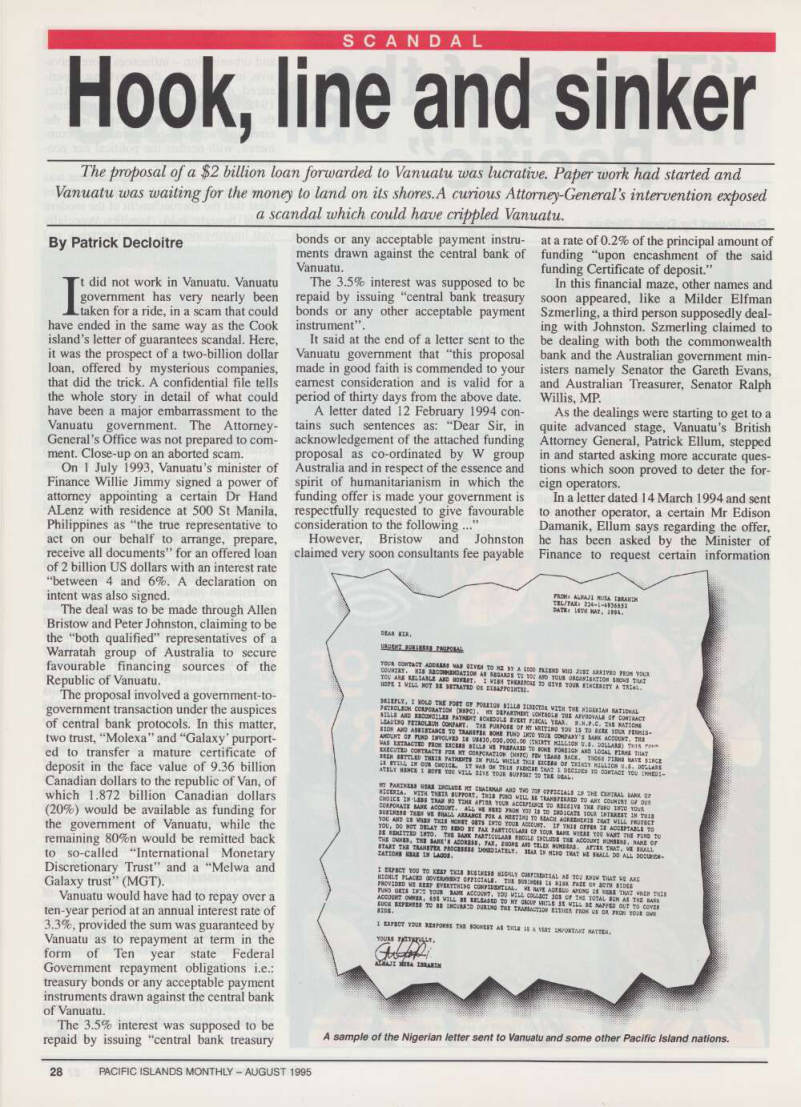
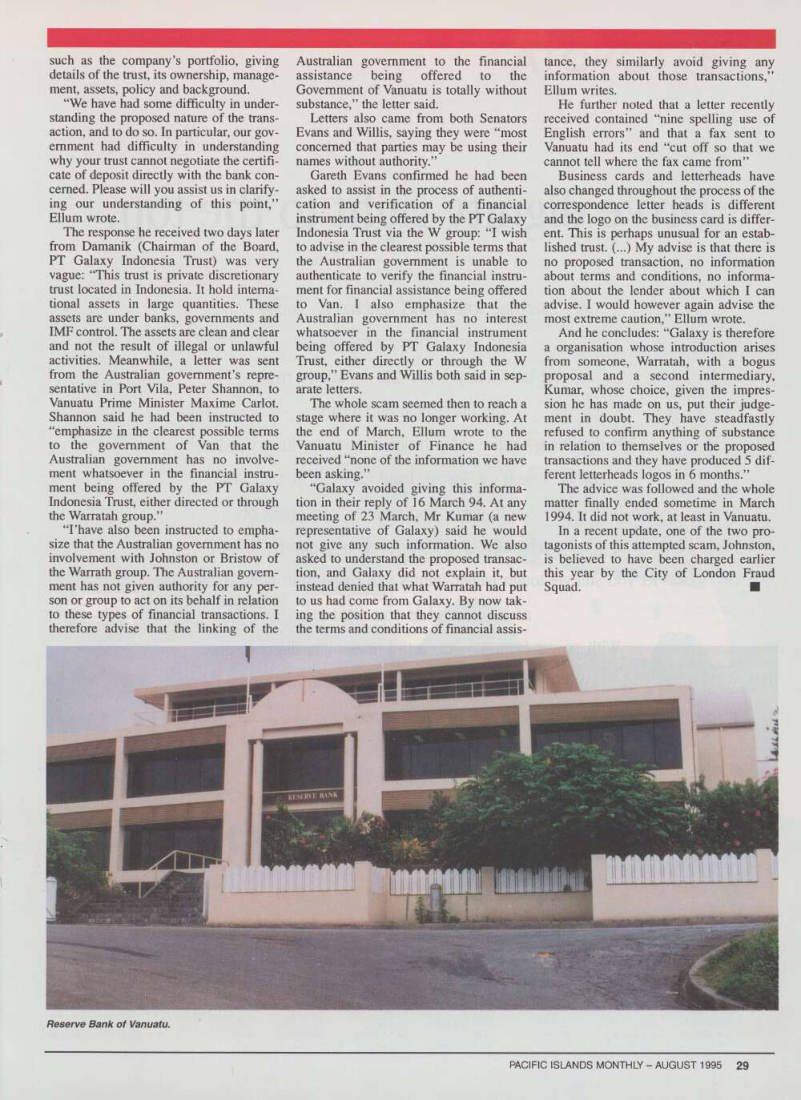
Scandal
The proposal of a $2 billion loan forwarded to Vanuatu was lucrative. Paper work had started and Vanuatu was waiting for the money to land on its shores. A curious Attorney-General’s intervention exposed a scandal which could have crippled Vanuatu.
By Patrick Decloitre
It did not work in Vanuatu. Vanuatu government has very nearly been taken for a ride, in a scam that could have ended in the same way as the Cook island’s letter of guarantees scandal. Here, it was the prospect of a two-billion dollar
loan, offered by mysterious companies,
that did the trick. A confidential file tells the whole story in detail of what could have been a major embarrassment to the Vanuatu government. The Attorney- General’s Office was not prepared to com ment. Close-up on an aborted scam.
On 1 July 1993, Vanuatu’s minister of Finance Willie Jimmy signed a power of attorney appointing a certain Dr Hand ALenz with residence at 500 St Manila, Philippines as “the true representative to act on our behalf to arrange, prepare, receive all documents” for an offered loan of 2 billion US dollars with an interest rate “between 4 and 6%. A declaration on intent was also signed.
The deal was to be made through Allen Bristow and Peter Johnston, claiming to be the “both qualified” representatives of a Warratah group of Australia to secure favourable financing sources of the Republic of Vanuatu.
The proposal involved a govemment-to govemment transaction under the auspices of central bank protocols. In this matter, two trust, “Molexa” and “Galaxy’ purport ed to transfer a mature certificate of deposit in the face value of 9.36 billion Canadian dollars to the republic of Van, of which 1.872 billion Canadian dollars (20%) would be available as funding for the government of Vanuatu, while the remaining 80%n would be remitted back to so-called “International Monetary Discretionary Trust” and a “Melwa and Galaxy trust” (MGT).
Vanuatu would have had to repay over a ten-year period at an annual interest rate of 3.3%, provided the sum was guaranteed by Vanuatu as to repayment at term in the form of Ten year state Federal Government repayment obligations i.e.; treasury bonds or any acceptable payment instruments drawn against the central bank of Vanuatu.
The 3 .5% interest was supposed to be
repaid by issuing “central bank treasury
bonds or any acceptable payment instruments drawn against the central bank of Vanuatu.
The 3.5% interest was supposed to be repaid by issuing “central bank treasury bonds or any other acceptable payment instrument”.
It said at the end of a letter sent to the Vanuatu government that “this proposal made in good faith is commended to your earnest consideration and is valid for a period of thirty days from the above date.
A letter dated 12 February 1994 contains such sentences as; “Dear Sir, in acknowledgement of the attached funding proposal as co-ordinated by W group Australia and in respect of the essence and spirit of humanitarianism in which the funding offer is made your government is respectfully requested to give favourable consideration to the following ...”
However, Bristow and Johnston claimed very soon consultants fee payable
at a rate of 0.2% of the principal amount of funding “upon encashment of the said funding Certificate of deposit.”
In this financial maze, other names and soon appeared, like a Milder Elfman Szmerling, a third person supposedly deal ing with Johnston. Szmerling claimed to be dealing with both the commonwealth bank and the Australian government min isters namely Senator the Gareth Evans, and Australian Treasurer, Senator Ralph Willis, MR As the dealings were starting to get to a quite advanced stage, Vanuatu’s British Attorney General, Patrick Ellum, stepped in and started asking more accurate ques tions which soon proved to deter the for eign operators.
In a letter dated 14 March 1994 and sent to another operator, a certain Mr Edison Damanik, Ellum says regarding the offer. he has been asked by the Minister of Finance to request certain information
A sample of the Nigerian letter sent to Vanuatu and some other Pacific Island nations.
such as the company’s portfolio, giving
details of the trust, its ownership, manage ment, assets, policy and background.
“We have had some difficulty in under standing the proposed nature of the trans action, and to do so. In particular, our gov ernment had difficulty in understanding why your trust cannot negotiate the certifi cate of deposit directly with the bank con cerned. Please will you assist us in clarify
ing our understanding of this point,”
Ellum wrote.
The response he received two days later from Damanik (Chairman of the Board, PT Galaxy Indonesia Trust) was very vague: “This trust is private discretionary trust located in Indonesia. It hold interna tional assets in large quantities. These assets are under banks, governments and IMF control. The assets are clean and clear and not the result of illegal or unlawful activities. Meanwhile, a letter was sent from the Australian government’s repre sentative in Port Vila, Peter Shannon, to Vanuatu Prime Minister Maxime Carlot.
Shannon said he had been instructed to “emphasize in the clearest possible terms to the government of Van that the Australian government has no involve ment whatsoever in the financial instru ment being offered by the PT Galaxy Indonesia Trust, either directed or through the Warratah group.”
“I’have also been instructed to empha size that the Australian government has no involvement with Johnston or Bristow of the Warrath group. The Australian govern ment has not given authority for any per son or group to act on its behalf in relation to these types of financial transactions. I therefore advise that the linking of the
Australian government to the financial assistance being offered to the Government of Vanuatu is totally without substance,” the letter said.
Letters also came from both Senators Evans and Willis, saying they were “most concerned that parties may be using their names without authority.”
Gareth Evans confirmed he had been asked to assist in the process of authenti cation and verification of a financial instrument being offered by the PT Galaxy Indonesia Trust via the W group: “I wish to advise in the clearest possible terms that the Australian government is unable to authenticate to verify the financial instru ment for financial assistance being offered to Van. I also emphasize that the Australian government has no interest whatsoever in the financial instrument being offered by PT Galaxy Indonesia Trust, either directly or through the W group,” Evans and Willis both said in sep arate letters.
The whole scam seemed then to reach a stage where it was no longer working. At the end of March, Ellum wrote to the Vanuatu Minister of Finance he had received “none of the information we have
been asking.”
“Galaxy avoided giving this informa tion in their reply of 16 March 94. At any meeting of 23 March, Mr Kumar (a new representative of Galaxy) said he would not give any such information. We also asked to understand the proposed transac tion, and Galaxy did not explain it, but instead denied that what Warratah had put to us had come from Galaxy. By now tak ing the position that they cannot discuss the terms and conditions of financial assis
tance, they similarly avoid giving any
information about those transactions,”
Ellum writes.
He further noted that a letter recently received contained “nine spelling use of English errors” and that a fax sent to Vanuatu had its end “cut off so that we cannot tell where the fax came from”
Business cards and letterheads have also changed throughout the process of the correspondence letter heads is different and the logo on the business card is differ ent. This is perhaps unusual for an estab lished trust. (...) My advise is that there is no proposed transaction, no information about terms and conditions, no informa tion about the lender about which I can advise. I would however again advise the most extreme caution,” Ellum wrote.
And he concludes: “Galaxy is therefore a organisation whose introduction arises from someone, Warratah, with a bogus proposal and a second intermediary, Kumar, whose choice, given the impres sion he has made on us, put their judge ment in doubt. They have steadfastly refused to confirm anything of substance in relation to themselves or the proposed transactions and they have produced 5 dif ferent letterheads logos in 6 months.”
The advice was followed and the whole matter finally ended sometime in March 1994. It did not work, at least in Vanuatu.
In a recent update, one of the two pro tagonists of this attempted scam, Johnston, is believed to have been charged earlier this year by the City of London Fraud
Squad. ■
Reserve Bank of Vanuatu.
Advertisements & other items, pp. 30-31 (1 item)
Drive dignity right to the top.
<Sg> TOYOTA
Everyone who knows cars has no doubts
about Land Cruiser’s ruggedness.
Yet how many know that its luxury rivals
the finest high-priced cars?
Or that it’s got more room inside than many luxury sedans?
And because it’s a Toyota, Land Cruiser’s fit and finish, attention to detail, and graceful form speak of
elegance as well as spacious comfort.
Yet you still get tough ladder frames and suspension built to take you as far off road as you want to go.
With power from 4.5-litre petrol or 4.2-litre diesel engines.
And it’s carefully protected from rust to last longer.
So if you’re going right to the top, this dignified car is ready to take you.
LAND CRUISER
PH 384888 PH 275562 PH 234-5911 PH 23500
DISTRIBUTORS/DEALERS
AMERICAN SAMOA BURNS PHILP MOTORS PH 633-4281 GUAM & MICRONESIA ...ATKINS KROLL, INC. PH 646-1876/9 NORFOLK ISLAND BORRY’S PTY LTD. PH 22114
SOLOMON ISLAND ELA MOTORS PH 30314
VANUATU ASCO MOTORS PH 22341
COOK ISLANDS PACIFIC MOTORS LTD. PH 20796
KIRIBATI TARAWA MOTORS PH 21090
PAPUA NEW GUINEA ELA MOTORS PH 3229400
TAHITI NIPPON AUTOMOTO PH 429819
WESTERN SAMOA ASCO MOTORS PH 20800
FIJI ASCO MOTORS
NEW CALEDONIA S.I.A.P.
SAIPAN MICROL CORPORATION
TONGA ASCO MOTORS
lliii ■ . M I |: m mi* mm ♦
LAND
CRUISER
LAWO CROISEfi
c ' .*- % sb» *• f
should talk
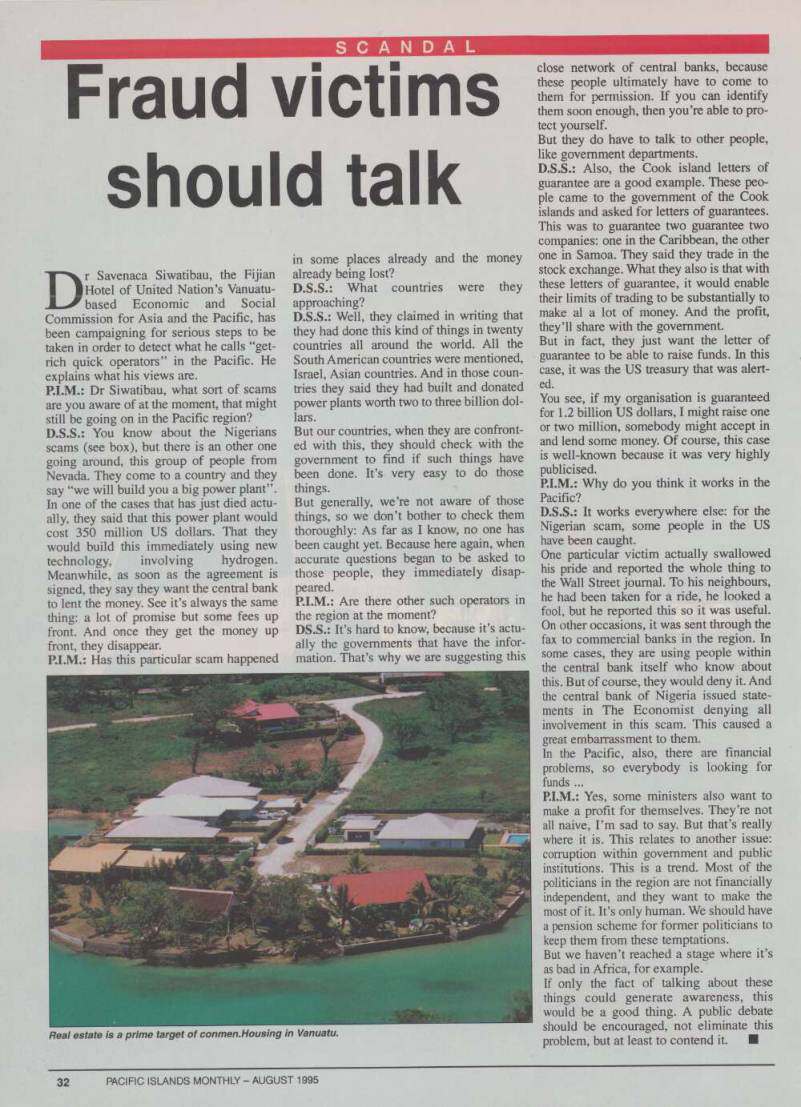
Fraud victims should talk
Dr Savenaca Siwatibau, the Fijian Hotel of United Nation’s Vanuatu based Economic and Social Commission for Asia and the Pacific, has been campaigning for serious steps to be taken in order to detect what he calls “get rich quick operators” in the Pacific. He explains what his views are.
P.1.M.: Dr Siwatibau, what sort of scams are you aware of at the moment, that might still be going on in the Pacific region?
D.S.S.: You know about the Nigerians scams (see box), but there is an other one going around, this group of people from Nevada. They come to a country and they say “we will build you a big power plant”.
In one of the cases that has just died actu ally, they said that this power plant would cost 350 million US dollars. That they would build this immediately using new technology, involving hydrogen.
Meanwhile, as soon as the agreement is signed, they say they want the central bank to lent the money. See it’s always the same thing: a lot of promise but some fees up front. And once they get the money up front, they disappear.
P.1.M.: Has this particular scam happened
in some places already and the money
already being lost?
D.S.S.: What countries were they
approaching?
D.S.S.: Well, they claimed in writing that they had done this kind of things in twenty countries all around the world. All the South American countries were mentioned, Israel, Asian countries. And in those coun tries they said they had built and donated power plants worth two to three billion dol lars.
But our countries, when they are confront ed with this, they should check with the government to find if such things have been done. It’s very easy to do those
things.
But generally, we’re not aware of those things, so we don’t bother to check them thoroughly: As far as I know, no one has been caught yet. Because here again, when accurate questions began to be asked to those people, they immediately disap
peared.
P.1.M.: Are there other such operators in the region at the moment?
DS.S.: It’s hard to know, because it’s actu ally the governments that have the infor mation. That’s why we are suggesting this
close network of central banks, because these people ultimately have to come to them for permission. If you can identify them soon enough, then you’re able to pro
tect yourself.
But they do have to talk to other people, like government departments.
D.S.S.: Also, the Cook island letters of guarantee are a good example. These peo ple came to the government of the Cook islands and asked for letters of guarantees.
This was to guarantee two guarantee two companies: one in the Caribbean, the other one in Samoa. They said they trade in the stock exchange. What they also is that with these letters of guarantee, it would enable their limits of trading to be substantially to make al a lot of money. And the profit, they’ll share with the government.
But in fact, they just want the letter of guarantee to be able to raise funds. In this case, it was the US treasury that was alert ed.
You see, if my organisation is guaranteed for 1.2 billion US dollars, I might raise one or two million, somebody might accept in and lend some money. Of course, this case is well-known because it was very highly
publicised.
P.1.M.: Why do you think it works in the Pacific?
D.S.S.: It works everywhere else: for the Nigerian scam, some people in the US have been caught.
One particular victim actually swallowed his pride and reported the whole thing to the Wall Street journal. To his neighbours, he had been taken for a ride, he looked a fool, but he reported this so it was useful.
On other occasions, it was sent through the fax to commercial banks in the region. In some cases, they are using people within the central bank itself who know about this. But of course, they would deny it. And the central bank of Nigeria issued state ments in The Economist denying all involvement in this scam. This caused a great embarrassment to them.
In the Pacific, also, there are financial problems, so everybody is looking for funds ...
P.1.M.: Yes, some ministers also want to make a profit for themselves. They’re not all naive, I’m sad to say. But that’s really where it is. This relates to another issue: corruption within government and public institutions. This is a trend. Most of the politicians in the region are not financially independent, and they want to make the most of it. It’s only human. We should have a pension scheme for former politicians to keep them from these temptations.
But we haven’t reached a stage where it’s as bad in Africa, for example.
If only the fact of talking about these things could generate awareness, this would be a good thing. A public debate should be encouraged, not eliminate this problem, but at least to contend it. ■
Real estate is a prime target of conmen. Housing in Vanuatu.
Masterplans to defraud
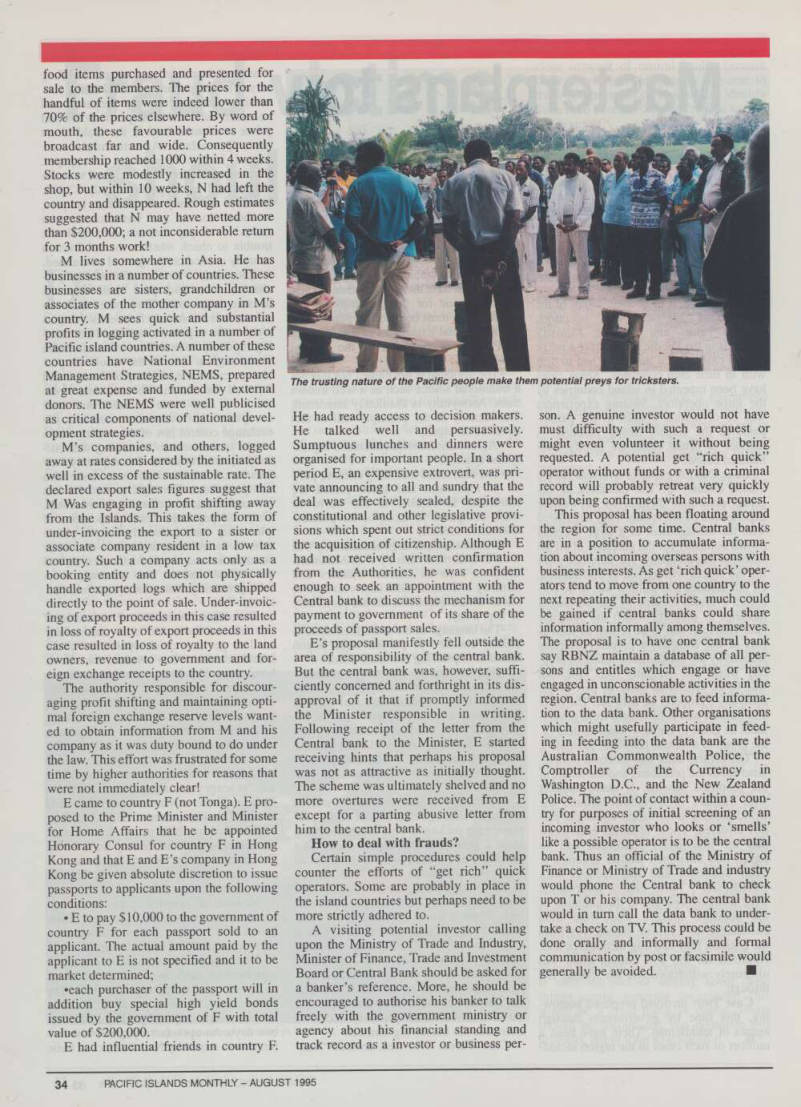
defraud
Central bankers. Commercial bankers. Accounting and Legal Firms, officials of the Ministries of Finance, Trade and Industry and the police, by the nature of their work, are generally the first to become aware of the presence of ‘get rich quick’ operators.
Central banks and Finance Ministry Officials in the Pacific region have a range of past cases which they have had to deal with in their own countries.. Some cases have been repeated in island countries by the same operators. Sharing experiences will be of mutual benefit to the partici pants at the Expert Group Meeting. A number of actual cases are briefly sum marised below: Case One: A group of overseas people visited country Q. The members of this group presented themselves as wealthy experienced businessmen. They negotiated with the management of a large overseas owned company for the purchase of all the shares in that company. The purchase price for the shares was agreed at $6O million.
Of this amount $3O million was to be bor rowed overseas secured by the substantial holdings of property which the company had. This loan was to be retired as soon as part of the company’s property overseas secured by the substantial holding of prop erty which the company had. This loan was to be retired as soon as part of the company’s property be sold off. The other $3O million was to be sought from govern ment as grant to the new shareholders i.e. the group of overseas people of promoters.
The central bank had extreme reserva tions about the promoters and the nature of the proposed scheme. It made contacts with various organisations around the world seeking information about the par ties involved. These inquiries established that the individuals concerned had no funds, had attempted similar schemes in other countries and had records with INTERPOL . These bits of information were formally brought to the attention of the decision makers who were than encouraged to extricate themselves from the position they had dug themselves into.
Approval for the $3O million grant was ultimately withdrawn and the scheme fell through.
Case Two: involved proposed borrow ing, this time by governments through agents or middleman. There have been a number of such cases in the region includ
ing well publicised cases in Australia and New Zealand. But the pattern in the same.
The standard approach of the loan mid dleman is predictable: •He must have the sole mandate to raise external loans for the government. His appointment must be made on paper bear ing the official letter head of the Minister of Finance or Governor of the Central Bank; •The principal is not named but it is not a traditional source such as a well known bank. Anonymity is absolutely important.
The identify of the principal will in fact never be divulged; • Agreement must be concluded urgent ly and quickly; •The loan terms including interest, peri od of repayment and grace period are extremely favourable to the borrower when compared to those of all possible alternative sources; •Discussions and negotiations they will wish to undertake directly with Ministers.
Officials such as Central bankers and Ministry of Finance Officials, who tend to ask awkward questions, should preferably be kept away; •The language of the draft documents is usually couched in pseudo legal jargon aimed at impressing the uninitiated; • The fees for the services provided by the middleman/loan arranger has to be paid up front i.e. before any real work is done. Such fees may go up to 5% of the proposed loan amount. Since the loan amounts bandied about in discussions are usually of the order of hundreds of mil lions the front end fees requested are sub stantial; • Recently middlemen have started talking of sinking funds as part of the pro posed loan packages. This involves setting aside a portion of the loan proceed as a Sinking Fund which will be invested at extremely favourable terms. The income of the Sinking Fund, the middleman will claim, will be sufficient to service the total loan. In other words the amount set aside in the Sinking Fund will effectively be a grant to the borrowing government!
Actually such claims are invariably unworkable. If the very favourable invest ment opportunities of the kind in which the Sinking Fund is to be invested do exist, the middleman would probably decide to undertake the borrowing himself.
Case Three: Two well dressed ‘busi
nessman’ descended on country M. They stayed in an up market hotel. In their pos session were attractively prepared and colourful subdivision maps of choice and prime residential land in the Gold Coast area, Queensland. Advertisements were placed in the local daily newspaper.
Purchasers of plots were required to make contact and pay deposits of only $2,500.
None of the many accountants, lawyers, teachers, doctors and businessmen who rushed in to pay their deposits took the trouble to check whether the subdivision actually existed on the ground as claimed.
Ultimately a number of would-be pur chasers who had paid their deposits became suspicious. They noted that the salesmen were staying for weeks living in style at the expensive hotel and commut ing regularly to and from other countries in the region. One of the would be pur chasers called the Ministry of Finance and reported the matter. The salesman were called in and were advised that their acceptance of deposits violated the exchange control law of the country since it was tantamount to borrowing domesti
cally by non-residents. Consequently they
must return all the deposits to those who had paid them. The legal ground for this instruction was not tested by the salesmen.
They did pay back small proportions of
what they had collected. Simple phone
calls to the relevant authorities and other contacts around the Gold Coast area had established that the two salesmen were selling nothing more than paper subdivi sions!
Case Four: A number of variations of this scheme have also been successfully tried to get rich quick operations in the island countries. One involved the sale of bonds issued by the government of a South American Country! The fake bonds were colourful and attractively printed. The fake bonds, it appeared sold like ‘hot cakes’.
More than $lOO,OOO later the overseas
bond salesman, departed hurriedly leaving
their local associates to answer to the irate buyers and to the authorities. Recently a similar scam was successfully executed in Manila. There a Manila based fdm sold Peso 900 million, about U 5533.3 million, of fake treasury bills to two local banks!
The Governor of the Central Bank of the Philippines, whom the media requested to comment upon the indecent said, “There is now law to prevent suckers.”
National of country E, resident over seas, returns to establish a shopping chain.
Prices in N’s shops, he announced, were to be less than 70% of prices elsewhere in E. But only people who have purchased membership cards in the chain of shops will be allowed to buy from the chain. The membership fee was set at $250. Fifty members signed up and paid up in the first two days. An open factory space with low rental was rented by N and stocks of basic
food items purchased and presented for sale to the members. The prices for the handful of items were indeed lower than 70% of the prices elsewhere. By word of mouth, these favourable prices were broadcast far and wide. Consequently membership reached 1000 within 4 weeks.
Stocks were modestly increased in the shop, but within 10 weeks, N had left the country and disappeared. Rough estimates suggested that N may have netted more than $200,000; a not inconsiderable return for 3 months work!
M lives somewhere in Asia. He has businesses in a number of countries. These businesses are sisters, grandchildren or associates of the mother company in M’s country. M sees quick and substantial profits in logging activated in a number of Pacific island countries. A number of these countries have National Environment
Management Strategies, NEMS, prepared
at great expense and funded by external donors. The NEMS were well publicised as critical components of national devel
opment strategies.
M’s companies, and others, logged away at rates considered by the initiated as well in excess of the sustainable rate. The declared export sales figures suggest that M Was engaging in profit shifting away from the Islands. This takes the form of under-invoicing the export to a sister or associate company resident in a low tax country. Such a company acts only as a booking entity and does not physically handle exported logs which are shipped directly to the point of sale. Under-invoic ing of export proceeds in this case resulted in loss of royalty of export proceeds in this case resulted in loss of royalty to the land owners, revenue to government and for eign exchange receipts to the country.
The authority responsible for discour
aging profit shifting and maintaining opti
mal foreign exchange reserve levels want ed to obtain information from M and his company as it was duty bound to do under the law. This effort was frustrated for some time by higher authorities for reasons that were not immediately clear!
E came to country F (not Tonga). E pro posed to the Prime Minister and Minister for Home Affairs that he be appointed Honorary Consul for country F in Hong Kong and that E and E’s company in Hong Kong be given absolute discretion to issue passports to applicants upon the following conditions: • E to pay $lO,OOO to the government of country F for each passport sold to an applicant. The actual amount paid by the applicant to E is not specified and it to be market determined; •each purchaser of the passport will in
addition buy special high yield bonds
issued by the government of F with total value of $200,000.
E had influential friends in country F.
He had ready access to decision makers.
He talked well and persuasively.
Sumptuous lunches and dinners were organised for important people. In a short period E, an expensive extrovert, was pri vate announcing to all and sundry that the deal was effectively sealed, despite the constitutional and other legislative provi sions which spent out strict conditions for
the acquisition of citizenship. Although E
had not received written confirmation from the Authorities, he was confident enough to seek an appointment with the Central bank to discuss the mechanism for payment to government of its share of the proceeds of passport sales.
E’s proposal manifestly fell outside the area of responsibility of the central bank.
But the central bank was, however, suffi ciently concerned and forthright in its dis approval of it that if promptly informed the Minister responsible in writing.
Following receipt of the letter from the Central bank to the Minister, E started receiving hints that perhaps his proposal was not as attractive as initially thought.
The scheme was ultimately shelved and no more overtures were received from E except for a parting abusive letter from him to the central bank.
How to deal with frauds?
Certain simple procedures could help counter the efforts of “get rich” quick operators. Some are probably in place in the island countries but perhaps need to be more strictly adhered to.
A visiting potential investor calling
upon the Ministry of Trade and Industry, Minister of Finance, Trade and Investment Board or Central Bank should be asked for a banker’s reference. More, he should be encouraged to authorise his banker to talk freely with the government ministry or agency about his financial standing and track record as a investor or business per
son. A genuine investor would not have must difficulty with such a request or might even volunteer it without being
requested. A potential get “rich quick”
operator without funds or with a criminal record will probably retreat very quickly upon being confirmed with such a request.
This proposal has been floating around the region for some time. Central banks are in a position to accumulate informa tion about incoming overseas persons with business interests. As get ‘rich quick’ oper ators tend to move from one country to the next repeating their activities, much could be gained if central banks could share information informally among themselves.
The proposal is to have one central bank say RBNZ maintain a database of all per sons and entitles which engage or have engaged in unconscionable activities in the region. Central banks are to feed informa tion to the data bank. Other organisations
which might usefully participate in feed
ing in feeding into the data bank are the Australian Commonwealth Police, the Comptroller of the Currency in Washington D.C., and the New Zealand Police. The point of contact within a coun try for purposes of initial screening of an incoming investor who looks or ‘smells’ like a possible operator is to be the central bank. Thus an official of the Ministry of Finance or Ministry of Trade and industry would phone the Central bank to check upon T or his company. The central bank would in turn call the data bank to under take a check on TV. This process could be done orally and informally and formal communication by post or facsimile would generally be avoided. ■
The trusting nature of the Pacific people make them potential preys for tricksters.
South Sea schizophrenia
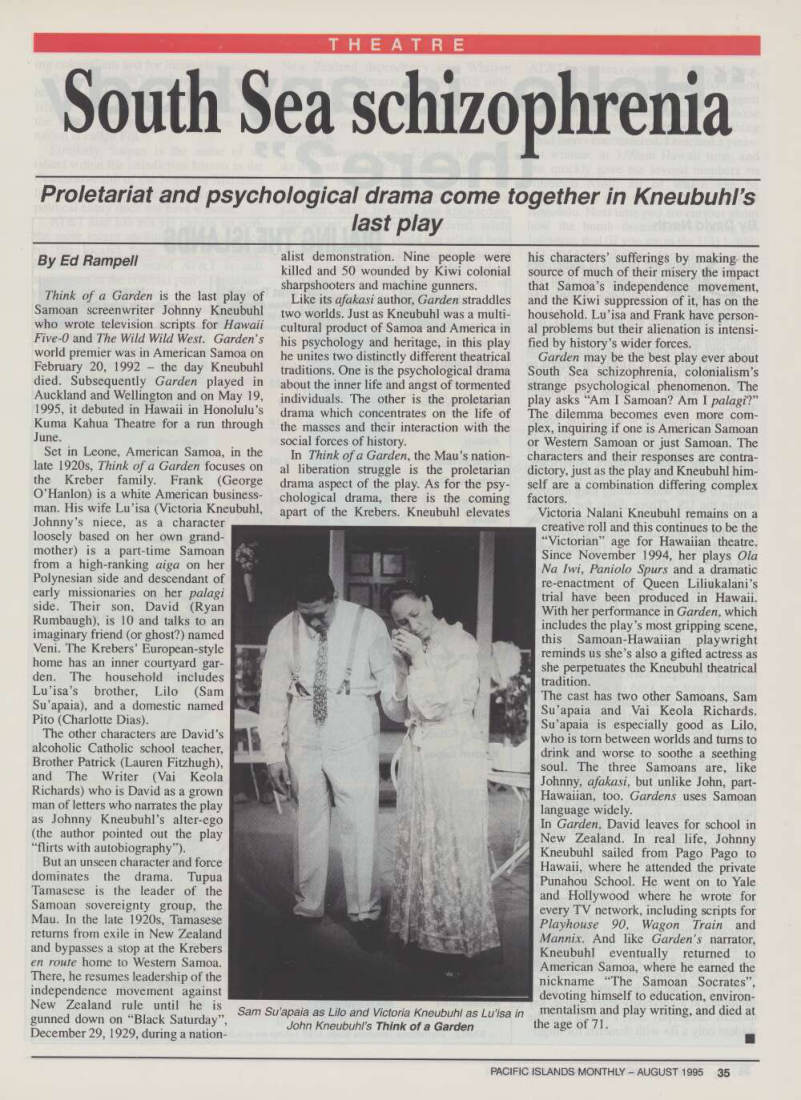
Proletariat and psychological drama come together in Kneubuhl’s last play
By Ed Rampell
Think of a Garden is the last play of Samoan screenwriter Johnny Kneubuhl who wrote television scripts for Hawaii Five-0 and The Wild Wild West. Garden’s world premier was in American Samoa on February 20, 1992 - the day Kneubuhl died. Subsequently Garden played in Auckland and Wellington and on May 19, 1995, it debuted in Hawaii in Honolulu’s Kuma Kahua Theatre for a run through June.
Set in Leone, American Samoa, in the late 19205, Think of a Garden focuses on the Kreber family. Frank (George O’Hanlon) is a white American business man. His wife Lu’isa (Victoria Kneubuhl,
Johnny’s niece, as a character loosely based on her own grand mother) is a part-time Samoan from a high-ranking alga on her Polynesian side and descendant of early missionaries on her palagi side. Their son, David (Ryan Rumbaugh), is 10 and talks to an imaginary friend (or ghost?) named Veni. The Krebers’ European-style home has an inner courtyard gar den. The household includes Lu’isa’s brother, Lilo (Sam Su’apaia), and a domestic named Pito (Charlotte Dias).
The other characters are David’s alcoholic Catholic school teacher.
Brother Patrick (Lauren Fitzhugh), and The Writer (Vai Keola Richards) who is David as a grown man of letters who narrates the play as Johnny Kneubuhl’s alter-ego (the author pointed out the play “flirts with autobiography”).
But an unseen character and force dominates the drama. Tupua Tamasese is the leader of the Samoan sovereignty group, the Mau. In the late 19205, Tamasese returns from exile in New Zealand and bypasses a stop at the Krebers en route home to Western Samoa.
There, he resumes leadership of the
independence movement against
New Zealand rule until he is gunned down on “Black Saturday”, December 29,1929, during a nation
alist demonstration. Nine people were killed and 50 wounded by Kiwi colonial sharpshooters and machine gunners.
Like its afakasi author. Garden straddles two worlds. Just as Kneubuhl was a multi cultural product of Samoa and America in his psychology and heritage, in this play he unites two distinctly different theatrical traditions. One is the psychological drama about the inner life and angst of tormented individuals. The other is the proletarian drama which concentrates on the life of the masses and their interaction with the social forces of history.
In Think of a Garden, the Mau’s nation al liberation struggle is the proletarian drama aspect of the play. As for the psy chological drama, there is the coming apart of the Krebers. Kneubuhl elevates
his characters’ sufferings by making the
source of much of their misery the impact that Samoa’s independence movement, and the Kiwi suppression of it, has on the household. Lu’isa and Frank have person al problems but their alienation is intensi fied by history’s wider forces.
Garden may be the best play ever about South Sea schizophrenia, colonialism’s
strange psychological phenomenon. The
play asks “Am I Samoan? Am I palagiT The dilemma becomes even more com plex, inquiring if one is American Samoan or Western Samoan or just Samoan. The characters and their responses are contra dictory, just as the play and Kneubuhl him self are a combination differing complex factors.
Victoria Nalani Kneubuhl remains on a
■ creative roll and this continues to be the I “Victorian” age for Hawaiian theatre.
I Since November 1994, her plays Ola I Na Iwi, Paniolo Spurs and a dramatic I re-enactment of Queen Liliukalani’s I trial have been produced in Hawaii.
I With her performance in Garden, which I includes the play’s most gripping scene, I this Samoan-Hawaiian playwright I reminds us she’s also a gifted actress as I she perpetuates the Kneubuhl theatrical I tradition.
The cast has two other Samoans, Sam Su’apaia and Vai Keola Richards.
Su’apaia is especially good as Lilo, who is tom between worlds and turns to drink and worse to soothe a seething soul. The three Samoans are, like Johnny, afakasi, but unlike John, part- Hawaiian, too. Gardens uses Samoan language widely.
In Garden, David leaves for school in New Zealand. In real life, Johnny Kneubuhl sailed from Pago Pago to Hawaii, where he attended the private Punahou School. He went on to Yale and Hollywood where he wrote for every TV network, including scripts for Playhouse 90, Wagon Train and Mannix. And like Garden’s narrator, Kneubuhl eventually returned to American Samoa, where he earned the nickname “The Samoan Socrates”, devoting himself to education, environ mentalism and play writing, and died at the age of 71.
Sam Su’apaia as Lilo and Victoria Kneubuhl as Lu’isa in John Kneubuhl’s Think of a Garden
“Hello, is anybody
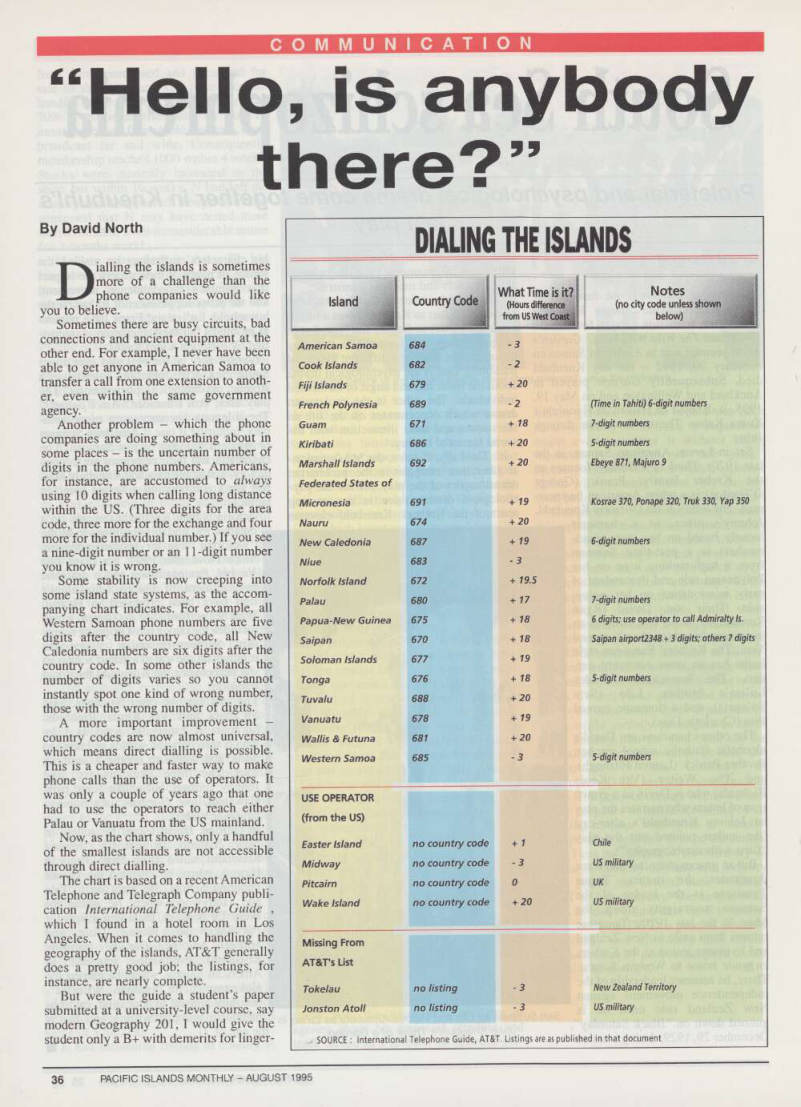
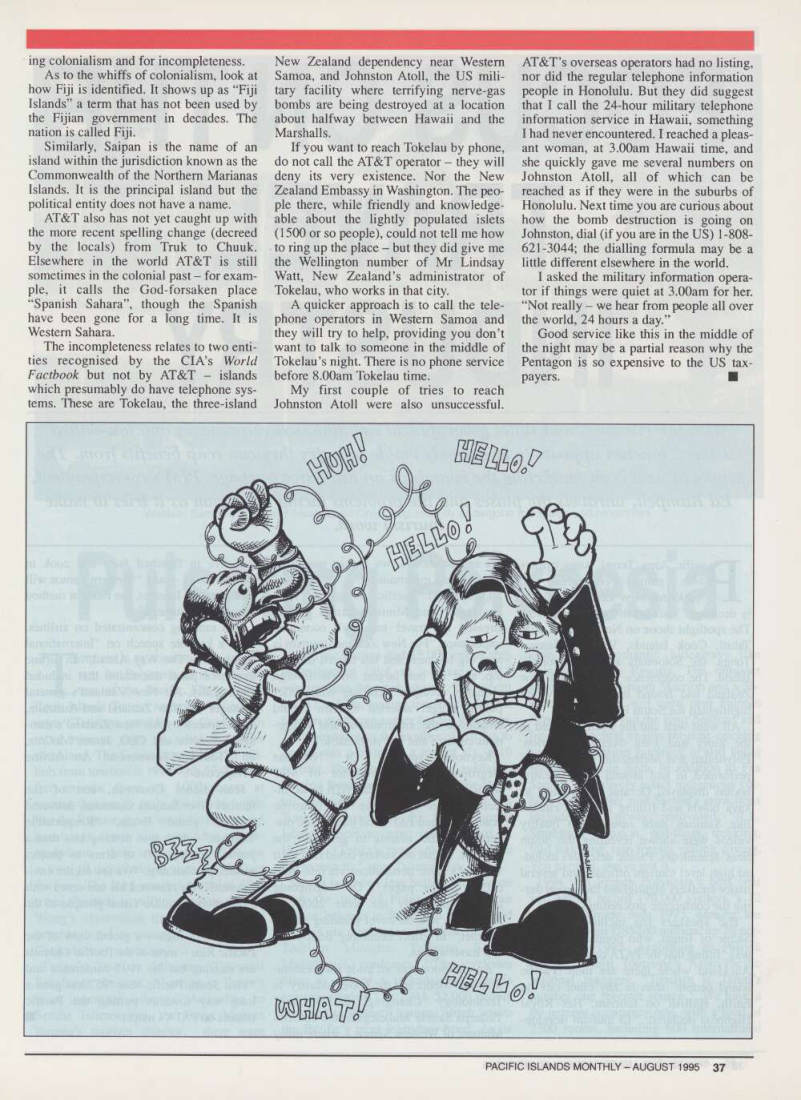
Communication
“Hello, is anybody there?”
By David North
Dialling the islands is sometimes more of a challenge than the
phone companies would like
you to believe.
Sometimes there are busy circuits, bad connections and ancient equipment at the other end. For example, I never have been able to get anyone in American Samoa to transfer a call from one extension to anoth er, even within the same government agency.
Another problem - which the phone
companies are doing something about in
some places - is the uncertain number of digits in the phone numbers. Americans, for instance, are accustomed to always using 10 digits when calling long distance within the US. (Three digits for the area code, three more for the exchange and four more for the individual number.) If you see a nine-digit number or an 11-digit number you know it is wrong.
Some stability is now creeping into some island state systems, as the accom panying chart indicates. For example, all Western Samoan phone numbers are five digits after the country code, all New Caledonia numbers are six digits after the country code. In some other islands the number of digits varies so you cannot instantly spot one kind of wrong number, those with the wrong number of digits.
A more important improvement country codes are now almost universal, which means direct dialling is possible.
This is a cheaper and faster way to make phone calls than the use of operators. It was only a couple of years ago that one had to use the operators to reach either Palau or Vanuatu from the US mainland.
Now, as the chart shows, only a handful of the smallest islands are not accessible
through direct dialling.
The chart is based on a recent American
Telephone and Telegraph Company publi
cation International Telephone Guide , which I found in a hotel room in Los Angeles. When it comes to handling the geography of the islands, AT&T generally does a pretty good job; the listings, for
instance, are nearly complete.
But were the guide a student’s paper submitted at a university-level course, say modem Geography 201, I would give the student only a B+ with demerits for linger
ing colonialism and for incompleteness.
As to the whiffs of colonialism, look at how Fiji is identified. It shows up as “Fiji Islands” a term that has not been used by the Fijian government in decades. The nation is called Fiji.
Similarly, Saipan is the name of an island within the jurisdiction known as the Commonwealth of the Northern Marianas Islands. It is the principal island but the political entity does not have a name.
AT&T also has not yet caught up with the more recent spelling change (decreed by the locals) from Truk to Chuuk, Elsewhere in the world AT&T is still sometimes in the colonial past - for exampie, it calls the God-forsaken place “Spanish Sahara”, though the Spanish have been gone for a long time. It is Western Sahara.
The incompleteness relates to two entities recognised by the ClA’s World Factbook but not by AT&T - islands which presumably do have telephone systerns. These are Tokelau, the three-island
New Zealand dependency near Western Samoa, and Johnston Atoll, the US mili tary facility where terrifying nerve-gas bombs are being destroyed at a location about halfway between Hawaii and the Marshalls.
If you want to reach Tokelau by phone, do not call the AT&T operator - they will deny its very existence. Nor the New Zealand Embassy in Washington. The peo
pie there, while friendly and knowledge
able about the lightly populated islets (1500 or so people), could not tell me how to ring up the place - but they did give me the Wellington number of Mr Lindsay Watt, New Zealand’s administrator of Tokelau, who works in that city.
A quicker approach is to call the tele phone operators in Western Samoa and they will try to help, providing you don’t want to talk to someone in the middle of Tokelau’s night. There is no phone service before B.ooam Tokelau time.
My first couple of tries to reach Johnston Atoll were also unsuccessful.
AT&T’s overseas operators had no listing, nor did the regular telephone information people in Honolulu. But they did suggest that I call the 24-hour military telephone information service in Hawaii, something I had never encountered. I reached a pleas ant woman, at 3.00 am Hawaii time, and she quickly gave me several numbers on Johnston Atoll, all of which can be reached as if they were in the suburbs of Honolulu. Next time you are curious about how the bomb destruction is going on Johnston, dial (if you are in the US) 1-808- 621-3044; the dialling formula may be a little different elsewhere in the world.
I asked the military information opera tor if things were quiet at 3.00 am for her.
“Not really - we hear from people all over the world, 24 hours a day.”
Good service like this in the middle of the night may be a partial reason why the Pentagon is so expensive to the US tax payers. ■
Dialing The Islands
Island
Country Code S
What Time is it?
(Hours difference from US West Coast Notes (no city code unless shown 1 below) American Samoa 684 - 3 Cook Islands 682 - 2
Fiji Islands
679 + 20
French Polynesia
689 -2 (Time in Tahiti) 6-digit numbers Guam 671 + 18
7-digit numbers
Kiribati 686 + 20 5-digit numbers Marshall Islands 692 + 20
Ebeye 871, Majuro 9
Federated States of Micronesia 691 + 19 Kosrae 370, Ponape 320, Truk 330, Yap 350 Nauru 674 + 20 New Caledonia 687 + 19
6-digit numbers
Niue 683 -3 Norfolk Island 672 + 19.5 Palau 680 + 17
7-digit numbers
Papua-New Guinea 675 + 18 6 digits; use operator to call Admiralty Is.
Saipan 670 + 18 Saipan airport2348 + 3 digits; others 7 digits Soloman Islands 677 + 19 Tonga 676 + 18
5-digit numbers
Tuvalu 688 + 20 Vanuatu 678 + 19 Wallis & Futuna 681 + 20 Western Samoa 685 -3
5-digit numbers
Use Operator
(from the US) Easter Island no country code + 1 Chile Midway no country code -3 US military Pitcairn no country code 0 UK Wake Island no country code + 20
US military
Missing From
AT&T's List Tokelau no listing -3 New Zealand Territory Jonston Atoll
no listing
-3
US military
SOURCE: International Telephone Guide, AT&T. Listings are as published in that document
Focus On The
Tourism
Travel
Industry
With the PAcific island states geographical isolation , scarce resources and low-skilled workers , tourism appears to be the only viable industry they can reap benefits from. The emphasis now is on marketing the islands as an attractive package. PI M's correspondent, Ed Rampell , unravels the pluses and the problems facing the region as it tries to make tourism work.
Pacific Area Travel Association’s 44th annual conference in Auckland, New Zealand, official ly declared “Visit South Pacific Year ’95”.
The spotlight shone on New Zealand, Fiji, Tahiti, Cook Islands, Vanuatu, Samoa, Tonga, the Solomons and even Norfolk Island. The conference was the fifth New Zealand had hosted but the first which highlighted the South Pacific.
All went well and the Pacific basked in the glory and long overdue attention.
Polynesian and Melanesian dance groups performed in and around Aotea Centre, booths displayed Oceanic decor, such as kava bowls and fishing nets and cuisine like Samoan palu sami. High quality videos were shown revealing the South Seas’ splendours. Pacific delegates includ ed high level tourism officials and several major speakers highlighted the region dur ing the conference proceedings.
The speakers list included Princess Salote of Tonga, who pointed out that it was “fitting that the PATA conference is in Auckland where there are more Pacific island people” than in any other city on Earth. Bullish on tourism. Her Royal Highness declared: “To tourism develop
ers and promoters, we entrust our gems into the next millennium.”
Like most Pacific delegates. New Zealand Prime Minister James Bolger stressed the travel industry’s economic importance. “For New Zealand, tourism is now big business and has moved into the top spot as our largest single foreign exchange receipts.” Keeping with PATA policy, Bolger asserted tourism should emphasise the environment and indige nous cultures and be “sustainable”.
Keynote speaker Dr Nicholas Negroponte, founder/director of MIT Media Lab, USA, brought PATA to the hi tech realm of cyberspace. The futuristic academic urged PATA and the distant, dis persed Pacific islands to get onto the Internet, so that net surfers could find their way to Oceanic destinations via info-hubs called “home pages”. Dr Negroponte boasted that “by the year 2000 all Americans will do travel planning on the Internet,” in effect becoming do-it-your self travel agents.
An afternoon was set aside for presenta tions on “Media and the Travel Industry; Is Technology Changing the Game?”
Tuilaepa Sailele Malielegaoi, the Tourism Minister of Western Samoa - where many
still live in thatched fales and cook in earthen umus - said: “Western Samoa will tack onto the Internet, the modem method to reach consumers.”
One morning concentrated on airlines, with a keynote speech on “International Transport - The Way Ahead,” an airline executive panel discussion that included Grant Lilly, Air New Zealand’s general manager for New Zealand and Australia, and a speech by Air New Zealand’s man aging director and CEO, James McCrea, on “Tourism Investment: An Airline
Perspective”.
Jean-Michel Cousteau, son of the famous diver Jacques Cousteau, delivered
PATA’s grand finale, “Responsible
Tourism,” which was nothing less than a poetic, stirring call to arms to protect nature, proclaiming, “We are all the envi ronment”. He crowned his eco-creed with a breathtaking audio-visual glimpse of the underwater world.
In PATA’s logo - a global view of the Pacific Rim - most of the Pacific’s islands are missing but the 1995 conference and “Visit South Pacific Year ’95” has gone a long way towards putting the Pacific islands on PATA’s map. ■
Pulsating Polynesia
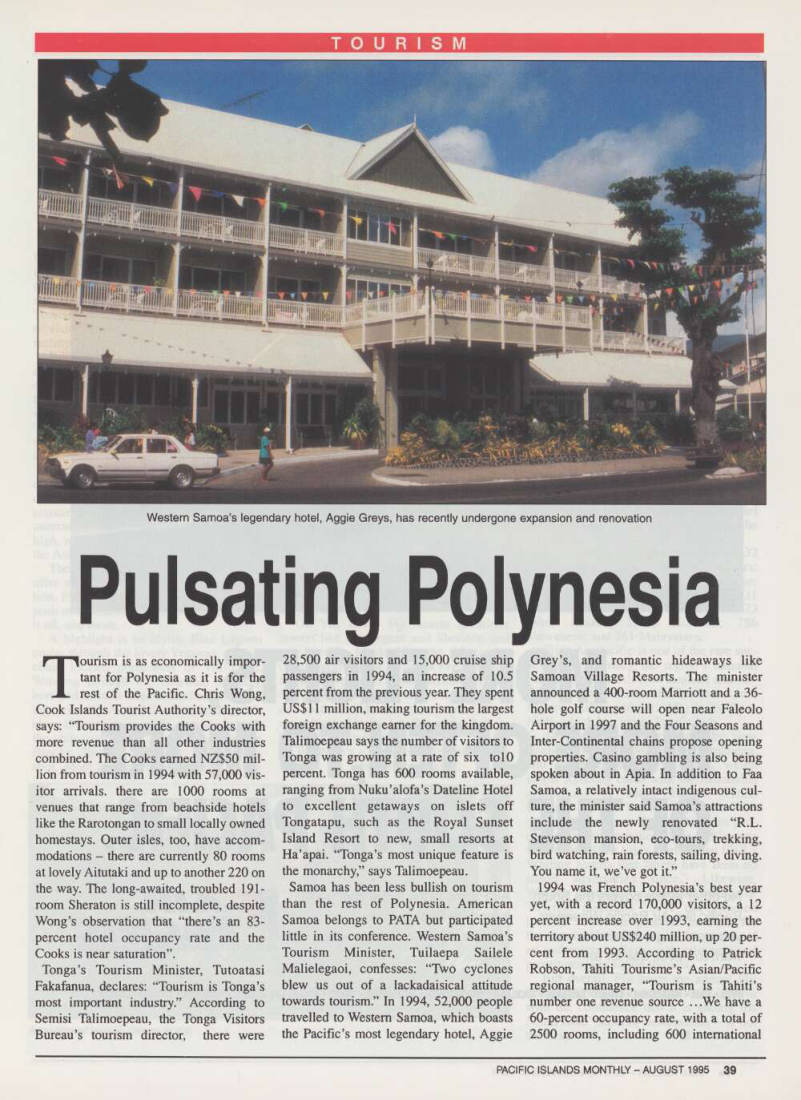
Tourism
Tourism is as economically impor tant for Polynesia as it is for the rest of the Pacific. Chris Wong, Cook Islands Tourist Authority’s director, says: “Tourism provides the Cooks with more revenue than all other industries combined. The Cooks earned NZ$5O mil lion from tourism in 1994 with 57,000 vis itor arrivals, there are 1000 rooms at venues that range from beachside hotels like the Rarotongan to small locally owned homestays. Outer isles, too, have accom modations - there are currently 80 rooms at lovely Aitutaki and up to another 220 on the way. The long-awaited, troubled 191room Sheraton is still incomplete, despite Wong’s observation that “there’s an 83percent hotel occupancy rate and the Cooks is near saturation”.
Tonga’s Tourism Minister, Tutoatasi Fakafanua, declares: “Tourism is Tonga’s most important industry.” According to Semisi Talimoepeau, the Tonga Visitors Bureau’s tourism director, there were
28,500 air visitors and 15,000 cruise ship passengers in 1994, an increase of 10.5 percent from the previous year. They spent US$ll million, making tourism the largest foreign exchange earner for the kingdom.
Talimoepeau says the number of visitors to Tonga was growing at a rate of six to 10 percent. Tonga has 600 rooms available, ranging from Nukualofa’s Dateline Hotel to excellent getaways on islets off Tongatapu, such as the Royal Sunset Island Resort to new, small resorts at Ha’apai. “Tonga’s most unique feature is the monarchy,” says Talimoepeau.
Samoa has been less bullish on tourism than the rest of Polynesia. American Samoa belongs to PATA but participated little in its conference. Western Samoa’s Tourism Minister, Tuilaepa Sailele Malielegaoi, confesses; “Two cyclones blew us out of a lackadaisical attitude towards tourism.” In 1994, 52,000 people travelled to Western Samoa, which boasts the Pacific’s most legendary hotel, Aggie
Grey’s, and romantic hideaways like Samoan Village Resorts. The minister announced a 400-room Marriott and a 36hole golf course will open near Faleolo Airport in 1997 and the Four Seasons and Inter-Continental chains propose opening properties. Casino gambling is also being spoken about in Apia. In addition to Faa Samoa, a relatively intact indigenous cul ture, the minister said Samoa’s attractions include the newly renovated “R.L.
Stevenson mansion, eco-tours, trekking, bird watching, rain forests, sailing, diving.
You name it, we’ve got it.” 1994 was French Polynesia’s best year yet, with a record 170,000 visitors, a 12 percent increase over 1993, earning the territory about US$24O million, up 20 per cent from 1993. According to Patrick Robson, Tahiti Tourisme’s Asian/Pacific regional manager, “Tourism is Tahiti’s number one revenue source .. .We have a 60-percent occupancy rate, with a total of 2500 rooms, including 600 international
Western Samoa’s legendary hotel, Aggie Greys, has recently undergone expansion and renovation
Advertisements & other items, p. 40 (1 item)
More Flights,
MORE OFTEN.TO MORE
OF IKE SOUTH PACIFIC
No other airline covers the South Pacific like Air Pacific.Wherever you want to go, whenever you want to travel, ask for an Air Pacific flight, in the comfort of a modern Boeing aircraft.
They’re all we fly,everywhere we go.
rJUR
PACIFIC
FIJI’S INTERNATIONAL AIRLINE
SUVA • NADI • MELBOURNE • SYDNEY* BRISBANE • AUCKLAND • CHRISTCHURCH • WELLINGTON • TOKYO • OSAKA* LOS ANGELES • PORT VILA • TONGA • HONIARA • APIA
Pacific
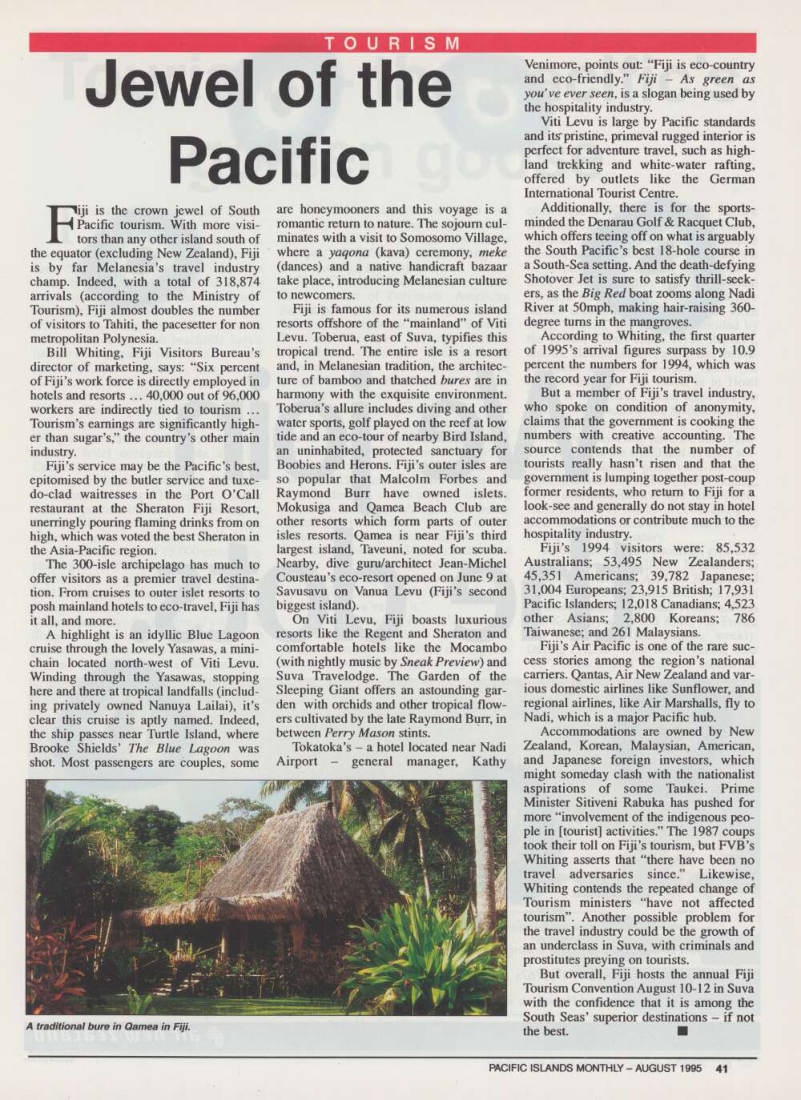
Jewel of the Pacific
Fiji is the crown jewel of South Pacific tourism. With more visi tors than any other island south of the equator (excluding New Zealand), Fiji is by far Melanesia’s travel industry champ. Indeed, with a total of 318,874 arrivals (according to the Ministry of Tourism), Fiji almost doubles the number of visitors to Tahiti, the pacesetter for non
metropolitan Polynesia.
Bill Whiting, Fiji Visitors Bureau’s director of marketing, says; “Six percent of Fiji’s work force is directly employed in hotels and resorts ... 40,000 out of 96,000 workers are indirectly tied to tourism ...
Tourism’s earnings are significantly high er than sugar’s,” the country’s other main
industry.
Fiji’s service may be the Pacific’s best, epitomised by the butler service and tuxe do-clad waitresses in the Port O’Call restaurant at the Sheraton Fiji Resort, unerringly pouring flaming drinks from on high, which was voted the best Sheraton in the Asia-Pacific region.
The 300-isle archipelago has much to offer visitors as a premier travel destina tion. From cruises to outer islet resorts to posh mainland hotels to eco-travel, Fiji has it all, and more.
A highlight is an idyllic Blue Lagoon cruise through the lovely Yasawas, a mini chain located north-west of Viti Levu.
Winding through the Yasawas, stopping here and there at tropical landfalls (includ
ing privately owned Nanuya Lailai), it’s
clear this cruise is aptly named. Indeed, the ship passes near Turtle Island, where Brooke Shields’ The Blue Lagoon was shot. Most passengers are couples, some
are honeymooners and this voyage is a romantic return to nature. The sojourn cul minates with a visit to Somosomo Village, where a yaqona (kava) ceremony, meke (dances) and a native handicraft bazaar take place, introducing Melanesian culture to newcomers.
Fiji is famous for its numerous island resorts offshore of the “mainland” of Viti Levu. Toberua, east of Suva, typifies this tropical trend. The entire isle is a resort and, in Melanesian tradition, the architec ture of bamboo and thatched hures are in harmony with the exquisite environment.
Toberua’s allure includes diving and other water sports, golf played on the reef at low tide and an eco-tour of nearby Bird Island, an uninhabited, protected sanctuary for Boobies and Herons. Fiji’s outer isles are so popular that Malcolm Forbes and Raymond Burr have owned islets.
Mokusiga and Qamea Beach Club are other resorts which form parts of outer isles resorts. Qamea is near Fiji’s third largest island, Taveuni, noted for scuba.
Nearby, dive guru/architect Jean-Michel Cousteau’s eco-resort opened on June 9 at Savusavu on Vanua Levu (Fiji’s second biggest island).
On Viti Levu, Fiji boasts luxurious resorts like the Regent and Sheraton and comfortable hotels like the Mocambo (with nightly music by Sneak Preview ) and Suva Travelodge. The Garden of the Sleeping Giant offers an astounding gar den with orchids and other tropical flow ers cultivated by the late Raymond Burr, in between Perry Mason stints.
Tokatoka’s - a hotel located near Nadi Airport - general manager, Kathy
Venimore, points out: “Fiji is eco-country and eco-friendly.” Fiji - As green as you’ve ever seen, is a slogan being used by the hospitality industry.
Viti Levu is large by Pacific standards and its'pristine, primeval rugged interior is perfect for adventure travel, such as high land trekking and white-water rafting, offered by outlets like the German International Tourist Centre.
Additionally, there is for the sports minded the Denarau Golf & Racquet Club, which offers teeing off on what is arguably the South Pacific’s best 18-hole course in a South-Sea setting. And the death-defying Shotover Jet is sure to satisfy thrill-seek ers, as the Big Red boat zooms along Nadi
River at 50mph, making hair-raising 360-
degree turns in the mangroves.
According to Whiting, the first quarter of 1995’s arrival figures surpass by 10.9 percent the numbers for 1994, which was the record year for Fiji tourism.
But a member of Fiji’s travel industry, who spoke on condition of anonymity, claims that the government is cooking the numbers with creative accounting. The source contends that the number of tourists really hasn’t risen and that the government is lumping together post-coup former residents, who return to Fiji for a look-see and generally do not stay in hotel accommodations or contribute much to the hospitality industry.
Fiji’s 1994 visitors were: 85,532 Australians; 53,495 New Zealanders; 45,351 Americans; 39,782 Japanese; 31,004 Europeans; 23,915 British; 17,931 Pacific Islanders; 12,018 Canadians; 4,523 other Asians; 2,800 Koreans; 786 Taiwanese; and 261 Malaysians.
Fiji’s Air Pacific is one of the rare suc cess stories among the region’s national carriers. Qantas, Air New Zealand and var ious domestic airlines like Sunflower, and regional airlines, like Air Marshalls, fly to Nadi, which is a major Pacific hub.
Accommodations are owned by New Zealand, Korean, Malaysian, American, and Japanese foreign investors, which might someday clash with the nationalist aspirations of some Taukei. Prime Minister Sitiveni Rabuka has pushed for more “involvement of the indigenous peo ple in [tourist] activities.” The 1987 coups took their toll on Fiji’s tourism, but FVB’s Whiting asserts that “there have been no travel adversaries since.” Likewise, Whiting contends the repeated change of Tourism ministers “have not affected tourism”. Another possible problem for the travel industry could be the growth of an underclass in Suva, with criminals and
prostitutes preying on tourists.
But overall, Fiji hosts the annual Fiji Tourism Convention August 10-12 in Suva with the confidence that it is among the South Seas’ superior destinations - if not the best. ■
A traditional bure in Qamea in Fiji.
Advertisements & other items, p. 42 (1 item)
We join
the dots.
O Air New Zealand is the airline linking the Pacific islands to New Zealand, Australia, North America, Asia, the U.K. and Europe. Our modern fleet of 7475, 767 s and 737 s now fly to Tonga, Fiji, New Caledonia, Norfolk Island, Tahiti, Western Samoa, the Cook Islands and Hawaii as well. Air New Zealand. No-one knows the South Pacific-and serves it-like we do. 0= air riEiu zEatano © Air New Zealand Limited 1994.
SAATCHI INT 0459
golden goose
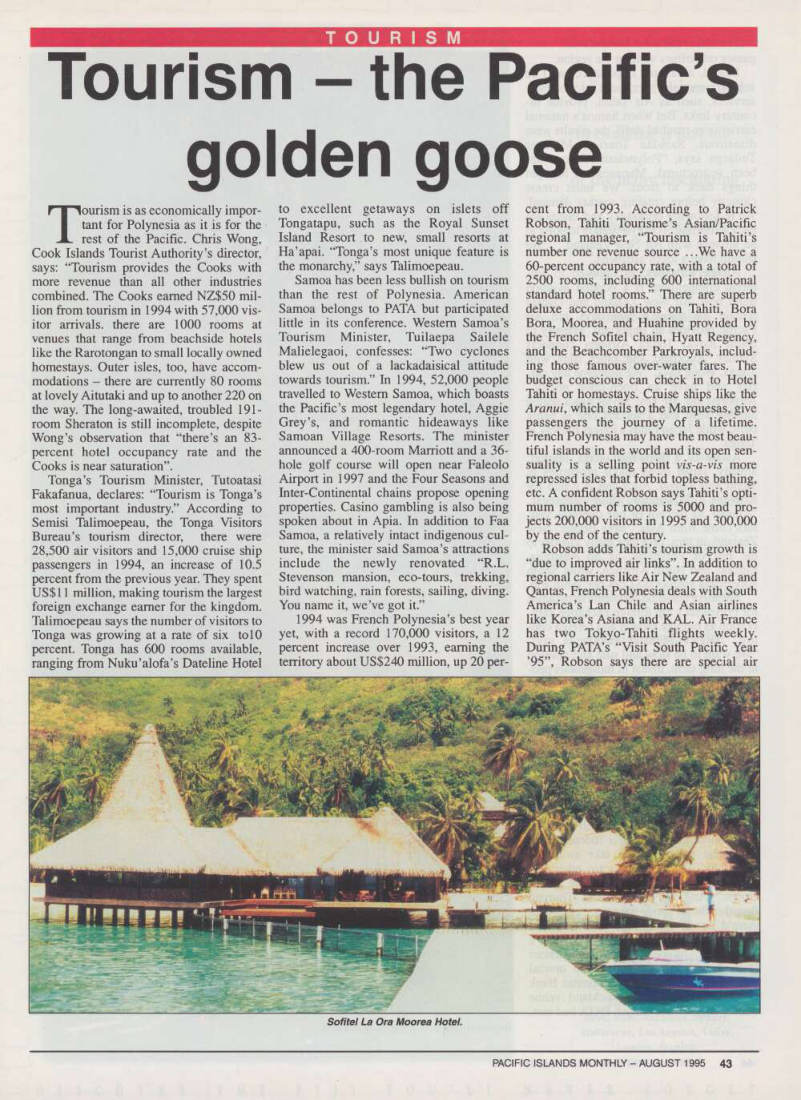
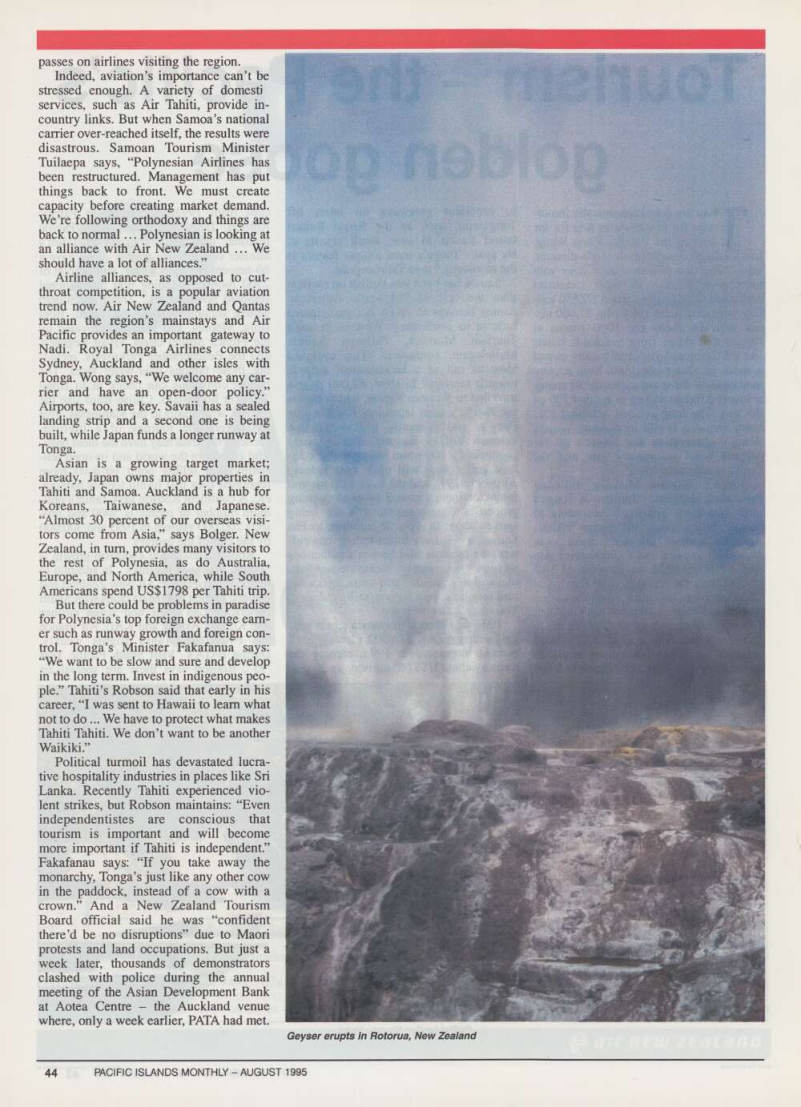
Tourism - the Pacific’s golden goose
Tourism is as economically impor
tant for Polynesia as it is for the rest of the Pacific. Chris Wong, Cook Islands Tourist Authority’s director, says: “Tourism provides the Cooks with more revenue than all other industries combined. The Cooks earned NZ$5O mil lion from tourism in 1994 with 57,000 vis itor arrivals, there are 1000 rooms at venues that range from beachside hotels like the Rarotongan to small locally owned homestays. Outer isles, too, have accom modations - there are currently 80 rooms at lovely Aitutaki and up to another 220 on the way. The long-awaited, troubled 191room Sheraton is still incomplete, despite Wong’s observation that “there’s an 83percent hotel occupancy rate and the Cooks is near saturation”.
Tonga’s Tourism Minister, Tutoatasi Fakafanua, declares; “Tourism is Tonga’s most important industry.” According to Semisi Talimoepeau, the Tonga Visitors Bureau’s tourism director, there were 28,500 air visitors and 15,000 cruise ship passengers in 1994, an increase of 10.5 percent from the previous year. They spent US$ll million, making tourism the largest
foreign exchange earner for the kingdom.
Talimoepeau says the number of visitors to Tonga was growing at a rate of six to 10 percent. Tonga has 600 rooms available, ranging from Nukualofa’s Dateline Hotel
to excellent getaways on islets off Tongatapu, such as the Royal Sunset Island Resort to new, small resorts at
Ha’apai. “Tonga’s most unique feature is
the monarchy,” says Talimoepeau.
Samoa has been less bullish on tourism than the rest of Polynesia. American Samoa belongs to PATA but participated little in its conference. Western Samoa’s Tourism Minister, Tuilaepa Sailele
Malielegaoi, confesses: “Two cyclones
blew us out of a lackadaisical attitude towards tourism.” In 1994, 52,000 people travelled to Western Samoa, which boasts the Pacific’s most legendary hotel, Aggie Grey’s, and romantic hideaways like Samoan Village Resorts. The minister announced a 400-room Marriott and a 36hole golf course will open near Faleolo Airport in 1997 and the Four Seasons and Inter-Continental chains propose opening
properties. Casino gambling is also being
spoken about in Apia. In addition to Faa Samoa, a relatively intact indigenous culture, the minister said Samoa’s attractions include the newly renovated “R.L.
Stevenson mansion, eco-tours, trekking, bird watching, rain forests, sailing, diving.
You name it, we’ve got it.” 1994 was French Polynesia’s best year yet, with a record 170,000 visitors, a 12 percent increase over 1993, earning the territory about US$24O million, up 20 per-
cent from 1993. According to Patrick Robson, Tahiti Tourisme’s Asian/Pacific regional manager, “Tourism is Tahiti’s number one revenue source ...We have a 60-percent occupancy rate, with a total of 2500 rooms, including 600 international standard hotel rooms.” There are superb deluxe accommodations on Tahiti, Bora Bora, Moorea, and Huahine provided by the French Sofitel chain, Hyatt Regency, and the Beachcomber Parkroyals, includ ing those famous over-water fares. The budget conscious can check in to Hotel Tahiti or homestays. Cruise ships like the Aranui, which sails to the Marquesas, give passengers the journey of a lifetime.
French Polynesia may have the most beau tiful islands in the world and its open sen suality is a selling point vis-a-vis more repressed isles that forbid topless bathing, etc. A confident Robson says Tahiti’s opti mum number of rooms is 5000 and pro jects 200,000 visitors in 1995 and 300,000 by the end of the century.
Robson adds Tahiti’s tourism growth is “due to improved air links”. In addition to regional carriers like Air New Zealand and Qantas, French Polynesia deals with South America’s Lan Chile and Asian airlines like Korea’s Asiana and KAL. Air France
has two Tokyo-Tahiti flights weekly,
During PATA’s “Visit South Pacific Year ’95”, Robson says there are special air
Sofitel La Ora Moorea Hotel.
passes on airlines visiting the region.
Indeed, aviation’s importance can’t be stressed enough. A variety of domesti services, such as Air Tahiti, provide in country links. But when Samoa’s national carrier over-reached itself, the results were disastrous. Samoan Tourism Minister Tuilaepa says, “Polynesian Airlines has been restructured. Management has put things back to front. We must create capacity before creating market demand.
We’re following orthodoxy and things are back to normal... Polynesian is looking at an alliance with Air New Zealand ... We should have a lot of alliances.”
Airline alliances, as opposed to cut throat competition, is a popular aviation trend now. Air New Zealand and Qantas remain the region’s mainstays and Air Pacific provides an important gateway to Nadi. Royal Tonga Airlines connects Sydney, Auckland and other isles with Tonga. Wong says, “We welcome any car rier and have an open-door policy.”
Airports, too, are key. Savaii has a sealed landing strip and a second one is being built, while Japan funds a longer runway at Tonga.
Asian is a growing target market; already, Japan owns major properties in Tahiti and Samoa. Auckland is a hub for Koreans, Taiwanese, and Japanese.
“Almost 30 percent of our overseas visi tors come from Asia,” says Bolger. New Zealand, in turn, provides many visitors to the rest of Polynesia, as do Australia, Europe, and North America, while South Americans spend US$l79B per Tahiti trip.
But there could be problems in paradise for Polynesia’s top foreign exchange earn er such as runway growth and foreign con trol. Tonga’s Minister Fakafanua says: “We want to be slow and sure and develop in the long term. Invest in indigenous peo ple.” Tahiti’s Robson said that early in his career, “I was sent to Hawaii to learn what not to do ... We have to protect what makes Tahiti Tahiti. We don’t want to be another Waikiki.”
Political turmoil has devastated lucra tive hospitality industries in places like Sri Lanka. Recently Tahiti experienced vio lent strikes, but Robson maintains: “Even independentistes are conscious that tourism is important and will become more important if Tahiti is independent.”
Fakafanau says: “If you take away the monarchy, Tonga’s just like any other cow in the paddock, instead of a cow with a crown.” And a New Zealand Tourism Board official said he was “confident there’d be no disruptions” due to Maori protests and land occupations. But just a week later, thousands of demonstrators clashed with police during the annual meeting of the Asian Development Bank at Aotea Centre - the Auckland venue where, only a week earlier, PATA had met.
Geyser erupts in Rotorua, New Zealand
Advertisements & other items, p. 45 (1 item)
Ours is a country rich in
tradition and culture and firewalking is just one of the many fascinating legends waiting to be discovered on your unbelievable Fiji holiday.
To find out more about the legendary Fijian firewalkers and the even more legendary hospitality of the Fijian people, contact the Fiji Visitors Bureau.
Suva, Nadi, Auckland, Sydney, Melbourne, Los Angeles, Tokyo, London, Munich.
VISITORS
BUREAU
Fiji Visitors Bureau:
Small and rich
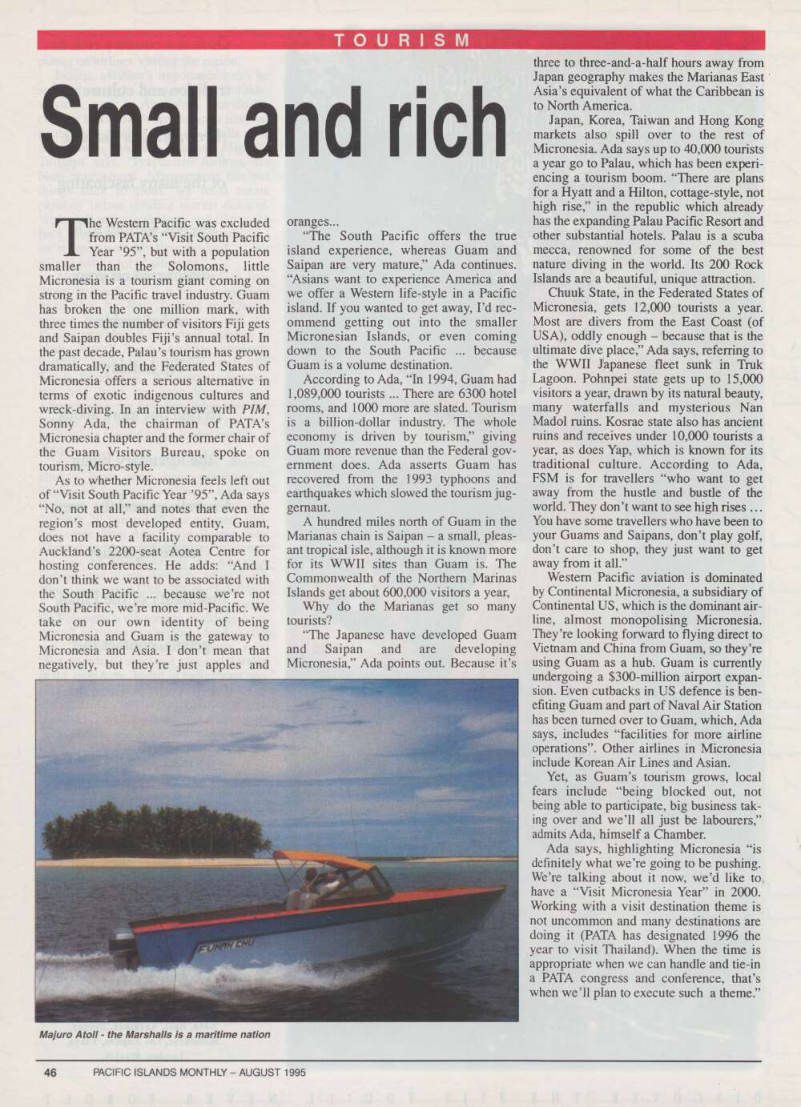
The Western Pacific was excluded from PATA’s “Visit South Pacific Year ’95”, but with a population smaller than the Solomons, little Micronesia is a tourism giant coming on strong in the Pacific travel industry. Guam has broken the one million mark, with three times the number of visitors Fiji gets and Saipan doubles Fiji’s annual total. In the past decade, Palau’s tourism has grown dramatically, and the Federated States of Micronesia offers a serious alternative in terms of exotic indigenous cultures and wreck-diving. In an interview with PIM, Sonny Ada, the chairman of PATA’s Micronesia chapter and the former chair of the Guam Visitors Bureau, spoke on
tourism, Micro-style.
As to whether Micronesia feels left out of “Visit South Pacific Year ’95”, Ada says “No, not at all,” and notes that even the region’s most developed entity, Guam, does not have a facility comparable to Auckland’s 2200-seat Aotea Centre for hosting conferences. He adds: “And I don’t think we want to be associated with the South Pacific ... because we’re not South Pacific, we’re more mid-Pacific. We take on our own identity of being Micronesia and Guam is the gateway to Micronesia and Asia. I don’t mean that
negatively, but they’re just apples and
oranges...
“The South Pacific offers the true island experience, whereas Guam and Saipan are very mature,” Ada continues.
“Asians want to experience America and we offer a Western life-style in a Pacific island. If you wanted to get away. I’d rec ommend getting out into the smaller Micronesian Islands, or even coming down to the South Pacific ... because Guam is a volume destination.
According to Ada, “In 1994, Guam had 1,089,000 tourists ... There are 6300 hotel rooms, and 1000 more are slated. Tourism is a billion-dollar industry. The whole economy is driven by tourism,” giving Guam more revenue than the Federal gov ernment does. Ada asserts Guam has recovered from the 1993 typhoons and earthquakes which slowed the tourism jug gernaut.
A hundred miles north of Guam in the Marianas chain is Saipan - a small, pleas ant tropical isle, although it is known more for its WWII sites than Guam is. The Commonwealth of the Northern Marinas Islands get about 600,000 visitors a year, Why do the Marianas get so many tourists?
“The Japanese have developed Guam and Saipan and are developing Micronesia,” Ada points out. Because it’s
three to three-and-a-half hours away from Japan geography makes the Marianas East Asia’s equivalent of what the Caribbean is to North America.
Japan, Korea, Taiwan and Hong Kong markets also spill over to the rest of Micronesia. Ada says up to 40,000 tourists a year go to Palau, which has been experi encing a tourism boom. “There are plans for a Hyatt and a Hilton, cottage-style, not high rise,” in the republic which already has the expanding Palau Pacific Resort and other substantial hotels. Palau is a scuba mecca, renowned for some of the best nature diving in the world. Its 200 Rock Islands are a beautiful, unique attraction.
Chuuk State, in the Federated States of Micronesia, gets 12,000 tourists a year.
Most are divers from the East Coast (of USA), oddly enough - because that is the ultimate dive place,” Ada says, referring to the WWII Japanese fleet sunk in Truk Lagoon. Pohnpei state gets up to 15,000 visitors a year, drawn by its natural beauty, many waterfalls and mysterious Nan Madol ruins. Kosrae state also has ancient mins and receives under 10,000 tourists a year, as does Yap, which is known for its traditional culture. According to Ada, FSM is for travellers “who want to get away from the hustle and bustle of the world. They don’t want to see high rises ...
You have some travellers who have been to your Guams and Saipans, don’t play golf, don’t care to shop, they just want to get away from it all.”
Western Pacific aviation is dominated by Continental Micronesia, a subsidiary of Continental US, which is the dominant air line, almost monopolising Micronesia.
They’re looking forward to flying direct to Vietnam and China from Guam, so they’re using Guam as a hub. Guam is currently undergoing a $3OO-million airport expan sion. Even cutbacks in US defence is ben efiting Guam and part of Naval Air Station has been turned over to Guam, which, Ada says, includes “facilities for more airline operations”. Other airlines in Micronesia include Korean Air Lines and Asian.
Yet, as Guam’s tourism grows, local fears include “being blocked out, not being able to participate, big business tak ing over and we’ll all just be labourers,” admits Ada, himself a Chamber.
Ada says, highlighting Micronesia “is definitely what we’re going to be pushing.
We’re talking about it now, we’d like to have a “Visit Micronesia Year” in 2000.
Working with a visit destination theme is not uncommon and many destinations are doing it (PATA has designated 1996 the year to visit Thailand). When the time is appropriate when we can handle and tie-in a PATA congress and conference, that’s when we’ll plan to execute such a theme.”
Majuro Atoll - the Marshalls is a maritime nation
Advertisements & other items, pp. 47-48 (1 item)
Our Reach
they are all within
rp
AIR MARSHALLS' ROUTES
MARSHALL ISLANDS
9 ■
HONOLULU
Hawaii
MAJURO
Marshall Islands Sr* J
TARAWA
Republic of Kiribati
FUNAFUTI
Tuvalu
SUVA
NAD
Service with a smile
that's the marshallese
style
AIR Marshall Islands
P.O. Box 1319 Majuro, Marshall Islands 96960 MH Majuro Hq. Phone: (692) 625-3731 Majuro Hq. Fax: (692) 625-3730 Reservations in Majuro: 625-3733/4/5 Reservations in Kwajalein: 2416 Reservations in Honolulu: 949-5522 Toll free from the U.S.A. Mainland: 1-800-543-3898 Reservations In Nadi, Fiji: 722192 Reservations In Suva, Fiji: 303888/889 Reservations in Tarawa: (686) 21577 Reservations In Tuvalu: (688) 20737
We have added a new dimension to
Nadi International Airport
7 J w I v ■
We have made it beautiful
All of us are concerned about our environment.
And we have done something about it We have filled our parking lot with flowering trees and our adjacent park with
landscaped gardens.
We have planted flowers on the verge of all of .our aircraft aprons, and hung pot plants in our passenger facilities.
We even offer an orchid garden in our transit lounge.
We pride ourselves as the Hub of the South Pacific offering airlines and passengers a range of services one would expect from a modern international airport.
At Nadi International Airport, we have done more.
We have made our environment beautiful.
V- * , 4
CIVIL AVIATION AUTHORITY OF FIJI
Private Mail Bag, Nadi International Airport. Fiji Islands. Ph0ne:722500 Fax: 790325
GEORGE RUftINE 99M
Melanesians miss
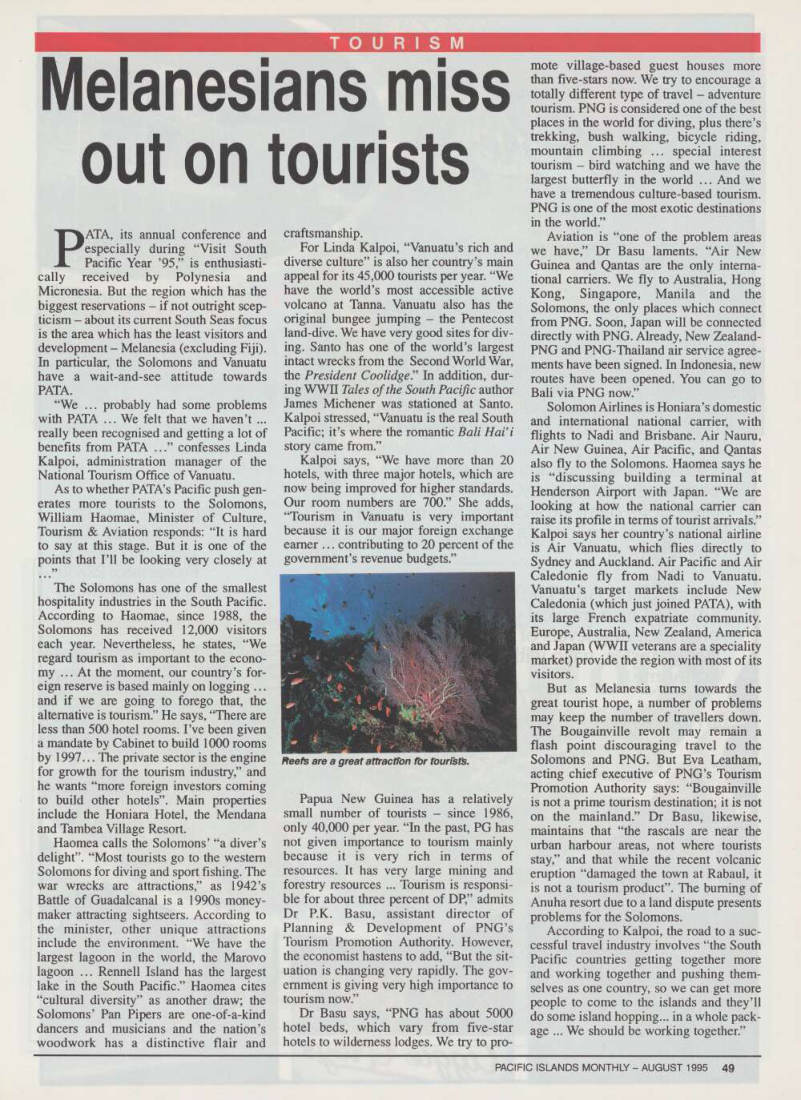
out on tourists
PATA, its annual conference and especially during “Visit South Pacific Year ’95,” is enthusiasti cally received by Polynesia and Micronesia. But the region which has the biggest reservations - if not outright scep ticism - about its current South Seas focus is the area which has the least visitors and development - Melanesia (excluding Fiji).
In particular, the Solomons and Vanuatu have a wait-and-see attitude towards
Pata.
“We ... probably had some problems with PATA ... We felt that we haven’t ... really been recognised and getting a lot of benefits from PATA ...” confesses Linda Kalpoi, administration manager of the National Tourism Office of Vanuatu.
As to whether PATA’s Pacific push gen erates more tourists to the Solomons, William Haomae, Minister of Culture, Tourism & Aviation responds: “It is hard to say at this stage. But it is one of the points that I’ll be looking very closely at The Solomons has one of the smallest hospitality industries in the South Pacific.
According to Haomae, since 1988, the Solomons has received 12,000 visitors each year. Nevertheless, he states, “We regard tourism as important to the econo my ... At the moment, our country’s for eign reserve is based mainly on logging ... and if we are going to forego that, the alternative is tourism.” He says, “There are less than 500 hotel rooms. I’ve been given a mandate by Cabinet to build 1000 rooms by 1997... The private sector is the engine for growth for the tourism industry,” and he wants “more foreign investors coming to build other hotels”. Main properties include the Honiara Hotel, the Mendana and Tambea Village Resort.
Haomea calls the Solomons’ “a diver’s delight”. “Most tourists go to the western Solomons for diving and sport fishing. The war wrecks are attractions,” as 1942’s Battle of Guadalcanal is a 1990 s money maker attracting sightseers. According to the minister, other unique attractions include the environment. “We have the largest lagoon in the world, the Marovo lagoon ... Rennell Island has the largest lake in the South Pacific.” Haomea cites “cultural diversity” as another draw; the Solomons’ Pan Pipers are one-of-a-kind dancers and musicians and the nation’s woodwork has a distinctive flair and
craftsmanship.
For Linda Kalpoi, “Vanuatu’s rich and diverse culture” is also her country’s main appeal for its 45,000 tourists per year. “We have the world’s most accessible active volcano at Tanna. Vanuatu also has the original bungee jumping - the Pentecost land-dive. We have very good sites for div ing. Santo has one of the world’s largest intact wrecks from the Second World War, the President CoolidgeT In addition, dur ing WWII Tales of the South Pacific author James Michener was stationed at Santo.
Kalpoi stressed, “Vanuatu is the real South Pacific; it’s where the romantic Bali Hai’i story came from.”
Kalpoi says, “We have more than 20 hotels, with three major hotels, which are now being improved for higher standards.
Our room numbers are 700.” She adds, “Tourism in Vanuatu is very important because it is our major foreign exchange earner ... contributing to 20 percent of the government’s revenue budgets.”
Papua New Guinea has a relatively small number of tourists - since 1986, only 40,000 per year. “In the past, PG has not given importance to tourism mainly because it is very rich in terms of resources. It has very large mining and forestry resources ... Tourism is responsi ble for about three percent of DP,” admits Dr P.K. Basu, assistant director of Planning & Development of PNG’s Tourism Promotion Authority. However, the economist hastens to add, “But the sit uation is changing very rapidly. The gov ernment is giving very high importance to tourism now.”
Dr Basu says, “PNG has about 5000 hotel beds, which vary from five-star hotels to wilderness lodges. We try to pro
mote village-based guest houses more than five-stars now. We try to encourage a totally different type of travel - adventure tourism. PNG is considered one of the best places in the world for diving, plus there’s trekking, bush walking, bicycle riding, mountain climbing ... special interest tourism - bird watching and we have the largest butterfly in the world ... And we have a tremendous culture-based tourism.
PNG is one of the most exotic destinations in the world.”
Aviation is “one of the problem areas we have,” Dr Basu laments. “Air New Guinea and Qantas are the only interna tional carriers. We fly to Australia, Hong Kong, Singapore, Manila and the Solomons, the only places which connect from PNG. Soon, Japan will be connected directly with PNG. Already, New Zealand- PNG and PNG-Thailand air service agree ments have been signed. In Indonesia, new routes have been opened. You can go to Bali via PNG now.”
Solomon Airlines is Honiara’s domestic and international national carrier, with flights to Nadi and Brisbane. Air Nauru, Air New Guinea, Air Pacific, and Qantas also fly to the Solomons. Haomea says he is “discussing building a terminal at Henderson Airport with Japan. “We are looking at how the national carrier can raise its profile in terms of tourist arrivals.”
Kalpoi says her country’s national airline is Air Vanuatu, which flies directly to Sydney and Auckland. Air Pacific and Air Caledonie fly from Nadi to Vanuatu.
Vanuatu’s target markets include New Caledonia (which just joined PATA), with its large French expatriate community.
Europe, Australia, New Zealand, America and Japan (WWII veterans are a speciality market) provide the region with most of its visitors.
But as Melanesia turns towards the great tourist hope, a number of problems may keep the number of travellers down.
The Bougainville revolt may remain a flash point discouraging travel to the Solomons and PNG. But Eva Leatham, acting chief executive of PNG’s Tourism Promotion Authority says: “Bougainville is not a prime tourism destination; it is not on the mainland.” Dr Basu, likewise, maintains that “the rascals are near the urban harbour areas, not where tourists stay,” and that while the recent volcanic eruption “damaged the town at Rabaul, it is not a tourism product”. The burning of Anuha resort due to a land dispute presents problems for the Solomons.
According to Kalpoi, the road to a suc cessful travel industry involves “the South Pacific countries getting together more and working together and pushing them selves as one country, so we can get more people to come to the islands and they’ll do some island hopping... in a whole pack age ... We should be working together.”
Reefs are a great attraction for tourists.
Advertisements & other items, pp. 50-51 (1 item)
QagieM^f?
63®
m i w
'A E mM u\ m ' Kit
HOTEL "WESTERN SAMOA
Sm $ p»i Si *flt» ■ ■a-ws s 0» %.
When you visit a place like AGGIES it is unlikely that you will leave unembraced by the warm Samoan hospitality that this gracious hotel has become famous for.
Like other well known retreats for seasoned travellers, AGGIES is in a class of its own, providing every modern facility and service in a friendly, relaxed environment.
BS*: imami nM
s ouih seas
mkaW'* Overlooking Apia Harbour and set
amongst lush tropical gardens, AGGIES
offers varying levels of accommodation, to suit all tastes, each with a personal teUehr
&bf home. J
AGGIE GREYS HOTEL
P.O. BOX 67, APIA
WESTERN SAMOA
Phone: (685) 22880 Fax; (685) 23626 HVi I « Mi X h'ill , t m 5; m "S-llr'i ■
QagieM^f?
iii IS*"* in i »■« ■ f!l /f <3re visiting Western Samoa for a holiday or for business , Aggie's Hotel promises you a warm welcome and a pleasant stay. Aggie's Hotel is an ideal choice because it is a short mile from the famous Palolo Deep Marine where can visitors swim in clear waters and take pictures of renowned reef formations. Another mile's drive will bring visitors to Vailala beach known for its huge surfs. To enjoy Western Samoa it is better to live close to places to visit. And Aggie's Hotel is near to places visitors normally want to see.
DATELINE Hotel
When visiting Polynesia's only remaining Kingdom, stay with us where you will be truly spoiled by our island's hospitality. • ALa Carte Restaurant. Succulent local food featured in our Special Tongan and seafood buffet night, complete with traditional Tongan entertainment. • Swimming pool with fitness centre. • Sight-seeing, island tours, game fishing, diving, cultural tours and other activities can be booked at our in-house booking kiosk.
P.O, Box 39, Nuku'alofa, Tonga, South Pacific.
Tel: (676) 23-411, Fax: 23-410. m
Rugby fights for
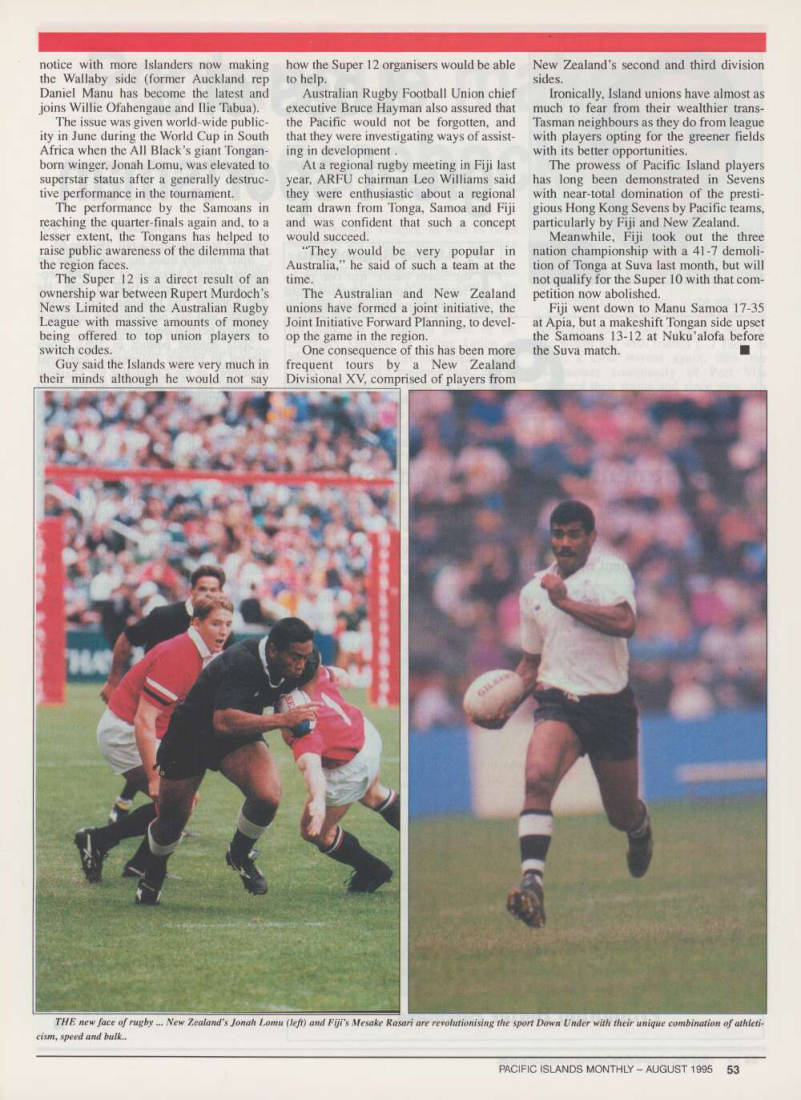
Sports
Rugby fights for survival
Pacific Island rugby officials are eyeing a regional barbarians-type team to take part in the new Super 12 competition as part of efforts to keep rugby alive and well in the region.
By Andrew Kacimaiwai
The concept is being floated after the South African, New Zealand and Australian unions announced a new semi-professional provincial com-
petition involving provinces from the three
countries would start next year.
The Super 10 competition , with its Pacific qualifier, has been replaced by the Super 12, which will feature six teams from New Zealand , five from South Africa and three from Australia.
Pacific unions are fearful of mass defections to league if they are kept out of
the lucrative Super 12; already, the Samoans have lost two key players to the rival code since the World Cup in June and are warning of more to come if nothing is done to combat it.
At a post-match function after the Fiji- Tonga game in Suva last month, Fiji’s Deputy Prime Minister, Ratu Timoci Vesikula, called on the unions to band together to form a regional team, and pointed to the British Lions (a side com prised of players from the Home Unions) as a precedent.
The last time Pacific Island players played together was in 1987 with a rebel South Seas Barbarians tour to apartheid South Africa led bv former All Black
Arthur Jennings.
The New Zealand Rugby Football Union chairman, Richie Guy, reassured the Island unions early last month that they were greatly concerned about the situation and would be working to develop the game in the Islands with their Australian coun terparts.
With a cluttered fixture next year (including five tests against World Champions South Africa), the NZRFU is trying to determine how to best help their
smaller neighbours.
New Zealand has long benefited from the infusion of Pacific Island players into their game alongside their Maori reps; even Australia is starting to sit up and take
notice with more Islanders now making the Wallaby side (former Auckland rep Daniel Manu has become the latest and joins Willie Ofahengaue and Hie Tabua).
The issue was given world-wide public ity in June during the World Cup in South Africa when the All Black’s giant Tongan bom winger, Jonah Lomu, was elevated to superstar status after a generally destruc tive performance in the tournament.
The performance by the Samoans in reaching the quarter-finals again and, to a lesser extent, the Tongans has helped to raise public awareness of the dilemma that the region faces.
The Super 12 is a direct result of an ownership war between Rupert Murdoch’s News Limited and the Australian Rugby League with massive amounts of money being offered to top union players to switch codes.
Guy said the Islands were very much in their minds although he would not say
how the Super 12 organisers would be able to help.
Australian Rugby Football Union chief executive Bruce Hayman also assured that the Pacific would not be forgotten, and that they were investigating ways of assist
ing in development.
At a regional rugby meeting in Fiji last year, ARFU chairman Leo Williams said they were enthusiastic about a regional team drawn from Tonga, Samoa and Fiji and was confident that such a concept would succeed.
“They would be very popular in Australia,” he said of such a team at the time.
The Australian and New Zealand unions have formed a joint initiative, the Joint Initiative Forward Planning, to devel op the game in the region.
One consequence of this has been more frequent tours by a New Zealand Divisional XV, comprised of players from
New Zealand’s second and third division sides.
Ironically, Island unions have almost as much to fear from their wealthier trans- Tasman neighbours as they do from league with players opting for the greener fields with its better opportunities.
The prowess of Pacific Island players has long been demonstrated in Sevens with near-total domination of the presti gious Hong Kong Sevens by Pacific teams, particularly by Fiji and New Zealand.
Meanwhile, Fiji took out the three nation championship with a 41-7 demoli tion of Tonga at Suva last month, but will not qualify for the Super 10 with that com petition now abolished.
Fiji went down to Manu Samoa 17-35 at Apia, but a makeshift Tongan side upset the Samoans 13-12 at Nuku’alofa before the Suva match. ■
THE new face of rugby ... New Zealand’s Jonah Lomu (left) and Fiji’s Mesake Rasari are revolutionising the sport Down Under with their unique combination of athleti cism, speed and bulk..
Advertisements & other items, p. 52 (1 item)
Graphic Sy
Bth Floor, Ratu Sukuna House, MacA Telephone: (679) 306 1 ■/IZ aird'd r, cJii’/ji RO. Boa 16149, chr/ii, Fiji DU i'U'jslxalle: (679) IU6 111
PRE-PRESS
We utilise leading-edge technology to give you total versatility, uncompromising quality and high production speed in scanning, colour separation, image manipulation and page assembly
SIGN WRITING
By combining the latest computer sign cutting technology with traditional sign writing skills including airbrush, screen printing, and hand illustrating we are able to offer a comprehensive quality signwriting service.
great sportsman
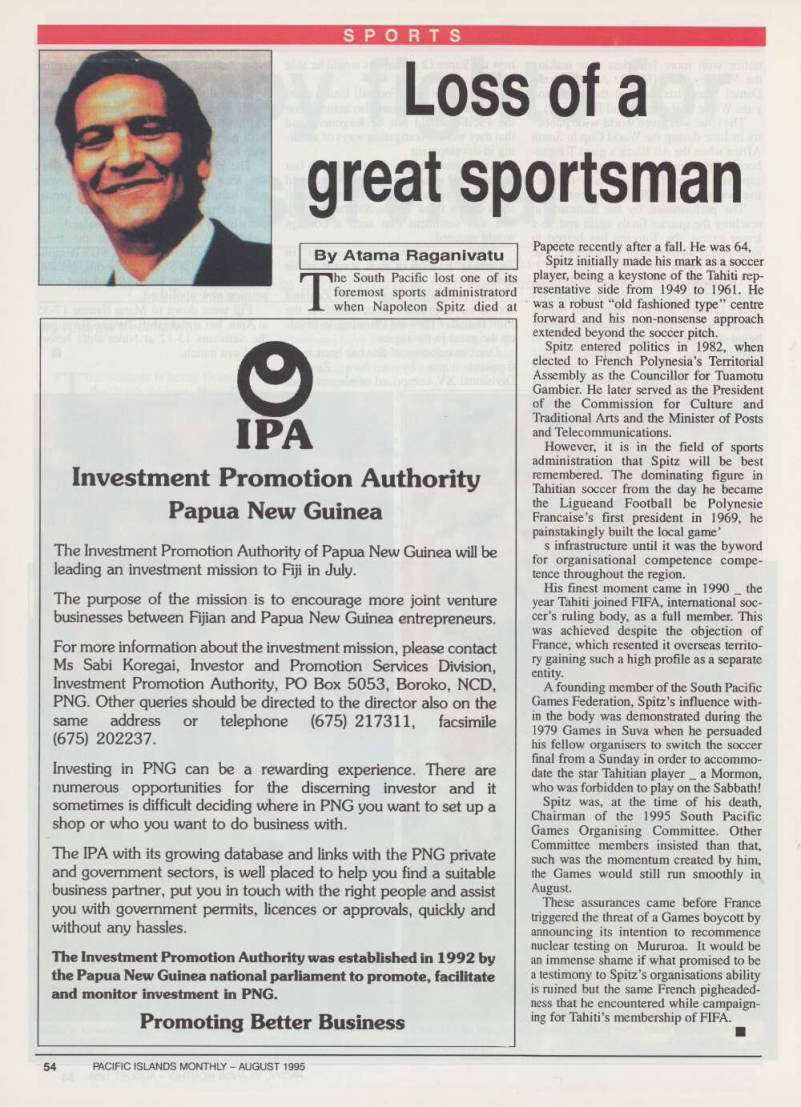
Loss of a great sportsman
By Atama Raganivatu
The South Pacific lost one of its foremost sports administratord when Napoleon Spitz died at
Papeete recently after a fall. He was 64, Spitz initially made his mark as a soccer player, being a keystone of the Tahiti rep resentative side from 1949 to 1961. He was a robust “old fashioned type” centre forward and his non-nonsense approach extended beyond the soccer pitch.
Spitz entered politics in 1982, when elected to French Polynesia’s Territorial Assembly as the Councillor for Tuamotu Gambier. He later served as the President of the Commission for Culture and Traditional Arts and the Minister of Posts and Telecommunications.
However, it is in the field of sports administration that Spitz will be best remembered. The dominating figure in Tahitian soccer from the day he became the Ligueand Football be Polynesie Francaise’s first president in 1969, he painstakingly built the local game’ s infrastructure until it was the byword for organisational competence compe tence throughout the region.
His finest moment came in 1990 the year Tahiti joined FIFA, international soc cer’s ruling body, as a full member. This was achieved despite the objection of France, which resented it overseas territo ry gaining such a high profile as a separate entity.
A founding member of the South Pacific Games Federation, Spitz’s influence with in the body was demonstrated during the 1979 Games in Suva when he persuaded his fellow organisers to switch the soccer final from a Sunday in order to accommo date the star Tahitian player a Mormon, who was forbidden to play on the Sabbath!
Spitz was, at the time of his death.
Chairman of the 1995 South Pacific Games Organising Committee. Other Committee members insisted than that, such was the momentum created by him, the Games would still run smoothly in August.
These assurances came before France triggered the threat of a Games boycott by announcing its intention to recommence nuclear testing on Mururoa. It would be an immense shame if what promised to be a testimony to Spitz’s organisations ability is ruined but the same French pigheaded ness that he encountered while campaign ing for Tahiti’s membership of FIFA.
Advertisements & other items, p. 54 (1 item)
Investment Promotion Authority
IPA
Papua New Guinea
The Investment Promotion Authority of Papua New Guinea will be leading an investment mission to Fiji in July.
The purpose of the mission is to encourage more joint venture businesses between Fijian and Papua New Guinea entrepreneurs.
For more information about the investment mission, please contact Ms Sabi Koregai, Investor and Promotion Services Division, Investment Promotion Authority, PO Box 5053, Boroko, NCD, PNG. Other queries should be directed to the director also on the same address or telephone (675) 217311, facsimile (675) 202237.
Investing in PNG can be a rewarding experience. There are numerous opportunities for the discerning investor and it sometimes is difficult deciding where in PNG you want to set up a shop or who you want to do business with.
The IPA with its growing database and links with the PNG private and government sectors, is well placed to help you find a suitable business partner, put you in touch with the right people and assist you with government permits, licences or approvals, quickly and without any hassles.
The Investment Promotion Authority was established in 1992 by the Papua New Guinea national parliament to promote, facilitate and monitor investment in PNG.
Promoting Better Business
Pentangue makes a comeback
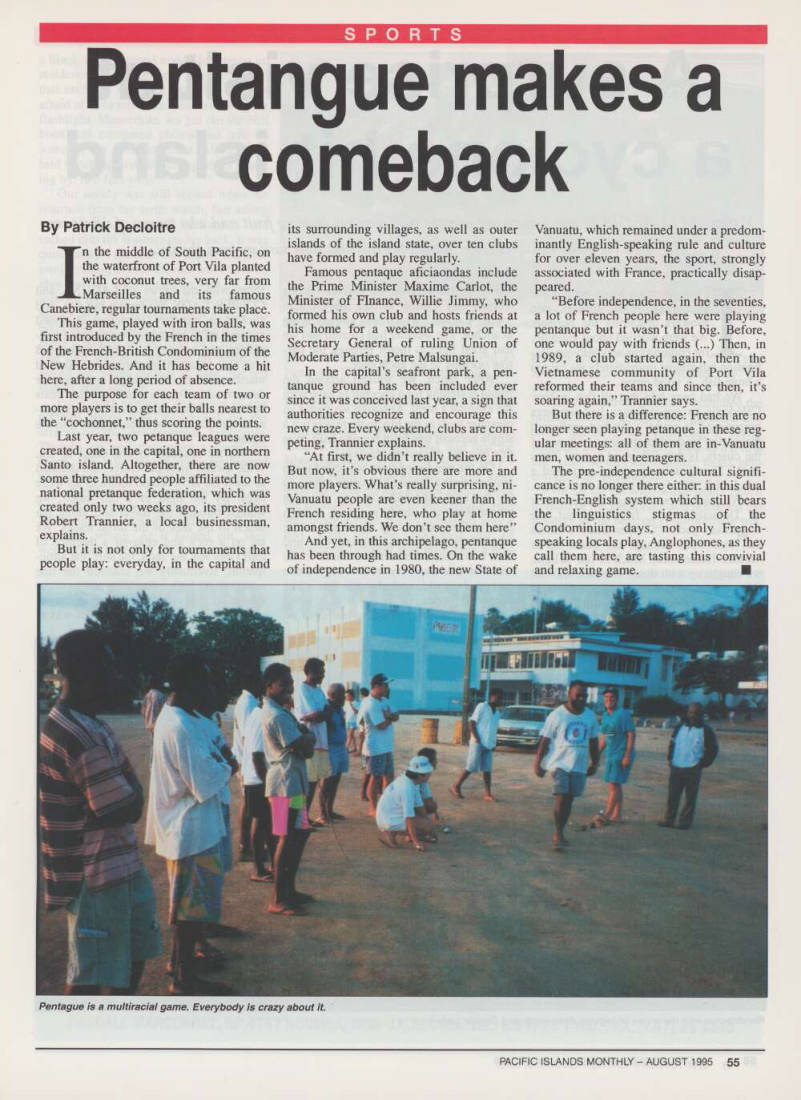
comeback
By Patrick Decloitre
I i .j-
C Vna C olan,eS
... with coconut trees, very far from arsei es an its amous a- ler e, regu ar oumamen s a e p ace.
This game, played with iron balls, was first mtroduced by the French in the times opheFreneh-Bntish Condominium of the New Hebrides. And it has become a hit erF ’ a er a on g P cno 0 a sence.
The purpose for each team of two or more players is to get their balls nearest to e coc onne , us scoring the points.
Last year, two petanque leagues were created, one in die capital, one m northern an o is an . ''S'- 1 ct ’ 1 are are now some three hundred people affiliated to the na lona pre anque e era ion, w ic was created only two weeks ago its president o er ranmer, a ocal businessman, ex P ai ? S l , r .
But it is not only for tournaments that people play: everyday, in the capital and
its surrounding villages, as well as outer islands of the island state, over ten clubs haVe f ° rmed “ d » lay re * ularly ’ .
Famous pentaque aficiaondas include the Prime Minister Maxime Car|ot the Minister of Finance, Willie Jimmy, who formed his own club and hosts friends at his home for a weekend or the Secret General of ruli Union of Moderate Parties, Petre Malsungai. the capital . s seafront park> a tanque ground has been included ever since it was c o nceived last year, a sign that authorities reco g n i ze and encourage this new craze £ V ery weekend, clubs are comti Xrannier ex lains „ A( f|rs , we did „, t rea||y in it [j Ll [ no w, it’s obvious there are more and more p|ayers wha ,. s rea , |y surpnsing> ni .
Vanuatu people are even keener than the French residing here, who play at home amongst friends. We don’t see them here”
And yet, in this archipelago, pentanque has been thro h had times Qn the wake of independence in 1980> new State of
Vanuatu, which remained under a predom inantly English-speaking rule and culture for OVCT deve " years ’ s P° rt - stro "B ly associated with France, practically disap peared “Before independence, in the seventies, a lot of French people here were playing ntan bul it F wa F sn ., that bi Before one wou|d with friends ( J in 1989, a club started again, then the Vietnamese community of Port Vila reformed their teams and since then, it’s soaring again,” Trannier says, Bui there is a difference: French are no longer seen playing petanque in these reg ular meeti n all ® f th J are in . Vanuatu m en, womet and teenagers.
The pre-independence cultural signifi cance is no ong er there either: in this dual French-English system which still bears the linguistics stigmas of the Condominium days, not only French speaking locals play, Anglophones, as they here / ar ' tasbn g F this convivia i and relaxing game . a
Pentague is a multiracial game. Everybody is crazy about it.
A surprise visit at
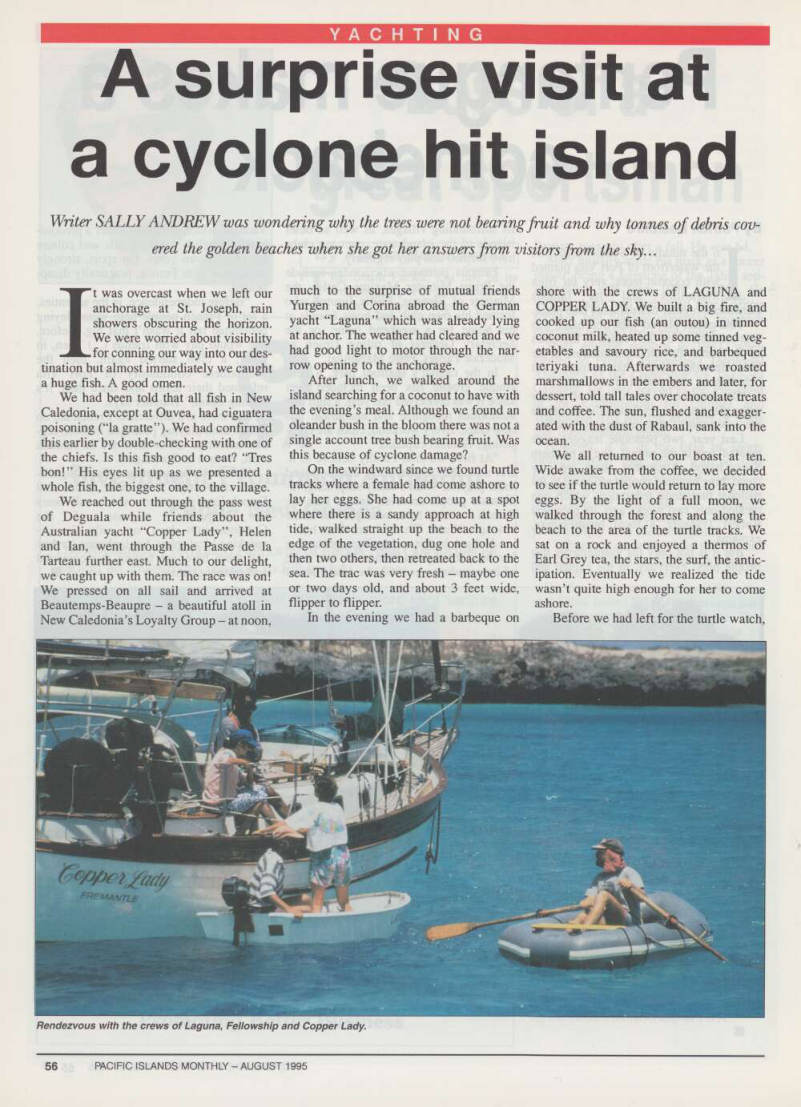

Yachting
A surprise visit at a cyclone hit island
Writer SALLY ANDREW was wondering why the trees were not bearing fruit and why tonnes of debris cov ered the golden beaches when she got her answers from visitors from the sky...
It was overcast when we left our anchorage at St. Joseph, rain showers obscuring the horizon.
We were worried about visibility for conning our way into our des tination but almost immediately we caught a huge fish. A good omen.
We had been told that all fish in New Caledonia, except at Ouvea, had ciguatera poisoning (“la gratte”). We had confirmed this earlier by double-checking with one of the chiefs. Is this fish good to eat? “Tres bon!” His eyes lit up as we presented a whole fish, the biggest one, to the village.
We reached out through the pass west of Deguala while friends about the Australian yacht “Copper Lady”, Helen and lan, went through the Passe de la Tarteau further east. Much to our delight, we caught up with them. The race was on!
We pressed on all sail and arrived at Beautemps-Beaupre - a beautiful atoll in New Caledonia’s Loyalty Group - at noon,
much to the surprise of mutual friends Yurgen and Corina abroad the German
yacht “Laguna” which was already lying
at anchor. The weather had cleared and we had good light to motor through the nar row opening to the anchorage.
After lunch, we walked around the island searching for a coconut to have with the evening’s meal. Although we found an oleander bush in the bloom there was not a single account tree bush bearing fruit. Was this because of cyclone damage?
On the windward since we found turtle tracks where a female had come ashore to lay her eggs. She had come up at a spot where there is a sandy approach at high tide, walked straight up the beach to the edge of the vegetation, dug one hole and then two others, then retreated back to the sea. The trac was very fresh - maybe one or two days old, and about 3 feet wide,
flipper to flipper.
In the evening we had a barbeque on
shore with the crews of LAGUNA and COPPER LADY. We built a big fire, and cooked up our fish (an outou) in tinned coconut milk, heated up some tinned veg etables and savoury rice, and barbequed teriyaki tuna. Afterwards we roasted marshmallows in the embers and later, for dessert, told tall tales over chocolate treats and coffee. The sun, flushed and exagger ated with the dust of Rabaul, sank into the ocean.
We all returned to our boast at ten.
Wide awake from the coffee, we decided to see if the turtle would return to lay more eggs. By the light of a full moon, we walked through the forest and along the beach to the area of the turtle tracks. We sat on a rock and enjoyed a thermos of Earl Grey tea, the stars, the surf, the antic ipation. Eventually we realized the tide wasn’t quite high enough for her to come ashore.
Before we had left for the turtle watch.
Rendezvous with the crews of Laguna, Fellowship and Copper Lady.
a black white-capped noddy had taken up residence on our lifeline, a wire “fence” that encloses our deck area. He was not afraid of us or our voices, and tolerated our flashlight. Meanwhile, we got out the bird book and compared photos and info on some of his close relations. My kind of bird watching, with the bird politely stand
ing by, two feet away!
Our noddy was still aboard when we returned from the turtle watch, fast asleep with his head rotated backwards and tucked into the feathers on his back. It was quite funny - the boat was rolling from the swell coming in over the reef and I have no idea how the noddy hung on with his little webbed feet. He looked like an old man, asleep on a bus, relaxing, then jerking his body back into position as he starts to col lapse - though all the time he’s sleeping.
The bird was still hanging on when we poked our heads outside at 4am, but left shortly after sunrise.
Early next morning, the peace of our tranquil haven was interrupted by the arrival of the gendarmerie helicopter.
Thumbs up and motioning towards the beach, the pilot landed. Four uniformed passengers got out. We went ashore to visit, thinking they had come to check out boat papers (fancy that, paper work, while anchored on an uninhabited island!), but we were wrong. As it turned out, they weren’t interested in our papers although
photos and boat names were relayed to Noumea. We chatted with the pilot, his medicine and one gendarme from Fayaoue, while two others walked around the island.
The pilot confirmed our suspicions about a recent cyclone, and said that the island had been hit by bad cyclone only 9 months earlier. That explained why there were no accounts and tons of debris along the shoreline. Not one of the existing trees was bearing fruit. It also explained why a tiny islet off the northeast tip of Beautemps-Beaupre was no longer a bird
nesting ground. Bordered with caves and arches, it had been decimated by the
cyclone.
On the windward beach, I restudied the turtle track and decided that the turtle had come ashore twice, following a nearly identical track but slightly west of the first one. How do they know where to go, gen eration after generation?
We sat on the wide white sandy beach in front of the anchorage and pondered the mystery as the horizon swallowed the sun.
The gendarmes arrive with answers and some questions.
Advertisements & other items, p. 57 (1 item)
Second Hand Containers
WHERE AND WHEN YOU WANT THEM IN THE PACIFIC If you need a flexible and safe storage space we have the ideal solution for you. Our second hand containers provide instant secure storage. Guaranteed to be wind and waterproof these containers are ideal for both temporary and longterm storage in Pacific conditions.
We can deliver to any island in the Pacific within a month and our rates have got to be the lowest you will find. All you need to do is tell us how many you want.
CONTACT:
PASCALE MARCONNET, BP 4757 NOUMEA, NEW CALEDONIA. TEL: (687) 28 7450. FAX: (687) 26 3248
Letters from
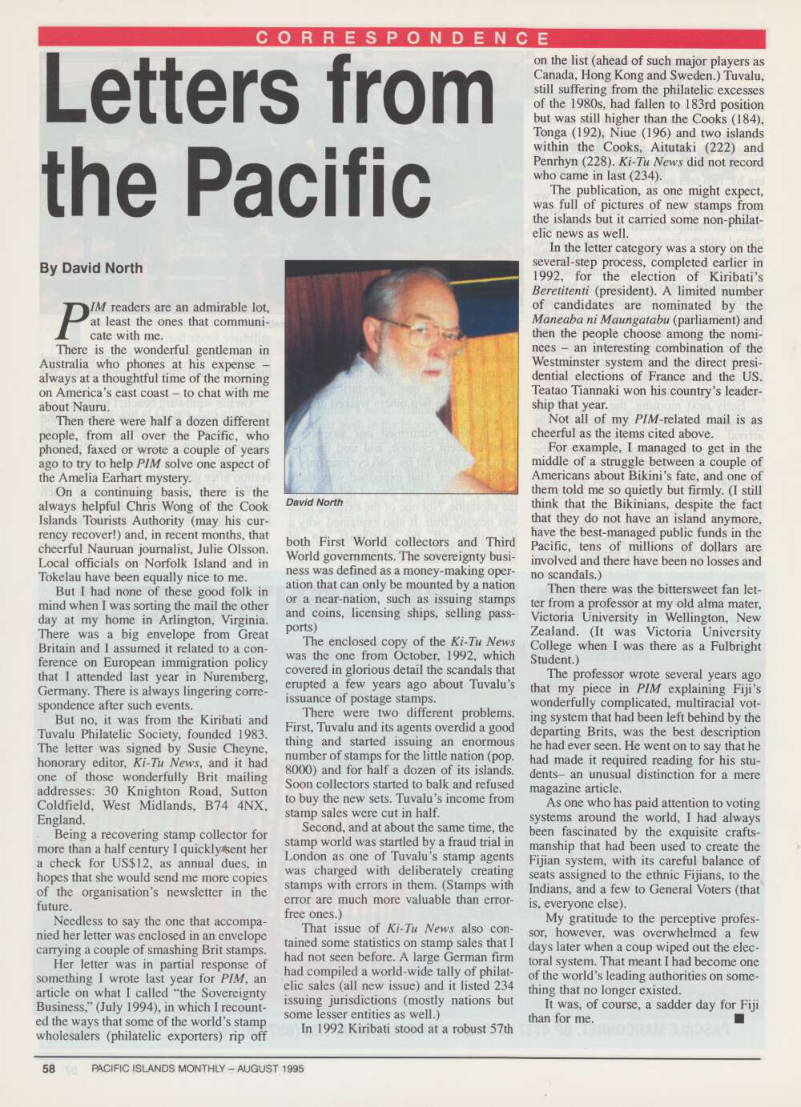
Correspondence
Letters from the Pacific
By David North
readers are an admirable lot, least the ones that communi .X cate with me.
There is the wonderful gentleman in Australia who phones at his expense always at a thoughtful time of the morning on America’s east coast - to chat with me about Nauru.
Then there were half a dozen different people, from all over the Pacific, who phoned, faxed or wrote a couple of years ago to try to help PIM solve one aspect of the Amelia Earhart mystery.
On a continuing basis, there is the always helpful Chris Wong of the Cook Islands Tourists Authority (may his cur rency recover!) and, in recent months, that cheerful Nauruan journalist, Julie Olsson.
Local officials on Norfolk Island and in Tokelau have been equally nice to me.
But I had none of these good folk in mind when I was sorting the mail the other day at my home in Arlington, Virginia.
There was a big envelope from Great Britain and I assumed it related to a con ference on European immigration policy that I attended last year in Nuremberg, Germany. There is always lingering corre spondence after such events.
But no, it was from the Kiribati and Tuvalu Philatelic Society, founded 1983.
The letter was signed by Susie Cheyne, honorary editor, Ki-Tu News, and it had one of those wonderfully Brit mailing addresses: 30 Knighton Road, Sutton Coldfield, West Midlands, 874 4NX,
England.
Being a recovering stamp collector for more than a half century I her a check for US$l2, as annual dues, in hopes that she would send me more copies of the organisation’s newsletter in the future.
Needless to say the one that accompa nied her letter was enclosed in an envelope carrying a couple of smashing Brit stamps.
Her letter was in partial response of something I wrote last year for PIM, an article on what I called “the Sovereignty Business,” (July 1994), in which I recount ed the ways that some of the world’s stamp wholesalers (philatelic exporters) rip off
both First World collectors and Third World governments. The sovereignty busi ness was defined as a money-making oper ation that can only be mounted by a nation or a near-nation, such as issuing stamps and coins, licensing ships, selling pass
ports)
The enclosed copy of the Ki-Tu News was the one from October, 1992, which covered in glorious detail the scandals that erupted a few years ago about Tuvalu’s issuance of postage stamps.
There were two different problems.
First, Tuvalu and its agents overdid a good thing and started issuing an enormous number of stamps for the little nation (pop. 8000) and for half a dozen of its islands.
Soon collectors started to balk and refused to buy the new sets. Tuvalu’s income from stamp sales were cut in half.
Second, and at about the same time, the stamp world was startled by a fraud trial in London as one of Tuvalu’s stamp agents was charged with deliberately creating stamps with errors in them. (Stamps with error are much more valuable than error free ones.) That issue of Ki-Tu News also con tained some statistics on stamp sales that I had not seen before. A large German firm had compiled a world-wide tally of philat elic sales (all new issue) and it listed 234
issuing jurisdictions (mostly nations but
some lesser entities as well.) In 1992 Kiribati stood at a robust 57th
on the list (ahead of such major players as
Canada, Hong Kong and Sweden.) Tuvalu,
still suffering from the philatelic excesses of the 1980 s, had fallen to 183rd position but was still higher than the Cooks (184), Tonga (192), Niue (196) and two islands within the Cooks, Aitutaki (222) and Penrhyn (228). Ki-Tu News did not record who came in last (234).
The publication, as one might expect, was full of pictures of new stamps from the islands but it carried some non-philat elic news as well.
In the letter category was a story on the several-step process, completed earlier in 1992, for the election of Kiribati’s Beretitenti (president). A limited number of candidates are nominated by the Maneaba ni Maungatabu (parliament) and then the people choose among the nomi nees - an interesting combination of the Westminster system and the direct presi dential elections of France and the US.
Teatao Tiannaki won his country’s leader ship that year.
Not all of my PIM- related mail is as cheerful as the items cited above.
For example, I managed to get in the middle of a struggle between a couple of Americans about Bikini’s fate, and one of them told me so quietly but firmly. (I still think that the Bikinians, despite the fact that they do not have an island anymore, have the best-managed public funds in the Pacific, tens of millions of dollars are involved and there have been no losses and no scandals.) Then there was the bittersweet fan let ter from a professor at my old alma mater, Victoria University in Wellington, New Zealand. (It was Victoria University College when I was there as a Fulbright Student.) The professor wrote several years ago that my piece in PIM explaining Fiji’s
wonderfully complicated, multiracial vot
ing system that had been left behind by the departing Brits, was the best description he had ever seen. He went on to say that he had made it required reading for his stu dents- an unusual distinction for a mere magazine article.
As one who has paid attention to voting systems around the world, I had always been fascinated by the exquisite crafts manship that had been used to create the Fijian system, with its careful balance of seats assigned to the ethnic Fijians, to the Indians, and a few to General Voters (that is, everyone else).
My gratitude to the perceptive profes
sor, however, was overwhelmed a few days later when a coup wiped out the elec toral system. That meant I had become one of the world’s leading authorities on some thing that no longer existed.
It was, of course, a sadder day for Fiji than for me. ■
David North
Advertisements & other items, pp. 59-60 (1 item)
Grand Pacific Life Insurance, Ltd.
0 JO 15 20 25 30 35 40 45 50 55 60 ©
A member of the Finance Factors Family
FEDERATED STATES
OF MICRONESIA
Actouka Executive Insurance Undenvriters P.O. Box 55, Kolonia, Pohnpei, Federated States of Micronesia 96941 Pacific Basin Insurance & General Services, Inc P.O. Box 494, Chuuk State, Federated States of Micronesia 96942
TONGA
Peseti Ma ‘afu Ins. & Finance, Ltd.
Private Bag 2, Taumoepeau Bldg.
Nukualofa, Tonga
GUAM
Great National Insurance Underwriters, Inc.
P.O. Box GA, Agana, Guam 96910
AMERICAN SAMOA
Mark Solofa Pacific Insurance & Finance, Inc.
P.O. Box 3149 Pago Pago, American Samoa 96799 Pacific Financial Corporation P.O. Box AT, Agana, Guam 96910 Takagi & Associates, Inc.
GCIC Bldg., Suite 100 414 W. Soledad Ave.
Agana, Guam 96910
MARSHALL ISLANDS
Marshalls Insurance Agency P.O. Box 113, Majuro, Marshall Islands 96960
WESTERN SAMOA
Mark Solofa Pacific Insurance & Finance, Inc.
P.O. Box 3149 Pago Pago, American Samoa 96799
NORTHERN MARIANAS
Pacific Basin Insurance Underwriters, Inc.
P.O. Box 710 Saipan, Mariana Islands 96950 Pacifica Insurance Underwriters, Inc.
P.O. Box 168, Saipan, Mariana Islands 96950 Grand Pacific Life Insurance, Ltd. *1164 Bishop Street, sth Floor, Honolulu, HI 96813 Phone: (808) 548-3363 • FAX: (808) 548-5122
y 9/f P#C- . ■ «•- \ hr 191 V
Born to run.
The Mitsubishi Lancer: A family sedan that meets our own standards of stability and performance.
Lancer is ready when you are.
The rear multi-link suspension system is absolutely fearless. The independent McPherson struts up front are equal to the challenge of even the toughest road conditions. And an aggressive, fuel-efficient SOHC engine awaits your command.
The ground-hugging chassis holds comers tight. A powerful braking system holds you and your family secure.
And when you venture into the passing lane, this car holds nothing back.
Because Lancer was born to run.
It is a dazzling product of our total approach to car design, a philosophy you can feel the moment you get behind the wheel.
There is no compromise in Lancer’s construction. Every detail meets our exacting standards of stability and performance. Its unique handling instincts and spirited responsiveness are an expression of Mitsubishi’s driving commitment to excellence in every car we make.
Yes, strictly speaking, Lancer is a family sedan. But the way it performs is something else.
MITSUBISHI LRNCER
What Drives You.
AMERICAN SAMOA: PACIFIC MARKETING INC. P.O. Box 698, Pago Pago, Tel. 699-9140 / AUSTRALIA: MITSUBISHI MOTORS AUSTRALIA LTD. 1284 South Road, Clovelly Park, South Australia 5042 Tel. (08) 2757297 / FUI: NIVIS MOTOR & MACHINERY CO. LTD. G.P.O. Box 150, Suva, Tel. 383411 / GUAM: TRIPLE J ENTERPRISES INC. P.O. Box 6066, Tamuning, Tel. 6469126 / NEW CALEDONIA; SOCIETE DTMPORTATION D'AUTO DU PACIFIQUE SUD S.A. P.O. Box 438, Noumea, lei. 272-562 / NEW ZEALAND: MITSUBISHI MOTORS NEW ZEALAND LTD. Private Bag. Porirua, Tel. 237-0109 / NORFOLK ISLAND: BORRY'S PTY LTD. P.O. Box 169, Taylors Road, Burnt, Tel. 2114 / PAPUA NEW GUINEA: TOBA MOTORS PTY LTD. P.O. Box 503, Port Moresby, Tel. 217-874 / SAIPAN: SAIPAN AUTOWORLD INC. P.O. Box 487, Tel. 234-7133 / SOLOMON ISLANDS: HARVEST PACIFIC LTD. G.P.O. Box 888, Honiara, Tel. 30407 / TAHITI: SOPADEP S.A. B.P. 1617, Papeete, Tel. 427393 / TONGA; SITANI MAPI CO., LTD. P.O. Box 83, Nuku'Alofa, Tel. 24044 / VANUATU: SOCOMETRA VANUATU LTD. BP. 6, Port-Vila, Tel. 2314/ WESTERN SAMOA: MOTOR DISTRIBUTORS (SAMOA) LTD. P.O. Box 576, Apia, Tel. 20957 A
MITSUBISHI
MOTORS
CREATING TOGETHER