Islands
Pacific
Monthly
July 1995
JH
Mm M!L «H Mo®- - '■
fs nl ImlMi ;K ■ . ft- v
—-—I* .Mhhmihir
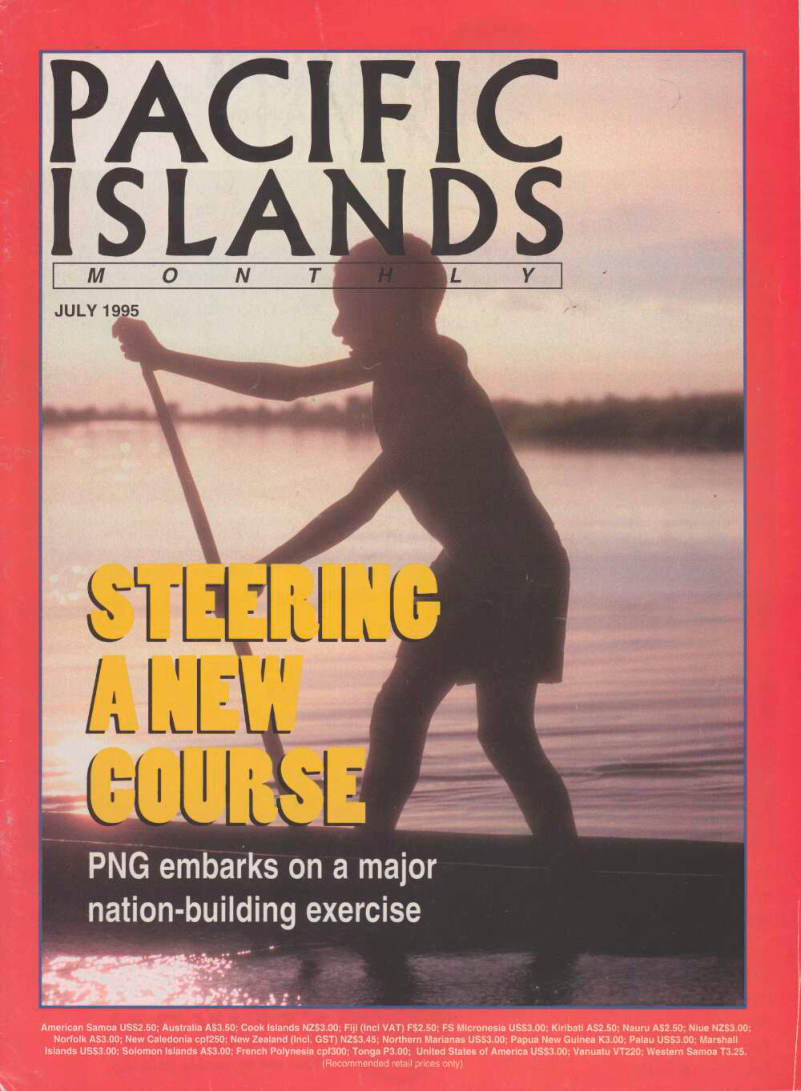
PNG embarks on a major
nation-building exercise
American Samoa US$2.5O; Australia A 53.50; Cook Islands NZ$3.OO; Fiji (Incl VAT) F 52.50; FS Micronesia US$3.OO; Kiribati A 52.50; Nauru A 52.50; Niue NZ$3.OO; Norfolk A 53.00; New Caledonia cpf2so; New Zealand (Incl. GST) NZ53.45; Northern Marianas US$3.OO; Papua New Guinea K 3.00; Palau U 533.00; Marshall Islands US$3.OO; Solomon Islands A 53.00; French Polynesia cpf3oo; Tonga P 3.00; United States of America US$3.OO; Vanuatu VT22O; Western Samoa T 3.25. (Recommended retail prices only)
Advertisements & other items, p. 2 (1 item)
}J Telikom
y Papua New Guinea
Cl-.-., rr^ 4 ■ """■*< '■mm mm MP If HI «•* a®* «£i ' m , ii 3 - ; / ■ |: ew
II r T“M
y * * * • j f
t iHiiiiiiiimmtuffi- i 2
■» »'- , L. jj I iii iirrifHlli t -..t"*!;*"*"*' / o II
iSil :
» i i b * V? tl : r v. ! r Telikom has set the pace in providing state-of-the-art telecommunications links within PNG and to anywhere around the world as we enter the 21st Century. For all your telecommunications needs, write to us at this address: Assistant General Manager Telikom Marketing Department P.O. Box 291 Waigani, Papua New Guinea Tel: 675 300 5564 Fax: 675 300 5540
TELIKOM
flow wete neatly, tcdkUvy!
Pacific
Islands
Monthly
V 01.65 No 7
The News Magazine
July 1995
PUBLISHER: Brian O’ Flaherty EDITOR: Malajagmohan SENIOR WRITER: Yunus Rashid GRAPHIC ARTIST: James Ranuku
Correspondents:
David North, Ed Rampell, lan Williams, Liz Thompson, Roman Grynberg, Wally Hiambohn, Lisa Williams, Patrick Decloitre, Barry Markowitz.
COLUMNISTS: David Barber (Wellington), Futa Helu (Tonga), Jemima Garrett (Sydney), Alfred Sasako (The Forum).
Advertising Sales:
• Regional Sales - South Pacific; Ashok Lai, Tel (679) 304111,303429, Fax (679) 303809. • Sydney, Canberra; Bob Hill Media Representation,Tel (61-2) 4164245, Fax (61-2) 4165064. • Brisbane: Jane Fewings Media and Advertising Associates, Tel (61-7) 378 4522, Fax (61-7) 878 1071. • Adelaide: Hastwell Williamsons Representatives,Tel (61-8) 3799522, Fax (61-8) 3799735. • Melbourne; Brown Orr Fletcher Burrows (Aust) Pty Ltd. Tel (61-3) 8265188, Fax (61-3) 8265644. • Auckland; McKay & Bowman, International Media Representatives Limited,Tel (64-9) 4190561, Fax (64-9) 4192243-Japan: Universal Media Corporation,Tokyo, Tel (3) 3266626741, Cable: UNI-MEDIA Tokyo, Fax (3) 32626742.
Founded 1930 (USPS 9522480).
A Fiji Times Limited production.
Cover prices are recommended retail only.
Registered by Australia Post, Publication No. NBPI2IO.
Copyright Fiji Times Limited, 177 Victoria Parade, Suva, Fiji. Tel (679) 304111, fax (670) 303809.
Tx Fj2124.
Pacific Islands Monthly is published monthly by Fiji Times Limited, a division of Nationwide News, 2 Holt Street, Surry Hills, Sydney,
Nsw 2010.
Send Address Changes To:
• Pacific Islands Monthly, PO Box 1167, Suva, Fiji. Typeset and printed by The Fiji Times Limited, 177 Victoria Parade, Suva, Fiji.
Inside
□ Letters 7
□ Headlines 8
□ Obituary
Hobby leads to death of billionaire 10
□ Law
Question of dual citizenship 13
□ Sovereignty
The state of the Hawaiian movement 14
□ Health
So, who is really on the gaining side? 16
□ Cover Stories
Changing course 19
□ Economy
Has the World Bank gone soft and green? 22
□ Crime
Fight against fraud and corruption 24
□ Opinion
All is not rosy 26 PNG prepares for Forum 43
□ Ordeal
Living on hope and faith 27
□ Environment
A new approach to logging 28
□ Religion
The battle of churches 29
□ Focus On Vanuatu
A nation celebrates 33
□ Canoeing
Sailing in the wake of the ancestors 44 Tapu lifted- and an epic voyage begins 46
□ Music
Boyz of Paradise and their angel 48
□ Rugby
United we stand a chance 51
□ Sports
Singh the Swing strikes a comeback 54
□ Yachting
Cliffs, caves and coral 56
SPORTS: Time for one Pacific team?
Hillblom’s dramatic death
CANOEING: Uniting Polynesians
Advertisements & other items, pp. 4-7 (1 item)
Telecommunications
ST VINCENT % SWEDEN & TAIWAN & THAILAND $ TONGA $ TRINIDAD $ TURKS AND CAICOS & UNITED KINGDOM & USA & VANUATU $ YEMEN $ ANGUILA f ANTIGUA ASCENSION ISLAND AUSTRALIA % BAHRAIN BARBADOS BELARUS BEFRMUDA
solutions for the Pacific
A 1 Y 9 • 0 I W The world of Cable and Wireless encompasses to the most sophisticated international both developed countries, and those still services. developing. Countries with widely varying Our philosophy of responding to telecommunications needs. individual needs explains why today we are And so Cable and Wireless solutions range from basic regional and local telephone systems the world's most widespread global telecommunications company, involved in m MALDIVES f MONGOLIA f MONTSERRAT PAKISTAN PHILIPPINES PORTUGAL RUSSIA SEYCHELLES
BOTSWANA • BRITISH VIRGIN ISLANDS • BULGARIA • CAYMAN ISLANDS • CHINA I COLOMBIA • DIEGO GARCIA
From the name that's
known around the world.
■"TI w m mm * i m »m ¥ * ♦**!. ml IM.H „ 9 II MMIIP 9 ' Mtiill * " • • nm» >•••*»« .mmwm im. ■" •-iww.il ■m* *•« mwi mmwKP • »M« NUT I «t*l <tM « Baa»tm#' .WuHm ♦**•!>*• » •»* p*‘ . »*• ” ” ■" 'I"
"5p Wmm • t» f «wn»ifnti ■■■• m i inNi wwmiiii«
*t|h,.WWW»M.WW«WI»fH
SlP*' ' A IlUflll -I , I f trtW |t M4An.ll I f IT4W% w hh,m.»»4l h,WW % 4IMM4> 41*.» mm***
fMMRMN • <#•**
mi <4
.Kt* • mMMMMMWMMI IWkn
* ■P« ■ mm* m mm mm 11 Hum i NM4in«Ml# . m **m> >« mm . mt , mmmm*’ 4»«*<m nmmmm •• H « »* • ia w m m « . . , . . M» • M •,1 . WHIM"
• » lIHWMW*.. Wtm ** H
. *m *p >w. mmm . , Mr «. •>•!.( HVIi r . i • . * HkiM .
rWJMMII
> *> . » #> • f« I'M. wmwi ».t Hn«H»>nt ..•y.w... < ’* if* ♦**«•• « n i map m w,
♦ I W • H
fltti is-.1l t IN IMftiMHpv • • m m«H I fjjfiSp « I *
* f IMP
• Hi *• •• ’ • •« I #**• ♦ » •a , *•* • on. ». « » I*' ♦ •••-■ •' ■m • , * * iVHm**- • •» J • •• i «i I If •* ll •
the provision of international services for
over thirty countries, and of domestic
these countries are here in the Pacific, an area of Cable and Wireless activity for more services for more than twenty. Many of than one hundred and twenty years.
CABLE & WIRELESS
The most experienced telecommunications company in the world. • Fiji Fiji International Telecommunications Limited, PO Box 59, Mercury House, 158 Victoria Parade, Suva. Tel: (679) 312933. • Solomon Islands Solomon Telekom Company Limited, PO Box 148, Honiara. Tel: (677) 21576.
Tonga Private Mail Bag 4, General Post Office, Nukualofa. Tel: (676) 23499. • Vanuatu Vanuatu Telecom Limited, PO Box 146, Port Vila. Tel: (678) 22185. • Pacific Head Office PO Box 60, Suva, Fiji Islands. Tel: (679) 311300. Fax (679) 311 Oil.
SIERRA LEONE#SOLOMON ISLANDS SOUTH AFRICA SPAIN ST HELENA ST KITTS AND NEVIS# ST LUCIA# FALKLAND ISLANDS ffe FIJI H FRANCE • GERMANY GRENADA HONG KONG IRELAND ITALY JAMAICA 0 JAPAN LATVIA MACAU
EXPRESS MAIL SERVICE
INTERNATIONAL AND DOMESTIC COURIER
GUARANTEES SPEEDY AND RELIABLE SERVICE
ON £ I Mess mail sma INTERNATIONAL and domestic courier assess ism WITH ATTRACTIVE RATES WE NOW OFFER YOU A
FAST, RELIABLE DELIVERY SERVICE TO MAJOR
DESTINATIONS AROUND THE WORLD
CONTACT YOUR MANAGER CUSTOMER SERVICE (POST)
HEAD OFFICE: SUVA PH: (679) 210304 FAX: (679) 314995
NADI AIRPORT: PH: 722264 FAX: 720467
LABASA: PH: 811281 FAX: 813666
SAVUSAVU: PH: 850001
MAILS
MAILS DELIVERED TO ITS DESTINATIONS ARE FAST AND SECURE. EVERY CARE IS TAKEN WHEN DELIVERING THE MAILS THROUGH OUR OWN F.P.T.L DELIVERY
VANS.
AEROGRAMS & POSTCARDS
FOR CHEAPER AND SECURED MAILS, USE AEROGRAMS
& POSTCARDS.
MONEY ORDERS
PRIORITY IS GIVEN TO MONEY ORDERS, THUS A
SECURED AND EFFICIENT SERVICE IS AVAILABLE.
TRANSFERRED TO ITS DESTINATIONS WITHIN MIN-
UTES.
EASY TRANSFERRING OF CASH
LOCAL: USE FIJI POSTAL NOTES FOR EFFICIENCY AND CHEAPER RATES. CAN BE CASHED AT ANY POST OFFICE
OR BANK IN ALL DENOMINATIONS.
OVERSEAS: USE BRITISH POSTAL ORDERS FOR SECUR-
ITY, FAST, EFFICIENT.
UNSEALED MAILS (2ND CLASS MAILS)
OFFERED AT HALF THE NORMAL RATE ITEMS LIKE PRINTED PAPER, MAGAZINES & SMALL PACKETS CAN
BE SENT EASILY THROUGH UNSEALED MAILS.
FOR INFORMATION ENQUIRE AT ANY POST OFFICE.
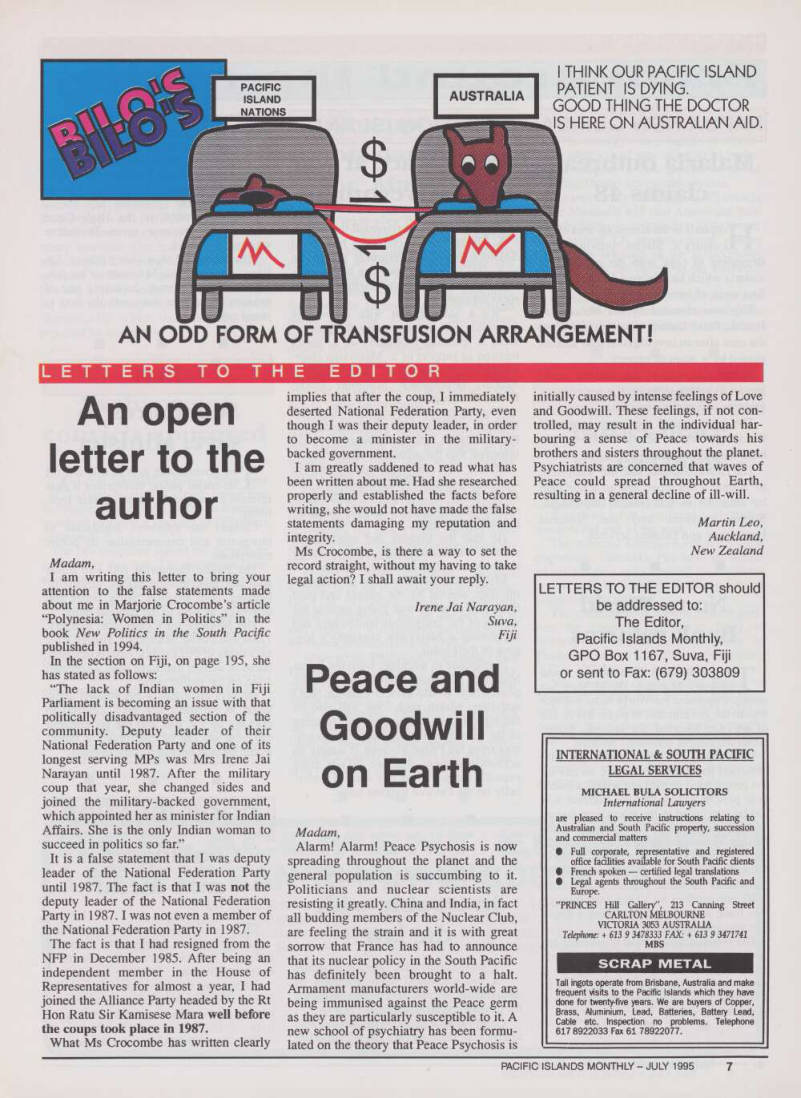
AUSTRALIA
I THINK OUR PACIFIC ISLAND
PATIENT IS DYING.
GOOD THING THE DOCTOR
IS HERE ON AUSTRALIAN AID.
PACIFIC
ISLAND
NATIONS
NV A'v D i H
AH ODD FORM OF TRANSFUSION ARRANGEMENT!
An open
Letters To The Editor
letter to the
author
Madam, I am writing this letter to bring your attention to the false statements made about me in Marjorie Crocombe’s article “Polynesia: Women in Politics” in the book New Politics in the South Pacific published in 1994.
In the section on Fiji, on page 195, she has stated as follows: “The lack of Indian women in Fiji Parliament is becoming an issue with that politically disadvantaged section of the community. Deputy leader of their National Federation Party and one of its longest serving MPs was Mrs Irene Jai Narayan until 1987. After the military coup that year, she changed sides and joined the military-backed government, which appointed her as minister for Indian Affairs. She is the only Indian woman to succeed in politics so far.”
It is a false statement that I was deputy leader of the National Federation Party until 1987. The fact is that I was not the deputy leader of the National Federation Party in 1987.1 was not even a member of the National Federation Party in 1987.
The fact is that I had resigned from the NFP in December 1985. After being an independent member in the House of Representatives for almost a year, I had joined the Alliance Party headed by the Rt Hon Ratu Sir Kamisese Mara well before the coups took place in 1987.
What Ms Crocombe has written clearly
implies that after the coup, I immediately deserted National Federation Party, even though I was their deputy leader, in order to become a minister in the military backed government.
I am greatly saddened to read what has been written about me. Had she researched properly and established the facts before writing, she would not have made the false statements damaging my reputation and
integrity.
Ms Crocombe, is there a way to set the record straight, without my having to take legal action? I shall await your reply.
Irene Jai Norayan,
Suva, Fiji
Peace and
Goodwill
on Earth
Madam, Alarm! Alarm! Peace Psychosis is now
spreading throughout the planet and the
general population is succumbing to it.
Politicians and nuclear scientists are resisting it greatly. China and India, in fact all budding members of the Nuclear Club, are feeling the strain and it is with great sorrow that France has had to announce that its nuclear policy in the South Pacific has definitely been brought to a halt.
Armament manufacturers world-wide are being immunised against the Peace germ as they are particularly susceptible to it. A new school of psychiatry has been formu lated on the theory that Peace Psychosis is
initially caused by intense feelings of Love and Goodwill. These feelings, if not con trolled, may result in the individual har bouring a sense of Peace towards his brothers and sisters throughout the planet.
Psychiatrists are concerned that waves of Peace could spread throughout Earth, resulting in a general decline of ill-will.
Martin Leo,
Auckland, New Zealand
Advertisements & other items, p. 7 (1 item)
The Editor,
LETTERS TO THE EDITOR should
be addressed to: The Editor, Pacific Islands Monthly, GPO Box 1167, Suva, Fiji or sent to Fax: (679) 303809
INTERNATIONAL & SOUTH PACIFIC
LEGAL SERVICES
MICHAEL BULA SOLICITORS
International Lawyers
are pleased to receive instructions relating to Australian and South Pacific properly, succession and commercial matters 4 Full corporate, representative and registered office facilities available for South Pacific clients • French spoken certified legal translations • Legal agents throughout the South Pacific and Europe.
"PRINCES Hill Caller/', 213 Canning Street
CARLTON MELBOURNE
VICTORIA 3053 AUSTRALIA
Telephone: + 613 9 3478333 FAX: + 613 9 3471741
MBS
SCRAP METAL
Tall ingots operate from Brisbane, Australia and make frequent visits to the Pacific Islands which they have done for twenty-five years. We are buyers of Copper, Brass, Aluminium, Lead, Batteries, Battery Lead, Cable etc. Inspection no problems. Telephone 617 8922033 Fax 61 78922077.
From around the region
Headlines
Papua New Guinea
Malaria outbreak
claims 48
Hospitals in the Kerowagi area of the
country’s Simbu province are
struggling to cope with the outbreak of malaria which has claimed 48 lives by the first week of June.
This was revealed by the Minister of Health, Peter Barter, who returned from the area after an investigation tour accom panied by a team of experts.
Barter also warned the malaria could spread to higher altitudes if a control pro gramme was not in place soon.
The team visited the lower region of Kerowagi where nearly 29,000 people have been hit by disease.
The Health Minister said the team were to submit a full report and an action plan by June 13 to the Health Department, Simbu province and the National Emergency and Disaster services ■ ■ ■
No to World
Bank reforms
The Country’s Commerce and Industry Minister, David Mai, has strongly opposed the World Bank’s direc tive to the government to phase out its list of activities reserved for nationals before it can implement economic reforms.
In a strongly worded statement, Mai criticised the Bank’s insistence on having the programme phased out within a three year period, adding that the exercise will not be concluded in the given time frame.
According to Mai, the regulations con taining “reserved activities” will remain in force despite the directive from the World Bank. He said the reserved list must not be blamed as the sole reason for rushing PNG into abiding by all the principles of free trade and, as such, the bank’s direc tive was premature.
The minister said he will be pushing for the government to show a degree of flexi bility in the policies and practices it adopts while at the same time adhering to directives from multilateral agencies such as the World Bank.
Solomon Islands
Greenpeace at war
with government
Greenpeace has slammed the recent ly revealed secret by a high level Solomon Islands government delegation to Russel Islands to convince landowners there to accept the government’s resettle ment scheme.
“It’s a scandal that with a looming financial crisis in the country, the govern ment is spending thousands on a secret mission in support of a Malaysian clear felling logging operation,” said Lawrence Makili, Greenpeace Solomon Island
Forest Campaigner.
A government navy patrol boat left Honiara to escort the secret mission to Russel Islands. The landowners were not informed that the mission was arriving.
Makili said they are attempting to ambush the people of Russel Islands and force them to accept a resettlement scheme that they have already compre
hensively rejected.
He said the logging and resettlement scheme was unanimously thrown out by landowners in December and March.
Makili also asked why a government minister, elected by the people and paid from public taxes, was going against the wishes of the indigenous landowners and supporting a Malaysian company’s log ging of their lands.
In response to warnings from the Prime Minister, Solomon Mamaloni, that the government would closely monitor NGO activities, Makili said: “We will also be
stepping up our monitoring and scrutiny
of the government of the day. The warn ings from the Prime Minister is simply an acknowledgement that we NGOs have exposed the government’s corrupt under belly on the Pavuvu logging issue.” ■ ■ ■
Ship captains
in trouble with
the law
The masters of six Taiwanese fishing boats charged with breaches of their fishing permits have been committed for trial by the High Court.
Chief Magistrate Denzil Seneviratne referred the matter to the High Court after
a preliminary inquiry had satisfied him there was sufficient evidence to commit the skippers for trial.
The six captains pleaded guilty to three counts each for their involvement in ille gal fishing activities in Solomon Islands territorial waters.
Their committal to the High Court means there are now seven Taiwanese waiting to be tried.
The captain of Man Sheng Eleven, Jan Rung, who faces eight counts of breach ing his fishing permit, including one of evasion of customs duty, was the first to plead guilty.
Fiji
Sell shares to
save: Minister
The government says it will sell off its major public enterprises if new reforms cannot make them operate prof itably.
Cabinet has approved legislation to reorganise and commercialise its public enterprises.
The Public Enterprise Bill will cover post and telecommunications, electricity, housing, civil aviation, ports, water and sewerage, as well as the national bank.
The Minister for Commerce, Industry, Trade and Public Enterprises, Jim Ah Koy, says many of Fiji’s public enterprises have failed to deliver and have been a constant drain on the public purse.
He says his ministry has studied legis lation in Australia and New Zealand in drawing up the Bill and the government can now get out of enterprises it thinks would be best operated commercially.
Cook Islands
Cooking up a
new menu
The Development Investment Council has approved the draft of a document that will promote the country to overseas investors.
Known as the Investment Promotion Guide, it contains information about the islands and outlines investment incen tives.
The Development Investment Council
was established in February to consider investment proposals from domestic and
foreign enterprises.
The council makes recommendations to the Monetary Board (which is com prised of cabinet members) on issues relating to these proposals.
In addition, the council in examining the existing Investment Code of the Cook Islands and incentives provided in the Development Act (1977).
The council is expected to bring back many investors who had left the country after scandals relating to business ethics surfaced earlier this year. Cook Islands has had to revert to the New Zealand dol lar after confidence in its dollar dropped dramatically when the scandals were reported by the media. ■ ■ ■
Exchange of
convicts approved
A Cook Islander serving a four-year prison term after a rape conviction in Western Samoa will be the first person involved in a new a Transfer of Offenders agreement.
The two countries signed the agreement in February this year. The agreement came after both countries passed legislation to allow such transfers.
Foreign Affairs Ministry and Western Samoan authorities are co-ordinating the transfer of Arerau Arona Tinirau who will serve the rest of his sentence in Cook Islands.
Police Inspector Richard Browne trav elled to Apia to escort Arona back to Rarotonga on May 28.
There was much public debate in the Cook Islands last year over Arena’s wish to be allowed to serve his remaining three and half years in the islands where he has a wife and three children.
Marshall Islands
Greenpeace
on standby
for Mururoa
Ten years after French agents sank the Greenpeace ship Rainbow Warrior, another ship bearing its name is on standby to leave for the nuclear test ground in Mururoa Atoll.
Greenpeace New Zealand executive director Ella Henry says New Zealand police and the Security Intelligence Service are working with Greenpeace to protect Rainbow Warrior 11.
French agents planted bombs on Rainbow Warrior in 1985, killing a crew man and sinking the ship just before it was due to leave for Mururoa.
Henry says the New Zealand SIS and police were being helpful. She said the two organisations were still angry at the French over 1985 and were working closely with Greenpeace.
Greenpeace New Zealand and its coun terparts in Paris and London are consider ing sending the ship to Mururoa, as a way of pressing the group’s anti-nuclear mes sage and galvanising international opposi tion to testing on the atoll.
France’s new President, Jacques Chirac, says he’ll keep France’s nuclear force at sufficient levels to maintain defence credibility, but he has not said if this meant he will resume the tests halted by Francois Mitterrand in 1992.
Meanwhile, Philippines President Fidel Ramos has urged France to abandon any plans of resuming nuclear testing in the South Pacific.
In a statement, President Ramos said the Philippines was concerned with the issue of nuclear testing because of envi ronmental damage it causes and other haz ards it poses to countries in the area.
American ships
divert
The country’s ship registry is contin uing to add new ships to its ranks, but is keeping a low profile to avoid angering United States trade unions.
The unions say that flagging US vessels in the Marshalls will cost Americans their sea jobs because companies will no longer need to hire US seamen. Some unions have filed lawsuits in an unsuccessful effort to stop the switch to the Marshall Islands flag.
Reflagging of five Sea Land ships and six new American President Lines ships in the Marshall Islands is almost complete.
Vanuatu
Parties brace
for elections
Political parties are positioning them
selves for national elections towards the end of the year.
The national executive council of the opposition Vanuaaku Pati says its theme of unity is the key to winning the elections and it will be holding its silver jubilee congress next month.
The coalition government’s junior part ner, the People’s Democratic Party, is holding its second general forum in Pentecost next month. They are expecting 200 to 300 delegates to attend.
The congress of the ruling Union of Moderate Parties was held in late May, and ended in disarray after it failed to endorse the names of the party’s candi dates requested by its sub-committee.
Sub-committee leaders have been told to review the names of their candidates for an extra-ordinary congress in July.
Advertisements & other items, p. 9 (1 item)
Largest Range In The South Pacific
♦ OVER 1000 ENGINES AVAILABLE * DIESEL-GASOLINE 10HP TO 400 HP TRANSMISSION TO MATCH IF REQUIRED * JAPANESE * ENGLISH * EUROPEAN MODELS * Bedford Cummins * Daihatsu Deutz * Ford Gardner * Hino Detroit Isuzu * Komatsu * Leyland * Mazda * Mercedes * Mitsubishi * Nissan Perkins Scania * Toyota * Volvo Yanmar * Kubota Rat lueco
SPECIAL
Yanmar Stationery Engines 9.5,11,13,14,15, 22, 24, 28, 44 Horsepower including Fuel Tank/Radiator
BLAIRS
p n ROY 14
GERALDINE, NEW ZEALAND
TELEPHONE: (643) 693 8122
FAX: (643) 693 8120
SPECIAL
Used Car Tyres 70% and Better Most sizes available container loads
Hobby leads
Obituary
Hobby leads to death of billionaire
Larry Hillblom, the H’ in DHL and a keen flyer, was not so lucky when his seaplane lunged into
shark-infested waters
By David North
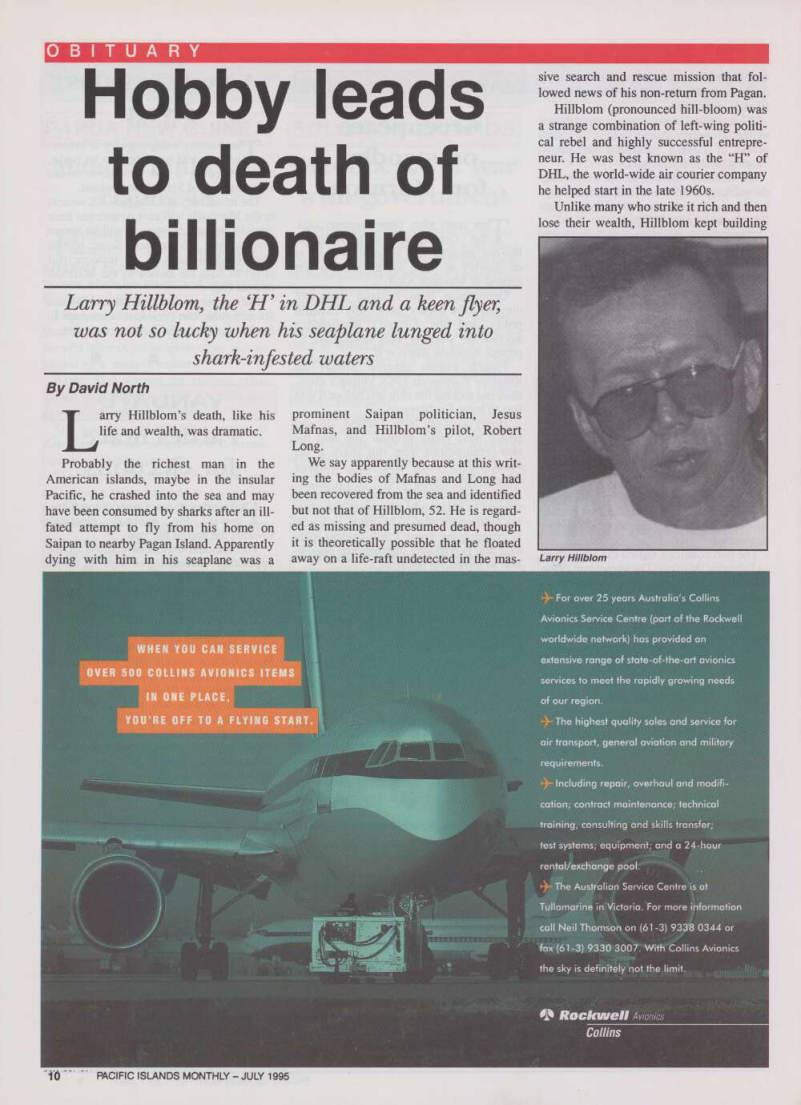
Larry Hillblom’s death, like his life and wealth, was dramatic.
Probably the richest man in the American islands, maybe in the insular Pacific, he crashed into the sea and may have been consumed by sharks after an ill fated attempt to fly from his home on Saipan to nearby Pagan Island. Apparently dying with him in his seaplane was a
prominent Saipan politician, Jesus Mafnas, and Hillblom’s pilot, Robert Long.
We say apparently because at this writ ing the bodies of Mafnas and Long had been recovered from the sea and identified but not that of Hillblom, 52. He is regard ed as missing and presumed dead, though it is theoretically possible that he floated away on a life-raft undetected in the mas
sive search and rescue mission that fol lowed news of his non-return from Pagan.
Hillblom (pronounced hill-bloom) was a strange combination of left-wing politi cal rebel and highly successful entrepre neur. He was best known as the “H” of DHL, the world-wide air courier company he helped start in the late 19605.
Unlike many who strike it rich and then lose their wealth, Hillblom kept building
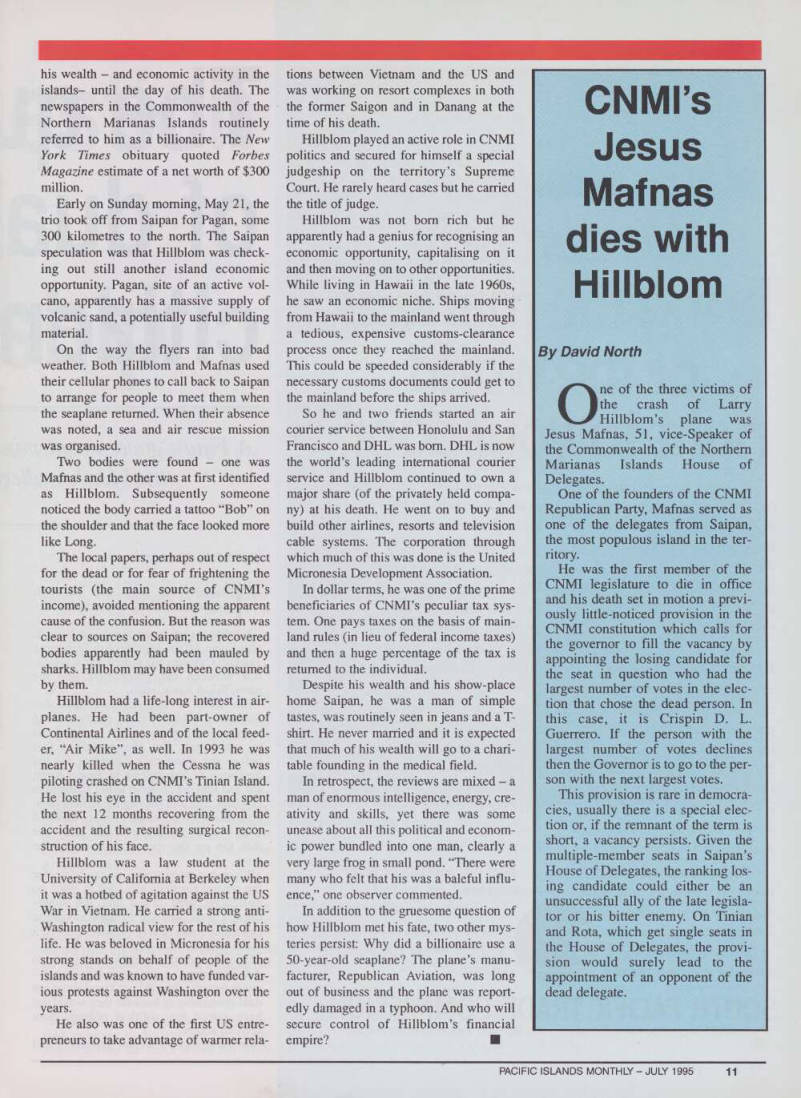
Larry Hillblom
his wealth - and economic activity in the islands- until the day of his death. The newspapers in the Commonwealth of the Northern Marianas Islands routinely referred to him as a billionaire. The New York Times obituary quoted Forbes Magazine estimate of a net worth of $3OO million.
Early on Sunday morning, May 21, the trio took off from Saipan for Pagan, some 300 kilometres to the north. The Saipan speculation was that Hillblom was check ing out still another island economic opportunity. Pagan, site of an active vol cano, apparently has a massive supply of volcanic sand, a potentially useful building material.
On the way the flyers ran into bad weather. Both Hillblom and Mafnas used their cellular phones to call back to Saipan to arrange for people to meet them when the seaplane returned. When their absence was noted, a sea and air rescue mission
was organised.
Two bodies were found - one was Mafnas and the other was at first identified as Hillblom. Subsequently someone noticed the body carried a tattoo “Bob” on the shoulder and that the face looked more like Long.
The local papers, perhaps out of respect for the dead or for fear of frightening the tourists (the main source of CNMTs income), avoided mentioning the apparent cause of the confusion. But the reason was clear to sources on Saipan; the recovered bodies apparently had been mauled by sharks. Hillblom may have been consumed
by them.
Hillblom had a life-long interest in air planes. He had been part-owner of Continental Airlines and of the local feed er, “Air Mike”, as well. In 1993 he was nearly killed when the Cessna he was piloting crashed on CNMTs Tinian Island.
He lost his eye in the accident and spent the next 12 months recovering from the accident and the resulting surgical recon struction of his face.
Hillblom was a law student at the University of California at Berkeley when it was a hotbed of agitation against the US War in Vietnam. He carried a strong anti- Washington radical view for the rest of his life. He was beloved in Micronesia for his strong stands on behalf of people of the islands and was known to have funded var ious protests against Washington over the years.
He also was one of the first US entre preneurs to take advantage of warmer rela
tions between Vietnam and the US and was working on resort complexes in both the former Saigon and in Danang at the time of his death.
Hillblom played an active role in CNMI politics and secured for himself a special judgeship on the territory’s Supreme Court. He rarely heard cases but he carried the title of judge.
Hillblom was not bom rich but he apparently had a genius for recognising an economic opportunity, capitalising on it and then moving on to other opportunities.
While living in Hawaii in the late 19605, he saw an economic niche. Ships moving from Hawaii to the mainland went through a tedious, expensive customs-clearance process once they reached the mainland.
This could be speeded considerably if the necessary customs documents could get to the mainland before the ships arrived.
So he and two friends started an air courier service between Honolulu and San Francisco and DHL was bom. DHL is now the world’s leading international courier service and Hillblom continued to own a major share (of the privately held compa ny) at his death. He went on to buy and build other airlines, resorts and television cable systems. The corporation through which much of this was done is the United Micronesia Development Association.
In dollar terms, he was one of the prime beneficiaries of CNMI’s peculiar tax sys tem. One pays taxes on the basis of main land rules (in lieu of federal income taxes) and then a huge percentage of the tax is returned to the individual.
Despite his wealth and his show-place home Saipan, he was a man of simple tastes, was routinely seen in jeans and a T shirt. He never married and it is expected that much of his wealth will go to a chari table founding in the medical field.
In retrospect, the reviews are mixed - a man of enormous intelligence, energy, cre ativity and skills, yet there was some unease about all this political and econom ic power bundled into one man, clearly a very large frog in small pond. “There were many who felt that his was a baleful influ ence,” one observer commented.
In addition to the gruesome question of how Hillblom met his fate, two other mys teries persist: Why did a billionaire use a
50-year-old seaplane? The plane’s manu
facturer, Republican Aviation, was long out of business and the plane was report edly damaged in a typhoon. And who will secure control of Hillblom’s financial
empire? ■
Advertisements & other items, p. 10 (1 item)
ill ONE PLACEp [
WHEN YOU CAN SERVICE
OVER 500 COLLINS AVIONICS ITEMS
YOU’RE OFF TO A FLYING START.
*=«. ; -.- 5 For over 25 years Australia's Collins Avionics Service Centre (part of the Rockwell worldwide network) has provided an extensive range of state-of-the-art avionics services to meet the rapidly growing needs of our region. highest quality sales and service for air transport, general aviation and military requirements.
Including repair, overhaul and modification; contract maintenance; technical training, consulting and skills transfertest systems; equipment; and a 24-hour rental/exchange pool. 1 The Australian Service Centre is at Tullamarine in Victoria. For more information call Neil Thomson on (61-3) 9338 0344 or fax (61-3) 9330 3007. With Collins Avionics the sky is definitely not the limit. *l* Rockwell Avionics Collins
Mafnas
Cnmi’S
Jesus Mafnas dies with Hillblom
By David North
One of the three victims of the crash of Larry Hillblom’s plane was Jesus Mafnas, 51, vice-Speaker of the Commonwealth of the Northern Marianas Islands House of Delegates.
One of the founders of the CNMI Republican Party, Mafnas served as one of the delegates from Saipan, the most populous island in the ter ritory.
He was the first member of the CNMI legislature to die in office and his death set in motion a previ ously little-noticed provision in the CNMI constitution which calls for the governor to fill the vacancy by appointing the losing candidate for the seat in question who had the largest number of votes in the elec tion that chose the dead person. In this case, it is Crispin D. L.
Guerrero. If the person with the largest number of votes declines then the Governor is to go to the per son with the next largest votes.
This provision is rare in democra cies, usually there is a special elec tion or, if the remnant of the term is short, a vacancy persists. Given the
multiple-member seats in Saipan’s
House of Delegates, the ranking los ing candidate could either be an unsuccessful ally of the late legisla tor or his bitter enemy. On Tinian and Rota, which get single seats in the House of Delegates, the provi sion would surely lead to the appointment of an opponent of the dead delegate.
The question

Law
The question of dual citizenship
A Fijian government mil trial for her allei
By Yunus Rashid
There is no doubt that the High Court in Fiji is in the hot seat rather the hot bench.
A political ploy by an opposition party to oust Fijian Affairs Minister Adi Samanunu Talakuli Cakobau has turned into a tug-of war between the government and the party, Fijian Association.
The facts of the case are that Adi Samanunu holds a British passport along with her Fijian passport. She admitted this in parliament. But she explained that before she stood as a candidate for the Soqosoqo ni Vakavulewa ni Taukei party, she had sent her passport to her husband in England. She said she had the British pass port solely for traveling with her husband who was serving in the British army and that too on the recommendation of the army.
When her nomination as candidate for the general elections was fded in 1993, no objections were raised and she subse quently won over the Fijian Association candidate and party leader Josevata Kamikamica.
Fijian Association could have objected to Adi Samanunu’s nomination but did not either because they did not know about her dual citizenship or because they would not have gained any political mileage from such an action.
On the basis of what Adi Samanunu told
ster and high chief goes on d dual citizenship
parliament, the Fijian Association is seek ing the High Court to; * Declare invalid the Fijian passport issued to Adi Samanunu in 1993 because at the time she was still the holder of a British passport; * Declare that she could not have been nominated to contest the general elections; * Declare that she could not have been registered as a voter last year; * Declare that she be disqualified as a Member of Parliament; * Declare that she could not be registered as a voter because she had not lived in Fiji continuously for the 24 months immedi ately before the general elections.
The Fijian Association also wants Kamikamica to be declared the victorious candidate instead of Adi Samanunu since he had received the fourth highest votes in the constituency and all documents signed by Adi Samanunu as Minister for Fijian Affairs be nullified.
Solicitor-general Isikeli Mataitoga, who is representing hte state, asked Justice Fatiaki to strike out the Fijian Association action on the grounds that there was no reasonable cause of action for it, the party did not have the legal right to institute such an action becasue it was not a registered voter and the action was contrary to public policy and was against common law prin ciples.
Meanwhile, Adi Samanunu’s supporters held meetings to discuss how they could protest against the move to oust her. They
held several meetings with the minister and expressed their support for her. She, in turn, told the supporters that times were trying for her but she was bearing the embarrassment with dignity. The support ers decided that if they were denied a per mit to march through the streets of the cap ital, Suva, they would gather at the court house on the date of the hearing. This they did.
The Supervisor of Elections has ruled that the minister’s election to parliament may be a breach of the constitution but it does not matter anymore because nobody picked it up during the one-week objection
period.
The supervisor said as far as his office was concerned, Adi Samanunu was in the clear.
Adi Samanunu saw Rabuka about her dual citizenship but his advice to her is not known. What is on record is that Adi Samanunu applied for a new passport in 1993 and was issued with one. How this happened has not been explained either.
Fiji’s Immigration Department says it
does not issue a Fiji passport to anyone known to have a foreign passport. Adi Samanunu’s lawyers have yet to file sub missions. ■
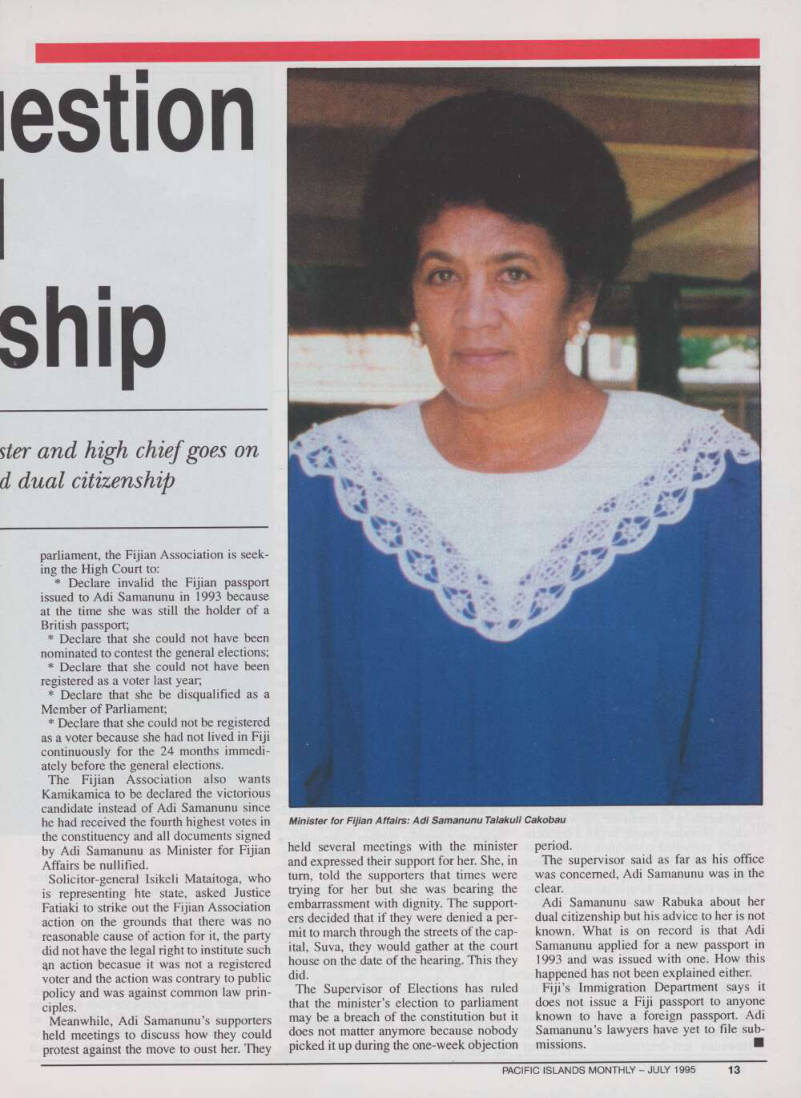
Minister for Fijian Affairs: Adi Samanunu Talakuli Cakobau
Advertisements & other items, p. 12 (1 item)
We can hel
sftlflri ■ , ' ■ ■ ■
■ misl
X 25* ■ ■s&a y ! m i i. * < w 'r
We can hel
bring the markets
of the world
right to your door.
If you’ve been in business for any length of time, you know that half the battle is knowing the right people. But when you live on an island, making such contacts can be pretty difficult, not to mention expensive.
That’s where the South Pacific Trade Commission comes in. Our primary purpose in life is helping business people in the Pacific Islands become more successful.
Not only can we introduce you to key importers, agents or retailers around the world, we can also put you in contact with potential investors.
And we can assist exporters attend Australian trade fairs and exhibitions.
To give you an idea. In recent months we helped Western Samoa Breweries find an Australian agent to promote and distribute Vailima beer. We helped Teikabuti Fishing Co. redesign their tuna jerky packaging to conform to Australian standards. We arranged for the enrollment of five trainees in technical training courses in NSW and Qld. And we paid for six South Pacific companies to attend Fine Food Fair‘94 in Melbourne.
So if you need some help making the right contacts, just contact us. After all, you’ve nothing to lose and the rest of the world to gain.
We can help you with packaging designs that will appeal to new markets.
We can arrange training in business and technical skills for your employees.
SOUTH PACIFIC TRADE COMMISSION
50 Park Street, Sydney 2000. Telephone (612) 283 5933 Facsimile (612) 283 5948
The state of
Sovereignty
The state of the Hawaiian movement
Support for the cause appears to be dwindling as the group gets fragmented
By Ed Rampell
What is that state of the Hawaiian sover eignty cause?
A so-called “plebiscite” is scheduled from November 15 to December 29, 1995, via mail-in ballot, to ask: “Shall the Hawaiian people elect delegates to propose a native Hawaiian government?” Anyone 18 and older around the world, with at least one percent Hawaiian blood, can vote. The result is to be announced on January 17, 1996.
The proposed referendum is derived from two acts passed by Hawaii’s State Legislature - Senate Bill 1028 established the Sovereignty Advisory Commission (SAC) and House Bill 3630 established the Hawaiian Sovereignty Elections Council (HSEC).
As its name indicates, SAC was an adviso ry body and U 55420,000 was appropriated for it to advise the Legislature on “holding a referendum to determine the will of the native Hawaiian people to call a democra tically convened convention for the pur pose of achieving consensus on an organic document that will propose the means for native Hawaiians to operate under a gov ernment of their own choosing...” SAC evolved into HSEC which turned the advi sory body into a government organ with the power and funding to implement the referendum.
TThe SAC-HSEC plebiscite has generated a tremendous amount of controversy in the indigenous movement. Proponents tout it as a major educational, organisational and unifying step that could lead towards Hawaiian self-determination. Opponents
fear it’s a co-ordinated, counter-intelli gence conspiracy to sell-out sovereignty.
In 1993, during the 100th anniversary of the overthrow of the kingdom of Hawaii, 16,000 people turned out for the biggest protest in state history. But by January 1995, the number of demonstrators at the annual Sovereign Sunday rally plummeted to 100.
For referendum foes, Hawaiians are not showing up en masse at protests because the plebiscite gives the appearance the state is remedying Hawaiian grievances.
The plebiscite’s enemy number one is Ka LaHui Hawaii, the Sovereign Hawaiian Nation, which claims more than 20,000 citizens and calls it “the final theft”. Office of Hawaiian Affairs Trustee Billie Beamer wants the vote delayed, calling the process “the second great Mahele” (commoners lost their lands in 1848’s first Mahele).
Independence advocate Kekuni Blaisdell of the Pro-Hawaiian Sovereignty Working Group believes authorities want this vote to occur soon because polls reveal only a
minority currently support independence.
A referendum now would result in a sov ereignty model that retains ties with the State and Federal governments.
The deepest fear plebiscite dissidents have is that the state and the US would try to use the vote as a way to close the chapter on sovereignty. They have other concerns: tainting of the voter roll (how can a voter prove he’s Hawaiian?) and ballot tamper ing via a mail-in vote. Professor Trask points out the federal, not the state govern ment, recognises nations and tribal gov ernmental entities, as with Indians and Eskimos.
In essence, opposition insists that self-
determination is by the self - not the state and government involvement nullifies the process as a legitimate act of self-determi nation. Ka LaHui, for example, was creat ed by a Native initiative. Its elections and constitutional convention were held with out state or federal funding and participa tion.
HSEC responds to some fears with a dec laration that the plebiscite does not waive Hawaiians rights. Hayden Burgess, an HSEC member and independence advo cate, cites several Indian cases as proof
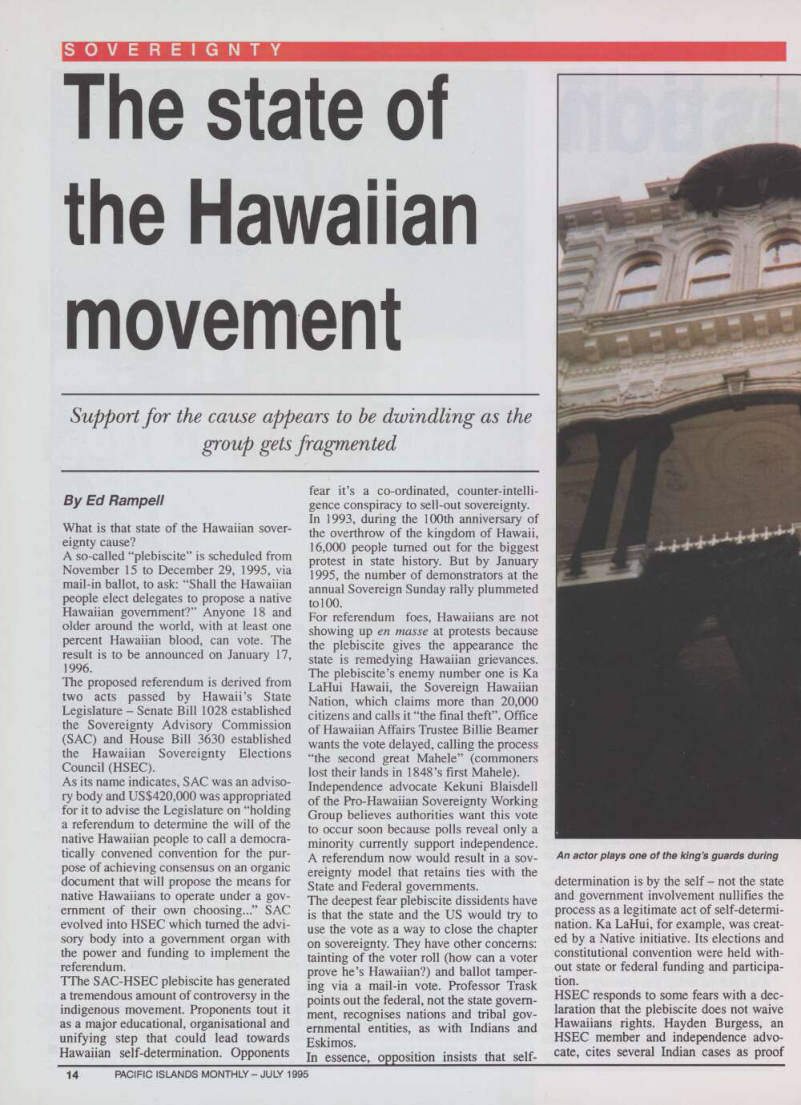
An actor plays one of the king’s guards during
that state and/or federal involvement does not necessarily invalidate the Native self determination process. He contends that blame for the low turnout at Ka LaHui ral lies is not due to HSEC but to the group’s own poor organising and sectarian divi siveness.
Whether or not the plebiscite was deliber ately created to divide Hawaiians, it is having exactly that effect. Instead of organising around land and other pressing issues, the vanguard is now embroiled in the HSEC imbroglio.
This divisiveness adds to the fractiousness of a movement already split into numerous groups with competing programmes. Most Hawaiians are pro-sovereignty. Broadly defined, sovereignty is native self-govern ment, providing Kanaka Maoli with polit ical, water, cultural, and religious rights, generally believed to require a land base.
But consensus and agreement over sover eignty end here and there are different ideas as to what form Hawaiian self-rule should take.
Mahealani Kamauu, executive director of the Native Hawaiian Legal Corp, describes the state-within-a-state sovereignty model as “a political subdivision ... it would be a
country-like entity”.
Proponents assert such an agency would act as a state government for a Hawaiian sovereign entity and would interact with state and federal governments on behalf of Hawaiians. It would function like common state governments with elected and appointed officials, and a variety of
departments governing lands, finances,
and so on. It would be another branch of government.
The nation-within-a-nation model holds Hawaiians must be accorded the same rights other Native Americans (Indians, Eskimos) have. This plan seeks tribal recognition for Hawaiians on something akin to a reservation-type system.
Hawaiians, on a land base, would become the restored Hawaiian nation within the American nation, with a govemment-to
govemment relationship with Washington.
This is similar to the treaty status 300 native nations in the US now have.
Hawaiians, uniquely, are the only major
Native American group which does not have this tribal set-up. Full voting rights would probably be restricted to Hawaiians, as might ownership of land and other resources. The main nation
within-a-nation exponent is Ka LaHui Hawaii.
Under nation-within-a-nation, Hawaiians would retain US citizenship and various entitlements, like social security, and remain subject to a draft and other feder al/state laws, as nation-within-a-nation has limited autonomy. Some backers see it as a pragmatic first step towards full indepen dent nationhood.
The independence model is total separa tion from the US as a separate country that includes the entire archipelago.
A number of native leaders and groups support independence (even if it’s in the long run). In a nutshell, like all sovereign ty exponents, “independentistas” contend the 1893 overthrow of the monarchy, the US annexation in 1898 and statehood were illegal under international law and uncon stitutional. But unlike advocates of the other models, independentistas contend the only proper recourse is restitution in the form of restoration of an independent nation state to replace the one stolen in 1893.
Interestingly, more indigenous leaders and groups advocate independence than any other sovereignty model ( although numer ically, this does not mean more Hawaiians do). One poll showed 12 percent of those polled favouring independence.
Independentistas divide over the kind of government a restored Hawaiian nation state would have. Some favour restoration of the monarchy. On June 7, 1992, dub bing himself King Kamehameha VI, Windyceslau Lorenzo declared the restoration of the Kingdom of Hawaii at an lolani Palace ceremony and then attempt ed a coup at Honolulu’s city hall in order to restore a monarchy in April, 1994.
The only independentista tendency to
attain mass following and public promi
nence is the Nation of Hawaii (formerly Ghana Council). On January 16, 1994, NOH declared independence from the US at an lolani Palace rally, and in October, 1994, held a constitutional convention. Its self-governance model emphasises the role of elders as perpetualors of Hawaiian culture and rule.
According to its attorney Francis Boyle (who represented the PLO, the ex-presi dent of Lithuania, and Bosnia), the US apology Bill (which called the 1893 over throw “illegal”) is “an admission of guilt giving Hawaiians the right under interna tional law to restitution in terms of return ing that which was taken from them - an independent nation - if they so desire”.
NOH follows a decolonisation process
prescribed by Professor Boyle.
The Nation of Hawaii is based at 50-plus acres it got from the state after a land struggle and likens its arrangement to Arafat’s deal with Israel giving Palestinians autonomy. To NOH, this is the embryonic start of a sovereign Hawaiian nation. ■
protests in 1993
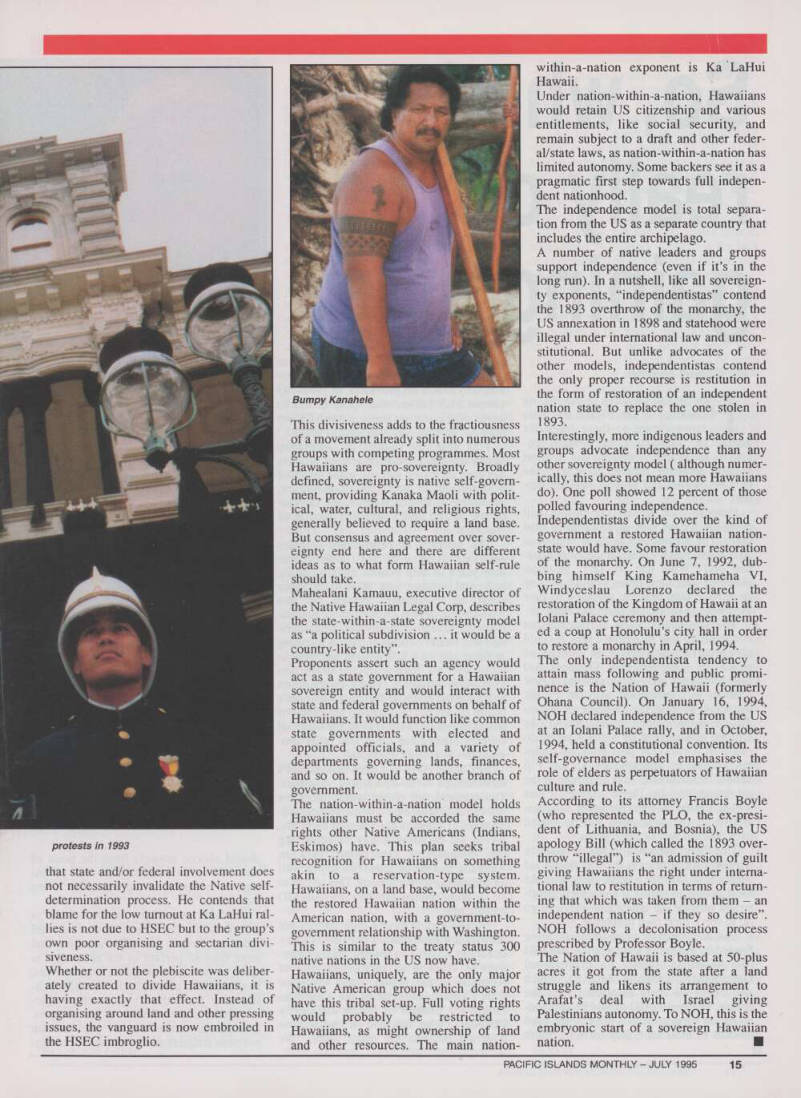
Bumpy Kanahele
gaining side?
Health
So, who is really on the gaining side?
By Robert Simms
Few health facilities in developing countries of the Pacific and Asia can compare to those taken for granted in Australia. Local medical spe cialists are scarce , surgeons are in short
supply, operating theatres have only the
bare necessities and support staff are lim ited.
Patients with serious complaints will often die for the lack of expertise to treat them. The seriousness in these regions is so massive that it elicits shrugs of resigna tion and “What can we do?” gestures.
However, there are those who are willing to provide help and are prepared to give their time to tackle the problems head on.
The Australian Society of Anaesthetists is one group that recognised how it could play a part in overcoming the shortage of specialists. Through their Overseas Aid Sub-committee they have devised a new scheme, in consultation with the Pacific Islanders, to ease the shortage of anaes thetists in the region. “In July we will be sending anaesthetist Dr Steve Kinnear to establish a two-year post-graduate diplo ma course in anaesthetics at the Fiji School of Medicine,” says chairman of the sub-committee Dr David Mawter. “This will help meet the need for about 20 anaes thetists in the south-west Pacific region over the next two or three years.”
This direct approach to health issues in developing countries is the way health aid works best: identify a need, liaise with the local people to ensure it has a high priori ty and provide the training so they can go on to solve their own problems.
The anaesthetists programme is being funded by Australia’s aid agency, AusAID (the Australian Agency for International
Development, formally AIDAB), which
will cover all costs associated with the course. While AusAID should be applaud ed for its support of this project, the total amount in assistance they offer to health
programmes generally is insufficient to cover more than a minority of those pro posed by health aid providers. In 1992-’93 almost $1.5 billion was spent in aid to developing countries through AusAID, yet only 5.2 percent was allocated to health.
This year, the budget for Australian health aid and population-related projects has been increased and will make up about 6.5 percent of total aid expenditure, according to Helena Hughes, the director of the Health and Population section of AusAID.
The increase in expenditure includes additional funding of $llO million over four years to help control malaria, polio, neo-natal tetanus and HIV/AIDS, four areas of particular concern in the Asia/Pacific region. Attention to popula tion issues, such as family planning, nutri tion and health education, raised spending in these areas by $2O million last year as part of a four-year, $ 130-million Population Initiative. These programmes will have the effect of focusing Australia’s health efforts but considering the extent of health problems in the region, the financial support offered for these and other pro grammes is grossly inadequate.
Health aid plays two roles in Australia’s relationships with developing countries.
The predominant philanthropic incentive is often augmented by commercial consid erations. If projects are selected carefully, giving aid becomes a way of enhancing the commercial association between Australia and the recipient country as well as addressing a health need. This seems to be a point underestimated by AusAID bureaucrats.
“Health should have a high priority not only for altruistic reasons but also as a way to further Australia’s foreign policy objec tives by creating an appropriate view of Australia in the region,” says Professor Cres Eastman, Director of the Australian Centre for Control of lodine Deficiency Disorders, who has had an association with aid projects for many years. “We
should choose projects from the point of view of need first but ought to take advan tage of commercial opportunities when they occur.”
Further advantage for Australia is gained when you consider the way aid funds are used. AusAID estimates that more than 85 percent of the aid budget is spent in Australia on goods and services.
Home-grown consultancies benefit sub stantially from the development, imple mentation and evaluation of aid projects.
Educational institutions are paid to train overseas students and equipment used dur
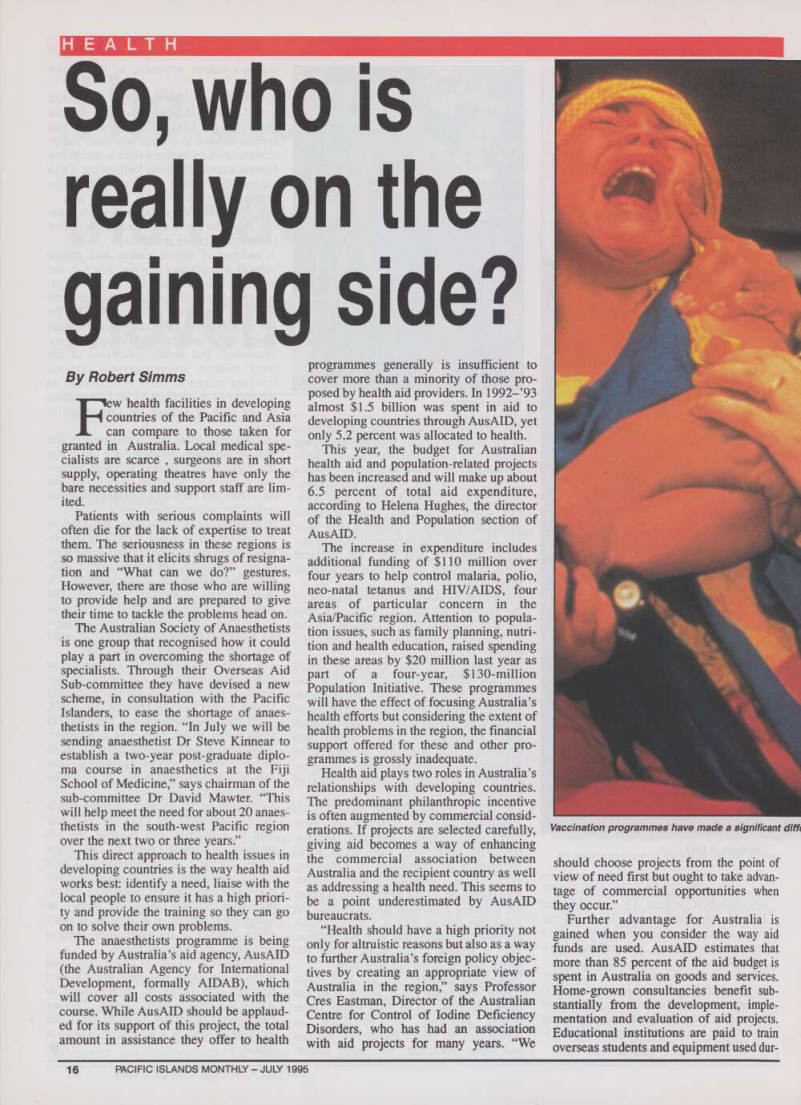
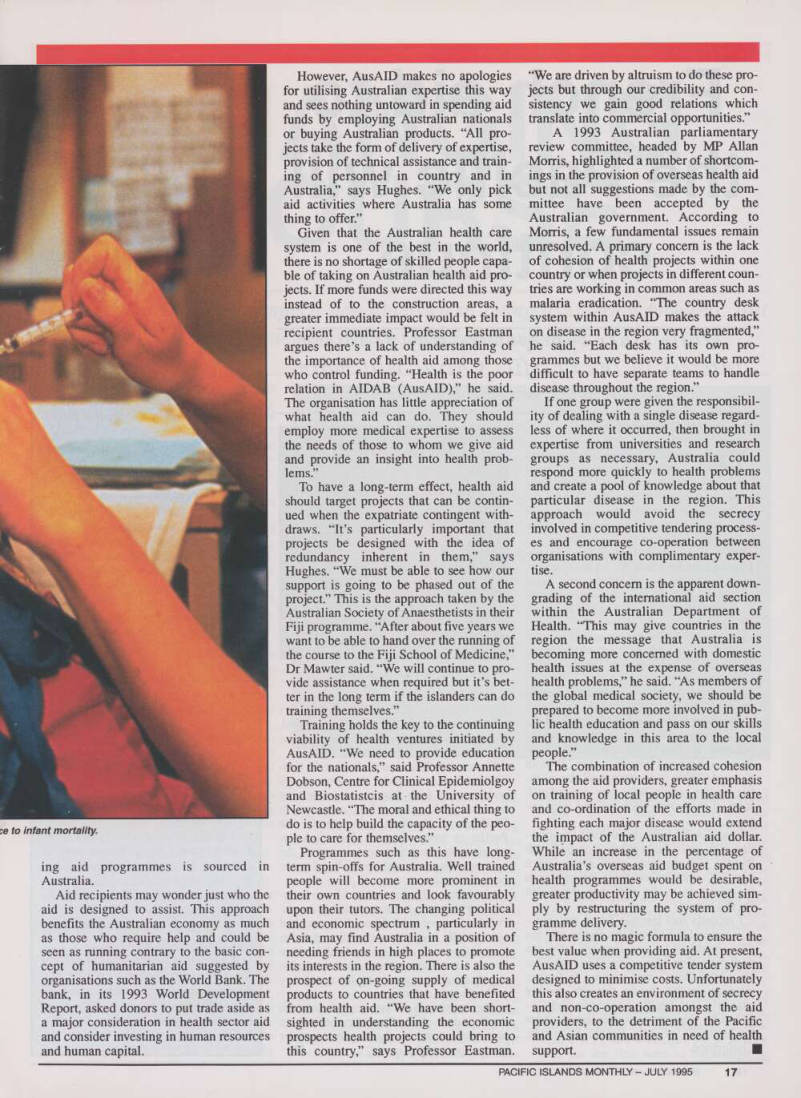
Vaccination programmes have made a significant diffe
ing aid programmes is sourced in Australia.
Aid recipients may wonder just who the aid is designed to assist. This approach benefits the Australian economy as much as those who require help and could be seen as running contrary to the basic con cept of humanitarian aid suggested by organisations such as the World Bank. The bank, in its 1993 World Development Report, asked donors to put trade aside as a major consideration in health sector aid and consider investing in human resources and human capital.
However, AusAID makes no apologies for utilising Australian expertise this way and sees nothing untoward in spending aid funds by employing Australian nationals or buying Australian products. “All pro jects take the form of delivery of expertise, provision of technical assistance and train ing of personnel in country and in Australia,” says Hughes. “We only pick aid activities where Australia has some thing to offer.”
Given that the Australian health care system is one of the best in the world, there is no shortage of skilled people capa ble of taking on Australian health aid pro jects. If more funds were directed this way instead of to the construction areas, a greater immediate impact would be felt in recipient countries. Professor Eastman argues there’s a lack of understanding of the importance of health aid among those who control funding. “Health is the poor relation in AIDAB (AusAID),” he said.
The organisation has little appreciation of what health aid can do. They should employ more medical expertise to assess the needs of those to whom we give aid and provide an insight into health prob lems.”
To have a long-term effect, health aid should target projects that can be contin ued when the expatriate contingent with draws. “It’s particularly important that projects be designed with the idea of redundancy inherent in them,” says Hughes. “We must be able to see how our support is going to be phased out of the project.” This is the approach taken by the Australian Society of Anaesthetists in their Fiji programme. “After about five years we want to be able to hand over the running of the course to the Fiji School of Medicine,”
Dr Mawter said. “We will continue to pro vide assistance when required but it’s bet ter in the long term if the islanders can do training themselves.”
Training holds the key to the continuing viability of health ventures initiated by AusAID. “We need to provide education for the nationals,” said Professor Annette Dobson, Centre for Clinical Epidemiolgoy and Biostatistcis at the University of Newcastle. “The moral and ethical thing to do is to help build the capacity of the peo ple to care for themselves.”
Programmes such as this have long term spin-offs for Australia. Well trained people will become more prominent in their own countries and look favourably upon their tutors. The changing political and economic spectrum , particularly in Asia, may find Australia in a position of needing friends in high places to promote its interests in the region. There is also the prospect of pn-going supply of medical products to countries that have benefited from health aid. “We have been short sighted in understanding the economic prospects health projects could bring to this country,” says Professor Eastman.
“We are driven by altruism to do these pro jects but through our credibility and con sistency we gain good relations which translate into commercial opportunities.”
A 1993 Australian parliamentary review committee, headed by MP Allan Morris, highlighted a number of shortcom ings in the provision of overseas health aid but not all suggestions made by the com mittee have been accepted by the Australian government. According to Morris, a few fundamental issues remain unresolved. A primary concern is the lack of cohesion of health projects within one country or when projects in different coun tries are working in common areas such as malaria eradication. “The country desk system within AusAID makes the attack on disease in the region very fragmented,” he said. “Each desk has its own pro grammes but we believe it would be more difficult to have separate teams to handle disease throughout the region.”
If one group were given the responsibil ity of dealing with a single disease regard less of where it occurred, then brought in expertise from universities and research groups as necessary, Australia could respond more quickly to health problems and create a pool of knowledge about that particular disease in the region. This approach would avoid the secrecy involved in competitive tendering process es and encourage co-operation between organisations with complimentary exper tise.
A second concern is the apparent down grading of the international aid section within the Australian Department of Health. “This may give countries in the region the message that Australia is becoming more concerned with domestic health issues at the expense of overseas health problems,” he said. “As members of the global medical society, we should be prepared to become more involved in pub lic health education and pass on our skills and knowledge in this area to the local people.”
The combination of increased cohesion among the aid providers, greater emphasis on training of local people in health care and co-ordination of the efforts made in fighting each major disease would extend the impact of the Australian aid dollar.
While an increase in the percentage of Australia’s overseas aid budget spent on health programmes would be desirable, greater productivity may be achieved sim ply by restructuring the system of pro gramme delivery.
There is no magic formula to ensure the best value when providing aid. At present, AusAID uses a competitive tender system designed to minimise costs. Unfortunately this also creates an environment of secrecy and non-co-operation amongst the aid providers, to the detriment of the Pacific and Asian communities in need of health support. ■
ce to infant mortality.
French aid to
The Territories
French aid to the Pacific will continue
While other superpowers may be losing interest in the Pacific, Chirac will main tain its presence here
By Patrick Decloitre
Paris-based ambassador Jean Bressot, who is permanent secre tary for the South Pacific and France’s permanent representative to the South Pacific Commission, said France’s relations with the Pacific were “ideal for the time being”.
Speaking during his first visit to Vanuatu, Bressot said the possibility of nuclear tests resuming in the Pacific was not discussed with Vanuatu’s Prime Minister, Maxime Carlot, although the two met for nearly one hour.
The French diplomat also said he recent ly met leaders of New Zealand, Australia and Fiji and “they all want France to stay in the region”.
He explained this saying Britain, a former colonial power in the Pacific had now clearly withdrawn from the region and the United States was starting to wonder whether it should do the same. “But France is here and intends to stay,” Bressot stressed. “This is a concept all the coun tries in the region have now assimilated, most of them with pleasure and they say so.”
He said apart from its bilateral co-opera tion with individual countries of the South Pacific, France was also active on a regional, multi-lateral basis through such organisations as the SPC and the South Pacific Forum.
“I recently met leremia Tabai, the secre tary-general of SPF in Suva and he told me how important he saw France’s relations with the region,” Bressot said in Port Vila.
He added France was seeking to further integrate in the Pacific through another channel - the Pacific Economic and Co operation Conference which comes under the umbrella of Asia Pacific Economic Conference.
Speaking more specifically on France’s relations with Australia and New Zealand, Bressot described them as “ideal for the
time being”.
“Countries like Australia and New
Zealand have changed; they now regard
co-operation with France as something necessary,” he said. “For instance, in Wellington, France’s presence in the Pacific is now accepted. I don’t know whether this is going to last but at the moment there isn’t a shadow of a cloud in our relations.”
Asked about the possibility of a resump tion of French nuclear testing in the Pacific, Bressot said although France had successfully been promoting the indefinite prolonging of the Non-Proliferation Treaty, its military force de dissuasion
was “capital to maintaining the credibility
of the French defence.
“The decision in the last resort belongs to the President of the Republic. Let’s leave him some time to thoroughly consider every aspect of the issue.” ■
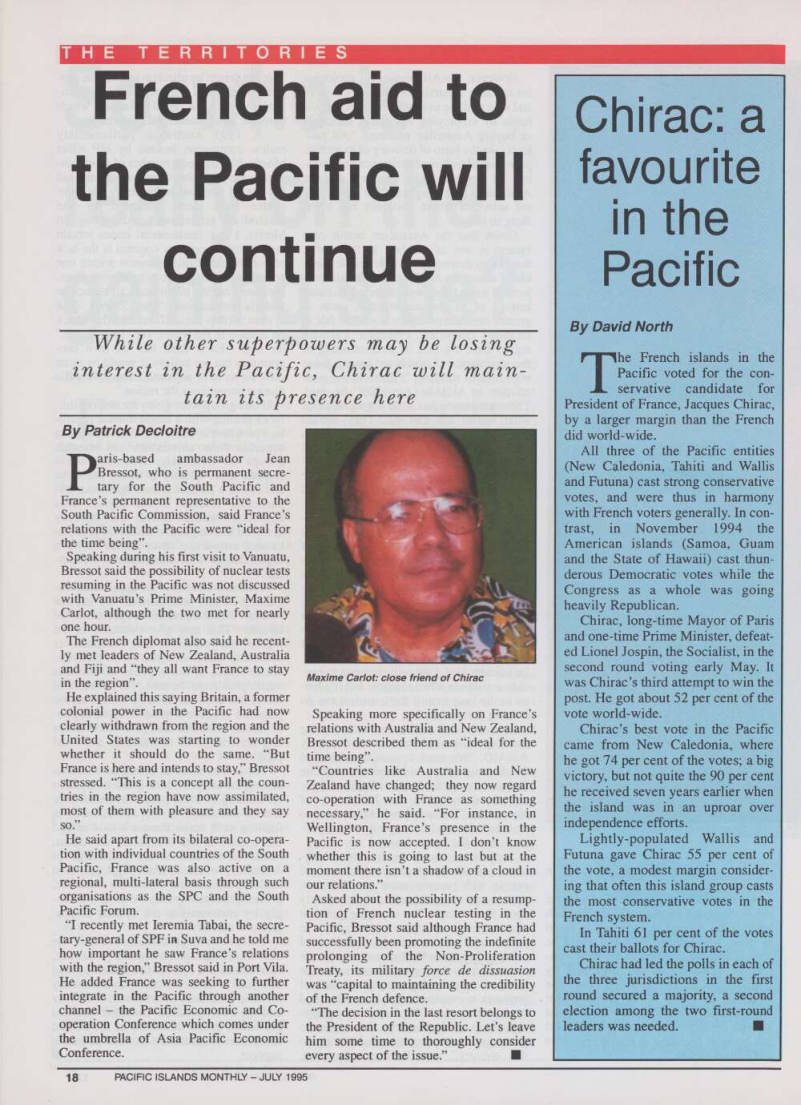
Maxime Carlot: close friend of Chirac
Chirac: a favourite
favourite in the Pacific
By David North
The French islands in the Pacific voted for the con servative candidate for President of France, Jacques Chirac, by a larger margin than the French did world-wide.
All three of the Pacific entities (New Caledonia, Tahiti and Wallis and Futuna) cast strong conservative votes, and were thus in harmony with French voters generally. In con trast, in November 1994 the American islands (Samoa, Guam and the State of Hawaii) cast thun derous Democratic votes while the Congress as a whole was going heavily Republican.
Chirac, long-time Mayor of Paris and one-time Prime Minister, defeat ed Lionel Jospin, the Socialist, in the second round voting early May. It was Chirac’s third attempt to win the post. He got about 52 per cent of the vote world-wide.
Chirac’s best vote in the Pacific came from New Caledonia, where he got 74 per cent of the votes; a big victory, but not quite the 90 per cent he received seven years earlier when the island was in an uproar over independence efforts.
Lightly-populated Wallis and Futuna gave Chirac 55 per cent of the vote, a modest margin consider ing that often this island group casts the most conservative votes in the French system.
In Tahiti 61 per cent of the votes cast their ballots for Chirac.
Chirac had led the polls in each of the three jurisdictions in the first round secured a majority, a second election among the two first-round leaders was needed. ■
Changing
Cover Story
Course
Papua New Guinea attempts a new approach in fixing its internal problems. But the question remains whether it will work
Papua New Guinea is marking its
20th independence anniversary
later this year since it divorced
Australia through independence on
September 16, 1975. Despite a mineral resources boom in the early post-indepen dence era, the transition over the last two decades has been anything but smooth.
Law and order continue to threaten peace and quiet. In many instances, sky rocketing land compensation has slowed down the pace of development, frustrating efforts by both the government and devel opers to proceed with many multi-million dollar projects.
The education system appears to have bottle-necked and the provincial govern ment system is facing the ire of the nation al lawmakers and could be axed.
As a country the very mention of Papua New Guinea immediately conjures up images (sometimes imagined) of violent crimes and serious allegations of wide spread corruption reaching the echelons of leadership at all levels.
These and a host of other factors have contributed to an unfavourable image of PNG and its people, both at home and abroad. Since taking office in September, Prime Minister Sir Julius Chan and his coalition government have been doing some serious soul-searching to find out what had gone wrong and how to fix it.
But untangling the mess which succes sive governments have been unable to contain in the last two decades is a daunt ing task indeed. But Chan’s government is determined to tackle the problem head on.
It has appointed a five-member National Events Council and given it a broad mandate to fix the problem. Part of its mandate is to “instil in the hearts and minds of Papua New Guineans self esteem and self-respect for their country”.
Heading the “Fix-it” team is former Air Niugini general manager Joe Tauvasa. As chairman of NEC, Tauvasa’s team will be
in charge of organising and co-ordinating
all international and national events to fur ther this end, starting this year.
It means the NEC must find the money for the events. For instance, Tauvasa has set his sights on raising K 750,000 to cover the costs associated with this year’s inde pendence anniversary celebrations and the hosting of the 26th South Pacific Forum, the annual summit of the region’s political leaders.
One private firm has so far provided K 250,000 towards this and more compa nies are expected to follow.
Like Chan, Tauvasa is determined to raise the awareness level within the coun try so that every Papua New Guinean knows the country has an image problem.
And the NEC wants to change that image.
Critics are already questioning whether
the new image-building campaign would work. They say that the money will be thrown into a bottomless pit. The NEC has
acknowledged that change will not hap
pen overnight but it is determined. It wants its campaign to be the catalyst for change in PNG.
No one argues that it’s a colossal task ahead for Tauvasa’s council. He would need the co-operation and assistance of every Papua New Guinean as much as he needs government and private sector help.
Where does Tauvasa start and what are
his plans?
The country’s tens of thousands of school children will be the main target.
Already the council has created a national logo, a song and a pledge. These will be used for the first time in September to
commemorate the country’s 20th independence anniversary. From then on, they will be used everyday in schools throughout the nation.
Under the motto One Nation, One People, One Country, the council hopes to instil and rekindle in the minds of the four million Papua New Guineans self-esteem, pride and respect for their country.
Under consideration is a plan to incorporate the new motto, the new national song and the pledge into the education
system by making it compulsory for
schools to recite them each morning before class starts.
The idea is that once the younger generation is taught self-esteem, pride and respect for their country - something that has been lacking in the past two decades they will be able to respect their fellowmen as well.
The spin-off is that they will also be able to pass it on to their children. One PNG official called this approach an “investment in the future of PNG”.
The NEC is pinning its hope on the belief that hosting international events in the next five years will act as a unifying force.
“It’s a starting point for us. We want to try to unite the people of Papua New Guinea,” the official said.
According to the official, the hosting of the South Pacific Forum’s annual summit will be the first of many international events PNG intends to host before the start of the next millennium.
“It’s part of the exercise to try to get the country on its right footing and for the
country to be united.”
Present and past governments have
acknowledged that indigenous Papua New
Guineans lacked self-dignity and that this has arguably contributed to the country’s social and economic dilemma. Instilling pride and self-respect should take care of this. It is a long shot indeed. The task will not easy.
Politically, socially and economically,
the past 20 years have been a bumpy ride for mineral -rich PNG. It seemed many Papua New Guineans only heard about the wealth of their country but never shared in it. Today problems loom in many areas.
The education system has bottle-
necked, especially in the community (pri-
mary) school level. Lack of student places in high schools has forced tens of thousands of children to leave school at the end of their six years of primary schooling, dashing their parents’ hopes for a
brighter future.
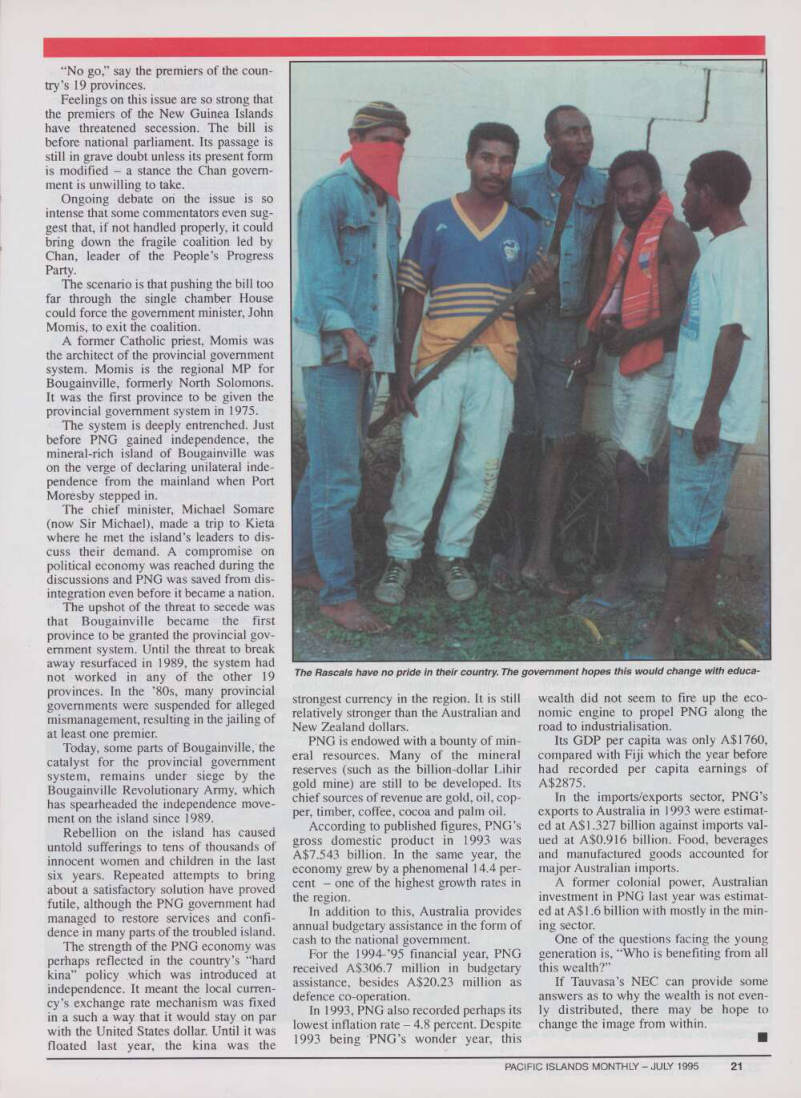
These children drifted aimlessly into towns and cities with a foregone conclusion. With nothing but boredom to look forward to, many eventually sign up with the rank and file of the growing “rascal” gangs that operate out of city suburbs.
According to PNG’s former ambassador to Fiji, Peter Tsiamalili, 44 percent of his country’s population are under the age of 15. “This has the potential for further growth. With a population of 3.9 million already, PNG’s annual population growth rate of 2.3 percent is adding 97,000 more people each year. This means that more schools, hospitals and other social infrastructure must be built to
accommodate the growth.
In fact, Tsiamalili, now PNG’s ambas sador in Brussels, says that by the year 2010, PNG would need 30,000 nurses (an increase of 12,000 over the current staffing level) and an additional 2000 trained teachers in the community school system.
At the provincial level, trouble is brew ing over attempts by the national govern ment to bring in sweeping reforms to the provincial government system.
A bi-partisan committee has recom mended drastic changes as a result of its findings that the provincial government system, introduced two decades ago, has been inefficient, costly and that those
charged with administering it have poorly
managed it.
The provincial government system
was introduced in PNG in the mid-’7os in a bid to take the government closer to the people. In other words, the grassroots should have more say in the way their government is run.
The idea is that instead of centralising power in Port Moresby, the political machinery should be shifted to the provin cial level through the process of decentral isation. In most of the 19 provinces, the provincial government system has obvi ously not worked. Instead, it has bred mis management, inefficiency and other short
comings.
Waigani is still determined to get the Provincial Government Reform Bill through but the response from the provinces has been anything but encour
aging.
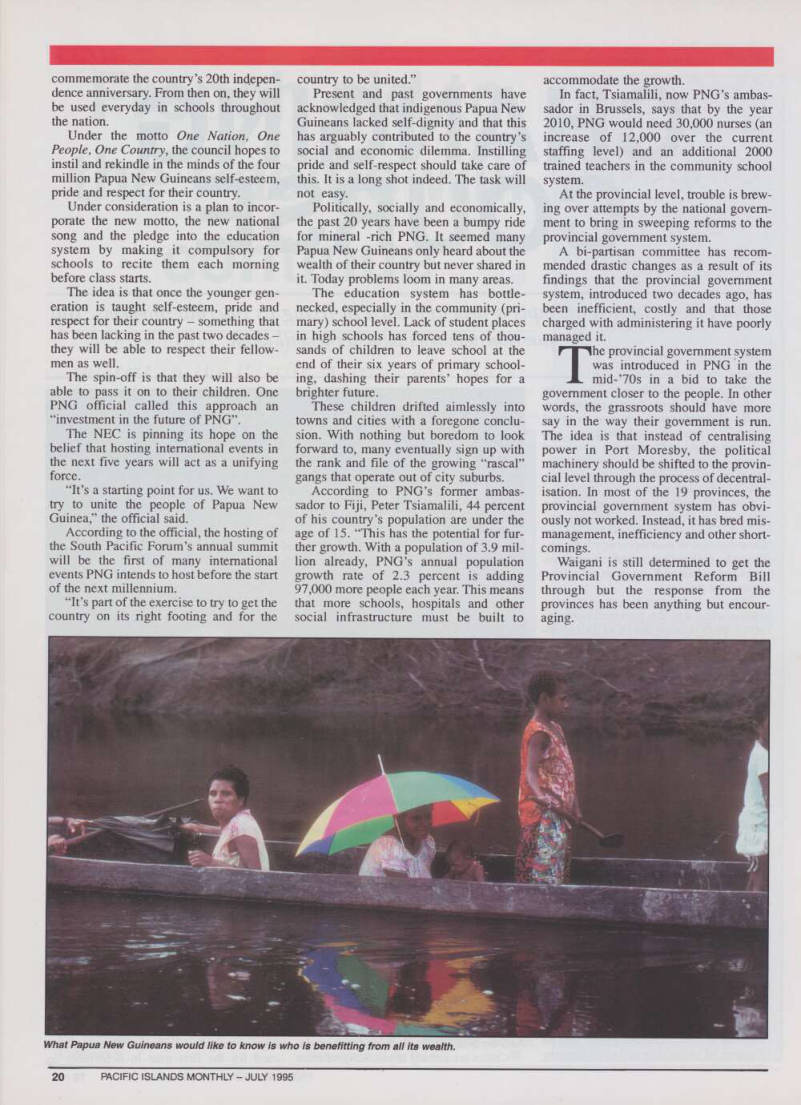
What Papua New Guineans would like to know is who is benefiting from all its wealth.
“No go,” say the premiers of the coun
try’s 19 provinces.
Feelings on this issue are so strong that the premiers of the New Guinea Islands have threatened secession. The bill is before national parliament. Its passage is still in grave doubt unless its present form is modified - a stance the Chan govern ment is unwilling to take.
Ongoing debate on the issue is so intense that some commentators even sug gest that, if not handled properly, it could bring down the fragile coalition led by Chan, leader of the People’s Progress Party.
The scenario is that pushing the bill too far through the single chamber House could force the government minister, John Momis, to exit the coalition.
A former Catholic priest, Momis was the architect of the provincial government system. Momis is the regional MP for
Bougainville, formerly North Solomons.
It was the first province to be given the provincial government system in 1975.
The system is deeply entrenched. Just before PNG gained independence, the mineral-rich island of Bougainville was on the verge of declaring unilateral inde pendence from the mainland when Port Moresby stepped in.
The chief minister, Michael Somare (now Sir Michael), made a trip to Kieta where he met the island’s leaders to dis cuss their demand. A compromise on political economy was reached during the discussions and PNG was saved from dis integration even before it became a nation.
The upshot of the threat to secede was that Bougainville became the first province to be granted the provincial gov ernment system. Until the threat to break away resurfaced in 1989, the system had not worked in any of the other 19 provinces. In the ’Bos, many provincial governments were suspended for alleged
mismanagement, resulting in the jailing of
at least one premier.
Today, some parts of Bougainville, the catalyst for the provincial government system, remains under siege by the
Bougainville Revolutionary Army, which
has spearheaded the independence move ment on the island since 1989.
Rebellion on the island has caused untold sufferings to tens of thousands of innocent women and children in the last six years. Repeated attempts to bring about a satisfactory solution have proved futile, although the PNG government had managed to restore services and confi dence in many parts of the troubled island.
The strength of the PNG economy was perhaps reflected in the country’s “hard kina” policy which was introduced at independence. It meant the local curren cy’s exchange rate mechanism was fixed in a such a way that it would stay on par with the United States dollar. Until it was floated last year, the kina was the
strongest currency in the region. It is still relatively stronger than the Australian and New Zealand dollars.
PNG is endowed with a bounty of min eral resources. Many of the mineral reserves (such as the billion-dollar Lihir gold mine) are still to be developed. Its chief sources of revenue are gold, oil, cop per, timber, coffee, cocoa and palm oil.
According to published figures, PNG’s
gross domestic product in 1993 was A 57.543 billion. In the same year, the economy grew by a phenomenal 14.4 per cent - one of the highest growth rates in
the region.
In addition to this, Australia provides annual budgetary assistance in the form of cash to the national government.
For the 1994-’95 financial year, PNG received A 5306.7 million in budgetary assistance, besides A 520.23 million as
defence co-operation.
In 1993, PNG also recorded perhaps its lowest inflation rate - 4.8 percent. Despite 1993 being PNG’s wonder year, this
wealth did not seem to fire up the eco nomic engine to propel PNG along the road to industrialisation.
Its GDP per capita was only A 51760, compared with Fiji which the year before had recorded per capita earnings of A 52875.
In the imports/exports sector, PNG’s exports to Australia in 1993 were estimat ed at A$ 1.327 billion against imports val ued at A 50.916 billion. Food, beverages and manufactured goods accounted for major Australian imports.
A former colonial power, Australian investment in PNG last year was estimat ed at Asl.6 billion with mostly in the min
ing sector.
One of the questions facing the young generation is, “Who is benefiting from all this wealth?”
If Tauvasa’s NEC can provide some answers as to why the wealth is not even ly distributed, there may be hope to change the image from within.
The Rascals have no pride in their country. The government hopes this would change with educa-
and green?
Economy
Has the World Bank gone soft and green?
By Roman Grynberg
If you open the most recent the most recent World Bank report on the South Pacific, entitled Pacific Island Economies - Building a Resilient Economic Base for the Twenty First Century, you would get the impression the much vilified bank had gone soft as it approaches its 50th birthday.
The report, which emphasises areas of economic concern to the South Pacific such as transfer pricing rip-offs in fisheries and forestry degradation, are such a dra matic departure from the standard analy ses that many officials in the region are wondering whether the bank has changed its position from its free market position of the 1980 s.
The bank’s changes began when envi
ronmental issues began to appear on the global agenda in the last 10 years. Its response has been two-track. On the one hand, it has started emphasising environ mental issues in its reports, something that was unheard of in the 1970’5. This is in no small part a result of the fact that some of the bank’s larger projects, especially some of the hydro-electric dams have been seen to be environmental disasters. But there has been another, much less positive side to its work in environment. It has been pushing a strong environmental line that economic growth, free trade and liberali sation policies are not only consistent with good environmental practices but that they are good for the environment.
There have been a number of reasons for change in the World Bank. The first and most obvious has been a Democratic administration in Washington which recently appointed Australian-bom
financier James Wolfensohn as the new president. Wolfensohn is not your usual bank president. He has a strong environ mental bent which fits well into US vice- President A 1 Gore’s own preference but he is by no means a liberal wimp. He has the most impeccable of banking backgrounds.
Senior officials within the bank indicate his appointment will mean not only a change in direction but, more importantly, it will mean that staff are likely to have some sense of direction. Bank insiders fre quently complain that they suffer from low morale stemming from the lack of leader ship of the organisation.
But Wolfensohn and the Democratic administration do not explain all the changes within the Bank. On the econom ic front, there have been some major changes in the thinking on economic poli cy. One important reason for them is that the East Asian countries provided a model of economic development throughout the 1980 s that was not only successful, but arguably nowhere remotely close to the free market, free trade position that has been the hallmark of Anglo-Saxon economies for the last 15 years and has been accepted by the World Bank. The success of highly regulated, outward look ing and extremely competitive East Asian economies throughout the Reagan/Thatcher decade made for real tensions within the development banking community. Japan, which controls the Asian Development Bank, has never accepted the free market position.
It has been difficult to justify free mar ket policies in light of Asia’s success. The response has been two-track, reflecting the World Bank’s own economic schizophre nia. One the one hand, the bank and its for mer employees have devoted enormous effort to demonstrate how much faster the Asian countries would have grown if they
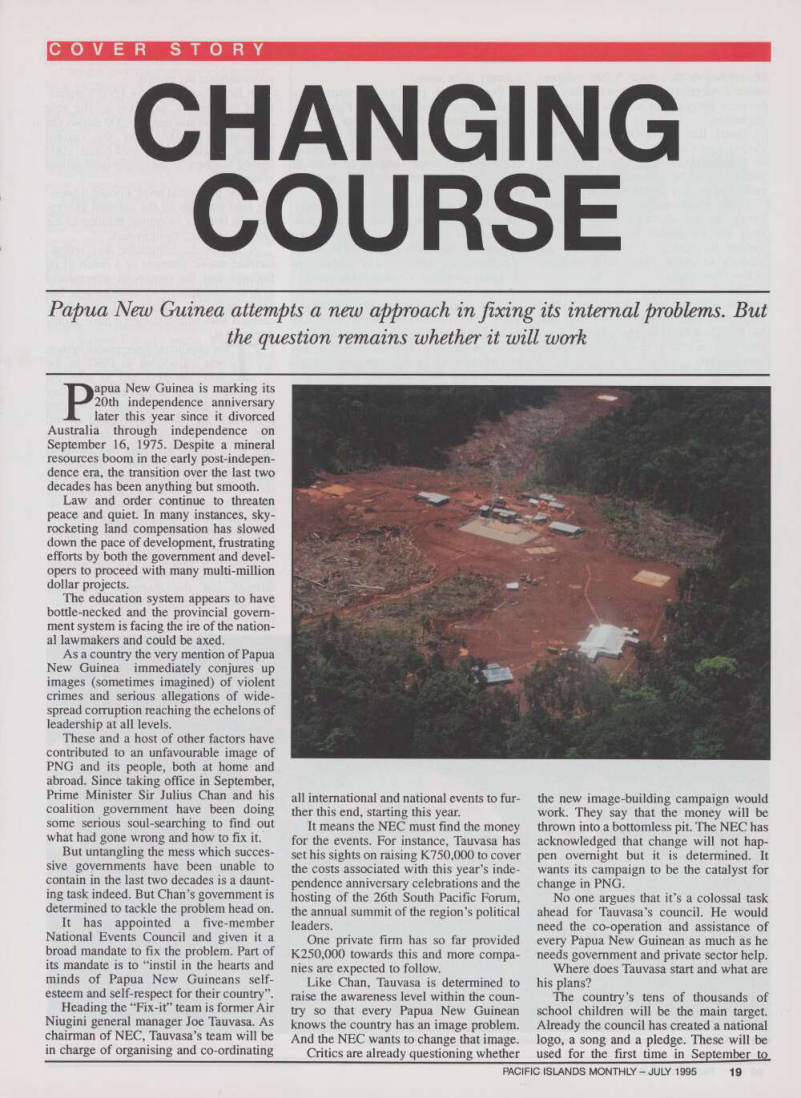
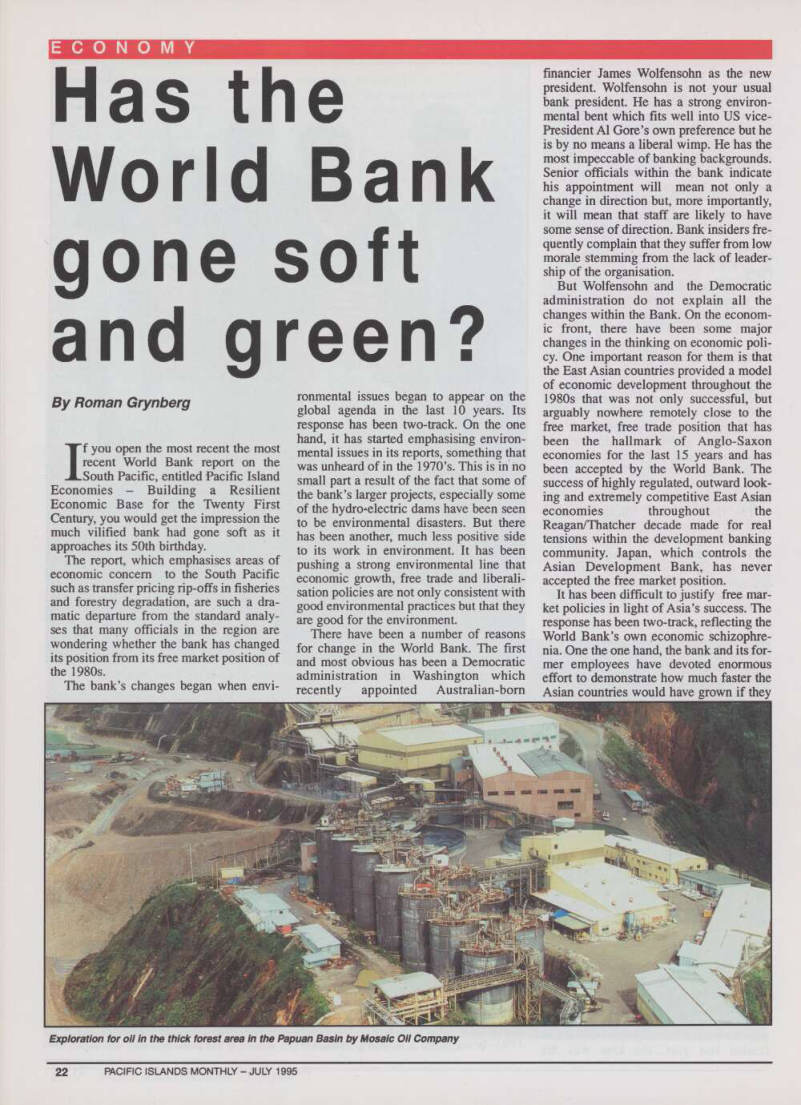
Exploration for oil in the thick forest area in the Papuan Basin by Mosaic Oil Company
had just followed the Anglo-Saxon free market model.
But inside the World Bank there is the sound of backtrack. Free market is no longer the buzz-word in Washington that it was in the heady hey day of Reaganite economics. Bank staff now talk of “market friendly” reforms. Moreover, the reports of the World Bank have been more focused on issues such as inequality and poverty.
The recently leaked but not-yet-released World Development Report emphasises these sorts of issues.
In the South Pacific, the World Bank and its sister organisation, the International Monetary Fund, have been embroiled in economic disasters in two countries. While there is no doubt a change inside the World Bank, the IMF remains a no-nonsense banker that has no time for big spending governments that spend their countries into insolvency.
Papua New Guinea has so mismanaged its economy that two years into oil exports it has been forced to sign a Kina 200 million rescue package with the IMF and the World Bank. Late in April, Finance Minister Chris Haiveta obtained the unan imous cabinet agreement for the rescue package while the Prime Minister, Sir Julius Chan, was in New Zealand desper ately attempting to obtain foreign exchange from New Zealand and Australian Reserve banks. On both occa sions he was met with precisely the same response - first agreements with the IMF and the World Bank and then there will be loans.
Reeling from the effects of the closure of the Bougainville mine the PNG govern ment had to negotiate its first structural adjustment package from the IMF in 1989.
When oil came on stream in 1993 the PNG government, rather than acting prudently from what was widely seen as a short spurt of very large foreign exchange earnings, has begun a widely predicted orgy of pub lic sector consumption that has resulted in the absurd situation that after opening two gold mines and one oil field, the PNG gov ernment is broke. IMF has imposed strict austerity measures on the public sector in PNG. Most of the measures are supposed to fall not upon education and health but directly upon PNG’s bloated public sector which is set to shrink by some 4000 work ers under the 18-month plan. The PNG cabinet agreed to abolish the much criticisedElectoral Development or slush fund as it is known in PNG. The funds of K 300,000 per MP (108 MPs) which is used at the discretion of the individual MP has been widely criticised as being abused to assure relection.
While the PNG government had argued it would never permit IMF or the World Bank to dictate internal policies, it was in the forestry sector, reputedly PNG’s most corrupt sector, that the international bank came down hard. The World Bank insisted
the government continue to provide fund ing for the Swiss company, Soceite General de Suveillance, which was recruited last year to monitor and control illegal trade practices, such as transfer pricing and species misidentification in the PNG forestry sector. The company, which is widely considered to be a relatively high cost service has provided the PNG govern ment with reliable information about the log export trade.
With agreement from the IMF/World Bank, the Australian Reserve Bank will release a loan of K4O million. Meanwhile, the government has been forced to further tighten lending as the Central Bank raised the minimum liquid asset ratio to 32 per cent on sth May. This is an increase from 11 percent six months ago. Commercial bankers in Port Moresby indicated that importers are simply unable to get money out of the country and that at the beginning of May there was unfulfilled import bill of K3O million.
While the situation in PNG has moved quickly to an agreement with the IMF and the World Bank, Solomon Islands has made little progress towards a structural adjustment package. The Mamoloni gov
emment has continued the rapacious poli cy of deforestation of the country with exports at levels that most forestry experts feel are utterly unsustainable and predict will lead to a complete deforestation with in 10 to 15 years. Unprocessed logs is now the Solomon Islands largest export. The World Bank and IMF will not agree to any loans until the forestry sector is brought under control.
While there is no doubt that changes are occurring within the World Bank, the sys tem is not going to change fundamentally.
While it may be willing to give more and more loans to what were previously “soft” areas such as education, environment, women’s issues, there will be no change in policy on structural adjustments that are needed when countries like PNG system
atically overspend and deplete their for
eign exchange reserves. In the final analy sis, the rules that apply to individual big spenders also apply to nations - if you spend more than you earn and deplete your savings, then you will end up in the hands of the bailiff - and that is a role the IMF and the World Bank will continue to per form, no matter who rules Washington. ■
Downtown Port Moresby: Forced to toe the World Bank line
Fight against
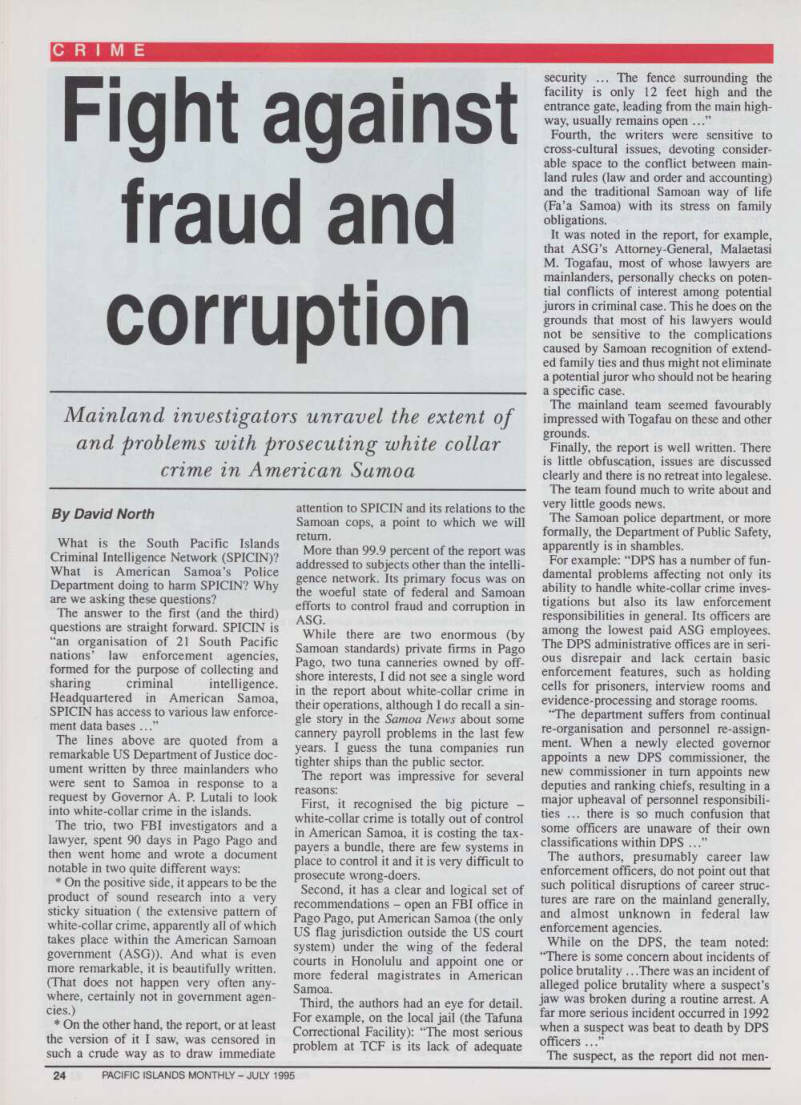
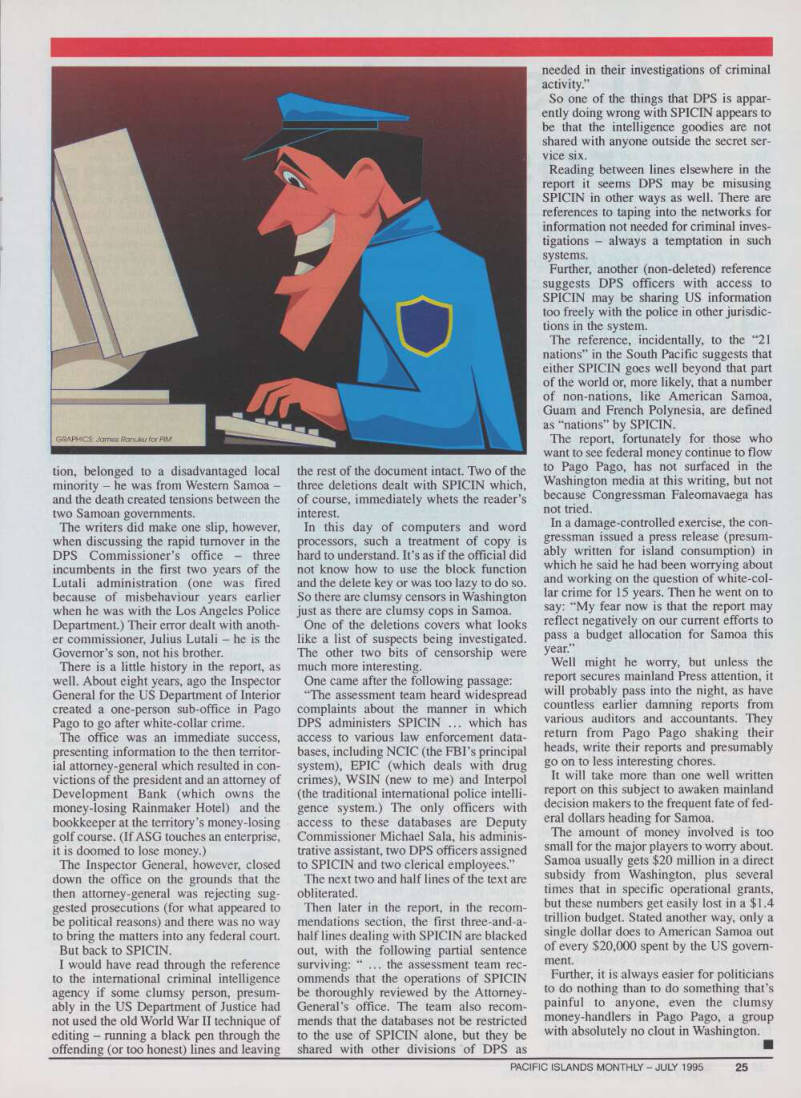
Crime
Fight against fraud and corruption
Mainland investigators unravel the extent of and problems with prosecuting white collar crime in American Samoa
By David North
What is the South Pacific Islands Criminal Intelligence Network (SPICIN)?
What is American Samoa’s Police Department doing to harm SPICIN? Why are we asking these questions?
The answer to the first (and the third) questions are straight forward. SPICIN is “an organisation of 21 South Pacific nations’ law enforcement agencies, formed for the purpose of collecting and sharing criminal intelligence.
Headquartered in American Samoa, SPICIN has access to various law enforce ment data bases ...”
The lines above are quoted from a remarkable US Department of Justice doc ument written by three mainlanders who were sent to Samoa in response to a request by Governor A. P. Lutali to look into white-collar crime in the islands.
The trio, two FBI investigators and a lawyer, spent 90 days in Pago Pago and then went home and wrote a document notable in two quite different ways: * On the positive side, it appears to be the product of sound research into a very sticky situation ( the extensive pattern of white-collar crime, apparently all of which takes place within the American Samoan government (ASG)). And what is even more remarkable, it is beautifully written. (That does not happen very often any where, certainly not in government agen cies.) * On the other hand, the report, or at least the version of it I saw, was censored in such a crude way as to draw immediate
attention to SPICIN and its relations to the Samoan cops, a point to which we will return.
More than 99.9 percent of the report was addressed to subjects other than the intelli gence network. Its primary focus was on the woeful state of federal and Samoan efforts to control fraud and corruption in
Asg.
While there are two enormous (by Samoan standards) private firms in Pago Pago, two tuna canneries owned by off shore interests, I did not see a single word in the report about white-collar crime in their operations, although I do recall a sin gle story in the Samoa News about some cannery payroll problems in the last few years. I guess the tuna companies run tighter ships than the public sector.
The report was impressive for several reasons; First, it recognised the big picture white-collar crime is totally out of control in American Samoa, it is costing the tax payers a bundle, there are few systems in place to control it and it is very difficult to prosecute wrong-doers.
Second, it has a clear and logical set of recommendations - open an FBI office in Pago Pago, put American Samoa (the only US flag jurisdiction outside the US court system) under the wing of the federal courts in Honolulu and appoint one or more federal magistrates in American Samoa.
Third, the authors had an eye for detail.
For example, on the local jail (the Tafuna Correctional Facility); “The most serious problem at TCF is its lack of adequate
security ... The fence surrounding the facility is only 12 feet high and the entrance gate, leading from the main high way, usually remains open ...”
Fourth, the writers were sensitive to cross-cultural issues, devoting consider able space to the conflict between main land rules (law and order and accounting) and the traditional Samoan way of life (Fa’a Samoa) with its stress on family obligations.
It was noted in the report, for example, that ASG’s Attorney-General, Malaetasi M. Togafau, most of whose lawyers are mainlanders, personally checks on poten tial conflicts of interest among potential jurors in criminal case. This he does on the grounds that most of his lawyers would not be sensitive to the complications caused by Samoan recognition of extend ed family ties and thus might not eliminate a potential juror who should not be hearing a specific case.
The mainland team seemed favourably impressed with Togafau on these and other grounds.
Finally, the report is well written. There is little obfuscation, issues are discussed clearly and there is no retreat into legalese.
The team found much to write about and very little goods news.
The Samoan police department, or more formally, the Department of Public Safety, apparently is in shambles.
For example: “DPS has a number of fun damental problems affecting not only its ability to handle white-collar crime inves tigations but also its law enforcement responsibilities in general. Its officers are among the lowest paid ASG employees.
The DPS administrative offices are in seri ous disrepair and lack certain basic enforcement features, such as holding cells for prisoners, interview rooms and evidence-processing and storage rooms.
“The department suffers from continual re-organisation and personnel re-assign ment. When a newly elected governor appoints a new DPS commissioner, the new commissioner in turn appoints new deputies and ranking chiefs, resulting in a major upheaval of personnel responsibili ties ... there is so much confusion that some officers are unaware of their own classifications within DPS ...”
The authors, presumably career law enforcement officers, do not point out that such political disruptions of career struc tures are rare on the mainland generally, and almost unknown in federal law enforcement agencies.
While on the DPS, the team noted: “There is some concern about incidents of police brutality .. .There was an incident of alleged police brutality where a suspect’s jaw was broken during a routine arrest. A far more serious incident occurred in 1992 when a suspect was beat to death by DPS officers ...”
The suspect, as the report did not men-
tion, belonged to a disadvantaged local minority - he was from Western Samoa and the death created tensions between the two Samoan governments.
The writers did make one slip, however, when discussing the rapid turnover in the DPS Commissioner’s office - three incumbents in the first two years of the Lutali administration (one was fired because of misbehaviour years earlier when he was with the Los Angeles Police Department.) Their error dealt with anoth er commissioner, Julius Lutali - he is the Governor’s son, not his brother.
There is a little history in the report, as well. About eight years, ago the Inspector General for the US Department of Interior created a one-person sub-office in Pago Pago to go after white-collar crime.
The office was an immediate success, presenting information to the then territor ial attorney-general which resulted in con victions of the president and an attorney of Development Bank (which owns the money-losing Rainmaker Hotel) and the
bookkeeper at the territory’s money-losing
golf course. (If ASG touches an enterprise, it is doomed to lose money.) The Inspector General, however, closed down the office on the grounds that the then attorney-general was rejecting sug gested prosecutions (for what appeared to be political reasons) and there was no way to bring the matters into any federal court.
But back to SPICIN.
I would have read through the reference to the international criminal intelligence agency if some clumsy person, presum ably in the US Department of Justice had not used the old World War II technique of editing - running a black pen through the offending (or too honest) lines and leaving
the rest of the document intact. Two of the three deletions dealt with SPICIN which, of course, immediately whets the reader’s interest.
In this day of computers and word processors, such a treatment of copy is hard to understand. It’s as if the official did not know how to use the block function and the delete key or was too lazy to do so.
So there are clumsy censors in Washington just as there are clumsy cops in Samoa.
One of the deletions covers what looks like a list of suspects being investigated.
The other two bits of censorship were much more interesting.
One came after the following passage: “The assessment team heard widespread complaints about the manner in which DPS administers SPICIN ... which has access to various law enforcement data bases, including NCIC (the FBl’s principal system), EPIC (which deals with drug crimes), WSIN (new to me) and Interpol (the traditional international police intelli gence system.) The only officers with access to these databases are Deputy Commissioner Michael Sala, his adminis trative assistant, two DPS officers assigned to SPICIN and two clerical employees.”
The next two and half lines of the text are obliterated.
Then later in the report, in the recom mendations section, the first three-and-a half lines dealing with SPICIN are blacked out, with the following partial sentence surviving: “ ... the assessment team rec ommends that the operations of SPICIN be thoroughly reviewed by the Attorney- General’s office. The team also recom mends that the databases not be restricted to the use of SPICIN alone, but they be shared with other divisions of DPS as
needed in their investigations of criminal
activity.”
So one of the things that DPS is appar ently doing wrong with SPICIN appears to be that the intelligence goodies are not shared with anyone outside the secret ser vice six.
Reading between lines elsewhere in the report it seems DPS may be misusing SPICIN in other ways as well. There are references to taping into the networks for information not needed for criminal inves tigations - always a temptation in such systems.
Further, another (non-deleted) reference suggests DPS officers with access to SPICIN may be sharing US information too freely with the police in other jurisdic tions in the system.
The reference, incidentally, to the “21 nations” in the South Pacific suggests that either SPICIN goes well beyond that part of the world or, more likely, that a number of non-nations, like American Samoa, Guam and French Polynesia, are defined as “nations” by SPICIN.
The report, fortunately for those who want to see federal money continue to flow to Pago Pago, has not surfaced in the Washington media at this writing, but not because Congressman Faleomavaega has not tried.
In a damage-controlled exercise, the con gressman issued a press release (presum ably written for island consumption) in which he said he had been worrying about and working on the question of white-col lar crime for 15 years. Then he went on to say: “My fear now is that the report may reflect negatively on our current efforts to pass a budget allocation for Samoa this year.”
Well might he worry, but unless the report secures mainland Press attention, it will probably pass into the night, as have countless earlier damning reports from various auditors and accountants. They
return from Pago Pago shaking their
heads, write their reports and presumably go on to less interesting chores.
It will take more than one well written report on this subject to awaken mainland decision makers to the frequent fate of fed eral dollars heading for Samoa.
The amount of money involved is too small for the major players to worry about.
Samoa usually gets $2O million in a direct
subsidy from Washington, plus several
times that in specific operational grants, but these numbers get easily lost in a $1.4 trillion budget. Stated another way, only a single dollar does to American Samoa out of every $20,000 spent by the US govern ment.
Further, it is always easier for politicians to do nothing than to do something that’s painful to anyone, even the clumsy
money-handlers in Pago Pago, a group
with absolutely no clout in Washington.
GRAPHICS: James Ranuku for PIM
rosy
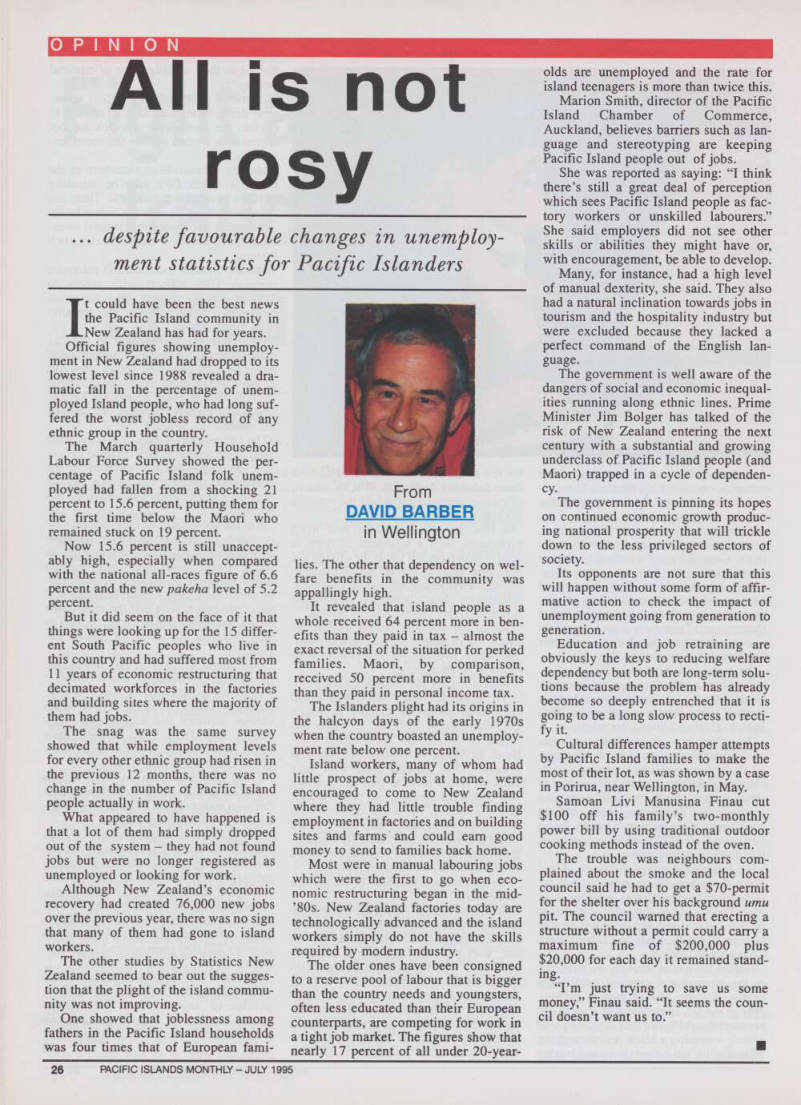
Opinion
All is not rosy
... despite favourable changes in unemploy ment statistics for Pacific Islanders
It could have been the best news the Pacific Island community in New Zealand has had for years.
Official figures showing unemploy ment in New Zealand had dropped to its lowest level since 1988 revealed a dra matic fall in the percentage of unem ployed Island people, who had long suf fered the worst jobless record of any ethnic group in the country.
The March quarterly Household Labour Force Survey showed the per centage of Pacific Island folk unem ployed had fallen from a shocking 21 percent to 15.6 percent, putting them for the first time below the Maori who remained stuck on 19 percent.
Now 15.6 percent is still unaccept ably high, especially when compared with the national all-races figure of 6.6 percent and the new pakeha level of 5.2 percent.
But it did seem on the face of it that things were looking up for the 15 differ ent South Pacific peoples who live in this country and had suffered most from 11 years of economic restructuring that decimated workforces in the factories and building sites where the majority of them had jobs.
The snag was the same survey showed that while employment levels for every other ethnic group had risen in the previous 12 months, there was no change in the number of Pacific Island
people actually in work.
What appeared to have happened is that a lot of them had simply dropped out of the system - they had not found jobs but were no longer registered as unemployed or looking for work.
Although New Zealand’s economic recovery had created 76,000 new jobs over the previous year, there was no sign that many of them had gone to island workers.
The other studies by Statistics New Zealand seemed to bear out the sugges tion that the plight of the island commu nity was not improving.
One showed that joblessness among fathers in the Pacific Island households was four times that of European fami-
lies. The other that dependency on wel fare benefits in the community was appallingly high.
It revealed that island people as a whole received 64 percent more in ben efits than they paid in tax - almost the exact reversal of the situation for perked families. Maori, by comparison, received 50 percent more in benefits than they paid in personal income tax.
The Islanders plight had its origins in the halcyon days of the early 1970 s when the country boasted an unemploy ment rate below one percent.
Island workers, many of whom had little prospect of jobs at home, were encouraged to come to New Zealand where they had little trouble finding employment in factories and on building sites and farms and could earn good money to send to families back home.
Most were in manual labouring jobs which were the first to go when eco nomic restructuring began in the mid ’Bos. New Zealand factories today are technologically advanced and the island workers simply do not have the skills
required by modem industry.
The older ones have been consigned to a reserve pool of labour that is bigger than the country needs and youngsters, often less educated than their European counterparts, are competing for work in a tight job market. The figures show that nearly 17 percent of all under 20-year
olds are unemployed and the rate for island teenagers is more than twice this.
Marion Smith, director of the Pacific Island Chamber of Commerce, Auckland, believes barriers such as lan guage and stereotyping are keeping Pacific Island people out of jobs.
She was reported as saying: “I think there’s still a great deal of perception which sees Pacific Island people as fac tory workers or unskilled labourers.”
She said employers did not see other skills or abilities they might have or, with encouragement, be able to develop.
Many, for instance, had a high level of manual dexterity, she said. They also had a natural inclination towards jobs in tourism and the hospitality industry but were excluded because they lacked a perfect command of the English lan guage.
The government is well aware of the dangers of social and economic inequal ities running along ethnic lines. Prime Minister Jim Bolger has talked of the risk of New Zealand entering the next century with a substantial and growing underclass of Pacific Island people (and Maori) trapped in a cycle of dependen cy.
The government is pinning its hopes on continued economic growth produc ing national prosperity that will trickle down to the less privileged sectors of society.
Its opponents are not sure that this will happen without some form of affir mative action to check the impact of unemployment going from generation to generation.
Education and job retraining are obviously the keys to reducing welfare dependency but both are long-term solu tions because the problem has already become so deeply entrenched that it is going to be a long slow process to recti
fy it.
Cultural differences hamper attempts by Pacific Island families to make the most of their lot, as was shown by a case in Porirua, near Wellington, in May.
Samoan Livi Manusina Finau cut $lOO off his family’s two-monthly power bill by using traditional outdoor cooking methods instead of the oven.
The trouble was neighbours com plained about the smoke and the local council said he had to get a $7O-permit for the shelter over his background umu pit. The council warned that erecting a structure without a permit could carry a maximum fine of $200,000 plus $20,000 for each day it remained stand ing.
“I’m just trying to save us some money,” Finau said. “It seems the coun cil doesn’t want us to.”
From
David Barber
in Wellington
Living on hope
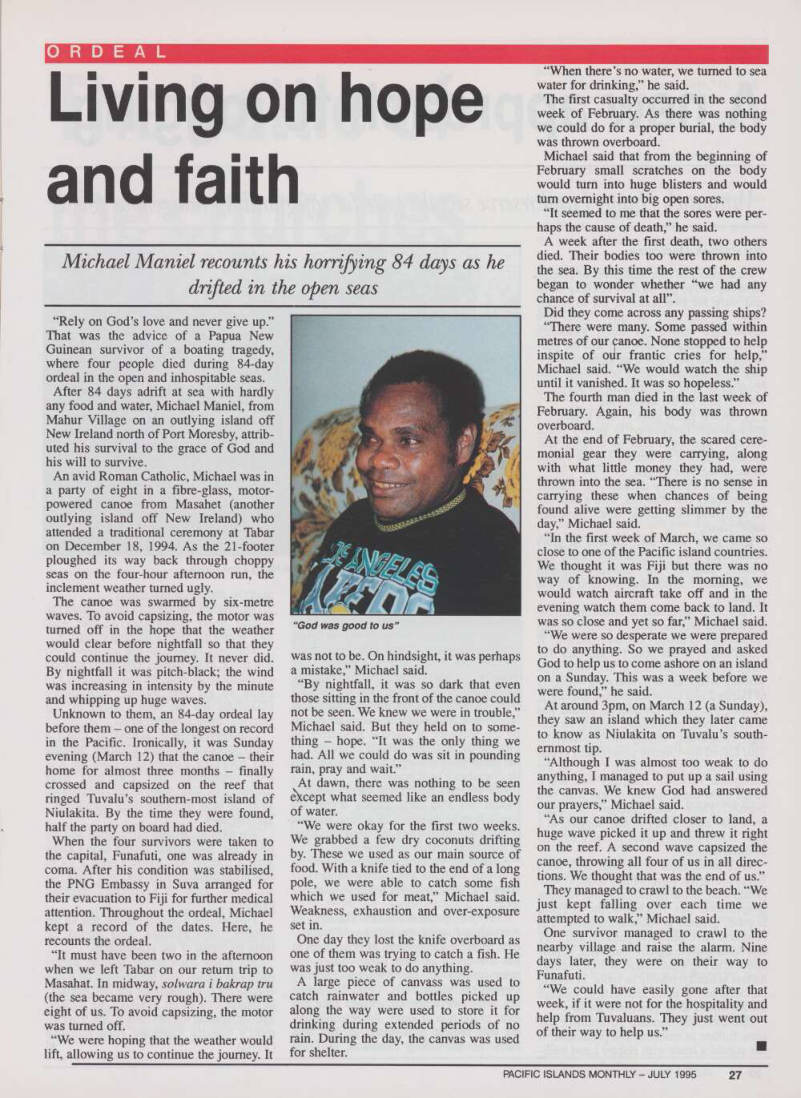
and faith
Michael Maniel recounts his horrifying 84 days as he drifted in the open seas
“Rely on God’s love and never give up.”
That was the advice of a Papua New Guinean survivor of a boating tragedy, where four people died during 84-day ordeal in the open and inhospitable seas.
After 84 days adrift at sea with hardly any food and water, Michael Maniel, from Mahur Village on an outlying island off New Ireland north of Port Moresby, attrib uted his survival to the grace of God and his will to survive.
An avid Roman Catholic, Michael was in a party of eight in a fibre-glass, motor powered canoe from Masahet (another outlying island off New Ireland) who attended a traditional ceremony at Tabar on December 18, 1994. As the 21-footer ploughed its way back through choppy seas on the four-hour afternoon run, the inclement weather turned ugly.
The canoe was swarmed by six-metre waves. To avoid capsizing, the motor was turned off in the hope that the weather would clear before nightfall so that they could continue the journey. It never did.
By nightfall it was pitch-black; the wind was increasing in intensity by the minute and whipping up huge waves.
Unknown to them, an 84-day ordeal lay before them - one of the longest on record in the Pacific. Ironically, it was Sunday evening (March 12) that the canoe - their home for almost three months - finally crossed and capsized on the reef that ringed Tuvalu’s southern-most island of Niulakita. By the time they were found, half the party on board had died.
When the four survivors were taken to the capital, Funafuti, one was already in coma. After his condition was stabilised, the PNG Embassy in Suva arranged for their evacuation to Fiji for further medical attention. Throughout the ordeal, Michael kept a record of the dates. Here, he recounts the ordeal.
“It must have been two in the afternoon when we left Tabar on our return trip to Masahat. In midway, solwara i bakrap tru (the sea became very rough). There were eight of us. To avoid capsizing, the motor was turned off.
“We were hoping that the weather would lift, allowing us to continue the journey. It
was not to be. On hindsight, it was perhaps a mistake,” Michael said.
“By nightfall, it was so dark that even those sitting in the front of the canoe could not be seen. We knew we were in trouble,”
Michael said. But they held on to some thing - hope. “It was the only thing we had. All we could do was sit in pounding rain, pray and wait.”
At dawn, there was nothing to be seen ekcept what seemed like an endless body of water.
“We were okay for the first two weeks.
We grabbed a few dry coconuts drifting by. These we used as our main source of food. With a knife tied to the end of a long pole, we were able to catch some fish which we used for meat,” Michael said.
Weakness, exhaustion and over-exposure set in.
One day they lost the knife overboard as one of them was trying to catch a fish. He was just too weak to do anything.
A large piece of canvass was used to catch rainwater and bottles picked up along the way were used to store it for drinking during extended periods of no rain. During the day, the canvas was used for shelter.
“When there’s no water, we turned to sea water for drinking,” he said.
The first casualty occurred in the second week of February. As there was nothing we could do for a proper burial, the body was thrown overboard.
Michael said that from the beginning of February small scratches on the body would turn into huge blisters and would turn overnight into big open sores.
“It seemed to me that the sores were per haps the cause of death,” he said.
A week after the first death, two others died. Their bodies too were thrown into the sea. By this time the rest of the crew began to wonder whether “we had any chance of survival at all”.
Did they come across any passing ships?
“There were many. Some passed within metres of our canoe. None stopped to help inspite of mir frantic cries for help,”
Michael said. “We would watch the ship until it vanished. It was so hopeless.”
The fourth man died in the last week of
February. Again, his body was thrown
overboard.
At the end of February, the scared cere
monial gear they were carrying, along
with what little money they had, were thrown into the sea. “There is no sense in carrying these when chances of being found alive were getting slimmer by the day,” Michael said.
“In the first week of March, we came so close to one of the Pacific island countries.
We thought it was Fiji but there was no way of knowing. In the morning, we would watch aircraft take off and in the evening watch them come back to land. It was so close and yet so far,” Michael said.
“We were so desperate we were prepared to do anything. So we prayed and asked God to help us to come ashore on an island on a Sunday. This was a week before we were found,” he said.
At around 3pm, on March 12 (a Sunday), they saw an island which they later came to know as Niulakita on Tuvalu’s south
ernmost tip.
“Although I was almost too weak to do anything, I managed to put up a sail using the canvas. We knew God had answered our prayers,” Michael said.
“As our canoe drifted closer to land, a huge wave picked it up and threw it right on the reef. A second wave capsized the canoe, throwing all four of us in all direc tions. We thought that was the end of us.”
They managed to crawl to the beach. “We just kept falling over each time we attempted to walk,” Michael said.
One survivor managed to crawl to the nearby village and raise the alarm. Nine days later, they were on their way to Funafuti.
“We could have easily gone after that week, if it were not for the hospitality and help from Tuvaluans. They just went out of their way to help us.”
“God was good to us”
A new approach to logging
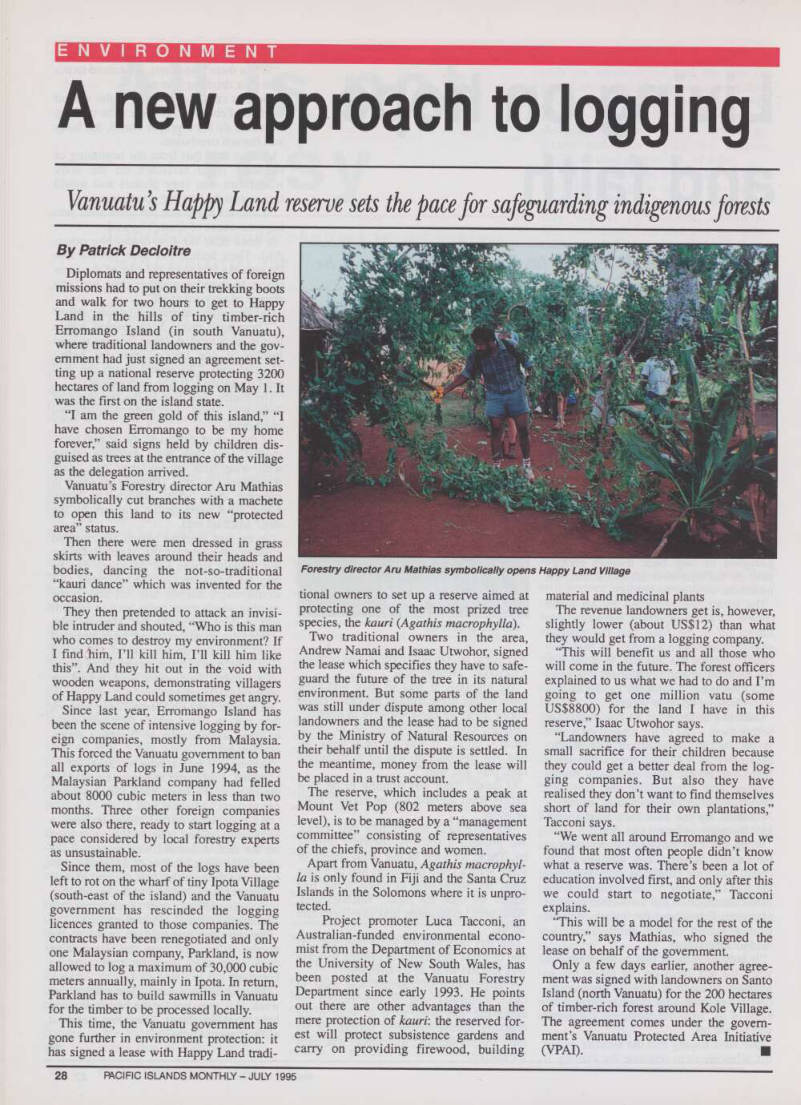
Environment
Vanuatu’s Happy Land reserve sets the pace for safeguarding indigenous forests
By Patrick Decloitre
Diplomats and representatives of foreign
missions had to put on their trekking boots and walk for two hours to get to Happy Land in the hills of tiny timber-rich Erromango Island (in south Vanuatu), where traditional landowners and the gov ernment had just signed an agreement set ting up a national reserve protecting 3200 hectares of land from logging on May 1. It was the first on the island state.
“I am the green gold of this island,” “I have chosen Erromango to be my home forever,” said signs held by children dis guised as trees at the entrance of the village as the delegation arrived.
Vanuatu’s Forestry director Am Mathias symbolically cut branches with a machete to open this land to its new “protected area” status.
Then there were men dressed in grass skirts with leaves around their heads and bodies, dancing the not-so-traditional “kauri dance” which was invented for the occasion.
They then pretended to attack an invisi ble intruder and shouted, “Who is this man who comes to destroy my environment? If I find him, I’ll kill him. I’ll kill him like this”. And they hit out in the void with
wooden weapons, demonstrating villagers
of Happy Land could sometimes get angry.
Since last year, Erromango Island has been the scene of intensive logging by for
eign companies, mostly from Malaysia.
This forced the Vanuatu government to ban all exports of logs in June 1994, as the Malaysian Parkland company had felled about 8000 cubic meters in less than two months. Three other foreign companies were also there, ready to start logging at a pace considered by local forestry experts as unsustainable.
Since them, most of the logs have been left to rot on the wharf of tiny Ipota Village (south-east of the island) and the Vanuatu government has rescinded the logging licences granted to those companies. The contracts have been renegotiated and only one Malaysian company. Parkland, is now allowed to log a maximum of 30,000 cubic meters annually, mainly in Ipota. In return, Parkland has to build sawmills in Vanuatu for the timber to be processed locally.
This time, the Vanuatu government has gone further in environment protection: it has signed a lease with Happy Land tradi-
tional owners to set up a reserve aimed at protecting one of the most prized tree species, the kauri {Agathis macrophylla).
Two traditional owners in the area, Andrew Namai and Isaac Utwohor, signed the lease which specifies they have to safe guard the future of the tree in its natural environment. But some parts of the land was still under dispute among other local landowners and the lease had to be signed by the Ministry of Natural Resources on their behalf until the dispute is settled. In the meantime, money from the lease will be placed in a trust account.
TTie reserve, which includes a peak at Mount Vet Pop (802 meters above sea level), is to be managed by a “management committee” consisting of representatives of the chiefs, province and women.
Apart from Vanuatu, Agathis macrophyl la is only found in Fiji and the Santa Cruz Islands in the Solomons where it is unpro tected.
Project promoter Luca Tacconi, an Australian-funded environmental econo mist from the Department of Economics at the University of New South Wales, has been posted at the Vanuatu Forestry
Department since early 1993. He points
out there are other advantages than the mere protection of kauri : the reserved for est will protect subsistence gardens and carry on providing firewood, building
material and medicinal plants The revenue landowners get is, however, slightly lower (about US$l2) than what they would get from a logging company.
“This will benefit us and all those who will come in the future. The forest officers explained to us what we had to do and I’m going to get one million vatu (some US$8800) for the land I have in this reserve,” Isaac Utwohor says.
“Landowners have agreed to make a small sacrifice for their children because they could get a better deal from the log ging companies. But also they have realised they don’t want to find themselves short of land for their own plantations,”
Tacconi says.
“We went all around Erromango and we found that most often people didn’t know what a reserve was. There’s been a lot of education involved first, and only after this we could start to negotiate,” Tacconi explains.
“This will be a model for the rest of the country,” says Mathias, who signed the lease on behalf of the government.
Only a few days earlier, another agree ment was signed with landowners on Santo Island (north Vanuatu) for the 200 hectares of timber-rich forest around Kole Village.
The agreement comes under the govern ment’s Vanuatu Protected Area Initiative
(Vpai). ■
Forestry director Am Mathias symbolically opens Happy Land Village
the churches
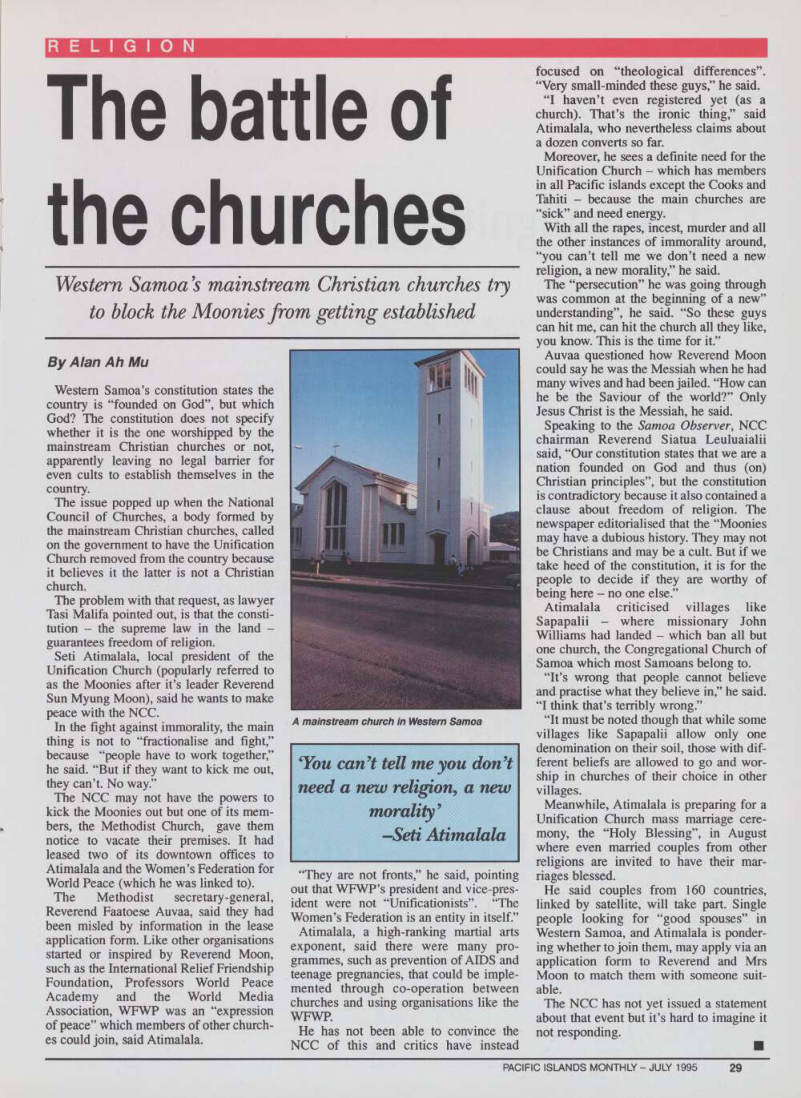
Religion
The battle of the churches
Western Samoa’s mainstream Christian churches try to block the Moonies from getting established
By Alan Ah Mu
Western Samoa’s constitution states the country is “founded on God”, but which God? The constitution does not specify whether it is the one worshipped by the mainstream Christian churches or not, apparently leaving no legal barrier for even cults to establish themselves in the country.
The issue popped up when the National Council of Churches, a body formed by the mainstream Christian churches, called on the government to have the Unification Church removed from the country because it believes it the latter is not a Christian church.
The problem with that request, as lawyer Tasi Malifa pointed out, is that the consti tution - the supreme law in the land guarantees freedom of religion.
Seti Atimalala, local president of the Unification Church (popularly referred to as the Moonies after it’s leader Reverend Sun Myung Moon), said he wants to make peace with the NCC.
In the fight against immorality, the main thing is not to “fractionalise and fight,” because “people have to work together,” he said. “But if they want to kick me out, they can’t. No way.”
The NCC may not have the powers to kick the Moonies out but one of its mem bers, the Methodist Church, gave them notice to vacate their premises. It had leased two of its downtown offices to Atimalala and the Women’s Federation for World Peace (which he was linked to).
The Methodist secretary-general, Reverend Faatoese Auvaa, said they had been misled by information in the lease application form. Like other organisations started or inspired by Reverend Moon, such as the International Relief Friendship Foundation, Professors World Peace Academy and the World Media Association, WFWP was an “expression of peace” which members of other church es could join, said Atimalala.
‘You can’t tell me you don’t need a new religion, a new
morality’
-Seti Atimalala
“They are not fronts,” he said, pointing out that WFWP’s president and vice-pres ident were not “Unificationists”. “The Women’s Federation is an entity in itself.”
Atimalala, a high-ranking martial arts exponent, said there were many pro grammes, such as prevention of AIDS and teenage pregnancies, that could be imple mented through co-operation between churches and using organisations like the
Wfwp.
He has not been able to convince the NCC of this and critics have instead
focused on “theological differences”.
“Very small-minded these guys,” he said.
“I haven’t even registered yet (as a church). That’s the ironic thing,” said Atimalala, who nevertheless claims about a dozen converts so far.
Moreover, he sees a definite need for the Unification Church - which has members in all Pacific islands except the Cooks and Tahiti - because the main churches are “sick” and need energy.
With all the rapes, incest, murder and all the other instances of immorality around, “you can’t tell me we don’t need a new religion, a new morality,” he said.
The “persecution” he was going through was common at the beginning of a new” understanding”, he said. “So these guys can hit me, can hit the church all they like, you know. This is the time for it.”
Auvaa questioned how Reverend Moon could say he was the Messiah when he had many wives and had been jailed. “How can he be the Saviour of the world?” Only Jesus Christ is the Messiah, he said.
Speaking to the Samoa Observer, NCC chairman Reverend Siatua Leuluaialii said, “Our constitution states that we are a nation founded on God and thus (on) Christian principles”, but the constitution is contradictory because it also contained a clause about freedom of religion. The newspaper editorialised that the “Moonies may have a dubious history. They may not be Christians and may be a cult. But if we take heed of the constitution, it is for the people to decide if they are worthy of being here - no one else.”
Atimalala criticised villages like Sapapalii - where missionary John Williams had landed - which ban all but one church, the Congregational Church of Samoa which most Samoans belong to.
“It’s wrong that people cannot believe and practise what they believe in,” he said.
“I think that’s terribly wrong.”
“It must be noted though that while some villages like Sapapalii allow only one denomination on their soil, those with dif ferent beliefs are allowed to go and wor ship in churches of their choice in other villages.
Meanwhile, Atimalala is preparing for a Unification Church mass marriage cere mony, the “Holy Blessing”, in August where even married couples from other religions are invited to have their mar riages blessed.
He said couples from 160 countries, linked by satellite, will take part. Single people looking for “good spouses” in Western Samoa, and Atimalala is ponder ing whether to join them, may apply via an application form to Reverend and Mrs Moon to match them with someone suit able.
The NCC has not yet issued a statement about that event but it’s hard to imagine it not responding.
A mainstream church in Western Samoa
Advertisements & other items, pp. 30-32 (1 item)
Drive dignity right to the top.
® TOYOTA
Everyone who knows cars has no doubts about Land Cruiser’s ruggedness.
Yet how many know that its luxury rivals the finest high-priced cars?
Or that it’s got more room inside than many luxury sedans?
And because it’s a Toyota, Land Cruiser’s fit and finish, attention to detail, and graceful form speak of elegance as well as spacious comfort.
Yet you still get tough ladder frames and suspension built to take you as far off road as you want to go.
With power from 4.5-litre petrol or 4.2-litre diesel engines.
And it’s carefully protected from rust to last longer.
So if you’re going right to the top, this dignified car is ready to take you.
LAND CRUISER
DISTRIBUTORS/DEALERS
AMERICAN SAMOA BURNS PHILP MOTORS PH 633-4281 COOK ISLANDS PACIFIC MOTORS LTD. PH 20796 FIJI ASCO MOTORS PH 384888 GUAM & MICRONESIA...ATKINS KROLL, INC, PH 646-1876/9 KIRIBATI TARAWA MOTORS PH 21090 NEW CALEDONIA S.I.A.P. PH 275562 NORFOLK ISLAND BORRY’S PTY LTD. PH 22114 PAPUA NEW GUINEA ELA MOTORS PH 3229400 SAIPAN MICROL CORPORATION PH 234-591 SOLOMON ISLAND ELA MOTORS PH 30314 TAHITI NIPPON AUTOMOTO PH 429819 TONGA ASCO MOTORS PH 23500 VANU ATU ASCO MOTORS PH 22341 WESTERN SAMOA ASCO MOTORS PH 20800
" -sy. I . ■ : ■
, v r ■■■t
V ■ . . ■ II *1 f
LAND
CRUISER
U ’ :\ n. met p • , - ■gP- ,M *■ * "
40- 1 h ■ , .
V *«
; VANUATU
“\iT
AUSTRALIA
rvi -**
CALEDONIA
Mi
SV-_-fA
« w Auckland ; j NEW ZEALAND
mrnmm
V V mm.
tofaM fl>\
w«ruls\ |vvv«
iVtU &W 1 m<?re,..
Where would you find white powder beaches overhung with coconut palms, reaching down to tropical blue water?
Where would you find diving in coral seas so clear and warm?
Where would you find top class resorts featuring world class cuisine, sporting activities, shows, casino and
night clubs?
Where would you find a live volcano and ancient custom villages, fresh grown market produce and some of the friendliest people you’ll ever meet?
Where?
Vanuatu, that’s where.
An untouched paradise on earth.
Air Vanuatu Reservations & Sales Offices: Port Vila (678) 23 848, Santo (678) 36 429, Sydney (612) 223 8333, Melbourne (613) 417 3977, Brisbane (617) 221 2566, Auckland (649) 373 3435, Nadi (679) 72 2521, Suva (679) 314 666, Apia (685) 212 61, Noumea (687) 286 677, Los Angeles (310) 670 7302, Paris (331) 40 53 82 25, Spain (34) 72 27 02 62, Denmark (45) 33 11 02 02, Germany (49) 60231028, Italy (39) 2 551 80528, Hong Kong (852) 336 6916.
, /XnvftHtV WWJL
&•> ‘ 4 JfAjwty ✓ \ Jr % v The Untouched Paradise
AIR VANUATU
MBE 8759
' m *
A nation celebrates
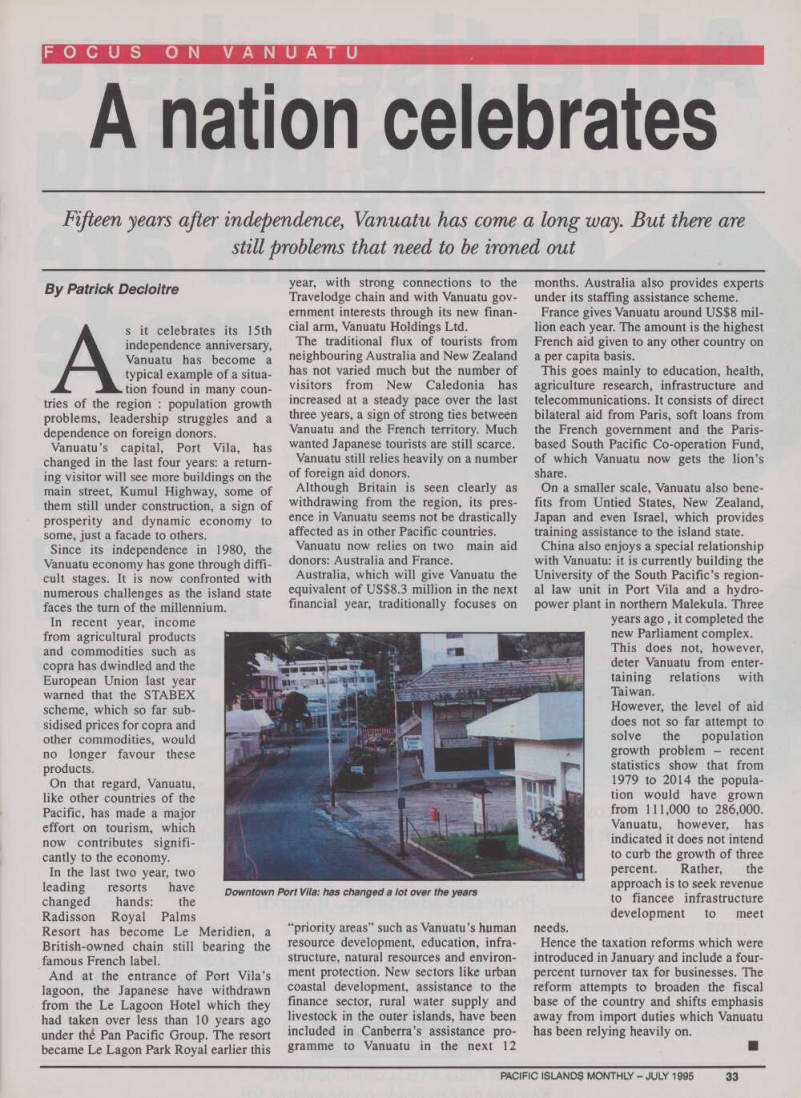
Focus On Vanuatu
Fifteen years after independence, Vanuatu has come a long way. But there are still problems that need to be ironed out
By Patrick Decloitre
As it celebrates its 15th
independence anniversary,
Vanuatu has become a typical example of a situa tion found in many coun tries of the region : population growth
problems, leadership struggles and a
dependence on foreign donors.
Vanuatu’s capital, Port Vila, has changed in the last four years: a return ing visitor will see more buildings on the main street, Kumul Highway, some of them still under construction, a sign of prosperity and dynamic economy to some, just a facade to others.
Since its independence in 1980, the Vanuatu economy has gone through diffi cult stages. It is now confronted with numerous challenges as the island state faces the turn of the millennium.
In recent year, income from agricultural products and commodities such as copra has dwindled and the European Union last year warned that the STABEX scheme, which so far sub sidised prices for copra and other commodities, would no longer favour these products.
On that regard, Vanuatu, like other countries of the Pacific, has made a major effort on tourism, which now contributes signifi cantly to the economy.
In the last two year, two leading resorts have changed hands: the Radisson Royal Palms
Resort has become Le Meridien, a British-owned chain still bearing the famous French label.
And at the entrance of Port Vila’s lagoon, the Japanese have withdrawn from the Le Lagoon Hotel which they had taken over less than 10 years ago under thd Pan Pacific Group. The resort became Le Lagon Park Royal earlier this
year, with strong connections to the Travelodge chain and with Vanuatu gov ernment interests through its new finan cial arm, Vanuatu Holdings Ltd.
The traditional flux of tourists from neighbouring Australia and New Zealand has not varied much but the number of visitors from New Caledonia has increased at a steady pace over the last three years, a sign of strong ties between Vanuatu and the French territory. Much wanted Japanese tourists are still scarce.
Vanuatu still relies heavily on a number of foreign aid donors.
Although Britain is seen clearly as withdrawing from the region, its pres ence in Vanuatu seems not be drastically affected as in other Pacific countries.
Vanuatu now relies on two main aid donors: Australia and France.
Australia, which will give Vanuatu the equivalent of US$B.3 million in the next financial year, traditionally focuses on
“priority areas” such as Vanuatu’s human resource development, education, infra structure, natural resources and environ ment protection. New sectors like urban coastal development, assistance to the finance sector, rural water supply and livestock in the outer islands, have been included in Canberra’s assistance pro gramme to Vanuatu in the next 12
months. Australia also provides experts under its staffing assistance scheme.
France gives Vanuatu around US$B mil lion each year. The amount is the highest French aid given to any other country on a per capita basis.
This goes mainly to education, health, agriculture research, infrastructure and telecommunications. It consists of direct bilateral aid from Paris, soft loans from the French government and the Paris based South Pacific Co-operation Fund, of which Vanuatu now gets the lion’s share.
On a smaller scale, Vanuatu also bene fits from Untied States, New Zealand, Japan and even Israel, which provides training assistance to the island state.
China also enjoys a special relationship with Vanuatu; it is currently building the University of the South Pacific’s region al law unit in Port Vila and a hydro power plant in northern Malekula. Three
years ago , it completed the new Parliament complex.
This does not, however, deter Vanuatu from enter taining relations with Taiwan.
However, the level of aid does not so far attempt to solve the population growth problem - recent statistics show that from 1979 to 2014 the popula tion would have grown from 111,000 to 286,000.
Vanuatu, however, has indicated it does not intend to curb the growth of three percent. Rather, the approach is to seek revenue to fiancee infrastructure development to meet
needs.
Hence the taxation reforms which were introduced in January and include a four percent turnover tax for businesses. The reform attempts to broaden the fiscal base of the country and shifts emphasis away from import duties which Vanuatu has been relying heavily on.
Downtown Port Vila: has changed a lot over the years
Advertisements & other items, p. 34 (1 item)
the buying
Advertise where
ecisions are
made
m f m
Phonecard
advertising
is the new
and exciting way
to advertise.
Reasonably priced For a reasonable cost, you can have your advertising message printed on a phonecard.
With phonecards ranging from $2 to $5O it's the perfect opportunity to target the type of audience you want to reach.
Phonecard advertising... It works!
Call us today For more information on Phonecard advertising contact the Fiji Post & Telecom Marketing Department on telephone 210600 or fax 305071.
FIJI POSTS & TELECOMMUNICATIONS
Automation of

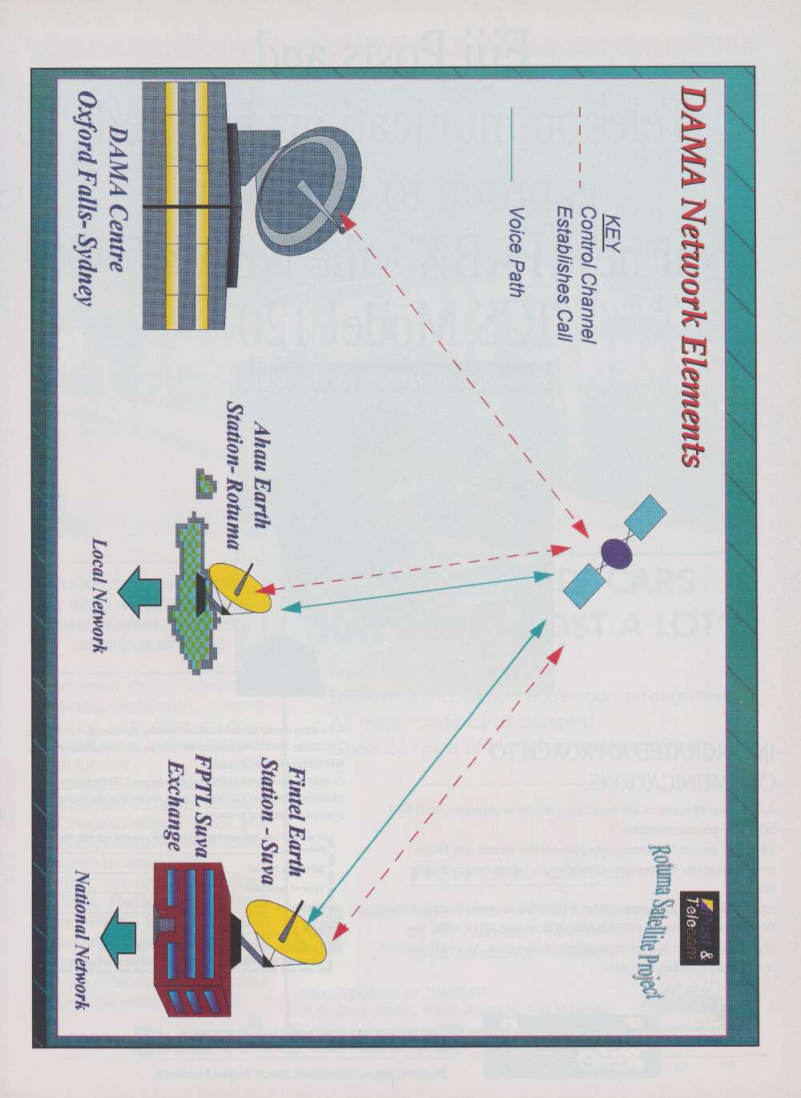

FIJI POSTS & TELECOMMUNICATIONS LTD - ADVERTISING FEATURE
Automation of Telecommunications in Rotuma
The new satellite earth station in Rotuma, Fiji, will bering the isolated island closer to the rest of the country and the world
The opening of the new satel lite earth station and digital telephone exchange in Rotuma by Fiji Posts and Telecommunications Limited (FPTL) will dramatically improve access to the people of Rotuma.
Rotuma is Fiji’s northernmost island, about 700 km from Suva. Its remote location elim inates the use of conventional terrestrial microwave, VHF or UHF radio systems as used in other parts of Fiji.
For this reason, satellite tech nology has been selected.
The new satellite earth sta tion and digital telephone exchange at Ahau will provide automatic modern telecommu nications services covering voice, facsimile and data.
The new system is a result of a Fs2-million project undertak en by FPTL.
The communications facilities in Rotuma feature a digital DAMA earth station supplied by Telstra Corporation of Australia, a 400-line Redeem
(RDX) digital exchange sup
plied by Redeem Laboratories of New York, solar and diesel hybrid power system with cus tomer cable reticulation. The telecommunications equip ment at Ahau is housed in a special passively cooled build ing designed to limit internal temperature rise without resorting to air-conditioning.
On the opening day 150 cus tomers are expected to be connected by underground cable from Itumuta, Motusa, Ahau and Malhaha.
The satellite earth station at Rotuma will utilise the new dig ital DAMA-Net Regional Satellite service developed and operated by Australia’s Telstra Corporation Limited.
FINTELs earth station at Vatuwaqa will be used to link Rotuma and interface with FPTLs Public Switched Telephone Network (PSTN) or any other country in the world (international calls).
The DAMA-Net is a modern, digital version of the extensive PACT (Pacific Area Co-opera tive Telecommunications) net
work which, since 1990, has provided economical, thin route satellite services to South Pacific countries.
The DAMA-net (Demand Assigned Multiple Access) service is cost effective, mean ing that satellite channels are only assigned to calls on demand and maintained for the duration of the call, rather than being permanently assigned. The multiple access feature allows each modem in the pool to be switched on a
call-by-call basis.
Customers can now dial 891 XXX - the six-digit number system for Return a. The rural Digital Exchange (RDX) is
supplied by Redeem
Laboratories of USA. This exchange was selected because of its reliability and cost-effectiveness in rural environment.
To facilitate this project, FPTL provided the tender docu ments with engineering design, installation, power sys
tem and equipment building.
Telstra Corporation provided
The earth station building at Ahau will provide auto matic modern telecommu nications services
the earth station equipment, training, installation, commis sioning supervision and docu mentation of the earth station equipment. Redcom Laboratories provided training installation and commissioning of the exchange. FINTEL pro vided the DAMA-Net modems at the Vatuwaqa hub.
FPTL would like to thank Telstra, Redcom Laboratories and FINTEL for their efforts in this innovative project and look forward to further participation in the extension of telecommu nications within Fiji.
Advertisements & other items, pp. 36-39 (1 item)
jn Fiji
63c 35*
FUI
$1.12 getMife
FIJI
50 ,h ANNIVERSARY OF THE
. END OF WORLD WAR II * J* '
r - jgsMjywj iy
3?.
gift.
: lr Jfv>“ . (Sfe 7* : f sat Mi • s •Jf :
FUI
r: If ; , . ■' • ‘ il k : - • ■■■. t r,. 11 Mjg-if ■v, |! ,f '{*, : " V.,' ~,Vf
WE FORGET
f.*.; v s^V‘‘*J
nms . yi 13c
50" ANNIVE
THE
END OK WORLD WAR II
V %l ; T ’«• -<• •T dTO&ssu,. v iji « anahctl Japinw Zen, Fight,
FIJI $2.00
•V John Paul 11 fc. 150th Anniversary of the arrival of the first Catholic Missionaries in Fiji
FIJI
h
FIJI 23c
150th Anniversary of the arrival of the first Catholic Missionaries in Fiji 1 50th Anniversary of the arrival of the first Catholic Missionaries in Fiji 150th Anniversary of the arrival of the first Catholic Missionaries in Fiji
A MUST FOR
STAMP COLLECTORS
IL V* ‘Sh-v?
Ecotouri
jn Fiji
(V G n rs
an \v
W? ••• mi ss m Va Wa
FIJI 63c
k m mmmsmmw Lomary Church 150th Anniversary of the arrival of the first Catholic Missionaries in Fiji Te For more information please write to: The Manager.
Stamp Production, Distribution & Sales GPO Box 100, Suva Fiji.
■IJI
■W\ m
FIJI
FUI
Avc
tMlfc
FIJI
FIJI
% s
WM3c
23C m 3lc
FIJI
Six
FIJI
®fc- : 81C
: p&m jf --- : >-2
DAMA Network Elements
ItePmfeCt
KEY
Control Channel
Establishes Call
Voice Path
/ N / N / S , \ N
Flntel Earth
Station - Suva
Ahau Earth
Station- Rotuma
iiill
FPTL Suva
Exchange
I-;;:..::,:,:-..:::;;:::;:::-.-.: SI:
DAMA Centre
Oxford Falls- Sydney
Local Network
National Network
Fiji Posts and
Telecommunications Limited
is proud to announce
their new PABX - the NEAX 7400
ICS Model 120
A Valuable Investment for the future
M
INTERGRATED APPROACH TO
COMMUNICATIONS.
\t the heart of many of the world's successful companies you'll find MEC's Hypercore systems. fhe NEC unique Hypercore approach allows current and future :ommunications equipment to link directly into the core of your
PABX.
Hypercore is an intelligent system which makes communication easier.
With the state-of-the-art NEAX74OO ICS Model 120 PABX, the Hypercore system is even more efficient than ever. As you'll discover, it's the only system you'll need For further details call our Business Systems representatives on phone 210222/fax 210527 Suva, phone 811800/fax 812766 Labasa or phone 660022/fax 666600 Lautoka.
Or send in this coupon to Fiji Post & Telecom, CPE Section, Marketing Division GPO Box 40, Suva and we'll send a Business Systems professional to see you.
Name: Company Name: Type ol business: Telephone: Date: T I Fax:.
I am interested in finding out more about NEC systems. oj)s ask your Business Systems representative to call on me. j
£.Post&
fetewn
Better Communications mean better business.
"FOR QUALITY CARS
THAT DON'T COST A LOT"
- Rates from $4OO/week. - Delivery and collection done upon arrangement - All major credit cards accepted. - Open 24 hours at Nadi International Airport
RENTAL OARS
H Phone: Nadi:- Town - 701009, Aerotown - 720616 24 hrs - Airport - 723506 Suva:- Samabula - 385033 Fax: 720616 or 702159 P.O. Box 9881, Nadi Airport, Fiji Islands.
The Postshop concept

The idea for the Postshop concept came up in 1990 when we started to sell postal-related products such as envelopes, padded bags, post cards, greeting cards, etc.
Proper research was conducted in mid-1992 to diversify into retailing of office and school stationery. The Northern Division was used as our fist area of research where we visit ed more than 40 schools. In the process, we talked to principals, school committees, parents and stu dents. In urban areas, we talked to business people and office workers to find how interested they were in the new concept.
We were overwhelmed by the favourable response from the cus tomers which gave us confidence that the concept should be success ful. We set up the Suva Postshop at
the end of December 1992, with the retailing of postcards, greeting cards and postakelated products and we added school and office stationery as part of diversifying into new prod ucts.
Now we have more than 30 outlets Fiji wide with a wide selection of school and office stationery, sou venirs, magazines, novels, children’s books, etc., in addition to our postal products: Handipost, Handibox, Mail Tubes, Jiffy Lite Bags, etc.
We are looking at setting up fully fledged postshops at Lautoka, Lakeba, Levuka, Lomaloma and Vunisea by the of 1995, in addition to Suva, Savusavu and Labasa Postshops.
We intend to set up Postshops at all of our 50 post offices by the end of 1996. ■
Advertisements & other items, pp. 40-42 (2 items)
Fiji Posts And Telecommunications Ltd - Advertising Feature
40
PACIFIC ISLANDS MONTHLY - JULY 1995
Aruns Furniture Ltd
MANUFACTURERS OF ALL TYPES OF OFFICE FURNITURE Offers a high quality range of: Steel and Wooden Frame Furniture, all types of Computer Work Station, Desks, Typist Chairs, and Computer work station, trolleys, reception chairs, school furniture and many more.
Factory: 10 Miles Nasinu, GPO Box 13341. Telephone; 410871. Fax: 410075. Suva, Fiji.
PVC and PE pipes for
Construction, Civil Works,
Water Reticulation,
Sewerage Systems, Electrical
Installations, and Cable Ducting.
Manufactured in Fiji, to International standards LOPE Pipes MOPE Pipes HOPE Pipes Builders Film Fittings PVC Pressure Pipes PVC Sewer Pipes Soil Waste 4 Vent Pipes PVC Downpipes Telecom Ducts Electrical Conduits m- •••■ ■> ... *
ADDRESS ALL TRADE ENQUIRIES TO:
CanPlast PVC Pipes 4 Fittings
MADE IN FIJI
LEES INDUSTRIES LIMITED
LAUTOKA OFFICE
19-23 Nasold Street, PO Box 155, Lautoka, FIJI Ph0ne:(679)660-000 Fax:(679)660-906
SUVA OFFICE
Lot 1, Ratu Dovi Road. Laucala Beach Estate GPO Box 14-444, Suva, FUI Ph0ne:(679)391-011 Fax:(679)340-138
THE POST SHOP
Your Stationery Requirements in Better
Hands"
- %>/ 5: £ * V V £>/ ! ■ .n
TELECOMS OWN
POST SHOP
WITH
OVER 30 OUTLETS
THROUGHOUT THE
COUNTRY
SUPPLIERS OF HANDY BAGS IN ALL SIZES
HANDY TUBES IN ALL SIZES
HANDY BOXES FROM 1-4 SIZES
* OFFICE STATIONERY
* MAGAZINES
* POST CARDS & GREETING CARDS
• POST CARDS
* PHONE CARDS
L 3 K Fiji Post and Telecom Ltd Post Shop Ground Floor, General Post Office, Suva Opposite Ganilau House Suva, Fiji Islands Phone: (679) 210 598 Fax: (679) 306 088 Opening Hours: Mon-Fri- Sam-spm Sat - Sam-Ipm
Papua New Guinea
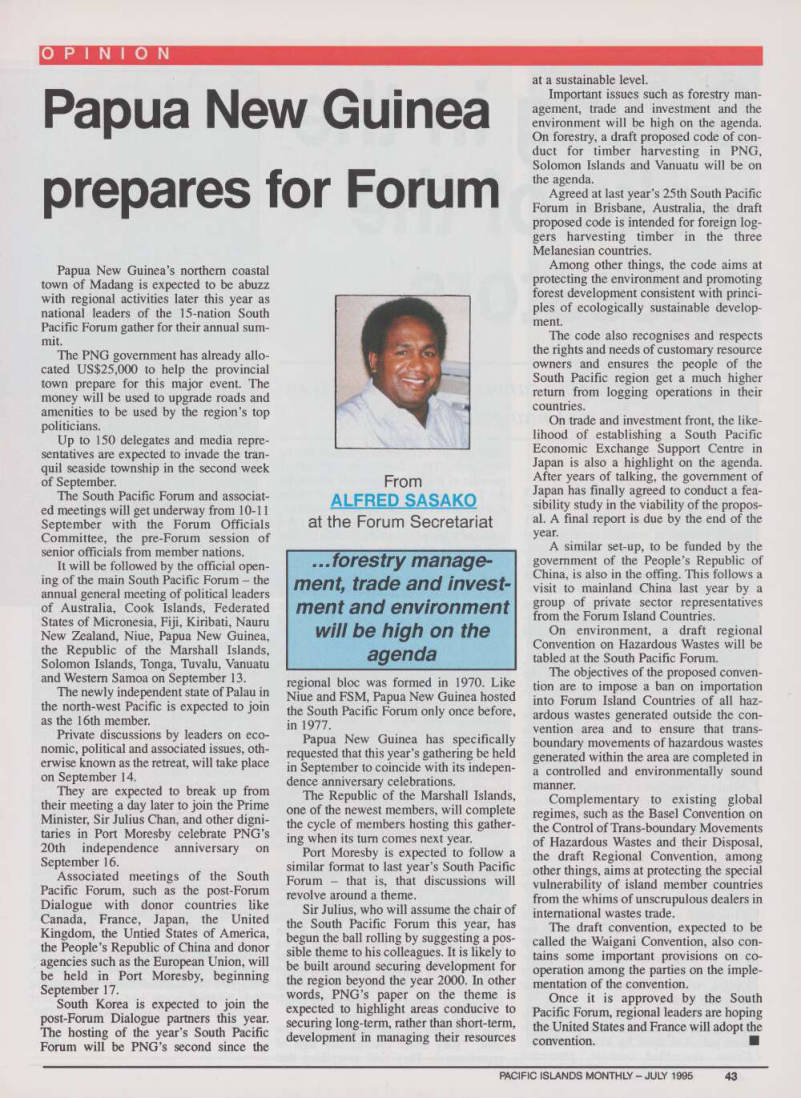
Opinion
Papua New Guinea prepares for Forum
Papua New Guinea’s northern coastal town of Madang is expected to be abuzz with regional activities later this year as national leaders of the 15-nation South Pacific Forum gather for their annual sum mit.
The PNG government has already allo cated U 5525,000 to help the provincial town prepare for this major event. The money will be used to upgrade roads and amenities to be used by the region’s top politicians.
Up to 150 delegates and media repre sentatives are expected to invade the tran quil seaside township in the second week of September.
The South Pacific Forum and associat ed meetings will get underway from 10-11 September with the Forum Officials Committee, the pre-Forum session of senior officials from member nations.
It will be followed by the official open ing of the main South Pacific Forum - the annual general meeting of political leaders of Australia, Cook Islands, Federated States of Micronesia, Fiji, Kiribati, Nauru New Zealand, Niue, Papua New Guinea, the Republic of the Marshall Islands, Solomon Islands, Tonga, Tuvalu, Vanuatu and Western Samoa on September 13.
The newly independent state of Palau in the north-west Pacific is expected to join as the 16th member.
Private discussions by leaders on eco nomic, political and associated issues, oth erwise known as the retreat, will take place on September 14.
They are expected to break up from their meeting a day later to join the Prime Minister, Sir Julius Chan, and other digni taries in Port Moresby celebrate PNG’s 20th independence anniversary on September 16.
Associated meetings of the South Pacific Forum, such as the post-Forum Dialogue with donor countries like Canada, France, Japan, the United Kingdom, the Untied States of America, the People’s Republic of China and donor agencies such as the European Union, will be held in Port Moresby, beginning September 17.
South Korea is expected to join the post-Forum Dialogue partners this year.
The hosting of the year’s South Pacific Forum will be PNG’s second since the
...forestry manage ment, trade and invest ment and environment will be high on the
agenda
regional bloc was formed in 1970. Like Niue and FSM, Papua New Guinea hosted the South Pacific Forum only once before, in 1977.
Papua New Guinea has specifically requested that this year’s gathering be held in September to coincide with its indepen dence anniversary celebrations.
The Republic of the Marshall Islands, one of the newest members, will complete the cycle of members hosting this gather ing when its turn comes next year.
Port Moresby is expected to follow a similar format to last year’s South Pacific Forum - that is, that discussions will revolve around a theme.
Sir Julius, who will assume the chair of the South Pacific Forum this year, has begun the ball rolling by suggesting a pos sible theme to his colleagues. It is likely to be built around securing development for the region beyond the year 2000. In other words, PNG’s paper on the theme is expected to highlight areas conducive to securing long-term, rather than short-term, development in managing their resources
at a sustainable level.
Important issues such as forestry man agement, trade and investment and the environment will be high on the agenda.
On forestry, a draft proposed code of con duct for timber harvesting in PNG, Solomon Islands and Vanuatu will be on the agenda.
Agreed at last year’s 25th South Pacific Forum in Brisbane, Australia, the draft proposed code is intended for foreign log gers harvesting timber in the three Melanesian countries.
Among other things, the code aims at protecting the environment and promoting forest development consistent with princi ples of ecologically sustainable develop ment.
The code also recognises and respects the rights and needs of customary resource owners and ensures the people of the South Pacific region get a much higher return from logging operations in their countries.
On trade and investment front, the like lihood of establishing a South Pacific Economic Exchange Support Centre in Japan is also a highlight on the agenda.
After years of talking, the government of Japan has finally agreed to conduct a fea sibility study in the viability of the propos al. A final report is due by the end of the year.
A similar set-up, to be funded by the government of the People’s Republic of China, is also in the offing. This follows a visit to mainland China last year by a group of private sector representatives from the Forum Island Countries.
On environment, a draft regional Convention on Hazardous Wastes will be tabled at the South Pacific Forum.
The objectives of the proposed conven tion are to impose a ban on importation into Forum Island Countries of all haz ardous wastes generated outside the con vention area and to ensure that trans boundary movements of hazardous wastes generated within the area are completed in a controlled and environmentally sound manner.
Complementary to existing global regimes, such as the Basel Convention on the Control of Trans-boundary Movements of Hazardous Wastes and their Disposal, the draft Regional Convention, among other things, aims at protecting the special vulnerability of island member countries from the whims of unscrupulous dealers in international wastes trade.
The draft convention, expected to be called the Waigani Convention, also con tains some important provisions on co operation among the parties on the imple mentation of the convention.
Once it is approved by the South Pacific Forum, regional leaders are hoping the United States and France will adopt the convention. ■
From
Alfred Sasako
at the Forum Secretariat
wake of the
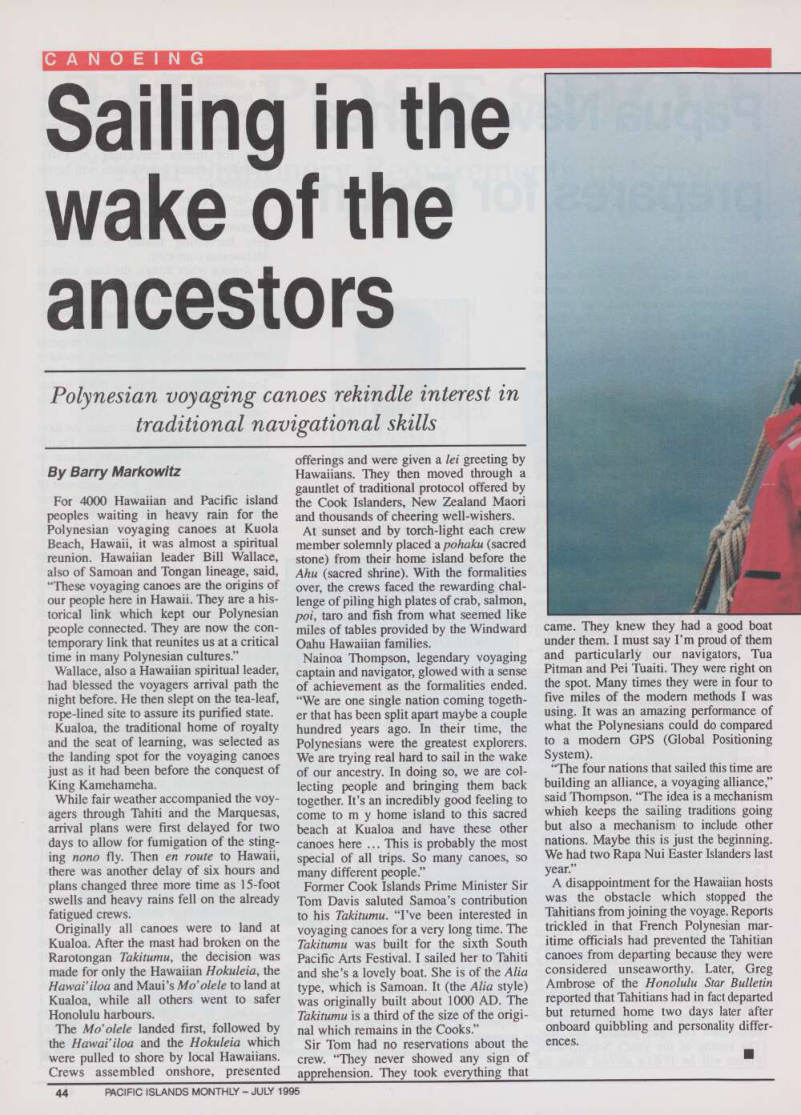
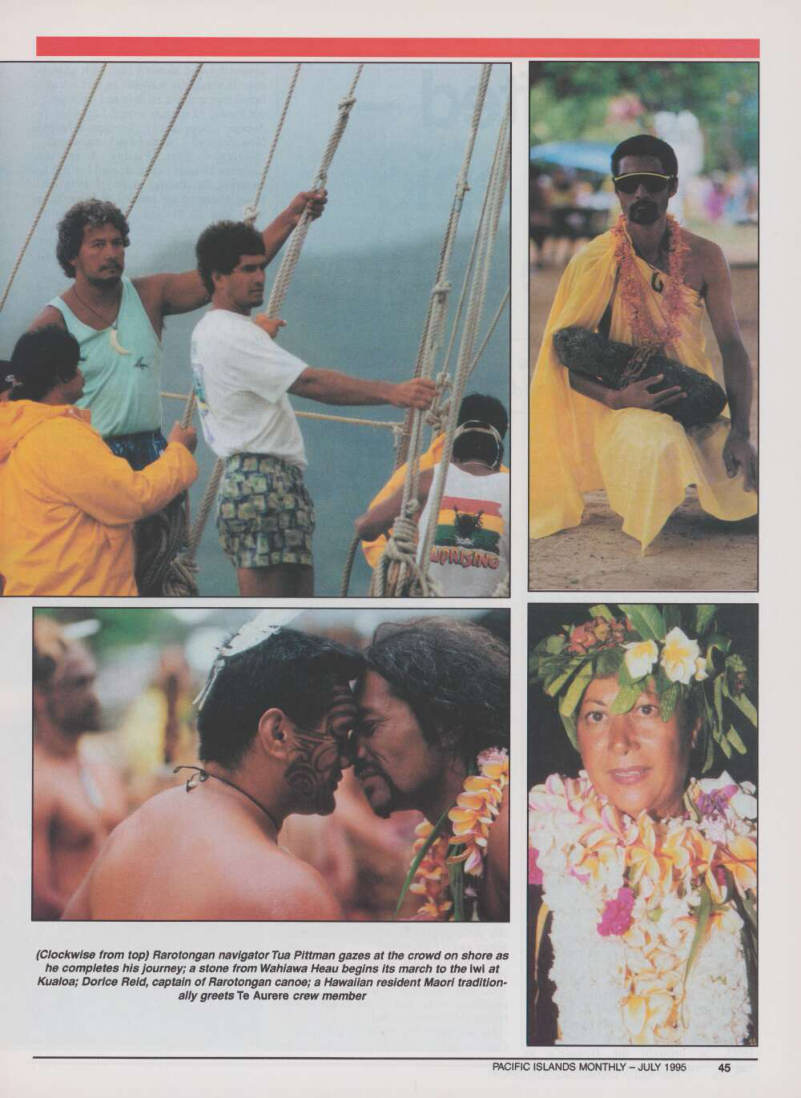
Canoeing
Sailing in the wake of the ancestors
Polynesian voyaging canoes rekindle interest in traditional navigational skills
By Barry Markowitz
offerings and were given a lei greeting by Hawaiians. They then moved through a gauntlet of traditional protocol offered by the Cook Islanders, New Zealand Maori and thousands of cheering well-wishers.
At sunset and by torch-light each crew member solemnly placed a pohaku (sacred stone) from their home island before the Ahu (sacred shrine). With the formalities over, the crews faced the rewarding chal lenge of piling high plates of crab, salmon, poi, taro and fish from what seemed like miles of tables provided by the Windward Oahu Hawaiian families.
Nainoa Thompson, legendary voyaging captain and navigator, glowed with a sense of achievement as the formalities ended.
“We are one single nation coming togeth er that has been split apart maybe a couple hundred years ago. In their time, the Polynesians were the greatest explorers.
We are trying real hard to sail in the wake of our ancestry. In doing so, we are col lecting people and bringing them back together. It’s an incredibly good feeling to come to m y home island to this sacred beach at Kualoa and have these other canoes here ... This is probably the most special of all trips. So many canoes, so many different people.”
Former Cook Islands Prime Minister Sir Tom Davis saluted Samoa’s contribution to his Takitumu. “I’ve been interested in voyaging canoes for a very long time. The Takitumu was built for the sixth South Pacific Arts Festival. I sailed her to Tahiti and she’s a lovely boat. She is of the Alia type, which is Samoan. It (the Alia style) was originally built about 1000 AD. The Takitumu is a third of the size of the origi nal which remains in the Cooks.”
Sir Tom had no reservations about the crew. “They never showed any sign of apprehension. They took everything that
For 4000 Hawaiian and Pacific island peoples waiting in heavy rain for the Polynesian voyaging canoes at Kuola Beach, Hawaii, it was almost a spiritual reunion. Hawaiian leader Bill Wallace, also of Samoan and Tongan lineage, said, “These voyaging canoes are the origins of our people here in Hawaii. They are a his torical link which kept our Polynesian people connected. They are now the con temporary link that reunites us at a critical time in many Polynesian cultures.”
Wallace, also a Hawaiian spiritual leader, had blessed the voyagers arrival path the night before. He then slept on the tea-leaf, rope-lined site to assure its purified state.
Kualoa, the traditional home of royalty and the seat of learning, was selected as the landing spot for the voyaging canoes just as it had been before the conquest of King Kamehameha.
While fair weather accompanied the voy agers through Tahiti and the Marquesas, arrival plans were first delayed for two days to allow for fumigation of the sting ing nono fly. Then en route to Hawaii, there was another delay of six hours and plans changed three more time as 15-foot swells and heavy rains fell on the already
fatigued crews.
Originally all canoes were to land at Kualoa. After the mast had broken on the Rarotongan Takitumu, the decision was made for only the Hawaiian Hokuleia, the Hawai’iloa and Maui’s Mo’olele to land at Kualoa, while all others went to safer Honolulu harbours.
The Mo’olele landed first, followed by the Hawai’iloa and the Hokuleia which were pulled to shore by local Hawaiians.
Crews assembled onshore, presented
came. They knew they had a good boat under them. I must say I’m proud of them and particularly our navigators, Tua Pitman and Pei Tuaiti. They were right on the spot. Many times they were in four to five miles of the modem methods I was using. It was an amazing performance of what the Polynesians could do compared to a modem GPS (Global Positioning System).
“The four nations that sailed this time are building an alliance, a voyaging alliance,” said Thompson. “The idea is a mechanism which keeps the sailing traditions going but also a mechanism to include other nations. Maybe this is just the beginning.
We had two Rapa Nui Easter Islanders last year.”
A disappointment for the Hawaiian hosts was the obstacle which stopped the Tahitians from joining the voyage. Reports trickled in that French Polynesian mar itime officials had prevented the Tahitian canoes from departing because they were considered unseaworthy. Later, Greg Ambrose of the Honolulu Star Bulletin reported that Tahitians had in fact departed but returned home two days later after onboard quibbling and personality differ ences.
(Clockwise from top) Rarotongan navigator Tua Pittman gazes at the crowd on shore as he completes his journey; a stone from Wahiawa Heau begins its march to the iwi at Kuaioa; Dorice Reid, captain of Rarotongan canoe; a Hawaiian resident Maori tradition ally greets Te Aurere crew member
voyage begins
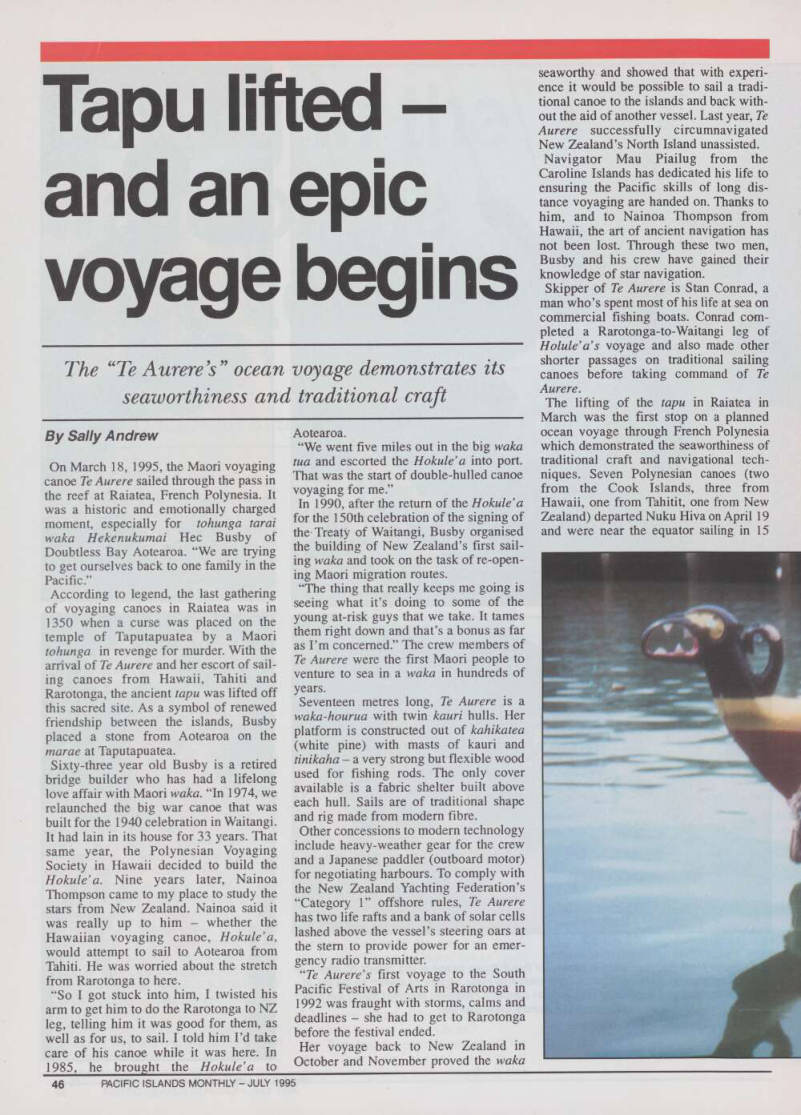
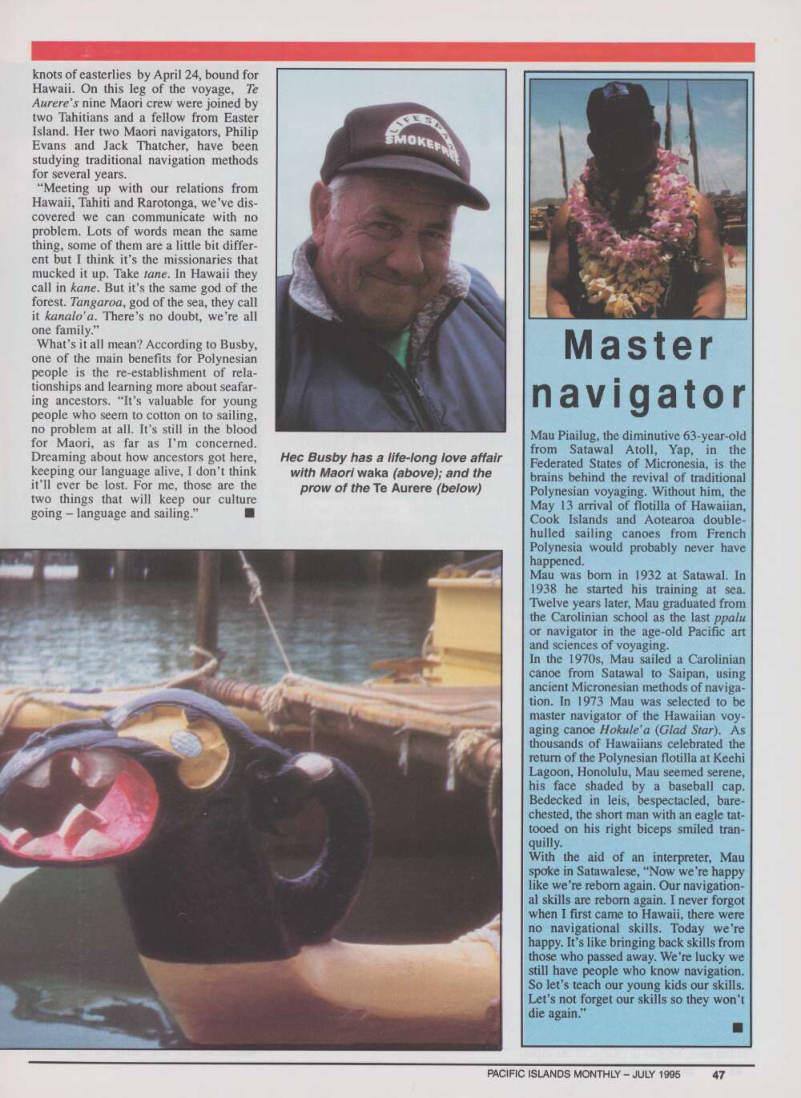
Tapu lifted and an epic voyage begins
The “Te Aurere’s” ocean voyage demonstrates its seaworthiness and traditional craft
By Sally Andrew
On March 18, 1995, the Maori voyaging canoe Te Aurere sailed through the pass in the reef at Raiatea, French Polynesia. It was a historic and emotionally charged moment, especially for tohunga tarai waka Hekenukumai Hec Busby of Doubtless Bay Aotearoa. “We are trying to get ourselves back to one family in the Pacific.”
According to legend, the last gathering of voyaging canoes in Raiatea was in 1350 when a curse was placed on the temple of Taputapuatea by a Maori tohunga in revenge for murder. With the arrival of Te Aurere and her escort of sail ing canoes from Hawaii, Tahiti and Rarotonga, the ancient tapu was lifted off this sacred site. As a symbol of renewed friendship between the islands, Busby placed a stone from Aotearoa on the marae at Taputapuatea.
Sixty-three year old Busby is a retired bridge builder who has had a lifelong love affair with Maori waka. “In 1974, we relaunched the big war canoe that was built for the 1940 celebration in Waitangi.
It had lain in its house for 33 years. That same year, the Polynesian Voyaging Society in Hawaii decided to build the Hokule’a. Nine years later, Nainoa Thompson came to my place to study the stars from New Zealand. Nainoa said it was really up to him - whether the Hawaiian voyaging canoe, Hokule’a, would attempt to sail to Aotearoa from Tahiti. He was worried about the stretch from Rarotonga to here.
“So I got stuck into him, I twisted his arm to get him to do the Rarotonga to NZ leg, telling him it was good for them, as well as for us, to sail. I told him I’d take care of his canoe while it was here. In 1985, he brought the Hokule’a to
Aotearoa.
“We went five miles out in the big waka tua and escorted the Hokule’a into port.
That was the start of double-hulled canoe voyaging for me.”
In 1990, after the return of the Hokule’a for the 150th celebration of the signing of the Treaty of Waitangi, Busby organised the building of New Zealand’s first sail ing waka and took on the task of re-open ing Maori migration routes.
“The thing that really keeps me going is seeing what it’s doing to some of the young at-risk guys that we take. It tames them right down and that’s a bonus as far as I’m concerned.” The crew members of Te Aurere were the first Maori people to venture to sea in a waka in hundreds of years.
Seventeen metres long, Te Aurere is a waka-hourua with twin kauri hulls. Her platform is constructed out of kahikatea (white pine) with masts of kauri and tinikaha - a very strong but flexible wood used for fishing rods. The only cover available is a fabric shelter built above each hull. Sails are of traditional shape and rig made from modern fibre.
Other concessions to modern technology include heavy-weather gear for the crew and a Japanese paddler (outboard motor) for negotiating harbours. To comply with the New Zealand Yachting Federation’s “Category 1” offshore rules, Te Aurere has two life rafts and a bank of solar cells lashed above the vessel’s steering oars at the stern to provide power for an emer gency radio transmitter.
“Te Aurere’s first voyage to the South Pacific Festival of Arts in Rarotonga in 1992 was fraught with storms, calms and deadlines - she had to get to Rarotonga before the festival ended.
Her voyage back to New Zealand in October and November proved the waka
seaworthy and showed that with experi ence it would be possible to sail a tradi tional canoe to the islands and back with out the aid of another vessel. Last year, Te
Aurere successfully circumnavigated
New Zealand’s North Island unassisted.
Navigator Mau Piailug from the Caroline Islands has dedicated his life to ensuring the Pacific skills of long dis tance voyaging are handed on. Thanks to him, and to Nainoa Thompson from Hawaii, the art of ancient navigation has not been lost. Through these two men, Busby and his crew have gained their
knowledge of star navigation.
Skipper of Te Aurere is Stan Conrad, a man who’s spent most of his life at sea on commercial fishing boats. Conrad com pleted a Rarotonga-to-Waitangi leg of Holule’a’s voyage and also made other shorter passages on traditional sailing canoes before taking command of Te Aurere.
The lifting of the tapu in Raiatea in March was the first stop on a planned ocean voyage through French Polynesia which demonstrated the seaworthiness of traditional craft and navigational tech niques. Seven Polynesian canoes (two from the Cook Islands, three from Hawaii, one from Tahitit, one from New Zealand) departed Nuku Hiva on April 19 and were near the equator sailing in 15
knots of easterlies by April 24, bound for Hawaii. On this leg of the voyage, Te Aurere’s nine Maori crew were joined by two Tahitians and a fellow from Easter Island. Her two Maori navigators, Philip Evans and Jack Thatcher, have been studying traditional navigation methods for several years.
“Meeting up with our relations from Hawaii, Tahiti and Rarotonga, we’ve dis covered we can communicate with no problem. Lots of words mean the same thing, some of them are a little bit differ ent but I think it’s the missionaries that mucked it up. Take tane. In Hawaii they call in kane. But it’s the same god of the forest. Tangaroa, god of the sea, they call it kanalo’a. There’s no doubt, we’re all one family.”
What’s it all mean? According to Busby, one of the main benefits for Polynesian people is the re-establishment of rela tionships and learning more about seafar ing ancestors. “It’s valuable for young people who seem to cotton on to sailing, no problem at all. It’s still in the blood for Maori, as far as I’m concerned.
Dreaming about how ancestors got here, keeping our language alive, I don’t think it’ll ever be lost. For me, those are the two things that will keep our culture going - language and sailing.” ■
Hec Busby has a life-long love affair with Maori waka (above); and the prow of the Te Aurere (below)
navigator
Master navigator
Mau Piailug, the diminutive 63-year-old from Satawal Atoll, Yap, in the Federated States of Micronesia, is the brains behind the revival of traditional Polynesian voyaging. Without him, the May 13 arrival of flotilla of Hawaiian, Cook Islands and Aotearoa double hulled sailing canoes from French Polynesia would probably never have happened.
Mau was bom in 1932 at Satawal. In 1938 he started his training at sea.
Twelve years later, Mau graduated from the Carolinian school as the last ppalu or navigator in the age-old Pacific art and sciences of voyaging.
In the 19705, Mau sailed a Carolinian canoe from Satawal to Saipan, using ancient Micronesian methods of naviga tion. In 1973 Mau was selected to be master navigator of the Hawaiian voy aging canoe Hokule’a (Glad Star). As thousands of Hawaiians celebrated the return of the Polynesian flotilla at Keehi Lagoon, Honolulu, Mau seemed serene, his face shaded by a baseball cap.
Bedecked in leis, bespectacled, bare chested, the short man with an eagle tat tooed on his right biceps smiled tran quilly.
With the aid of an interpreter, Mau spoke in Satawalese, “Now we’re happy like we’re reborn again. Our navigation al skills are reborn again. I never forgot when I first came to Hawaii, there were no navigational skills. Today we’re happy. It’s like bringing back skills from those who passed away. We’re lucky we still have people who know navigation.
So let’s teach our young kids our skills.
Let’s not forget our skills so they won’t
die again.”
their angel
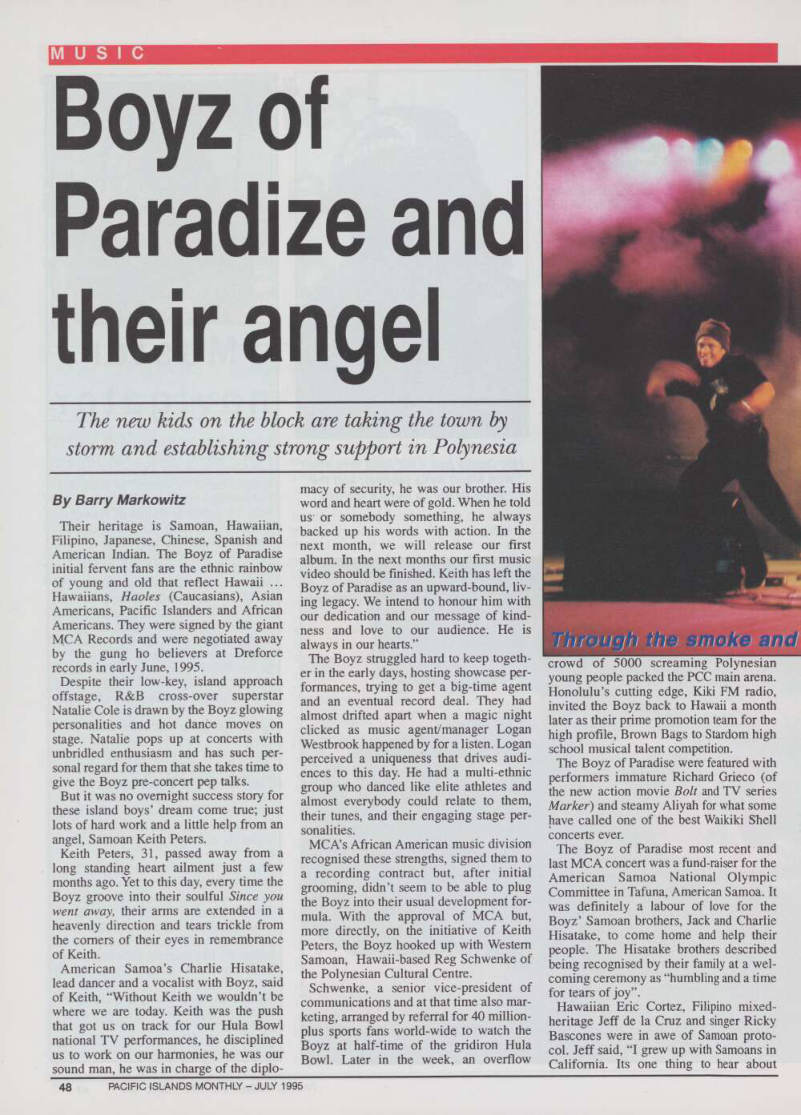
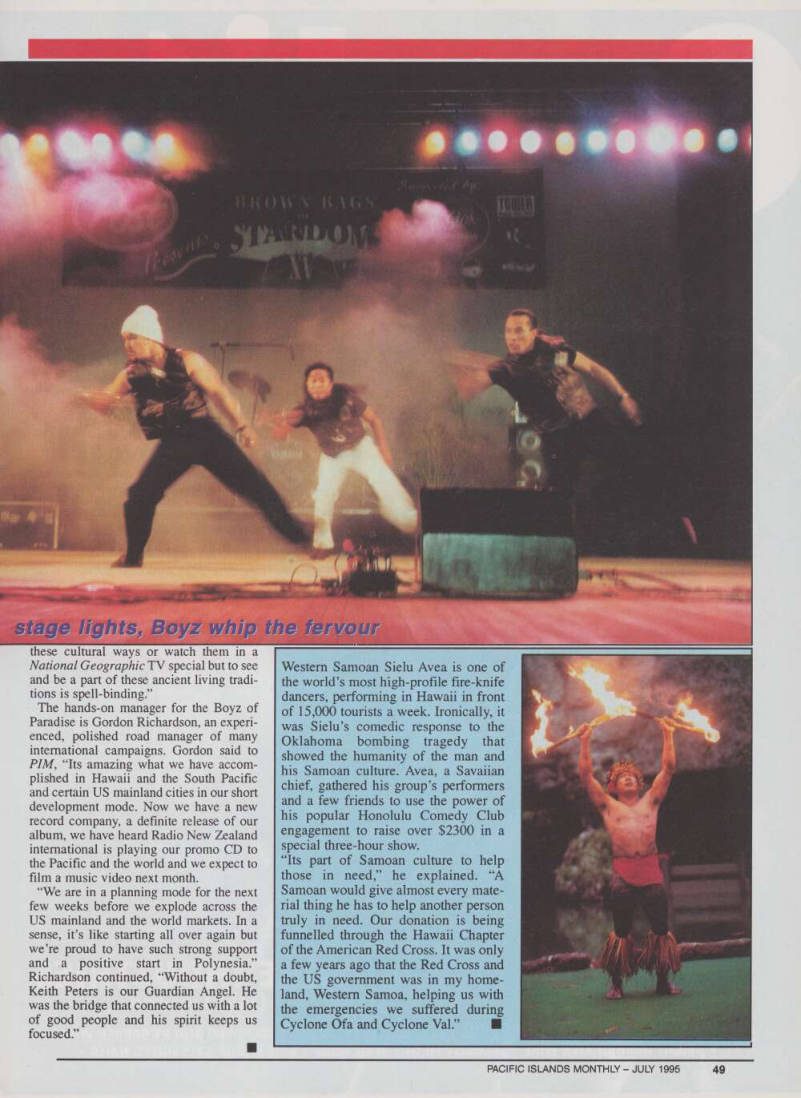
Music
Boyz of Paradize and their angel
The new kids on the block are taking the town by storm and establishing strong support in Polynesia
By Barry Markowitz
Their heritage is Samoan, Hawaiian, Filipino, Japanese, Chinese, Spanish and American Indian. The Boyz of Paradise initial fervent fans are the ethnic rainbow of young and old that reflect Hawaii ...
Hawaiians, Haoles (Caucasians), Asian Americans, Pacific Islanders and African Americans. They were signed by the giant MCA Records and were negotiated away by the gung ho believers at Dreforce records in early June, 1995.
Despite their low-key, island approach offstage, R&B cross-over superstar Natalie Cole is drawn by the Boyz glowing personalities and hot dance moves on stage. Natalie pops up at concerts with unbridled enthusiasm and has such per sonal regard for them that she takes time to give the Boyz pre-concert pep talks.
But it was no overnight success story for these island boys’ dream come true; just lots of hard work and a little help from an angel, Samoan Keith Peters.
Keith Peters, 31, passed away from a long standing heart ailment just a few months ago. Yet to this day, every time the Boyz groove into their soulful Since you went away, their arms are extended in a heavenly direction and tears trickle from the comers of their eyes in remembrance of Keith.
American Samoa’s Charlie Hisatake, lead dancer and a vocalist with Boyz, said of Keith, “Without Keith we wouldn’t be where we are today. Keith was the push that got us on track for our Hula Bowl national TV performances, he disciplined us to work on our harmonies, he was our sound man, he was in charge of the diplo
macy of security, he was our brother. His word and heart were of gold. When he told us' or somebody something, he always backed up his words with action. In the next month, we will release our first album. In the next months our first music video should be finished. Keith has left the Boyz of Paradise as an upward-bound, liv ing legacy. We intend to honour him with our dedication and our message of kind ness and love to our audience. He is always in our hearts.”
The Boyz struggled hard to keep togeth er in the early days, hosting showcase per formances, trying to get a big-time agent and an eventual record deal. They had almost drifted apart when a magic night clicked as music agent/manager Logan Westbrook happened by for a listen. Logan perceived a uniqueness that drives audi ences to this day. He had a multi-ethnic group who danced like elite athletes and almost everybody could relate to them, their tunes, and their engaging stage per sonalities.
MCA’s African American music division
recognised these strengths, signed them to
a recording contract but, after initial grooming, didn’t seem to be able to plug the Boyz into their usual development for mula. With the approval of MCA but, more directly, on the initiative of Keith Peters, the Boyz hooked up with Western Samoan, Hawaii-based Reg Schwenke of the Polynesian Cultural Centre.
Schwenke, a senior vice-president of communications and at that time also mar keting, arranged by referral for 40 million plus sports fans world-wide to watch the Boyz at half-time of the gridiron Hula Bowl. Later in the week, an overflow
crowd of 5000 screaming Polynesian young people packed the PCC main arena.
Honolulu’s cutting edge, Kiki FM radio, invited the Boyz back to Hawaii a month later as their prime promotion team for the high profile, Brown Bags to Stardom high school musical talent competition.
The Boyz of Paradise were featured with performers immature Richard Grieco (of the new action movie Bolt and TV series Marker ) and steamy Aliyah for what some have called one of the best Waikiki Shell concerts ever.
The Boyz of Paradise most recent and last MCA concert was a fund-raiser for the American Samoa National Olympic Committee in Tafuna, American Samoa. It was definitely a labour of love for the Boyz’ Samoan brothers, Jack and Charlie Hisatake, to come home and help their people. The Hisatake brothers described being recognised by their family at a wel coming ceremony as “humbling and a time for tears of joy”.
Hawaiian Eric Cortez, Filipino mixed heritage Jeff de la Cruz and singer Ricky Bascones were in awe of Samoan proto col. Jeff said, “I grew up with Samoans in California. Its one thing to hear about
Through the smoke and
these cultural ways or watch them in a National Geographic TV special but to see and be a part of these ancient living tradi tions is spell-binding.”
The hands-on manager for the Boyz of Paradise is Gordon Richardson, an experi enced, polished road manager of many international campaigns. Gordon said to PIM, “Its amazing what we have accom plished in Hawaii and the South Pacific and certain US mainland cities in our short development mode. Now we have a new record company, a definite release of our album, we have heard Radio New Zealand international is playing our promo CD to the Pacific and the world and we expect to film a music video next month.
“We are in a planning mode for the next few weeks before we explode across the US mainland and the world markets. In a sense, it’s like starting all over again but we’re proud to have such strong support and a positive start in Polynesia.”
Richardson continued, “Without a doubt, Keith Peters is our Guardian Angel. He was the bridge that connected us with a lot of good people and his spirit keeps us focused.”
Western Samoan Sielu Avea is one of the world’s most high-profile fire-knife dancers, performing in Hawaii in front of 15,000 tourists a week. Ironically, it was Sielu’s comedic response to the Oklahoma bombing tragedy that showed the humanity of the man and his Samoan culture. Avea, a Savaiian chief, gathered his group’s performers and a few friends to use the power of his popular Honolulu Comedy Club engagement to raise over $2300 in a special three-hour show.
“Its part of Samoan culture to help those in need,” he explained. “A Samoan would give almost every mate rial thing he has to help another person truly in need. Our donation is being funnelled through the Hawaii Chapter of the American Red Cross. It was only a few years ago that the Red Cross and the US government was in my home land, Western Samoa, helping us with the emergencies we suffered during Cyclone Ofa and Cyclone Val.” ■
stage lights, Boyz whip the fervour
Advertisements & other items, p. 50 (1 item)
Wire Industries (Fiji) Limited produce the highest quality wire
highest quality wire and wire products in the country. Because we use only top quality imported steel. We make just about any wire product you’ll ever need, pig and goat fencing, pipework and pipe gates and fences, galvanised and PVC chainlink fencing, standard and HT barbed wire, bright hard drawn wire, security mesh, wire rods and a huge range of bright and galvanised nails pins and fasteners.
Call our sales team today on: 4yva (679) 361 418 or Nadi (679) 702 280 or fax Suva (679) 361 506 or Nadi (679) 702 260 P O Box 2451 Nadi, Fiji Islands.
United we stand
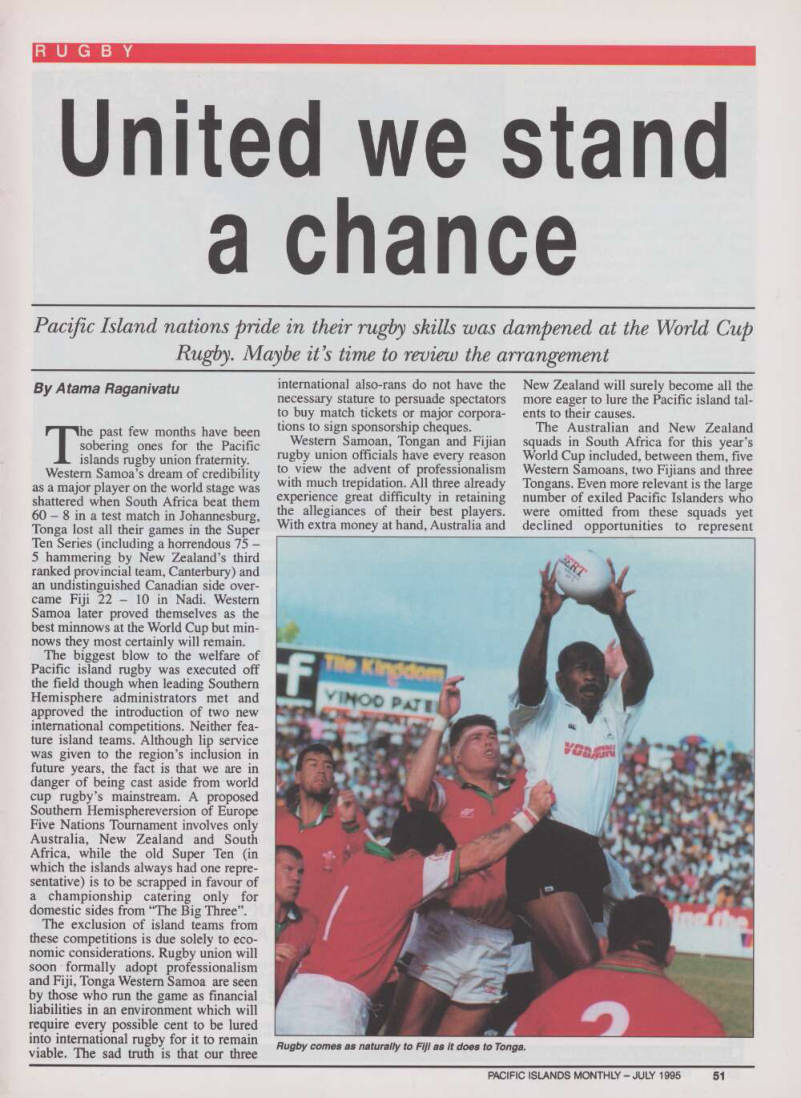
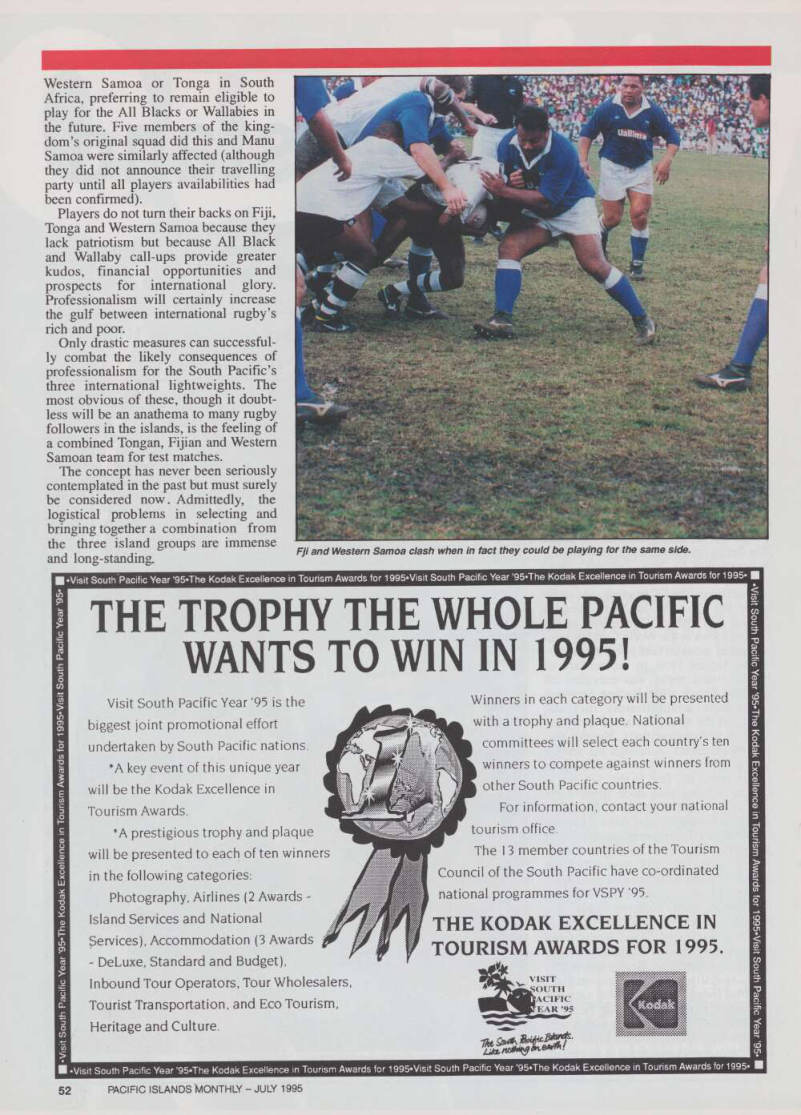
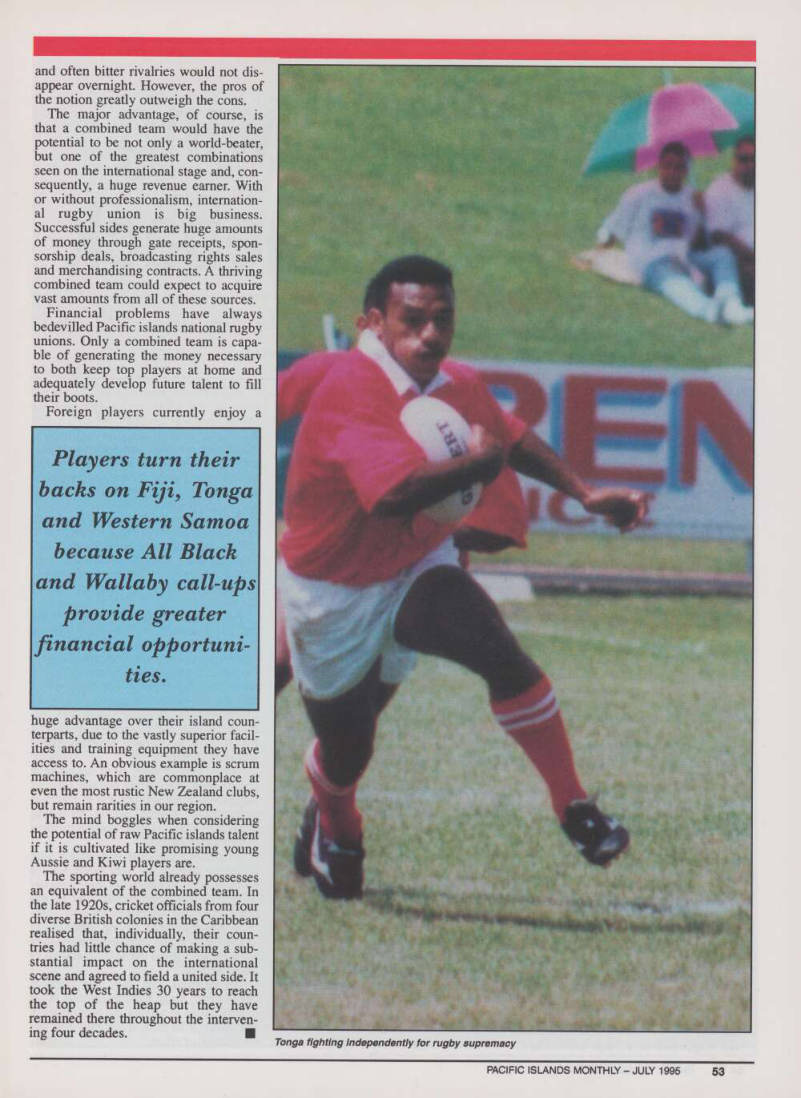
Rugby
United we stand a chance
Pacific Island nations pride in their rugby skills was dampened at the World Cup Rugby. Maybe it’s time to review the arrangement
By Atama Raganivatu
The past few months have been sobering ones for the Pacific islands rugby union fraternity.
Western Samoa’s dream of credibility as a major player on the world stage was shattered when South Africa beat them 60 - 8 in a test match in Johannesburg, Tonga lost all their games in the Super Ten Series (including a horrendous 75 - 5 hammering by New Zealand’s third ranked provincial team, Canterbury) and an undistinguished Canadian side over came Fiji 22 - 10 in Nadi. Western Samoa later proved themselves as the best minnows at the World Cup but min nows they most certainly will remain.
The biggest blow to the welfare of Pacific island rugby was executed off the field though when leading Southern Hemisphere administrators met and approved the introduction of two new international competitions. Neither fea ture island teams. Although lip service was given to the region’s inclusion in future years, the fact is that we are in danger of being cast aside from world cup rugby’s mainstream. A proposed Southern Hemisphereversion of Europe Five Nations Tournament involves only Australia, New Zealand and South Africa, while the old Super Ten (in which the islands always had one repre sentative) is to be scrapped in favour of
a championship catering only for
domestic sides from “The Big Three”.
The exclusion of island teams from these competitions is due solely to eco nomic considerations. Rugby union will soon formally adopt professionalism and Fiji, Tonga Western Samoa are seen by those who run the game as financial liabilities in an environment which will require every possible cent to be lured into international rugby for it to remain viable. The sad truth is that our three
international also-rans do not have the necessary stature to persuade spectators to buy match tickets or major corporations to sign sponsorship cheques.
Western Samoan, Tongan and Fijian rugby union officials have every reason to view the advent of professionalism with much trepidation. All three already experience great difficulty in retaining the allegiances of their best players, With extra money at hand, Australia and
New Zealand will surely become all the more eager to lure the Pacific island tal ents to their causes, The Australian and New Zealand squads in South Africa for this year’s World Cup included, between them, five Western Samoans, two Fijians and three Tongans. Even more relevant is the large number of exiled Pacific Islanders who were omitted from these squads yet declined opportunities to represent
Rugby comes as naturally to Fiji as it does to Tonga.
Western Samoa or Tonga in South Africa, preferring to remain eligible to play for the All Blacks or Wallabies in the future. Five members of the king dom’s original squad did this and Manu Samoa were similarly affected (although they did not announce their travelling party until all players availabilities had been confirmed).
Players do not turn their backs on Fiji, Tonga and Western Samoa because they lack patriotism but because All Black and Wallaby call-ups provide greater kudos, financial opportunities and prospects for international glory.
Professionalism will certainly increase the gulf between international rugby’s rich and poor.
Only drastic measures can successful ly combat the likely consequences of professionalism for the South Pacific’s three international lightweights. The most obvious of these, though it doubt less will be an anathema to many rugby followers in the islands, is the feeling of a combined Tongan, Fijian and Western Samoan team for test matches.
The concept has never been seriously contemplated in the past but must surely be considered now. Admittedly, the logistical problems in selecting and bringing together a combination from the three island groups are immense and long-standing.
Fji and Western Samoa clash when in fact they could be playing for the same side.
and often bitter rivalries would not dis appear overnight. However, the pros of the notion greatly outweigh the cons.
The major advantage, of course, is that a combined team would have the potential to be not only a world-beater, but one of the greatest combinations seen on the international stage and, con sequently, a huge revenue earner. With or without professionalism, internation al rugby union is big business.
Successful sides generate huge amounts of money through gate receipts, spon sorship deals, broadcasting rights sales and merchandising contracts. A thriving combined team could expect to acquire vast amounts from all of these sources.
Financial problems have always bedevilled Pacific islands national rugby unions. Only a combined team is capa ble of generating the money necessary to both keep top players at home and adequately develop future talent to fill their boots.
Foreign players currently enjoy a
Players turn their backs on Fiji , Tonga and Western Samoa because All Black
and Wallaby call-ups
provide greater
financial opportuni
ties.
huge advantage over their island coun terparts, due to the vastly superior facil ities and training equipment they have access to. An obvious example is scrum machines, which are commonplace at even the most rustic New Zealand clubs, but remain rarities in our region.
The mind boggles when considering the potential of raw Pacific islands talent if it is cultivated like promising young Aussie and Kiwi players are.
The sporting world already possesses an equivalent of the combined team. In the late 19205, cricket officials from four diverse British colonies in the Caribbean realised that, individually, their coun tries had little chance of making a sub stantial impact on the international scene and agreed to field a united side. It took the West Indies 30 years to reach the top of the heap but they have remained there throughout the interven ing four decades. ■
Tonga fighting independently for rugby supremacy
Advertisements & other items, p. 52 (1 item)
Wants To Win In 1995!
■ •Visit South Pacific Year '9s*The Kodak Excellence in Tourism Awards for 1995- Visit South Pacific Year '95» •Visit South Pacific Year '9s*The Kodak Excellence in Tourism Awards for 1995*Visit South Pacific Year '9s«The Kodak Excellence in Tourism Awards for 1995-
THE TROPHY THE WHOLE PACIFIC
Visit South Pacific Year '95 is the biggest joint promotional effort undertaken by South Pacific nations. *A key event of this unique year will be the Kodak Excellence in Tourism Awards. *A prestigious trophy and plaque will be presented to each of ten winners in the following categories; Photography, Airlines (2 Awards - Island Services and National , Services), Accommodation (3 Awards - Deluxe, Standard and Budget), Inbound Tour Operators, Tour Wholesalers.
Tourist Transportation, and Eco Tourism, Heritage and Culture.
Winners in each category will be presented with a trophy and plaque. National committees will select each country's ten winners to compete against winners from other South Pacific countries.
For information, contact your national tourism office.
The 13 member countries of the Tourism Council of the South Pacific have co-ordinated national programmes for VSPY '95.
THE KODAK EXCELLENCE IN
TOURISM AWARDS FOR 1995.
VISIT
SOUTH
JACIFIC
Tear '95 •Visit South Pacific Year '9s«The Kodak Excellence in Tourism Awards for 1995*Visit South Pacific Year •gS'The Kodak Excellence in Tourism Awards (or 1995- ■ ‘Visit South Pacific Year '9s*The Kodak Excellence in Tourism Awards for 1995»Visit South Pacific Year '9s* ■
Singh the Swing
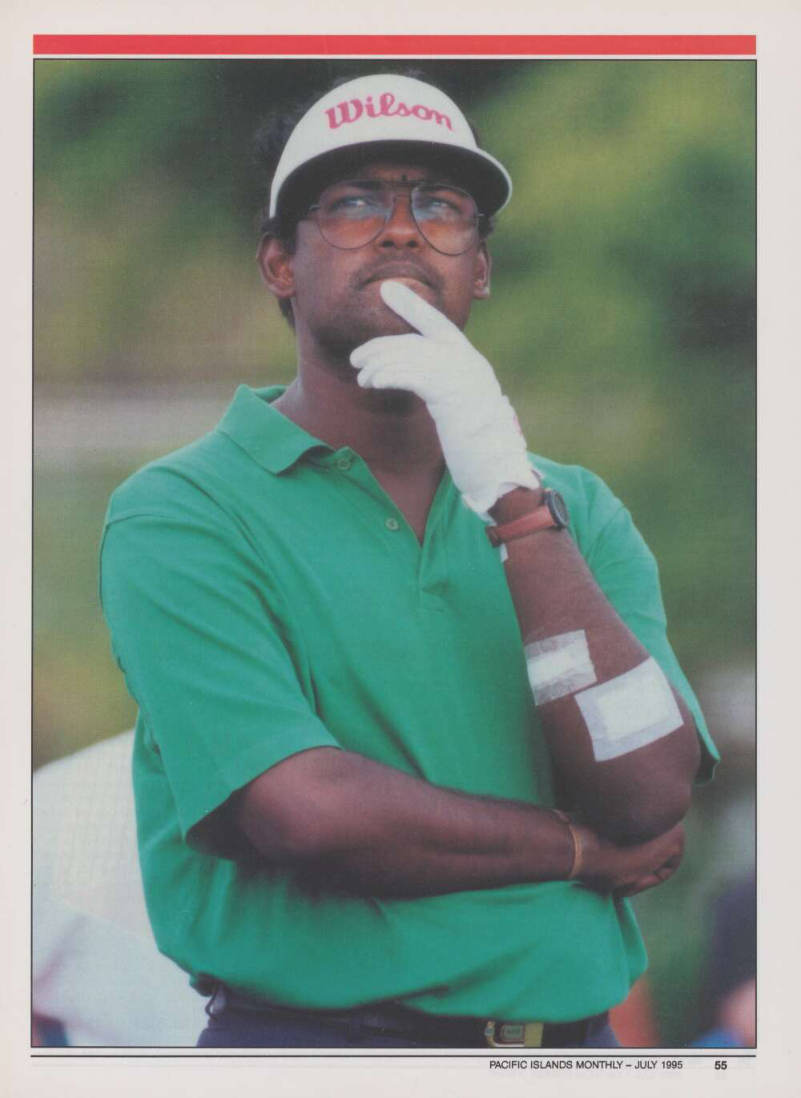
strikes a comeback
Determination and persistence is what it's all about for Vijay Singh as he defies all odds to win the Buick Classic
By Atama Raganivatu
Fijian golfer Vijay Singh’s recent success at the Buick Classic tour nament at Harrison, New York, marked the latest chapter in one of the most extraordinary comeback stories in modem sport.
Singh is now ranked amongst the world’s top 20, yet just a few short years ago he was disgraced and penniless, bare ly scraping a living as resident profession al at a club in a remote comer of Borneo.
It is a tribute, above all else, to Singh’s incredible single-mindedness that he is where he is today and if it were not for his determination he would never have embarked upon a professional career.
Vijay’s father, a technician at Nadi airport, Fiji, had once attempted to make a living from golf and failed miserably. He was, therefore, loathe to see his son travel down the same unhappy road and many were the arguments when Singh junior discarded homework and sneaked away to the local golf course.
The course was a rudimentary nine hole one adjacent to the airport. Even as a teenager, Vijay found that his drives out stripped the length of the fairways there and, when safe to do so, would smash balls down the airport runway.
Pacific Harbour offered a greater chal lenge when it was opened and here Singh first began to show himself as being more than just a capable amateur. After winning several local tournaments, he graduated to the Asian professional tour. It was a sober ing experience for him.
The young “rookie” struggled desper ately in Asia. Despite his most earnest efforts, he could not string together any respectable rounds and prize cheques were small in value and few in number. Just when it appeared as if Singh had reached
rock bottom, fate produced a bombshell that would have destroyed the aspirations of lesser mortals but which today must be acknowledged as the catalyst dial made him.
Playing in Indonesia, Singh was dis covered to have claimed one shot less on his scorecard than he had actually achieved and unceremoniously banned from all competitive golf. To this day, he remains bitter about the episode and adamant that it resulted from an innocent and fully explainable error on his behalf and only an Indonesian dignitary’s pig headedness prevented his penalty being nothing more than a token fine.
Only his inability to match the proficiency of the greats at putting has prevented him from capturing golf’s most coveted titles
But Singh found himself suspended from tournament play and a near-pariah throughout the golfing world. Rather than abandon his dreams, as most would have done, he decided to continue in the game in a non-competing capacity, though ren dered almost unemployable. When he did finally find work, it was as the profession al at a club deep in the heart of east Malaysian state of Sarawak. Here, between giving golfing lessons to timber and oil company executives, he practised for hours on end. The powerfully built Fijian now had an added reason to succeed - the desire to restore his pride.
When the suspension ended, he did not return to the Asian circuit. His previous ordeal there was too bitter. Africa’s Safari Tour both marked Singh’s competitive rebirth and provided him with a first pro fessional win. Since then, he has not looked back. During the intervening years, victories have come regularly in Europe and North America.
A fierce determination has always been the Singh hallmark and that is reflected in the countless hours he spends practising.
That unending honing of skill has pro duced one of the best actions in contempo rary golf and, with it, the nickname “Singh the Swing”.
Few players hit the ball further off the tee. Unfortunately, he is less efficient on the greens. Only his inability to match the proficiency of the greats at putting has pre vented him from capturing any of golf’s four most coveted titles - the Majors (the British Open, American PGA Championship, the US Open and the Masters). But, there is reason to believe that at least one of these glittering prizes will soon be his.
Singh has, of late, been spending a greater proportion of his practise time on the putting green and the win in Harrison suggests that this is paying dividends.
Hopefully, Fiji’s greatest sporting moment is not too far away.
Singh has a love-hate relationship with his native country. He very rarely returns home and only occasionally represents her in international competitions, yet he has often expressed yearnings to earn suffi cient money to buy a private island in Fiji and retire there and appears genuine when stating a wish to aid the next generation of Fijian golfers.
An introvert with very few interests beyond golf, Singh remains resolute in his determination to become the best player in the world. If he fails, it certainly will not be for lack of effort. ■
Cliffs,
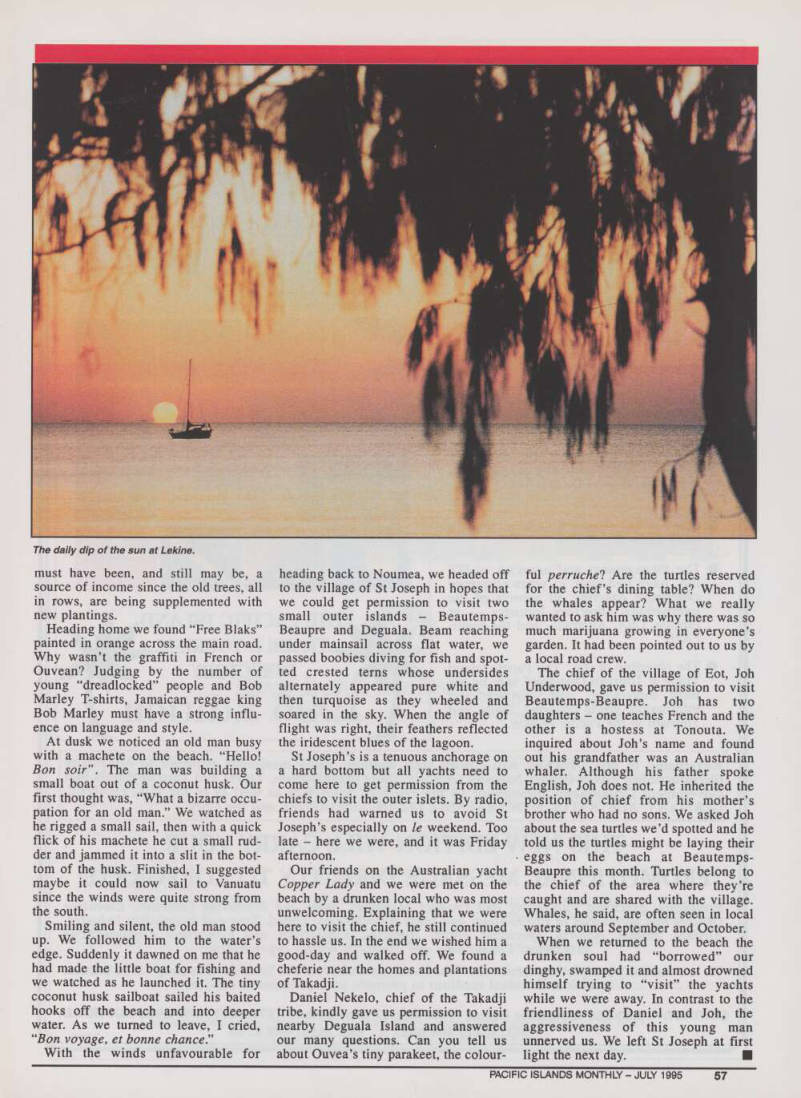
Yachting
Cliffs, Caves and Coral
A little French , a lot of interest go a long way in the Loyalties
By Sally Andrew
£ £ T'fc oger. Roger. Talk to you tomorrow.”
When cruising, keeping in touch with
friends across the Pacific via amateur radio is an important part of the morn ing. So finally, after chatting with a friend in Moorea, we pulled up the hook and sailed to the village of Lekine, anchoring just north of the bridge con necting He Mouli to the main island of
Ouvea in the Loyalties.
Patrick, a Kanak with an incredibly long and fat Rastafarian dreadlock, was sitting on the beach when we brought our dinghy ashore. Writing in the sand, Patrick spelt out the names of local vil lages for me. He spoke to us about inde pendence and we tried hard to under stand as he talked about New Caledonia’s political problems. My French was not up to the complexity.
He waved good-bye as we left to hike around to the high grey cliffs of Lekine - impressive geological structures that can be reached by following the beach around from the bridge. Towering walls of limestone, undercut by waves long before the island was uplifted, now have massive stalactites caused by fresh water percolating through the limestone cap above the overhang. The cliffs are dotted with gaping caves and face Lekine Bay’s shimmering colours. The cliffs and caves extend for miles and, with the low afternoon lighting, were quite fantastic.
By the time we strolled through the village of Lekine it was late afternoon.
The settlement is divided into sections, with one family per section. Like us, the electricity followed the dirt road. A stuccoed concrete block church, not of any great age, was painted white, blue and yellow. People, busy with normal late afternoon activities, were lighting cooking fires and taking showers. Copra
must have been, and still may be, a source of income since the old trees, all in rows, are being supplemented with new plantings.
Heading home we found “Free Blaks” painted in orange across the main road, Why wasn’t the graffiti in French or Ouvean? Judging by the number of young “dreadlocked” people and Bob Marley T-shirts, Jamaican reggae king Bob Marley must have a strong influence on language and style.
At dusk we noticed an old man busy with a machete on the beach. “Hello!
Bon soir” . The man was building a small boat out of a coconut husk. Our first thought was, “What a bizarre occupation for an old man.” We watched as he rigged a small sail, then with a quick flick of his machete he cut a small rudder and jammed it into a slit in the bottom of the husk. Finished, I suggested maybe it could now sail to Vanuatu since the winds were quite strong from the south.
Smiling and silent, the old man stood up. We followed him to the water’s edge. Suddenly it dawned on me that he had made the little boat for fishing and we watched as he launched it. The tiny coconut husk sailboat sailed his baited hooks off the beach and into deeper water. As we turned to leave, I cried, “Bon voyage, et bonne chance.”
With the winds unfavourable for
heading back to Noumea, we headed off to the village of St Joseph in hopes that we could get permission to visit two small outer islands - Beautemps- Beaupre and Deguala. Beam reaching under mainsail across flat water, we passed boobies diving for fish and spot ted crested terns whose undersides alternately appeared pure white and then turquoise as they wheeled and soared in the sky. When the angle of flight was right, their feathers reflected the iridescent blues of the lagoon, St Joseph’s is a tenuous anchorage on a hard bottom but all yachts need to come here to get permission from the chiefs to visit the outer islets. By radio, friends had warned us to avoid St Joseph’s especially on le weekend. Too late - here we were, and it was Friday afternoon.
Our friends on the Australian yacht Copper Lady and we were met on the beach by a drunken local who was most unwelcoming. Explaining that we were here to visit the chief, he still continued to hassle us. In the end we wished him a good-day and walked off. We found a cheferie near the homes and plantations of Takadji.
Daniel Nekelo, chief of the Takadji tribe, kindly gave us permission to visit nearby Deguala Island and answered our many questions. Can you tell us about Ouvea’s tiny parakeet, the colour
ful perruchel Are the turtles reserved for the chief’s dining table? When do the whales appear? What we really wanted to ask him was why there was so much marijuana growing in everyone’s garden. It had been pointed out to us by a local road crew.
The chief of the village of Eot, Joh Underwood, gave us permission to visit Beautemps-Beaupre. Joh has two daughters - one teaches French and the other is a hostess at Tonouta. We inquired about Job’s name and found out his grandfather was an Australian whaler. Although his father spoke English, Joh does not. He inherited the position of chief from his mother’s brother who had no sons. We asked Joh about the sea turtles we’d spotted and he told us the turtles might be laying their eggs on the beach at Beautemps- Beaupre this month. Turtles belong to the chief of the area where they’re caught and are shared with the village, Whales, he said, are often seen in local waters around September and October, When we returned to the beach the drunken soul had “borrowed” our dinghy, swamped it and almost drowned himself trying to “visit” the yachts while we were away. In contrast to the friendliness of Daniel and Joh, the aggressiveness of this young man unnerved us. We left St Joseph at first light the next day. ■
The daily dip of the sun at Lekine.
Advertisements & other items, pp. 56-60 (1 item)
Second Hand Containers
WHERE AND WHEN YOU WANT THEM IN THE PACIFIC If you need a flexible and safe storage space we have the ideal solution for you. Our second hand containers provide instant secure storage. Guaranteed to be wind and waterproof these containers are ideal for both temporary and longterm storage in Pacific conditions.
We can deliver to any island in the Pacific within a month and our rates have got to be the lowest you will find. All you need to do is tell us how many you want.
CONTACT:
PASCALE MARCONNET, BP 4757 NOUMEA, NEW CALEDONIA. TEL (687) 28 7450. FAX: (687) 26 3248
INTERNATIONAL UJRADE & UJOIIRISM
THE ITT DIRECTORY INCORPORATES
Editorial focus on the current and future business, investment and trade develop-
ment opportunity.
A comprehensive travel and tourism documentary as well as island chronicle dent which heightens awareness, not only locally, but overseas to the myriad
offerings available.
International srade & lousism A trade & tourism classified section, per island listed alphabetically, and advertisers index.
A multi island section for companies & B operating in several South Pacific i. Introductory forewards by respective ministries of trade and tourism as well as from the South Pacific Trade Commission, Maps of the Pacific Islands and major town street directories.
The management and agencies of ITT INC have had over 25 years Directory experience covering all aspects of the
International Directory Inaustry in
+ ★ * ★ ★ Europe, USA, Australia, and the South Pacific. • The objective of the The Pacific Island Trade & Tourism Directory' is to be the most innovative, cost effective and informative guide covering Trade and Tourism in the Pacific Region.
IHE PACIFIC ISLAND
TRADE & TOURIS
DIRECTORY
1996 Edition
Advertising in this Directory will ensure your business gains maximum exposure to companies (manufacturing, export-import, business services), Trade organisations. Travel and Tour operators and Government Departments throughout all the PACIFIC ISLANDS as well as in the U.K, FRANCE, GERMANY, AUSTRALIA, NEW ZEALAND, JAPAN, SINGAPORE and the USA.
THIS NEW EDITION WILL CARRY YOUR
PROMOTIONAL MESSAGE DIRECTLY TO CORPORATE:
Presidents, Executive Purchasing and Product Managers, Sales and Marketing Directors, Executive Officers and Secretaries of Professional and trade Associations. Travel, Tour and hospitality Industry, Airlines, Hotels, Resorts. Specialist Travel Agencies, Exhibitions and Conference Organisations Investment Consultants and Agents of related organisations.
We are currently completing entries for “The Pacific Islands Trade & Tourism Directory" 1996 Edition which is the ideal medium to promote your products & services.
CONTACT:— 133-135 Alexander Street P.O. Box 57 Crows Nest (SYDNEY) NSW 2065 AUSTRALIA TEL: (612) 906 6487 FAX (612) 439 2738 100358V1
10 15 20 25 30 35 40 45 50 55
I A LIFETIME OF SERVICES
30 40 45 Grand Pacific Life Insurance offers you a lifetime of safe, secure products at very competitive rates. 0 Choose from a full range of products such as
• Super Ordinary Life
• Super Universal • Non-Participating Whole Life • 10-Year Level Term • Flexible Premium Annuities • Group Life Insurance
• IRAs
• Graded Premium Whole Life A We've been dedicated to providing fast, personalized service for more than 35 years through local ownership and management.
That's why Grand Pacific Life is your Family for ...throughout the Pacific. 30 35 40 45 10 15 20 25 30 35 40 45 50 55 60 ©
Grand Pacific Life Insurance, Ltd.
A member of the Finance Factors Family
FEDERATED STATES
OF MICRONESIA
Actouka Executive Insurance Underwriters P.O. Box 55, Kolonia, Pohnpei, Federated States of Micronesia 96941 Pacific Basin Insurance & General Services, Inc P.O. Box 494, Chuuk State, Federated States of Micronesia 96942
TONGA
Peseti Ma ‘afu Ins. & Finance, Ltd.
Private Bag 2, Taumoepeau Bldg.
Nukualofa, Tonga
GUAM
Great National Insurance Underwriters, Inc.
P.O. Box GA, Agana, Guam 96910
AMERICAN SAMOA
Mark Solofa Pacific Insurance & Finance, Inc.
P.O. Box 3149 Pago Pago, American Samoa 96799 Pacific Financial Corporation P.O. Box AT, Agana, Guam 96910 Takagi & Associates, Inc.
GCIC Bldg., Suite 100 414 W. Soledad Ave.
Agana, Guam 96910
MARSHALL ISLANDS
Marshalls Insurance Agency P.O. Box 113, Majuro, Marshall Islands 96960
WESTERN SAMOA
Mark Solofa Pacific Insurance & Finance, Inc.
P.O. Box 3149 Pago Pago, American Samoa 96799
NORTHERN MARIANAS
Pacific Basin Insurance Underwriters, Inc.
P.O. Box 710 Saipan, Mariana Islands 96950 Pacifica Insurance Underwriters, Inc.
P.O. Box 168, Saipan, Mariana Islands 96950 Grand Pacific Life Insurance, Ltd. *1164 Bishop Street, sth Floor, Honolulu, HI 96813 Phone: (808) 548-3363 • FAX: (808) 548-5122
0, ' (T.
V life- -4b
Born to run.
The Mitsubishi Lancer: A family sedan that meets our own standards of stability and performance.
Lancer is ready when you are.
The rear multi-link suspension system is absolutely fearless. The independent McPherson struts up front are equal to the challenge of even the toughest road conditions. And an aggressive, fuel-efficient SOHC engine awaits your command.
The ground-hugging chassis holds comers tight. A powerful braking system holds you and your family secure.
And when you venture into the passing lane, this car holds nothing back.
Because Lancer was born to run.
It is a dazzling product of our total approach to car design, a philosophy you can feel the moment you get behind the wheel.
There is no compromise in Lancer’s construction. Every detail meets our exacting standards of stability and performance. Its unique handling instincts and spirited responsiveness are an expression of Mitsubishi’s driving commitment to excellence in every car we make.
Yes, strictly speaking, Lancer is a family sedan. But the way it performs is something else.
MITSUBISHI LRNCER
What Drives You.
Of *O.
N
ISSS
EP 4* AMERICAN SAMOA: PACIFIC MARKETING INC. P.O. Box 698, Pago Pago, Tel. 699-9140 / AUSTRALIA: MITSUBISHI MOTORS AUSTRALIA LTD. 1284 South Road, Clovelly Park, South Australia, 5042, Tel (08) 2757297 / FIJI: NIVIS MOTOR & MACHINERY CO. LTD. G.P.O. Box 150, Suva, Tel. 383411 / GUAM: TRIPLE J ENTERPRISES INC. P.O. Box 6066, Tamuning, Tel. 6469126 / NEW CALEDONIA: SOCIETE D'IMPORTATION D'AUTO DU PACIFIQUE SUD S.A. P.O. Box 438, Noumea, Tel. 272-562 / NEWZEALAND; MITSUBISHI MOTORS NEW ZEALAND LTD. Private Bag. Porirua, Tel. 237-0109 / NORFOLK ISLAND: BORRY'S PTY LTD. P.O. Box 169, Taylors Road, Burnt, Tel. 2114/ PAPUA NEW GUINEA; TOBA MOTORS PTY LTD. P.O. Box 503, Port Moresby, Tel. 217-874 /SAIPAN: SAIPAN AUTOWORLD INC. P.O. Box 487, Tel. 234-7133 / SOLOMON ISLANDS; HARVEST PACIFIC LTD. G.P.O. Box 888, Honiara, Tel. 30407/ TAHITI: SOPADEP S.A. B.P. 1617, Papeete, Tel. 427393 / TONGA: SITANI MAFI CO., LTD. P.O. Box 83, Nuku'Alofa, Tel. 24044 / VANUATU: SOCOMETRA VANUATU LTD. B.P. 6. Port-Vila, Tel. 2314 / WESTERN SAMOA: MOTOR DISTRIBUTORS (SAMOA) LTD. PO. Box 576, Apia, Tel. 20957 A
MITSUBISHI
MOTORS
CREATING TOGETHER