] mi'A ifw Ir 1

Pacific
Islands
Monthly
t
Jl/Juj’vjJiiJJii jjJujj iu ijyyujjjy iijy iiJ^ Jy uj 1 BB^
I i\ iwra P mMMi ] mi'A ifw Ir 1
American Samoa USS2.SO; Australia A 53.50; Cook Islands NZ$3.OO; Fiji (Incl VAT) F 52.50; FS Micronesia USS3.OO; Kiribati A 52.50: Nauru A 52.50; Niue NZS3.OO: Norfolk A 53.00; New Caledonia cpf2so; New Zealand (Incl. GST) NZ53.45; Northern Marianas USS3.OO; Papua New Guinea K 3.00; Palau USS3.OO; Marshall Islands USS3.OO; Solomon Islands A 53.00; French Polynesia cpf3oC; Tonga P 3.00; United States of America USS3.OO; Vanuatu VT22O; Western Samoa T 3.25. (Recommended retail prices only)
Advertisements & other items, p. 2 (1 item)
Telikom
11l
Papua New Guinea Mi • \!
''Mail.
I lags p-.m sm
smmsi
;3f?^SßPfe
* t*, '-'V* M m lit •«
irni m WP'm
m m 4 in i n 1111 l ] • nmnnnnnnnmt: i i* : * ■ " \ o ]J‘I 1 i:3 ;> £ [ [yyyfmfftmiJiiiM ].-i3 I * - T| rir i! - iBl >r It ■ Telikom has set the pace in providing state-of-the-art telecommunications links within PNG and to anywhere around the world as we enter the 21st Century. For all your telecommunications needs, write to us at this address: Assistant General Manager Telikom Marketing Department P.O. Box 291 Waigani, Papua New Guinea Tel: 675 300 5564 Fax:67s 300 5540
TELIKOM
Alow we'ne neatly talkUuy!
Pacific
Islands
Monthly
V 01.65 No 6
The News Magazine
June 1995
□ Letters 7
□ Politics
The land of sour milk and bitter honey 9
□ Cover Stories
Commercial sense or sheer madness 15 No nukes is good nukes 17 Uncovered at the crossroads 19
□ United Nations
UN chief visits Fiji 21
□ Environment
In the name of nature 22 Something worth protecting 24
□ Scandal
"I made a mistake": Sir Geoff 26
□ Conflict
Who has the answers? 28
□ Law
Flaw and order 29
□ Women
Dealing with domestic violence 32
□ Media
TVNZ gagged 33
□ Advertising Feature
PATA and the Pacific 34
□ Murder
Widow wanted for murder 45
□ Economy
In the red 46
□ Ocean
Endless Ocean bottomless greed 47
□ Books
Ocean of information 49
□ Bodybuilding
Knight of the order of bodybuilders 50
□ Sports
Rugby goes on Safari 51 Survival of the richest 53 Coup in the sevens
kingdom 55
□ Yachting
Land of canoes and Customs 57
□ Opinion
David Barber 13
Publisher; Brian O’ Flaherty Editor: Malajagmohan Senior Writer: Yunus Rashid Graphic artist: James Ranuku Correspondents: Christine Hatcher, David North, Ed Rampell, lan Williams, Karen Mangnall, Liz Thompson, Roman Grynberg, Wally Hiambohn, Lisa Williams, Patrick Decloitre, Barry Markowitz.
Columnists: David Barber (Wellington), Futa Helu (Tonga, covering the Pacific Islands), Jemima Garrett (Sydney), Alfred Sasako (The Forum).
Advertising Sales; • Regional Sales - South Pacific; Ashok Lai, Monita Shires, Dharmend Prasad Tel (679) 304111,303429, Fax (679) 303809.
• Sydney, Canberra: Bob Hill Media Representation,Tel (61-2) 4164245, Fax (61-2) 4165064. • Brisbane: Robert Walker, Media House, Tel (61-7) 3710533, Fax (61-7) 3718904. • Adelaide: Hastwell Williamsons Representatives, Tel (61-8) 3799522, Fax (61-8) 3799735. • Melbourne: Brown Orr Fletcher Burrows (Aust) Pty Ltd. Tel (61-3) 8265188, Fax (61-3) 8265644. • Auckland: McKay & Bowman, International Media Representatives Limited, Tel (64-9) 4190561, Fax (64-9) 4192243. • Japan: Universal Media Corporation, Tokyo,Tel (3) 3266626741, Cable:
UNI-MEDIA Tokyo, Fax (3) 32626742.
Founded 1930 (USPS 9522480). A Fiji Times Limited production.
Cover prices are recommended retail only.
Registered by Australia Post, Publication No. NBPI2IO.
Copyright Fiji Times Limited, 177 Victoria Parade, Suva, Fiji. Tel (679) 304111, fax (670) 303809.Tx FJ2124.
Pacific Islands Monthly is published monthly by Fiji Times Limited, a divi sion of Nationwide News, 2 Holt Street, Surry Hills, Sydney, NSW 2010.
Send address changes to: • Pacific Islands Monthly, PO Box 1167, Suva, Fiji. Typeset and printed by The Fiji Times Limited, 177 Victoria Parade, Suva, Fiji.
Advertisements & other items, pp. 4-6 (1 item)
Telecommunications
ST VINCENT SWEDEN % TAIWAN THAILAND TONGA TRINIDAD TURKS AND CAICOS UNITED KINGDOM USA VANUATU
BARBADOS BELARUS t BERMUDA
ANTIGUA ASCENSION ISLAND
Telecommunications
solutions for the Pacific
§ t ■4 - *1 f % - 8r yNjmiV'i' I ■' j , m-r* 4 The world of Cable and Wireless encompasses to the most sophisticated international both developed countries, and those still services. developing. Countries with widely varying telecommunications needs.
And so Cable and Wireless solutions range from basic regional and local telephone systems Our philosophy of responding to individual needs explains why today we are the world's most widespread global telecommunications company, involved in MALDIVES MONGOLIA MONTSERRAT PAKISTAN PHILIPPINES PORTUGAL RUSSIA SEYCHELLES
BOTSWANA f BRITISH VIRGIN ISLANDS BULGARIA CAYMAN ISLANDS CHINA f COLOMBIA
From the name that's
known around the world.
* I: f : - \■' t '*uJk . *4 the provision of international services foroverthirty countries, and of domestic ** !
J. ,;v Siiiiii'':, *s . ■■' jirnß* *-* I t « ? these countries are here in the Pacific, an „ area of Cable and Wireless activity for more services for more than twenty. Many of than one hundred and twenty years.
Cable & wireless
The most experienced telecommunications company in the world. • Fiji Fiji International Telecommunications Limited, PO Box 59, Mercury House, 158 Victoria Parade, Suva. Tel: (679) 312933. • Solomon Islands Solomon Telekom Company Limited, PO Box 148, Honiara. Tel: (677) 21576. • Tonga Private Mail Bag 4, General Post Office, Nukualofa. Tel: (676) 23499. • Vanuatu Vanuatu Telecom Limited, PO Box 146, Port Vila. Tel: (678) 22185. • Pacific Head Office PO Box 60, Suva, Fiji Islands. Tel: (679) 311300. Fax (679) 311 Oil.
SIERRA LEONE#SOLOMON ISLANDS SOUTH AFRICA SPAIN #ST HELENA# ST KITTS AND NEVIS# ST LUCIA DOMINICA #FALKLAND ISLANDS# FIJI# FRANCE# GERMANY# GRENADA# HONG KONG# IRELAND# ITALY# JAMAICA# JAPAN# LATVIA# MACAU#
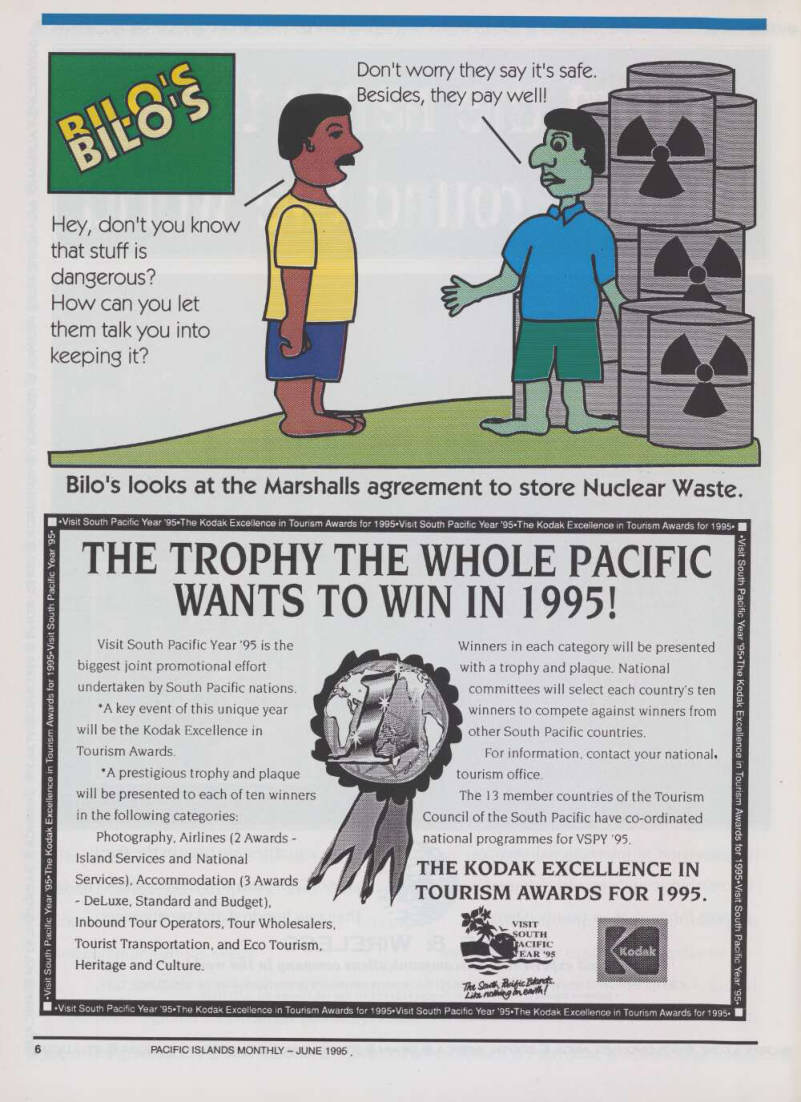
Don't worry they say it's safe.
Besides, they pay well!
Hey don know you A that stuff is danserous?
How let can you them talk you keepins it? into Bilo's looks at the Marshalls agreement to store Nuclear Waste.
•Visit South Pacific Year '95-The Kodak Excellence in Tourism Awards tor 1995* Visit South Pacific Year '9s* I •Visit South Pacific Year '95-The Kodak Excellence in Tourism Awards for 1995-Visit South Pacific Year '9s*The Kodak Excellence in Tourism Awards for 1995*
THE TROPHY THE WHOLE PACIFIC
WANTS TO WIN IN 1995!
Visit South Pacific Year '95 is the biggest joint promotional effort undertaken by South Pacific nations.
"A key event of this unique year will be the Kodak Excellence in Tourism Awards. *A prestigious trophy and plaque will be presented to each of ten winners in the following categories: Photography, Airlines (2 Awards - Island Services and National Services), Accommodation (3 Awards - DeLuxe, Standard and Budget), Inbound Tour Operators, Tour Wholesalers, Tourist Transportation, and Eco Tourism, Heritage and Culture. 7 Winners in each category will be presented with a trophy and plaque. National committees will select each country's ten winners to compete against winners from other South Pacific countries.
For information, contact your national, tourism office.
The ! 3 member countries of the Tourism Council of the South Pacific have co-ordinated national programmes for VSPY '95.
THE KODAK EXCELLENCE IN
TOURISM AWARDS FOR 1995.
VISIT
SOUTH
SfACIFIC
Tear '95 •Visit South Pacific Year ’9s»The Kodak Excellence in Tourism Awards for 1995-Visit South Pacific Year '9s«The Kodak Excellence in Tourism Awards for 1995- •Visit South Pacific Year '95-The Kodak Excellence in Tourism Awards for 1995-Visit South Pacific Year '95- ■
acceptance?
Letters To The Editor
Silence or
Madam, Madan Gopal of Toronto, Canada (PIM-May, 1995) has written a brilliant comparative analysis between the pre vailing racial ideology in both Fiji and Guyana.
The racism that Gopal talks about is reflected through his Fijian student.
However, similar racism is also reflect ed by most of the Indian students. This confirms that in Fiji racial consciousness powerfully shapes social discourses, and assists in the suppression of cross-cultur
al understanding.
What is even more perplexing is the concept of silence that Gopal so elo quently elucidates. Silence is not so much a phenomenon emanating out of racism, it is, of course, a cultural disposition with
in Fiji’s Indian community that, for some reason, believes that being silent will make the problem eventually go away. In fact, silence has added to their oppres sion, placing the whole community at the mercy of the Fijian lords.
It is important to understand that Gopal spoke of official silence which sanctions rather unlawful racism acts.
This silence shall not be confused with the silence that I am attempting to illus trate - the silence of the oppressed.
Incidentally, I happen to speak to a learned Indian gentlemen who claimed that, “As a community we shall have patience and in the end God will assist us.”
This kind of statement, which is becoming prevalent among both the young and old, shows that the communi ty is finally coming to terms with oppression, and no degree of persuasion would make them think otherwise.
Herein lies the evidence that the Indian community in Fiji has turned the other cheek.
Sanjay Ramesh,
Mead Road, Tamavua, Suva.
France,
wake up!
Madam, Napoleon had dreams of grandeur and ended up being poisoned by them.
Currently France has dreams of radio active mushrooms the nightmare of which all South Pacific nations must ingest. I Subterranean nightmares must eventu ally come to an end - when will France finally wake up?
Martin Leo,
Otahuhu, Auckland, New Zealand.
Advertisements & other items, pp. 7-8 (1 item)
Macmillan Brown Centre
INTERNATIONAL & SOUTH PACIFIC
LEGAL SERVICES
MICHAEL BULA SOLICITORS
International Lawyers
are pleased to receive instructions relating to Australian and South Pacific property, succession and commercial matters • Full corporate, representative and registered office facilities available for South Pacific clients • French spoken certified legal translations • Legal agents throughout the South Pacific and
Europe.
"PRINCES Hill Gallery", 213 Canning Street
CARLTON MELBOURNE
VICTORIA 3053 AUSTRALIA
Telephone: + 613 9 3478333 FAX: + 613 9 3471741
MBS
SCRAP METAL
Tall ingots operate from Brisbane, Australia and make frequent visits to the Pacific Islands which they have done for twenty-five years. We are buyers of Copper, Brass, Aluminium, Lead, Batteries, Battery Lead, Cable etc. Inspection no problems. Telephone 617 8922033 Fax 61 78922077.
MACMILLAN BROWN CENTRE
FOR
PACIFIC STUDIES
UNIVERSITY OF CANTERBURY
RESEARCH SCHOLARS PROGRAMME FOR 1996
The Centre invites applications for positions as Research and Visiting Scholars in 1996. Successful applicants will be selected on their research record. Applicants without formal qualifications will be considered on the basis of experience and research interest.
Applications close on Friday, 30 June 1995.
For more information please write to: The Director, Macmillan Brown Centre for Pacific Studies, University of Canterbury Private Bag 4800 Christchurch 1, New Zealand Ph 64-3-364 2957 or Fax 64-3-364 2002
Despite current peace processes in the Middle East the situation will degenerate into chaos.
Write for the Free booklet
“Storm Clouds over
Jerusalem
to be dispersed by Christ"
THE CHRISTADELPHIANS
GPO Box 881
ADELAIDE
SOUTH AUSTRALIA 5001
BORAL GAS
<Bk.
Working with you in the Pacific
BORAL GAS
PACIFIC
The land of sour
Politics
The land of sour milk and bitter honey
Fiji is a land of frustrated people. Indigenous Fijians want political supremacy in their land and Indians want equal political rights,There is no love lost between these two major races of a so-called multiracial country. Amid such a scenario, a committee has been appointed to review the 1990 Constitution. YUNUS RASHID reports on why such a review cannot guarantee political stability.
Call it white washing and you have hit the nail on the head. It may be a pessimistic attitude towards the review of Fiji’s racially biased Constitution but it is a formidable pes simism - born from the experiences of the two military coups in 1987.
Many realists who normally carry the pessimistic bug ask how a review of the
Constitution can possibly create an envi ronment of racial and cultural tolerance and harmony? How can a document establish a multiracial society when the society itself is not ready for any type of collaboration?
A conducive Constitution would be one where indigenous Fijians and the strong population of Indians and other
races have equal representation in Parliament. The 1970 Constitution which was thrown out after the first coup on May 14, 1987, was such a document.
Cross-voting was allowed and a facade of
harmony reigned.
Facade because when the coalition of the newly-born and labour-oriented Fiji worker-Party and the Indian-dominated
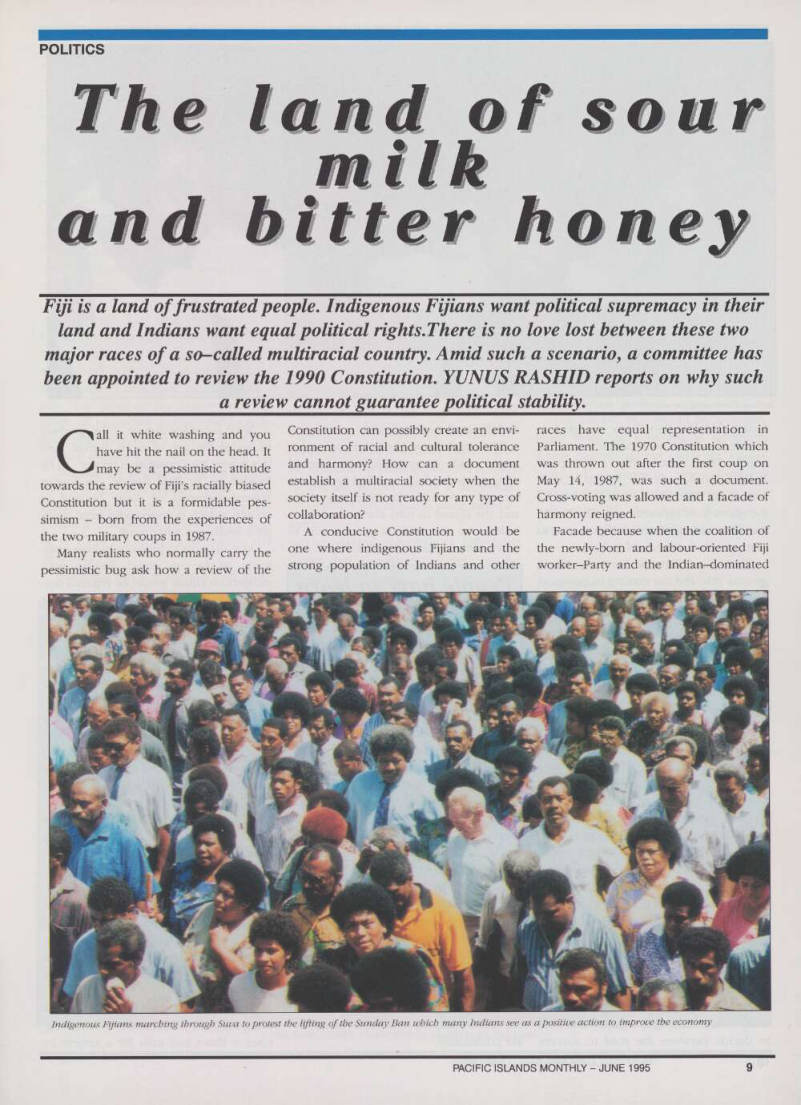
Indigenous Fijians marching through Suva to protest the lifting of the Sunday Ban which many Indians see as a positive action to improve the economy
National Federation Party swept into power, the indigenous people were out raged. They asked why a group of Indians should rule the Taukei in their own land? The Fijian Prime Minister of the short-lived government, Dr Timoci Bavadra, who has since died, was seen as a puppet in the hands of Indians.
The fall of Ratu Sir Kamisese Mara’s 16-year rule and the coming to power of a common Fijian was a bad omen as far as the Fijians were concerned. Suddenly, out of nowhere, Taukei mushroomed and took to the streets. Buildings burst into flames and hundreds of Fijian prisoners were let loose on the streets as a sign of protest.
What was simmering under the guise of multiracialism surfaced as blatant racism.
The Bavadra government was removed from Parliament at gun point, loaded into an army truck and taken for a ride to destination unknown. This was when the most sensational rumours start ed to fly. The Indian MPs, said some, were going to be separated from the few Fijian MPs and stranded on Mokogai, a former leprosy centre. Others said they would be taken to sea and drowned.
Funny as it may seem these rumours testified to the absence of trust despite a
century-old co-existence.
So where did Fiji go wrong? Why the animosity and distrust? And above all why is Fiji today standing at a junction unable to decide between the road to success
and the road to destruction?
The simple answer, even though acad emics and many politicians would disagree, is that Indians failed to appreci ate and understand the Fijian way of life and the Fijians in turn always looked at Indians as the migrant race ready to usurp their indigenous rights. Worse still,
People have to learn to live in peace before any practical political solution can be found.
despite a long standing relationship, the vast majority still need the colonial mas ters’ language to communicate.
However, despite the emotions, peo ple of Fiji can be proud of the fact that local extremists are tame compared with those abroad.
Two bloodless coup and the rapid recovery of the economy to sustainable figures following those events are rays of hope. The experiences of the coups, as one old politician points out, has taught the people of Fiji that racial groupings will not succeed. The politician says that people are coming to terms with the fact that the concept of “richness in diversity” has to be accepted as a norm for a toler ant community.
What is lacking though is the goodwill to bridge the gap of racial distrust. And this is why the Constitution review , to be headed by Sir Paul Reeves a former governor-general of New Zealand, a country which is undergoing racial prob lems itself- is a white wash.
Any attempts to promote Indians polit ically to be on equal footing with indigenous Fijians would be rejected out right by the Taukei - let alone the idea that an Indian could become Prime Minister. The 1990 Constitution forbids this. The Taukei cannot be blamed because it was only recently that they were brain washed into thinking “Fiji for Fijians”. Unless, of course, Prime Minister Sitiveni Rabuka’s idea that all Fiji citizens be called Fijians is adopted.
In the rigmarole to find a solution only one politician has spoken with far sight edness and wisdom. He is the Leader of the Opposition, Jai Ram Reddy, who has time and again reminded the country that racial hostilities would have to go if the future generations were to live in peace.
During a political rally in a Suva suburb, he said the country’s political crisis could be resolved quickly but would not be because he said the Fijians rightfully held some fears about Indians and vice -versa.
He said a peaceful atmosphere had to
prevail before any practical political solu
tion could be found.
Reddy’s views are justified because using the 1990 Constitution, which recog nises it flaws and calls for a review by
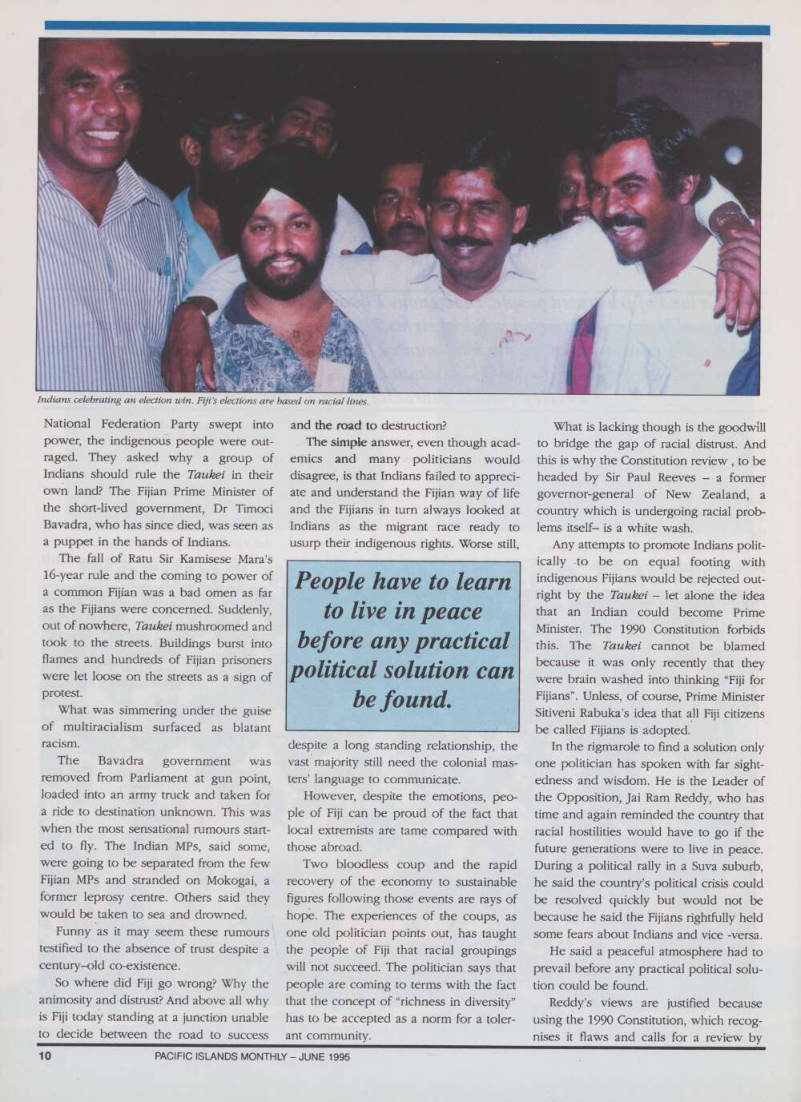
Indians celebrating an election win. Fiji’s elections are based on racial lines.
1997, segregated people into racial groups. This failed. People know that they need each other to build a solid mul tiracial foundation - a society which is conducive to all and tolerant.
As for those who blame the 1990 Constitution for the economic problems of the country, it can only be said that they have not monitored closely the steady decline in investor confidence.
There are many countries in the world which have Constitutions which violate fundamental human rights yet they have thriving economies. So why should Fiji be any different?
In fact, the Constitution is not the cause of Fiji’s poor economy. What is to be blamed is the government of the day.
It has been making inconsistent deci sions, has unruly Cabinet ministers and fails to take a firm stand against extrem ists. Then there are the landowners who block off properties and demand incredi ble compensation. See PIM April “Who’s running the gov’t”).
Because the problem of racism is deep rooted in the parliamentary circles, it has seeped through into the civil service.
People are promoted for being a particu lar race and not for being productive and deserving.
Since the problem has surfaced in all
sectors of Fiji’s community, it may be wise for government to just extend the review time clause in the 1990 Constitution. The first step is to get the people to live harmoniously and co-oper ate towards the betterment of the country so that the second step of a democratic Constitution would fall in place automat ically.
The political upheavals of 1987 have shown that a multiracial society can be established using a democratic
Constitution like the 1970 one, but such a society would be impossible to maintain in the face of racism.
The second step would be to collec tively build the economy to an extent where unemployment (with the excep
tion of voluntary unemployment)
becomes unknown and everyone is con tent with life. The simple logic, as a University of the South Pacific economist explains, behind this is that when people have money they don’t worry too much about politics. ■
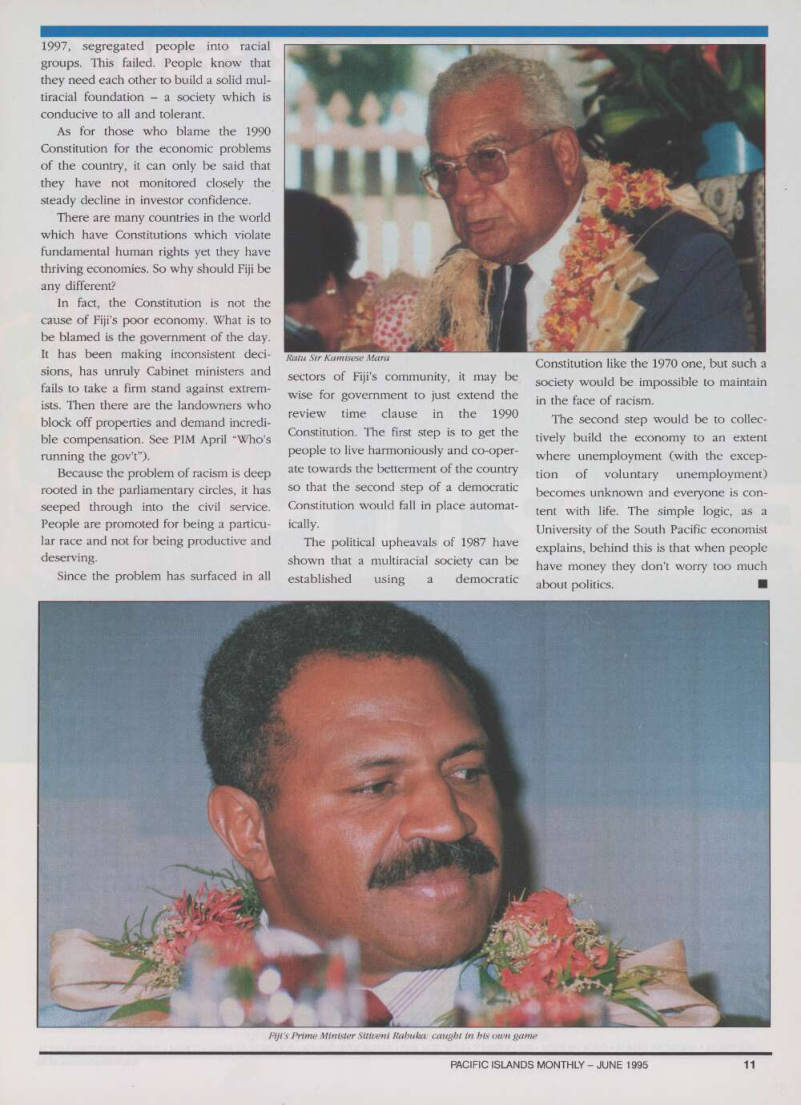
Ratu Sir Kamisese Mara
Fiji’s Prime Minister Sitiveni Rabuka: caught in his own game
Advertisements & other items, p. 12 (1 item)
Pacific Forum Line
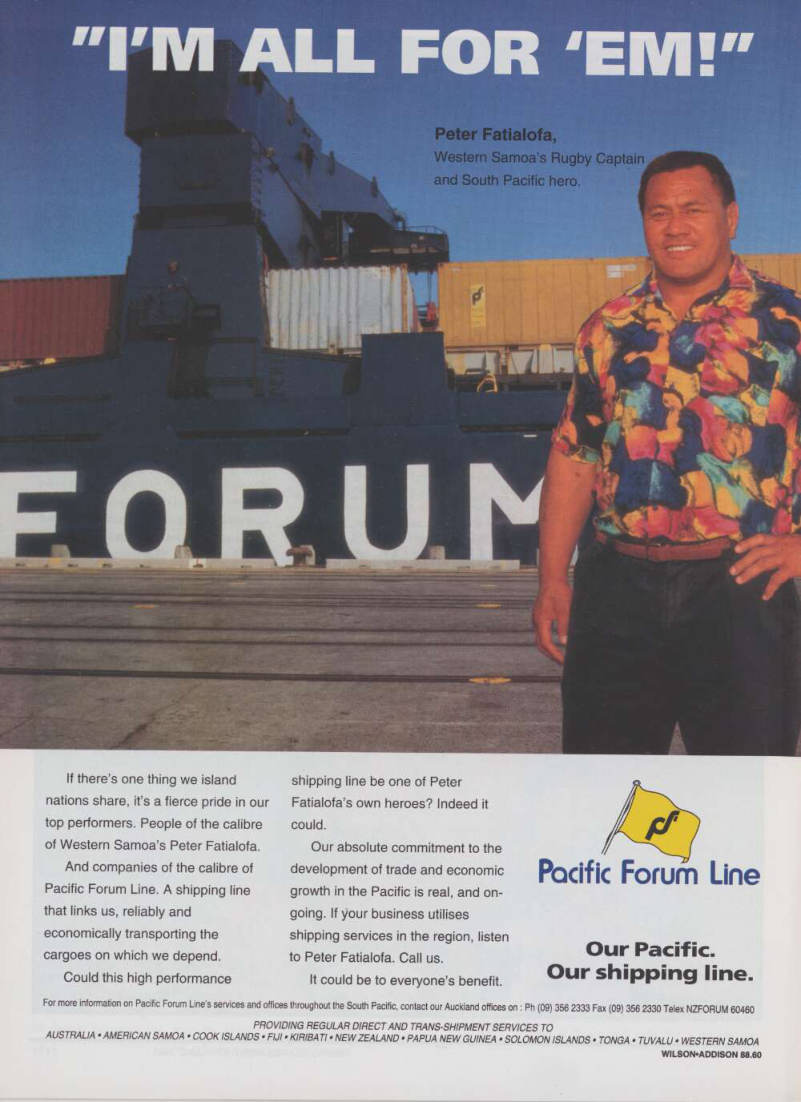
Peter Fatialofa,
Western Samoa’s Rugby Captain
and South Pacific hero. i (» pi If there’s one thing we island nations share, it’s a fierce pride in our top performers. People of the calibre of Western Samoa’s Peter Fatialofa.
And companies of the calibre of Pacific Forum Line. A shipping line that links us, reliably and economically transporting the cargoes on which we depend.
Could this high performance shipping line be one of Peter Fatialofa’s own heroes? Indeed it could.
Our absolute commitment to the development of trade and economic growth in the Pacific is real, and ongoing. If your business utilises shipping services in the region, listen to Peter Fatialofa. Call us.
It could be to everyone’s benefit. fa]
Pacific Forum Line
Our Pacific.
Our shipping line.
For more information on Pacific Forum Line’s services and offices throughout the South Pacific, contact our Auckland offices on : Ph (09) 356 2333 Fax (09) 356 2330 Telex NZFORUM 60460 PROVIDING REGULAR DIRECT AND TRANS-SHIPMENT SERVICES TO AUSTRALIA • AMERICAN SAMOA • COOK ISLANDS • FIJI • KIRIBATI • NEW ZEALAND • PAPUA NEW GUINEA • SOLOMON ISLANDS • TONGA • TUVALU • WESTERN SAMOA
WILSON'ADDISON 88.60
Too small to be
Opinion
Too small to be successful
SMALL is beautiful, argued American E F Schumacher in his 1973 book of that title.
But it seems it’s not so beautiful in the eyes of the Asian Development Bank and that’s bad news for its 12 Pacific Island members.
The 55-member bank, which held its annual meeting in Auckland last month, is the leading development finance insti tution in the Asia-Pacific nations.
Its principal purpose is to lend money, donated by the wealthy states, to the region’s under-developed members to help them progress economically and socially.
The bank’s charter requires it to pay special attention to the needs of the smaller and least-developed countries among the 39 members states in the region. These get virtually interest-free loans from the ABD’s highly concessional Asian Development Fund.
Now, they don’t come much smaller and less developed than the dozen Pacific Island states on the membership list. But the bank’s own figures show they haven’t done very well out of the SUSSI.S billion the ADB has lent for around 1,240 projects in more than 30 countries since it started operations.
The reason; they are too small.
Because of their tiny populations and economies, their needs are insignificant compared with those of the ADB’s major borrowing members like Indonesia, China and India.
To put it bluntly, a bank whose systems are geared to lending hundreds of mil lions of dollars a year to half the world’s population can’t be bothered with micro states like Tuvalu, Kiribati and the Cook Islands.
The bank’s latest annual report notes, for instance, that Kiribati has borrowed just SUS 4.9 million for five projects since joining the ADB in 1974. The Cook Islands took eight loans worth only SUSIS.7 million since it joined in 1976.
Vanuatu, a member since 1981, has bor rowed $U519.25 million for six projects.
Bank officials admit they would not process a single loan of that size to Indonesia, which normally borrows something like SUSI. 2 billion every year.
Even the biggest Pacific Island member, Papua New Guinea, has borrowed less than half that figure in a total of 42 sepa rate loans over 23 years. Fiji has received SUSI2I million in 12 loans since 1970.
The other Pacific Island member states are: The Marshall Islands, Federated States of Micronesia, Nauru, the Solomon Islands, Tonga and Western Samoa. Niue has applied for membership.
Now no-one denies the development needs of the Pacific countries are every bit as great as Asia’s poorest nations like Nepal, Bhutan, Laos and Myanmar.
But, says Colin Pratt, New Zealand’s alternate director at the ADB’s Manila headquarters, who also has responsibility for the Cooks, Fiji, Tonga and Western Samoa, they have been neglected.
Bank procedures need to be scaled down to cater for the needs of the island states, he says. But unfortunately, there is only half-hearted support for the Pacific among the big donor countries who are more interested in Asia, which remains the world’s fastest-growing region.
The burgeoning Chinese economy and the potential of newly-developing coun tries like Vietnam, now heading for 9per cent annual growth according to the ADB, are much more attractive to the developed world’s big business sector than the isolated micro states of the Pacific with their tiny domestic markets and poor growth rates.
The fact remains that the 12 Pacific Island members make up one-third of the
ADB’s borrowing countries and the bank’s charter says its has a special responsibility to them - a responsibility it has clearly not honoured to date.
The bank revamped its Pacific opera tions as part of a major internal reorganisation on January 1, but New Zealand is not yet convinced the change will improve the situation.
The revamp was controversial because it saw the bank’s South Pacific Regional Office in Vanuatu downgraded and its staff numbers reduced.
But bank officials say the island states should be better off under the reorgani sation, which has created a separate Office of Pacific Operations (OPO) at
Manila headquarters.
The bank says the island nations will have a staff and budget dedicated to their requirements for the first time, but New Zealand officials fear separation could lead to further isolation of the Pacific members from the mainstream of bank business.
Geert Van Der Linden, chief of OPO, said under the previous system, the Vanuatu office suggested programmes for the Pacific states, but depended on head quarters staff to prepare projects.
Those staff had other responsibilities, including countries like big borrower Indonesia, and the Pacific continually lost out.
The Pacific was short-changed, he said, and should now get a better deal with 26 fulltime dedicated staff - half in Vanuatu and the remainder with OPO in Manila.
Whether that number, out of the 645 professional staff on the bank’s books, is enough to give the Pacific more promi nence on the ADB map, remains to be seen.
Van Der Linden says OPO’s first priori ty is to produce a strategy paper defining the ADB’s role in the Pacific and assess ing what it can do to improve economic growth rates which have been among the lowest in the world in recent years.
Pratt says he for one will not let the bank forget its responsibilities to the region. “What is needed is a long-term commitment to the Pacific and we have not seen that from the ADB yet.” ■
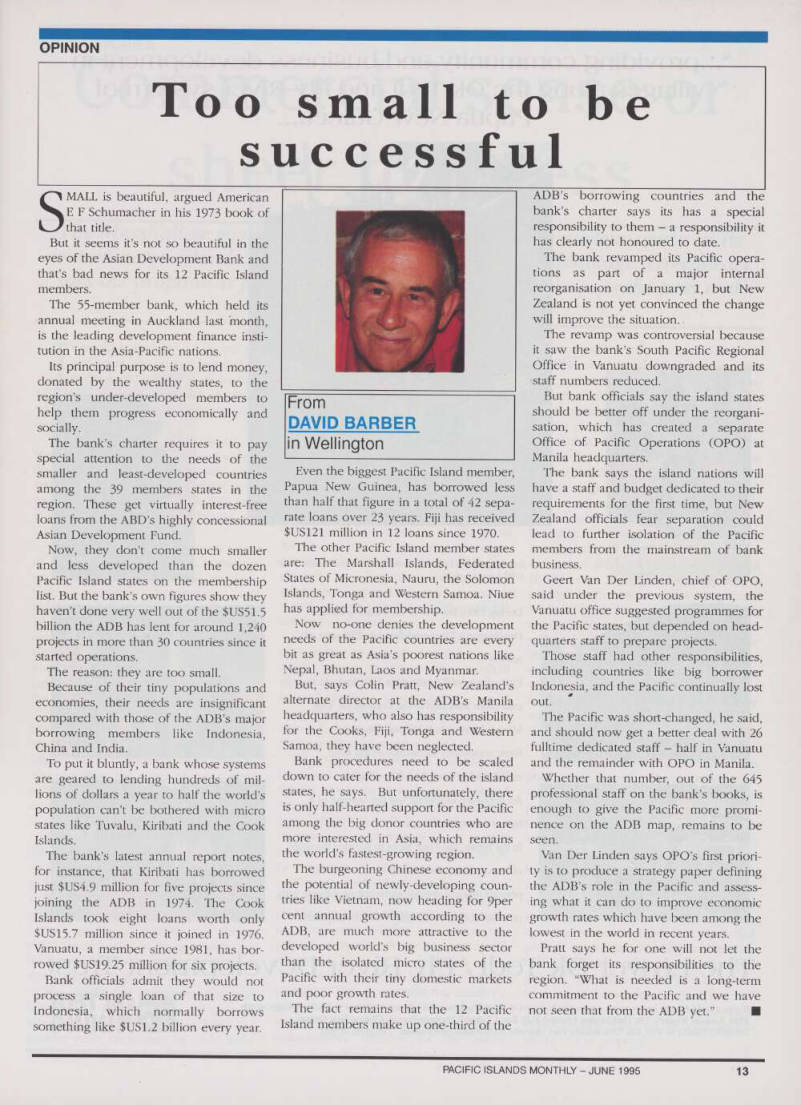
From
David Barber
in Wellington
Advertisements & other items, p. 14 (1 item)
“...providing community and business development in
villages along the Ok Tedi and Fly River system of
Papua New Guinea...”
£ M Extracts from the Lower Ok Tedi/Fly River Development Trust 1994 Annual Report: 3 % During 1994, the Lower Ok Tedi/Fly River Development Trust completed its fifth year of activity...
Expenditure of K 3 million in 1994 brought the total funds allocated to the Trust by Ok Tedi Mining Limited to K 13.8 million...
Basic community infrastructure has been established in more than 100 villages...
An important milestone was the opening of a rubber factory in Kiunga...
In the future, the Trust looks to broaden the scope of its activities to identify new activities and projects that can provide participating villages with other sources of sustainable rural development. iSi The Lower Ok Tedi / Fly River Development Trust If you would like to know more about the Lower Ok Tedi/Fly River Development Trust write for a copy of the 1994 Annual Report. Ok Tedi Mining Limited P.O. Box 1 Tabubil Western Province Papua New Guinea.
Tel: (675) 583311 or P.O. Box 7396 Boroko Port Moresby NCD Papua New Guinea. Tel: (675) 213522
OK TEDI
MINING
sheer madness
Cover Stories
Commercial sense or sheer madness
The Marshallese government says the proposal to store nuclear waste on its contaminated islands is turning a bad situation to its advantage, Greenpeace says the proposal is flawed and lethal, YUNUS RASHID reports the pros and
cons of the proposal.
It would have been a safe bet sev eral years ago to say that nobody in the world wanted to do anything with nuclear waste - least of all people who have had first-hand experience of radiation.
Incredible as it may seem, the Marshallese government is proposing to do just that - store nuclear waste on its remote islands endangering, if not in the near future than at least 10,000 years down the lane, the entire Pacific with radioactive contamination.
The Marshall Islands are no newcom er to the “nuclear age”. Its population understands more than most the long term problems associated with radioactivity. During the 1940 s and 50s, while the Marshall Islands were adminis tered as a UN Strategic Trust Territory, the United States conducted 67 atmospheric nuclear tests there, including the Bravo test in 1954, which contaminated many of the inhabited atolls with radiation.
In 1994, releases of classified informa tion about the test programme in the Marshalls, confirmed that not only has the United States of America been lying for 40 years about the extent of the contami nation but that the US deliberately exposed the Marshallese people to radia tion as part of a medical experiment code-named “Project 4.1” (PIM April 1994).
The Marshallese government is sug gesting that the proposal allows them to make the best use of a bad situation, given the remoteness of their islands; the island’s geological stability; the already contaminated state of many islands; and the unsatisfactory attempts to clean up that contamination.
But, while the short-term economic imperative which has driven the Marshalls to consider offering itself as a nuclear waste dump may be understand
able, it makes no sense in the longer term - or in environmental and economic terms - to take such a risk.
Why the proposal does not make sense is explained in a report compiled by Greenpeace about the repercussions of such a plan.
The report says the scheme is flawed for various reasons and one of them is that it suggests: “A solution to this nuclear challenge may lie in the Republic of the Marshall Islands. The Marshallese Government has indicated a willingness for one or more of the country’s many remote, uninhabitable islands to be con sidered for long-term storage and permanent disposal of surplus nuclear materials, spent fuel and other highly radioactive substances...”
The flaw in this statement, the report says, is that to suggest that providing a single storage facility in the Marshall Islands is going to solve the global prob lem of nuclear waste defies current experience. It is clear that the only long term solution to the problem is an end to the generation of nuclear waste.
The current stockpiles of waste should be stored above ground, preferably on the site where the waste is generated and where it can be monitored and if neces sary, retrieved. While there is no international consensus on how to dis pose of waste, there should be no move to create new “sacrifice” areas.
If the nuclear industry can assume that its waste problem is solved by shifting the problem to a second country, the incen tive and responsibility to reduce the amount of nuclear waste generated will
disappear.
A related problem is that of trans portation. The report says the country’s bid in fact exacerbates many of the risks involved in current radioactive waste management, because of the much
greater handling anid transportation need ed. The risks involved in transporting such materials in economic, environmen tal and political terms have not been fully or adequately considered.
The second flaw is that the proposal states that, “These island formations, which descend 18,000 feet into the abyssal depths of the ocean, are consid ered geologically stable”.
The Greenpeace report says this notion, while true fails to consider that fact that a lot of waste considered for storage has half-lives (technical term for the rate of decay of radiactivity) beyond 10,000 years. It says that stability of any geological formation cannot be guaran teed for that long. In support of its argument, Greenpeace quoted American scientists Doctor Bowman and Doctor Venri, who have expressed strong oppo sition to geologic disposal of nuclear wastes. Their concern was based on the fact that as the containers holding the waste dissolve long before the wastes become inert, the waste can react and detonate.
Yet another concern is that while the bureaucratic words “closely monitored” will be applied to the dump site, the problem with it is that the monitoring will tell when the leak has occurred and not when the leak would occur.
Whether the Republic of Marshall Islands can use one or more of its nudear-damaged islands as a long-term storage and permanent disposal site for spent'nuclear fuel or high-level radioac tive waste raises significant legal and
policy questions. Binding obligations
under regional and broader multilateral treaties, the requirements of US legisla tion and emerging principles of international law and policy all combine to cast serious doubt on the legal accept ability of the proposal.
Greenpeace says that two internation al treaties may bear directly on any proposal for storage or disposal of nuclear waste in the Marshalls: the Convention for the Protection of the Natural Resources and Environment of the South Pacific Region, opened for sig nature on November 25, 1986, and the Basel Convention on the Control of Transboundary Movements of Hazardous Wastes and their Disposal, opened for signature on March 22, 1989. The former would seem to ban such a proposal alto gether, while the latter at least casts doubt on its viability.
The proposal to store or dispose of spent nuclear fuel and high-level radioac tive waste in the Marshall Islands is fundamentally inconsistent with four emerging consensus principles of both a global and regional nature related to the need to protect the marine environment and the environment of small island nations from pollution generated by the industrialised world. First, it is improper for industrialised countries to use devel oping countries as the garbage dump for their nuclear waste. Second, low-lying atolls such as those in the Marshall Islands are not suitable for storage or dis posal because they are an integral, ecological component of the oceans and the marine environment. Third, given the major uncertainties about the safety of
waste management generally, application
of the precautionary approach should preclude the assumption of major nuclear waste storage and disposal responsibili ties in small, developing countries.
Fourth, in the South Pacific region, in par ticular, the creation of an environment free from radiation hazards is an objective that must be respected. The Marshall Islands proposal cannot stand in light of the near universal international agree ment on these principles.
But there is more to why the Marshallese government is wrong.
The Marshall Islands was the first country in the Pacific to alert the interna tional community to the impact of climate change on low-lying islands. It is there fore ironic that the same country is now ignoring its own warnings of sea level rise and increased storm activity in pur suit of the proposal for a nuclear waste
dump.
In May 1990 the world’s climate scien tists sounded a warning about the impact of global climate change unless emissions of greenhouse gases into the atmosphere were drastically cut.
The Marshall Islands would be one of the first countries seriously affected if, as the Intergovernmental Panel on Climate Change (A UN appointed body set in 1988) predicted, sea levels will rise. The highest point on its atolls is just 10 metres above sea level. A 50 metre rise in sea level would make the Marshall Islands uninhabitable, the 1994 Barbados confer ence of Small Island States was told by the Marshall Islands government.
Given the IPCC warnings, the storage of nuclear wastes cannot be guaranteed under these climate scenarios, says Greenpeace.
The Marshall Islands have already received a warning of what may happen if sea levels rise as a result of global warming. In May 1994, a combination of high tides and huge seas swept large waves inland on several low-lying coral atolls of the Marshall Islands, wrecking up to 100 homes, damaging crops and dumping debris. The atolls of Majuro, Arno, Mili and Jaluit were declared disas ter areas by the government.
The response to the Greenpeace con cern from the Marshall Islands Foreign Minister Philip Muller is that the report is presumptuous.
“We are in the process of getting a fea sibility study done and I think it is presumptuous of Greenpeace to criticise the proposal,” Muller said.
He said that several islands were con taminated and needed to be cleaned before they could be used He said the collected waste would need to be stored and the Marshallese government had to store the waste rather than dump it at sea.
Muller said the idea of getting other governments involved was to maximise security and safety of the storage site.
He said the world lacked a common dumping ground and it would be appro priate that Marshall uses one of the uninhabitable islands to store waste from other countries alongside its own waste.
Muller challenged Greenpeace to come up with better ideas to clean up the contaminated islands and the disposal of the gathered waste. He said Greenpeace should have talked to the Marshall Islands government rather than going around talking to the media.
He said the feasibility study would incorporate the experiences of nuclear experts from developing countries and should they give the go-ahead for the proposal, the neighbouring island gov ernments would be consulted about the plan.
Both Greenpeace and the Marshall Islands government have their views on the subject. But the most important thing for the Marshallese government is to remember that nuclear waste is not everyday house-hold refuse.
It can kill, if not today, then tomorrow and if not tomorrow then the day after or failing that it could kill ten thousand years down the lane. None of the leaders proposing the idea would be answerable then. ■
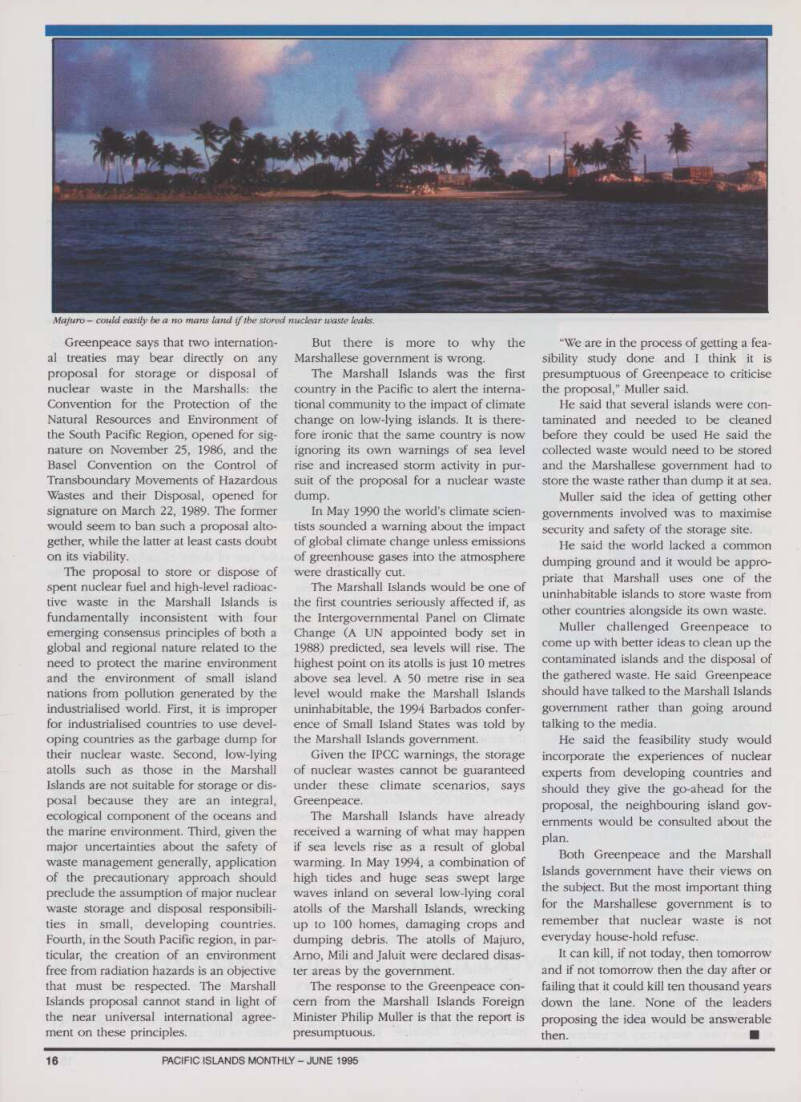
Majuro - could easily be a no mans land if the stored nuclear waste leaks.
No nukes is good nukes
By Ian Williams
In three weeks of unprecedented intense discussions at the UN in New York, the Pacific has achieved some major concessions on clearing up nuclear test sites, enforcing the Treaty of Raratonga, and on transit of nuclear mate rials.
The occasion for these diplomatic suc cesses is the 25-year review of the Nuclear Non Proliferation Treaty. In the 1960’5, as China and France joined the nuclear club, prophets looked forward gloomily to the end of the century, antic ipating possibly dozens of countries with nuclear arsenals. It was an even more frightening prospect than the uneasy sta bility of mutually assured destruction, appropriately acronymed MAD, on which the US/Soviet arms race was based.
Hence the NPT, valid for twenty five years, which represented an unprece dented degree of cooperation between the nuclear powers. In one sense, how ever, such collaboration was hardly surprising since the NPT established a cosy club of the five nuclear powers, Britain, China, France, the USA and the USSR, which were the only countries allowed to retain nuclear weapons.
In return, they were supposed to take steps to disarm themselves, and to ensure that peaceful nuclear technology was available to all other signatories. They did not, and this mandatory 25-year review gave all the other 170-plus signatories the chance to complain about the nuclear weapons states’ lack of progress. Far from disarming during the Reagan era both the USA and Soviet Union vastly increased their arsenals. They even had an example to cite, since South Africa had voluntarily abandoned its nuclear weapons.
The weapon of choice for ihe have nets at the Review conference has been the issue of how long the treaty should be renewed for - five years, twenty five years, or indefinitely. The nuclear nations and most of the developed world wanted it extended indefinitely, and the roasting they were getting from the non-aligned nations probably reinforced their deter mination to twist arms in the corridors to secure votes. The US alone and half a dozen cruising the corridors applying pressure." complained one Pacific diplo mat, "But they didn't always know who was doing what. I was approached by several different guys in one day, And then there were the Canadians and the others!”
The American zeal for everyone to sign on for an indefinite extension did not however meet with universal approval. Washington's moral pressure on Russia not to supply nuclear reactors to Iran, a signatory of the treaty, was somewhat diminished by the absolute
refusal of the Clinton administration to exert the faintest pressure on Israel.
Protected by its strong lobby in Washington, Israel is the treaty’s biggest failure, a non-signatory with an unde clared arsenal of around two hundred nuclear devices. Hence the unhappiness of Egypt and other Arab and non-aligned states with an indefinite, unconditional renewal.
The industrialised countries were determined that the treaty would be essentially unchanged and that any con cessions that were wrested from a reluctant North would not be in it, or attached to it. Anything they agreed would not be conditions or small print, they assured, as others cast around for words to describe what the Conference Report recommendations would be.
“Sweeteners” or “Desiderata” were two semi-facetious suggestions. Despite the denials of connections, it is clear that the final vote of many states on whether to renew the treaty or not, will depend on what is agreed in the recommendations,
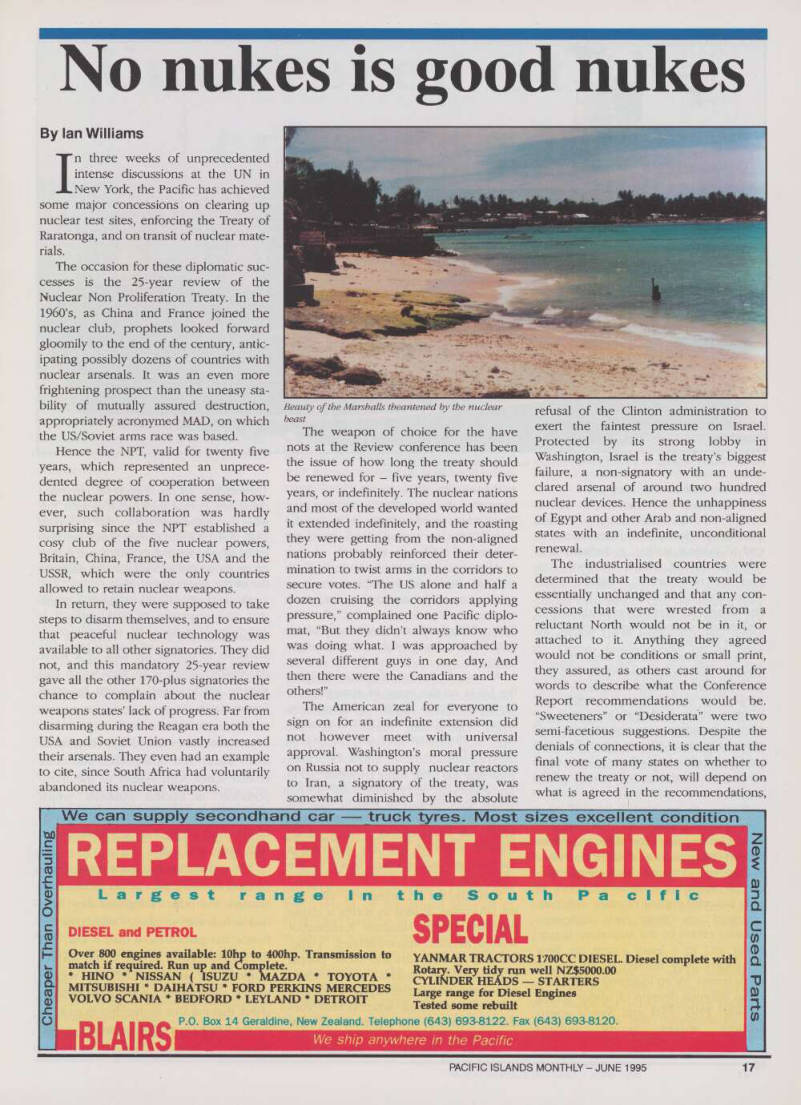
Beauty of the Marshalls theantened by the nuclear beast
just what “sweeteners” they get.
Other states want variously or collec tively, among other things, a firm commitment to nuclear disarmament, an end to nuclear testing, a declaration of “No first use” of nuclear weapons, sup port for non-nuclear weapons states when attacked, Israel to sign to the treaty and disarm, an end to the production of fissionable materials and support for nuclear free zones.
To complicate matters, until the last minute, the voting procedure had not been agreed on. Many delegations want ed a secret, rather than open vote. This would not only make all the arm-twisting in vain, it would make it counterproduc tive. Delegations at UN conferences have a long traditions of getting their own back for undue pressure in the secrecy of the ballot.
Fishing in troubled waters is what many Pacific islanders do for a living, so it is pleasant to note their diplomats proved rather good at it. Since no Pacific islands have declared the slightest inten tion of acquiring nuclear weaponry or even peaceful nuclear reactors, they con centrated on their own concerns.
Resisting efforts by the Australians in par ticular and to a lesser extent the New Zealanders, they refused to be just an amen corner for an indefinite extension.
An informal division of labour sprang up with PNG, FSM and Samoa spear heading moves against nuclear
transportation. New Zealand and PNG went after the South Pacific Nuclear Free Zone while the Marshalls, as befits the main US nuclear testing site, pursued the question of aid for the clear up.
After their initial shock, the Australians and New Zealanders joined in, enough to erase some of the resentment that many of the island delegations felt after the Berlin Global Climate conference, where they felt let down by their larger neigh bours.
As a result, Pacific delegations feel that the US is on the verge of accepting the Raratonga South Pacific Nuclear Free Zone in which case the UK will certainly follow, which increases the chances of France. That in turn would allow the Marshalls, FSM and Palau to emerge from the nuclear defence umbrella that the US forced over them, and also to sign the treaty. That likelihood was enhanced when US Secretary of Energy Hazel O’Leary indicated that she expected a compete nuclear test ban treaty by the end of the year.
Similarly, the US delegation, after ini tial reluctance, agreed to accept a clause proposed by the Marshalls Ambassador Wilfred Kendall, acknowledging “a spe cial responsibility towards those people of former United Nations Trust Territories who have been adversely affected as a result of the nuclear weapon tests con ducted during the period of the
Trusteeship.” In his speech he reminded delegates, in case they had forgotten, just what the clause referred to, that “between 1946 and 1958 the United. States detonat ed 66 atomic weapons of immense power on or above atolls located in the northern tier of the Marshall Islands.”
There is of course a domestic dimen sion to this. If aid is forthcoming, then it means that there is no need for the Marshalls to pursue the idea of a waste processing facility - an idea which had already led to much concern by other Forum states.
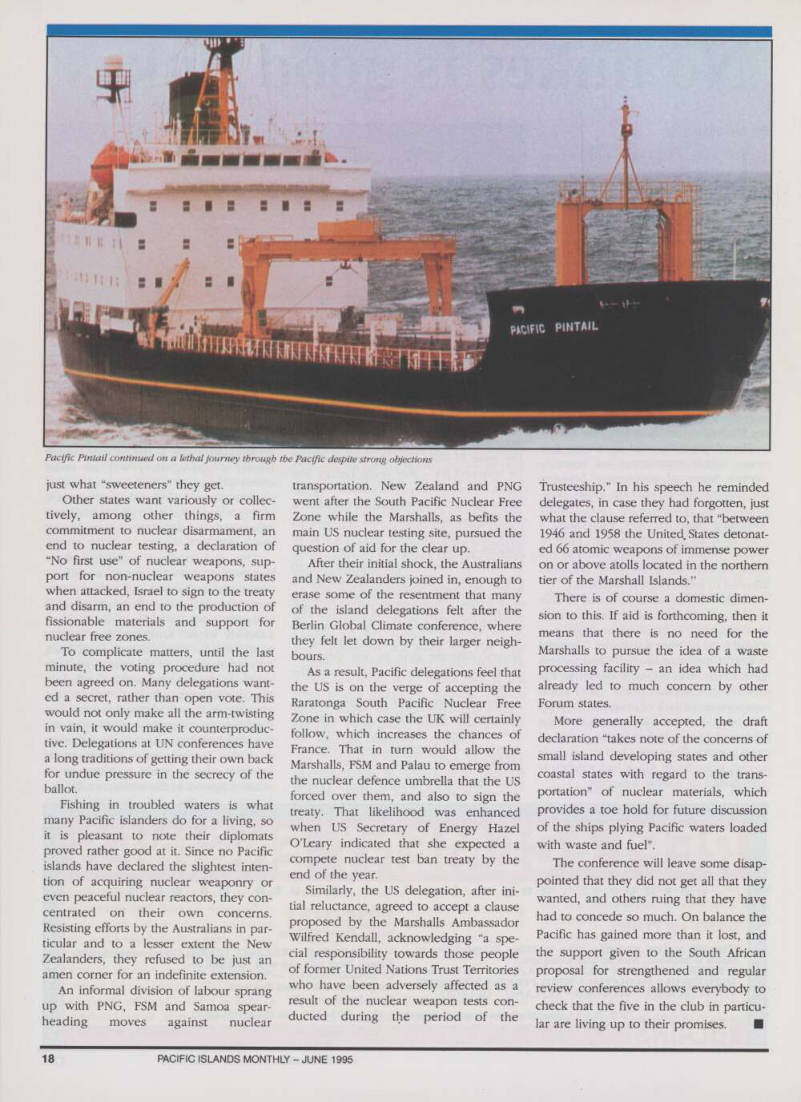
More generally accepted, the draft declaration “takes note of the concerns of small island developing states and other coastal states with regard to the trans portation” of nuclear materials, which provides a toe hold for future discussion of the ships plying Pacific waters loaded with waste and fuel”.
The conference will leave some disap pointed that they did not get all that they wanted, and others ruing that they have had to concede so much. On balance the Pacific has gained more than it lost, and the support given to the South African
proposal for strengthened and regular
review conferences allows everybody to check that the five in the club in particu lar are living up to their promises. ■
Pacific Pintail continued on a lethal journey through the Pacific despite strong objections
Advertisements & other items, p. 17 (1 item)
Cheaper Than Overhauling
We can supply secondhand car truck tyres. Most sizes excellent condition
REPLACEMENT ENGINES
Largest range In the South Pa clflc
DIESEL and PETROL
Over 800 engines available: lOhp to 400 hp. Transmission to match if required. Run up and Complete. * HINO * NISSAN ( ISUZU * MAZDA * TOYOTA * MITSUBISHI * DAIHATSU * FORD PERKINS MERCEDES VOLVO SCANIA * BEDFORD * LEYLAND * DETROIT
SPECIAL
YANMAR TRACTORS 1700 CC DIESEL. Diesel complete with Rotary. Very tidy run well NZ$5OOO.OO
CYLINDER HEADS STARTERS
Large range for Diesel Engines Tested some rebuilt
BLAIRS
P.O. Box 14 Geraldine, New Zealand. Telephone (643) 693-8122. Fax (643) 693-8120.
We ship anywhere in the Pacific
New and Used Parts
crossroads
Uncovered at the crossroads
By Ian Williams
As the 178 signatories to the Non Proliferation Treaty were at a crossroads in New York, it seems highly appropriate to review Jonathan M Weisgall’s distressing book “Operation Crossroads: The Atomic Tests at Bikini Atoll.”
Every book about nuclear testing, every leaked report from the former Soviet Union reinforces the impression that whatever the devastating physical effects nuclear weapons, in a way their worst damage was mental. The possession of such diabolical strength seems to bring out the devil in decision makers; the hell fire they control seems to vaporise their consciences.
Other works have shown that nuclear tests almost wherever conducted, by who ever, involved immediate risks to the testers’ own troops and their own civil ians. But Operation Crossroads, Weisgall suggests, was conducted with even more recklessness than usual - and it was of course conducted on the tiny home land of Pacific Islanders whose welfare the United Nations had put in Trusteeship with the United States.
The two tests were even more bizarre than usual. There was no doubt that the atomic bombs worked. Many people in Hiroshima and Nagasaki could testify to that. The test were the result as much of interdepartmental battles between the air force and the navy as much as they were a shot above the Soviet’s bows. The pur pose was to prove that the US Navy still had a role in modern warfare, in particular nuclear warfare.
When the results showed that the US Navy had little or no chance of surviving, that original purpose was sidelined. And the response of the Soviets seems to have been to redouble their efforts to ensure that they, too, could produce a nuclear weapon.
Soon after, the British declared inde pendence from the USA with their own bombs, and later France did the same.
Both shared the American preference for the Pacific as a test site.
Weisgall shows that the navy during Crossroads had the same difficulties as all
the later testers. Anyone can see the bang, the flash and their immediate after-effects of a weapon exploding. But how do you envisage a long-term, invisible, inaudible, tasteless and odour-less killer like radia tion? Billions of humans still smoke despite overwhelming evidence that it would give them heart and circulation problems and cancer. They do so because it is difficult to be scared of a long term
statistical probability.
If radiation shimmered with unearthly green lights, smelt obnoxious, or made loud noises then the techniques that humanity has developed over the years for avoiding danger might be able to cope with it more readily. But, as Weisgall points out, although the agonizing effects of fatal radiation poisoning were well document ed, and visible even in the test animals on the Bikini ships, there were political rea sons to downplay its effect. In one of those displays of fatuity that accompany nuclear experimentation as surely as a mushroom cloud, Lesley Groves, the man who had masterminded the production side of the A bomb project told Congress that “radiation poisoning was a very pleas ant way to die.” He was not, of course, speaking from personal experience.
At Bikini the problem was compound ed because the Geiger counters issued could not measure plutonium’s heavy alpha particle output. It was only after massive exposure by the clean-up crews on the surviving ships from the test shot that the navy realised just how risky the atoll and its environs had become, partic ularly after the underwater Baker shot, which was so dirty that it has been called a forerunner of Chernobyl.
Perhaps most horrifyingly, its effects had been exactly predicted - a column of water would be fountained some 8 to 10,000 feet into the air - not high enough to disperse it widely, but enough for it to fall back with its “witch’s brew” of radioac tive products on the ships in the area, concentrating the pollution in the vicini ty. Many ships stayed afloat, but were unusable for naval purposes. If they had been crewed, the sailors would have been dying of radiation poisoning.
Perhaps a measure of their unpre paredness was the steps the Navy took to try to decontaminate the 95 ships that took part in the tests. Everything from tra ditional swabbing of the decks, to fire hoses, to blasting the vessels with corn cobs, rice, barley, ground coffee, sand and coconut shells was tried, to no avail. The radiation pollution was so pervasive and insidious, that most of the ships were scuttled and never used again.
Unfortunately. Bikini atoll was to be used again, and again, making itone of the most polluted areas on earth, even almost 50 years after the first test.
While it is true that the testers were happy to expose US troops and civilians to high levels of radiation, their treatment of the Bikini islanders showed new dimensions of callousness.
Moved from their ancestral home, they were shuttled around small islands in the vicinity. The navy showed great solicitude - not to make the exiles too dependent despite promises to care for them if they cooperated in quitting their homes. “Let’s not civilize these happy people,” wrote the Deputy Commissioner of the Trust Territory in 1947. In the case of the Bikinians, he meant that the only benefits of civilisation they should get is the dubi ous honour of having 23 of the world’s most modern weapons exploded in their midst. Weisgall quotes comedian Bob Hope,“As soon as the war ended, we locat ed the one spot on earth that hadn’t been touched by war - and blew it to hell.”
As Weisgall points out, the islanders were as much the victims of incompe tence as of deliberate cruelty.
Weisgall’s book was sparked by his work as a lawyer seeking compensation for the islanders for their travails, but it has been written in an objective non polemical way. It is all the more damning for that.
Thousands of letters were written complaining about the use of animals in the tests. Few were written to protest what happened to the islanders. Perhaps Weisgall’s book will substitute for all those unwritten letters. ■
Advertisements & other items, p. 20 (1 item)
Pacific Islands Monthly
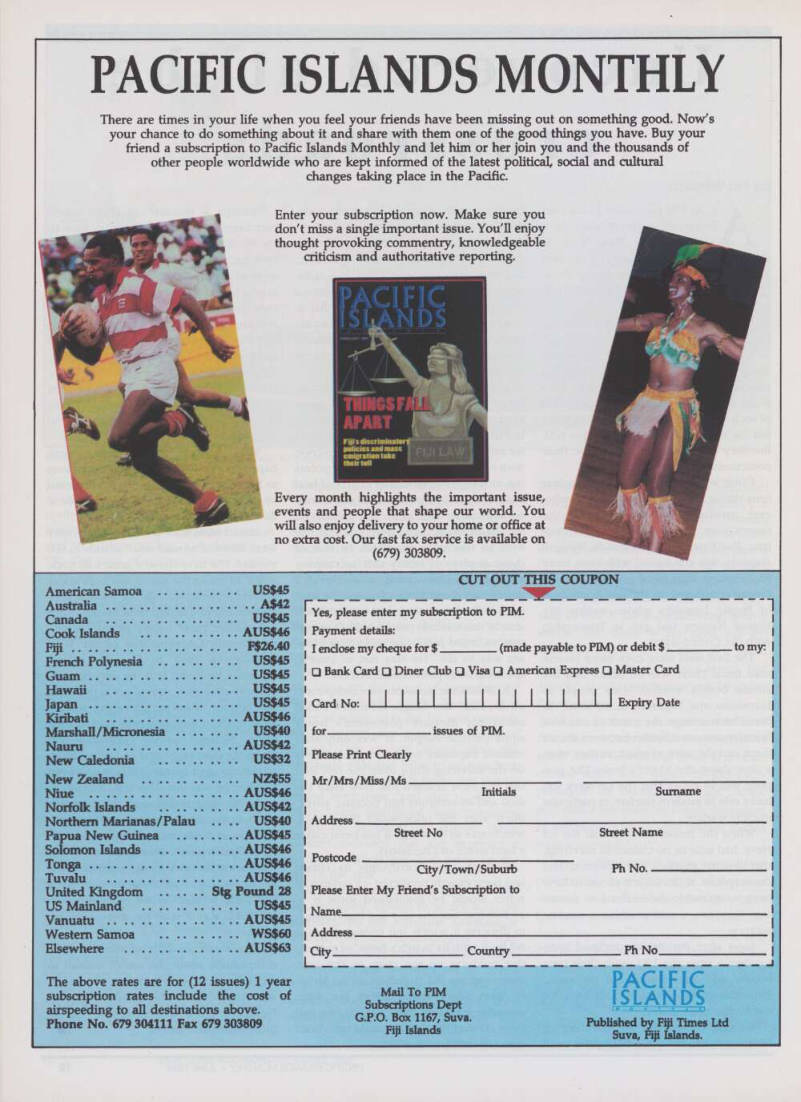
There are times in your life when you feel your friends have been missing out on something good. Now's your chance to do something about it and share with them one of the good things you have. Buy your friend a subscription to Pacific Islands Monthly and let him or her join you and the thousands of other people worldwide who are kept informed of the latest political sodal and cultural changes taking place in the Pacific, r.
Enter your subscription now. Make sure you don't miss a single important issue. You'll enjoy thought provoking commentry, knowledgeable criticism and authoritative reporting. flfscf immaiet f emigration u*c tftctr t«lf Every month highlights the important issue, events and people that shape our world. You will also enjoy delivery to your home or office at no extra cost. Our fast fax service is available on (679) 303809. r> American Samoa US$45 Australia As 42 Canada US$45 Cook Islands AUSS46 Fiji F$ 26.40 French Polynesia US$45 Guam US$45 Hawaii US$45 Japan US$45 Kiribati AUSS46 Marshall / Micronesia US$4O Nauru AUSS42 New Caledonia US$32 New Zealand NZ$55 Niue AUSS46 Norfolk Islands AUSS42 Northern Marianas/Palau ... US$4O Papua New Guinea AUSS4S Solomon Islands AUSS46 Tonga AUSS46 Tuvalu AUSS46 United Kingdom Stg Pound 28 US Mainland US$45 Vanuatu AUSS4S Western Samoa WS$6O Elsewhere AUSS63 The above rates are for (12 issues) 1 year subscription rates include the cost of airspeeding to all destinations above.
Phone No. 679 304111 Fax 679 303809
CUT OUT THIS COUPON
I ™ Yes, please enter my subscription to PIM.
Payment details: I enclose my cheque for $ (made payable to PIM) or debit $ to my □ Bank Card □ Diner Club □ Visa □ American Express □ Master Card Card No; I I I 1 I I I I I 1 I I I I I—l Expiry Date for.
Please Print Clearly Mr/Mrs/Miss/Ms . issues of PIM.
Initials Surname Address.
Street No Postcode City / Town / Suburb Please Enter My Friend's Subscription to Name Street Name Ph No.— Address.
City.
L L Country.
PhNo.
Mail To PIM Subscriptions Dept G.P.O. Box 1167, Suva.
Fiji Islands
PACIFIC
ISLANDS
Published by Fiji Times Ltd Suva, Fiji Islands.
visits Fiji
United Nations
UN Chief visits Fiji
By Ian Williams
On his way to his first visit to the South Pacific, touring Indonesia, Australia, New Zealand and Fiji before going on to Russia, UN Secretary-General Boutros Boutros-Ghali told correspondents at the UN, that a major point of his visit was to express his gratitude to the Pacific coun tries for their support for the UN, in personnel for peacekeeping and in finan cial and political terms.
It was also 10 years since a UN Secretary General had visited the region, and this coincided with the 50th Anniversary of the UN, which gave an opportunity to demonstrate that it was a real global organisation. Although the UN “is an intergovernmental organisation,” the anniversary gave the opportunity to see “if we can get the support of the peo ples of the world, ” he said. The former Egyptian Cabinet Minister gave himself an eight month timetable to decide whether or not to run for a second term. It was the most precise that he had been since he had announced last year that he was reconsidering his earlier pledge to run for just one term.
The Secretary-General has every rea son to be pleased with his visit. All of the SOPAC countries he visited in their vari ous ways place great importance on the world organisation. New Zealand has just finished a two-year term on the Security Council and Australia is making a deter mined effort to secure one for next year.
Like Fiji, they provide troops, and they pay promptly. Their foreign ministries spend a lot of time and effort on the future and efficiency of the organisation, which they see as a linch pin of their
diplomacy. Even Indonesia, marshalling
the non-aligned and recently a member of the Security Council, puts a great deal of effort into the UN - not least in ensur ing that the East Timor issue is not
brought up.
Nonetheless, the UN involvement of his hosts ensured ensured a high level of hospitable reception during his tour which must gladden his heart after the snubs he sometimes receives in an unap preciative United States.
Journalists looking for comments on local matters had to try hard. He skirted round the question of whether East Timor would be on the agenda, preferring to refer to the talks that the UN had been facilitating over the years. Asked whether he would support Australian Foreign Minister Gareth Evans as his successor, he joked that he looked forward to dis cussing the succession with him when he was in Canberra, adding that if he decid ed to run for a second term, then of course Mr Evans couldn’t be the best can didate!
Both before his trip and in Fiji itself, he refused to discuss whether or not the constitution was racist, and indicated that the UN was glad to have troops offered from any country, regardless of whether the army’s recruitment policy was dis criminatory. When asked to compare with apartheid in South Africa, over which the UN had indeed played an active and honoured role despite Pretoria’s claims that it was an internal affair, he claimed that the UN had received no complaints. Of course, he can’t be expected to listen to every speech, but at almost every conference on human rights India’s speeches have certainly complained of Fiji’s policy.
On his tour, Mr Boutros-Ghali occa sionally displayed one of his common and perhaps understandable faults. He is very good on the broad strategic sweep of events, but sometimes loses track of the details, like over Bougainville.
On the other hand, he can, when it is politic to do so, reverse the process and obscure the big picture in a welter of minor details. Questions about East Timor were regularly answered with minute details about meetings between Portugal and Indonesia, or meetings between Timorese factions. There was little if any mention of General Assembly declara tions and supposedly binding Security Council resolutions ordering Indonesia to get out of the territory. As he said in Australia, “we avoided discussing sub
stance because if you begin to discuss substance, there is such opposition between the two positions that one is not able to continue.” A cynic would translate this as “Djakarta i|S going to ignore our resolutions, so let’s not annoy it by rais ing them.”
Indeed, when in Indonesia itself he praised his hosts as a “leading contributor to the important debate,” on human rights. People in Dili and the rest of East Timor may not appreciate Djakarta”s debating techniques, any more than the journalists silenced there just before his arrival.
In Australia his answers on Bougainville had hit the headlines in Port Moresby, suggesting that he saw a role for Australia and New Zealand to inter vene. A later clarification had to be issued too cool down the scandal.
Other than that, the region’s statesmen seemed happy to see him, personally and in his official status. Prime Minister Rabuka seemed especially happy, prais ing the organisation for maintaining relations with Fiji when organizations like the Commonwealth had cut them off after the 1987 coup. Indeed, the UN recog nizes every government - even the Khmer Rouge, so this is no great achievement for Mr Rabuka’s government or Mr Boutros Ghali.
But the Prime Minister was on surer ground, when he said that, “For small countries such as Fiji, our membership of the United Nations is vitally important, because it is the ultimate guarantee of our international status and standing as a sov ereign independent and equal member of the international community of nation states.”
And although the Bosnians might quib ble, that is essentially true, ensuring the UN’s continuing importance to the nations of the region. Even Australia, a regional big power, must think of the day they may have to call on the UN for help with a stroppy Indonesia. ■
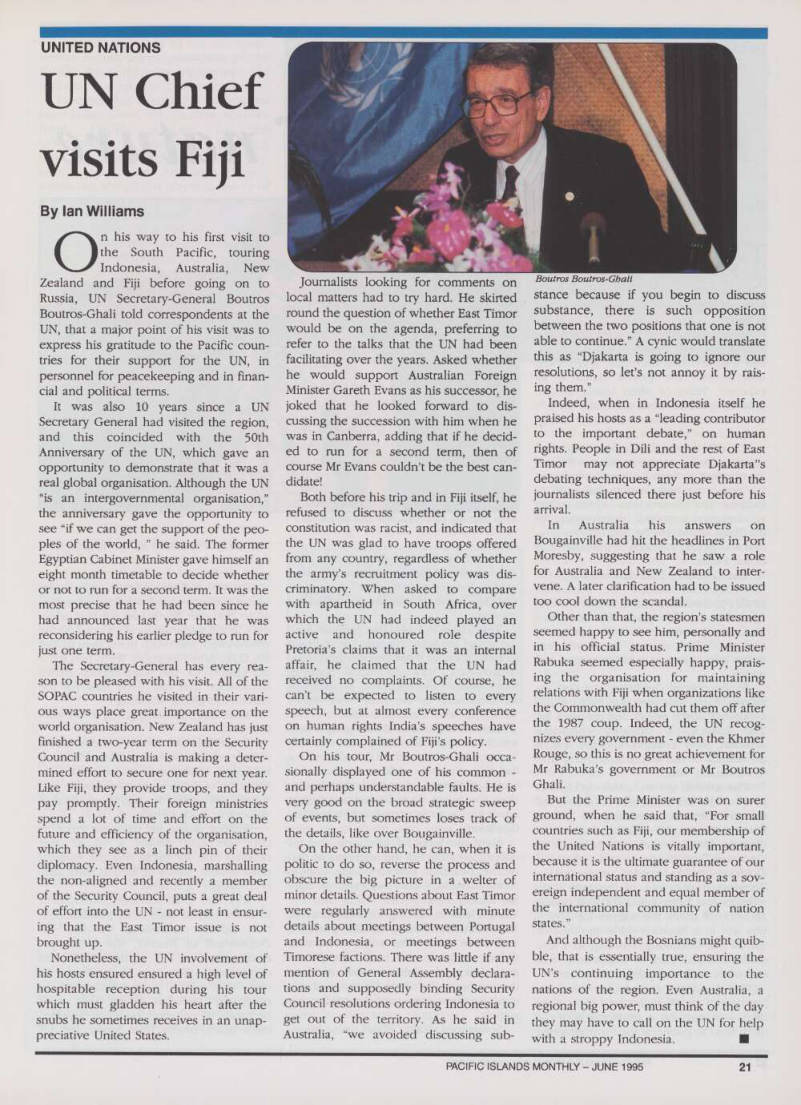
Boutros Boutros-Ghali
In the name of nature
Environment
By David North
Before the phone rang in Palau that morning, Noah Idechong had never heard of San Franciso’s Goldman Foundation or its (US) $75,000 annual prize for grassroots environmental activists.
Two minutes later he learned that the Foundation had heard about his work, had awarded him the prize, and invited him to tour the United States at its expense. Years of often lonely labour, protecting the environment of the world’s newest nation, were suddenly recog nised.
A year or so earlier Idechong had resigned from a secure position in Palau’s government to found a non-governmen tal, non-profit organisation dedicated to battling the destruction which often accompanies economic development in the Third World, but he had no idea any one was paying attention at the other side of the Pacific.
The Goldman Foundation awards for “environmental heroes” are somewhat similar to Sweden’s Nobel Prizes and the “genuine awards” made by America’s McArthur Foundation. You do not apply, and you often do not know you are under consideration until the phone call comes.
In the case of Goldman, it makes six awards each year, one for each of the continents of the world, and the sixth for The Islands, a category including Australia, New Zealand, and the rest of the islands of the world. Australians and Kiwis usually win.
The awards go to active, grassroots people who are making a difference for the environment, according to Duane Silverstein, the Foundation’s executive director. The Foundation is in favour of vigorous advocacy, and Richard Goldman, its co-founder announced in Washington that four of this year’s six winners had been jailed for their work, and one of them, the winner for Africa, was still in a Nigerian jail at the time of the award. (Idechong, working in a less confrontational part of the world, was one of the two non-jailbirds honoured.) The Goldman Foundation does not just drop a check in the mail to its hon orary - it puts on a triumphal tour for them (and to publicise the environmental
cause.) First there was the glitzy awards cere mony in San Francisco, followed by press conferences, complete with all the expen sive equipment that comes with television coverage.
Then, later in April, five grantees (and the son of the jailed Nigerian) were flown to New York for more ceremonies (at the famed New York Zoological Society), more press coverage, and a full-page advertisement in the New York Times with a photo of each of the six.
Then it was on to Washington where we interviewed Idechong and his wife Teory, who was on the US mainland for the first time. In addition to the usual round of newspaper and television atten tion, the Sierra Club hosted an elegant lunch for the six winners (and Mr and Mrs Goldman.) Here the work of Idechong and his colleagues attracted the attention of two of the Beautiful People of the Clinton Administration, Under Secretary of State for Global Affairs Tim Wirth, and the White House’s ranking environmentalist, Katie McGinty. Both politically powerful and tall in stature (he a little more than she on both counts), both slim, photo genic, elegantly dressed, and articulate, they came to the Sierra Club’s luncheon to praise the winners, and they did so ful somely.
Sometimes visiting island prime minis
ters get less attention in Washington than that accorded Idechong and his follow prize winners.
The young British woman to my right, one of the once-jailed winners, comment ed to me after Wirth had left that while the Clinton Administration’s record on the environment was much better than that of the Bush Administration, Wirth had led a delegation to the then-recent Berlin Conference that had done little for the islands (on global warming.) What was Idechong going to do with the money?
He said that he would use much of it to support his continuing work educating his fellow Palauans on the need for con servation of Palau’s beautiful islands and waters, including the highly-regarded if vulnerable Rock Islands.
Without raising his voice (or going to jail) Idechong makes a sound and detailed case for preserving the Palauan environment, which he feels is particular ly in danger right now.
Why not? Until recently development in Palau had at least been monitored, if not tightly controlled, by the US Department of Interior, the most pro environment of any of the US cabinet departments. But now Palau is on its own, with a small government weak in regulatory tradition facing the eager demands of rich and assertive develop ment firms, largely from Japan. He did
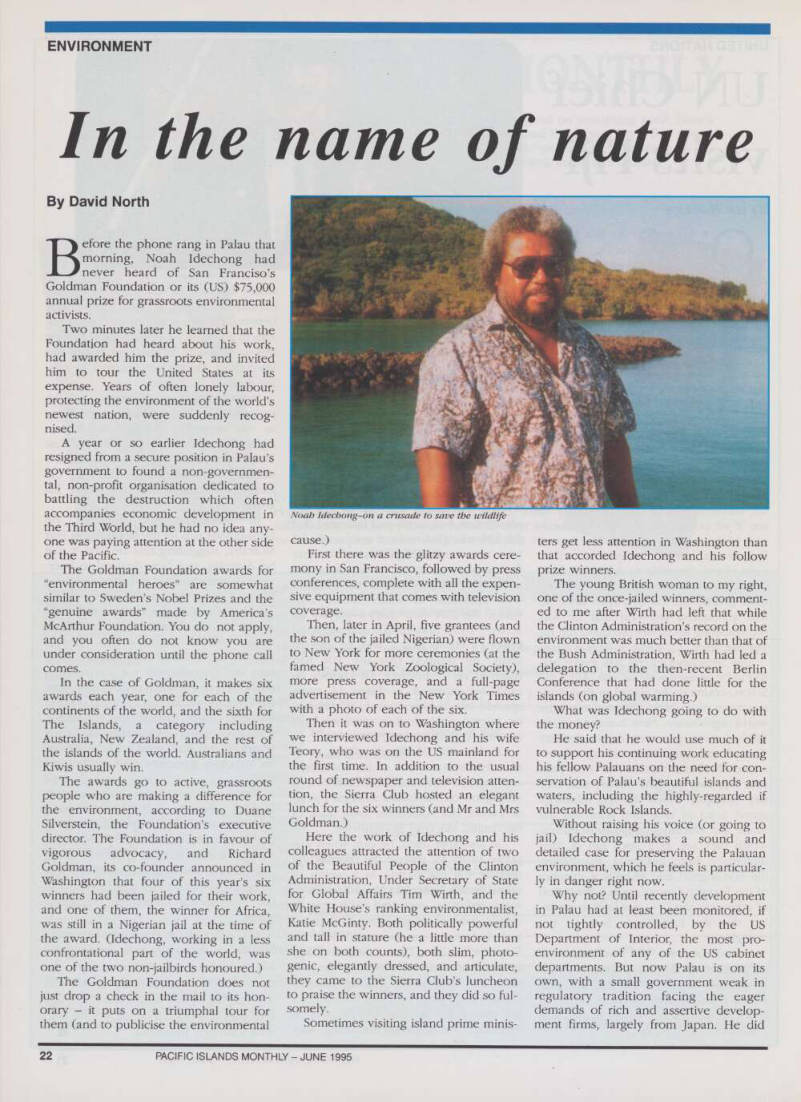
Noah Idechong-on a crusade to save the wildlife
not need to spell out to me that under similar circumstances, elsewhere in the Pacific, that rain-forests disappeared, and pollution and erosion took their place.
Idechong has a particular interest and knowledge about the maritime environ ment. (While working for the Government of Palau he had, among other things, supervised the highly suc cessful giant clam seedlings project, which has spread this potential source of food and cash income to most of the island groups of the Pacific.) “You know those fish that you see swimming in tanks in fancy restaurants in Hong Kong and Taiwan?” he asked. “The customer picks out the one he wants, and then it is cooked for him.”
I said I had not noticed them, but in the States there are sometimes lobsters in restaurant tanks awaiting similar fates.
He then told me how some Indonesian fishermen spread cyanide in the water to stun the fish, so that they can be captured alive.
“Doesn’t that poison the customer in Hong Kong?” I asked.
“For the fish it is a mild dose, he is just stunned” he replied, “but the chemical kills lots of other living things.”
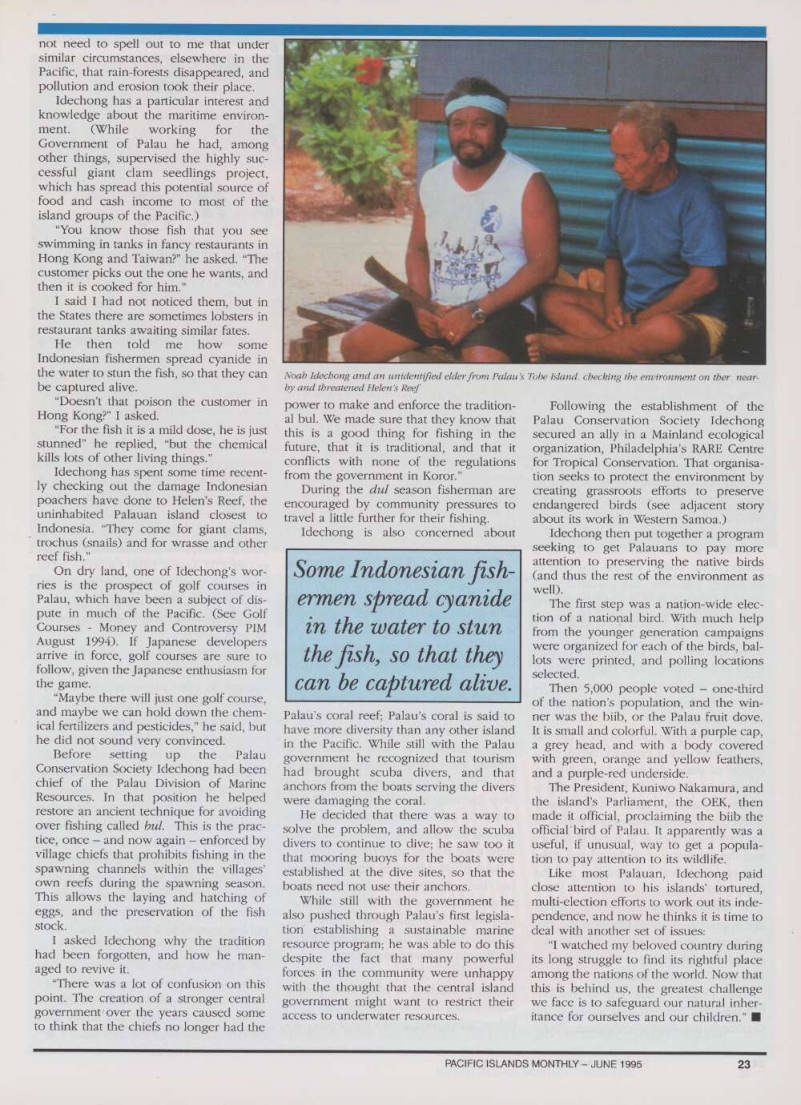
Idechong has spent some time recent ly checking out the damage Indonesian poachers have done to Helen’s Reef, the uninhabited Palauan island closest to Indonesia. “They come for giant clams, trochus (snails) and for wrasse and other reef fish.”
On dry land, one of Idechong’s wor ries is the prospect of golf courses in Palau, which have been a subject of dis pute in much of the Pacific. (See Golf Courses - Money and Controversy PIM August 1994). If Japanese developers arrive in force, golf courses are sure to follow, given the Japanese enthusiasm for the game.
“Maybe there will just one golf course, and maybe we can hold down the chem ical fertilizers and pesticides,” he said, but he did not sound very convinced.
Before setting up the Palau Conservation Society Idechong had been chief of the Palau Division of Marine Resources. In that position he helped restore an ancient technique for avoiding over fishing called bul. This is the prac tice, once - and now again - enforced by village chiefs that prohibits fishing in the spawning channels within the villages’ own reefs during the spawning season.
This allows the laying and hatching of eggs, and the preservation of the fish stock.
I asked Idechong why the tradition had been forgotten, and how he man aged to revive it.
“There was a lot of confusion on this point. The creation of a stronger central government over the years caused some to think that the chiefs no longer had the
power to make and enforce the tradition al bul. We made sure that they know that this is a good thing for fishing in the future, that it is traditional, and that it conflicts with none of the regulations from the government in Koror.”
During the dul season fisherman are encouraged by community pressures to travel a little further for their fishing.
Idechong is also concerned about
Some Indonesian fish
ermen spread cyanide
in the water to stun the fish , so that they can be captured alive.
Palau’s coral reef; Palau’s coral is said to have more diversity than any other island in the Pacific. While still with the Palau government he recognized that tourism had brought scuba divers, and that anchors from the boats serving the divers were damaging the coral.
He decided that there was a way to solve the problem, and allow the scuba divers to continue to dive; he saw too it that mooring buoys for the boats were established at the dive sites, so that the boats need not use their anchors.
While still with the government he also pushed through Palau’s first legisla tion establishing a sustainable marine resource program; he was able to do this despite the fact that many powerful forces in the community were unhappy with the thought that the central island government might want to restrict their access to underwater resources.
Following the establishment of the Palau Conservation Society Idechong secured an ally in a Mainland ecological organization, Philadelphia’s RARE Centre for Tropical Conservation. That organisa tion seeks to protect the environment by creating grassroots efforts to preserve endangered birds (see adjacent story about its work in Western Samoa.) Idechong then put together a program seeking to get Palauans to pay more attention to preserving the native birds (and thus the rest of the environment as well).
The first step was a nation-wide elec tion of a national bird. With much help from the younger generation campaigns were organized for each of the birds, bal lots were printed, and polling locations selected.
Then 5,000 people voted - one-third of the nation’s population, and the win ner was the biib, or the Palau fruit dove.
It is small and colorful. With a purple cap, a grey head, and with a body covered with green, orange and yellow feathers, and a purple-red underside.
The President, Kuniwo Nakamura, and the island’s Parliament, the OEK, then made it official, proclaiming the biib the official bird of Palau. It apparently was a useful, if unusual, way to get a popula tion to pay attention to its wildlife.
Like most Palauan, Idechong paid close attention to his islands’ tortured, multi-election efforts to work out its inde pendence, and now he thinks it is time to deal with another set of issues: “I watched my beloved country during its long struggle to find its rightful place among the nations of the world. Now that this is behind us, the greatest challenge we face is to safeguard our natural inher itance for ourselves and our children.” ■
Noah Idechong and an unidentified elder from Palau’s Tobe Island, checking the environment on ther near by and threatened Helen’s Reef
Something

worth protecting
A man takes up the unrewarding task of saving manumea, Western Samoa’s pigeon with the ugly beak. DAVID NORTH reports on how Toni Tipamaa has infected a whole community with his cause.
In many ways Toni Tipamaa plays the Noah Idechong role in Western Samoa.
Both are grassroots environmental activists.
Both build on traditional concerns, practices and pride to encourage preser vation of nature in the islands.
And both have some support from an interesting, small-scale public interest group in Philadelphia - RARE Centre for Tropical Conservation.
RARE, now 20-years-old and with a million-dollar budget for the first time in its history this year, has followed what might be called in the US the “spotted owl strategy” of conservation. This is to focus public attention on a single, endan gered species - the spotted owl in what is left of the once-massive virgin forests of America’s Pacific northwest - seeking to save the bird’s entire environment as well as the bird itself.
RARE, however, has worked outside the US, and until it came to the Pacific a couple of years ago it used tropical par rots as its stalking birds. Before coming to Western Samoa, RARE had largely worked in the English-speaking islands of the Caribbean, such as St Lucia, Dominica and the Caymans - seeking local allies and building local capacities to aid the conservation cause.
In financial terms it would be a lever age operation: if the metaphor is the civil rights struggle in the American South of a generation ago, RARE’s Philadelphia staff consists of “outside agitators.”
Toni Tipamaa’s task was to translate this mainland strategy, long honed in the Caribbean, into South Pacific terms. RARE
says he has met this challenge and much more in Western Samoa.
The bird used there is the endangered manumea, which in English is the tooth billed pigeon and in Latin is didunculus strigirostris. It is large (38 centimetres), and a bit awkward: a RARE publication says that its flight is “rather ponderous through the sub-stage of the forest, often following a noisy start.”
Most of the survivors live in the high er parts of Savaii and Upolu, and it is not found outside Western Samoa.
Tipamaa and RARE did something unusual in environmental campaigns; they conducted a bench-mark survey before they started their education work to see how familiar the Western Samoan populace was with the manumea and other endangered species, such as fruit bats and sea turtles.
Then they launched a vigorous cam paign to get the entire population - from school children to corporate executives to pay attention to these issues. They stressed local pride, and the uniqueness of the manumea. Kids wrote essays and drew pictures, there were letters to the editor of the local papers; there were contests and songs and radio news; and there were posters and bumper stickers.
After the first burst of activity Tipamaa and his colleagues conducted another survey, reaching what in the polling busi ness would be regarded as a very large sample - fully one half of one per cent of the Western Samoan population.
They found that on many levels the work had reached its goal. More people were aware of the national bird than before, more were aware that it was man
- not cyclones - that was endangering the bird (by eating it and cutting down trees), and more were interested in its preservation. They found, on the other hand, limited additional knowledge about the country’s park system.
In short, the joint RARE-Western Samoan government report on this effort is not the bland sort of document that governments often issue. When things did not work, they said so.
Given my interest in the use of postage stamps for governmental purpos es (see PIM August 1994) I found a bit of bracing honesty on this point in the report entitled “Marketing the Manumea,”
A Conservation Education Programme for Western Samoa.”
It indicated that the activists, who secured good co-operation with the gov ernment in other ways, ran into a stone wall when they tried to get the local phi latelic authorities to issue a stamp in honour of the Manumea. The notion was that this would reinforce other public education efforts in the islands, and be useful to the broader cause world-wide.
But the authorities said, in effect, that they already had a series of stamps on birds and did not want any more of them.
Maybe RARE should have intervened with the Western Samoa’s stamp whole salers, whoever they are and wherever the are - maybe 130 kilometres up the rail line from Philadelphia in New York.
My point is that reporting this setback (in somewhat more oblique terms than those used above) makes Tipamaa’s claims of success all that more believable.
Maybe he and RARE will finally save the rare pigeon with the ugly beak. ■
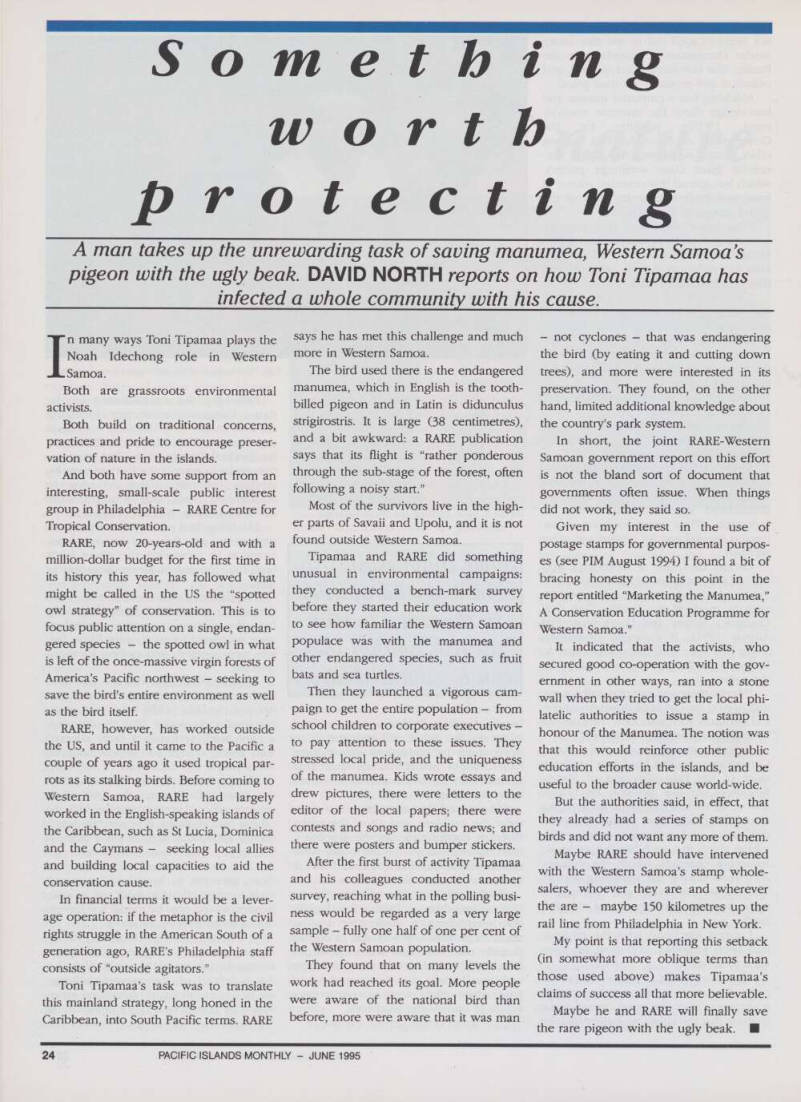
A girl is dwarfed by a caricature of a manumea.
Advertisements & other items, p. 25 (1 item)
Second Hand Containers
WHERE AND WHEN YOU WANT THEM IN THE PACIFIC If you need a flexible and safe storage space we have the ideal solution for you. Our second hand containers provide instant secure storage. Guaranteed to be wind and waterproof these containers are ideal for both temporary and longterm storage in Pacific conditions.
We can deliver to any island in the Pacific within a month and our rates have got to be the lowest you will find. All you need to do is tell us how many you want.
CONTACT:
PASCALE MARCONNET, BP 4757 NOUMEA, NEW CALEDONIA. TEL: (687) 28 7450. FAX: (687) 26 3248
“I made a mistake”: Sir Geoff
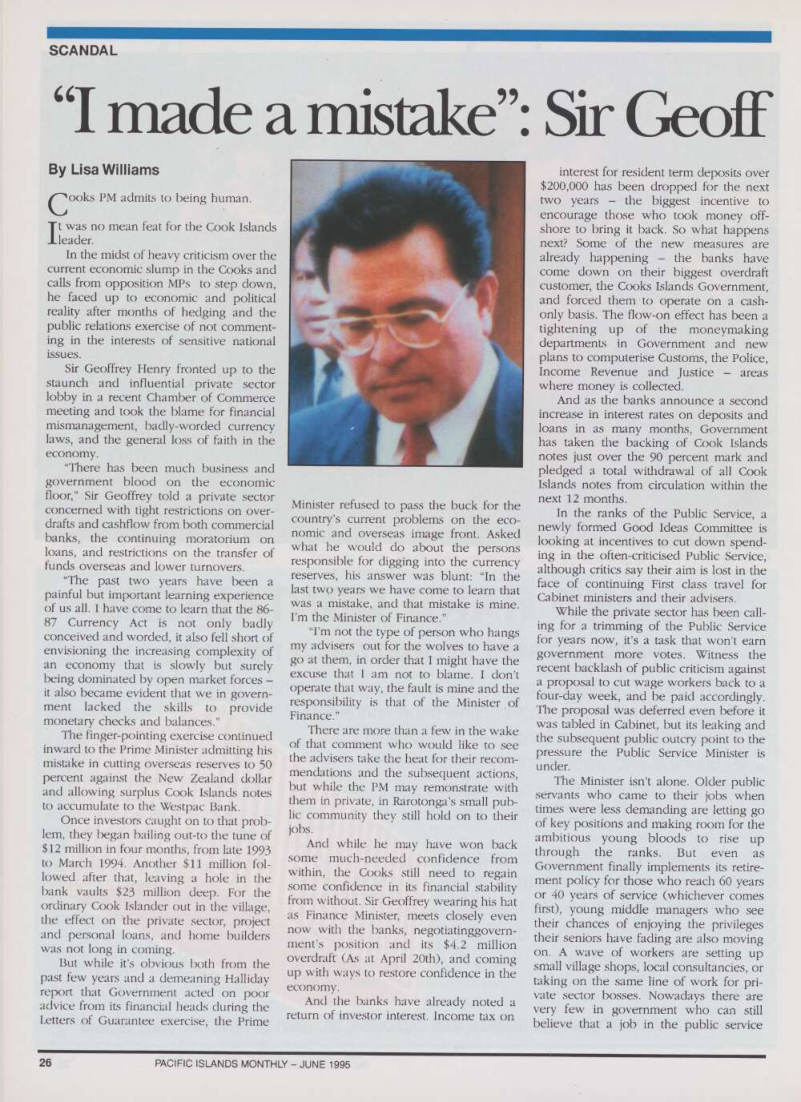
Scandal
By Lisa Williams
PM admits to being human.
It was no mean feat for the Cook Islands leader.
In the midst of heavy criticism over the current economic slump in the Cooks and calls from opposition MPs to step down, he faced up to economic and political reality after months of hedging and the public relations exercise of not comment ing in the interests of sensitive national issues.
Sir Geoffrey Henry fronted up to the staunch and influential private sector lobby in a recent Chamber of Commerce meeting and took the blame for financial mismanagement, badly-worded currency laws, and the general loss of faith in the economy.
“There has been much business and government blood on the economic floor,” Sir Geoffrey told a private sector concerned with tight restrictions on over drafts and cashflow from both commercial banks, the continuing moratorium on loans, and restrictions on the transfer of funds overseas and lower turnovers.
“The past two years have been a painful but important learning experience of us all. I have come to learn that the 86- 87 Currency Act is not only badly conceived and worded, it also fell short of envisioning the increasing complexity of an economy that is slowly but surely being dominated by open market forces it also became evident that we in govern ment lacked the skills to provide monetary checks and balances.”
The finger-pointing exercise continued inward to the Prime Minister admitting his mistake in cutting overseas reserves to 50 percent against the New Zealand dollar and allowing surplus Cook Islands notes to accumulate to the Westpac Bank.
Once investors caught on to that prob lem, they began bailing out-to the tune of $l2 million in four months, from late 1993 to March 1994. Another $ll million fol lowed after that, leaving a hole in the bank vaults $23 million deep. For the ordinary Cook Islander out in the village, the effect on the private sector, project and personal loans, and home builders was not long in coming.
But while it’s obvious lx)th from the past few years and a demeaning Halliday report that Government acted on poor advice from its financial heads during the Letters of Guarantee exercise, the Prime
Minister refused to pass the buck for the country’s current problems on the eco nomic and overseas image front. Asked what he would do about the persons responsible for digging into the currency reserves, his answer was blunt: “In the last two years we have come to learn that was a mistake, and that mistake is mine.
I’m the Minister of Finance.”
“I’m not the type of person who hangs my advisers out for the wolves to have a go at them, in order that I might have the excuse that I am not to blame. I don’t operate that way, the fault is mine and the responsibility is that of the Minister of Finance.”
There are more than a few in the wake of that comment who would like to see the advisers take the heat for their recom mendations and the subsequent actions, but while the PM may remonstrate with them in private, in Rarotonga’s small pub lic community they still hold on to their jobs.
And while he may have won back some much-needed confidence from within, the Cooks still need to regain some confidence in its financial stability from without. Sir Geoffrey wearing his hat as Finance Minister, meets closely even now with the banks, negotiatinggovern ment’s position and its $4.2 million overdraft (As at April 20th), and coming up with ways to restore confidence in the economy.
And the banks have already noted a return of investor interest. Income tax on
interest for resident term deposits over $200,000 has been dropped for the next two years - the biggest incentive to encourage those who took money off shore to bring it back. So what happens next? Some of the new measures are already happening - the banks have come down on their biggest overdraft customer, the Cooks Islands Government, and forced them to operate on a cash only basis. The flow-on effect has been a tightening up of the moneymaking departments in Government and new plans to computerise Customs, the Police, Income Revenue and Justice - areas where money is collected.
And as the banks announce a second increase in interest rates on deposits and loans in as many months, Government has taken the backing of Cook Islands notes just over the 90 percent mark and pledged a total withdrawal of all Cook Islands notes from circulation within the next 12 months.
In the ranks of the Public Service, a newly formed Good Ideas Committee is looking at incentives to cut down spend ing in the often-criticised Public Service, although critics say their aim is lost in the face of continuing First class travel for Cabinet ministers and their advisers.
While the private sector has been call ing for a trimming of the Public Service for years now, it’s a task that won’t earn government more votes. Witness the recent backlash of public criticism against a proposal to cut wage workers back to a four-day week, and be paid accordingly.
The proposal was deferred even before it was tabled in Cabinet, but its leaking and the subsequent public outcry point to the pressure the Public Service Minister is under.
The Minister isn’t alone. Older public servants who came to their jobs when times were less demanding are letting go of key positions and making room for the ambitious young bloods to rise up through the ranks. But even as Government finally implements its retire ment policy for those who reach 60 years or 40 years of service (whichever comes first), young middle managers who see their chances of enjoying the privileges their seniors have fading are also moving on. A wave of workers are setting up small village shops, local consultancies, or taking on the same line of work for pri vate sector bosses. Nowadays there are very few in government who can still believe that a job in the public service
continued from P. 26
represents a lifelong career or financial security.
But at another level, the shaking up could well be a breath of fresh air for the Cooks.
Just as the Prime Minister’s admission sealed the new closer relationship between Government and the private sec tor, it’s also put the onus on workers to start reassessing their long-term goals and career plans.
Sir Geoffrey admits the pressure is on for Government as well to look more closely at its dependence on Tourism for Cook Islands industry, and the depen dence of tourism on lots of sunshine, cheap airfares and good newspaper head lines - something the Cooks hasn’t been seeing much of lately.
His aims to diversify came up again in the annual ADB Board of Governors meeting, held last month (May) in New Zealand. While trying to tie down more
loan money for development projects on ADB concessional rates, he was seek ing financial support for the country’s manganese mining potential.
And so while Sir Geoffrey works on all the issues that add up to the crucial item of restoring confidence in the Cook Islands, those left without work or failed businesses because of the downturn will have to make do with a poignant “sorry” from the Prime Minister.
Because for now, that’s all they’re going to get. ■
was dengue
And then there was dengue
By Lisa Williams
The Cook Islands money-spinning
holiday destination industry has
lost valuable dollars because of the shadow cast by a two-month long
dengue epidemic.
Air New Zealand manager Barry Hardy says potential visitors to the country are choosing to fly over and on to other destinations because of the six letter word and its image.
Another tour agent says a visiting cruiser cancelled plants to visit after hearing of the outbreak, even though only a few tourists came into contact with dengue about a month back.
A health official says their symptoms were so mild they did not have to be admitted for treatment.
As it is, hotel and other tourist accommodation are probably the best place to be if you don’t want to face the risk of dengue.
Virtually all cases are from homes close to swamp areas or with verdant gardens. Health warnings over keeping garden cans and plant holders close to homes are still continuing even as cases climbed to 340 by the beginning of May.
And while the concern from overseas holiday makers continues to affect the local industry, doctors are concentrating on making the treatment available and flying in three consignments of medi cine every week to help keep the hospital numbers under control.
The good news has yet to make
much of an impact overseas where the bookings from New Zealand and other regions tuned in to local events have taken a slight drop.
The manager of the Air New Zealand service bringing most of the tourists in says some potential tourists from Hawaii are flying over Raro. In pre dengue times-they would have spent a stopover and a few dollars there.
Tourism Director Chris Wong says media attention to the dengue outbreak is more powerful than the control of the outbreak in the local health system.
‘Yes, it very worrying - in terms of the average visitor not 0 fully understand mg dengue as treatable.”
“Yes, it is worrying - in the terms of the average visitor not fully understand ing dengue outbreak is more powerful than the control of the outbreak in the local health system.
“Yes, it is worrying - in terms of the average visitor not fully understanding
dengue as treatable,” he says.
“Their perception of the disease may be quite wrong because they don’t fully understand it - that’s a deterrent. It depends on how the message is getting out - I am assured by the Secretary for Hotels that visitors should not worry about it because they live in hotels which tend to be kept very clean.”
He says the image of dengue here is no worse than the image of malaria for Vanuatu and the Solomons - “in any case, the industry can handle it”.
Agents have been loath to blame the drop in visitor arrivals on a mosquito pest, claiming its only another brick through a tourism window already cracked by accusations over the Letters of Guarantee, currency problems only recently solved by the announcement of a return to the New Zealand dollar as the Cooks currency, and news of hard times for the economy.
The dengue outbreak is restricted to the country’s capital Rarotonga, where almost 350 people have received treat ment between March and April for the mosquito-borne illness which leaves sufferers weak, nauseous and with a total loss of appetite.
Some health officials are predicting numbers will soon drop as the outbreak slows itself and the dengue-carrying mosquitoes fail to cope with the cooler nights and dry spells. For tourism oper ators in the Cooks multi-million dollar industry, that moment can’t come fast enough. ■
answer?
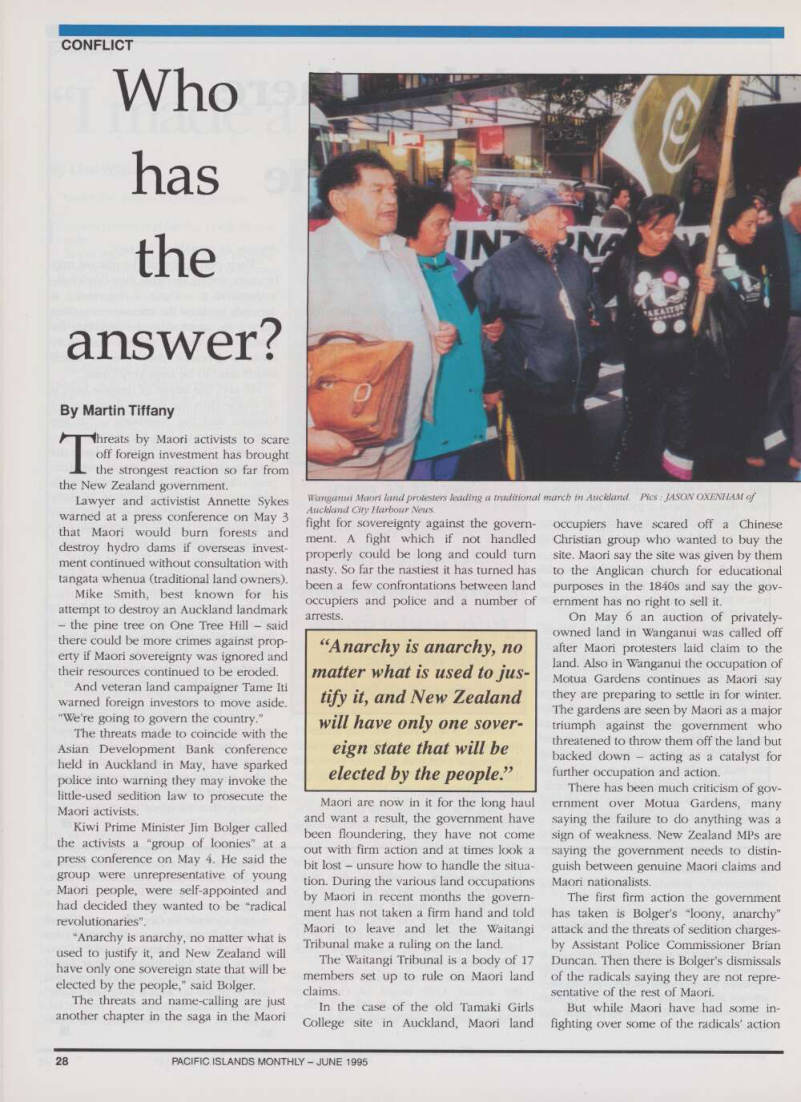
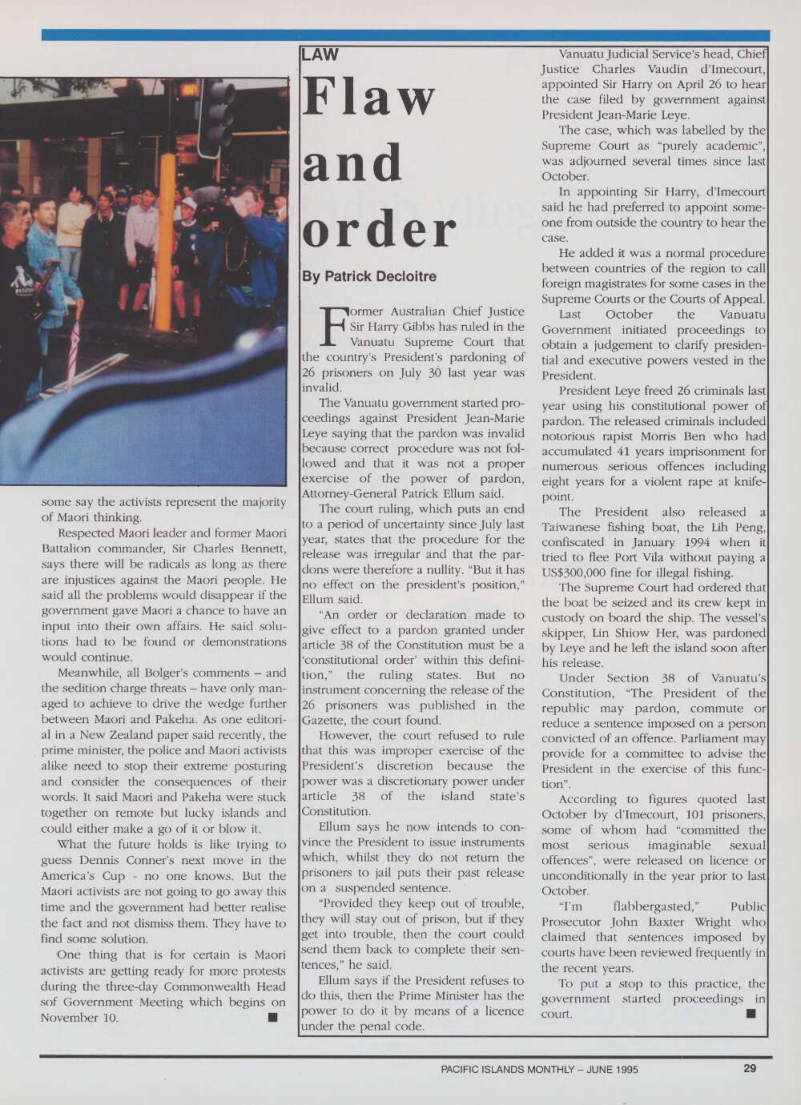
Conflict
Who has the answer?
By Martin Tiffany
Threats by Maori activists to scare off foreign investment has brought the strongest reaction so far from the New Zealand government.
Lawyer and activistist Annette Sykes warned at a press conference on May 3 that Maori would burn forests and destroy hydro dams if overseas invest ment continued without consultation with tangata whenua (traditional land owners).
Mike Smith, best known for his attempt to destroy an Auckland landmark - the pine tree on One Tree Hill - said there could be more crimes against prop erty if Maori sovereignty was ignored and their resources continued to be eroded.
And veteran land campaigner Tame Iti warned foreign investors to move aside.
“We’re going to govern the country.”
The threats made to coincide with the Asian Development Bank conference held in Auckland in May, have sparked police into warning they may invoke the little-used sedition law to prosecute the Maori activists.
Kiwi Prime Minister Jim Bolger called the activists a “group of loonies” at a press conference on May 4. He said the group were unrepresentative of young Maori people, were self-appointed and had decided they wanted to be “radical revolutionaries”.
“Anarchy is anarchy, no matter what is used to justify it, and New Zealand will have only one sovereign state that will be
elected by the people,” said Bolger.
The threats and name-calling are just another chapter in the saga in the Maori
fight for sovereignty against the govern ment. A fight which if not handled properly could be long and could turn nasty. So far the nastiest it has turned has been a few confrontations between land occupiers and police and a number of arrests.
“Anarchy is anarchy , no matter what is used to jus tify it, and New Zealand will have only one sover eign state that will be elected by the people ”
Maori are now in it for the long haul and want a result, the government have been floundering, they have not come out with firm action and at times look a bit lost - unsure how to handle the situa tion. During the various land occupations by Maori in recent months the govern ment has not taken a firm hand and told Maori to leave and let the Waitangi Tribunal make a ruling on the land.
The Waitangi Tribunal is a body of 17 members set up to rule on Maori land claims.
In the case of the old Tamaki Girls College site in Auckland, Maori land
occupiers have scared off a Chinese Christian group who wanted to buy the site. Maori say the site was given by them to the Anglican church for educational purposes in the 1840 s and say the gov ernment has no right to sell it.
On May 6 an auction of privately owned land in Wanganui was called off after Maori protesters laid claim to the land. Also in Wanganui the occupation of Motua Gardens continues as Maori say they are preparing to settle in for winter.
The gardens are seen by Maori as a major triumph against the government who threatened to throw them off the land but backed down - acting as a catalyst for further occupation and action.
There has been much criticism of gov ernment over Motua Gardens, many saying the failure to do anything was a sign of weakness. New Zealand MPs are saying the government needs to distin guish between genuine Maori claims and Maori nationalists.
The first firm action the government has taken is Bolger’s “loony, anarchy” attack and the threats of sedition charges by Assistant Police Commissioner Brian Duncan. Then there is Bolger’s dismissals of the radicals saying they are not repre sentative of the rest of Maori.
But while Maori have had some in fighting over some of the radicals’ action
Wanganui Maori land protesters leading a traditional march in Auckland. Pics: JASON OXENHAM of Auckland City Harbour News.
some say the activists represent the majority of Maori thinking.
Respected Maori leader and former Maori Battalion commander, Sir Charles Bennett, says there will be radicals as long as there are injustices against the Maori people. He said all the problems would disappear if the government gave Maori a chance to have an input into their own affairs. He said solu tions had to be found or demonstrations would continue.
Meanwhile, all Bolger’s comments - and the sedition charge threats - have only man aged to achieve to drive the wedge further between Maori and Pakeha. As one editori al in a New Zealand paper said recently, the prime minister, the police and Maori activists alike need to stop their extreme posturing and consider the consequences of their words. It said Maori and Pakeha were stuck together on remote but lucky islands and could either make a go of it or blow it.
What the future holds is like trying to guess Dennis Conner’s next move in the America’s Cup - no one knows. But the Maori activists are not going to go away this time and the government had better realise the fact and not dismiss them. They have to find some solution.
One thing that is for certain is Maori activists are getting ready for more protests during the three-day Commonwealth Head sof Government Meeting which begins on November 10. ■
Flaw
Law
Flaw and order
By Patrick Decloitre
Former Australian Chief Justice Sir Harry Gibbs has ruled in the Vanuatu Supreme Court that the country’s President’s pardoning of 26 prisoners on July 30 last year was invalid.
The Vanuatu government started pro ceedings against President Jean-Marie Leye saying that the pardon was invalid because correct procedure was not fol lowed and that it was not a proper exercise of the power of pardon, Attorney-General Patrick Ellum said.
The court ruling, which puts an end to a period of uncertainty since July last year, states that the procedure for the release was irregular and that the par dons were therefore a nullity. “But it has no effect on the president’s position,”
Ellum said.
“An order or declaration made to give effect to a pardon granted under article 38 of the Constitution must be a ‘constitutional order’ within this defini tion,” the ruling states. But no instrument concerning the release of the 26 prisoners was published in the Gazette, the court found.
However, the court refused to rule that this was improper exercise of the President’s discretion because the power was a discretionary power under article 38 of the island state’s Constitution.
Ellum says he now intends to con vince the President to issue instruments which, whilst they do not return the prisoners to jail puts their past release on a suspended sentence.
“Provided they keep out of trouble, they will stay out of prison, but if they get into trouble, then the court could send them back to complete their sen tences,” he said.
Ellum says if the President refuses to do this, then the Prime Minister has the power to do it by means of a licence under the penal code.
Vanuatu Judicial Service’s head, Chief Justice Charles Vaudin d’lmecourt, appointed Sir Harry on April 26 to hear the case filed by government against President Jean-Marie Leye.
The case, which was labelled by the Supreme Court as “purely academic”, was adjourned several times since last October.
In appointing Sir Harry, d’lmecourt said he had preferred to appoint some one from outside the country to hear the case.
He added it was a normal procedure between countries of the region to call foreign magistrates for some cases in the Supreme Courts or the Courts of Appeal.
Last October the Vanuatu Government initiated proceedings to obtain a judgement to clarify presiden tial and executive powers vested in the President.
President Leye freed 26 criminals last year using his constitutional power of pardon. The released criminals included notorious rapist Morris Ben who had accumulated 41 years imprisonment for numerous serious offences including eight years for a violent rape at knife point.
The President also released a Taiwanese fishing boat, the Lih Peng, confiscated in January 1994 when it tried to flee Port Vila without paying a US$3OO,OOO fine for illegal fishing.
The Supreme Court had ordered that the boat be seized and its crew kept in custody on board the ship. The vessel’s skipper, Lin Shiow Her, was pardoned by Leye and he left the island soon after his release.
Under Section 38 of Vanuatu’s Constitution, “The President of the republic may pardon, commute or reduce a sentence imposed on a person convicted of an offence. Parliament may provide for a committee to advise the President in the exercise of this func tion”.
According to figures quoted last October by d’lmecourt, 101 prisoners, some of whom had “committed the most serious imaginable sexual offences”, were released on licence or unconditionally in the year prior to last October.
“I’m flabbergasted,” Public Prosecutor John Baxter Wright who claimed that sentences imposed by courts have been reviewed frequently in the recent years.
To put a stop to this practice, the government started proceedings in court. ■
Advertisements & other items, pp. 30-31 (1 item)
Drive dignity right to the top.
(Jg) TOYOTA
Everyone who knows cars has no doubts about Land Cruiser’s ruggedness.
Yet how many know that its luxury rivals the finest high-priced cars?
Or that it’s got more room inside than many luxury sedans?
And because it’s a Toyota, Land Cruiser’s fit and finish, attention to detail, and graceful form speak of elegance as well as spacious comfort.
Yet you still get tough ladder frames and suspension built to take you as far off road as you want to go.
With power from 4.5-litre petrol or 4.2-litre diesel engines.
And it’s carefully protected from rust to last longer.
So if you’re going right to the top, this dignified car is ready to take you.
LAND CRUISER
DISTRIBUTORS /DEALERS
AMERICAN SAMOA BURNS PHILP MOTORS PH 633-4281 COOK ISLANDS GUAM & MICRONESIA.. .ATKINS KROLL, INC. PH 646-1876/9 KIRIBATI NORFOLK ISLAND BORRY’S PTY LTD. PH 22114 PAPUA NEW GUINEA SOLOMON ISLAND ELA MOTORS PH 30314 TAHITI VANUATU ASCO MOTORS PH 22341 WESTERN SAMOA
..PACIFIC MOTORS LTD. PH 20796
..TARAWA MOTORS PH 21090
.ELA MOTORS PH 3229400
. NIPPON AUTOMOTO PH 429819
.ASCO MOTORS PH 20800
FIJI ASCO MOTORS PH 384888
NEW CALEDONIA S.I.A.P. PH 275562
SAIPAN MICROL CORPORATION PH 234-5911
TONGA ASCO MOTORS PH 23500
ts* ;; ■ mu ip ■ ‘1 «»■» i mm
LAND
CRUISER
LAW!CRUISER
C ! » / * r & -C SP
_«=S--TU-
lat 2sfcw<
Dealing
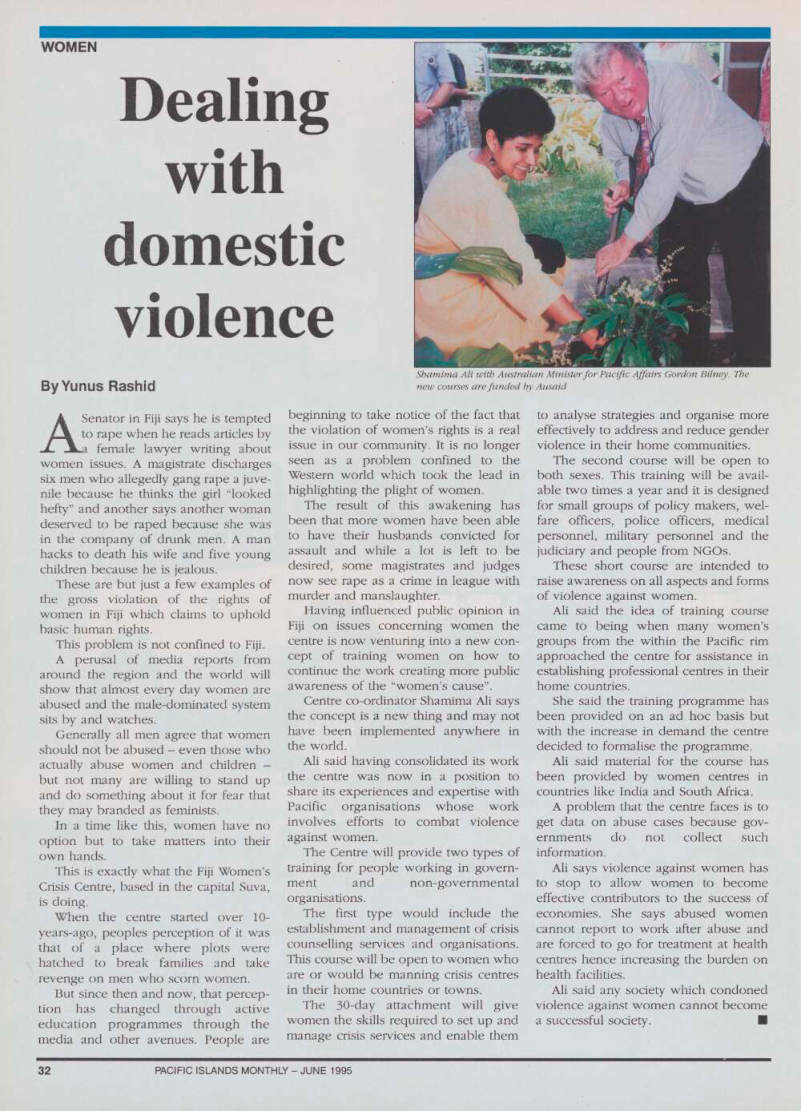
Women
Dealing with domestic violence
By Yunus Rashid
A Senator in Fiji says he is tempted to rape when he reads articles by a female lawyer writing about women issues. A magistrate discharges six men who allegedly gang rape a juve nile because he thinks the girl “looked hefty” and another says another woman deserved to be raped because she was in the company of drunk men. A man hacks to death his wife and five young children because he is jealous.
These are but just a few examples of the gross violation of the rights of women in Fiji which claims to uphold basic human rights.
This problem is not confined to Fiji.
A perusal of media reports from around the region and the world will show that almost every day women are abused and the male-dominated system sits by and watches.
Generally all men agree that women should not be abused - even those who actually abuse women and children but not many are willing to stand up and do something about it for fear that they may branded as feminists.
In a time like this, women have no option but to take matters into their own hands.
This is exactly what the Fiji Women’s Crisis Centre, based in the capital Suva, is doing.
When the centre started over 10years-ago, peoples perception of it was that of a place where plots were hatched to break families and take revenge on men who scorn women.
But since then and now, that percep tion has changed through active education programmes through the media and other avenues. People are
beginning to take notice of the fact that the violation of women’s rights is a real issue in our community. It is no longer seen as a problem confined to the Western world which took the lead in highlighting the plight of women.
The result of this awakening has been that more women have been able to have their husbands convicted for assault and while a lot is left to be desired, some magistrates and judges now see rape as a crime in league with murder and manslaughter.
Having influenced public opinion in Fiji on issues concerning women the centre is now venturing into a new con cept of training women on how to continue the work creating more public awareness of the “women’s cause”.
Centre co-ordinator Shamima Ali says the concept is a new thing and may not have been implemented anywhere in the world.
Ali said having consolidated its work the centre was now in a position to share its experiences and expertise with Pacific organisations whose work involves efforts to combat violence against women.
The Centre will provide two types of training for people working in govern ment and non-governmental organisations.
The first type would include the establishment and management of crisis counselling services and organisations.
This course will be open to women who are or would be manning crisis centres in their home countries or towns.
The 30-day attachment will give women the skills required to set up and manage crisis services and enable them
to analyse strategies and organise more effectively to address and reduce gender violence in their home communities.
The second course will be open to both sexes. This training will be avail able two times a year and it is designed for small groups of policy makers, wel fare officers, police officers, medical personnel, military personnel and the judiciary and people from NGOs.
These short course are intended to raise awareness on all aspects and forms of violence against women.
Ali said the idea of training course came to being when many women’s groups from the within the Pacific rim approached the centre for assistance in establishing professional centres in their home countries.
She said the training programme has been provided on an ad hoc basis but with the increase in demand the centre decided to formalise the programme.
Ali said material for the course has been provided by women centres in countries like India and South Africa.
A problem that the centre faces is to get data on abuse cases because gov ernments do not collect such information.
Ali says violence against women has to stop to allow women to become effective contributors to the success of economies. She says abused women cannot report to work after abuse and are forced to go for treatment at health centres hence increasing the burden on health facilities.
Ali said any society which condoned violence against women cannot become a successful society. ■
Shamima Ali with Australian Minister for Pacific Affairs Gordon Bilney. The new courses are funded by Ausaid
TVNZ gagged
Press Freedom
By Lisa Williams
If the whole exercise was planned as a publicity stunt, they couldn’t have timed it better. Cook Islands Immigration chief Tutai Toru issued a directive to TVNZ Assignment reporter Rod Vaughn during their April visit that the cameras were to stop filming for the rest of the teams stay.
The reason? No work permit had been issued authorising the film crew to carry out their work in the Cooks.
The four crew led by producer Daine Shanahan had been working on a story about the Cook Islands economy for six days before receiving the short letter on their last day of filming, so it mattered less to their work than the problems with getting the Prime Minister on camera.
TVNZ’s head of News and Current Affairs, Sean Brown, was a little less amused. “I think it’s a very convenient action in the end to say ‘hey, you don’t have the paperwork for this,” Mr Brown told a reporter.
He said it was very unusual for any country to ask a visiting journalist to get a work permit, but Toru says TVNZ should be well aware of the Cooks Immigration requirements.
A team from the same station came to Rarotonga for filming back in the early 80s, and were told by the then Immigration minister Sir Thomas Davies that if they didn’t switch from visitors visas to work permits they would have to leave.
“I think they are well aware of our pol icy,” says Toru.
“The point here is that in the passport their visas clearly state that they’re not to do anything while they’re here.”
As it was, the TVNZ crews arrival and subsequent work in the Cook Islands was no big secret. Both Shanahan and Vaughn say they had written to the Prime Minister from New Zealand and requested an interview. The answer they got back was sorry, too busy.
Then, in a surprise announcement to Parliament a week just days before the team arrived, the Prime Minister accused Rod Vaughn and TVNZ of being a front for a CIA plot to subvert government.
He explained that while he could have blocked them from entering the country, he wouldn’t - because there was nothing that the team could find that would enable the plot to succeed.
The public announcements about the team should have been the clue to Immigration authorities that someone was coming, but when they did arrive, the TVNZ crew were issued with visitors stamps in the passports, valid for 31 days.
The problem, Tom says, is media and other professionals who come into the country on visitors permits, do their work, and leave without the authorities being aware of anything.
He says the Cook Islands Entry, Residency and Departure Act clearly make it illegal for any person to “engage in the commercial enterprise” while here on a visitors permit. It’s the monitoring of the whole exercise that demands some honesty from people here for work rea sons, he says.
“The point here is that in the passport their visas clearly state that they’re not to do anything while they are here!’
Which means another government body, the Cook Islands Tourist Authority, has been happily assisting media repre sentatives, travel writers and documentary crews and all kinds of pro fessionals here on visitors permits to promote the Cooks as a holiday destina tions - and break the law.
From a tourism point of view, the paperwork involved in processing work permits doesn’t sound too promising especially with CITA director Chris Wong expecting another TVNZ crew doing a travel feature for “Open Home” to film at the end of last month. In the last 12 months, Wong puts a conservative guesstimate on about 60 media visitors to the Cooks who’ve come to the Tourist
Authority for guidance. Half that number came through in the last four months.
The people who come here working to promote the Cooks are a modern day sign that the Immigration restrictions on work permits are just not holding up, admits Toru. He says a revamped Immigration Act is being set up for tabling in Parliament come 1996 - mainly to “keep up with the times and the num ber of people coming into the country”.
At the moment the law dictates that anyone who hits the workbooks rather than the beach on a visitors permit can be prosecuted. That’s not good PR, but it’s a problem that’s gone on for years without some decisive tackling.
For tourism, the travel writers and crews that come to the Cooks are a bonus for the industry, which gives these media people the best treatment it can in terms of something they can write about.
“It raises the issue of whether or not we want them to come here without any requirement, because they come and see the destination for what it is and they go and write about it,” says Chris Wong.
“And I must say all the articles have been positive about the destination - you can’t force them into anything; they say it how they want to say it.”
Will enforcing the work permit rule affect the media coverage in travel maga zines? Yes, says Wong.
“These people’s interests are solely tourism-oriented - they are featuring hol iday programs and they’re not about to get involved in any political issues.”
But while the Immigration Department continues to come under flak on the local front for not giving the same kind of scrutiny to overseas insurance sales reps, officials, VIPs and anyone that’s also nipped through on a visitors permit, the Media poses the best example of abuse of the system, says Toru - even though he denies making an example of the TVNZ team.
And while he maintains the Prime Minister had nothing to do with his letter to Rod Vaughn and the TVNZ crew, his final comment is a telling one: “We can’t allow anyone to come into the country and write something nasty about the place.” ■
PATA and the Pacific
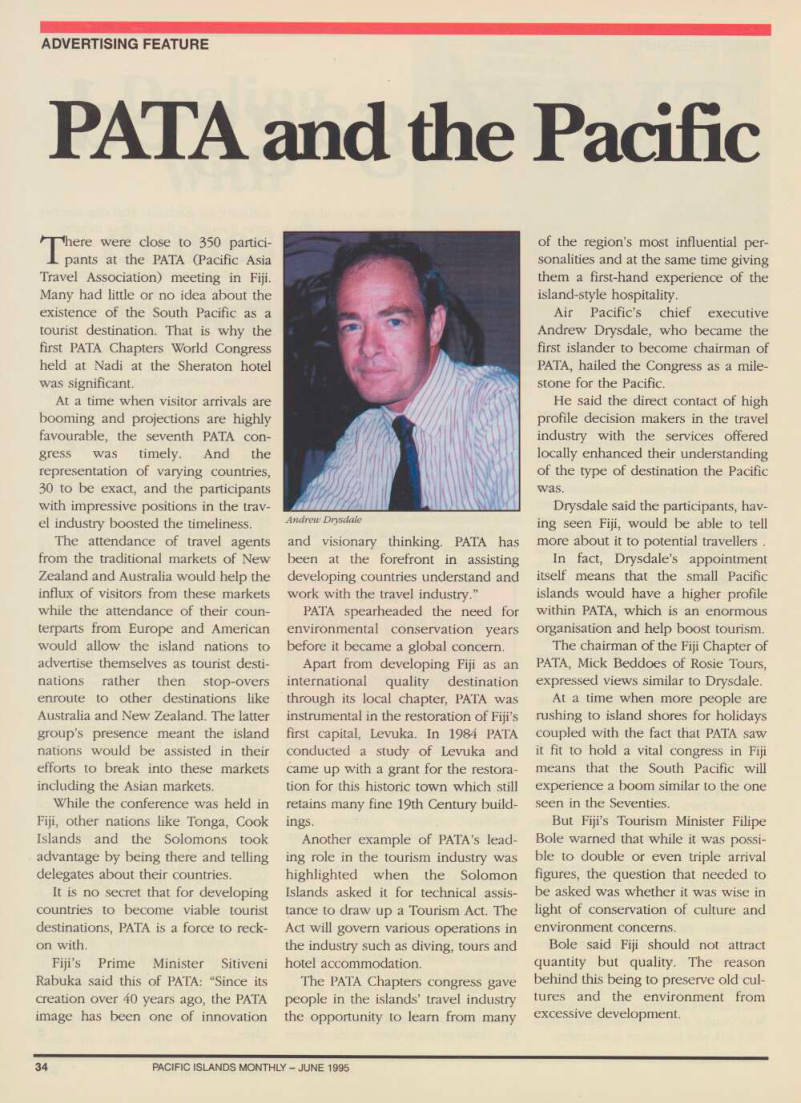
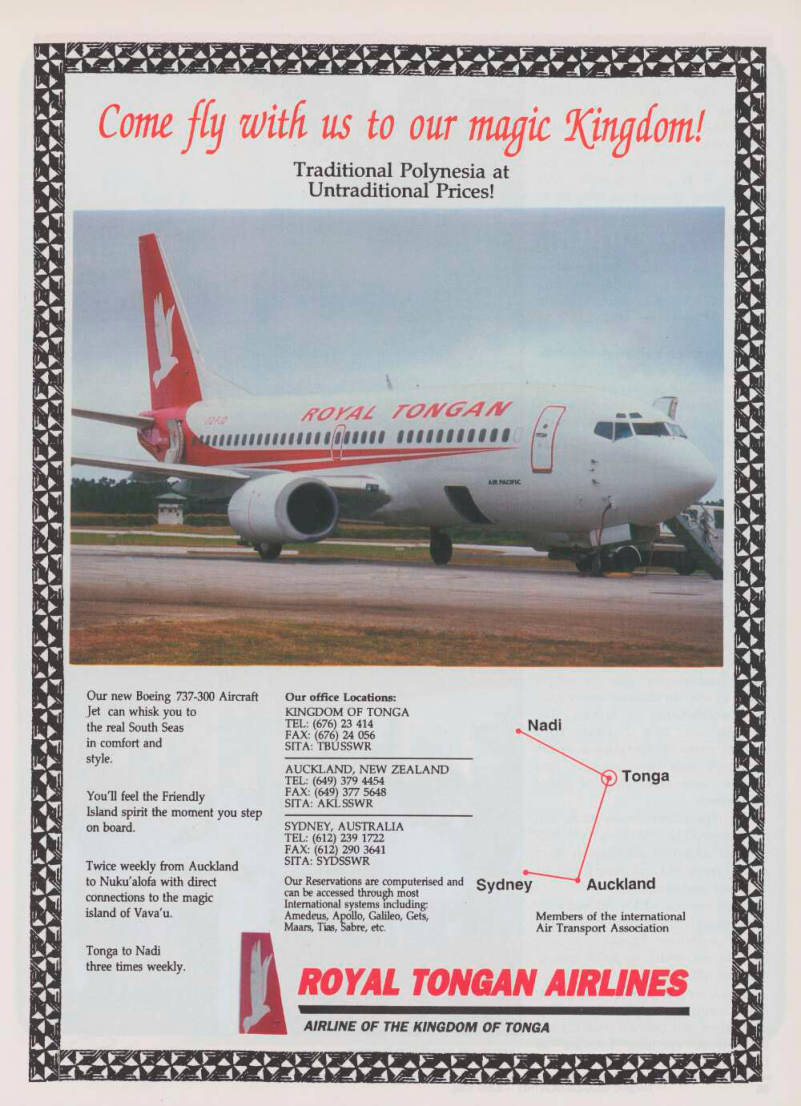
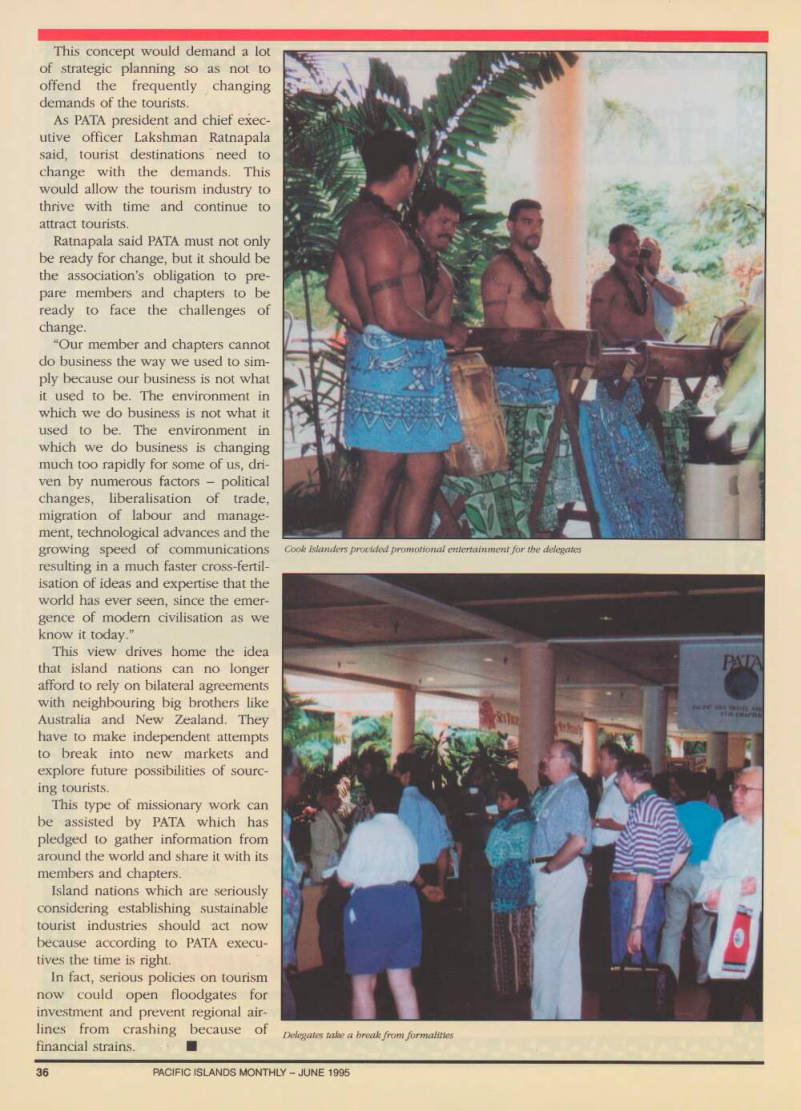
Advertising Feature
There were close to 350 partici pants at the PATA (Pacific Asia Travel Association) meeting in Fiji.
Many had little or no idea about the existence of the South Pacific as a tourist destination. That is why the first PATA Chapters World Congress held at Nadi at the Sheraton hotel
was significant.
At a time when visitor arrivals are booming and projections are highly favourable, the seventh PATA con gress was timely. And the representation of varying countries, 30 to be exact, and the participants with impressive positions in the trav el industry boosted the timeliness.
The attendance of travel agents from the traditional markets of New Zealand and Australia would help the influx of visitors from these markets while the attendance of their coun terparts from Europe and American would allow the island nations to advertise themselves as tourist desti nations rather then stop-overs enroute to other destinations like Australia and New Zealand. The latter group’s presence meant the island nations would be assisted in their efforts to break into these markets including the Asian markets.
While the conference was held in Fiji, other nations like Tonga, Cook Islands and the Solomons took
advantage by being there and telling
delegates about their countries.
It is no secret that for developing countries to become viable tourist destinations, PATA is a force to reck on with.
Fiji’s Prime Minister Sitiveni Rabuka said this of PATA: “Since its creation over 40 years ago, the PATA image has been one of innovation
and visionary thinking. PATA has been at the forefront in assisting developing countries understand and work with the travel industry.”
PATA spearheaded the need for environmental conservation years before it became a global concern.
Apart from developing Fiji as an international quality destination through its local chapter, PATA was instrumental in the restoration of Fiji’s first capital, Levuka. In 1984 PATA conducted a study of Levuka and came up with a grant for the restora tion for this historic town which still retains many fine 19th Century build ings.
Another example of PATA’s lead ing role in the tourism industry was highlighted when the Solomon Islands asked it for technical assis tance to draw up a Tourism Act. The Act will govern various operations in the industry such as diving, tours and hotel accommodation.
The PATA Chapters congress gave people in the islands’ travel industry the opportunity to learn from many
of the region’s most influential per sonalities and at the same time giving them a first-hand experience of the island-style hospitality.
Air Pacific’s chief executive Andrew Drysdale, who became the first islander to become chairman of PATA, hailed the Congress as a mile stone for the Pacific.
He said the direct contact of high profile decision makers in the travel industry with the services offered locally enhanced their understanding of the type of destination the Pacific was.
Drysdale said the participants, hav ing seen Fiji, would be able to tell more about it to potential travellers .
In fact, Drysdale’s appointment itself means that the small Pacific islands would have a higher profile within PATA, which is an enormous organisation and help boost tourism.
The chairman of the Fiji Chapter of PATA, Mick Beddoes of Rosie Tours, expressed views similar to Drysdale.
At a time when more people are rushing to island shores for holidays coupled with the fact that PATA saw it fit to hold a vital congress in Fiji means that the South Pacific will experience a boom similar to the one seen in the Seventies.
But Fiji’s Tourism Minister Filipe Bole warned that while it was possi ble to double or even triple arrival figures, the question that needed to be asked was whether it was wise in light of conservation of culture and environment concerns.
Bole said Fiji should not attract quantity but quality. The reason behind this being to preserve old cul tures and the environment from excessive development.
Andrew Drysdale
This concept would demand a lot of strategic planning so as not to
offend the frequently changing
demands of the tourists.
As PATA president and chief exec utive officer Lakshman Ratnapala said, tourist destinations need to change with the demands. This would allow the tourism industry to thrive with time and continue to attract tourists.
Ratnapala said PATA must not only be ready for change, but it should be the association’s obligation to pre pare members and chapters to be ready to face the challenges of
change.
“Our member and chapters cannot do business the way we used to sim ply because our business is not what it used to be. The environment in which we do business is not what it used to be. The environment in which we do business is changing much too rapidly for some of us, dri ven by numerous factors - political changes, liberalisation of trade, migration of labour and manage ment, technological advances and the growing speed of communications resulting in a much faster cross-fertil isation of ideas and expertise that the world has ever seen, since the emer gence of modern civilisation as we know it today.”
This view drives home the idea that island nations can no longer afford to rely on bilateral agreements with neighbouring big brothers like Australia and New Zealand. They have to make independent attempts to break into new markets and explore future possibilities of sourc ing tourists.
This type of missionary work can be assisted by PATA which has pledged to gather information from around the world and share it with its members and chapters.
Island nations which are seriously
considering establishing sustainable
tourist industries should act now because according to PATA execu tives the time is right.
In fact, serious policies on tourism now could open floodgates for investment and prevent regional air lines from crashing because of financial strains. ■
Cook Islanders provided promotional entertainment for the delegates
Delegates take a break from formalities
Advertisements & other items, pp. 35-38 (1 item)
Com fly with us to our magic kingdom!
Traditional Polynesia at
Untraditional Prices!
/TOK4I
tmninmnuinn imilllllf
Our new Boeing 737-300 Aircraft Jet can whisk you to the real South Seas in comfort and style.
You'll feel the Friendly Island spirit the moment you step on board.
Twice weekly from Auckland to Nukualofa with direct connections to the magic island of Vava'u.
Tonga to Nadi three times weekly.
Our office Locations:
KINGDOM OF TONGA
TEL: (676) 23 414
FAX: (676) 24 056
SITA; TBUSSWR
AUCKLAND, NEW ZEALAND
TEL; (649) 379 4454
FAX: (649) 377 5648
SITA: AKLSSWR
SYDNEY, AUSTRALIA
TEL; (612) 239 1722
FAX: (612) 290 3641
SITA: SYDSSWR
Our Reservations are computerised and SvdflGV can be accessed through most y International systems including: Amedeus, Apollo, Galileo, Gets, Maars, lias, Sabre, etc.
Nadi
Tonga
Auckland
Members of the international Air Transport Association
ROYAL TONGAN AIRLINES
AIRLINE OF THE KINGDOM OF TONGA
they are all within
OUR REACH
Vf"'
AIR MARSHALLS' ROUTES
MARSHALL ISLANDS
9
HONOLULU
Hawaii
MAJURO
Marshall Islands
TARAWA
Republic of Kiribati
FUNAFUTI
Tuvalu
NADI
SUVA
NADI
Fyi Islands A a 'Tour Key to the Inner Pacific"
AIR Marshall Islands
P.O. Box 1319 Majuro, Marshall Islands 96960 MH Majuro Hq. Phone: (692) 625-3731 Majuro Hq. Fax: (692) 625-3730 Reservations In Majuro: 6253733 / 4 /5 Reservations In Kwajalein; 2416 Reservations In Honolulu: 949-5522 Toll free from the U.S.A Mainland: 1 (800) 643-3898 Reservations In Nadi, Fiji: 722192 Reservations In Suva, Fiji: 303888 Reservations In Tarawa: contact Air Tungaru Reservations In Tuvalu: (688) 20737
■jr -,-x - ■' J" 7 ; v; J i¥^iaiv
GISSF
Bangk T anil m
EWC
PAPUA NEW GUINEA
Smgapo ft apura Ao t Moresby / Cairns Brisbane dney v * v Ml 9«
The best
connections to the
World’s Greatest
Adventure...
Papua New Guinea
Land of Adventure and Excitement
Finding some of the world's greatest diving, fishing, trekking, rafting and cultural adventures is as easy as connecting with Air Niugini's regular services from Singapore, Hong Kong, Manila, Honiara, Jayapura, Cairns, Brisbane or Sydney, to Papua New Guinea.
Aside from having the best international connections, Air Niugini offers the largest network of regular services throughout Papua New Guinea.
Ask about our special 'Adventure Airpass’ and the 'Visit South Pacific Year 95 Airpass' for even greater value. see Start packing more adventure into your holidays. Call Air Niugini or your nearest Travel Agent now.
V. M
(J Air Niugini
ACIFIC
v ®Ofure &
Craft Works 3322 d.
Air Niugini taps
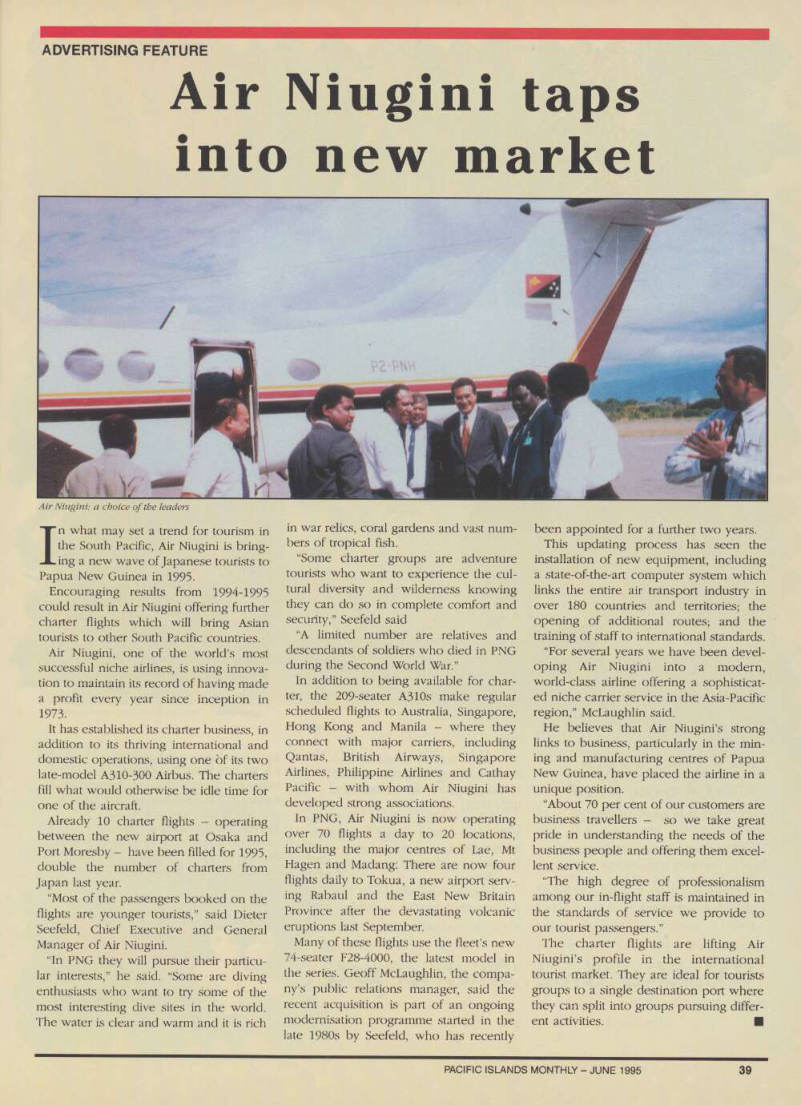
into new market
In what may set a trend for tourism in the South Pacific, Air Niugini is bring ing a new wave of Japanese tourists to Papua New Guinea in 1995.
Encouraging results from 1994-1995 could result in Air Niugini offering further charter flights which will bring Asian tourists to other South Pacific countries.
Air Niugini, one of the world’s most successful niche airlines, is using innova tion to maintain its record of having made a profit every year since inception in 1973.
It has established its charter business, in addition to its thriving international and domestic operations, using one of its two late-model A3lO-300 Airbus. The charters fill what would otherwise be idle time for one of the aircraft.
Already 10 charter flights - operating between the new airport at Osaka and Port Moresby - have been filled for 1995, double the number of charters from Japan last year.
“Most of the passengers booked on the flights are younger tourists,” said Dieter Seefeld, Chief Executive and General Manager of Air Niugini.
“In PNG they will pursue their particu lar interests,” he said. “Some are diving enthusiasts who want to try some of the most interesting dive sites in the world.
The water is clear and warm and it is rich
in war relics, coral gardens and vast num bers of tropical fish.
“Some charter groups are adventure tourists who want to experience the cul tural diversity and wilderness knowing they can do so in complete comfort and security,” Seefeld said “A limited number are relatives and descendants of soldiers who died in PNG during the Second World War.”
In addition to being available for char ter, the 209-seater A3los make regular scheduled flights to Australia, Singapore, Hong Kong and Manila where they connect with major carriers, including Qantas, British Airways, Singapore Airlines, Philippine Airlines and Cathay Pacific - with whom Air Niugini has developed strong associations.
In PNG, Air Niugini is now operating over 70 flights a day to 20 locations, including the major centres of Lae, Mt Hagen and Madang; There are now four flights daily to Tokua, a new airport serv ing Rabaul and the East New Britain Province after the devastating volcanic eruptions last September.
Many of these flights use the fleet’s new 74-seater F2B-4000, the latest model in the series. Geoff McLaughlin, the compa ny’s public relations manager, said the recent acquisition is part of an ongoing modernisation programme started in the late 1980 s by Seefeld, who has recently
been appointed for a further two years.
This updating process has seen the installation of new equipment, including a state-of-the-art computer system which links the entire air transport industry in over 180 countries and territories; the opening of additional routes; and the training of staff to international standards.
“For several years we have been devel oping Air Niugini into a modern, world-class airline offering a sophisticat ed niche carrier service in the Asia-Pacific region,” McLaughlin said.
He believes that Air Niugini’s strong links to business, particularly in the min ing and manufacturing centres of Papua New Guinea, have placed the airline in a unique position.
“About 70 per cent of our customers are business travellers - so we take great pride in understanding the needs of the business people and offering them excel lent service.
“The high degree of professionalism among our in-flight staff is maintained in the standards of service we provide to our tourist passengers.”
The charter flights are lifting Air Niugini’s profile in the international tourist market. They are ideal for tourists groups to a single destination port where they can split into groups pursuing differ ent activities. ■
Air Niugini: a choice of the leaders
Advertisements & other items, p. 40 (1 item)
IrfpCiwW
v /x ✓r / \ nr'? m I.
J| (
VANUATU
Santo fli i L *; / i ■L Port Vila / w
‘ ■ v/ - - FIJI
AUSTRALIA
9 V Mtt I Ml * r*
IrfpCiwW
Auckland ' a. NEW ZEALAND w i o~h
Mf iWw aW4 m«?r^,..
Where would you find white powder beaches overhung with coconut palms, reaching down to tropical blue water?
Where would you find diving in coral seas so clear and warm?
Where would you find top class resorts featuring world class cuisine, sporting activities, shows, casino and night clubs?
Where would you find a live volcano and ancient custom villages, fresh grown market produce and some of the friendliest people you’ll ever meet?
Where?
Vanuatu, that’s where.
An untouched paradise on earth.
Air Vanuatu Reservations & Sales Offices: Port Vila (678) 23 848, Santo (678) 36 429, Sydney (612) 223 8333, Melbourne (613) 417 3977, Brisbane (617) 221 2566, Auckland (649) 373 3435, Nadi (679) 72 2521, Suva (679) 314 666, Apia (685) 212 61, Noumea (687) 286 677, Los Angeles (310) 670 7302, Paris (331) 40 53 82 25, Spain (34) 72 27 02 62, Denmark (45) 33 11 02 02, Germany (49) 60231028, Italy (39) 2 551 80528, Hong Kong (852) 336 6916.
, fahatHiv MMJL.
The Untouched Paradise
AIR VANUATU
MBE 8759
for Solomon Airlines
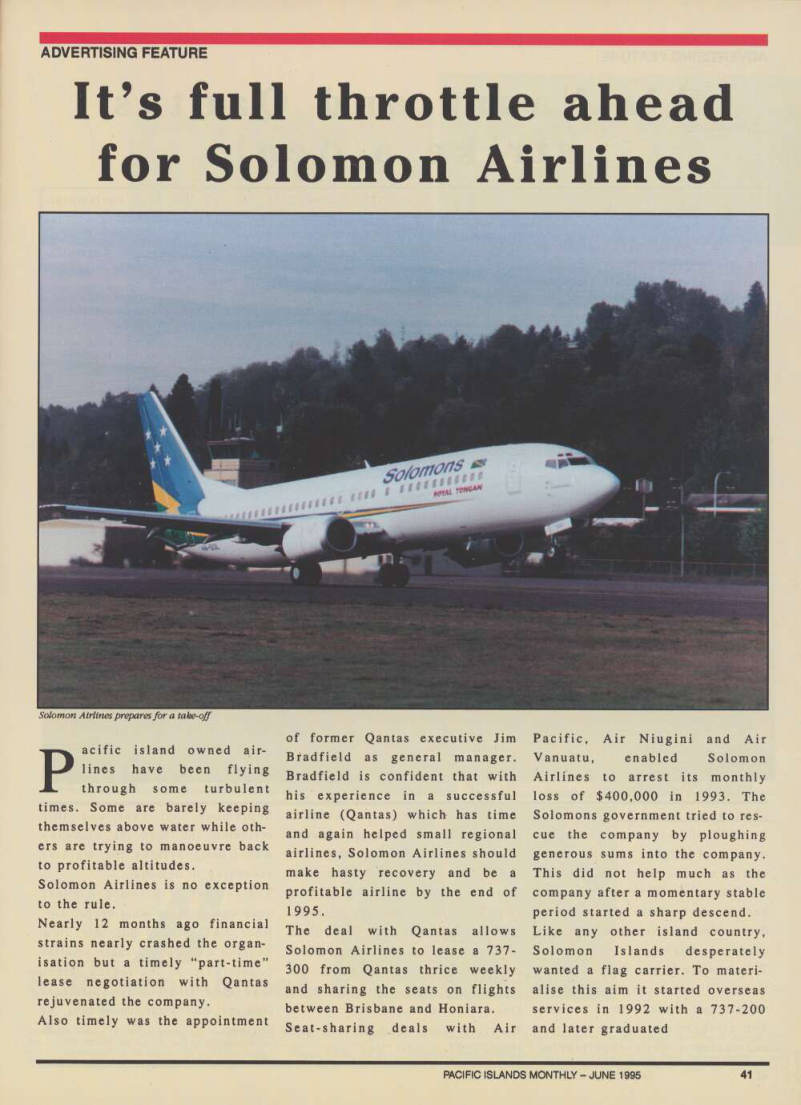
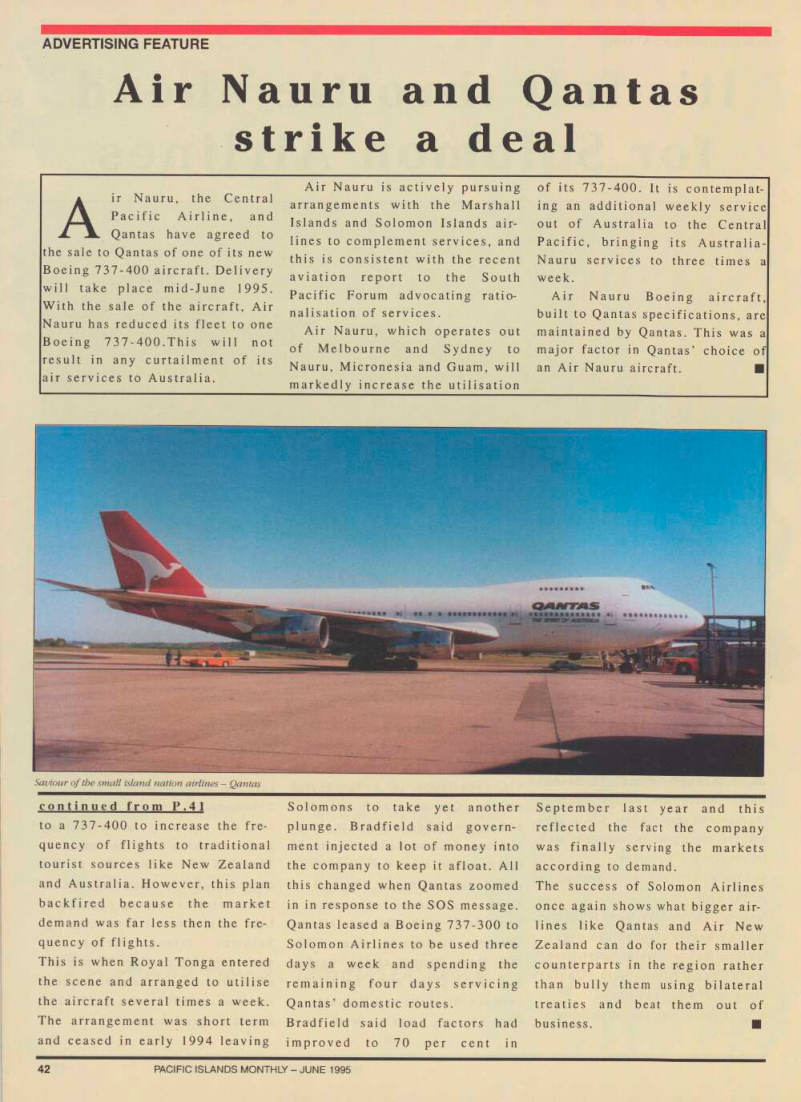
It’s full throttle ahead for Solomon Airlines
Pacific island owned airlines have been flying 3 6 through some turbulent 6 times. Some are barely keeping 3 k & themselves above water while others are trying to manoeuvre back 3 to profitable altitudes. r Solomon Airlines is no exception F to the rule.
Nearly 12 months ago financial ® strains nearly crashed the organ- 3 b isation but a timely “part-time” 3 v lease negotiation with Qantas rejuvenated the company.
Also timely was the appointment
of former Qantas executive Jim „ AC . , Bradfield as general manager. t> A c- u • ... t Bradfield is confident that with u . . . his experience in a successful . ■ . . u . . , airline (Qantas) which has time , . , , , . . and again helped small regional . c , . . . airlines, Solomon Airlines should , , t . , make hasty recovery and be a , , . . .. . r profitable airline by the end of 1995. The deal with Qantas allows e , ... . .
Solomon Airlines to lease a 737- An c r\ . • , , 300 from Qantas thrice weekly an( j s h ar i n g the seats on flights between Brisbane and Honiara.
Seat-sharing deals with Air
Pacific, Air Niugini and Air Vanuatu, enabled Solomon Airlines to arrest its monthly loss of $400,000 in 1993. The Solomons government tried to res cue the company by ploughing generous sums into the company.
This did not help much as the company after a momentary stable period started a sharp descend.
Like any other island country, Solomon Islands desperately wanted a flag carrier. To materi alise this aim it started overseas services in 1992 with a 737-200 and later graduated
Solomon Airlines prepares for a take-off
continued from P. 41
to a 737-400 to increase the fre quency of flights to traditional tourist sources like New Zealand and Australia. However, this plan backfired because the market demand was far less then the fre quency of flights.
This is when Royal Tonga entered the scene and arranged to utilise the aircraft several times a week.
The arrangement was short term and ceased in early 1994 leaving
Solomons to take yet another plunge. Bradfield said govern ment injected a lot of money into the company to keep it afloat. All this changed when Qantas zoomed in in response to the SOS message.
Qantas leased a Boeing 737-300 to Solomon Airlines to be used three days a week and spending the
remaining four days servicing
Qantas’ domestic routes.
Bradfield said load factors had improved to 70 per cent in
September last year and this reflected the fact the company was finally serving the markets according to demand.
The success of Solomon Airlines once again shows what bigger air lines like Qantas and Air New Zealand can do for their smaller counterparts in the region rather than bully them using bilateral treaties and beat them out of business. ■
Air Nauru and Qantas
strike a deal
Air Nauru, the Central Pacific Airline, and Qantas have agreed to the sale to Qantas of one of its new Boeing 737-400 aircraft. Delivery will take place mid-June 1995.
With the sale of the aircraft. Air Nauru has reduced its fleet to one Boeing 737-400. This will not result in any curtailment of its air services to Australia.
Air Nauru is actively pursuing arrangements with the Marshall Islands and Solomon Islands air lines to complement services, and this is consistent with the recent aviation report to the South Pacific Forum advocating ratio nalisation of services.
Air Nauru, which operates out of Melbourne and Sydney to Nauru, Micronesia and Guam, will markedly increase the utilisation
of its 737-400. It is contemplat ing an additional weekly service out of Australia to the Central Pacific, bringing its Australia- Nauru services to three times a week.
Air Nauru Boeing aircraft, built to Qantas specifications, are maintained by Qantas. This was a major factoif in Qantas’ choice of an Air Nauru aircraft. ■
Saviour of the small island nation airlines - Qantas
Advertisements & other items, pp. 43-44 (1 item)
Solomon Airlines
HONIARA
The South Pacific?
with Solomon Airlines
LEI
m
Solomon Airlines
the new spirit of the pacific AUSTRALIA: Brisbane Tel: +6l (07) 8604342 Fax; +6l (07) 8604351; Cairns Tel: +6l (70) 311120 Fax: +6l (70) 312378; Melbourne Tel: +6l (03) 321 6860 Fax: +6l (03) 3290082; Sydney Tel: +6l (02) 2391722 Fax; +6l (02) 2903306. FIJI: Nadi Tel: +679 722831 Fax: +679 722140; Suva Tel: +679 315755 Fax: +679 305027. GERMANY: Frankfurt Tel: +37 (69) 172260 Fax: +37 (69) 729314. HEW ZEALAND: Auckland Tel: +64 (09) 308 9098 Fax: +64 (09) 3775654. PAPUA NEW GUINEA: Port Moresby Tel: +675 255724 Fax: +675 250975. SOLOMON ISLANDS; Honiara Tel: +677 20031 Fax: +677 23992. UNITED KINGDOM: London Tel: +44 (732) 743050 Fax; +44 (732) 743055. UNITED STATES; Los Angeles Tel: +1 (310) 6707302 Fax: +1 (310) 3380708. VANUATU: Port Vila Tel: +678 23838 Fax; +678 23250.
In these times,
people want more for their money.
Why not send them to a hotel,
that's had this philosophy all along?
Coast Watchers Hotel Smugglers Inn Resort
MADANG
J sm Melanesian Hotel Huon Gulf Lodge Highlander Hotel Lammgton Lodge - S'! ■ Gateway Hotel
FLAG
INTERNATIONAL
norms int« resqris ai^kiments
Coral Sea Hotels
PO Box KZIS, Boroko N.C.D., Papua New Guinea
CENTRAL RESERVATIONS PHONE (675) 25 2612
Widow wanted for murder
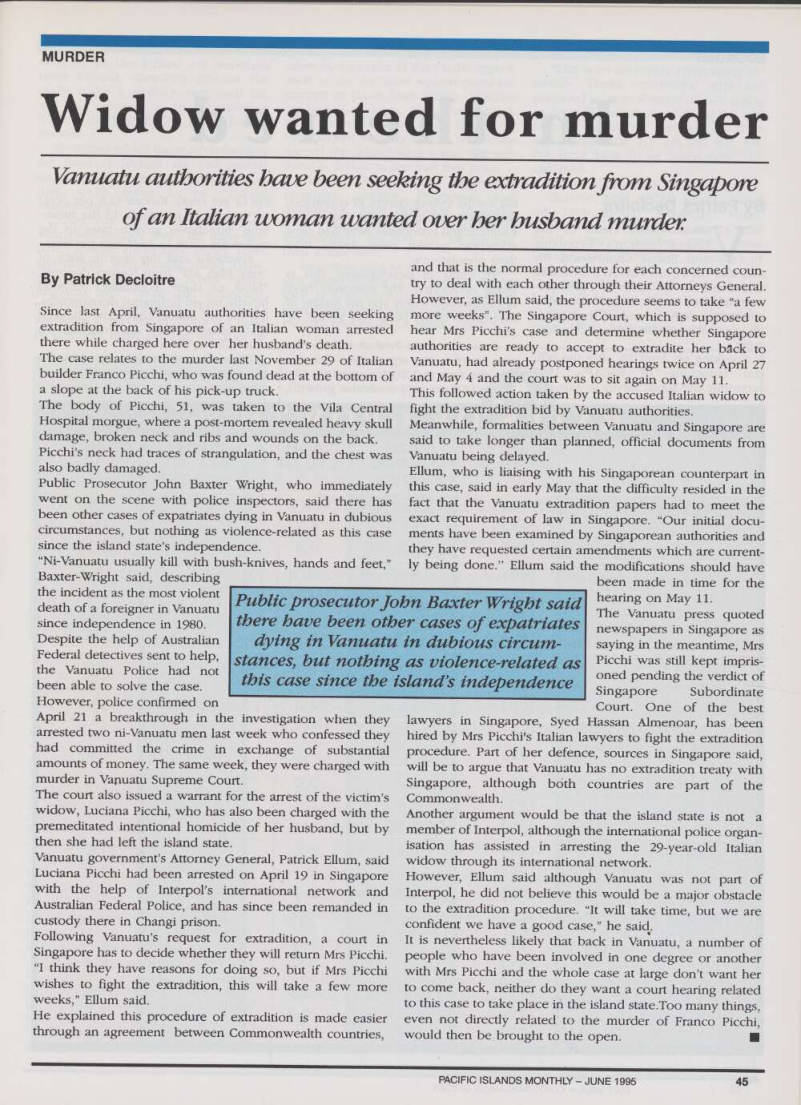
Murder
Vanuatu authorities have been seeking the extradition from Singapore of an Italian woman wanted over her husband murder
By Patrick Decloitre
Since last April, Vanuatu authorities have been seeking extradition from Singapore of an Italian woman arrested there while charged here over her husband’s death.
The case relates to the murder last November 29 of Italian builder Franco Picchi, who was found dead at the bottom of a slope at the back of his pick-up truck.
The body of Picchi, 51, was taken to the Vila Central Hospital morgue, where a post-mortem revealed heavy skull damage, broken neck and ribs and wounds on the back.
Picchi’s neck had traces of strangulation, and the chest was
also badly damaged.
Public Prosecutor John Baxter Wright, who immediately went on the scene with police inspectors, said there has been other cases of expatriates dying in Vanuatu in dubious circumstances, but nothing as violence-related as this case since the island state’s independence.
“Ni-Vanuatu usually kill with bush-knives, hands and feet,”
Baxter-Wright said, describing
the incident as the most violent death of a foreigner in Vanuatu since independence in 1980.
Despite the help of Australian Federal detectives sent to help, the Vanuatu Police had not been able to solve the case.
However, police confirmed on
April 21 a breakthrough in the investigation when they arrested two ni-Vanuatu men last week who confessed they had committed the crime in exchange of substantial amounts of money. The same week, they were charged with murder in Vanuatu Supreme Court.
The court also issued a warrant for the arrest of the victim’s widow, Luciana Picchi, who has also been charged with the premeditated intentional homicide of her husband, but by then she had left the island state.
Vanuatu government’s Attorney General, Patrick Ellum, said Luciana Picchi had been arrested on April 19 in Singapore with the help of Interpol’s international network and Australian Federal Police, and has since been remanded in custody there in Changi prison.
Following Vanuatu’s request for extradition, a court in Singapore has to decide whether they will return Mrs Picchi.
“I think they have reasons for doing so, but if Mrs Picchi wishes to fight the extradition, this will take a few more weeks,” Ellum said.
He explained this procedure of extradition is made easier through an agreement between Commonwealth countries,
and that is the normal procedure for each concerned coun try to deal with each other through their Attorneys General.
However, as Ellum said, the procedure seems to take “a few more weeks”. The Singapore Court, which is supposed to hear Mrs Picchi’s case and determine whether Singapore authorities are ready to accept to extradite her back to Vanuatu, had already postponed hearings twice on April 27 and May 4 and the court was to sit again on May 11.
This followed action taken by the accused Italian widow to fight the extradition bid by Vanuatu authorities.
Meanwhile, formalities between Vanuatu and Singapore are said to take longer than planned, official documents from
Vanuatu being delayed.
Ellum, who is liaising with his Singaporean counterpart in this case, said in early May that the difficulty resided in the fact that the Vanuatu extradition papers had to meet the exact requirement of law in Singapore. “Our initial docu ments have been examined by Singaporean authorities and they have requested certain amendments which are current ly being done.” Ellum said the modifications should have
Public prosecutor John Baxter Wright said there have been other cases of expatriates dying in Vanuatu in dubious circum stances, but nothing as violence-related as this case since the island's independence
been made in time for the hearing on May 11.
The Vanuatu press quoted newspapers in Singapore as saying in the meantime, Mrs Picchi was still kept impris oned pending the verdict of Singapore Subordinate Court. One of the best
lawyers in Singapore, Syed Hassan Almenoar, has been hired by Mrs Picchi's Italian lawyers to fight the extradition procedure. Part of her defence, sources in Singapore said, will be to argue that Vanuatu has no extradition treaty with Singapore, although both countries are part of the Commonwealth.
Another argument would be that the island state is not a member of Interpol, although the international police organ isation has assisted in arresting the 29-year-old Italian widow through its international network.
However, Ellum said although Vanuatu was not part of Interpol, he did not believe this would be a major obstacle to the extradition procedure. “It will take time, but we are confident we have a good case,” he said.
It is nevertheless likely that back in Vanuatu, a number of people who have been involved in one degree or another with Mrs Picchi and the whole case at large don’t want her to come back, neither do they want a court hearing related to this case to take place in the island state .Too many things, even not directly related to the murder of Franco Picchi, would then be brought to the open. ■
In the red
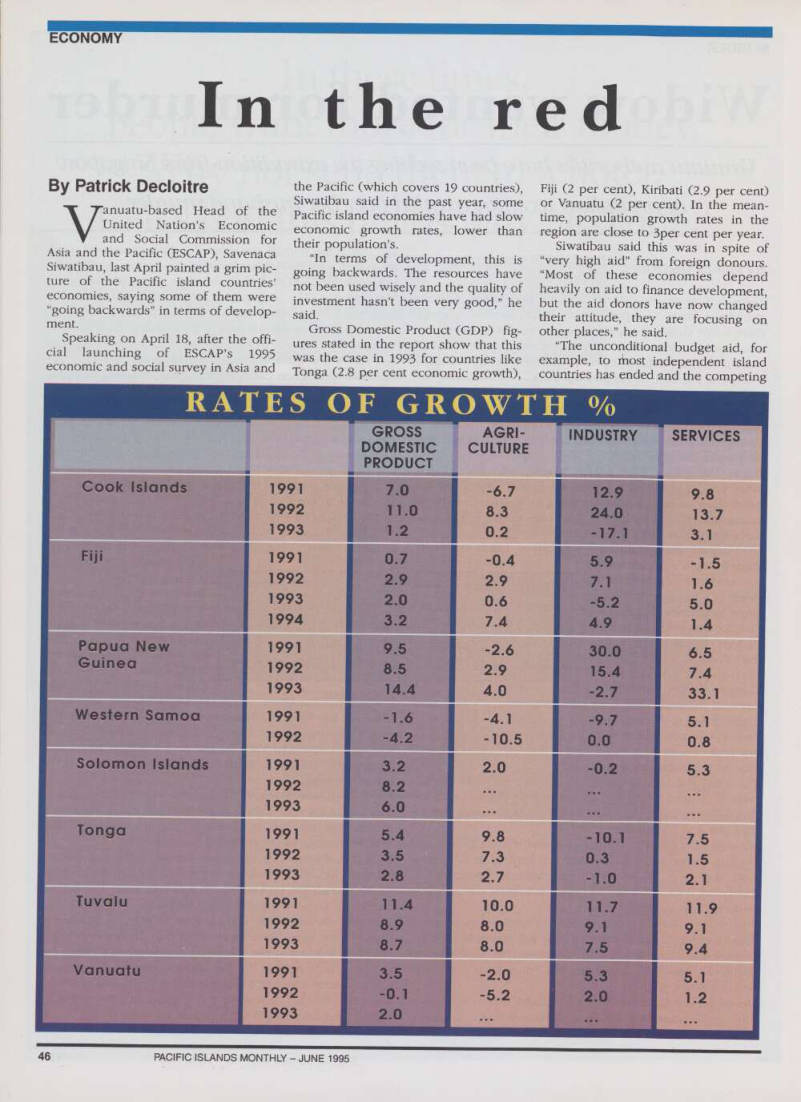

Economy
By Patrick Decloitre
Vanuatu-based Head of the United Nation’s Economic and Social Commission for Asia and the Pacific (ESCAP), Savenaca Siwatibau, last April painted a grim pic ture of the Pacific island countries’ economies, saying some of them were “going backwards” in terms of develop ment.
Speaking on April 18, after the offi cial launching of ESCAP’s 1993 economic and social survey in Asia and
the Pacific (which covers 19 countries), Siwatibau said in the past year, some Pacific island economies have had slow economic growth rates, lower than
their population’s.
“In terms of development, this is going backwards. The resources have not been used wisely and the quality of investment hasn’t been very good,” he said.
Gross Domestic Product (GDP) fig ures stated in the report show that this was the case in 1993 for countries like Tonga (2.8 per cent economic growth),
Fiji (2 per cent), Kiribati (2.9 per cent) or Vanuatu (2 per cent). In the mean time, population growth rates in the region are close to 3per cent per year.
Siwatibau said this was in spite of “very high aid” from foreign donours.
“Most of these economies depend heavily on aid to finance development, but the aid donors have now changed their attitude, they are focusing on other places,” he said.
“The unconditional budget aid, for example, to ihost independent island countries has ended and the competing
Rates Of Growth %
7 .
Gross
Domestic
Product
m
Agri-
Culture
' Industry
' Services
Cook Islands 1991 7.0 -6.7 12.9 9.8 1992 11.0 8.3 24.0 13.7 1993 1.2 0.2 -17.1 3.1 Fiji 1991 0.7 -0.4 5.9 -1.5 1992 2.9 2.9 7.1 1.6 1993 2.0 0.6 -5.2 5.0 1994 3.2 7.4 4.9 1.4 Papua New 1991 9.5 -2.6 30.0 6.5 Guinea 1992 8.5 2.9 15.4 7.4 1993 14.4 4.0 -2.7 33.1 Western Samoa 1991 -1.6 -4.1 -9.7 5.1 1992 -4.2 -10.5 0.0 0.8 Solomon Islands 1991 3.2 2.0 -0.2 5.3 1992 8.2 ... 1993 6.0 ... ,,,
Tonga
1991 5.4 9.8 -10.1 7.5 1992 3.5 7.3 0.3 1.5 1993 2.8 2.7 -1.0 2.1 Tuvalu 1991 11.4 10.0 11.7 11.9 1992 8.9 8.0 9.1 9.1 1993 8.7 8.0 7.5 9.4 Vanuatu 1991 3.5 -2.0 5.3 5.1 1992 -0.1 -5.2 2.0 1.2 1993 2.0
demand for the limited aid resources from various claimants around the globe make it unlikely that such aid will be restored in the foreseeable future,” the 1995 ESCAP report further stresses.
Siwatibau added these advantages in the form of foreign aid and special trade agreements to Pacific island coun tries were going to be “slowly
disappearing”.
“After the GATT’s Uruguay round which has brought down the trade bar riers, special advantages under trade agreements with Pacific island coun tries like Lome IV or South Pacific Regional and Trade and Economic Cooperation Agreement (SPARTECA) are going to be eroded. There is a need to compete more fiercely, we have to
Siwatibau said to be more competitive, gov ernments of the region should look at their exchange rates, work in their efficiency by deregu lating and privatizing public service sectors.
export more,” Siwatibau said.
The ESCAP report says amongst Pacific island countries, Papua New Guinea was a “heavyweight in terms of its economic size,” which determines largely the performance of the whole region. But reviewing some countries in the Pacific region, Siwatibau said Papua New Guinea was “unable to control its expenditure”. “They have a problem with their balance of pay ments, despite export earnings and large mineral resources. There are about 60,000 school-leavers every year, but only 5000 to 6,000 jobs are created in the meantime,” he said. Statistically, however, PNG achieved 14.4 per cent GDP in 1993. The UN report attributes this strong growth to the good perfor mance of their service sector which grew by 33 per cent.
About Solomon Islands (6 per cent GDP in 1993), Siwatibau said they had a “very shortsighted policy” in exploit ing timber and fish at an “unsustainable rate”.
He outlined what he saw as “good examples” of “niche markets” to be
taken by countries of the Pacific region, such as the lucrative squash pumpkin exports to Japan from Tonga, Vanuatu or New Caledonia, the young black pearl industry in the Cook Islands or the garment industry in Fiji, which has earned this island state some 100 mil lion US dollars in the past five years.
The ESCAP head said Melanesian countries, unlike Polynesia and Micronesia, have resources to make them financially and economically independent, but they did not manage their affairs well.
Siwatibau said to be more competi tive, governments of the region should look at their exchange rates, work in their efficiency by deregulating and pri vatising sectors in the public service.
“This is an extremely challenging sit uation. Those (countries) who are prepared to gear themselves are going to do well, but those who are not will face a continuing decrease in their social standards. It’s not too late yet, but steps have to be taken now,” he
analysed.
Note: data for 1994 are estimates. (Source: 1995 ESCAP report, based on International Monetary Fund, International Financial Statistics, vol XLVII, N°lo - October 1994-; Asian Development Bank, Key Indicators of Developing Asian and Pacific Countries, 1994 - Oxford University Press, 1994 - and Asian Development Outlook, 19944 - Oxford University Press, 1994 - and national sources). ■
Advertisements & other items, p. 47 (1 item)
Investment Promotion Authority
IPA
Papua New Guinea
The Investment Promotion Authority of Papua New Guinea will be leading an investment mission to Fiji in July.
The purpose of the mission is to encourage more joint venture businesses between Fijian and Papua New Guinea entrepreneurs.
For more information about the investment mission, please contact Ms Sabi Koregai, Investor and Promotion Services Division, Investment Promotion Authority, PO Box 5053, Boroko, NCD, PNG. Other queries should be directed to the director also on the same address or telephone (675) 217311, facsimile (675) 202237.
Investing in PNG can be a rewarding experience. There are numerous opportunities for the discerning investor and it sometimes is difficult deciding where in PNG you want to set up a shop or who you want to do business with.
The IPA with its growing database and links with the PNG private and government sectors, is well placed to help you find a suitable business partner, put you in touch with the right people and assist you with government permits, licences or approvals, quickly and without any hassles.
The Investment Promotion Authority was established in 1992 by the Papua New Guinea national parliament to promote, facilitate and monitor investment in PNG.
Promoting Better Business
greed
Ocean
Endless ocean, bottomless greed
By Ian Williams
For three hundred years, the Pacific Ocean was the equivalent of Outer Space for European explorers. They launched across its vast expanses with a nagging suspicion that there might be no end to it. The first recorded crossing was of course by the Portuguese nobleman Ferdinand Magellan who sailed around the world, traversing the Ocean in 1521 on behalf of the King of Spain.
While he was the first to circumnavigate the globe, many Pacific islanders had crossed the same stretches of ocean with out any chroniclers to record their achievement. However, that should not detract from the heroism of Magellan and his men. Plagued with scurvy, the ships
rats provided one of the few sources of fresh food, while the water was foul green smelling swill. Scurvy killed nineteen crewmen and weakened the rest, while the leather rigging straps were boiled to be eaten.
However their heroic deed, was as Frank Sherry’s book records, undertaken for far from heroic motives. What impelled men to take such risks and make such sacrifices was an almost palpable appetite for gold. Pacific Passions recounts how the whole world had become part of the European economic and political system. Magellan’s voyage was intended to stave off the impending bankruptcy of the Spain, and to by-pass their Portuguese rivals. Spain was using its American treasures to fight bitter wars in Europe, particularly in Holland.
Other fortune hunters set off looking for Japan and China. Later they were look ing for the huge continent they assumed must be in the South. In the early stages, curiosity was a minor factor in comparison with greed. The French Dutch and British knew that the ocean contained treasures.
And they knew where it was - in the holds of Spanish ships. Buccaneers patri otically looted them.
Later the Frencth and British mounted purely scientific (expeditions like James Cook’s and Louis Antoine de Bougainville's, butt even they were under commission to Hook for commercial advantage. Cook’ss voyage started off to observe the transiit of Venus across the Sun - but he was also told to watch out for Bougainville amd see if, in passing he could find and claiim the southern conti nent. History records of course that he found a southern continent. Even if it was not as big as tthey had hoped for, Australia was no tiiny atoll.
The struggles fo>r supremacy in Europe were reflected in tlhe waves of Spaniards, Portuguese, Dutdfi, British, French and even Russians wfho descended on the Pacific as their poliitical and economic for tunes ebbed and fllowed. While they each seized whatever rraajor prizes they could, like Indonesia and! the Philippines most of blood letting was of each other. Most of the islands were blessed with a total absence of mineral wealth and thus pre served from occupation, if not from occasional raids. And even then, technol ogy did not always triumph, with the Solomon’s martial traditions proving too much for many explorers. Isolated, the smaller islands were also mostly spared the joys of the Spanish Inquisition.
While Sherry’s pangram of heroes, buccaneers, pirates, scientists and traders has its own interest, one wishes that he had devoted more space to the islanders the explorers met. It is clear that there was total mutual incomprehension. The sailors may as well have been aliens in flying saucers for the peoples they met.
The Europeans’ eccentric habits, their sense of property rights, their assumption of superiority, their sexual inhibitions, all represented a mystery to their often
involuntary hosts.
Pacific Passions does not set out to be anything but Eurocentric. That’s where the explorers came from after all.
Nonetheless, it is a gripping story of major events, matching the glory details of the explorer’s exploits to the broad sweep of history. And as such it is an excellent background to the present political and ethnic shape of the Pacific, formed as it was by these intruders and only now being returned to its original inhabitants. ■
Advertisements & other items, p. 48 (1 item)
For Sale By Tender
(Closing date extended)
Vessel "Pacific Ruby"
Built Le Havre 1958, re-fitted Slong Huat shipyard, Singapore 1987. Steel, tonnage 381/114 (gross/ nett), dimensions 42.4x7.4x3.4 draft, s/screw, 2x12 cyl diesel (each 600 hp), speed 13.5 k, range 9,000 mis, class (type) motor yacht, 37 berths.
Has been used for Christian mission work in SW Pacific. Suitable for diving tender or reconversion to cargo. Vessel well maintained.
Particulars believed correct but not guaranteed.
Tenders close with the undersigned Friday 30 June 1995. Currently berthed NZ port. Highest or any tender not necessarily accepted.
Stuart Oates, P.O. Box 3269, Auckland, NZ.
Fax 64-9-358-3670
information
Books
Ocean of information
By David North
Ocean Yearbook II is both a mix and a blessing, and sometimes a
mixed blessing.
This English-language compilation
looks at oceans from a world-wide per spective and from many points of view; if your field is diplomacy, naval warfare, underwater minerals, fisheries, conserva tion, or some other facet of the wet and the wild, there is something for you in this volume. As is often the case you may learn the most about what is at the edge of, or quite beyond, your field of inter est.
While this is a serious to somber vol ume, 676 pages long and mostly scholarly in tone, one can find enough maritime tidbits to keep one entertained on many a long summer night. I learned, for example, that: • Tonga has quite a navy, by island standards; • Much of the Northern Solomon Islands belongs to that country - and not to PNG - because of a century-old, three-way imperialist real estate deal focused on the Samoans; • Tuna boat captains, until recently,
routinely dropped bombs on dolphins;
and • Totally non-environmental consid erations have been helpful in the conservation of fishing stocks in Niue and other South Pacific Islands.
The Ocean Yearbook is with original articles on specific matters of interest, and closing with an appendix of statis tics, tabulations and full texts of international documents important to some, and useless to others.
Want to know what countries have rat ified the Law of the Sea (LOS) and when?
Check Appendix Table IH.
Want to know about the changing amount of chemical residues in Canadian seabird eggs over time? See Appendix Table IG.
But the blessing is often a mixed one.
The two tables just cited were the first two I noticed as I thumbed through the volume, and each carries the signs of editorial haste. The two pages of the list of LOS signatories appear in reverse order, not fatal but off-putting. The chemical residues found in the eggs of puffins, petrels and cormorants are DDE and PCB, nasty stuff, I am sure, but the non-chemist might like to know what those initials stand for, and maybe what it all means. (The residues in the eggs have, generally, decreased over the past two decades.) Further, there is at least one piece on US military policy, written by a captain in the US Navy, that sounds more like a Fourth of July speech by an American politician than anything else. One Pacific publication with a small staff has a way to handle such submissions; the Samoa News simply prints the item in question as is, and notes that it is a press release.
One often has the sense that the three Yearbook editors did a lot more assem bling - of usually interesting pieces than editing. But these caveats aside, there is much that is fascinating in this publication. Returning to the four items mentioned earlier, we find the following. • Tongan’s navy gets fairly high marks in the first article I have ever seen on “Constabulary Navies”, a nice term. This one is by another US Navy captain, Joseph R. Morgan. Tonga’s force, he writes “includes three Australian Pacific patrol boats, two smaller coastal patrol craft, and the royal yacht, which doubles as an auxiliary patrol craft. In addition, there are two landing craft medium (LCMs) and two logistic support craft ... the country comes close to having a sur veillance force with genuine capabilities...”
In contrast the author chides PNG: “with a population of about 3,500,000 and land area of 462,840 square kilome tres, [PNG] has ample reason to maintain a navy designed for coastal defence. It has not done so, however.” • Victor Prescott, an Australian acade
mic, writes about the development of the maritime boundary between PNG and the Solomons, a scene of some current tension because of the events in Bougainville. He notes the local bound ary change at the turn of the century, moving both Santa Isabel and Choiseul Islands from the then-German New Guinea to then-British Solomons Islands.
This is the bi-product of the briefly fierce rivalry among the US, Britain and Germany over the Samoans. When the dust settled, the Germans got Western Samoa, but modified the boundary in the Solomons, the Brits . withdrew their claims in on the Samoans in exchange for islands in the Solomons, and the Americans got the smaller eastern islands. (America, alone, remains in the area, and continues to pay some of Samoa’s bills.) But as is often the case in this volume, Prescott’s careful text refers to points on maritime maps which are missing, at least in this edition. • Alexandra Nadal Egea, who is with the prestigious Colegio de Mexico, has what many will find a detached view of the dolphin-tuna question; his country’s boats still seine tuna in the Eastern Tropical Pacific although America’s tuna boats, pressed by the environmentalists, have long since left the area. (If you net tuna in this part of the Pacific you are highly likely to kill the air-breathing dol phins.) But it is Nadel Egea who reminds us that the tuna boats’ helicopters used to drop small bombs on the dolphins to herd them out of the way of the fishing operations. • On a happier note, Canadian Scott Coffen-Smout, a one-time resident of Niue, writes about ocean management on that island, and tells how certain island practices, not related to conserva tion, have worked to preserve the near-shore fisheries stock. Traditionally, fishing was restricted by the villages after a death; similarly, but later, the mission aries decided that fishing on Sundays was sacrilege, and banned it.
In summary, if you have a serious interest in the ocean, get this book, and then drop a line to the editors urging a little more editing the next time around.
Ocean Year, Volume II Edited by Elisabeth Mann Borgese, Norton Ginsburg and Joseph R. Morgan; ISBN 0-226-06614-2; University of Chicago Press/Journals Division, Chicago, Illinois, (US) $77.00 676 pp.
of bodybuilders

Bodybuilding
Knight of the order of bodybuilders
By Shailendra Singh
BODY building in Fiji ffas never had a big following and interna tionally, the country has lagged far behind in the sport.
But now, there is rdason for optimism in the Fiji body building squad that is preparing for the South Pacific Games in August.
The team is being coached by Brisbane-based Billy Knight Tuinasaqalau, the most famous and pro lific Fijian bodybuilder ever.
Born in Ba, a town in the Western part of Fiji, Knight is the only bodybuilder in history to win the prestigious Mr Australia title for three consecutive years in'T9Bo - It was in Australia, where Knight migrated 22 years ago, that opportunities opened up and his sports career took off.
Now the Fiji Amateur Body building Association (FABA) has called on Knight to impart some of his knowledge to his fellow countrymen, and he agreed with out hesitation.
“It’s something I’ve always wanted to do. I’m very honoured to be invited,” he said.
A mammoth task awaits Knight, who has already had some sessions with the Fiji team. But those that have watched him at work have no doubt the team is in
good hands.
At 45, and married with four children, Knight displays the energy of someone half his age. The optimism and enthusi asm with which he has set out to do his job is quite encouraging for the Hedging
Faba.
“I’ve dropped all schedules ffor 1995 for this. This is the biggest and best chal lenge of my life,’ Knight said.
While his first look at the Fiji team wasn’t very encouraging, Knight can see
Hie said less than 10% of the body builders were in the running as far as international standards went and 90 per cent were not aware of what they should be doing.
But he added his clinics should put that right. “I’ll get them in the best shape of their lives,” he promised.
Knight’s accomplishments both as a competitor and administrator are prolific.
He has finished in the top four and top six twice in the Mr Universe and was sec ond in the World Games in 1981 in San Jose, USA.
He held the position of national presi dent of the National Amateur Bodybuilders of Australia from 1983-87 and was World vice-president from 1984- 87.
In between, he has been national coach and manager and addressed sever al high profile world body building seminars and exhibitions apart from giv ing radio and television interviews throughout Australia.
Through body building, Knight has
travelled extensively to the Philippines, Egypt, England, France, Germany,!
Austria, Italy, Spain, Belgium, Hawaii/ New Zealand and the United States.
He also had the chance to train under his mentor, the legendary four-time Mr Universe winner, Bill Pearl, in the United States, and body building icons like Bertil Fox, Tom Platz, Casey Viator, Chris Dickersen, Tom Belknap, Lance Dreher and Jeff King.
The 1994 Mr Universe winner, John j Terrelli, is a former training partner and j student of Knight.
Having been un contact with thou sands of bodybuilders from all parts of the world, Knight believes Pacific Islanders have great potential.
He said facilities and expertise are somewhat lacking but there is an ? abun dance of natural foods, and island people
are genetically endowed for the sport.
“They have naturally good legs, big arms and chest without even training,” he said.
“We have an advantage over other countries in that the atmosphere here is very stress-free, relaxed and happy. It’s difficult to perform where there is a high level of stress.”
But knight added that facilities have to be improved. “Like any other trade in the world, you can’t do your job without the proper tools. “The reason for our stand ing is because we don’t have the facilities to start with,” he said Another problem with Fiji body builders, and those of the South Pacific, is lack knowledge, said Knight.
“The sport is a combination of train ing, diet, nutrition, supplementation and recuperation.
“After training, enough sleep is need ed to allow the body to grow otherwise all that hard lifting is wasted,” he said.
Knight’s sporting interest is not con fined to bodybuiding. He is a keen follower of both rugby league and union.
He is the successful coach of the New Farm United 7-11 year age group soccer club and the assistant junior netball coach at Holy Spirit School, New Farm.
Initially, Knight came to Australia hop ing to make his mark in boxing. His interest in music led him to body build ing. ‘“Because I used to perform on stage, I always took an interest in dressing well and looking good . 1 started using weights and found that body building gave me everything I wanted.”
Knight hopes his involvement with Fiji won’t be just for the South Pacific Games.
He has given the Fiji Government a pro posal for a national fitness council.
The proposal aims to spread aware ness about good nutrition and exercise to people from all walks of life and set up training centres around the country, ■
Rugby goes on safari
Sports
By Andrew Kacimaiwai
THEY have come from all corners of the world to play for their countries, and hopefully for glory, watched by a television audience of 2.5 billion people in more than 160 countries.
While it sounds like the soccer World Cup, it’s not - quite.
It’s a World Clip tournament rightly enough, but the sport is rugby union.
And the tournament is one of the four biggest in the world.
When hosts South Africa and defend ing champions Australia opened the tournament in their Pool A clash late last month, it signalled yet another new chap ter in the saga of the new democratic South Africa.
For Western Samoa and Tonga, it will be a chance to take on some of the big guns in rugby on a more equal footing than in any other sport, particularly for the Samoans.
For the Fijians, who will not be taking part, it will be the end of a bewildering month of half-held hope that they could have taken part.
Western Samoa has been grouped in Pool B with England, Italy and Argentina while the Tongans find themselves up against Scotland, France and Ivory Coast in Pool D.
The recent performances of the Italians and the Argentines in Australia suggest that the Samoans will be hard pushed to repeat their 1991 feat of qualifying for the quarter-finals.
The Samoans have impressed many international commentators by their per formance since the 1991 tournament, when they upset the Welsh and almost did the same to the Wallabies before bowing out in the quarter-finals against Scotland.
Their performance since than has increased their credibility with wins over the likes of Wales and Scotland. However, they are likely to struggle upfront with a powerful team like Argentina, who had a disastrous debut in 1987’s inaugural tour nament when they were thumped by the Fijians.
The Samoans have demonstrated themselves to be an upcoming power,
knocking on the door of the inner sanc tum currently enjoyed by the Big Eight - Australia, New Zealand, South Africa, France, Scotland, Wales, Ireland and England.
Tonga, on the other hand, enters the tournament with plenty of potential which they have yet to unleash.
Devastating hits are not the sole trade mark of the Samoans, and Ivory Coast in particular can look forward to a fiery bap tism of fire against a Pacific team in a much-anticipated clash of two similar rugby styles.
A critical factor which all teams have to contend with in the 1995 tournament will be the environment.
South Africa’s high altitude demands an exceptionally high level of fitness from all players, and such a high-pressure tour-
Tournament will be watched by 2.5 billion people in more than 160 countries.
nament like this one will exact its toll.
Of the two Pacific teams, Samoa has had the luck of the draw, playing its pool games in and around Durban on the Indian Ocean coast. The only concern is the ongoing violence in an area dominat ed by the Inkatha party.
Tonga have not been so lucky with their venue; their games will be held at Pretoria and Rustenberg, high-altitude venues deep in the heart of Afrikaaner
territory, with their games against France and Scotland being held at Pretoria.
The Polynesian brand of rugby, how ever, will not be confined to just these two Island nations.
The New Zealand All Blacks, particu larly, bristle with strong Polynesian influence in the shape of players like Norm Hewitt (Maori), Jonah Lomu (Tongan), 010 Brown and Frank Bunce (Samoan) and Walter Little (Fijian).
Australia, not to be undone, has Willie Ofahengaue (Tongan) and Hie Tabua (Fijian), both of whom are renown for their bone-citushing tackles.
Only Fiji will be left behind to “mind the house” when a touring England A side comes visiting as part of its Down Under tour for those players who failed to make the World Cup squad.
Fiji came close to taking part in its third World Cup when the International Rugby Football Board asked the Fiji Rugby Football Union to be on stand-by in case of a late withdrawal.
Despite repeated requests for confir mation, the FRFU was left to alert its national reps, in Fiji and elsewhere, to possible World Cup duties without pro viding a definite “yes” or “no”.
The IRB had alerted the top non-qual ifier in each World Cup zone - Africa, Europe, Asia, Pacific and the Americas to be on stand-by following reports that one of the participants was reported to be on the verge of pulling out.
Some reports identified the country as Ivory Coast, others said Tonga.
Despite sacking and replacing its coach and a lack of success in finding a sponsor for its team, the Tongan Rugby Union insisted it was still going to the tournament and named its Cup squad which included New Zealand and Australia-based players.
Despite speculation in some Fiji rugby circles that Fijians might yet replace Ivory Coast, Namibia appears set to step in should the African nation pull out.
Already, the FRFU is looking forward to the 1999 tournament (to be shared among the Home Unions of Wales, Ireland, England and Scotland) and promising fans that they will be there.
Samoa and Tonga will be on safari in South Africa along with the rest of the cream of international rugby. ■
Advertisements & other items, p. 52 (1 item)
Atlas Gives You The World
IN A BRIEFCASE - FOR ONLY $11,995 For only U 5511,995 you can carry away an Atlas Elektronik Satcom- M briefcase terminal.
The SPI6OO-B provides a reliable digital secure satellite phone service anywhere within the Pacific, Indian and Atlantic Ocean Regions, covering about two thirds of the earth’s surface, including the Pacific Islands, Asia and Europe.
Weighing only 10.5 kg and running on batteries or 110-240 V AC, the briefcase also has an optional external wet weather antenna which can be set up permanently outside. Thus you can use the phone as an office phone (it can be connected to a PABX) or when needed as a fully portable field phone. This makes the Atlas SPI6OO-B ideal for a wide range of applications hotel communications, exploration and mining, oil and gas rigs, construction, emergency backup, independent communications for government diplomats and business executives.
With fax and data capability you have a portable office that allows you to send and receive fax and data communications no matter how remote your location, Plus, its backed by a world-wide sales and service network and carries a 12 month warranty.
Take advantage of this limited offer and put the world in your briefcase by calling; 612 437 4577 or Fax 612 439 7576 If you’re in the marine business we also have a maritime version with a stabilised antenna allowing voice, fax and data. Allow us to quote you a very competitive price and enjoy the luxury of dialling the world at any time and at any place.
Q ATLAS ELEKTRONIK Innovations in Electronics
UNIT 6, 39 HERBERT ST, ST LEONARDS, NSW 2065, AUSTRALIA.
ATLAS ELEKTRONIK (AUSTRALIA) PTY LTD ACN 056 058 952
Survival of the richest
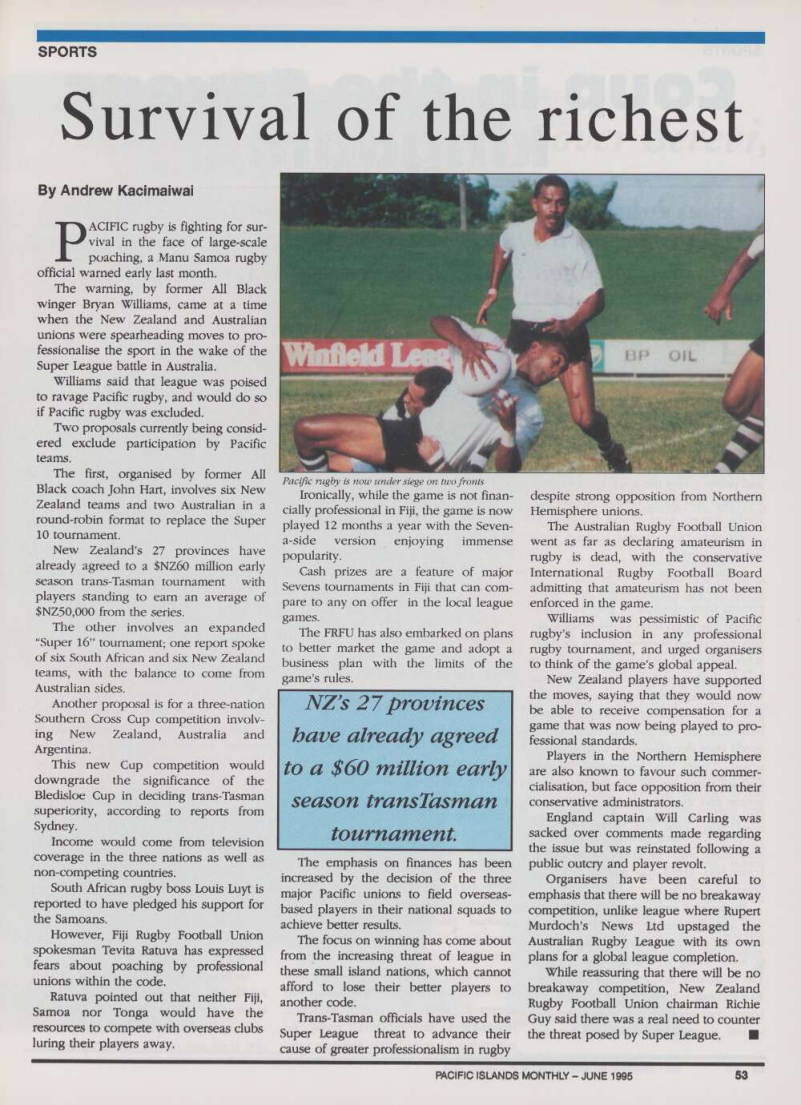
By Andrew Kacimaiwai
PACIFIC rugby is fighting for sur vival in the face of large-scale poaching, a Manu Samoa rugby official warned early last month.
The warning, by former All Black winger Bryan Williams, came at a time when the New Zealand and Australian unions were spearheading moves to pro fessionalise the sport in the wake of the Super League battle in Australia.
Williams said that league was poised to ravage Pacific rugby, and would do so if Pacific rugby was excluded.
Two proposals currently being consid ered exclude participation by Pacific teams.
The first, organised by former All Black coach John Hart, involves six New Zealand teams and two Australian in a round-robin format to replace the Super 10 tournament.
New Zealand’s 27 provinces have already agreed to a SNZ6O million early season trans-Tasman tournament with players standing to earn an average of SNZSO,OOO from the series.
The other involves an expanded “Super 16” tournament; one report spoke of six South African and six New Zealand teams, with the balance to come from Australian sides.
Another proposal is for a three-nation Southern Cross Cup competition involv ing New Zealand, Australia and Argentina.
This new Cup competition would downgrade the significance of the Bledisloe Cup in deciding trans-Tasman superiority, according to reports from Sydney.
Income would come from television coverage in the three nations as well as non-competing countries.
South African rugby boss Louis Luyt is reported to have pledged his support for the Samoans.
However, Fiji Rugby Football Union spokesman Tevita Ratuva has expressed fears about poaching by professional unions within the code.
Ratuva pointed out that neither Fiji, Samoa nor Tonga would have the resources to compete with overseas clubs luring their players away.
Ironically, while the game is not finan cially professional in Fiji, the game is now played 12 months a year with the Seven a-side version enjoying immense
popularity.
Cash prizes are a feature of major Sevens tournaments in Fiji that can com pare to any on offer in the local league games.
The FRFU has also embarked on plans to better market the game and adopt a business plan with the limits of the game’s rules.
NZ’s 27provinces have already agreed to a $6O million early season transTasman tournament.
The emphasis on finances has been increased by the decision of the three major Pacific unions to field overseas based players in their national squads to achieve better results.
The focus on winning has come about from the increasing threat of league in these small island nations, which cannot afford to lose their better players to another code.
Trans-Tasman officials have used the Super League threat to advance their cause of greater professionalism in rugby
despite strong opposition from Northern Hemisphere unions.
The Australian Rugby Football Union went as far as declaring amateurism in rugby is dead, with the conservative International Rugby Football Board admitting that amateurism has not been enforced in the game.
Williams was pessimistic of Pacific rugby’s inclusion in any professional rugby tournament, and urged organisers to think of the game’s global appeal.
New Zealand players have supported the moves, saying that they would now be able to receive compensation for a game that was now being played to pro fessional standards.
Players in the Northern Hemisphere are also known to favour such commer cialisation, but face opposition from their conservative administrators.
England captain Will Carling was sacked over comments made regarding the issue but was reinstated following a public outcry and player revolt.
Organisers have been careful to emphasis that there will be no breakaway competition, unlike league where Rupert Murdoch’s News Ltd upstaged the Australian Rugby League with its own plans for a global league completion.
While reassuring that there will be no breakaway competition, New Zealand Rugby Football Union chairman Richie Guy said there was a real need to counter the threat posed by Super League. ■
Pacific rugby is now under siege on two fronts
kingdom
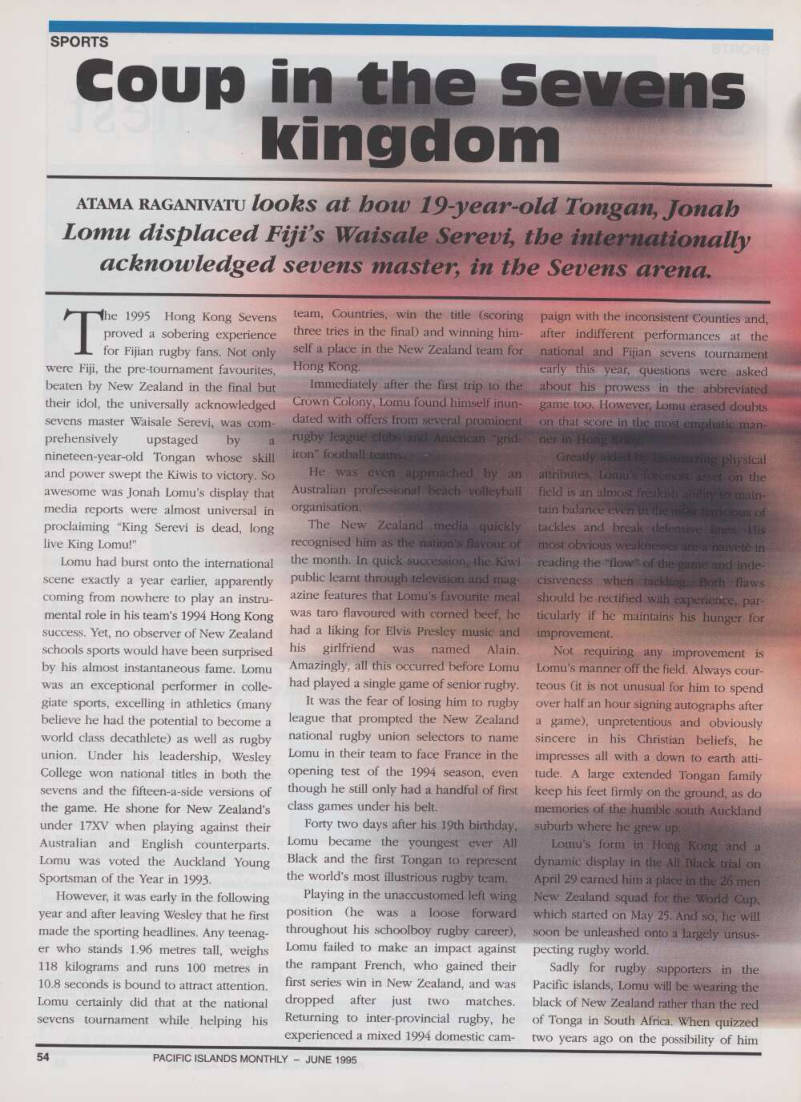
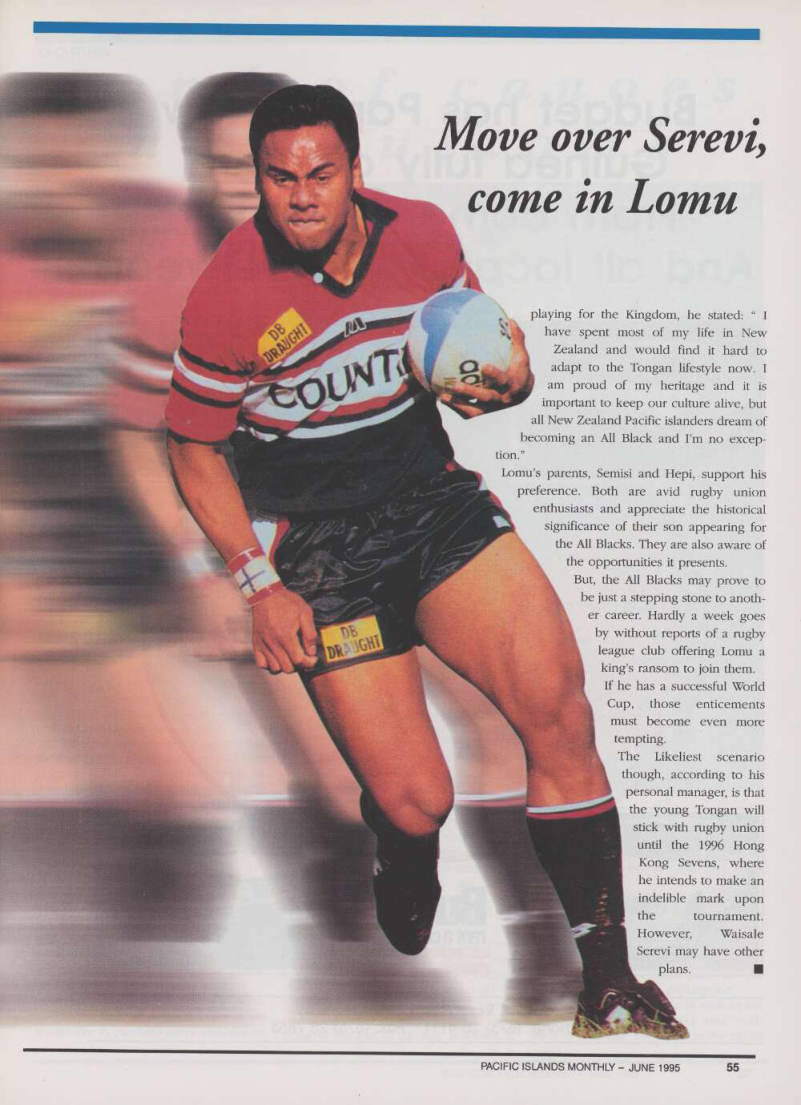
Coup in the Sevens kingdom
atama raganivatu looks at how Tongan, Jonah Lomu displaced Fiji’s Waisale Serevi, the internationally acknowledged sevens master, in the Sevens arena.
The 1995 Hong Kong Sevens proved a sobering experience for Fijian rugby fans. Not only were Fiji, the pre-tournament favourites, beaten by New Zealand in the final but their idol, the universally acknowledged sevens master Waisale Serevi, was com
prehensively upstaged by
nineteen-year-old Tongan whose skill and power swept the Kiwis to victory. So awesome was Jonah Lomu’s display that media reports were almost universal in proclaiming “King Serevi is dead, long live King Lomu!”
Lomu had burst onto the international scene exactly a year earlier, apparently coming from nowhere to play an instru mental role in his team’s 1994 Hong Kong success. Yet, no observer of New Zealand schools sports would have been surprised by his almost instantaneous fame. Lomu was an exceptional performer in colle giate sports, excelling in athletics (many believe he had the potential to become a world class decathlete) as well as rugby union. Under his leadership, Wesley College won national titles in both the sevens and the fifteen-a-side versions of the game. He shone for New Zealand’s under 17XV when playing against their Australian and English counterparts.
Lomu was voted the Auckland Young Sportsman of the Year in 1993.
However, it was early in the following year and after leaving Wesley that he first made the sporting headlines. Any teenag er who stands 1.96 metres tall, weighs 118 kilograms and runs 100 metres in 10.8 seconds is bound to attract attention.
Lomu certainly did that at the national sevens tournament while helping his
team, Countries, win the title (scoring three tries in the final) and winning him self a place in the New Zealand team for Hong Kong.
Immediately after the first trip to the Crown Colony, Lomu found himself inun dated with offers from several prominent rugby league clubs and American “grid iron” football teams.
He was even approached by an
Australian professional beach volleyball
organisation.
The New Zealand media quickly recognised him as the nation’s flavour of the month. In quick succession, the Kiwi public learnt through television and mag azine features that Lomu’s favourite meal was taro flavoured with corned beef, he had a liking for Elvis Presley music and his girlfriend was named Alain.
Amazingly, all this occurred before Lomu had played a single game of senior rugby.
It was the fear of losing him to rugby league that prompted the New Zealand national rugby union selectors to name Lomu in their team to face France in the opening test of the 1994 season, even though he still only had a handful of first class games under his belt.
Forty two days after his 19th birthday, Lomu became the youngest ever Ail Black and the first Tongan to represent the world’s most illustrious rugby team.
Playing in the unaccustomed left wing position (he was a loose forward throughout his schoolboy rugby career), Lomu failed to make an impact against the rampant French, who gained their first series win in New Zealand, and was dropped after just two matches.
Returning to inter-provincial rugby, he experienced a mixed 1994 domestic cam
paign with the inconsistent Counties and, after indifferent performances at the national and Fijian sevens tournament early this year, questions were asked about his prowess in the abbreviated game too. However, Lomu erased doubts on that score in the most emphatic man- Greatly aided by his amazing physical attributes, Lomu’s foremost asset on the field is an almost freakish ability to main tain balance even in (he mfist ferocious of tackles and break defensive lines. His most obvious weaknesses are a naivete in reading the “flow” of the game and inde cisiveness when tackling. Both flaws should be rectified with experience, par ■ ■ v •* - 1 I ticularly if he maintains his hunger for improvement.
Not requiring any improvement is Lomu’s manner off the field. Always cour teous (it is not unusual for him to spend over half an hour signing autographs after a game), unpretentious and obviously sincere in his Christian beliefs, he impresses all with a down to earth atti tude. A large extended Tongan family keep his feet firmly on the ground, as do memories of the humble south Auckland dynamic display in the All Black trial on April 29 earned him a place in the 26 men New Zealand squad for the World Cup, which started on May 25. And so, he will soon be unleashed onto a largely unsus pecting rugby world.
Sadly for rugby supporters in the Pacific islands, Lomu will be wearing the black of New Zealand rather than the red of Tonga in South Africa. When quizzed two years ago on the possibility of him
Move over Serevi, come in Lomu
r playing for the Kingdom, he stated: “ I V \ have spent most of my life in New \ Zealand and would find it hard to a<^a P t to the Tongan lifestyle now. I HHH am proud of my heritage and it is Wgfr important to keep our culture alive, but all New Zealand Pacific islanders dream of becoming an All Black and I’m no excep tion.”
Lomu’s parents, Semisi and Hepi, support his preference. Both are avid rugby union |k enthusiasts and appreciate the historical significance of their son appearing for the All Blacks. They are also aware of \ the opportunities it presents.
But, the All Blacks may prove to kbe just a stepping stone to anoth er career. Hardly a week goes 5 by without reports of a rugby league club offering Lomu a H king’s ransom to join them.
If he has a successful World A.A Cup, those enticements must become even more tempting.
The Likeliest scenario though, according to his personal manager, is that W." ** lc young Tongan will B Nick with rugby union ■ until the 1996 Hong Kong Sevens, where ' \'. T : ' ■ he intends to make an k a- indelible mark upon ■ the tournament.
Hk However > Waisale
■ Serevi may have other * ■' ‘ plans. ■
Advertisements & other items, p. 56 (1 item)
Budget
has Papua New
Guinea fully covered
From corner to corner
And all locations in between
540
BAJ
Manus Kavieng bau ew 0 Madang Kimb© Mt Hagen Tabubil 7 Goroka !/ Mendi Lae Kiunga ; Nadza sH pondena Port, Moresby v^Totau
Budget
rentacard^_
BLSi
rr Central Reservation - Port Moresby Phone: (675) 25 4111 Fax: (675) 25 7853
and customs
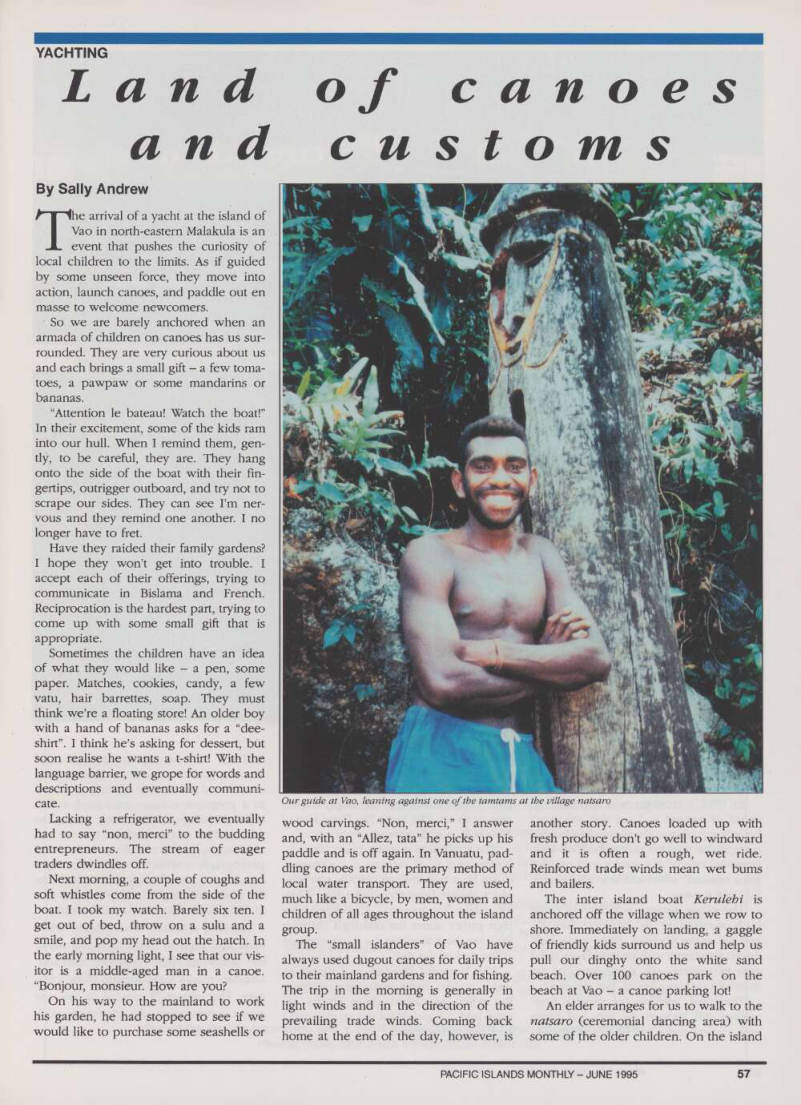
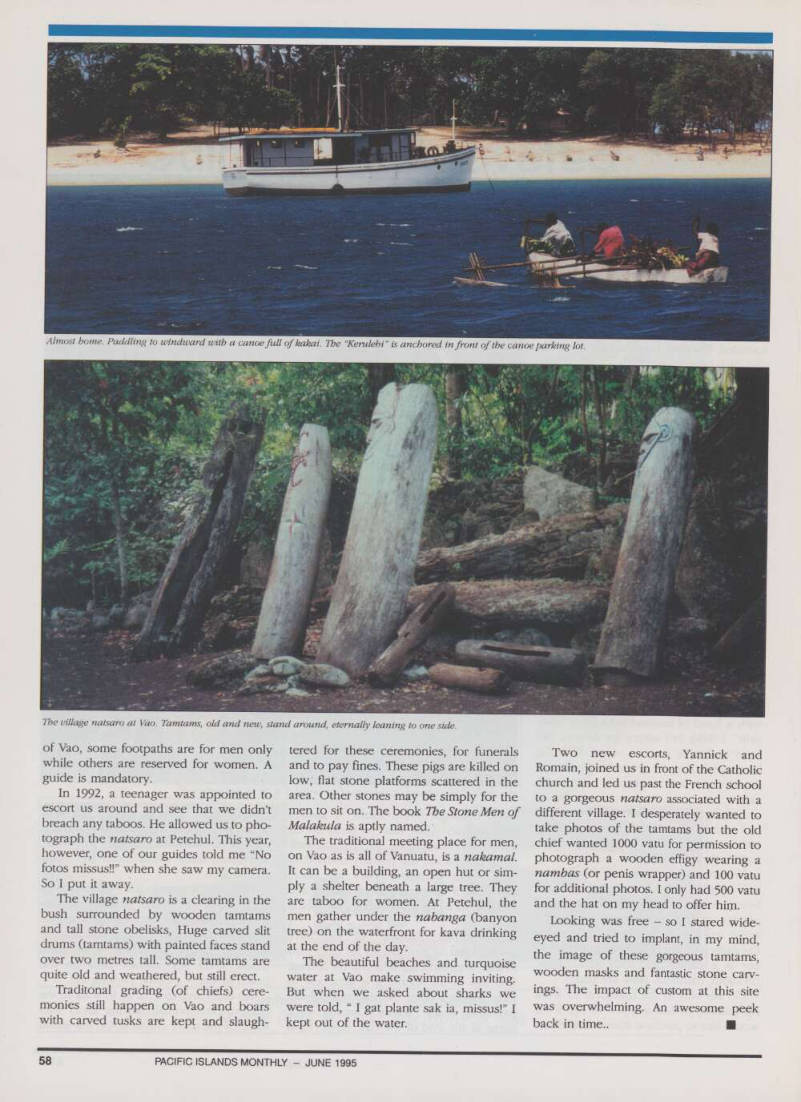
Yachting
Land of canoes and customs
By Sally Andrew
The arrival of a yacht at the island of Vao in north-eastern Malakula is an event that pushes the curiosity of local children to the limits. As if guided by some unseen force, they move into action, launch canoes, and paddle out en masse to welcome newcomers.
So we are barely anchored when an armada of children on canoes has us sur rounded. They are very curious about us and each brings a small gift - a few toma toes, a pawpaw or some mandarins or bananas.
“Attention le bateau! Watch the boat!”
In their excitement, some of the kids ram into our hull. When I remind them, gen tly, to be careful, they are. They hang onto the side of the boat with their fin gertips, outrigger outboard, and try not to scrape our sides. They can see I’m ner vous and they remind one another. I no longer have to fret.
Have they raided their family gardens?
I hope they won’t get into trouble. I accept each of their offerings, trying to communicate in Bislama and French.
Reciprocation is the hardest part, trying to come up with some small gift that is appropriate.
Sometimes the children have an idea of what they would like - a pen, some paper. Matches, cookies, candy, a few vatu, hair barrettes, soap. They must think we’re a floating store! An older boy with a hand of bananas asks for a “dee shirt”. I think he’s asking for dessert, but soon realise he wants a t-shirt! With the language barrier, we grope for words and
descriptions and eventually communi
cate.
Lacking a refrigerator, we eventually had to say “non, merci” to the budding entrepreneurs. The stream of eager traders dwindles off.
Next morning, a couple of coughs and soft whistles come from the side of the boat. I took my watch. Barely six ten. I get out of bed, throw on a sulu and a smile, and pop my head out the hatch. In the early morning light, I see that our vis itor is a middle-aged man in a canoe.
“Bonjour, monsieur. How are you?
On his way to the mainland to work his garden, he had stopped to see if we would like to purchase some seashells or
wood carvings. “Non, merci,” I answer and, with an “Allez, tata” he picks up his paddle and is off again. In Vanuatu, pad dling canoes are the primary method of local water transport. They are used, much like a bicycle, by men, women and children of all ages throughout the island group.
The “small islanders” of Vao have always used dugout canoes for daily trips to their mainland gardens and for fishing.
The trip in the morning is generally in light winds and in the direction of the prevailing trade winds. Coming back home at the end of the day, however, is
another story. Canoes loaded up with fresh produce don’t go well to windward and it is often a rough, wet ride.
Reinforced trade winds mean wet bums and bailers.
The inter island boat Kerulehi is anchored off the village when we row to shore. Immediately on landing, a gaggle of friendly kids surround us and help us pull our dinghy onto the white sand beach. Over 100 canoes park on the beach at Vao - a canoe parking lot!
An elder arranges for us to walk to the natsaro (ceremonial dancing area) with some of the older children. On the island
Our guide at Vao, leaning against one of the tamtams at the village natsaro
of Vao, some footpaths are for men only while others are reserved for women. A guide is mandatory.
In 1992, a teenager was appointed to escort us around and see that we didn’t breach any taboos. He allowed us to photograph the natsaro at Petehul. This year, however, one of our guides told me “No fotos missus!! when she saw my camera.
So I put it away.
The village natsaro is a clearing in the bush surrounded by wooden tamtams and tall stone obelisks, Huge carved slit drums (tamtams) with painted faces stand over two metres tall. Some tamtams are quite old and weathered, but still erect.
Traditonal grading (of chiefs) ceremonies still happen on Vao and boars with carved tusks are kept and slaugh-
tered for these ceremonies, for funerals and to pay fines. These pigs are killed on low, flat stone platforms scattered in the area. Other stones may be simply for the men to sit on. The book The Stone Men of Malakula is aptly named.
The traditional meeting place for men, on Vao as is all of Vanuatu, is a nakamal.
It can be a building, an open hut or simply a shelter beneath a large tree. They are taboo for women. At Petehul, the men gather under the nabanga (banyon tree) on the waterfront for kava drinking at the end of the day.
The beautiful beaches and turquoise water at Vao make swimming inviting.
But when we asked about sharks we were told, “ I gat plante sak ia, missus!” I kept out of the water.
Two new escorts, Yannick and Romain, joined us in front of the Catholic church and led us past the French school to a gorgeous natsaro associated with a different village. I desperately wanted to take photos of the tamtams but the old chief wanted 1000 vatu for permission to photograph a wooden effigy wearing a nambas (or penis wrapper) and 100 vatu for additional photos. I only had 500 vatu and the hat on my head to offer him.
Looking was free - so I stared wide evefl j eyed and tried to tmplant, ,n my m.nd, thC image ° f theSe B or B eous tamtams, wooden masks and fantastic stone carv in 8 s - The impact of custom at this site was overwhelming. An awesome peek back in time.. ■
Almost home. Paddling to windward with a canoe full of kakai. The “Kerulehi” is anchored in front of the canoe parking lot.
The village natsaro at Vao. Tamtams, old and new, stand around, eternally leaning to one side.
Advertisements & other items, pp. 59-60 (1 item)
I A Lifetime Of Services
10 15 20 25 30 35 40 45 50 55 60
25 40 Grand Pacific Life Insurance offers you a lifetime of safe, secure products at very competitive rates.
Choose from a full range of products such as
• Super Ordinary Life
• Super Universal • Non-Participating Whole Life • 10-Year Level Term • Flexible Premium Annuities • Group Life Insurance
• IRAs
• Graded Premium Whole Life J I We've been dedicated to providing fast, . personalized service for more than 35 years
through local ownership and management. "IS
That's why Grand Pacific Life is your Ramify for Life ...throughout the Pacific, 35 40 45 45 10 15 20 25 30 35 40 45 50 55 60 ©
Grand Pacific Life Insurance, Ltd.
A member of the Finance Factors Family
FEDERATED STATES
OF MICRONESIA
Actouka Executive Insurance Underwriters P.O. Box 55, Kolonia, Pohnpei, Federated States of Micronesia 96941 Pacific Basin Insurance & General Services, Inc P.O. Box 494, Chuuk State, Federated States of Micronesia 96942
TONGA
Peseti Ma ‘afu Ins. & Finance, Ltd.
Private Bag 2, Taumoepeau Bldg.
Nukualofa, Tonga
GUAM
Great National Insurance Underwriters, Inc.
P.O. Box GA, Agana, Guam 96910
AMERICAN SAMOA
Mark Solofa Pacific Insurance & Finance, Inc.
P.O. Box 3149 Pago Pago, American Samoa 96799 Pacific Financial Corporation P.O. Box AT, Agana, Guam 96910 Takagi & Associates, Inc.
GCIC Bldg., Suite 100 414 W. Soledad Ave.
Agana, Guam 96910
MARSHALL ISLANDS
Marshalls Insurance Agency P.O. Box 113, Majuro, Marshall Islands 96960
WESTERN SAMOA
Mark Solofa Pacific Insurance & Finance, Inc.
P.O. Box 3149 Pago Pago, American Samoa 96799
NORTHERN MARIANAS
Pacific Basin Insurance Underwriters, Inc.
P.O. Box 710 Saipan, Mariana Islands 96950 Pacifica Insurance Underwriters, Inc.
P.O. Box 168, Saipan, Mariana Islands 96950 Grand Pacific Life Insurance, Ltd. • 1164 Bishop Street, sth Floor, Honolulu, HI 96813 Phone: (808) 548-3363 • FAX: (808) 548-5122
4/ /^&c> h- I i * ■ J .i . v : ■' / ‘ /« 1»N
Born to run.
The Mitsubishi Lancer: A family sedan that meets our own standards of stability and performance.
Lancer is ready when you are.
The rear multi-link suspension system is absolutely fearless. The independent McPherson struts up front are equal to the challenge of even the toughest road conditions. And an aggressive, fuel-efficient SOHC engine awaits your command.
The ground-hugging chassis holds comers tight. A powerful braking system holds you and your family secure.
And when you venture into the passing lane, this car holds nothing back.
Because Lancer was born to run.
It is a dazzling product of our total approach to car design, a philosophy you can feel the moment you get behind the wheel.
There is no compromise in Lancer’s construction. Every detail meets our exacting standards of stability and performance. Its unique handling instincts and spirited responsiveness are an expression of Mitsubishi’s driving commitment to excellence in every car we make.
Yes, strictly speaking, Lancer is a family sedan. But the way it performs is something else.
MITSUBISHI LRNCER
What Drives You.
V -T .0
2 0 SFP 19
l V", A A.
AMERICAN SAMOA: PACIFIC MARKETING INC. P.O. Box 698, Pago Pago, Tel. 699-9140 / AUSTRALIA: MITSUBISHI MOTORS AUSTRALIA LTD. 1284 South Road Clovelly Park South Australia 5042 Tel. (08) 2757297 / FIJI: NIVIS MOTOR & MACHINERY CO. LTD. G.P.O. Box 150, Suva, Tel. 383411 / GUAM: TRIPLE J ENTERPRISES INC. PO. Box 6066, Tamuning, Tel. 6469126 / NEW CALEDONIA' SOCIETE D 'IMPORTATION D'AUTD DU PACIFIQUE SUD S.A. PO. Box 438, Noumea, Tel, 272-562 / NEW ZEALAND: MITSUBISHI MOTORS NEW ZEALAND LTD Private Bag Porirua Tel 237-0109 / NORFOLK ISLAND: BORRY'S PTY LTD. PO. Box 169, Taylors Road. Burnt, Tel, 2114 / PAPUA NEW GUINEA: TOBA MOTORS PTY LTD. PO. Box 503, Port Moresby, Tel. 217-874 / SAIPAN: SAIPAN AUTOWORLD INC. PO. Box 487, Tel. 234-7133 / SOLOMON ISLANDS: HARVEST PACIFIC LTD. G.P.O. Box 888, Honiara, Tel. 30407 / TAHITI: SOPADEP S.A. B.P. 1617, Papeete Tel 427393 / TONGA' SITANI MAFI CO., LTD. PO. Box 83, Nuku'Alola, Tel. 24044 / VANUATU: SOCOMETRA VANUATU LTD. B.P. 6, Port-Vila, Tel. 2314 / WESTERN SAMOA: MOTOR DISTRIBUTORS (SAMOA) LTD. PO. Box 576, Apia, Tel. 20957 A
MITSUBISHI
MOTORS
CREATING TOGETHER