
Pacific

Islands
Monthly
May 1995
Will I
Migration
Replace^
The debate gathers momentum as Australia reviews its Pacific policy
American Samoa USS2.SO; Australia A 53.50; Cook Islands NZ$3.OO; Fiji (Incl VAT) F 52.50; FS Micronesia USS3.OO; Kiribati A 52.50; Nauru A 52.50; Niue NZ$3.OO; Norfolk A 53.00; New Caledonia cpf2so; New Zealand (Incl. GST) NZ53.45; Northern Marianas USS3.OO: Papua New Guinea K 3.00; Palau USS3.OO; Marshall Islands USS3.OO; Solomon Islands A 53.00; French Polynesia cpf3oo; Tonga P 3.00; United States of America USS3.OO; Vanuatu VT22O; Western Samoa T 3.25. (Recommended retail prices only)
Advertisements & other items, pp. 2-4 (1 item)
}j telikom
/ Papua New Guinea » " )\t s 7 si m m Kwte m I -v y>,J * :/ !> IX
iirniiiiiiiiiiiiiiiim
• I' m s:] **■ ■' r ; ► |:i :: L V [[fyyyPfiimttMili }-sj B sj»a» r>- Telikom has set the pace in providing state-of-the-art telecommunications links within PNG and to anywhere around the world as we enter the 21st Century. For all your telecommunications needs, write to us at this address: Assistant General Manager Telikom Marketing Department P.O. Box 291 Waigani, Papua New Guinea Tel: 675 300 5564 Fax:67s 300 5540
TELIKOM
flow- we'ne tealUi taikinai
BORAL GAS
Working with your business in the Pacific!
■HHI
BORAL GAS
PACIFIC
mm rnoen n
l it/.
/ / / 7/ i ;: : m i nc/e ni c> -
amm
m / ' , * 1 m
/peeay servic
j Si%, nvemenc r:;i ri £ I 1
We do more business
in the Pacific
than anyone else.
Westpac has been serving the banking needs of visitors to Fiji and the Pacific Islands since 1901. We’re specialists in foreign currency exchange, offering our customers the most competitive exchange rates available, speedy service and convenient locations.
And with Westpac, you do not pay a fee when you exchange foreign currency cash or travellers cheques with us!
Ilf
You can bank on Westpac
TRAVEL FINANCE
Fiji Branches: Ba, Labasa, Lautoka, Levuka, Nabua, Nadi, Nausori, Rakiraki, Savusavu, Sigatoka, Suva, Tavua.
Bureau de Change: * Central Agency Nadi * Namaka Agency (near Nadi Airport). d a ncir ret a mhc. rr\r\v ict amhc . cdcxic'u dci vmccta . * mc\a/ C' a i ctacamt a • mttic * cm nunxi tci amtac • xnxiriA • ttt\/atit * vamttatii • wpqtfcm qamha
Pacific

Islands
Monthly
V0L.65 No 5
The News Magazine
May 1995
Letters 6
Briefly 8
New Zealand
The Kiwi dilemma 10
Obituary
A nation mourns a leader 12
The Region
ADB under a reorganisation 14
Tourism
But where are the investors? 15
Economy
A major currency crisis 18
Education
Law unit makes progress 20 A faltering start to the school year 22
Focus
Age-old practice under scrutiny 26
Cover Stories
Immigration versus Aid 34
Viewpoint
The world according to Dr Finau 37
Politics
Navigating the treacherous waters 40
Earthquake
When the earth trembled 44
Books
The life and times of Chief Nathan 46
Arts
Impressions of Papua New Guinea 47
Sports
All Blacks winning streak 48 Athletes in action 50
Yachting
Ouvea - A slice of paradise 54
Shipping
New Fiji boat to create waves 56
Opinion
Alfred Sasako Aid funds and how they work 21 David Barber A socially toxic environment ...29
Publisher: Brian O’ Flaherty Editor: Mala Jagmohan Senior Writer: Yunus Rashid Graphic artist: James Ranuku Correspondents: Christine Hatcher, David North, Ed Rampelt, lan Williams, Karen Mangnall, Liz Thompson, Roman Grynberg, Wally Hiambohn, Patrick Decloitre, Barry Markowitz.
Columnists: David Barber (Wellington), Futa Helu (Tonga, covering the Pacific Islands), Jemima Garrett (Sydney), Alfred Sasako (The Forum).
Advertising Sales: . Regional Sales - South Pacific; Ashok Lai, Monita Shires, Dharmend Prasad Tel (679) 304111, 303429,
Fax(679) 303809. .Sydney, Canberra: Bob Hill Media Representation, Tel (61-2) 4164245, Fax (61-2) 4165064. . Brisbane; Robert Walker, Media House, Tel (61-7) 3710533, Fax (61-7) 3718904. .Adelaide: Hastwell Williamsons Representatives, Tel (61-8) 3799522, Fax (61-8) 3799735. .Melbourne: Brown Orr Fletcher Burrows (Aust) Pty Ltd. Tel (61-3) 8265188, Fax (61- 3)8265644. .Auckland: McKay & Bowman, International Media Representatives Limited, Tel (64-9) 4190561, Fax (64-9) 4192243.
Japan: Universal Media Corporation, Tokyo, Tel (3) 3266626741, Cable: UNI-MEDIA Tokyo, Fax (3) 32626742.
Founded 1930 (DSPS 9522480). A Fiji Times Limited production.
Cover prices are recommended retail only.
Registered by Australia Post, Publication No.
Nbpi2Io.
Copyright Fiji Times Limited, 177 Victoria Parade, Suva, Fiji. Tel (679) 304111, fax
(670) 303809. Tx Fj2124.
Pacific Islands Monthly is published monthly by Fiji Times Limited, a division of Nationwide News, 2 Holt Street, Surry Hills, Sydney, NSW 2010.
Send address changes to: Pacific Islands Monthly, PO Box 1167, Suva, Fiji. Typeset and printed by The Fiji Times Limited, 177 Victoria Parade, Suva, Fiji.
of silence

Letters To The Editor
The sound of silence
Madam, I am writing with the aim of promot ing racial harmony and stability through public education. The immediate prompt for it is a recent article ( PIM , February, 1995) which reflects a common but shal low view about race relations in societies like Fiji and Guyana.
One day after I had arrived in Fiji to teach at the University of the South Pacific, one of my Fijian students invited me to visit his village. He was sitting in my office asking me about myself, where I had come from, and what I thought of Fiji.
It was, of course, too early to answer his last question definitely but this didn’t hamper the flow of conversation and it certainly didn’t prevent him from telling me what he himself thought about Indian-Fijian relations. “The Indians will always be ahead of us,” he said, “We can’t compete against them.”
I was taken aback that he should say so but he went on to tell me that they had always outshone him at school and it would continue to be that way.
Later, from reading the Press, I discov ered he was not alone in fearing compe
tition from Indians. Indeed, Sakeasi Butadroka, the Fijian politician who would “repatriate” the Indian community now resident for over a century in Fiji, has himself publicly claimed the Fijian is no match for the Indians - a view which, there are reasons to suspect, is widely shared.
Why countervailing evidence is shunt ed aside in favour of the dominant ideo logical tune of Indian invincibility, is intriguing. (One of my best students at the university who won gold medals was a Fijian).
The fact of insecurity is important for understanding race relations in a plural society like Fiji. Insecurity can exist in more than one form and, in the case of Fiji, it is definitely not confined to one group. It is, of course, commonly men tioned in relation to the Indian communi ty- I stress insecurity because it can be cultivated and, through it, racial con sciousness can be dangerously inflated. It is one of those remarkable oversights in Fiji that almost nowhere in public discus sion is this factor pf the cultivation of insecurity mentioned.
Linked to this oversight is a common pretence that the problem in Fiji is large ly a problem of the people, in particular their culture.
All of which reminds me of my native Guyana - how insecurity came into play in the disruption of that country, how fears were preyed upon by certain politi cians, backed by local and foreign inter ests, and how the tensions eventually exploded into physical conflict in the early sixties, leaving nearly 200 people dead. When it was all over, the politicians and the media piously began to inquire into what had happened.
It is of interest that few seriously asked what was wrong with the politi cians: whether, for instance, in a multira cial society, their conduct ought not to be bound by special ethical codes.
Instead, the favourite preoccupation amounted to one question: “What is wrong with the people?”
And prominent among the askers were some of the very people who had engineered and stirred up trouble in the first place! (May I mention that some nationalists in Guyana also valued, the image of the Indian as bogeyman: “De coolie gon tek over de country ’/”) Since something was supposed to be wrong with the people, that thing had to be located, and it was identified as racial disharmony. The solution for many lay in inter-racial marriage and the regime that came to power and held it for nearly three decades promoted the idea of racial integration, drawing upon a model of race relations forged in the crucible of the American experience. If the benefits of integration are reflected in voting pat terns, then the results of the 1992 elec tions, the first free elections since inde pendence in 1966, showed little evidence on this score. Voting was largely along racial lines.
Inter-racial marriage as a solution for racial problems is a simplistic formula advocated by those who, in place of the practice and teaching of tolerance in a beautifully diverse world, would abolish its variety. Its advocates, who are not overly eager to preach at home, may also be reflecting their traditional belief in “simple” people living in simple societies, where problems are best solved by sim ple means.
I see neither the presence nor the absence of miscegenation as a straightfor
non-whites subjected to apartheid, slav ery, indentureship and the varieties of the colonial condition, have always known thisbut “Special Correspondent” (PIM February, 1995 ) apparently doesn’t.
On the other hand, the absence of miscegenation is not necessarily an indictment against the culture and people not observing this practice. Ethnic bound aries can be maintained for reasons which have little or nothing to do with racism.
But if I cannot accuse the multitude of Fiji of cultural apartheid, then perhaps there is another form of the malady. Of this there was evidence enough in the political arena.
Were we to look at the system of pub lic education, we might chance upon one reason why a contradictory animosity of a certain type thrives and one way in which it is nurtured. Under public education I include all the informal modes of teach ing which, though they might escape the attention of the average educator, are sys tematically used to communicate values, norms and standards of acceptable con duct. Because these modes are employed by those who occupy sanctioned roles, they are extremely effective.
I emphasise, too, that teaching via public education need not be accom plished simply by what is said or done but also by their opposites. Silence and inaction can be just as effective in passing
on understandings.
A good example of what I have in mind was furnished at the beginning of 1993 by an incident following Cyclone Kina. Livestock owned by Indians of Nausori were carried off by nearby vil lagers and yet, even though the event was prominent in the news, no condem nation from any high official followed. It is just possible that such silence drove home the point that the violation of the rights of some people, including the theft of their property, is perfectly acceptable.
A similar reasoning applies to silence when a temple is desecrated, when an Indian taxi-driver is mauled and robbed, or worse happens.
These events are not the effects of tra ditional culture and may not be the doings of any substantial section of the population. But they reinforce, and take place against, a core background of racial understandings about what is right, just and acceptable. It is against this backdrop that silence derives its effectiveness.
And what is at the heart of this back ground against which lesser events are given meaning? It is the singular, domi nant fact of denying half the population of Fiji a voice in their government. And on what soil does it thrive? On the inse curity of ordinary people like my former student, an insecurity insidiously cultivat ed through the system of public educa tion. To this end, the nationalists do not contribute alone.
Racial insecurity in Fiji has deeper
roots. Insecurity is institutionalised in the structures of the state, its processes and rituals. Perhaps it is time to wake up to the realisation that there is little or noth ing radically wrong with the traditional cultures of the major groups but that, quite possibly, there is something seri ously flawed in the political praxis and culture superimposed on these traditions.
Perhaps what is needed is a political solu tion to what is basically a political prob lem, a solution which is multiracially just and addresses the insecurities of both groups, not just one. As matters currently stand, the lovelier side of the Pacific Way, is actively undermined by what obtains in the sphere of politics.
Madan Gopal, Toronto, Ontario, Canada
Advertisements & other items, pp. 6-7 (2 items)
m
t BILO's looks at the Earthquake in Western Samoa
DID YOU FEEL THE EARTHQUAKE
THE OTHER DAY?
Jill
LETTERS TO THE EDITOR
should be addressed to: The Editor, Pacific Islands Monthly, RO. Box 1167, Suva, Fiji or faxed to: (679) 303809
m Al IQTPAI IA m
TOP QUALITY MADE IN AUSTRALIA AUSTRALIA
► Manual Deep Sea Winches.
Stainless steel and fibreglass 11” (280 mm) to 18" (460 mm) dia.spool. ► Sidecast fishing reels. ► Trolling fishing reels ► Fishing accessories. ► Plastic handcasters 4“ (100 mm) to 10" (250 mm).
RELIABLE • STRONG CONSTRUCTION • LOW MAINTENANCE
FREE CATALOGUES AVAILABLE
DISTRIBUTORS REQUIRED
IN SOME PACIFIC AREAS
PHONE (617)271 2844
FAX (617) 271 2451
ALVEY REELS (AUSTRALIA)
PO BOX 105, GOODNA
QUEENSLAND 4300
THE ARK SAVED
NOAH
BUT
imi WWLL
Write for this Free booklet
THE CHRISTADELPHIANS
GPO Box 881
ADELAIDE
SOUTH AUSTRALIA 5001
REPLACEMENT ENGINES
LARGEST RANGE IN THE SOUTH PACIFIC
♦ OVER 800 ENGINES AVAILABLE ♦ DIESEL-GASOLINE 10HP TO 400 HP TRANSMISSION TO MATCH IF REQUIRED * JAPANESE ♦ ENGLISH * EUROPEAN MODELS * Bedford Cummins * Daihatsu Deutz * Ford Gardner * Hino Detroit Isuzu * Komatsu * Leyland * Mazda * Mercedes ♦ Mitsubishi * Nissan Perkins Scania * Toyota * Volvo Yanmar * Kubota
SPECIAL BLAIRS SPECIAL
Yanmar Stationery Engines P.O. BOX 14 Cylinder Heads - Starters 2 HS/66/72 - 2 TR 15/20 - Y 35 GERALDINE, NEW ZEALAND Tested-Rebuilt & Japan Including Fuel Tank/Radiator 8122 Most Japanese Diesels
■ AA« (u 43) 693 BjL2O
Lava threat
Briefly
in Rabaul
Lava flow is continuing to pose a hazard to Papua New Guinea’s volcano devas tated town of Rabaul, even as authorities prepare to lift a state of emergency imposed on the East New Britain province after the explosions last
September.
A situation report reveals intermittent activity could continue for some time including occasional larger explosions from Tavurvur. But there is no threat to life in the Rabaul area.
According to the deputy controller of the State of Emergency, Hosea Turbarat, Tavurvur is continuing to erupt but activ ity is spasmodic.
Turbarat said a moderate explosion around mid-day on April 2 signaled the return of more frequent explosions. The clouds rose to about 1.5 km above the vent but declined later in the evening.
Economic reforms
Regional
a must for
success
The Asian Development Bank has warned that Pacific island economies will have to overcome a number of econom ic problems if they are to make the best use of their limited resources.
In its Outlook Report for 1995-96, the bank says Pacific countries need to improve the efficiency of their public sectors.
The bank suggests one way is through withdrawing government from essentially commercial activities which can be han dled more efficiently by the private sec tor.
The report says improving the public sec tor calls for sustained efforts to build up institutional capacity for economic man agement, effective policy formation and
informed decision-making.
The bank notes that some countries did well in 1994, including Fiji, the Solomon Islands and Tonga, with growth rates between 3.2 per cent and 4.7 per cent.
However, the bank says average eco nomic growth in Pacific island nations slowed to 1.4 percent due largely to a sharp fall in economic growth in Papua New Guinea.
UN chief
Fiji
agrees to visit
The United Nations secretary general, Boutros Boutros-Ghali will visit Fiji this month on the invitation of the govern ment there.
The Fiji stop-over in early May will fol low his visit to Australia where he is to open a conference on cultural diversity
in Sydney.
Officials said his programme in Fiji was still to be finalised but he would most likely meet Prime Minister Sitiveni Rabuka and government leaders.
UN officials have indicated that Mr Boutros-Ghali would also be stopping over in New Zealand and Indonesia.
Wife beating
Vanuatu
on increase
Violence against women, particularly wife beating, is reportedly common and on the rise in Vanuatu, according to a USA State Department report on the situ ation of human rights in the country.
The report says few cases of wife beating are brought to the attention of the authorities and even fewer are prosecut ed. Usually the women involved drop their cases before trial.
The report says in villages, where custom is strong, women who have been beaten, abused and raped, frequently suffer greater punishment than their abusers.
It says although there are specific laws against spouse beating, the courts have at times dealt severely with such cases, using common law assault as the basis for imposing punishment.
Filipino
Marianas
Ban on
workers
The deployment of Filippino workers to the Northern Marianas has been sus pended.
The Philippine Labour Department said the ban would cover domestic helpers,
farmers, waitresses and other workers in what it called vulnerable areas.
It said it was taking the step because of numerous and persistent cases of abuse of Filippino workers in the Northern Marianas. The department said the ban would not cover skilled labour.
Officials said more than 7000 Filipino workers were in the Northern Marianas last year but they could not say how many were there at present or how many would be covered by the ban.
The move comes amid renewed concern in the Philippines about overseas work ers following the execution in Singapore last month of Flor Contemplacion, who was convicted for the 1991 murder of a fellow maid and a Singapore child.
Suffer the
Marshall Islands
children
Testing on Marshall Island children has revealed serious deficiencies in their lev els of Vitamin A. Not one of the 600 Marshall Islands children tested have nor mal levels of Vitamin A, and imported Western food is being blamed.
Public Health director Kennar Briand says the World Health Organisation con siders it an epidemic when 1.5 percent of the population has moderate to severe Vitamin A deficiency. The Marshall Islands has 60 percent.
Health secretary Donald Capelle says food from the Marshall Islands is packed with nutritional value but many imported foods have little or no value. He says children are eating cheeseballs, instead of pandanus and drinking cola instead of coconut milk.
Vitamin A deficiency is linked to night blindness, anaemia, measles, diarrohea and pneumonia.
The latest discovery on the health of Marshallese children compounds further the already held belief that many suffer from radiation fall out from American tests on Bikini island.
PIM carried a story in its April, 1994, issue of how the US used the islanders as guinea pigs to test the impact of radiation
on people.
Scientifically, radiation is able to carry itself through genes from parents to chil dren.
This in itself is causing anxiety in the Marshallese people about the health problems of their children.
Close embassy,

Fsm
stop wastage
The Public Auditor’s Office in the Federated States of Micronesia says the country’s embassy in Japan should be closed.
A hard-hitting 72-page report said audi tors had reported a significant break down in the management of public funds by personnel at the Tokyo embassy.
The report said the auditors had discov ered the use of unauthorised bank accounts by embassy staff and misuse of travel allowances. It concluded the embassy was not worth the money it cost.
footing
Papua New Guinea
Kina should
find sound
footing
The Papua New Guinea opposition claims the kina has continued to slip because the International Monetary Fund has maintained pressure on the Central Bank not to support the currency.
Commercial bank sources told Post Courier they supported the view, saying the IMF had advised strongly that the kina be allowed to find its actual level in the market.
The sources, however, said the kina would not be able to find a level as there are no buyers to balance the huge demand for foreign currencies by importers. They said the currency could only move down.
The kina slipped further during trading on April 4, when it closed at 82..25 US cents after opening trade at 82.40 cents.
Central Bank governor, Koiari Tarata, said the bank would not intervene to support the kina which should be left to find its own level.
Deputy Opposition leader Bill Skate said that they had been informed by Central Bank sources that the IMF wanted the currency to depreciate by a further 12 percent.
Skate said with prices of food and other goods rising constantly, the people were finding it more difficult to afford these.
Advertisements & other items, p. 9 (2 items)
Briefly
We can help
m /I C ; gf I3ȣ J WiiEMm::U
bring the markets
of the world
right to your door.
If you’ve been in business for any length of time, you know that half the battle is knowing the right people. But when you live on an island, making such contacts can be pretty difficult, not to mention expensive.
That’s where the South Pacific Trade Commission comes in. Our primary purpose in life is helping business people in the Pacific Islands become more successful.
Not only can we introduce you to key importers, agents or retailers around the world, we can also put you in contact with potential investors.
And we can assist exporters attend Australian trade fairs and exhibitions.
To give you an idea. In recent months we helped Western Samoa Breweries find an Australian agent to promote and distribute Vailima beer. We helped Teikabuti Fishing Co. redesign their tuna jerky packaging to conform to Australian standards. We arranged for the enrollment of five trainees in technical training courses in NSW and Qld. And we paid for six South Pacific companies to attend Fine Food Fair ‘ 94 in Melbourne.
We can help you with packaging designs that will appeal to new markets.
We can arrange training in business and technical skills for your employees.
So if you need some help making the right contacts, just contact us. After all, you’ve nothing to lose and the rest of the world to gain.
SOUTH PACIFIC TRADE COMMISSION
50 Park Street, Sydney 2000. Telephone (612) 283 5933 Facsimile (612) 283 5948
jppr
The Kiwi
New Zealand
The Kiwi dilemma
As the Maori openly defy the law, the authorities appear powerless to do anything
By Martin Tiffany
A Pakeha man is kicked off an Auckland park for illegal occupation of the land.
This seemingly small incident magnifies a sore point in the Maori land enigma (some may say madness) currently facing the New Zealand government - a puzzle that has epidemic qualities which those in power seem at a loss to control.
Alistair Goodwin, a 37-year-old surf reporter and landscaper, pitched his tent in Albert Park in inner city Auckland on March 26 to protest Maori occupation of Wanganui’s Motua Gardens. On March 27 police evicted him after he ignored a tres pass notice from the Auckland City Council. His eviction only added weight to the point he was making: “You can’t have different laws for different races”.
At the Wanganui gardens hundreds of Maori ignored an eviction notice from the local council and around 1500 Maori par tied as the spm deadline passed on March 30.
Maori have occupied the gardens, which they have renamed Pakaitore Marae, since February 28. They say they are reclaiming land which is rightfully theirs.
Protest leader Ken Mair said the reclaiming of the gardens should encour age other Kiwi (Maori tribal groups) to do the same in their areas.
Despite other land disputes in recent months before the Motua Gardens occu pation, the Wanganui stand-off seems to mark a new and improved resurgence of Maori activists and protesters. As veteran protester Eva Rickard said, the stand in Wanganui was “the beginning of the Maori nation”.
Many people are angry at the decision not to forcibly remove the garden occu piers .
The Wanganui local council looked to the government for guidance. The gov ernment basically said, “It’s your problem you sort it out”.
In April the council went to the High Court seeking a decision on the land ownership. As this issue went to press a decision had yet to be made.
If a decision is made that is not favourable to the garden occupiers, no doubt Mair will repeat his famous we
don’t-recognise-Pakeha-law line.
It is ironic that the Wanganui protesters threatened to go to the Police Complaints
Authority with police brutality and harass
ment claims - even though they do not recognise Pakeha law.
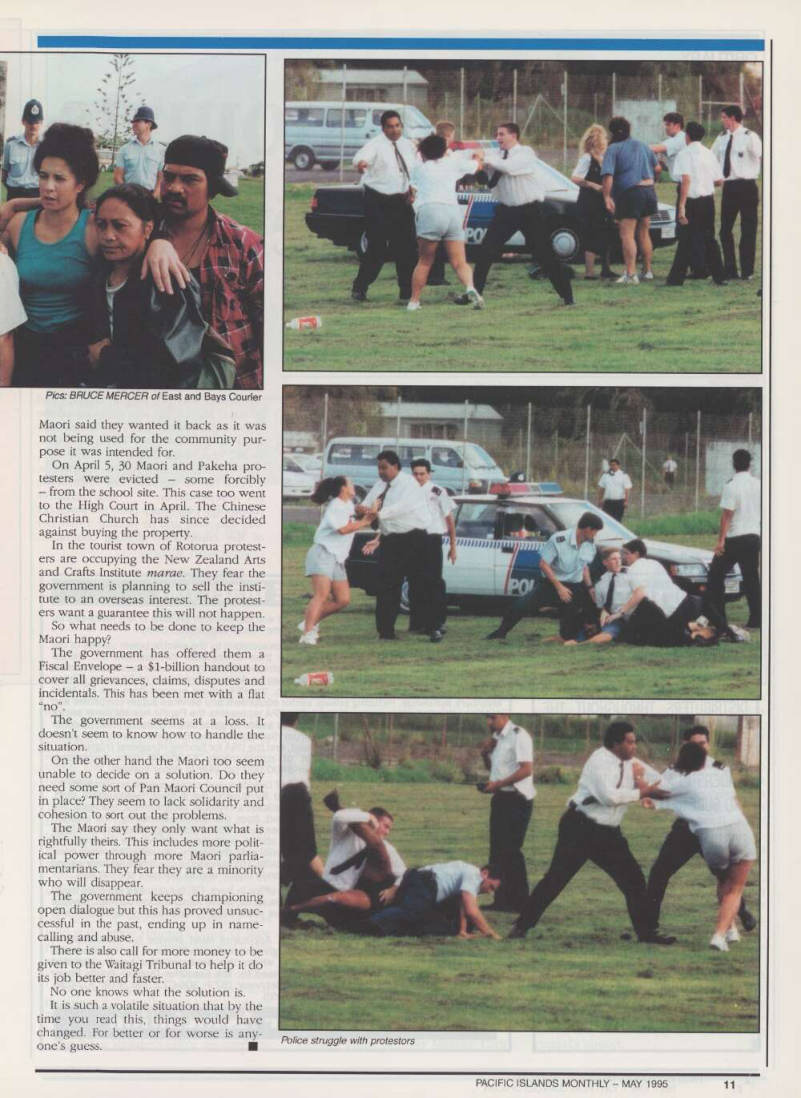
There were a few angry scenes in Wanganui and police reinforcements were called to the city. Maori set up a roadblock and smashed windows of two cars which tried to drive through the blockade. There were a few minor skir mishes, some disorderly behaviour and a number of fierce haka (Maori war dance). A handful of men were charged with disorderly conduct.
A lid was able to be kept on the situa tion, one that had the potential to boil over into nasty racial violence.
However, the fact that the Maori ignored the law and stayed on the land remains a sore point. The government seems perplexed as it tries to tackle a del icate situation which, if not handled cor rectly, could turn into the worst conflict between Maori and Pakeha in recent times - one that would make Bastion Point look like a school-yard scuffle.
In 1978 Maori activists were kicked off land at Bastion Point after a 506-day cam paign. They were forced off by 600 police and servicemen; 222 protesters were arrested and many were convicted of wil ful trespass.
Nine years later the Waitagi Tribunal ruled that Bastion Point be returned to the Ngati Whatua - the tribe evicted from their huts on the site in the 1950 s - who had watched as their homes were torched.
The tribunal ruled the area remain a public park. The government paid $3 mil lion in reparation “to inaugurate pro grammes necessary for the tribe’s rehabil itation”.
The Waitagi Tribunal is a body of 17 members, currently 60 percent Pakeha and 40 percent Maori, set up to rule on land claims. However, the tribunal is act ing as a catalyst for some of the current
unrest and land claims.
Some Maori say they have given the tri bunal 10 years but it has failed to pro duce the desired results.
The tribunal is under tremendous pres sure. It has over 400 land claim cases pending and few resources. A single case can take years to complete and may require substantial specialist research - all of which cost money. The tribunal is con tinually asking for more funds from the government to help it operate effectively.
Also stirring up the Maori is a younger, more radical, better educated (in Maori history) element which is taking control and playing on the emotions of the younger Maori. The elders seem to be losing power.
The Maori, who make up 12 to 13 percent of the population, have an unemployment rate three times the national aver age - one in four are unemployment.
They also have lower education than the national average and 75 percent earn less
than NZ$2O,OOO.
Out of this, the unrest, the protests and the petty violence come easily. They are a race who feel they have legitimate grievances.
One only has to look at the history of land in Auckland to understand these grievances. Thousands of acres of prime land were bought by Pakeha for a pit tance - blankets, tobacco and a few hun dred pounds - and sold for big profits.
One current dispute in Auckland is over the site of the old Tamaki Girls College. The dispute over the 4.7 ha site goes back a few years. Maori say they gave the land to the Anglican Church as a gift for educational purposes in the 1840 s. The church sold it to the govern ment in 1947 and it was given to the Education Department.
The government wanted to sell the land to the Chinese Christian Church. The
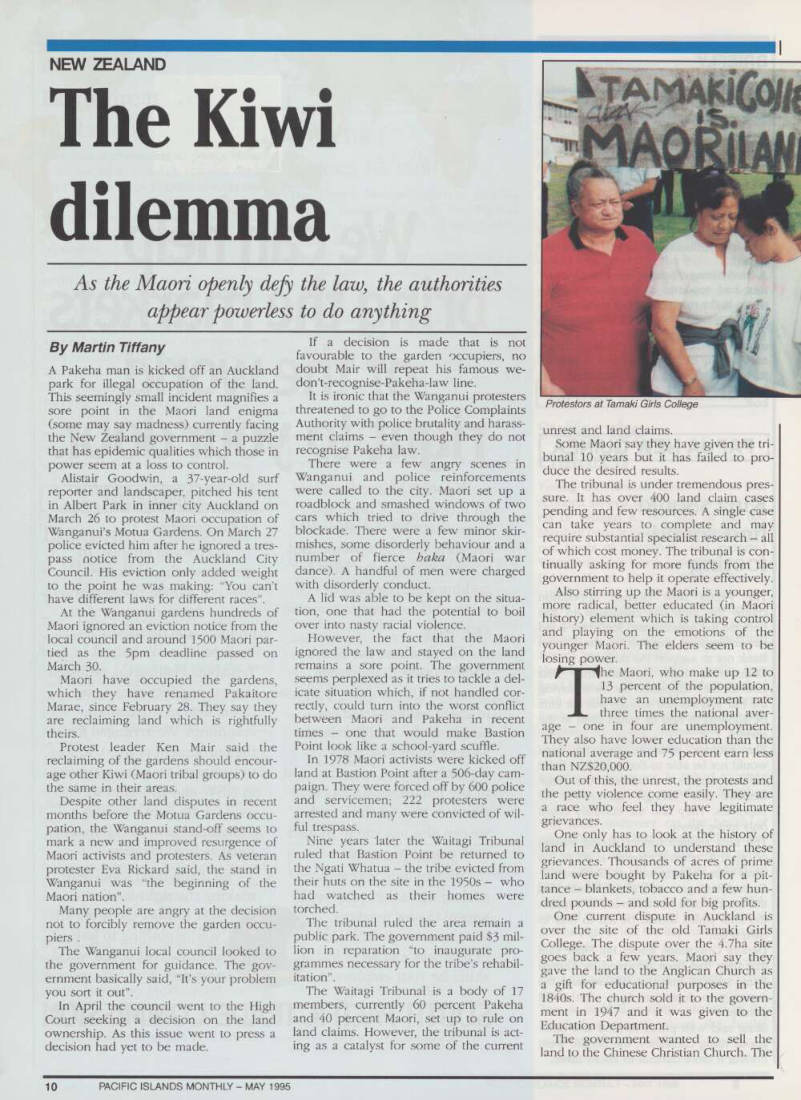
Protestors at Tamaki Girls College
Maori said they wanted it back as it was not being used for the community pur pose it was intended for.
On April 5, 30 Maori and Pakeha pro testers were evicted - some forcibly - from the school site. This case too went to the High Court in April. The Chinese Christian Church has since decided against buying the property.
In the tourist town of Rotorua protest ers are occupying the New Zealand Arts and Crafts Institute marae. They fear the government is planning to sell the insti tute to an overseas interest. The protest ers want a guarantee this will not happen.
So what needs to be done to keep the
Maori happy?
The government has offered them a Fiscal Envelope - a $ 1-billion handout to cover all grievances, claims, disputes and incidentals. This has been met with a flat “no”.
The government seems at a loss. It doesn’t seem to know how to handle the situation.
On the other hand the Maori too seem unable to decide on a solution. Do they need some sort of Pan Maori Council put in place? They seem to lack solidarity and cohesion to sort out the problems.
The Maori say they only want what is rightfully theirs. This includes more polit ical power through more Maori parlia mentarians. They fear they are a minority who will disappear.
The government keeps championing
open dialogue but this has proved unsuc cessful in the past, ending up in name calling and abuse.
There is also call for more money to be given to the Waitagi Tribunal to help it do its job better and faster.
No one knows what the solution is.
It is such a volatile situation that by the time you read this, things would have changed. For better or for worse is any one’s guess. ■
Pics: BRUCE MERCER of East and Bays Courier
Police struggle with protestors
a leader

Obituary
A nation mourns a leader
Vanuatu pays homage to former President Fred Timakata
By Patrick Decloitre
Vanuatu’s second President and a founding father of the island state, Fred Timakata, died at his Port Vila home, aged 59, on March 21. The nation’s politicians paid homage to him at a cere mony which was the biggest ever for a statesmen. Vanuatu’s dignitaries, tradi tional chiefs, ministers, members of Opposition and numerous ordinary folk recognised Timakata’s contribution to the
island’s history.
Timakata was one of the early leaders of the Vanuaaku Pati. He was Vanuatu’s president from 1989 to 1994.
A former Presbyterian pastor and tradi tional chief, Timakata (who comes from Emae Island in Vanuatu) had earlier been a deputy Prime Minister and Minister of Home Affairs in Vanuatu’s first govern ment after independence, from 1980 to 1983.
He had also held the positions of
Speaker of Parliament from 1983 to 1987 and Minister of Health from 1987 to 1989.
He was Chancellor of the University of the South Pacific from 1992 to 1993.
His term as head of state was marked by his strong stand to uphold the consti tution and his insistence on maintaining a code of conduct among leaders.
Timakata was not only a religious and political leader, he was also one of the highest traditional chiefs of Vanuatu. He received his customary name, Timakata, in 1975 on Emae Island. The same year, the Council of Chiefs, the Shepherds, elected him to become their voice in the pre-independence Representative Assembly. Two years later, the assembly was dissolved and he became a member of the constitution drafting committee,
which paved the way for New Hebrides to become Vanuatu.
Timakata’s health problems first emerged two years ago when he had to go to New Zealand for medical treat ment. The nature of his illness was not revealed then.
For most of February, this year, Timakata stayed in Port Vila’s Central Hospital for blood transfusions, a hospi tal source said. It was decided he should go to New Zealand but blood samples sent there revealed it would be of no use.
Sources at VCH said Timakata had been suffering from leukaemia.
Soon after the official announcement of his death, an emergency meeting was held at the Prime Minister’s office of State House officials, the Prime Minister’s first secretary, the Protocol Section, the Police and the Attorney-General’s office.
The matter needed serious considera tion since this was the first time a former President had died and a state ceremony had to be organised.
The Prime Minister’s office declared the
day of the funeral, March 23, a “national day of mourning” and a public holiday.
Flags throughout Vanuatu were flown at half-mast for six days and the national radio changed its normal programs (except for news and community mes sages), broadcasting classical music most of the time.
The ceremony, attended by state digni taries, government ministers, traditional chiefs and heads of foreign missions, was held in the traditional chiefs meeting place, the Nakamal.
A traditional ceremony was held where pigs, mats and kava roots were offered by the paramount chief, Noel Mariasua, to the family of the deceased leader.
The Vanuatu Presbyterian Church, of which Timakata was a pastor, also held a memorial service in the capital before the body was flown to Emae, where it was buried the next day.
At the airport, the para-military Vanuatu Mobile Force formed a guard of honour as the body took off to Emae.
Vanuatu Prime Minister Maxime Carlot,
who was heading a one-week trade del egation in Australia at the time, sent a condolence message to Timakata’s wife, referring to him as a “well known and highly respected” leader.
During the church service, acting Prime Minister Sethy Regevanu said Timakata stood out as an example in Vanuatu’s young history because he was “a man of principle, a statesman who respected and upheld the rule of law”.
Leader of Opposition Donald Kalpokas saw in Timakata a “true statesman” one of the founding fathers of Vanuatu when, as a moderator in the Presbyterian Church of the New Hebrides, he expressed his convictions for indigenous
self-government and independence from
the colonial French-British condomini um.
The people also showed they felt Timakata’s death was a loss for the coun try - thousands of them attended the funeral ceremonies in Port Vila, then fol lowed the coffin along the road to the capital’s airport. ■
Traditional cer emony at the chiefs Nakamal (above) and Timakata as President in 1989
Advertisements & other items, p. 12 (1 item)
Distributers Required
LEADING AUSTRALIAN SUNCARE
COMPANY, ALOE UP, IS INTERESTED
IN HEARING FROM ESTABLISHED
DISTRIBUTERS THROUGHOUT THE
PACinC ISLANDS. ALOE UP SUNCARE
PRODUCTS ARE THE MARKET
LEADERS IN AUSTRALIA IN SPORTS
AND SURF RETAIL
EXISTING DISTRIBUTION THROUGH
PHARMACY, SUPERMARKETS, RE-
SORTS AND KIOSKS WOULD BE A
DECIDED ADVANTAGE.
MORE INFO CONTACT:
GEOFF TOBIN
FAX 61-66-877070 AUSTRALIA.
EXECUTIVE DIRECTOR
Applications are invited from suitably qualified and experienced persons of any nationality for the position of Executive Director of the Pacific Power Association (PPA) The PPA was established in 1992 as a trade association by the electric power utilities of the Pacific islands region in order to facilitate their co-operative development and mutual assistance in technical advancement, administrative efficiency, customer service and market development. The Association today comprises an Active membership of 23 power utilities across the Pacific islands region. In addition, the PPA enjoys support-from over 50 Allied members world-wide, including private sector equipment and services supply companies and public sector and research institutions. The PPA represents the Pacific Islands power sector at international fora, and interacts closely with a wide range of bilateral and multilateral donor organisations including UNDP, the Forum Secretariat, the European Union, the Asian Development Bank, Australia, New Zealand, and the USA for funding of regional programmes.
The PPA manages an annual budget of approximately $300,000 from membership contributions, supplemented by a further $400,000 per year in donor support.
The Executive Director reports to the Board of Directors and carries overall responsibility for managing the affairs of the Association and for supervising a small headquarters staff, supervising consultants, directing the Association’s regional programmes, managing the Association’s funds, and maintaining support from the donor community. The position demands skill in forging and maintaining, across some 75 member organisations and a large number of outside support institutions, a strong consensus behind the Association’s programme. This requires leadership, managerial skill, diplomacy, and excellent communication and analytical skills. In addition to these skills, the successful candidate will have a good understanding of the whole of the Pacific islands region and its peoples and cultures.
The position is based at the PPA headquarters office in Suva, Fiji, but requires extensive travel throughout the region. The appointment carries an attractive remuneration package, payable in US dollars. The appointment will be for three years initially, renewable on agreement with the Board.
Further information is available on request. Applicants must provide full information on education and career background and should give the names, addresses, and telephone/fax numbers of at least three referees with whom the applicant has been associated professionally. Applications should be addressed to: The Executive Director, Pacific Power Association, Private Mail Bag, Suva, Fiji. Telephone: (679) 306-022; Fax (679) 302-038.
Applications must be received by 15 May 1995.
Pacific Power Association
ADB undergoes
The Region
ADB undergoes a re-organisation
But its restructuring does not mean it is withdraw ing from the Pacific, assures the hank
By Patrick Decloitre
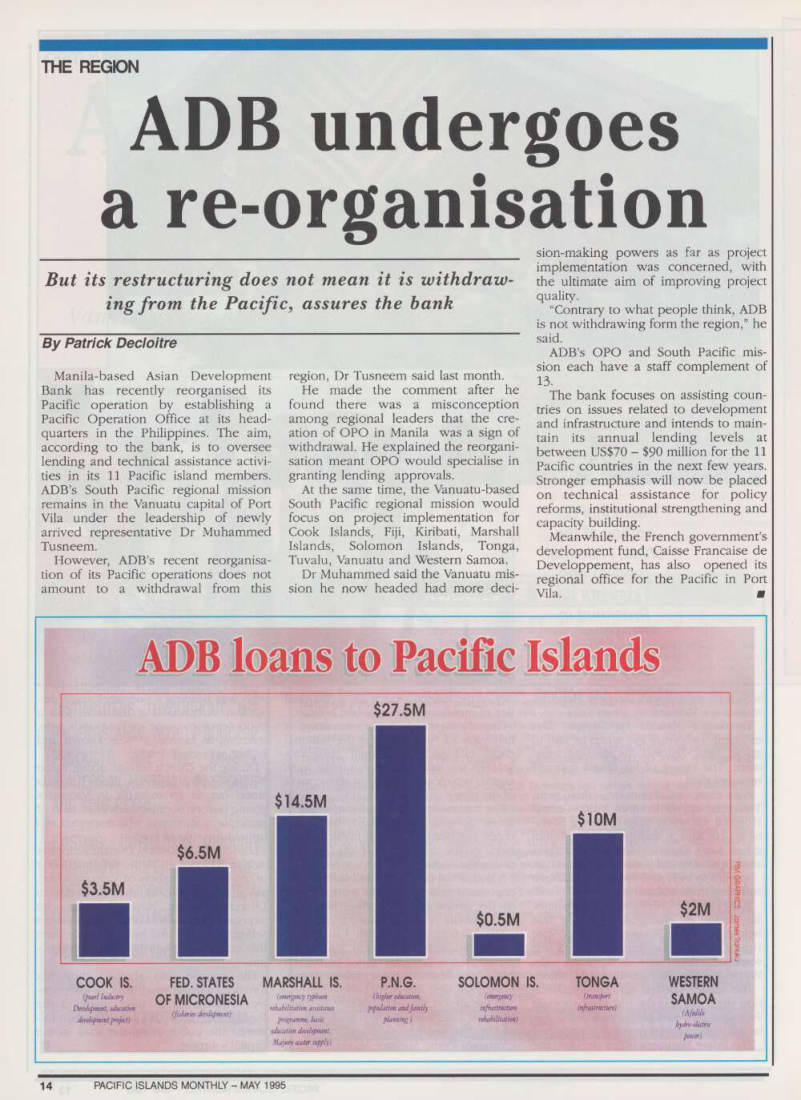
Manila-based Asian Development Bank has recently reorganised its Pacific operation by establishing a Pacific Operation Office at its head quarters in the Philippines. The aim, according to the bank, is to oversee lending and technical assistance activi ties in its 11 Pacific island members.
ADB’s South Pacific regional mission remains in the Vanuatu capital of Port Vila under the leadership of newly arrived representative Dr Muhammed Tusneem.
However, ADB’s recent reorganisa tion of its Pacific operations does not amount to a withdrawal from this
region, Dr Tusneem said last month.
He made the comment after he found there was a misconception among regional leaders that the cre ation of OPO in Manila was a sign of withdrawal. He explained the reorgani sation meant OPO would specialise in granting lending approvals.
At the same time, the Vanuatu-based South Pacific regional mission would focus on project implementation for Cook Islands, Fiji, Kiribati, Marshall Islands, Solomon Islands, Tonga, Tuvalu, Vanuatu and Western Samoa.
Dr Muhammed said the Vanuatu mis sion he now headed had more deci
sion-making powers as far as project implementation was concerned, with the ultimate aim of improving project quality.
“Contrary to what people think, ADB is not withdrawing form the region,” he said.
ADB’s OPO and South Pacific mis sion each have a staff complement of 13.
The bank focuses on assisting coun tries on issues related to development and infrastructure and intends to main tain its annual lending levels at between US$7O - $9O million for the 11 Pacific countries in the next few years.
Stronger emphasis will now be placed on technical assistance for policy reforms, institutional strengthening and capacity building.
Meanwhile, the French government’s development fund, Caisse Francaise de Developpement, has also opened its regional office for the Pacific in Port Vila. m
the investors?

Tourism
But where are the investors?
For an industry that is shoxving increases in demand and profits, there is a surprising lack
of interest from the private sector
By Roman Grynberg
It would be difficult to ask for more if you were running the Fiji tourism sector. From the outside the sector seems to be moving ahead quite nicely. Tourism arrivals are grow ing at what the Fiji Visitors Bureau pro jects will be a rate of six percent at the end of the century. In 1994, Fiji had 318,000 tourist arrivals, up from 278,000 in 1993. Total earnings from tourism were $419-6 million in 1994. If the FVB is to be believed then we shall
foreign exchange earnings of tourism leaking out for imported products for the same sector, the remainder is suffi ciently large.
But while the arrival statistics are booming, they mask a fundamental cri sis of confidence in the industry’s future. The loss of confidence is all the more surprising given the changes in the industry - from relying on the old low-income, Australian and New Zealand visitors to a new high-income, high-profit tourism from East Asia and North America.
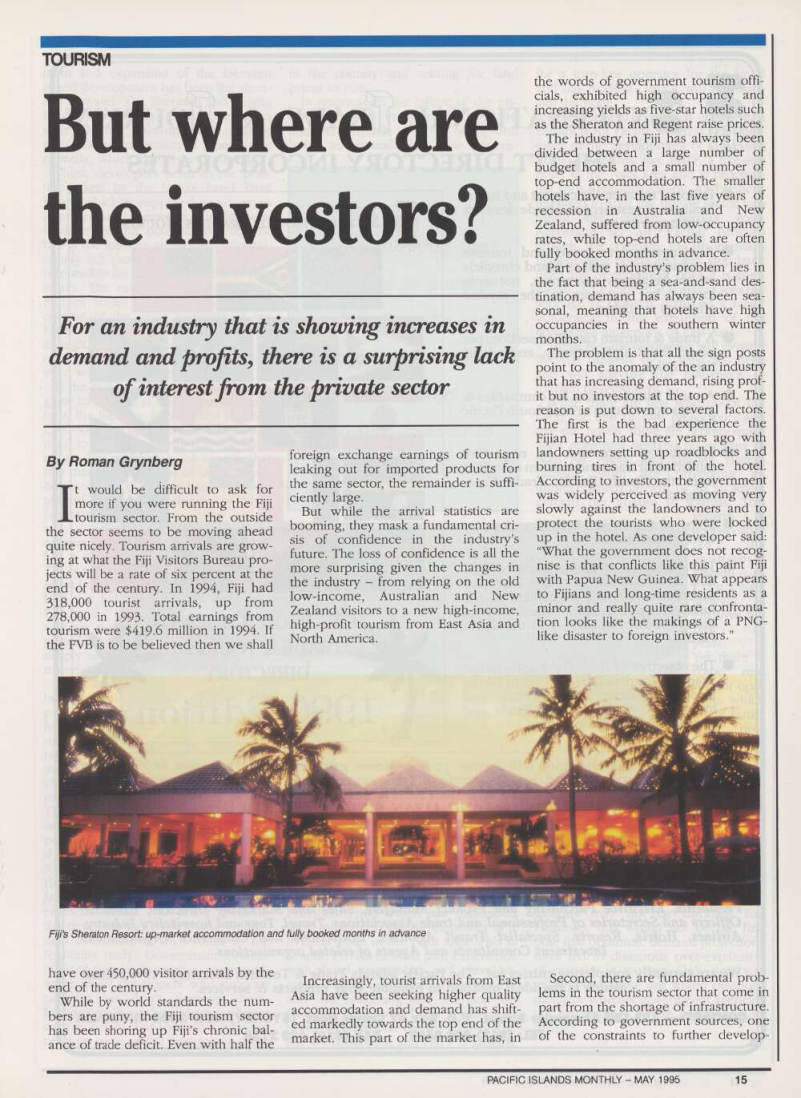
the words of government tourism offi cials, exhibited high occupancy and increasing yields as five-star hotels such as the Sheraton and Regent raise prices.
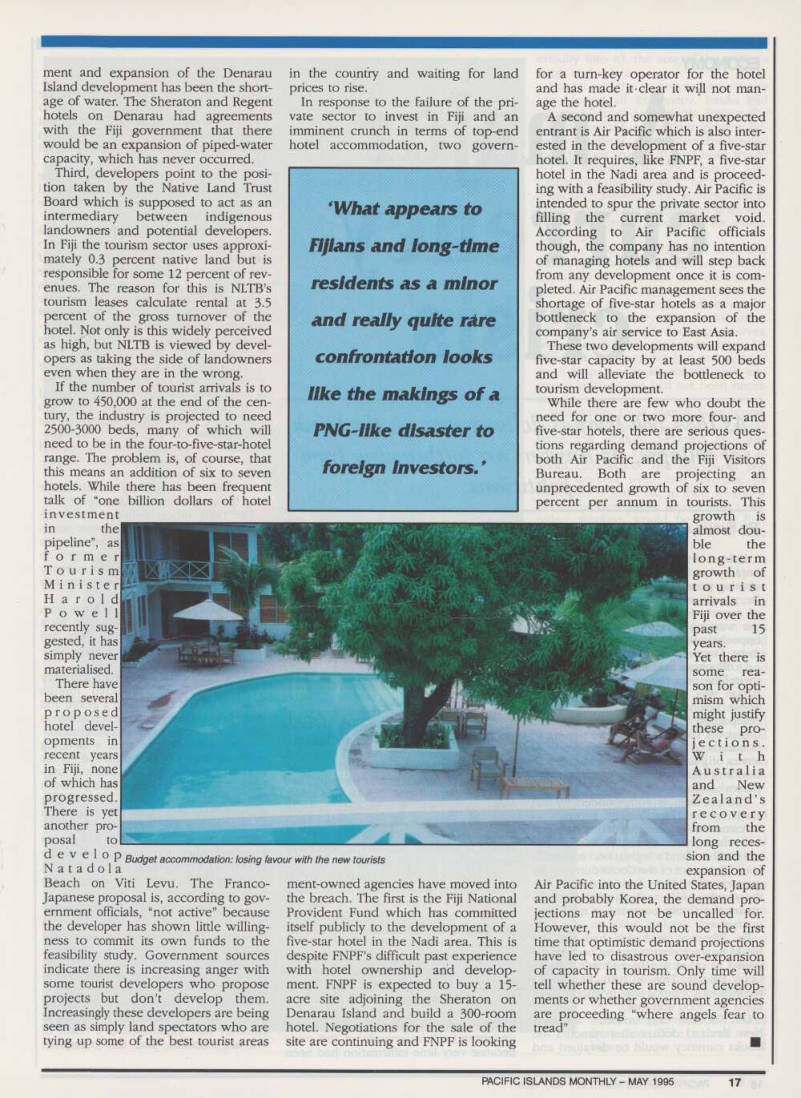
The industry in Fiji has always been divided between a large number of budget hotels and a small number of top-end accommodation. The smaller hotels have, in the last five years of recession in Australia and New Zealand, suffered from low-occupancy rates, while top-end hotels are often fully booked months in advance.
Part of the industry’s problem lies in the fact that being a sea-and-sand des tination, demand has always been sea sonal, meaning that hotels have high occupancies in the southern winter months.
The problem is that all the sign posts point to the anomaly of the an industry that has increasing demand, rising prof it but no investors at the top end. The reason is put down to several factors.
The first is the bad experience the Fijian FFotel had three years ago with landowners setting up roadblocks and burning tires in front of the hotel.
According to investors, the government was widely perceived as moving very slowly against the landowners and to protect the tourists who were locked up in the hotel. As one developer said: “What the government does not recog nise is that conflicts like this paint Fiji with Papua New Guinea. What appears to Fijians and long-time residents as a minor and really quite rare confronta tion looks like the makings of a PNG like disaster to foreign investors.”
have over 450,000 visitor arrivals by the end of the century.
While by world standards the num bers are puny, the Fiji tourism sector has been shoring up Fiji’s chronic bal ance of trade deficit. Even with half the
Increasingly, tourist arrivals from East
Asia have been seeking higher quality
accommodation and demand has shift ed markedly towards the top end of the market. This part of the market has, in
Second, there are fundamental prob lems in the tourism sector that come in part from the shortage of infrastructure.
According to government sources, one of the constraints to further develop
Fiji’s Sheraton Resort: up-market accommodation and fully booked months in advance
ment and expansion of the Denarau Island development has been the short age of water. The Sheraton and Regent hotels on Denarau had agreements with the Fiji government that there would be an expansion of piped-water capacity, which has never occurred.
Third, developers point to the posi tion taken by the Native Land Trust Board which is supposed to act as an intermediary between indigenous landowners and potential developers.
In Fiji the tourism sector uses approxi mately 0.3 percent native land but is responsible for some 12 percent of rev enues. The reason for this is NLTB’s tourism leases calculate rental at 3.5 percent of the gross turnover of the hotel. Not only is this widely perceived as high, but NLTB is viewed by devel opers as taking the side of landowners even when they are in the wrong.
If the number of tourist arrivals is to grow to 450,000 at the end of the cen tury, the industry is projected to need 2500-3000 beds, many of which will need to be in the four-to-five-star-hotel range. The problem is, of course, that this means an addition of six to seven hotels. While there has been frequent talk of “one billion dollars of hotel investment
in the I pipeline”, as former Tourism Minister Harold Powell recently sug gested, it has simply never materialised.
There have been several proposed hotel devel opments in recent years in Fiji, none of which has progressed.
There is yet another pro posal to
develop
Nata d o 1 a
Beach on Viti Levu. The Franco- Japanese proposal is, according to goveminent officials, “not active” because the developer has shown little willingness to commit its own funds to the feasibility study. Government sources indicate there is increasing anger with some tourist developers who propose projects but don’t develop them, Increasingly these developers are being seen as simply land spectators who are tying up some of the best tourist areas
in the country and waiting for land prices to rise.
In response to the failure of the private sector to invest in Fiji and an imminent crunch in terms of top-end hotel accommodation, two govern-
' What appears to
Fijians and long-time
residents as a minor and really quite rare confrontation looks like the makings of a PNG-like disaster to
foreign Investors
ment-owned agencies have moved into the breach. The first is the Fiji National Provident Fund which has committed itself publicly to the development of a five-star hotel in the Nadi area. This is despite FNPF’s difficult past experience with hotel ownership and develop ment. FNPF is expected to buy a 15acre site adjoining the Sheraton on Denarau Island and build a 300-room hotel. Negotiations for the sale of the site are continuing and FNPF is looking
for a turn-key operator for the hotel and has made it clear it will not man age the hotel.
A second and somewhat unexpected entrant is Air Pacific which is also inter ested in the development of a five-star hotel. It requires, like FNPF, a five-star hotel in the Nadi area and is proceed ing with a feasibility study. Air Pacific is intended to spur the private sector into filling the current market void.
According to Air Pacific officials though, the company has no intention of managing hotels and will step back from any development once it is com pleted. Air Pacific management sees the shortage of five-star hotels as a major bottleneck to the expansion of the company’s air service to East Asia.
These two developments will expand five-star capacity by at least 500 beds and will alleviate the bottleneck to tourism development.
While there are few who doubt the need for one or two more four- and five-star hotels, there are serious ques tions regarding demand projections of both Air Pacific and the Fiji Visitors Bureau. Both are projecting an unprecedented growth of six to seven percent per annum in tourists. This
growth is I almost dou- I ble the
I long-term
I growth of tourist I arrivals in I Fiji over the I past 15
i years.
Yet there is some rea son for opti- I mism which I might justify these pro jections.
With I Australia and New Zealand’s recovery from the long reces sion and the expansion of
Air Pacific into the United States, Japan and probably Korea, the demand pro jections may not be uncalled for.
However, this would not be the first time that optimistic demand projections have led to disastrous over-expansion of capacity in tourism. Only time will tell whether these are sound develop ments or whether government agencies are proceeding “where angels fear to tread”
Budget accommodation: losing favour with the new tourists
Advertisements & other items, p. 16 (1 item)
International iJrade & Tourism
X
THE ITT DIRECTORY INCORPORATES
• Editorial focus on the current and future business, investment and trade development opportunity. • A comprehensive travel and tourism documentary as well as island chronicle which heightens awareness, not only locally, but overseas to the myriad
offerings available.
• A trade & tourism classified section, per island listed alphabetically, and advertisers index. • A multi island section for companies & groups operating in several South Pacific l Islands. • Introductory forewards by respective ministries of trade and tourism as well as from the South Pacific Trade Commission. • Maps of the Pacific Islands and major town street directories. • The management and agencies of ITT INC have had over 25 years Directory
experience covering all aspects of the
International Directory Industry in
Europe, USA, Australia, and the South Pacific. • The objective of the 'The Pacific Island Trade & Tourism Directory' is to be the most innovative, cost effective and informative guide covering Trade and Tourism in the Pacific Region.
International srade & Tourism mm mnm mnm mm + ★ ★ *
THE PACIFIC ISLAND
TRADE &TOIIRIS
DIRECTORY
1996 Edition
Advertising in this Directory will ensure your business gains maximum exposure to companies (manufacturing, export-import, business services), Trade organisations. Travel and Tour operators and Government Departments throughout all the PACIFIC ISLANDS as well as in the U.K, FRANCE, GERMANY, AUSTRALIA, NEW ZEALAND, JAPAN, SINGAPORE and the USA.
THIS NEW EDITION WILL CARRY YOUR
PROMOTIONAL MESSAGE DIRECTLY TO CORPORATE:
Presidents, Executive Purchasing and Product Managers, Sales and Marketing Directors, Executive Officers and Secretaries of Professional and trade Associations. Travel, Tour and hospitality Industry, Airlines, Hotels, Resorts. Specialist Travel Agencies, Exhibitions and Conference Organisations Investment Consultants ana Agents of related organisations.
We are currently completing entries for "The Pacific Islands Trade & Tourism Directory" 1996 Edition which is the ideal medium to promote your products & services.
CONTACT.- 133-135 Alexander Street P.O. Box 57 Crows Nest (SYDNEY) NSW 2065 AUSTRALIA TEL: (612) 906 6487 FAX (612) 439 2738
A major
Economy
currency crisis
As the Cook Islands dollar teeters on the brink of collapse, no answers are forthcoming from politicians
By Yunus Rashid
Unless drastic financial policies are implemented to arrest the declining pur chasing power of the Cook Islands dol lar, people would start feeling the pinch of poverty in about a month. This was the warning given by one of the five opposition members of the Cooks parlia ment, Doctor Robert Woonton.
Dr Woonton said investment had been dwindling over the months as the small nation was hit by damaging scandals.
These involved tax evasions by several companies which allegedly obtained bogus tax certificates and the signing of hundreds of millions of dollars worth of letters of guarantee by Prime Minister Sir Geoffrey Henry, allowing overseas com panies to raise loans.
The problem is compounded by the drain on the New Zealand currency as investors move their funds overseas for fear the Cooks currency would lose value. The island’s legislation requires at least 50 percent of the Cooks currency be guaranteed by New Zealand dollars. But the exodus of New Zealand dollars has meant the Cooks currency is no longer guaranteed.
Dr Woonton said this had led the banks to place restrictions on bank drafts issued to cover purchases made outside Cook Islands. This, in turn, has led to businesses not being able to import basic items like food and fuel.
Dr Woonton said investors withheld New Zealand dollars after rumours the Cooks currency would be devalued and
as the economy continued its downhill slide.
However, latest reports from the island state that Sir Geoffrey has announced the New Zealand money will not replace the Cooks currency. And to boost confidence in the island’s money, the government will provide hundred-percent backing for the Cook’s currency using New Zealand dollars.
But Dr Woonton says the currency cri sis is a small part of the economic woes.
“The economy has gone down the drain plug,” he said.
He blamed Sir Geoffrey’s letters of guarantee and the tax evasion scandals for the crisis. Media reports had quoted Sir Geoffrey as saying he had cancelled the letters of guarantee and that he believed the letters would have profited the Cooks by millions. But he later told a news conference, “For as long as I can find extra revenue for the people of this country ... for as long as that revenue source is available outside the pockets of our people, I will go for it.”
Dr Woonton said the opposition has been seeking answers from Sir Geoffrey but had not received any. He said the Cooks’ overseas debt was NZ$25O mil lion but the country could not service the
borrowings.
To deal with the problem, the govern ment has plans which include reducing civil service working days from five to four and giving members of parliament pay cuts.
Dr Woonton said many people did not understand the magnitude of the crisis because very little information had been
given to them by the government. He warned the economy could be close to
collapse. Some people had already lost
jobs and were unable to meet their loan repayments and honour other financial
obligations.
Dr Woonton said a leadership change was possible and the Opposition would vote against Sir Geoffrey should there be a move to oust him.
However, his version of the crisis is disputed by a senior bank officer who asked not to be named. The source said the media had exaggerated the currency crisis. While it was true the country was using its foreign reserves to service some overseas debts, incoming New Zealand currency helped compensate for the out going currency and only the short-falls were serviced by foreign reserves.
The source said it was not true people would start starving soon because priori ty would be given to paying essential services debts before less important ones. And, to restore confidence in the non-tradable Cooks currency, the gov ernment has increased the New Zealand currency guarantee from 50 to 80 per cent, the source said.
So when and why did the Cooks dollar lose the confidence it had enjoyed?
The bank officer believes confidence eroded with the public disclosure sever al months ago that government was not honouring the legislation requiring it to hold 50 percent New Zealand currency in reserves to back total Cooks currency in circulation.
He added the first drain of funds from the Cooks in November followed by a second in early March this year had resulted in foreign reserves being “dan
gerously low”.
Based on the current trend in currency flow, the source predicted foreign reserves should last at least a month and should remain steady if the restriction on cash transfers overseas was adhered to.
Investor confidence took a battering when the letters of guarantee and the tax evasion scandals became public knowl edge. “What has happened is that Cooks has lost its reputation as a fair trading ground and this has not helped in improving the already tarnished reputa tion of our economy. The slump was expected after the massive economic growth we experienced one year ago but the scandals have made it worse,” the bank source said.
“The Cooks does not have a healthy economy and investors know this. It is now up to the government to boost con fidence by giving economic packages, tax concessions and related incentives, and clamp down on government expen diture.”
The island’s chief economist, Edward Drollet, agreed confidence in the Cooks currency had diminished as a result of the tax scandals (and the subsequent
enquiry into it), the size of the nation’s debts and rumours.
Drollet said that to prevent the country from losing all its money, banks had imposed exchange controls against the repatriation of funds. And to prevent liq uidity problems, the Reserve Bank ruled that cheques written in the Cooks would not be honoured in New Zealand. This means all transfers have to be done elec tronically, allowing the government to keep a tab on the money that goes out.
Remittance can be made only for essen tial services.
Drollet said the rumours of food and other supplies running out were false. He explained that food flow into the country had slowed down because payments were made on the baqis of money com ing into the country. The banks, in an effort to control their overseas reserves, were operating on a day-to-day basis. He added the government had not stepped in to help the banks control cash sur pluses because this had not been neces sary.
Meanwhile, Cook Islands News report ed the Public Service Commission would retire 156 workers between May and December with a payout amounting to about U 55650,000. The newspaper said these workers were long overdue for retirement - some are in their seventies.
Under the new public service policy, the oldest workers would be retired first, then those who have turned 60 or have completed 46 years of service.
The newspaper quoted Public Service commissioner Pae Puna as saying those affected already had income from three sources: old-age pension, superannua tion and their salaries.
Puna said when the 156 retirements were completed, the commission would begin enforcing the 60-year age and 40year service retirement regulation. And the remaining civil servants face shorter working hours.
The Opposition Alliance Party has crit
icised this plan, saying it would adversely affect the lowly paid civil servants. They have in turn come up with a plan which they say would be better than slashing working hours.
The plan includes: • Reducing all ministerial and MP salaries by 25 percent. • Stopping all overseas travel and junkets on first and busi ness classes. • Stopping tax-free allowances for the elite public servants. • Taking no more dance teams on travel junkets. • Switching to the New Zealand currency immediately. • Stopping the Cook Islands national constitution festival for 1995 and other “money-wast ing” festivals. • Reducing the size of Cabinet from nine to five or three mem bers. ■
Sir Geoffrey Henry: blamed for the economic crisis
The seat of power: rocked by financial scandals
makes progress

Education
Law unit makes progress
The University of the South Pacific’s decentrali sation policy takes shape in Vanuatu
By Patrick Decloitre
„ , . . , The foundation stone for the University of the South Pacifics decen tralised law school in the Vanuatu cap ita o on la was ai in . arc . e project is funded by the government of feSV a,” 8 “ mterest - free loan of US$5.B million.
The unit is situated on the existing USP campus in Vanuatu and once com pleted, in September 1996, will have the capacity to accommodate 180
boarding students.
At the official foundation laying cere mony, attended by Prime Minister Maxim Carlot, Education Minister Remain Batick, USP’s pro-Vice Chancellor Asesela Ravuvu, Chinese Ambassador Zhan Daode and govern ment and diplomatic officials, the Vanuatu government stressed the importance of this law unit and its aim to make it a bilingual (French and English) one.
The same day, minutes before the foundation stone was laid and a com
memorative plaque unveiled, Vanuatu padiament had ratified a treaty of tech nical and economic co-operation with China, paving the way for the project.
Carlot said he was considering plans to amend Vanuatu’s Immigration laws to allow USP students to enter the island state with a special visa. He stressed the importance of an institu tion such as the USP, saying “half the region’s leaders have at different times attended courses at USP”.
Ravuvu said the project was part of USP’s decentralisation policy, after its first Law programme, involving sub degree courses, was established almost 10 years ago. The new project will offer degree-level courses.
A regional workshop in 1992 saw lawyers and experts from the region draft a new programme for the degree course, taking into account European style law and traditional and customary principles.
The Vanuatu aims to have the com plex completed by January 1996 - in time to welcome the first students for the new school year. The complex includes a library, classrooms, a labora tory, dormitories and dining facilities.
The library has been aptly named Sarovanua, meaning island coming together. ■
Advertisements & other items, p. 20 (1 item)
Ship Constructors Limited
P.O. BOX 24 WHANGAREI
FRASER STREET, WHANGAREI NEW ZEALAND
Telephone (649) 438 2219 Fax (649) 438 7845 i •111 111 m 1 1 i 1 - 7T T ' Ship Constructors of New Zealand Builders of quality vessels.
Specialising in design and build of steel vessels up to 110 metres LOA and aluminium vessels up to 30 metres LOA to owners specifications and International Classification Requirements.
Pictured is the recently completed ‘Sea-Tow 4’, a 97 metre bulk cargo barge delivered to ‘Sea Tow Ltd’.
For more information, competitive prices and delivery dates, contact Kelvin Hardie.
Aid funds and
Opinion
Aid funds and how they work
As greater accountability is demanded of donor coun tries, developing nations are told to make do with what they have
One of the first questions asked of me on my return from the recent World Social Summit in Copenhagen, Denmark, was: “Did we get anything out of it?”
In a way, it was a difficult question to answer because, for us in the Pacific, unless the result is immediate and tangi ble, it is of no value.
Reports from the summit stated that developing countries received about US$l.4 trillion in official development assistance (ODA) in the last 35 years.
Considering the world’s population is only 5.5 billion that seems more than enough to go around.
But Pacific countries, whose participa tion was co-ordinated by the Noumea based South Pacific Commission with technical support from the South Pacific Forum Secretariat and the University of the South Pacific, learned something about aid assistance and why many eco nomic activities remain stagnant.
Statistics abound on the fact that there is little to show for (in terms of economic activities) the huge injection of funds by donors. In the case of Pacific island coun tries, aid flow in the last 10 years did lit tle to fire up economic activities in the region. According to reports by the World Bank and the International Monetary Fund, Pacific economic activity grew by a mere 0.1 percent in that period. By com parison, other island regions of the world recorded much higher growth rates. To encourage economic growth, experts insist some painful structural adjustments are in order.
Critics have shot back, saying austerity measures promoted by the World Bank need to be overhauled and urged the UN to ensure the bank was accountable for its policies. One of the critics, British aid organisation Christian Aid, told the sum mit the bank’s structural adjustment poli cies “had deepened poverty in Zambia and Zimbabwe - the countries once con
sidered models for African development”.
For the Pacific, the issue of aid and its implementation raises more questions than it answers. For instance, where was all the money spent? Why did the “large injection” of and funds fail to produce the goods? And, most importantly, is there a need for change?
Where did the US$l.4 trillion given by donors in ODA over the last 35 years go?
The Pacific did not receive all this money.
But, as developing countries, we did get some of it. Just how much no one knows.
According to Terra Viva, an indepen dent newspaper which publishes at major UN conferences, ODA is not working because much of the aid funds has ended up back in the hands of donors. For instance, a study in Bangladesh found 75 percent of aid since independence 25 years ago went back to pay for experts, consultants and equipment from donor countries.
Other studies have established that some of the bigger aid donors to the Pacific follow a similar pattern in distrib uting their ODA, Terra Viva said.
In the case of one country, 65 percent of its aid assistance in 1992 was spent in the donor country. Only 35 percent left the shores of this donor, the newspaper said.
In another case, a donor spent 90 per cent of its aid money on the usual ele ments - experts, consultants and equip ment at home. If at all, only 10 percent of total funds got to the recipient country.
According to Western Samoa’s ambas sador to the United Nations, His Excellency Neroni Slade, “Well over 90 percent of this money was spent on for eign consultants who go to developing countries in the name of national capaci ty building,” he told last year’s UN Global Conference on the Sustainable Development of Small Island Developing States in Barbados.
So where does the future of the region’s small island states lie? Is it in global trad-
ing arrangements being administered by the World Trade Organisation? Or is it in more aid? Debates on these and related questions will probably go on forever.
As part of its mandate, the South Pacific Forum Secretariat is pursuing “strength ened linkages” with external trading blocs and others within the Pacific Rim. It is hoped that through this, the long-term beneficiaries will be the people of the Pacific.
For now, however, the reality is that the official development assistance barometer will continue its downward slide as tax payers demand more accountability from their governments on how their tax dollar is being spent. One thing is clear. Dogged by donor fatigue, they have made it clear that no more new or additional resources would be coming. Instead, developing countries have been told to make do with the level of aid they are receiving now.
Nowhere has this message been clearer than in the outcomes of UN-sponsored conferences such as the Earth Summit in Rio De Janeiro in 1992, the Global Conference on Sustainable Development of Small Island Developing States in Barbados, the UN Population and Development Conference in Cairo and the UN World Summit on Social Development in Copenhagen this year.
The situation facing many developing countries is likely to worsen as a result of the failure of the developed world to live up to pledges they made at the Earth Summit. There, the richest, market-orient ed countries pledged to provide 0.7 per cent of their Gross National Product in aid to developing countries.
According to UN secretary general Dr Bhoutros Bhoutros Ghali, only four - Norway, Sweden, Denmark and the Netherlands - have met or exceeded this target. Others have fallen behind.
Increases in official development aid from countries such as Japan had been offset by decreases from others. ■
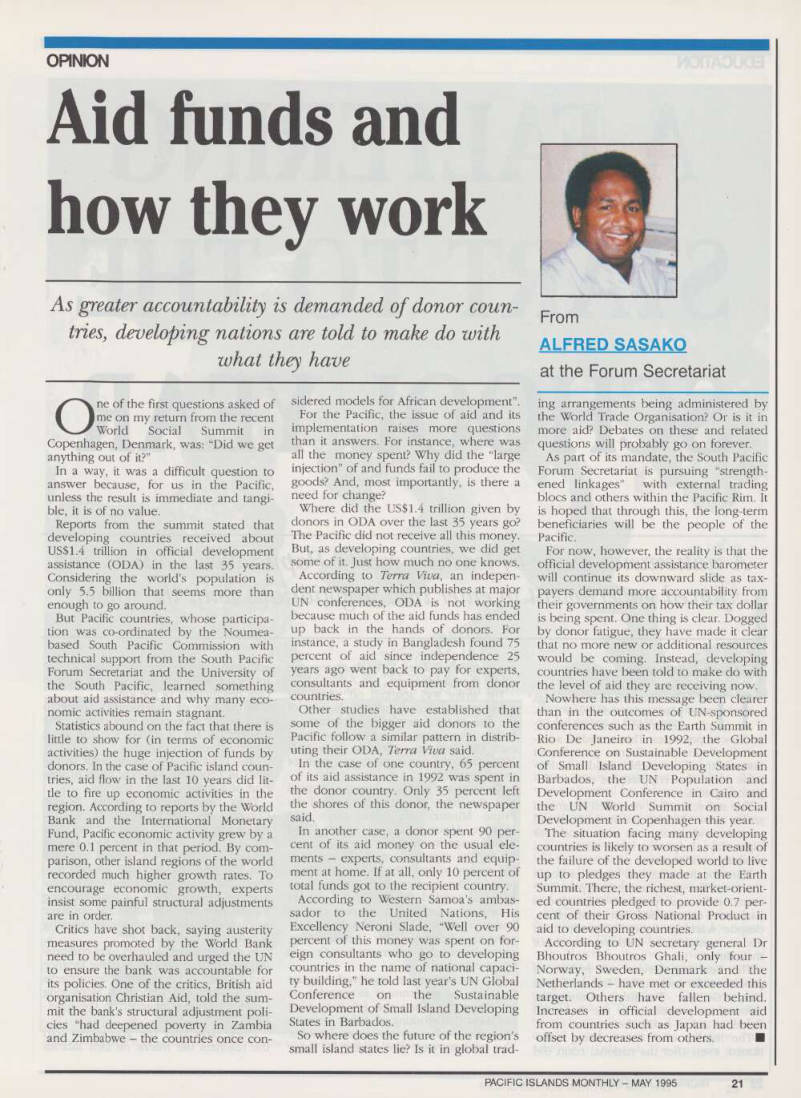
From
Alfred Sasako
at the Forum Secretariat
A Faltering

Education
Start To The
School Year
A nationwide strike by teachers rocked Papua New Guinea and forced government to enter into negotiations with the union
By Maureen Gerewa
History has shown that uprisings take place when ordinary peo ple cannot deal with economic and social pressures. This served as a les son for Papua New Guinea government last month when teachers held a nation wide strike that crippled the entire edu cation system.
The strike, the first ever well organised strike, saw 18,000 teachers from all schools and institutions stop work for eight days in protest over salaries and
working conditions.
Plans for the strike had begun earlier in the year. The government had paid little attention because previous strike threats had never materialised. But on March 21, despite warnings from the government and its agencies, the teachers carried out their threat.
The Teaching Service Act makes no provisions for such strikes. But the Papua New Guinea Teachers Association referred to provisions in the Industrial Relations Act to justify their action.
The legality of it is still being ques tioned, even after the national court did
not order them back to work as request ed by the government.
The strike was sparked off when the government failed to inform teachers of the fate of their new wage structure, as public sector wage increases were ruled out. The structure, effective from mid -1994, was the result of three years of tough battling.
The country was in economic turmoil and the new government, headed by Prime Minister Sir Julius Chan and Finance Minister Chris Haiveta, had frozen wage increases for the public sec tor for the year because it did not have the money to pay. The new wage struc ture for the teachers had, among other benefits, entitled them to a 3.3-percent annual pay rise, based on performance and productivity. It also included a five percent allowance for headmasters, retrenchment and retirement benefits and travel expenses.
The teachers were aggrieved because they saw the government as reneging on an agreement. They also felt they were the most hardworking of public servants who deserved every one those benefits.
The teachers were also asking for wage
adjustments based on the Consumer Price Index for 1994 and 1995 and the 12-per cent devaluation of the kina.
In the face of government’s failure to
provide an acceptable explanation, the
association felt a strike was the most effective weapon available.
The Teachers Association went to the polls in February and most voted in sup port of a strike.
Talks between the Teaching Service Commission, the government agency which employs the 18,000 teachers, and PNGTA were tense as the two parties refused to give in. TSC refused to enter tain the teachers demands for two rea sons: the government’s inability to pay and the Memorandum of Understanding for the new wage structure did not have a provision for negotiations seeking adjustments based on CPI.
In mid-February, a third party compris ing government officers from the Finance and Labour & Employment departments and Salaries and Conditions Monitoring Committee were engaged in the meet ings.
Three days later the government told the teachers the freeze on their salaries
and other benefits was lifted, and pay ments would begin from April 14. This was welcomed by the teachers and their union. But they still insisted on a CPI adjustment to offset the higher cost of liv ing.
The government offered a 1.5-percent CPI increase to all public servants, includ ing teachers who rejected it, saying the actual increase for 1994 was 4.8 percent and even higher for 1995.
PNGTA also wanted to insert a clause in the wage agreement providing for nego tiations for CPI-based increases.
On March 5, the two parties signed a Memorandum of Understanding which allowing CPI as part of the wage-fixation mechanism for teachers. The same day PNGTA asked TSC to begin negotiations for such an adjustment. TSC responded it would only negotiate before an Arbitration Tribunal. The teachers associ-
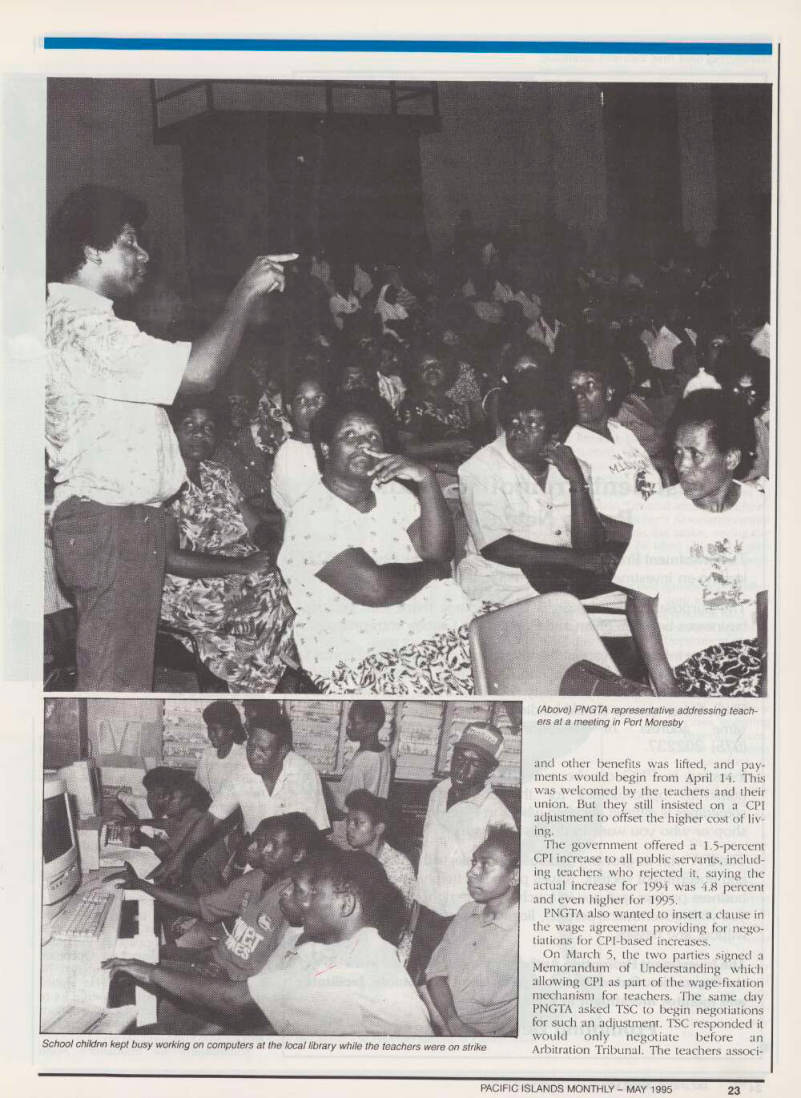
(Above) PNGTA representative addressing teach ers at a meeting in Port Moresby
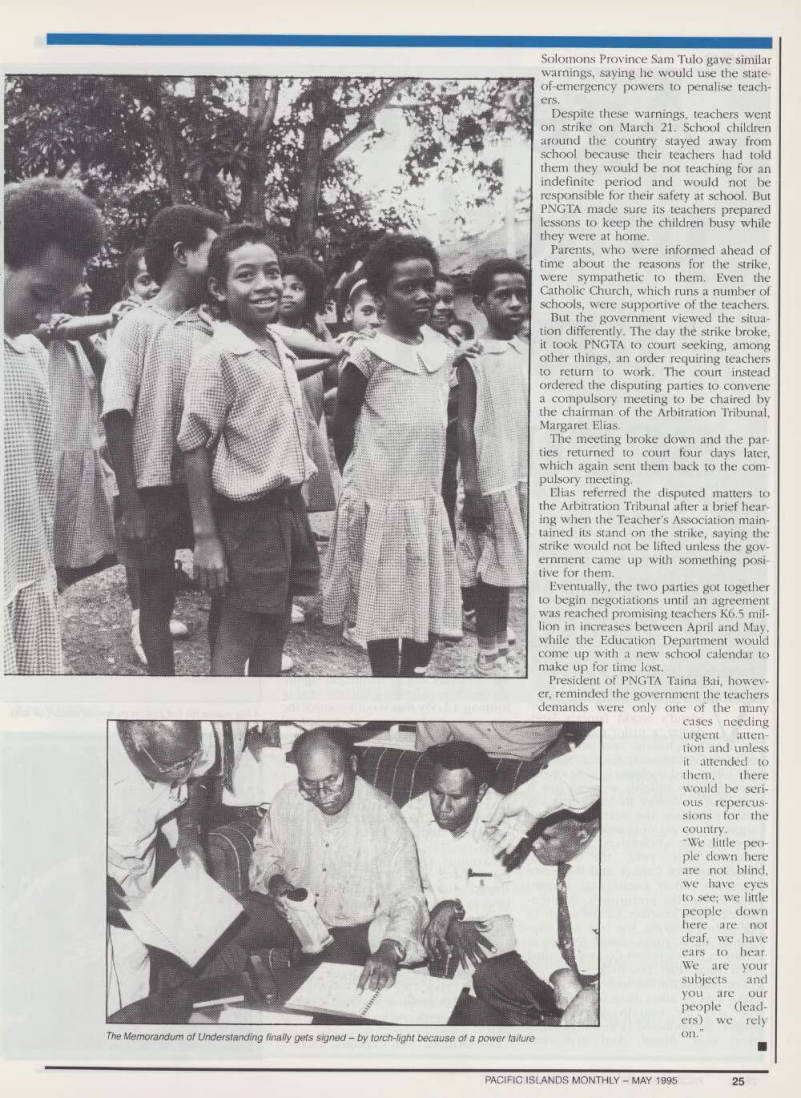
School childrn kept busy working on computers at the local library while the teachers were on strike
ation refused.
Education Minister Joseph Onguglo warned a strike would be illegal and those who did go on strike would either lose their salaries, be demoted or dis missed.
“My ministry, the department and the Teaching Service Commission (TSC) wish to make it clear that any sit-in striker will be deemed to be absent from duty and would result in loss of salary. Even a teacher sitting in his or her classroom but not actually teaching subjects cannot be taken as being on duty,” he said.
At the same time, the teachers in vol cano-devastated East New Britain were warned against participating in the strike.
Rabaul’s State of Emergency Operation Unit’s deputy controller threatened he would have them arrested. He argued that children had already missed a lot of classes because of the volcanic eruptions and should not be victimised further by a strike.
Administrator for trouble-torn North
Back to school at last
Solomons Province Sam Tulo gave similar warnings, saying he would use the state of-emergency powers to penalise teach ers.
Despite these warnings, teachers went on strike on March 21. School children around the country stayed away from school because their teachers had told them they would be not teaching for an indefinite period and would not be responsible for their safety at school. But PNGTA made sure its teachers prepared lessons to keep the children busy while they were at home.
Parents, who were informed ahead of time about the reasons for the strike, were sympathetic to them. Even the Catholic Church, which runs a number of schools, were supportive of the teachers.
But the government viewed the situa tion differently. The day thd strike broke, it took PNGTA to court seeking, among other things, an order requiring teachers to return to work. The court instead ordered the disputing parties to convene a compulsory meeting to be chaired by the chairman of the Arbitration Tribunal, Margaret Elias.
The meeting broke down and the par ties returned to court four days later, which again sent them back to the com pulsory meeting.
Elias referred the disputed matters to the Arbitration Tribunal after a brief hear ing when the Teacher’s Association main tained its stand on the strike, saying the strike would not be lifted unless the gov ernment came up with something posi tive for them.
Eventually, the two parties got together to begin negotiations until an agreement was reached promising teachers K 6.5 mil lion in increases between April and May, while the Education Department would come up with a new school calendar to make up for time lost.
President of PNGTA Taina Bai, howev er, reminded the government the teachers demands were only one of the many
cases needing
urgent atten tion and unless it attended to them, there would be seri ous repercus sions for the country.
"We little peo ple down here are not blind, we have eyes to see; we little
people down
here are not deaf, we have ears to hear.
We are your
subjects and
you are our
people (lead
ers) we rely on.”
The Memorandum of Understanding finally gets signed - by torch-light because of a power failure
Advertisements & other items, p. 24 (1 item)
soprc
VACANCY
Applications are invited from nationals of the South Pacific Applied Geoscience Commission (SOPAC) member countries for the position of TRAINING COORDINATOR in the SOPAC Secretariat, located in Suva, Fiji. The Training Coordinator is responsible for the development and implementation of the SOPAC Training Program which includes a Certificate Program in Earth Science and Marine Geology, Scholarship Scheme, Fellowship Scheme, Workshop and Seminars.
Qualification A post graduate geoscience degree and more than 5 years relevant experience is required.
Application Applications should be fully documented and include relevant details of qualifications and experience, and names of three referees. Further information may be obtained from the Administrative Assistant on Telephone (679) 381 377 and Fax (679) 370 040. Applications close on 30th June, 1995 and should be addressed to the Director, SOPAC Secretariat, Private Mail Bag, Suva, Fiji. loisoevi
IPA
Investment Promotion Authority
Papua New Guinea
The Investment Promotion Authority of Papua New Guinea will be leading an investment mission to Fiji in July.
The purpose of the mission is to encourage more joint venture businesses between Fijian and Papua New Guinea entrepreneurs.
For more information about the investment mission, please contact Ms Sabi Koregai, Investor and Promotion Services Division, Investment Promotion Authority, PO Box 5053, Boroko, NCD, PNG. Other queries should be directed to the director also on the same address or telephone (675) 217311, facsimile (675) 202237.
Investing in PNG can be a rewarding experience. There are numerous opportunities for the discerning investor and it sometimes is difficult deciding where in PNG you want to set up a shop or who you want to do business with.
The IPA with its growing database and links with the PNG private and government sectors, is well placed to help you find a suitable business partner, put you in touch with the right people and assist you with government permits, licences or approvals, quickly and without any hassles.
The Investment Promotion Authority was established in 1992 by the Papua New Guinea national parliament to promote, facilitate and monitor investment in PNG.
Promoting Better Business
Age-old
Focus
Age-old practice under scrutiny
Dispute mars Vanuatu s traditional practice of land diving and highlights ancient fears as a diver is seri
ously injured this season
By Patrick Decloitre
Vanuatu’s northern Pentecost island’s world famous land diving, a major tourist attrac tion, has this year become the centre of controversy for the Ministry of Culture and commercial tour opera tors. Ministry officials want to ban it this year to restore its traditional sig nificance while the tourism industry argues it has an obligation to fulfil to overseas tour wholesalers.
Earlier this year, the Vanuatu Department of Culture and Religion’s executive officer, Lazare Asal, banned land-diving, the precursor to Western style Bungee jumping, for the whole of 1995. In Pentecost, the ban was sup ported by a group, South Pentecost Tourism Development Council, headed by a local chief, Leo Bebe.
The reason for the ban, according to Asal, was to allow time to reorganise the way the land-diving ceremony, Nagol , is conducted before it resumes next year. Nagol, Asal says, has
become too commercialised and has subsequently lost its traditional signifi cance. “We are looking into the idea of forming a body that would control the ceremony and restore its traditional and customary value,” he said.
“The ceremony is not the jump alone, it involves a lot of customs and that’s what we’re trying to restore.”
But he admits that although meetings have been held for a number of years in Pentecost, “the issue of land-diving has been disputed for a number of years”.
According to custom, if a dispute exists over land-diving, then Nagol should not take place. If someone ignores this and goes ahead, then it is believed something bad will happen to him.
Asal also thinks there are too many commercial jumps each year. “This is now taking place every week-end in April and May. This has to be reduced.
Each village group sells about eight to 10 dives every year. That’s just too much,” he said.
Last October, Asal explains, another
A boy makes his first jump in the age-old custom of land
There is a legend on land-diving in Pentecost. It tells the story of a woman being chased by her angry husband. She finally comes up with the idea of luring him into a trap. She climbed a banyon tree and jumped from a branch after tying vines to her ankles. The husband jumped after her but without the sup port of vines and killed himself.
Later, the ceremony of jumping from tall platforms with only the support of vines emerged as a way of celebrating the planting of yam. A wooden tower with platforms at different heights is erected, one for each diver. The vines are attached to the platform and to the diver’s ankles. The diver is also responsible for his own jump. He has to carefully check his “equipment” because his life depends on it.
The time of the year when the custom is performed, in April and May, is also important because it is only in this period that the vines are elastic enough not to break under stress.
The platform from which each diver jumps break when the vines are fully extended, thus providing a tra ditional shock absorber. The diver’s head lightly brushes the ground at the bottom when the vine is stretched to its limit and taut. The jumper, usually quite stunned, is immediately carried into a frantic dance by other men waiting for him at the bottom of the tower.
Although the original story celebrates the victory of woman over man, man appears to have taken his revenge in this male-dominated society: no woman is allowed to perform the Nagol.
diving on Pentecost
meeting took place on the island and ended with the signing of an agree ment by 21 chiefs. Only three remained opposed to a review. The agreement outlined guidelines for the ceremony and gave hints on how money generated by tourists in entry fees should be distributed. “At the moment, the distribution is not fair.
There are one or two leaders who hap pen to use the money for their person al interests”. According to Asal, a diver would only receive about 200 to 300 vatu (between US$l.BO and US$2.7O) for a jump. “It’s nothing.”
The first land-dive for the season, in April, did take place on Pentecost despite the remonstrations. It was organised by Vanuatu's main tour operator, Tour Vanuatu. The ban imposed by the Ministry of Culture had
been ignored.
The ceremony took an even more dramatic turn when right before the tourists, a diver was seriously injured in Wali village (South Pentecost) as one of the vines tied to his ankle broke. The victim, Tony Melson, 25, broke his hip bone and had to be flown to Port Vila Central Hospital fro treatment.
“Other tour operators have listened to our decision and they have suspended their tours of Pentecost this year,” Asal says. “Only Tour Vanuatu went ahead.
“When there is a dispute over land diving and someone decides to jump, he will have an accident and this is what happened. So now they should think twice. We see Tour Vanuatu and their agent on Pentecost as responsible for this accident,” Asal said in early April.
Some local chiefs too were dis turbed by the accident. They recalled the 1974 accident when Britain’s Queen Elizabeth visited what was then known as the French British Condominium of the New Hebrides aboard her ship Britannia. The royal vessel took her to Pentecost to witness the land-diving ceremony. A diver died in front of the monarch and local chiefs attributed this to a dispute over the jump then.
Tour Vanuatu’s view, however, is quite different. Its general manager, Jimmy Tapasei, says his company had obligations to fulfil, especially as for eign wholesalers in the tourism indus try had been selling Nagol since the end of the last year. “We are being por trayed as not respecting the traditional values associated with land-diving. But this is not right,” Tapasei said.
“When the land-diving season fin ished last May, we had already made arrangements for this year.”
He said 1995 was a crucial year because it was the Visit the South Pacific Year for the whole region, a
bid to boost South Pacific as a tourist destination.
“If this ban is really enforced, this is a big disadvantage for Vanuatu as the Pentecost land-dive is one of the main highlights and a major attraction with overseas tourists,” he says.
According to Tapasei, the accident did not cast any shadow on the suc cess of the event. “The first tower was already built on March 28 by the vil lagers in Pentecost. Even if we hadn't brought any tourists, people would have jumped anyway,” he says.
“Also, to say that there is a loss of cul tural values is a misconception
because in Port Vila someone from the Vanuatu Cultural Centre gives a lecture to tourists the day before they arrive in
the village. They are reminded they
must respect the jump, that they must not touch the wooden tower while people are jumping from it and so on.
“And to say that we are responsible for the injuries this jumper received is not right either. It’s very wrong. During this traditional ceremony, each diver is responsible for constructing his own
platform.”
Whichever view is right, Tapasei’s comment is particularly relevant: “This year has been very confusing.” ■
Poised atop the platform, a diver prepares to leap.
environment
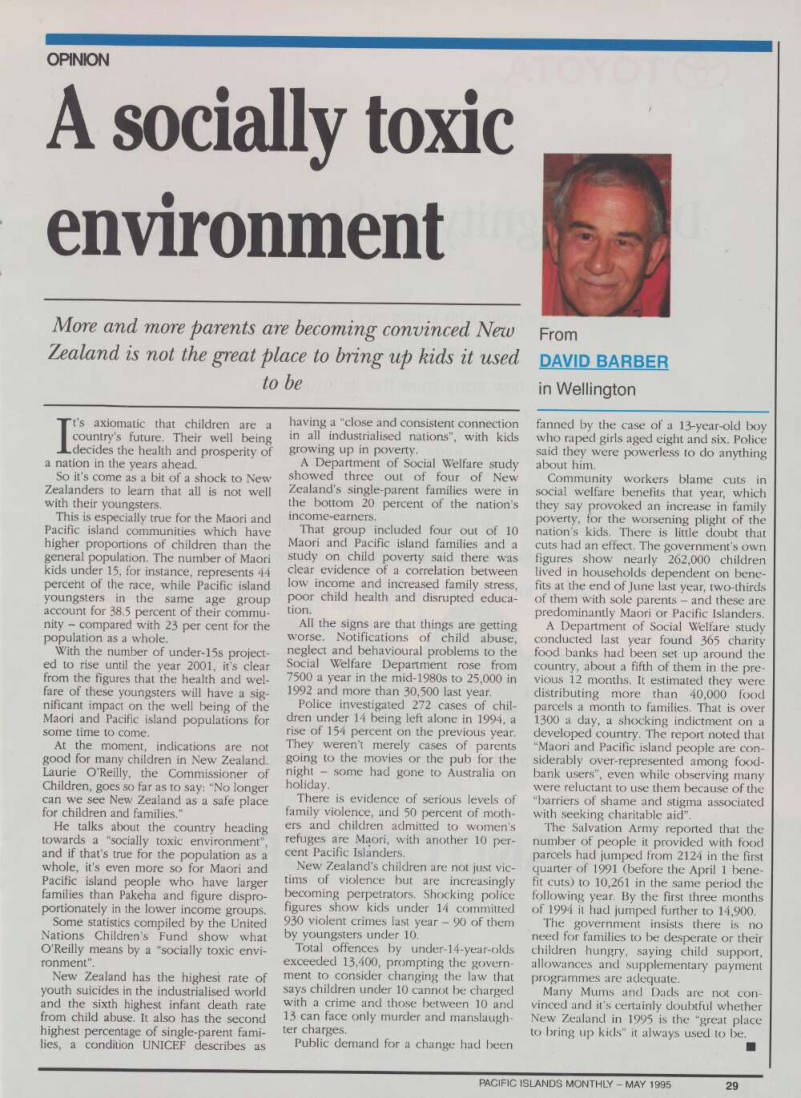
Opinion
A socially toxic environment
More and more parents are becoming convinced New Zealand is not the great place to bring up kids it used to be
It’s axiomatic that children are a country’s future. Their well being decides the health and prosperity of a nation in the years ahead.
So it’s come as a bit of a shock to New Zealanders to learn that all is not well with their youngsters.
This is especially true for the Maori and Pacific island communities which have higher proportions of children than the general population. The number of Maori kids under 15, for instance, represents 44 percent of the race, while Pacific island youngsters in the same age group account for 38.5 percent of their community - compared with 23 per cent for the population as a whole.
With the number of under-15s projected to rise until the year 2001, it’s clear from the figures that the health and welfare of these youngsters will have a significant impact on the well being of the Maori and Pacific island populations for some time to come.
At the moment, indications are not good for many children in New Zealand.
Laurie O’Reilly, the Commissioner of Children, goes so far as to say: “No longer can we see New Zealand as a safe place for children and families.”
He talks about the country heading towards a “socially toxic environment”, and if that’s true for the population as a whole, it’s even more so for Maori and Pacific island people who have larger families than Pakeha and figure disproportionately in the lower income groups.
Some statistics compiled by the United Nations Children’s Fund show what O’Reilly means by a “socially toxic environment”.
New Zealand has the highest rate of youth suicides in the industrialised world and the sixth highest infant death rate from child abuse. It also has the second highest percentage of single-parent families, a condition UNICEF describes as
having a “close and consistent connection in all industrialised nations”, with kids growing up in poverty, A Department of Social Welfare study showed three out of four of New Zealand’s single-parent families were in the bottom 20 percent of the nation’s income-earners.
Th at group included four out of 10 Maori and Pacific island families and a study on child poverty said there was clear evidence of a correlation between l° w income and increased family stress, P oor child health and disrupted educa hon.
All the signs are that things are getting worse. Notifications of child abuse, neglect and behavioural problems to the Social Welfare Department rose from 7500 a year in the mid-1980s to 25,000 in 1992 and more than 30,500 last year, Police investigated 272 cases of chil clren under 14 being left alone in 1994, a n se °f 154 percent on the previous year.
T hey weren’t merely cases of parents g° in g to the movies or the pub for the ni B ht some had gone to Australia on
holiday.
There is evidence of serious levels of family violence, and 50 percent of moth ers anb children admitted to women’s refuges are Maori, with another 10 per cent Pacific Islanders, New Zealand’s children are not just vic t'ms °f violence but are increasingly
becoming perpetrators. Shocking police
figures show kids under 14 committed 930 violent crimes last year - 90 of them b Y youngsters under 10.
Total offences by under-14-year-olds
exceeded 13,400, prompting the govern ment to consider changing the law that sa Y s children under 10 cannot be charged wit h a crime and those between 10 and 13 can face only murder and manslaugh
ter charges.
Public demand for a change had been
fanned by the case of a 13-year-old boy who raped girls aged eight and six. Police said they were powerless to do anything about him.
Community workers blame cuts in social welfare benefits that year, which they say provoked an increase in family poverty, for the worsening plight of the nation’s kids. There is little doubt that cuts had an effect. The government’s own figures show nearly 262,000 children lived in households dependent on bene fits at the end of June last year, two-thirds of them with sole parents - and these are predominantly Maori or Pacific Islanders.
A Department of Social Welfare study conducted last year found 365 charity food banks had been set up around the country, about a fifth of them in the pre vious 12 months. It estimated they were distributing more than 40,000 food parcels a month to families. That is over 1300 a day, a shocking indictment on a developed country. The report noted that “Maori and Pacific island people are con siderably over-represented among food bank users”, even while observing many were reluctant to use them because of the “barriers of shame and stigma associated with seeking charitable aid”.
The Salvation Army reported that the number of people it provided with food parcels had jumped from 2124 in the first quarter of 1991 (before the April 1 bene fit cuts) to 10,261 in the same period the following year. By the first three months of 1994 it had jumped further to 14,900.
The government insists there is no need for families to be desperate or their children hungry, saying child support, allowances and supplementary payment programmes are adequate.
Many Mums and Dads are not con vinced and it’s certainly doubtful whether New Zealand in 1995 is the “great place to bring up kids” it always used to be.
From
David Barber
in Wellington
Advertisements & other items, pp. 30-33 (1 item)
Drive dignity right to the top.
<Sg) TOYOTA
Everyone who knows cars has no doubts about Land Cruiser’s ruggedness.
Yet how many know that its luxury rivals the finest high-priced cars?
Or that it’s got more room inside than many luxury sedans?
And because it’s a Toyota, Land Cruiser’s fit and finish, attention to detail, and graceful form speak of elegance as well a 5 spacious comfort.
Yet you still get tough ladder frames and suspension built to take you as far off road as you want to go.
With power from 4.5-litre petrol or 4.2-litre diesel engines.
And it’s carefully protected from rust to last longer.
So if you’re going right to the top, this dignified car is ready to take you.
LAND CRUISER
DISTRIBUTORS/DEALERS
AMERICAN SAMOA BURNS PHILP MOTORS PH 633-4281 GUAM & MICRONESIA.. .ATKINS KROLL, INC. PH 646-1876/9 NORFOLK ISLAND BORRY’S PTY LTD. PH 22114
SOLOMON ISLAND ELA MOTORS PH 30314
VANUATU ASCO MOTORS PH 22341
COOK ISLANDS PACIFIC MOTORS LTD. PH 20796
KIRIBATI TARAWA MOTORS PH 21090
PAPUA NEW GUINEA ELA MOTORS PH 3229400
TAHITI NIPPON AUTOMOTO PH 429819
WESTERN SAMOA ASCO MOTORS PH 20800
FIJI ASCO MOTORS PH 384888
NEW CALEDONIA S.I.A.P. PH 275562
SAIPAN MICROL CORPORATION PH 234-5911
TONGA ASCO MOTORS PH 23500
■ asm IS aiiiii ■ ::ai:|SS - C cg>
LAND
CRUISER
v. fl-4 m Sf« ■ ... . %
: • m
dq-fjb
asqf*» - - -•» iissa*!
MORE FUGHIS,
MORE OFIEN.TO MORE
OF IKE
No other airline covers the South Pacific like Air Pacific. Wherever you want to go, whenever you want to travel, ask for an
SOUTH PACIFIC
Air Pacific flight, in the comfort of a modern Boeing aircraft.
They’re all we fly,everywhere
FIJI’S INTERNATIONAL AIRLINE
we go.
AIR
PACIFIC
SUVA * NADI • MELBOURNE • SYDNEY* BRISBANE • AUCKLAND • CHRISTCHURCH • WELLINGTON • TOKYO • OSAKA* LOS ANGELES * PORT VILA • TONGA • HONIARA • APIA
(ADVERTISEMENT)
SPREADING
OUR WINGS
When opportunity knocked, Air Pacific grabbed it.
A new Boeing 737 was not part of this year’s plan. But when Royal Tongan Airlines proposed that Air Pacific and Royal Tonga enter into the joint leasing of a 737-300 plane, Air Pacific agreed.
With Air Pacific having 2000 flying hours of the plane and its partner 1000, new destinations came into being and existing routes were reinforced.
Air Pacific’s General Manager Commercial, Narendra Kumar, said the airline has increased its services to Brisbane from three (one 767 flight and two 737 flights) to five 737 flights, leaving the 767 to provide a fourth flight to Sydney.
The new aircraft will also be used for a seco n d Christchurch flight from April 25 to cater for increased demand by tourists wanting to escape the New Zealand winter.
And a new weekly service to Wellington started on April 8.
The plan is to increase the utilisation of the plane and to decrease operational costs. Total flying hours are anticipated at 3700 hours or more when the lease expires.
The relationship between the two regional airlines has not been affected by Royal Tonga leasing an additional 737-jet.
Kumar said the commercial judgements of each partner were their prerogative and did not affect the other.
Apart from the lease bond, the two airlines operate independently.
“We are comfortable with Royal Tonga’s operations and do not foresee problems,” Kumar said.
The idea of joint-leasing was mooted last year and with the help of a supportive board and a quick assessment of the market, Air Pacific included the new plane into its 1995 plan.
Explaining the additional flights to Brisbane, Kumar said the Brisbane route was a “thin route”. Thin routes normally have below average travellers. To counter the problem, frequency of flights is increased.
Kumar was optimistic about the increased services to New Zealand as last year saw a significant growth - by 31 percent - of Kiwi arrivals to Fiji.
He said the services to Christchurch and Wellington would attract tourists who would normally go to Queensland, Australia for holidays because of the direct services.
The inaugural flight departed Nadi’s international airport on April 8 and the regular service will leave at 7am and return at 3.25 pm the same day.
To mark the launch, a major travel industry function was hosted by Air Pacific at Wellington Civic Centre on April 6, where travel agents, industry personnel and civic dignitaries were in attendance, with the chief guest being Fiji’s Ambassador to New Zealand, Jioji Guivalu.
The Fiji Police Band travelled to Wellington and provided music and cultural entertainment at the function.
Travel and tourism industry representatives from Fiji were also present at this event.
The Mayor of Wellington, Fran Wilde, hosted a civic luncheon on the day the plane touched down at the New Zealand capital.
Kumar said Air Pacific was pleased with bookings for the new service and the first flight from Wellington was sold out.
He said the weekend service was expected to be popular not only for tourists but for local and business travellers to and from the lower of New Zealand’s North Island. ■
AIR PACIFIC
Immigration
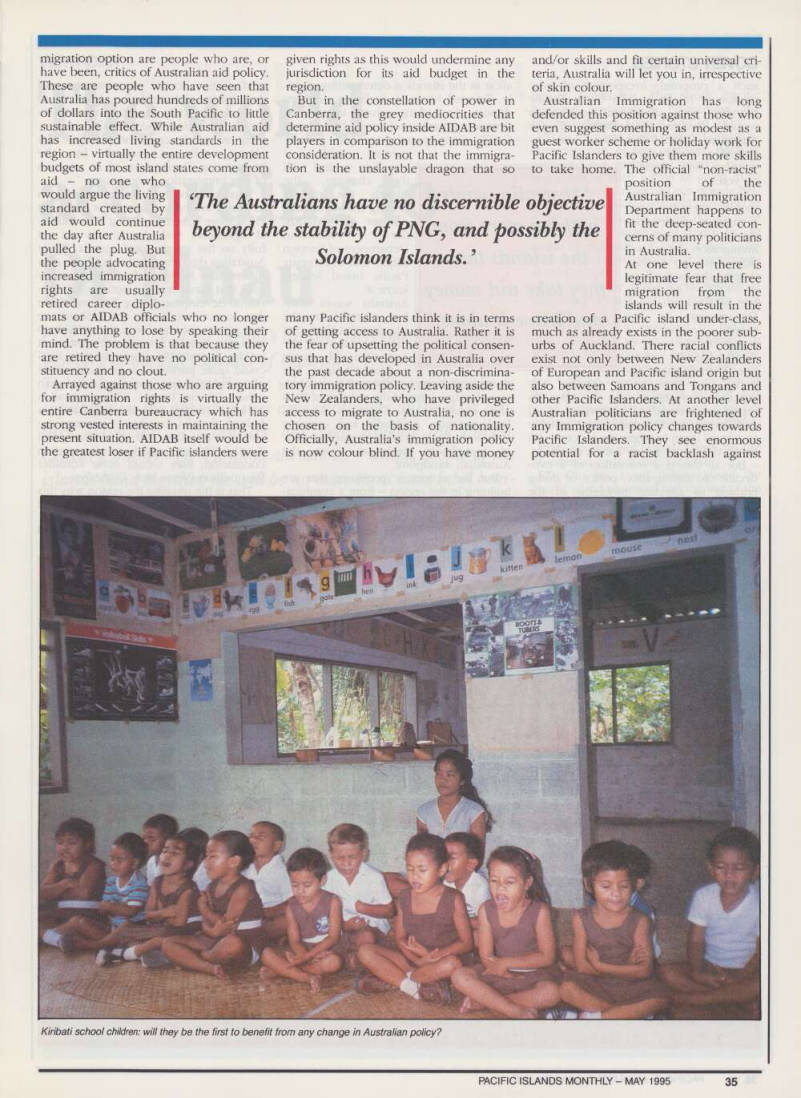
Cover Stories
vs
Aid
Australia's dilemma as it continues to pour millions into the islands without much hope of
them ever attaining self-sufficiency
By Roman Grynberg
Since the independence of most of the Pacific island states, the issue of immigration rights to Australia and New Zealand has been sitting on the back burner of diplomatic relations between the former colonial powers and the island states. In 1983, the now famous Jackson Report on the future of Australia International Development Agency (AIDAB) put the matter on the front burn er by suggesting that Australia would be better advised to allow Pacific islanders to sell their labour services in Australia than to pour Asl37 million (plus $350 million for Papua New Guinea) in aid from Australia.
Quietly, at most forum meetings, lead ers from the Polynesian and Micronesian states have endorsed and pushed this proposal. The Polynesian and Micronesian countries earn most of their foreign exchange from remittances from Pacific Islanders living abroad and will not be able to maintain their low stan dards of living if there is no increase in emigration.
The Australian response to the island request for preferential access to their labour market has been a deafening silence, which many in the islands have construed as a throw-back to the days of the “White Australia Policy” where only Europeans were permitted to migrate to Australia.
However, in the last few months, the immigration issue appears to have resur faced under pressure from a number of
sources. First, there is palpable aid fatigue evident among donors in the islands gen erally - a sense that given the failure of the islands to develop an investment cli mate that would stimulate investment, all that aid was doing was propping up political structures that refused to reform and deal with their problems.
Second, there is the sense that the 15year-old SPARTECA treaty has failed to develop trade between Australia and the islands as expected. With the exception of garments from Fiji, there has been almost no success in diversifying visible trade away from gold, coffee and tea. In volume, non-mineral trade from the islands to Australia has decreased since SPARTECA was signed in 1981.
All this has led the Australian Minister for Pacific Islands, Gordon Bilney, to openly talk of a SPARTECA- Mark 11. With the decline in Australian tariffs caused by the closure of the Uruguay Round of GATT and Australia’s own trade liberali sation, the original SPARTECA is dimin ishing in value. So Bilney would like to find a new way of enhancing Australia’s relationship with the islands.
Australia and Fiji have begun discus sions about a new bilateral treaty arrange ment. Fiji has long viewed SPARTECA as a denigration of its status as the second largest island state. The idea of being lumped together with Tuvalu is increas ingly being viewed by Suva as a position unbecoming Fiji’s importance. Moreover, in the past five years Fiji has abandoned any pretence of a multilateral regional approach to its relations and has moved to what it formally refers to as “bilateral ism”.
But what has in part pushed Fiji in this direction has been the PACTRA treaty between PNG and Australia, and what Suva perceives as the benefits this sort of bilateral approach might offer. PACTRA, like the proposed bilateral Fiji Australia Treaty, is broad-based, encompassing far more than just trade issues. In reality though, after 20 years, PACTRA has offered little to PNG that is not available to it under SPARTECA.
Fiji and Australia have jointly conduct ed a study on the options for a bilateral treaty and that report, while probably purposely vague, has touched upon that most sensitive of issues - the rights of labour to move between the two coun tries.
There are many in Suva who see the clear benefit to Fiji of signing a new, spe cial treaty with Australia which over time will allow access of citizens to the Australian labour market. This would not only alleviate the political pressures for reform of the constitution from the Indian community but would provide a safety valve for unemployed indigenous Fijians.
Fiji is creating only 100 new jobs per year while 10,000-13,000 people are leav ing school each year. The benefits of labour migration are obvious to all labour surplus countries but the proposed treaty between Australia and Fiji is supposed to be reciprocal. And while Fiji may be more than happy to unload any number of Indian cane-farmers or unemployed Fijian youths on Sydney’s western sub urbs, it is by no means obvious that Fiji is psychologically prepared for Australians having migration rights to Fiji. The idea of 100,000 Australians deciding to take up residence in sunny Fiji may be no more pleasing to Fijians than the recent gov ernment proposal to bring thousands of Hong Kong Chinese businessmen to Fiji.
While the prospect of emigration from the Pacific islands to Australia is wel comed at almost every level in the islands, the benefits and support for these proposals in Australia are not obvious.
The most obvious supporters of the
migration option are people who are, or have been, critics of Australian aid policy.
These are people who have seen that Australia has poured hundreds of millions of dollars into the South Pacific to little sustainable effect. While Australian aid has increased living standards in the region - virtually the entire development budgets of most island states come from
aid - no one who would argue the living standard created by aid would continue the day after Australia
pulled the plug. But
the people advocating
increased immigration
rights are usually
retired career diplo
mats or AIDAB officials who no longer have anything to lose by speaking their mind. The problem is that because they are retired they have no political constituency and no clout.
Arrayed against those who are arguing for immigration rights is virtually the entire Canberra bureaucracy which has strong vested interests in maintaining the present situation. AIDAB itself would be the greatest loser if Pacific islanders were
given rights as this would undermine any jurisdiction for its aid budget in the region.
But in the constellation of power in Canberra, the grey mediocrities that determine aid policy inside AIDAB are bit players in comparison to the immigration consideration. It is not that the immigra tion is the unslayable dragon that so
‘The Australians have no discernible objective beyond the stability of PNG, and possibly the Solomon Islands . 5
many Pacific islanders think it is in terms of getting access to Australia. Rather it is the fear of upsetting the political consen sus that has developed in Australia over the past decade about a non-discrimina tory immigration policy. Leaving aside the New Zealanders, who have privileged access to migrate to Australia, no one is chosen on the basis of nationality.
Officially, Australia’s immigration policy
is now colour blind. If you have money
and/or skills and fit certain universal cri teria, Australia will let you in, irrespective of skin colour.
Australian Immigration has long defended this position against those who even suggest something as modest as a guest worker scheme or holiday work for Pacific Islanders to give them more skills to take home. The official “non-racist”
position of the Australian Immigration Department happens to fit the deep-seated con cerns of many politicians in Australia.
At one level there is legitimate fear that free migration from the islands will result in the
creation of a Pacific island under-class, much as already exists in the poorer sub urbs of Auckland. There racial conflicts exist not only between New Zealanders of European and Pacific island origin but also between Samoans and Tongans and other Pacific Islanders. At another level Australian politicians are frightened of any Immigration policy changes towards Pacific Islanders. They see enormous potential for a racist backlash against
Kiribati school children: will they be the first to benefit from any change in Australian policy?
such a proposal, irrespective of how modest it might be. To allow Pacific Islanders even short-term work rights would involve a decision of the Australian Cabinet that could cost any
politician dearly while winning him virtually no votes.
In the past few months, there has been a number of develop ments that indicate the immigration issue will not just go away, despite the best efforts of the Australian Immigration Department. It has recently prepared a report on the issue of Pacific Islander migra tion. The expected hap
pened and Immigration opposed any concession whatsoever on the issue. Its report concluded that the provision of aid and investment remained more suitable responses (than immigration concessions) to the difficulties facing Pacific countries.
But all this is a reiteration of a twodecade-old Immigration policy of doing nothing to alleviate problems of the islands, except throwing more money and “policy dialogue” consultants at them. The problem is the economic situ-
‘Australia wants
nothing more from
the islands than they take aid money and leave it alone. *
ation in the islands is deteriorating rapidly. Trapped between declining aid from donors, diminishing private investment, decreasing trade preference because of GATT, rising populations- and govern-
ments unable or unwilling to deal with the changes, the islands are rapidly sinking into economic disaster and AIDAB, the Australian Department of Foreign Affairs and even many Pacific island leaders know it.
Australia wants noth ing more from the island states than that they take the Australian aid money and leave it alone. The
Australians have no discernible or obvi ous objective beyond the stability of PNG and possibly the Solomon Islands.
Diplomatically, politically and certainly economically, most of the western Pacific is completely irrelevant from the Australian standpoint.
But the economic pressures that are building in the region - from a combina tion of domestic economic mismanage ment and post-Gold War structural changes - will, in the early part of the
next century, create pressures that will destabilise “Australia’s Lake”, as Australian officials so colourfully refer to the Pacific region. The Australian govern ment is clearly concerned, despite the almost religious recital by the Immigration Department of its rejection of any immigration concessions.
What some of the larger countries such as Tonga are openly asking for and what Fiji is more covertly wanting in its bilater al agreement with Australia is not yet fully on the international agenda. While Australian diplomats and aid officials may differentiate between those island coun tries that have realistic options for eco nomic development (like Fiji) and those that do not (like Tuvalu and Kiribati), the real reason Fiji and Tonga are unlikely to gain any special immigration agreement in the foreseeable future is that PNG could quite justifiably argue it, by virtue of its colonial ties, has more rights than either Fiji or Tonga. While Australian politicians might, immediately following a federal election, be able to summon the courage to allow 60,000 Kiribati and Tuvalu citizens some form of migration concession, they would never consider four million Papua New Guineans.
That is the ultimate the reason why this solution to Australia’s aid dilemma and the islands’ population pressure will take so long to resolve. ■
What the studies show
One of the ways to judge the longer-term thinking of Australian bureaucrats is to look at the reports and studies they are funding and the types of questions they are asking. Recently AIDAB and other Australian gov ernment agencies have been preparing reports on the immi gration issue. These studies make horrific projections for the future of the Pacific island countries.
A series of doomsday scenarios have been developed by Rodney Cole of the AIDAB-funded National Centre of Development Studies in the past two years. They were viewed with such alarm in official Canberra that they have been taken up by the Australian government’s official think tank on migration issues, the Bureau of Immigration and Population Research. It contracted the Centre for International Economics to prepare a report on the impli cations of the pending economic disaster in the region. The report, Demographic and Economic Development in the Pacific Island States: Are there Implications for Australia’s Immigration Policy?, considers policy responses which vary from that of doing nothing to permitting Pacific islanders to migrate.
In general the report sees migration as retarding develop ment and decreasing the pressure on the island states to make the economic reforms needed to avoid the doomsday scenario.
In the end migration is precisely that - an alternative to
undertaking the sort of structural changes needed to make the economics of Pacific island countries function and grow according to the standard World/IMF model. But even the most die-hard free marketers cannot come up with a rea sonable package of policies that will make Tuvalu or Kiribati grow rapidly. The fact is that despite the unbending faith in the free market, even AIDAB knows there are no such policies - these countries are so small, so remote, so disadvantaged that only as members of a larger economic unit can they ever hope to achieve living standards approaching those of developed countries.
AIDAB is in its own way adjusting. Inside AIDAB the immi gration issue has once again come up. It has recently com missioned a study of the New Zealand migration model for Pacific countries, differentiating between the smaller and larger nations. New Zealand permits free migration of Niueans and Cook islanders.
This in many ways points the way the aid and migration policy debate will go in the years to come - to a neve SPARTECA arrangement. Soon Australia will become not only tired but completely exhausted from giving aid to the smallest of the countries. It knows they will never “succeed” by its definition and they will almost certainly offer work or migration rights to citizens of countries such as Tuvalu and Kiribati where the potential for real economic development is limited and where absorption into Australia of such small numbers would hardly be noticed. ■
according to


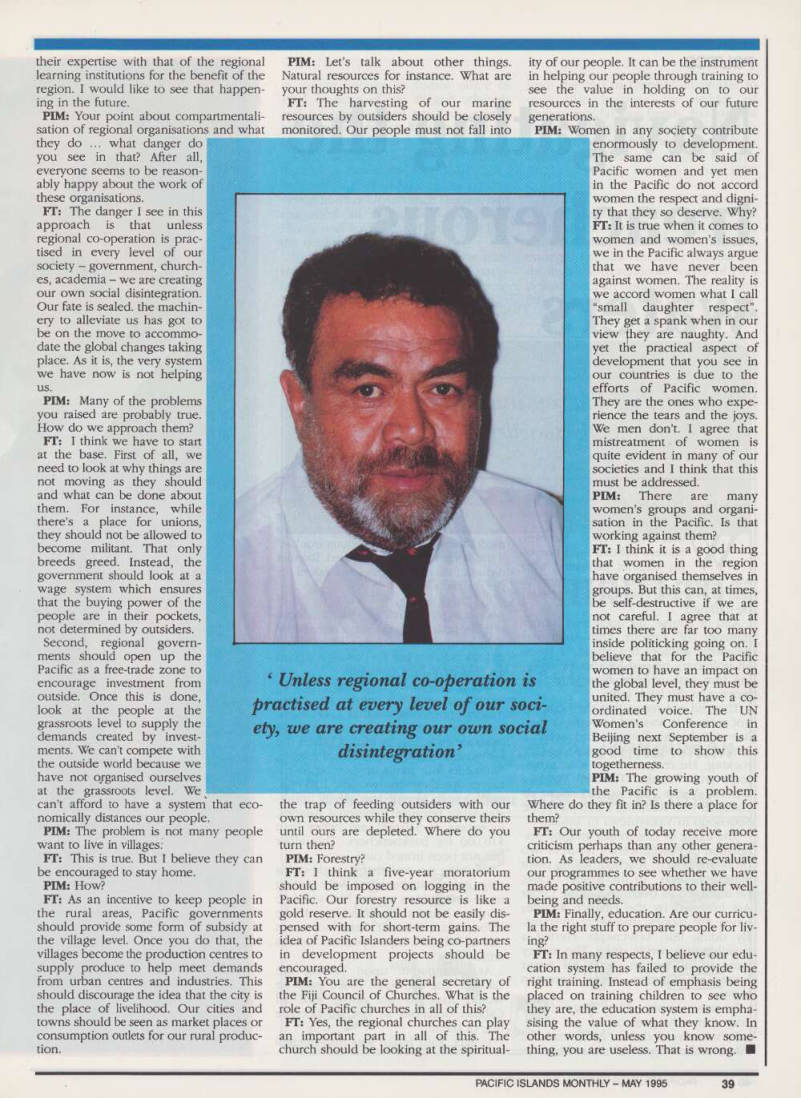
Viewpoint
The world according to Dr Finau
PIM talks to one of the region’s leading clergymen, the general secretary of the Fiji Council of Churches, Reverend Dr Finau Tu’uholoaki, on what Pacific island countries need to do to capitalise on the opportunities and challenges of the 21st cen tury. True the 21st century has been dubbed the Pacific Century, but as Dr Tu’uholoaki sees it, unless people of the islands band together, we will be no more than mere label bear ers for the next 100 years.
FT: The catch-phrase around the world today is simply this: eat local, think glob al. To realise this, we need to have an efficient mechanism to make this work.
PIM: But we do have this mechanism. At the regional level, we have inter-govern mental organisations such as the South Pacific Commission, the South Pacific
Forum Secretariat, the South Pacific Regional Environment Programme, the Forum Fisheries Agency, and so on.
FT: In my view these regional organisa tions are part of our problem. Because each one is a specialised agency, every one tends to keep within its given man date. We have to prepare our people bet ter, not in compartmentalised segments as is the case today. We simply do not have the resources - financial or otherwise - to work in isolation of each other. This shows in our participation at internation al conferences.
PIM: You were at the Social Summit in Copenhagen. How did we perform as a region?
FT: In fairness to everyone, we did our best. But we were unprepared. It showed. Again, this was perhaps a reflec tion that the regional organisations are
not working together closely enough as
they should. The technical support was weak because it seemed that we were not using the technical expertise available to us.
PIM: You are not talking about the use of external consultants, are you?
FT: Oh, no. I am talking about the Pacific island countries making use of the technocrats and academics we have at our regional universities such as the University of the South Pacific and the University of Papua New Guinea.
Regional organisations should combine
their expertise with that of the regional learning institutions for the benefit of the region. I would like to see that happen ing in the future.
PIM: Your point about compartmentali sation of regional organisations and what
they do ... what danger do you see in that? After all, everyone seems to be reason ably happy about the work of these organisations.
FT: The danger I see in this approach is that unless regional co-operation is prac tised in every level of our society - government, church es, academia - we are creating our own social disintegration.
Our fate is sealed, the machin ery to alleviate us has got to be on the move to accommo date the global changes taking place. As it is, the very system we have now is not helping us.
PIM; Many of the problems you raised are probably true.
How do we approach them?
FT; I think we have to start at the base. First of all, we need to look at why things are not moving as they should and what can be done about them. For instance, while there’s a place for unions, they should not be allowed to become militant. That only breeds greed. Instead, the government should look at a wage system which ensures that the buying power of the people are in their pockets, not determined by outsiders.
Second, regional govern ments should open up the Pacific as a free-trade zone to encourage investment from outside. Once this is done, look at the people at the grassroots level to supply the demands created by invest ments. We can’t compete with the outside world because we have not organised ourselves at the grassroots level. We
can’t afford to have a system that eco nomically distances our people.
PIM: The problem is not many people want to live in villages; FT: This is true. But I believe they can be encouraged to stay home.
PIM: How?
FT: As an incentive to keep people in the rural areas, Pacific governments should provide some form of subsidy at the village level. Once you do that, the villages become the production centres to
supply produce to help meet demands
from urban centres and industries. This should discourage the idea that the city is the place of livelihood. Our cities and towns should be seen as market places or consumption outlets for our rural produc tion.
PIM: Let’s talk about other things, Natural resources for instance. What are your thoughts on this?
FT: The harvesting of our marine resources by outsiders should be closely monitored. Our people must not fall into
the trap of feeding outsiders with our own resources while they conserve theirs until ours are depleted. Where do you turn then?
PIM; Forestry?
FT; I think a five-year moratorium should be imposed on logging in the Pacific. Our forestry resource is like a gold reserve. It should not be easily dis pensed with for short-term gains. The idea of Pacific Islanders being co-partners in development projects should be
encouraged.
PIM: You are the general secretary of the Fiji Council of Churches. What is the role of Pacific churches in all of this?
FT: Yes, the regional churches can play an important part in all of this. The church should be looking at the spiritual
ity of our people. It can be the instrument in helping our people through training to see the value in holding on to our resources in the interests of our future generations, PIM: Women in any society contribute
enormously to development.
The same can be said of Pacific women and yet men in the Pacific do not accord women the respect and digni ty that they so deserve. Why?
FT: It is true when it comes to women and women’s issues, we in the Pacific always argue that we have never been against women. The reality is we accord women what I call
I “small daughter respect”.
They get a spank when in our view jhey are naughty. And yet the practical aspect of development that you see in our countries is due to the efforts of Pacific women.
They are the ones who expe rience the tears and the joys.
We men don’t. I agree that mistreatment of women is quite evident in many of our societies and I think that this must be addressed.
PIM: There are many women’s groups and organi sation in the Pacific. Is that working against them?
FT: I think it is a good thing that women in the region have organised themselves in groups. But this can, at times, be self-destructive if we are not careful. I agree that at times there are far too many inside politicking going on. I believe that for the Pacific women to have an impact on the global level, they must be united. They must have a co ordinated voice. The UN Women’s Conference in Beijing next September is a good time to show this
togetherness.
PIM: The growing youth of the Pacific is a problem.
Where do they fit in? Is there a place for them?
FT: Our youth of today receive more criticism perhaps than any other genera tion. As leaders, we should re-evaluate our programmes to see whether we have made positive contributions to their well being and needs.
PIM: Finally, education. Are our curricu la the right stuff to prepare people for liv ing?
FT; In many respects, I believe our edu cation system has failed to provide the
right training. Instead of emphasis being
placed on training children to see who they are, the education system is empha sising the value of what they know. In other words, unless you know some thing, you are useless. That is wrong. ■
‘ Unless regional co-operation is practised at every level of our soci ety, we are creating our own social
disintegration
Advertisements & other items, pp. 37-38 (1 item)
Second Hand Containers
WHERE AND WHEN YOU WANT THEM IN THE PACIFIC If you need a flexible and safe storage space we have the ideal solution for you. Our second hand containers provide instant secure storage. Guaranteed to be wind and waterproof these containers are ideal for both temporary and longterm storage in Pacific conditions.
We can deliver to any island in the Pacific within a month and our rates have got to be the lowest you will find. All you need to do is tell us how many you want.
CONTACT:
PASCALS MARCONNET, BP 4757 NOUMEA, NEW CALEDONIA. TEL (687) 28 7450. FAX: (687) 26 3248
PACIFIC ISLANDS MONTHLY
There are times in your life when you feel your friends have been missing out on something good. Now's your chance to do something about it and share with them one of the good things you have. Buy your friend a subscription to Pacific Islands Monthly and let him or her join you and the thousands of other people worldwide who are kept informed of the latest political, social and cultural changes taking place in the Pacific.
Enter your subscription now. Make sure you don't miss a single important issue. You'll enjoy
thought provoking commentry, knowledgeable
criticism and authoritative reporting. <L s % Every month highlights the important issue, events and people that shape our world. You will also enjoy delivery to your home or office at no extra cost. Our fast fax service is available on (679) 303809.
American Samoa US$45 Australia As 42 Canada US$45 Cook Islands AUSS46 Fiji F 526.40 French Polynesia US$45 Guam US$45 Hawaii US$45 Japan US$45 Kiribati AUSS46 Marshall/Micronesia US$4O Nauru AUSS42 New Caledonia US$32 New Zealand NZ$55 Niue AUSS46 Norfolk Islands AUSS42 Northern Marianas/Palau .. .. US$4O Papua New Guinea AUSS4S Solomon Islands AUSS46
Tonga AUSS46
Tuvalu AUSS46 United Kingdom Stg Pound 28 US Mainland US$45 Vanuatu AUSS4S Western Samoa WS$6O Elsewhere AUSS63 The above rates are for (12 issues) 1 year subscription rates include the cost of airspeeding to all destinations above.
Phone No. 679 304111 Fax 679 303809
CUT OUT THIS COUPON
r Yes, please enter my subscription to PEM.
Payment details; I enclose my cheque for $ (made payable to PIM) or debit $. . to my: □ Bank Card □ Diner Club □ Visa □ American Express □ Master Card Card No: I—l—l—l—l—l—l—l I I I 1 I I I I Expiry Date for . issues of PIM.
Please Print Clearly Mr/Mrs/Miss/Ms Initials Surname Address.
Street No Postcode City / Town / Suburb Please Enter My Friend's Subscription to Name Street Name Ph No Address.
City.
L L Country.
PhNo.
Mail To PIM Subscriptions Dept G.P.O. Box 1167, Suva.
Fiji Islands
PACIFIC
ISLANDS
rs —g —* ---r—a,- ■ i —n Published by Fiji Times Ltd Suva, Fiji Islands.
Navigating the
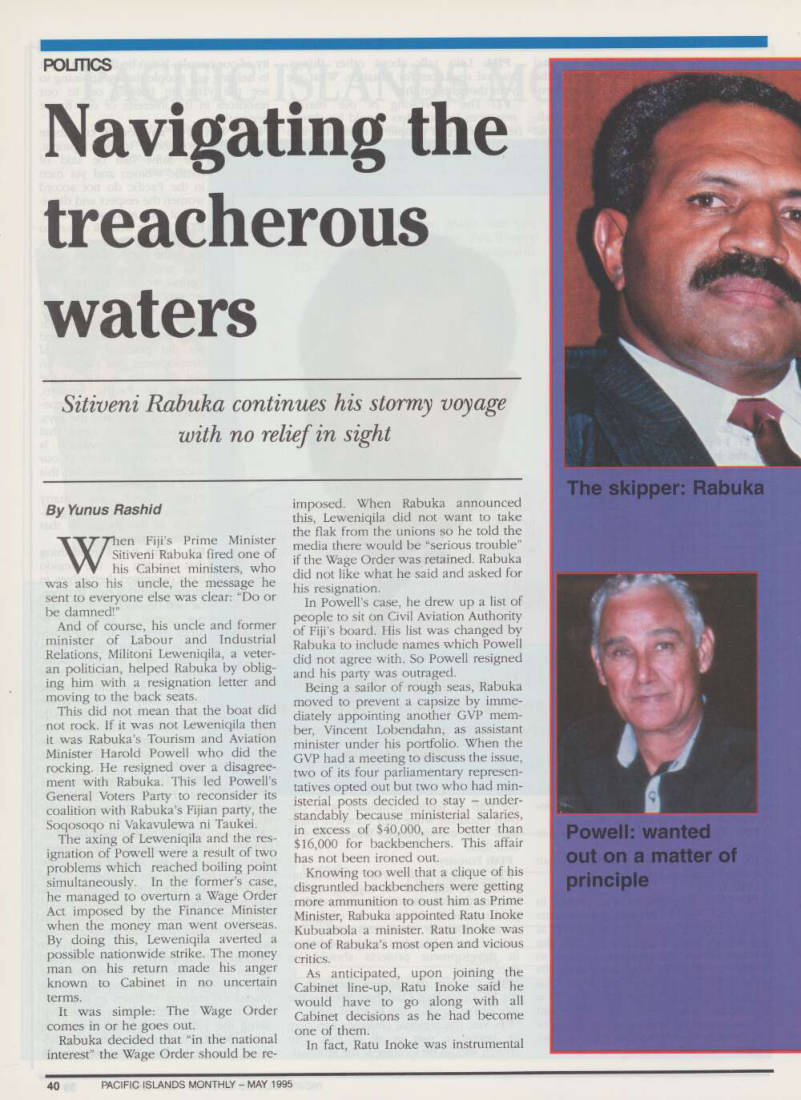

Politics
Navigating the treacherous waters
Sitiveni Rabuka continues his stormy voyage with no relief in sight
By Yunus Rashid
When Fiji’s Prime Minister Sitiveni Rabuka fired one of his Cabinet ministers, who was also his uncle, the message he sent to everyone else was clear: “Do or be damned!”
And of course, his uncle and former minister of Labour and Industrial Relations, Militoni Leweniqila, a veter an politician, helped Rabuka by oblig ing him with a resignation letter and moving to the back seats.
This did not mean that the boat did not rock. If it was not Leweniqila then it was Rabuka’s Tourism and Aviation Minister Harold Powell who did the rocking. He resigned over a disagree ment with Rabuka. This led Powell’s General Voters Party to reconsider its coalition with Rabuka’s Fijian party, the Soqosoqo ni Vakavulewa ni Taukei.
The axing of Leweniqila and the res ignation of Powell were a result of two problems which reached boiling point simultaneously. In the former’s case, he managed to overturn a Wage Order Act imposed by the Finance Minister when the money man went overseas.
By doing this, Leweniqila averted a possible nationwide strike. The money man on his return made his anger known to Cabinet in no uncertain terms.
It was simple: The Wage Order comes in or he goes out.
Rabuka decided that “in the national interest” the Wage Order should be re
imposed. When Rabuka announced this, Leweniqila did not want to take the flak from the unions so he told the media there would be “serious trouble” if the Wage Order was retained. Rabuka did not like what he said and asked for his resignation.
In Powell’s case, he drew up a list of people to sit on Civil Aviation Authority of Fiji’s board. His list was changed by Rabuka to include names which Powell did not agree with. So Powell resigned and his party was outraged.
Being a sailor of rough seas, Rabuka moved to prevent a capsize by imme diately appointing another GYP mem ber, Vincent Lobendahn, as assistant minister under his portfolio. When the GYP had a meeting to discuss the issue, two of its four parliamentary represen tatives opted out but two who had min isterial posts decided to stay - under standably because ministerial salaries, in excess of $40,000, are better than $16,000 for backbenchers. This affair has not been ironed out.
Knowing too well that a clique of his disgruntled backbenchers were getting more ammunition to oust him as Prime Minister, Rabuka appointed Ratu Inoke Kubuabola a minister. Ratu Inoke was one of Rabuka’s most open and vicious critics.
As anticipated, upon joining the Cabinet line-up, Ratu Inoke said he would have to go along with all Cabinet decisions as he had become one of them.
In fact, Ratu Inoke was instrumental
The skipper: Rabuka
Powell: wanted out on a matter of
principle
in asking Rabuka to vacate office in 1994 because of his alleged adultery and he later teamed up with several backbenchers to ask Rabuka to vacate office a second time this year.
Ratu Inoke’s reason for asking Rabuka to step down was that Rabuka had agreed to the lifting of the contro versial Sunday Observance Decree, had suggested all Fiji citizens be called Fijians and had allowed gambling into the country.
With Ratu Inoke moving to the min isterial ranks, the clique of back benchers did not gain a supporter in Leweniqila but lost a powerful force.
Rabuka is safe from any conspiracy
from the Indian Opposition parties to oust him because the leader of Opposition, Jai Ram Reddy, has said his party would not become embroiled in a power tussle which was essentially a Fijian issue. Indians cannot become prime minister as per the 1990 Constitution.
So in the meantime, while GVP mem bers decide whether they are too weak to stand against the might of Rabuka or strong enough to say enough is enough, Rabuka continues his journey through the treacherous waves of Fiji’s politics with an undisciplined crew and little support. ■
Kubuabola: gave up principles for a Cabinet post
Advertisements & other items, pp. 41-42 (1 item)
Hiring
A
HAS ARRIVED
s*
MINSON HIRE LTD
Every Working Tool For Builder, Contractor, Handyman 90 Brown Street, Suva Phone 314759, 313001, Fax 315356 'l,
SVC!
'I Jf l & v (2 <«|gg^ gw J
y ? i
,■ A WE HAVE THE
QUALITY GRADE OF
*SS'%SS
»££i' g;
Food, analytical, pharmaceutical
and livestock.
• ' you buy any grade of salt from Dominion Salt you will know you are
jurchasing quality.
This quality starts at the company's solar crystallising ponds at take Grassmere where the salt is evaporated from some of the i.. ' V p purest sea water in the world. The quality continues at the Lake Grassmere and Mt. Maunganui refineries and processing plant.
These use the latest sophisicated technology to produce each grade of solar and pure dried vacuum salt.
Salt for livestock, food processing and industry, through to specialised grades for pharmacy and laboratory analysis are available.
You can order large or small quantities for prompt delivery.
We will make the grade you need.
REFINERIES:
Totara Street, Mt Maunganui and Lake Grassmere, Marlborough.
OVERSEAS AGENTS:
Cbeetham Salt Pty Ltd, Geelong, Australia; Stinson Pearce Ltd, Suva, Fiji; TRADSERVE PNG Pty Ltd, PNG; ARMAX: Noumea, New Caledonia; ARMAX: Papeete, Tahiti; CLIPPER SALT, Pago Pago, US Samoa.
QUOTATIONS:
For delivery to nearest port, or into store, by return fax, on any quantity, to any destination.
DOMINION SALT LTD
Main Street, P.O. Box 446, Blenheim, New Zealand.
Phone: +64-3-578-5148. Fax: +64-3-578-0131.
portable

Advertising Feature
Peterson's portable sawmill
What do the Fiji Islands, South Africa, Eastern Siberia, Papua New Guinea, Southern Tanzania, Zambia, Switzerland, Chile, England and the jungles of the Solomon Islands have in common?
Sometimes adverse weather condi tions? Remote or difficult-to-get-at locations? Beautiful indigenous tim bers?
Yes, all are true. But there is one more thing. They are among the many diverse countries world-wide where you can find Peterson portable sawmills operating successfully.
What makes Petersons successful in so many places of different cultures and languages? Making money.
Village co-operatives, British busi nessmen and South American farm ers are doing the same thing with Peterson portables - they are making money, improving their lifestyles, help ing their neighbours.
Peterson sawmills were designed originally in the jungles of Fiji during the 14 years that Carl Peterson lived there. Peterson wanted a sawmill he could carry into the bush. He wanted a sawmill that could cut commercial amounts of wood, that would produce accurate, high-quality timber requiring no further sizing. The sawmill had to be easy to operate, made of light weight, non-corrosive materials and low cost. There was no such sawmill to fit these criteria.
So Peterson made his own. Now liv ing in New Zealand, Carl Peterson manufactures the most popular portable sawmills in Australasia. Made of aluminium and stainless steel and powered by a number of options including four-stroke 18 to 25 h/p petrol and diesel engines, PTC hydraulics or electric engines, Peterson designs are built for every conceivable location and operator. But they all cut commercial amounts of wood, produce high-grade timber and are still the cheapest commercial grade portable sawmill on the world market. ■
Salt

Pacific
Worth more than its weight in gold
Some two and a half percent of sea water is salt, so it is the most abundant natural resource in the world. In a country surrounded by ocean, it is little wonder that almost as soon as Europeans began to settle in New Zealand they were trying to find ways to extract this' precious mineral.
Various experiments were conducted throughout the late 1800 s and early this century, but these met with little success.
Very few locations can provide the right mix of climate, soil conditions and sea water of a high enough density to produce solar salt. However, Lake
Grassmere, in Marlborough, was long recognised as a potential site. George Skellerup, of Skellerup rubber fame, recognised its tremendous potential and on a visit in 1942 decided there and then to make Lake Grassmere the site of New Zealand’s first solar-evap orated salt works.
Today, a good summer at Lake Grassmere will yield more than 60,000 tonnes of salt from the 1800 hectares of artificial ponds.
Dominion Salt’s two plants can sat isfy the nation’s domestic and industri al salt needs. Lake Grassmere also supplies domestic salt throughout New
Zealand. Bulk shipments from over seas supplement local production as required and are processed and refined at Mt Maunganui.
Dominion Salt began exporting vac uum salt to Australia in 1975. Three years later, pharmaceutical BP grades were being sent to Australia and later to South East Asia. Today Dominion Salt exports salt and salt blocks from both refineries to almost all of the Pacific islands through established agents in Fiji, Papua New Guinea, Tahiti, New Caledonia and American Samoa.
In Australia, Dominion Salt can sup ply a good proportion of the Australian vacuum salt demand, while the market for pharmaceutical BP grades has extended to Thailand, Singapore, Hong Kong, the Philippines and Indonesia.
Today Dominion Salt manufactures a range of different salt grades and salt products to meet the growing needs of agriculture, the dairy industry, the freezing industry, paper mills, food manufacturers, water chlorination, soap and chemical processors. ■
Advertisements & other items, p. 43 (1 item)
Truly Portable Sawmill?
Have you been looking for a low cost, high capacity
PORTABILITY Peterson sawmills are made mostly of aluminium and stainless steel. Very light, durable and rust resistant they can be hand-carried into the bush or moved by punt or utility.
PRICE From NZ514,490 for complete mill with designs to suit evexy situation.
PRODUCTIVITY Peterson sawmills will saw 4-6 cubic metres of native hardwood per day in Island conditions with two operators!
SIMPLICITY Peterson sawmills were originally designed for use in Island conditions. For this reason they are made of high quality materials, and are of very simple design for easy operation and minimal maintenance requirements.
EFFICIENCY Only four litres of petrol required per cubic metre sawn timber, with a recovery rate of up to 75% and ; accuracy to Imm!
THIS IS IT!
162 View Rd. ROTORUA, New Zealand Winner 1988 New Zealand National Field Days Export Award Winner 1991 Rotorua Business Innovative Export Award Winner 1993 Forestry Corporation Business Innovation Award Winner 1994 "Highly Commended" NZ Tradenz Export Award
When the earth trembled
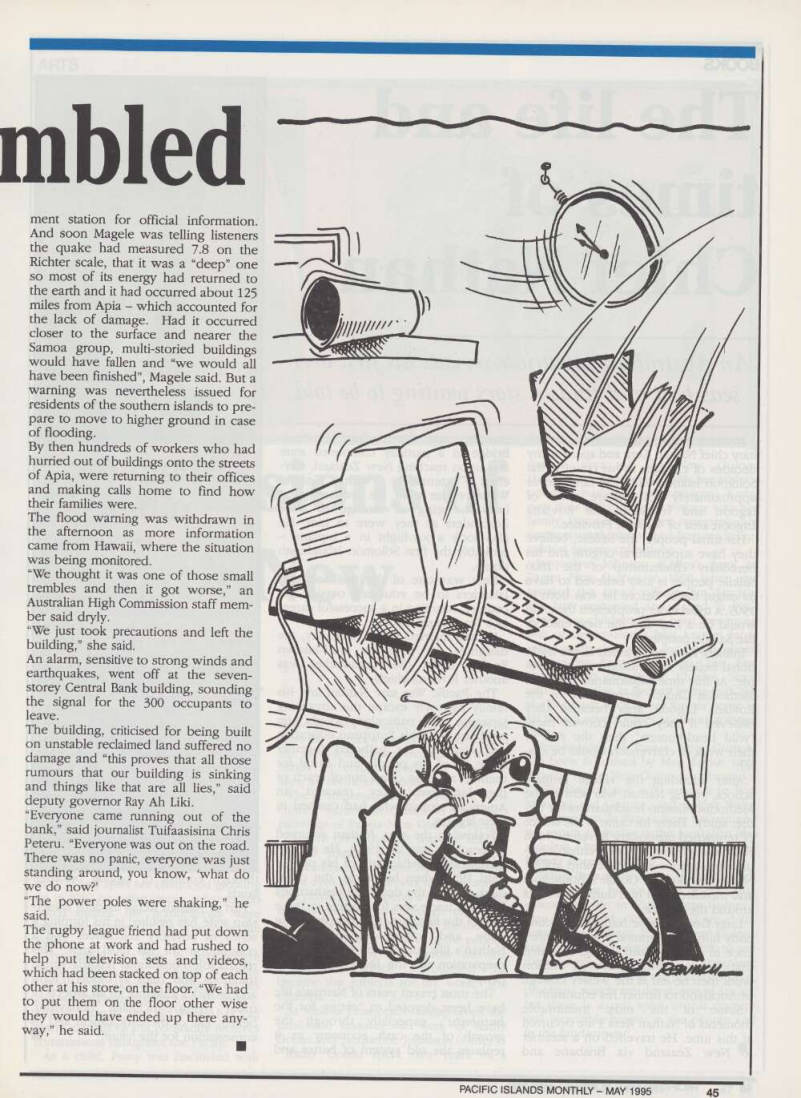
Earthquake
By Alan Ah Mu
Our Western Samoan correspondent recounts his experience as he weathered the island's worst
quake
It was a scary end to the working week. Shortly after 11am on Friday, April 7, the earth shook - and kept on shaking - longer and stronger than tremors in Western Samoa have in the past.
“Did you feel that?” a friend from the Western Samoa Rugby League Association asked on the phone. “It’s
an earthquake.”
I had already gathered that and was sliding down my chair and seeking shelter under the desk as was drilled to me in earthquake-prone Wellington years ago.
My friend and I were discussing anoth er earthquake of sorts, the one hitting the rugby league world and the real likelihood of Western Samoa joining Rupert Murdoch’s super league.
“I’ve got to go mate, I’ll talk to you later,” he said quickly.
“Okay, bye.” But I didn’t put the receiv er in its slot because that was on the desk. It lay beside me as I answered my partner’s terrified voice calling out.
She had been abruptly shaken awake and quickly grasped that the world had just become a dangerous place to be in.
“Come here,” I called and soon she and our two-year-old boy were under the desk too and in a quivering voice she wondered aloud how our three-year old at kindergarten was doing.
That was another worry to add to the fear of the roof collapsing and crushing us under the desk and the expensive computer on top.
The lid on the pot of freshly boiled bananas slid off and clattered loudly to the floor. The sound added to our ter ror. Fear was briefly replaced by anger at the terror the quake was causing in my loved ones and I swore under my breath.
It felt like the earthquake had lasted a full five minutes but the main shock had actually lasted only about 20 sec onds at the most, according to the
assistant superintendent at meteorolog
ical service, Faatoia Magele.
A talkback host on private radio came back on air, saying “... let’s leave it to the man above (God),” then adding, as if annoyed, “I wonder where He’s gone to.”
Many radios were tuned to the govern
merit station for official information.
And soon Magele was telling listeners the quake had measured 7.8 on the Richter scale, that it was a “deep” one so most of its energy had returned to the earth and it had occurred about 125 miles from Apia - which accounted for the lack of damage. Had it occurred closer to the surface and nearer the Samoa group, multi-storied buildings would have fallen and “we would all have been finished”, Magele said. But a warning was nevertheless issued for residents of the southern islands to pre pare to move to higher ground in case
of flooding.
By then hundreds of workers who had hurried out of buildings onto the streets of Apia, were returning to their offices and making calls home to find how their families were.
The flood warning was withdrawn in the afternoon as more information came from Hawaii, where the situation was being monitored.
“We thought it was one of those small trembles and then it got worse,” an Australian High Commission staff mem ber said dryly.
“We just took precautions and left the building,” she said.
An alarm, sensitive to strong winds and earthquakes, went off at the seven storey Central Bank building, sounding the signal for the 300 occupants to leave.
The building, criticised for being built on unstable reclaimed land suffered no damage and “this proves that all those rumours that our building is sinking and things like that are all lies,” said deputy governor Ray Ah Liki.
“Everyone came running out of the bank,” said journalist Tuifaasisina Chris Peteru. “Everyone was out on the road.
There was no panic, everyone was just standing around, you know, ‘what do we do now?’
“The power poles were shaking,” he said.
The rugby league friend had put down the phone at work and had rushed to help put television sets and videos, which had been stacked on top of each other at his store, on the floor. “We had to put them on the floor other wise they would have ended up there any way,” he said.
Advertisements & other items, p. 44 (1 item)
The Australian National University
RESEARCH SCHOOL OF PACIFIC AND ASIAN STUDIES The John Knight Fellowship Fund Awards Applications are invited from young people from the Pacific Islands, including Papua New Guinea, who nave completed or are completing their higher education, for John Knight Awards. Awards will be chiefly to those seeking assistance towards the cost of travel and living expenses (but not for their dependants) for relatively short visits for study and experience in Australia, including short courses, form conferences, for visits, industrial, agricultural or social enterprises, and for other visits of a similar kind. Awards will not normally exceed $A2,000. No limitation will be placed on the field of study, but the selection committee may take into account Senator Knight's special interest in providing help for the disabled.
Many people and institutions have contributed to the John Knight Fellowship Fund which was established after the untimely death in 1981 of Senator John Knight to enable young people from the Pacific Islands to expand their experience in Australia. The Fund is administered by a Committee under the Director of the Research School of Pacific and Asian Studies, The Australian National University.
Applicants will be required to provide details of their educational background and a statement of the purpose for which an Award is sought, an estimate of the costs involved, and details of any other sources of funds available. They will be required to arrange for at least two referees to write in support of their applications. Application forms should be obtained from: The School Secretary Research School of Pacific and Asian Studies The Australian National University Canberra ACT 0200 AUSTRALIA Telephone: (61-6) 249 3200/2678; FAX: (61-6) 249 4836 email: Pamela. Ferrari® anu.edu.au.
Envelopes should be clearly marked "John Knight Awards". There are two closing dates for the receipt of applications. Applications should be received by 1 May for consideration in May/June and by 1 October for consideration in October/November each year. 4.4.1995 PJF: g/rspas/general/kniginfo.doc
Chief Nathan
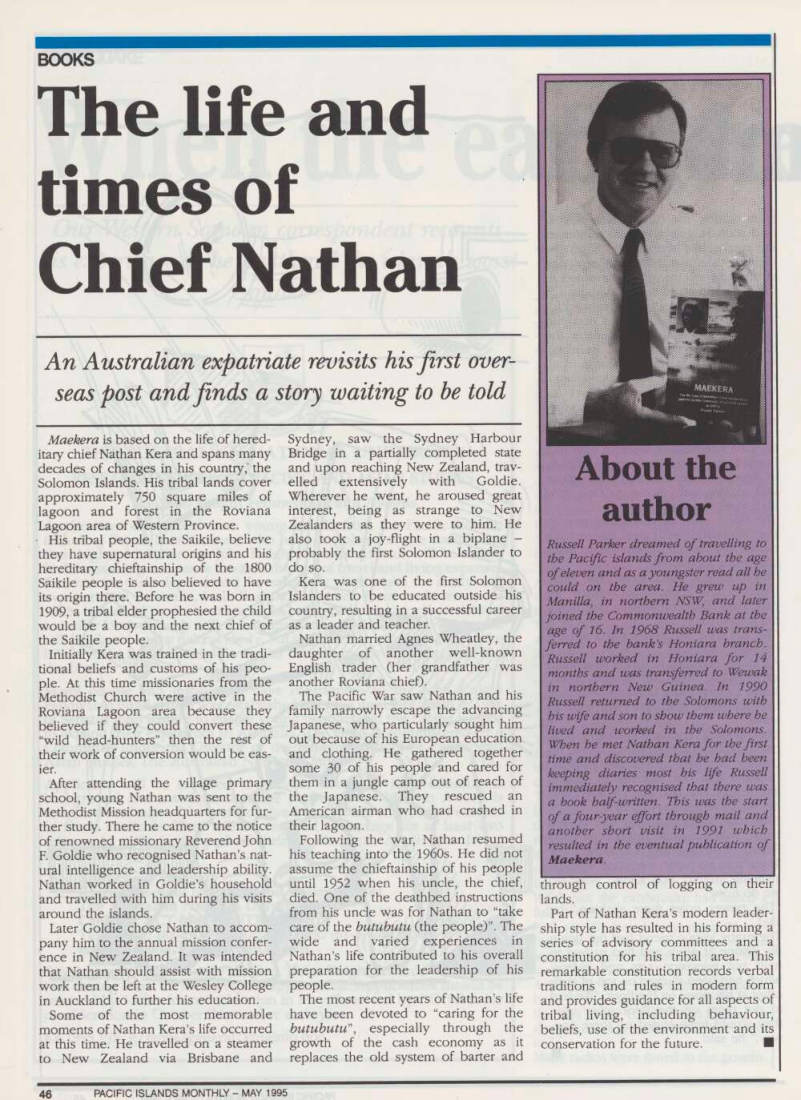
Books
The life and times of Chief Nathan
An Australian expatriate revisits his first over seas post and finds a story waiting to be told
Maekera is based on the life of hered itary chief Nathan Kera and spans many decades of changes in his country,' the Solomon Islands. His tribal lands cover approximately 750 square miles of lagoon and forest in the Roviana Lagoon area of Western Province.
His tribal people, the Saikile, believe they have supernatural origins and his hereditary chieftainship of the 1800 Saikile people is also believed to have its origin there. Before he was born in 1909, a tribal elder prophesied the child would be a boy and the next chief of the Saikile people.
Initially Kera was trained in the tradi tional beliefs and customs of his peo ple. At this time missionaries from the Methodist Church were active in the Roviana Lagoon area because they believed if they could convert these “wild head-hunters” then the rest of their work of conversion would be eas ier.
After attending the village primary school, young Nathan was sent to the Methodist Mission headquarters for fur ther study. There he came to the notice of renowned missionary Reverend John F. Goldie who recognised Nathan’s nat ural intelligence and leadership ability.
Nathan worked in Goldie’s household and travelled with him during his visits around the islands.
Later Goldie chose Nathan to accom pany him to the annual mission confer ence in New Zealand. It was intended that Nathan should assist with mission work then be left at the Wesley College in Auckland to further his education.
Some of the most memorable moments of Nathan Kera’s life occurred at this time. He travelled on a steamer to New Zealand via Brisbane and
Sydney, saw the Sydney Harbour Bridge in a partially completed state and upon reaching New Zealand, trav elled extensively with Goldie.
Wherever he went, he aroused great interest, being as strange to New Zealanders as they were to him. He also took a joy-flight in a biplane probably the first Solomon Islander to do so.
Kera was one of the first Solomon Islanders to be educated outside his country, resulting in a successful career as a leader and teacher.
Nathan married Agnes Wheatley, the daughter of another well-known English trader (her grandfather was another Roviana chief).
The Pacific War saw Nathan and his family narrowly escape the advancing Japanese, who particularly sought him out because of his European education and clothing. He gathered together some 30 of his people and cared for them in a jungle camp out of reach of the Japanese. They rescued an American airman who had crashed in their lagoon.
Following the war, Nathan resumed his teaching into the 19605. He did not assume the chieftainship of his people until 1952 when his uncle, the chief, died. One of the deathbed instructions from his uncle was for Nathan to “take care of the butubutu (the people)”. The wide and varied experiences in Nathan’s life contributed to his overall preparation for the leadership of his
people.
The most recent years of Nathan’s life have been devoted to “caring for the butubutu ”, especially through the growth of the cash economy as it replaces the old system of barter and
through control of logging on their lands.
Part of Nathan Kera’s modern leader ship style has resulted in his forming a series of advisory committees and a constitution for his tribal area. This remarkable constitution records verbal traditions and rules in modern form and provides guidance for all aspects of tribal living, including behaviour, beliefs, use of the environment and its conservation for the future. H
About the author
author
Russell Parker dreamed of travelling to the Pacific islands from about the age of eleven and as a youngster read all he could on the area. He grew up in Manilla, in northern NSW, and later joined the Commonwealth Bank at the age of 16. In 1968 Russell was trans ferred to the bank’s Honiara branch.
Russell worked in Honiara for 14 months and was transferred to Wewak in northern New Guinea. In 1990 Russell returned to the Solomons with his wife and son to show them where be lived and worked in the Solomons.
When he met Nathan Kera for the first time and discovered that he had been keeping diaries most his life Russell immediately recognised that there was a book half-written. This was the start of a four-year effort through mail and another short visit in 1991 which resulted in the eventual publication of Maekera.
Impressions of
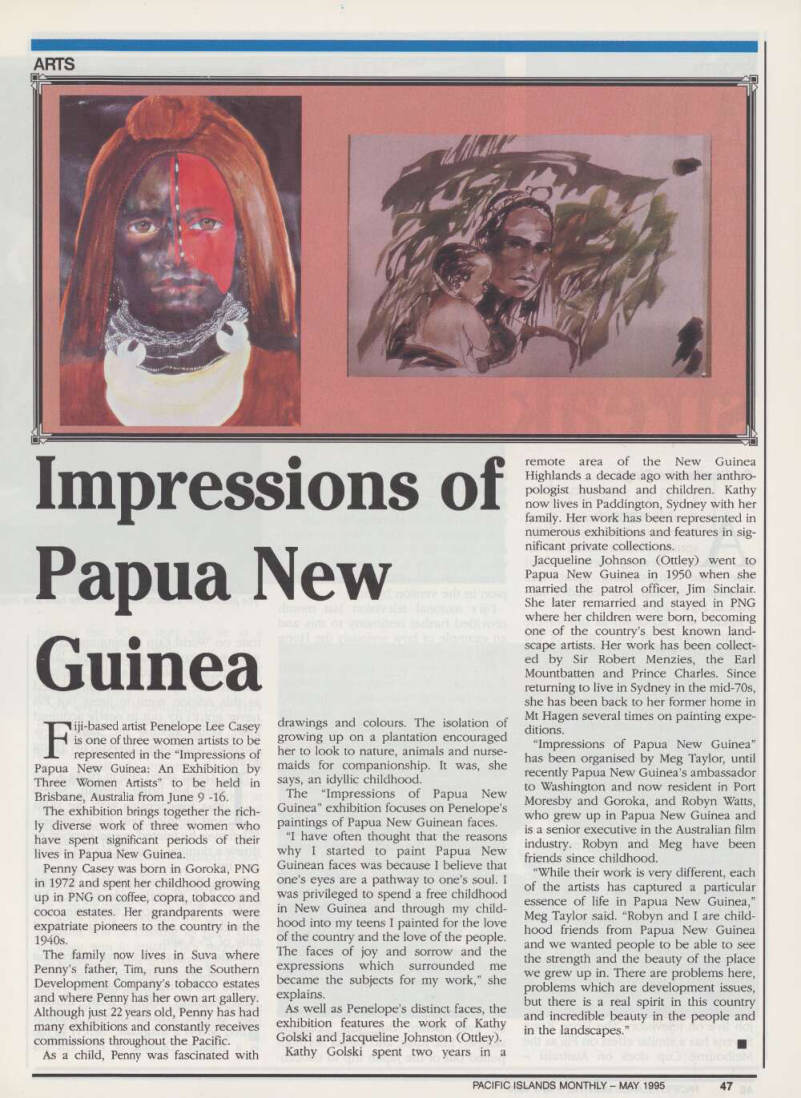
Arts
Impressions of Papua New Guinea
Fiji-based artist Penelope Lee Casey is one of three women artists to be represented in the “Impressions of Papua New Guinea: An Exhibition by Three Women Artists” to be held in Brisbane, Australia from June 9 -16.
The exhibition brings together the rich ly diverse work of three women who have spent significant periods of their lives in Papua New Guinea.
Penny Casey was born in Goroka, PNG in 1972 and spent her childhood growing up in PNG on coffee, copra, tobacco and cocoa estates. Her grandparents were expatriate pioneers to the country in the 19405.
The family now lives in Suva where Penny’s father, Tim, runs the Southern Development Company’s tobacco estates and where Penny has her own art gallery.
Although just 22 years old, Penny has had many exhibitions and constantly receives commissions throughout the Pacific.
As a child, Penny was fascinated with
, , , . - . c drawings and colours. The isolation of growing up on a plantation encouraged her * 0 l ° ok to nature > animals and nurse mai s a ° m j? a P!P nS ! P ' WaS ’ S e sa Yf > an * IC c . l 00 ' . e „ m PJ' e^ slor J s ° apua ew Gumea exhibition focuses on Penelope s P a * n ’ n^ S ° f a^ a e , W uint j an aces.
I have often thought that the reasons wh Y 1 started to P aint Pa P ua New Guinean faces was because I believe that ones e Y es ar <- a pathway to one s soul. I was privileged to spend a free childhood * n New Guinea and through my child h°°d into W teens I painted for the love of the country and the love of the people. -ru c c ■ a a The faces of )°Y and sorrow and the expressions which surrounded me became the subjects for my work, she
explains .
As ™ ell as Penel °pe s distinct faces, he exhibition features the work of Kathy
Golski and Jacqueline Johnston (Ottley).
Kathy Golski spent two years in a
remote area of the New Guinea Highlands a decade ago with her anthro pologist husband and children. Kathy now lives in Paddington, Sydney with her family. Her work has been represented in numerous exhibitions and features in sig nificant private collections.
Jacqueline Johnson (Ottley) went to Papua New Guinea in 1950 when she married the patrol officer, Jim Sinclair.
She later remarried and stayed in PNG where her children were born, becoming one of the country’s best known land scape artists. Her work has been collect ed by Sir Robert Menzies, the Earl Mountbatten and Prince Charles. Since returning to live in Sydney in the mid-70s, she has been back to her former home in Mt Hagen several times on painting expe ditions.
“Impressions of Papua New Guinea” has been organised by Meg Taylor, until recently Papua New Guinea’s ambassador to Washington and now resident in Port Moresby and Goroka, and Robyn Watts, who grew up in Papua New Guinea and is a senior executive in the Australian film industry. Robyn and Meg have been friends since childhood.
“While their work is very different, each of the artists has captured a particular essence of life in Papua New Guinea,”
Meg Taylor said. “Robyn and I are child hood friends from Papua New Guinea and we wanted people to be able to see the strength and the beauty of the place we grew up in. There are problems here, problems which are development issues, but there is a real spirit in this country and incredible beauty in the people and in the landscapes.”
winning
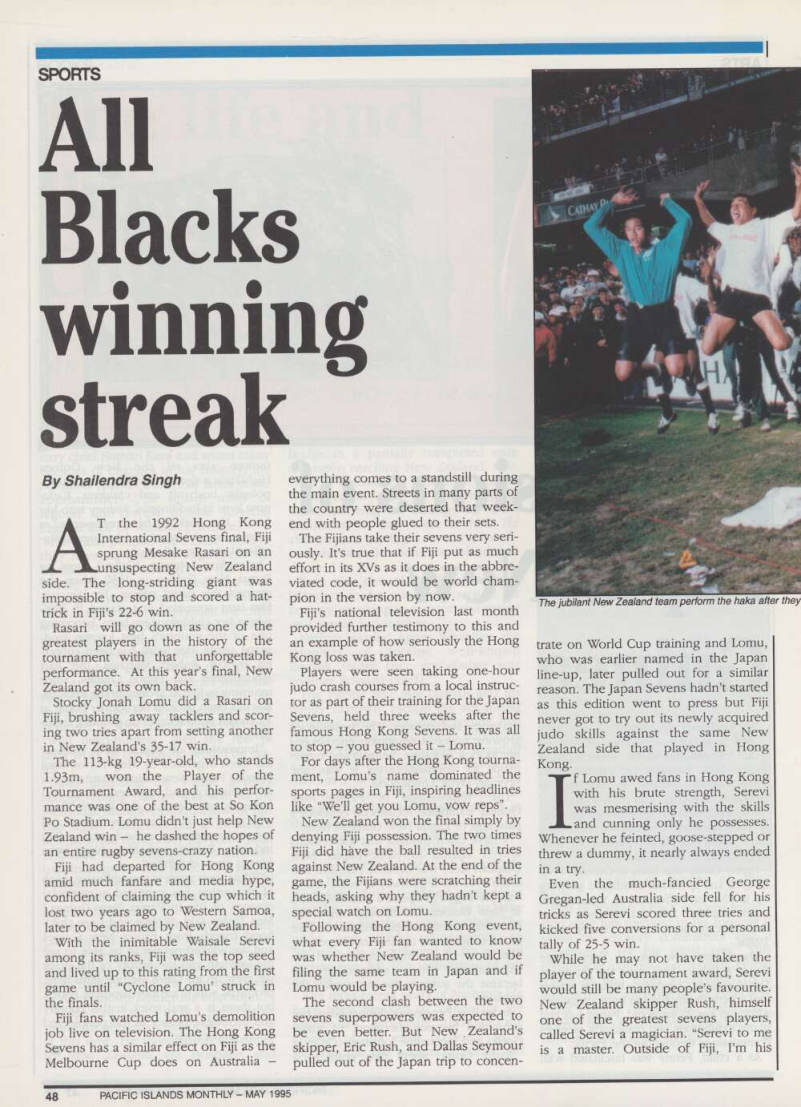
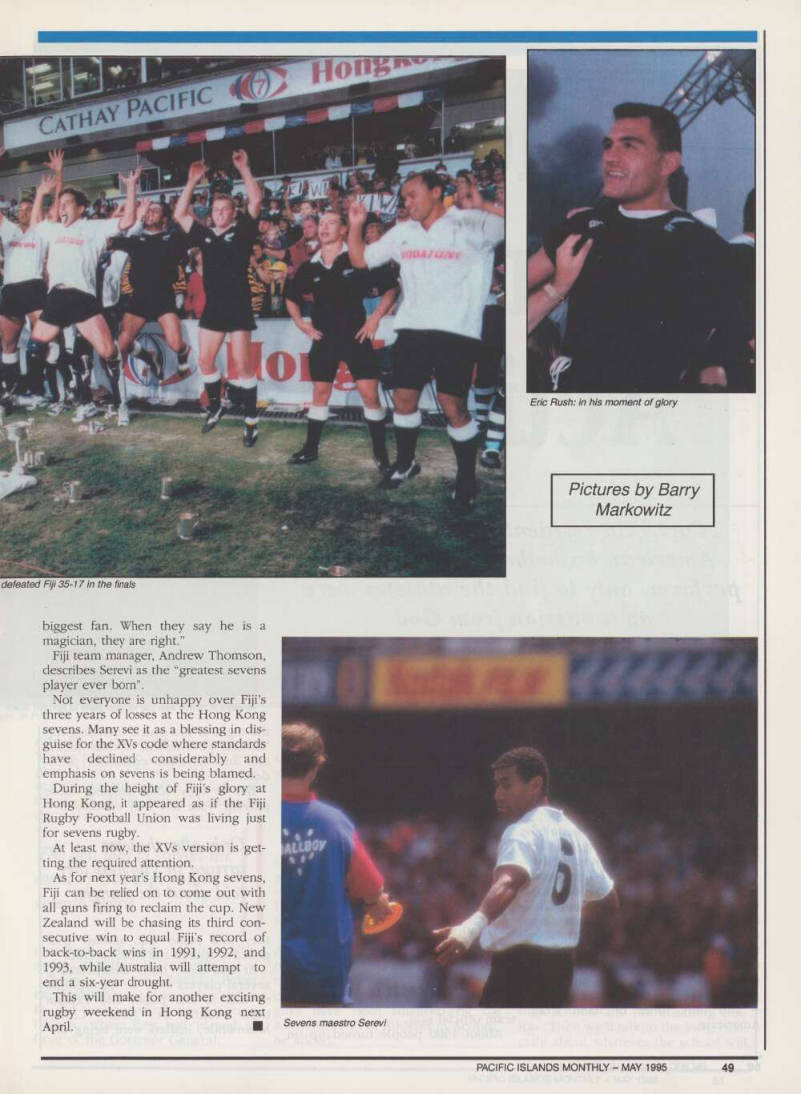
Sports
All Blacks winning streak
By Shailendra Singh
AT the 1992 Hong Kong International Sevens final, Fiji sprung Mesake Rasari on an unsuspecting New Zealand side. The long-striding giant was impossible to stop and scored a hat trick in Fiji’s 22-6 win.
Rasari will go down as one of the greatest players in the history of the tournament with that unforgettable performance. At this year’s final, New Zealand got its own back.
Stocky Jonah Lomu did a Rasari on Fiji, brushing away tacklers and scor ing two tries apart from setting another in New Zealand’s 35-17 win.
The 113-kg 19-year-old, who stands 1.93 m, won the Player of the Tournament Award, and his perfor mance was one of the best at So Kon Po Stadium. Lomu didn’t just help New Zealand win he dashed the hopes of an entire rugby sevens-crazy nation.
Fiji had departed for Hong Kong amid much fanfare and media hype, confident of claiming the cup which it lost two years ago to Western Samoa, later to be claimed by New Zealand.
With the inimitable Waisale Serevi among its ranks, Fiji was the top seed and lived up to this rating from the first game until “Cyclone Lomu’ struck in the finals.
Fiji fans watched Lomu’s demolition job live on television. The Hong Kong Sevens has a similar effect on Fiji as the Melbourne Cup does on Australia -
everything comes to a standstill during the main event. Streets in many parts of the country were deserted that week end with people glued to their sets.
The Fijians take their sevens very seri ously. It’s true that if Fiji put as much effort in its XVs as it does in the abbre viated code, it would be world cham pion in the version by now.
Fiji’s national television last month provided further testimony to this and an example of how seriously the Hong Kong loss was taken.
Players were seen taking one-hour judo crash courses from a local instruc tor as part of their training for the Japan Sevens, held three weeks after the famous Hong Kong Sevens. It was all to stop - you guessed it - Lomu.
For days after the Hong Kong tourna ment, Lomu’s name dominated the sports pages in Fiji, inspiring headlines like “We’ll get you Lomu, vow reps”.
New Zealand won the final simply by denying Fiji possession. The two times Fiji did have the ball resulted in tries against New Zealand. At the end of the game, the Fijians were scratching their heads, asking why they hadn’t kept a special watch on Lomu.
Following the Hong Kong event, what every Fiji fan wanted to know was whether New Zealand would be filing the same team in Japan and if Lomu would be playing.
The second clash between the two sevens superpowers was expected to be even better. But New Zealand’s skipper, Eric Rush, and Dallas Seymour pulled out of the Japan trip to concen-
trate on World Cup training and Lomu, who was earlier named in the Japan line-up, later pulled out for a similar reason. The Japan Sevens hadn’t started as this edition went to press but Fiji never got to try out its newly acquired judo skills against the same New Zealand side that played in Hong Kong.
If Lomu awed fans in Hong Kong with his brute strength, Serevi was mesmerising with the skills and cunning only he possesses.
Whenever he feinted, goose-stepped or threw a dummy, it nearly always ended in a try.
Even the much-fancied George Gregan-led Australia side fell for his tricks as Serevi scored three tries and kicked five conversions for a personal tally of 25-5 win.
While he may not have taken the player of the tournament award, Serevi would still be many people’s favourite.
New Zealand skipper Rush, himself one of the greatest sevens players, called Serevi a magician. “Serevi to me is a master. Outside of Fiji, I’m his
The jubilant New Zealand team perform the haka after they
biggest fan. When they say he is a magician, they are right.”
Fiji team manager, Andrew Thomson, describes Serevi as the “greatest sevens player ever born”.
Not everyone is unhappy over Fiji’s three years of losses at the Hong Kong sevens. Many see it as a blessing in dis guise for the XVs code where standards have declined considerably and emphasis on sevens is being blamed.
During the height of Fiji’s glory at Hong Kong, it appeared as if the Fiji Rugby Football Union was living just for sevens rugby.
At least now, the XVs version is get ting the required attention.
As for next year’s Hong Kong sevens, Fiji can be relied on to come out with all guns firing to reclaim the cup. New Zealand will be chasing its third con secutive win to equal Fiji’s record of back-to-back wins in 1991, 1992, and 1993, while Australia will attempt to end a six-year drought.
This will make for another exciting rugby weekend in Hong Kong next April. ■
defeated Fiji 35-17 in the finals
Eric Rush: in his moment of glory
Pictures by Barry Markowitz
Sevens maestro Serevi
Athletes
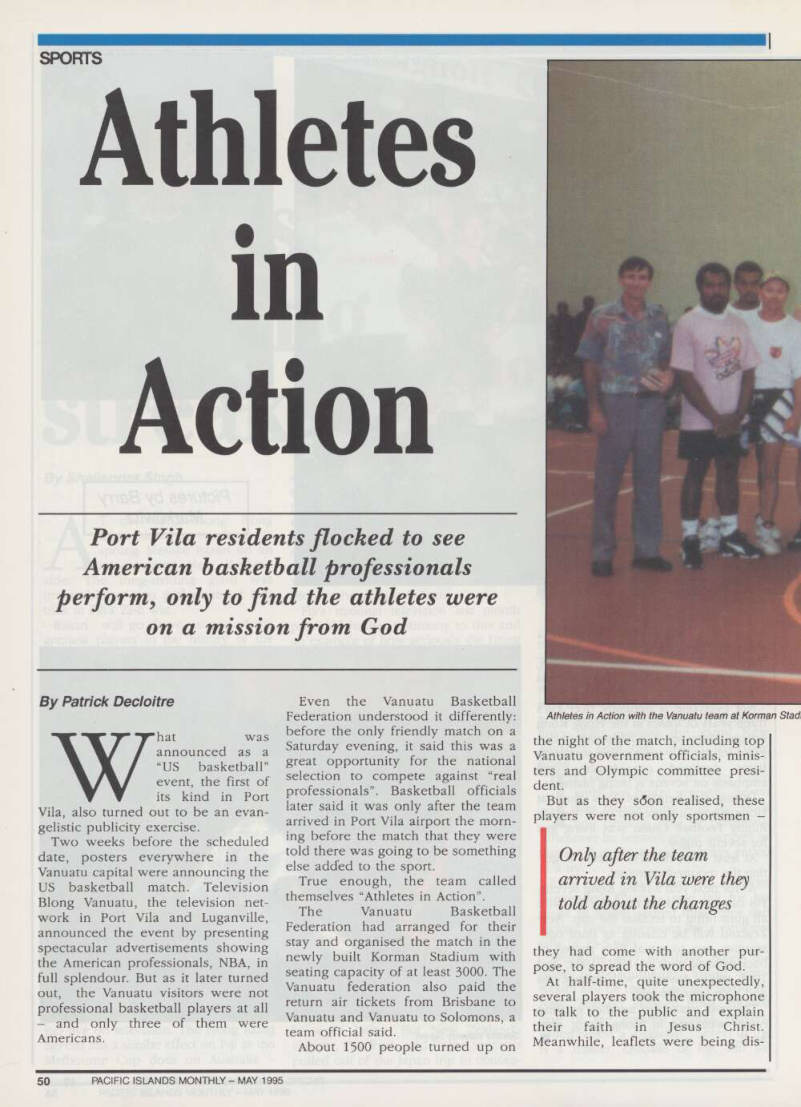
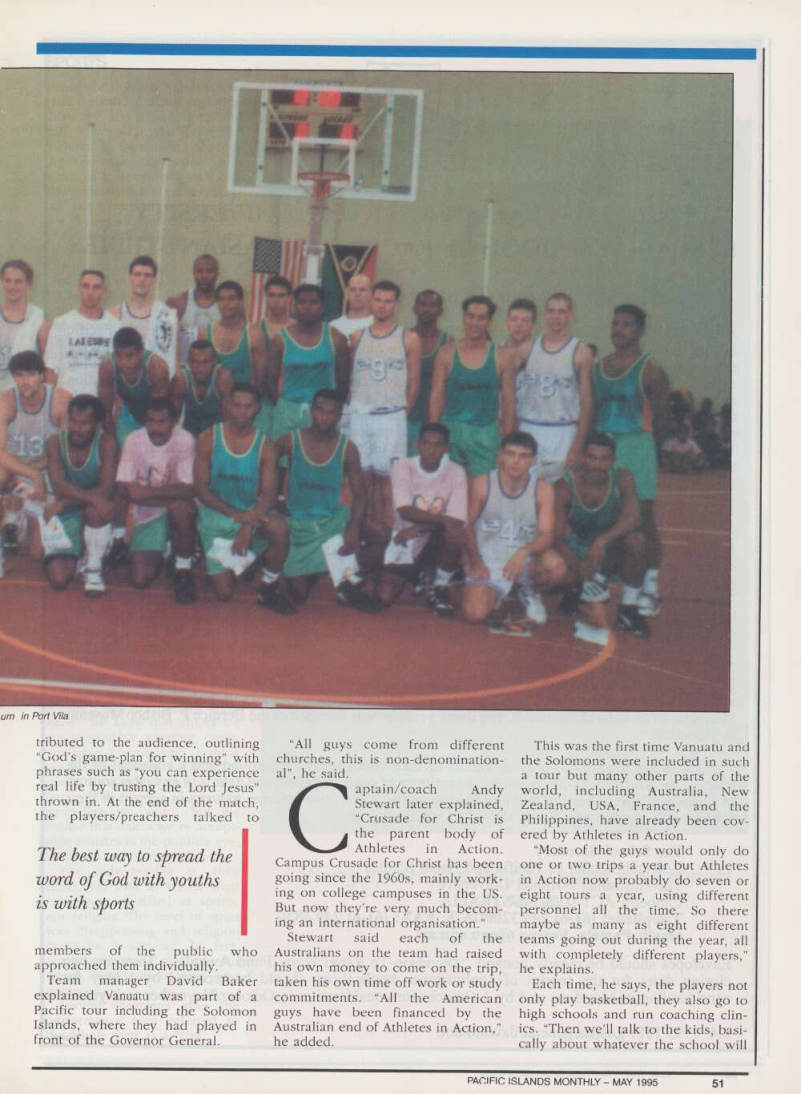
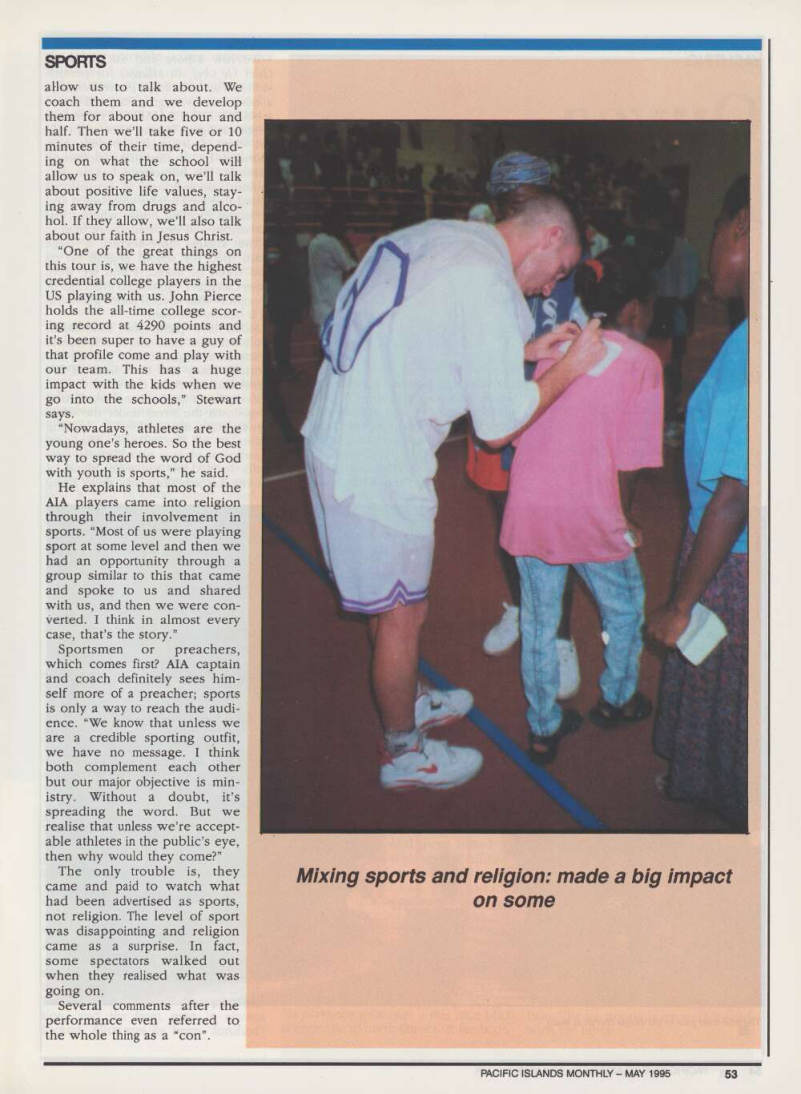
Sports
Athletes in Action
Port Vila residents flocked to see American basketball professionals perform, only to find the athletes were on a mission from God
By Patrick Decloitre
What was
announced as a “US basketball” event, the first of its kind in Port Vila, also turned out to be an evan gelistic publicity exercise.
Two weeks before the scheduled date, posters everywhere in the Vanuatu capital were announcing the US basketball match. Television Blong Vanuatu, the television net work in Port Vila and Luganville, announced the event by presenting spectacular advertisements showing the American professionals, NBA, in full splendour. But as it later turned out, the Vanuatu visitors were not professional basketball players at all and only three of them were Americans.
Even the Vanuatu Basketball Federation understood it differently: before the only friendly match on a Saturday evening, it said this was a great opportunity for the national selection to compete against “real professionals”. Basketball officials later said it was only after the team arrived in Port Vila airport the morn ing before the match that they were told there was going to be something else added to the sport.
True enough, the team called themselves “Athletes in Action”.
The Vanuatu Basketball Federation had arranged for their stay and organised the match in the newly built Korman Stadium with seating capacity of at least 3000. The Vanuatu federation also paid the return air tickets from Brisbane to Vanuatu and Vanuatu to Solomons, a team official said.
About 1500 people turned up on
the night of the match, including top Vanuatu government officials, minis ters and Olympic committee presi dent.
But as they sdon realised, these players were not only sportsmen -
Only after the team
arrived in Vila were they told about the changes
they had come with another pur pose, to spread the word of God.
At half-time, quite unexpectedly, several players took the microphone to talk to the public and explain their faith in Jesus Christ.
Meanwhile, leaflets were being dis
Athletes in Action with the Vanuatu team at Korman Stad
tributed to the audience, outlining “God’s game-plan for winning” with phrases such as you can experience real life by trusting the Lord Jesus” thrown in. At the end of the match, the players/preachers talked to
The best way to spread the word of God with youths is with sports
members of the public who approached them individually.
Team manager David Baker explained Vanuatu was part of a Pacific tour including the Solomon Islands, where they had played in front of the Governor General.
All guys come from different churches, this is non-denominational”, he said. f a P tain /cc>ach Andy Stewart later explained, I “Crusade for Christ is j the parent body of Athletes in Action.
Campus Crusade for Christ has been going sin ce the 19605, mainly working on college campuses in the US.
But now they’re very much becoming an international organisation.”
Stewart said each of the Australians on the team had raised his own money to come on the trip, taken his own time off work or study commitments. “All the American guys have been financed by the Australian end of Athletes in Action,” he added.
This was the first time Vanuatu and the Solomons were included in such a tour but many other parts of the world, including Australia, New Zealand, USA, France, and the Philippines, have already been cov ered by Athletes in Action.
“Most of the guys would only do one or two trips a year but Athletes in Action now probably do seven or eight tours a year, using different personnel all the time. So there maybe as many as eight different teams going out during the year, all with completely different players,”
he explains.
Each time, he says, the players not only play basketball, they also go to high schools and run coaching din ics. “Then we’ll talk to the kids, basi cally about whatever the school will
um in Port Vila
allow us to talk about. We coach them and we develop them for about one hour and half. Then we’ll take five or 10 minutes of their time, depend ing on what the school will allow us to speak on, we’ll talk about positive life values, stay ing away from drugs and alco hol. If they allow, we’ll also talk about our faith in Jesus Christ.
“One of the great things on this tour is, we have the highest credential college players in the US playing with us. John Pierce holds the all-time college scor ing record at 4290 points and it’s been super to have a guy of that profile come and play with our team. This has a huge impact with the kids when we go into the schools,” Stewart says.
“Nowadays, athletes are the young one’s heroes. So the best way to spread the word of God with youth is sports,” he said.
He explains that most of the AIA players came into religion through their involvement in sports. “Most of us were playing sport at some level and then we had an opportunity through a group similar to this that came and spoke to us and shared with us, and then we were con verted. I think in almost every case, that’s the story.”
Sportsmen or preachers, which comes first? AIA captain and coach definitely sees him self more of a preacher; sports is only a way to reach the audi ence. “We know that unless we are a credible sporting outfit, we have no message. I think both complement each other but our major objective is min istry. Without a doubt, it’s spreading the word. But we realise that unless we’re accept able athletes in the public’s eye, then why would they come?”
The only trouble is, they came and paid to watch what had been advertised as sports, not religion. The level of sport was disappointing and religion came as a surprise. In fact, some spectators walked out when they realised what was going on.
Several comments after the performance even referred to the whole thing as a “con”.
Mixing sports and religion: made a big impact on some
Advertisements & other items, p. 52 (1 item)
The Australian National University
RESEARCH SCHOOL OF PACIFIC AND ASIAN STUDIES
Davidson-Te Rangi Hiroa Fund Awards
Applications are invited for Davidson-Te Rangi Hiroa Fund Awards from students from the Pacific Islands, including Papua New Guinea, who have recently completed or are completing their higher education. Awards are made chiefly to those seeking assistance towards the cost of travel and living expenses (but not for their dependants) for relatively short visits for research, study and consultation at universities, institutions or places other than that in which they are currently studying. Awards do not normally exceed, $^1,5100. 1 No limitation is placed on the field of study, but there is some preference for assistance for visits to universities, institutions or other places in the Pacific region.
The intention of the Awards is to support persons in the earlier stages of their career, rather than those who are well established in their employment, and an Award is not available to the same applicant on more than one occasion. Normally attendance at a conference only would not attract a grant.
Several governments, university institutions and private individuals contributed to the Davidson Memorial Fund which was established by The Australian National University on the death in 1973 of Professor J.W. Davidson, “to enable Pacific Islands students to continue their education overseas”. The Fund is administered by a Committee under the Director of the Research School of Pacific and Asian Studies, The Australian National University. Professor Davidson, a New Zealander by birth, was the Foundation Professor of Pacific History in the Research School of Pacific Studies.
He served as a constitutional consultant to the Governments of Western Samoa, the Cook Islands, Naum, Micronesia and Papua New Guinea during their advance towards self-government. In 1991 the Committee took over the administration of the Te Rangi Hiroa Fund for the study of Pacific History, established in 1969. Te Rangi Hiroa, also known as Sir Peter Buck, was a distinguished anthropologist and historian of the Pacific and author of numerous books on Polynesian culture and monographs on individual islands. For many years he was Director of the Bernice P, Bishop Museum in Honolulu.
Applicants are required to provide details of their educational background and a statement of the purpose for which an Award is sought, an estimate of costs involved, and details of any other sources of funds available. They are required to arrange for at least two referees to write in support of their applications. Application forms should be obtained from: The School Secretary Research School of Pacific and Asian Studies The Australian National University Canberra ACT 0200 AUSTRALIA Telephone: (61-6) 249 3200/2678; FAX: (61-6) 249 4836 email: Pamela. Ferrar @anu.edu.au Envelopes should be clearly marked “Davidson-Te Rangi Hiroa Fund Awards”. There are two closing dates for the receipt of applications. Applications should be received by 1 May for consideration in May/June and by 1 October for consideration in October/November each year. 4.4. 1995 PJF: g/rspas/general/davinfo.doc 111998V3
paradise
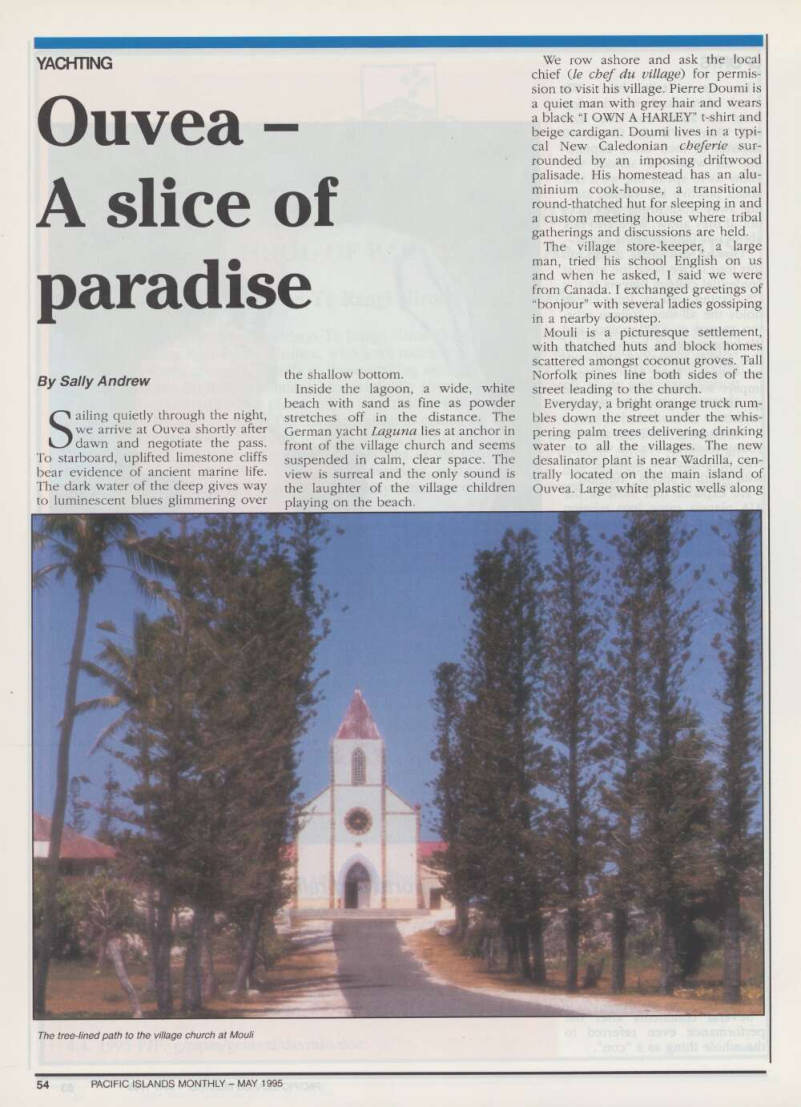
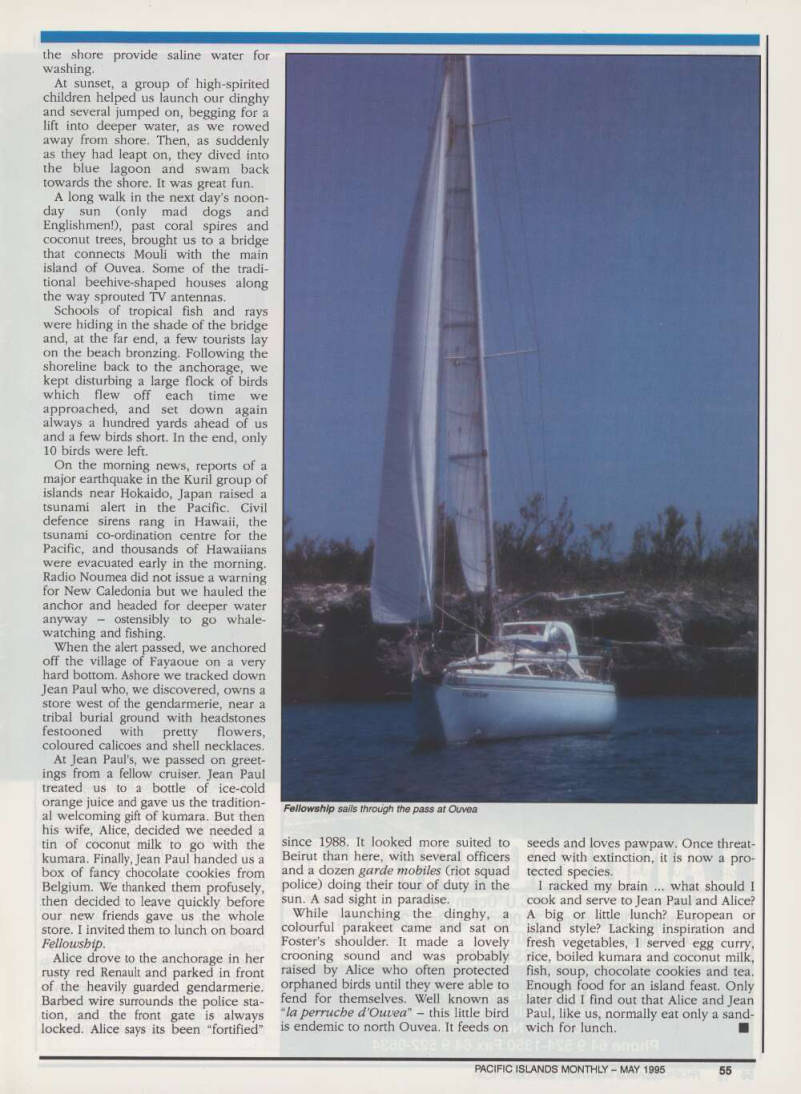
Yachting
Ouvea - A slice of paradise
By Sally Andrew
Sailing quietly through the night, we arrive at Ouvea shortly after dawn and negotiate the pass.
To starboard, uplifted limestone cliffs bear evidence of ancient marine life.
The dark water of the deep gives way to luminescent blues glimmering over
the shallow bottom.
Inside the lagoon, a wide, white beach with sand as fine as powder stretches off in the distance. The German yacht Laguna lies at anchor in front of the village church and seems suspended in calm, clear space. The view is surreal and the only sound is the laughter of the village children playing on the beach.
We row ashore and ask the local chief (le chef du village) for permis sion to visit his village. Pierre Doumi is a quiet man with grey hair and wears a black “I OWN A HARLEY” t-shirt and beige cardigan. Doumi lives in a typi cal New Caledonian cbeferie sur rounded by an imposing driftwood palisade. His homestead has an alu minium cook-house, a transitional round-thatched hut for sleeping in and a custom meeting house where tribal gatherings and discussions are held.
The village store-keeper, a large man, tried his school English on us and when he asked, I said we were from Canada. I exchanged greetings of “bonjour” with several ladies gossiping in a nearby doorstep.
Mouli is a picturesque settlement, with thatched huts and block homes scattered amongst coconut groves. Tall Norfolk pines line both sides of the street leading to the church.
Everyday, a bright orange truck rum bles down the street under the whis pering palm trees delivering drinking water to all the villages. The new desalinator plant is near Wadrilla, cen trally located on the main island of Ouvea. Large white plastic wells along
The tree-lined path to the village church at Mouli
the shore provide saline water for
washing.
At sunset, a group of high-spirited children helped us launch our dinghy and several jumped on, begging for a lift into deeper water, as we rowed away from shore. Then, as Suddenly as they had leapt on, they dived into the blue lagoon and swam back towards the shore. It was great fun.
A long walk in the next day’s noon day sun (only mad dogs and Englishmen!), past coral spires and coconut trees, brought us to a bridge that connects Mouli with the main island of Ouvea. Some of the tradi
tional beehive-shaped houses along
the way sprouted TV antennas.
Schools of tropical fish and rays were hiding in the shade of the bridge and, at the far end, a few tourists lay on the beach bronzing. Following the shoreline back to the anchorage, we kept disturbing a large flock of birds which flew off each time we approached-, and set down again always a hundred yards ahead of us and a few birds short. In the end, only 10 birds were left.
On the morning news, reports of a major earthquake in the Kuril group of islands near Hokaido, Japan raised a tsunami alert in the Pacific. Civil defence sirens rang in Hawaii, the tsunami co-ordination centre for the Pacific, and thousands of Hawaiians were evacuated early in the morning.
Radio Noumea did not issue a warning for New Caledonia but we hauled the anchor and headed for deeper water anyway - ostensibly to go whale watching and fishing.
When the alert passed, we anchored off the village of Fayaoue on a very hard bottom. Ashore we tracked down Jean Paul who, we discovered, owns a store west of the gendarmerie, near a tribal burial ground with headstones festooned with pretty flowers, coloured calicoes and shell necklaces.
At Jean Paul’s, we passed on greet ings from a fellow cruiser. Jean Paul treated us to a bottle of ice-cold orange juice and gave us the tradition al welcoming gift of kumara. But then his wife, Alice, decided we needed a tin of coconut milk to go with the kumara. Finally, Jean Paul handed us a box of fancy chocolate cookies from Belgium. We thanked them profusely, then decided to leave quickly before our new friends gave us the whole store. I invited them to lunch on board
Fellowship.
Alice drove to the anchorage in her rusty red Renault and parked in front of the heavily guarded gendarmerie.
Barbed wire surrounds the police sta tion, and the front gate is always locked. Alice says its been “fortified”
since 1988. It looked more suited to Beirut than here, with several officers and a dozen garde mobiles (riot squad police) doing their tour of duty in the sun. A sad sight in paradise.
While launching the dinghy, a colourful parakeet came and sat on Foster’s shoulder. It made a lovely crooning sound and was probably raised by Alice who often protected orphaned birds until they were able to fend for themselves. Well known as “la perruche d’Ouvea" - this little bird is endemic to north Ouvea. It feeds on
seeds and loves pawpaw. Once threat ened with extinction, it is now a pro tected species.
I racked my brain ... what should I cook and serve to Jean Paul and Alice?
A big or little lunch? European or island style? Lacking inspiration and fresh vegetables, I served egg curry, rice, boiled kumara and coconut milk, fish, soup, chocolate cookies and tea.
Enough food for an island feast. Only later did I find out that Alice and Jean Paul, like us, normally eat only a sand wich for lunch. ■
Fellowship sails through the pass at Ouvea
New Fiji boat
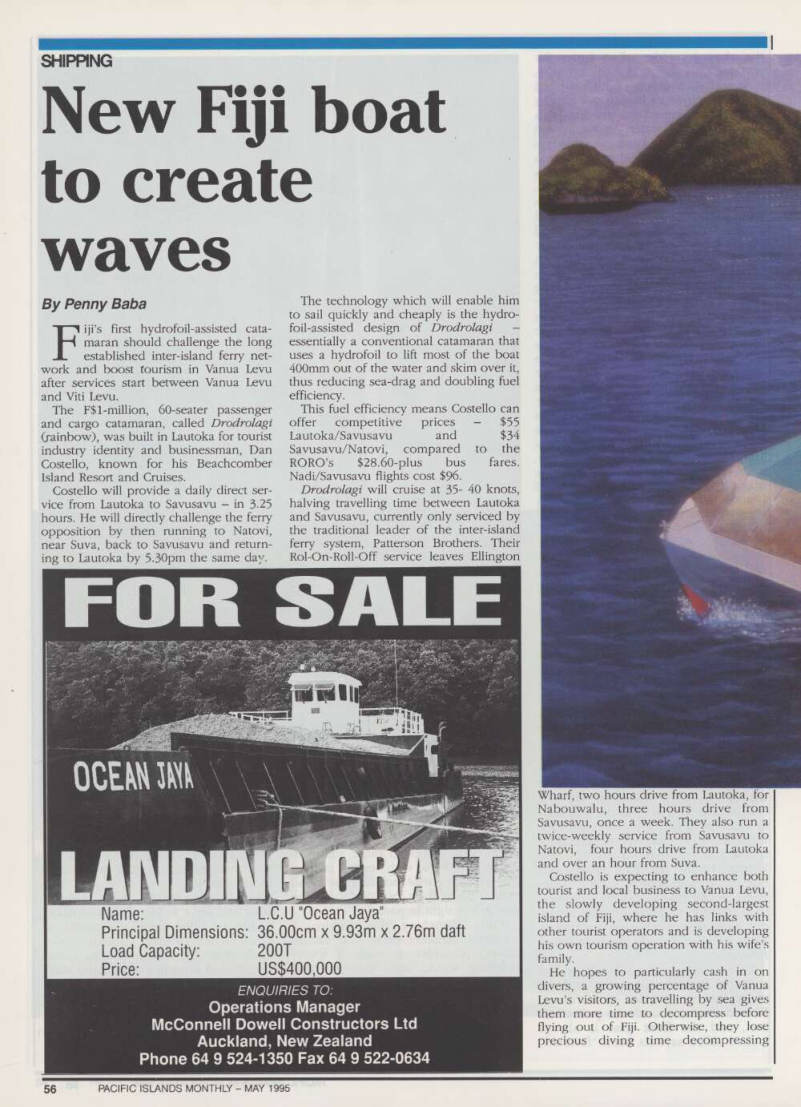
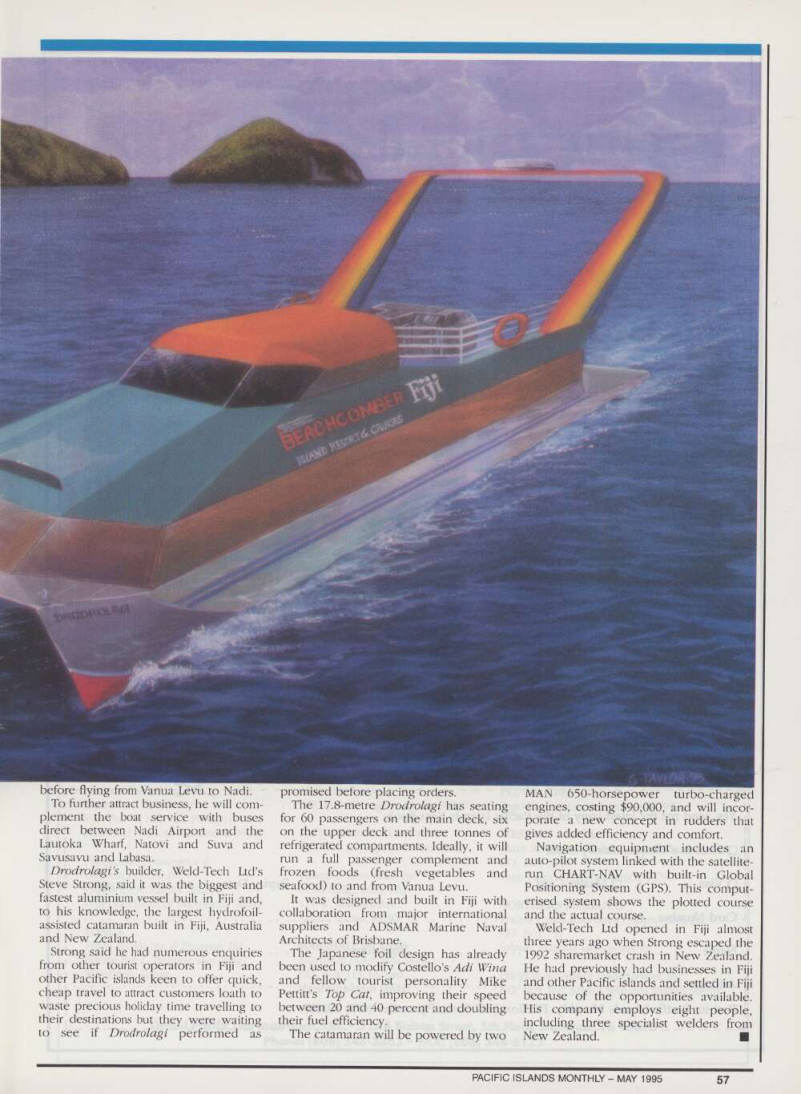
Shipping
New Fiji boat to create waves
By Penny Baba
Fiji’s first hydrofoil-assisted cata maran should challenge the long established inter-island ferry net work and boost tourism in Vanua Levu after services start between Vanua Levu and Viti Levu.
The Fsl-million, 60-seater passenger and cargo catamaran, called Drodrolagi (jainbow), was built in Lautoka for tourist industry identity and businessman, Dan Costello, known for his Beachcomber Island Resort and Cruises.
Costello will provide a daily direct ser vice from Lautoka to Savusavu - in 3-25 hours. He will directly challenge the ferry opposition by then running to Natovi, near Suva, back to Savusavu and return ing to Lautoka by 5.30 pm the same day.
The technology which will enable him to sail quickly and cheaply is the hydro foil-assisted design of Drodrolagi essentially a conventional catamaran that uses a hydrofoil to lift most of the boat 400 mm out of the water and skim over it, thus reducing sea-drag and doubling fuel
efficiency.
This fuel efficiency means Costello can offer competitive prices - $55 Lautoka/Savusavu and $34 Savusavu/Natovi, compared to the RORO’s $28.60-plus bus fares.
Nadi/Savusavu flights cost $96.
Drodrolagi will cruise at 35- 40 knots, halving travelling time between Lautoka and Savusavu, currently only serviced by the traditional leader of the inter-island ferry system, Patterson Brothers. Their Rol-On-Roll-Off service leaves Ellington
Wharf, two hours drive from Lautoka, for Nabouwalu, three hours drive from Savusavu, once a week. They also run a twice-weekly service from Savusavu to Natovi, four hours drive from Lautoka and over an hour from Suva.
Costello is expecting to enhance both tourist and local business to Vanua Levu,
the slowly developing second-largest
island of Fiji, where he has links with other tourist operators and is developing his own tourism operation with his wife’s
family.
He hopes to particularly cash in on divers, a growing percentage of Vanua Levu’s visitors, as travelling by sea gives them more time to decompress before flying out of Fiji. Otherwise, they lose precious diving time decompressing
before flying from Vanua Levu to Nadi.
To further attract business, he will complement the boat service with buses direct between Nadi Airport and the Lautoka Wharf, Natovi and Suva and Savusavu and Labasa.
Drodrolagi’s builder, Weld-Tech Ltd’s Steve Strong, said it was the biggest and fastest aluminium vessel built in Fiji and,
to his knowledge, the largest hydrofoil-
assisted catamaran built in Fiji, Australia and New Zealand.
Strong said he had numerous enquiries from other tourist operators in Fiji and other Pacific islands keen to offer quick, cheap travel to attract customers loath to waste precious holiday time travelling to their destinations but they were waiting to see if Drodrolagi performed as
promised before placing orders.
The 17.8-metre Drodrolagi has seating for 60 passengers on the main deck, six on the upper deck and three tonnes of refrigerated compartments. Ideally, it will run a full passenger complement and frozen foods (fresh vegetables and seafood) to and from Vanua Levu.
It was designed and built in Fiji with collaboration from major international suppliers and ADSMAR Marine Naval Architects of Brisbane.
The Japanese foil design has already been used to modify Costello’s Adi Wina and fellow tourist personality Mike Pettitt’s Top Cat , improving their speed between 20 and 40 percent and doubling their fuel efficiency.
The catamaran will be powered by two
MAJN 650-horsepower turbo-charged engines, costing $90,000, and will incor porate a new concept in rudders that gives added efficiency and comfort.
Navigation equipment includes an auto-pilot system linked with the satellite run CHART-NAV with built-in Global Positioning System (GPS). This comput erised system shows the plotted course and the actual course.
Weld-Tech Ltd opened in Fiji almost three years ago when Strong escaped the 1992 sharemarket crash in New Zealand.
He had previously had businesses in Fiji and other Pacific islands and settled in Fiji because of the opportunities available.
His company employs eight people, including three specialist welders from New Zealand. ■
Advertisements & other items, pp. 56-60 (1 item)
I
TIS
P 1 a Name: L.C.U "Ocean Jaya"
Principal Dimensions: 36.00 cm x 9.93 m x 2.76 m daft Load Capacity: 200 T Price: US$4OO,OOO
ENQUIRIES TO:
Operations Manager McConnell Dowell Constructors Ltd Auckland, New Zealand Phone 64 9 524-1350 Fax 64 9 522-0634
Now Avai
Pacific Islands Yearßook
17th Edition
Price
AUD
oo
PLUS
m
POSTAGE
Learn more about the Pacific
culture/custom tradition!people
population, tourism, trade, airlines, tax system etc.
X Expiry Date Name Signature Address I i Yes, send me the latest copy of the Pacific Islands Year Book.
I □ Here is a cheque/money order 1 □ Visa □ Master Card I Card Number , Post to: Pacific Islands Monthly, PO Box 1167 Suva, Fiji or Fax (679) 303809.
I J
o 5 10 15 20 25 30 35 40 45 50 55 60 0 mm— -I— 1 0
I A LIFETIME OF SERVICES
25 35 40 Grand Pacific Life Insurance offers you a lifetime of safe, secure products at very competitive rates. • Choose from a full range of products such as
• Super Ordinary Life
• Super Universal • Non-Participating Whole Life • 10-Year Level Term • Flexible Premium Annuities • Group Life Insurance
• IRAs
• Graded Premium Whole Life We've been dedicated to providing fast, personalized service for more than 35 years through local ownership and management.
Cmn«! Pacific I .ifo Insurance, Ltd, That’s v/hy Grand Pacific Life is your Family for Life 009 throughout the Pacific, 25 30 40 45 45 10 15 20 25 30 35 40 45 50 55 60 ©
Grand Pacific Life Insurance, Ltd.
A member of the Finance Factors Family
FEDERATED STATES
OF MICRONESIA
Actouka Executive Insurance Underwriters P.O. Box 55, Kolonia, Pohnpei, Federated States of Micronesia 96941 Pacific Basin Insurance & General Services, Inc P.O. Box 494, Chuuk State, Federated States of Micronesia 96942
TONGA
Peseti Ma'afu Ins. & Finance, Ltd.
Private Bag 2, Taumoepeau Bldg.
Nukualofa, Tonga
GUAM
Great National Insurance Underwriters, Inc.
P.O. Box GA, Agana, Guam 96910 Pacific Financial Corporation P.O. Box AT, Agana, Guam 96910 Takagi & Associates, Inc.
GCIC Bldg., Suite 100 414 W. Soledad Ave.
Agana, Guam 96910
MARSHALL ISLANDS
Marshalls Insurance Agency P.O. Box 113, Majuro, Marshall Islands 96960
AMERICAN SAMOA
Mark Solofa Pacific Insurance & Finance, Inc.
P.O. Box 3149 Pago Pago, American Samoa 96799
WESTERN SAMOA
Mark Solofa Pacific Insurance & Finance, Inc.
P.O. Box 3149 Pago Pago, American Samoa 96799
NORTHERN MARIANAS
Pacific Basin Insurance Underwriters, Inc.
P.O. Box 710 Saipan, Mariana Islands 96950 Pacifica Insurance Underwriters, Inc.
P.O. Box 168, Saipan, Mariana Islands 96950 Grand Pacific Life Insurance, Ltd. *1164 Bishop Street, sth Floor, Honolulu, HI 96813 Phone: (808) 548-3363 • FAX: (808) 548-5122
A/ <?/q f sy** : ’ f % & pSjp"‘ A #r •?•-- ***'" ■ *£ .. .. m
Bom to run,
The Mitsubishi Lancer: A family sedan that meets our own standards of stability and performance.
Lancer is ready when you are.
The rear multi-link suspension system is absolutely fearless. The independent McPherson struts up front are equal to the challenge of even the toughest road conditions. And an aggressive, fuel-efficient SOHC engine awaits your command.
The ground-hugging chassis holds comers tight. A powerful braking system holds you and your family secure.
And when you venture into the passing lane, this car holds nothing back.
Because Lancer was born to run.
It is a dazzling product of our total approach to car design, a philosophy you can feel the moment you get behind the wheel.
There is no compromise in Lancer’s construction. Every detail meets our exacting standards of stability and performance. Its unique handling instincts and spirited responsiveness are an expression of Mitsubishi’s driving commitment to excellence in every car we make.
Yes, strictly speaking, Lancer is a family sedan. But the way it performs is something else.
MITSUBISHI LRNCER
What Drives You.
feBARY
Or 4/ 5T
ISSS
E F AMERICAN SAMOA: PACIFIC MARKETING INC. P.O. Box 698, Pago Pago, Tel. 699-9140 / AUSTRALIA: MITSUBISHI MOTORS AUSTRALIA LTD. 1284 South Road Clovelly Park South Australia 5042 Tel. (08) 2757297 / FIJI: NIVIS MOTOR & MACHINERY CO. LTD. G.P.O. Box 150, Suva, Tel. 383411 / GUAM: TRIPLE J ENTERPRISES INC. P.O. Box 6066, Tamuning Tel 6469126 / NEW CALEDONIA SOCIETE DTMPORTATION D'AUTO DU RACIFIQUE SUD S.A. P.O. Box 438, Noumea, Tel. 272-562 / NEW ZEALAND; MITSUBISHI MOTORS NEW ZEALAND LTD. Private Bag Porirua Tel 237-0109 / NORFOLI ISLAND: BORRY'S PTY LTD. P.O. Box 169, Taylors Road, Burnt, Tel. 2114 / PAPUA NEW GUINEA: TOBA MOTORS PTY LTD. P.O. Box 503, Port Moresby Tel. 217-874 / SAIPAN: SAIPAN AUTOWORLt INC. P.O. Box 487, Tel. 234-7133 / SOLOMON ISLANDS; HARVEST PACIFIC LTD. G.P.O. Box 888, Honiara, Tel. 30407 / TAHITI; SOPADEP S.A. B.P. 1617, Papeete, Tel. 427393 / TONGA: SITANI MAP CO., LTD. P.O. Box 83. Nukualofa, Tel. 24044 / VANUATU: SOCOMETRA VANUATU LTD. B.P. 6, Port-Vila, Tel. 2314 / WESTERN SAMOA: MOTOR DISTRIBUTORS (SAMOA) LTD. P.O. Box 576, Apia, Tel. 2095) A
MITSUBISHI
MOTORS
CREATING TOGETHER