Pacific

Islands
Monthly
April 1995
Our ■■■ ailing health service
American Samoa US$2.5O; Australia A 53.50; Cook Islands NZS3.OO; Fiji (Incl VAT) F 52.50; FS Micronesia USS3.OO; Kiribati A 52.50; Nauru A 52.50; Niue NZS3.OO; Norfolk ASS.OO; New Caledonia cpf2so; New Zealand (Incl. GST) NZ53.45; Northern Marianas USS3.OO; Papua New Guinea K 3.00; Palau USS3.OO; Marshall Islands USS3.OO; Solomon Islands A 53.00; French Polynesia cpf3oo; Tonga P 3.00; United States of America USS3.OO; Vanuatu VT22O; Western Samoa T 3.25.
Advertisements & other items, pp. 2-4 (1 item)
I'M jill
rrir
ii ■J- ■; gg :"•< If there’s one thing we island nations share, it’s a fierce pride in our top performers. People of the calibre of Western Samoa’s Peter Fatialofa. economically transporting the cargoes on which we depend.
Could this high performance shipping line And companies of the calibre of Pacific Forum be one of Peter Fatialofa’s own heroes?
Line. A shipping line that links us, reliably and Indeed it could.
For more information on Pacific Forum Line’s services and offices throughout the South Pacific, PROVIDING REGULAR DIRECT AND TRANS-SHIPMENT SERVICES TO AUSTRALIA • AMERICAN SAMOA • COOK ISLANDS
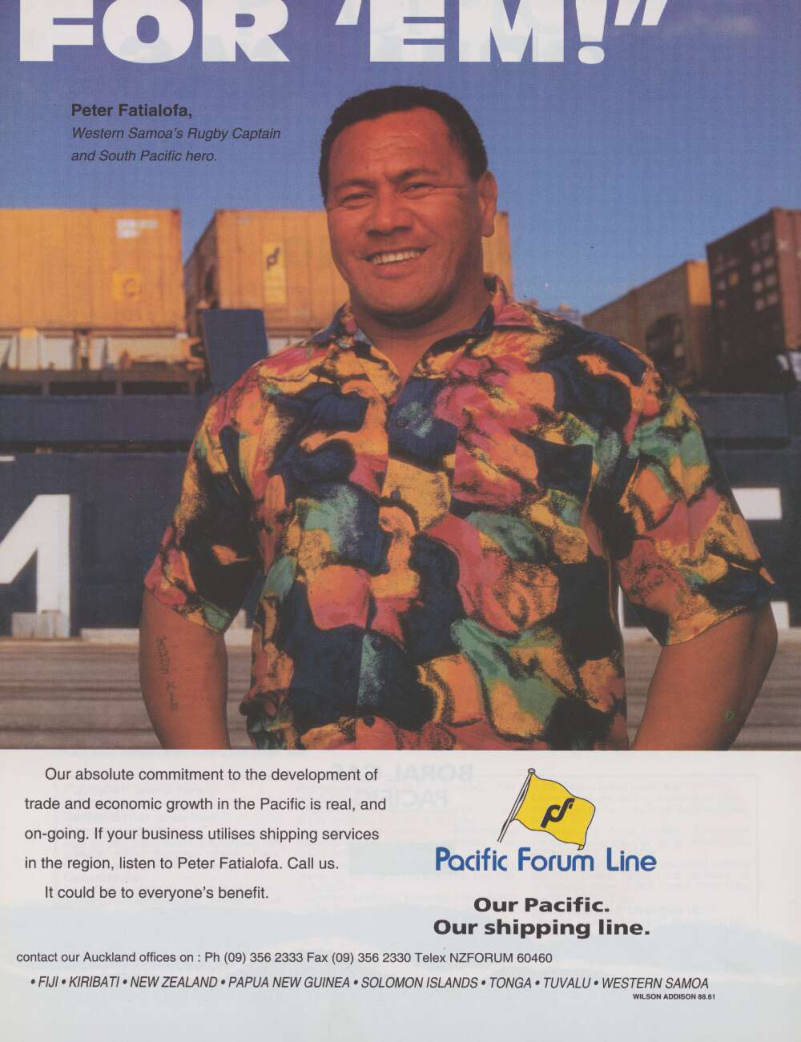
Peter Fatialofa,
Western Samoa’s Rugby Captain and South Pacific hero. r ■A cs? £ - Our absolute commitment to the development of trade and economic growth in the Pacific is real, and on-going. If your business utilises shipping services in the region, listen to Peter Fatialofa. Call us.
It could be to everyone’s benefit.
f~rn
Pacific Forum Line
Our Pacific.
Our shipping line.
contact our Auckland offices on : Ph (09) 356 2333 Fax (09) 356 2330 Telex NZFORUM 60460 • FIJI • KIRIBATI • NEW ZEALAND • PAPUA NEW GUINEA • SOLOMON ISLANDS • TONGA • TUVALU • WESTERN SAMOA
WILSON ADDISON 88.61
BORAL GAS
WORKING
WITH
YOU
IN THE
PACIFIC
BORAL GAS
PACIFIC
Pacific
Islands
Monthl Y
V0L.65 No 4
The News Magazine
April 1995
Letters 6
Headlines 9
Economy
Haiveta gets the ball rolling 10 Coming to terms with the kina 11 WaronVAGST 22
Volcano
Vanuatu’s boiling lake 13
Tahiti
Strikes riots and flag burning 14
Cover Stories
Focus on Vanuatu’s health system 16 The health situation never improves 18 Working out a regional solution 19
Politics
When the roof leaks 21 Who is running the government? 26
Aid
At the crossroads 25
Reform
Reshaping the legislature 29
Budget
A tough balancing act 32
Business
Kava - the next boom industry? 44
Sports
The Ironmen from Samoa 47 Fiji in top Sevens form 50
Yachting
The charm of the channel 52
Shipping
Mad as hell 56 Adventure on the South Seas 58
Opinion
David Barber 46 COVER DESIGN: James Ranuku
Publisher: Brian O’ Flaherty Editor: Mala Jagmohan Senior Writer: Yunus Rashid
Correspondents:
Alan Ah Mu, David North, Ed Rampell, lan Williams, Karen Mangnall, Martin Tiffany, Roman Grynberg, Wally Hiambohn.
Columnists: David Barber (Wellington), Futa Helu (Tonga, covering the Pacific Islands), Jemima Garrett (Sydney), Alfred Sasako (The Forum).
Advertising Sales: * Regional Sales - South Pacific; Ashok Lai, Monita Shires, Tel (679) 304111, 303429, Fax (679) 303809. ‘Sydney, Canberra: Bob Hill Media
Representation, Tel (61-2) 4164245, Fax (61-2) 4165064. ‘Brisbane: Robert Walker, Media House, Tel (61-7) 3710533, Fax (61-7) 3718904. ‘Adelaide: Hastwell Williamsons Representatives, Tel (61-8) 3799522, Fax (61-8) 3799735. ‘Melbourne: Brown Orr Fletcher Burrows (Aust) Pty Ltd. Tel (61-3) 8265188, Fax (61- 3) 8265644. ‘Auckland: McKay & Bowman, International Media Representatives Limited, Tel (64-9) 4190561, Fax (64-9) 4192243. ‘Japan: Universal Media Corporation, Tokyo, Tel (3) 3266626741, Cable: UNI-MEDIA Tokyo. Fax (3) 32626742.F0unded 1930
(Usps 9522480).
A Fiji Times Limited production.
Cover prices are recommended retail only.
Registered by Australia Post, Publication No.
Nbpi2Io.
Copyright Fiji Times Limited, 177 Victoria Parade, Suva, Fiji. Tel (679) 304111, fax
(670) 303809. Tx Fj2124.
Pacific Islands Monthly is published monthly by Fiji Times Limited, a division of Nationwide News, 2 Holt Street, Surry Hills, Sydney, NSW 2010.
Send address changes to: ‘Pacific Islands Monthly, PO Box 1167, Suva, Fiji.
Typeset and printed by The Fiji Times Limited, 177 Victoria Parade, Suva, Fiji.
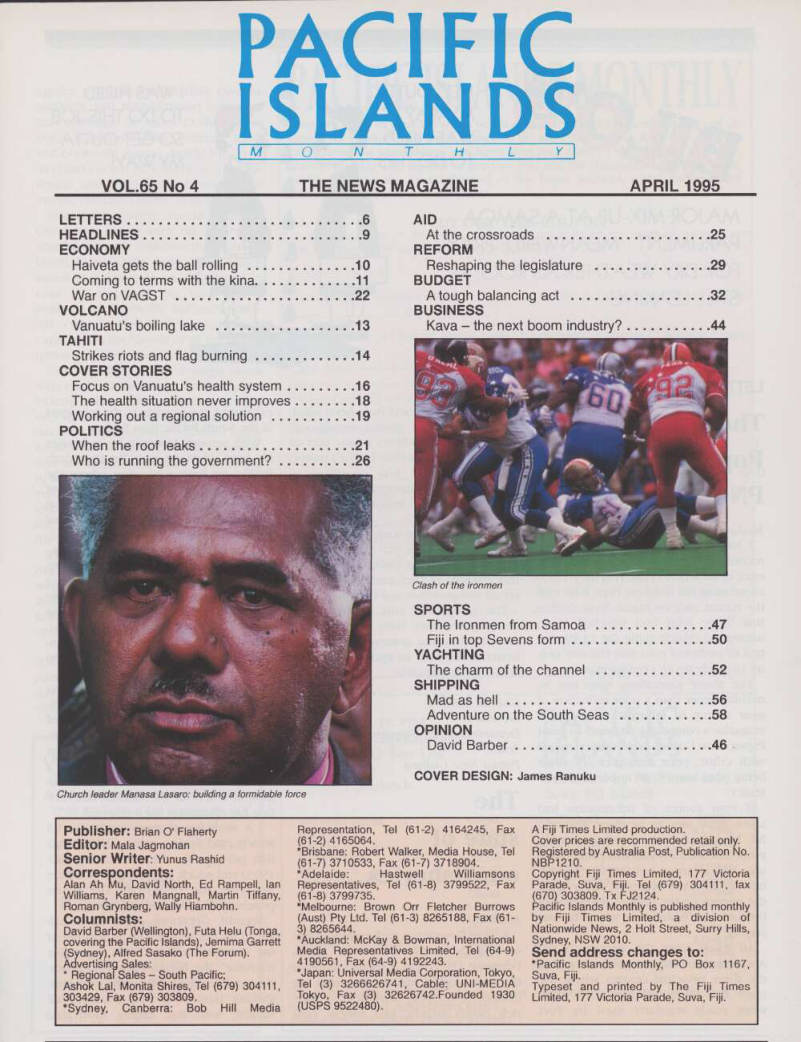
Church leader Manasa Lasaro: building a formidable force
Clash of the ironmen
Pope’s
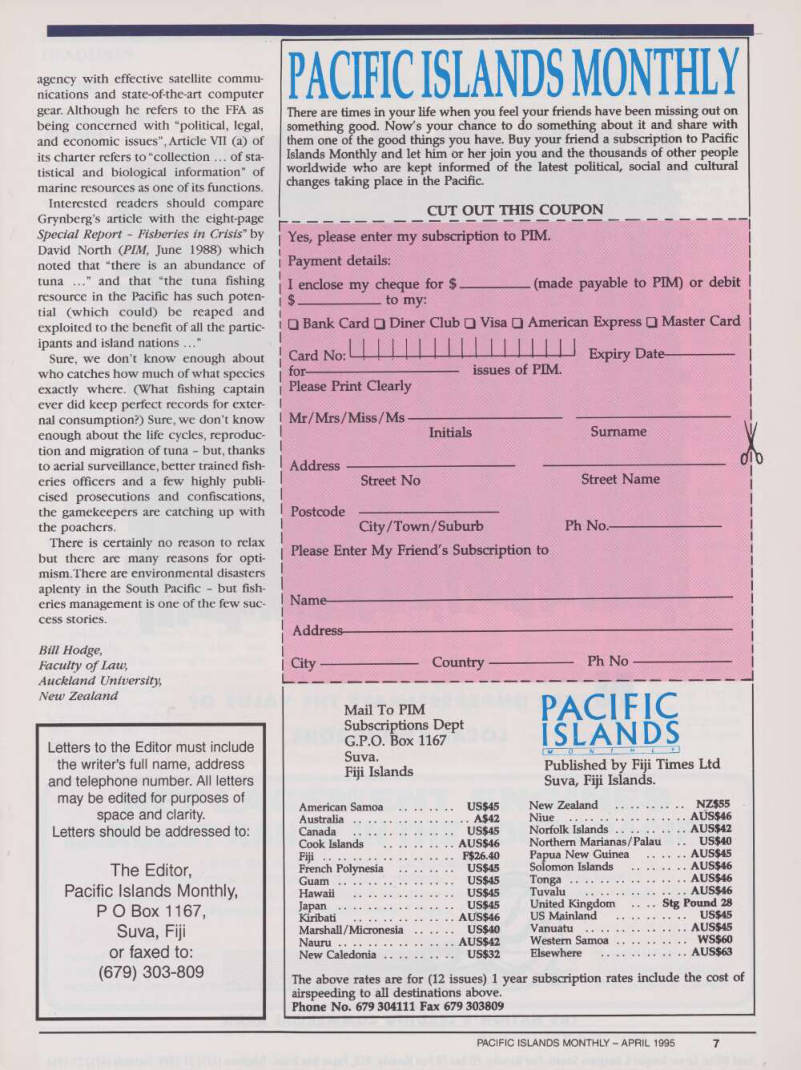
Lettersto The Editor
The
PNG visit
Madam, I have to write to you to set the record straight in relation to the refer ence in an article (PIM, February 1995) concerning His Holiness, Pope John Paul IPs recent visit to Papua New Guinea that “Pope John Paul travelled in an uncovered vehicle along the 14 kilome tres of potholed road into the city cen tre to celebrate an evening mass”.
The above journalistic quip can be nothing other than a poor reflection of your source of information and your magazine’s continuing attempts to paint Papua New Guinea as a country rigged with crime, poor managers, let alone being poor hosts to an important world leader.
If your source of information had taken more time to be more resource ful, he would have noted that at no point did the Holy Father’s programme take him to travel beyond five kilome tres within Port Moresby, either from the airport or the official residence of the Apostolic Nunciature where he was staying.
All roads from the airport to the Apostolic Nunciature’s residence and to the three principal centres where the mass and other activities took place were roads regularly used by Port
Moresby residents and have been main tained at normal, sound conditions.
There were no potholes in any part of these roads and the Holy Father’s motor cade never took him to distances beyond four kilometres from the Vatican’s official residence in Port
Moresby.
Such fabrications can only be con strued as attempts yet again by your maga2ine and your cohorts to portray this country as backward and that we are all irresponsible and nuts.
The people of this country, Port Moresby residents, their city managers and certainly the government deserve better; and indeed an apology from you and/or your magazine.
Gabriel Busava
Secretary Department of Foreign Affairs and Trade Papua New Guinea
The
state of
our fisheries
Madam, Roman Grynberg’s well written piece on South Pacific fisheries ( PIM , February 1995) was a useful reminder that the world’s marine resources are limited. He correctly identifies the once rich North Atlantic cod fishery, now
exhausted, as a warning to the managers of the South Pacific tuna fishery.
With respect, however, he overstates his case when he says, “In the South Pacific we have a situation where the existing tuna fisheries are clearly out of control,” and, again, “In the end there is little optimism for the management of the fisheries ...”
I take issue with both those remarks.
First, he has ignored some recent suc cesses in the South Pacific, including; * Adoption of 200-mile EEZs, now recognised by the Distant Water Fishing Nations (DWFN). Twenty-five years ago, Forum nations had three or 12-mile lim its and the rule of law did not extend to the high seas; * Prohibition of drift-netting. As recently as 1988-89, 40-kilometre drift nets threatened to turn the waters of the South Pacific into a maritime desert, devoid of sea mammals, birds, turtles, as well as all migratory fish. Now, with a Prohibition Convention, a UN resolu tion, and several US statutes, drift-net ting has effectively been stopped; * A multi-lateral treaty with the US which paid Forum nations USsl2 mil lion per year for the five years (1988- 1993) and which will pay US$lB million per year for 1994-1998. The worst
poachers thus become game-keepers.
Second, Grynberg could have bal anced his pessimism with an account of the guardians of that “last renewable resource”, the Forum Fisheries Agency.
He would have found, on the hills over looking Honiara, a well housed, well staffed, well led, highly motivated
agency with effective satellite commu nications and state-of-the-art computer gear. Although he refers to the FFA as being concerned with “political, legal, and economic issues”. Article VII (a) of its charter refers to “collection ... of sta tistical and biological information” of marine resources as one of its functions.
Interested readers should compare Grynberg’s article with the eight-page Special Report - Fisheries in Crisis ” by David North (PIM, June 1988) which noted that “there is an abundance of tuna ...” and that “the tuna fishing resource in the Pacific has such poten tial (which could) be reaped and exploited to the benefit of all the partic ipants and island nations ...”
Sure, we don’t know enough about who catches how much of what species exactly where. (What fishing captain ever did keep perfect records for exter nal consumption?) Sure, we don’t know enough about the life cycles, reproduc tion and migration of tuna - but, thanks to aerial surveillance, better trained fish eries officers and a few highly publi cised prosecutions and confiscations, the gamekeepers are catching up with
the poachers.
There is certainly no reason to relax but there are many reasons for opti mism. There are environmental disasters aplenty in the South Pacific - but fish eries management is one of the few suc cess stories.
Bill Hodge,
Faculty of Law, Auckland University, New Zealand
Advertisements & other items, pp. 7-8 (1 item)
Pacific Islands Monthly
There are times in your life when you feel your friends have been missing out on something good. Now's your chance to do something about it and share with them one of the good things you have. Buy your friend a subscription to Pacific Islands Monthly and let him or her join you and the thousands of other people worldwide who are kept informed of the latest political, social and cultural changes taking place in the Pacific.
CUT OUT THIS COUPON
Yes, please enter my subscription to PIM.
I Payment details:
I I enclose my cheque for $ (made payable to PIM) or debit I $ to my: 1 □ Bank Card □ Diner Club □ Visa □ American Express □ Master Card
Card No: 1—1—!—I—I—I—I—I—l—lI—1—1—I I—l—l—l Expiry Date-
for issues of PIM.
Please Print Clearly Mr/Mrs/Miss/Ms Initials Surname Address Street No Street Name Postcode City/Town/Suburb Ph No.
Please Enter My Friend's Subscription to Name Address —— City Country Ph No I Mail To PIM
Subscriptions Dept
G.P.O. Box 1167 Suva.
Fiji Islands
PACIFIC
INLANDS
Published by Fiji Times Ltd Suva, Fiji Islands.
American Samoa US$45 Australia As 42 Canada US$45 Cook Islands AUSS46 Fiji F 526.40 French Polynesia US$45 Guam US$45 Hawaii US$45 Japan US$45 Kiribati AUSS46 Marshall /Micronesia US$4O Nauru AUSS42 New Caledonia US$32 New Zealand NZ$55 Niue AUSS46 Norfolk Islands AUSS42 Northern Marianas/Palau .. US$4O Papua New Guinea AUSS4S Solomon Islands AUSS46 Tonga AUSS46 Tuvalu AUSS46 United Kingdom ... Stg Pound 28 US Mainland US$45 Vanuatu AUSS4S Western Samoa WS$6O Elsewhere AUSS63 The above rates are for (12 issues) 1 year subscription rates include the cost of airspeeding to all destinations above.
Phone No. 679 304111 Fax 679 303809
Letters to the Editor must include the writer’s full name, address and telephone number. All letters may be edited for purposes of space and clarity.
Letters should be addressed to: The Editor, Pacific Islands Monthly, P O Box 1167,
Suva, Fiji
or faxed to: (679) 303-809
: I
EVER UNDERESTIMATE THE VALUE OF
LOCAL KNOWLEDGE.
PUA NEW GUINEA BANKING CORPORATION
THE NATION'S LEADING COMMERCIAL BANK
Head Office: Corner Douglas & Musgrave Streets, Port Moresby. PO Box 78 Port Moresby, NCD, Papua New Guinea. Telephone (675) 21 1999 Facsimile (675) 21 1954
money?
Headlines
Nauru
Where’s the
money?
A small town in Southern Germany is missing US$26 million and the mayor is claiming the money in Nauru.
The mayor of the 3000-citizen town of Neckarsheim, Horst Armbrust, was arrest ed and charged with fraud. The mayor says he has invested the money at the Thalia Bank of Nauru to earn high inter est rates for the town.
The representative of the Nauru govern ment office in London, Martin Weston, says, however, that such a bank is unknown to him. Weston alleges the mayor is a “swindler” and has damaged the reputation of Nauru.
The prosecution’s case is that the mayor was either defrauded by an investment consultant or that he transferred the money to a bank account in Switzerland.
While the stale and the local authorities are desperately investigating the where abouts of the millions, private clubs in the small town are planning to travel to Nauru themselves to look for the money.
The Weekly reports that the town is one of the richest in Germany because a nuclear plant is their major tax payer.
Vanuatu
Free
press
Prime Minister Maxime Carlot Korman has praised the country’s only indepen dent weekly, The Trading Post, and assured it that it has the right to publish in any language it wants.
Korman’s reassurances followed an order from his first secretary, Father Gerard Leymang, to the publisher of the paper, Marc Neil-Jones, to carry some French articles in his English-only publication or face deportation.
Neil-Jones says the Prime Minister, who is the Minister for Media and Immigration, said he fully supports freedom of the press and the weekly has the right to publish in whatever language it wants.
Neil-Jones said it is the government con trolled media that is bound to publish in two or three languages.
He says in order to foster good will and show his appreciation to the govern ment, he will begin running a two or four-page supplement in French as a conciliatory gesture. The Trading Post, which started life as an advertising paper, will be renamed Vanuatu Post.
Cooks
Financial
crisis rocks
tax haven
A number of top companies in New Zealand have been issued with legal notices requiring them to produce docu ments on a series of transactions con ducted with offshore banks in the island’s tax haven.
The Royal Commission of Inquiry inves tigating the Cook Islands tax operation said in a statement it had also issued legal notices to the Inland Revenue Department and the Serious Fraud Office.
Among those named as being required to produce documents are the Bank of New Zealand which is owned by the Commonwealth Bank of Australia.
Brewer DB Group Limited has also received a notice, as has merchant banker Fay Richwhite and Company Limited. European Pacific Group Ltd, a Hong-Kong based banking group which set up the Cooks’ operations, has also received a notice. International accoun tancy firm KMPG Peat Marwick is includ ed in the list of notice recipients.
Others named included the New Zealand
Wool Board, state-owned Television New Zealand, the legal firm Simpson Grierson Butler White, ANZ Bank Ltd and BNZ Finance Limited.
The Royal Commission was set up last year to investigate files taken from a Cook Islands offshore banking operation and leaked to an opposition parliamen tarian, Winston Peters. He succeeded in having them heard and published by
parliament.
The Royal Commission is charged with establishing whether the papers reveal illegal tax evasion.
Meanwhile investors continue to be attracted to the island despite currency
problems.
The island’s Commercial Realty Brokers director, Peter Stenson, says investment is slower than in the past but investors still like the country.
Stenson says there are some monetary aspects which are scaring investors as the banks are advising there are no guaran tees of getting their money out.
Westpac bank was only weeks away from running out of New Zealand dollars (when this article went to press) and the ANZ was close behind, yet there were no moves to buy more reserves.
The reason for the financial collapse includes letters of guarantee for hun dreds of millions of dollars signed by the Prime Minister, Sir Geoffrey Henry.
Stenson says this did not affect investors because they can have accounts set up overseas.
Sir Geoffrey said his country stood to make up to US$10 million from controversial loan guarantees he signed. He said he signed five such guarantees which were to be taken over by banks.
Sir Geoffrey said he did not know how the details of the financial scheme worked but he said he believed the country would make between US$l.3 million and US$2 million per transaction.
Sir Geoffrey denied he signed 22 guaran tees. He said he has cancelled all guar antees.
Advertisements & other items, p. 9 (1 item)
Replacement Engines
LARGEST RANGE IN THE SOUTH PACIFIC
♦ OVER 800 ENGINES AVAILABLE ♦ DIESEL-GASOLINE 10HP TO 400 HP TRANSMISSION TO MATCH IF REQUIRED * JAPANESE * ENGLISH * EUROPEAN MODELS * Bedford Cummins * Daihatsu Deutz * Ford Gardner * Hino Detroit Isuzu * Komatsu * Leyland * Mazda * Mercedes * Mitsubishi * Nissan Perkins Scania * Toyota * Volvo Yanmar * Kubota
SPECIAL
Yanmar Stationery Engines 2 HS/66/72 - 2 TR 15/20 - Y 35 Including Fuel Tank/Radiator
BLAIRS
P.O. BOX 14
GERALDINE, NEW ZEALAND
TELEPHONE: (643) 693 8122
FAX: (643) 693 8120
SPECIAL
Cylinder Heads - Starters Tested-Rebuilt & Japan Most Japanese Diesels
rolling
Economy
Haiveta gets the ball rolling
Papua New Guinea passes the new budget in trying times and deregulation appears to be the buzz word
It was a case of the pre-match enter tainment outshining the main event.
Papua New Guinea had eagerly antici pated its government’s 1995 Budget, albeit with more than a little trepida tion. But when it came to presenting his first Budget, Finance and Planning Minister Chris Haiveta offered a docu ment with lots of promises but no real radical fiscal reforms.
The bottom line was certainly far more responsible than had been the case in the recent past. The deputy Prime Minister slashed the country’s Budget deficit to K 58.1 million, or one per cent of the Gross Domestic Product (GDP).And, as had been widely urged by Papua New Guinea’s overseas donors most prominently Australia, the International Monetary Fund (IMF) and the World Bank - Haiveta also pledged to tighten the public sector, both in accountability of its spending and num bers of public servants.
The government plans to cut 4500
jobs from the 60,000-strong public ser
vice this year, setting aside Kl 2 million for redundancy payouts in the Budget.
The exercises will cost about K 45 mil lion but Haiveta said the government would be unable to meet the entire expense this year, with parts of the package having to be deferred to later years mostly, through tax concessions to the affected staff.
In terms of managing its own books, Haiveta said the government would
implement new administrative reforms, including “strict” eligibility criteria for MPs’ controversial Electoral Development Funds, the strengthening of the existing monthly expenditure tracking system, widening the use of interests and trust accounts, direct donor payments for concessionally funded projects and the streamlining of the bureaucratic approval process to speed up projects.
The government’s ability to achieve its target deficit will depend heavily on its revenue base. While the deficit was cut back sharply, total outlays will actually rise 4.3 percent from 1994 to 1995. The deficit figure relies on an 8.6 percent increase in total revenues and grants from the actual result in 1984.
Haiveta said the expanded revenue figure would be achieved by broadening the tax base, bringing more people into the tax net. He told parliament major structural and fiscal reforms in expendi ture programmes would “change forever the way government spends money”.
“Through this Budget, we aim to recover lost ground, build on the strengths we have achieved and stop talking about reforms, changes and problems and to make a real start in steering the country back to economic growth, recovery and prosperity,” he said during a lock-up with the press prior to presenting the Budget.
Perhaps the most significant reforms contained in the Budget were moves to
begin the dismantling of protectionist trade barriers. The government is to replace all import bans with various lev els of tariffs, while existing import duty levels will be reviewed. To get the ball rolling, Haiveta announced tariff reduc tions for fresh barracuda fish, fresh milk, baked beans, cement and bridges and bridge sections.
The government will also phase out the controversial reserved business activities list, as well as all price controls over the next two to three years.
“Everyone has to wake up and realise that we ... (must) change our way of thinking ... unless we stop protecting and giving special payouts to our friends ... giving investments over and above others who have invested millions of kina, have lived in this country, have been good corporate citizens, have paid their taxes and have developed their industries without a single iota of help from government ...We should be free ing up these sectors,” Haiveta told jour nalists.
“Bans and quotas usually mean less competitiveness in quality and prices of products,” Chamber of Manufacturers president Wayne Golding told the Post- Courier newspaper.
“We have to be more cost competitive in the global world and our member ship to APEC (Asia Pacific Economic Co operation) and WTC (World Trade Organisation) forces us anyway to lift bans and quotas by the end of 1996.”
While the figures suggest an improved fiscal offering for 1993, Papua New Guinea will face a tough line economi cally.
GDP is expected to fall 5.4 per cent in 1995, mainly as a result of poorer con tributions from the mining and petrole um sectors, which will fall 18.2 percent and 29.4 percent respectively as major resource projects leave peak production behind them. The slide in just two years has been significant, with a growth rate of 16.6 per cent in 1993 and a revised figure of 2.3 percent in 1994.
Non-mining sectors will perform bet ter, with total non-mining GDP set to rise 2.0 percent. Nevertheless, the result is still below the revised 1994 figure of 5.1 percent.
Consumers also face further price hikes as a result of inflation sparked by the devaluation of the Kina and its sub sequent float last year. The government predicts the Consumer Price Index will surge 15 percent this year.
The pressure is now on the govern ment to control the wage demands from the public service, which have already begun and are sure to grow as the year progresses. ■
Coming to
terms with the kina
The real effects of the devaluation of Papua New Guinea currency are now being felt , four months later
The official effects of the devalua tion and the subsequent float of Papua New Guinea’s kina last year - the latter bringing a further devaluation for the currency - were recognised this month when the coun try’s National Statistics Office revealed a 7,3 percent surge in prices for the three months to the end of December.
The government also believed those effects will continue to be felt through higher prices in 1995, forecasting a 15percent rise in inflation this year in last month’s national Budget.
But while the official recognition of the impact on consumers has only just been realised, Papua New Guineans were already aware of the diminished purchasing power of their pay packets and the broad aspects of the devalua tion on their daily lives.
While higher prices have hurt many the NSO says the food group grew 4.2 percent in the last quarter of 1994, the drink/tobacco/betel nut sector posted a 9 3 percent rise, clothing and footwear lifted 3.1 percent, rents/coun cil charges/fuel/power gained 1.2 per cent, household equipment rose 2.1 percent and transport and communica tions saw 15.9 percent added - perhaps the most difficult aspect to come to terms with has been the drying up of funds available for lending by banks.
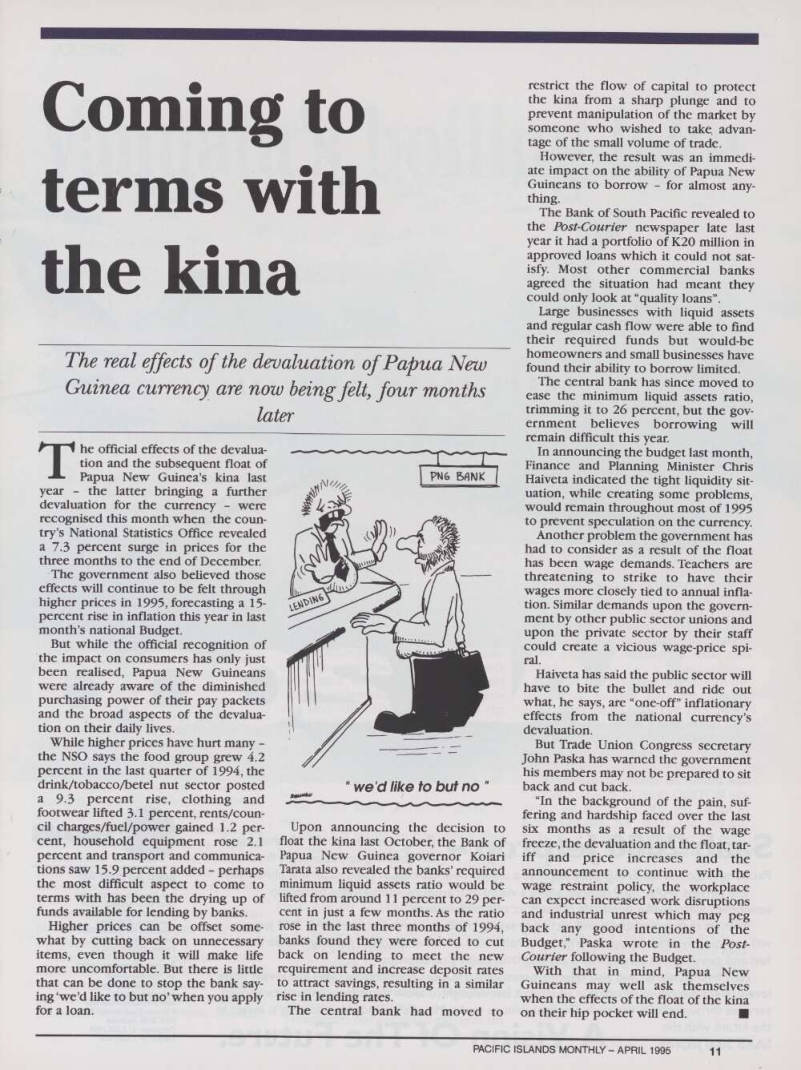
Higher prices can be offset some what by cutting back on unnecessary items, even though it will make life more uncomfortable. But there is little that can be done to stop the bank say ing ‘we’d like to but no’ when you apply for a loan.
Upon announcing the decision to float the kina last October, the Bank of Papua New Guinea governor Koiari Tarata also revealed the banks’ required minimum liquid assets ratio would be lifted from around 11 percent to 29 per cent in just a few months. As the ratio rose in the last three months of 1994, banks found they were forced to cut back on lending to meet the new requirement and increase deposit rates to attract savings, resulting in a similar rise in lending rates.
The central bank had moved to
restrict the flow of capital to protect the kina from a sharp plunge and to prevent manipulation of the market by someone who wished to take; advan tage of the small volume of trade.
However, the result was an immedi ate impact on the ability of Papua New Guineans to borrow - for almost any thing.
The Bank of South Pacific revealed to the Post-Courier newspaper late last year it had a portfolio of K2O million in approved loans which it could not sat isfy. Most other commercial banks agreed the situation had meant they could only look at “quality loans”.
Large businesses with liquid assets and regular cash flow were able to find their required funds but would-be homeowners and small businesses have found their ability to borrow limited.
The central bank has since moved to ease the minimum liquid assets ratio, trimming it to 26 percent, but the gov ernment believes borrowing will remain difficult this year.
In announcing the budget last month, Finance and Planning Minister Chris Haiveta indicated the tight liquidity sit uation, while creating some problems, would remain throughout most of 1993 to prevent speculation on the currency.
Another problem the government has had to consider as a result of the float has been wage demands. Teachers are threatening to strike to have their wages more closely tied to annual infla tion. Similar demands upon the govern ment by other public sector unions and upon the private sector by their staff could create a vicious wage-price spi ral.
Haiveta has said the public sector will have to bite the bullet and ride out what, he says, are “one-off” inflationary effects from the national currency’s devaluation.
But Trade Union Congress secretary John Paska has warned the government his members may not be prepared to sit back and cut back.
“In the background of the pain, suf fering and hardship faced over the last six months as a result of the wage freeze, the devaluation and the float, tar iff and price increases and the announcement to continue with the wage restraint policy, the workplace can expect increased work disruptions and industrial unrest which may peg back any good intentions of the Budget,” Paska wrote in the Post- Courier following the Budget.
With that in mind, Papua New Guineans may well ask themselves when the effects of the float of the kina on their hip pocket will end. ■
" we'd like to but no"
Advertisements & other items, p. 12 (1 item)
S£'Z:ZZ. A Vision Of The Future.
■ fc V\
\S ATRMaxsWWk.md^
ilfli •Hill •ifliilii
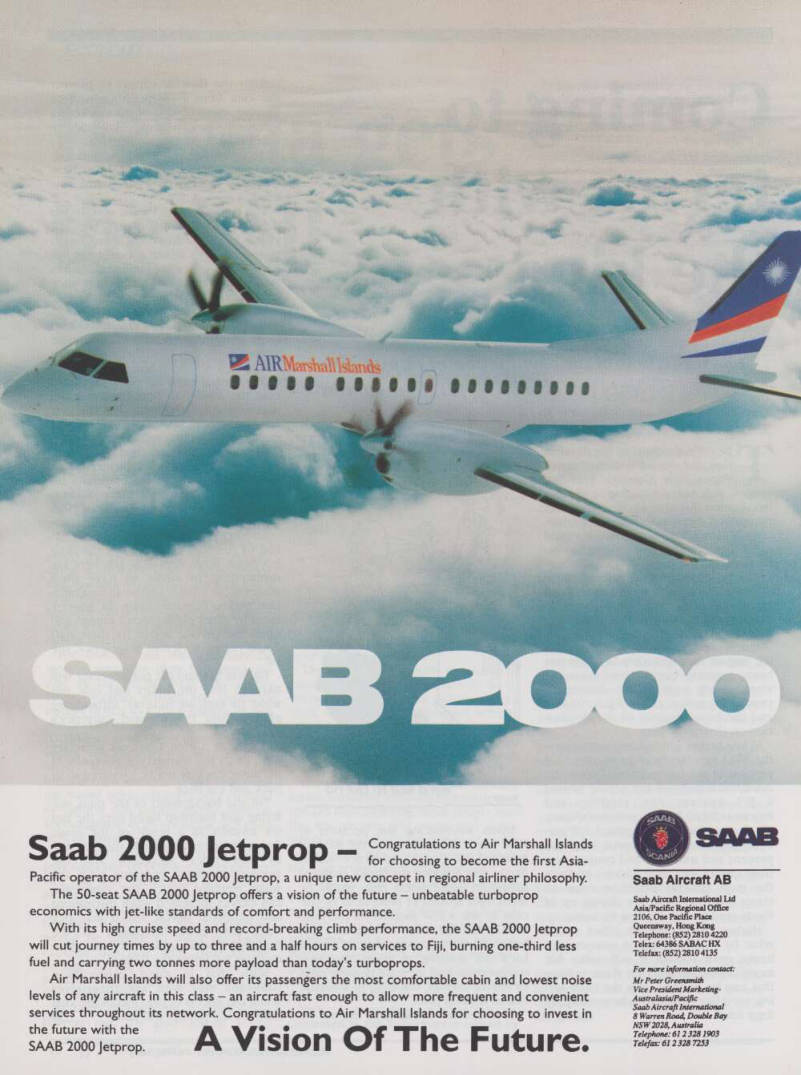
A , - AA A y*f\ r\ Congratulations to Air Marshall Islands &€t€tU XmUXIU JCipi Up “ for choosing to become the first Asia- Pacific operator of the SAAB 2000 Jetprop, a unique new concept in regional airliner philosophy.
The 50-seat SAAB 2000 Jetprop offers a vision of the future - unbeatable turboprop economics with jet-like standards of comfort and performance.
With its high cruise speed and record-breaking climb performance, the SAAB 2000 Jetprop will cut journey times by up to three and a half hours on services to Fiji, burning one-third less fuel and carrying two tonnes more payload than today’s turboprops.
Air Marshall Islands will also offer its passengers the most comfortable cabin and lowest noise levels of any aircraft in this class - an aircraft fast enough to allow more frequent and convenient services throughout its network. Congratulations to Air Marshall Islands for choosing to invest in
S£'Z:ZZ. A Vision Of The Future.
Saab Aircraft AB Saab Aircraft International Ltd Asia/Pacific Regional Office 2106, One Pacific Place Queensway, Hong Kong Telephone: (852) 2810 4220 Telex: 64386 SABACHX Telefax: (852) 2810 4135 For more information contact: Mr Peter Greensmith Vice President Marketing- A ustralasiajPacific Saab Aircraft International 8 Warren Road, Double Bay NSW2O2B, Australia Telephone: 612 3281903 Telefax: 612328 7253
Vanuatu’s boiling lake
Volcano
By Patrick Decloitre
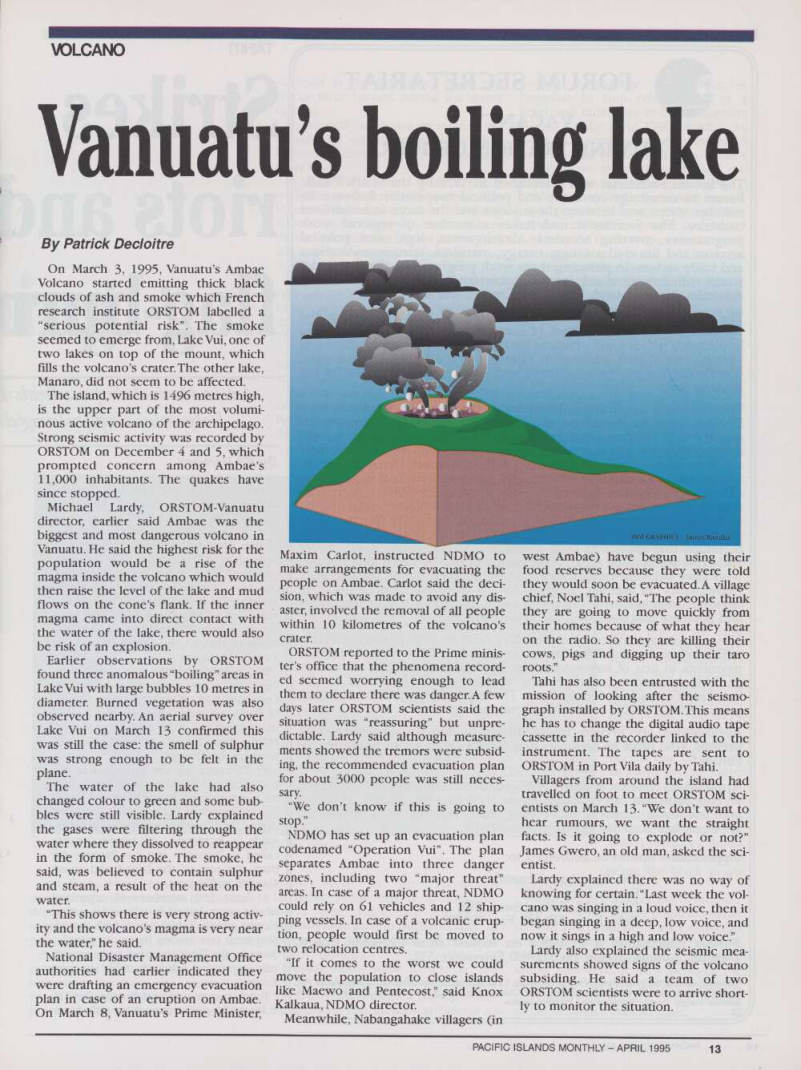
On March 3, 1993, Vanuatu’s Ambae Volcano started emitting thick black clouds of ash and smoke which French research institute ORSTOM labelled a “serious potential risk”. The smoke seemed to emerge from, Lake Vui, one of two lakes on top of the mount, which fills the volcano’s crater. The other lake, Manaro, did not seem to be affected.
The island, which is 1496 metres high, is the upper part of the most volumi nous active volcano of the archipelago.
Strong seismic activity was recorded by ORSTOM on December 4 and 5, which prompted concern among Ambae’s 11,000 inhabitants. The quakes have since stopped.
Michael Lardy, ORSTOM-Vanuatu director, earlier said Ambae was the biggest and most dangerous volcano in Vanuatu. He said the highest risk for the population would be a rise of the magma inside the volcano which would then raise the level of the lake and mud flows on the cone’s flank. If the inner magma came into direct contact with the water of the lake, there would also be risk of an explosion.
Earlier observations by ORSTOM found three anomalous “boiling” areas in Lake Vui with large bubbles 10 metres in diameter. Burned vegetation was also observed nearby. An aerial survey over Lake Vui on March 13 confirmed this was still the case: the smell of sulphur was strong enough to be felt in the plane.
The water of the lake had also changed colour to green and some bub bles were still visible. Lardy explained the gases were filtering through the water where they dissolved to reappear in the form of smoke. The smoke, he said, was believed to contain sulphur and steam, a result of the heat on the water.
“This shows there is very strong activ ity and the volcano’s magma is very near the water,” he said.
National Disaster Management Office authorities had earlier indicated they were drafting an emergency evacuation plan in case of an eruption on Ambae.
On March 8, Vanuatu’s Prime Minister,
Maxim Carlot, instructed NDMO to make arrangements for evacuating the people on Ambae. Carlot said the deci sion, which was made to avoid any dis aster, involved the removal of all people within 10 kilometres of the volcano’s crater.
ORSTOM reported to the Prime minis ter’s office that the phenomena record ed seemed worrying enough to lead them to declare there was danger. A few days later ORSTOM scientists said the situation was “reassuring” but unpre dictable. Lardy said although measure ments showed the tremors were subsid ing, the recommended evacuation plan for about 3000 people was still neces sary.
“We don’t know if this is going to
stop.”
NDMO has set up an evacuation plan codenamed “Operation Vui”. The plan separates Ambae into three danger zones, including two “major threat” areas. In case of a major threat, NDMO could rely on 61 vehicles and 12 ship ping vessels. In case of a volcanic erup tion, people would first be moved to two relocation centres.
“If it comes to the worst we could move the population to close islands like Maewo and Pentecost,” said Knox Kalkaua, NDMO director.
Meanwhile, Nabangahake villagers (in
west Ambae) have begun using their food reserves because they were told they would soon be evacuated. A village chief, Noel Tahi, said, “The people think they are going to move quickly from their homes because of what they hear on the radio. So they are killing their cows, pigs and digging up their taro roots.”
Tahi has also been entrusted with the mission of looking after the seismo graph installed by ORSTOM.This means he has to change the digital audio tape cassette in the recorder linked to the instrument. The tapes are sent to ORSTOM in Port Vila daily by Tahi.
Villagers from around the island had travelled on foot to meet ORSTOM sci entists on March 13. “We don’t want to hear rumours, we want the straight facts. Is it going to explode or not?”
James Gwero, an old man, asked the sci entist.
Lardy explained there was no way of knowing for certain. “Last week the vol cano was singing in a loud voice, then it began singing in a deep, low voice, and now it sings in a high and low voice.”
Lardy also explained the seismic mea surements showed signs of the volcano subsiding. He said a team of two ORSTOM scientists were to arrive short ly to monitor the situation.
flag-burning
Tahiti
Strikes riots and flag-burning
An industrial dispute leads Polynesia , emphasising c
By Ed Rampell
Labour unrest and civil disturbances have swept French Polynesia in recent months. The latest, in February, saw vio lent protests triggered by the dismissal of two brewery workers at the Hinano beer plant at Tiperui.
“The workers were accused of steal ing two cartons of beer,” said Oscar Temaru, the mayor of Faaa.The employ ees went to court and won their case but the brewery refused to reinstate the workers. Instead, the employers offered a cash settlement.
But insisting that the two union mem bers be given their jobs back, the Confederation of Independent Unions of Polynesia went on strike. Because of its connections with heavily unionised France, many Tahitian workers belong to
workers’ syndicates.
By February 15, the industrial action had escalated. Strikers set up barricades on a main thoroughfare near the brew ery at Tiperui in Papeete, the territorial capital. As Tahiti has many cars and few roads, a barrage - as barricades are called in French - can cut Papeete off from the rest of the island and cause massive traffic jams.
At least 150 members of organised labour were joined by about 50 unem ployed youth. Tahiti has a high unem ployment rate among its young people.
Some in the Tahitian community report edly expressed solidarity with the pro testers.
Tension mounted and France flew in at least 150 police from New Caledonia
o violent protests in French ?ep-seated political strife
and Paris. Some estimates put the number of reinforcements in the hun dreds. The police belong to the gendar marie and Guarde Mobile (motorcycle policemen).
A riot erupted at the barrage as the colonial authorities clashed with the indigenous workers and unemployed youth. The police fired tear gas and the protesters hurled stones and molotov
cocktails at the riot police. Cars and trucks were burned during the street
fighting.
Significantly, according to reports, the French flag was destroyed in what is believed to have been the first incident of its kind.
At least 10 Tahitians were arrested while an indeterminate number was injured. One woman was seriously injured in her house - the soldiers threw a grenade that landed on her roof and tear gas got inside. Soldiers were hurt too.
Work at the brewery resumed on
February 14.Temaru, who was asked by
labour and management to mediate in the dispute, told PIM, “The strike is over.
The two workers were fired and that’s it ... There was no settlement for the strike. The boss believes the two work ers are guilty.”
The February street battles are the lat est round of demonstrations in French Polynesia. According to Temaru, who is the head of Tavini Huiraatira No Te Ao
Maohi Party, or the Polynesian Liberation Front, this is at least the fourth time since late 1994 that Tahitians have gone to the barricades, an increasingly popular form of revolt in French Polynesia.
Temaru, who holds a seat in the Territorial Assembly, said pro-indepen dence activists organised barrages dur ing the past few months at Tiperui to
protest a garbage incinerator; at Punaauia to stop construction of a hotel; and at Mataiva to halt phosphate mining. In the early 19905, roadblocks went up in protest against tax increases by Territorial President Gaston Flosse’s government. Mayor Temaru says the protests were successful in all cases.
Why is going to the barricades becom ing so popular in French Polynesia? Why are the indigenous people so restless?
And why did the letting go of two work ers trigger a mass strike and battles in the streets of Papeete?
Tahiti remains one of the last remote outposts of the empire of France. The once glorious empire of Napoleon has shrunk and whittled dcywn to only about eight far-flung colonies. Yet Paris remains reluctant to decolonise, for strategic, military, and economic rea sons. Space explorations in French Guyana, South America, make France a member of the space race, and nuclear testing at Mururoa in French Polynesia makes it a charter member in the arms
race (even if the Cold War is over). Nickel at New Caledonia and the potential riches of the seabed within French Polynesia’s exclusive economic zone add an economic motive to maintaining one of the world’s last empires.
Tied to the French economy, Tahiti’s prices are hyper-inflated, mak ing it one of the most expensive places in the region. Unemployment is high and Polynesians are increasingly becom ing alienated from their lands. The brewery, which produces the popular local Flinano beer, is one of the few factories in the entire territory. This plant is an important part of the industrial work force and an economy which produces almost nothing, besides export items like black pearls
and handicrafts.
Mayor Temaru asserts the demonstra tions and strike have a political charac ter. The independence leader maintains the two dismissed brewery workers belong to his party, as are many of the union members. Temaru believes the dismissals touched a raw nerve and the riots were symptomatic of the politici sation of Tahiti’s class struggle. ■
Oscar Temaru: sees the riot as symptomatic of Tahiti’s class struggle
Advertisements & other items, p. 14 (1 item)
Forum Secretariat
VACANCY
ADMINISTRATION OFFICER
The Forum Secretariat was established in 1973 by the South Pacific Forum to encourage economic and political cooperation between its member states, and between those states and the more industrialised countries. The Secretariat undertakes a number of regional work programmes covering economic development, legal and political services and the civil aviation, energy, maritime, telecommunications and trade sectors. In pursuing these work programmes, the Secretariat works with a range of aid donor countries and organisations including Australia, New Zealand, Japan, EC, Canada and the UNDP.
The Administration Division plays a central role in meeting the Secretariat's needs in the area of corporate services. It develops and implements policies and practices for the recruitment, employment and performance of staff, administers salaries and conditions of service and coordinates the provision of office and other support services for the organisation.
The successful applicant will supervise the work of Administration Division staff in the areas of personnel, purchasing, maintenance, registry and support services. He /She will be responsible for the maintenance of all personnel records, and will provide advice/ recommendations to the Director, Administration Division on the interpretation and implementation of the Secretariat's Staff Regulations.
Other responsibilities include the identification of training needs and suitable staff training programmes; coordination of recruitment of staff, including establishment/repatriation of expat staff; and assisting in the preparation and monitoring of the Divisional Budget. It is essential, therefore, that applicants have considerable, demonstrated experience and expertise in those areas. Preference will also be given to applicants who have relevant qualifications in Human Resource Management, Accountancy or similar subjects and a successful background in personnel management. Computer skills, particularly in spreadsheets and database functions, will be highly regarded.
The appointment will cairy an attractive remuneration package, payable in Fiji dollars. For non-Fiji citizens this is tax-free. Other benefits include payments in lieu of superannuation, medical and housing allowance, and life insurance coverage. The appointee will be based at the Secretariat's headquarters in Suva. The appointment will be for three years initially, and is renewable by mutual agreement.
Applications are invited from suitably qualified and experienced persons, who must be nationals of a member state of the South Pacific Forum.* Applications close on 30 April 1995 and should contain full information on education and career backgrounds, including the names, addresses and telephone numbers of at least three referees with whom the applicant has been associated professionally.
Applications should be addressed to: The Secretary General Forum Secretariat Private Mail Bag, Suva, Fiji Telephone 312-600 Fax: 305573 Further information is available on request from Christine Collett, Director, Administration, on 312-600 Extension: 332. ’Member states of the South Pacific Forum: Australia, Cook Islands, Federated States of Micronesia, Fiji, Kiribati, Nauru, New Zealand, Niue, Papua New Guinea, Republic of the Marshall Islands, Solomon Islands, Tonga, Tuvalu, Vanuatu and Western Samoa.
I ‘Localising
Cover Stories
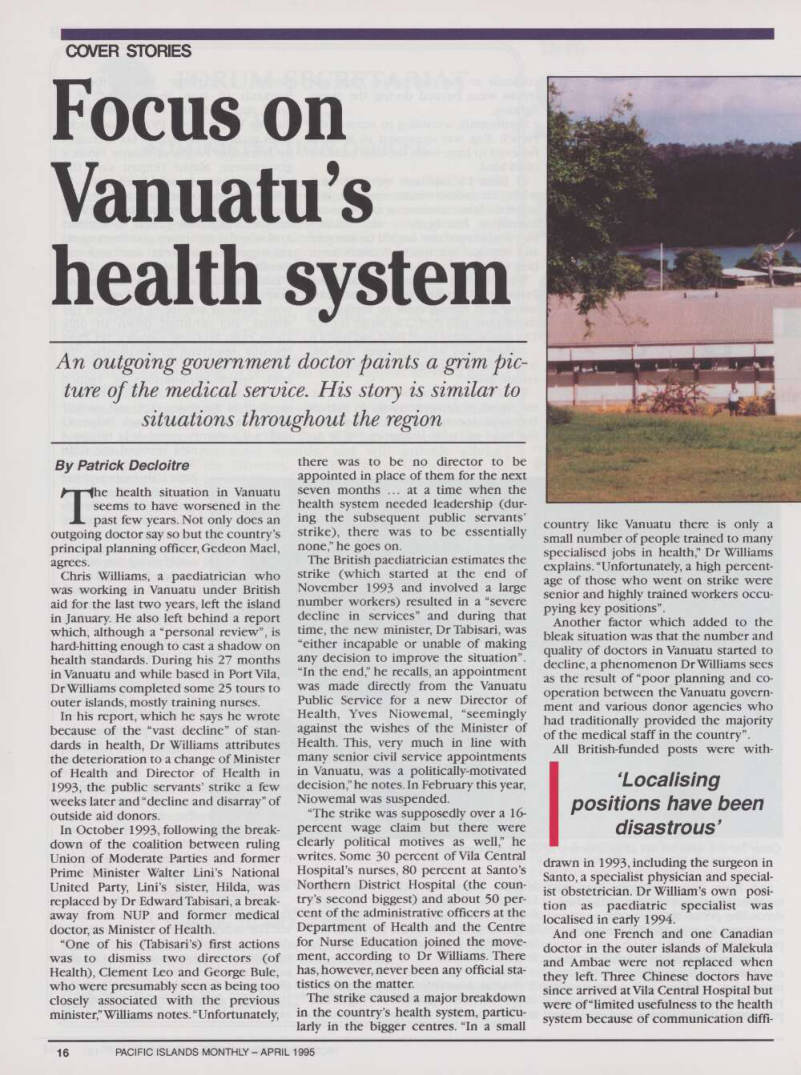
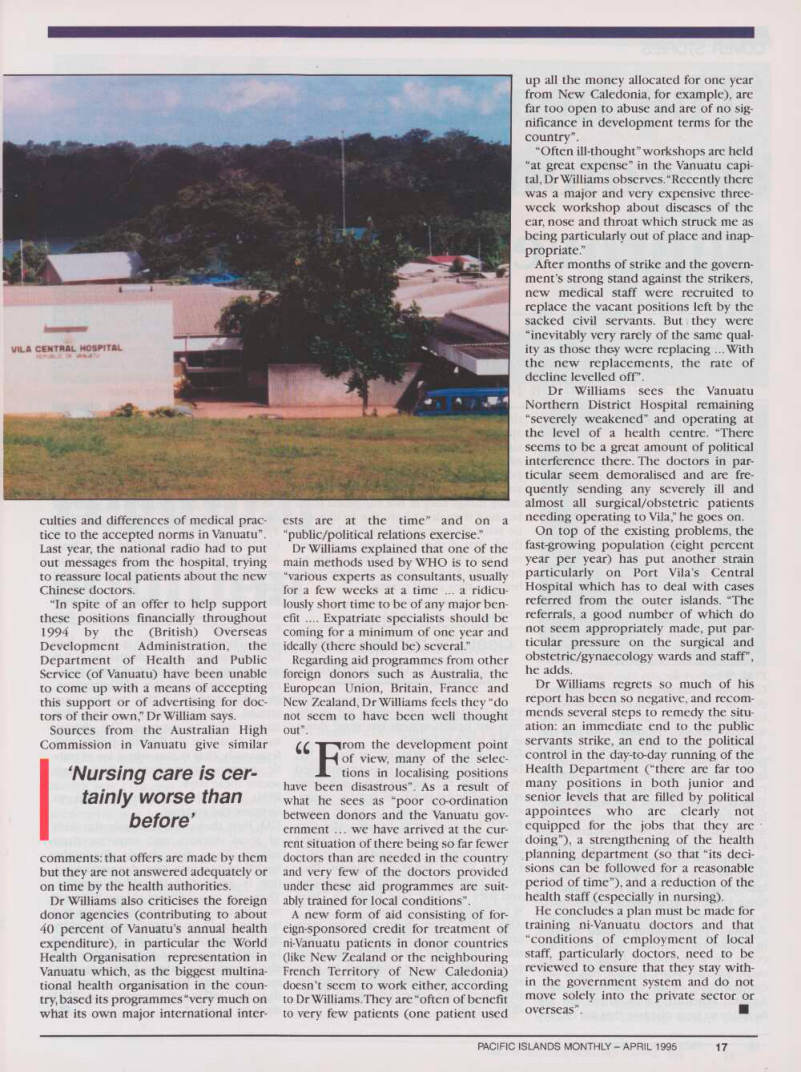
Focus on Vanuatu's health system
An outgoing government doctor paints a grim pic ture of the medical service. His story is similar to situations throughout the region
By Patrick Decloitre
The health situation in Vanuatu seems to have worsened in the past few years. Not only does an outgoing doctor say so but the country’s principal planning officer, Gedeon Mael, agrees.
Chris Williams, a paediatrician who was working in Vanuatu under British aid for the last two years, left the island in January. He also left behind a report which, although a “personal review”, is hard-hitting enough to cast a shadow on health standards. During his 27 months in Vanuatu and while based in Port Vila, Dr Williams completed some 25 tours to outer islands, mostly training nurses.
In his report, which he says he wrote because of the “vast decline” of stan dards in health, Dr Williams attributes the deterioration to a change of Minister of Health and Director of Health in 1993, the public servants’ strike a few weeks later and “decline and disarray” of outside aid donors.
In October 1993, following the break down of the coalition between ruling Union of Moderate Parties and former Prime Minister Walter Lini’s National United Party, Lini’s sister, Hilda, was replaced by Dr Edward Tabisari, a break away from NUP and former medical doctor, as Minister of Health.
“One of his (Tabisari’s) first actions was to dismiss two directors (of Health), Clement Leo and George Buie, who were presumably seen as being too closely associated with the previous minister,”Williams notes. “Unfortunately,
there was to be no director to be appointed in place of them for the next seven months ... at a time when the health system needed leadership (dur ing the subsequent public servants’ strike), there was to be essentially none,” he goes on.
The British paediatrician estimates the strike (which started at the end of November 1993 and involved a large number workers) resulted in a “severe decline in services” and during that time, the new minister, Dr Tabisari, was “either incapable or unable of making any decision to improve the situation”.
“In the end,” he recalls, an appointment was made directly from the Vanuatu Public Service for a new Director of Health, Yves Niowemal, “seemingly against the wishes of the Minister of Health. This, very much in line with many senior civil service appointments in Vanuatu, was a politically-motivated decision,” he notes. In February this year, Niowemal was suspended.
“The strike was supposedly over a 16percent wage claim but there were clearly political motives as well,” he writes. Some 30 percent of Vila Central Hospital’s nurses, 80 percent at Santo’s Northern District Hospital (the coun try’s second biggest) and about 50 per cent of the administrative officers at the Department of Health and the Centre for Nurse Education joined the move ment, according to Dr Williams. There has, however, never been any official sta tistics on the matter.
The strike caused a major breakdown in the country’s health system, particu larly in the bigger centres. “In a small
country like Vanuatu there is only a small number of people trained to many specialised jobs in health,” Dr Williams explains. “Unfortunately, a high percent age of those who went on strike were senior and highly trained workers occu pying key positions”.
Another factor which added to the bleak situation was that the number and quality of doctors in Vanuatu started to decline, a phenomenon Dr Williams sees as the result of “poor planning and co operation between the Vanuatu govern ment and various donor agencies who had traditionally provided the majority of the medical staff in the country”.
All British-funded posts were with-
I ‘Localising
positions have been
disastrous’
drawn in 1993, including the surgeon in
Santo, a specialist physician and special
ist obstetrician. Dr William’s own posi tion as paediatric specialist was localised in early 1994.
And one French and one Canadian doctor in the outer islands of Malekula and Ambae were not replaced when they left. Three Chinese doctors have since arrived at Vila Central Hospital but were of “limited usefulness to the health system because of communication diffi
culties and differences of medical prac tice to the accepted norms in Vanuatu”.
Last year, the national radio had to put out messages from the hospital, trying to reassure local patients about the new Chinese doctors.
“In spite of an offer to help support these positions financially throughout 1994 by the (British) Overseas Development Administration, the Department of Health and Public Service (of Vanuatu) have been unable to come up with a means of accepting this support or of advertising for doc tors of their own,” Dr William says.
Sources from the Australian High Commission in Vanuatu give similar
I ‘Nursing care is cer
tainly worse than
before ’
comments: that offers are made by them but they are not answered adequately or on time by the health authorities.
Dr Williams also criticises the foreign donor agencies (contributing to about 40 percent of Vanuatu’s annual health expenditure), in particular the World Health Organisation representation in Vanuatu which, as the biggest multina tional health organisation in the coun try, based its programmes “very much on what its own major international inter
ests are at the time” and on a “public/political relations exercise.”
Dr Williams explained that one of the main methods used by WHO is to send “various experts as consultants, usually for a few weeks at a time ... a ridicu lously short time to be of any major ben efit ... Expatriate specialists should be coming for a minimum of one year and ideally (there should be) several.”
Regarding aid programmes from other foreign donors such as Australia, the European Union, Britain, France and New Zealand, Dr Williams feels they “do not seem to have been well thought out”.
QQ '■-'irom the development point I—4 of view, many of the selec- JL tions in localising positions have been disastrous”. As a result of what he sees as “poor co-ordination between donors and the Vanuatu gov ernment ... we have arrived at the cur rent situation of there being so far fewer doctors than are needed in the country and very few of the doctors provided under these aid programmes are suit ably trained for local conditions”.
A new form of aid consisting of for eign-sponsored credit for treatment of ni-Vanuatu patients in donor countries (like New Zealand or the neighbouring French Territory of New Caledonia) doesn’t seem to work either, according to Dr Williams. They are “often of benefit to very few patients (one patient used
up all the money allocated for one year from New Caledonia, for example), are far too open to abuse and are of no sig nificance in development terms for the
country”.
“Often ill-thought” workshops are held “at great expense” in the Vanuatu capi tal, Dr Williams observes.“ Recently there was a major and very expensive three week workshop about diseases of the ear, nose and throat which struck me as being particularly out of place and inap
propriate.”
After months of strike and the govern ment’s strong stand against the strikers, new medical staff were recruited to replace the vacant positions left by the sacked civil servants. But i they were “inevitably very rarely of the same qual ity as those they were replacing ... With the new replacements, the rate of decline levelled off”.
Dr Williams sees the Vanuatu Northern District Hospital remaining “severely weakened” and operating at the level of a health centre. “There seems to be a great amount of political interference there. The doctors in par ticular seem demoralised and are fre quently sending any severely ill and almost all surgical/obstetric patients needing operating to Vila,” he goes on.
On top of the existing problems, the fast-growing population (eight percent year per year) has put another strain particularly on Port Vila’s Central Hospital which has to deal with cases referred from the outer islands. “The referrals, a good number of which do not seem appropriately made, put par ticular pressure on the surgical and obstetric/gynaecology wards and staff”, he adds.
Dr Williams regrets so much of his report has been so negative, and recom mends several steps to remedy the situ ation: an immediate end to the public servants strike, an end to the political control in the day-to-day running of the Health Department (“there are far too many positions in both junior and senior levels that are filled by political appointees who are clearly not equipped for the jobs that they are doing”), a strengthening of the health planning department (so that “its deci sions can be followed for a reasonable period of time”), and a reduction of the health staff (especially in nursing).
He concludes a plan must be made for training ni-Vanuatu doctors and that “conditions of employment of local staff, particularly doctors, need to be reviewed to ensure that they stay with in the government system and do not move solely into the private sector or overseas”. ■
improves’
Cover Stories
‘The health situation never improves’
Vanuatu’s Principal Planning Officer in the Ministry of Health, Gedeon Mael, gave his view of the health situation in the island state.
By Patrick Decloitre
PIM: What is the health situation like in Vanuatu in terms of infrastructure?
GM; There is a big hospital in Port Vila, Vila Central Hospital, one in Santo, Northern District Hospital, then there are three other regional hospitals. Then you have 20 health centres (each with three medical staff (a nurse, a midwife and a nurse practitioner), 68 dispen saries (with one staff nurse each) and at the last records, 162 aid posts, some of which are no longer working.
To be honest about the health situation in Vanuatu, I think it never improves. The department only tries to maintain a ser vice designed to satisfy areas.
PIM: Why?
GM; When Vanuatu became indepen dent in 1980 ... Vanuatu was not ready for independence; at the time there were not enough nationals who had the skills to take over. So the former colonial powers, France and Britain, had to leave behind their staff to help the country to run the medical service, up until 1986.
This is when a lot of ni-Vanuatu came back for the first time from overseas studies to take over some positions. But even then, with the Health Department, the emphasis was on nurse training but there were very few doctors because it takes longer for a doctor to be trained.
Since 1980, the government had entered a scheme whereby it asks foreign aid donors to provide some of their doctors in various areas of the country. But they come on a short-term basis, many of them for two years. I think this is not enough. Also, in the outer islands, like Ambae, Malekula, Tanna, there are no facilities to treat diseases that are occur
ring there. Only simple surgery, like appendix removal, is possible. But major surgery is never taking place in the islands. And foreign doctors who are posted in the outer islands then say they are wasting their time, they say they’re doing things they’re not supposed to do because they don’t have the facilities to do what they are qualified for. Also, they think that if they’re staying more than one year in an outer island with no operating facility, they lose their skills because they don’t practise.
There should be a clear line between poli tics and administration’
PIM: Do you think foreign aid to the Vanuatu health system has gone down in the last few years?
GM; I think so, although no study has been made so far.A lot of positions filled by foreign aid donors have not been renewed. Some positions remain vacant, either to be localised or to be trans ferred to other areas. Besides, the doc tors are coming from a lot of different places: there is a Nigerian doctor, a French one, a team of Chinese. They never communicate with one another and they use their own methods. There is no cohesion in the spirit.
Also, when there is an offer for assis tance, there are requirements as to how the funds will be used. This needs some people here (at the ministry) to do a report, but this rarely happens, because there is no one skilled enough to do the draft report.
Some donors say they have offered assistance but did not get a reply from the local authority. Is this what you mean?
GM: Yes, for instance last year, the ser vice was affected by the strike. There was no one to formulate a request to foreign donors. Now it’s getting better.
PIM: Did the strike affect the health ser
vice severely?
GM; Yes. There are still some effects being felt now. A lot of skilled people were sacked last year, very few of them have come back. Meanwhile, nurses who are still training have been employed to fill vacant positions, where as they should have first worked under supervision. A lot of people in the ser vice now cannot address problems because they are i new and they don’t know yet. Still, only about 35 percent have been replaced now. I think over 100 people have been sacked altogether last year as result of the strike.
PIM: And has the situation changed now?
GM: The situation is worse. The reasons are the budget is not enough and never has been. For instance, this year, the bud get is smaller than what we had before.
For food, we only have 9 5 million vatu (about US$B5,OOO) in 1995 to cater for our patients in Vila Central Hospital. In 1994, it was 17 million (about U 55153,000). But we should get at least 30 million vatu (about U 55270,000) this year to provide enough nutriments for patients.
PIM: How strong is politics at the min istry? Does it affect your work on a day to-day basis?
GM: There should be a clear line between politics and administration. I’m not saying there shouldn’t be any politi cal involvement in the administration, but the extent of this involvement should be minimised to a level that allows work to progress. The depart ment should be allowed to operate pro fessionally. That is also why a lot of pub lic servants are moving to the private sector these days.
PIM; What should then be done to improve the system?
GM: First, they must recognise the skills of local doctors and improve their salaries. Then they should divide the health sector into two departments... one is preventive the other curative.
These are two different things. Whereas now, it is all under one department and it is too big to be properly controlled by the Director of Health. Also, VCH should be made a specialist area which could also be used as a training facility for doc tors and nurses from the rural areas. For this, the influx of persons into VCH must be stopped. ■
regional

Working out a
solution
Health officals from around the Pacific are intent on coming up with an answer to the chronic problems related to health services
By Yunus Rashid It is too early to say if the historic regional health seminar in Fiji last month was a success.
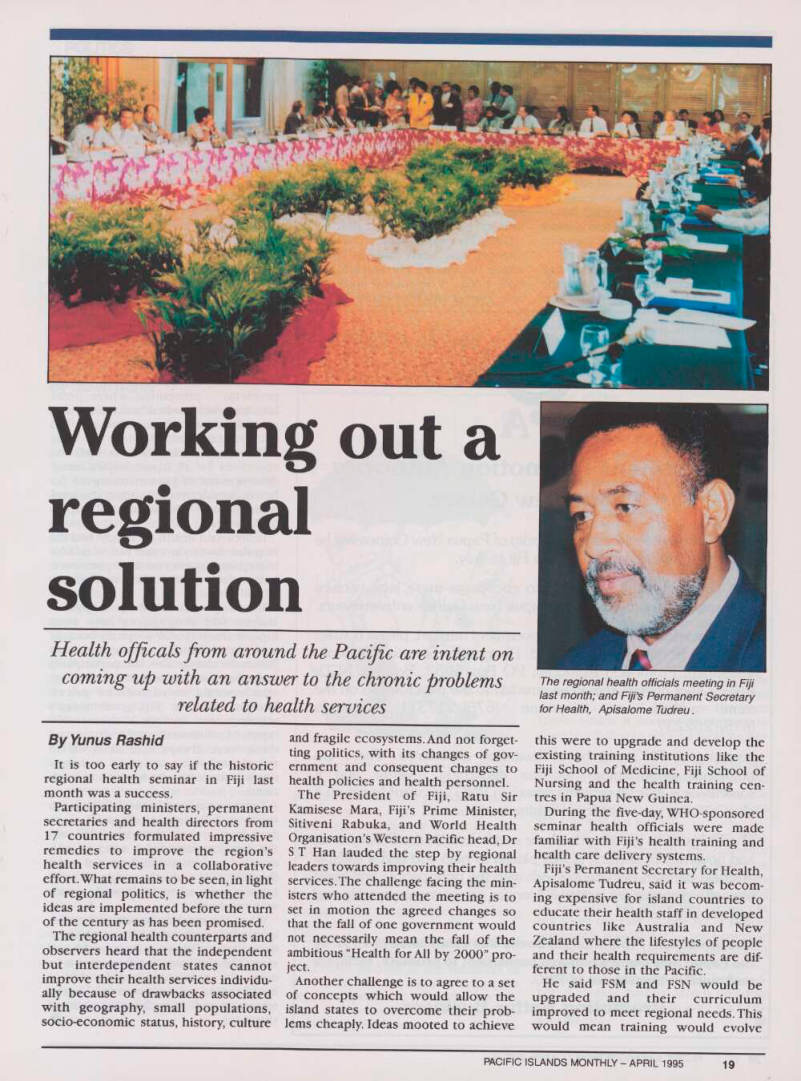
Participating ministers, permanent secretaries and health directors from 17 countries formulated impressive remedies to improve the region s health services in a collaborative effort. What remains to be seen, in light of regional politics, is whether the ideas are implemented before the turn of the century as has been promised.
The regional health counterparts and observers heard that the independent but interdependent states cannot improve their health services individually because of drawbacks associated with geography, small populations, socio-economic status, history, culture
and fragile ecosystems. And not forgettin ß politics, with its changes of goveminent and consequent changes to health policies and health personnel.
The President of Fiji, Ratu Sir Kamisese Mara, Fiji’s Prime Minister, Sitiveni Rabuka, and World Health Organisation’s Western Pacific head, Dr ST Han lauded the step by regional leaders towards improving their health services. The challenge facing the ministers who attended the meeting is to set in motion the agreed changes so that the fall of one government would not necessarily mean the fall of the ambitious “Health for All by 2000” project.
Another challenge is to agree to a set of concepts which would allow the island states to overcome their problems cheaply. Ideas mooted to achieve
this were to upgrade and develop the existing training institutions like the Fiji School of Medicine, Fiji School of Nursing and the health training cen tres in Papua New Guinea.
During the five-day WHO-sponsored seminar health officials were made familiar with Fiji’s health training and health care delivery systems, Fiji’s Permanent Secretary for Health, Apisalome Tudreu, said it was becom ing expensive for island countries to educate their health staff in developed countries like Australia and New Zealand where the lifestyles of people and their health requirements are dif ferent to those in the Pacific, He said FSM and FSN would be upgraded and their curriculum improved to meet regional needs. This would mean training would evolve
The regional health officials meeting in Fiji last month; and Fiji’s Permanent Secretary for Health, Apisalome Tudreu.
around the region’s health demands and allow specialists to have a better grasp of the type of services needed.
Tudreu said the idea of having post graduate training locally was not to deter doctors from migrating overseas “but to equip them with the type of training essential to our needs”. He said the brain drain would continue because doctors could not be forced to remain when they had better options either in the private sector or overseas.
Fiji’s Health Minister Seruwaia Hong- Tiy said it was incorrect to assume the region’s health service would be cen
tralised in Suva.
“What we are doing is to collective ly look at our problems and resolving them,” she said. “Each government has to play its part. Fiji hosts FSM and FSN and a big hospital like the CWM (Suva’s Colonial War Memorial Hospital) and our government is com mitted to the idea of sharing these facilities with the other island nations as it has been doing in the past”.
Hong-Tiy said some curriculum changes have been made at FSM and added the visiting participants should take heed of feasibility studies and take steps towards enhancing the
health staff training capabilities of the school as recommended.
Dr Han said keeping in line with WHO’s “Health for All by 2000” effort, the organisation decided that the island nations had to get together and find means to achieve this goal. He said many people, because of their isola tion, were unable to get good health services and it was up to the islands to remedy this problem.
Dr Han said that because islands were beset with drawbacks, it was wise for them to collectively resolve the problems. He said there was an urgent need to resolve problems in the health services now because in time more complicated problems would arise and would require more effort and other resources to fight.
“All of our efforts in health to date have been centred around disease problems - prevention where possi ble, treatment when necessary, and rehabilitation where damage has occurred,” he said.
Three areas identified as common objectives for all island nations were: development of human resources for health; health promotion and the envi ronment; and pharmaceutical supply management.
Tudreu said health no longer had the singular focus on cure but was now incorporating preventative measures, hence, the inclusion of environment as a health issue.
Speaking about drug supplies, Tudreu said drug prices have been high in the regional hospitals because each bought small quantities at higher prices. To change this, the participants looked at the prospect of bulk-buying, which would mean reduced prices.
Tudreu said the Fiji government’s requirements included almost 400 types of commonly used drugs and these were always held in stock. In some cases these are given to outpa tients but preference is given to inpa tients.
Tudreu was confident Fiji had the scope to fully train health staff mem bers from around the region. He said the seminar provided a solid founda tion for leaders to build on and make the FSM, FSN and other regional insti tutions more compatible with over seas standards.
When the meeting concluded, partic ipants left with new ideas and ambi tious plans to improve their health ser vices. The challenge for them now is to meet the rising demand for better health in an environment of limited resources and ever-changing political situations. ■
Advertisements & other items, p. 20 (1 item)
Investment Promotion Authority
IPA
Papua New Guinea
The Investment Promotion Authority of Papua New Guinea will be leading an investment mission to Fiji in July.
The purpose of the mission is to encourage more joint venture businesses between Fijian and Papua New Guinea entrepreneurs.
For more information about the investment mission, please contact Ms Sabi Koregai, Investor and Promotion Services Division, Investment Promotion Authority, PO Box 5053, Boroko, NCD, PNG. Other queries should be directed to the director also on the same address or telephone (675) 217311, facsimile (675) 202237.
Investing in PNG can be a rewarding experience. There are numerous opportunities for the discerning investor and it sometimes is difficult deciding where in PNG you want to set up a shop or who you want to do business with.
The IPA with its growing database and links with the PNG private and government sectors, is well placed to help you find a suitable business partner, put you in touch with the right people and assist you with government permits, licences or approvals, quickly and without any hassles.
The Investment Promotion Authority was established in 1992 by the Papua New Guinea national parliament to promote, facilitate and monitor investment in PNG.
Promoting Better Business
When the roof
Politics
leaks ...
... fix it. But , some instances, that is easier said than done
By David North
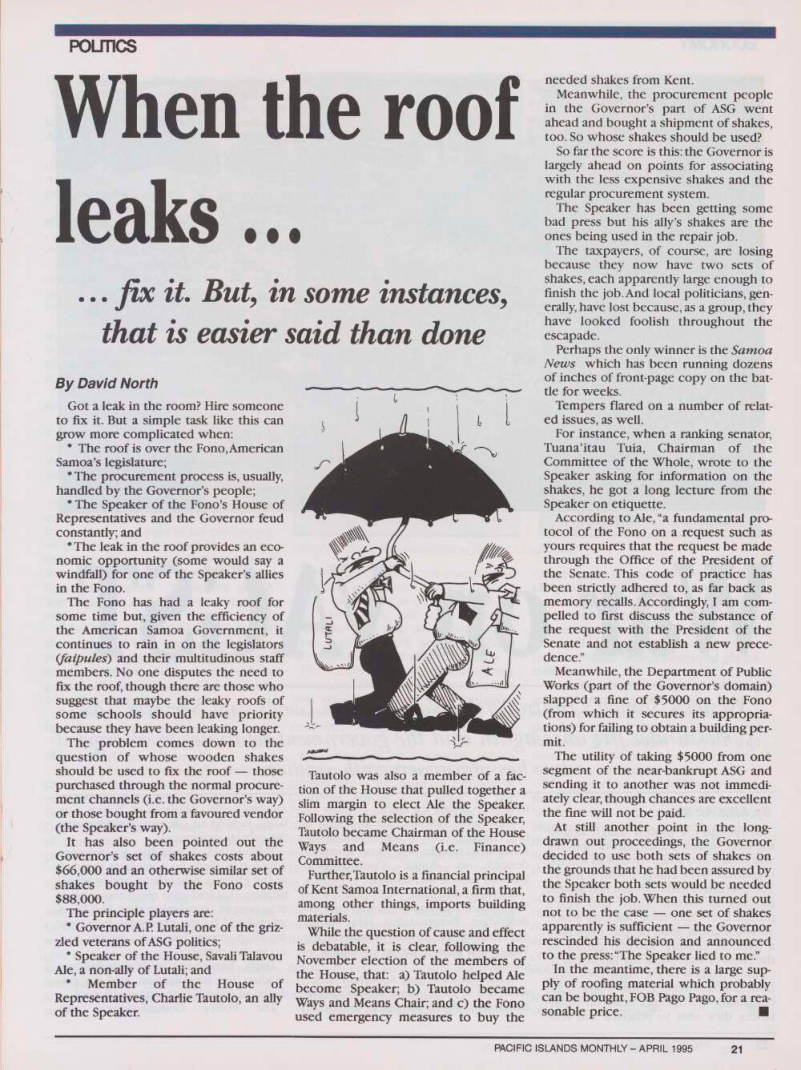
Got a leak in the room? Hire someone to fix it. But a simple task like this can grow more complicated when: * The roof is over the Fono, American Samoa’s legislature; * The procurement process is, usually, handled by the Governor’s people; * The Speaker of the Fono’s House of Representatives and the Governor feud constantly; and * The leak in the roof provides an eco nomic opportunity (some would say a windfall) for one of the Speaker’s allies in the Fono.
The Fono has had a leaky roof for some time but, given the efficiency of the American Samoa Government, it continues to rain in on the legislators (faipules) and their multitudinous staff members. No one disputes the need to fix the roof, though there are those who suggest that maybe the leaky roofs of some schools should have priority because they have been leaking longer.
The problem comes down to the question of whose wooden shakes should be used to fix the roof those purchased through the normal procure ment channels (i.e. the Governor’s way) or those bought from a favoured vendor (the Speaker’s way).
It has also been pointed out the Governor’s set of shakes costs about $66,000 and an otherwise similar set of shakes bought by the Fono costs
$Bb,Ooo.
The principle players are: * Governor A.R Lutali, one of the griz zled veterans of ASG politics; * Speaker of the House, Savali Talavou Ale, a non-ally of Lutali; and * Member of the House of Representatives, Charlie Tautolo, an ally of the Speaker.
Tautolo was also a member of a fac tion of the House that pulled together a slim margin to elect Ale the Speaker.
Following the selection of the Speaker, Tautolo became Chairman of the House Ways and Means (i.e. Finance) Committee.
Further,Tautolo is a financial principal of Kent Samoa International, a firm that, among other things, imports building materials.
While the question of cause and effect is debatable, it is clear, following the November election of the members of the House, that; a) Tautolo helped Ale become Speaker; b) Tautolo became Ways and Means Chair; and c) the Fono used emergency measures to buy the
needed shakes from Kent.
Meanwhile, the procurement people in the Governor’s part of ASG went ahead and bought a shipment of shakes, too. So whose shakes should be used?
So far the score is this: the Governor is largely ahead on points for associating with the less expensive shakes and the regular procurement system.
The Speaker has been getting some bad press but his ally’s shakes are the ones being used in the repair job.
The taxpayers, of course, are losing because they now have two sets of shakes, each apparently large enough to finish the job. And local politicians, gen erally, have lost because, as a group, they have looked foolish throughout the
escapade.
Perhaps the only winner is the Samoa News which has been running dozens of inches of front-page copy on the bat tle for weeks.
Tempers flared on a number of relat ed issues, as well.
For instance, when a ranking senator, Tuana’itau Tuia, Chairman of the Committee of the Whole, wrote to the Speaker asking for information on the shakes, he got a long lecture from the Speaker on etiquette.
According to Ale, “a fundamental pro tocol of the Fono on a request such as yours requires that the request be made through the Office of the President of the Senate. This code of practice has been strictly adhered to, as far back as memory recalls. Accordingly, I am com pelled to first discuss the substance of the request with the President of the Senate and not establish a new prece dence.”
Meanwhile, the Department of Public Works (part of the Governor’s domain) slapped a fine of $3OOO on the Fono (from which it secures its appropria tions) for failing to obtain a building per mit.
The utility of taking $5OOO from one segment of the near-bankrupt ASG and sending it to another was not immedi ately clear, though chances are excellent the fine will not be paid.
At still another point in the long drawn out proceedings, the Governor decided to use both sets of shakes on the grounds that he had been assured by the Speaker both sets would be needed to finish the job. When this turned out not to be the case one set of shakes apparently is sufficient the Governor rescinded his decision and announced to the press: “The Speaker lied to me.”
In the meantime, there is a large sup ply of roofing material which probably can be bought, FOB Pago Pago, for a rea sonable price. ■
War on VAGST
Economy
Western Samoa's controversial Value added Goods and Services Tax comes under fire once again and the government retaliates by charger two key organisers with sedition
By Alan Ah Mu
In February, a protest march against the Value Added Goods and Services Tax was postponed when two of its leading organisers were charged with sedition.
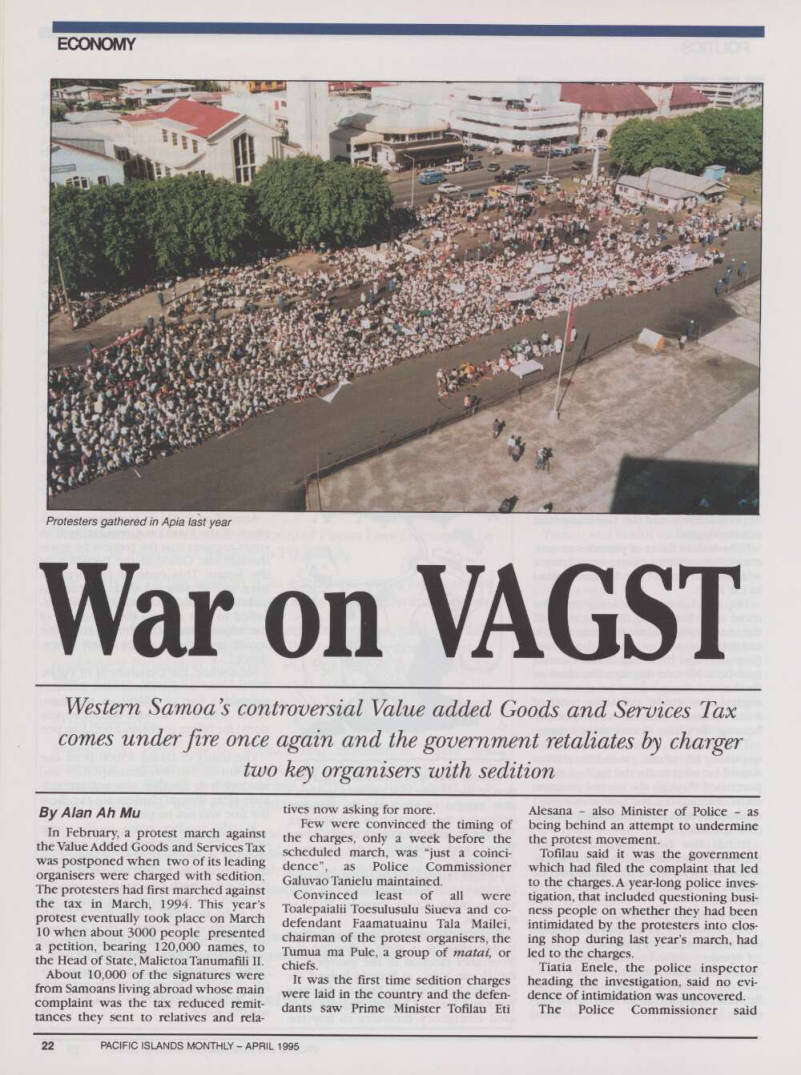
The protesters had first marched against the tax in March, 1994. This year’s protest eventually took place on March 10 when about 3000 people presented a petition, bearing 120,000 names, to the Head of State, MalietoaTanumafili 11.
About 10,000 of the signatures were from Samoans living abroad whose main complaint was the tax reduced remit tances they sent to relatives and rela
tives now asking for more.
Few were convinced the timing of the charges, only a week before the scheduled march, was “just a coinci dence”, as Police Commissioner Galuvao Tanielu maintained.
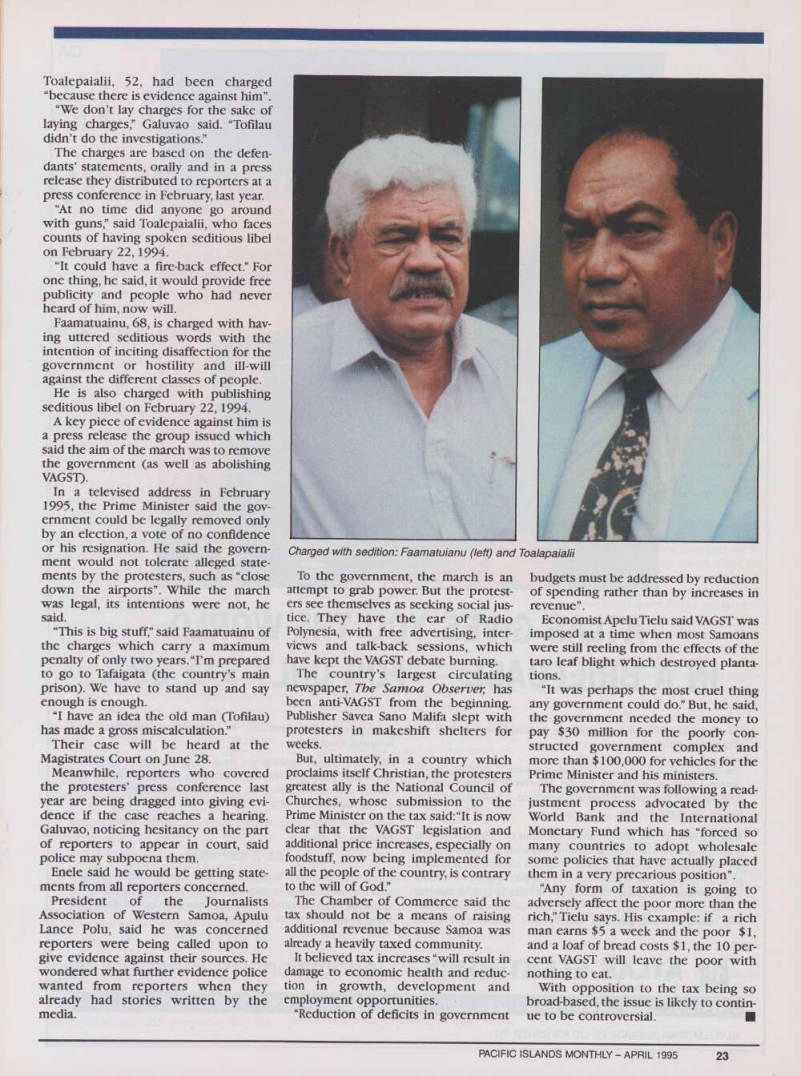
Convinced least of all were Toalepaialii Toesulusulu Siueva and co defendant Faamatuainu Tala Mailei, chairman of the protest organisers, the Tumua ma Pule, a group of matai, or chiefs.
It was the first time sedition charges were laid in the country and the defen dants saw Prime Minister Tofilau Eti
Alesana - also Minister of Police - as being behind an attempt to undermine the protest movement.
Tofilau said it was the government which had filed the complaint that led to the charges. A year-long police inves tigation, that included questioning busi ness people on whether they had been intimidated by the protesters into clos ing shop during last year’s march, had led to the charges.
Tiatia Enele, the police inspector heading the investigation, said no evi dence of intimidation was uncovered.
The Police Commissioner said
Protesters gathered in Apia last year
Toalepaialii, 52, had been charged “because there is evidence against him”.
“We don’t lay charges for the sake of laying charges,” Galuvao said. “Tofilau didn’t do the investigations.”
The charges are based on the defen dants’ statements, orally and in a press release they distributed to reporters at a press conference in February, last year.
“At no time did anyone go around with guns,” said Toalepaialii, who faces counts of having spoken seditious libel on February 22,1994.
“It could have a fire-back effect.” For one thing, he said, it would provide free publicity and people who had never heard of him, now will.
Faamatuainu, 68, is charged with hav ing uttered seditious words with the intention of inciting disaffection for the government or hostility and ill-will against the different classes of people.
He is also charged with publishing seditious libel on February 22,1994.
A key piece of evidence against him is a press release the group issued which said the aim of the march was to remove the government (as well as abolishing
Vagst).
In a televised address in February 1995, the Prime Minister said the gov ernment could be legally removed only by an election, a vote of no confidence or his resignation. He said the govern ment would not tolerate alleged state ments by the protesters, such as “close down the airports”. While the march was legal, its intentions were not, he said.
“This is big stuff,” said Faamatuainu of the charges which carry a maximum penalty of only two years. “I’m prepared to go to Tafaigata (the country’s main prison). We have to stand up and say enough is enough.
“I have an idea the old man (Tofilau) has made a gross miscalculation.”
Their case will be heard at the Magistrates Court on June 28.
Meanwhile, reporters who covered the protesters’ press conference last year are being dragged into giving evi dence if the case reaches a hearing.
Galuvao, noticing hesitancy on the part of reporters to appear in court, said police may subpoena them.
Enele said he would be getting state ments from all reporters concerned.
President of the Journalists Association of Western Samoa, Apulu Lance Polu, said he was concerned reporters were being called upon to give evidence against their sources. He wondered what further evidence police wanted from reporters when they already had stories written by the media.
To the government, the march is an attempt to grab power. But the protesters see themselves as seeking social justice. They have the ear of Radio Polynesia, with free advertising, interviews and talk-back sessions, which have kept the VAGST debate burning.
The country’s largest circulating newspaper, The Samoa Observer, has been anti-VAGST from the beginning, Publisher Savea Sano Malifa slept with protesters in makeshift shelters for weeks.
But, ultimately, in a country which proclaims itself Christian, the protesters greatest ally is the National Council of Churches, whose submission to the Prime Minister on the tax said:“lt is now clear that the VAGST legislation and additional price increases, especially on foodstuff, now being implemented for all the people of the country, is contrary to the will of God.”
The Chamber of Commerce said the tax should not be a means of raising additional revenue because Samoa was already a heavily taxed community. il believed tax increases “will result in damage to economic health and reduction in growth, development and
employment opportunities.
“Reduction of deficits in government
budgets must be addressed by reduction of spending rather than by increases in revenue”.
Economist ApeluTielu said VAGST was imposed at a time when most Samoans were still reeling from the effects of the taro leaf blight which destroyed planta tions.
“It was perhaps the most cruel thing any government could do.” But, he said, the government needed the money to pay $3O million for the poorly con structed government complex and more than $lOO,OOO for vehicles for the Prime Minister and his ministers, The government was following a read justment process advocated by the World Bank and the International Monetary Fund which has “forced so many countries to adopt wholesale some policies that have actually placed them in a very precarious position”, “Any form of taxation is going to adversely affect the poor more than the rich,” Tielu says. His example; if a rich man earns $5 a week and the poor $l, and a loaf of bread costs $ 1, the 10 per cent VAGST will leave the poor with nothing to eat.
With opposition to the tax being so broad-based, the issue is likely to contin ue to be controversial. ■
Charged with sedition: Faamatuianu (left) and Toalapaialii
Advertisements & other items, pp. 24-25 (2 items)
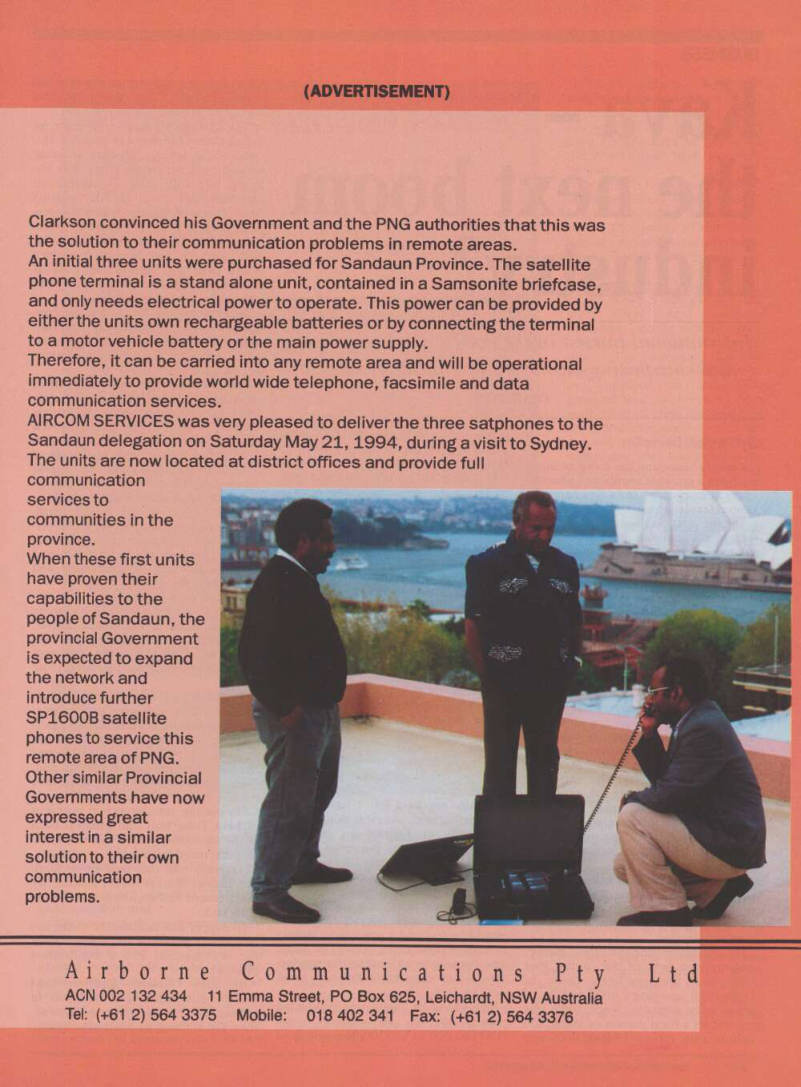
In A Briefcase - For Only $11,995
■ ■ f * ' f ■m r . * \ ** ■ > uy «rs 3
I flfir
» A raM • I i ||uy
©vVi
ATLAS GIVES YOU THE WORLD
IN A BRIEFCASE - FOR ONLY $11,995 For only U 5511,995 you can carry away an Atlas Elektronik Satcom- M briefcase terminal.
The SPI6OO-B provides a reliable digital secure satellite phone service anywhere within the Pacific and Indian Ocean Regions, covering about two thirds of the earth’s surface, including the Pacific Islands, Asia and Europe.
Weighing only 10.5 kg and running on batteries or 110-240 V AC, the briefcase also has an optional external wet weather antenna which can be set up permanently outside. Thus you can use the phone as an office phone (it can be connected to a PABX) or when needed as a fully portable field phone. This makes the Atlas SPI6OO-B ideal for a wide range of applications hotel communications, exploration and mining, oil and gas rigs, construction, emergency backup, independent communications for government diplomats and business executives.
With fax and data capability you have a portable office that allows you to send and receive fax and data communications no matter how remote your location, Plus, its backed by a world-wide sales and service network and carries a 12 month warranty.
Take advantage of this limited offer and put the world in your briefcase by calling: 61 2 437 4577 If you’re in the marine business we also have a maritime version with a stabilised antenna allowing voice, fax and data. Allow us to quote you a very competitive price and enjoy the luxury of dialling the world at any time and at any place.
ATLAS ELEKTRONIK Innovations in Electronics
, 39 HERBERT ST,
LEONARDS, NSW 2065, AUSTRALIA
ATLAS ELEKTRONIK (AUSTRALIA) PTY LTD ACN 056 058 952
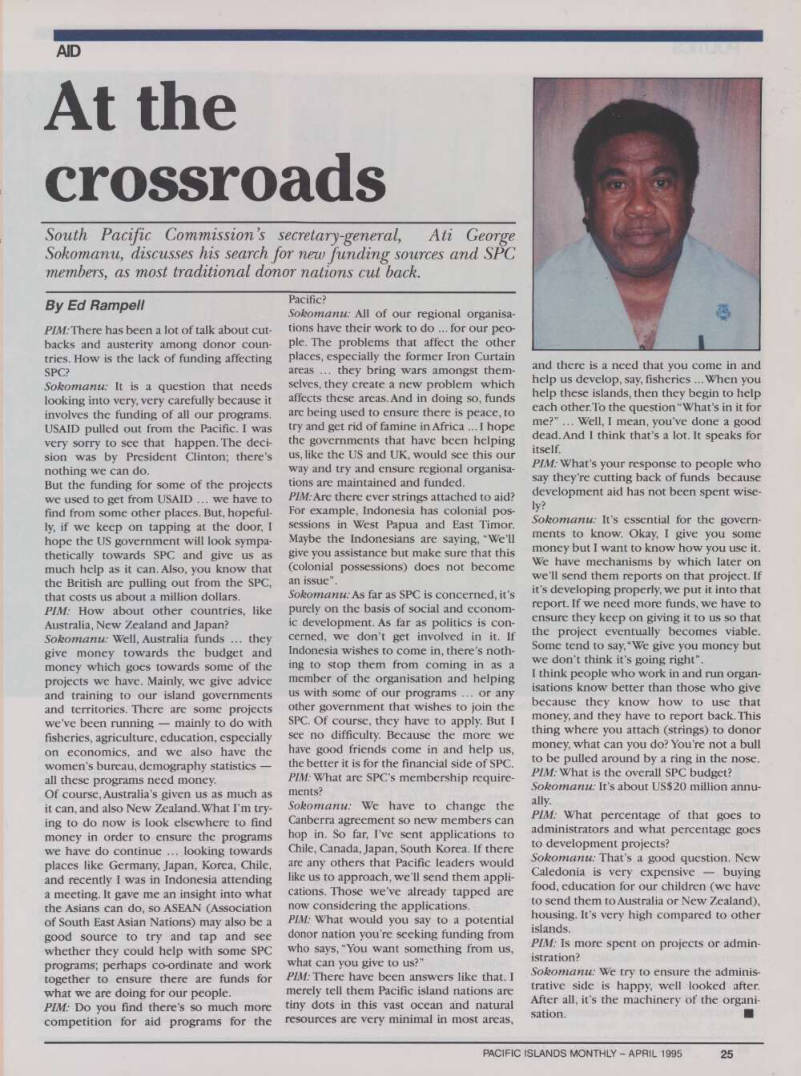
At the
AID
At the crossroads
South Pacific Commission’s secretary-general, Ati George
Sokomanu, discusses his search for new funding sources and SPC members, as most traditional donor nations cut back.
By Ed Rampell
PIM: There has been a lot of talk about cut backs and austerity among donor coun tries. How is the lack of funding affecting
SPC?
Sokomanu: It is a question that needs looking into very, very carefully because it involves the funding of all our programs.
USAID pulled out from the Pacific. I was very sorry to see that happen. The deci sion was by President Clinton; there’s nothing we can do.
But the funding for some of the projects we used to get from USAID ... we have to find from some other places. But, hopeful ly, if we keep on tapping at the door, I hope the US government will look sympa thetically towards SPC and give us as much help as it can. Also, you know that the British are pulling out from the SPC, that costs us about a million dollars.
PIM: How about other countries, like Australia, New Zealand and Japan?
Sokomanu: Well, Australia funds ... they give money towards the budget and money which goes towards some of the projects we have. Mainly, we give advice and training to our island governments and territories. There are some projects we’ve been running mainly to do with fisheries, agriculture, education, especially on economics, and we also have the women’s bureau, demography statistics all these programs need money.
Of course, Australia’s given us as much as it can, and also New Zealand. What I’m try ing to do now is look elsewhere to find money in order to ensure the programs we have do continue ... looking towards places like Germany, Japan, Korea, Chile, and recently I was in Indonesia attending a meeting. It gave me an insight into what the Asians can do, so ASEAN (Association of South East Asian Nations) may also be a good source to try and tap and see whether they could help with some SPC programs; perhaps co-ordinate and work together to ensure there are funds for what we are doing for our people.
PIM: Do you find there’s so much more competition for aid programs for the
Pacific?
Sokomanu: All of our regional organisa tions have their work to do ... for our peo ple. The problems that affect the other places, especially the former Iron Curtain areas ... they bring wars amongst them selves, they create a new problem which affects these areas. And in doing so, funds are being used to ensure there is peace, to try and get rid of famine in Africa ... I hope the governments that have been helping us, like the US and UK, would see this our way and try and ensure regional organisa tions are maintained and funded.
PIM: Are there ever strings attached to aid?
For example, Indonesia has colonial pos sessions in West Papua and East Timor.
Maybe the Indonesians are saying, “We’ll give you assistance but make sure that this (colonial possessions) does not become an issue”.
Sokomanu: As far as SPC is concerned, it’s purely on the basis of social and econom ic development. As far as politics is con cerned, we don’t get involved in it. If Indonesia wishes to come in, there’s noth ing to stop them from coming in as a member of the organisation and helping us with some of our programs ... or any other government that wishes to join the SPC. Of course, they have to apply. But I see no difficulty. Because the more we have good friends come in and help us, the better it is for the financial side of SPC.
PIM: What are SPC’s membership require ments?
Sokomanu: We have to change the Canberra agreement so new members can hop in. So far, I’ve sent applications to Chile, Canada, Japan, South Korea. If there are any others that Pacific leaders would like us to approach, we’ll send them appli cations. Those we’ve already tapped are now considering the applications.
PIM: What would you say to a potential donor nation you’re seeking funding from who says, “You want something from us, what can you give to us?”
PIM: There have been answers like that. I merely tell them Pacific island nations are tiny dots in this vast ocean and natural resources are very minimal in most areas,
and there is a need that you come in and help us develop, say, fisheries ...When you help these islands, then they begin to help each other.To the question “What’s in it for me?” ... Well, I mean, you’ve done a good dead. And I think that’s a lot. It speaks for itself.
PIM: What’s your response to people who say they’re cutting back of funds because development aid has not been spent wise ly?
Sokomanu: It’s essential for the govern ments to know. Okay, I give you some money but I want to know how you use it.
We have mechanisms by which later on we’ll send them reports on that project. If it’s developing properly, we put it into that report. If we need more funds, we have to ensure they keep on giving it to us so that the project eventually becomes viable.
Some tend to say, “We give you money but we don’t think it’s going right”.
I think people who work in and run organ isations know better than those who give because they know how to use that money, and they have to report back. This thing where you attach (strings) to donor money, what can you do? You’re not a bull to be pulled around by a ring in the nose.
PIM: What is the overall SPC budget?
Sokomanu: It’s about US$2O million annu ally.
PIM: What percentage of that goes to administrators and what percentage goes to development projects?
Sokomanu: That’s a good question. New Caledonia is very expensive buying food, education for our children (we have to send them to Australia or New Zealand), housing. It’s very high compared to other islands.
PIM: Is more spent on projects or admin istration?
Sokomanu: We try to ensure the adminis trative side is happy, well looked after.
After all, it’s the machinery of the organi sation. ■
Politics
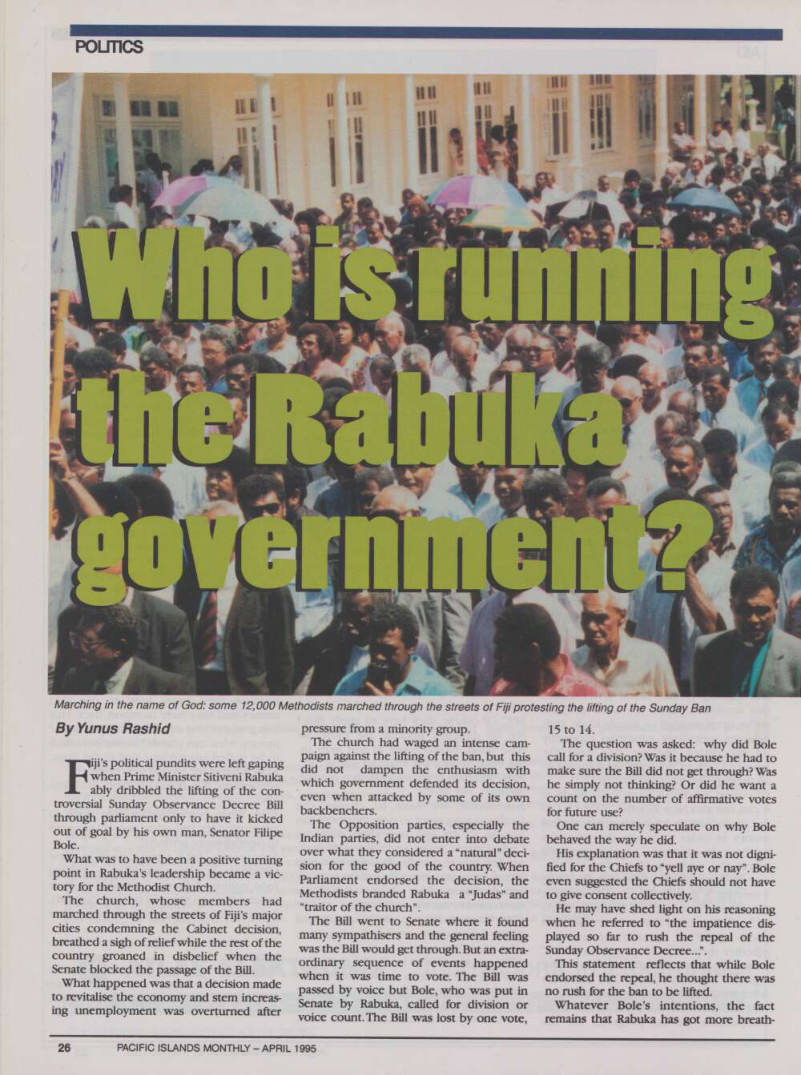
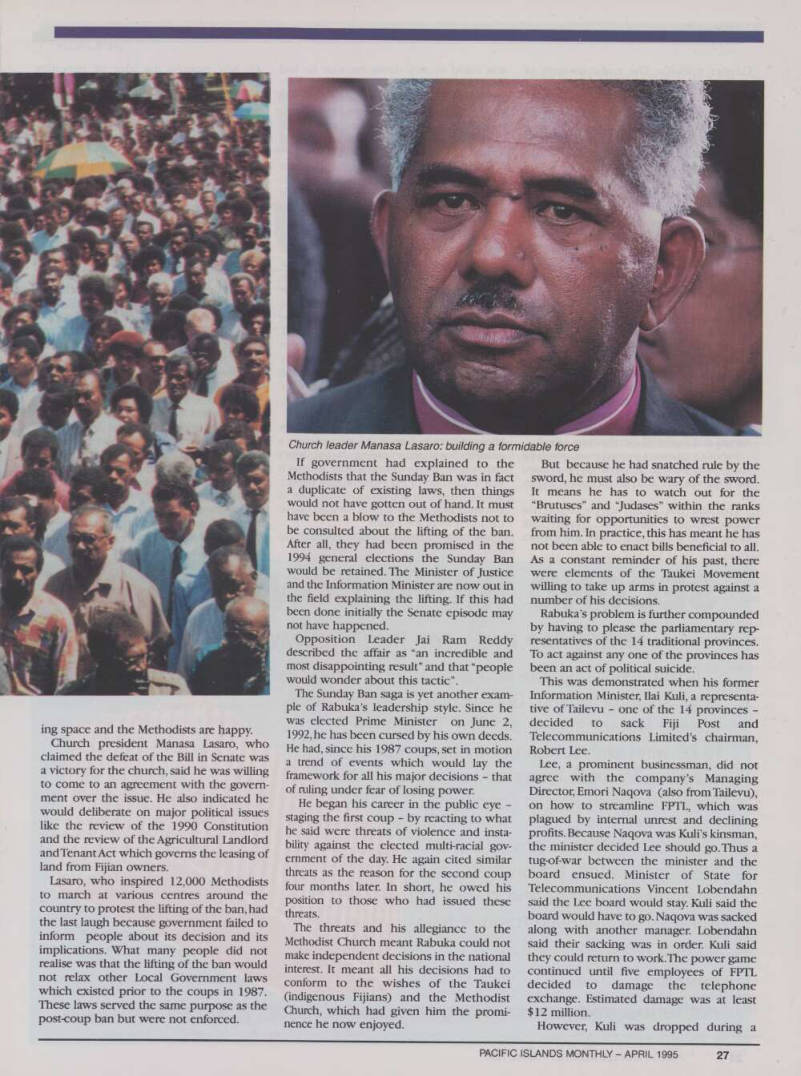

By Yunus Rashid
pressure from a minority group.
The church had waged an intense cam paign against the lifting of the ban, but this did not dampen the enthusiasm with which government defended its decision, even when attacked by some of its own backbenchers.
The Opposition parties, especially the Indian parties, did not enter into debate over what they considered a “natural” deci sion for the good of the country. When Parliament endorsed the decision, the Methodists branded Rabuka a “Judas” and “traitor of the church”.
The Bill went to Senate where it found many sympathisers and the general feeling was the Bill would get through. But an extra ordinary sequence of events happened when it was time to vote. The Bill was passed by voice but Bole, who was put in Senate by Rabuka, called for division or voice count. The Bill was lost by one vote,
Fiji’s political pundits were left gaping when Prime Minister Sitiveni Rabuka ably dribbled the lifting of the con troversial Sunday Observance Decree Bill through parliament only to have it kicked out of goal by his own man, Senator Filipe Bole.
What was to have been a positive turning point in Rabuka’s leadership became a vic tory for the Methodist Church.
The church, whose members had marched through the streets of Fiji’s major cities condemning the Cabinet decision, breathed a sigh of relief while the rest of the country groaned in disbelief when the Senate blocked the passage of the Bill.
What happened was that a decision made to revitalise the economy and stem increas ing unemployment was overturned after
15 to 14.
The question was asked: why did Bole call for a division? Was it because he had to make sure the Bill did not get through? Was he simply not thinking? Or did he want a count on the number of affirmative votes for future use?
One can merely speculate on why Bole behaved the way he did.
His explanation was that it was not digni fied for the Chiefs to “yell aye or nay”. Bole even suggested the Chiefs should not have to give consent collectively.
He may have shed light on his reasoning when he referred to “the impatience dis played so far to rush the repeal of the Sunday Observance Decree...”.
This statement reflects that while Bole endorsed the repeal, he thought there was no rush for the ban to be lifted.
Whatever Bole’s intentions, the fact remains that Rabuka has got more breath
Marching in the name of God: some 12,000 Methodists marched through the streets of Fiji protesting the lifting of the Sunday Ban
ing space and the Methodists are happy.
Church president Manasa Lasaro, who claimed the defeat of the Bill in Senate was a victory for the church, said he was willing to come to an agreement with the govern ment over the issue. He also indicated he would deliberate on major political issues like the review of the 1990 Constitution and the review of the Agricultural Landlord and Tenant Act which governs the leasing of land from Fijian owners.
Lasaro, who inspired 12,000 Methodists to march at various centres around the country to protest the lifting of the ban, had the last laugh because government failed to inform people about its decision and its implications. What many people did not realise was that the lifting of the ban would not relax other Local Government laws which existed prior to the coups in 1987.
These laws served the same purpose as the post-coup ban but were not enforced.
If government had explained to the Methodists that the Sunday Ban was in fact a duplicate of existing laws, then things would not have gotten out of hand. It must have been a blow to the Methodists not to be consulted about the lifting of the ban.
After all, they had been promised in the 1994 general elections the Sunday Ban would be retained. The Minister of Justice and the Information Minister are now out in the field explaining the lifting. If this had been done initially the Senate episode may not have happened.
Opposition Leader Jai Ram Reddy described the affair as “an incredible and most disappointing result” and that “people would wonder about this tactic”.
The Sunday Ban saga is yet another exam ple of Rabuka’s leadership style. Since he was elected Prime Minister on June 2, 1992, he has been cursed by his own deeds.
He had, since his 1987 coups, set in motion a trend of events which would lay the framework for all his major decisions - that of ruling under fear of losing power.
He began his career in the public eye staging the first coup - by reacting to what he said were threats of violence and insta bility against the elected multi-racial gov ernment of the day. He again cited similar threats as the reason for the second coup four months later. In short, he owed his position to those who had issued these threats.
The threats and his allegiance to the Methodist Church meant Rabuka could not make independent decisions in the national interest. It meant all his decisions had to conform to the wishes of the Taukei (indigenous Fijians) and the Methodist Church, which had given him the promi nence he now enjoyed.
But because he had snatched rule by the sword, he must also be wary of the sword.
It means he has to watch out for the “Brutuses” and “Judases” within the ranks waiting for opportunities to wrest power from him. In practice, this has meant he has not been able to enact bills beneficial to all.
As a constant reminder of his past, there were elements of the Taukei Movement willing to take up arms in protest against a number of his decisions.
Rabuka’s problem is further compounded by having to please the parliamentary rep resentatives of the 14 traditional provinces.
To act against any one of the provinces has been an act of political suicide.
This was demonstrated when his former Information Minister, Ilai Kuli, a representa tive ofTailevu - one of the 14 provinces decided to sack Fiji Post and Telecommunications Limited’s chairman, Robert Lee.
Lee, a prominent businessman, did not agree with the company’s Managing Director, Emori Naqova (also fromTailevu), on how to streamline FPTL, which was plagued by internal unrest and declining profits. Because Naqova was Kuli’s kinsman, the minister decided Lee should go. Thus a tug-of-war between the minister and the board ensued. Minister of State for Telecommunications Vincent Lobendahn said the Lee board would stay. Kuli said the board would have to go. Naqova was sacked along with another manager. Lobendahn said their sacking was in order. Kuli said they could return to work. The power game continued until five employees of FPTL decided to damage the telephone exchange. Estimated damage was at least $l2 million.
However, Kuli was dropped during a
Church leader Manasa Lasaro: building a formidable force
Cabinet reshuffle. The embarrassment of the FPTL saga followed by the drop from the Cabinet line-up made Kuli a bitter foe.
Being a tyro in politics, Rabuka’s prob lems began almost as soon as he took office. The biggest scandal, which flared at the same time as the FF*TL saga, was the out of-court settlement reached between gov ernment and Suva businessman Anthony Stephens. Stephens had sued government for $3O million for wrongful detention in 1987. Government agreed to pay Stephens a total of $lO million in cash and property in return for the withdrawal of the writ.
When documents relating to the payout were leaked to the media, Rabuka’s Attorney-General Apaitia Seru resigned and Parliament resolved to have a Commission of Inquiry investigate the deal. The findings of the inquiry became the basis of a police investigation and Seru and Stephens were charged with forgery.
These incidents indirectly led to the fall of the Rabuka government 18 months later.
Kuli and several other backbenchers voted against the 1993 Budget in the hope of a leadership change. Parliament was dis solved and a general election was called.
Rabuka’s charisma proved more powerful than many pundits believed, as he cruised back into power with an increased majori ty- This did not mean his problems had ended. Within a short time, another split occurred in government ranks and Rabuka
was asked to step down because he had called for a Government of National Unity and there were allegations that he had com mitted adultery. Rabuka offered to resign if the parliamentary SVT caucus wanted him to. The caucus decided in favour of Rabuka staying.
To Rabuka’s credit, despite being a novice to the cut-throat game of politics, he was able to pick his way through the onslaught of problems. The Opposition pushed him for a review of the Constitution and ALTA, investors asked for better economic poli cies, school leavers demanded jobs, the Fijians wanted more positive discrimina tion, he had to be wary of some of his back benchers, some of his ministers acted inde pendently bringing greater disrepute to the government and then there was the Methodist church talking about bloodshed.
The threat came when government refused to implement the recommenda tions of a Job Evaluation Exercise and refused to go to arbitration. But the strike threat forced government to arbitration, which is continuing.
Then there was Rabuka’s Information Minister, Ratu Jo Dimuri, trying to secure a majority local shareholding in the News Ltd-owned Fiji Times newspaper. He said it was a question of Fiji’s sovereignty. Rabuka quickly moved in and dispelled the fears of investors that their interests were second to the interests of the Fijians.
Just prior to that, the Trade Minister, Jim
Ah Koy, mooted the idea of importing American chickens - only by Fijians. What the Minister had hoped would gain him popularity turned out to be his and the gov ernment’s embarrassment. Fijian sharehold ers in the local chicken industry criticised the idea saying it was aimed at putting them out of business. The idea was shelved.
The latest scheme to attract widespread bad press was the proposed Hong Kong Chinese immigration plan. (Story PIM March 1995). Two ministers decided this was a way to energise Fiji’s ailing economy without any proper research. And because they could not explain the impact of such a move on Fiji’s political, social and econom ic structures - let alone identify the pro posers of the deal - the plan was left to die a natural death.
These are but a few examples of how Rabuka’s government has been running the show. It is unfortunate that when Rabuka was ready to act as the leader of the coun try and make a decision in the national interest, he gave in to a minority.
A poll conducted by the Fiji Times recent ly revealed for the first time since polling began in August 1993, that Rabuka’s popu larity rating had plunged dramatically, and that he was losing support amongst all sec tions of the community.
At this rate, if his government continues down the path of indecision, mismanage ment and pressure-group politics, Rabuka could find himself out of a job. ■
Advertisements & other items, p. 28 (1 item)
Second Hand Containers
WHERE AND WHEN YOU WANT THEM IN THE PACIFIC If you need a flexible and safe storage space we have the ideal solution for you. Our second h; provide instant secure storage. Guar to be wind and waterproof these cor are ideal for both temporary and lonj term storage in Pacific conditions.
We can deliver to any island in the Pacific within a month and our rates have got to be the lowest you will find. All you need to do is tell us how many you want.
CONTACT:
PASCALE MARCONNET, BP 4757 NOUMEA, NEW CALEDONIA. TEL: (687) 28 7450. FAX: (687) 26 3248
Reshaping the
Reform
Reshaping the legislature
Guam attempts to provide a leaner bureaucracy, but how serious is the intention ?
By David North
When a palace coup of sorts hit the 23rd Guam Legislature on its first official day of business on January 4, the losing faction expressed shock and dismay. Embittered senators called the body “a parliament of whores” and an “incestuous pool of self interest’’.Vengeance was vowed.
But most residents and veteran observers of the island’s flamboyant legislative branch were not surprised. The shake-up, though more bitter than most recent squabbles, was just one more engrossing chapter in the 45-year history of one of the richest, most diverse, free-wheeling, and fascinating legislative bodies in the
Pacific. Though not especially powerful by
Pacific island standards, the venerable ter ritorial legislature of Guam is certainly exceptional.
Don Parkinson, a “stateside” attorney from Utah who came to Guam 20 years ago, is now the Speaker, thanks to the January 4 coup.
The legislature also is losing its venera bility. The average age of members is drop ping quickly. In the current body, two thirds of the senators are under 40. And that was a key factor in the January power struggle.
As Guam has prospered over the past two decades, primarily from a thriving tourism industry and, until recently, a rela tively stable US military presence the legislature also has waxed wealthy. Its annual budgets have grown from a modest $5 million to $lO million in the late 1950 s to $l5O million over the past few years.
Senators’ salaries jumped to $55,000 annually the highest of any in the Pacific and second highest of any of the 50 states of the United States. Staffing has sim ilarly ballooned and the 21-member body now employs more than 500 persons either through direct staffing or indirect contractual arrangements.
The influence of the body over the oper ations of the 12,000-strong government of
Guam has similarly increased. Through its committee structure, investigative authori ty, and legislative power especially bud get appropriation authority the legisla ture has held down utility, public health and education costs, boosted the salaries of local government workers and the pen sion benefits of government retirees, and heavily influenced education, health and welfare appointments and policies of the local executive branch.
The private sector has complained about this agenda, arguing that too much of the
‘We elected them to do a job, and now the people of Guam have to go and do their job for them. ’ \
island’s wealth was being used by public employees and government welfare pro grams rather on new roads, improved power systems and better schools.
Many of the problems with public edu cation and health care have been traced to political intervention and favoritism. As Guam slipped into a recession, public dis satisfaction mounted. Guam’s flat econo my, rising unemployment, inflation, gov ernment deficit of more than $lOO million and the public’s perception of continued deterioration in public utility, educational and health services left many voters frus trated and upset. The local government’s borrowing through bond issues to pay long overdue tax refunds (just before the primary) and to meet other operating expenses had further exacerbated the sit uation. As one irate voter said in referring to earlier failed attempts at legislative
reform, “We elected them to do a job, and now the people of Guam have to go and do their job for them.”
A major voters initiative aimed at reform ing the legislature was introduced in last year’s general election. The initiative called for reducing membership to 15, lowering legislators annual salaries to $40,000, cap ping the budget at 2.5 percent total rev enue and limiting consecutive legislative terms to three.
Several incumbent Guam legislators had unsuccessfully introduced legislative reform measures. More than 8000 voters eagerly signed the petitions. Mark Forbes, who launched the effort, was carried along on the wave and handily elected to office, placing him within the top 15 elect ed members.
But when it came time to submit the ini tiative petitions to the Guam Election Commission, Forbes had a change of heart, saying that as a member of the body, he had to give it a chance to reform itself.
A public outcry led to bills being intro duced in the legislature to achieve the reform and an unsuccessful legislative candidate’s pledge to reinvigorate the citi zens initiative. But for many voters, reform appears further off now that it did a year ago.
Many of the younger generation of Democratic Party senators who were elected last November also took up the battle, promising reform from within. The Democrats had won 13 of the seats to the Republicans 8 in the November, 1994 vote. Flushed with electoral victory, and led by Senator Tom Ada, the most popular vote getter among all the senators, the group was aided by party chairman Mike Phillips and won the caucus endorsement for Speaker. They began to build a power base around him. Important committee assignments were slated to go to Ada’s allies and the Republicans were warned that their staff budgets could be cut by as much as $lOO,OOO each as a “reform” and downsizing effort.
The “magnificient seven plus one” as they came to be known, had unwittingly pro vided the motivation that drove a group of disgruntled older Democratic senators (some of whom boasted five consecutive terms and said they also had a voter man date) and eight minority members into a coalition that on January 4 voted for the “statesider” Don Parkinson as Speaker of the 23rd Legislature. The winners quickly attempted to consolidate their victory by offering major committee assignments to some of the younger Democrats. Most accepted and the new coalition solidified its position, for now at least.
Left unanswered were the issues of reform and downsizing. The new legis lature has shown no sign of reducing its
Advertisements & other items, pp. 30-31 (1 item)
rugged reliability, elegant luxury...
■ r ;.rv w • *V -•- ssrlz t 7' i “H v »;V •• *** .*>.- >-T - . *-'* —w^w--, — !&&§ ■ fv***?* "~rA '*--•• ■ - mpm •£s»§?
V?‘ ■ ' V-. >*_>. . ,V|& \~r ■■ » - : 4 ?
Toyota Land Cruiser offers you more
rugged reliability, elegant luxury...
and long-lasting durability.
Land Cruiser’s reputation is second to none. No one doubts its rugged constitution. Yet here is a vehicle that rivals the finest limousines where comfort is concerned. And its fit and finish, the attention to detail, and the graceful lines and fine trim are reminiscent of exquisite luxury cars.
Nevertheless, hidden beneath its elegance, Land Cruisers still offer tough ladder frames and suspension engineered to go wherever you wish... in total comfort powered by your choice of 4.5-litre petrol or 4.2-litre diesel engines. And everything is carefully protected from rust and corrosion so it lasts longer Toyota Land Cruiser. The best for your world.
Now and forever.
DISTRIBUTORS /DEALERS
AMERICAN SAMOA BURNS PHILP MOTORS PH 633-4281 GUAM & MICRONESIA ATKINS KROLL, INC. PH 646-1876/9 NORFOLK ISLAND BORRY’S PTY LTD. PH 22114
SOLOMON ISLAND ELA MOTORS PH 30746
VANUATU ASCO MOTORS PH 22341
COOK ISLANDS PACIFIC MOTORS LTD PH 20796
KIRIBATI TARAWA MOTORS PH 21090
PAPUA NEW GUINEA ELA MOTORS PH 229400
TAHITI NIPPON AUTOMOTO PH 429819
WESTERN SAMOA ASCO MOTORS PH 23664
FIJI ASCOMOTORS
NEW CALEDONIA S.I.A.P.
SAIPAN MICROL CORPORATION
TONGA ASCOMOTORS
9 wmmmmmmmmggm Sts* ' ■ v T « •ML'-rr: ’ ■» ■>“ *• sc .a*...: ‘•L,' ,'i’ : " feS •* .i.
1C WINCH
LAND CRUISER
* Exact Matures and specifications may vary depending on country of purchase. Please check with your nearest TOYOTA distributor/dealer for details.
PH312666 PH 275562 PH 234-5911 PH 23500
® TOYOTA
balancing act
Budget
A tough, balancing act
Clinton proposes his plan for the American territories 9 but Congress is a tough group to contend with
By David North
Bill Clinton’s proposed budget for the islands cuts $2O million from the Northern Marianas and transfers most of those funds to American Samoa and, to a lesser extent, Guam.
Budgets presented by US presidents, however, unlike those tabled by finance ministers in parliamentary democracies, are not the last word. The Congress, now controlled by Republicans, plays a major and independent role in setting budget priorities.
The Marianas, full of Japanese tourists, is relatively affluent and American Samoa, with its lightly taxed tuna facto ries instead of tourists, is always broke.
But the transfer was much more than a simple movement of funds from a rich jurisdiction to a poorer one.
If Tonga used to be called the Friendly Islands, the Commonwealth of the Northern Mariana Islands (CNMI) could be termed the Friendless Islands, at least in Washington. With no delegate to the House of Representatives (because past CNMI leaders blew the opportunity to get one) and with highly publicised immigration and labour exploitation problems, no one of importance stands up for CNMI’s interests.
Further, on the question of federal pay ments, these islands are in a bad bar gaining position. First, it is well known that as much as 95 percent of the income taxes levied on individuals in the islands have been rebated to them by the CNMI government - a peculiar system which has lured some mainland
multi-millionaires to settle there.
Second, Governor FroilanTenorio, who wants to correct the strange tax struc ture, has indicated he would rather forego the flow of federal funds in exchange for keeping powers over immigration and the minimum wage.
The Governor may lose both the money and the labour and migration powers.
The President’s provisions for the
In the allocation of
funds for the next
financial year, it is likely Guam ’s anti tree snake fund will remain intact.
islands were relatively tiny items in the $1.6 trillion-budget he sent to Capitol Hill. Among the allocations were; * to FSM, $B7 million in compact funds (i.e. no strings); * to the Marshall Islands, $4O million in those funds plus another $3.1 million for nuclear cleanup; * to newly independent Palau, $22 mil lion; * another $22 million in specialised grants to be spread among the three
Associated States; * $5 million to Guam for its costs stem ming from migrants from the Associated States and to help control the brown tree snake; * $24 million in normal subsidy to the American Samoan Government, plus another $l6 million (ex-CNMI funds) to improve the frayed Samoan infrastruc ture; and * $6 million for CNMI.
Clinton’s people had several things to worry about in addition to the needs of CNMI and Samoa. First, the US has a treaty obligation to the Associated States, hence the generous allocation to FSM, the Marshalls and Palau. Secondly, because of a historic accident (CNMI used to get $27 million a year from the mainland), they could divert some money from one set of islands to anoth er without raising little flags saying, in effect:“this is new money”.
Thirdly, the Department of Interior’s decision to close down the Office of Territorial and International Affairs was a small bone to be handed to the pop ulist Congress.
What will Samoa do with the extra money?
The funds, if they get through Congress at all, would be used not to help balance the ASG’s bloated territori al budget, but to fix up Samoa’s hospital and to bury the utility lines to prevent them from being blown down in the next hurricane. Samoans discussing the burial of the lines are careful to point out that while this is a common practice in America’s tonier suburbs (because it looks nicer), aesthetics have nothing to do with that practice in hurricane-prone Samoa.
But given the Republican Congress’s avid desire to cut the budget more deeply than Clinton did, Samoa will be lucky to retain the $24 million operating subsidy, which is a million or so higher than it has been in the past. It will be a miracle if ASG gets the $ 16 million for its infrastructure.
The chunk of money which is the safest is the anti-brown snake fund. The snakes in question, which apparently arrived from Papua New Guinea after World War 11, run wild in Guam without natural enemies, often short-circuit (above-ground) electrical wires, kill songbirds and threaten babies.
Everyone hates snakes, even Republicans. ■
Advertisements & other items, pp. 33-43 (1 item)
Telikom
Papua New Guinea
mm 1\l -.■^55^ : x ->x: »>•»» ' P^8 n m : * m Hi m m
i unmiiiiiiiiiiiam
-i:] ■./« •• > : : ;• 1 •M 1 B 3"?£ : r SSg* Telikom has set the pace in providing state-of-the-art telecommunications links within PNG and to anywhere around the world as we enter the 21st Century. For all your telecommunications needs, write to us at this address: Assistant General Manager
Telikom Marketing Department
P.O. Box 291
Waigani, Papua New Guinea
Tel: 675 300 5564 r- orvn rr a n
TELIKOM
Alout we'ne
ADVERTISING FEATURE
Telecommunications
in
Papua New Guinea
Telecommunications (and postal services) in Papua New Guinea are the responsibility of the Post and Telecommunications Corporation (PTC), established by the Post and Telecommunications Corporation Act 1982.
Telecommunications Network The telecommunications system in Papua New Guinea is 100 percent automatic, with international links to 143 countries in the world and domestic services to most urban centres.
Prior to the recent opening of the new Gerehu earth station, the backbone of the network was a series of microwave radio bearers comprising over 71 microwave links with repeaters on mountain tops. Another 14 are being planned to be constructed in 1995. The bearers provide service through 43 exchanges which in turn connect 44,000 telephone lines (subscribers) and 72,500 terminal instruments (e.g. telephones). High costs exist in PNG’s telecommunications system due to the relatively low subscriber base, high infrastructure cost of providing terrestrial links, compounded by land compensation claims for mountain top repeater sites and high wage costs.
For subscribers beyond the reach of the exchanges, a high frequency service exists where subscribers call by radio into a number of control centres where they are manually linked into the network. Overseas calls are provided by about 203 submarine cable circuits and 223 satellite circuits through the Gerehu earth station. In addition, there is a telex network of some 400 subscribers.
The cost of having telephones was reduced in the 1993 Budget by the abolition of the telephone tax. This tax had been levied since 1984. National subscribers had been exempted in 1990. At K 4 per phone per month, it had generated nearly K 1 million per year. Also, since August 1991, PTC has been collecting sales tax on behalf of 10 provincial governments, ranging from two to five percent of the monthly PTC bill. About K 1.5 million per year is raised by this tax. The National Government has also indicated it will cap provincial taxes at 2.5 percent.
During the five-year period to 1998, PTC plans to cover half of its exchanges from analogue to digital exchanges.
This will allow greater traffic volumes, faster switching and improved services throughout the country. More than Kl 5 million will be allocated to this programme in this period under the Government’s “Public Investment Program”.
Alternative routing facilities will be available with PTC domestic satellite system, scheduled to be completed by the end of 1994.
Also, improved transmission technology, together with wage restraints, should enable PTC to reduce the cost of services.
Telecommunication Services Papua New Guinea has one of the most modern and sophisticated telecommunications networks in the South Pacific. Products and services available include: * Touch phone * Digital key telephone and display phones * Facsimile service * Coin and payphone service * Telex service * Radio paging service * Data and datel service * Switchboard packet data service * International Direct Dialling (IDD) * Subscriber Trunk Dialling (STD) within PNG * HF and UHF service for remote areas and ship to shore * Satellite service * Operator assisted services (24 hours) Telecommunications Tariffs
All dialled telephone calls in Papua New Guinea are metered for charging purposes. Local calls advance a subscriber meter one unit when the telephone number dialled answers; this is called one “meter pulse”.
Trunk line (long distance) calls advance the subscriber’s meter one pulse every 72, 36, 24, 18 or 12 seconds on national calls depending on the time the call is made and the charging areas in which the two telephone services are located. Basically, the longer the time and distance of the call, the higher the charge. Off peak rates apply after 6.00 pm and at weekends. The structure is modelled on the Australian telephone tariff.
The above structure basically reflects FTC’s costs of supplying telephone services. There is significant cross-subsidisation between different categories of subscribers, particularly from business to domestic and from the major towns to the small ones.
Seventy-four percent of FTC’s business comes from major towns, 23 percent from minor urban centres and three percent from the rural sector. Profit margins are higher on international calls resulting in a cross-subsidy from international to domestic callers.
Local and STD calls In Papua New Guinea, a telephone meter measures one unit of 17 toea )approx. USl7c) for each local call.
For an STD call, the meter advances at specified intervals for the duration of the call, so that the average cost per minute is paid for. The charges are shown below. STD calls are half price between 5.30 pm and 7.30 am and all day Sunday.
International Direct Dial (IDD) Calls IDD calls can be made to 143 countries around the world from Papua New Guinea by following these steps: (i) Dial the international access code ‘O5” (ii) Dial the country code (consult a telephone directory (iii) Dial the area code for the town or city (if applicable) (iv) Dial the telephone number The charges vary according to the country called for the time used, with no minimum charge.
IDD charge rates are indicated by a charge band for each particular country.
Cost per minute Band 1 K 2.30 Band 2 K 2.60 Band 3 K 3.70 Sample Charge Band 1 countries: Australia, Fiji, Guam, Nauru, New Caledonia, New Zealand, Solomon Islands and Vanuatu.
There is an economy rate to Australia at K 1.45 per minute from 10pm to 6am Monday to Saturday and all day Sunday.
Sample Charge
Band 2 countries: Belgium, Canada, China,
France, Germany,
Hawaii, India, Israel, Japan, South Korea, Philippines, Spain, Switzerland, Taiwan, Thailand, United Kingdom and United States.
Conference Calls Conference calls are available to all centres in PNG and various overseas countries. A conference call can be arranged for up to 10 people, from anywhere in Papua New Guinea and overseas, to be connected at the — Hi \ Four transportable interim mobile earth stations installed and ready for use in emergencies. In the background is the full DOMSAT Earth Station
same time. Such calls should be booked a day in advance.
Satellite Communication in Papua New Guinea Papua New Guinea’s Domestic and International Communications Centre is based at Gerehu in Port Moresby. It was officially opened on August 6, 1993. The facility includes a new 18-metre standard ‘A’ International Satellite Organisation (INTELSAT) antenna, a 7-metre Optus Communications (Australia) antenna and an 18-metre Domestic Satellite (DOMSAT) antenna.
The new facility replaces the former Standard B 1 equipment. Standard ‘A’ enables improved International Direct Dialling (IDD) communication links with more than 100 countries using digital transmission equipment.
The Optus antenna enables direct IDD links between Papua New Guinea and Australia. The DOMSAT system enables communications within Papua New Guinea using a transponder leased from Intelsat.
Satellites A satellite orbits the earth at a speed determined by its altitude. The higher the orbit, or altitude of its path, the lower the speed. Satellites positioned over the equator, at a height of approximately 36,000 kms, travel at the same speed as the earth. These are called “geostationary” satellites. Most other satellites are at lower altitudes and therefore travel at higher speeds.
Satellites have two main uses - communications and observations. In both cases they transmit radio signals to earth stations, such as that at Gerehu, by a beam which is kept as small as possible. This is to maximise the strength of the signal and to minimise the power required.
Communication satellites operate in equatorial orbit and they must be positioned at least two degrees apart. Less than that and they can interfere with each others’ transmissions.
The need for Satellite Technology Papua New Guinea is a mountainous country and communications links between Port Moresby and the rest of the country, and overseas, is often very difficult because of bad weather which can affect transmission from one mountain to repeater station to another. Also, communications services have, in the past, been disrupted by exorbitant compensation claims by landowners of mountain top repeater stations. On occasions, landowners have occupied these sites and sometimes damaged valuable equipment.
Since independence in 1975, Papua New Guinea has witnessed rapid changes in telecommunications technology as a result of the accelerated development of the mining and petroleum sector: customers from these industries require modern telecommunications services.
In addition, Papua New Guinea’s ability to attract foreign investment depends on its capacity to provide up-todate telephone and data communications services to customers as the country progresses towards the next century. PTC’s vision 2001 is aimed at improving and expanding the delivery of postal and telecommunication services to the majority of Papua New Guineans at an affordable cost.
PTC began planning for the introduction of a Domestic Satellite Service in 1989 as a modernisation program as well as to protect PTC’s expensive telecommunications service.
SI T I I cl m Two linesmen connect telephones for a customer The DOMSAT Service The PNG DOMSAT service is being implemented in two stages.
Stage one was installed in early 1992 and comprised of seven earth stations serving major mining and petroleum companies as well as Manus Province and also the restoration programme for the North Solomons Province. The following places currently served under stage one of the programme are: Port Moresby, Porgera, OkTedi, Kutubu, Hides, Lorengau, Wakunai (NSP), Loloho (NSP) and Buin (NSP).The DOMSAT system provided under stage one is a small capacity system, and can only provide a limited number of telephone and data services.
Stage two of the DOMSAT programme is currently being implemented, and it is expected that all the earth stations will be in use by 1995. The DOMSAT system under stage two is designed to provide the following services; * TV distribution service from Port Moresby to the rest of PNG;
* Replacement of the existing troposcatter system to Manus and Dam; * Telephone restoration services for 11 provincial and district centres in PNG; and, * Four transportable earth stations for emergency services.
The stage two DOMSAT programme will serve; Port Moresby, Lorengau, Daru, Alotau, Misima, Madang, Wewak, Vanimo, Rabaul, Kavieng, Tabubil, Kimbe and Lihir.
In deciding which satellite system to use for the PNG DOMSAT service, PTC made a technical and economic evaluation of three satellites - INTELSAT, AUSSAT and PALAPA. Of these PALAPA was chosen. PTC went to tender for the construction of 23 earth station and Scientific Atlanta of the USA was the successful tenderer and was awarded a K 13.5 million contract.
PTC’s three-year lease on a PALAPA transponder has expired and it has signed an agreement with INTELSAT which has now taken over the DOMSAT service. PTC joins 40 other countries who are now hooked up with Intelsat in a bid to upgrade its immediate short-term capabilities and long-term communications needs.
System 12 Apart from the DOMSAT programme, PTC commenced last year to implement a five-year programme of modernising its telephone from analogue (mechanical) to digital (computerised). The first System 12 digital exchange was put into service in Lae in April 1993, followed by Kimbe and Boroko. By the end of 1995, the following centres will have the System 12 digital exchange installed: Ela Beach, Porgera, Mt Hagen, Alotau, Daru, Misima, Gerehu, Goroka and Madang.
System 12 is one of the most modern telephone technologies in the world today. It has been introduced into most developed countries in the last few years to replace ageing analogue exchanges. The System 12 digital exchange is designed to provide the customer with quality improved point to point connections, faster setting up of calls, reduced exchange congestion, reduction in maintenance costs and time, faster connections and service transfer. It
No More Cables!
EP-401 Radio Modem for interconnecting:
♦ PLC’s
♦ Dataloggers ♦ Intelligent transducers ♦ Remote printers ♦ R 5232
EP-101 Radio Telemetry Module for signal
transmission:
♦ Digital/contacts
♦ Analogues No radio licence required Range up to 5 km Microprocessor controlled Error detection Automatic retries
0 ELPRO
Technologies Pty Ltd Made in Australia Distributors: AUSTRALIA: Elpro Technologies, Old PH: 0011 61 7 357 5344 FAX: 0011 61 7 357 5746 FIJI: Posts & Telecommunications Ltd, Suva PH: 0011 67 9 304 019 FAX: 0011 67 9 303 210 PAPUA NEW GUINEA: Pacom Communications, Port Moresby & LAE PH: 0011 67 5 258 928 FAX; 0011 67 5 258 204 *^<^Xvi**«* I :
provides distinctive customer features. In addition to the direct exchange line service, it will offer call waiting, call control, “call me back when you are free”, call forwarding, detailed call information (itemised billing), ring back price information (on STD/IDD calls), wake up calls, enquiry calls, three party services, and abbreviated dialling. Apart from the installation of the new exchanges and the DOMSAT system, work also began on digitising the microwave radio bearer network.
Satellite Link to Australia The high tech facility at Gerehu was built by Optus Communications of Australia for Telikom and has established a direct all digital service link to Australia via the Optus A 2 satellite. This is only the second application for Optus satellite services outside Australia.
The new satellite takes full advantage of the recent upgrades in the Telikom network. The earth station is connected to the new digital System 12 exchange in Boroko and the connection between the Gerehu earth station and Boroko exchange is via NCD Optic Fibre Link. Port Moresby customers now have direct access to Optus when they call Australia, as do Optus customers when they call PNG.
The Telikom-Optus connection is the first international link from PNG that incorporates C 7 signalling, a system
which provides faster transmission of signals and greater flexibility in handling congestion. The new satellite is primarily intended for telephone traffic but will soon be extended to incorporate other communications services.
Highlights from the 1993 PTC Annual Report The corporation recorded an annual income of K 154.2 million and paid a final dividend of K 3.6 million to the National Government. It contributed K 11.4 million in corporate tax and achieved a commercial rate of return on investment of 22.1 percent. The 1993 year was busy as far as telecommunications was concerned.
During 1993, there were significant increases in growth of both domestic and international telecommunications services. These were: more than 10 percent increase in telephone connections for subscribers, establishment of 90 new digital circuits with Optus via the Aussat Satellite, the introduction of International Direct Dialling (IDD) to 16 additional countries bringing the total to 143. The introduction of High Speed Data Services (64 kilobytes per second) for both national and international customers. The network digitalisation programme commenced in early 1992, when the first System 12 exchange was commissioned in Lae in April. The upgrade of two analogue microwave radio bearers from Port Moresby-Lae- Goroko-Mt Hagen was completed.
Upgrading of the third analogue bearer along the same route commenced in 1994. Digitalisation of the radio bearers which commenced in 1994 are the Mt Hagen-Wewak, Mt Hagen-Port Moresby (back haul) and Port- Moresby-Alotau. Other projects, which will be commencing soon, include a tariff review, the development of a data service focusing on Packet Switch and
“Your computer systems must be up and running 24 hours a day, 7 days a week, 365 days a year, so you don’t have to be.”
You can rely on our AViiON and CLARiiON open systems to be there, up and running, always available.
For highly available computing, call Gary Dcltci OdlCrcll Hewton at Data General on (675) 25 3800. Bringing CommonSenseto Computing
Digital! Data Network Service.
Posttal Division The successful advertising campaign using the slogan “Go like a Rocket” was launched and was given good coverage by the medial. The response from customer's was positive as revenue increased by 10 percent over 1992. In 1993, a review to restructure Ptost PNG was undertaken by NZ Post. The reorganisation has now ffocused on commercialisation. The Express Mail Service (EMS) has again proven very popular and competitive since its introduction in 1990. EMS is really meeting the needs of customers who want a reliable, cost effective service. Salim Moni Kwik (SMK) continues to provide a quick, secure and inexpensive service for “grassroots” customers in PNG. A joint venture between Post and Post Courier newspaper now allowed customers to advertise their messages in the newspaper u The coastal radio service is provided by PTC to ships at sea and the national disaster and emergency using the “classifax” service available at all post offices.
A new agreement was established in 1993 to sell Lotto tickets over post office counters for Lotto PNG Pty Ltd.
PNG’s postage stamps are keenly sought around the world. Philatelic sales in 1993 increased by 26 percent over the previous year. Outlets have been established with 23 overseas agents in Australia, the USA, the UK, New Zealand, Japan, Sweden, Switzerland, the Netherlands, Germany, China, Spain and Italy. Post PNG is liaising closely with the Department of Mining and Petroleum and the mining and oil industries to ensure that appropriate postal services are provided in resource development areas. Post office agencies were appointed at Porgera and Misima and others would be established as the need arises. As from January 1, 1991, PTC’s Postal division assumed responsibility for the collection of Airport Departure Tax. Departure tax stamps are available at post offices and special sales points located at major airports.
Coastal Radio and High Frequency Outstation Services HP radio remains a very important medium for PTC as it provides an effective communication link to out stations in rural areas beyond the reach of the microwave or the VHP network. For these isolated communities, HP radio is the only communication link with the outside world. It is also vital for safety of life at seas. The Corporation is committed as part of its community service obligations to provide an uneconomic service for humanitarian, national security, natural disasters and development reasons.
At present there are 280 HP rural subscribers using the outstation network on a regular basis. The figure was to have been reduced to 170 in 1994. There are approximately 1200 HP stations through- An operator talks to a customer reporting a line fault
Stan Hite’s reputation for providing effective telecommunications solutions is known worldwide, with over 200 systems operating in more than 20 countries including Papua New Guinea, Vanuatu, Solomon 1., and Tonga. As well as building to international standards, we can create custom solutions to match your specific requirements.
A Cellswitch: Cellular switching systems and networks
A Trunkswitch:
Trunked radio systems and networks A Wireless Access systems Wireless infrastructure for fixed telephone networks A Custom Private Mobile Radio systems
A Terminal products
Please send me more information on: □ Cellswitch □ Trunkswitch □ Wireless Access systems □ Private mobile Radio □ Terminal products Name: Address: Mail to: StanUite Electronics (NZ) Ltd Attn: Robert Tomlinson Unit B, 1 William Pickering Drive • North Harbour Industr'al Fstate • Albany Auckland • New Zealand Telephone: +64 (9)415 6370 Fax: +64 (9) 415 6371
out PNG that are licensed to operate into the Outstation Network. The majority of these stations seldom, if ever, use the service at present, but participate exclusively in mission and private networks within their own locatio One group that is mindful of people going out to sea is the Coastal Radio Service based in Port Moresby (and Rabaul until the volcanic eruptions of September 1994). The CRS warns seamen of imminent dangers by transmitting weather forecasts, strong wind and cyclone warnings, receiving of distress signals from ships and people at sea, testing of ships radios and connecting calls from people at sea to subscribers on land. Although the CRS is now out of date by recent advances in communication technology, the service still plays a vital role in assisting PNG’s development.
Mobile Telephony Plans are continuing for the new cellular radio service to form the basis of a new mobile telecommunication service to be operated by PTC initially in the NCD and Lae.
Card Phones The introduction of card operated public telephones took place in 1991. Trialed in 1988, its introduction and adoption was mainly to solve problems of collection of takings and maintenance due to repeated vandalising of conventional coin-operated pay phones. The PTC Board has approved the development of payphones as a separate business unit.
Apart from providing the public with a more convenient and reliable way of paying for telephone calls, the cardphone offers many other advantages, especially for Papua New Guinean families, the elderly and disabled people. Where card operated public telephones have been installed, income has doubled and maintenance has been negligible.
Fibre Optics
The first fibre optic cable was laid in November 1991 in Port Moresby. This technology uses a glass cable instead of Antenna of hf radio on Tasman island copper for the transmission path signals. Using light to transmit signals, this special cable has a very high capacity and is able to carry many more signals as well as provide excellent optics. Cabling will be used to link all of the telephone exchanges located in the National Capital District to the earth station at Gerehu.
Future Telecommunication Programmes under study include: * Tariff review * Payphones * Mobile phone service (cellular) * Digital data network * Expansion of IDD reduced rate to other countries.
Major resource companies should apply to Telikom Marketing Department for their telecommunications requirements. Telikom Marketing and Telikom Planning Department will then design a system and advise them about costs.
Such requests should be addressed to; 4t m Assistant General Manager,
Telekom Marketing Department,
Ist Floor, Telikom Rumana,
P.0.80x 291,
Waigani, Papua New Guinea.
Tel: 675 300 5555 Fax: 675 300 5540 675 300 5541 ft m
TELIKOM
Papua New Guinea
\i X.
D ir^ tor aging an Ross
(ADVERTISEMENT)
SANDAUN PROVINCIAL
GOVERNMENT PROVIDES REMOTE
PNG COMMUNITIES WITH WORLD
CLASS COMMUNICATION
SERVICES USING ADVANCED PORTABLE
SATELLITE PHONE TERMINALS
When Clarkson Dikinseep was sent to the ANU in Canberra to study for his Masters degree, he was also asked to look for solutions to several problems faced by the remote Sandaun Provincial Government in the western part of PNG.
The Sandaun Province, which was previously known as the West Sepik Province, is poorly served by conventional telephone services, and people in many villages and rural towns have virtually no communication with the outside world. This is a major problem for the provision of health and emergency services and other government utilities and makes normal business activities almost impossible.
So, when Clarkson met Des of AIRCOM SERVICES and heard about the Atlas Elektronik SPI6OOB satellite phone terminal, he immediately knew that this technology could provide the essential communications that Sandaun so desperately needed.
The Sandaun Government knew that PNG Central Government would not be able to provide conventional phone services for several years and the cost of installing the necessary land lines for this service would be enormous. However, the cost of several satellite phones was relatively minor and they provided an immediate solution to the problem. So, the farsighted Sandaun Government officials decided that they had to move ahead as soon as possible with their own solution.
After several meetings and a demonstration of the SPII6OOB in action,
(ADVERTISEMENT)
Clarkson convinced his Government and the PNG authorities that this was the solution to their communication problems in remote areas.
An initial three units were purchased for Sandaun Province. The satellite phone terminal is a stand alone unit, contained in a Samsonite briefcase, and only needs electrical power to operate. This power can be provided by either the units own rechargeable batteries or by connecting the terminal to a motor vehicle battery or the main power supply.
Therefore, it can be carried into any remote area and will be operational immediately to provide world wide telephone, facsimile and data communication services.
AIRCOM SERVICES was very pleased to deliver the three satphones to the Sandaun delegation on Saturday May 21,1994, during a visit to Sydney.
The units are now located at district offices and provide full communication services to communities in the province.
When these first units have proven their capabilities to the people of Sandaun, the provincial Government is expected to expand the network and introduce further SPI6OOB satellite phones to service this remote area of PNG.
Other similar Provincial Governments have now expressed great interest in a similar solution to their own communication problems.
N» *
Airborne Communications Pty Ltd
ACN 002 132 434 11 Emma Street, PO Box 625, Leichardt, NSW Australia Tel: (+6l 2) 564 3375 Mobile: 018 402 341 Fax: (+6l 2) 564 3376
industry?
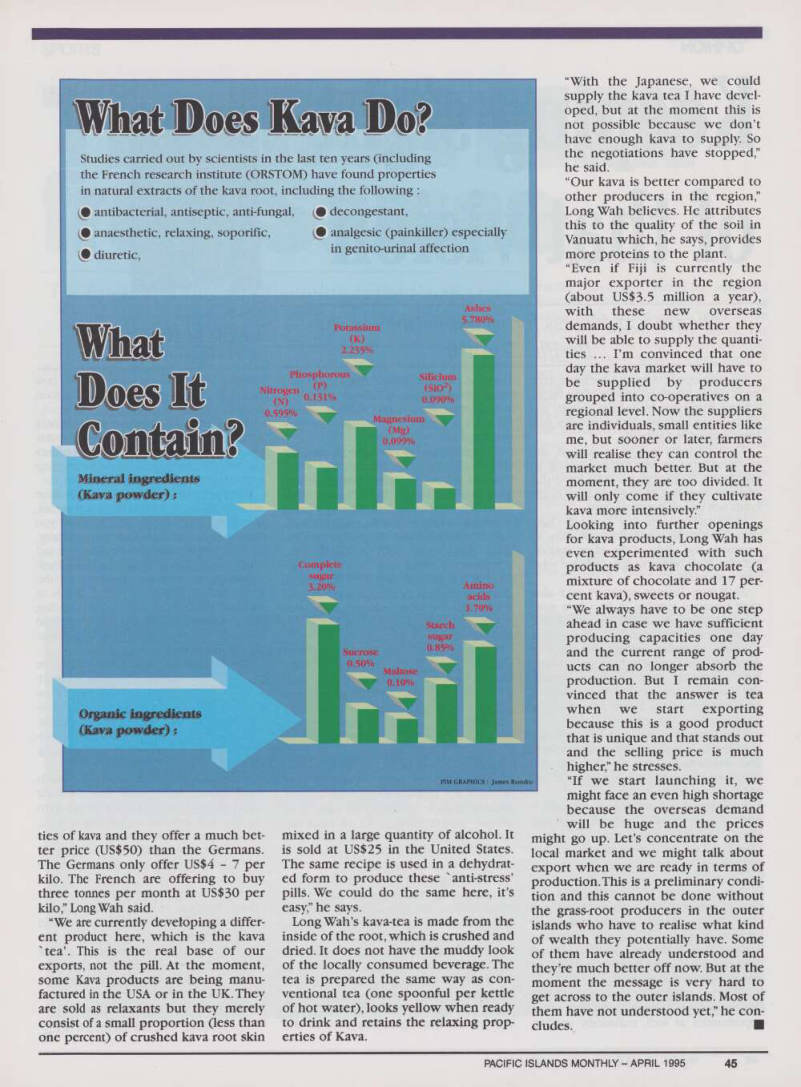
Business
Kava the next boom industry?
International interest in the Pacific drink is growing and enterprising business people are beginning to cash in
By Patrick Decloitre
Kava is becoming the focus of inter est from a growing number of pharma ceutical companies from Germany, the United States, Japan and France, as they study the medicinal values of the plant which is a common drink throughout the region.
In February, a German pharmaceuti cal company, Schwabe, said it would buy 100 tonnes of dried kava from pro ducers in the South Pacific to manufac ture an anti-stress pill that is to be mar keted in South East Asia.
Eckhart Muller, a Schwabe official, said the quantities (the equivalent of some 600 tonnes of green kava), would be bought from South Pacific kava pro ducers: Fiji, Tonga, Western Samoa and Vanuatu.
The possibility of creating joint ven tures in the kava-producing countries, especially in Fiji, was also mentioned.
They intend to make the anti-stress pill after three years of research, Schwabe said. The company intends to sell the pill in Malaysia, South Korea, and Indonesia. It will be marketed to treat such complaints as anxiety and
hypertension.
But one of Vanuatu’s main kava dis tributors, Charles Long Wah, says the problem locally is not to export but to be able to face the demand from the domestic market.
He estimates the Vanuatu market (mainly kava bars of the capital, Port Vila, and the northern town of Luganville) consumes 4000 tonnes of green kava annually. “Since 1985, this represents a local market of about 100 million vatu (about US$900,000) and
this could grow in the coming years at a rate of seven percent per year,” he says.
This is clearly a reversal in trend com pared to the pre-independence situa tion, where missionaries had labelled the beverage the “devil’s drink”.
“In Port Vila, on Erromango, on Futuna, Anatom, Malekula, the mission aries had told the islanders to destroy kava plants. And so they did.
“But at present, at this pace and given the present situation, we are facing the risk of a kava shortage for the Vanuatu market by the end of this year and for the next three to four years,” he said.
“We should start to increase the pro duction effort now to provide for this increasing local demand, let alone the export markets,” says Long Wah.
The problem is that kava is not grown in the most productive way.
“People are replanting smaller and smaller sticks (from the plant) and the roots are therefore smaller, too. On the islands ofTongoa, Epi and Tanna, there is hardly any kava left. I have started negotiating with overseas donors who are ready to finance an intensive replanting scheme. But even if this eventuates, it will take at least five years before the first harvest is ready.
“But this is a very profitable business which yields nearly 14 million vatu (U 55125,000) per hectare. The idea would be to build a processing factory in a main production centre (an island like Pentecost) to enable the produc tion of an exportable finished prod uct,” he says.
The island of Tanna was producing some 20 to 40 million vatu (US$lBO,OOO to US$300,000) worth of
kava each year but this production has now decreased to less than 10 million vatu (US$9O,OOO).
“The consumption is even bigger on Tanna than what they can produce. The only island left to produce in large quantities is Pentecost. That’s why we heard recently that producers in Malekula and Santo (north Vanuatu) have increased their prices by 300 per cent because there is a shortage in the southern islands,” he points out. Long Wah said he has bought quantities worth over 200 million vatu (US$l.B million) in the past 15 years from the central Pentecost region alone .
He explains this by a “too big con sumption” of the anaesthetic beverage in Port Vila and Santo. “And I have so far never exported any kava since I start ed,” he added.
Long Wah’s Kava Store centralises production of kava, buying at just over US$l per kilogram from the outer islands, mainly from northern Pentecost. He estimates he has 27 per cent of the market, with an average of nine to 10 tonnes bought every week, amounting to 585 tonnes annually.
Daily sales average 1.5 tonnes.
Some of his customers retail to small er kava bars which prepare the bever age every night for a wide range of cus tomers, including ni-Vanuatu and a growing number of expatriates and local residents.
The business of producing and sell ing kava provides income for some 6000 growers in the outer islands, according to Long Wah’s estimates. “On Pentecost, nearly the whole island now concentrates on kava production,” he said.
“I think kava growing is a good thing, it’s become a real source of income.
Someone in the islands who has land and grows a thousand plants of kava is nowadays a rich man and he’d better not leave his land unattended,” he said.
“This is the answer to all the Vanuatu islands, and other Pacific islands.”
Elaborating on the export potential of kava, Long Wah said products such as the anti-stress pill did not need to be manufactured overseas.
“Overall, with this growing demand, the export market could increase by 100 percent in the coming years,” Long Wah said.
To supply this demand, he thinks the best thing would be to process locally the raw material into a semi-finished
product.
He says German, American and French companies are interested in buying kava. “At the moment in Hawaii, they are starting to plant huge quanti
ties of kava and they offer a much better price (US$5O) than the Germans, The Germans only offer US$4 - 7 per kilo. The French are offering to buy three tonnes per month at US$3O per kilo,” Long Wah said.
“We are currently developing a different product here, which is the kava 'tea’. This is the real base of our exports, not the pill. At the moment, some Kava products are being manufactured in the USA or in the UK. They are sold as relaxants but they merely consist of a small proportion (less than one percent) of crushed kava root skin
mixed in a large quantity of alcohol. It is sold at US$25 in the United States, The same recipe is used in a dehydrated form to produce these 'anti-stress’ pills. We could do the same here, it’s easy,” he says.
Long Wah’s kava-tea is made from the inside of the root, which is crushed and dried. It does not have the muddy look of the locally consumed beverage. The tea is prepared the same way as conventional tea (one spoonful per kettle of hot water), looks yellow when ready to drink and retains the relaxing properties of Kava.
“With the Japanese, we could supply the kava tea I have devel oped, but at the moment this is not possible because we don’t have enough kava to supply. So the negotiations have stopped,” he said.
“Our kava is better compared to other producers in the region,”
Long Wah believes. He attributes this to the quality of the soil in Vanuatu which, he says, provides more proteins to the plant.
“Even if Fiji is currently the major exporter in the region (about US$3.5 million a year), with these new overseas demands, I doubt whether they will be able to supply the quanti ties ... I’m convinced that one day the kava market will have to be supplied by producers grouped into co-operatives on a regional level. Now the suppliers are individuals, small entities like me, but sooner or later, farmers will realise they can control the market much better. But at the moment, they are too divided. It will only come if they cultivate kava more intensively.”
Looking into further openings for kava products, Long Wah has even experimented with such products as kava chocolate (a mixture of chocolate and 17 per cent kava), sweets or nougat.
“We always have to be one step ahead in case we have sufficient producing capacities one day and the current range of prod ucts can no longer absorb the production. But I remain con vinced that the answer is tea when we start exporting because this is a good product that is unique and that stands out and the selling price is much higher,” he stresses.
“If we start launching it, we might face an even high shortage because the overseas demand will be huge and the prices
might go up. Let’s concentrate on the local market and we might talk about export when we are ready in terms of production. This is a preliminary condi tion and this cannot be done without the grass-root producers in the outer islands who have to realise what kind of wealth they potentially have. Some of them have already understood and they’re much better off now. But at the moment the message is very hard to get across to the outer islands. Most of them have not understood yet,” he con cludes. ■
Advertisements & other items, p. 45 (1 item)
What Does
m Studies carried out by scientists in the last ten years (including the French research institute (ORSTOM) have found properties in natural extracts of the kava root, including the following : • antibacterial, antiseptic, anti-fungal, • decongestant, 0 anaesthetic, relaxing, soporific, (• analgesic (painkiller) especially {]• diuretic, in genito-urinal affection It Mineral ingredients (Kava powder) (Kava powder) PIM GRAPHICS : James Ranuku ’Mamam
Keeping sight
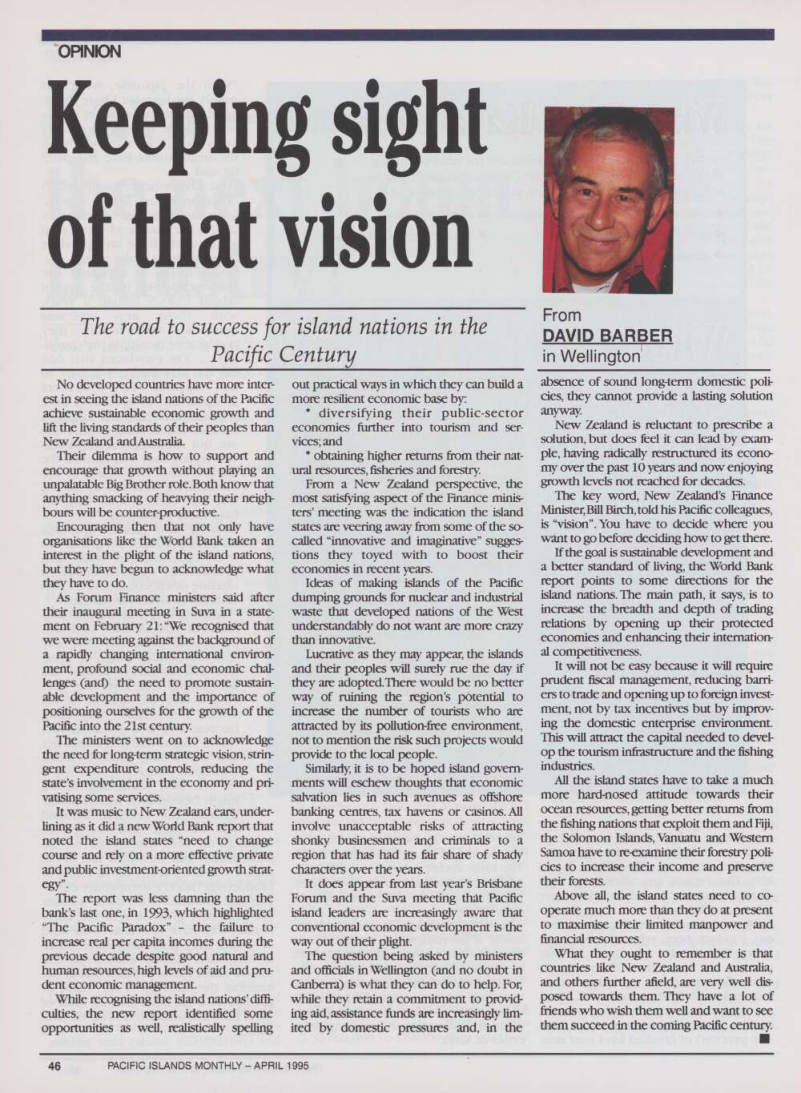
Opinion
of that vision
The road to success for island nations in the Pacific Century
No developed countries have more inter est in seeing the island nations of the Pacific achieve sustainable economic growth and lift the living standards of their peoples than New Zealand and Australia.
Their dilemma is how to support and encourage that growth without playing an unpalatable Big Brother role. Both know that anything smacking of heavying their neigh bours will be counter-productive.
Encouraging then that not only have organisations like the World Bank taken an interest in the plight of the island nations, but they have begun to acknowledge what they have to do.
As Forum Finance ministers said after their inaugural meeting in Suva in a state ment on February 21; “We recognised that we were meeting against the background of a rapidly changing international environ ment, profound social and economic chal lenges (and) the need to promote sustain able development and the importance of positioning ourselves for the growth of the Pacific into the 21st century.
The ministers went on to acknowledge the need for long-term strategic vision, strin gent expenditure controls, reducing the state’s involvement in the economy and pri vatising some services.
It was music to New Zealand ears, under lining as it did a new World Bank report that noted the island states “need to change course and rely on a more effective private and public investment-oriented growth strat egy”- The report was less damning than the bank’s last one, in 1993, which highlighted “The Pacific Paradox” - the failure to increase real per capita incomes during the previous decade despite good natural and human resources, high levels of aid and pru dent economic management.
While recognising the island nations’ diffi culties, the new report identified some opportunities as well, realistically spelling
out practical ways in which they can build a more resilient economic base by: * diversifying their public-sector economies further into tourism and ser vices; and * obtaining higher returns from their nat ural resources, fisheries and forestry.
From a New Zealand perspective, the most satisfying aspect of the Finance minis ters’ meeting was the indication the island states are veering away from some of the so called “innovative and imaginative” sugges tions they toyed with to boost their economies in recent years.
Ideas of making islands of the Pacific dumping grounds for nuclear and industrial waste that developed nations of the West understandably do not want are more crazy than innovative.
Lucrative as they may appear, the islands and their peoples will surely rue the day if they are adopted. There would be no better way of ruining the region’s potential to increase the number of tourists who are attracted by its pollution-free environment, not to mention die risk such projects would provide to the local people.
Similarly it is to be hoped island govern ments will eschew thoughts that economic salvation lies in such avenues as offshore banking centres, tax havens or casinos. All involve unacceptable risks of attracting shonky businessmen and criminals to a region that has had its fair share of shady characters over the years.
It does appear from last year’s Brisbane Forum and the Suva meeting that Pacific island leaders are increasingly aware that conventional economic development is the way out of their plight.
The question being asked by ministers and officials in Wellington (and no doubt in Canberra) is what they can do to help. For, while they retain a commitment to provid ing aid, assistance funds are increasingly lim ited by domestic pressures and, in the
absence of sound long-term domestic poli cies, they cannot provide a lasting solution anyway.
New Zealand is reluctant to prescribe a solution, but does feel it can lead by exam ple, having radically restructured its econo my over the past 10 years and now enjoying growth levels not reached for decades.
The key word, New Zealand’s Finance Minister, Bill Birch, told his Pacific colleagues, is ‘Vision”. You have to decide where you want to go before deciding how to get there.
If the goal is sustainable development and a better standard of living, the World Bank report points to some directions for the island nations. The main path, it says, is to increase the breadth and depth of trading relations by opening up their protected economies and enhancing their internation al competitiveness.
It will not be easy because it will require prudent fiscal management, reducing barri ers to trade and opening up to foreign invest ment, not by tax incentives but by improv ing the domestic enterprise environment.
This will attract the capital needed to devel op the tourism infrastructure and the fishing industries.
All the island states have to take a much more hard-nosed attitude towards their ocean resources, getting better returns from the fishing nations that exploit them and Fiji, the Solomon Islands, Vanuatu and Western Samoa have to re-examine their forestry poli cies to increase their income and preserve their forests.
Above all, the island states need to co operate much more than they do at present to maximise their limited manpower and financial resources.
What they ought to remember is that countries like New Zealand and Australia, and others further afield, are very well dis posed towards them. They have a lot of friends who wish them well and want to see them succeed in the coming Pacific century.
From
David Barber
in Wellington
from Samoa
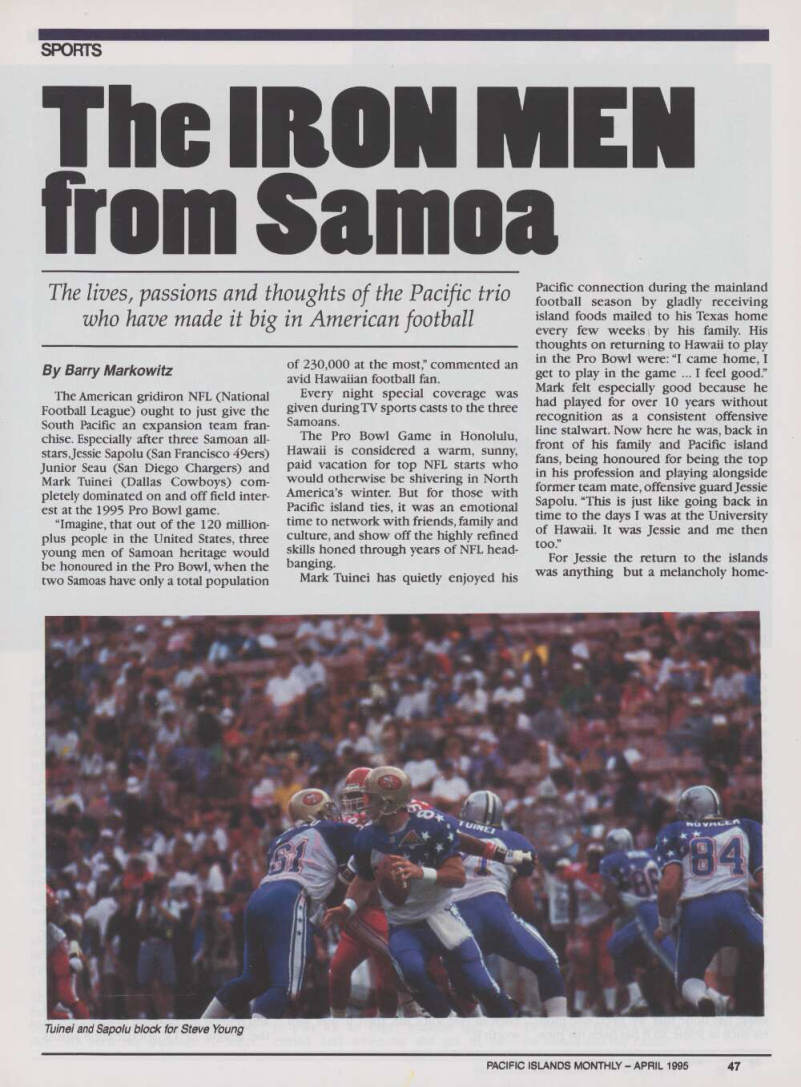
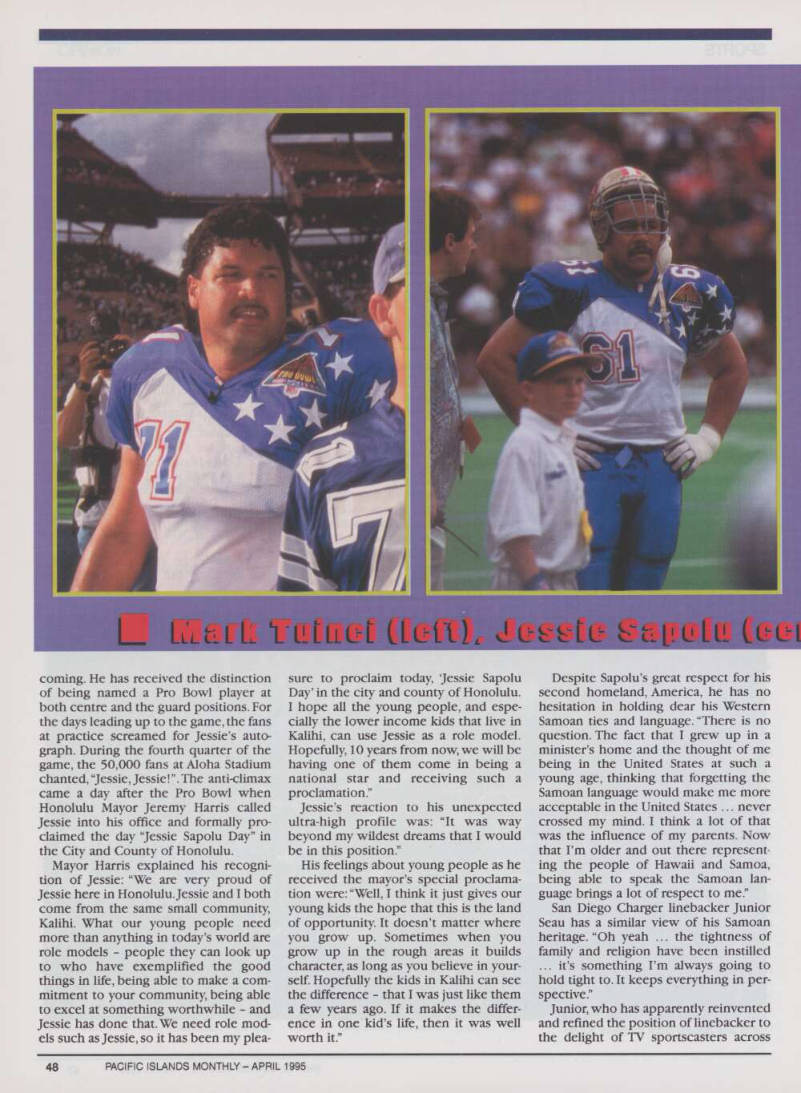
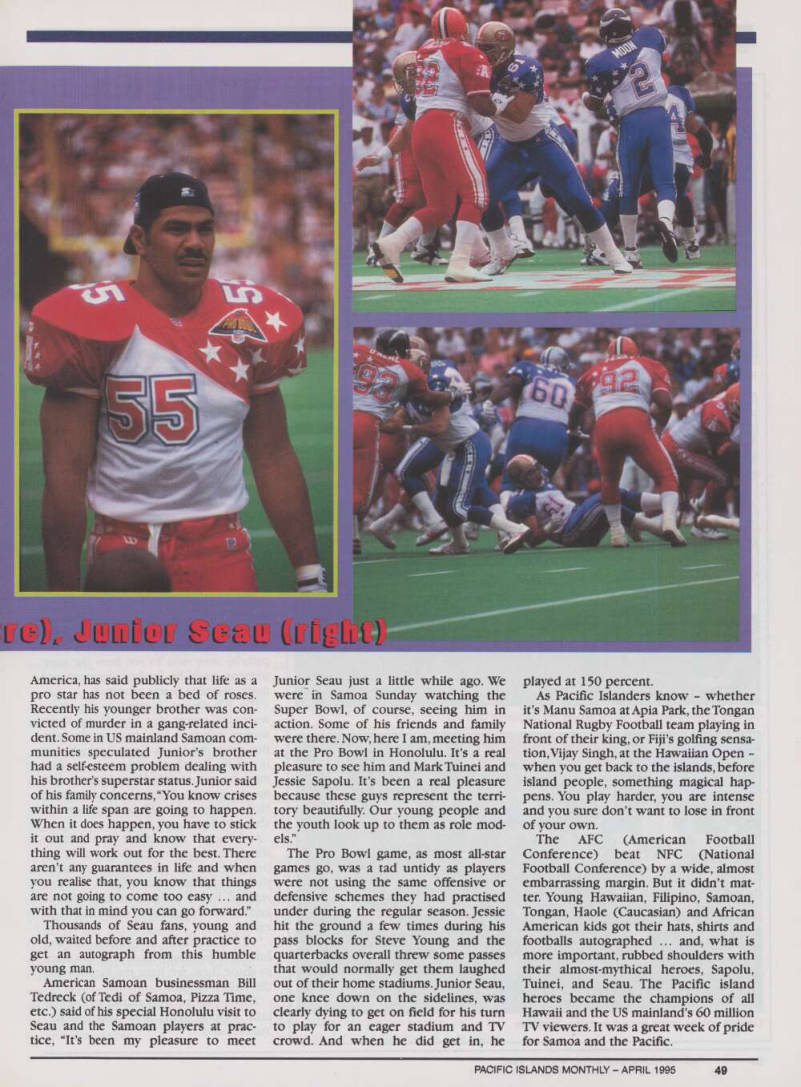
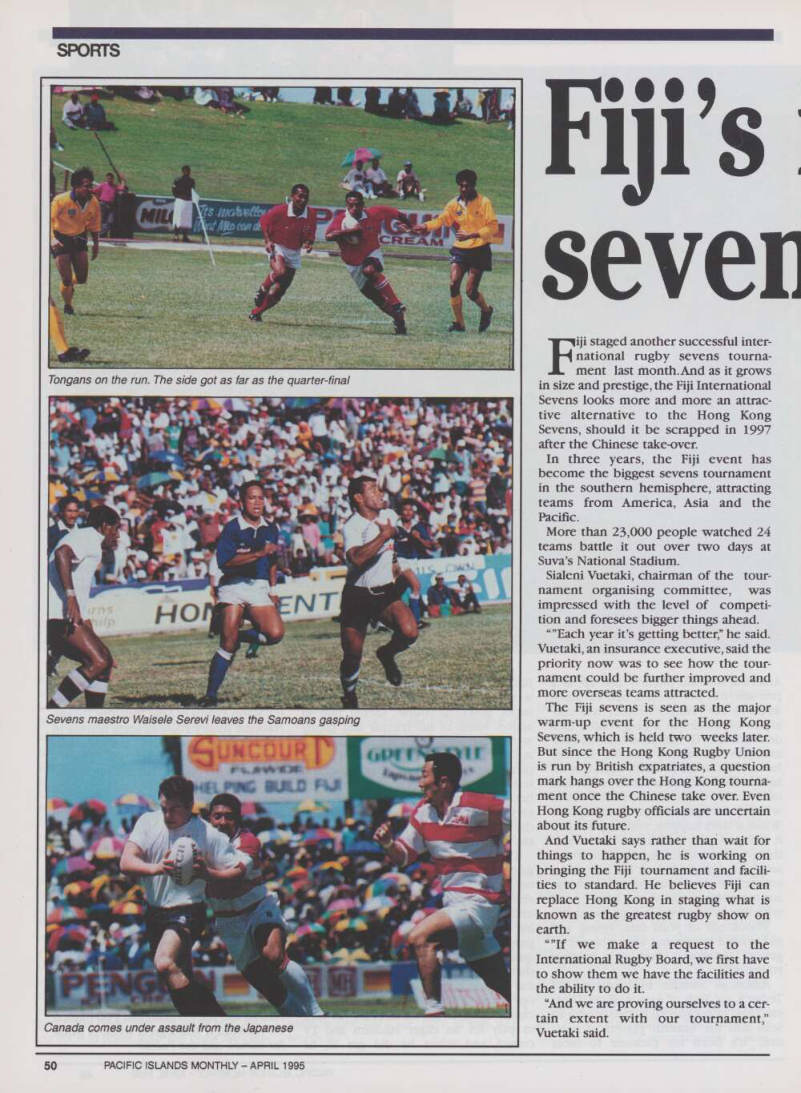
Sports
The Iron Men
The lives, passions and thoughts of the Pacific trio who have made it big in American football
By Barry Markowitz
The American gridiron NFL (National Football League) ought to just give the South Pacific an expansion team fran chise. Especially after three Samoan all stars, Jessie Sapolu (San Francisco 49ers) Junior Seau (San Diego Chargers) and Mark Tuinei (Dallas Cowboys) com pletely dominated on and off field inter est at the 1995 Pro Bowl game.
“Imagine, that out of the 120 million plus people in the United States, three young men of Samoan heritage would be honoured in the Pro Bowl, when the two Samoas have only a total population
of 230,000 at the most,” commented an avid Hawaiian football fan.
Every night special coverage was given during TV sports casts to the three Samoans.
The Pro Bowl Game in Honolulu, Hawaii is considered a warm, sunny, paid vacation for top NFL starts who would otherwise be shivering in North America’s winter. But for those with Pacific island ties, it was an emotional time to network with friends, family and culture, and show off the highly refined skills honed through years of NFL head banging.
Mark Tuinei has quietly enjoyed his
Pacific connection during the mainland football season by gladly receiving island foods mailed to his Texas home every few weeks i by his family. His thoughts on returning to Hawaii to play in the Pro Bowl were: “I came home, I get to play in the game ... I feel good.”
Mark felt especially good because he had played for over 10 years without recognition as a consistent offensive line stalwart. Now here he was, back in front of his family and Pacific island fans, being honoured for being the top in his profession and playing alongside former team mate, offensive guard Jessie Sapolu. “This is just like going back in time to the days I was at the University of Hawaii. It was Jessie and me then too.”
For Jessie the return to the islands was anything but a melancholy home-
Tuinei and Sapolu block for Steve Young
coming. He has received the distinction of being named a Pro Bowl player at both centre and the guard positions. For the days leading up to the game, the fans at practice screamed for Jessie’s auto graph. During the fourth quarter of the game, the 50,000 fans at Aloha Stadium chanted, “Jessie, Jessie!”.The anti-climax came a day after the Pro Bowl when Honolulu Mayor Jeremy Harris called Jessie into his office and formally pro claimed the day “Jessie Sapolu Day” in the City and County of Honolulu.
Mayor Harris explained his recogni tion of Jessie; “We are very proud of Jessie here in Honolulu. Jessie and I both come from the same small community, Kalihi. What our young people need more than anything in today’s world are role models - people they can look up to who have exemplified the good things in life, being able to make a com mitment to your community, being able to excel at something worthwhile - and Jessie has done that. We need role mod els such as Jessie, so it has been my plea
sure to proclaim today, Jessie Sapolu Day’ in the city and county of Honolulu.
I hope all the young people, and espe cially the lower income kids that live in Kalihi, can use Jessie as a role model.
Hopefully, 10 years from now, we will be having one of them come in being a national star and receiving such a
proclamation.”
Jessie’s reaction to his unexpected ultra-high profile was: “It was way beyond my wildest dreams that I would be in this position.”
His feelings about young people as he received the mayor’s special proclama tion were: “Well, I think it just gives our young kids the hope that this is the land of opportunity. It doesn’t matter where you grow up. Sometimes when you grow up in the rough areas it builds character, as long as you believe in your self. Hopefully the kids in Kalihi can see the difference - that I was just like them a few years ago. If it makes the differ ence in one kid’s life, then it was well worth it.”
Despite Sapolu’s great respect for his second homeland, America, he has no hesitation in holding dear his Western Samoan ties and language. “There is no question. The fact that I grew up in a minister’s home and the thought of me being in the United States at such a young age, thinking that forgetting the Samoan language would make me more acceptable in the United States ... never crossed my mind. I think a lot of that was the influence of my parents. Now that I’m older and out there represent ing the people of Hawaii and Samoa, being able to speak the Samoan lan guage brings a lot of respect to me.”
San Diego Charger linebacker Junior Seau has a similar view of his Samoan heritage. “Oh yeah ... the tightness of family and religion have been instilled ... it’s something I’m always going to hold tight to. It keeps everything in per
spective.”
Junior, who has apparently reinvented and refined the position of linebacker to the delight of TV sportscasters across
Mark Tuinel ( Left) jessic Sapolu (ce[?]ght)
America, has said publicly that life as a pro star has not been a bed of roses.
Recently his younger brother was con victed of murder in a gang-related inci dent. Some in US mainland Samoan com munities speculated Junior’s brother had a self-esteem problem dealing with his brother’s superstar status. Junior said of his family concerns, “You know crises within a life span are going to happen.
When it does happen, you have to stick it out and pray and know that every thing will work out for the best. There aren’t any guarantees in life and when you realise that, you know that things are not going to come too easy ... and with that in mind you can go forward.”
Thousands of Seau fans, young and old, waited before and after practice to get an autograph from this humble young man.
American Samoan businessman Bill Tedreck (of Tedi of Samoa, Pizza Time, etc.) said of his special Honolulu visit to Seau and the Samoan players at prac tice, “It’s been my pleasure to meet
Junior Seau just a little while ago. We were in Samoa Sunday watching the Super Bowl, of course, seeing him in action. Some of his friends and family were there. Now, here I am, meeting him at the Pro Bowl in Honolulu. It’s a real pleasure to see him and Mark Tuinei and Jessie Sapolu. It’s been a real pleasure because these guys represent the terri tory beautifully. Our young people and the youth look up to them as role mod els.”
The Pro Bowl game, as most all-star games go, was a tad untidy as players were not using the same offensive or defensive schemes they had practised under during the regular season. Jessie hit the ground a few times during his pass blocks for Steve Young and the quarterbacks overall threw some passes that would normally get them laughed out of their home stadiums. Junior Seau, one knee down on the sidelines, was clearly dying to get on field for his turn to play for an eager stadium and TV crowd. And when he did get in, he
played at 150 percent.
As Pacific Islanders know - whether it’s Manu Samoa at Apia Park, the Tongan National Rugby Football team playing in front of their king, or Fiji’s golfing sensa tion, Vijay Singh, at the Hawaiian Open when you get back to the islands, before island people, something magical hap pens. You play harder, you are intense and you sure don’t want to lose in front of your own.
The AFC (American Football Conference) beat NFC (National Football Conference) by a wide, almost embarrassing margin. But it didn’t mat ter. Young Hawaiian, Filipino, Samoan, Tongan, Haole (Caucasian) and African American kids got their hats, shirts and footballs autographed ... and, what is more important, rubbed shoulders with their almost-mythical heroes, Sapolu, Tuinei, and Seau. The Pacific island heroes became the champions of all Hawaii and the US mainland’s 60 million TV viewers. It was a great week of pride for Samoa and the Pacific.
[?]re).Junior Seau (right)
Tongans on the run. The side got as far as the quarter-final
Sevens maestro Waisele Serevi leaves the Samoans gasping
Canada comes under assault from the Japanese
Fiji’s [?]n top
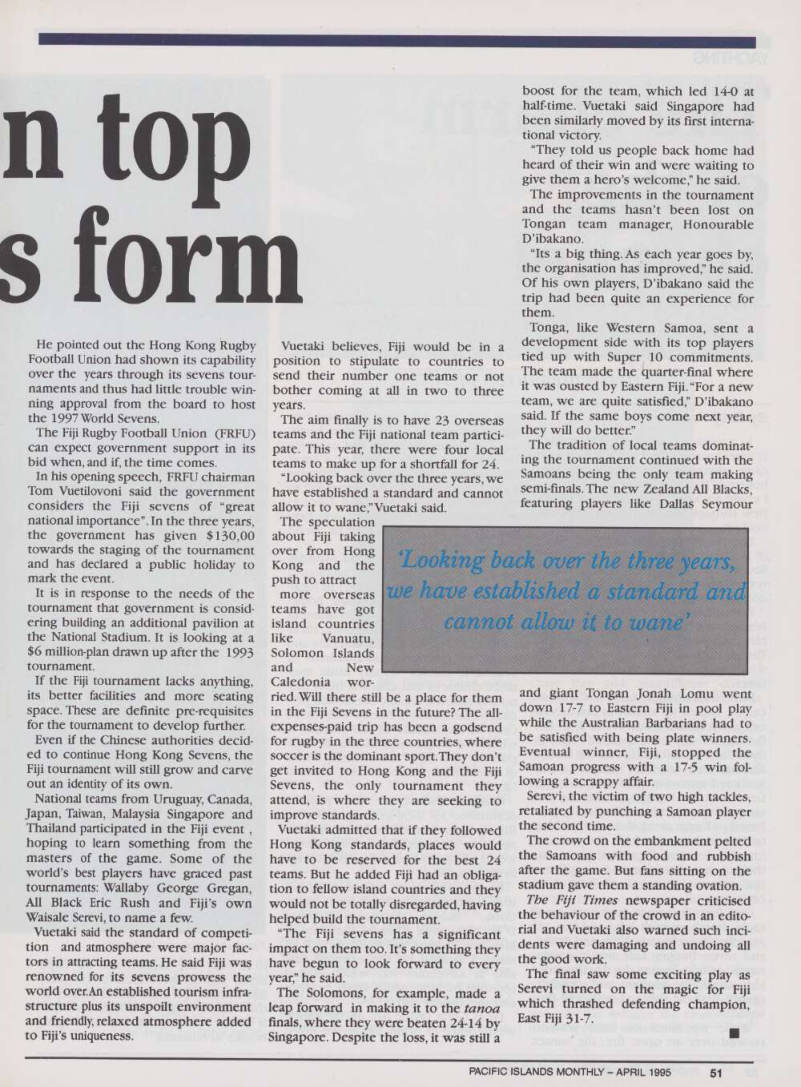
sevens form
Fiji staged another successful inter national rugby sevens tourna ment last month. And as it grows in size and prestige, the Fiji International Sevens looks more and more an attrac tive alternative to the Hong Kong Sevens, should it be scrapped in 1997 after the Chinese take-over.
In three years, the Fiji event has become the biggest sevens tournament in the southern hemisphere, attracting teams from America, Asia and the Pacific.
More than 23,000 people watched 24 teams battle it out over two days at Suva’s National Stadium.
Sialeni Vuetaki, chairman of the tour nament organising committee, was impressed with the level of competi tion and foresees bigger things ahead.
“’’Each year it’s getting better,” he said.
Vuetaki, an insurance executive, said the priority now was to see how the tour nament could be further improved and more overseas teams attracted.
The Fiji sevens is seen as the major warm-up event for the Hong Kong Sevens, which is held two weeks later.
But since the Hong Kong Rugby Union is run by British expatriates, a question mark hangs over the Hong Kong tourna ment once the Chinese take over. Even Hong Kong rugby officials are uncertain about its future.
And Vuetaki says rather than wait for things to happen, he is working on bringing the Fiji tournament and facili ties to standard. He believes Fiji can replace Hong Kong in staging what is known as the greatest rugby show on earth.
“”If we make a request to the International Rugby Board, we first have to show them we have the facilities and the ability to do it.
“And we are proving ourselves to a cer tain extent with our tournament,”
Vuetaki said.
He pointed out the Hong Kong Rugby Football Union had shown its capability over the years through its sevens tour naments and thus had little trouble win ning approval from the board to host the 1997 World Sevens.
The Fiji Rugby Football Union (FRFU) can expect government support in its bid when, and if, the time comes.
In his opening speech, FRFU chairman Tom Vuetilovoni said the government considers the Fiji sevens of “great national importance”. In the three years, the government has given $130,00 towards the staging of the tournament and has declared a public holiday to mark the event.
It is in response to the needs of the tournament that government is consid ering building an additional pavilion at the National Stadium. It is looking at a $6 million-plan drawn up after the 1993 tournament.
If the Fiji tournament lacks anything, its better facilities and more seating space. These are definite pre-requisites for the tournament to develop further.
Even if the Chinese authorities decid ed to continue Hong Kong Sevens, the Fiji tournament will still grow and carve out an identity of its own.
National teams from Uruguay, Canada, Japan, Taiwan, Malaysia Singapore and Thailand participated in the Fiji event , hoping to learn something from the masters of the game. Some of the world’s best players have graced past
tournaments: Wallaby George Gregan,
All Black Eric Rush and Fiji’s own Waisale Serevi, to name a few.
Vuetaki said the standard of competi tion and atmosphere were major fac tors in attracting teams. He said Fiji was renowned for its sevens prowess the world over.An established tourism infra structure plus its unspoilt environment and friendly, relaxed atmosphere added to Fiji’s uniqueness.
Vuetaki believes, Fiji would be in a position to stipulate to countries to send their number one teams or not bother coming at all in two to three years.
The aim finally is to have 23 overseas teams and the Fiji national team partici pate. This year, there were four local teams to make up for a shortfall for 24.
“Looking back over the three years, we have established a standard and cannot allow it to wane "Vuetaki said.
The speculation
about Fiji taking over from Hong Kong and the push to attract more overseas teams have got island countries like Vanuatu, Solomon Islands and New
Caledonia wor ried. Will there still be a place for them in the Fiji Sevens in the future? The all expenses-paid trip has been a godsend for rugby in the three countries, where soccer is the dominant sport. They don’t get invited to Hong Kong and the Fiji Sevens, the only tournament they attend, is where they are seeking to improve standards.
Vuetaki admitted that if they followed Hong Kong standards, places would have to be reserved for the best 24 teams. But he added Fiji had an obliga tion to fellow island countries and they would not be totally disregarded, having helped build the tournament.
“The Fiji sevens has a significant impact on them too. It’s something they have begun to look forward to every year,” he said.
The Solomons, for example, made a leap forward in making it to the tanoa finals, where they were beaten 24-14 by Singapore. Despite the loss, it was still a
boost for the team, which led 14-0 at half-time. Vuetaki said Singapore had been similarly moved by its first interna tional victory.
“They told us people back home had heard of their win and were waiting to give them a hero’s welcome,” he said.
The improvements in the tournament and the teams hasn’t been lost on Tongan team manager, Honourable D’ibakano.
“Its a big thing. As each year goes by, the organisation has improved,” he said.
Of his own players, D’ibakano said the trip had been quite an experience for them.
Tonga, like Western Samoa, sent a development side with its top players tied up with Super 10 commitments.
The team made the Quarter-final where it was ousted by Eastern Fiji. “For a new team, we are quite satisfied,” D’ibakano said. If the same boys come next year, they will do better.”
The tradition of local teams dominat ing the tournament continued with the Samoans being the only team making semi-finals. The new Zealand All Blacks, featuring players like Dallas Seymour
‘Looking back over the three years, we have established a standard and cannot allow it to wane’ ’
and giant Tongan Jonah Lomu went down 17-7 to Eastern Fiji in pool play while the Australian Barbarians had to be satisfied with being plate winners.
Eventual winner, Fiji, stopped the Samoan progress with a 17-5 win fol lowing a scrappy affair.
Serevi, the victim of two high tackles, retaliated by punching a Samoan player the second time.
The crowd on the embankment pelted the Samoans with food and rubbish after the game. But fans sitting on the stadium gave them a standing ovation.
The Fiji Times newspaper criticised the behaviour of the crowd in an edito rial and Vuetaki also warned such inci dents were damaging and undoing all the good work.
The final saw some exciting play as Serevi turned on the magic for Fiji which thrashed defending champion, East Fiji 31-7. ■
The charm
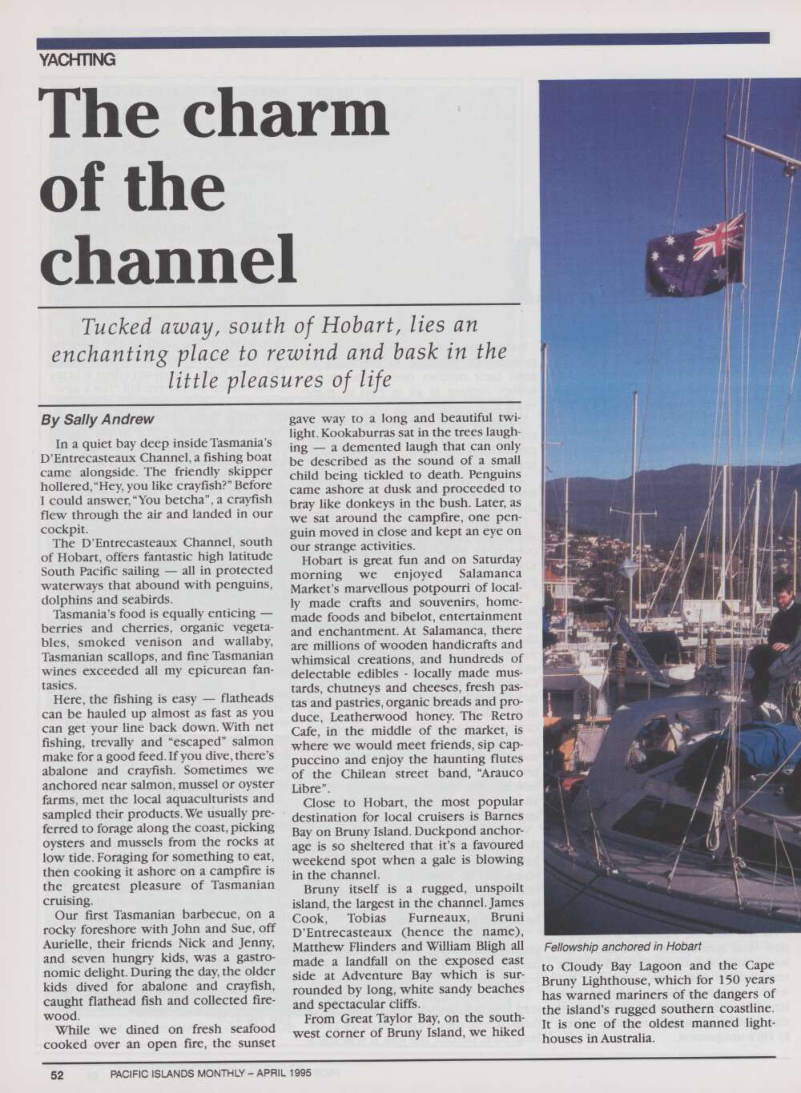
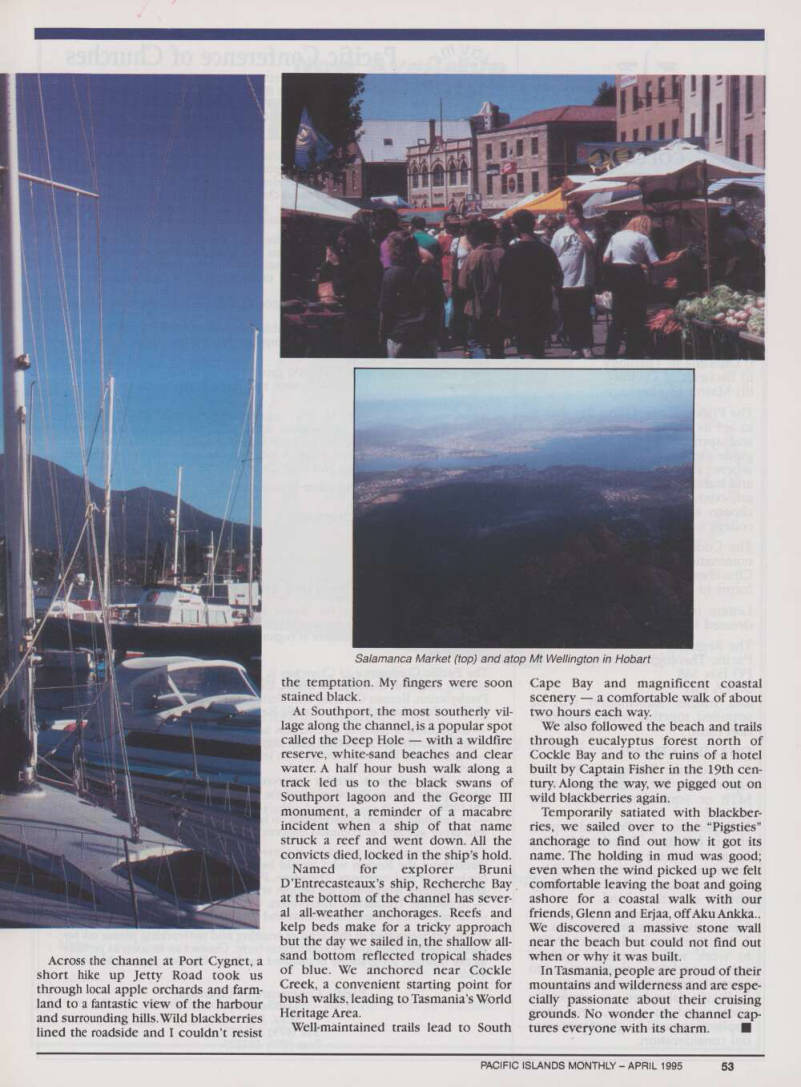
Yachting
The charm of the channel
Tucked away, south of Hobart, lies an enchanting place to rewind and bask in the
little pleasures of life
By Sally Andrew
In a quiet bay deep inside Tasmania s D’Entrecasteaux Channel, a fishing boat came alongside. The friendly skipper hollered,“Hey, you like crayfish? Before I could answer, “You betcha , a crayfish flew through the air and landed in our cockpit.
The D Entrecasteaux Channel, south of Hobart, offers fantastic high latitude South Pacific sailing all in protected waterways that abound with penguins, dolphins and seabirds.
Tasmania’s food is equally enticing berries and cherries, organic vegeta bles, smoked venison and wallaby, Tasmanian scallops, and fine Tasmanian wines exceeded all my epicurean fan tasies.
Here, the fishing is easy flatheads can be hauled up almost as fast as you can get your line back down. With net fishing, trevally and “escaped” salmon make for a good feed. If you dive, there’s abalone and crayfish. Sometimes we anchored near salmon, mussel or oyster farms, met the local aquaculturists and sampled their products. We usually pre ferred to forage along the coast, picking oysters and mussels from the rocks at low tide. Foraging for something to eat, then cooking it ashore on a campfire is the greatest pleasure of Tasmanian cruising.
Our first Tasmanian barbecue, on a rocky foreshore with John and Sue, off Aurielle, their friends Nick and Jenny, and seven hungry kids, was a gastro nomic delight. During the day, the older kids dived for abalone and crayfish, caught flathead fish and collected fire wood.
While we dined on fresh seafood cooked over an open fire, the sunset
gave way to a long and beautiful twi light. Kookaburras sat in the trees laugh jng a deme nted laugh that can only be deS cribed as the sound of a small child being tick i e d to dea th. Penguins came ashore at dusk and proceeded to bray like donkeys in the bush. Later, as we sat around the campfire, one pen guin moved in close and kept an eye on our strange activities, Hobart is great fun and on Saturday morning we enjoyed Salamanca Market’s marvellous potpourri of local ly made crafts and souvenirs, home made foods and bibelot, entertainment and enchantment. At Salamanca, there are millions G f woo den handicrafts and whimsical creations, and hundreds of de i ec table edibles - locally made mus tards, chutneys and cheeses, fresh pas tas and p a stries, organic breads and pro duce Leatherwood honey. The Retro Cafe ’ in the m i dd i e of the market, is where we wou ld meet friends, sip cap pUccino and enjoy the haunting flutes of the Chilean street band, “Arauco Libre”.
Close to Hobart, the most popular des tination for local cruisers is Barnes gay on Bruny island. Duckpond anchor age is so sheltered that it’s a favoured weekend spot when a gale is blowing in t h e channel.
Bruny itself is a rugged, unspoilt island, the largest in the channel. James cook, Tobias Furneaux, Bruni D’Entrecasteaux (hence the name), Matt h ew Flinders and William Bligh all made a land f a n G n the exposed east side at Adventure Bay which is sur rounded by long, white sandy beaches and spectacular cliffs, From Great Taylor Bay, on the south west corner of Bruny Island, we hiked
to Cloudy Bay Lagoon and the Cape Bruny Lighthouse, which for 150 years has warned mariners of the dangers of the island’s rugged southern coastline.
It is one of the oldest manned light houses in Australia.
Fellowship anchored in Hobart
Across the channel at Port Cygnet, a short hike up Jetty Road took us through local apple orchards and farm land to a fantastic view of the harbour and surrounding hills. Wild blackberries lined the roadside and I couldn’t resist
the temptation. My fingers were soon stained black.
At Southport, the most southerly vil lage along the channel, is a popular spot called the Deep Hole with a wildfire reserve, white-sand beaches and clear water. A half hour bush walk along a track led us to the black swans of Southport lagoon and the George 111 monument, a reminder of a macabre incident when a ship of that name struck a reef and went down. All the convicts died, locked in the ship’s hold.
Named for explorer Bruni D’Entrecasteaux’s ship, Recherche Bay at the bottom of the channel has sever al all-weather anchorages. Reefs and kelp beds make for a tricky approach but the day we sailed in, the shallow all sand bottom reflected tropical shades of blue. We anchored near Cockle Creek, a convenient starting point for bush walks, leading to Tasmania’s World Heritage Area.
Well-maintained trails lead to South
Cape Bay and magnificent coastal scenery a comfortable walk of about two hours each way.
We also followed the beach and trails through eucalyptus forest north of Cockle Bay and to the ruins of a hotel built by Captain Fisher in the 19th cen tury. Along the way, we pigged out on wild blackberries again.
Temporarily satiated with blackber ries, we sailed over to the “Pigsties” anchorage to find out how it got its name. The holding in mud was good; even when the wind picked up we felt comfortable leaving the boat and going ashore for a coastal walk with our friends, Glenn and Erjaa, off Aku Ankka..
We discovered a massive stone wall near the beach but could not find out when or why it was built.
In Tasmania, people are proud of their mountains and wilderness and are espe cially passionate about their cruising grounds. No wonder the channel cap tures everyone with its charm. ■
Salamanca Market (top) and atop Mt Wellington in Hobart
Advertisements & other items, pp. 54-55 (1 item)
Pacific Conference of Churches
*• o u o
PACIFIC
invites applications from interested persons for the position of the
SECRETARY FOR HUMAN
RESOURCES DEVELOPMENT
to be based at its Secretariat in Suva, Fiji This position involves collating information on various training and leadership building resources and opportunities available in the region both church and secular. It will develop a suitable database on these opportunities and resources to assist churches and ecumenical bodies build up their personnel and leadership potential to serve the needs and challenges of the Christian communities in the region today.
Persons with the following qualifications and experience would be eligible: a) Relevant tertiary level qualifications and sound employment experience in personnel training, manpower planning and management and education; bl A good knowledge of PCC and other ecumenical organisations and cnurches in the Pacific; c) A fair knowledge of the Pacific region and its various countries, peoples and cultures. d) Mature Christian background, stable and honest personality; e) Experienced and capable with computer data processing and analysis.
Employment Condition: Two year contract with FJ$l2,OOO gross salary plus $7,200 p.a. housing allowance, medical/health allowance and leave entitlements.
Application:
Apply in writing with a C.V. stating information about personal background (full name, age, marital status and children, etc), educational qualifications (with copies of certificates) employment history (with references from past employers). A letter of recommendation or support from the local and/or the National Church leader would be necessary Address Application and other information to:- The General Secretary, Pacific Conference of Churches, PO Box 208, Suva, Fiji.
The Pacific Conference of Churches
is looking for fluent bilingual (English/French) Pacific Islanders who would like to serve occasionally as Translators and Interpreters at regional PCC conference workshops and meetings.
The Pacific Conference of Churches is a regional ecumenical organisation serving Anglican Churches of Christ, Congregational, Lutheran, Methodist, Presbyterian, Roman Catholic, and United Churches and National Councils of Churches, throughout the Pacific Region. It aims to promote a spirit of ecumenism among the Churches - to nelp member Churches plan together in order to use their human and financial resources in joint action for Christian witness and service to help create a greater awareness of justice, peace and human development issues the people and the nations of the region and the world are facing to facilitate mutual consultation on issues affecting Church relationships and other subjects of common concern among the Churches etc.
The PCC would like to set up a network of Translators and Interpreters throughout the Region who would be called upon to serve during PCC conferences and meetings. Therefore, PCC offers translation and interpretation training workshops for people who would like ■— to become Translators Interpreters, or to improve on their translation and interpretation skills.
If you are interested in this kind of training and networking please ask for further information and an application form. Contact us as soon as possible as the training programme is planned for June. Contact person: Ms Maria Wolf Pacific Conference of Churches PO Box 208
Suva, Fiji.
Ph: (679) 311277 Fax: (679) 303205 O.
jsg:
PACIFIC
c f 4
PACIFIC THEOLOGICAL
COLLEGE
PRINCIPAL
The Council of the College is seeking a Principal to take office in January, 1997 and invites applications tom suitably qualified persons by July 15, 1995.
The Pacific Theological College is an ecumenical institution established in Fiji to serve the needs of the Churches of the Pacific by preparing students for its diploma and degrees:
i) Diploma of Theology
ii) Bachelor of Divinity iii) Master of Theology The Principal must have the ability to act as academic, administrative and spiritual leader and pastoral guide to a varied community,
where study, research, worship
and training are united in the life of an extended family. The person chosen will be committed to the college's ecumenical orientation.
The Council would also welcome nominations from member Churches and will send application forms to persons so named.
Letters of inquiry should be addressed to:
The Registrar
Pacific Theological College
PO Box 388
SUVA FIJI
and further information will be
supplied, together with an applica-
tion form.
QUALIFICATIONS:
1. Academic: Preferably PhD or equivalent, but candidates with MTh or equivalent will be considered. 2. Experience: (a) Practical experience in full-time Christian Ministry for at least three years. (b) Previous experience of teaching in a recognised field of Theology and/or at tertiary level. (c) Evidence of competence in, and familiarity with administration.
3. Inter-personal relations: Ability
to work with people of various cultures and denominations, and to
promote fellowship and unity.
4. Pacific Islanders are especially encouraged to apply, and their applications will be given preferential consideration.
Now Available
Pacific Islands Yearßook
17th Edition
Price
AUD
oo S
PLUS
POSTAGE
r Leam more about the Pacific
culture/custom tradition!people
population, tourism, trade, airlines, tax system etc. -X Yes, send me the latest copy of the Pacific Islands Year Book, □ Here is a cheque/money order □ Visa □ Master Card Card Number Name Signature Address Expiry Date Post to: Pacific Islands Monthly, PO Box 1167 Suva, Fiji or Fax (679) 303809,
Hell
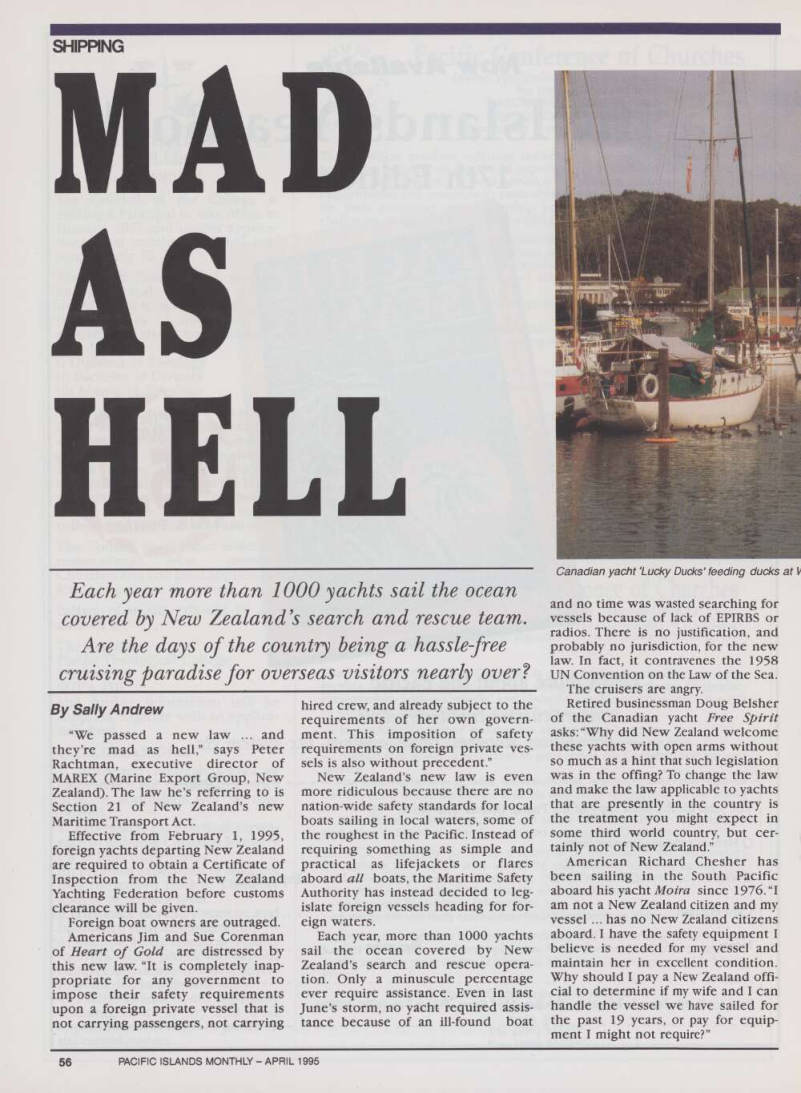
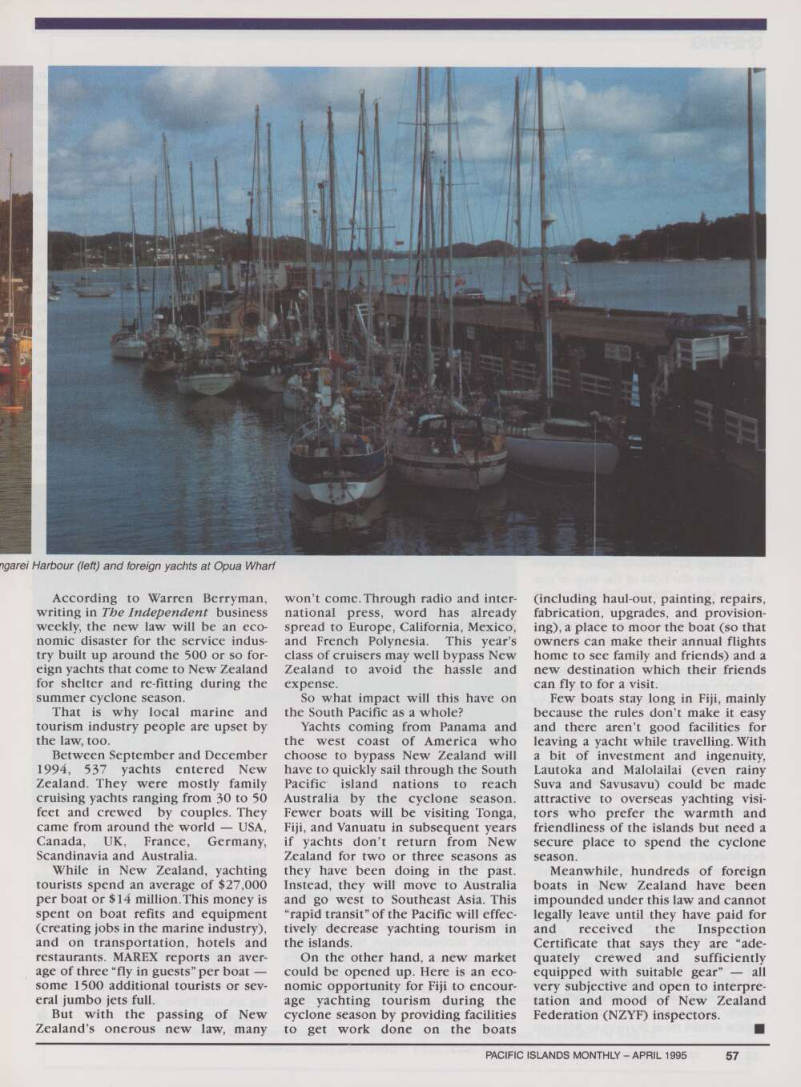
Shipping
Mad
AS
Hell
Each year more than 1000 yachts sail the ocean covered by New Zealand's search and rescue team.
Are the days of the country being a hassle-free cruising paradise for overseas visitors nearly overl
By Sally Andrew
“We passed a new law ... and they’re mad as hell,” says Peter Rachtman, executive director of MAREX (Marine Export Group, New Zealand). The law he’s referring to is Section 21 of New Zealand’s new Maritime Transport Act.
Effective from February 1, 1995, foreign yachts departing New Zealand are required to obtain a Certificate of Inspection from the New Zealand Yachting Federation before customs clearance will be given.
Foreign boat owners are outraged.
Americans Jim and Sue Corenman of Heart of Gold are distressed by this new law. “It is completely inap propriate for any government to impose their safety requirements upon a foreign private vessel that is not carrying passengers, not carrying
hired crew, and already subject to the requirements of her own govern ment. This imposition of safety requirements on foreign private ves sels is also without precedent.”
New Zealand’s new law is even more ridiculous because there are no nation-wide safety standards for local boats sailing in local waters, some of the roughest in the Pacific. Instead of requiring something as simple and practical as lifejackets or flares aboard all boats, the Maritime Safety Authority has instead decided to leg islate foreign vessels heading for for eign waters.
Each year, more than 1000 yachts sail the ocean covered by New Zealand’s search and rescue opera tion. Only a minuscule percentage ever require assistance. Even in last June’s storm, no yacht required assis tance because of an ill-found boat
and no time was wasted searching for vessels because of lack of EPIRBS or radios. There is no justification, and probably no jurisdiction, for the new law. In fact, it contravenes the 1958 UN Convention on the Law of the Sea.
The cruisers are angry.
Retired businessman Doug Belsher of the Canadian yacht Free Spirit asks: “Why did New Zealand welcome these yachts with open arms without so much as a hint that such legislation was in the offing? To change the law and make the law applicable to yachts that are presently in the country is the treatment you might expect in some third world country, but cer tainly not of New Zealand.”
American Richard Chesher has been sailing in the South Pacific aboard his yacht Moira since 1976.“! am not a New Zealand citizen and my vessel ... has no New Zealand citizens aboard. I have the safety equipment I believe is needed for my vessel and maintain her in excellent condition.
Why should I pay a New Zealand offi cial to determine if my wife and I can handle the vessel we have sailed for the past 19 years, or pay for equip ment I might not require?”
Canadian yacht ‘Lucky Ducks’ feeding ducks at
According to Warren Berryman, writing in The Independent business weekly, the new law will be an eco nomic disaster for the service indus try built up around the 500 or so for eign yachts that come to New Zealand for shelter and re-fitting during the summer cyclone season.
That is why local marine and tourism industry people are upset by the law, too.
Between September and December 1994, 537 yachts entered New Zealand. They were mostly family cruising yachts ranging from 30 to 50 feet and crewed by couples. They came from around the world USA, Canada, UK, France, Germany, Scandinavia and Australia.
While in New Zealand, yachting tourists spend an average of $27,000 per boat or $l4 million. This money is spent on boat refits and equipment (creating jobs in the marine industry), and on transportation, hotels and restaurants. MAREX reports an aver age of three “fly in guests” per boat some 1500 additional tourists or sev
eral jumbo jets full.
But with the passing of New Zealand’s onerous new law, many
won’t come. Through radio and inter national press, word has already spread to Europe, California, Mexico, and French Polynesia. This year’s class of cruisers may well bypass New Zealand to avoid the hassle and expense.
So what impact will this have on the South Pacific as a whole?
Yachts coming from Panama and the west coast of America who choose to bypass New Zealand will have to quickly sail through the South Pacific island nations to reach Australia by the cyclone season.
Fewer boats will be visiting Tonga, Fiji, and Vanuatu in subsequent years if yachts don’t return from New Zealand for two or three seasons as they have been doing in the past.
Instead, they will move to Australia and go west to Southeast Asia. This “rapid transit” of the Pacific will effec tively decrease yachting tourism in the islands.
On the other hand, a new market could be opened up. Here is an eco nomic opportunity for Fiji to encour age yachting tourism during the cyclone season by providing facilities to get work done on the boats
(including haul-out, painting, repairs, fabrication, upgrades, and provision ing), a place to moor the boat (so that owners can make their annual flights home to see family and friends) and a new destination which their friends can fly to for a visit.
Few boats stay long in Fiji, mainly because the rules don’t make it easy and there aren’t good facilities for leaving a yacht while travelling. With a bit of investment and ingenuity, Lautoka and Malolailai (even rainy Suva and Savusavu) could be made attractive to overseas yachting visi tors who prefer the warmth and friendliness of the islands but need a secure place to spend the cyclone season.
Meanwhile, hundreds of foreign boats in New Zealand have been impounded under this law and cannot legally leave until they have paid for and received the Inspection Certificate that says they are “ade quately crewed and sufficiently equipped with suitable gear” all very subjective and open to interpre tation and mood of New Zealand Federation (NZYF) inspectors. ■
[?]garei Harbour (left) and foreign yachts at Opua Wharf
Adventure
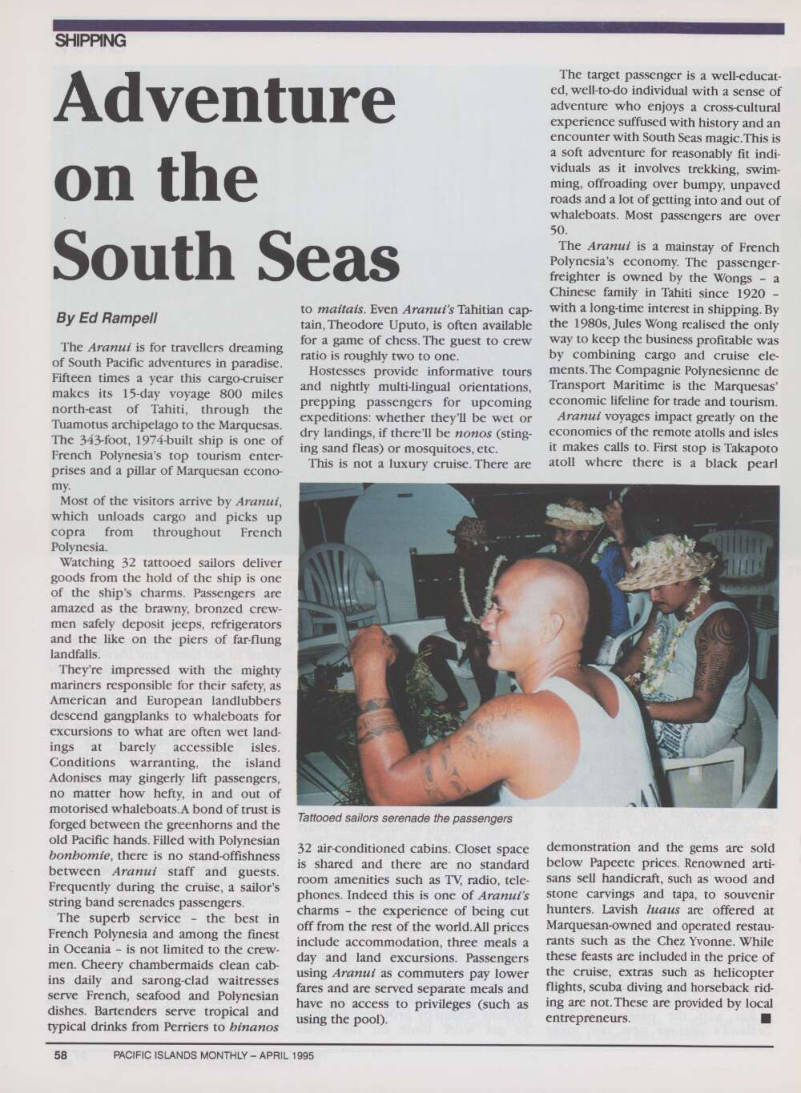
Shipping
Adventure on the South Seas
By Ed Rampell
The Aranui is for travellers dreaming of South Pacific adventures in paradise.
Fifteen times a year this cargo-cruiser makes its 15-day voyage 800 miles north-east of Tahiti, through the Tuamotus archipelago to the Marquesas.
The 343-foot, 1974-built ship is one of French Polynesia’s top tourism enter prises and a pillar of Marquesan econo my.
Most of the visitors arrive by Aranui, which unloads cargo and picks up copra from throughout French Polynesia.
Watching 32 tattooed sailors deliver goods from the hold of the ship is one of the ship’s charms. Passengers are amazed as the brawny, bronzed crew men safely deposit jeeps, refrigerators and the like on the piers of far-flung landfalls.
They’re impressed with the mighty mariners responsible for their safety, as American and European landlubbers descend gangplanks to whaleboats for excursions to what are often wet land ings at barely accessible isles.
Conditions warranting, the island Adonises may gingerly lift passengers, no matter how hefty, in and out of motorised whaleboats.A bond of trust is forged between the greenhorns and the old Pacific hands. Filled with Polynesian bonhomie, there is no stand-offishness between Aranui staff and guests.
Frequently during the cruise, a sailor’s string band serenades passengers.
The superb service - the best in French Polynesia and among the finest in Oceania - is not limited to the crew men. Cheery chambermaids clean cab ins daily and sarong-clad waitresses serve French, seafood and Polynesian dishes. Bartenders serve tropical and typical drinks from Perriers to hinanos
to maitais. Even Aranui’s Tahitian cap tain, Theodore Uputo, is often available for a game of chess. The guest to crew ratio is roughly two to one.
Hostesses provide informative tours and nightly multi-lingual orientations, prepping passengers for upcoming expeditions: whether they’ll be wet or dry landings, if there’ll be nonos (sting ing sand fleas) or mosquitoes, etc.
This is not a luxury cruise. There are
32 air-conditioned cabins. Closet space is shared and there are no standard room amenities such as Ty radio, tele phones. Indeed this is one of Aranui’s charms - the experience of being cut off from the rest of the world. All prices include accommodation, three meals a day and land excursions. Passengers using Aranui as commuters pay lower fares and are served separate meals and have no access to privileges (such as using the pool).
The target passenger is a well-educat ed, well-to-do individual with a sense of adventure who enjoys a cross-cultural experience suffused with history and an encounter with South Seas magic. This is a soft adventure for reasonably fit indi viduals as it involves trekking, swim ming, offroading over bumpy, unpaved roads and a lot of getting into and out of whaleboats. Most passengers are over 30.
The Aranui is a mainstay of French Polynesia’s economy. The passenger freighter is owned by the Wongs - a Chinese family in Tahiti since 1920 with a long-time interest in shipping. By the 1980 s, Jules Wong realised the only way to keep the business profitable was by combining cargo and cruise ele ments. The Compagnie Polynesienne de Transport Maritime is the Marquesas’ economic lifeline for trade and tourism.
Aranui voyages impact greatly on the economies of the remote atolls and isles it makes calls to. First stop is Takapoto atoll where there is a black pearl
demonstration and the gems are sold below Papeete prices. Renowned arti sans sell handicraft, such as wood and stone carvings and tapa, to souvenir hunters. Lavish luaus are offered at Marquesan-owned and operated restau rants such as the Chez Yvonne. While these feasts are included in the price of the cruise, extras such as helicopter flights, scuba diving and horseback rid ing are not. These are provided by local entrepreneurs. ■
Tattooed sailors serenade the passengers
Advertisements & other items, pp. 59-60 (1 item)
I A Lifetime Of Services
JO 15 20 25 30 35 40 45 50 55 60
25 40 Grand Pacific Life insurance offers you a lifetime of safe, secure products at very competitive rates.
Choose from a full range of products such as
• Super Ordinary Life
• Super Universal • Non'Participating Whole Life • T 0-Year Level Term • Flexible Premium Annuities • Group Life insurance • Graded Premium Whole Life WeVe been dedicated to providing fast, personafrred service for more than 35 years through local ownership and management.
Crand Pacific UiV Imurant**., LuL K That's why Grand Pacific Ufe rs your Family far Ufa ...throughout the Pacific. 25 30 35 40 45 0 5 JO 15 20 25 30 35 40 45 45 60
Grand Pacific Life Insurance, Ltd.
A member of the Finance Factors Family
FEDERATED STATES
OF MICRONESIA
Actouka Executive Insurance Underwriters P.O. Box 55, Kolonia, Pohnpei, Federated States of Micronesia 96941 Pacific Basin Insurance & General Services, Inc P.O. Box 494, Chuuk State, Federated States of Micronesia 96942
TONGA
Peseti Ma'afu Ins. & Finance, Ltd.
Private Bag 2, Taumoepeau Bldg.
Nukualofa, Tonga
GUAM
Great National Insurance Underwriters, Inc.
P.O. Box GA, Agana, Guam 96910 Pacific Financial Corporation P.O. Box AT, Agana, Guam 96910 Takagi & Associates, Inc.
GCIC Bldg., Suite 100 414 W. Soledad Ave.
Agana, Guam 96910
MARSHALL ISLANDS
Marshalls Insurance Agency P.O. Box 113, Majuro, Marshall Islands 96960
AMERICAN SAMOA
Mark Solofa Pacific Insurance & Finance, Inc.
P.O. Box 3149 Pago Pago, American Samoa 96799
WESTERN SAMOA
Mark Solofa Pacific Insurance & Finance, Inc.
P.O. Box 3149 Pago Pago, American Samoa 96799
NORTHERN MARIANAS
Pacific Basin Insurance Underwriters, Inc.
P.O. Box 710 Saipan, Mariana Islands 96950 Pacifica Insurance Underwriters, Inc.
P.O. Box 168, Saipan, Mariana Islands 96950 Grand Pacific Life Insurance, Ltd. *1164 Bishop Street, sth Floor, Honolulu, HI 96813 Phone: (808) 548-3363 • FAX: (808) 548-5122
Born to run.
The Mitsubishi Lancer: A family sedan that meets our own standards of stability and performance.
Lancer is ready when you are.
The rear multi-link suspension system is absolutely fearless. The independent McPherson struts up front are equal to the challenge of even the toughest road conditions. And an aggressive, fuel-efficient SOHC engine awaits your command.
The ground-hugging chassis holds comers tight. A powerful braking system holds you and your family secure.
And when you venture into the passing lane, this car holds nothing back.
Because Lancer was born to run.
It is a dazzling product of our total
approach to car design, a philosophy
you can feel the moment you get behind the wheel.
There is no compromise in Lancer’s construction. Every detail meets our exacting standards of stability and performance. Its unique handling
((I 2 0 SEP m I)
SA I
instincts and spirited responsiveness are an expression of Mitsubishi’s driving commitment to excellence in every car we make.
Yes, strictly speaking, Lancer is a family sedan. But the way it performs is something else.
MITSUBISHI LRNCER
What Drives You.
A
MITSUBISHI
MOTORS
CREATING TOGETHER
AMERICAN SAMOA: PACIFIC MARKETING INC. P.O. Box 698, Pago Pago, Tel. 699-9140 / AUSTRALIA: MITSUBISHI MOTORS AUSTRALIA LTD. 1284 South Road, Clovelly Park, South Australia, 5042, Tel. (08) 2757297 / FIJI: NIVIS MOTOR & MACHINERY CO. LTD. G.P.O. Box 150, Suva, Tel. 383411 / GUAM: TRIPLE J ENTERPRISES INC. RO. Box 6066, Tamuning, Tel 6469126 / NEW CALEDONIA: SOCIETE D'IMPORTATION D'AUTO DU PACIFIQUE SUD S.A. RO. Box 438, Noumea, Tel. 272-562 / NEW ZEALAND: MITSUBISHI MOTORS NEWZEALAND LTD. Private Bag. Porirua, Tel. 237-0109 / NORFOLK ISLAND: BORRY'S PTY LTD. RO. Box 169, Taylors Road, Burnt, Tel. 2114 / PAPUA NEW GUINEA: TDBA MOTORS PTY LTD. RO. Box 503, Port Moresby, Tel. 217-874 / SAIPAN: SAIPAN AUTOWORLD INC. RO. Box 487, Tel. 234-7133 / SOLOMON ISLANDS: HARVEST PACIFIC LTD. G.P.O. Box 888, Honiara, Tel. 30407 / TAHITI: SOPADEP S.A. B.P. 1617, Papeete, Tel. 427393 / TONGA: SITANI MAPI CO., LTD. RO. Box 83, Nuku'Alofa, Tel. 24044 / VANUATU: SOCOMETRA VANUATU LTD. B.P. 6, Port-Vila, Tel. 2314 / WESTERN SAMOA: MOTOR DISTRIBUTORS (SAMOA) LTD. RO. Box 576, Apia, Tel. 20957