migration scheme
Pacific
Islands
Monthly
March 1995
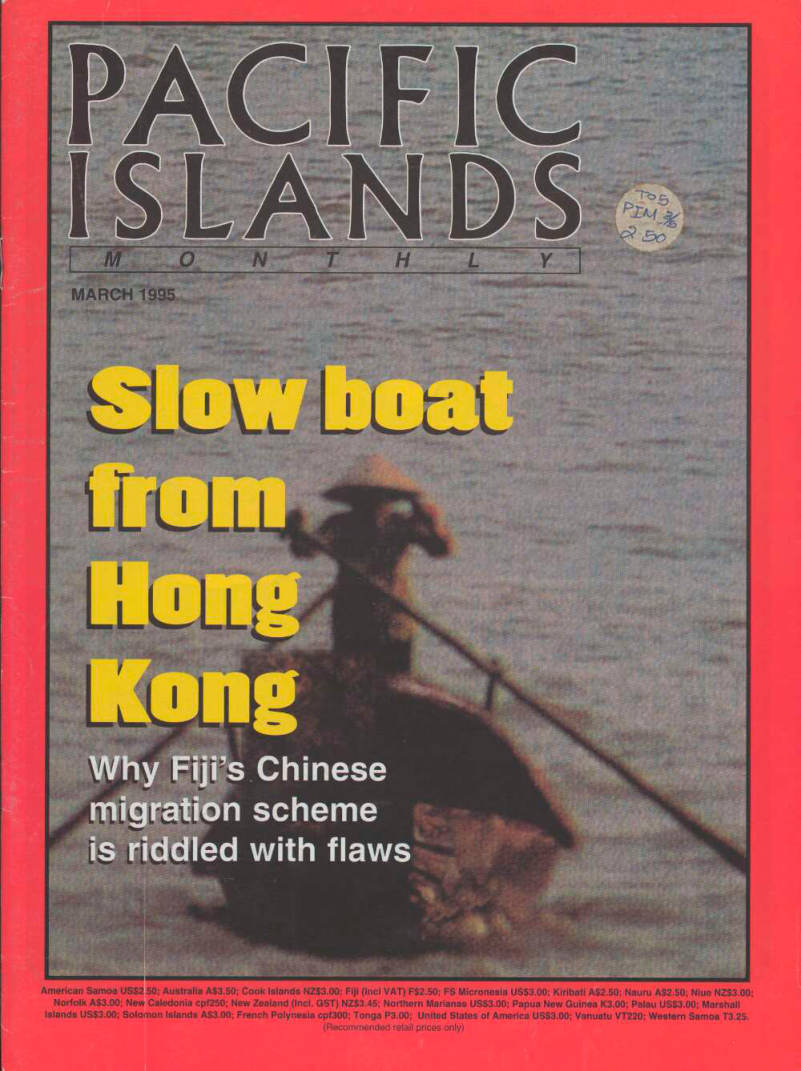
m| « WIM pj m B , A Jl . ; *• *' ** Why Fiji's Chinese migration scheme is riddled with flaws
American Samoa US$2,5O; Australia A 53.50; Cook Islands NZ$3.OO; Fiji (Incl VAT) F 52.50; FS Micronesia US$3.OO; Kiribati A 52.50; Nauru A 52.50; Niue NZ$3.OO; Norfolk A 53.00; New Caledonia cpf2so; New Zealand (Incl. GST) NZ53.45; Northern Marianas US$3.OO; Papua New Guinea K 3.00; Palau US$3.OO; Marshall Islands US$3.OO; Solomon Islands A 53.00; French Polynesia cpf3oo; Tonga P 3.00; United States of America US$3.OO; Vanuatu VT22O; Western Samoa T 3.25. (Recommended retail prices only)
Advertisements & other items, p. 2 (1 item)
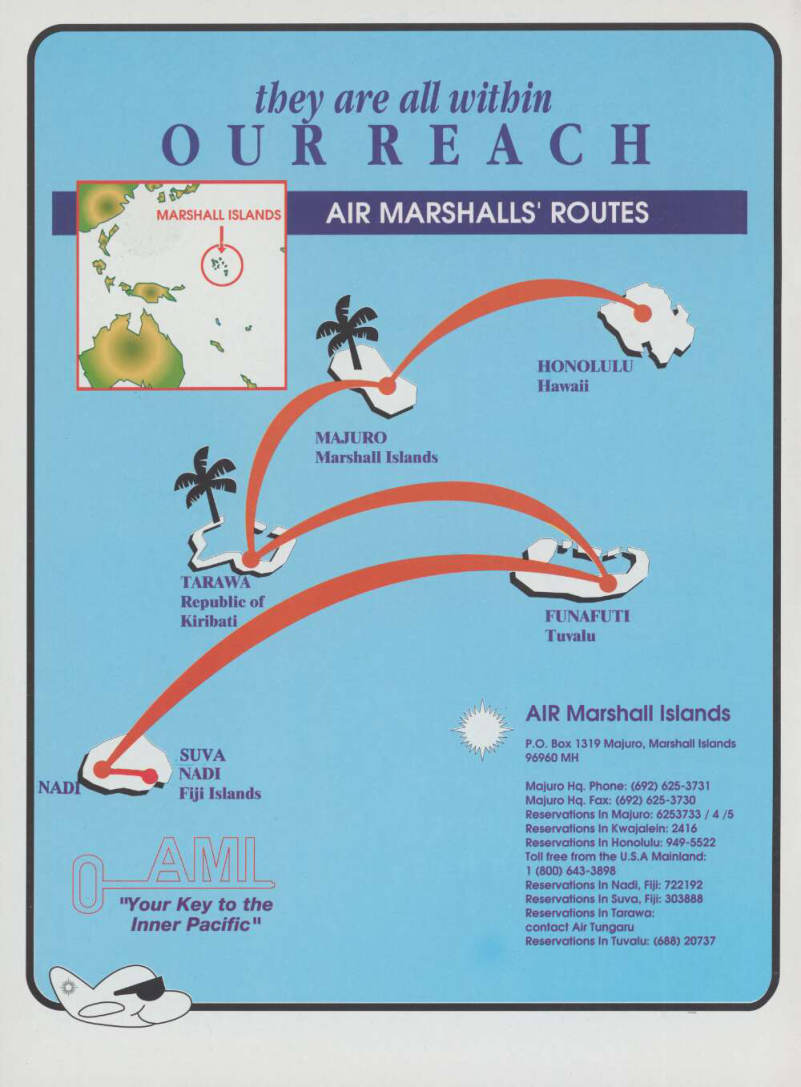
Our Reach
they are all within
r p. w
AIR MARSHALLS' ROUTES
MARSHALL ISLANDS
9 %
HONOLULU
Hawaii a.
MAJURO
Marshall Islands
TARAWA
Republic of Kiribati
FUNAFUTI
Tuvalu
NADI
SUVA
NADI
Fiji Islands A a "Your Key to the Inner Pacific 11
AIR Marshall Islands
P.O. Box 1319 Majuro, Marshall Islands 96960 MH Majuro Hq. Phone; (692) 625-3731 Majuro Hq. Fax: (692) 625-3730 Reservations In Majuro: 6263733 / 4 /5 Reservations In Kwajalein: 2416 Reservations In Honolulu: 949-5522 Toil free from the U.S.A Mainland: 1 (800) 643-3898 Reservations In Nadi, Fiji: 722192 Reservations in Suva, Fiji: 303888 Reservations In Tarawa: contact Air Tungaru Reservations In Tuvalu: (688) 20737
Pacific
Islands
Monthly
Vol6S No 3
The News Magazine
March 1995
□ Letters 4
□ Headlines 6
□ Law
In pursuit of justice 9 Crime and punishment 16
□ Briefly
Saipan’s offer- of sorts 10 How do our islands rate? 11
□ Violence
Tragedy strikes home 12
□ Focus
The Papal visit 14
□ Opinion
David Barber. 21 Alfred Sasako 32
□ Business
A taxing business 25 Abusing the system 27
□ Media
Degrees of freedom 28 The Trading Post experience 29
□ Entertainment
The Tongan explosion 39 Our Samoan heart throb 53
□ Advertising Feature
Aviation 42
□ Books
Through the ages 55
□ Yachting
A rollicking good time 56
COVER DESIGN: James Ranuku
Publisher: Brian O’ Flaherty Editor; Mala Jagmohan Senior Writer: Yunus Rashid Correspondents: Christine Hatcher, David North, Ed Rampell, lan Williams, Karen Mangnall, Liz Thompson, Roman Grynberg, Wally Hiambohn.
Columnists: David Barber (Wellington), Futa Helu (Tonga, cover ing the Pacific Islands), Jemima Garrett (Sydney). Alfred Sasako (The Forum).
Advertising Sales: • Regional Sales -South Pacific; Monita Shires, Ashok Lai, Tel (679) 304111, 303429, Fx (679) 303809. • Sydney, Canberra: Bob Hill Media Representation. Tel (61-2) 4164245, Fx (61-2) 4165064. • Brisbane: Robert Walker, Media House, Tel (61-7) 3710533, Fx (61-7) 371-8904. • Adelaide: Hastwell Williamsons Representatives, Tel (61-8) 3799522, Fx (61-8) 3799735. • Melbourne: Brown Orr Fletcher Burrows (Aust) Pty Ltd. Tel (61-3) 8265188, Fx (61-3) 8265644. • Auckland: McKay & Bowman, International Media Representatives Ltd. Tel (64-9) 4190561, Fx (64-9) 4192243. • Japan: Universal Media Corporation, Tokyo, Tel (3) 326626741, Cable: UNI MEDIA Tokyo, Fx (3) 32626742.
Founded 1930 (USPS 952480). A Fiji Times Limited production.
Cover prices are recommended retail only.
Registered by Australia Post, Publication No.
Nbp 1210.
© Copyright Fiji Times Limited, 177 Victoria Parade, Suva. Fiji. Tel (679) 304111, Fx (679)
303809. Tx Fj2124.
Pacific Islands Monthly is published monthly by Fiji Times Limited, a division of Nationwide News, 2 Holt Street, Surry Hills, Sydney, NSW 2010.
Send address changes to: •Pacific Islands Monthly, PO Box 1167, Suva, Fiji.
Typeset and printed by The Fiji Times Limited, 177 Victoria Parade, Suva, Fiji.
salary
Letters To The Editor
A
common
bond
Madam, Thank you to Tarcisius Tara Kabutaulaka, lecturer at the University of the South Pacific, for his report on the racism and prejudice that is present at the university (“Incubating a time bomb”P/M, November 1994).
Hopefully, it has opened minds of stu dents and lecturers alike to the prob lem.
As a university student in Australia, I have experienced and witnessed many occurrences of the same kind but no incident has resulted in such tragic cir cumstances as those that have occurred at the South Pacific campus. It is incred ibly amazing that people of the same race, such as the Fijians and the Solomon Islanders, are so racist towards each other that one island group can think itself superior to another.
It is a great shame as Fijians and Solomon Islanders are of one ethnic group, even though they are separated
by physical boundaries.
Melanesians, just as Polynesians, are beautiful people and, to a certain extent, share similarities in their culture and customs which are unique. To think of oneself as higher than the other is wrong as we share similar ancestral backgrounds.
To have different ethnic groups who live together in one ocean brawl about their superiority in that part of the world is ridiculous and shameful.
Let us not forget that whether we are Melanesian, Polynesian or Micronesian, we are one people - we are the people of the South Pacific and nothing will change that.
After all, it is our generation that will take our nations into the future through supporting each other.
So, please, fellow students of the University of the South Pacific, be civilised and together show the world what a proud and intelligent race of people we are.
Elizabeth Kurai,
Cairns, Qld, Australia
Forum's
salary
package
Madam,
I was interested to see the article “New Salary Structure Causes Dismay” (PIM, January 1995). It has some good points (I agree, for example, that we all need to live within our means), and some that call for correction.
The article implies that, for a range of underhand motives, Australia and New Zealand are largely responsible for reducing salaries at the Forum Secretariat to a level where that organi sation can no longer attract suitably
qualified people. There is no truth in this or in the other theories advanced in this article.
The decision to introduce a new salary structure at the Forum Secretariat was taken by representatives of all Forum island countries at the November Forum Officials Committee meeting. It was taken by consensus. It was not a case of Australia, or any other country, forcing its views on others.
The suggestion that Australia wishes to run down the Forum Secretariat is similarly untrue. Australia has complete confidence in the excellent job being done by the Forum Secretariat. Nor is there any truth in the suggestion that Australia is seeking to reduce its com mitment to the region. Indeed, Australian development cooperation with Pacific island countries has increased over the past few years. While future commitments will depend on the overall size of the aid budget, there are no plans to reduce our assistance to the Pacific.
The simple fact is that current salary packages for contract staff in Pacific regional organisations are higher than required to attract high calibre staff. The heads of some organisations earn a tax free salary higher than any regional prime minister. Directors of divisions and equivalents earn considerably more than any Pacific minister.
At a time when we are all trying to do more with less, such salary packages can no longer be justified. Sensible reduc tions in salary packages for contract staff in all regional organisations can be made while ensuring that they are suffi ciently attractive to ensure excellent people continue to be attracted to serve in these organisations.
Very importantly, however, it also means that up to Fsl million more per year can be spent on programmes that assist the intended beneficiaries, the cit izens of Pacific island states. This is in all our interests.
John Trotter,
Permanent Representative of Australia to the Forum Secretariat, Suva, Fiji
Hazardous
waste
issue
Madam, Alfred Sasako has provided excellent reasons for the development of a haz ardous waste convention for the Pacific region (“For a cleaner environment”, PIM January 1995). As an observer of the negotiating process for this conven tion, I have been both fascinated and disturbed by what I’ve witnessed.
A working group of Forum countries has now met three times to steer the Waigani Convention through the sur rounding politics. Its task hasn’t been easy because, despite the seriousness of the hazardous waste issue, the aims and
mechanisms of the Waigani Convention have been shaped by the politics and vested interests of the waste trade as much as by the good intentions and merits of the arguments.
Australian hazardous waste exports have been a significant factor in the position taken by Australia during these negotiations. For example, an internal Australian briefing paper cites haz ardous waste recycling as a viable devel opment path for Pacific island coun tries: “As PICs become more industrialised, they may wish to engage in trade in recyclable materials. Indeed this is a tra ditional development model followed by Japan and a number of Asian tigers. It would therefore be unfortunate if devel opment of this trade was nipped in the bud.”
Obviously, if a developing country is encouraged with foreign assistance to invest in capital intensive facilities for reprocessing imported hazardous waste, a continuous stream of hazardous waste is then necessary to justify the investment. This leaves the recipient of the dirty ‘technology transfer’ with the toxic by-products, residues and emis sions, and removes any incentive for industry to clean up its production processes at home. At the last working group meeting in Suva, one delegate understandably referred to this kind of development as‘immoral’.
For the Waigani Convention to protect
the people and environment of the Pacific from hazardous waste, it is criti cal the next negotiation sessions resolve to: 1) Ban imports of hazardous sub stances and products which cannot be used, for human health or environment reasons, in the country of manufacture.
In 1991, for example, 42 pesticides ille gal for use in the USA were exported to Pacific islands; 2) Support the globally ag *eed ban on exports of hazardous wastes from OECD (industrialised) countries to non- OECD countries; and 3. Reject a proposal by the USA to exempt military aircraft and vessels from outside the region from adhering to the Waigani Convention.
Papua New Guinea deserves congratu lations for recognising the need to pro tect the region and initiating action within the South Pacific Forum. The Forum deserves congratulations for tak ing up the challenge and keeping it moving. It is now in the hands of the Forum working group to ensure the spirit and integrity of the Waigani Convention is defended in the home stretch of negotiations. This observer will be watching with keen interest.
Noni Keys,
Greenpeace Pacific Campaign, Canberra, ACT, Australia
Advertisements & other items, pp. 4-5 (2 items)
fWsE^
v onn\ 3 •»
s&r -1 ■*Cx\jLl**t \ y\uJ JTuM, Ytfci <y KMObO
0U6Y O^
6-E T / Roo^ D
Heee /
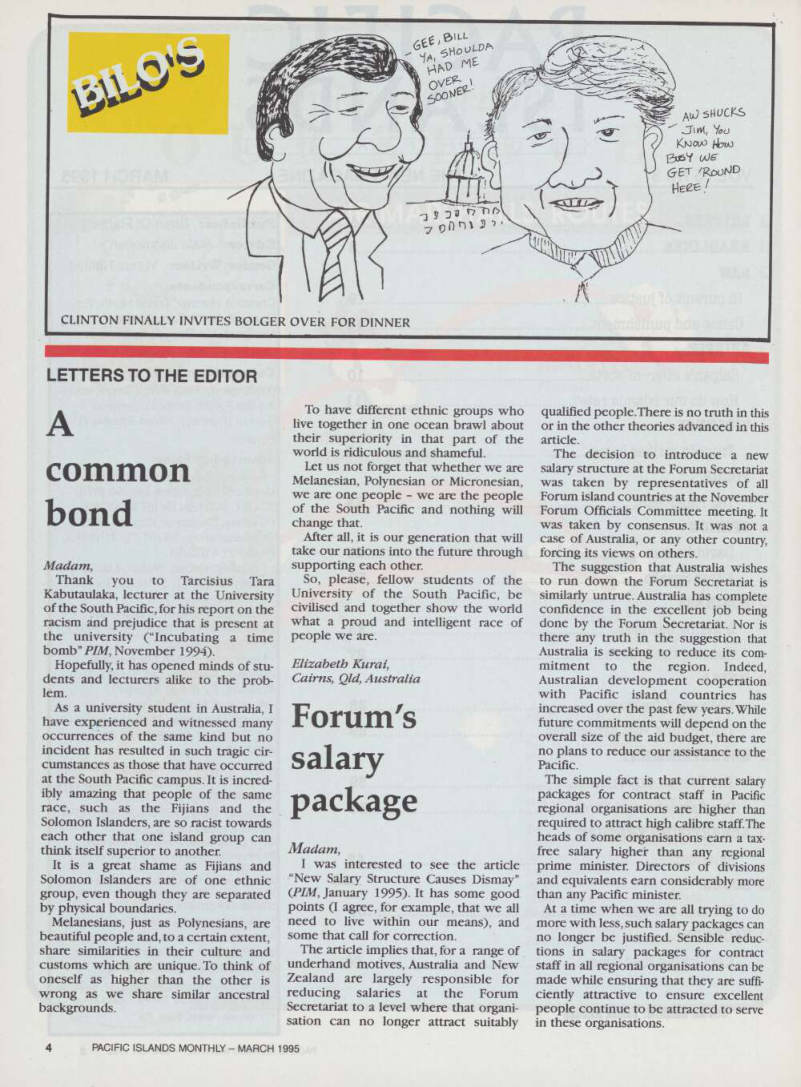
CLINTON FINALLY INVITES BOLGER OVER FOR DINNER
Remember your Friend
There are times in your life when you feel your friends have been missing out on something good. Now’s your chance to do something about it and share with them one of the good things you have. Buy your friend a subscription to Pacific Islands Monthly and let him or her join you and the thousands of other people worldwide who are kept informed of the latest political, social and cultural changes taking place in the Pacific.
SUBSCRIPTIONS
American Samoa US$45 Australia A 542.00 Canada US$45 Cook Islands AUSS46 Fiji F 526.40 French Polynesia US$45 Guam US$45 Hawaii US$45 Japan US$45 Kiribati AUSS46 Marshall/Micronesia US$4O Nauru AUSS42 New Caledonia US$32 New Zealand NZ$55 Niue AUSS46 Norfolk Island AUSS42 Northern Marianas/Palau US$4O Papua New Guinea AUSS4S Solomon Islands AUSS46 Tonga AUSS46 Tuvalu AUSS46 United Kingdom Stg Pound2B US Mainland US$45 Vanuatu AUSS4S Western Samoa WS$6O Elsewhere AUSS63 Payment to Pacific Islands Monthly: Subscriptions Dept, GPO Box 1167, Suva, FIJI.
Subscriptions rates include the cost of airspeeding to all destinations set out above.
Direct airmail rates on application.
Telephone: 304111 Fax: 303809
r PACIFIC ' "j
ISLANDS i
I- ° ' '=3 Please send my friend Pacific Islands Monthly for one year (12 issues).
I I enclose my cheque for $ (made payable to Pacific Islands Monthly) or debit $ to my: I □ Bankcard □ Visacard □ Mastercard I I Card No I I I I I I I I I I I I I I I [Expiry Date ] 1 I
NAME
j SIGNATURE
MY FRIEND’S NAME 1
I 1
MY FRIEND'S ADDRESS I
[ CITY
.COUNTRY j
blood suckers
Headlines
Cook Islands
War on
blood suckers
A Cook Islands Ministry of Health official visited the outer island of Aitutaki last month to look at a sandfly problem.
During the visit the health consultant, Doctor George Koteka, identified breed ing sites and discussed possible measures with the island council to eradicate the
blood-sucking insects.
The visit followed a trip to the island by Health Minister, Doctor Joe Williams, who found the populations of mosquitoes and sandflies had increased considerably.
Health workers carried out a spraying programme around the island but Dr Koteka is going to continue liaising with the island council to determine long term solutions.
Regionalism
Fiji
Save our
turtles
A ban has been placed on all commercial sales of turtle meat this year to mark the Year of the Sea Turtle.
Acting Director of Fisheries, Simone Tuilaucala, said in an effort to save turtles which face extinction in the Pacific, an education campaign will attempt to teach people in Fiji that if they continue to kill sea turtles at the current rate, there would soon be none left.
The Conservation Officer with the South Pacific Regional Environment Programme (SPREP), Sue Miller, said the ban was the first major achievement in the Year of the Sea Turtle. Miller said although the ban ends in March 1996, it has the potential to become permanent.
Previously, Fiji had stopped the killing or taking of sea turtle eggs only between November and February. Islanders were still be able to kill sea turtles between March and October this year for ceremo nial, customary or subsistence purposes.
Meanwhile, a Fisheries Officer, Aisake Batibasaga has warned that Fijians who relish turtle meat may be catching and eating the endangered marine species faster than they reproduce.
Batibasaga warned that four types of tur tles found in Fiji waters faced possible extinction if the use of sophisticated methods for killing turtles continued.
American Samoa and Guam have already banned the killing of sea turtles.
Yet another
no confidence motion
Fijian Association was expected to move a motion of no confidence in the govern ment of the Prime Minister Sitiveni Rabuka.
Association president Josevata Kamikamica confirmed that his party was going to move the motion in the session which started on February 13.
The decision was made to protest against government’s decision to “import” 28,000 Hong Kong Chinese, to repeal the Sunday Observance Decree and to call all Fiji citi
zens “Fijians”.
The motion reportedly had the support of some backbenchers who were unhappy with the decisions.
However, National Federation Party leader and Leader of Opposition, Jai Ram Reddy, said the Indian Members of Parliament would get involved in what is a Fijian
political tussle.
This leaves in doubt the success the motion. Its chances are further dimmed by the fact the Secretary to Parliament, Victor Rigamoto, ruled out the possibility of the motion being debated this session.
Regionalism
takes over
racism
A special ceremony welcoming regional students to the Suva campus of the University of the South Pacific was planned for last month.
It was organised by the Fiji-based students in an effort to remove the hostility that took shape last year as a result of on-cam pus racial fights USP Students Association’s Vice President, Sushil Deo Raj, said the ceremony would be a step towards uniting the students.
Solomon Islands and Vanuatu had pulled out their students when several Solomon Island students were hospitalised after being attacked by a group of Fijian stu dents. A lecturer who attempted to break the brawl was also injured.
In another incident, three Samoan stu dents attacked a Fijian student and gorged out his eye with a broken beer bottle.
Raj said the ceremony was not to remind the students of last year’s events but to start a fresh year with fresh relationships.
The Solomon and Vanuatu governments agreed to have their students to USP after new security measures were put in place by the USP administration.
USP’s acting Vice-Chancellor Dr Vijay Naidu said he was glad the students were returning. He said the university was owned by 12 countries and it was vital all of them were represented on campus by students.
for Bougainville
Papua New Guinea
Hope dawns
The people of North Solomons province of Papua New Guinea will see a new Bougainville when a transitional govern ment is in place.
Prime Minister Sir Julius Chan met with the chairmen of interim authorities, chiefs around Buka and women leaders from Arawa to discuss the establishment of a transitional government.
Sir Julius says the transitional government is expected to be in place in June and will have the full backing of the national gov ernment. He says the transitional govern ment will also have representatives of the chiefs, women, youth and churches.
Discussions also centered on the forma tion of a new task force to work closely with the transitional government to co ordinate restoration services on Bougainville.
Responsible
reporting sought
Chief Ombudsman Simon Pentanu has called on the media to be more responsi ble in their reporting.
The comments followed recent media speculations that certain government ministers had been referred to the leader ship tribunal while others were likely to follow suit.
Pentanu said the requirement of the lead ership code has always been that if a leader is to be referred to, the leaders con cerned must be the first to know about it.
He refused to comment on specific cases before him but said in a statement later that it was not appropriate for the media to speculate on the matter.
intervention
East Timor
Divine
Pope John Paul plans to send an envoy to Indonesia to assess the situation there.
East Timor’s Bishop Carlos Belo says the Pope told him in Manila he would send a cardinal to have a closer look at the situa tion in the territory.
Bishop Belo did not say when the envoy would arrive but said the Pope always watched developments on East Timor.
The Vatican directly administers the Cathloic church in East Timor to which more than 95 percent of its residents belong.
go home
Vanuatu
Aussies
Three Australian nationals have been ordered to leave Vanuatu. They include the owner of Environment Drift Travel and Tours in Santo, Fred Kleckham, the man ager of Clib Hipique in Port Vila, Troy Harris, and the owner of Island Construction company, Roger Waters, who is also a shareholder of the Tanna White Grass Bungalow.
According to the Trading Post newspa per, the three received their letter in January from the Department of Immigration. However, no explanations were given for the orders.
One of the three said his letter was dated December 14 but he received it on January 12.
The three say they did not know why they had been asked to leave and would seek legal assistance to have the order over turned.
Politicians charged
Western Samoa
with sedition
Two politicians from the traditional groups Tumua and Pule, have been charged with sedition in the wake of last year’s political protest marches against Value-Added Goods and Services Tax.
The two former members of parliament, Toalepaiilii Toesulusulu Siueva and Fa’amatuainuTala Mailei, are the first peo ple to be charged with sedition in Western Samoa. The charge carries a mximum two year sentence.
Toaleppaialii says the charge is an attempt by Prime Minister Tofilau Eti Alesena to intimidate him and to shut the mouths of people speaking out against the govern ment. The second leader, Fa’amatuainu faces an additional charge of libel.
However, Police Commissioner Galuvao Tanielu denied the Prime Minister was behind the investigation or that the charges had anything to do with the February protest march against the new tax.
The march followed a petition from about 90,000 signatories calling on the govern ment to scrap the tax which was intro duced last year.
A second march for February 9 was post poned indefinitely when officials did not receive signatures from New Zealand and Hawaii.
Senators call
North Mariana
for FBI investigation
Northern Mariana legislators want the FBI to investigate allegations of bribery in connection with the recent move to roll back the Commonwealth’s minimum wage.
The Northern Marianas minimum wage of $2.45 an hour was raised to $2.75 in January, this year. Five days later, Governor Froilan Tenorio signed legislation that put the wage back to the old price.
Representatives Stanley Torree and Pete Reyes have introduced a resolution asking FBI to investigate unnamed executives and legislative official in connection with the rollback.
In the Commonwealth Senate, Rota Senator Paul Manqlona made a similar move by sending a letter to the Saipan office of FBI.
The Commonwealth’s minimum wage, along with other labour issues, has been a point of debate between the Northern Marianas and the US Congress for the past three years.
Education Minister
Solomons
cries foul
The Solomon Islands Minister of Education, Alfred Maetia, has accused a newspaper of releasing a story which could threaten the safety of Solomon Islanders in Papua New Guinea.
And, Maetia said it could harm diplomatic relations between the two countries.
The story, released by the Solomon Star, a bi-weekly newspaper, involved the fatal shooting of a Papua New Guinea soldier by a Solomon security guard on the Solomon Islands side of the border.
The original report by Solomon Islands police authorities did not state anyone from either side was killed in the incident in which gunfire was exchanged at Komoliae village in the Shortland islands.
Komoliae was the scene of a cross-border raid by Papua New Guinea Defence sol diers in 1992 in which three Solomon Islanders were killed.
Maetia accused the Solomon Star of prac tising irresponsible journalism and being uncaring about possible repercussions on Solomon Islanders in PNG, especially stu dents.
PNG’s High Commission to Solomon Islands, Joseph Asaigo, has repudiated the report, saying it was in bad taste.
Climatic doom neigh
Regional
for small islands
The effects of climate change could lead to disasters of national proportions for small islands in the South Pacific, Caribbean and Indian oceans.
The spokesperson for the Alliance of Small Island States (AOSIS), Annette des lies, delivered the warning at the final preparatory talks on the framework of the
Treaty on Climate Change.
She said all small islands face the constant threat of low-lying coastal areas and wet lands, the reduction of available ground water due to salt water intrusion, and potential social disruption due to the pos sible need for relocation of coastal popu lations.
Small islands, she added, have been pursu ing negotiations on the climate change treaty for their survival, des lies made the comments as she intro duced the AOSIS draft protocol urging developed countries to reduce carbon dioxide emission into the atmosphere by at least 20 per cent below 1990 levels, by the year 2005.
The AOSIS proposal clashes with the posi tion of most industrialised countries which want a voluntary, non-mandatory approach to the treaty.
However, Germany, which also wants spe cific times and targets in the treaty, has allied itself with the AOSIS proposal at the meeting. Dr Michael von Websky of the Germany Environment Ministry said Germany welcomed the initiative of the AOSIS in proposing a draft protocol.
Pacific behind in
civic duties
Pacific islanders have a long way to go in terms of fulfilling their quota on the inter national civil service scene, according to United Nations statistics.
A statistical summary of how many Pacific islanders are employed on a professional basis at the United Nations reveals there are under 10 people, or 10 percent of the required quota, for seven countries listed in the summary.
Fiji has the highest number with five; Papua New Guinea and Samoa have two.
The other member countries , the Marshall Islands, the Federated States of Micronesia, Solomon islands and Vanuatu , have none of their nationalities employed by the United Nations as yet.
The desired range average for Pacific island countries is between two to 14.
Advertisements & other items, p. 8 (1 item)
Hat u
Zum ***±
& r 4 60i
cV.unuUu
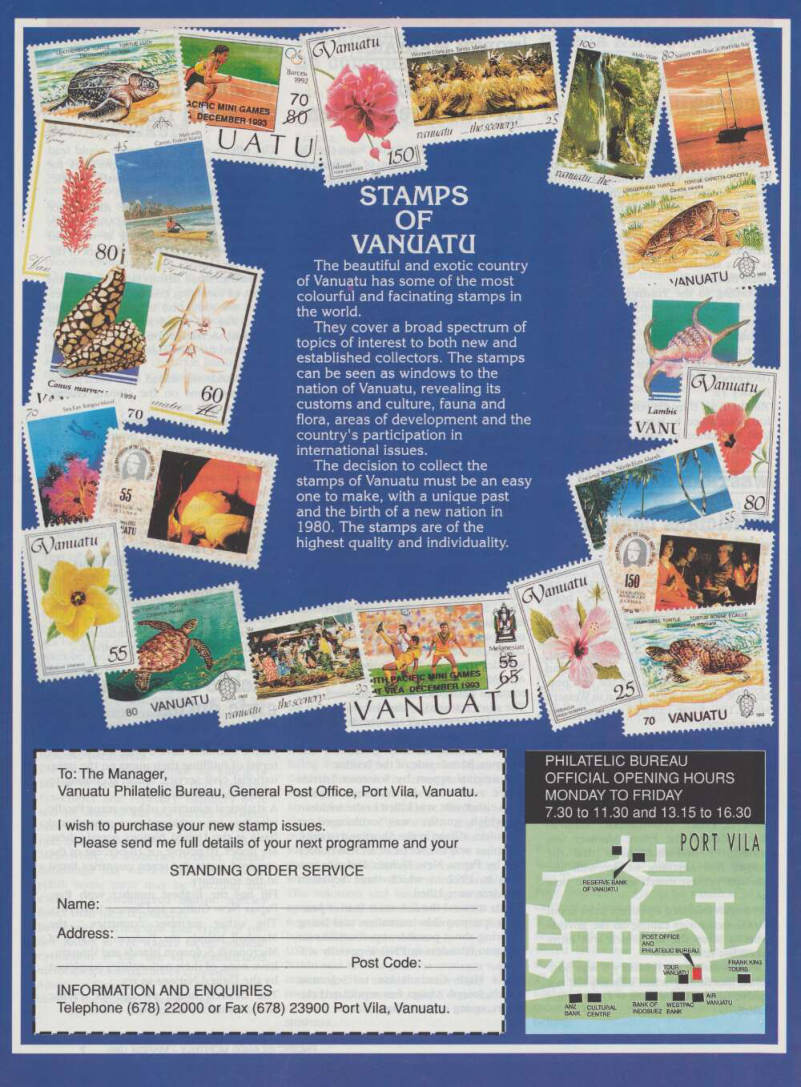
STAMPS
OF
VANUATU
The beautiful and exotic country of Vanuatu has some of the most colourful and facinating stamps in the world.
They cover a broad spectrum of topics of interest to both new and established collectors. The stamps can be seen as windows to the nation of Vanuatu, revealing its customs and culture, fauna and flora, areas of development and the country's participation in international issues.
The decision to collect the stamps of Vanuatu must be an easy one to make, with a unique past and the birth of a new nation in 1980. The stamps are of the highest quality and individuality.
" : _* » |Hm -.a, '
UATU
Lambis
VANI
Vanuatu y
* mu*. 80 .si '&rstss Tnj»- WW '• KUWSBa-l- TOtiTLt i so
• MINI §AMES
:eMßirojMO ■2S
70 VANUATU
To: The Manager, Vanuatu Philatelic Bureau, General Post Office, Port Vila, Vanuatu.
I wish to purchase your new stamp issues.
Please send me full details of your next programme and your
STANDING ORDER SERVICE
PHILATELIC BUREAU
OFFICIAL OPENING HOURS
MONDAY TO FRIDAY
7.30 to 11.30 and 13.15 to 16.30
PORT VILA
Name: Address: Post Code;
INFORMATION AND ENQUIRIES
Telephone (678) 22000 or Fax (678) 23900 Port Vila, Vanuatu.
POST OFFICE
AND
PHILATELIC BUREAU
NU
ANZ CULTURAL BANK OF WESTPAC VANUATU
bank indosuez bank ■ ■'
TRAC '
pursuit of
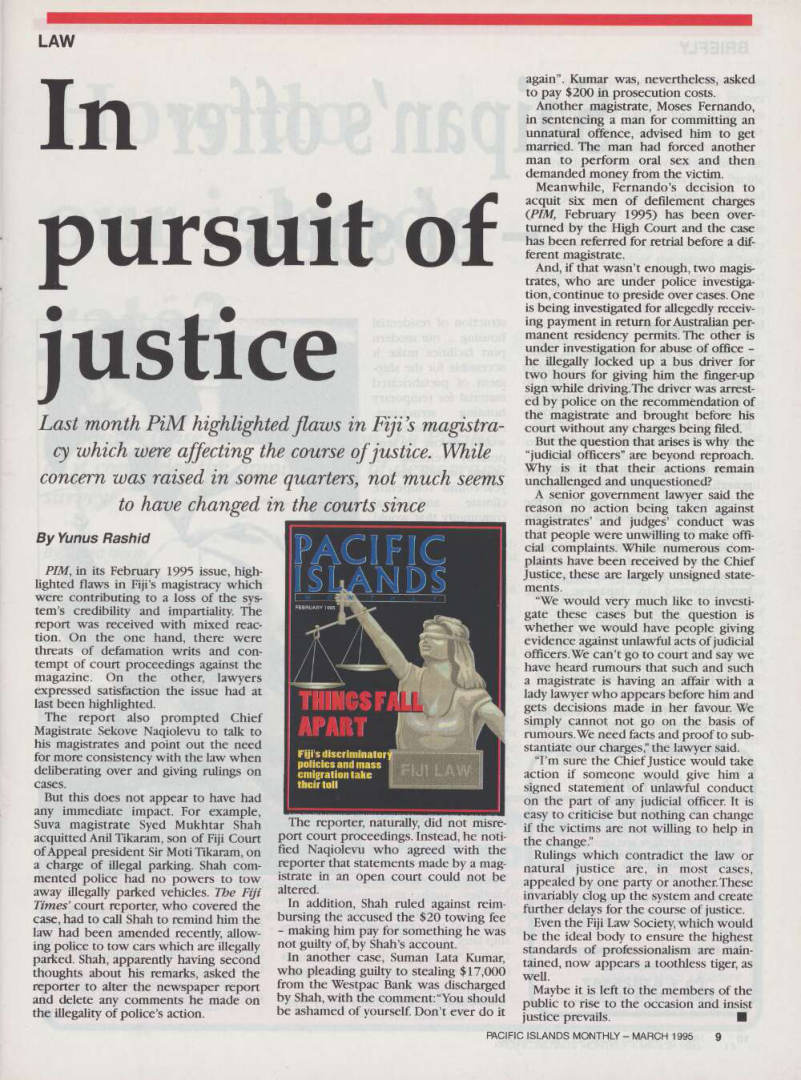
Law
In pursuit of justice
Last month PiM highlighted flaws in Fiji s magistra cy which were affecting the course of justice. While concern was raised in some quarters, not much seems to have changed in the courts since
By Yunus Rashid
PIM , in its February 1995 issue, high lighted flaws in Fiji’s magistracy which were contributing to a loss of the sys tem’s credibility and impartiality. The report was received with mixed reac tion. On the one hand, there were threats of defamation writs and con tempt of court proceedings against the magazine. On the other, lawyers expressed satisfaction the issue had at last been highlighted.
The report also prompted Chief Magistrate Sekove Naqiolevu to talk to his magistrates and point out the need for more consistency with the law when deliberating over and giving rulings on cases.
But this does not appear to have had any immediate impact. For example, Suva magistrate Syed Mukhtar Shah acquitted Anil Tikaram, son of Fiji Court of Appeal president Sir Moti Tikaram, on a charge of illegal parking. Shah com mented police had no powers to tow away illegally parked vehicles. The Fiji Times’ court reporter, who covered the case, had to call Shah to remind him the law had been amended recently, allow ing police to tow cars which are illegally parked. Shah, apparently having second thoughts about his remarks, asked the reporter to alter the newspaper report and delete any comments he made on the illegality of police’s action.
The reporter, naturally, did not misre port court proceedings. Instead, he noti fied Naqiolevu who agreed with the reporter that statements made by a mag istrate in an open court could not be altered.
In addition, Shah ruled against reim bursing the accused the $2O towing fee - making him pay for something he was not guilty of, by Shah’s account.
In another case, Suman Lata Kumar, who pleading guilty to stealing $17,000 from the Westpac Bank was discharged by Shah, with the comment: “You should be ashamed of yourself. Don’t ever do it
again”. Kumar was, nevertheless, asked to pay $2OO in prosecution costs.
Another magistrate, Moses Fernando, in sentencing a man for committing an unnatural offence, advised him to get married. The man had forced another man to perform oral sex and then demanded money from the victim.
Meanwhile, Fernando’s decision to acquit six men of defilement charges (PIM, February 1995) has been over turned by the High Court and the case has been referred for retrial before a dif ferent magistrate.
And, if that wasn’t enough, two magis trates, who are under police investiga tion, continue to preside over cases. One is being investigated for allegedly receiv ing payment in return for Australian per manent residency permits. The other is under investigation for abuse of office he illegally locked up a bus driver for two hours for giving him the finger-up sign while driving. The driver was arrest ed by police on the recommendation of the magistrate and brought before his court without any charges being filed.
But the question that arises is why the “judicial officers” are beyond reproach.
Why is it that their actions remain unchallenged and unquestioned?
A senior government lawyer said the reason no action being taken against magistrates’ and judges’ conduct was that people were unwilling to make offi cial complaints. While numerous com plaints have been received by the Chief Justice, these are largely unsigned state ments.
“We would very much like to investi gate these cases but the question is whether we would have people giving evidence against unlawful acts of judicial officers. We can’t go to court and say we have heard rumours that such and such a magistrate is having an affair with a lady lawyer who appears before him and gets decisions made in her favour. We simply cannot not go on the basis of rumours. We need facts and proof to sub stantiate our charges,” the lawyer said.
“I’m sure the Chief Justice would take action if someone would give him a signed statement of unlawful conduct on the part of any judicial officer. It is easy to criticise but nothing can change if the victims are not willing to help in the change.”
Rulings which contradict the law or natural justice are, in most cases, appealed by one party or another. These invariably clog up the system and create further delays for the course of justice.
Even the Fiji Law Society, which would be the ideal body to ensure the highest standards of professionalism are main tained, now appears a toothless tiger, as well.
Maybe it is left to the members of the public to rise to the occasion and insist justice prevails. ■
Saipan's offer
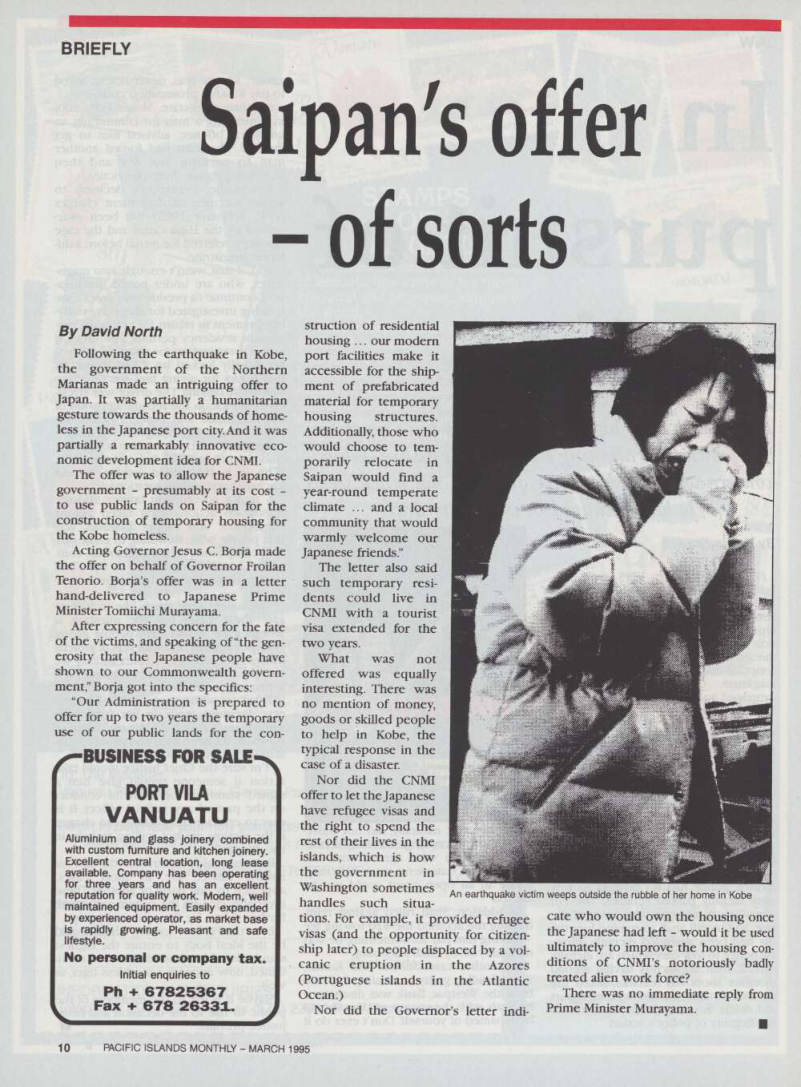
Briefly
Saipan's offer - of sorts
By David North
Following the earthquake in Kobe, the government of the Northern Marianas made an intriguing offer to Japan. It was partially a humanitarian gesture towards the thousands of home less in the Japanese port city. And it was partially a remarkably innovative eco nomic development idea for CNMI.
The offer was to allow the Japanese government - presumably at its cost to use public lands on Saipan for the construction of temporary housing for the Kobe homeless.
Acting Governor Jesus C. Borja made the offer on behalf of Governor Froilan Tenorio. Borja’s offer was in a letter hand-delivered to Japanese Prime MinisterTomiichi Murayama.
After expressing concern for the fate of the victims, and speaking of “the gen erosity that the Japanese people have shown to our Commonwealth govern ment,” Borja got into the specifics: “Our Administration is prepared to offer for up to two years the temporary use of our public lands for the con
struction of residential
housing ... our modern
port facilities make it accessible for the ship ment of prefabricated material for temporary housing structures.
Additionally, those who would choose to tem porarily relocate in Saipan would find a year-round temperate climate ... and a local community that would warmly welcome our Japanese friends.”
The letter also said such temporary resi dents could live in CNMI with a tourist visa extended for the two years.
What was not offered was equally interesting. There was no mention of money, goods or skilled people to help in Kobe, the typical response in the case of a disaster.
Nor did the CNMI offer to let the Japanese have refugee visas and the right to spend the rest of their lives in the islands, which is how the government in
Washington sometimes
handles such situa
tions. For example, it provided refugee visas (and the opportunity for citizen ship later) to people displaced by a vol canic eruption in the Azores (Portuguese islands in the Atlantic Ocean.) Nor did the Governor’s letter indi-
cate who would own the housing once the Japanese had left - would it be used ultimately to improve the housing con ditions of CNMI’s notoriously badly treated alien work force?
There was no immediate reply from Prime Minister Murayama.
An earthquake victim weeps outside the rubble of her home in Kobe
Advertisements & other items, p. 10 (1 item)
Vanuatu
BUSINESS FOR
PORT VILA
Aluminium and glass joinery combined with custom furniture and kitchen joinery.
Excellent central location, long lease available. Company has been operating for three years and has an excellent reputation for quality work. Modem, well maintained equipment. Easily expanded by experienced operator, as market base is rapidly growing. Pleasant and safe lifestyle.
No personal or company tax.
Initial enquiries to Ph + 67825367 Fax + 678 26331.
our islands
How do our islands rate?
Freedom House files its report on the Pacific as it concludes the annual state of democracy survey
By David North
The small nations of the Pacific were praised, albeit backhandedly, by Freedom House in its annual survey of the state of democracy around the world.
In its report on Asia and the Pacific, the New York based think-tank had many harsh things to say about the lack of freedom in nations such as capitalist Singapore and communist North Korea.
It berated the Burmese dictators and worried about the lack of progress in China, while giving good marks to
Japan, South Korea and, surprisingly, Mongolia (formerly a wholly owned subsidiary of the Soviet Union).
Then to cap off its essay on the region it asked: “So where can one find the largest col lection of democracies in Asia?
“In the South Pacific, where 11 of 14 countries, mostly poor and isolated, are free democracies. Never heard of Nauru, Kiribati, Vanuatu and Tuvalu?
“Neither apparently have many of Asia’s ruling elites ... nor their Western apologists ... who don’t seem to believe that ordinary Asians can handle democ racy.”
As usual with the Freedom House rat ings, freedom from a colonial power (like the US or France) does not seem to be part of the formula. Individual politi cal and civil rights are what counts.
Freedom House gave totally free rat ings to all the jurisdictions in the Pacific except Papua New Guinea, Fiji and Tonga, which it called only partly free. At the very bottom of the region’s list is Indonesia’s Irian Jaya which occupies the western end of the island of New Guinea. The 7.0 rating that area received is the worst available in the Freedom House system and is the same rating held by places like Iraq, Libya and Sudan.
The rationale for the ratings of the smaller nations, unfortunately, was not released at the same time as the ratings, beyond the regional essay quoted in full earlier.
Among the interesting elements of the lists were: Easter Island is now listed by Freedom House by its Polynesian name, Rapanui, which is not the name used by Chile there has been some tension between the Polynesian residents of the islands and its Spanish-speaking mainland gov ernors.
Vanuatu’s rating on civil liberties dropped in the last year presumably because Freedom House got wind of what it regarded as restrictions on the freedom of the press and of expression.
For some unrecorded reason Australia’s Norfolk Island, home of some of the descendants of the Bounty muti neers, got a less than perfect 1.5 rating; though Australia (along with the U.S. and New Zealand) got 1.0, the best rat ing available.
Advertisements & other items, p. 11 (1 item)
Replacement Engines
LARGEST RANGE IN THE SOUTH PACIFIC
* OVER 800 ENGINES AVAILABLE * DIESEL-GASOLINE 10HP TO 400 HP TRANSMISSION TO MATCH IF REQUIRED ♦ JAPANESE ♦ ENGLISH * EUROPEAN MODELS * Bedford Cummins * Daihatsu Deutz * Ford Gardner * Hino Detroit Isuzu * Komatsu * Leyland * Mazda * Mercedes * Mitsubishi * Nissan Perkins Scania * Toyota * Volvo Yanmar * Kubota
SPECIAL BLAIRS SPECIAL
Yanmar Stationery Engines p.o. box 14 Cylinder Heads - Starters 2 HS/66/72 - 2 TR 15/20 - Y 35 GERALDINE, NEW ZEALAND Tested-Rebuilt & Japan Including Fuel Tank/Radiator F^W) E 69381^) 93 8122 Most Ja P anese Diesels
Tragedy


Violence
strikes home
Papua New Guinea has the world’s second highest incidence of violence against women , according to a UNICEF report. But a new trend shows men are just as likely to fall victim to abuse in the homes.
By Ruth Waram
Twenty-two-year-old Yahu Mahe of Kainantu in the Eastern Highlands province of Papua New Guinea was stabbed to death by her husband after an argument. Police reports said Mahe and her husband argued over a piece of lamb flap which he wanted and tried to grab out of her hand. She stabbed him. He was unconscious for some time due to loss of blood, but when he recovered, he used the same knife to stab her. She later died.
This is just one example of the seri ousness of domestic violence in Papua New Guinea, where petty arguments can develop into major quarrels, some times leading to death.
Domestic violence is a widespread and serious problem in PNG, affecting about two-thirds of the families in the country. Discussions on domestic vio lence have so far mainly centred on wife-bashings but husbands are emerg ing as victims, as well. In fact, recent sta tistics show more male victims are now
seeking help.
According to Ronnie Mamia, a welfare officer with the National Capital District Welfare office in Port Moresby, eight or nine of the 20 complaints they receive daily have male victims. Mamia said as
more and more PNG women become educated and aware of their rights, their behaviour and attitudes change as well.
This problem has not gone unnoticed by the international community. United Nations has rated PNG second in the world in the number of reported cases of domestic violence. UNICEF’s 1994 State of the World’s Children report released late last year, states community based surveys have yielded alarming fig ures - up to 50 per cent of women in Thailand, 60 percent in PNG and the Republic of Korea and 80 percent in Pakistan have been victims of domestic violence. UNICEF says childbirth and pregnancy, as a leading cause of death for women worldwide, are rivalled only by domestic violence. The report also states surveys in recent years indicate about a quarter of the world’s women are violently abused in their homes by their male partners.
Such figures suggest assaults on women by their husbands or partners are the world’s most common form of violence. But it was only over a decade ago that wife-bashing was recognised as a problem in the world and PNG.
In 1982, PNG’s then Minister for Justice,Warren Dutton, directed the Law Reform Commission to investigate
domestic violence and recommend legal and other means of protecting women, following pressure from the National Council of Women.
As a result, PNG is the only developing country which has conducted a com prehensive study of violence against women.
A study carried out at Angau General Hospital in Lae in 1983 found that of the 97 patients who required medical treat ment as a result of domestic violence during a 10-week period, only three were men.
Since 1982 LRC has conducted sur veys in most provinces to determine the nature and extent of domestic violence.
These studies show two-thirds of all married women in rural areas had been beaten by their husbands. Figures for Port Morseby were slightly lower: 56 percent among low income earners and 62 percent among the higher income earners.
In the provinces, 67 percent of the wives said they had been hit by their husbands, while 66 percent of the hus bands claimed they had been beaten by their wives.
Among low incomes earners in urban areas, 56 percent of the wives claimed they had been beaten, while 55 percent
of the husbands admitted to striking their wives.
While it was not possibly to make an objective assessment on the frequency and severity of beatings in rural areas, urban figures indicate one in six wives surveyed had received medical treat ment for injuries inflicted on them by their husbands.
The study also found up to 18 percent of the beaten wives had asked for police help, despite a police policy of non intervention in domestic assaults. The survey also showed a large number of wives were beaten several times a year, five to 13 percent were beaten at least once a month, and five percent of the wives in the urban low-income category reported beatings every week.
Most domestic violence victims find it hard to get out of their violent marriages because they have no money, no where to go and children to support. This is often misinterpreted as victims not real ly minding the beatings they receive.
Women in these marriages are often totally dependent on their husbands.
This is true for both urban and rural women. In rural areas, when a woman marries, she leaves her own group of people and becomes part of her hus band’s group, with little contact with
her relatives. The relatives who receive part of the bride price do not want to pay it back if the woman leaves her hus band. Also they are the ones who bene fit from any compensation the husband may have to pay for injuring his wife.
Another factor that has been a major obstacle in the fight against domestic violence is the belief that paying a bride price gives a husband the right to bash up his wife.
The survey also found many women stay in violent marriages out of igno rance - they do not know they have a right to object to the treatment they are given, nor do they know how to go about leaving such a marriage.
Other women remain out of fear their husbands threatening to kill them or their children if they try to leave or
seek help.
Still others live in the hope their hus bands mind change for the better these husbands are remorseful and lov ing after beatings, promising never to do it again, and the wives want to believe them. They put up with it until things get so bad the women become desper ate. That’s when they look for agencies which should help them - the police, courts, welfare offices, the medical sys tem - but don’t want to get involved
because it is a “domestic matter”.
In most cases, women who are trying to protect themselves against further abuse need immediate financial assis tance and a safe place to stay. If she has left the marriage, she needs financial help to return to her village or an alter native source of income.
Today, domestic violence is treated as any other criminal offence in the courts.
But 12 years ago, the issue was not dis cussed as openly. Following the LRC survey, the Women and Law Committee, active in creating a greater awareness of the problem, was formed.
The group produced pamphlets, posters and videotapes informing women about their legal rights and how to go about securing them.
The material was distributed through out the country by the police, the Education Department (through schools), the Health Department, the Department of Agriculture and Livestock, welfare officers, the court sys tem and some business houses. The first lot of posters and pamphlets ran out within two weeks of their release.
But the sad thing, despite all the good that is being done, is that LRC’s final report has yet to be tabled in parlia ment. ■
The relatives who receive part of the bride price do not want to pay it back if the woman leaves her husband. Also they are the ones who benefit from any compensa tion the husband may have to pay for injur
ing his wife.
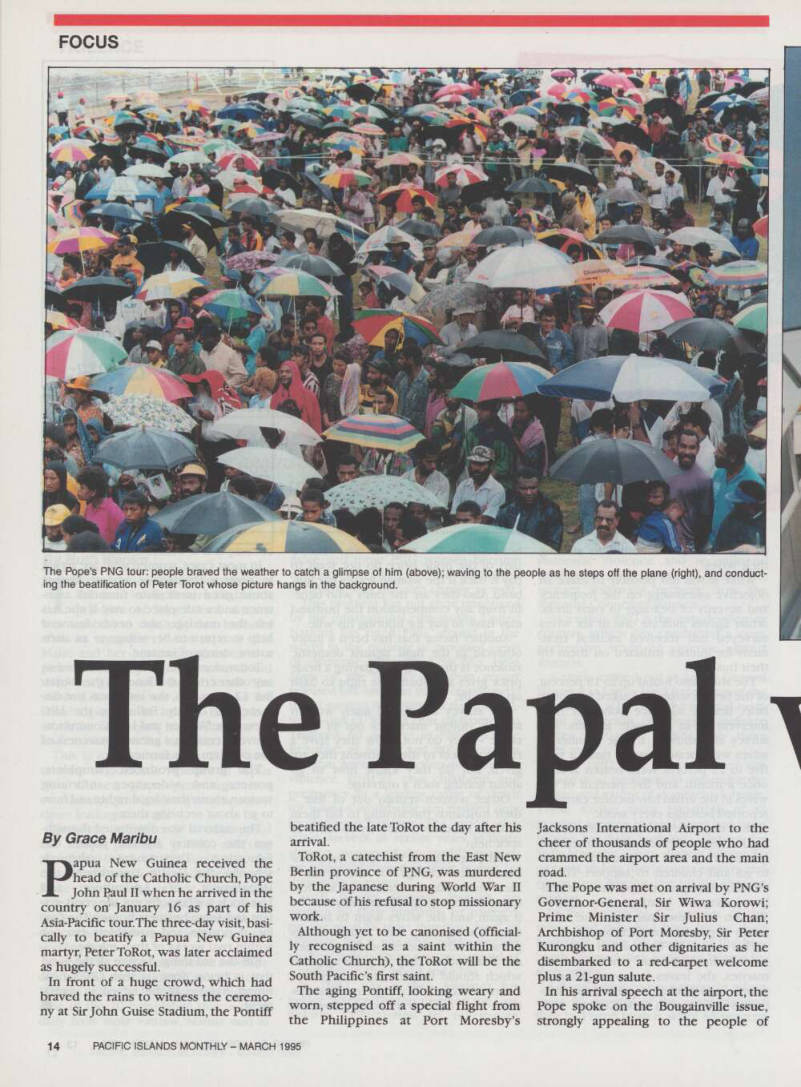
The Papal visit

Focus
By Grace Maribu
Papua New Guinea received the 'head of the Catholic Church, Pope John Paul II when he arrived in the country on January 16 as part of his Asia-Pacific tour. The three-day visit, basi cally to beatify a Papua New Guinea martyr, PeterToßot, was later acclaimed as hugely successful In front of a huge crowd, which had braved the rains to witness the ceremo ny at Sir John Guise Stadium, the Pontiff
beatified the late Toßot the day after his arrival.
Toßot > a catechist from the East New ® erli " P™ vince of PNG - was ”“ rdered by the Japancsc dunn * World War 11 because of his refusal to stop missionary
work *
Akhou « h y et to be canonised (officially recognised as a saint within the Catholic Church), the Toßot will be the S™" 11 flrs ' sain ‘- Thc agmg P ° nt s’ lookm B weaiy md T° m ’ f epped off a special night from the Philippines at Port Moresby’s
Jacksons International Airport to the cheer of thousands of people who had crammed the airport area and the main road.
The Po P e was met on arrival h V PNG’s Governor-General, Sir Wiwa Korowi; Prime Minister Sir Julius Chan, Archbishop of Port Moresby, Sir Peter Kurongku and other dignitaries as he disembarked to a red-carpet welcome plus a 2 '"W® sa > ute - In Ws “rrival speech at the airport, the Po P e s P oke on the BougainvUle issue, strongly appealing to the people of
The Pope’s PNG tour: people braved the weather to catch a glimpse of him (above); waving to the people as he steps off the plane (right), and conduct ing the beatification of Peter Torot whose picture hangs in the background.
Catholic-controlled Bougainville to “remove bitterness from your hearts, lay down your arms, and seek reconcilia tion”.
“To you, people of Bougainville, I send a special word of encouragement. If you have been treated unjustly, I urge you to remove bitterness from your hearts. If you bear arms unjustly, put them down and seek reconciliation.”
He officiated at various other church engagements before leading the beatifi cation ceremony the next day. Amid a
steady downpour, about 20,000 people cheered and sang as the Pontiff led the ceremony in true Papua New Guinean
style.
The three-day visit received extensive media coverage - it was carried live via television and radio broadcasts through out the country and to Australia, USA, Spain and Italy.
It had been initially planned the Pontiff would travel to East New Britain to beatify Toßot but the plan was can celled due to the Pope’s ailing health and the volcanic disaster there in
September last year. The Pope expressed
regret at not being able to perform the rites on New Britain soil”! regret that I am not able to be with Peter Toßofs beloved Tolai people on this occasion but circumstances have not permitted me to go to New Britain,” he said.
“I wish I could visit all the people in the various parts of these islands, but I can only stay very briefly. Therefore, I can assure all of you, wherever you are,
that I am thinking of you.”
The Pontiff departed for Australia on January 18 for the beatification of Australian nun M' / McKillop after his Air Niugini flight was delayed for 20 minutes due to a fault in the tempera ture gauge.
“I take leave of you and your beautiful country with my heart filled with grati tude, joy and hope,” said the Pope when he farewelled the people of PNG short ly before his departure. “I am deeply grateful for the warm hospitality which (you) have shown me. I express my sin cere thanks to all those who made this pastoral visit possible, especially His Excellency the Governor-General, the Prime Minister and the distinguished Members of Parliament.”
He also thanked his brother bishops, the clergy, the religious and laity, many of whom, he said, had made quiet and unseen sacrifices so that the visit brought happiness and strength to oth ers. ■
Crime


Law
And
Punishment
By Yunus Rashid
The Forum Secretariat’s secretary-gen eral, leremia Tabai, recently made known his concerns over Fiji’s growing crime rate to the country’s government.
He was concerned for the security of his Fiji-based staff and their property, as the country is swept by a crime wave that appears an insurmountable prob lem.
Tabai is not alone in his concern. He is joined by hundreds of Fiji residents who have fallen victim to burglaries as their homes have been broken into and bru tally ransacked in search of valuables.
Police statistics show the number of reported burglaries increased by 14 per cent from 906 in 1992 to 1039 in 1993.
Figures for last year have not been released yet, but the trend indicates a major increase as unemployment becomes a serious problem and jobs are hard to come by.
Amid such an atmosphere - when the public is on the warpath against crime, when crime has spread its roots deeply and firmly and when criminals are devising new methods of outsmarting the system, it is not easy being Police
Commissioner.
But for Fiji’s police boss, Isikia Savua, life must go on. He agrees crime figures have sky-rocketed but he does not try to justify the statistics. Instead he gives explanations.
Savua says the media has suddenly decided to run a series of stories on serious offences and this has led to the public outcry against an “alarming increase in crime”. He said it was good the media had decided to run such stories because it warned people criminals could attack any time and any where.
“But what is lacking is the initiative of the force to inform people about the responsibilities they could share with us to combat crime. I have now drawn up a plan whereby our officers would be stationed closer to the people in police posts. I have held numerous talks in localities where more crime has been reported and asked for their assistance in setting up police posts. The people are willing and ready to help. The problem has been that they did not know how to help,” Savua explained.
He said crime had been increasing at an average of eight percent annually not because of lack of personnel and
transport in the police department, but because every year there are more school leavers who remain unemployed and resort to crime for a living.
Savua, unlike his predecessors, also brushed aside suggestions that lack of personnel and transport may be a major factor in police’s inability to combat crime.
“The public look to the police to main tain law and order and we must honour that duty and come up with ideas and plans to effectively deal with the crime problem. However, it must be noted that citizens could play a very prominent role in combating crime by simply polic ing their own neighbourhoods”.
But why is a small society like Fiji being faced with such hideous crimes, such as rape, violent robberies and mur ders?
“School leavers, unemployment fig ures and population increases, seen in the light of economic growth, explain a lot,” Savua said. Crime statistics showed increases but, compared to other figures such as the number of school leavers and the unemployed, it was not unfavourable.
How does he explain the decline in
the number of prisoners when the crime rate has gone up? Is this a reflec tion of fewer prosecutions?
“(Police) prosecutors are not trained, I agree. But the Director of Public Prosecutions has come up with a plan to establish a national prosecution service which will incorporate the work of police prosecutors. Eventually there will be no more police prosecutors. We have earmarked two police officers to become lawyers and this programme will continue.
“We have a good success rate in con victing people. But then our work is not to get convictions only, but to see that justice is done. The job of the prosecutor is largely dependent on how good the evidence supplied by detectives or investigating officers is.”
Savua said he did not agree police prosecutors were unable to “take on” seasoned lawyers. “The evidence itself decides whether a man will or will not be convicted. The prosecutor merely leads the evidence in court. It is for the defence counsel to find out means to defend his or her clients.
“Our prosecutors are doing a fine job.
We have a fairly good success rate. We have seminars for prosecutors and crime officers and this allows them to do decent work.”
A general public complaint has been that police do not immediately arrive at the scene of the crime because they do not have enough vehicles.
Explaining this Savua said: “Lack of transport is an excuse of convenience. It is something that has been there for a number of years as a lame excuse.
Mobility is what we should look at. How can our officers effectively be deployed to attend to reports?
“Every police officer knows that if transport is not available, we ask the nearest station to help or we use public transport. We also have some other gov ernment vehicles available to us over weekends.
“Our problem at the moment is response time. To the complainant, the response time of one hour after the first call is made, is too long. We accept that and we are now in the process of having police officers closer to the people.
“The response time should reduce.
Places identified as crime centres are slowly having their police stations or police posts. Most of our problems have been addressed singly when, in fact, the problems are interrelated. If you deal with them on an individual basis and when related problems continue to exist, then that is no use because, like in a chain reaction, the resolved problem
continues to reappear in a short span of time.”
Savua said the reason these problems had not been effectively addressed over the years was that the police had not gone out there to talk to the communi ty Another drawback with mobility has been that police officers have been taught to use vehicles but they have not been taught to maintain their vehicles.
Therefore, many vehicles were out of order.
To deal with this problem, Savua has hired a mechanic to assist police drivers learn basic maintenance skills.
“We can get 100 more vehicles but these would be of no use if they are not maintained and we don’t have any strat egy to combat crime.”
Is manpower shortage a problem?
Setting an example: Police Commissioner Savua checks
How the Police Budget
measures up
1984 1993 Population 690681 771104 School Leavers 6518 2370 Unemployed 16800 15800 Police Strength 1410 1913 Police Budget $12,929,300 $25,436,600
“At the moment there are 1913 police officers. One policeman to 400 people.
The number we have is not a problem.
“What is the use of having more offi cers when the existing ones are not ade quately equipped? We need to improve accommodation. I have 88 single men here (in Suva) but accommodation for only 52. So, the others have to pay rent.
They do not get lodging allowances. The single men then are burdened with heavier duties.
“What I would like to do is to go on with the existing numbers but improve their working conditions and their equipment. I have drawn up a standard equipment list which will cost the tax payer $ 1000 per officer.To get more offi cers would mean more costs in terms of training and accommodation expenses.
“We have broadened our special con
stabulary unit. Special constables are cheaper to have and they are always in line to take up any vacancies which come up.”
Savua said he would ideally like to see his officers do the work they are trained to do, rather than serve summons, cap ture escaped prisoners, serve as butlers to judges and act as court orderlies.
Savua said he would like to see a change but the question was if police did not perform these duties, then who would?
“Unless a better, financially viable, acceptable and workable solution is available, I would not like to change that. People are always advocating change but without solutions. I’m for change but somebody has to give me a better alternative.”
He also expressed concern at the atti tude of some magistrates who released violent criminals on bail, pending trial.
He said these people, knowing they were going to be convicted eventually, normally carried out a series of criminal activities while on bail. When they were finally sentenced for the offences, they would get concurrent terms. For exam ple, someone who has committed 13 robberies with violence at around the same time would not get more then three to four years behind bars all told.
Who are these people who repeatedly go to prison? What is the profile of the average criminal?
Savua’s Assistant Commissioner for Crime, Jone Waisale, outlined the charac teristics of the habitual offender.
Repeat offenders were usually chil dren from broken homes with little edu cation.
Waisale, who is also a lay-preacher, said churches did their best to call young people to the church but had little response.
“I would say the criminal career starts at an early stage. If not at home stealing lollies, then at school stealing food, and
then money. Normally it starts out of desperation and later develops into a habit.
“When children are younger, there is enough family support to sustain them but as they grow older, family support lessens and the children are left alone to survive. As the needs of the criminals grow, their crimes become bigger, until they end up in prison for long periods.
The turning point comes at around 30 to 35 years of age.”
The solution, Waisale feels, is greater commitment from churches and fami lies. “Unless our basic institutions are made strong, the moral fight becomes an uphill battle. My own opinion also is that the government needs to actively do something about the economy so that more work is available to the large num ber of school leavers every year.
“What we sometimes forget when talk ing about crime and criminals is that we are dealing with human beings. Yes, the prisons can help rehabilitate criminals, but of what use is this when they come out from behind bars and there is a hos tile society waiting to snub them, and an economy which does not provide enough means for people to financially sustain themselves.”
Waisale also raised concern at the ready market which receives stolen properties. He said criminals knew places where they could sell their loot.
There was obviously a demand for stolen goods and it was difficult for the police to keep a trace on how they were being disposed of.
For example, he said, stolen gold jew ellery was apparently taken to promi nent jewellers who would melt it down, leaving police without any trail. Waisale said it was unfortunate people who bought stolen property did not realise they were encouraging robberies and burglaries. ■
[?]t a department vehicle
Pacific Islands Monthly - March 1995
Comparative Crime Analysis, Police, Population and Employment Statistics Between 1984 - 93
Offences
1984 1985 1986 1987 1988 1989 1990 1991 1992 1993 Murder/Attempted murder 19 21 17 25 31 12 30 19 28 16 Rape/Attempted rape 57 49 66 80 102 89 98 82 77 77 Robbery with violence 228 250 310 542 649 542 409 624 760 677 Burglary/House Breaking 1296 1281 1724 1670 2510 1682 1727 1826 2274 2547 Other Breakings 777 988 1228 1037 1198 860 740 858 1161 1476 Serios Assaults 221 254 247 229 257 245 234 292 313 313
Uuomv
221 186 275 231 352 313 226 413 530 469 Serios Fraud 2 1 1 3 5 1 10 8 8 4 Serious Theft 5 11 12 16 Drugs 38 27 109 164 178 135 127 118 236 326
Total
2859 3057 3977 3981 5282 3879 3606 4251 5399 5921
Advertisements & other items, pp. 16-18 (3 items)
Forum Secretariat
f
VACANCY
DEPUTY SECRETARY GENERAL
(POLICY & SERVICES)
Applications are invited from suitably qualified and experienced persons, who must be nationals of a member state of the South Pacific Forum*, for the position of Deputy Secretary General (Policy & Services) in the Forum Secretariat.
The Forum Secretariat was established in 1972 by the South Pacific Forum to encourage economic and political cooperation between its member states, and between those states and the more industrialised countries.
Under the control of a Secretary General, the Secretariat provides services to the Forum and undertakes activities in a number of areas: economic development, legal and political, civil aviation, energy, maritime, telecommunications and trade. In pursuing these work programmes, the Secretariat works with a range of aid donor countries and organisations including Australia, New Zealand, Japan, France, EC, Canada and the
UNDP.
This executive position in the Forum Secretariat has substantial responsibilities in management, policy advising, economic development and representation. The occupant together with the Deputy Secretary General (Programmes) provides support to the Secretary General in his management of the Secretariat and serving the Forum and associated meetings.
The Deputy Secretary General (Policy & Services) has specific oversight for staff involved in: policy and legal issues, law enforcement cooperation and such political matters as may concern the Forum; economic analysis, development coordination and environmental liaison; liaison with member governments and with other governments and regional and international organisations; finance, management services, and infrastructural development; corporate planning and evaluation; information and computer services; office and conference support.
The position requires leadership, managerial, advising, communication, representation and analytical skills and regional and international awareness.
The appointment will carry an attractive remuneration package, payable in Fiji dollars. For non-Fiji citizens this is tax-free and includes housing and education allowance where eligible. Other benefits include payments in lieu of superannuation, and medical, life and travel insurance coverage. The appointee will be based at the Secretariat’s headquarters in Suva. The appointment will be for three years initially, and may be renewable for a further three year period.
Applications close on 30 April 1995. They should contain full information on education and career backgrounds and should give names, addresses and telephone numbers of at least three referees with whom the applicant has been associated professionally.
Applications should be addressed to: The Secretary General Forum Secretariat GPO Box 856, Suva, Fiji Telephone 312-600 Telex: 2229FJ Fax: 305573, 301102 Further information is available on request from Dr William Sutherland, (Deputy Secretary General, Policy & Services), on 312-600 Extension: 202. » Member states of the South Pacific Forum: Australia. Cook Islands, Federated States of Micronesia, Rji, Kiribati, Nauru New Zealand, Niue, Papua New Guinea, Republic of the Marshall Islands, Solomon Islands, Tonga, Tuvalu. Vanuatu and Western Samoa.
Ie I I
ISHMEWT
For Wu.
4* Hr
SUi
WE HAVE THE
QUALITY GRADE OF
FOR WU.
Sianowos. , *
food, analytical, pharmaceutical
and livestock,
you buy any grade of salt from Dominion Salt you will know you are
* quality.
This quality starts at the company's solar crystallising ponds ‘ at Lake Grassmere where the salt is evaporated from some of the purest sea water in the world. The quality continues at the Lake Grassmere and Ml. Maunganui refineries and processing plant. ‘ *■* These use the latest sophisicated technology to produce each grade of solar and pure dried vacuum salt.
Salt for livestock, food processing and industry, through to specialised grades for pharmacy and laboratory analysis are available.
You can order large or small quantities for prompt delivery.
We will make the grade you need. m * ■
REFINERIES:
OVERSEAS AGENTS:
QUOTATIONS:
Totara Street, Mt Maunganui and Lake Grassmere, Marlborough.
Cheetbam Salt Pty Ltd, Geelong, Australia; Stinson Pearce Ltd, Suva, Fiji; TRADSERVE PNG Pty Ltd, PNG; ARMAX: Noumea, New Caledonia; ARMAX: Papeete, Tahiti; CLIPPER SALT, Pago Pago, US Samoa.
For delivery to nearest port, or into store, by return fax, on any quantity, to any destination.
AA
DOMINION SALT LTD
Main Street, P.O. Box 446, Blenheim, New Zealand.
Phone: +64-3-578-5148. Fax: +64-3-578-0131.
Is rehabilitation

the answer?
Despite statistics showing a decline in the number of prisoners in Fiji, prisons around the country are still filled to capac ity, mostly with repeat offenders. And a recent report investigating break-outs from prisons shows lack of equipment, inadequate security measures and poor management have combined to con tribute to the many escapes.
Suva Prison has 134 inmates, Lautoka has 139, Naboro secures 299 with an addi tional 24 at the prerelease centre in Naboro. Smaller prisons such as those in Labasa, Levuka, Ba, Taveuni and Lakeba have a total of 118 prisoners. The women’s prison in Korovou is filled to capacity with 12 inmates, while the juvenile prison has 96 inmates.
Acting Commissioner of Prisons, Ilesa Tiko, is concerned that unless society
realises its responsibility towards rehabili tating prisoners, the current 50 percent rate of recidivism would mean at least 400 of the 842 now in custody would re offend and return behind bars. This was the magnitude of the crime problem in
Fiji.
Tiko believes the Prisons Department is only one part of the criminal justice sys tem and a collective effort was needed to combat the crime problem.
He did not mince his words in blaming society for the crime rate. “What we have here is a society unable to live in political harmony. This results in investors not hav ing the confidence they should have and, as a result, the economy is suffering.
Therefore, the unemployed, especially
those with no type of work experience, are resorting to crime as a means to a
livelihood.”
The prison service has many types of rehabilitation programmes which include family visits, visits by church colleagues, Bible studies, training for jobs and projects aimed at making prisoners more socially adaptable. But they had worked in only some instances, largely for older prisoners.
Tiko believes the programme failed because once prisoners stepped outside, they were snubbed and alienated by soci ety.
“Even if a prisoner is genuinely seeking to rehabilitate, people generally are not willing to give him that chance,’"Tiko said.
He said prisoners, faced with social rejection, normally preferred the prison environment so they could be part of a group which shared similar lifestyles. This explained why many younger prisoners returned to life in prison within a short time of being released.
Over the past 10-year period, the aver age annual intake of prisoners has been 1307. The coups (of 1987) resulted in a drastic drop in the number of prisoners, but economic pressures which set in in 1990 took their toll and the number of inmates increased from 726 in 1989 to 2259 in 1990. The trend continued until last year when the number of prisoners was a low 848. ■
Advertisements & other items, p. 20 (1 item)
Second Hand Containers
WHERE AND WHEN YOU WANT THEM IN THE PACIFIC If you need a flexible and safe storage space we have the ideal solution for you. Our second hand containers provide instant secure storage. Guaranteed to be wind and waterproof these containers are ideal for both temporary and longterm storage in Pacific conditions.
We can deliver to any island in the Pacific within a month and our rates have got to be the lowest you will find. All you need to do is tell us how many you want.
CONTACT:
PASCALS MARCONNET, BP 4757 NOUMEA, NEW CALEDONIA. TEL: (687) 28 7450. FAX: (687) 26 3248
Making up
Opinion
with Uncle Sam
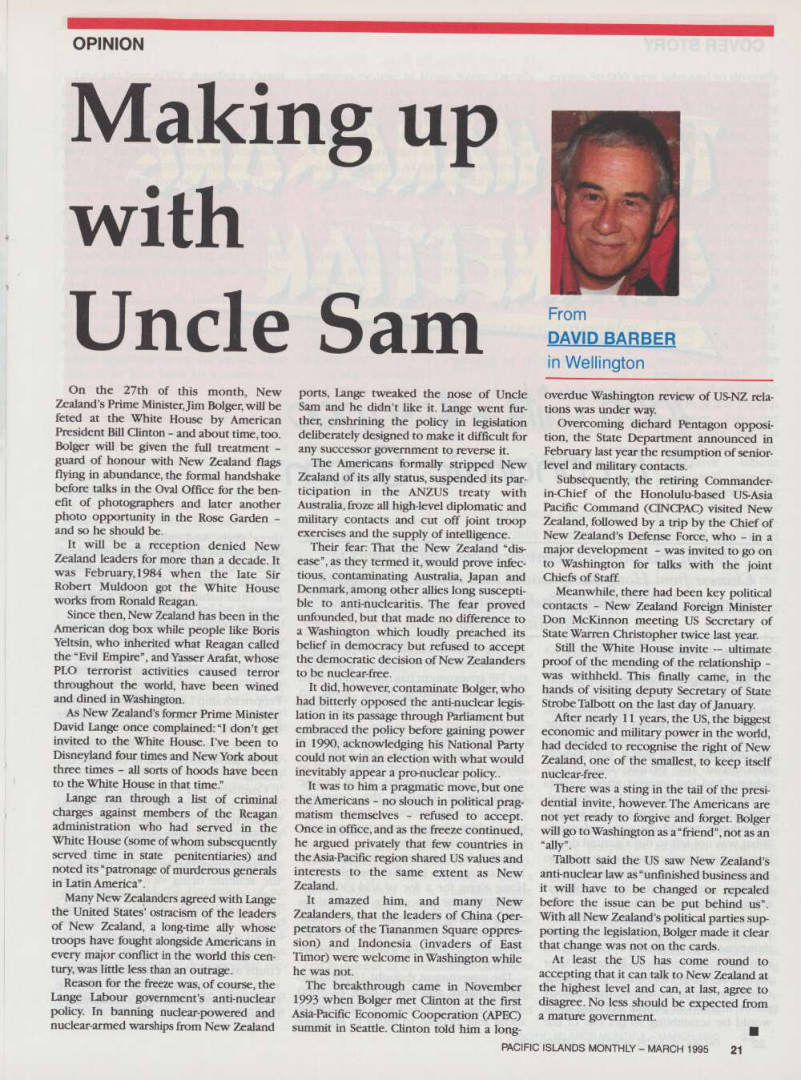
On the 27th of this month, New Zealand’s Prime Minister, Jim Bolger, will be feted at the White House by American President Bill Clinton - and about time, too.
Bolger will be given the full treatment guard of honour with New Zealand flags flying in abundance, the formal handshake before talks in the Oval Office for the ben efit of photographers and later another photo opportunity in the Rose Garden and so he should be.
It will be a reception denied New Zealand leaders for more than a decade. It was February, 1984 when the late Sir Robert Muldoon got the White House works from Ronald Reagan.
Since then, New Zealand has been in the American dog box while people like Boris Yeltsin, who inherited what Reagan called the “Evil Empire”, and Yasser Arafat, whose PLO terrorist activities caused terror throughout the world, have been wined and dined in Washington.
As New Zealand’s former Prime Minister David Lange once complained: “I don’t get invited to the White House. I’ve been to Disneyland four times and New York about three times - all sorts of hoods have been to the White House in that time.”
Lange ran through a list of criminal charges against members of the Reagan administration who had served in the White House (some of whom subsequently served time in state penitentiaries) and noted its “patronage of murderous generals in Latin America”.
Many New Zealanders agreed with Lange the United States’ ostracism of the leaders of New Zealand, a long-time ally whose troops have fought alongside Americans in every major conflict in the world this cen tury, was little less than an outrage.
Reason for the freeze was, of course, the Lange Labour government’s anti-nuclear policy. In banning nuclear-powered and nuclear-armed warships from New Zealand
ports, Lange tweaked the nose of Uncle Sam and he didn’t like it. Lange went fur ther, enshrining the policy in legislation deliberately designed to make it difficult for any successor government to reverse it.
The Americans formally stripped New Zealand of its ally status, suspended its par ticipation in the ANZUS treaty with Australia, froze all high-level diplomatic and military contacts and cut off joint troop exercises and the supply of intelligence.
Their fear: That the New Zealand “dis ease”, as they termed it, would prove infec tious, contaminating Australia, Japan and Denmark, among other allies long suscepti ble to anti-nuclearitis. The fear proved unfounded, but that made no difference to a Washington which loudly preached its belief in democracy but refused to accept the democratic decision of New Zealanders to be nuclear-free.
It did, however, contaminate Bolger, who had bitterly opposed the anti-nuclear legis lation in its passage through Parliament but embraced the policy before gaining power in 1990, acknowledging his National Party could not win an election with what would inevitably appear a pro-nuclear policy..
It was to him a pragmatic move, but one the Americans - no slouch in political prag matism themselves - refused to accept.
Once in office, and as the freeze continued, he argued privately that few countries in the Asia-Pacific region shared US values and interests to the same extent as New Zealand.
It amazed him, and many New Zealanders, that the leaders of China (per petrators of the Tiananmen Square oppres sion) and Indonesia (invaders of East Timor) were welcome in Washington while he was not.
The breakthrough came in November 1993 when Bolger met Clinton at the first Asia-Pacific Economic Cooperation (APEC) summit in Seattle. Clinton told him a long-
overdue Washington review of US-NZ rela tions was under way.
Overcoming diehard Pentagon opposi tion, the State Department announced in February last year the resumption of senior level and military contacts.
Subsequently, the retiring Commander in-Chief of the Honolulu-based US-Asia Pacific Command (CINCPAQ visited New Zealand, followed by a trip by the Chief of New Zealand’s Defense Force, who - in a major development - was invited to go on to Washington for talks with the joint Chiefs of Staff.
Meanwhile, there had been key political contacts - New Zealand Foreign Minister Don McKinnon meeting US Secretary of State Warren Christopher twice last year.
Still the White House invite ultimate proof of the mending of the relationship was withheld. This finally came, in the hands of visiting deputy Secretary of State Strobe Talbott on the last day of January.
After nearly 11 years, the US, the biggest economic and military power in the world, had decided to recognise the right of New Zealand, one of the smallest, to keep itself nuclear-free.
There was a sting in the tail of the presi dential invite, however. The Americans are not yet ready to forgive and forget. Bolger will go to Washington as a “friend”, not as an “ally”.
Talbott said the US saw New Zealand’s anti-nuclear law as “unfinished business and it will have to be changed or repealed before the issue can be put behind us”.
With all New Zealand’s political parties sup porting the legislation, Bolger made it clear that change was not on the cards.
At least the US has come round to accepting that it can talk to New Zealand at the highest level and can, at last, agree to disagree. No less should be expected from a mature government.
From
David Barber
in Wellington
Chinese from Hong Kong would take care of the sluggish

Cover Story
The Fiji government is convinced opening its doors to Chinese from Hong Kong would take care of the sluggish economy. But, as Yunus Rashid points out, the equation doesn’t quite add up.
On January 18, 1995, Fiji’s Cabinet approved a scheme to ‘import’ thousands of people from Hong Kong. This would, according to a select group of Cabinet ministers, give Fiji’s ailing economy the shot in the arm it needed. But within a month of the approval being given, government announced the people behind the scheme had lost interest after changes were made to the initial proposal.
Government went further to suggest the scheme would die a natural death.
What was not left to die a natural death, however, was government’s intention to continue exploring other avenues of granting asylum to the “political refugees” from Hong Kong.
Contrary to expectations, public dis pleasure with the scheme had not dampened government’s enthusiasm that there was money to be made. After all, it believes, in 1997 when Hong Kong reverts to China from its crown colony status, millions of people in Hong Kong would be scrambling to get out of the
clutches of communism - especially if their fortunes were threatened. What the Fiji government has overlooked is an agreement allowing Hong Kong to retain its capitalist system for 30 years after 1997.
The government, convinced that a scheme which would sell rights to reside in Fiji would have mass appeal in the colony, has given Asia-Oceanic Development Limited, the company which made the proposal, three months to consider changes government made to the original submission.
AODL had proposed settling, over a 10-year period, 130,000 people from Hong Kong for a fee of US$l3O,OOO - US$3O,OOO for processing applications and providing the necessary documen tation, and US$lOO,OOO to go towards an investment fund to boost economic activity in Fiji.
The government thought 150,000 too high a figure and cut it back to 7000 ‘units’ or families, each comprising about four people, to move to Fiji over
three years. And rather than offer resi dency status, the Fiji government decid ed it would offer five-year work permits, with an option to extend it and apply for citizenship under the country’s existing Immigration laws.
While AODL ponders the changes, a new player enters the field - a consor tium between one Arex Communications Company Limited of Japan and Venture Australia Proprietorship Limited of Australia - and proposes a scheme, it feels, is better than the AODL offer.
Cabinet has put this on hold, saying it would allow AODL time to consider the
changes.
Confused? So is everyone in Fiji from parliamentarians to government backbenchers to ministers. Even those ministers who have given their whole hearted backing to the scheme are shy ing away from the media. The reason for the scheme being viewed with suspi cion is that so little is known about it.
Information from government has been scant.
The idea of importing Chinese was first mooted following the military coups of 1987 to replace ethnic Indians, who began migrating out of Fiji. The idea was never seriously considered by the government then.
Late last year, AODL dangled a carrot, to the tune of US$9lO million, before some Cabinet ministers who took the proposal to Cabinet in January and fought to the hilt to have it approved.
Without proper research and consulta tion, a Cabinet sub-committee recom mended the project be approved (with some amendments). What was funny about the whole thing was that many ministers did not know what they had agreed to and the Minister for Home Affairs, Paul Manueli, who chaired the sub-committee, reportedly agreed under protest.
When PIM sought clarification and explanation of the programme from Manueli, it was told no information would be forthcoming because the whole thing was very confidential. Since then, there have been no answers, only more questions.
Attempts to trace the AODL and its directors failed. The company was not registered in Fiji. Its representative in Fiji - one Jerry Nacoke - then said it was a Hong Kong-based company. Searches for registration of the company there revealed nothing. It was then supposed to be registered somewhere else. He would not say where. Then again it was in the process of being registered.
A K.K. Mak, reportedly from Hong Kong, was named as AODL’s representa tive there. But no one seems to know exactly who he is.
How did Cabinet get led by the nose to approve something that was shroud ed in so much secrecy? Why did govern ment make a decision on something which had not been thoroughly researched? Could it be the government had been taken for a ride? And, in an effort not to lose face, government stood by and defended its decision in the opposition?
Finally, in response to PIM questions, a government official, speaking on behalf of Cabinet, tried to answer them.
He said government’s biggest worry for now was to create jobs for the thou sands of school leavers. An influx of about 28,000 Chinese with their invest ment funds would do this, it believed.
Based on this assumption, the spokesman said the “intrusion of an additional 20-odd thousand Chinese immigrants over a period of 10 years (although the period of intake is intend ed for three years only) would not impact greatly on the demographic pic ture of the country”.
And the company? The spokesman described AODL as a group of reputable
business people in Hong Kong. Details of directors were known to govern ment, along with their referees in the Hong Kong government. In the same statement, the spokesman said: “Asia- Oceanic represents a group of individ ual businessmen.As far as government is concerned, it is dealing with an interest ed group of people and they could easi ly be individuals and it would still be perfectly legal for government to talk to them. Government, however, would require, when the formal agreement is signed, that the other party is a proper
legal entity”.
Was the govern ment continuing talks without know ing if they were a legal entity?
On the possibility of criminal elements coming into the country as migrants, the spokesman said this would not hap pen because the applicants would be thoroughly screened?
He failed to explain how they would be screened.
Yet another flaw in the whole deal is the price tag for a work
‘This rise in unemploy ment is government’s
single biggest concern for
the immediate future of
this country.’
- Government spokesman explaining why the decision was made
permit in Fiji. The scheme requires the applicants to pay $130,000 before being given a work permit for five years.
There are cheaper alternatives to Fiji available, from countries like Australia and New Zealand.
If, as the spokesman said, the appli cants are business people, then their business sense would dictate they go elsewhere and not to Fiji where the economy is sluggish and chances of return on investment are slim.
It is worth noting government is con fident the applicants (who have yet to apply) are “respectable business peo
ple”.
Assuming 7000 units of four people arrived on Fiji’s shores, each unit would have to spend, apart from the $130,000, about $lOO,OOO to $130,000 to buy a home, $20,000 on a car and some $15,000 to travel to Fiji. The immediate price tag for the five-year work permit would be more than s3oo,ooo.After this what? He would need to plough in sev eral hundreds of thousands of dollars to start a business and create employment.
Government has repeatedly said the plan is to revitalise the economy and
create 50,000 new jobs and to diversify the economy’s base. It all seems like child’s play. Get 7000 Hong Kong investors and Fiji will become another economic power to reckon with - an economic tiger parallel ro any other Asian country.
But does government realise the suc cess of Hong Kong is not )ased on the fact that Chinese live there, but on its strategic position in the international trade market. It does not have to import raw materials from thousands of kilome tres away. It has no shipping problems. It sells to a large local population and a
vast external popula
tion nearby. It enjoys
cheap labour. And, above all, it is com petitive in the export market?
Where then is the comparison between Fiji and Hong Kong? Fiji has a small population, expensive labour rates, will have to import almost every raw material for any type of mass produc tion and then export it because the local market is too small, and is situated in the
middle of nowhere.
These are the impracticalities of industrialising Fiji.
The demographic impact would be equally bad. Fiji would need 20 schools (on the basis of two children per migrant family and an average of 700 students per school) , more roads, more and bigger ports, more hospitals, more housing schemes and more of almost
everything else?
And that is not all. Having invested their money into the fund, which would be handled by government for invest ment purposes, what are the 7000 units and their spouses expected to do? Get
jobs by replacing locals? How would
these people be expected to survive, having spent close to $300,000 on just getting started in Fiji? What industries would the government start and how would it ensure they would be viable?
The Hong Kong Chinese deal is noth ing more than a big question mark.
Whatever government’s intentions are in the importation of Hong Kong Chinese, it would be fair to say the pro ject would create social and economic problems too great to fathom. ■
Advertisements & other items, p. 24 (1 item)
Pacific Islands Yearßook
Available Soon
17th Edition
Price
AUD
00 23S E
PLUS
POSTAGE
Leam more about the Pacific
culture!custom tradition!people
population, tourism, trade, airlines, tax system etc. i ->C- Yes, send me the latest copy of the Pacific Islands Year Book □ Here is a cheque/money order □ Visa □ Master Card Card Number Name Signature ...
Address Post to: Pacific Islands Monthly, PO Box 1167 Suva, Fiji or Fax (679) 303809.
Expiry Date
taxing
Business
A
business
The region's tax haven, Vanuatu, grapples with teething problems associated with a new tax structure
By Patrick Decloitre
message that they did not want to hear about income tax for themselves or their companies. Some business leaders even threatened to pull their businesses out of the country or to mass sack their work force.
Early this year, more than 60 business people (including retailers and whole salers of all sizes) petitioned the govern ment to delay implementing the tax, calling for discussions between the gov ernment and the private sector over the next three months to look at “alternative methods of raising revenue”. The peti tion also expressed “grave concern” and predicted an inflation would actually increase 15 to 18 percent this year as a result of the tax.
But the government went ahead and implemented the scheme anyway. And its effect started to show in the new prices - which rose by more than four percent.
Some businesses, for instance, which were paying a three-percent tax under the previous scheme were passing on a four-percent increase to their cus tomers, even though their actual increase was only one percent.
Port Vila taxi and bus operators held meetings in early January and decided the 70-vatu (US63 cents) urban bus fare would be increased to 100 vatu (US9O
Since the introduction of a four-per cent turnover tax for some businesses from January 1, prices in Vanuatu have hit the ceiling. The government is trying to explain the correct way of applying the new tax ... but business people see
it differently.
The tax was passed in parliament last year as part of a scheme to make busi ness turnover taxes more uniform.
This was the first step to broaden the fiscal base and to shift away from depen dence on import duties for revenue.
The implementation of the new tax also follows recommendations of Australian-funded tax expert Neil Warren, who was in Vanuatu last year to assess its tax structure. Warren pro duced a report recommending a wider tax system, which Prime Minister Maxime Carlot’s government has yet to
implement.
Reaction to the new tax from the busi ness community was strong. In a coun try which is known as a tax haven and has no income tax, companies were uptight about the very idea of a tax. As early as last year, when Warren was in Vanuatu and began consulting with the business people, he received a clear
cents) - a 42.8 percent increase.
The Land Transport Board intervened and advised the public not to pay the new fare as it was not the approved rate. The bus association replied it had taken into account, among other things, an increase in road worthiness inspec tion fees.
The Vanuatu Price Control Unit has held meetings with the business com munity in Port Vila and the northern town of Luganville, explaining that prices had to be marked up by four per cent only, but without success.
Principal Price Control Officer Joseph Tor said prices had changed a lot in Luganville, too. For instance, the price of a can of imported beer had gone up from 200 to 250 vatu - a 25-percent increase. Tor gave the northern town’s business community until this month to straighten out its pricing.
The Opposition Vanuaaki Pati described the situation as “price control out of control”, prompting a nationwide radio statement from Finance Minister Willie Jimmy, followed by one from Carlot.
“I don’t like paying taxes. Nobody likes paying taxes ... The reasons my government introduced the four-per cent tax were given at length while the bill was being submitted in parliament and reiterated by the Minister of Finance ...and I fully support his posi tion,” Carlot said. He added Vanuatu’s taxation system was “one of the laxest and most liberal in the world and is based on mutual trust between taxpay ers and government departments”.
“My government is fully aware of the inflationary potential but I consider the risk is insignificant compared to the benefits of the four-percent levy,” he said. “Let us stop whining and try to be more objective. We should give more thought to the tax’s beneficial effects.
The four-percent levy will increase pub lic sector revenue, and when there is increased revenue, there is also
increased spending ... (in) public sector
investment and ... more jobs and ... increased consumption.
“The private sector should not oppose and abuse the system, especially
by pushing the inflationary effects to
the extreme,” he stressed.
However brave the government’s stand might be, the consumer has so far been given little or no say in this battle between the government and the busi ness community. The only good thing for the consumer was the government rec ommendation that minimum wages in urban areas be increased from US$ll7 to US$l79 a month.
It is, after all, an election year. ■
Advertisements & other items, p. 26 (1 item)
being togethei^
I
VISIT
v SOUTH
PACIFIC
EAR '95
Solomon Islands Post will be issuing souvenir stamp sets to coincide with Visit South Pacific Year ’95.
S ° L °Mo N
o ES
OF bh y S 2 IS .^
ff'°rno n
lsl ond c E'R m Solomon Islands Solomon Islands ; Solomon Islands E'R i iiuhiidi mp&inpor 70c Solomon Islands E'R p**» 70c : E'R 70c Solomon Islands : Solomon Islands E'R 70c : E'R (Sfe «Ef3aEJOM994 ; sb 70c : E'R 70c Solomon Islands Solomon Islands ; Solomon Islands It A 70c ; E'R • VttpiUo ftloh t hitx 70c : E-R
sl.lo *
Ml dvooafc y ,7«» $1 ER \ ' \,, „. i\K>N islands : *I- 1 -
SOLOMON ISLANDS . SOL
+<oopther iS(.
being togethei^
For more information on the stamps of the Solomon Islands write to: Solomon Islands Philatelic Bureau, Ministry of Posts & Communications, GPO Box G3l, Honiara, Solomon Islands.
Abusing
the system
Vanuatu ’s Finance Minister, Willy Jimmy, discusses his concerns with Patrick Decloitre as his government revises the tax structure
PIM: It seems that since the introduction of the new four-percent turnover tax, some businesses have increased their prices more than they should have.
WJ: I think what is going on in Vanuatu at the moment, related to the four percent on turnover, is that business people are abus ing (it) and assisting in creating high infla tion. As a result of the introduction of this tax, the business community is no longer honest; it is putting prices up by more than four percent.
PIM: Do you think they are taking advan tage of this new tax to increase their prices much more than they should, and even when they shouldn’t?
WJ: That’s correct. The only categories of business that should be affected are D3a and D3c licence holders - that is, whole salers and retail importers. The others should not apply the four percent tax at all. For example, the kava bars should not be increasing their prices. Even some goods on the local market have started to
apply four-percent increases on locally
grown products. This (the tax) doesn’t affect them at all but they’re taking the opportunity to increase their prices.
The alternative now would be for the big supermaricets and wholesalers to capitalise the four percent on the value of the prod ucts once they are cleared from the wharf.
This is when they should add their four percent and work out their selling price, so that every time they ring up the till, they
should not be saying “four percent govern ment tax”. So, the four percent should be included in the overall cost once and for all.
PIM: Concerns have been raised that this tax will affect the inflation rate this year, with predictions of 15 to 18 percent increases.
WJ: I can see their point. This is exactly where most of the retailers are abusing the system. If an importer imports a bag of rice and wholesales it to a retailer, the four per cent must be included once and for all. I can’t see how it is accumulating. I’m look ing into the possibility of signing an order to enforce all retailers and wholesalers to include the four percent before retailing their goods. There will be an order issued very shortly for wholesalers and retailers to accommodate the four percent, so that it is not charged separately. This could be done in March.
We’ll have to amend the Price Control Act and enable the Price Control Unit to rein force it. This is after parliament sits and reviews all import duties. We should then be able to know exactly how much, say rice or other basic commodities, should be sold for in Vanuatu.
PIM: Do you think the Price Control Unit here has so far been able to ensure prices arc not going out of hand?
WJ: We can’t do very much at this stage because wholesalers and retailers also have to take into account import duties
they are paying on products. But if we reduce the duties, this will have to change.
PIM: Is this new four-percent tax the first step towards a new base for revenue col lection in Vanuatu after recommendations last year by Australian expert Neil Warren?
WJ: Yes, this is one of the first recommen dations that we’re trying to implement out of Dr Neil Warren’s report. But, of course, the principal of expanding the tax base in Vanuatu has continuously been pointed out by the International Monetary Fund, the World Bank and the Asian Development Bank. Australian International Development Assistance Bureau-funded expert Neil Warren came up with the same conclusions but these are more precise and transparent.
PIM: What’s next?
WJ: I’m not quite sure I want to reveal that. We’re still working on that with the advisers and technical people from the Department of Rates and Taxes. The gener al idea, in the long run, is to try to do away with our present revenue collection sys tem that is based on customs and import duties.
PIM: So far the tax system in Vanuatu has been heavily reliant on import duties. Will there be a change?
WJ: Exactly. At the moment our govern ment relies heavily on import duties to get revenue. If we shift our revenue collection system to other sources, then the import duties should go down. This is also one of the recommendations of Neil Warren’s report. Some import duties should even be zero percent.
PIM: Some business people here have said an income tax is not Mr because it means only a few people will pay for the whole country. What do you think?
WJ:I don’t understand. These people com plaining are the ones who are making the most income. Most of them have monopo lies. If they pay more, this is good.
Also, I’d like to make it clear that local busi nessmen are taking advantage in saying that because Vanuatu is a tax haven, we cannot possibly introduce this type of tax.
I think this is wrong. A tax haven is an opportunity for foreign companies, off shore companies. That’s what the tax haven is there for.
This is where the problem is; local busi nessmen think that because of this tax haven status, the government cannot intro duce any form of local taxation. This is wrong because tax haven conditions only apply to foreign, exempted companies which have their headquarters in Vanuatu but whose operations are somewhere else.
But local companies have their base here and are operating here, as well. They should be obliged to pay all forms of taxa tion that the Vanuatu government intro duces. ■
freedom


Media
Degrees of
Vanuatu government tries to disprove a Freedom House finding that its media is partly free \ especially in this crucial election year
By Patrick Decloitre
Last year Vanuatu (along with Fiji and Tonga) rated “partly free” in a survey published by Freedom House, a New York-based research organisation, which classified 10 countries of the region as “free”. But since it came to power in December 1991, the Vanuatu govern ment, led by Prime Minister Maxime Carlot, has regularly professed it promot ed freedom of expression and freedom of the Press.
What is the situation really like in Vanuatu in 1995, the year of general elec tions?
Vanuatu’s national media consist main ly of the government-controlled Radio Vanuatu and Vanuatu Weekly newspa per. Radio Vanuatu, an AM station, also has a sister FM station, Nambawan FM 98. The FM station broadcasts only to Port Vila and the town of Luganville and carries music and short news bulletins.
The French-funded TV Blong Vanuatu, which has four-hour daily broadcasts, alternately in English and French, does not carry local news at all - not even international footage it receives every day.
The rest of the non-govemment media are Trading Post, a newspaper, and
newsletters of political parties - like Vanuaaki Pali’s Viewpoints, edited by party coordinator Peter Taurokoto.
Viewpoints, published weekly and print ed on a small duplicating machine, con sists of a half dozen A 4 sheets. It is high ly critical of the government in the party press releases, stories, gossip and satirical poems it prints.
In 1992, former Prime Minister Walter Lini’s National United Party, a then junior partner in the government coalition with the ruling Union of Moderate Parties, published a weekly, Golden Express.
At around the same time, UMP printed another weekly party publication called I’Etoile (The Star). UMP announced in early February it was relaunching Golden Express because it wanted to inform the public about its achieve ments before the general elections later this year.
In addition, the Pacific news agency, Pacnews, moved from Solomon Islands to Vanuatu in 1993, where it puts out sto ries from member media organisations in the region, twice a day. The job, carried out by two journalists, however, does not place any special emphasis on news from Vanuatu.
Other foreign media agencies, radios and newspapers are also represented in
the capital through their correspon dents.
From time to time, Vanuatu media have been banned from covering some issues.
Two years ago, when the UMP-NUP coali tion split, the media were not allowed to carry press releases from the NUP fac tion.
In January this year, the Minister for Public Works, Ambae Amos Bangabiti, said he did not want the radio station to carry any more news about the dangers of volcanic eruptions on his home island because previous warnings, he said, had unnecessarily frightened the people of his constituency.
In an interview with PIM, government spokeswoman Yvette Sam said much had changed since the Carlot govern ment came to power. “Laws have been passed that can confirm the government wants to promote freedom of the Press,” she says.
She also points out that the Government Media Services was changed to Vanuatu Broadcasting and Television Corporation, following an act passed in 1992. “I think the opposition and government alike have access to the press”, although she admits VBTC is still heavily reliant on government funding.
“The government still pays an annual subsidy to VBTC,” she said.
This implies government control of the national radio and weekly. But Sam does not want to term it ‘control’.
“Journalists in the region call this gov ernment control of the media but I don’t agree. The government simply wants to make sure its views are carried in any story which talks about government mat ters. This is not control. We think all jour nalists should do this. This is their responsibility to check they have both sides of the story. Unfortunately, some of them don’t do this of their own initia tive, so what we’re doing is reminding them of their responsibility. That’s all we ask,” Sam explains.
She says she is informed of radio head lines daily to see if any news item con cerns the government. “If there is news about us, then we make sure our view is carried too. That’s what some journalists see as control. But sometimes I get the impression some journalists here are printing or airing news which is rumour and has not been checked.”
She said the procedure applied to all
local journalists.
“The government wants freedom of the Press but, at the same time, it has to ensure that our journalists do their jobs properly. You can’t change things overnight. As long as we don’t have real ly well trained journalists, we’ll have to do this. We are responsible for liberalisa
tion of the Press but we also have to be responsible for the impact this can have,” Sam told PIM.
The British High Commissioner in Port Vila,Tom Duggin, recently expressed his views on Vanuatu’s media. He said it was “unfortunate the main media outlets here are government-owned and have tended to become propaganda machines. I don’t mean this in a deroga tory sense but it operates differently to a free independent Press. Last year, Vanuascope, (a bi-lingual newspaper) opened a few eyes by supplying news that was not government controlled and people saw what an independent news paper was all about, with questions raised that were not normally asked and it woke a few people up”.
Ruling UMP party’s Secretary General, Petre Malsungai, estimates this control is still necessary in Vanuatu because “our
journalists are not really trained”.
“To say that VBTC is controlled by the government is not true. We need to fur ther train our journalists. Also, sometimes when a political party issues a press release, it is distorted when it comes out on the radio.”
As a result some journalists now do not want to take any chances; they sim ply read or print press releases verbatim.
“They sometimes think freedom of expression allows them to say some thing else than what the release says.
Many times this leads us to ask which side they are on,” Malsungai says.
He admits control of VBTC will be tighter this election year. “But other newspapers will not be controlled, even if the government does not like what they say. We’ll respect freedom of the Press.
“The Vanuaaki Pati newsletter has
been attacking us for years and it’s still here,” he says.
Malsungai says his party has already started briefing the government on moves to enforce tighter control of VBTC. “For the Press, we should do it soon because it’s very important for this election year ... But other parties will have the right to speak, this has hap pened under past governments,” he says.
In the meantime, moves are already underway which seem to indicate the government is preparing for this critical election - former deputy Director of VBTC, Kaltau Ayong, was promoted in early January to the position of Third Secretary in the Prime Minister’s Office (the office directly responsible for the media). It has not been stated what his job will be but his background in the media is likely to be put to use.
The Trading Post experience
Mark Neil-Jones, the Australian publisher of Trading Post, explains his approach has been completely different to what has been done by other publications. When he took over Trading Post in April 1994, he started by securing advertising revenue through classified ads, which was what the paper was originally all about. He then introduced ‘social pictures’ - lots of them - showing expatriates at parties in Port Vila, a gossip page and entertainment news from around the world. With a mostly expatriate readership, Neil-Jones now claims “huge advertising support and more expatriates now read the Trading Post than the (government-run) Vanuatu Weekly" (although readers complain about the spelling mistakes).
Nonetheless, for the past three months, Neil-Jones has ven tured into incorporating local news (including political) into his publication with the help of a local journalist who once edited former Prime Minister Walter Lini’s National United Party’s Golden Press.
“We are taking a chance because no independent newspaper has ever been so successful in Vanuatu. The publisher of Tam Tam was deported under the Lini government for publishing anti-government views and last year, the bilingual paper, Vanuascope, closed through lack of advertising revenue.
“The Vanuatu Weekly still loses money and is heavily sup
ported by government funds.
“We were under strong pressure to add local news and make it into a proper newspaper, which we have done, and we have increased our circulation to 2000 very quickly.
“The government of Vanuatu has been very supportive of our efforts, despite it being an English newspaper, and we have had no interference on editorial (content). It is a very positive sign that freedom of the Press is genuinely being pursued by the Vanuatu government and we are confident the Trading Post will continue to grow and offer independent news to the gen eral public,” Neil-Jones said in a self-promoted press release in January.
But he later found things weren’t that rosy. He told PlMMt’s extremely difficult to get government news and press releases.
Because people are so used to dealing with the government
newspaper, they only send things to them.”
On a more sensitive issue, he said he was careful about what he or his staff wrote. “Our policy is not to attack the govern ment - to question it, yes, but not to attack it.
“I’m a foreigner. I can’t be seen to be supporting a party. Any accusation that I may be running an anti-government newspa per is ridiculous, it’s ludicrous.”
He reveals he sends a copy of every story he thinks has any direct relation to the government to government spokesper son and Prime Minister’s private secretary,Yvette Sam.
“To date we’ve had no negative comment from her; we have a good relationship with this government. We’re trying very hard to walk a straight line. It’s an educational process.We now have more freedom than we had before but we still don’t have enough.”
Neil-Jones feels one of his stories about the deportation of three expatriates in January had irritated some high-ranking government officials. “If the government doesn’t want me to publish local news. I’m happy not to run any more local news.
We’re only doing it because Vanuatu needs freedom of the Press.”
But it is certainly not detrimental to his newspaper’s circula tion figures either.
A top official in the Prime Minister’s office said, however, that although Trading Post enjoyed a good relationship with indi viduals in his office, “he shouldn’t look for news in the dust bins” to be “too sensational”. The same source points out Neil- Jones had been reminded the government promoted newspa pers in both French and English.
But Neil-Jones says it doesn’t make financial sense and since most of his readers are English-speaking, he stays with English.
“No newspaper in Vanuatu has ever made money running both French and English stories. The government’s Vanuatu Weekly has to carry French, English and bislama (pidgin), so two thirds of the paper is not read,” he says.
If all goes well, Neil-Jones intends to boost his Trading Post into a bi-weekly before the end of this year and to distribute it in the northern town of Luganville.
Advertisements & other items, pp. 30-31 (1 item)
rugged reliability, elegant luxury...
T: H c 4 ? 1 . j •«^ivy e^ess
Toyota Land Cruiser offers you more
and long-lasting durability.
Land Cruiser’s reputation is second to none. No one doubts its rugged constitution. Yet here is a vehicle that rivals the finest limousines where comfort is concerned. And its fit and finish, the attention to detail, and the graceful lines and fine trim are reminiscent of exquisite luxury cars.
Nevertheless, hidden beneath its elegance, Land Cruisers still offer tough ladder frames and suspension engineered to go wherever you wish... in total comfort powered by your choice of 4.5-litre petrol or 4.2-litre diesel engines. And everything is carefully protected from rust and corrosion so it lasts longer.
Toyota Land Cruiser. The best for your world.
Now and forever.
DISTRIBUT ORS /DEALERS
AMERICAN SAMOA BURNS PHILP MOTORS PH 633-4281 GUAM & MICRONESIA ATKINS KROLL, INC. PH 646-1876/9
NORFOLK ISLAND BORRY’SPTYLTD. PH 22114
SOLOMON ISLAND ELA MOTORS PH 30746
VANUATU ASCO MOTORS PH 22341
COOK ISLANDS PACIFIC MOTORS LTD PH 20796
KIRIBATI TARAWA MOTORS PH 21090
PAPUA NEW GUINEA ELA MOTORS PH 229400
TAHITI NIPPON AUTOMOTO PH 429819
WESTERN SAMOA ASCO MOTORS PH 23664
FIJI ASCO MOTORS
NEW CALEDONIA S.I.A.P.
SAIPAN MICROL CORPORATION
TONGA ASCO MOTORS
- ■ A i m «P 9 ■ ;.^s -j ■ $ m SKt ' %mm.
OTA
i* 1 1
LAND CRUISER
WINCH
IBSTI
LAND CRUISER
* . ■""• ’ , Sv.' : V. Af” 7 * :>; *• f^ftsass. nxaci reaiures ana speancations may vary depending on country of purchase. Please check with your nearest TOYOTA distributor/dealer for details.
PH312666 PH 275562 PH 234-5911 PH 23500
® TOYOTA
priorities

Opinion
When it's a matter of
The United Nations summit on social issues will have ended in Denmark by the middle of the month. The World Social Summit - from March 6-12 in Copenhagen - was about tackling, on a global scale, social issues such as pover ty, unemployment and social integration (or disintegration).
At the time of printing, a strong dele gation from Pacific island countries was being put together to attend the sum mit. Their participation was co-ordinat ed by the Noumea-based South Pacific Commission with joint technical sup port from the South Pacific Forum Secretariat.
The joint support is part of continuing efforts to ensure issues of concern to the Pacific are given the international attention they deserve. Pacific delegates are aware they face an uphill battle in enlisting additional support from exter nal sources. Global political changes continue to work against them. And there is no indication this will change in the foreseeable future.
However, for the Pacific, the idea is too keep reminding the world that island countries also face poverty, unemploy ment and social disintegration. Arguably, these manifest in varying degrees but they are here and throughout the world - in developed and developing coun tries.
The difference is that wealthy nations have the resources to tackle, or even eradicate, these problems in their coun tries. Developing countries - including those in the Pacific - do not.
The lot of the latter is even gloomier as prospects for getting additional resources, including aid funds, are not so rosy.
However, Copenhagen provides a use
ful stage to continue the dialogue and the need for partnerships in trying to solve or alleviate some of the problems.
The biggest problem of developing countries, including those in the Pacific, is that donors now say there is no more they can give. Developing countries, they say, will just have to make do with the development assistance (or aid) they are getting.
On the other hand, developing coun tries insist that no programme of action would work if additional funding is not forthcoming. Unless additional resources are available, efforts to tackle emerging social problems, or any other problems, are destined for failure, they say.
As in all previous UN conferences, the dilemma for Pacific island countries is one of competing demands.
Perhaps the greater threat to the Pacific cause at the Social Summit was from Eastern bloc countries, otherwise known as the ‘economies in transition’.
Western countries continue to inject massive amounts of funds in the name of development assistance or aid.
The aim, Western countries say, is to help stabilise the fledgling political makeups in these former Soviet republics so the democracies survive the rigors of adjustment.
Investment in these economies in transition have a brighter prospect for returns or profits than traditional assis tance to developing countries. The end result is to help transform the centrally planned system to a market economy in those countries.
Of course, there is nothing wrong with assisting Europe. Except that aid for development assistance should not be confused with investments. As it is,
aid is increasingly taking on a new meaning. It is now the euphemism for investment. It looks good on paper but it is not genuine.
It seems Western countries are taking this approach to camouflage their fail ure to honour commitments to help developing countries.
For instance, at the Earth Summit in Rio de Janeiro in 1992, developed coun tries pledged to provide 0.7 percent of their GDP in foreign aid to developing countries. Four years on, the Secretary General of the United Nations, Dr Boutros Boutros Ghali, told delegates at the UN Population Conference in Cairo that many developed countries had defaulted. Instead of making amends, wealthy nations now insist developing countries adjust their priorities to accommodate failing support pledged by their rich cousins.
Pacific delegations have always argued that whatever the degree of sacrifice, it must be shared by both the developed and developing countries.
“It is not fair to ask developing coun tries to give up so much when the other side of the equation is not prepared to forego even an iota,” one official said.
If anything, this is where the battle line is drawn. Perhaps it would be unfair to pre-empt the outcome of the World Social Summit on the subject of addi tional funding alone.
There is no doubt the summit would have been an eye-opener on the enor mity of these social problems and the resources needed to deal with them.
Many, including Pacific delegates, would have been grateful for the staging of the Copenhagen summit.
From
Alfred Sasako
at the Forum Secretariat
Boral Gas Pacific
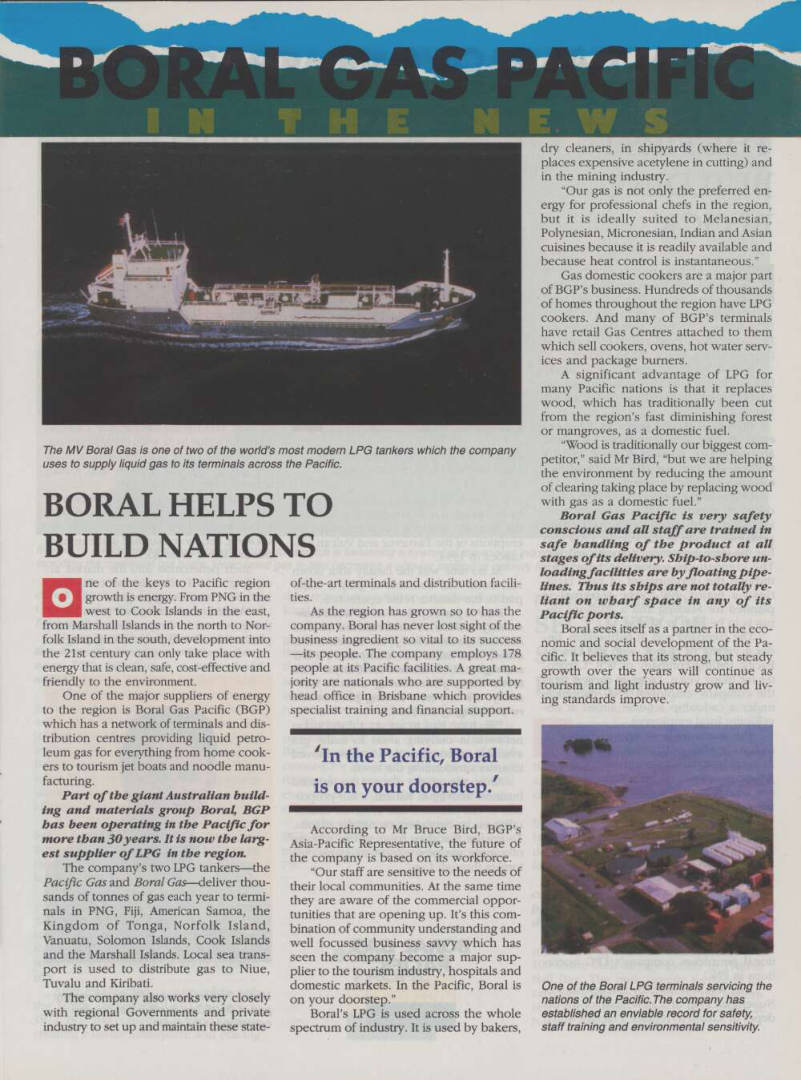
In The News
Boral Helps To
Build Nations
o
ne of the keys to Pacific region growth is energy. From PNG in the west to Cook Islands in the east,
from Marshall Islands in the north to Nor folk Island in the south, development into the 21st century can only take place with energy that is clean, safe, cost-effective and friendly to the environment.
One of the major suppliers of energy to the region is Boral Gas Pacific (BGP) which has a network of terminals and dis tribution centres providing liquid petro leum gas for everything from home cook ers to tourism jet boats and noodle manu
facturing.
Part of the giant Australian build ing and materials group Boral, BGP has been operating in the Pacific for more than 30years. It is now the larg est supplier of LPG in the region.
The company’s two LPG tankers—the Pacific Gas and Boral Gas —deliver thou sands of tonnes of gas each year to termi nals in PNG, Fiji, American Samoa, the Kingdom of Tonga, Norfolk Island, Vanuatu, Solomon Islands, Cook Islands and the Marshall Islands. Local sea trans port is used to distribute gas to Niue, Tuvalu and Kiribati.
The company also works very closely with regional Governments and private industry to set up and maintain these state
of-the-art terminals and distribution facili ties.
As the region has grown so to has the company. Boral has never lost sight of the business ingredient so vital to its success —its people. The company employs 178 people at its Pacific facilities. A great ma jority are nationals who are supported by head office in Brisbane which provides specialist training and financial support.
'in the Pacific, Boral is on your doorstep/
According to Mr Bruce Bird, BGP’s Asia-Pacific Representative, the future of the company is based on its workforce.
“Our staff are sensitive to the needs of their local communities. At the same time they are aware of the commercial oppor tunities that are opening up. It’s this com bination of community understanding and well focussed business savvy which has seen the company become a major sup plier to the tourism industry, hospitals and domestic markets. In the Pacific, Boral is on your doorstep.”
Boral’s LPG is used across the whole spectrum of industry. It is used by bakers,
dry cleaners, in shipyards (where it re places expensive acetylene in cutting) and in the mining industry.
“Our gas is not only the preferred en ergy for professional chefs in the region, but it is ideally suited to Melanesian, Polynesian, Micronesian, Indian and Asian cuisines because it is readily available and because heat control is instantaneous.”
Gas domestic cookers are a major part of BGP’s business. Hundreds of thousands of homes throughout the region have LPG cookers. And many of BGP’s terminals have retail Gas Centres attached to them which sell cookers, ovens, hot water serv ices and package burners.
A significant advantage of LPG for many Pacific nations is that it replaces wood, which has traditionally been cut from the region’s fast diminishing forest or mangroves, as a domestic fuel.
“Wood is traditionally our biggest com petitor,” said Mr Bird, “but we are helping the environment by reducing the amount of clearing taking place by replacing wood with gas as a domestic fuel.”
Boral Gas Pacific is very safety conscious and all staff are trained in safe handling of the product at all stages of its delivery. Ship-to-shore un loading facilities are by floating pipe lines. Thus its ships are not totally re liant on wharf space in any of its Pacific ports.
Boral sees itself as a partner in the eco nomic and social development of the Pa cific. It believes that its strong, but steady growth over the years will continue as tourism and light industry grow and liv ing standards improve.
The MV Boral Gas is one of two of the world's most modern LPG tankers which the company uses to supply liquid gas to its terminals across the Pacific.
One of the Boral LPG terminals servicing the nations of the Pacific. The company has established an enviable record for safety, staff training and environmental sensitivity.
Building
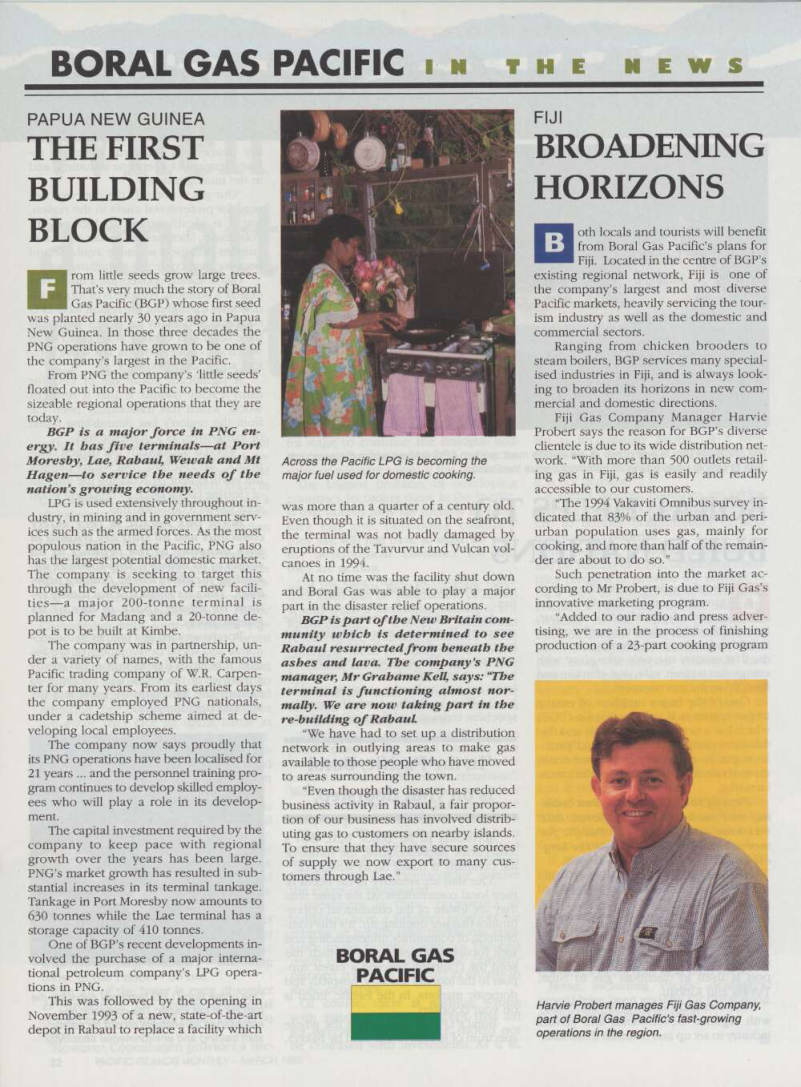
Papua New Guinea
The First
Block
F
rom little seeds grow large trees.
That’s very much the story of Boral Gas Pacific (BGP) whose first seed
was planted nearly 30 years ago in Papua New Guinea. In those three decades the PNG operations have grown to be one of the company’s largest in the Pacific.
From PNG the company’s ‘little seeds’ floated out into the Pacific to become the sizeable regional operations that they are today.
BGP is a major force in PNG en ergy. It has five terminals—at Port Moresby, Lae, Rabaul, Wewak and Mt Hagen —to service the needs of the nation’s growing economy.
LPG is used extensively throughout in dustry, in mining and in government serv ices such as the armed forces. As the most populous nation in the Pacific, PNG also has the largest potential domestic market.
The company is seeking to target this through the development of new facili ties —a major 200-tonne terminal is planned for Madang and a 20-tonne de pot is to be built at Kimbe.
The company was in partnership, un der a variety of names, with the famous Pacific trading company of W.R. Carpen ter for many years. From its earliest days the company employed PNG nationals, under a cadetship scheme aimed at de veloping local employees.
The company now says proudly that its PNG operations have been localised for 21 years ... and the personnel training pro gram continues to develop skilled employ ees who will play a role in its develop ment.
The capital investment required by the company to keep pace with regional growth over the years has been large.
PNG’s market growth has resulted in sub stantial increases in its terminal tankage.
Tankage in Port Moresby now amounts to 630 tonnes while the Lae terminal has a storage capacity of 410 tonnes.
One of BGP’s recent developments in volved the purchase of a major interna tional petroleum company’s LPG opera tions in PNG.
This was followed by the opening in November 1993 of a new, state-of-the-art depot in Rabaul to replace a facility which
was more than a quarter of a century old.
Even though it is situated on the seafront, the terminal was not badly damaged by eruptions of the Tavurvur and Vulcan vol canoes in 1994.
At no time was the facility shut down and Boral Gas was able to play a major part in the disaster relief operations.
BGP is part of the New Britain com munity which is determined to see Rabaul resurrected from beneath the ashes and lava. The company's PNG manager, Mr Grahame Kell, says: “The terminal is functioning almost nor mally. We are now taking part in the re-building of RabauL “We have had to set up a distribution network in outlying areas to make gas available to those people who have moved to areas surrounding the town.
“Even though the disaster has reduced business activity in Rabaul, a fair propor tion of our business has involved distrib uting gas to customers on nearby islands.
To ensure that they have secure sources of supply we now export to many cus tomers through Lae.”
Across the Pacific LPG is becoming the major fuel used for domestic cooking.
Boral Gas
Pacific
Horizons
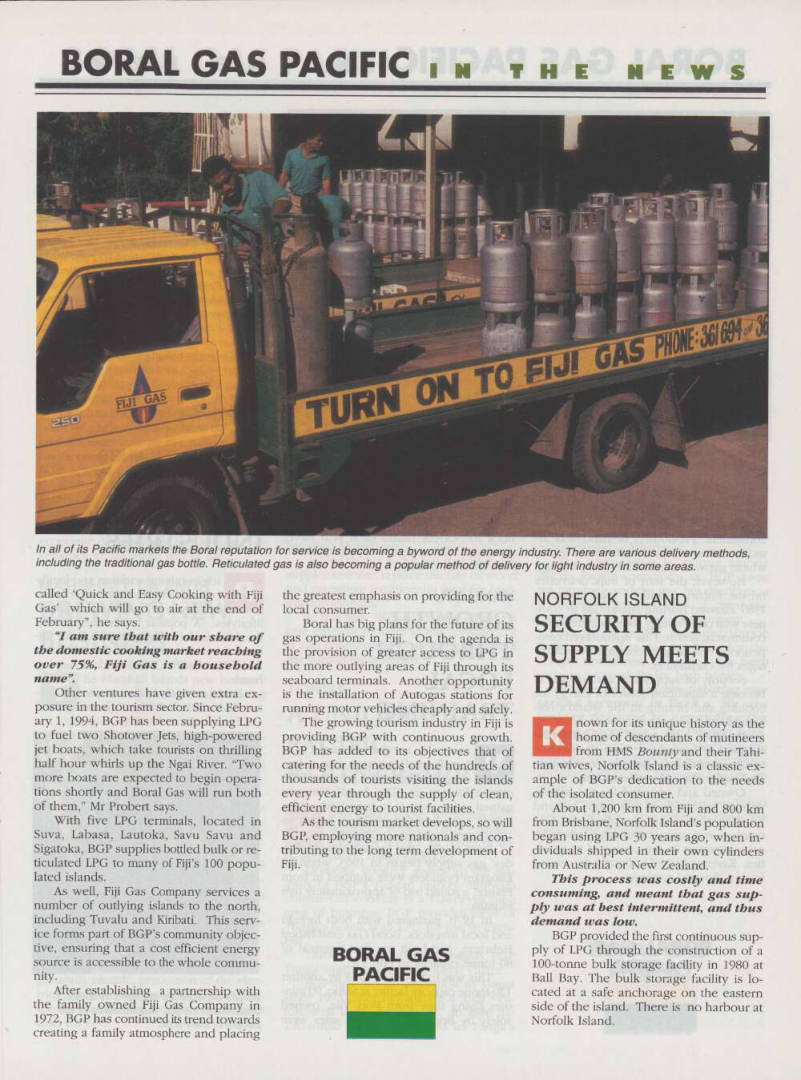
Fiji
Broadening
B
oth locals and tourists will benefit from Boral Gas Pacific’s plans for Fiji. Located in the centre of BGP’s
existing regional network, Fiji is one of the company’s largest and most diverse Pacific markets, heavily servicing the tour ism industry as well as the domestic and commercial sectors.
Ranging from chicken brooders to steam boilers, BGP services many special ised industries in Fiji, and is always look ing to broaden its horizons in new com mercial and domestic directions.
Fiji Gas Company Manager Harvie Probert says the reason for BGP’s diverse clientele is due to its wide distribution net work. “With more than 500 outlets retail ing gas in Fiji, gas is easily and readily accessible to our customers.
“The 1994 Vakaviti Omnibus survey in dicated that 83% of the urban and peri urban population uses gas, mainly for cooking, and more than half of the remain der are about to do so.”
Such penetration into the market ac cording to Mr Probert, is due to Fiji Gas’s innovative marketing program.
“Added to our radio and press adver tising, we are in the process of finishing production of a 23-part cooking program
Harvie Probert manages Fiji Gas Company, part of Boral Gas Pacific's fast-growing operations in the region.
called ‘Quick and Easy Cooking with Fiji Gas’ which will go to air at the end of February”, he says.
“I am sure that with our share of the domestic cooking market reaching over 75%, Fiji Gas is a household name”.
Other ventures have given extra ex posure in the tourism sector. Since Febru ary 1, 1994, BGP has been supplying LPG to fuel two Shotover Jets, high-powered jet boats, which take tourists on thrilling half hour whirls up the Ngai River. “Two more boats are expected to begin opera tions shortly and Boral Gas will run both of them,” Mr Probert says.
With five LPG terminals, located in Suva, Labasa, Lautoka, Savu Savu and Sigatoka, BGP supplies bottled bulk or re ticulated LPG to many of Fiji’s 100 popu lated islands.
As well, Fiji Gas Company services a number of outlying islands to the north, including Tuvalu and Kiribati. This serv ice forms part of BGP’s community objec tive, ensuring that a cost efficient energy source is accessible to the whole commu nity.
After establishing a partnership with the family owned Fiji Gas Company in 1972, BGP has continued its trend towards creating a family atmosphere and placing
the greatest emphasis on providing for the local consumer.
Boral has big plans for the future of its gas operations in Fiji. On the agenda is the provision of greater access to LPG in the more outlying areas of Fiji through its seaboard terminals. Another opportunity is the installation of Autogas stations for running motor vehicles cheaply and safely.
The growing tourism industry in Fiji is providing BGP with continuous growth.
BGP has added to its objectives that of catering for the needs of the hundreds of thousands of tourists visiting the islands every year through the supply of clean, efficient energy to tourist facilities.
As the tourism market develops, so will BGP, employing more nationals and con tributing to the long term development of Fiji.
In all of its Pacific markets the Boral reputation for service is becoming a byword of the energy industry. There are various delivery methods, including the traditional gas bottle. Reticulated gas is also becoming a popular method of delivery for light industry in some areas.
Boral Gas
Pacific
Advertisements & other items, p. 34 (1 item)
BORAL GAS PACIFIC in the news
Security Of
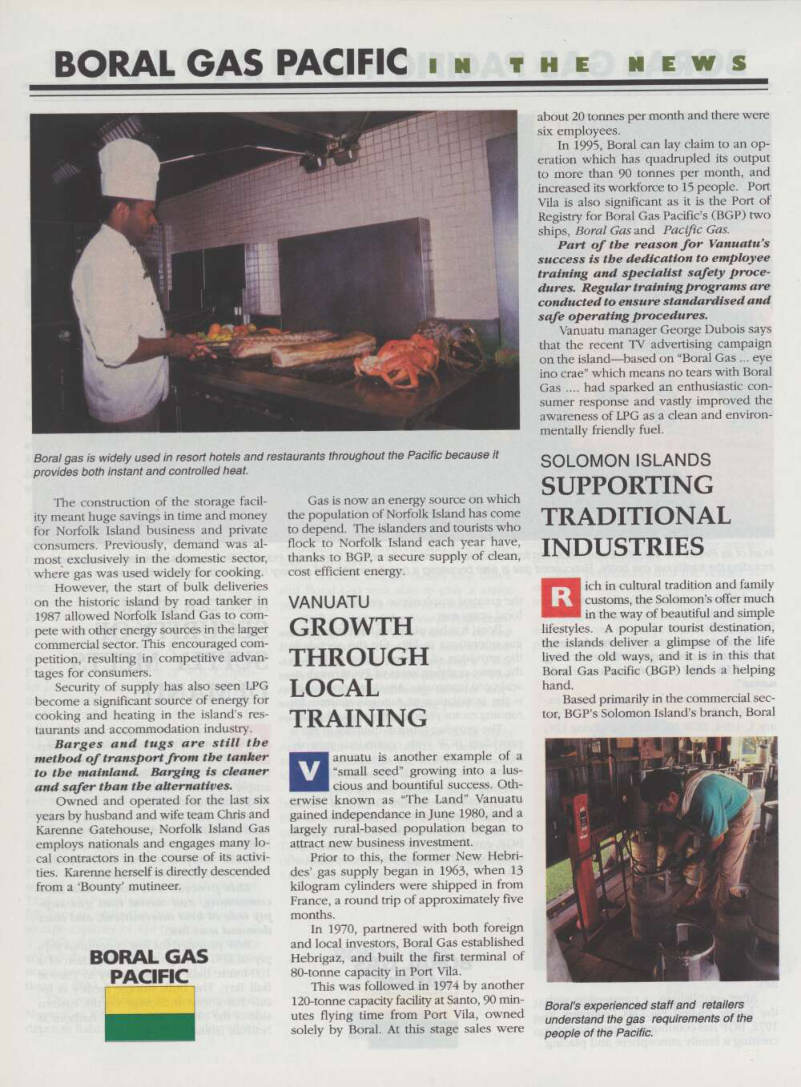
Norfolk Island
Supply Meets
Demand
K
nown for its unique history as the home of descendants of mutineers from HMS Bounty and their Tahi
tian wives, Norfolk Island is a classic ex ample of BGP’s dedication to the needs of the isolated consumer.
About 1,200 km from Fiji and 800 km from Brisbane, Norfolk Island’s population began using LPG 30 years ago, when in dividuals shipped in their own cylinders from Australia or New Zealand.
This process was costly and time consuming, and meant that gas sup ply was at best intermittent, and thus demand was low.
BGP provided the first continuous sup ply of LPG through the construction of a 100-tonne bulk storage facility in 1980 at Ball Bay. The bulk storage facility is lo cated at a safe anchorage on the eastern side of the island. There is no harbour at Norfolk Island.
The construction of the storage facil ity meant huge savings in time and money for Norfolk Island business and private consumers. Previously, demand was al most exclusively in the domestic sector, where gas was used widely for cooking.
However, the start of bulk deliveries on the historic island by road tanker in 1987 allowed Norfolk Island Gas to com pete with other energy sources in the larger commercial sector. This encouraged com petition, resulting in competitive advan tages for consumers.
Security of supply has also seen LPG become a significant source of energy for cooking and heating in the island’s res taurants and accommodation industry.
Barges and tugs are still the method of transport from the tanker to the mainland. Barging is cleaner and safer than the alternatives.
Owned and operated for the last six years by husband and wife team Chris and Karenne Gatehouse, Norfolk Island Gas employs nationals and engages many lo cal contractors in the course of its activi ties. Karenne herself is directly descended from a ‘Bounty’ mutineer.
Gas is now an energy source on which the population of Norfolk Island has come to depend. The islanders and tourists who flock to Norfolk Island each year have, thanks to BGP, a secure supply of clean, cost efficient energy.
Boral gas is widely used in resort hotels and restaurants throughout the Pacific because it provides both instant and controlled heat.
Boral Gas
Pacific
Advertisements & other items, p. 35 (1 item)
Boral Gas Pacific I H The Hews
Growth
Vanuatu
Through
Local
Training
V
anuatu is another example of a “small seed” growing into a lus cious and bountiful success. Oth
erwise known as “The Land” Vanuatu gained independance in June 1980, and a largely rural-based population began to attract new business investment.
Prior to this, the former New Hebri des’ gas supply began in 1963, when 13
kilogram cylinders were shipped in from
France, a round trip of approximately five months.
In 1970, partnered with both foreign and local investors, Boral Gas established Hebrigaz, and built the first terminal of 80-tonne capacity in Port Vila.
This was followed in 1974 by another 120-tonne capacity facility at Santo, 90 min utes flying time from Port Vila, owned solely by Boral. At this stage sales were
about 20 tonnes per month and there were
six employees.
In 1995, Boral can lay claim to an op eration which has quadrupled its output to more than 90 tonnes per month, and increased its workforce to 15 people. Port Vila is also significant as it is the Port of Registry for Boral Gas Pacific’s (BGP) two ships, Boral Gas and Pacific Gas.
Part of the reason for Vanuatu’s success is the dedication to employee training and specialist safety proce dures. Regular training programs are conducted to ensure standardised and safe operating procedures.
Vanuatu manager George Dubois says that the recent TV advertising campaign on the island—based on “Boral Gas ... eye ino crae” which means no tears with Boral Gas ... had sparked an enthusiastic con sumer response and vastly improved the awareness of LPG as a clean and environ mentally friendly fuel.
Supporting
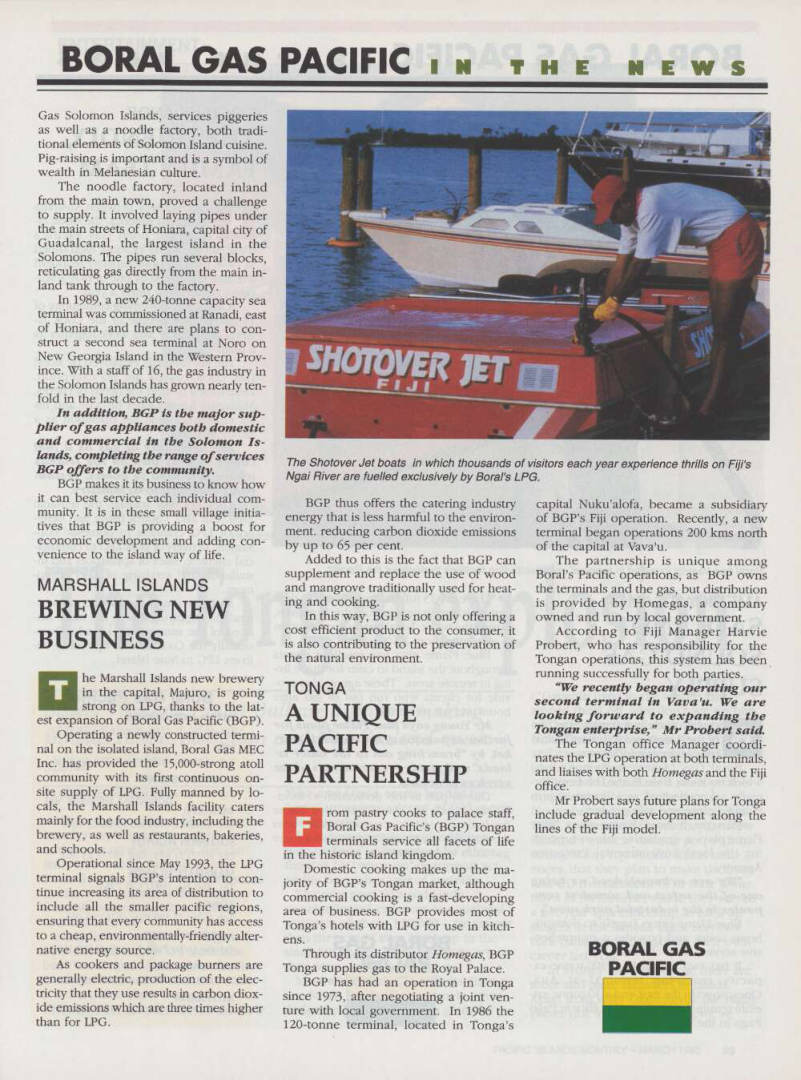
Solomon Islands
Traditional
Industries
R
ich in cultural tradition and family customs, the Solomon’s offer much in the way of beautiful and simple
lifestyles. A popular tourist destination, the islands deliver a glimpse of the life lived the old ways, and it is in this that Boral Gas Pacific (BGP) lends a helping hand.
Based primarily in the commercial sec tor, BGP’s Solomon Island’s branch, Boral
Boral's experienced staff and retailers understand the gas requirements of the people of the Pacific.
Gas Solomon Islands, services piggeries as well as a noodle factory, both tradi tional elements of Solomon Island cuisine.
Pig-raising is important and is a symbol of wealth in Melanesian culture.
The noodle factory, located inland from the main town, proved a challenge to supply. It involved laying pipes under the main streets of Honiara, capital city of Guadalcanal, the largest island in the Solomons. The pipes run several blocks, reticulating gas directly from the main in land tank through to the factory.
In 1989, a new 240-tonne capacity sea terminal was commissioned at Ranadi, east of Honiara, and there are plans to con struct a second sea terminal at Noro on New Georgia Island in the Western Prov ince. With a staff of 16, the gas industry in the Solomon Islands has grown nearly ten fold in the last decade.
In addition, BGP is the major sup plier of gas appliances both domestic and commercial in the Solomon Is lands, completing the range of services BGP offers to the community.
BGP makes it its business to know how it can best service each individual com munity. It is in these small village initia tives that BGP is providing a boost for economic development and adding con venience to the island way of life.
Advertisements & other items, p. 36 (1 item)
BORAL GAS PACIFIC in the news
Brewing New
Marshall Islands
Business
T
he Marshall Islands new brewery in the capital, Majuro, is going strong on LPG, thanks to the lat
est expansion of Boral Gas Pacific (BGP).
Operating a newly constructed termi nal on the isolated island, Boral Gas MFC Inc. has provided the 15,000-strong atoll community with its first continuous on site supply of LPG. Fully manned by lo cals, the Marshall Islands facility caters mainly for the food industry, including the brewery, as well as restaurants, bakeries, and schools.
Operational since May 1993, the LPG terminal signals BGP’s intention to con tinue increasing its area of distribution to include all the smaller pacific regions, ensuring that every community has access to a cheap, environmentally-friendly alter native energy source.
As cookers and package burners are generally electric, production of the elec tricity that they use results in carbon diox ide emissions which are three times higher than for LPG.
BGP thus offers the catering industry energy that is less harmful to the environ ment. reducing carbon dioxide emissions by up to 65 per cent.
Added to this is the fact that BGP can supplement and replace the use of wood and mangrove traditionally used for heat ing and cooking.
In this way, BGP is not only offering a cost efficient product to the consumer, it is also contributing to the preservation of the natural environment.
The Shotover Jet boats in which thousands of visitors each year experience thrills on Fiji's Ngai River are fuelled exclusively by Boral's LPG.
A Unique
Tonga
Pacific
Partnership
F
rom pastry cooks to palace staff, Boral Gas Pacific’s (BGP) Tongan terminals service all facets of life
in the historic island kingdom.
Domestic cooking makes up the ma jority of BGP’s Tongan market, although commercial cooking is a fast-developing area of business. BGP provides most of Tonga’s hotels with LPG for use in kitch ens.
Through its distributor Homegas, BGP Tonga supplies gas to the Royal Palace.
BGP has had an operation in Tonga since 1973, after negotiating a joint ven ture with local government. In 1986 the 120-tonne terminal, located in Tonga’s
capital Nukualofa, became a subsidiary of BGP’s Fiji operation. Recently, a new terminal began operations 200 kms north of the capital at Vava'u.
The partnership is unique among Boral’s Pacific operations, as BGP owns the terminals and the gas, but distribution is provided by Homegas, a company owned and run by local government.
According to Fiji Manager Harvie Probert, who has responsibility for the Tongan operations, this system has been running successfully for both parties.
“We recently began operating our second terminal in Vava'u. We are looking forward to expanding the Tongan enterprise,” Mr Probert said.
The Tongan office Manager coordi nates the LPG operation at both terminals, and liaises with both Homegas and the Fiji office.
Mr Probert says future plans for Tonga include gradual development along the lines of the Fiji model.
Boral Gas
Pacific
Advertisements & other items, p. 37 (1 item)
Boral Gas Pacific In The Hews
Sound Gas
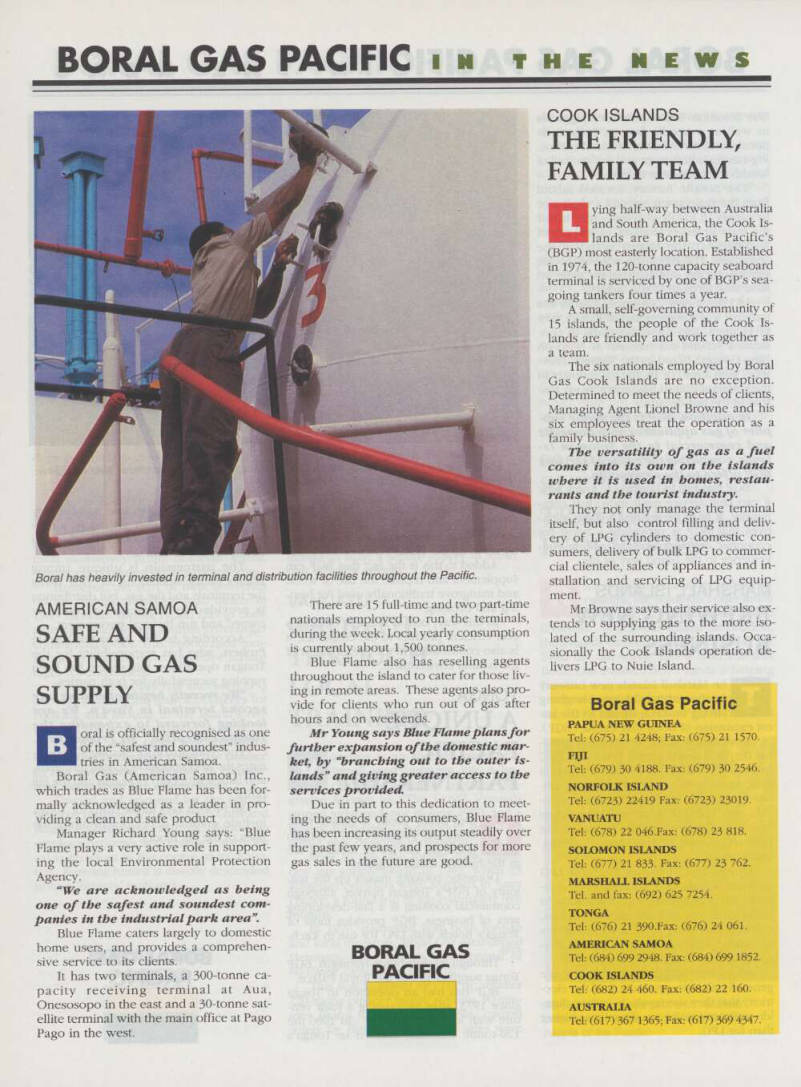
American Samoa
Safe And
Supply
B
oral is officially recognised as one of the “safest and soundest” indus tries in American Samoa.
Boral Gas (American Samoa) Inc., which trades as Blue Flame has been for mally acknowledged as a leader in pro viding a clean and safe product Manager Richard Young says: “Blue Flame plays a very active role in support ing the local Environmental Protection Agency.
“We are acknowledged as being one of the safest and soundest com panies in the industrial park area”.
Blue Flame caters largely to domestic home users, and provides a comprehen sive service to its clients.
It has two terminals, a 300-tonne ca pacity receiving terminal at Aua, Onesosopo in the east and a 30-tonne sat ellite terminal with the main office at Pago Pago in the west.
There are 15 full-time and two part-time nationals employed to run the terminals, during the week. Local yearly consumption is currently about 1,500 tonnes.
Blue Flame also has reselling agents throughout the island to cater for those liv ing in remote areas. These agents also pro vide for clients who run out of gas after hours and on weekends.
Mr Young says Blue Flame plans for further expansion of the domestic mar ket, by “branching out to the outer is lands” and giving greater access to the services provided Due in part to this dedication to meet ing the needs of consumers, Blue Flame has been increasing its output steadily over the past few years, and prospects for more gas sales in the future are good.
Boral has heavily invested in terminal and distribution facilities throughout the Pacific.
Boral Gas
Pacific
The Friendly,
Cook Islands
Family Team
L
ying half-way between Australia and South America, the Cook Is lands are Boral Gas Pacific’s
(BGP) most easterly location. Established in 1974, the 120-tonne capacity seaboard terminal is serviced by one of BGP’s sea going tankers four times a year.
A small, self-governing community of 15 islands, the people of the Cook Is lands are friendly and work together as a team.
The six nationals employed by Boral Gas Cook Islands are no exception.
Determined to meet the needs of clients, Managing Agent Lionel Browne and his six employees treat the operation as a family business.
The versatility of gas as a fuel comes into its own on the islands where it is used in homes, restau rants and the tourist industry.
They not only manage the terminal itself, but also control filling and deliv ery of LPG cylinders to domestic con sumers, delivery of bulk LPG to commer cial clientele, sales of appliances and in stallation and servicing of LPG equip ment.
Mr Browne says their service also ex tends to supplying gas to the more iso lated of the surrounding islands. Occa sionally the Cook Islands operation de livers LPG to Nuie Island.
Advertisements & other items, p. 38 (2 items)
BORAL GAS PACIFIC in the news
Boral Gas Pacific
PAPUA NEW GUINEA
Tel: (675) 21 4248; Fax: (673) 21 1370.
FIJI
Tel: (679) 30 4188. Fax: (679) 30 2546.
NORFOLK ISLAND
Tel: (6723) 22419 Fax: (6723) 23019.
VANUATU
Tel: (678) 22 046. Fax; (678) 23 818.
SOLOMON ISLANDS
Tel: (677) 21 833. Fax; (677) 23 762.
MARSHALL ISLANDS
Tel. and fax; (692) 625 7254.
TONGA
Tel: (676) 21 390. Fax; (676) 24 061.
AMERICAN SAMOA
Tel: (684) 699 2948. Fax; (684) 699 1852.
COOK ISLANDS
Tel: (682) 24 460. Fax: (682) 22 160.
AUSTRALIA
Tel: (617) 367 1365; Fax: (617) 369 4347.
The Tongan explosion
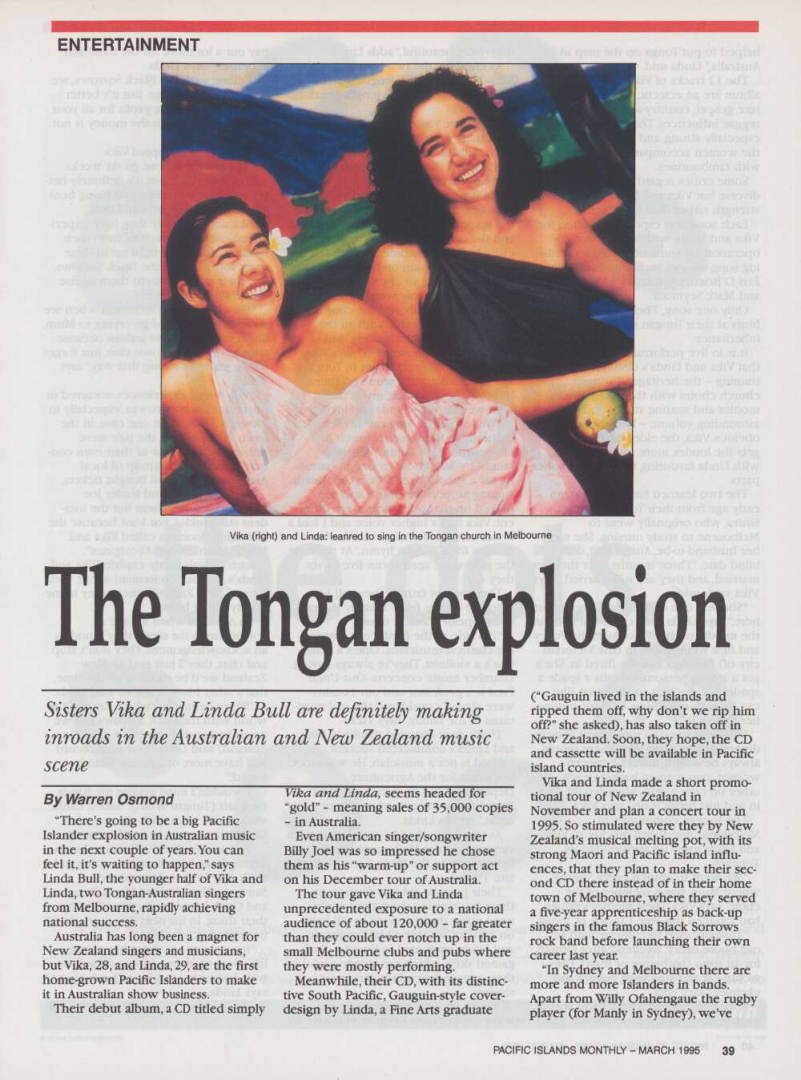
Entertainment
Sisters Vika and Linda Bull are definitely making inroads in the Australian and New Zealand music scene
By Warren Osmond
“There’s going to be a big Pacific Islander explosion in Australian music in the next couple of years. You can feel it, it’s waiting to happen,” says Linda Bull, the younger half of Vika and Linda, two Tongan-Australian singers from Melbourne, rapidly achieving national success.
Australia has long been a magnet for New Zealand singers and musicians, but Vika, 28, and Linda, 29, are the first home-grown Pacific Islanders to make it in Australian show business.
Their debut album, a CD titled simply
Vika and Linda, seems headed for “gold” - meaning sales of 35,000 copies - in Australia.
Even American singer/songwriter Billy Joel was so impressed he chose them as his “warm-up” or support act on his December tour of Australia.
The tour gave Vika and Linda unprecedented exposure to a national audience of about 120,000 - far greater than they could ever notch up in the small Melbourne clubs and pubs where
they were mostly performing.
Meanwhile, their CD, with its distinc tive South Pacific, Gauguin-style cover design by Linda, a Fine Arts graduate
(“Gauguin lived in the islands and ripped them off, why don’t we rip him off?” she asked), has also taken off in New Zealand. Soon, they hope, the CD and cassette will be available in Pacific island countries.
Vika and Linda made a short promo tional tour of New Zealand in November and plan a concert tour in 1995. So stimulated were they by New Zealand’s musical melting pot, with its strong Maori and Pacific island influ ences, that they plan to make their sec ond CD there instead of in their home town of Melbourne, where they served
a five-year apprenticeship as back-up
singers in the famous Black Sorrows rock band before launching their own career last year.
“In Sydney and Melbourne there are more and more Islanders in bands.
Apart from Willy Ofahengaue the rugby
player (for Manly in Sydney), we’ve
Vika (right) and Linda: leanred to sing in the Tongan church in Melbourne
helped to put Tonga on the map in Australia,” Linda said.
The 12 tracks of Vika and Linda’s first album are an eclectic mixture of rock, jazz, gospel, country-and-western, and reggae influences. The gospel strain is especially strong and in performances the women accompany themselves with tambourines.
Some critics regard the album as too diverse but Vika and Linda see this as a strength rather than a weakness.
Each song was especially written for Vika and Linda, with their active co operation, by some of Australia’s lead ing song-writers, including Paul Kelly, Eris O’Brien, Joe Camilleri, Wayne Burt and Mark Seymour.
Only one song, These Hands , directly hints at their Tongan roots and religious inheritance.
It is in live performances, though, that Vika and Linda’s distinctive musical training - the heritage of Tongan church choirs with their intricate har monies and soaring voices and at times astounding volume - becomes really obvious. Vika, the elder by 17 months, gets the louder, more assertive parts, with Linda favouring the sweeter, softer parts.
The two learned harmony from an early age from their Tongan mother, Siniva, who originally went to Melbourne to study nursing. She met her husband-to-be, Austin Bull, on a blind date. “Three months later they got married, and they are still married,” says Vika with pride.
“She was one of the first Tongans out here,” says Linda. “She came out bang in the middle of the White Australia Policy and first went to live in (the Victorian city of) Bendigo, but she fitted in. She’s got a strong personality, calls a spade a spade, but she’s also a diplomat. She can smooth out things without putting her foot in it.”
“We used to go to some great Tongan dinner dances,” says Vika. There would always be a fight, always between women, two women bashing each other up over a man. Mum would step in and just break it up,” says Vika.
The Tongan community in Melbourne developed quickly, so Vika and Linda grew up surrounded by Tongans.
“We went to church every Sunday, where Mum was a member of the choir,” says Vika.Their mother’s father had founded the Free Church of Tonga.
“Tongans used to come around to our house every weekend after church for an umu (barbeque or feast). They would eat and sing with guitars and ukeleles,” says Vika.
“Our cousins had a little band with ukeleles and tea-chest double bass, and
they were beautiful,” adds Linda.
As children, the two learned e lea
faka-Tonga (Tongan language).They
still understand but no longer speak it themselves.
They have visited Tonga twice - once with their parents when they were eight and six respectively, and again in 1989, when they took a holiday there, without their parents.
But it was their childhood visit, when they heard the powerful church choirs, the responsiveness of the congregation and the open displays of emotion, espe cially by Tongan women, which left the deepest impression on them.
“I hated going to church here in Melbourne. We only went to hang out with the kids really, but the church in Tonga was wonderful, with all the elders up the front, chanting and responding to the sermon,” says Vika.
“It would be great to get to Tonga again, but Vika and I won’t go there because they can sing much better than we can,” says Linda half-jokingly.
“We learned to sing our fist song in harmony in the Tongan church in Melbourne,” says Linda. “We were taught by Mum how to sing in harmo ny for a special event. We were already singing around the house and she picked up that our voices were differ ent. Vika had a higher voice and I had a lower one. So she taught us the har monies for a Tongan hymn.” At the time the girls were aged about five or six,
they say.
Their palagi father (they call him “Ozzie”) comes from a family steeped in European classical music.
“His side of the family, our cousins, are classical musicians. One’s a cellist, one’s a violinist. They’re always having chamber music concerts. Our Uncle Fred is a professor and our cousins were always considered the real musi cians in the family,” says Vika.
That’s now changed thanks to Vika and Linda’s commercial success.
“Dad is not a musician. He was stock inspector for the Agriculture Department but he used to sing us Bing Crosby songs to sleep every night,” recalls Linda.
As teenagers they began singing with various popular Melbourne bands before joining the Black Sorrows in the late 1980 s.
Their parents did not discourage them but warned them they might need other qualifications to fall back on, so Vika became a legal secretary and Linda graduated in Fine Art. Both gained skills which are clearly useful in their new, independent careers as singers.
“Financially, it’s harder now that we’re on our own because you have to
pay out a lot more for the band and expenses,” says Linda.
“Before, with the Black Sorrows, we just collected a wage. But it’s better because you get the profit for all your hard work, although the money is not
phenomenal.”
“Not yet!” interrupted Vika.
“Remember, we can go six weeks without working, but it’s definitely bet ter being on your own and being boss of your own money,” said Linda.
Vika and Linda say they have experi enced racism in Australia, from their kindergarten years right up to their years touring with the Black Sorrows.
But their mother taught them to rise above such prejudice.
“We copped a lot of racism when w r e were at school. We’d go crying to Mum.
She’d say they’re just jealous because they haven’t got brown skin, just forget it. She made us strong that way,” says Vika.
Their worst experiences occurred in Australian country towns, especially in Western Australia. In one case, in the town of Esperance, the pair were refused entry to one of their own con certs, along with a group of local Aboriginals who had bought tickets.
Black Sorrows band leader Joe Camilleri rescued them but the inci dent still rankles, not least because the offending doorman called Vika and Linda “Asian-looking Aborigines”.
Such ordeals partly explain Vika and Linda’s obvious excitement about their tour of New Zealand where they imme diately felt at home.
“In Australia when we see a Polynesian in the street they’ll nod as an acknowledgement.They don’t stop and chat, they’ll just nod. In New Zealand we’d be chatting all the time, that’s what I love about it,” said Linda.
“We’ve been everywhere around the world with the Black Sorrows but we never had such a reception as in New Zealand,” said Linda. “Our next record will have more of a Pacific islands sound.”
“I wouldn’t mind getting my hands on a lali (Tongan drum),” added Linda, who is also taken with the sound of Cook Islands pate or log-drumming.
“In Australia there’s Christine Anu, a Torres Strait Islander, who’s going to be really big. In New Zealand the Samoans, New Zealand Maori,Tongans, and Cook Islanders, they’re all doing their thing. In the next five years they’ll be really big,” says Vika.
“It’s good to see those big strong Islanders up there, strong and soft as well. I want to see a bit of fresh blood,” says Linda.
Advertisements & other items, p. 41 (1 item)
We join
the dots
"f p. % Air New Zealand is the airline linking the Pacific islands to New Zealand, Australia, North America, Asia, the U.K. and Europe. Our modern fleet of 7475, 767 s and 737 s now fly to Tonga, Fiji, New Caledonia, Norfolk Island, Tahiti, Western Samoa, the Cook Islands and Hawaii as well. Air New Zealand. No-one knows the South Pacific-and serves it-like we do. £ air new zeaiano © Air New Zealand Limited 1994.
SAATCHI INT 0459
jet-setter
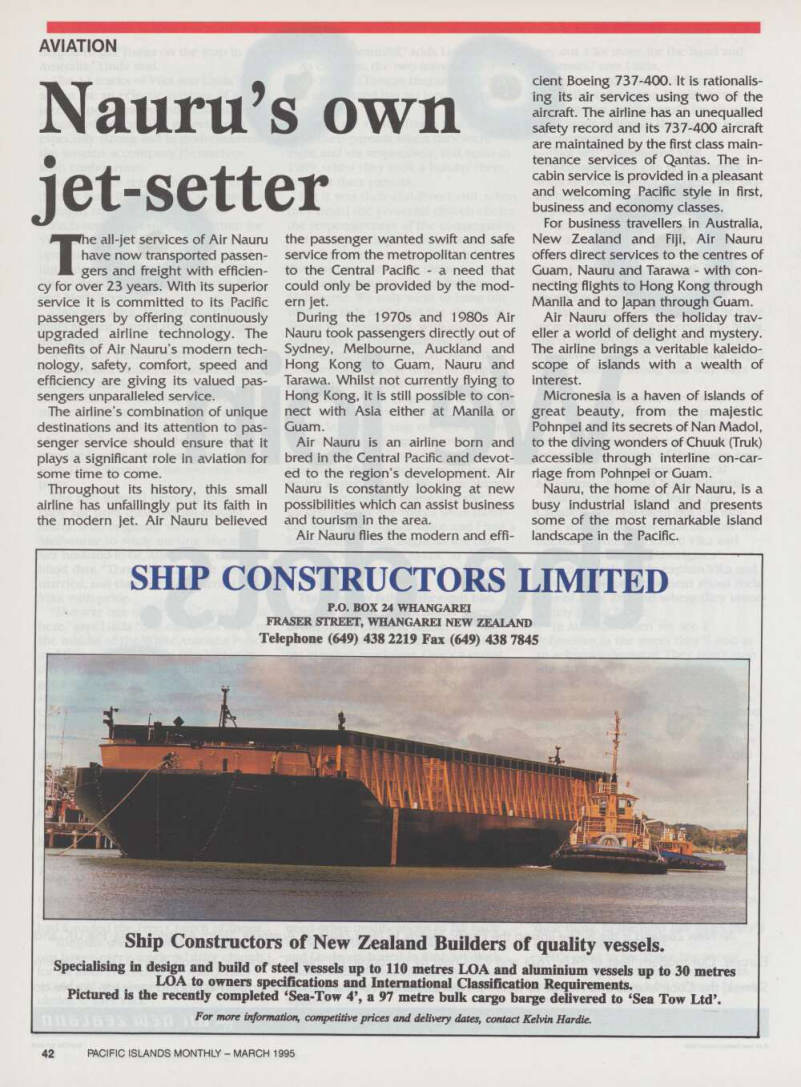
Aviation
Nauru’s own jet-setter
The all-jet services of Air Naum have now transported passen gers and freight with efficien cy for over 23 years. With its superior service it is committed to its Pacific passengers by offering continuously
upgraded airline technology. The
benefits of Air Nauru’s modern tech nology, safety, comfort, speed and efficiency are giving its valued pas sengers unparalleled service.
The airline’s combination of unique destinations and its attention to pas senger service should ensure that it plays a significant role in aviation for some time to come.
Throughout its history, this small airline has unfailingly put its faith in the modern jet. Air Nauru believed
the passenger wanted swift and safe service from the metropolitan centres to the Central Pacific - a need that could only be provided by the mod ern jet.
During the 1970 s and 1980 s Air Naum took passengers directly out of Sydney, Melbourne, Auckland and Hong Kong to Guam, Nauru and Tarawa. Whilst not currently flying to Hong Kong, it is still possible to con nect with Asia either at Manila or Guam.
Air Nauru is an airline born and bred in the Central Pacific and devot ed to the region’s development. Air Naum is constantly looking at new possibilities which can assist business and tourism in the area.
Air Naum flies the modern and effi
dent Boeing 737-400. It is rationalis ing its air services using two of the aircraft. The airline has an unequalled safety record and its 737-400 aircraft are maintained by the first class main tenance services of Qantas. The in cabin service is provided in a pleasant and welcoming Pacific style in first, business and economy classes.
For business travellers in Australia, New Zealand and Fiji, Air Nauru offers direct services to the centres of Guam, Nauru and Tarawa - with con
necting flights to Hong Kong through
Manila and to japan through Guam.
Air Nauru offers the holiday trav eller a world of delight and mystery.
The airline brings a veritable kaleido scope of islands with a wealth of interest.
Micronesia is a haven of islands of great beauty, from the majestic Pohnpei and its secrets of Nan Madol, to the diving wonders of Chuuk (Truk) accessible through interline on-car riage from Pohnpei or Guam.
Nauru, the home of Air Nauru, is a busy industrial island and presents some of the most remarkable island landscape in the Pacific.
Advertisements & other items, p. 42 (1 item)
Ship Constructors Limited
P.O. BOX 24 WHANGAREI
FRASER STREET, WHANGAREI NEW ZEALAND
Telephone (649) 438 2219 Fax (649) 438 7845 SS? 7?
Ship Constructors of New Zealand Builders of quality vessels.
Specialising in design and build of steel vessels up to 110 metres LOA and aluminium vessels up to 30 metres LOA to owners specifications and International Classification Requirements.
Pictured is the recently completed ‘Sea-Tow 4% a 97 metre bulk cargo barge delivered to ‘Sea Tow Ltd’.
For more information, competitive prices and delivery dates, contact Kelvin Hardie.
Upgrading the service
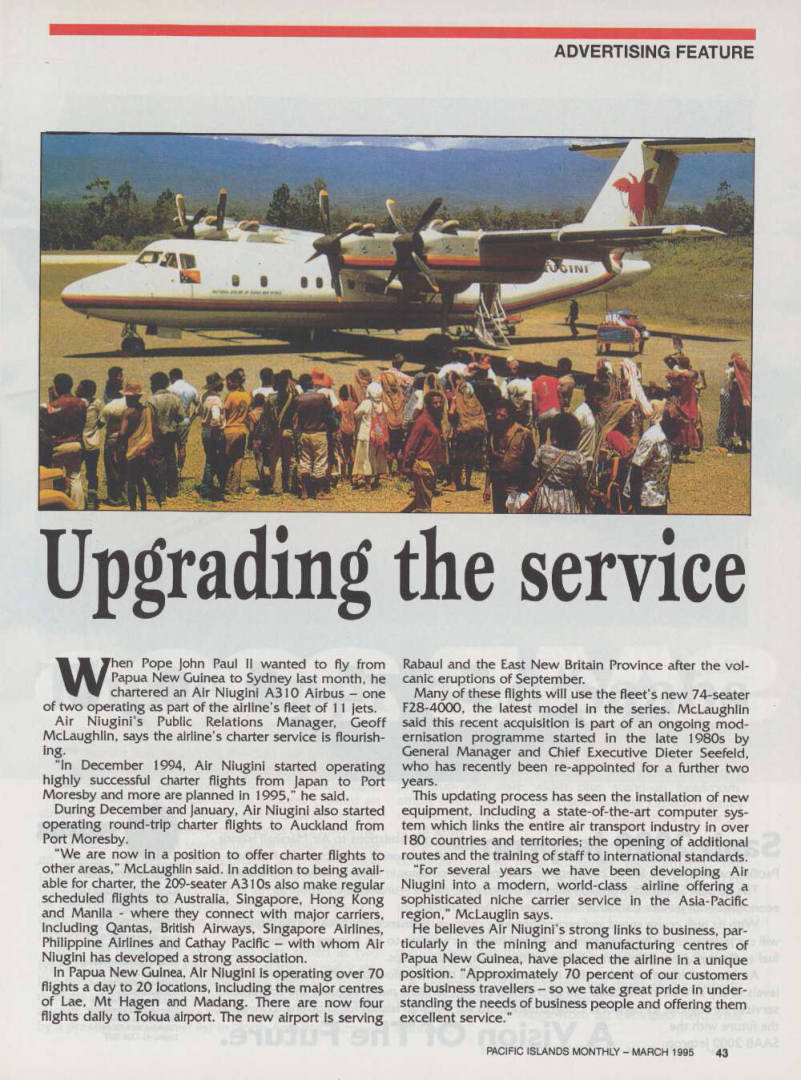
Advertising Feature
When Pope john Paul II wanted to fly from Papua New Guinea to Sydney last month, he chartered an Air Niugini A3lO Airbus - one of two operating as part of the airline’s fleet of 11 jets.
Air Niugini’s Public Relations Manager, Geoff McLaughlin, says the airline’s charter service is flourish ing.
“In December 1994, Air Niugini started operating highly successful charter flights from Japan to Port Moresby and more are planned in 1995,” he said.
During December and January, Air Niugini also started operating round-trip charter flights to Auckland from Port Moresby.
“We are now in a position to offer charter flights to other areas,” McLaughlin said. In addition to being avail able for charter, the 209-seater A3l Os also make regular scheduled flights to Australia, Singapore, Hong Kong and Manila - where they connect with major carriers, including Qantas, British Airways, Singapore Airlines, Philippine Airlines and Cathay Pacific - with whom Air Niugini has developed a strong association.
In Papua New Guinea, Air Niugini is operating over 70 flights a day to 20 locations, including the major centres of Lae, Mt Hagen and Madang. There are now four flights daily to Tokua airport. The new airport is serving
Rabaul and the East New Britain Province after the vol canic eruptions of September.
Many of these flights will use the fleet’s new 74-seater F2B-4000, the latest model in the series. McLaughlin said this recent acquisition is part of an ongoing mod ernisation programme started in the late 1980 s by General Manager and Chief Executive Dieter Seefeld, who has recently been re-appointed for a further two years.
This updating process has seen the installation of new equipment, including a state-of-the-art computer sys tem which links the entire air transport industry in over 180 countries and territories; the opening of additional routes and the training of staff to international standards.
“For several years we have been developing Air Niugini into a modern, world-class airline offering a sophisticated niche carrier service in the Asia-Pacific region,” McLauglin says.
He believes Air Niugini’s strong links to business, par ticularly in the mining and manufacturing centres of Papua New Guinea, have placed the airline in a unique position. “Approximately 70 percent of our customers are business travellers - so we take great pride in under standing the needs of business people and offering them excellent service.”
Advertisements & other items, p. 44 (1 item)
SAAB 2000 Jetprop. A Vision Of The Future.
.. iisi ' w as -* H •* '* »-
ATRMatsMI
s\at\ j : :■ A
I Congratulations to Air Marshall Islands
AiWWW for choosing to become the first Asia- Pacific operator of the SAAB 2000 Jetprop, a unique new concept in regional airliner philosophy.
The 50-seat SAAB 2000 Jetprop offers a vision of the future - unbeatable turboprop economics with jet-like standards of comfort and performance.
With its high cruise speed and record-breaking climb performance, the SAAB 2000 Jetprop will cut journey times by up to three and a half hours on services to Fiji, burning one-third less fuel and carrying two tonnes more payload than today’s turboprops.
Air Marshall Islands will also offer its passengers the most comfortable cabin and lowest noise levels of any aircraft in this class - an aircraft fast enough to allow more frequent and convenient services throughout its network. Congratulations to Air Marshall Islands for choosing to invest in SAAB 2000 Jetprop. A Vision Of The Future.
Saab Aircraft AB Saab Aircraft International Ltd Asia/Pacific Regional Office 2106, One Pacific Place Queensway, Hong Kong Telephone: (852) 2810 4220 Telex: 64386 SABAC HX Telefax: (852) 2810 4135 For more information contact: Mr Peter Greensmith Vice President Marketing- A ustralasiajPacific Saab Aircraft International 8 Warren Road, Double Bay NSW2O2B, Australia Telephone: 612 3281903 Telefax: 612328 7253
Those improved Saahs
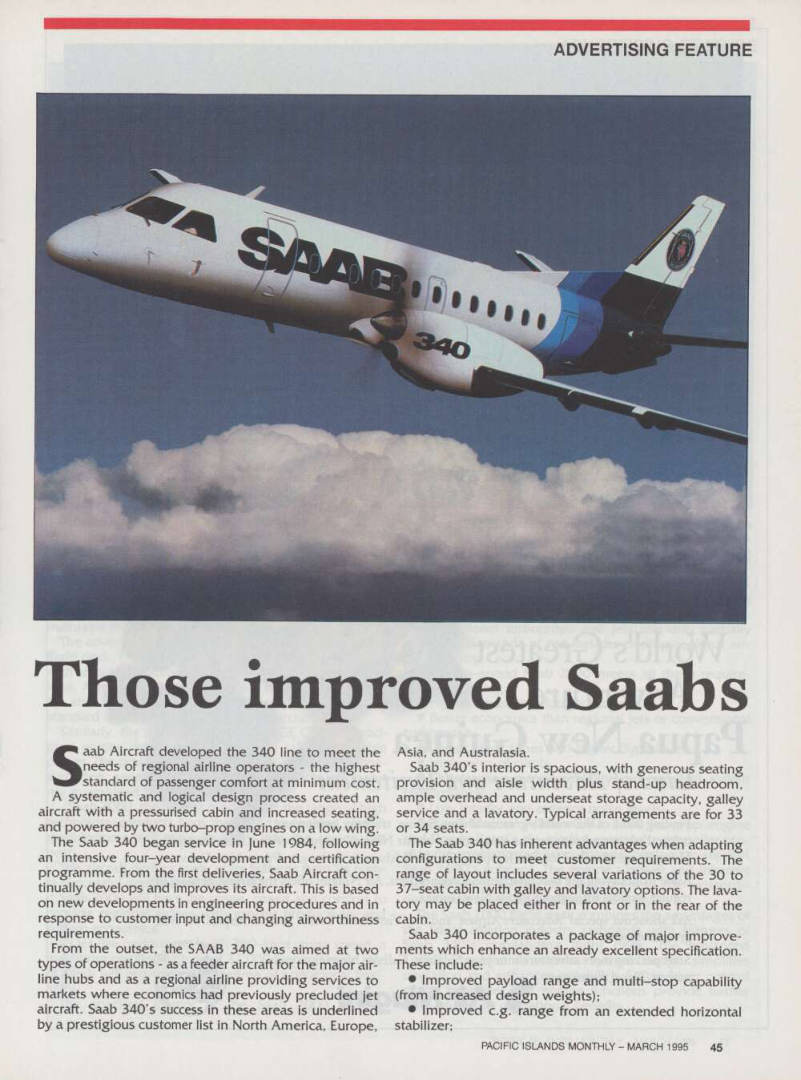


Saab Aircraft developed the 340 line to meet the needs of regional airline operators - the highest standard of passenger comfort at minimum cost.
A systematic and logical design process created an aircraft with a pressurised cabin and increased seating, and powered by two turbo-prop engines on a low wing.
The Saab 340 began service in June 1984, following an intensive four-year development and certification programme. From the first deliveries, Saab Aircraft con tinually develops and improves its aircraft. This is based on new developments in engineering procedures and in response to customer input and changing airworthiness requirements.
From the outset, the SAAB 340 was aimed at two types of operations - as a feeder aircraft for the major air line hubs and as a regional airline providing services to markets where economics had previously precluded jet aircraft. Saab 340’s success in these areas is underlined by a prestigious customer list in North America, Europe,
Asia, and Australasia.
Saab 340’s interior is spacious, with generous seating provision and aisle width plus stand-up headroom, ample overhead and underseat storage capacity, galley service and a lavatory. Typical arrangements are for 33 or 34 seats.
The Saab 340 has inherent advantages when adapting configurations to meet customer requirements. The range of layout includes several variations of the 30 to 37-seat cabin with galley and lavatory options. The lava tory may be placed either in front or in the rear of the cabin.
Saab 340 incorporates a package of major improve ments which enhance an already excellent specification.
These include: • Improved payload range and multi-stop capability (from increased design weights); • Improved c.g. range from an extended horizontal stabilizer;
• Reduced flight times without increases in fuel burn (from the upgraded GECT7-9B engine; • Improved “hot and high” payloads from the auto matic power reserve on takeoff; • Reduced cabin noise levels from acoustic dampers.
In all other respects, notably interior comfort, cockpit design and systems simplicity, the Saab 340 series maintains the excellent qualities of Saab.
The advanced technology of Saab 340 extends to the flight deck. The flight crew have a spacious working area with all control locations designed to reduce pilot work load. A modern all-digital avionics system with autopi lot and Electronic Flight Instrumentation System are standard equipment on all Saab 340 aircraft.
Similarly, the advanced technology GE CT7-9B turbo prop engine provides Saab 340 with safe and reliable power. The powerplant for the aircraft has low fuel con sumption, excellent maintainability and technical matu rity guaranteed by General Electric.
Saab 2000, the newest model from the range of high technology products from the world renowned aircraft manufacturer, will make its entry into the region this year.
The aircraft derives many of its features from its high ly successful predecessor, Saab 340.
Saab 2000 will have the range, speed and comfort to provide regional airlines with greater productivity and superb economics.
Its jet-like performance with 360-knot cruise speed, a maximum certified altitude of 31,000 feet and rapid rate of climb will provide a high degree of operational flexi bility.
The spacious interior of the Saab 2000 will be
designed for 50 passengers with a comfortable 32-Inch seat pitch. The pressurised cabin with stand-up head room, ample overhead cabin storage and unsurpassed quiet will ensure passenger appeal.
Passenger comfort is further enhanced by slow-turn ing (950 rpm) propellers resulting in lower noise (76dbA) throughout the cabin.
Conventional turboprops and jets can only partially meet the demands of the fast-developing regional air line industry.
The high-speed Saab 2000 meets all these require ments including: • Higher speed and longer range; • Better economics than regional jets or conventional turboprops; • Lower block times and higher flight levels; • High rates of climb; • Outstanding manoeuvrability and excellent airfield performance; • Low interior and exterior noise levels; General Motors’ Allison GMA 2100 jet—prop engine and Dowty Rotol’s six-bladed composite propeller pro vide the sophisticated propulsion technology to support Saab 2000’s concept. The engine’s power and inherent fuel efficiency contribute significantly to the extraordi nary cruise speed and over-all economy.
The Saab 2000 flight deck combines the advantages of the latest aviation industry standards with features of Saab 340’s outstanding flight deck. The advanced Collins Pro Line 4 avionics system design simplifies operation and enhances reliability. Single lever control of the propeller and engine functions provide further state-of-the-art operational benefits.
Advertisements & other items, pp. 46-48 (1 item)
The best
7- London
|i^APAN
COTF
PAPUA NEW GUINEA
Sbrt Moresby ura mgapo Oh Cairns Brisbane ydney 'h
n jf
■ N W 4 N| S' Hi
The best
connections to the
World's Greatest
Adventure...
Papua New Guinea
Land of Adventure and Excitement
Finding some of the world's greatest diving, fishing, trekking, rafting and cultural adventures is as easy as connecting with Air Niugini's regular services from Singapore, Hong Kong, Manila, Honiara, Jayapura, Cairns, Brisbane or Sydney, to Papua New Guinea.
Aside from having the best international connections, Air Niugini offers the largest network of regular services throughout Papua New Guinea.
Ask about our special 'Adventure Airpass' and the 'Visit South Pacific Year 95 Airpass' for even greater value. X 8 Start packing more adventure into your holidays. Call Air Niugini or your nearest Travel Agent now. *
Air Niugini
CIFIC
x mure! y
Craft Works 3322 d.
Come fly with us to our ‘Kingdom 1 .
Traditional Polynesia at
Untraditional Prices!
iiiuiiinmnmiii mum in
»m pacific Our new Boeing 737-300 Aircraft Jet can whisk you to the real South Seas in comfort and
style.
You'll feel the Friendly Island spirit the moment you step on board.
Twice weekly from Auckland to Nuku'alofa with direct connections to the magic island of Vava'u.
Tonga to Nadi three times weekly.
Our office Locations:
KINGDOM OF TONGA
TEL: (676) 23 414
FAX; (676) 24 056
SITA; TBUSSWR
AUCKLAND, NEW ZEALAND
TEL: (649) 379 4454
FAX: (649) 377 5648
SITA: AKLSSWR
SYDNEY, AUSTRALIA
TEL: (612) 239 1722
FAX: (612) 290 3641
SITA: SYDSSWR
Our Reservations are computerised and can be accessed through most International systems including: Amedeus, Apollo, Galileo, Gets, Maars, Tias, Sabre, etc.
Nadi
Tonga
Auckland Apia Members of the international Air Transport Association
ROYAL TONGAN AIRLINES
AIRLINE OF THE KINGDOM OF TONGA
Made in heaven
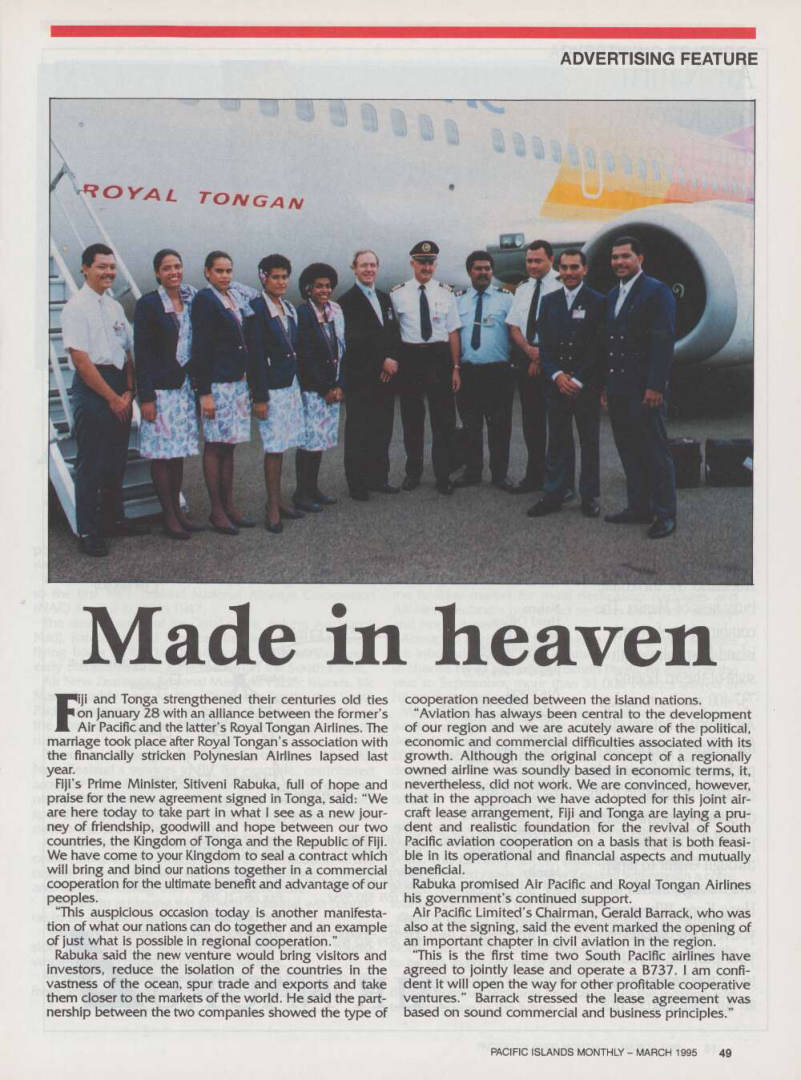
Fiji and Tonga strengthened their centuries old ties on january 28 with an alliance between the former’s Air Pacific and the latter’s Royal Tongan Airlines. The marriage took place after Royal Tongan’s association with the financially stricken Polynesian Airlines lapsed last year.
Fiji’s Prime Minister, Sitiveni Rabuka, full of hope and praise for the new agreement signed in Tonga, said: “We are here today to take part in what I see as a new jour ney of friendship, goodwill and hope between our two countries, the Kingdom of Tonga and the Republic of Fiji.
We have come to your Kingdom to seal a contract which will bring and bind our nations together in a commercial cooperation for the ultimate benefit and advantage of our peoples.
“This auspicious occasion today is another manifesta tion of what our nations can do together and an example of just what is possible in regional cooperation.”
Rabuka said the new venture would bring visitors and investors, reduce the isolation of the countries in the vastness of the ocean, spur trade and exports and take them closer to the markets of the world. He said the part nership between the two companies showed the type of
cooperation needed between the island nations.
“Aviation has always been central to the development of our region and we are acutely aware of the political, economic and commercial difficulties associated with its growth. Although the original concept of a regionally owned airline was soundly based in economic terms, it, nevertheless, did not work. We are convinced, however, that in the approach we have adopted for this joint air craft lease arrangement, Fiji and Tonga are laying a pru dent and realistic foundation for the revival of South Pacific aviation cooperation on a basis that is both feasi ble in its operational and financial aspects and mutually beneficial.
Rabuka promised Air Pacific and Royal Tongan Airlines his government’s continued support.
Air Pacific Limited’s Chairman, Gerald Barrack, who was also at the signing, said the event marked the opening of an important chapter in civil aviation in the region.
“This is the first time two South Pacific airlines have agreed to jointly lease and operate a 8737. I am confi dent it will open the way for other profitable cooperative ventures.” Barrack stressed the lease agreement was based on sound commercial and business principles.”
over twenty
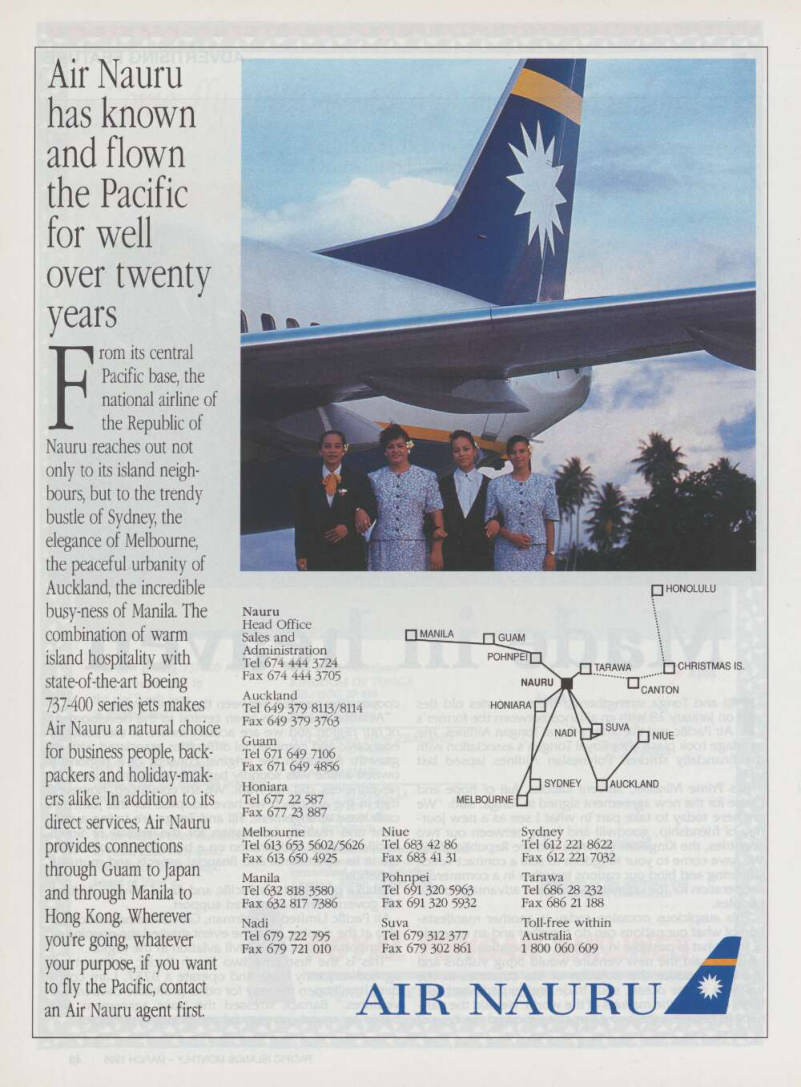
Air Nauru has known and flown the Pacific for well over twenty years
From its central Pacific base, the national airline of the Republic of Nauru reaches out not only to its island neigh bours, but to the trendy bustle of Sydney, the elegance of Melbourne, the peaceful urbanity of Auckland, the incredible busy-ness of Manila. The combination of warm island hospitality with state-of-the-art Boeing 737-400 series jets makes Air Nauru a natural choice for business people, back packers and holiday-mak ers alike. In addition to its direct services, Air Nauru provides connections through Guam to Japan and through Manila to Hong Kong. Wherever you’re going, whatever your purpose, if you want to fly the Pacific, contact an Air Nauru agent first.
Access to the Pacific
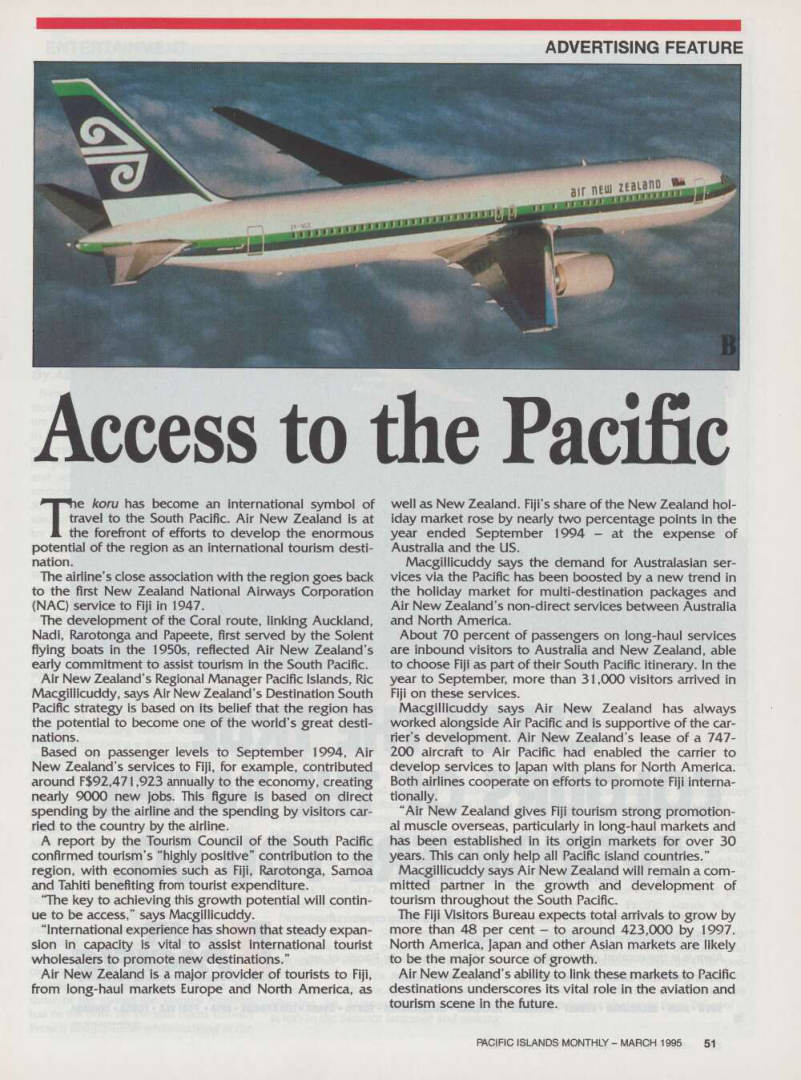
The koru has become an international symbol of travel to the South Pacific. Air New Zealand is at the forefront of efforts to develop the enormous potential of the region as an international tourism desti nation.
The airline’s close association with the region goes back to the first New Zealand National Airways Corporation (NAC) service to Fiji in 1947.
The development of the Coral route, linking Auckland, Nadi, Rarotonga and Papeete, first served by the Solent flying boats in the 19505, reflected Air New Zealand’s early commitment to assist tourism in the South Pacific.
Air New Zealand’s Regional Manager Pacific Islands, Ric Macgillicuddy, says Air New Zealand’s Destination South Pacific strategy is based on its belief that the region has the potential to become one of the world’s great desti nations.
Based on passenger levels to September 1994, Air New Zealand’s services to Fiji, for example, contributed around F 592,471,923 annually to the economy, creating nearly 9000 new jobs. This figure is based on direct spending by the airline and the spending by visitors car ried to the country by the airline.
A report by the Tourism Council of the South Pacific confirmed tourism’s “highly positive” contribution to the region, with economies such as Fiji, Rarotonga, Samoa and Tahiti benefiting from tourist expenditure.
“The key to achieving this growth potential will contin ue to be access,” says Macgillicuddy.
“International experience has shown that steady expan sion in capacity is vital to assist international tourist wholesalers to promote new destinations.”
Air New Zealand is a major provider of tourists to Fiji, from long-haul markets Europe and North America, as
well as New Zealand. Fiji’s share of the New Zealand hol iday market rose by nearly two percentage points in the year ended September 1994 - at the expense of Australia and the US.
Macgillicuddy says the demand for Australasian ser vices via the Pacific has been boosted by a new trend in the holiday market for multi-destination packages and Air New Zealand’s non-direct services between Australia and North America.
About 70 percent of passengers on long-haul services are inbound visitors to Australia and New Zealand, able to choose Fiji as part of their South Pacific itinerary. In the year to September, more than 31,000 visitors arrived in Fiji on these services.
Macgillicuddy says Air New Zealand has always worked alongside Air Pacific and is supportive of the car rier’s development. Air New Zealand’s lease of a 747- ZOO aircraft to Air Pacific had enabled the carrier to develop services to japan with plans for North America.
Both airlines cooperate on efforts to promote Fiji interna tionally.
“Air New Zealand gives Fiji tourism strong promotion al muscle overseas, particularly in long-haul markets and has been established in its origin markets for over 30 years. This can only help all Pacific island countries.”
Macgillicuddy says Air New Zealand will remain a com mitted partner in the growth and development of tourism throughout the South Pacific.
The Fiji Visitors Bureau expects total arrivals to grow by more than 48 per cent - to around 423,000 by 1997.
North America, japan and other Asian markets are likely to be the major source of growth.
Air New Zealand’s ability to link these markets to Pacific destinations underscores its vital role in the aviation and tourism scene in the future.
Advertisements & other items, p. 52 (1 item)
Pwjur
m
pACIf IC
AIH
w is
CATCH THE TRUE
COLOURS OF THE PACIFIC,
EVERYWHERE YOU GO.
Air Pacific can fly you to more Pacific destinations more frequently.
Always in the comfort of a modern Boeing aircraft, always in the care of the friendliest cabin crews in the skies.
Book through Air Pacific or any lATA Travel Agent.
PWJUR
PACIFIC
FIJI'S INTERNATIONAL AIRLINE
SUVA • NADI • MELBOURNE • SYDNEY • BRISBANE • AUCKLAND • CHRISTCHURCH • TOKYO • OSAKA • LOS ANGELES • APIA • PORT VILA • TONGA • HONIARA
WILSON-ADDISON 07.693
Samoan
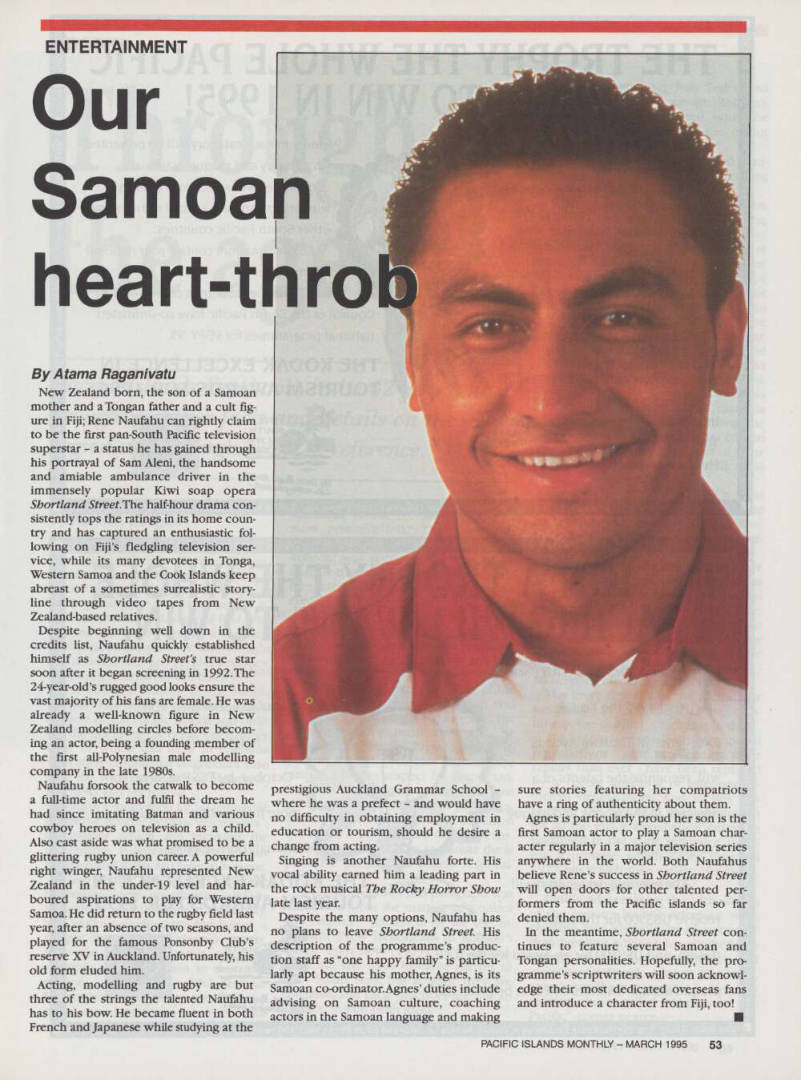
Entertainment
Our Samoan heart-throb
By Atama Raganivatu
New Zealand born, the son of a Samoan mother and a Tongan father and a cult fig ure in Fiji; Rene Naufahu can rightly claim to be the first pan-South Pacific television superstar - a status he has gained through his portrayal of Sam Aleni, the handsome and amiable ambulance driver in the immensely popular Kiwi soap opera Shortland Street. The half-hour drama con sistently tops the ratings in its home coun try and has captured an enthusiastic fol lowing on Fiji’s fledgling television ser vice, while its many devotees in Tonga, Western Samoa and the Cook Islands keep abreast of a sometimes surrealistic story line through video tapes from New Zealand-based relatives.
Despite beginning well down in the credits list, Naufahu quickly established himself as Shortland Street’s true star soon after it began screening in 1992. The 24-year-old’s rugged good looks ensure the vast majority of his fans are female. He was already a well-known figure in New Zealand modelling circles before becom ing an actor, being a founding member of the first all-Polynesian male modelling company in the late 1980 s.
Naufahu forsook the catwalk to become a full-time actor and fulfil the dream he had since imitating Batman and various cowboy heroes on television as a child.
Also cast aside was what promised to be a glittering rugby union career. A powerful right winger, Naufahu represented New Zealand in the under-19 level and har boured aspirations to play for Western Samoa. He did return to the rugby field last year, after an absence of two seasons, and played for the famous Ponsonby Club’s reserve XV in Auckland. Unfortunately, his old form eluded him.
Acting, modelling and rugby are but three of the strings the talented Naufahu has to his bow. He became fluent in both French and Japanese while studying at the
prestigious Auckland Grammar School where he was a prefect - and would have no difficulty in obtaining employment in education or tourism, should he desire a change from acting.
Singing is another Naufahu forte. His vocal ability earned him a leading part in the rock musical The Rocky Horror Show late last year.
Despite the many options, Naufahu has no plans to leave Shortland Street. His description of the programme’s produc tion staff as “one happy family” is particu larly apt because his mother, Agnes, is its Samoan co-ordinator.Agnes’ duties include advising on Samoan culture, coaching actors in the Samoan language and making
sure stories featuring her compatriots have a ring of authenticity about them.
Agnes is particularly proud her son is the first Samoan actor to play a Samoan char acter regularly in a major television series anywhere in the world. Both Naufahus believe Rene’s success in Shortland Street will open doors for other talented per formers from the Pacific islands so far denied them.
In the meantime, Shortland Street con tinues to feature several Samoan and Tongan personalities. Hopefully, the pro gramme’s scriptwriters will soon acknowl edge their most dedicated overseas fans and introduce a character from Fiji, too! ■
Advertisements & other items, p. 54 (1 item)
Design A Trophy The Whole
■ -Visit South Pacific Year '9s*The Kodak Excellence in Tourism Awards for 1995- Visit South Pacific Year '9s' •Visit South Pacific Year ’95-The Kodak Excellence in Tourism Awards for 1995-Visit South Pacific Year '95-The Kodak Excellence in Tourism Awards for 1995*
THE TROPHY THE WHOLE PACIFIC
WANTS TO WIN IN 1995!
Visit South Pacific Year ’95 is the biggest joint promotional effort undertaken by South Pacific nations. *A key event of this unique year will be the Kodak Excellence in Tourism Awards. *A prestigious trophy and plaque will be presented to each of ten winners in the following categories: Photography, Airlines (2 Awards - Island Services and National Services), Accommodation (3 Awards - DeLuxe, Standard and Budget).
Inbound Tour Operators. Tour Wholesalers, Tourist Transportation, and Eco Tourism, Heritage and Culture.
Winners in each category will be presented with a trophy and plaque. National committees will select each country’s ten winners to compete against winners from other South Pacific countries.
For information, contact your national tourism office.
The 13 member countries of the Tourism Council of the South Pacific have co-ordinated national programmes for VSPY '95.
THE KODAK EXCELLENCE IN
TOURISM AWARDS FOR 1995.
VISIT
SOUTH
SACIFIC
Tear '95 •Visit South Pacific Year '9s*The Kodak Excellence in Tourism Awards for 1995*Visit South Pacific Year '9s*The Kodak Excellence in Tourism Awards for 1995* •Visit South Pacific Year '9s*The Kodak Excellence in Tourism Awards for 1995-Visit South Pacific Year '95- ■
■ •Visit South Pacific Year ’9s*The Kodak Excellence in Tourism Awards tor 1995* Visit South Pacific Year '9s< •Visit South Pacific Year ’9s*The Kodak Excellence in Tourism Awards for 1995-Visit South Pacific Year '9s*The Kodak Excellence in Tourism Awards for 1995*
DESIGN A TROPHY THE WHOLE
PACIFIC WILL WANT TO WIN.
To celebrate Visit South Pacific Year 1995 the Kodak Excellence in Tourism Awards will recognize the talents of a designer in the trophy and plaque competition.
The winning designer(s) will receive US$5OO for the trophy design, and US$5OO for an Award winner’s plaque design. Winners will also be given the opportunity to tender for the manufacture of their work.
Judging will be conducted in October, byTCSP in Suva. For more information, contact your national tourism office.
THE KODAK EXCELLENCE IN
TOURISM AWARDS FOR 1993.
VISIT
SOUTH
[jACIFIC
r EAR '95
•Visit South Pacific Year '95-The Kodak Excellence in Tourism Awards for 1995*Visit South Pacific Year '9s*The Kodak Excellence in Tourism Awards for 1995* ■ -Visit South Pacific Year '9s*The Kodak Excellence in Tourism Awards for 1995-Visit South Pacific Year '9s* I
Through
Books
Through the ages
Pacific Islands Yearbook, in its 62 years, has brought together facts and details on the region into a single work of reference.
By Norman Douglas
In the 62 years since its first appear ance in 1932, the Pacific Islands Yearbook has undergone a number of modifications in geographical scope. In the beginning the word was with R. W.
Robson, founder and editor of PIM , who decided the region needed a regularly published reference work that brought together the facts and details of politics,
geography, economics and history.
The first few editions of the Pacific Islands Yearbook consisted almost entirely of the Pacific islands and omit ted the islands of the ocean’s periphery, most of which had more in common with their continental neighbours than they did with the islands of Melanesia, Polynesia and Micronesia.
Robson’s motivation for including Fiji under the general heading “Micronesia”, a category which also included the
undeniably Polynesian Ellice Islands
(Tuvalu) and Wallis and Futuna, is vague.
It may be that Robson, who had some interesting ideas on ethnicity and its association with intelligence and ability, was anxious to dissociate the Fijians, a people he evidently admired greatly, from the rest of Melanesia, since he wrote in an introduction to the sixth edition (1950): “Polynesians, Micronesians and Indonesians are peo ple of a good type, who quickly become accustomed to and accept European
standards of life ... Melanesians are more primitive folk”. The observation remained for the next two editions.
Robson, was very much a man of his time, and given to making pronounce ments that these days would be consid ered at best paternalistic and at worst grossly offensive. “The Polynesians”, he declared, as late as 1959, (are) usually happy-natured, attractive and intelligent ...”, even if they were tending “towards aggressive nationalism”.
When it came to the Islanders of the Western Pacific, however, Robson was far less impressed. “One of the Administration’s main concern”, he wrote in the entry on Papua in the 1956 edition, “is to inculcate among the natives a proper respect for Europeans.
Some of the natives, as they become partly educated and granted privileges, are inclined to be insolent - a condition for which a certain class of Europeans, who do not know how to handle these primitive people, are largely responsi ble.”
In the next edition this paragraph was toned down but the matters of “control and respect” remained. As for the ni- Vanuatu (New Hebrideans in Robson’s time), “Even now (1959) they are per haps not the most loveable natives in the South Seas; but at least they are tractable, and their practices are not an offence to European ideas”.
By the ninth (1963) edition, Robson’s
long-time companion, Judy Tudor, had become the editor - though Robson’s name was still associated with the Yearbook - and many of the quaint statements were removed.
Fiji, however, remained listed tem
porarily under the heading
“Micronesia”.
With the appearance of a new edition in 1977 (the 12th), under a new editor, Stuart Inder, the format and the geo graphical scope of the Yearbook changed abruptly. The East Asian com ponent was discarded. The island groups were now listed alphabetically and for the first time an attempt was made to provide the information in the same sequence for each group. It was also, the preface announced, the first of the Yearbook’s annual editions. It was almost certainly not the fault of the energetic and Pacific-wise Inder, who was also the publisher of PIM, that this claims could be maintained. Although he succeeded in producing another edition the following year, the prospect of annu al editions quickly became as difficult as it had ever been.
For the new edition - the 17th - the editors have thought it appropriate to make other changes which better illus trate the Yearbook’s relevance and use fulness in the 19905.
On the other hand, the omission, since the first edition, of one of the most important of all Pacific island countries - New Zealand - seemed inexcusable.
The new edition contains an entry on New Zealand and the book is now devoted entirely to the islands of the Pacific’s three cultural regions - Melanesia, Polynesia and Micronesia.
The entry devoted to the Pacific War has finally gone, 53 years after the begin ning of the conflict which inspired it.
The separate entries on regional organisations - now proliferating more rapidly than ever - have been replaced by a recent appraisal of inter-govern mental organisations. And in this edi tion, for the first time, the information for all the major alphabetical entries is organised in the same sequence, fulfill ing a promise which Inder made in 1977, but which, for a variety of reasons, could not be kept until now All this, while making the 17th edition of the region’s leading reference work
perhaps less charmingly idiosyncratic
than previous editions, has resulted in a tighter, neater, more consistent and more useful Pacific Islands Yearbook , one that will grow in value as the 21st century, the so-called “Century of the Pacific”, comes nearer.
rollicking
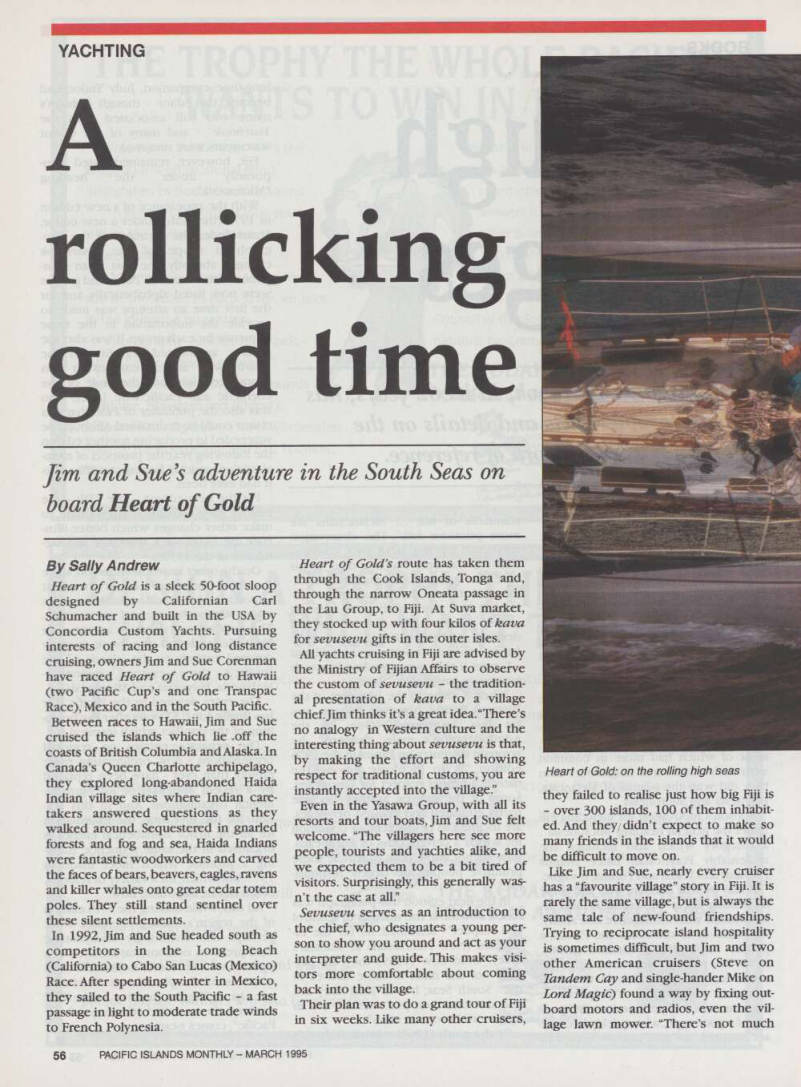
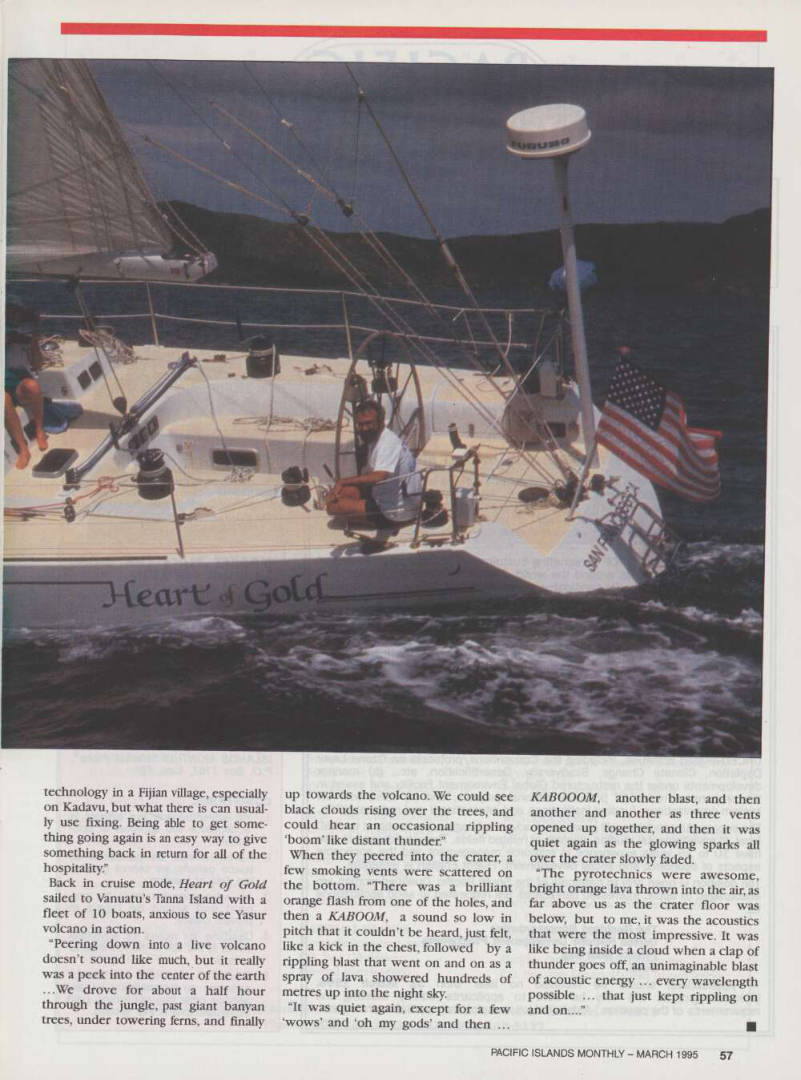
Yachting
A rollicking good time
Jim and Sue’s adventure in the South Seas on board Heart of Gold
By Sally Andrew
Heart of Gold is a sleek 30-foot sloop designed by Californian Carl Schumacher and built in the USA by Concordia Custom Yachts. Pursuing interests of racing and long distance cruising, owners Jim and Sue Corenman have raced Heart of Gold to Hawaii (two Pacific Cup’s and one Transpac Race), Mexico and in the South Pacific.
Between races to Hawaii, Jim and Sue cruised the islands which lie ,off the coasts of British Columbia and Alaska. In Canada’s Queen Charlotte archipelago,
they explored long-abandoned Haida
Indian village sites where Indian care takers answered questions as they walked around. Sequestered in gnarled forests and fog and sea, Haida Indians were fantastic woodworkers and carved the faces of bears, beavers, eagles, ravens and killer whales onto great cedar totem poles. They still stand sentinel over these silent settlements.
In 1992, Jim and Sue headed south as competitors in the Long Beach (California) to Cabo San Lucas (Mexico) Race. After spending winter in Mexico, they sailed to the South Pacific - a fast passage in light to moderate trade winds to French Polynesia.
Heart of Gold’s route has taken them through the Cook Islands, Tonga and, through the narrow Oneata passage in the Lau Group, to Fiji. At Suva market, they stocked up with four kilos of kava for sevusevu gifts in the outer isles.
All yachts cruising in Fiji are advised by the Ministry of Fijian Affairs to observe the custom of sevusevu - the tradition al presentation of kava to a village chief. Jim thinks it’s a great idea. “There’s no analogy in Western culture and the interesting thing about sevusevu is that, by making the effort and showing respect for traditional customs, you are instantly accepted into the village.”
Even in the Yasawa Group, with all its resorts and tour boats, Jim and Sue felt welcome. “The villagers here see more people, tourists and yachties alike, and we expected them to be a bit tired of visitors. Surprisingly, this generally was n’t the case at all.”
Sevusevu serves as an introduction to the chief, who designates a young per son to show you around and act as your interpreter and guide. This makes visi tors more comfortable about coming back into the village.
Their plan was to do a grand tour of Fiji in six weeks. Like many other cruisers,
they failed to realise just how big Fiji is - over 300 islands, 100 of them inhabit ed. And they/didn’t expect to make so many friends in the islands that it would be difficult to move on.
Like Jim and Sue, nearly every cruiser has a “favourite village” story in Fiji. It is rarely the same village, but is always the same tale of new-found friendships.
Trying to reciprocate island hospitality is sometimes difficult, but Jim and two other American cruisers (Steve on Tandem Cay and single-hander Mike on Lord Magic) found a way by fixing out board motors and radios, even the vil lage lawn mower. “There’s not much
Heart of Gold: on the rolling high seas
technology in a Fijian village, especially on Kadavu, but what there is can usual ly use fixing. Being able to get some thing going again is an easy way to give something back in return for all of the
hospitality.”
Back in cruise mode, Heart of Gold sailed to Vanuatu’s Tanna Island with a fleet of 10 boats, anxious to see Yasur volcano in action.
“Peering down into a live volcano doesn’t sound like much, but it really was a peek into the center of the earth ...We drove for about a half hour through the jungle, past giant banyan trees, under towering ferns, and finally
up towards the volcano. We could see black clouds rising over the trees, and could hear an occasional rippling ‘boom’ like distant thunder.”
When they peered into the crater, a few smoking vents were scattered on the bottom. “There was a brilliant orange flash from one of the holes, and then a KABOOM, a sound so low in pitch that it couldn’t be heard, just felt, like a kick in the chest, followed by a rippling blast that went on and on as a spray of lava showered hundreds of metres up into the night sky.
“It was quiet again, except for a few ‘wows’ and ‘oh my gods’ and then ...
KABOOOM, another blast, and then another and another as three vents opened up together, and then it was quiet again as the glowing sparks all over the crater slowly faded.
“The pyrotechnics were awesome, bright orange lava thrown into the air, as far above us as the crater floor was below, but to me, it was the acoustics that were the most impressive. It was like being inside a cloud when a clap of thunder goes off, an unimaginable blast of acoustic energy ... every wavelength possible ... that just kept rippling on and 0n...”
Advertisements & other items, pp. 58-60 (1 item)
Ac Ifi
SLANDS
AftKCT Pine
o For the benefit of our readers who would like to place a small classified advertisement in our magazine, Market Place will assist you in selling personal items, accommodation, real estate, boating or a service ... in fact anything you would like to sell to our over 50,000 readers.
Market Place Advertising Rates are structured to allow you to place as many advertisements as you wish, economically.
REAL ESTATE
Fiji-South Pacific Beachfront and hillview freehold holiday/residential lots for sale from $15,000 adjacent Upmarket Resort. Ph: (679) 311075. Fax: (679) 303160 or write to P.O. Box 228, Suva, Fiji.
SCRAP METAL
Tall ingots operate from Brisbane, Australia and make frequent visits to the Pacific Islands which they have done for twenty-five years. We are buyers of Copper, Brass, Aluminium, Lead Cable etc. Inspection no problems. Telephone 61 7 8922033. Fax; 61 7892207.
THE UNITED NATIONS DEVELOPMENT PROGRAMME
Invites applications from qualified Candidates for the following position:
NATIONAL SUSTAINABLE DEVELOPMENT ADVISER
The United Nations Development Programme (UNDP) is the world’s largest channel for multilateral technical cooperation. Agenda 21, as adopted at the Earth Summit in June 1992, calls on sustainable development at the local, national and regional levels. The bulk of responsibility for promotion and implementation of national sustainable development initiatives lies at the country/field level.
To meet this demand, UNDP is recruiting Sustainable Development Advisers at 41 Country/Field Officers around the world. This is a demanding senior level position with the successful candidates advising the UNDP Resident Representatives on methods to integrate environment and sustainable development into all aspects of the development process.
At the national level the Adviser would: (a) act as a catalyst and contribute technical environmental inputs to programme and project reviews; (b) monitor and assist in the implementation of UNDP’s environmental management guidelines; (c) proactively support national capacity building programmes as they relate to the national Agenda 21; (d) coordinate field level activities under major UNDP sponsored or co-managed programmes such as Capacity 21, the Sustainable Development Network, the Sustainable Agriculture Network, etc.; and (e) promote the role of women, youth, national NGOs, the private sector and other key communities in the process.
At the global level, the Adviser would: (a) promote the implementation of UNCED-related activities, including the Conventions/protocols on Ozone Layer Depletion, Climate Change, Biodiversity, Desertification, etc., (b) monitor developments under the restructured Global Environment Facility and assist in the preparation/review of potential national projects; and (c) liaise with UN system organizations, funding institutions and international and regional NGOs.
The successful candidate will possess an advanced degree, preferably at the PhD level, in environmental studies, ecology or related fields. The candidates will also have 10 to 15 years experience in resource management and the applicable aspects of economic and social development. Fluent English is essential.
The position is open only to nationals of the South Pacific. Qualified women are encouraged to apply. Interested candidates are requested to send applications to: The Resident Representative United Nations Development Programme Private Mail Bag Suva Applications should be received no later than 31 March 1995. (Acknowledgments will only be sent to applicants strictly meeting the requirements of the position.) A detailed job description is available on request.
MRRKCT PLRC€ CRN UJOAK
WONDCRS FOR VOU ...
Promote your business, or service, sell your household items, cars or heavy machinery etc.
ONLY AUSSI PER WORD.
NO COMPANY LOGO. NO
DISPLAY. NO BOLD TYPE.
Just forward your Advertisement together with payment to: PACIFIC ISLANDS MONTHLY “Market Place ", P.O. Box 1167, Suva. Fiji.
CONDITIONS:
1. All Advertisements are subject to acceptance and approval of publisher. 2. Advertisements are published as space permits; we cannot guarantee date of insertion. 3. All advertisements must be prepaid and should be typed or printed clearly. 4. Deadline for receipt of advertisements is the 10th of the month prior to issue.
5. PACIFIC ISLANDS MONTHLY
assumes no responsibility for any service other than publishing paid advertisements in this section.
5 J 0 15 20 25 30 35 40 45 50 55 60
I A LIFETIME OF SERVICES
Grand Pacific Life Insurance offers you a lifetime of safe, secure products at very competitive rates, 111 ' Choose from a full range of products such as ♦ Super Ordinary Life ♦ Super Universal ♦ Non-Participating Whole Life ♦ T 0-Year Level Term ♦ Flexible Premium Annuities ♦ Group Life Insurance
♦ IRAs
♦ Graded Premium Whole Life WeVe been dedicated to providing fast, personalized service for more than 35 years through local ownership and management. f -A fraud Pacific Life Insurance, Ltd That's why Grand Pacific Ufa fs your Family for throughout the Pacific. 40 10 15 20 25 30 35 40 45 50 45 55 60 ©
Grand Pacific Life Insurance, Ltd.
A member of the Finance Factors Family
FEDERATED STATES
OF MICRONESIA
Actouka Executive Insurance Underwriters P.O. Box 55, Kolonia, Pohnpei, Federated States of Micronesia 96941 Pacific Basin Insurance & General Services, Inc P.O. Box 494, Chuuk State, Federated States of Micronesia 96942
TONGA
Peseti Ma‘afu Ins. & Finance, Ltd.
Private Bag 2, Taumoepeau Bldg.
Nukualofa, Tonga
GUAM
Great National Insurance Underwriters, Inc.
P.O. Box GA, Agana, Guam 96910 Pacific Financial Corporation P.O. Box AT, Agana, Guam 96910 Takagi & Associates, Inc.
GCIC Bldg., Suite 100 414 W. Soledad Ave.
Agana, Guam 96910
MARSHALL ISLANDS
Marshalls Insurance Agency P.O, Box 113, Majuro, Marshall Islands 96960
AMERICAN SAMOA
Mark Solofa Pacific Insurance & Finance, Inc.
P.O. Box 3149 Pago Pago, American Samoa 96799
WESTERN SAMOA
Mark Solofa Pacific Insurance & Finance, Inc.
P.O, Box 3149 Pago Pago, American Samoa 96799
NORTHERN MARIANAS
Pacific Basin Insurance Underwriters, Inc.
P.O. Box 710 Saipan, Mariana Islands 96950 Pacifica Insurance Underwriters, Inc.
P.O. Box 168, Saipan, Mariana Islands 96950 Grand Pacific Life Insurance, Ltd. *1164 Bishop Street, sth Floor, Honolulu, HI 96813 Phone: (808) 548-3363 • FAX: (808) 548-5122
' % % t! * // 9/9 m ■ i %
Born to run.
The Mitsubishi Lancer: A family sedan that meets our own standards of stability and performance.
Lancer is ready when you are.
The rear multi-link suspension system is absolutely fearless. The independent McPherson struts up front are equal to the challenge of even the toughest road conditions. And an aggressive, fuel-efficient SOHC engine awaits your command.
The ground-hugging chassis holds comers tight. A powerful braking system holds you and your family secure.
And when you venture into the passing lane, this car holds nothing back.
Because Lancer was born to run.
It is a dazzling product of our total approach to car design, a philosophy you can feel the moment you get behind the wheel.
There is no compromise in Lancer’s construction. Every detail meets our exacting standards of stability and performance. Its unique handling instincts and spirited responsiveness are an expression of Mitsubishi’s driving commitment to excellence in every car we make.
Yes, strictly speaking, Lancer is a family sedan. But the way it performs is something else.
MITSUBISHI LINGER
What Drives You.
Of 1835 A. * AMERICAN SAMOA: PACIFIC MARKETING INC. P.O. Box 698, Pago Pago, Tel. 699-9140 /AUSTRALIA; MITSUBISHI MOTORS AUSTRALIA LTD. 1284 South Road, Clovelly Park, South Australia, 5042, Tel. (08) 2757297 / FIJI: NIVIS MOTOR & MACHINERY CO, LTD, G.P.O. Box 150, Suva, Tel. 383411 / GUAM: TRIPLE J ENTERPRISES INC. P.O. Box 6066, Tamuning, Tel. 6469126 / NEW CALEDONIA: SOCIETE D’IMPORTATION D’AUTO DU RACIFIQUE SUD S.A. P.O. Box 438, Noumea, Tel. 272-562 / NEW ZEALAND: MITSUBISHI MOTORS NEW ZEALAND LTD, Private Bag. Porirua, Tel. 237-0109 / NORFOLK ISLAND: BORRY'S PTV LTD P.O. Box 169, Taylors Road, Burnt, Tel. 2114 / PAPUA NEW GUINEA: TOBA MOTORS FTY LTD. P.O. Box 503, Port Moresby, Tel. 217-874 / SAIPAN: SAIPAN AUTOWORLD INC. P.O. Box 487, Tel. 234-7133/ SOLOMON ISLANDS: HARVEST PACIFIC LTD. G.P.O. Box 888, Honiara, Tel. 30407/ TAHITI; SOPADEP S.A. B.P. 1617, Papeete, Tel. 427393/ TONGA: SITANI MAFI C 0„ LTD. P,O. Box 83, Nuku'Alofa, Tel. 24044 / VANUATU: SOCOMETRA VANUATU LTD. B.P. 6, Port-Vila, Tel. 2314 / WESTERN SAMOA: MOTOR DISTRIBUTORS (SAMOA) LTD. P.O. Box 576, Apia, Tel. 20957 A
MITSUBISHI
MOTORS
CREATING TOGETHER