Pacific


Advertisements & other items, p. 2 (1 item)
than anybody else-
: I M m
S.W.I.F.T.
% / ='C) iCI Caa V » » » We do more business in the Pacific
than anybody else-
With representation in eleven Pacific Island countries and a history of service in the region that dates back to 1901, it’s not hard to see why we do more business in this part of the world than anyone else!
Westpac’s international connections enable our clients to be kept right up to date with the latest movements and changes on the world markets. Our “5.W.1.F.T.” computer network link ensures that our clients overseas business is w transacted quickly, efficiently and safely - anywhere in the world.
Letters of Credit, import/export finance, foreign exchange, forward cover and technical expertise - Westpac sets the standard, others follow!
If you have interests in the Pacific, it makes good sense to deal with the leader!
Talk to Westpac today. We’re in the Pacific to stay and we mean business!
You can hank on Westpac
INTERNATIONAL TRADE FINANCE
Pacific Branches: Cook Islands • Fiji • French Polynesia • New Caledonia • Niue • Solomon Islands • Vanuatu Subsidiary: Kiribati (Bank of Kiribati, Tarawa) Affiliates: Tonga (Bank of Tonga, Nukualofa) • Tuvalu (National Bank of Tuvalu, Funafuti) • Western Samoa (Pacific Commercial Bank Ltd., Apia) International Representation: Beijing • Hong Kong • Jakarta • Jersey • Kuala Lumpur • London • New York • Singapore • Sydney • Tokyo • Wellington
WILSON ADDISON 66.738
Pacific
V0L.65 No 2
The News Magazine
February 1995
□ Letters 4
□ Headlines 6
□ Rescue
Saving the dolphins ..8
□ Business
The banking dilemma 14 Seven strategies for success 15 The paycheques of CEOs 17 Phasing out the pineapple 19
□ Fisheries
Guarding our last renewal resources 24
□ Protest
Moari cross swords with TVNZ 28
□ Cover Stories
And justice for all? 32 The economic bubble burst 35 And never the twain shall meet 38
□ United Nations
We've come a long way. 40 Palau - the newest recruit 44
□ Special Report
Johnston Atoll revisited 46
□ Health
Typhoid scare in New Zealand 51
□ Yachting
A hasty departure from Lord Howe 52
□ Sport
Fiji's lone surfer 54
□ Opinion
David Barber. 11 Alfred Sasako 29
Publisher: Brian O’ Flaherty Editor: Mala Jagmohan Senior Writer: Yunus Rashid Correspondents: Christine Hatcher, David North, Ed Rampell, lan Williams, Karen Mangnall, Liz Thompson, Roman Grynberg, Wally Hiambohn.
Columnists: David Barber (Wellington), Futa Helu (Tonga, cover ing the Pacific Islands), Jemima Garrett (Sydney). Alfred Sasako (The Forum).
Advertising Sales: • Regional Sales -South Pacific; Salendra Narayan, Ashok Lai, Tel (679) 304111, 303429, Fx (679) 303809. • Sydney, Canberra: Bob Hill Media Representation. Tel (61-2) 4164245, Fx (61-2) 4165064. • Brisbane: Robert Walker, Media House, Tel (61-7) 3710533, Fx (61-7) 371-8904. • Adelaide: Hastwell Williamsons Representatives, Tel (61-8) 3799522, Fx (61-8) 3799735. • Melbourne: Brown Orr Fletcher Burrows (Aust) Pty Ltd. Tel (61-3) 8265188, Fx (61-3) 8265644. • Auckland: McKay & Bowman, International Media Representatives Ltd, Tel (64-9) 4190561, Fx (64-9) 4192243. • Japan: Universal Media Corporation, Tokyo, Tel (3) 326626741, Cable: UNI MEDIA Tokyo, Fx (3) 32626742.
Founded 1930 (USPS 952480).
A Fiji Times Limited production.
Cover prices are recommended retail only. Registered by Australia Post, Publication No. NBP 1210. © Copyright Fiji Times Limited, 177 Victoria Parade, Suva. Fiji. Tel (679) 304111, Fx (679) 303809. Tx FJ2124.
Pacific Islands Monthly is published monthly by Fiji Times Limited, a divi sion of Nationwide News, 2 Holt Street, Surry Hills, Sydney, NSW 2010.
Send address changes to: Pacific Islands Monthly, PO Box 1167, Suva , Fiji.
Typeset and printed by The Fiji Times Limited, 177 Victoria Parade, Suva, Fiji.
Pacific
Islands
Monthly
disposal
Letters
Hazardous waste disposal
Madam, It’s a problem that just won’t go away - getting rid of the mountains of haz ardous waste produced in the industrial world. In recent years there have been at least 10 different schemes by waste brokers to ship hazardous materials to Pacific countries for land-fill or incinera tion or just out-of-sight, out-of-mind stor age.
As a result, Papua New Guinea initiat ed the idea of a regional hazardous waste convention at the 1992 South Pacific Forum in Honiara. When signed and brought into effect, the convention (known as the Waigani Convention) will represent a collective “no” to future haz ardous waste import schemes.
As with most agreements dealing with global environment problems, the issue of technology transfer is important in the waste trade debate. The Waigani Convention is no exception.
Industrialised countries such as Australia have argued that if it can assist with or ensure a hazardous waste reprocessing facility built in a developing country is up to standard acceptable to both exporting and importing government,
then this type of technology transfer should not only be allowed but could be encouraged as a form of development.
Obviously, if a developing country is encouraged, with foreign assistance, to invest in capital intensive facilities for reprocessing imported hazardous waste, a continuous stream of hazardous waste imports is necessary to justify the investment. This leaves the developing country with toxic by-products, residues, emissions and removes any incentive for industry to reduce the pro duction of hazardous waste at source.
While several Pacific countries on the working group of the Waigani Convention argued for a commitment not to export hazardous waste to other developing countries outside the Forum region (in recognition of the global regime established under the Basel Convention), Australia was adamant the international decision should not be reflected in the regional convention.
There is one more meeting scheduled to finalise the regional convention before it is due for signing at the next Forum meeting in September. There are three outstanding issues to be decided at the meeting. □ The Waigani Convention preamble still makes reference to the globally agreed Basel ban. While Australia is expected to try to have this reference deleted, it should be retained. □ The original proposal by PNG includes a ban on imports of hazardous substances and products which cannot legally be used in the country where
they are produced. In 1991, for exam ple, 42 pesticides which had been banned, restricted or unregistered for use in the US, were available in the Pacific islands. □ Another suggestion, from the US observer, would exempt military and other aircraft and vessels run by govern ments from outside the region from adhering to the Waigani Convention.
The Basel Convention does not impose such a double standard and neither should the Waigani Convention.
The Waigani Convention is critical to protecting the South Pacific region from damage by imports of hazardous waste.
It also plays an essential role in closing off options for cheap disposal of haz ardous waste by its generators.
PNG deserves congratulations for recognising the threat to this region and initiating action within the South Pacific Forum. The Forum deserves congratula tions for taking up the challenge and keeping it moving.
It is now in the hands of the Forum working group to ensure the spirit and integrity of the Waigani Convention is defended in the home stretch of negoti ations.
Noni Keys,
Greenpeace Pacific Campaigner, Canberra, Australia
coverage
Unsuitable coverage
Madam, Your coverage (PIM, October, 1994) of an incident in which a circus elephant escaped from captivity and was ulti mately killed was one of the most dis gusting examples of sensational, cold hearted journalism I have ever had the misfortune to read.
To start with, the manner in which your correspondent wrote this story comparing the incident to the film King Kong - was despicable. King Kong was a movie, that is fiction; this was a real event in which two living creatures were killed. It was nothing more than a
cheap shot by your correspondent to
liken it to a Hollywood make-believe drama.
Secondly, both your correspondent’s and your magazine’s editorial ethics must be questioned considering the
almost humorous tone that this article has been written in. Why describe a hor rific incident like this as a “melee” when this mild word means little more than a “scuffle” ? There are several sentences which I found particularly offensive due to the writer’s pathetic attempts to include humorous prose into the report ing of an event which was anything but funny. The last paragraph is one example of this.
Thirdly, I found it incomprehensible that you could publish an article like this in conjunction with a colour photo of an elephant who is in obvious physi cal and mental distress. Where is your magazine’s sense of compassion towards both the deceased trainer and the dead elephant?
Having travelled in the Pacific for my work as an author with the internation al guide book publisher, Lonely Planet, I am well acquainted with the Pacific, its people and your magazine. It is, there fore, with deep dissatisfaction that I write this letter complaining about your coverage.
Surely, you could have served your
readers better by covering the incident in a different light. Instead of making a joke out of it, why not pass on the mes sage that it is no longer acceptable for animals to be kept in captivity, whether it be in zoos or circuses.
No doubt if you had lived life behind bars doing stupid circus tricks like Tyke, eventually you too would be driven to the extraordinary lengths that this great creature was to free itself.
Leanne Logan
Brisbane, QLD, Australia
Letters to the Editor must include the writer’s full name, address and tele phone number.
All letters may be edited for purposes of clarity and space.
Letters should be addressed to: The Editor, Pacific Islands Monthly, P O Box 1167, Suva, Fiji or to Fax: (679) 303809
Advertisements & other items, p. 5 (1 item)
Remember your Friend
There are times in your life when you feel your friends have been missing out on something good. Now’s your chance to do something about it and share with them one of the good things you have. Buy your friend a subscription to Pacific Islands Monthly and let him or her join you and the thousands of odier people worldwide who are kept informed of the latest political, social and cultural changes taking place in the Pacific.
SUBSCRIPTIONS
American Samoa US$45 Australia A 542.00 Canada US$45 Cook Islands AUSS46 Fiji F 526.40 French Polynesia US$45 Guam US$45 Hawaii US$45 Japan US$45 Kiribati AUSS46 Marshall/Micronesia US$4O Nauru AUSS42 New Caledonia US$32 New Zealand NZ$55 Niue AUSS46 Norfolk Island AUSS42 Northern Marianas/Palau US$4O Papua New Guinea AUSS4S Solomon Islands AUSS46 Tonga AUSS46 Tuvalu AUSS46 United Kingdom Stg Pound2B US Mainland US$45 Vanuatu AUSS4S Western Samoa WS$6O Elsewhere AUSS63 Payment to Pacific Islands Monthly: Subscriptions Dept, GPO Box 1167, Suva, FIJI.
Subscriptions rates include the cost of airspeeding to all destinations set out above.
Direct airmail rates on application.
Telephone: 304111 Fax: 303809 r
PACIFIC
ISLANDS
1 Please send my friend Pacific Islands Monthly for one year (12 issues).
I I enclose my cheque for $ (made payable to Pacific Islands Monthly) or debit $ to my: I □ Bankcard □ Visacard □ Mastercard I Card No: I I I I I I I I I I I I I I I I Expiry Date_
' NAME
! SIGNATURE
MY FRIEND'S NAME.
MY FRIEND'S ADDRESS.
La
CITY
.COUNTRY.
peril
Headlines
Papua New Guinea
Pope
for
peace
Pope John Paul pleaded on January 17 that peace should come to the rebel, Catholic island of Bougainville as he arrived in Papua New Guinea amid a security scare that was later
largely dismissed by police.
Police in the South Pacific nation were placed on secu rity alert two hours before John Paul’s arrival when
they discovered that two Iranian men had checked out of their hotel and could not be found.
Initial police concerns were that the two might be connected to an alleged assassination plot uncovered in Manila last week at the start of the Pope’s four-nation Asia-Pacific tour.
As the Pope addressed a 30,000-strong crowd at Jacksons International Airport in the capital, Port Moresby, security offi cials considered having the Pope travel in a covered car instead of the open-air utility truck “Popemobile”.
At the time, a secret-service officer at the airport told the media: “We are treating this very, very seriously.”
Despite the security alert, Pope John Paul travelled in an uncov ered vehicle along the 14 kilometres of potholed road into the city centre to celebrate an evening mass.
The two Iranians, one involved in the carpet industry and the other in mineral exploitation, flew from Manila in December, but security officials in Papua New Guinea were not notified of their presence in the country until today.
“It was just a routine computer scan in Papua New Guinea and these gentlemen's names appeared,” said police Chief Superintendent Denis Samin. “You don’t get many Iranians here.”
“Immigration alerted us because of the problems in Manila.
There was speculation that they may have been connected to the four in Manila, but we don’t think so at this stage,” he said.
At least two people were arrested in relation to an alleged Muslim extremist plot to kill the Pope in Manila and police there are still looking for another 20 suspects. Samin said police were asking newspapers and radio stations to ask the two Iranians to contact police to verify their bona fides.
Police tightened security for the remainder of the Papal three day tour.”
Addressing the Bougainville war, the Pope said, “If you bear arms unjustly, I urge you to put them down and seek reconcil iation,” as villagers who had trekked to the airport climbed trees and onto roofs to get a glimpse of the man they affectionately call “Papa Santu”.
The Pope told the crowd that it was a “joy to return to this beau tiful country”. He last visited in 1984. The highlight of his three day visit was the beatification of Peter Torot, a catechist killed by lethal injection in 1945 by occupying Japanese forces for refusing to deny his faith.
Pope John Paul offered encouragement for the people on Bougainville, 800 kms north-east of PNG, before blessing the cheering throng in their language. He asked them to remove any bitterness from their hearts.
Aviation
peril
Papua New Guinea’s Department of Civil Aviation has begun scaling down operations by withdrawing certain services to the
aviation industry.
Acting Civil Aviation Secretary, Sam Gono, said the “progressive withdrawal” started on December 31, with the closing down of control towers in Madang, Wewak and Goroka towns. Tokua air port, which was being used as an emergency airport following the volcanic eruptions in Rabaul, has also been declared “uncon trolled space”.
He said that the declaration means there would be no commu nication between the tower and aircraft to direct the traffic and pilots would make the decision on whether to land or fly out.
Motote airport in Manus and Kavieng airport have been operat ing under similar circumstances.
The trimming of aviation services was decided by the DCA last month as a result of the shortage of funds and was being imple mented in close consultation with the 30 operators in the avia
tion industry.
Bloody
polls
Police said two people died and many were injured as violence erupted in many parts of the Western Highlands province dur ing polling in the provincial government elections on January 9.
Police and health authorities said there was widespread fighting in many constituencies, the worst affected being Hagen Town, the Anglimp, and another constituency in the Dei district.
Police confirmed the death of two men, one from Kindeng and the other from Dei, who they said were killed during polling.
Police expect the death and injury toll to rise when the situation became clearer.
Election winners were expected to be announced on January 10 and police fearing the worst, were keeping a close watch on the Central Tally Room and Hagen Town itself.
Government
takes over
education
The Papua New Guinea government has decided to vest total control of the entire US$3O million education subsidy alloca tion to the Ministry of Education and Culture.
This means schools in Papua New Guinea will no longer be getting their education subsidy through provincial education authorities.
The result is the national Education Department will decide what schools need, buy the supplies, and have them delivered.
Education and Culture minister Joseph Ongugio has welcomed the new system, saying the change had been necessary because most schools had misused or redirected the money for “other purposes”. He said tenders would be called soon for local companies to supply school materials. He said centralised tenders would reduce prices and stop a lot of abuses. Only PNG-owned stationery and delivery companies would be allowed to tender.
Sunday ban
Fiji
Economic growth
wins over
Sunday ban
Fiji’s controversial Sunday Observance Decree has been repealed. A government statement said Cabinet reached the decision after careful consideration of the views of the various communities in Fiji.
It said Cabinet considered the views and concerns of the Christian churches also important, and that these are covered by existing laws and by-laws regulating the operation of business premises on Sunday which are adequate to achieve the present level of observance of Sunday as a rest day and worship for others.
The Cabinet decided the situation had improved a great deal since the decree was promulgated in 1988 following the 1987 military coup in response to the national security needs of the time to continue it.
Cabinet also decided that with the repeal of the decree certain legislative measures now in place will have to be enforced with a lot more vigour. These include a tightening of the relevant Suva City by-laws covering the issuance of business licences, to ensure that only those activities permitted in the pre-1987 peri od are to be continued and continued ban on consumption of
liquor in public places.
The decision was given an open arm welcome by everybody except the Methodist Church president, Reverend Manasa Lasaro who said that members of his church would “lay down their lives” and go to prison if need be to have the decision overturned.
Opposition to mass
migration of Chinese
Opposition is growing in Fiji to a plan being considered by the government to accept thousands of immigrants from Hong Kong.
Government backbencher Ratu Inoke Kubuabola has warned against the social and political impact of having large numbers of immigrants moving into Fiji’s rural areas.
Government is considering proposals by two Asian companies for tens of thousands of rich and skilled Chinese and other Asians to resettle in Fiji within the next two to four years.
The one proposal reportedly most attractive to the government is from Hong Kong-based Asian Oceanic Development Company. It suggests that 40,000 people, including spouses and children, of 2250 individuals be resettled in Fiji over two to four years. Each family would contribute US$lOO,OOO to a pool which would be kept in a bank overseas and controlled by the company.
President of the capital, Suva’s Retailer’s Association, Himmat Lodhia, warned that Fiji’s infrastructure could be inadequate, saying the government might be “opening up a whole Pandora’s box of surprises” if it went ahead with the scheme.
Some prominent Fiji Chinese businessmen have also expressed concern about the proposal.
The proposal offer lucrative deals for the indigenous Fijians by way of financial gain. The proposals state that the government would gain USs2lion for its coffers and the Fijian provinces US$5O million for investment purposes.
Fishing
Fsm
worry
A recently released fisheries report lists several major concerns and criticisms about the fishing industry in the Federated States of Micronesia.
The Micronesian Maritime Authority report covering 1992-1993 flags the decline in skipjack catches since the record of almost one million tons set in 1991.
MMA says that some of the decline can be contributed to a reduction in the Japanese pole and longline fleet operating in Micronesia, but it raises the concern that the decline might be attributed to “too much effort on the stock”.
Another major concern raised in the 38-page report is that increased purse seine catches of the past five years, in addition to the heavy longline effort in place in Micronesia, are having a negative impact on the longline catches.
A third issue raised was the uncertainties of the bigeye tuna catch by the surface fisheries and the impact on the longline catches.
The report states, “We know very little about the population dynamics and stock structure of bigeye tuna at this point. This is due to several factors, one being the lack of separation by species in catch reports for the surface fishery.”
It criticised tagging reports provided by the South Pacific Commission, saying no attempt had been made to break down the data by area or time. Instead, the data is lumped together for a regional view.
Furthermore, tagging results are based almost entirely on purse seiners. Longline returns have been very few.
“The concern here is that longliners catch a higher percentage of medium to large fish and lack of these fish in the tagging analysis might be creating some bias on the overall results,” the report stated.
The Korean purse seine fleet operating in FSM waters during this time frame also get tagged for criticism because its date quality did not show improvements, despite repeated requests by vari ous nations.
for firm policies
Vanuatu
Minister calls
The President, Jean-Marie Leye, signed the turnout tax bill into law, effecting it on January 1, despite a request from some expa triate businessmen to delay the implementation of the new four percent tax.
Finance Minister Willie Jimmy called on the government to be firm in its decisions regarding policy matters.
In a letter to the Prime Minister, Maxime Carlot Korman, Jimmy said the government should not allow the small number of colo nial expatriates in the country to manipulate government deci sions.
Jimmy was referring to the letter which a group of businessmen had sent to Korman in December requesting a delay on the implementation of the new tax. Jimmy says the new system would prevent importers from cheating through under-valuation on imported products, as was the case in the past. Despite the letter, the President went-ahead and signed into law the tax bill.
Saving the dolphins
Rescue
By Patrick Decloitre
Thirty-six dolphins were trapped
in Port Vila’s Erakor Lagoon between December 19 and January 3, before most of them were finally rescued by an emergency Australian-supervised operation. And worldwide news coverage of the event gave Vanuatu more publicity than it could ever have expected.
It all began like a well timed Christmas tale: in the early hours of
December 19, a pod of dolphins was suddenly found at the entrance of Port Vila’s calm lagoon. Soon the presence of the friendly mammals became a major attraction for the people of the island
state’s capital.
The dolphins seemed to have settled between tiny Erakor Island (where a resort is located) and the main island, Efate (where Port Vila is located).
Authorities first believed the dol phins had chosen the place to get shel ter and to breed. Erakor Island resort
manager Lynn Cowper said newborn dolphins were noticed among the group since Thursday, December 22.
Locals and Erakor villagers soon undertook to feeding the mammals with fish and bread and numerous locals and tourists began crossing over to the small island to enjoy the sight.
“Everyone’s respecting them. We were told they might stay for a while and that they’ll go when they’re ready. I hope they stay. It’s a beautiful sight to see them at night when the moon
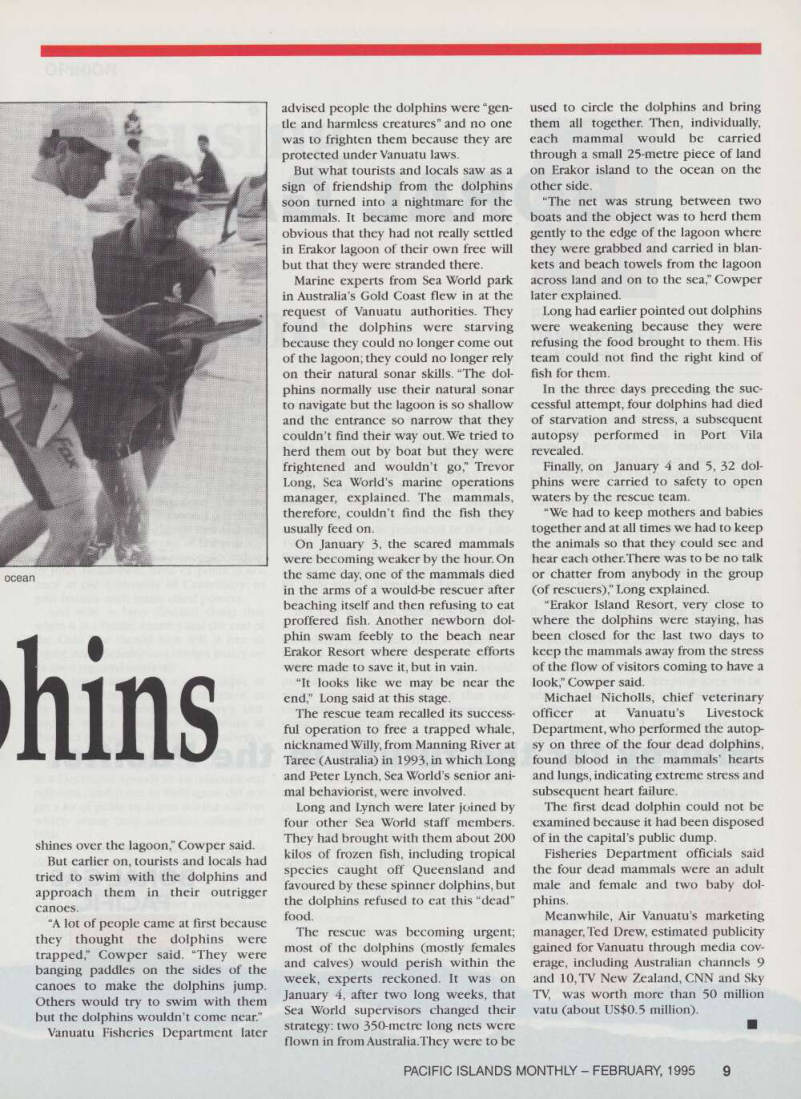
Sea World’s Trevor Long (left) and two other colleagues carry a dolphin to safety (left); Marine life experts carry dolphins across land to the safety of
shines over the lagoon,” Cowper said.
But earlier on, tourists and locals had tried to swim with the dolphins and approach them in their outrigger canoes.
“A lot of people came at first because
they thought the dolphins were
trapped,” Cowper said. “They were banging paddles on the sides of the canoes to make the dolphins jump.
Others would try to swim with them but the dolphins wouldn’t come near.”
Vanuatu Fisheries Department later
advised people the dolphins were “gen tle and harmless creatures” and no one was to frighten them because they are protected under Vanuatu laws.
But what tourists and locals saw as a sign of friendship from the dolphins soon turned into a nightmare for the mammals. It became more and more obvious that they had not really settled in Erakor lagoon of their own free will but that they were stranded there.
Marine experts from Sea World park in Australia’s Gold Coast flew in at the request of Vanuatu authorities. They found the dolphins were starving because they could no longer come out of the lagoon; they could no longer rely on their natural sonar skills. “The dol phins normally use their natural sonar to navigate but the lagoon is so shallow and the entrance so narrow that they couldn’t find their way out. We tried to herd them out by boat but they were frightened and wouldn’t go,” Trevor Long, Sea World’s marine operations manager, explained. The mammals, therefore, couldn’t find the fish they usually feed on.
On January 3, the scared mammals were becoming weaker by the hour. On the same day, one of the mammals died in the arms of a would-be rescuer after beaching itself and then refusing to eat proffered fish. Another newborn dol phin swam feebly to the beach near Erakor Resort where desperate efforts were made to save it, but in vain.
“It looks like we may be near the end,” Long said at this stage.
The rescue team recalled its success ful operation to free a trapped whale, nicknamed Willy, from Manning River at Taree (Australia) in 1993, in which Long and Peter Lynch, Sea World’s senior ani mal behaviorist, were involved.
Long and Lynch were later joined by four other Sea World staff members.
They had brought with them about 200 kilos of frozen fish, including tropical species caught off Queensland and favoured by these spinner dolphins, but the dolphins refused to eat this “dead” food.
The rescue was becoming urgent; most of the dolphins (mostly females and calves) would perish within the week, experts reckoned. It was on January 4, after two long weeks, that Sea World supervisors changed their strategy: two 350-metre long nets were flown in from Australia. They were to be
used to circle the dolphins and bring them all together. Then, individually, each mammal would be carried through a small 23-metre piece of land on Erakor island to the ocean on the other side.
“The net was strung between two boats and the object was to herd them gently to the edge of the lagoon where they were grabbed and carried in blan kets and beach towels from the lagoon across land and on to the sea,” Cowper
later explained.
Long had earlier pointed out dolphins were weakening because they were refusing the food brought to them. His team could not find the right kind of fish for them.
In the three days preceding the suc cessful attempt, four dolphins had died of starvation and stress, a subsequent autopsy performed in Port Vila revealed.
Finally, on January 4 and 5, 32 dol phins were carried to safety to open waters by the rescue team.
“We had to keep mothers and babies together and at all times we had to keep the animals so that they could see and hear each other. There was to be no talk or chatter from anybody in the group (of rescuers),” Long explained.
“Erakor Island Resort, very close to where the dolphins were staying, has been closed for the last two days to keep the mammals away from the stress of the flow of visitors coming to have a look,” Cowper said.
Michael Nicholls, chief veterinary officer at Vanuatu’s Livestock Department, who performed the autop sy on three of the four dead dolphins, found blood in the mammals’ hearts and lungs, indicating extreme stress and subsequent heart failure.
The first dead dolphin could not be examined because it had been disposed of in the capital’s public dump.
Fisheries Department officials said the four dead mammals were an adult male and female and two baby dol phins.
Meanwhile, Air Vanuatu’s marketing manager, Ted Drew, estimated publicity gained for Vanuatu through media cov erage, including Australian channels 9 and 10, TV New Zealand, CNN and Sky TV, was worth more than 50 million vatu (about US$O.5 million). ■
ocean
Advertisements & other items, p. 10 (1 item)
Boral Gas
Energy for the future in the Pacific.
BORAL GAS
PACIFIC
Focusing
Opinion
closer to home
Why did New Zealand send 250 troops - the biggest military contingent to leave this country since the Vietnam War - to Bosnia on the other side of the world?
The official answer, of course, is to hon our its obligations to the United Nations and the contribution to the UN peace keeping force can certainly be justified in those terms. Those obligations also saw New Zealand military personnel serving in the Middle East, Africa, South East Asia and Central America at the end of last year.
But there was another reason, according to John Henderson, head of political sci ence at the University of Canterbury: to gain favours with major allied powers.
And why is New Zealand doing that when it is a Pacific country and the end of the Cold War should have left it free to concentrate defence and foreign policy on its own regional interests?
Foreign policy is not a major topic of debate in New Zealand, involvement in the Vietnam War and the country’s anti nuclear stance being the only issues in that area to have stirred public conscience in recent times.
So Henderson’s provocative comments, in a December speech to an international relations conference in Wellington, did not get a lot of publicity. It was not the stuff on which prime time television ratings are built.
But it raised an issue that is worthy of debate and one that may well be fired in the new political environment of propor tional representation that is bound to pro duce coalition governments and the need for consensus politics in the future. For outside of the ruling National Party there is little enthusiasm for foreign affairs - the focus of all the opposition parties is very much closer to home.
Henderson’s theme is simple: the Pacific island region is the one part of the world where what New Zealand does or does not do actually makes a difference. “In no other region is New Zealand’s action or
inaction likely to significantly affect the outcome of events,” he said.
With the Cold War over, New Zealand need no longer feel in jeopardy because of its isolation and should be taking advan tage of the freedom to pursue a more inde pendent and regional foreign policy.
Henderson, it should be pointed out, is biased. He was head of Prime Minister David Lange’s department when the anti nuclear policy was produced in the mid 1980s. And he later chaired the South Pacific Review Group which made a per suasive case for a regional foreign policy in its 1990 report, Towards a Pacific Island Community.
But that does not make his ideas any less worthy of consideration. He rejects the claims of critics that a regionally focused foreign policy reflects the views of “little New Zealanders”, saying it would provide a firm base on which to pursue wider interests and points out that con centrating on the security of a region cov ering nearly 20 percent of the globe is hardly isolationist.
In his speech, Henderson argued it was important to New Zealand’s national iden tity to recognise the geographic reality that it is a Pacific island nation. It is also increasingly a Polynesian country and it retains constitutional links with the Cook Islands, Niue and Tokelau.
These three points, he said, gave New Zealand a distinct relationship with the Pacific island region not shared by Australia, which has priority security pre occupations with South East Asia and the Indian Ocean.
New Zealand’s more relaxed relation ship with Asian countries, especially Indonesia, enabled it to serve as a bridge between the island states and Asia. “This would be in accord with the growing ten dency of the Pacific island countries to look north to Asia, rather than their tradi tional southern friends of Australia and New Zealand.”
While the region faced no direct exter nal threat, potential threats to peace and security were internal, Henderson said.
He welcomed the Pacific island peace keeping force that was established on Bougainville - short-lived as it was - as an example of what co-operation among the island states, together with New Zealand and Australia, can achieve.
But he noted it took considerable time to get the peace force together and said there was a need for contingency planning with the island governments earmarking and training sections of their forces for regional development.
A bigger New Zealand commitment to Bougainville - like the size of the force sent to Bosnia - might, he said, have helped promote a different outcome.
That is a questionable thesis given the New Zealand and Australian governments’ anxiety for the peace-keeping force to be seen as a Pacific island body, not dominat ed by two white powers.
Henderson noted the dilemma New Zealand and Australia could face if, for instance, the Tongan government request ed military assistance following a pro democracy riot. Not to respond would appear to be letting down a friendly gov ernment - responding would appear to be suppressing the evolution of democratic government.
Similar no-win situations could arise in New Caledonia, East Timor and Irian Jaya or from further military coups in the region.
New Zealand and Australia should be guided by the Forum states in any action in the region, he said. Meanwhile, it was important the island nations develop and maintain the capability and will to resolve their own problems. “Not to do so is to invite other larger outside powers to inter vene.”
And that is food for thought for all of us. ■
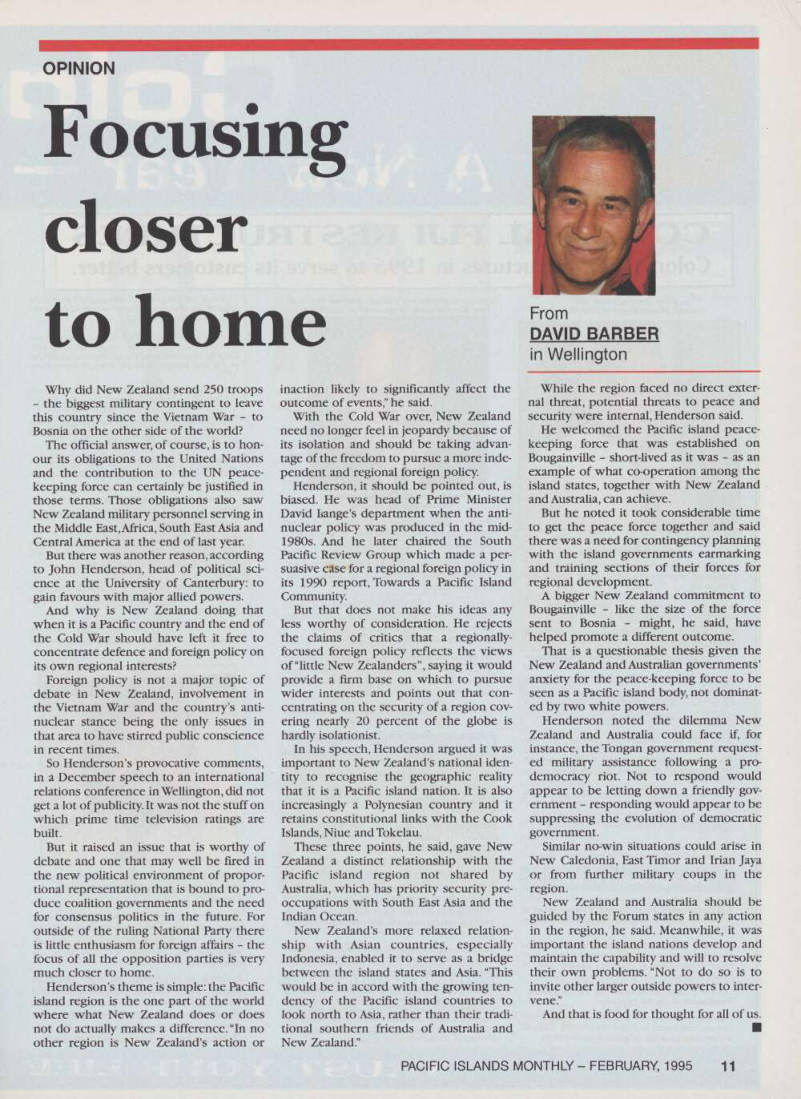
From
David Barber
in Wellington
Advertisements & other items, pp. 12-13 (1 item)
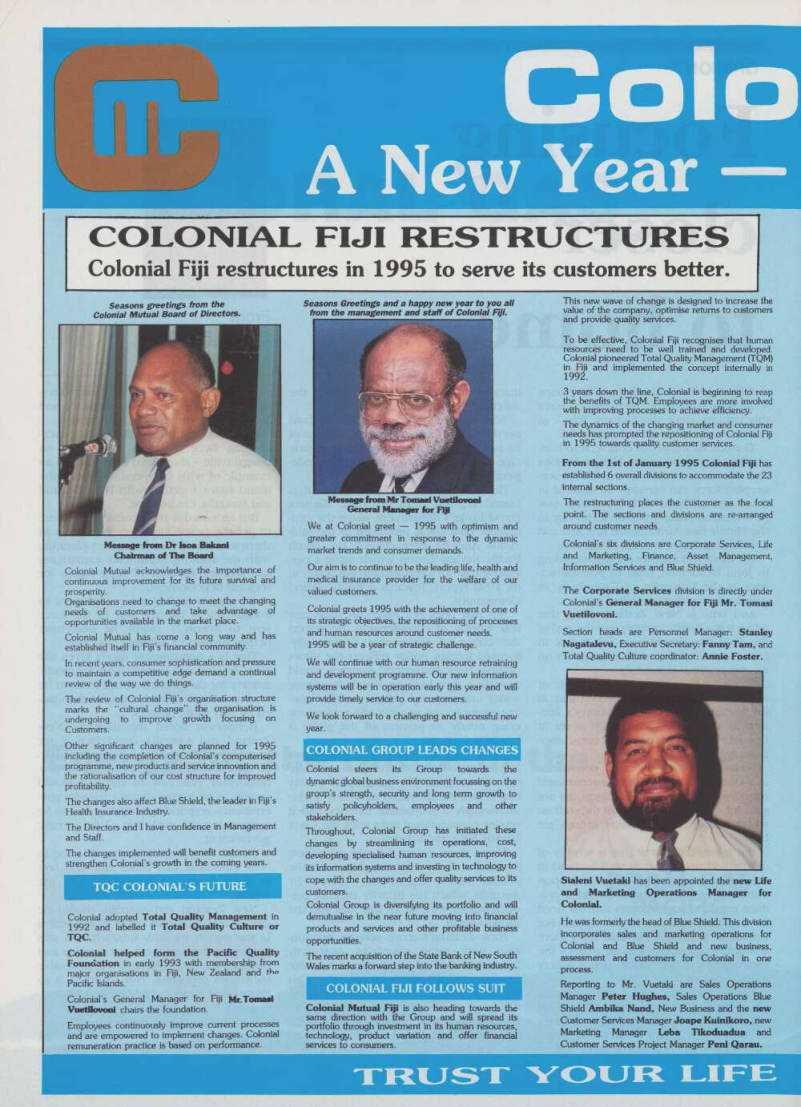
Colo
A New Year
COLONIAL FIJI RESTRUCTURES
Colonial Fiji restructures in 1995 to serve its customers better.
Seasons greetings from the Colonial Mutual Board of Directors.
I I Message from Dr boa Bakani Chairman of The Board Colonial Mutual acknowledges the importance of continuous improvement for its future survival and prosperity.
Organisations need to change to meet the changing needs of customers and take advantage of opportunities available in the market place.
Colonial Mutual has come a long way and has established itself in Fiji’s financial community.
In recent years, consumer sophistication and pressure to maintain a competitive edge demand a continual review of the way we do things.
The review of Colonial Fiji’s organisation structure marks the “cultural change’’ the organisation is undergoing to improve growth focusing on Customers.
Other significant changes are planned for 1995 including the completion of Colonial’s computerised programme, new products and service innovation and the rationalisation of our cost structure for improved profitability.
The changes also affect Blue Shield, the leader in Fiji’s Health Insurance Industry.
The Directors and 1 have confidence in Management and Staff.
The changes implemented will benefit customers and strengthen Colonial’s growth in the coming years.
TQC COLONIAL’S FUTURE
Colonial adopted Total Quality Management in 1992 and labelled it Total Quality Culture or
TQC.
Colonial helped form the Pacific Quality Foundation in early 1993 with membership from major organisations in Fiji, New Zealand and tbo Pacific Islands.
Colonial’s General Manager for Fiji Mr.Tomasi Vuetßovonl chairs the foundation.
Employees continuously improve current processes and are empowered to implement changes. Colonial remuneration practice is based on performance.
Seasons Greetings and a happy new year to you all from the management and staff of Colonial FIJI.
Message from Mr Tocnasi VuetOovoni General Manager for Fiji We at Colonial greet 1995 with optimism and greater commitment in response to the dynamic market trends and consumer demands.
Our aim is to continue to be the leading life, health and medical insurance provider for the welfare of our valued customers.
Colonial greets 1995 with the achievement of one of its strategic objectives, the repositioning of processes and human resources around customer needs. 1995 will be a year of strategic challenge.
We will continue with our human resource retraining and development programme. Our new information systems will be in operation early this year and will provide timely service to our customers.
We look forward to a challenging and successful new year.
COLONIAL GROUP LEADS CHANGES
Colonial steers its Group towards the dynamic global business environment focussing on the group’s strength, security and long term growth to satisfy policyholders, employees and other stakeholders.
Throughout, Colonial Group has initiated these changes by streamlining its operations, cost, developing specialised human resources, improving its information systems and investing in technology to cope with the changes and offer quality services to its customers.
Colonial Group is diversifying its portfolio and will demutualise in the near future moving into financial products and services and other profitable business opportunities.
The recent acquisition of the State Bank of New South Wales marks a forward step into the banking industry.
COLONIAL FIJI FOLLOWS SUIT
Colonial Mutual Fiji is also heading towards the same direction with the Group and will spread its portfolio through investment in its human resources, technology, product variation and offer financial services to consumers.
This new wave of change is designed to increase the value of the company, optimise returns to customers and provide quality services.
To be effective, Colonial Fiji recognises that human resources need to be well trained and developed.
Colonial pioneered Total Quality Management (TQM) in Fiji and implemented the concept internally in 1992. 3 years down the line, Colonial is beginning to reap the benefits of TQM. Employees are more involved with improving processes to achieve efficiency.
The dynamics of the changing market and consumer needs has prompted the repositioning of Colonial Fiji in 1995 towards quality customer services.
From the Ist of January 1995 Colonial Fiji has established 6 overall divisions to accommodate the 23 internal sections.
The restructuring places the customer as the focal point. The sections and divisions are re-arranged around customer needs.
Colonial's six divisions are Corporate Services, life and Marketing, Finance, Asset Management, Information Services and Blue Shield.
The Corporate Services division is directly under Colonial’s General Manager for Fiji Mr. Tomasi Vuetilovoni.
Section heads are Personnel Manager: Stanley Nagatalevu, Executive Secretary: Fanny Tam, and Total Quality Culture coordinator: Annie Foster.
Sialeni Vuetaki has been appointed the new Life and Marketing Operations Manager for Colonial.
He was formerly the head of Blue Shield. This division incorporates sales and marketing operations for Colonial and Blue Shield and new business, assessment and customers for Colonial in one process.
Reporting to Mr. Vuetaki are Sales Operations Manager Peter Hughes, Sales Operations Blue Shield Ambika Nand, New Business and the new Customer Services Manager Joape Kuinikoro, new Marketing Manager Leba Tikoduadua and Customer Services Project Manager Peni Qarau.
nial
A New Paradigm
David Robertson is the Asset Management Manager.
Sections are Properties headed by Isiromi Bayameyame, Investment Rajindar Singh, Support Services Rajeshwar Singh, new Product Development Promotion & Services Manager Mahen Narotam and Asset Management handled by the Asset Management Manager.
Malakai Naiyaga is Colonial’s Finance Manager.
Malakai's 6 departments are Accounting headed by the Accounting Manager Asok Swami, Corporate Management Vueti Maraiwai, Fleet and Remuneration George Thomas and Supplies Alice Heffcrman.
Alex Ah Jack is the Information Services Manager.
Alex is responsible for Information Technology operations. Research & Technology operations.
Business Analysis and Communications. His section is currently developing a database programme which will provide on-line information access and will assist a great deal with customer information services.
SSI
Rosemarie Mercado-David is the new Blue Shield Manager replacing Sialeni Vuetaki, Rosemarie’s sections and heads of departments are New Business and Sales, Customer Services Wilson Tokaora and the new Administration/Accounting head Unise C a warn.
Leba Tikoduadua Marketing Manager Unise Cawaru Blue Shield’s A/C’s and Administration Standing: L to R Margaret Sadal (Sales), Atelina Muavono (Customer Accounts), Rosemarie Mercado-David (Blue Shied Manager), Leba Tikoduadua, Vlki Tuxson (Customer Services). (Absent): Rajinder Singh (Investment) Sitting: L to R Roshni Lakhan (Information Services), Unise Cawaru (Blue Shield’s Accounts & Administration), Swaran Rao (Accounts) Iva Codrokadroka (Marketing).
Absent: Alice Heffeman (Supplies), Fanny Tam (Executive Secretary, Martha Katoanga (Special Projects), Doris Domonatani (Underwriting), Anne Foster (TQC Co-ordinator).
COLONIAL PROMOTES WOMEN IN
MANAGEMENT
COLONIAL PROMOTES WOMEN IN
MANAGEMENT
Colonial Mutual values the contribution of women working in the Society and places 15 middle and senior management women within its new organisation structure.
The women’s professions range from customers services to accounting, administration, underwritng, sales marketing and investment.
Managerial positions taken by women on repositioning are Blue Shields Accounts/ Administration Unise Cawaru, Divisional Head for Blue Shields Manager Rosemarie Mercado-David and Marketing Manager for Colonial Leba Tikoduadua.
Colonial fully supports the employment and development of women in management. Colonial employs about 50% women in its workforce.
Viki Tuxson, Vijay Prasad, Mosese Taga.
CUSTOMERS COME FIRST.
To provide better services to its customers, Colonial has appointed key knowledge people to its customer services area.
Viki Tuxson, Mosese Taga and Vijay Prasad are well known industry figures who will provide specific information and answer general inquiries.
The service representatives will be assisted by experienced clerks who in turn will rely on our new information system Consolidated Life Administration System (CLAS).
This is the one “stop-shop” concept where customers and consumers are served by the Customer Services department, 1995 will be spent on developing and completing this concept so that all clients are ably assisted by the Customer Services Department. l+l
fSlup {Pacific) ilnsunmrf til til
A SUBSIDIARY OF
Colonial mutual
Serving Fiji since 1876
WITH COLONIAL MUTUAL
banking
Business
The
dilemma
By David North
The president of the Chamber of Commerce and local bankers are mates, right?
They all want to boost business, lower taxes, and, when need be, fight off the labour unions. If they have any dif ferences, they settle them quietly, right?
Wrong. That’s not the way it is in American Samoa. Prominent business man George Wray, president of the local Chamber of Commerce, is waging a very public war with the Bank of Hawaii.
Wray, once owner of the now inop erative South Pacific International Airways, is upset by what he regards as the shabby treatment of American Samoans by the big Honolulu-based financial institution.
Wray’s complaint is that BoH happily takes deposits from the Samoans, but rarely makes loans to them, preferring to export the deposits to the much more prosperous Hawaiian islands, where it has an active lending business.
Wray, more confrontational than some of his colleagues on the chamber’s board of directors, persuaded a number of them to co-sign his letter to the bank.
The exchange was printed in full and at great length in the Samoa News.
Using an approach more like that of an investigative reporter than a cham ber official, Wray wrote: “Consider the situation of a young man, 24 years old, five years on a job, who wants $3OOO to build an inside bathroom for his family. Everywhere else in the Bank of Hawaii community
he would have grown up exposed to the availability of BoH’s home improve ment loan offerings everyday in news papers, magazines and TV “But not in American Samoa ... He would not have experienced a single marketing effort of any kind by the Bank of Hawaii to communicate ... that the Bank of Hawaii makes home improve ment loans, or any loans.
“Consider that this young man had heard by word of mouth that BoH can make a home improvement loan. He goes to the bank’s office in Pago Pago.
He opens the door and is faced with a large lobby and an airline-counter array of teller windows. There is no sign any where that the bank makes loans. There is no indication of where he is to go, to whom he is to see about a loan ...
“The young man has to be lucky enough to find someone to tell him to go outside the bank building and ascend the outside steps to a second-storey mall area where the bank has a small office for loans.”
Wray then went on to contrast the obscurity of the bank’s loan operation in Samoa with its heavily promoted lending activities in the Hawaiian islands. “There appears to be a mind set ... that the bank somehow does not have to accommodate and treat the peo ple here like a regular community served by the bank in Hawaii and other areas.”
The bank, of course, disagreed and pointed out it does have a lending pro gramme for homeowners and argued its ability to make loans to individuals in Samoa was hampered by massive loans
it has made to the perpetually broke ter ritorial government.
Wray, a lawyer, was tangling with another lawyer, Joseph T. Kiefer, vice president and general counsel for the bank. The two had apparently met decades earlier. From the correspon dence it was clear both were trying to establish a public record prior to fur ther action by a mainland bank regula tory agency, the Federal Deposit Insurance Corporation. That agency had been requested by Wray to look into a series of charges that BoH was mistreat ing people in American Samoa.
One of the matters in dispute has a broader, regional significance: how do First World banking arrangements, such as mortgages on a house, mesh with tra ditional concepts of non-alienation of that land?
In American Samoa, as in some other islands, families are prohibited from sell ing their land to outsiders. This is a problem, according to the bank. How will it foreclose on a house for non-pay ment of the loan if it is barred by law from owning land under the house?
In most First World countries this is no problem - if the loan is not paid ulti mately the bank goes to court, secures a ruling and takes over the house which it usually sells to someone else.
The bank’s lawyer, Kiefer, raised this issue, saying, “We believe that there is a very rational basis to conclude that members of the family of the borrower would be the only potential purchasers at any foreclosure sale. This is not a situ ation which would give any lender comfort, that a foreclosure of a mort gage might ultimately lead to insuffi cient funds to repay its debt.”
What he did not add is that a main land banker might suspect the family would close ranks and make no bids on the property in question, forcing the bank to lose its entire investment.
Kiefer went on to say that since BoH bought the Bank of American Samoa from Wells Fargo (the California bank) in 1969, it has made $lO million in mortgage loans.
Wray replied that the $lO million was a drop in the Samoan housing mar ket, and that most of these loans had been made many years earlier.
When the FIDC examiners appear on the scene to settle these and other ques tions they will be facing some issues, such as the matter of land tenure, which will be new to them.
It will be interesting to see if the feds side with the bank or with the angry Chamber of Commerce. ■
strategies
Seven
for success
American Samoas fish canneries have contin ued to remain reasonably prosperous despite growing competition. David North examines their strategies and what they tell us about the
industry
Samoa Packing, the biggest tuna pro cessing operation in the islands, has qui etly changed ownership. The secrecy covering this corporate manoeuvre is typical of the industry.
The firm ships an estimated $l5O million worth of canned product, most ly tuna, every year from its large plant on the shores of Pago Pago Bay. Only HJ.
Heinz’s StarKist Cannery, also on the bay, is larger (with an estimated produc tion of S2OO million).
Samoa Packing is the only factory owned by Van Camp Seafood company of San Diego, California. Van Camp used to be owned, in turn, by St Louis-based Ralston Purina Corporation, a US food giant. In 1988 Van Camp was sold to P.T Mantrust, a major conglomerate in Indonesia.
At this point in the story a shroud of obscurity falls over the Van Camp oper ation. It is, according to Van Camp offi cials in San Diego, a privately owned US corporation based in that city.
One of them acknowledged that the
huge Prudential Insurance Company, of Newark, New Jersey, had taken over the firm a couple of years earlier.
In Pago Pago Van Camp not only packs the tuna, which is largely harvest ed in the western Pacific (often in the EEZs of Papua New Guinea and Federated States of Micronesia) by US owned tuna boats, its also packs smaller quantities of salmon caught in the cold waters of north Pacific. It buys other types of seafood from other canners and it also buys tuna from non-US tuna boats.
Van Camp, like StarKist, formerly packed yellowfin tuna caught in the eastern tropical Pacific. But catching these fish caused a major controversy with mainland environmentalists. The yellowfin usually feed in waters imme diately under schools of dolphin.
Catching these tuna with the huge nets used by purse seiners often snared and
killed dolphins.
Public outcry against the killing of dolphins, despite industry attempts to
employ techniques that would release the dolphins, led it to reluctantly move to western Pacific to harvest skipjack.
It is canned tuna that dominates the economy of American Samoa. About 40 percent of the workforce are employed in the two canneries (another 40 per cent works for the over-staffed American Samoan government).
But although the Pago Pago canner ies are humming at the 'moment, and the American canned tuna industry is robust, the industry faces major and growing competition from foreign fish
packers.
How has the industry managed, despite flat sales and growing competi tion, to remain reasonably prosperous?
Like an old warrior chief, who is aging but still wily and powerful, the industry has made some important allies and has used a number of different systems to stay on top of the heap.
These largely defensive strategies bear examination, not only for what they tell us about tuna packing, but about any mature island-based industry selling to the First World.
There appear to be seven strategies: keep the product attractive; keep it inexpensive; keep taxes low; keep wages low; play the tariff game; stay in touch with mainland environmentalists and diplomats; and keep as many secrets as you can.
Keep the product attractive. The canneries and the tuna boats have taken
strong steps to keep the product attrac tive, through vigorous quality control.
For example, a fish that has been cut in the process of seining, if identified, is sorted out of the packing process on the grounds that it will absorb too much brine used for freezing fish in tuna boats, and thus taste salty (which tuna routinely does not). This is also the rea son one uses fresh water to wash fish.
The use of salt water would add a saline taste to the canned product.
Similarly, some of the canners have changed the design of the small (3 oz) cans of tuna sold to be packed in lunch boxes. Since these will be opened away from home (and away from can open ers) they are now equipped with pull tops that can be opened by hand.
Keep it inexpensive. In order to keep consumers from wandering dff in the direction of alternate products, such as turkey, and to keep foreign competi tors at bay, the industry has made a point of keeping prices low (while not threatening profits). The cutback in advertising budgets and the low-wage and low-tax strategies described below, all fit into this category.
Another part of the picture is the canneries’ investment in more efficient technology. The 200-plus-feet purse-sein ers, many of them large enough to carry a helicopter, have so much labour-saving equipment on board that they go to sea with a complement of only 18 men.
StarKist has recently announced that, in addition, it is equipping some of the helicopters with a “fish-eye” -a sophisticated device which can mea sure the temperature of the sea (appar ently without touching it) and give the purse-seiner’s navigator key information on where the tuna are congregating.
Keep taxes low. Like the wily chief who pays as little tribute as he can man age, the American tuna industry goes to great lengths to avoid paying taxes.
While there is relatively little industry can do about mainland tax levels, it has played a remarkably effective role in lim iting and nearly eliminating taxes that might be paid to American Samoa.
The threat, of course, is the tuna fac tories will leave behind their extensive holdings in Samoa, desert their workers and move their activities to a lower wage location elsewhere in the Pacific.
The threat has done wonders with American Samoan politicians, governors and legislators. No politician wants to eliminate 4400 jobs - or even run against an opponent who accuses him of risking such an outcome.
Asa result, according to Samoa’s member of the US House of
The threat that the tuna factories will leave behind their extensive holdings in Samoa, desert their workers and move their activities to a lower-wage location has done wonders with American Samoan
politicians.
Representatives, Eni F.H. Faleomavaega, the tuna canneries pay virtually nothing in taxes. He suggested during the last election campaign that the least the companies could do would be to pay about $6 million, between them, for medical costs.
Currently they provide no medical insurance for their workers. When work ers and their family members are sick they go to the island’s public hospital where they usually pay nothing for treatment. It is unlikely the local legisla ture, the Fono, will have the courage to take Faleomavaega’s suggestion.
Gus Hanneman, subsequently defeat ed for re-election to the Samoan House of Representatives, had suggested dur ing his campaign that each can of tuna leaving the harbour be taxed two cents.
This would produce about $7 million in taxes, he had said. Nothing happened to that proposal either.
In fact, the whole issue of cannery taxation has been largely obliterated by a series of 10-year tax holidays which have been quietly negotiated with gov ernors Coleman and Lutali over the years. These holidays handle some of the canneries’ tax obligations, but not all of them. When taxes for the Samoan gov ernment are not eliminated, they are delayed, amid dispute and more negotia tions which are not public.
A vignette on the canneries’ tax-pay ing habits could be gleaned from the Samoa News (October 5, 1994). The lead was about another cliff-hanging story of government finances - the gov ernment had just barely met the dead line to pay $1.3 million on a bond issue.
The story concluded:“The task (meeting the payment) was made easier this year
because StarKist Samoa reached a final settlement withASG on the Tax Office’s audit of the company’s 1986-1990 tax returns. Part of the final settlement includes a payment to the Tax Office.
The amount of the settlement is confi dential and cannot be legally disclosed by either side.”
So, whatever StarKist paid, three things are clear: the company paid something less than $1.3 million, what it paid it had owed for four to eight years, and how much it paid was clearly not the kind of information to be shared with Samoan taxpayers.
Keep wages low. The tuna canner ies have followed a three-part strategy to keep their wages low. They use for eign workers, break up union-organising attempts and play the US minimum wage system.
Using foreign workers, from Western Samoa, is a basic part of the strategy.
Western Samoans, though of the same ethnic group (and sometimes the same extended family) as American Samoans, cannot become citizens of American Samoa and cannot vote in ASG elections and, therefore, have no ability to influ ence the governor or the Fono.
The industry has from time to time been challenged by union organisers arriving from the mainland, usually from the big and controversial Teamsters Union. The plants always manage to get both the governor and the traditional leaders to rally around to fight the union. (Neither the chiefs nor the gov ernors want to see anew and powerful organisation created that might compli cate their lives.) With the island establishment solidly against the union, and with little contin uing local support for it, the union always loses.
Meanwhile, every two years, under mainland law, a system is set in motion to review the perennial request of America Samoa for a minimum wage under the mainland level of $4.25 an hour.
Six people are chosen to set the wages; two from industry, two from labour and two from the public. One of the public members is appointed by the US Secretary of Labor and one by the governor. Since it takes four votes to make a decision, and since the gover nor’s representative always sides with the companies, the tuna factories, in effect, set their own minimum wages.
The last time around the wage was set at $2.97 an hour. In June or July there will be another round of wage-setting.
Play the tariff game. The tuna companies came to American Samoa for
one reason - it was the lowest wage location under the American flag and thus behind US tariff walls. These walls, however, are not terribly high and may be crumbling.
As is usually the case with trade bar riers, the significance is in the details and the details are complicated.
Tuna packed in oil has a high tariff (35 percent of its value) and very little foreign-packed tuna in oil arrives in the US as a result. Unfortunately for the industry, it thought tuna in oil was more important than tuna in water and agreed to the current set of rates many years ago when the spring-water pack was less popular than it is now.
Tuna packed in water has two levels of tariffs: 12 percent most of the year and six percent of the value on January l.This is how it works,not how the law is written.
The law says that 20 percent of the previous year’s domestic consumption of tuna can be admitted with a six-per cent duty rate, but above that quota, duty is levied at 12 percent.
The US Congress recently ratified the General Agreement on Trade and Tariffs, but that document left fish tariffs in place to the relief of tuna packers. They are much more worried about the North American Free Trade Agreement which covers exports from Canada and Mexico.
The Mexico tuna industry is the problem. It has ships working tuna and has even mounted some efforts to avoid killing dolphins. It has tuna packing plants, all of which are much closer to the mainland than those in Samoa and its wage scale is lower than Pago Pago’s.
Further, NAFTA will, over the next 15 years, reduce the existing tariffs by one fifteenth a year.
NAFTA also has a complex set of pro visions that discourages the US from enforcing legislation, like the “dolphin safe” provision in the Marine Mammal Act, that might be viewed as inhibiting free trade between US and Mexico.
At the moment Mexico is not press ing the issue and is not seeking to either comply completely with US “dolphin safe” requirements nor is it seeking to over-rule the Marine Mammal Act. But should the Mexican industry take either of these courses, the US tuna industry might be in trouble.
Stay in touch with environmen talists and diplomats. Just as the wily aging chief has to maintain alliances with external powers, so does the indus try. Although it does not talk much about the very real sacrifices it made to end the dolphin controversy, it clearly
won friends in environmental move ments and created a set of allies who may be useful in the future.
The time may come when Mexico wants to enter the US canned tuna mar ket and when the “dolphin-safe” issue may be the only real barrier to the ship ment of tuna from Mexico. The tuna industry will then need allies among the
dolphin lovers.
Further, although the industry does not regard the $ 12 million a year paid by the US State Department to island gov ernments for fishing rights as a subsidy to it, it welcomes the peace that has fol lowed the negotiation of the tuna treaty.
In earlier years tuna boats would be found in the islands’ EEZs and were
sometimes captured by island police
forces. Solomon Islands and Kiribati levied substantial fines on boat owners before releasing the vessels. The diplo mats who handle the tuna treaty are important allies of the industry.
Keep it a secret. While it may not be good for the broader public, tuna canneries have clearly benefited from their policies of secrecy. No one knows how much taxes they pay, how large their profits are or, in the case of Samoa
Packing, who owns the company.
A couple of years ago this policy of secrecy was preserved through the unlikely intervention of the Big Daddy of US Senate liberals, Senator Teddy Kennedy. Through some legislative acci dent the law that once applied to Puerto Rico about the minimum wage had been extended to American Samoa. It said corporations, like the tuna canner ies, seeking lower than normal mini mum wages had to open their books for public inspection. This had been the case for years in Puerto Rico and had not caused problems.
The tuna industry, however, was furi ous and mounted a major lobbying effort - threatening to open up the whole question of the recently enacted minimum wage on the mainland if its secrecy could not be preserved.
Kennedy did not want to revisit and defend the then new minimum wage, and so he and the rest of the Senate and House Democrats quietly caved. A small bill drafted by the industry moved through both houses of Congress and the canneries won yet another round for secrecy. ■
The paycheques of CEOs
No matter what the exact relationship between Samoa Packing and Prudential Insurance, one thing is clear: Pru’s chief execu tive officer has a more modest remuneration package than Tony O’Reilly, CEO of Heinz which owns American Samoa’s Starkist operation.
A couple of years ago O’Reilly had a particularly good year, drawing $75,084,622 in various forms of compensation (salary, bonuses, fringes and stock options).To provide a frame of refer ence, it was more than twice the entire gross national product of Kiribati in a recent year.
In contrast, in the last year for which we have data, 1993, Prudential’s since-retired CEO, Robert Cushing Winters, pulled down only $2,290,000 in salary and bonuses.
Winters thus earned considerably less that year than the pay roll of the Samoa Packing plant (which we estimate at about $12,000,000).The figure assumes a $3.00 average hourly wage, a 2000-hour work year and employment of 2000 people.
O’Reilly, on the other hand, in his $75,000,000 year, earned five times as much as the 2400 workers at StarKist, whose earnings we estimate in the $14,000,000 - $15,000,000 range.
Advertisements & other items, p. 18 (1 item)
with the voice of the Pacific
Talk to the Pacific
‘There is one magazine that decision-matters in the ‘Pacific
must read each month .
That magazine is the voice of the ... t 'i 40*
VCL
VL V > ZfJl A Pacific Islands Monthly has been a cornerstone of communications in the region for 63 years.
It has built an unequalled reputation for providing the best available news, analyses and insight on events in the region.
That reputation spans the islands, the region and more than 71 countries.
That reputation puts Pacific Islands Monthly on the desks of Government figures, public servants, business leaders and other decision-makers throughout the region.
That reputation gives Pacific Islands Monthly the things advertisers need most... credibility and selling power.
Talk to your market with the voice of your market.
Pacific Islands Monthly
Call (679) 304-111.
Pacific Islands Monthly is the only regional news magazine with an independently audited circulation.
pineapple
Phasing out the pineapple
Tourist resorts are
replacing Hawaii’s
pineapple plantations
as Dole turns its atten tion to the tourism market.
Uncle Sol Kaupuiki stretches his arm in front of the expanse of dry brush and orange clay.
“All of this used to be pineapple,” he says, a proud smile on his brown crinkled face.
An oblong oasis of perfect green grass appears in the middle of the neglected fields. That, says Kaupuiki, is the 18th hole of the Manele Bay Golf Course. The barren land and manicured greens represent the past and future of Lanai, a tiny Hawaiian island just a 30-minute plane ride from Honolulu.
Hundreds of Lanaians who spent hot days bending over spiny pineap ple plants now work in the air-condi tioned comfort of two luxury resorts.
In 1990, the Dole Food Co., which owns 98 percent of the 360 sq-km island, announced it would phase out its pineapple crop to enter Hawaii’s tourism market with the resorts.
Lanai, named “Pineapple Island” in the days when as many as 3700 hectares of land blossomed with the fruit, had its crop reduced to 40 hectares surrounding the airport. At the time, 90 percent of the island’s
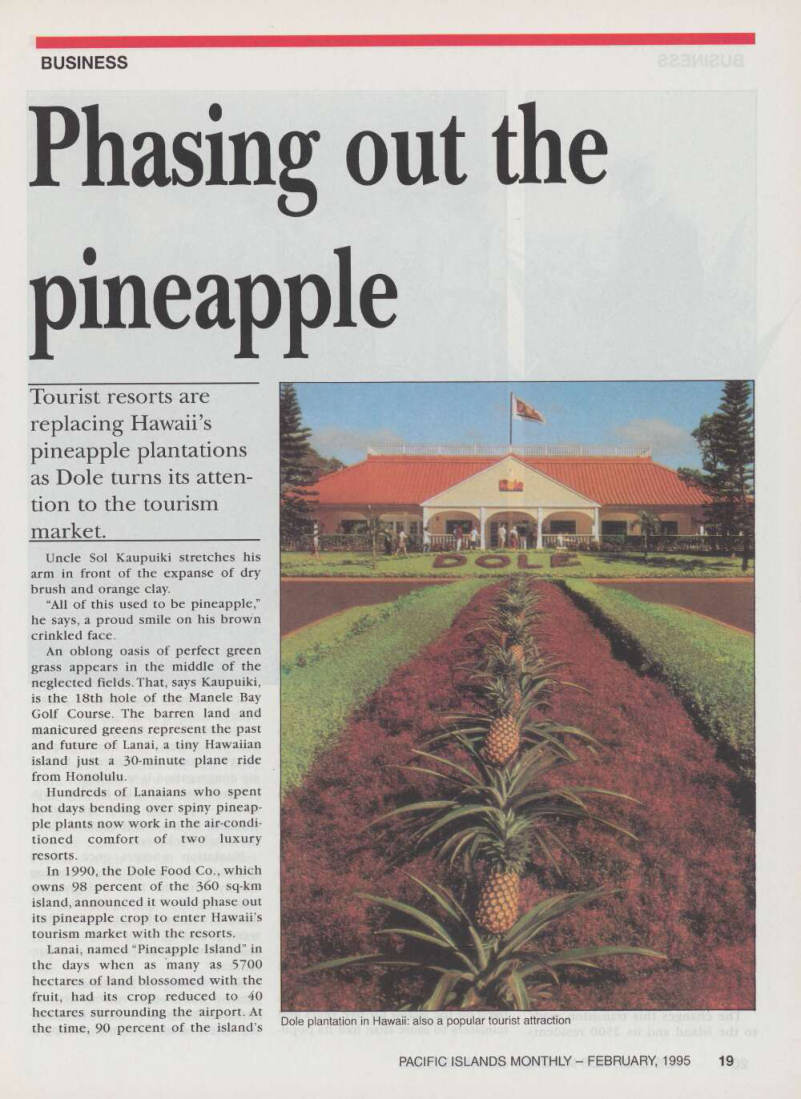
Dole plantation in Hawaii: also a popular tourist attraction
jobs were linked to pineapple. Tn April 1990, the elegantly rustic The Lodge at Koele opened amid the whistling pines of Lanai’s cool high lands. A few months later, the slick Manele Bay Resort opened on the coast, overlooking one of Hawaii’s most beautiful beaches. Both were accompanied by championship golf courses.
For the first time, residents had to share their roads with rental cars, their beaches with tourists and their jobs with outsiders.
The company said all pineapple workers, mostly first - and second generation Filipinos brought to Hawaii to work in the fields, would be considered for jobs without los ing their pensions and health bene fits. But the workers, some with Dole for 20 years and more, would have no seniority in the hotels which are
managed mostly by newcomers to
the close-knit community.
The changes this transition made to the island and its 2500 residents
are seen in various faces and places around Lanai.
Butch Gima points to the cars passing as he stops at one of the community’s few stop signs. Traffic lights are nonexistent.
“I had to wait for six or seven cars the other day! Before the hotels, you never had to wait for more than two or three,” he said.
But Gima said he wishes such minor inconveniences were the only problems he had to deal with as Lanai’s lone social worker.
The new industry, he said, has ush ered in new social problems, such as increases in divorce, family violence, depression, crime and alcohol and illegal drug use.
Father Bob Schwarzhaupt has lived on the island for five years and ministers to more than half its popu
lation through his Sacred Heart Church.
“Sunday is no longer the family day at Church. It’s the day they work,” he said. “At Christmas, half of my congregation is working.”
Schwarzhaupt said he has wit nessed spiritual and emotional changes in his Congregation since the hotels took over.
Plantation workers once gained spiritual satisfaction from working closely with the land and growing “the sweetest pineapple in the
world,” Schwarzhaupt said. “They
were proud of what they did,” he said. “Now, they’re janitors and bar tenders.”
Kurt Matsumoto, the general man ager of The Lodge, remembers the summers he spent in the fields grow ing up on Lanai. Pineapple-picking is
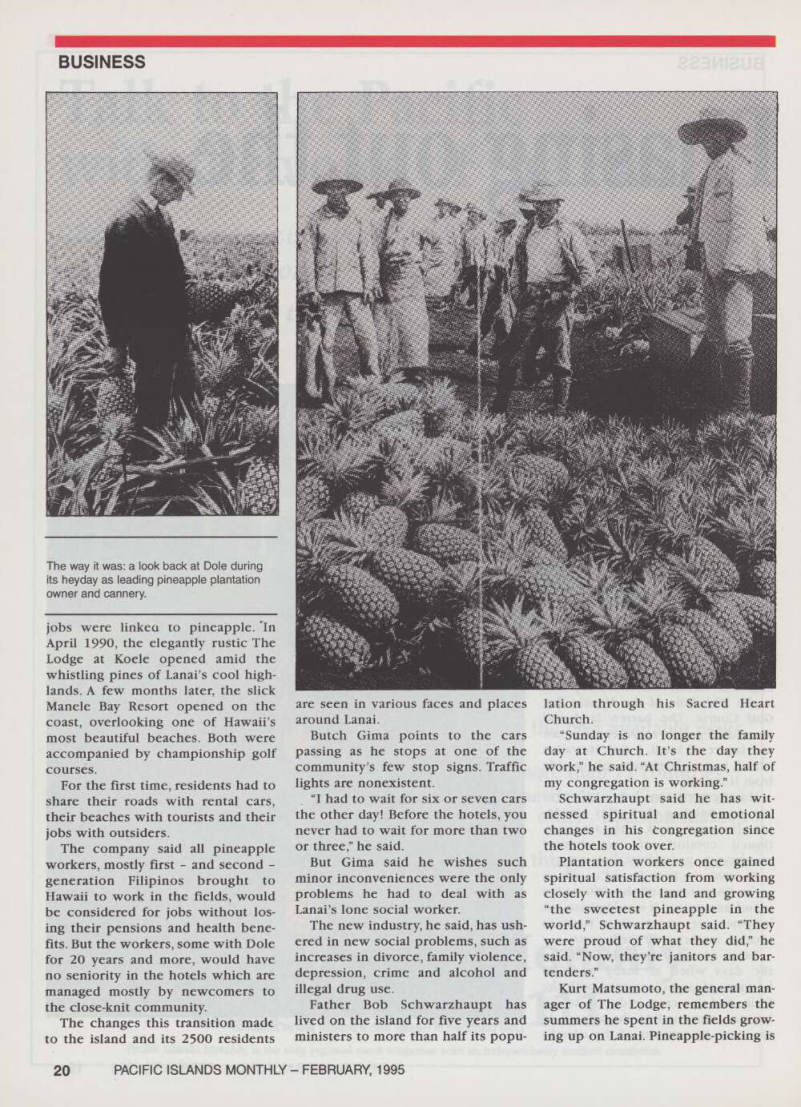
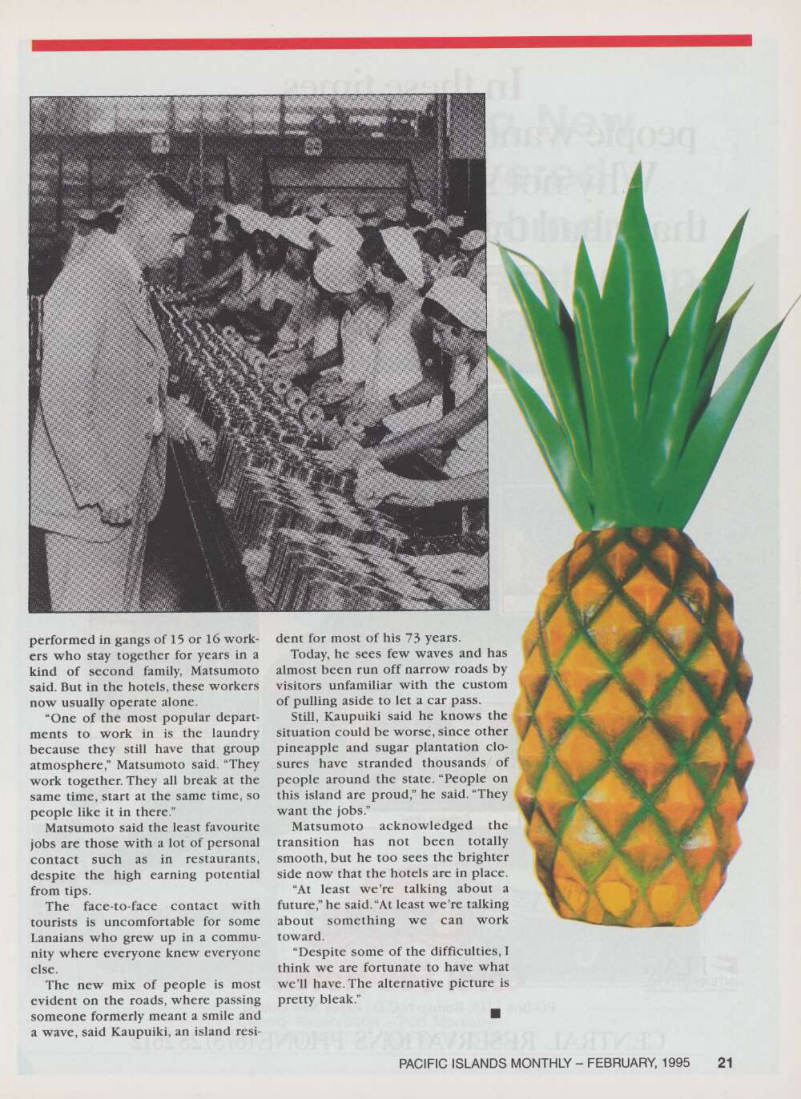
The way it was: a look back at Dole during
its heyday as leading pineapple plantation
owner and cannery.
performed in gangs of 13 or 16 work ers who stay together for years in a kind of second family, Matsumoto said. But in the hotels, these workers now usually operate alone.
“One of the most popular depart ments to work in is the laundry because they still have that group
atmosphere,” Matsumoto said. “They
work together. They all break at the same time, start at the same time, so people like it in there.”
Matsumoto said the least favourite jobs are those with a lot of personal contact such as in restaurants, despite the high earning potential from tips.
The face-to-face contact with tourists is uncomfortable for some Lanaians who grew up in a commu nity where everyone knew everyone else.
The new mix of people is most evident on the roads, where passing someone formerly meant a smile and a wave, said Kaupuiki, an island resi
dent for most of his 73 years.
Today, he sees few waves and has almost been run off narrow roads by visitors unfamiliar with the custom of pulling aside to let a car pass.
Still, Kaupuiki said he knows the situation could be worse, since other pineapple and sugar plantation clo sures have stranded thousands of people around the state. “People on this island are proud,” he said. “They want the jobs.”
Matsumoto acknowledged the transition has not been totally smooth, but he too sees the brighter side now that the hotels are in place.
“At least we’re talking about a future,” he said.“At least we’re talking about something we can work toward.
“Despite some of the difficulties, I think we are fortunate to have what we’ll have. The alternative picture is pretty bleak.” ■
Advertisements & other items, pp. 22-23 (1 item)
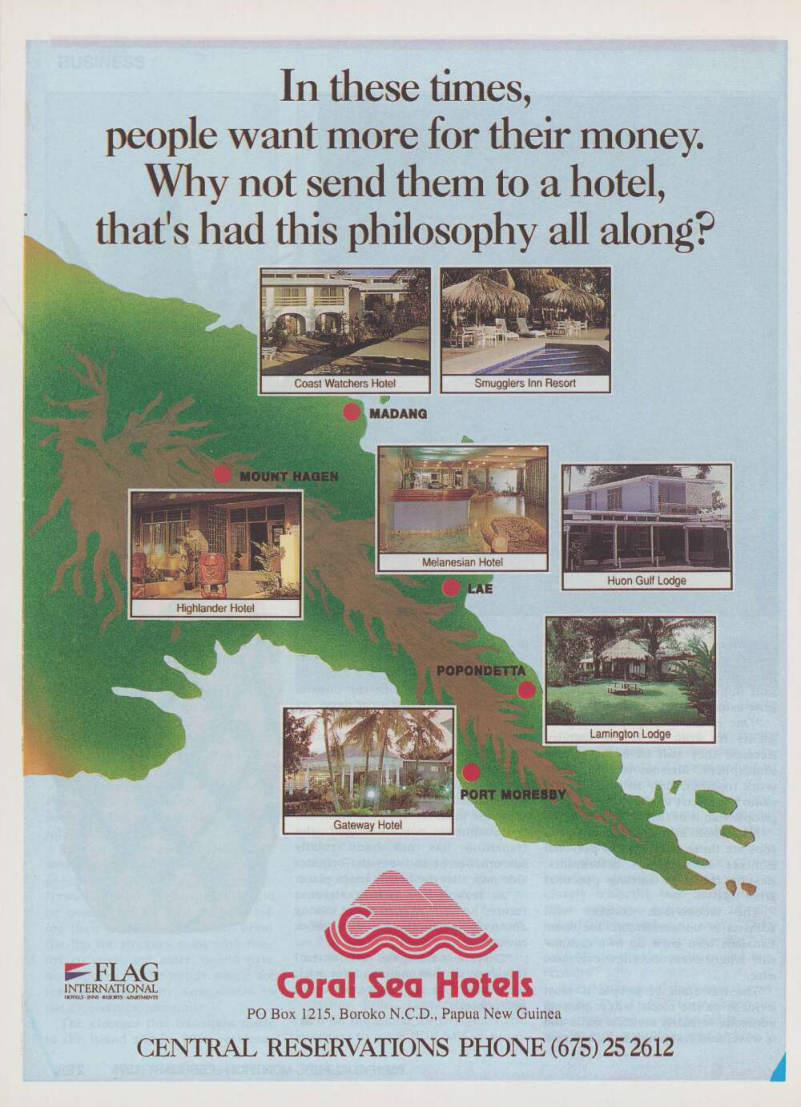
that's had this philosophy all along?
In these times,
people want more for their money.
Why not send them to a hotel,
that's had this philosophy all along?
: -non ton Smugglers Inn Resort Coast Watchers Hotel
MADANG
m , —Tgii;- . - Hotel Melanesian Huon Gulf Lodge Highlander Hotel : s. m Lammgton Lodge r
CRT W
Gateway Hotel
FLAG
INTERNATIONAL
HOTELS INT'K RESORTS APARTMENTS
Coral Sea Hotels
PO Box 1215, Boroko N.C.D., Papua New Guinea
CENTRAL RESERVATIONS PHONE (675) 25 2612
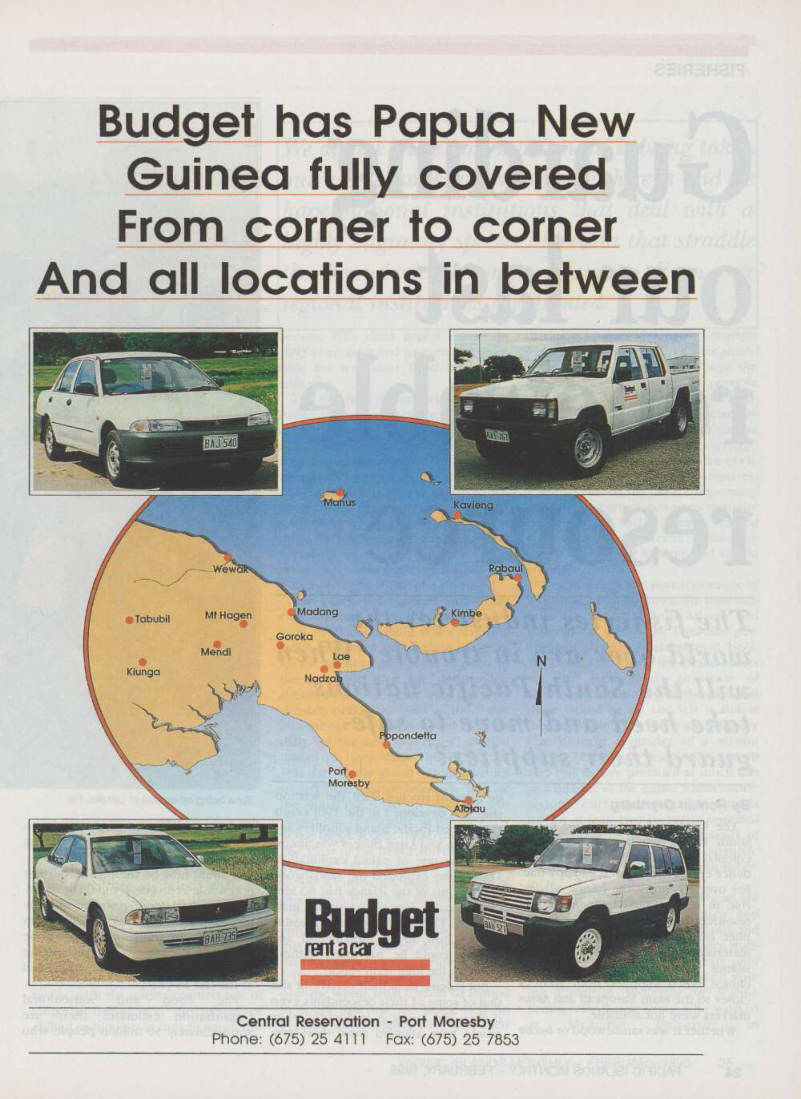
Budget has Papua New
Guinea fully covered
From corner to corner
And all locations in between
Jtt-TSI 540
BAJ
" •d-m Manus Kavieng WewaK v R Mt Hagen Madang / Kimbe • r’NL rJ y Goroka^* > X / .. ' lend! . :/ Rabau T, -v Tabubil Lae Kiunga Nadza % \ pondetta Po Mor by Atotau Central Reservation - Port Moresby Phone: (675) 25 4111 Fax: (675) 25 7853
Guarding

Fisheries
our last renewable resource
The fisheries industries the world over are in trouble. When will the South Pacific nations take heed and move to safe
guard their supplies
By Roman Grynberg
The history of resource use in the South Pacific whether it was under colonial rule or in the post-indepen dence era has never been a happy one.
For over a century, the Pacific islands’ role in international trade in natural resources has been as a peripheral sup plier of some very insignificant raw materials. And even then the Pacific islands have only been suppliers of choice when supplies from sources closer to the main European and Asian markets were not available.
Whether it was sandalwood or beche
de mere or trochus shell, the relation ship deve , oped in the , 9th centu . between Pacific island suppliers and European and Asian buyers was almost invariably one of naked exploitation, Those who exploited the sandalwood and trochus of the islands had no idea of susta inable forestry or marine man
agement. They could not have possibly
known how much sandalwood and troc hus could be harvested without a ff ec ting the long term supply, gut judging from their behaviour and that G f som e of their descendants even if t h e y did know, it is doubtful they wou id have allowed their short-term
financial interests to stop them from
exploiting and eventually destroying
the resource.
It could now be the turn of our last renewable resource - tuna. The seem ingly endless ocean resource of com mercial tuna is not as limitless as it would appear and soon it too will be subject to the same sort of rape as the forests of Melanesia have experienced in the last 13 years.
The Food and Agricultural Organisation estimates there are approximately 50 million people who
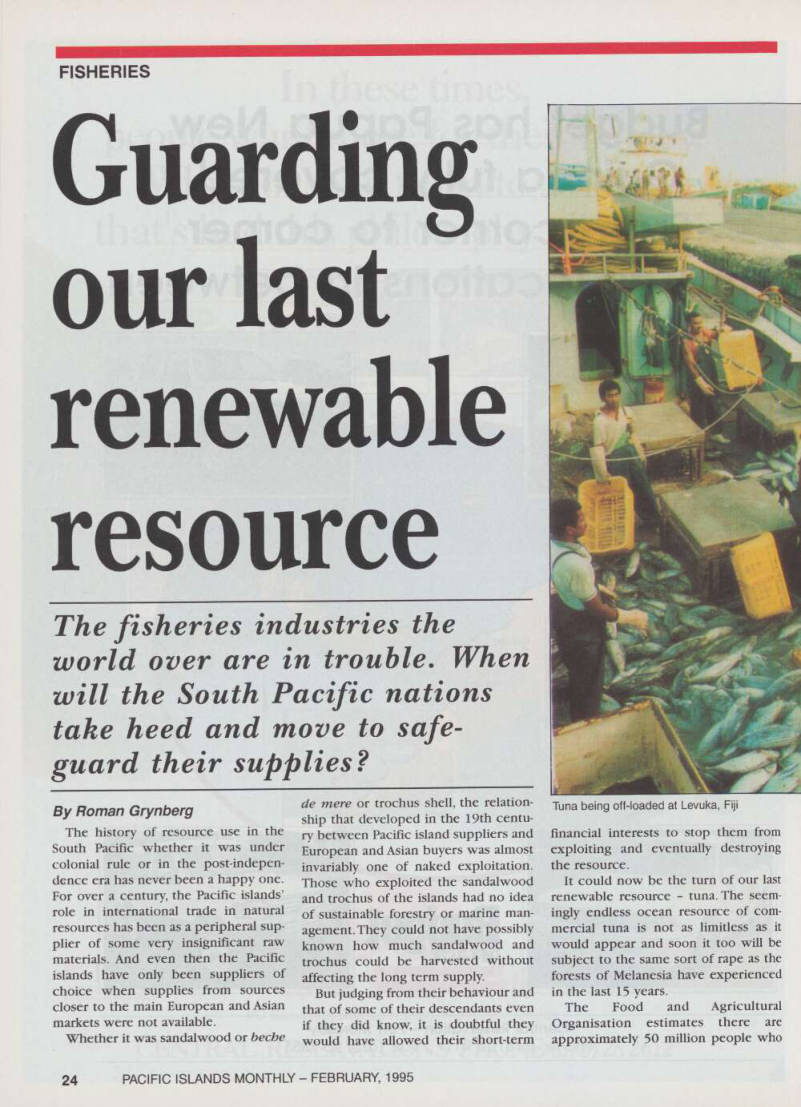
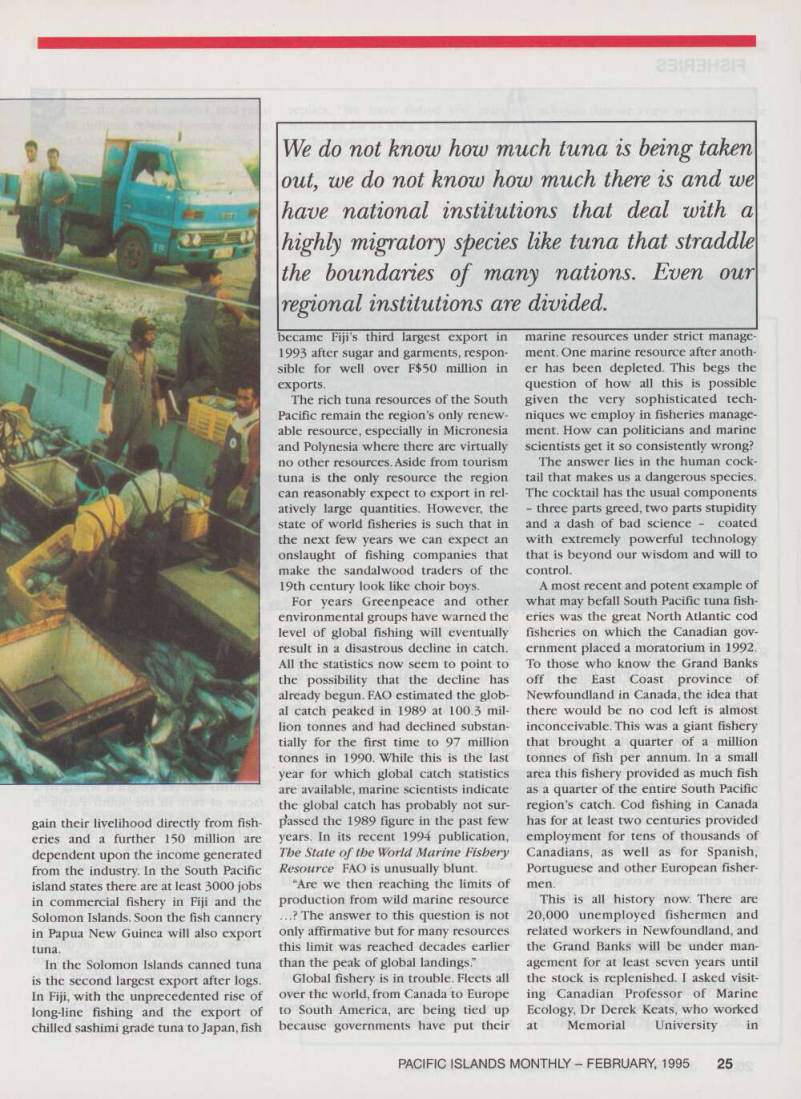
Tuna being off-loaded at Levuka, Fiji
gain their livelihood directly from fish eries and a further 150 million are dependent upon the income generated from the industry. In the South Pacific island states there are at least 3000 jobs in commercial fishery in Fiji and the Solomon Islands. Soon the fish cannery in Papua New Guinea will also export tuna.
In the Solomon Islands canned tuna is the second largest export after logs.
In Fiji, with the unprecedented rise of long-line fishing and the export of chilled sashimi grade tuna to Japan, fish
We do not know how much tuna is being taken out, we do not know how much there is and we have national institutions that deal with a highly migratory species like tuna that straddle the boundaries of many nations. Even our regional institutions are divided.
became Fiji’s third largest export in 1993 after sugar and garments, respon sible for well over Fsso million in exports.
The rich tuna resources of the South Pacific remain the region’s only renew able resource, especially in Micronesia and Polynesia where there are virtually no other resources. Aside from tourism tuna is the only resource the region can reasonably expect to export in rel atively large quantities. However, the state of world fisheries is such that in the next few years we can expect an onslaught of fishing companies that make the sandalwood traders of the 19th century look like choir boys.
For years Greenpeace and other environmental groups have warned the level of global fishing will eventually result in a disastrous decline in catch.
All the statistics now seem to point to the possibility that the decline has already begun. FAO estimated the glob al catch peaked in 1989 at 100.3 mil lion tonnes and had declined substan tially for the first time to 97 million tonnes in 1990. While this is the last year for which global catch statistics are available, marine scientists indicate the global catch has probably not sur p*assed the 1989 figure in the past few years. In its recent 1994 publication, The State of the World Marine Fishery Resource FAO is unusually blunt.
“Are we then reaching the limits of production from wild marine resource ...?The answer to this question is not only affirmative but for many resources this limit was reached decades earlier than the peak of global landings.”
Global fishery is in trouble. Fleets all over the world, from Canada to Europe to South America, are being tied up because governments have put their
marine resources under strict manage ment. One marine resource after anoth er has been depleted. This begs the question of how all this is possible given the very sophisticated tech niques we employ in fisheries manage ment. How can politicians and marine scientists get it so consistently wrong?
The answer lies in the human cock tail that makes us a dangerous species.
The cocktail has the usual components - three parts greed, two parts stupidity and a dash of bad science - coated
with extremely powerful technology
that is beyond our wisdom and will to control.
A most recent and potent example of what may befall South Pacific tuna fish eries was the great North Atlantic cod fisheries on which the Canadian gov ernment placed a moratorium in 1992.
To those who know the Grand Banks off the East Coast province of Newfoundland in Canada, the idea that there would be no cod left is almost inconceivable. This was a giant fishery that brought a quarter of a million tonnes of fish per annum. In a small area this fishery provided as much fish as a quarter of the entire South Pacific region’s catch. Cod fishing in Canada has for at least two centuries provided employment for tens of thousands of Canadians, as well as for Spanish, Portuguese and other European fisher men.
This is all history now. There are 20,000 unemployed fishermen and related workers in Newfoundland, and the Grand Banks will be under man agement for at least seven years until the stock is replenished. I asked visit ing Canadian Professor of Marine Ecology, Dr Derek Keats, who worked at Memorial University in
Newfoundland during the 1980 s, how this occurred. “The Canadian govern ment set the total allowable catch at 260,000 tonnes of cod per annum. The actual level should have been set at half of this.”
Professor Keats was adviser to the Newfoundland Inshore Fisherman’s Association during the 1980 s and pre pared a report which predicted the stock would be destroyed within six years. The Canadian government dis missed his report. Dr Keats was out by only one year on his prediction about when the stock would be exhausted. I asked him how it is that scientists get their estimates wrong. “The stock assessment techniques we use that tell us how much fish there is are simply poor. There are just too many variables for us to know with any great precision how much we can taken from the seas.”
What went wrong in Newfoundland is exactly what could go wrong in the Pacific. The fishing industry with its
high technology and governments will ing to err on the optimistic side when it comes to fish stocks will set catch levels that are unsustainable. The com bination of greed, high technology and scientific ignorance are what so obvi ously destroyed the Grand Banks cod
fishery.
The FAO report suggests the South Pacific is one of the last remaining under exploited fisheries in the world.
In 1992 approximately one million tonnes of tuna were taken out of the waters of the South Pacific. This consti tutes a little over one percent of the total world marine catch. However, what we are increasingly being told officially by the South Pacific Commission is member nations can produce at least two million tonnes of tuna per annum without seriously affecting fish stocks. Just 10 years ago the SPC was saying unofficially, in what until very recently were called “prelim inary estimates”, we could catch three to five million tonnes of skipjack.
Clearly those estimates were opti mistic.
I asked Dr Derek Keats what he thought of the accuracy of these esti mates. He said, “I don’t know enough about Pacific tuna to say, but I don’t know how anyone can know this either. In Canada we had decades of experience, massive amounts of funds for research and some of the very best scientists and yet we got it wrong by a factor of two. In the South Pacific it could be a much larger factor.”
In reply, SPC Co-ordinator of Oceanic Fisheries, Dr Tony Lewis, said,“Tuna and cod are as different as zebras and mon keys.” He will argue that while over fishing appears to be a problem in tem perate waters, we cannot find a case of over-fishing of tuna in tropical waters.
“We could look at the oft-quoted example of the Philippines where hunger and the press of people over rides economics, and where tropical
tuna (skipjack, yellowfin and bigeye)
are harvested at a size of 20 to 30 cen
timetres, the size of sardines, and yet it is still difficult to conclusively demon strate that biological over-fishing is occurring.”
The up-shot of the SPC argument is clear - over-fishing happens in temper ate waters but is unlikely to happen to us.
In the South Pacific we have a situa tion where the existing tuna fisheries are clearly out of control. The SPC has no idea where fish are being caught in the waters of the South Pacific because the Taiwanese and Korean tuna boats massively under-report their catch. The SPC thinks they know the total quanti ty because they can get landing figures in Thailand, Korea, etc. However, these are also under-reported for commercial reasons.
It is also readily admitted the level of scientific research is inadequate to know with certainty how much tuna can be safely caught in any year. The distant water fishing nations pay us a pittance for our tuna. Korea, Taiwan and Japan pay between four to five per cent of what they declare, the US purse-seiners pay nine percent and some nations are paying 11 percent to Australia.
There is clearly a need to protect our tuna resources from over-fishing. We do not know how much is being taken out, how much there is and we have national institutions that deal with a highly migratory species that straddle the boundaries of many nations. Even our regional institutions are divided the SPC deals with scientific issues and the Forum Fisheries Agency with polit ical, legal and increasingly economic issues. It would seem only logical that fisheries management be brought under one regional umbrella.
The Forum Fisheries Agency appears the right umbrella because it can deal with highly political issues the SPC cannot. We must also soon come to terms with foreign nations fishing in our waters. They must either sign fair multilateral agreements and report accurately on their catches or fish else where.
In the end however, no matter how well we manage our fisheries, we are unlikely to ever know with any accura cy how much tuna we can harvest from the waters of the South Pacific.
How then do we fish? Dr Keats
replies, “We have fished the marine resources for as long as man has been on the planet. We can only continue to do so as long as we employ those tech nologies that do not result in the destruction of the fisheries - the same simple technologies we used for cen turies. We cannot use huge purse-sein ers in increasing numbers with spotter helicopters, radar and sophisticated technology and not expect to ultimate ly destroy the commercial tuna resource. We must replicate the tech
nologies that we knew were safe in the past.”
In the end there is little optimism for the management of the fisheries, there is only hope that there will not be one last great rape of our resources. This will take an unusual measure of good sense and restraint - something we have almost never experienced as it relates to our natural resource. ■
Advertisements & other items, p. 27 (1 item)
Alliance Corporation Ltd
SPECIALISING IN IMPORTED FASHION
CLOTHING FOR ALL OCCASIONS
* FASHION CLOTHING
* CASUAL AND FORMAL SHOES
* MANCHESTER
* BEDROOM LINEN
* ELECTRICAL APPLIANCES
* TABLE UTENSILS
* MARINE PRODUCTS EXPORTER
* STATIONERY SUPPLIES
* OFFICE FURNITURE
* MUSICAL INSTRUMENTS
AGENTS FOR ELECTRIC AND ACOUSTIC GUITARS,
DRUMS, PIANOS,
KEYBOARDS,
AMPLIFIERS, SPEAKERS,
MIKES AND STAGE
SOUND SYSTEM
MUSICAL INSTRUMENTS CO. LTD.
LOCATION:
ACOR BOOKSHOP BUILDING
ASHLEY STREET
HONIARA
SOLOMON ISLANDS
POSTAL ADDRESS:
PO BOX 780
HONIARA, SOLOMON ISLAND
FAX: (677) 21477
PHONE: (677) 21239
cross swords
Protest
Maori cross swords with
Tvnz
By Martin Tiffany
Maori activists are threatening further protests if their demands for more Maori programmes on television are
ignored.
On January 2, activists stormed TVNZ’s central Auckland studio forcing the 6pm news - the day’s main news to be delayed for 10 minutes. The dozen or so protesters, led by activist Ken Mair, tricked a security guard and entered the studio. They lined up behind the news readers as supporters in the street out side chanted and waved placards.
Mair said they took the action because the Maori were fed up with pro grammes in their language being side lined. The Maori news programme, Te Karere, was cut off completely over the Christmas holidays. It was expected to return to air in the first week of
February.
Mair said they wanted more air time for Te Karere and other Maori pro grammes and support from TVNZ was needed for a separate Maori broadcast ing station. He said under the Treaty of Waitangi TVNZ had an obligation to pro
vide quality Maori programmes.The pro testers also want more of these pro grammes to be shown during prime time.
TVNZ met the protesters the day after they infiltrated the studios. Mair said he had a promise at the meeting that further talks will be held with “deci sion makers”, including the Minister for Broadcasting.
A TVNZ director, Rod Cornelius, said they had listened to grievances during the three-hour meeting with the group.
He said he pointed out that Te Karere was funded by the Maori broadcasting agency, Te Mangai Paho, for a limited number of programmes a year.
Last year Te Mangai Paho gave TVNZ $5 million for all Maori programmes on the network. TVNZ says it asked for more funds to continue Te Karere over the Christmas period but were told funds were instead being used for an infotainment programme on cable tele vision network Sky.
According to TVNZ, Te Karere , with a regular audience of about 50,000, is not commercially viable during prime time.
However, they say they have six dramas by Maori writers with Maori themes
which could become regular features if they prove popular.
The protest has been successful in that the grievances have received national attention and TVNZ has given an undertaking to look into them.
Whether this will be enough remains to be seen.
Mair has threatened more of “these types of actions” if demands are not met.
The TVNZ protest is the third high profile act by Maori activists against the system in recent months. Last year an activist attacked an Auckland landmark - the pine tree on One Tree Hill - with a chainsaw. This was followed by the beheading of a statue in Wanganui. The statue was of one of the men responsi ble for land sales in the area.
Charges have been laid against those responsible for the attacks on the tree and the statue. But no charges have been laid against the protesters at
Tvnz.
A radical Maori group is behind the three attacks. Their action is causing splits in the Maori community.
Mair has publicly said he wants an end to white rule by the year 2000 and his meetings around the country will look at mechanisms and systems to enable such a move.
“By the year 2000 the liberation of the Maori people will occur in this country,” he says. They want to be able to make all immigration decisions. But not all Maori agree with Mair’s stand and many prominent Maori leaders are distancing themselves from Mair.
Northland Maori leader Dover Samuels warns against extremism and acts of aggression, saying they hurt Maori chances of winning equitable Treaty of Waitangi settlements. He said while he supported a call for a better coverage of Maori issues by television, the radical approach was not the way to go about things. He said following estab lished procedure would achieve more.
Other Maori leaders disagree, saying the radical approach is the only way.
Muriwhenua leader and Alliance Maori Affairs spokesman Matiu Rata says the Maori should maintain pressure even to the point of civil disobedience.
He said Maori had genuine grievances and valid complaints and had to get unruly to draw attention to them.
This year is the year of Maori lan guage. One thing is certain - more than their language will make news this year. ■
The Forum
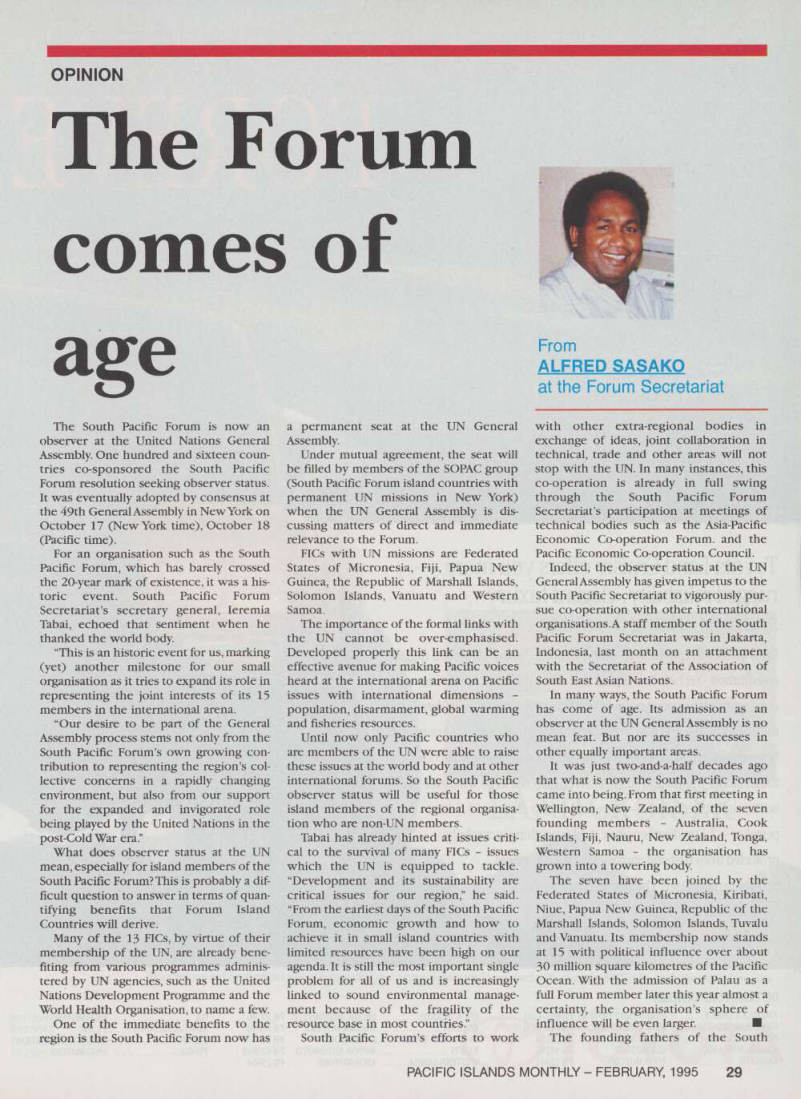
Opinion
The Forum comes of age
The South Pacific Forum is now an observer at the United Nations General Assembly. One hundred and sixteen coun tries co-sponsored the South Pacific Forum resolution seeking observer status.
It was eventually adopted by consensus at the 49th General Assembly in New York on October 17 (New York time), October 18 (Pacific time).
For an organisation such as the South Pacific Forum, which has barely crossed the 20-year mark of existence, it was a his toric event. South Pacific Forum Secretariat’s secretary general, leremia Tabai, echoed that sentiment when he thanked the world body.
“This is an historic event for us, marking (yet) another milestone for our small organisation as it tries to expand its role in representing the joint interests of its 15 members in the international arena.
“Our desire to be part of the General Assembly process stems not only from the South Pacific Forum’s own growing con tribution to representing the region’s col lective concerns in a rapidly changing environment, but also from our support for the expanded and invigorated role being played by the United Nations in the post-Cold War era.”
What does observer status at the UN mean, especially for island members of the South Pacific Forum? This is probably a dif ficult question to answer in terms of quan tifying benefits that Forum Island Countries will derive.
Many of the 13 FICs, by virtue of their membership of the UN, are already bene fiting from various programmes adminis tered by UN agencies, such as the United Nations Development Programme and the World Health Organisation, to name a few.
One of the immediate benefits to the region is the South Pacific Forum now has
a permanent seat at the UN General
Assembly.
Under mutual agreement, the seat will be filled by members of the SOPAC group (South Pacific Forum island countries with permanent UN missions in New York) when the UN General Assembly is dis cussing matters of direct and immediate relevance to the Forum.
FICs with UN missions are Federated States of Micronesia, Fiji, Papua New Guinea, the Republic of Marshall Islands, Solomon Islands, Vanuatu and Western Samoa.
The importance of the formal links with the UN cannot be over-emphasised.
Developed properly this link can be an effective avenue for making Pacific voices heard at the international arena on Pacific issues with international dimensions population, disarmament, global warming and fisheries resources.
Until now only Pacific countries who are members of the UN were able to raise these issues at the world body and at other international forums. So the South Pacific observer status will be useful for those island members of the regional organisa tion who are non-UN members.
Tabai has already hinted at issues criti cal to the survival of many FICs - issues which the UN is equipped to tackle.
“Development and its sustainability are critical issues for our region,” he said.
“From the earliest days of the South Pacific Forum, economic growth and how to achieve it in small island countries with limited resources have been high on our agenda. It is still the most important single problem for all of us and is increasingly linked to sound environmental manage ment because of the fragility of the resource base in most countries.”
South Pacific Forum’s efforts to work
with other extra-regional bodies in exchange of ideas, joint collaboration in technical, trade and other areas will not stop with the UN. In many instances, this co-operation is already in full swing through the South Pacific Forum Secretariat’s participation at meetings of technical bodies such as the Asia-Pacific Economic Co-operation Forum, and the Pacific Economic Co-operation Council.
Indeed, the observer status at the UN General Assembly has given impetus to the South Pacific Secretariat to vigorously pur sue co-operation with other international organisations. A staff member of the South Pacific Forum Secretariat was in Jakarta, Indonesia, last month on an attachment with the Secretariat of the Association of South East Asian Nations.
In many ways, the South Pacific Forum has come of age. Its admission as an observer at the UN General Assembly is no mean feat. But nor are its successes in other equally important areas.
It was just two-and-a-half decades ago that what is now the South Pacific Forum came into being. From that first meeting in Wellington, New Zealand, of the seven founding members - Australia, Cook Islands, Fiji, Nauru, New Zealand, Tonga, Western Samoa - the organisation has grown into a towering body.
The seven have been joined by the Federated States of Micronesia, Kiribati, Niue, Papua New Guinea, Republic of the Marshall Islands, Solomon Islands, Tuvalu and Vanuatu. Its membership now stands at 15 with political influence over about 30 million square kilometres of the Pacific Ocean. With the admission of Palau as a full Forum member later this year almost a certainty, the organisation’s sphere of influence will be even larger. ■ The founding fathers of the South
From
Alfred Sasako
at the Forum Secretariat
Advertisements & other items, pp. 30-31 (1 item)
rugged reliability, elegant luxury...
. -/v ©eg ' i is .. ': - V.-
Toyota Land Cruiser offers you more
and long-lasting durability.
Land Cruiser’s reputation is second to none. No one doubts its rugged constitution. Yet here is a vehicle that rivals the finest limousines where comfort is concerned. And its fit and finish, the attention to detail, and the graceful lines and fine trim are reminiscent of exquisite luxury cars.
Nevertheless, hidden beneath its elegance, Land Cruisers still offer tough ladder frames and suspension engineered to go wherever you wish... in total comfort powered by your choice of 4,5-litre petrol or 4.2-litre diesel engines. And everything is carefully protected from rust and corrosion so it lasts longer.
Toyota Land Cruiser. The best for your world.
Now and forever. jga T O
DISTRIBUTORS /DEALERS
AMERICAN SAMOA BURNS PHILP MOTORS PH 633-4281 GUAM & MICRONESIA ATKINS KROLL, INC. PH 646-1876/9 NORFOLK ISLAND BORRY’S PTY LTD. PH 22114
SOLOMON ISLAND ELA MOTORS PH 30746
VANUATU ASCO MOTORS PH 22341
COOK ISLANDS PACIFIC MOTORS LTD PH 20796
KIRIBATI TARAWA MOTORS PH 21090
PAPUA NEW GUINEA ELA MOTORS PH 229400
TAHITI NIPPON AUTOMOTO PH 429819
WESTERN SAMOA ASCO MOTORS PH 23664
FIJI ASCO MOTORS
NEW CALEDONIA S.I.A.P.
SAIPAN MICROL CORPORATION
TONGA ASCO MOTORS
I i.
“: v -. saa* ■ s?s.: sar ■ .i ■*,
land CRUISER
v
LAND CRUISER
A**.aSft.4VKf - 3S»PP - Exact features and specifications may vary depending on country of purchase. Please check with your nearest TOYOTA distributor/dealer for details.
PH312666 PH 275562 PH 234-5911 PH 23500
® TOYOTA
Cover Stories

And justice for all?
Fiji's magistrates' cour tsibilitv
By Yunus Rashid
On November 11 1994, a 15year-old girl, was the victim of a sexual attack by six men, one of whom was her boyfriend. Charges of rape and defile ment were subsequently laid against the six - rape because the six alleged ly took turns at holding her down and covering her mouth, and defilement because the girl was a minor (under 16 years old). When they appeared before Labasa (a town on Fiji’s island of Vanua Levu) Court, the men plead ed guilty to both charges, but magis trate Moses Fernando pointed out they could not plead guilty to both because rape is “carnal knowledge” without consent while the defile ment charge is irrespective of con sent .
The men were given an option between rape and defilement. The men opted to plead guilty to defile ment.
The facts of the case were read out and the men verified them. The crunch came when it was time for the men to make their statements in mitigation. They said they had not realised the girl was under 16 and that she had looked bigger than her age.
Fernando called the girl before the court. After seeing the victim, he acquitted all six and commented that the girl “looked hefty for someone her age”.
Statements of shock and horror flooded The Fiji Times which first reported the case. Women’s rights movements, politicians and lawyers criticised Fernando’s decision.
Lawyers argued that if the men had said the girl looked older for her age then the magistrate should have entered a plea of not guilty and pro ceeded with a trial. A more disturbing question is how the accused, who all pleaded guilty to the charge, could be acquitted?
Director of Public Prosecutions Nazhat Shameem and the Permanent Secretary for Justice and Solicitor- General, Isikeli Mataitoga, called for more details of the case so that an appeal could be lodged. (It has since been filed). The matter is now before the High Court for its adjudication.
After the initial hue and cry sub sided, public attitude to the case is
one of “but this is nothing new”. And indeed it is not.
Three days before the end of 1994, Suva magistrate Syed Mukhtar Shah, in a custody battle, threatened to send a 10-year-old boy to prison if he did not go with his father who had divorced his wife seven years ago. The father had been a stranger to the boy. The boy had lived with his mother after his parents divorced in 1986. His father sought custody for the child on December 28, 1994. The father told Shah he wanted to keep his son until the custody application was heard on January 25. Without calling witnesses, Shah ordered the child go with his father. The child said he wanted to be with his mother, to which Shah replied, the boy could be sent to prison if he fussed.
The mother made an application before Suva High Court judge Mr Justice Scott who said of Shah’s deci sion: “In my judgment this order by the Resident Magistrate was seriously at fault. Not only had no evidence been heard before the order was made but also the Welfare Reports on file were completely ignored. There is no proper judgment and no reason shown at all why the obviously dis turbing effect of separating a small child from his mother and grandpar ents should so immediately be taken, given the long period during which he had not seen his father. The Resident Magistrate’s order was, I am satisfied, made without jurisdiction, was premature and unwise. The order is revoked.” At least a happy end - for a while anyway.
Let us consider the case of Epi Nakanacagi, a policeman. Nakanacagi was charged with abuse of office and larceny in 1991 and has been appear ing before the Suva Magistrates’ Court for mention since. On December 20, 1994, when his trial was scheduled to begin, magistrate Salesi Temo could not find the charge sheet because it was not placed in the court file given to him that day. Temo discharged Nakanacagi, saying since the charge sheet was not available, there was no case and ordered the DPP’s office to file new charges.
The immediate reaction from prose cutors was: how can a man not charged be discharged? If the magis trate saw there were no charges then he should have acquitted the accused. The DPP’s office has since laid new charges.
In Nadi, a town on the western coast of Fiji’s main island, magistrate Naresh Prasad blamed a victim for being raped because she got drunk and fell asleep at a party and sen tenced the accused to a lenient three year term . “The situation could have been avoided if she was sober,” magis trate Prasad said. “The behaviour of the complainant on this occasion leaves me to take a somewhat lenient attitude in sentencing the accused.”
He even added the victim was “the author of her own vulnerability” and the rapist was tempted by the sight of a sleeping girl.
This is another example of the type of judgments handed down in the magistrates’ courts which deal with 95 percent of the cases registered with the police. Decisions such as these have led to a lack of faith in the integrity, impartiality and wisdom of the judiciary.
Some informed sources put the blame on lack of training, lack of supervision and, in other instances, simply a lack of ethics. But surely people who have the ability to obtain law degrees should not be totally devoid of common sense. But cynical lawyers simply say, “Wise people do not become magistrates”. Perhaps better pay for magistrates would be an answer in attracting senior mem bers of the bar to sit on the benches.
But the situation is further com pounded by the fact that a decree was passed in 1988 removing the cri terion that one had to have qualifica tions as a lawyer before he/she could be appointed a magistrate.
Three magistrates have since been appointed to Fiji’s bench who do not have legal qualifications. They are Aminiasi Katonivualiku, resident mag istrate in Tavua, Viliame Nadakuitavuki, resident magistrate in Nausori and Eroni Sauvakacolo, mag istrate at Suva Domestic Court. (Sauvakacolo was reportedly moved to the domestic court in September 1993 after a public outcry over mani festly lenient sentences given while presiding over criminal cases.) The three who had been civil servants prior to their appointments as magis trates (two were teachers and one an administrator) had also acted as medi ators in Fiji’s traditional court system which deals with minor disputes at the village level.
But in all fairness to them, while they may take more time to unravel
legal technicalities, the first two have not given any reported controversial decisions - not yet anyway. They are able to hear trials which the Chief Magistrate, a graduate from the University of Papua New Guinea, rarely has time to do.
It is difficult to understand how magistrates seem to have the leeway to act on their own, sometimes even in breach of the law, without any apparent repercussions. Recently magistrate Shah held proceedings at a suburban police station in Suva dur ing a public holiday. Shah remanded four alleged rapists, one murder sus pect, and nine others - in the absence of any defence lawyers, interpreters or court clerks - during the Christmas holidays. The court sitting was reported in the media which praised Shah’s initiative. The media also carried a picture of Shah appar ently hearing the cases with division al prosecuting officer Jahir Khan looking over his shoulders.
The DPP consequently wrote to the Chief Registrar, the Chief Magistrate and the Police Commissioner object ing to the sitting on the grounds that it compromised the court system .
She said the sitting had violated fun damental concepts of the law where the prosecution and defence are given equal weight. The hearing, she claimed, was not held in a neutral setting.
If this is so, Shah has set a danger ous precedent whereby defence lawyers could, by the same token, ask magistrates to hold hearings in their offices in the absence of prosecutors.
While holding special hearings on holidays is not new in Fiji, these have until now been held at the court com plexes.
Shah’s response to the queries has been that he had gone to the police station to remand suspects and no court was ever held. This statement is contradictory in itself - how can Shah remand people without the jurisdic tion of the court? In most instances a magistrate can only exercise his vest ed powers within the confines of the court , that is, in the presence of both parties and court officers.
There were no defence lawyers and no court clerks. Every accused brought before Shah’s “court” was remanded in custody, some until December 28 while the others until January 6.
The obvious question raised is whether there is any safeguard against collusion between a magis
trate and police to the detriment of the accused? It unfortunately appears that despite everyone knowing about these incidents, no action seems to be taken to discipline those at fault or to prevent further violations of justice.
Responding to PlM’s questions, Chief Magistrate Sekove Naqiolevu admitted there were lapses but said not all magistrates gave controversial decisions. He blamed the government for a lot of the problems within the magistracy, saying that while the country’s population had grown con siderably since the establishment of the court system, the number of mag istrates and their pay-packets had not been increased accordingly.
Naqiolevu defended his magistrates saying they did their work diligently despite being under constant pres sure. He said where magistrates used to hear 100 to 200 cases per week 10 years ago, they were now having to hear at least 500 to 700 cases.
“We can’t attract seasoned lawyers to come and sit on the bench because there is more money to be made in private practice,” he said.
Perhaps the greatest laxity in the judiciary arises from the fact that it is not independent. The Public Service Commission has to have a say in how the budget is spent and what appoint ments are made.
Sir David Beattie, a former Governor-General of New Zealand, conducted a Commission of Inquiry, at the request of the Fiji government, into the court system to streamline the entire operation. Sir David has compiled his report and handed it over to government which is expect ed to implement some recommenda tions and shelve others until funds are available. No recommendations appear to have been implemented.
The Chief Justice, Sir Timoci Tuivaga, had made recommendations to the Beattie Commission that the judiciary be independent, but this was knocked back in favour of the Attorney-General’s submission that this was not possible on the grounds that it would be too expensive.
Hence, Sir David Beattie’s report on the court system has come under attack as being dictated to by the gov ernment.
While the public is outraged, by the number of complaints and appeals lodged against magistrates’ decisions, Sir Timoci, a highly respected judge, attributes this to “ignorance”. Asked why such criticisms rarely existed t before the coups, Sir Timoci said the
criticisms originated out “of utter ignorance on the part of the public about the processes of law” and the increasing criticism was a result of “increasing ignorance”.
Responding to what PIM described as “controversial” decisions, SirTimoci said,“All cases are controversial”. He said he could not comment on the Labasa rape/defilement case because it was before the courts. On magis trate Shah’s custody case, Sir Timoci said he was away in Lau (an outer island group) and had not heard of the decision. Asked if it was ethical for magistrates to hear cases where their personal friends appeared for one of the parties, SirTimoci said the judicial system in the country was based on ethics and it was improper to allege unethical conduct on the part of “My Lords” without any evi dence. He said people should realise that if they were dissatisfied with a magistrate’s decision, they could go further up by way of appeal.
Sir Timoci said it was difficult to analyse decisions because such an analysis could take up to a year and could only be done by a professor of law, who may eventually get it wrong anyway.
Sir Timoci said he “could not see what the excitement was all about”.
It is worth repeating here Sir Timoci’s points relating to judicial ethics which he made during a magis trates seminar on November 5, 1991.
He had said a magistrate should “dis qualify himself in a proceeding in which his impartiality might reason ably be questioned”. And a general observation he had made then was: “It was no secret that some judgments had been inadequate because they lacked cohesion and coherence.”
Another warning given to magis trates was that they should not min gle in civic and charitable activities if this would reflect adversely on their impartiality or interfere with the per formance of their judicial duties. It was unethical for them to serve organisations conducted “for the eco nomic and political advantage of its members”.
He said magistrates should not solicit funds for any organisation “or use or permit the use of the prestige of his office for that purpose”. They should not be guest speakers at fund raising events.
PIM was unable to get any views from Fiji Law Society president Ram Krishna. ■
bubble bursts
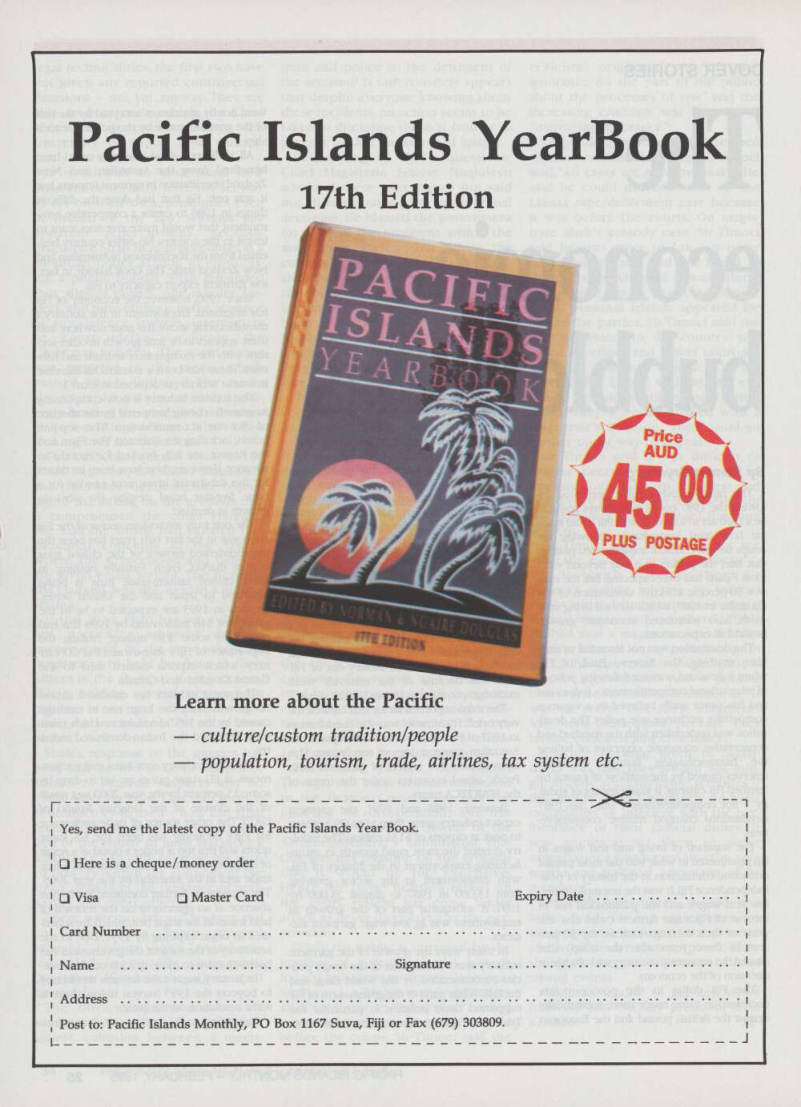
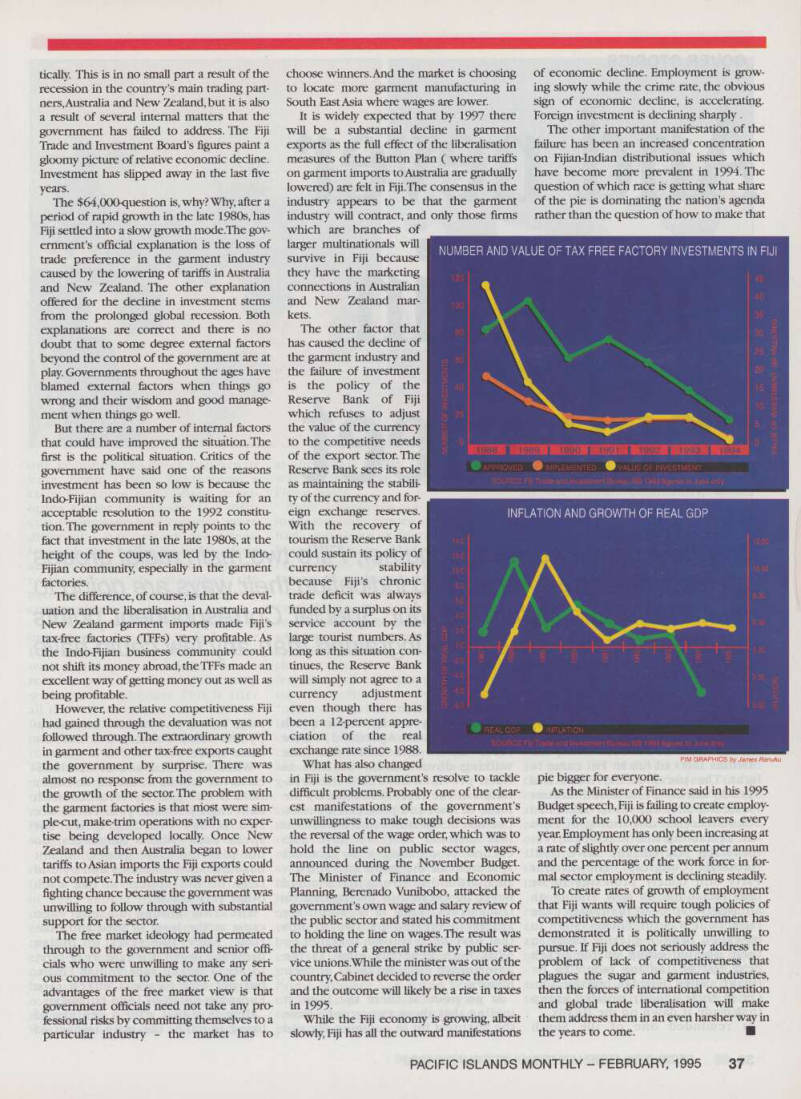
The economic bubble bursts
By Roman Grynberg
The rapid recovery Fiji experienced fol lowing the 1987 coups was always going to be a hard act to follow. Few in Fiji could imag ine how hard. Immediately following the coups the government implemented policies that hurt the pocket in a way beyond what most Fijians had ever expected. But the mas sive 50-percent effective devaluation of the Fiji dollar in 1987, which slashed living stan dards, also stimulated economic growth beyond all expectations.
The devaluation was not intended to stim ulate anything. The Reserve Bank of Fiji, when it devalued, was not following policies of international competitiveness - it does not and has never really believed in a vigorous competitive exchange rate policy. The deval uation was undertaken with the standard and conservative economic objective of halting the haemorrhaging foreign exchange reserves caused by the outflow of capital by terrified Fiji citizens. It was a matter of stabil ity - not competitiveness - but the 1987 devaluations changed relative competitive ness.
The standard of living and real wages in Fiji plummeted in what was the most painful economic contraction in the history of post independence Fiji. It was the unemployment, low real wages and the paradoxical rise in income of Fiji sugar farmers (who saw the value of their earnings increase by 30 per cent in three years after the coup) that caused the economic recovery and change in direction of the economy.
The Fiji dollar in the post-coup era decreased in value much more substantially against the British pound and the European
ECU than it did against the value of the Australian and New Zealand dollars. As a result there was a sharp increase in the dollar value of sugar exports to the UK. As a result the prices of imported consumer goods from Australia and New Zealand did not rise as sharply as the value of earnings and sugar cane farmers saw an increase in their living standards directly as a result of the devalua tions.
What also caused the transformation of the economy was the creation of the tax-free factory system. These factories offered not only lower taxes but a way in which local investors could get their money out of Fiji.
This was because of the relatively weak exchange control regulations in that sector.
The third important factor that created the very brief “Fiji Miracle” was the liberalisation in 1987 of New Zealand and subsequently of Australian garment import regulations. This allowed duty free import of garments from Pacific island countries under the terms of the SPARTECA treaty.
Between 1988 and 1991, the garment export industry grew from virtually nothing to peak at exports of $l3l million. The indus try created the most rapid growth in manu facturing employment in the history of Fiji, with employment in the sector growing from 13,000 in 1987 to almost 23,000 by 1991. A substantial part of the growth in employment was in low-wage garment fac tories.
In many ways the growth of the garment industry was a vindication of the tough poli cies recommended by the World Bank and the IMF While parts of the government of Fiji supported these policies, in particular the Trade and Finance departments, these views
were not by any means accepted by the rest of the government or by the political leader
ship.
All 13 Forum island countries could have benefited from the Australian and New Zealand liberalisation in garment imports, but it was only Fiji that had done the difficult things in 1988 to create a competitive envi ronment that would make investors want to invest in the country. No other country ben efited from the liberalisation inAustralian and New Zealand trade. The Cook Islands, in fact, lost garment export capacity to Fiji.
Since 1990, however, the economy of Fiji has stagnated. Employment in the country’s manufacturing sector has gone nowhere and there appears to be little growth in other sec tors, with the exception of tourism and fish eries. There has been a continuous increase in tourist arrivals (as depicted in chart).
The tourism industry is now complaining its growth is being hampered by the absence of five-star accommodation. The top-line hotels, including the Sheraton,The Fijian and the Regent, are fully booked for months in advance. However, there have been no takers for the substantial investment needed for a large five-star hotel despite the obvious growth in demand.
The one truly miraculous sector of the Fiji economy in the last two years has been the unprecedented growth of the chilled tuna export market. From virtually nothing in 1992, chilled sashimi-grade tuna is being exported to Japan and the United States.
Exports in 1993 are expected to be in the vicinity of $lB million and by 1993 this had grown to some $3O million, rivaling the importance of Fiji’s state-owned PAFCO can nery which exports canned tuna to the United Kingdom and Canada.
The sugar industry has exhibited almost no growth since the huge rise in earnings caused by the 1987 devaluation which, ironi cally, benefited the Indian-dominated indus try.
The sugar industry now faces major adjust ments as EU sugar prices are set to drop by some 15 percent by the year 2000 as a result of the closure of the Uruguay Round of GATT. The other source of trade preference for Fiji’s economy has been the US sugar quota and this too is under a cloud as a result of US commitments to the creation of a free trade area in the Americas by the year 2005.
The situation is further compounded by the absence of an agreement on the renewal of land leases in the sugar belt, which are sched uled to begin expiring by 1997. Due to the sensitivity of the subject, the government has been reluctant to move quickly on the issue.
In January, sugar cane farmers threatened to boycott the 1995 harvest unless there is some resolution on the issue.
Investment in Fiji has been declining dras
tically. This is in no small part a result of the recession in the country’s main trading part ners, Australia and New Zealand, but it is also a result of several internal matters that the government has failed to address. The Fiji Trade and Investment Board’s figures paint a gloomy picture of relative economic decline.
Investment has slipped away in the last five years.
The $64,000-question is, why? Why, after a period of rapid growth in the late 1980 s, has Fiji settled into a slow growth mode. The gov ernment’s official explanation is the loss of trade preference in the garment industry caused by the lowering of tariffs in Australia and New Zealand. The other explanation offered for the decline in investment stems from the prolonged global recession. Both explanations are correct and there is no doubt that to some degree external factors beyond the control of the government are at play. Governments throughout the ages have blamed external factors when things go wrong and their wisdom and good manage ment when things go well.
But there are a number of internal factors that could have improved the situation. The first is the political situation. Critics of the government have said one of the reasons investment has been so low is because the Indo-Fijian community is waiting for an acceptable resolution to the 1992 constitu tion. The government in reply points to the fact that investment in the late 1980 s, at the height of the coups, was led by the Indo- Fijian community, especially in the garment factories.
The difference, of course, is that the deval uation and the liberalisation in Australia and New Zealand garment imports made Fiji’s tax-free factories (TFFs) very profitable. As the Indo-Fijian business community could not shift its money abroad, the TFFs made an excellent way of getting money out as well as being profitable.
However, the relative competitiveness Fiji had gained through the devaluation was not followed through. The extraordinary growth in garment and other tax-free exports caught the government by surprise. There was almost no response from the government to the growth of the sector. The problem with the garment factories is that most were sim ple-cut, make-trim operations with no exper tise being developed locally. Once New Zealand and then Australia began to lower tariffs to Asian imports the Fiji exports could not compete. The industry was never given a fighting chance because the government was unwilling to follow through with substantial support for the sector.
The free market ideology had permeated through to the government and senior offi cials who were unwilling to make any seri ous commitment to the sector. One of the advantages of the free maiket view is that government officials need not take any pro fessional risks by committing themselves to a particular industry - the market has to
choose winners. And the market is choosing to locate more garment manufacturing in South East Asia where wages are lower.
It is widely expected that by 1997 there will be a substantial decline in garment exports as the full effect of the liberalisation measures of the Button Plan ( where tariffs on garment imports to Australia are gradually lowered) are felt in Fiji. The consensus in the industry appears to be that the garment industry will contract, and only those firms
which are branches of larger multinationals will survive in Fiji because they have the marketing connections in Australian and New Zealand mar kets.
The other factor that has caused the decline of the garment industry and the failure of investment is the policy of the Reserve Bank of Fiji which refuses to adjust the value of the currency to the competitive needs of the export sector. The Reserve Bank sees its role as maintaining the stabili ty of the currency and for eign exchange reserves.
With the recovery of tourism the Reserve Bank could sustain its policy of
currency stability
because Fiji’s chronic trade deficit was always funded by a surplus on its service account by the large tourist numbers. As long as this situation con tinues, the Reserve Bank will simply not agree to a
currency adjustment
even though there has been a 12-percent appre ciation of the real exchange rate since 1988.
What has also changed
in Fiji is the government’s resolve to tackle difficult problems. Probably one of the clear est manifestations of the government’s unwillingness to make tough decisions was the reversal of the wage order, which was to hold the line on public sector wages, announced during the November Budget.
The Minister of Finance and Economic Planning, Berenado Vunibobo, attacked the government’s own wage and salary review of the public sector and stated his commitment to holding the line on wages. The result was the threat of a general strike by public ser vice unions. While the minister was out of the country, Cabinet decided to reverse the order and the outcome will likely be a rise in taxes in 1995.
While the Fiji economy is growing, albeit slowly, Fiji has all the outward manifestations
of economic decline. Employment is grow ing slowly while the crime rate, the obvious sign of economic decline, is accelerating.
Foreign investment is declining sharply .
The other important manifestation of the failure has been an increased concentration on Fijian-Indian distributional issues which have become more prevalent in 1994. The question of which race is getting what share of the pie is dominating the nation’s agenda rather than the question of how to make that
pie bigger for everyone.
As the Minister of Finance said in his 1995 Budget speech, Fiji is failing to create employ ment for the 10,000 school leavers every year. Employment has only been increasing at a rate of slightly over one percent per annum and the percentage of the work force in for mal sector employment is declining steadily.
To create rates of growth of employment that Fiji wants will require tough policies of competitiveness which the government has demonstrated it is politically unwilling to pursue. If Fiji does not seriously address the problem of lack of competitiveness that plagues the sugar and garment industries, then the forces of international competition and global trade liberalisation will make them address them in an even harsher way in the years to come. ■
PIM GRAPHICS by James Ranuku
Advertisements & other items, p. 36 (1 item)
Pacific Islands Yearßook
17th Edition
Price
AUD
00 Va i
PLUS
POSTAGE
r Learn more about the Pacific
culture!custom tradition!people
population , tourism , frade, airlines , tax system etc.
X- Yes, send me the latest copy of the Pacific Islands Year Book. □ Here is a cheque/money order □ Visa □ Master Card Card Number Name Signature Expiry Date Address Post to: Pacific Islands Monthly, PO Box 1167 Suva, Fiji or Fax (679) 303809.
U
the twain

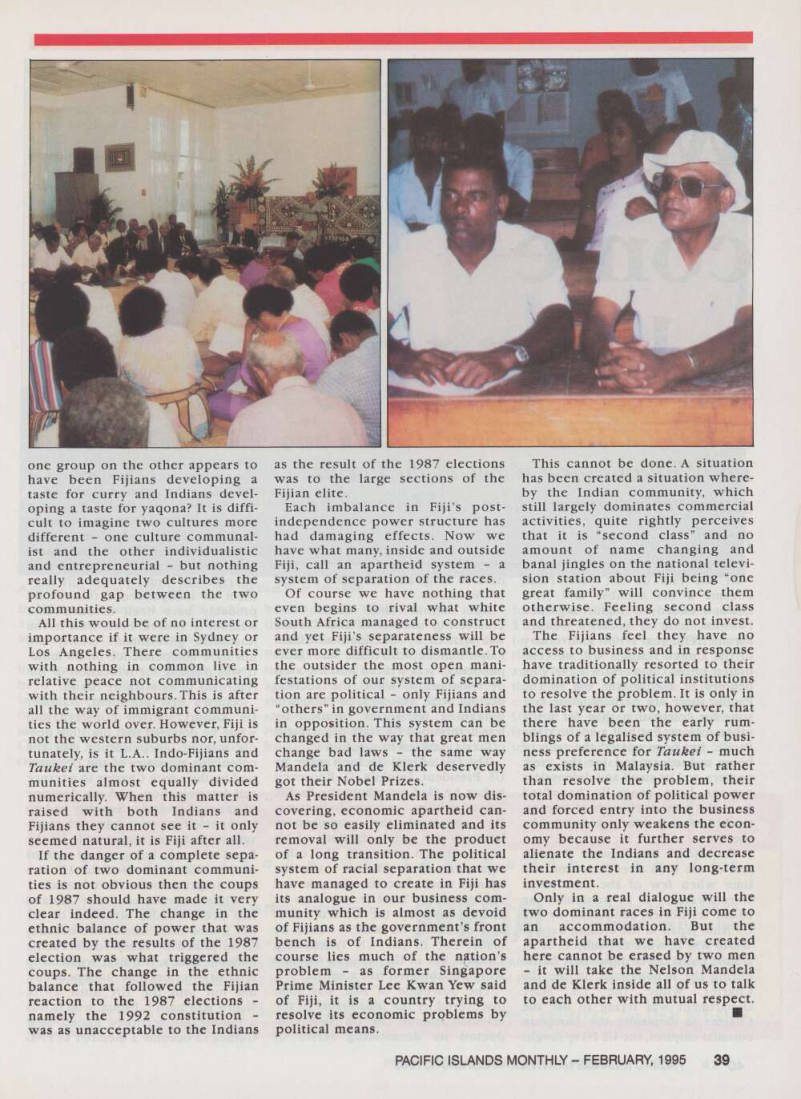
And never the twain shall meet
Despite a century of living together, Fiji’s two main racial groups still lead separate lives with no indication their ways are going to meet in the near future. As our Special Correspondent points out, the differences are more ingrained than any law could have created.
It was on a bright sunny day walking down Deuba beach ata Pacific Harbour when the obvious facts of life in Fiji came to light. The previous day Adi Kuini Speed, widow of deposed Labour Prime Minister Timoci Bavadra, had announced the disbanding of Fiji’s last remaining multi-racial party ironically called the ANC (All Nationals Congress). The Labour
Party still lamely professes to be
multiracial but is now simply an alternative voice of the Indian cane farmers. It was the Fijians (soon to be called Taukef) playing rugby in their isolated group on the beach next to the Indians (soon to be
finally called Fijians) playing soc
cer in their equally isolated group that made it dawn on me finally.
It reminded one of the South
Africa of 20 years ago - the South Africa of Grand Apartheid where races never mixed. It was like walking down similar beaches in Natal province but there the sepa ration of the races was done by the force of laws and policemen’s trun cheons. In Fiji it became obvious at that* moment that we have suc ceeded in creating a far grander apartheid of the mind and spirit an apartheid so strong that it could never be created or dismantled by law-makers. This is a voluntary apartheid created by two groups that have been thrown together by what both generally view as the unfortunate circumstances of their
history.
At no point is there the faintest inkling that these two groups have the slightest bit in common. By and
large Fijians and Indians may occu py the same country but not the same space.
When the Indian soccer ball land ed in the middle of the Fijian rugby field it was politely returned with and English thank you. These are two groups that largely do not speak each other’s languages, do not play the same games, do not have the same interests and by and large do not appear to like each other very much.
The two groups do not even cross at the level of love and mar riage. After 100 years of Indian presence in Fiji it is rare, very rare, to see a mixed race Indian-Fijian, but not rare to see a mixed race European-Fijian or Indo-European.
How is it that after a century of living together the main impact of
one group on the other appears to have been Fijians developing a taste for curry and Indians devel oping a taste for yaqona? It is diffi cult to imagine two cultures more different - one culture communal ist and the other individualistic and entrepreneurial - but nothing really adequately describes the profound gap between the two communities.
All this would be of no interest or importance if it were in Sydney or Los Angeles. There communities with nothing in common live in relative peace not communicating with their neighbours. This is after all the way of immigrant communi ties the world over. However, Fiji is not the western suburbs nor, unfor tunately, is it L.A.. Indo-Fijians and Taukei are the two dominant com munities almost equally divided numerically. When this matter is raised with both Indians and Fijians they cannot see it - it only seemed natural, it is Fiji after all.
If the danger of a complete sepa ration of two dominant communi ties is not obvious then the coups of 1987 should have made it very clear indeed. The change in the ethnic balance of power that was created by the results of the 1987 election was what triggered the coups. The change in the ethnic balance that followed the Fijian reaction to the 1987 elections namely the 1992 constitution was as unacceptable to the Indians
as the result of the 1987 elections was to the large sections of the Fijian elite.
Each imbalance in Fiji’s post independence power structure has had damaging effects. Now we have what many, inside and outside Fiji, call an apartheid system - a system of separation of the races.
Of course we have nothing that even begins to rival what white South Africa managed to construct and yet Fiji’s separateness will be ever more difficult to dismantle.To the outsider the most open mani festations of our system of separa tion are political - only Fijians and “others” in government and Indians in opposition. This system can be changed in the way that great men change bad laws - the same way Mandela and de Klerk deservedly got their Nobel Prizes.
As President Mandela is now dis covering, economic apartheid can not be so easily eliminated and its removal will only be the product of a long transition. The political system of racial separation that we have managed to create in Fiji has its analogue in our business com munity which is almost as devoid of Fijians as the government’s front bench is of Indians. Therein of course lies much of the nation’s problem - as former Singapore Prime Minister Lee Kwan Yew said of Fiji, it is a country trying to resolve its economic problems by
political means.
This cannot be done. A situation has been created a situation where by the Indian community, which still largely dominates commercial activities, quite rightly perceives that it is “second class” and no amount of name changing and banal jingles on the national televi sion station about Fiji being “one great family” will convince them otherwise. Feeling second class and threatened, they do not invest.
The Fijians feel they have no access to business and in response have traditionally resorted to their domination of political institutions to resolve the problem. It is only in the last year or two, however, that there have been the early rum blings of a legalised system of busi ness preference for Taukei - much as exists in Malaysia. But rather than resolve the problem, their total domination of political power and forced entry into the business community only weakens the econ omy because it further serves to alienate the Indians and decrease their interest in any long-term investment.
Only in a real dialogue will the two dominant races in Fiji come to an accommodation. But the apartheid that we have created here cannot be erased by two men - it will take the Nelson Mandela and de Klerk inside all of us to talk to each other with mutual respect. ■
Advertisements & other items, pp. 40-43 (2 items)
We’ve
UNITED NATIONS
We’ve come a long way
As the United Nations enters its 50th year, lan Williams takes a look at the Pacific states representated there and how we have
fared.
At the end of last year, Palau became a UN member and New Zealand ended its highly regarded two-year term as Security Council member. This year’s 50th anniversary of the United Nations will be cele brated across the world with varying degrees of enthusiasm, but in the Pacific there are perhaps more rea sons for celebration than for many other regions. For half a century, the Pacific has been spared the pain of being a battleground for the great powers, and its small and defenseless nations have generally benefited from the partial triumph of interna tional law and order represented by the UN.
The Pacific islands were the sub ject of the UN’s attention, even at a time when few of the inhabitants were aware of it. In particular, the island territories, conquered by the US from Japan in the closing days of World War 11, were the subject of an almost equal bitter diplomatic battle during the negotiations on the UN Charter. While the US State Department was trying to use the Charter to dismantle the European colonial empires, the US Navy fought
hard to keep its unfettered control of the islands.
But within that battle, the Trusteeship section of the Charter was written by American statesman Ralph Bunche, who made sure “inde pendence” was written into the aims of trusteeship, while the section dealing with colonies, or “non-self governing territories,” drafted by less-determined US State department officials, omitted to mention it.
The last official decision made by US President Franklin D. Roosevelt before he died was about the Pacific Trust Territory - as it was to become.
He approved the compromise between the various factions of his administration and with the other signatories of the Charter - that the islands would become the one and only “Strategic Trust Territory” to be administered by the United States and decisions on which would be made, not in the UN Trusteeship Council, but in the Security Council where Washington had a veto.
The downside of that was soon discovered by the inhabitants of the Marshall Islands. The US Navy con ducted its devastating series of
nuclear tests, which some historians claim had more to do with a budget battle between the Navy and the Army than it had with frightening the Russians.
Although these happened under
UN Trusteeship, it would be difficult to blame the new organisation for the radioactive disaster which befell the islanders. After all, the US would have had its way whether the UN was there or not. And one has to doubt whether Washington would have contemplated giving indepen dence to the Marshalls, Micronesia and Palau if it had not been tied by its trusteeship agreement “to pro mote the political, economic, social and educational advancement of the inhabitants ...and their progressive development towards self-govern ment or independence”.
For the Pacific, the turning point was clearly the decision by the Nauruans to go for independence in 1968. Like the radiated Marhsallese, they may have wished for a stronger supervisory hand from the UN while their phosphate assets were being extracted by the British, Australians and New Zealanders, but the new international order of the UN gave them an independence that would probably have been inconceivable without it. Indeed, even with it, the Australian government clearly did not have independence on its mind.
It was pushing for relocation of the Nauruans to an offshore island.
Nauru’s first president, Hammer De Roburt, caused consternation when he declared that his 3000 peo ple wanted independence, but the colonialist members of the UN were tied by their own Charter to advance self-determination, and its doctrine of national sovereign equality had no lower size limit to it. Any such reser vations had been swept aside by the flood of newly independent nations in the 1960 s who used the US as a lever to get colonies their freedom.
While Australia and New Zealand had been founder members of the UN, it took them almost two decades to be joined by other South Pacific nations. Samoa, the first trusteeship territory to become independent, did not join the UN until 1976.
Nauru still hasn’t. Papua, which was a Trusteeship territory, joined New Guinea to become a member as PNG
in 1976; the Solomons in 1976 and in 1978 Vanuatu, followed by the Marshalls and Micronesia in 1991.
Of course the French territories have yet to follow, but they have been on the UN’s agenda. In the teeth of French opposition, PNG and other Pacific states have rallied a majority to “reinscribe” New Caledonia on the list of colonial ter ritories at the UN, and the pressure
has helped the Kanaks in their nego tiations with Paris.
And while the UN still regards Portugal as the official administra tion of East Timor, its resolutions against the Indonesian annexation showed how ineffectual the organi sation could be when a major regional state defied it with the backing of a superpower like the US.
So what’s in the United Nations
for the Pacific states, apart from over $lOO,OOO a year in minimum dues?
In fact, they have benefited more than most. UN agencies like UNDP and UNFPA have been operating in the area for a long time, even in countries that have not joined the UN. But the biggest benefit for small islands is their continued safe exis tence as equal sovereign states.
For example, if Nauru had not
A view of the United Nations building: from the East River, New York
taken its case to the World Court, it is difficult to believe it would have secured the compensation it did from Australia last year. Under what other circumstances would one of the world’s smallest nations have been able to challenge one of the biggest?
In general, most Pacific states feel free not to waste their money on defence, confident that the UN Charter protects them. Indeed, one of the few nations with a defence force, Fiji, earns a substantial amount of foreign exchange by making half its army available to the UN for peacekeeping operations around the world. Just in case, the General Assembly has mandated ' the Secretary-General to draw up a report on the special defense needs of small island states following the invasion of the Indian Ocean state of the Maldives by an armed group that wanted to use it as a base.
On issues like this, the Pacific states have been relatively adept at relating their local concerns to glob al issues. It was Vanuatu, joined by its neighbours, which played the major role in developing the Alliance of Small Island States. AOSIS, through last year’s Barbados conference, has ensured the particular vulnerabili ties of small island states are taken into account in decisions on the global environment. Even earlier, at the Rio Earth Summit, the presence of a large bloc of small island states exerted significant pressure on the larger nations.
The various conventions on green house gases, marine dumping and so on, negotiated under the UN aegis, benefit the maritime nations of the Pacific much more than the major industrial nations.
Last year saw the end of the decades-long saga of the Law of Sea which is, in its own quiet way, per haps the biggest step forward for island states. Finally, coming into force last Autumn, in enshrining the 200-mile exclusive economic zone, it made tiny islets into huge territories.
If the talks on “straddling and migra tory fish stocks” come to fruition, they will help ensure the economic future of many.
Small countries are not always independent in their voting. Beijing and Taipei have both discovered that
a reasonably big aid cheque buys votes at the UN, while the former Trust Territories sometimes follow Washington when not even America’s closest allies will. And while in the aftermath of the recov ery of Kuwait from Iraqi invaders many small states rushed to take advantage of the insurance policy that UN membership seemed to offer, events in Bosnia seem to have added small print to the effect that “only small states need apply”.
Even so, the Pacific presence at
the UN has made a distinctive mark, and keeps the other nations of the world aware of their existence. It would be almost inconceivable for the world body to allow a successful military invasion - and it is looking more probable that the nations of the world will take action to stop an invasion by rising sea levels. For all its failures and bureaucratic prob lems, there is little doubt that the UN has been a good thing for the Pacific. ■
Replacement Engines
Largest range in the South Pacific
Over 800 engines available: lOhp to 400 hp. Transmission to match if required
’HINO ’NISSAN ’ISUZU ’MAZDA ’ TOYOTA
’MITSUBISHI ’DAIHATSU ’FORD PERKINS MERCEDES
VOLVO SCANIA ’BEDFORD ’LEYLAND ’DETROIT
SPECIAL
Generating Set 220 V 45KVA
ISUZU DIESEL 329 Hours Full Instruments Yanmar Diesel Stationary Units with Fuel Tank and Radiator Toyota IK2 3 litre Diesel Engine Near new. As fitted latest Hilux.
iBLAIRS
P.Q. Box 14 Geraldine, New Zealand. Telephone (643) 693-8122. Fax (643) 693-8120 We ship anywhere in the Pacific
\m y- 'Wff IT?
M s> ■ '-J -J ■ * — f i E" r ‘~ r " • j |K rr^ r 1 i B wnsaai
■I IS i . ■
'W^IiP
■H ‘
vf »j '1
EVER UNDERESTIMATE THE VALUE OF
LOCAL KNOWLEDGE.
PUA NEW GUINEA BANKING CORPORATION
THE NATION'S LEADING COMMERCIAL BANK
Head Office: Corner Douglas & Musgrave Streets, Port Moresby. PO Box 78 Port Moresby, NCD, Papua New Guinea. Telephone (675) 21 1999 Facsimile (675) 21 1954
Q GAS OVEN BAKING-ROASTING
Baking/cooking oven Gas operated. 2 deck oven each deck holds 2 baking trays 18'* x 30". Each oven chamber is 970 mm wide x 780 mm deep x 230 mm high. Each oven
deck entirely operated independently.
Construction: External Stainless Steel Internal Alu- Steel.
L.P.G. gas consumption 0.55L8 or (0.25 Kg) per deck per hour. Each deck fitted with Top & Bottom state-of-the-art Ribbon Burners thermostatically controlled and fitted with flame sensor safety devices for perfect results.
Demo model special price AUD513,750 FOB Sydney New replacement price $22,000.
Ice Maker Clearance Specials
1. Ice making heads —350 Kg per day.
BRAND NEW Famous Brand Icemaking heads each capable of Max Production 350 Kg of cubed ice per 24 hrs.
Dimensions 800 L x 625 H x 575 D (mm). Storage bins available in varying capacities not included. Normal Price AUD $6,590 each will sell AUD54,595 each FOB
Sydney. Only 3 available.
2. Complete Ice makers —73 Kg per day (120 Kg stored) BRAND NEW Complete Icemakers Current Model- Famous Brand Head and Storage Bin complete.
Each unit produces around 73Kg per day. Complete with underneath storage bin capacity of 120 Kg. Normal Price AUD $4,694 each. Special clearance price AUD $3,550 each FOB Sydney. Only 2 available.
Contact Food Machinery International Pty Ltd PO Box 533 Hurstville NSW 2220 Australia Tel +6l 2 580 2744 Fax: +6l 2 580 2766
Palau - lie newest recruit
By Ian Williams
In the middle of December, the Pacific’s ranks at the UN gained a new recruit with the 185th member state, the Republic of Palau. The raising of the coun try’s flag outside UN headquarters in New York marked a new beginning for the coun try and the end of a 50-year saga of three-cor nered relations among the UN, the US, and the Pacific which began when US marines stormed ashore in 1944 and the UN was established in 1945. In fact, Palau President Kuniwo Nakamura referred to his country’s independence as a “symbolic end to World War IT.
Palau, the 10th South Pacific Forum nation to join the United Nations, has had the most involved relationship of almost any nation with the world organisation. It is the very last UN trusteeship territory and so one would expect the Trusteeship Council to be wrapped up. But anything Palau touched seems tied up in procedural wrangles. The council will be moth-balled, not abolished, because, as one French diplomat warned, to close it down would require an alteration to the UN Charter which could have “danger ous consequences”. By this he meant other countries might ask questions about the other World War II relic in the UN Charter the permanent Security Council seats still held by former great powers like Britain and France.
One other wrangle has been avoided. As President Nakamura explains in his inter view with PIM, the long-lasting court case between a consortium of banks and Palau has been settled satisfactorily. The banks sued over a dubious loan made 10 years ago, which, with interest, would have crippled the newly independent state with a debt of somewhere in the region of a $100 million.
The case had been bouncing between the State and Federal courts in New York for the past 10 years until the President intervened in 1993.
But, of course, the mother of all procedur al wrangles has been the series of referen dums over amending the Palauan constitu tion’s anti-nuclear provisions to suit US objections. In 1983, the US delegate told the UN nuclear weapons were “necessary if the United States is to meet its responsibilities
for the defence of Palau”.This highly dubious claim was, however, backed by the indis putable fact that US money was indeed indis pensable for the survival of the fledgling republic, which, after 40 years ofTrusteeship, had almost no other resources or income.
Successive Palauan governments tried to get their hands on the funds that would be available under the Compact of Free Association with the US, but Washington was adamant the non-nuclear provisions had to go first. Vote after vote failed to raise the 75percent majority needed to overturn the con stitution until last year when the clause spec ifying the 75-percent was amended by refer endum to allow a simple majority.
After Spanish, German, Japanese, and American rule, one of the most colonised ter ritories in the world now seems set for a prosperous independent future. The Compact assures a once off payment of $l9O million, and then annual payments of $lB million for 14 years, which per capita for the estimated 15,000 inhabitants must make it the most heavily aided country in the world.
However, such largess could breed depen dency, and President Nakamura’s govern ment has to develop the indigenous resources to bridge the gap when the Compact funds run out Agriculture, fisheries, textiles and tourism are the major possibili ties, but the latter especially has potential to cause dissent. Many islands have suffered as much as benefited from tourism, and it will need tight control if Palau’s fragile environ ment is to be preserved. As he told the UN General Assembly, despite its size, possibly the smallest member, “we are large in things that count: a strong cultural heritage; a com mitment to human rights and a democratic government; resources - both human and marine - which we are particularly proud of; and most of all, the support and friendship of our brothers and sisters in the international family of nations.”
Every press release and speech about the accession of Palau to the UN seemed to give a different population figure. President Nakamura is equally vague, hazarding that “if you include everyone, inside and outside of Palau, I’d say about 40,000 About half in Palau and half outside, even in New York”.
Will there soon be a permanent mission in New York to add to the expatriate population there? “We haven’t decided yet. To begin with, our UN affairs will be handled by our Washington office, and I haven’t named any one for that yet.”
It looks as though Palau would have been crippled at birth with huge debts from the Ipseco power station scandal. How did he get that millstone off his neck?
“Well, we had no ability to pay that kind of money,” President Nakamura confessed,“so as soon as I took over office, I told them I want ed to resolve it. I immediately contacted the banks and asked for a renegotiation of the loan, which as you know, we defaulted on some time ago. They agreed to meet us, so I
went to London in June 1993, along with other leaders of Palau, and we were able to strike a deal to reduce the debt to S2O mil lion, interest-free, to be paid within five years with the first installment of $2.5 million to be paid on or before January 9,1995. The final agreement was signed in June. Since the prin cipal was $32 million, this was a good deal.
We have already secured the money and we will be remitting the money, $22.5 million, to Morgan Grenfell of London. It is interest-free so we want to wait until then to pay. But the problem has been resolved. We are very glad to get this out of the way before we begin a new chapter of our history.”
Asked about the difficulty of settling, the President said, “ They too realised that they had to meet us half way. We had very frank discussions - about our ability to pay for example. I told them that I cannot settle on something that we cannot deliver.”
Apart from the debt, the other obstacle for Palauan independence has been the non nuclear provisions of the constitution. What is their present status? “The nuclear provi sions are suspended for the duration of the Compact, for 50 years, and will be revived, reactivated afterwards. Of course, the Compact can be terminated any time.”
Has the referendum finally settled the issue? “Well we got 68 percent in the last one, which was also on a very high turnout of about 80 percent. In 1992, we had a referen dum to lower the test to a simple majority and last year we had the referendum to sus pend the constitution. In fact, we have good turnouts in votes. In the last presidential elec tions we had over 90 percent turnout.”
So is there any more litigation pending on it? “Not as of today,” he chuckled indulgently.
Some other countries have complained that Micronesia and the Marshalls vote with the US on issues like the Middle East where the rest of the world opposes it. Will Palau
have an independent foreign policy?
President Nakamura chuckled knowingly, and cautioned, “You know, the US is a very influential country, and given our historical relationship with the US, I think we’ll contin ue to have a good relationship and we will co-ordinate with them. I think we will work very closely with the United States.”
He added that of course, Palau will be join ing the South Pacific Forum soon;“We will be a member - an active member -and of course of the AOSIS.There are a lot of region al issues to be addressed”.
In his speech to the General Assembly he referred to rebuilding infrastructure. Apart from tourism, what is there to develop? “Next to tourism, our biggest asset is our exclusive economic zone, the offshore fisheries, long liners from Japan and China and the US with whom we have a regional agreement.”
“We also have a plan for small-scale indus tries including garments. But it’s highly labour intensive and we’d have to import labour so we are looking very carefully at it.”
There have been fears the rush for tourist dollars would destroy the very environmen
tal assets that attract tourists. Could he reas sure people about that?
“We are very aware that our environment is very sensitive and very important for our economic development. It’s the only thing that we have really. It’s something that we want to share with the rest of the world, but we do have to be careful. Tourism has been growing at an annual rate of between 18 to 20 percent for the past three years. It is very small compared with, say, Guam but we want to concentrate on quality tourism. We don’t want mass tourism, we want tourists with lots of money to spend who won’t affect our environment.”
Whatever the country does with its econo my, for the foreseeable future it is going to be one of the largest per capita recipients of aid in the world. Was the President worried Palauans would be highly dependent?
“That’s one area that we have to continue to educate our people in. You have to think dif ferently before you can act differently. For 50 years we have been provided with practical ly everything by the United States. We need to change the attitude, especially for our
young people.”
The biggest asset is, he says, the people, “You know, I’m amazed by the strength of our cultural values. I think our values are still strong and will continue to be so.”
How did he account for the resilience of that culture in the face of successive waves of colonial cultures? “That’s a very interesting question. I think it has to be, to some extent, because of traditional control over the land and over a lot of even daily functions in our society. For instance, if a man builds his house, all his relatives will contribute to buy it.We call it ocheraol.lt means, literally,“some thing to be purchased”.lt’s not practised any where in Micronesia except Palau. And we have good houses in Palau generally, very very good, even for unemployed people.”
With all the bitterness of the Compact wrangling, how do Palauans look at the UN trusteeship system and the US administra tion? “We consider ourselves fortunate to have been put under the UN Trusteeship sys tem and under the US as an administratering authority. One of the best things that hap pened was the introduction of democracy, which is alive and working in Palau, and for tunately meshes perfectly with our tradition al values and system of society.
In general I can say that although it took a lot longer than the UN originally anticipated, - after all we were the last trust territory in the world - the achievements that we have
accomplished together are generally accept
able and have brought us to where we are now.
We have a solid foundation - small govern ment, small country. We can sail our ship along with the other bigger ships on this ocean knowing that everything will be OK.
Fortunately, we have the Compact relation ship with the US and I believe that they will continue to give us the type of help they have been giving us for the past 50 years.” ■
Advertisements & other items, p. 44 (1 item)
£ Forum Secretariat
VACANCY TECHNICAL ASSISTANCE
TO THE FORUM SECRETARIAT
The Secretary General of the Forum Secretariat, as Regional Authorising Officer (RAO) for the European Development Fund (EDF), invites applications from suitably qualified nationals of the Pacific ACP 1 countries for the post of Technical Assistant to be attached to the Economic Development Division of the Forum Secretariat, based in
Suva, Fiji.
The Technical Assistant will be responsible to the RAO through the Director of the Economic Development Division for the monitoring of projects funded by the European Union under the Lom'e Conventions and for the provision of advice and assistance to member governments in connection with the Lom'e regional programmes and EU funding procedures. He /she will also be required to provide advice and assistance to Management in particular with regard to the Secretary General's role as RAO.
Applicants should have a degree in economics or related fields with at least five (5) years working experience and a good command of EDF procedures. The successful candidate will be expected to take up duties in May/June 1995 for a period of two years. Terms and conditions of employment will be commensurate with the position and with the experience of the successful applicant. It is important to note that the successful applicant will be recruited as an EU-funded Technical Assistant to the Forum Secretariat and not a Secretariat staff member.
More details on the terms of reference can be obtained from the Forum Secretariat on request.
Applications will close on 24 February, 1995 and should contain information on education and career background as well as names and addresses of two referees with whom the applicant has been associated with professionally. All applications must be addressed to: The Secretary General
EDF Regional Authorising Officer
Forum Secretariat GPO Box 856 Suva
FIJI
(Fax No. 679 300-192) 1 Pacific ACP member countries are Fiji, Kiribati, Papua New Guinea, Solomon Islands, Tonga, Tuvalu, .Vanuatu and Western Samoa. 107709V1 a
Johnston Atoll
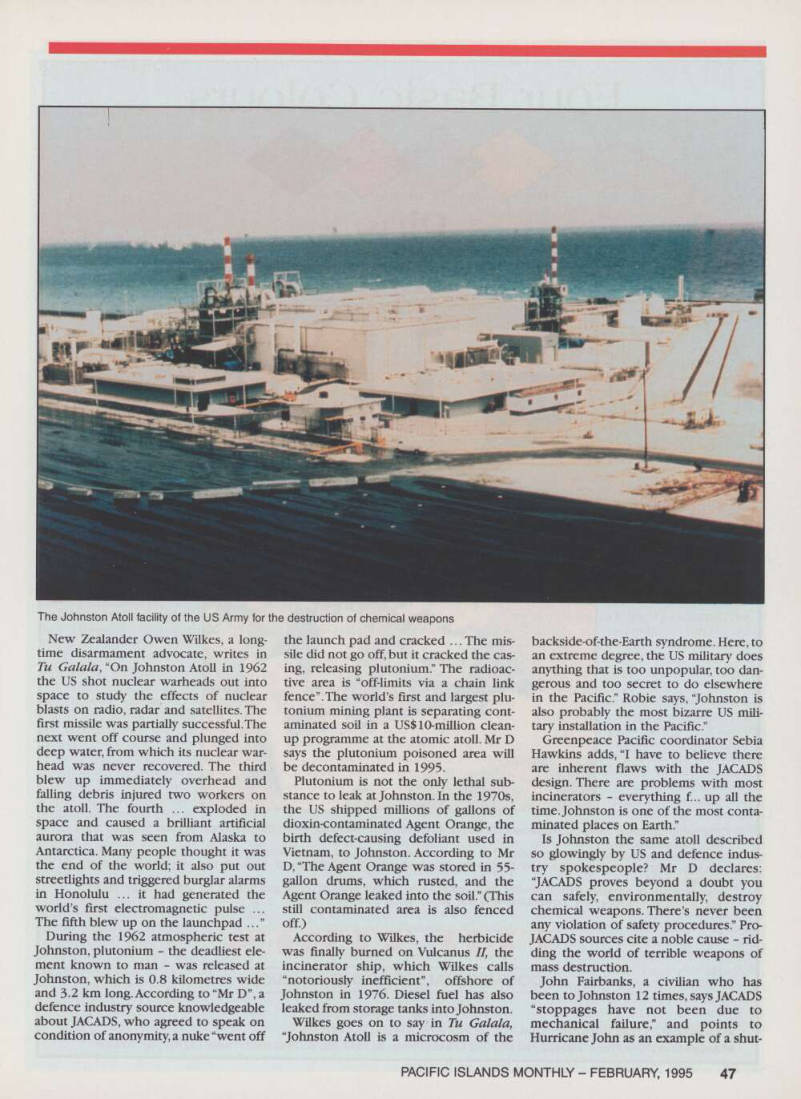

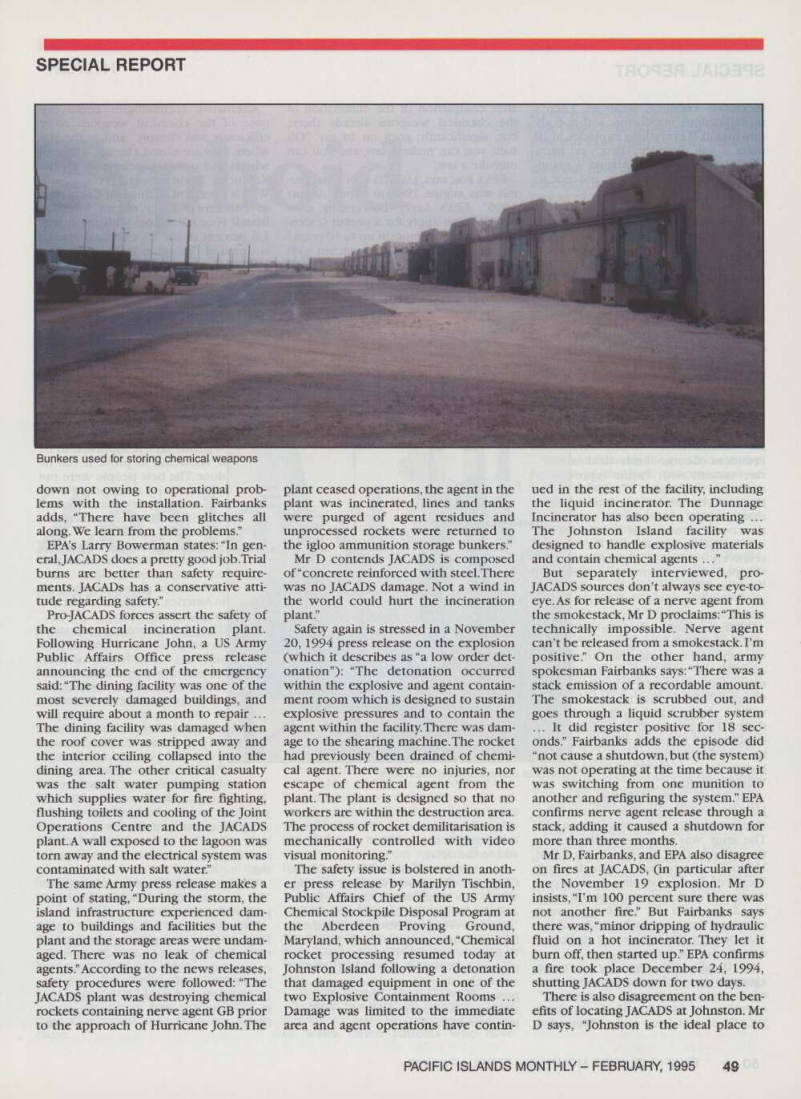
Special Report
Johnston Atoll revisited
As the disposal of chemical weapons on Johnston continues amid a series of accidents, concern is being raised over the programme’s
safety
By Ed Rampell
On January 3, the US Army announced it was seeking an extension and an additional US$65O million to fulfill its mandate to burn up to 6.6 percent of the US chem ical weapons stockpile at the US$24O million at Johnston Atoll Chemical Agent Disposal System’s incinerator complex.
Why is the Army asking for a modifi cation to its August 30,1995 deadline to incinerate 400,000 weapons, including mustard gas and 400 tons of nerve gas shipped from Germany to Johnston?
And how safe is JACADS?
According to the Army, delays have been caused by “unexpected opera tional problems” which include: □ A fire in the explosive containment area of the experimental plant on March 14, 1994 of Johnston, where the US Army incinerates much of its chemical weapons arsenal. According to US Environmental Protection Agency spokesman Ray Fox, “Rockets are chopped, then dropped down chutes of deactivation furnaces. There was a mis fortune - a spark went up through the chute and ignited a rocket. Although there was some damage and shutdown for a few days, there was no nerve agent release or injury.”
□ An accidental release of live nerve agent GB from a JACADS smokestack on March 23,1994. This 25-minute exposure was at least 10 times greater than EPA’s allowable levels. There were no injuries, but JACADS was shut down until July 12.(EPA also reports there was another accidental release of nerve agent GB since JACADS burning began on June 30,1990.) □ Hurricane John forced the evacuation of 1105 civilian and military personnel from Johnston Atoll on August 25,1994. The JACADS plant ceased burning chemical agents for up to three months, according to various estimates, and the Army reported “infrastructure ... damage.” □ Another fire and an explosion in the explosive and agent containment room at JACADS on November 19, 1994, during the shearing of a rocket that had been drained of nerve agent GB M 55.
The shearing machine was damaged and chemical rocket processing was halted at Johnston until December 5. □ A fire at JACADS caused by “a coolant line that came apart, spraying coolant on the hot surface of the deactivation furnace (on December 24,1994).
The fire lasted until the coolant burned out. There was soot, but no damage to equipment. Operations resumed Dec. 26,” according at EPA’s Fox.
This is not the first major delay for the facility. Activist Craig Williams of the Chemical Weapons Working Group and the Kentucky Environmental Foundation alleges, “I don’t know how often JACADS has ceased operation because there have been so many shut downs. JACADS is down more than 30 percent of the time.” Indeed, the Army’s own public notice regarding its exten sion request states that from June 30, 1990 to August 31, 1994, there were no hazardous waste operations at JACADS for 660 days, or about two years! And the above incidents are not the only accidents at Johnston Atoll.
According to the US magazine The Progressive, JACADS’s “test period was supposed to last about 16 months, from the middle of 1990 through late 1991.
But work had to be halted on 65 of the first 85 days of scheduled operations in 1990 because gas-leak monitors sound ed false alarms, conveyor belts melted, the incinerator overheated, and mechan ical equipment failed. Major repairs and
modifications required a protracted
shutdown”.
But Johnston’s calamities started long before construction of JACADS began in 1985, located outside the area covered by the South Pacific Nuclear Free Zone Treaty and not subject to all US environ mental laws. According to New Zealand journalist David Robie in Blood On Their Banner , “At Johnston, US Air Force planes dropped two thermonu clear bombs in 1958, and then used mis siles to launch a further 10 bombs into space four years later,” before the US USSR 1963 Partial Test Ban Treaty went into effect.
New Zealander Owen Wilkes, a longtime disarmament advocate, writes in Tu Galala, “On Johnston Atoll in 1962 the US shot nuclear warheads out into space to study the effects of nuclear blasts on radio, radar and satellites. The first missile was partially successful. The next went off course and plunged into deep water, from which its nuclear warhead was never recovered. The third blew up immediately overhead and falling debris injured two workers on the atoll. The fourth ... exploded in space and caused a brilliant artificial aurora that was seen from Alaska to Antarctica. Many people thought it was the end of the world; it also put out streetlights and triggered burglar alarms in Honolulu ... it had generated the world’s first electromagnetic pulse ...
The fifth blew up on the launchpad ...”
During the 1962 atmospheric test at Johnston, plutonium - the deadliest element known to man - was released at Johnston, which is 0.8 kilometres wide and 3.2 km long. According to “Mr D”, a defence industry source knowledgeable about JACADS, who agreed to speak on condition of anonymity, a nuke “went off
the launch pad and cracked ... The missile did not go off, but it cracked the casing, releasing plutonium.” The radioactive area is “off-limits via a chain link fence”. The world’s first and largest plutonium mining plant is separating contaminated soil in a US$ 10-million cleanup programme at the atomic atoll. Mr D says the plutonium poisoned area will be decontaminated in 1993.
Plutonium is not the only lethal substance to leak at Johnston. In the 19705, the US shipped millions of gallons of dioxin-contaminated Agent Orange, the birth defect-causing defoliant used in Vietnam, to Johnston. According to Mr D, “The Agent Orange was stored in 55gallon drums, which rusted, and the Agent Orange leaked into the soil.” (This still contaminated area is also fenced off.) According to Wilkes, the herbicide was finally burned on Vulcanus 11, the incinerator ship, which Wilkes calls “notoriously inefficient”, offshore of Johnston in 1976. Diesel fuel has also leaked from storage tanks into Johnston, Wilkes goes on to say in Tu Galala, “Johnston Atoll is a microcosm of the
backside-of-the-Earth syndrome. Here, to an extreme degree, the US military does anything that is too unpopular, too dan gerous and too secret to do elsewhere in the Pacific.” Robie says, “Johnston is also probably the most bizarre US mili tary installation in the Pacific.”
Greenpeace Pacific coordinator Sebia Hawkins adds, “I have to believe there are inherent flaws with the JACADS design. There are problems with most incinerators - everything f... up all the time. Johnston is one of the most conta minated places on Earth.”
Is Johnston the same atoll described so glowingly by US and defence indus try spokespeople? Mr D declares: “JACADS proves beyond a doubt you
can safely, environmentally, destroy
chemical weapons. There’s never been any violation of safety procedures.” Pro- JACADS sources cite a noble cause - rid ding the world of terrible weapons of mass destruction.
John Fairbanks, a civilian who has been to Johnston 12 times, says JACADS “stoppages have not been due to mechanical failure,” and points to Hurricane John as an example of a shut-
The Johnston Atoll facility of the US Army for the destruction of chemical weapons
down not owing to operational prob lems with the installation. Fairbanks adds, “There have been glitches all along. We learn from the problems.”
EPA’s Larry Bowerman states: “In gen eral, JACADS does a pretty good job. Trial burns are better than safety require ments. JACADs has a conservative atti tude regarding safety.”
Pro-JACADS forces assert the safety of the chemical incineration plant.
Following Hurricane John, a US Army Public Affairs Office press release announcing the end of the emergency said: “The dining facility was one of the most severely damaged buildings, and will require about a month to repair ...
The dining facility was damaged when the roof cover was stripped away and the interior ceiling collapsed into the dining area. The other critical casualty was the salt water pumping station which supplies water for fire fighting, flushing toilets and cooling of the Joint Operations Centre and the JACADS plant. A wall exposed to the lagoon was torn away and the electrical system was contaminated with salt water.”
The same Army press release makes a point of stating, “During the storm, the island infrastructure experienced dam age to buildings and facilities but the plant and the storage areas were undam aged. There was no leak of chemical agents.” According to the news releases, safety procedures were followed: “The JACADS plant was destroying chemical rockets containing nerve agent GB prior to the approach of Hurricane John. The
plant ceased operations, the agent in the plant was incinerated, lines and tanks were purged of agent residues and unprocessed rockets were returned to the igloo ammunition storage bunkers.”
Mr D contends JACADS is composed of “concrete reinforced with steel. There was no JACADS damage. Not a wind in the world could hurt the incineration plant.”
Safety again is stressed in a November 20,1994 press release on the explosion (which it describes as “a low order det onation”): “The detonation occurred within the explosive and agent contain ment room which is designed to sustain explosive pressures and to contain the agent within the facility. There was dam age to the shearing machine. The rocket had previously been drained of chemi cal agent. There were no injuries, nor escape of chemical agent from the plant. The plant is designed so that no workers are within the destruction area.
The process of rocket demilitarisation is mechanically controlled with video visual monitoring.”
The safety issue is bolstered in anoth er press release by Marilyn Tischbin, Public Affairs Chief of the US Army Chemical Stockpile Disposal Program at the Aberdeen Proving Ground, Maryland, which announced, “Chemical rocket processing resumed today at Johnston Island following a detonation that damaged equipment in one of the two Explosive Containment Rooms ...
Damage was limited to the immediate area and agent operations have contin
ued in the rest of the facility, including the liquid incinerator. The Dunnage Incinerator has also been operating ...
The Johnston Island facility was designed to handle explosive materials and contain chemical agents ...”
But separately interviewed, pro- JACADS sources don’t always see eye-to eye.As for release of a nerve agent from the smokestack, Mr D proclaims: “This is
technically impossible. Nerve agent
can’t be released from a smokestack. I’m positive.” On the other hand, army spokesman Fairbanks says: “There was a stack emission of a recordable amount.
The smokestack is scrubbed out, and goes through a liquid scrubber system ... It did register positive for 18 sec onds.” Fairbanks adds the episode did “not cause a shutdown, but (the system) was not operating at the time because it was switching from one munition to another and refiguring the system.” EPA confirms nerve agent release through a stack, adding it caused a shutdown for more than three months.
Mr D, Fairbanks, and EPA also disagree on fires at JACADS, (in particular after the November 19 explosion. Mr D insists, “I’m 100 percent sure there was not another fire.” But Fairbanks says there was, “minor dripping of hydraulic fluid on a hot incinerator. They let it burn off, then started up.” EPA confirms a fire took place December 24, 1994, shutting JACADS down for two days.
There is also disagreement on the ben efits of locating JACADS at Johnston. Mr D says, “Johnston is the ideal place to
Bunkers used for storing chemical weapons
incinerate chemical weapons. There’s no indigenous population, and nobody downwind. If everything explodes, in 10 miles it will dissipate. There’s no harm to any personnel downrange - grand mothers, couples are safe, and not in risk.”
Fairbanks differs: “The location is far from ideal. JACADS is extremely costly.
It’s in a hostile, salt-laden atmosphere.
The plant will be ready to come down
due to corrosion ... You have to ship in fuel, pay excess money to workers (who are shipped in and, by the way, forbidden to unionise), pay for a desalinisation plant and power plant. It’s very expensive to operate.”
The defence industry, Army, and EPA spokesmen also disagree on when - and if - JACADS will shut down. JACADS is now mandated to cease operations once the munitions Already stored there are incinerated. When US President George Bush held a rare summit with Pacific repre sentatives on October 27,1990 in Honolulu, he “assured the leaders that we plan to dispose of only the chemical munitions ... found in the Pacific islands and those relatively small quantities shipped from Germany ...We have no plans to use Johnston Atoll for any other chemical munitions purposes.”
While Fairbanks raised the pos sibility that JACADS might contin ue operation as far into the future as 2010, he said, “but as stated now, (no additional chemical weapons) from the mainland” will be shipped and incinerated there. “The plant will be disas sembled and Johnston will revert to a bird sanctuary,” under the jurisdiction of the US Fish and Wildlife Service.
But Mr D is more bullish on
JACADS and its possible future. “The shutdown date was never reasonable.
The army was under pressure, due to the treaty that (ex-USSR President Mikhail) Gorbachev signed with President Bush”, banning further pro duction of chemical weapons and creat ing a timetable for eliminating most existing arsenals by the beginning of the 21st century. “JACADS won’t make the date. It’s too far behind.”
Mr D adds, “It’s ideal for all nerve agents to go to Johnston to be incinerat ed. It makes most sense to continue” operation of JACADS. Mr D confirms JACADS is mandated to be dismantled
after completion of the elimination of the chemical weapons already there, but, significantly, goes on to say: “Oh sure, you can make a law, and you can unmake a law.”
EPA’s Fox says, JACADS’s “original per mit was August 1985 to expire August 1995”. EPA’s Larry Bowerman says, JACADS “can apply for a permit (exten sion) from a few months up to 10 years.”
Bowerman adds JACADS’s concern with
safety is “why it has been slower than originally planned ... Various opera tional problems and time to fix them” add to the delay.
According to Craig Williams of the Chemical Weapons Working Group, which has members in the US, Russia and the Pacific, the big picture is about “money, vested interests, like Raytheon (the defence contractor at JACADS).
Defence contractors are gauging the taxpayers. With the end of the Cold War, suddenly they’re environmental dis posers. It’s the same people, with a con tinuing relationship with the military.
It’s a revolving door.”
Alternative technologies could dis pose of the chemical weapons more efficiently and cheaply and at the site where they are stored, charges Williams, who is also national spokesman for the Kentucky Environmental Foundation, Why is a resident of this East Coast state so concerned about distant Johnston Island? Four miles from Williams’ home, 1.6 percent of the US chemical arsenal is stored at Lexington in Kentucky, one
of eight states where chemical weapons are stockpiled and pro posed JACADS-like plants may be built in order to burn the weapons there.
Since these states have - unlike Johnston - resident populations, community protests in the 1980 s forced the US govern ment to postpone building untested plants in these states.
Instead, the incineration was relocated to Johnston, which, Williams says, is supposed to be a “showcase to prove it can be done. The best people were put on it. JACADS is supposed to be the crown jewel demonstrating the viability” of the incineration of chemical agents.
Williams points out that if JACADS proved to be successful, not only would eight other incineration plants then be built in America, but plants could also be built in Russia.
Thus defence contractors stand to make billions - if JACADS is a success - which may explain why so much is riding on the facility, information is so limited and the operation so secretive.
A second plant is being pre pared at Tooele, Utah, where 42.3 percent of US chemical weapons stock is stored.
Williams asserts Tooele is trou bled and has been the subject of many media exposes, adding “If
you think Tooele is bad, JACADS must be a nightmare. At least there’s some over sight at Tooele - at JACADS, only JACADS is doing it. God knows what’s happen ing.”
Williams and Mr D agree on one point: 100 workers are at Johnston for repair purposes.
Johnston Atoll Chemical Agent Disposal System opponents are, as of this writing, considering formally requesting major investigations of JACADS by independent sources, the Department of Defence’s Inspector General, and/or the Army’s Inspector General. ■
Chemical warheads at Johnston Atoll
Advertisements & other items, p. 48 (1 item)
Equals
Four Basic Colours
YELLOW CYAN X/MAGENTA X '~ / BLACK
Plus
Fiji Times Commercial Printing
UTHRone SB >•»»» tm 'tin
Equals
Printing Excellence
» r * . ; mik ms • r-v ?-■ •» i It is quite amazing what our experienced master printers, with the latest in printing technology, can produce from FuM colour packaging and food labels that look good enough to eat; award winning full colour brochures and posters; magazines, calendars, books, stickers, fabric labels and billboards with pictures that leap right out of the iTyour product requires export-quality, high impact four colour printing, then you should be talking to us first.
You’ll find our prices very competitive and our paper stock quite extensive.
FIJI TIMES
COMMERCIAL PRINTING DIVISION
Printing Excellence
HEAD OFFICE: 20 GORDON STREET, SUVA, FIJI. PHONE: (679) 304111, FAX: 305935 BRANCHES: LAUTOKA Phone: 660422 Fax: 660-352 LABASA Phone: 811644 Fax: 812649 NADI Phone: 702702 Fax: 702705
Typhoid
Health
scare in New Zealand
By Martin Tiffany
On the surface, the several cases of typhoid reported in Auckland, New Zealand last year do not appear too much to worry about. But scratch the surface and a bigger problem emerges.
Fresh fish from Western Samoa seems to have been the likely cause of the dis ease in at least two cases. The problem, therefore, is food and people entering New Zealand without undergoing thor ough screening and, in the process, bringing diseases in as well.
Central Auckland’s Medical Officer of Health, Dr Lester Calder, says, cases of the potentially fatal disease can be linked to a typhoid epidemic in Western Samoa in 1993.
He said it was hard to say for certain where a person contracted typhoid and it often took a bit of detective work to trace it to a possible source.
“ Typhoid is uncommon here. It is usu ally contracted when people travel overseas. But when people have not travelled, we have to inquire what they have eaten,” said Dr Calder.
He said two of the cases seemed to have been caused by fish from Western Samoa, and there was a possibility a third case could stem from the same cause.
According to figures from the Communicable Diseases Centre in Wellington, 23 cases of typhoid were reported last year. None was fatal.
Although this may seem nothing to get excited about, it was enough for Dr Calder to broadcast, on Auckland’s Pacific Island Station, warnings of the dangers of bringing in the disease through fresh fish.
New Zealand’s Ministry of Agriculture and Fisheries allows dead fish from Western Samoa and other Pacific coun tries into the country.
Dr Calder said he had asked the New Zealand Ministry of Health to put up warning signs in airports and distribute pamphlets to the various island nations but had not received an enthusiastic response. “They seem worried about it being a political thing,” he said.
Dr Calder also wants to take up with MAF the case of regulations on seafood coming into New Zealand being so lax.
He said people needed to know about the infection, the symptoms - stomach pain, fever - and the fact that because it is a gastrointestinal disease, it can kill you.
“People have to take it seriously.”
Typhoid is a bacterial infection of the intestines caused by contaminated food or water. Often patients who have
recovered become carriers.
Dr Calder is also concerned about the time and money spent when a person is found to have typhoid. There are lengthy tests that have to be carried out on the infected person and relatives, and a course of expensive antibiotics have to
be prescribed.
Dr Farhat Mahmood, South Auckland’s Medical Officer of Health, is also con cerned about the risks of typhoid. He, like Dr Calder, was glad when PIM con tacted him to highlight the problem.
“I am glad you called, I have been try ing to get this problem into the paper,” were Dr Mahmood’s first words. He said everyone bringing fish into New Zealand was taking a risk as there was no way of knowing if the fish was cont aminated.
He was unhappy there were no restrictions on bringing fish to New Zealand and believed the only way to tackle the problem was to educate the people.
South Auckland is the area most at risk because of the high concentration of Pacific Islanders - especially Western Samoans. Most of the fish brought from the Pacific is given as gifts by visitors or returning residents.
Typhoid is not the only disease caus ing concern in New Zealand’s Pacific island population - especially in South Auckland. Tuberculosis rates among Pacific Islanders are high, compared to Europeans and other races.
According to Dr Calder, TB among Pacific Islanders in Auckland is 30 times that of Europeans in Auckland. He blamed overseas travel by Pacific Islanders and Asians for the number of TB cases in New Zealand remaining sta tic.
After World War 11, the rate had declined steadily until the early 1980 s when it levelled off and remained so for the past 10 to 12 years.
Dr Calder sees the end of the welfare state, with its increase in poverty, anoth er factor affecting the number of TB cases.
The TB problem is more difficult to eradicate. Health checks are compulso ry only for Pacific Islanders seeking res idency, but people from Niue, Tokelau and the Cook Islands enjoy New Zealand citizenship and come and go as
they please.
The New Zealand government is reviewing its health screening proce dure for immigrants following concerns raised. But this has already been criti cised as being a breach of human rights.
The battle against diseases being brought into New Zealand is a difficult one to win. ■
A hasty
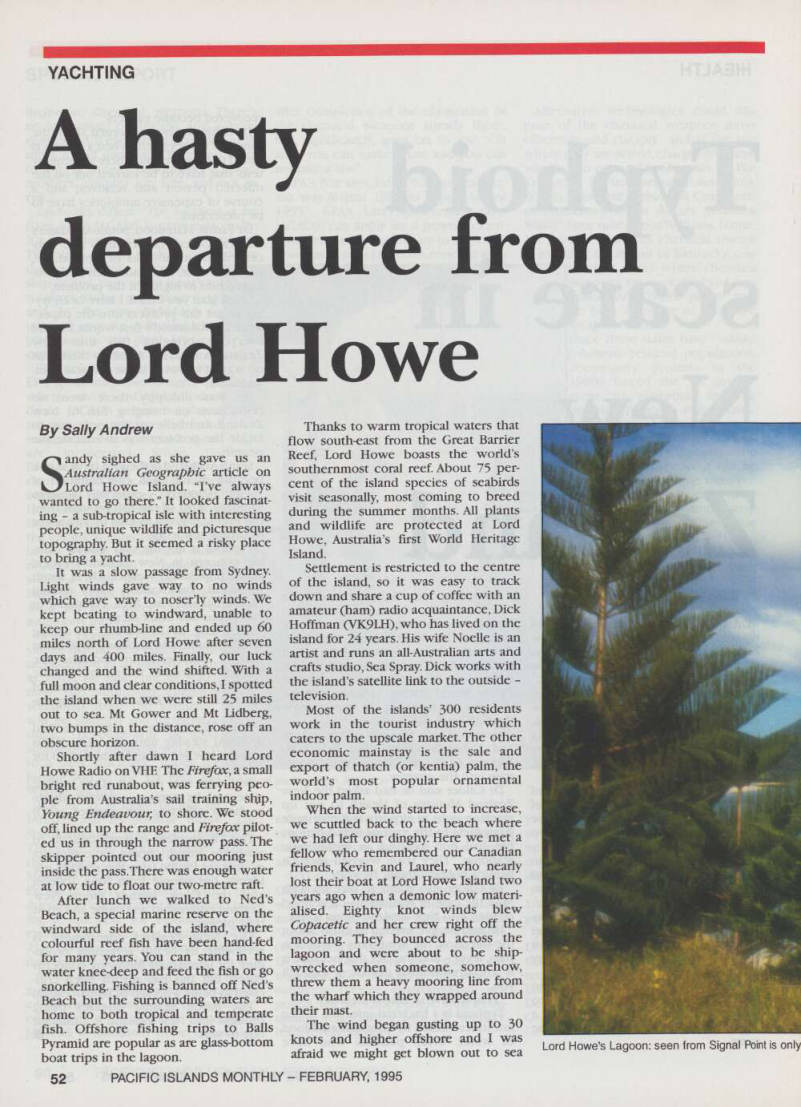
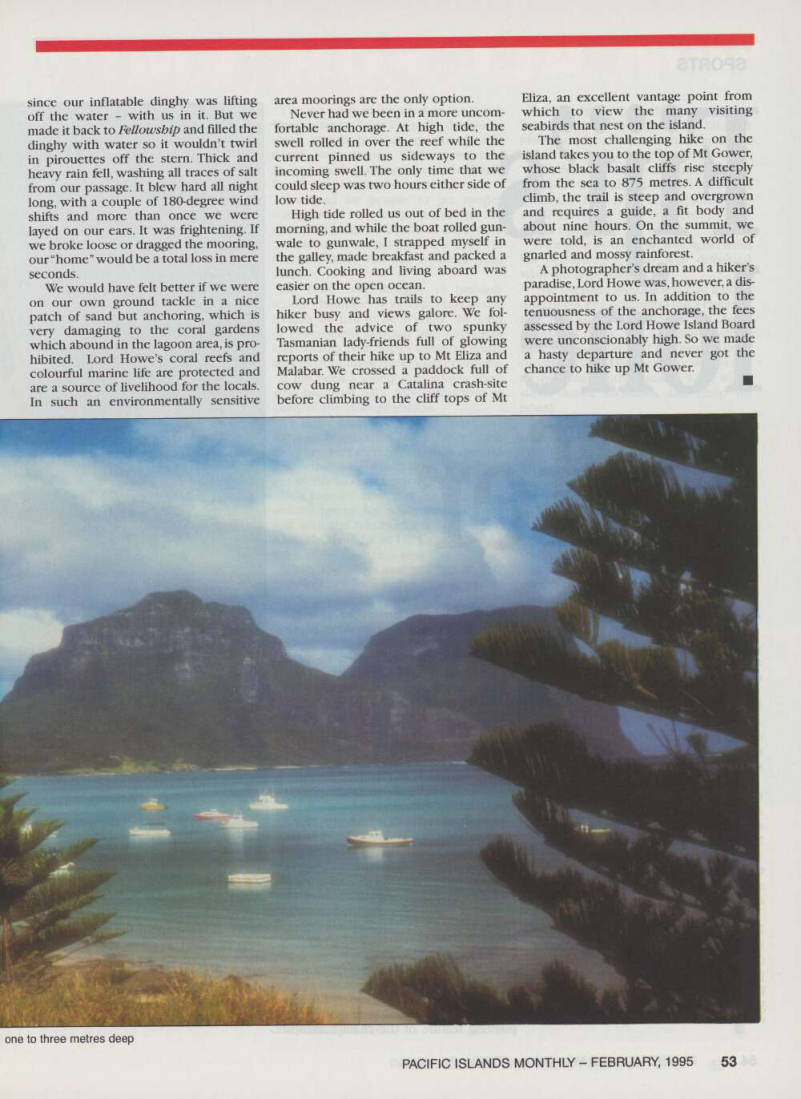
Yachting
A hasty departure from Lord Howe
By Sally Andrew
Sandy sighed as she gave us an Australian Geographic article on Lord Howe Island. “I’ve always wanted to go there.” It looked fascinat ing - a sub tropical isle with interesting people, unique wildlife and picturesque topography. But it seemed a risky place to bring a yacht.
It was a slow passage from Sydney.
Light winds gave way to no winds which gave way to noser’ly winds. We kept beating to windward, unable to keep our rhumb-line and ended up 60 miles north of Lord Howe after seven days and 400 miles. Finally, our luck changed and the wind shifted. With a full moon and clear conditions, I spotted the island when we were still 25 miles out to sea. Mt Gower and Mt Lidberg, two bumps in the distance, rose off an obscure horizon.
Shortly after dawn I heard Lord Howe Radio on VHF. The Firefox, a small bright red runabout, was ferrying peo ple from Australia’s sail training ship, Young Endeavour, to shore. We stood off, lined up the range and Firefox pilot ed us in through the narrow pass. The skipper pointed out our mooring just inside the pass. There was enough water at low tide to float our two-metre raft.
After lunch we walked to Ned’s Beach, a special marine reserve on the windward side of the island, where colourful reef fish have been hand-fed for many years. You can stand in the water knee-deep and feed the fish or go snorkelling. Fishing is banned off Ned’s Beach but the surrounding waters are home to both tropical and temperate fish. Offshore fishing trips to Balls
Pyramid are popular as are glass-bottom
boat trips in the lagoon.
Thanks to warm tropical waters that flow south-east from the Great Barrier Reef, Lord Howe boasts the world’s southernmost coral reef. About 75 per cent of the island species of seabirds visit seasonally, most coming to breed during the summer months. All plants and wildlife are protected at Lord Howe, Australia’s first World Heritage Island.
Settlement is restricted to the centre of the island, so it was easy to track down and share a cup of coffee with an amateur (ham) radio acquaintance, Dick Hoffman (VK9LH), who has lived on the island for 24 years. His wife Noelle is an artist and runs an all-Australian arts and crafts studio, Sea Spray. Dick works with the island’s satellite link to the outside television.
Most of the islands’ 300 residents work in the tourist industry which caters to the upscale market. The other economic mainstay is the sale and export of thatch (or kentia) palm, the world’s most popular ornamental indoor palm.
When the wind started to increase, we scuttled back to the beach where we had left our dinghy. Here we met a fellow who remembered our Canadian friends, Kevin and Laurel, who nearly lost their boat at Lord Howe Island two years ago when a demonic low materi alised. Eighty knot winds blew Copacetic and her crew right off the mooring. They bounced across the lagoon and were about to be ship wrecked when someone, somehow, threw them a heavy mooring line from the wharf which they wrapped around their mast.
The wind began gusting up to 30 knots and higher offshore and I was afraid we might get blown out to sea
Lord Howe’s Lagoon: seen from Signal Point is only
since our inflatable dinghy was lifting off the water - with us in it. But we made it back to Fellowship and filled the dinghy with water so it wouldn’t twirl in pirouettes off the stern. Thick and heavy rain fell, washing all traces of salt from our passage. It blew hard all night long with a couple of 180-degree wind shifts and more than once we were layed on our ears. It was frightening. If we broke loose or dragged the mooring, our “home” would be a total loss in mere seconds.
We would have felt better if we were on our own ground tackle in a nice patch of sand but anchoring, which is very damaging to the coral gardens which abound in the lagoon area, is prohibited. Lord Howe’s coral reefs and colourful marine life are protected and are a source of livelihood for the locals, In such an environmentally sensitive
area moorings are the only option.
Never had we been in a more uncomfortable anchorage. At high tide, the swell rolled in over the reef while the current pinned us sideways to the incoming swell. The only time that we could sleep was two hours either side of low tide.
High tide rolled us out of bed in the morning, and while the boat rolled gunwale to gunwale, I strapped myself in the galley, made breakfast and packed a lunch. Cooking and living aboard was easier on the open ocean.
Lord Howe has trails to keep any hiker busy and views galore. We followed the advice of two spunky Tasmanian lady-friends full of glowing reports of their hike up to Mt Eliza and Malabar. We crossed a paddock full of cow dung near a Catalina crash-site before climbing to the cliff tops of Mt
Eliza, an excellent vantage point from which to view the many visiting seabirds that nest on the island, The most challenging hike on the island takes you to the top of Mt Gower, whose black basalt cliffs rise steeply from the sea to 875 metres. A difficult climb, the trail is steep and overgrown and requires a guide, a fit body and about nine hours. On the summit, we were told, is an enchanted world of gnarled and mossy rainforest, A photographer’s dream and a hiker’s paradise, Lord Howe was, however, a dis appointment to us. In addition to the tenuousness of the anchorage, the fees assessed by the Lord Howe Island Board were unconscionably high. So we made a hasty departure and never got the chance to hike up Mt Gower,
one to three metres deep
Fiji’s
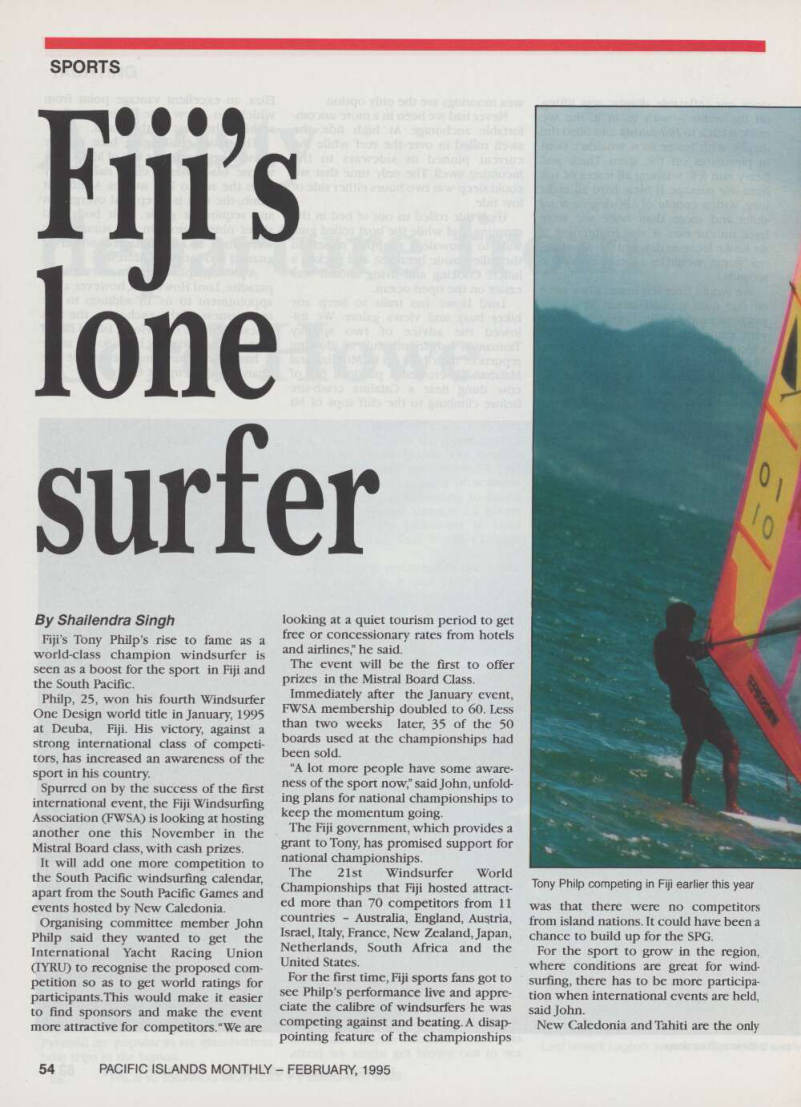
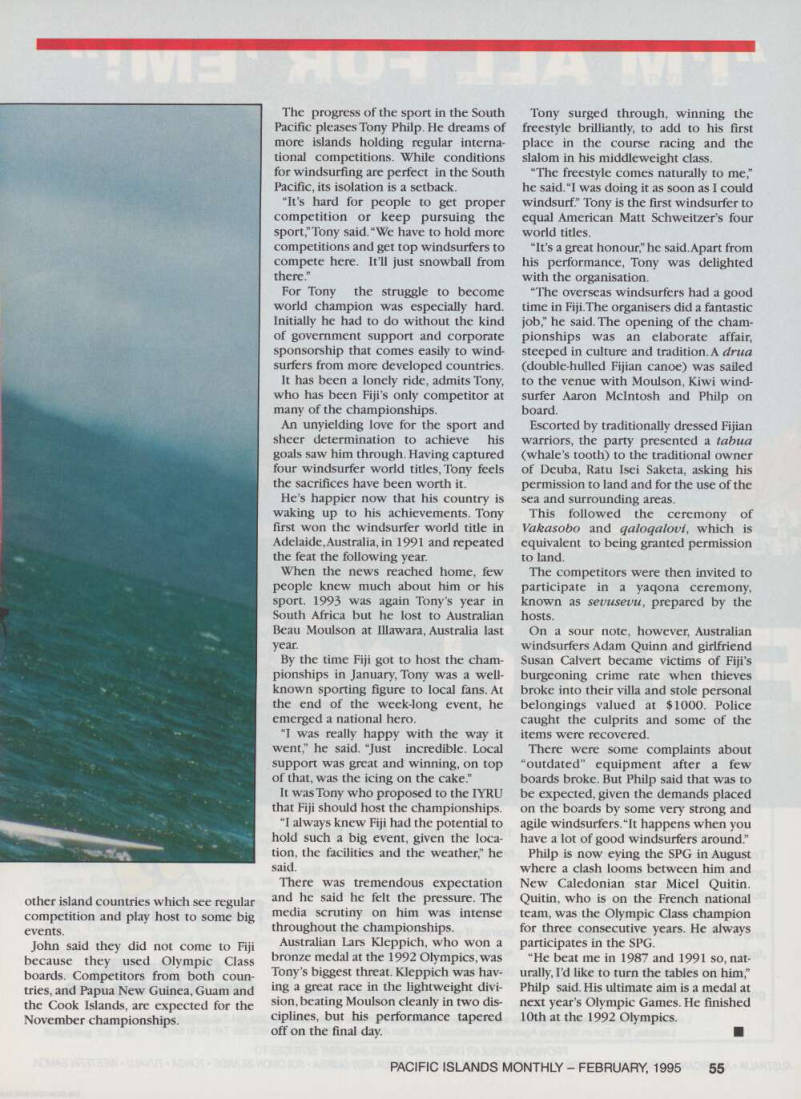
Sports
Fiji’s lone surfer
By Shailendra Singh
Fiji’s Tony Philp’s rise to fame as a world-class champion windsurfer is seen as a boost for the sport in Fiji and the South Pacific Philp, 23, won his fourth Windsurfer One Design world title in January, 1995 at Deuba, Fiji. His victory, against a strong international class of competi tors, has increased an awareness of the sport in his country Spurred on by the success of the first international event, the Fiji Windsurfing Association (FWSA) is looking at hosting another one this November in the Mistral Board class, with cash prizes.
It will add one more competition to the South Pacific windsurfing calendar, apart from the South Pacific Games and events hosted by New Caledonia.
Organising committee member John Philp said they wanted to get the International Yacht Racing Union (IYRU) to recognise the proposed com petition so as to get world ratings for participants. This would make it easier to find sponsors and make the event more attractive for competitors.“We are
looking at a quiet tourism period to get free or concessionary rates from hotels and airlines,” he said.
The event will be the first to offer prizes in the Mistral Board Class.
Immediately after the January event, FWSA membership doubled to 60. Less than two weeks later, 35 of the 30 boards used at the championships had been sold.
“A lot more people have some aware ness of the sport now,” said John, unfold ing plans for national championships to keep the momentum going.
The Fiji government, which provides a grant to Tony, has promised support for
national championships.
The 21st Windsurfer World Championships that Fiji hosted attract ed more than 70 competitors from 11 countries - Australia, England, Austria, Israel, Italy, France, New Zealand, Japan, Netherlands, South Africa and the United States.
For the first time, Fiji sports fans got to see Philp’s performance live and appre ciate the calibre of windsurfers he was competing against and beating. A disap pointing feature of the championships
was that there were no competitors from island nations. It could have been a chance to build up for the SPG.
For the sport to grow in the region, where conditions are great for wind surfing, there has to be more participa tion when international events are held, said John.
New Caledonia and Tahiti are the only
Tony Philp competing in Fiji earlier this year
other island countries which see regular competition and play host to some big events.
John said they did not come to Fiji because they used Olympic Class boards. Competitors from both coun tries, and Papua New Guinea, Guam and the Cook Islands, are expected for the
November championships.
The progress of the sport in the South Pacific pleases Tony Philp. He dreams of more islands holding regular interna tional competitions. While conditions for windsurfing are perfect in the South Pacific, its isolation is a setback.
“It’s hard for people to get proper competition or keep pursuing the sport,’’Tony said. “We have to hold more competitions and get top windsurfers to compete here. It’ll just snowball from there.”
For Tony the struggle to become world champion was especially hard.
Initially he had to do without the kind of government support and corporate sponsorship that comes easily to wind surfers from more developed countries.
It has been a lonely ride, admits Tony, who has been Fiji’s only competitor at many of the championships.
An unyielding love for the sport and sheer determination to achieve his goals saw him through. Having captured four windsurfer world titles, Tony feels the sacrifices have been worth it.
He’s happier now that his country is waking up to his achievements. Tony first won the windsurfer world title in Adelaide,Australia, in 1991 and repeated the feat the following year.
When the news reached home, few people knew much about him or his sport. 1993 was again Tony’s year in South Africa but he lost to Australian Beau Moulson at Illawara, Australia last year.
By the time Fiji got to host the cham pionships in January, Tony was a well known sporting figure to local fans. At the end of the week-long event, he emerged a national hero.
“I was really happy with the way it went,” he said. “Just incredible. Local support was great and winning, on top of that, was the icing on the cake.”
It was Tony who proposed to the IYRU that Fiji should host the championships.
“I always knew Fiji had the potential to hold such a big event, given the loca tion, the facilities and the weather,” he said.
There was tremendous expectation and he said he felt the pressure. The media scrutiny on him was intense throughout the championships.
Australian Lars Kleppich, who won a bronze medal at the 1992 Olympics, was Tony’s biggest threat. Kleppich was hav ing a great race in the lightweight divi sion, beating Moulson cleanly in two dis
ciplines, but his performance tapered
off on the final day.
Tony surged through, winning the freestyle brilliantly, to add to his first place in the course racing and the slalom in his middleweight class.
“The freestyle comes naturally to me,” he said. “I was doing it as soon as I could windsurf.” Tony is the first windsurfer to equal American Matt Schweitzer’s four world titles.
“It’s a great honour,” he said.Apart from his performance, Tony was delighted with the organisation.
“The overseas windsurfers had a good time in Fiji.The organisers did a fantastic job,” he said. The opening of the cham pionships was an elaborate affair, steeped in culture and tradition. A drua (double-hulled Fijian canoe) was sailed to the venue with Moulson, Kiwi wind surfer Aaron McIntosh and Philp on board.
Escorted by traditionally dressed Fijian warriors, the party presented a tabua (whale’s tooth) to the traditional owner of Deuba, Ratu Isei Saketa, asking his permission to land and for the use of the sea and surrounding areas.
This followed the ceremony of Vakasobo and qaloqalovi, which is equivalent to being granted permission to land.
The competitors were then invited to participate in a yaqona ceremony, known as sevusevu, prepared by the hosts.
On a sour note, however, Australian windsurfers Adam Quinn and girlfriend Susan Calvert became victims of Fiji’s burgeoning crime rate when thieves broke into their villa and stole personal belongings valued at $1000. Police caught the culprits and some of the items were recovered.
There were some complaints about “outdated” equipment after a few boards broke. But Philp said that was to be expected, given the demands placed on the boards by some very strong and agile windsurfers. “It happens when you have a lot of good windsurfers around.”
Philp is now eying the SPG in August where a clash looms between him and New Caledonian star Micel Quitin.
Quitin, who is on the French national team, was the Olympic Class champion for three consecutive years. He always participates in the SPG.
“He beat me in 1987 and 1991 so, nat urally, I’d like to turn the tables on him,”
Philp said. His ultimate aim is a medal at next year’s Olympic Games. He finished 10th at the 1992 Olympics. ■
Advertisements & other items, p. 56 (1 item)
Pacific Forum Line
I
Jack Madho,
Senior Sales Manager,
Tropik Wood Industries.
i 9 .iodtk® llroptk* as ; -. r> W' "'■■,< Every year, Jack Madho of Fiji’s Tropik Wood Industries ships up to 20,000 tonnes of timber to waiting buyers overseas.
“My timber has to get there on time, and it has to come in on budget,” says Jack.
Most of Tropik Wood’s business goes to the shipping line that since 1987 has given Jack Madho the service he insists on. Pacific Forum Line.
Our absolute commitment to the development of trade and economic growth in the Pacific is real, and ongoing. If your own business utilises shipping services in the region, do what Jack Madho did. Call us.
It could be to everyone’s benefit. /£?
Pacific Forum Line
Our Pacific.
Our shipping line.
Suva, Fiji: Forum Shipping Agencies International, P.O. Box 13147. Telex: 2429 Fax: (679) 302 754 Tel: (679) 315 444 Lautoka, Fiji: Forum Shipping Agencies International, P.O. Box 49. Telex: 5158 Fax: (679) 662 985 Tel: (679) 660 577 PROVIDING REGULAR DIRECT AND TRANS-SHIPMENT SERVICES TO AUSTRALIA • AMERICAN SAMOA • COOK ISLANDS • FIJI • KIRIBATI • NEW ZEALAND • PAPUA NEW GUINEA • SOLOMON ISLANDS • TONGA • TUVALU • WESTERN SAMOA.
WILSON'ADDISON 88.51
Shipping
schedules
New Zealand - Fiji direct Sofrana Unilines operates a fully containerised/ breakbulk service every 21 days from Auckland, Tauranga, Lyttleton to Suva and Lautoka.
Loading every 21 days, ro/ro service, containers - reefer. Contact Sofrana Unilines, Sofrana House, 101 Customs Street, Auckland, PO Box 3614, Fax (09) 393874, Ph (09) 773279, Tlx NZ 2313. Direct toll free line 0800 659-922, Contact Alan Foote. Compass Shipping Agencies, PO Box 921 Wellington, Tel (04) 382 8206, Fax (04) 3828239, Tlx NZ 4769 Contact Steve Brannigan.
Sofrana Unilines Agencies, PO Box 22046 Christchurch, Tel (03) 366 7180, Fax (03) 366 8868, TLX NZ4769, Contact Tony Newell.
Carpenters Shipping, Private Mail Bag, Suva, Fiji, Tel (679) 312244, Fax (679) 301572, Tlx FJ 2199. Sofrana Unilines, Suva, Fiji, Tel (679) 315645, Fax (679) 300057.
Australia - FIJI direct Sofrana Unilines operates a container breakbulk service every three weeks from Melbourne, and Sydney to Lautoka and Suva. Contact Sofrana Unilines (Aust) Pty Ltd, PO Box Qj36, Queen Victoria Building, Sydney, NSW 2000, Austra lia. Tel (02) 2648944, Fax (02) 2676547, Tlx (71) A 170090, Contact Sam Attaway/ George Lopez.
Delams Australia Pty Ltd. 474 Flinders Street, Melbourne. Tel (03) 614 1344, Fax (03) 629 4957.
Carpenters Shipping, Suva, Tel (679) 312244, Fax (679) 301572. Sofrana Unilines Suva, Tel (679) 315 645, Fax (679) 300057. Carpenters Shipping, Lautoka, Tel (679) 663988, Fax (679) 664896. Sofrana Unilines, Lautoka Tel (679) 662921, Fax (679) 664896.
Australia - Fiji monthly service Sofrana Unilines (Australia) Pty Ltd operates a regular monthly service with MV Capilaine Wallis. Contact Sofrana Unilines, Sydney, Tel (02) 2648944, Tlx AA170090, Fax (02) 267-6547. Carpenters Shipping, Suva, Fiji, Tel (679) 312244, Fax (679) 301572, Sofrana Unilines, Suva, Fiji Tel (679) 315645, Fax (679) 300057. Carpenters Shipping, Lautoka, Tel (679) 63988, Fax (679) 664896. Sofrana Uni lines, Lautoka, Fiji, Tel (679) 662921, Fax (679) 664896.
Far-East - FIJI Service New Guinea Pacific Line (NGPL) operates a monthly service accepting containerised and break-bulk cargoes from Manila, Keelung, Kaoshiung, Hong Kong, Lae to Suva, Lautoka (via Suva).
Contact Carpenters Shipping Suva, Fiji, tel (679) 312244, fax (679) 301572. New Zealand Unit Express, Maritime Building, 2-10 Customs House Quay, PO Box 890, Wellington. Tel 727865, Cables Enzue Man, Wellington, Tlx NZ31340 Nedlnz or Nedlloyd Swire Pty Ltd, Sydney, Tel 20522.
Japan - South Pacific Ssrvics Same as Bums Philp Japan - South Pacific Ssrvics - Kyowa Shipping Co Ltd
Kyowa Shipping, Shipping Co Ltd provides a monthly service from Hong Kong to main ports of Japan, Saipan, Guam, Island ports, Lautoka, Suva via Nukualofa to Pago Pago and Apia.
Contact Carpenters Shipping, Neptune House, 3/4 floor, Tofuaa Street, Walu Bay, Suva. Tel 312244, Fax 301572, Tlx FJ2199.
Europe - Pacific Service Bank Line offers a monthly service to and from Europe for containerised breakbulk and bulk vegetable cargoes. Calling Papeete, Apia, Suva, Lautoka, Noumea, Port Vila, Santo, Honiara and PNG. Main ports to and from major northern Eurpoean ports. Contact Bank Line, South Pacific Office, Central Court Bid , 7th Street, Lea, PNG,TeI 422925, Tlx NE4426s.Carpenters Shipping, 3/4 Floor,Neptune House, Walu Bay, Suve, Fiji, Tel (679) 312244, Fax (679) 301572, TIxFJ 2199.
Nedlloyd offers cargo services from Continental ports to Papeetee, Fiji, New Caledonia and Doniambo on slot basis with Bank Line. Contact Carpenters Shipping, Suva, tel 312244, Tlx FJ2199, Fax 301572. Carpenters Shipping, Lautoka, Tel 663988, Tlx FJ5215, Fax 664896.
South Bast Asia - FIJI Ssrvics Nedlloyd Lines Service (NZEAS) Service oper ates regular fast cargo service from Jakarta, Pt Keelang, Singapore, Bangkok, Surubaya via Auckland to Suva and Lautoka. Contact Carpenters Shipping, Suva, Tel 312244, Tlx FJ2199, Fax 301572. Carpenters Shipping,
Lautoka Tel 663988, Tlx FJ5215, Fax 663988.
Nedlloyd New Zealand, Wellington Tel (04) 472 7864, Fx (04) 473 9201 Far last - MM South Pacific China Navigations New Guinea Pacific Line in association with Bank Line, operates a regular container and breakbulk heavy lift service from Hong Kong, Taiwan, Manila, Singapore, Malaysia, Thailand to Port Moresby, Lac, Rabaul, Kieta and Honiara. Cargo from the same eastern ports to the South Pacific Ports of Noumea, Santo, Vila, Papeete, PagoPago, Apia, Nukualofa, Rarotonga and Tarawa will be shipped via Japan or Busan on the monthly Bali Hai Service. Contact Steamships Shipping, Port Moresby, PO Box 634, Tel 220283 or 220289.
Tasman Asia operate a 20-day frequency fixed date service, shipping breakbulk and containerised cargoes from Japan, Korea, Tai wan and Hong Kong to Suva and Lautoka (via Suva). Fiji agents are Forum Shipping Agencies in Suva, Tel 315444, and Lautoka 660577.
Australia - New Caledonia - FIJI - Samoas - Tonga Pacific Forum Line operates a fully containerised service (general, reefer and ro-ro) from Sydney and Brisbane to Noumea, Lautoka, Suva, Apia, Pago Pago, Nuku’alofa, Sydney. Cargo central ised from Adelaide and Melbourne. Contact: Pacific Forum Line, PO Box 796, Auckland; Union Bulkships, 333 George St, Sydney, Brisbane and Melbourne; Union Co, Lautoka; Pacific Forum Line, Suva, Nuku’alofa; Pacific Forum Line, Apia; Polynesia Shipping, Pago Pago. Sofrana Unilines operates a roro/container
Advertisements & other items, pp. 57-60 (1 item)
Co., Ltd.
KYOWA
KYOWA
SHIPPING
CO., LTD.
Liner Service to Pacific Islands
FROM OJAPAN
OKOREA
©TAIWAN
©THAILAND
TO ©SAIPAN
©FEDERATED STATES
OF MICRONESIA
©MARSHAL ISLANDS
©AMERICAN SAMOA
©NEW CALEDONIA
©FIJI
©HONG KONG
©SINGAPORE
©PHILIPPINES
©MALAYSIA
©INDONESIA
©GUAM
©YAP
©PALAU
©WESTERN SAMOA
©SOLOMON ISLANDS
©VANUATU
©PAPUA NEW GUINEA
HEAD OFFICE;
9th Floor, Shuwa No 2 Shibapark Bldg., 12-7, Shiba-Daimon 2-chome, Minalo-ku, Tokyo 105, Japan Phone: 03(3437)2885 (Rep.) Cables: "MARIQUEEN" Tokyo Telex: 242-4651 Kyowa J.
OSAKA OFFICE:
Dai San Fuji Bid.]., 3-13, Itachibori 1-chome, Osaka 550.
Phone: 06(533)5821 (Rep.) Cables: "MARIQUEEN" Osaka Telex: 525-6271 Ssiosa J.
AC IFI
SLANDS
MON
RRKcr plrc
For the benefit of our readers who would like to place a small classified advertisement in our magazine, Market Place will assist you in selling personal items, accommodation, real estate, boating or a service ... in fact anything you would like to sell to our over 50,000 readers.
Market Place Advertising Rates are structured to allow you to place as many advertisements
as you wish, economically.
SELF ADHESIVE LABELS
FORUM LABELS (FIJI) LTD
P.O. BOX 1167, Suva, Fiji. Phone: 304111, Fax: 305935. We print self-adhesive labels in rolls, multi-coloured labels with hot foil, and die cut to shape, tickets and tags in rolls. We also supply labelling machines and fabric labels.
REAL ESTATE
Fiji-South Pacific Beachfront and hillview freehold holiday/residential lots for sale from $15,000 adjacent Upmarket Resort. Ph: (679) 311075. Fax: (679) 303160 or write to P.O. Box 228, Suva, Fiji.
MRRKCT PLACE CRN WORK
WONDERS FOR VOU ...
Promote your business, or service, sell your household
items, cars or heavy machinery
etc.
ONLY AUSSI PER WORD.
NO COMPANY LOGO. NO
DISPLAY. NO BOLD TYPE.
Just forward your Advertisement together with payment to: PACIFIC ISLANDS MONTHLY "Market Place ", P.O. Box 1167, Suva. Fiji.
CONDITIONS:
1. All Advertisements are subject to acceptance and approval of publisher. 2. Advertisements are published as space permits; we cannot guarantee date of insertion. 3. All advertisements must be prepaid and should be typed or printed clearly. 4. Deadline for receipt of advertisements is the 10th of the month prior to issue.
5. PACIFIC ISLANDS MONTHLY
assumes no responsibility for any service other than publishing paid advertisements in this section.
Remember your Friend
There are times in your life when you feel your friends have been missing out on something good. Now’s your chance to do something about it and share with them one of the good things you have. Buy your friend a subscription to Pacific Islands Monthly and let him or her join you and the thousands of other people worldwide who are kept informed of the latest political, social and cultural changes taking place in the Pacific.
SUBSCRIPTIONS
American Samoa US$45 Australia A 542.00 Canada US$45 Cook Islands AUSS46 Fiji F 526.40 French Polynesia US$45 Guam US$45 Hawaii US$45 Japan US$45 Kiribati AUSS46 Marshall/Micronesia US$4O Nauru AUSS42 New Caledonia US$32 New Zealand NZ$55 Niue AUSS46 Norfolk Island AUSS42 Northern Marianas/Palau US$4O Papua New Guinea AUSS4S Solomon Islands AUSS46 Tonga AUSS46 Tuvalu AUSS46 United Kingdom Stg Pound2B US Mainland US$45 Vanuatu AUSS4S Western Samoa WS$6O Elsewhere AUSS63 Payment to Pacific Islands Monthly: Subscriptions Dept, GPO Box 1167, Suva, FIJI.
Subscriptions rates include the cost of airspeeding to all destinations set out above.
Direct airmail rates on application.
Telephone: 304111 Fax: 303809 r
PACIFIC
ISLANDS
i Please send my friend Pacific Islands Monthly for one year (12 issues).
Card No:
NAME
Expiry Date.
.SIGNATURE.
MY FRIEND'S NAME.
MY FRIEND'S ADDRESS.
LEI
CITY
.COUNTRY.
I I enclose my cheque for $ (made payable to Pacific Islands Monthly) i or debit $ to my: I □ Bankcard □ Visacard □ Mastercard
10 15 20 25 30 35 40 45 50 55 60
I A LIFETIME OF SERVICES
40 Grand Pacific Life Insurance offers you a lifetime of safe, secure products at very competitive rates. Choose from a full range of products such as
• Super Ordinary Life
• Super Universal • Non-Participating Whole Life • 10-Year Level Term • Flexible Premium Annuities • Group Life Insurance
• IRAs
• Graded Premium Whole Life We've been dedicated to providing fast, personalized service for more than 35 years through local ownership and management.
That's why Grand Pacific Life is your Family for Life ...throughout the Pacific, r.miwl I’ndfif. Ufc InwintfiM 20 30 40 45 10 15 20 25 30 35 45 45 50 55 60 ©
Grand Pacific Life Insurance, Ltd.
A member of the Finance Factors Family
FEDERATED STATES
OF MICRONESIA
Actouka Executive Insurance Underwriters P.O. Box 55, Kolonia, Pohnpei, Federated States of Micronesia 96941 Pacific Basin Insurance & General Services, Inc P.O. Box 494, Chuuk State, Federated States of Micronesia 96942
TONGA
Peseti Ma ‘afu Ins. & Finance, Ltd.
Private Bag 2, Taumoepeau Bldg.
Nukualofa, Tonga
GUAM
Great National Insurance Underwriters, Inc.
P.O, Box GA, Agana, Guam 96910 Pacific Financial Corporation P.O. Box AT, Agana, Guam 96910 Takagi & Associates, Inc.
GCIC Bldg., Suite 100 414 W. Soledad Ave.
Agana, Guam 96910
MARSHALL ISLANDS
Marshalls Insurance Agency P.O. Box 113, Majuro, Marshall Islands 96960
AMERICAN SAMOA
Mark Solofa Pacific Insurance & Finance, Inc.
P.O, Box 3149 Pago Pago, American Samoa 96799
WESTERN SAMOA
Mark Solofa Pacific Insurance & Finance, Inc.
P.O, Box 3149 Pago Pago, American Samoa 96799
NORTHERN MARIANAS
Pacific Basin Insurance Underwriters, Inc.
P.O. Box 710 Saipan, Mariana Islands 96950 Pacifica Insurance Underwriters, Inc.
P.O. Box 168, Saipan, Mariana Islands 96950 Grand Pacific Life Insurance, Ltd. *1164 Bishop Street, sth Floor, Honolulu, HI 96813 Phone: (808) 548-3363 • FAX: (808) 548-5122
4/ mmmm <?/? .** ■■': . 7j ' 4MS % Hi The Mitsubishi Lancer: A family sedan that meets our own standards of stability and performance.
Lancer is ready when you are.
The rear multi-link suspension system is absolutely fearless. The independent McPherson struts up front are equal to the challenge of even the toughest road conditions. And an aggressive, fuel-efficient SOHC engine awaits your command.
The ground-hugging chassis holds comers tight. A powerful braking system holds you and your family secure.
And when you venture into the passing lane, this car holds nothing back.
Because Lancer was born to run.
It is a dazzling product of our total approach to car design, a philosophy you can feel the moment you get behind the wheel.
There is no compromise in Lancer’s construction. Every detail meets our exacting standards of stability and performance. Its unique handling instincts and spirited responsiveness are an expression of Mitsubishi’s driving commitment to excellence in every car we make.
Yes, strictly speaking, Lancer is a family sedan. But the way it performs is something else.
MITSUBISHI LRNCER
What Drives You.
OF Ah r- 'V AMERICAN SAMOA: PACIFIC MARKETING INC. P.O. Box 698, Pago Pago, Tel. 699-9140 / AUSTRALIA: MITSUBISHI MOTORS AUSTRALIA LTD. 1284 South Road, Clovclly Park, South Australia, 5042, Tel. (08) 2757297 / FIJI: NIVIS MOTOR & MACHINERY CO. LTD. G.P.O. Box 150, Suva, Tel. 383411 / GUAM; TRIPLE J ENTERPRISES INC. P.O. Box 6066, Tamuning, Tel. 6469126 / NEW CALEDONIA: SOCIETE DTMPORTATION D'AUTO DU RACIFIQUE SUD S.A. P.O. Box 438, Noumea, Tel . 272-562 / NEW ZEALAND: MITSUBISHI MOTORS NEW ZEALAND LTD. Private Bag. Porirua, Tel. 237-0109 / NORFOLK ISLAND: BORRY'S PTY LTD. P.O. Box 169, Taylors Road, Burnt, Tel. 2114 / PAPUA NEW GUINEA: TOBA MOTORS PTY LTD. P.O. Box 503, Port Moresby, Tel. 217-874 / SAIPAN: SAIPAN AUTOWORLD INC. P.O. Box 487, Tel. 234-7133 / SOLOMON ISLANDS: HARVEST PACIFIC LTD. G.P.O. Box 888, Honiara, Tel. 30407 / TAHITI: SOPADEP S.A. DP. 1617, Papeete, Tel. 427393 / TONGA: SITANI MAFI CO., LTD. P.O. Box 83, Nuku'Alota, Tel. 24044 / VANUATU: SOCOMETRA VANUATU LTD. DP. 6 Port-Vila, Tel. 2314 / WESTERN SAMOA: MOTOR DISTRIBUTORS (SAMOA) LTD. P.O. Box 576, Apia, Tel. 20957 A
MITSUBISHI
MOTORS
CREATING TOGETHER