Pacific
Islands Monthly
Mj Ary 1995
Bgbhbi
Over
' F Tse
m-mf «
■Aebnih
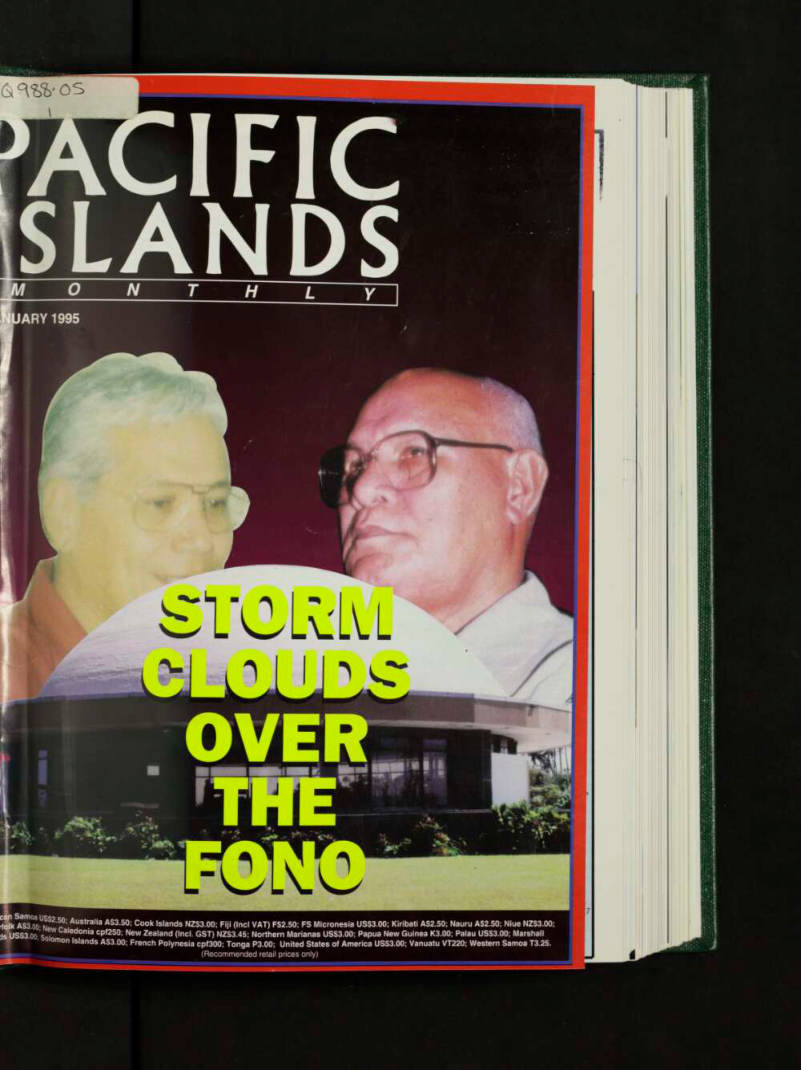
•fQlk^VS3°oo U Mp 2 r°’ Australia AS3 - s °; Cook Islands NZS3.OO; Fiji (Incl VAT) F 52.50; FS Micronesia USS3.OO; Kiribati A 52.50; Nauru A 52.50; Niue NZS3.OO; js USS3.OO So| W Caledonia c P f25 O; New Zealand (Incl. GST) NZ53.45; Northern Marianas USS3.OO; Papua New Guinea K 3.00; Palau USS3.OO; Marshall omon Islands A 53.00; French Polynesia cpf3oo; Tonga P 3.00; United States of America USS3.OO; Vanuatu VT22O; Western Samoa T 3.25. (Recommended retail prices only)
Advertisements & other items, p. 2 (1 item)
%
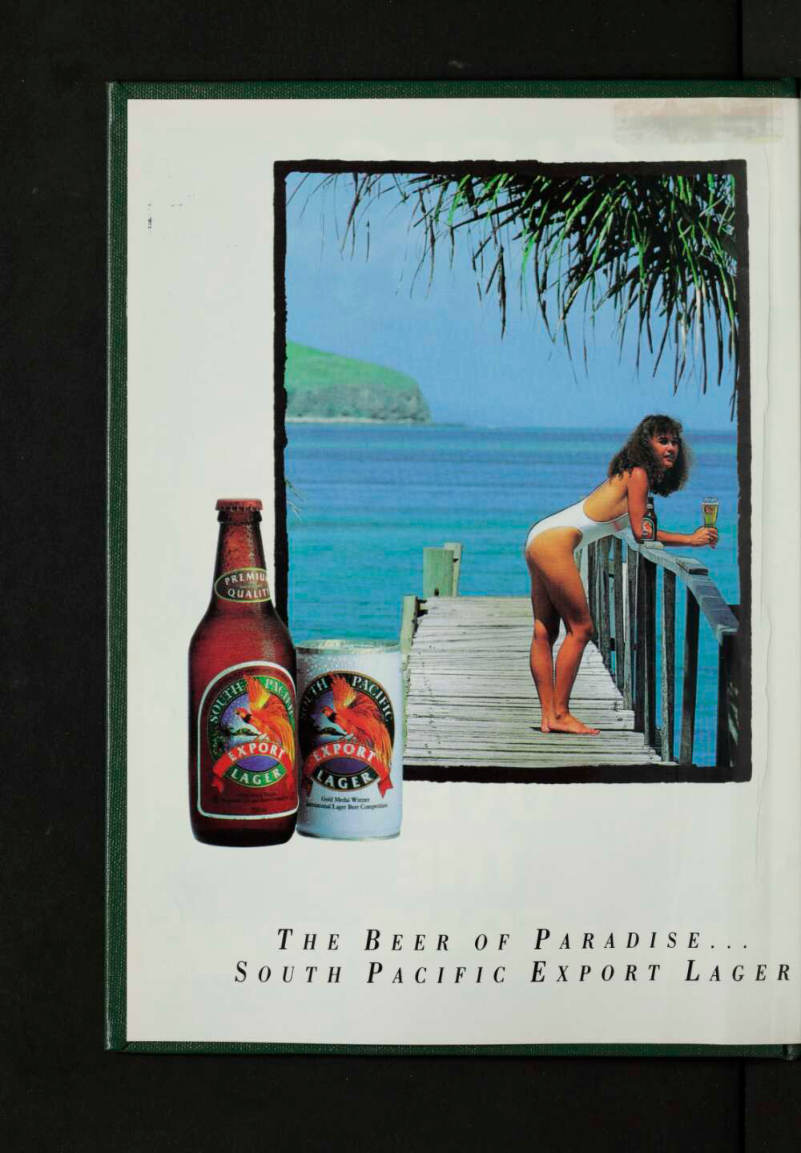
n 1 v r f % wa Wasm Uger Ben CanpOß* The South Beer of Paradise...
Pacific Export Lager
Pacific
Islands
Monthly
Vol. 65 No.l
The News Magazine
January 1995
□ Letters 4
□ Headlines 7
□ Killing shocks Vanuatu 10 The Cook Islands saga 11
□ Cover Stories
Apia's political crunch 12 And then there is VAGST 15
□ Opinion
Islanders' health poses problems 19 For a cleaner environment 21 And they went marching in 25
□ The Forum
New salary structure causes dismay 16
□ Mining
Dividing up the ocean bottom 18
□ The Region
McKinnon's view of the Pacific 22
□ Vanuatu
Upset in provincial elections 26
□ Labour
Exploitation in the Marianas 28
□ Films
Lights, camera, action 32
□ Profile
Our man in New York 36
□ Economy
A bitter pill for Vanuatu 39
□ Sports
Sikahem's American dream 53
□ Yachting
New year's dreaming 56
Cover design by JAMES RANUKU
CORRECTION: We had inadvertently described DHL’s new Pacific manager, Gary Hislop, as having worked in the USSR in our last issue. Hislop had, in fact, worked in the USA.
Publisher: Brian O’ Flaherty Editor; Mala Jagmohan Senior Writer: Yunus Rashid Correspondents: Christine Hatcher, David North, Ed Rampell, lan Williams, Karen Mangnall, Liz Thompson, Roman Grynberg, Wally Hiambohn.
Columnists: David Barber (Wellington), Futa Helu (Tonga, cover ing the Pacific Islands), Jemima Garrett (Sydney). Alfred Sasako (The Forum).
Advertising Sales: • Regional Sales -South Pacific; Salendra Narayan, Ashok Lai, Tel (679) 304111,303429, Fx (679) 303809. • Sydney, Canberra: Bob Hill Media Representation. Tel (61-2) 4164245, Fx (61-2) 4165064. • Brisbane: Robert Walker, Media House, Tel (61-7) 3710533, Fx (61-7) 371-8904. • Adelaide: Hastwell Williamsons Representatives, Tel (61-8) 3799522, Fx (61-8) 3799735. • Melbourne: Brown Orr Fletcher Burrows (Aust) Pty Ltd. Tel (61-3) 8265188, Fx (61-3) 8265644. • Auckland: McKay & Bowman, International Media Representatives Ltd, Tel (64-9) 4190561, Fx (64-9) 4192243. • Japan: Universal Media Corporation, Tokyo, Tel (3) 326626741, Cable: UNI MEDIA Tokyo, Fx(3) 32626742.
Founded 1930 (USPS 952480). A Fiji Times Limited production.
Cover prices are recommended retail only.
Registered by Australia Post, Publication No. NBP 1210. g) Copyright Fiji Times Limited, 177 Victoria Parade, Suva. Fiji. Tel (679) 304111, Fx (679)
303809. Tx Fj2124.
Pacific Islands Monthly is published monthly by Fiji Times Limited, a division of Nationwide News, 2 Holt Street. Surry Hills, Sydney, NSW 2010.
Send address changes to: •Pacific Islands Monthly, PO Box 1167, Suva, Fiji.
Typeset and printed by The Fiji Times Limited, 177 Victoria Parade, Suva, Fiji.
tragedy
Letters To The Editor
Elephant tragedy
Madam, Read Ed Rampell’s report on an ele phant tragedy in Honolulu (PIM, Oct., 1994). The blame for this tragedy belongs to the persons in charge of the elephant; owner, trainer and keeper.The treatment of many elephants in circuses and other captivities is very, very cruel.
Circus elephants are “trained” with sharpened sticks, electric prods, brutal beatings, etc., until the animal “gives in” and performs stupid tricks to amuse the public. Keeping wild animals in cages or chained is outright criminal, because those animals are kept under perma nent stress. The circus is a relic of a bar baric age, an anachronism.
Many years ago a zoo elephant in Honolulu was killed by “officials”. The animal had endured many years of bru tal torture by its keeper. To name just one brutality: the keeper burned holes through the elephant’s skin - all over its body. After years of torture the day final ly came when the elephant killed its keeper.
In both Hawaiian elephant tragedies, the “beasts” were the two-legged keeper/trainers.
In this day and age all animals must be treated humanely. Animals feel pain just like people do.
And last, but not least, all 50 US states have animal cruelty laws, Hawaii includ ed ... we hope the Hawaiian Humane Society will “go” after the circus.
Inge Mathiesen, (Member of several US Humane Societies, S.PC.A.s, Defenders of Wildlife and Greenpeace.), Montana, USA
Astronaut award
Madam, I would like to nominate Roman Grynberg as one of the candidates for the “Pacific Astronauts Medal of the Year Award” for his article Aid, Aids and Per diems (PIM, December, 1994).
The award, nicknamed “Lord of Hypocrisy”, is the highest honour for his courageous coverage of the UNDP aid conference and what took place after wards in Manila recently.
The merits for his nomination are for: never accepting per diems while work ing for the Forum Secretariat, never being an “astronaut” in his time in the Pacific, having his salary at the Forum Secretariat taxed while the others’ were not, refusing to accept the per diem given to him by UNDP at the Manila conference.
Last, but not least, for being so success
ful in achieving exactly the opposite of what he really wants to teach us Pacific people - thou shalt not be an astronaut!
Pene Lefale, Auckland, New Zealand
Racism at the university
Madam, I commend this journal on its coverage of racism at the University of the South Pacific, concern about which I have myself expressed to the Vice Chancellor and which, because it is real, must be addressed at the level of policy, not per ception. As a former lecturer in the School of Humanities, I am particularly touched by Mr Kabutaulaka’s candour and courage, even if our analyses do not altogether coincide.
Your coverage of racism is an advance on the strange kind of phobic evasive ness on this topic at an academic insti tution dedicated to furthering the needs of a multiracial population.
And yet, despite its merit, your coverage is too much of a piece with a dominant selective trend whenever this important topic is broached. In the process you introduce distortions. Whatever may be
your intention, and granted that the immediate impetus behind your cover age is student unrest, your exclusive focus on the students conveys the sug gestion that the problem is confined to them.
If, to use one of your criteria, self-segre gation among students at mealtimes is part of the problem, then you ought to take a look at what happens at the fac ulty dining hall. I assure you the fre quent all-white groupings are among the most potent pedagogical practices propagating racist ideology on campus.
So the students, if they are at fault, can point to an exemplary source of inspira tion. I invite your anonymous senior lec turer to ponder on this.
Let me identify another shortcoming of your coverage. Focused as your discus sion is on student relations, it is further limited through concentration on some students. Are you unaware, for instance, that participation by Indian students in such activities as the open-air segment of Pacific Week celebrations is minimal and low-key, that it is greeted by sneers by a section of the audience?
It is too fashionable at the university to observe a silence on this score. As long as this silence remains unbroken, the university functions as one of the most psychologically effective forums for the teaching of hypocrisy. Participation in the culture of such an institution can hardly be in the best moral and best educational interests of those who will fill leadership roles.
One objection, often voiced in some quarters, to free and full discussion at the university is that certain issues are “sensitive”, and that race is one of them.
I have not encountered any obstruction from my students whenever I intro duced topics with a bearing on race and culture. The majority of students show tolerance, awareness of one another’s
rights and obligations, including their
right to differ, and usually enjoy the interchange of ideas. What is more, I have found many of them to be critical ly inclined, even more so than they are generally given credit for.
If race is a sensitive issue but this sensi tivity is not to be located primarily in the orientation of the students, perhaps we need to look elsewhere; possibly at
the political temperature maintained in the setting where the university’s main campus is situated. What is it about the ethos of this milieu that renders race a sensitive subject, to virtually prescribe it to the region of taboo?
If it is true the situation outside the uni versity constrains its internal function ing, then clearly, the major political actors have a role to play in defusing it.
They owe it to the young people of their country and their region.
To sum up, racism is not a trivial affair and cannot be abolished by half mea sures. Its forms and levels feed off one another, giving it an extraordinary abili ty to survive. To single out the students is a bit like scapegoating them; a little like excising the periphery of a malig nant growth while ignoring its capacity for regeneration. Its elimination must become the focus of a comprehensive policy, enlisting the support of those within the university and those without.
In this task all must be involved because, ultimately, all stand to gain.
Madan Gopal, Toronto, Ontario, Canada
Letters to the Editor must include the writer’s full name, address and telephone number.
All letters may be edited for purposes of clarity and space.
Letters should be addressed to: The Editor, Pacific Islands Monthly, PO Box 1167, Suva, Fiji or to Fax: (679) 303-809
Advertisements & other items, pp. 4-6 (2 items)
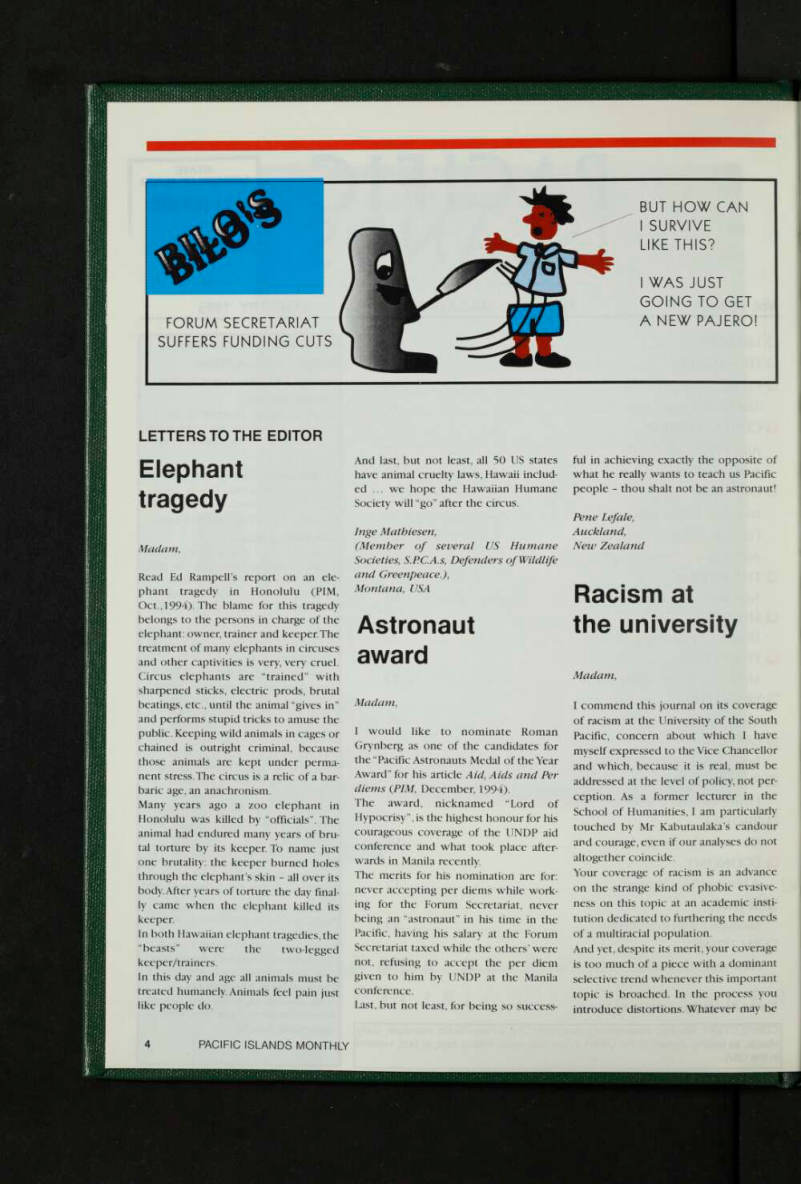
Forum Secretariat
SUFFERS FUNDING CUTS
0
BUT HOW CAN
I SURVIVE
LIKE THIS?
I WAS JUST
GOING TO GET
A NEW PAJERO!
; Pacific
Remember your Friend
There are times in your life when you feel your friends have been missing out on something good. Now’s your chance to do something about it and share with them one of the good things you have. Buy your friend a
subscription to Pacific Islands
Monthly and let him or her join you and thousands of other people worldwide who are kept informed of the latest political, social and cultural
changes taking place in the Pacific.
SUBSCRIPTIONS
American Samoa Australia Canada ...; Cook Islands Fiji French Polynesia Guam .v Hawaii Japan Kiribati Marshall/Micronesia Nauru New Caledonia New Zealand Niue Norfolk Island Northern Marianas/Palau Papua New Guinea Solomon Islands Tonga Tuvalu United Kingdom US Mainland Vanuatu Western Samoa Elsewhere Payment to Pacific Islands Monthly Subscriptions Dept, GPO Box 1167, Suva, FIJI.
Subscriptions rates include the cost of airspeeding to all destinations set out above.
Direct airmail rates on application.
USS4S
A542.00
USS4S
AUSS46
F526.40
USS4S
USS4S
USS4S
USS4S
AUSS46
USS4O
AUSS42
USS32
NZSSS
AUSS46
AUSS42
USS4O
AUSS4S
AUSS46
AUSS46
AUSS46
Stg Pound2B
USS4S
AUSS4S
WSS6O
AUSS63
Telephone: 304111 Fax: 303809
; PACIFIC
• STANDS
lImoN T H L y I I Please send my friend Pacific I Islands Monthly for one year
(12 issues).
■ I enclose my cheque for $
(made payable to Pacific
1 Islands Monthly) or debit $ to my: l I □ Bankcard □ Visacard □ Mastercard , Card No: i i I 1 M I! I I ! M I 1 Expiry Date
NAME
V
cCb
U
SIGNATURE
ADDRESS:
CITY COUNTRY
World events herald the
Return of
Jesus Christ
Are you prepared ?
Write for the Free booklet “Europe United and Russia Triumphant”
THE CHRISTADELPHIANS
GPO Box 881
ADELAIDE
SOUTH AUSTRALIA 5001
EVER UNDERESTIMATE THE VALUE OF
LOCAL KNOWLEDGE.
iPUfI NEW GTJINEA BANKING CORPORATION!
THE NATION'S LEADING COMMERCIAL BANK
Heod Office: Corner Dooglos 8 Musgtove Streets, Port Moresby. PO Box 78 Port Moresby, NCD, Popoo Hew Guioeo. Telephone (675) 21 1999 Facsimile (675) 21 1954
SAVI PBCOO9I
Training guise
Headlines
Niue
Tax haven not for
New Zealanders
The New Zealand government has intro duced new legislation aimed at blocking attempts by New Zealand tax-payers to use the tax haven in Niue.
Revenue minister Wyatt Creech said the Taxation Reform Bill will amend conces sions to ensure that New Zealand resi dents cannot benefit the from current law which grants concessions to New Zealand companies which do business mainly on Niue.
Creech says the Niue government has been consulted before making changes which he says signal to tax planners and foreign governments that New Zealand will protect its tax base.
Palau
UN's 185th
member
The United Nations has endorsed an application by newly independent nation Palau to become its 185th member.
The Security Council approved a favourable report from its committee on the admission of new members, which will formally admit Palau to membership at a forthcoming meeting.
Palau was the last of the UN trust territo ries and had been administered since 1947 by the United States. It became self governing on October 1 in a compact of free association with Washington.
Solomon Islands
Log laws loosened
The new Solomon Islands government of prime minister Solomon Mamaloni has almost halved export duty on round logs imposed by former prime minister Francis Billy Hilly.
The new Cabinet decided the export duty should be 35 percent of the greight on board price of each cubic metre, down from the previous 65 percent. The new measure was backdated to November 1.
The government has also thrown out the former government’s proposal that 20
percent of the duty on log exports be returned to the resource owners. Instead, it decided that 7.5 percent of the levy be returned to the resource owners.
Cabinet further decided the timber levy be held in trust accounts until landowners submitted development proposals on which to spend the money.
As well, Cabinet decided that logging companies could also request a further remission of five percent of the export duty to be used for community projects and services in areas where they were operating.
Vanuatu
Training guise
for child labour
Vanuatu has been employing child labour for years under the guise of “training”, according to the president of Vanuatu Council of Trade Unions, Obed Masing.
He warned that the number of children in employment would continue to rise.
Masing said children had been working in some garages for as little as US$20 a month.
He warned that with hundreds of 11 and 12-year-old students released into the streets from primary schools every year, many more under-age children would be forced to enter the job market.
Masing put the blame on the youths unawareness of their trade union rights and the Vanuatu constitution. He said the VCTU was preparing a major trade union campaign to explain the workers’ rights to the people in the islands and the gov ernment should do the same.
The Employment Act prohibits the employment of children under 15 years old.
Papua New Guinea
PNG's money
matters
Papua New Guinea’s banks are having problems lending to businesses because of severe constraints on liquidity recently imposed by the Central Bank. It’s also affecting new lending to customers.
There have been recent claims that com mercial banks were reluctant to entertain loan requests from locally-owned busi nesses because they were less favoured than foreign companies.
However, the managing director of the Bank of South Pacific, Noel Smith, says whilst commercial banks have approved too many loans, most have not performed because of a lack of management and book-keeping skills.
Police versus
army
Drunken Papua New Guinea Defence Force soldiers, angry after a confrontation with police, destroyed traffic lights and stoned vehicles in the capital Port Moresby on December 3- Police had to divert traffic from parts of the city to avoid further damage to vehi cles. A number of motorists had their vehicles damaged and at least one bus driver was injured.
The incident was sparked off by a fight involving soldiers and a Boroko police unit after a dance at the Port Moresby Rugby Club.
Police reinforcements managed to dis perse the group by firing warning shots but aggravated the situation which later led to the stone throwing incident.
The tense stand-off eased when police units withdrew and the soldiers returned to their quarters. It was not known whether anyone had been arrested.
Western Samoa
Fiji to reject
Samoan copra
Five containers of copra from Western Samoa was expected to be rejected by Fiji when the consignment arrived in Fiji at the end of December.
The Apia suppliers received a letter from the Fiji government, saying that a ban was in place against any plant or crop from Western Samoa because of fears of harm ful leaf blights and the giant African snails found on plantations in recent years.
The shipment was bound for Punja and Sons Limited edible oil refinery.
Fiji
Where's the
money?
Fiji troops who took part in the failed Bougainville peacekeeping mission are still waiting to receive allowances owed to them nearly a month after their return because the Fiji government has yet to receive the money promised to it by the Papua New Guinea prime minister Sir Julius Chan.
About US$l7B,OOO is owed to the 232 sol diers under the bi-lateral agreement signed by Fiji prime minister Sitiveni Rabuka and Sir Julius.
Fiji’s Foreign Affairs secretary, Ratu Tui Cavuilati, said Fiji was waiting for money to be remitted from Port Moresby.
An undisclosed sum was remitted in early November, but Ratu Tui said it was to cover the cost of training and equipping the soldiers.
Peace overseas
or harmony at
home ?
A Fiji Opposition Party has questioned the government’s priorities in maintaining peacekeeping forces abroad while failing to maintain law and order at home.
A vice-president of the All Nationals Congress, Mick Beddoes’ comment fol lowed an increase in violent crimes in Fiji, including one in which a 73-year-old church elder died of a heart attack while being robbed.
Expressing outrage at the “cowardly” attack, Beddoes said it appeared police could not cope with the increase in crime.
Fundamentally
flawed
The Director of Public Prosecutions has lodged an appeal in a case in which six men were acquitted of defiling a “well built” 15-year-old girl because the magis trate thought she looked older.
DPP Nazhat Shameem said the appeal was on the grounds that magistrate Moses Fernando had erred in law in acquitting the six after they had pleaded
guilty to having sex with a girl aged 16 or under..
The decision angered women’s groups in the country, and have called for greater gender sensitivity among judges and mag istrates.
Police told the court that the victim, two friends and her boyfriend (one of the accused) were in an old church when the other five defendants appeared. Her friends ran away and the six covered her mouth and took turns at having sex with her.
Fernando asked the victim be brought to the court, said she looked “hefty” for her age and set the six accused free.
Radio talkback shows and women’s rights lawyers were inundated with calls from the public, all expressing their disgust at the magistrate’s comments.
Security remedy
for USP
Security at the University of the South Pacific’s Suva campus looks set to improve with the erection of a two-metre high fence alongside two roads on the campus boundary.
Security at the university has become a major concern following two incidents of campus violence which resulted in seri ous injury to students last year.
More than 140 Solomon Islands and Vanuatu students fled Fiji because of the violence, saying they would only return when security was improved.
Following the violence the number of security guards at USP was increased from five to 13. The new fence is part of a long-term project which began in the 19905.
Marshall Islands
Caging the killer
The proposal to develop a nuclear waste facility in the Marshall Islands is pro gressing with several international com panies expressing interest to the govern ment.
It was reported that one Washington based company had offered US$160 mil lion for the right to develop the facility.
The government is officially saying a fea sibility study must be undertaken before
any decisions are made, but there appears to be high level support for the facility in the Marshalls.
An expert panel is expected to be assem bled to undertake a feasibility study and the project may progress further when parliament meets this month.
Nuclear
worry
Marshall Islanders, whose territory was used for US atmospheric nuclear testing, were to send a mission to the United States to ensure it took responsibility for monitoring their health and environment.
Island leaders are worried responsibility was being passed between different US government agencies and funds for con tinuing radiological, environmental and health monitoring may be cut.
Enewetak Atoll was the site of 43 American nuclear weapons tests from 1948 to 1958, including the detonation in 1952 of the first US hydrogen device.
The islanders were moved off in 1947, but after a clean up by the US Army which finished in 1982, Enewetak islanders moved back to the southern islands in the atoll.
Studies have found thyroid tumours, breast cancer, leukemia and stomach can cer among a list of 23 ailments suffered by some of the 800 islanders, which are pre sumed to be caused by radiation.
War for financial
gain
The American ambassador in the Marshall Islands, David Fields, says budget cuts will lead to reduced operations at the mil itary base on Kwajalein. But Fields assures that the base will not be closed.
Kwajalein is a missile testing range which is a cornerstone for Strategic Defence Initiative or Star Wars.
Earlier, missile range commander David Spaulding had said US$l6 million, or 10, percent of the operating costs, would have to be slashed from the 1995 budget.
Marshall Islands officials are concerned about the cuts which threaten the base’s contribution to the Marshalls economy.
A substantial number of islanders working on the base are also likely to lose their jobs.
Advertisements & other items, p. 8 (1 item)
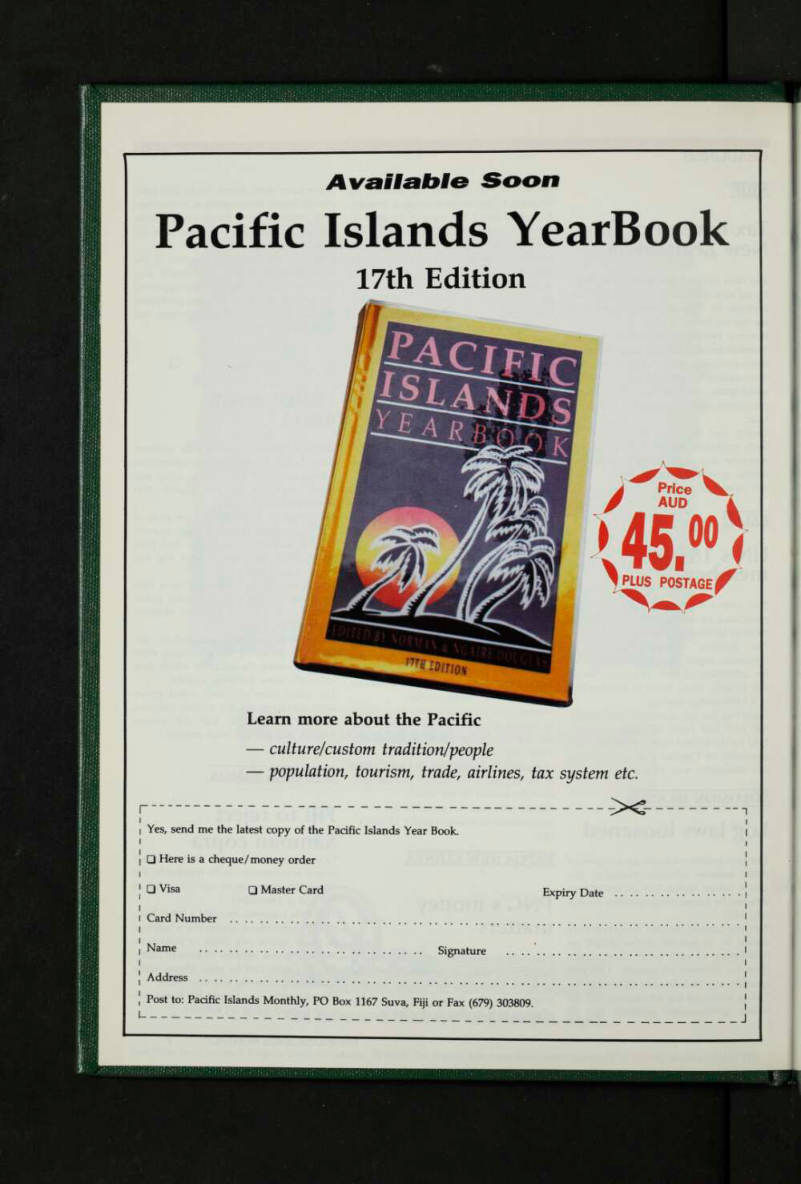
Pacific Islands Yearßook
Available Seen
17th Edition
>v % / Price
AUD
*45. M < sm V/, 06
PLUS POSTAGE
” r^Dum
r Leant more about the Pacific
culture/custom tradition/people
population, tourism, trade, airlines, tax system etc.
X_ Yes, send me the latest copy of the Pacific Islands Year Book □ Here is a cheque/money order □ Visa □ Master Card Card Number ame Signature Address Expiry Date Post to: Pacific Islands Monthly, PO Box 1167 Suva, Fiji or Fax (679) 303809.
I
Killing

Murder
Shocks Vanuatu
By Patrick Decloitre
The murder of an Italian builder on November 29 in Vanuatu’s capital has caused deep shock within the community, generat ing the wildest rumours, but also fear.
On November 29, in Port Vila, the body of Franco Pichi, 51, was found by police on the rear of his truck in what authorities immediately believed was a gang murder case.
The body of Pichi, owner of the Roman Construction building company, was taken to the Vila Central Hospital morgue, where a post mortem revealed heavy skull damage, a broken neck and ribs and wounds on the back. Pichi’s neck had traces of strangulation.
Public Prosecutor John Baxter-Wright said from the start that the case would be treated as murder, granted the evi dence found on the scene and traces on the body.
Police have recovered a jack and a handle that “may have been used to inflict the injuries”, Baxter-Wright said.
The pick-up truck was found at the bottom of a slope near a construction site on a hill overlooking Port Vila’s sec ond lagoon.
Wheel traces on the grass indicate the vehicle was pushed down the slope
while the body was already placed at the rear in the open wagon.
Baxter-Wright, who immediately went on the scene with police inspectors, says there have been other cases of expatriates dying in Vanuatu in dubious circumstances, but there had been noth ing as violent as this since indepen dence.
Police in Port Vila later indicated they excluded indigenous ni-Vanuatu as being the possible murderers, saying the crime did not fit with local killing habits.
The same source said it was believed at least two persons took part in the killing, one holding the victim while the other hit him.
“Ni-Vanuatu usually kill with bush knives, hands and feet,” Baxter-Wright said.
Police have called on the public to provide information on the murder.
Meanwhile, three Australian Federal Police officers have been flown to Port Vila to provide assistance to the Vanuatu police.
Although every line of inquiry is being followed and a number of people have been questioned, no one has been arrested. on December 13, a local business man’s working premises were searched,
but police had refused to reveal any more.
“The investigation is progressing, but we don’t want to release anything about it until it comes to an end,” Police Commissioner Luke Siba said last month.
The Port Vila community is increas ingly worried. This generates the wildest rumours in the capital as to who could have committed the murder. Because of the builder’s background, reference to the Italian mafia crops up, not to men tion Chinese triads, so called “American Vietnamese from Los Angeles”.
Suspicion has fallen on local people, in relation to gambling or, more trivially, affairs.
Rumour, which in Port Vila can be considered as being a national pastime, goes wild, whether it is talk of motives or the origin of the murderers. Since the murder took place, the subject monopo lises all social conversations.
“This has had a considerable impact on the local community,” says Baxter- Wright, “mainly because we have never had such a violent killing in the last four teen years.
“It’s not really the sort of thing that happens everyday. So I’m not surprised at the amount of gossip. Of course, this is not very helpful to the police, but
they have to investigate every possible hint.”
A prominent local manager’s com ments are also reflective of the feeling among the ni-Vanuatu community; “First we are very shocked about the way this was done, but mainly, people are now afraid, they feel they are no longer safe if this sort of crime can happen here,” he said.
“If the police cannot find the murder er or murderers, then this means that anyone can get killed tomorrow in the same manner, and the murderer will get away with it.”
Although authorities here are aware of Pichi’s recent background in relation to the Cook Islands Sheraton hotel sham, nothing yet indicates that there is a link between this and the murder.
Pichi arrived in Port Vila less than two years ago from the Cook Islands, where he was the manager of the Sheraton construction project through his Stephany company.
However, soon after his arrival, Pichi went into trading under the name Roman Development Limited, which was mainly building private houses. ■
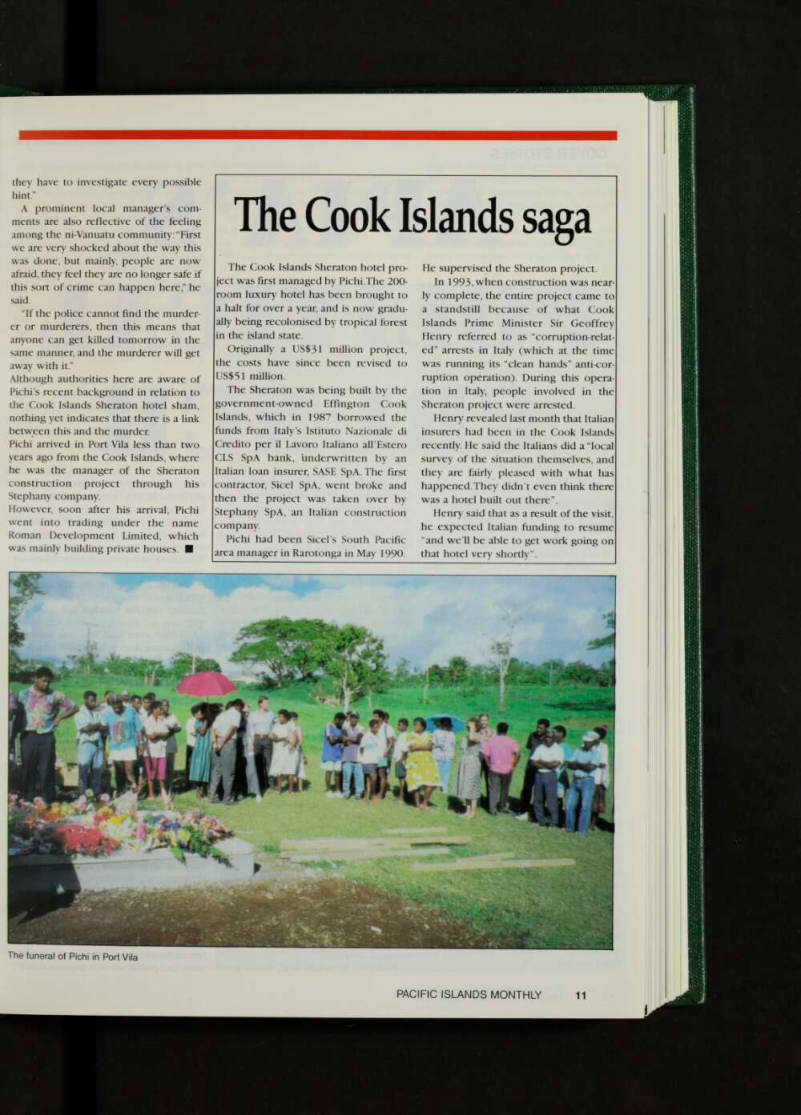
The funeral of Pichi in Port Vila
The Cook Islands saga
The Cook Islands Sheraton hotel pro ject was first managed by Pichi.The 200room luxury hotel has been brought to a halt for over a year, and is now gradu ally being recolonised by tropical forest in the island state.
Originally a US$3l million project, the costs have since been revised to US$5l million.
The Sheraton was being built by the government-owned Effington Cook Islands, which in 1987 borrowed the funds from Italy’s Istituto Nazionale di Credito per il Lavoro Italiano all’Estero CLS SpA bank, underwritten by an Italian loan insurer, SASE SpA. The first contractor, Sicel SpA, went broke and then the project was taken over by Stephany SpA, an Italian construction company.
Pichi had been Sicel’s South Pacific area manager in Rarotonga in May 1990.
He supervised the Sheraton project.
In 1993, when construction was near ly complete, the entire project came to a standstill because of what Cook Islands Prime Minister Sir Geoffrey Henry referred to as “corruption-relat ed” arrests in Italy (which at the time was running its “clean hands” anti-cor ruption operation). During this opera tion in Italy, people involved in the Sheraton project were arrested.
Henry revealed last month that Italian insurers had been in the Cook Islands recently. He said the Italians did a “local survey of the situation themselves, and they are fairly pleased with what has happened. They didn’t even think there was a hotel built out there”.
Henry said that as a result of the visit, he expected Italian funding to resume “and we’ll be able to get work going on that hotel very shortly”.
Political
Cover Stories
Apia’S
Crunch
By Alan Ah Mu
Last month the government used its big majority in Parliament to approve a commission of inquiry’s report that cleared seven Cabinet minis ters of corruption.
Rather than end the matter, the move has fuelled a controversy likely to continue into the new year.
Former chief auditor Tom Overhoff called the findings a “whitewash”. The corruption allegations, which also impli cated government officials, came from chief auditor Sua Rimoni Ah Chong in his annual report to parliament. The nor mal procedure, said Overhoff, is for such a report to be referred to the public accounts committee for recommenda tions to parliament. Instead it was exam ined by a commission consisting of “non-parliamentarians chosen by the very body that is under fire in the audit report: Cabinet”.
A commission of inquiry, Prime Minister Tofilau EtiAlesana had decided, would give those accused the chance to give their side of the story in the man ner of a trial in court - and as he point ed out later, Tuiatua Tupua Tamasese, leader of the main opposition, the Samoa National Development Party, had agreed to one.
True, and people criticised Tuiatua for it, but as he said, the government of the ruling Human Rights Protection Party wanted a commission of inquiry and had the numbers in parliament to make one inevitable.
What he pressed for instead - and failed - was for the commission mem bers to be recruited from overseas led by someone like former New Zealand governor-general Sir David Beattie, who had done a similar job in Fiji.
That would reflect badly on quali fied Samoans who the country had sent overseas for education, Tofilau said, ignoring Tuiatua’s argument that “an Australian refereeing a rugby game between Tonga and Samoa does not reflect on the integrity and capacity of Samoan referees or the Samoan people”.
“The intention is to place the issue of impartiality beyond dispute,” he said.
Overhoff surfaced, saying the com mission lacked independence and impartiality in an open letter to chair man Maiava lulai Toma to express “my feeling of utter disgust about your report” which gives “all sorts of excus es” for what was alleged in the audit report.
In parliament, the PM turned on Sua, focusing on the commission’s most crit ical conclusions that the auditor had gone beyond his “jurisdiction and legiti mate sphere of concern”, cited politi cians “particularly ministers on flimsi ly composed allegations or suggestions of wrongdoing” and had “disregarded mechanisms laid down by law to deter mine the correctness or legality of cer tain actions by government officials and has improperly taken onto himself the function of declaring such actions as wrong or unlawful.”
However, Overhoff said, when gov
eminent money is lost, by wrongdoing as alleged by Sua,“it is the auditor’s func tion to report that”.
Another commission finding Tofilau latched on to was Sua’s hiring of private sector auditors and spending WS$ 18,000, a sum that required Cabinet approval.
Sua said legally he could hire audi tors if it was necessary and was “disap pointed” the PM had lost his “perspec tive”.
Tofilau even said Sua was working withTuiatua during his attack which at times was so strong the rumour was that government would do all it could to fire the chief auditor.
But if the PM chose to dwell on Sua’s alleged faults his opponents were bound to seize onto those commission conclusions that support Sua qualified though they may be namely that: “We confirm, in the main, the irregu larities outlined by the ... chief auditor but we do not agree with all of the dimensions of these events portrayed in the report..”
Also, “We confirm the disturbing trends of dishonesty and unprofessional conduct uncovered by the chief auditor in some departments and agencies of government”, though it doesn’t mean there’s a “general state of degeneracy in public administration as could perhaps be inferred from numerous allusions to such a state in the report”.
Overhoff says differently. There has been a “marked degeneration of govern ment and public service accountability”
with “corruption and favouritism in gov ernment departments and corpora tions” undeniably widespread, he said.
The Opposition has begun to revive its attack on the government’s exten sion of parliamentary terms from three to five years because of the commis sion’s belief that five years is “too long a period to have to rely entirely for honest government on the “conscience and sheer honesty” of our human leaders “given the possibility that party disci pline can make Parliament’s control ineffective”.
Though it’s in black and white, the PM denies the commission said such a thing.
“Tofilau is a good politician," Tuiatua admits, but indicated that political skill cannot justify government supporters benefiting from contracts involved in the major development projects that have and are being undertaken.
One example that gives rise to such an accusation is the hiring in 1990 of a company owned by Post Office and Telecommunications Minister Toi Aukuso, to help the government-owned Electricity Corporation in the big rural electrification programme.
Compared to overseas contractors, Toi’s company’s costs are very low and in the best interests of the country, the com mission of inquiry says. But the work should now be tendered especially since Cabinet decided in 1991 that all government work should be awarded that way.
Toi has withdrawn as a director of the company and legislation for all govern ment work to be tendered is being pre pared, the PM announced during discus sions in Parliament of the commission’s report.
The good and bad results of the govern ment’s desire to get things done now is epitomised by Public Works Minister Leafa Vitale, a stroke victim last year, who the commission of inquiry said leads by “phenomenally energetic” example.
But Leafa s word has become the only rule and “effective check” not only of him but of everyone else in the depart ment has gone “out the window”.
Leafa’s achievements through his hands on approach cannot be denied.
“Unfortunately there is no denying either the almost total collapse of pro cedures and control systems in the department, making it easy for person nel at all levels to engage in improper and dishonest activities with impunity”,
the commission said.
The department’s undersecretary had a departmental bulldozer taken to his property where it levelled a part of it.
The explanation given to the commis sion: the bulldozer was taken there to be tested for repairs.
When, road improvements began several years ago workers were detoured to tar
seal the frontage and parking space for the HRPP headquarters. The explanation given by the Minister of Public Works in Parliament: they were testing the quality of the tar.
Support for the government seems now to rest on whether an appreciation of its work record can outweigh such tests. ■
Advertisements & other items, pp. 13-14 (1 item)
And then there is VAGST
Likely to fuel the controversy longer is a petition begun months ago calling for the support of the chief auditor’s report and signatures collected so far number a reported 90,000.
The petition also seeks the abolition of the Value Added Goods and Services Tax (VAGST). The PM said the petition was illegal while Finance Minister Tuilaepa Sailele Malielegaoi warned that the tax was needed for revenue for development projects and the country would be plunged back to the dire days of 1979-82 (when Tuiatua was in government) when ships refused to unload goods until they got their money and there were queues to buy cigarettes.
Petition organisers, who call themselves Tumua ma Pule, will take their petition to the Head of State - an inappropriate action, according to the PM ,who claims involving the Head of State in the matter would soil His Highness’s name.
But Independent MP Le Tagaloa Pita said accessibility to even high-ranking matai (heads of families) such as the Head of State is, for refuge or solutions, the essence of the Samoan way.
“This is a free country,” he said, with no slaves or commoners.
Anti-VAGST feeling drew thousands to the streets of Apia last March. Protesters, after weeks of camping in front of the government building, dispersed only after cuts on duty on essential goods, including food items, were announced.
From its office in Apia, set up partly for that purpose, Tumua ma Pule monitored how much of a financial help the cuts would be and concluded “none at all”, said chairman Faamatuainu Tala in explaining their latest protest action.
Tumua ma Pule is made up of a group of matai who until the Germans replaced them in colonial times with a Lands and Titles court, arbitrated in disputes and met to discuss matters of national concern.
Tofilau believes only a few of that group backed the March protest and now the petition and urging them on is Tuiatua, trying to bring down the government through “seditious” means.
Furthermore, the PM maintains the government belongs to Tumua ma Pule through being voted into office in the elections.
In any case, rises in cigarette and beer prices effective this month are seen as another load on families struggling for cash in the aftermath of the taro leaf blight and the price increases introduced with the 10 percent VAGST a year ago.
Tuiatua said that not only was the tax immoral, as evidenced by the objections of churches here and in New Zealand and Australia, but it was being used to fill financial “holes” left by mismanagement, most notably the ill-advised funding of ambitious plans by Polynesian Airlines.
Finance minister Tuilaepa denies any great financial strife since the government has WS$2BO million in hand. He says the VAGST is a fairer tax and a form of self help needed for greater independence for the country and seeing such efforts would encourage overseas donors to provide aid.
It’s one theme the government is likely to repeat to counter the heat from the petition which was winding up at the time of writing.
The government is proud of its work record and impressive infrastructure achievements - improved roads, electricity and water supplies.
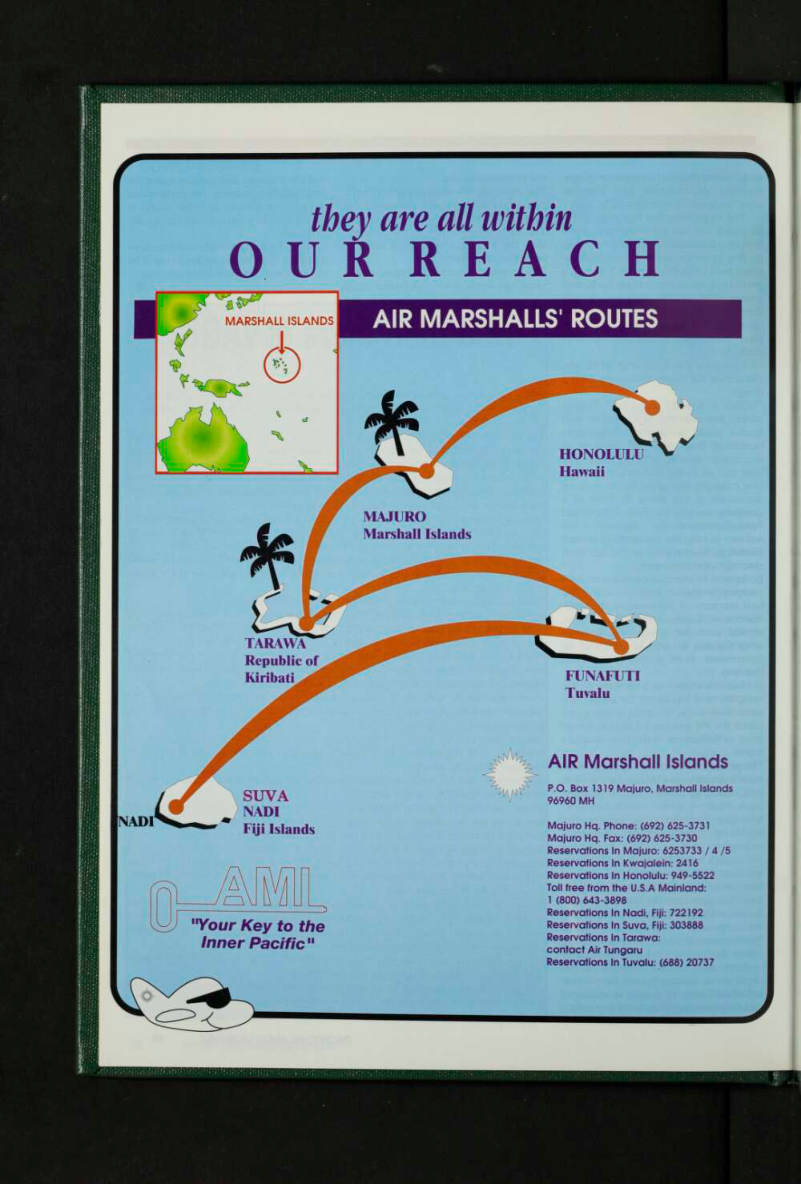
they
OUR
are all within
REACH
w
AIR MARSHALLS' ROUTES
MARSHALL ISLANDS
9 \:
HONOLULU
Hawaii
MAJURO
Marshall Islands
TARAWA
Republic Kiribati of
FUNAFUTI
Tuvalu
NADI
SUVA
NADI
Fiji Islands "Your Key to the Inner Pacific"
AIR Marshall Islands
P.O. Box 1319 Majuro, Marshall Islands 96960 MH Majuro Hq. Phone; (692) 625-3731 Majuro Hq. Fax: (692) 625-3730 Reservations In Majuro: 6253733 / 4 /5 Reservations In Kwajalein: 2416 Reservations In Honolulu: 949-5522 Toll free from the U.S.A Mainland: 1 (800) 643-3898 Reservations In Nadi, Fiji: 722192 Reservations In Suva, Fiji: 303888 Reservations In Tarawa: contact Air Tungaru Reservations In Tuvalu; (688) 20737
poses problems
Opinion
Islanders' health poses problems
The grim findings of an official report on health of Pacific islands people in New Zealand came as no surprise to the subjects of the study.
The country’s 167,000 residents of Pacific island descent already knew that the past decade’s painful, if necessary, economic restructuring had hit them particularly hard, consequently bringing worsening health.
The Public Health Commission report paint ed a sorry picture of the problems they face.
It found they suffered from inferior housing, poor diet, low incomes and high unemploy ment - all key factors affecting their health.
Although it has long been known the island community was the most disadvantaged sec tor of the population, it was the first detailed survey of its health status.
As such, it was important in identifying not only the health needs of Pacific island people, but of the nation as a whole. For, with a birth rate more than double the national level, the islanders are one of the fastest growing ethnic communities in New Zealand.
Between 1986 and the last census in 1991, their numbers grew at a rate eight times high er than the total population. By the year 2031, they are forecast to increase by 114 percent and constitute more than seven percent of the population.
The health of Pacific islanders will therefore have an increasing influence on the health of the entire New Zealand population.
It is a report that cannot be ignored by the government and health authorities - or by the island people themselves, for it is clear, their economic plight notwithstanding, there is much they can do to improve their own con dition.
The report shows three-quarters of them are overweight and do little physical exercise compared with the rest of the population.
They eat the wrong sort of foods, they tend to use abortion as a form of contraception, they
do not look after their teeth and often do not take advantage of health services available for their children.
“Some Pacific island people,” the report sug gested,“place personal health very low down in their list of priorities.
“This may be because they cannot afford health care; or there are competing demands on household income (eg. the wish to make monetary contributions to the church may override expenditure on health needs); or because they have low self-esteem and con cern about their personal well-being.”
Certainly there is evidence that, as health spe cialist Dr Colin Tiikuitionga wrote, some Pacific island families live “an underclass eco nomic existence” in New Zealand.
A survey in Manukau, an Auckland area with a big island population, found that nearly 90 percent of Pacific island households reported financial difficulties buying food (against 38 percent of Palagi (white New Zealanders) families). More than two-thirds said they could not afford “necessary things” (Palagi 29 percent) and a similar number said they often had to choose between buying food and pay ing bills (Palagi 17 percent).
About two-thirds put off visits to the doctor and dentist (Palagi 35 percent) and 48 per cent said they had not had prescriptions filled (Palagi 12 percent).
The reasons for this situation are clear.
Unemployment in the Pacific island labour force doubled to more than 20 percent between 1981 and 1991 - twice that of the population as a whole. The unemployment rate for those aged 15 to 24 topped 44 per cent.
Many Pacific island people identified unem ployment as one of the major factors affecting their health, pointing out it restricted their ability to meet health costs or access care.
Four out of five Pacific islanders had incomes under $20,000 in 1991 compared with 64 percent of New Zealanders as a whole. More than two-thirds were on benefits in 1991 so they suffered particularly when benefit pay ments were reduced at the end of last year.
Ironically the report said the mortality rate for Pacific island people between 1987 and 1991 were well below those of the population as a whole. On the other hand, they have a much
higher hospitalisation rate, especially for asth
ma, acute respiratory infections and pneumo nia - presumably because they do not seek medical attention as early as Palagi and are therefore more likely to have to go to hospital when their condition worsens.
They also have a higher incidence of diabetes and infectious and parasitic diseases (espe cially tuberculosis).The latter, the report says, possibly arising from the larger size of Pacific island households, greater over-crowding and
poorer quality of housing.
The report notes that a 1993 survey found nearly 20 percent of islanders described their health as “not so good” or “poor” compared
with only eight percent Palagi.
The situation could get a lot worse as the island population, in common with the rest of New Zealand, ages.
The report warns that deaths from cancer, heart disease, cerebrovascular disease, dia betes and pneumonia could increase more than threefold over the next 17 years, well above those for the national population as a whole.
At the other end of the age scale, the report warns that any further deterioration in the economic circumstances of Pacific island par ents, combined with poor parenting and poor employment prospects, could lead to an increase in youth offences, including areas that have an impact on health, such as sub stance abuse.
Further, the report expresses concern at the level of violence in Pacific island society. It notes that Pacific island men make up a dis proportionate share of convictions for violent offences - 12 percent in 1991 and 1992. And their women and children account for nearly 10 percent of clients admitted to refuges. This from a group that constitutes less than five percent of the population. ■
From
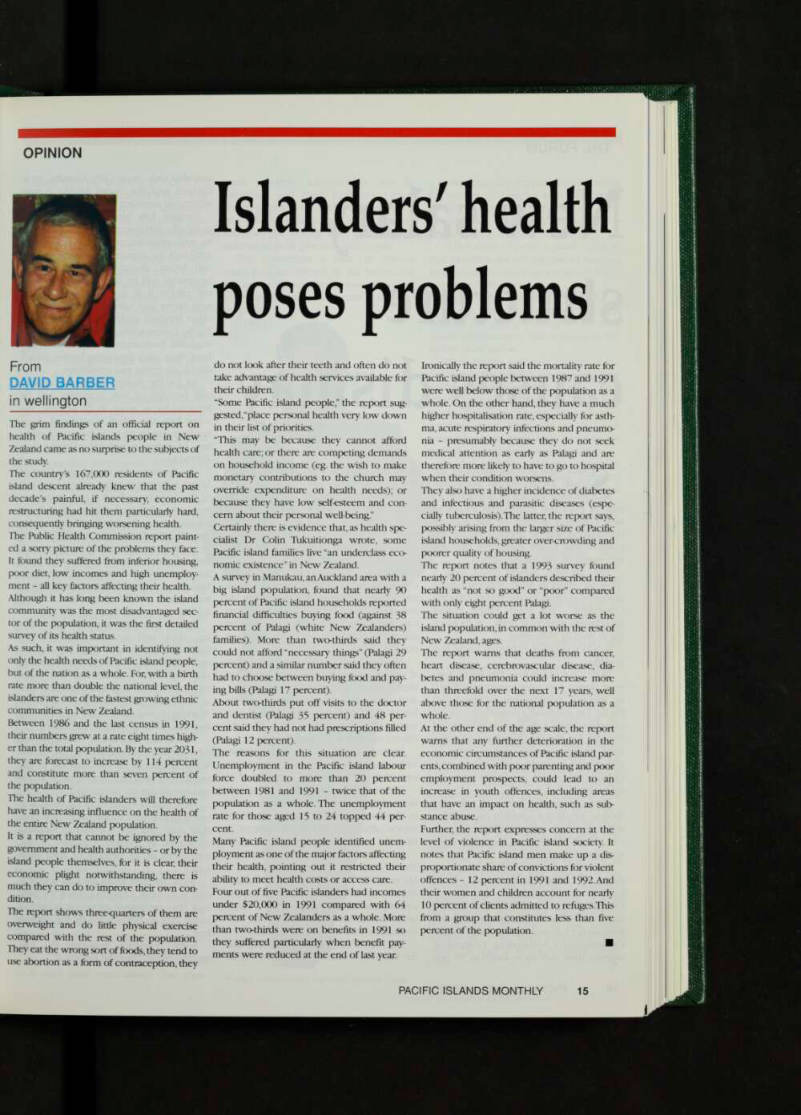
David Barber
in Wellington
New salary
The Forum
New salary structure causes dismay
Salaries and benefits offered by the South Pacific Forum Secretariat are to be slashed by as much as 25 percent from this month. This means all new contracts offered by the regional organisation will be affected, raising the concern that future recruitees may not necessarily be the most qualified.
The decision, which could have a “flow-on” effect to other regional organi sations, was taken by the Forum Officials Committee - the South Pacific Forum Secretariat’s governing body - at its meet ing in Suva in November.
It was a decision everyone knew was coming.
In fact, it was last June that battle lines were drawn over salary packages offered by regional organisations in the South Pacific. On one hand, a consultant’s report called for drastic cuts in some salaries and benefits. On the other, regional organisa tions resisted, arguing that in order to attract and maintain high calibre staff, existing terms and conditions must be maintained.
The consultant’s terms of reference were to “produce a common package that will attract high calibre staff at minimum cost”. The NZ$ 1000-a-day,six-month study was completed last June.
Funded by the New Zealand govern ment, the author of the report, Doug Ruhen, of management consultants Deloiite, Touche and Tohmatsu, argued that most of the seven regional organisa tions under the umbrella of South Pacific Organisation Coordinating Committee overpay their staff by as much as 35 per
cent. This extra fat must be trimmed, he said.
For instance, the head of one regional organisation receives a tax-free package of US$l2O,OOO a year. The consultant wants this reduced, arguing that similar jobs in Australia or New Zealand could be done at two-thirds the cost.
He argued that by slashing salaries and conditions for all SPOCC member organi sations net savings would amount to around Fsl.B million per annum. Internal calculations by some organisations being affected, however, showed different results.
Angered by the report, heads of region al organisations hit back. They described the report as “riddled with inaccuracies”.
And riddled with inaccuracies it was. The Forum Officials Committee was told con tents were changed three times since the Forum meeting in Brisbane in August.
In many circles, the report continues to be unpopular. In some quarters it has earned the nickname “the ruin report”.
The wrangling over terms and condi tions of SPOCC members came to a head in Brisbane at pre-Forum sessions of senior officials. Officials had agreed to have the recommendations re-examined.
A sub-committee comprising Australia, New Zealand, Federated States of Micronesia, Fiji, Papua New Guinea, Republic of Marshall Islands and Tuvalu, and representatives of six SPOCC mem bers was set up to do the job. The sub committee met seven times in Suva.
Fiji, Forum Fisheries Agency (FFA) and the Tourism Council of the South Pacific
attended only once. Only Australia, New Zealand and the South Pacific Forum Secretariat attended all seven meetings.
Despite low attendance, the “razor gang” (the sub-committee) brought down its recommendations in late November.
Although the impact of the decisions are still being absorbed, the Suva-based Secretariat will be the first to cope with the effects. It is not clear whether the new terms and conditions will apply to other regional bodies such as the South Pacific Commission and the South Pacific Regional Environment Programme. They have their own governing bodies which decide on terms and conditions.
As for the Forum Secretariat, salaries and benefits of new contracts will be reduced by as much as 25 percent. For some jobs the salary component alone has been cut by up to 16 percent. A num ber of other significant changes was agreed to.
For instance, the six-monthly Cost of Living Adjustment being enjoyed by staff of the Secretariat for the past four years would be abolished. Salaries of staff are adjusted every six months to account for the official inflation rate in Fiji. This will now be done away with from January 1.
Instead the committee has agreed to introduce Special Drawing Rights using a basket of regional currencies with a mechanism which will take into account inflation.
Annual leave entitlements of 30 work ing days will be reduced by five.
Education allowances paid to contract staff will be limited to the first three chil dren only. New contract staff with more children will be responsible for the cost of educating their additional children.
Working hours have been increased by two to a 37-hour week from January.
Permanent staff, that is Fiji employees who are not on contract, are the overall winners. Except for the increase in the number of working hours, their terms and conditions are untouched.
New contract staff from Fiji also came out winners. After a long battle, new con tract staff will get a minimum housing allowance of Fslooo a month or the equivalent of 17 percent of their base salary.
While the new salary package and ben efits may seem a big dive down for new staff, they are lenient, especially in light of initial cuts recommended by the consul tant.
Some countries, including Fiji, had wanted blood. They did not get it.
Along with the abolition of COLA, Fiji was said to have insisted that a three-year wage freeze be imposed on salaries of Secretariat staff. Fiji had reportedly also argued that salary increases should be based on the employer’s ability-to-pay principle. (Budgetary constraints have forced the Fiji government to reject a con sultant’s report recommending huge wage increases for its public servants.
Ironically, it was the same consultant who had recommended huge cuts in the salaries and benefits of SPOCC organisa tions.) In the intense debate over the new terms and conditions, Australia and New Zealand were said to have argued strong ly against the Forum Secretariat’s top job commanding more pay than their prime ministers.
As well, they were said to have argued that directors of divisions should not be paid more than government ministers in the two countries.
While the decision on salaries and benefits appeared to be the main out come of the review, a number of areas remain vague. Among them, the question i of the abolition of COLA. Staff on exist-1 ing contracts say they understand the 1 won’t be affected by any of the deci sions. The management of the Forum Secretariat is yet to clarify its position on this.
Under the previous system, COLA was part of the package offered to contract staff. It, therefore, can only be changed by mutual agreement. (All Forum staff have received COLA since it was brought in in 1991.) Is there more to this whole exercise than mere cost-cutting? And why are Australia and New Zealand pushing for new terms and conditions at the Forum Secretariat?
One argument is that they pick up the bulk of the salary tab in the organisation.
Tight economic circumstances now ques tion whether the generous funding levels provided over the years by both coun tries would be maintained. Through assessed member contributions, Australia and New Zealand provide more than two thirds of the Forum Secretariat’s regular budget. F0r1993, contributions from both countries are estimated to be over Fsl.6 million - a massive injection of funds. As well, they provide the bulk of funding for the Forum Secretariat’s extra budget which is used to run regional pro grammes.
But some officials think there is more to it than mere cost-cutting. One argu
ment privately advanced is that in Australia’s and New Zealand’s views, Pacific islanders do not command much of a salary package back in their home countries due, among other things, to the inability of their governments to pay.
The conclusion is that the lowest salary package offered by the Secretariat will be readily accepted, especially when it carries a tax-free component as a sweet ener.
Others offer
a more pragmatic explanation. According to them, by pushing for sweeping cuts in salaries and benefits, Australia and New Zealand are deliberately trying to run down the organisation.
“They want to prove a point - that is, that islanders are not capable of running an organisation, let alone a regional body,” one angry official said.
“They want to be seen as saviours.”
On the other hand, Australia and New Zealand are perhaps trying to tell their island neighbours to start learning to live within their means.
What baffles everyone though is the fact that in the mid-80s Australia and New Zealand had instigated moves to bolster salary packages offered by the South Pacific Forum Secretariat. Why are they reacting now, especially when their nationals (apart from Fiji) dominate the staff of the organisation numerically?
In the mid-80s (perhaps when the going was good) a consultant reviewed m the terms and conditions of the oigani- BL sation, resulting in the sizing of jobs.
St This means the higher the point size of a job, the more pay there is. In a ■ number of cases, job sizes of posi tions held by Australians, New r Zealanders and those funded by donor agencies were slightly higher than those held by their island counterparts, (hi one case, a contract officer was hired at an adviser level. The moment he came in, he was promoted to director level. This became a topic of debate two years ago when some countries demanded to know the criteria used to determine the level of salaries.) In 1988/89, an Australian-funded review was again conducted, this time by Rod Tinning. (He later did one for the South Pacific Commission and Apia-based SPREP) His recommended salary struc ture and benefits were adopted by the Forum Secretariat and gradually phased in from 1991. Among the recommendations is the six-monthly COLA which is now being thrown out. Staff who have been with the Secretariat for 10 years or more confirmed it was during this time that salary levels sky-rocketed.
Nauru was said to have been just as baffled as everyone else, reminding the November Forum Officials Committee meeting that Australia and New Zealand had actually supported the generous remuneration packages of the Forum Secretariat. Now, both countries have taken the lead in recommending reduc tions. ■
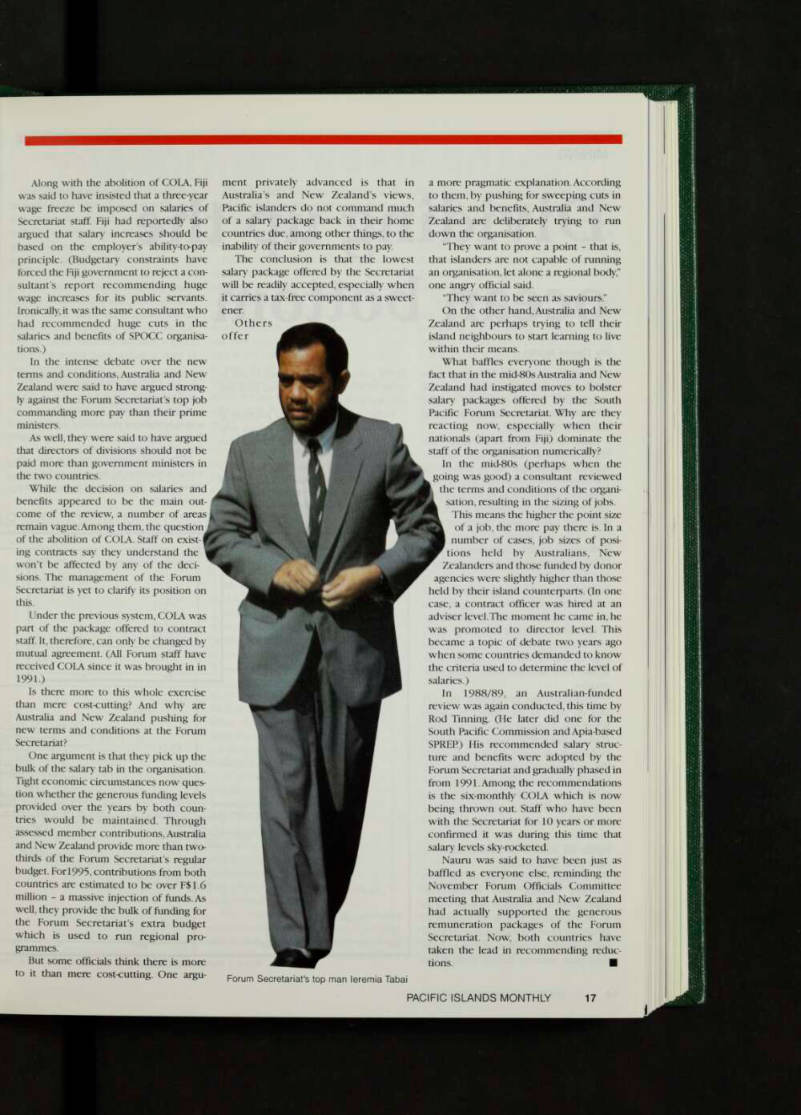
Forum Secretariat’s top man leremia Tabai
ocean bottom
Mining
Dividing up the ocean bottom
By David North
Quietly, if not secretly, the major powers divided the mineral wealth lying in the deep Pacific beyond the island nations’ 200-mile EEZs, just as they divided up the islands 100 years earlier.
Many of the names are the same - the US, Britain, France and Germany - and the mineral wealth sought may be as elusive as the hoped-for tropical economic goodies of the old days, but many of the asset-grab bing techniques are identical to the old ones. The major powers confer far from the Pacific and quietly divide the spoils with little or no input from the islands.
The potential wealth drawing the atten tion consists of rocks usually ranging in size from that of golf balls to small pota toes. Literally trillions of these objects lie on the ocean floor mostly at depths of three to six kilometres, each containing signifi cant amounts of nickel, copper, cobalt and a great deal of not very valuable man ganese. They are often called manganese nodules.
Importantly, and mysteriously, the nod ules do not become buried by debris Ming from higher in the ocean; one spec ulation is that perhaps the living organisms that apparently attract the minerals out of the sea water and onto the nodules also keep the nodules on the top of the ocean floor Each of the nodules is formed around a hard object, such as piece of volcanic rock, a shark tooth or sometimes a bit of manufactured metal. It is not clear how rapidly the nodules are formed, but some must grow quite quickly.
According to Carl Jugel of the (US) National Oceanic and Atmospheric Administration, it is unlikely anyone will go to the expense of mining the sea-bottom for at least 10 years or so, because: a) it will take at least five years to start such an oper ation once someone decides to do it, and
b) the price of nickel will have to rise to about US$7.OO - $B.OO a pound until any one decides to take the risk.
Nickel, which is produced primarily in New Caledonia, Canada and Russia, now sells for about $3.00 a pound, but was over $6.00 a pound in 1989.
Although there is less cobalt in the nod ules than any other metal, it is currently the most valuable of the metals, selling for
about $28.00 a pound. It is used in high strength steel alloys, as a chemical catalyst and as a colouring agent. Cobalt prices are currently high because political chaos has seriously reduced production in Zaire, the former Belgian Congo, which was once the principal exporter of this metal.
“Why would anyone want to go through miles of seawater to bring up rocks with these small percentages of metals?” we asked Jugel.
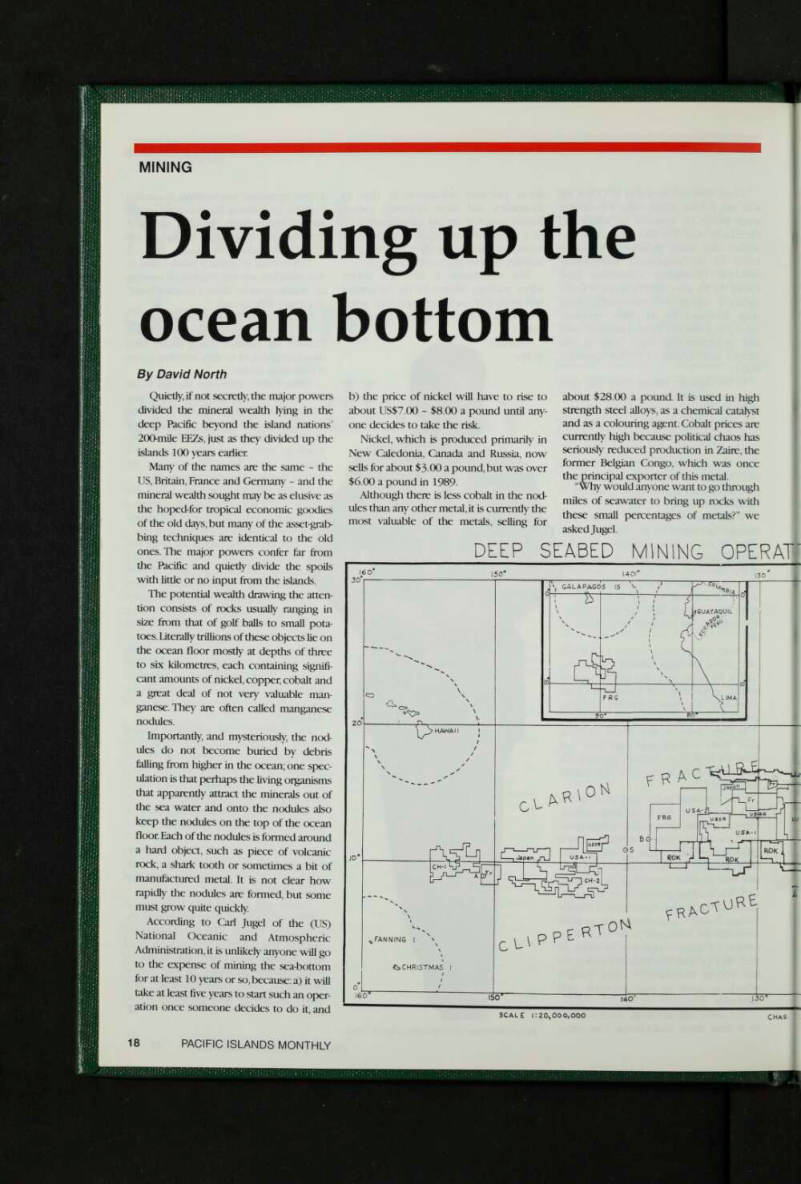
Deep Seabed Mining Operatt
Ig Areas
He replied that many mines on land oper ate successfully when they work with nick el or copper ore just below the one percent mark. “When mining the ocean you have an opportunity to bring up a 2.5 - 3 0 percent ore, that’s a significant percentage.”
He said the projections of at least a 10year wait before underwater mining begins could be shortened quickly if the demand for any of the three major metals soared.
“What would happen if the electric car, with its nickel batteries, became a major player?” he asked. Some cobalt is used in these batteries as well.
Getting the manganese nodules out of the ocean not only requires metal prices to rise, it would require a mining company to raise about $1.5 billion for a complete nod ule mining system.
Clearly no one is going to make a $ 1.5 bil lion investment until the price of metal is right, and the political and legal climate is such that the enterprise seems feasible.
“People make business decisions all the time about fluctuating prices, that does not seem to bother them,” Jugel said. “But the question of political and legal stability are more troublesome.”
He was talking, indirectly, about the Law of the Sea Treaty which has cast a pall of uncertainty over deep-sea mining for years.
Back in the early 1980 s US Congress passed the Deep Seabed Hard Mineral Resources Act which was designed to sort out rival claims among American compa nies to the nodules in international waters.
It was about this time that the world became involved in the decade-long negoti ations leading to the Law of the Sea Treaty which dealt with, among other things, the riches of the seabed.
Fiji played a major role in these negotia tions, being the first nation to ratify the treaty. For years Satya Nandan, a citizen of Fiji, was the leading figure pushing for such a treaty. He remains the ranking United Nations official dealing with the issue.
The Law of the Sea Treaty went into at least partial effect on November 16, 1994, when enough signatories (60) ratified it to make it effective on those that had ratified it.
But some of the major powers, notably the US, have not ratified the treaty.
Meanwhile, the major mining interests worked out a technique for dividing the Pacific’s sea bottom despite non-ratification of the treaty by the US, Britain and others.
What they did, essentially, was to negotiate a series of sea-bottom boundaries among the major powers (and some other players).
Each nation agreed that in return for recog nition of its claim by the others, it would agree not to poach on others’ deep-sea turf.
It was an elaborate underwater mutual back scratching arrangement.
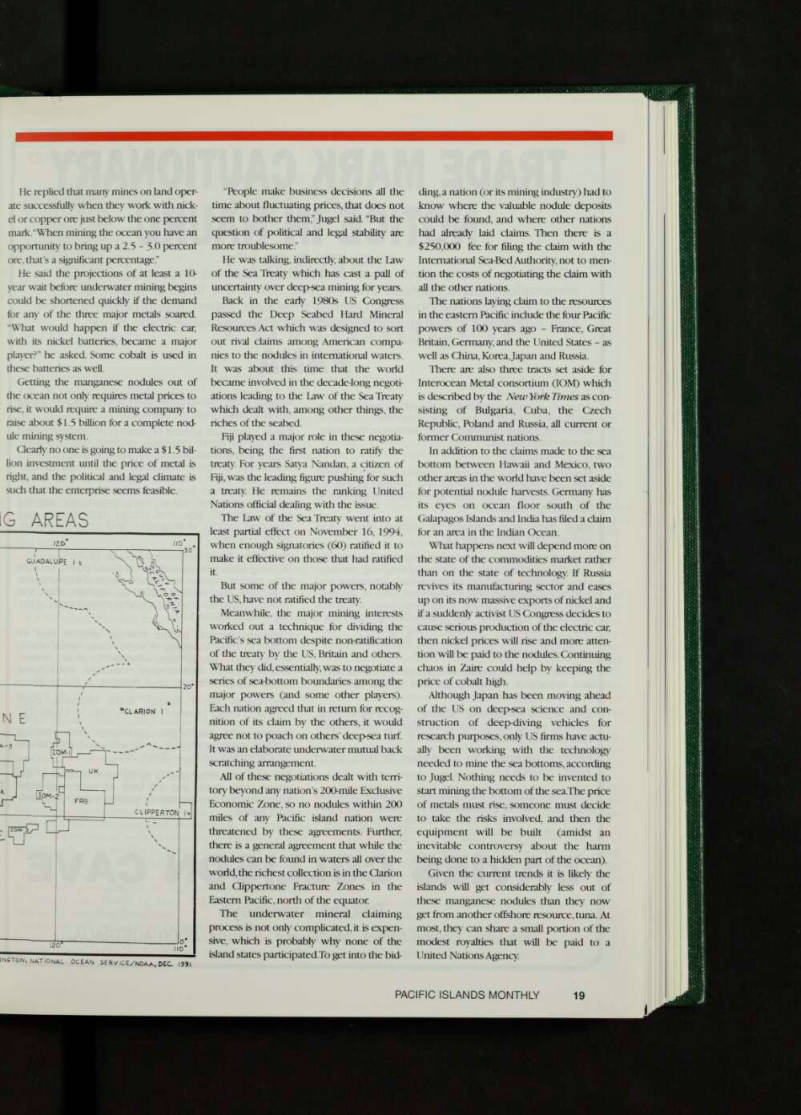
All of these negotiations dealt with terri tory beyond any nation’s 200-mile Exclusive Economic Zone, so no nodules within 200 miles of any Pacific island nation were threatened by these agreements. Further, there is a general agreement that while the nodules can be found in waters all over the world, the richest collection is in the Clarion and Clippertone Fracture Zones in the Eastern Pacific, north of the equator.
The underwater mineral claiming process is not only complicated, it is expen sive, which is probably why none of the island states participated.To get into the bid
ding, a nation (or its mining industry) had to know where the valuable nodule deposits could be found, and where other nations had already laid claims. Then there is a $250,000 fee for filing the claim with the International Sea-Bed Authority, not to men tion the costs of negotiating the claim with all the other nations.
The nations laying claim to the resources in the eastern Pacific include the four Pacific powers of 100 years ago - France, Great Britain, Germany, and the United States - as well as China, Korea, Japan and Russia.
There are also three tracts set aside for Interocean Metal consortium (IOM) which is described by the New York Times as con sisting of Bulgaria, Cuba, the Czech Republic, Poland and Russia, all current or former Communist nations.
In addition to the claims made to the sea bottom between Hawaii and Mexico, two other areas in the world have been set aside for potential nodule harvests. Germany has its eyes on ocean floor south of the Galapagos Islands and India has filed a claim for an area in the Indian Ocean.
What happens next will depend more on the state of the commodities market rather than on the state of technology. If Russia revives its manufacturing sector and eases up on its now massive exports of nickel and if a suddenly activist US Congress decides to cause serious production of the electric car, then nickel prices will rise and more atten tion will be paid to the nodules. Continuing chaos in Zaire could help by keeping the price of cobalt high.
Although Japan has been moving ahead of the US on deep-sea science and con struction of deep-diving vehicles for research purposes, only US firms have actu ally been woridng with the technology needed to mine the sea bottoms, according to Jugel. Nothing needs to be invented to start mining the bottom of the sea. The price of metals must rise, someone must decide to take the risks involved, and then the equipment will be built (amidst an inevitable controversy about the harm being done to a hidden part of the ocean).
Given the current trends it is likely the islands will get considerably less out of these manganese nodules than they now get from another offshore resource, tuna. At most, they can share a small portion of the modest royalties that will be paid to a United Nations Agency.
Advertisements & other items, p. 20 (1 item)
Trade Mark Cautionary
NOTICE IN NAURU
NOTICE is hereby given that Matsushita Electric Industrial Co. Ltd, a corporation duly organised and existing under the laws of Japan, of 1006 oaza. Kadoma, Kadoma-shi, Osaka Prefecture, Japan, Manufacturers, is the sole proprietor in Nauru and elsewhere of the following trade mark:
PANA
used in respect of: Catalyst, oxidation catalyst, catalyst for exhaust gas purification, plastic moulding materials, ceramic materials, rodent repellent toner, developer for copier, absorbent - Class 1.
Ferrite - Class 6.
Machines and machine tools, motors (except for land vehicles), machine couplings and belting (except for land vehicles); large size agricultural implements; incubators - Class 7.
Hand tools and instruments; cutlery; forks and spoons; side arms - Class 8.
Scientific, nautical, surveying and electrical apparatus and instruments(including wireless) weighing, measuring, signalling, checking (supervision), lifesaving and teaching apparatus and instruments coin or counterfreed apparatus, talking machines, cash registers; calculating machines; fire extinguishing apparatus, but excluding optical, photographic and cinematographic apparatus and instruments, their parts and accessories — Class 9.
Surgical, medical, dental and veterinary instruments and apparatus (including artificial limbs, eyes and teeth) — Class 10.
Installations for lighting, heating, steam generating, cooking, refrigerating, drying, ventilating, water supply and sanitary purposes — Class 11.
Vehicles: apparatus for locomotion by land, air or water — Class 12.
Precious metals and their alloys and goods in precious metals or coated therewith (except cutlery, forks and spoons), jewellery, precious stones, horological and other chronometric instruments — Class 14.
DAVIES COLLISON CAVE
Patent Attorneys
One Little Collins Street, Melbourne, Victoria. 3000 AUSTRALIA.
Musical instruments (other than talking machines and wireless apparatus) — Class 15.
Paper, cardboard articles of paper or of cardboard (not included in other classes); printed matter, newspapers and periodicals, books; book-binding material; stationery, adhesive materials (stationery); artists' materials; paint brushes; typewriters and office requisites (other than furniture); instructional and teaching material (other than apparatus); playing cards, printers’ type and cliches (stereotype), but excluding optical, photographic and cinematographic paper — Class 16.
Plastic moulding materials — Class 17.
Building materials, natural and artificial stone, cement lime, mortar, plaster and gravel, pipes of earthenware or cement; road-making materials; asphalt, pitch and bitumen; portable buildings, stone monuments; chimney pots — Class 19.
Furniture, mirrors, picture frames; articles (not included in other classes) of wood, cork, reeds, cane, wicker, horn, bone, ivory, whalebone, shell, amber, mother-of-pearl, meerschaum, celluloid, substitutes for all these materials, or of plastics — Class 20.
Mail boxes (letter boxes), audio cleaners, cloth cleaners, dress brushes, bath brushes — Class 21.
Games and playthings; gymnastic and sporting articles (except clothing); ornaments and decorations for Christmas trees — Class 28.
The said proprietor claims all rights in respect of the above trade mark and will take all necessary legal steps against any person or company infringing their said rights.
environment
Opinion
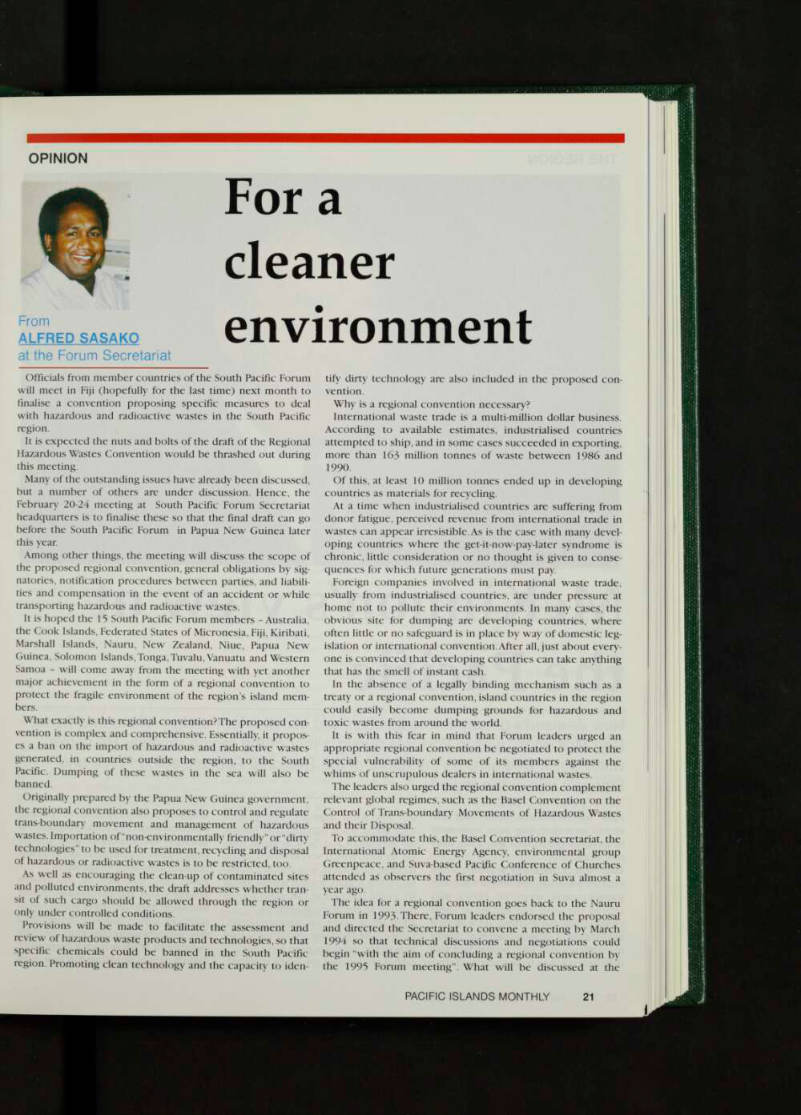
For a cleaner environment
Officials from member countries of the South Pacific Forum will meet in Fiji (hopefully for the last time) next month to finalise a convention proposing specific measures to deal with hazardous and radioactive wastes in the South Pacific region.
It is expected the nuts and bolts of the draft of the Regional Hazardous Wastes Convention would be thrashed out during this meeting.
Many of the outstanding issues have already been discussed, but a number of others are under discussion. Hence, the February 20-24 meeting at South Pacific Forum Secretariat headquarters is to finalise these so that the final draft can go before the South Pacific Forum in Papua New Guinea later this year.
Among other things, the meeting will discuss the scope of the proposed regional convention, general obligations by sig natories, notification procedures between parties, and liabili ties and compensation in the event of an accident or while transporting hazardous and radioactive wastes.
It is hoped the 15 South Pacific Forum members - Australia, the Cook Islands, Federated States of Micronesia, Fiji, Kiribati, Marshall Islands, Nauru, New Zealand, Niue, Papua New Guinea, Solomon Islands, Tonga, Tuvalu, Vanuatu and Western Samoa - will come away from the meeting with yet another major achievement in the form of a regional convention to protect the fragile environment of the region s island mem bers.
What exactly is this regional convention? The proposed con vention is complex and comprehensive. Essentially, it propos es a ban on the import of hazardous and radioactive wastes generated, in countries outside the region, to the South Pacific. Dumping of these wastes in the sea will also be banned.
Originally prepared by the Papua New Guinea government, the regional convention also proposes to control and regulate trans-boundary movement and management of hazardous wastes. Importation of“non-environmentally friendly ” or “dirty technologies” to be used for treatment, recycling and disposal of hazardous or radioactive wastes is to be restricted, too.
As well as encouraging the clean-up of contaminated sites and polluted environments, the draft addresses whether tran sit of such cargo should be allowed through the region or only under controlled conditions.
Provisions will be made to facilitate the assessment and review of hazardous waste products and technologies, so that specific chemicals could be banned in the South Pacific region. Promoting clean technology and the capacity to iden
tify dirty technology are also included in the proposed con vention.
Why is a regional convention necessary?
International waste trade is a multi-million dollar business.
According to available estimates, industrialised countries attempted to ship, and in some cases succeeded in exporting, more than 163 million tonnes of waste between 1986 and 1990.
Of this, at least 10 million tonnes ended up in developing countries as materials for recycling.
At a time when industrialised countries are suffering from donor fatigue, perceived revenue from international trade in wastes can appear irresistible. As is the case with many devel oping countries where the get-it-now-pay-later syndrome is chronic, little consideration or no thought is given to conse quences for which future generations must pay.
Foreign companies involved in international waste trade, usually from industrialised countries, are under pressure at home not to pollute their environments. In many cases, the obvious site for dumping are developing countries, where often little or no safeguard is in place by way of domestic leg islation or international convention. After all, just about every one is convinced that developing countries can take anything that has the smell of instant cash.
In the absence of a legally binding mechanism such as a treaty or a regional convention, island countries in the region could easily become dumping grounds for hazardous and toxic wastes from around the world.
It is with this fear in mind that Forum leaders urged an appropriate regional convention be negotiated to protect the special vulnerability of some of its members against the whims of unscrupulous dealers in international wastes.
The leaders also urged the regional convention complement relevant global regimes, such as the Basel Convention on the Control of Trans-boundary Movements of Hazardous Wastes and their Disposal.
To accommodate this, the Basel Convention secretariat, the International Atomic Energy Agency, environmental group Greenpeace, and Suva-based Pacific Conference of Churches attended as observers the first negotiation in Suva almost a year ago.
The idea for a regional convention goes back to the Nauru Forum in 1993. There, Forum leaders endorsed the proposal and directed the Secretariat to convene a meeting by March 1994 so that technical discussions and negotiations could begin “with the aim of concluding a regional convention by the 1995 Forum meeting”. What will be discussed at the
From
Alfred Sasako
at the Forum Secretariat
McKinnon's view of
The Region
McKinnon's view of the Pacific
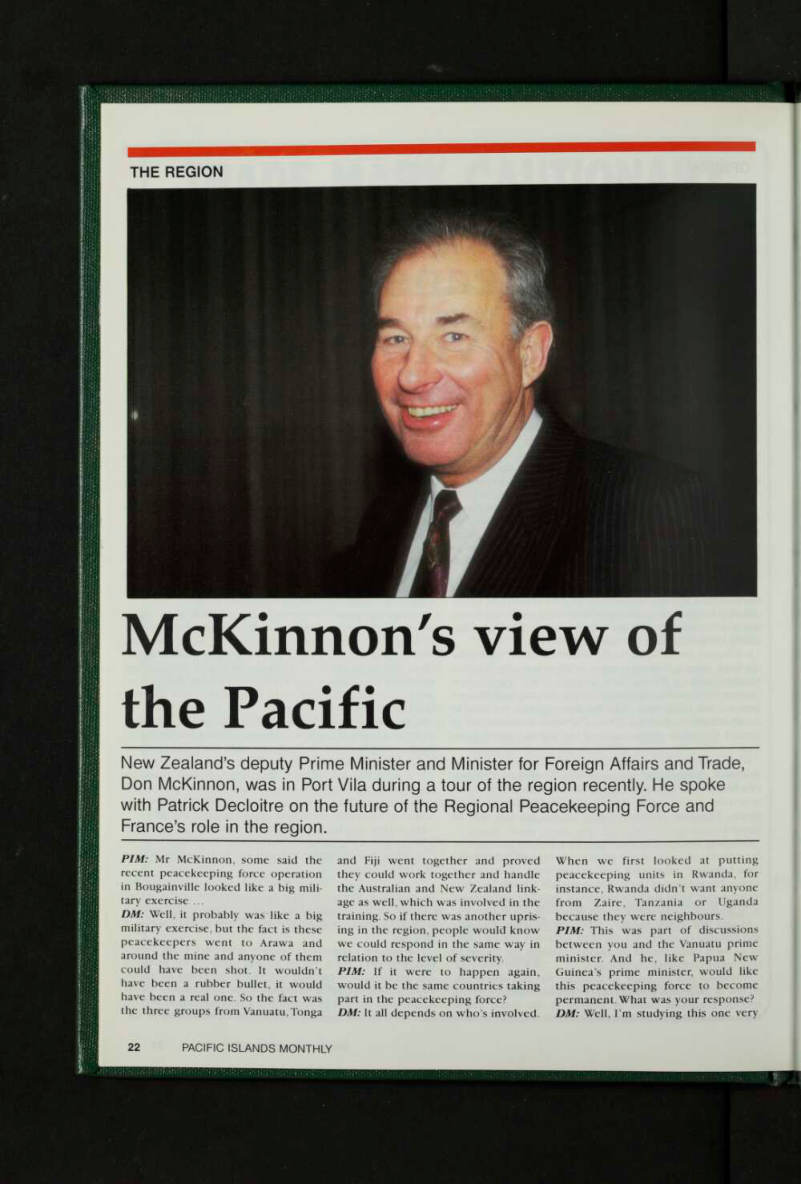
New Zealand’s deputy Prime Minister and Minister for Foreign Affairs and Trade, Don McKinnon, was in Port Vila during a tour of the region recently. He spoke with Patrick Decloitre on the future of the Regional Peacekeeping Force and France’s role in the region.
PIM: Mr McKinnon, some said the recent peacekeeping force operation in Bougainville looked like a big mili tary exercise ...
DM: Well, it probably was like a big military exercise, but the fact is these peacekeepers went to Arawa and around the mine and anyone of them could have been shot. It wouldn’t have been a rubber bullet, it would have been a real one. So the fact was the three groups from Vanuatu, Tonga
and Fiji went together and proved they could work together and handle the Australian and New Zealand link age as well, which was involved in the training. So if there was another upris ing in the region, people would know we could respond in the same way in relation to the level of severity.
PIM: If it were to happen again, would it be the same countries taking part in the peacekeeping force?
DM: It all depends on who’s involved.
When we first looked at putting peacekeeping units in Rwanda, for instance, Rwanda didn’t want anyone from Zaire, Tanzania or Uganda because they were neighbours.
PIM: This was part of discussions between you and the Vanuatu prime minister. And he, like Papua New Guinea’s prime minister, would like this peacekeeping force to become permanent. What was your response?
DM: Well, I’m studying this one very
carefully because I’m aware that Sir Julius (PNG prime minister) and Maxime Carlot have interest in this. I probably don’t see it with the same level of necessity. And I guess I’m probably saying that because I know that we can do it in an ad hoc way quite successfully. If anything hap pens, we know we can put this group together. All these forces are at the same time exercising among them selves from time to time, and with the Australians. So there’s a regular kind of involvement of forces. They don’t come together as aliens at all. As long as that can happen, I don’t see the need for a permanent force.
PIM: What about disaster relief oper ations, as they suggest?
DM: The second factor is the question of disaster relief; in many ways, it’s a similar response. Three years ago when I was in the region here, I was following a cyclone. And I was horri fied to find there was an Australian air craft travelling north to an island. Five minutes later, there was a New Zealand aircraft travelling in the same direction. And then I thought: can’t we do a little bit better than this?
Later there was better coordination between the three main players in the region - Australia, New Zealand and France.
My officials had told me France would not come into this. I told them to try.
You see, we must engage France in the region, France belongs in the Pacific.
We must continue to engage them because there has been a long period of people throwing rocks at each other over nuclear testing, the Rainbow Warrior ... And I sent this proposal to Mr LePensec (who was then minister for French overseas ter ritories). He replied it was a good idea. So we got together and now the idea when there is a natural disaster in the region is for all three countries’ military officials to meet and organise and coordinate relief operations. It’s just a logistical and administrative centre.
With this in place, you don’t need a permanent force, you know. What we could do in the future is call upon small sections of the Vanuatu,Tonga or Fiji forces for these sorts of things. We, on our part, have the aircraft to pick
‘France sees itself as a permanent
player here.
Why do we try and kid ourselves that France is a colonial power that is just
drawing back?’
- Don McKinnon
people up as we did with the Vanuatu forces recently to carry them to Bougainville.
PIM: Also a permanent force would be expensive.
DM: Yes, that’s a fact.
PIM: New Zealand is now a member of the United Nations Security Council. Do you see your country as a voice for the region?
DM: Very much so, and I made the point when campaigning for the posi tion, saying we wanted to be speaking for the region. I told the countries of the region that we wanted their sup port, but we would always come back to them if they wanted to raise an issue. For instance, global warming is going to affect us all.
PIM: What about France’s role in the Pacific? Things seem to have changed in the past few years in terms of its image.
DM: I must admit I got a bit of a shock about 10 years ago. I was in French Polynesia and I met the French gov ernment’s delegate then. I asked him what France’s role in the Pacific would be in 20 years. His response was “This is France.” Then I realised
that France sees itself as a permanent player here. So why do we try and kid ourselves that France is a colonial power that is just drawing back?
When I became minister I decided to start some positive dialogue with France. They’re a big player, they’re spread from New Caledonia, Wallis and Futuna, French Polynesia, right across the Pacific. Let’s be a little bit more welcoming and positive.
PIM: Why did that change all of a sud den?
DM: You see the government that pre ceded me had the battle over nuclear testing and the Rainbow Warrior.
Let’s get it behind us. Rocard came to New Zealand in 1991. It was excel lent. It was a turning point. We smoothed out a lot of things and then I was able to get my disaster relief thing off the ground. I had a special visit to New Caledonia and we got trade agreements going. With LePensec, and his successor Dominique Perben, we have good relationships. I had discussions with my French counterpart, Alain Juppe, in New York a month ago. We want them to be players in the region.
PIM: On the same level?
DM: It’s entirely up to them. We’re not going to say “you shouldn’t be here”, we re saying “you’re here. Right. There are things we can work together on”.
PIM: But the uncertainty over the resumption of French nuclear testing is still there.
DM: It’s there, but I’m not going to let that bother me at the present time.
We’ve got enough things to worry about with what’s happening today, without worrying too much about what may happen tomorrow. I’ve made very strong comments because France did have one or two tests after we were engaging with them in a pos itive way. I’m very pleased that Mitterrand has said “no more”, but what happens after the end of May (French presidential elections)? But it’s not a big deal. I’m not going to let that issue dominate other issues.
PIM: What if France began testing again?
DM: If France started testing again, it would have the capacity to destabilise the relationship with New Zealand. ■
Advertisements & other items, p. 24 (1 item)
Boral Gas
Energy for the future in the Pacific.
BORAL GAS
PACIFIC
And they
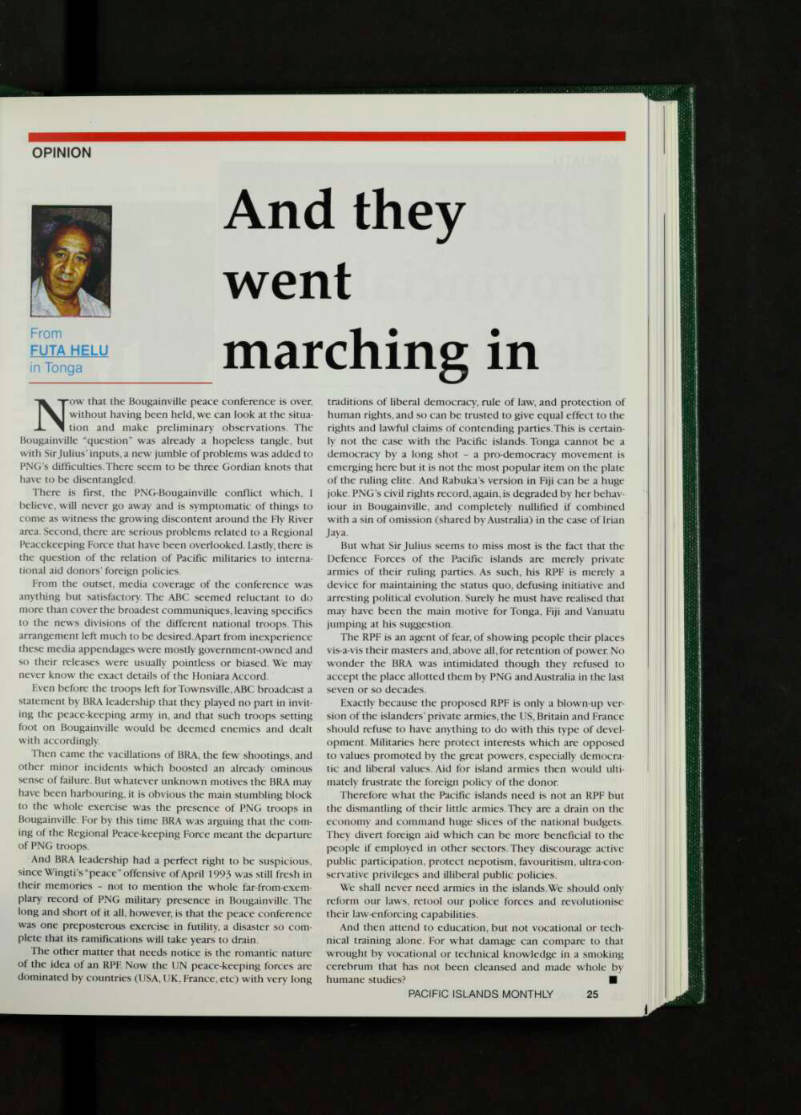
Opinion
And they went marching in
Now that the Bougainville peace conference is over, without having been held, we can look at the situa tion and make preliminary observations. The Bougainville “question” was already a hopeless tangle, but with Sir Julius’ inputs, a new jumble of problems was added to PNG’s difficulties. There seem to be three Gordian knots that have to be disentangled.
There is first, the PNG-Bougainville conflict which, I believe, will never go away and is symptomatic of things to come as witness the growing discontent around the Fly River area. Second, there are serious problems related to a Regional Peacekeeping Force that have been overlooked. Lastly, there is the question of the relation of Pacific militaries to interna tional aid donors’ foreign policies.
From the outset, media coverage of the conference was anything but satisfactory. The ABC seemed reluctant to do more than cover the broadest communiques, leaving specifics to the news divisions of the different national troops. This arrangement left much to be desired. Apart from inexperience these media appendages were mostly government-owned and so their releases were usually pointless or biased. We may never know the exact details of the Honiara Accord.
Even before the troops left for Townsville, ABC broadcast a statement by BRA leadership that they played no part in invit ing the peace-keeping army in, and that such troops setting foot on Bougainville would be deemed enemies and dealt with accordingly.
Then came the vacillations of BRA, the few shootings, and other minor incidents which boosted an already ominous sense of failure. But whatever unknown motives the BRA may have been harbouring, it is obvious the main stumbling block to the whole exercise was the presence of PNG troops in Bougainville. For by this time BRA was arguing that the com ing of the Regional Peace-keeping Force meant the departure of PNG troops.
And BRA leadership had a perfect right to be suspicious, since WingtiV 1 peace ’’offensive of April 1993 was still fresh in their memories - not to mention the whole far-from-exem plary record of PNG military presence in Bougainville. The long and short of it all, however, is that the peace conference was one preposterous exercise in futility, a disaster so com plete that its ramifications will take years to drain.
The other matter that needs notice is the romantic nature of the idea of an RPF. Now the UN peace-keeping forces are dominated by countries (USA, UK, France, etc) with very long
traditions of liberal democracy, rule of law, and protection of human rights, and so can be trusted to give equal effect to the rights and lawful claims of contending parties. This is certain ly not the case with the Pacific islands. Tonga cannot be a democracy by a long shot - a pro-democracy movement is emerging here but it is not the most popular item on the plate of the ruling elite. And Rabuka’s version in Fiji can be a huge joke. PNG’s civil rights record, again, is degraded by her behav iour in Bougainville, and completely nullified if combined with a sin of omission (shared by Australia) in the case of Irian Jaya.
But what Sir Julius seems to miss most is the fact that the Defence Forces of the Pacific islands are merely private armies of their ruling parties. As such, his RPF is merely a device for maintaining the status quo, defusing initiative and arresting political evolution. Surely he must have realised that may have been the main motive for Tonga, Fiji and Vanuatu jumping at his suggestion.
The RPF is an agent of fear, of showing people their places vis-a-vis their masters and, above all, for retention of power. No wonder the BRA was intimidated though they refused to accept the place allotted them by PNG and Australia in the last seven or so decades.
Exactly because the proposed RPF is only a blown-up ver sion of the islanders’ private armies, the US, Britain and France should refuse to have anything to do with this type of devel opment. Militaries here protect interests which are opposed to values promoted by the great powers, especially democra tic and liberal values. Aid for island armies then would ulti mately frustrate the foreign policy of the donor.
Therefore what the Pacific islands need is not an RPF but the dismantling of their little armies. They are a drain on the economy and command huge slices of the national budgets.
They divert foreign aid which can be more beneficial to the people if employed in other sectors. They discourage active public participation, protect nepotism, favouritism, ultra-con servative privileges and illiberal public policies.
We shall never need armies in the islands.We should only reform our laws, retool our police forces and revolutionise their law-enforcing capabilities.
And then attend to education, but not vocational or tech nical training alone. For what damage can compare to that wrought by vocational or technical knowledge in a smoking cerebrum that has not been cleansed and made whole by humane studies? ■
From
Futa Held
in Tonga
provincial
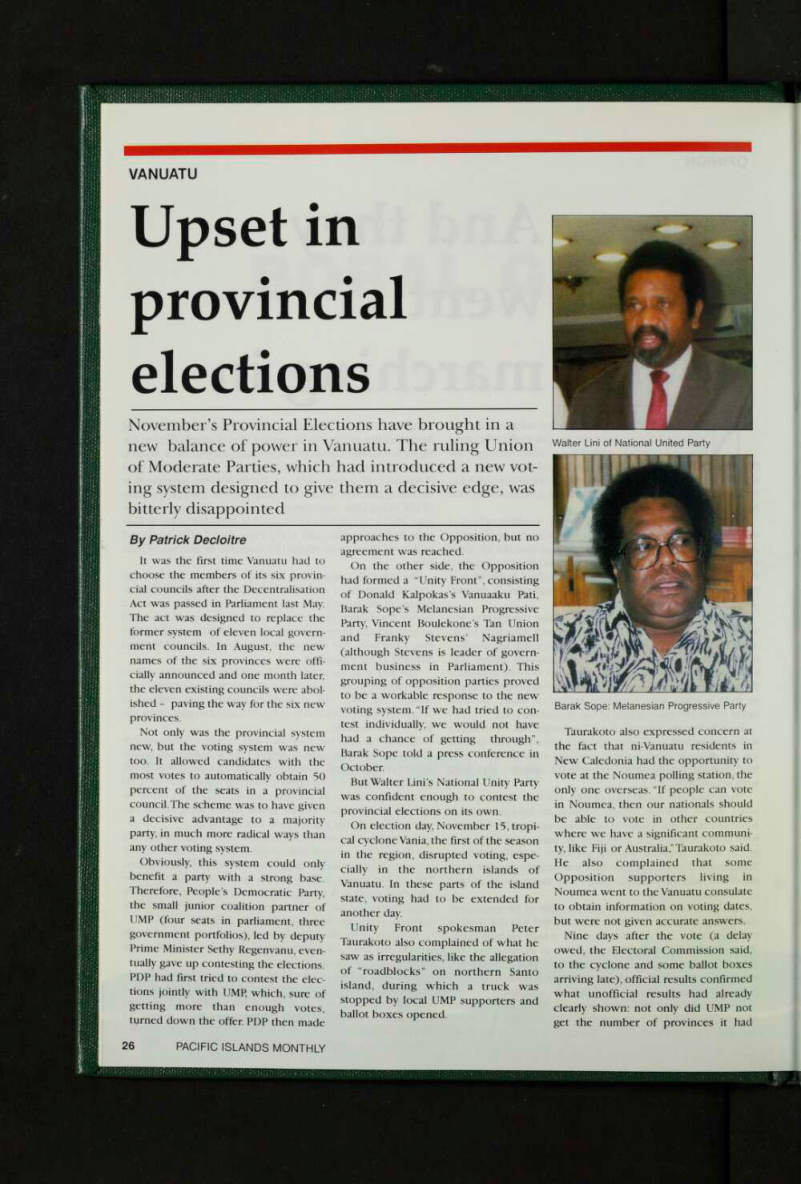
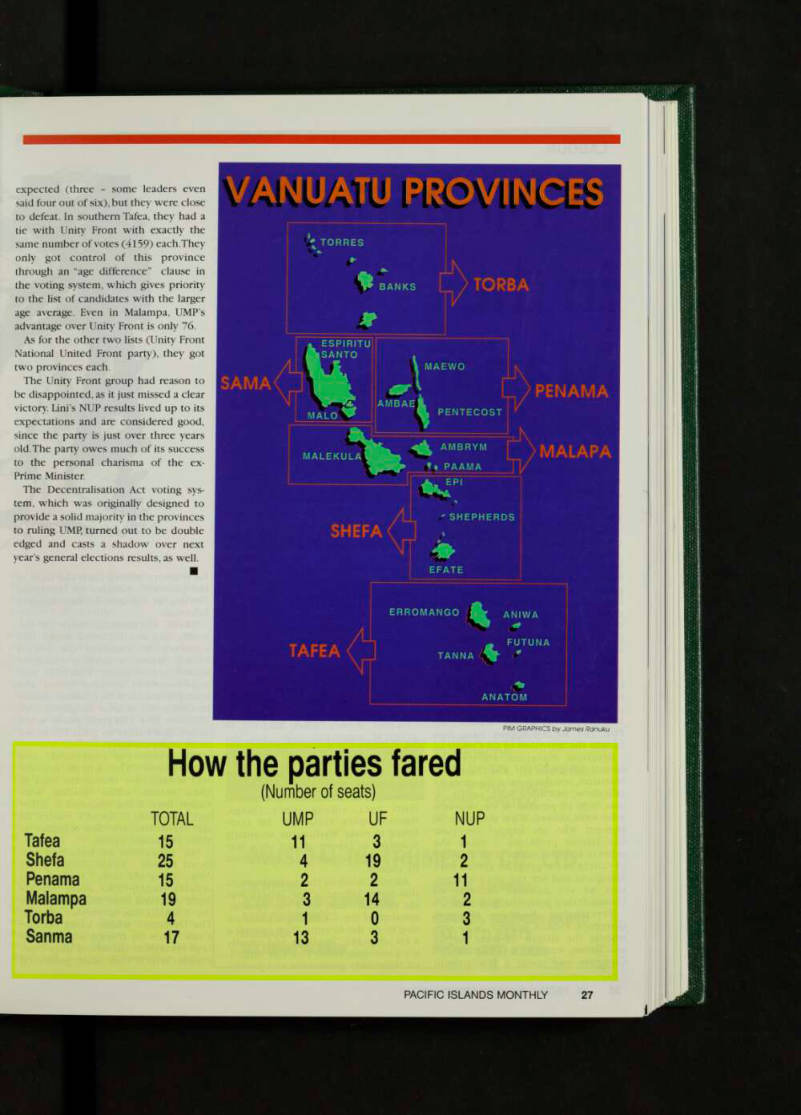
Vanuatu
Upset in provincial elections
November’s Provincial Elections have brought in a new balance of power in Vanuatu. The ruling Union of Moderate Parties, which had introduced a new vot ing system designed to give them a decisive edge, was
bitterly disappointed
By Patrick Decloitre
It was the first time Vanuatu had to choose the members of its six provin cial councils after the Decentralisation Act was passed in Parliament last May.
The act was designed to replace the former system of eleven local govern ment councils. In August, the new names of the six provinces were off.cially announced and one month later, , 7 the eleven existing councils were abol t & ished - paving the way for the six new y & 7 provinces.
Not only was the provincial system new, but the voting system was new too. It allowed candidates with the most votes to automatically obtain 30 , 7 percent of the seats in a provincial F council. The scheme was to have given ... s a decisive advantage to a majority a J 7 party, m much more radical ways than . . 7 any other voting system.
Obviously, this system could only , 7 7 benefit a party with a strong base. rru c & Therefore, People’s Democratic Party, .. „ • ... 7 the small junior coalition partner of rrwn UMP (four seats m parliament, three n „-.. x . . , government portfolios), led by deputy d • . . c . K 7 Prime Minister Sethy Regenvanu, even . , . tually gave up contesting the elections.
DnD * , PDP had first tried to contest the elec-
Tttkata . • , „
tions jointly with UMP, which, sure of 0 „ n - „ , getting more than enough votes, . , . . cr . tyrned down the offer. PDP then made
approaches to the Opposition, but no agreement was reached.
Qn tht other side the Opposition had formed a « Unity Front -, consisting of Donald Kalpokas . s yanuaaku Pali, Barak Sope , s Melanesian Progressive Party vincem Boulekone . s Xan Union and Hranky Stevens . Nagriamell (although Stevens is leader of govern . mem business Parliament) xhis e , grouping of opposition parties proved . . , , , . . u to be a workable response to the new .. . „ T<r , , . , voting system. If we had tried to con test individually, we would not have had a chancc of getting through . Barak s told a ess conference in October D T - • > XT . TT • ™ But Walter Lim s National Unity Party , was confident enough to contest the . . , , . provincial elections on its own. . XT , On election day, November 15, tropi , , v . .. f t cal cyclone Vania, the first of the season . ... m the region, disrupted voting, espe ... - u . , ’ c cially m the northern islands of w U T - , . , .
Vanuatu. In these parts of the island + ,,/ , . . r state, voting had to be extended for . . another day.
Tt I
Unity Front spokesman Peter , \ Taurakoto also complained of what he . saw as irregularities, like the allegation ~,. „ , ® of roadblocks on northern Santo . , . , island, during which a truck was
. . , , Itxm
stopped by local UMP supporters and . ~\, , ballot boxes opened,
Taurakoto also expressed concern at the fact that ni-Vanuatu residents in New Caledonia had the opportunity to vote at the Noumea polling station, the only one overseas. “If people can vote in Noumea, then our nationals should be able to vote in other countries where we have a significant communi ty, like Fiji or Australia,”Taurakoto said.
He also complained that some Opposition supporters living in Noumea went to the Vanuatu consulate to obtain information on voting dates, but were not given accurate answers.
Nine days after the vote (a delay owed, the Electoral Commission said, to the cyclone and some ballot boxes arriving late), official results confirmed what unofficial results had already clearly shown: not only did UMP not get the number of provinces it had
Walter Uni of National United Party
Barak Sope: Melanesian Progressive Party
expected (three - some leaders even said four out of six), but they were close to defeat. In southern Tafea, they had a tie with Unity Front with exactly the same number of votes (4139) each. They only got control of this province through an “age difference” clause in the voting system, which gives priority to the list of candidates with the larger age average. Even in Malampa, UMP’s advantage over Unity Front is only 76.
As for the other two lists (Unity Front National United Front party), they got two provinces each.
The Unity Front group had reason to be disappointed, as it just missed a clear victory. Lini’s NUP results lived up to its expectations and are considered good, since the party is just over three years old. The party owes much of its success to the personal charisma of the ex- Prime Minister.
The Decentralisation Act voting sys tem, which was originally designed to provide a solid majority in the provinces to ruling UMP, turned out to be double edged and casts a shadow over next year’s general elections results, as well. ■
PIM GRAPHICS by James Ranuku
How the parties fared
(Number of seats)
Total
Ump
UF
Nup
Tafea 15 11 3 1 Shefa 25 4 19 2 Panama 15 2 2 11
Maiampa
19 3 14 2 Torba 4 1 0 3 Sanma 17 13 3 1
Exploitation
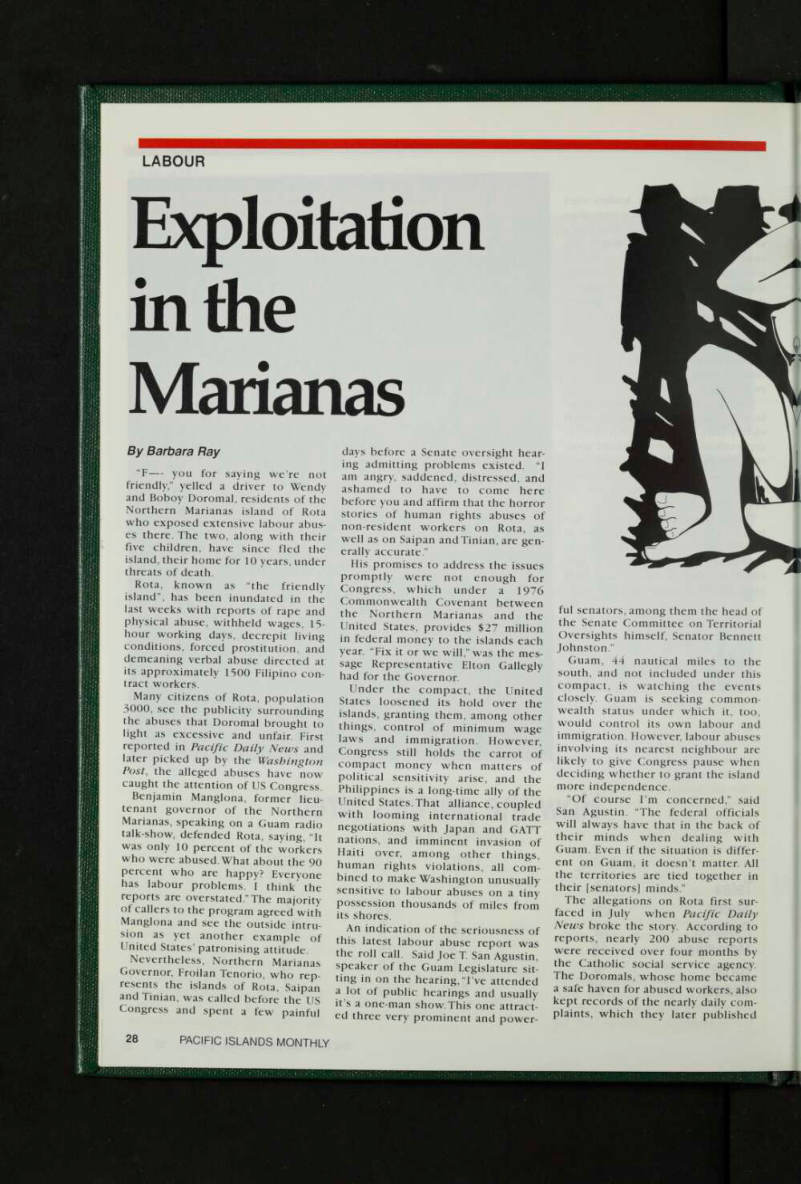
Labour
Exploitation in the Marianas
By Barbara Ray
“F — you for saying we’re not friendly,” yelled a driver to Wendy and Boboy Doromal, residents of the Northern Marianas island of Rota who exposed extensive labour abus es there. The two, along with their five children, have since fled the island, their home for 10 years, under threats of death.
Rota, known as “the friendly island”, has been inundated in the last weeks with reports of rape and physical abuse, withheld wages, 15hour working days, decrepit living conditions, forced prostitution, and demeaning verbal abuse directed at its approximately 1500 Filipino con tract workers.
Many citizens of Rota, population 3000, see the publicity surrounding the abuses that Doromal brought to light as excessive and unfair. First reported in Pacific Daily News and later picked up by the Washington Post, the alleged abuses have now caught the attention of US Congress.
Benjamin Manglona, former lieu tenant governor of the Northern Marianas, speaking on a Guam radio talk-show, defended Rota, saying, “It was only 10 percent of the workers who were abused. What about the 90 percent who are happy? Everyone has labour problems. I think the reports are overstated.” The majority of callers to the program agreed with Manglona and see the outside intru sion as yet another example of United States’ patronising attitude.
Nevertheless, Northern Marianas Governor, Froilan Tenorio, who rep resents the islands of Rota, Saipan and Tinian, was called before the US Congress and spent a few painful
days before a Senate oversight hear ing admitting problems existed. “I am angry, saddened, distressed, and ashamed to have to come here before you and affirm that the horror stories of human rights abuses of non-resident workers on Rota, as well as on Saipan and Tinian, are gen erally accurate ”
His promises to address the issues promptly were not enough for Congress, which under a 1976 Commonwealth Covenant between the Northern Marianas and the United States, provides $27 million in federal money to the islands each year. “Fix it or we will,” was the mes sage Representative Elton Gallegly had for the Governor.
Under the compact, the United States loosened its hold over the islands, granting them, among other things, control of minimum wage laws and immigration. However, Congress still holds the carrot of compact money when matters of political sensitivity arise, and the Philippines is a long-time ally of the United States. That alliance, coupled with looming international trade negotiations with Japan and GATT nations, and imminent invasion of Haiti over, among other things, human rights violations, all com bined to make Washington unusually sensitive to labour abuses on a tiny possession thousands of miles from its shores.
An indication of the seriousness of this latest labour abuse report was the roll call. Said Joe T. San Agustin, speaker of the Guam Legislature sit ting in on the hearing, “I’ve attended a lot of public hearings and usually it s a one-man show. This one attract ed three very prominent and power
ful senators, among them the head of the Senate Committee on Territorial Oversights himself, Senator Bennett Johnston.”
Guam, 44 nautical miles to the south, and not included under this compact, is watching the events closely. Guam is seeking common wealth status under which it, too, would control its own labour and immigration. However, labour abuses involving its nearest neighbour are likely to give Congress pause when deciding whether to grant the island more independence.
“Of course I’m concerned,” said San Agustin. “The federal officials will always have that in the back of their minds when dealing with Guam. Even if the situation is differ ent on Guam, it doesn’t matter. All the territories are tied together in their [senators] minds.”
The allegations on Rota first sur faced in July when Pacific Daily News broke the story. According to reports, nearly 200 abuse reports were received over four months by the Catholic social service agency.
The Doromals, whose home became a safe haven for abused workers, also kept records of the nearly daily com plaints, which they later published
in a report, Human Rights Violations and Labor abuses in Rota, Commonwealth of the Northern Marianas.
A Labour Task Force was assem bled on Saipan and its report, released in August, revealed that labour laws and regulations had been repeatedly violated. Some agency heads tasked with aiding contract workers were convicted of taking money for filing visa exten sions and other paperwork. Rota immigration chief Ramon Sablan was convicted of theft and misconduct in public office, and Glenn Manglona, resident head of the Department of Commerce and Labor on Rota was put on administrative leave. He is accused in the report of giving false information to alien workers on labour matters, of being arrogant to aliens who file complaints, and of intimidating those complainants in the disposition of their cases.
The Northern Marianas offer a classic Catch-22. A push to develop economically, combined with a small labour pool, means foreign workers are necessary. Filipino workers, many of whom arrive on a tourist visa and stay, illegally, carry little clout and, fearing prosecution, are
hesitant to file labour complaints.
They skirt the law because they need the work and work is plentiful. This dependency, which has pushed the population up by 138 percent in the last few years, creates an atmosphere of conflicts. “We’re in an impossible situation, the Pacific Daily News quoted Gary Anderson, a missionary on Rota, as saying. Anderson has daily contact with Filipino workers in his work. “The people here hate Filipinos, but they need them. WeTe in the middle of an ethnic clash.”
Congress has given Rota and the
Northern Marianas six months to clean up its act or suffer the conse quences. To help the island remedy the situation, Congress has ear marked $7 million of the annual sup plement to support a direct federal presence on Saipan for enforcing federal labour and immigration laws.
If at the end of six months there are no satisfactory results, the program, said Senator Johnston in a lightly veiled threat, “will become inflexi ble”. ■ ■
Advertisements & other items, pp. 29-31 (1 item)
Alliance Corporation Ltd
SPECIALISING IN IMPORTED FASHION
CLOTHING FOR ALL OCCASIONS
♦ FASHION CLOTHING
♦ CASUAL AND FORMAL SHOES
♦ MANCHESTER
♦ BEDROOM LINEN
♦ ELECTRICAL APPLIANCES
* TABLE UTENSILS
* MARINE PRODUCTS EXPORTER
* STATIONERY SUPPLIES
* OFFICE FURNITURE
* MUSICAL INSTRUMENTS
AGENTS FOR ELECTRIC AND ACOUSTIC GUITARS,
DRUMS, PIANOS,
KEYBOARDS,
AMPLIFIERS, SPEAKERS,
MIKES AND STAGE
SOUND SYSTEM
MUSICAL INSTRUMENTS CO. LTD.
LOCATION:
ACOR BOOKSHOP BUILDING
ASHLEY STREET
HONIARA
SOLOMON ISLANDS
POSTAL ADDRESS:
PO BOX 780
HONIARA, SOLOMON ISLAND
FAX: (677) 21477
PHONE: (677) 21239
. k ‘rfte£s:.Li
Toyota Land Cruiser offers you more
rugged reliability, elegant luxury...
and long-lasting durability.
Land Cruiser’s reputation is second to none. No one doubts its rugged constitution. Yet here is a vehicle that rivals the finest limousines where comfort is concerned. And its fit and finish, the attention to detail, and the graceful lines and fine trim are reminiscent of exquisite luxury cars.
Nevertheless, hidden beneath its elegance, Land Cruisers still offer tough ladder frames and suspension engineered to go wherever you wish... in total comfort powered by your choice of 4.5-litre petrol or 4.2-litre diesel engines. And everything is carefully protected from rust and corrosion so it lasts longer.
Toyota Land Cruiser. The best for your world.
Now and forever.
A
DISTRIBUTORS/DEALERS
AMERICAN SAMOA BURNS PHILP MOTORS PH6SV42BI
Soßmf K M K < i R A O N, N n ESIA A ™ NS KROLL ’ ,NC PH 1876/9
NORFOLK ISLAND BORRY’SPTY LTD. PH 22114
Vanuatu ISLAND ELA MOTORS PH 30746
VANUATU ASCO MOTORS PH 22341
COOK ISLANDS PACIFIC MOTORS LTD PH 20796
KIRIBATI TARAWA MOTORS PH 21090
PAPUA NEW GUINEA ELA MOTORS PH 229400
TAHITI NIPPON AUTOMOTO PH 429819
WESTERN SAMOA ASCO MOTORS PH 23664
FIJI ASCOMOTORS
NEW CALEDONIA S.I.A.P.
SAIPAN MICROL CORPORATION
TONGA ASCOMOTORS
I ,' '&F* ass
LAND CRUISER
I
LAND CRUISER
Exact features and specifications may vary depending on country of purchase. Please check with your nearest TOYOTA distributor/dealer for details.
<® TOYOTA
Lights,

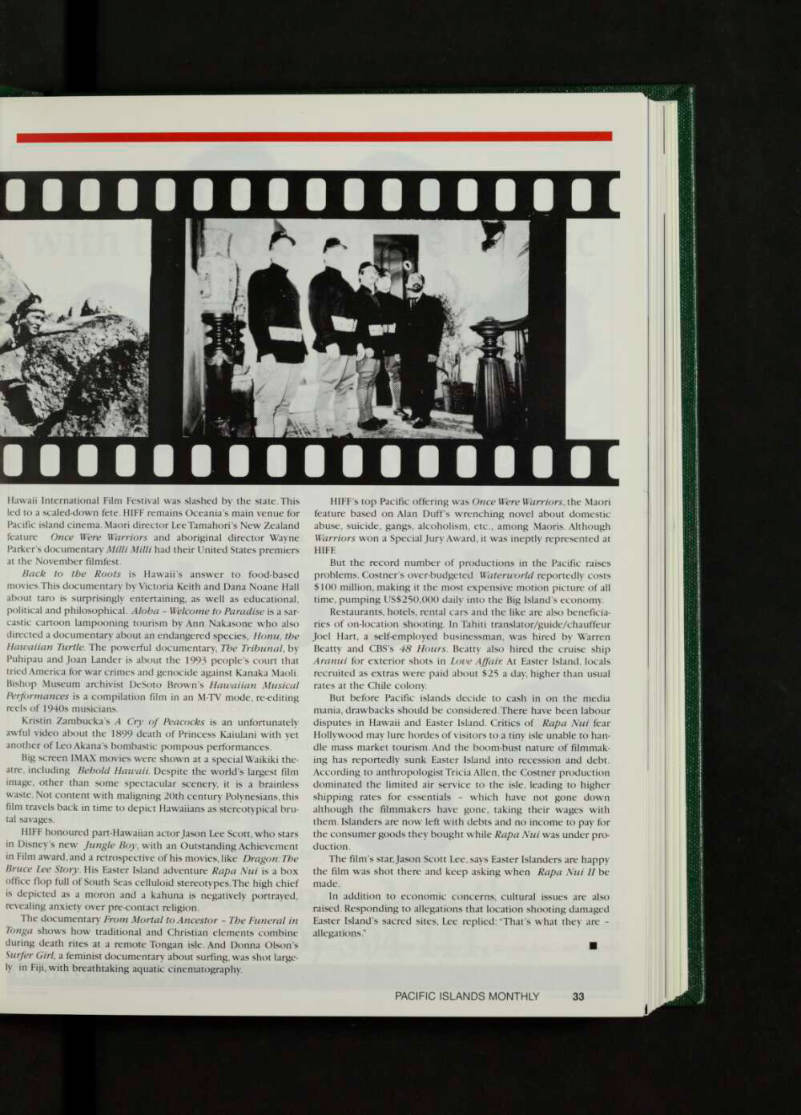
Films
Lights, Camera, Action
The Pacific isands have captured the film makers’ imagination as a record number of films were churned out last year. Ed Rampell looks at the not-so-bright side of the impact this is having on the Pacific economies.
A bumper crop of TV programmes and films have been shot on location in the Pacific islands in the wake of the 1992 success of the The Piano. Movies and televi sion spots have been filmed at a wide range of isles ranging from Easter Island to Kauai to Moorea to Lanai to Tahiti. Some of them cost more than the entire budget of many island governments.
Steven Spielberg’s 1993 Jurassic Park was filmed in part at Kauai and Oahu. Hollywood giant Kevin Costner produced Rapa Nui, shot mainly at Easter Island, and has been on location at the Big Island of Hawaii, producing and starring in Waterworld, reportedly the most expensive film ever made.
Warren Beatty went to French Polynesia for Love Affair and
CBS News programme 48 Hours , hosted by anchorman Dan Rather, went to Tahiti and the Marquesas to tape two segments.
But the lion’s share of TV took place in Hawaii. Director Rob Reiner shot part of North at Kauai, where superstar Dustin Hoffman acted in the upcoming Outbreak. Gary ( Pretty Woman ) Marshall’s sex farce Exit to Eden was shot at the Manele Bay Resort at Lanai and on Maui. The feature film Katie was lensed at Oahu, where the upcoming Don Juan deMarco was shot at the North Shore, starring Marlon Brando - no stranger to the Pacific islands since 1962’s Mutiny on the Bounty shot at Tahiti. And Tfollywood producers plan a feature version of the TV series Hawaii Five-O.
Hawaii is the location for many TV commercials, specials and series. Shows include Byrds of Paradise and the detective drama One West Waikiki (both cancelled), and four episodes of a new programme, Marker. The pilot for Crowfoot was shot at Maui.
Episodes from non-Hawaii based programmes have been shot in the 50th State, too, like soap opera The Young and the Restless , Murder She Wrote , and Baywatch. Specials include Hart to Hart, cable TV’s HBO pay-per-view Supermodels of the World and
Playboy Channel’s Playmate Challenge at Maui.
Despite this record year, the budget for the 14th annual
Hawaii International Film Festival was slashed by the state. This led to a scaled-down fete. HIFF remains Oceania’s main venue for Pacific island cinema. Maori director LeeTamahori’s New Zealand feature Once Were Warriors and aboriginal director Wayne Parker’s documentary Milli Milli had their United States premiers at the November filmfest.
Back to the Roots is Hawaii’s answer to food-based movies. This documentary by Victoria Keith and Dana Noane Hall about taro is surprisingly entertaining, as well as educational, political and philosophical. Aloha - Welcome to Paradise is a sar castic cartoon lampooning tourism by Ann Nakasone who also directed a documentary about an endangered species, Honu, the Hawaiian Turtle. The powerful documentary, The Tribunal , by Puhipau and Joan Lander is about the 1993 people’s court that tried America for war crimes and genocide against Kanaka Maoli.
Bishop Museum archivist DeSoto Brown’s Hawaiian Musical Performances is a compilation film in an M-TV mode, re-editing reels of 1940 s musicians.
Kristin Zambucka’s A Cry of Peacocks is an unfortunately awful video about the 1899 death of Princess Kaiulani with yet another of LeoAkana’s bombastic pompous performances.
Big screen IMAX movies were shown at a special Waikiki the atre, including Behold Hawaii. Despite the world’s largest film image, other than some spectacular scenery, it is a brainless waste. Not content with maligning 20th century Polynesians, this film travels back in time to depict Hawaiians as stereotypical bru tal savages.
HIFF honoured part-Hawaiian actor Jason Lee Scott, who stars in Disney’s new Jungle Boy, with an Outstanding Achievement in Film award, and a retrospective of his movies, like Dragon. The Bruce Lee Story. His Easter Island adventure Rapa Nui is a box office flop full of South Seas celluloid stereotypes. The high chief is depicted as a moron and a kahuna is negatively portrayed,
revealing anxiety over pre-contact religion.
The documentary From Mortal to Ancestor - The Funeral in Tonga shows how traditional and Christian elements combine during death rites at a remote Tongan isle. And Donna Olson’s Surfer Girl, a feminist documentary about surfing, was shot large ly in Fiji, with breathtaking aquatic cinematography.
HIFF’s top Pacific offering was Once Were Warriors, the Maori feature based on Alan Duff’s wrenching novel about domestic abuse, suicide, gangs, alcoholism, etc., among Maoris. Although Warriors won a Special Jury Award, it was ineptly represented at
Hiff.
But the record number of productions in the Pacific raises problems. Costner’s over-budgeted Waterworld reportedly costs $lOO million, making it the most expensive motion picture of all time, pumping U 55230,000 daily into the Big Island’s economy.
Restaurants, hotels, rental cars and the like are also beneficia ries of on-location shooting. In Tahiti translator/guide/chauffeur Joel Hart, a self-employed businessman, was hired by Warren Beatty and CBS’s 48 Hours. Beatty also hired the cruise ship Aranui for exterior shots in Love Affair. At Easter Island, locals recruited as extras were paid about $25 a day, higher than usual rates at the Chile colony.
But before Pacific islands decide to cash in on the media mania, drawbacks should be considered. There have been labour disputes in Hawaii and Easter Island. Critics of Rapa Nui fear Hollywood may lure hordes of visitors to a tiny isle unable to han dle mass market tourism. And the boom-bust nature of filmmak ing has reportedly sunk Easter Island into recession and debt.
According to anthropologist Tricia Allen, the Costner production dominated the limited air service to the isle, leading to higher shipping rates for essentials - which have not gone down although the filmmakers have gone, taking their wages with them. Islanders are now left with debts and no income to pay for the consumer goods they bought while Rapa Nui was under pro duction.
The film’s star, Jason Scott Lee, says Easter Islanders are happy the film was shot there and keep asking when Rapa Nui II be made.
In addition to economic concerns, cultural issues are also raised. Responding to allegations that location shooting damaged Easter Island’s sacred sites, Lee replied: “That’s what they are allegations.” ■
Advertisements & other items, pp. 34-35 (1 item)
We join
jl %
the dots.
1 Air New Zealand is the airline linking the Pacific islands to New Zealand, Australia, North America, Asia, the U.K. and Europe. Our modern fleet of 7475, 767 s and 737 s now fly to Tonga, Fiji, New Caledonia, Norfolk Island, Tahiti, Western Samoa, the Cook Islands and Hawaii as well. Air New Zealand. No-one knows the South Pacific-and serves it-like we do. air new zeaianu © Air New Zealand Limited 1994
SAATCHI INT 0459
Talk to the Pacific
with the voice of the Pacific
‘There is one magazine that decision-makers in the (Pacific
must read each month.
That magazine is the voice of the ‘Pacific...
IF*
i Slavic
NOs
r
SVCLvU
i inc
OVER
[9
lUMI
IJITV
Pacific Islands Monthly has been a cornerstone of communications in the region for 63 years.
It has built an unequalled reputation for providing the best available news, analyses and insight on events in the region.
That reputation spans the islands, the region and more than 71 countries.
That reputation puts Pacific Islands Monthly on the desks of Government figures, public servants, business leaders and other decision-makers throughout the region.
That reputation gives Pacific Islands Monthly the things advertisers need most... credibility and selling power.
Talk to your market with the voice of your market.
Pacific Islands Monthly
Call (679) 304-111.
Pacific Islands Monthly is the only regional news magazine with an independently audited circulation.
New York
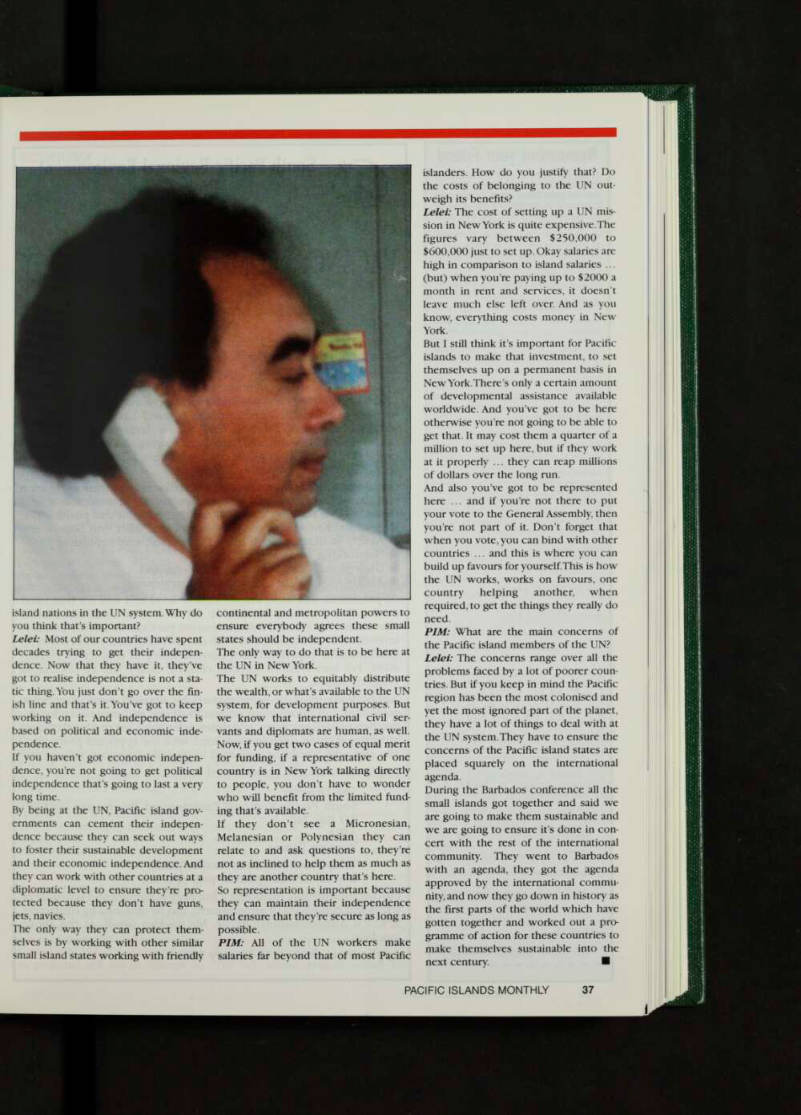
Profile
Our man in New York
Lelei Lelaulu is an international civil servant and the
first Polynesian employee of
tt * at at the United Nations in New York city. After many years in the Big Apple, be may have become a Samoan city slicker, as sophisticated as any urbane Manhattanite, but he . „ has never forgotten his South Seas roots and tries to get home as often as possible.
Ed Rampell interviews Lelei at bis office in tbe United
Nations Building.
° DMi X¥ru , , , , .
PIM: What do you do at the United Nations? 7 rnini. i f „ Leleu I m the outreach coordmator for roordinat o H c ’' Y
Devefonment M ''V
Development. My tasks centre on helpmg with the organisation of global contprPIV . ( . t M ‘, Terences, especially as they relate to sus toimKio j a 7 tamable development. So, I was involved in the global conference for sustainable development of small island developing states, which was held in Barbados in AprU/May.
PIM: Where are you originally from?
Lelei: I was born in Apia. My family is from Falealili on my father s side, and also from Pololi on the beautiful island of Savaii ... From there I went to high school and university training in New Zealand ... at Auckland University and
Wellington University ... with a 8.A...
From there 1 moved into broadcasting Wlth the New Zealand Broadcasting Corporation in radio and television,and then moved on to Asia and then to Europe, Africa, and the Middle East, where I served as a foreign correspon dent for a number of years... I did some work for the Far East Economic f'T’ . p ' us the A “ st, ; alian Broadcasting Corporation ... but large ly worldng as a freelancer in Asia , In Africa and the Middle East I worked for the largest publishing group in English ... a whole slew of expensive, confldential newsletters on business and , politics tbat volatUe rc « ion - And then in the States, I came over to start the American bureau ... for T ,„ , . , International Communications, which groups together these publications here , The UN was P of beat a " d then I ended up in the UN as a SusUmMe result of my work for International Communications m f ... . . , TTXT PIM - What year did you join the UN as an international civil servant? r , . T 1 B ° l my ** m 1978 “ Z I
Zr “ '"T Z C
PaClf,C So 1 Started a radl ° P ro Bramme “ W3S mCd ° u Ut °" Short WaVe hT' ° Ut VP ° and “ Mia ’ called “ UN Calling Asia”. ™ hapPV t 0 *“ ' tS StiU « oin S' l want ‘ p '° Z ° f the “‘ slands a ' ldAs ' a *e UN sys- Th ' S SCCmed the beSt to do “■
through a UN radio programme.
PIM: What is it like for you being a Samoan in New York city?
Lelei: Well, as I keep telling Americans who ask me what on earth I’m doing here, I say that when I was growing up in Samoa, I always used to think places like the Bronx were exotic, so here I am.
I tell them we’re all islands after all.
Manhattan is a small island, much small er than Upolu where I’m from.
It’s just a matter of the space around you, and the people you deal with. It doesn’t matter where you are. I think most islanders can live anywhere because they can work on a space with in themselves, and within their family and community settings, to allow them to travel further.
PIM: Of course, Polynesians are the most notable migratory people in histo ry. You once wrote a very witty piece for PIM magazine. Can you tell us about it?
Lelei: It was over the whole debate about (anthropologists) Margaret Mead vs Derek Freeman. I thought it was all rather amusing. I thought I’d have a bit of fun and sort of put the questions back to them a little bit. I said first of all, Mead came along; she portrayed us as happy-go-lucky South Sea natives forev er making love on beaches as the magic Pacific Ocean lapped at our happy brown feet. Which was, you know, okay, but it was difficult to deal with this image. Amd them along comes this char acter Freeman from Harvard who said no, no, no, it’s incorrect because Samoans, and most Polynesians, in fact suffer from tremendous neuroses and they’re all suicidal and wife beaters and all this stuff. So we had two contrasting images of what we’re supposed to be.
So I looked at these terms and said, obviously we’re a bit of both, we’re just like anybody else.
So I wrote, everytime a plane landed on my grass airstrip in Savaii, there seemed to be at least six candidates for Ph.D.s in anthropology stumbling onto the tar mac.
So I said, look, I have some advice for anyone seeking a Ph.D. : I live on an island, which is riven asunder with trib al tensions and where sexual neuroses are rife and which could certainly do with the tourist buck. And it’s called Manhattan.
PIM: Let’s talk about the role of Pacific
island nations in the UN system. Why do you think that’s important?
Lelei: Most of our countries have spent decades trying to get their indepen dence. Now that they have it, they’ve got to realise independence is not a sta tic thing. You just don’t go over the fin ish line and that’s it. You’ve got to keep working on it. And independence is based on political and economic inde pendence.
If you haven’t got economic indepen dence, you’re not going to get political independence that’s going to last a very long time.
By being at the UN, Pacific island gov ernments can cement their indepen dence because they can seek out ways to foster their sustainable development and their economic independence. And they can work with other countries at a diplomatic level to ensure they’re pro tected because they don’t have guns, jets, navies.
The only way they can protect them selves is by working with other similar small island states working with friendly
continental and metropolitan powers to ensure everybody agrees these small states should be independent.
The only way to do that is to be here at the UN in New York.
The UN works to equitably distribute the wealth, or what’s available to the UN system, for development purposes. But we know that international civil ser vants and diplomats are human, as well.
Now, if you get two cases of equal merit for funding, if a representative of one country is in New York talking directly to people, you don’t have to wonder who will benefit from the limited fund ing that’s available.
If they don’t see a Micronesian, Melanesian or Polynesian they can relate to and ask questions to, they’re not as inclined to help them as much as they are another country that’s here.
So representation is important because they can maintain their independence and ensure that they’re secure as long as possible.
PIM: All of the UN workers make salaries far beyond that of most Pacific
islanders. How do you justify that? Do the costs of belonging to the UN out weigh its benefits?
Lelei: The cost of setting up a UN mis sion in New York is quite expensive. The figures vary between $230,000 to $600,000 just to set up. Okay salaries are high in comparison to island salaries ... (but) when you’re paying up to $2OOO a month in rent and services, it doesn’t leave much else left over. And as you know, everything costs money in New York.
But I still think it’s important for Pacific islands to make that investment, to set themselves up on a permanent basis in NewYork.There’s only a certain amount of developmental assistance available worldwide. And you’ve got to be here otherwise you’re not going to be able to get that. It may cost them a quarter of a million to set up here, but if they work at it properly ... they can reap millions of dollars over the long run.
And also you’ve got to be represented here ... and if you’re not there to put your vote to the General Assembly, then you’re not part of it. Don’t forget that when you vote, you can bind with other countries ... and this is where you can build up favours for yourself. This is how the UN works, works on favours, one country helping another, when required, to get the things they really do need.
PIM: What are the main concerns of the Pacific island members of the UN?
Lelei: The concerns range over all the problems faced by a lot of poorer coun tries. But if you keep in mind the Pacific region has been the most colonised and yet the most ignored part of the planet, they have a lot of things to deal with at the UN system. They have to ensure the concerns of the Pacific island states are placed squarely on the international agenda.
During the Barbados conference all the small islands got together and said we are going to make them sustainable and we are going to ensure it’s done in con cert with the rest of the international community. They went to Barbados with an agenda, they got the agenda approved by the international commu nity, and now they go down in history as the first parts of the world which have gotten together and worked out a pro gramme of action for these countries to make themselves sustainable into the next century. ■
Advertisements & other items, p. 38 (1 item)
Vacancy - Computer/Technology
Remember your Friend
There are times in your life when you feel your friends have been missing out on something good. Now’s your chance to do something about it and share with them one of the good things you have. Buy your friend a subscription to Pacific Islands Monthly and let him or her join you and thousands of other people worldwide who are kept informed of the latest political, social and cultural
changes taking place in the Pacific.
SUBSCRIPTIONS
American Samoa US$45 Australia A 542.00 Canada US$45 Cook Islands AUSS46 Fiji F 526.40 French Polynesia US$45 Guam US$45 Hawaii US$45 Japan US$45 Kiribati AUSS46 Marshall/Micronesia US$4O Nauru AUSS42 New Caledonia US$32 New Zealand NZ$55 Niue AUSS46 Norfolk Island AUSS42 Northern Mananas/Palau US$4O Papua New Guinea AUSS4S Solomon Islands ;. AUSS46 Tonga AUSS46 Tuvalu AUSS46 United Kingdom Stg Pound2B US Mainland US$45 Vanuatu AUSS4S Western Samoa WS$6O Elsewhere AUSS63 Payment to Pacific Islands Monthly: Subscriptions Dept, GPO Box 1167, Suva, Fiji.
Subscriptions rates include the cost of airspeeding to all destinations set out above.
Direct airmail rates on application.
Telephone: 304111 Fax; 303809
PACIFIC ;
ISLANDS •
I m o~ hi T h i n Please send my friend Pacific l Islands Monthly for one year .
(12 issues). y
I enclose my cheque for $ cCb (made payable to Pacific Islands Monthly) ■ or debit $ to my: □ Bankcard □ Visacard □ , Mastercard Card No: U I 1 ! I I! I I I I I M , Expiry Date . 1
NAME 1
I
SIGNATURE a
ADDRESS:
CITY COUNTRY
South Pacific Regional Environment
( ''\J ) Programme
(SPREP)
VACANCY - COMPUTER/TECHNOLOGY
OFFICER
Applications are invited for the position of Computer Technology Officer with the South Pacific Environment Programme (SPREP) in Apia, Western Samoa.
SPREP uses a large number of IBM Compatible PC running Microsoft Windows and Microsoft Office products, together with a number of specialised applications. A small Lantastic network is installed, and it is probable that a new large network will be implemented in the future. There is a growing use of telecommunications for E-mail and on-line database access. SPREP is also a node for GRID and GIS capability.
Candidates must have appropriate tertiary qualifications from a recognised institution and at least five years' experience in a field related to this position. Essential requirements for this position are: • Essential Knowledge of PC hardware and Microsoft Software; • Ability to diagnose and solve PC and software problems;
• Networking Knowledge;
• Understanding of telecommunications; and • Ability to work with minimum supervision.
Appointment wall be at Project Officer level and will for two years in the first instance, renewable for a further term by mutual agreement. An attractive remuneration package and other employment benefits will be offered, with commencing salary dependent on qualifications, experience and current salary in country of recruitment. For non-Western Samoan citizens, salary will be tax-free in Western Samoa.
Applications must be accompanied by detailed curriculum vitae containing full information on qualifications and experience for the position as well as names, addresses, telephone, fax or e-mail contact numbers of three referees associated with the applicant professionally and who would be prepared to provide necessary references.
Applications should be addressed to : The Director South Pacific Regional Environment Programme (SPREP) PO Box 240
APIA
Western Samoa Telephone:(6Bs) 21929 Fax(685)20231 E-Mail: SPREP@pactok, peg, ape, org Further information, including a full duty statement and schedule of terms and conditions of appointment, can be obtained by contacting SPREPs Administration Officer, Mr. Eneliko Seluli, at the above numbers.
Applications close on 14 January 1995
bitter pill
Economy
A
for Vanuatu
By Patrick Decloitre
The results of an Australian-funded sur vey about Vanuatu have been received in the island state with mixed feelings.
The most sensitive points of the recom mendations are the local currency’s devaluation and the copra industry.
A team from the National Centre for Development Studies at Australian National University presented its survey, Pacific 2010, and strategies for Vanuatu in November.
The Pacific 2010 project, which seeks to draw attention to issues relating to sub stantial growth in populations in Melanesian states, looks at Vanuatu, the Solomons Islands, Papua New Guinea and Fiji.
The team, which included Rodney Cole ( Director of Islands/Australian pro gramme at NCOS) and Michael Grey (Development Economics Advisor at Australia’s International Development Assistance Bureau (AIDAB)), spent over a week in Port Vila holding a series of talks and presenting Pacific 2010 strate gies for Vanuatu to a wide range of offi cials. Ministers, members of the Opposition and representatives of the business community were invited to attend.
What they heard was not a pleasant tale.
In an attractive, professionally presented “show”, Cole and Grey painted a bleak picture of the future of Vanuatu: a popu lation that will double by 2010, hence an expected fall in Gross Domestic Product per capita (which was already at a low of about US$l2OO per year per head in 1990). The capital’s population, they projected, will also be different in
15 years: from 22,000 now, to 80,000.
And as population increases by 2010, so too will the number of ni-Vanuatu look ing for jobs.
Purely from these population-related fig ures and extrapolations, the project designers explained the impact of this on the nation’s infrastructure, such as schools, hospitals, water supply as they come under increasing pressure.
In order to increase the country’s GDP, its economy has to be improved and the number of jobs has to be increased accordingly.
The recommendations are similar to those expressed by another expert, John Fallon, in his report, The Vanuatu Economy.
Among other issues touched upon in both reports are Vanuatu’s relatively high costs - for labour, electricity and telecommunications. “Strategies must reduce Vanuatu’s costs and make them relative to international costs,” The Vanuatu Economy says.
The recommendations include a reduc tion of the minimum wage (currently about US$l3O per month), a leaner pub lic service, an investment in education, a major tax reform which involves intro ducing income tax, the devaluation of the vatu to make Vanuatu products competitive on the international market and an end to subsidies paid to local copra producers. In a word, a full liber alization of the Vanuatu economy.
The last three recommendations have created the most controversy, as the leaders and officials concerned grasped their full implications.
The tax reform project, which has
already been drafted by Australian tax expert Neil Warren, had triggered con cern at the Vanuatu Finance Center. The center said this would discourage new investment and “harshly hit” the tourism and retail sectors.
Vanuatu Prime Minister Maxime Carlot had to quell mounting rumours that an income tax would soon be introduced in what has so far been a tax haven.Tm totally against it and I ask all men of good faith not to listen to those for eigners propagating the rumours,”
Carlot said in Parliament.
“Our government accepted the princi ple of these reforms, but this does not mean it will implement every single recommendation,” he said.
Similarly, after the Pacific 2010 team left, rumours of a possible devaluation of the vatu were rife, leading to con cern in the banking system. Carlot had to again make a statement defusing a potential financial crisis. “In the past few days, a number of traders have speculated against the vatu.This specu lation consists of exchanging the funds in vatu to Australian or American dol lars. This speculation is based on a rumour which arose following a semi nar recently organised with the help of some lecturers from a university in Australia. ... I want to say clearly that a devaluation of the vatu is totally not jus tified,” Carlot told parliament.
Part of the recommendations also touched on the sensitive issue of world prices for copra. The commodity is cur rently subsidised by the STABEX fund from the European Union. The aim of the fund is to subsidise prices paid to local producers in order to protect them from price fluctuations on the world market. The ANU study and The Vanuatu Economy report recommend seeking other cash crops and gradually moving away from copra.
There were strong reactions from copra industry officials and, at a higher level, from the Minister of Economic Affairs, Serge Vohor, who said copra played a significant part in Vanuatu economy and should not to be
dropped.
The Pacific 2010 team, on its first visit to one of the countries surveyed, has made a significant impact. But it remains to be seen whether it was real ly a constructive study, and how it will be accepted if, in future, governments choose to implement some of its rec ommendations. ■
Advertisements & other items, pp. 40-52 (1 item)
you the business advantage
The new FPTL service that gives
W v/£r a 1 n -s m C / * OL y O jj
The number that your customers can
What is 0800? 0800 is a service number provided by Post & Telecom which your company can use to improve business opportunities and generate revenue.
The Business Advantage Your 0800 Toll Free number gives your company the business edge over competitors by: • Improving your customer services - your clients now have an added incentive to call you. • Improving your company's efficiency - you can utilise your existing resources to the fullest by channeling customer calls to the appropriate personnel. • Expanding and maintaining your customer base - you are constantly in direct contact with your customers; answering their questions, providing information and clarifying their concerns. • Providing an immediate customer response your customers will respond to your advertising if they don't have to pay for their call.
Costs so little The 0800 Toll Free number can provide a 24 hour service for your company at a nominal monthly rental.
Call us free today Call us for more information on our Post & Telecom Toll Free number: 0800300000 It won’t cost you a cent!
FUI POSTS & TELECOMMNICATIONS LIMITED
Bringing the future of communications to Fiji today. 7b
ADVERTTISING FEATURE
Our
Exporters
of the year
1993 WINNER OP THE PRIME MINISTER'S
EXPORTER OP THE YEAR AWARD
1993 Sc 1994 WINNER OP FTIB'S EXPORTER OP THE YEAR AWARD IN THE FOOD AND BEVERAGE CATEGORY
WINNER
f !„’I
FISH
LTD
' ' »u>
EXPORT
FIJI
QUALITY
FRH
EXPORT
FIJI
FIJI
The Fiji Fish Company Limited is the South Pacific’s Premier exporter of Sashimi and raw fish products to Japan, USA and Canada, With a turnover in excess of $3O million Fiji Fish Company Ltd has demonstrated an outstanding characteristics of export excellence.
Second to None!
The Fiji Fish Company Ltd
Queens Rd., Lam I. P.O. Box 1470, Suva, Fiji.
Phone: (679) 361077 Fax: (679) 362049
ADVERTISING FEATURE
Fiji Trade and Investment Board Awards
Fiji Trade and Invetment Board recently honoured exporters who had displayed exemplary business skill and acumen in succeeding in their highly competitive fields and for their bit in helping Fiji achieve its goals of becoming more export-oriented.
We present below some of the winners of the various categories and highlight their achievements. Fiji’s Prime Minister, Sitiveni Rabuka, presented the awards.
Architects Pacific’s success
* Stuart Huggett of Architects Pacific receives his award.
The hall-mark of Architects Pacific’s successful, prestigious and cost-effective work is combining designs which reflect local cultures and traditions with practical building techniques which encourage local craftsmanship.
The firm’s reputation for quality has spread throughout the Pacific and beyond. Current involvement in the new South Pacific Commission headquarters in New Caledonia and the redevelopment of Royal Palms Hotel in Vanuatu confirm the high profile of this leading exporter of Fiji’s architectural services.
Expanding sales for Fiji Fish
Sheik Saheb, general manager Df Fiji Fish Co. _td. receives his award in the Food and Beverage category V*. * %
Four Basic Colours
YELLOW CYAN BLACK
Plus
Fiji Times Commercial Printing
. , g, UTHRCTE SB
81
Equals
Printing Excellence
SB m & r m -4*. * It is quite amazing what our experienced master printers, with the latest in printing technology, can produce from four basic colours.
Full colour packaging and food labels that look good enough to eat; award winning full colour brochures and posters, magazines, calendars, books, stickers, fabric labels and billboards with pictures that leap right out of the printed pages.
If your product requires export-quality, high impact four colour printing, then you should be talking to us first.
You'll find our prices very competitive and our paper stock quite extensive.
FIJI TIMES
COMMERCIAL PRINTING DIVISION
Printing Excellence
HEAD OFFICE: 20 GORDON STREET, SUVA, FIJI. PHONE: (679) 304111, FAX: 305935 BRANCHES: LAUTOKA Phone: 660422 Fax: 660352 LABASA Phone: 811644 Fax: 812649 NADI Phone; 702702 Fax: 702705
Expanding sales
for Fiji Fish
Once again Fiji Fish Company has demonstrated its ability to expand sales rapidly in a high quality, high risk industry. As well as reinforcing its success in the Japanese sashimi market, Fiji Fish has moved boldly into USA with new products, and is energetically examining future possibilities in New Zealand.
Heavy capital investment in new vessels and modern equipment, and an ambitious and highly professional marketing strategy are the key factors underlying the “explosive growth” in 1993/1994 for this major supplier of high quality seafood.
High fashion
shell buttons
The development of significant exports of shell buttons by Yon Tong Button company is a testimony to the faith and dedication of the proprietors and a striking example of successful support provided by public sector agencies.
Local pearl shells are used by Yon Tong to produce a high fashion product much appreciated by garment industries in Australia, New Zealand, Japan and Europe - truly a unique Fiji export.
* Canadian Airlines’ Ramendra Sahai accepts the \W. ■
Commendable
Service
In 1991, following the imposition of tight transshipment pest control measures by the US Department of Agriculture in Hawaii, Fiji’s exports of agricultural produce to Canada declined dramatically.
For three years, officials of Canadian Airlines International pursued the development of new transshipment methods and engaged in lengthy and difficult negotiations with the USA. Earlier this year their persistence was rewarded when the Department of Agriculture accepted the new transshipment system.
The way is now open for an expansion of Fiji’s exports of produce to Canada. In facilitating this process, through what was very much an uphill struggle, Canadian Airlines International has rendered a most commendable service to Fiji’s exports and exporters.
Quality and design in furniture
By concentrating on quality and design, and by developing a strong relationship with one of the best known international retailers of furniture, CHE International Furniture has solved the problems of market acceptability and transport costs which all of Fiji’s exporters must
CHE International has established export markets for its sophisticated and affordable sofas, coffee tables and beds throughout the Pacific and Australia and is poised for further export growth. Its success provides a useful model for potential exporters throughout Fiji.
WPU
BA INDUSTRIES LTD
P.O. Box 707, 80, FIJI. Phone (679) 674966, Telex: 6241 VINCO FJ, Fax: (679) 676700 - '.l 'Srr & J 9« wm mm r-C^Ssr '3. u
DAMPCOURSE
Fiji’s Largest Manufacturers and Exporters of
NAILS, BARBED WIRE
& CHAINLINK NETTING
Also Exporters of Concrete Nails, Rubber Foam & Foam Mattresses, Corrugated Roofing Iron, Welded Mesh, Hardware & Building Material
F.T.1.8 EXPORTER OF THE YEAR AWARD
BUILDING AND INDUSTRIAL
WINNER 1993 & 1994
ADVERTTISING FEATURE
Ba Industries
Ltd improves
export market
share
1 Ankur Amin of Ba Industries Ltd Ba Industries Limited (BIL) was established in 1974 by Vinod Patel (present chairman),.Arvin Patel and Umakant Patel are the other directors of the company.
BIL is enjoying major market shares in Fiji and has widespread export markets in the Pacific islands. BIL products are marketed under brand name “Reliable”.
Some of the Reliable products of BIL are: * Galvanised and bright nails * Galvanised and Poly Vinyl Chloride (PVC) chain link fence * Welded mesh and quota rods * Standard and high tensile barbed wire * Copper nails and panel pins * Staples BIL is the only company in Fiji having its own wire drawing plants and facilities for drawing various types of nail wires. BIL is the only company in Fiji having a fully automated double-spiral machine to manufacture “barbed chain links”.
While BIL has maintained its major share in the domestic market, it has remarkably improved its export market share in the Pacific islands.
And this was in the face of stiff competition from Australian and New Zealand manufacturers. BIL has only been able to achieve this through its reliable, quality products and services.
BIL has won the FTIB Exporter of the Year Award twice in a row - in 1993 and 1994.
BIL is likely to continue its upward trend in 1995 with improved qualitivity’ - better quality management and
productivity.
BIL’s Reliable have won a distinct reputation in export markets due to competitive prices and world class quality of its products and services. BIL takes pride in offering the same services in the domestic market.
AUSSIE CLEAN
BIG RANGE OF INDUSTRIAL MACHINES
PRESSURES TO 4000 PSI
WET, DRY VACS AND EXTRACTORS
QUALITY PRODUCTS AFFORDABLE PRICES
HOT COLD AND STEAM BLASTERS
FULL RANGE OF PARTS AND ACCESSORIES
WATER BLASTERS
AND VACS
SOME ISLAND
DUSTRIBUTORSHI PS
STILL AVAILABLE
SWfi
RELIABLE PRODUCTS ...RELIABLE PEOPLE
AUSTRALIAN PUMP
AUSTRALIAN PUMP INDUSTRIES PTY. UMITED A.C.N 061 619 234 PHONE: (61-2) 655154 6551541 FAX (612) 0551689 » f ml /// Big hot water Masters like Aussie Pump’s Top-Pro range can be used for engine or transmission Jobs.
■» >v > «"• « 1 **
1994 Prime
“ - r -I* ,
Award Winner and also 1
Textilc
SI
of the Year
_. ♦•V . » f".i m . »; J|C /''.<
ier in the
P>'A'•:: Til v' * C I. v . *s V. S r ~-., % if %..**>>>■■" ? 5 '■ *. >* **- f, '*•*% *.> 1 •- « W wm
hmmv*
ms§SM
< a .*.* *'->>3 •y v : i_ % -". *■%. *£ ■><; s I
£i2^MSN-N.>sl
ar v -
FACILITY:
at& w-* , V L*‘
lA7 c A.-**: V/
s-s.wv- /A. ■• s I.*
: :«£:
Semi Constmcted/Constmcted Gar-
z§e^i&
Wasb
I « meets <t jf f S$ . <xo
||“Wri
esign r % z * ..
Up to
-<r
* Fabric,
i,.
SUSS
Only Facility of
m ✓*
Ssr
iw/ %s|g sg 5 -c a? ■ i- 1 * * * ■: s v 7
■aai*gg % |Sj. c =*-,
§§ is ), Lautoka. Telephone: (679) ( ' '
w.
ADVERTTISING FEATURE
* ) Flour Mills of Fiji Ltd’s executive manager, Dinesh Shanker, receives the award for the new exporter.
FMF overcomes barriers
Punja &
Sons Ltd -
A household
name in the
Pacific
For many years Punja and Sons has been a household name throughout the Pacific. It is very much to this company’s credit that, despite its leading position in many markets, it remains an energetic innovator.
This year’s award in the “general” category recognises the success of the new range of Priya natural soaps, aimed at the top end of the Australian market. All ingredients and packaging are100-percent Fijian. The fact that the product is a runaway success in its target market shows once again the potential of well-identified niches for local products.
Over the last two years Flour Mills of Fiji has established itself as a promising new exporter of flour and biscuits to the Pacific, New Zealand, Australian and American markets.
This has been done in the face of stiff competition and formidable barriers to entry.
The firm is to be congratulated on its very carefully worked out strategy,
which emphasises quality, competitive pricing, reliable supply, solid market research and carefully targeted promotion.
Its success shows clearly that, even when the cards seem stacked against it, Fiji industry can succeed, given quality products and intelligent and energetic marketing.
R. C. Manubhai & Co Ltd is Fiji’s largest stockists of structural steel and all kinds of pipes.
MANUBHAI’S
A. COMIVXrXiVLEINrr TO excellence. msmmm i -r-r* 1 H. Li
i *w»f If hhUU
‘ ---: Ar t. •tpaM* »V' f ' >s
afesnyEiiiaiL
M i Hr’
TJJHa&m 1 I i E jj *2 i * :■ I i r ■= r 1 Strong management. Quality products. Unbeatable service.
A most progressive and successful company providing general hardware, building materials, structural steel, industrial fittings and electrical items. Suppliers to most major projects and clientele in Fiji * Monasavu Hydro Scheme, Vaturu Dam, CAAF-Airport 1 langar, Public Works Department, Fiji Sugar Corporation, Kmperor Gold Mines, Marine Department, Oil a)mpanies - to name just a few.
ISJTjr¥s] We are now exporting in the South Pacific region with a very competitive price on all your Hardware requirements. For all export enquiries contact our Export Division Office, Grantham Road, Suva, Fiji Islands.
I Subsidiary companies; Manubhai Industries Ltd - Polyurethane Foam Manufacturers X CRP Industries Ltd ■ Wire Mesh Manufacturers.
AI CH « s
AI & CO. LTD
Mii HEAD OFFICE: P.O. Box 9, Ba, Fiji Islands, Phone: (679) 674633 Fax: (679) 670184
ADVERTISING FEATURE
I ,V r i
Kalacraft’s
commitment
to quality
In 1987, prompted by legislative changes in Australian import policy, Kalacraft Pty Limited’s directors, Alan Panambalana and Chris Ogle, decided to research the possibility of establishing a garment manufacturing plant in Fiji. In the course of this research they also discovered that Fiji offered significant advantages for exports to both United States and Europe by virtue of having quota free and quota/duty free access, respectively.
After extensive research, Kalacraft formed a 30/50 partnership with a New Zealand company. The company was incorporated in Fiji as Apparels (Fiji) Limited. AFL commenced trading from leased premises in March 1988 while planning a new factory in the Namaka district in Nadi.The factory opened with 150 machines in January 1989.
In June 1989, Kalacraft sold its interest in AFL to its New Zealand partners.
Without delay, Alan and Chris incorporated a new company, Kalacraft (Fiji) Limited, and proceeded to plan a new factory in the outskirts of Lautoka.
With total faith in the future of the garment industry in Fiji, the objective of the directors was to build a model factory.The two hectares of land purchased would allow Kalacraft to double the size of the original plan through expansion. Existing factories at the time were quite basic and experience from AFL showed it was an absolute priority to build a factory which all employees could be proud of. Much thought and planning was given to staff facilities and working conditions, as the directors believed that through these provisions they would develop the highest levels of staff loyalty and morale, in addition to attracting the best workers available.
Construction work commenced on the new factory in May 1989 The building was completed in May 1990 and was officially opened by the then President, Ratu Sir Penaia Ganilau, on June 6,1990.
Kalacraft (Fiji) Limited is Fiji’s leading manufacturer of quality casual pants, shorts and jeans. Our products are currently exported worldwide to Australia, New Zealand, United States and Europe.
Our clients are, in the main, high profile companies prominent in their respective sectors.
Kalacraft is unique in Fiji in that we provide our clients only a high quality product but also, through the provision of numerous in-house services, total and flexible freight on board packages to suit their requirements. Such services include: design and pattern making, sourcing of all fabric, trims and components, grading and marker making, sampling - both prototype and salesman samples, in-house laundry processing, in-house pressing services and quality control audits to world standards.
Kalacraft made a decision to specialise in relatively labour intensive garments at an early stage. We decided against producing quantity in favour of producing quality. It has always been our intention to produce a world class product in order to attract world class clientele.
At Kalacraft we strive not to be the biggest, merely to be the best.
Currently we produce garments for the
following clients;
* Just Jeans - Australia and New Zealand; * Billabong - Australia and New Zealand * iMambo - Australia and New Zealand * Ripcurl - Australia and the United States * Local Motion - USA * Kahala - USA * Lee Cooper - Australia and New Zealand * Gazal Corporation - Australia * Merv Brown Apparel - Australia We have chosen to be recognised as much by the company we keep as for the garment we produce. Most importantly, our association with high profile brand names and our ability to produce high quality garments have afforded us the luxury of openly and proudly declaring to prospective clients that Kalacraft is not the cheapest factory in Fiji; it is the best factory in Fiji.
Australian
Pump
blasters
clean up
the Pacific
Australian Pump Industries, well known for its range of construction and agricultural heavy duty self-priming centrifugal pumps, has launched a complete range of high pressure water blasters suitable for use in the Pacific region.
Marketed under the Aussie Clean label the water blasters represent a complete range of machines that offer unique features and characteristics particularly suitable for environmentally minded users.
Australian Pump Industries’ range of machines represent the utilisation of higher pressure combined with lower flows to achieve more cleaning power than conventional machines combined with water savings. A spokesman for the company said, “Our machines, combined with the right accessories, can provide major savings in water, power and manhours.”
I
Jack Madho,
Senior Sales Manager,
Tropik Wood Industries
u urn i M 1 IX ■ ilTopik r n^y Every year, Jack Madho of Fiji’s Tropik Wood Industries ships up to 20,000 tonnes of timber to waiting buyers overseas.
“My timber has to get there on time, and it has to come in on budget,” says Jack.
Most of Tropik Wood’s business goes to the shipping line that since 1987 has given Jack Madho the service he insists on. Pacific Forum Line.
Our absolute commitment to the development of trade and economic growth in the Pacific is real, and ongoing. If your own business utilises shipping services in the region, do what Jack Madho did. Call us.
It could be to everyone’s benefit. ff
Pacific Forum Line
Our Pacific.
Our shipping line.
Suva, Fiji: Forum Shipping Agencies International, P.O. Box 13147. Telex: 2429 Fax: (679) 302 754 Tel: (679) 315 444 Lautoka, Fiji: Forum Shipping Agencies International, P.O. Box 49. Telex: 5158 Fax: (679) 662 985 Tel: (679) 660 577 a i iqtdai i a ™ PROVIDING REGULAR DIRECT AND TRANS-SHIPMENT SERVICES TO LI A • AMERICAN SAMOA • COOK ISLANDS • FIJI • KIRIBATI • NEW ZEALAND • PAPUA NEW GUINEA • SOLOMON ISLANDS • TONGA • TUVALU • WESTERN SAMOA.
WI^ONjADDISONW
Sikahem's
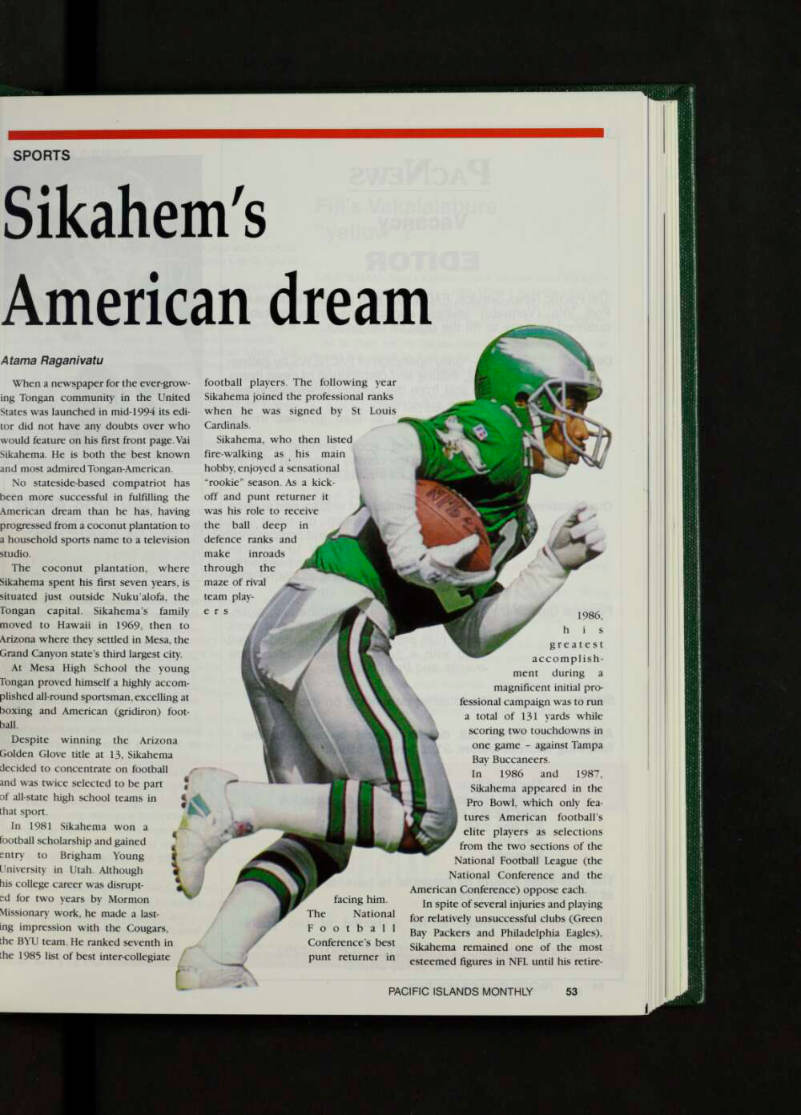
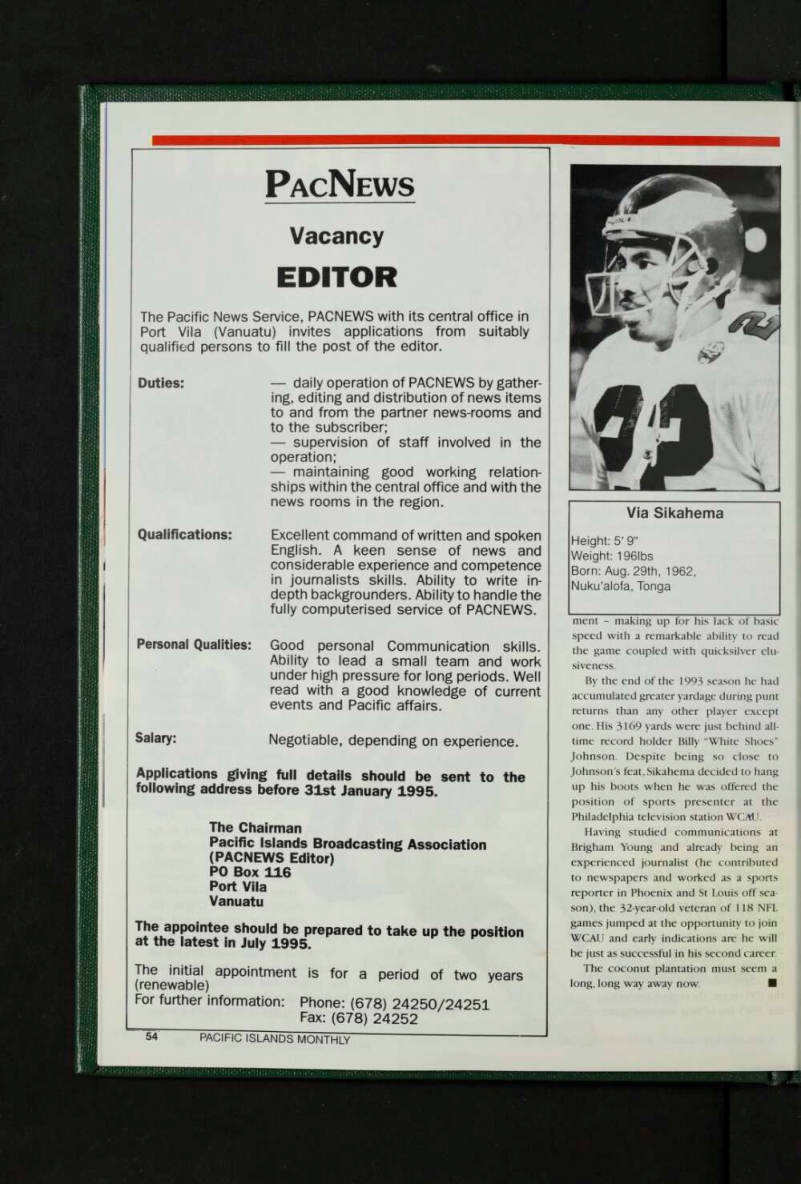
Sports
Sikahem's American dream
Atama Raganivatu
When a newspaper for the ever-grow ing Tongan community in the United States was launched in mid-1994 its edi tor did not have any doubts over who would feature on his first front page.Vai Sikahema. He is both the best known and most admired Tongan-American.
No stateside-based compatriot has been more successful in fulfilling the American dream than he has, having progressed from a coconut plantation to a household sports name to a television studio.
The coconut plantation, where Sikahema spent his first seven years, is situated just outside Nuku’alofa, the
Tongan capital. Sikahema’s family
moved to Hawaii in 1969, then to Arizona where they settled in Mesa, the Grand Canyon state’s third largest city.
At Mesa High School the young Fongan proved himself a highly accom plished all-round sportsman, excelling at boxing and American (gridiron) foot ball.
Despite winning the Arizona Golden Glove title at 13, Sikahema decided to concentrate on football and was twice selected to be part J of all-state high school teams in
that sport.
In 1981 Sikahema won a
football scholarship and gained
entry to Brigham Young University in Utah. Although \ bis college career was disrupt- i ed for two years by Mormon Missionary work, he made a last ing impression with the Cougars, the BYU team. He ranked seventh in the 1983 list of best inter-collegiate
football players. The following year Sikahema joined the professional ranks when he was signed by St Louis Cardinals.
Sikahema, who then listed fire-walking as his main hobby, enjoyed a sensational “rookie” season. As a kick off and punt returner it was his role to receive the ball deep in defence ranks and
make inroads jil \
through the maze of rival team player s V
facing him. 0The National Football Conference’s best punt returner in
/ 1986,
mgr greatest
accomplish ment during a magnificent initial pro fessional campaign was to run a total of 131 yards while scoring two touchdowns in one game - against Tampa Bay Buccaneers.
In 1986 and 1987, Sikahema appeared in the 1 Pro Bowl, which only fea- Ijl tures American football’s Velite players as selections from the two sections of the National Football League (the National Conference and the American Conference) oppose each.
In spite of several injuries and playing for relatively unsuccessful clubs (Green Bay Packers and Philadelphia Eagles), Sikahema remained one of the most esteemed figures in NFL until his retire-
ment - making up for his lack of basic speed with a remarkable ability to read the game coupled with quicksilver elu siveness.
By the end of the 1993 season he had accumulated greater yardage during punt returns than any other player except one. His 3169 yards were just behind all time record holder Billy “White Shoes”
Johnson. Despite being so close to Johnson’s feat, Sikahema decided to hang up his boots when he was offered the position of sports presenter at the Philadelphia television station WCAU.
Having studied communications at Brigham Young and already being an
experienced journalist (he contributed
to newspapers and worked as a sports reporter in Phoenix and St Louis off sea son), the 32-year-old veteran of 118 NFL games jumped at the opportunity to join WCAU and early indications are he will be just as successful in his second career.
The coconut plantation must seem a long, long way away now. ■
Via Sikahema Height: 5’ 9”
Weight: 196ibs Born: Aug. 29th, 1962, Nuku’alofa, Tonga
Advertisements & other items, p. 54 (1 item)
FacNews
Vacancy
EDITOR
The Pacific News Service, PACNEWS with its central office in Port Vila (Vanuatu) invites applications from suitably qualified persons to fill the post of the editor.
Duties: daily operation of PACNEWS by gathering, editing and distribution of news items to and from the partner news-rooms and to the subscriber; supervision of staff involved in the operation; maintaining good working relationships within the central office and with the news rooms in the region.
Qualifications: Excellent command of written and spoken English. A keen sense of news and considerable experience and competence in journalists skills. Ability to write indepth backgrounders. Ability to handle the fully computerised service of PACNEWS.
Personal Qualities: Good personal Communication skills.
Ability to lead a small team and work under high pressure for long periods. Well read with a good knowledge of current events and Pacific affairs.
Salary: Negotiable, depending on experience.
Applications giving full details should be sent to the following address before 31st January 1995.
The Chairman Pacific Islands Broadcasting Association (PACNEWS Editor) PC Box 116 Port Vila Vanuatu The appointee should be prepared to take up the position at the latest in July 1995.
The initial appointment is for a period of two years (renewable) For further information: Phone: (678) 24250/24251 Fax: (678) 24252
Funds shortage
Sports Briefs
Brawl mars tournament
THERE was an all-in brawl between the Tonga and American Samoa soccer teams at the Oceania Polynesian Cup in Apia in late November.
The match was called off as a result of the brawl which erupted during the second half when American Samoa was leading four-nil.
Police had to intervene to quell the fight after the Tongan goalkeeper attempted to kick an opponent in the mouth.
The match, which was awarded to American Samoa, left Tonga without a win in the tournament. Tonga earlier lost to Tahiti and drew with Western Samoa.
Favourites Tahiti and Western Samoa (led by former rugby representative Lalani Koko) were to have played the tourna ment final after the Tonga-Western Samoa game, but a freak thunderstorm postponed the match.
A win for either team will give them the opportunity to make the qualifying rounds for the 1998 World Cup in France.
Funds shortage jeopardises preparations
FIJI’S preparations for the South Pacific Games are already beginning to feel the pinch of reduced funding from their government.
Plans for training camps, getting overseas coaches to con duct clinics in Fiji and sending teams abroad have been put on hold because of a lack of funds.
Sports officials say if they do not get money to activate their preparations for the Games soon, chances are Fiji would fin ish at the bottom of the medals table in Tahiti in August.
Fiji’s Finance Minister Berenado Vunibobo cut allocations for sports from US$2.4 million to $832,000 in November’s budget.
The Fiji Amateur Sports Association National Olympic Committee had asked for an additional $568,000 for the Games but is yet to receive a response from the government.
Fiji’s Vakalalabure “yellow”?
AUSTRALIAN boxer Shannan Taylor has described Fiji’s pro fessional boxing scene as a joke. Taylor’s scathing comment followed Fijian Tevita Vakalalabure’s failure to turn up for a world welterweight elimination contest at Fiji’s National Gymnasium on December 2.
As he flew out of Fiji on December 4, Taylor vowed he would not return to fight in Fiji for “any amount of money, ever”. He said it was unfortunate his first trip to Fiji would also be his last.
Fans booed when it was announced Vakalalabure would not be fighting. Taylor said there was no medical certificate pro duced and “I don’t know if he was scared or yellow”
18 teams so far for Fiji Sevens
CANADA and Uruguay have confirmed their participation in the Third Fiji International Sevens scheduled for March 10 and 11.
Their participation brings to 18 the number of teams taking part in the two-day tournament.
Fiji Rugby Football Union’s administrative officer, Tevita Ratuva, says they are looking at a 24-team competitive format.
Most of the countries participating are viewing FIS as a build-up to the crucial Hong Kong Sevens.
Countries playing for the first time in Fiji are Singapore, Thailand and Papua New Guinea. The Australian Fijians are also competing for the first time.
Other teams are from Australia, New Zealand, Western Samoa, Tonga, Fiji, Malaysia, Sri Lanka, Japan, New Zealand Fijians, Cook Islands, Vanuatu, Solomon Islands and New Caledonia.
Advertisements & other items, p. 55 (1 item)
Replacement Engines
Lar gest range in the South Pacific Over 800 engines available: lOhp to 400hp. Transmission to match if required
*HINO ’NISSAN ’ISUZU ’MAZDA ’ TOYOTA
’MITSUBISHI ’DAIHATSU ’FORD PERKINS MERCEDES
VOLVO SCANIA ’BEDFORD ’LEYLAND ’DETROIT
SPECIAL
Generating Set 220V 45KVA ISUZU DIESEL 329 Hours Full Instruments Yanmar Diesel Stationary Units with Fuel Tank and Radiator Toyota 1K2 3 litre Diesel Engine Near new. As fitted latest Hilux.
bBLAIRS
P-O- Box 14 Geraldine, New Zealand. Telephone (643) 693-8122. Fax (643) 693-8120 We ship any where in the Pacific
New Year's Dreaming
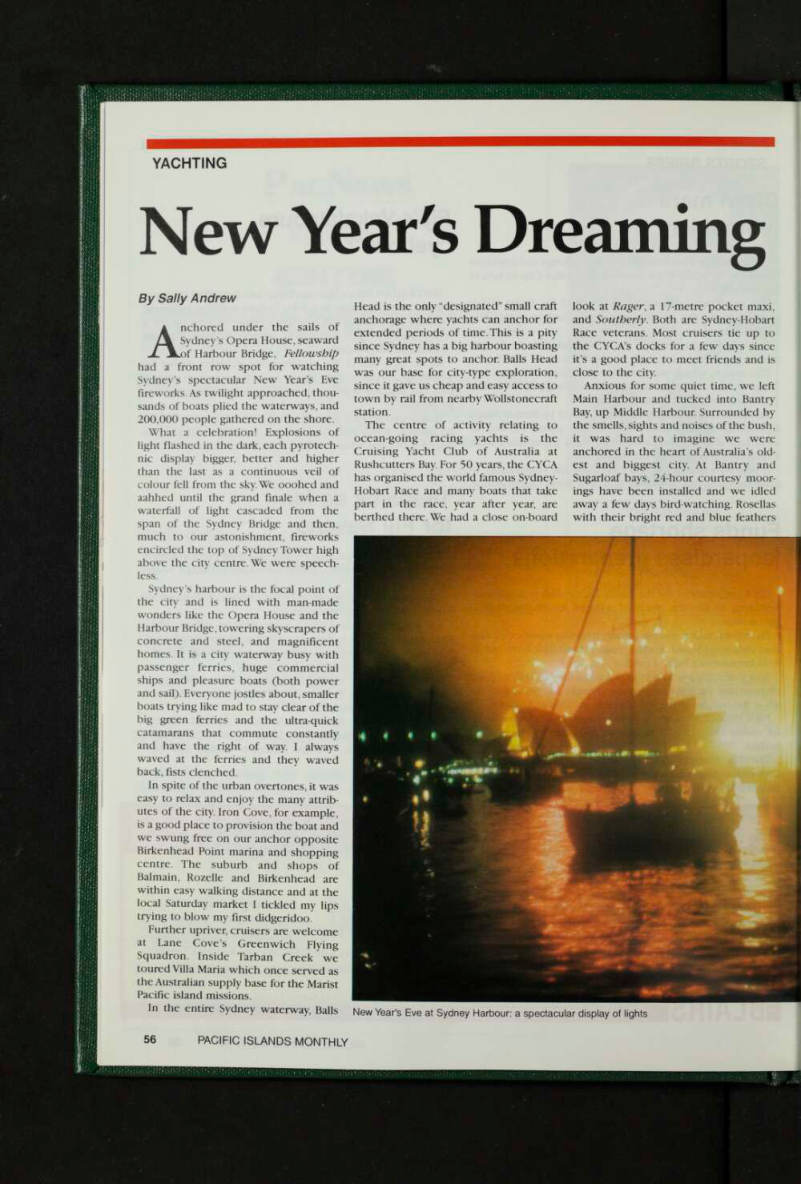
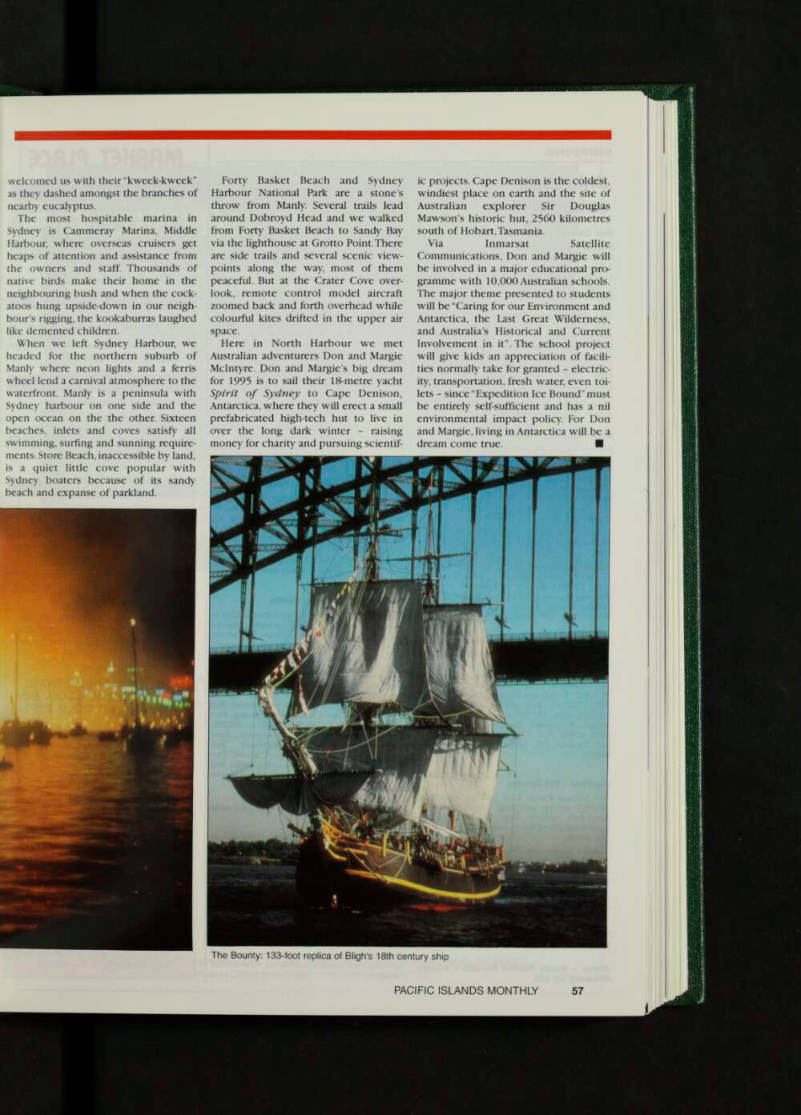
Yachting
By Sally Andrew
Anchored under the sails of Sydney’s Opera House, seaward of Harbour Bridge, Fellowship had a front row spot for watching Sydney’s spectacular New Year’s Eve fireworks. As twilight approached, thou sands of boats plied the waterways, and 200,000 people gathered on the shore.
What a celebration! Explosions of light flashed in the dark, each pyrotech nic display bigger, better and higher than the last as a continuous veil of colour fell from the sky. We ooohed and aahhed until the grand finale when a waterfall of light cascaded from the span of the Sydney Bridge and then, much to our astonishment, fireworks encircled the top of Sydney Tower high above the city centre. We were speech less.
Sydney’s harbour is the focal point of the city and is lined with man-made wonders like the Opera House and the Harbour Bridge, towering skyscrapers of concrete and steel, and magnificent homes. It is a city waterway busy with passenger ferries, huge commercial ships and pleasure boats (both power and sail). Everyone jostles about, smaller boats trying like mad to stay clear of the big green ferries and the ultra-quick catamarans that commute constantly and have the right of way. I always waved at the ferries and they waved back, fists clenched.
In spite of the urban overtones, it was easy to relax and enjoy the many attrib utes of the city. Iron Cove, for example, is a good place to provision the boat and we swung free on our anchor opposite Birkenhead Point marina and shopping centre. The suburb and shops of Balmain, Rozelle and Birkenhead are within easy walking distance and at the local Saturday market I tickled my lips trying to blow my first didgeridoo.
Further upriver, cruisers are welcome at Lane Cove’s Greenwich Flying Squadron. Inside Tarban Creek we toured Villa Maria which once served as the Australian supply base for the Marist Pacific island missions.
In the entire Sydney waterway, Balls
Head is the only “designated” small craft anchorage where yachts can anchor for extended periods of time. This is a pity since Sydney has a big harbour boasting many great spots to anchor. Balls Head was our base for city-type exploration, since it gave us cheap and easy access to town by rail from nearby Wollstonecraft station.
The centre of activity relating to ocean-going racing yachts is the Cruising Yacht Club of Australia at Rushcutters Bay. For 50 years, the CYCA has organised the world famous Sydney- Hobart Race and many boats that take part in the race, year after year, are berthed there. We had a close on-board
look at Rager, a 17-metre pocket maxi, and Southerly. Both are Sydney-Hobart Race veterans. Most cruisers tie up to the CYCA’s docks for a few days since it’s a good place to meet friends and is close to the city.
Anxious for some quiet time, we left Main Harbour and tucked into Bantry Bay, up Middle Harbour. Surrounded by the smells, sights and noises of the bush, it was hard to imagine we were anchored in the heart of Australia’s old est and biggest city. At Bantry and Sugarloaf bays, 24-hour courtesy moor ings have been installed and we idled away a few days bird-watching. Rosellas with their bright red and blue feathers
New Year’s Eve at Sydney Harbour: a spectacular display of lights
welcomed us with their “kweek-kweek” as they dashed amongst the branches of nearby eucalyptus.
The most hospitable marina in Sydney is Cammeray Marina, Middle Harbour, where overseas cruisers get heaps of attention and assistance from the owners and staff. Thousands of native birds make their home in the neighbouring bush and when the cock atoos hung upside-down in our neigh bour’s rigging, the kookaburras laughed like demented children.
When we left Sydney Harbour, we headed for the northern suburb of Manly where neon lights and a ferris wheel lend a carnival atmosphere to the waterfront. Manly is a peninsula with Sydney harbour on one side and the open ocean on the the other. Sixteen beaches, inlets and coves satisfy all swimming, surfing and sunning require ments. Store Beach, inaccessible by land, is a quiet little cove popular with Sydney boaters because of its sandy beach and expanse of parkland.
Forty Basket Beach and Sydney Harbour National Park are a stone’s throw from Manly. Several trails lead around Dobroyd Head and we walked from Forty Basket Beach to Sandy Bay via the lighthouse at Grotto Point. There are side trails and several scenic view points along the way, most of them peaceful. But at the Crater Cove over look, remote control model aircraft zoomed back and forth overhead while colourful kites drifted in the upper air space.
Here in North Harbour we met Australian adventurers Don and Margie Mclntyre. Don and Margie’s big dream for 1995 is to sail their 18-metre yacht Spirit of Sydney to Cape Denison, Antarctica, where they will erect a small prefabricated high-tech hut to live in over the long dark winter - raising money for charity and pursuing scientif
ic projects. Cape Denison is the coldest, windiest place on earth and the site of Australian explorer Sir Douglas Mawson’s historic hut, 2360 kilometres south of Hobart,Tasmania.
Via Inmarsat Satellite Communications, Don and Margie will be involved in a major educational pro gramme with 10,000 Australian schools.
The major theme presented to students will be “Caring for our Environment and Antarctica, the Last Great Wilderness, and Australia’s Historical and Current Involvement in it”. The school project will give kids an appreciation of facili ties normally take for granted - electric ity, transportation, fresh water, even toi lets - since “Expedition Ice Bound” must be entirely self-sufficient and has a nil environmental impact policy. For Don and Margie, living in Antarctica will be a dream come true. ■
The Bounty: 133-foot replica of Bligh’s 18th century ship
Shipping
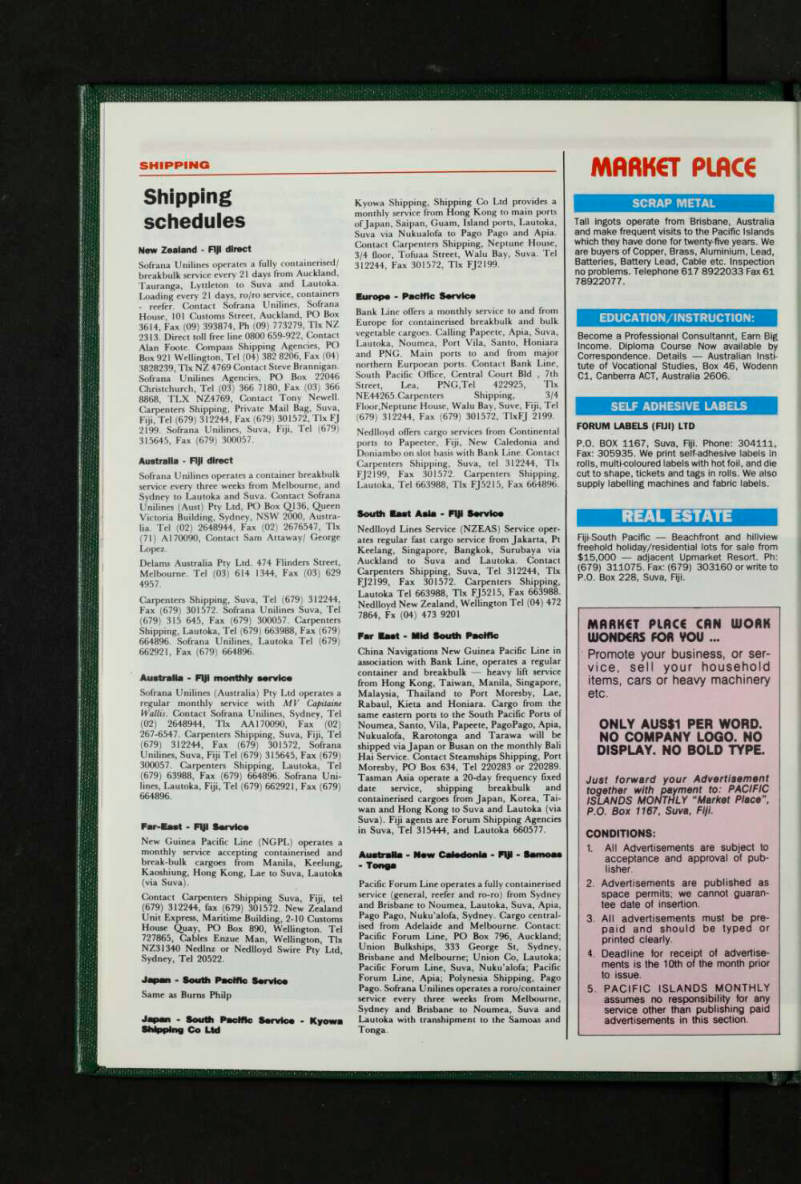
schedules
New Zealand - FIJI direct Sofrana Unilines operates a fully containerised/ breakbulk service every 21 days from Auckland, Tauranga, Lyttleton to Suva and Lautoka.
Loading every 21 days, ro/ro service, containers - reefer. Contact Sofrana Unilines, Sofrana House, 101 Customs Street, Auckland, PO Box 3614, Fax (09) 393874, Ph (09) 773279, Tlx NZ 2313. Direct toll free line 0800 659-922, Contact Alan Foote. Compass Shipping Agencies, PO Box 921 Wellington, Tel (04) 382 8206, Fax (04) 3828239, Tlx NZ 4769 Contact Steve Brannigan.
Sofrana Unilines Agencies, PO Box 22046 Christchurch, Tel (03) 366 7180, Fax (03) 366 8868, TLX NZ4769, Contact Tony Newell.
Carpenters Shipping, Private Mail Bag, Suva, Fiji, Tel (679) 312244, Fax (679) 301572, Tlx FJ 2199. Sofrana Unilines, Suva, Fiji, Tel (679) 315645, Fax (679) 300057.
Australia - FIJI direct Sofrana Unilines operates a container breakbulk service every three weeks from Melbourne, and Sydney to Lautoka and Suva. Contact Sofrana Unilines (Aust) Pty Ltd, PO Box Q 136, Queen Victoria Building, Sydney, NSW 2000, Austra lia. Tel (02) 2648944, Fax (02) 2676547, Tlx (71) A 170090, Contact Sam Attaway/ George Lopez.
Delams Australia Pty Ltd. 474 Flinders Street, Melbourne. Tel (03) 614 1344, Fax (03) 629 4957.
Carpenters Shipping, Suva, Tel (679) 312244, Fax (679) 301572. Sofrana Unilines Suva, Tel (679) 315 645, Fax (679) 300057. Carpenters Shipping, Lautoka, Tel (679) 663988, Fax (679) 664896. Sofrana Unilines, Lautoka Tel (679) 662921, Fax (679) 664896.
Australia - FIJI monthly service Sofrana Unilines (Australia) Pty Ltd operates a regular monthly service with MV Capitaine Wallis. Contact Sofrana Unilines, Sydney, Tel (02) 2648944, Tlx AA170090, Fax (02) 267-6547. Carpenters Shipping, Suva, Fiji, Tel (679) 312244, Fax (679) 301572, Sofrana Unilines, Suva, Fiji Tel (679) 315645, Fax (679) 300057. Carpenters Shipping, Lautoka, Tel (679) 63988, Fax (679) 664896. Sofrana Uni lines, Lautoka, Fiji, Tel (679) 662921, Fax (679) 664896.
Far-East - Fiji Service New Guinea Pacific Line (NGPL) operates a monthly service accepting containerised and break-bulk cargoes from Manila, Keelung, Kaoshiung, Hong Kong, Lae to Suva, Lautoka (via Suva).
Contact Carpenters Shipping Suva, Fiji, tel (679) 312244, fax (679) 301572. New Zealand Unit Express, Maritime Building, 2-10 Customs House Quay, PO Box 890, Wellington. Tel 727865, Cables Enzue Man, Wellington, Tlx NZ31340 Nedlnz or Nedlloyd Swire Pty Ltd, Sydney, Tel 20522.
Japan - South Pacific Service Same as Bums Philp Japan - South Pacific Service - Kyowa Shipping Co Ltd
Kyowa Shipping, Shipping Co Ltd provides a monthly service from Hong Kong to main ports of Japan, Saipan, Guam, Island ports, Lautoka, Suva via Nukualofa to Pago Pago and Apia.
Contact Carpenters Shipping, Neptune House, 3/4 floor, Tofuaa Street, Walu Bay, Suva. Tel 312244, Fax 301572, Tlx FJ2199.
Europe - Pacific Service Bank Line offers a monthly service to and from Europe for containerised breakbulk and bulk vegetable cargoes. Calling Papeete, Apia, Suva, Lautoka, Noumea, Port Vila, Santo, Honiara and PNG. Main ports to and from major northern Eurpoean ports. Contact Bank Line, South Pacific Office, Central Court Bid , 7th Street, Lea, PNG,TeI 422925, Tlx NE4426s.Carpenters Shipping, 3/4 Floor,Neptune House, Walu Bay, Suve, Fiji, Tel (679) 312244, Fax (679) 301572, TIxFJ 2199.
Nedlloyd offers cargo services from Continental ports to Papeetee, Fiji, New Caledonia and Doniambo on slot basis with Bank Line. Contact Carpenters Shipping, Suva, tel 312244, Tlx FJ2199, Fax 301572. Carpenters Shipping, Lautoka, Tel 663988, Tlx FJ5215, Fax 664896.
South East Asia - FIJI Sorvlcs Nedlloyd Lines Service (NZEAS) Service oper ates regular fast cargo service from Jakarta, Pt Keelang, Singapore, Bangkok, Surubaya via Auckland to Suva and Lautoka. Contact Carpenters Shipping, Suva, Tel 312244, Tlx FJ2199, Fax 301572. Carpenters Shipping, Lautoka Tel 663988, Tlx FJ5215, Fax 663988.
Nedlloyd New Zealand, Wellington Tel (04) 472 7864, Fx (04) 473 9201 Far Bast - MM South Pacific China Navigations New Guinea Pacific Line in association with Bank Line, operates a regular container and breakbulk heavy lift service
from Hong Kong, Taiwan, Manila, Singapore,
Malaysia, Thailand to Port Moresby, Lae, Rabaul, Kieta and Honiara. Cargo from the same eastern ports to the South Pacific Ports of
Noumea, Santo, Vila, Papeete, PagoPago, Apia,
Nukualofa, Rarotonga and Tarawa will be shipped via Japan or Busan on the monthly Bali Hai Service. Contact Steamships Shipping, Port Moresby, PO Box 634, Tel 220283 or 220289.
Tasman Asia operate a 20-day frequency fixed date service, shipping breakbulk and containerised cargoes from Japan, Korea, Tai wan and Hong Kong to Suva and Lautoka (via Suva). Fiji agents are Forum Shipping Agencies in Suva, Tel 315444, and Lautoka 660577.
Australia - New Caledonia - FIJI - ftamoas - Tonga Pacific Forum Line operates a fully containerised service (general, reefer and ro-ro) from Sydney and Brisbane to Noumea, Lautoka, Suva, Apia, Pago Pago, Nuku’alofa, Sydney. Cargo central ised from Adelaide and Melbourne. Contact; Pacific Forum Line, PO Box 796, Auckland; Union Bulkships, 333 George St, Sydney, Brisbane and Melbourne; Union Co, Lautoka; Pacific Forum Line, Suva, Nuku’alofa; Pacific Forum Line, Apia; Polynesia Shipping, Pago Pago. Sofrana Unilines operates a roro/container service every three weeks from Melbourne, Sydney and Brisbane to Noumea, Suva and Lautoka with transhipment to the Samoas and Tonga.
Advertisements & other items, pp. 58-60 (1 item)
Mrrkct Place
SCRAP METAL
Tall ingots operate from Brisbane, Australia and make frequent visits to the Pacific Islands which they have done for twenty-five years. We are buyers of Copper, Brass, Aluminium, Lead, Batteries, Battery Lead, Cable etc. Inspection no problems. Telephone 617 8922033 Fax 61 78922077.
EDUCATION/INSTRUCTION:
Become a Professional Consultannt, Earn Big Income. Diploma Course Now available by Correspondence. Details Australian Institute of Vocational Studies, Box 46, Wodenn Cl, Canberra ACT, Australia 2606.
SELF ADHESIVE LABELS
FORUM LABELS (FIJI) LTD
P.O. BOX 1167, Suva, Fiji. Phone: 304111, Fax: 305935. We print self-adhesive labels in rolls, multi-coloured labels with hot foil, and die cut to shape, tickets and tags in rolls. We also supply labelling machines and fabric labels.
REAL ESTATE
Fiji-South Pacific Beachfront and hillview freehold holiday/residential lots for sale from $15,000 adjacent Upmarket Resort. Ph: (679) 311075. Fax: (679) 303160 or write to P.O. Box 228, Suva, Fiji.
MRRK€T PLRC€ CRN UJORK
WONDCRS FOR VOU ...
Promote your business, or service, sell your household items, cars or heavy machinery etc.
ONLY AUSSI PER WORD.
NO COMPANY LOGO. NO
DISPLAY. NO BOLD TYPE.
Just forward your Advertisement together with payment to: PACIFIC ISLANDS MONTHLY "Market Place", P.O. Box 1167, Suva, Fiji.
CONDITIONS:
1. All Advertisements are subject to acceptance and approval of publisher. 2. Advertisements are published as space permits; we cannot guarantee date of insertion. 3. All advertisements must be prepaid and should be typed or printed clearly. 4. Deadline for receipt of advertisements is the 10th of the month prior to issue.
5. PACIFIC ISLANDS MONTHLY
assumes no responsibility for any service other than publishing paid advertisements in this section.
z 1*. y • Graded Premium Whole Life We've been dedicated to providing fast, personalized service for more than 35 years through local ownership and management That's why Grand Pacific Life is your Family ...throughout the Pacific . ©
Grand Pacific Life Insurance, Ltd.
A member of the Finance Factors Family
FEDERATED STATES
OF MICRONESIA
Actouka Executive Insurance Underwriters P.O. Box 53, Kolonia, Pohnpei, Federated States of Micronesia 96941 Pacific Basin Insurance & General Services, Inc P.O. Box 494, Chuuk State, Federated States of Micronesia 96942
TONGA
Peseti Ma‘afu Ins. & Finance, Ltd.
Private Bag 2, Taumoepeau Bldg.
Nukualofa, Tonga
GUAM
Great National Insurance Underwriters, Inc.
P.O. Box GA, Agana, Guam 96910
AMERICAN SAMOA
Mark Solofa Pacific Insurance & Finance, Inc.
P.O. Box 3149 Pago Pago, American Samoa 96799 Pacific Financial Corporation P.O. Box AT, Agana, Guam 96910 Takagi & Associates, Inc.
GCIC Bldg, Suite 100 414 W. Soledad Ave.
Agana, Guam 96910
MARSHALL ISLANDS
Marshalls Insurance Agency P.O. Box 113, Majuro, Marshall Islands 96960
WESTERN SAMOA
Mark Solofa Pacific Insurance & Finance, Inc.
P.O. Box 3149 Pago Pago, American Samoa 96799
NORTHERN MARIANAS
Pacific Basin Insurance Underwriters, Inc.
P.O. Box 710 Saipan, Mariana Islands 96950 Pacifica Insurance Underwriters, Inc.
P.O. Box 168, Saipan, Mariana Islands 96950 Grand Pacific Life lnsurance / Ltd. *1164 Bishop Street, 5th Floor, Honolulu, HI 96813 Phone: (808) 548-3363 * FAX: (808) 548-5122
The Mitsubishi Lancer: A family sedan that meets our own standards of stability and performance.
Lancer is ready when you are.
The rear multi-link suspension system is absolutely fearless. The independent McPherson struts up front are equal to the challenge of even the toughest road conditions. And an aggressive, fuel-efficient SOHC engine awaits your command.
The ground-hugging chassis holds comers tight. A powerffil braking system holds you and your family secure.
And when you venture into the passing lane, this car holds nothing back.
Because Lancer was born to run.
It is a dazzling product of our total approach to car design, a philosophy you can feel the moment you get behind the wheel.
There is no compromise in Lancer’s construction. Every detail meets our exacting standards of stability and performance. Its unique handling instincts and spirited responsiveness are an expression of Mitsubishi’s driving commitment to excellence in every car we make.
Yes, strictly speaking, Lancer is a family sedan. But the way it performs is something else.
MITSUBISHI LRNCER
What Drives You.
Tel (08) 2757297 / FIJI- NIVIS MOTOR & MAC^INERY^nTTl^r^ 8^^^ 914 °' AUSTRALIA: MITSUBISHI MOTORS AUSTRALIA LTD. 1284 South Road, Clovelly Park, South Australia, 5042, SOCIETEDTMTORWI0ND'AUTODUPWrUFICUIF^in«uP'pnIitr m° X 150 ' 383411 /GUAM; TRIPLE J ENTERPRISES INC, P.O Box 6066, Tamuning, Tel. 6469126/NEW CALEDONIA: ISLAND: BORRY'SPTY LTD. P0 Box 169 TayloreRoad Burnt T^1M/Mpii*M™f^ l M?r^?I^jnmDl T^BISH| M^R SNWZ EALANDLTD.PrivateBag.Porirua,Tel.237-0109/NORE01J( INC P.0 Box 487, Tel. 234-7133 / SOLOMON ISLANDS HARDEST PAC Fir I in ? pn n ofiQ U ° M0TORS m LTD P ° B ° X 503 Port Moresb * Tel 217 874 ' SAIPAN AUTDWORLD CO., LTD. P.0. Box 83, Nuku'Alota Tel 24044/SniwtU SOCOMFTrSict? H ° mara ’ T ® 30407 ' TAHITI: S0PADEP SA BP 1617. Tel, 427393 / TONGA; SITANI MAPI NUATU - S0C0METRA van UATU LTD. BP 6 Port-Vila, Tel. 2314 / WESTERN SAMOA: MOTOR DISTRIBUTORS (SAMOA) LTD. P.0, Box 576 Apia, Tel, 20957 A
MITSUBISHI
MOTORS
CREATING TOGETHER