Pacific

Islands
Monthly
December 1994
Sending
\Out The
Wrong
Sisals
American Samoa USS2.SO; Australia A 53.50; Cook Islands NZ$3.OO; Fiji (Incl VAT) F 52.50; FS Micronesia US$3.OO; Kiribati A 52.50; Nauru A 52.50; Niue NZ$3.OO; Norfolk A 53.00; New Caledonia cpf2so; New Zealand (Incl. GST) NZ53.45; Northern Marianas US$3.OO; Papua New Guinea K 3.00; Palau US$3.OO; Marshall Islands US$3.OO; Solomon Islands A 53.00; French Polynesia cpf3oo; Tonga P 3.00; United States of America US$3.OO; Vanuatu VT22O; Western Samoa T 3.25. (Recommended retail prices only)
Advertisements & other items, p. 2 (1 item)
Your Island Connections
i vm
Cable and Wireless began keep-
ing people in touch around the
world more than a century ago. Today,
while the technology has changed,
the tradition of service to our customers in the
South Pacific is just the same.
We work in partnership with Governments,
dedicated to meeting the need of communities and businesses to stay in touch. From one island to the next or to the other side of the world, the message is the same: Cable and Wireless is
your South Pacific
connection bringing the
islands together.
CABLE & WIRELESS
Asia Pacific Head Office Cable and Wireless pic Cable and Wireless (Pacific) Limited 22nd Floor Office Tower Convention Plaza 1 Harbour Road Hong Kong Tel: (852) 848 8620 Facsimile: (852) 868 5195 Fiji In association with the Government of Fiji Fiji International Telecommunications Ltd, P.O. Box 59 Mercury House 158 Victoria Parade Suva Fiji Tel: (679) 312933 Solomon Islands In association with the Government of the Solomon Islands Solomon Telekom Company Limited P.O. Box 148 Honiara Solomon Islands Tel; (677) 21576 Tonga Cable and Wireless pic Private Mail Bag 4 General Post Office Nuku Alofa Tonga South Pacific Tel: (676) 23499 Vanuatu In association with the Government of Vanuatu and France dtbles et Radio Telecom Vanuatu Limited P.O. Box 146 Port VUa Vanuatu Tel: (678) 22185
Pacific
Islands
Monthly
Vol. 64 N 0.12
The News Magazine
December 1994
□ Letters 4
□ Headlines 7
□ South Pacific Commission
Tightening the belt 9
□ Cover Stories
Fiji’s television dilemma 13 Fiji’s Media: Who pulls the strings 15
□ Tourism
Another year, another convention 19
□ Business
Goods news for New Caledonia 21 Coconut oil price soars 23
□ Solomon Islands
Mamaloni back at the helm 27
□ Opinion
Justice delayed 29
□ Money
Aid, AIDS and perdiems 32
□ Advertising Feature
What a pity 35 Peddling the Pacific 39
□ Focus
Pacific’s own literary forum 45 The angry warrior 46
□ Election
Democrats sweep thorugh the islands 49
□ Sports
League’s here to stay 54
□ Yatching
Storm of 1994 56 Cover design by JAMES RANUKU
Publisher: Brian O’ Flaherty Editor: Mala Jagmohan Senior Writer; Yunus Rashid Correspondents: Christine Hatcher, David North, Ed Rampell, Ian Williams, Karen Mangnall,
Liz Thompson, Roman Grynberg, Waliy
Hiambohn.
Columnists: David Barber (Wellington), Futa Helu (Tonga, cover ing the Pacific Islands), Jemima Garrett
(Sydney). Alfred Sasako (The Forum).
Advertising Sales: • Regional Sales -South Pacific; Salendra Narayan, Ashok Lai, Tel (679) 304111,303429, Fx (679) 303809. • Sydney, Canberra: Bob Hill Media
Representation. Tel (61-2) 4164245,
Fx (61-2) 4165064. • Brisbane: Robert Walker, Media House, Tel (61-7) 3710533, Fx (61-7) 371-8904. • Adelaide: Hastwell Williamsons Representatives, Tel (61-8) 3799522, Fx (61-8) 3799735. • Melbourne: Brown Orr Fletcher Burrows (Aust) Pty Ltd. Tel (61-3) 8265188, Fx (61-3) 8265644. • Auckland: McKay & Bowman, International Media Representatives Ltd, Tel (64-9) 4190561, Fx (64-9) 4192243. • Japan: Universal Media Corporation, Tokyo, Tel (3) 326626741, Cable: UNI MEDIA Tokyo, Fx (3) 32626742.
Founded 1930 (USPS 952480). A Fiji Times Limited production.
Cover prices are recommended retail only.
Registered by Australia Post, Publication No. NBP 1210. © Copyright Fiji Times Limited, 177 Victoria Parade. Suva. Fiji. Tel (679) 304111, Fx (679)
303809. Tx Fj2124.
Pacific Islands Monthly is published monthly by The Fiji Times Limited, a division of Nationwide News, 2 Holt Street, Surry Hills, Sydney, NSW 2010.
Send address changes to: •Pacific Islands Monthly, PO Box 1167, Suva , Fiji.
Typeset and printed by The Fiji Times Limited, 177 Victoria Parade, Suva, Fiji.
For A Free Press
From The Editor’S Desk
This month we have chosen to highlight the media situation in Fiji, not only because we believe it is cause for concern here, but because government intervention in one form or another is a worrying development in most Pacific countries.
The view that governments and their actions are above critical analysis by their electorate has led in many cases to a lack of accountability in the public sector. So much so, that the very reason for the government’s being has been neglected as politicians with their shortsightedness and personal agendas are flourishing - at the expense of the country’s welfare.
This is where a free and independent media can be a voice for the people. This is where pressure can be brought to bear on the government for greater accountability on how public funds are spent. This is how the electorate takes on a more mature role of keeping an eye on the government it elected.
But it also works for the benefit of the government, allowing it to get an assessment of its performance through the feedback in the media.
And in the long run, the whole country can benefit from free and open discussion and debate of critical issues facing a nation. But in our Pacific countries,
steeped in traditions where a questioning of authority is misconstrued as being dis respectful, conditions can be trying for a
free-spirited journalist.
More often than not, senior politicians are chiefs or traditional leaders or have close ties with them, creating a conflict between tradition and contemporary val ues. When the media are owned or con trolled by governments the problem is fur ther compounded as journalists are drawn into this conflict.
Ideally, the media should operate as independent objective forums for the pub lie. We understand this may not always be possible in the region, as the private sector may lack sufficient funds to embark on such ventures. Hence, Pacific media may need to have government support to remain viable. The absence of such sup port could mean there is no other viable alternative.
However, what was disturbing about the Fiji situation was that when there was a viable private media company, a govern ment minister saw fit to call for a relin quishing of majority share holding to local interests. He made the proclamation on the grounds that the company was for eign-owned.
In our region, where populations are
small, where resources and the private sector is minimal and still in stages of development with the help of foreign assistance, his statement not only threat ened the sanctity of the freedom of the media, but also sent shudders down the spine of every foreign investor in the country.
The Prime Minister of Fiji stepped in quickly to smooth over the storm created by the Information Minister, and denied any such move was afoot by his govern ment. He stated the minister had not been speaking on behalf of the government and his stand did not reflect government poli cy.
While there was the initial outcry from the business community, there was an unusual lack of opposition as far as the media industry was concerned. In fact, some journalists saw it as a good move to have controlling interests in the media in ,local.
That appears fine, and in keeping with the current trend where island nations are trying to establish a distinct Pacific identi ty. But the problem arises because the Pacific communities are so small, and per sonalities are so closely associated that maintaining an objective stance becomes difficult.
A foreign-owned media company, aside from its greater resources, is also its ability to have an independent perspective.
Disgruntled
Letters
Author
defends
Missionaries
Madam, lan Williams review (OCT PIM) of my book, Conversations with the Cannibals, was fine except in one area. He made it sound like I am opposed to missionaries and the mis sionary movement and that is simply not true.
I applaud the missionaries efforts in medical service and education, often for people who would otherwise have neither. Missionaries have long stood up for islanders’rights when no one else world. My only objection to the missionary movement, historically, is that it has had a large part to play in eradicating the traditional cultures of the islanders.
Also, my story about missionary couple working in the Solomons was not written as a sop to the missionar ies. It was written because that cou ple, to me, symbolized the best the
missionary movement offers to the Pacific.
Michael J Krieger
Skyeland Farm,
Orcas, United States of America.
Disgruntled
citizen
Madam, Are you aware of politics in the “untouched Paradise”? Vanuatu politics sadly reflects an increasing state of moral corruption engulfing the minds of the leaders of this supposedly godly nation. The trend is worsening, yet a great majority of the people remain pow erless to say or do anything, because of the prevailing “top-down-master-ser vant” approach to people’s public expression of views determined and encouraged by the system.
The highly political “who-you-know” system of worker recruitment presently
practised in Vanuatu has so over whelmed the system, that it has gone very much out of control.
The nation currently lacks a mecha nism such as the media, that should effectively monitor, challenge and con trol the activities of the government and its officials. Our entire administrative and political system have simply gone way out of touch with the people they were created to serve, and we urgently need such a mechanism(s) set up to take some control over the present situation.
This suggests one more thing: the urgent need for a clean-up campaign.
A lot of people in Vila, for instance, were shocked when the government dis missed the former general manager of
Vnpf.
Decisions made at the national level for the good of the people must be ratio nal, justifiable and honest.
Concerned citizen.
Port Vila, Vanuatu
Imminent
doom: Act now
Madam
Reading through September PIM I
found an article by Akanisi Motufaga on the Forum’s concern about the environ mental problems in the Pacific under the heading “Lets not panic leaders say”.
I understand that commentaries made by Pacific Island country leaders was in response to Australia’s warning that the Pacific was on the brink of environmental disaster as a result uncontrolled exploitation of our natural resources.
In fact we should be panicky so that our governments are alert and pre
pared.
We have to be practical about the environmental problems because I have seen what companies did with logging in my country.
What the indigenous peoples are left with in the end is a zero. We become the losers and we should put a stop to the day light robbery of our inheritance.
There has been heavy logging in Papua New Guinea, Solomon Islands and Vanuatu compared to other Pacific island countries.
And if the leaders of today are gen uinely critical of the abuse of our envi ronment, they should then also see how the indigenous peoples survive on the environment.
The exploitation must stop.
Solutions must be found to right the
already dangerous situation.
Reaforestation will not bring back our forests in the natural form and would takes many years before the denuded forests take shape again.
We must realise we are heading for a catastrophy and this is mainly because of a lack of a system to replace effectively the damaged forests.
All is not lost, leaders of countries where exploitation of the environment threatens the very existence of their people should get together and put a stop to these nightmarish activities.
Whatever steps are to be taken need to be taken now before the region is doomed by a problem we have never known before.
There are other ways in which resources can be earned rather than
through destroying our environment.
Peter Tirang,
Papua New Guinea.
Nickel
Mines
controversy
Madam, The articile “Mine of the Future” (PIM, August, 1994) failed to mention the end-use of this type of nickel - as listed by the French Bureau of Statistics - in super alloys for the nuclear industry: or that SLN is a sub sidiary of both the French Atomic Energy Authority and Cogema, the largest uranium mining interest in the world.
Exported nickel from ‘pro-inde
pendence’ New Caledonia is also being used to build the new generation of nuclear reactors in Japan.
Ironical when you think that the independence movement’s Charter and Constitution both comit the FLNKS to an anti-nuclear position. And that their official protest of the shipment of pluto nium to Japan, when it passed through New Caledonian territorial waters was for a cargo destined for the very reac tors they were helping build.
France needs to guarantee a continual supply of this strategic miner al for its own defense purposes. To imply that Nepoui is part of a ‘rebalanc ing of the economy after the Matignon Accords’ is to beleive the lie that even the Kanak liberation front elite are cur rently trying to sell to their own people, at the expense of their health, environ ment and truly independent future.
Susi Newborn
Grey Lynn Auckland, New Zealand.
Letters to the editor must include the writers’ full name, address and tele phone number. All letters may be edited for purposes of clarity and space.
Letters should be addressed to; The Editor, Pacific Islands Monthly, PO Box 1167, Suva, FIJI or Fax; (679) 303-809
Advertisements & other items, pp. 5-6 (1 item)
Pacific
Remember your Friend
There are times in your life when you feel your friends have been missing out on something good. Now’s your chance to do something about it and share with them one of the good things you have. Buy your friend a subscription to Pacific Islands Monthly and let him or her join you and thousands of other people worldwide who are kept informed of the latest political, social and cultural
changes taking place in the Pacific.
SUBSCRIPTIONS
American Samoa US$45 Australia A 542.00 Canada US$45 Cook Islands AUSS46 Fiji F 526.40 French Polynesia US$45 Guam US$45 Hawaii US$45 Japan US$45 Kiribati AUSS46 Marshall/Micronesia US$4O Nauru AUSS42 New Caledonia US$32 New Zealand NZ$55 Niue AUSS46 Norfolk Island AUSS42 Northern Marianas/Palau US$4O Papua New Guinea AUSS4S Solomon Islands AUSS46 Tonga AUSS46 Tuvalu AUSS46 United Kingdom Stg Pound2B US Mainland US$45 Vanuatu AUSS4S Western Samoa WS$6O Elsewhere AUSS63 Payment to Pacific Islands Monthly: Subscriptions Dept, GPO Box 1167, Suva, FIJI.
Subscriptions rates include the cost of airspeeding to all destinations set out above.
Direct airmail rates on application.
Telephone: 304111 Fax: 303809
PACIFIC
ISLANDS
Please send my friend Pacific Islands Monthly for one year ,
(12 issues). y
I enclose my cheque for $ c£b (made payable to Pacific
Islands Monthly)
or debit $ to my: □ Bankcard □ Visacard □ Mastercard Card No: I I I I I I I ! I M I ! I i I Expiry Date
NAME
•SIGNATURE-
ADDRESS:
CITY-
COUNTRY
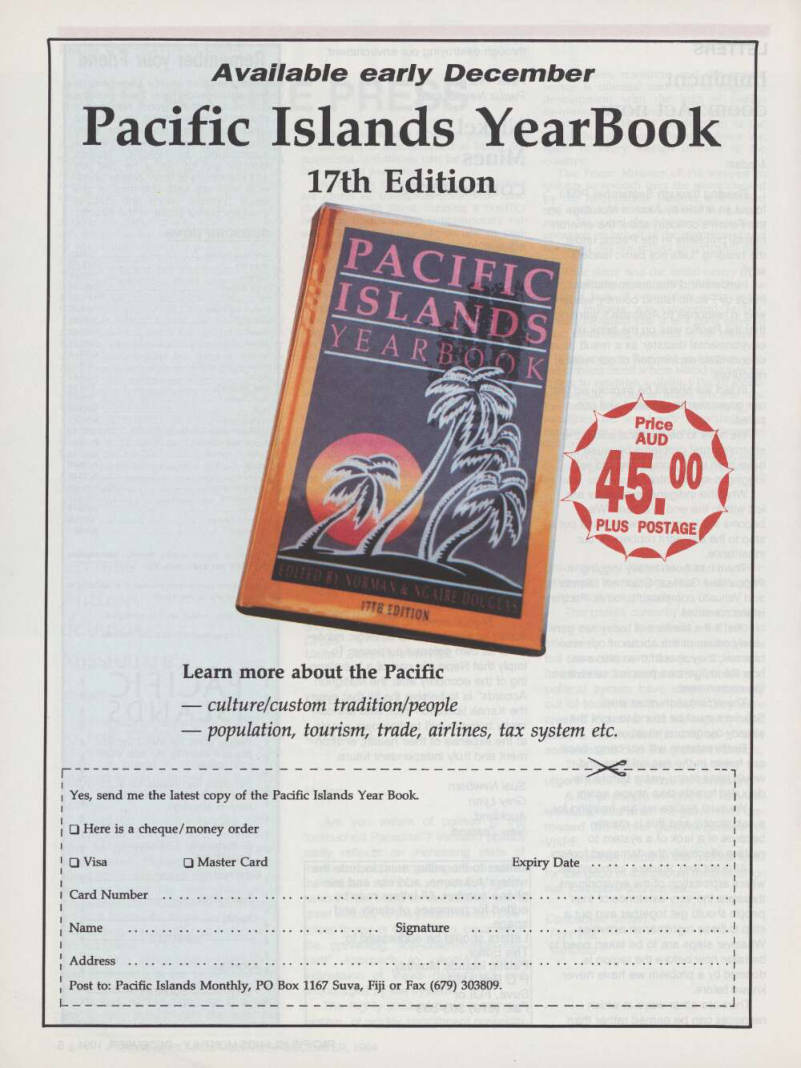
Available early December
Pacific Islands Yearßook
17th Edition
Price
AUD
am 45 oo
PLUS POSTAGE
Leant more about the Pacific
culture!custom tradition!people
population, tourism, trade, airlines, tax system etc.
X Expiry Date Name Signature Address I Yes, send me the latest copy of the Pacific Islands Year Book. □ Here is a cheque/money order □ Visa □ Master Card Card Number , Post to: Pacific Islands Monthly, PO Box 1167 Suva, Fiji or Fax (679) 303809.
I J
Fatal shooting
Headlines
Papua New Guinea
tolls two
A Papua New Guinea soldier and a civil ian have been shot dead in central Bougainville. The Prime Minister’s Office confirmed the two were killed and another soldier seriously wounded in an ambush at Manetai on the afternoon of November 21.
Their military vehicle was attacked as it was transporting fuel and food.
On-one claimed responsibility for the ambush but it is the most serious of a number of clashes since the PNG gov ernment signed a cease fire agreement with the Bougainville Revolutionary Army in September. n n n
Provincial
govt's must go
Papua New Guinea’s prime minister Sir Julius Chan, has reiterated that the country’s provincial government system would be abolished, contradicting earli er statements made by his deputy Chris Haiveta who said the system would be retained.
PNG’s Cabinet met on November 17 while Sir Julius was still away attending the APEC summit and agreed, under the chairmanship of the acting prime minister, Haiveta, to retain the provincial government system.
to nuclear storage
Marshall Islands
Japan says no
Japan has rejected an offer from the Marshall Islands to store nuclear waste on one of its atolls. The Japanese gov ernment said it will stick to its policy of storing its waste inside Japan.
A delegation from the Marshall islands offered Tokyo the use of an atoll already made uninhabitable because of nuclear testing carried out by the United States, since World War II.
A major Japanese daily, the Asahi
Shinbun, said the offer came from the Marshall Islands’ ambassador to the US, Wilfred Kendell.
The approach was made after a deci sion by the government of the island republic in February to examine the fea sibility of placing nuclear waste dumps on some of its atolls.
At loggerheads
Vanuatu
Landowners in Vanuatu say they are reluctant to comply with a ban on log exports. They say they fear this could reduce their chances of getting a fair share of the profits of logs already cut.
Attorney-General Patrick Ellum has been addressing traditional chiefs on the island of Erromango to explain the government’s policy. But he says the government is talking to the logging companies to renegotiate the number of logging licenses to be issued for Erromango and the amount of timber to be harvested.
Prime Minister Maxime Carlot Korman banned log exports in June, reacting to concerns by overseas aid donors that the trees were being felled at an unsus tainable rate.
and democracy
Fiji
Americans,
chickens
and democracy
The Fiji Times newspaper has attacked the US embassy in Suva for agreeing to a racially discriminatory trade agree ment with the Fiji Government. Under the agreement, only indigenous Fijians will be allowed to import and sell chick en from the United States.
In a sharply worded editorial , The Fiji Times said the US is the great defender of democracy and human rights with slogans about freedom and justice, but its embassy in Suva supports economic
apartheid.
It said Fiji’s Indian, Asian and European traders will not have access to the cheaper US product and will suffer as a result.
The Fiji Times said the US has set high ideals for itself and it is sad to see those ideals sold down the river for the price of a few chicken. On the Fiji government, the newspaper says it has “a habit of kicking the teeth of any Fiji citizen who does not happen to have indigenous blood lines” and urged it to come up with a better scheme “to enhance the busi ness prospects of indigenous Fijians without making half the country feel like
lepers”
Twenty days later Fiji’s Information Minister said editorials like this threat ened the sovereignty of the country,
the only foreign owned and indepen
dent media in the country should sell 51 percent shares to locals. This utterance attracted a flood of criticisms from the
general public and political parties who
said was trying to gag the media. a a n
Watch waste
and pollution
Problems caused by waste disposal and pollution in thq Pacific islands are such that waste management has become priority environmental issue for the region, a workshop was told in Suva on November 16.
University of the South Pacific vice chancellor Esekia Solofa was speaking at the opening of a hazardous Waste
and Water Quality Workshop.
Solofa said the environment was increasingly being threatened by the lack of adequate environmental con trols.
He said development and industrialisa tion in Fiji had been allowed to progress without adequate waste-management and pollution prevention programmes being put in place.
This resulted in significant degradation of the coastal environment occurring where most of the development was based.Solofa said there was a need for effective waste management strategies in every country in the South Pacific. n n n
Mild Budget
violent response
Fiji’s Finance Minister Serenade Vunibobo has tabled what he described as “a mild Budget” in thr sum of $827.8 million.
However, the reaction to the Budget was far from mild as public sector unions threatened to call a nation wide strike if government failed to implement a Job Evaluiation Exercise which recom mends higher salaries for civil servants.
Vunibobo said the report would cost government S6B million and this was something the country could not afford without burdening the people with heav ier taxes.
Vunibobo expressed concern that the
deficit stood at $62 million, or 2.5 per cent of the gross domestic
product(GDP).
Gross expenditure for 1995 was esti mated at $827.8 million, compared to a forecast of $832.1 million in 1994.
Revenue in 1995 was forecast at $693.8 million. Vunibobo warned that Fiji’s dependence on sugar and tourism must lessen and Fiji should broaden its export base.
After the Budget was tabled, about 500
public servants in Fiji unanimously
voted in favour of holding a nation-wide strike to protest against what they call draconian measures to kill the trade union movement.
pose problems
Tonga
Pumpkins
As Tonga’s lucrative squash pumpkin season draws to an end, some growers are facing a crisis because they have not been able to sell any of their crops.
One of the major exporters, MBM, is reported to have filled its quota of 3500 tonnes for this season with the departure of their fourth shipment for Japan on November 16.
Media reports said they still have a num ber of member growers who have yet to sell their crops. They are now negotiat ing with other exporters who still have not filled their quota to take their crops.
But Radio Tonga says a survey shows that of the 13 exporting companies, most have completed or are close to completing their quotas. At the same time most exporters have member grow ers who have still not been able to sell their crops to packing sheds.
The government set the ceiling for this year’s crop at 17,000 tonnes and has refused two petitions for the extra crops to be exported. a a a
For King
and country
More than 400 Tongan women have
signed a petition urging parliament to
take action to free them from “pain, anguish and misery” caused by despectful and untrue remarks about the King and the country published in the Wall Street Journal.
The remarks were made by commoner MR Akilisi Rohiva who criticised the King’s kingdom and his lifestyle.
Tonga over
Western Samoa
W. Samoa haunts
dead stowaway
Western Samoa’s Polynesian Airlines wants compensation from Tonga for not preventing a stowaway hiding in one of its aircraft and forcing it to crash land..
The Polynesian Boeing 737-300 made an emergency landing at Apia’s Faleolo airport on September 14 after its right landing gear was jammed by the body of a dead stowaway, who climbed into a wheel well before the plane’s take-off
from Tonga.
The damaged aircraft, the financially stricken Polynesian’s only jet, was out of action for two weeks after being forced to land on its nose wheel and the left hand undercarriage.
Tonga’s director of civil aviation, John Best, says the Tongan government received a letter indicating the possibili ty of a compensation claim. Best said Fua’amotu airport complies with securi ty standards set by the international Civil Aviation Organisation, and has passed inspections by New Zealand and United States authorities.
fishing officials
Micronesia
Bribes bait
A State lawmaker in the Federated States of Micronesia has accused fish ing officials of accepting gifts from for eign companies seeking fishing permits.
Pohnpei state senator Wagner Lawrence alleged the officials accepted foreign trips from Asian companies seeking to exploit the country’s vast ocean resources. Fishing and fishing license fees are one of the main sources of revenue for FSM, which comprises hundreds of islands divided into four states.
The allegations follow growing hostility in Micronesia toward Taiwanese and Chinese fishing companies operating in its waters.
Chinese fishermen have been assault ed by Micronesians who believe foreign boats are guilty of overfishing and wast ing unwanted fish that could be supplied
to locals.
Senator Lawrence, in a speech last month to the National Congress, called for the resignation of the board of the Micronesian Maritime Authority.
He accused the authority’s board mem bers of acting as “lobby”on behalf of for
eign boat companies rather than trying
to help Micronesia get the best deal from its fishing resources.
Another
Kiribati
Constitution
under review
The Kiribati parliament has approved a motion moved by President Teburoro Tito to appoint a five-man select com mittee to review the constitution.
President Tito said the committee will try to have its hearings completed by December 1995, to enable a constitu tion convention to discuss its findings in early 1996.
The committee’s recommendations will be tabled for approval at the first meet ing of parliament in 1996.
President Tito said the present Constitution was not the best for the country. He said some clauses needed to be rectified and defined more explicit ly and other deleted if found unneces sary. This would be the first constitution al review since it was passed 15 years ago.
Meanwhile, the Kiribati parliament has passed a Constitution Amendment Bill to increase the number of government ministeries from nine to 11. The new ministeries created are the Ministery of Environment and Social Development and the Ministry for Communications, Industry and Culture.
Social development will group together youth and sports, women’s groups, old men’s associations, non-governmental organisations and cultural matters.
President Tito said the creation of the ministeries will streamlined the imple mentation of government policy.
Opposition members have criticised the move saying it was implemented to increase government numbers.
Advertisements & other items, p. 8 (1 item)
Headlines
Tightening the belt

South Pacific Commission
By Patrick Decloitre
SPC is plagued with financial problems as former colonial powers phase out
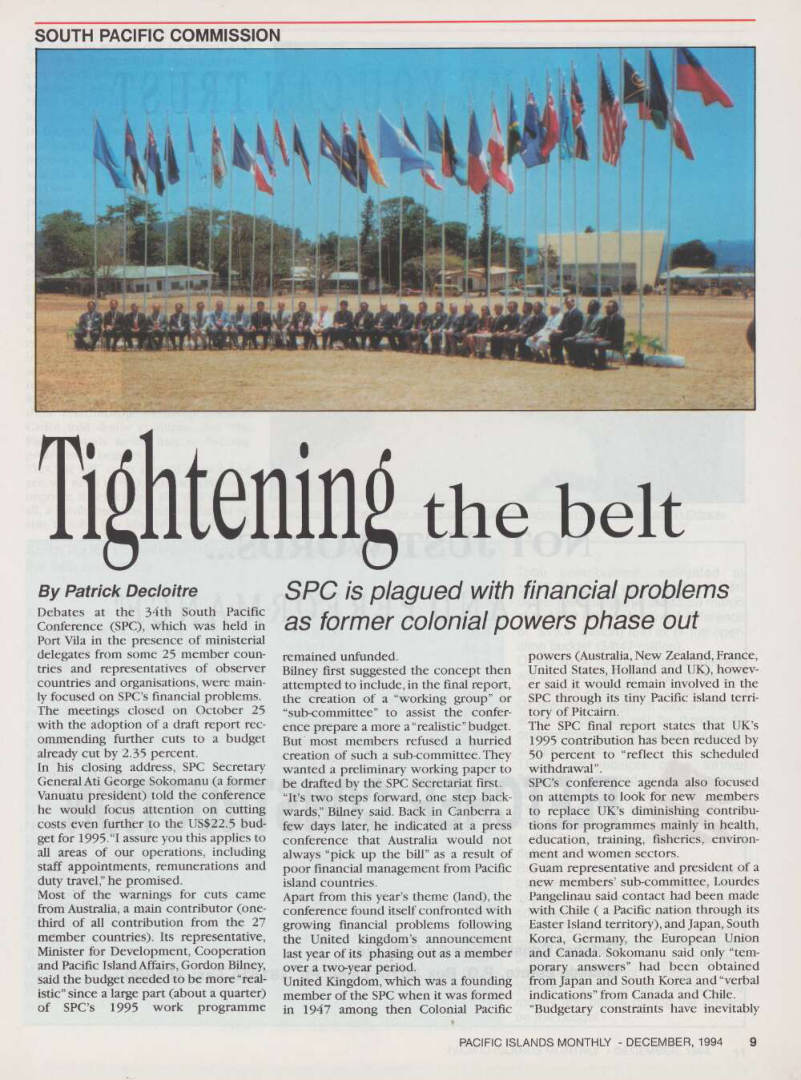
Debates at the 34th South Pacific Conference (SPC), which was held in Port Vila in the presence of ministerial delegates from some 25 member coun tries and representatives of observer countries and organisations, were main ly focused on SPC’s financial problems.
The meetings closed on October 25 with the adoption of a draft report rec ommending further cuts to a budget already cut by 2.35 percent.
In his closing address, SPC Secretary General Ati George Sokomanu (a former Vanuatu president) told the conference he would focus attention on cutting costs even further to the U 5522.5 bud get for 1995.“! assure you this applies to all areas of our operations, including staff appointments, remunerations and duty travel,” he promised.
Most of the warnings for cuts came from Australia, a main contributor (one third of all contribution from the 27 member countries). Its representative, Minister for Development, Cooperation and Pacific Island Affairs, Gordon Bilney, said the budget needed to be more “real istic” since a large part (about a quarter) of SPC’s 1995 work programme
remained unfunded.
Bilney first suggested the concept then attempted to include, in the final report, the creation of a “working group” or “sub-committee” to assist the confer ence prepare a more a “realistic” budget.
But most members refused a hurried creation of such a sub-committee. They wanted a preliminary working paper to be drafted by the SPC Secretariat first.
“It’s two steps forward, one step back wards,” Bilney said. Back in Canberra a few days later, he indicated at a press conference that Australia would not always “pick up the bill” as a result of poor financial management from Pacific island countries.
Apart from this year’s theme (land), the conference found itself confronted with growing financial problems following the United kingdom’s announcement last year of its phasing out as a member over a two-year period.
United Kingdom, which was a founding member of the SPC when it was formed in 1947 among then Colonial Pacific
powers (Australia, New Zealand, France, United States, Holland and UK), howev er said it would remain involved in the SPC through its tiny Pacific island terri tory of Pitcairn.
The SPC final report states that UK’s 1993 contribution has been reduced by 50 percent to “reflect this scheduled withdrawal”.
SPC’s conference agenda also focused on attempts to look for new members to replace UK’s diminishing contribu tions for programmes mainly in health, education, training, fisheries, environ ment and women sectors.
Guam representative and president of a new members’ sub-committee, Lourdes Pangelinau said contact had been made with Chile ( a Pacific nation through its Easter Island territory), and Japan, South Korea, Germany, the European Union and Canada. Sokomanu said only “tem porary answers” had been obtained from Japan and South Korea and “verbal indications” from Canada and Chile.
“Budgetary constraints have inevitably
forced us to reduce our spending,” said Sokomanu at the official opening of the conference. But Vanuatu Prime Minister Maxime Carlot put it more bluntly: “How can SPC justify its existence and its operating costs?”
In the same speech Carlot said he did not accept the arguments of financial necessity put forward by the United kingdom to justify its withdrawal. He accused “officials from several major powers” of not caring about the fate of Pacific Island nations.
He said according to the major powers represented at the conference, “the future revolves around the rim of the Pacific, what happens inside is of little or no consequence”.
He added that “at the same time, a grow ing number of governments or large pri vate companies are pursuing our small er nations either to seek their votes in international organisations, or to come and exploit the few resources we may have.”
Referring to developmental issues and their relationship to independence, Carlot told donor countries that “the Pacific islands would hate to become
professional beggars”.
“Yes, the SPC costs a lot of money. And yes, we need to make greater efforts to improve its efficiency. But this is, after all, a family business and we should be able to solve this kind of problem.” ■
Delegates conferring at the 34th South Pacific Conference in Port Vila. Vanuatu in October
Advertisements & other items, pp. 10-12 (1 item)
Fletcher Construction
THE NAME YOU CAN TRUST
NOT JUST WORDS...
"PEOPLE AND PERFORMANCE"
FLETCHER CONSTRUCTION
Fletcher Construction Co (Fiji) Ltd.
Wailada Estate, P.O. Box 3070, Lami. Ph: 361511 Fax: 361200
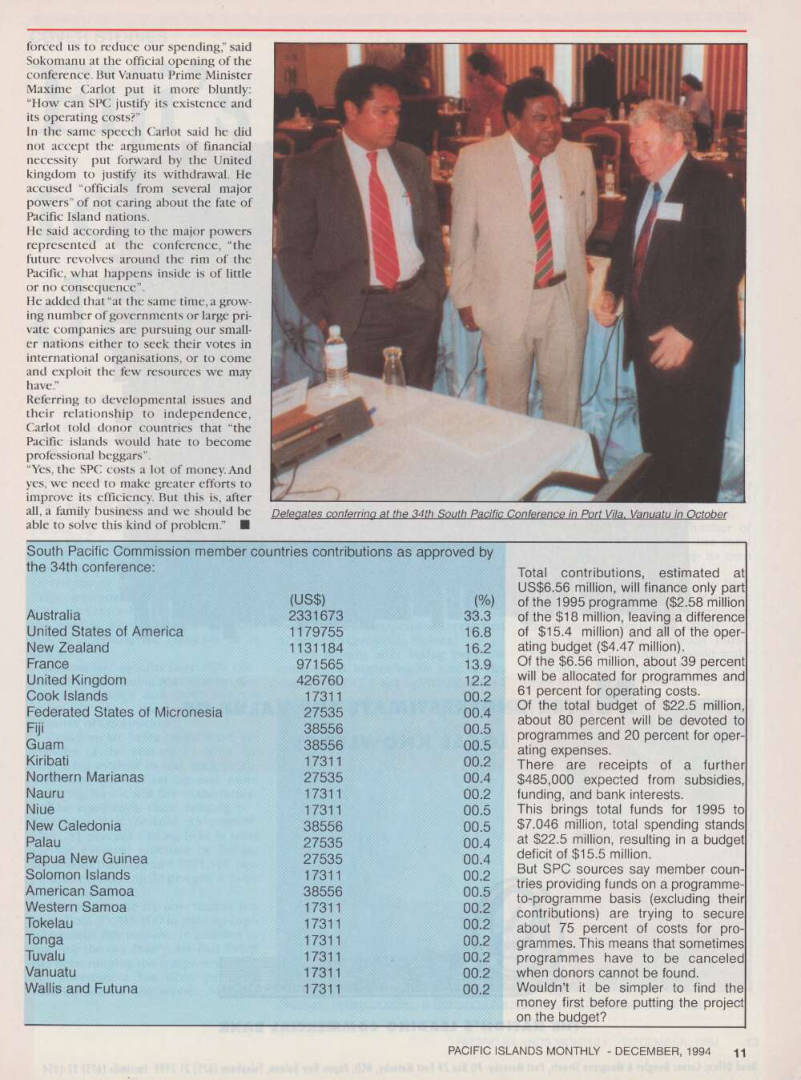
South Pacific Commission member countries contributions as approved by the 34th conference: Australia United States of America New Zealand France United Kingdom Cook Islands Federated States of Micronesia Fiji Guam Kiribati Northern Marianas Nauru Niue New Caledonia Palau Papua New Guinea Solomon Islands American Samoa Western Samoa Tokelau Tonga Tuvalu Vanuatu Wallis and Futuna Total contributions, estimated at U 556.56 million, will finance only part of the 1995 programme ($2.58 million of the $lB million, leaving a difference of $15.4 million) and all of the operating budget ($4.47 million).
Of the $6.56 million, about 39 percent will be allocated for programmes and 61 percent for operating costs.
Of the total budget of $22.5 million, about 80 percent will be devoted to programmes and 20 percent for operating expenses.
There are receipts of a further $485,000 expected from subsidies, funding, and bank interests.
This brings total funds for 1995 to $7,046 million, total spending stands at $22.5 million, resulting in a budget deficit of $15.5 million.
But SPC sources say member countries providing funds on a programmeto-programme basis (excluding their contributions) are trying to secure about 75 percent of costs for programmes. This means that sometimes programmes have to be canceled when donors cannot be found.
Wouldn’t it be simpler to find the money first before putting the project on the budget?
EVER UNDERESTIMATE THE VALUE OF
LOCAL KNOWLEDGE.
APUA NEW GUINEA BANKING CORPORATION
THE NATION'S LEADING COMMERCIAL BANK
Head Office: Corner Douglas & Musgrove Streets, Port Moresby. PO Box 78 Port Moresby, NCD, Popuo New Guinea. Telephone (675) 21 1999 Facsimile (675) 21
Fiji’s

Cover Stories
Fiji’s television dilemma
By Yunus Rashid
At least 12 years ago Fiji decided it was time to set up a television ser vice in the country. Now, after years of negotiations, calling for tenders, and leaving behind a trail of disgruntled investors, a decision appears “finally” made allowing Fiji Television Ltd to air a service to consumers who have been putting up with a temporary service since 1991.
Television New Zealand and Fiji government-owned entities Fiji Development Bank and Fiji Post and Telecommunications Limited (along with not-yet-forthcoming members of the public) were given the ominous task of operating the company as of July 1.
Almost five months later, Fiji’s con sumers are still being fed the same diet which includes a daily news bulletin compiled by the government’s Ministry of Information.
Concerns are being raised about the viability of the venture as flaws are becoming evident in the manner Fiji Television Ltd was set up and, more worrying, how it will fare in the future.
The company’s share holding is : Television New Zealand, 15 percent, FDB , 51 percent ( being held in trust for the eventual purchase by indige nous shareholders) and FPTL, 14 per cent. The remaining 20 percent is to be sold to the public.
This means the Fiji government has forked out $5,355,000 in paid up capi tal towards this venture. In addition to that, for the last four years that TVNZ has been running the temporary show, Fiji government has been paying a monthly fee for the service, bringing
total government contribution in excess of $1 million.
Not a small amount by any means, and more so for a government which by its own admission is unable to meet its expenses within the present eco nomic policies.
The venture is further complicated by the fact that the only study on its viability , carried out by TVNZ points out it will make losses to the tune of $8 million in the first five years of opera tion.
The government’s actions belie its stated conviction that the arrangement is a viable one - particularly in its deci sion to bar any competition for the first 12 years, to grant concessions.
Five months after taking over, the company is beginning to give at the seams - it has a net operating loss of
$114,000 for the first three months and the government has decided to charge it $lOOO a day for the news ser vice it produces.
Company chairman Laisenia Qarase (also FDB managing director) says gov ernment’s demand for payment would further increase losses beyond $200,000 for the first three months.
Qarase will consider a number of options, including omitting the local news bulletin until it sets up its own facility.
The company had planned to have its own news team ready by May next year. Qarase expressed concern that government’s decision would put severe strain on the company purse.
Qarase said the company would make substantial losses during the first five years but it was not made clear if the
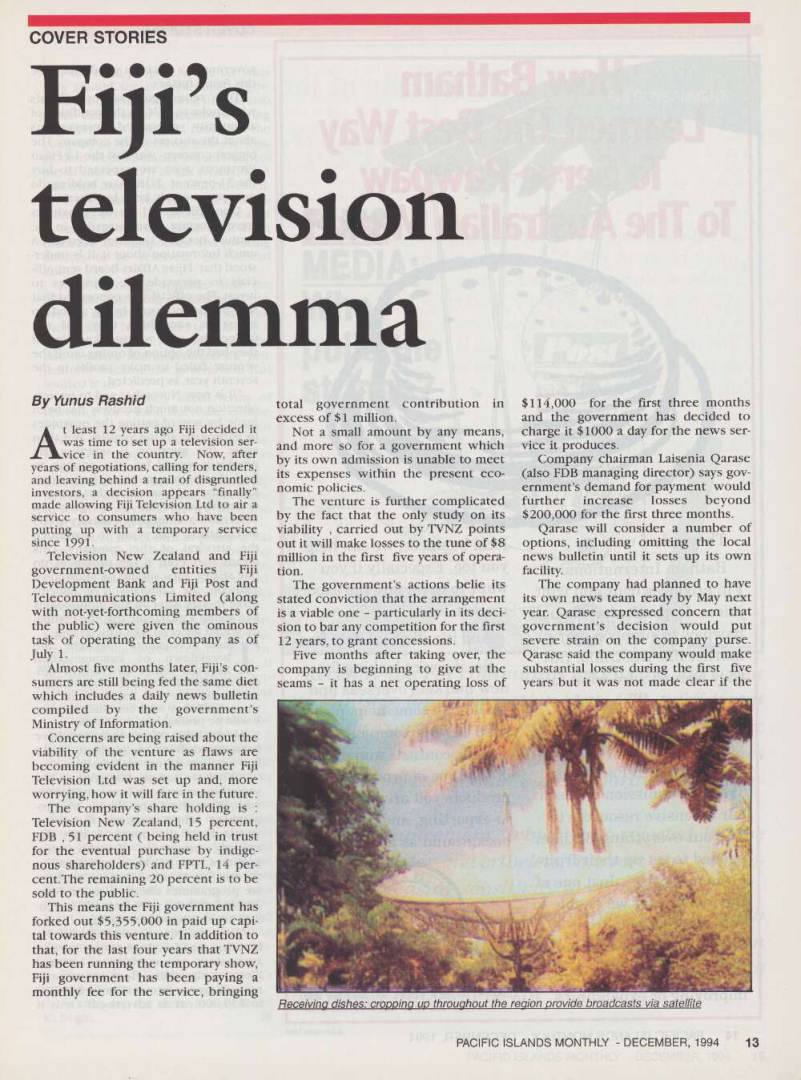
Receiving dishes: cropping up throughout the region provide broadcasts via satellite
Cover Stories
government’s decision would increase this figure further.
Two senior government officials who spoke to PIM on the condition of anonymity, expressed reservations about the success of the company. The biggest concern was that the 14 Fijian Provinces, who are expected to buy the 51-percent FDB share holding, do not appear overly keen buy them.
One official said the the provinces were reluctant about investing in the venture because they not been given much information about it. It is under stood that Fijian Affairs Board sent offi cials to persuade the provinces to invest. The official was concerned that the provinces were being asked to invest in something they did not understand and without knowing if they had the option of opting out if the venture failed to make profits in the seventh year, as predicted.
“It is now November and to my rec ollection not much headway has been made by way of getting the provinces to participate in the venture. But then again, the question is whether the provinces would be wise enough to buy shares in something they don’t know about. My worry is that the gov ernment has seen fit to give Fiji Television a monopoly, contrary to its deregulation policy just to guarantee the survival of the company. This means that even if the provinces do buy shares, they should be allowed to abandon the company if it fails to make money. After all, the monopoly is like giving a guarantee that the compa ny would succeed,” the official said.
These comments highlight the breakdown of communication between senior government offi cers and the bank.A bank source said the provinces were not expected to buy shares until they were sure the company would be profitable as anticipated.
Meanwhile, other concerns have been raised about people being “force fed” an alien culture and lifestyle.
“What we see on television is not something everybody here can identify with. What should be shown are pro grammes which enhance the living standards of the people within the existing resources. Suitable pro grammes have not been introduced in the last five months. What we see here are programmes already aired in New Zealand and the cost for such screen ings are recouped here in Fiji.
“Even the advertisements indirectly hint that the lifestyle of people in rural areas does not conform to normal lifestyles elsewhere. How can an ordi nary villager or farmer afford a $40,000 to $50,000 car as advertised? Or is it
that the rural people’s views on what they should see is irrelevant?” a gov ernment official asked. The official also raised the issue of concessions, saying if government provided funds for the company to recover from its initial loss es, then what assurance would the peo ple of the country, as tax payers, have that their money was soundly invested.
“I personally feel that the govern ment has decided to unwisely put a lot at stake on the television deal when there are more important and pressing matters to be resolved,” the official said.
It is becoming apparent that the television deal is not something all par ties had mutually agreed upon, as is fur ther evident by statements made by a Fiji Development Bank source who said the bank had undertaken the pro ject only because the government had wanted it to.
The government’s initial terms of reference for a local television compa ny had stipulated it should be at no cost to government. And it had also, along the way, stated that it was opposed to cross- media ownership that is, allowing one entity ownership of more than one medium. Applications to set up a television service were also rejected on this basis.
But in an about-turn in policy, it has now awarded licence to the Fiji Development Bank and its corporation, Fiji Posts and Telecommunications Ltd.
The bank already has another media interest - a daily newspaper.
If the Fijian provinces are not con vinced the venture is viable and decide against buying shares, then the govern ment is saddled with paying for it. If the venture is a failure, then the gov ernment would have wasted millions of dollars of tax-payers’ money.
In addition to the forecast losses, the company will also be required to pay a licence fee of $230,000 annually for the first four years, $1 million for the next two and then it comes under review.
The problem does not stop here either. If the government had looked beyond the immediate future, it would have found that there is a likelihood Australian Broadcasting Corporation will broadcast a free-to-air television service in the South Pacific in the next two years. And with the rapid advance ment in technology, Fiji could easily fall in the foot-print of a satellite, providing viewers here more access to interna tional channels.
So much for the government’s
monopoly clause.
As they say, the show is only about to begin. ■
“ ...freedom of the press ...is a freedom which is inviolable, being directly linked to our constitutional provisions on the freedom of expression - a
fundamental freedom,” so spoke
Information Minister Ratu Josefa Dimuri at the recent opening of Fiji
Journalism Training Institute.
Admirable sentiments indeed, especially when they come from a government minister, a position traditionally known for brandishing threats to muzzle this freedom in an attempt to end any criticism of the government.
And the sentiments were welcomed by journalists around the country who cherish and protect this soveriegnty of the media, knowing all too well that any threat to the sanctity of this freedom is in effect a threat to the public’s right to free speech. For ultimately media freedom is the public’s freedom to hold views (which may be contrary to the official line) and a right to express these views publicly without fear or censure, within the limitations of our existing laws relating to libel, slander and defamation.
These laws adequately protect individuals/groups from being wrongfully maligned in public and act as a check and balance measure to ensure freedom of speech does have a sound base.
That was the reason local media had
presented a united opposition to any attempts to throttle this freedom - from the complete ban on news immediately following the coups to the harsh Internal Secuirty Decree to threats issued on and off about censoring and licensing the industry.
Have we really progressed so far so soon?
A close examination of the industry in Fiji has revealed a disturbing trend - one which is becoming so ingrained so quietly that it most likely has gone unnoticed by defenders of a free Press.
The creeping worry concerns the question of ownership - and ultimately control.Who decides what Fiji’s public gets to view, hear and read and, more impor-
tantly, how they perceive the world
around them?
An analysis of the industry reveals an alarming development - the government has emerged as the largest media owner in the country in terms of diversity and reach, spanning radio, television and the print media.
This has been achieved either directly, as is the case with Fiji Broadcasting Commission, or through its subsidiaries or agencies as with the Daily Post newspaper and the newly established television company.
Let us examine the media companies and how much influence they wield.
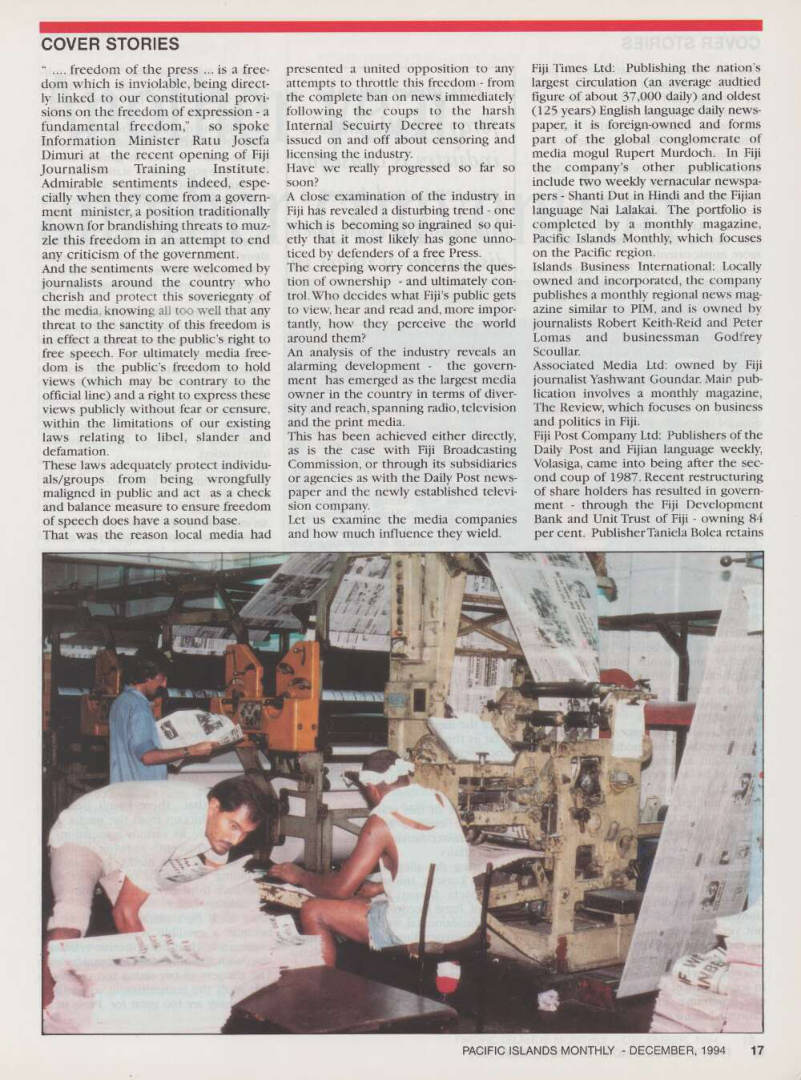
Fiji Times Ltd: Publishing the nation’s largest circulation (an average audtied figure of about 37,000 daily) and oldest (123 years) English language daily news paper, it is foreign-owned and forms part of the global conglomerate of media mogul Rupert Murdoch. In Fiji the company’s other publications include two weekly vernacular newspa pers - Shanti Dut in Hindi and the Fijian language Nai Lalakai. The portfolio is completed by a monthly magazine, Pacific Islands Monthly, which focuses on the Pacific region.
Islands Business International: Locally owned and incorporated, the company publishes a monthly regional news mag azine similar to PIM, and is owned by journalists Robert Keith-Reid and Peter Lomas and businessman Godfrey Scoullar.
Associated Media Ltd: owned by Fiji journalist Yashwant Goundar. Main pub lication involves a monthly magazine, The Review, which focuses on business and politics in Fiji, Fiji Post Company Ltd; Publishers of the Daily Post and Fijian language weekly, Volasiga, came into being after the sec ond coup of 1987. Recent restructuring of share holders has resulted in govern ment - through the Fiji Development Bank and Unit Trust of Fiji - owning 84 per cent. PublisherTaniela Bolea retains
two per cent and a management posi tion. The remaining 14 per cent is divid ed among staff members (some of whom are no longer with the company) and other interested parties, such as Attorney-General Kelemedi Bulewa (five per cent).
Fiji Broadcasting Commission: wholly government-owned enterprise providing programmes in the three main languages, through its three AM stations - Radio Fiji One,Two and Three.
Also has the FM 104 station which is more music-oriented.
Communications Fiji Ltd: A newcomer to the radio scene, it nevertheless has taken a significant share of radio listen ers in Fiji’s urban areas. The company has two radio stations - FM 96 and the Hindi language Navtarang. Both concen trate on music with hourly news spots.
Owners are William Parkinson, Unit Trust of Fiji and business people.
Fiji Television Ltd: recently incoprorated holding with dominant government control through FDB’s 51 per cent shareholding and Fiji Post and Telecommunication Ltd’s 14 per cent. In addition, a New Zealand government through its ownership of TVNZ - has a 15 per cent stake in the venture. The remaining 20 per cent will be offered to
the public.
All this after initial government guide lines that the television venture should be at no cost to government, followed by rejection of some applications on the grounds that it did not believe in cross media ownership The media enterprises with the major influence in Fiji are naturally those focusing on local issues - Pacific Islands Monthly and Islands Business are of peripheral importance. The Review, with its target readership of business men and higher income earners, does not reach the masses.
The two daily newspapers are the only players in the print media to reach the population at large. The Fiji Times, by virtue of its larger circulation, has a larg er reach. The Daily Post, for which there are no audited circulation figures avail able, would, according to industry esti mates, have a daily print run of around 10,000.
As for radio listnership, a survey con ducted last year showed FM 96 and Navtarang, where available, attracted more loyal listeners than the FBC sta tions. However, FM96 and Navtarang are not yet available throughout the coun try, especially in all outlying islands as a result of weaker signals.
Television, which is so far only available in some parts ofViti Levu, with no defi nite timeframe set for when it will go national, has no competitor.
Fiji government’s
foray into the media
industry is cause for
concern and poses a threat to free and open discussion of issues in
the community.
While government-owned media do not have a significant audience in each cate gory per se (except for television and where FM stations do not reach), the three mediums combined provide the government with a powerful voice in the media.
A voice which, when it chooses to do so, can be brought to bear upon the unfettered disemmination of news and information.
In the months following the coups, the government was keenly studying the system in place in Malaysia relating to the media. While there is a general belief that the government is loosening con trol of the media with the reliquishing of the main newspaper, New Straits Times, there is still an unwritten policy that media do not touch “sensitive” issues. And there are directive from the Home Affairs Ministry on the do’s and don’ts.
It would be naive to think that with the change to parliamentary democracy and an elected government, these studies and the ideas which urged the govern ment to consider adapting stricter con trol of the media are now behind us.
As far as the remaining “free” media are concerned, the present government is not averse to putting out threats to cur tail this freedom when criticism appears too intense.
An example of this was at the time of the furore created by allegations of Prime Minister Sitiveni Rabuka’s extra marital affairs.
Countering the allegations as reported in The Review, Information Minister Ratu Josefa Dimuri (the same who spoke of Press freedom being inviolable and a fundamental freedom) had con sidered suspending the magazine’s operations and reviewing the Media Registration Act because he was con vinced it had “misled its readers”.
There is no denying the government is also inclined to manipulate news as is evident by the treatment given to cov
erage on television. The “news” as wit nessed nightly on Fiji One is produced by civil servants at the government’s Ministry of Information. From its incep tion Fiji One news has come under crit icism from citizens, opposition political parties and viewers in general for its heavy pro-government stance, often at the exclusion of all contrary viewpoints.
There are no clear-cut guidelines on how news will be presented when the new company, Fiji Television Ltd, is fully operational. Suffice to say, the majority shareholders will have the dominant voice in appointment of the board of directors who will in turn appoint key staff members.
The government has also been known to remove items from its Radio Fiji news bulletins. Former Information Minister Ratu Inoke Kubuabola, apparently angered by what he thought was an inaccuracy went into the Radio Fiji stu dio as it was about to go on air for the 7.00 am newsbreak and walked out with the script. Much commotion was created as a result of this ministerial intervention.
Now with its control of the Daily Post , the government’s influence over the focus given to events in the media is even stronger.
An example of The Daily Post’s pro-gov ernment slant came to light in the news paper’s coverage last week of govern ment’s decision to reduce its annual grant to the Fiji Broadcasting Commission. This would mean major job losses at the commission and possi ble cuts to services. Next year’s govern ment allocation is expected to be reduced by 75 per cent.
The independent media highlighted the most newsworthy angle of the story that people would lose their jobs.
The Daily Post chose to highlight the “positive” aspect and said the govern ment had given Radio Fiji a new lease on life for the sake of Fijian listeners.
It wasn’t until the second half of the story that a brief mention of redundan cy was made.
Why is it that there hasn’t been so much as a hiccup from the media - its spokespeople, its various associations against government’s growing control?
Is it because the media generally is becoming too reliant on support and assistance from government to develop the industry here?
After all, if Fiji’s media is to grow to become a credible watchdog for the community, then an objective relation ship with the officials is recommended.
The dangers of becoming too comfort able with the authorities in so small a community are too great for Press free dom. ■
Advertisements & other items, pp. 14-16 (1 item)
Learned The Best Way
How Batham
To Serve Pawpaw
To The Australian Market.
V They asked us.
Batham International of Fiji produces fruit and fruit juices. In particular, enough pawpaw to supply a major market like Australia. But they weren’t sure what form to ship it in. Who would be most interested. Or how to get it distributed.
At the South Pacific Trade Commission we used our extensive resources to find out everything Batham needed to set up their fruitful new venture. Just one of the many ways we’re able to help businessmen from Pacific Forum countries.
If you’re starting up, improving or expanding a local business, we can help you too. Especially if you want to move into the export market.
And it’s all absolutely free.
So, if you’re looking for new markets overseas and would like some help, please send us your company details, contacts and details of the type of product or products you are interested in exporting, and as much background as possible.
SIS
-o Z I re Level 6, 50 Park Street, Sydney NSW 2000 Phone (612) 283 5933 Fax (612) 283 5948 Adventors 1481
FIJI GOVERNMENT
FJI'S
MEDIA:
Who
pulls the
strings?
EZ51 i a
TIKKA
a
IIK
c N □ %
TIK
i >tP
TELEVISION
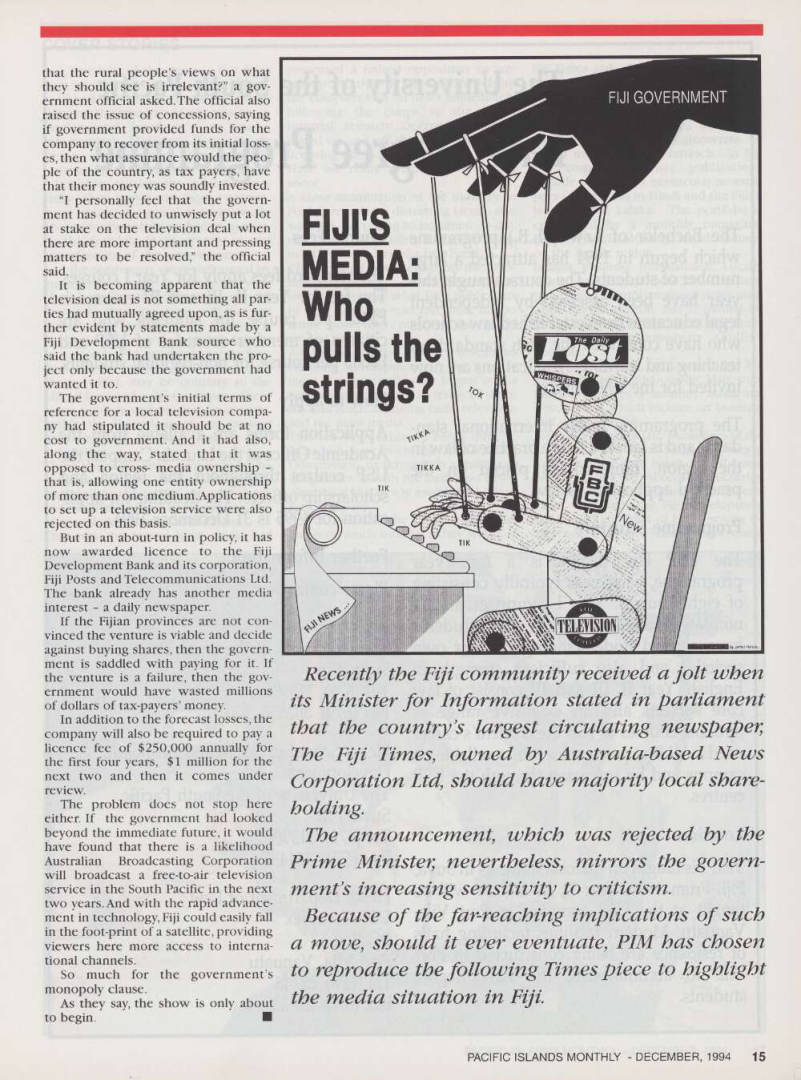
vs. / £8 Recently the Fiji community received a jolt when its Minister for Information stated in parliament
that the country’s largest circulating newspaper,
The Fiji Times, owned by Australia-based News Corporation Ltd, sbotdd have majority local shareholding.
The announcement, which was rejected by the Prime Minister, nevertheless, mirrors the government’s increasing sensitivity to criticism.
Because of the far-reaching implications of such a move, should it ever eventuate, PIM has chosen to reproduce the following Times piece to highlight the media situation in Fiji.
The University of the South Pacific Law Degree Programme
The Bachelor of Law (LL.B.) programme which begun in 1994 has attracted a large number of students. The courses taught this year have been assessed by independent legal educators from established law schools who have confirmed the high standards of
teaching and learning. Applications are now
invited for the 1995 intake.
The programme meets international standards and is tailored to the practice of law in the region. Emphasis is placed on the
practical application of law.
Programme Structure The USP law degree is a four year programme, each year typically consisting of eight courses. Year I comprises mainly non-law courses to ensure that students have a good understanding of their own societies and also sufficient strength in English. Year 11, IE and IV consist of law core subjects and an extensive range of optional courses to suit the student's career needs. All first year courses are avaEable on campus and by extension through the USP centres.
Location Year I is taught on Laucala Campus in Suva, Fiji. From 1996, Year 11, IE and IV will be taught at the USP complex in Port VEa, Vanuatu. Modem facilities including haUs of residence are being constructed in Port Vila to accommodate the Law degree students.
Course Fees The standard fees apply for Year I courses.
The fee for Year 11, 111 and IV courses is Fs42o per course for students who are citizens of member countries of USP and Fs6o6 per course for non-regional students.
How to apply Application forms are available from the Academic Office at the Laucala Campus, the USP centres throughout the region and scholarship officers. The deadline for application for 1995 is 31 December 1994.
Further Information Please contact: Registrar The University of the South Pacific Suva, FIJI Tel (679) 313900 Fax (679) 302556 Head, School of Social and Economic
Development
The University of the South Pacific Suva, FIJI Tel (679) 313900 Fax (679) 301487 Head, Department of Law
USP Complex
PO Box 12 Port Vila, Vanuatu Tel (678) 22748 Fax (678) 22633
Another year,
Tourism
Another year, another convention
By Sudesh Kissun
THE Fiji tourism industry was told dur ing the annual Fiji Tourism Convention to increase Fijian participation in executive positions especially in the management of hotels and resorts. Fiji’s Finance minister Serenade Vunibobo and Tourism minister Harold Powell both made the call that the government was concerned Fijians were clearly under-represented in these areas.
“The industry cannot afford to portray an image that Fijians clean rooms, serve at the bars and restaurants and provide entertainment while other races and expa triates run the show,”Vunibobo said.
He called on the industry to address the issue so that next year’s convention would report some progress.
Powell said Fijians enjoyed very few senior management positions even though they had been in the industry for over 30 years.
Fiji Hotel Association president Dick Smith said the issue was a long and com plicated one and asked whether the min isters meant indigenous Fijians or Fiji nationals. “If they are talking about indige nous Fijians then there is no rule stopping them from managing hotels and resorts.”
He said the industry should stop debating such issues but strive towards a strong and viable industry so everyone involved in it would benefit.
“What we should try to do is employ the largest number of locals we can find. If we can’t find suitable locals then we can get the expatriates.”
According to figures provided by the association, 101 hotels were owned by Fiji nationals, 19 by Australians, 11 by Asians, 10 by Americans, eight by New Zealanders and six by nationals from Austria, Canada, Italy and Britain.
Smith pointed out that most multi national hotels in Fiji employed Fiji nation als in the number two position.
Sheraton Fiji Resort’s resident manager,
Kevin Mutton, was an expatriate, married to a local and now residing in Fiji. Regent of Fiji’s assistant manager, Jackson Mar, is a local.
Shangri-La Fiji has Radike Qereqeretabua, an indigenous Fijian, as general manager and Fiji Mocambo Flotel is managed by another local, Bill Gavoka.
The European Union-sponsored Tourism
Council of Fiji is headed by Levani Tuinabua (indigenous Fijian) as is Fiji Visitors Bureau’s chief executive, Isimeli Bainimara.
Fijian women in the tourism industry include Beachcomber Cruises and Resorts general manager Akanisi Dreunamisimisi and Fiji Hotel Association Executive Olivia Pareti.
Smith said this proved that if people had the ability they could get top jobs in the
industry. He suggested Fijians be encour
aged to operate small scale tourism-related activities like water taxis and boats to
enhance their participation in the indus try.
The four-day tourism convention, which attracted about 400 delegates, also focused on tourism and environment, marketing, duty free shopping and government’s involvement in infrastructure develop ment.
Fiji Visitors Bureau predicted Fiji would get 310,900 visitors this year, with an earn ing potential of about $4OO million in for eign exchange and creating about 40,000 jobs.
The FVB has forecast 336,000 visitor for next year, representing growths in arrivals from Japan (29 percent), Britain (seven percent) and the United States of America (six percent).
But the bureau was concerned that a shortage of hotel rooms during the peak period (from June to October) could hin der the record arrivals forecast for next year. ■
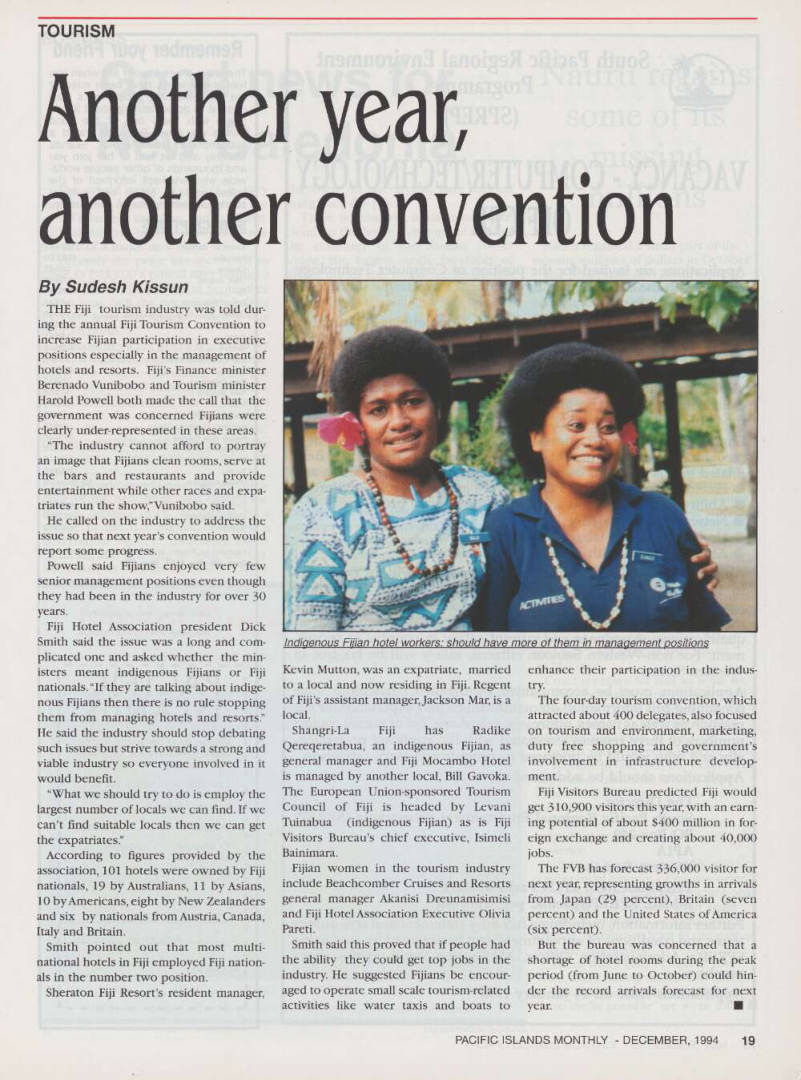
Indigenous Fijian hotel workers: should have more of them in management positions
Advertisements & other items, p. 20 (1 item)
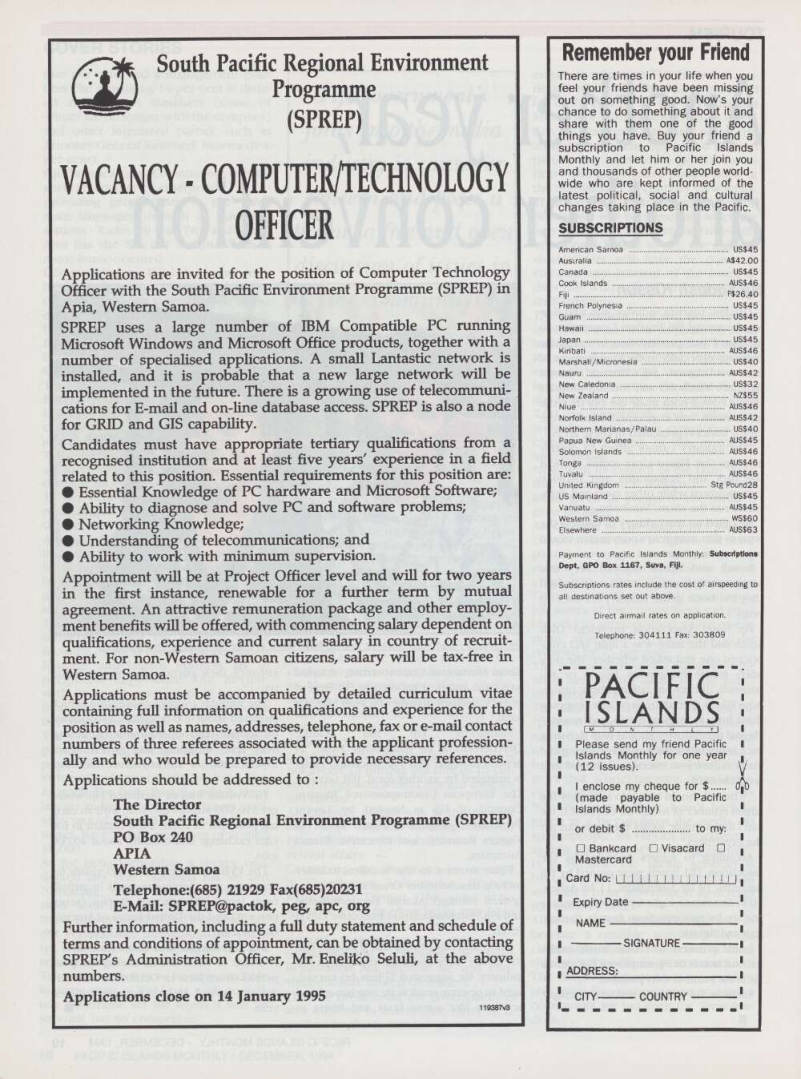
Vacancy - Computer/Technoiogy
Remember your Friend
There are times in your life when you feel your friends have been missing out on something good. Now’s your chance to do something about it and share with them one of the good things you have. Buy your friend a subscription to Pacific Islands Monthly and let him or her join you and thousands of other people worldwide who are kept informed of the latest political, social and cultural
changes taking place in the Pacific.
SUBSCRIPTIONS
American Samoa US$45 Australia A 542.00 Canada US$45 Cook Islands AUSS46 Fiji F 526.40 French Polynesia US$45 Guam US$45 Hawaii US$45 Japan US$45 Kiribati AUSS46 Marshall/Micronesia US$4O Nauru AUSS42 New Caledonia US$32 New Zealand NZ$55 Niue AUSS46 Norfolk Island AUSS42 Northern Marianas/Palau US$4O Papua New Guinea AUSS4S Solomon Islands AUSS46 Tonga AUSS46 Tuvalu AUSS46 United Kingdom Stg Pound2B US Mainland US$45 Vanuatu AUSS4S Western Samoa WS$6O Elsewhere AUSS63 Payment to Pacific Islands Monthly: Subscriptions Dept. GPO Box 1167, Suva, FIJI.
Subscriptions rates include the cost of airspeeding to all destinations set out above.
Direct airmail rates on application.
Telephone: 304111 Fax: 303809
PACIFIC :
ISLANDS ■
inohrh l r I I Please send my friend Pacific I Islands Monthly for one year (
(12 issues). y
I enclose my cheque for $
(made payable to Pacific
Islands Monthly) * or debit $ to my; □ Bankcard □ Visacard □ ( Mastercard I Card No: I M I M ! ! M ! I I ! I I ( Expiry Date 1 I
NAME ,
SIGNATURE 1
ADDRESS:
CITY COUNTRY
/Ojk South Pacific Regional Environment
Programme
(SPREP)
VACANCY - COMPUTER/TECHNOIOGY
OFFICER
Applications are invited for the position of Computer Technology Officer with the South Pacific Environment Programme (SPREP) in Apia, Western Samoa.
SPREP uses a large number of IBM Compatible PC running Microsoft Windows and Microsoft Office products, together with a number of specialised applications. A small Lantastic network is installed, and it is probable that a new large network will be implemented in the future. There is a growing use of telecommunications for E-mail and on-line database access. SPREP is also a node for GRID and GIS capability.
Candidates must have appropriate tertiary qualifications from a recognised institution and at least five years' experience in a field related to this position. Essential requirements for this position are: • Essential Knowledge of PC hardware and Microsoft Software; • Ability to diagnose and solve PC and software problems;
• Networking Knowledge;
• Understanding of telecommunications; and • Ability to work with minimum supervision.
Appointment will be at Project Officer level and will for two years in the first instance, renewable for a further term by mutual agreement. An attractive remuneration package and other employment benefits will be offered, with commencing salary dependent on qualifications, experience and current salary in country of recruitment. For non-Westem Samoan citizens, salary will be tax-free in Western Samoa.
Applications must be accompanied by detailed curriculum vitae containing full information on qualifications and experience for the position as well as names, addresses, telephone, fax or e-mail contact numbers of three referees associated with the applicant professionally and who would be prepared to provide necessary references.
Applications should be addressed to : The Director South Pacific Regional Environment Programme (SPREP) PO Box 240
APIA
Western Samoa Telephone:(6Bs) 21929 Fax(685)20231 E-Mail: SPREP@pactok, peg, ape, org Further information, including a full duty statement and schedule of terms and conditions of appointment, can be obtained by contacting SPREP's Administration Officer, Mr. Eneliko Seluli, at the above numbers.
Applications close on 14 January 1995 119387v3
New Caledonia
Business
Good news for New Caledonia
The world price of nickel is very important in New Caledonia, one of the world’s largest supplies, and is poten tially significant in the Solomons, possi ble site of a major new mine.
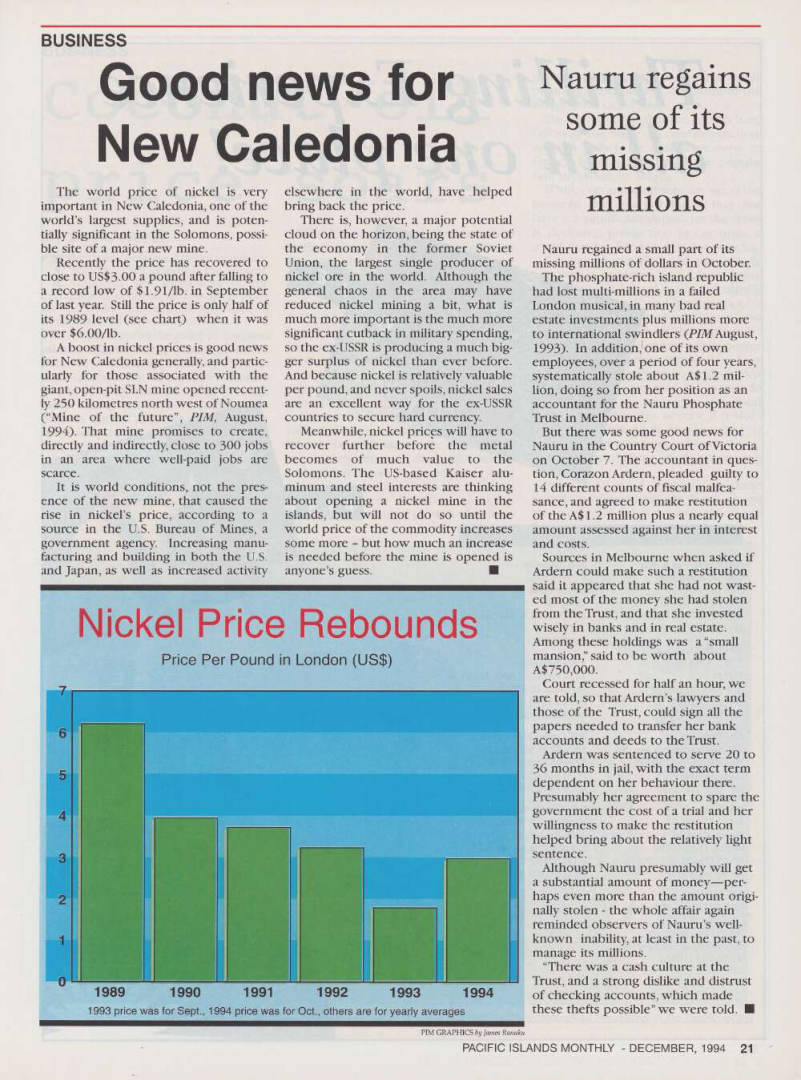
Recently the price has recovered to close to US$3 00 a pound after falling to a record low of $1.91/lb. in September of last year. Still the price is only half of its 1989 level (see chart) when it was over $6.00/lb.
A boost in nickel prices is good news for New Caledonia generally, and partic ularly for those associated with the giant, open-pit SLN mine opened recent ly 250 kilometres north west of Noumea (“Mine of the future”, PIM, August, 1994). That mine promises to create, directly and indirectly, close to 300 jobs in an area where well-paid jobs are scarce.
It is world conditions, not the pres ence of the new mine, that caused the rise in nickel’s price, according to a source in the U.S. Bureau of Mines, a government agency. Increasing manu facturing and building in both the U.S. and Japan, as well as increased activity
elsewhere in the world, have helped bring back the price.
There is, however, a major potential cloud on the horizon, being the state of the economy in the former Soviet Union, the largest single producer of nickel ore in the world. Although the general chaos in the area may have reduced nickel mining a bit, what is much more important is the much more
significant cutback in military spending,
so the ex-USSR is producing a much big ger surplus of nickel than ever before.
And because nickel is relatively valuable per pound, and never spoils, nickel sales are an excellent way for the ex-USSR countries to secure hard currency.
Meanwhile, nickel prices will have to recover further before the metal becomes of much value to the Solomons. The US-based Kaiser alu minum and steel interests are thinking about opening a nickel mine in the islands, but will not do so until the world price of the commodity increases some more - but how much an increase is needed before the mine is opened is anyone’s guess. ■
Advertisements & other items, p. 21 (1 item)
Nickel Price Rebounds
Price Per Pound in London (US$)
PIM GRAPHICS by James Ranuku
missing
Nauru regains some of its missing millions
Nauru regained a small part of its missing millions of dollars in October.
The phosphate-rich island republic
had lost multi-millions in a failed London musical, in many bad real estate investments plus millions more to international swindlers (PlM August, 1993). In addition, one of its own employees, over a period of four years, systematically stole about Asl.2 mil lion, doing so from her position as an accountant for the Nauru Phosphate Trust in Melbourne.
But there was some good news for Nauru in the Country Court of Victoria on October 7. The accountant in ques tion, Corazon Ardern, pleaded guilty to 14 different counts of fiscal malfea sance, and agreed to make restitution of the A$ 1.2 million plus a nearly equal amount assessed against her in interest and costs.
Sources in Melbourne when asked if Ardern could make such a restitution said it appeared that she had not wast ed most of the money she had stolen from the Trust, and that she invested wisely in banks and in real estate.
Among these holdings was a “small mansion,” said to be worth about A 5730,000.
Court recessed for half an hour, we are told, so that Ardern’s lawyers and those of the Trust, could sign all the papers needed to transfer her bank accounts and deeds to the Trust.
Ardern was sentenced to serve 20 to 36 months in jail, with the exact term dependent on her behaviour there.
Presumably her agreement to spare the government the cost of a trial and her willingness to make the restitution
helped bring about the relatively light
sentence.
Although Nauru presumably will get a substantial amount of money—per haps even more than the amount origi nally stolen - the whole affair again reminded observers of Nauru’s well known inability, at least in the past, to manage its millions.
“There was a cash culture at the Trust, and a strong dislike and distrust of checking accounts, which made these thefts possible” we were told. ■
Advertisements & other items, p. 22 (1 item)
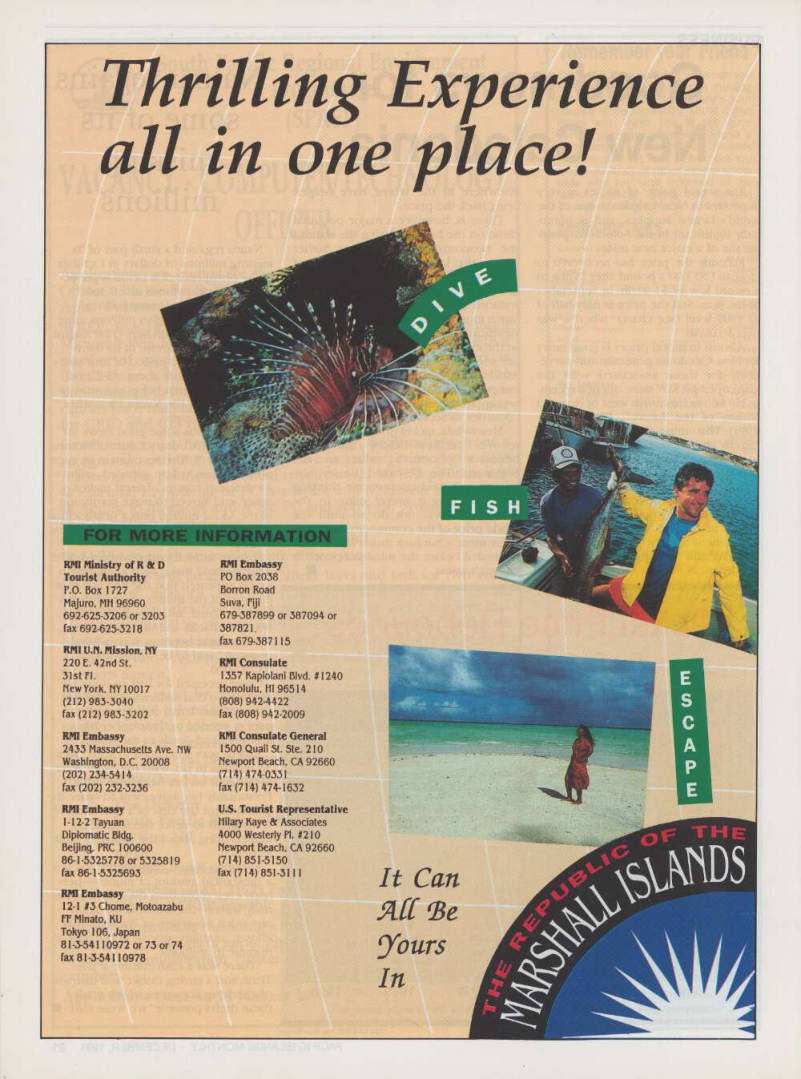
Thrilling Experience
all in one place!
RMI Ministry of R fir D Tourist Authority P.O. 80x1727 Majuro, MH 96960 692-625-3206 or 3203 fax 692-625-3218 RMI U.N. Mission. NY 220 E. 42nd St. 31stEI.
New York, NY 10017 (212)983-3040 fax(212)983-3202 RMI Embassy 2433 Massachusetts Ave. NW Washington, D.C. 20008 (202) 234-5414 fax (202) 232-3236 RMI Embassy 1-12-2 Tayuan Diplomatic Bldg.
Beijing, PRC 100600 86-1-5325778 or 5325819 fax 86-1-5325693 RMI Embassy 12-1 #3Chome, Motoazabu IT Minato, KU Tokyo 106, Japan 81-3-54110972 or 73 or 74 fax 81-3-54110978 •r* ... |p RMI Embassy PO Box 2038 Bonron Road Suva, Fiji 679-387899 or 387094 or 387821, fax 679-387115 RMI Consulate 1357 Kapioiani Blvd. #1240 Honolulu, HI 96514 (808) 942-4422 fax (808) 942-2009 RM! Consulate General 1500 Quail St. Ste. 210 Newport Beach, CA 92660 (714) 474-0331 fax (714) 474-1632 U.S. Tourist Representative Hilary Kaye & Associates 4000 Westerly PI. #2lO Newport Beach, CA 92660 (714) 851-5150 fax (714) 851-3111
It C
M <Be
yours
In W
price soars
Business
Coconut oil price soars
By David North
The most pervasive form of economic activity in the islands is the harvest, shipment and processing of the omnipresent coconut, so it is good news for the entire region when the value of coconuts increases.
In recent months the price of coconut oil, the biggest money earner from the coconut tree, has increased by 50 per cent going from about US2O cents a pound to more than 30 cents. (As with most widely traded commodities, the price is quoted at a particular place in the world - in this case dockside in New Orleans, the American port.) To the extent that the commodity price increase reaches back to the islands, this is good news all around, for producers, for shippers, and particularly for governments.
Why for government? Because many of them prop up the price of coconuts or copra, the dried form, to encourage people to stay in the outer islands, where coconut is the primary and sometimes only cash crop.
The Marshall Islands, for example, has long used some of its Compact of Free Association money from the US govern ment to subsidise both the growing of coconuts in the outer islands, and the conversion of them into coconut oil for export.
Along with the usual economic moti vations there is a demographic one, too.
Majuro is splitting at the seams as a result of migration to the capital island, and subsidisation of outer island coconut production is one of the tools the government is using to keep Majuro’s population growth down to
manageable proportions. (So is a family planning program; see “Investing in the future” PIM Oct. 1994).
My impression is that the French have followed the same coconut-production subsidy policy for similar reasons in French Polynesia, to ease the popula tion pressures on Tahiti.
While coconut oil prices are up, at the moment, this has not had - may not have - a significant impact on the slow ly declining production in coconuts, a trend that has been in play for decades.
Growing, harvesting and particularly processing coconuts, is a labour-inten sive process; it is hard work, and usually not well-paid work, and how much of it is done on a specific island often relates to decisions made in distant capitals.
If, for example, a metropolitan power (e.g. Germany before World War I, or Japan between the two wars) decides it wants to grow coconuts for export to the homeland, it organises the local economy so that this occurs; if it does not care about such exports, and is interested in pursuing other values, coconut production and processing may suffer.
Palau is a good example of these swings in imperial moods; the Germans (in power in Palau for only 15 years)
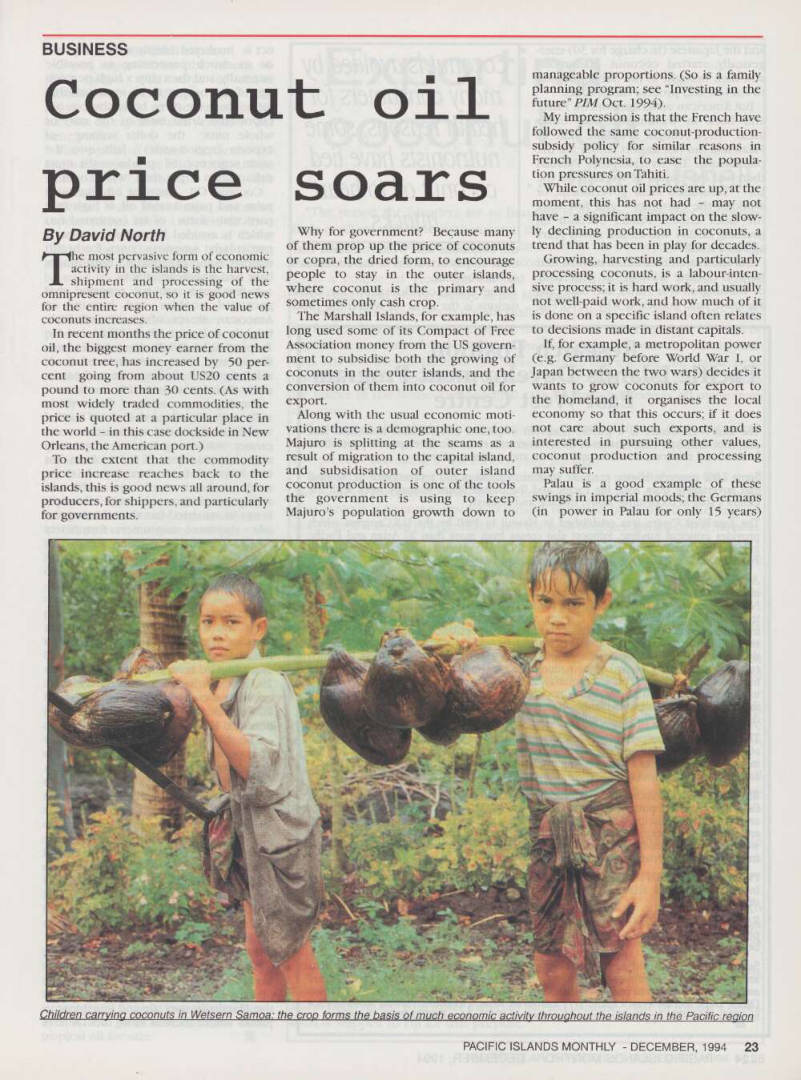
Children carrying coconuts in Wetsern Samoa: the crop forms the basis of much economic activity throughout the islands in the Pacific region
and the Japanese (in charge for 30) ener getically started coconut plantations and then brought in the needed labour to harvest and process the product.
But American administrators on Palau, and back in Washington, had other ideas. They brought a welfare state to Palau and did not import labour for the plantations. To oversimplify, Palauns then had the choice of working for the US - subsidised local government, or working the coconuts - and few took the latter choice. Palau’s coconut oil pressing facility was closed down years ago as a result.
But there are other island nations that have to operate without the generosity of Washington ((or Paris), and that, plus adequate land masses, is why PNG, Fiji,
Coconut is avoided by many consumers for health reasons; some nutrionists have tied coconut oil to heart attacks
the Solomons and Western Samoa con tinue to pay attention to the economics of the coconut.
One basic consideration for these nations is the form in which the prod
uct is marketed. Ideally a nation would do as much processing as possible internally, and then ship a high percent age of the output in its most valuable form. There are three basic choices: oil, copra (the dried meat of the nut) or whole nuts; the dollar volume of exports (region-wide) falls into the same sequence, oil produces the most dollars, then copra, then whole nuts.
Coconut Oil Coconut oil, like both palm and palm kernel oil, is high in a particular form of fat (saturated fat) which is avoided by many consumers, particularly American ones, for health reasons; some outspoken nutritionists have tied it to heart attacks.
A few years ago we reported that packaged cookies and biscuits in American stores often carried little brightly coloured labels “Contains No Tropical Oils”. While these labels have disappeared, many manufactured foods still brag about their low fat, and partic ularly their low saturated fat, content.
Turning from packaged foods made with vegetable oils to the sale of bottled vegetable oils in the supermarkets, one cannot, without going to a specialty store, buy coconut oil for cooking, but one buys oil from corn, canola (rape seed), soybean, sunflowers, safflower and peanuts (ground nuts), all much lower in saturated fats than the tropical oils. Qapanese consumers, fortunately for the islands, do not worry about such things.) Most of the coconut oil shipped to the US is used for non-food items, likes soaps, shampoos and can dles.
The price of coconut oil is volatile on the world market; sometimes reflecting fashions in eating habits, but more often the classic fluctuations of supply and demand. The average price in 1991 was 19.7 cents, in 1992 the average was 26.1 cents, in October, 1993 it had fallen to 20.5 cents, and in November 1994 had bounced back to 33 cents.
The substantial increase in the value of exports between 1991 and 1992 - it was about 60 percent - reflected both a better harvest in the islands (about 30 percent more oil) and a better price (another 30 percent.) If production in 1994 holds up to the 1992 levels, and a 30-cent per pound price turns out to be the year’s average, the region’s exports of coconut oil will reach nearly $40,000,000 - up a bit from 1992, and almost double the 1991 total of $21,500,000.
Copra To produce copra one opens the nut and dries it until the moisture level is reduced to about 14 percent; then it can be shipped either for press ing into oil, or for other uses. The drying process in many of the islands, such as the Marshalls, uses air and sunshine; in places where there is more fuel there is
the option of kiln-dried copra.
Copra exports from the islands in 1992 had a total value of about $25,000,000 according to the FAO, about two-thirds of the value of the coconut oil exported that year from the
same places.
The principal island exporters of copra that year were PNG ($9,000,000), Vanuatu ($7,300,000), and the
Solomons ($6,500,000).
Whole Nuts Most large American supermarkets have a dozen or two coconuts for sale, at prices of about US$ 1.00 each. The worker back in the islands who harvested the coconut and brought it to a local middleman may have received all of one American cent for it.
Other nations produce other coconut products. Thailand, for example, exports canned coconut milk, often used in cur ries, and the Philippines (the world leader in coconut production) produces a moist coconut meat which is used in candy bars.
Palm Oil and Palm Kernel Oil The two commodities have quite different qualities, and are produced and priced separately. PNG is the principal suppli er of these oils in the islands; production of both kinds of oils has just about tripled in PNG between 1982 and 1993- Palm oil is relatively high in saturated fat (51 percent compared to 92 percent in coconut oil, and only 18 percent in peanut oil) but it is grouped with, and often priced with, other vegetable oils.
Since this is the case, events half way around the world can raise and lower palm oil prices, which went from about 16 cents a pound when it hit its lowest in June, 1993, up to the level at this writ ing, of 27 cents a pound.
According to a tropical oil specialist in the US Department of Agriculture, Malaysia increased its production of palm oil sharply in 1993, driving down the world price, and making it, for a while, the least expensive of the veg etable oils.
Then two other distant events occurred; the great flood of the Mississippi River later in 1993 ruined the soybean crop (from which soy oil is extracted) and to ease inflationary pres sures in hundreds of millions of kitchens the government of China start ed importing a large volume of various kinds of vegetable oils for subsidised resale. So with a smaller supply, and heightened demand, palm oil prices surged.
Unlike cartels that seek to regulate prices in other commodities, as in cof fee, tin and diamonds, there appears to be no such operation in tropical oils. So, if the future is like the past, prices will surge up and done.At the moment, how ever, it is a good time to have some tropical oil for sale. ■
Advertisements & other items, p. 24 (1 item)
Pacific Islands Development Program
Research Position
East-West Centre
The East-West Centre is a public, nonprofit education and research institution that examines such Asia-Pacific issues as the environment, economic development, population, international relations, resources and culture and communications.
Some 2,000 research fellows, graduate students, educators and professionals in business and government from Asia, tne Pacific and the United States annually work with the Centre's staff in cooperative study, training and research.
The East-West Centre was established in Hawaii in 1960 by the U.S.Congress which provides principal funding. Support also comes from more than 20 Asian and Pacific Sovemments, private agencies and corporations and through the East-West Centre oundation. The Centre has an international board of governors.
Applications are being accepted for a three-year limited Fellow position tf) coordinate the implementation of a major multi-year research and training project funded by the United Nations Population Fund (UNFPA) The Fellow will develop substantial regional capacity to conduct population-economic development research, policy analysis, training and integrated planning involving nationals or the region in population-economic development research projects; investigate the sustainable interrelationships between population dynamics and socio-economic change in South Pacific countries; find ways in which research results may be linked to national decision-making and policy development mechanisms; develop and publish materials based on research done in the region designed to stimulate discussion of sustainable population-development interrelationships and of the ways in which integrated planning can assist attainment of development goals among decision-makers and the wider public in selected Pacific islands countries.
The Fellow will be responsible for implementing the Project activities; coordinating with other PIDP projects and government agencies; supervising research and training activities in the selected countries and facilitating publication and dissemination of research results, and reporting of project activities.
REQUIRED QUALIFICATIONS: Applicants must have a Ph.D. in a relevant social science field, and 8 years of post-Ph.D. research experience with demonstrated ability to manage and conduct multidisciplinary research and training that bridges sustainable development and population concerns. Candidates should also have the ability to work collaboratively with regional organizations and scholars within and outside the Centre and policy makers from diverse backgrounds and cultures.
PREFERRED QUALIFICATIONS: Experience working with Pacific island policy makers in planning or field activity in the Pacific, and indepth knowledge of Pacific island situations.
SALARY RANGE: $U547,920.00 to $U552,711.00 per year, depending on qualifications, plus cost-of-living allowance currently at 22.5% (subject to change) and an attractive
benefits package.
Submit cover letter including position title and statement addressing how the qualifications are met, a resume, and names and addresses of three professional references. Screening and assessment will be based on the materials you submit. Send to; Rebecca Dixon, Personnel Office, Dept. 89,East-West Centre, 1777 East-West Road, Honolulu, Hawaii 96848 or FAX to: (808) 944-7970. Applications must be received/FAXed by DECEMBER 15, 1994.
Exporting
coconut oil ... in a nutshell
“The reason the islanders are so beautiful is because when they are babies their mothers rub them with coconut oil.”
Kevin Ake was talking to PIM from his home in the Pennsylvania mountains, but his affection for the islands, for coconuts, and for coconut oil, was obvious.
Until a couple of years ago he had been the manager of Tobalar Copra Processing Plant Inc. on Majuro in the Marshalls.
Coconut has many uses in the Marshalls he explained.“ You can burn the shells for fuel, or make into charcoal, or use them to make drinking cups, earrings or necklaces; you can drink the milk, eat the meat, and cobk with the oil.” In addi tion, one can use the fibres of the husks in ropes and matting, the smoke from burning husks to repel insects, the leaves for a roof of a house, and the trunks for timber in the house. The principal cash product, however is oil made from the copra.
If gathering the whole nuts, and smashing them and drying them into copra are labour-intensive, their conversion into oil is a capital and equipment-inten sive process, according to the former plant manager.
Tobalar accepts only copra, not whole nuts. It then cuts the copra into small pieces, heats the pieces, heats the pieces and presses out the oil. Next the oil goes through a filtration process to remove remnants of shell and other impuri ties. Then it is stored in huge tanks until the next freighter arrives in the harbour.
“How do you get the oil from the company’s tanks to the ship?” he was asked.
“First we had to make sure that the ship’s tanks were perfectly clean, then we pumped the oil into the holds with fire hoses.”
Storing the oil in the Marshalls, and shipping in tropical areas is not a prob lem, but when the weather grows cold the oil congeals and becomes like lard which means that one cannot pump it from container to container. Ships head ing into colder climate need to be able to heat the oil in transit, to keep it a liq uid. Most oil from the Marshalls flows through two semi-tropical American ports, Los Angeles and New Orleans, which minimises the need for on-board heating.
Tobalar and other coconut oil processors need a lot of heat in the pressing process; starting up the boilers and the rest of the machinery is an expensive activity, so plant managers prefer to run the machinery 24 hours a day when they have sufficient raw product.
But the Tobalar plant is too big - or the Marshalls supply of copra is too small - for year-around, 24-hour operation, so much of the year the plant sits idle, wait ing for another burst of 24-hour work. The Marshalls regularly imports copra from other islands to keep the plant going.
During Ake’s tour of duty in the Marshalls he started a soap factory along side the copra pressing mill. The Marshalls had been in the position of shipping out coconut oil, and then importing soap from the US mainland, some of which con tained coconut oil.
Tobalar now produces several different brands of bar soap and hopes to export it as well as sell it in the Marshalls. “Unlike a lot of soap, our product worked well in salt water, which is important in a country where sometimes you need to wash yourself or your clothes in the sea,” he said.
There is still another by-product of coconut - copra meal - the residue left from copra after the oil has been pressed out. This has some nutritional value, and is often mixed with other materials and fed to cattle. Some ofTobalar’s copra meal is shipped to Fiji for that purpose. ■
Advertisements & other items, p. 26 (1 item)
with the voice of the Pacific
Talk to the Pacific
Pfiere is one magazine tHat decision-matters in the ‘Pacific
must read each month.
‘That magazine is the voice of the Pacific ...
PACIFIC
SLANDS
rAC
tf
Election 2
So mmnm * Sttlvool Habuka ?» >o»*VBta Kamlkamlca **>o, bcc*** I *p- Mahendra Chaudhry Jal Ram Reddy Pacific Islands Monthly has been a cornerstone of communications in the region for 63 years.
It has built an unequalled reputation for providing the best available news, analyses and insight on events in the region.
That reputation spans the islands, the region and more than 71 countries.
That reputation puts Pacific Islands Monthly on the desks of Government figures, public servants, business leaders and other decision-makers throughout the region.
That reputation gives Pacific Islands Monthly the things advertisers need most... credibility and selling power.
Talk to your market with the voice of your market.
Pacific Islands Monthly
Call (679) 304-111.
Pacific Islands Monthly is the only regional news magazine with an independently audited circulation.
Mamaloni
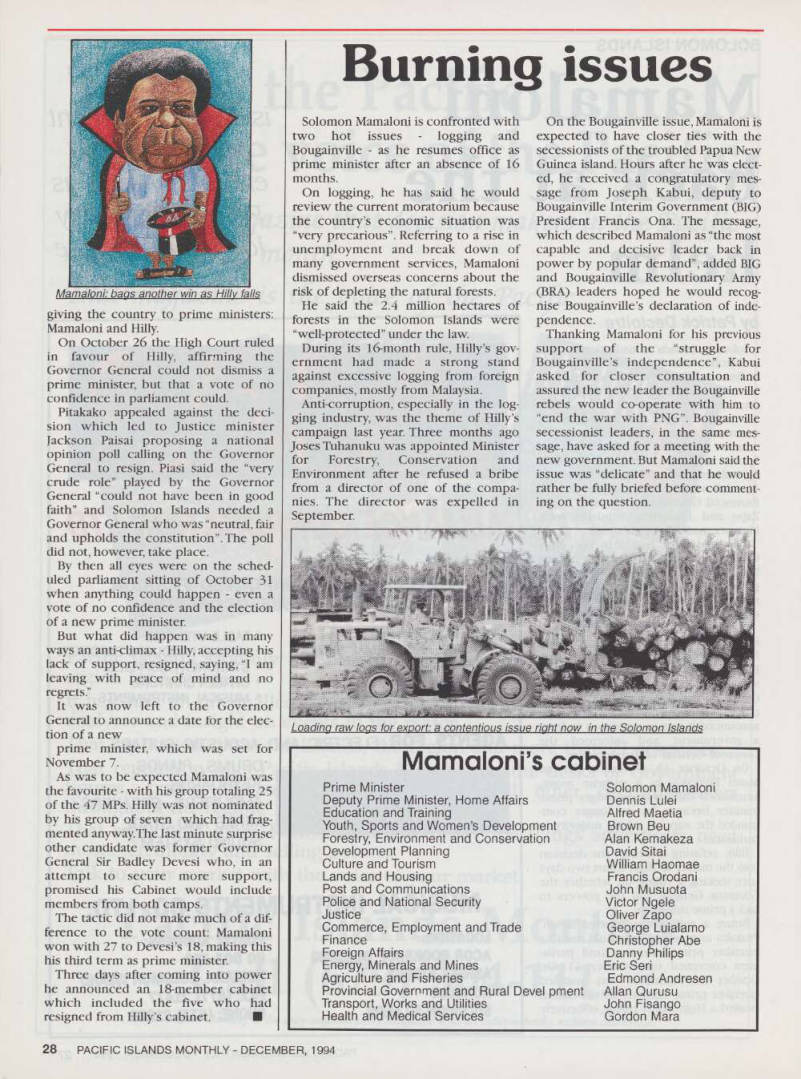
Solomon Islands
Mamaloni back at the helm
by Patrick Decloitre
Solomon Islands’ constitutional crisis in October ended with the resignation of Francis Billy Hilly and the return of Solomon Mamaloni, after serving just 16 months as Opposition leader.
It began at the end of September, when two ministers from Hilly’s gov ernment resigned. They were Youth and Sports minister Alfred Maetia and Agriculture minister Edmund Andresen.
The following week, on October 4, Provincial Government minister Oliver Zapo and Education minister John Musuota made the same move.
Five ministers had left the Hilly Cabinet in less than two weeks, placing his government, which came into power in June, 1993, in a minority posi tion with only 17 of the 47-seat parlia ment on his side.
At the same time, the Opposition had regrouped its forces into a so-called National Unity and Reconciliation Progressive Party (NURPP), claiming the support of 25 members of parliament (including the five ministers who had crossed the floor) . The NURPP then announced it was in a position to form a government and informed the Governor General of its intentions.
On October 13, Governor General Moses Pitakako, in a surprise move, announced Hilly was no longer prime minister because he no longer com manded the support of the majority in parliament.
Hilly, refusing to accept the decision took the matter to High Court two days later, seeking a ruling on whether the Governor General had the powers to sack a prime minister.
Before a ruling was handed down, Pitakako announced he would install a caretaker prime minister until parlia ment convened on October 31. On October 24, Mamaloni was installed caretaker prime minister as the nation awaited a High Court ruling, effectively
Another Pacific island government falls before the end of its term, as Francis Billy Hilly loses the ultimate numbers game
giving the country to prime ministers: Mamaloni and Hilly.
On October 26 the High Court ruled in favour of Hilly, affirming the Governor General could not dismiss a prime minister, but that a vote of no confidence in parliament could.
Pitakako appealed against the deci sion which led to Justice minister [ackson Paisai proposing a national opinion poll calling on the Governor General to resign. Piasi said the “very crude role” played by the Governor General “could not have been in good faith” and Solomon Islands needed a Governor General who was “neutral, fair and upholds the constitution”. The poll did not, however, take place.
By then all eyes were on the sched uled parliament sitting of October 31 when anything could happen - even a vote of no confidence and the election of a new prime minister.
But what did happen was in many ways an anti-climax - Hilly, accepting his lack of support, resigned, saying, “I am leaving with peace of mind and no regrets.”
It was now left to the Governor General to announce a date for the elec tion of a new prime minister, which was set for November 7.
As was to be expected Mamaloni was the favourite - with his group totaling 25 of the 47 MPs. Hilly was not nominated by his group of seven which had frag mented anyway. The last minute surprise other candidate was former Governor General Sir Badley Devesi who, in an attempt to secure more support, promised his Cabinet would include members from both camps.
The tactic did not make much of a dif ference to the vote count: Mamaloni won with 27 to Devesi’s 18, making this his third term as prime minister.
Three days after coming into power he announced an 18-member cabinet which included the five who had resigned from Hilly’s cabinet. ■
Mamaloni: bags another win as Hilly falls
Advertisements & other items, p. 27 (1 item)
Alu/ 'Ci Corporation Ltd
SPECIALISING IN IMPORTED FASHION
CLOTHING FOR ALL OCCASIONS
* FASHION CLOTHING * TABLE UTENSILS
* CASUAL AND FORMAL SHOES * MARINE PRODUCTS EXPORTER
* MANCHESTER * STATIONERY SUPPLIES
* BEDROOM LINEN ♦ OFFICE FURNITURE
* ELECTRICAL APPLIANCES ♦ MUSICAL INSTRUMENTS
AGENTS FOR ELECTRIC AND ACOUSTIC GUITARS,
DRUMS, PIANOS,
KEYBOARDS,
AMPLIFIERS, SPEAKERS,
MIKES AND STAGE
SOUND SYSTEM
MUSICAL INSTRUMENTS CO. LTD.
LOCATION:
ACOR BOOKSHOP BUILDING
ASHLEY STREET
HONIARA
SOLOMON ISLANDS
POSTAL ADDRESS:
PO BOX 780
HONIARA, SOLOMON ISLAND
FAX: (677) 21477
PHONE: (677) 21239
Burning issues
Solomon Mamaloni is confronted with two hot issues - logging and Bougainville - as he resumes office as prime minister after an absence of 16 months.
On logging, he has said he would review the current moratorium because the country’s economic situation was “very precarious”. Referring to a rise in unemployment and break down of many government services, Mamaloni dismissed overseas concerns about the risk of depleting the natural forests.
He said the 2.4 million hectares of forests in the Solomon Islands were “well-protected” under the law.
During its 16-month rule, Hilly’s gov ernment had made a strong stand against excessive logging from foreign companies, mostly from Malaysia.
Anti-corruption, especially in the log ging industry, was the theme of Hilly’s campaign last year. Three months ago Joses Tuhanuku was appointed Minister for Forestry, Conservation and Environment after he refused a bribe from a director of one of the compa nies. The director was expelled in
September.
On the Bougainville issue, Mamaloni is expected to have closer ties with the secessionists of the troubled Papua New Guinea island. Hours after he was elect ed, he received a congratulatory mes sage from Joseph Kabui, deputy to Bougainville Interim Government (BIG) President Francis Ona. The message, which described Mamaloni as “the most capable and decisive leader back in power by popular demand”, added BIG and Bougainville Revolutionary Army (BRA) leaders hoped he would recog nise Bougainville’s declaration of inde
pendence.
Thanking Mamaloni for his previous support of the “struggle for Bougainville’s independence”, Kabui asked for closer consultation and assured the new leader the Bougainville rebels would co-operate with him to “end the war with PNG”. Bougainville secessionist leaders, in the same mes sage, have asked for a meeting with the new government. But Mamaloni said the issue was “delicate” and that he would rather be fully briefed before comment ing on the question.
Loading raw logs for export: a contentious issue right now in the Solomon Islands
Mamaloni’s cabinet
Prime Minister Solomon Mamaloni Deputy Prime Minister, Home Affairs Dennis Lulei Education and Training Alfred Maetia Youth, Sports and Women’s Development Brown Beu Forestry, Environment and Conservation Alan Kemakeza Development Planning David Sitai Culture and Tourism William Haomae Lands and Housing Francis Orodani Post and Communications John Musuota Police and National Security Victor Ngele Justice Oliver Zapo Commerce, Employment and Trade George Luialamo Finance Christopher Abe Foreign Affairs Danny Philips Energy, Minerals and Mines Eric Seri Agriculture and Fisheries Edmond Andresen Provincial Government and Rural Devel pment Allan Qurusu Transport, Works and Utilities John Fisango Health and Medical Services Gordon Mara
Justice delayed
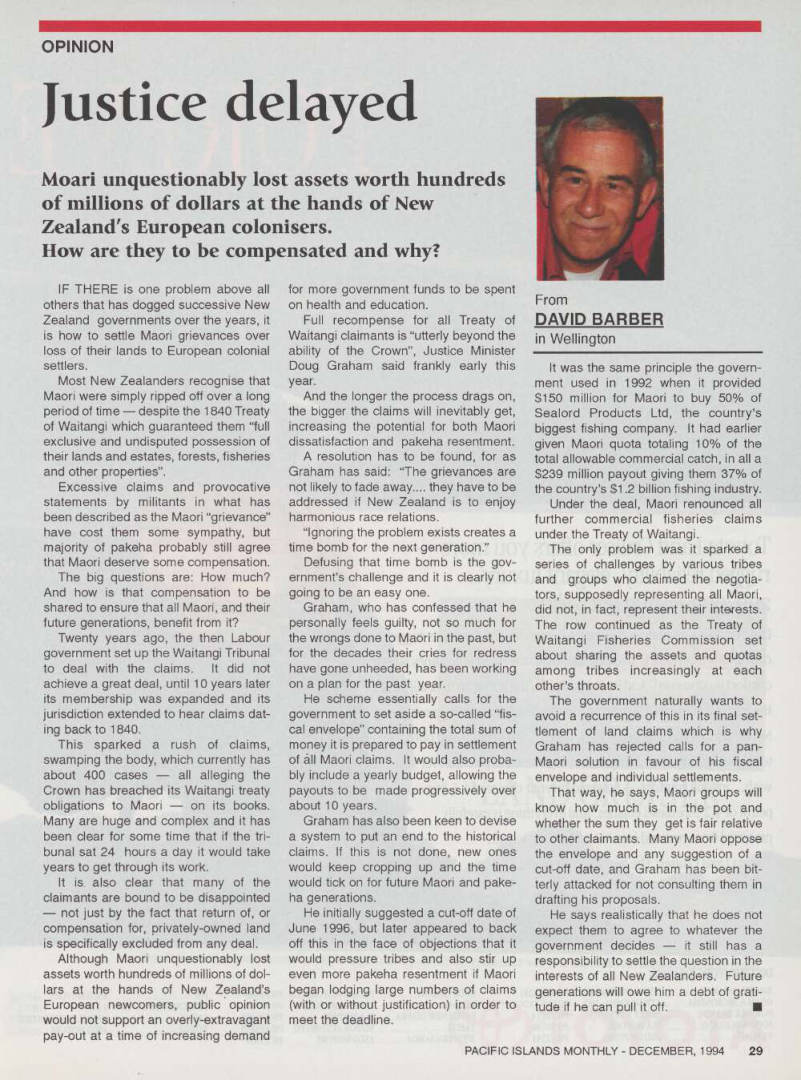
Opinion
Moari unquestionably lost assets worth hundreds of millions of dollars at the hands of New Zealand's European colonisers.
How are they to be compensated and why?
IF THERE is one problem above all others that has dogged successive New Zealand governments over the years, it is how to settle Maori grievances over loss of their lands to European colonial settlers.
Most New Zealanders recognise that Maori were simply ripped off over a long period of time despite the 1840 Treaty of Waitangi which guaranteed them “full exclusive and undisputed possession of their lands and estates, forests, fisheries and other properties”.
Excessive claims and provocative statements by militants in what has been described as the Maori “grievance” have cost them some sympathy, but majority of pakeha probably still agree that Maori deserve some compensation.
The big questions are: How much?
And how is that compensation to be shared to ensure that all Maori, and their future generations, benefit from it?
Twenty years ago, the then Labour government set up the Waitangi Tribunal to deal with the claims. It did not achieve a great deal, until 10 years later its membership was expanded and its jurisdiction extended to hear claims dat ing back to 1840.
This sparked a rush of claims, swamping the body, which currently has about 400 cases all alleging the Crown has breached its Waitangi treaty obligations to Maori on its books.
Many are huge and complex and it has been clear for some time that if the tri bunal sat 24 hours a day it would take years to get through its work.
It is also clear that many of the claimants are bound to be disappointed not just by the fact that return of, or
compensation for, privately-owned land
is specifically excluded from any deal.
Although Maori unquestionably lost assets worth hundreds of millions of dol lars at the hands of New Zealand’s
European newcomers, public opinion
would not support an overly-extravagant pay-out at a time of increasing demand
for more government funds to be spent on health and education.
Full recompense for all Treaty of
Waitangi claimants is “utterly beyond the
ability of the Crown”, Justice Minister Doug Graham said frankly early this year.
And the longer the process drags on, the bigger the claims will inevitably get, increasing the potential for both Maori dissatisfaction and pakeha resentment.
A resolution has to be found, for as Graham has said: “The grievances are not likely to fade away... they have to be addressed if New Zealand is to enjoy harmonious race relations.
“Ignoring the problem exists creates a time bomb for the next generation.”
Defusing that time bomb is the gov ernment’s challenge and it is clearly not going to be an easy one.
Graham, who has confessed that he personally feels guilty, not so much for the wrongs done to Maori in the past, but for the decades their cries for redress have gone unheeded, has been working on a plan for the past year.
He scheme essentially calls for the government to set aside a so-called “fis cal envelope” containing the total sum of money it is prepared to pay in settlement of all Maori claims. It would also proba bly include a yearly budget, allowing the payouts to be made progressively over about 10 years.
Graham has also been keen to devise a system to put an end to the historical claims. If this is not done, new ones would keep cropping up and the time would tick on for future Maori and pake ha generations.
He initially suggested a cut-off date of June 1996, but later appeared to back off this in the face of objections that it would pressure tribes and also stir up even more pakeha resentment if Maori
began lodging large numbers of claims
(with or without justification) in order to meet the deadline.
It was the same principle the govern ment used in 1992 when it provided $l5O million for Maori to buy 50% of Sealord Products Ltd, the country’s biggest fishing company. It had earlier given Maori quota totaling 10% of the total allowable commercial catch, in all a $239 million payout giving them 37% of the country’s $1.2 billion fishing industry.
Under the deal, Maori renounced all further commercial fisheries claims under the Treaty of Waitangi.
The only problem was it sparked a series of challenges by various tribes and groups who claimed the negotia tors, supposedly representing all Maori, did not, in fact, represent their interests.
The row continued as the Treaty of Waitangi Fisheries Commission set about sharing the assets and quotas among tribes increasingly at each other’s throats.
The government naturally wants to avoid a recurrence of this in its final set tlement of land claims which is why Graham has rejected calls for a pan- Maori solution in favour of his fiscal envelope and individual settlements.
That way, he says, Maori groups will know how much is in the pot and whether the sum they get is fair relative to other claimants. Many Maori oppose the envelope and any suggestion of a cut-off date, and Graham has been bit terly attacked for not consulting them in drafting his proposals.
He says realistically that he does not expect them to agree to whatever the government decides it still has a responsibility to settle the question in the interests of all New Zealanders. Future generations will owe him a debt of grati tude if he can pull it off. ■
From
David Barber
in Wellington
Advertisements & other items, pp. 30-31 (1 item)
rugged reliability, elegant luxury...
m
Toyota Land Cruiser offers you more
and long-lasting durability.
Land Cruiser’s reputation is second to none. No one doubts its rugged constitution. Yet here is a vehicle that rivals the finest limousines where comfort is concerned. And its fit and finish, the attention to detail, and the graceful lines and fine trim are reminiscent of exquisite luxury cars.
Nevertheless, hidden beneath its elegance, Land Cruisers still offer tough ladder frames and suspension engineered to go wherever you wish... in total comfort powered by your choice of 4.5-litre petrol or 4.2-litre diesel engines. And everything is carefully protected from rust and corrosion so it lasts longer.
Toyota Land Cruiser. The best for your world.
Now and forever.
Js
DISTRIBUTORS /DEALERS
AMERICAN SAMOA BURNS PHILP MOTORS PH 633-4281 GUAM & MICRONESIA ATKINS KROLL, INC. PH 646-1876/9 NORFOLK ISLAND BORRY’S PTY LTD. PH 22114
SOLOMON ISLAND ELA MOTORS PH 30746
VANUATU ASCO MOTORS PH 22341
COOK ISLANDS PACIFIC MOTORS LTD PH 20796
KIRIBATI TARAWA MOTORS PH 21090
PAPUA NEW GUINEA ELA MOTORS PH 2 29400
TAHITI NIPPON AUTOMOTO PH 429819
WESTERN SAMOA ASCO MOTORS PH 23664
FIJI ASCO MOTORS
NEW CALEDONIA S.I.A.P.
SAIPAN MICROL CORPORATION
TONGA ASCO MOTORS
- I •i£Sfe^sa» .T£. * mmammm - j . ia m
/rynr
E^3
LAND CRUISER
Exact features and speafications may vary depending on country of purchase. Please check with your nearest TOYOTA distributor/dealer for details.
PH312666 PH 275562 PH 234-5911 PH 23500
® TOYOTA
Aid, AIDS and

Money
Aid, AIDS and Per diems
If you thought those official overseas trips and conferences were nothing more than a lucrative source of tax-free income, you are probably right.
By Roman Grynberg
the per diem, and they are tax free in most Pacific island countries, the incentive to go ‘down market’ in terms of your accom modation and save the per diem is enor mous.
The hotel in Ermita was the usual fare noisy air-conditioning and tame cock roaches that helped you forget the noise, poverty and misery just outside the door.
A number of participants at the confer ence also came and stayed in Ermita. At night the others wanted to see what Manila was famous for. So I took my col leagues down to Mabini and Del Pillar Street, the centre of what used to be the red light district. There is a great deal of irony as well as misery on those streets.
Both Mabini and Del Pillar were Filipino nationalist leaders who had rebelled against colonial rule. I had always thought that they must be turning in their graves knowing their names were now associat ed with prostitution and brothels.
Much to my horror the old bars were dark - the mayor of Manila had closed them claiming that he wanted to ‘clean up the image of the town’. Quite by accident I met an old friend Drajan, a Yugoslav Australian who owned a bar on Del Pillar.
Sitting there drunk in one of the few remaining cafes, he told me to go down Roxas Boulevard, just beyond the outskirts of Manila and he would find the place where the old Ermita had moved.
The ‘new Ermita’ had even less style than the old. It was a hasty collection of bars established around a vacant lot around an unsealed road and had all the feel of the ‘wild west’. As you got past the bar entrance - there it was, just as Drajan had said - pot-bellied middle aged Australians drooling over half-naked Filipino girls dancing on the stage. All had numbers attached so the buyers, or more correctly tenants, could easily differentiate them.
Five years had elapsed since I had been in such a bar and maybe it was the aids conference I was attending or just too much gray in the beard, but they really did
The number of USP and UPNG eco nomic students who have over the years submitted papers to me about the evil effects of ‘foreign aids’ almost defies credulity. At first I thought this was simply a misspelling but experience has
recently taught me that perhaps they
might know something I don’t.
Last year I was invited by the UNDP to attend a conference in Manila on the eco nomic consequence of aids in Asia. The conference was held, as is so often the case, among the plush marble conference room of the Asian Development Bank headquarters in Manila. The ADB office is beautifully constructed with all the wealth and opulence that one would expect of an organization dedicated to assisting the poor - who can be found in such large numbers just outside their doors.
The conference organizers had done their best to choose the most expensive hotel in Makate. Having been in Manila many times in the past, I decided to opt for a lower cost hotel on the edge of what used to be the red light district of Ermita.
Those who are lucky enough to receive invitation to such international meetings are paid a per diem or a DSA (daily subsis tence allowance). The DSA pays for a lot more than subsistence. Usually it pays for a good hotel and three meals per day. The per diems or DSA vary depending upon the expense of the country. If you are lucky enough to be sent to New York you will get US$2OO per day. If three of you are sent and share a room and eat at MacDonald’s for a two-week conference then you can easily end up saving US$2OOO. For a bureaucrat earning between US$lO,OOO -15,000 a year, which is about average in the South Pacific, such a conference is the biggest legal windfall he can hope for in any year: it will give him more money in the pocket than any promotion he could reasonably expect.
Given that you never have to account for
look like so many sausages for sale or rent.
After the second or third beer I got terri bly depressed and left. My friends stayed.
The next morning the expected hap pened. I went to wake up my colleagues in their room and a girl - number 73, if I recall correctly - answered the door. Clearly my colleagues found sausage far more attrac tive than I did. They of course denied sleeping with the girls - they had just stayed there the night. It was like President Clinton’s now famous admission that he had smoked marijuana but had never inhaled. At that moment I finally understood that my students who appar ently mistook ‘foreign aid’ for ‘foreign aids’ may actually have struck upon something.
My colleague could well have been using the per diem he was getting to attend an aids conference to actually transmit aids back to the Pacific.
I returned to Suva and \ It / recounted the anecdote to my W friends, for many, who like me had previously worked in senior positions in government, the story was no news at all. Virtually everyone could recount a story of having to get their minister out of a brothel in Bangkok when attending an ESCAP meeting or drunken debauchery with their permanent secretaries in Manila
or New Delhi. The per diems that these officials received from the aid agencies to attend these meeting became a means for a life-style that none could possibly afford back home.
The problem with the per diem is not that it ends up used in bars and brothels.
The most common use of the per diem in the Pacific is for savings. Most Pacific Islanders do not end up in bars - most live very frugally and save their per diem so that they can buy themselves a duty-free stereo. In my own case the difference in hotel costs was enough to pay for clothes for my children and wife for almost a year.
This very financial logic, or something that is very similar to it, is what pervades the decision by many Pacific Islanders on where they stay when are invited to attend international conferences.
But there is another very important down-side to per diems.They are so lucra tive that some government officials will become what is known in the business as ‘astronauts’ - flying around the world attending one conference after another in order to collect per diems. However, in order to get to these conferences the offi cial has to satisfy two parties - his boss as well as the aid agency. I recall one previ ous deputy Secretary General of a region
al organization black-listing a Niuean offi cial who had had the temerity to com plain about her during an attachment with the organization. ‘No more per diems for her’ was the passing comment.
Senior government officials know that the best pay-off to one of your ‘yes men’ is to send him or her on a conference. Thus the conference travel becomes a powerful vehicle of incentives and control of gov ernment officials.
Understanding per diems goes a long way to explaining a lot of government behavior that is not always clear to those viewing government from the outside. If you want to have a regional conference and you want permanent secretaries to attend, the conference has to be in Sydney or Brisbane. Even the paltry SPOCC (South Pacific Organizations Coordinating Committee) per diems in Australia are about US$l7O per day with the opportunity for good shopping. The best attended conferences are before Christmas, as they permit a shopping trip.
If you only want junior officials to attend then Kiribati will do, but Western Samoa is just a no-no because the per diems (US$ 110 per day), for some reason are very low.
But there is another element of all this that is far from comical. The current pressure for training semi nars is part of the same economic incen tive. Training seminars are usually long and hence the total per diems earned by a participant can be enormous. A training seminar for junior central bank officials in Washington with IMF or a trade officials course at GATT in Geneva can be US$lOOO - 2000 in saved per diems.
The very best option, though, is training leave. This will give you a year (or some times two) where you will receive not only your regular salary as a public servant back home, but also a scholarship or bet ter, with restricted per diems. In PNG the Commission for Higher Education and the Public Service could never understand why it look so long for their students to finish their MAs and PhDs in Australia or the UK. It was not because the students were bad but because they were making double income and returning home would be a financial disaster.
To the outsider who is not privileged to have entry to this world, these stories are a source of anger which is often just thin ly disguised jealousy. But if collecting per diems and attending a dozen training sem inars in two or three years is a ‘bad thing’, then trying to remove them might be futile and counter-productive. Financial controllers of international organizations and government bureaucracies have long known about this ‘rent -seeking behavior’ but they are faced with two options. The
first is to pay per diems and have confer ence participants account for the expense or just pay a lump sum as is presently the case. The former course cre ates a massive financial bureaucracy where the financial controllers have to check thousands of receipts - many of which can be easily forged or created. The other is to put up and shut up- which is the usually accepted option.
In a real sense this per diem hunting is just one more symptom of economic fail ure. If the region develops and salaries are high, the relative financial benefits of going to conferences would be small - as they are in developed countries. But this is not the case. Per diems have become a sick and perverse link between the nation al bureaucracies of the region and the international aid agencies that assist and increasingly dominate policy in the region. But remove the per diems and some of our officials will find other, less savory ways of supplementing their incomes.
At very best , per diems will clothe my children or pay for a stereo, but at worst they end up as a conduit for aids.
However, in the end the money that is used for the payment of per diems is for eign aid and if naivete can be forgiven, it is money that could have helped the poor which, believe it or not, was orinal ly the intention of the citizens of the developed countries who pay for the aid.
If for one moment we look past the slick cynical over -paid officials who will give you a hundred reasons why this process continues, the real reason is that it is part of a very personal web of control over each and every one in government. These meetings give mandates to aid agencies to undertake initiatives - they are important vehicles by which these agencies get gov ernment consent to continue to under take their work programmes. Without many of these meetings more money can not be spent, consultants will not be hired and bureaucrats who are nothing in their own countries will not be able to contin ue to live on their fantastic salaries in the Pacific and elsewhere. From the per diem recipient’s perspective, the key is that without these meetings there are no more meetings and hence no more per diems.
Only those who are so rich that they want no more per diems would be so rude as to get up at an international conference and say that it is time we spent develop ment assistance funds on the poor rather than on clothes, stereos or spreading aids. ■
These are the views of Dr Roman Grynberg and not necessarily those of the University of the South Pacific where he is employed.
Advertisements & other items, p. 34 (1 item)
r/mm noonu
Ni i. n &:r rv :
Bertei
■ ■ ' j i ap T i 24
r/mm noonu
m m ipping Ltd has introduce major new development in the evolution of freight services between the Pacific Islands and the World with the introduction of:- NEW SCHEDULES - providing services to the Pacific Islands every 14 days ■ MODERN SHIPS -as well as the Filaos, Translink Pacific Shipping has introduced six modern Astrakhan vessels to its Pacific service ■ BETTER RATES - the Pacific is a tough market, but so are we - talk to us about our unbeatable rates IMPROVED CARGO OPTIONS - the versatility of the Astrakhan vessels means we can offer unprecedented options including RO/RO, breakbulk, container and reefer moves (ionUu'i your lorn! shipping agent now, and bo pan
ol (ho now ora of progross!
a pity
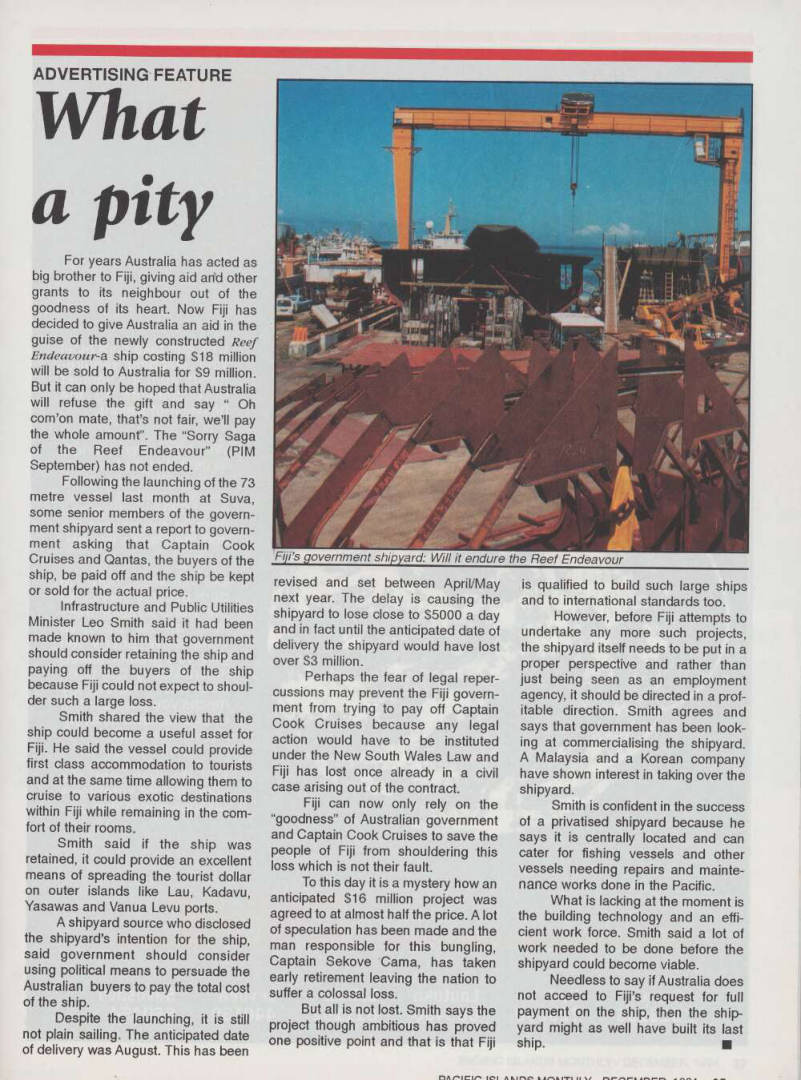
Advertising Feature
What a pity
For years Australia has acted as big brother to Fiji, giving aid ant'd other grants to its neighbour out of the goodness of its heart. Now Fiji has decided to give Australia an aid in the guise of the newly constructed Reef Endeavour-a ship costing $lB million will be sold to Australia for $9 million.
But it can only be hoped that Australia will refuse the gift and say “ Oh com’on mate, that’s not fair, well pay the whole amount’. The “Sorry Saga of the Reef Endeavour” (RIM September) has not ended.
Following the launching of the 73 metre vessel last month at Suva, some senior members of the govern ment shipyard sent a report to govern ment asking that Captain Cook Cruises and Qantas, the buyers of the ship, be paid off and the ship be kept or sold for the actual price.
Infrastructure and Public Utilities Minister Leo Smith said it had been made known to him that government should consider retaining the ship and paying off the buyers of the ship because Fiji could not expect to shoul der such a large loss.
Smith shared the view that the ship could become a useful asset for Fiji. He said the vessel could provide first class accommodation to tourists and at the same time allowing them to cruise to various exotic destinations within Fiji while remaining in the com fort of their rooms.
Smith said if the ship was retained, it could provide an excellent means of spreading the tourist dollar on outer islands like Lau, Kadavu, Yasawas and Vanua Levu ports.
A shipyard source who disclosed the shipyard’s intention for the ship, said government should consider using political means to persuade the Australian buyers to pay the total cost of the ship.
Despite the launching, it is still not plain sailing. The anticipated date of delivery was August. This has been
revised and set between April/May next year. The delay is causing the shipyard to lose close to $5OOO a day and in fact until the anticipated date of delivery the shipyard would have lost over $3 million.
Perhaps the fear of legal repercussions may prevent the Fiji government from trying to pay off Captain Cook Cruises because any legal action would have to be instituted under the New South Wales Law and Fiji has lost once already in a civil case arising out of the contract.
Fiji can now only rely on the “goodness” of Australian government and Captain Cook Cruises to save the people of Fiji from shouldering this loss which is not their fault.
To this day it is a mystery how an anticipated $l6 million project was agreed to at almost half the price. A lot of speculation has been made and the man responsible for this bungling, Captain Sekove Cama, has taken early retirement leaving the nation to suffer a colossal loss.
But all is not lost. Smith says the project though ambitious has proved one positive point and that is that Fiji
is qualified to build such large ships and to international standards too.
However, before Fiji attempts to undertake any more such projects, the shipyard itself needs to be put in a proper perspective and rather than just being seen as an employment agency, it should be directed in a prof itable direction. Smith agrees and says that government has been look ing at commercialising the shipyard, A Malaysia and a Korean company have shown interest in taking over the
shipyard.
Smith is confident in the success of a privatised shipyard because he says it is centrally located and can cater for fishing vessels and other vessels needing repairs and mainte nance works done in the Pacific, What is lacking at the moment is the building technology and an effi cient work force. Smith said a lot of work needed to be done before the shipyard could become viable, Needless to say if Australia does not acceed to Fiji’s request for full payment on the ship, then the ship yard might as well have built its last ship. ■
Fiji’s government shipyard: Will it endure the Reef Endeavour
Advertisements & other items, p. 36 (1 item)
DHL can take care of all
your shipping requirements from the lightest of documents to the heaviest of freight.
We have the world’s largest distribution network with over 1600 service centres in almost 220 countries and operate throughout Fiji and the Pacific Islands.
Our Express door to door delivery service to the world’s major markets at all inclusive competitive prices will give you greater speed and reliability. Our track and trace technology means you have control of your shipment every step of the way.
Call us now and see your freight problems disappear into thin air.
Levuka Savusavu 440139 850454
Around the world
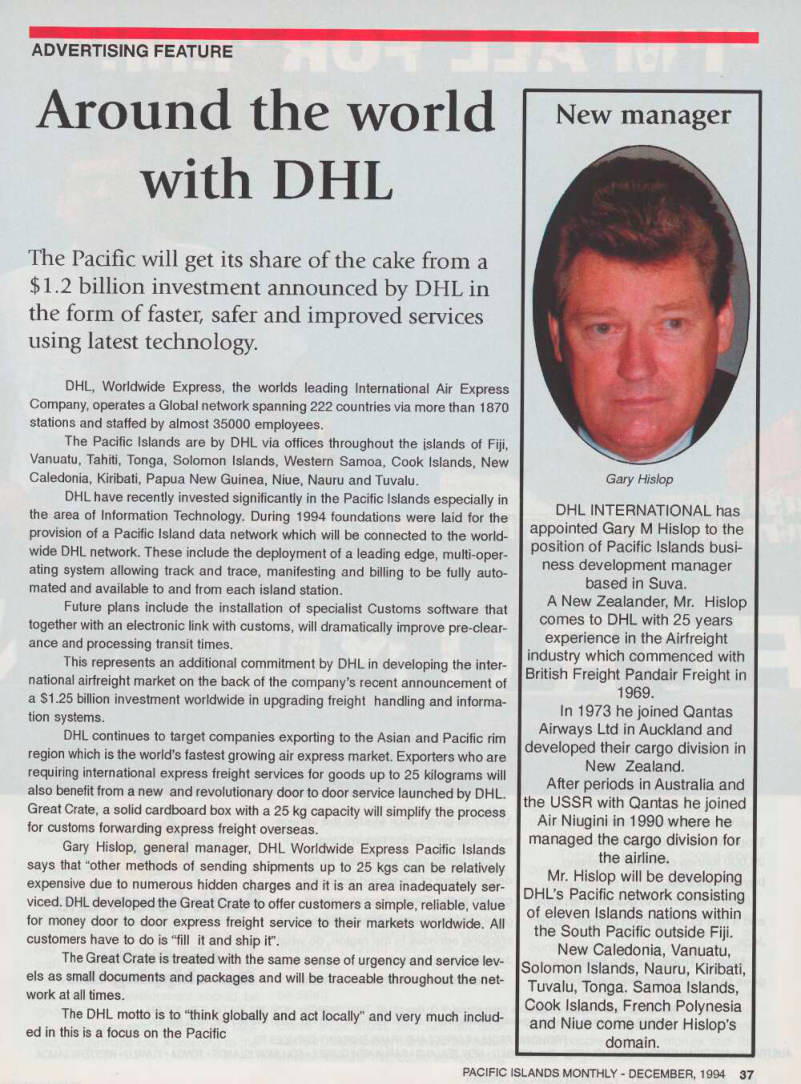
Advertising Feature
Around the world with DHL
The Pacific will get its share of the cake from a $1.2 billion investment announced by DHL in the form of faster, safer and improved services
using latest technology.
DHL, Worldwide Express, the worlds leading International Air Express Company, operates a Global network spanning 222 countries via more than 1870 stations and staffed by almost 35000 employees.
The Pacific Islands are by DHL via offices throughout the islands of Fiji, Vanuatu, Tahiti, Tonga, Solomon Islands, Western Samoa, Cook Islands, New Caledonia, Kiribati, Papua New Guinea, Niue, Nauru and Tuvalu.
DHL have recently invested significantly in the Pacific Islands especially in the area of Information Technology. During 1994 foundations were laid for the provision of a Pacific Island data network which will be connected to the world wide DHL network. These include the deployment of a leading edge, multi-oper ating system allowing track and trace, manifesting and billing to be fully auto mated and available to and from each island station.
Future plans include the installation of specialist Customs software that together with an electronic link with customs, will dramatically improve pre-clear ance and processing transit times.
This represents an additional commitment by DHL in developing the inter national airfreight market on the back of the company’s recent announcement of a $1.25 billion investment worldwide in upgrading freight handling and informa tion systems.
DHL continues to target companies exporting to the Asian and Pacific rim region which is the world’s fastest growing air express market. Exporters who are requiring international express freight services for goods up to 25 kilograms will also benefit from a new and revolutionary door to door service launched by DHL.
Great Crate, a solid cardboard box with a 25 kg capacity will simplify the process for customs forwarding express freight overseas.
Gary Hislop, general manager, DHL Worldwide Express Pacific Islands says that “other methods of sending shipments up to 25 kgs can be relatively expensive due to numerous hidden charges and it is an area inadequately ser viced. DHL developed the Great Crate to offer customers a simple, reliable, value for money door to door express freight service to their markets worldwide. All customers have to do is “fill it and ship if.
The Great Crate is treated with the same sense of urgency and service lev els as small documents and packages and will be traceable throughout the net work at all times.
The DHL motto is to “think globally and act locally” and very much includ ed in this is a focus on the Pacific
Advertisements & other items, pp. 37-38 (1 item)
New manager
Gary Hislop
DHL INTERNATIONAL has
appointed Gary M Hislop to the position of Pacific Islands business development manager based in Suva.
A New Zealander, Mr. Hislop comes to DHL with 25 years experience in the Airfreight industry which commenced with British Freight Pandair Freight in 1969.
In 1973 he joined Qantas Airways Ltd in Auckland and developed their cargo division in New Zealand.
After periods in Australia and the USSR with Qantas he joined Air Niugini in 1990 where he managed the cargo division for the airline.
Mr. Hislop will be developing DHL’s Pacific network consisting of eleven Islands nations within the South Pacific outside Fiji.
New Caledonia, Vanuatu, Solomon Islands, Nauru, Kiribati, Tuvalu, Tonga. Samoa Islands, Cook Islands, French Polynesia and Niue come under Hislop’s domain.
I'M ALL FOR 'EM!
anager,
Justries.
;■ 51 * Ttoprtt mm Every year, Jack Madho of Fiji’s Tropik Wood Industries ships up to 20,000 tonnes of timber to waiting buyers overseas.
“My timber has to get there on time, and it has to come in on budget,” says Jack.
Most of Tropik Wood’s business goes to the shipping line that since 1987 has given Jack Madho the service he insists on. Pacific Forum Line.
Our absolute commitment to the development of trade and economic growth in the Pacific is real, and ongoing. If your own business utilises shipping services in the region, do what Jack Madho did. Call us.
It could be to everyone’s benefit.
Pacific Forum Line
Our Pacific.
Our shipping line.
Suva, Fiji: Forum Shipping Agencies International, P.O. Box 13147. Telex: 2429 Fax: (679) 302 754 Tel: (679) 315 444 Lautoka, Fiji: Forum Shipping Agencies International, P.O. Box 49. Telex: 5158 Fax: (679) 662 985 Tel: (679) 660 577 PROVIDING REGULAR DIRECT AND TRANS-SHIPMENT SERVICES TO AUSTRALIA • AMERICAN SAMOA • COOK ISLANDS • FIJI • KIRIBATI • NEW ZEALAND • PAPUA NEW GUINEA • SOLOMON ISLANDS • TONGA • TUVALU • WESTERN SAMOA.
WILSON'ADDISON 88,51
Peddling the Pacific

By David North
It may be useful to think about cruise ships visits as a specialised, side-effects free economic opportunity.
Suppose you are the Finance Minister of an island nation, and you are trying to attract a (US) million-dollar-a year factory for one of your port cities.
Nailing down the factory may mean extensive negotiations with the owners )who have other pleasant islands to choose from); in addition, the factory may foul the environment or use up lots of local resources (such as fresh water or timber). Further, the factory operators may want a freehold pur chase of the site, and your nation’s cus toms and laws insist on non-alienation of any land.
As you— and perhaps your poten tial critics —examine the fine print of the deal,, you realise that only a small part of the $1,000,000 in sales will stay in your country. All profits, interest pay ments and patent fees (if any ) will be shipped overseas; most to all of the raw material will be purchased elsewhere; some of the salaries paid to the expatri ate managers will go overseas, as will money for shipping in the raw material and shipping out of finished product.
And you, the Finance Minister, have already agreed to a 10-year-old tax hol iday.
What’s left is, say, about $240,000 in wages, which, for the sake of conver sation, is what is paid to 240 factory workers who get $lOOO a year, or, in a higher-wage island, 120 people receiv ing an average of $2OOO a year. That’s obviously important to the port city, but it promises to be a major headache for you and for everyone else involved.
There is a much easier way to pump $240,000 a year into the econo my.
Arrange for eight day-long cruise ships visits, averaging 750 passengers, each of whom will spend an average of $4O per visit for meals, drinks, handi craft, and local travel; that is 750 x $4O x 8 = $240,000. (this is not to suggest that industrial development should be ignored).
The cruise ship numbers are real istic, and perhaps low. According to the
travel section of a recent New York Times the 830-passenger “Golden Princess” of the Princess Line will spend the period Dec 7, 1994-Feb 17, 1995 sailing from Auckland to Papeete, with
stops at Noumea, Suva, Pago Pago,
Bora Bora, Moorea, and Christmas Island in Kiribati, visiting several of these ports more than once during the season.
At $4O per person per visit, a fre quently-cited estimate, a port call by the “Golden Princess” brings a $33,200 burst of business every time it drops anchor, in addition to any supplies pur chased by the ship itself. And there are no hotels or factories to build, no contin uing demand for electric power, no pol lution, and no damage to the environ ment; in short, this represents nearly side -effects-free economic develop ment.
But for every “Golden Princess” that spends part of each year in the South Pacific, there are scores of cruise ships— by definition portable— that spend their entire year in waters else where in the world.
Further, and even more troubling to the South Pacific tourist industry are the near misses— cruise ships that come close, but spend little or no time in island ports.
The best example is the annual “round-the-world trip of the huge “Queen Elizabeth II”. Carrying 1,850 affluent passengers (they must pay (US) $24,990 to $152,440 for the whole voyage) , the next trip is 102 days long and it cuts right through the heart of the South Pacific but spends only three nights in island ports. The ship is sched uled to stop at Pago Pago and Suva on the way to Australia, and then at Rabaul on the way out of the area.
That last stop, on February 16, 1995, will bring some welcome cash to a
city recently devastated by volcanic
eruptions. (Cunard told us in October that Rabaul visit was still on, and that the line was sure that passengers would
be safe.)
The “QEH” is one of the largest cruise ships afloat, and can not dock easily in many ports, but there are other, smaller vessels that could be spending
more time in the South Pacific, one could sense from the Times listings, but have no plans to do so.
For example, the 1,075 passenger “Rotterdam” leaves Los Angles on January 23, 1995 for a “round-the world cruise which will take 85 nights. On its way across the Pacific it visits Hawaii, of course, but stops at only one island, Yap in FSM, between Honolulu and Manilla.
That is a remarkable 5,500-mile journey (Hawaii to Manila) with only a single landfall, which must mean many con secutive days at sea, an annual sched ule for any cruise ship. Why not visit Christmas Island, or Palau, or some other islands along the way?
One more example of the so-near yet-so-far theme; on Feb 22, 1995, the “Royal Odyssey” will steam out of Sydney headed for Singapore; will it look in on, say Suva and Rabaul en route?
No. The decision-makers chose to go around Australia the other way, call ing at such exotic locations as Adelaide and Perth on way to Indonesia. It carries a maximum of 750 passengers, none of whom will be able to spend any time, or money, in our islands.
Generally speaking, the South
Pacific is not an easy place for the cruise ships. It is not a few hours air travel from well-to-do First World nations as the Caribbean and the Mediterranean are handy to the U.S. and Western Europe, respectively.
Ships cruising the South Pacific must seek a more affluent crowd than those found on the one-week cruises in the West Indies and around the Greek Islands.
There is another, once-a-week
complication for cruise ships operating
in some parts of the Pacific — the deeply religious character of some islands causing them not to want cruise ship visits on Sunday. The “Never on
Sunday” syndrome is a continuing mat
ter for island-cruise ships negotiations and schedule adjustments.
But cruising is a growing industry;
more ships are built each year, and every year there seem to be more and more people with the money and the tome to go cruising. Further, many of
them have done the West Indies and the Greek Islands, and they want some thing different. It is real opportunity for the South Pacific, and these are some of the steps that might be considered.
Selling the South Seas to the
Cruising Industry:
There is a small population of mid dle managers employed by the several dozen cruise lines; most of them are in New York, London, and Tokyo. They work out the schedules each year and,, like middle managers everywhere, pre fer not to take risks. If Saint Kitts, Saint Thomas, Saint Croix and Saint Martin ( all near to each other in the Caribbean) worked last year, they will decide to repeat the pattern in the following year.
Many of these managers and their bosses never have seen the South Pacific. Nations wanting more cruise ships visits, and, perhaps, paying all or part of their travel expenses so that they can see for themselves.
Less expensive in money, but more so in an ambassador’s time, would be for Fiji’s and PNG’s ambas sadors, for example, to telephone a key manager or two and invite them to lunch. How often does a middle manag er get such an invitation? Perhaps some of this wooing of the cruise lines could be done on a regional, rather than
a national basis, which leads to the next point.
Putting it on the Forum’s
Agenda:
Perhaps the South Pacific Forum, or another of the multiplicity of regional organisations, could make the encour agement of cruise ships a major subject of joint action, Perhaps the Forum could open— on a test basis— a cruise ships office in, say, New York.
The Forum would announce at the time that if the office did not produce a 50 percent increase in the South Pacific cruise ship port calls in three or four years, the office would be closed and the manager and staff would be fired.
This is one public sector activity in which it is very easy to keep score.
It might be easier to set such a tough standard for a public tourist pro motion authority at the regional, as opposed to the national level, where tourist bureaus are often patronage operations of the party in power.
Encouraging more islands based cruise ships: Some ships roam the world, others have home bases. Few of them are based in the South Pacific, however.
Although the Times twice-yearly listings are not complete, it is worth noting that again this year there are only a handful
of cruise ships listed as being based in the islands.
The largest of these is the 148passenger “Wind Song” owned by Windstar Cruises, that operates seven day cruises out of Papeete all year around. It calls only the French islands.
The largest collection of them, a fleet of six small vessels holding from eight to ninety passengers, works the waters and islands of the Galapagos in the Eastern Pacific. Charles Darwin’s early work on evolution in these islands inspires many of the visitors.
Then, too, there is the 42-passen ger Melanesian Discover cruising the northern coast and the islands of PNG; it used to have a sister ship but now works alone.
More ships with this pattern would, of course, bring more people to more South Seas ports.
Cleaning up the Harbour:: It would also be helpful if would-be cruise ships ports put their best foot for ward, and made themselves as attrac tive as possible so that the ships would return. If the island’s public Works Department can only be energized sometimes to paint the pilot boat, or clear away abandoned cars and other junk, let it be energized the day before the cruise ships arrives! ■
Advertisements & other items, pp. 40-41 (1 item)
Second Hand Containers
WHERE AND WHEN YOU WANT THEM IN THE PACIFIC If you need a flexible and safe storage space we have the ideal solution for you. Our second h provide instant secure storage. Qua to be wind and waterproof these coi are ideal for both temporary and lon term storage in Pacific conditions.
We can deliver to any island in the Pacific within a month and our rates have got to be the lowest you will find. All you need to do is tell us how many you want.
CONTACT:
PASCALS MARCONNET, BP 4757 NOUMEA, NEW CALEDONIA. TEL: (687) 28 7450. FAX: (687) 26 3248
I 4* [ if ■ * W %i t - mm m iff H iWa w > Cruising away with the islands’ wealth.
wmm m
The Bank Line
YOUR EXPERTS IN THE SOUTH PACIFIC
A SERVICE OF ANDREW WEIR SHIPPING
■ TJießs from - •“ " : V-■ »-■' . rr • -* X ! 'Europe andS.E. Asia
SSL ‘X'J
mmmmm k m-r.s : Contact us on PH: (675) 422988 FAX: (675) 422925
TLX: 44265 NE
fh,? Bfir,k t inf H.O Box IMoiobo Province P.ipm Now Guinea
Shipping
schedules
New Zealand - FIJI direct Sofrana Unilines operates a fully containerised/ breakbulk service every 21 days from Auckland, Tauranga, Lyttleton to Suva and Lautoka.
Loading every 21 days, ro/ro service, containers - reefer. Contact Sofrana Unilines, Sofrana House, 101 Customs Street, Auqkland, PO Box 3614, Fax (09) 393874, Ph (09) 773279, Tlx NZ 2313. Direct toll free line 0800 659-922, Contact Alan Foote. Compass Shipping Agencies, PO Box 921 Wellington, Tel (04) 382 8206, Fax (04) 3828239, Tlx NZ 4769 Contact Steve Brannigan.
Sofrana Unilines Agencies, PO Box 22046 Christchurch, Tel (03) 366 7180, Fax (03) 366 8868, TLX NZ4769, Contact Tony Newell.
Carpenters Shipping, Private Mail Bag, Suva, Fiji, Tel (679) 312244, Fax (679) 301572, Tlx FJ 2199. Sofrana Unilines, Suva, Fiji, Tel (679) 315645, Fax (679) 300057.
Australia - FIJI direct Sofrana Unilines operates a container breakbulk service every three weeks from Melbourne, and Sydney to Lautoka and Suva. Contact Sofrana Unilines (Aust) Pty Ltd, PO Box Q 136, Queen Victoria Building, Sydney, NSW 2000, Austra lia. Tel (02) 2648944, Fax (02) 2676547, Tlx (71) A 170090, Contact Sam Attaway/ George Lopez.
Delams Australia Pty Ltd. 474 Flinders Street, Melbourne. Tel (03) 614 1344, Fax (03) 629 4957.
Carpenters Shipping, Suva, Tel (679) 312244, Fax (679) 301572. Sofrana Unilines Suva, Tel (679) 315 645, Fax (679) 300057. Carpenters Shipping, Lautoka, Tel (679) 663988, Fax (679) 664896. Sofrana Unilines, Lautoka Tel (679) 662921, Fax (679) 664896.
Australia - FIJI monthly service Sofrana Unilines (Australia) Pty Ltd operates a regular monthly service with MV Capitaine Wallis. Contact Sofrana Unilines, Sydney, Tel (02) 2648944, Tlx AA170090, Fax (02) 267-6547. Carpenters Shipping, Suva, Fiji, Tel (679) 312244, Fax (679) 301572, Sofrana Unilines, Suva, Fiji Tel (679) 315645, Fax (679) 300057. Carpenters Shipping, Lautoka, Tel (679) 63988, Fax (679) 664896. Sofrana Uni lines, Lautoka, Fiji, Tel (679) 662921, Fax (679) 664896.
Far-East - Fiji Service New Guinea Pacific Line (NGPL) operates a monthly service accepting containerised and break-bulk cargoes from Manila, Keelung, Kaoshiung, Hong Kong, Lae to Suva, Lautoka (via Suva).
Contact Carpenters Shipping Suva, Fiji, tel (679) 312244, fax (679) 301572. New Zealand Unit Express, Maritime Building, 2-10 Customs House Quay, PO Box 890, Wellington. Tel 727865, Cables Enzue Man, Wellington, Tlx NZ31340 Nedlnz or Nedlloyd Swire Pty Ltd, Sydney, Tel 20522.
Japan - South Pacific Service Same as Burns Philp Japan - South Pacific Sendee - Kyowa Shipping Co Ltd
Kyowa Shipping, Shipping Co Ltd provides a monthly service from Hong Kong to main ports °fJapan, Saipan, Guam, Island ports, Lautoka, Suva via Nukualofa to Pago Pago and Apia.
Contact Carpenters Shipping, Neptune House, 3/4 floor, Tofuaa Street, Walu Bay, Suva. Tel 312244, Fax 301572, Tlx FJ2199.
Europe - Pacific Service tj it’ «- Bank Line oilers a monthly service to and from c . . , 7 , ji ..
Europe for containerised breakbulk and bulk vegetable cargoes. Calling Papeete, Apia, Suva, La ;t’ N °r ea - P ° rt Y lla ’ S JT’ H ° niara J i P I r 3? major northern Eurpoean ports. Contact Bank Line South Pacific Office Central Court Bid , 7th r ’ , ’ cu• ’ 1“ NE4426s.Carpenters Shipping, 3/4 Floor,Neptune House, Walu Bay, Suve, Fiji, Tel f 6791 312244 Fax ffiTQ'i 301572 TlvFI 91QQ (679) 312244, fax (679) 301572, IIxFJ 2199.
Nedlloyd offers cargo services from Continental ports to Papeetee, Fiji, New Caledonia and Doniambo on slot basis with Bank Line. Contact Carpenters Shipping, Suva, tel 312244, Tlx FJ2199, Fax 301572. Carpenters Shipping, Lautoka, Tel 663988, Tlx FJ5215, Fax 664896.
Smith Bast Asia - Fill Barvte* x T ji, j T • o .
Nedlloyd Lines Service (NZEAS) Service operates regular fast cargo service from Jakarta, Pt Keelang, Singapore, Bangkok, Surubaya via Auckland to Suva and Lautoka. Contact Carpenters Shipping, Suva, Tel 312244, Tlx FJ2199, Fax 301572. Carpenters Shipping,
Lautoka Tel 663988, Tlx FJ5215, Fax 663988.
Nedlloyd New Zealand, Wellington Tel (04) 472 7864, Fx (04) 473 9201 Far Bast - Mid South Pacific China Navigations New Guinea Pacific Line in association with Bank Line, operates a regular container and breakbulk heavy lift service from Hong Kong, Taiwan, Manila, Singapore, Malaysia, Thailand to Port Moresby, Lae, Rabaul, Kieta and Honiara. Cargo from the same eastern ports to the South Pacific Ports of Noumea, Santo, Vila, Papeete, PagoPago, Apia, Nukualofa, Rarotonga and Tarawa will be shipped via Japan or Busan bn the monthly Bali Hai Service. Contact Steamships Shipping, Port Moresby, PO Box 634, Tel 220283 or 220289.
Tasman Asia operate a 20-day frequency fixed date service, shipping breakbulk and containerised cargoes from Japan, Korea, Tai wan and Hong Kong to Suva and Lautoka (via Suva). Fiji agents are Forum Shipping Agencies in Suva, Tel 315444, and Lautoka 660577.
Australia - New Caledonia - FIJI - Samoas - Tonga Pacific Forum Line operates a fully containerised service (general, reefer and ro-ro) from Sydney and Brisbane to Noumea, Lautoka, Suva, Apia, Pago Pago, Nuku’alofa, Sydney. Cargo central ised from Adelaide and Melbourne. Contact: Pacific Forum Line, PO Box 796, Auckland; Union Bulkships, 333 George St, Sydney, Brisbane and Melbourne; Union Co, Lautoka; Pacific Forum Line, Suva, Nuku’alofa; Pacific Forum Line, Apia; Polynesia Shipping, Pago
Advertisements & other items, pp. 42-44 (1 item)
Director of Finance & Administration
WWF
South Pacific Program
. . . supporting conservation and sustainable development in Pacific Island countries
Director of Finance & Administration
WWF World Wide Fund for Nature is an independent conservation organisation with a network of National Organisations around the world and over 5 million regular supporters.
WWF is seeking an experienced Director of Finance & Administration to support and extend its South Pacific Program. This is a senior position in a small dynamic team responsible for organising all aspects of WWF's conservation work in Melanesia, Micronesia and Polynesia. The position will be based in a Pacific Island country and will involve travel in the region and beyond.
Key Functions: O to direct financial and administration planning, management and reporting for the Program.
O to direct project administration, and management of Program and project offices, staff, information and records systems; O to provide support for fund-raising and relations with government and aid organisations.
Essentials; O advanced qualifications; 7-10 years experience in accounting and finance, including managerial positions.
O advanced skills m communications, organisation, training, and in development and operation of computerised accounting and data-base systems.
O knowledge of the Pacific Islands and understanding of the people, cultures and institutions.
Enquiries to the Pacific Coordinator, phone (61 2) 2476300; fax (61 2) 2522252.
Applications should be sent to the WWF Pacific Program, GPO Box 528, Sydney 2001.
Closing date: 16, December, 1994. 121918v3
"Pacific's
new
■ mm mm
visitor"
- . a I Introducing the newly built multi-purpose vessel “Kyowa Hibiscus” a high-tech ship with modern facilities with capability of carrying 270 units of automobiles by roror at the same time 370 teu’s of container liftings, 2X366T cranes with a speed of 14 knots. The scheduled ports of calls are Hong Kong, Taiwan, Korea, Japan, Guman, Fiji, pagopago, Apia, Port Villa, Santo, Noumea, Honiara, IMoro thence to Hong Kong.
TROPICAL REEF SHIPYARD
CAIRNS, NORTH QUEENSLAND, AUSTRALIA
mm M.V. “MICRO SPIRIT” - YAP - F.S.M. 8/94
SERVICING
THE PACIFIC ISLANDS
AND PNG SHIP REPAIRS
AND MAINTENANCE
TROPICAL REEF SHIPYARD - 11/94
Main Slipway capacity : 3,000 tonnes plus ... 350 tonne Floating Drydock To minimise ship's time out of service, our shipyard works 24 hours per day, 6 days per week - no overtime charges All ship repairs facilities are available on site
FOR MORE INFORMATION PLEASE CONTACT...
Tom or Cris Jones, Tropical Reef Shipyard. Phone : (INT) 61-70-516877, Fax: (INT) 61-70-510798.
POBox 44, Cairns 4870, Queensland, Australia
NEWEST AND MOST MODERN HOTEL IN MAJURO A * T. 4^ o T % o o t I w ( * 24 ROOMS EACH ONE IS AIR CONDITIONED
* FULLY CARPETED
* PHONE, COLOUR TV, REFRIGERATOR
* HOT & COLD WATER, PRIVATE BATH
ROOM RATES
BAR & RESTAURANT
COZY BAR & RESTAURANT WITH
OCEAN VIEW.
HAPPY HOURS 5-7 PM
BREAKFAST, LUNCH AND DINNER.
* SINGLE ROOM $78.00
* DOUBLE ROOM (DOUBLE OCCUPANCY) $78.00
* DOUBLE ROOM (DOUBLE OCCUPANCY) $95.00
* SUITE ROOM $103.00
PLUS $2.00 ROOM TAX.
24 HOUR RECEPTION,
LAUNDRY FACILITIES
RENTAL CARS AND
FAX MACHINE.
FOR RESERVATIONS
Telephone: (692) 247-3701/3702/3703 Fax: (692) 625-3705 P.O. Box 735 MAJURO MARSHALL ISLANDS 96960
literary forum
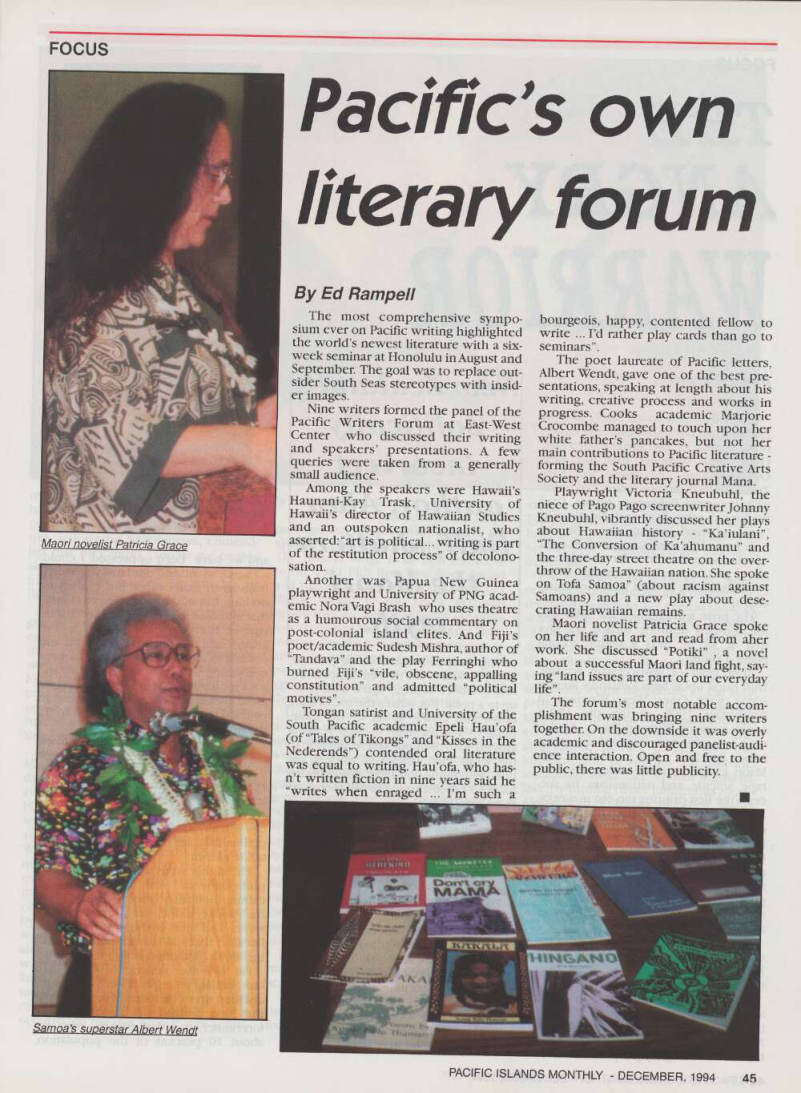
Focus
Pacific's own literary forum
By Ed Rampell
The most comprehensive sympo sium ever on Pacific writing highlighted the world’s newest literature with a six week seminar at Honolulu in August and September. The goal was to replace out sider South Seas stereotypes with insid er images.
Nine writers formed the panel of the Pacific Writers Forum at East-West Center who discussed their writing and speakers’ presentations. A few queries were taken from a generally small audience.
Among the speakers were Hawaii’s
Haunani-Kay Trask, University of
Hawaii’s director of Hawaiian Studies and an outspoken nationalist, who asserted:“art is political... writing is part of the restitution process” of decolono sation.
Another was Papua New Guinea playwright and University of PNG acad emic Nora Vagi Brash who uses theatre as a humourous social commentary on post-colonial island elites. And Fiji’s poet/academic Sudesh Mishra, author of “Tandava” and the play Ferringhi who burned Fiji’s “vile, obscene, appalling constitution” and admitted “political motives”.
Tongan satirist and University of the South Pacific academic Epeli Hau’ofa (of “Tales of Tikongs” and “Kisses in the Nederends”) contended oral literature was equal to writing. Hau’ofa, who has n’t written fiction in nine years said he “writes when enraged ... I’m such a
bourgeois, happy, contented fellow to write ... I’d rather play cards than go to seminars”.
The poet laureate of Pacific letters Albert Wendt, gave one of the best pre sentations, speaking at length about his writing, creative process and works in progress. Cooks academic Marjorie Crocombe managed to touch upon her white father’s pancakes, but not her main contributions to Pacific literature forming the South Pacific Creative Arts Society and the literary journal Mana.
Playwright Victoria Kneubuhl the niece of Pago Pago screenwriter Johnny Kneubuhl, vibrantly discussed her plays about Hawaiian history - “Ka’iulani”
“The Conversion of Ka’ahumanu” and the three-day street theatre on the over throw of the Hawaiian nation. She spoke on Tofa Samoa” (about racism against Samoans) and a new play about dese crating Hawaiian remains, Maori novelist Patricia Grace spoke on her life and art and read from aher work. She discussed “Potiki” , a novel about a successful Maori land fight sav ing “land issues are part of our evervdav life”. phe forum’s most notable accom plishment was bringing nine writers together. On the downside it was overly academic and discouraged panelist-audi ence interaction. Open and free to the public, there was little publicity,
Maori novelist Patricia Grace
Samoa’s superstar Albert Wendt
Angry
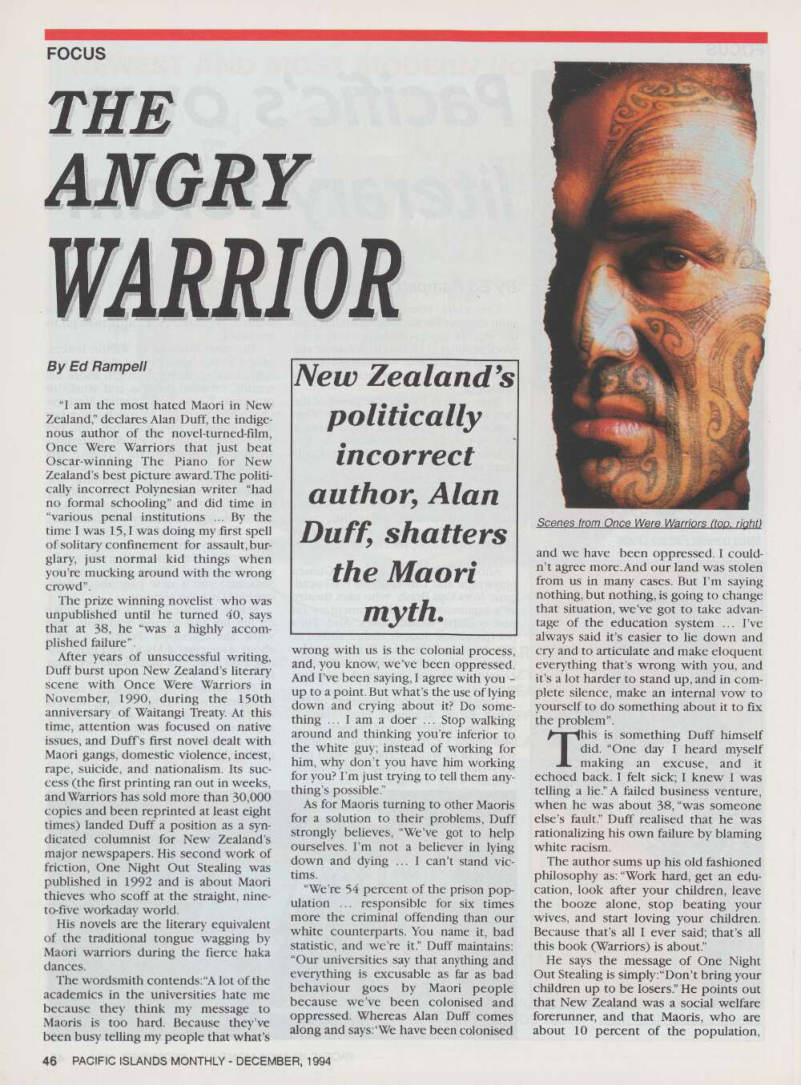
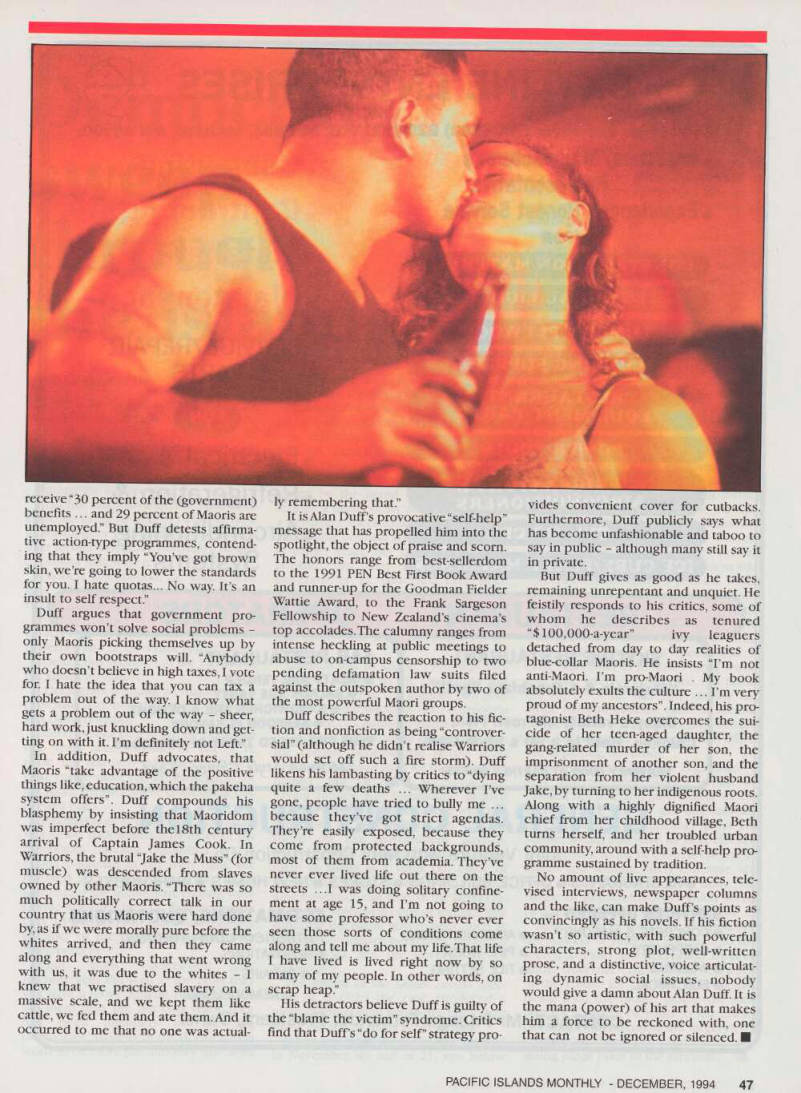
Tee
By Ed Rampell
“I am the most hated Maori in New Zealand,” declares Alan Duff, the indige nous author of the novel-turned-film, Once Were Warriors that just beat Oscar-winning The Piano for New Zealand’s best picture award. The politi cally incorrect Polynesian writer “had no formal schooling” and did time in “various penal institutions ... By the time I was 15,1 was doing my first spell of solitary confinement for assault, bur glary, just normal kid things when you’re mucking around with the wrong crowd”.
The prize winning novelist who was unpublished until he turned 40, says that at 38, he “was a highly accom
plished failure”.
After years of unsuccessful writing, Duff burst upon New Zealand’s literary scene with Once Were Warriors in November, 1990, during the 150th anniversary of Waitangi Treaty. At this time, attention was focused on native issues, and Duff’s first novel dealt with Maori gangs, domestic violence, incest, rape, suicide, and nationalism. Its suc cess (the first printing ran out in weeks, and Warriors has sold more than 30,000 copies and been reprinted at least eight times) landed Duff a position as a syn dicated columnist for New Zealand’s major newspapers. His second work of friction, One Night Out Stealing was published in 1992 and is about Maori thieves who scoff at the straight, nine to-five workaday world.
His novels are the literary equivalent of the traditional tongue wagging by Maori warriors during the fierce haka dances.
The wordsmith contends: “A lot of the academics in the universities hate me because they think my message to Maoris is too hard. Because they’ve been busy telling my people that whafs
New Zealand’s politically incorrect author ; Alan Duff, shatters the Maori myth.
wrong with us is the colonial process, and, you know, we’ve been oppressed.
And I’ve been saying, I agree with you up to a point. But what’s the use of lying down and crying about it? Do some thing ... I am a doer ... Stop walking around and thinking you’re inferior to the white guy; instead of working for him, why don’t you have him working for you? I’m just trying to tell them any
thing’s possible.”
As for Maoris turning to other Maoris for a solution to their problems, Duff strongly believes, “We’ve got to help ourselves. I’m not a believer in lying down and dying ... I can’t stand vic tims.
“We’re 54 percent of the prison pop ulation ... responsible for six times more the criminal offending than our white counterparts. You name it, bad statistic, and we’re it.” Duff maintains: “Our universities say that anything and everything is excusable as far as bad behaviour goes by Maori people because we’ve been colonised and oppressed. Whereas Alan Duff comes along and says:‘We have been colonised
and we have been oppressed. I could n’t agree more. And our land was stolen from us in many cases. But I’m saying nothing, but nothing, is going to change that situation, we’ve got to take advan tage of the education system ... I’ve always said it’s easier to lie down and cry and to articulate and make eloquent everything that’s wrong with you, and it’s a lot harder to stand up, and in com plete silence, make an internal vow to yourself to do something about it to fix the problem”.
This is something Duff himself did. “One day I heard myself making an excuse, and it echoed back. I felt sick; I knew I was telling a lie.” A failed business venture, when he was about 38, “was someone else’s fault.” Duff realised that he was rationalizing his own failure by blaming white racism.
The author sums up his old fashioned philosophy as: “Work hard, get an edu cation, look after your children, leave the booze alone, stop beating your wives, and start loving your children.
Because that’s all I ever said; that’s all this book (Warriors) is about.”
He says the message of One Night Out Stealing is simply;“Don’t bring your children up to be losers.” He points out that New Zealand was a social welfare forerunner, and that Maoris, who are about 10 percent of the population,
Scenes from Once Were Warriors (top, right )
receive 30 percent of the (government) benefits ... and 29 percent of Maoris are unemployed. But Duff detests affirmalive action-type programmes, contendmg that they imply “You’ve got brown skin, we’re going to lower the standards tor you. I hate quotas... No way. It’s an iHsultt o self respect.”
Duff argues that government programmes won’t solve social problems only Maoris picking themselves up by their own bootstraps will. “Anybody who doesnt believe in high taxes, I vote tor. 1 hate the idea that you can tax a problem out of the way. I know what gets a problem out of the way - sheer, hard work, just knuckling down and getting on with it. I’m definitely not Left.” !n addition Duff advocates, that Maoris take advantage of the positive things like^education which the pakeha system offers . Duff compounds his blasphemy by insisting that Maoridom was imperfect before the 18th century amva! of Captain James Cook. In Warnors, the brutal Jake the Muss” (for muscle) was descended from slaves owned by other Maoris. “There was so much politically correct talk in our countiy that us Maoris were hard done y, as if we were morally pure before the whites arrived, and then they came along and everything that went wrong with us it was due to the whites - I new that we practised slavery on a massive scale, and we kept them like cattle, we fed them and ate them. And it occurred to me that no one was actual-
ly remembering that.”
It is Alan Duffs provocative “self-help” message that has propelled him into the spotlight, the object of praise and scorn.
The honors range from best-sellerdom to the 1991 PEN Best First Book Award and runner-up for the Goodman Fielder Wattie Award, to the Frank Sargeson Fellowship to New Zealand’s cinema’s top accolades. The calumny ranges from intense heckling at public meetings to abuse to on-campus censorship to two pending defamation law suits filed against the outspoken author by two of the most powerful Maori groups.
Duff describes the reaction to his fiction and nonfiction as being “controversial” (although he didn’t realise Warriors would set off such a fire storm). Duff likens his lambasting by critics to “dying quite a few deaths ... Wherever I’ve gone, people have tried to bully me ... because they’ve got strict agendas.
They’re easily exposed, because they come from protected backgrounds, most of them from academia. They’ve never ever lived life out there on the streets ...I was doing solitary confinement at age 15, and I’m not going to have some professor who’s never ever seen those sorts of conditions come along and tell me about my life. That life I have lived is lived right now by so many of my people. In other words, on
scrap heap.”
His detractors believe Duff is guilty of the “blame the victim” syndrome. Critics find that Duff’s “do for self” strategy pro-
vides convenient cover for cutbacks, Furthermore, Duff publicly says what has become unfashionable and taboo to say in public - although many still say it in private But Duff gives as good as he takes remaining unrepentant and unquiet. He feistily responds to his critics, some of whom he describes as tenured “$lOO,OOO-a-year” ivy leaguers detached from day to day realities of blue-collar Maoris. He insists “I’m not anti-Maori. I’m pro-Maori . My book absolutely exults the culture ... I’m very proud of my ancestors”. Indeed, his pro tagonist Beth Heke overcomes the sui cide of her teen-aged daughter the gang-related murder of her son the imprisonment of another son, and the separation from her violent husband Jake, by turning to her indigenous roots, Along with a highly dignified Maori chief from her childhood village Beth turns herself, and her troubled urban community, around with a self-help pro gramme sustained by tradition, No amount of live appearances tele vised interviews, newspaper columns and the like, can make Duff’s points as convincingly as his novels. If his fiction wasn’t so artistic, with such powerful characters, strong plot well-written prose, and a distinctive, voice articulat ing dynamic social issues, nobodv would give a damn about Alan Duff. It is the mana (power) of his art that makes him a force to be reckoned with one that can not be ignored or silenced. ■
Advertisements & other items, p. 48 (1 item)
General Construction
SKYLINE ENTERPRISES /l7 ' x
PHONE: (692) 628-3695: FAX; (692) 6283921 P.O. Box 854, MAJURO, MH 96960.
• Importers/Manufacturer’s
Representative
•Contracting
Consulting
• Experienced Honest Service
FOR
CONSTRUCTION MATERIALS
ELECTRICAL/LIGHTING
•Installation
•Maintenance
LUMBEH/PLYWOOD
PLUMBING SUPPLIES
RESTAURANT
EQUIPMENT/PARTS
SERVICE/REPAIR
PARTS
POWER TOOLS
REFRIGERATORS &
AIRCONDITIONERS
TV’s & VCR’s
ICE CUBE/FLAKE MACHINES
• Electrical
• Refrigeration &
•Airconditioning
Systems
RESTAURANT OPERATORS
SKYLINE RESTAURANT
1 r ‘Majuro’s 1 Breakfast Spot!”
Enjoy a variety of Fresh Fish, Chicken, Beef In a 60’s Style Cafe.
HEAVENLY FOOD AT EARTHLY PRICESI
FAB RESTAURANT
• MEATS ARE TENDER
• SALADS ARE TASTY
• SANDWICHES ARE A DEUGHT
• SEAFOOD IS SAVORY
PLUS THE ADDED TREAT OF DEUCIOUS
Szecfiuan StyCe Chinese food
GENERAL CONSTRUCTION
Joint Venture with Mini Construction Co • RESTAURANTS • OFFICE BUILDINGS • STORES • NEW HOMES • WAREHOUSES
SERVICES OFFERED
• CONCRETE & MASONRY * AIRCONDITIONING
• CARPENTRY * PIPE WO rk
• WELDING • TILE SETTING
• ELECTRICAL
ESTIMATIONS/QUOTATIONS
furnished upon request
• RENOVATIONS
• REPAIRS
• REMODELLING
CONTACT: Mr Prianga Fernando, President/Owner
through
Elections
Democrats sweep through the islands
By David North
Democratic Party candidates swept the November elections in US flag islands, with the re-election of delegates in American Samoa and Guam. Democrats seized the governorship in Guam and expanded their hold on the legislature.
Among the victors were: 1 Eni EH. Faleomavaega, the Samoa del egate, securing his fourth two-year term in Washington by a three-to-one margin over former Governor Coleman’s daugh ter, Amata Radewagen. 1 Robert Underwood, the Guam dele gate, winning his second term in the House without Opposition. 1 Guam senators CarlTC. Gutierrez and Madeleine Bordallo, being elected Governor and Lt. Governor respectively. 1 Democrats taking 13 of the 21 seats in the Guam legislature. 1 Democrats winning all major offices (a Senate seat, two places in the House
and Governorship).
Faleomavaega clearly can be Governor two years hence should he decide to trade his relatively low-pressure, well paid, comfortable job in Washington for the more stressful, more challenging one in Pago Pago.
Faleomavaega’s principal opponent was Amata Radewagen, a member of the republican National Committee and a skilled politician in her own right; she received 20 percent of the vote to 64 percent for the incumbent. Trailing were Faiivae Galea’i, chief of Faleomavaega’s clan, 13 percent, and Tuika Tuika, former member of the island legislature, with three percent.
While both Underwood and Faleomavaega did well at the polls they will have a more difficult two years fac ing them than the last two years. They had been members of the big Democratic majority in the House which tends to be more pro-minority and more
pro-spending and hence more pro islands than the Republicans.
Running as a team on Guam, Gutierrez and Bordallo collected 53 percent of the vote, defeating the Republican team of Senators Tommy Tanaka and Doris Floris Brooks. Gutierrez will replace two-term Republican Governor Joe Ada, who was barred by the island constitution from seeking a third consecutive term.
Bordallo’s successful race kept alive a remarkable political skein - either she or, in earlier years, her late husband Rick Bordallo, has been on the ballot for Governor or Lt. Governor ever since 1974. He ran and won in 1974 and 1982, he ran and lost in 1978 and 1986; shortly after his second defeat he committed sui cide rather than serve a prison term for fraud.
Bordallo lost to Ada in 1990, was sub sequently elected to the Legislature and was the winner of the number two spot this year. A Statesider, she is an outspoken proponent of Chamorro rights.
Gutierrez and Bordallo apparently won the contest because the Tanaka team pressed a little too hard for balancing the budget, and for fiscal accountability.
Saving money, and eliminating padded payrolls is good news for those who pay the costs of government, but not for those on the government payroll.
Everyone who benefits from big govern ment in Guam is a voter, but many of those who would benefit from a leaner government do not vote. In the latter cat egory are voteless groups or entities that subsidise the island government, such as tourists, US military personnel, off-island corporations and the government in
Washington.
The results of the Guam Senate elec tion, as is often the case, produced a more cosmopolitan legislative body than those elected in many other islands.
While the number of women elected in November, six out of 21, was below
the usual levels for Guam, it is well above the average for most other islands. In addition, the presiding officer, Lt Governor, is a woman.
While most of the senators are Chamorros, there is at least one Statesider in the group, at least two oth ers (like Underwood) of mixed Stateside and Chamorro ancestry, and two more who were children of Chamorro-Filipino marriages.
Guam’s senators are elected at large for two-year terms, with primary elections held to determine who will be the can didates of each party; the parties can choose up to 21 candidates fort he gen eral election.
There was more turnover than usual this year. Six of the sitting members left thd Legislature to run for Governor or Lt Governor in the primaries, which opened up a number of slots. Several other senators, including three women with substantial seniority, were turned aside this year by the voters. They were replaced by a number of Young Turks, youthful legislators most of whom ran on strong Chamorro rights platforms.
The two most interesting of newcom ers are both Republicans, both former associates of retiring Governor Joe Ada, and both of mixed Stateside-Chamorro ancestry. They are Elizabeth Barrett- Andersen, the former Attorney-General and Mark Forbes, former assistant to Ada.
Forbes has circulated a petition which calls for a referendum on cutting the size of the Legislature from 21 to 15 mem bers as a cost-cutting measure; this issue will be brought before the voters in the near future. There was speculation in early November as to how Forbes would feel if he were to be elected, but not in the top 15 - he was 10th on the list, while Barrett-Andersen came in second.
Topping the bill was Democratic Senator Tom Ada, a distant relative, but no ally, of the departing Governor.
The American Samoan Legislature is very different from Guam’s; it has two Houses, not one, and party labels are not used. Further, women and non-Samoans play very minor roles in either house. The Senate, which will have its next election for four-year terms in 1996, is chosen by matai and women rarely can vote, and have never served in that body. The House of Representatives, which serves two-year terms, was elected this year.
Noteworthy in the latter election was the success of Tulafono Solaita, who had served as Parks and Recreation Director under Governor Coleman. He won a seat in the House for the first time despite being tried the month before the elec tion for a variety of white collar crimes (stealing, embezzlement and forgery); the charges had been dismissed by the pre siding judge prior to the election. ■
Advertisements & other items, pp. 50-51 (1 item)
C.A.R. Corporation Ltd
mi - . iP® 8 ® ¥ 3 Series
Touring
a; i I KM j fJ7 ■* [ * M wl f I * f M 3 mmm Accessories i» Sr 4 cT i r o m OL 9R m ¥ m
MIDN9UB
Wheels
Compact
C.A.R. CORPORATION LTD
RAIWAQA, FIJI. TEL. 384600 384900
% \ „ ■ '■ 1 v ■ S : >$ mmm
'VV S
Vi
MOT 79&
V 7 Series m Convertible
Air Bags
WE ! a
Engine
Interior 4 5 Series
7 Series: a new ear for BMW

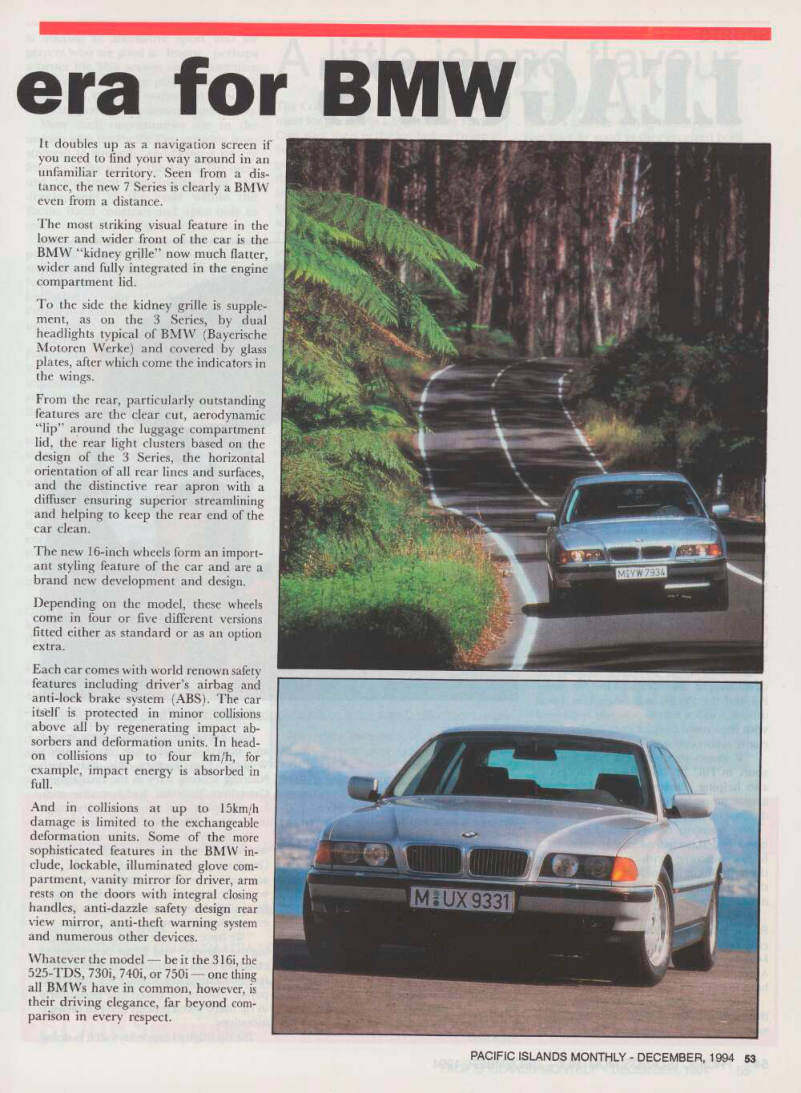
BMW 7 Series
advertising feature
By Arvind Kumar
BWM’s new 7 Series car has heralded a new era for top of the range executive
luxury vehicles.
Launched at the Sheraton Mirage Resort in Port Douglas, Australia in October the 7 Series is a ear in which you feel at home, a car which is simply fun to drive.
The new “third generation” BMW 7 Series has everything it takes to continue the outstanding success of the second generation 7 Series launched in 1986.
The “second generation” 7 Series was the car that gave BMW the final breakthrough to the top in the luxury performance market. A car with a concept combining typical BNIW features such as safety and dynamic performance with discreet elegance-making 7 series an entirely new type of automobile at the top end of the market.
AltlinnoT the 7 series will nnr hp in Fiii this year, die 3 series and 5 series are due jji tfig country early next month, says Jack Reddy of CAR Corporation Ltd.
CAR Corporation, a joint venture between Reddy’s Tyre Power (Fiji) Ltd and Australia-trained BMW engineer Glenn Cupit, will sell and service the cars at its workshop at Raiwaqa.
The first shipment of 12 cars include
the BMW 316 i Compact (hatchback),
316 i, 318 i (four-door, sedan), 320 i sedan, 520iT (sedan 5.2 litre), 525-TDS (sedan diesel turbo), and the 525iX (full time 4W'D), M 3 (racing model) and the 730 i
of the 7 Series which will be available in Fiji next year.
On the demanding road test drive from Port Douglas to Kuranda and back, the BMW 730 i and the 740 i took the challenge head-on and emerged winners - with flying colours.
With more than enough leg room and the seats adjustable to every curve of the body, the 180-kilometre drive to Kuranda was a breeze.
Both, the 730 i and the 740 i proved amazingly sturdy on the long and winding road towards Mareeba, almost halfway to Kuranda.
The new 7 Series is entering the world market as an all-new saloon with fourvalve, eight-cylinder power units developing 160 kW (218bhp) in the 730 i and 210 kW (286bhp) in the 740 i power units offering the very best in terms of performance, motoring comfort and fuel economy.
Although the 740 i tackled with ease the many sharp bends and proved a more gutsy performer on the stretches, the 730 i, I feel, is better suited for Fiji roads.
Perhaps the single most important feature that gives the German-made BMWs its unique behaviour on the road is its high performance suspension.
This is further enhanced by the extra large disc brakes and the sophisticated anti-lock brake system fitted as standard.
The new 7 Series is only a bit longer and wider than its predecessor while its
interior dimensions have grown much more than the exterior dimensions.
Through its design alone, BMW’s latest “baby” emanates dynamic el egance and underlines its smooth and compact supremacy through the interac tion of clear cut lines with gently rounded sections of the body.
The most important factor contribu ting to genuine class is, nevertheless, the inner values a car is able to offer.
Just a few items which add to its superior characteristics are its spaciousness, excellent vibration control and sound-deadening, pleasant climate control, the luxurious interior and the magnificent suspension with its all-new rear axle.
The console between the seats offers more storage space than before, the handbrake previously fitted at this point is now replaced by a footbrake for parking. The length of the front centre arm-rest is now adjustable.
The height and length adjustable steering wheel excels through styling and handling functions typical of BMW.
Standard features include not only an air-bag but cruise control, radio func tions, air recirculation controls and, in certain models, a telephone.
The control panel of the 740 i I tested, featured a mini television screen, approximately 10cm x 10cm. The TV can only be viewed while the vehicle is stationary.
BMW’s new 7 Series: top of the range luxury vehicle
It doubles up as a navigation screen if you need to find your way around in an unfamiliar territory. Seen from a dis tance, the new 7 Series is clearly a BMW even from a distance.
The most striking visual feature in the lower and wider front of the car is the BMW “kidney grille” now much flatter, wider and fully integrated in the engine compartment lid.
To the side the kidney grille is supple ment, as on the 3 Series, by dual headlights typical of BMW (Bayerische Motoren Werke) and covered by glass plates, after which come the indicators in
the wings.
From the rear, particularly outstanding features are the clear cut, aerodynamic “lip” around the luggage compartment lid, the rear light clusters based on the design of the 3 Series, the horizontal orientation of all rear lines and surfaces, and the distinctive rear apron with a diffuser ensuring superior streamlining and helping to keep the rear end of the car clean.
The new 16-inch wheels form an import ant styling feature of the car and are a brand new development and design.
Depending on the model, these wheels come in four or five different versions fitted either as standard or as an option extra.
Each car comes with world renown safety features including driver’s airbag and anti-lock brake system (ABS). The car itself is protected in minor collisions above all by regenerating impact ab sorbers and deformation units. In head on collisions up to four km/h, for example, impact energy is absorbed in full.
And in collisions at up to 15km/h damage is limited to the exchangeable deformation units. Some of the more sophisticated features in the BMW in clude, lockable, illuminated glove com partment, vanity mirror for driver, arm rests on the doors with integral closing handles, anti-dazzle safety design rear view mirror, anti-theft warning system and numerous other devices.
Whatever the model —be it the 316 i, the 525-TDS, 730 i, 740 i, or 750 i one thing all BMWs have in common, however, is their driving elegance, far beyond com parison in every respect.
League’S
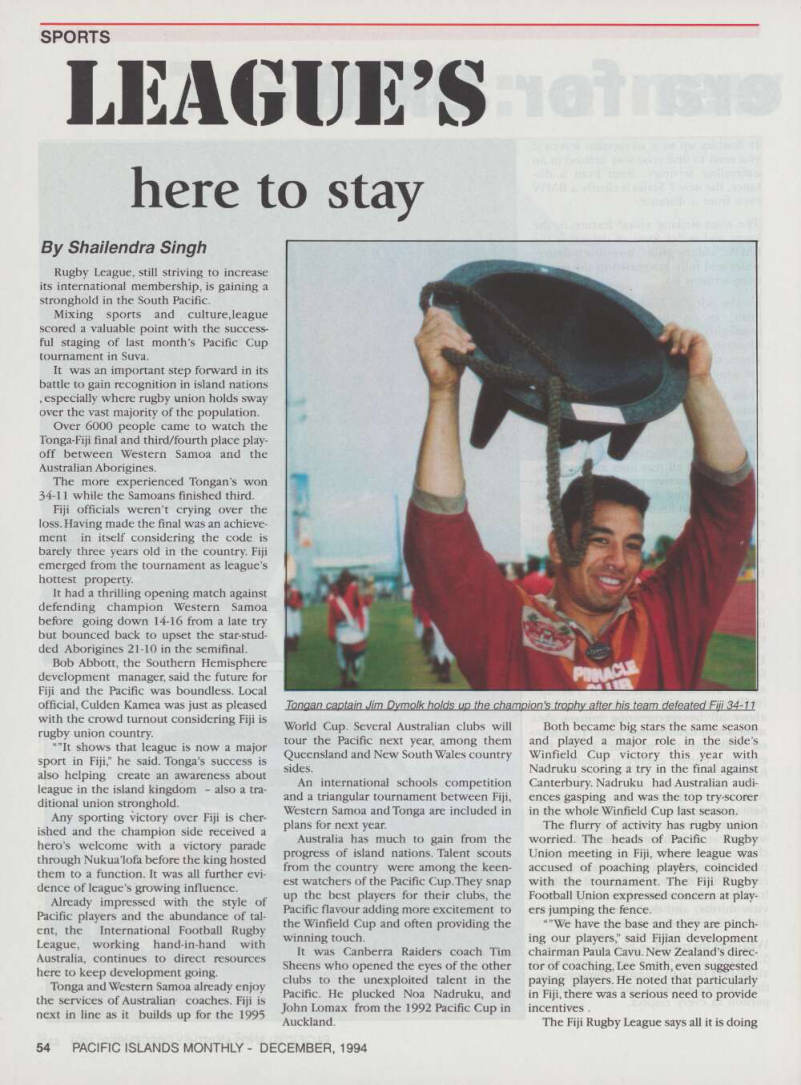
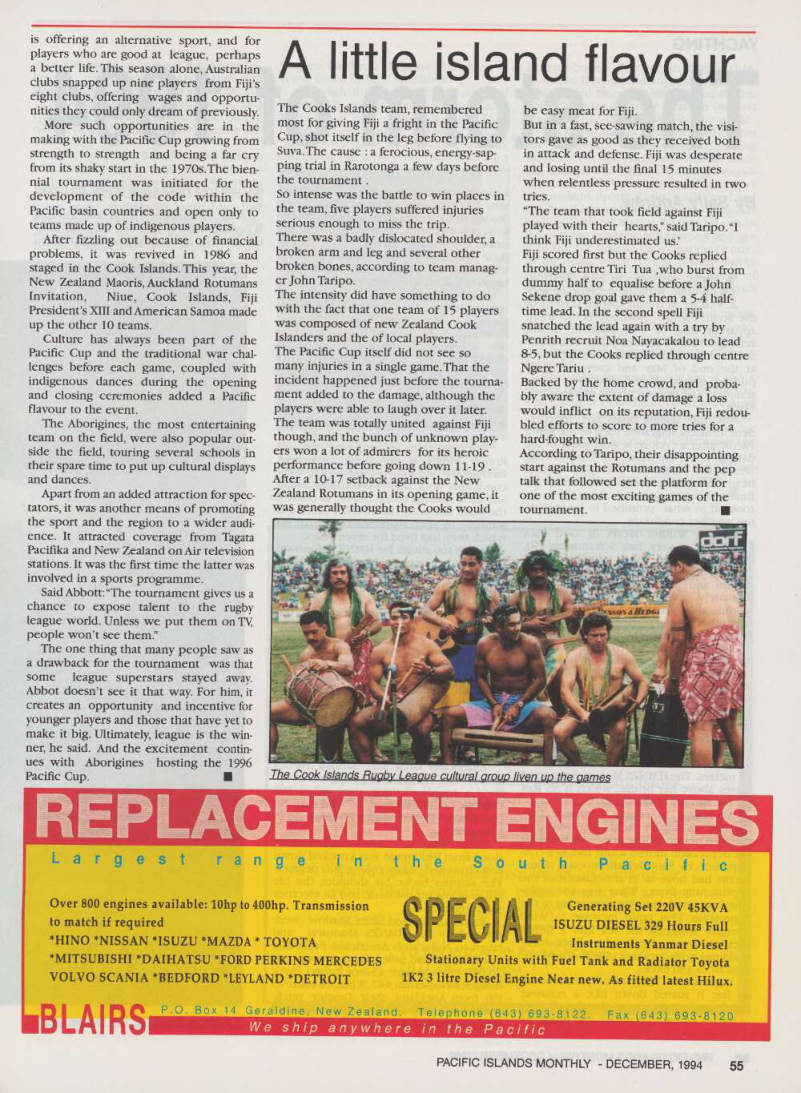
Sports
here to stay
By Shailendra Singh
Rugby League, still striving to increase its international membership, is gaining a stronghold in the South Pacific.
Mixing sports and culture,league scored a valuable point with the success ful staging of last month’s Pacific Cup tournament in Suva.
It was an important step forward in its battle to gain recognition in island nations , especially where rugby union holds sway over the vast majority of the population.
Over 6000 people came to watch the Tonga-Fiji final and third/fourth place play off between Western Samoa and the Australian Aborigines.
The more experienced Tongan’s won 34-11 while the Samoans finished third.
Fiji officials weren’t crying over the loss. Having made the final was an achieve ment in itself considering the code is barely three years old in the country. Fiji emerged from the tournament as league’s hottest property.
It had a thrilling opening match against
defending champion Western Samoa
before going down 14-16 from a late try but bounced back to upset the star-stud ded Aborigines 21-10 in the semifinal.
Bob Abbott, the Southern Hemisphere development manager, said the future for Fiji and the Pacific was boundless. Local official, Gulden Kamea was just as pleased with the crowd turnout considering Fiji is rugby union country.
“”It shows that league is now a major sport in Fiji,” he said. Tonga’s success is also helping create an awareness about league in the island kingdom - also a tra ditional union stronghold.
Any sporting victory over Fiji is cher ished and the champion side received a hero’s welcome with a victory parade through Nukualofa before the king hosted them to a function. It was all further evi dence of league’s growing influence.
Already impressed with the style of
Pacific players and the abundance of tal ent, the International Football Rugby League, working hand-in-hand with Australia, continues to direct resources here to keep development going.
Tonga and Western Samoa already enjoy the services of Australian coaches. Fiji is next in line as it builds up for the 1995
World Cup. Several Australian clubs will tour the Pacific next year, among them Queensland and New South Wales country sides.
An international schools competition and a triangular tournament between Fiji, Western Samoa and Tonga are included in plans for next year.
Australia has much to gain from the progress of island nations. Talent scouts from the country were among the keen est watchers of the Pacific Cup. They snap up the best players for their clubs, the Pacific flavour adding more excitement to the Winfield Cup and often providing the winning touch.
It was Canberra Raiders coach Tim Sheens who opened the eyes of the other clubs to the unexploited talent in the Pacific. He plucked Noa Nadruku, and John Lomax from the 1992 Pacific Cup in Auckland.
Both became big stars the same season and played a major role in the side’s Winfield Cup victory this year with Nadruku scoring a try in the final against Canterbury. Nadruku had Australian audi ences gasping and was the top try-scorer in the whole Winfield Cup last season.
The flurry of activity has rugby union worried. The heads of Pacific Rugby Union meeting in Fiji, where league was accused of poaching players, coincided with the tournament. The Fiji Rugby Football Union expressed concern at play ers jumping the fence.
“”We have the base and they are pinch ing our players,” said Fijian development chairman Paula Cavu.New Zealand’s direc tor of coaching, Lee Smith, even suggested paying players. Fie noted that particularly in Fiji, there was a serious need to provide incentives .
The Fiji Rugby League says all it is doing
Tongan captain Jim Dymolk holds up the champion’s trophy after his team defeated Fiji 34-11
is offering an alternative sport, and for players who are good at league, perhaps a better life. This season alone, Australian clubs snapped up nine players from Fiji’s eight clubs, offering wages and opportu nities they could only dream of previously.
More such opportunities are in the making with the Pacific Cup growing from strength to strength and being a far cry from its shaky start in the 1970s.The bien nial tournament was initiated for the development of the code within the Pacific basin countries and open only to teams made up of indigenous players.
After fizzling out because of financial problems, it was revived in 1986 and staged in the Cook Islands. This year, the New Zealand Maoris, Auckland Rotumans Invitation, Niue, Cook Islands, Fiji President’s XIII and American Samoa made up the other 10 teams.
Culture has always been part of the Pacific Cup and the traditional war chal lenges before each game, coupled with indigenous dances during the opening and closing ceremonies added a Pacific flavour to the event.
The Aborigines, the most entertaining team on the field, were also popular out side the field, touring several schools in their spare time to put up cultural displays and dances.
Apart from an added attraction for spec tators, it was another means of promoting the sport and the region to a wider audi ence. It attracted coverage from Tagata Pacifika and New Zealand on Air television stations. It was the first time the latter was involved in a sports programme.
Said Abbott: “The tournament gives us a chance to expose talent to the rugby league world. Unless we put them on Ty people won’t see them.”
The one thing that many people saw as a drawback for the tournament was that some league superstars stayed away.
Abbot doesn’t see it that way. For him, it creates an opportunity and incentive for younger players and those that have yet to make it big. Ultimately, league is the win ner, he said. And the excitement contin ues with Aborigines hosting the 1996 Pacific Cup. ■
A little island flavour
The Cooks Islands team, remembered most for giving Fiji a fright in the Pacific Cup, shot itself in the leg before flying to Suva. The cause ; a ferocious, energy-sap ping trial in Rarotonga a few days before the tournament.
So intense was the battle to win places in the team, five players suffered injuries serious enough to miss the trip.
There was a badly dislocated shoulder, a broken arm and leg and several other broken bones, according to team manag er John Taripo.
The intensity did have something to do with the fact that one team of 15 players was composed of new Zealand Cook Islanders and the of local players.
The Pacific Cup itself did not see so many injuries in a single game. That the incident happened just before the tourna ment added to the damage, although the players were able to laugh over it later.
The team was totally united against Fiji though, and the bunch of unknown play ers won a lot of admirers for its heroic performance before going down 11-19 .
After a 10-17 setback against the New Zealand Rotumans in its opening game, it was generally thought the Cooks would
be easy meat for Fiji.
But in a fast, see-sawing match, the visi tors gave as good as they received both in attack and defense. Fiji was desperate and losing until the final 15 minutes when relentless pressure resulted in two tries.
“The team that took field against Fiji played with their hearts,” saidTaripo.“l think Fiji underestimated us.’
Fiji scored first but the Cooks replied through centre Tiri Tua ,who burst from dummy half to equalise before a John Sekene drop goal gave them a 5-4 half time lead. In the second spell Fiji snatched the lead again with a try by Penrith recruit Noa Nayacakalou to lead 8-5, but the Cooks replied through centre NgereTariu .
Backed by the home crowd, and proba bly aware the extent of damage a loss would inflict on its reputation, Fiji redou bled efforts to score to more tries for a hard-fought win.
According to Taripo, their disappointing start against the Rotumans and the pep talk that followed set the platform for one of the most exciting games of the tournament. ■
The Cook Islands Rugby League cultural group liven up the games
Advertisements & other items, p. 55 (1 item)
■Blairs
La rg e s t range in the South Pacific Over 800 engines available: lOhp to 400 hp. Transmission to match if required
*HINO 'NISSAN 'ISUZU 'MAZDA * TOYOTA
'MITSUBISHI 'DAIHATSU 'FORD PERKINS MERCEDES
VOLVO SCANIA 'BEDFORD 'LEYLAND 'DETROIT
Generating Set 220 V 45KVA
ISUZU DIESEL 329 Hours Full Instruments Yanmar Diesel Stationary Units with Fuel Tank and Radiator Toyota IK2 3 litre Diesel Engine Near new. As fitted latest Hilux.
C
■BLAIRS
P__o^_£ox__M__GeraXdl ne, New Zealand. Telephone (643) 693-81 22. Fax (643) 693-8120 We ship anyw here in the Pacific
The storm of 1994
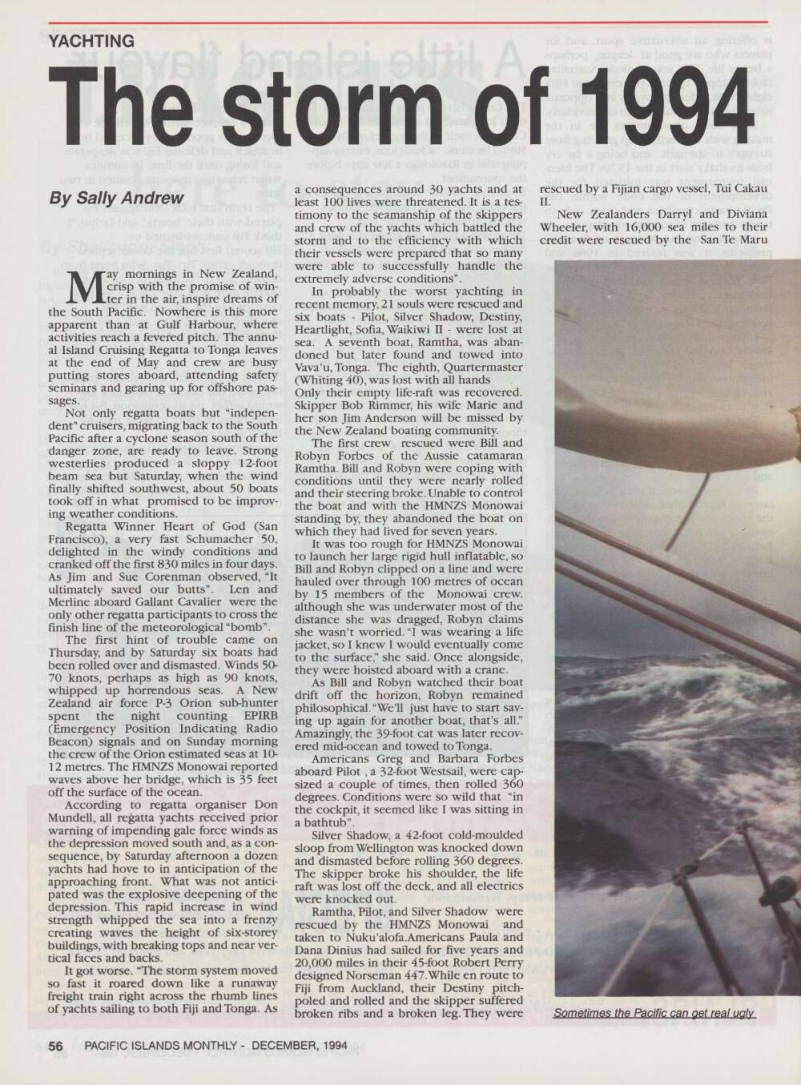
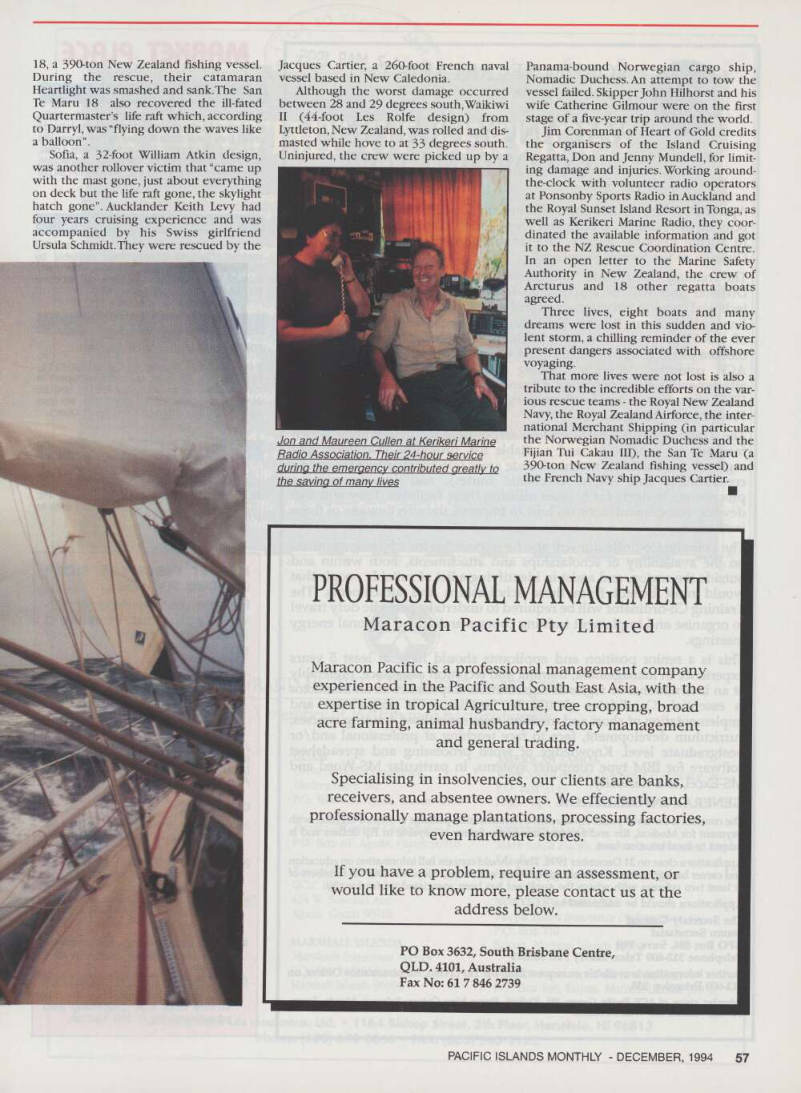
Yachting
By Sally Andrew
May mornings in New Zealand, crisp with the promise of win ter in the air, inspire dreams of the South Pacific. Nowhere is this more apparent than at Gulf Harbour, where activities reach a fevered pitch. The annu al Island Cruising Regatta to Tonga leaves at the end of May and crew are busy putting stores aboard, attending safety seminars and gearing up for offshore pas sages.
Not only regatta boats but “indepen dent” cruisers, migrating back to the South Pacific after a cyclone season south of the danger zone, are ready to leave. Strong westerlies produced a sloppy 12-foot beam sea but Saturday, when the wind finally shifted southwest, about 50 boats took off in what promised to be improv ing weather conditions.
Regatta Winner Heart of God (San Francisco), a very fast Schumacher 50, delighted in the windy conditions and cranked off the first 830 miles in four days.
As Jim and Sue Corenman observed, “It ultimately saved our butts”. Len and Merline aboard Gallant Cavalier were the only other regatta participants to cross the finish line of the meteorological “bomb”.
The first hint of trouble came on Thursday, and by Saturday six boats had been rolled over and dismasted. Winds 50- 70 knots, perhaps as high as 90 knots, whipped up horrendous seas. A New Zealand air force P-3 Orion sub-hunter spent the night counting EPIRB (Emergency Position Indicating Radio Beacon) signals and on Sunday morning the crew of the Orion estimated seas at 10- 12 metres. The HMNZS Monowai reported waves above her bridge, which is 35 feet off the surface of the ocean.
According to regatta organiser Don Mundell, all regatta yachts received prior warning of impending gale force winds as the depression moved south and, as a con sequence, by Saturday afternoon a dozen yachts had hove to in anticipation of the approaching front. What was not antici pated was the explosive deepening of the depression. This rapid increase in wind strength whipped the sea into a frenzy creating waves the height of six-storey buildings, with breaking tops and near ver tical faces and backs.
It got worse. “The storm system moved so fast it roared down like a runaway freight train right across the rhumb lines of yachts sailing to both Fiji and Tonga. As
a consequences around 30 yachts and at least 100 lives were threatened. It is a tes timony to the seamanship of the skippers and crew of the yachts which battled the storm and to the efficiency with which their vessels were prepared that so many were able to successfully handle the extremely adverse conditions”.
In probably the worst yachting in recent memory, 21 souls were rescued and six boats - Pilot, Silver Shadow, Destiny, Heartlight, Sofia, Waikiwi II - were lost at sea. A seventh boat, Ramtha, was aban doned but later found and towed into Vava’u, Tonga. The eighth, Quartermaster (Whiting 40), was lost with all hands Only their empty life-raft was recovered.
Skipper Bob Rimmer, his wife Marie and her son Jim Anderson will be missed by the New Zealand boating community.
The first crew rescued were Bill and Robyn Forbes of the Aussie catamaran Ramtha. Bill and Robyn were coping with conditions until they were nearly rolled and their steering broke. Unable to control the boat and with the HMNZS Monowai standing by, they abandoned the boat on which they had lived for seven years.
It was too rough for HMNZS Monowai to launch her large rigid hull inflatable, so Bill and Robyn clipped on a line and were hauled over through 100 metres of ocean by 15 members of the Monowai crew, although she was underwater most of the distance she was dragged, Robyn claims she wasn’t worried. “I was wearing a life jacket, so I knew I would eventually come to the surface,” she said. Once alongside, they were hoisted aboard with a crane.
As Bill and Robyn watched their boat drift off the horizon, Robyn remained philosophical.“ We’ll just have to start sav ing up again for another boat, that’s all.”
Amazingly, the 39-foot cat was later recov ered mid-ocean and towed to Tonga.
Americans Greg and Barbara Forbes aboard Pilot , a 32-foot Westsail, were cap sized a couple of times, then rolled 360 degrees. Conditions were so wild that “in the cockpit, it seemed like I was sitting in a bathtub”.
Silver Shadow, a 42-foot cold-moulded sloop from Wellington was knocked down and dismasted before rolling 360 degrees.
The skipper broke his shoulder, the life raft was lost off the deck, and all electrics were knocked out.
Ramtha, Pilot, and Silver Shadow were rescued by the HMNZS Monowai and taken to Nuku’alofa.Americans Paula and Dana Dinius had sailed for five years and 20,000 miles in their 45-foot Robert Perry designed Norseman 447. While en route to Fiji from Auckland, their Destiny pitch poled and rolled and the skipper suffered broken ribs and a broken leg. They were
rescued by a Fijian cargo vessel, Tui Cakau 11.
New Zealanders Darryl and Diviana Wheeler, with 16,000 sea miles to their credit were rescued by the San Te Maru
Sometimes the Pacific can get real ugly
18, a 390-ton New Zealand fishing vessel.
During the rescue, their catamaran Heartlight was smashed and sank. The San Te Maru 18 also recovered the ill-fated Quartermaster’s life raft which, according to Darryl, was “flying down the waves like a balloon”.
Sofia, a 32-foot William Atkin design, was another rollover victim that “came up with the mast gone, just about everything on deck but the life raft gone, the skylight hatch gone”. Aucklander Keith Levy had four years cruising experience and was accompanied by his Swiss girlfriend Ursula Schmidt. They were rescued by the
Jacques Cartier, a 260-foot French naval vessel based in New Caledonia.
Although the worst damage occurred between 28 and 29 degrees south,Waikiwi II (44-foot Les Rolfe design) from Lyttleton, New Zealand, was rolled and dismasted while hove to at 33 degrees south.
Uninjured, the crew were picked up by a
Panama-bound Norwegian cargo ship, Nomadic Duchess. An attempt to tow the vessel failed. Skipper John Hilhorst and his wife Catherine Gilmour were on the first stage of a five-year trip around the world.
Jim Corenman of Heart of Gold credits the organisers of the Island Cruising Regatta, Don and Jenny Mundell, for limit ing damage and injuries. Working around the-clock with volunteer radio operators at Ponsonby Sports Radio in Auckland and the Royal Sunset Island Resort in Tonga, as well as Kerikeri Marine Radio, they coor dinated the available information and got it to the NZ Rescue Coordination Centre.
In an open letter to the Marine Safety Authority in New Zealand, the crew of Arcturus and 18 other regatta boats agreed.
Three lives, eight boats and many dreams were lost in this sudden and vio lent storm, a chilling reminder of the ever present dangers associated with offshore voyaging.
That more lives were not lost is also a tribute to the incredible efforts on the var ious rescue teams - the Royal New Zealand Navy, the Royal Zealand Airforce, the inter national Merchant Shipping (in particular the Norwegian Nomadic Duchess and the Fijian Tui Cakau III), the San Te Maru (a 390-ton New Zealand fishing vessel) and the French Navy ship Jacques Cartier. ■
Jon and Maureen Cullen at Kerikeri Marine Radio Association. Their 24-hour service during the emergency contributed greatly to the saving of many lives
Advertisements & other items, pp. 57-60 (1 item)
Professional Management
Maracon Pacific Pty Limited
Maracon Pacific is a professional management company experienced in the Pacific and South East Asia, with the expertise in tropical Agriculture, tree cropping, broad
acre farming, animal husbandry, factory management
and general trading.
Specialising in insolvencies, our clients are banks, receivers, and absentee owners. We effeciently and
professionally manage plantations, processing factories,
even hardware stores.
If you have a problem, require an assessment, or would like to know more, please contact us at the address below.
PO Box 3632, South Brisbane Centre, QLD. 4101, Australia Fax No: 61 7 846 2739
MARKET PLACE
SCRAP METAL
Tall ingots operate from Brisbane, Australia and make frequent visits to the Pacific Islands which they have done for twenty-five years. We are buyers of Copper, Brass, Aluminium, Lead, Batteries, Battery Lead, Cable etc. Inspection no problems. Telephone 617 8922033 Fax 61 78922077.
EDUCATION/INSTRUCTION:
Become a Professional Consultannt, Earn Big Income. Diploma Course Now available by Correspondence. Details Australian Institute of Vocational Studies, Box 46, Wodenn Cl, Canberra ACT, Australia 2606.
SELF ADHESIVE LABELS
FORUM LABELS (FIJI) LTD
P.O. BOX 1167, Suva, Fiji. Phone: 304111, Fax: 305935. We print self-adhesive labels in rolls, multi-coloured labels with hot foil, and die cut to shape, tickets and tags in rolls. We also supply labelling machines and fabric labels.
REAL ESTATE
Fiji-South Pacific Beachfront and hillview freehold holiday/residential lots for sale from $15,000 adjacent Upmarket Resort. Ph: (679) 311075. Fax: (679) 303160 or write to P.O. Box 228, Suva, Fiji.
t FORUM SECRETARIAT ' 8 ’® s ,
VACANCY-TRAINING
CO-ORDINATOR
Applications are invited from citizens of EC or ACP* countries for the position of Training Co-ordinator for the European Union funded Lome 111 Pacific Regional Energy Programme implemented by the Energy Division of the Forum Secretariat.
The training Co-ordinator will report directly to the Director, Energy Division and will be responsible for organising and implementing technical training activities associated with the Lome ID Pacific Regional Energy Programme (PREP). The Training Co-ordinator will be a member of the PREP team. The tasks include establishing and maintaining biodata of electric power utility and energy office staff in Pacific Island ACP countries, develop training programmes, organise training attachments, implement training courses as an instructor and manage the PREP manpower development programme together with the PREP
Programme Manager.
The Training Co-ordinator will be responsible for determining which facilities are capable of, and available for, providing in-country and regional courses in the technical trade areas (electrical, refrigeration/air conditioning and engine mechanic trades), and for determining programme budgets for courses utilising these facilities. They will also develop recommendations on how to improve the effectiveness of these institutions.
The Training Co-ordinator will also be responsible for advising countries on the availability of scholarships and attachments, both within and outside the region, and assist in identifying a list of suitable people that would most benefit from those scholarships and attachments. The Training Co-ordinator will be required to undertake periodic duty travel to organise and implement training courses and attend regional energy meetings.
This is a senior position and applicants should have at least 5 years experience in management, training and technical assistance, preferably at an international or regional organisation. Experience as an instructor is essential. Candidates should be familiar with preparation and implementation of short and medium term specialised training courses, curriculum development, face to face teaching at professional and/or postgraduate level. Knowledge of word processing and spreadsheet software for IBM type computer systems, in particular MS-Word and MS-Excel, is a necessity.
GENERAL INFORMATION
The contract is for three years. An attractive remuneration package is offered together with payment for Medical, life and accident insurance. Salary is payable in Fiji dollars and is subject to local taxation laws.
Applications close on 31 December 1994. They should contain full information on education and career backgrounds and should give names, addresses, telephone and fax numbers of at least two referees with whom the applicant has been associated professionally.
Applications should be addressed to: The Secretary General Forum Secretariat GPO Box 856, Suva, Fiji Telephone 312-600 Telex: 2229FJ Fax: 305573 Further information is available on request from Mr Tiu Livino, Administration Officer, on 312-600 Extension 335. •Member states of ACP Pacific Group; Fiji, Kiribati, Papua New Guinea, Solomon Islands, Tonga, Tuvalu, Vanuatu and Western Samoa.
MftftKCT PlflCC CAN WORK
WOND6RS FOR VOU ...
Promote your business, or service, sell your household items, cars or heavy machinery etc.
ONLY AUSSI PER WORD.
NO COMPANY LOGO. NO
DISPLAY. NO BOLD TYPE.
Just forward your Advertisement together with payment to: PACIFIC ISLANDS MONTHLY "Market Place ", P.O. Box 1167, Suva, Fiji.
CONDITIONS:
1. All Advertisements are subject to acceptance and approval of publisher. 2. Advertisements are published as space permits; we cannot guarantee date of insertion. 3. All advertisements must be prepaid and should be typed or printed clearly. 4. Deadline for receipt of advertisements is the 10th of the month prior to issue.
5. PACIFIC ISLANDS MONTHLY
assumes no responsibility for any service other than publishing paid advertisements in this section.
J£ J 20 25 30 35 40 45 50 55
I A LIFETIME OF SERVICES
Grand Pacific Life Insurance offers you a lifetime of safe, secure products at very competitive rates. • Choose from a full range of products such as
• Super Ordinary Life
• Super Universal • Non-Participating Whole Life • 10-Year Level Term • Flexible Premium Annuities • Group Life Insurance
• IRAs
• Graded Premium Whole Life I We've been dedicated to providing fast, personalized service for more than 35 years through local ownership and management.
I That's why Grand Pacific Life is your Family for 1 ...throughout the Pacific, - 25 40 10 15 20 25 30 35 40 45 50 55 60 45 ©
Grand Pacific Life Insurance, Ltd.
A member of the Finance Factors Family
FEDERATED STATES
OF MICRONESIA
Actouka Executive Insurance Underwriters P.O. Box 55, Kolonia, Pohnpei, Federated States of Micronesia 96941 Pacific Basin Insurance & General Services, Inc P.O. Box 494, Chuuk State, Federated States of Micronesia 96942
TONGA
Peseti Ma ‘afu Ins. & Finance, Ltd.
Private Bag 2, Taumoepeau Bldg.
Nukualofa, Tonga
GUAM
Great National Insurance Underwriters, Inc.
P.O. Box GA, Agana, Guam 96910
AMERICAN SAMOA
Mark Solofa Pacific Insurance & Finance, Inc.
P.O. Box 3149 Pago Pago, American Samoa 96799 Pacific Financial Corporation P.O. Box AT, Agana, Guam 96910 Takagi & Associates, Inc.
GCIC Bldg., Suite 100 414 W, Soledad Ave.
Agana, Guam 96910
MARSHALL ISLANDS
Marshalls Insurance Agency P.O. Box 113, Majuro, Marshall Islands 96960
WESTERN SAMOA
Mark Solofa Pacific Insurance & Finance, Inc.
P.O, Box 3149 Pago Pago, American Samoa 96799
NORTHERN MARIANAS
Pacific Basin Insurance Underwriters, Inc.
P.O, Box 710 Saipan, Mariana Islands 96950 Pacifica Insurance Underwriters, Inc.
P.O. Box 168, Saipan, Mariana Islands 96950 Grand Pacific Life Insurance, Ltd. *1164 Bishop Street, sth Floor, Honolulu, HI 96813 Phone: (808) 548-3363 • FAX: (808) 548-5122
I. ?>Poc ft
sU\ iN 19 ■■■*.. • kA' * 1 "* **jM& mm ... t • V • %. i ■ - & iM JV{,. ■ MBfe
ijg
ill
The Mitsubishi Lancer: A family sedan that meets our own standards of stability and performance.
Lancer is ready when you are.
The rear multi-link suspension system is absolutely fearless. The independent McPherson struts up front are equal to the challenge of even the toughest road conditions. And an aggressive, fuel-efficient SOHC engine awaits your command.
The ground-hugging chassis holds comers tight. A powerful braking system holds you and your family secure.
And when you venture into the passing lane, this car holds nothing back.
Because Lancer was born to mn.
It is a dazzling product of our total approach to car design, a philosophy you can feel the moment you get behind the wheel.
There is no compromise in Lancer’s construction. Every detail meets our exacting standards of stability and performance. Its unique handling instincts and spirited responsiveness are an expression of Mitsubishi’s driving commitment to excellence in every car we make.
Yes, strictly speaking, Lancer is a family sedan. But the way it performs is something else.
MITSUBISHI LRNCER
What Drives You .
SOCIETEO’IMPORIWION D AUTOOU RACIRQUESUDSA P.O. 8cw438, Ntoumea il™?J nunin ®’ Te'- 6469!26/ NEW CALEDON ISLAND: BORRV'S PTY LTD, Pd Bo* 169, Taylors Road Burnt Te 12114 / D RS ZEALANO Lra P™* 6 Bag. Porirua, Tel. 237-0109 / NORFO A
MITSUBISHI
MOTORS
CREATING TOGETHER