Monthly
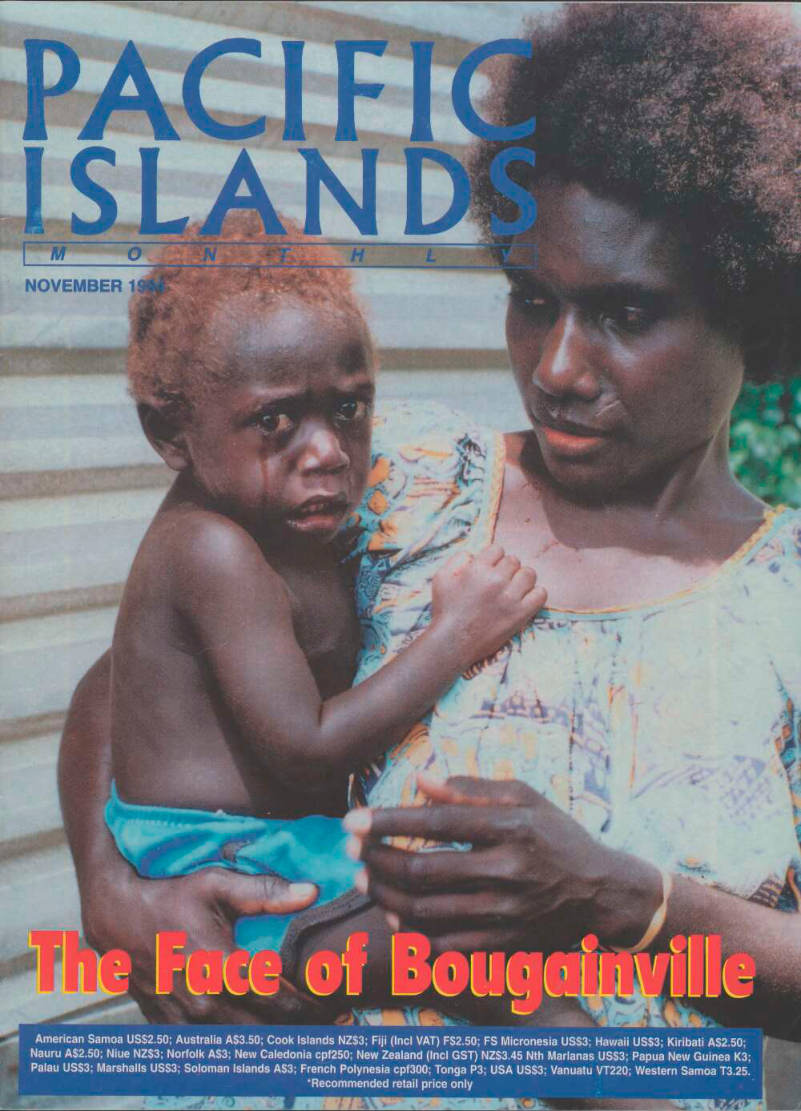
Pacific
Islands
November Vmf
Tj|i. « .Wit n:frf!7T"iTm jr
American Samoa US$2.5O; Australia A 53.50; Cook Islands NZ$3; Fiji (Incl VAT) F 52.50; FS Micronesia US$3; Hawaii US$3; Kiribati A 52.50; Nauru A 52.50; Niue NZ$3; Norfolk As 3; New Caledonia cpf2so; New Zealand (Incl GST) NZ53.45 Nth Marianas US$3; Papua New Guinea K 3; Palau US$3; Marshalls US$3; Soloman Islands As 3; French Polynesia cpf3oo; Tonga P 3; USA US$3; Vanuatu VT22O; Western Samoa T 3.25. *Recommended retail price only
Advertisements & other items, p. 2 (1 item)
The South Pacific
TASTE OF
V »ii m
; v.*ui
PACIFIC
».. V* ‘»|*| N <!
V4i • •* • »
SOUTH PACIFIC
. 5 . ■ '*#, * * cgtf Pi>» ** k. f V;’ o • * » k
fefb ; v*-v- ■
*• - * o - » • • •-•• ■» «•» • . Hi Hi;
iHiaSI
SP NQI BEER
Pacific
Islands
Monthly
Vol. 64 No. 11
The News Magazine
November 1994
Letters 4
Headlines 6
Cover Stories
Bougainville - An island of sorrow 9 The way we were 11 In the beginning 12
Focus
Conflict on Campus 15 “Incubating a time bomb 19
Volcano
Rebuilding Rabaul 23
Money
The rise and fall of the kina 24
Business
Facing facts 27 Business Baron Loy 29
Books
Spoofing the Spooks 32
Advertising Feature
Construction in the Pacific 35 How about a Kitset home 37
Economy
World Bank releases GNP data 39
Mystery
One stubborn gal 42
Forestry
A united approach to logging 44
Election
Underwood gets a free ride 46 Eni seeks fourth term in congress 47
Fraud
Boiler-room scam 48
Sports
Oceania strikes back 52 Samoan backs soccer 55
Yachting
UVEA? ...Where’s that? 56 COLUMNIST: David Baber 51
Publisher: Brian O’ Flaherty Editor: Mala Jagmohan Senior Writer: Yunus Rashid
Correspondents:
Christine Hatcher, David North, Ed Rampell, lan Williams, Karen Mangnall, Liz Thompson, Roman
Grynberg, Wally Hiambohn.
Columnists: David Barber (Wellington), Futa Helu (Tonga, cover ing the Pacific Islands), Jemima Garrett (Sydney). Alfred Sasako (The Forum).
Advertising Sales: • Regional Sales -South Pacific; Salendra Narayan, Tel (679) 304111, 303429, Fx (679) 303809. • Sydney, Canberra: Bob Hill Media Representation. Tel (61-2) 4164245, Fx (61-2) 4165064. • Brisbane: Robert Walker, Media House, Tel (61-7) 3710533, Fx (61-7) 371-8904. • Adelaide: Hastwell Williamsons Representatives, Tel (61-8) 3799522, Fx (61-8) 3799735. • Melbourne: Brown Orr Fletcher Burrows (Aust) Pty Ltd. Tel (61-3) 8265188, Fx (61-3) 8265644. • Auckland: McKay & Bowman, International Media Representatives Ltd, Tel (64-9) 4190561, Fx (64-9) 4192243. • Japan: Universal Media Corporation, Tokyo, Tel (3) 326626741, Cable: UNI MEDIA Tokyo, Fx (3) 32626742.
Founded 1930 (USPS 952480). A Fiji Times Limited production.
Cover prices are recommended retail only.
Registered by Australia Post, Publication No. NBP 1210. © Copyright Fiji Times Limited, 177 Victoria Parade. Suva. Fiji. Tel (679) 304111, Fx (679)
303809. Tx Fj2124.
Pacific Islands Monthly is published monthly by The Fiji Times Limited, a division of Nationwide News, 2 Holt Street, Surry Hills, Sydney, NSW 2010.
Send address changes to: •Pacific Islands Monthly. PO Box 1167, Suva , Fiji. Typeset and printed by The Fiji Times Limited, 177 Victoria Parade, Suva, Fiji.
ODA expenditure
Letters
to increase
Madam I was disappointed to read Bill Morton’s negative reporting on Australia’s 1994/95 Development Co operation Budget (Aid under scrutiny, PIM, August, 1994).
Australia’s Development Co-operation Budget did not “once again decrease as a proportion of GNP”. In fact, the out come of the budget was particularly positive. Expenditure on Official Development Assistance (ODA) in 1994.95 is expected to increase byAsB2 million over last year’s expenditure, a real increase of 3.6 percent.
Morton could have noted that is the largest budget increase in both real terms and money terms for over 20 years.
Your readers may be particularly interested to know that in the South
Pacific region, an area where a number of donors are reducing their activity, Australia has increased its ODA alloca tion from A 5123.6 million to A 5133.3 million, an increase of eight percent.
This very positive outcome, in the face of continued fiscal restraint in the overall budget context, reconfirms Australia’s commitment especially in the region.
D. Rooken Smith
Development Co-operation, Australian Embassy, Suva, Fiji
For the
record
Madam, Your readers may be mystified by the
comment associated with the figures which appear appear in Akanisi Motufaga’s otherwise excellent cover age of the recent South Pacific Forum, (September PIM ).
Referring to sustainable forestry and quoting our Minister for Development Co-operation and Pacific Island Affairs, Gordon Bilney, she reports the minister as saying that part of the logging prob lem was related to regional govern ments being ripped off by logging com panies. The report goes on, quoting the minister: “The countries are simply not getting the price for the exports that they ought to. I was reading some fig ures recently that showed in the case of one country’s logs that were being sold for around $3-50 per cubic metre, were returning only $2.70 to that country.”
The figures, as reported, make the comment “ripping off” nonsensical in that context.
What the minister did say, as quoted in the Australian Embassy’s own month ly Australian-South Pacific Newsletter
was, “Some figures recently had shown in the case of one country, logs were being sold for around $330 per cubic metre with a return of only $2.70 to that country.”
These figures show clearly one of the reasons that the minister and the Australian government as a whole are so concerned about the forestry situation in the region.
John Trotter
Permanent Representative of Australia to the South Pacific, Forum Secretariat, Suva, Fiji
One Pacific
currency
Madam, With a dozen or so different curren cies in the South Pacific, it is hard for Pacific people (travellers) to keep track of the hodge-podge of their money as they skip from one nation to another.
A single currency would be an excel lent idea that would make good sense.
We would not have to change money in another country. A joint central bank would issue a single currency.
Maybe the Melanesian countries of the South Pacific may consider this idea.
The Melanesian Spearhead Group should study this idea and put it in their agenda items for their next meeting.
Overall we have similar socio-economic and political idealogies.
Over to you, the leaders of the South Pacific. How about the Year 2000?
Francis Kasau,
Waigani, Papua New Guinea.
Public right
to know
Madam, Thanks to F. Syme-Buchanan, spokesman for the Cook Islands Prime Minister, for his letter regarding my ‘Pearls” 94’ peice in the July PIM, which I stand behind, and to PIM for the chance to set the record straight. Henry is ‘a poor spokesman for the Cooks’ because ‘he failed to find a few minutes
to talk with the media’ not only during Pearls 94, but because he has a history of doing so. The July 1990 PIM ran my interview with Henry, who was inter viewed during one of his many Hawaii trips. It was favourable to Henry and I’ve been puzzled since at his reluc tance for interviews with PIM , Radio Australia, etc.
In 1991,1 spent a month at the Cooks, and found Henry to be extremely elu sive. He failed to show up at a sched uled appointment without notification, although I eventually persisted in attain ing a brief interview. In April, 1994, Henry chaired the PIDP meetings at Honolulu, and was consistently unavail able to the press, just as he was during his return trip to Hawaii for Pearls’94 in May. Syme-Buchanan asserts:‘Rampell fails to accept (Henry) is not obligated in any way to hold media interviews during two and half days in Hawaii’.
Syme-Buchanan is right., and hits the nail on the head. Politicians elected and paid by the public are accountable to the people, and as the eyes and ears of the public, the media often informs the people as to what their public servants are doing and how the people’s busi ness is conducted and their money spent.
I suspect Henry evades intrviews because he does not want to be asked embarrassing questions such as: allega tions of gun trafficking by a Cooks ship, queries raised by the PIDP meeting and public complaints about the govern ment.
Speaking of which, Peter Williams said publicly and in a private interview that his family ‘had to resort to firearms to protect their pearl farm’, although there wasn’t any shooting. It was also said in public that Manihikians had made millions from pearls, and Williams verified in an interview that his family had ‘made over a million NZ dollars annually’.
Journalists are not in popularity con tests. When leaders snub the press, they also snub the costituents and others seeking information. In a free society, a free press must report without fear or favour, and with devotion to the public’s right to know - whether or not politi cians want them to know.
Ed Rampell, Journalist, Honolulu, Hawaii,
U.S.A.
Advertisements & other items, pp. 4-5 (2 items)
%
% % B lias LOOKS AT
HIGHER LEARNING
4TUSP.
£l ■ \
The South Sea Digest
Jt
The Newsletter on Islands affairs. Eveiy Other Friday.
South Sea Digest has all the latest business news, expectly streamlined and obtainable nowhere else.
Subcriptlons: 25 issues SAISO for Australian subcriber; SAI7S overseas, all airmailed. Payment by cheque in $A and SUS, otherwise by bank draft.
Send payment to: The South Sea Digest, GPO Box 4245, Sydney, NSW 2001, Australia.
Name Address
Introducing the
CHRISTADELPHIANS
Modern Revival of
Apostolic Faith
For a copy of this FREE booklet write to
THE CHRISTADELPHIANS
GPO Box 881
ADELAIDE
SOUTH AUSTRALIA 5001
Remember your Friend
There are times in your life when you feel your friends have been missing out on something good. Now’s your chance to do something about it and share with them one of the good things you have. Buy your friend a subscription to Pacific Islands Monthly and let him or her join you and thousands of other people worldwide who are kept informed of the latest political, social and cultural
changes taking place in the Pacific.
SUBSCRIPTIONS
American Samoa US$45 Australia A 542.00 Canada US$45 Cook Islands AUSS46 Fiji F 526.40 French Polynesia US$45 Guam US$45 Hawaii US$45 Japan US$45 Kiribati AUSS46 Marshall/Micronesia US$4O Nauru AUSS42 New Caledonia US$32 New Zealand NZ$55 Niue AUSS46 Norfolk Island AUSS42 Northern Marianas/Palau US$4O Papua New Guinea AUSS4S Solomon Islands AUSS46 Tonga AUSS46 Tuvalu AUSS46 United Kingdom Stg Pound2B US Mainland US$45 Vanuatu AUSS4S Western Samoa WS$6O Elsewhere AUSS63 Payment to Pacific Islands Monthly: Subscriptions Dept, GPO Box 1167, Suva, FIJI.
Subscriptions rates include the cost of airspeeding to all destinations set out above.
Direct airmail rates on application.
Telephone: 304111 Fax: 303809
PACIFIC ;
ISLANDS ■
Imohr h l r I I Please send my friend Pacific I Islands Monthly for one year (
(12 issues). W
I enclose my cheque for $ c£b
(made payable to Pacific
Islands Monthly) 1 or debit $ to my: □ Bankcard □ Visacard □ ( Mastercard Card No; il 1 I ! I i ! I I ! ! I M I ( Expiry Date 1 I
NAME ,
SIGNATURE 1
I
ADDRESS: ,
CITY COUNTRY
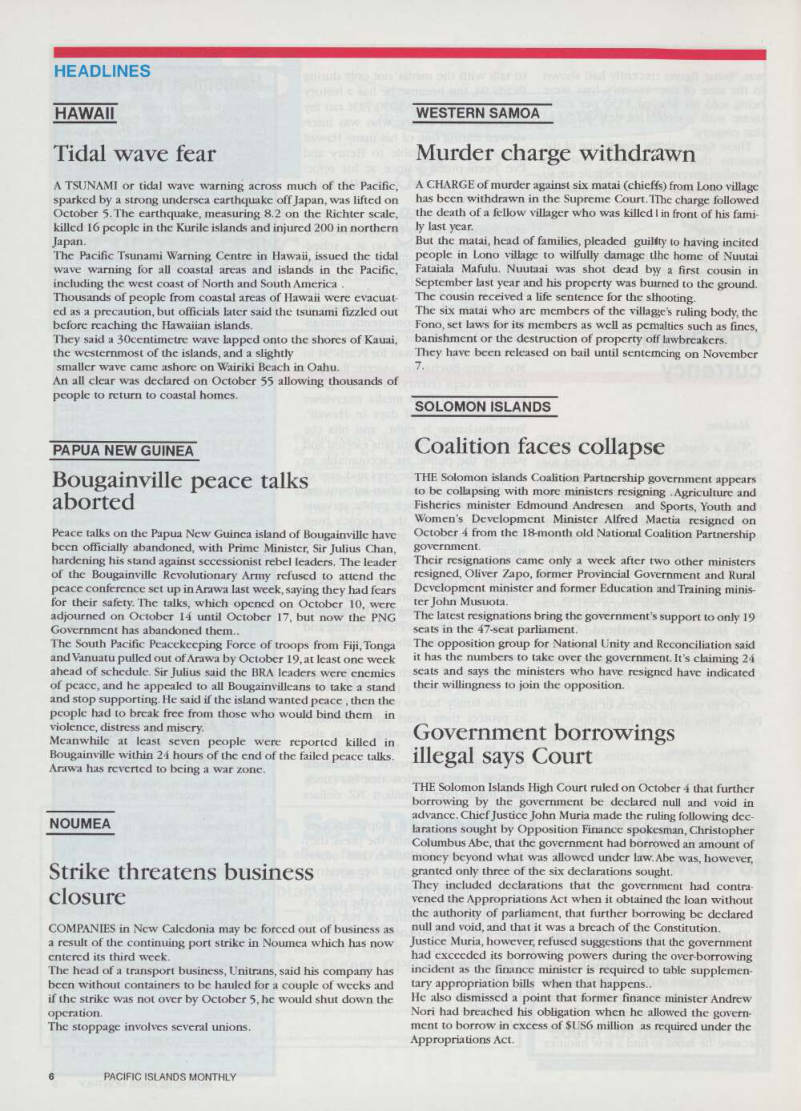
Tidal wave fear
Headlines
Hawaii
A TSUNAMI or tidal wave warning across much of the Pacific, sparked by a strong undersea earthquake off Japan, was lifted on October 5-The earthquake, measuring 8.2 on the Richter scale, killed 16 people in the Kurile islands and injured 200 in northern
Japan.
The Pacific Tsunami Warning Centre in Hawaii, issued the tidal wave warning for all coastal areas and islands in the Pacific, including the west coast of North and South America .
Thousands of people from coastal areas of Hawaii were evacuat ed as a precaution, but officials later said the tsunami fizzled out before reaching the Hawaiian islands.
They said a 30centimetre wave lapped onto the shores of Kauai, the westernmost of the islands, and a slightly smaller wave came ashore on Wairiki Beach in Oahu.
An all clear was declared on October 55 allowing thousands of people to return to coastal homes.
aborted
Papua New Guinea
Bougainville peace talks
Peace talks on the Papua New Guinea island of Bougainville have been officially abandoned, with Prime Minister, Sir Julius Chan, hardening his stand against secessionist rebel leaders. The leader of the Bougainville Revolutionary Army refused to attend the peace conference set up in Arawa last week, saying they had fears for their safety. The talks, which opened on October 10, were adjourned on October 14 until October 17, but now the PNG Government has abandoned them..
The South Pacific Peacekeeping Force of troops from Fiji, Tonga and Vanuatu pulled out of Arawa by October 19, at least one week ahead of schedule. Sir Julius said the BRA leaders were enemies of peace, and he appealed to all Bougainvilleans to take a stand and stop supporting. He said if the island wanted peace , then the people had to break free from those who would bind them in violence, distress and misery.
Meanwhile at least seven people were reported killed in Bougainville within 24 hours of the end of the failed peace talks.
Arawa has reverted to being a war zone.
Strike threatens business
Noumea
closure
COMPANIES in New Caledonia may be forced out of business as a result of the continuing port strike in Noumea which has now entered its third week.
The head of a transport business, Unitrans, said his company has been without containers to be hauled for a couple of weeks and if the strike was not over by October 5, he would shut down the operation.
The stoppage involves several unions.
Murder charge withdrawn
Western Samoa
A CFIARGE of murder against six matai (chieffs) from Lono village has been withdrawn in the Supreme Court.TThe charge followed the death of a fellow villager who was killed I in front of his fami ly last year.
But the matai, head of families, pleaded guihlty to having incited people in Lono village to wilfully damage tlhe home of Nuutai Fataiala Mafulu. Nuutaai was shot dead byy a first cousin in September last year and his property was butrned to the ground.
The cousin received a life sentence for the slhooting.
The six matai who are members of the village’s ruling body, the Fono, set laws for its members as well as pemalties such as fines, banishment or the destruction of property off lawbreakers.
They have been released on bail until sentemcing on November 7.
Government borrowings
Solomon Islands
Coalition faces collapse
THE Solomon islands Coalition Partnership government appears to be collapsing with more ministers resigning .Agriculture and Fisheries minister Edmound Andresen and Sports, Youth and Women’s Development Minister Alfred Maetia resigned on October 4 from the 18-month old National Coalition Partnership government.
Their resignations came only a week after two other ministers resigned, Oliver Zapo, former Provincial Government and Rural Development minister and former Education and Training minis ter John Musuota.
The latest resignations bring the government’s support to only 19 seats in the 47-seat parliament.
The opposition group for National Unity and Reconciliation said it has the numbers to take over the government. It’s claiming 24 seats and says the ministers who have resigned have indicated their willingness to join the opposition.
Government borrowings
illegal says Court
THE Solomon Islands High Court ruled on October 4 that further borrowing by the government be declared null and void in advance. Chief Justice John Muria made the ruling following dec larations sought by Opposition Finance spokesman, Christopher Columbus Abe, that the government had borrowed an amount of money beyond what was allowed under law. Abe was, however, granted only three of the six declarations sought.
They included declarations that the government had contra vened the Appropriations Act when it obtained the loan without the authority of parliament, that further borrowing be declared null and void, and that it was a breach of the Constitution.
Justice Muria, however, refused suggestions that the government had exceeded its borrowing powers during the over-borrowing incident as the finance minister is required to table supplemen tary appropriation bills when that happens..
He also dismissed a point that former finance minister Andrew Nori had breached his obligation when he allowed the govern ment to borrow in excess of SUS 6 million as required under the Appropriations Act.
Runway testing
Kiribati
underway
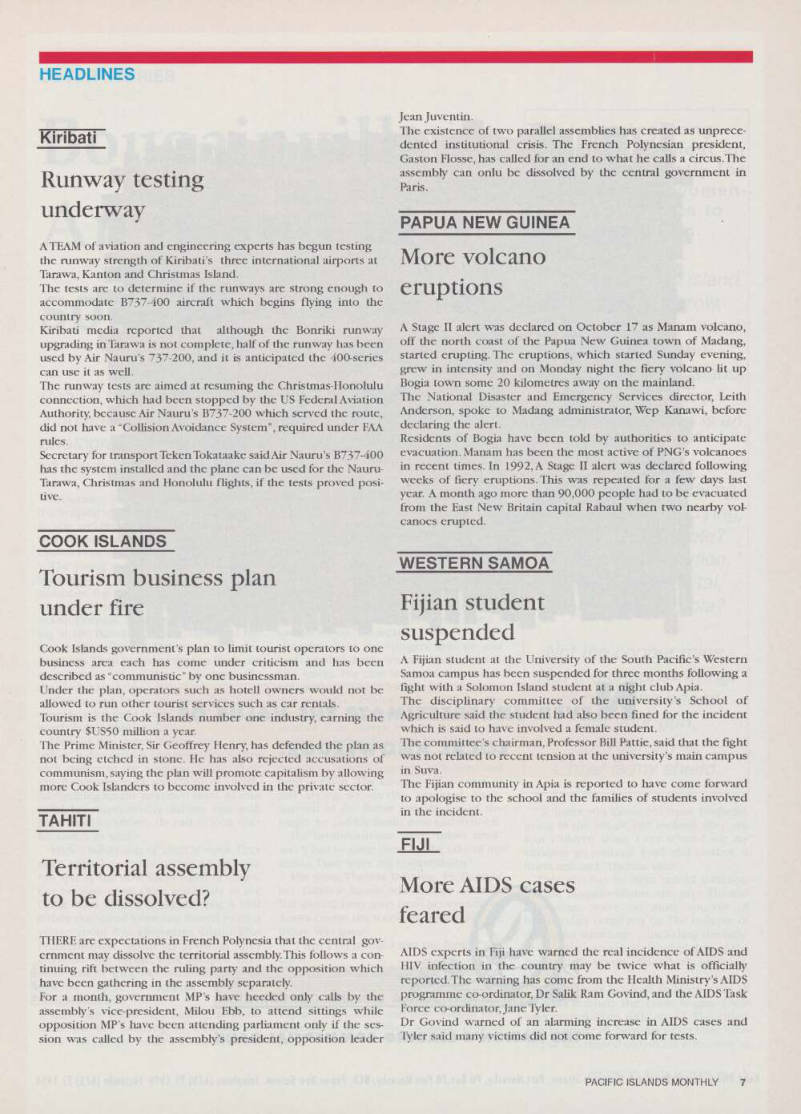
A TEAM of aviation and engineering experts has begun testing the runway strength of Kiribati’s three international airports at Tarawa, Kanton and Christmas Island.
The tests are to determine if the runways are strong enough to accommodate 8737-400 aircraft which begins flying into the country soon.
Kiribati media reported that although the Bonriki runway upgrading in Tarawa is not complete, half of the runway has been used by Air Nauru’s 737-200, and it is anticipated the 400-series can use it as well.
The runway tests are aimed at resuming the Christmas-Honolulu connection, wliich had been stopped by the US Federal Aviation Authority, because Air Nauru’s 8737-200 which served the route, did not have a “Collision Avoidance System”, required under FAA rules.
Secretary for transportTekenTokataake said Air Nauru’s 8737-400 has the system installed and the plane can be used for the Nauru- Tarawa, Christmas and Honolulu flights, if the tests proved posi tive.
Tourism business plan
Cook Islands
under fire
Cook Islands government’s plan to limit tourist operators to one business area each has come under criticism and has been described as ‘communistic’’ by one businessman.
Under the plan, operators such as hotell owners would not be allowed to run other tourist services such as car rentals.
Tourism is the Cook Islands number one industry, earning the country SUSSO million a year.
The Prime Minister, Sir Geoffrey Henry, has defended the plan as not being etched in stone. He has also rejected accusations of communism, saying the plan will promote capitalism by allowing more Cook Islanders to become involved in the private sector.
Territorial assembly
Tahiti
to be dissolved?
THERE are expectations in French Polynesia that the central gov ernment may dissolve the territorial assembly. This follows a con tinuing rift between the ruling party and the opposition which liave been gathering in the assembly separately.
For a month, government MP’s have heeded only calls by the assembly’s vice-president, Milou Ebb, to attend sittings while opposition MP’s have been attending parliament only if the ses sion was called by the assembly’s president, opposition leader
Jean Juventin.
The existence of two parallel assemblies has created as unprece dented institutional crisis. The French Polynesian president, Gaston Flosse, has called for an end to what he calls a circus. The assembly can onlu be dissolved by the central government in Paris.
eruptions
Papua New Guinea
More volcano
A Stage II alert was declared on October 17 as Manam volcano, off the north coast of the Papua New Guinea town of Madang, started erupting. The eruptions, which started Sunday evening, grew in intensity and on Monday night the fiery volcano lit up Bogia town some 20 kilometres away on the mainland.
The National Disaster and Emergency Services director, Leith Anderson, spoke to Madang administrator, Wep Kanawi, before declaring the alert.
Residents of Bogia have been told by authorities to anticipate evacuation. Manam has been the most active of PNG’s volcanoes in recent times. In 1992, A Stage II alert was declared following weeks of fiery eruptions. This was repeated for a few days last year. A month ago more than 90,000 people had to be evacuated from the East New Britain capital Rabaul when two nearby vol
canoes erupted.
Fijian student
Western Samoa
suspended
A Fijian student at the University of the South Pacific’s Western Samoa campus has been suspended for three months following a fight with a Solomon Island student at a night club Apia.
The disciplinary committee of the university’s School of Agriculture said the student had also been fined for the incident wliich is said to have involved a female student.
The committee’s chairman, Professor Bill Pattie, said that the fight was not related to recent tension at the university’s main campus in Suva.
The Fijian community in Apia is reported to have come forward to apologise to the school and the families of students involved in the incident.
feared
Fiji
More AIDS cases
AIDS experts in Fiji have warned the real incidence of AIDS and HIV infection in the country may be twice what is officially reported. The warning has come from the Health Ministry’s AIDS programme co-ordinator, Dr Salik Ram Govind, and the AIDS Task Force co-ordinator, Jane Tyler.
Dr Govind warned of an alarming increase in AIDS cases and Tyler said many victims did not come forward for tests.
Advertisements & other items, p. 8 (1 item)
Savi Pbcoo9I
mmrt A 1 a* M-
—r—'r ; ‘J I 'I
r r*i i a HHi i. .. ni 3a ■
Never underestimate the value of
LOCAL KNOWLEDGE.
APUA NEW GUINEA BANKING CORPORATION
THE NATION'S LEADING COMMERCIAL BANK
Head Office: Corner Douglas & Musgrave Streets, Port Moresby. PO Box 78 Port Moresby, NCD, Papua New Guinea. Telephone (675) 21 1 999 Facsimile (675) 21 1954
SAVI PBCOO9I
Bougainville-
Cover Stories
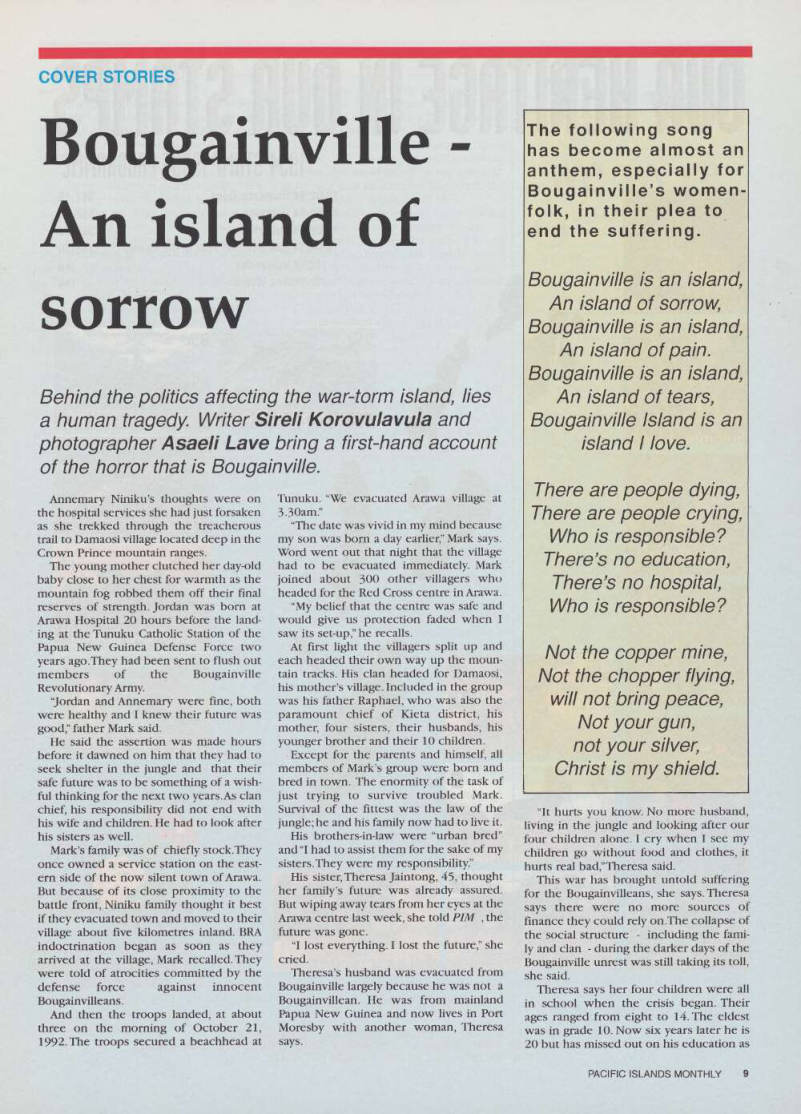
Bougainville- An island of
sorrow
Behind the politics affecting the war-torm island, lies a human tragedy. Writer Sireli Korovulavula and photographer Asaeli Lave bring a first-hand account of the horror that is Bougainville.
Annemary Niniku’s thoughts were on the hospital services she had just forsaken as she trekked through the treacherous trail to Damaosi village located deep in the Crown Prince mountain ranges.
The young mother clutched her day-old baby close to her chest for warmth as the mountain fog robbed them off their final reserves of strength. Jordan was born at Arawa Hospital 20 hours before the land ing at the Tunuku Catholic Station of the Papua New Guinea Defense Force two years ago. They had been sent to flush out members of the Bougainville Revolutionary Army.
“Jordan and Annemary were fine, both were healthy and I knew their future was good,” father Mark said.
He said the assertion was made hours before it dawned on him that they had to seek shelter in the jungle and that their safe future was to be something of a wish ful thinking for the next two years.As clan chief, his responsibility did not end with his wife and children. He had to look after his sisters as well.
Mark’s family was of chiefly stock. They once owned a service station on the east ern side of the now silent town of Arawa.
But because of its close proximity to the battle front, Niniku family thought it best if they evacuated town and moved to their village about five kilometres inland. BRA indoctrination began as soon as they arrived at the village, Mark recalled. They were told of atrocities committed by the defense force against innocent Bougainvilleans.
And then the troops landed, at about three on the morning of October 21, 1992. The troops secured a beachhead at
Tunuku. “We evacuated Arawa village at 3.30 am.”
“The date was vivid in my mind because my son was born a day earlier,” Mark says.
Word went out that night that the village had to be evacuated immediately. Mark joined about 300 other villagers who headed for the Red Cross centre in Arawa.
“My belief that the centre was safe and would give us protection faded when I saw its set-up,” he recalls.
At first light the villagers split up and each headed their own way up the moun tain tracks. His clan headed for Damaosi, his mother’s village. Included in the group was his father Raphael, who was also the paramount chief of Kieta district, his mother, four sisters, their husbands, his younger brother and their 10 children.
Except for the parents and himself, all members of Mark’s group were born and bred in town. The enormity of the task of just trying to survive troubled Mark.
Survival of the fittest was the law of the jungle; he and his family now had to live it.
His brothers-in-law were “urban bred” and “I had to assist them for the sake of my sisters. They were my responsibility.”
His sister, Theresa Jaintong, 45, thought her family’s future was already assured.
But wiping away tears from her eyes at the Arawa centre last week, she told PIM , the future was gone.
“I lost everything. I lost the future,” she cried.
Theresa’s husband was evacuated from Bougainville largely because he was not a Bougainville an. He was from mainland Papua New Guinea and now lives in Port Moresby with another woman, Theresa says.
The following song has become almost an anthem, especially for Bougainville’s women folk, in their plea to end the suffering.
Bougainville is an island, An island of sorrow, Bougainville is an island, An island of pain.
Bougainville is an island, An island of tears, Bougainville Island is an island I love.
There are people dying, There are people crying, Who is responsible?
There’s no education, There’s no hospital, Who is responsible?
Not the copper mine, Not the chopper flying, will not bring peace, Not your gun, not your silver ; Christ is my shield.
“It hurts you know. No more husband, living in the jungle and looking after our four children alone. I cry when I see my children go without food and clothes, it hurts real bad,"Theresa said.
This war has brought untold suffering for the Bougainvilleans, she says. Theresa says there were no more sources of finance they could rely on. The collapse of the social structure - including the fami ly and clan - during the darker days of the Bougainville unrest was still taking its toll, she said.
Theresa says her four children were all in school when the crisis began. Their ages ranged from eight to 14. The eldest was in grade 10. Now six years later he is 20 but has missed out on his education as
a result of the collapse of the civil govern ment in Bougainville.
“If things had been normal, he may have even been in university by now,” she said.
Her only daughter was in grade six then.
The younger sons were in grades five and three respectively. For them the future is limited.
“I knew education doesn’t stop. They have to be rehabilitated, they have been in the bush far too long. If government can set up schools here and accept students regardless of their ages,” she said.
Education must go on, it is the only way to survive, says Theresa.
Theresa said her children together with those of her brother and other sisters were lucky to be alive after so long in the jungle. “Women and children were the most ill-treated people in the jungle,” she said. Food was in abundant supply. But children died in droves because of the absence of proper health facilities.
“There was no immunisation for babies as they died in large numbers. Then there were mothers who died in painful circum stances during child birth,’’Theresa said.
She witnessed women who should have received caesarean operations die because they did not have access to facilities.
Others died in pregnancy complications, women died because of the absence of proper medical facilities or trained staff.
Medical facilities in the jungle were non-existent. People suffering from chron ic diseases just died.
“Just imagine mothers watching their babies die in front of them, and they were helpless,” Theresa says. They were not allowed to leave the jungle and seek refuge in Arawa. The revolutionists ran a successful propaganda campaign warning people of the atrocities committed against civilians by the Papua New Guinea Defence Force.“ Fear was driving us all the time. It was a nightmare. They could come and get you anytime of the night,” she says.
BRA was feared as much as the security forces. Brothers and brothers were forced to join the BRA out of necessity. They had to do that to protect their womenfolk and children. Because of the clan system in the society, it was important to have a brother or father join BRA. Theresa believes that was a way families could be
guaranteed safety while living in BRA-con
trolled territories.
BRA members would harass civilians in their areas of operation if a community either did not have a member in the BRA group in control of that area.
“If we did not have a male member in the BRA for that sector, they will harass us.
We did not have freedom of speech and everything we did, we must submit to authorities,” she said. “The BRA in control of the area we live in will not give us pro tection if we do not belong to the same clan or if no male from our family unit joined them in their struggle.
“They’d do nothing if members of
another BRA command were to come and take material goods from us, even young women,” she said. Theresa said she had never had to do as heavy a task as she did while in the jungle.
“I did back-breaking gardening from dawn to dusk, my husband was no longer with me, but I had to see to my kids and, as far as I was concerned, they were the most important things in my life.”
She says now there was no room for pay-backs; it was now time for peace.
“But if there is to be forgiveness it has to be done according to our traditions and customs because that is what we under stand best. Blanket amnesty or legislated peace will not be effective.”
Pauline Onsa, a volunteer with Papua New Guinea Red Cross, says it pained her to see women and children isolated in the jungle. They were once paid workers in Arawa, but now lived a nomadic lifestyle in the jungle. wore almost noth % jL j ing and would disappear ▼ T into forest cover at the first appearance of men. They lived hard,” she said. They could not turn to churches because of the same reason, Onsa said.
She said food was not a problem to those living in the jungle. Their main prob lem was medical supplies and clothes.
“A lot have died from malaria, pneumo nia, cold and exhaustion,” she said. Onsa said her main wish was for the re-estab lishment of peace in Bougainville. She believes both sides were guilty of indis criminate killings but it was time to iron out differences and discuss peace. Onsa echoed the sentiments of Papua New Guinea Prime Minister Sir Julius Chan who said peace should be given a chance so the 10-year-old Bougainvillean could once again smell freedom.
“The 10-year-old is suffering more than the six-year-old because he has already experienced freedom. Are we going to keep on denying him that right?” he asked.
Patricia, a refugee in the Arawa Care Centre, said she was frightened for her children. She had lived in the jungle with her husband and two children since 1990.
“We were always scared to move about: of the BRA and the security force,” she said.
Maryanne Mases, representative of the women in BRA-controlled areas, said she defied censor to attend the conference “because it was what the people wanted”.
“The two conflicting parties in the
Bougainville conflict must compromise
and participate fully in this conference,” she said.
“We the women of the BRA and the interim administration want to convince everyone of the importance of this meet ing.”
Of all those who spoke at the confer ence, on one spoke of anything but mak ing peace. And if that is the only thing achieved it would have served its pur pose.. ■
Advertisements & other items, p. 10 (1 item)
Ouii Him 111
ri n rr
JJ uJn
V nn
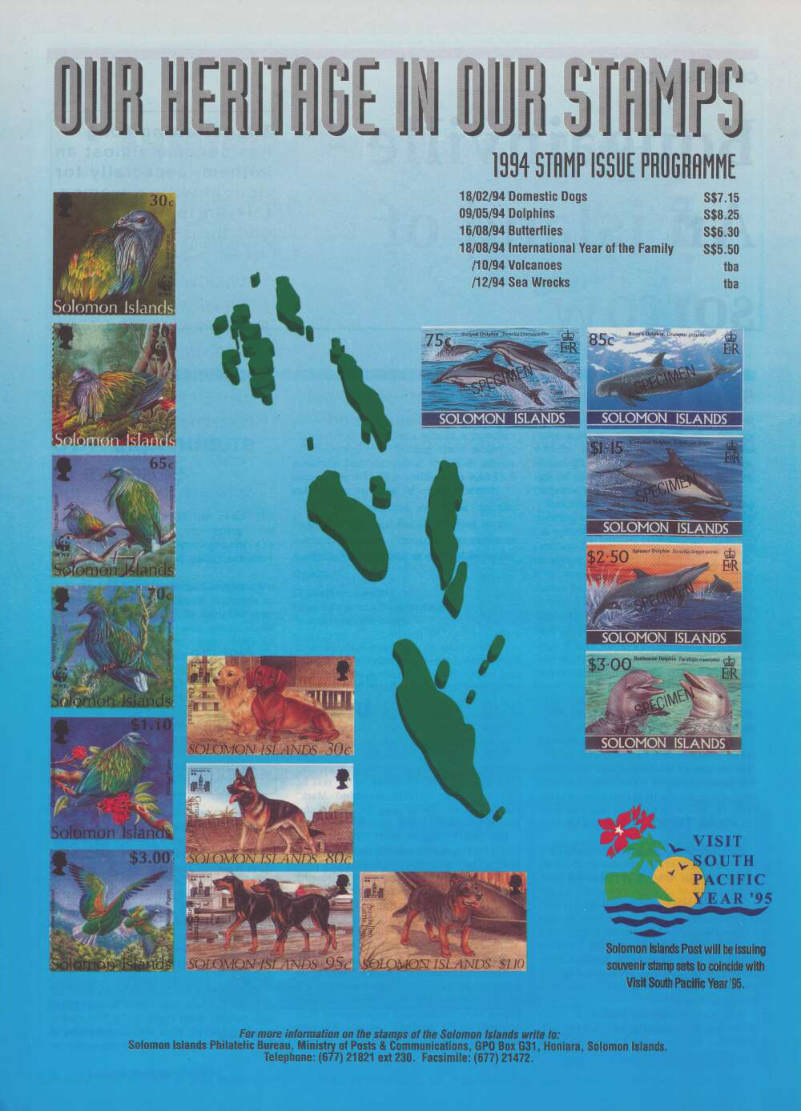
1994 STHMP ISSUE PROGRAMME
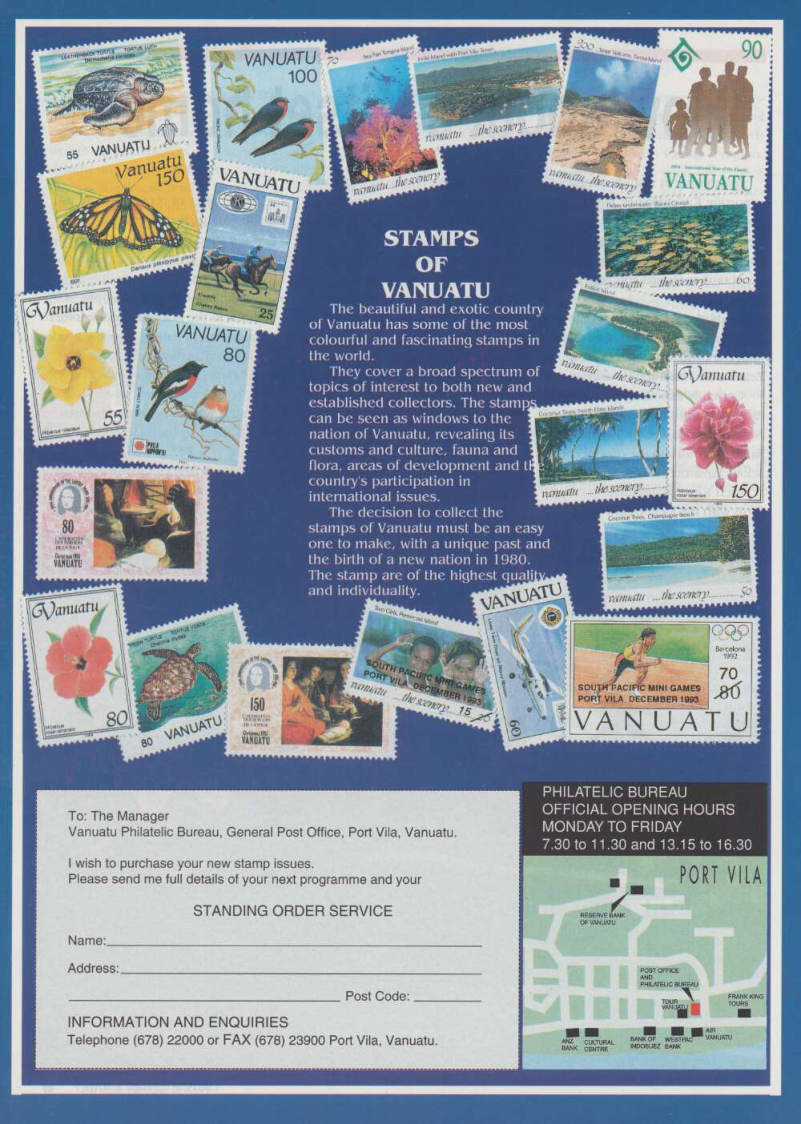
18/02/94 Domestic Dogs 09/05/94 Dolphins 16/08/94 Butterflies 557.15 558.25 556.30 18/08/94 International Year of the Family 555.50 30 /10/94 Volcanoes /12/94 Sea Wrecks tea tba Striped Dolphin Stenclla cotrultoaiha Qt) QIT m Bbc KisMt’s Dolphin (Irumpus gr.
SOLOMON ISLANDS
SOLOMON ISLANDS
I
SOLOMON ISLANDS
SOLOMON ISLANDS
> ' $3OO E'R \# * am
SOLOMON ISLANDS
SOLOMON ISLANDS 30c
£ M f ■■ 0
VISIT
mm &
SOI
OUTH
PACIFIC
YEAR ’95
mSM m 3‘ rS
SOLOMON /
OMpN ISLANDS $llO
Solomon Islands Post will be issuing souvenir stamp sets to coincide with Visit South Pacific Year’9s.
For more information on the stamps of the Solomon Islands write to: Solomon Islands Philatelic Bureau. Ministry of Posts & Communications, GPO Box G3l, Honiara, Solomon Islands.
Telephone: (677) 21821 ext 230. Facsimile: (677) 21472.
The way
we were
Once hailed as the best provincial capital in Papua New Guinea, Arawa was the toast of all Bougainvilleans. Located on the south eastern coast of Bougainville, the North Solomon capital was protected on the west by the densely forested Crown Prince mountain range and on the east by the Pacific ocean.
Former mine employee Michael Titus recalls the nation’s capital, Port Moresby, was “hell compared to Arawa”. It was a beautiful town.”.
“There was a 108-bed government hos pital there,” he said pointing to the burnt out structure facing Arawa Care Centre.
Titus pointed north and said it pained him to see the Bougainville Copper Limited-sponsored hospital in ruins.
“Why did they have to do this,” he asked.
The provincial office was understandable but the hospital, no.”
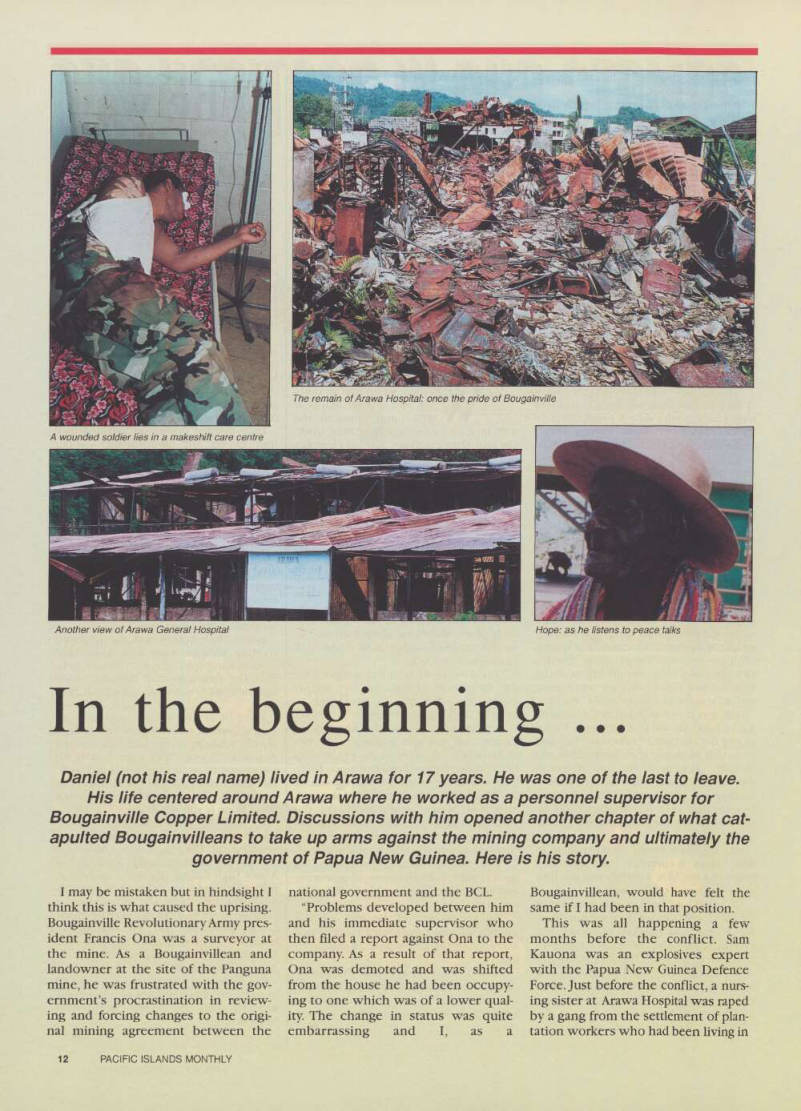
The government hospital was located close to the mining company’s executive single quarters. Neither government sym pathisers nor revolutionary supporters remember who the responsible party was. The town once bustling with activity was now in ruins. Fire-ravaged walls of the mining hospital were the only reminder left standing of what used to be the best hospital in the country.
Arawa High School and the technical training college were abandoned and deteriorating from the six years of isola tion. The two important facilities would take millions of dollars to reestablish,Titus said.
Three of the five primary schools oper ated according to the Papua New Guinea system while the other two followed the Australian system. “The mine had to do something to attract specialists and to do this they had to provide the same type of services that were available in Australia. Of these none is still standing.
Then there were two high schools which catered for the townsfolk, those working the Panguna Copper Mine and the people of Bougainville. Buildings at Arawa High School, the venue of the cur rent peace conference, are in usable con dition but have been idle and overgrown because of six years of neglect. The Public Library has all but gone. The only sign of its past is its broken down signposts nes tled between chicken-wire fences of Arawa Care Centre.
Electricity and water have been restored in some areas but all form of telecommu nication with the outside world have been severed.
In the beginning...
Daniel (not his real name) lived in Arawa for 17 years. He was one of the last to leave.
His life centered around Arawa where he worked as a personnel supervisor for Bougainville Copper Limited. Discussions with him opened another chapter of what cat apulted Bougainvilleans to take up arms against the mining company and ultimately the government of Papua New Guinea. Here is his story.
I may be mistaken but in hindsight I think this is what caused the uprising.
Bougainville Revolutionary Army pres-
idem Francis Ona was a surveyor at the mine. As a Bougainvillean and landowner at the site of the Panguna mine, he was frustrated with the government’s procrastination in reviewing and forcing changes to the original mining agreement between the
national government and the BCL.
“Problems developed between him and his immediate supervisor who then filed a report against Ona to the company. As a result of that report, Ona was demoted and was shifted from the house he had been occupying to one which was of a lower quality. The change in status was quite embarrassing and I, as a
Bougainvillean, would have felt the same if I had been in that position.
This was all happening a few months before the conflict. Sam Kauona was an explosives expert with the Papua New Guinea Defence Force. Just before the conflict, a nurs ing sister at Arawa Flospital was raped by a gang from the settlement of plan tation workers who had been living in
A wounded soldier lies in a makeshift care centre
Another view of Arawa General Hospital
The remain ofArawa Hospital: once the pride of Bougainville
Hope: as he listens to peace talks
squatter settlements close to town.
She was then murdered and muti lated and she was from Kongara vil lage, the village also of Sam Kauona. If that happened to your sister what would you do? I don’t blame Sam for what happened. Local people took revenge and killed some of the planta tion people. These people had come to work in the copra and cocoa plan tations.
Riot police were called in to curb the killing that gained momentum after the first pay-back killing. The riot police started burning local villages in a tactic they were well known for. Any agitation in the country would be treated as such by them.
They took the Bougainvilleans light ly. The tactic was successful else where; here in Bougainville it back fired.
Joseph Kabui won the premiership
election with a landslide in 1988. He was a landowner here in Bougainville and haboured the same feelings as other Bougainvilleans. Three started out as individual outfit leaders fight ing against a common enemy and also among themselves. They realised that they would have to fight side by side to beat the government forces.
And when you have three fighters, who have their own reasons to fight, grouped together in combat, you have a real war on your hands.
Francis One is now BRA president, Joseph Kabui is vice-president and Sam Kauona is BRA supreme com mander.
Together they have sustained a war that has claimed hundreds of lives and together with government they are trying to work their way out of it without losing face on any quarter.
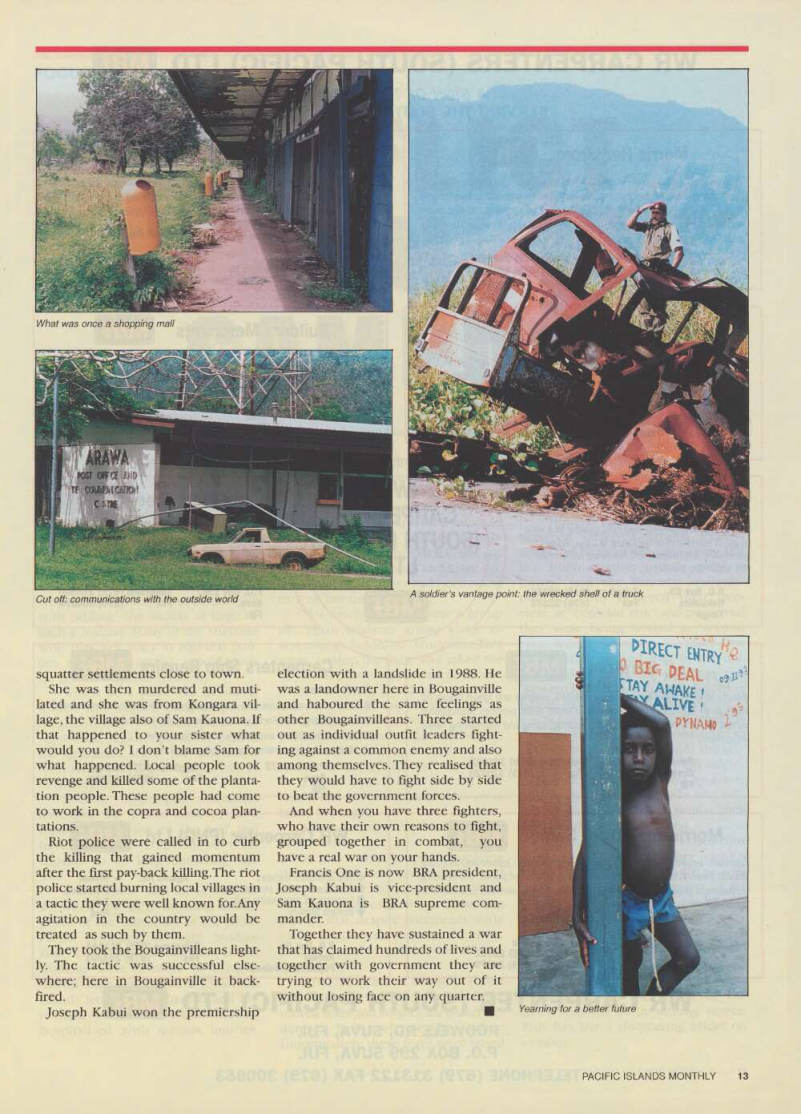
What was once a shopping mall
A soldier’s vantage point: the wrecked shell of a truck
Cut off: communications with the outside world
Yearning for a better future
Advertisements & other items, p. 14 (1 item)
(South Pacific)
WR CARPENTERS (SOUTH PACIFIC) LTD EEfl
A SIGN OF THE FUTURE
SERVING THE SOUTH PACIFIC REGION
Morris Hedstrom
m Fiji’s largest retail and wholesale organisation. General merchants, importers and exporters for over 120 years. Agents and distributors for wellknown international brands of food, liquor, toys, cosmetics, stationery, sports equipment, glassware, furniture, electrical appliances, white goods, audio and video equipment and more.
P.O. Box 295 Telephone (679) 315299 Suva Fax (679) 301216
FIJI
Carpenters Motors
Fiji’s No. 1 automotive dealer for over 70 years and providing professional service of world standard. We have a fully computerised inventory system and our spare parts and service back-up is second to none.
Agents for: Private Mall Bag • Nissan Suva • Honda FIJI • Tata Telephone (679) 313644 Fax (679) 301872 IB
Carpenters Shipping
MBf
International freight forwarders with offices strategically located at Fiji’s main sea and air gateways thus facilitating excellent communication and speedy service. We also operate fully equipped modem container terminals with freezer container facilities and round the clock forklift service.
Private Mall Bag Suva
FIJI
Telephone: Suva (679) 312244 Lautoka (679) 663988 Fax: Suva (679) 301572 Lautoka (679) 664896
Builders Merchants
A major supplier of building and industrial contracting materials to Fiji and the region. Contact us for reliable and professional service for all your hardware and building material requirements.
P.O. Box 48 Suva
FIJI
Telephone (679) 313155 Fax (679) 300694
Morris Hedstrom Tonga [^TTij
Tonga’s leading general merchant dealing in a wide range of merchandise including textiles, liquor, homeware, appliances and hardware on a retail and wholesale basis.
WR
CARPENTER
(SOUTH PACIFIC)
LTD.
Carpenters Steel IiTJiH
We manufacture and supply reinforcing rods and welded i steel mesh fabric to international standards for industrial and construction applications across the Pacific. Carpenters steel MBf is a trusted name.
P.O. Box 63 Nukualofa Tonga Telephone (676) 23355 Fax (676) 23386 P.O. Box 1367 Suva
FIJI
Telephone (679) 314500 Fax (679) 304876
Carptrac IlfllifJ
Carpenters Ship Repairs IhtltfJ
Agents for the Caterpillar range of machines, engines and forklift trucks for more than 60 years. Our experienced sales team provides professional advice on all aspects of selecting, acquiring, using and maintaining heavy equipment.
Private Mail Bag Telephone (679) 381622 Suva Fax (679) 370329
FIJI
Specialists In • Installations and repairs to marine engines • Cylinder head repairs • Boilermaking • Factory machine installation and repairs • General machinery and fittings • Ship repairs Contact us for personalised and professional service P.O. Box 172 Telephone (679) 312133 Suva Fax (679) 301364
FIJI
Morris Hedstrom Samoa
Samoa’s largest general merchant featuring food, homeware/electrical goods, drapery, fancy goods, hardware, agriculture and paints. Our shipping department provides packing and removals, freight services and customs clearing.
Agents for. • Nissan • Caterpillar • Ford • Yanmar P.O. Box 1857 Apia Western Samoa Telephone (685) 22722 Fax (685) 24279
WR CARPENTER (SOUTH PACIFIC) LTD
RODWELL RD, SUVA, FIJI.
P.O. BOX 299 SUVA, FIJI.
TELEPHONE (679) 313122 FAX (679) 300953
Conflict

Focus
ON
Campos
By Yunus Rashid
University of the South Pacific, arguably home to the Pacific’s academic and intellectual cream , and a place where the region’s future leaders are nurtured and groomed, has been plagued with a disease which threatens its very existence. The disease is racism. The tragedy of the situation is that the dis ease is prevalent in an institution one would normally expect to be charged with ridding the society at large of such a malaise. Many of the students will play key roles in regional poli tics which presumably would push for greater regional solidarity.
Will it be a place for moulding leaders who can work amicably with neighbouring counterparts to resolve the region’s problems or will the graduates leave the institution with racial prejudices against others in the region?
Recent on-campus incidents have put the whole concept of a regional university to the test and have seen the eruption of what appears to be long-simmering ten sion.
It was about 3am on September 25 when the early morning atmos phere of the University of the South Pacific exploded into ugly student violence. Fijian and Solomon Island students were involved in a night marish brawl in which a (Solomon Island) lecturer was beaten and bit ten, and two Solomon Island students hospitalised with serious injuries,
including broken bones.
The lecturer, Tarcisius Tara Kabutaulaka, recounted his version to PIM : He had just returned to campus with a group of Want ok students in a bus when a Fijian student swung a punch into the bus and hit a Solomon student. Tara quickly stepped in, hop ing to avert any further attack, and got the boys to shake hands and make up.
He thought the matter had been taken care of. But he was wrong.
Not much later, Tara saw a group of Fijian students giving chase to screaming Solomon students. Tara went to stop the fight and asked the boys to report to the security officers.
Before anything could be reported ,
however, and in the presence of the security guards, there was yet another onslaught of punches and kicks. This time round Tara got punched, kicked and bitten along with the students.
Police was called to end the brawl. Tara and the injured boys were taken to hospital.
When the new day broke, all hell broke loose.
A major row erupted, involving the students, their governments and the university administration. What emerged as a result was a disturbing picture that, despite statements made to the contrary throughout the years, a nasty form of racism was rife on campus.
After 26 years of being, USP had failed to address and resolve the deep rooted fears and suspicions island stu dents had of each other.
Unfortunately, these fears were based
along national and racial lines.
It also became apparent that Vanuatu students felt they had been victims at the university, as well, recounting in a petition to their gov ernment, instances of harassment.
“Hatred and misunderstanding between different groups existed since the birth of this university but the administration usually plays it down,” said the Vanuatu students’ petition. They believed their lives were at “constant risk” and perceived they were being treated as “second class human beings”. “... most East Pacific students and staff of the uni versity see those of us from the Western Pacific (particularly Solomon Islands and Vanuatu) as inferior.”
Solomon and Vanuatu students demanded their governments agree to have them return home until the ten sion had diffused and they felt safer.
Their governments and sponsors obliged. It appeared nobody was will ing to guarantee that a similar inci dent would not be repeated.
After all, it was only about four months ago that another vicious attack at USP had left students seri
ously injured and in hospital. One
Fijian student had lost an eye after it was gouged out with a broken beer bottle. There were criminal charges laid against the Samoan perpetrators and convictions made.
But what startled the university community was the extent of vio lence resorted to in settling scores.
This has left a disquieting effect on campus.
Following the September inci dent, USP’s Vice-Chancellor Esekia Solofa, after listening to witnesses, suspended five Fijian students alleged ly involved in the brawl. The Fijian Students Association asked him to reconsider and allow them to contin ue their studies, especially since it was so close to examinations. Solofa agreed. But the USP Senate did not.
They decided on complete suspen sion until the university’s disciplinary committee had concluded its hearing.
Solofa abided by the Senate ruling, although he had powers to overturn their decision.
The Fijian Students Association boycotted lectures as a result, saying the students had been unfairly treat ed. Solomon and Vanuatu students left - the Solomon students on a especially chartered flight - after the university agreed to have them sit their exams in their home countries.
Solofa admitted there were per ceptions that racial problems existed on campus. “It is possible that these perceptions are valid. We have to try and dispel them. That can come about by actually providing for activities and actions which can dispel percep tions.”
He said fights which normally started from arguments over girls ended in racial conflicts.
“There is no danger until there is a spark from a fight between two stu dents which quickly becomes a fight between two groups.”
However, Tara, did not mince his words when it came to describing the situation at the university . “Racism exists here. It is unfortunate, but it is true”.
Tara, a Solomon Islander, added that the “Wantok” students, who are gener ally darker-skinned, were looked down upon by their counterparts from Fiji, Tonga, Western Samoa and some other countries. The root of the problem lay in the fact that students came to campus with varying degrees of prejudices of their fellow students from neighbouring countries.
Tara believes it is important for Wantok students to shed their inferi ority complex and mingle with oth ers to build a more harmonious envi ronment.
Solofa, on the other hand, has expressed concern that if the problem is not resolved, member countries would consider withdrawing financial support from what is supposed to be
a regional school.
Tara further claims that many crimes committed along racial lines have gone unreported and the two recent major fights have been a culmination of this tension.
In the meantime, the USP administra tion has increased security numbers from six to 13 for the 3000-odd stu dents and has asked police to include USP in its patrol list.
But these temporary measures cannot cure the racial problems. Students and lecturers agree that there is not much cross-cultural assimilation. Racism is further encouraged by the very struc ture of student associations. For exam ple: the University of the South Pacific Students Association has a Fiji Students Association which then has sub-groups along further racial lines - Fijian Students Association, Indian Students Association, Chinese Students Association and the Rotuman Students Association.
“Go anywhere in the university, except perhaps in the classes, and you will find students grouping along cultural lines. For any lasting solution to this university’s problems, students need to break away from racial groups and mingle with other students,” one senior lecturer said.
Solofa agreed with this principle. He said for many years now the universi ty had been trying to get students to form hobby groups, professional groups and other associations which would help break down racial barri ers. While some students have taken
the initiative to do this, many remain cold to this idea. A read of the USP’s regulation book shows there are no clear-cut rules against racism.
Solomon Island’s government infor mation director, Johnson Honimae, says the immediate withdrawal of more than 100 of their students was a temporary measure to help diffuse the tension at USR He said the USP administration had made arrange ments for the returning students to sit
exams by correspondence. Honimae
said the experience had not left a bit ter note between Fiji and Solomons, but he, all the same, called for an immediate review of the security sys tem at USR A former student and now Fiji Prime Minister’s press secretary, Jone Dakuvula, said such conflicts were not new. In the ‘7os, as a senior stu dent , he was called in to diffuse a sit uation where Fijian and Western Samoan students had had a major con frontation.
He said in the ‘7os there was a smaller number of students and it was easier to talk to them, unlike today , when the number of students exceeds the 3000-mark and it is easier to group along national lines.
What needs to be emphasised is that students, irrespective of their back grounds, who criticised the assaults and the resulting fight are a ray of hope for the university. It is through these students that the ideals upon which the university was built can still be realised.
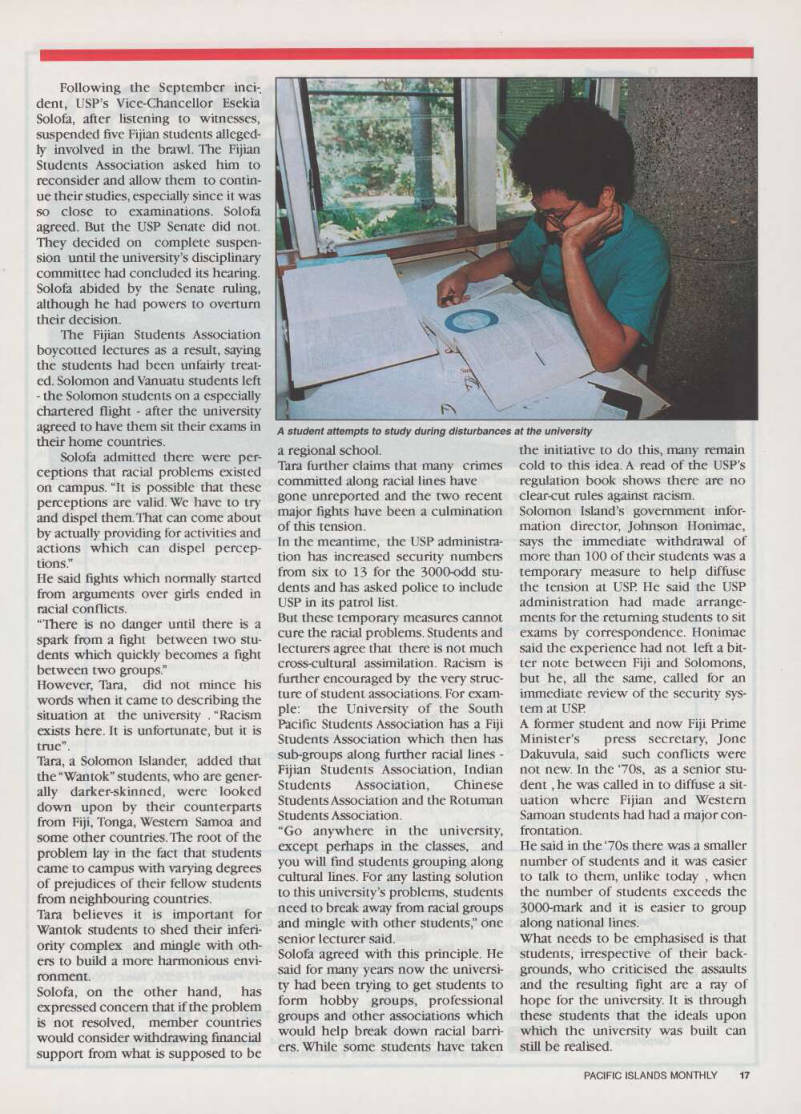
A student attempts to study during disturbances at the university
Advertisements & other items, pp. 16-18 (1 item)
arvi
aa= ► 5 ...y.. ■ J • m M * , • : j?S
JP**’.. S
*■* ' m m t ■- 21 W Jfr ‘ w :n‘
4 jus.
ii F * .. -<i>r'^ v- ■ </' w Wi a • *■ ■■ • #s M
fSP
m m ; • i
NICATION CORPO
im I mm . £
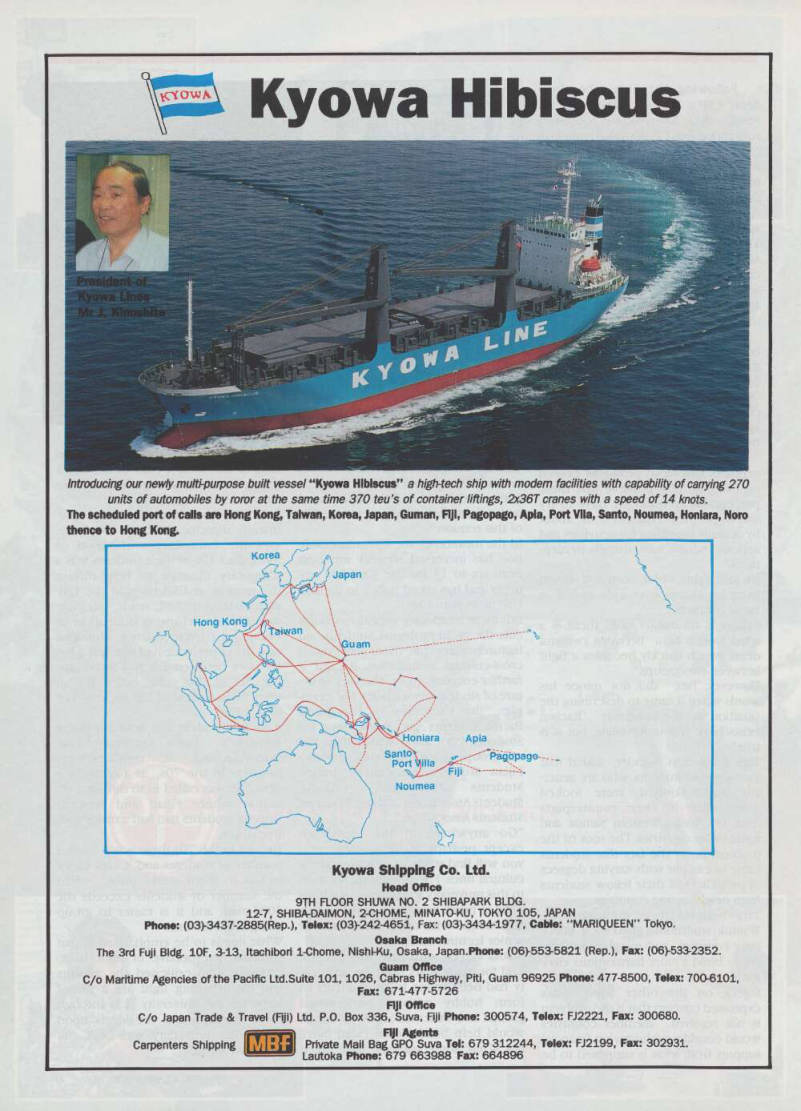
Kyowa Hibiscus
Pf Introducing our newly multi-purpose built vessel “Kyowa Hibiscus” a high-tech ship with modem facilities with capability of carrying 270 units of automobiles by roror at the same time 370 teu’s of container liftings, 2x36T cranes with a speed of 14 knots.
The scheduled port of calls are Hong Kong, Taiwan, Korea, Japan, Guman, FIJI, Pagopago, Apia, Port Vila, Santo, Noumea, Honiara, Noro thence to Hong Kong.
Kyowa Shipping Co. Ltd.
Head Office 9TH FLOOR SHUWA NO. 2 SHIBAPARK BLDG. 12-T, SHIBA-DAIMON, 2-CHOME, MINATO-KU, TOKYO 105, JAPAN Phone: (03)-3437-2885(Rep.), Telex: (03)-242-4651, Fax: (03)-3434-1977, Cable: "MARIQUEEN” Tokyo.
Osaka Branch The 3rd Fuji Bldg. 10F, 3-13, Itachibori 1-Chome, Nishi-Ku, Osaka, Japan. Phone: (06>-553-5821 (Rep.), Fax: (06)-533-2352.
Guam Office C/o Maritime Agencies of the Pacific Ltd. Suite 101, 1026, Cabras Highway, Piti, Guam 96925 Phone: 477-8500, Telex: 700-6101, Fax: 671-477-5726 FIJI Office C/o Japan Trade & Travel (Fiji) Ltd. P.O. Box 336, Suva, Fiji Phone: 300574, Telex: FJ2221, Fax: 300680.
Carpenters Shipping FIJI Agents Private Mail Bag GPO Suva Tel: 679 312244, Telex: FJ2199, Fax: 302931.
Lautoka Phone; 679 663988 Fax: 664896
'Incubating a time bomb’
time bomb’
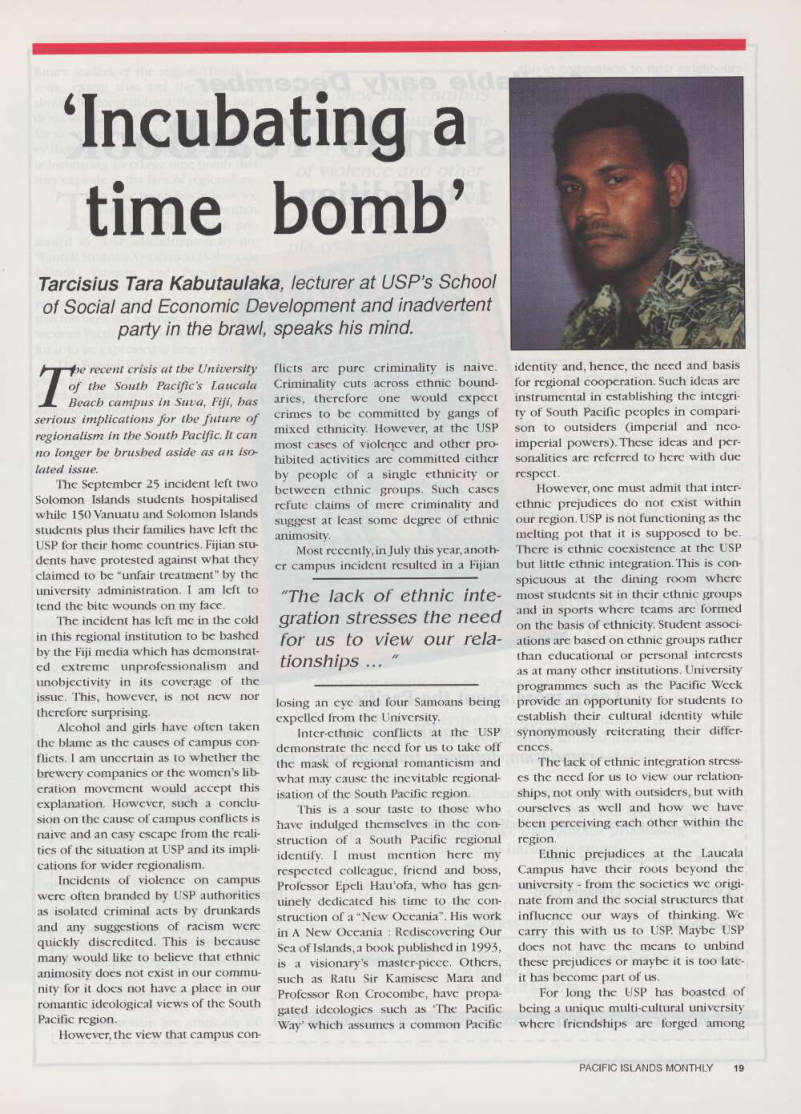
Tarcisius Tara Kabutaulaka, lecturer at USP’s School of Social and Economic Development and inadvertent party in the brawl, speaks his mind.
T'fye recent crisis at the University of the South Pacific’s Laucala Beach campus in Suva, Fiji, has
serious implications for the future of
regionalism in the South Pacific. It can no longer be brushed aside as an iso lated issue.
The September 23 incident left two Solomon Islands students hospitalised while 150 Vanuatu and Solomon Islands students plus their families have left the USP for their home countries. Fijian stu dents have protested against what they claimed to be “unfair treatment” by the university administration. I am left to tend the bite wounds on my face.
The incident has left me in the cold in this regional institution to be bashed by the Fiji media which has demonstrat ed extreme unprofessionalism and unobjectivity in its coverage of the issue. This, however, is not new nor therefore surprising.
Alcohol and girls have often taken the blame as the causes of campus con flicts. I am uncertain as to whether the brewery companies or the women’s lib eration movement would accept this explanation. However, such a conclu sion on the cause of campus conflicts is naive and an easy escape from the reali ties of the situation at USP and its impli cations for wider regionalism.
Incidents of violence on campus were often branded by USP authorities as isolated criminal acts by drunkards and any suggestions of racism were quickly discredited. This is because many would like to believe that ethnic animosity does not exist in our commu nity for it does not have a place in our romantic ideological views of the South Pacific region.
However, the view that campus con
flicts are pure criminality is naive.
Criminality cuts across ethnic bound aries, therefore one would expect crimes to be committed by gangs of mixed ethnicity. However, at the USP most cases of violence and other pro hibited activities are committed either by people of a single ethnicity or between ethnic groups. Such cases refute claims of mere criminality and suggest at least some degree of ethnic animosity.
Most recently, in July this year, anoth er campus incident resulted in a Fijian
"The lack of ethnic inte gration stresses the need for us to view our rela tionships ... "
losing an eye and four Samoans being expelled from the University.
Inter-ethnic conflicts at the USP demonstrate the need for us to take off the mask of regional romanticism and what may cause the inevitable regional isation of the South Pacific region.
This is a sour taste to those who have indulged themselves in the con struction of a South Pacific regional identify. I must mention here my respected colleague, friend and boss, Professor Epeli Hau’ofa, who has gen uinely dedicated his time to the con struction of a “New Oceania”. His work in A New Oceania : Rediscovering Our Sea of Islands, a book published in 1993, is a visionary’s master-piece. Others, such as Ratu Sir Kamisese Mara and Professor Ron Crocombe, have propa gated ideologies such as ‘The Pacific Way’ which assumes a common Pacific
identity and, hence, the need and basis for regional cooperation. Such ideas are instrumental in establishing the integri ty of South Pacific peoples in compari son to outsiders (imperial and neo imperial powers). These ideas and per sonalities are referred to here with due respect.
However, one must admit that inter ethnic prejudices do not exist within our region. USP is not functioning as the melting pot that it is supposed to be.
There is ethnic coexistence at the USP but little ethnic integration. This is con spicuous at the dining room where most students sit in their ethnic groups and in sports where teams are formed on the basis of ethnicity. Student associ ations are based on ethnic groups rather than educational or personal interests as at many other institutions. University programmes such as the Pacific Week provide an opportunity' for students to establish their cultural identity while synonymously reiterating their differ ences.
The lack of ethnic integration stress es the need for us to view our relation ships, not only with outsiders, but with ourselves as well and how we have been perceiving each other within the region.
Ethnic prejudices at the Laucala Campus have their roots beyond the university - from the societies we origi nate from and the social structures that influence our ways of thinking. We carry this with us to USP. Maybe USP does not have the means to unbind these prejudices or maybe it is too late it has become part of us.
For long the USP has boasted of being a unique multi-cultural university where friendships are forged among
future leaders of the region. This is to some extent true and the university should be congratulated. However, inci dents of ethnic violence signal the need for us to look beyond the congratulato ry flags and see whether the institution is incubating an ethnic time bomb that may explode in the face of regionalism.
This time bomb lies in how we perceive each other within the region. The petition pre sented to USP administration by the Wantok Students Association (Solomons Islands, Vanuatu and Papua New Guinea) reflects the nature of our regional relationship. It is something that has been felt amongst the people of western Pacific for a long time. The time for it to be expressed is long overdue.
The Wantok students stated that for years they felt they have been margin alised and made to feel inferior by their neighbours from eastern Pacific. This sense of inferiority is not new. It has developed as a result of interactions at the USP campus and throughout the region.
Many people come to USP with a preconceived conception of their status in the regional community. The meaa suring yardstick often used is civilisa tion (westernisation) and race - assum ing one race is superior to another.
This is the pattern of thought that has its roots in mordernisation theory and the lineal perception of social evolu tion. Hence, a society regarded as behind in the line of social evolution is therefore inferior. It is a thought pattern entertained and perpetuated in many of our societies through the teaching of churches, school curricula and other means of social interactions.
These thought patterns are reflect ed in the relationship between students at USP which in turn depicts in a fun damental way the politics of the wider region.
The ongoing regionalisation of the region - what others have referred to as the development of sub regionalism - is a demonstration of the enormity of the problem underlying the crisis at USP’s Laucala Campus. One may wonder why “subregional” groups such as the
Melanesian Spearhead Group (MSG)
have developed. Why not one South Pacific regional organisation? Why advo cate a Melanesian Way as separate from a Pacific Way?
There are several reasons. Race and geographical location have often been stressed. Melanesians are ethnically of
"The view that campus conflicts are pure crimi nality is naive, ... cases of violence and other prohibited activities are committed either by peo ple of a single ethnicity or between ethnic groups."
darker complexion than those of the eastern and northern Pacific. However, there is more to it than this. Those of the western Pacific have, for a long time, been viewed as inferior by their neigh bours in eastern Pacific.As a result, they have often felt unfairly treated in the South Pacific community. In my reply to Professor Hau’ofa’s New Oceania arti cle I stated that in Melanesia “many peo ple have been led to believe that they are inferior, not only in the internation al community of the “white man”, but
also in comparison to their neighbours in the eastern Pacific”.
Confronted with these attitudes Melanesians have been forced to reassert their own group identity. This has led to the development of “sub regional” organisations such as the Wantok Students Association and the Melanesian Spearhead Group, as well as ideologies such as the Melanesian Way which defines Melanesia as different from the rest of the South Pacific. Such regionalism is a consequence of the nature of our relationship within the region and of how we perceive each other.
There is therefore a need to reassess our relationships and our perceptions of each other. In a way, the conflicts between our students at USP is posi tive. It awakens us to the need to reeval uate our relationships. If we truly hope to create a “New Oceania”, we must cre ate a “community of equals” in fact as well as in rhetoric. Attitudes of ethnic prejudice and superiority within the region must be both recognised and changed. If not, the regionalisation of the region will continue unabated as Melanesia forges its own path. ■
Advertisements & other items, pp. 20-22 (1 item)
Pacific Islands Yearßook
Available early December
17th Edition
r m Vj m* Learn more about the Pacific
culture/custom tradition/people
population, tourism, trade, airlines, tax system etc.
X Yes, send me the latest copy of the Pacific Islands Year Book □ Here is a cheque/money order □ Visa □ Master Card Card Number Name Signature Address Expiry Date Post to: Pacific Islands Monthly, PO Box 1167 Suva, Fiji or Fax (679) 303809.
U
PROFESSIONAL MANAGEMENT
Maracon Pacific Pty Limited
Maracon Pacific is a professional management company experienced in the South Pacific abd South East Asia, with the expertise in tropical Agriculture, tree cropping, broad acre farming, animal husbandry, factory management and general trading.
Specialising in insolovencies, our clients are banks, receivers, and absantee owners. We effeciently and professionally amanage plantations, processing factories and hardware stores.
If you have a problem, require an assessment, or would like to know more, please contact us at the address below.
Postal address : PO Box 3632, South Brisbane Centre, QLD. 4101, Australia Fax No: 61 7 846 2739
How Balthan
Learned The Best Way
To Serve Pawpaw
To The Australian Market.
They asked us.
Balthan International of Fiji produces fruit and fruit juices. In particular, enough pawpaw to supply a major market like Australia. But they weren’t sure what form to ship it in. Who would be most interested. Or how to get it distributed.
At the South Pacific Trade Commission we used our extensive resources to find out everything Balthan needed to set up their fruitful new venture. Just one of the many ways we’re able to help businessmen from Pacific Forum countries.
If you’re starting up, improving or expanding a local business, we can help you too. Especially if you want to move into the export market.
And it’s all absolutely free.
So, if you’re looking for new markets overseas and would like some help, please send us your company details, contacts and details of the type of product or products you are interested in exporting, and as much background as possible.
Eg V <o I ft $ fTJ Level 6, 50 Park Street, Sydney NSW 2000 Phone (612) 283 5933 Fax (612)283 5948 Adventors 1481 A
Rebuilding Rabaul

Volcano
By Wally Hiambohn
Papua New Guinea Prime Minister Sir Julius Chan inspected volcano devas tated Rabaul on more than one occasion, as did many of his government officials.A World Bank team and insurance compa ny representatives also made similar trips to the town. And they all agreed on one thirlg - to rebuild Rabaul would be a major exercise costing millions of kina.
At a time when the country’s curren cy has been devalued as a result of a deci sion to float it, and in light of the recent crises experienced in Papua New Guinea recently, this latest feat seemed almost insurmountable.
The volcano eruptions had spared lit-
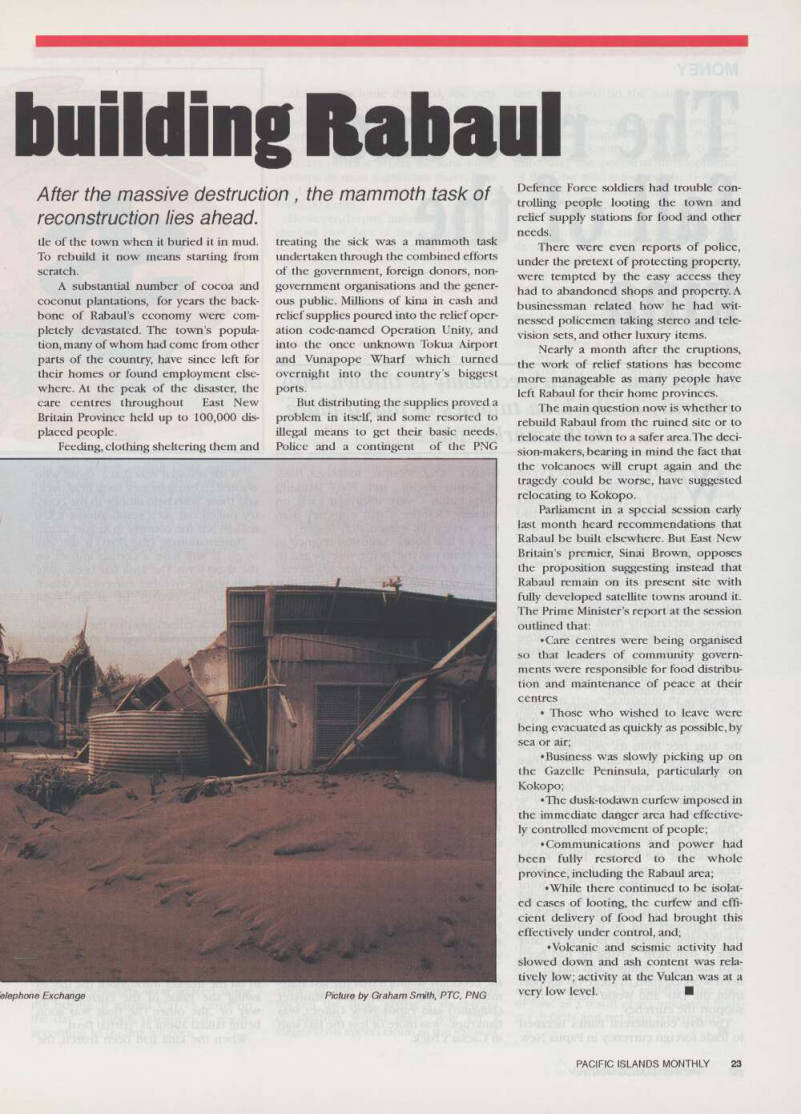
Telecommunications equipment destroyed at the Rabaul
After the massive destruction, the mammoth task of reconstruction lies ahead.
tie of the town when it buried it in mud.
To rebuild it now means starting from scratch.
A substantial number of cocoa and coconut plantations, for years the back bone of Rabaul’s economy were com pletely devastated. The town’s popula tion, many of whom had come from other parts of the country, have since left for their homes or found employment else where. At the peak of the disaster, the care centres throughout East New Britain Province held up to 100,000 dis
placed people.
Feeding, clothing sheltering them and
treating the sick was a mammoth task undertaken through the combined efforts of the government, foreign donors, non government organisations and the gener ous public. Millions of kina in cash and relief supplies poured into the relief oper ation code-named Operation Unity, and into the once unknown Tokua Airport and Vunapope Wharf which turned
overnight into the country’s biggest
ports.
But distributing the supplies proved a problem in itself, and some resorted to illegal means to get their basic needs.
Police and a contingent of the PNG
Defence Force soldiers had trouble con
trolling people looting the town and
relief supply stations for food and other needs.
There were even reports of police, under the pretext of protecting property, were tempted by the easy access they had to abandoned shops and property. A businessman related how he had wit nessed policemen taking stereo and tele vision sets, and other luxury items.
Nearly a month after the eruptions, the work of relief stations has become more manageable as many people have left Rabaul for their home provinces.
The main question now is whether to rebuild Rabaul from the ruined site or to relocate the town to a safer area. The deci sion-makers, bearing in mind the fact that the volcanoes will erupt again and the tragedy could be worse, have suggested
relocating to Kokopo.
Parliament in a special session early last month heard recommendations that Rabaul be built elsewhere. But East New Britain’s premier, Sinai Brown, opposes the proposition suggesting instead that Rabaul remain on its present site with fully developed satellite towns around it.
The Prime Minister’s report at the session outlined that: • Care centres were being organised so that leaders of community govern ments were responsible for food distribu tion and maintenance of peace at their centres • Those who wished to leave were being evacuated as quickly as possible, by sea or air; •Business was slowly picking up on the Gazelle Peninsula, particularly on
Kokopo;
•The dusk-todawn curfew imposed in the immediate danger area had effective ly controlled movement of people; •Communications and power had been fully restored to the whole province, including the Rabaul area; •While there continued to be isolat ed cases of looting, the curfew and effi cient delivery of food had brought this effectively under control, and; •Volcanic and seismic activity had slowed down and ash content was rela tively low; activity at the Vulcan was at a very low level. ■
Telephone Exchange
Picture by Graham Smith, PTC, PNG
The rise and
Money
The rise and fall of the kina
Papua New Guinea's economy is thrown into disarray as the kina tumbles to find a place in the market place.
When Papua New guinea’s cur rency, the kina, was devalued by 12 percent on September 11, few were surprised. Rumours had circulated for months that the unit would be revalued downwards, mir rored by the withdrawal of US$l2O mil lion in foreign reserves in August.
Upon announcing the decision, Finance and Planning Minister Chris Haiveta said the devaluation would remove uncertainty from the currency market and put a halt to speculative trading. However, rumours persisted that another devaluation would be forthcoming and speculation against the currency continued.
What did surprise the financial com munity and the nation as a whole was the new government’s solution - to set the kina free from its “peg” and allow the market to determine its own price for the kina.
The decision was made during an all night meeting on Monday, October 3, involving the Prime Minister, Sir Julius Chan, the Secretary for Finance and Planning, Gerea Aopi, and the new Governor of the Reserve Bank, Koiari Tarat. Haiveta, also the deputy Prime Minister, was away at the joint International Monetary Fund (JMF)/World Bank meetings in Madrid, and it appears had no involvement in the decision. However, he was to later issue a statement saying he had been kept abreast of changes, and had in fact been working hard to shore up support from the IMF and World Bank to help support the currency.
The five commercial banks licensed to trade foreign currency in Papua New
Guinea - ANZ, Westpac, Indosuez, Bank of South Pacific and PNG Banking Corporation - were informed early on Tuesday, October 4 that currency mar kets were to be immediately frozen.
For a few hours confusion reigned in the country as the “grape-vine” began to spread the news of the currency freeze.
It was not until a few hours later that statements were issued to the media and Tarat called them to his office for a briefing. The kina had been frozen until first trade on Monday, October 10, when the unit was to be opened to the forces of supply and demand.
Tarata assured the media the central bank would play no part in the setting of a price for the kina, but insisted he saw no reason why it should fall, citing strong economic fundamentals, includ ing a trade surplus of K 596 million in the first half of 1994.
Sir Julius talked of a “major attack” on the currency following a 12 percent devaluation and admitted the previous government - of which he was deputy Prime Minister - had erred in “talking down the economy”.
“I think we used the wrong econom ic jargon over the last eight months of the government. Although I was part of the government, I was not in charge of (the Finance) portfolio,” he said. (Sir Julius had been moved to Foreign Affairs in January, with Masket langalio replac ing him at Finance.) “The government was talking down the economy so much that the last state ment - when the Finance Minister (langalio) said Papua New Guinea was bankrupt - was more or less the last stab in Caesar’s back.
“What resulted was that ... those who wanted to bring money back held back, and those who held money in the coun try pulled out. As a result almost Kl2O million left the country in August alone.
“Internationally (the float) is the way to go. It will have a certain impact on the short-term. The kina has been quite high, relative to other currencies, which may not necessarily be at the right benchmark.”
Sir Julius’ comments that the float was the “internationally” correct thing to do, was contested by one currency' dealer who admitted after the float was announced that the PNG market may struggle with an unpegged currency.
“There’s not the critical mass to allow the currency an orderly float ... it will need to be a managed float,” the dealer said.
It appears Tarata had a change of mind later in the week after announcing the float. Following meetings with rep resentatives of the banks and a quick trip to Australia for talks with the Reserve Bank of Australia, the form of the float on the first day Monday, October 10 - of trading varied greatly from what is the “norm” for an unpegged currency The central bank announced it would hold twice-daily auctions, for an unspec ified period, at which only the five com mercial banks would be allowed to bid.
In so doing, the central bank eliminated much of the risk of speculators moving in on the market throughout the day to swing the value of the currency one way or the other. The float was soon being talked about as “partial float”.
When the kina had been frozen, the
unit had traded around US92 cents. It quickly slid on the first day, losing 6.5 percent in all to finish at U 586.05 cents.
That trend continued the next day, with the kina losing a further 4.7 percent, to finish at U 582.00 cents.
The market appeared to be unsettled, with one going as far as to say: “Problems are starting to appear in the process here.” Another was quoted by Reuters as saying: “The central bank could have stopped the kina falling as far as it did just by buying US$l million or so ... but it didn’t. It’s starting to feel like the central bank is not fully aware of the implications of the system it’s set up, and the market’s power in it.”
Other dealers complained there was an attempt by the central bank to turn them into brokers. “We are not inde pendent brokers,” one protested. “We have to serve our clients’interests.The central bank has to move quickly or things will fall apart.”
But by Wednesday, the selling of the kina began to ease, with only a margin al loss of USO. 2 cents on the day.
Dealers said exporters had begun to return foreign currency to the market and had taken the opportunity of the low price to buy kina.
Tarata had earlier revealed he had forced the return to PNG of “significant foreign currency holdings” by a number of exporters who had held funds off shore for periods exceeding exchange control guidelines.
On Thursday it was becoming evi dent the exporters were indeed doing the buying. It gained US 1.75 cents on the day - a “totally unexpected” result, according to trading sources.
Although volume dropped, the pen dulum had swung and smiles were appearing in Waigani (the government complex) and at the central bank offices. The smiles became wider on the fifth day of trade when the kina made perhaps its most significant move, leap ing U 52.45 cents to finish the week at U 586.00 cents.
However, despite impressive gains on the last two days of the week, dealers remain cautious, pointing out first week trade was bound to be a roller coaster ride and it will take some time yet before the currency levels off into a comfortable range.
Even then, should the central bank alter the machinations of the market to allow it freer trade, given the relative size of the market, any large order, whether buying or selling the kina, could result in large swings in the cur rency’s value.
Most commentators on the market are maintaining a wait-and-see approach to the ramifications of the float, although some have taken a firm stand in either support or defiance of the action.
Among the potential losers are the trade unions who are now calling for across the board wage hikes.
Government workers copped a wage freeze at the time of the 12-percent devaluation as part of a package of gov ernment economic reforms and stop gap remedies. The PNG Trade Union Congress had accepted the wage freeze in the interests of the nation, with its general secretary,John Paska, saying the union was “committed to work with this government to help bail the nation out of the current difficulties...”
But the prospect of a further devalu ation following the float does not sit well with the workers’ representatives, and Paska has since called for wage rises of up to 20 percent.
“Wages must surely go up to meet the balance, to counter the coming massive increases in the cost of living,” he said later. langalio, now Opposition spokesman on Finance, has maintained a steady flow of brutal attacks on the govern ment since the announcement of the float, predicting a massive slide in the value of the kina, a rising cost of living, higher lending rates and an artificial shortage of funds for lending due to central bank moves - linked with the float - to tighten liquidity within PNG’s monetary system.
Institute for National Affairs econo mist John Milled, who was a staunch critic of the initial devaluation, has backed the float, saying a short-term devaluation would make way for a longer-term appreciation in the value of
the kina, based on the nation’s strong trading base.
The enormous resource projects within the country - such as Porgera gold mine, Kutubu, Ok Tedi copper mine and the potential developments of the l.ihir gold mine and the Gobe oil fields - would continue to bring wealth to PNG and support the currency, he said.
Higher interest rates resulting from a devalued currency would actually attract funds from offshore and also aid in boosting the buying power of the kina, he said.
University of Papua New Guinea eco nomics lecturer Dr Agogo Mawuli also supported the need for a floating cur rency. During a seminar which coincid ed with the float announcement, Dr Mawuli said continuing strong perfor mances from the resource sector would “result in the over-valuation of the kina, which would undermine competitive ness and comparative advantage of the tradeables and non-tradeables, particu larly in resource-based domestic pro duction.”
A flexible exchange rate system would avert such an impact, he said.
Further, any additional devaluations would be unnecessary as the unit found its proper trading range.
With the kina having been devalued by up to 18 percent since the begin ning of September (at the most recent rate prior to going to press) shoppers are now beginning to see the results on the shelves of their local stores.
Deposit rates have already risen by 1.5 percentage points at one bank, and lending rates are expected to follow shortly.
Further, overseas borrowing has now taken on the devaluation to impose a burden on those repaying the debts the national government being one of the most significant casualties.
However, there are positives.
Exporters will win. Coffee growers will accept more for their produce (although much of that advantage has recently been taken away by a govern ment exporting levy' on coffee) and mineral and petroleum products will also reap more after being converted to kina.
And the news is not all bad for the government either. Defined amounts of overseas aid and loans will now convert into a figure some 20 percent higher than before the devaluation and float, at the present rate, easing some of the pressure from the tight fiscal situation which left a domestic financing require ment of some K 323.7 million at the end of June as a result of accumulated bud get deficits and net loan repayments.
Advertisements & other items, p. 26 (1 item)
Your Island Connections
V .'•’•Tv " ■
Cable and Wireless began keep-
ing people in touch around the
world more than a century ago. Today,
while the technology has changed,
the tradition of service to our customers in the
South Pacific is just the same.
We work in partnership with Governments,
dedicated to meeting the need of communities and businesses to stay in touch. From one island to the next or to the other side of the world, the message is the same: Cable and Wireless is
your South Pacific
connection bringing the
islands together.
CABLE & WIRELESS
Asia Pacific Head Office Cable and Wireless pic Cable and Wireless (Pacific) Limited 22nd Floor Office Tower Convention Plaza 1 Harbour Road Hong Kong Tel: (852) 848 8620 Facsimile: (852) 868 5195
Fiji
In association with the Government of Fiji Fiji International Telecommunications Ltd, P.O, Box 59 Mercury House 158 Victoria Parade Suva Fiji Tel: (679) 312933 Solomon Islands In association with the Government of the Solomon Islands Solomon Telekom Company Limited PO. Box 148 Honiara Solomon Islands Tel: (677) 21576 Tonga Cable and Wireless pic Private Mail Bag 4 General Post Office Nuku Alofa Tonga South Pacific Tel; (676) 23499 Vanuatu In association with the Government of Vanuatu and France Cdbles el Radio Telecom Vanuatu Limited P.O. Box 146 Port Vila Vanuatu Tel: (678) 22185
Facing facts
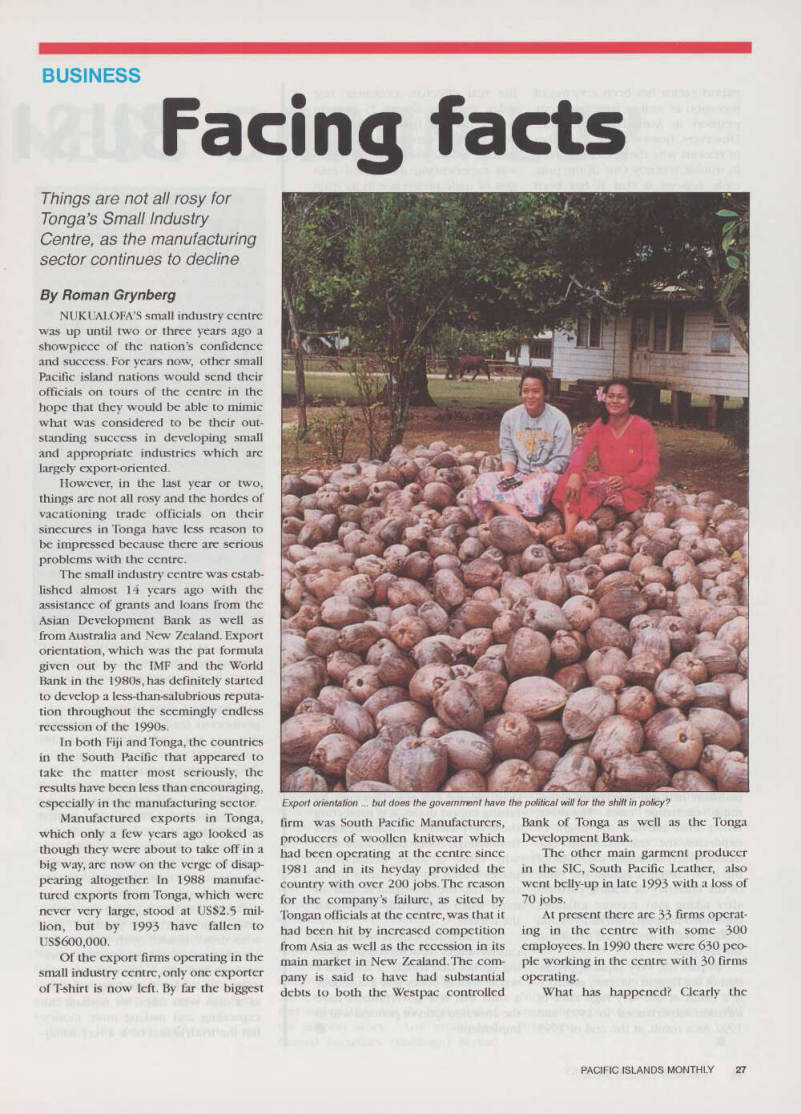
Business
Things are not all rosy for Tonga’s Small Industry Centre , as the manufacturing sector continues to decline
By Roman Grynberg
NUKUALOFA’S small industry centre was up until two or three years ago a showpiece of the nation’s confidence and success. For years now, other small Pacific island nations would send their officials on tours of the centre in the hope that they would be able to mimic what was considered to be their out standing success in developing small and appropriate industries which are largely export-oriented.
However, in the last year or two, things are not all rosy and the hordes of vacationing trade officials on their sinecures in Tonga have less reason to be impressed because there are serious problems with the centre.
The small industry centre was estab lished almost 14 years ago with the assistance of grants and loans from the Asian Development Bank as well as from Australia and New Zealand. Export orientation, which was the pat formula given out by the IMF and the World Bank in the 1980 s, has definitely started to develop a less-than-salubrious reputa tion throughout the seemingly endless recession of the 19905.
In both Fiji and Tonga, the countries in the South Pacific that appeared to take the matter most seriously, the results have been less than encouraging, especially in the manufacturing sector.
Manufactured exports in Tonga, which only a few years ago looked as though they were about to take off in a big way, are now on the verge of disap pearing altogether. In 1988 manufac tured exports from Tonga, which were never very large, stood at US$2.5 mil lion, but by 1993 have fallen to
Us$6Oo,Ooo.
Of the export firms operating in the small industry centre, only one exporter of T-shirt is now left. By far the biggest
firm was South Pacific Manufacturers, producers of woollen knitwear which had been operating at the centre since 1981 and in its heyday provided the country with over 200 jobs. The reason for the company’s failure, as cited by Tongan officials at the centre, was that it had been hit by increased competition from Asia as well as the recession in its main market in New Zealand. The com pany is said to have had substantial debts to both the Westpac controlled
Bank of Tonga as well as the Tonga Development Bank.
The other main garment producer in the SIC, South Pacific Leather, also went belly-up in late 1993 with a loss of
70 jobs.
At present there are 33 firms operat ing in the centre with some 300 employees. In 1990 there were 630 peo ple working in the centre with 30 firms operating.
What has happened? Clearly the
Export orientation ... but does the government have the political will for the shift in policy?
export sector has been a‘ victim of recession as well as increased com petition in Australasian markets.
Observers, however, cite a number of reasons why the centfe has been in trouble recently. One of the prin ciple reasons is that it has been unable to attract labour in large part because the squash industry has been so profitable that it has pushed up both demand and wages in the agricultural sector.
Another reason for the decline is that the five-year tax holidays that were initially granted to firms that operated in the SIC have now expired, and even with the very low rates of company tax in Tonga (15 percent), many of the firms have packed up and gone. In the case of garment manufacturers, the reason cited was that the firms involved in exports were unable to maintain products that were up-to-date in a very competitive market.
Some manufacturers cite exchange rates for the decline in manufactured exports. Up until 1991, the Tonga pa’anga was set on par to the Australia dollar and for years officials had told the Tongan government that it was unnecessari ly linking the Tongan economy to the fortunes of the Australian econo my. Especially with the rise of the value of the Australian dollar in the late 1980 s, this was seen as a disin centive to the exporting sector as a whole.
As a result, in early 1991 the government linked the currency to the value of a basket of currencies which included the value of the US, New Zealand and Australian dollars: this trade weighted basket is the way most Pacific island countries that maintain national currencies deter mine exchange rates. However, rather than alleviate the plight of exporters, the real exchange rate index, which measures the value of the local currency against the value of the currency of trading partners after taking into account inflation, continued to appreciate in 1991 and 1992 though it has started to fall if in the last year.
In part the very rapid apprecia tion of the Tongan currency is direct ly a result of the very high rates of inflation experienced in 1991 and 1992. As a result, at the end of 1993
the real effective exchange rate index stood at almost 25 percent higher than in 1988. Inflation has now fallen to virtually zero, but the damage is done. For a country which was experiencing diminished mar gins of trade preference in its main export markets to allow the curren cy to appreciate in the way that Tonga has done in the last few years meant it was bound to kill the man
ufacturing sector.
Oddly enough, this particular type of macroeconomic suicide is exactly what Fiji is practicing. Since 1988, Fiji has permitted its real effec tive exchange rate to appreciate by 15 percent while it is also losing its margin of preference in the Australian and New Zealand mar kets. Predictably the Fiji garment industry also appears to be in decline.
The response of people to what appears to others to be economic adversity is sometimes a bit hard to fathom. Some officials want to increase the amount of factory space in the SIC and there is talk of yet other centres. Why , one would ask, would anyone increase the amount of factory space when firms are shutting down? Firms producing for the local market, which in the past received the same tax incentives as exporters are staying open and expanding. The reason for the demand for a place in the centre is in part a result of the government’s tax policy.
The government of Tonga has increased import duties to raise gov ernment revenues. It does this because it is increasingly dependent upon trade taxes for its revenue as it does not want to raise its flat 10-per cent income tax rate. However, by raising import duties, it is protecting these very small local manufacturers from foreign competition and that is why there is more demand for places within the SIC. Clearly this is not what the government had in mind when it originally established the centre.
The fact that export orientation cannot simply be achieved by open ing up tax free zones; it requires a whole shift in policy and it is usually a shift that few governments have the attention span or political will to
implement. ■
Business Baron Loy
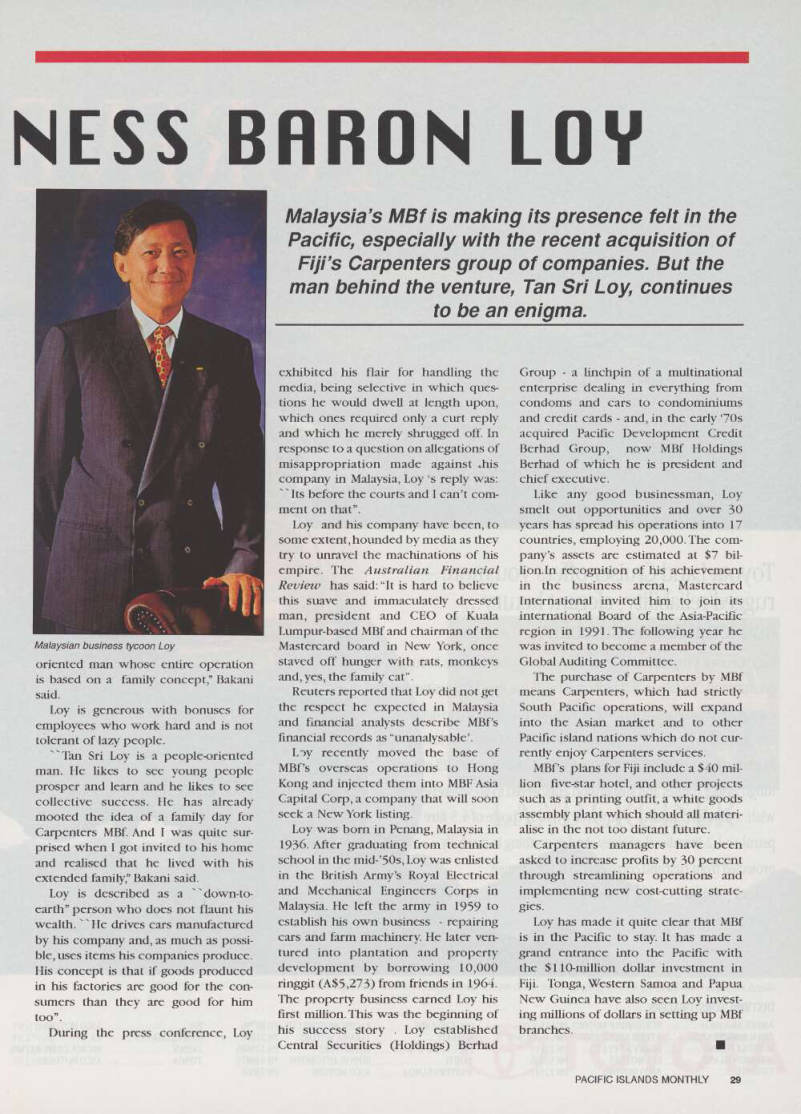
By Yunus Rashid
TTTThen Malaysia’s MBf took
\IL/ over Carpenters Fiji
▼ ▼ Limited, Australian-owned and the country’s largest retailer, the local media was invited to a press con ference with the man behind the $BO - investment. Organisers of the press conference in Fiji’s capital, Suva, repeatedly reminded the reporters that the president and chief executive of the multinational business empire, Loy Hean Heong, be referred to as Tan Sri a title bestowed on the billionaire by the Sultan of Johor in Malaysia.
Perhaps this insistence was the first insight reporters had of the man they were going to haul questions at.
Voluminous annual reports given out prior to the conference had already provided a visual image of the man - a smartly dressed and smiling Loy, who looked a bit too young to be master of this expanding and diversifying busi ness now making definite inroads into the Pacific.
The question many were asking was: ‘who exactly is Loy’, the man whose brainchild, MBf, had come under criti cism in Malaysia and South Australia.
Who is this man who was born poor and is today a billionaire? What made him so successful ?
In Fiji, only a selected few are in a position to shed light on what makes the man tick. One such man is MBf Carpenters’ new deputy managing director, Kalivati Bakani.
Bakani first made contact with Loy when he was deputy general manager at National Bank of Fiji which resulted in NBF and MBf jointly agreeing to finance a credit card in 1990. He moved to Carpenters when MBf bought out the more-than-a-century old business from its Australian owners.
Bakani described Loy as an "ener getic, innovative, and youthful” man who drove himself with a degree of "ruthlessness” and expected his work ers to follow suit. "Many people who do not know Loy would perceive him as a man who cares for nothing but expanding and making more money.
But the truth is that he is a very family-
oriented man whose entire operation is based on a family concept,” Bakani said.
Loy is generous with bonuses for employees who work hard and is not
tolerant of lazy people.
Tan Sri Loy is a people-oriented man. He likes to see young people prosper and learn and he likes to see collective success. He has already mooted the idea of a family day for Carpenters MBf. And I was quite sur prised when I got invited to his home and realised that he lived with his extended family,” Bakani said.
Loy is described as a " down-to earth” person who does not flaunt his wealth.'' He drives cars manufactured by his company and, as much as possi ble, uses items his companies produce.
His concept is that if goods produced in his factories are good for the con sumers than they are good for him too”.
During the press conference, Loy
Malaysia’s MBf is making its presence felt in the Pacific, especially with the recent acquisition of Fiji’s Carpenters group of companies. But the man behind the venture, Tan Sri Loy, continues to be an enigma.
exhibited his flair for handling the media, being selective in which ques tions he would dwell at length upon, which ones required only a curt reply and which he merely shrugged off. In response to a question on allegations of misappropriation made against .his company in Malaysia, Loy ‘s reply was: '' Its before the courts and I can’t com ment on that”.
Loy and his company have been, to some extent,hounded by media as they try to unravel the machinations of his empire. The Australian Financial Review has said: “It is hard to believe this suave and immaculately dressed man, president and CEO of Kuala Lumpur-based MBf and chairman of the Mastercard board in New York, once staved off hunger with rats, monkeys and, yes, the family cat”.
Reuters reported that Loy did not get the respect he expected in Malaysia and financial analysts describe MBf’s financial records as “unanalysable’.
L oy recently moved the base of MBf’s overseas operations to Hong Kong and injected them into MBF Asia Capital Corp, a company that will soon seek a New York listing.
Loy was born in Penang, Malaysia in 1936. After graduating from technical school in the mid-’3os, Loy was enlisted in the British Army’s Royal Electrical and Mechanical Engineers Corps in Malaysia. He left the army in 1939 to establish his own business - repairing cars and farm machinery. He later ven tured into plantation and property' development by borrowing 10,000 ringgit (A 55,273) from friends in 1964.
The property business earned Loy his first million. This was the beginning of his success story . Loy established Central Securities (Holdings) Berhad
Group - a linchpin of a multinational enterprise dealing in everything from condoms and cars to condominiums and credit cards - and, in the early ‘7os acquired Pacific Development Credit Berhad Group, now MBf Holdings Berhad of which he is president and chief executive.
Like any good businessman, Loy smelt out opportunities and over 30 years has spread his operations into 17 countries, employing 20,000. The com pany’s assets are estimated at $7 bil lion. In recognition of his achievement in the business arena, Mastercard International invited him to join its international Board of the Asia-Pacific region in 1991 The following year he was invited to become a member of the Global Auditing Committee.
The purchase of Carpenters by MBf means Carpenters, which had strictly South Pacific operations, will expand into the Asian market and to other Pacific island nations which do not cur rently enjoy Carpenters services.
MBf’s plans for Fiji include a $4O mil lion five-star hotel, and other projects such as a printing outfit, a white goods assembly plant which should all materi alise in the not too distant future.
Carpenters managers have been asked to increase profits by 30 percent through streamlining operations and implementing new cost-cutting strate gies.
Loy has made it quite clear that MBf is in the Pacific to stay. It has made a grand entrance into the Pacific with the $ 110-million dollar investment in Fiji. Tonga, Western Samoa and Papua New Guinea have also seen Loy invest ing millions of dollars in setting up MBf branches.
Malaysian business tycoon Loy
Advertisements & other items, pp. 30-31 (1 item)
rugged reliability, elegant luxury...
i
Toyota Land Cruiser offers you more
and long-lasting durability.
Land Cruiser’s reputation is second to none. No one doubts its rugged constitution. Yet here is a vehicle that rivals the finest limousines where comfort is concerned. And its fit and finish, the attention to detail, and the graceful lines and fine trim are reminiscent of exquisite luxury cars.
Nevertheless, hidden beneath its elegance, Land Cruisers still offer tough ladder frames and suspension engineered to go wherever you wish... in total comfort powered by your choice of 4.5-litre petrol or 4.2-litre diesel engines. And everything is carefully protected from rust and corrosion so it lasts longer.
Toyota Land Cruiser. The best for your world.
Now and forever.
DISTRIBUTORS/DEALERS
AMERICAN SAMOA BURNS PHILP MOTORS PH 633-4281 GUAM & MICRONESIA ATKINS KROLL, INC. PH 646-1876/9
NORFOLK ISLAND BORRY’SPTYLTD. PH 22114
SOLOMON ISLAND ELA MOTORS PH 30746
VANUATU ASCOMOTORS PH 22341
COOK ISLANDS PACIFIC MOTORS LTD PH 20796
KIRIBATI TARAWA MOTORS PH 21090
PAPUA NEW GUINEA ELA MOTORS PH 229400
TAHITI NIPPON AUTOMOTO PH 429819
WESTERN SAMOA ASCO MOTORS PH 23664
FIJI ASCOMOTORS
NEW CALEDONIA S.I . A.P.
SAIPAN MICRO!, CORPORATION
TONGA ASCOMOTORS
i m m . " ; -#S mm sail*
LAND CRUISER
Exact features and specifications may vary depending on country of purchase. Please check with your nearest TOYOTA distributor/dealer for details.
PH312666 PH 275562 PH 234-5911 PH 23500
®TOYOTA
Spoofing
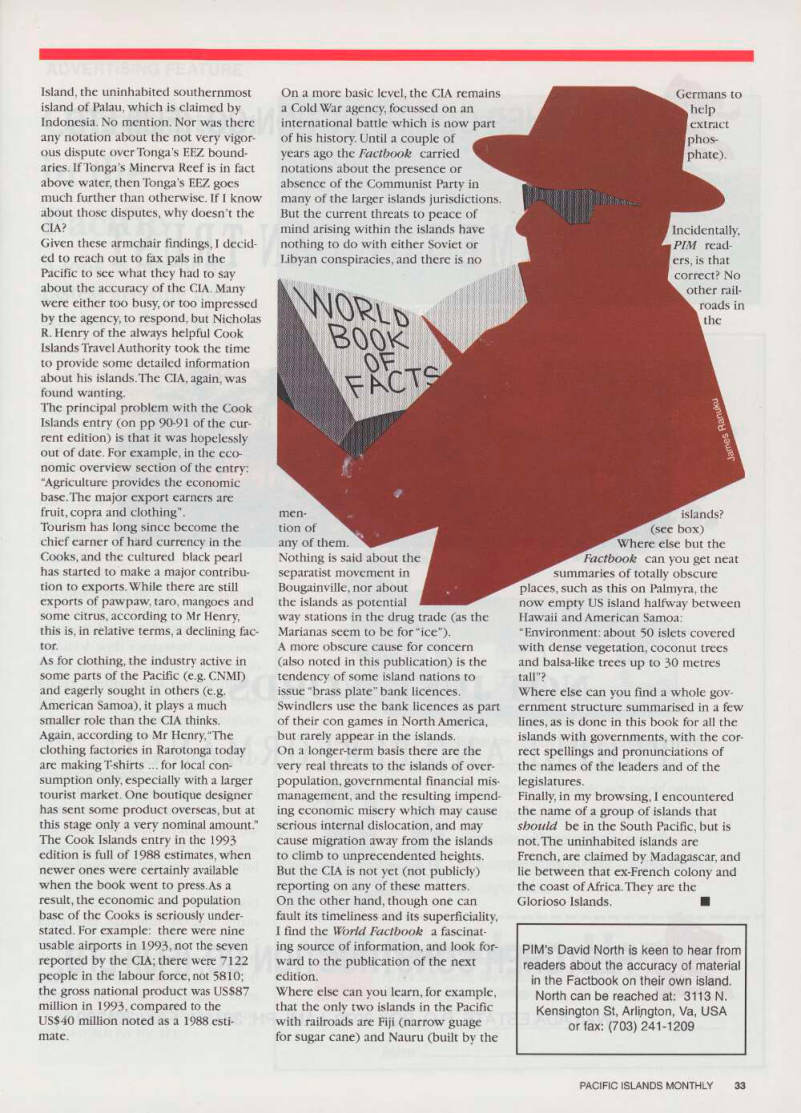
Books
The
Spooks
How much does the United States’ Central Intelligence Agency really know about the Pacific Islands? The agency’s reputation as knowledgable and powerful comes under scrutiny with the publication of its latest World Factbook.
By David North
How much docs the U.S. Central Intelligence Agency know about the Pacific Islands?
One test of this is to see how good its published information is on the islands.
Yes, published. The CIA, for several years, has produced the World Factbook which includes 33 detailed entries on islands in the Pacific - from the full-fledged nations (e.g. Fiji and PNG) down to the uninhabited relics of empire (e.g Clipperton Island and
Palmyra Atoll.)
The Factbook’s little maps of the islands, the terse recitation of basic facts about them, and the agency’s rep utation as knowledgeable and powerful had given me the impression that it must know what it was writing about.
Further, I live in the Virginia suburbs of Washington, the CIA headquarters is a few miles from my house, and I have encountered a number of active and retired CIA people socially; the spooks I met all seemed bright and enlight ened.
But I started to have second thoughts about the agency, as did many Americans, when it failed woefully to predict the implosion of the USSR, and when the agency’s own internal securi ty system proved so lax that one of its senior people sold secrets to the Soviets for years before he was caught.
The CIA had not noticed, in that
instance, that the spook in question had been driving a Jaguar into the agency parking lot every day, a car that he could not have possibly afford ed on his government salary.
With all that in mind, I took a much closer look at what the ClA’s Factbook had to say about the Pacific Islands.
The 33 entries cover all the indepen dent and associated nations of the Pacific plus islands that are not gov erned as an integral part of another entity. So Australia’s Norfolk Island gets a listing, but Lord Howe (part of New South Wales) does not; Chile’s Easter Island and America’s Hawaii are not list ed, because they are governed like other parts of those nations.Tokelau, Pitcairn and Midway all have listings, because of the nature of their gover nance.
Each one - or two - page country entry has sections on geography, the popula tion, government, economy, communi cations and defense forces. The govern ment section includes a listing I have not seen elsewhere, all the internation al organisations to which the country belongs. Fiji, for instance, is a member
Of Acp,Asdb, Cp, Escap, Fao, G-77,
IBRD, ICAO, ICFTU, IDA, IFAD, IFC, ILO,
Imf, Imo, Intelsat And Intepol And
18 other alphabet agencies, the full names of which are provided else where in the Factbook.
As I examined the book, the first thing I noticed was an aura of carelessness maybe bad editing as opposed to bad
intelligence gathering. For example, on p. 384 of the most recent (1993) edi tion, we find that 57 percent of Tonga’s adults are literate; looking a little fur ther we see that 60 percent of the men are literate, as are 60 percent of the women. The three members are logical ly incompatible; at least one - if not all three - of those numbers must be wrong.
Along the same lines the literacy rate for all adults in FSM is shown as 90 per cent, for the men as 90 percent and for the women it is 85 percent. That set of numbers would be accurate under only one circumstance - if there were 10 times as many men as women in FSM, which is clearly not the case.
PIM recently published a story report ing that the birth rate in the Marshall Islands had fallen to 23.5 per thousand in 1993 from a rate of 35 per thousand in 1989 The 1993 Factbook carries this item on the subject (p. 248) “Birth rate: 46.55 births/1000 population (1993 est.) .’’The CIA missed that one by almost a two-to-one margin.
Well, I thought, maybe the CIA doesn’t do demographics very well, but it has to be good on international disputes.
But an examination of the entries under that heading, for the 33 islands, was not reassuring. Yes, the CIA report ed that the Marshalls claimed Wake Island, now under the US flag, and that Mexico claimed Clipperton, which the French think belongs to France.
But what about Helens Reef or Helens
Island, the uninhabited southernmost island of Palau, which is claimed by Indonesia. No mention. Nor was there any notation about the not very vigor ous dispute over Tonga’s FEZ bound aries. If Tonga’s Minerva Reef is in fact above water, then Tonga’s FEZ goes much further than otherwise. If I know about those disputes, why doesn’t the
Cia?
Given these armchair findings, I decid ed to reach out to fax pals in the Pacific to see what they had to say about the accuracy of the CIA. Many were either too busy, or too impressed by the agency, to respond, but Nicholas R. Henry of the always helpful Cook Islands Travel Authority took the time to provide some detailed information about his islands. The CIA, again, was found wanting.
The principal problem with the Cook Islands entry (on pp 90-91 of the cur rent edition) is that it was hopelessly out of date. For example, in the eco nomic overview section of the entry; “Agriculture provides the economic base. The major export earners are fruit, copra and clothing”.
Tourism has long since become the chief earner of hard currency in the Cooks, and the cultured black pearl has started to make a major contribu tion to exports. While there are still exports of pawpaw, taro, mangoes and some citrus, according to Mr Henry, this is, in relative terms, a declining fac tor.
As for clothing, the industry active in some parts of the Pacific (e.g. CNMI) and eagerly sought in others (e.g.
American Samoa), it plays a much smaller role than the CIA thinks.
Again, according to Mr Henry, “The clothing factories in Rarotonga today are making T-shirts ... for local con sumption only, especially with a larger tourist market. One boutique designer has sent some product overseas, but at this stage only a very nominal amount.”
The Cook Islands entry in the 1993 edition is full of 1988 estimates, when newer ones were certainly available when the book went to press. As a result, the economic and population base of the Cooks is seriously under stated. For example; there were nine usable airports in 1993, not the seven reported by the CIA; there were 7122 people in the labour force, not 5810; the gross national product was USSB7 million in 1993, compared to the USS4O million noted as a 1988 esti mate.
On a more basic level, the CIA remains a Cold War agency, focussed on an international battle which is now part of his history. Until a couple of years ago the Factbook carried notations about the presence or absence of the Communist Party in many of the larger islands jurisdictions.
But the current threats to peace of mind arising within the islands have nothing to do with either Soviet or Libyan conspiracies, and there is no
men tion of any of them. JH Nothing is said about the K separatist movement in K Bougainville, nor about the islands as potential KHHi way stations in the drug trade (as the Marianas seem to be for “ice”).
A more obscure cause for concern (also noted in this publication) is the tendency of some island nations to issue “brass plate” bank licences.
Swindlers use the bank licences as part of their con games in North America, but rarely appear in the islands.
On a longer-term basis there are the very real threats to the islands of over population, governmental financial mis management, and the resulting impend ing economic misery which may cause serious internal dislocation, and may cause migration away from the islands to climb to unprecendented heights.
But the CIA is not yet (not publicly) reporting on any of these matters.
On the other hand, though one can fault its. timeliness and its superficiality, I find the World Factbook a fascinat ing source of information, and look for ward to the publication of the next edition.
Where else can you learn, for example, that the only two islands in the Pacific with railroads are Fiji (narrow guage for sugar cane) and Nauru (built by the
Germans to m - help extract phos
; ’ phate).
Incidentally, K* PIM read - :-v ers. is that \ *..?*£ C correct? No other rail roads in
K the
■ • islands? (see box) Where else but the Factbook can you get neat summaries of totally obscure places, such as this on Palmyra, the now empty US island halfway between Hawaii and American Samoa: “Environment: about 50 islets covered with dense vegetation, coconut trees and balsa-like trees up to 30 metres tall”?
Where else can you find a whole gov ernment structure summarised in a few lines, as is done in this book for all the islands with governments, with the cor rect spellings and pronunciations of the names of the leaders and of the legislatures.
Finally, in my browsing, I encountered the name of a group of islands that should be in the South Pacific, but is not. The uninhabited islands are French, are claimed by Madagascar, and lie between that ex-French colony and the coast of Africa. They are the Glorioso Islands. ■
PlM’s David North is keen to hear from readers about the accuracy of material in the Factbook on their own island.
North can be reached at; 3113 N.
Kensington St, Arlington, Va, USA or fax: (703) 241-1209
Advertisements & other items, p. 34 (1 item)
The Name You Can Trust
FLETCHER CONSTRUCTION CO. (FIJI) LTD,
NOT JUST WORDS...
"PEOPLE AND PERFORMANCE"
FLETCHER CONSTRUCTION CO. (FIJI) LTD.
WAILADA ESTATE, P.O. BOX 3070, LAMI. PH: 361511. FAX: 361200
Construction


Advertising Feature
Construction in the Pacific A look at one of the fastest growing ind sutries in the region.
One hundred years ago, South Pacific island nations were barren of what is today known as the urban jun gle. Indigenous peoples mainly lived in grass homes while the European settlers opted for wooden ones. The construction industry while in exis tence kept a low profile. But all this has changed in the last 20 to 30 years, depending on the economy of the countries.
Today the urban jungles are a reali ty. Grass homes have been bull-dozed and replaced with concrete infra structure. Wooden bridges have been replaced with mega-steel structures, stone jetties have been converted to luxury berthing spaces, and homes have been built incorporating west ern designs with traditional architec ture.
All in all, the construction industry has dome wondrously well.
In Fiji, the industry saw a stagnant period after the military coups but this may have been a blessing in dis guise because three years after coup, the industry saw a boom which it had never seen before.
Hardware stores like Fiji’s Vinod Patel and Suncourt became chain operations, more roads took shape during a short period of three years, bigger and better homes reaching the heights of luxury emerged from vacant lots and office blocks contin ued to reach for the sky.
Rob Maginnity (left) of Fletcher Construction in front of Fiji’s parliament.
The construction industry is a fas cinating industry because it gives meaning to abstract ideas. It gives design to nothingness and converts dreams into reality - albeit at a cost, of course. The fascination is in the fact that any person could mentally visu alise a structure and say; "I want that”. Provided the dreamer has money, the vision gets converted from the mind into words, the words get onto paper and from paper eventu ates the final product.
In the Pacific, when one talks about construction, some names immediately come to mind. One such name is Fletcher Construction.
Fletcher Construction serves nine island nations, having started from Western Samoa in 1946 and spreading to Fiji and Papua New Guinea in 1969 and then to Solomon Islands,Vanuatu, Tonga, Cooks Islands, American Samoa, and Kiribati.
Fletcher Construction’s Fiji manag er, Rob Maginnity, said the company’s
Pacific . customers can expect consis tency and continuity of service and the same performance standards throughout the Pacific region.
Maginnity said the difference between Fletcher and many other newer construction companies was that Fletcher served old and new cus tomers alike.
"Many are looking to expand their influence in some of the fastest growing economies in the world. We offer a diversity of skills, and people who have not only done the job before but are continually looking for new ways to do it better.”
Speaking in general about the con struction industry in Fiji, Maginnity said building in the South Pacific was expensive, some countries being more expensive than others, depend ing on the local input of raw material.
Not only is building expensive, but in some instances difficult. Maginnity explained that where a blend of tra ditional designs with Western archi tecture was required, putting up infrastructure could be difficult.
"This is not always possible”.
Throughout the Pacific, civic amenities projects handled by Fletcher Construction include schools, universities, hospitals, clin ics, utilities reticulation, roads, bridges, marinas and recreational facilities.
The motto of the company is to be by the year 2000, one of those suc cessful companies which would pro cure business solutions rather than solely construct projects.
Fletcher Construction plans to assemble and integrate project teams and supply chains, pioneer new information processes, and generate and deliver new solutions. “Our strategic goal must be to create per sistent value in facilities for our cus tomers and their customers,” manag ing director David Chandler said. This in fact is the test and challenge of sur vival in the construction industry.
Advertisements & other items, pp. 35-36 (1 item)
in low cost, easy
A new concept
to erect homes.
m ■ Maddren's Pacific Panel homes ore possibly the perfect solution to Pacific Island residential housing needs. Constructed from fibre cement and lightweight concrete panels, with special cyclone fastened trusses, these homes combine ease of construction with unprecedented strength.
For a comprehensive brochure, complete and mail the coupon below.
Maddren Homes
PO Box 244, Kumeu, New Zealand, Ph 0-9-412 9070. Fax 0-9-412 7251.
Please mail me your free catalogue.
Name Address
Building for the future.
Coca Cola Amatil Bottlers, Suva.
Reserve Bank Tonga.
Lae Mackerel Cannery.
Gerehu High School, PNG.
Nadi Airport upgrade.
Fourth St Office Block, Lae.
Preserving the past.
IS I I
li;= «•.:! I;
m mm ii«
r~: m ! ! S1 ?! Ti'!T!7i! frnTrTTTiniinm'flinmr' Wt -= Sacred Heart Cathedral, Suva.
Robert Louis Stevenson House, Apia.
Aggie Grey's Hotel, Apia.
Fletcher Construction offices in: Fiji, Papua New Guinea, Western Samoa, American Samoa, Solomon Islands, Tonga, Cook Islands.
FLETCHER CONSTRUCTION
How about a Kitset home?
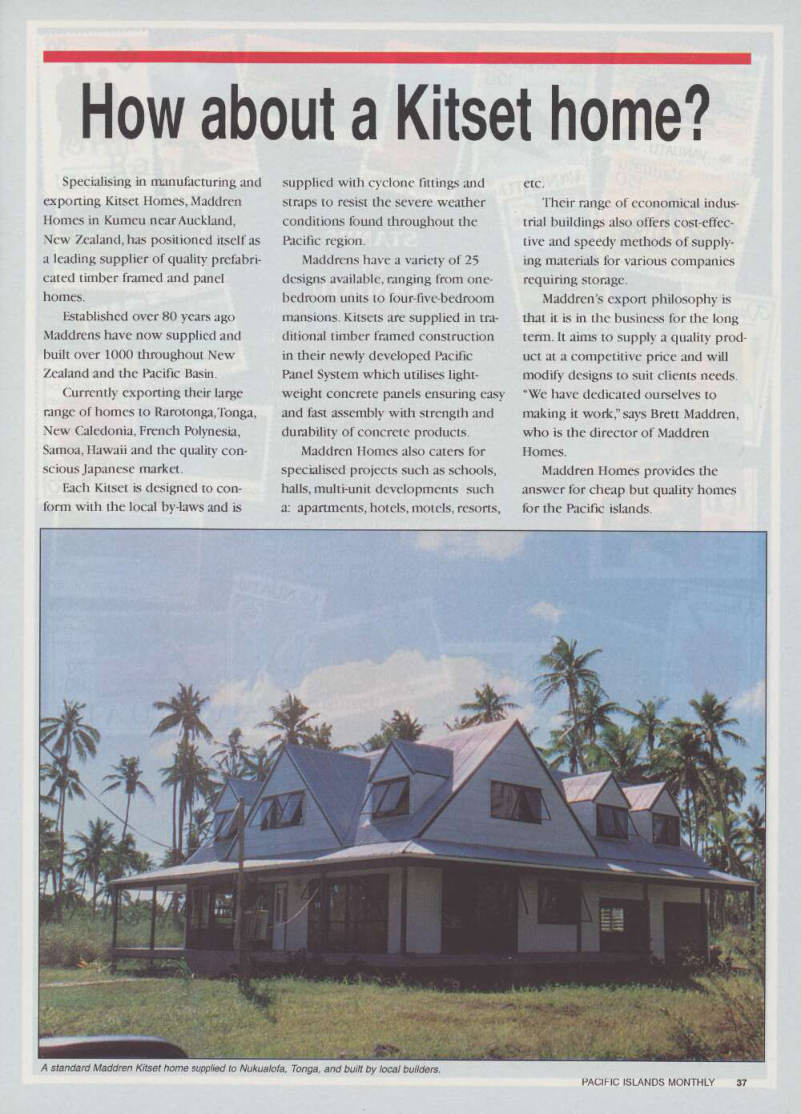
Specialising in manufacturing and exporting Kitset Homes, Maddren Homes in Kumeu near Auckland, New Zealand, has positioned itself as a leading supplier of quality prefabri cated timber framed and panel homes.
Established over 80 years ago Maddrens have now supplied and built over 1000 throughout New Zealand and the Pacific Basin.
Currently exporting their large range of homes to Rarotonga, Tonga, New Caledonia, French Polynesia, Samoa, Hawaii and the quality con scious Japanese market.
Each Kitset is designed to con form with the local by-laws and is
supplied with cyclone fittings and straps to resist the severe weather conditions found throughout the Pacific region.
Maddrens have a variety 7 of 25 designs available, ranging from one bedroom units to four-five-bedroom mansions. Kitsets are supplied in tra ditional timber framed construction in their newly developed Pacific Panel System which utilises light weight concrete panels ensuring easy and fast assembly with strength and durability of concrete products.
Maddren Homes also caters for specialised projects such as schools, halls, multi-unit developments such a: apartments, hotels, motels, resorts,
etc.
Their range of economical indus trial buildings also offers cost-effec tive and speedy methods of supply ing materials for various companies requiring storage.
Maddren’s export philosophy is that it is in the business for the long term. It aims to supply a quality prod uct at a competitive price and will modify designs to suit clients needs.
“We have dedicated ourselves to making it work,” says Brett Maddren, who is the director of Maddren Homes.
Maddren Homes provides the answer for cheap but quality homes for the Pacific islands.
A standard Maddren Kitset home supplied to Nukualofa, Tonga, and built by local builders.
Advertisements & other items, p. 38 (1 item)
1* *Mf I Vanuatu*
i^SSSSS^
,■ VANUATU M
K r 100 % \ i \
66 VANUATU
V«P u iso
pe»iB u9 I# l Cv™ 11 """ 2s
1* *Mf I VANUATU*
Ml A * 80 1
la 55J *i i A & »I
y^iiMru
V *TtoJWBW?
RlVff*' /W ' mif ■ <i - * ■iu. iht& nC I
STAMPS
VANUATU
The beautiful and exotic country of Vanuatu has some of the most colourful and fascinating stamps in the world.
They cover a broad spectrum of topics of interest to both new and established collectors. The stamp can be seen as windows to the nation of Vanuatu, revealing its customs and culture, fauna and flora, areas of development and t country's participation in international issues.
The decision to collect the stamps of Vanuatu must be an easy one to make, with a unique past and the birth of a new nation in 1980.
The stamp are of the highest quaH and individuality.
SNn, si m , I ... .
Ikll r i *6% ■ 80 \|f^
I IV'.L'
VANUATU
60 gaSaS** s * /A -. . '
VANUATU
Fishes underwater itktnks t.ruup ... the Mm
GOanuatu
**s» thescmrp 150 iwiuatu vciHiMXtu the scenery.
OCX)
Barcelona 1992 70 m
SOUTH PACIFIC MINI GAMES
PO A-
VILA DECEMBER 1993
VA N U AT U
To: The Manager Vanuatu Philatelic Bureau, General Post Office, Port Vila, Vanuatu.
I wish to purchase your new stamp issues.
Please send me full details of your next programme and your
PHILATELIC BUREAU
OFFICIAL OPENING HOURS
MONDAY TO FRIDAY
7.30 to 11.30 and 13.15 to 16.30
STANDING ORDER SERVICE
Name:.
Address:.
Post Code:
INFORMATION AND ENQUIRIES
Telephone (678) 22000 or FAX (678) 23900 Port Vila, Vanuatu.
PORT VILA
POST OFFICE
AND
PHILATELIC BUREAU
A
NUjj^
ANZ CULTURAL BANK OF WESTPAC VANUATU
BANK centre indosuez BANK
releases
Economy
World Bank releases
Gnp
data
By David North
Fiji’s per capita gross national prod uct (GNP) is the highest in the South Pacific, but PNG’s grew the fastest in the region.
These and other data were just released by the World Bank as part of its annual, world-wide survey of economic conditions.
Fiji’s per capita GNP went from US$2O5O in 1992 to $2140 in 1993, for an increase of 4.1 per cent . PNG’s GNP rose by 13.1 percent from $990 to $ll2O. This was the largest increase in the region, moving up from $l5lO to $l6lO, a positive change of 6.6 percent.
Other increases were shown by Western Samoa, up 2.1 percent to $9BO, and by the Solomons, up by 2.1 percent to $750.
Remaining dead level were Vanuatu at $1230 in both years, and Kiribati at $7lO in both 1992 and 1993.
While all the island GNPs are small compared to those of the developed world, they either held their own in 1993, or increased, in some cases sharply.
Many nations were not as lucky; most ex-Soviet republics fell by as much as 20 percent and even relatively pros perous Australia dropped from $17,730 to $17,510. New Zealand, on the other hand, was up a bit from $12,660 to $12,900.
PNG’s rate of increase was some of the largest in the world, exceeded by only a few others, such as Argentina, up 18.1 percent and both Hong Kong and Singapore, each up about 13 7 percent.
Taiwan, one of the “Little Tigers” proba bly did as well as the other two, but because of the international politics, Taiwan is not a member of the World Bank.
Meanwhile, nearby Indonesia moved a bit ahead of Kiribati in 1993, increasing from $6BO to $730. All other nations in the South Pacific continued to do better than those rich, but crowd ed islands to the west of PNG.
Gross national product is a long established but rough measure of eco nomic performance, it covers all goods and services produced within a nation in a 12-month period; per capita GNP is that number divided by the population.
GNP does not, however, take into account the cost of living. For example, people in the North Atlantic island of Iceland do have a much higher per capi
ta GNP than those in the South Pacific islands, but Iceland’s costs, such as the construction of stout houses against the cold, of heating those houses, and of importing most of its food, are not part of this reckoning.
So Iceland’s thunderous GNP of $24,300 in 1992 - even more than that recorded for the US in that year - is a bit misleading. It costs much more to live in Iceland than in Tonga, for instance.
Which leads us to this question - has any PIM reader ever lived in both places and experienced these differential costs (and temperatures). If so, drop us a line. ■
Advertisements & other items, pp. 39-41 (1 item)
A Hanoi Corporation Ltd
SPECIALISING IN IMPORTED FASHION
CLOTHING FOR ALL OCCASIONS
* FASHION CLOTHING
* CASUAL AND FORMAL SHOES
* MANCHESTER
* BEDROOM LINEN
* ELECTRICAL APPLIANCES
♦ TABLE UTENSILS
♦ MARINE PRODUCTS EXPORTER
♦ STATIONERY SUPPLIES
♦ OFFICE FURNITURE
♦ MUSICAL INSTRUMENTS
AGENTS FOR ELECTRIC AND ACOUSTIC GUITARS,
DRUMS, PIANOS,
KEYBOARDS,
AMPLIFIERS, SPEAKERS,
MIKES AND STAGE
SOUND SYSTEM
MUSICAL INSTRUMENTS CO. LTD.
LOCATION:
ACOR BOOKSHOP BUILDING
ASHLEY STREET
HONIARA
SOLOMON ISLANDS
POSTAL ADDRESS:
PO BOX 780
HONIARA, SOLOMON ISLAND
FAX: (677) 21477
PHONE: (677) 21239
datec
DATEC (FIJI) LIMITED
Quality - Value - Support
AUTHORISED
DEALERS FOR:
PERSONAL COMPUTERS -IBM PS/2 ‘PS/VP ‘NOTEBOOKS
MIDRANGE COMPUTERS ‘AS/400 ‘RISC SYSTEM 6000
PRINTERS ‘DOTMATRIX ‘LASER HEAVY DUTY PRINTERS
HEWLETT
PACKARD
•SCANNERS ‘PLOTTERS ‘PRINTERS
INKJET PRINTERS
USER PRINTERS
ZENITHDATASYSTEMS
A Bull Company
•NOTEBOOK & PERSONAL COMPUTERS
NEC
•PERSONAL COMPUTERS »UPTOPS & NOTE-
BOOKS ‘PRINTERS ‘DESKTOP PRINTERS
DEulc
•POWER CONDITIONERS *UPS SYSTEMS
Generic Business Systems
•ACCOUNTING SOFTWARE
•FIDELIO HOSPITALITY
(aOMPUTER®
Associates
Software superior by design.
ACC PAG PLUS ‘ACCPAC SIMPLY *PC PACKAGES
GBS
Microsoft fidguo
MICROSOFT PRODUCTS
OPERATING SYSTEMS
DOS WINDOWS ‘UNIX ‘NOVEL *AIX *OB/400
OCT/
Ch *chus t u,c *s & Pe rs °nai c ol7l Put Mid ers ran 9eC oni Puter s oftw, 3 re p sck. a 9es Pro yramm a n 9 S ervhes Co HSU/ti n 9 S er vic es Pa C'lit/e Man a 9em Com ent 'Puni Ca tion Ma Wen orkin a nce Pn Pe ntai s 9nie e nn g er Vice Com Prehe Psi\/ e >ra Cyst ln m g c ei7ls lnte ° Ur ses 9 r atio
SECRET BEHIND OUR CONTINUED
GROWTH AND SUCCESS
Our 72 staff are helping over 300 satisfied customers in Fiji & PNG.
Join them and make your business grow. sf m Sfe i* s ■■■l : ■ V\
datec
DATEC (FIJI) LIMITED
FIJI 68 Gordon Street, Suva, Fiji Islands. PO Box 12577, Suva, Fiji Islands, Tel: (679) 314411 Fax (679) 300162 Queens Road, Next to Metro Inn, Martintar, Nadi. Tel: (679) 720181 Fax (679) 720194 PNG Douglas Street, Port Moresby, Papua New Guinea. PO Box 504 Port Moresby, Papua New Guinea Tel: (675) 212066 Fax: (675) 213471
Stubborn
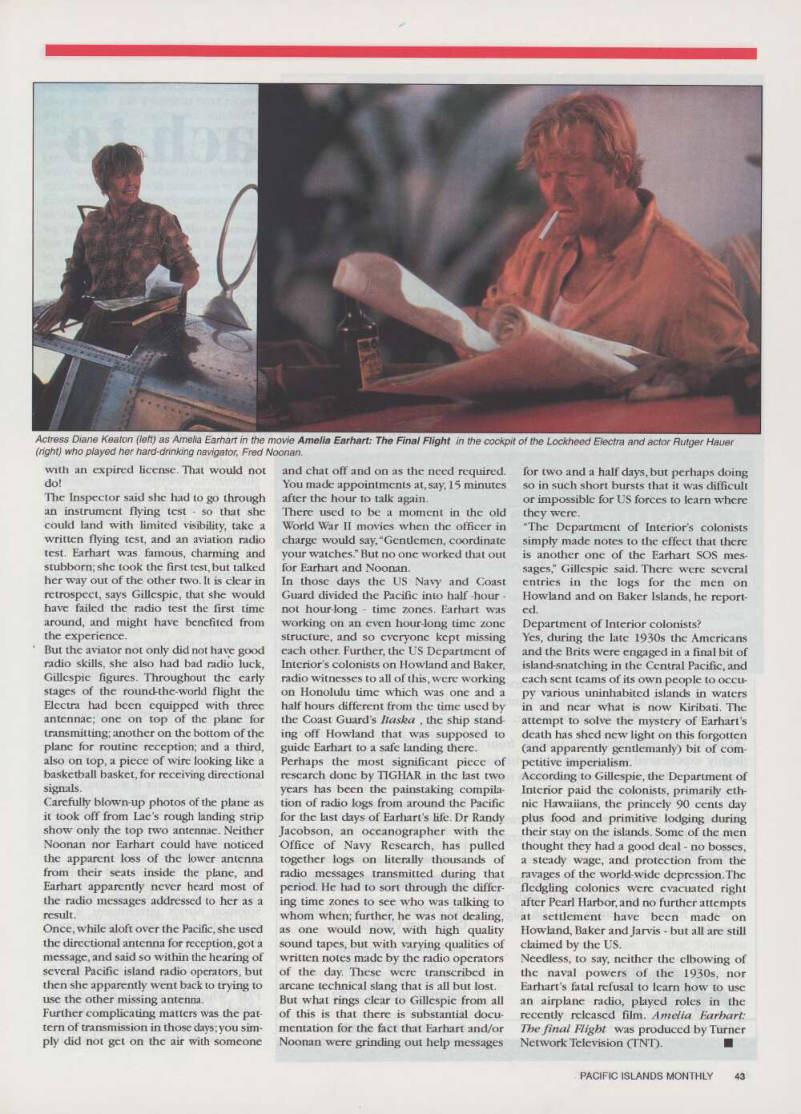
Mystery
One
Gal
Hollywood and historians are once again trying to unravel the mystery behind American aviator Amelia Earhart’s disappear ance. As a new movie about her hits the screen, historians are attempting to piece together her last days.
By David North
Both Hollywood and the historians have been busy with the Amelia Earhart mystery recently.
The American aviator, seeking a record making round-the-world flight in 1937, took off from Lae, Papua New Guinea, and never reached her goal, Howland Island, probably dying in what is now Kiribati.
Hollywood’s activities, a made-for-TV movie, featured Diane Keaton in the title role, secured maximum public attention, while the historians, quietly burrowing through US government archives of 1937 radio messages, dug up some previously overlooked information on what appear to be her last two-and-a-half days on earth.
The mystery, of course, is how did she die? Was she captured by the Japanese in the Marshalls, and died subsequently in a prison camp in Saipan, as some totally undocumented lurid stories suggest? Did she and her navigator, Fred Noonan, sim ply run out of gas and crash at sea, the
principle responsible speculation of the
past? Or did she and Noonan land on Nikomaroro, a then (and now) uninhabit ed island in Kiribati, and try to signal for help for a couple of days? This is the more recently developed scenario put forward by a team of aviation historians.
Hollywood deliberately avoided trying
to answer the question. The last frame of the movie shows Earhart gunning the plane up above the clouds with the last drop of fuel, so that the flyers can have one glorious last view of the Pacific sky before meeting whatever fate was in store.
The historians think they have the answer. Led by Richard E. Gillespie and his wife, Patricia R.Thrasher, they work with a band of dedicated volunteers called the International Group for Historic Aircraft recovery (TIGHAR). The organisation has mounted two sustained visits to Nikumaroro in Kiribati and while they did not find the wreck of the Earhart-Noonan plane they were seeking on the island and in the adjacent waters, they did find sever al pieces of a 1930 s era Lockheed Electra 10, the type of plane used in the attempt ed round-the-world flight TIGHAR’s scientists and historians, pulling together bits and pieces of evi dence on the island, in people’s memories, and in US government records, developed the theory that the two flyers, just before they ran out of fuel, spotted the island, landed on the beach at low tide, and spent the next two and a half days sending radio messages to the outside world. Then the two flyers died, presumably of heat and exposure, and the plane was swept into the depths of the ocean by the tides.
Meanwhile, the US Navy’s fumbling effort to rescue them failed.
TIGHAR’s research, in various US gov ernment archives over the last two years, has convinced them that one of the rea sons why Earhart dies was because she was a terrible radio operator. (Noonan was no better in this regard.) Aircraft radios were crude in those
days, and while potentially helpful over
water, they had none of the power or
sophistication of today’s instrumentation.
They were also simple to operate, but the headstrong Earhart had resisted learning much about them.
For starters, neither she nor Noonan could handle (“read” is the technical term) Morse Code, which was then used exten sively. To them it was just a jumble of dots and dashes.
Ironically, it was a government bureau crat who - had he been a little more unbending - could have saved Earhart s life. He was Inspector Bedinger of what was then the US Department of Commerce’s Bureau of Aviation. Stationed in the Bay area of California, he noticed in the early months of 1937 that Earhart’s pilot license would expire on April 15; she was then scheduled to start a trip around the world that would have brought her back to the United States in late April -
with an expired license. That would not do!
The Inspector said she had to go through an instrument flying test - so that she could land with limited visibility, take a written flying test, and an aviation radio test. Earhart was famous, charming and stubborn; she took the first test, but talked her way out of the other two. It is clear in retrospect, says Gillespie, that she would have failed the radio test the first time around, and might have benefited from
the experience.
But the aviator not only did not have good radio skills, she also had bad radio luck,
Gillespie figures. Throughout the early
stages of the round-the-world flight the Electra had been equipped with three antennae; one on top of the plane for transmitting; another on the bottom of the plane for routine reception; and a third, also on top, a piece of wire looking like a basketball basket, for receiving directional
signals.
Carefully blown-up photos of the plane as it took off from Lae’s rough landing strip show only the top two antennae. Neither Noonan nor Earhart could have noticed the apparent loss of the lower antenna from their seats inside the plane, and Earhart apparently never heard most of the radio messages addressed to her as a result.
Once, while aloft over the Pacific, she used the directional antenna for reception, got a message, and said so within the hearing of several Pacific island radio operators, but then she apparently went back to trying to use the other missing antenna.
Further complicating matters was the pat tern of transmission in those days;you sim ply did not get on the air with someone
and chat off and on as the need required.
You made appointments at, say, 15 minutes after the hour to talk again.
There used to be a moment in the old World War II movies when the officer in charge would say, “Gentlemen, coordinate your watches.” But no one worked that out for Earhart and Noonan.
In those days the US Navy and Coast Guard divided the Pacific into half -hour not hour-long - time zones. Earhart was working on an even hour-long time zone structure, and so everyone kept missing each other. Further, the US Department of Interior’s colonists on Howland and Baker, radio witnesses to all of this, were working on Honolulu time which was one and a half hours different from the time used by the Coast Guard’s Itaska , the ship stand ing off Howland that was supposed to guide Earhart to a safe landing there.
Perhaps the most significant piece of
research done by TIGHAR in the last two years has been the painstaking compila tion of radio logs from around the Pacific for the last days of Earhart’s life. Dr Randy Jacobson, an oceanographer with the
Office of Navy Research, has pulled
together logs on literally thousands of
radio messages transmitted during that period. He had to sort through the differ ing time zones to see who was talking to whom when; further, he was not dealing, as one would now, with high quality sound tapes, but with varying qualities of written notes made by the radio operators of the day. These were transcribed in arcane technical slang that is all but lost.
But what rings clear to Gillespie from all of this is that there is substantial docu mentation for the fact that Earhart and/or Noonan were grinding out help messages
for two and a half days, but perhaps doing so in such short bursts that it was difficult or impossible for US forces to learn where
they were.
“The Department of Interior’s colonists simply made notes to the effect that there is another one of the Earhart SOS mes sages,” Gillespie said. There were several entries in the logs for the men on Howland and on Baker Islands, he report ed.
Department of Interior colonists?
Yes, during the late 1930 s the Americans and the Brits were engaged in a final bit of island-snatching in the Central Pacific, and each sent teams of its own people to occu py various uninhabited islands in waters in and near what is now Kiribati. The attempt to solve the mystery of Earhart’s death has shed new light on this forgotten (and apparently gentlemanly) bit of com
petitive imperialism.
According to Gillespie, the Department of Interior paid the colonists, primarily eth nic Hawaiians, the princely 90 cents day
plus food and primitive lodging during
their stay on the islands. Some of the men thought they had a good deal - no bosses, a steady wage, and protection from the ravages of the world-wide depression. The fledgling colonies were evacuated right after Pearl Harbor, and no further attempts at settlement have been made on Howland, Baker and Jarvis - but all are still claimed by the US.
Needless, to say, neither the elbowing of the naval powers of the 19305, nor Earhart’s fatal refusal to learn how to use an airplane radio, played roles in the recently released film. Amelia Earhart: The final Flight was produced by Turner Network Television (TNT). ■
Actress Diane Keaton (left) as Amelia Earhart in the movie Amelia Earhart: The Final Flight in the cockpit of the Lockheed Electra and actor Rutger Hauer (right) who played her hard-drinking navigator, Fred Noonan.
logging
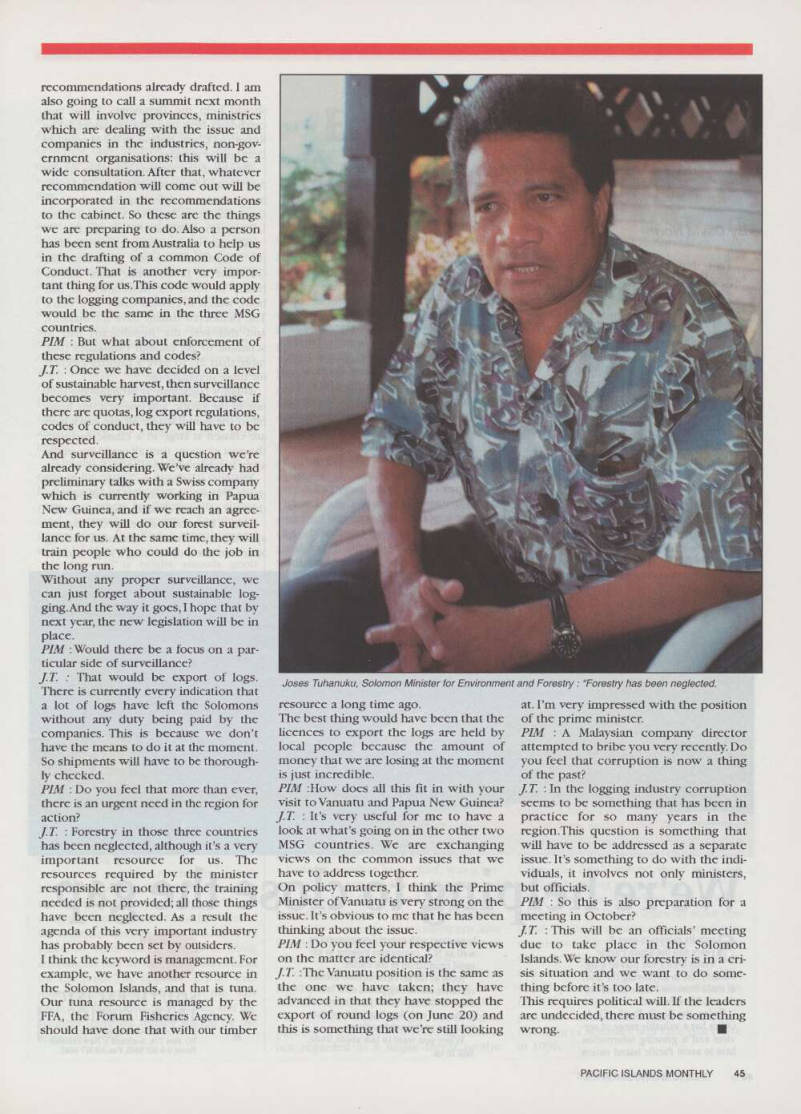
Forestry
A united approach to
Solomon Islands Minister for Forestry, Environment and Conservation, Joses Tuhanuku, in August visited Papua New Guinea and Vanuatu. The move followed a recent Melanesian Spearhead Group decision urging member countries (Vanuatu, Solomon Islands and Papua New Guinea) to have a common approach on logging matters. It was an occasion for the two countries to adopt the same stand on the con troversial logging issue, despite pressure from foreign logging companies. Tuhanuku explains his stand to Vanuatu correspondent, Patrick Decloitre.
PIM: Mr Tuhanuku, you were recently appointed Minister for Forestry, Environment and Conservation in the government of the Solomon Islands.
What is the purpose of your visit in Vanuatu?
J. T : My visit is a follow-up of an under standing reached during the last Melanesian Spearhead Group (MSG) meeting in the Solomon Islands. And for Forestry, in the region, Papua New Guinea, Solomon Islands and Vanuatu are among the few countries in the world who still have a primary forest.
So we feel it’s important that we take some common position in dealing with our timber resources, because by doing that, we will have a better chance of withstanding the pressures from out side.
PIM.: And there are pressures?
J.T :Yes, and to deal with those pres sures individually is quite difficult. But collectively it’s easier. If we don’t take a common position, we can be used against each other by companies and by outsiders. And it will be very hard for them to exert those pressures if we take this common approach.
PIM ; So that’s why you took this trip?
J.T ; Yes, I’ve just visited Papua New Guinea, and now Vanuatu. Also, the Solomon Islands government is cur rently carrying out its inventory report this month (September) and once this report is adopted and accepted by the government, I will have to proceed to make recommendations to the cabinet.
PIM :What other steps is the Solomon Islands government currently taking?
J. T: We are working on a new forestry legislation. At this stage, we have the
recommendations already drafted. I am also going to call a summit next month that will involve provinces, ministries which are dealing with the issue and companies in the industries, non-gov ernment organisations: this will be a wide consultation. After that, whatever recommendation will come out will be incorporated in the recommendations to the cabinet. So these are the things we are preparing to do. Also a person has been sent from Australia to help us in the drafting of a common Code of Conduct. That is another very impor tant thing for us .This code would apply to the logging companies, and the code would be the same in the three MSG countries.
PIM : But what about enforcement of these regulations and codes?
J.T. : Once we have decided on a level of sustainable harvest, then surveillance becomes very important. Because if there are quotas, log export regulations, codes of conduct, they will have to be respected.
And surveillance is a question we’re already considering. We’ve already had preliminary talks with a Swiss company which is currently working in Papua New Guinea, and if we reach an agree ment, they will do our forest surveil lance for us. At the same time, they will train people who could do the job in the long run.
Without any proper surveillance, we can just forget about sustainable log ging. And the way it goes, I hope that by next year, the new legislation will be in
place.
PIM : Would there be a focus on a par ticular side of surveillance?
J.T. : That would be export of logs.
There is currently every indication that a lot of logs have left the Solomons without any duty being paid by the companies. This is because we don’t have the means to do it at the moment.
So shipments will have to be thorough ly checked.
PIM : Do you feel that more than ever, there is an urgent need in the region for action?
J.T. : Forestry in those three countries has been neglected, although it’s a very important resource for us. The resources required by the minister responsible are not there, the training needed is not provided; all those things have been neglected. As a result the agenda of this very important industry has probably been set by outsiders.
I think the keyword is management. For example, we have another resource in the Solomon Islands, and that is tuna.
Our tuna resource is managed by the FFA, the Forum Fisheries Agency. We should have done that with our timber
resource a long time ago.
The best thing would have been that the licences to export the logs are held by local people because the amount of money that we are losing at the moment is just incredible.
PIM :How does all this fit in with your visit to Vanuatu and Papua New Guinea?
J.T. : It’s very useful for me to have a look at what’s going on in the other two MSG countries. We are exchanging views on the common issues that we have to address together.
On policy matters, I think the Prime Minister ofVanuatu is very strong on the issue. It’s obvious to me that he has been thinking about the issue.
PIM : Do you feel your respective views on the matter arc identical?
J.T. :The Vanuatu position is the same as the one we have taken; they have advanced in that they have stopped the export of round logs (on June 20) and this is something that we’re still looking
at. I’m very impressed with the position of the prime minister.
PIM : A Malaysian company director attempted to bribe you very recently. Do you feel that corruption is now a thing of the past?
J.T. : In the logging industry corruption seems to be something that has been in practice for so many years in the region. This question is something that will have to be addressed as a separate issue. It’s something to do with the indi viduals, it involves not only ministers, but officials.
PIM : So this is also preparation for a meeting in October?
J.T. : This will be an officials’ meeting due to take place in the Solomon Islands. We know our forestry is in a cri sis situation and we want to do some thing before it’s too late.
This requires political will. If the leaders are undecided, there must be something wrong. ■
Joses Tuhanuku, Solomon Minister for Environment and Forestry: “Forestry has been neglected.
Advertisements & other items, p. 44 (1 item)
Consulting Opportunities
Development
ACIL Australia Pty Ltd is one of Australia's most successful project management and international development consultancies. We are currently implementing 18 major development assistance projects valued at AUD24O million in Papua New Guinea, Fiji, Indonesia, China, Thailand, Laos, Philippines and the Solomon Islands. Over the past 25 years we have completed 280 projects in 63 countries throughout Asia, Africa and the Pacific.
ACIL invites registrations of interest from highly experienced consultants who wish to be considered for future long and short term consulting opportunities.
A minimum of ten years professional experience,
including five years developing country experi-
ence, is mandatory.
Experience on development projects funded
by major lending agencies and an ability to speak a foreign language will be highly
regarded.
ACIL Australia Pty Ltd Consultants meeting these requirements who have expertise in: Agricultural Systems Community Development Economics Environment Forestry Gender Analysis Health HRD/Education Institutional Development Law and Order Management Information Systems Marketing Monitoring and Evaluation Project Management Regional Planning Training Water Supply and Sanitation are invited to send a detailed Curriculum Vitae to Ms Danielle Macquarie ACIL Australia Pty. Ltd. 854 Glenferrie Road Hawthorn Victoria 3122
AUSTRALIA
Fax: +613 819 4216
gets a free ride
Elections
Underwood gets a free ride
By David North
Two things are sure about Guam s November election: * the island will get a new Governor, and * 11 Wlll kee P lts Congressman, Bob Underwood.
Guam voters, like those of American ’ .
Samoa ( and the American Mainland) will go to the polls on November 8; the ones on Guam will select a replacement for the retmng, two-term Republican Governor, Joe Ada, who can not run for a third con secutive term.
But Guam’s voters will not, as they usu ally do in even-numbered years, be picking a Congressman. They will not because freshman Democrat Bob Underwood has become so popular in his first two years in Congress that no one, Republican or Democrat, was willing to run against him.
This feat has not been seen in the US Flag
PaCiflC SinCC Sam ° an ConBressman Foro L F. Sunia, and another Democrat, did it in 1982, after his first two years in Washington. Guam’s voters, however, will have many other races to decide.
First, there is the governorship, where the Democratic candidate is a long-time territorial senator, Carl Gutierrez, and his opponent is Republican Tommie Tanaka, another senator Each of the gubernatorial -uwuici BUUIUI.UIUI ui un. guuv-uwiuiiiu candidates has a woman, and a state senator, as his running mate for the office of Lt Governor; they are Democrat Madeleine Bordallo, widow of the former Governor, Ricky Bordaloo who shot himself rather than go to a Mainland prison, and Republican Doris Brooks, who has been in the Senate for several years.
Gutierrez comes to the race with what may be a major handicap, a sex scandal involving him and a teenage girl; his running mate, however, is in touch with the remnants of political machine her late husband created over the years, and this
should help the Democrats. These two candidates beat two other senators, Eddie Reyes and Gloria Nelson, in the September Democratic primary.
Tanaka is the reform candidate in the race; he and Senator Brooks also had a pri mary contests, defeating incumbent Lt Governor Frank Bias (Ada’s favourite) and Lt Governor candidate Simon Sanchez.
With six of the sitting 21 members of the Legislature leaving it to run for Governor or Lt Governor there will be plenty of room for newcomers in that body, which is elected every two years.
The Democrats usually have the majority, and this year the Republicans had to scramble to get enough candidates (one more than 21) to have a primary election for these nominations.
Guam’s Legislature is probably the only one in the Pacific, and one of a tiny hand ful in the world, where all the candidates are chosen at large in a classic first-past the-post election; they all could live in the same neighbourhood - but, in fact, do not.
Guam’s elections are more similar to those of Hawaii, and the US Mainland, than they are to those of other Pacific islands.
Guam has a well developed two-party system, and has a tradition (along Mainland lines) of electing a large number
of women to high office. This year, for, example a woman will be elected Lt Governor only because women are run ning for that office; usually six to eight women serve in the 21-member legisla ture.
Guam politics, while stimulating, has none of the drama of either Samoa or Saipan, partially because Joe Ada has kept things down to a dull roar. Yes, Guam’s government is in the red, but the territory meets its payroll regularly, which can not be said for the hard-pressed American Samoan government. Yes, Guam has had a governmental scandal now and again, but they have been minor compared to the endless series of corrupt practices rou
tinely reported during the recently con
cluded reign of CNMI’s former Governor, Lorenzo Guerrero. Ada is young enough, and popular enough, so that he may be in another race for Governor four years hence.
Why did Underwood get a free ride so early in his career? A respected educator, he had never held elective office until two years ago when he defeated the sitting
(and somewhat stodgy) Republican
Congressman, Ben Blaz, a retired general in the US Marines.
Underwood is bright, smooth, good looking, and hardworking which always
helps. More importantly he captured, as
Blaz had not, a sense of the Guamanians’ frustration with Washington. He is an out spoken advocate of Chamorro rights, and has worked loudly and effectively to get the US military establishment to give back some of its vast landholdings on the island.
He was making good progress with his bill on this subject when the deadline passed for filing against him in the elec tion; it was only later that his H.R. 2144 passed the US Senate (where Guam has no voice at all).The bill calls for the transfer, at no cost to Guam, of 3200 acres of excess military land. Underwood, earlier in the year, blocked an effort by the feder al Department of Interior to gain control of the land in question.
Guam’s politics rarely get much Mainland attention, but every two years there is a brief flurry of interest - it is all a matter of timing. Since Guam lies west of the International Dateline, it is the first US place to vote, and a winner is being announced just as the Mainlanders head for the polls. The opposite is true with American Samoa, which is the last American flag jurisdiction to vote, and the winners there are usually ignored by the Mainland press. ■
Advertisements & other items, p. 46 (1 item)
We're helping to close the gap
ince its inception over 5 years ago the South Pacific Trade Office has played a significant role in improving the level of trade from the Pacific Island Nations to New Zealand.
Today the South Pacific Trade Office has a valuable range of services and a growing information base to assist Pacific Island nation businesses with export development as well as N.Z. companies looking to expand production in the Pacific.
Some of the services include market research, marketing plans, data bases, office facilities, product promotion and assistance with locating joint venture business or financial partners.
When you want to talk about trade, talk to us.
SOUTH PACIFIC
TRADE OFFICE
Jetset Centre, 44-48 Emily Place, PO. Box 774, Auckland 1. New Zealand Phone 0-9-302 0465, Fax 0-9-377 6642.
Eni seeks fourth
term in congress
The big political battle in American Samoa this November is Congressman Eni F.H. Faleomavaega’s bid for another two years in the US House of
Representatives.
The third-term Democrat holds a seat which gives the island a voice in the House, a vote in important committee matters and in party caucuses, but no vote on the final passage of bills on the House Floor. It is also the second most powerful position in the territory (after the governorship) and comes with a
nearly million-dollar-a-year budget.
Far and away the most prominent of his four opponents is Amata Coleman Radewagen, the former Governor’s daughter, already a power within the
Mainland Republican Party.
The other three candidates for the seat, all men, are: High chief Fai’ivae Galea’i a former member of the island’s senate and a relative of Faleomavaega; former boxer Unasa Leroy Ledoux,who once lost a race for the island’s Lower House; and Tuika Tuika, a former mem ber of the Territorial House.
This year’s congressional race has raised few burning issues. Fai’ivae, for example, wrote a letter to President Clinton that was published in the Samoa News and used that vehicle to report his successful efforts of 22 years earlier to secure the discharge from the US Army of a man who then helped build Samoa’s golf course. (The candi date did not mention that the golf course, which often had an over-stuffed payroll, was a consistent money loser, and a subject of controversies in the Lutali-Coleman race.) Fai’ivae in the same letter raised a more pressing issue, the current sad shape of airline serving the islands.
Ledoux, another high chief, was a ter ritorial civil servant for many years, and was director of Parks and Recreation in both the Lutali and Coleman administra tions. His campaign announcement also boasted of his role in the construction of the money-losing golf course.
Tuika Tuika, who was a member of the legislature for a single term in the mid 80s, is the only one of the four who has run territory-wide. He got about three percent of the vote two years ago, and is not regarded as a major threat to the
incumbent.
In the campaign, Faleomavaega has stressed the utility of his role as an expe rienced legislator and as a Democrat working with the Democratic majority in the US House of Representatives, and with both a Democratic president and Democratic governor (Lutali).
He has also spoken of his success in bringing federal funds to Samoa, open ing up, for example, both a federally sub sidised housing loan program for former members of the US armed forces, and a federally-supported food stamp pro gram for the elderly and the disabled Another theme is that he has gone to bat for the region, not just American Samoa; he takes credit for blocking the closure of the American diplomatic mis sion in Apia, which was due for the axe a few months ago. Similarly, he secured funding for a new university scholar ship program for young people from the independent nations of the Pacific.
Whoever wins the election will have the dubious distinction of representing fewer people than any other member of the US House of Representatives. Many Mainland races attract 100,000 to 200.000 voters, but two years ago only 12.000 people voted in Samoa. This year there will be fewer votes than ever, as reform-minded Lutali administration has forced all voters to either register or re validated their prior registration. There had been wide-spread suspicion that some to many voters were really not
qualified, particularly those voting by
absentee ballot. It is not clear which candidate, if any, will benefit from the reduced size of the electorate.
American samoa will also elect the members of the Territorial House of rep resentatives for two-year terms; unlike Guam and the Mainland, these races are not fought along party lines.
The Senate in American Samoa is an anomaly in US Flag politics, as most res idents of the territory cannot vote for its members. Only chiefs or matai can vote; virtually no women hold these titles, and most males do not either. This would probably be found contrary to the US constitution, but that is not a potential variable this year, as the next selection of senators will take place late in 1996.
Boiler-room scam
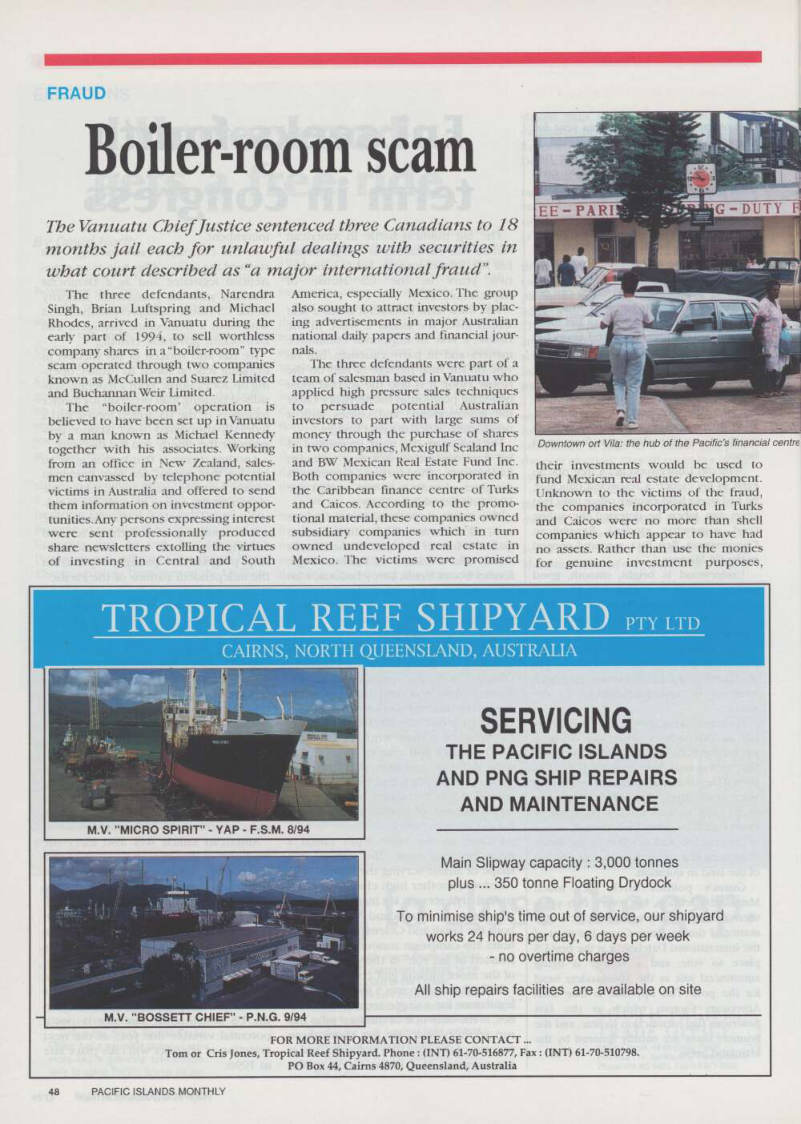

Fraud
The Vanuatu Chief Justice sentenced three Canadians to 18 months jail each for unlawful dealings with securities in what court described as “a major international fraud”.
The three defendants, Narendra Singh, Brian Luftspring and Michael Rhodes, arrived in Vanuatu during the early part of 1994, to sell worthless company shares in a “boiler-room” type scam operated through two companies known as McCullen and Suarez Limited and Buchannan Weir Limited.
The “boiler-room’ operation is believed to have been set up in Vanuatu by a man known as Michael Kennedy together with his associates. Working from an office in New Zealand, sales men canvassed by telephone potential victims in Australia and offered to send them information on investment oppor tunities. Any persons expressing interest
were sent professionally produced
share newsletters extolling the virtues of investing in Central and South
America, especially Mexico. The group also sought to attract investors by plac ing advertisements in major Australian national daily papers and financial jour nals.
The three defendants were part of a team of salesman based in Vanuatu who applied high pressure sales techniques
to persuade potential Australian
investors to part with large sums of money through the purchase of shares in two companies, Mexigulf Sealand Inc and BW Mexican Real Estate Fund Inc.
Both companies were incorporated in the Caribbean finance centre of Turks and Caicos. According to the promo tional material, these companies owned subsidiary companies which in turn owned undeveloped real estate in Mexico. The victims were promised
their investments would be used to fund Mexican real estate development.
Unknown to the victims of the fraud, the companies incorporated in Turks and Caicos were no more than shell companies which appear to have had no assets. Rather than use the monies for genuine investment purposes,
Downtown ort Vila: the hub of the Pacific’s financial centre
Kennedy and his associates used the money to support an extravagant jet-set ting lifestyle. Monies that were not spent were channeled through other offshore finance centres to bank accounts controlled by Kennedy and his associates.
“Everyone involved arrived in
Vanuatu under a false name. They all knew each other and the office staff in Port Vila knew them by their adopted personae. They played the game 24 hours a day,” public prosecutor John Baxter Wright told the Supreme Court..
Dealing mainly with Australian individu als, the salespeople told potential investors the price of land was rising and “it was a good time to invest there”.
“Every company set up here has to have a 90-day lifespan. It was therefore planned the scam would have lasted about three months and closed up as quickly as it was set up, only to be replaced by another company,” Baxter- Wright added at Supreme Court hear ings. He produced copies of blank share certificates which, he said, were part of a stock of five million pre-printed copies found in the company’s Vanuatu offices during a search in April.
One of the Australian victims told the Vanuatu Supreme Court during hear ings this month that he had been lured to invest some U 55145,000 in the fraud. It was a complaint from an Australian investor that triggered the Vanuatu Financial Service Commission (created last December to “protect the investors in Vanuatu from financial loss arising from dishonesty or “incompe tence” of people in the finance busi
ness) to start enquiring about Port Vila based Me Cullen and Suarez Inc.
On April 20, Vanuatu Financial Services Commissioner Richard Carpenter obtained a warrant to search the Port Vila-based office and closed it down. All bank accounts used in con nection with the fraud, including some in the Isle of Man, were frozen.
“Were it not for the diligence of the Vanuatu Financial Services Commissioner, the scam would have succeeded in netting considerably more than the Asl.2 million (US$870,000) which had been dishonestly obtained in the enterprise,” Chief Justice Vaudin d’lmecourt said.
“Vanuatu’s financial services indus try, which contributes 15 percent towards the country’s gross domestic product, is an important element of Vanuatu’s economy. It is my duty to pro tect its integrity. If Vanuatu became known as a haven for fraudsters, the effects would be disastrous. We will not tolerate such abuse of our good name,” d’lmecourt said.
Kennedy, believed to be the master mind of the whole operation, escaped the Vanuatu jurisdiction and fled the island state in April by chartering a plane from an outer island. ■
Advertisements & other items, pp. 48-50 (1 item)
Tropical Reef Shipyard
CAIRNS, NORTH QUEENSLAND, AUSTRALIA
PTY LTD
s»a« f t M.V. "MICRO SPIRIT" - YAP - F.S.M. 8/94
SERVICING
THE PACIFIC ISLANDS
AND PNG SHIP REPAIRS
AND MAINTENANCE
M.V. "BOSSETT CHIEF" - P.N.G. 9/94
Main Slipway capacity : 3,000 tonnes plus ... 350 tonne Floating Drydock To minimise ship's time out of service, our shipyard works 24 hours per day, 6 days per week - no overtime charges All ship repairs facilities are available on site
FOR MORE INFORMATION PLEASE CONTACT ...
Tom or Cris Jones, Tropical Reef Shipyard. Phone ; (INT) 61-70-516877, Fax : (INT) 61-70-510798.
PO Box 44, Cairns 4870, Queensland, Australia
SECOND HAND CONTAINERS
WHERE AND WHEN YOU WANT THEM IN THE PACIFIC If you need a flexible and safe storage space we have the ideal solution for you. Our second hand containers provide instant secure storage. Guaranteed to be wind and waterproof these containers are ideal for both temporary and longterm storage in Pacific conditions.
We can deliver to any island in the Pacific within a month and our rates have got to be the lowest you will find. All you need to do is tell us how many you want.
CONTACT:
PASCALS MARCONNET, BP 4757 NOUMEA, NEW CALEDONIA. TEL; (687) 28 7450. FAX: (687) 26 3248
Fresh from the tropical rainforests of the Solomon Islands comes the new taste sensation of Ngali Nuts.
Ngali Nuts don’t just taste great, they really are good for you.
High in fibre and protein, they contain a balanced mix of saturated and unsaturated oils.
Eaten either raw or cooked, ngali nuts have a unique delicate taste that complements most other foods. Raw these nuts are delicious in muesli, yoghurt or icecream and can be added to casseroles, soups, fish and vegetables to bring out their flavour.
Best of all these nuts are not cultivated but harvested from trees that are hundreds of years old and have never come into contact with chemical additives. You could say they were truly organi-
cally grown.
These nuts have long been part of Solomon Islanders traditional diets and ngali nut harvesting is often accompanied by custom rituals, dances and song. Removal of the delicate kernal without damage from within the extremely hard shell is a skillful operation but one which local people acquire at an early age.
The ngali nut is just one of many natural products that are produced by the Solomon Islands. These include high grade copra, cocoa, coffee and a wide range of spices.
For more information on the ngali nut or any of our other products contact the Commodities Export Marketing Authority at the address below.
°*»ON 'S' - '
1 \ PO Box 1087, Honiara, Solomon Islands, ft/ Tel; (677) 22528 or 22529. Fax: (677) 21262. fij Telex: HQ 66316. Cable: “COPRA”.
P\ Commodities Export Marketing Authority,
identity...
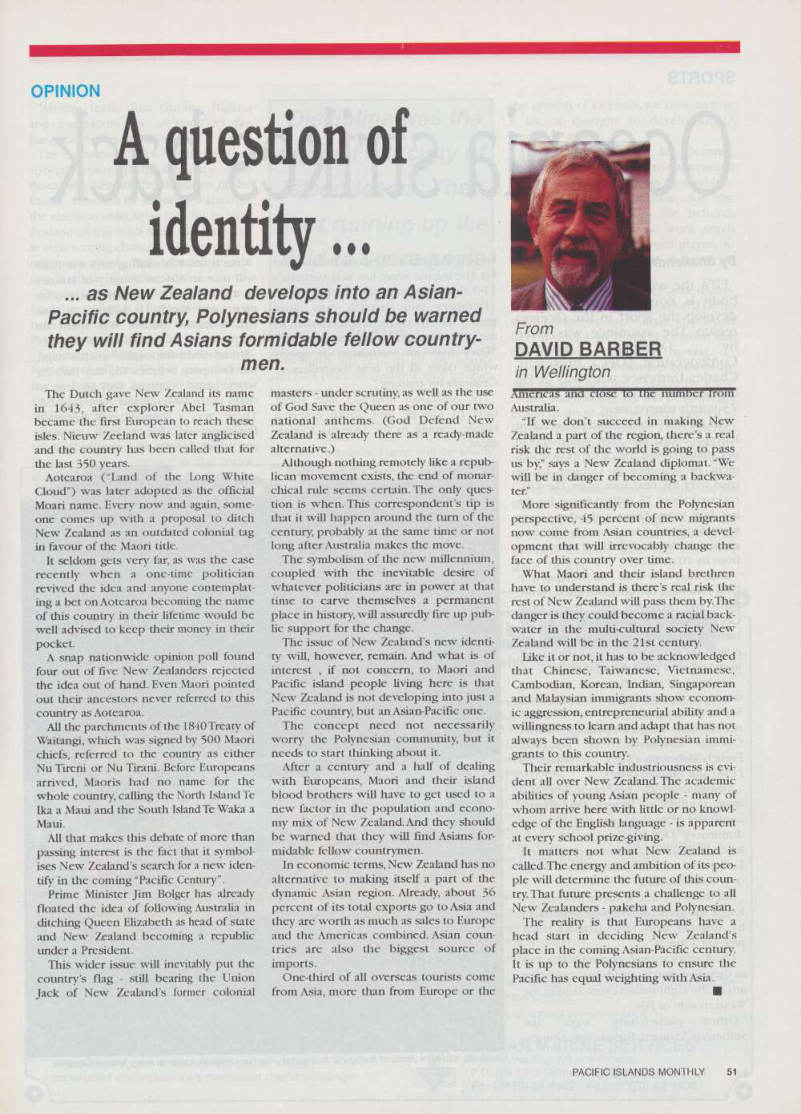
Opinion
A question of identity...
... as New Zealand develops into an Asian- Pacific country, Polynesians should be warned they will find Asians formidable fellow country men.
The Dutch gave New Zealand its name in 1643, after explorer Abel Tasman became the first European to reach these isles. Nieuw Zeeland was later anglicised and the country has been called that for the last 350 years.
Aotearoa (“Land of the Long White Cloud”) was later adopted as the official Moari name. Every now and again, some one comes up with a proposal to ditch New Zealand as an outdated colonial tag in favour of the Maori title.
It seldom gets very far, as was the case recently when a one-time politician revived the idea and anyone contemplat ing a bet on Aotearoa becoming the name of this country in their lifetime would be well advised to keep their money in their
pocket.
A snap nationwide opinion poll found four out of five New Zealanders rejected the idea out of hand. Even Maori pointed out their ancestors never referred to this country as Aotearoa.
All the parchments of the 1840 Treaty of Waitangi, which was signed by 500 Maori chiefs, referred to the country as either Nu Tireni or Nu Tirani. Before Europeans arrived, Maoris had no name for the whole country, calling the North Island Te Ika a Maui and the South Island Te Waka a Maui.
All that makes this debate of more than passing interest is the fact that it symbol ises New Zealand’s search for a new iden tify in the coming “Pacific Century”.
Prime Minister Jim Bolger has already floated the idea of following Australia in ditching Queen Elizabeth as head of state and New Zealand becoming a republic under a President.
This wider issue will inevitably put the country’s flag - still bearing the Union Jack of New Zealand’s former colonial
masters - under scrutiny, as well as the use of God Save the Queen as one of our two national anthems. (God Defend New Zealand is already there as a ready-made alternative.) Although nothing remotely like a repub lican movement exists, the end of monar chical rule seems certain. The only ques tion is when. This correspondent’s tip is that it will happen around the turn of the century, probably at the same time or not long after Australia makes the move.
The symbolism of the new millennium, coupled with the inevitable desire of whatever politicians are in power at that time to carve themselves a permanent place in history, will assuredly fire up pub lic support for the change.
The issue of New Zealand’s new identi ty will, however, remain. And what is of interest , if not concern, to Maori and Pacific island people living here is that New Zealand is not developing into just a Pacific country, but an Asian-Pacific one.
The concept need not necessarily worry the Polynesian community, but it needs to start thinking about it.
After a century and a half of dealing with Europeans, Maori and their island blood brothers will have to get used to a new factor in the population and econo my mix of New Zealand. And they should be warned that they will find Asians for midable fellow countrymen.
In economic terms, New Zealand has no alternative to making itself a part of the dynamic Asian region. Already, about 36 percent of its total exports go to Asia and they are worth as much as sales to Europe and the Americas combined. Asian coun tries are also the biggest source of
imports.
One-third of all overseas tourists come from Asia, more than from Europe or the
Americas ana close to me nuniDcr rrom Australia.
“If we don’t succeed in making New Zealand a part of the region, there’s a real risk the rest of the world is going to pass us by,” says a New Zealand diplomat. “We will be in danger of becoming a backwa ter.”
More significantly from the Polynesian perspective, 45 percent of new migrants now come from Asian countries, a devel opment that will irrevocably change the face of this country over time.
What Maori and their island brethren have to understand is there’s real risk the rest of New Zealand will pass them by. The danger is they could become a racial back water in the multi cultural society New Zealand will be in the 21st century.
Like it or not, it has to be acknowledged that Chinese, Taiwanese, Vietnamese, Cambodian, Korean, Indian, Singaporean and Malaysian immigrants show econom
ic aggression, entrepreneurial ability and a
willingness to learn and adapt that has not
always been shown by Polynesian immi
grants to this country.
Their remarkable industriousness is evi dent all over New Zealand. The academic abilities of young Asian people - many of whom arrive here with little or no knowl edge of the English language - is apparent at every school prize-giving.
It matters not what New Zealand is called. The energy and ambition of its peo ple will determine the future of this coun try. That future presents a challenge to all New Zealanders - pakeha and Polynesian.
The reality is that Europeans have a head start in deciding New Zealand’s place in the coming Asian-Pacific century.
It is up to the Polynesians to ensure the Pacific has equal weighting with Asia.
From
David Barber
in Wellington
Oceania strikes back
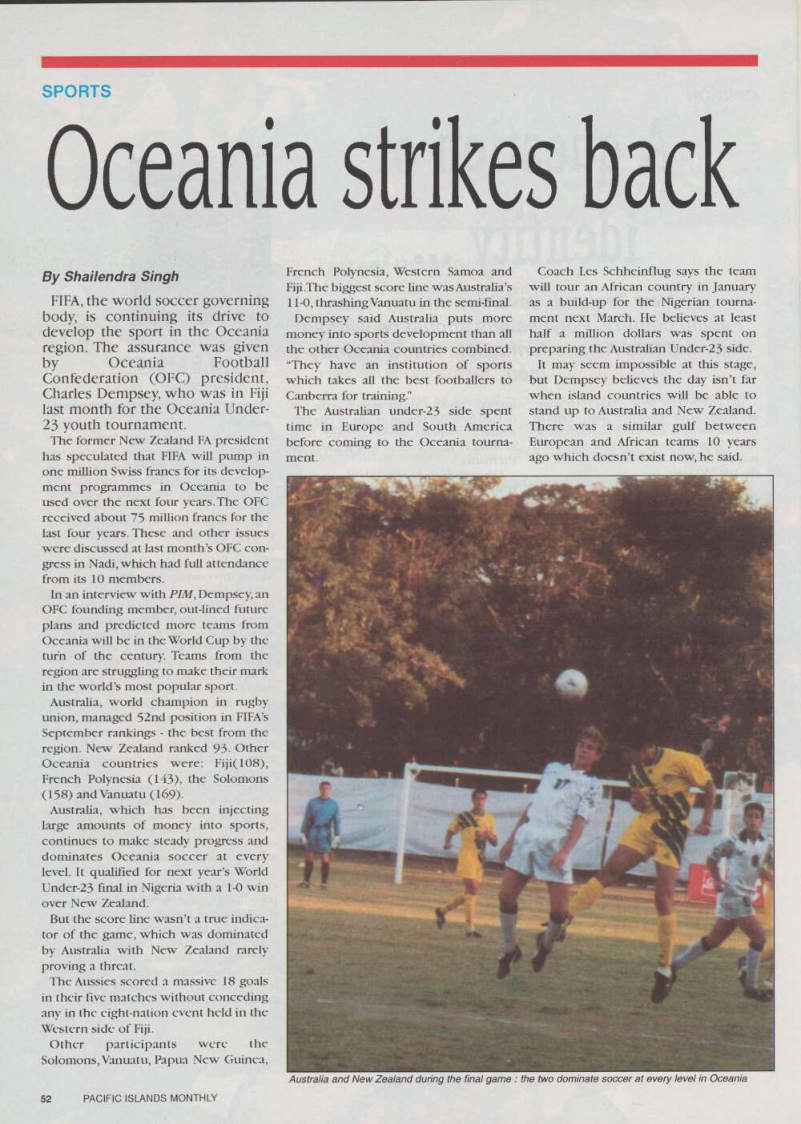
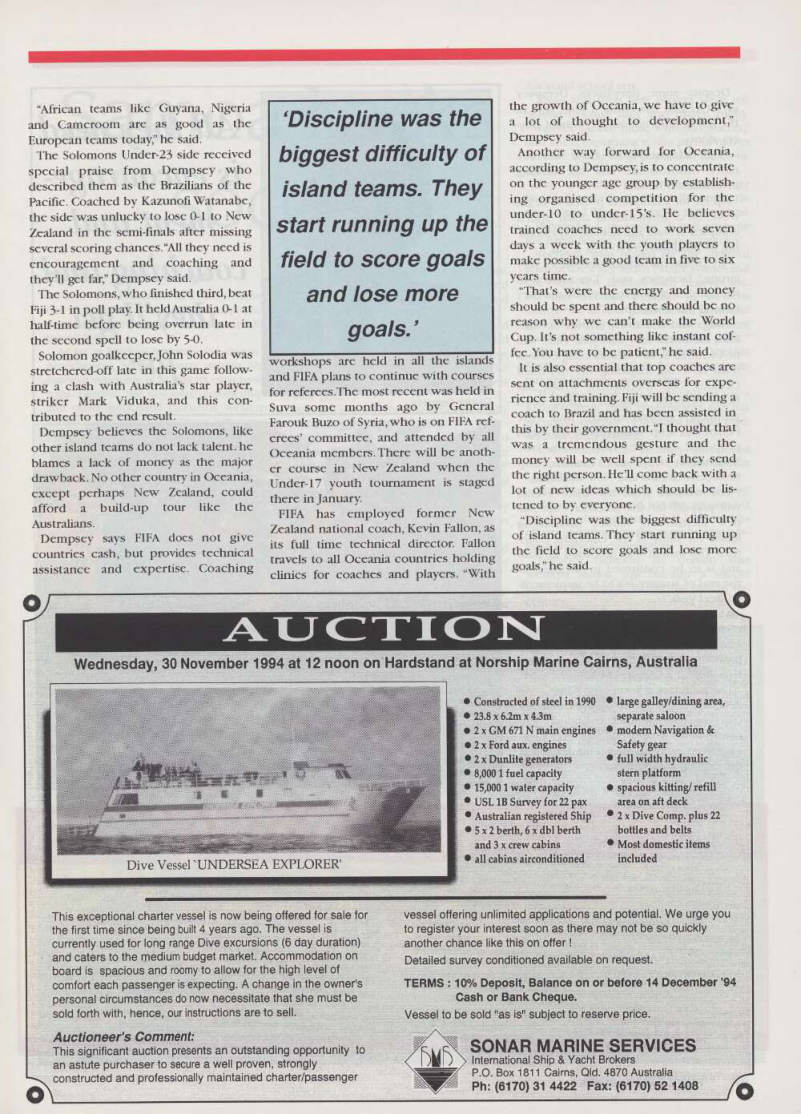
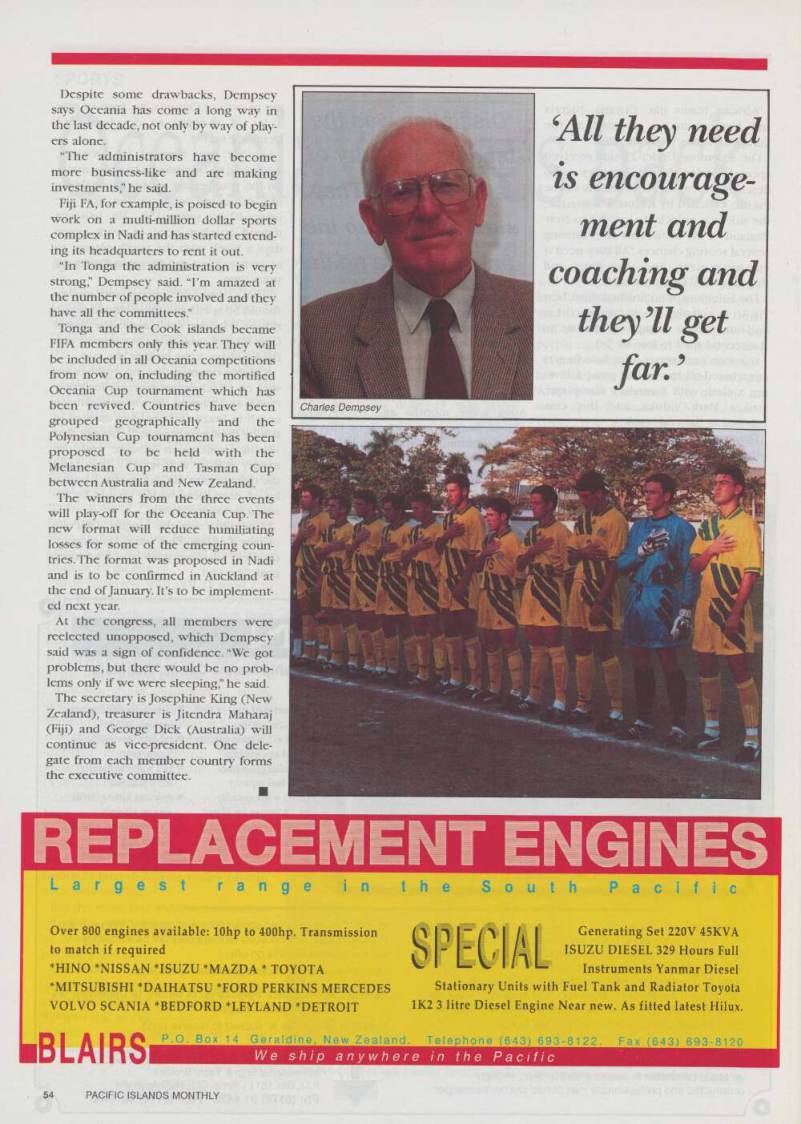
Sports
By Shailendra Singh
FIFA, the world soccer governing body, is continuing its drive to develop the sport in the Oceania region. The assurance was given by Oceania Football
Confederation (OFC) president,
Charles Dempsey, who was in Fiji last month for the Oceania Under
-23 youth tournament.
The former New Zealand FA president has speculated that FIFA will pump in one million Swiss francs for its develop ment programmes in Oceania to be used over the next four years. The OFC received about 73 million francs for the last four years. These and other issues were discussed at last month’s OFC con gress in Nadi, which had full attendance from its 10 members.
In an interview with PIM, Dempsey, an OFC founding member, out-lined future plans and predicted more teams from Oceania will be in the World Cup by the turn of the century. Teams from the region are struggling to make their mark in the world’s most popular sport.
Australia, world champion in rugby union, managed 52nd position in FIFA’s September rankings - the best from the region. New Zealand ranked 93- Other Oceania countries were: Fiji(108), French Polynesia (143), the Solomons (158) and Vanuatu (169).
Australia, which has been injecting large amounts of money into sports, continues to make steady progress and dominates Oceania soccer at every level. It qualified for next year’s World Under-23 final in Nigeria with a 1-0 win over New Zealand.
But the score line wasn’t a true indica tor of the game, which was dominated by Australia with New Zealand rarely proving a threat.
TheAussics scored a massive 18 goals in their five matches without conceding any in the eight-nation event held in the Western side of Fiji.
Other participants were the Solomons, Vanuatu, Papua New Guinea,
French Polynesia, Western Samoa and Fiji. The biggest score line was Australia’s 11-0, thrashing Vanuatu in the semi-final.
Dempsey said Australia puts more money into sports development than all the other Oceania countries combined.
“They have an institution of sports which takes all the best footballers to Canberra for training.”
The Australian under-23 side spent time in Europe and South America before coming to the Oceania tourna ment.
Coach Les Schheinflug says the team will tour an African country in January as a build-up for the Nigerian tourna ment next March. He believes at least half a million dollars was spent on preparing the Australian Under-23 side.
It may seem impossible at this stage, but Dempsey believes the day isn’t far when island countries will be able to stand up to Australia and New Zealand.
There was a similar gulf between European and African teams 10 years ago which doesn’t exist now, he said.
Australia and New Zealand during the final game: the two dominate soccer at every level in Oceania
“African teams like Guyana, Nigeria and Cameroom are as good as the European teams today,” he said.
The Solomons Under-23 side received
special praise from Dempsey who
described them as the Brazilians of the Pacific. Coached by Kazunofi Watanabe, the side was unlucky to lose 0-1 to New Zealand in the semi-finals after missing several scoring chances.“ All they need is encouragement and coaching and they’ll get far,” Dempsey said.
The Solomons,who finished third, beat Fiji 3-1 in poll play. It held Australia 0-1 at half-time before being overrun late in the second spell to lose by 5-0.
Solomon goalkeeper, John Solodia was stretchered-off late in this game follow ing a clash with Australia’s star player, striker Mark Viduka, and this con tributed to the end result.
Dempsey believes the Solomons, like other island teams do not lack talent, he blames a lack of money as the major drawback. No other country in Oceania, except perhaps New Zealand, could afford a build-up tour like the Australians.
Dempsey says FIFA does not give countries cash, but provides technical assistance and expertise. Coaching
‘Discipline was the biggest difficulty of island teams. They start running up the field to score goals and lose more goals.’
workshops are held in all the islands and FIFA plans to continue with courses for referees. The most recent was held in Suva some months ago by General Farouk Buzo of Syria, who is on FIFA ref erees’ committee, and attended by all Oceania members. There will be anoth er course in New Zealand when the Under-17 youth tournament is staged there in January.
FIFA has employed former New Zealand national coach, Kevin Fallon, as its full time technical director. Fallon travels to all Oceania countries holding clinics for coaches and players. “With
the growth of Oceania, we have to give a lot of thought to development,”
Dempsey said.
Another way forward for Oceania, according to Dempsey, is to concentrate on the younger age group by establish ing organised competition for the under-10 to under-15’s. He believes trained coaches need to work seven days a week with the youth players to make possible a good team in five to six years time.
“That’s were the energy and money should be spent and there should be no reason why we can’t make the World Cup. It’s not something like instant cof fee. You have to be patient,” he said.
It is also essential that top coaches are sent on attachments overseas for expe rience and training. Fiji will be sending a coach to Brazil and has been assisted in this by their government.“l thought that was a tremendous gesture and the money will be well spent if they send the right person. He’ll come back with a lot of new ideas which should be lis tened to by everyone.
“Discipline was the biggest difficulty of island teams. They start running up the field to score goals and lose more goals,” he said.
Despite some drawbacks, Dempsey says Oceania has come a long way in the last decade, not only by way of play ers alone.
“The administrators have become more business-like and are making investments,” he said.
Fiji FA, for example, is poised to begin work on a multi-million dollar sports complex in Nadi and has started extend ing its headquarters to rent it out.
“In Tonga the administration is very strong,” Dempsey said. “I’m amazed at the number of people involved and they have all the committees.”
Tonga and the Cook islands became FIFA members only this year. They will be included in all Oceania competitions from now on, including the mortified Oceania Cup tournament which has been revived. Countries have been grouped geographically and the Polynesian Cup tournament has been proposed to be held with the Melanesian Cup and Tasman Cup between Australia and New Zealand.
The winners from the three events will play-off for the Oceania Cup. The new format will reduce humiliating losses for some of the emerging coun tries. The format was proposed in Nadi and is to be confirmed in Auckland at the end of January. It’s to be implement ed next year.
At the congress, all members were reelected unopposed, which Dempsey said was a sign of confidence. “We got problems, but there would be no prob lems only if we were sleeping,” he said.
The secretary is Josephine King (New Zealand), treasurer is Jitendra Maharaj (Fiji) and George Dick (Australia) will continue as vice-president. One dele gate from each member country forms the executive committee.
6 All they need is encourage ment and coaching and they 7/ get far.’
Charles Dempsey
Advertisements & other items, pp. 53-54 (1 item)
Sonar Marine Services
Wednesday, 30 November 1994 at 12 noon on Hardstand at Norship Marine Cairns, Australia Dive Vessel 'UNDERSEA EXPLORER' • Constructed of steel in 1990 • 23.8 x 6.2 m x 4.3 m
•2x GM 671 N main engines
• 2 x Ford aux. engines • 2 x Dunlite generators • 8,0001 fuel capacity • 15,0001 water capacity • USL IB Survey for 22 pax
• Australian registered Ship
• 5 x 2 berth, 6 x dbl berth and 3 x crew cabins • all cabins airconditioned
• large galley/dining area,
separate saloon • modem Navigation &
Safety gear
• full width hydraulic stem platform
• spacious kitting/ refill
area on aft deck • 2 x Dive Comp, plus 22 bottles and belts • Most domestic items included This exceptional charter vessel is now being offered for sale for the first time since being built 4 years ago. The vessel is currently used for long range Dive excursions (6 day duration) and caters to the medium budget market. Accommodation on board is spacious and roomy to allow for the high level of comfort each passenger is expecting. A change in the owner's personal circumstances do now necessitate that she must be sold forth with, hence, our instructions are to sell.
Auctioneer's Comment: This significant auction presents an outstanding opportunity to an astute purchaser to secure a well proven, strongly constructed and professionally maintained charter/passenger vessel offering unlimited applications and potential. We urge you to register your interest soon as there may not be so quickly another chance like this on offer!
Detailed survey conditioned available on request.
TERMS : 10% Deposit, Balance on or before 14 December '94 Cash or Bank Cheque.
Vessel to be sold "as is" subject to reserve price.
SONAR MARINE SERVICES
< I/Ml ) / International Ship & Yacht Brokers P.O. Box 1811 Cairns, Old. 4870 Australia Ph: (6170) 31 4422 Fax: (6170) 52 1408 /
REPLACEMENT ENG
Largest range In the South Pacific
Over 800 engines available: lOhp to 400 hp. Transmission to match if required
"HINO "NISSAN "ISUZU "MAZDA " TOYOTA
"MITSUBISHI "DAIHATSU "FORD PERKINS MERCEDES
VOLVO SCANIA "BEDFORD "LEYLAND "DETROIT
SPECIAL
Generating Set 220 V 45KVA
ISUZU DIESEL 329 Hours Full Instruments Yanmar Diesel Stationary Units with Fuel Tank and Radiator Toyota IK2 3 litre Diesel Engine Near new. As fitted latest Hilux.
W3LAIRS
P-O- Box 14 Geraldine, New Zealand. Telephone (643) 693-81 22. Fax (643) 693-8120 We ship any w here in the Pacific
Samoa backs
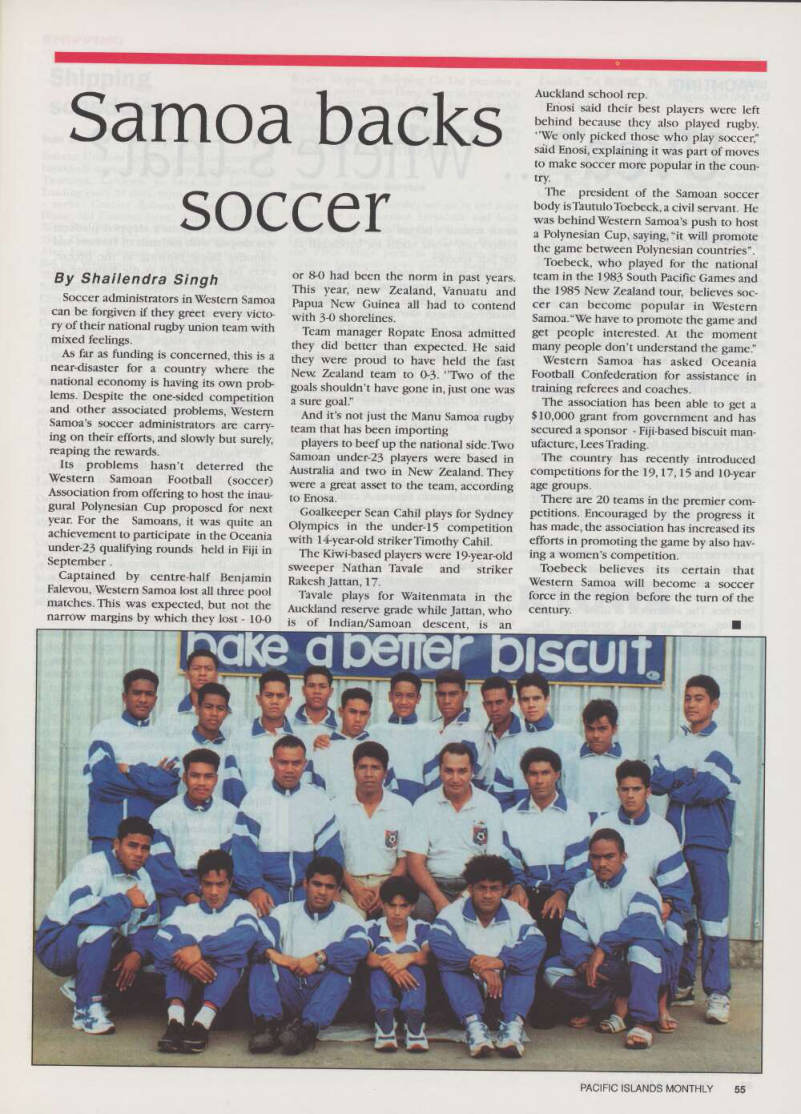
soccer
By Shailendra Singh
Soccer administrators in Western Samoa can be forgiven if they greet every victo ry of their national rugby union team with mixed feelings.
As far as funding is concerned, this is a near-disaster for a country where the national economy is having its own prob lems. Despite the one-sided competition and other associated problems, Western Samoa’s soccer administrators are carry ing on their efforts, and slowly but surely, reaping the rewards.
Its problems hasn’t deterred the Western Samoan Football (soccer) Association from offering to host the inau gural Polynesian Cup proposed for next year. For the Samoans, it was quite an achievement to participate in the Oceania under-23 qualifying rounds held in Fiji in September .
Captained by centre-half Benjamin Falevou, Western Samoa lost all three pool matches. This was expected, but not the narrow margins by which they lost - 10-0
or 8-0 had been the norm in past years.
This year, new Zealand, Vanuatu and Papua New Guinea all had to contend with 3-0 shorelines.
Team manager Ropate Enosa admitted they did better than expected. He said they were proud to have held the fast New Zealand team to 0-3. "Two of the goals shouldn’t have gone in, just one was a sure goal.”
And it’s not just the Manu Samoa rugby team that has been importing players to beef up the national side. Two Samoan under-23 players were based in Australia and two in New Zealand. They were a great asset to the team, according to Enosa.
Goalkeeper Sean Cahil plays for Sydney Olympics in the under-15 competition with 14-year-old striker Timothy Cahil.
The Kiwi-based players were 19-year-old sweeper Nathan Tavale and striker Rakesh Jattan, 17.
Tavale plays for Waitenmata in the Auckland reserve grade while Jattan, who is of Indian/Samoan descent, is an
Auckland school rep.
Enosi said their best players were left behind because they also played rugby. ”We only picked those who play soccer,” said Enosi, explaining it was part of moves to make soccer more popular in the coun try.
The president of the Samoan soccer body isTautuloToebeck, a civil servant. He was behind Western Samoa’s push to host a Polynesian Cup, saying, “it will promote the game between Polynesian countries”.
Toebeck, who played for the national team in the 1983 South Pacific Games and the 1985 New Zealand tour, believes soc cer can become popular in Western Samoa.“We have to promote the game and get people interested. At the moment many people don’t understand the game.”
Western Samoa has asked Oceania Football Confederation for assistance in training referees and coaches.
The association has been able to get a $lO,OOO grant from government and has secured a sponsor - Fiji-based biscuit man ufacture, Lees Trading.
The country has recently introduced competitions for the 19,17,15 and 10-year age groups.
There are 20 teams in the premier com petitions. Encouraged by the progress it has made, the association has increased its efforts in promoting the game by also hav ing a women’s competition.
Toebeck believes its certain that Western Samoa will become a soccer force in the region before the turn of the century.
Uvea?... Where's that?
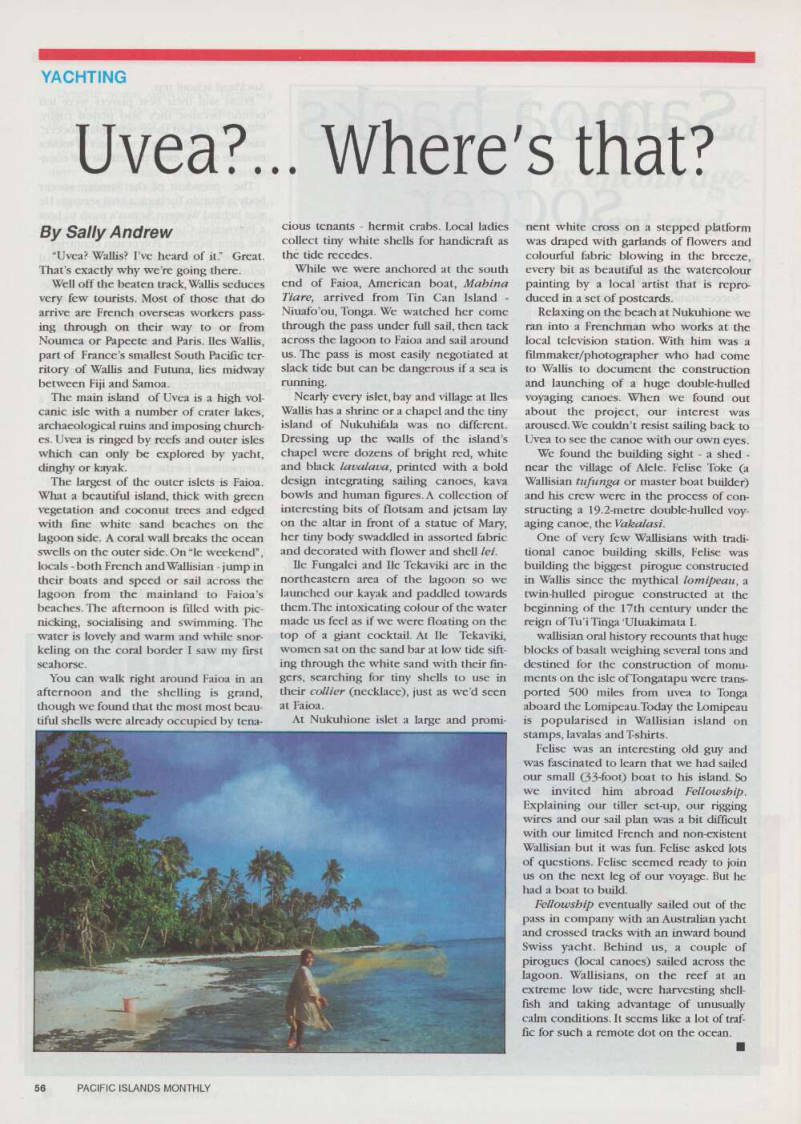
Yachting
By Sally Andrew
“Uvea? Wallis? I’ve heard of it.” Great.
That’s exactly why we’re going there.
Well off the beaten track, Wallis seduces very few tourists. Most of those that do arrive are French overseas workers pass ing through on their way to or from Noumea or Papeete and Paris. Hes Wallis, part of France’s smallest South Pacific ter ritory of Wallis and Futuna, lies midway between Fiji and Samoa.
The main island of Uvea is a high vol canic isle with a number of crater lakes, archaeological ruins and imposing church es. Uvea is ringed by reefs and outer isles which can only be explored by yacht,
dinghy or kayak.
The largest of the outer islets is Faioa.
What a beautiful island, thick with green vegetation and coconut trees and edged with fine white sand beaches on the lagoon side. A coral wall breaks the ocean swells on the outer side. On “le weekend”, locals - both French and Wallisian - jump in their boats and speed or sail across the lagoon from the mainland to Faioa s beaches. The afternoon is filled with pic nicking, socialising and swimming. The water is lovely and warm and while snor keling on the coral border I saw my first seahorse.
You can walk right around Faioa in an afternoon and the shelling is grand, though we found that the most most beau tiful shells were already occupied by tena
cious tenants - hermit crabs. Local ladies collect tiny white shells for handicraft as the tide recedes.
While we were anchored at the south end of Faioa, American boat, Mahina Tiare, arrived from Tin Can Island - Niuafo’ou, Tonga. We watched her come through the pass under full sail, then tack across the lagoon to Faioa and sail around us. The pass is most easily negotiated at slack tide but can be dangerous if a sea is running.
Nearly every islet, bay and village at lies Wallis has a shrine or a chapel and the tiny island of Nukuhifala was no different.
Dressing up the walls of the island’s chapel were dozens of bright red, white and black lavalava, printed with a bold
design integrating sailing canoes, kava
bowls and human figures. A collection of interesting bits of flotsam and jetsam lay on the altar in front of a statue of Mary, her tiny body swaddled in assorted fabric and decorated with flower and shell lei. lie Fungalei and He Tekaviki are in the northeastern area of the lagoon so we launched our kayak and paddled towards them. The intoxicating colour of the water made us feel as if we were floating on the top of a giant cocktail. At lie Tekaviki, women sat on the sand bar at low tide sift ing through the white sand with their fin gers, searching for tiny shells to use in their collier (necklace), just as we’d seen at Faioa.
At Nukuhione islet a large and promi-
nent white cross on a stepped platform was draped with garlands of flowers and colourful fabric blowing in the breeze, every bit as beautiful as the watercolour painting by a local artist that is repro duced in a set of postcards.
Relaxing on the beach at Nukuhionc we ran into a Frenchman who works at the local television station. With him was a filmmaker/photographer who had come to Wallis to document the construction and launching of a huge double-hulled voyaging canoes. When we found out about the project, our interest was aroused. We couldn’t resist sailing back to Uvea to see the canoe with our own eyes.
We found the building sight - a shed near the village of Alele. Felise Toke (a Wallisian tufunga or master boat builder) and his crew were in the process of con structing a 19-2-metre double-hulled voy aging canoe, the Vakalasi.
One of very few Wallisians with tradi tional canoe building skills, Felise was
building the biggest pirogue constructed
in Wallis since the mythical lomipean, a twin-hulled pirogue constructed at the beginning of the 17th century under the reign of Tu’iTinga ‘Uluakimata I. wallisian oral history recounts that huge blocks of basalt weighing several tons and destined for the construction of monu ments on the isle ofTongatapu were trans ported 500 miles from uvea to Tonga aboard the Lomipeau.Today the Lomipeau is popularised in Wallisian island on stamps, lavalas and T-shirts.
Felise was an interesting old guy and was fascinated to learn that we had sailed our small (33-foot) boat to his island. So we invited him abroad Fellowship.
Explaining our tiller set-up, our rigging wires and our sail plan was a bit difficult with our limited French and non-existent Wallisian but it was fun. Felise asked lots of questions. Felise seemed ready to join us on the next leg of our voyage. But he had a boat to build.
Fellowship eventually sailed out of the pass in company with an Australian yacht and crossed tracks with an inward bound Swiss yacht. Behind us, a couple of pirogues (local canoes) sailed across the lagoon. Wallisians, on the reef at an extreme low tide, were harvesting shell
fish and taking advantage of unusually
calm conditions. It seems like a lot of traf fic for such a remote dot on the ocean.
Shipping
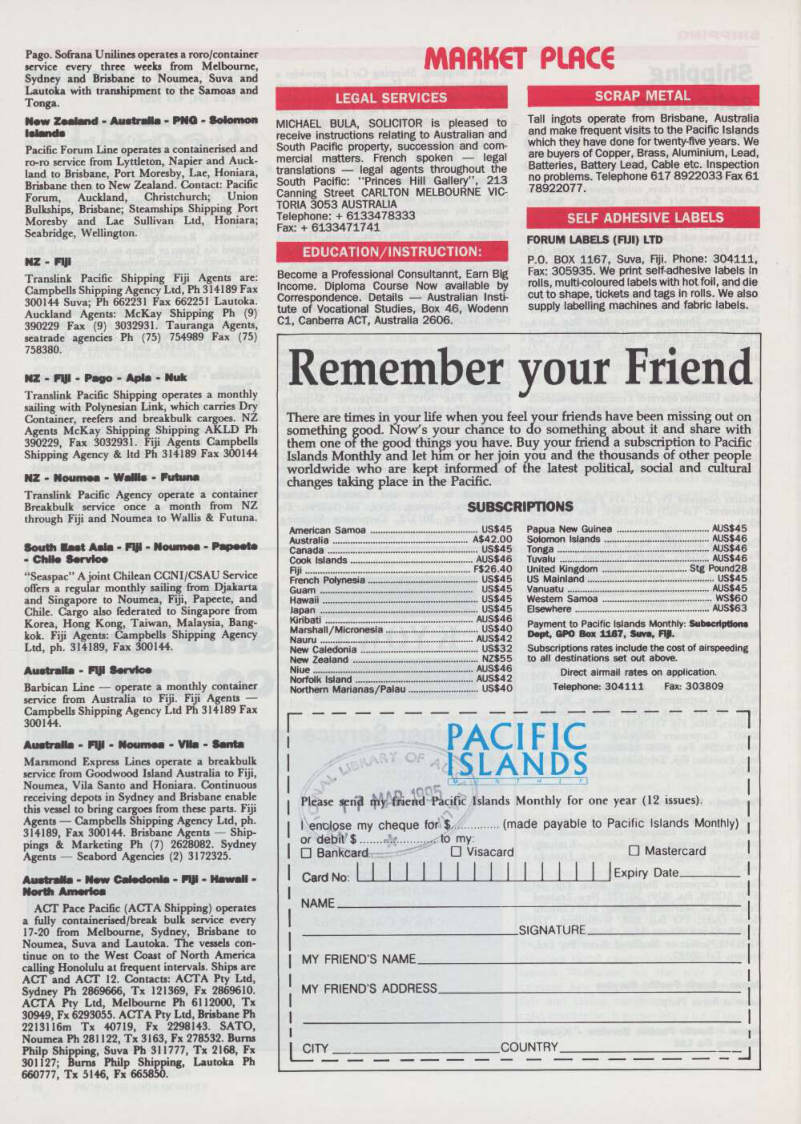
schedules
New Zealand - FIJI direct Sofrana Unilines operates a fully containerised/ breakbulk service every 21 days from Auckland, Tauranga, Lyttleton to Suva and Lautoka.
Loading every 21 days, ro/ro service, containers - reefer. Contact Sofrana Unilines, Sofrana House, 101 Customs Street, Auckland, PO Box 3614, Fax (09) 393874, Ph (09) 773279, Tlx NZ 2313. Direct toll free line 0800 659-922, Contact Alan Foote. Compass Shipping Agencies, PO Box 921 Wellington, Tel (04) 382 8206, Fax (04) 3828239, Tlx NZ 4769 Contact Steve Brannigan.
Sofrana Unilines Agencies, PO Box 22046 Christchurch, Tel (03) 366 7180, Fax (03) 366 8868, TLX NZ4769, Contact Tony Newell.
Carpenters Shipping, Private Mail Bag, Suva, Fiji, Tel (679) 312244, Fax (679) 301572, Tlx FJ 2199. Sofrana Unilines, Suva, Fiji, Tel (679) 315645, Fax (679) 300057.
Australia • Fiji direct Sofrana Unilines operates a container breakbulk service every three weeks from Melbourne, and Sydney to Lautoka and Suva. Contact Sofrana Unilines (Aust) Pty Ltd, PO Box Q 136, Queen Victoria Building, Sydney, NSW 2000, Austra lia. Tel (02) 2648944, Fax (02) 2676547, Tlx (71) A 170090, Contact Sam Attaway/ George Lopez.
Delams Australia Pty Ltd. 474 Flinders Street, Melbourne. Tel (03) 614 1344, Fax (03) 629 4957.
Carpenters Shipping, Suva, Tel (679) 312244, Fax (679) 301572. Sofrana Unilines Suva, Tel (679) 315 645, Fax (679) 300057. Carpenters Shipping, Lautoka, Tel (679) 663988, Fax (679) 664896. Sofrana Unilines, Lautoka Tel (679) 662921, Fax (679) 664896.
Australia - FIJI monthly service Sofrana Unilines (Australia) Pty Ltd operates a regular monthly service with MV Capitaine Wallis. Contact Sofrana Unilines, Sydney, Tel (02) 2648944, Tlx AA170090, Fax (02) 267-6547. Carpenters Shipping, Suva, Fiji, Tel (679) 312244, Fax (679) 301572, Sofrana Unilines, Suva, Fiji Tel (679) 315645, Fax (679) 300057. Carpenters Shipping, Lautoka, Tel (679) 63988, Fax (679) 664896. Sofrana Uni lines, Lautoka, Fiji, Tel (679) 662921, Fax (679) 664896.
Far-East - FIJI Service New Guinea Pacific Line (NGPL) operates a monthly service accepting containerised and break-bulk cargoes from Manila, Keelung, Kaoshiung, Hong Kong, Lae to Suva, Lautoka (via Suva).
Contact Carpenters Shipping Suva, Fiji, tel (679) 312244, fax (679) 301572. New Zealand Unit Express, Maritime Building, 2-10 Customs House Quay, PO Box 890, Wellington. Tel 727865, Cables Enzue Man, Wellington, Tlx NZ31340 Nedlnz or Nedlloyd Swire Pty Ltd, Sydney, Tel 20522.
Japan - South Pacific Service Same as Bums Philp Japan - South Pacific Service - Kyowa Shipping Co Ltd
Kyowa Shipping, Shipping Co Ltd provides a monthly service from Hong Kong to main ports of Japan, Saipan, Guam, Island ports, Lautoka, Suva via Nukualofa to Pago Pago and Apia.
Contact Carpenters Shipping, Neptune House, 3/4 floor, Tofuaa Street, Walu Bay, Suva. Tel 312244, Fax 301572, Tlx FJ2199.
Europe - Pacific Service Bank Line offers a monthly service to and from Europe for containerised breakbulk and bulk vegetable cargoes. Calling Papeete, Apia, Suva, Lautoka, Noumea, Port Vila, Santo, Honiara and PNG. Main ports to and from major northern Eurpoean ports. Contact Bank Line, South Pacific Office, Central Court Bid , 7th Street, Lea, PNG,TeI 422925, Tlx NE4426s.Carpenters Shipping, 3/4 Floor,Neptune House, Walu Bay, Suve, Fiji, Tel (679) 312244, Fax (679) 301572, TIxFJ 2199.
Nedlloyd offers cargo services from Continental ports to Papeetee, Fiji, New Caledonia and Doniambo on slot basis with Bank Line. Contact Carpenters Shipping, Suva, tel 312244, Tlx FJ2199, Fax 301572. Carpenters Shipping, Lautoka, Tel 663988, Tlx FJ5215, Fax 664896.
South Bast Asia - Fiji Ssrvios Nedlloyd Lines Service (NZEAS) Service oper ates regular fast cargo service from Jakarta, Pt Keelang, Singapore, Bangkok, Surubaya via Auckland to Suva and Lautoka. Contact Carpenters Shipping, Suva, Tel 312244, Tlx FJ2199, Fax 301572. Carpenters Shipping,
Lautoka Tel 663988, Tlx FJ5215, Fax 663988.
Nedlloyd New Zealand, Wellington Tel (04) 472 7864, Fx (04) 473 9201 Far Bask - Mid South Pacific China Navigations New Guinea Pacific Line in association with Bank Line, operates a regular container and breakbulk heavy lift service from Hong Kong, Taiwan, Manila, Singapore, Malaysia, Thailand to Port Moresby, Lae, Rabaul, Kieta and Honiara. Cargo from the same eastern ports to the South Pacific Ports of Noumea, Santo, Vila, Papeete, PagoPago, Apia, Nukualofa, Rarotonga and Tarawa will be shipped via Japan or Busan on the monthly Bali Hai Service. Contact Steamships Shipping, Port Moresby, PO Box 634, Tel 220283 or 220289.
Tasman Asia operate a 20-day frequency fixed date service, shipping breakbulk and containerised cargoes from Japan, Korea, Tai wan and Hong Kong to Suva and Lautoka (via Suva). Fiji agents are Forum Shipping Agencies in Suva, Tel 315444, and Lautoka 660577.
Australia - Now Caledonia - Fiji - Samoas - Tonga Pacific Forum Line operates a fully containerised service (general, reefer and ro-ro) from Sydney and Brisbane to Noumea, Lautoka, Suva, Apia,
Pago Pago, Nukualofa, Sydney. Cargo central
ised from Adelaide and Melbourne. Contact: Pacific Forum Line, PO Box 7%, Auckland;
Union Bulkships, 333 George St, Sydney,
Brisbane and Melbourne; Union Co, Lautoka; Pacific Forum Line, Suva, Nukualofa; Pacific Forum Line, Apia; Polynesia Shipping, Pago
Pago. Sofrana Unilines operates a roro/container service every three weeks from Melbourne, Sydney and Brisbane to Noumea, Suva and Lautoka with transhipment to the Samoas and Tonga.
Nsw Zealand - Australia - PNG - Solomon Islands Pacific Forum Line operates a containerised and ro-ro service from Lyttlcton, Napier and Auck land to Brisbane, Port Moresby, Lae, Honiara, Brisbane then to New Zealand. Contact: Pacific Forum, Auckland, Christchurch; Union Bulkships, Brisbane; Steamships Shipping Port Moresby and Lae Sullivan Ltd, Honiara; Seabridge, Wellington.
Nz - F||I
Translink Pacific Shipping Fiji Agents are: Campbells Shipping Agency Ltd, Ph 314189 Fax 300144 Suva; Ph 662231 Fax 662251 Lautoka.
Auckland Agents: McKay Shipping Ph (9) 390229 Fax (9) 3032931. Tauranga Agents, seatrade agencies Ph (75) 754989 Fax (75) 758380.
NZ - F||l - Pago - Apia - Nuk Translink Pacific Shipping operates a monthly sailing with Polynesian Link, which carries Dry Container, reefers and breakbulk cargoes. NZ Agents McKay Shipping Shipping AKLD Ph 390229, Fax 3032931. Fiji Agents Campbells Shipping Agency & ltd Ph 314189 Fax 300144 NZ - Noumoa - Wallis - Futuna Translink Pacific Agency operate a container Breakbulk service once a month from NZ through Fiji and Noumea to Wallis & Futuna.
South Bast Asia - FIJI - Noumoa - Papoots - Chits Ssrvfcs “Seaspac” A joint Chilean CCNI/CSAU Service offers a regular monthly sailing from Djakarta and Singapore to Noumea, Fiji, Papeete, and Chile. Cargo also federated to Singapore from Korea, Hong Kong, Taiwan, Malaysia, Bang kok. Fiji Agents: Campbells Shipping Agency Ltd, ph. 314189, Fax 300144.
Australia - FIJI Sondes Barbican Line operate a monthly container service from Australia to Fiji. Fiji Agents Campbells Shipping Agency Ltd Ph 314189 Fax 300144.
Australia - FIJI - Noumoa - VHa - Santa Marsmond Express Lines operate a breakbulk service from Goodwood Island Australia to Fiji, Noumea, Vila Santo and Honiara. Continuous receiving depots in Sydney and Brisbane enable this vessel to bring cargoes from these parts. Fiji Agents Campbells Shipping Agency Ltd, ph. 314189, Fax 300144. Brisbane Agents Ship pings & Marketing Ph (7) 2628082. Sydney Agents Seabord Agencies (2) 3172325.
Australia - Now Calsdowla - FIJI - Hawaii - North Amorlca ACT Pace Pacific (ACTA Shipping) operates a fully containcriscd/break bulk service every 17-20 from Melbourne, Sydney, Brisbane to Noumea, Suva and Lautoka. The vessels con tinue on to the West Coast of North America calling Honolulu at frequent intervals. Ships are ACT and ACT 12. Contacts: ACTA Pty Ltd, Sydney Ph 2869666, Tx 121369, Fx 2869610.
ACTA Pty Ltd, Melbourne Ph 6112000, Tx 30949, Fx 6293055. ACTA Pty Ltd, Brisbane Ph 2213116 m Tx 40719, Fx 2298143. SATO, Noumea Ph 281122, Tx 3163, Fx 278532. Bums Philp Shipping, Suva Ph 311777, Tx 2168, Fx 301127; Bums Philp Shipping, Lautoka Ph 660777, Tx 5146, Fx 665850.
Advertisements & other items, pp. 57-60 (1 item)
Co., Ltd.
KYOWA
KYOWA
SHIPPING
CO., LTD.
Liner Service to Paciffic Islands
FROM OJAPAN
OKOREA
©TAIWAN
O THAILAND
TO O SAIPAN
O FEDERATED STATES
OF MICRONESIA
O MARSHAL ISLANDS
O AMERICAN SAMOA
ONEW CALEDONIA
O FIJI
OHONG KONG
OSINGAPORE
©PHILIPPINES
©MALAYSIA
©INDONESIA
©GUAM
©YAP
©PALAU
©WESTERN SAMOA
©SOLOMON ISLANDS
©VANUATU
©PAPUA NEW GUINEA
HEAD OFFICE:
9th Floor, Shuwa No 2 Shibapark Bldg., 12-7, Shiba-Daimon 2-chome, Minato-ku, Tokyo 105, Japan Phone: 03(3437)2885 (Rep.) Cables: "MARIQUEEN” Tokyo Telex: 242-4651 Kyowa J.
OSAKA OFFICE:
Dai San Fuji 810.],, 3-13, Itachibori 1-chome, Osaka 550.
Phone: 06(533)5821 (Rep.) Cables: "MARIQUEEN" Osaka Telex: 525-6271 Ssiosa J.
MflftKCT PLAC6
LEGAL SERVICES
MICHAEL BULA, SOLICITOR is pleased to receive instructions relating to Australian and South Pacific property, succession and commercial matters. French spoken legal translations legal agents throughout the South Pacific; “Princes Hill Gallery”, 213 Canning Street CARLTON MELBOURNE VIC-
TORIA 3053 AUSTRALIA
Telephone; + 6133478333 Fax; + 6133471741
EDUCATION/INSTRUCTION:
Become a Professional Consultannt, Earn Big Income. Diploma Course Now available by Correspondence. Details Australian Institute of Vocational Studies, Box 46, Wodenn Cl, Canberra ACT, Australia 2606.
SCRAP METAL
Tall ingots operate from Brisbane, Australia and make frequent visits to the Pacific Islands which they have done for twenty-five years. We are buyers of Copper, Brass, Aluminium, Lead, Batteries, Battery Lead, Cable etc. Inspection no problems. Telephone 617 8922033 Fax 61 78922077.
SELF ADHESIVE LABELS
FORUM LABELS (FIJI) LTD
P.O. BOX 1167, Suva, Fiji. Phone: 304111, Fax: 305935. We print self-adhesive labels in rolls, multi-coloured labels with hot foil, and die cut to shape, tickets and tags in rolls. We also supply labelling machines and fabric labels.
Remember your Friend
There are times in your life when you feel your friends have been missing out on something good. Now's your chance to do something about it and share with them one of the good things you have. Buy your friend a subscription to Pacific Islands Monthly and let him or her join you and the thousands of other people worldwide who are kept informed of the latest political, social and cultural
changes taking place in the Pacific.
SUBSCRIPTIONS
American Samoa Australia Canada Cook Islands Fiji French Polynesia Guam Hawaii Japan Kiribati Marshall/Micronesia Nauru New Caledonia New Zealand Niue Norfolk Island Northern Marianas/Palau 1 Please send ipy friend Pacific Islands Monthly for one year (12 issues). v•’ 1 ' ,A / I enclose my cheque for $ (made payable to Pacific Islands Monthly) or debit $ my: □ Bankcard □ Visacard □ Mastercard Card No: I I I I I I I I I I I 1 I I I l Ex P ir V Date
NAME
SIGNATURE
MY FRIEND'S NAME
MY FRIEND'S ADDRESS
r Of
PACIFIC
Islands
f M P ... US$45 A 542.00 ... US$45
.. AUSS46
. F 526.40 ... US$45 .. US$45 ... US$45 ... US$45
.. AUSS46
... US$4O
.. AUSS42
... US$32 ... NZ$55
.. AUSS46
.. AUSS42
... US$4O
Papua New Guinea AUSS4S Solomon Islands AUSS46 Tonga AUSS46 Tuvalu AUSS46 United Kingdom Stg Pound2B US Mainland US$45 Vanuatu AUSS4S Western Samoa WS$6O Elsewhere AUSS63 Payment to Pacific Islands Monthly; Subscriptions Dept, GPO Box 1167, Suva, FIJI.
Subscriptions rates include the cost of airspeeding to all destinations set out above.
Direct airmail rates on application.
Telephone: 304111 Fax: 303809 I
CITY
COUNTRY
I - I
10 15 20 25 30 35 40 45 50 55 60
I A LIFETIME OF SERVICES
40 45 Grand Pacific Life Insurance offers you a lifetime of safe, secure products at very competitive rates.
Choose from a full range of products such as
• Super Ordinary Life
• Super Universal • Non-Participating Whole Life • 10-Year Level Term • Flexible Premium Annuities • Group Life Insurance
• IRAs
• Graded Premium Whole Life We've been dedicated to providing fast, personalized service for more than 35 years through local ownership and management.
That’s v/hy Grand Pacific Life is your Family throughout the Pacific.
Ji Grand Pacific Life Insurance, Lid 25 35 40 45 10 15 20 25 30 35 40 45 50 55 60
Grand Pacific Life Insurance, Ltd.
A member of the Finance Factors Family
FEDERATED STATES
OF MICRONESIA
Actouka Executive Insurance Underwriters P.O. Box 55, Kolonia, Pohnpei, Federated States of Micronesia 96941 Pacific Basin Insurance & General Services, Inc P.O. Box 494, Chuuk State, Federated States of Micronesia 96942
TONGA
Peseti Ma‘afu Ins. & Finance, Ltd.
Private Bag 2, Taumoepeau Bldg.
Nukualofa, Tonga
GUAM
Great National Insurance Underwriters, Inc.
P.O. Box GA, Agana, Guam 96910
AMERICAN SAMOA
Mark Solofa Pacific Insurance & Finance, Inc.
P.O. Box 3149 Pago Pago, American Samoa 96799 Pacific Financial Corporation P.O. Box AT, Agana, Guam 96910 Takagi & Associates, Inc.
GCIC Bldg., Suite 100 414 W. Soledad Ave.
Agana, Guam 96910
MARSHALL ISLANDS
Marshalls Insurance Agency P.O. Box 113, Majuro, Marshall Islands 96960
WESTERN SAMOA
Mark Solofa Pacific Insurance & Finance, Inc.
P.O. Box 3149 Pago Pago, American Samoa 96799
NORTHERN MARIANAS
Pacific Basin Insurance Underwriters, Inc.
P.O.'Box 710 Saipan, Mariana Islands 96950 Pacifica Insurance Underwriters, Inc.
P.O. Box 168, Saipan, Mariana Islands 96950 Grand Pacific Life Insurance, Ltd. *1164 Bishop Street, sth Floor, Honolulu, HI 96813 Phone: (808) 548-3363 • FAX: (808) 548-5122
‘SWWoy
N IS PB-^
Born to run
am .* »« The Mitsubishi Lancer: A family sedan that’s practically built toperform.
Lancer leaves the rest of its class in the dust.
Yes, it is a family sedan. Comfortable and practical.
But exciting, too, because Mitsubishi hasn’t forgotten what truly drives you: the pure pleasure of total
driving performance.
Its ground-hugging chassis holds comers tight. A self-aligning multi-link suspension adjusts to the road no matter what the driving conditions. And the aggressive, fuel-efficient 16-valve SOHC engine makes Lancer eager and responsive in the passing lane.
All of this performance comes from one very simple idea—our total approach to engineering.
We believe that unless each aspect of a car is fully integrated into the overall design, the result will never exceed the sum of the parts. The difference is self-evident. Behind the wheel.
And on the road.
It is this philosophy that makes every Mitsubishi such a reassuring and rewarding driving experience Whether it’s our top-end Mitsubishi Sigma, technologically sophisticated Galant, all-weather 3000 GT sports car, or offroad 4WD Pajero... they’re all driven by the power of positive thinking.
So take the wheel of a Lancer, the family sedan that performs like
a thoroughbred.
MITSUBISHI LRNCER
What Drives You.
TeL 699-9140 / AUSTRAUA: MITSUBISHI MOTORS AUSTRALIA LTD. 1284 South Road, Clovelly Park, South Australia, 5042 GP ° 15ft Suva ’ TeL 383411 ' GUAM: TRIPLE J ENTER PR'SES INC. P.O. Box 6066, Tamuning, Tel. 6469126 / NEW CALEDONIA S °1™ F ' QU , ESJ d D SAPa 80X438 Noumea ' *'■ 272562 1 HEW ZEALAND: MITSUBISHI MOTORS NEW ZEALAND LTD. Private Bag. Porirua, Tel. 237-0109 / NORFOLK BEAR °’ BORR7S m LTa Pa Box 169 ’ Taya'S Road, Burnt, Tel. 2114 / PAPUA NEW GUINEA; TOBA MOTORS PTY LTD. P.O. Box 503 Port Moresby Tel 217-874 / SAIPAN’ SAIPAN AUTOWORL r ™ ,T°n pnl 87 , T : l l , 2 5 4 :IL M ' S °? ON ISUHDS: HARVEST PACIFIC LTD ’ GPO Box 888 Honto. 101 30407 / TAHITI: SOPADEP S A BP 16V TONGA’"mAF CO., LTD. P.O. Box 83, Nuku Akrfa, Tel. 24044 / WHUATU: SOCOMETRA VANUATU LTD. B.P. 6, Port-Vila, TeL 2314 / WESTERN SAMOA; MOTOR DISTRIBUTORS (SAMOA) LTD. P.O. Box 576, Apia, Tel. 2095?
A
MITSUBISHI
MOTORS
CREATING TOGETHER