Islands


Pacific
Monthly
Special;
I' : j ) ,
October 1994
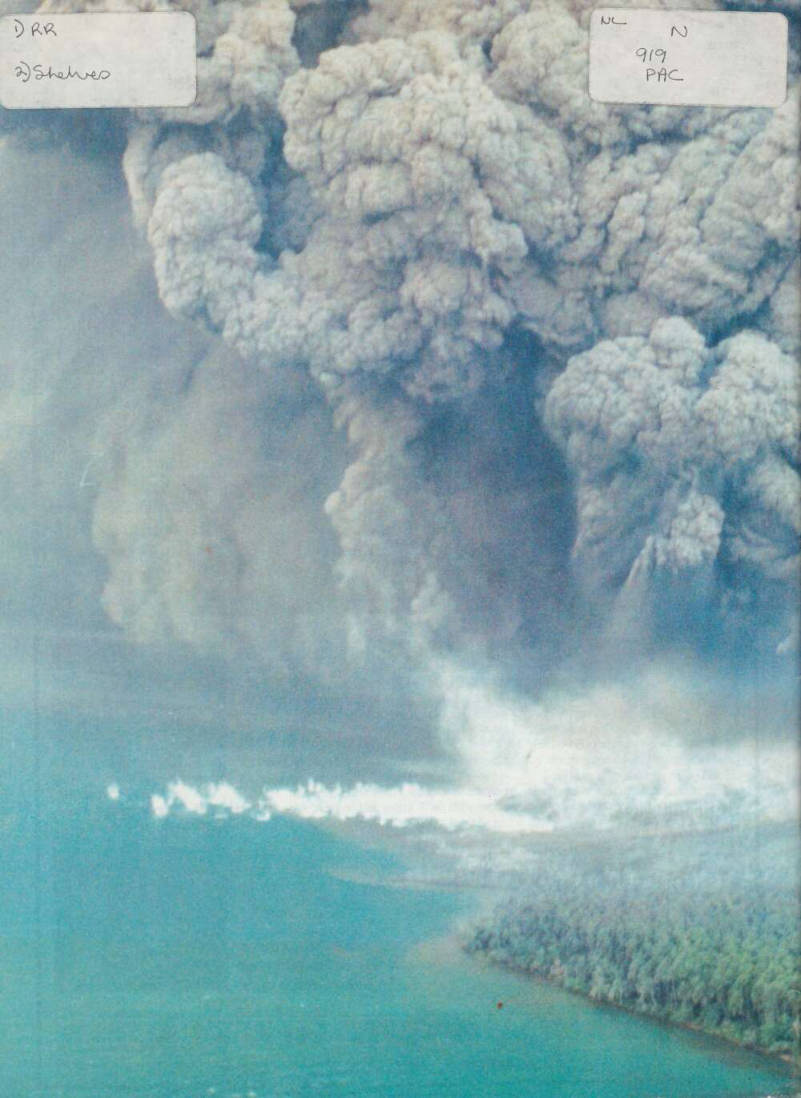
Hell’s fury unleashed
American Samoa US$2.5O; Australia A 53.50; Cook Islands NZ$3; FIJI (Incl VAT) F 52.50; FS Micronesia US$3; Hawaii US$3; Kiribati A$2.SO; Nauru A 52.50; Niue NZ$3; Norfolk As 3; New Caledonia cpf2So; New Zealand (Incl QST) NZ53.45; Nth Marianas US$3; Papua New Guinea K 3; Palau US$3; Marshalls US$3; Solomon Islands As 3; French Polynesia cpf3oo; Tonga P 3; USA US$3; Vanuatu VT22O; Western Samoa T3J25. * Recommended retail price only
COVER Armed police guard PNG parliament grounds during election of prime minister.
Devastating
Volcano Special
Devastating destruction
By Wally Hiambohn
TWO angry volcanoes spewing hot fury have devastated Rabaul, Papua New Guinea’s fourth largest town. Situated in the centre of a ring of volcanoes at the north-eastern end of the island of New Britain, it is now coated in thick volcanic lava and ash, much of its infrastructure damaged.
The Tavurvur and Vulcan volcanoes, with a history of erupting together in 1937 and 1941 blew their tops suddenly on the morning of September 19. Luckily, an earthquake and a succession of tremors within the preceding 24 hours had alerted the locality’s 40,000 to flee to safe areas in outlying parts of East New Britain Province.
Hot lava spewed from the two craters and columns of volcanic ash and smoke were sent up to 60 metres, spreading out over the island region, and reaching as far as West New Britain, New Ireland and Manus Provinces, and to the mainland coast.
Miraculously, only two deaths were reported
from the disaster.
The town of Rabaul was pitch dark for days, with a perpetual mass of dark ash hanging over it. Damage to the town was massive, with insurance companies placing initial estimates at a conservative one million kina. The PNG government and its people have launched a major relief programme.
“It seems to be quite a horrendous activity, with clouds thousands of feet in the sky. Rabaul is pretty severely damaged,” said Prime Minister Sir Julius Chan after his first aerial inspection on the afternoon of the eruptions.
National Disaster and Emergency chief Leith Anderson said, “The damage is astronomical. You have to see it to believe it ... the eruptions signalled the greatest disaster we’ve ever had to face in the history of Papua New Guinea.”
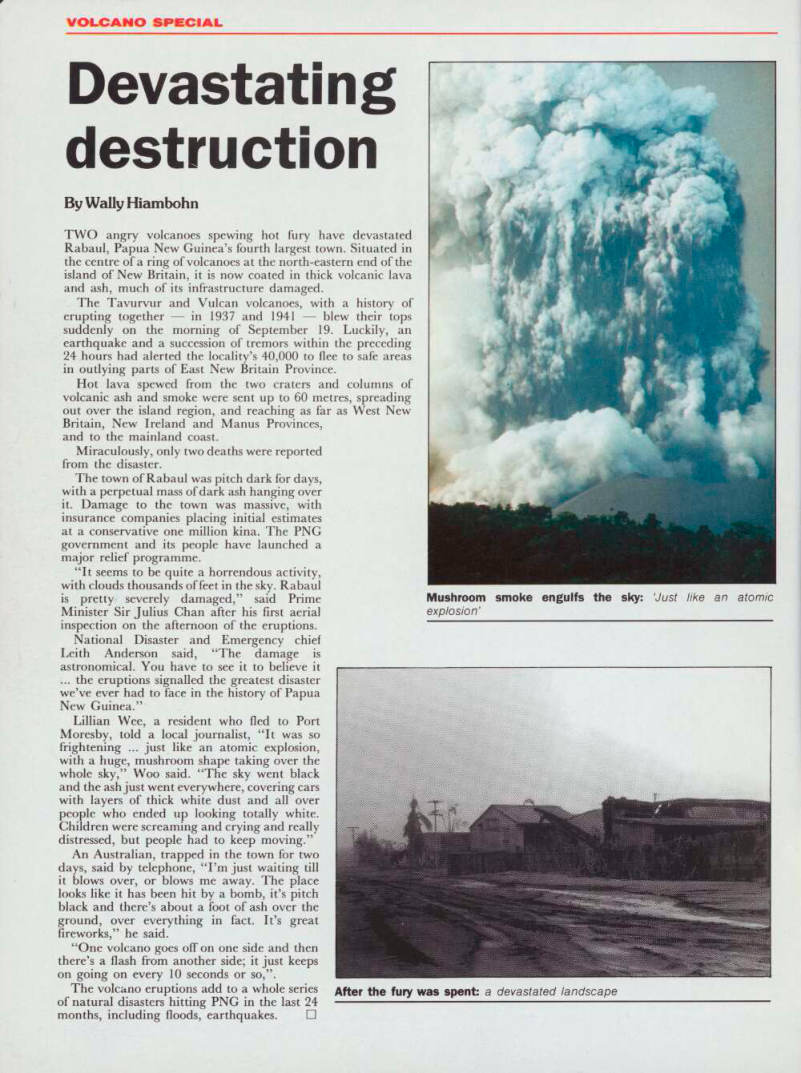
Lillian Wee, a resident who fled to Port Moresby, told a local journalist, “It was so frightening ... just like an atomic explosion, with a huge, mushroom shape taking over the whole sky,” Woo said. “The sky went black and the ash just went everywhere, covering cars with layers of thick white dust and all over people who ended up looking totally white.
Children were screaming and crying and really distressed, but people had to keep moving.”
An Australian, trapped in the town for two days, said by telephone, “I’m just waiting till it blows over, or blows me away. The place looks like it has been hit by a bomb, it’s pitch black and there’s about a foot of ash over the ground, over everything in fact. It’s great fireworks,” he said.
“One volcano goes off on one side and then there’s a flash from another side; it just keeps on going on every 10 seconds or so,”.
The volcano eruptions add to a whole series of natural disasters hitting PNG in the last 24
months, including floods, earthquakes. □
Mushroom smoke engulfs the sky: ‘Just like an atomic explosion'
After the fury was spent: a devastated landscape
Pacific
Islands
Monthly
Papua New Guinea faces another challenge as it tries to overcome economic and political problems
October 1994
( .?56... Chaos...Conflict...Ps 6 **
American Samoa US$2.5O; Australia A 53.50; Cook Islands NZ$3; Fiji (incl VAT) F 52.50; FS Micronesia US$3; Hawaii US$3; Kiribati A 52.50; Nauru A 52.50; Niue NZ$3; Norfolk As 3; New Caledonia cpf2so; New Zealand (incl GST) NZ53.45; Nth Marianas US$3; Papua New Guinea K 3; Palau US$3; Marshalls US$3; Solomon Islands As 3; French Polynesia cpf3oo; Tonga P 3; USA US$3; Vanuatu VT22O; Western Samoa T 3.25. * Recommended retail price only
Advertisements & other items, p. 4 (1 item)
Your Island Connections
m * i *
Cable and Wireless began keep-
ing people in touch around the
SNKwi world more than a century ago. Today,
m| while the technology has changed,
the tradition of service to our customers in the
South Pacific is just the same.
We work in partnership with Governments,
dedicated to meeting the need of communities and businesses to stay in touch. From one island to the next or to the other side of the world, the message is the same: Cable and Wireless is
your South Pacific = —
connection bringing the
islands together.
CABLE & WIRELESS
Asia Pacific Head Office Cable and Wireless pic Cable and Wireless (Pacific) Limited 22nd Floor Office Tower Convention Plaza 1 Harbour Road Hong Kong Tfel: (852) 848 8620 Facsimile: (852) 868 5195 Fiji In association with the Government of Fiji Fiji International Telecommunications Ltd.
P.O. Box 59 Mercury House 158 Victoria Parade Suva Fiji Tel: (679) 312933 Solomon Islands In association with the Government of the Solomon Islands Solomon Telekom Company Limited P.O. Box 148 Honiara Solomon Islands Tel: (677) 21576 Tonga Cable and Wireless pic Private Mail Bag 4 General Post Office Nuku Alofa Tonga South Pacific Tfel: (676) 23499 Vanuatu In association with the Government of Vanuatu and France Cdhies el Radio Telecom Vanuatu Limited P.O. Box 146 Port Vila Vanuatu Tel: (678) 22185
Pacific
Islands
Monthly
Vol. 64 No. 10
The News Magazine
October 1994
Business
Managing the purse-strings 4 In keeping with the spirit of 21
Sparteca
Cover Stories
Operation Unity 6 In the Red 7 Haiveta’s Reforms 10 The man who is PM 11
Tragedy
The beast in Tyke 12
Media
Freedom of expression 14
United Nations
A coming of age 20
Economy
The military’s finally going 22
Books
Essence of a dying age 26
Health
Investing in the future 29 Visit South Pacific Year ’95 Welcome to Fiji 33
Marketing abroad 35 Room to improve 37 Air Pacific soars to new heights 41 An exciting year ahead 47 That Shotover feeling 51
Culture
A celebration of dance 53
Sports
A will of iron 54
Yachting
Enchanted Asanvare 56
Shipping
Shipping Schedules 57
Columnists
David Barber 17 Alfred Sasako 25
Publisher: Brian O’Flaherty Editor: Mala Jagmohan Senior Writer: Yunus Rashid Correspondents: Christine Hatcher, David North, Ed Rampell, lan Williams, Karen Mangnall, Liz Thompson, Roman Grynberg, Wally Hiambohn.
Columnists: David Barber (Wellington), Futa Helu (Tonga, covering the Pacific Islands), Jemima Garrett (Sydney).
Alfred Sasako (The Forum).
Advertising Sales: • Regional Sales (South Pacific; Salendra Narayan, Tel (679) 304111, 303244, Fx (679) 303809. • Sydney. Canberra Bob Hill Media Reoresen lations, Tel (61-2) 4164245, Fx (61-2) 4165064 • Brisbane: Robert Walker, Media House, Tel (61-7) 3710533. Fx (61-7) 371-8904 • Adelaide: Hastwell Williamsons Representatives, Tel (61-8) 3799522, Fx (61-8) 3799735. • Melbourne: Brown Orr Fletcher Burrows (Aust) Pty Ltd. Tel (613) 8265188; Fx: (613) 8265644. • Auckland: McKay & Bowman, International Media Representatives Ltd, Tel (64-9) 4190561, Fx (64-9) 4192243.
• Japan: Universal Media Corrporation, Tokyo, Tel (3) 32626741, Cable: UNIMEDIA Tokyo, Fx (3) 32626742.
Founded 1930 (USPS 952480). A Fiji Times Limited production.
Cover prices are recommended retail only. Regis tered by Australia Post, Publication No. NBP 1210.
C- Copyright Fiji Times Limited. 177 Victoria Parade, Suva. Fiji. Tel (679) 304111. Fx (679)
303809. Tx Fj2124.
Pacific Islands Monthly is published monthly by The Fiji Times Limited, a division of Nationwide News, 2 Holt Street, Surry Hills. Sydney. NSW 2010.
Send address changes to: • Pacific Islands Monthly. PO Box 1167. Suva. Fiji.
Typeset and printed by The Fiji Times Limited, 177 Victoria Parade. Suva, Fiji.
Fiji Visitors Bureau Fiji's tourism Industry: getting a boost in '95
purse-strings
Business
Managing the purse-strings
Fiji’s new Finance Minister, Berenado Vunibobo, discusses his views on the country’s economy and future with Yunus Rashid.
By Yunus Rashid
PIM: What do you see as your main role and mission in this portfolio and how do you plan to achieve it?
Vunibobo: My main role, apart from the statutory ones, is really to work closely with the other economic ministers in formulating and overseeing govern ment’s policies in the broad areas of the economy. This involves the closest co operation and consultation with the private sector. The other part of “my mission”, as you put it, is to work toward improving the management of govern ment finances. Put another way, I hope to contribute to the protection of the integrity of government finance and its management.
PIM: How do you view Fiji’s currentfinancial and economic position?
Vunibobo: The financial position of the government can be better. There is a need for a concerted effort to focus more clearly on the objectives of government expenditure. This will lay the basis for a squeeze on the current high level of the budget deficit. In addition, expenditure over and above the budgeted amount needs to be controlled very tightly.
The main threat to government finances at present is the possibility of large increases in the public service pay bill.
There is a so-called COLA (Cost of
Living Adjustment) payment in dispute.
This is with the Arbitration Tribunal.
There is also the Job Evaluation reports recommendations to deal with. These could raise government expenditure to highly unsustainable levels.
Fiji’s current economic position is good.
Contrary to the rather gloomy state ments on the economy from the oppo sition and other groups, economic growth will be strong this year. Our major industries, sugar and tourism, are heading for record years. Inflation is very low at present. This is a good sign and
will help our producers remain competi tive, both in export markets and in our domestic market.
PIM: What are Fiji’s strengths and weak nesses?
Vunibobo: Fiji’s main strength is its people. Our mainstay industries are also a source of strength. Tourism is a strength because it is internationally competitive and shows great potential for future development. The sugar industry is a source of both strength and weak nesses. It provides a livelihood to many of our people and is an important source of foreign exchange. However, there is also uncertainty about the future of sugar prices. This will necessitate changes in the industry.
Weaknesses a belief that government has all the answers and can wave a magic wand to eliminate problems; a lack of confidence that Fiji will be able to compete in the world. The Fiji economy
can become internationally competitive.
PIM: Are there plans to improve Fiji’s sugar and tourism industries?
Vunibobo: The major objective in the sugar industry must be to improve efficiency. This is essential in the face of sugar price cuts which are likely as a result of changes to the EU agricultural policy. The industry is currently looking at the possibility of introducing a quality payments system. At present, cane pay ments are based on weight. The new system would pay farmers on the basis of sugar content. This will provide the incentive to improve yields and to choose cane varieties which have high sugar content.
Our tourism industry is doing well this year. Visitor arrivals are at record levels and hotel occupancy rates are high. The challenge facing the industry is to sustain this growth over the long haul. New flights will help. There will be an additional flight to Japan (Osaka) start ing in October (this month). The new
Air Pacific flight to the West Coast of the US which started in July will tap both the USA and European markets. The Fiji Visitors Bureau, the hotels and airlines must continue to focus sharply on source markets with the greatest poten tial.
PIM: Are there any plans which you hope to implement to improve Fiji’s exports?
Vunibobo: Our government’s economic policies centre around economic growth achieved through the promotion of exports within a competitive market
economy. Successful exporting requires
that we are competitive at an interna tional level. This means bringing our domestic prices more in line with inter national prices. This is the rationale behind the trade deregulation pro gramme.
Government commissioned a study to develop an Export Development Strat egy last year. An Export Strategy Committee of government officials has been established to oversee the im plementation of the study’s recommen dations. We are looking at ways of channelling more aid funds direct to industry with the aim of improving firms’ ability to export. The TFF and TFZ
(Tax Free Factory/Zone) schemes,
together with company tax concessions for exporters, will remain as important incentives for exporters.
PIM : Do investors local and overseas have enough incentives to invest in Fiji?
Vunibobo: Yes, I believe that the incentive package we offer through the TFF/TFZ schemes and the company tax concessions for exporting are very gen erous by international standards. There is evidence, from international studies of incentives for investment, that factors other than tax holidays play a more significant role in attracting investment.
These are such things as government attitude to business, the availability of infrastructure, the availability of skilled labour at a reasonable price, a stable macro-economic framework.
PIM : How can Fiji compete with cheap goods imported from Asian sources?
Vunibobo: The deregulation of trade has considerably reduced Fiji cost structure.
This, coupled with very low inflation rates of late, will make Fiji producers better able to compete. Many of the cheap alternative products imported from some Asian countries, were initially very popular. However, many consumers have realised that they are of very low quality and are switching back to buy Fiji-made products. Better enforcement of quality and standards legislation is needed to ensure that there is fair competition between local producers and
imports.
PIM : How can local production costs be reduced to allow our manufacturers to compete with their overseas counterparts?
Vunibobo: The import substitution and self-sufficiency policies of the 1980 s led to high-cost economy. The process of trade deregulation is part of the solution for reducing costs. A major cost of pro duction, however, is the cost of labour.
The labour reforms of 1991 and 1992 were aimed at making changes in wages more closely aligned with the commer cial realities facing companies. It is important that, if we are to compete successfully, employers do not concede wage increases that are not paid for
through higher output.
PIM : Do you have plans which will help offset the negative effects of deregulation?
Vunibobo: The deregulation programme has brought many benefits. Consumers now face lower prices for many staple products. There is much more variety in the shops. Exporters find they are able to import raw materials at much lower cost and without time-consuming customs clearance.
However, the policy of deregulation has not been without its costs. The lowering of import tariffs has meant that many producers have had to make adjustments, sometimes painful adjust ments, to new economic conditions.
Government has monitored the im pact of deregulation on industries pro ducing for the local market. The moni toring exercise has been encouraging in that it has revealed measures have been taken to adjust to the competition.
Production has had to become more efficient in the face of greater competition from imports. Some producers have diversified into other products, some have increased export sales. These ad justments mean our economy is becom ing more efficient and better able to compete in the international market place.
As a result of these monitoring exer cises, the deregulation timetable was slowed down with the last cut in the general maximum import tariff limited to only five per cent instead of 10 per cent.
I am very concerned about the impact of deregulation. A study, which is currently underway, is taking a much wider view* of the whole deregulation process and is assessing the overall impact of deregulation. The results of this study will be used to devise ad ditional ways in which we, the govern ment, can assist in the process of adjustment. I should add that I think it essential that the deregulation pro gramme continues.
PIM : Do you think Fiji politics and issues
like the Sunday ban are a hindrance to economic growth?
Vunibobo: They are only a hindrance because of the way we have handled the issue. It is not an easy one to deal with because the issue has become emotionally charged. I myself believe that there are issues of public interest that are best addressed away from the public arena.
Grand-standing in order to highlight what is perceived as a weakness often ends up being counter-productive. If it has become a hindrance it is because we ourselves on both sides of the divide have made it a hindrance.
PIM : Will you revive the Economic Summit?
Vunibobo: This is something I have yet to give serious consideration to.
PIM : Do you have statistics on recent investments?
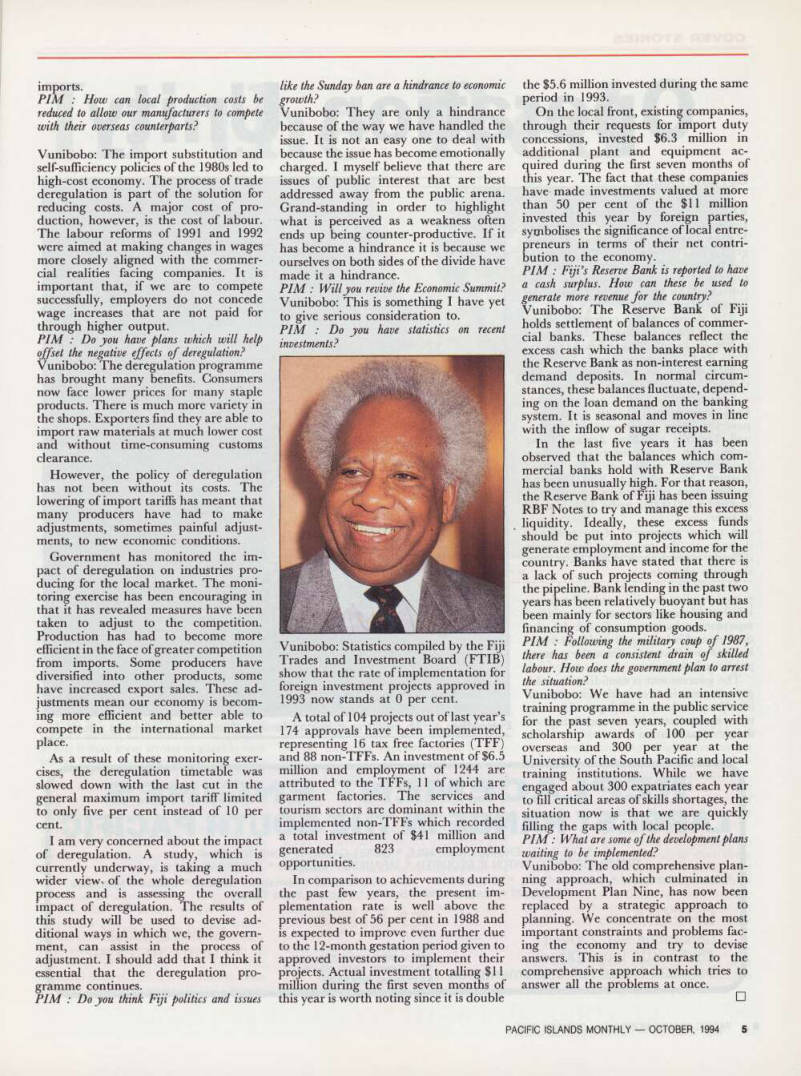
Vunibobo: Statistics compiled by the Fiji Trades and Investment Board (FTIB) show that the rate of implementation for foreign investment projects approved in 1993 now stands at 0 per cent.
A total of 104 projects out of last year’s 174 approvals have been implemented, representing 16 tax free factories (TFF) and 88 non-TFFs. An investment of $6.5 million and employment of 1244 are attributed to the TFFs, 11 of which are garment factories. The services and tourism sectors are dominant within the implemented non-TFFs which recorded a total investment of s4l million and
generated 823 employment
opportunities.
In comparison to achievements during the past few years, the present im plementation rate is well above the previous best of 56 per cent in 1988 and is expected to improve even further due to the 12-month gestation period given to approved investors to implement their projects. Actual investment totalling $ 11 million during the first seven months of this year is worth noting since it is double
the $5.6 million invested during the same period in 1993.
On the local front, existing companies, through their requests for import duty concessions, invested $6.3 million in additional plant and equipment ac quired during the first seven months of this year. The fact that these companies have made investments valued at more than 50 per cent of the $ 11 million invested this year by foreign parties, symbolises the significance of local entre preneurs in terms of their net contri bution to the economy.
PIM : Fiji’s Reserve Bank is reported to have a cash surplus. How can these be used to generate more revenue for the country?
Vunibobo: The Reserve Bank of Fiji holds settlement of balances of commer cial banks. These balances reflect the excess cash which the banks place with the Reserve Bank as non-interest earning demand deposits. In normal circum stances, these balances fluctuate, depend ing on the loan demand on the banking system. It is seasonal and moves in line with the inflow of sugar receipts.
In the last five years it has been observed that the balances which com mercial banks hold with Reserve Bank has been unusually high. For that reason, the Reserve Bank of Fiji has been issuing RBF Notes to try and manage this excess liquidity. Ideally, these excess funds should be put into projects which will generate employment and income for the country. Banks have stated that there is a lack of such projects coming through the pipeline. Bank lending in the past two years has been relatively buoyant but has been mainly for sectors like housing and financing of consumption goods.
PIM : Following the military coup of 1987, there has been a consistent drain of skilled labour. How does the government plan to arrest the situation?
Vunibobo: We have had an intensive training programme in the public service for the past seven years, coupled with scholarship awards of 100 per year overseas and 300 per year at the University of the South Pacific and local training institutions. While we have engaged about 300 expatriates each year to fill critical areas of skills shortages, the situation now is that we are quickly filling the gaps with local people.
PIM : What are some of the development plans waiting to be implemented?
Vunibobo: The old comprehensive plan ning approach, which culminated in Development Plan Nine, has now been
replaced by a strategic approach to
planning. We concentrate on the most important constraints and problems fac ing the economy and try to devise answers. This is in contrast to the comprehensive approach which tries to answer all the problems at once. □
Operation Unity
Cover Stories
By Harry Momos
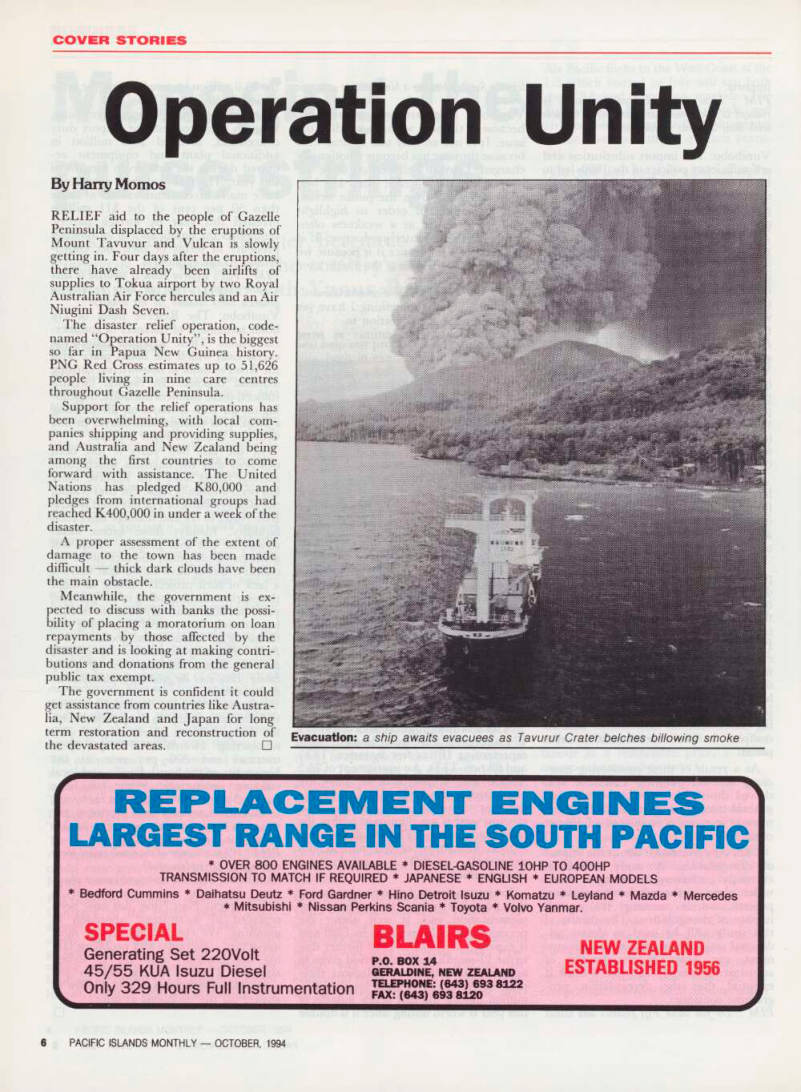
RELIEF aid to the people of Gazelle Peninsula displaced by the eruptions of Mount Tavuvur and Vulcan is slowly getting in. Four days after the eruptions, there have already been airlifts of supplies to Tokua airport by two Royal Australian Air Force hercules and an Air Niugini Dash Seven.
The disaster relief operation, code named “Operation Unity”, is the biggest so far in Papua New Guinea history.
PNG Red Cross estimates up to 51,626 people living in nine care centres throughout Gazelle Peninsula.
Support for the relief operations has been overwhelming, with local com panies shipping and providing supplies, and Australia and New Zealand being among the first countries to come forward with assistance. The United Nations has pledged KBO,OOO and pledges from international groups had reached K 400,000 in under a week of the disaster.
A proper assessment of the extent of damage to the town has been made difficult thick dark clouds have been the main obstacle.
Meanwhile, the government is ex pected to discuss with banks the possi bility of placing a moratorium on loan repayments by those affected by the disaster and is looking at making contri butions and donations from the general public tax exempt.
The government is confident it could get assistance from countries like Austra lia, New Zealand and Japan for long term restoration and reconstruction of the devastated areas. □
Evacuation: a ship awaits evacuees as Tavurur Crater belches billowing smoke
Advertisements & other items, p. 8 (1 item)
Replacement Engines
LARGEST RANGE IN THE SOUTH PACIFIC
♦ OVER 800 ENGINES AVAILABLE * DIESEL-GASOLINE 10HP TO 400 HP TRANSMISSION TO MATCH IF REQUIRED * JAPANESE * ENGLISH * EUROPEAN MODELS ♦ Bedford Cummins * Daihatsu Deutz * Ford Gardner * Hino Detroit Isuzu * Komatzu * Leyland * Mazda * Mercedes * Mitsubishi * Nissan Perkins Scania * Toyota * Volvo Yanmar.
special BLAIRS
Generating Set 220V01t p 0 BOXI4 45/55 KUA Isuzu Diesel geraldine, new Zealand Only 329 Hours Full Instrumentation JS^^fUsaiao 938122
NEW ZEALAND
ESTABLISHED 1956
In the Red

LOTTERY and its jingle “Go Lotto” have been the buzzwords around Papua New Guinea this year. In August the jackpot was K 730,000 the biggest ever in the country. In February the prize was K 444,469. With promises of instant wealth, the game has taken the country
by storm, as people form ever-growing
queques at lottery sales outlets.
Maybe the government of Papua New Guinea should have been in the queque.
While it may seem wrong to gamble with public funds, the state of its pocket was such that any means of getting money was an option.
The state coffers were dry and in a financial mess which left it indebted to many, including its own workforce.
It was little wonder then that public servants were playing lotto and punting on horse races during work hours. For these officers it was no less a gamble than spending fortnights in an office, uncertain of what the return would be.
The crisis had grown to a stage where public servants were going without their pay, vital government services were on the verge of grinding to a halt, the national budget deficit was running at an all time high, and international reserves
were at their lowest levels.
PNG Defence Force soldiers, fighting a war on Bougainville and which was costing both lives and millions of kina, were on numerous occasions not paid or short of supplies and rations. The naval element at one stage withdrew ships from Bougainville, returned to Port Moresby and sat it out for a week until the government assured them that their allowances would be paid and that proper logistical support would be pro vided.
Public Employees Association president Napoleon Liosi complained, “Non payment of wages of public servants is totally unacceptable because numerous families’ survival and comfort depend on what the worker earns. It is morally and legally wrong for the government, as an employer to, to with-hold wages properly earned by workers.”
Leith Anderson, chief of disaster and emergency services said, “Where can I get the money from? I don’t know, it’s pretty bad,” while going through an other year of natural disasters hitting the country.
The government was caught in a stranglehold, and the public was running
worried. It asked how a country reaping benefits from the rich mines and oil fields now in their peak performance period could be short of money. Whatever had happened to the Papua New Guinea dubbed the “mountain of gold floating in a sea of oil”, many were to ask.
The Bougainville war, creation of vice
ministries, expensive government perks
and privileges, overseas trips by govern ment ministers and politicians, hiring of expensive consultants, high government legal fees, fulfillment of expensive elec
tion promises, unbudgeted expenditures,
general financial management... were explanations offered by many. Most, if not all, of these explanations were to prove valid.
The Wingti government responded to the crisis by first conceding that there were financial problems, but denied the country was bankrupt. Wingti’s finance minister, Masket langalio, urged public servants to be patient, saying the prob lems would continue for another four months.
The signs of economic crisis were obvi ous, and langalio made no bones of it when he warned in early August that the nation was facing bankruptcy if no
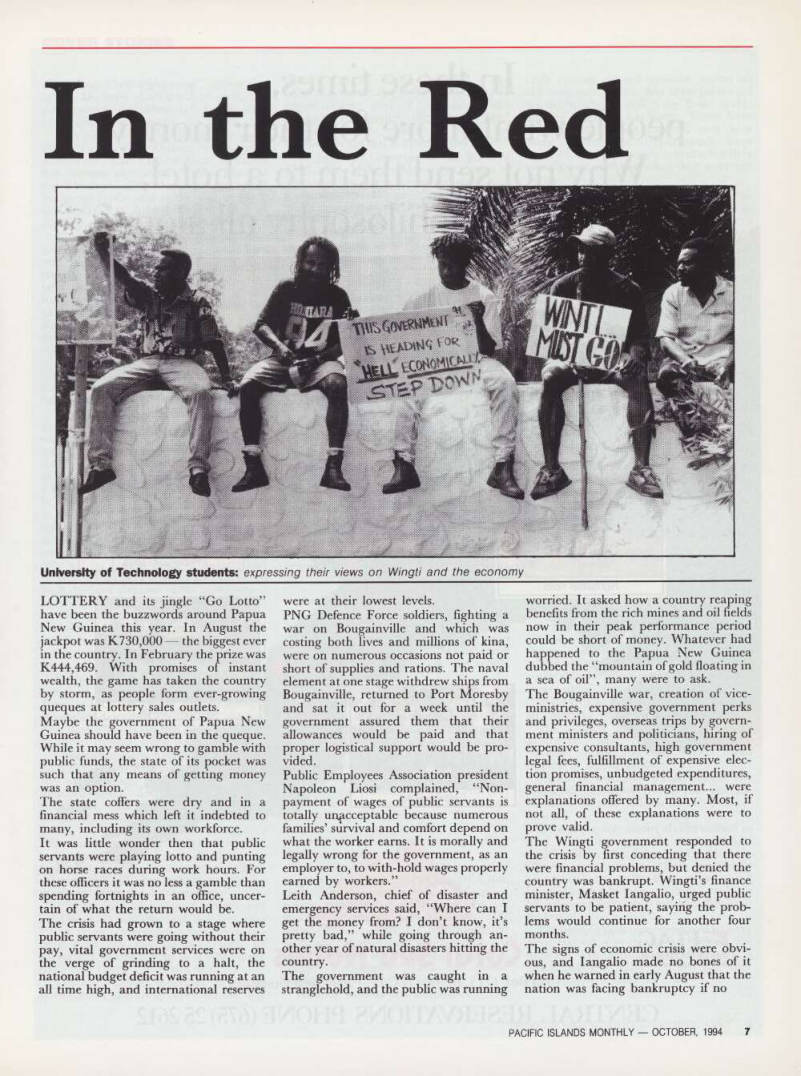
University of Technology students: expressing their views on Wingti and the economy
immediate “belt-tightening” action was taken. He even threatened to prosecute
government departmental heads they
overspent their budgets.
In a forceful address to them langalio said, “Papua New Guinea is now at a watershed. The current fiscal situation has become extremely serious. Most of the budget deficits have exceeded budgeted levels and at the end of 1993, the total accumulated budget stood at KB3l (5.5 per cent of GDP).”
An example of how serious the situ ation had become, the state-owned Post and Telecommunications Corporation, started cutting off telephone and other telecommunications services to cus tomers with accounts in arrears in order to meet its revenue target. A lot of these defaulters turned out to be government departments who found themselves in a communications black-out.
Private companies could not pay their taxes on time because they were owed money by the State. The government had landed itself in a catch-20 situation.
In March, langalio brought down a surprise mini-budget, in which he an
nounced cost-saving and revenue-raising
measures primarily aimed at making up for the estimated K2OO-million shortfall in revenue, which according to him, was a direct result of a sudden drastic drop in world oil prices.
In a more startling move, the govern ment handed over first rights to govern ment revenue from oil and mining projects to an international bank syndi cate led by Union Bank of Switzerland to pay off BUS9O million it secured to fund budget deficits. This government revenue, derived from taxes and profits usually paid to the Mineral Resources Stabilisation Fund, were to be paid to a nominee company, Raggiana Ltd, in the tax haven of Cayman Islands for three years.
Economist John Millet said the deal signalled the “inevitable result of break down in fiscal discipline”, while another economist described the deal as “the first sign that PNG is on the road to serious financial trouble, even bankruptcy”.
Opposition finance spokesman Rabbie
Namaliu, a former prime minister, said the arrangement was “ridiculous and unprecedented” and was “yet another nail in the coffin of PNG’s international credibility”. Namaliu further defended
public servants against langalio’s
“blatant buck-passing”, saying it was the politicians who had the final say on expenditure. He accused the Wingti government of destroying a healthy economy after the 1992 election.
“No amount of political bluster and mud-slinging can conceal the fact that Paias Wingti inherited a healthy econ omy from my government which he succeeded in destroying in a little more than two years,” Namaliu said.
The mini-budget measures to rein in government spending had “barely any
effect”, langalio later conceded. “The level of government deficit is completely unsustainable and if continued will bankrupt the country. We urgently need to address this, and our room for manoeuvre on this is months, not years.”
In June the Governor of the Bank of PNG, Sir Mekere Morauta, issued a warning that government spending had increased by 30 per cent since the beginning of the year, despite appeals for restraint.
Soon after the change of government in August, the new Chan regime said excessive government spending would be
controlled in weeks and the use of costly and largely expatriate consultants would be scrapped. The new finance minister Chris Haiveta said, “Belts that have been tightened will have to be tightened more to help the government in the whole exercise.”
In his acceptance speech Chan, the author of the 1993 and 1994 budgets under then-prime minister Paias Wingti, said his coalition was resuming power when the economy was on the rise. The economic bulletin for the March quarter of this year confirmed that this was true gross domestic product was expected to exceed the planned 14.4 per cent, and there was a stronger than anticipated growth in the private sector. The econ omy was not the problem, it was the government which was overspending, the report said.
Two days earlier, as he was preparing to leave the government of Wingti, Chan said, “The economy is thriving, it’s going strong and there is no reason why we should talk down the economy.” He urged that in order for the budget to work, the government should draw down loans provided by the World Bank, the Asian Development Bank and donor countries.
He later said as prime minister, “The
only cyclone on our horizon centres on the way expenditure has been permitted to storm ahead with very little visible sign of where it has gone. There have been no significant controls over how some government departments have been allowed to not only spend what they were given, but also what they were not given.
“The system has let us down, but the process was accelerated by the way in which spending outside the budget’s limits was allowed to proceed without restraint. I admit that some of our current economic statistics do not paint
a pretty picture.
“Primarily, it is the management of our cash flow which has been allowed to go haywire. The knives are out from today onwards. Expenditures will be trimmed and departments made ac countable for their sins. Heads will roll from sinful shoulders. Discipline and control will be introduced. They’ve been strangers to us for too long.”
His deputy Haiveta gave a “firm assurance” that public servants, the business sector and any others owed money to would be paid.
“I am determined to turn around the financial management of the govern ment’s resources without further delay,” he said.
The new government also promised to deal with and get the much-delayed multi-million kina Lihir gold project, in Chan’s own electorate, off the ground. It was revealed that the delay was caused by a dispute between Wingti and his Mining and Petroleum minister, Sir John
Kaputm.
“Projects which were supposed to have been started a year ago are still in the pipeline. The prime minister has made it Suite clear that Lihir gets first call after ougainville,” Haiveta said.
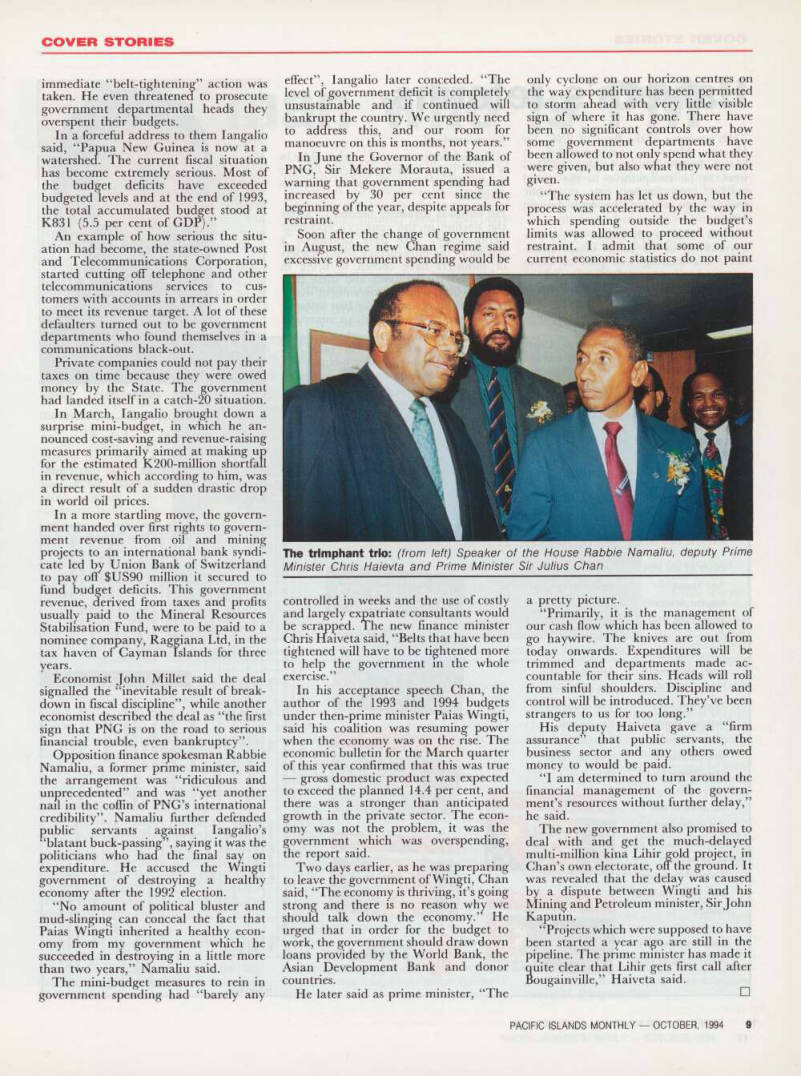
The trimphant trio: (from left) Speaker of the House Rabble Namaliu, deputy Prime Minister Chris Haievta and Prime Minister Sir Julius Chan
Advertisements & other items, p. 10 (1 item)
that's had this philosophy all along?
In these times,
people want more for their money.
Why not send them to a hotel,
that's had this philosophy all along?
1 niii -mm M it*. ■ 1 jlltssg mmm . • £2® - & m Coast Watchers Hotel Smugglers Inn Resort
MADANQ
■«s w M 4 : MiTt I Melanesian Hotel Huon Gulf Lodge yj —- - Highlander Hotel a
POPONDETTA
:i iiotMn l —'‘aajjj_i , Lammgton Lodge - % r
PORT MORESBY
i#< AV- Gateway Hotel
FLAG
INTERNATIONAL
iicmis rsr« restarts
Coral Saa Hotels
PO Box 1215, Boroko N.C.D., Papua New Guinea
CENTRAL RESERVATIONS PHONE (675) 25 2612
Haiveta’s reforms
THE governor of the Bank of PNG, Sir Mereke Morauta, recommended in March that the kina be devalued (if PNG were to be competitive in the world market) and further cuts to public
spending to reduce the high budget
deficit.
He was subsequently sacked by the new government of Sir Julius Chan. Ironi cally, the sacking was part of Chan
government’s structural reforms package
which last month included a devaluation of the kina, and wide-ranging expendi ture cuts as advised by Morauta months ago.
The new deputy Prime Minister, Chris Haiveta, also said there would be a wage freeze until the end of 1995 for public servants, with no wage adjustments to offset the impact of the devalued kina.
He said that in the short term this would remove uncertainty about the kina’s future as a convertible currency and improve the profits of exporters.
Haiveta said only essential expenditure such as wages, paying off debts, and other government running costs would
be entertained.
“The public sector at all levels will be in a very tight holding pattern for the remainder of 1994. No other option is feasible.”
He outlined measures needed to arrest the decline in the country’s economic performance. “We have developed a system in the bureaucracy where leaders or ministers have chosen to bring in (expatriate) consultants and these con sultants form a tier of government which is ... sometimes against the best interests of this country,” he said in an interview.
Haiveta also said there would a number of immediate sackings “in both the political and public service sectors” but did not say how many. The measures were designed to set up a framework for the 1995 budget, to be announced next month.
“A balanced budget with zero deficit for 1995 is our target. Our plans will involve financing of the budget and we will increase the amount provided externally,
especially looking once again to our
traditional concessional sources ... such
as the World Bank ... and the Australian government.”
The kina exchange rate in mid- Septembers was at $U51.0493 and 5A1.40. □
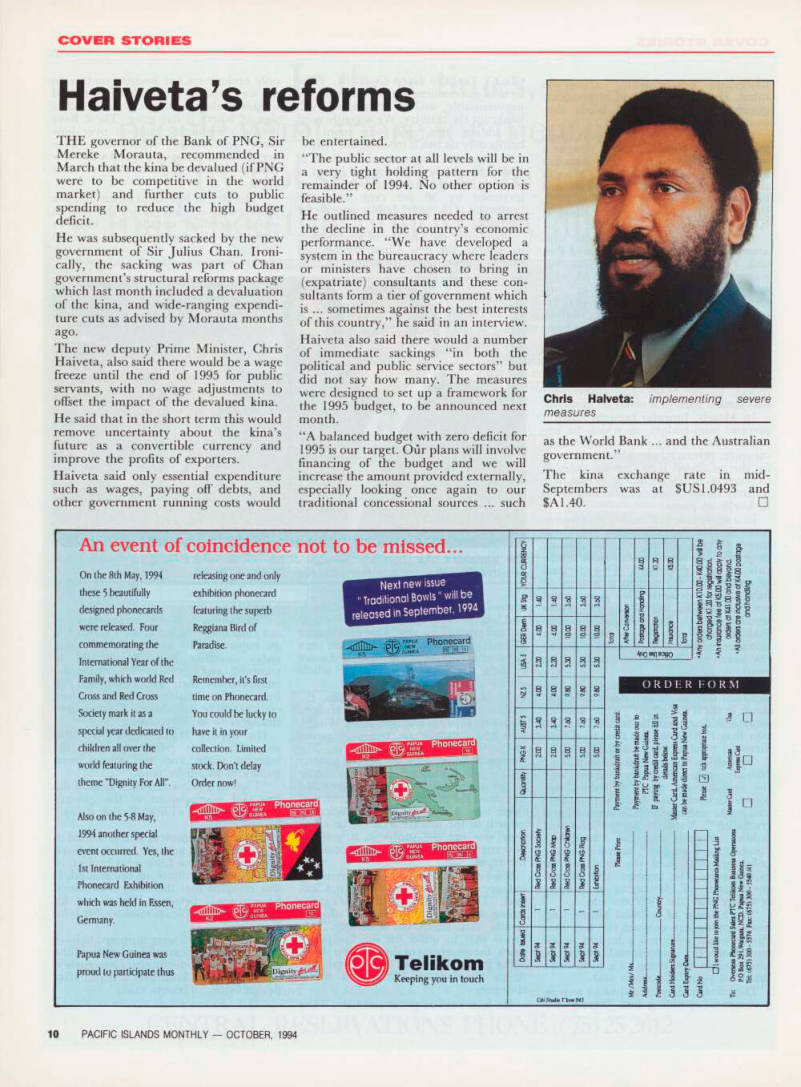
Chris Haiveta: implementing severe measures
Advertisements & other items, p. 12 (2 items)
Cover Stories
Telikom
An event of coincidence not to be missed.
On the Blh May, 1994 these 5 beautifully designed phonecards were released. Four commemorating the International Year of the Family, which world Red Cross and Red Cross Society mark it as a special year dedicated to children all over the world featuring the theme "Dignity For All". releasing one and only exhibition phonecard featuring the superb Reggiana Bird of Paradise.
Remember, it's first time on Phonecard.
You could be lucky to have it in your collection, limited stock. Don't delay Order now!
Also on the 5-8 May, 1994 another special event occurred. Yes, the Ist International Phonecard Exhibition which was held in Essen, Germany.
Papua New Guinea was proud to participate thus papua phonecar rmm L ? -- s + Timm + Dignity Next new issue " Traditional Bowls" will be released in September, 1994 papua phonecard > g Sa @3OO 0 rmifi + PAPUA Phonecar
w oil tes
Sfcj £*VmM - a* « ■-
Telikom
Keeping you in touch 8 g S € € 8 » S 5 ; 8 i s •s
ii s
g S 2 P Apo esneoyjo
ORDER FORM
3 5 55 ia
ill
.111 0 Crti Sfw/w T'km 04.1 n
lio
! 5- □ s§; m O S iz. r~ § »
i Ik
1-8
O; ON
3 K V) o
The man who is PM
WHEN parliament elected Sir Julius Chan the seventh prime minister of PNG for the second time, few in the know were surprised. For months, events leading to the change of government when Chan
replaced his former prime minister, Paias
Wingti, the writing was on the wall. ... , A disenchanted Chan held secret court •i... , . , r with the Opposition as he waited tor the ■ \ r ■ r™ . . . . right opportunity. 1 he Opposition m the meantime did all it could within its meagre resources to seek a court in-
terpretation of
Wingti’s surprise res
ignation and re election, and at
tacked Wingti’s style
of leadership and management of the economy.
On many oc casions, including his resignation and re
election, Wingti
acted without con sultation with his coaltion partners and during Chan’s absence from the country.
Chan’s letter of
resignation to Wingti
said, “Over the past 12 months, courses of national action were chosen with little, if any, consultation with either myself or
my party. The government has become a one-man show, with suspect advisers being vocal and aggressive in their actions.
“Your sudden and secret resignation last year was not in the best interests of PNG. These actions were dictated more by the desire to hold on to power for power’s sake alone, rather than for the good administration of our nation.”
On election day, the new prime minister declared that the outcome was inevitable. “The new coaltion govern ment of Papua New Guinea had to happen. It was quite obvious that there was really no other choice, ” he said in his victory speech, “the long train of mismanagement and scandal has led us to the event of today.
“I do not and will deny Paias Wingti a place in our history, but it would be a sin of gross omission to ignore the fact that by his own actions he has caused his downfall.”
The Supreme Court on August 25 ruled that while Wingti’s resignation was proper, his re-election was null and void.
Under the constitution the re-election of a new prime minister should take place at the next sitting of parliament after it has been informed. Wingti wrote to the governor-general on September 23, the announcement was made on September 24. He was re-elected the same day.
Paias Wingti had thought he had cleverly executed a ‘coup’ in PNG
politics when he resigned on September
23 last year and got re-elected the same day to secure power until the 1997 elections. As events culminated towards the change of government in August, that coup of Wingti’s caused his own downfall and the rise of Chan to prime ministership which he is guaranteed until the 1997 elections.
Then Chan scored his second victory when, for the first time in six years of the Bougainville crisis, a prime minister met the rebel high command and negotiated a ceasefire, signalling hope for peace.
“The guns of war are slowly being silenced,” announced Chan, after the signing of the ceasefire agreement be tween the PNG government and the
Bougainville Revolutionary Army in the
Solomons capital, Honiara, on Septem ber 8. The ceasefire, agreed to in talks between Chan and BRA commander Sam Kauona, came into effect the next
day.
This month another chapter will be written when a South Pacific peacekeep ing force an idea promoted by Chan since his prime-ministerial days in 1980 comprising troops from Tonga, Fiji and Vanuatu will be deployed to Bou gainville, the blockade will be lifted and a peace conference held in the troubled island’s badly ravaged headquarters, Arawa.
That he rallied and managed to organise a regional peacekeeping force
was Chan’s
third victory.
He had seen a dream become reality ... a force which can be used to attend to man-made and natural disasters in the future.
He was also
quick in visiting
Australia to, among other
things, organise
a logistic back up for the
peacekeeping
operation.
Chan is confi dent that the peace momen tum has picked up and will roll on to a happy ending, not in a
hurried way, but in a manner acceptable to all parties.
“At this stage, the process is fragile.
One wrong step will bring us right back to hell,” he cautioned. “I have no hang ups with questions of anyone’s status, whether a bad precedent would be set if a head of government lent legitimacy to a rebel group by meeting with its leader.
I have no worries on that score.
“The Bougainville Revolutionary
Army is a fact of fife, not a shadowy player in a theatrical game. I’m giving this everything I’ve got all my energy, every piece of experience and common sense I may possess.”
He further acknowledged there was blame on both sides and that there had “never been a matter of simple right and wrong”. “We all realise that firstly we must admit the mistakes of the past if we are going to solve them. We recognise and admit that there have been mistakes made on Bougainville.” □
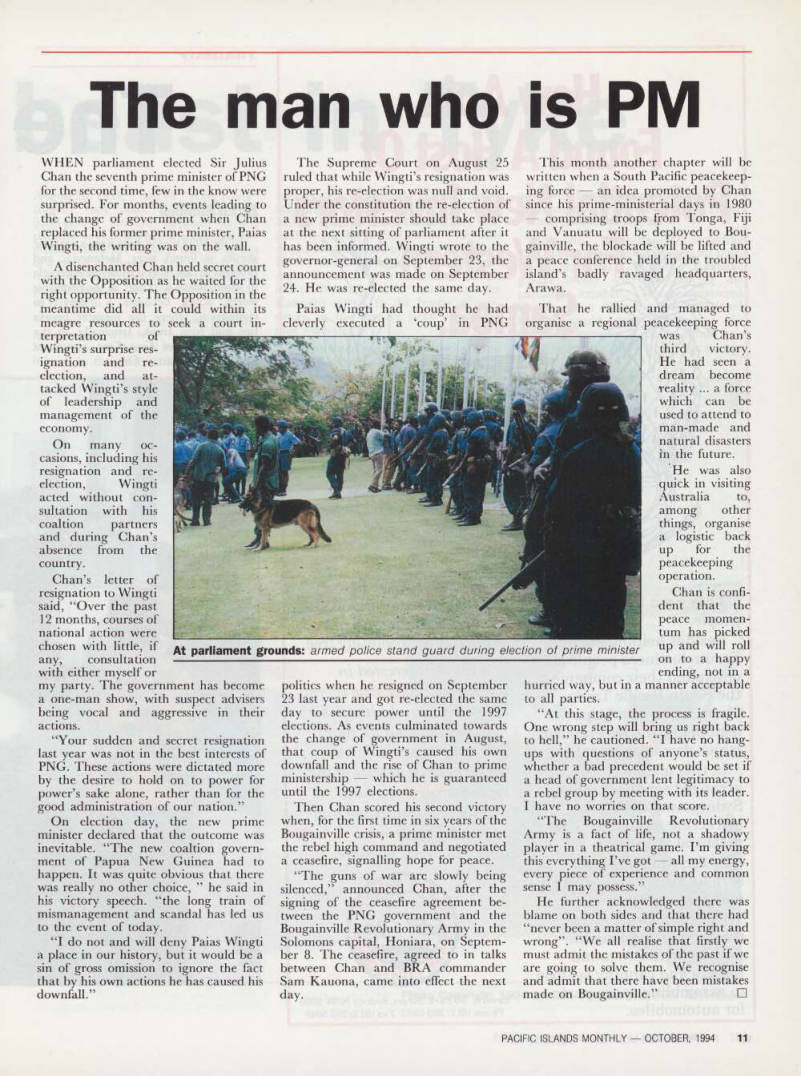
At parliament grounds: armed police stand guard during election of prime minister
The beast in Tyke
Tragedy
By Ed Rampell
In the 1933 movie King Kong a gigantic gorilla is found near Melanesia, and brought in chains as a show-biz spectacle to Manhattan. A “king” in the primitive world, Kong becomes a “slave” in civilisation, where the monster breaks free and runs amok. Ironically, in the 1976 re-make of King Kong , sequences were shot at Kauai. On
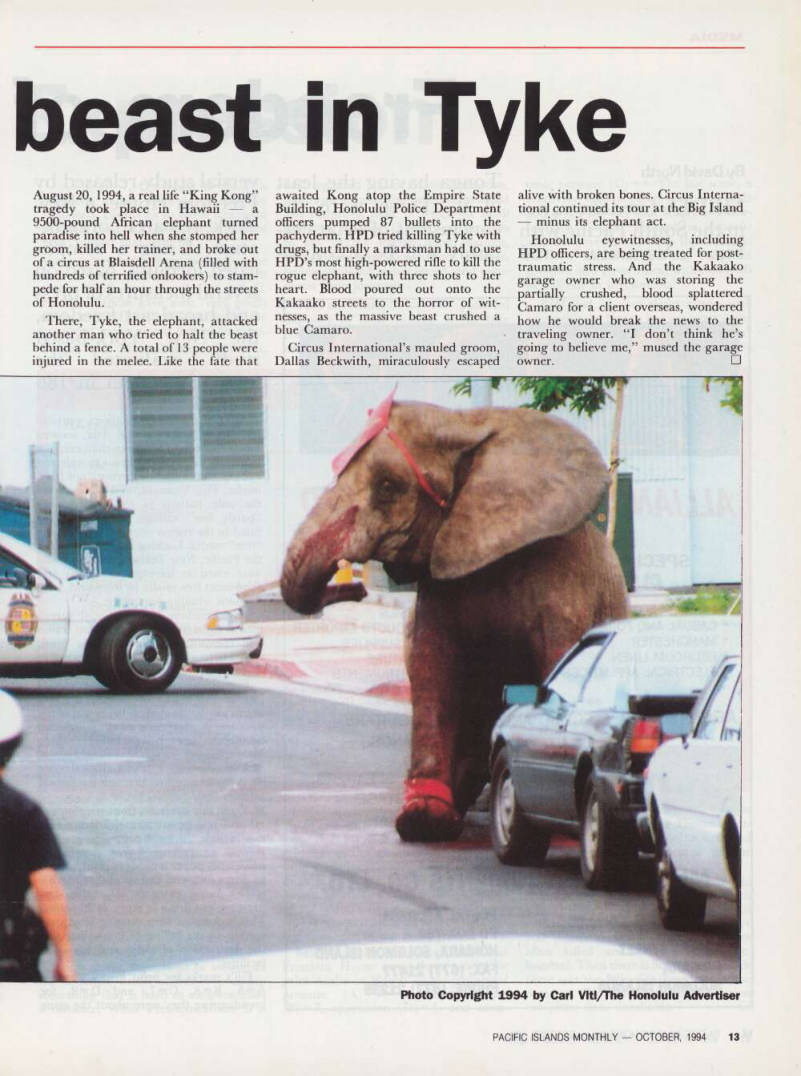
August 20, 1994, a real life “King Kong” tragedy took place in Hawaii a
9500-pound African elephant turned
paradise into hell when she stomped her groom, killed her trainer, and broke out of a circus at Blaisdell Arena (filled with hundreds of terrified onlookers) to stampede for half an hour through the streets of Honolulu.
There, Tyke, the elephant, attacked another man who tried to halt the beast behind a fence. A total of 13 people were injured in the melee. Like the fate that
awaited Kong atop the Empire State
Building, Honolulu Police Department
officers pumped 87 bullets into the
pachyderm. HPD tried killing Tyke with
drugs, but finally a marksman had to use HPD’s most high-powered rifle to kill the rogue elephant, with three shots to her heart. Blood poured out onto the Kakaako streets to the horror of wit- Jesses, as the massive beast crushed a blue Camaro. , Circus International’s mauled groom,
Dallas Beckwith, miraculously escaped
alive with broken bones. Circus Interna tional continued its tour at the Big Island minus its elephant act.
Honolulu eyewitnesses including
HPD officers are being treated for post traumatic stress And the Kakaako garage owner who was storing the
partially crushed blood splattered
Camaro for a client overseas, wondered bow b e break the news to the traveling owner. “I don’t think he’s going to believe me,” mused the garage owner. □
Photo Copyright 1994 by Carl Viti/The Honolulu Advertiser
Advertisements & other items, p. 14 (1 item)
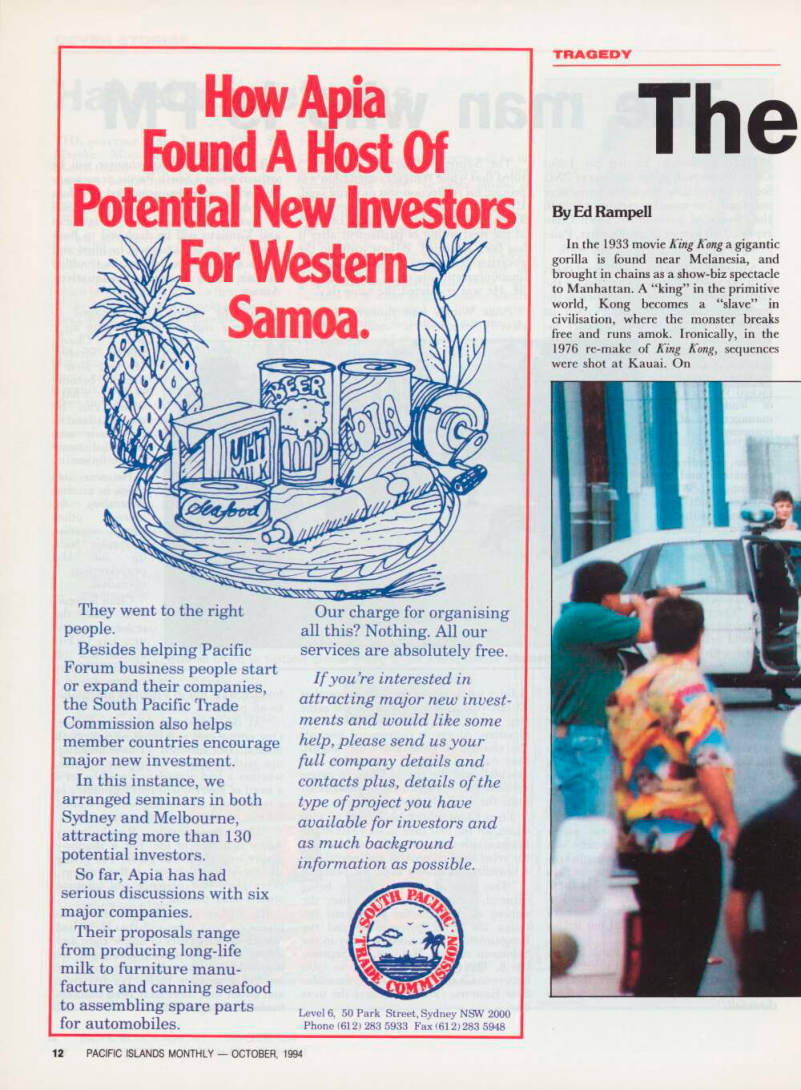
How Apia
Found A Host Of
Potential New Investors
r Wester
Samoa
2 2 They went to the right people.
Besides helping Pacific Forum business people start or expand their companies, the South Pacific Trade Commission also helps member countries encourage major new investment.
In this instance, we arranged seminars in both Sydney and Melbourne, attracting more than 130 potential investors.
So far, Apia has had serious discussions with six major companies.
Their proposals range from producing long-life milk to furniture manufacture and canning seafood to assembling spare parts for automobiles.
Our charge for organising all this? Nothing. All our services are absolutely free.
If you’re interested in attracting major new investments and would like some help, please send us your full company details and contacts plus, details of the type of project you have available for investors and as much background information as possible.
E£ & e w Level 6, 50 Park Street, Sydney NSW 2000 Phone (612) 283 5933 Fax (612) 283 5948
Freedom of

Media
By David North
MEDIA freedom varies in the South Pacific with Fiji, Vanuatu and
Tonga having the least
of it. These were the conclusions of what cer tainly will be a contro
versial study released by
Freedom House, a New
York research organis
ation. Using a compli
cated formula, based on
several measures of press
and broadcast freedom,
the New York-based
study evaluated the
level of freedom in 186
countries.
Most of the studied nations, particu larly those in Africa and Asia, secured much less attractive ratings than even the worst in the Pacific. For example, 54 nations were rated as having “not free” media; Fiji, Vanuatu, and Tonga were the only nations in the Pacific with “partly free” ratings; the other seven rated in the region were all said to have “free” media. Looking elsewhere around the Pacific, New Zealand and Australia were rated as having the second and third most free media in the world, with Belgium winning first place.
The Freedom House annual survey measures the freedom of broadcast (radio and television) media, and the press, separately, giving the lowest marks to those with the most free expression.
Four different kinds of pressures against the media are measured, and points are distributed on the extent of the pressure. A maximum of ten points can be allocated in each of the following three categories: • Official pressure, laws and regulation; • Political pressure, through less formal intervention. • Economic pressure, from governmen tal and non-governmental forces. (This can include, in some countries, govern mental or private forces denying a newspaper paper it needs to print, as well as direct financial threats and reprisals).
The fourth category (D) called op pression, can bring as many as 20 points.
This includes actions ranging from cen sorship to the killing of journalists and the destruction of radio and television facilities.
Fiji’s marks for print media were A= 5, B= 8, C= 7, and D= 8; for broadcasting they were about the same
A= 4, B=7, C=7 and D= 9. This produced a raw score of 55. Nearby Indonesia, known for its harsh treatment of Timor, and to a lesser extent, of Irian Jaya, topped that with 58.
Vanuatu’s record suffered primarily from its treatment of the print media, with scores of 10 each for A, B, and C.
Freedom House gave zero (very good) scores on the D variable, and found the broadcast media much freer than print.
Tonga, with 35 total points against it,
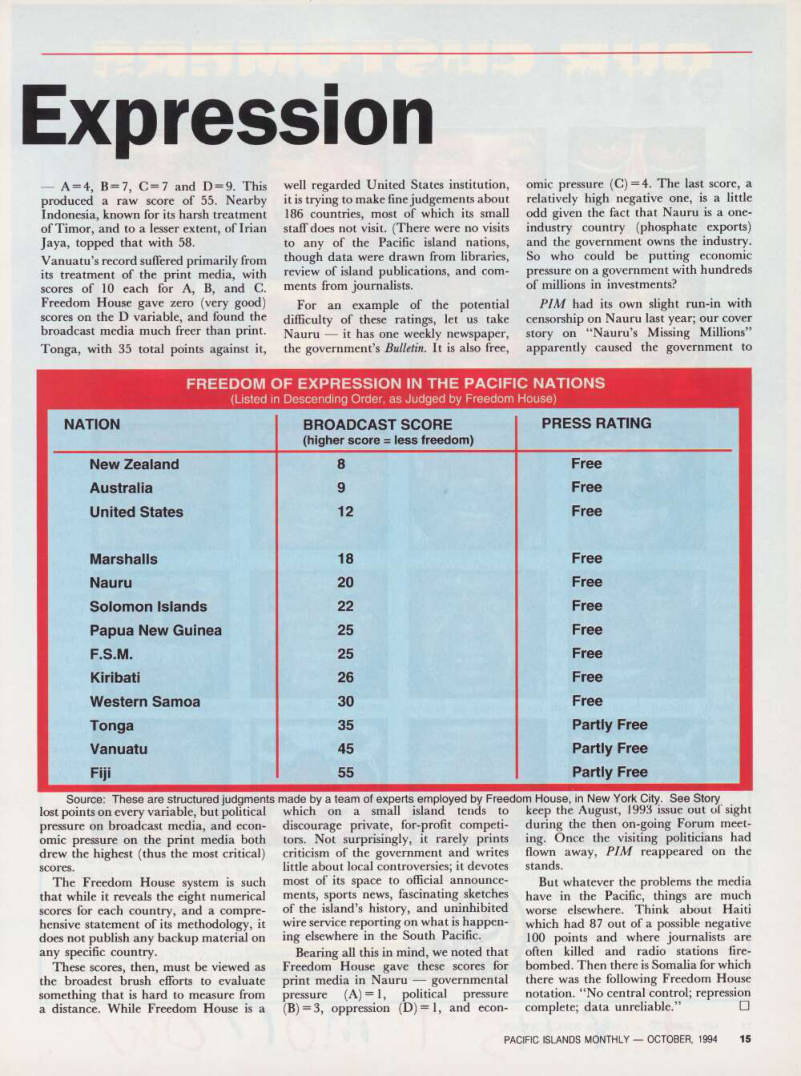
FREEDOM OF EXPRESSION IN THE PACIFIC NATIONS (Listed in Descending Order, as Judged by Freedom House)
Source: These are structured judgments made by a team of experts employed by Freedom House, in New York City. See Story
lost points on every variable, but political pressure on broadcast media, and econ omic pressure on the print media both drew the highest (thus the most critical) scores.
The Freedom House system is such that while it reveals the eight numerical scores for each country, and a compre hensive statement of its methodology, it does not publish any backup material on any specific country.
These scores, then, must be viewed as the broadest brush efforts to evaluate something that is hard to measure from a distance. While Freedom House is a
well regarded United States institution, it is trying to make fine judgements about 186 countries, most of which its small staff does not visit. (There were no visits to any of the Pacific island nations, though data were drawn from libraries, review of island publications, and com ments from journalists.
For an example of the potential difficulty of these ratings, let us take Nauru it has one weekly newspaper, the government’s Bulletin. It is also free,
which on a small island tends to
discourage private, for-profit competi
tors. Not surprisingly, it rarely prints criticism of the government and writes little about local controversies; it devotes most of its space to official announce ments, sports news, fascinating sketches of the island’s history, and uninhibited wire service reporting on what is happen ing elsewhere in the South Pacific.
Bearing all this in mind, we noted that Freedom House gave these scores for print media in Nauru governmental pressure (A) = l, political pressure (B) = 3, oppression (D) = l, and econ
omic pressure (C) =4. The last score, a relatively high negative one, is a little odd given the fact that Nauru is a one industry country (phosphate exports) and the government owns the industry.
So who could be putting economic pressure on a government with hundreds of millions in investments?
PIM had its own slight run-in with censorship on Nauru last year; our cover story on “Nauru’s Missing Millions” apparently caused the government to
keep the August, 1993 issue out of sight during the then on-going Forum meet ing. Once the visiting politicians had flown away, PIM reappeared on the stands.
But whatever the problems the media have in the Pacific, things are much worse elsewhere. Think about Haiti which had 87 out of a possible negative 100 points and where journalists are often killed and radio stations fire bombed. Then there is Somalia for which there was the following Freedom House notation. “No central control; repression complete; data unreliable.” □
Nation
Broadcast Score
(higher score = less freedom)
Press Rating
New Zealand 8 Free Australia 9 Free United States 12 Free Marshalls 18 Free Nauru 20 Free Solomon Islands 22 Free Papua New Guinea 25 Free
F.S.M.
25 Free Kiribati 26 Free Western Samoa 30 Free
Tonga
35 Partly Free Vanuatu 45 Partly Free Fiji 55
Partly Free
Advertisements & other items, pp. 16-18 (1 item)
Alliance Corporation Ltd
SPECIALISING IN IMPORTED FASHION
CLOTHING FOR ALL OCCASIONS
* FASHION CLOTHING
* CASUAL AND FORMAL SHOES
* MANCHESTER
* BEDROOM UNEN
* ELECTRICAL APPLIANCES
♦ TABLE UTENSILS
♦ MARINE PRODUCTS EXPORTER
♦ STATIONERY SUPPLIES
♦ OFFICE FURNITURE
♦ MUSICAL INSTRUMENTS
AGENTS FOR ELECTRIC AND ACOUSTIC GUITARS,
DRUMS, PIANOS,
KEYBOARDS,
AMPLIRERS, SPEAKERS,
MIKES AND STAGE
SOUND SYSTEM
MUSICAL INSTRUMENTS CO. LTD.
LOCATION:
ACOR BOOKSHOP BUILDING
ASHLEY STREET
HONIARA
SOLOMON ISLANDS
POSTAL ADDRESS:
PO BOX 780
HONIARA, SOLOMON ISLAND
FAX: (677) 21477
PHONE: (677) 21239
F mm ■ ; B 1 w - Z-' > 1 me&u*
SPSP P
I /' M "raff" ifcaSS. - ■•••« wrm m/ urn s< am* I r i/ V _]
•APUA NEW GUINEA BANKING CORPORATION
-B»S B"
I 4 A /I f •' v. vy X*1 \
The key to the future
WHILE the rest of the world spent seven years trying to free up international trade in the GATT Uruguay Round nego tiations, the island states of the Pacific were sitting on the sidelines.
Only Fiji had any involvement, joining
the GATT (General Agreement on Tariffs and Trade) as the round came to a tortuous end. There was no other input from the region.
It was not necessarily that Fiji’s neigh bours were disinterested. They have few resources for international negotiations and participation in the Uruguay Round was a very demanding and expensive business. Some probably thought the outcome of years of wheeler-dealing be tween the world’s trading giants was of little relevance to them anyway.
But with the increasing globalisation of trade and new rules governing its interna
tional conduct in place, the question now is whether the Pacific states can afford to remain outside the mainstream.
A new World Trade Orgainisation, to provide a single institutional umbrella over current GATT structures and all agreements reached in the Uruguay Round, will be set up next year.
China and Taiwan are negotiating membership. So is Russia. All but a couple of the Commonwealth of Independent States of the former Soviet Union want in.
Vietnam is interested, along with Kampuchea, Saudi Arabia and Jordan are thinking it’s time they joined Burma and Benin, Chad and Cuba, Saint Lucia and Suriname and more than 100 other nations in the GATT.
Can the tiny island states of the Pacific, whose future, it is increasingly clear, depends on trading internationally, afford to stay out?
The Brisbane communique of the South Pacific Forum, which stressed “the need to adopt a global perspective in regard to the development of economic policies” and
acknowledged this required increasing international
competitiveness, indicated the region’s leaders are thinking about the issues.
What they don’t know at the moment is what the Uruguay Round means to them. Is it good as it is, with a long over due reduction in barriers to agricultural exports for New Zealand and Australia?
Or is it bad, indicating as it does, higher prices for food imports for those nations which have to buy much of their
requirements when subsidy-driven surpluses are reduced?
Will it open up new opportunities for Pacific island countries’ exports, or will it provide increased competition from other suppliers with a resulting reduction in returns?
I understand that New Zealand officials anxious to see that their nearest neighbours’ interests are not overlooked in the new international trading environment are actively
looking at these issues.
They suspect there may be opportunities, as yet uncovered, for the island nations in the Uruguay Round outcome, but acknowledge that re search is needed to find them. This may be a role for the Forum, but I understand New Zealand is ready to offer a helping hand.
The main point is that it seems clear the island states will need some sort of relationship with the new WTO to make sure their interests are not
trampled u|}on.
The most optimistic view is that they will inevitably benefit from the Uru guay Round outcome because it will
stimulate economic activity through
out the world, thereby creating a greater demand for the products of the Pacific island states as well as those of
every other exporting country.
This argument says every country would have been worse off without a Uruguay Round agreement.
This may be true, but those benefits are very hard to define.
An alternative downside of the round is that the Pacific island countries will suffer from the loss of tariff margins of preference they have enjoyed for access to developed countries under the Lome Convention and the Generalised System of Preferences. (They have already felt the pressure of reduced margins to their biggest markets as New Zealand and Australia have cut their tariffs against imports from all
countries.)
There is a major issue here for the Fiji clothing industry, which currently has quotas for exports into the United States and Canada. All quotas will be eliminated over time under the Uruguay Round agreement this could help Fiji expand its sales or, on the other hand, provide greater competition from other suppliers. Other issues which will have to be addressed inlcude the impact of the Uruguay Round deal on sanitary measures affecting PIC exports, and the extent to which they may need to fight tendencies of importing countries to resort to new forms of protection. (Many see the introduction of unjustified quarantine rules and unnecessary environmental regulations inevitable as some countries seek to minimise the impact on their own
producers.)
The key to the PlC’s economic future as the Brisbane Forum communique indicates their leaders recognise is
international competitiveness.
This all points to the Forum countries taking positive action on areas to which they have done little more than pay lip service to so far that is, expanding their private sectors, diversifying their economies, adopting sustainable fishing and
forestry policies, increasing value-added production and
developing regional approaches to international trade.
Wellington
David
Barber
Advertisements & other items, pp. 20-21 (1 item)
c
(ADVERISEMENT)
SANDAUN PROVINCIAL
GOVERNMENT PROVIDES REMOTE
PNG COMMUNITIES WITH WORLD
CLASS COMMUNICATION
SERVICES USING ADVANCED PORTABLE
SATELLITE PHONE TERMINALS
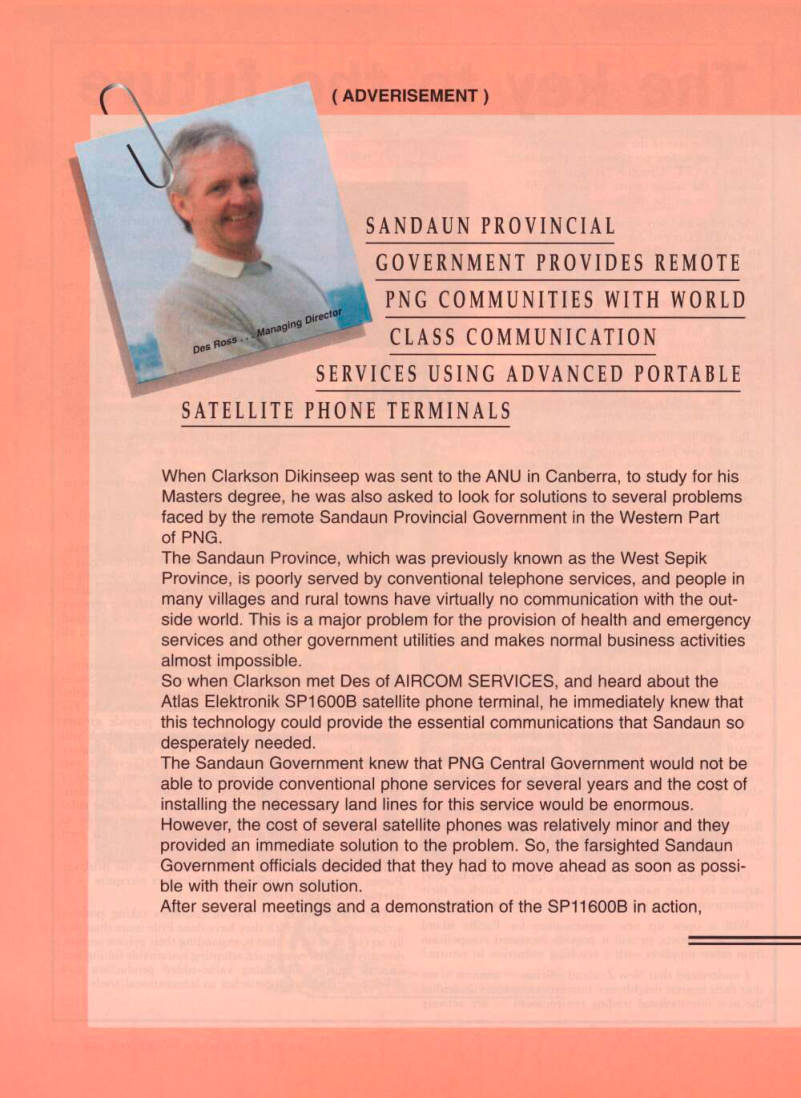
When Clarkson Dikinseep was sent to the ANU in Canberra, to study for his Masters degree, he was also asked to look for solutions to several problems faced by the remote Sandaun Provincial Government in the Western Part of PNG.
The Sandaun Province, which was previously known as the West Sepik Province, is poorly served by conventional telephone services, and people in many villages and rural towns have virtually no communication with the outside world. This is a major problem for the provision of health and emergency services and other government utilities and makes normal business activities almost impossible.
So when Clarkson met Des of AIRCOM SERVICES, and heard about the Atlas Elektronik SPI6OOB satellite phone terminal, he immediately knew that this technology could provide the essential communications that Sandaun so desperately needed.
The Sandaun Government knew that PNG Central Government would not be able to provide conventional phone services for several years and the cost of installing the necessary land lines for this service would be enormous.
However, the cost of several satellite phones was relatively minor and they provided an immediate solution to the problem. So, the farsighted Sandaun Government officials decided that they had to move ahead as soon as possible with their own solution.
After several meetings and a demonstration of the SPII6OOB in action,
(ADVERISEMENT)
Clarkson convinced his Government and the PNG authorities that this was the solution to their communication problems in remote areas.
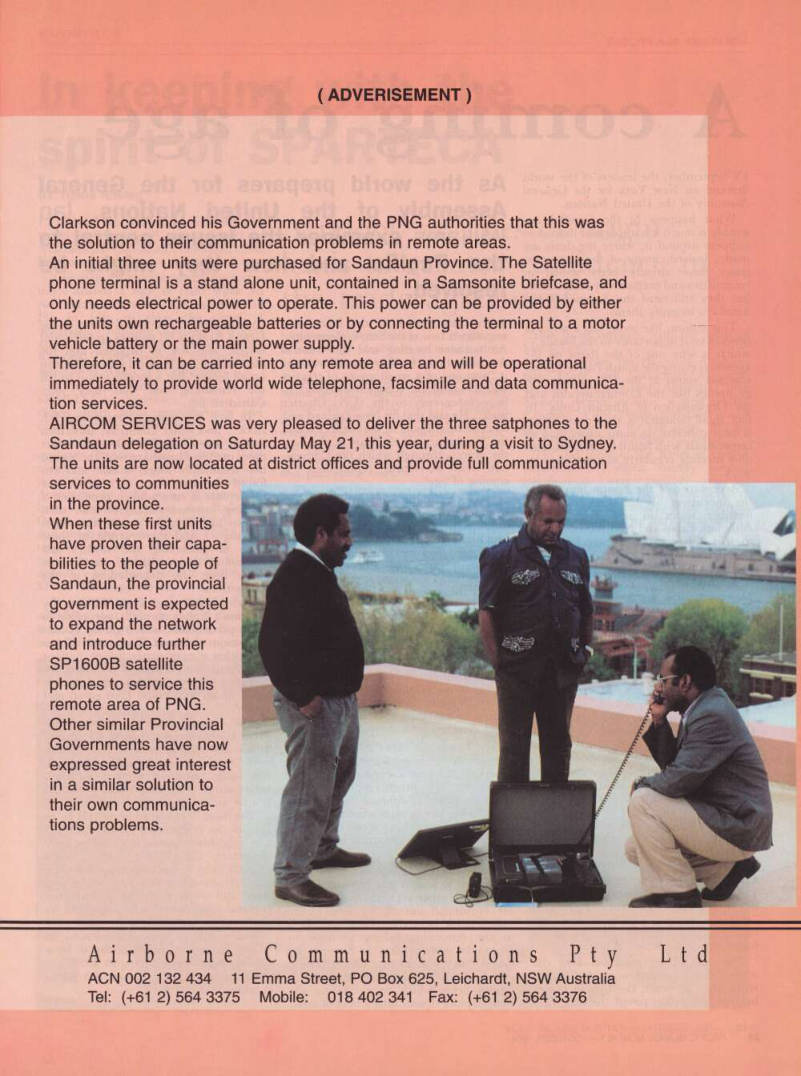
An initial three units were purchased for Sandaun Province. The Satellite phone terminal is a stand alone unit, contained in a Samsonite briefcase, and only needs electrical power to operate. This power can be provided by either the units own rechargeable batteries or by connecting the terminal to a motor vehicle battery or the main power supply.
Therefore, it can be carried into any remote area and will be operational immediately to provide world wide telephone, facsimile and data communication services.
AIRCOM SERVICES was very pleased to deliver the three satphones to the Sandaun delegation on Saturday May 21, this year, during a visit to Sydney.
The units are now located at district offices and provide full communication services to communities in the province.
When these first units have proven their capabilities to the people of Sandaun, the provincial government is expected to expand the network and introduce further SPI6OOB satellite phones to service this remote area of PNG.
Other similar Provincial Governments have now expressed great interest in a similar solution to their own communications problems. » • * » 40H 4* i.
"'*W-
Airborne Communications Pty Ltd
ACN 002 132 434 11 Emma Street, PO Box 625, Leichardt, NSW Australia Tel: (+6l 2) 564 3375 Mobile: 018 402 341 Fax: (+6l 2)564 3376
A coming of age
United Nations
IN September, the leaders of the world descend on New York for the General Assembly of the United Nations.
What happens in the General As sembly is much less important that what happens around it, where the deals are made. Indeed, many of the important issues have already been settled in committees and preparatory conferences, but they still need the Assembly’s 184 members to ratify them This session, like most, has a series of issues of vital importance to the Pacific which is why one of the items on the agenda is giving the South Pacific Forum observer status at the UN, along with groupings like the Commonwealth and the Organisation of African Unity. In fact, small though it is, the Forum group is more coherent on many issues than its larger rivals, with South Pacific ambassa dors meeting regularly to coordinate its work.
Acceptance of the Forum may lessen the incentives of the remaining non member states to seek membership.
Although Palau and Nauru could afford to, it is still an expensive step for others
considering joining, like Tonga, Tuvalu
and even Niue.
As Ambassador Yosiwo George of Micronesia said, this session will consider the report back from the Barbados Conference of Small Island States, and a crucial question will be whether the nebulous promises of finance made there will get any firmer. “I think development issues will be very important for the Pacific this session,” the Ambassador told
Pim.
At this session also the UN Secretary General Boutros Boutros Ghali will present a report on the defence of small islands states, requested two years ago by the Maldives and strongly backed by the Pacific islands. It is the relative powerlessness of the small states, shown by what has happened to Bosnia, that makes the United Nations and the rule of International Law so important to the Pacific.
Indeed, in August, when the Security Council endorsed a United States in vasion of Haiti, New Zealand’s Ambassa
dor Colin Keating, archly hoped that
“similar alacrity” would be shown when other small countries, farther away, found their democracy threatened.
The rule of International Law did
score a major breakthrough this August
when after 12 years, the United States’ belated conversion paved the way for a
As the world prepares for the General Assembly of the United Nations, lan Williams examines the issues central to the Pacific and how they might be resolved.
general acceptance of the laboriously negotiated Law of the Sea. Welcoming it, Ambassador Keating told the General Assembly that after 12 years of waiting, it “was one of a small group of treaties which would be considered second in
importance only to the (UN) Charter
itself’. He said that for New Zealand and its close neighbours in the South Pacific, the Conference on the Law of the Sea, the process through which the Conven tion was developed, represented “a
coming of age”.
However, if the Convention was to continue to be important, it would be important to ensure that all of its
provisions were effectively implemented.
He stressed the issues of marine pollution, hazardous wastes and radioactive wastes and the need for more specific rules to enforce the sections on high seas fisheries.
Within weeks the UN Conference on
straddling fish and highly migratory fish
stocks finished its fourth session at the end of August. And it almost looked like his hopes might be carried out. Fijian Ambassador Satya Nandan, the Chair man of the Conference, told PIM, “There is a general acceptance that there should be a binding agreement. It was a
good meeting.”
The Pacific, he says, “has had a very strong voice in the conference it’s been probably the best coordinated group.”
Of course, few other regions have as much at stake; as Ambassador Nandan says, “They are sweeping the seas we have to regulate fishing across the world, since the fish don’t recognise man-made boundaries.”
While the Pacific nations knew how important it was, it has recently had a boost from other regions. As fish stocks are vacuumed out of one fishery, the vessels made redundant have moved on
to the remaining fishing grounds to
repeat the same process. In Europe, the
Royal Navy now escorts British fishing
vessels to protect them against Spanish fishing fleets which were chasing the same rapidly diminishing stocks of tuna.
In Canada, the famous cod fishery on the Grand Banks is 80 percent in territorial waters, and was so depleted that the government has imposed a complete ban on all fishing. But someone forgot to tell the remaining cod that they were Canadian fish.
In fact, they were a “straddling fish stock”, and other countries’ fishermen waited just off the 200-mile limit to net them in. The Canadians took the logical but technically illegal action and en forced the ban there as well. If the Conference is successful in producing a binding international agreement, then actions like Canada’s would have legal backing — and there would be some hope of preserving the world’s last
remaining major fishery, the Pacific
tuna, from the depredations of the driftnetters.
The breakthrough, helped along by
Nandan’s diplomatic skills, according to other participants, was to get the grudg ing assent of Japan, Korea and China and other distant water fishing nations like Spain and Portugal to agree to anything stronger than a vague declar ation which they could then go off and
ignore.
The current draft establishes mini mum international standards for conser vation and management which Nandan says “would err on the side of caution, not using resources without sufficient information. The unavailability would not be an excuse to go ahead.”
The most important part would be to provide an enforcement mechanism for any guidelines, which is of course very important for Pacific nations who scarcely have the resources to police their own territorial waters, let alone the high seas, and even more so against the regional superpowers who appear to be the worst perpetrators.
There will be one more session in March to be followed, it is hoped, by a binding agreement in August 1995.
Let us hope there are some fish left to conserve. □
spirit of SPARTECA
Business
In keeping with the spirit of SPARTECA
By Yunus Rashid
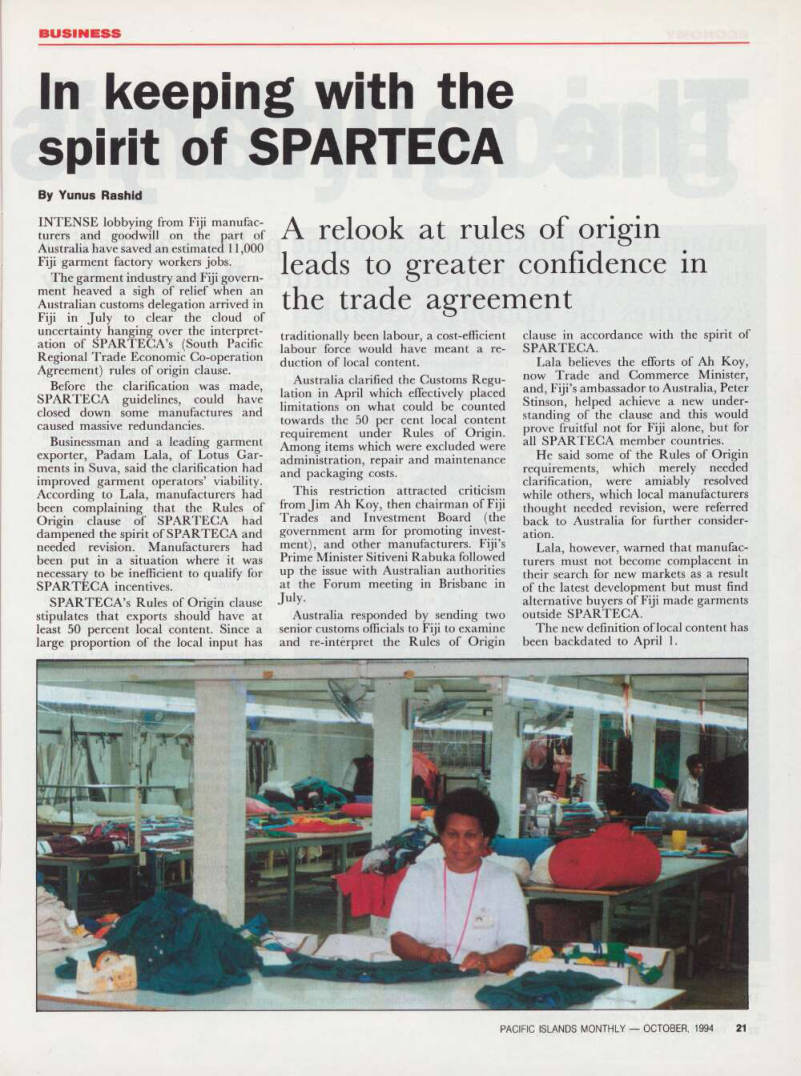
INTENSE lobbying from Fiji manufacturers and goodwill on the part of Australia have saved an estimated 11,000
Fiji garment factory worker, jobs
The garment industry and I iji government heaved a sigh of relief when an Australian customs delegation arrived in Fiji in July to clear the cloud of
uncertainty hanging oyer the interpret-
ation of SPARTECA s (South Pacific
Regional Trade Economic Co-operation
Agreement) rules °f°n g m dame.
Before the clarification was made, SPARTECA guidelines, could have .., 5 ’ r . . closed down some manufactures and caused massive redundancies.
Businessman and a leading garment exporter Padam Lala, of Lotus Garments in Suva, said the clarification had
improved garment operators’ viability.
According to Lala, manufacturers had been complaining that the Rules of Origin clause of SPARTECA had dampened the spirit of SPARTECA and needed revision. Manufacturers had been put in a situation where it was necessary to be inefficient to qualify for SPARTECA incentives.
SPARTECA’s Rules of Origin clause stipulates that exports should have at least 50 percent local content. Since a large proportion of the local input has
A relook at rules of origin leads to greater confidence in the trade agreement
traditionally been labour, a cost-efficient labour force would have meant a re duction of local content.
Australia clarified the Customs Regu
lation in April which effectively placed
limitations on what could be counted towards the 50 per cent local content requirement under Rules of Origin.
Among items which were excluded were administration, repair and maintenance and packaging costs.
This restriction attracted criticism from Jim Ah Koy, then chairman of Fiji Trades and Investment Board (the government arm for promoting invest ment), and other manufacturers. Fiji’s Prime Minister Sitiveni Rabuka followed up the issue with Australian authorities at the Forum meeting in Brisbane in J ul Y-
Australia responded by sending two
senior customs officials to Fiji to examine and re-interpret the Rules of Origin
clause in accordance with the spirit of
Sparteca.
Lala believes the efforts of Ah Koy, now Trade and Commerce Minister, and, Fiji’s ambassador to Australia, Peter Stinson, helped achieve a new under standing of the clause and this would prove fruitful not for Fiji alone, but for all SPARTECA member countries.
He said some of the Rules of Origin
requirements, which merely needed
clarification, were amiably resolved while others, which local manufacturers thought needed revision, were referred back to Australia for further consider ation.
Eala, however, warned that manufac turers must not become complacent in their search for new markets as a result of the latest development but must find alternative buyers of Fiji made garments outside SPARTECA.
The new definition of local content has been backdated to April 1.
The military’s
Economy
Guam is re-thinking its economic policies as it shifts its focus to a civilian-based future. Barbara Ray examines the options available.
SINCE 1989, Guam has implored the United States Navy to close its Naval Air Station, Agana. It looks like it will get its wish sooner than expected. April 1995, NAS will close.
Facing serious demand to rein in the prodigious US budget deficit, Congress in 1988 winced and trimmed its pet, military spending. Overnight it seemed, towns and cities across the country faced major job losses as military contracts shriveled and the number of bases fell by 15 percent.
Amid the din of voices clamouring for the survival of military contracts, Guam could be heard asking the military to please remember to turn out the lights behind them.
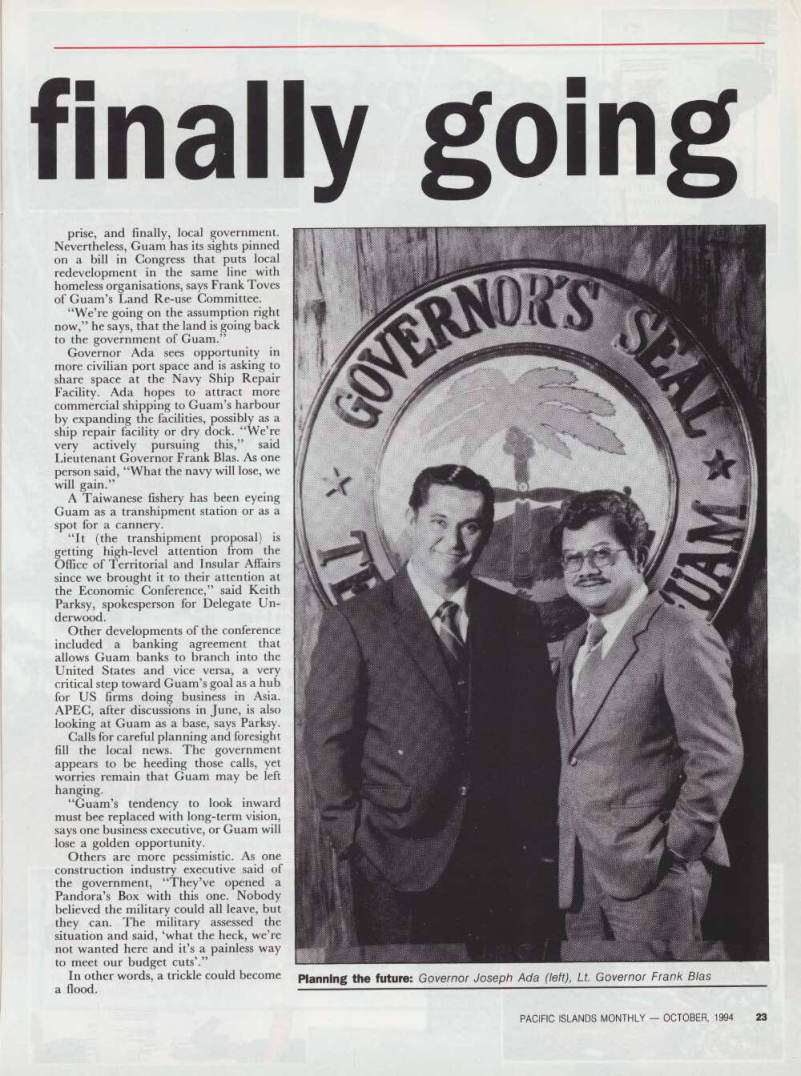
Today, Governor Ada’s Guam Re-Use Committee, headed by Lt. Governor Frank Bias, is planning for a future independent of the military. Innovation and long-range thinking are what are needed. However, the luxury of time is not on the government’s side. Nor is the blessing of continuity. A new administra tion will come on board next month as Ada’s term ends.
But as Bias notes, “the private-sector involvement on the committee will mitigate any administration change. The driving force is the business and com munity and because of that I wouldn’t think there would be major disruption.”
To understand the earnestness of the government and private sector, one need only look at the figures. In fiscal year 1993, the US military contributed $748 million to Guam’s economy, according to navy spokesperson Lt. Kelly Merrell.
The military paid civilians $lBO million, and paid $52.6 million in taxes to the Government of Guam.
The Department of Education re ceived $11.5 million in Department of Defence subsidies in 1993, according to
Silvia Monkres, Department of Educa tion spokesperson.
In 1993, according to Merrell, total active duty military personnel numbered 10,639, supporting another 11,447 de pendents. The majority are navy re cruits, numbering 7836. Air Force fol lows with 2550. Marines in 1992 reduced ranks from 334 to 55. Army and Coast Guard contribute 198. Civilians on the payroll number 8971.
Today, only one of the original six hom-imported navy ships is scheduled to remain, the marines have all but ledt, all three naval air squadrons are scheduled to leave, and a navy helicopter squadron will move to Andersen Air Force Base.
According to Merrel, navy personnel will be reduced by approximately 2100.
Conceivably, Guam could see military numbers decline by one-fourth to one third from 1992 figures.
A January Department of Defence report listed the two air squadrons as slated to depart, but no official word had been released at the time of this writing.
Conceivably, Guam could see military numbers decline by one-quarter to one third from 1992 figures.
What this means for the economy is clear less revenue through taxes, fewer military dollars for education, and civ ilian personnel facing layoffs. Indirect contributions include air traffic control, some local business revenue, and the prized commissary privileges that many Guam residents now enjoy.
On the positive side, the departures ease housing shortages, release more land, free up a major port, and lessen
island congestion.
The call for less military could be viewed as just one more step in the island’s move to loosen US ties. As Guam strides toward possible Commonwealth
status, the Government of Guam and private industry step forward with inno vative ideas and solutions to guide it through its evolution.
Congressional delegate Robert Under
wood is one of those guiding Guam into the future. This June, Underwood will host the Capitol Hill Economic Confer ence in Washington, D.C., where Guam community leaders will be introduced to contacts and sources critical to Guam’s future.
Island will be selling Guam as a base for operations to those seeking to take advantage of Asia’s booming econ omy. Among those present will be individuals connected with Asia-Pacific
Economic Cooperation (APEC), a
loosely aligned group of 18 nations in Asia and the Pacific fostering economic ties as the Asian economies boom.
“To date,” says Underwood, “There has been no systematic way for Guam to participate in the discussions of regional economic activity. APEC is that larger
systematic way.” He explains that while
the State Department would not allow Guam to join APEC as a member state, Guam can pursue interests as a member economy, or a working group of experts unconnected to political membership of APEC.Currently, Hawaii is taking the
most advantage of this “working group”
status.
“The train is leaving the station and if we can’t be on the first car, we’ll be in the caboose.”
The land freed up from the base closure is making many mouths water.
Guam International Airport has its eye on the land for future expansion, some see industrial parks, others see rec reational parks, and still others just want their land back. How the Navy will treat that land is an open question.
Federal law states that first priority for bids on excess land should go to homeless
organisations, followed by private enter
prise, and finally, local government.
Nevertheless, Guam has its sights pinned on a bill in Congress that puts local redevelopment in the same line with homeless organisations, says Frank Toves of Guam’s Land Re-use Committee.
“We’re going on the assumption right
now,” he says, that the land is going back to the government of Guam.”
Governor Ada sees opportunity in more civilian port space and is asking to share space at the Navy Ship Repair Facility. Ada hopes to attract more commercial shipping to Guam’s harbour by expanding the facilities, possibly as a ship repair facility or dry dock. “We’re
very actively pursuing this,” said
Lieutenant Governor Frank Bias. As one person said, “What the navy will lose, we
will gain.”
A Taiwanese fishery has been eyeing Guam as a transhipment station or as a spot for a cannery.
“It (the transhipment proposal) is
getting high-level attention from the Office of Territorial and Insular Affairs since we brought it to their attention at the Economic Conference,” said Keith
Parksy, spokesperson for Delegate Un
derwood.
Other developments of the conference included a banking agreement that allows Guam banks to branch into the United States and vice versa, a very critical step toward Guam’s goal as a hub for US firms doing business in Asia.
APEC, after discussions in June, is also looking at Guam as a base, says Parksy.
Calls for careful planning and foresight fill the local news. The government appears to be heeding those calls, yet worries remain that Guam may be left
hanging.
“Guam’s tendency to look inward must bee replaced with long-term vision, says one business executive, or Guam will
lose a golden opportunity.
Others are more pessimistic. As one construction industry executive said of the government, “They’ve opened a Pandora’s Box with this one. Nobody believed the military could all leave, but they can. The military assessed the situation and said, ‘what the heck, we’re not wanted here and it’s a painless way to meet our budget cuts’.”
In other words, a trickle could become a flood.
Planning the future: Governor Joseph Ada (left), Lt. Governor Frank Bias
Advertisements & other items, p. 26 (1 item)
throughout Papua
► ■it jm
iW'iWYu
- K' - • I I N.
V h
throughout Papua
>■* V JL s.
mm- M * <T> • /# a . 9 w 4* ' ■ * IT
fST.x- 4 y
. .# -V- v*. -■„> . «.- - • rmm ; ■ .-• ■
JK it
-HBf i« ■ • .^n/4tr
%>sVr Hi
NICATION CORPO
; * 'V a.- V , -j fiJm&kJNi- -5* .IM@= -i
The Cairo agenda
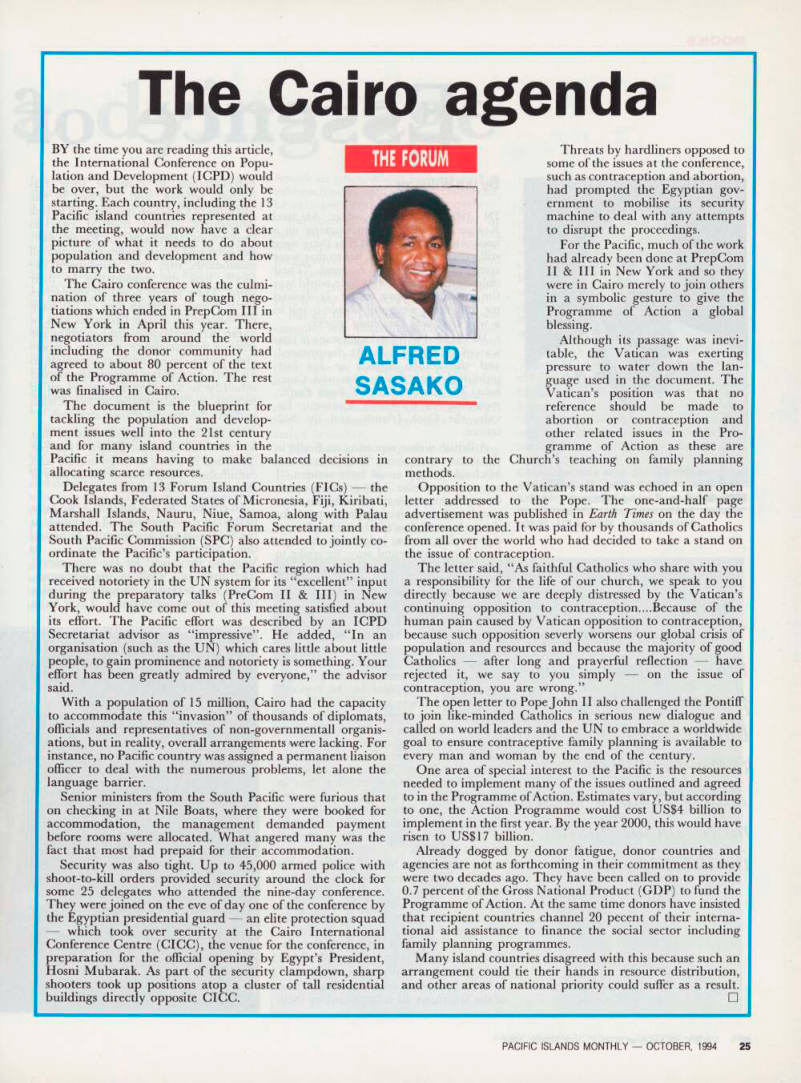
BY the time you are reading this article, the International Conference on Popu lation and Development (ICPD) would be over, but the work would only be starting. Each country, including the 13 Pacific island countries represented at the meeting, would now have a clear picture of what it needs to do about population and development and how to marry the two.
The Cairo conference was the culmi nation of three years of tough nego tiations which ended in Prep Com 111 in New York in April this year. There, negotiators from around the world including the donor community had agreed to about 80 percent of the text of the Programme of Action. The rest was finalised in Cairo.
The document is the blueprint for tackling the population and develop ment issues well into the 21st century and for many island countries in the
Pacific it means having to make balanced decisions in allocating scarce resources.
Delegates from 13 Forum Island Countries (FICs) the Cook Islands, Federated States of Micronesia, Fiji, Kiribati, Marshall Islands, Nauru, Niue, Samoa, along with Palau attended. The South Pacific Forum Secretariat and the South Pacific Commission (SPC) also attended to jointly co ordinate the Pacific’s participation.
There was no doubt that the Pacific region which had received notoriety in the UN system for its “excellent” input during the preparatory talks (PreCom II & III) in New York, would have come out of this meeting satisfied about its effort. The Pacific effort was described by an ICPD Secretariat advisor as “impressive”. He added, “In an organisation (such as the UN) which cares little about little people, to gain prominence and notoriety is something. Your effort has been greatly admired by everyone,” the advisor said.
With a population of 15 million, Cairo had the capacity to accommodate this “invasion” of thousands of diplomats, officials and representatives of non-governmentall organis ations, but in reality, overall arrangements were lacking. For instance, no Pacific country was assigned a permanent liaison officer to deal with the numerous problems, let alone the language barrier.
Senior ministers from the South Pacific were furious that on checking in at Nile Boats, where they were booked for accommodation, the management demanded payment before rooms were allocated. What angered many was the fact that most had prepaid for their accommodation.
Security was also tight. Up to 45,000 armed police with shoot-to-kill orders provided security around the clock for some 25 delegates who attended the nine-day conference.
They were joined on the eve of day one of the conference by the Egyptian presidential guard an elite protection squad which took over security at the Cairo International Conference Centre (CICC), the venue for the conference, in preparation for the official opening by Egypt’s President, Hosni Mubarak. As part of the security clampdown, sharp shooters took up positions atop a cluster of tall residential buildings directly opposite CICC.
Threats by hardliners opposed to some of the issues at the conference, such as contraception and abortion, had prompted the Egyptian gov ernment to mobilise its security machine to deal with any attempts
to disrupt the proceedings.
For the Pacific, much of the work had already been done at Prep Com II & 111 in New York and so they were in Cairo merely to join others in a symbolic gesture to give the Programme of Action a global
blessing.
Although its passage was inevi table, the Vatican was exerting pressure to water down the lan guage used in the document. The Vatican’s position was that no reference should be made to abortion or contraception and other related issues in the Pro gramme of Action as these are
contrary to the Church’s teaching on family planning methods.
Opposition to the Vatican’s stand was echoed in an open letter addressed to the Pope. The one-and-half page advertisement was published in Earth Times on the day the conference opened. It was paid for by thousands of Catholics from all over the world who had decided to take a stand on the issue of contraception.
The letter said, “As faithful Catholics who share with you a responsibility for the life of our church, we speak to you directly because we are deeply distressed by the Vatican’s continuing opposition to contraception...Because of the human pain caused by Vatican opposition to contraception, because such opposition severly worsens our global crisis of population and resources and because the majority of good Catholics — after long and prayerful reflection — have rejected it, we say to you simply — on the issue of contraception, you are wrong.”
The open letter to Pope John II also challenged the Pontiff to join like-minded Catholics in serious new dialogue and called on world leaders and the UN to embrace a worldwide goal to ensure contraceptive family planning is available to every man and woman by the end of the century.
One area of special interest to the Pacific is the resources needed to implement many of the issues outlined and agreed to in the Programme of Action. Estimates vary, but according to one, the Action Programme would cost US$4 billion to implement in the first year. By the year 2000, this would have risen to US$17 billion.
Already dogged by donor fatigue, donor countries and agencies are not as forthcoming in their commitment as they were two decades ago. They have been called on to provide 0.7 percent of the Gross National Product (GDP) to fund the Programme of Action. At the same time donors have insisted that recipient countries channel 20 pecent of their interna tional aid assistance to finance the social sector including family planning programmes.
Many island countries disagreed with this because such an arrangement could tie their hands in resource distribution, and other areas of national priority could suffer as a result. □
The Forum
Alfred
Sasako
Essence of a dying age
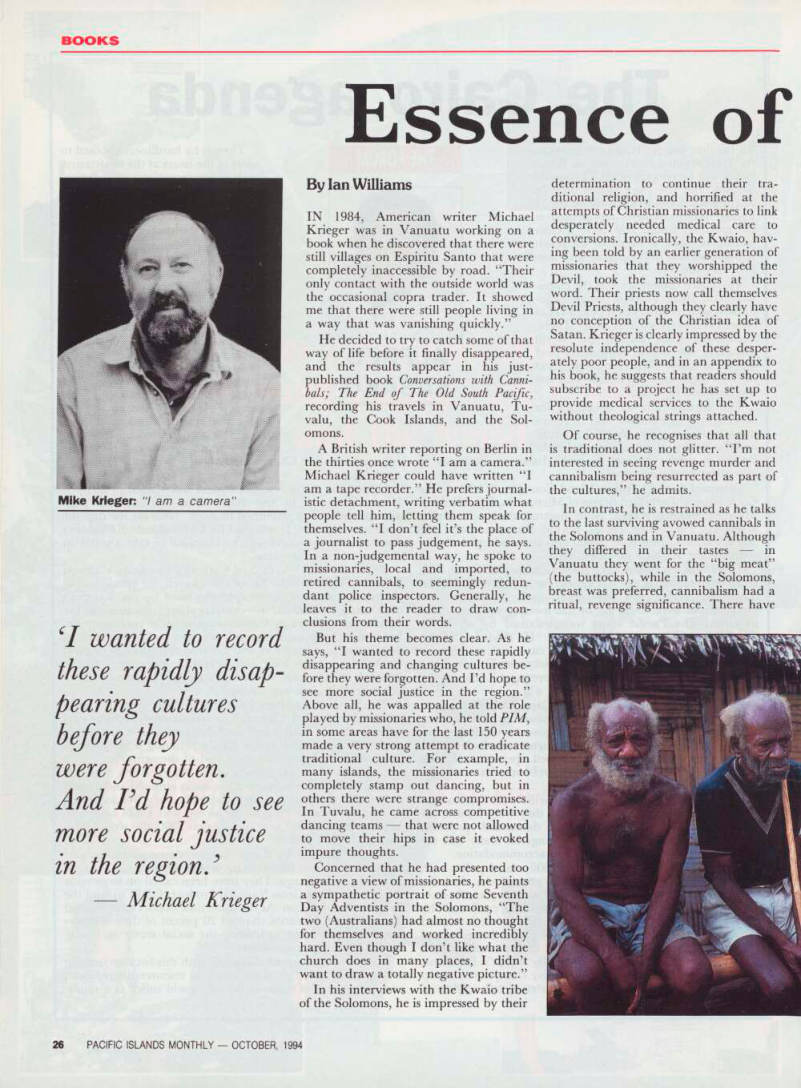
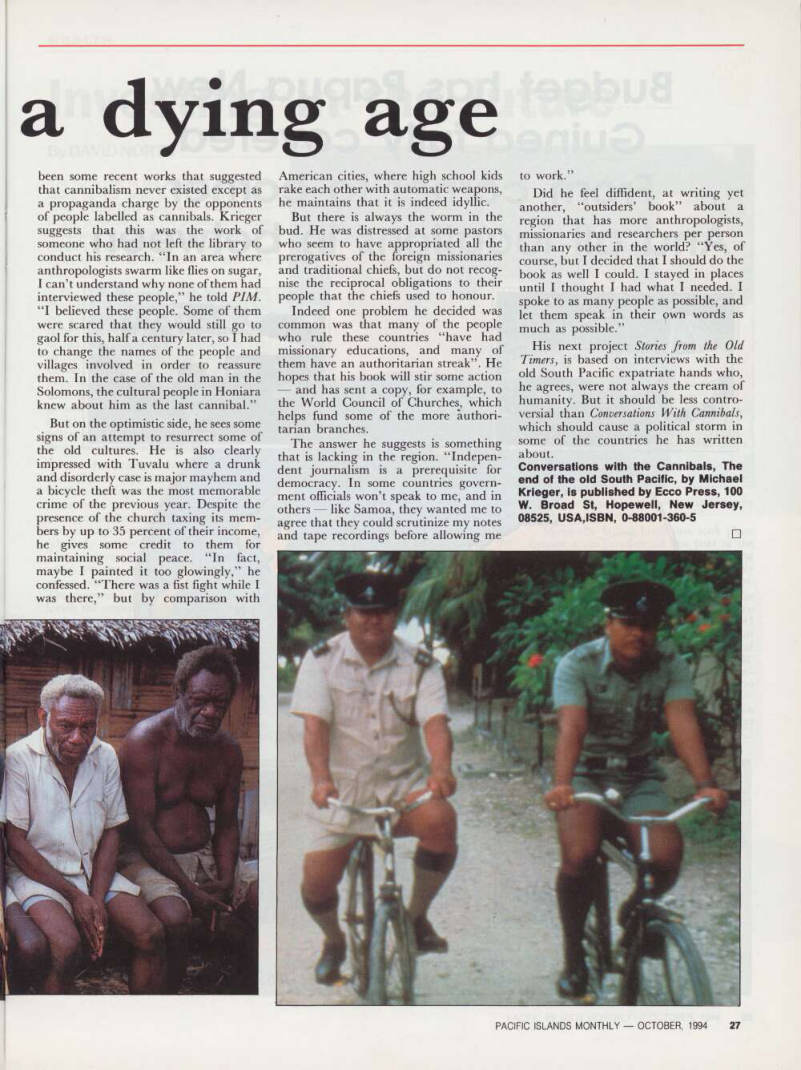
Books
By Ian Williams
‘I wanted to record these rapidly disap pearing cultures
before they
were forgotten.
And Pd hope to see more social justice in the region Michael Krieger
IN 1984, American writer Michael Krieger was in Vanuatu working on a book when he discovered that there were still villages on Espiritu Santo that were completely inaccessible by road. “Their only contact with the outside world was the occasional copra trader. It showed me that there were still people living in a way that was vanishing quickly.”
He decided to try to catch some of that way of life before it finally disappeared, and the results appear in his just published book Conversations with Canni bals; The End of The Old South Pacific, recording his travels in Vanuatu, Tu valu, the Cook Islands, and the Sol omons.
A British writer reporting on Berlin in the thirties once wrote “I am a camera.”
Michael Krieger could have written “I am a tape recorder.” He prefers journal istic detachment, writing verbatim what people tell him, letting them speak for themselves. “I don’t feel it’s the place of a journalist to pass judgement, he says.
In a non-judgemental way, he spoke to missionaries, local and imported, to retired cannibals, to seemingly redun
dant police inspectors. Generally, he
leaves it to the reader to draw con clusions from their words.
But his theme becomes clear. As he says, “I wanted to record these rapidly disappearing and changing cultures be fore they were forgotten. And I’d hope to see more social justice in the region.”
Above all, he was appalled at the role played by missionaries who, he told PIM, in some areas have for the last 150 years made a very strong attempt to eradicate traditional culture. For example, in many islands, the missionaries tried to completely stamp out dancing, but in others there were strange compromises.
In Tuvalu, he came across competitive dancing teams that were not allowed to move their hips in case it evoked
impure thoughts.
Concerned that he had presented too negative a view of missionaries, he paints a sympathetic portrait of some Seventh Day Adventists in the Solomons, “The two (Australians) had almost no thought for themselves and worked incredibly hard. Even though I don’t like what the church does in many places, I didn’t want to draw a totally negative picture.”
In his interviews with the Kwaio tribe of the Solomons, he is impressed by their
determination to continue their tra ditional religion, and horrified at the attempts of Christian missionaries to link desperately needed medical care to conversions. Ironically, the Kwaio, hav ing been told by an earlier generation of missionaries that they worshipped the Devil, took the missionaries at their word. Their priests now call themselves
Devil Priests, although they clearly have
no conception of the Christian idea of Satan. Krieger is clearly impressed by the resolute independence of these desper ately poor people, and in an appendix to his book, he suggests that readers should subscribe to a project he has set up to provide medical services to the Kwaio
without theological strings attached.
Of course, he recognises that all that is traditional does not glitter. “I’m not interested in seeing revenge murder and cannibalism being resurrected as part of the cultures,” he admits.
In contrast, he is restrained as he talks to the last surviving avowed cannibals in the Solomons and in Vanuatu. Although they differed in their tastes in Vanuatu they went for the “big meat” (the buttocks), while in the Solomons, breast was preferred, cannibalism had a ritual, revenge significance. There have
Mike Krieger: "I am a camera”
been some recent works that suggested that cannibalism never existed except as
a propaganda charge by the opponents
of people labelled as cannibals. Krieger suggests that this was the work of someone who had not left the library to conduct his research. “In an area where anthropologists swarm like flies on sugar, I can’t understand why none of them had interviewed these people,” he told PIM.
“I believed these people. Some of them were scared that they would still go to gaol for this, half a century later, so I had to change the names of the people and villages involved in order to reassure them. In the case of the old man in the Solomons, the cultural people in Honiara knew about him as the last cannibal.”
But on the optimistic side, he sees some signs of an attempt to resurrect some of the old cultures. He is also clearly impressed with Tuvalu where a drunk and disorderly case is major mayhem and a bicycle theft was the most memorable crime of the previous year. Despite the presence of the church taxing its mem bers by up to 35 percent of their income, he gives some credit to them for maintaining social peace. “In fact, maybe I painted it too glowingly,” he confessed. “There was a fist fight while I
was there,” but by comparison with
American cities, where high school kids rake each other with automatic weapons, he maintains that it is indeed idyllic.
But there is always the worm in the bud. He was distressed at some pastors who seem to have appropriated all the prerogatives of the foreign missionaries and traditional chiefs, but do not recognise the reciprocal obligations to their people that the chiefs used to honour.
Indeed one problem he decided was common was that many of the people who rule these countries “have had missionary educations, and many of them have an authoritarian streak”. He hopes that his book will stir some action and has sent a copy, for example, to the World Council of Churches, which helps fund some of the more authoritarian branches.
The answer he suggests is something that is lacking in the region. “Independent journalism is a prerequisite for democracy. In some countries government officials won’t speak to me, and in others like Samoa, they wanted me to agree that they could scrutinize my notes and tape recordings before allowing me
to work.”
Did he feel diffident, at writing yet another, “outsiders’ book” about a region that has more anthropologists, missionaries and researchers per person than any other in the world? “Yes, of course, but I decided that I should do the book as well I could. I stayed in places until I thought I had what I needed. I spoke to as many people as possible, and let them speak in their <pwn words as much as possible.”
His next project Stories from the Old Timers, is based on interviews with the old South Pacific expatriate hands who, he agrees, were not always the cream of humanity. But it should be less contro versial than Conversations With Cannibals , which should cause a political storm in some of the countries he has written about.
Conversations with the Cannibals, The end of the old South Pacific, by Michael Krieger, is published by Ecco Press, 100 W. Broad St, Hopewell, New Jersey,
08525, Usa,Isbn, 0-88001-360-5
Advertisements & other items, p. 30 (1 item)
Budget
has Papua New
Guinea fully covered
From corner to corner
And all locations in between
• •-3 m visi 540
BAJ
' Vs* Mam Kavieng Rabau Wewafek 'y .
Tabubl, M, Hagen <£■"» Mendi Kiunga N?
' Goroka ■> Lae Nadza * pondetta Por t« Moresby ATbtou
Budget
rentacar**
ir Central Reservation - Port Moresby Phone: (675) 25 4111 Fax: (675) 25 7853
Investing in the future

Health
By David North
The birth rate in the Marshall Islands has fallen by one third in the last five years.
With a tiny land base, and with an ever
larger percentage of the population living
in Majuro (the capital), the nation’s leaders decided a few years ago to make a major effort to cut the birth rate and they succeeded.
In 1989 the birth rate was 35 per thousand; families until quite recently had an average of eight members; half the babies were born within two years of an earlier birth; and teenage pregnancies were increasing. As a result of all this, the 1988 census showed an annual increase in population of 4.2 per thousand, a statistic that topped some of the world population
growth tables, as reported by international
health agencies. For 1993 the rate had fallen to 23.5 per thousand, a remarkable decrease in such a short time.
How did Marshall Islands do it? First,
the religious objections which complicate
family planning activities in some Catholic areas were not a factor. Second, the government had enough up-front money and enough courage to make use of a relatively new technique called Norplant.
This involves a minor surgical procedure in which six tiny tubes are inserted into the upper arm of an otherwise fertile woman.
The operation can be done quickly, and leaves the woman with a slightly sore arm and a band-aid for a few days.
It also leaves her highly unlikely to become pregnant for the next five years, or until the tubes are surgically removed from her arm.
The up-front costs of the procedure, however, often discourage individuals and governments from using Norplant.
According to Mona Miller of the Planned
Parenthood Federation in Washington, this amounts to about US$5OO a person. While five years of birth control pills cost about as much, that cost can be spread over the five years.
The Marshalls, with (for the next few years anyway) a continuing flow of Uncle Sam’s dollars, decided to go ahead and make the investment, as well as mounted other family planning programmes through its public health clinics.
According to a story in Saipan’s Marianas Variety, Marshalls leadership was chagrined by the nation’s standing in the published population statistics. Micheal Jenkins, a health planner, said, “A lot of the figures (that got quoted) are based on the 1988 Census. It was 4.2 percent ... but if that
figure is left unchecked it does not show any
change (until the next census).”
Marshall’s falling birth rate took place despite a major effort on the part of the government to improve the birth-reporting s y stem > f" intervention that probably decreased the number of unreported births.
Further, there is a strong likelihood that while there are fewer babies, the ones born re healthier than their older siblings. RMI * s spending money to encourage pregnant women to attend pre-natal clinics, and urges them to g i ve birth m t h e hospital.
This involves, among other things, trans porting outer-island pregnant women to Majuro in time for the expected birth another costly process, but again, an investment in the health of the next
generation. □
Advertisements & other items, pp. 31-34 (1 item)
SIE CLEAN WATER blasters
♦ BIG RANGE OF INDUSTRIAL MACHINES
* PRESSURES TO 4000 RSI
♦ WET, DRY VACS AND EXTRACTORS
* QUALITY PRODUCTS AFORDABLE PRICES
* HOT COLD AND STEAM BLASTERS
♦ FULL RANGE OF PARTS AND ACCESSORIES
AND VACS
SOME ISLAND
DISTRIBUTORSHIPS
STILL AVAILABLE
sfie C.U&*. \
RELIABLE PRODUCTS ... RELIABLE PEOPLE
AUSTRALIAN PUMP INDUSTRIES PTY. UNITED A.C.N. 061619 234
PHONE; (61-2) 6551541 FAX (612) 6551689
„iiTl Big hot water blasters like Aussie Pump’s Top-Pro range can be used for engine or transmission Jobs.
9.
Vr ,~s
Toyota Land Cruiser offers you more
rugged reliability, elegant luxury...
and long-lasting durability.
Land Cruiser’s reputation is second to none. No one doubts its rugged constitution. Yet here is a vehicle that rivals the finest limousines where comfort is concerned. And its fit and finish, the attention to detail, and the graceful lines and fine trim are reminiscent of exquisite luxury cars.
Nevertheless, hidden beneath its elegance, Land Cruisers still offer tough ladder frames and suspension engineered to go wherever you wish... in total comfort powered by your choice of 4.5-litre petrol or 4. 2 -litre diesel engines. And everything is carefully protected from rust and corrosion so it lasts longer.
Toyota Land Cruiser. The best for your world.
Now and forever.
DISTRIBUTORS/DEALERS
AMERICAN SAMOA...
GUAM & MICRONESIA
NORFOLK ISLAND
SOLOMON ISLAND
VANUATU
BURNS PHILP MOTORS PH 633-4281
ATKINS KROLL, INC. PH 646-1876/9
BORRY’SPTYLTD. PH 22114
ELA MOTORS PH 30746
ASCO MOTORS PH 22341
COOK ISLANDS
KIRIBATI
PAPUA NEW GUINEA
TAHITI
WESTERN SAMOA...
PACIFIC MOTORS LTD PH 20796
TARAWA MOTORS PH 21090
ELA MOTORS PH 229400
NIPPON AUTOMOTO PH 429819
ASCO MOTORS PH 23664
FIJI ASCO MOTORS
NEW CALEDONIA S.I.A.P.
SAIPAN MICROL CORPORATION
TONGA ASCO MOTORS
i ... r*v>~—. " -'^ *-**■ - S3V sssaiifiMar^:;^ i&ai EH
LAND CRUISER
LAND CRUISER
3jßgS»p**
Exact features and specifications may vary depending on country of purchase. Please check with your nearest TOYOTA distributor/dealer for details.
PH312666 PH 275562 PH 234-5911 PH 23500
® TOYOTA
: & f '* w m * /
cy A.
f / f m ' k; *• a#* me'. kk m,*
HRST CLASS SERVICE WITH
A BUSINESS CLASS TAG.
The tabua (pronounced “tam-boo-a”) plays a significant role in Fijian culture and ceremony.
This highly prized tooth of the sperm whale is used ceremonially as a symbol of respect. Tabua Class’ therefore, seemed a very appropriate name for this very special class of service on all Air Pacific international flights.
Tabua Class’ is unique to Air Pacific. It represents a combination of gracious hospitality, for which Fijians are famous the world over, and a level of service, meals, drinks and appointments you would normally find in a first class cabin.
And all of this is provided at what is equivalent to a normal business class fare.
Tabua Class - only on Air Pacific.
rJUK
PACIFIC
FIJI'S INTERNATIONAL AIRLINE
SUVA • NADI • MELBOURNE • SYDNEY • BRISBANE • AUCKLAND • CHRISTCHURCH • TOKYO • OSAKA • LOS ANGELES • APIA • PORT VILA • TONGA • HONIARA
WILSON-ADDISON 07.692
Welcome to Fiji
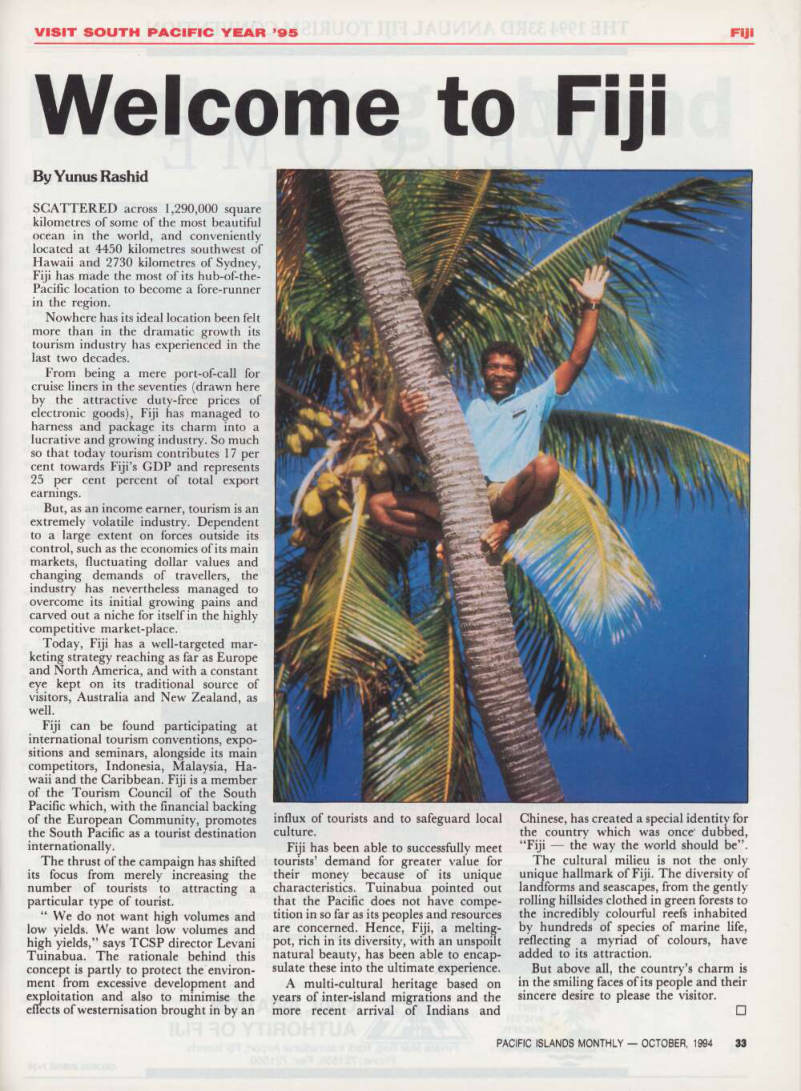
Visit South Pacific Year '95
Fiji
By Yunus Rashid
SCATTERED across 1,290,000 square kilometres of some of the most beautiful ocean in the world, and conveniently located at 4450 kilometres southwest of Hawaii and 2730 kilometres of Sydney, Fiji has made the most of its hub-of-the- Pacific location to become a fore-runner in the region.
Nowhere has its ideal location been felt more than in the dramatic growth its tourism industry has experienced in the last two decades.
From being a mere port-of-call for cruise liners in the seventies (drawn here by the attractive duty-free prices of electronic goods), Fiji has managed to harness and package its charm into a lucrative and growing industry. So much so that today tourism contributes 17 per cent towards Fiji’s GDP and represents 25 per cent percent of total export earnings.
But, as an income earner, tourism is an
extremely volatile industry. Dependent
to a large extent on forces outside its control, such as the economies of its main markets, fluctuating dollar values and changing demands of travellers, the industry has nevertheless managed to overcome its initial growing pains and carved out a niche for itself in the highly competitive market-place.
Today, Fiji has a well-targeted mar keting strategy reaching as far as Europe and North America, and with a constant eye kept on its traditional source of visitors, Australia and New Zealand, as well.
Fiji can be found participating at international tourism conventions, expo sitions and seminars, alongside its main competitors, Indonesia, Malaysia, Ha waii and the Caribbean. Fiji is a member of the Tourism Council of the South Pacific which, with the financial backing of the European Community, promotes the South Pacific as a tourist destination
internationally.
The thrust of the campaign has shifted its focus from merely increasing the number of tourists to attracting a particular type of tourist.
“ We do not want high volumes and low yields. We want low volumes and high yields,” says TCSP director Levani Tuinabua. The rationale behind this concept is partly to protect the environ ment from excessive development and exploitation and also to minimise the effects of westernisation brought in by an
influx of tourists and to safeguard local culture.
Fiji has been able to successfully meet tourists’ demand for greater value for their money because of its unique characteristics. Tuinabua pointed out that the Pacific does not have compe tition in so far as its peoples and resources are concerned. Hence, Fiji, a melting pot, rich in its diversity, with an unspoilt natural beauty, has been able to encap sulate these into the ultimate experience.
A multi-cultural heritage based on years of inter-island migrations and the more recent arrival of Indians and
Chinese, has created a special identity for the country which was once dubbed, “Fiji the way the world should be”.
The cultural milieu is not the only unique hallmark of Fiji. The diversity of landforms and seascapes, from the gently rolling hillsides clothed in green forests to the incredibly colourful reefs inhabited by hundreds of species of marine life, reflecting a myriad of colours, have added to its attraction.
But above all, the country’s charm is in the smiling faces of its people and their sincere desire to please the visitor, □
Advertisements & other items, p. 36 (1 item)
Welcome
THE 1994 33RD ANNUAL FIJI TOURISM CONVENTION
£ m The convention is important The 1994 Fiji Tourism Convention is an opportunity for both local and overseas delegates to explore ways in which our industry can grow and be improved. These are important deliberations for they have influence on the future direction of tourism.
A tradition of welcome While the convention will focus on tourism issues, it does so in a country that has always welcomed the visitor. It is one of our greatest strengths.
At Nadi International Airport, we have kept this tradition alive and well since we opened in 1946.
A most enjoyable visit All of the staff at CAAF welcome our overseas visitors to the Fiji Tourism Convention and wish them a most enjoyable stay in the country. *
VISIT
, SOUTH
pacific
YEAR '95
CIVIL AVIATION
AUTHORITY OF FIJI
Private Mail Bag, Nadi International Airport, Fiji Islands.
Phone; 721555. Fax: 721500.
GEORGE RUBINE 7*39
Marketing abroad
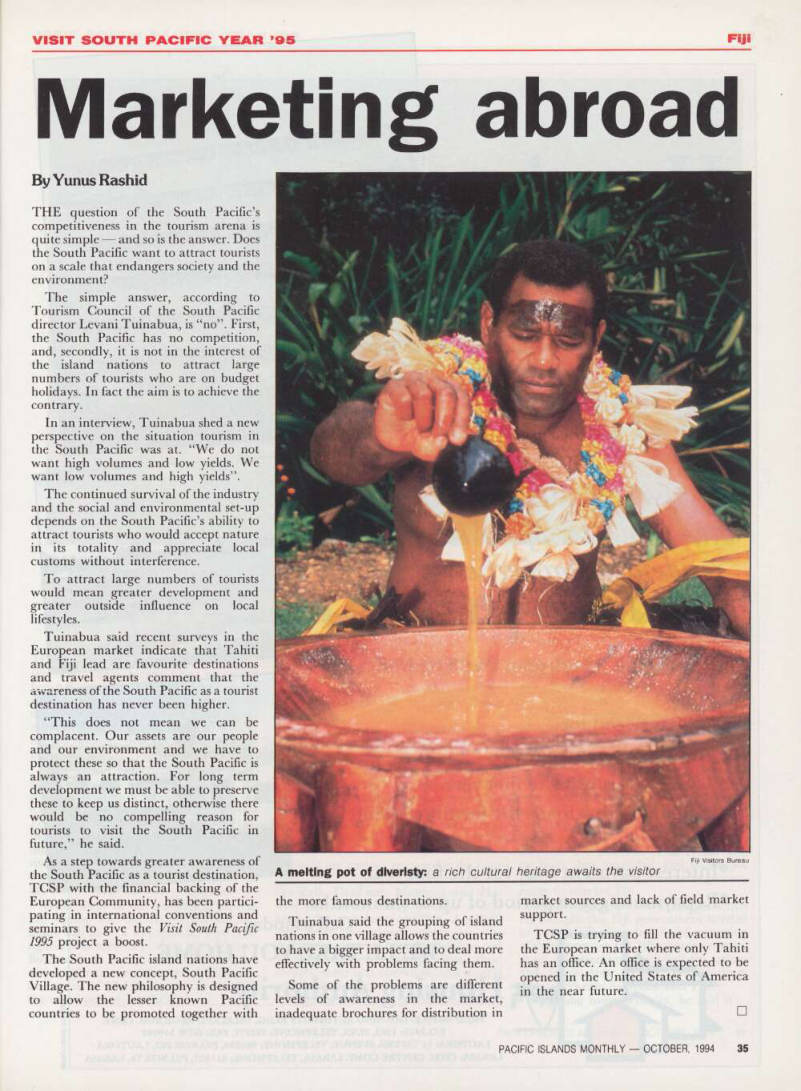
By Yunus Rashid
THE question of the South Pacific’s competitiveness in the tourism arena is quite simple and so is the answer. Does the South Pacific want to attract tourists on a scale that endangers society and the environment?
The simple answer, according to Tourism Council of the South Pacific director Levani Tuinabua, is “no”. First, the South Pacific has no competition, and, secondly, it is not in the interest of the island nations to attract large numbers of tourists who are on budget holidays. In fact the aim is to achieve the contrary.
In an interview, Tuinabua shed a new perspective on the situation tourism in the South Pacific was at. “We do not want high volumes and low yields. We want low volumes and high yields”.
The continued survival of the industry and the social and environmental set-up depends on the South Pacific’s ability to attract tourists who would accept nature in its totality and appreciate local customs without interference.
To attract large numbers of tourists would mean greater development and greater outside influence on local
lifestyles.
Tuinabua said recent surveys in the European market indicate that Tahiti and Fiji lead are favourite destinations and travel agents comment that the awareness of the South Pacific as a tourist destination has never been higher.
“This does not mean we can be complacent. Our assets are our people and our environment and we have to protect these so that the South Pacific is always an attraction. For long term development we must be able to preserve these to keep us distinct, otherwise there would be no compelling reason for tourists to visit the South Pacific in future,” he said.
As a step towards greater awareness of the South Pacific as a tourist destination, TCSP with the financial backing of the
European Community, has been partici
pating in international conventions and seminars to give the Visit South Pacific 1995 project a boost.
The South Pacific island nations have developed a new concept, South Pacific
Village. The new philosophy is designed
to allow the lesser known Pacific countries to be promoted together with
the more famous destinations.
Tuinabua said the grouping of island nations in one village allows the countries to have a bigger impact and to deal more effectively with problems facing them.
Some of the problems are different levels of awareness in the market, inadequate brochures for distribution in
market sources and lack of field market support.
TCSP is trying to fill the vacuum in the European market where only Tahiti has an office. An office is expected to be opened in the United States of America in the near future. □
Fiji Visitors Bureau A melting pot of diveristy: a rich cultural heritage awaits the visitor
Advertisements & other items, pp. 37-38 (2 items)
35
Fiji
PACIFIC ISLANDS MONTHLY OCTOBER, 1994
VISIT SOUTH PACIFIC YEAR ’95
Housing
The
Nation
Housing Authority, Fiji’s number
one producer of
residential properties.
Take Advantage Of These Offers: Ready built 2 bedroom and 3 bedroom houses Fully serviced lots
Mortgage financing
*9.5% interest for the first year. *Home comfort loans for furniture, white
goods, etc.
*lnterest payment only for the first year. *Repayment grace period of up to six months.
Call us today
WE’LL TAKE YOU HOME
m ■M a y •Vi*- S&Bf? •Til'l Iff! -,"T
Housing Authority
HEAD OFFICE: HOUSING AUTHORITY BLDG. VALELEVU REGIONAL CENT.
P.0.80X: 1263, SUVA, TELEPHONE: 392977, FAX: (679) 340092 LAUTOKA: 14 TAVEWA AVENUE. TELEPHONE: 660299, P.0.80X 262, LAUTOKA LABASA: CIVIC CENTRE COMP. LABASA, TELEPHONE: 811977, P.0.80X 78, LABASA
Room to improve
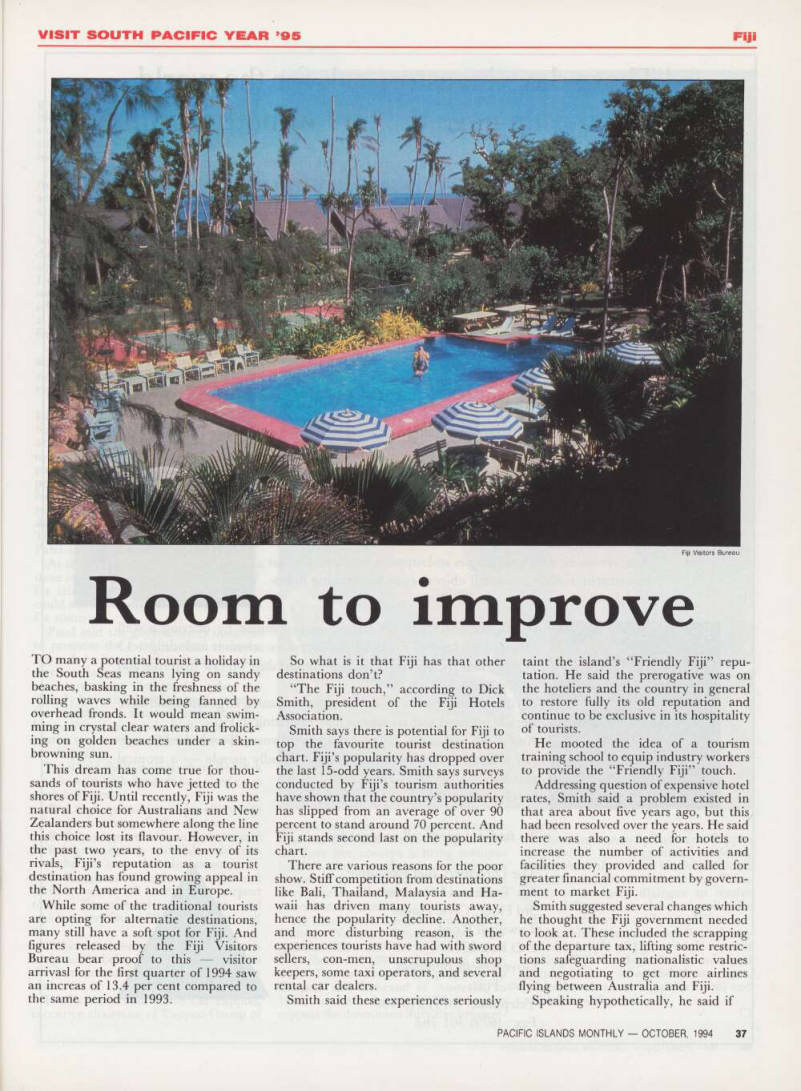

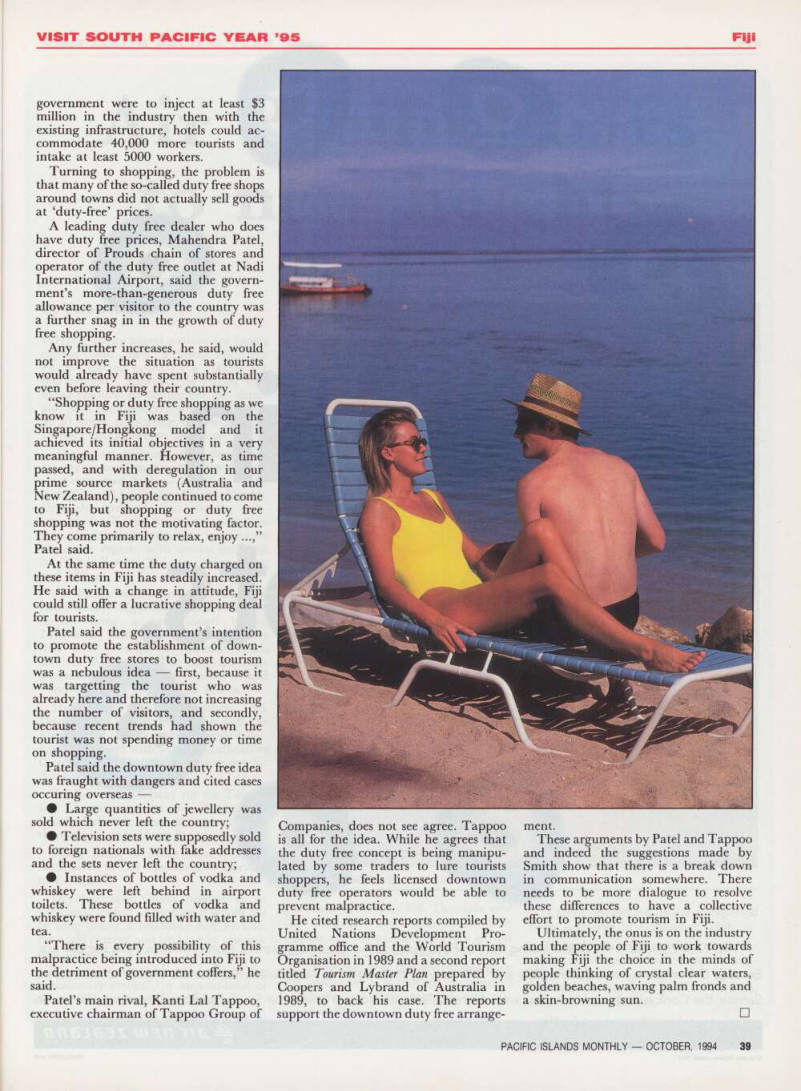
TO many a potential tourist a holiday in the South Seas means lying on sandy beaches, basking in the freshness of the
rolling waves while being fanned by
overhead fronds. It would mean swimming in crystal clear waters and frolicking on golden beaches under a skin-
browning sun.
This dream has come true for thousands of tourists who have jetted to the shores of Fiji. Until recently, Fiji was the natural choice for Australians and New Zealanders but somewhere along the line this choice lost its flavour. However, in the past two years, to the envy of its rivals, Fiji’s reputation as a tourist destination has found growing appeal in the North America and in Europe.
While some of the traditional tourists are opting for alternatie destinations, many still have a soft spot for Fiji. And
figures released by the Fiji Visitors
Bureau bear proof to this visitor arrivasl for the first quarter of 1994 saw an increas of 13.4 per cent compared to the same period in 1993.
So what is it that Fiji has that other destinations don’t?
“The Fiji touch,” according to Dick Smith, president of the Fiji Hotels Association.
Smith says there is potential for Fiji to top the favourite tourist destination chart. Fiji’s popularity has dropped over the last 15-odd years. Smith says surveys conducted by Fiji’s tourism authorities have shown that the country’s popularity has slipped from an average of over 90 percent to stand around 70 percent. And Fiji stands second last on the popularity chart.
There are various reasons for the poor show. Stiff competition from destinations like Bali, Thailand, Malaysia and Hawaii has driven many tourists away, hence the popularity decline. Another, and more disturbing reason, is the experiences tourists have had with sword sellers, con-men, unscrupulous shop keepers, some taxi operators, and several rental car dealers.
Smith said these experiences seriously
taint the island’s “Friendly Fiji” repu tation. He said the prerogative was on the hoteliers and the country in general to restore fully its old reputation and continue to be exclusive in its hospitality °f tourists.
He mooted the idea of a tourism
training school to equip industry workers
to provide the “Friendly Fiji” touch,
Addressing question of expensive hotel
rates, Smith said a problem existed in that area about five years ago, but this had been resolved over the years. He said there was also a need for hotels to increase the number of activities and facilities they provided and called for greater financial commitment by govern ment to market Fiji.
Smith suggested several changes which he thought the Fiji government needed to look at. These included the scrapping of the departure tax, lifting some restric tions safeguarding nationalistic values and negotiating to get more airlines flying between Australia and Fiji, Speaking hypothetically, he said if
Fiji Visitors Bureau
government were to inject at least $3 million in the industry then with the existing infrastructure, hotels could ac commodate 40,000 more tourists and intake at least 5000 workers.
Turning to shopping, the problem is that many of the so-called duty free shops around towns did not actually sell goods at ‘duty-free’ prices.
A leading duty free dealer who does have duty free prices, Mahendra Patel, director of Prouds chain of stores and operator of the duty free outlet at Nadi International Airport, said the govern ment’s more-than-generous duty free allowance per visitor to the country was a further snag in in the growth of duty
free shopping.
Any further increases, he said, would not improve the situation as tourists would already have spent substantially even before leaving their country.
“Shopping or duty free shopping as we know it in Fiji was based on the Singapore/Hongkong model and it achieved its initial objectives in a very meaningful manner. However, as time passed, and with deregulation in our prime source markets (Australia and New Zealand), people continued to come to Fiji, but shopping or duty free shopping was not the motivating factor.
They come primarily to relax, enjoy ...,”
Patel said.
At the same time the duty charged on these items in Fiji has steadily increased.
He said with a change in attitude, Fiji could still offer a lucrative shopping deal for tourists.
Patel said the government’s intention to promote the establishment of down town duty free stores to boost tourism was a nebulous idea first, because it was targetting the tourist who was already here and therefore not increasing the number of visitors, and secondly, because recent trends had shown the tourist was not spending money or time on shopping.
Patel said the downtown duty free idea was fraught with dangers and cited cases occuring overseas • Large quantities of jewellery was sold which never left the country; • Television sets were supposedly sold to foreign nationals with fake addresses and the sets never left the country; • Instances of bottles of vodka and whiskey were left behind in airport toilets. These bottles of vodka and whiskey were found filled with water and tea.
“There is every possibility of this malpractice being introduced into Fiji to the detriment of government coffers,” he said.
Patel’s main rival, Kanti Lai Tappoo, executive chairman of Tappoo Group of
Companies, does not see agree. Tappoo is all for the idea. While he agrees that the duty free concept is being manipulated by some traders to lure tourists shoppers, he feels licensed downtown duty free operators would be able to prevent malpractice.
He cited research reports compiled by United Nations Development Programme office and the World Tourism Organisation in 1989 and a second report titled Tourism Master Plan prepared by Coopers and Lybrand of Australia in 1989, to back his case. The reports support the downtown duty free arrange-
ment.
These arguments by Patel and Tappoo and indeed the suggestions made by Smith show that there is a break down in communication somewhere. There needs to be more dialogue to resolve these differences to have a collective effort to promote tourism in Fiji.
Ultimately, the onus is on the industry and the people of Fiji to work towards making Fiji the choice in the minds of people thinking of crystal clear waters, golden beaches, waving palm fronds and a skin-browning sun. □
Advertisements & other items, pp. 39-42 (3 items)
Fiji
VISIT SOUTH PACIFIC YEAR *95
ZiilX
“These days investors ask for the world.
Now they can have the best of both worlds”
Fiji offers many opportunities for the investor. Tax holidays, freedom to repatriate capital and profits, import duty waivers and concessions, export incentives, export promotions incentives and assistance under the Hotels, Aid Act are some of these.
To make these opportunities readily available to you the Fiji Trade and Investment Board (FTIB) extends its “One-Stop-Shop” service to assist and expedite your investment proposal. Government approvals can be obtained with FTIB assistance in less than 8 weeks.
You can also receive preferential access to Australia and New Zealand markets under SPARTECA, to Europe under the LOME Agreement and to the United States, Canada and Japanese markets under the GSP Agreement. —m ggS *** * Other advantages include: An adaptable, productive, industrially disciplined and English speaking labour force with competitive wage rates.
Sophisticated telecommunication links with the rest of the world.
A well developed infrastructure, including electricity, water supplies and internal communications.
Availability of factory land and buildings at reasonable rates.
Well developed banking and financing institutions providing full ongoing financial services.
A government which welcomes and supports local and foreign investment, within its overall objectives of accelerating industrial development.
Fiji Government policies encourage investment by offering a well balanced package of financial and incentive schemes including a 13 year tax holiday and freedom from import duty on raw materials and
capital goods.
An illustrious list of local and foreign companies, large and small have already invested and are successfully operating in Fiji.
And at the end of the day you can reward yourself with the life-style Fiji is famous for, beautiful beaches, friendly people a tropical
paradise.
Invest in Fiji. “The best of both worlds”.
To find out more call or write to:- The Director/Chief Executive Fiji Trade and Investment Board 3rd Floor, Civic House Townhall Road P O Box 2303
Government Buildings
Suva, Fiji.
Telephone: (679) 315 988 Fax : (679) 301 783
ZiilX
FTIB
0 0 ®<2)
We join
the dots
m \ I Air New Zealand is the airline linking the Pacific islands to New Zealand, Australia, North America, Asia, the U.K. anc Europe. Our modern fleet of 7475, 767 s and 737 s now fly to Tonga, Fiji, New Caledonia, Norfolk Island, Tahiti, Western Samoa, the Cook Islands and Hawaii as well. Air New Zealand. No-one knows the South Padfic-and serves it-like we do. 0 air new ZEaiano © Air New Zealand Limited 1994. SAATCHI INI 0459
39
Fiji
PACIFIC ISLANDS MONTHLY OCTOBER, 1994
VISIT SOUTH PACIFIC YEAR ’95
Air Pacific soars
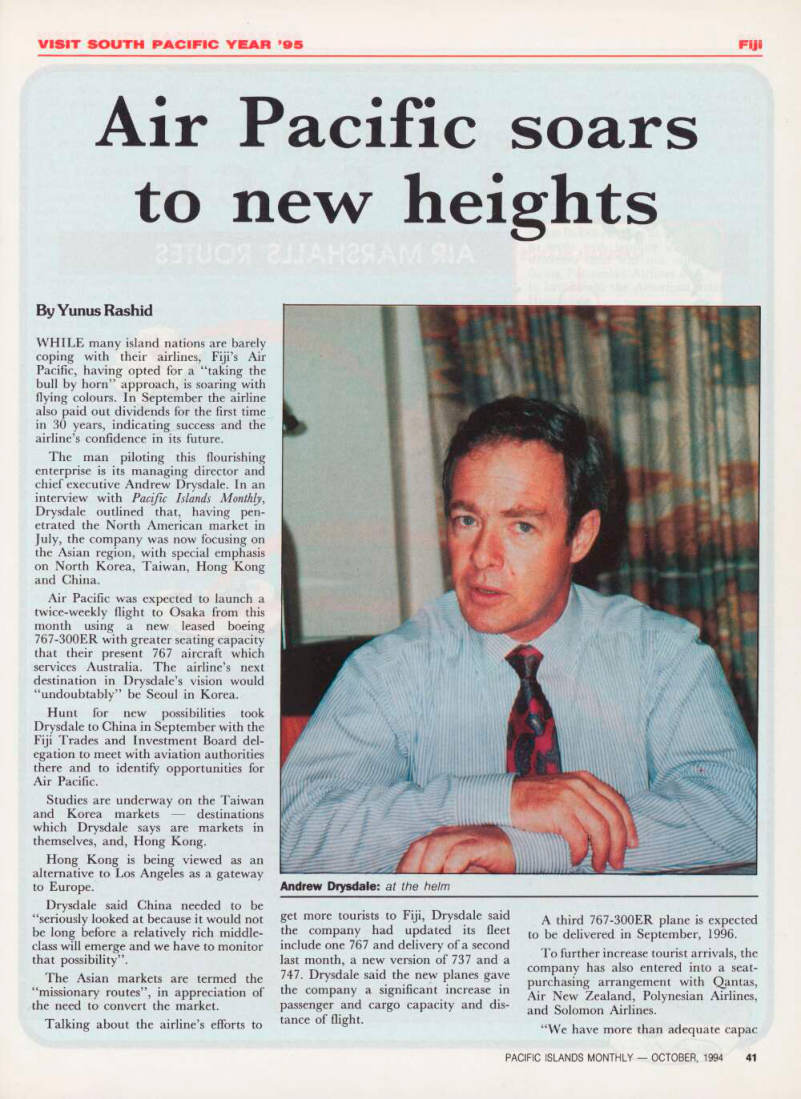
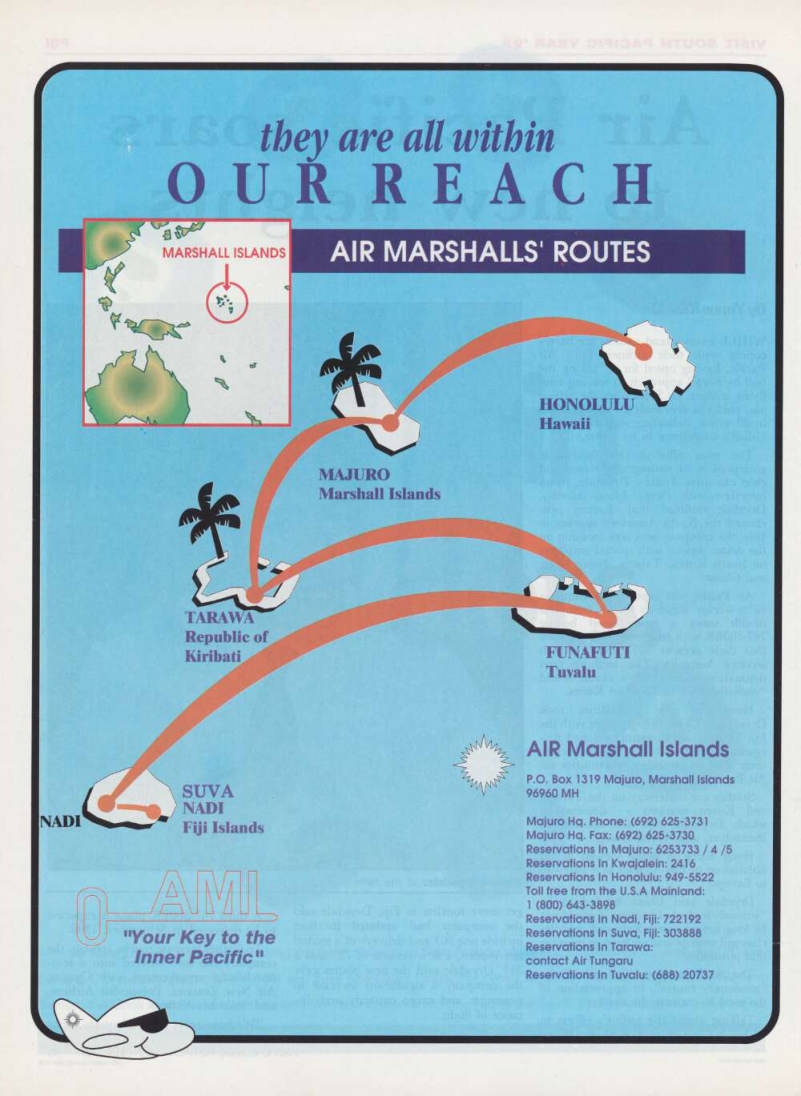
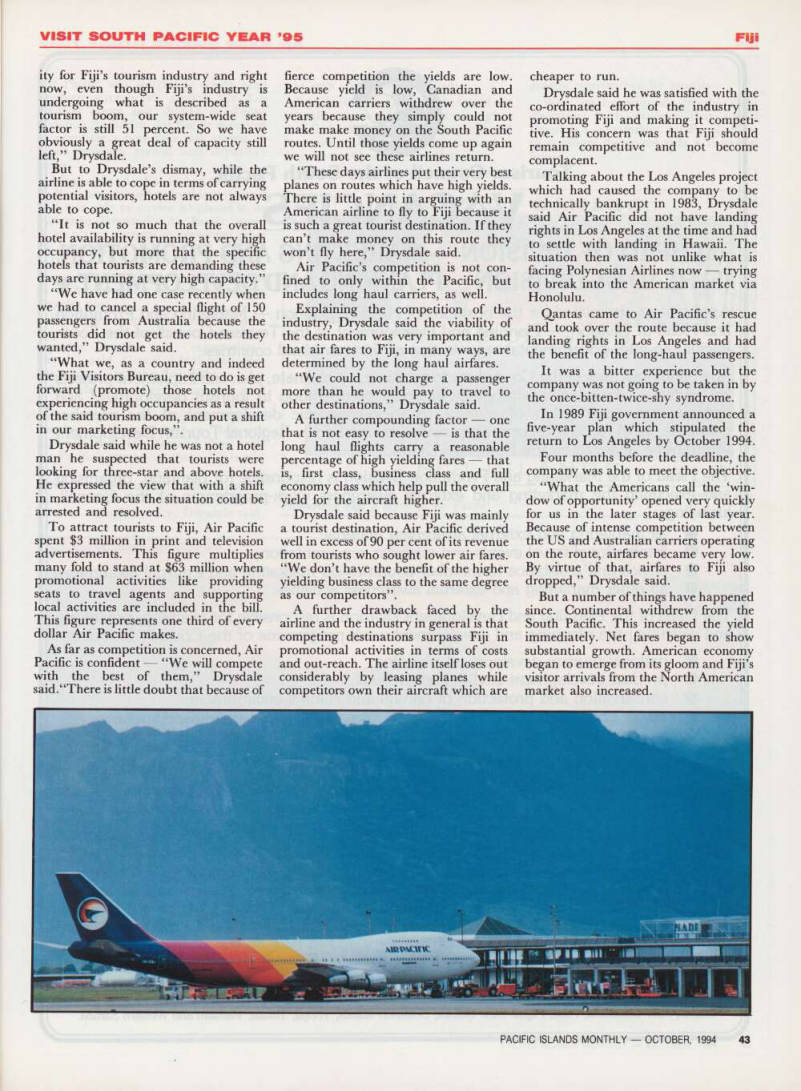
to new heights
By Yunus Rashid
WHILE many island nations are barely coping with their airlines, Fiji’s Air Pacific, having opted for a “taking the bull by horn” approach, is soaring with flying colours. In September the airline also paid out dividends for the first time in 30 years, indicating success and the airline’s confidence in its future.
The man piloting this flourishing enterprise is its managing director and chief executive Andrew Drysdale. In an interview with Pacific Islands Monthly , Drysdale outlined that, having pen etrated the North American market in July, the company was now focusing on
the Asian region, with special emphasis
on North Korea, Taiwan, Hong Kong
and China.
Air Pacific was expected to launch a twice-weekly flight to Osaka from this month using a new leased boeing 767-300 ER with greater seating capacity that their present 767 aircraft which services Australia. The airline’s next destination in Drysdale’s vision would “undoubtably” be Seoul in Korea.
Hunt for new possibilities took Drysdale to China in September with the Fiji Trades and Investment Board del egation to meet with aviation authorities there and to identify opportunities for Air Pacific.
Studies are underway on the Taiwan and Korea markets destinations which Drysdale says are markets in
themselves, and, Hong Kong.
Hong Kong is being viewed as an alternative to Eos Angeles as a gateway
to Europe.
Drysdale said China needed to be “seriously looked at because it would not be long before a relatively rich middle class will emerge and we have to monitor
that possibility”.
The Asian markets are termed the “missionary routes”, in appreciation of the need to convert the market.
Talking about the airline’s efforts to
get more tourists to Fiji, Drysdale said the company had updated its fleet include one 767 and delivery of a second last month, a new version of 737 and a 747. Drysdale said the new planes gave the company a significant increase in passenger and cargo capacity and dis tance of flight.
A third 767-300 ER plane is expected to be delivered in September, 1996.
To further increase tourist arrivals, the company has also entered into a seat purchasing arrangement with Qantas, Air New Zealand, Polynesian Airlines, and Solomon Airlines.
“We have more than adequate capac
Andrew Drysdale: at the helm
ity for Fiji’s tourism industry and right now, even though Fiji’s industry is undergoing what is described as a tourism boom, our system-wide seat factor is still 51 percent. So we have obviously a great deal of capacity still left,” Drysdale.
But to Drysdale’s dismay, while the airline is able to cope in terms of carrying potential visitors, hotels are not always able to cope.
“It is not so much that the overall hotel availability is running at very high occupancy, but more that the specific hotels that tourists are demanding these days are running at very high capacity.”
“We have had one case recently when we had to cancel a special flight of 150 passengers from Australia because the tourists did not get the hotels they wanted,” Drysdale said.
“What we, as a country and indeed the Fiji Visitors Bureau, need to do is get forward (promote) those hotels not experiencing high occupancies as a result of the said tourism boom, and put a shift in our marketing focus,”.
Drysdale said while he was not a hotel man he suspected that tourists were looking for three-star and above hotels.
He expressed the view that with a shift in marketing focus the situation could be arrested and resolved.
To attract tourists to Fiji, Air Pacific spent $3 million in print and television advertisements. This figure multiplies many fold to stand at $63 million when promotional activities like providing seats to travel agents and supporting local activities are included in the bill.
This figure represents one third of every dollar Air Pacific makes.
As far as competition is concerned, Air Pacific is confident — “We will compete with the best of them,” Drysdale said.“There is little doubt that because of
fierce competition the yields are low.
Because yield is low, Canadian and American carriers withdrew over the years because they simply could not make make money on the South Pacific routes. Until those yields come up again we will not see these airlines return.
“These days airlines put their very best Zu™ ? n J°y tes which have high yields.
T here 18 htt K P omt ar S u ! n g Wlth an • mei can air l me to fly to Fiji because it is such a great tourist destination. If they can t make money on this route they won t fly here, Drysdale said.
Air Pacific’s competition is not confined to only within the Pacific, but includes long haul carriers, as well.
Explaining the competition of the industry, Drysdale said the viability of the destination was very important and at aiT . to Fiji, m many ways, are determined by the long haul airfares.
“We could not charge a passenger more than he would pay to travel to other destinations,” Drysdale said.
A further compounding factor - one that is noe ~a sy resolvl-is that the long haul flights carry a reasonable percentage of high yielding fares that is, first class, business class and full economy class which help pull the overall yield for the aircraft higher.
Drysdale said because Fiji was mainly a tourist destination, Air Pacific derived well in excess of 90 per cent of its revenue from tourists who sought lower air fares.
“We don’t have the benefit of the higher yielding business class to the same degree as our competitors”.
A further drawback faced by the airline and the industry in general is that competing destinations surpass Fiji in promotional activities in terms of costs and out-reach. The airline itself loses out considerably by leasing planes while competitors own their aircraft which are
cheaper to run.
Drysdale said he was satisfied with the co-ordinated effort of the industry in promoting Fiji and making it competi dve pji s concern was that Fiji should remain competitive and not become complacent.
Talking about the I os Anp-eles nroiert wh [ c h had caused the compinyV be technically bankrupt in 1983, Drysdale sa j d A i r p ac if] c d i d no t have landing rights in Los Angeles at the time and had to settle with landing in Hawaii. The situation then was not unlike what is f ac i ng Polynesian Airlines now trying to break into the American market via Honolulu, Qa ntas came to Air Pacific ’ s rescue and took over the route because it had landing rights in Los Angdes and had t h e benefit of the long-haul passengers.
T .. , , '' was a bl “ er tbe company was not gomg to be taken m by
the once-b.tten-tw,ce-shy syndrome,
In 1989 T’J 1 government announced a [ 0 fiv e-year plan which stipulated the return to Los Angeles by October 1994.
Four months before the deadline, the company was able to meet the objective.
“What the Americans call the ‘win
dow of opportunity’ opened very quickly
for us in the later stages of last year.
Because of intense competition between the US and Australian carriers operating on the route, airfares became very low.
By virtue of that, airfares to Fiji also dropped,” Drysdale said, But a number of things have happened since. Continental withdrew from the South Pacific. This increased the yield immediately. Net fares began to show substantial growth. American economy began to emerge from its gloom and Fiji’s visitor arrivals from the North American market also increased.
Air Pacific was worried it would need another aircraft to service the Los Angeles route but thanks to Tokyo Aviation Authority, Air Pacific managed to negotiate a new time slot, saving 26 hours between arrival and departure times.
Meanwhile, Air Pacific had completed its Nadi hangar and trained its engineers and was able to service its planes in its own time. Previously, Air Pacific would fly its planes overseas at appointed times for servicing.
Drysdale said the company quickly assessed the situation and took the matter to its board which agreed to the Los Angeles plan.
“We have seen such an enormous response and the first few weeks saw capacity double our expectation,”
Drysdale said. A total of 2445 passengers have flown since the first flight.
Fiji has never been promoted as a tourist destination in the Northern Am erican market where Fiji was treated merely as a stop-over, en route to Australia and New Zealand. Now with Air Pacific’s operations there, Fiji is sold as Fiji.
Air Pacific is already contemplating the option of a second and third service because a single service, Drysdale said,
was very costly and inefficient.
“At the moment crew fly on board the aircraft, stay in a hotel for three nights, then fly back on Qantas and are replaced by another set of crew who fly to Los Angeles on Qantas,” Drysdale said.
Additional flights would also mean
greater convenience for tourists.
With its bearings set in the right direction, it is obvious that under Drysdale’s captainship, Air Pacific is set to continue flying towards a colourful future. □
Fiji Visitors Bureau Promoting FIJI: a boon to Air Pacific
Advertisements & other items, pp. 43-48 (4 items)
41
Fiji
PACIFIC ISLANDS MONTHLY OCTOBER, 1994
VISIT SOUTH PACIFIC YEAR ’95
Reach
they
OUR
are all within
REACH
AIR MARSHALLS' ROUTES
NADI
HONOLULU
Hawaii
MAJURO
Marshall Islands
TARAWA
Republic of Kiribati
FUNAFUTI
Tuvalu
SUVA
NADI
Fiji Islands A "Your Key to the Inner Pacific"
AIR Marshall Islands
P.O. Box 1319 Majuro, Marshall Islands 96960 MH Majuro Hq. Phone: (692) 625-3731 Majuro Hq. Fax: (692) 625-3730 Reservations In Majuro: 6253733 / 4 /5 Reservations In Kwajalein; 2416 Reservations In Honolulu: 949-5522 Toll free from the U.S.A Mainland: 1 (800) 643-3898 Reservations In Nadi, Fiji: 722192 Reservations In Suva, Fiji: 303888 Reservations In Tarawa; contact Air Tungaru Reservations In Tuvalu: (688) 20737
Tourism Council of the South Pacific
VACANCIES
(a) HEAD OF DIVISION MARKETING AND PROMOTION (b) HEAD OF DIVISION PLANNING AND DEVELOPMENT ★ Applications are invited for the positions of Head of Division Marketing and Promotion and Head of Division Planning and Development of the Tourism Council of the South Pacific, an inter-govemmental organisation of thirteen island countries.
The main objectives of the Council arc to promote, co-ordinate, plan and implement projects and activities designed to strengthen regional co-operation in tourism development and optimise the contribution of tourism to socio-economic development of the member countries. Most funding is currently provided by the Pacific Regional Tourism Development Programme financed by the European Union.
The Head of the Marketing and Promotion Division is responsible for planning, organising and executing the marketing and external awareness work-programme of the Council, including: • all marketing and external awareness material; • international travel events and overseas representation; • advice and assistance to member countries on marketing and external awareness; • all other marketing and external awareness activities.
The Head of the Planning and Development Division is responsible for planning, organising and executing the planning and development work programme of the Council, including: • national tourism development planning; • product development studies and projects; • conservation and protection of natural and cultural environment; • advice and assistance to member countries on planning and development; • all other planning and development activities.
Applications are restricted to nationals of the member countries of the TCSP*.
Applicants should have qualifications and experience appropriate to the posts and a record of achievement in tourism, or related development fields in the region, at senior level.
Those interested in the appointments are advised to obtain a copy of further particulars available from the Director at the TCSP Secretariat, Phone (679) 304177; Fax (679) 301995 before applying. Applications including a detailed curriculum vitae and names and addresses of three referees with whom the applicants have been associated in a professional capacity must be submitted by 31 October, 1994 to the Director, Tourism Council of the South Pacific, PO Box 13119, Suva, Fiji. Envelopes should be marked “Professional Staff Application”. The successful candidates are expected to take up the positions as soon as possible. ★ Readvertisement * Member countries of the Tourism Council of the South Pacific are Cook Islands, Fiji, French Polynesia, Kiribati, Marshall Islands, New Caledonia, Niue, Papua New Guinea, Solomon Islands, Tonga, Tuvalu, Vanuatu and Western Samoa.
rim
j
HHI
m v?r «w - \ \ MM ii I iWll i nIiJBM ?9.T su,rAßlf AS A cowPirrE rocn fo« baoles^l
FULL CREAM
MjuiLljC
POWDER
v r T/ -‘ 1 fev .m, rf
NON FAT
SKEVI^
ir ,J • 1 11 *i M I ’ \x
LOW
i •» -ar;, 5.L gft.'wtei 111 \x i
.. .|i milk
■lie f FunFlav :ur VDER
*" iJ» rr Kwaoam Kjcikg £ES£7‘
CREAM
1 LITRE li'
Mil
FumFlaV^Uß
_itre m Kewaoaipy *ety a oaJP y ftewaDairf (Vogbcißt *ewa oaitf
gutter.
\\\ ' • Whatever you're going to do in life, it's essential that you have a good, well rounded intake of food.
Rewa Dairy Products are essential ingredients in a good diet, which, when combined with the other essential elements, give you the required daily intake of vitamins, essential for a healthy lifestyle.
So to make the most of your day, make sure your own diet contains all the essential ingredients.
f fL*l
Fiji
VISIT SOUTH PACIFIC YEAR ’95
Fiji
VISIT SOUTH PACIFIC YEAR ’95
An exciting year ahead

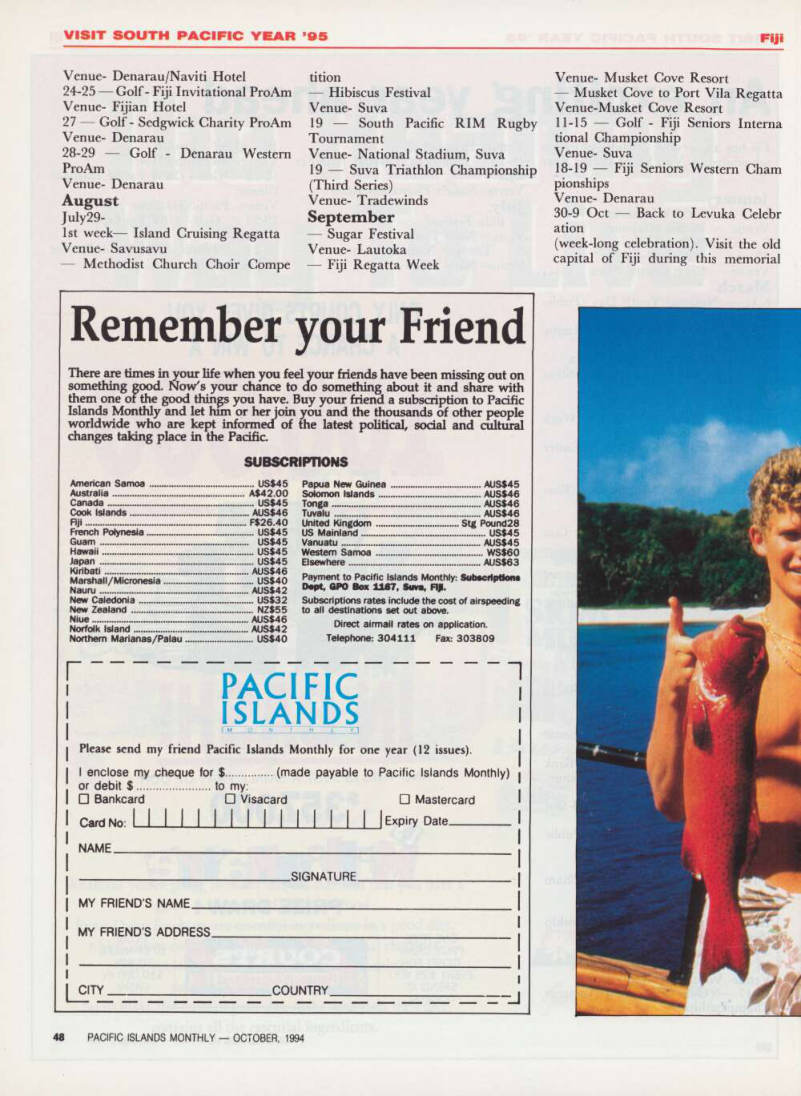
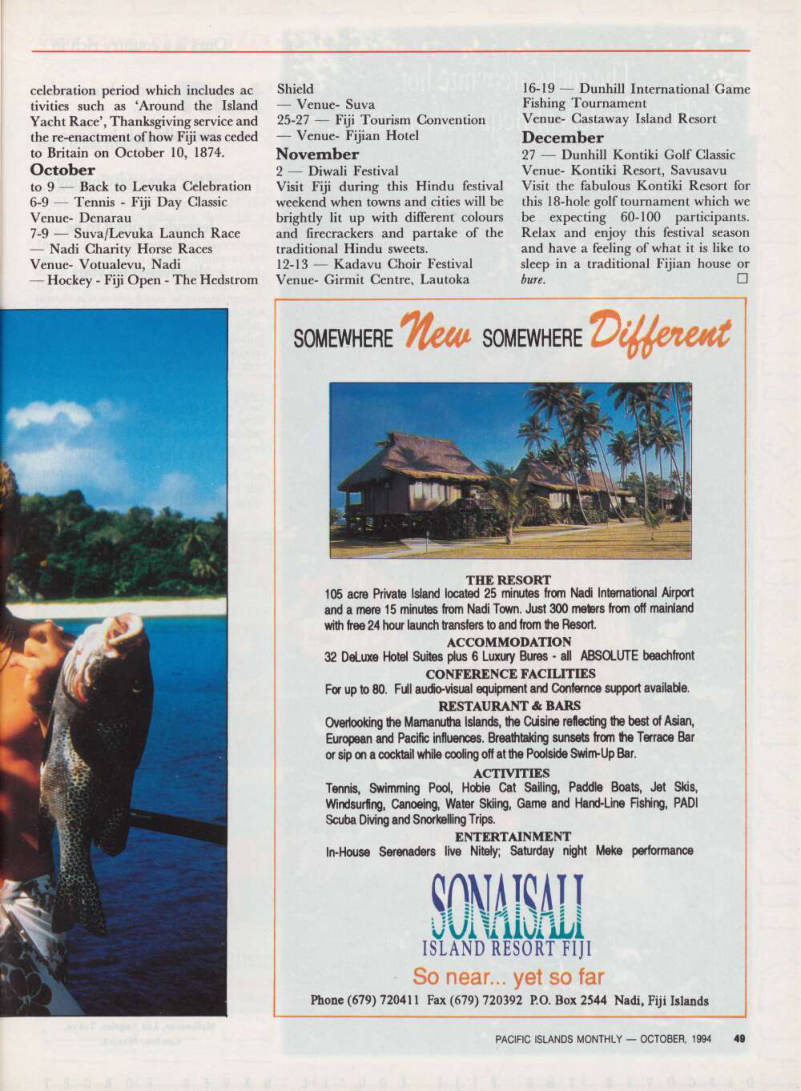
Fiji has an exciting calendar of events sch eduled for Visit South Pacific Year ’95.
January
1 - 3 World Windsurfers Titles Venue Pacific Harbour 9 Chinese New Year Theme “Year of the Pig”
Venue Civic Centre, Suva March 6-11 National Youth Day (Public
Holiday)
10-11 - Fiji International Rugby Sevens Venue - National Stadium, Suva 31 Cricket Crompton Competition Venue- Suva
April
Easter Basketball Easter Week
Open Club Championship
Tennis South Pacific Region Easter
Open
Venue- Nadi Sports Club
Suva Biathlon Championship (First
Series)
Venue- Tradewinds 20- PATA World Chapter Con gress Venue - Sheraton and Fijian hotels 21- The Fanta Secondary School
Basketball Championship
The Pacific Cup Children’s Sailing
Dinghies
Venue- Savusavu April/May — Auckland/Suva Yacht Race
May
5-7 South Pacific International
Triathlon Championship
Venue - Denarau 13-14 Buca Bay International Bilibili Raft Race 17-20 The Fiji Arts Club/ANZ Bank Art Exhibition Competition Venue- Playhouse, Selbourne, Suva 20-27 Savusavu World 14-foot
Sailing Championship
25-29 Ratu Sukuna Day (Public
Holiday)
June
9-12 Fiji National Tennis Cham
pionship
Venue- Suva 10 Suva Biathlon Championship
(Second Series)
Venue- Pacific Harbour 16 Nadi Charity Horse Races Venue- Votualevu, Nadi 16-17 Golf -Fiji Open Amateur
Championship
Venue- Denarau 16-20 Southern Taveuni Arts Fes tival Venue- Susie’s Plantation Resort J ul Y Bula Festival Venue- Nadi Town 8 Tennis - Nadi Pro Am Venue- Nadi Town
10 Golf - Pro Am Venue- Mocambo Hotel 12-15 Golf - C&W Pacific Harbour Classic Venue- Pacific Harbour 19- Golf - CBF Fiji Open Venue- Suva 20- Tennis - The Naviti/Regent
of Fiji/Fiji Open
Venue- Denarau/Naviti Hotel 24-25 Golf - Fiji Invitational ProAm Venue- Fijian Hotel 27 Golf - Sedgwick Charity ProAm Venue- Denarau 28-29 Golf - Denarau Western ProAm Venue- Denarau
August
July 29- Ist week — Island Cruising Regatta Venue- Savusavu Methodist Church Choir Compe
tition Hibiscus Festival Venue- Suva 19 South Pacific RIM Rugby Tournament Venue- National Stadium, Suva 19 Suva Triathlon Championship
(Third Series)
Venue- Tradewinds
September
Sugar Festival
Venue- Lautoka
Fiji Regatta Week
Venue- Musket Cove Resort Musket Cove to Port Vila Regatta Venue-Musket Cove Resort 11-15 Golf - Fiji Seniors Interna tional Championship Venue- Suva 18-19 Fiji Seniors Western Cham pionships Venue- Denarau 30-9 Oct Back to Levuka Celebr ation (week-long celebration). Visit the old capital of Fiji during this memorial
celebration period which includes ac tivities such as ‘Around the Island Yacht Race’, Thanksgiving service and the re-enactment of how Fiji was ceded to Britain on October 10, 1874.
October to 9 Back to Levuka Celebration 6- Tennis - Fiji Day Classic Venue- Denarau 7- Suva/Levuka Launch Race Nadi Charity Horse Races Venue- Votualevu, Nadi Hockey - Fiji Open - The Hedstrom
Shield Venue- Suva 25-27 Fiji Tourism Convention Venue- Fijian Hotel November 2 Diwali Festival Visit Fiji during this Hindu festival weekend when towns and cities will be brightly lit up with different colours and firecrackers and partake of the traditional Hindu sweets. 12-13 Kadavu Choir Festival Venue- Girmit Centre, Lautoka
16-19 Dunhill International Game
Fishing Tournament
Venue- Castaway Island Resort December 27 Dunhill Kontiki Golf Classic Venue- Kontiki Resort, Savusavu Visit the fabulous Kontiki Resort for this 18-hole golf tournament which we
be expecting 60-100 participants.
Relax and enjoy this festival season and have a feeling of what it is like to sleep in a traditional Fijian house or bure. □
Advertisements & other items, pp. 49-52 (3 items)
47
Fiji
PACIFIC ISLANDS MONTHLY OCTOBER, 1994
VISIT SOUTH PACIFIC YEAR ’95
Kkwoo
$
ONLY COURTS GIVES YOU
A CHANCE TO WIN A
KKWOO
&L
IN CASH!
AND THIS IS JUST A SMALL PART OF OUR 357,000
PRIZE DRAW !
ONE FREE
PRIZE DRAW
TICKET FOR
EVERY $25 YOU
SPEND AT
COURTS!
PLUS
10 CHANCES
TO WIN
$lO,OOO IN
CASH!
Remember your Friend
There are times in your life when you feel your friends have been missing out on something good. Now's your chance to dfo something about it and share with them one or the good things you have. Buy your friend a subscription to Pacific Islands Monthly and let him or her join you and the thousands of other people worldwide who are kept informed of the latest political, social and cultural
changes taking place in the Pacific,
SUBSCRIPTIONS
American Samoa US$45 Australia A 542.00 Canada US$45 Cook Islands AUSS46 Fiji F 526.40 French Polynesia US$45 Guam US$45 Hawaii US$45 Japan US$45 Kiribati AUSS46 Marshall/Micronesia US$4O Nauru AUSS42 New Caledonia US$32 New Zealand NZ$55 Niue AUSS46 Norfolk Island AUSS42 Northern Marianas/Palau US$4O Papua New Guinea AUSS4S Solomon Islands AUSS46 Tonga AUSS46 Tuvalu AUSS46 United Kingdom Stg Pound2B US Mainland US$45 Vanuatu AUSS4S Western Samoa WS$6O Elsewhere AUSS63 Payment to Pacific Islands Monthly; Subscriptions Dept, QPO Box 1167, Suva, FIJL Subscriptions rates include the cost of airspeeding to all destinations set out above.
Direct airmail rates on application.
Telephone: 304111 Fax: 303809 r
PACIFIC
ISLANDS
1 Please send my friend Pacific Islands Monthly for one year (12 issues).
I I enclose my cheque for $ (made payable to Pacific Islands Monthly) j or debit $ to my; 1 □ Bankcard □ Visacard □ Mastercard Card No; Expiry Date.
NAME.
.SIGNATURE.
MY FRIEND'S NAME.
MY FRIEND’S ADDRESS.
LEI
ITY
COUNTRY
SOMEWHERE Ttm SOMEWHERE
THE RESORT
105 acre Private Island located 25 minutes from Nadi International Airport and a mere 15 minutes from Nadi Town. Just 300 meters from off mainland with free 24 hour launch transfers to and from the Resort.
ACCOMMODATION
32 Deluxe Hotel Suites plus 6 Luxury Bures - all ABSOLUTE beachfront
CONFERENCE FACILITIES
For up to 80. Full audio-visual equipment and Confernce support available.
RESTAURANT & BARS
Overlooking the Mamanutha Islands, the Cuisine reflecting the best of Asian, European and Pacific influences. Breathtaking sunsets from the Terrace Bar or sip on a cocktail while cooling off at the Poolside Swim-Up Bar.
Tennis, Swimming Pool, Hobie Cat Sailing, Paddle Boats, Jet Skis, Windsurfing, Canoeing, Water Skiing, Game and Hand-Line Fishing, PADI Scuba Diving and Snorkelling Trips.
ENTERTAINMENT
In-House Serenades live Nitely; Saturday night Meke performance
ACTIVITIES
\Ji U iiu iL/i
ISLAND RESORT FIJI
So near... yet so far
Phone (679) 720411 Fax (679) 720392 P.O. Box 2544 Nadi, Fiji Islands
Ours is a country rich in tradition and culture and firewalking is just one of the many fascinating legends waiting to be discovered on your unbelievable Fiji holiday.
To find out more about the legendary Fijian firewalkers and the even
more legendary
hospitality of the Fijian people, contact the Fiji Visitors Bureau.
Fiji Visitors Bureau: Suva, Nadi, Auckland, Sydney, Melbourne, Los Angeles, Tokyo, London, Munich.
VISITORS
BUREAU
48
Fiji
PACIFIC ISLANDS MONTHLY OCTOBER, 1994
VISIT SOUTH PACIFIC YEAR ’95
That Shotover feeling

By Yunus Rashid
A holiday need not be relaxed and lazy.
It could be adventurous and thrilling. It could mean doing things out of the ordinary and remembering them for a long time later.
In Fiji, the ultimate holiday experience can be found on a ride in Shotover Jet down Nadi River. Shotover Jet’s craft, Big Red, which can seat 12, rumbles and prowls across the water at ground speeds of up to 70 kilomtres an hour. Aboard the craft your life is in the hands of a pilot, who has undergone 130 hours of piloting before being allowed to carry passengers.
Once in the open, an incredible half-hour journey begins.
You are guaranteed to feel your heart race and your adrenalin surge as your pilot twists and turns the craft with astounding precision, barely missing overhanging mangrove branches and flotsam.
Shotover Jet’s driving style, and the spectacular Hamilton Turn (where the boat spins 360 degrees of its own length)
is the driver’s trademark, according to the company’s sales and marketing manager, Hilary Finnic.
Finnic said Shotover Jet (New Zealand)
commenced operations in 1970, and has carried nearly one million passengers
with an impeccable safety record.
“Shotover Jet is acknowledged as one of New Zealand’s leading tourist attrac tions, and the world leader in commer cial jet-boating, both as an operator and innovator,” Finnic said. □
Advertisements & other items, pp. 53-54 (2 items)
Fiji
VISIT SOUTH PACIFIC YEAR ’95
100% Natural Cane Furniture
BEST IN QUALITY AND PRICE.
For * Homes * Businesses * Hotel & Resorts. ’|i ■ 1/ Mil K v vr. ..iW w * T 7 n i \ m - ■m K « / - ’ ..'I.. :M1
WII II
nr: ■ Is ■ i l ■ sa
Sun Corporation Limited
GPO Box 13655 Suva Ffll Tel: 679 362205 Fax: 679 361073
Sun Enterprises Limited
GPO Box 13655 Suva Fiji Te1:679 362205 Fax: 679 361073
FORUM SECRETARIAT
w VACANCY
REGIONAL MARINE TRAINING COORDINATOR
Applications are invited from suitably qualified and experienced persons, who must be nationals of a member state of the South Pacific Forum*, for the position of Regional Marine Training Coordinator, Maritime Division, in the Forum Secretariat.
The Forum Secretariat was established in 1972 by the South Pacific Forum to encourage economic and political cooperation between its member states, and between those states and the more industrialised countries. Under the control of a Secretary General, the Secretariat undertakes activities in a number of areas: economic development, legal and political, civil aviation, energy, maritime, telecommunications and trade. In pursuing these work programmes, the Secretariat works with a range of aid donor countries and organisations including Australia, New Zealand, Japan, France, EC, Canada and the UNDP.
The Maritime Division implements and administers a range of maritime development assistance activities under the Forum Maritime Programme, aimed at achieving self-sustaining economic growth in the maritime sectors of Forum Island Countries. The Division also assists in coordinating development assistance activities of other organisations in the region’s madtime sector.
The Regional Marine Training Coordinator will be responsible to the Deputy Secretary General (Programmes) through the Director, Maritime Division in co-ordinating developments in regional maritime education and training: promoting of Maritime Sector Human Resource Planning; developing of teaching syllabus, model courses and examinations to SPMC standards; institutional needs assessment: institution building through procurement and staff development assistance: providing support for inter-institutional, co-operation through the establishment of an Association of Schools and Examiners, production of newsletters, staff exchanges, promotion of examination banks, and co-operation with regional and international organisations; establishing regional quality control mechanisms to ensure standards as stipulated in SPMC and related documents are maintained; promoting of contemporary training technology such as experiential training and utilisation of distance delivery methodology; and assist in other activities relevant to the implementation of the Division’s annual Work Programme.
The appointee to the position will have appropriate qualifications with some background as a maritime school educator/administrator. He/she should be familiar with maritime education and training in the South Pacific.
The Co-ordinator should be able to cover the needs of the navigation, engineer and fishing sections of marine training and must have the DRIVE to make things HAPPEN.
This appointment carries an attractive remuneration package, payable in Fiji dollars. For non-Fiji citizens this is tax-free and includes housing or a housing allowance, education and child allowances where eligible. Other benefits for all staff include superannuation, and medical, life and accident insurance coverage. The appointee will be based at the Secretariat’s headquarters in Suva. Appointment will be for three years initially, and can be renewed by mutual agreement.
Applications close on 31 October 1994. They should contain full information on education and career backgrounds and should give names, addresses and telephone numbers of at least three referees with whom the applicant has been associated professionally.
Applications should be addressed to: The Secretary General Forum Secretariat GPO Box 856, Suva, Fiji Telephone 312-600 Telex: 2229FJ Fax: 305573 Further information is available on request from the Administration Officer, on 312600 Extension: 335. * Member states of the South Pacific Forum: Australia, Cook Islands, Federated States of Micronesia, Fiji, Kiribati, Nauru, New Zealand, Niue, Papua New Guinea, Republic of the Marshall Islands, Solomon Islands, Tonga, Tuvalu, Vanuatu and Western Samoa.
of dance
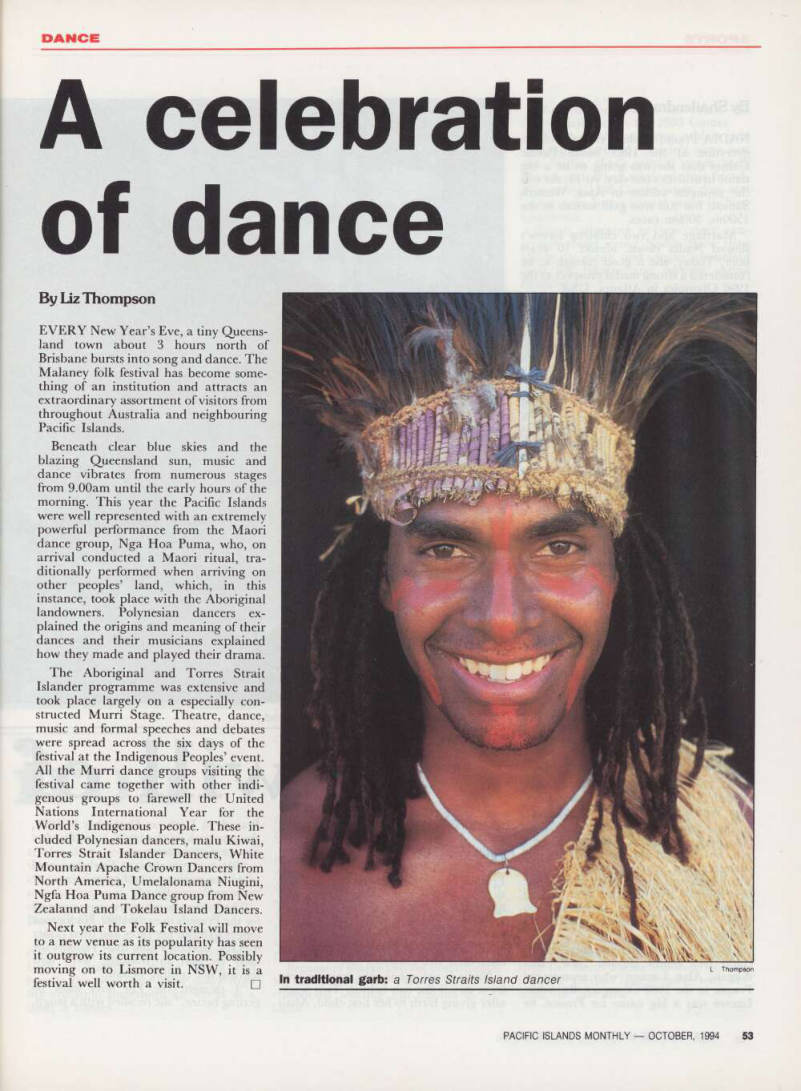
Dance
A celebration of dance
By Liz Thompson
EVERY New Year’s Eve, a tiny Queens land town about 3 hours north of Brisbane bursts into song and dance. The Malaney folk festival has become some thing of an institution and attracts an extraordinary assortment of visitors from
throughout Australia and neighbouring
Pacific Islands.
Beneath clear blue skies and the blazing Queensland sun, music and dance vibrates from numerous stages from 9.00 am until the early hours of the morning. This year the Pacific Islands were well represented with an extremely powerful performance from the Maori dance group, Nga Hoa Puma, who, on arrival conducted a Maori ritual, tra ditionally performed when arriving on other peoples’ land, which, in this instance, took place with the Aboriginal landowners. Polynesian dancers ex plained the origins and meaning of their dances and their musicians explained how they made and played their drama.
The Aboriginal and Torres Strait Islander programme was extensive and took place largely on a especially con structed Murri Stage. Theatre, dance, music and formal speeches and debates were spread across the six days of the festival at the Indigenous Peoples’ event.
All the Murri dance groups visiting the festival came together with other indi genous groups to farewell the United Nations International Year for the World’s Indigenous people. These in cluded Polynesian dancers, malu Kiwai, Torres Strait Islander Dancers, White Mountain Apache Crown Dancers from North America, Umelalonama Niugini, Ngfa Hoa Puma Dance group from New Zealannd and Tokelau Island Dancers.
Next year the Folk Festival will move to a new venue as its popularity has seen it outgrow its current location. Possibly moving on to Lismore in NSW, it is a festival well worth a visit. □
In Thompson In traditional garb: a Torres Straits Island dancer
A will of
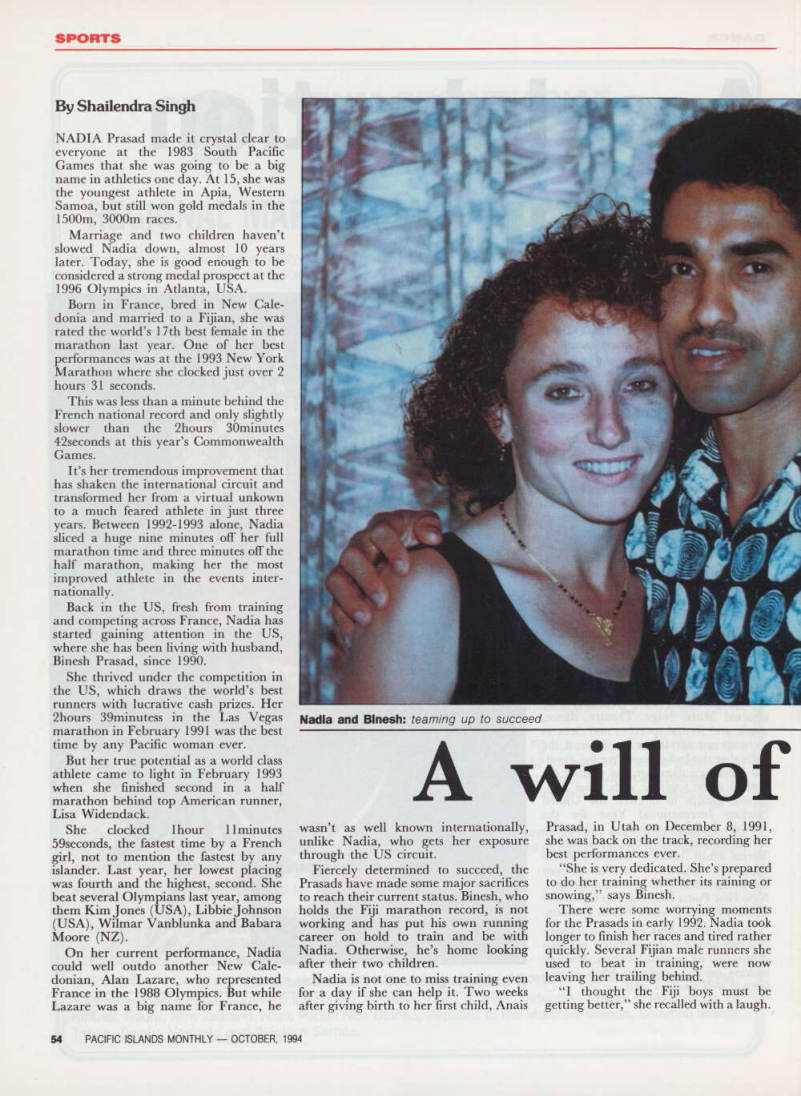
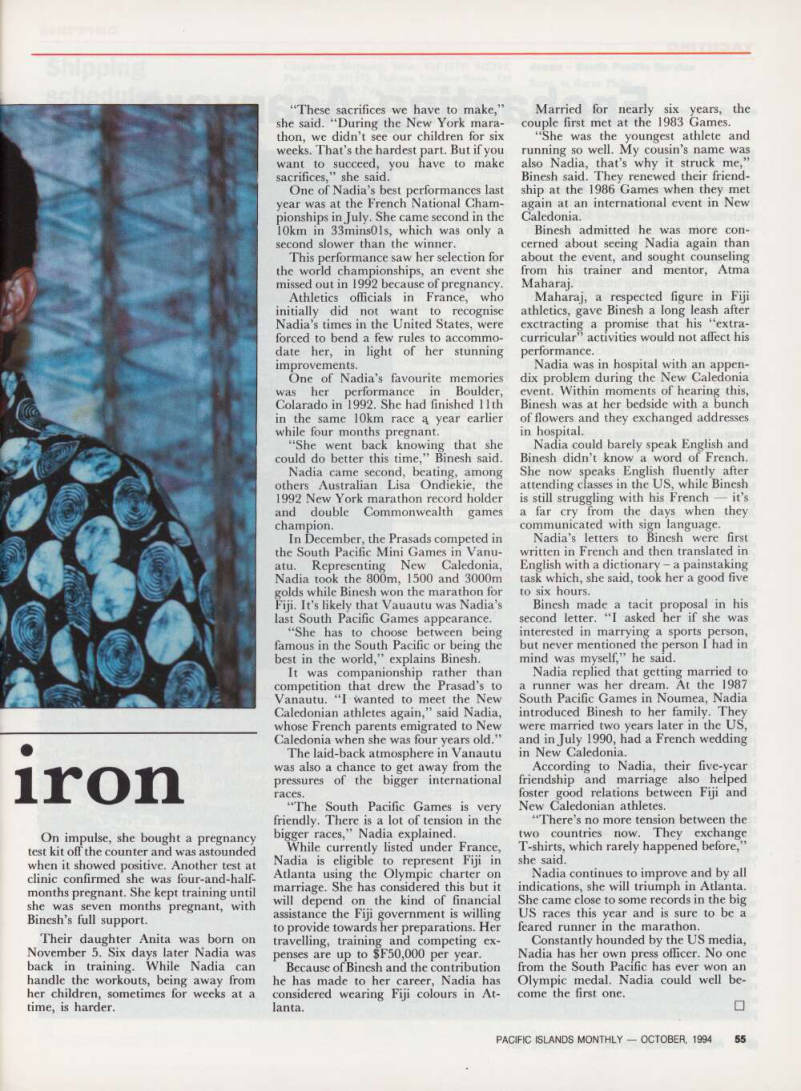
Sports
By Shailendra Singh
NADIA Prasad made it crystal clear to everyone at the 1983 South Pacific Games that she was going to be a big name in athletics one day. At 15, she was the youngest athlete in Apia, Western Samoa, but still won gold medals in the 1500 m, 3000 m races.
Marriage and two children haven’t slowed Nadia down, almost 10 years later. Today, she is good enough to be considered a strong medal prospect at the 1996 Olympics in Atlanta, USA.
Born in France, bred in New Cale donia and married to a Fijian, she was rated the world’s 17th best female in the marathon last year. One of her best performances was at the 1993 New York Marathon where she clocked just over 2 hours 31 seconds.
This was less than a minute behind the French national record and only slightly slower than the 2hours 30minutes 42seconds at this year’s Commonwealth Games.
It’s her tremendous improvement that has shaken the international circuit and transformed her from a virtual unkown to a much feared athlete in just three years. Between 1992-1993 alone, Nadia sliced a huge nine minutes off her full marathon time and three minutes off the half marathon, making her the most improved athlete in the events inter
nationally.
Back in the US, fresh from training and competing across France, Nadia has started gaining attention in the US, where she has been living with husband, Binesh Prasad, since 1990.
She thrived under the competition in the US, which draws the world’s best runners with lucrative cash prizes. Her 2hours 39minutess in the Las Vegas marathon in February 1991 was the best time by any Pacific woman ever.
But her true potential as a world class athlete came to light in February 1993 when she finished second in a half marathon behind top American runner, Lisa Widendack.
She clocked Ihour 11 minutes 59seconds, the fastest time by a French girl, not to mention the fastest by any islander. Last year, her lowest placing was fourth and the highest, second. She beat several Olympians last year, among
them Kim Jones (USA), Libbie Johnson
(USA), Wilmar Vanblunka and Babara
Moore (NZ).
On her current performance, Nadia could well outdo another New Cale donian, Alan Lazare, who represented France in the 1988 Olympics. But while Lazare was a big name for France, he
wasn’t as well known internationally, unlike Nadia, who gets her exposure through the US circuit.
Fiercely determined to succeed, the Prasads have made some major sacrifices to reach their current status. Binesh, who holds the Fiji marathon record, is not working and has put his own running career on hold to train and be with Nadia. Otherwise, he’s home looking after their two children.
Nadia is not one to miss training even for a day if she can help it. Two weeks after giving birth to her first child, Anais
Prasad, in Utah on December 8, 1991, she was back on the track, recording her best performances ever.
“She is very dedicated. She’s prepared to do her training whether its raining or snowing,” says Binesh.
There were some worrying moments for the Prasads in early 1992. Nadia took longer to finish her races and tired rather quickly. Several Fijian male runners she used to beat in training, were now
leaving her trailing behind,
“I thought the Fiji boys must be getting better,” she recalled with a laugh.
Nadia and Binesh: teaming up to succeed
On impulse, she bought a pregnancy test kit off the counter and was astounded when it showed positive. Another test at clinic confirmed she was four-and-half months pregnant. She kept training until she was seven months pregnant, with Binesh’s full support.
Their daughter Anita was born on November 5. Six days later Nadia was back in training. While Nadia can handle the workouts, being away from her children, sometimes for weeks at a time, is harder.
“These sacrifices we have to make,” she said. “During the New York mara thon, we didn’t see our children for six weeks. That’s the hardest part. But if you want to succeed, you have to make sacrifices,” she said.
One of Nadia’s best performances last year was at the French National Cham pionships in July. She came second in the 10km in 33mins01s, which was only a second slower than the winner.
This performance saw her selection for the world championships, an event she missed out in 1992 because of pregnancy.
Athletics officials in France, who initially did not want to recognise Nadia’s times in the United States, were forced to bend a few rules to accommo date her, in light of her stunning
improvements.
One of Nadia’s favourite memories was her performance in Boulder, Colarado in 1992. She had finished 11th in the same 10km race year earlier while four months pregnant.
“She went back knowing that she could do better this time,” Binesh said.
Nadia came second, beating, among others Australian Lisa Ondiekie, the 1992 New York marathon record holder and double Commonwealth games
champion.
In December, the Prasads competed in the South Pacific Mini Games in Vanu atu. Representing New Caledonia, Nadia took the 800 m, 1500 and 3000 m golds while Binesh won the marathon for Fiji. It’s likely that Vauautu was Nadia’s last South Pacific Games appearance.
“She has to choose between being famous in the South Pacific or being the best in the world,” explains Binesh.
It was companionship rather than competition that drew the Prasad’s to Vanautu. “I wanted to meet the New Caledonian athletes again,” said Nadia, whose French parents emigrated to New Caledonia when she was four years old.”
The laid-back atmosphere in Vanautu was also a chance to get away from the pressures of the bigger international races.
“The South Pacific Games is very friendly. There is a lot of tension in the
bigger races,” Nadia explained.
While currently listed under France, Nadia is eligible to represent Fiji in Atlanta using the Olympic charter on marriage. She has considered this but it will depend on the kind of financial assistance the Fiji government is willing to provide towards her preparations. Her
travelling, training and competing ex
penses are up to $F50,000 per year.
Because of Binesh and the contribution he has made to her career, Nadia has considered wearing Fiji colours in At lanta.
Married for nearly six years, the couple first met at the 1983 Games.
“She was the youngest athlete and running so well. My cousin’s name was also Nadia, that’s why it struck me,”
Binesh said. They renewed their friend ship at the 1986 Games when they met again at an international event in New Caledonia.
Binesh admitted he was more con cerned about seeing Nadia again than about the event, and sought counseling from his trainer and mentor, Atma
Maharaj.
Maharaj, a respected figure in Fiji
athletics, gave Binesh a long leash after exctracting a promise that his “extra curricular” activities would not affect his
performance.
Nadia was in hospital with an appen dix problem during the New Caledonia event. Within moments of hearing this, Binesh was at her bedside with a bunch of flowers and they exchanged addresses
in hospital.
Nadia could barely speak English and
Binesh didn’t know a word of French.
She now speaks English fluently after
attending classes in the US, while Binesh is still struggling with his French — it’s a far cry from the days when they
communicated with sign language.
Nadia’s letters to Binesh were first written in French and then translated in English with a dictionary - a painstaking task which, she said, took her a good five to six hours.
Binesh made a tacit proposal in his second letter. “I asked her if she was interested in marrying a sports person, but never mentioned the person I had in mind was myself,” he said.
Nadia replied that getting married to a runner was her dream. At the 1987 South Pacific Games in Noumea, Nadia introduced Binesh to her family. They were married two years later in the US, and in July 1990, had a French wedding in New Caledonia.
According to Nadia, their five-year
friendship and marriage also helped
foster good relations between Fiji and New Caledonian athletes.
“There’s no more tension between the two countries now. They exchange T-shirts, which rarely happened before,” she said.
Nadia continues to improve and by all indications, she will triumph in Atlanta.
She came close to some records in the big US races this year and is sure to be a feared runner in the marathon.
Constantly hounded by the US media, Nadia has her own press officer. No one from the South Pacific has ever won an Olympic medal. Nadia could well be come the first one. □
Enchanting Asanvare
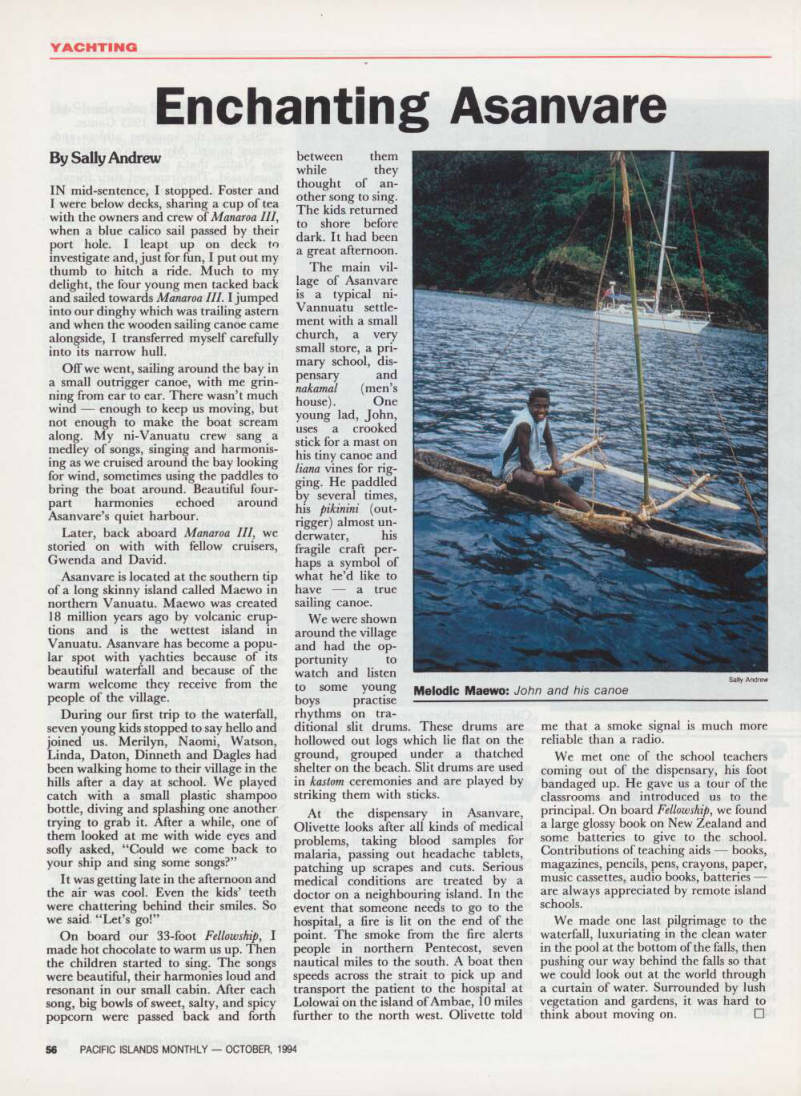
Yachting
By Sally Andrew
IN mid-sentence, I stopped. Foster and I were below decks, sharing a cup of tea with the owners and crew of Manaroa 111 , when a blue calico sail passed by their port hole. I leapt up on deck to investigate and, just for fun, I put out my thumb to hitch a ride. Much to my delight, the four young men tacked back and sailed towards Manaroa 111. I jumped into our dinghy which was trailing astern and when the wooden sailing canoe came alongside, I transferred myself carefully into its narrow hull.
Off we went, sailing around the bay in a small outrigger canoe, with me grin ning from ear to ear. There wasn’t much wind enough to keep us moving, but not enough to make the boat scream along. My ni-Vanuatu crew sang a medley of songs, singing and harmonis ing as we cruised around the bay looking for wind, sometimes using the paddles to bring the boat around. Beautiful four part harmonies echoed around Asanvare’s quiet harbour.
Later, back aboard Manaroa 111 , we storied on with with fellow cruisers, Gwenda and David.
Asanvare is located at the southern tip of a long skinny island called Maewo in northern Vanuatu. Maewo was created 18 million years ago by volcanic erup tions and is the wettest island in Vanuatu. Asanvare has become a popu lar spot with yachties because of its beautiful waterfall and because of the warm welcome they receive from the
people of the village.
During our first trip to the waterfall, seven young kids stopped to say hello and joined us. Merilyn, Naomi, Watson, Linda, Daton, Dinneth and Dagles had been walking home to their village in the hills after a day at school. We played catch with a small plastic shampoo bottle, diving and splashing one another trying to grab it. After a while, one of them looked at me with wide eyes and sofly asked, “Could we come back to your ship and sing some songs?”
It was getting late in the afternoon and the air was cool. Even the kids’ teeth were chattering behind their smiles. So we said. “Let’s go!”
On board our 33-foot Fellowship , I made hot chocolate to warm us up. Then the children started to sing. The songs were beautiful, their harmonies loud and resonant in our small cabin. After each song, big bowls of sweet, salty, and spicy popcorn were passed back and forth
between them while they thought of an other song to sing.
The kids returned to shore before dark. It had been a great afternoon.
The main vil lage of Asanvare is a typical ni- Vannuatu settle ment with a small church, a very small store, a pri mary school, dis pensary and nakamal (men’s house). One young lad, John, uses a crooked stick for a mast on his tiny canoe and liana vines for rig ging. He paddled by several times, his pikinini (out rigger) almost un derwater, his fragile craft per haps a symbol of what he’d like to have a true sailing canoe.
We were shown around the village and had the op
portunity to
watch and listen to some young
boys practise
rhythms on tra
ditional slit drums. These drums are hollowed out logs which lie flat on the ground, grouped under a thatched shelter on the beach. Slit drums are used in kastom ceremonies and are played by striking them with sticks.
At the dispensary in Asanvare, Olivette looks after all kinds of medical problems, taking blood samples for malaria, passing out headache tablets, patching up scrapes and cuts. Serious medical conditions are treated by a doctor on a neighbouring island. In the event that someone needs to go to the hospital, a fire is lit on the end of the point. The smoke from the fire alerts people in northern Pentecost, seven nautical miles to the south. A boat then speeds across the strait to pick up and transport the patient to the hospital at Lolowai on the island of Ambae, 10 miles further to the north west. Olivette told
me that a smoke signal is much more reliable than a radio.
We met one of the school teachers coming out of the dispensary, his foot bandaged up. He gave us a tour of the classrooms and introduced us to the principal. On board Fellowship , we found a large glossy book on New Zealand and some batteries to give to the school.
Contributions of teaching aids books, magazines, pencils, pens, crayons, paper, music cassettes, audio books, batteries
are always appreciated by remote island
schools.
We made one last pilgrimage to the waterfall, luxuriating in the clean water in the pool at the bottom of the falls, then pushing our way behind the falls so that we could look out at the world through a curtain of water. Surrounded by lush vegetation and gardens, it was hard to think about moving on. □
Sally Andrew Melodic Maewo: John and his canoe
Shipping
schedules
New Zealand - FIJI direct Sofrana Unilines operates a fully containerised/ breakbulk service every 21 days from Auckland, Tauranga, Lyttleton to Suva and Lautoka.
Loading every 21 days, ro/ro service, containers - reefer. Contact Sofrana Unilines, Sofrana House, 101 Customs Street, Auckland, PO Box 3614, Fax (09) 393874, Ph (09) 773279, Tlx NZ 2313. Direct toll free line 0800 659-922, Contact Alan Foote. Compass Shipping Agencies, PO Box 921 Wellington, Tel (04) 382 8206, Fax (04) 3828239, Tlx NZ 4769 Contact Steve Brannigan.
Sofrana Unilines Agencies, PO Box 22046 Christchurch, Tel (03) 366 7180, Fax (03) 366 8868, TLX NZ4769, Contact Tony Newell.
Carpenters Shipping, Private Mail Bag, Suva, Fiji, Tel (679) 312244, Fax (679) 301572, Tlx FJ 2199. Sofrana Unilines, Suva, Fiji, Tel (679) 315645, Fax (679) 300057.
Australia - FIJI direct Sofrana Unilines operates a container breakbulk service every three weeks from Melbourne, and Sydney to Lautoka and Suva. Contact Sofrana Unilines (Aust) Pty Ltd, PO Box Q 136, Queen Victoria Building, Sydney, NSW 2000, Austra lia. Tel (02) 2648944, Fax (02) 2676547, Tlx (71) A 170090, Contact Sam Attaway/ George Lopez.
Delams Australia Pty Ltd. 474 Flinders Street, Melbourne. Tel (03) 614 1344, Fax (03) 629 4957.
Carpenters Shipping, Suva, Tef (679) 312244, Fax (679) 301572. Sofrana Unilines Suva, Tel (679) 315 645, Fax (679) 300057. Carpenters Shipping, Lautoka, Tel (679) 663988, Fax (679) 664896. Sofrana Unilines, Lautoka Tel (679) 662921, Fax (679) 664896.
Australia - FIJI monthly sorvico Sofrana Unilines (Australia) Pty Ltd operates a regular monthly service with MV Capitaine Wallis. Contact Sofrana Unilines, Sydney, Tel (02) 2648944, Tlx AA170090, Fax (02) 267-6547. Carpenters Shipping, Suva, Fiji, Tel (679) 312244, Fax (679) 301572, Sofrana Unilines, Suva, Fiji Tel (679) 315645, Fax (679) 300057. Carpenters Shipping, Lautoka, Tel (679) 63988, Fax (679) 664896. Sofrana Uni lines, Lautoka, Fiji, Tel (679) 662921, Fax (679) 664896.
Far-East - FIJI Sorvico New Guinea Pacific Line (NGPL) operates a monthly service accepting containerised and break-bulk cargoes from Manila, Keelung, Kaoshiung, Hong Kong, Lae to Suva, Lautoka (via Suva).
Contact Carpenters Shipping Suva, Fiji, tel (679) 312244, fax (679) 301572. New Zealand Unit Express, Maritime Building, 2-10 Customs House Quay, PO Box 890, Wellington. Tel 727865, Cables Enzue Man, Wellington, Tlx NZ31340 Nedlnz or Nedlloyd Swire Pty Ltd, Sydney, Tel 20522.
Japan - South Pacific Sorvlc# Same as Bums Philp Japan - South Pacific Sorvico - Kyowa Shipping Co Ltd Kyowa Shipping, Shipping Co Ltd provides a monthly service from Hong Kong to main ports of Japan, Saipan, Guam, Island ports, Lautoka, Suva via Nukualofa to Pago Pago and Apia.
Contact Carpenters Shipping, Neptune House, 3/4 floor, Tofuaa Street, Walu Bay, Suva. Tel 312244, Fax 301572, Tlx FJ2199.
Europe - Pacific Sorvico Bank Line offers a monthly service to and from Europe for containerised breakbulk and bulk vegetable cargoes. Calling Papeete, Apia, Suva, Lautoka, Noumea, Port Vila, Santo, Honiara and PNG. Main ports to and from major northern Eurpoean ports. Contact Bank Line, South Pacific Office, Central Court Bid , 7th Street, Lea, PNG,TeI 422925, Tlx NE4426s.Carpenters Shipping, 3/4 Floor,Neptune House, Walu Bay, Suve, Fiji, Tel (679) 312244, Fax (679) 301572, TIxFJ 2199.
Nedlloyd offers cargo services from Continental ports to Papeetee, Fiji, New Caledonia and Doniambo on slot basis with Bank Line. Contact Carpenters Shipping, Suva, tel 312244, Tlx FJ2199, Fax 301572. Carpenters Shipping, Lautoka, Tel 663988, Tlx FJ5215, Fax 664896.
Advertisements & other items, pp. 59-64 (1 item)
Contact us on PH: (675) 422988 FAX: (675) 422925
Sr* £Ki| - , '■ - ... ... ■ •■ ■ ."■ :; "c - :?: 't s ;.. \ v: -7"'t *" '"’ ’ -.jyw..^,^ yr i?Kmi*Sr- Hif
~' , * g^^^ac>.--:
TLX; 44265 NE
Th<' ELmk Lino, P G Box 2 225, Lae, Moiobe Province, Papua New Guinea
MARKET PLACE
SCRAP METAL
Tall ingots operate from Brisbane, Australia and make frequent visits to the Pacific Islands which they have done for twenty-five years. We are buyers of Copper, Brass, Aluminium, Lead, Batteries, Battery Lead, Cable etc. Inspection no problems. Telephone 617 8922033 Fax 61 78922077.
EDUCATION/INSTRUCTION:
Become a Professional Consultant, Earn Big Income. Diploma Course Now available by Correspondence. Details Australian Institute of Vocational Studies, Box 46, Wodenn Cl, Canberra ACT, Australia 2606.
LEGAL SERVICES
MICHAEL BULA, SOLICITOR is pleased to receive instructions relating to Australian and South Pacific property, succession and commercial matters. French spoken legal translations legal agents throughout the South Pacific: “Princes Hill Gallery”, 213 Canning Street CARLTON MELBOURNE VIC-
TORIA 3053 AUSTRALIA
Telephone: + 6133478333 Fax: + 6133471741
SELF ADHESIVE LABELS
FORUM LABELS (FIJI) LTD
P.O. BOX 1167, Suva, Fiji. Phone: 304111, Fax: 305335. We print self-adhesive labels in rolls, multi-coloured labels with hot foil, and die cut to shape, tickets and tags in rolls. We also supply labelling machines and fabric labels.
MARKET PLACE CAN WORK
WONDERS FOR YOU ...
Promote your business, or services, sell your household items, cars or heavy machinery etc.
ONLY AUSSI PER WORD.
NO COMPANY LOGO. NO DISPLAY. NO
BOLD TYPE.
Just forward your Advertisement together with payment to: PACIFIC ISLANDS MONTHLY “Market Place", PO Box 1167, Suva, FIJI or debit $ to my credit card.
Card No Expiry Date: Fax (679) 303809
UNITED NATIONS DEPARTMENT OF HUMANITARIAN AFFAIRS
SOUTH PACIFIC PROGRAMME OFFICE
I my
DHA-SPPO
GENERAL INFORMATION: The South Pacific Disaster Reduction Project (RAS/92/360) is a four year technical support project for 15 countries in the Pacific region. The Project is funded by UNDP and several donor countries and is implemented by the South Pacific Programme Office of the UN Department of Humanitarian Affairs. The objective of the Project is to enable Pacific Island Countries reduce the impact of natural disasters and improve post-disaster recovery management and thus reduce a major constraint on sustainable development in the region.
The Project provides in-country training and technical assistance including the preparation, revision and implementation of disaster management plans and disaster reduction programmes and projects.
Under the Project a number of manuals, guidelines and public awareness materials for emergency management disaster preparedness and disaster reduction will be prepared to support the in-country activities. The Project further includes a number of disaster mitigation pilot projects and will assist countries in the development of information management for disaster purposes. The Project will act as a local point for disaster management in the region, and improve co-operation and collaboration among Pacific Island Countries, donors, regional organisations and other agencies.
The advertised position focuses on the implementation of the disaster mitigation component of the project, which includes a number of pilot projects for community risk reduction, and will assist countries in the identification and implentation of disaster risk reduction strategies as part of their ongoing development The successful candidate for the post will have a good application of architecture, engineering, development planning and community projects and project activities in the broad area of disaster prevention and mitigation. The success of this component of the project will depend on the ability of the applicant to bridge the gaps between professional disciplines involved in disaster mitigation, rather than on very specialised knowledge of one of the disciplines.
In addition to the present post the project team will consist of a Chief Technical Adviser, disaster management adviser, training adviser, information management officer, and several short-term consultants for specific projects tasks.
Selection will be made on the basis of merit and the principle of equal opportunity. The position will be based in Suva, Fiji. The length of appointment will be two years.
TECHNICAL ADVISER FOR NATURAL DISASTER MITIGATION
RESPONSIBILITIES: Responsible to the Chief Technical Adviser for the provision of technical advice and support for the identification, development and implementation of pilot projects for disaster mitigation, and the development and implementation of country-level and regional action programmes for disaster reduction on the basis of national and local needs.
Also the Adviser will: • Advise on disaster prevention and mitigation measures, including planning, engineering and community development; • Advise on the inclusion of disaster considerations in development planning; promote and guide on the adoption and practical application of relevant regulations for disaster reduction; • Assist with the evaluation of potential fosses, and the overall impact of major natural hazards on development in the Pacific region. • Prepare information materials on disaster prevention and mitigation methods and organise activites to propagate them to local officials and the public in high risk zones; • Liaise and coordinate with regional organisations on the implementations of disaster mitigation activities. • Assist countries in preparing project proposals for disaster mitigation for external funding.
ESSENTIAL QUALITIES: Degree in architecture, planning, engineering or a similar discipline, with at least five years of working experience, of which two years were in developing countries; thorough knowledge of disaster mitigation approaches and concepts; broad knowledge of related subjects including land use planning community-based development engineering, public administration and information management DESIRABLE QUALITIES: Master Degree; knowledge and experience of the disaster threat in the Pacific; experience in the implementation of disaster mitigation projects; combined education in planning and architecture or engineering.
SALARY PACKAGE: Negotiable.
Applications, together with full resume should be lodged with Australian Planning & Training Associates Pty Ltd at the address below by 4.30 pm on Monday, October 31,1994.
Australian Planning & Training Associates Pty Ltd
ACN 003 480224
□O □□ Suite 1801, Town Hall House, 466 Kent Street, Sydney 2000, Australia Tel: (02) 261 4868 Fax: (02) 261 1686
10 15 20 25 30 35 40 45 50 55 60
I A LIFETIME OF SERVICES
40 45 Grand Pacific Life Insurance offers you a lifetime of safe, secure products at very competitive rates. • Choose from a full range of products such as
• Super Ordinary Life
• Super Universal • Non-Participating Whole Life • 10-Year Level Term • Flexible Premium Annuities • Group Life Insurance
• IRAs
• Graded Premium Whole Life We've been dedicated to providing fast, personalized service for more than 35 years through local ownership and management That's v/hy Grand Pacific Life is your Family ...throughout the Pacific.
T,raru! Pacific Life Insurance, Ltd. ■M m 35 45 10 15 20 25 30 35 40 45 50 55 60
Grand Pacific Life Insurance, Ltd.
A member of the Finance Factors Family
FEDERATED STATES
OF MICRONESIA
Actouka Executive Insurance Underwriters P.O. Box 55, Kolonia, Pohnpei, Federated States of Micronesia 96941 Pacific Basin Insurance & General Services, Inc P.O. Box 494, Chuuk State, Federated States of Micronesia 96942
TONGA
Peseti Ma ‘afu Ins. & Finance, Ltd.
Private Bag 2, Taumoepeau Bldg.
Nukualofa, Tonga
GUAM
Great National Insurance Underwriters, Inc.
P.O. Box GA, Agana, Guam 96910
AMERICAN SAMOA
Mark Solofa Pacific Insurance & Finance, Inc.
P.O. Box 3149 Pago Pago, American Samoa 96799 Pacific Financial Corporation P.O. Box AT, Agana, Guam 96910 Takagi & Associates, Inc.
GCIC Bldg., Suite 100 414 W. Soledad Ave.
Agana, Guam 96910
MARSHALL ISLANDS
Marshalls Insurance Agency P.O. Box 113, Majuro, Marshall Islands 96960
WESTERN SAMOA
Mark Solofa Pacific Insurance & Finance, Inc.
P.O. Box 3149 Pago Pago, American Samoa 96799
NORTHERN MARIANAS
Pacific Basin Insurance Underwriters, Inc.
P.O. Box 710 Saipan, Mariana Islands 96950 Pacifica Insurance Underwriters, Inc.
P.O. Box 168, Saipan, Mariana Islands 96950 Grand Pacific Life Insurance, Ltd. *1164 Bishop Street, sth Floor, Honolulu, HI 96813 Phone: (808) 548-3363 • FAX: (808) 548-5122
The Mitsubishi Lancer: A family sedan that’s practically built to perform.
Lancer leaves the rest of its class in the dust.
Yes, it is a family sedan. Comfortable and practical.
But exciting, too, because Mitsubishi hasn’t forgotten what truly drives you: the pure pleasure of total
driving performance.
Its ground-hugging chassis holds comers tight. A self-aligning multi-link suspension adjusts to the road no matter what the driving conditions. And the aggressive, fuel-efficient 16-valve SOHC engine makes Lancer eager and responsive in the passing lane.
All of this performance comes from one very simple idea —our total approach to engineering.
We believe that unless each aspect of a car is fully integrated into the overall design, the result will never exceed the sum of the parts. The difference is self-evident. Behind the wheel.
And on the road.
It is this philosophy that makes every Mitsubishi such a reassuring and
rewarding driving experience. Whether
it’s our top-end Mitsubishi Sigma, technologically sophisticated Galant, all-weather 3000 GT sports car, or offroad 4WD Pajero... they’re all driven by the power of positive thinking.
So take the wheel of a Lancer, the family sedan that performs like a thoroughbred.
MITSUBISHI LDNCER
What Drives You.
AMERICAN SAMOA: PACIFIC MARKETING INC. P.O. Box 698, Pago Pago, Tel. 699-9140 / AUSTRALIA: MITSUBISHI MOTORS AUSTRALIA LTD. 1284 South Road, Clovelly Park, South Australia, 5042, Tel. (08) 2757297 / FUI: NMS MOTOR & MACHINERY CO. LTD. G.P.O. Box 150, Suva, Tel. 383411 / GUAM; TRIPLE J ENTERPRISES INC. P.O. Box 6066, Tamuning, Tel. 6469126 / NEW CALEDONIA: SOCIETE D'IMPORTATION D'AUTD DU RACIFIQUE SUDS. A. P.O. Box 438, Noumea, Tel. 272-562 / NEW ZEALAND: MITSUBISHI MOTDRSNEW ZEALAND LTD. Private Bag. Porirua, Tel. 237-0109 / NORFOLK ISLAND: BORRYS PTY LTD. P.O. Box 169, Taylors Road, Burnt, Tel. 2114 / PAPUA NEW GUINEA: TDBA MOTORS PTY LTD. P.O. Box 503, Port Moresby, Tel. 217-874 / SAIPAN: SAIPAN AUTOWORLD INC. P.O. Box 487, Tel. 234-7133 / SOLOMON ISLANDS; HARVEST PACIFIC LTD. G.P.O. Box 888, Honiara, Tel. 30407 / TAHITI: SOPADEP S.A. B.P. 1617, Papeete, Tel. 427393 / TONGA: SITANI MAPI CO., LTD. P.O. Box 83, Nuku'Alofa, Tel. 24044 / VANUATU: SOCOMETRA VANUATU LTD. B.P. 6, Port-Wla, Tel. 2314 / WESTERN SAMOA: MOTOR DISTRIBUTORS (SAMOA) LTD. P.O. Box 576, Apia, Tel. 20957 A
MITSUBISHI
MOTORS
CREATING TOGETHER
STAY AT ONE ■ PLAY AT FIVE And charge everything back to your room. The Islands' leading hotels offer a superb choice of locations and dining experiences.
Tanoaf International Hotel
Nadi Airport, Phone 720277 My -‘-v 24 hour dining in our poolside Bistro or airconditioned Coffee Shop. Special theme dining nights: Wednesday: Asian Night, Friday: Pacific Night & Meke, Saturday: Kebab BBQ, Sunday: A Taste of India. Happy Hour Monday through Friday 5:30 until 7:oopm with hot savouries & live entertainment.
SKYLODGE HOTEL
Nadi Airport Ph 722200 \ / Poolside buffet breakfast daily Poolside BBQ every Thursday - $13.75 Chefs 'Roast-Of-The Day (x Thurs) $9.90 Happy hour & live entertainment daily
THE WATERFRONT HOTEL
Lautoka Ph 664777 Buffet luncheon, Mon - Fri, $ll.OO Poolside BBQ & buffet Sundays Happy hour & entertainment Mon - Fri
RAKIRAKI HOTEL
Rakiraki Ph 694101 Poolside BBQ - Fridays - $13.95 Curry buffet lunch - Sundays - $9.50 Evening entertainment - Lawn bowls Special weekend rates
TANOA APARTMENTS
Nadi Airport Ph 723685 Executive apartment condominiums Fully serviced 1,2 & 3 bedroom plans Pool - Sauna - Tennis courts m m
FANOA
HOTELS
3 1508 00355040 2
IJI ISLANDS • SOUTH PACIFIC
m i U(— 9 M °i(°]
PtfC.
«y Am y ■ ■ , ► "3^ ■;« m m*. <■ ■ ■ fH '■ ■ - 'Pf «