Pacific

Islands
M O Nthly
Inside
The Fiji magic in US -p2B
David Tua takes it easy -p66
September 1994
Hid Forum
SPARTECA changes
Managing our resources
t
American Samoa US$2.5O; Australia A 53.50; Cook Islands NZ$3; Fiji (Incl VAT) F 52.50; FS Micronesia US$3; Hawaii US$3; Kiribati A 52.50; Nauru A 52.50; Niue NZ$3; Norfolk AS3; New Caledonia cpf2so; New Zealand (Incl GST) NZ53.45; Nth Marianas USS 3; Papua New Guinea K 3; Palau US$3; Marshalls US$3; Solomon Islands AS3; French Polynesia cpf3oo; Tonga P 3; USA US$3; Vanuatu VT22O; Western Samoa T 3.25. ‘Recommended retail price only
Advertisements & other items, p. 2 (1 item)
The Beer of Paradise...
m '•> -■ p-i * m m Ws A K » *ll -.<V-‘.
A. * Ik L^BetrOwap^®^
South Pacific Export Lager
Pacific
Islands
Monthly
Vol 64 No. 9
The News Magazine
September 1994
Letters 4
Headlines 6
Cover Stories
The Forum 9 Fiji vs The Forum 11 Unwanted export 13 Let’s not panic 14
Western Samoa
Under pressure 15
POLITICS Tonga
Political party for kingdom 17
Sovereignty
A matteer of style 18
Business
Western Samoa: could the economy get worse? 21 Sorry saga of the Reef Endeavour 22
Peacekeeping 24
Culture
Rasigatale’s US adventure 28
Tonga
Tonga treat 49
Theatre
Wan Smol Bag: a success story 52
Guam
Heroes honoured 53
Vanuatu Feature 55
Sport
Manu Samoa slaughtered 65 Tua takes it easy 66 Samoans tipped as giantkillers 67
Nauru joins Olympic team 67
Yachting
Journey’s end 68
Shipping
Shipping schedules 69
Columnists
Alfred Sasako 27 Jemima Garrett 32 David Barber 54
Publisher: Brian O’Flaherty Acting Editor: Arvind Kumar Senior Writer: Fiona Phillips Correspondents: Christine Hatcher, David North, Ed Rampell, lan Williams, Johnson Honimae, Karen Mangnall, Liz Thompson. Nicholas Rothwell, Pesi Fonua, Wally Hiambohn.
Columnists: David Barber (Wellington), Futa Helu (Tonga, covering the Pacific Islands), Jemima Garrett (Sydney).
Julian Moti (Pacific Law). Alfred Sasako (The Forum).
Advertising Sales: • Regional Sales (South Pacific; Salendra Narayan, Tel (679) 304111, 303244, Fx (679) 303809. • Sydney. Canberra Bob Hill Media Reoresen lations, Tel (61-2) 4164245. Fx (61-2) 4165064 • Brisbane: Robert Walker. Media House. Tel (61-7) 3710533. Fx (61-7) 371-8904 • Adelaide: Hastwell Williamsons Representatives, Tel (61-8) 3799522, Fx (61-8) 3799735. • Melbourne: Brown Orr Fletcher Burrows (Aust).
Pty Ltd. Tel (613) 8265188: Fx: (613) 8265644, • Auckland: McKay & Bowman, International Media Representatives Ltd, Tel (64-9) 4190561, Fx (64-9) 4192243.
• Japan: Universal Media Corrporation, Tokyo, Tel (3) 32626741, Cable: UNIMEDIA Tokyo, Fx (3) 32626742.
Founded 1930 (USPS 952480). A Fiji Times Limited production.
Cover prices are recommended retail only. Regis tered by Australia Post, Publication No. NBP 1210. © Copyright Fiji Times Limited, 177 Victoria Parade. Suva. Fiji. Tel (679) 304111, Fx (679)
303809. Tx Fj2124.
Pacific Islands Monthly is published monthly by The Fiji Times Limited, a division of Nationwide News, 2 Holt Street. Surry Hills. Sydney, NSW 2010.
Send address changes to: • Pacific Islands Monthly, PO Box 1167, Suva, Fiji.
Typeset and printed by The Fiji Times Limited, 177 Victoria Parade, Suva. Fiji.
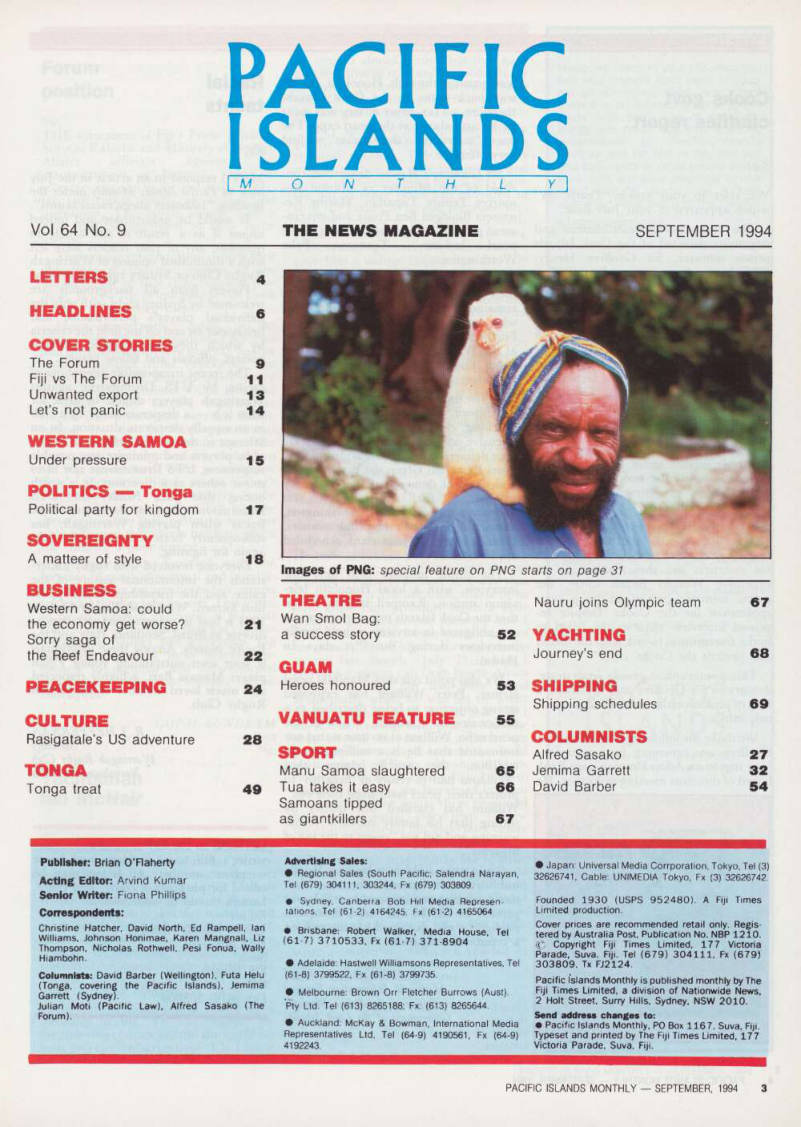
Images of PNG: special feature on PNG starts on page 31
Cooks govt
Letters
clarifies report
Sir WE refer to your article “Pearls ’94” which appeared in your July issue.
The many inaccuracies therein and negativity directed at the Cook Islands prime minister, Sir Geoffrey Henry, KBE, has made it necessary for this office to respond and register our strong objections. After consulting by telephone with PIM Acting Editor Arvind Kumar, we would like to clarify the following points: With regard to paragraph four, author Ed Rampell has distorted the facts about booths at the pearl expo. The Cook Islands government fully supports and encourages the country’s pearl industry.
To this end, the government purchased one booth for the exclusive use of the country’s private sector representatives.
At no time was the booth operated or controlled by government officials at tending Pearl Expo ’94.
Secondly, Rampell writes “but despite an excellent speech and thousands of taxpayer dollars to send Sir Geoffrey and his courtiers on their junket to an expensive Waikiki Beach suitte, the prime minister proved to be a poor spokesman for the Cooks. Despite re peated interview requests, he failed to find a few minutes to talk with the media and present the Cooks’ case.”
This paragraph is grossly inaccurate, denigrates Sir Geoffrey and illustrates a lack of professionalism and basic journal istic ethics.
We make the following corrections: Sir Geoffrey was returning from a month long trip to an Asian Development Bank board of directors meeting in France. He
was passing through Honolulu on his way back home to the Cook Islands, therefore, no tax-payer money was spent for his attendance at the pearl expo. The use of “courtiers on their junket” we find very offensive.
Sir Geoffrey’s Hawaii delegation con sisted of the Minister of Marine Re sources Tepure Tapaitau, Marine Re sources Biologist Ben Ponia and govern ment projects analyst (specialising in the pearl industry) Teanaroa Paka
Worthington.
Of the 25 Cook Islands delegates, only these three were government officials, the remainder representing the private sector who travelled at their own expense.
Furthermore, the prime minister stayed at the Waikiki Sheraton courtesy of the hotel. The rest of the delegation stayed at budget accommodation.
By the time the prime minister arrived in Hawaii, he had just completed a gruelling electoral campaign and an intensive one month trip to Europe. He then delivered the keynote address at the Pearl Expo ’94. Given the psychological and physical demands of such a heavy schedule, Sir Geoffrey was undestandably exhausted. Worthington, also acting as aide to the prime minister, cancelled several important scheduled appointments.
The prime minister held only one interview, with a local Honolulu tele vision station. Rampell fails to accept that the Cook Islands prime minister was not obligated in anyway to hold media interviews during the 2 1 / 2 days in Hawaii.
We also point out that Manihiki pearl farmer, Peter William has expressed strong objection to being described as a millionaire by Rampell. While at the pearl expo, William at no time stated nor insinuated that- he is a millionaire. In addition, the article claims that “Williams had to resort to ‘firearms’ to protect their pearl farm from theft etc.”
William has clarified this matter by stating that his family issued a verbal warning and did not “resort to the use of firearms”.
Given that PIM is a leading Pacific publication, it is most unfortunate that this damaging and inaccurate article was printed at all. In our view, Rampell’s negligence and disregard has discredited
a reputable magazine.
F Syme-Buchanan
Media & Information Services Office of the Prime Minister Government of the Cook Islands
Racial
taunts
Sir, MAY I respond to an article in the July issue of Pacific Islands Monthly under the heading “Islanders allege racial taunts”.
It would be unfortunate and indeed unjust if as a result of the article in question, any of your readers were left with a diminished opinion of Warringah Rugby Club or Sydney rugby generally.
Players from all backgrounds are welcomed by Sydney clubs with only the
individual playerl’s performance and
behaviour on and off the field the criteria by which they are accepted by sup porters, officials and fellow players.
The recent irresponsible allegations of racism by UTS Drummoyne against Warringah players should be seen for what it is a desperate tactic by a club in an equally desperate situation. In an attempt to defend the behaviour of one of its players and minimise any possible suspension, UTS Drummoyne saw fit to smear others as a diversion. It is worth noting that Jack Noble, the UTS Drummoyne player at the centre of the fracas when playing Warringah, has subsequently been sent from the field again for fighting.
Everyone involved with rugby under stands the international nature of the game and the friendships and support thus formed. Warringah Rugby Club in 1994 is host to players from countries as diverse as Brazil, Scotland, Italy and the Pacific islands. Among these individuals is your own outstanding young Fijian player Manasa Bari, a highly respected and much loved member of Warringah Rugby Club.
R J Heffernan
Secretary Warringah Rugby Club Narrabeen, Australia
LETTERS to the Editor must include the writer’s full name, address and home telephone number. All letters may be edited for purposes of clarity and space.
Letters should be addressed to: Editor Pacific Islands Monthly P O Box 1167 Suva Fiji Islands OR Fax (679) 303809
Forum
position
Sir, THE utterances of Fiji’s Prime Minister Sitiveni Rabuka and Ministry of Foreign Affairs officials against the reappointment of lercmia Tabai as secretary-general of the Forum Secretar iat, (see report inside) are hollow and insensitive. The media should take a more critical approach to their state ments.
Their public protestations expose their ignorance of the due process in the appointment of this vital regional pos ition. It took the prime minister of Cook Islands to enlighten them.
More importantly, Tabai, as the former long-serving president of Kiribati and the current secretary general, has the
requisite qualifications, experience and
stature to do more than adequate justice to the position. Indeed, Filipe Bole had indicated that Tabai’s candidature should take precedence over his. Nomi nation by the Kiribati government confirmed Tabai’s candidature. The more sensitive and graceful line of action for Fiji would have been to withdraw Bole’s nomination and accept Tabai’s
reappointment. Unfortunately, the
prime minister and other Fiji govern ment officials by their outbursts have not only ridiculed themselves but have given the country a poor image.
Fiji appears not satisfied with the location of many of regional and interna tional agencies on its shores but aspires to get all the top jobs as well. This seems to be an outward extension of the post coup ethno-nationalism that has charac
terised Fiji politics and leadership. Fiji
taxpayers expect a more mature ap proach to regional and international relations from the prime minister and his colleagues.
Gopal Sundram
Suva Fiji
Yachtsman
lan McNair
Sir, PERHAPS some of your readers may remember the tall, red-headed yachts man whose yacht Arion came ashore on the golf course at Toberua Island without him? Over a period of 30 years, lan visited many Pacific islands and made goods friends where ever he stayed.
Those of us who knew him were often amazed by the long passages he fre
quently completed, single handed and
without the benefit of radio contact or
modern sailing equipment.
For lan, cruising was a search for a meaning in life. To an observer his meandering courses around the world (at least two circumnavigations that I know
of) seemed almost aimless but they gave him the time to read and to meditate for extended periods of time and also provided him with the experiences to test his spiritual theories. lan’s reclusive lifestyle gave him a greatly slowed down sense of time and a tranquil manner. This could be very irritating when we were rushing around trying to fit everything into a very busy life but at other times lan provided us with the luxury of having someone who had the time and the ability to really listen to what we were saying. His long self-imposed periods of seclusion also gave him a unique insight into the folly of the lives we led (and his own life) but he only gave us the benefit of his observations if we asked for them and more often that not they were cushioned by his gentle sense of humour.
When he sailed on, we were never sure if we would see him again but then, years later he would appear unannounced and, if pushed, again entertain us with a new set of incredible stories told in his amusing, understated style. Some of these stories have been told by other
cruising yachties in numerous yachting
magazines. A couple of years ago lan finally parted company with Arion in South Africa after deciding that the boat was becoming too much of a restriction.
Failing eyesight and the possible early
onset of Alzheimer’s disease hastened his decision. lan was an intensely private person.
He belived that as people find out more about you, they classify you and uncon sciously try you to behave in a way that supports their classification. Each of us who knew him probably holds a little piece of his life in our memory but I doubt that anyone knows the full story of his unusual life. This was brought home to me last month (July 23) when I received a phone call from South Africa telling me that lan had been killed accidentally when he was hit by a car while riding his bike. I was asked if I knew if he had any family or anyone else that should be notified. There are Erobably many people around the world oth on and off boats who should know but few of us know each other. I had to admit that despite the fact that I lived on Arion with lan for nearly three years and had kept in contact since then, I knew very little about his life, especially before we met in Suva in August 1970.
Perhaps your readers may like to write to me with their memories and/or photos of lan and between us we could reconstruct his interesting life? 1 always threatened that I would do this if he just disappeared on one of his ocean cross ings. His response to this threat was to write a couple of times each year to let me know that he “wasn’t dead yet".
Sadly that is no longer true.
Reeni Behan
( nee Smith)
96 Arenga St Gumdale, Qld. 4154 Australia
Advertisements & other items, pp. 4-6 (1 item)
Christadelphian
Write for this FREE Booklet “The
GPO Box 881 Adelaide South Australia
Remember your Friend
There are times in your life when you feel your friends have been missing out on something good. Now's your chance to do something about it and share with them one of the good things you have. Buy your friend a subscription to Pacific Islands Monthly and let him or her join you and thousands of other people worldwide who are kept informed of the latest political, social and cultural
changes taking place in the Pacific.
SUBSCRIPTIONS
American Samoa US$45 Australia A 542.00 Canada US$45 Cook Islands AUSS46 Fiji F 526.40 French Polynesia US$45 Guam US$45 Hawaii US$45 Japan US$45 Kiribati AUSS46 Marshall/Micronesia US$4O Nauru AUSS42 New Caledonia US$32 New Zealand NZ$55 Niue AUSS46 Norfolk Island AUSS42 Northern Marianas/Palau US$4O Papua New Guinea AUSS4S Solomon Islands AUSS46 Tonga AUSS46 Tuvalu AUSS46 United Kingdom Stg Pound2B US Mainland US$45 Vanuatu AUSS4S Western Samoa WS$6O Elsewhere AUSS63 Payment to Pacific Islands Monthly: Subscriptions Dept, GPO Box 1167, Suva, FIJI.
Subscriptions rates include the cost of airspeeding to all destinations set out above.
Direct airmail rates on application.
Telephone: 304111 Fax: 303809
PACIFIC ;
STANDS ■
IMONT H L V I I
Please send my friend Pacific I Islands Monthly for one year g
(12 issues). y
I enclose my cheque for $ c£b
(made payable to Pacific
Islands Monthly) 1 or debit $ to my: □ Bankcard □ Visacard □ ( Mastercard I Card No: i i ! i ! ! i M ! : i I 1 i I ( Expiry Date 1 I
NAME g
SIGNATURE 1
ADDRESS:
CITY COUNTRY
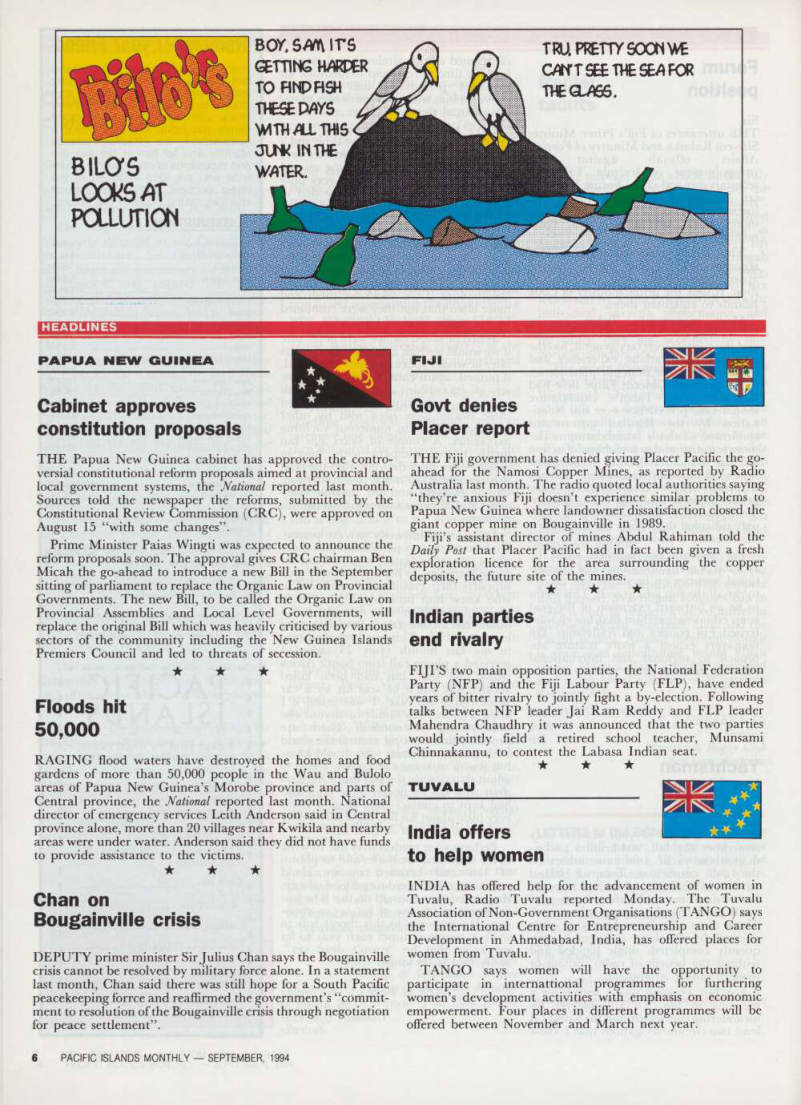
BUG'S
LOOKS AT
POLLUTION
b or. $m irs
GETTING HARPER
TO FIND FISH
THESE PAYS
WITH ALL THIS
JUNK IN THE
WATER.
TRU PRETTY SOON WE
CAN'T SEE THE SEA FOR
THE GLASS.
:: : 'r m
constitution proposals
Headlines
Papua New Guinea
Cabinet approves constitution proposals
THE Papua New Guinea cabinet has approved the contro versial constitutional reform proposals aimed at provincial and local government systems, the National reported last month.
Sources told the newspaper the reforms, submitted by the Constitutional Review Commission (CRC), were approved on August 15 “with some changes”.
Prime Minister Paias Wingti was expected to announce the reform proposals soon. The approval gives CRC chairman Ben Micah the go-ahead to introduce a new Bill in the September sitting of parliament to replace the Organic Faw on Provincial Governments. The new Bill, to be called the Organic Faw on Provincial Assemblies and Local Level Governments, will replace the original Bill which was heavily criticised by various sectors of the community including the New Guinea Islands Premiers Council and led to threats of secession. ★ ★ ★
Floods hit
50,000 RAGING flood waters have destroyed the homes and food gardens of more than 50,000 people in the Wau and Bulolo areas of Papua New Guinea’s Morobe province and parts of Central province, the National reported last month. National director of emergency services Leith Anderson said in Central province alone, more than 20 villages near Kwikila and nearby areas were under water. Anderson said they did not have funds to provide assistance to the victims. ★ ★ ★
Chan on
Bougainville crisis
DEPUTY prime minister Sir Julius Chan says the Bougainville crisis cannot be resolved by military force alone. In a statement last month, Chan said there was still hope for a South Pacific peacekeeping forrce and reaffirmed the government’s “commit ment to resolution of the Bougainville crisis through negotiation for peace settlement”.
end rivalry
Fiji
Govt denies Placer report
THE Fiji government has denied giving Placer Pacific the go ahead for the Namosi Copper Mines, as reported by Radio Australia last month. The radio quoted local authorities saying “they’re anxious Fiji doesn’t experience similar problems to Papua New Guinea where landowner dissatisfaction closed the giant copper mine on Bougainville in 1989.
Fiji’s assistant director of mines Abdul Rahiman told the Daily Post that Placer Pacific had in fact been given a fresh exploration licence for the area surrounding the copper deposits, the future site of the mines. ★ ★ ★
Indian parties
end rivalry
FIJI’S two main opposition parties, the National Federation Party (NFP) and the Fiji Labour Party (FTP), have ended years of bitter rivalry to jointly fight a by-election. Following talks between NFP leader Jai Ram Reddy and FLP leader Mahendra Chaudhry it was announced that the two parties would jointly field a retired school teacher, Munsami Chinnakannu, to contest the Labasa Indian seat.
India offers
Tuvalu
India offers to help women
INDIA has offered help for the advancement of women in Tuvalu, Radio Tuvalu reported Monday. The Tuvalu Association of Non-Government Organisations (TANGO) says the International Centre for Entrepreneurship and Career Development in Ahmedabad, India, has offered places for women from Tuvalu.
TANGO says women will have the opportunity to participate in internattional programmes for furthering women’s development activities with emphasis on economic empowerment. Four places in different programmes will be offered between November and March next year.
from university
Western Samoa
Three expelled from university
THREE Western Samoans, who attacked a Fijian student at the University of the South Pacific campus in June causing him to lose his left eye, have been banned and expelled from the university’s Fiji facilities until 1999. USP registrar Sarojini Pillay said Siaumau Faasavalu, Uluipefosi Fa’aloga and Eroni Sitanieli were expelled for “breaching university regulations” in the June 25 attack.
However, the three can resume their studies at any regional USP centre from 1997. The decision was made during the USP’s disciplinary committee meeting. Last month, when the trio appeared before Fijian chief magistrate Sakeo Naqiolevu charged with intent to cause grievous bodily harm, he gave them a conditional discharge.
Faasavalu, Fa’aloga and Sitanieli attacked Fijian Saimoni Tuiqali, 21, with a broken beer bottle in his dorm room.
Surgeons had to remove Tuiqali’s left eye after the attack. He is currently undergoing medical treatment in Australia.
New judge
Cook Islands
New judge appointed
THE Cook Islands has a new high court judge. Justice Ron Gilbert, of the Auckland District Court, has been appointed to the Cooks High Court.
Although he retired last year, Justice Gilbert has been a temporary judge of the Auckland District Court since his retirement. His three-year term in the Cook Islands started on
July 27.
Radio station
New Zealand
Radio station gets the squeeze
THE only broadcaster in New Zealand controlled and operated by Pacific islanders, Radio 53 PI, is under pressure to live within its means.
The Auckland station is getting the squeeze from New Zealand on Air, which wants the station to live within its allocation from public broadcasting fee revenue. The station, which is almost a year old, receives NZ$2OO,OOO per year but at present is losing more than that. Radio 531 Pi’s acting manager Sefita Hao’uli said they needed time to get on their feet.
He said if people only wanted them to play “jukebox” music they could live within their means. But he said they had a social function and this was not only to entertain. Hao’uli said their income was growing and was now earning about $20,000 a month but this still left them in the red. He said if income was to grow the station had to be given more time to build and gain more listeners.
Polynesian problems
Tonga
Polynesian problems hit Royal Tongan
TONGA is trying to restore confidence in its national airline after serious disruption to flights caused by the financial problems of partner carrier Polynesian Airlines. Royal Tongan Airlines said last month it was looking for another airline to carry its passengers on key Pacific routes, and also said it wanted its own international aircraft within five years.
Royal Tongan currently does not have its own aircraft, and relies mainly on Polynesian Western Samoa’s national airline to service its routes. Royal Tongan’s name is also carried on the aircraft. Following an ill-fated expansion plan, Polynesian had by May built up debts of As2B million and last month was said by Western Samoa’s chief auditor to be in a “chronic state of insolvency”.
Polynesian’s financial problems have now forced it to hand back two of its three aircraft and to halt services to the United States, plunging its schedules into disarray. These problems are understood to have cost Royal Tongan a considerable drop in revenue On key routes.
“The end result of Polynesian’s problems has been serious disruption and a loss of public confidence in the services offered by Royal Tongan,” general manager Geoff Bowmaker said in a statement. He said he had made clear his concerns to Polynesian. Tonga had had to suspend services to the US, although a review by Polynesian had satisfied him that Royal Tongan could still count on reliable services to Sydney and Auckland. AAP ★ ★ ★
Man wins appeal
against deportation
A FORMER Tongan policeman has won an appeal against deportation from New Zealand, despite having been convicted of indecently assaulting a child last year. Talifolau Maka, 31, of Auckland, was going to be deported by the ministry of immigration as they said by being in New Zealand, Maka was a threat to the public, including his children.
On July 20, 1993 Maka was sentenced to 18 months in jail for indecently assaulting a girl. He served six months and is currently on parole. Maka went to New Zealand in 1986 on a visitor’s permit but remained illegally in the country when the visa expired. He was granted permanent residency in 1989.
In a report made public on August 3, the deportation review tribunal said Maka’s wife was a diabetic and needed regular care. Also the couple’s three children all under five needed their father’s help and parental influence. ★ ★ ★
Squash pumpkin
price worry
SQUASH pumpkin exporters in Tonga are worried that this year’s prices may be lower than expected. Radio Australia reported last month that harvesting was two months away, but Tongan government trade officials say prices would be affected by competition from Vanuatu and New Caledonia. They say the Japanese market, which takes all of Tonga’s exports, will not pay the record prices of last year. Squash pumpkin is Tonga’s top export crop.
Advertisements & other items, p. 8 (1 item)
Your Island Connections
4
Cable and Wireless began keep-
' ing people in touch around the world more than a century ago. Today,
while the technology has changed,
the tradition of service to our customers in the
South Pacific is just the same.
We work in partnership with Governments,
dedicated to meeting the need of communities and businesses to stay in touch. From one island to the next or to the other side of the world, the message is the same: Cable and Wireless is
your South Pacific
connection bringing the
islands together.
CABLE & WIRELESS
Asia Pacific Head Office Cable and Wireless pic Cable and Wireless (Pacific) Limited 22nd Floor Office Tower Convention Plaza 1 Harbour Road Hong Kong Tel: (852) 848 8620 Facsimile: (852) 868 5195 Fiji In association with the Government of Fiji Fiji International Telecommunications Ltd.
P.O. Box 59 Mercury House 158 Victoria Parade Suva Fiji Tel: (679) 312933 Solomon Islands In association with the Government of the Solomon Islands Solomon Telekom Company Limited P.O. Box 148 Honiara Solomon Islands Tel: (677) 21576 Tonga Cable and Wireless pic Private Mail Bag 4 General Post Office Nuku Alofa Tonga South Pacific Tel: (676) 23499 Vanuatu In association with the Government of Vanuatu and France Cdbies el Radio Telecom Vanuatu Limited P.O. Box 146 Port Vila Vanuatu Tel: (678) 22185
The Forum
Cover Stories
Managing resources, SPARTECA changes; Tabai stays in post
By Akanisi Motufaga
THIS year’s South Pacific Forum was certainly one with a difference. Apart from having a specific theme, Australian Prime Minister Paul Keating said it was also an attempt to revert to the original aim which the founders had in mind.
However, there were indications that some countries left the Forum disap pointed and Fiji was no exception. As an official put it, Fiji lost in its bid for the post of secretary-general for the Forum Secretariat, it did not get much out of the SPARTECA changes and the agreement to work towards a common code of conduct for the logging industry.
“The code of conduct does not really apply to Fiji because its logging problems
are not as severe as other countries like Vanuatu, Papua New Guinea or the Solomons,” the official pointed out.
Although Fiji Prime Minister Sitiveni Rabuka said the Forum in Brisbane was more effective compared to the previous two, he could not confirm whether the changes to SPARTECA would be in favour of Fiji.
Fiji was also disappointed and angry with the way former Kiribati president leremia Tabai was re-appointed as secretary-general to the Suva-based Fo rum Secretariat.
Fiji may have been the only country that left disappointed as the Solomon Islands delegation left with an offer of $2 million from the Australian Government to help conserve its forests.
This year’s 25th Forum focussed on the theme of Managing Our Resources with great emphasis on environment issues such as fishing, nuclear dumping and logging as well as regional airline services.
According to a United Nations report,
environment issues are the regional governments’ main challenge. It said 70 per cent of Pacific Islanders living in rural areas and outer islands depend on the environment and ecosystem for their livelihood.
“Any destruction to the environment will, therefore, have a wide and signifi cant impact on the welfare and survival of the large minority of Pacific people,” it said.
The report said deforestation in the Solomon Islands was a fine example of failure to carefully consider environ mental costs.
Australian Minister Gordon Bilney said part of the logging problem was related regional governments being ripped olf by logging companies and the lack of careful monitoring.
Some of these countries, he said, were Vanuatu, Papua New Guinea, Solomon Islands and, to some extent, Fiji.
“In some of these countries, you are looking at a situation where the rate of exploitation is six to eight times higher
Alfred Sasako
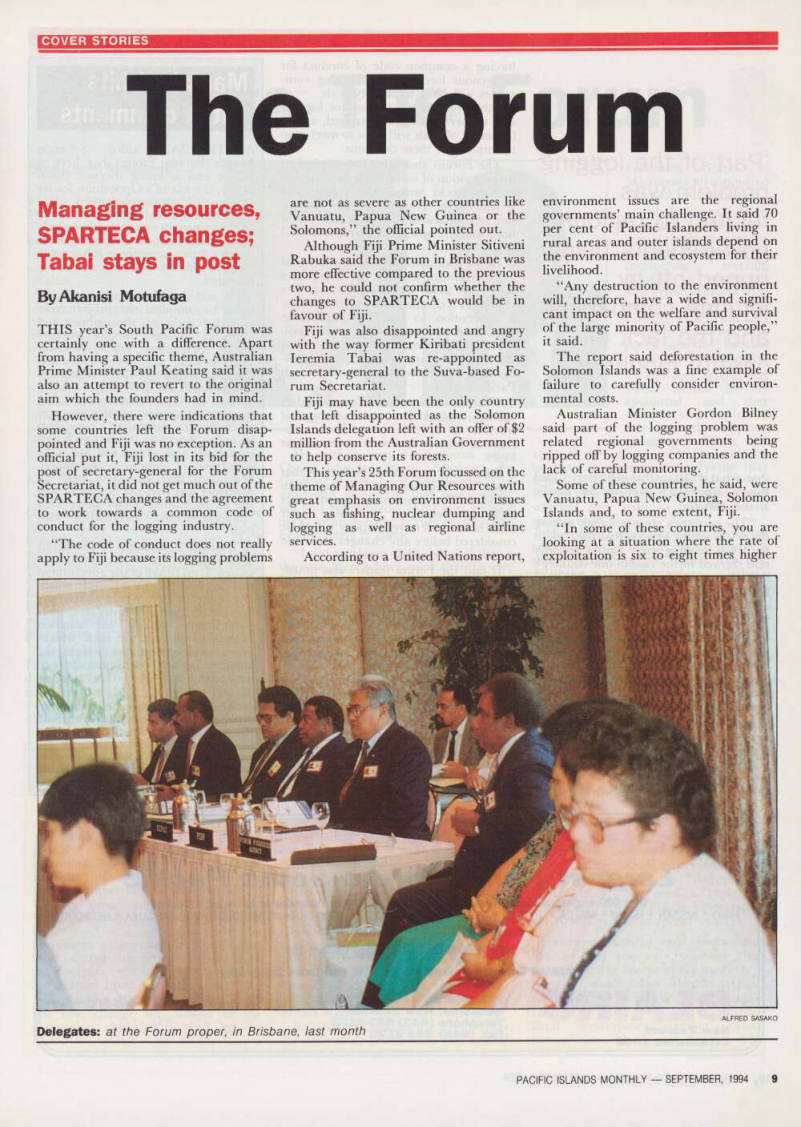
Delegates: at the Forum proper, in Brisbane, last month
‘Part of the logging problem was related to regional governments being ripped off by logging companies and the lack of careful monitoring’
than what is sustainable in forestry,” said Bilney, Australia’s Minister for Pacific Island Affairs.
“The countries are simply not getting the prices for the exports that they ought to. I was reading some figures recently that showed in the case of one country’s logs that were being sold for around $3.50 per cubic metre were returning only $2.70 to that country,” the minister said.
Bilney stressed that Australia would not adopt a ‘big brother’ attitude; rather
it would help regional countries through
advice and technical assistance to use their resources in a sustainable way to last for the next generations.
As a result of these discussions, an agreement was drawn up between Aus tralia, New Zealand, Fiji, Vanuatu, Solomon Islands and Papua New Guinea where: (a) these governments will work towards
having a common code of conduct for indigenous forests which logging com panies will have to comply with; (b) the urgent need to monitor logging and timber exports was stressed, and (c) senior officials will have to meet soon to implement these decisions.
The Forum also agreed to strengthen its promotion of sustainable exploitation of fish stocks within the region and welcomed the United Nations Conven tion of the Law of the Sea which would build and strengthen the current regional ties.
In its communique, the Forum said global warming and the rise in sea level were the most serious threats to the region. It welcomed the negotiations for a convention to ban the imports to hazardous and radioactive wastes into Forum Island countries and to control the transboundary movement and man agement of such waste within the South
Pacific region.
The communique said Forum leaders agreed to look into rationalising air services to operate on a likely sub regional basis in a move to arrest airline losses.
Bilney said at a Press conference that losses for regional airlines ran into millions. The communique said issues such as frequency, operation costs airfares and safety regulations would be considered before any changes are made to the current airline structure.
It said the Forum leaders also noted: (a) that finance and trade ministers in the region should meet to discuss and devise proper policies, broaden the Forum island countries economic base, improve the balance of payments and look into fiscal public sector mismanage ment; (b) that the usage of land, in terms of the indigenous peoples’ relation to their land, varied from country to country, and (c) that officials would meet later this year at Hawaii to form an agenda and proposal aimed at promoting trade and investment between the United States and Pacific Island states. □
Mamaloni hits
out at comments
AUSTRALIAN aided Solomon Islands Forests Project has been a failure and is losing investor confi dence, the island’s Opposition leader Solomon Mamaloni claimed in a statement. Mamaloni said 14 years after the project started with Austra lian International Development Agency Bureau assistance, it has yet to yield any fruitful data as was initially intended.
He said the Australian consultants hired to complete the project have exceeded their job descriptions and indulged in the island’s internal affairs. Australian Prime Minister Paul Keating also came under fire from Mamaloni who said Keating was preaching to the SIG project person nel and Solomon Islanders about the proper management of their resources when the first Australian Consultants inventory report on the island’s forests contained many errors and had to be withdrawn from circulation.
Mamaloni said the view held by Australia was that the Solomons was still an Australian colony hence their
“imperialist and paternalistic atti
tude”.
“Instead of listening to lies about over exploitation of our natural re sources I, on behalf of the government and people of Solomon Islands, cordi ally invite all Forum leaders to come and see for themselves, or, send their government officials to Solomon Islands to observe the legal instru ments and procedures which the Solomon Islands government apply to the control and use of this country’s natural resources.
“There is no other better way to disprove what Mr Keating and Mr Billy Hilly have been saying about Solomon Islands natural resources than for the Forum leaders, including Mr Keating or their officials, to come to the Solomons to see for themselves.” □
Advertisements & other items, p. 10 (1 item)
Blairs
REPLACEMENT ENGINES
Largest Range in the South Pacific
Over 800 engines available: Dlesel-Gasollne lOhp to 400 hp. Transmission to match If required * HINO * NISSAN * ISUZU * MAZDA * TOYOTA * MITSUBISHI * DAIHATSU * FORD PERKINS MERCEDES VOLVO SCANIA * BEDFORD *
LEYLAND * DETROIT COMMINS DEUTZ.
NEW ARRIVALS: lUECO 300 hp Bedford 330 YANMAR Stationary Engines with Radlator/Fuel Tank 13hp —24 hp
BLAIRS
New Zealand Established 1956 P.O. Box 14 Geraldine, New Zealand Telephone (643) 693-8122 Fax (643) 693-8120
‘We ship anywhere
in the Pacific
Fiji vs The Forum
By Akanisi Motufaga
FIJI’S relationship with the Forum Secretariat’s leremia Tabai may take some time to heal following the controversy over the appointment of a secretary general for the Sec retariat.
The controversy led to a lot of anger and disappointment in the Fiji delegation, which be lieved that its own candidate, Senator Filipe Bole, would get the job.
However, Tabai’s reappointment has led to the Forum laying down clear and firm guidelines on future ap pointments. Tabai was ap pointed three years ago and his
job vacancy resulted in four applications
one each from Fiji, Tonga, Papua
New Guinea and Australia.
The candidate from Papua New Guinea withdrew his application after being offered a United Nations post.
Senator Bole, in his application, had asked that his letter be set aside if Tabai reapplied for the post. Seeing that Tabai * i T?— did not reapply, fni endorsed Senator b i > ju , •
Bole s application and began lobbying.
T'V • . t - ' * Tfc *1 i During the Forum in Brisbane last ment!!, Kiribati nominated Tabai for the post minus his application.
In explaining the controversy, Fiji Prime Minister Sitiveni Rabuka said his delegation had to review its stand when it arrived for the meeting. He said Fiji went to the Forum knowing that Tabai did not re-apply.
He said he was disappointed when Cook Islands Prime Minister Sir Geoffrey Henry stated that there was an unwritten agreement that there would not be a Fijian holder of the post because of the location of the Forum Secretariat s headquarters m Suva.
“I did not know that ... and if that is the case, then I don’t think that it’s very r • d u j u* c fair. Perhaps we can do what one of ji . 1 . .. delegates suggested that we put the T-i ri • 1 , r* , I Forum Secretariat on a platform so that everyone can apply, he said.
Throughout the controversy, Tabai refused to comment or to confirm whether he did apply or not. A senior Fiji official to the Forum described Rabuka as very angry and disappointed. He said Papua New Guinea, Solomon Islands, Tuvalu, Tonga, Western Samoa and the
Federated States of Micronesia all supported Fiji and its candidate.
“Mr Bole was the best candidate but the prob lems were the procedures and the Pacific way of
conducting meeting
through a consensus.
The Prime Minister (Ra
buka) spoke very
strongly against the fact
that Fiji could not sup port a candidate because it was the host country.
“But they agreed that
Tabai should be re appointed and that when his term expires in three years time anyone,
including a Fijian, can
apply,” the official said. He said the leaders also agreed at the Forum that future appointees should inform the Forum after the second year of service of whether they wish to re-apply for a second term He said if future appointee decide to re-app y en ewi ge o serve asecon srn?’5 rn ?’ ccor m S ° orum o icia s, Australia supported labais • * > i a u xr- u <-■ \ reappointment backed by Kiribati. A JT f h Fiji de l e gation business- U 1 ill vIVIL t; CltlUll. U UolllC-OJ man j im Ah Koy J said it B was disappoint . see , he Fo ' rum endorse and *X C ce P t Tabai’s “arrogance” in not applying.
The senior official said that if Tabai had indicated his wish to be reappointed, then Fiji would not have had to go
through the lobbying period, the disap
pointment and anger during the meet
ing. □
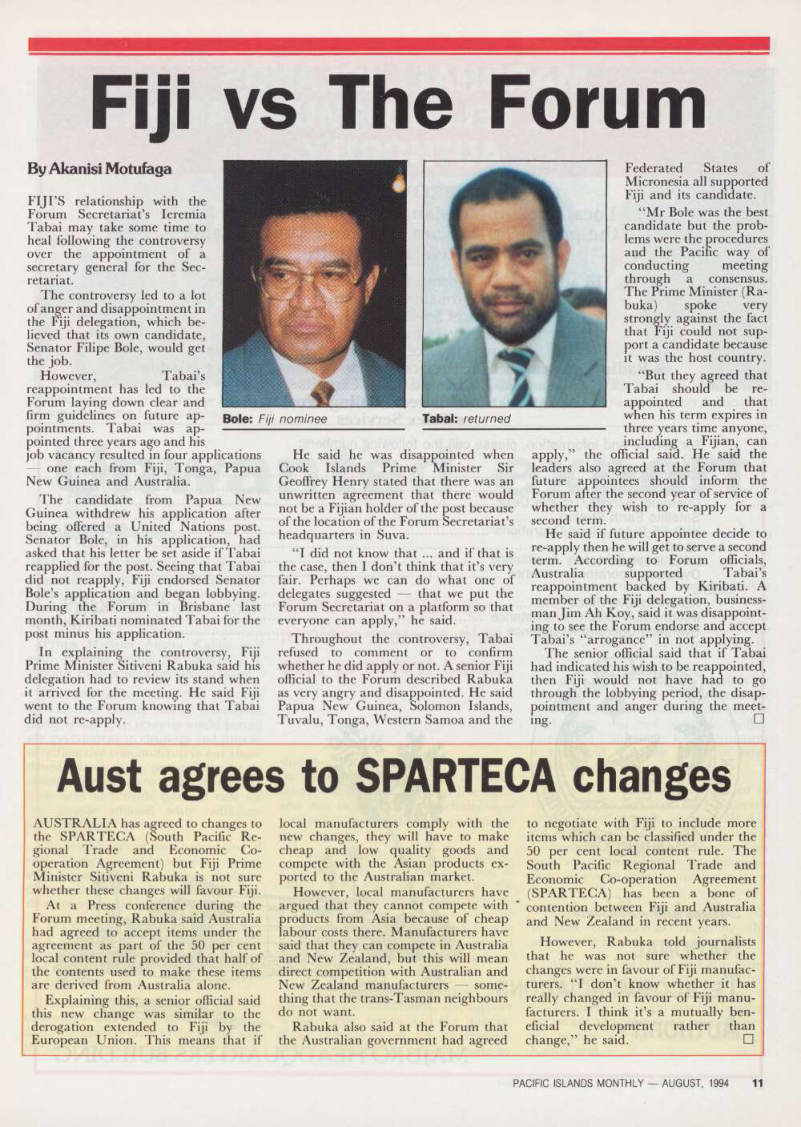
Bole: Fiji nominee
Tabai: returned
Aust agrees to SPARTECA changes
AUSTRALIA has agreed to changes to the SPARTECA (South Pacific Re gional Trade and Economic Co
operation Agreement) but Fiji Prime
Minister Sitiveni Rabuka is not sure whether these changes will favour Fiji.
At a Press conference during the Forum meeting, Rabuka said Australia had agreed to accept items under the agreement as part of the 50 per cent local content rule provided that half of the contents used to make these items are derived from Australia alone.
Explaining this, a senior official said this new change was similar to the
derogation extended to Fiji by the
European Union. This means that if
local manufacturers comply with the new changes, they will have to make
cheap and low quality goods and
compete with the Asian products ex ported to the Australian market.
However, local manufacturers have argued that they cannot compete with products from Asia because of cheap labour costs there. Manufacturers have said that they can compete in Australia and New Zealand, but this will mean direct competition with Australian and New Zealand manufacturers some thing that the trans-Tasman neighbours do not want.
Rabuka also said at the Forum that the Australian government had agreed
to negotiate with Fiji to include more items which can be classified under the 50 per cent local content rule. The South Pacific Regional Trade and
Economic Co-operation Agreement
(SPARTECA) has been a bone of contention between Fiji and Australia and New Zealand in recent years.
However, Rabuka told journalists that he was not sure whether the changes were in favour of Fiji manufac turers. “I don’t know whether it has really changed in favour of Fiji manu facturers. I think it’s a mutually ben eficial development rather than change,” he said. □
Advertisements & other items, pp. 12-13 (2 items)
Marshall Islands
NATIONAL TELECOMMUNICATIONS
AUTHORITY
PROVIDES
Local and long distance telephone service for the people on Majuro Atoll and Ebeye Island on Kwajalein Atoll.
In addition NT A provides the following services: • Directory Assistance • Packet Switching Services • Key Systems for Businesses • PBX Systems for Larger Businesses and Hotels • Radio Communication Services to the Marshalls Outer Islands • Dedicated Data Circuits • International Direct Dialing Worldwide • Telex Services For service and information, please call the following numbers:
MAJURO
Executive Offices 625-3852 Accounting Office 625-3676/3618 Customer Service/Trouble Desk 625-3851 Satellite Earth Station 625-3532 KUP 65 Outer Island Operations 625-3363 or call 625-3577 Information/Directory Assistance “411”
Overseas Operator Assistance “0”
EBEYE
Administrative Office 329-3341/3500 Information/Directory Assistance “411“ Overseas Operator Assistance “0“
sBA u
& w 4k Sc G. § & V
National
Telecommunciations
Authority
MAJURO HEADQUARTERS BUILDING
Cover Stories
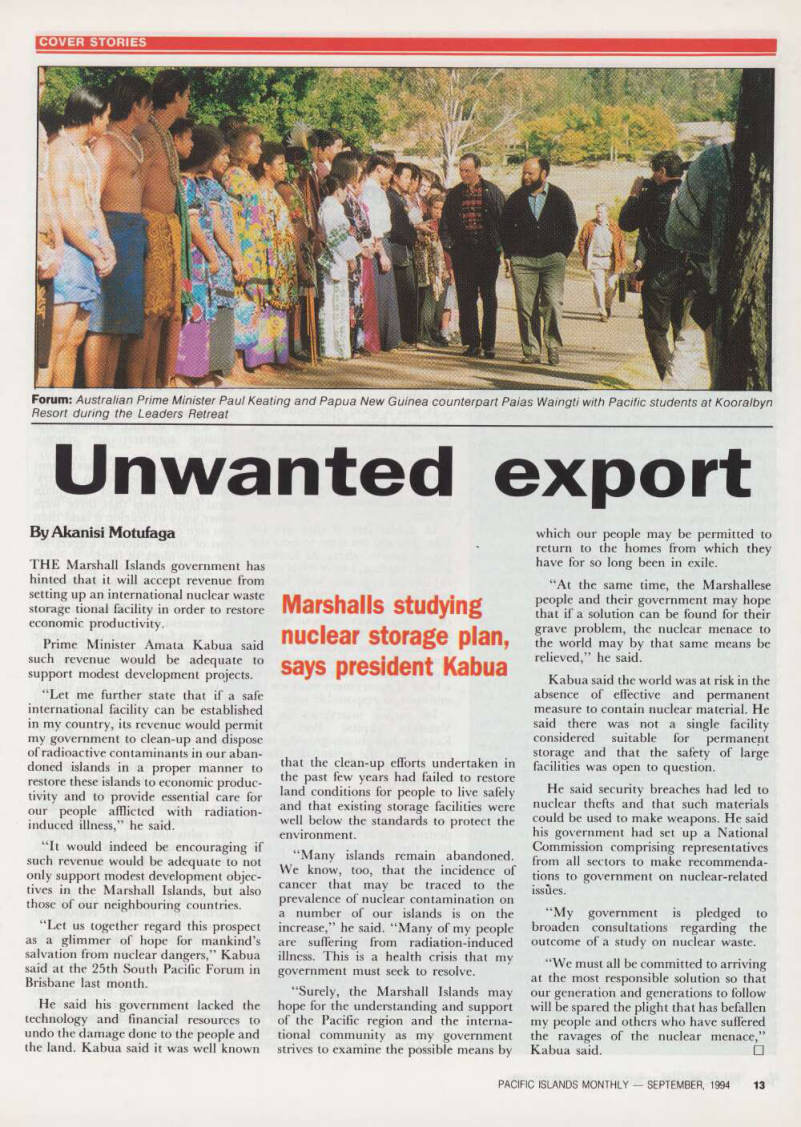
Forum: Australian Prime Minister Paul Keating and Papua New Guinea counterpart Paias Wa ingti with Pacific students at Kooralbyn Resort during the Leaders Retreat
Unwanted export
By Akanisi Motufaga
THE Marshall Islands government has hinted that it will accept revenue from setting up an international nuclear waste storage tional facility in order to restore
economic productivity.
Prime Minister Amata Kabua said such revenue would be adequate to
support modest development projects.
“Let me further state that if a safe international facility can be established in my country, its revenue would permit my government to clean-up and dispose of radioactive contaminants in our aban doned islands in a proper manner to restore these islands to economic produc tivity and to provide essential care for our people afflicted with radiation induced illness,” he said.
“It would indeed be encouraging if such revenue would be adequate to not
only support modest development objec
tives in the Marshall Islands, but also those of our neighbouring countries.
“Let us together regard this prospect as a glimmer of hope for mankind’s salvation from nuclear dangers,” Kabua said at the 25th South Pacific Forum in Brisbane last month.
He said his government lacked the technology and financial resources to undo the damage done to the people and the land. Kabua said it was well known
Marshalls studying nuclear storage plan, says president Kabua
that the clean-up efforts undertaken in the past few years had failed to restore land conditions for people to live safely and that existing storage facilities were well below the standards to protect the environment.
“Many islands remain abandoned.
We know, too, that the incidence of cancer that may be traced to the prevalence of nuclear contamination on a number of our islands is on the increase,” he said. “Many of my people are suffering from radiation-induced illness. This is a health crisis that my government must seek to resolve.
“Surely, the Marshall Islands may hope for the understanding and support of the Pacific region and the interna tional community as my government strives to examine the possible means by
which our people may be permitted to return to the homes from which they have for so long been in exile.
“At the same time, the Marshallese people and their government may hope that if a solution can be found for their grave problem, the nuclear menace to the world may by that same means be relieved,” he said.
Kabua said the world was at risk in the absence of effective and permanent measure to contain nuclear material. He said there was not a single facility considered suitable for permanent storage and that the safety of large facilities was open to question.
He said security breaches had led to nuclear thefts and that such materials could be used to make weapons. He said his government had set up a National
Commission comprising representatives
from all sectors to make recommenda tions to government on nuclear-related issues.
“My government is pledged to broaden consultations regarding the outcome of a study on nuclear waste.
“We must all be committed to arriving at the most responsible solution so that our generation and generations to follow will be spared the plight that has befallen my people and others who have suffered the ravages of the nuclear menace,”
Kabua said. □
Let’s not panic,
leaders say
By Akanisi Motufaga
PACIFIC Island leaders say their countries are not on the brink of disaster, as Australia put it when describing the region’s environment.
Prime ministers Sitiveni Rabuka and Paias Wingti said there were serious environment problems, but not too serious to warrant panic.
They both said that working together to resolve these problems was the way forward.
Solomon Islands Prime Minister Francis Billy Hilly has the same belief although he has a different strategy. Hilly said at the forum that his country would stop exporting round logs in a move to contain the exploitation of forests and to conserve the remaining trees.
Round logs exports make up more than 50 per cent of the country’s revenue. Although no dates have been set on the total ban, the Solomon Islands will have to rely more on foreign aid and diversify its products to survive.
Hilly said at the Forum in Brisbane last month that Australia had offered $2 million to help in the country’s structural adjustment programme.
“All we need is more assistance and less criticism,” he said. He added that exploitation of natural resources was a serious problem and that regional governments would be able to look after their own environmental problems if they were given assistance.
Hilly said his government intended to introduce processing of timber products once the total ban is in place. According to a United Nations report, logging in the Solomon Islands for export began in 1961. At the moment, half of the country’s viable forest resources have been logged with extraction rates doubled between 1991 to 1992.
The report said logging would not be sustained for more than eight years if the current extraction rate remains. It saia the annual sustainable yield was about 270,000 cubic metres, but that the logging licences granted catered for more than 1.4 million cubic metres annually.
“Reforestation will take 30-40 years in those areas that have been carefully logged,” the report said. “However, it is reported that there has been widespread disregard of environmental protection controls with the result that reforestation may take anything from 45 to 200 years. Significant under reporting of volumes and values has eroded the returns to Solomon Islands in the form of royalties and export taxes.”
Hilly said his government’s aim was to divert foreign exchange income from forest-related products to other areas. “It is a cause of grave concern to the government that because of our limited and narrow economic base, heavy empha sis is being placed on a very few resources to sustain the national economy,” Hill said.
“The government is anxious to implement sensible and practical policies that will enable sustainable management of this resource and the whole environment in general so that future generations of our people too can enjoy the benefits from that sector. The government is also serious in its efforts to diversify the productive sector and therefore divert the pressure away from the reliance on forestry for foreign exchange earnings,” Hilly said. U
Korman’s challenge
to loggers
By Patrick DeCloitre
DURING the recent South Pacific Forum summit in Brisbane, Vanu atu Prime Minister Maxime Carlot Korman was asked to elaborate on his recent stand on logging in the island state. In a ground-breaking decision, last June, he had first banned all exports of whole logs, then invalidated all business li cences to logging companies on the tiny island of Erromango. The address he gave in Brisbane is highly critical of some members of his cabinet.
It was a good opportunity for Vanuatu’s Prime Minister to make use of the French-English in terpretation system that had been installed at the Forum at his request. Talking to Forum del egates, Korman referred to the logging problems as “important” to him.
In actual fact, if they are for him, they did not seem to bear the importance to others. As Korman hinted, “at first, I have left it to my cabinet to negotiate with foreign companies. The result is that contracts have been signed with those companies without taking into account the country’s real potential, or the sustainable devel opment, not even local regulations and Customs (...) I considered that a head of government must see his ministers as responsible men”.
In earlier interviews in the Vanuatu capital Port Vila, Korman had shown growing con cern about the potentially disas trous impact of intensive logging in his country.
“We had reached an absurd situation whereby the country’s forest resources would have been destroyed in as less as five years. I have therefore decided to act, and to act abruptly, by declaring without notice a review of all granted licences and a ban on the export of whole legs.
“Foreign companies have no scruple in dragging a government or a nation into anarchy (...) I know certain private foreign inter ests will seek and, in fact, already do to put their weight into the local political life. As their financial power is much more than our national budget, there will be some sport!”, he said, adding the island state’s general elections were
scheduled next year.
“The electoral campaign will be tough,” he said. So the prime minister has had to be tougher than his more docile ministers - “I wanted to show our flawless deter mination, even if this means that we had to breach existing contracts and therefore be exposed to pay
penalties”.
Korman explained he had made
a simple offer to foreign logging
companies operating in the island state - “either this is war, and they sue my government for breach of contract. We would have to pay
compensation, but then they
would have to leave the country.
Or a new balance is found, and existing contracts are renego tiated”.
Not only did the government have to resist the foreign loggers’ offers, but it also had to explain local landowners that there were other ways to develop a land than just sign contracts, sometimes with two or three different loggers for the same block of land.
“Some landowners think it is their exclusive right to decide what to do with the trees on their customary land. (They) think the government has no right to inter fere, even for the sake of the whole community. Some will even find it all right to leave bare ground to their children,” he said.
Hence the need, Korman thinks, to introduce legislation that would enhance such values as the duty for traditional owners to be ‘guard ians’ of their land for future
generations.
“Numerous traditions here show the traditional landowner and the one cultivating the land are often two different persons. There was a relation between the guardian and the cultivator (...) We should be able to make landowners accept that they don’t have the right to destroy what they have not cre ated”.
But, as Carlot told the Forum participants, there are reasons for nope.
In this battle, Vanuatu can rely on the full support of major aid donors like Australia, New Zea land, United Kingdom and France. They were the ones who initiated the U-turn last May,
when they were jointly received by
Korman and expressed their con cern to him. □
Under pressure
Western Samoa
By Martin Tiffany
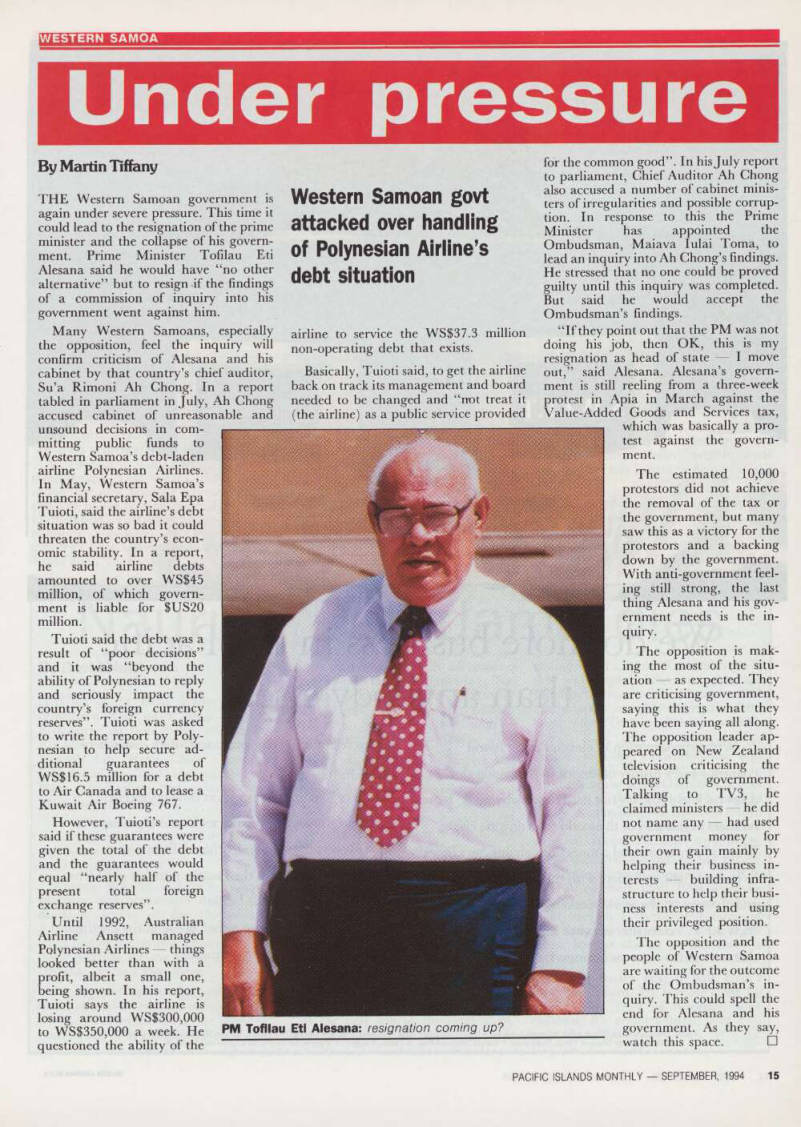
THE Western Samoan government is again under severe pressure. This time it could lead to the resignation of the prime minister and the collapse of his govern ment. Prime Minister Tofilau Eti Alesana said he would have “no other alternative” but to resign if the findings of a commission of inquiry into his government went against him.
Many Western Samoans, especially
the opposition, feel the inquiry will confirm criticism of Alesana and his cabinet by that country’s chief auditor, Su’a Rimoni Ah Chong. In a report tabled in parliament in July, Ah Chong accused cabinet of unreasonable and
unsound decisions in com mitting public funds to Western Samoa’s debt-laden airline Polynesian Airlines.
In May, Western Samoa’s financial secretary, Sala Epa Tuioti, said the airline’s debt situation was so bad it could threaten the country’s econ omic stability. In a report, he said airline debts amounted to over WSS4S million, of which govern ment is liable for SUS2O million.
Tuioti said the debt was a result of “poor decisions” and it was “beyond the ability of Polynesian to reply and seriously impact the
country’s foreign currency
reserves”. Tuioti was asked to write the report by Poly nesian to help secure ad ditional guarantees of WSSI6.S million for a debt to Air Canada and to lease a Kuwait Air Boeing 767.
However, Tuioti’s report said if these guarantees were given the total of the debt and the guarantees would equal “nearly half of the present total foreign exchange reserves”.
Until 1992, Australian Airline Ansett managed Polynesian Airlines things looked better than with a profit, albeit a small one, being shown. In his report, Tuioti says the airline is losing around WS$3OO,OOO to W 55350,000 a week. He questioned the ability of the
Western Samoan govt
. . 3tI3CKOU OV6T nSnullDg * DnK/nacian AirlSno’c OT rOlyilßSian MINIHC 5 citliatifltl
Ucui Ailuduu
airline to service the W 5537.3 million non-operating debt that exists.
Basically, Tuioti said, to get the airline back on track its management and board needed to be changed and “not treat it (the airline) as a public service provided
for the common good”. In his July report to parliament, Chief Auditor Ah Chong also accused a number of cabinet minis ters of irregularities and possible corrup tion. In response to this the Prime Minister has appointed the Ombudsman, Maiava lulai Toma, to lead an inquiry into Ah Chong’s findings.
He stressed that no one could be proved
guilty until this inquiry was completed.
But said he would accept the
Ombudsman’s findings.
“If they point out that the PM was not doing his job, then OK, this is my resignation as head of state I move out,” said Alesana. Alesana’s govern ment is still reeling from a three-week protest in Apia in March against the Value-Added Goods and Services tax,
which was basically a pro test against the govern ment.
The estimated 10,000 protestors did not achieve the removal of the tax or the government, but many saw this as a victory for the protestors and a backing down by the government.
With anti-government feel ing still strong, the last thing Alesana and his gov ernment needs is the in quiry.
The opposition is mak ing the most of the situ ation as expected. They are criticising government, saying this is what they have been saying all along.
The opposition leader ap peared on New Zealand television criticising the doings of government.
Talking to TVS, he claimed ministers he did not name any had used government money for their own gain mainly by helping their business in terests building infra structure to help their busi ness interests and using their privileged position.
The opposition and the people of Western Samoa are waiting for the outcome of the Ombudsman’s in quiry. This could spell the end for Alesana and his government. As they say, watch this space. □
PM Tofilau Eti Alesana: resignation coming up?
Advertisements & other items, p. 16 (1 item)
We do more business in the Pacific
than anybody else.
With representation in eleven Pacific Island countries and a history of service in the region that dates back to 1901, it’s not hard to see why we do more business in this part of the world than anyone else!
Westpac’s international connections enable our clients to be kept right up to date with the latest movements and changes on the world markets. Our “5.W.1.F.T.” computer network link ensures that our clients overseas business is transacted quickly, efficiently and safely - anywhere in the world.
Letters of Credit, import/export finance, foreign exchange, forward cover and technical expertise - Westpac sets the standard, others follow!
If you have interests in the Pacific, it makes good sense to deal with the leader!
Talk to Westpac today. We’re in the Pacific to stay and we mean business! w You can hank on Westpac
INTERNATIONAL TRADE FINANCE
Pacific Branches: Cook Islands • Fiji • French. Polynesia • New Caledonia • Niue • Solomon Islands • Vanuatu Subsidiary: Kiribati (Bank of Kiribati, Tarawa) Affiliates: Tonga (Bank of Tonga, Nukualofa) • Tuvalu (National Bank of Tuvalu, Funafuti) • Western Samoa (Pacific Commercial Bank Ltd., Apia) International Representation: Beijing • Hong Kong • Jakarta • Jersey • Kuala Lumpur • London • New York • Singapore • Sydney • Tokyo • Wellington
WILSON ADDISON 65.738
Political party for kingdom
POLITICS - Tonga
By Martin Tiffany
TONGA’S pro-democracy movement have made their most assertive step so far against the country’s noble-dominated government they have launched the kingdom’s first political party. The Tonga Democratic Party is expected to become reality in a few weeks with an official launching.
What the pro-democracy campaigners hope for is the party to find seriousness in their fight to change the monarch-led government system.
MP Viliami Fukofuka, a leading pro democracy campaigner and one of the party’s founders, believes the party’s time has come as has time for democratic change in the island kingdom. At last year’s general election, pro-democracy campaigners grabbed six of the nine “people’s representative” seats.
An election in Tonga happens every three years. This means the people choose the nine people’s representatives and nine nobles to parliament. The other 12 members of parliament are cabinet ministers appointed for life by the country’s near-absolute monarch, King Taufa’ahau Tupou IV.
What this really means is the people’s representatives are chosen by 95 per cent of the population (around 94,000) while nobles elect, among themselves, their nine representatives from 33 noble titles.
The new party expects to finalise their
constitution soon. The push towards full
democracy began in Tonga on Novem
ber 24-27 when the pro-democracy movement formed in August that year held a public pro-democracy confer ence. It’s aim was to show the Tongan public what real democracy was and why power should be taken away from the
king.
The battle between the pro democracy people and the nobles has not been easy. It was also been hindered by the fact that many commoners see them as revolutionary. The noble MPs have the pro-democracy movement at every opportunity and cost them especially MP ‘Akilisi’ Pohiva a packet in liable costs.
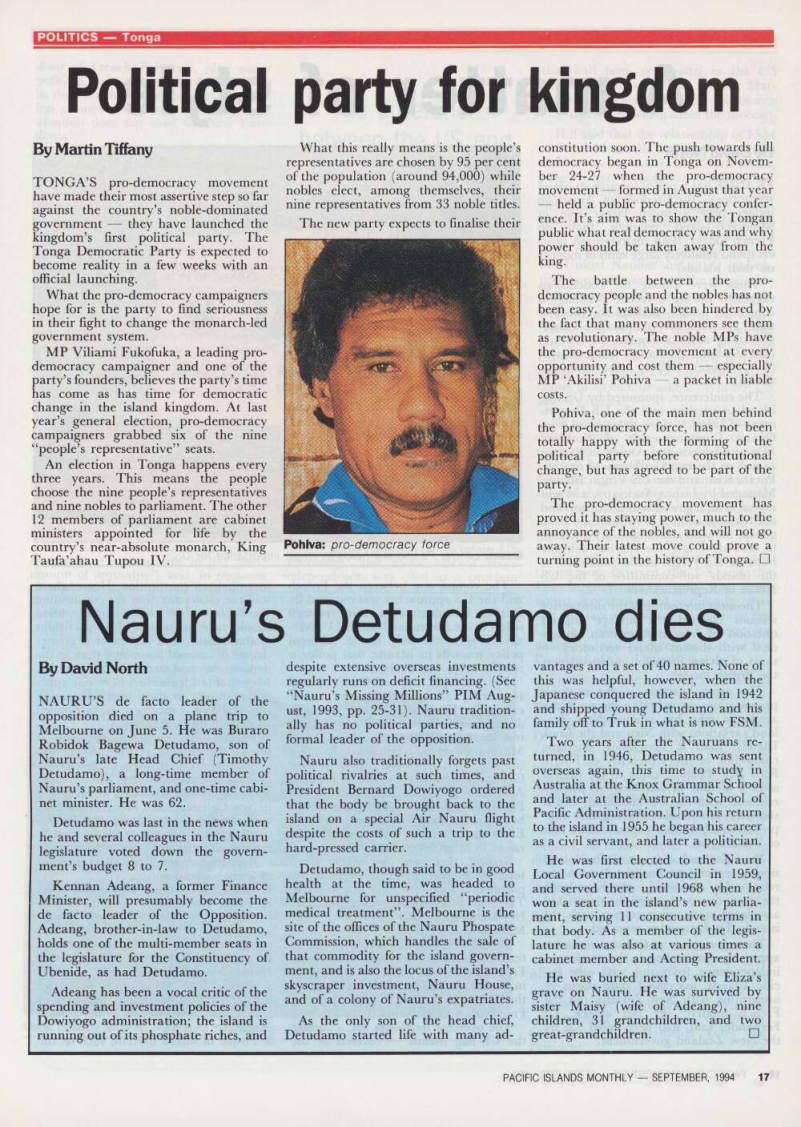
Pohiva, one of the main men behind the pro-democracy force, has not been totally happy with the forming of the political party before constitutional change, but has agreed to be part of the party.
The pro-democracy movement has proved it has staying power, much to the annoyance of the nobles, and will not go away. Their latest move could prove a turning point in the history of Tonga. □
Pohiva: pro-democracy force
Nauru’s Detudamo dies
By David North
NAURU’S de facto leader of the opposition died on a plane trip to Melbourne on June 5. He was Buraro Robidok Bagewa Detudamo, son of Nauru’s late Head Chief (Timothy Detudamo), a long-time member of Nauru’s parliament, and one-time cabi net minister. He was 62.
Detudamo was last in the news when he and several colleagues in the Nauru legislature voted down the govern ment’s budget 8 to 7.
Kennan Adeang, a former Finance Minister, will presumably become the de facto leader of the Opposition.
Adeang, brother-in-law to Detudamo, holds one of the multi-member seats in the legislature for the Constituency of Übenide, as had Detudamo.
Adeang has been a vocal critic of the spending and investment policies of the Dowiyogo administration; the island is running out of its phosphate riches, and
despite extensive overseas investments regularly runs on deficit financing. (See “Nauru’s Missing Millions” PIM Aug ust, 1993, pp. 25-31). Nauru tradition ally has no political parties, and no formal leader of the opposition.
Nauru also traditionally forgets past political rivalries at such times, and President Bernard Dowiyogo ordered that the body be brought back to the island on a special Air Nauru flight despite the costs of such a trip to the hard-pressed carrier.
Detudamo, though said to be in good health at the time, was headed to Melbourne for unspecified “periodic medical treatment”. Melbourne is the site of the offices of the Nauru Phospate Commission, which handles the sale of that commodity for the island govern ment, and is also the locus of the island’s skyscraper investment, Nauru House, and of a colony of Nauru’s expatriates.
As the only son of the head chief, Detudamo started life with many ad
vantages and a set of 40 names. None of this was helpful, however, when the Japanese conquered the island in 1942 and shipped young Detudamo and his family off to Truk in what is now FSM.
Two years after the Nauruans re turned, in 1946, Detudamo was sent overseas again, this time to study in Australia at the Knox Grammar School and later at the Australian School of Pacific Administration. Upon his return to the island in 1955 he began his career as a civil servant, and later a politician.
He was first elected to the Nauru Local Government Council in 1959, and served there until 1968 when he won a seat in the island’s new parlia ment, serving 11 consecutive terms in that body. As a member of the legis lature he was also at various times a cabinet member and Acting President.
He was buried next to wife Eliza’s grave on Nauru. He was survived by
sister Maisy (wife of Adeang), nine
children, 31 grandchildren, and two
great-grandchildren. □
A matter of style
Sovereignty
By David North
FRANCE has a policy towards its island territories the US does not. American judges play a much larger role in Mainland-Island relations than do French judges. Both metropolitan pow ers spend relatively large sums of moneys on their islands.
These were among the conclusions suggested during a recent Washington conference which, perhaps for the first time, analysed the comparative island governing styles of France, the US and New Zealand. (Holland’s relations with its Caribbean islands were also dis cussed).
The conference, sponsored by US flag island universities and the US Depart ment of Interior, drew delegations from Guam, Commonwealth of Northern Mariana Islands and American Samoa, as well as the two Caribbean territories, Puerto Rico and the US Virgin Islands.
Managed by Lisboa Associates, a Wash ington firm, it gave island politicians and academics a chance to rub elbows, swap gossip, blow off steam, and say goodbye to Ron de Lugo, the retiring delegate from the US Virgin Islands, and chair of the islands’ sub-committee of the US House of Representatives.
The most interesting of the substantive sessions covered the always difficult question of how metropolitan powers deal with distant island territories short of giving them full independence, the British model.
The most heartfelt of the session’s presentations came from a Puerto Rican academic who has studied New Zea land’s relations with Nieu and the Cook Islands. Juan R Fernandez, one-time chancellor of the University of Puerto Rico (Rio Pedras), came to the subject after a lifetime of watching his island’s relations with the US mainland, and it showed. He found Wellington’s ap proach much more acceptable than that
of Washington.
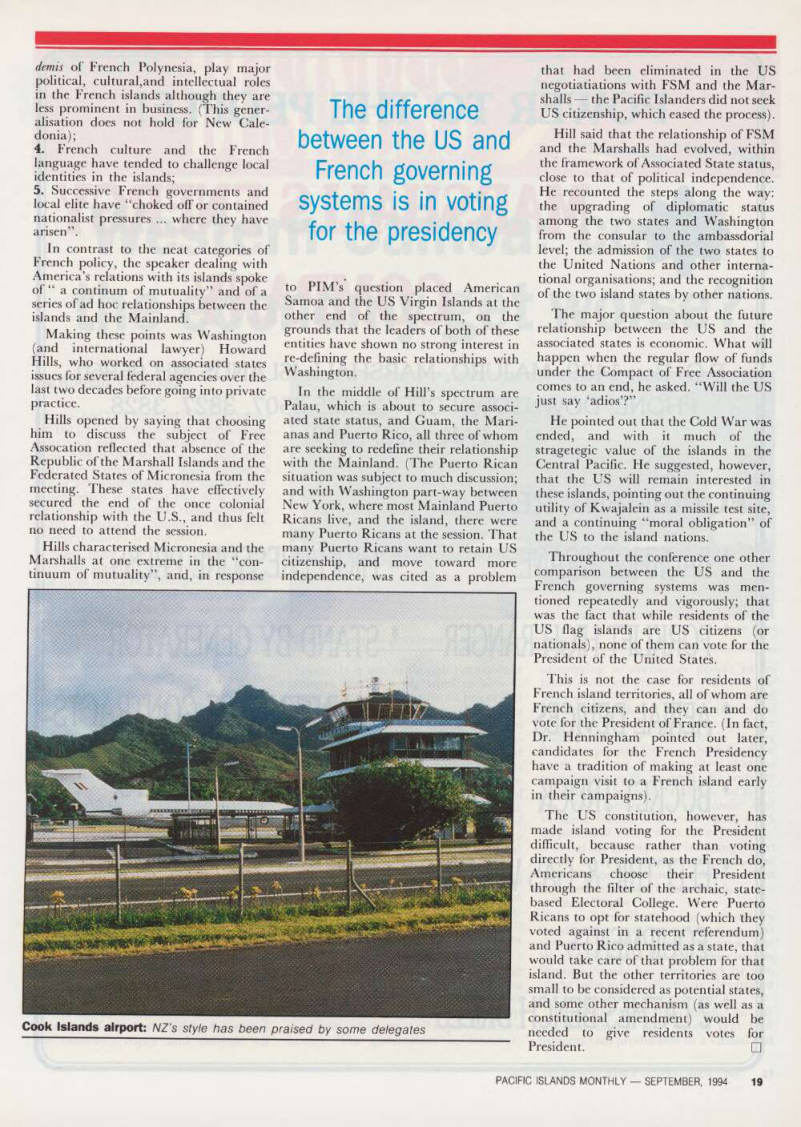
New Zealand did not sit back and simply respond to the islanders on the relationship question the Kiwis took the initiative and carefully negotiated associated state arrangements with the islands, Dr Fernandex reported.
There were four potential alternative approaches, according to the speaker independence, federation with othe Pa cific Islands, associated state status or integration with New Zealand (on the French model); the last choice, Dr Fernandez said, had been ruled out by the New Zealand government.
The comparison between the French and the US approaches was outlined by Stephen Henningham, a senior research fellow at the Australian National University. France not only has a coherent policy towards its islands; that policy is
readily subject to analysis.
For example, all of Gaul’s island territories are divided into three categories. First there are four overseas departments, which are fully assimilated into European France - Guadeloupe and
Martinique (in the Caribbean), Reunion
(in the Indian Ocean), and French Guiana (a non-island territory in South America). All have been part of the French Empire since the 18th Century or before, and all are considered part of the
European Union. Their populations
range from 90,000 to 600,000.
Second, there are the smaller territorial collectives, potential overseas departments, also with long ties to Paris.
These are St Pierre and Miquelon, near Newfoundland, and Mayotte, near
Madagascar.
Thirdly, there are the French overseas territories. These are New Caledonia, French Polynesia, Walli and Futuna, all in the Pacific, and uninhabited islands in the Southern Indian Ocean and the French slice of Antartica.
The overseas territories are unlike the US flag islands covered by the
metropolitan constitution. Henningham
told the conference that the constitution “recognises that their administration should take account of their particular characteristics, and allows for a greater degree of internal autonomy than in the departments and territorial collectivities.
Metropolitan legislation does not apply
automatically in these territories unless the territory concerned is mentioned
specifically in ... legislation”,
Further, the constitution makes it possible for overseas territories to proceed to independence if this is supported by
the majority of the territory’s population.
This is a viable alternative, he said, only in New Caledonia and French Polynesia, with Wallis and Futuna being too small,and too dependent on metropoli tan subsidies, to consider such a step.
Henningham noted five characteristics of French island policy; 1. Authority continues to be centralised in Paris, but each of the islands has voting members in the French Parlia ment. (Most US islands get along with
non-voting representation; the Marianas
do not have a non-voting delegate while Hawaii is a full fledged state); 2. People from the French mainland occupy most of the major positions in government and business in the French islands; 3. People of mixed descent, such as the
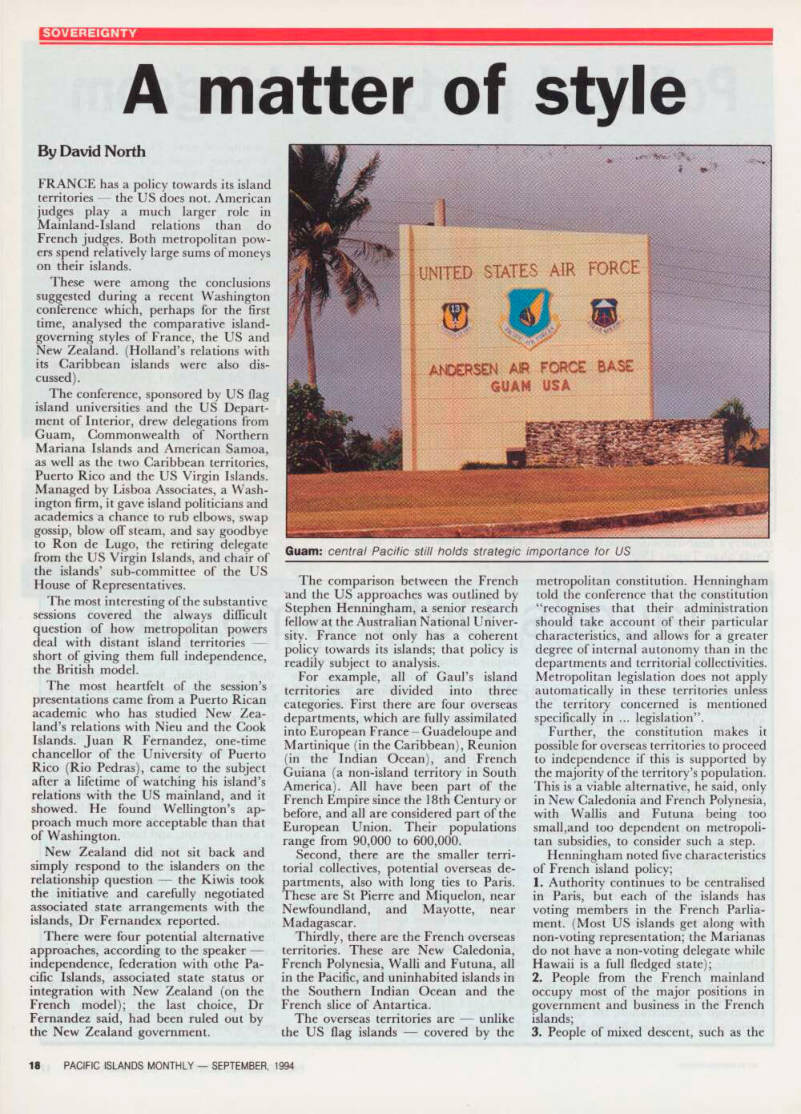
Guam: central Pacific still holds strategic importance for US
dermis of French Polynesia, play major political, cultural,and intellectual roles in the French islands although they are less prominent in business. (This gener alisation does not hold for New Cale donia); 4. French culture and the French language have tended to challenge local identities in the islands; 5. Successive French governments and local elite have “choked off or contained nationalist pressures ... where they have arisen”.
In contrast to the neat categories of French policy, the speaker dealing with America’s relations with its islands spoke of “ a continum of mutuality” and of a series of ad hoc relationships between the islands and the Mainland.
Making these points was Washington (and international lawyer) Howard Hills, who worked on associated states issues for several federal agencies over the last two decades before going into private practice.
Hills opened by saying that choosing him to discuss the subject of Free Assocation reflected that absence of the Republic of the Marshall Islands and the Federated States of Micronesia from the meeting. These states have effectively secured the end of the once colonial relationship with the U.S., and thus felt no need to attend the session.
Hills characterised Micronesia and the Marshalls at one extreme in the “con tinuum of mutuality”, and, in response
The difference between the US and French governing systems is in voting for the presidency
to PlM’s question placed American Samoa and the US Virgin Islands at the other end of the spectrum, on the grounds that the leaders of both of these entities have shown no strong interest in re-defining the basic relationships with
Washington.
In the middle of Hill’s spectrum are Palau, which is about to secure associ ated state status, and Guam, the Mari anas and Puerto Rico, all three of whom are seeking to redefine their relationship with the Mainland. (The Puerto Rican situation was subject to much discussion; and with Washington part-way between New York, where most Mainland Puerto Ricans live, and the island, there were many Puerto Ricans at the session. That many Puerto Ricans want to retain US citizenship, and move toward more independence, was cited as a problem
that had been eliminated in the US negotiatiations with FSM and the Mar shalls the Pacific Islanders did not seek US citizenship, which eased the process).
Hill said that the relationship of FSM and the Marshalls had evolved, within the framework of Associated State status, close to that of political independence.
He recounted the steps along the way: the upgrading of diplomatic status among the two states and Washington from the consular to the ambassdorial level; the admission of the two states to the United Nations and other interna tional organisations; and the recognition of the two island states by other nations.
The major question about the future relationship between the US and the associated states is economic. What will happen when the regular flow of funds under the Compact of Free Association comes to an end, he asked. “Will the US just say ‘adios’?”
He pointed out that the Cold War was ended, and with it much of the stragetegic value of the islands in the Central Pacific. He suggested, however, that the US will remain interested in these islands, pointing out the continuing utility of Kwajalein as a missile test site, and a continuing “moral obligation” of the US to the island nations.
Throughout the conference one other comparison between the US and the French governing systems was men tioned repeatedly and vigorously; that was the fact that while residents of the US flag islands are US citizens (or nationals), none of them can vote for the President of the United States.
This is not the case for residents of French island territories, all of whom are French citizens, and they can and do vote for the President of France. (In fact, Dr. Henningham pointed out later, candidates for the French Presidency have a tradition of making at least one campaign visit to a French island early in their campaigns).
The US constitution, however, has made island voting for the President difficult, because rather than voting directly for President, as the French do, Americans choose their President through the filter of the archaic, state based Electoral College. Were Puerto Ricans to opt for statehood (which they voted against in a recent referendum) and Puerto Rico admitted as a state, that would take care of that problem for that island. But the other territories are too small to be considered as potential states, and some other mechanism (as well as a constitutional amendment) would be needed to give residents votes for President. □
Cook Islands airport: NZ's style has been praised by some delegates
Advertisements & other items, p. 20 (1 item)
Marshalls Energy
POWER TO THE PEOPLE!
COMPANY
P.O. Box 1439: MAJURO, MARSHALL ISLANDS MH 96960
PHONE: DOWNTOWN OFHCE 625-3507, 3827, 3828.
FAX: (6251 3397
EQUIPMENT RENTAL
BACKHOE CRANE
HIGH PRESSURE PRESS
FORKLIFT HIGH RANGER * STAND BY GENERATOR
AERIAL DEVICES
MAINTENANCE CONTRACTS
BUCKET TRUCK
DIESEL FUEL EXPORTS
ELECTRIC & GAS WELDING
LUBRICATING, ENGINE
HYDRAULIC. OUTBOARDS
EQUIPMENTS
2 LATHES BENCH DRILLS ,2 CYCLE) OIL
Business
Pacific
Western Samoa: could the economy get worse?
By Roman Grynberg
IF you had not been in Western Samoa for the past year or two and went straight into Apia and stood in front of the Clock Tower on Beach Road you would think that the economy had gone through a major transformation. The shabby run down beach front that had long been a source of unfortunate comparison for many American Samoans has been
changed almost irrevocably.
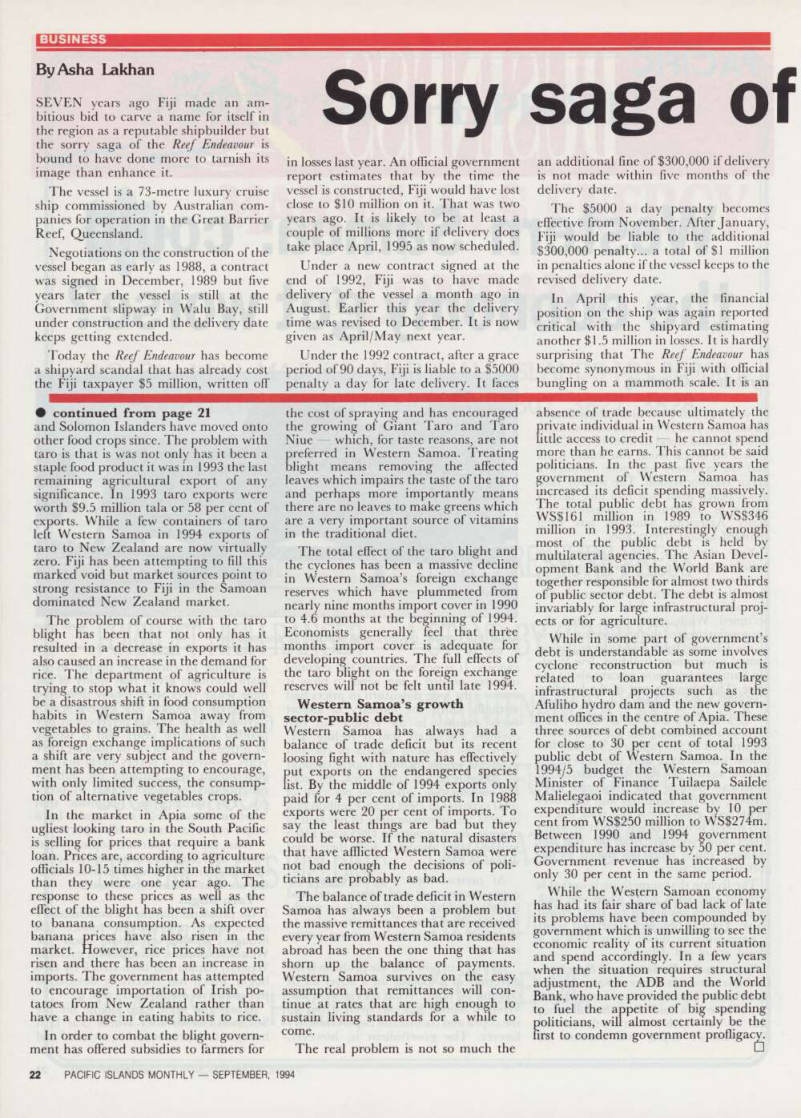
Now there are two shinning new
buildings standing on the water’s edge
one them the Central Bank of Samoa and the other the central government build ing which by late July was not yet occupied. While some argue about the appropriateness of the architectural style of the Chinese built eight-storey, onion domed government building, few West ern Samoans few know or care about the price. The ultimate cost of the building is WSS3S million which is owed, interest free to the government of China.
As you walk along the sea wall, newly constructed by the Japanese, you and feel almost instinctively that this is Western Samoa saying to its richer cousins in American Samoa that they too have arrived. All the buildings and improve ments look good but if you walk one or two streets behind Beach Street or Main Street and you see that life has not changed much and for many it has gotten a deal worse.
The feeling that something is unreal is brought into stark relief when you look at the figures published by the Central Bank. Then it becomes clear that what is happening in down town Apia is a grand act of self delusion.
Exports-An Endangered Species
God has not dealt Western Samoa a fair hand lately. Three years ago it was struck by cyclone Ofa and then the following year by Val which absolutely devastated the country’s copra and coconut oil
exports. It is not as though the coconut industry needed a big wind to blow it over the long downturn in prices had virtually killed the industry in almost every country in the region but two
cyclones absolutely sent it reeling. Ex-
ports from Western Samoa of coconut products which includes copra, coconut oil coconut cream copra meal fell from SI9 million tala (about 60 per cent of total exports) in 1988 to 53.4 million tala in 1993 (or approximately 18 per cent of exports. Total exports in 1993 were $16.5 million tala, almost a half their total value in 1989. .
At present there are no exports of copra coconut oil and copra meal and
coconuts are being imported from neigh-
bourmg Niue and Tonga m order to maintain the country s coconut cream industry.
As a sign of how bad the problem is the government is looking for a buyer for its coconut oil plant. What is evident is that Western Samoa has effectively given up the copra and coconut oil export industry forever. The government is, however,
attempting to encourage people to re plant coconuts given that many of the most senile trees were totally destroyed during the cyclones. The government is paying growers $2 tala per coconut tree planted for three years and is paying SI .5/tree planted for cocoa bush for three years. However, it is very likely that the government will suspend the subsidy programme because of abuses by farm ers. Few farmers are optimistic that Western Samoa will ever again be a major copra or coconut oil exporter, W h at the government is hoping is that it will have enough coconut production to satisfy domestic consumption as well as the coconut cream export nee ds.
Taro Bli ht If theproblems that the coconut industry faced P were nQt en h nature has brought anothcr visitation upon the Western Samoans. On top of the cyclones Western Samoa has been struck by taro blight which has effectively devastated the country’s staple food crop.
When the same taro blight hit the Solomon Islands after World War II it brought taro production to a virtual end
Arvind Kumar
Apia: the central government building in the capital
• continued from page 21 and Solomon Islanders have moved onto other food crops since. The problem with taro is that is was not only has it been a staple food product it was in 1993 the last remaining agricultural export of any significance. In 1993 taro exports were worth 59.5 million tala or 58 per cent of exports. While a few containers of taro left Western Samoa in 1994 exports of taro to New Zealand are now virtually zero. Fiji has been attempting to fill this marked void but market sources point to strong resistance to Fiji in the Samoan dominated New Zealand market.
The problem of course with the taro blight has been that not only has it resulted in a decrease in exports it has also caused an increase in the demand for rice. The department of agriculture is trying to stop what it knows could well be a disastrous shift in food consumption habits in Western Samoa away from vegetables to grains. The health as well
as foreign exchange implications of such
a shift are very subject and the govern ment has been attempting to encourage, with only limited success, the consump tion of alternative vegetables crops.
In the market in Apia some of the ugliest looking taro in the South Pacific is selling for prices that require a bank loan. Prices are, according to agriculture officials 10-15 times higher in the market than they were one year ago. The response to these prices as well as the effect of the blight has been a shift over to banana consumption. As expected banana prices have also risen in the market. However, rice prices have not risen and there has been an increase in imports. The government has attempted to encourage importation of Irish po tatoes from New Zealand rather than have a change in eating habits to rice.
In order to combat the blight govern ment has offered subsidies to farmers for
the cost of spraying and has encouraged the growing of Giant Taro and Taro Niue which, for taste reasons, are not preferred in Western Samoa. Treating blight means removing the affected leaves which impairs the taste of the taro and perhaps more importantly means there are no leaves to make greens which are a very important source of vitamins in the traditional diet.
The total effect of the taro blight and the cyclones has been a massive decline m Western Samoa’s foreign exchange reserves which have plummeted from nearly nine months import cover m 1990 to 4.6 months at the beginning of 1994.
Economists generally feel that three months import cover is adequate for developing countries. Ihe full effects of the taro blight on the foreign exchange reserves will not be felt until late 1994.
Western Samoa’s growth
sector-public debt
Western Samoa has always had a balance of trade deficit but its recent
loosing fight with nature has effectively
pu t exports on the endangered species h s t. By the middle of 1994 exports only pa id for 4 per cent of imports. In 1988 exports were 20 per cent of imports. To sa Y the least thin g s are bad but the Y could be worse. If the natural disasters that have afflicted Western Samoa were enough the decisions of noli not bad enough the decisions ol poll "aans are probably as bad.
The balance of trade deficit in Western Samoa has always been a problem but the massive remittances that are received every year from Western Samoa residents abroad has been the one thing that has u r * shorn up the balance of payments.
Western Samoa survives on the easy assumption that remittances will con tmue at rates that are high enough to sustain living standards for a while to
come ‘
The real problem is not so much the
absence of trade because ultimately the private individual in Western Samoa has little access to credit he cannot spend more than he earns. This cannot be said politicians. In the past five years the government of Western Samoa has increased its deficit spending massively.
The total public debt has grown from WSSI6I million in 1989 to WS$346 million in 1993. Interestingly enough most of the public debt is held by multilateral agencies. The Asian Devel opment Bank and the World Bank are together responsible for almost two thirds of public sector debt. The debt is almost
invariably for large infrastructural proj
ects or for agriculture.
While in some part of government’s debt is understandable as some involves cyclone reconstruction but much is related to loan guarantees large infrastructural projects such as the Afuliho hydro dam and the new govern ment offices in the centre of Apia. These three sources of debt combined account for close to 30 per cent of total 1993 public debt of Western Samoa. In the 1994/5 budget the Western Samoan Minister of Finance Tuilaepa Sailele Malielegaoi indicated that government expenditure would increase by 10 per cent from WS$25O million to WSS274m.
Between 1990 and 1994 government expenditure has increase by 50 per cent.
Government revenue has increased by only 30 per cent in the same period.
While the Western Samoan economy has had its fair share of bad lack of late
its problems have been compounded by
government which is unwilling to see the economic reality of its current situation and spend accordingly. In a few years when the situation requires structural adjustment, the ADB and the World Bank, who have provided the public debt to fuel the appetite of big spending fjoliticians, will almost certainly be the irst to condemn government profligacy.
Sorry saga of the Reef Endeavour
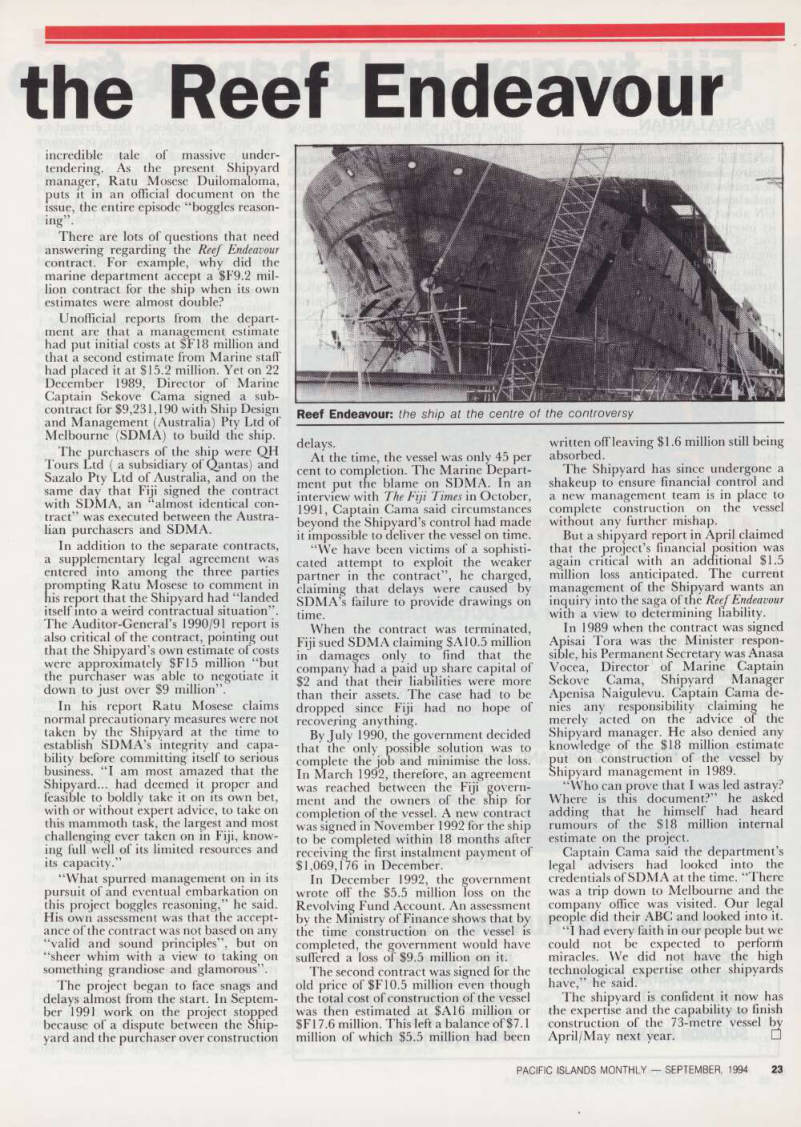
By Asha Lakhan
SEVEN years ago Fiji made an am bitious bid to carve a name for itself in the region as a reputable shipbuilder but the sorry saga of the Reef Endeavour is bound to have done more to tarnish its image than enhance it.
The vessel is a 73-metre luxury cruise ship commissioned by Australian com panies for operation in the Great Barrier
Reef, Queensland.
Negotiations on the construction of the vessel began as early as 1988, a contract was signed in December, 1989 but five years later the vessel is still at the Government slipway in Walu Bay, still under construction and the delivery date
keeps getting extended.
Today the Reef Endeavour has become a shipyard scandal that has already cost the Fiji taxpayer $5 million, written off
in losses last year. An official government report estimates that by the time the vessel is constructed, Fiji would have lost close to $lO million on it. That was two years ago. It is likely to be at least a couple of millions more if delivery does take place April, 1995 as now scheduled.
Under a new contract signed at the end of 1992, Fiji was to have made delivery of the vessel a month ago in August. Earlier this year the delivery time was revised to December. It is now given as April/May next year.
Under the 1992 contract, after a grace period of 90 days, Fiji is liable to a $5OOO penalty a day for late delivery. It faces
an additional fine of $300,000 if delivery is not made within five months of the
delivery date.
The $5OOO a day penalty becomes effective from November. After January, Fiji would be liable to the additional $300,000 penalty... a total ofsl million in penalties alone if the vessel keeps to the revised delivery date.
In April this year, the financial position on the ship was again reported critical with the shipyard estimating another $1.5 million in losses. 11 is hardly surprising that The Reef Endeavour has become synonymous in Fiji with official bungling on a mammoth scale. It is an
incredible tale of massive under tendering. As the present Shipyard manager, Ratu Mosese Duilomaloma, puts it in an official document on the issue, the entire episode “boggles reason
ing”.
There are lots of questions that need
answering regarding the Reef Endeavour
contract. For example, why did the marine department accept a $F9.2 mil lion contract for the ship when its own estimates were almost double?
Unofficial reports from the depart ment are that a management estimate had put initial costs at SFIB million and that a second estimate from Marine staff had placed it at $15.2 million. Yet on 22 December 1989, Director of Marine Captain Sekove Cama signed a sub contract for $9,231,190 with Ship Design
and Management (Australia) Pty Ltd of
Melbourne (SDMA) to build the ship.
The purchasers of the ship were QH Tours Ltd ( a subsidiary of Qantas) and Sazalo Pty Ltd of Australia, and on the same day that Fiji signed the contract with SDMA, an “almost identical con tract” was executed between the Austra lian purchasers and SDMA.
In addition to the separate contracts, a supplementary legal agreement was entered into among the three parties prompting Ratu Mosese to comment in his report that the Shipyard had “landed itself into a weird contractual situation”.
The Auditor-General’s 1990/91 report is also critical of the contract, pointing out that the Shipyard’s own estimate of costs were approximately SFIS million “but the purchaser was able to negotiate it down to just over $9 million”.
In his report Ratu Mosese claims normal precautionary measures were not taken by the Shipyard at the time to establish SDMA’s integrity and capa bility before committing itself to serious business. “I am most amazed that the Shipyard... had deemed it proper and feasible to boldly take it on its own bet, with or without expert advice, to take on this mammoth task, the largest and most challenging ever taken on in Fiji, know ing full well of its limited resources and
its capacity.”
“What spurred management on in its pursuit of and eventual embarkation on
this project boggles reasoning,” he said.
His own assessment was that the accept ance of the contract was not based on any “valid and sound principles”, but on “sheer whim with a view to taking on
something grandiose and glamorous”.
The project began to face snags and delays almost from the start. In Septem ber 1991 work on the project stopped because of a dispute between the Ship yard and the purchaser over construction
delays.
At the time, the vessel was only 45 per cent to completion. The Marine Department put the blame on SDMA. In an interview with The Fiji Times in October, 1991, Captain Cama said circumstances beyond the Shipyard’s control had made it impossible to deliver the vessel on time.
“We have been victims of a sophisticated attempt to exploit the weaker partner in the contract”, he charged,
claiming that delays were caused by
SDMA’s failure to provide drawings on time.
When the contract was terminated, Fiji sued SDMA claiming $A10.5 million in damages only to find that the company had a paid up share capital of $2 and that their liabilities were more than their assets. The case had to be dropped since Fiji had no hope of
recovering anything.
By July 1990, the government decided that the only possible solution was to complete the job and minimise the loss.
In March 1992, therefore, an agreement was reached between the Fiji government and the owners of the snip for completion of the vessel. A new contract was signed in November 1992 for the ship to be completed within 18 months after receiving the first instalment payment of $1,069,176 in December.
In December 1992, the government wrote oil the $5.5 million loss on the Revolving Fund Account. An assessment by the Ministry of Finance shows that by the time construction on the vessel is completed, the government would have suffered a loss of $9.5 million on it.
The second contract was signed for the old price of $F10.5 million even though the total cost of construction of the vessel was then estimated at SAI6 million or $F17.6 million. This left a balance of $7.1 million of which $5.5 million had been
written off leaving $1.6 million still being absorbed, The Shipyard has since undergone a shakeup to ensure financial control and a new management team is in place to complete construction on the vessel without any further mishap, But a shipyard report in April claimed that the project’s financial position was again critical with an additional $1.5 million loss anticipated. The current management of the Shipyard wants an inquiry into the saga of the Reef Endeavour with a view to determining liability.
In 1989 when the contract was signed Apisai Tora was the Minister respon sible, his Permanent Secretary was Anasa Vocea, Director of Marine Captain
Sekove Cama, Shipyard Manager
Apenisa Naigulevu. Captain Cama de
nies any responsibility claiming he merely acted on the advice of the Shipyard manager. He also denied any knowledge of the $lB million estimate put on construction of the vessel by Shipyard management in 1989.
“Who can prove that I was led astray?
Where is this document? he asked adding that he himself had heard rumours of the $lB million internal estimate on the project, Captain Cama said the department’s legal advisers had looked into the credentials of SDMA at the time. “There was a trip down to Melbourne and the company office was visited. Our legal people did their ABC and looked into it.
“I had every faith in our people but we could not be expected to perform miracles. We did not have the high
technological expertise other shipyards
have,” he said.
The shipyard is confident it now has the expertise and the capability to finish construction of the 73-metre vessel by April/May next year. □
Reef Endeavour: the ship at the centre of the controversy
Fiji troops in Lebanon face
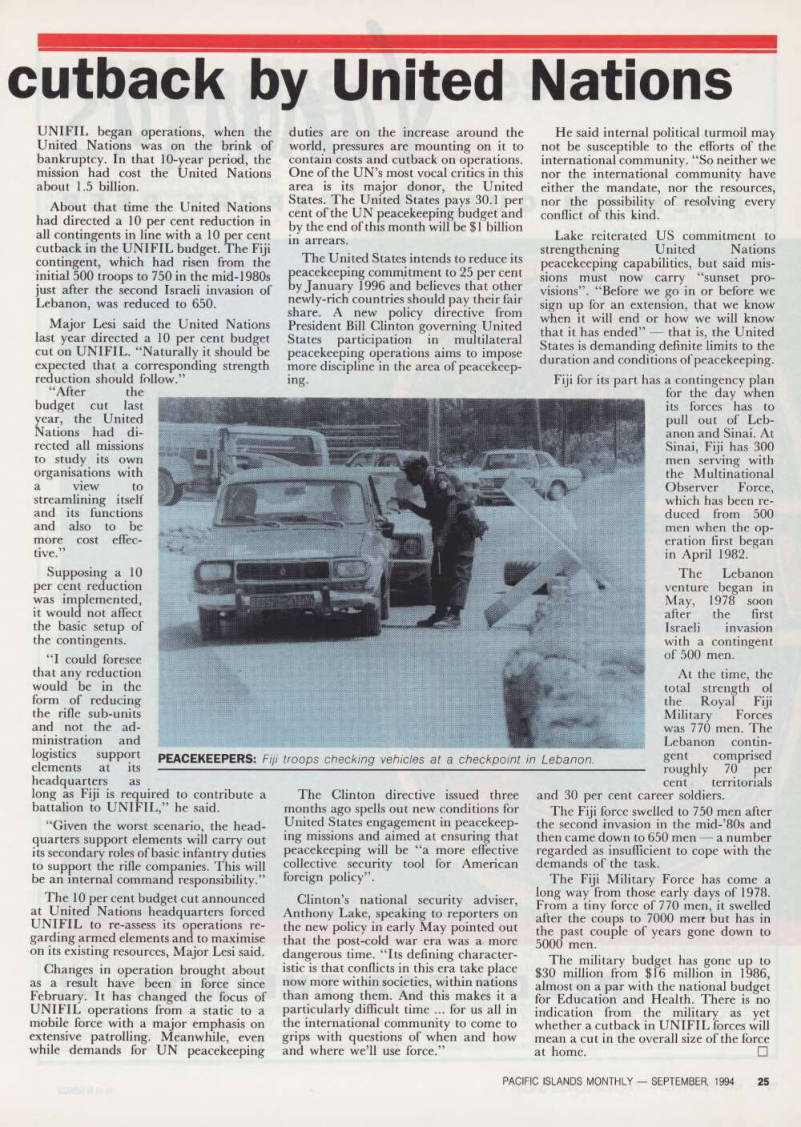
Peacekeeping
By Ashalakhan
UNITED Nations Secretary-General Boutros Boutros-Ghali has given notice of a cutback in peacekeeping operations in Lebanon. The mission is costing the UN about SUSI3B million a year. Since its inception in March, 1978 the total cost of the peacekeeping force to the organisation has been over $2 billion.
But can Boutros-Ghali cut back on the strength of the mission in Lebanon? And if it does decide to do so what will be the
impact on Fiji which has 650 men serving under UNIFIL?
According to Fiji Government sources, the country has earned about SISO million from the UNIFIL since its first contingent took up duties in May, 1978.
The United Nations has always lagged behind in its reimbursements to Fiji, which meant that much of the burden of the humanitarian mission has fallen on the shoulders of the Fiji government.
Today the UN is believed to be about Sl2-Sl4 million in arrears in its payments
to Fiji. The problem is that demand for
United Nations peacekeeping operations
has blown out of all proportion.
Since peacekeeping operations began
in 1948, the UN has been engaged in 34 such operations at a total cost of$USlO.4 billion. Data released by the UN Infor mation Centre in Sydney shows it is
today engaged in 17 missions involving
71,543 troops and civilian personnel at an annual cost of SUS3.B billion.
At June 30, 1994 outstanding contri butions from member states to peace keeping operations stood at SUS2.I billion. However, much as Boutros-Ghali might be justified in trying to cut back -on some of these commitments, on humanitarian grounds alone he may find it very difficult to do so.
At least that’s how Fiji sees the situation. Despite the breakthrough in peace efforts in the Middle East, the Fiji Military Forces believes it may be too soon to cut back on UNIFIL operations.
Says Fiji Military Forces chief of staff
Brigadier George Konrote “The
situation out there is quite volatile. It remains unpredictable ... likely to flare up without warning.”
The peace process has brought some stability to the area and today there some semblance of law and order. At the same time, the warring factions tend to do their own thing. “It’s a question of who’s
controlling whom.”
On the UN’s plans to cut back on UNIFIL, Fiji is still very much in the dark. “I don’t know. It’s so unpredict able..., says Brigadier Konrote. But he ventured to add: “I can see the present status quo being maintained.”
Lesi Korovavala, a former senior plans officer for UNIFIL who is in Fiji on leave from peacekeeping duties, says if there is a cutback the decision will be sent to his government first.
“If the United Nations has to enforce reductions based on operational or financial considerations, then contribu ting nations have little say apart from implementing these decisions.
“The government or FMF may at tempt to protest that decision; however, the final decision rests with the United Nations.” This is not the first time the United Nations has been forced to reconsider or cutback on its peacekeep
ing operations.
In 1986, as the costs of UNIFIL mounted, it was suggested that the force be withdrawn. A proposal to cutback on UNIFIL as made in 1988, a decade after
UNIFIL began operations, when the United Nations was on the brink of
bankruptcy. In that 10-year period, the
mission had cost the United Nations about 1.5 billion.
About that time the United Nations had directed a 10 per cent reduction in all contingents in line with a 10 per cent cutback in the UNIFIL budget. The Fiji contingent, which had risen from the initial 500 troops to 750 in the mid-1980s just after the second Israeli invasion of Lebanon, was reduced to 650.
Major Lesi said the United Nations last year directed a 10 per cent budget cut on UNIFIL. “Naturally it should be
expected that a corresponding strength
reduction should follow.”
“After the budget cut last year, the United Nations had di rected all missions to study its own
organisations with
a view to
streamlining itself
and its functions and also to be more cost effec tive.”
Supposing a 10 per cent reduction
was implemented,
it would not affect the basic setup of
the contingents.
“I could foresee that any reduction would be in the form of reducing the rifle sub-units and not the ad ministration and
logistics support
elements at its
headquarters as
long as Fiji is required to contribute a battalion to UNIFIL,” he said.
“Given the worst scenario, the head quarters support elements will carry out its secondary roles of basic infantry duties to support the rifle companies. This will be an internal command responsibility.”
The 10 per cent budget cut announced at United Nations headquarters forced UNIFIL to re-assess its operations re garding armed elements and to maximise on its existing resources, Major Lesi said.
Changes in operation brought about
as a result have been in force since February. It has changed the focus of UNIFIL operations from a static to a mobile force with a major emphasis on extensive patrolling. Meanwhile, even while demands for UN peacekeeping
duties are on the increase around the world, pressures are mounting on it to contain costs and cutback on operations.
One of the UN’s most vocal critics in this area is its major donor, the United States. The United States pays 30.1 per Cent ° f ’ the UN Peacekeeping budget and b the end of this month will be billion j n arrears . . .
United States intends to reduce its peacekeeping commitment to 25 per cent by January 1996 and believes that other newly-nch countries should pay their fair s D har ?. A "f" P °‘ Cy from President Bill Clinton governing United States participation m multilateral
peacekeeping operations aims to impose
more discipline in the area of peaeekeep-
ing.
The Clinton directive issued three months ago spells out new conditions for United States engagement in peaeekeep missions and aimed at ensuring that peacekeeping will be “a more effective collective security tool for American
foreign policy”.
Clinton’s national security adviser,
. , T 1 .. 7 ’
Anthony Lake, speaking to reporters on the new policy m early May pointed out that the post-cold war era was a more dangerous time “Its defining character istic is that conflicts m this era take place now more within societies, within nations than among them. And this makes it a particularly difficult time ... for us all in the international community to come to grips with questions of when and how and where we’ll use force.”
He said internal political turmoil may not be susceptible to the efforts of the international community. “So neither we nor the international community have either the mandate, nor the resources, nor the possibility of resolving every conflict of this kind.
Lake reiterated US commitment to strengthening United Nations peacekeeping capabilities, but said mis sions must now carry “sunset pro visions”. “Before we go in or before we sign up for an extension, that we know when it will end or how we will know that it has ended” that is, the United States is demanding definite limits to the duration and conditions of peacekeeping.
Fiji for its part has a contingency plan
for the day when its forces has to pull out of Leb anon and Sinai. At Sinai, Fiji has 300 men serving with the Multinational Observer Force, which has been re duced from 500 men when the op eration first began in April 1982.
The Lebanon venture began in May, 1978 soon after the first Israeli invasion with a contingent of 500 men.
At the time, the total strength of
the Royal Fiji
Military Forces
was 770 men. The Lebanon contin
gent comprised
roughly 70 per cent territorials
and 30 per cent career soldiers, The Fiji force swelled to 750 men after the second invasion in the mid-‘Bos and then came down to 650 men a number regarded as insufficient to cope with the demands of the task, The Fiji Military Force has come a
Idwi
from a tiny force of // 0 men, it swelled a ft er the coups to 7000 men but has in the past couple of years gone down to 5000 men The mi |;, bud , has to $3O mdbon f rom $l5 million in 1986, a j most on a par with the national budget f or Education and Health. There is no indication from the military as yet whether a cutback in UNIFIL forces will mean a cut in the overall size of the force at home. □
PEACEKEEPERS: Fiji troops checking vehicles at a checkpoint in Lebanon.
Advertisements & other items, pp. 24-26 (1 item)
Alliance Corporation Ltd
SPECIALISING IN IMPORTED FASHION
CLOTHING FOR ALL OCCASIONS
♦ FASHION CLOTHING * TABLE UTENSILS
♦ CASUAL AND FORMAL SHOES ♦ MARINE PRODUCTS EXPORTER
♦ MANCHESTER ♦ STATIONERY SUPPLIES
♦ BEDROOM UNEN ♦ OFFICE FURNITURE
♦ ELECTRICAL APPLIANCES * MUSICAL INSTRUMENTS
AGENTS FOR ELECTRIC AND ACOUSTIC GUITARS,
DRUMS, PIANOS,
KEYBOARDS,
rr'lH 1/ % AMPLIFIERS, SPEAKERS,
MIKES AND STAGE
SOUND SYSTEM
MUSICAL INSTRUMENTS CO. LTD.
LOCATION:
ACOR BOOKSHOP BUILDING
ASHLEY STREET
HONIARA
SOLOMON ISLANDS
POSTAL ADDRESS:
PO BOX 780
HONIARA, SOLOMON ISLAND
FAX: (677) 21477
PHONE: (677) 21239
wwWs
PREMIUM QUALITY EXPORT BEER
, •V ■ ■
vmts&mmm
“* PiSSr
READY FOR THE WORLD!
H of N N 8922
Managing our resources
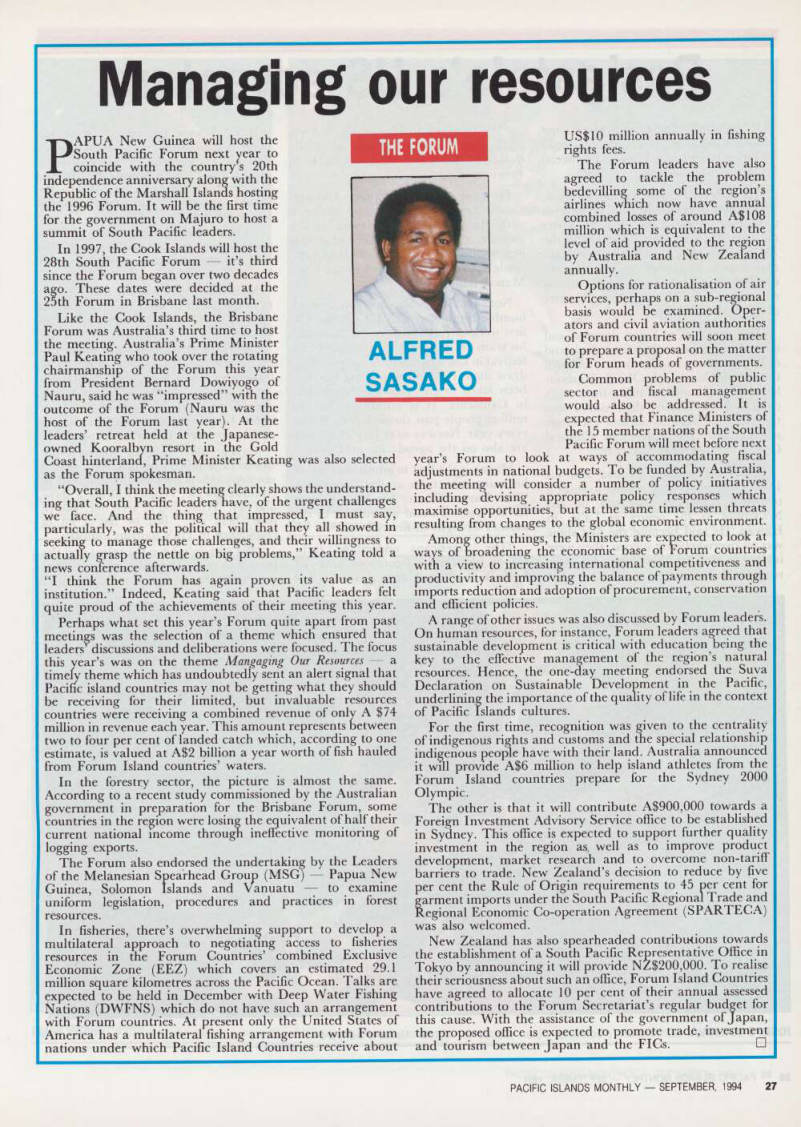
PAPUA New Guinea will host the South Pacific Forum next year to coincide with the country s 20th
independence anniversary along with the
Republic of the Marshall Islands hosting the 1996 Forum. It will be the first time for the government on Majuro to host a summit of South Pacific leaders.
In 1997, the Cook Islands will host the 28th South Pacific Forum it’s third since the Forum began over two decades ago. These dates were decided at the 25th Forum in Brisbane last month.
Like the Cook Islands, the Brisbane Forum was Australia’s third time to host the meeting. Australia’s Prime Minister Paul Keating who took over the rotating chairmanship of the Forum this year from President Bernard Dowiyogo of Nauru, said he was “impressed” with the outcome of the Forum (Nauru was the host of the Forum last year). At the leaders’ retreat held at the Japanese owned Kooralbyn resort in the Gold
Coast hinterland, Prime Minister Keating was also selected as the Forum spokesman.
“Overall, I think the meeting clearly shows the understand ing that South Pacific leaders have, of the urgent challenges we face. And the thing that impressed, I must say, particularly, was the political will that they all showed in seeking to manage those challenges, and their willingness to actually grasp the nettle on big problems,” Keating told a news conference afterwards.
“I think the Forum has again proven its value as an institution.” Indeed, Keating said that Pacific leaders felt quite proud of the achievements of their meeting this year.
Perhaps what set this year’s Forum quite apart from past meetings was the selection of a theme which ensured that leaders’ discussions and deliberations were focused. The focus this year’s was on the theme Mangaging Our Resources a timely theme which has undoubtedly sent an alert signal that Pacific island countries may not be getting what they should be receiving for their limited, but invaluable resources countries were receiving a combined revenue of only A $74 million in revenue each year. This amount represents between two to four per cent of landed catch which, according to one estimate, is valued at As 2 billion a year worth of fish hauled from Forum Island countries’ waters.
In the forestry sector, the picture is almost the same.
According to a recent study commissioned by the Australian government in preparation for the Brisbane Forum, some countries in the region were losing the equivalent of half their current national income through ineffective monitoring of
logging exports.
The Forum also endorsed the undertaking by the Leaders of the Melanesian Spearhead Group (MSG) Papua New Guinea, Solomon Islands and Vanuatu to examine uniform legislation, procedures and practices in forest resources.
In fisheries, there’s overwhelming support to develop a multilateral approach to negotiating access to fisheries resources in the Forum Countries’ combined Exclusive Economic Zone (EEZ) which covers an estimated 29.1 million square kilometres across the Pacific Ocean. Talks are expected to be held in December with Deep Water Fishing Nations (DWFNS) which do not have such an arrangement with Forum countries. At present only the United States of America has a multilateral fishing arrangement with Forum nations under which Pacific Island Countries receive about
USIIO million annually in fishing rights fees.
The Forum leaders have also agreed to tackle the problem bedevilling some of the region’s airlines which now have annual combined losses of around AS 108 million which is equivalent to the level of aid provided to the region by Australia and New Zealand
annually.
Options for rationalisation of air services, perhaps on a sub-regional basis would be examined. Oper ators and civil aviation authorities of Forum countries will soon meet to prepare a proposal on the matter for Forum heads of governments.
Common problems of public sector and fiscal management would also be addressed. It is expected that Finance Ministers of the 15 member nations of the South Pacific Forum will meet before next
year’s Forum to look at ways of accommodating fiscal adjustments in national budgets. To be funded by Australia, the meeting will consider a number of policy initiatives
including devising appropriate policy responses which
maximise opportunities, but at the same time lessen threats resulting from changes to the global economic environment.
Among other things, the Ministers are expected to look at ways of broadening the economic base of Forum countries with a view to increasing international competitiveness and productivity and improving the balance of payments through imports reduction and adoption of procurement, conservation and efficient policies.
A range of other issues was also discussed by Forum leaders.
On human resources, for instance, Forum leaders agreed that sustainable development is critical with education being the key to the effective management of the region’s natural resources. Hence, the one-day meeting endorsed the Suva Declaration on Sustainable Development in the Pacific, underlining the importance of the quality of life in the context of Pacific Islands cultures.
For the first time, recognition was given to the centrality of indigenous rights and customs and the special relationship indigenous people have with their land. Australia announced it will provide AS6 million to help island athletes from the Forum Island countries prepare for the Sydney 2000
Olympic.
The other is that it will contribute A 5900,000 towards a Foreign Investment Advisory Service office to be established in Sydney. This office is expected to support further quality investment in the region as well as to improve product development, market research and to overcome non-tariff barriers to trade. New Zealand’s decision to reduce by five per cent the Rule of Origin requirements to 45 per cent for garment imports under the South Pacific Regional Trade and
.egional Economic Co-operation Agreement (SPARTECA)
was also welcomed.
New Zealand has also spearheaded contributions towards the establishment of a South Pacific Representative Office in Tokyo by announcing it will provide N£s2oo,ooo. To realise their seriousness about such an office, Forum Island Countries have agreed to allocate 10 per cent of their annual assessed contributions to the Forum Secretariat’s regular budget for this cause. With the assistance of the government of Japan, the proposed office is expected to promote trade, investment and tourism between Japan and the FICs. □
The Forum
Alfred
Sasako
Rasigatale’s US adventure
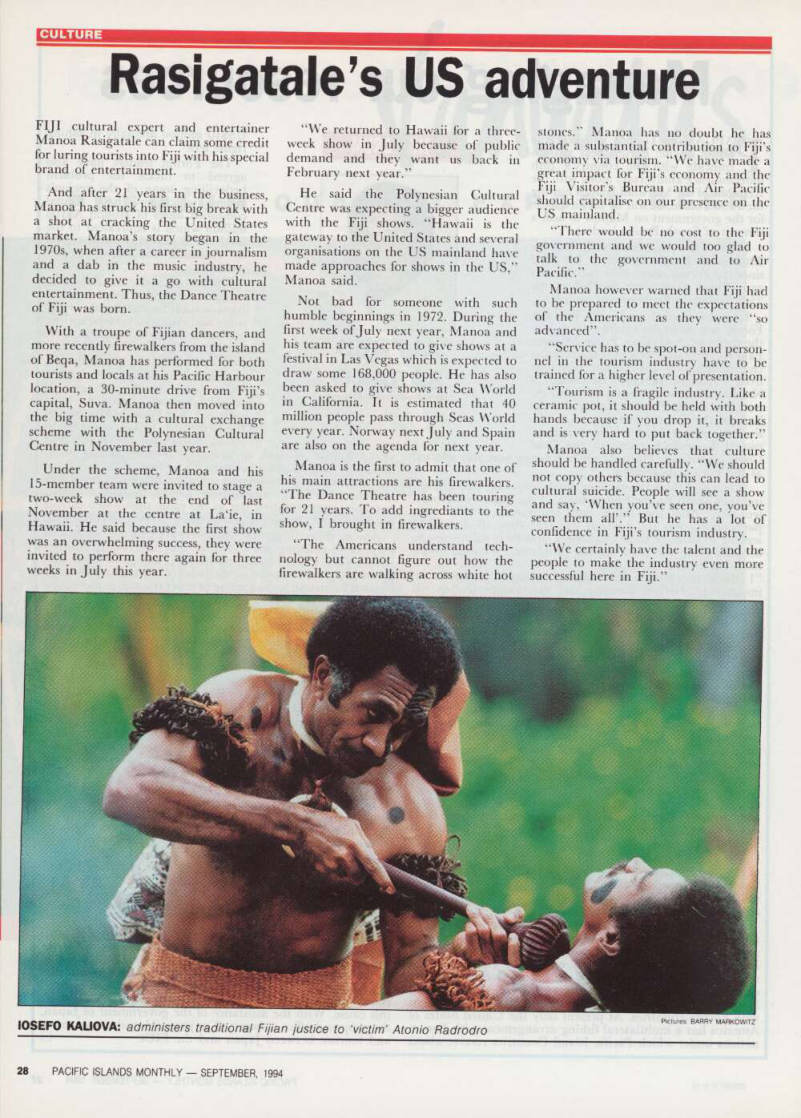
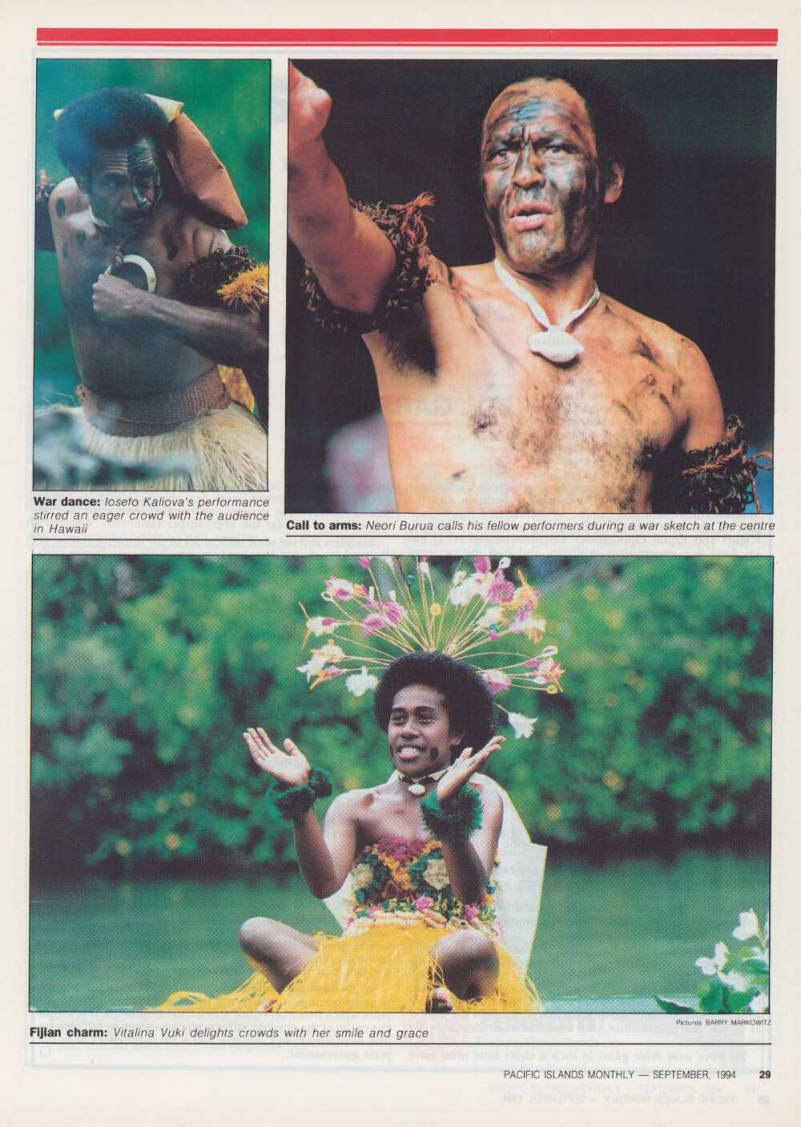
Culture
FIJ I cultural expert and entertainer Manoa Kasigatale can claim some credit or urmg tourists into f iji with his special brand of entertainment.
And after 21 years in the business, Manoa has struck his first big break with a shot at cracking the United States market. Manoa’s story began in the 19705, when after a career in journalism and a dab in the music industry, he decided to give it a go with cultural entertainment. Thus, the Dance Theatre of Fiji was born With a troupe of Fijian dancers, and more recently firewalkers from the island of Beqa, Manoa has performed for both tourists and locals at his Pacific Harbour location, a 30-minute drive from Fiji’s capital, Suva. Manoa then moved into the big time with a cultural exchange scheme with the Polynesian Cultural Centre in November last year.
Under the scheme, Manoa and his 15-member team were invited to stage a two-week show at the end of last November Hawaii. He said because the first show was an overwhelming success, they were invited to perform there again for three weeks in July this year.
“We returned to Hawaii for a threeweek show in July because of public demand and they want us back in February next year.”
Fie said the Polynesian Cultural Centre was expecting a bigger audience with the Fiji shows. “Hawaii is the gateway to the United States and several organisations on the US mainland have made approaches for shows in the US,"
Manoa said. f . . . iNot bad . or someone Wlth such humble beginnings in 1972. During the brst week of July next year, Manoa and his team are expected to give shows at a festival in Las Vegas which is expected to draw some 168,000 people. He has also been asked }° g ive shows at Sea World California. It is estimated that 40 million people pass through Seas \\ orld every year. Norway next July and Spain are al so on the agenda for next year.
Manoa is the first to admit that one of hls mam attra cdons are his firewalkers.
“The Dance Theatre has been touring 21 Y™' To add ingrediants to thf show ’ 1 brou ght m firewalkers.
“The Americans understand technology but cannot figure out how the firewalkers are walking across white hot
stones.” Manoa has no doubt he has made a substantial contribution to Fiji’s economy via tourism. “We have made a great impact for Fiji’s economy and the dill.Ml * U yg mainland ° UI P rtSCnCt ° n 1 U ‘ '. , , , ICIC wou dbc no c ° j st to the Fiji g ovcriimcilt an v ' c won ( too glad to Uk gOVCrnmcnl and “ Alr Manoa however warned that Fiji had to be prepared to meet the expectations of the Americans as they were “so advanced”, “Service has to be spot-on and person nel in the tourism industry have to be trained for a higher level of presentation, “Tourism is a fragile industry. Like a ceramic pot, it should be held with both hands because if you drop it, it breaks and is very hard to put back together.”
Manoa also believes that culture Sh ° uld bC h f ndl l d Careful !>> “ W e should n ° co P y othe . rs this can lead to , tura S ,™f/ de ' e °P e Wlb see a show Z « confidence in Fiji’s tourism industry, “We certainly have the talent and the people to make the industry even more successful here in Fiji.”
Pictures: BARRY MARKOWITZ
lOSEFO KALIOVA: administers traditional Fijian justice to ‘victim’ Atonio Radrodro
War dance: losefo Kaliova’s performance stirred an eager crowd with the audience in Hawaii
Call to arms: Neori Burua calls his fellow performers during a war sketch at the centre
Pictures: BARRY MARKOWITZ
Fijian charm: Vitalina Vuki delights crowds with her smile and grace
Victory for islanders
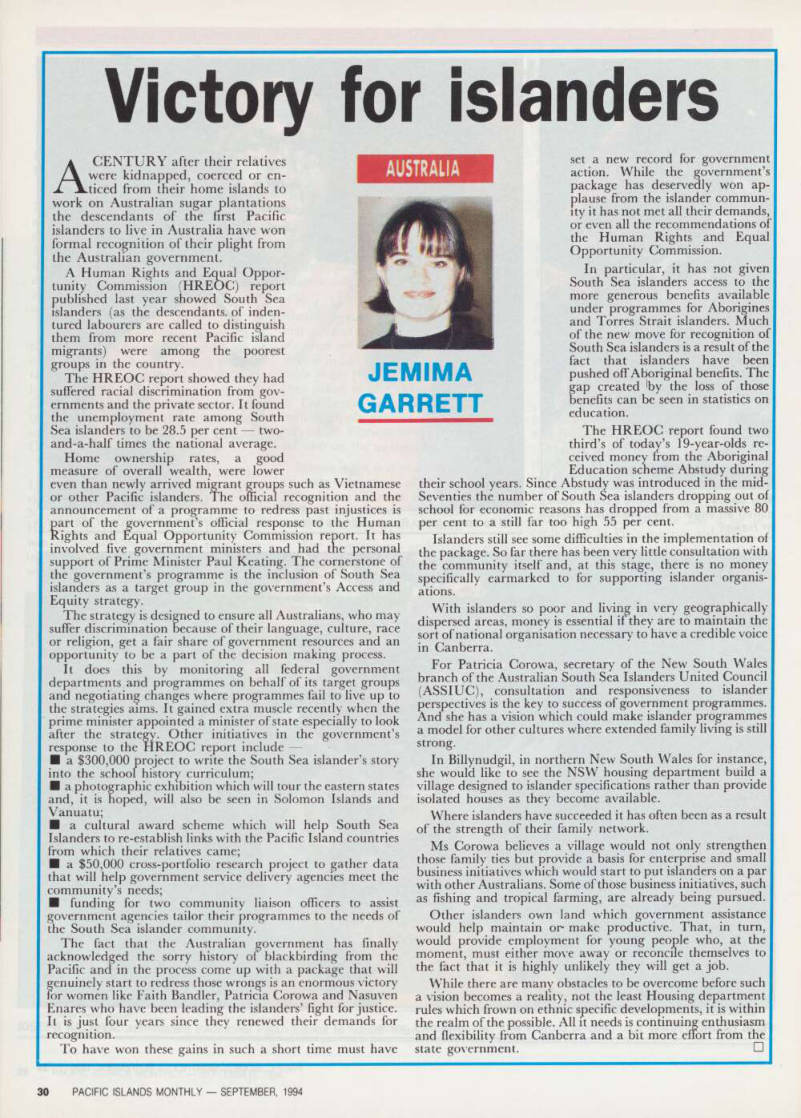
A CENTURY after their relatives were kidnapped, coerced or en ticed from their home islands to work on Australian sugar plantations the descendants of the first Pacific islanders to live in Australia have won formal recognition of their plight from the Australian government.
A Human Rights and Equal Oppor
tunity Commission (HREOC) report
published last year showed South Sea islanders (as the descendants, of inden tured labourers are called to distinguish them from more recent Pacific island migrants) were among the poorest groups in the country.
The HREOC report showed they had suffered racial discrimination from gov ernments and the private sector. It found the unemployment rate among South Sea islanders to be 28.5 per cent two and-a-half times the national average.
Home ownership rates, a good measure of overall wealth, were lower
even than newly arrived migrant groups such as Vietnamese or other Pacific islanders. The official recognition and the announcement of a programme to redress past injustices is part of the government’s official response to the Human Rights and Equal Opportunity Commission report. It has involved five government ministers and had the personal support of Prime Minister Paul Keating. The cornerstone of the government’s programme is the inclusion of South Sea islanders as a target group in the government’s Access and
Equity strategy.
The strategy is designed to ensure all Australians, who may suffer discrimination because of their language, culture, race or religion, get a fair share of government resources and an opportunity to be a part of the decision making process.
It does this by monitoring all federal government departments and programmes on behalf of its target groups and negotiating changes where programmes fail to live up to the strategies aims. It gained extra muscle recently when the prime minister appointed a minister of state especially to look after the strategy. Other initiatives in the government’s response to the HREOC report include I a $300,000 project to write the South Sea islander’s story into the school history curriculum; ■ a photographic exhibition which will tour the eastern states and, it is hoped, will also be seen in Solomon Islands and Vanuatu; I a cultural award scheme which will help South Sea Islanders to re-establish links with the Pacific Island countries from which their relatives came; ■ a $50,000 cross-portfolio research project to gather data that will help government service delivery agencies meet the
community’s needs;
■ funding for two community liaison officers to assist government agencies tailor their programmes to the needs of the South Sea islander community.
The fact that the Australian government has finally acknowledged the sorry history of blackbirding from the Pacific and in the process come up with a package that will genuinely start to redress those wrongs is an enormous victory for women like Faith Handler, Patricia Corowa and Nasuven Enares who have been leading the islanders’ fight for justice.
It is just four years since they renewed their demands for
recognition.
To have won these gains in such a short time must have
set a new record for government action. While the government’s package has deservedly won ap plause from the islander commun ity it has not met all their demands, or even all the recommendations of the Human Rights and Equal
Opportunity Commission.
In particular, it has not given South Sea islanders access to the more generous benefits available under programmes for Aborigines and Torres Strait islanders. Much of the new move for recognition of South Sea islanders is a result of the fact that islanders have been pushed off Aboriginal benefits. The gap created by the loss of those benefits can be seen in statistics on education.
The HREOC report found two third’s of today’s 19-year-olds re ceived money from the Aboriginal Education scheme Abstudy during
their school years. Since Abstudy was introduced in the mid- Seventies the number of South Sea islanders dropping out of school for economic reasons has dropped from a massive 80 per cent to a still far too high 55 per cent.
Islanders still see some difficulties in the implementation of the package. So far there has been very little consultation with the community itself and, at this stage, there is no money specifically earmarked to for supporting islander organis ations.
With islanders so poor and living in very geographically dispersed areas, money is essential if they are to maintain the sort of national organisation necessary to have a credible voice in Canberra.
For Patricia Corowa, secretary of the New South Wales branch of the Australian South Sea Islanders United Council (ASSIUC), consultation and responsiveness to islander perspectives is the key to success of government programmes.
And she has a vision which could make islander programmes a model for other cultures where extended family living is still strong.
In Billynudgil, in northern New South Wales for instance, she would like to see the NSW housing department build a village designed to islander specifications rather than provide isolated houses as they become available.
Where islanders have succeeded it has often been as a result of the strength of their family network.
Ms Corowa believes a village would not only strengthen those family ties but provide a basis for enterprise and small business initiatives which would start to put islanders on a par with other Australians. Some of those business initiatives, such as fishing and tropical farming, are already being pursued.
Other islanders own land which government assistance would help maintain or- make productive. That, in turn, would provide employment for young people who, at the moment, must either move away or reconcile themselves to the fact that it is highly unlikely they will get a job.
While there are many obstacles to be overcome before such a vision becomes a reality, not the least Housing department rules which frown on ethnic specific developments, it is within the realm of the possible. All it needs is continuing enthusiasm and flexibility from Canberra and a bit more effort from the state government. □
Australia
Jemima
Garrett
The Pacific giant
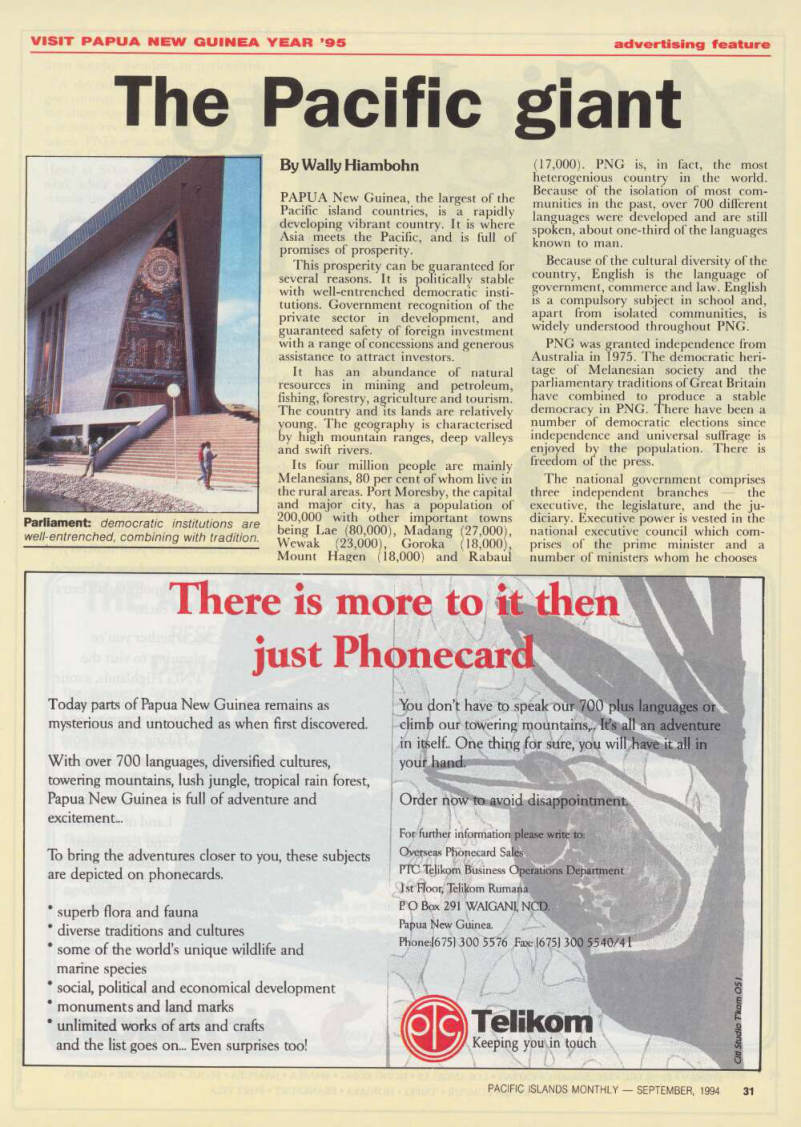
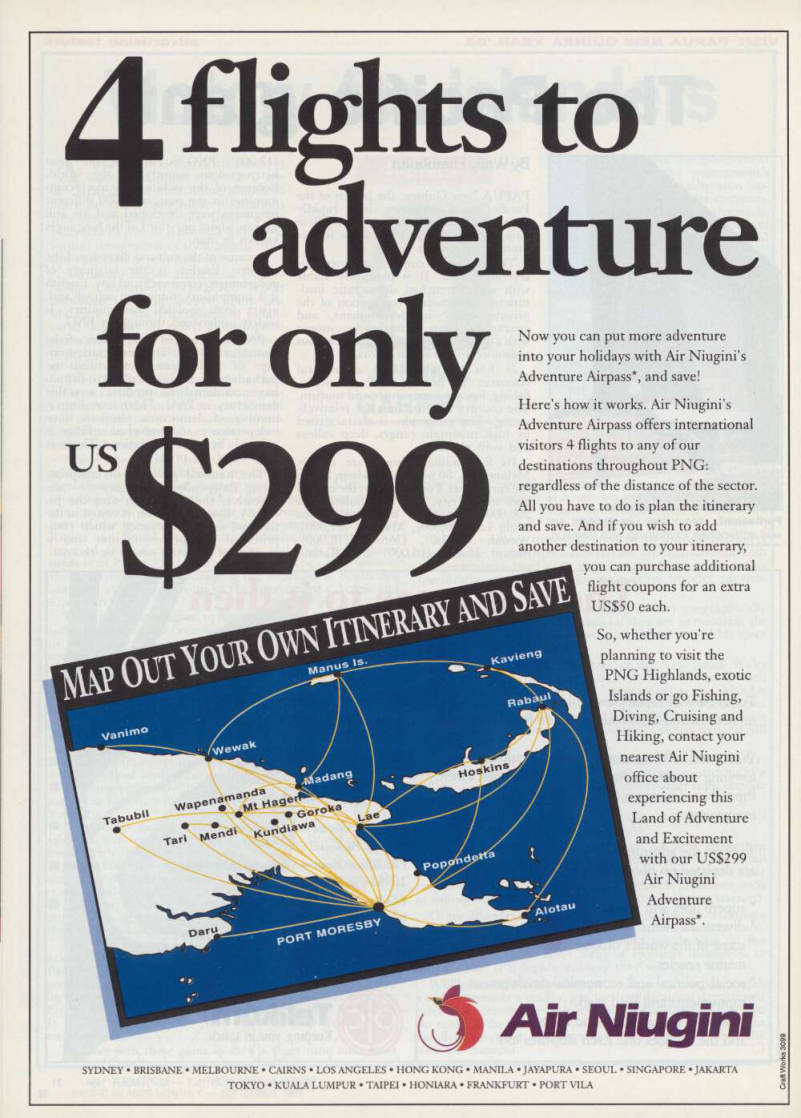
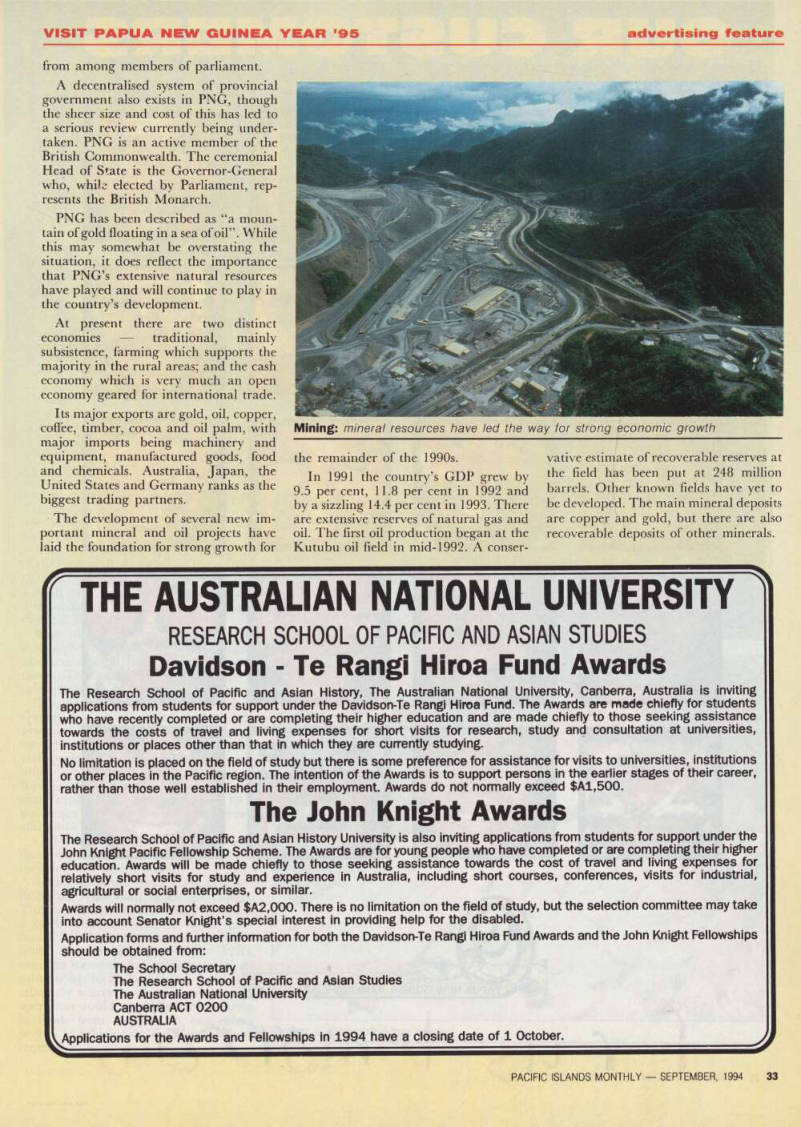

By Wally Hiambohn
PAPUA New Guinea, the largest of the Pacific island countries, is a rapidly developing vibrant country. It is where Asia meets the Pacific, and is full of
promises of prosperity.
This prosperity can be guaranteed for several reasons. It is politically stable with well-entrenched democratic insti tutions. Government recognition of the private sector in development, and guaranteed safety of foreign investment with a range of concessions and generous assistance to attract investors.
It has an abundance of natural resources in mining and petroleum,
fishing, forestry, agriculture and tourism.
The country and its lands are relatively young. The geography is characterised
by high mountain ranges, deep valleys
and swift rivers.
Its four million people are mainly Melanesians, 80 per cent of whom live in the rural areas. Port Moresby, the capital and major city, has a population of 200,000 with other important towns
being Lae (80,000), Madang (27,000),
Wewak (23,000), Goroka (18,000),
Mount Hagen (18,000) and Rabaul
(17,000). PNG is, in fact, the most heterogenious country in the world.
Because of the isolation of most com munities in the past, over 700 different languages were developed and are still spoken, about one-third of the languages known to man.
Because of the cultural diversity of the country, English is the language of government, commerce and law. English is a compulsory subject in school and, apart from isolated communities, is
widely understood throughout PNG.
PNG was granted independence from Australia in 1975. The democratic heri tage of Melanesian society and the parliamentary traditions of Great Britain have combined to produce a stable democracy in PNG. There have been a number of democratic elections since independence and universal suffrage is enjoyed by the population. There is freedom of the press.
The national government comprises three independent branches the executive, the legislature, and the ju diciary. Executive power is vested in the national executive council which com prises of the prime minister and a number of ministers whom he chooses
Parliament: democratic institutions are well-entrenched, combining with tradition.
from among members of parliament.
A decentralised system of provincial government also exists in PNG, though the sheer size and cost of this has led to a serious review currently being under taken. PNG is an active member of the British Commonwealth. The ceremonial Head of State is the Governor-General who, while elected by Parliament, rep resents the British Monarch.
PNG has been described as “a moun tain of gold floating in a sea of oil”. While this may somewhat be overstating the situation, it does reflect the importance that PNG’s extensive natural resources have played and will continue to play in
the country’s development.
At present there are two distinct economies traditional, mainly subsistence, farming which supports the majority in the rural areas; and the cash economy which is very much an open economy geared for international trade.
Its major exports are gold, oil, copper, coffee, timber, cocoa and oil palm, with
major imports being machinery and
equipment, manufactured goods, food
and chemicals. Australia, Japan, the United States and Germany ranks as the
biggest trading partners.
The development of several new im portant mineral and oil projects have laid the foundation for strong growth for
the remainder of the 19905.
In 1991 the country’s GDP grew by 9.5 per cent, 11.8 per cent in 1992 and by a sizzling 14.4 per cent in 1993. There are extensive reserves of natural gas and oil. The first oil production began at the Kutubu oil field in mid-1992. A conser
vative estimate of recoverable reserves at the field has been put at 248 million barrels. Other known fields have yet to be developed. The main mineral deposits are copper and gold, but there are also recoverable deposits of other minerals.
Mining: mineral resources have led the way for strong economic growth
THE Ok Tedi mine is now producing more copper than that produced by the Bougainville mine before its forced clos ure due to an armed rebellion. The Porgera gold mine is one of the world’s largest and is expected to produce 11.3 million ounces of gold over its 20-year life. A medium size gold mine is also based on Misima Island, and soon to come on stream is the Lihir gold mine, said to be the biggest undeveloped gold mine outside South Africa.
The waters around PNG are also rich in marine resources and are almost untapped. Within the 200 mile economic zone are large varieties of fish, including migrating schools of tuna.
Forest products are one of PNG’s major exports but the timber resource of the country remains largely intact. There are 36 million hectares of enclosed forest of which 15 million hectares of high quality tropical hardwood are estimated as suitable for immediate development.
Timber operators are currently harvest ing only around 1.5 million cubic metres of available timber.
The government of PNG is, however, mindful of the important obligations to its environmental heritage. Each major investment project is carefully evaluated in terms of the environmental impact.
Every effort is made to devise appropri ate solutions to meet the needs of both the local people and the investors.
The PNG banking system is made up of the Central Bank (Bank of Papua New Guinea), a number of commercial banks, a small number of finance companies and a development bank, namely the Agri cultural Bank of PNG.
One of the commercial banks, the Papua New Guinea Banking Corpor ation, is wholly owned by the govern ment. The others are subsidiaries of international and Australian banks.
The Agricultural Bank of Papua New Guinea has as its main objective the provision of finance to PNG enterprises for agricultural, industrial and commer cial projects. Another recently estab lished government body, the Small Business Development Corporation, as sists small and medium size local businesses to secure finance and operate efficiently.
Other financial institutions include finance companies, saving and loans societies, and credit unions.
Some companies operating in PNG are listed on Australian Stock Exchanges.
The government also intends to establish a stock exchange in PNG in the near future. While some finance is available from the banking system in PNG, overseas investors are unlikely to secure substantial local borrowing from the relatively scarce local resources. A new operation would normally need to bring in funds from overseas to establish a project in which case the Central Bank requires a
Highlanders: 80 per cent of the population live in rural areas
Copra: a major revenue earner
debt to equity ratio of 3:1 or less.
Exchange controls are applied in PNG and are administered by the Central Bank. These controls are applied to protect the country’s reserves and have been liberalised recently. Approval is readily given for the repatriation of aftertax profits of foreign-owned enterprises, and other current account payments for legitimate business reasons generally present no problems.
Business may be carried out in PNG in a number of forms. These include a sole trader, partnership, private company, public company, branch of a foreign company, business group and trust.
Each type of business organisation is subject to particular regulations. Foreign investors usually establish a private or public company or a branch of a foreign company. Before commencing business in PNG, it is necessary to incorporate a company or register as a branch of a foreign company under the Companies Act. This is a simple formality if a shelf company is purchased.
The legal system in PNG is based largely on the Australian legal system which, in turn, has its roots in the English legal system. There are, however, areas where the traditional or ‘customary’ law applies. Under the constitution, courts are required to have regard to both common law and customary law (called
the underlying law). This underlying law is determined by the courts and can be particularly important when dealing with cases involving land tenure and the use of natural resources.
Court hearings are held in English and the law is applied equally and fairly. The final court of appeal is the Supreme Court of PNG.
Labour
There is an available pool of labour in PNG; but while the wage rates are low by developed country standards, productivity is not high. The Government has taken steps to improve its education standards and qualifications of the people. In 1991, there were over 13,000 enrolled in university, vocational and technical institutions.
Until the local workforce upgrades its skills many new ventures, particularly those requiring technical skills, will have to rely on some managerial and supervisory staff from overseas on short term assignments.
Expatriate Employment
While recognising the legitimate need for overseas personnel for some new ventures, the Government of PNG also insists that there be a training and localisation programme to allow Papua New Guineans to eventually fill these roles.
Before employing expatriates, a busi-
ness must submit a plan to the Depart ment of Labour and Department of Labour and Employment which outlines the training to be given to local PNG staff to enable them to take on the positions filled by the expatriates, Once the requirements are satisfied a new business should have no problem in obtaining work permits for expatriates,
Trade Agreements/Export
Promotion
PNG has preferential access to a number of overseas markets. Products of PNG origin are allowed duty free access to Australia, New Zealand and the EC under the PATCRA and SPARTECA agreements and the Lome Convention, PNG products also have preferential access to numerous other developed countries including Japan and the US under their respective General System of Preferences.
The Department of Trade and Indus try actively assists local producers to export. Activities are targeted at areas where supply capabilities are available or have good potential for development, The Department sponsors selling mis sions and attendance at trade fairs in overseas markets.
Commercial representation offices are located in Sydney and Brussels, while PNG’s diplomatic representatives in other countries are organised to bring
Papuans: training of locals is a necessity with foreign investment
about greater foreign market awareness and demand for PNG products.
Land Tenure
As already mentioned, the ownership and the right to use most land and natural resources is governed by the traditional law of the PNG people.
Only three per cent of land is outside of this ancient system and this is almost entirely owned by the national govern ment. Foreign investors can lease land from the government for particular projects. The recently-established Indus trial Centres Development Corporation is developing industrial sites, which could also be made available to investors, in or
near the major urban areas.
Investors involved in manufacturing operations will usually face no difficulties with land availability. Those involved in resource or agricultural projects should appreciate, however, that access to land resource may be difficult.
The government will assist investors in large projects that are vital to the
economic growth of the country it has the right to do so under the Land Act.
Nonetheless, the government is gener ally restricted to protecting traditional property rights and investors will not be allowed to negotiate directly with the local owners. If handled properly, the government’s investors has shown that a mutually satisfactory agreement can be readily developed. D
Landowners: government committed to protecting traditional rights
Port Moresby: industrial projects won’t have land difficulties
Advertisements & other items, pp. 31-42 (6 items)
31
PACIFIC ISLANDS MONTHLY SEPTEMBER, 1994
advertising feature
VISIT PAPUA NEW GUINEA YEAR ’95
just Phonecar^'ilii
There is more to it then
Today parts of Papua New Guinea remains as mysterious and untouched as when first discovered.
With over 700 languages, diversified cultures, towering mountains, lush jungle, tropical rain forest, Papua New Guinea is full of adventure and excitement...
To bring the adventures closer to you, these subjects are depicted on phonecards. * superb flora and fauna * diverse traditions and cultures * some of the world’s unique wildlife and marine species * social, political and economical development * monuments and land marks * unlimited works of arts and crafts and the list goes 0n... Even surprises too!
You don’t have to speak our 700 plus languages or climb our towering mountains,.. Ifs all an adventure in itself. One thing for sure, you will have it all in your hand.
Order now to avoid disappointment. ■ § V For further information please write to; Overseas Phonecard Sales PTC Telikom Business Operations Department 1 st Floor, Telikom Rumana
P O Box 291 WAIGANI, NCD.
Papua New Guinea.
Phone:l67s) 300 5576 Fax: (675) 30 0 5 5 40/41 . t J !' I
Telikom
Keeping you in touch \ \ o >-■ aa Studio Tkom OS I
A flights to
adventure
for only
US 0)^ i W»a nU S w an' , * T *° ” J vAos oena^ 30 . uaQ® *«>•> • ,W‘« a9 #Gor oK» ua® Tat> u
T «eV>
tar» Oa r *j Now you can put more adventure into your holidays with Air Niugini’s Adventure Airpass*, and save!
Here's how it works. Air Niugini's Adventure Airpass offers international visitors 4 flights to any of our destinations throughout PNG: regardless of the distance of the sector.
All you have to do is plan the itinerary and save. And if you wish to add another destination to your itinerary, you can purchase additional flight coupons for an extra US$5O each.
So, whether you're planning to visit the PNG Highlands, exotic Islands or go Fishing,
Diving, Cruising and
Hiking, contact your nearest Air Niugini office about
experiencing this
Land of Adventure and Excitement with our US$299
Air Niugini
Adventure
Airpass*.
(J Air Niugini
SYDNEY • BRISBANE • MELBOURNE • CAIRNS • LOS ANGELES • HONG KONG • MANILA • JAYAPURA • SEOUL • SINGAPORE • JAKARTA TOKYO • KUALA LUMPUR • TAIPEI • HONIARA • FRANKFURT • PORT VILA
THE AUSTRALIAN NATIONAL UNIVERSITY
RESEARCH SCHOOL OF PACIFIC AND ASIAN STUDIES Davidson - Te Rang! Hiroa Fund Awards The Research School of Pacific and Asian History, The Australian National University, Canberra, Australia is inviting applications from students for support under the Davidson-Te Rangi Hiroa Fund. The Awards are made chiefly for students who have recently completed or are completing their higher education and are made chiefly to those seeking assistance towards the costs of travel and living expenses for short visits for research, study and consultation at universities, institutions or places other than that in which they are currently studying.
No limitation is placed on the field of study but there is some preference for assistance for visits to universities, institutions or other places in the Pacific region. The intention of the Awards is to support persons in the earlier stages of their career, rather than those well established in their employment. Awards do not normally exceed $A1,500.
The John Knight Awards
The Research School of Pacific and Asian History University is also inviting applications from students for support under the John Knight Pacific Fellowship Scheme. The Awards are for young people who have completed or are completing their higher education. Awards will be made chiefly to those seeking assistance towards the cost of travel and living expenses for relatively short visits for study and experience in Australia, including short courses, conferences, visits for industrial, agricultural or social enterprises, or similar.
Awards will normally not exceed $A2,000. There is no limitation on the field of study, but the selection committee may take into account Senator Knight’s special interest in providing help for the disabled.
Application forms and further information for both the Davidson-Te Rangi Hiroa Fund Awards and the John Knight Fellowships should be obtained from: The School Secretary The Research School of Pacific and Asian Studies The Australian National University Canberra ACT 0200
AUSTRALIA
Applications for the Awards and Fellowships in 1994 have a closing date of 1 October.
**' 1,1 ■* % jm v *r V _3
APUA NEW GUINEA BANKING CORPORATION
ft — V-■ •v ■ -i- T^ J m *:* >A - '
*t:ft
:o;'H':* mimm^ ig|
S3SW
•• • isp; Vf ay| s» a*’
Toyota Land Cruiser offers you more
rugged reliability, elegant luxury...
and long-lasting durability.
Land Cruiser’s reputation is second to none. No one doubts its rugged constitution. Yet here is a vehicle that rivals the finest limousines where comfort is concerned. And its fit and finish, the attention to detail, and the graceful lines and fine trim are reminiscent of exquisite luxury cars.
Nevertheless, hidden beneath its elegance, Land Cruisers still offer tough ladder frames and suspension engineered to go wherever you wish... in total comfort powered by your choice of 4.5-litre petrol or 4.2-litre diesel engines. And everything is carefully protected from rust and corrosion so it lasts longer.
Toyota Land Cruiser, The best for your world.
Now and forever.
DISTRIBUTORS/DEALERS
AMERICAN SAMOA...
GUAM & MICRONESIA
NORFOLK ISLAND
SOLOMON ISLAND
VANUATU
BURNS PHILP MOTORS PH 633-4281
ATKINS KROLL, INC. PH 646-1876/9
BORRY’SPTYLTD. PH 22114
ELA MOTORS PH 30746
ASCO MOTORS PH 22341
COOK ISLANDS
KIRIBATI
PAPUA NEW GUINEA
TAHITI
WESTERN SAMOA...
PACIFIC MOTORS LTD PH 20796
TARAWA MOTORS PH 21090
ELA MOTORS PH 229400
NIPPON AUTOMOTO PH 429819
ASCO MOTORS PH 23664
FIJI ASCO MOTORS
NEW CALEDONIA S.I.A.P.
SAIPAN MICROL CORPORATION
TONGA ASCO MOTORS
I r ... i?=S '•smmwA l
LAND CRUISER
1
iiii.ii
ill
. v - :; - - Sat; .M-v' * • " , Exact features and specifications may vary depending on country of purchase. Please check with your nearest TOYOTA distributor/dealer for details.
PH312666 PH 275562 PH 234-5911 PH 23500
® TOYOTA
This is Papua New Guinea. ■■ ■ "H ■ If you think our scenery is impressive
wait until you meet our people.
PRIMITIVE cultures? Think again. Some of our ancestors were tending irrigated market gardens thirty thousand years ago. ♦ Others devised giant multi-hulled sailing vessels to increase cargo volume on trading voyages. These Lakatois are still built each year in celebration of those epic voyages. ♦You may also marvel at the skills needed to construct massive Hans Tambarans —buildings soaring to heights that would shame many a modern architect. ♦ Yet the most impressive fact for the jaded traveller is that so many fascinating cultures and traditions are still a part of everyday life; not something turned on for the benefit of tourists. ♦ And with over 800 languages in PNG, we probably have more ways of saying "welcome" than any other people on earth. ♦ So come to PNG for the natural, breathtaking scenery and you will quickly discover that it's our people that make PNG a truly unique destination.
For many more fascinating facts about Papua New Guinea holidays, contact your travel agent or the Papua New Guinea Tourism Promotion Authority.
PO Box 1291 Port Moresby NCD Papua New Guinea Call (675)20 0211 Fax (675) 20 0223
TOURISM
In these times,
people want more for their money.
Why not send them to a hotel,
that's had this philosophy all along?
won Smugglers Inn Resort Coast Watchers Hotel W
MADANG
Melanesian Hotel Huon Gulf Lodge Highlander Hotel & .
'•'H.
Lammgton Lodge I f Gateway Hotel
FLAG
INTERNATIONAL
MOTHS INhS • RESdOS • ATMH^ISVTS
Coral Sea Hotels
PO Box 1215, Boroko N.C.D., Papua New Guinea
CENTRAL RESERVATIONS PHONE (675) 25 2612
Joint
Ventures
The Investment Promotion Authority (IPA) promotes the establishment of Joint Ventures (JVs) A key function of the IPA is its role of "match maker". IPA will assist foreign investors in their search for JV partners. 0 There is no set equity requirement for a JV for either a foreign or domestic entity.
Iil : Businesses freely choose to enter JVs in PNG. 0 All Businesses must be registered with the Office of the Registrar of Companies.
Investment Promotion Authority sth floor Investment Haus Douglas St Port Moresby For further information please contact: The Managing Director P.O. Box 5053 BOROKO NCD Papua New Guinea Tel: (675) 217311 Fax: (675) 212819
South Pacific Regional Environment
Programme (SPREP)
Vacancy
Population and Development Officer
Applications are invited for the position of Population and Development Officer with the South Pacific Regional Environment Programme (SPREP) in Apia, Western Samoa.
SPREP is a regional organisation established by 26 governments and administrations to assist Pacific Island countries and territories to protect and improve their shared environment and to manage their resources so as to enhance the quality of life for present and future generations. The need to integrate population and environment concerns is a priority for sustainable development in the Pacific and an integral part of SPREP’s Action Plan.
The Population and Development Officer is responsible for the implementation and supervision of a UNFPA funded Population Integration Project that focuses on macro level linkages between population characteristics, sustainable development and the environment which can be addressed through sectoral and national planning.
Candidates must have appropriate tertiary qualifications from a recognised institution and at least five years’ work
experience in a field related to this position. Other essential requirements are the ability to work as part of a small inter-disciplinary team, to manage the work of consultants and to meet project deadlines. Appointment will be at Project Officer level and will be for two years in the first instance, renewable for a further term by mutual agreement. An attractive remuneration package and other employment benefits will be offered, with commencing salary dependent on qualifications, experience and current salary in country of recruitment. For non-Western Samoan citizens, salary will be tax-free in Western Samoa.
Applications must be accompanied by detailed curricula vitae containing full information on qualifications and experience for the position as well as names, address, telephone and/or fax contact numbers of three referees associated with the applicant professionally and who would be prepared to provide necessary references.
Applications should be addressed to: The Director South Pacific Regional Environment Programme PO Box 240
APIA
Western Samoa Telephone: (685) 21 929 Fax: (685) 20 231 Further information, Including a full duty statement and schedule of terms and conditions of appointment, can be obtained by contacting SPREP’s Administration Officer, Mrs Amy Grace Tlelu, at these numbers.
Applications close on 15th October, 1994. 104671v7
An event of coincidence not to be missed..
On the Bth May, 1994 these 5 beautifully designed phonecards were released. Four commemorating the International Year of the Family, which world Red Cross and Red Cross Society mark it as a special year dedicated to children all over the world featuring the theme "Dignity For All". releasing one and only exhibition phonecard featuring the superb Reggiana Bird of Paradise.
Remember, it's first time on Phonecard.
You could be lucky to have it in your collection. Limited stock. Don't delay Order now!
Also on the 5-8 May, 1994 another special event occurred. Yes, the Ist International Phonecard Exhibition which was held in Essen, Germany.
Papua New Guinea was proud to participate thus •ntiiii + iiiiiii) + Next new issue "Traditional Bowls" will be released in September. 1994 aauwsA ELM.-—-i.. i X|uq asn aoiyo 1.1,1
I Hit
liilif
|=i||l mu I I 5
ORDER FORM
1 1.1 |J I □ ir
, !lii!
! M 111 U
! i‘f 1 1 I
□ □ In Citi Studio T'kom 043 ll 3 3 3 I I i i 5 Hi * |3i IB Hi <5 S g
advertising feature
VISIT PAPUA NEW GUINEA YEAR ’95
35
advertising feature
PACIFIC ISLANDS MONTHLY SEPTEMBER, 1994
VISIT PAPUA NEW GUINEA YEAR ’95
advertising feature
VISIT PAPUA NEW GUINEA YEAR ’95
advertising feature
VISIT PAPUA NEW GUINEA YEAR *95
Liquid gas next on the list
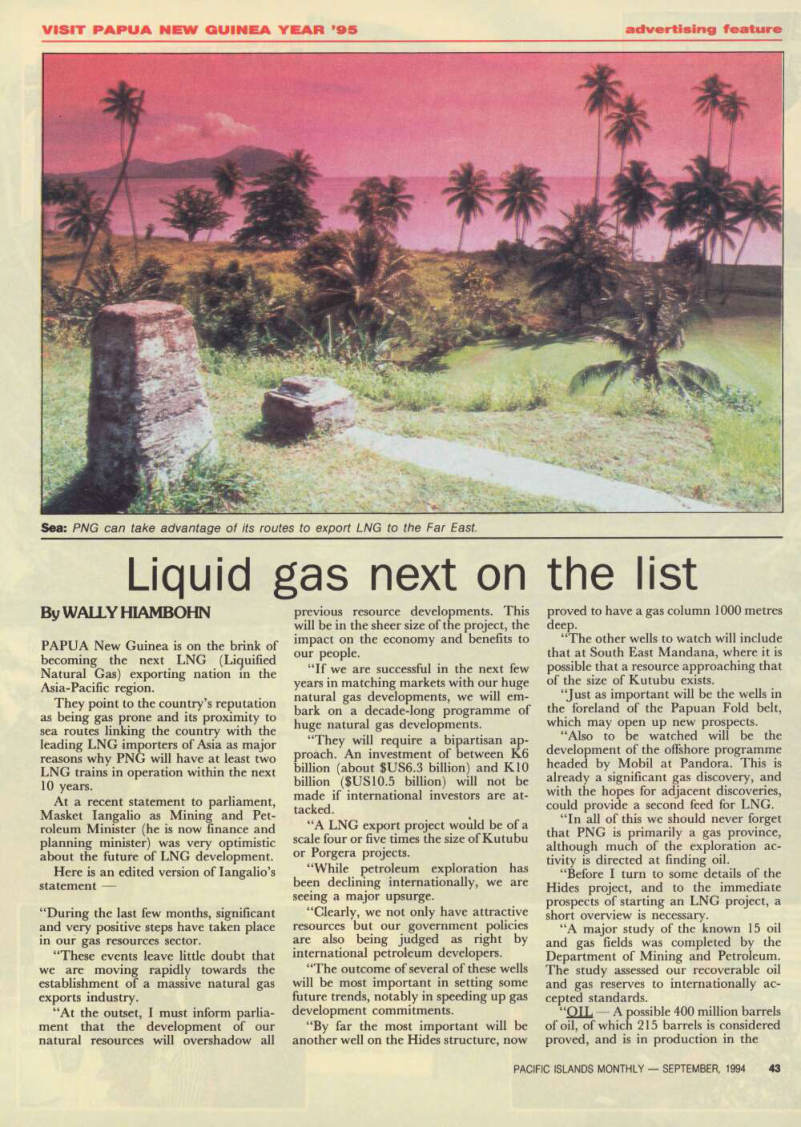

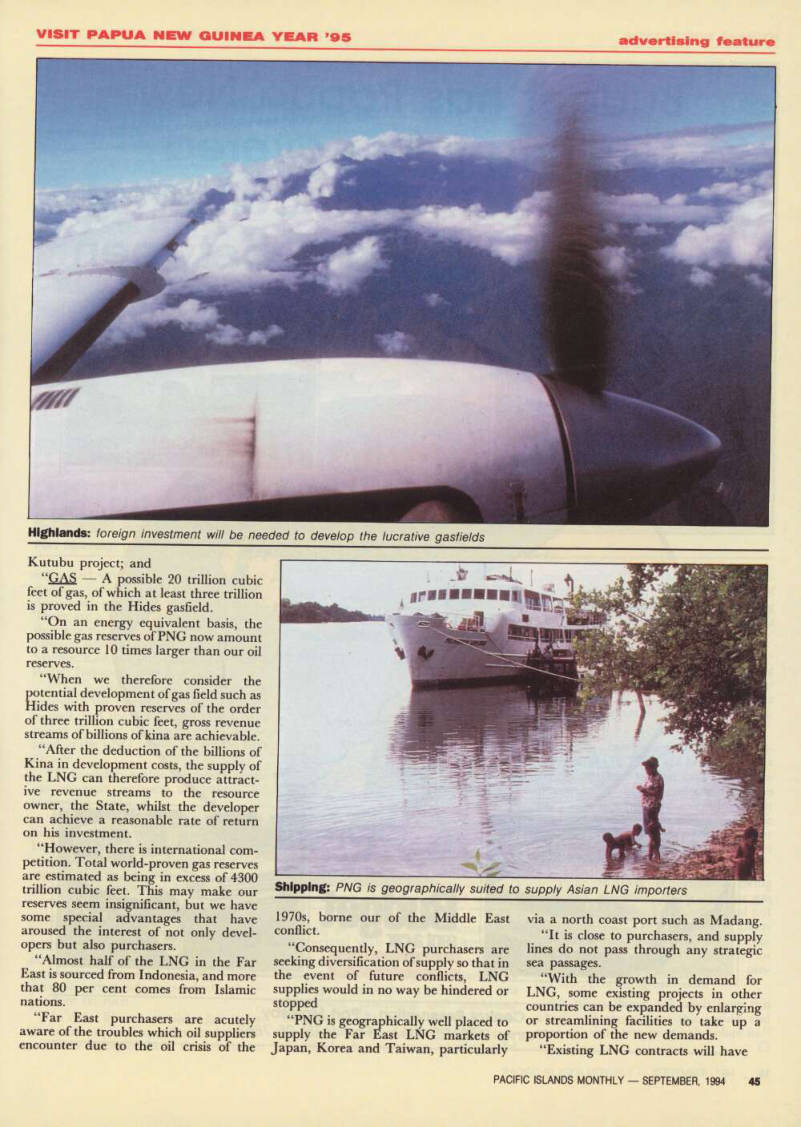
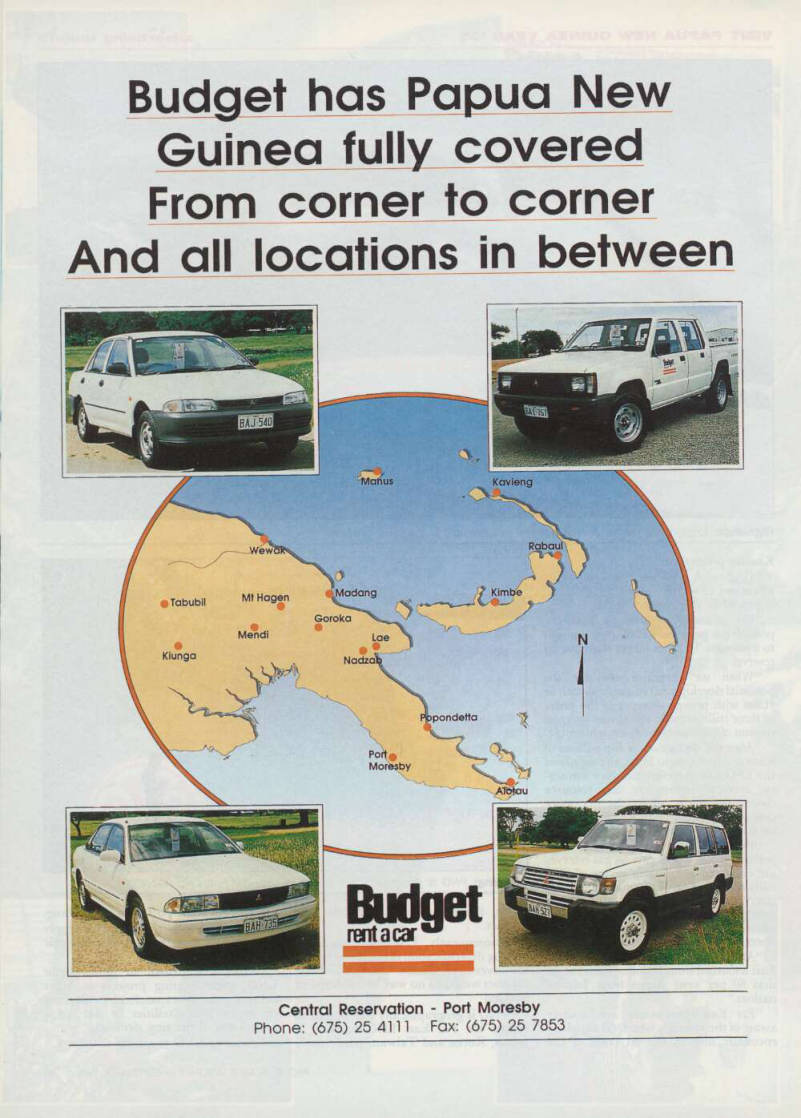
By Wally Himbohn
dadtta TVT i • i c FArUA New Guinea is on the brink of , . . T /T . . c , N^tural^Gas) 6 exiiortine nation the Asia-Pacific reeion rj. u ■ ' , .. ey pom o e coun ry s repu a ion as being gas prone and its proximity to sea routesi linking the country with the leading LNG importers of Asia as major reasons whv PNG will have at least two reasons why ri\ljr will have at least two LNG trains in operation Within the next in vears ycais.
At a recent statement to parliament, Masket langaho as Mining and Pet roleum Minister (he is now finance and planning minister) was very optimistic about the future of LNG development.
Here is an edited version of langalio’s statement “During the last few months, significant and very positive steps have taken place in our gas resources sector.
“These events leave little doubt that we are moving rapidly towards the establishment of a massive natural gas
exports industry.
“At the outset, I must inform parlia ment that the development of our natural resources will overshadow all
previous resource developments. This will be in the sheer size of the project, the impact on the economy and benefits to r , 1 our people.
“If we are successful in the next few years in matching markets with our huge natural gas developments, we will em- 3ar j on a decade-long programme of h natural developments. » T he V will reouire a hinartisan an 1 hey will require a bipartisan ap proach. An investment of between K 6 •«. /'about ffiTJSfi S billion') and KlO J 3 };}! 011 X r , bllllon ) and , U billion ($11810.5 billion) will not be made if international investors are at- ‘‘ uwernattonal investors arc at , J . •, , . f A LNG export project would be of a scale four or five times the size of Kutubu or Porgera projects. , “While petroleum exploration has been declining internationally, we are seeing a major upsurge.
“Clearly, we not only have attractive resources but our government policies are also being judged as right by international petroleum developers.
“The outcome of several of these wells will be most important in setting some future trends, notably in speeding up gas
development commitments.
“By far the most important will be another well on the Hides structure, now
proved to have a gas column 1000 metres
deep.
“The other wells to watch will include c *w j . • that at South Last Mandana, where it is possible that a resource approaching that of the size of Kutubu exists.
“Just as important will be the wells in the foreland of the Papuan Fold belt, which may open up new prospects.
“Also to be watched will be the dpvp i nnrnpnt of the offshore nrommme development ol the onshore programme headed by Mobil at Pandora. This is alreadv a cfonifirflnt eras disroverv and already a sigmhcant gas discovery, and With the hopes for adjacent dISCOVeriCS, cou)d a feed for LNG “In all of this we should never forget that pNG is pr i mar ily a gas province, akhough muck of the exploration ac tivity is directed at finding oil « Before j turn tQ gome details of the Hides • and tQ the imme diate prospects of starting an LNG project, a short overview is necessary, “A major study of the known 15 oil and gas fields was completed by the Department of Mining and Petroleum, The study assessed our recoverable oil and gas reserves to internationally ac
cepted standards.
“OIL A possible 400 million barrels of oil, of which 215 barrels is considered proved, and is in production in the
Sea: PNG can take advantage of its routes to export LNG to the Far East.
Kutubu project; and “GAS A possible 20 trillion cubic feet of gas, of which at least three trillion is proved in the Hides gasfield.
“On an energy equivalent basis, the possible gas reserves of PNG now amount to a resource 10 times larger than our oil reserves.
“When we therefore consider the potential development of gas field such as Hides with proven reserves of the order of three trillion cubic feet, gross revenue streams of billions of kina are achievable.
“After the deduction of the billions of Kina in development costs, the supply of the LNG can therefore produce attract ive revenue streams to the resource owner, the State, whilst the developer can achieve a reasonable rate of return on his investment.
“However, there is international com petition. Total world-proven gas reserves are estimated as being in excess of 4300 trillion cubic feet. This may make our reserves seem insignificant, but we have some special advantages that have aroused the interest of not only devel opers but also purchasers.
“Almost half of the LNG in the Far East is sourced from Indonesia, and more that 80 per cent comes from Islamic nations.
“Far East purchasers are acutely aware of the troubles which oil suppliers encounter due to the oil crisis of the
19705, borne our of the Middle East conflict.
“Consequently, LNG purchasers are seeking diversification of supply so that in the event of future conflicts, LNG supplies would in no way be hindered or stopped “PNG is geographically well placed to supply the Far East LNG markets of Japan, Korea and Taiwan, particularly
via a north coast port such as Madang.
“It is close to purchasers, and supply lines do not pass through any strategic sea passages.
“With the growth in demand for LNG, some existing projects in other countries can be expanded by enlarging or streamlining facilities to take up a proportion of the new demands.
“Existing LNG contracts will have
Highlands: foreign investment will be needed to develop the lucrative gasfields
Shipping: PNG is geographically suited to supply Asian LNG importers
exhausted various fields, and new pro
duction projects supported by newly
discovered gas fields will be required.
There are a variety of projects vying for shares of the project increase in demand ranging from Qatar and Oman in the Middle East, to our immediate neigh bours, Indonesia and Australia.
“The confirmation of our large gas reserves, the success of our first oil project, and the advantages that I have talked of, have all placed PNG at the head of the LNG supply list for the next decade.
“If we wish to realise the wealth of our gas resources we need to confirm our interest as a nation.
“LNG projects are hugely capital
intensive, with construction periods of between six to eight years. The mere construction of the facilities and plants represent a major activity which can provide a boost to our economy.
“Once gas production and processing commences, apart from providing excel lent and stable revenue streams, the LNG infrastructure allows for the easier addition of other activities such as power
generation, petrochemical industries and
manufacturing industries which are de pendent on such.
“In order for us to realise a gas-driven economy, we need to understand that we will have to exploit both the investment
capital, as well as the technical and commercial skills of the developers.
“But, at the same time, we need to be the catalyst of development, partner of developers, and the regulation of gas
production, processing and marketing
activities. “The very long lead time during the construction, before pro duction leads to revenue, requires solid
commitment from the buyers, devel opers, sellers, and the governments of both the producing and consuming countries right from the project’s inception.
“The progress towards commer cialisation requires the active and willing participation of all parties. These com mitments must endure and rise above changes in politics, policy or govern ments.
“Whilst companies that have dis covered gas in PNG are keen to reap a return on their sunken exploration ex penditure, an LNG development of gas reserves is so significant a venture that it requires firm endorsement from the government and the people of PNG prior to any steps towards LNG project
development.
“Prior to that endorsement being provided, the policy framework for gas development has to be reviewed and put in place. To this end an inter departmental task force has been estab lished to review the present provisions for gas exploration, development, pro duction, processing and sale.
“A White Paper will result from this which will encapsulate this review and analysis, and place proposals before us.” □
Port Moresby: government will be conducting a White Paper on gas exploration
Government: committment must last
Advertisements & other items, pp. 43-48 (4 items)
advertising feature
VISIT PAPUA NEW GUINEA YEAR ’95
mimic
I ftlftflUS DIGITAL OPEfltn© 67 «i , a i” 3m m «¥ > * m * r #*» lit i\4l W i 4: \ -’ •' - => '-' f f
Ifit-
v» :.*.< rr# .*■ X ifj >s A' x *
f-j&tz
n N « ' Ik fiV *■' i * ' .. v ■J V** fe : ii ■ - s V T ■■ - MU * %fm ti t u K If ■ ** .
NICATION CORPO
ua t ’5
Budget has Papua New
Guinea fully covered
From corner to corner
And all locations in between
Is* m ■ Vftl 540
BAJ
SSWV-'
'Mahi Kavieng bau ew 0 Madang / Ki S7W Kimbe Tabubil Mt Hagen 7 Goroka Mendi Lae Kiunga • 1 Nadza 4 ; pondetta Po by Mor Atotau 735jS^
BAH
Budget
mnt n nor w
rentacar
m Central Reservation - Port Moresby Phone: (675) 25 4111 Fax: (675) 25 7853
INTERNATIONAL
V v; '’•V m M I « DG r-
111 |if JSTMNOTAL
s im «!
TTt; £3 II ill! i -v ».s I A m .n. . r« 1 Ks«"
The International Dateline Hotel invites you to experience some of the finest and cheapest duty free shopping in the South Pacific through the convenience of our in-hotel branch of the
SEeioiu
DUTY FREE SHOPS
On the waterfront only ten minutes walk from the capital Nuku’alofa awaits Tonga’s premier hotel.
Seventy six airconditioned rooms with - all amenities, delicious international and local cuisine, floor shows, private guest lounge, open air terrace, swimming pool, cosmetic shop, boutique and duty free shopping make the International Dateline Hotel the perfect retreat for complete relaxation.
The International Dateline Hotel, Tonga’s leading hotel serving you with Friendly Islands hospitality.
iWTEWWAT IQHAi
OTEL
PO Box 39, Nuku’alofa, Kingdom of Tonga.
Tel: +676 23411. Fax: +676 23410
Telex: 66223 DATELINE TS
advertising feature
VISIT PAPUA NEW GUINEA YEAR ’95
47
advertising feature
PACIFIC ISLANDS MONTHLY SEPTEMBER, 1994
VISIT PAPUA NEW GUINEA YEAR ’95
Tonga
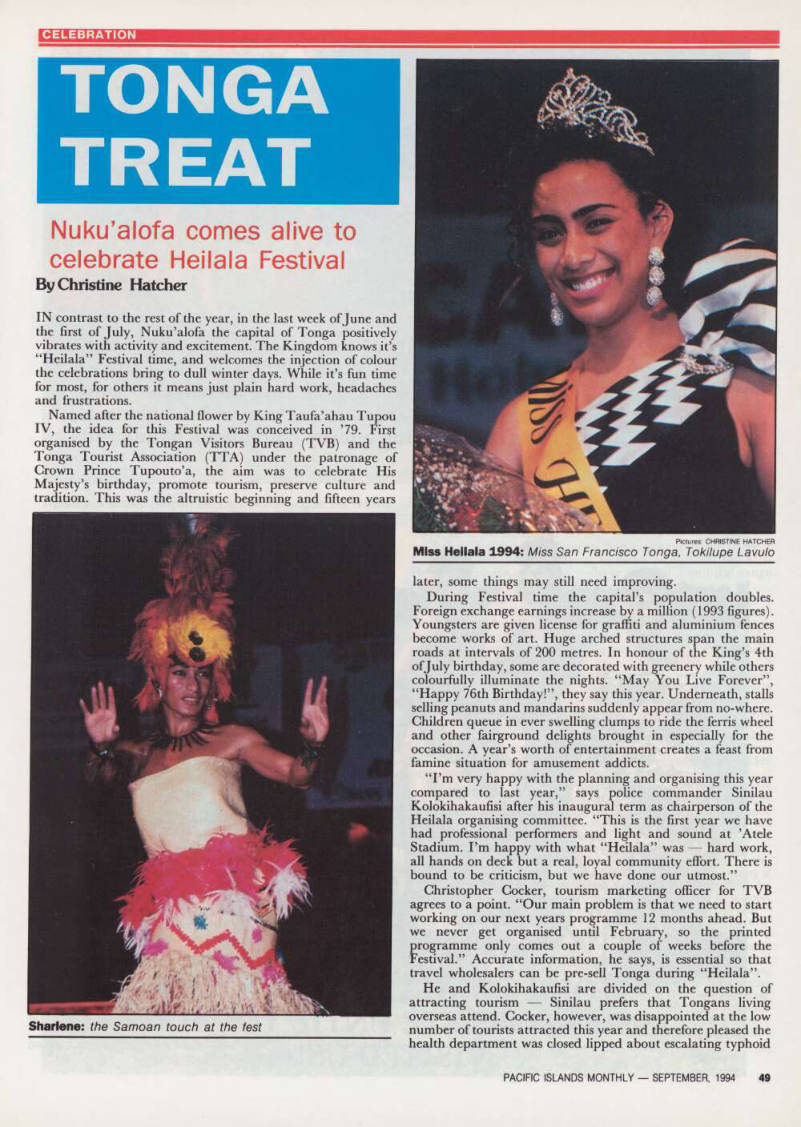
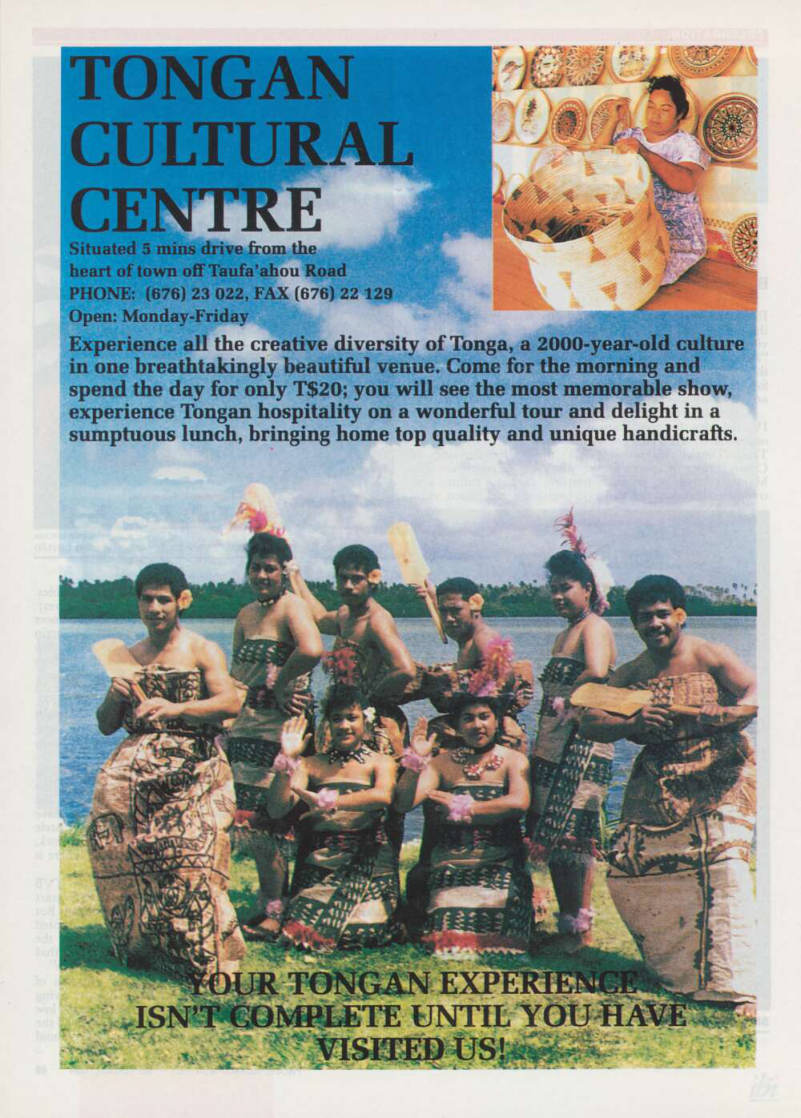
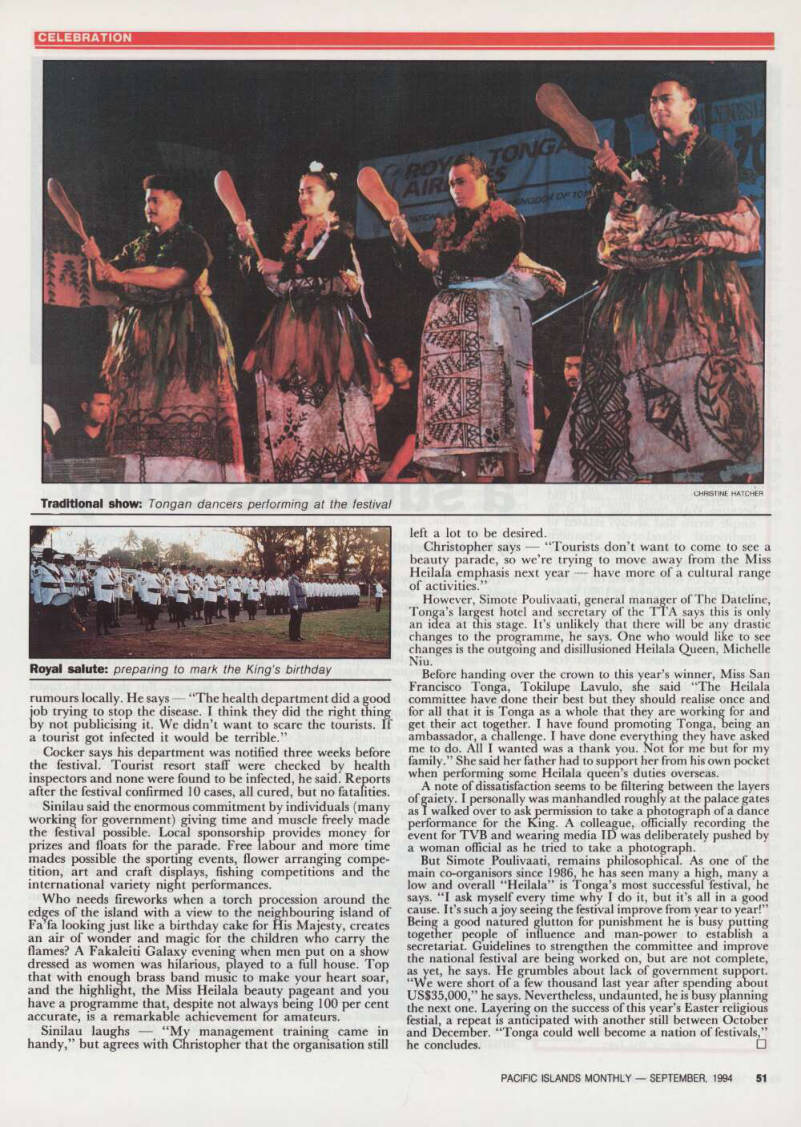
Celebration
Treat
Nuku’alofa comes alive to celebrate Heilala Festival
By Christine Hatcher
IN contrast to the rest of the year, in the last week of June and the first of July, Nuku’alofa the capital of Tonga positively vibrates with activity and excitement. The Kingdom knows it’s “Heilala” Festival time, and welcomes the injection of colour the celebrations bring to dull winter days. While it’s fun time for most, for others it means just plain hard work, headaches and frustrations.
Named after the national flower by King Taufa’ahau Tupou IV, the idea for this Festival was conceived in ’79. First organised by the Tongan Visitors Bureau (TVB) and the Tonga Tourist Association (TTA) under the patronage of Crown Prince Tupouto’a, the aim was to celebrate His Majesty’s birthday, promote tourism, preserve culture and tradition. This was the altruistic beginning and fifteen years
later, some things may still need improving.
During Festival time the capital’s population doubles.
Foreign exchange earnings increase by a million (1993 figures).
Youngsters are given license for graffiti and aluminium fences become works of art. Huge arched structures span the main roads at intervals of 200 metres. In honour of the King’s 4th of July birthday, some are decorated with greenery while others colourfully illuminate the nights. “May You Live Forever”, “Happy 76th Birthday!”, they say this year. Underneath, stalls selling peanuts and mandarins suddenly appear from no-where.
Children queue in ever swelling clumps to ride the ferris wheel and other fairground delights brought in especially for the occasion. A year’s worth of entertainment creates a feast from famine situation for amusement addicts.
“I’m very happy with the planning and organising this year compared to last year,” says police commander Sinilau Kolokihakaufisi after his inaugural term as chairperson of the Heilala organising committee. “This is the first year we have had professional performers and light and sound at ’Atele Stadium. I’m happy with what “Heilala” was hard work, all hands on deck but a real, loyal community effort. There is bound to be criticism, but we have done our utmost.”
Christopher Cocker, tourism marketing officer for TVB agrees to a point. “Our main problem is that we need to start working on our next years programme 12 months ahead. But we never get organised until February, so the printed programme only comes out a couple of weeks before the Festival.” Accurate information, he says, is essential so that travel wholesalers can be pre-sell Tonga during “Heilala”.
He and Kolokihakaufisi are divided on the question of attracting tourism Sinilau prefers that Tongans living overseas attend. Cocker, however, was disappointed at the low number of tourists attracted this year and therefore pleased the health department was closed lipped about escalating typhoid
Sharlene: the Samoan touch at the test
Pictures: Christine Hatcher
Miss Heilala 1994: Miss San Francisco Tonga, Tokilupe Lavulo
rumours locally. He says “The health department did a good job trying to stop the disease. I think they did the right thing by not publicising it. We didn’t want to scare the tourists. If a tourist got infected it would be terrible.”
Cocker says his department was notified three weeks before the festival. Tourist resort staff were checked by health inspectors and none were found to be infected, he said. Reports after the festival confirmed 10 cases, all cured, but no fatalities.
Sinilau said the enormous commitment by individuals (many working for government) giving time and muscle freely made the festival possible. Local sponsorship provides money for prizes and floats for the parade. Free labour and more time mades possible the sporting events, flower arranging compe tition, art and craft displays, fishing competitions and the international variety night performances.
Who needs fireworks when a torch procession around the edges of the island with a view to the neighbouring island of Fa’fa looking just like a birthday cake for His Majesty, creates an air of wonder and magic for the children who carry the flames? A Fakaleiti Galaxy evening when men put on a show dressed as women was hilarious, played to a full house. Top that with enough brass band music to make your heart soar, and the highlight, the Miss Heilala beauty pageant and you have a programme that, despite not always being 100 per cent accurate, is a remarkable achievement for amateurs.
Sinilau laughs “My management training came in handy,” but agrees with Christopher that the organisation still
left a lot to be desired.
Christopher says “Tourists don’t want to come to see a beauty parade, so we’re trying to move away from the Miss Heilala emphasis next year have more of a cultural range of activities.”
However, Simote Poulivaati, general manager of The Dateline, Tonga’s largest hotel and secretary of the TTA says this is only an idea at this stage. It’s unlikely that there will be any drastic changes to the programme, he says. One who would like to see changes is the outgoing and disillusioned Heilala Queen, Michelle Niu.
Before handing over the crown to this year’s winner, Miss San Francisco Tonga, Tokilupe Lavulo, she said “The Heilala committee have done their best but they should realise once and for all that it is Tonga as a whole that they are working for and get their act together. I have found promoting Tonga, being an ambassador, a challenge. I have done everything they have asked me to do. All I wanted was a thank you. Not for me but for my family.” She said her father had to support her from his own pocket when performing some Heilala queen’s duties overseas.
A note of dissatisfaction seems to be filtering between the layers of gaiety. I personally was manhandled roughly at the palace gates as I walked over to ask permission to take a photograph of a dance performance for the King. A colleague, officially recording the event for TVB and wearing media ID was deliberately pushed by a woman official as he tried to take a photograph.
But Simote Poulivaati, remains philosophical. As one of the main co-organisors since 1986, he has seen many a high, many a low and overall “Heilala” is Tonga’s most successful festival, he says. “I ask myself every time why I do it, but it’s all in a good cause. It’s such a joy seeing the festival improve from year to year!”
Being a good natured glutton for punishment he is busy putting together people of influence and man-power to establish a secretariat. Guidelines to strengthen the committee and improve the national festival are being worked on, but are not complete, as yet, he says. He grumbles about lack of government support.
“We were short of a few thousand last year after spending about U 5535,000,” he says. Nevertheless, undaunted, he is busy planning the next one. Layering on the success of this year’s Easter religious festial, a repeat is anticipated with another still between October and December. “Tonga could well become a nation of festivals,” he concludes. □
Christine Hatcher
Traditional show: Tongan dancers performing at the festival
Royal salute: preparing to mark the King’s birthday
Advertisements & other items, p. 50 (1 item)
iD USiaafe.
AN
•' W Sc. I
Situated 5 mins drive from the heart of town off Taufa’ahou Road PHONE; (676) 23 022, FAX (676) 22 129 Open: Monday-Friday w. » * Experience all the creative diversity of Tonga, a 2000-year-old culture in one breathtakingly beautiful venue. Come for the morning and spend the day for only Ts2o; you will see the most memorable show, experience Tongan hospitality on a wonderful tour and delight in a sumptuous lunch, bringing home top quality and unique handicrafts.
Jt mM* * ** i " . ■ 5* f m- i * \r- ■
V EXPEMENESI
UNTIL YOU HA
iD USiaafe.
B , I iff u£ - I
problems
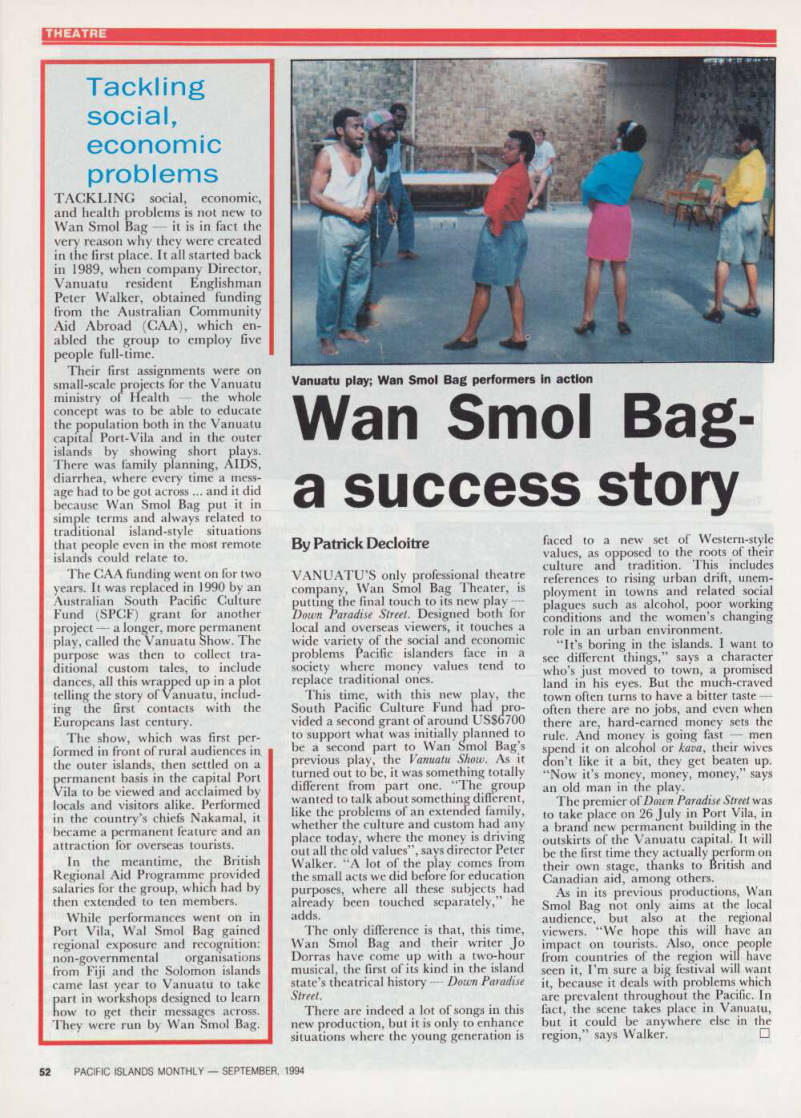
Tackling social, economic problems
TACKLING social, economic,
and health problems is not new to Wan Smol Bag it is in fact the very reason why they were created in the first place. It all started back in 1989, when company Director, Vanuatu resident Englishman
Peter Walker, obtained funding
from the Australian Community Aid Abroad (CAA), which en abled the group to employ five
people full-time.
Their first assignments were on small-scale projects for the Vanuatu ministry of Health the whole concept was to be able to educate the population both in the Vanuatu capital Port-Vila and in the outer
islands by showing short plays.
There was family planning, AIDS,
diarrhea, where every time a mess age had to be got across ... and it did because Wan Smol Bag put it in simple terms and always related to traditional island-style situations that people even in the most remote islands could relate to.
The CAA funding went on for two years. It was replaced in 1990 by an Australian South Pacific Culture Fund (SPCF) grant for another project a longer, more permanent play, called the Vanuatu Show. The purpose was then to collect tra ditional custom tales, to include dances, all this wrapped up in a plot telling the story of Vanuatu, includ ing the first contacts with the Europeans last century.
The show, which was first per formed in front of rural audiences in the outer islands, then settled on a permanent basis in the capital Port Vila to be viewed and acclaimed by locals and visitors alike. Performed in the country’s chiefs Nakamal, it became a permanent feature and an attraction for overseas tourists.
In the meantime, the British
Regional Aid Programme provided
salaries for the group, which had by then extended to ten members.
While performances went on in Port Vila, Wal Smol Bag gained
regional exposure and recognition:
non-governmental organisations
from Fiji and the Solomon islands came last year to Vanuatu to take part in workshops designed to learn how to get their messages across.
They were run by Wan Smol Bag.
Wan Smol Bag
Theatre
Wan Smol Bag a success story
By Patrick Decloitre
VANUATU’S only professional theatre
company, Wan Smol Bag Theater, is putting the final touch to its new play Down Paradise Street. Designed both for local and overseas viewers, it touches a wide variety of the social and economic problems Pacific islanders face in a society where money values tend to replace traditional ones.
This time, with this new play, the South Pacific Culture Fund had pro vided a second grant of around US$67OO to support what was initially planned to be a second part to Wan Smol Bag’s previous play, the Vanuatu Show. As it turned out to be, it was something totally different from part one. “The group wanted to talk about something different, like the problems of an extended family, whether the culture and custom had any place today, where the money is driving out all the old values”, says director Peter Walker. “A lot of the play comes from the small acts we did before for education purposes, where all these subjects had already been touched separately,” he adds - The only difference is that, this time, Wan Smol Bag and their writer Jo Dorras have come up with a two-hour musical, the first of its kind in the island state’s theatrical history Down Paradise Street.
There are indeed a lot of songs in this new production, but it is only to enhance situations where the young generation is
faced to a new set of Western-style values, as opposed to the roots ot their culture and tradition. This includes references to rising urban drift, unem ployment in towns and related social plagues such as alcohol, poor working conditions and the women’s changing ro j e j n an ur ban environment, “It’s boring in the islands. I want to see different things,” says a character w ho’s just moved to town, a promised l an d j n pis eyes gut the much-craved town often turns to have a bitter taste often there are no jobs, and even when there are, hard-earned money sets the ru i e And money is going fast men spend it on alconol or kava, their wives don’t like it a bit, they get beaten up.
“Now it’s money, money, money,” says an o ld m an in the play, The pre mier ot Down Paradise Street was to ta k e p i ace on 26 July in Port Vila, in a brand new permanent building in the outskirts of the Vanuatu capital. It will be the first time they actually perform on t b e i r own stage, thanks to British and Canadian among others, As in its previous productions, Wan Smo j Bag not on i y a i ms at the local audience, but also at the regional viewers. “We hope this will have an impact on tourists. Also, once people from countries of the region will have seen it, I’m sure a big festival will want it ; because it deals with problems which are prevalent throughout the Pacific. In fact, the scene takes place in Vanuatu, but it could be anywhere else in the region,” says Walker. □
Vanuatu play; Wan Smol Bag performers in action
Heroes honoured
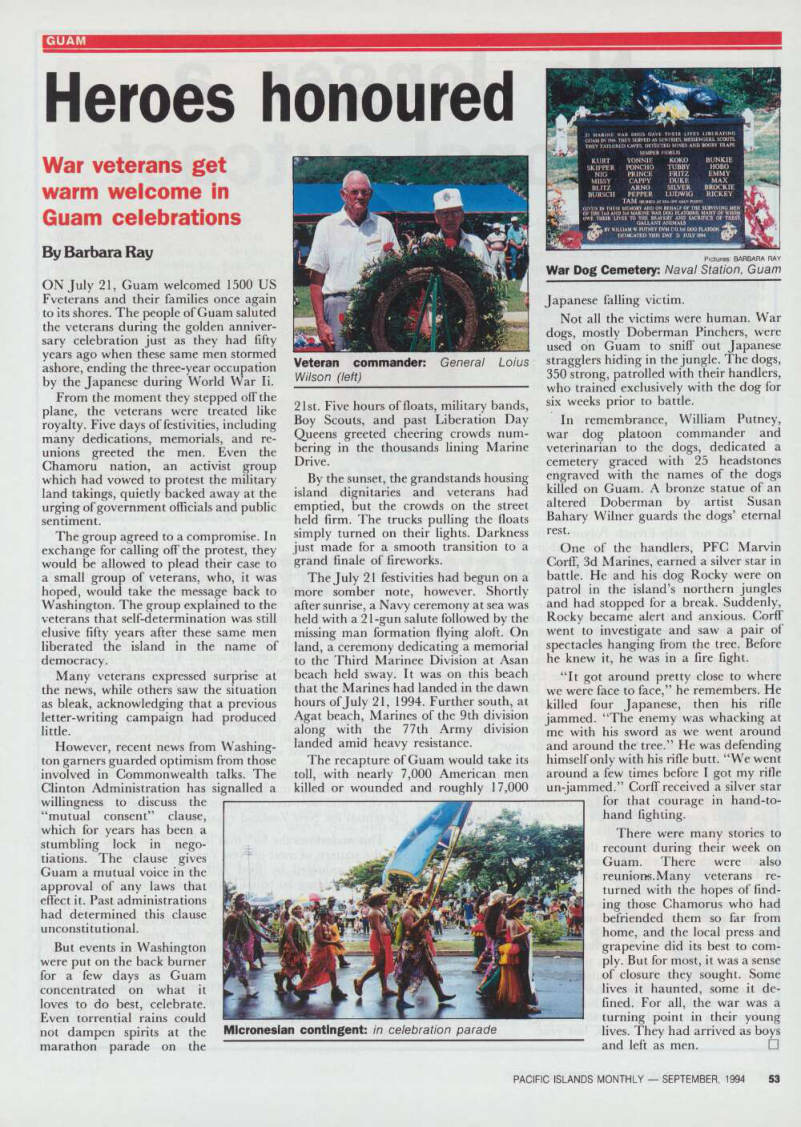
Guam
War veterans get warm welcome in Guam celebrations
By Barbara Ray
ON July 21, Guam welcomed 1500 US Fveterans and their families once again to its shores. The people of Guam saluted the veterans during the golden anniver sary celebration just as they had fifty years ago when these same men stormed
ashore, ending the three-year occupation
by the Japanese during World War li.
From the moment they stepped off the plane, the veterans were treated like
royalty. Five days of festivities, including
many dedications, memorials, and re unions greeted the men. Even the Chamoru nation, an activist group which had vowed to protest the military land takings, quietly backed away at the urging of government officials and public sentiment.
The group agreed to a compromise. In exchange for calling off the protest, they would be allowed to plead their case to a small group of veterans, who, it was hoped, would take the message back to Washington. The group explained to the veterans that self-determination was still elusive fifty years after these same men liberated the island in the name of
democracy.
Many veterans expressed surprise at
the news, while others saw the situation as bleak, acknowledging that a previous
letter-writing campaign had produced
little.
However, recent news from Washing ton garners guarded optimism from those involved in Commonwealth talks. The Clinton Administration has signalled a
willingness to discuss the “mutual consent” clause, which for years has been a stumbling lock in nego tiations. The clause gives Guam a mutual voice in the approval of any laws that effect it. Past administrations had determined this clause unconstitutional.
But events in Washington were put on the back burner for a few days as Guam concentrated on what it loves to do best, celebrate.
Even torrential rains could not dampen spirits at the marathon parade on the
21st. Five hours of floats, military bands,
Boy Scouts, and past Liberation Day
Queens greeted cheering crowds num
bering in the thousands lining Marine Drive.
By the sunset, the grandstands housing
island dignitaries and veterans had emptied, but the crowds on the street held firm. The trucks pulling the floats simply turned on their lights. Darkness just made for a smooth transition to a grand finale of fireworks.
The July 21 festivities had begun on a more somber note, however. Shortly after sunrise, a Navy ceremony at sea was held with a 21-gun salute followed by the missing man formation flying aloft. On land, a ceremony dedicating a memorial to the Third Marinee Division at Asan beach held sway. It was on this beach that the Marines had landed in the dawn hours of July 21, 1994. Further south, at Agat beach, Marines of the 9th division along with the 77th Army division landed amid heavy resistance.
The recapture of Guam would take its toll, with nearly 7,000 American men killed or wounded and roughly 17,000
Japanese falling victim.
Not all the victims were human. War dogs, mostly Doberman Pinchers, were used on Guam to sniff out Japanese stragglers hiding in the jungle. The dogs, 350 strong, patrolled with their handlers, who trained exclusively with the dog for six weeks prior to battle.
In remembrance, William Putney, war dog platoon commander and veterinarian to the dogs, dedicated a cemetery graced with 25 headstones engraved with the names of the dogs killed on Guam. A bronze statue of an altered Doberman by artist Susan
Bahary Wilner guards the dogs’ eternal
rest.
One of the handlers, PFC Marvin Corff, 3d Marines, earned a silver star in battle. He and his dog Rocky were on patrol in the island’s northern jungles and had stopped for a break. Suddenly, Rocky became alert and anxious. Corff went to investigate and saw a pair of spectacles hanging from the tree. Before he knew it, he was in a fire fight.
“It got around pretty close to where we were face to face,” he remembers. He killed four Japanese, then his rifle jammed. “The enemy was whacking at me with his sword as we went around and around the tree.” He was defending himself only with his rifle butt. “We went around a few times before I got my rifle un-jammed.” Corff received a silver star
for that courage in hand-to
hand fighting.
There were many stories to recount during their week on Guam. There were also reunions. Many veterans re turned with the hopes of find ing those Chamorus who had befriended them so far from home, and the local press and grapevine did its best to com ply. But for most, it was a sense of closure they sought. Some lives it haunted, some it de fined. For all, the war was a turning point in their young lives. They had arrived as boys and left as men. □
Veteran commander: General Loius Wilson (left)
Micronesian contingent: in celebration parade
Pictures: BARBARA RAY War Dog Cemetery: Naval Station, Guam
regional outcast
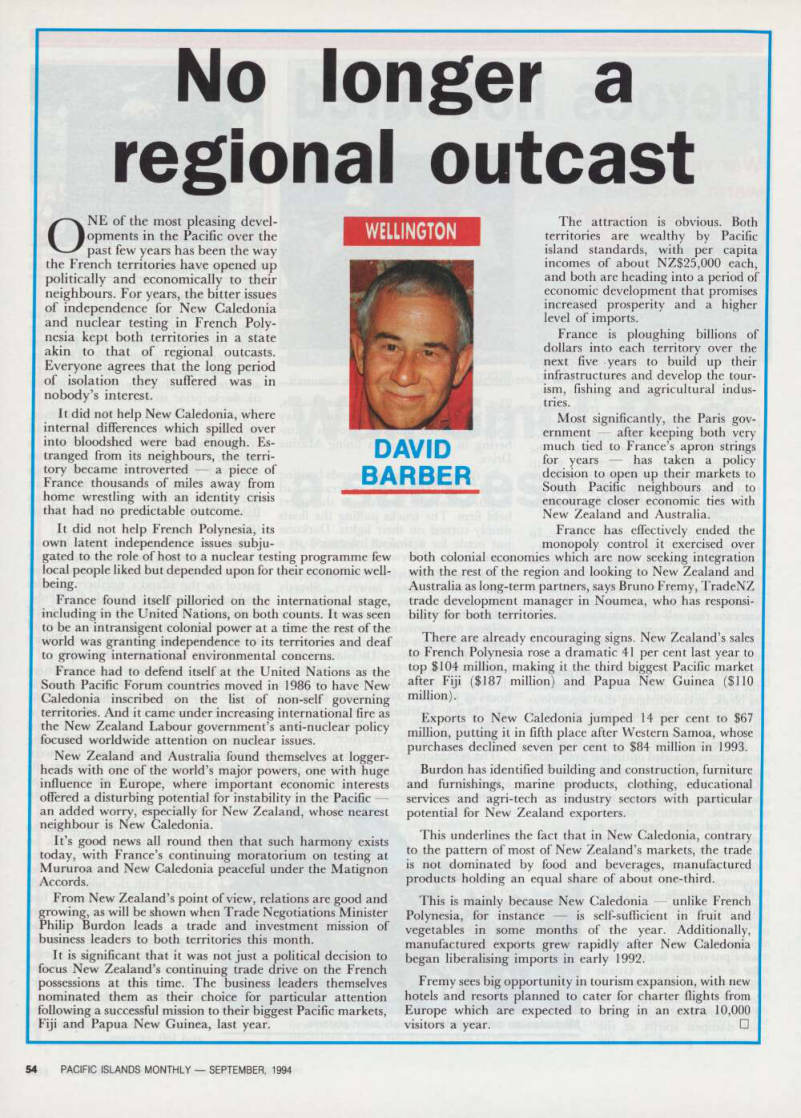
No longer a regional outcast
ONE of the most pleasing devel opments in the Pacific over the past few years has been the way the French territories have opened up politically and economically to their neighbours. For years, the bitter issues of independence for New Caledonia and nuclear testing in French Poly nesia kept both territories in a state akin to that of regional outcasts.
Everyone agrees that the long period
of isolation they suffered was in
nobody’s interest.
It did not help New Caledonia, where internal differences which spilled over into bloodshed were bad enough. Es tranged from its neighbours, the terri tory became introverted a piece of France thousands of miles away from home wrestling with an identity crisis that had no predictable outcome.
It did not help French Polynesia, its own latent independence issues subju
gated to the role of host to a nuclear testing programme few local people liked but depended upon for their economic well
being.
France found itself pilloried on the international stage, including in the United Nations, on both counts. It was seen to be an intransigent colonial power at a time the rest of the world was granting independence to its territories and deaf to growing international environmental concerns.
France had to defend itself at the United Nations as the South Pacific Forum countries moved in 1986 to have New Caledonia inscribed on the list of non-self governing territories. And it came under increasing international fire as the New Zealand Labour government’s anti-nuclear policy focused worldwide attention on nuclear issues.
New Zealand and Australia found themselves at logger heads with one of the world’s major powers, one with huge influence in Europe, where important economic interests offered a disturbing potential for instability in the Pacific an added worry, especially for New Zealand, whose nearest neighbour is New Caledonia.
It’s good news all round then that such harmony exists today, with France’s continuing moratorium on testing at Mururoa and New Caledonia peaceful under the Matignon Accords.
From New Zealand’s point of view, relations are good and growing, as will be shown when Trade Negotiations Minister Philip Burdon leads a trade and investment mission of business leaders to both territories this month.
It is significant that it was not just a political decision to focus New Zealand’s continuing trade drive on the French possessions at this time. The business leaders themselves nominated them as their choice for particular attention following a successful mission to their biggest Pacific markets, Fiji and Papua New Guinea, last year.
The attraction is obvious. Both territories are wealthy by Pacific island standards, with per capita incomes of about NZ525,000 each, and both are heading into a period of
economic development that promises
increased prosperity and a higher level of imports.
France is ploughing billions of dollars into each territory over the next five years to build up their infrastructures and develop the tour ism, fishing and agricultural indus tries.
Most significantly, the Paris gov ernment after keeping both very much tied to France’s apron strings for years has taken a policy decision to open up their markets to South Pacific neighbours and to encourage closer economic ties with New Zealand and Australia.
France has effectively ended the monopoly control it exercised over
both colonial economies which are now seeking integration with the rest of the region and looking to New Zealand and Australia as long-term partners, says Bruno Fremy, TradeNZ trade development manager in Noumea, who has responsi bility for both territories.
There are already encouraging signs. New Zealand’s sales to French Polynesia rose a dramatic 41 per cent last year to top $lO4 million, making it the third biggest Pacific market after Fiji ($lB7 million) and Papua New Guinea ($llO
million).
Exports to New Caledonia jumped 14 per cent to $67 million, putting it in fifth place after Western Samoa, whose purchases declined seven per cent to $B4 million in 1993.
Burdon has identified building and construction, furniture
and furnishings, marine products, clothing, educational
services and agri-tech as industry sectors with particular potential for New Zealand exporters.
This underlines the fact that in New Caledonia, contrary to the pattern of most of New Zealand’s markets, the trade is not dominated by food and beverages, manufactured products holding an equal share of about one-third.
This is mainly because New Caledonia unlike French Polynesia, for instance is self-sufficient in fruit and vegetables in some months of the year. Additionally, manufactured exports grew rapidly after New Caledonia
began liberalising imports in early 1992.
Fremy sees big opportunity in tourism expansion, with new hotels and resorts planned to cater for charter flights from Europe which are expected to bring in an extra 10,000 visitors a year. □
Wellington
David
Barber
A natural welcome
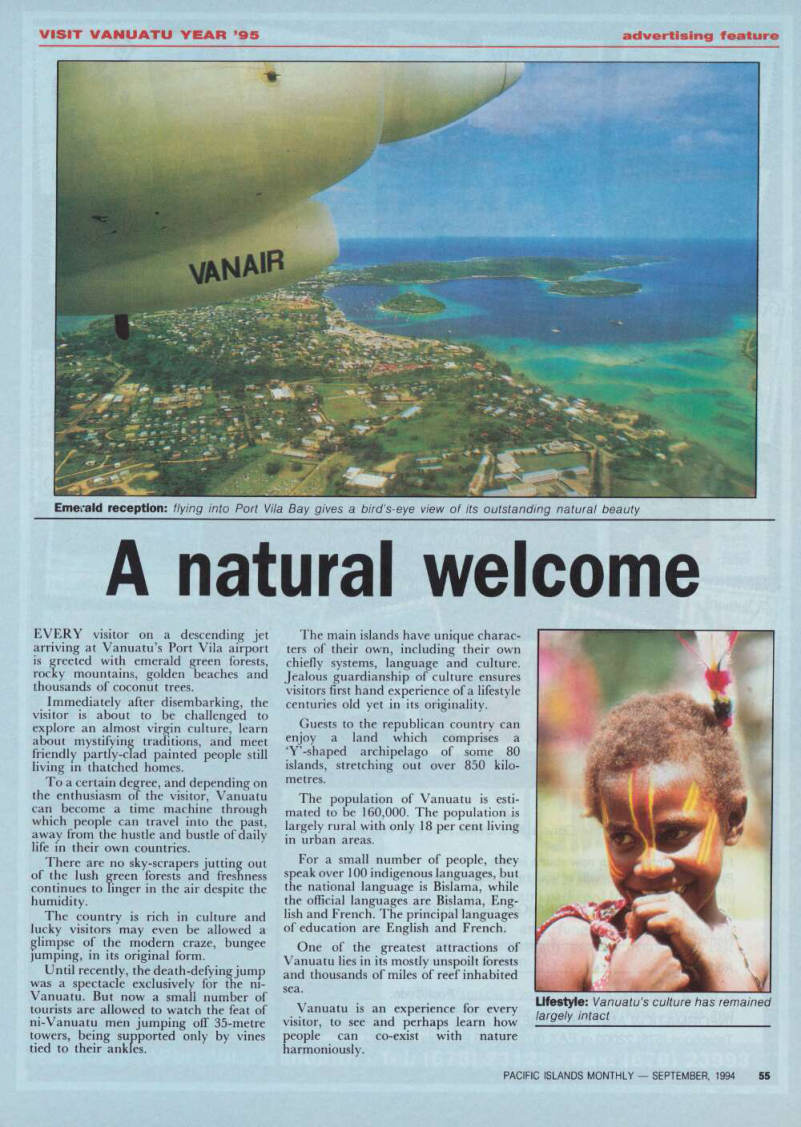
EVERY visitor on a descending jet arriving at Vanuatu’s Port Vila airport is greeted with emerald green forests, rocky mountains, golden beaches and thousands of coconut trees.
Immediately after disembarking, the
visitor is about to be challenged to explore an almost virgin culture, learn about mystifying traditions, and meet
friendly partly-clad painted people still
living in thatched homes.
To a certain degree, and depending on the enthusiasm of the visitor, Vanuatu can become a time machine through which people can travel into the past, away from the hustle and bustle of daily life in their own countries.
There are no sky-scrapers jutting out of the lush green forests and freshness continues to linger in the air despite the
humidity.
The country is rich in culture and lucky visitors may even be allowed a glimpse of the modern craze, bungee jumping, in its original form.
Until recently, the death-defying jump
was a spectacle exclusively for the ni- Vanuatu. But now a small number of tourists are allowed to watch the feat of ni-Vanuatu men jumping off 35-metre
towers, being supported only by vines
tied to their ankles.
The main islands have unique charac ters of their own, including their own chiefly systems, language and culture.
Jealous guardianship of culture ensures visitors first hand experience of a lifestyle centuries old yet in its originality.
Guests to the republican country can enjoy a land which comprises a ‘Y’-shaped archipelago of some 80 islands, stretching out over 850 kilo metres.
The population of Vanuatu is esti mated to be 160,000. The population is largely rural with only 18 per cent living in urban areas.
For a small number of people, they speak over 100 indigenous languages, but the national language is Bislama, while the official languages are Bislama, Eng lish and French. The principal languages of education are English and French.
One of the greatest attractions of Vanuatu lies in its mostly unspoilt forests and thousands of miles of reef inhabited sea.
Vanuatu is an experience for every visitor, to see and perhaps learn how people can co-exist with nature
harmoniously.
Emerald reception: flying into Port Vila Bay gives a bird’s-eye view of its outstanding natural beauty
Lifestyle: Vanuatu’s culture has remained largely intact
Advertisements & other items, pp. 55-56 (2 items)
55
advertising feature
PACIFIC ISLANDS MONTHLY SEPTEMBER, 1994
VISIT VANUATU YEAR ’95
To If 80 I
rm 90
y VANUATU
100 sand 4 J* wr//<vr
VANUATU
"**" Vw«fUwfaunih
VANUATU
Fishes undefwaief iSanks
STAMPS
OF DB n3us vualu —the scenery. bo
VANUATU
The beautiful and exotic country of Vanuatu has some of the most colourful and fascinating stamps in the world.
They cover a broad spectrum of topics of interest to both new and established collectors. The stamp can be seen as windows to the nation of Vanuatu, revealing its customs and culture, fauna and flora, areas of development and t country's participation in international issues.
The decision to collect the stamps of Vanuatu must be an easy one to make, with a unique past and the birth of a new nation in 1980.
The stamp are of the highest qua]] and individuality.
o\) anuani ... 25
I % ‘ If 1 VA NUATU m
TO If 80 I
GOanuatu
if xmmrn thescem? 150 vanmtu ... the scenery.
(Syanuaru,-
OCX)
«3S«* 55?7 * Tw 9&P Barcelona 1992 or H 70 J&6 Po M nr/,.
SOUTH PACIFIC MINI GAMES
PORT VILA DECEMBER 1993
///( \ % «a '«-n
VAN UATU
8Q qp^ OraacM
VANUATU
To: The Manager Vanuatu Philatelic Bureau, General Post Office, Port Vila, Vanuatu.
I wish to purchase your new stamp issues.
Please send me full details of your next programme and your
STANDING ORDER SERVICE
Name:
PHILATELIC BUREAU
OFFICIAL OPENING HOURS
MONDAY TO FRIDAY
7.30 to 11.30 and 13.15 to 16.30 Address:, Post Code:
INFORMATION AND ENQUIRIES
Telephone (678) 22000 or FAX (678) 23900 Port Vila, Vanuatu.
PORI VILA
s
POST OFFICE
AND
PHILATELIC BUREAU
A
ANZ riiiTiiPAi BANK OF WESTPAC
BANK ce“ INDOSUK
Calendar of events
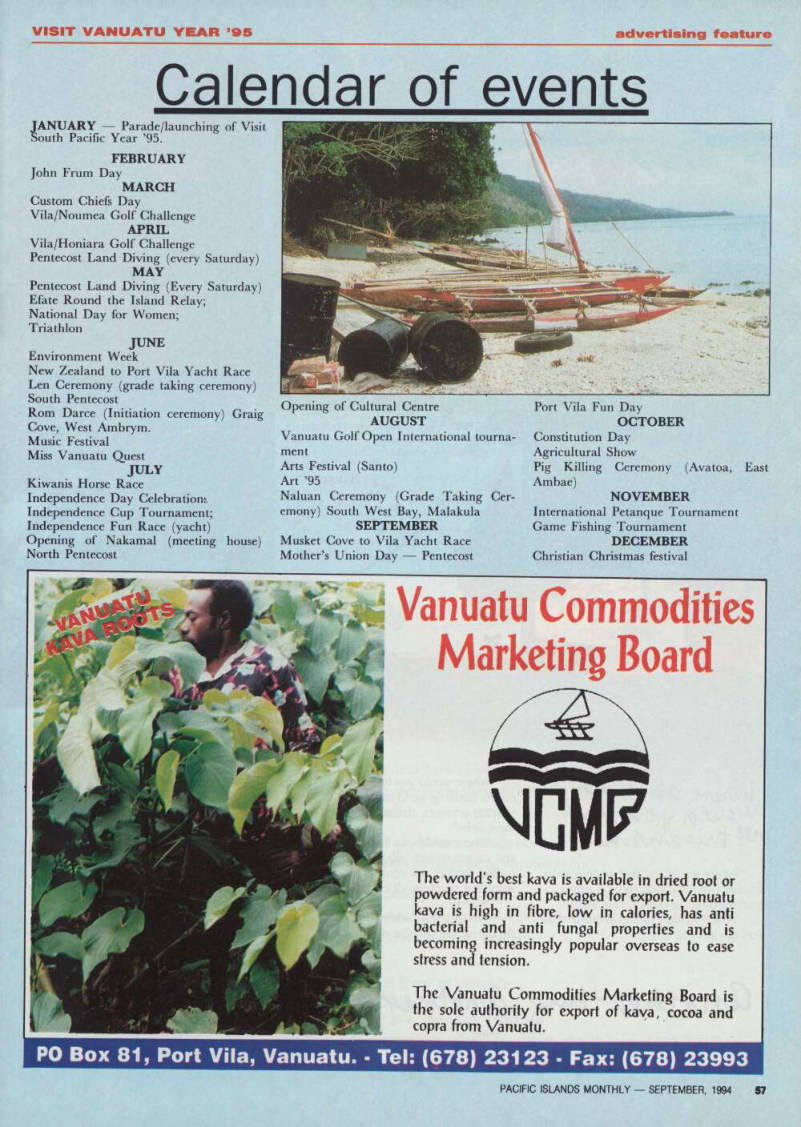
JANUARY Parade/launching of Visit South Pacific Year ’95.
February
John Frum Day
March
Custom Chiefs Day Vila/Noumea Golf Challenge
April
Vila/Honiara Golf Challenge Pentecost Land Diving (every Saturday)
May
Pentecost Land Diving (Every Saturday) Efate Round the Island Relay; National Day for Women; Triathlon
June
Environment Week New Zealand to Port Vila Yacht Race Len Ceremony (grade taking ceremony) South Pentecost Rom Darce (Initiation ceremony) Craig Cove, West Ambrym.
Music Festival Miss Vanuatu Quest
July
Kiwanis Horse Race Independence Day Celebrations Independence Cup Tournament; Independence Fun Race (yacht) Opening of Nakamal (meeting house) North Pentecost
Opening of Cultural Centre
August
Vanuatu Golf Open International tourna ment Arts Festival (Santo) Art ’95
Naluan Ceremony (Grade Taking Cer
emony) South West Bay, Malakula
September
Musket Cove to Vila Yacht Race Mother’s Union Day Pentecost
Port Vila Fun Day
October
Constitution Day Agricultural Show Pig Killing Ceremony (Avatoa, East Ambae)
November
International Petanque Tournament Game Fishing Tournament
December
Christian Christmas festival
Advertisements & other items, pp. 57-58 (2 items)
57
advertising feature
PACIFIC ISLANDS MONTHLY SEPTEMBER, 1994
VISIT VANUATU YEAR ’95
Marketing Board
M w m f. ¥
The world's best kava is available in dried root or powdered form and packaged for export. Vanuatu kava is high in fibre, low in calories, has anti bacterial and anti fungal properties and is becoming increasingly popular overseas to ease stress and tension.
The Vanuatu Commodities Marketing Board is the sole authority for export of kava, cocoa and copra from Vanuatu.
PO Box 81, Port Vila, Vanuatu. - Tel: (678) 23123 - Fax: (678) 23993
4* nr* * S I. i
VANUATU
' Port Vila
- w- FIJI
[ AUSI
Ik
AUSTRALIA
CALEDONIA
NEW
Mte flr S'^'NT-'f'Awd ■ 1 h % V Auckland ' &.NEW ZEALAND V k-v^;;
U)tktM Cy\
wxru£s\ v>ol\ £vv>fl
Alf ivvU <*!wt Fv\(?re >..
Where would you find white powder beaches overhung with coconut palms, reaching down to tropical blue water?
Where would you find diving in coral seas so clear and warm?
Where would you find top class resorts featuring world class cuisine, sporting activities, shows, casino and
night clubs?
Where would you find a live volcano and ancient custom villages, fresh grown market produce and some of the friendliest people you’ll ever meet?
Where?
Vanuatu, that’s where.
An untouched paradise on earth.
Air Vanuatu Reservations & Sales Offices: Port Vila (678) 23 848, Santo (678) 36 429, Sydney (612) 223 8333, Melbourne (613) 417 3977, Brisbane (617) 221 2566, Auckland (649) 373 3435, Nadi (679) 72 2521, Suva (679) 314 666, Apia (685) 212 61, Noumea (687) 286 677, Los Angeles (310) 670 7302, Paris (331) 40 53 82 25, Spain (34) 72 27 02 62, Denmark (45) 33 11 02 02, Germany (49) 60231028, Italy (39) 2 551 80528, Hong Kong (852) 336 6916.
(Lnjrtktyivh wHjl-
n The Untouched Paradise
AIR VANUATU
M B E 8759
Vanuatu’s riches
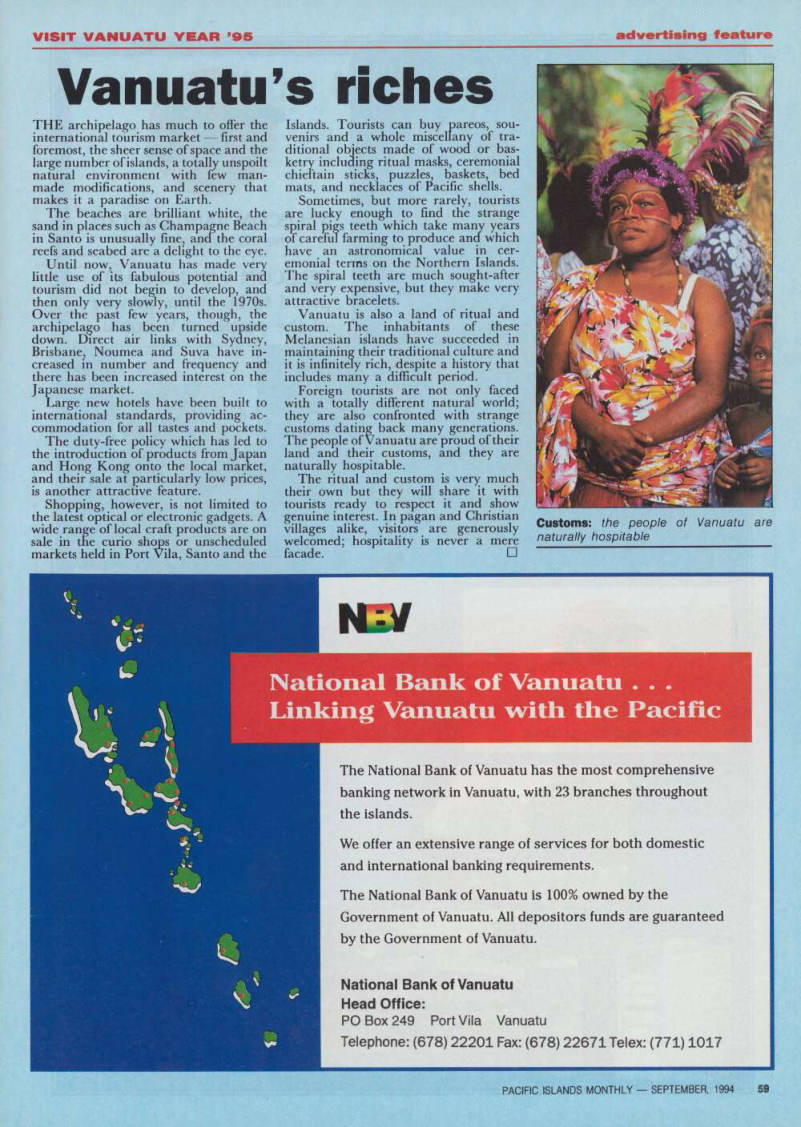
THE archipelago has much to offer the international tourism market first and foremost, the sheer sense of space and the large number of islands, a totally unspoilt natural environment with few manmade modifications, and scenery that makes it a paradise on Earth.
The beaches are brilliant white, the sand in places such as Champagne Beach in Santo is unusually fine, ana the coral reefs and seabed are a delight to the eye.
Until now, Vanuatu has made very little use of its fabulous potential and tourism did not begin to develop, and then only very slowly, until the 19705.
Over the past few years, though, the archipelago has been turned upside down. Direct air links with Sydney, Brisbane, Noumea and Suva have increased in number and frequency and there has been increased interest on the
Japanese market.
Large new hotels have been built to international standards, providing accommodation for all tastes and pockets.
The duty-free policy which has led to the introduction of products from Japan and Hong Kong onto the local market, and their sale at particularly low prices, is another attractive feature.
Shopping, however, is not limited to the latest optical or electronic gadgets. A wide range of local craft products are on sale in the curio shops or unscheduled markets held in Port Vila, Santo and the
Islands. Tourists can buy pareos, sou venirs and a whole miscellany of tra ditional objects made of wood or bas ketry including ritual masks, ceremonial chieftain sticks, puzzles, baskets, bed mats, and necklaces of Pacific shells, Sometimes, but more rarely, tourists are lucky enough to find the strange spiral pigs teeth which take many years of careful farming to produce and which have an astronomical value in cer emonial terms on the Northern Islands, The spiral teeth are much sought-after and very expensive, but they make very attractive bracelets.
Vanuatu is also a land of ritual and custom. The inhabitants of these Melanesian islands have succeeded in maintaining their traditional culture and it is infinitely rich, despite a history that includes many a difficult period.
Foreign tourists are not only faced with a totally different natural world; they are also confronted with strange customs dating back many generations.
The people of Vanuatu are proud of their land and their customs, and they are naturally hospitable, The ritual and custom is very much their own but they will share it with tourists ready to respect it and show genuine interest. In pagan and Christian villages alike, visitors are generously welcomed; hospitality is never a mere facade. □
Customs: the people of Vanuatu are naturally hospitable
Advertisements & other items, pp. 59-60 (2 items)
59
advertising feature
PACIFIC ISLANDS MONTHLY SEPTEMBER, 1994
VISIT VANUATU YEAR ’95
Linking Vanuatu with the Pacific
r r u - j National Bank of Vanuatu . . .
The National Bank of Vanuatu has the most comprehensive banking network in Vanuatu, with 23 branches throughout the islands.
We offer an extensive range of services for both domestic and international banking requirements.
The National Bank of Vanuatu is 100% owned by the Government of Vanuatu. All depositors funds are guaranteed by the Government of Vanuatu.
National Bank of Vanuatu Head Office: PO Box 249 Port Vila Vanuatu Telephone: (678) 22201 Fax: (678) 22671 Telex: (771) 1017
'm
TELECOM VANUATU LTD
the international link
TELECOM VANUATU LTD
proud to be at the service of the people of Vanuatu. ( i > SB
TELECOM VANUATU
the national link - \ ■HE ■ 9m
Living off the fertile resource of land
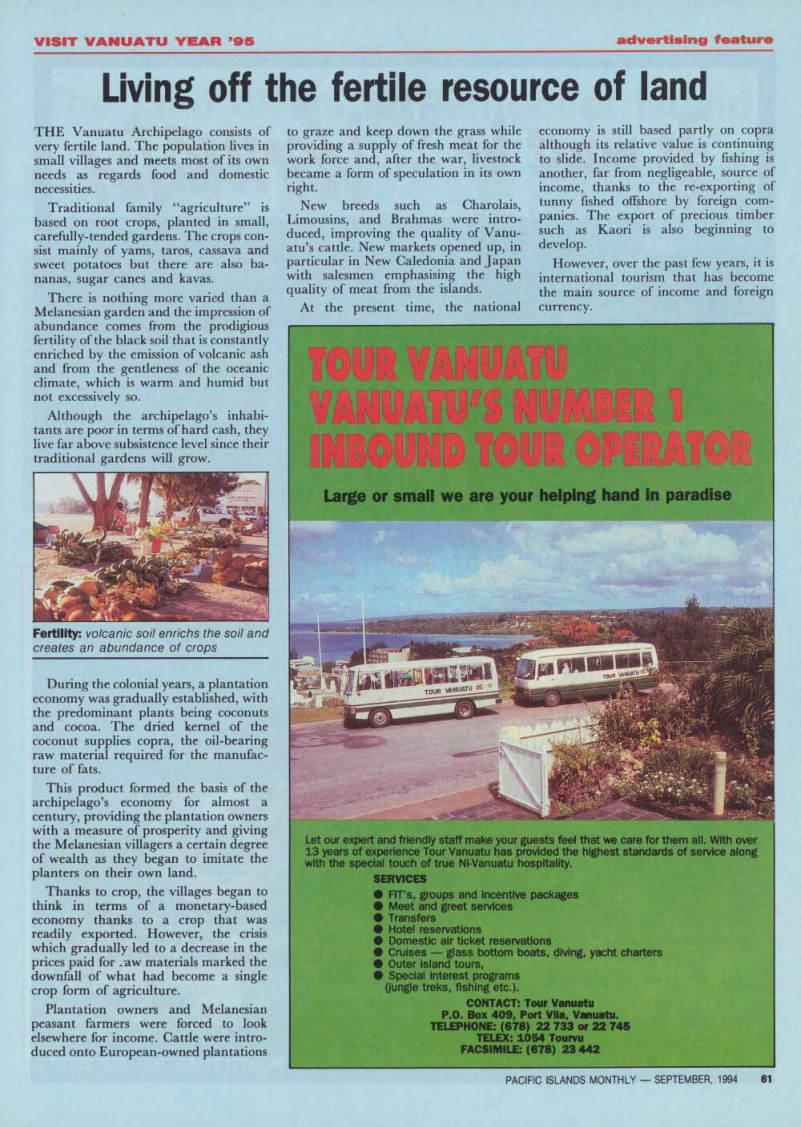
THE Vanuatu Archipelago consists of very fertile land. The population lives in small villages and meets most of its own needs as regards food and domestic necessities.
Traditional family “agriculture” is
based on root crops, planted in small, carefully-tended gardens. The crops con sist mainly of yams, taros, cassava and sweet potatoes but there are also ba nanas, sugar canes and kavas.
There is nothing more varied than a Melanesian garden and the impression of abundance comes from the prodigious fertility of the black soil that is constantly enriched by the emission of volcanic ash and from the gentleness of the oceanic climate, which is warm and humid but not excessively so.
Although the archipelago’s inhabi
tants are poor in terms of hard cash, they live far above subsistence level since their traditional gardens will grow.
During the colonial years, a plantation economy was gradually established, with the predominant plants being coconuts and cocoa. The dried kernel of the coconut supplies copra, the oil-bearing raw material required for the manufac ture of fats.
This product formed the basis of the archipelago’s economy for almost a century, providing the plantation owners with a measure of prosperity and giving the Melanesian villagers a certain degree of wealth as they began to imitate the planters on their own land.
Thanks to crop, the villages began to think in terms of a monetary-based economy thanks to a crop that was readily exported. However, the crisis which gradually led to a decrease in the prices paid for /aw materials marked the downfall of what had become a single crop form of agriculture.
Plantation owners and Melanesian peasant farmers were forced to look elsewhere for income. Cattle were intro duced onto European-owned plantations
to graze and keep down the grass while providing a supply of fresh meat for the work force and, after the war, livestock became a form of speculation in its own
right.
New breeds such as Charolais, Limousins, and Brahmas were intro duced, improving the quality of Vanu atu’s cattle. New markets opened up, in particular in New Caledonia and Japan with salesmen emphasising the high quality of meat from the islands.
At the present time, the national
economy is still based partly on copra although its relative value is continuing to slide. Income provided by fishing is another, far from negligeable, source of income, thanks to the re-exporting of tunny fished offshore by foreign com panies. The export of precious timber such as Kaori is also beginning to develop.
However, over the past few years, it is international tourism that has become the main source of income and foreign currency.
Fertility: volcanic soil enrichs the soil and creates an abundance of crops
Advertisements & other items, pp. 61-63 (5 items)
61
advertising feature
PACIFIC ISLANDS MONTHLY SEPTEMBER, 1994
VISIT VANUATU YEAR *95
Large or small we are your helping hand in paradise
n nr?M Large or small we are your helping hand in paradise m HI
VANUATU
tqUR
VANUATU
TOUR
- » 1 !r> Let our expert and friendly staff make your guests feel that we care for them all. With over 13 years of experience Tour Vanuatu has provided the highest standards of service along with the special touch of true Ni-Vanuatu hospitality.
SERVICES
• FIT’S, groups and incentive packages • Meet and greet services • Transfers • Hotel reservations • Domestic air ticket reservations • Cruises glass bottom boats, diving, yacht charters • Outer island tours, • Special interest programs (jungle treks, fishing etc.).
CONTACT: Tour Vanuatu P.O. Box 409, Port Vila, Vanuatu.
TELEPHONE: (678) 22 733 or 22 745 TELEX: 1054 Tourvu
FACSIMILE: (678) 23 442
hmvtuT* yanufita
m % \ * Saturday 16th Horse Race .,* •*- 15th & 16th Toka Festival (Tanna^ II over the country) Ta^ |3W mm ia 345.1 : f '
Where
Tt ( * r?T i *Mk •'
VISIT
v SOITH
v PACIFIC
k. YEAR ’95)
I I W
'/mate ’~r * mmi ■
ili;
s» best cuiskrfe f
-■• * *>'*' , 4 - ■*:fi <■ "
Contact the National Tourism Office of Vanuatu, PO Box 209, Port Vila - Ph: (678) 22685 - Fax: (678) 23889
The land divers of Pentecost Island
Pentecost: a small number of tourists are being allowed to witness this age-old tradition of land diving
63
advertising feature
PACIFIC ISLANDS MONTHLY SEPTEMBER, 1994
VISIT VANUATU YEAR ’95
Port Vila
Fme
ROYAL PALMS RESORT & CASINO
i.«. If
S m 4 i» ■ Mi 4 I■■ Great dining & entertainment Sport & leisure facilities rgssss -/A'"
Welcome to the relaxed atmosphere of The Royal Palms Resort & Casino.
Our many facilities are yours to enjoy.
Play a game of golf or tennis, try a variety of wotersports or simply soak up the sun by the pool or on our private beach.
Every night you will find something different to do. Watch a colourful fashion parade, indulge in one of our theme cuisine nights or try your luck at the casino.
Whether you are staying with us or just visiting, let us help make your stay in Vanuatu an experience to remember.
Call us today.
Royal Palms Resort & Casino Tassiriki Park PO Box 215 Port Vila Vanuatu Telephone (678) 22040 Facsimile (678) 23340
Preparing for 1995
A NATIONAL Visit South Pacific Year ’95 working committee was formed in early April with its first meeting held on the April 18th. To date there has been nine meetings.
In these meetings a number of activi ties have been carried out.
The committee has now finalised a calendar of events and is now working on producing a good calendar for these event. These should be on the market by September. In regards to the committee’s internal awareness programmes for the VSPY ’95, the committee is working on a number of activities.
The committee is now getting quo tation for VPSY ’95 Logo stickers.
Current plans call for 20,000 small stickers to sell to business houses foor them to use in their correspondences.
There will also be 1000 stickers of 15 centimetres in size and 30 large stickers.
These will be distributed to all public vehicles and placed on the sides of Air Vanuatu and Van Air aircraft.
. . , Th ere will be pm badges with the VSPY’9S logo. The committee will have nlaced orders for the badees and stickers orders for the badges and stickers.
The committee has spoken to the National Breweries Limited and Vanua tu Beverages, who have both agreed to <»e VSPY '95 logo on their cans.
The Vanuatu Philatic Bureau has publicised a special issue of stamps for the
VSPY ’95. The committee plans to host a scheme similar to the New Zealand Kiwi Host Scheme.
The committee has made enquires about the scheme, someone who has expressed interest in training, which will begin with those who come in contact with visitors.
The committee informs the public about its activities through the use of one of the local newspapers, the Trading Post.
The editor, who is also one of the committee members, publishes our ac tivities every fortnight.
The committee has also written to Vanuatu Television and ask if they can use the VSPY ’95 logo as a filler or part of their test programme.
The committee is now working on a Tourism Open Forum which is planned to be held on September 14. It is hoped that this forum will further exposed the awareness of VSPY ’95.
The committee is also working on printing of T-shirts and sweatshirts.
These will be on sale soon. □
Advertisements & other items, p. 64 (2 items)
64
advertising feature
PACIFIC ISLANDS MONTHLY SEPTEMBER, 1994
VISIT VANUATU YEAR ’95
(C\ Cw.{/t>
i iii i li mm Bw »i•»pf l
UL 111. IJI
P 0 Box 230, Port Vila, Vanuatu Pti: (678) 22464 Fx: (678) 22953 \ 'talk
(C\ Cw.{/t>
(formerly the Olympic Hotel, Port Vila) Situated in the busy commercial centre of Port Vila with easy access to Government Departments, business houses and financial institutions, IRIRIKI CENTRE VILLE HOTEL offers reasonable rates including: * Air conditioned rooms, serviced daily. * ISO dialing. * Full secretarial back-up facilities. * Charge meals to your room account at El Gecko Restaurant & Bar Rossi Restaurant Iririki Island Resort * Same-day laundry service. * Studios/Apartments with kitchen facilities and office desks. * Monthly rates available. * Centrally located to shopping, markets, cultural centre and Chinatown. ‘YOkete a YOatm acidic YOetcome faow out (Zoutteous, Svet~ Smiling (^Ccan\ f will ZttesLstihiy Enhance Stay”
Manu Samoa slaughtered
Sport
By Atama Raganivatu
A HORRENDOUS 73-3 loss to the Wallabies under floodlights at the Syd ney Football Stadium badly marred an otherwise successful tour of Australia by Manu Samoa. Western Samoa was
totally outgunned by the rampant world
champions, for who Viliame Ofahengaue the Tongan Torpedo made an impressive return to the international arena, after missing the whole of last season through a knee injury.
Ofahengaue provided the inspiration for
a dominant home pack and their ram pant backs went on a points scoring spree. The result was an Australian record, beating the 67-9 annihilation of U.S.A. in 1990.
And yet, the Samoans went into the
game with seemingly justifiable hopes of
victory. They had improved consider-
ably since holding an Australian team on the way to World Cup triumph 9-3 in Wales three years ago and impressed everybody while winning all their four previous tour games.
But, Western Samoa never got into the game in Sydney at all and perhaps had been drained by what was greeted as a milestone conquest of Queensland six
days earlier.
As well as the 24-22 win over the Super Ten champions, Western Samoa recorded successes against Victoria
(60-26), Australian Capital Territory
(39-13) and President’s XV (21-18). A good team does not become a bad team overnight and, hopefully, the Samoans
will focus upon their excellent perform ances when coming from behind to beat
Queensland, despite being reduced to 14
men, -and the eclipse of what is widely regarded as the best A.C.T. combination to ever be fielded, rather than the nightmare experienced under the stars at Sydney (although this is rather like asking Mrs. Lincoln to remember the
play’s plot!).
Nearly every major national rugby
s id e has experienced a defeat of similar magnitude at some stage in their history and bounced back. The character of Manu Samoa will now be severely tested, but such is the quality of the young talent now coming up through the ranks that the S F S failure is likely to be soon dismissed as a mere aberration rather than a major setback. □
Olympic team
Nauru joins Olympic team
By David North
NAURU has been accepted into the next round of Olympic Games. The Switzerland-based International Olym- Ric Committee (IOC) decided that lauru could join a list of 192 nations and near-nations in the next Summer Olym pics, in Atlanta, USA, in 1996. Nauru President Bernard Dowiyogo had flown to Western Samoa earlier this year to press his island’s case when lOC Presi dent Juan Samaranch was touring the South Pacific.
The other Pacific island jurisdictions already on the list include: American Samoas, the Cooks, Fiji, Papua New Guinea, the Solomons, Tonga, Vanuatu, and Western Samoa. Not participating, at least so far, are the nations of Kiribati and Tuvalu, the French islands in the Pacific and the various US and ex-US territories in Micronesia.
Nauru’s hope is that it can do what no other Pacific island has done win a medal in a Summer Olympic compe tition. Those hopes are pinned on the sturdy physique of Marcus Stephen, who has already won weight-lifting gold medals in a series of non-Olympic competitions, such as the 1990 Common wealth Games, the 1991 South Pacific Games, and more recently the 1994 Micronesian Games.
Stephen, incidentally, is the only Nauruan with Olympic experience, hav ing joined the 1992 Games as a member of the Western Samoa team. In the year 2000 the Games will come a little closer to the islands, being played that year in Sydney. □
Maori bid continues
despite some criticism
By Martin Tiffany
DENNIS Hansen, a former New Zealand Maori rugby league rep resentative, says he believes the Aotearoa Sports Federation is back ing a lost cause. He said they should instead concentrate on nurturing
promising Maori sporting talent.
Hansen’s comments follow signs a Maori contingent will compete at the 1999 SPG. A sports delegation from Aotearoa Sports was recently in Tahiti pushing the case for Maori inclusion.
The Maori delegation has been granted observer status at the 1995 games in Tahiti.
Hansen, however, does not believe the Maori will ever compete at the SPG because of what he describes as its “closed door policy on large nations”.
Hansen was a member of the original Aotearoa Sports Committee (as it was known) from 1980 to 1985. It was around this time the Maori began the push for the right to compete in the Games. At the time there was a lot of resistance from small Pacific states.
Aboriginal and native Hawaiian participation at the SPG has also met with resistance.
Hansen said it was understandable that there was resistance as Maori were
already exposed to top competition
while the smaller Pacific nations used the SPG for the development of sport.
Some countries have said it would be unfair for their athletes to compete against Maori, Aboriginals and native Hawaiians as those nations have big advantage because of the sports devel opment and facilities.
Some of the island nations with American links receive funding from the United States to help with their partici pation at the SPG. Many of these nations are worried that funding would not be forthcoming if these bigger nations are allowed to compete, says Hansen.
However, Bill Tangariki, a member of the Aotearoa Sports delegation to Tahiti, has said he was not aware of this financial assistance being a factor in the Maori exclusion.
He said they were much closer than they were 14 years ago.
A decision on Maori participation is likely to come after the 1995 SPG, where further discussions will take
place. □
Tua takes it easy
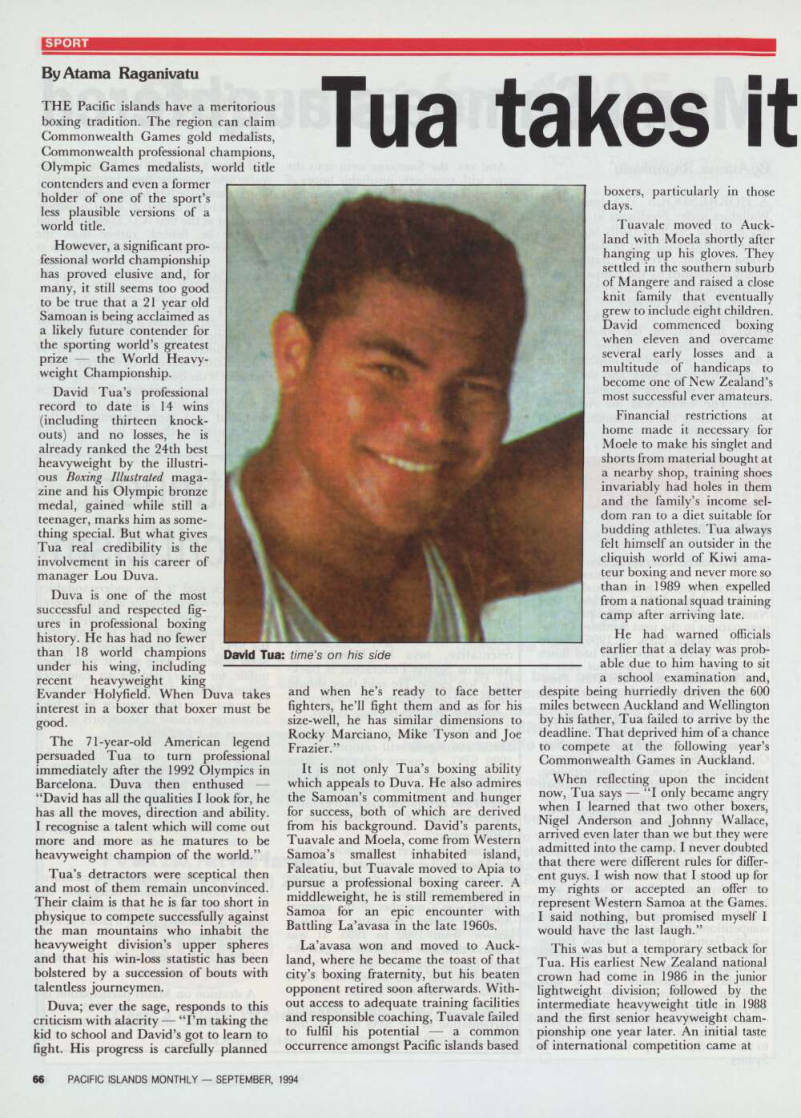
By Atama Raganivatu
THE Pacific islands have a meritorious boxing tradition. The region can claim Commonwealth Games gold medalists, Commonwealth professional champions, Olympic Games medalists, world title
contenders and even a former holder of one of the sport’s less plausible versions of a world title.
However, a significant pro fessional world championship has proved elusive and, for many, it still seems too good to be true that a 21 year old Samoan is being acclaimed as a likely future contender for the sporting world’s greatest prize the World Heavy
weight Championship.
David Tua’s professional record to date is 14 wins (including thirteen knock outs) and no losses, he is already ranked the 24th best heavyweight by the illustri ous Boxing Illustrated maga zine and his Olympic bronze medal, gained while still a teenager, marks him as some thing special. But what gives Tua real credibility is the involvement in his career of manager Lou Duva.
Duva is one of the most successful and respected fig ures in professional boxing history. He has had no fewer than 18 world champions under his wing, including recent heavyweight king
Evander Holyfield. When Duva takes interest in a boxer that boxer must be good. rp, * . , , The 71-year-old American legend persuaded Tua to turn professional immediately after the 1992 Olympics in Barcelona. Duva then enthused “David has all the qualities I look for, he has all the moves, direction and ability.
I recognise a talent which will come out more and more as he matures to be , -i.i • c , , heavyweight champion of the world. 7 & r Tua’s detractors were sceptical then and most of them remain unconvinced.
Their claim is that he is far too short in
physique to compete successfully against
the man mountains who inhabit the heavyweight division’s upper spheres and that his win-loss statistic has been bolstered by a succession of bouts with
talentless journeymen.
Duva; ever the sage, responds to this criticism with alacrity “I’m taking the kid to school and David’s got to learn to fight. His progress is carefully planned
a nd when he’s ready to face better fighters, he’ll fight them and as for his size-well, he has similar dimensions to Rocky Marciano, Mike Tyson and Toe Frazi ' r » J .
It is not only Tuas boxing ability which appeals to Duva. He also admires the Samoan’s commitment and hunger for success, both of which are derived from his background. David's parents, Tuavale and Moela, come from Western c , 11 , 7 • i i*, i *i j Samoa s smallest inhabited island, f-s i . , m , , * . aea 1U ’ u uava move o pia o
a boxing careei j
middleweight, he is still remembered m Samoa or , an e .P lc Battling La avasa m the late 19605.
La’avasa won and moved to Auck land, where he became the toast of that
city’s boxing fraternity, but his beaten
opponent retired soon afterwards. With out access to adequate training facilities and responsible coaching, Tuavale failed to fulfil his potential a common occurrence amongst Pacific islands based
boxers, particularly in those
days.
Tuavale moved to Auck land with Moela shortly after
hanging up his gloves. They
settled in the southern suburb of Mangere and raised a close
knit family that eventually
grew to include eight children.
David commenced boxing when eleven and overcame several early losses and a multitude of handicaps to become one of New Zealand’s most successful ever amateurs.
Financial restrictions at home made it necessary for Mode to make his singlet and shorts from material bought at
a nearby shop, training shoes
invariably had holes in them and the family’s income sel dom ran to a diet suitable for
budding athletes. Tua always
felt himself an outsider in the cliquish world of Kiwi ama teur boxing and never more so than in 1989 when expelled from a national squad training camp after arriving late.
He had warned officials earlier that a delay was prob able due to him having to sit a school examination and,
despite being hurriedly driven the 600
miles between Auckland and Wellington by his father, Tua failed to arrive by the deadline. That deprived him of a chance to compete at the following year’s Commonwealth Games in Auckland, . .
When reflecting upon the incident n ° w > Tua says I only became angry
er \ learnecl other boxers,
Nl « el Anderson and Johnny Wallace, a t nv s vela a [ er lan ! u ! ' T"' I *.' admitted into the camp. 1 never doubted . r . , f that there were ditierent rules lor diller ent g U ys. I wish now that I stood up for m y r ig Fts or accepted an offer to represent Western Samoa at the Games.
I said nothing, but promised myself I would have the last laugh.” was but a temporary setback for Tua His earliest New Zealand national crown had come in 1986 in the junior lightweight division; followed by the intermediate heavyweight title in 1988 and the first senior heavyweight cham pionship one year later. An initial taste of international competition came at
David Tua: time's on his side
the 1991 World Junior Championships in Peru. He suffered a controversial loss to a Cuban there but soon afterwards beat the gold medal winner, Russia’s Angor Undrew, in a challenge match at Palmerston North.
Olympic champion Felix Savon of Cuba knocked him out during the first round of their World Championships semi final clash in Australia, just before the Barcelona Games. Still, Tua was gaining knowledge with every fight and he went to Spain confident of bringing home a gold medal. After conclusive wins over Spanish and Czech opponents, only Nigeria’s David Oizonritei stood be tween him and a rematch with Savon in the final. Unfortunately, the tall, willy Oizonritei outpointed a strangely listless Tua despite having his nose broken.
Tua had done sufficient in the two earlier bouts to impress Duva as an uncut diamond with immense promise. The teenager needed little persuasion to turn professional. Compatriot Jimmy Peau (now better known as Jimmy Thunder) stagnated far too long in the backwater of New Zealand amateur boxing and allowed his career to lose all momentum before, belatedly, joining the paid ranks.
Two or three more year as a carefully groomed amateur would probably have benefitted Tua but New Zealand was unlikely to provide this and, moreover, he was eager to secure the financial future of his family. “We are poor,” he said at the time. “I admit it and I’m not ashamed of it. But, hopefully, I can
change that.”
One of Duva’s priorities was to change Tua’s eating habits. His penchant for fresh bread and hamburgers (even when offered a variety of healthy food in Barcelona, he preferred to frequent the local McDonalds) may have been per missible in New Zealand’s haphazard amateur boxing circles but Duva insists his food intake now befits a top athlete.
Billed in the United States as “The Terminator”, Tua’sphysique, as well as ringcraft, have developed to an incred ible degree under the elderly guru.
In New Zealand and Western Samoa for a holiday during May and June, Tua also impressed interviews with his level headedness. “People have their own expectations of me. They want me to be the world heavyweight champion,” he contemplated. “I think I will be, but right now I just have be patient. My time will come and I will be ready. I am always learning. I know where I’m going and how I’m going to get there. No one will stop me, because I believe in myself.
That’s the key.” □
as giantkillers
Samoans tipped as giantkillers
By Atama Raganivatu
MAURICE Lindsay, British rugby league’s leading administrator and di rector of his sport’s 1995 World Cup, has tipped Western Samoa as the team to watch next year after officiating at the tournament draw in Brisbane.
“The rugby league world will be staggered by the quality of Western Samoa,” Lindsay enthused. He could be right but only if Samoa is given the opportunity to field all the top quality players eligible to represent them, including John Schuster (Hali fax); Sam Panapa (Salford); Va’aiga Tuigamala (Wigan); Apollo Perelini (St Helens) and Esene Faimalo (Widnes) in England, the Australia based Ruben Wiki (Canberra Raiders and many high profile performers in New Zealand’s major domestic compe tition.
However, the Kiwis believe they have first call upon several members of this talented bunch. An unsavoury and embarrassing tug-of-war may eventu ate. Western Samoa has been included in the same group as France and Wales teams they would be confident of beating, if at full strength. The draw has been less kind to the Pacific’s other
representatives.
Fiji will face the top two seeds England and Australia in group one.
Even with players honed by experi enced in the world’s toughest domestic competition, Australia’s Winfield Cup (Noa Nadruku and Manoa Thompson are the best known of an ever-increasing band), the Fijians cannot be expected to
match the game’s two traditional giants at this stage of their development, even if the recent 40-8 defeat of Britain’s national amateur selection suggests them to be progressing well. South Africa is the fourth team in the pool.
Enigmatic Papua New Guinea will be heartened by the 29-22 win over France in Port Moresby that effectively raised them to number five in world rankings. The Kumuls are certainly a team of great potential and, in halfback Adrian Lam (now playing for Eastern Suburbs), they have a player of excep tional skills. But PNG usually struggles in the cold of England and will probably find New Zealand too tough for them in group two which also features Tonga.
During their brief international rugby league history, Tongan teams have already won many friends with an inextinguishable fighting spirit. Hope fully, they will also have the services of Winfield Cup stars Martin Masella (Balmain) and Jim Dymock (Canter bury Bankstown) and St Helens’
George Mann. But even then, a lack of real depth will probably prove crucial.
Group one’s top two teams, plus the winners of the other two groups, will advance to the semi-finals.
Sadly, the Cook Islands were re garded as too weak to be involved.
However, Lindsay made a point while in Brisbane to express his delight at the way rugby league was booming in Rarotonga. He has also hinted a secondary competition may be organ ised, should available funds permit, which would include Russia, Moldova, USA and Canada and the Cooks. □
Island weightlifters surprise Aussies
AUSTRALIA’S anticipated dominance of the Oceania Weightlifting Championships in Guam did not quite eventuate, with several lifters from the smaller Pacific nations stealing the thunder of the higher ranked Austrabans.
The performance of Ashfaq Dean (Fiji); Peter Kolapa (PNG); Marcus Stephens (Nauru); Manalatu Boli (Guam); and Eric Brown (American
Samoa) all gained deserved acclaim, but the enduring impression will be the tremendous depth of talent in the region.
Australia did take the team event but only five points ahead of Guam. The South Pacific Championships, for which Australians were not eligible, saw Am erican Samoa top the points table, with New Caledonia second and Guam third. □
Journey's end
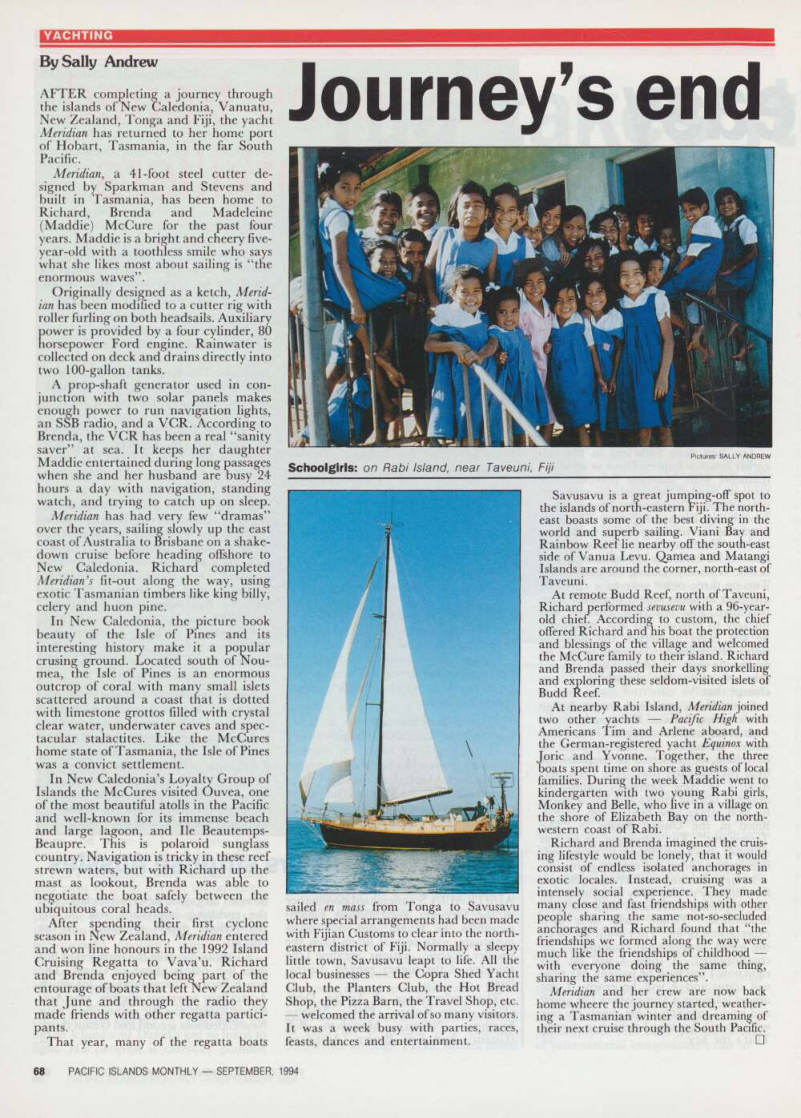
By Sally Andrew
AFTER completing a journey through
the islands of New Caledonia, Vanuatu, New Zealand, Tonga and Fiji, the yacht Meridian has returned to her home port of Hobart, Tasmania, in the far South Pacific.
Meridian, a 41-foot steel cutter de
signed by Sparkman and Stevens and
built in Tasmania, has been home to Richard, Brenda and Madeleine (Maddie) McCure for the past four years. Maddie is a bright and cheery five year-old with a toothless smile who says what she likes most about sailing is “the enormous waves”.
Originally designed as a ketch, Merid ian has been modified to a cutter rig with roller furling on both headsails. Auxiliary power is provided by a four cylinder, 80 horsepower Ford engine. Rainwater is collected on deck and drains directly into two 100-gallon tanks.
A prop-shaft generator used in con junction with two solar panels makes
enough power to run navigation lights,
an SSB radio, and a VCR. According to Brenda, the VCR has been a real “sanity saver” at sea. It keeps her daughter Maddie entertained during long passages when she and her husband are busy 24
hours a day with navigation, standing
watch, and trying to catch up on sleep.
Meridian has had very few “dramas” over the years, sailing slowly up the east coast of Australia to Brisbane on a shake down cruise before heading offshore to New Caledonia. Richard completed Meridian’s fit-out along the way, using exotic Tasmanian timbers like king billy,
celery and huon pine.
In New Caledonia, the picture book beauty of the Isle of Pines and its
interesting history make it a popular
crusing ground. Located south of Nou mea, the Isle of Pines is an enormous outcrop of coral with many small islets scattered around a coast that is dotted with limestone grottos filled with crystal clear water, underwater caves and spec tacular stalactites. Like the McCures home state of Tasmania, the Isle of Pines was a convict settlement.
In New Caledonia’s Loyalty Group of Islands the McCures visited Ouvea, one of the most beautiful atolls in the Pacific and well-known for its immense beach
and large lagoon, and He Beautemps-
Beaupre. This is polaroid sunglass
country. Navigation is tricky in these reef strewn waters, but with Richard up the mast as lookout, Brenda was able to negotiate the boat safely between the übiquitous coral heads.
After spending their first cyclone season in New Zealand, Meridian entered and won line honours in the 1992 Island Cruising Regatta to Vava’u. Richard and Brenda enjoyed being part of the entourage of boats that left New Zealand that June and through the radio they made friends with other regatta partici pants.
That year, many of the regatta boats
sailed en mass from Tonga to Savusavu where special arrangements had been made with Fijian Customs to clear into the north eastern district of Fiji. Normally a sleepy little town, Savusavu leapt to life. All the local businesses the Copra Shed Yacht Club, the Planters Club, the Hot Bread Shop, the Pizza Barn, the Travel Shop, etc. welcomed the arrival of so many visitors.
It was a week busy with parties, races, feasts, dances and entertainment.
Savusavu is a great jumping-off spot to the islands of north-eastern Fiji. The north east boasts some of the best diving in the world and superb sailing. Viani Bay and Rainbow Reef lie nearby off the south-east side of Vanua Levu. Qamea and Matangi Islands are around the corner, north-east of Taveuni.
At remote Budd Reef, north of Taveuni, Richard performed sevusevu with a 96-year old chief. According to custom, the chief offered Richard and his boat the protection and blessings of the village and welcomed the McCure family to their island. Richard
and Brenda passed their days snorkelling
and exploring these seldom-visited islets of Budd Reef.
At nearby Rabi Island, Meridian joined
two other yachts Pacific High with
Americans Tim and Arlene aboard, and
the German-registered yacht Equinox with
Joric and Yvonne. Together, the three boats spent time on shore as guests oflocal families. During the week Maddie went to kindergarten with two young Rabi girls, Monkey and Belle, who live in a village on the shore of Elizabeth Bay on the north western coast of Rabi.
Richard and Brenda imagined the cruis ing lifestyle would be lonely, that it would consist of endless isolated anchorages in exotic locales. Instead, cruising was a
intensely social experience. They made
many close and fast friendships with other people sharing the same not-so-secluded anchorages and Richard found that “the friendships we formed along the way were much like the friendships of childhood with everyone doing the same thing,
sharing the same experiences”.
Meridian and her crew are now back home wheere the journey started, weather ing a Tasmanian winter and dreaming of their next cruise through the South Pacific. □
Pictures: SALLY ANDREW
Schoolgirls: on Rabi Island, near Taveuni, Fiji
Shipping
schedules
New Zealand - FIJI direct Sofrana Unilines operates a fully containerised/ breakbulk service every 21 days from Auckland, Tauranga, Lyttleton to Suva and Lautoka.
Loading every 21 days, ro/ro service, containers - reefer. Contact Sofrana Unilines, Sofrana House, 101 Customs Street, Auckland, PO Box 3614, Fax (09) 393874, Ph (09) 773279, Tlx NZ 2313. Direct toll free line 0800 659-922, Contact Alan Foote. Compass Shipping Agencies, PO Box 921 Wellington, Tel (04) 382 8206, Fax (04) 3828239, Tlx NZ 4769 Contact Steve Brannigan.
Sofrana Unilines Agencies, PO Box 22046 Christchurch, Tel (03) 366 7180, Fax (03) 366 8868, TLX NZ4769, Contact Tony Newell.
Carpenters Shipping, Private Mail Bag, Suva, Fiji, Tel (679) 312244, Fax (679) 301572, Tlx FJ 2199. Sofrana Unilines, Suva, Fiji, Tel (679) 315645, Fax (679) 300057.
Australia - FIJI direct Sofrana Unilines operates a container breakbulk service every three weeks from Melbourne, and Sydney to Lautoka and Suva. Contact Sofrana Unilines (Aust) Pty Ltd, PO Box Q 136, Queen Victoria Building, Sydney, NSW 2000, Austra lia. Tel (02) 2648944, Fax (02) 2676547, Tlx (71) A 170090, Contact Sam Attaway/ George Lopez.
Delams Australia Pty Ltd. 474 Flinders Street, Melbourne. Tel (03) 614 1344, Fax (03) 629 4957.
Carpenters Shipping, Suva, Tel (679) 312244, Fax (679) 301572. Sofrana Unilines Suva, Tel (679) 315 645, Fax (679) 300057. Carpenters Shipping, Lautoka, Tel (679) 663988, Fax (679) 664896. Sofrana Unilines, Lautoka Tel (679) 662921, Fax (679) 664896.
Australia - FIJI monthly service Sofrana Unilines (Australia) Pty Ltd operates a regular monthly service with MV Capitairu Wallis. Contact Sofrana Unilines, Sydney, Tel (02) 2648944, Tlx AA170090, Fax (02) 267-6547. Carpenters Shipping, Suva, Fiji, Tel (679) 312244, Fax (679) 301572, Sofrana Unilines, Suva, Fiji Tel (679) 315645, Fax (679) 300057. Carpenters Shipping, Lautoka, Tel (679) 63988, Fax (679) 664896. Sofrana Uni lines, Lautoka, Fiji, Tel (679) 662921, Fax (679) 664896.
Far-East - FIJI Sendee New Guinea Pacific Line (NGPL) operates a monthly service accepting containerised and break-bulk cargoes from Manila, Keelung, Kaoshiung, Hong Kong, Lae to Suva, Lautoka (via Suva).
Contact Carpenters Shipping Suva, Fiji, tel (679) 312244, fax (679) 301572. New Zealand Unit Express, Maritime Building, 2-10 Customs House Quay, PO Box 890, Wellington. Tel 727865, Cables Enzue Man, Wellington, Tlx NZ31340 Ncdlnz or Nedlloyd Swire Pty Ltd, Sydney, Tel 20522. ■ it■ 11Ml n vflfNßl * IPWiUI rMllli OVffWICW Same as Bums Philp Japan • South Fadflo Sondes • Kyowa Shipping Co Ltd
Kyowa Shipping, Shipping Co Ltd provides a monthly service from Hong Kong to main ports ofjapan, Saipan, Guam, Island ports, Lautoka, Suva via Nukualofa to Pago Pago and Apia.
Contact Carpenters Shipping, Neptune House, 3/4 floor, Tofuaa Street, Walu Bay, Suva. Tel 312244, Fax 301572, Tlx FJ2199.
Europe - Pacific Service Bank Line offers a monthly service to and from Europe for containerised breakbulk and bulk vegetable cargoes. Calling Papeete, Apia, Suva, Lautoka, Noumea, Port Vila, Santo, Honiara and PNG. Main ports to and from major northern Eurpoean ports. Contact Bank Line, South Pacific Office, Central Court Bid , 7th Street, Lea, PNG,TeI 422925, Tlx NE4426s.Carpenters Shipping, 3/4 Floor,Neptune House, Walu Bay, Suve, Fiji, Tel (679) 312244, Fax (679) 301572, TIxFJ 2199.
Nedlloyd offers cargo services from Continental ports to Papeetee, Fiji, New Caledonia and Doniambo on slot basis with Bank Line. Contact Carpenters Shipping, Suva, tel 312244, Tlx FJ2199, Fax 301572. Carpenters Shipping, Lautoka, Tel 663988, Tlx FJ5215, Fax 664896.
South East Asia - FIJI Service Nedlloyd Lines Service (NZEAS) Service oper ates regular fast cargo service from Jakarta, Pt Keelang, Singapore, Bangkok, Surubaya via Auckland to Suva and Lautoka. Contact Carpenters Shipping, Suva, Tel 312244, Tlx FJ2199, Fax 301572. Carpenters Shipping, Lautoka Tel 663988, Tlx FJ5215, Fax 663988.
Nedlloyd New Zealand, Wellington Tel (04) 472 7864, Fx (04) 473 9201
Far East - Mid South Pacific China Navigations New Guinea Pacific Line in association with Bank Line, operates a regular container and breakbulk heavy lift service from Hong Kong, Taiwan, Manila, Singapore, Malaysia, Thailand to Port Moresby, Lae, Rabaul, Kieta and Honiara. Cargo from the same eastern ports to the South Pacific Ports of Noumea, Santo, Vila, Papeete, PagoPago, Apia, Nukualofa, Rarotonga and Tarawa will be shipped via Japan or Busan on the monthly Bali Hai Service. Contact Steamships Shipping, Port Moresby, PO Box 634, Tel 220283 or 220289.
Tasman Asia operate a 20-day frequency fixed date service, shipping breakbulk and containerised cargoes from Japan, Korea, Tai wan and Hong Kong to Suva and Lautoka (via Suva). Fiji agents are Forum Shipping Agencies in Suva, Tel 315444, and Lautoka 660577.
Australia - New Caledonia - FIJI - Samoa* - Tonga Pacific Forum Line operates a fully containerised service (general, reefer and ro-ro) from Sydney and Brisbane to Noumea, Lautoka, Suva, Apia, Pago Pago, Nuku’alofa, Sydney. Cargo central ised from Adelaide and Melbourne. Contact: Pacific Forum Line, PO Box 796, Auckland; Union Bulkships, 333 George St, Sydney, Brisbane and Melbourne; Union Co, Lautoka; Pacific Forum Line, Suva, Nuku’alofa; Pacific Forum Line, Apia; Polynesia Shipping, Pago Pago. Sofrana Unilines operates a roro/container service every three weeks from Melbourne, Sydney and Brisbane to Noumea, Suva and Lautoka with transhipment to the Samoas and
Tonga.
Advertisements & other items, pp. 69-72 (1 item)
Co., Ltd.
KYOWA
KYOWA
SHIPPING
CO., LTD.
Liner Service
FROM OJAPAN
OKOREA
©TAIWAN
O THAILAND
to Paciffic Islands
OHONG KONG
O SINGAPORE
OPHILIPPINES
O MALAYSIA
©INDONESIA
TO O SAIPAN
©FEDERATED STATES
OF MICRONESIA
©MARSHAL ISLANDS
©AMERICAN SAMOA
©NEW CALEDONIA
©FIJI
©GUAM
©YAP
©PALAU
©WESTERN SAMOA
©SOLOMON ISLANDS
©VANUATU
©PAPUA NEW GUINEA
HEAD OFFICE:
9th Floor, Shuwa No 2 Shibapark Bldg., 12-7, Shiba-Daimon 2-chome, Minato-ku, Tokyo 105, Japan Phone: 03(3437)2885 (Rep.) Cables: “MARIQUEEN" Tokyo Telex; 242-4651 Kyowa J.
OSAKA OFFICE:
Dai San Fuji Blc 1 .]., 3-13, Itachibori 1-chome, Osaka 550.
Phone: 06(533)5821 (Rep.) Cables: “MARIQUEEN" Osaka Telex; 525-6271 Ssiosa J.
MARKET PlflCC
ANTIQUE ENGRAVINGS
Send for catalogue listing antique maps and engravings from early expeditions to the Pacific which are available for sale. Lists of out-of-print books also available. Write stating areas of interest.
COUN HINCHCUFFE
12 QUEENS STAITH MEWS
YORK YOIIHH U.K.
REAL ESTATE
New 4-Bedroom, 3-Bathroom House on 14-acre Coastal Property and 500 foot of Ocean Front and Sandy Beach. Situated on Fiji's Largest Island with Beautiful View. Good for Retirement, Farming or Small Resort price SUS2OO.OOO Write to: St. Kfipl, Box 129, Korovou, Tailevu, Fiji Islands.
EDUCATION/INSTRUCTION:
Become a Professional Consultant. Earn Big Income. Diploma Course Now available by Correspondence. Details Australian Institute of Vocational Studies, Box 46, Woden Cl, Canberra ACT, Australia 2606.
FORUM SECRETARIAT
W VACANCY
DIRECTOR, ENERGY DIVISION
Applications are invited from suitably qualified and experienced persons, who must be nationals of a member state of the South Pacific Forum*, for the position of Director, Energy Division, with the Forum Secretariat.
The Forum Secretariat was established in 1972 by the South Pacific Forum to encourage economic and political cooperation between its member states and between those states and the more industrialised countries. Under the control of a Secretary General, the Secretariat undertakes activites in a number of areas: economic development, legal and political, civil aviation, energy, maritime, telecommunications and trade. In pursuing these work programmes, the Secretariat works with a range of aid donor countries and organisations including Australia, New Zealand, Japan, France, EC, Canada and the UNDP.
The Energy Division aims to assist Forum Island Countries improve their capabilities to plan and manage their energy sectors. The Division implements a comprehensive energy sector development programme that covers all key energy subsections and activities including general energy policy and planning, petroleum, electric power, renewable energy, and energy conservation and efficiency. The Division also assists in coordinating the activities of other organisations active in regional energy programmes, convenes Regional Energy Committee Meetings, provides technical advice and training services, and gathers and disseminates energy information and statistics to member countries.
The Director will be responsible for the efficient operation of the Division and the effective implementation of its projects. The Director will assist with formulating regional policy initiatives, identifying regional projects, drafting funding proposals, liasing with officials of member countries and with other energy-related agencies, arranging consultancies, organising regional seminars, workshops and other training activities and representing the Secretariat at regional and international meetings dealing with energy matters.
Applicants should have proven programme management and administrative abilities, and be capable of directing the work of a multi-disciplinary team of energy sector specialists. Experience in administering energyrelated, or similar, technical programmes in developing countries would be highly regarded as would relevant tertiary qualifications, preferably in economics or engineering. The applicant should also have proven energy policy development experience. Preference will be given to applicants with a demonstrated appreciation of the economic, social and political aspirations of the Forum's region.
Applications close on 07 October 1994. They should contain full information on education and career backgrounds and should give names, addresses and telephone numbers of at least three referees with whom the applicant has been associated professionally.
Applications should be addressed to: The Secretary General Forum Secretariat GPO Box 856, Suva, FIJI.
Telephone 312-600. Telex: 2229FJ. Fax: 302-204 Further information is available on request from the Administration Officer, on 312-600 Extension: 335. * Member states of the South Pacific Forum; Australia, Cook Islands, Federated States of Micronesia, Fiji, Kiribati, Nauru, New Zealand, Niue, Papua New Guinea, Republic of the Marshall Islands, Solomon Islands, Tonga, Tuvalu, Vanuatu and Western Samoa.
MRRKCT PLflC€ CRN WORK
WONDCRS FOR VOU ...
Promote your business, or service, sell your household items, cars or heavy machinery etc.
ONLY AUSSI PER WORD.
NO COMPANY LOGO. NO
DISPLAY. NO BOLD TYPE.
Just forward your Advertisement together with payment to: PACIFIC ISLANDS MONTHLY "Market Place”, P.O. Box 1167, Suva, Fiji.
CONDITIONS:
1. All Advertisements are subject to acceptance and approval of publisher. 2. Advertisements are published as space permits; we cannot guarantee date of insertion. 3. All advertisements must be prepaid and should be typed or printed clearly. 4. Deadline for receipt of advertisements is the 10th of the month prior to issue.
5. PACIFIC ISLANDS MONTHLY
assumes no responsibility for any service other than publishing paid advertisements in this section.
3 1508 00293753 5
Grand Pacific Life Insurance, Ltd.
A member of the Finance Factors Family
FEDERATED STATES
OF MICRONESIA
Actouka Executive Insurance Underwriters P.O. Box 55, Kolonia, Pohnpei, Federated States of Micronesia 96941 Pacific Basin Insurance & General Servides, Inc P.O. Box 494, Chuuk State, Federated States of Micronesia 96942
TONGA
Peseti Ma ‘afu Ins. & Finance, Ltd.
Private Bag 2, Taumoepeau Bldg.
Nukualofa, Tonga
GUAM
Great National Insurance Underwriters, Inc.
P.O. Box GA, Agana, Guam 96910
AMERICAN SAMOA
Mark Solofa Pacific Insurance & Finance, Inc.
P.O. Box 3149 Pago Pago, American Samoa 96799 Pacific Financial Corporation P.O. Box AT, Agana, Guam 96910 Takagi & Associates, Inc.
GCIC Bldg., Suite 100 414 W. Soledad Ave.
Agana, Guam 96910
MARSHALL ISLANDS
Marshalls Insurance Agency P.O. Box 113, Majuro, Marshall Islands 96960
WESTERN SAMOA
Mark Solofa Pacific Insurance & Finance, Inc.
P.O. Box 3149 Pago Pago, American Samoa 96799
NORTHERN MARIANAS
Pacific Basin Insurance Underwriters, Inc.
P.O. Box 710 Saipan, Mariana Islands 96950 Pacifica Insurance Underwriters, Inc.
P.O. Box 168, Saipan, Mariana Islands 96950 Grand Pacific Life Insurance, Ltd. *1164 Bishop Street, sth Floor, Honolulu, HI 96813 Phone: (808) 548-3363 • FAX: (808) 548-5122
)*sr Nj pkmi -■■'f
MITSUBISHI
■ The Mitsubishi Lancer: A family sedan that’s practically built to perform.
Lancer leaves the rest of its class in the dust.
Yes, it is a family sedan. Comfortable and practical.
But exciting, too, because Mitsubishi hasn’t forgotten what truly drives you: the pure pleasure of total
driving performance.
Its ground-hugging chassis holds comers tight. A self-aligning multi-link suspension adjusts to the road no matter what the driving conditions. And the aggressive, fuel-efficient 16-valve SOHC engine makes Lancer eager and responsive in the passing lane.
All of this performance comes from one very simple idea —our total approach to engineering.
We believe that unless each aspect of a car is fully integrated into the overall design, the result will never exceed the sum of the parts. The difference is self-evident. Behind the wheel.
And on the road.
It is this philosophy that makes every Mitsubishi such a reassuring and
rewarding driving experience. Whether
it’s our top-end Mitsubishi Sigma,
technologically sophisticated Galant,
all-weather 3000 GT sports car, or offroad 4WD Pajero... they’re all driven by the power of positive thinking.
So take the wheel of a Lancer, the family sedan that performs like
a thoroughbred.
MITSUBISHI LRNCER
What Drives You.
AMERICAN SAMOA: PACIFIC MARKETING INC. P.O. Box 698, Pago Pago, Tel 699-9140 / AUSTRALIA: MITSUBISHI MOTORS AUSTRALIA LTD. 1284 South Road, Clovelly Park, South Australia, 5042, Tel. (08) 2757297 / FUI: NMS MOTOR & MACHINERY CO. LTD. G.P.O. Box 150, Suva, Tel. 383411 / GUAM: TRIPLE J ENTERPRISES INC. P.O. Box 6066, Tamuning, Tel. 6469126 / NEW CALEDONIA; SOCIETE DTMPORTATION D'AUTD DU RACIFIQUE SUD S. A. P.O. Box 438, Noumea, Tel. 272-562 / NEW ZEALAND: MITSUBISHI MOTORS NEW ZEALAND LTD. Private Bag. Porirua, Tel. 237-0109 / NORFOLK ISLAND; BORRY'S PTY LTD. P.O. Box 169, Taylors Road, Burnt, Tel. 2114 / PAPUA NEW GUINEA: TOBA MOTORS PTY LTD. P.O. Box 503, Port Moresby, Tel. 217-874 1 SAIPAN: SAIPAN AUTOWORLD INC. P.O. Box 487, Tel. 234-7133 / SOLOMON ISLANDS; HARVEST PACIFIC LTD. G.P.O. Box 888, Honiara, Tel. 30407 / TAHITI: SOPADEP S.A. B.P. 1617, Papeete, Tel. 427393 / TONGA: SITANI MAPI CO., LTD. P.O. Box 83, NukuAMa, Tel. 24044 / VANUATU: SOCOMETRA VANUATU LTD. 8.P6, Port-Vila, Tel. 2314 / WESTERN SAMOA: MOTOR DISTRIBUTORS (SAMOA) LTD. P.O. Box 576, Apia, Tel. 20957 A
MITSUBISHI
MOTORS
CREATING TOGETHER