Pacific

Islands
Monthly
August 1994
the£ i anwcons
See special report on page 8
Sports
Rugby league prospers - p 57 Tonga's the winner - p5B Super Solomons - p 59
■ Where is the Forum going? - p2O ■ Vanuatu logging dilemma - pl 7 ■ Dutch disease' hits FSM, Marshalls - p 24 ■ The stinking bird - p 37
Feature
Visit Solomon Islands Year '95 - p 49
American Samoa USS2.SO; Australia ASS.SO; Cook Islands NZ$3; Fiji (Incl VAT) F 52.50; FS Micronesia US$3; Hawaii US$3; Kiribati A 52.50; Nauru A 52.50; Niue NZS3; Norfolk AS3; New Caledonia cpf2so; New Zealand (Incl GST) NZ53.45; Nth Marianas US$3; Papua New Guinea K 3; Palau USS 3; Marshalls US$3; Solomon Islands ASS; French Polynesia cpfSOO; Tonga P 3; USA US$3; Vanuatu VT22O; Western Samoa T 3.25. ‘Recommended retail price only
Advertisements & other items, p. 2 (1 item)
Your Island Connections
* t f *
Cable and Wireless began keep-
ing people in touch around the
world more than a century ago. Today,
while the technology has changed,
the tradition of service to our customers in the
South Pacific is just the same.
We work in partnership with Governments,
dedicated to meeting the need of communities and businesses to stay in touch. From one island to the next or to the other side of the world, the message is the same: Cable and Wireless is
your South Pacific
connection bringing the
islands together.
CABLE & WIRELESS
Asia Pacific Head Office Cable and Wireless pic Cable and Wireless (Pacific) Limited 22nd Floor Office Tower Convention Plaza 1 Harbour Road Hong Kong Tel: (852) 848 8620 Facsimile: (852) 868 5195 Fiji In association with the Government of Fiji Fiji International Telecommunications Ltd.
PO. Box 59 Mercury House 158 Victoria Parade Suva Fiji Tel: (679) 312933 Solomon Islands In association with the Government of the Solomon Islands Solomon Telekom Company Limited P.O. Box 148 Honiara Solomon Islands Tel: (677) 21576 Tonga Cable and Wireless pic Private Mail Bag 4 General Post Office Nuku Alofa Tonga South Pacific Tel; (676) 23499 Vanuatu In association with the Government of Vanuatu and France Cdbies et Radio Telecom Vanuatu Limited P.O. Box 146 Port VUa Vanuatu Tel: (678) 22185
Pacific
Islands
Monthly
Vol 64 No. 8
The News Magazine
August 1994
Letters 4
Media
Training concern 6
Headlines 7
Cover Story
Golf courses money and controversy 8
Pacific Diary 10
Papua New Guinea
The women in Wingti’s life 13
Celebration
Two Samoas celebrate one’s independence 14
Vanuatu
Logging dilemma 17
Women
Ministers endorse action 19 OPINION South Pacific Forum Flaying golf won’t do 20
Economy
Cure the 'Dutch disease' 24
Business
Economy’s gone bananas
but is not yet squashed 27 Business bulletin 28 Beer brewers join forces 29
Nature
A stinking bird, and the downside of western education 37
Farming
Pearlers face problems 42
New Caledonia
Mine of the future 43
Books
Aid under scrutiny 56
Sport
Fiji Bati in giant leap 57 Tonga emerges champ 58 Super Solomons 59
Yachting
Mahalo Flawaii 60
Shipping
Shipping schedules 61
Columnists
Alfred Sasako 23 ’Atu Emberson-Bain 31 David Barber 39 Jemima Garrett 41 Futa FHelu 47
Publisher: Brian O’Flaherty Acting Editor: Arvind Kumar Senior Writer: Fiona Phillips
Correspondents:
Christine Hatcher, David North, Ed Rampell, lan Williams, Johnson Honimae, Karen Mangnall, Liz Thompson, Nicholas Rothwell, Pesi Fonua, Wally Hiambohn.
Columnists: David Barber (Wellington), Futa Helu (Tonga, covering the Pacific Islands). Jemima Garrett (Sydney).
Julian Moti (Pacific Law). Alfred Sasako (The Forum).
Advertising Sales: • Regional Sales (South Pacific; Salendra Narayan, Tel (679) 304111, 303244, Fx (679) 303809. • Sydney. Canberra Bob Hill Media Represen tations, Tel (61-2) 4164245, Fx (61-2) 4165064 • Brisbane: Robert Walker. Media House, Tel (61 7) 3710533, Fx (61-7) 371-8904 • Adelaide: Hastwell Williamsons Representatives, Tel (61-8) 3799522, Fx (61-8) 3799735. • Melbourne: Brown Orr Fletcher Burrows (Aust).
Pty Ltd. Tel (613) 8265188: Fx: (613) 8265644. • Auckland: McKay & Bowman, International Media Representatives Ltd, Tel (64-9) 4190561, Fx (64-9) 4192243.
• Japan: Universal Media Corporation, Tokyo, Tel (3) 32626741, Cable: UNIMEDIA Tokyo, Fx (3) 32626742.
Founded 1930 (USPS 952480). A Fiji Times Limited production.
Cover prices are recommended retail only. Regis tered by Australia Post, Publication No. NBP 1210. iC Copyright Fiji Times Limited, 177 Victoria Parade. Suva. Fiji. Tel (679) 304111, Fx (679)
303809, Tx Fj2124.
Pacific islands Monthly is published monthly by The Fiji Times Limited, a division of Nationwide News, 2 Holt Street, Surry Hills. Sydney, NSW 2010.
Send address changes to: • Pacific Islands Monthly, PO Box 1167, Suva, Fiji.
Typeset and printed by The Fiji Times Limited, 177 Victoria Parade, Suva, Fiji.
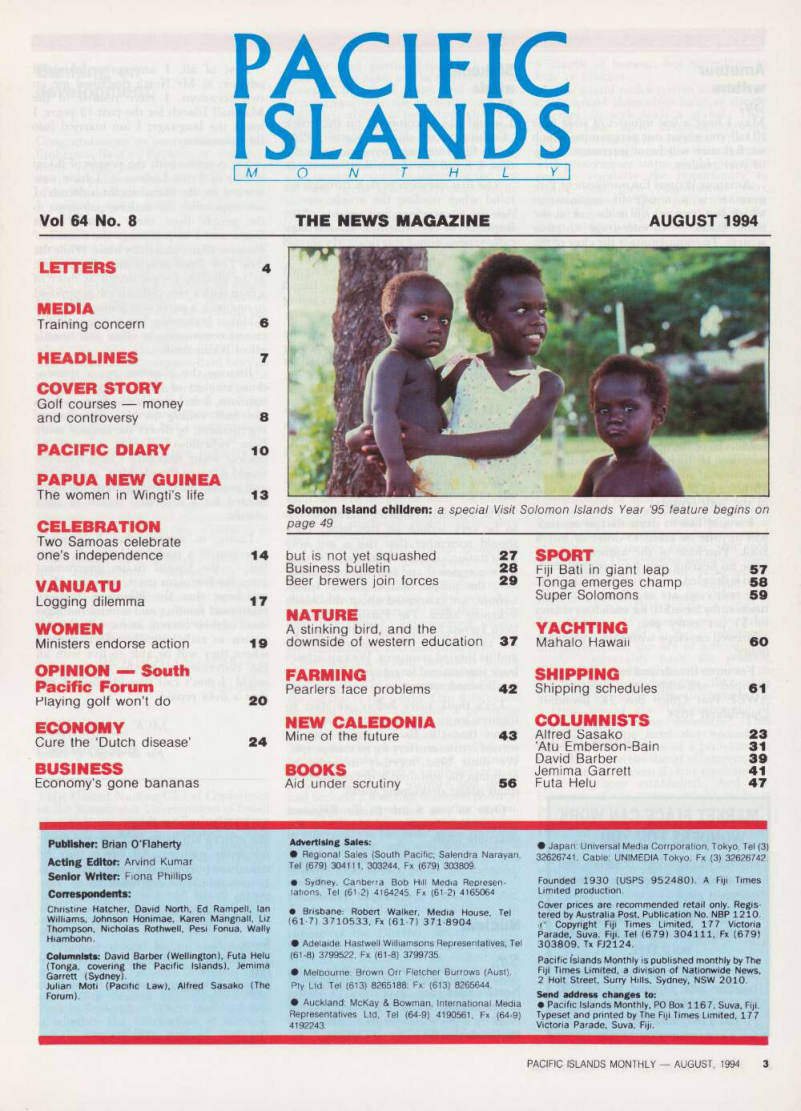
Solomon Island children: a special Visit Solomon Islands Year ’95 feature begins on page 49
Sickening
Letters
Amateur writers
Sir ;
May I have a few minutes of your time to tell you about our programme which we feel sure will be of interest to many of your readers.
Amateur Writers Encouragement Pro gramme is a non-profit organisation which has been set up to do just as the name states to encourage amateur writers. To commemorate the close of the 20th century we are compiling anthologies of the works of hitherto unpublished authors of poetry and short stories.
Details of the programme are clearly set out in the letter and entry form which is sent out to those who request it. This programme is a two-fold opportunity.
Part one is a short story and poetry competition. Substantial first, second and third prizes and merit certificates for all highly commended work. Part two is all cash winners and merit certificate holders have the opportunity of having a selection of their writing published in Collections of Australian Literature, a set of
anthologies planned to highlight the end
of the 20th century.
I would like to stress that at no time will anyone be asked to order or buy a book. Purchase of the anthologies will have no bearing on who gets published.
This is decided on merit alone and is free.
The only costs are as follows compe tition entry fee is $lO for each four entries or $5 per entry plus a stamped self addressed envelope with each correspon dence.
For more details and entry forms send
stamped self-addressed envelope to
AWEP Post Office Box 24, Boondall,
Queensland 4034.
Sarah Sinclair
Manager
Sickening
affair
Sir ;
I would like to comment on the article “Cashing in on nuclear waste”, PIM,
June. On receiving my June subscrip
tion, I could not digest the front cover.
The first question to flick through my mind when reading the article was Are the government and citizens of the Republic of the Marshall Islands logi cally serious about this deal? My second thought was about the previous agree ment. What had happened to the signed MOU between affected Pacific Island nations and superpower countries trying to end this horrific activity?
I just don’t understand how we, the people of the Pacific region, are going about our internal and external affairs. It will only take an ordinary person to think logically on this issue.
The small island nations have just ended their two-week long conference in Barbados trying to draw up strategy plans in order to get international recognition on the sustainable develop ment of small developing states that is affecting our small island nations.
The Marshall Islands government has to be very serious on this issue. They should remember that this is not only their nation’s internal affair but it’s going to be a regional and international affair.
We, the people of the Pacific Island nations, are concerned about this whole sickening affair. The Pacific region has been known for decades for its diversity.
Let us make use of our natural beauty and its limited resources. We can attract huge tourism and foreign investors to our small island nations.
Let’s think twice before we start to frighten away useful investors. Let’s not forget that the Pacific region can be turned into a cemetery for its own people.
We must bind together in order to maintain the sustainable development of small island developing states.
Over to you South Pacific Regional Environment Programme to clear up this
sickening affair.
Peter Tirang
Rabaul Papua New Guinea Nuclear waste Sir ; As one of the people referred to in David North’s /VA/June cover story, “Cashing in on nuclear waste”, I would like to clear up a few misconceptions about my role with the Bikinian community.
First of all, I am not a mainland advisor, as Mr North described me on two occasions. I have resided in the Marshall Islands for the past 13 years; I speak the language; I am married into
the community.
My position with the people of Bikini is that of Trust Liaison I have now worked for the Bikinians for a decade. I am responsible for making payments to the people from three different trust funds, and I help manage the Bikinians’ business affairs on a daily basis. While the New York Times article may describe me as an idealist, I view myself as more of a man with a very difficult job as opposed to one with a particular philosophy. The Bikinian leadership has a responsibility to our community to clean and resettle all of Bikini Atoll.
Because the islanders put a tremen dous amount of faith and trust in my opinions, I feel that it my duty to keep the ball rolling in the direction of resettlement, to divert the council away from ridiculous schemes - such as nuclear waste disposal that I believe would damage the islanders’ reputations and prevent them from gaining the funds needed for a successful return to their islands.
Lastly, to suggest that I favour a reversion to a traditional lifestyle is not fair the United States government owes the Bikinians more than that. It is my hope that the Bikinians, through additional funding and careful manage ment of their current assets, will one day return to radiologically safe homeland where they will be able to live with all the conveniences of the modern day world. I don’t call that idealism. I call that a debt repaid.
Jack Niedenthal
Trust Liaison For the People of Bikini
LETTERS to the Editor must include the writer’s full name, address and home telephone number. All letters may be edited for purposes of clarity and space.
Letters should be addressed to: Editor Pacific Islands Monthly P O Box 1167 Suva Fiji Islands OR Fax (679) 303809
Banking on
development
Sir, Congratulations on your columnist ’Atu
Emberson-Bain’s “Banking on develop
ment” [PIM, June 1994). It is certainly
worth to publicise Susan George’s adage
of the World Bank (and banks in general, I would add) being a “medieval church”.
Pacific island leaders are avid church goers and thus comprise part of the enthusiastic congregation of the World Bank Church, with the promised land always just around the corner (of course the many pilgrimages of supplicant Pacific island politicians to worship the
Washington high priests are ever so
sweet). My only gripe is the column’s label “Not The Mainstream” it may well be that ’Atu Emberson-Bain belongs to that minority 10 per cent of the population which desperately tries to clean up the economic and environ mental mess created and perpetuated by the other 90 per cent, but a more realistic view is, that only some “medieval” five per cent of the population indoctrinate (via the World Bank Church and other
such saintly organisations) and manipu
late the 85 per cent of blindfolded followers (how this is done has been variously described and documented as early as Reich’s The Mass Psychology of
Fascism).
So please, ’Atu Emberson-Bain, you are “mainstream” because you care about the people, the mass of people, the vast majority, and you do it by providing
information (as any good journalist
should) instead of disseminating World Bank Church doctrine.
Dr Wolfgang Sperlich
Aloft Niue Island
Barbados
conference
Sir, THE United Nations Global Conference on the Sustainable Development of Small Island States, held in Barbados from April 25 to May 6, adopted a Pro gramme of Action which, if properly implemented in the spirit of the Barbados Declaration also adopted by the confer ence, should foster genuine and meaning ful development in small island states, while ensuring the preservation of their unique cultural and environmental di versity.
Whether it will be so implemented remains to be seen. There is no doubt that the UN General Assembly will endorse the programme and declaration at its 49th Session beginning in New York in September. Where there is doubt is whether the affirmation of interna tional responsibility and of common
purpose and partnership which these documents contain will be converted into action. The island states will need to demonstrate over the coming years not only their ability to help themselves but also both tact and persistence in their efforts to get members of the interna
tional community to keep their promises.
Australian minister Gordon Bilncy’s re cent remarks explicitly underline the first of these needs and tacitly demonstrate the second.
The delegates at Barbados worked carefully over the range of natural, environmental, economic and social haz ards and difficulties to w'hich island states are particularly vulnerable, and they have made many very sensible recom mendations about how to combat the threats which could overwhelm the islands if they had to stand alone.
But small island states also face another kind of survival threat which is just as dangerous and in some ways more immediate. That is the threat to their security and sense of identity because of their inability to defend themselves or to pursue their legitimate interests in the world at large unless they have a
grotector. The experience of Espiritu
antu, of Mayotte in the Comoros, of the Maldives and of Dominica in the West Indies make clear that small island states can be put at risk by confidence men, mercenaries, criminals and rebels, and in such an event, unless their legitimate governments can quickly find an outside power to intervene immediately, they may be overthrown.
The Barbados Declaration recognises
that sustainable development pro
grammes must seek to to enhance “the safety” of peoples; that small island states should have rights over their own natural resources”, and that “their institutional and administrative capac
ity” should be “strengthened by support
ive partnerships and co-operation ’.
But nothing is said anywhere about how they are going to ensure this, how they are going to protect themselves from the villains of the world. Can they count on good fairies? To enlist a protector state is not a satisfactory solution to this problem for many small island states.
The protector would usually be the former colonial power, and continued association with it as a protectorate may
create problems of identity and pride,
and become a festering domestic political sore. What is needed is another option, one which can offer the same protection
in emergencies, the same prior warning,
and the same self assurance that a protector state can offer, but without loss of self esteem or face before the indepen dent world.
There is an obvious answer to this.
That answer is the United Nations, not
just through the language and impli
cations of the Charter, which villains, have learned to assess sceptically, but through the formal institutionalisation of a United Nations protectorate role. With the UN as legal protector, a small state would have a guarantee against illegal usurpation of power, a guarantee of benevolent intervention in time of need, and a guarantee which would be seen as
a mantle of honour, not something to hide or obscure.
How would such a system work? Small states would themselves have to decide whether to seek such a status. They should take such decisions through popular consultative processes. The UN would have a right to insist that all states with protectorate status would give their
peoples regularly the opportunity to
ensure that their governments were
representative. The protected state
would be in the UN but not in quite the same category as an ordinary member state.
It would not pay an annual levy, and should not have full voting rights. But it should participate in the discussion of all subjects of concern to it, have limited voting rights on them, and have access to UN services. It would have the guaran tee of protection against outside assault.
Governments perpetuating themselves illegally would have to confront the spectre of possible UN intervention.
Protected states should receive a small subsidy from the UN to assist with administration, and particularly the ad ministration of security. The UN would represent such states, or assist them with their representation, in negotiations with other states on such matters as fishing rights, the exploitation of their economic zones, etc.
There would be no need for the construction of new elaborate and ex pensive UN machinery. The old Trusteeship Council could be given a new name and used for legislative control of the protectorate system; the old Trusteeship Department could be used for administrative control. It would be sensible and desirable to amend the Charter accordingly, though the system could probably be introduced without amendment. As amendment for this purpose should be relatively uncontroversial, the act of amendment
might conceivably have the positive
spinoff of facilitating subsequent or simultaneous amendment to effect other desirable but more difficult changes.
How would the UN intervene if intervention became necessary? This difficult question need not necessarily delay the introduction of a protectorate system, because the threat of intervention would be there, even if clear mechanisms had not been established. And the existence of the system would make it possible for a single state (as for example India vis a vis the Maldives) to act on the UN’s behalf, thus giving its action immediate legitimacy. But in the long run, the establishment of a protectorate system should strengthen the case for a small UN standing force complimented by Article 43 commitments to provide national units for UN peacekeeping operations. A standing force would be immediately available and would be a clear deterrent to the enemies of small states, and the Charter.
C R Ashwin
Master Si Mark's College Inc
University of Adelaide
Australia
Advertisements & other items, p. 4 (1 item)
Market Place Can Work
WONDERS FOR YOU ...
Promote your business, or service, sell your household items, cars or heavy machinery etc.
ONLY AUSSI PER WORD.
NO COMPANY LOGO. NO DISPLAY. NO
BOLD TYPE.
Just forward your Advertisement together with payment to: PACIFIC ISLANDS MONTHLY “Market Place”, PO Box 1167, Suva, Fiji.
Getting serious about training
Media
TRAINING seemed to be the concern among
regional journalists who
attended the Pacific Islands News Associ ation’s annual confer ence in Apia, Western Samoa, last month.
Talks on journalism training needs and opportunities were the
highlight of the four-day
convention hosted by the Journalists Association of Western Samoa.
Keynote speaker for
the training conference, Charla Hatton, public affairs officer of the United States Infor mation Service in Suva, summed it up aptly in her opening address “I know of no issue that so unites journalists in the Pacific as the need for training. And I know of no issue that so divides them as the politics of
training.”
In best journalistic tradition, Hatton outlined her views on what training is or what it isn’t, or rather what it should and shouldn’t be: “Training is an investment in someone with the potential and the desire to improve. It is not a reward for longevity.
Training is a contract between employer, employee and trainer, based on shared ideals of what makes the media good. It is not a substitute for a raise in salary.
“Training is a way for honest, fair journalists to become better. It is not a substitute for integrity. Show me a journalist who will put his or her name on someone else’s work, and I’ll show you a journalist who isn’t going to benefit from training of any sort.” Hatton said
it was the question of ‘who’ was to get trained that created the most friction.
The PINA convention was opened by Congressman Eni H unkin Faleomavaega, of American Samoa. The four days of conferences and workshops culminated with the awards night for the Pacific journalists. Journalist of the Year
was Vasiti Waqa (*lslands Business Pacific,
Fiji); Young Journalist of the Year was Avin Rahish (Daily Post, Fiji); Photojournalist of the Year was Asaeli Lave (j Fiji Times)-, and TV Journalist of the Year was won by Lisa Williams of Cook Islands. PINA president Monica Miller and all executives were returned unopposed at the annual meeting. □
Christine Hatcher
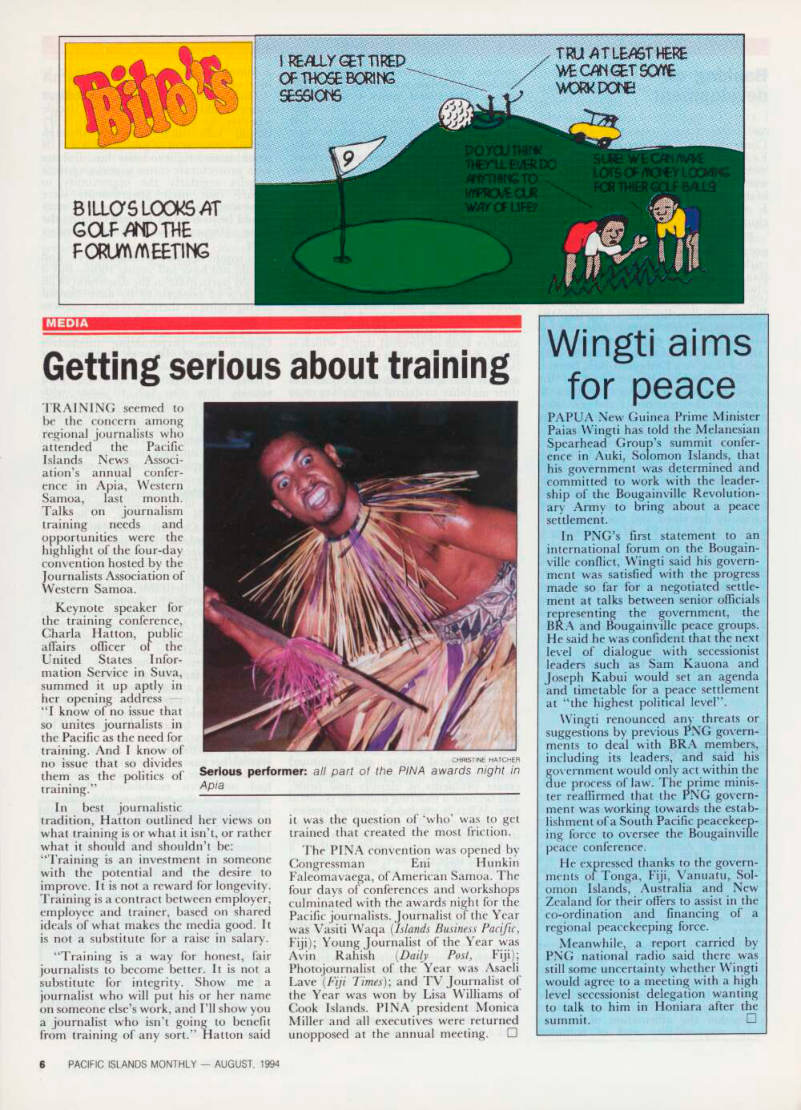
Serious performer: all part of the PINA awards night in Apia
Wingti aims
for peace
PAPUA New Guinea Prime Minister Paias Wingti has told the Melanesian
Spearhead Group’s summit confer
ence in Auki, Solomon Islands, that his government was determined and committed to work with the leader ship of the Bougainville Revolution ary Army to bring about a peace settlement.
In PNG’s first statement to an international forum on the Bougain ville conflict, Wingti said his govern ment was satisfied with the progress made so far for a negotiated settle ment at talks between senior officials representing the government, the BRA and Bougainville peace groups.
He said he was confident that the next level of dialogue with secessionist leaders such as Sam Kauona and Joseph Kabul would set an agenda and timetable for a peace settlement at “the highest political level”.
Wingti renounced any threats or suggestions by previous PNG govern ments to deal with BRA members, including its leaders, and said his government would only act within the due process of law. The prime minis ter reaffirmed that the PNG govern ment was working towards the estab lishment of a South Pacific peacekeep ing force to oversee the Bougainville peace conference.
He expressed thanks to the govern ments of Tonga, Fiji, Vanuatu, Sol omon Islands, Australia and New Zealand for their offers to assist in the co-ordination and financing of a
regional peacekeeping force.
Meanwhile, a report carried by PNG national radio said there was still some uncertainty whether Wingti would agree to a meeting with a high
level secessionist delegation wanting
to talk to him in Honiara after the summit. D
Auckland radio drops
Headlines
New Zealand
Auckland radio drops vernacular news
AUCKLAND’S National Radio has dropped its news in Pacific island languages. This is despite Pacific island leaders approaching the radio station. Sharon Crosbie, the station’s general manager, feels there is no more need for the service as a number of other radio stations in Auckland now broadcast news in the Polynesian languages.
National Radio say they will instead increase its coverage of Pacific island news in English and plan to recruit three more Pacific Island Affairs reporters.
Trust holds calendar
contest for schools
THE Pacific Island Business Development Trust recently ran a competition for a calendar design for New Zealand schools and technical institutes. Nineteen-year-old Rebecca Winstone of Auckland beat 240 entrants to win the contest for a calendar design with a Pacific island flavour. The calendar will be available soon.
Winstone won NZ$1000 plus $250 worth of Pacific island books. A graphic design student at the Auckland Institute of Technology, Winstone also won NZ$1250 worth of books to help with her studies.
over logging
Papua New Guinea
Concern raised over logging
A PROMINENT Papua New Guinea environmentalist says several European countries are becoming increasingly con cerned at destructive logging practices in PNG, Solomon Islands and Vanuatu.
The director of the Pacific Heritage Foundation, Max Henderson, was speaking on his return to Port Moresby from visits to Britain, German and Holland to seek support for so called community-based and ecologically-sustainable forestry operations. Henderson said that according to government figures, PNG received some US$500 million from log exports last year. However, had landowners opted for eco-based forestry operations with down-stream processing of logs into saw timber, the return to PNG would have been US$3.5 billion and the forests would be preserved for future generations.
Amnesty urges human
rights investigation
THE human rights organisation, Amnesty International, has urged the Papua New Guinea government to initiate a thorough and impartial investigation into alleged human rights violations in Bougainville.
Amnesty has issued its second report in eight months alleging that both government security forces and the self-styled Bougainville Revolution Army have been committing the worst kinds of human rights abuses.
Women challenged to
take up leadership roles
PAPUA New Guinea women have been challenged to take up prominent leadership roles in the political area. The challenge has come from Prime Minister Paias Wingti in a speech to the closing session of the week-long National Women’s Convention in Port Moresby which was attended by more than 3000 women from PNG.
Defence Department
Hawaii
Protection offered to sacred sand dunes
HAWAIIANS have erected a traditional shrine filled with bananas, taro and ti leaves at the American army missile launching site on Kauai island in order to offer protection to sacred sand dunes.
A military spokesman said permission had been given to erect the shrine after the Reverend Kalco Patterson agreed to hold the dedication ceremony about a kilometre from the Nohili dunes. Hawaiians taking part in the ceremony said the shrine was to protect sand dunes covering an ancient burial site from being disturbed by rockets being fired from the nearby
launching pad.
Defence Department
to relocate operations
THE US Defence Department has decided to relocate 19 finance and accounting operations throughout the Pacific defence command to navy facilities at Pearl Harbour in Hawaii. Hawaii senator Daniel Inouye said the consolidation would create 500 new jobs in Honolulu.
Senator Inouye, who is chairman of the defence sub committee of the Senate Appropriations Committee, said the relocations to Pearl Harbour were expected to begin next year.
Study finds greater level
Marshall Islands
Study finds greater level of radioactive fallout
A STUDY in the Marshall Islands has found a greater level of radioactive fallout from American nuclear testing there than was earlier believed.
The head of the study, Steven Simon, has told the American based Health Physics Society that radioactivity levels increase are heaviest in the Northern Marshalls where the test sites of Bikini and Enewetak are located.
Simon said it’s important to have complete data before any further clean-up of the radioactivity can be attempted. People from the atolls of Bikini, Enewetak and Rongelap were displaced by the United States’ above-ground nuclear testing programme of the 1940 s and 50s, and have been unable to return because of high levels of radioactivity.
Country gets ready
Kiribati
Country gets ready to go to polls
KIRIBATI was gearing up for general elections last month following the fall of the government and dissolution of parliament last May. Registration of voters had closed on all inhabited islands and the chief electoral officer, Teramweai Itinraoi, said the number of voters registered this year was fewer than in the last general election held in 1991.
The Electoral Commission had earlier estimated that the number of voters in Kiribati would increase from the more than 29.000 in 1991 to well over 32,000 this year. But just over 27.000 voters have registered.
Two hundred and sixty candidates were to have contested the 39 seats in the poll. Run-off elections were to be held on July 29 for any constituencies which produced inconclusive results. □
Golf courses-money and controversy
Cover Story
By David North
THE islands want the tourists’ money.
Japanese tourists have money and want
to play golf.
Hence, more and more of the islands
are building golf courses, and facing
related controversies in fact, golf course opponents label the proposed courses as environmental disasters. These trends, so far, are more pronounced in the North Pacific than in the South
Pacific. Usually speaking in long-term
language, the critics, such as the Global
Anti-Golf Movement (GAG’M), charge
that new golf courses consume too much land, agricultural chemicals, and irri
gation water, often displace indigenous
people, and bring too few benefits to the host nations.
Many of these arguments are shouldered aside by the golf course developers, and their political allies, in a focus on what appears to be substantial short-term benefits profits, jobs and taxes. These controversies can be par ticularly sharp in Micronesia, where land and fresh water are both scarce.
Fueling these fires is the golf mania in
Japan, a densely populated mountainous
chain ofislands, where there is little room for golf courses. There are said to be 13 million golfers in Japan, but many of them never play on a normal golf course, and must content themselves to the use of golfing ranges sometimes three storeys high. (It must be difficult to follow the flight of the ball you just hit when there are people over your head and beneath your feet hitting balls at the same time.) The Japanese enthusiasm for golf would simply be a domestic Japanese phenomenon if it were not for Japanese
prosperity. Millions of Japanese golfers
nave more than enough money to travel abroad. In fact, they often find that they can have a golfing holiday more cheaply by flying to the islands or to the US Mainland than they could staying at home and doing their golfing on Japan ese courses, at Japanese prices.
With this in mind we review the environmental battle over golf courses, the enormous difference in the fees paid for 18 holes of golf (from as much as US$5OO in Japan to as little as $3.41 in the Solomons) and the state of golf courses throughout the islands.
The ecology of golf courses
Golf was invented in Scotland, where the cool climate and frequent rains make it possible to maintain fairways and greens with relatively modest amounts of arti ficial fertilisers and pesticides. But when these same grasses are moved into the
tropics they become hard-to-sustain
exotics, requiring substantial chemical inputs. According to GAG’M, to make an island golf course look like its forefathers in Scotland, one must use more chemicals than any form of pro ductive agriculture; in fact, it is estimated that 1500 kilograms of chemicals must be used each year to keep a course green.
Gen Morita, a Japanese environmentalist who is one of GAG’M’s founders, claims that in addition to the fertilisers courses often use zeolite for soil improvements. This, he says, consists mainly of silicic-acid, aluminium oxide
and iron oxide, all potential cancer causing agents. Golf course professionals
reply that they are rapidly moving
toward the use of more and more organic
fertilisers and pest-control techniques,
and moving away from the chemicals used in the past.
The critics of the golf courses also contend that they consume inordinate amounts of irrigation water. In Malay sia, for example, where GAG’M seems to be particularly strong, the government is paying more than $7.5 million to run a pipeline from a mainland area to the island of Redang, the location of a golf course. Meanwhile, the resident poor of the same mainland area are said to be experiencing an outbreak of cholera caused by, among other things, an inadequate supply of clean water. What ever the facts of the Malaysia situation,
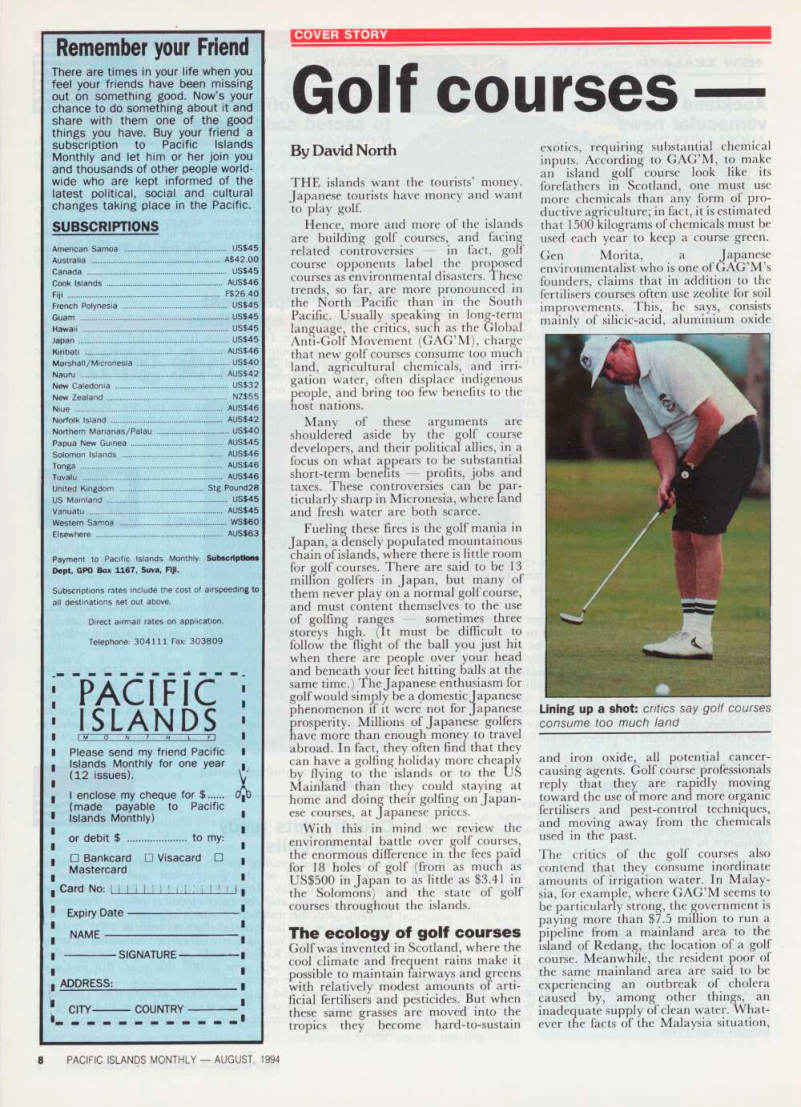
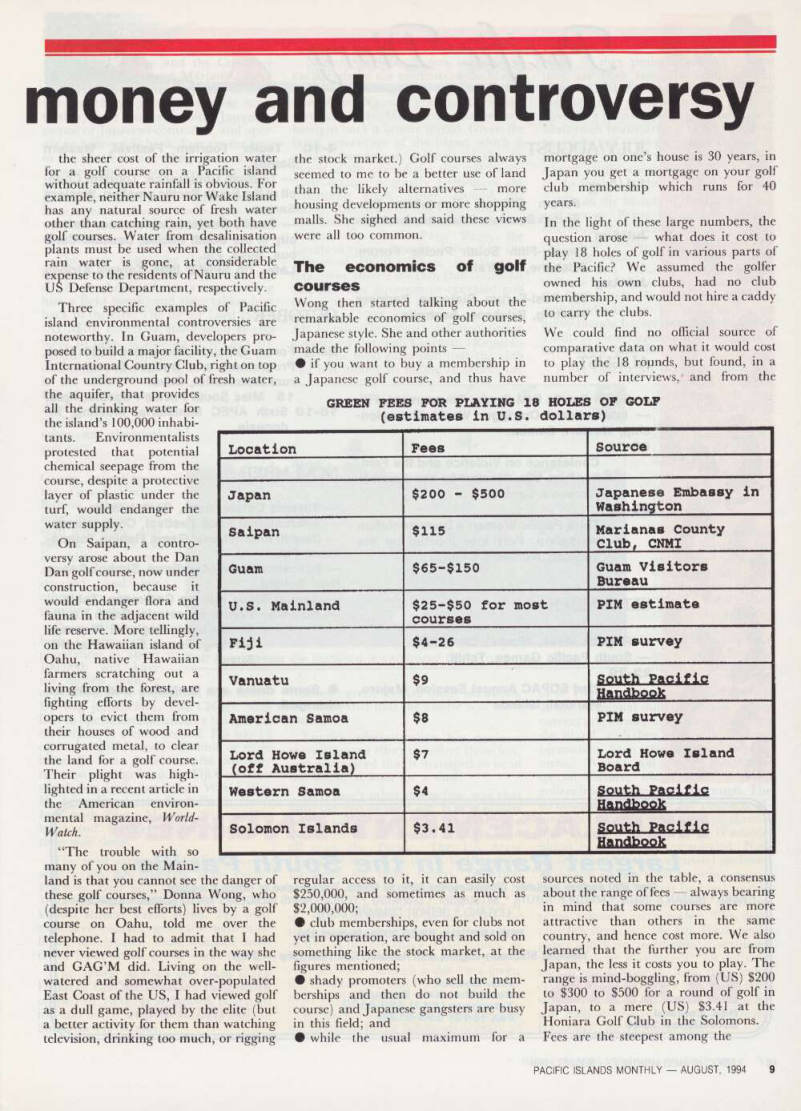
Lining up a shot: critics say golf courses consume too much land
the sheer cost of the irrigation water for a golf course on a Pacific island without adequate rainfall is obvious. For example, neither Nauru nor Wake Island has any natural source of fresh water other than catching rain, yet both have golf courses. Water from desalinisation plants must be used when the collected rain water is gone, at considerable expense to the residents of Nauru and the
UIS Defense Department, respectively.
Three specific examples of Pacific island environmental controversies are noteworthy. In Guam, developers pro posed to build a major facility, the Guam International Country Club, right on top of the underground pool of fresh water,
the aquifer, that provides
all the drinking water for the island’s 100,000 inhabi tants. Environmentalists
protested that potential
chemical seepage from the
course, despite a protective
layer of plastic under the turf, would endanger the
water supply.
On Saipan, a contro versy arose about the Dan Dan golf course, now under construction, because it would endanger flora and fauna in the adjacent wild life reserve. More tellingly, on the Hawaiian island of Oahu, native Hawaiian farmers scratching out a living from the forest, are
fighting efforts by devel
opers to evict them from their houses of wood and corrugated metal, to clear the land for a golf course.
Their plight was high
lighted in a recent article in the American environ mental magazine, World- Watch.
“The trouble with so many of you on the Main
land is that you cannot see the danger of these golf courses,” Donna Wong, who (despite her best efforts) lives by a golf course on Oahu, told me over the telephone. I had to admit that I had never viewed golf courses in the way she and GAG’M did. Living on the well watered and somewhat over-populated East Coast of the US, I had viewed golf as a dull game, played by the elite (but a better activity for them than watching television, drinking too much, or rigging
the stock market.) Golf courses always seemed to me to be a better use of land than the likely alternatives more
housing developments or more shopping
malls. She sighed and said these views were all too common.
The economics of golf
courses Wong then started talking about the remarkable economics of golf courses, Japanese style. She and other authorities
made the following points
if you want to buy a membership in a Japanese golf course, and thus have
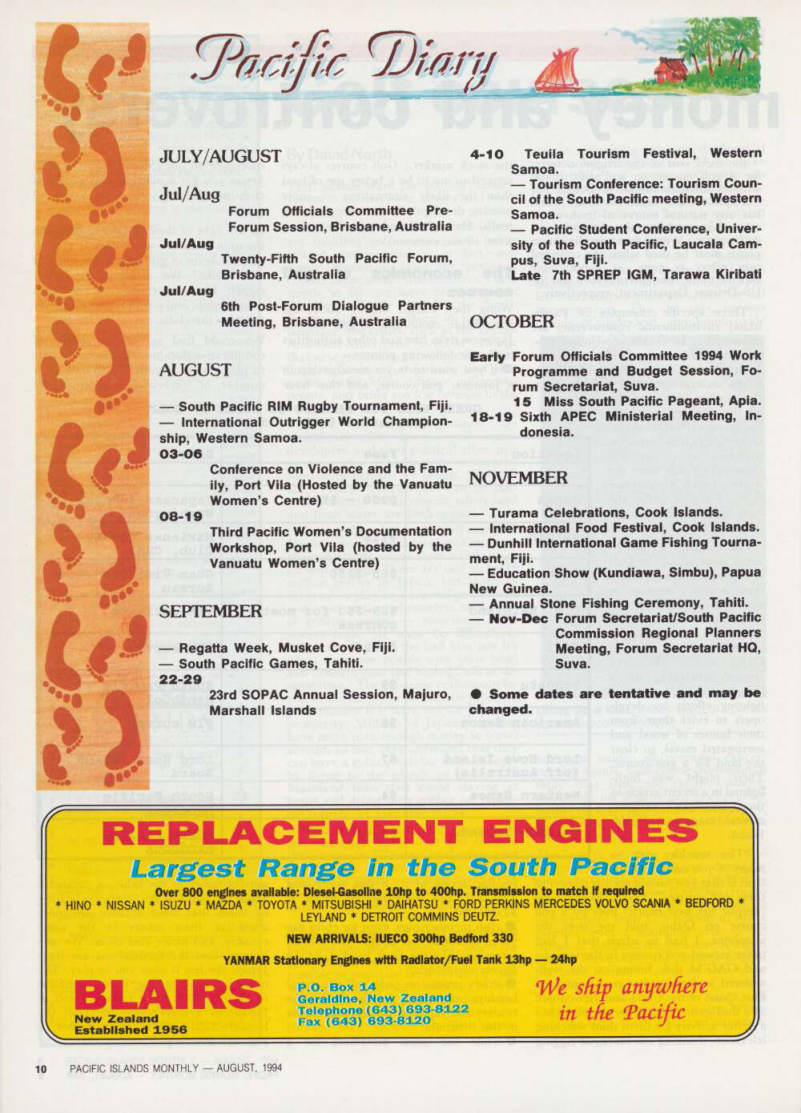
GREEN FEES FOR PLAYING 18 HOLES OF GOLF (estimates in U.S. dollars)
regular access to it, it can easily cost $250,000, and sometimes as much as $2,000,000; • club memberships, even for clubs not yet in operation, are bought and sold on something like the stock market, at the figures mentioned; • shady promoters (who sell the mem berships and then do not build the course) and Japanese gangsters are busy in this field; and • while the usual maximum for a
mortgage on one’s house is 30 years, in Japan you get a mortgage on your golf club membership which runs for 40 years.
In the light of these large numbers, the question arose what does it cost to play 18 holes of golf in various parts of the Pacific? We assumed the golfer owned his own clubs, had no club membership, and would not hire a caddy to carry the clubs.
We could find no official source of comparative data on what it would cost to play the 18 ropnds, but found, in a number of interviews,’ and from the
sources noted in the table, a consensus about the range of fees always bearing in mind that some courses are more attractive than others in the same country, and hence cost more. We also learned that the further you are from Japan, the less it costs you to play. The range is mind-boggling, from (US) $2OO to $3OO to $5OO for a round of golf in Japan, to a mere (US) $3.41 at the Honiara Golf Club in the Solomons.
Fees are the steepest among the
Location Fees Source Japan $200 - $500 Japanese Embassy in Washington Saipan $115 Marianas County Club, CNMI Guam $65-$150 Guam Visitors Bureau U.S. Mainland $25-$50 for most courses PIM estimate Fiji $4-26 PIM survey Vanuatu $9 South Pacific Handbook American Samoa $8 PIM survey Lord Howe Island (off Australia) $7 Lord Howe Island Board Western Samoa $4 South Pacific Handbook Solomon Islands $3.41 South Pacific Handbook
islands in Guam and the Common wealth of the Northern Mariana Islands (CNMI), which cater to Japanese tour ists and charge at near-Japanese rates; further, these courses are often Japanese owned or Japanese-controlled, and oper ate on a for-profit basis. Fees are the least in the South Pacific where there are few Japanese golfers, and courses are often government-owned, and sometimes government-subsidised. Many courses have higher fees on the weekends than on week days. Week day fees are shown in the table.
The fees noted for Japan usually involve transporting the golfer from the city to the club in a bus or a train, feeding him a light lunch, and then taking him back to the city. The fee for Lord Howe (AUSSIO) covers as many holes as you want to play. If additional services are needed (such as equipment rental, or use of a caddy) fees are higher than shown
in the table; in the US the fee range shown usually in cludes two people using an electrical
golf cart.
Currently on
Guam, according to the Guam Visitors Bureau, there are nine operating civ ilian golf clubs, and two for the military.
In addition, six more are being con structed, and five others are in the
planning stage.
Once all 20 are built, Guam, with a population of about 100,000, will have the highest number
of golf courses to population ratio of any US flag jurisdiction. The CNMI, with four in operation and another being built on Saipan, is a close second. Fiji has 14 operative golf courses with nine or more holes. Of these the oldest and probably the most prestigeful, is the Fiji Golf Club which was built just before World War 11. According to the South Pacific Hand book, both Prime Minister Sitiveni Ra buka and President Ratu Mara play their golf there.
The most expensive of Fiji’s courses, with a (US) 526 green fee, is the Pacific Harbour Golf and Country Club; its 18-hole course was designed by the well known Robert Trent Jones. The least expensive courses, generally with nine holes, are located some distance from either Suva or the prime resort district.
The newest of Fiji’s golf clubs is the Dcnarau Golf and Racquet club, which opened in 1993. It is located near two five-star hotels, the Regent of Fiji and the Sheraton Fiji Resort.
Nauru’s golf course, now used almost exclusively by the residents of the island, was built during the days of British
Phosphate. Nauru’s golf team recently
travelled to the Micronesian Games and brought back a bronze medal. Given the large percentage of the island which is virtual moonscape, because of the re moval of the phosphate, the golf course must occupy a goodly portion of the remaining green fringe around the island. American Samoa’s only course is noteworthy for several reasons. About a dozen miles from Pago Pago, the Lavalava course is on land leased by the
village of Illiilli. (Then, speaking of
repetition, there’s the Dan Dan course on
Saipan.) The government-operated golf
course was a minor issue in the rough election of 1992, when former governor AP Lutali (Democrat) defeated sitting governor Peter Tali Coleman (Republi can). The local press said that the club had lost money by failing to collect the
(modest) green fees on many occasions, and suggested that the course was over staffed.
Lutali’s administration has made a more vigorous effort to collect those fees, and announced that it managed to be in the black, at least for a time.
Lavalava's other distinction was that until the end of the Cold War it played host to tall, eavesdropping radio towers, that listened to air-borne messages from all over the Pacific. The US State Department used to pay a little rent to Lavalava for those towers, but that source of funds has now departed.
Lord Howe’s nine-hole golf course is the only one we know of in the Pacific that uses an honour system for collecting its fees. If the pro shack is not staffed, as it often is not, one is supposed to push a AUSftlO note through a slot for a green fee; it costs tw ice that if you want to rent a set of clubs as well.
We do not know if the golf courses in the Cooks or in the Solomons operate at
night they probably do not but
they are both near the islands’ main airports, and the GAG’M people would say that this promises trouble. One of GAG’M’s criticisms of a golf course in a Malaysian resort area is that the course has night golf to gain more income and that the very powerful lighting
system confuses incoming pilots as they
try to land at night.
Not all the islands in the Pacific have golf courses. Palau, for instance, though interested in Japanese tourists, has no courses in being, but several in the planning stage. Travel literature from Kiribati and Tuvalu, both land-poor, indicate no course in either nation. Also, the South Pacific Handbook, though it has useful information on golf courses on many islands, has no links listed for either Tahiti or New Caledonia, both of which have ample land for such facilities.
Wake Islands’ six-hole golf course has
a couple of dubious distinctions. It was clearly built at great taxpayer expense by the American mili tary, with the dirt (as well as the chemi
cals) presumably
brought in by ships
from hawaii or the Mainland.
Wake Islands’ Air Force Station has only the slimmest workload, and one might argue that it should have been closed years ago. The golf course, however, continues to operate as a perk for the dozen Americans and maybe the 200
or so Thai workers on the island, as well as the occasional military tourist. (Only current and former US military may visit the island, and then only with advance permission from the Defense Depart ment.) Wake’s golf course also has a special feature, which tends to keep golfers from straying into the rough. The terrain surrounding the golf course is off limits because, the military says, there is plenty of left-over World War II ammu nition lying around unexploded. Now there’s a serious environmental problem! ■ As this edition went to press, compe tition on the Fiji circuit had just started in which cabinet ministers, including prime minister, participated. This drew criticism from the The Fiji Times, news paper which, in an editorial, questioned why they were playing golf “on our time and at our expense”? “One thing is for certain Fiji will never fix its problems while its decision-makers are looking for golf balls in the jungle around Pacific Harbour,” the editorial said. □
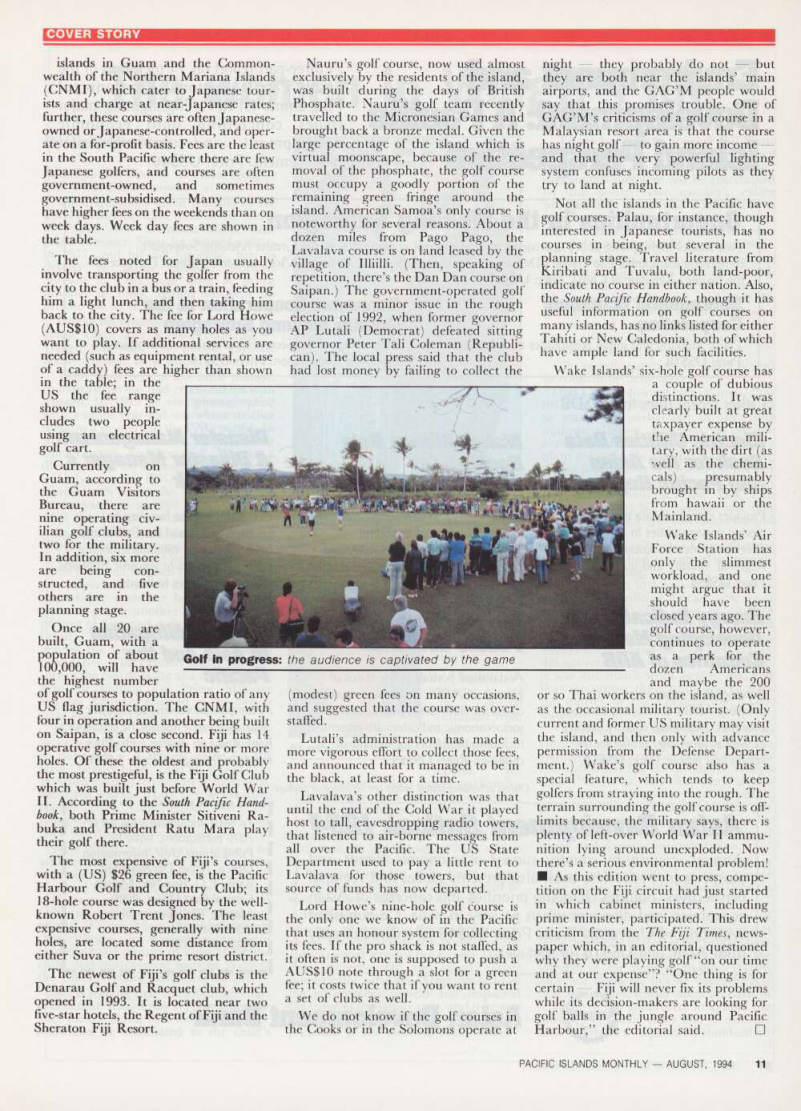
Golf in progress: the audience is captivated by the game
Advertisements & other items, pp. 8-12 (2 items)
Pacific
Remember your Friend
There are times in your life when you feel your friends have been missing out on something good. Now’s your chance to do something about it and share with them one of the good things you have. Buy your friend a subscription to Pacific Islands Monthly and let him or her join you and thousands of other people worldwide who are kept informed of the latest political, social and cultural changes taking place in the Pacific.
SUBSCRIPTIONS
American Samoa US$45 Australia A 542.00 Canada US$45 Cook Islands AUSS46 Fiji F 526.40 French Polynesia US$45 Guam US$45 Hawaii US$45 Japan US$45 Kiribati AUSS46 Marshall/Micronesia US$4O Nauru AUSS42 New Caledonia US$32 New Zealand NZ$55 Niue AUSS46 Norfolk Island AUSS42 Northern Marianas/Palau US$4O Papua New Guinea AUSS4S Solomon Islands AUSS46 Tonga AUSS46 Tuvalu AUSS46 United Kingdom Stg Pound2B US Mainland US$45 Vanuatu AUSS4S Western Samoa WS$6O Elsewhere AUSS63 Payment to Pacific Islands Monthly: Subscription* Dept, GPO Box 1167, Suva, Fiji.
Subscriptions rates include the cost of airspeeding to all destinations set out above.
Direct airmail rates on application.
Telephone: 304111 Fax: 303809
PACIFIC
ISLANDS
Please send my friend Pacific Islands Monthly for one year (12 issues).
I enclose my cheque for $ (made payable to Pacific
Islands Monthly)
or debit $ to my: □ Bankcard Mastercard Card No: □ Visacard □ V c& _i_L !MI Expiry Date
NAME
-SIGNATURE-
ADDRESS:
CITY-
COUNTRY
iJmrv
: r
’IfJ
f: r 'f s
iJmrv
JULY/AUGUST
Jul/Aug
Forum Officials Committee Pre- Forum Session, Brisbane, Australia Jul/Aug Twenty-Fifth South Pacific Forum, Brisbane, Australia Jul/Aug 6th Post-Forum Dialogue Partners Meeting, Brisbane, Australia
AUGUST
South Pacific RIM Rugby Tournament, Fiji.
International Outrigger World Championship, Western Samoa. 03-06 Conference on Violence and the Family, Port Vila (Hosted by the Vanuatu Women’s Centre) 08-19 Third Pacific Women’s Documentation Workshop, Port Vila (hosted by the Vanuatu Women’s Centre)
SEPTEMBER
Regatta Week, Musket Cove, Fiji.
South Pacific Games, Tahiti. 22-29 23rd SOPAC Annual Session, Majuro, Marshall Islands 4-10 Teuila Tourism Festival, Western Samoa.
Tourism Conference: Tourism Council of the South Pacific meeting, Western Samoa.
Pacific Student Conference, University of the South Pacific, Laucala Campus, Suva, Fiji.
Late 7th SPREP IGM, Tarawa Kiribati
OCTOBER
Early Forum Officials Committee 1994 Work Programme and Budget Session, Forum Secretariat, Suva. 15 Miss South Pacific Pageant, Apia. 18-19 Sixth APEC Ministerial Meeting, Indonesia.
NOVEMBER
Turama Celebrations, Cook Islands.
International Food Festival, Cook Islands.
Dunhill International Game Fishing Tournament, Fiji.
Education Show (Kundiawa, Simbu), Papua New Guinea.
Annual Stone Fishing Ceremony, Tahiti.
Nov-Dec Forum Secretariat/South Pacific Commission Regional Planners Meeting, Forum Secretariat HQ, Suva. • Some dates are tentative and may be changed. f
REPLACEMENT ENGINES
Largest Range in the South Pacific
Over 800 engines available: Dlesel-Gasollne lOhp to 400 hp. Transmission to match If required * HINO * NISSAN * ISUZU * MAZDA * TOYOTA * MITSUBISHI * DAIHATSU * FORD PERKINS MERCEDES VOLVO SCANIA * BEDFORD *
LEYLAND * DETROIT COMMINS DEUTZ.
NEW ARRIVALS: lUECO 300 hp Bedford 330 YANMAR Stationary Engines with Radlator/Fuel Tank 13hp —24 hp
BLAIRS
New Zealand Established 1956 P.O. Box 14 Geraldine, New Zealand Telephone (643) 693-8122 Fax (643) 693-8120
<We ship anywhere
in the (Pacific
J
Environment and
Development: A Pacific
Island Perspective
A three-part report on 14 members of the South Pacific Regional Environment Programme (SPREP), highlighting major issues concerning both economic development and environmental management. Price: US$4O.
Opportunities in the Mekong Subregion
Two studies highlighting policy approaches and investment opportunities in the Qreater Mekong Subregion, comprising Cambodia, Lao People's Democratic Republic, Myanmar, Thailand, Viet Nam and Yunnan Province of the People's Republic of China, Price: US$lB.
Subregional Economic Economic Cooperation in the
Cooperation Greater Mekong Subregion
Policy thinking and initial possibilities of cooperation. Proceedings of the Second Conference on Subregional Price: US$lB. Economic Cooperation. Price: US$lO.
Other recent titles from ADB Electric Utilities Data Book for the Asian and Pacific Region Provides extensive data pertaining to electric power utilities in ADB's developing member countries.
Regional, country and utility profiles.
Price: US$55.
Energy Indicators of
Developing Member
Countries of ADB Provides time-series energy data covering ADB's developing member countries. Individual country profiles as well as an energy profile for the region as a whole. Price: US$5O.
Water Utilities Data Book Provides data from 38 water utilities in 23 developing member countries.
Regional profiles of important performance parameters. Utility and city profiles. Price: US$2O.
Bender Indicators of Developing Asian and Pacific Countries A statistical portrait of the status of women in ADB's developing member countries. Both demographic and socioeconomic indicators are presented, including indicators for individual countries. Price: US$25.
Disaster Management:
A Disaster Manager's Handbook A ready reference focusing on Southeast Asia and the Pacific and covering natural calamities ranging from earthquakes to volcanic eruptions and from cyclones to floods.
Price: US$lB.
Disaster Mitigation
in Asia and the PadHc A companion volume to Disaster Management Presents the results of a Bank study on disaster mitigation efforts in the region. Price: US$lB.
Unless otherwise stated, prices are inclusive of postage.
Asian Development Outlook 1094
Annual, country-by-country survey of economic trends and prospects in 1995. The book also presents global and regional perspectives, outlines changing priorities and concerns of Asian economies, and discusses urban poverty in Asia. Co-published with Oxford University Press. Price: US$lB (if ordered directly from ADB, add US$lO for postage).
To order and obtain a full list of ADB publications, write to: Publications Unit, Information Office, Asian Development Bank, P.O. Box 789, Manila Central Post Office, 0980 Manila, Philippines. Or fax: (632) 632-6344 or (632) 632-5121.
Asian Development Bank
The women in Wingti’s life
Papua New Guinea
By Wally Hiambohn
WHO is the woman in Paias Wingti’s life? Or is there a woman at all?
These questions asked recently in the PNG parliament have been on the minds of Papua New Guineans about their prime minister. Since he entered politics m 1977, and hit the limelight, first as deputy to prime minister Michael Somare in 1982, and later as prime minister in 1986, Wingti has kept his private life as it is private.
Unlike his predecessors Somare, Sir Julius Chan and Rabbie Namaliu
Wingti has kept the nation guessing
about whether he is single or married.
There have been a few hints though, to indicate he has had relationships with women. In 1985 he was photographed with a seven-year-old son whose mother remains a mystery to the PNG public. In May this year, the Mount Hagen district court heard and granted Wingti a divorce from his customary marriage to a University of PNG student Dianne Kende with whom he has a son. The two’s marriage in 1991 was hushed up until the divorce was made public.
Except for the time she appeared with
Wingti at his government’s victory bash
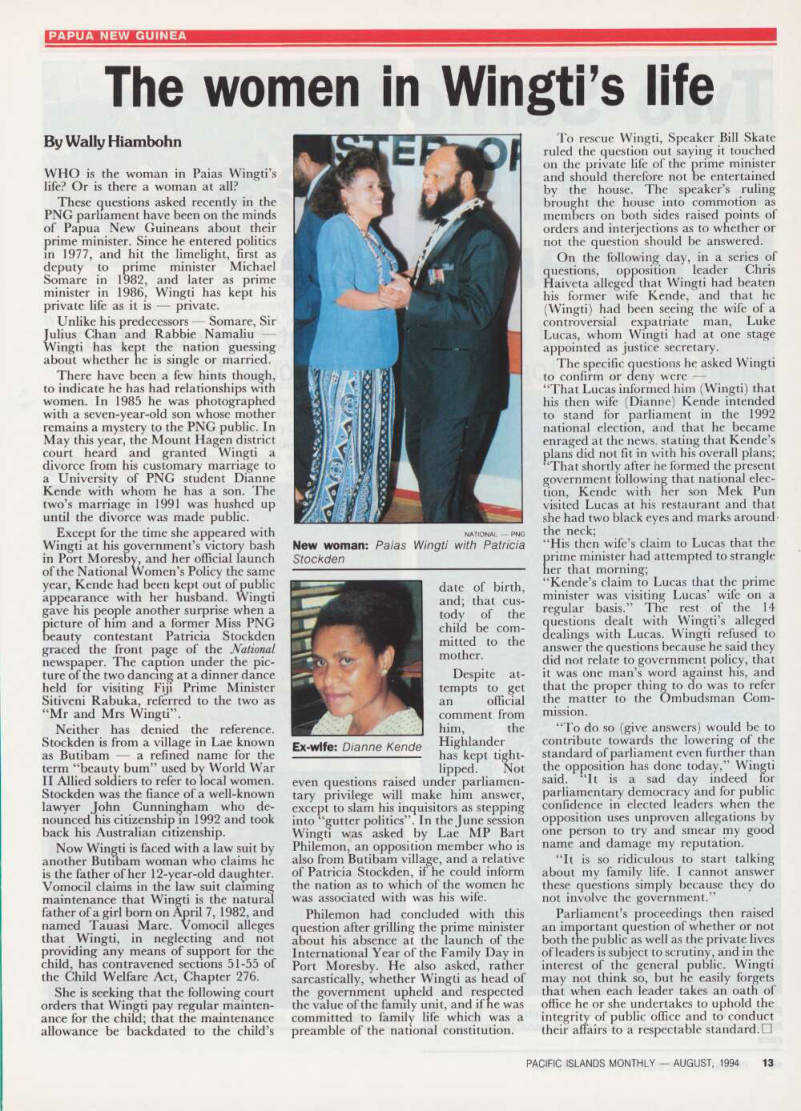
in Port Moresby, and her official launch of the National Women’s Policy the same year, Kende had been kept out of public appearance with her husband. Wingti gave his people another surprise when a Eicture of him and a former Miss PNG eauty contestant Patricia Stockden graced the front page of the National newspaper. The caption under the pic ture of the two dancing at a dinner dance held for visiting Fiji Prime Minister Sitiveni Rabuka, referred to the two as “Mr and Mrs Wingti”.
Neither has denied the reference.
Stockden is from a village in Lae known as Butibam a refined name for the term “beauty bum” used by World War II Allied soldiers to refer to local women.
Stockden was the fiance of a well-known
lawyer John Cunningham who de
nounced his citizenship in 1992 and took back his Australian citizenship.
Now Wingti is faced with a law suit by another Butibam woman who claims he is the father of her 12-year-old daughter.
Vomocil claims in the law suit claiming maintenance that Wingti is the natural father of a girl born on April 7, 1982, and named Tauasi Mare. Vomocil alleges that Wingti, in neglecting and not providing any means of support for the child, has contravened sections 51-55 of the Child Welfare Act, Chapter 276.
She is seeking that the following court orders that Wingti pay regular mainten ance for the child; that the maintenance allowance be backdated to the child’s
date of birth, and; that cus tody of the child be com mitted to the mother.
Despite at tempts to get an official comment from him, the Highlander has kept tight lipped. Not
even questions raised under parliamen tary privilege will make him answer, except to slam his inquisitors as stepping into “gutter politics”. In the June session Wingti was asked by Lae MP Bart Philemon, an opposition member who is also from Butibam village, and a relative of Patricia Stockden, if he could inform the nation as to which of the women he was associated with was his wife.
Philemon had concluded with this
question after grilling the prime minister
about his absence at the launch of the International Year of the Family Day in Port Moresby. He also asked, rather sarcastically, whether Wingti as head of the government upheld and respected the value of the family unit, and if he was committed to family life which was a preamble of the national constitution.
To rescue Wingti, Speaker Bill Skate ruled the question out saying it touched on the private life of the prime minister and should therefore not be entertained
by the house. The speaker’s ruling
brought the house into commotion as members on both sides raised points of orders and interjections as to whether or not the question should be answered.
On the following day, in a series of
questions, opposition leader Chris
Haiveta alleged that Wingti had beaten his former wife Kende, and that he (Wingti) had been seeing the wife of a controversial expatriate man, Luke Lucas, whom Wingti had at one stage
appointed as justice secretary.
The specific questions he asked Wingti
to confirm or deny were “That Lucas informed him (Wingti) that his then wife (Dianne) Kende intended to stand for parliament in the 1992 national election, and that he became enraged at the news, stating that Kende’s plans did not fit in with his overall plans; “That shortly after he formed the present government following that national elec tion, Kende with her son Mek Pun visited Lucas at his restaurant and that she had two black eyes and marks around the neck; “His then wife’s claim to Lucas that the
prime minister had attempted to strangle
her that morning; “Kende’s claim to Lucas that the prime minister was visiting Lucas’ wife on a regular basis.” The rest of the 14
3uestions dealt with Wingti’s alleged
ealings with Lucas. Wingti refused to answer the questions because he said they did not relate to government policy, that it was one man’s word against his, and that the proper thing to do was to refer the matter to the Ombudsman Com mission.
“To do so (give answers) would be to contribute towards the lowering of the standard of parliament even further than the opposition has done today,” Wingti said. “It is a sad day indeed for
parliamentary democracy and for public
confidence in elected leaders when the
opposition uses unproven allegations by
one person to try and smear my good name and damage my reputation.
“It is so ridiculous to start talking about my family life. I cannot answer
these questions simply because they do
not involve the government.”
Parliament’s proceedings then raised an important question of whether or not both the public as well as the private lives of leaders is subject to scrutiny, and in the
interest of the general public. Wingti
may not think so, but he easily forgets that when each leader takes an oath of office he or she undertakes to uphold the integrity of public office and to conduct their affairs to a respectable standard. □
National - Png
New woman: Paias Wingti with Patricia Stockden
Ex-wife: Dianne Kende
independence
Celebration
Two Samoas celebrate one’s independence
Fast races, joyful dances and great barbecue bring Pacific nations together for a glorious ‘fla-fla’
By Jim Nielsen
FOR two days, the Cradle of Polynesia rocked with song and celebration as Western Samoa celebrated its 32nd year of independence. The special events began with the National Sunday of Worship on May 29, and ended on June 2 with canoe races, a fautasi (longboat) regatta and traditional Samoan songs and dances.
The events were held in front of the Government Building Complex along Beach Road in Apia, and were hosted by His Highness the Head of State Malietoa and Prime Minister Tofilau Eti Alesana. Other distinguished guests included members of the Council of Deputies, representatives from the Kingdom of Tonga and the Maori Queen. The governor of American Samoa, Peter Tali Coleman, and US Congressman Eni Faleomavaega also joined in the celebrations.
“The islands of Western and American Samoa are divided politically, but not socially,” said an official. “Although we are separate countries, our families and our friendships are joined
by tradition.”
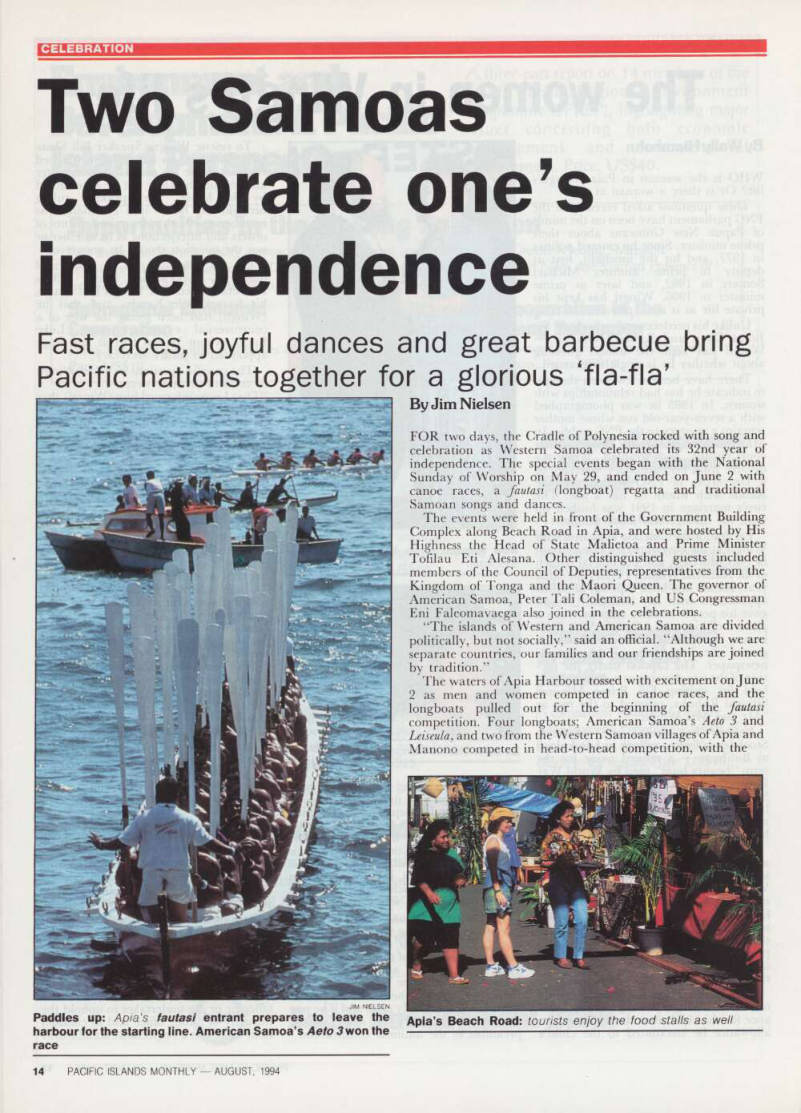
The waters of Apia Harbour tossed with excitement on June 2 as men and women competed in canoe races, and the longboats pulled out for the beginning of the fautasi competition. Four longboats; American Samoa’s Aeto 3 and Leiseula, and two from the Western Samoan villages of Apia and Manono competed in head-to-head competition, with the
Jim Nielsen
Paddles up: Apia’s fautasi entrant prepares to leave the harbour for the starting line. American Samoa’s Aeto 3 won the race
Apia’s Beach Road: tourists enjoy the food stalls as well
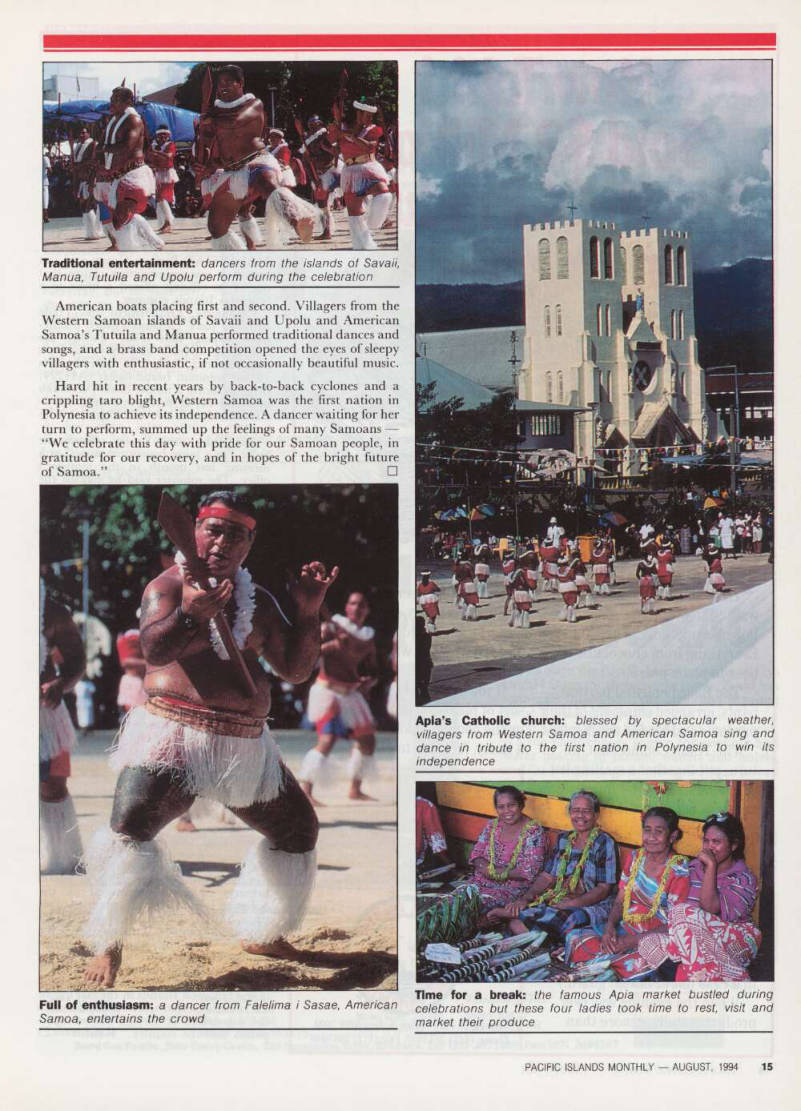
American boats placing first and second. Villagers from the Western Samoan islands of Savaii and Upolu and American Samoa’s Tutuila and Manua performed traditional dances and songs, and a brass band competition opened the eyes of sleepy villagers with enthusiastic, if not occasionally beautiful music.
Hard hit in recent years by back-to-back cyclones and a crippling taro blight, Western Samoa was the first nation in Polynesia to achieve its independence. A dancer waiting for her turn to perform, summed up the feelings of many Samoans “We celebrate this day with pride for our Samoan people, in gratitude for our recovery, and in hopes of the bright future of Samoa.” □
Traditional entertainment: dancers from the islands of Savaii, Manua, Tutuila and Upolu perform during the celebration
Full of enthusiasm: a dancer from Falelima i Sasae, American Samoa, entertains the crowd
Apia’s Catholic church: blessed by spectacular weather, villagers from Western Samoa and American Samoa sing and dance in tribute to the first nation in Polynesia to win its independence
Time for a break: the famous Apia market bustled during celebrations but these four ladies took time to rest, visit and market their produce
probed
Solomon Islands
Bribe claims probed
MALAYSIA’S Berjaya Group said last month it was investigating claims that one of its officials offered a bribe to a Solomon Islands minister.
Commerce, Employment and Trade Minister Joses Tuhanuku issued a state ment saying that Tony Yeong, the managing director of Berjaya Group s Star Harbour Timber Co, offered him a 10,000 Solomon Island dollar (A 54224) bribe to secure a timber deal. Tuhanuku deported Yeong, saying in a statement “The incident is not only illegal, it is an insult.”
Tuhanuku said Yeong offered the bribe “in a large brown envelope” at a meeting last month in the minister s office. The minister said he refused the offer and quoted Yeong as telling him “It was the accepted practice in the South Pacific and indeed around the world for a large company such as Berjaya to show its appreciation to those in government who assisted the com pany.” Tuhanuku said Yeong then offered him a wristwatch, which he also refused. The politically well-connected Berjaya Group said in a statement it was not its policy to offer financial induce ments to government officials. It said Yeong, who had taken full responsibility for the incident, had resigned.
“The company has already com menced an internal investigation of this matter and we will take the appropriate action as the situation warrants.”
Berjaya said it objected to statements by Tuhanuku, which “had cast aspersions on the integrity and credibility of the Berjaya Group and has also imputed impropriety to the manner in which our group carries on business and in our interaction with government officials”.
Berjaya said it would lodge a protest with the Solomon Islands prime minister.
Yeong was unavailable for comment.
The Berjaya Group has offered to buy a 100 per cent stake in Star Harbour, a company with logging rights to 45,000 hectares of forest concessions on the Solomon Islands. Star also planned to set up a 5A81.7 million integrated timber processing complex. Tuhanuku said the incident “only highlighted the endemic corruption which surrounds the timber industry in the Solomon Islands”. “Sadly this problem has only got out of control in the Solomon Islands in the last five or six years, a period which coincides with the big influx of foreign timber com panies into the country.” Reuter □
Advertisements & other items, p. 16 (1 item)
How Tahiti
Sold $2 Million
Worth Of Products
In One Night.
—tf'Ca^L <s^ C>s? > «s if € ?•/* r The Tahiti Exportation Board wanted to promote French Polynesian products in Sydney.
Everything from chocolates to beer to black pearls.
The Board enlisted participants, arranged shipment of their products and funded the displays.
The Trade Commission, in turn, put together a mailing list of people likely to be interested and sent out invitations to a gala evening in the ballroom of the Regent.
We had displays built. Generated press coverage. And we hired three lovely ladies to move among the guests wearing some of those black pearls. (The most expensive jewels were in a case under armed guard.) When the evening was over, products totalling more than $2 million had been sold.
Needless to say, the Tahiti Exportation Board was quite pleased with the way everything went.
If you’d like to feel the same sort of pleasure, just post or fax us the coupon below. If you’re in a hurry, feel free to phone.
I I Name I Company ! Address
Eie
£ 2 o e 0 W Level 6, 50 Park Street, Sydney NSW 2000.
Phone: (612) 2835933, Fax: (612) 2835948
Logging dilemma

Vanuatu
By Patrick Decloitre
THE timber-rich Erromango tropical forest (South Vanuatu) has been logged by a Malaysian company for only two months and eight thousand cubic meters
have already been harvested.
Company officials on Erromango say 60 to 80 trees (the equivalent of 450 cubic meters) are felled everyday. But on June 20, the minister of agriculture signed an order banning the export of whole logs.
The ship Esmelmlda, which was then already in the island state’s capital, could not load the first shipment, estimated to be worth about US$BOO,OOO dollars.
A few days later, the Esmelralda left Vanuatu, I but it was empty.
Following the announce ment, Malaysian companies licensed to operate on Erromango have put the pressure on the government threatening to bring the case to court for breach of the contract initially granted to them.
Under the previous terms, four com
panics (two Malaysian, Parklane and
Pacific Veneers, one Chinese, Kingwood, and a Malaysia-Vanuatu joint venture, Erro Lumber) were licensed to operate on Erromango, with annual logging
quotas well above the amount recom
mended by a recent Forestry Depart
ment study. The final straw came on July 8 when the Vanuatu government in
formed in writing all four logging companies on Erromango that their logging licences granted last year were rescinded due to a “mutual mistake” as to the sustainable level of harvesting on the island. It followed recommendations
made earlier the same week to the agriculture and for estry minister by the Vanu
atu attorney-general, Eng
lishman Patrick Ellum.
Ellum said that some com panies had been invited to renegotiate, and that the terms vary from one com pany to another. “The general terms under which
they can renegotiate have
already been indicated to them,” he said. Earlier last month, Vanuatu prime minister Maxime Carlot Korman indicated the new logging quotas would be a maximum of 25,000 cubic
metres for the timber-rich island, includ ing 15,000 for Parklane and for Erro Lumber and Pacific Veneers, 5000 each.
“Any proceedings taken against the
Patrick Decloitre
Not going anywhere: 8000 cubic metres of logs at lpota (Erromango) will not be exported
government will be defended,” Ellum
said, commenting on possible legal action
to be taken by the companies for breach of contract.
Following rising concern in the capital from the foreign diplomatic missions (including European Union and Australia) represented here, Korman said he would reduce the logged quantities on Erromango, as well as the number of authorised companies there. On June 22 and 23, Ellum and director of forestry Aru Mathias were sent on a fact finding mission. Their mission was twofold assess the situation on Erromango, but more specifically investigate on allegations that some sacred (taboo) sites there had been violated by the logging companies, that some landowners had hrihpd and that the Parklane comoanv was from sam to company was working Irom Sam to But' on Erromaneo foreien loreine P 1? Erromango, loreign logging spells riches to the custom landowners and various leaders roads, churches, football fields, have been built in the past two months by the Malaysian company Parklane in the area of Ipota (West Erromango).
When Parklane decided to suspend its operations following the government ban on logs export last June 20, landowners began to worry Their concern increased when they saw nine Parklane Malaysian workmen (including chainsaw operators and bulldozer drivers) leave back to
Malaysia on June 25.
“For each cubic meter felled, they sometimes get as much as 1000 vatu
(over USSB),” says Parklane log grading
manager Chung Lung Ling.
“Erromango’s forest is one of the best in Vanuatu, it’s a healthy, typical rainforest. That’s why we’re concerned abut it and that’s why we want the logging to be done with as less damage as possible,” says Mathias.
“If we hadn’t made a quick decision, they (Parklane) would have reached the
Deep in the lush tropical forest of Erromango (South Vanuatu), intensive logging and road construction by Malaysian company Parklane, has started to scar the landscape. The company has suspended its operations after a ban was ordered on June 20 on the export of unprocessed logs.
annual quota in three months,” Korman later added in an interview.
For most of the Erromango land owners, however, environment is not a matter for concern some 18 land owners, have signed leases with Parklane, but some also signed with one or two other companies for the same block of land. “We want development, we don’t want the work to stop, we don’t want the
export of logs to be banned and we don t want the Malaysians to go, an angry Seventh Day Adventist church e der (who has had a new church built by Parklane) told the government mission during a meeting m pota. veryone ese agreed. Since Parklane came, there are ™°f e truc ks than ever in the vi age.
Q. ul^ e a ew Vl Bagers ev T n P rou Y disp^lay expensive Mont anc pens, said they were o ere y eir Malaysian tnends .
There are also problems not related to the ban chief Charlie Tor asked the attorney-general what to do, because he had signed with two companies. JNow I m stuck. I d like someone to explain t e contract to me, he asked the attorney general. Each area of Erromango sup port a dmerent company in Ipota, it s £ arkl in Port .fr a ™in, it’s* Pacific Veeners E|to Lumbe ’. DiHon , s
Bay, it’s Kingwood.
“Thpv want to sell their want to sen inei wood, Korman told PIM last month.
Only a few Erromango landowners like Simon Yaviong in Dillon s Bay are aware of the threat on their island s environment. “There’s too much mter ference from politics ... I’m not agaist the companies, I’m against the number of companies here, it s too much, he says.
Energetic Yaviong promotes the idea of logging by locals only “There was a chainsaw workshop last May here, which I organised. It was the first time ever.
Advertisements & other items, pp. 17-18 (2 items)
On The Energy Of Boral
THE PACIFIC ISLANDS RELY
■ ■wug ■-I- -3 ! : m m American Samoa (684) Marshall Islands (692) Tafuna 699 2948 Aua 6442170 Cook Islands (682) Rarotonga 24460
FQI (679)
Suva 315522 Lautoka 60088 Sigatoka 50578 Labasa 82973 Majuro 6257254 Norfolk Islands (6723) Norfolk Island 2419 Papua New Guinea (675) Port Moresby 214248 Lae 422574 Rabaul 921225 Wewak 862125 Mount Hagen 551216 Solomon Islands (677) Honiara 21833 All through the Pacific Islands, people rely on Boral LP gas for their energy needs. Boral has terminals throughout the area, and is proud to be a leading supplier.
Boral Gas is clean, efficient and low in cost.
It’s the ideal energy source for cooking and water heating in homes, motels and hotels, and for a wide range of industrial uses. So call for Boral Gas. We have the energy you’re
looking for.
BORAL GAS
Tonga (676) Nuku’alofa 24035 Vava’u 22903 Vanuatu (678) Santo 36455 Port Vila 22046 Boral Gas Pacific, John Oxley Centre, 339 Coronation Drive, Brisbane. Tel: (07) 3671365. Fax: (07) 3694347
SECOND HAND CONTAINERS
WHERE AND WHEN YOU WANT THEM IN THE PACIFIC If you need a flexible and safe storage space we have the ideal solution for you. Our second hand containers provide instant secure storage. Guaranteed to be wind and waterproof these containers are ideal for both temporary and longterm storage in Pacific conditions.
We can deliver to any island in the Pacific within a month and our rates have got to be the lowest you will find. All you need to do is tell us how many you want.
CONTACT:
PASCALE MARCONNET, BP 4757 NOUMEA, NEW CALEDONIA. TEL: (687) 28 7450. FAX: (687) 26 3248
Vanuatu
Ministers endorse action
Women
By Debbie Singh
REGIONAL government ministers from some of the world’s smallest nations met in Noumea, New Caledonia, in May and proved that they think big when it comes to ensuring that women’s role in the region’s development is not ignored.
The ministers met to review the Pacific Platform for Action highlighting areas of critical concern to island women during a two-day ministerial meeting, following the Sixth Triennial Regional Conference of Pacific Women. The conference, called Rethinking Sustainable Development for Pacific Women Towards the Year 2000,
was organised by the South Pacific Com mission (SPC) as part of the region’s preparatory activi ties leading to the Asia-Pacific Minis terial Meeting, which was held in Jakarta, Indonesia, in June. The plat form will form part of the Asia-Pacific sub mission for the United Nations Fourth World Con ference on Women, in Beijing, China, in September 1995.
The platform was adopted by women delegates during the triennial conference at the close of an intense three days of debate. Chairperson of the women’s conference, Western Samoa’s Foisaga’asina Eteuati-Shon said amidst applause from the tired but elated women “There were times when feelings ran high and the chair almost lost control, but we held together, and in the truly Pacific way we have achieved our goal to formulate and adopt a Pacific Platform for Action.”
The platform identifies 13 areas of concern to Pacific women health, education, economic empowerment, agriculture and fishing, legal and human rights, decision-making, environment, culture and the family, mechanisms to promote the advancement of women, violence, peace, poverty and the rights of indigenous peoples.
“The (platform) aims to accelerate full and equal partnership of women and men in all spheres of life, including
economic and political decision-making,
to protect human rights and address critical areas of concern so that Pacific women and men can work together for
equality, development and peace,” ex
plained Bernadette Pereira-Xulue, con
ference co-ordinator and women’s pro gramme adviser at the SPC’s Pacific Women’s Resource Bureau (PWRB), based in Noumea. But she stressed that the topics discussed at the conference were “community and not just women related, as issues which affect women in turn affect society due to women’s integral role in the community”. In opening the conference, secretary general of the SPC, Ati George Sokomanu urged the women delegates to produce a Platform for Action which addressed the need to achieve more balance in the roles and relations of men and women, rather than focussing on women as a separate group.
In light of 1994 being declared the International Year of the Family, Sokomanu said “Attitudes are shaped
largely through education taking place
during the child’s formative years within the family. The values of respect for life and the dignity of others could only be effectively instilled in our children where they experience such respect from parents in the home. When the child becomes an adult, respect and under standing would become part of the personality and gender differences would make little difference.”
The ministerial session of the confer ence heard that progress in the im plementation of the Nairobi Forward- Looking Strategies for the Advancement of Women, which emerged after the UN Decade for Women ended in 1985, had been uneven in the Pacific, and despite the region’s diversity, the hold of tra ditional, family and customary values had proved resilient.
“Many values and practices have ascribed a subordinate position to women in social hierarchies, leading to the persistence of gender discrimination in many spheres. The differences be tween women and men have persisted in terms of such critical factors as health
and nutrition, levels of literacy and training, access to education and econ
omic opportunity, satisfactory conditions
of work, equal representation before the law, and in participation in decision making at all levels,” said Fiji’s minis terial representative and chairperson of the ministerial meeting, Ratu Mesake
(Jo) Nacola.
Papua New Guinea’s Minister for Religion, Home Affairs and Youth Andrew Posai urged Pacific governments
to give women’s issues priority, particu
larly after the Beijing World Conference on Women in 1995.
“Women and the environment are issues that have often been left out even
though they are di
rectly linked to the health and economic survival of women.
“Environment and sustainable de velopment are vital for our nation’s sur vival, as we have already seen the ad verse effects of envir
onmental exploi
tation within some countries in the re gion,” Posai said.
Island countries were urged to protect their fragile environ ments and the prob
lems of nuclear testing and dumping in Pacific states were highlighted during the conference. Also under debate at the conference were the rights of indigenous peoples and its proposed inclusion as a 13th critical area of concern in the platform. Delegates discussed the Con vention on the Elimination of All Forms of Discrimination Against Women (CEDAW). They reviewed and evalu ated the implementation of the Nairobi Forward-Looking Strategies for the Ad vancement of Women in the Pacific, as well as the work of the SPC Women’s Bureau since the last South Pacific Conference in Guam in 1991.
More than 150 women delegates, most of them government and non
governmental organisation officials from
22 Pacific countries, attended the confer ence. Ministerial representatives from PNG, Samoa, Tonga, Niue, Guam, Tuvalu, the Federated States of Micro nesia, French Polynesia, Vanuatu, the Solomon Islands and Fiji participated in the ministerial meeting which followed the three-day triennial women’s confer ence. The ministerial meeting adopted the platform in its entirety on the final day of deliberations. Australia, New Zealand, the United Kingdom and New Caledonia funded the conference. □
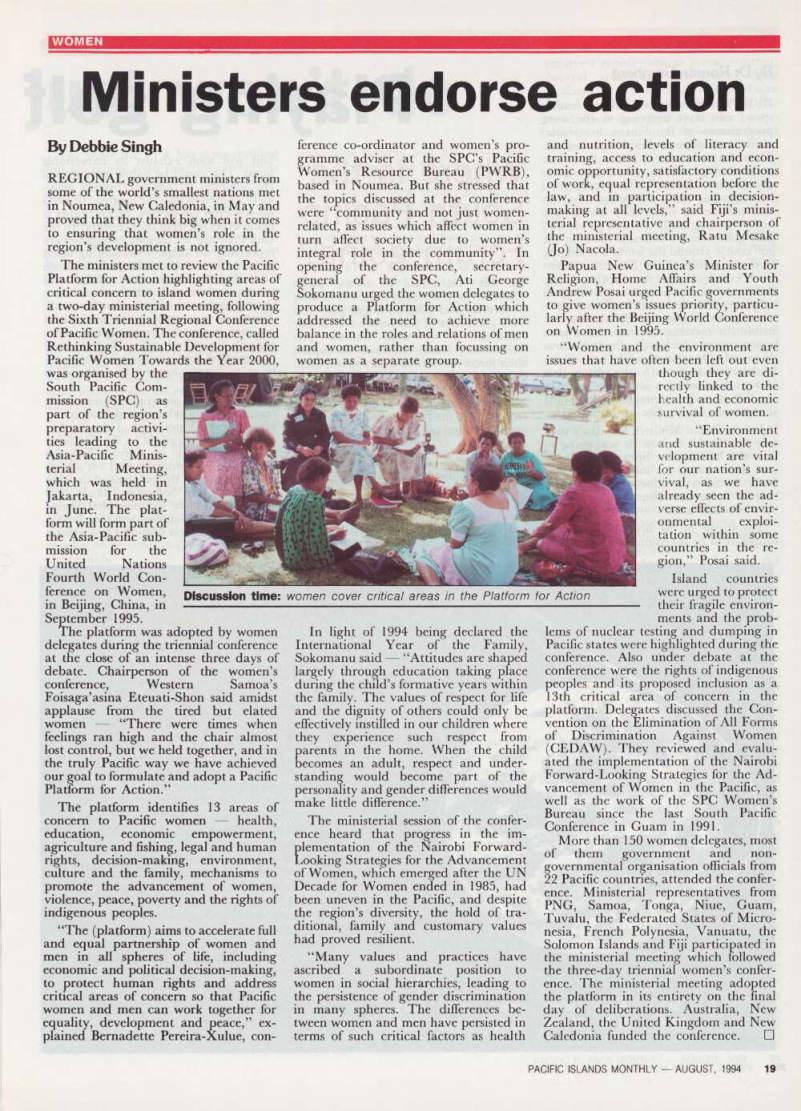
Discussion time: women cover critical areas in the Platform for Action
Playing golf
OPINION - South Pacific Forum
Where is the South Pacific Forum going?
By Dr Roman Grynberg
EVERY year they meet. First our leaders spend two days agreeing to the work programmes of the Forum Secretariat and several other regional organisations.
Then they discuss the issues that their senior foreign affairs officials see fit to allow them to discuss. Then once total boredom has set in our prime ministers and presidents, when they could even bother coming to the Forum, go out and play golf. Much business is done on the golf course around the world but judging from the results of the Forum in recent years even golf does not appear to help
their ability to produce anything of
substance. At the end of it all they have to say something so the officials who met before the meeting will iron out a joint communique which will reflect what was discussed. Once in a while one of the leaders, just to prove to the editors that it is worth sending a journalist to cover the Forum, will say something untoward that sounds faintly like an initiative.
It was Prime Minister Rabuka’s turn last year to tell us how he was going to
join the Melanesian Spearhead Group
and then change his mind once he got back to Suva to discover that Fiji’s largely Polynesian elite didn’t care for that idea one iota.
The theme of the Brisbane Forum is supposed to be managing our resources.
By this Australians of course mean resources in its broadest sense but looking at forestry and fisheries might give us a very good idea of just how we treat our resources if we were honest. The Melanesian states continue to exploit their forest resource in a way that is often described as rape. Rape of course assumes that the victim was unwilling but in this case it is by no means evident that some of the region’s political leaders
are not voluntarily assisting the logging
companies.
It is also equally fair to say that the region’s political leaders are not the
victims of forestry practice they are
themselves frequently the perpetrators of some of the worst abuses. Solomon Islands is exporting timber at some three times their maximum sustainable yield
and will soon exhaust its harvestable forest. This could be halted tomorrow if the Solomon Islands government genu inely wanted to stop the logging. In PNG no-one even knows how much timber is being exported from that country. In the Gulf Province the logging companies are reportedly no longer even seeking forest permits but are clear felling whole stands of forest for what they claim will subsequently be oil palm estates “once they generate enough cash flow ...”.
Timber is reportedly being stolen and not even reported. The corruption in the region’s forest industry is known, well documented and yet governments con tinue to permit logging to continue in this manner.
We have only one common renewable resource in abundance and that is our tuna. Some 55 per cent of the world’s canning tuna is caught in the Exclusive Economic Zones of Forum Fisheries Agency (FFA) countries and yet almost all of it is caught by and canned in other countries. Only Solomon Islands, Fiji and Kiribati have anything that begins to look like a fishing fleet and tuna is only canned in Solomon Islands, Fiji and soon
Png.
For years the FFA has done nothing but attempt to write fisheries agreements that would but help other nationals get our fish. Their work programme, which is set by their member countries, had virtually no orientation and certainly no mandate to develop the fisheries in the region. Fortunately there now appears to be some political will to actually develop the region’s tuna fisheries and the FFA will one day evolve into an organisation that will help Pacific Islanders develop their fisheries capacity.
Almost immediately after the Forum Secretariat’s Secretary-General leremia Tabai and Father Walter Lini let the Soviet tuna boats fish in our waters the Americans began to negotiate the US FFA multilateral treaty. Since its signing
in 1989 we have been receiving nine per cent of the value of the US purse seiner catch in the Pacific.
However, we have bilateral treaties with the Taiwan ese, Koreans and Japanese.
Under these treaties, we receive five per cent or less of what these countries say
they catch.
The Japanese pay 11 per cent of the value of their catch to Australia in tuna fishing grounds that are far worse than ours. As a result of the fact that the Forum nations refuse to try to impose a multilateral treaty on the Asian Distant
Water Fishing Nations and continue with the present bilateral ap-
proach whereby each country negotiates
with the much more powerful fishing nation we are losings millions in access fees each year. I once asked out-going director of the FFA Sir Peter Kenilorea why we tolerated such a miserably low rate of return from the Asians when we had shown such political resolve in the face of much more powerful American pressure.
Sir Peter trotted out the standard reply that we are unwilling to challenge the region’s major aid donors. While this made some sense in explaining Forum behaviour towards Japan the explanation makes no sense with regard to Taiwan and South Korea which are not
major donors. If they co-operated FFA
countries could threaten to throw the Taiwanese and Koreans out of the Pacific and ban their pole and line fleets until such time as they begin to pay
reasonable returns and get what they want. At present the FFA is negotiating a multilateral treaty with Taiwan but this is only for purse seiners but not for pole and line vessels and longliners.
Have we lost our resolve in dealing with the distant water fishing nations or is there another explanation?
The FFA, like all South Pacific organisations, works on consensus; you cannot even begin to work towards developing a multilateral fisheries access agreement unless everyone wants it so if one minister in one country is corrupt, and there may be more than one, then they will get up at FFA meetings and tell the staff that his country does not want multilateral agreements because it would interfere with the internal affairs of
members states and that would end it.
While it is not possible to prove conclus ively that corruption is an explanation of why the Forum countries refuse to push for a multilateral fisheries access agree ment with the Asian countries it is at least as good an explanation as aid depen dence.
Our forests are being destroyed, we are being cheated our fisheries resources. So what should our leaders do? Sign a declaration of course. At the Nauru Forum last year PNG brought a declar ation on the Co-operation in the Natural Resources. Basically the idea is that Forum countries would co-operate to halt the rapacious behaviour of their
resource developers.
It is time for our leaders to actually lead and not produce vacuous press statements and meaningless declarations that will be forgotten until the next Forum meeting. It is time to once again
resurrect regionalism as a real concept.
Several years ago the former New Zealand Prime Minister Mike Moore suggested the idea of a Pacific parlia ment. Such an organisation which over sees the many regional organisations and assures that they do not become vehicles of one or other aid donor would be a way to develop a sense of one political region.
It could also be a forum for discussion on how we can develop our potential as a
region.
The South Pacific is not taken seriously on the world stage. We remain
objects to be manipulated by much
larger powers. That is because we are individually small but as a region stretching from Apia to Port Moresby we would cover a substantial portion of the earth. We have accepted the political realities that our colonial masters created and have accepted smallness as an excuse for our poverty. Our officials trot it out just before they beg for more aid funds.
This is a poor excuse for poverty because
we are small only because our leaders have a vested interest in maintaining a political structure based on small nations that can never be viable. As a region we are neither small nor should we really be poor. It is only the region’s leaders who choose to leave us poor and small.
At the moment the whole world is breaking up
into regional groupings for
trade and political pur poses and yet we sit here
becoming more
marginalised all the time and our leaders fail to
respond to the changing
realities of the end of this
-- century. , Over 20 years ago the island states made a commitment to develop a regional trade group under the original SPEC agreement which established the precursor to the forum. V\ ith the exception of the Melanesian Spearhead Trade Agreement we have not moved at all m that direction. It is time t at we seriously moved towards esta is mg a trade area * n the legion an ocusing
bave\r o ur dts osal"
P It is time that we started using our resources because time is running out for the region. Aid is s owing own, lations are expanding rapidly and the opportunities for employment are m creasing y limited. If we do not focus upon what will give emp oyment an growth to the region an mat tic necessary adjustments then our c i dren have a bleak future to 100 orwar to.
I laying goll will not do.
Last year’s Forum: Fiji’s Rabuka and Australian Prime Minister Paul Keating
Advertisements & other items, pp. 20-22 (1 item)
Suva
313166
Nadi Lautoka Labasa Levuka
723 800 665 400 811162 440139
Savu Savu
850 454 DHL can take care of all your shipping requirements from the lightest of documents to the heaviest of freight.
We have the world's largest distribution network with over 1600 service centres in almost 220 countries and operate throughout Fiji and the Pacific Islands.
Our Express door to door delivery service to the world's major markets at all inclusive competitive prices will give you greater speed and reliability. Our track and trace technology means you have control of your shipment every step of the way.
Call us now and see your freight problems disappear into thin air.
DHLO22.TCP
mm-x-' A orriDen cm if r \ m n m ■*"— r~ • s %m>» ; / j y * \ . ...• •ii : f -/-••■■ W7M vs* tiiHHIiB r r i»Mi*n\
We do more business
in the Pacific
than anyone else.
Westpac has been serving the banking
needs of visitors to Fiji and the Pacific Islands since 1901. We’re specialists in foreign
currency exchange, offering our
customers the most competitive
Ilf
exchange rates available, speedy service and convenient locations.
And with Westpac, you do not pay a fee when you exchange foreign currency or travellers cheques with us!
You can bank on Westpac
TRAVEL FINANCE
Fiji Branches: Ba, Labasa, Lautoka, Levuka, Nabua, Nadi, Nausori, Rakiraki, Savusavu, Sigatoka, Suva, Tavua.
Bureau de Change:* Central Agency Nadi * Namaka Agency (near Nadi Airport).
PACIFIC ISLANDS: COOK ISLANDS • FRENCH POLYNESIA • KIRIBATI • NEW CALEDONIA • NIUE • SOLOMON ISLANDS • TONGA • TUVALU • VANUATU • WESTERN SAMOA
A lasting gift from Japan
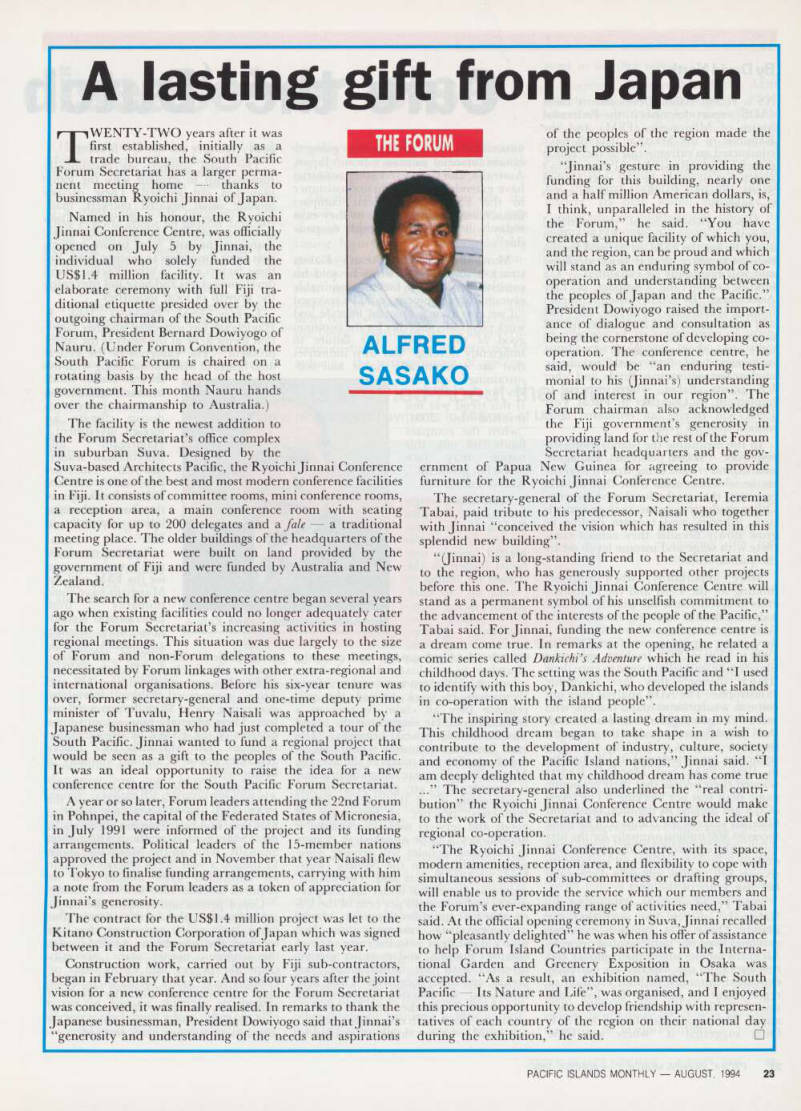
TWENTY-TWO years after it was first established, initially as a trade bureau, the South Pacific Forum Secretariat has a larger perma nent meeting home thanks to
businessman Ryoichi Jinnai ofjapan.
Named in his honour, the Ryoichi Jinnai Conference Centre, was officially opened on July 5 by Jinnai, the individual who solely funded the US$l.4 million facility. It was an elaborate ceremony with full Fiji tra
ditional etiquette presided over by the
outgoing chairman of the South Pacific Forum, President Bernard Dowiyogo of Nauru. (Under Forum Convention, the South Pacific Forum is chaired on a rotating basis by the head of the host government. This month Nauru hands over the chairmanship to Australia.) The facility is the newest addition to the Forum Secretariat’s office complex in suburban Suva. Designed by the
Suva-based Architects Pacific, the Ryoichi Jinnai Conference Centre is one of the best and most modern conference facilities in Fiji. It consists of committee rooms, mini conference rooms, a reception area, a main conference room with seating capacity for up to 200 delegates and a fale a traditional meeting place. The older buildings of the headquarters of the Forum Secretariat were built on land provided by the government of Fiji and were funded by Australia and New Zealand.
The search for a new conference centre began several years ago when existing facilities could no longer adequately cater for the Forum Secretariat’s increasing activities in hosting regional meetings. This situation was due largely to the size of Forum and non-Forum delegations to these meetings, necessitated by Forum linkages with other extra-regional and international organisations. Before his six-year tenure was over, former secretary-general and one-time deputy prime minister of Tuvalu, Henry Naisali was approached by a Japanese businessman who had just completed a tour of the South Pacific. Jinnai wanted to fund a regional project that would be seen as a gift to the peoples of the South Pacific.
It was an ideal opportunity to raise the idea for a new conference centre for the South Pacific Forum Secretariat.
A year or so later, Forum leaders attending the 22nd Forum in Pohnpei, the capital of the Federated States of Micronesia, in July 1991 were informed of the project and its funding arrangements. Political leaders of the 15-member nations approved the project and in November that year Naisali flew to Tokyo to finalise funding arrangements, carrying with him a note from the Forum leaders as a token of appreciation for
Jinnai’s generosity.
The contract for the US$l.4 million project was let to the Kitano Construction Corporation ofjapan which was signed between it and the Forum Secretariat early last year.
Construction work, carried out by Fiji sub-contractors, began in February that year. And so four years after the joint vision for a new conference centre for the Forum Secretariat was conceived, it was finally realised. In remarks to thank the Japanese businessman, President Dowiyogo said that Jinnai’s “generosity and understanding of the needs and aspirations
of the peoples of the region made the
project possible”.
“Jinnai’s gesture in providing the
funding for this building, nearly one
and a half million American dollars, is, I think, unparalleled in the history of the Forum,” he said. “You have created a unique facility of which you, and the region, can be proud and which will stand as an enduring symbol of co
operation and understanding between
the peoples of Japan and the Pacific.”
President Dowiyogo raised the import ance of dialogue and consultation as being the cornerstone of developing co operation. The conference centre, he said, would be “an enduring testi monial to his (Jinnai’s) understanding of and interest in our region”. The Forum chairman also acknowledged
the Fiji government’s generosity in
providing land for the rest of the Forum Secretariat headquarters and the gov
ernment of Papua New Guinea for agreeing to provide furniture for the Ryoichi Jinnai Conference Centre.
The secretary-general of the Forum Secretariat, leremia Tabai, paid tribute to his predecessor, Naisali who together with Jinnai “conceived the vision which has resulted in this
splendid new building”.
“(Jinnai) is a long-standing friend to the Secretariat and to the region, who has generously supported other projects before this one. The Ryoichi Jinnai Conference Centre will stand as a permanent symbol of his unselfish commitment to the advancement of the interests of the people of the Pacific,”
Tabai said. For Jinnai, funding the new conference centre is a dream come true. In remarks at the opening, he related a comic series called Dankichi’s Adventure which he read in his childhood days. The setting was the South Pacific and “I used to identify with this boy, Dankichi, who developed the islands in co-operation with the island people”.
“The inspiring story created a lasting dream in my mind.
This childhood dream began to take shape in a wish to contribute to the development of industry, culture, society and economy of the Pacific Island nations,” Jinnai said. “I am deeply delighted that my childhood dream has come true ...” The secretary-general also underlined the “real contri bution” the Ryoichi Jinnai Conference Centre would make to the work of the Secretariat and to advancing the ideal of
regional co-operation.
“The Ryoichi Jinnai Conference Centre, with its space, modern amenities, reception area, and flexibility to cope with simultaneous sessions of sub-committees or drafting groups, will enable us to provide the service which our members and the Forum’s ever-expanding range of activities need,” Tabai said. At the official opening ceremony in Suva, Jinnai recalled how “pleasantly delighted” he was when his offer of assistance to help Forum Island Countries participate in the Interna tional Garden and Greenery Exposition in Osaka was accepted. “As a result, an exhibition named, “The South Pacific Its Nature and Life”, was organised, and I enjoyed this precious opportunity to develop friendship with represen tatives of each country of the region on their national day during the exhibition,” he said. □
The Forum
Alfred
Sasako
Cure the ‘Dutch
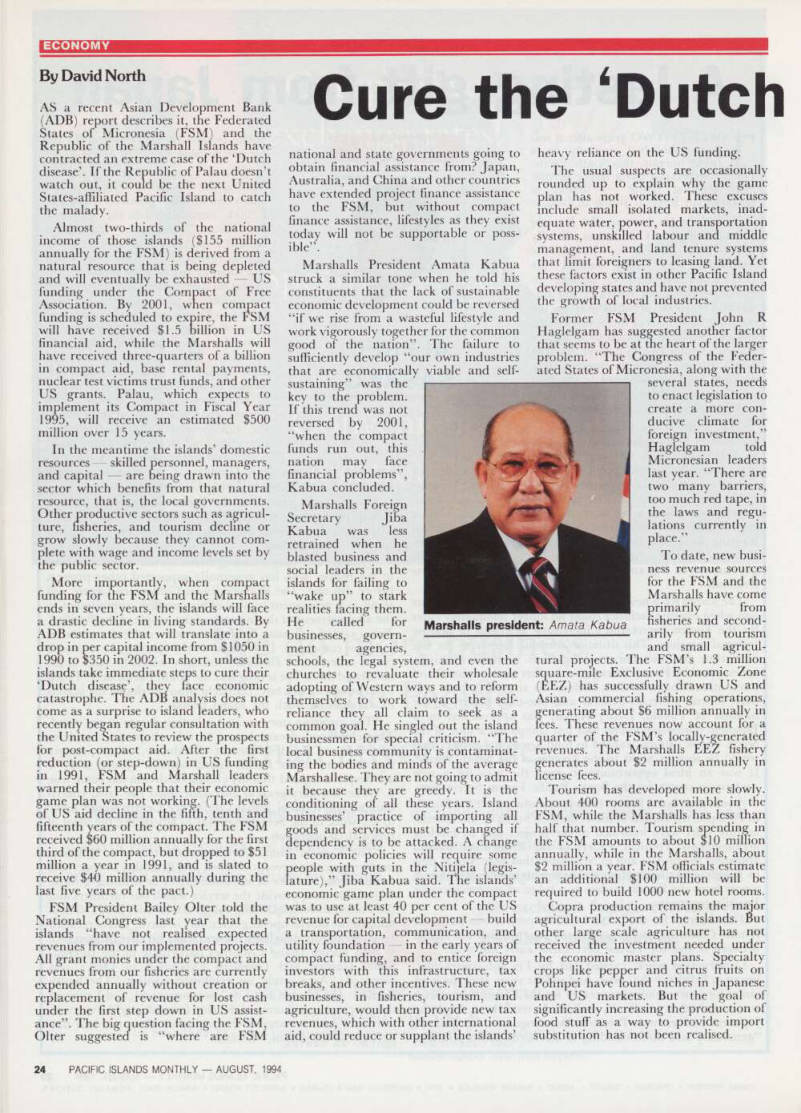
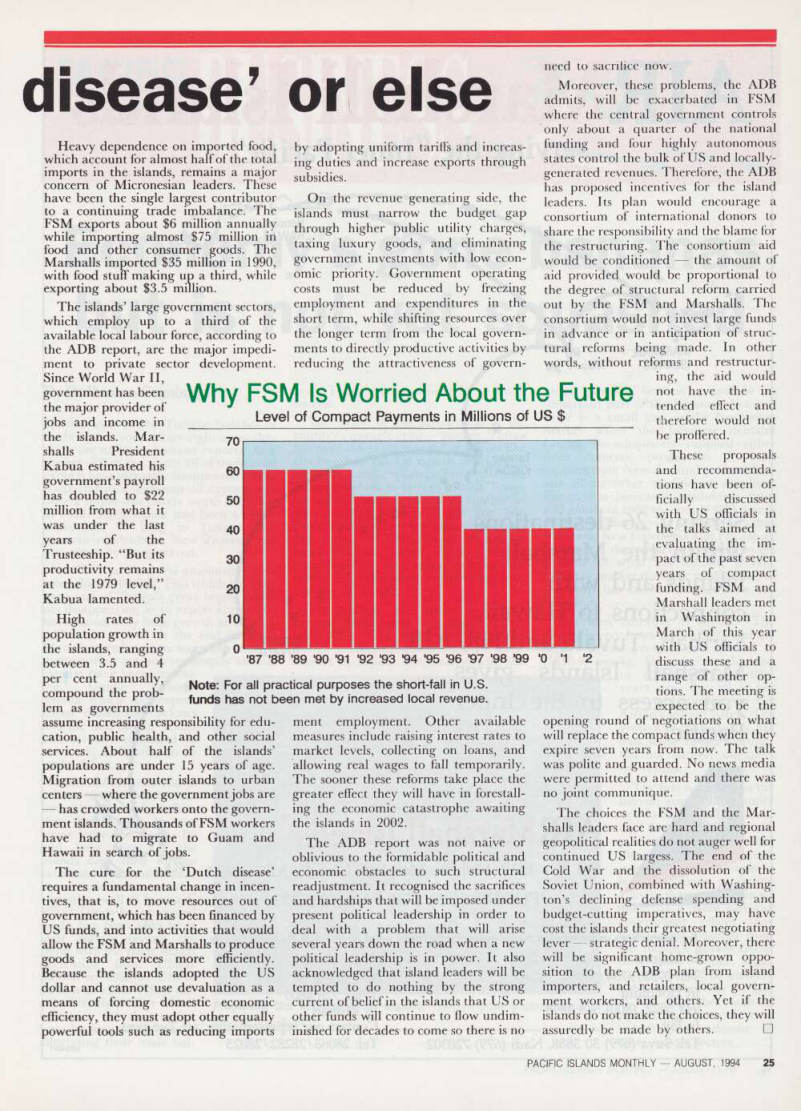
Economy
By David North
AS a recent Asian Development Bank (ADB) report describes it, the Federated States of Micronesia (FSM) and the Republic of the Marshall Islands have contracted an extreme case of the ‘Dutch disease’. If the Republic of Palau doesn’t watch out, it could be the next United States-affiliated Pacific Island to catch
the malady.
Almost two-thirds of the national income of those islands ($155 million annually for the FSM) is derived from a natural resource that is being depleted and will eventually be exhausted US funding under the Compact of Free Association. By 2001, when compact funding is scheduled to expire, the FSM will have received $1.5 billion in US financial aid, while the Marshalls will have received three-quarters of a billion in compact aid, base rental payments, nuclear test victims trust funds, and other US grants. Palau, which expects to implement its Compact in Fiscal Year 1995, will receive an estimated $5OO million over 15 years.
In the meantime the islands’ domestic resources skilled personnel, managers, and capital are being drawn into the sector which benefits from that natural resource, that is, the local governments.
Other productive sectors such as agricul ture, fisheries, and tourism decline or grow slowly because they cannot com plete with wage and income levels set by the public sector.
More importantly, when compact funding for the FSM and the Marshalls ends in seven years, the islands will face a drastic decline in living standards. By ADB estimates that will translate into a drop in per capital income from $lO5O in 1990 to $350 in 2002. In short, unless the islands take immediate steps to cure their ‘Dutch disease’, they face economic catastrophe. The ADB analysis does not come as a surprise to island leaders, who
recently began regular consultation with
the United States to review the prospects for post-compact aid. After the first
reduction (or step-down) in US funding
in 1991, FSM and Marshall leaders warned their people that their economic game plan was not working. (The levels of US aid decline in the fifth, tenth and fifteenth years of the compact. The FSM received $6O million annually for the first third of the compact, but dropped to $5l million a year in 1991, and is slated to receive $4O million annually during the last five years of the pact.) FSM President Bailey Offer told the National Congress last year that the islands “have not realised expected revenues from our implemented projects.
All grant monies under the compact and revenues from our fisheries are currently expended annually without creation or replacement of revenue for lost cash under the first step down in US assist ance”. The big question facing the FSM, Offer suggested is “where are FSM
national and state governments going to obtain financial assistance from? Japan, Australia, and China and other countries have extended project finance assistance to the FSM, but without compact finance assistance, lifestyles as they exist today will not be supportable or poss ible”.
Marshalls President Amata Kabua struck a similar tone when he told his constituents that the lack of sustainable economic development could be reversed “if we rise from a wasteful lifestyle and work vigorously together for the common good of the nation”. The failure to sufficiently develop “our own industries that are economically viable and self
sustaining” was the
key to the problem.
If this trend was not reversed by 2001, “when the compact funds run out, this nation may face
financial problems”,
Kabua concluded.
Marshalls Foreign
Secretary Jiba
Kabua was less retrained when he blasted business and social leaders in the islands for failing to “wake up” to stark realities facing them.
He called for businesses, govern ment agencies,
schools, the legal system, and even the churches to revaluate their wholesale adopting of Western ways and to reform themselves to work toward the self reliance they all claim to seek as a common goal. He singled out the island businessmen for special criticism. “The local business community is contaminat ing the bodies and minds of the average Marshallese. They are not going to admit it because they are greedy. It is the conditioning of all these years. Island businesses’ practice of importing all goods and services must be changed if dependency is to be attacked. A change in economic policies will require some people with guts in the Nitijela (legis lature),” Jiba Kabua said. The islands’ economic game plan under the compact was to use at least 40 per cent of the US revenue for capital development build a transportation, communication, and utility foundation in the early years of compact funding, and to entice foreign investors with this infrastructure, tax breaks, and other incentives. These new businesses, in fisheries, tourism, and agriculture, would then provide new tax revenues, which with other international aid, could reduce or supplant the islands’
heavy reliance on the US funding.
The usual suspects are occasionally rounded up to explain why the game plan has not worked. These excuses include small isolated markets, inad equate water, power, and transportation systems, unskilled labour and middle management, and land tenure systems that limit foreigners to leasing land. Yet these factors exist in other Pacific Island developing states and have not prevented the growth of local industries.
Former FSM President John R Haglelgam has suggested another factor that seems to be at the heart of the larger problem. “The Congress of the Feder ated States of Micronesia, along with the
several states, needs to enact legislation to create a more con ducive climate for
foreign investment,”
Haglelgam told
Micronesian leaders last year. “There are two many barriers, too much red tape, in the laws and regu lations currently in
place.”
To date, new busi ness revenue sources for the FSM and the Marshalls have come
primarily from
fisheries and second arily from tourism and small agricul
tural projects. The FSM’s 1.3 million square-mile Exclusive Economic Zone (EEZ) has successfully drawn US and
Asian commercial fishing operations,
generating about $6 million annually in fees. These revenues now account for a quarter of the FSM’s locally-generated revenues. The Marshalls EEZ fishery generates about $2 million annually in license fees.
Tourism has developed more slowly.
About 400 rooms are available in the FSM, while the Marshalls has less than half that number. Tourism spending in the FSM amounts to about $lO million annually, while in the Marshalls, about $2 million a year. FSM officials estimate an additional $lOO million will be required to build 1000 new hotel rooms.
Copra production remains the major
agricultural export of the islands. But other large scale agriculture has not received the investment needed under the economic master plans. Specialty crops like pepper and citrus fruits on Pohnpei have found niches in Japanese and US markets. But the goal of
significantly increasing the production of
food stuff as a way to provide import substitution has not been realised.
Marshalls president: Amata Kabua
Heavy dependence on imported food,
which account for almost half of the total imports in the islands, remains a major concern of Micronesian leaders. These have been the single largest contributor to a continuing trade imbalance. The FSM exports about $6 million annually while importing almost $75 million in food and other consumer goods. The Marshalls imported $35 million in 1990, with food stuff making up a third, while exporting about $3.5 million.
The islands’ large government sectors, which employ up to a third of the available local labour force, according to the ADB report, are the major impedi ment to private sector development.
Since World War 11, government has been
the major provider of
jobs and income in the islands. Mar shalls President Kabua estimated his
government’s payroll
has doubled to $22 million from what it was under the last years of the Trusteeship. “But its
productivity remains
at the 1979 level,”
Kabua lamented.
High rates of
population growth in
the islands, ranging between 3.5 and 4 per cent annually,
compound the prob
lem as governments
assume increasing responsibility for edu cation, public health, and other social services. About half of the islands’ populations are under 15 years of age.
Migration from outer islands to urban centers where the government jobs are has crowded workers onto the govern ment islands. Thousands of FSM workers have had to migrate to Guam and Hawaii in search of jobs.
The cure for the ‘Dutch disease’ requires a fundamental change in incen tives, that is, to move resources out of government, which has been financed by US funds, and into activities that would allow the FSM and Marshalls to produce goods and services more efficiently.
Because the islands adopted the US dollar and cannot use devaluation as a means of forcing domestic economic
efficiency, they must adopt other equally
powerful tools such as reducing imports
by adopting uniform tariffs and increas ing duties and increase exports through subsidies.
On the revenue generating side, the islands must narrow the budget gap through higher public utility charges, taxing luxury goods, and eliminating government investments with low econ omic priority. Government operating costs must be reduced by freezing employment and expenditures in the short term, while shifting resources over the longer term from the local govern ments to directly productive activities by reducing the attractiveness of govern-
Why FSM Is Worried About the Future Level of Compact Payments in Millions of US $
ment employment. Other available measures include raising interest rates to market levels, collecting on loans, and allowing real wages to fall temporarily.
The sooner these reforms take place the greater effect they will have in forestall
ing the economic catastrophe awaiting
the islands in 2002.
The ADB report was not naive or oblivious to the formidable political and economic obstacles to such structural readjustment. It recognised the sacrifices and hardships that will be imposed under present political leadership in order to deal with a problem that will arise several years down the road when a new political leadership is in power. It also acknowledged that island leaders will be tempted to do nothing by the strong current of belief in the islands that US or other funds will continue to flow undim inished for decades to come so there is no
need to sacrifice now.
Moreover, these problems, the ADB admits, will be exacerbated in FSM where the central government controls only about a quarter of the national funding and four highly autonomous states control the bulk of US and locally generated revenues. Therefore, the ADB has proposed incentives for the island leaders. Its plan would encourage a consortium of international donors to share the responsibility and the blame for the restructuring. The consortium aid would be conditioned the amount of aid provided would be proportional to the degree of structural reform carried out by the FSM and Marshalls. The consortium would not invest large funds in advance or in anticipation of struc tural reforms being made. In other words, without reforms and restructur
ing, the aid would not have the in tended effect and therefore would not
be proffered.
These proposals
and recommenda tions have been of ficially discussed with US officials in the talks aimed at evaluating the im pact of the past seven years of compact funding. FSM and Marshall leaders met in Washington in March of this year with US officials to discuss these and a range of other op tions. The meeting is expected to be the
opening round of negotiations on what will replace the compact funds when they expire seven years from now. The talk was polite and guarded. No news media were permitted to attend and there was
no joint communique.
The choices the FSM and the Mar shalls leaders face are hard and regional geopolitical realities do not auger well for continued US largess. The end of the Cold War and the dissolution of the Soviet Union, combined with Washing ton’s declining defense spending and
budget-cutting imperatives, may have
cost the islands their greatest negotiating lever-- strategic denial. Moreover, there will be significant home-grown oppo sition to the ADB plan from island importers, and retailers, local govern ment workers, and others. Yet if the islands do not make the choices, they will assuredly be made by others. □
Note: For all practical purposes the short-fall in U.S. funds has not been met by increased local revenue.
Advertisements & other items, p. 26 (1 item)
AlRMarshall Islands
serving the "Inner Pacific"
Honolulu \ V
HAWAII \jd
q Kwajalein
MARSHALL
ISLANDS
Majuro Tarawa
KIRIBATI
Q to 4 « Funafuti
TUVALU
f Nadi
FIJI
Serving 26 destinations
within the Marshall
Islands and with
connections to Hawaii,
Kiribati, Tuvalu and Fiji, AIR
Marshall Islands gives
you access to the Inner
Pacific.
AlRMarshall Islands
PO Box 1319, Majuro, Marshall Islands, MH 96980.
PHONE: (625) 3731 FAX (625) 3730
For reservations or informaton please contact your travel agent or call AIR Marshall Islands.
In Majuro Tel: 3733/3734/3735 In Honolulu 949 5522, (800) 543 3898 In Fiji Tel: Suva (679) 30 3888. Nadi (679) 720302 in Tuvalu Telex 726 4800 In Kiribati Contact our representative, air Tungaru Tel: 28083/28282/28025
Business
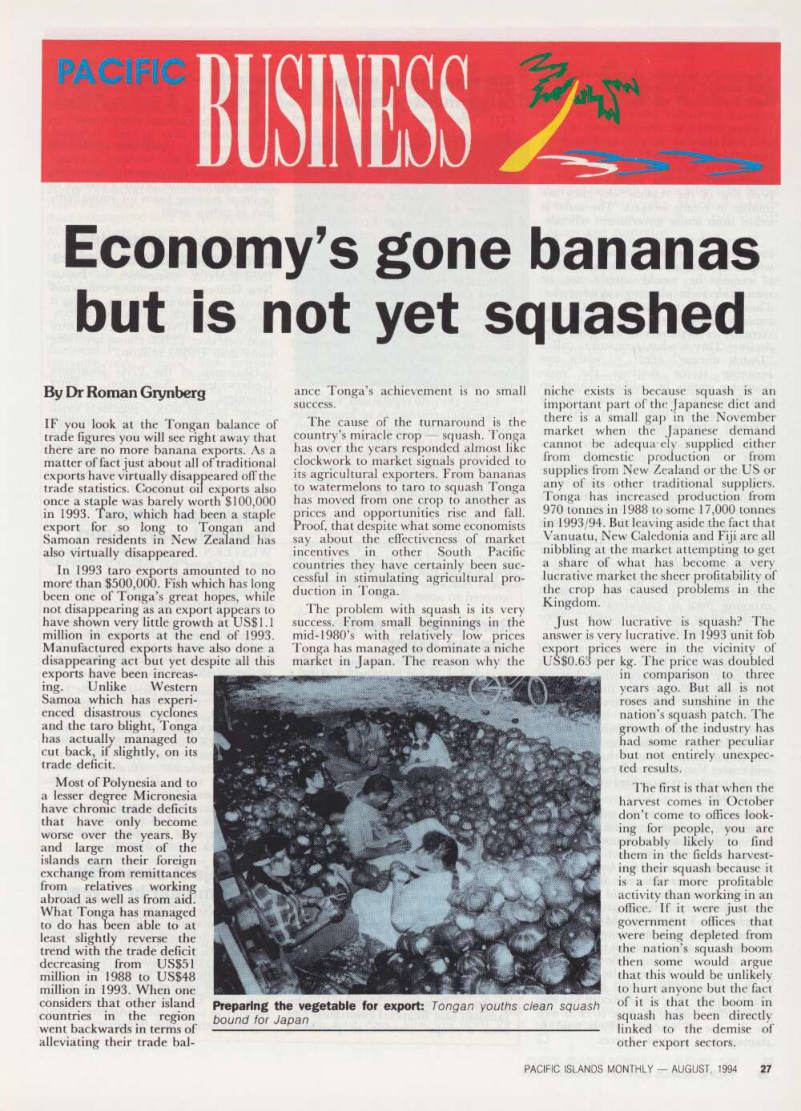
Pacific
Economy’s gone bananas but is not yet squashed
By Dr Roman Grynberg
IF you look at the Tongan balance of trade figures you will see right away that there are no more banana exports. As a matter of fact just about all of traditional exports have virtually disappeared off the trade statistics. Coconut oil exports also once a staple was barely worth $lOO,OOO in 1993. Taro, which had been a staple export for so long to Tongan and Samoan residents in New Zealand has
also virtually disappeared.
In 1993 taro exports amounted to no more than $500,000. Fish which has long been one of Tonga’s great hopes, while not disappearing as an export appears to have shown very little growth at US$l.l million in exports at the end of 1993.
Manufactured exports have also done a disappearing act but yet despite all this
exports have been increas ing. Unlike Western Samoa which has experi enced disastrous cyclones and the taro blight, Tonga
has actually managed to
cut back, if slightly, on its trade deficit.
Most of Polynesia and to a lesser degree Micronesia have chronic trade deficits that have only become worse over the years. By and large most of the islands earn their foreign exchange from remittances from relatives working abroad as well as from aid.
What Tonga has managed
to do has been able to at least slightly reverse the trend with the trade deficit decreasing from US$5l million in 1988 to US$4B million in 1993. When one considers that other island countries in the region went backwards in terms of alleviating their trade bal
ance Tonga’s achievement is no small success.
The cause of the turnaround is the
country’s miracle crop squash. Tonga
has over the years responded almost like clockwork to market signals provided to its agricultural exporters. From bananas to watermelons to taro to squash Tonga has moved from one crop to another as prices and opportunities rise and fall.
Proof, that despite what some economists say about the effectiveness of market incentives in other South Pacific countries they have certainly been suc cessful in stimulating agricultural pro duction in Tonga.
The problem with squash is its very success. From small beginnings in the mid-1980’s with relatively low prices Tonga has managed to dominate a niche market in Japan. The reason why the
niche exists is because squash is an important part of the Japanese diet and thei T j s a small gap in the November market J vhe " ) the Japanese demand
cannot be adequa ely supplied either
from domestic production or from supplies from New Zealand or the US or any of its other traditional suppliers, Tonga has increased production from 970 tonnes m 1988 to some 17,000 tonnes m 1993/94. But leaving aside the fact that anuatu, New Caledonia and Fiji are all nibbling at the market attempting to get a share of what has become a very lucrative market the sheer profitability of the crop has caused problems in the Kingdom F ° Just how lucrative is squash? The answer is very lucrative. In 1993 unit fob export prices were in the vicinity of US$O.63 per kg. The price was doubled
in comparison to three years ago. But all is not roses and sunshine in the
nation’s squash patch. The
growth of the industry has had some rather peculiar but not entirely unexpec ted results.
The first is that when the harvest comes in October don’t come to offices look ing for people, you are
probably likely to find
them in the fields harvest ing their squash because it is a far more profitable activity than working in an office. If it were just the government offices that
were being depleted from
the nation’s squash boom then some would argue that this would be unlikely to hurt anyone but the fact of it is that the boom in
squash has been directly
linked to the demise of other export sectors.
Preparing the vegetable for export: Tongan youths clean squash bound for Japan
Generally speaking those working in
industry and in other export sectors are those individuals who are most likely to respond to market incentives. So when you can earn a lot more working in your own field than working in someone else’s factory, bye-bye factory. Some manufac turers in the Small Industry Centre have complained that the squash boom has been one of the reasons why they are unable to retain workers. The same is heard from senior government officials.
There is however another effect. Be cause the average small farmer is making what is by Tongan standards a great deal of money he would simply not be reasonable to be planting anything else.
That is one of the reasons why the taro exports along with watermelons and virtually everything else has gone into decline. This is what economists call a “Dutch disease” effect when one booming sector destroys the non
booming sectors by pushing wages up
and diverting resources to the booming sector. Squash, like oil in PNG, is effecting other sectors.
The squash boom has another serious effect it makes the export sector dependent upon one crop. In 1988 there was not one particular product that dominated Tonga’s exports but the
country is becoming perilously depen
dent upon one crop for its export earnings. In 1992 when squash pro duction got out of control and peaked at 18,452 tonnes squash constituted 60 per cent of the country’s exports. In 1993 this returned to 50 per cent but Tonga is exposing itself to considerable risk by putting all its eggs in one basket they may get squashed.
The first problem with this strategy of course is that the niche market may just disappear. Niche markets, when they are
extremely profitable like the Japanese
squash market, always attract new en trants and while Tonga has for the moment been able to maintain its control of the Japanese market the high prices will almost certainly mean that new firms will enter. Vanuatu and New Caledonia are the producers most likely to upset the
apple cart.
This however is not the only problem.
There are also biological risks. Squash is susceptible to disease and much like what happened to the Samoan taro crop, squash could be wiped out by disease. In order to combat disease farmers use pesticides and these could eventually harm the very delicate ground water supply on Tongatapu. Moreover, as farmers apply more and more fertiliser to attempt to maintain output on land that they are not leaving fallow for long enough periods. There is also the danger that fertiliser residues will get into the water supply. The squash boom has also meant the clearing of more trees as well as the use of tractors which tend to damage root systems of trees. □
Fiji trade man warns
of garment jobs loss
FIJI Trade and Investment Board chairman Jim Ah Koy says the bulk of the country’s 11,000 garment factory workers could lose their jobs because of new Australian customs regulations introduced on April 1. Fiji’s garment manufacturers export to Australia un der the SPARTECA (South Pacific Regional Trade and Economic Co
operation Agreement) trade agree
ment.
Under the agreement, goods manu factured in Fiji as well as other Forum Island Countries that contain over 50 per cent “local content”, including material and labour, qualify for prefer ential and tax-free import into Austra lia. Materials from “preferred countries” such as Australia, New Zealand and other Forum island na tions also qualify as “local content”.
Under the new regulations, however, Fiji’s manufacturers can no longer trust
their “preferred country” suppliers.
Manufacturers who export to Australia must now be sure their imported raw materials, which previously qualified as “local content”, comes fiom a qualify ing country. Ah Koy said the onus was on Fiji manufacturing exporters to prove content... they have to make sure the content of every raw material is 100 per cent from where the suppliers say it is from. He said he was amazed that Fiji was fighting the battle alone while the South Pacific Forum had not at tempted to assist in the situation.
Rarotonga to revive
banana export
THE Rarotonga Banana Growers As sociation in Cook Islands is making a comeback for the export market by starting a programme to plant more than 2000 banana shoots over the next four months. Association president Tupe Short says there are two varieties of bananas that are being planted for export to New Zealand. They are the Australian and Ecuador breeds.
Short says the two breeds do not ripen as quickly as the local variety.
Therefore, they can be shipped to New Zealand and arrive there still green. He said the value for green bananas on arrival at the market was much higher than if they arrived ripe. The market price for a carton of bananas in New Zealand ranges from $l4 to $l7.
Minister wants aid
for home buyers
A PAPUA New Guinea government minister wants to establish a financial institution to support future home buyers. Housing Minister John Jaminan said financial constraints had been a major obstacle to providing
housing for workers in both rural and urban areas.
Jaminan told a seminar on the role of housing in national development in Port Moresby that a stable financial institution or a bank was needed to serve the nation’s housing develop ment. He said the proposed institution could help mobilise people’s savings to facilitate housing loans for young fam ilies in urban areas.
Insurance companies
concerned about claims
INSURANCE companies in Papua
New Guinea are becoming concerned about high insurance claims, saving it was costing them millions of dollars.
Last year, the PNG insurance industry paid well over 12,000 claims involving more than US$l2 million.
Chairman of the PNG Insurance Underwriters Association, Peter Greenless, said PNG had a fairly unique market with a relatively small number of risks which have a very high value. But the national NBC radio said the insurance companies could expect some relief if proposed reforms by the government to the Insurance Act are
approved by parliament.
Polynesian Airlines
insolvent, says report
WESTERN Samoa’s auditor-general Sua Ah Chong has tabled a report in parliament saying the country’s carrier, Polynesian Airlines, is insolvent and cannot repay its debts.
His 94-page report has prompted Prime Minister Tofilau Eti Alesana to call a commission of inquiry into its contents which also include allegations of wrong doing by politicians.
Eti Alesana told parliament he had
appointed Chief Justice Tiavaasue
Falefatu Sapolu to head the com mission. Opposition leader Tupua Tamasse Eli said the auditor’s report clearly demonstrated that there was a critical economic situation which would get worse. He’s called on the head of state, Malietqa Tanumafili 11, to use his constitutional powers to nominate a panel of commissioners to investigate what was going on and to report back to him directly.
Oil project earns PNG
$350 million in 2 years
PAPUA New Guinea has achieved another economic milestone with the
government-owned Kutubu oil project
earning well over US$35O million in the past two years. National NBC radio says during the same period the Kutubu oil project also brought PNG well over US$lOO million worth of benefits in wages, infrastructure, train ing and community benefits. □
Advertisements & other items, p. 28 (1 item)
Business
Beer brewers join forces
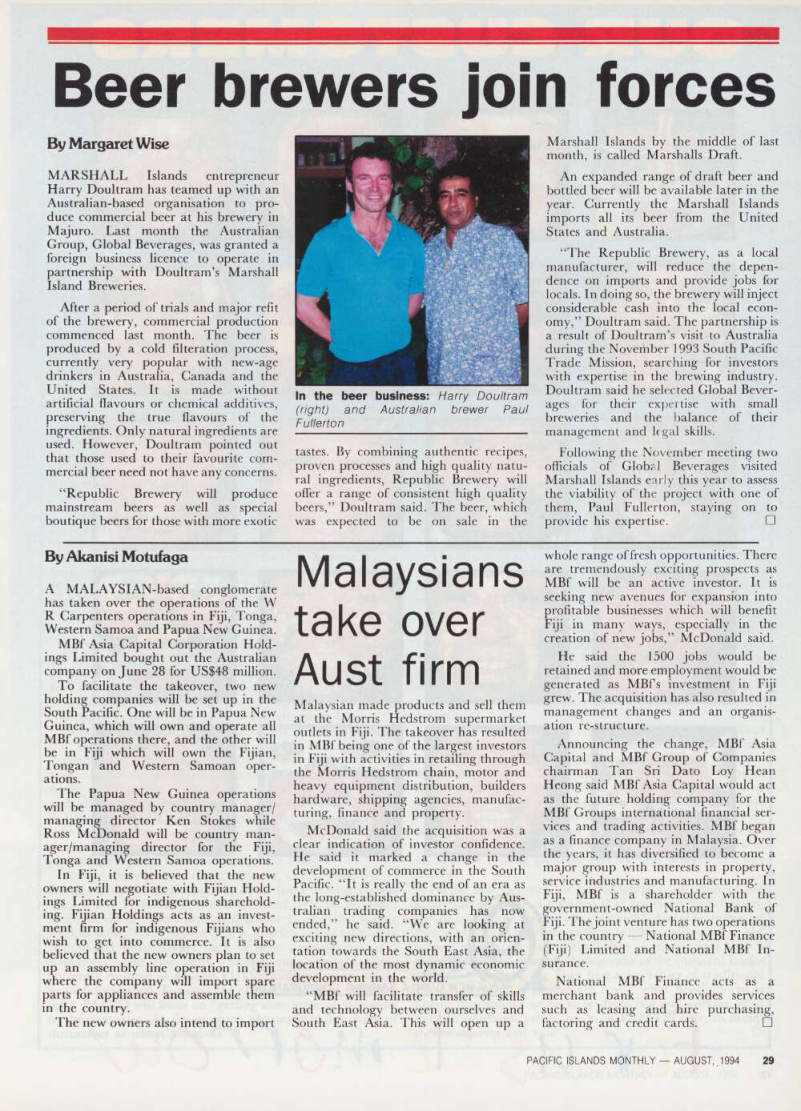
By Margaret Wise
MARSHALL Islands entrepreneur Harry Doultram has teamed up with an Australian-based organisation to pro duce commercial beer at his brewery in Majuro. Last month the Australian
Group, Global Beverages, was granted a
foreign business licence to operate in partnership with Doultram’s Marshall Island Breweries.
After a period of trials and major refit of the brewery, commercial production commenced last month. The beer is produced by a cold filteration process, currently very popular with new-age drinkers in Australia, Canada and the United States. It is made without artificial flavours or chemical additives, preserving the true flavours of the
ingredients. Only natural ingredients are
used. However, Doultram pointed out that those used to their favourite com mercial beer need not have any concerns.
“Republic Brewery will produce
mainstream beers as well as special boutique beers for those with more exotic
tastes. By combining authentic recipes, proven processes and high quality natu ral ingredients, Republic Brewery will offer a range of consistent high quality beers,” Doultram said. The beer, which was expected to be on sale in the
Marshall Islands by the middle of last month, is called Marshalls Draft.
An expanded range of draft beer and bottled beer will be available later in the year. Currently the Marshall Islands imports all its beer from the United States and Australia.
“The Republic Brewery, as a local manufacturer, will reduce the depen dence on imports and provide jobs for locals. In doing so, the brewery will inject considerable cash into the local econ omy,” Doultram said. The partnership is a result of Doultram’s visit to Australia during the November 1993 South Pacific Trade Mission, searching for investors
with expertise in the brewing industry.
Doultram said he selected Global Bever ages for their expertise with small breweries and the balance of their management and legal skills.
Following the November meeting two officials of Global Beverages visited Marshall Islands early this year to assess the viability of the project with one of them, Paul Fullerton, staying on to
provide his expertise. □
In the beer business: Harry Doultram (right) and Australian brewer Paul Fullerton
Malaysians
take over Aust firm
By Akanisi Motufaga
A MALAYSIAN-based conglomerate has taken over the operations of the W
R Carpenters operations in Fiji, Tonga,
Western Samoa and Papua New Guinea.
MBf Asia Capital Corporation Hold ings Limited bought out the Australian company on June 28 for US$4B million.
To facilitate the takeover, two new holding companies will be set up in the South Pacific. One will be in Papua New Guinea, which will own and operate all MBf operations there, and the other will be in Fiji which will own the Fijian, Tongan and Western Samoan oper ations.
The Papua New Guinea operations
will be managed by country manager/
managing director Ken Stokes while Ross McDonald will be country man ager/managing director for the Fiji, Tonga and Western Samoa operations.
In Fiji, it is believed that the new owners will negotiate with Fijian Hold ings Limited for indigenous sharehold ing. Fijian Holdings acts as an invest ment firm for indigenous Fijians who wish to get into commerce. It is also believed that the new owners plan to set up an assembly line operation in Fiji where the company will import spare parts for appliances and assemble them in the country.
The new owners also intend to import
Malaysian made products and sell them at the Morris Hedstrom supermarket outlets in Fiji. The takeover has resulted in MBf being one of the largest investors in Fiji with activities in retailing through the Morris Hedstrom chain, motor and
heavy equipment distribution, builders
hardware, shipping agencies, manufac
turing, finance and property.
McDonald said the acquisition was a clear indication of investor confidence.
He said it marked a change in the development of commerce in the South Pacific. “It is really the end of an era as the long-established dominance by Aus tralian trading companies has now ended,” he said. “We are looking at exciting new directions, with an orien tation towards the South East Asia, the location of the most dynamic economic development in the world.
“MBf will facilitate transfer of skills and technology between ourselves and South East Asia. This will open up a
whole range of fresh opportunities. There are tremendously exciting prospects as MBf will be an active investor. It is seeking new avenues for expansion into profitable businesses which will benefit Fiji in many ways, especially in the creation of new jobs,” McDonald said.
He said the 1500 jobs would be retained and more employment would be generated as MBfs investment in Fiji grew. The acquisition has also resulted in management changes and an organis ation re-structure.
Announcing the change, MBf Asia
Capital and MBf Group of Companies
chairman Tan Sri Dato Toy Hean Heong said MBf Asia Capital would act as the future holding company for the MBf Groups international financial ser vices and trading activities. MBf began as a finance company in Malaysia. Over the years, it has diversified to become a major group with interests in property, service industries and manufacturing. In Fiji, MBf is a shareholder with the government-owned National Bank of Fiji. The joint venture has two operations in the country National MBf Finance (Fiji) Limited and National MBf In surance.
National MBf Finance acts as a merchant bank and provides services such as leasing and hire purchasing, factoring and credit cards. □
Advertisements & other items, p. 30 (1 item)
tli At'"P/\
«" ’ r H-fr F HE >v ' ' , '■’* Tm T ♦ "V ■> -in* * i m & % WL Jw s' V <j>apua new guinea banking corporation p , -T U ■«* «■"
» v ; vJ • ' C-'
Love thy labourer
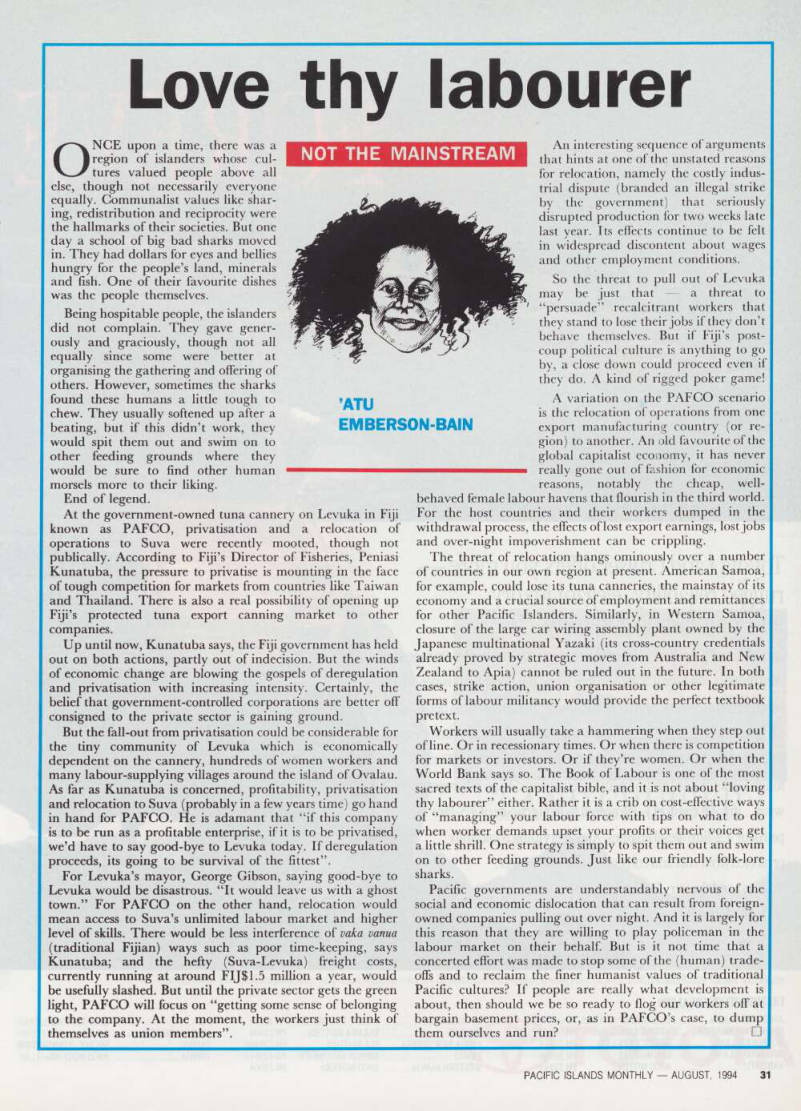
ONCE upon a time, there was a region of islanders whose cul tures valued people above all
else, though not necessarily everyone
equally. Communalist values like shar ing, redistribution and reciprocity were the hallmarks of their societies. But one day a school of big bad sharks moved in. They had dollars for eyes and bellies hungry for the people’s land, minerals and fish. One of their favourite dishes was the people themselves.
Being hospitable people, the islanders
did not complain. They gave gener
ously and graciously, though not all
equally since some were better at
organising the gathering and offering of
others. However, sometimes the sharks found these humans a little tough to chew. They usually softened up after a beating, but if this didn’t work, they would spit them out and swim on to
other feeding grounds where they
would be sure to find other human morsels more to their liking.
End of legend.
At the government-owned tuna cannery on Levuka in Fiji known as PAFCO, privatisation and a relocation of operations to Suva were recently mooted, though not publically. According to Fiji’s Director of Fisheries, Peniasi Kunatuba, the pressure to privatise is mounting in the face of tough competition for markets from countries like Taiwan and Thailand. There is also a real possibility of opening up Fiji’s protected tuna export canning market to other
companies.
Up until now, Kunatuba says, the Fiji government has held out on both actions, partly out of indecision. But the winds of economic change are blowing the gospels of deregulation and privatisation with increasing intensity. Certainly, the belief that government-controlled corporations are better off consigned to the private sector is gaining ground.
But the fall-out from privatisation could be considerable for the tiny community of Levuka which is economically dependent on the cannery, hundreds of women workers and many labour-supplying villages around the island of Ovalau.
As far as Kunatuba is concerned, profitability, privatisation and relocation to Suva (probably in a few years time) go hand in hand for PAFCO. He is adamant that “if this company is to be run as a profitable enterprise, if it is to be privatised, we’d have to say good-bye to Levuka today. If deregulation proceeds, its going to be survival of the fittest”.
For Levuka’s mayor, George Gibson, saying good-bye to Levuka would be disastrous. “It would leave us with a ghost town.” For PAFCO on the other hand, relocation would mean access to Suva’s unlimited labour market and higher level of skills. There would be less interference of vaka vanua (traditional Fijian) ways such as poor time-keeping, says Kunatuba; and the hefty (Suva-Levuka) freight costs, currently running at around FIJSLS million a year, would be usefully slashed. But until the private sector gets the green light, PAFCO will focus on “getting some sense of belonging to the company. At the moment, the workers just think of themselves as union members”.
An interesting sequence of arguments that hints at one of the unstated reasons for relocation, namely the costly indus
trial dispute (branded an illegal strike
by the government) that seriously
disrupted production for two weeks late last year. Its effects continue to be felt in widespread discontent about wages and other employment conditions.
So the threat to pull out of Levuka may be just that a threat to “persuade” recalcitrant workers that they stand to lose their jobs if they don’t behave themselves. But if Fiji’s post coup political culture is anything to go by, a close down could proceed even if they do. A kind of rigged poker game!
A variation on the PAFCO scenario is the relocation of operations from one export manufacturing country (or re gion) to another. An old favourite of the global capitalist economy, it has never really gone out of fashion for economic reasons, notably the cheap, well
behaved female labour havens that flourish in the third world.
For the host countries and their workers dumped in the withdrawal process, the effects of lost export earnings, lost jobs
and over-night impoverishment can be crippling.
The threat of relocation hangs ominously over a number of countries in our own region at present. American Samoa, for example, could lose its tuna canneries, the mainstay of its economy and a crucial source of employment and remittances for other Pacific Islanders. Similarly, in Western Samoa, closure of the large car wiring assembly plant owned by the Japanese multinational Yazaki (its cross-country credentials already proved by strategic moves from Australia and New Zealand to Apia) cannot be ruled out in the future. In both cases, strike action, union organisation or other legitimate forms of labour militancy would provide the perfect textbook pretext.
Workers will usually take a hammering when they step out of line. Or in recessionary times. Or when there is competition for markets or investors. Or if they’re women. Or when the World Bank says so. The Book of Labour is one of the most sacred texts of the capitalist bible, and it is not about “loving thy labourer” either. Rather it is a crib on cost-effective ways of “managing” your labour force with tips on what to do when worker demands upset your profits or their voices get a little shrill. One strategy is simply to spit them out and swim on to other feeding grounds. Just like our friendly folk-lore sharks.
Pacific governments are understandably nervous of the social and economic dislocation that can result from foreign owned companies pulling out over night. And it is largely for this reason that they are willing to play policeman in the labour market on their behalf. But is it not time that a concerted effort was made to stop some of the (human) trade offs and to reclaim the finer humanist values of traditional Pacific cultures? If people are really what development is about, then should we be so ready to flog our workers off at bargain basement prices, or, as in PAFCO’s case, to dump them ourselves and run? □
Not The Mainstream
’Atu
Emberson-Bain
Advertisements & other items, pp. 32-36 (1 item)
Rigged reliability, elegant luxury...
I ■ WBSSmm 53S as _-v/: , ■■. £?■«*** ■ >■
Toyota Land Cruiser offers you more
and long-lasting durability.
Land Cruiser’s reputation is second to none. No one doubts its rugged constitution. Yet here is a vehicle that rivals the finest limousines where comfort is concerned. And its fit and finish, the attention to detail, and the graceful lines and fine trim are reminiscent of exquisite luxury cars.
Nevertheless, hidden beneath its elegance, Land Cruisers still offer tough ladder frames and suspension engineered to go wherever you wish... in total comfort powered by your choice of 4.5-litre petrol or 4.2-litre diesel engines. And everything is carefully protected from rust and corrosion so it lasts longer.
Toyota Land Cruiser. The best for your world
Now and forever.
DISTRIBUTORS/DEALERS
AMERICAN SAMOA BURNS PHILP MOTORS PH 633 4281 GUAM & MICRONESIA ATKINS KROLL, INC. PH 646-1876/9 NORFOLK ISLAND BORRY’S PTY LTD. PH 22114
SOLOMON ISLAND ELA MOTORS PH 30746
VANUATU ASCO MOTORS PH 22341
COOK ISLANDS
KIRIBATI
PAPUA NEW GUINEA
TAHITI
WESTERN SAMOA ...
PACIFIC MOTORS LTD PH 20796
TARAWA MOTORS PH 21090
ELA MOTORS PH 229400
NIPPON AUTOMOTO PH 429819
ASCO MOTORS PH 23664
FIJI ASCO MOTORS
NEW CALEDONIA S.I.A.P.
SAIPAN MICROL CORPORATION
TONGA ASCO MOTORS
i “■■■ -,
SFSvS
r “'* -;..* -■ . — . • • - -: ‘ si 'J&' ' 5B i’ > : - :v, -' . > ■ -■• :. >*k, ■. ". . ■.:• -- ■ ;>? •'*•■ Vi m m ■ ■ ' -*>rT : •-'
-.1- jj:rcQ--
■:- - ' Or-^ pmz :-C ■ > J*K^2 %% ~; : m- ■■ r • ••' " Jr ■ .JH—-*■ A*-»
LAND CRUISER
Exact features and specifications may vary depending on country of purchase. Please check with your nearest TOYOTA distributor/dealer for details.
PH312666 PH 275562 PH 234-5911 PH 23500
® TOYOTA
BE WISE.
ALWAYS WEAR
PROTECTOR CONDOMS
D ::: v
PROTECTOR
CONDOMS
ARE
STRONG,
DEPENDABLE
AND
REASONABLY
PRICED,
* •* m 111 ■ m i isHSi wmm M i
PROTECTOR
ANOTHER QUALITY PRODUCT FROM C J PATEL, SUVA • A South Pacific Alliance for Family Health (SPAFH), sponsored project • Funded by AIDAB and USAID.
The South Pacific Alliance for Family Health or SPAFH is a Regional non- Govemment, non Profit organization whose primary objective is the promotion of Family Planning and Population activities in its member countries namely the Cook Islands, Fiji, Kiribati, Papua New Guinea, Solomon Islands, Vanuatu, Tonga, Tuvalu, Niue and Western Samoa.
These Island Nations are scattered over the vast Pacific Ocean with different ethnicity, tradition and cultures. Each nation falls into one of the three ethnic groups Melanesian, Polynesian and Micronesian. The absolute size of their populations are not large by world standards ranging from less than 3,000 in Niue to almost 3.8 million in Papua New Guinea. But because of the relatively high fertility, rapid population growth is one of the major factors hindering the development of these countries from a socio-economic point of view.
In 1985 there were a few population programmes in the South Pacific region. Although the U.N.F.P.A was providing funding to the Governments of the Island nations, much of this funding was returned unspent.
A review sponsored by U.S.A.I.D revealed that fertility was high and the continued population growth was seriously threatening the nations. It also revealed the need for developing Indigenous capacity in Family Planning rather than relying on long term continuing inputs from expatriates.
The concept of developing an Indigenous Regional Family Planning institution was formulated by U.S.A.I.D and was supported by donors such as U.N.F.P.A. and W.H.0., as well as by the Governments of the region.
SPAFH was incorporated in Tonga in 1986 with a Formal Charter and By-Laws. It became operational in 1987.
Its Board of Directors consists of Senior Health Officials from its ten member countries.
SPAFH’s mission statement is “COMMUNITY HEALTH AND WELL BEING IS OUR NUMBER ONE
CONCERN”
Since its inception, our organization has been funded by the United States Agency for International Development (U.S.A.I.D) which has provided us with varying amounts of funding the principal one being an amount of US$l.9 million for phase one which ran from September 1 1990 to September 31 1993, and Phase II (U 551,214 million) from 1 October 1993 1 October 1995.
However, the organization was given a big boost to its activities with the approval of Project EXCEL (Expanding Country Efforts at All Levels) in 1992 which provided a sum of U 553,285 million for five years from July 1 1992.
This was to promote Social Marketing of Contraceptives and Improve family planning service provision in the countries of Fiji, The Solomon Islands, Tonga and Vanuatu. Of the US $3,285 million, the Australian International Development Assistance Bureau (A.1.D.A.8.) is to provide U 552,613 million while U.S.A.I.D. is to provide US $0,672 million through two American organization; S.E.A.T.S. (Service Expansion and Technical Support), and SOMARC (Social Marketing for Change II).
Other organization which have assisted in the past are: The Overseas Development Administration of the U.K., The U.N.F.P.A. The Republic of China and The Papua New Guinea Government.
SPAFH is recognised by both the International organizations in the region as well as Member countries and it has been acknowledged by the major donors as a channel of funds to provide service in family planning to the countries concerned. Our organization enjoys a good working relationship with Government and Non-Government organizations in the Countries.
SPAFH has demonstrated its potential to help meet the critical family planning challenges in the region. Its major strengths are an increasingly active and committed Board comprising ranking officials of the member countries, installation of viable management and operation systems, growing recognition as a major player in the family planning field, an impressive amount of programming given the emphasis of Phase one on institutional development, the ability to respond rapidly to regional needs, adherence to its implementation objective as expressed by the Benchmarks and its significant contributions to family planning expertise in the region.
Significant not only because of its joint sponsorship by A.1.D.A.8. and U.S.A.I.D and to the tune of U 553,235 million over five years, but also it is the beginning of activities which will help further strengthen and compliment the efforts of others in expanding family planning in the region.
THE SECRETARIAT
The Secretariat is headed by the Secretary General. Others are divided as technical and support staff. The Secretariat is responsible for the implementation of the organizations programmes and activities. As of December 1992, SPAFH’s manpower consisted; Secretary General, five Senior Project Officers (SPO’s), one Accountant, one Accounts Clerk, one Administrative Officer, one Secretary, one Steno/Typist and one Driver.
Recently under Project EXCEL, an Australian Resident Advisor for the organization was appointed with funding from AIDAB. The organizations functions are also assisted through the services of part time consultants, for example in computing and accountancy.
The Regional Office of the Secretariat is located in Nuku’alofa in the Kingdom of Tonga. The technical staff are recruited from the region while the general support staff arc recruited locally. Because SPAFH is relatively a small and a young organization, and the fact that its mandate is fairly specific at this stage, the total of staff is quite small. : S' SPAFH Secretary General Dr Ram Narendra Duve
PROJECT ACTIVITIES:
During the first phase of the USAID Cooperative Agreement, the focus in the organization has primarily been one of Institution building. In addition, SPAFH over the years, has been involved in the implementation of both in country and regional activities. These activities are summarized below: A. National Population Policies With SPAFH’s assistance, the following countries have now adopted official population policies; Solomon Islands (1988) and Papua New Guinea (1991). Vanuatu and Western Samoa are currently formulating their policies. In Kiribati activities of a National Population Policy Committee is being reactivated through SPAFH’s assistance.
B. Family Planning Service Delivery Contraceptive Supply Management and lEC Activities. A number of in country and regional protects have been implemented in the area of service delivery and the contraceptive supply management activities. The total number of in country grants made so far is 32 and distributed as follows; Cook Islands (2), Fiji (4), Kiribati (2), PNG (4), Solomon Islands (6), Tonga (3), Tuvalu (1), Vanuatu (5), and Western Samoa (4). Of the 32 grants, 26 were to Governments and 6 to Non Government Organizations. The distribution of grants by activities were: Training/ Workshops (63.1%) lEC (15.12%), Population Policy (20.12%) KAP Survey (1.7%).
C. Regional Activities A total of 14 regional activities, mainly regional workshops have been either conducted or supported by SPAFH during the period 1988 92 giving an average of 2.4 per year.
D. Non USAID Projects Non USAID Projects implemented came from UNFPA, ODA (UK), AIDAB (Aust) and the Norman Kirk Fund (NZ).
FUTURE PROJECTIONS:
With the achievements in the organization to-date, SPAFH’s future appears promising. However to further strengthen its capabilities as a non governmental regional organization in family health and population sector, the following strategies are listed: — A. 1993: 1993 was the last year of phase one (1/9/90 31/9/93) of the USAID Co-operative Agreement Project. As per per Agreement, the main emphasis should continue to be one of further strengthening SPAFH’s management capabilities as a regional Institution. 1993 has also seen this primary focus shifting more towards greater efforts in the implementation of more family planning activities in the member countries. Project implementation, subject to availability of funding, will continue to be the main emphasis of the second phase of the USAID Cooperative Agreement Project.
The approval of Project EXCEL (1992 1997) by AIDAB and USAID, will not only provide more funds and resources to SPAFH, but will also provide the necessary impetus in the further development of project strategics outlined in the joint agreement with this two important funding bodies.
B. 1994 and Beyond 1. Phase II of USAID Cooperative Agreement Project would become operational.
Project EXCEL activities will become the major focus of activities of the organization. Most of the regional training activities planned under the USAID Cooperative Agreement Phase 1 will be completed by 1993, hence there would be greater emphasis on in country projects in family planning service delivery, contraceptive social marketing and lEC activities between 1994 1997. 3. It is also essential that SPAFH continues to build on its present footing and continues to strengthen relationship with other international and regional organizations and donors. This is necessary in that it would not only become more effective in delivering the goods it is mandated to deliver, but it will enjoy the international and regional recognition it duly deserves. 4. There were mixed responses to the formation of SPAFH. Some saw it as a competitor while others welcomed it on the grounds that it would lead to the building up of indigenous capabilities in population and family planning sectors in the South Pacific region. However, with the adoption of an open-policy attitude and its willingness and interest to welcome close collaboration with other regional and international agencies in the disciplines of family health and population issues, SPAFH is presently recognised as an important regional organization in population and family planning activities in the South Pacific.
Collaboration The organisation collaborates with other regional/intemational organizations in the promotion of family planning/ population activities in the South Pacific. These agencies include: UNFPA, SPC and IPPF.
Social Marketing of Contraceptive One of the major components of Project EXCEL is the Social Marketing of contraceptive programme designed to make Condom and pills more readily available, accessible and affordable in Fiji, Tonga, Vanuatu and Solomon Islands.
The target for sale of PROTECTOR condoms in the first year is 525,000 in the four countries while its target in Fiji is 367,000/year which is about 30,625 condoms/months. The Protector condom was launched in Fiji in July 1993 and so far the sales have averaged about 34,000/month (above target), and very encouraging. Protector condoms are expected to be launched in SI, Vanuatu and Tonga early in 1994.
A stinking bird, and
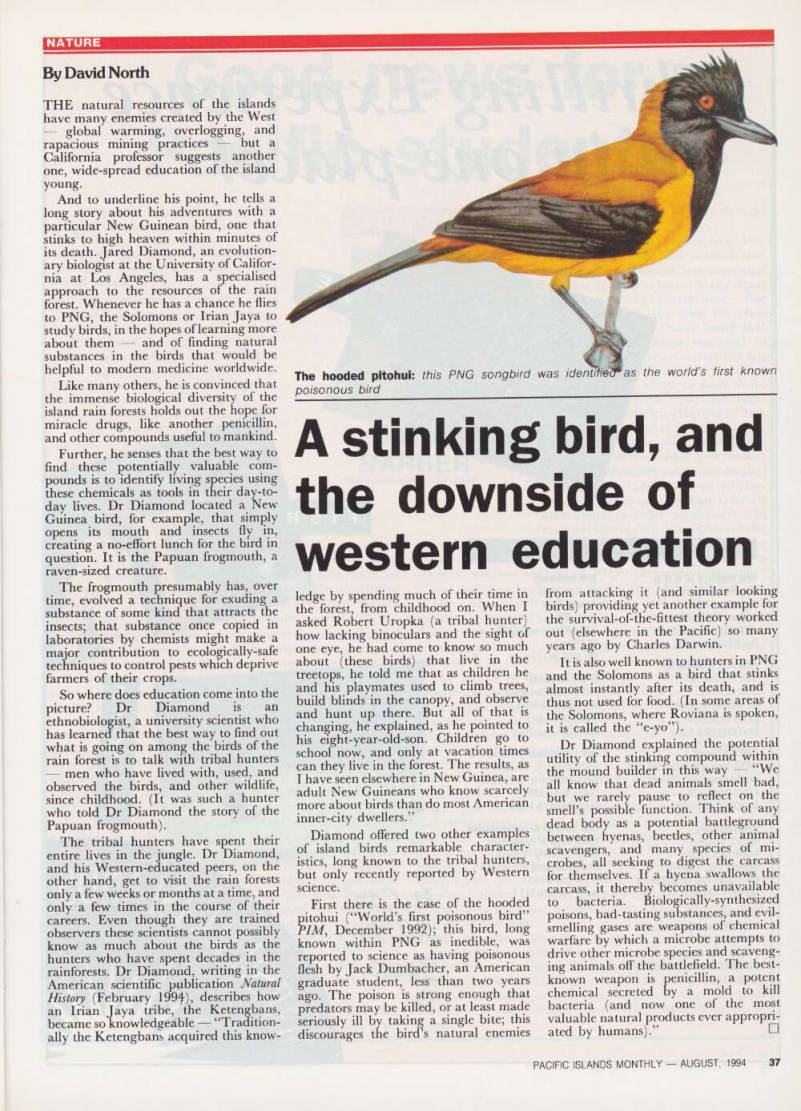
Nature
A stinking bird, and the downside of western education
By David North
THE natural resources of the islands have many enemies created by the West global warming, overlogging, and rapacious mining practices but a California professor suggests another one, wide-spread education of the island young.
And to underline his point, he tells a long story about his adventures with a particular New Guinean bird, one that stinks to high heaven within minutes of its death. Jared Diamond, an evolution ary biologist at the University of Califor nia at Los Angeles, has a specialised approach to the resources of the rain forest. Whenever he has a chance he flies to PNG, the Solomons or Irian Jaya to study birds, in the hopes of learning more about them and of finding natural substances in the birds that would be helpful to modern medicine worldwide.
Like many others, he is convinced that the immense biological diversity of the island rain forests holds out the hope for miracle drugs, like another penicillin, and other compounds useful to mankind.
Further, he senses that the best way to find these potentially valuable com pounds is to identify living species using these chemicals as tools in their day-to day lives. Dr Diamond located a New Guinea bird, for example, that simply opens its mouth and insects fly in, creating a no-effort lunch for the bird in question. It is the Papuan frogmouth, a raven-sized creature.
The frogmouth presumably has, over time, evolved a technique for exuding a substance of some kind that attracts the insects; that substance once copied in laboratories by chemists might make a major contribution to ecologically-safe techniques to control pests which deprive farmers of their crops.
So where does education come into the picture? Dr Diamond is an ethnobiologist, a university scientist who has learned that the best way to find out what is going on among the birds of the rain forest is to talk with tribal hunters men who have lived with, used, and observed the birds, and other wildlife, since childhood. (It was such a hunter who told Dr Diamond the story of the
Papuan frogmouth).
The tribal hunters have spent their entire lives in the jungle. Dr Diamond, and his Western-educated peers, on the other hand, get to visit the rain forests only a few weeks or months at a time, and only a few times in the course of their careers. Even though they are trained observers these scientists cannot possibly know as much about the birds as the hunters who have spept decades in the rainforests. Dr Diamond, writing in the American scientific publication Natural History (February 199 J), describes how an Irian Jaya tribe, the Ketengbans, became so knowledgeable “Tradition ally the Ketengbans acquired this know-
ledge by spending much of their time in the forest, from childhood on. When I asked Robert Uropka (a tribal hunter) how lacking binoculars and the sight of one eye, he had come to know so much about (these birds) that live in the treetops, he told me that as children he and his playmates used to climb trees, build blinds in the canopy, and observe and hunt up there. But all of that is changing, he explained, as he pointed to his eight-year-old-son. Children go to school now, and only at vacation times can they live in the forest. The results, as I have seen elsewhere in New Guinea, are adult New Guineans who know scarcely more about birds than do most American inner-city dwellers.”
Diamond offered two other examples of island birds remarkable character istics, long known to the tribal hunters, but only recently reported by Western science.
First there is the case of the hooded pitohui (“World’s first poisonous bird”
PIM, December 1992); this bird, long known within PNG as inedible, was reported to science as having poisonous flesh by Jack Dumbacher, an American graduate student, less than two years ago. The poison is strong enough that predators may be killed, or at least made seriously ill by taking a single bite; this discourages the bird’s natural enemies
from attacking it (and similar looking birds) providing yet another example for the survival-of-the-fittest theory worked out (elsewhere in the Pacific) so many years ago by Charles Darwin.
It is also well known to hunters in PNG and the Solomons as a bird that stinks almost instantly after its death, and is thus not used for food. (In some areas of the Solomons, where Roviana is spoken, it is called the “e-yo”).
Dr Diamond explained the potential utility of the stinking compound within the mound builder in this way “We all know that dead animals smell bad, but we rarely pause to reflect on the smell’s possible function. Think of any dead body as a potential battleground between hyenas, beetles, other animal scavengers, and many species of mi crobes, all seeking to digest the carcass for themselves. If a hyena swallows the carcass, it thereby becomes unavailable to bacteria. Biologically-synthesized poisons, bad-tasting substances, and evil smelling gases are weapons of chemical warfare by which a microbe attempts to drive other microbe species and scaveng ing animals off the battlefield. The best known weapon is penicillin, a potent chemical secreted by a mold to kill bacteria (and now one of the most valuable natural products ever appropri ated by humans).” D
The hooded pitohui: this PNG songbird was identified as the world’s first known poisonous bird
Advertisements & other items, p. 38 (1 item)
Thrilling Experience
all in one
■A r j m eo r RMI Ministry of R 8c D Tourist Authority P.O. Box 1727 Majuro, MH 96960 692-625-3206 or 3203 fax 692-625-3218 RM! U.n. Mission, NY 220 E. 42nd St. 31st FI.
Mew York, NY 10017 (212)983-3040 fax(212)983-3202 RMI Embassy 2433 Massachusetts Ave. MW Washington, D.C. 20008 (202) 234-5414 fax (202) 232-3236 RMI Embassy 1-12-2 Tayuan Diplomatic Bldg.
Beijing, PRC 100600 86-1-5325778 or 5325819 fax 86-1-5325693 RMI Embassy 12-1 #3Chome, Motoazabu IT Minato, KU Tokyo 106, Japan 81-3-54110972 or 73 or 74 fax 81-3-54110978 RMI Embassy PO Box 2038 Borron Road Suva, Fiji 679-387899 or 387094 or 387821, fax 679-387115 RMI Consulate 1357 Kapiolani Bivd. #1240 Honolulu, HI 96514 (808) 942-4422 fax (808) 942-2009 RMI Consulate General 1500 Quail St. Ste. 210 Newport Beach, CA 92660 (714) 474-0331 fax (714) 474-1632 U.S. Tourist Representative Hilary Kaye & Associates 4000 Westerly Pi. #2lO Newport Beach, CA 92660 (714) 851-5150 fax (714) 851-3111 % -J
It C
M tie
yours
In i mr?
Pacific students
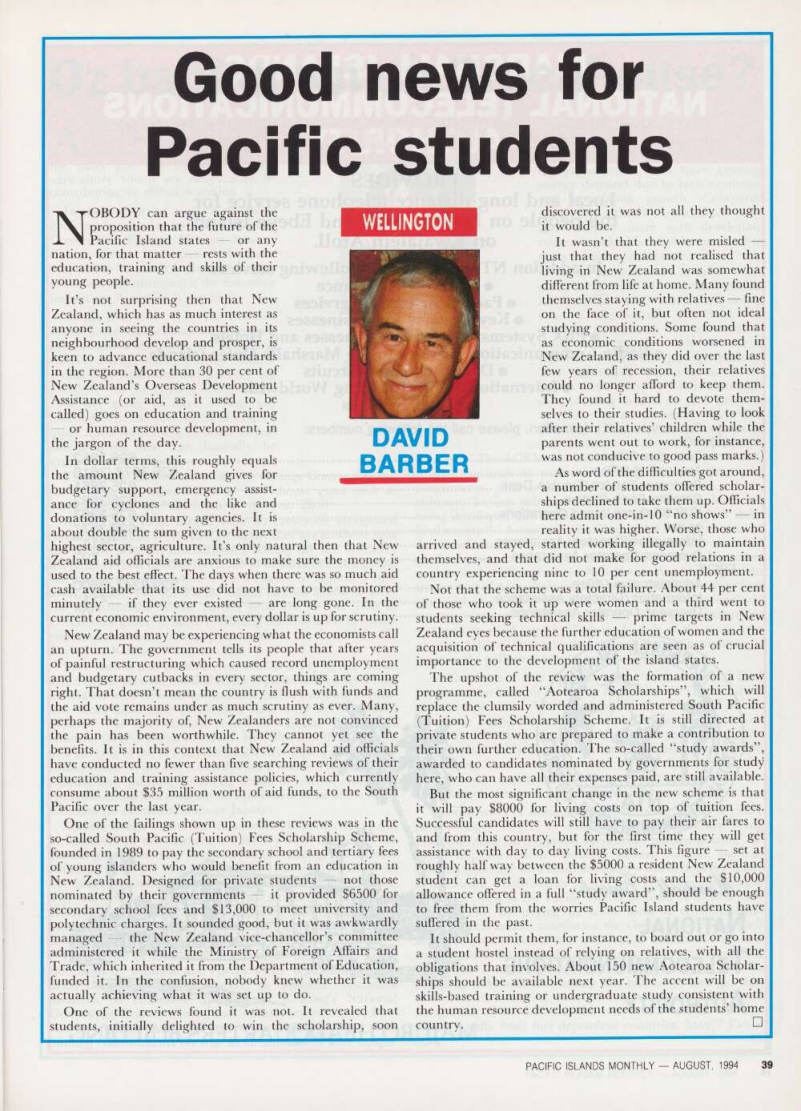
Good news for Pacific students
NOBODY can argue against the proposition that the future of the Pacific Island states or any nation, for that matter rests with the education, training and skills of their
young people.
It’s not surprising then that New Zealand, which has as much interest as anyone in seeing the countries in its neighbourhood develop and prosper, is keen to advance educational standards in the region. More than 30 per cent of New Zealand’s Overseas Development Assistance (or aid, as it used to be called) goes on education and training or human resource development, in the jargon of the day.
In dollar terms, this roughly equals the amount New Zealand gives for budgetary support, emergency assist ance for cyclones and the like and donations to voluntary agencies. It is about double the sum given to the next
highest sector, agriculture. It’s only natural then that New Zealand aid officials are anxious to make sure the money is used to the best effect. The days when there was so much aid cash available that its use did not have to be monitored minutely if they ever existed are long gone. In the current economic environment, every dollar is up for scrutiny.
New Zealand may be experiencing what the economists call an upturn. The government tells its people that after years of painful restructuring which caused record unemployment and budgetary cutbacks in every sector, things are coming right. That doesn’t mean the country is flush with funds and the aid vote remains under as much scrutiny as ever. Many, perhaps the majority of, New Zealanders are not convinced the pain has been worthwhile. They cannot yet see the benefits. It is in this context that New Zealand aid officials have conducted no fewer than five searching reviews of their education and training assistance policies, which currently consume about $35 million worth of aid funds, to the South Pacific over the last year.
One of the failings shown up in these reviews was in the so-called South Pacific (Tuition) Fees Scholarship Scheme, founded in 1989 to pay the secondary school and tertiary fees of young islanders who would benefit from an education in New Zealand. Designed for private students not those nominated by their governments it provided $6500 for secondary school fees and $13,000 to meet university and polytechnic charges. It sounded good, but it was awkwardly managed the New Zealand vice-chancellor’s committee administered it while the Ministry of Foreign Affairs and Trade, which inherited it from the Department of Education, funded it. In the confusion, nobody knew whether it was actually achieving what it was set up to do.
One of the reviews found it was not. It revealed that students, initially delighted to win the scholarship, soon
discovered it was not all they thought it would be.
It wasn’t that they were misled just that they had not realised that living in New Zealand was somewhat different from life at home. Many found themselves staying with relatives fine on the face of it, but often not ideal studying conditions. Some found that as economic conditions worsened in New Zealand, as they did over the last few years of recession, their relatives could no longer afford to keep them.
They found it hard to devote them selves to their studies. (Having to look after their relatives’ children while the parents went out to work, for instance, was not conducive to good pass marks.) As word of the difficulties got around, a number of students offered scholar ships declined to take them up. Officials here admit one-in-10 “no shows” in reality it was higher. Worse, those who
arrived and stayed, started working illegally to maintain themselves, and that did not make for good relations in a country experiencing nine to 10 per cent unemployment.
Not that the scheme was a total failure. About 44 per cent of those who took it up were women and a third went to students seeking technical skills - prime targets in New Zealand eyes because the further education of women and the acquisition of technical qualifications are seen as of crucial importance to the development of the island states.
The upshot of the review was the formation of a new programme, called “Aotearoa Scholarships”, which will replace the clumsily worded and administered South Pacific (Tuition) Fees Scholarship Scheme. It is still directed at private students who are prepared to make a contribution to their own further education. The so-called “study awards”, awarded to candidates nominated by governments for study here, who can have all their expenses paid, are still available.
But the most significant change in the new scheme is that it will pay $BOOO for living costs on top of tuition fees.
Successful candidates will still have to pay their air fares to and from this country, but for the first time they will get assistance with day to day living costs. This figure set at roughly half way between the $5OOO a resident New Zealand student can get a loan for living costs and the $lO,OOO allowance offered in a full “study award”, should be enough to free them from the worries Pacific Island students have suffered in the past.
It should permit them, for instance, to board out or go into a student hostel instead of relying on relatives, with all the obligations that involves. About 150 new Aotearoa Scholar ships should be available next year. The accent will be on skills-based training or undergraduate study consistent with the human resource development needs of the students’ home country. D
Wellington
David
Barber
Advertisements & other items, p. 40 (1 item)
National Telecommunications
MARSHALL ISLANDS
AUTHORITY
PROVIDES
Local and long distance telephone service for the people on Majuro Atoll and Ebeye Island on Kwajalein Atoll.
In addition NTA provides the following services: • Directory Assistance • Packet Switching Services • Key Systems for Businesses • PBX Systems for Larger Businesses and Hotels • Radio Communication Services to the Marshalls Outer Islands • Dedicated Data Circuits • International Direct Dialing Worldwide • Telex Services For service and information, please call the following numbers:
MAJURO
Executive Offices Accounting Office Customer Service/!rouble Desk Satellite Earth Station KUP 65 Outer Island Operations or call Information/Directory Assistance Overseas Operator Assistance
EBEYE
Administrative Office Information/Directory Assistance Overseas Operator Assistance 625-3852 625-3676/3618 625-3851 625-3532 625-3363 625-3577 “411”
“0” 329-3341/3500 “411”
“0”
SHALL
4&j & Sc <2 V
National
Telecommunciations
Authority
8 I 5
MAJURO HEADQUARTERS BUILDING
Oz backdown on Greenhouse?
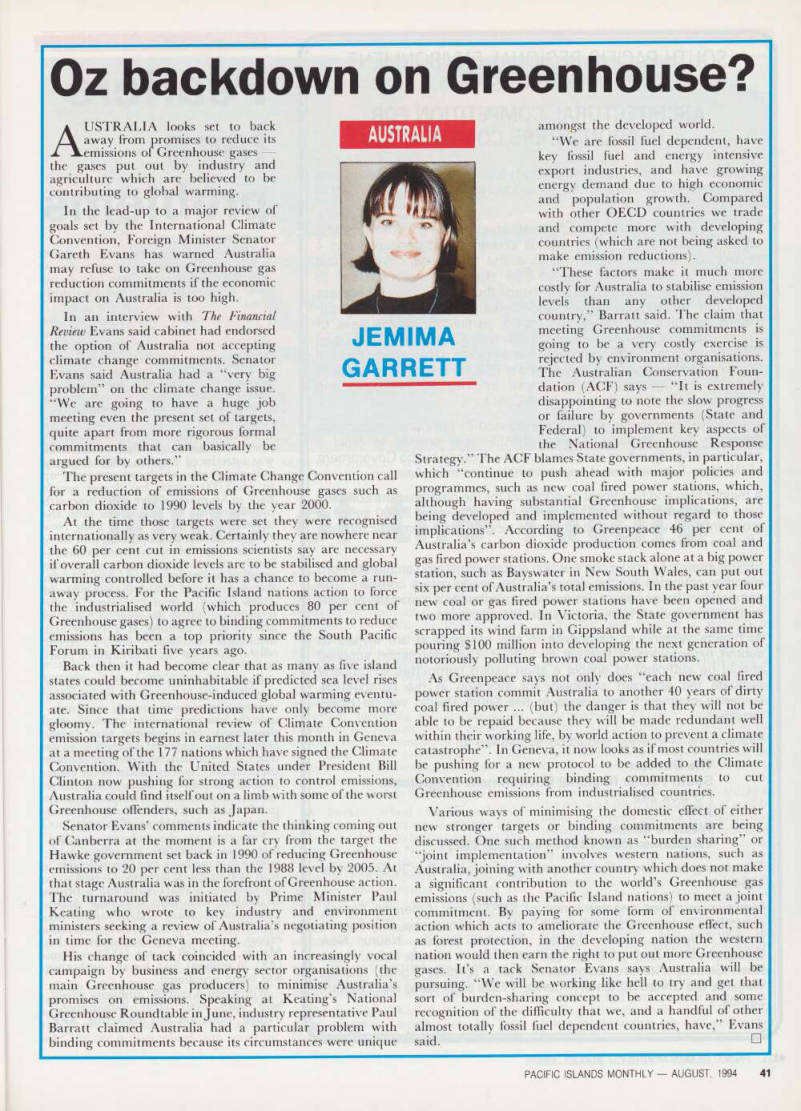
AUSTRAFIA looks set to back away from promises to reduce its emissions of Greenhouse gases the gases put out by industry and agriculture which are believed to be
contributing to global warming.
In the lead-up to a major review of goals set by the International Climate Convention, Foreign Minister Senator Gareth Evans has warned Australia may refuse to take on Greenhouse gas reduction commitments if the economic impact on Australia is too high.
In an interview with The Financial Review Evans said cabinet had endorsed the option of Australia not accepting climate change commitments. Senator Evans said Australia had a “very big problem” on the climate change issue.
“We are going to have a huge job meeting even the present set of targets, quite apart from more rigorous formal commitments that can basically be argued for by others.”
The present targets in the Climate Change Convention call for a reduction of emissions of Greenhouse gases such as carbon dioxide to 1990 levels by the year 2000.
At the time those targets were set they were recognised internationally as very weak. Certainly they are nowhere near the 60 per cent cut in emissions scientists say are necessary if overall carbon dioxide levels are to be stabilised and global warming controlled before it has a chance to become a run away process. For the Pacific Island nations action to force the industrialised world (which produces 80 per cent of Greenhouse gases) to agree to binding commitments to reduce emissions has been a top priority since the South Pacific Forum in Kiribati five years ago.
Back then it had become clear that as many as five island states could become uninhabitable if predicted sea level rises associated with Greenhouse-induced global warming eventu ate. Since that time predictions have only become more gloomy. The international review of Climate Convention emission targets begins in earnest later this month in Geneva at a meeting of the 177 nations which have signed the Climate Convention. With the United States under President Bill Clinton now pushing for strong action to control emissions, Australia could find itself out on a limb with some of the worst Greenhouse offenders, such as Japan.
Senator Evans’ comments indicate the thinking coming out of Canberra at the moment is a far cry from the target the Hawke government set back in 1990 of reducing Greenhouse emissions to 20 per cent less than the 1988 level by 2005. At that stage Australia was in the forefront of Greenhouse action.
The turnaround was initiated by Prime Minister Paul Keating who wrote to key industry and environment ministers seeking a review of Australia’s negotiating position in time for the Geneva meeting.
His change of tack coincided with an increasingly vocal campaign by business and energy sector organisations (the main Greenhouse gas producers) to minimise Australia’s promises on emissions. Speaking at Keating’s National Greenhouse Roundtable in June, industry representative Paul Barratt claimed Australia had a particular problem with binding commitments because its circumstances were unique
amongst the developed world.
“We are fossil fuel dependent, have key fossil fuel and energy intensive export industries, and have growing energy demand due to high economic
and population growth. Compared
with other OECD countries we trade and compete more with developing countries (which are not being asked to make emission reductions).
“These factors make it much more costly for Australia to stabilise emission levels than any other developed country,” Barratt said. The claim that meeting Greenhouse commitments is going to be a very costly exercise is
rejected by environment organisations.
The Australian Conservation Foun dation (ACF) says “It is extremely disappointing to note the slow progress or failure by governments (State and
Federal) to implement key aspects of
the National Greenhouse Response
Strategy.” The ACF blames State governments, in particular, which “continue to push ahead with major policies and programmes, such as new coal fired power stations, which,
although having substantial Greenhouse implications, are
being developed and implemented without regard to those implications”. According to Greenpeace 46 per cent of Australia’s carbon dioxide production comes from coal and gas fired power stations. One smoke stack alone at a big power station, such as Bayswater in New South Wales, can put out six per cent of Australia’s total emissions. In the past year four new coal or gas fired power stations have been opened and two more approved. In Victoria, the State government has scrapped its wind farm in Gippsland while at the same time pouring SIOO million into developing the next generation of notoriously polluting browm coal power stations.
As Greenpeace says not only does “each new coal fired power station commit Australia to another 40 years of dirty coal fired power ... (but) the danger is that they will not be able to be repaid because they will be made redundant well within their working life, by world action to prevent a climate catastrophe”. In Geneva, it now looks as if most countries will be pushing for a new protocol to be added to the Glimate Convention requiring binding commitments to cut Greenhouse emissions from industrialised countries.
Various ways of minimising the domestic effect of either new stronger targets or binding commitments are being discussed. One such method known as “burden sharing” or “joint implementation” involves western nations, such as Australia, joining with another country which does not make a significant contribution to the world’s Greenhouse gas emissions (such as the Pacific Island nations) to meet a joint commitment. By paying for some form of environmental action which acts to ameliorate the Greenhouse effect, such as forest protection, in the developing nation the western nation would then earn the right to put out more Greenhouse gases. It’s a tack Senator Evans says Australia will be pursuing. “We will be working like hell to try and get that sort of burden-sharing concept to be accepted and some recognition of the difficulty that we, and a handful of other almost totally fossil fuel dependent countries, have,” Evans said. D
Australia
Jemima
Garrett
problems
Farming
Pearlers face problems
DREAMS of diving for a fortune in black pearls have lured people back to remote Manihiki atoll in the Cook Islands but
some pearlers have plunged into prob
lems.
“Some small pearl farmers on Manihiki are really hurting,” Teanaroa
Paka Worthington, a project analyst
with the prime minister’s office, said in an interview. “They borrowed money to set themselves up, and now some are having trouble making their payments.
There have been some failures.”
The atoll, which is the home of the black-lipped oyster, lies 1000 kilometres north of Rarotonga. Pearl cultivation was introduced there in 1986. Farming cultured pearls, which can command up to A 553,000 apiece, has drawn people back to Manihiki, where only those with blood links to the island can farm the lagoon. Some people came from New Zealand after selling up there, and there were instances of relatives and extended family members putting money into pearling businesses, sources familar with the ventures said. “With the exception of a few smart farmers ... most of the farmers are still at the stage of trying to achieve pearl farming as a viable and sustainable business,” said a recent official report on the local cultured pearl
industry.
For the majority, the results have been “low retention rates (of the pearl nuclei or seed), poor quality pearls and conse quently low financial returns overall”, the report said, adding that many farmers had, however, learned a great deal. “The problem has been one of price expectations,” said an official of the Cook Islands Development Bank, which made loans to the farmers. “With poor quality f>earls, marketing was difficult, and some armers have been short of income.”
Financing to the industry totalled more than ASBOO,OOO, the official said, adding that the bank had “been flexible” with cash-strapped farmers. To revitalise the industry, a Pearl Authority is being established with help from the Asian Development Bank (ADB) and with Joan Rolls, who runs a pearls import and export business here, as chairman. In Manila, the ADB said a US$l million (A$ 1.36 million) loan for the authority
was being negotiated.
Worthington said the authority would
help with oyster-farm management,
trading, valuation and marketing. AFP
Advertisements & other items, p. 42 (1 item)
Programme (Sprep)
SOUTH PACIFIC REGIONAL ENVIRONMENT
ARCHITECTURAL COMPETITION FOR
HEADQUARTERS COMPLEX
Expressions of interest are invited from architects for participation in a concept design competition for a headquarters complex for SPREP in Apia, Western Samoa.
SPREP is a regional organisation established by the governments and administrations of 22 Pacific Islands countries and territories and 4 developed countries. Its aim is to assist the Island countries and territories to protect and improve their shared environment and to manage their resources so as to enhance the quality of life for present and future generations. SPREP undertakes a wide range of environmental activities throughout the region, particularly in the areas of Conservation of Biological Diversity, Climate -Change and Sea Level Rise, Environmental Planning and Management (Terrestrial), Coastal Planning and Management, Prevention of Pollution and Management of Pollution Emergencies, Environmental Information, Education and Training and Regional Environmental Concerns.
The SPREP secretariat is presently housed in temporary accommodation in Apia, Western Samoa. SPREP now wishes to build a permanent headquarters complex on a site donated by the Government of Western Samoa located approximately 6km from Apia.
A master plan and functional design brief for the headquarters complex have been prepared. These indicate a requirement for 3,600 sq.m, of gross area in a variety of building types ranging from domestic through office to conference facilities.
SPREP intends to hold a competition among registered architects from member countries for the design of the headquarters complex. The competition, for a concept design, will be limited to a maximum of eight participants, invited following a short listing process.
Architects wishing to participate in the competition are invited to submit expressions of interest to SPREP. The Information supplied should be sufficient to enable a short listing committee to properly evaluate the applicant suitability for inclusion in the competition.
Evidence of project experience in the South Pacific will be highly regarded.
Expressions of interest should be addressed to: The Director South Pacific Regional Environment Programme PO Box 240
APIA
Western Samoa Telephone: (685) 21921 Fax: (685) 20231 The closing date for receipt of expressions of interest is 30 September 1994.
Member countries and territories of SPREP are: American Samoa, Australia, Cook Islands, Federated States of Micronesia, Fiji, France, French Polynesia, Guam, Kiribati, Marshall Islands, Nauru, New Caledonia, New Zealand, Niue, Northern Mariana Islands, Palau, Papua New Guinea, Pitcairn, Solomon Islands, Tokelau, Tonga, Tuvalu, Vanuatu, the United States of America, Wallis and Futuna and Western Samoa. 124980v3
Mine of the future
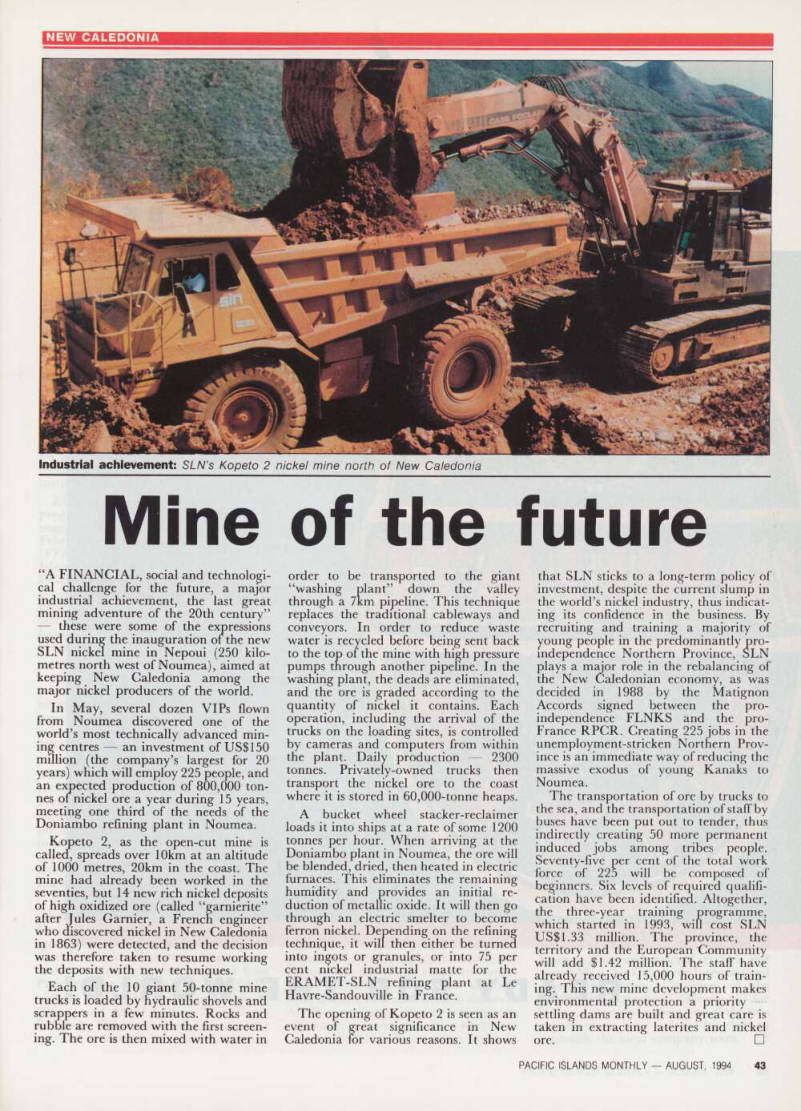
New Caledonia
“A FINANCIAL, social and technological challenge for the future, a major industrial achievement, the last great mining adventure of the 20th century” these were some of the expressions used during the inauguration of the new SLN nickel mine in Nepoui (250 kilometres north west of Noumea), aimed at keeping New Caledonia among the major nickel producers of the world.
In May, several dozen VIPs flown from Noumea discovered one of the world’s most technically advanced mining centres an investment of US$l5O million (the company’s largest for 20 years) which will employ 225 people, and an expected production of 800,000’tonnes of nickel ore a year during 15 years, meeting one third of the needs of the Doniambo refining plant in Noumea.
Kopeto 2, as the open-cut mine is called) spreads over 10km a. an altitude of 1000 metres, 20km in the coast. The mine had already been worked in the * , , . ’ . , ... ' TITT’ k. U ‘ 14 new , r,cb "‘f. kel d ?P° slt ,; of high oxidized ore (called “garmente” after Jules Gamier a French engineer who discovered ntckel m New Caledonta m 1863) were detected, and the decision was therefore taken to resume work.ng the deposits with new techniques.
Each of the 10 giant 50-tonne mine trucks is loaded by hydraulic shovels and scrappers in a few minutes. Rocks and rubble are removed with the first screening. The ore is then mixed with water in
order to be transported to the giant
“washing plant” down the valley
through a 7km pipeline. This technique
replaces the traditional cableways and conveyors. In order to reduce waste water is recycled before being sent back to the top of the mine with high pressure pumps through another pipeline. In the washing plant, the deads are eliminated, and the ore is graded according to the quantity of nickel it contains. Each operation, including the arrival of the trucks on the loading sites, is controlled by cameras and computers from within
the plant. Daily production 2300
tonnes. Privately-owned trucks then transport the nickel ore to the coast where it is stored in 60,000-tonne heaps.
A bucket wheel stacker-reclaimer loa ds it into ships at a rate of some 1200 tonnes per hour. When arriving at the Donianlbo plant in Noumea, the ore will be blended, dried, then heated m electric furnaces. This eliminates the remaining i i j • •• , & humidity and provides an initial reduction of metallic oxide. It will then go through an electric smelter to become ferron nickel Depending on the refining technique it will then either be turned into ingots or granules, or into 75 per cent nickel mdustnal matte for the , ■ ]. l ' - 1 m ' l ” pan a e Havre-Sandouville m France.
The opening of Kopeto 2 is seen as an event of great significance in New Caledonia for various reasons. It shows
that SLN sticks to a long-term policy of investment, despite the current slump in the world’s nickel industry, thus indicat ing its confidence in the business. By recruiting and training a majority of young people in the predominantly pro independence Northern Province, SLN plays a major role in the rebalancing of the New Caledonian economy, as was decided in 1988 by the Matignon Accords signed between the pro independence FLNKS and the pro- France RPCR. Creating 225 jobs in the unemployment-stricken Northern Prov ince is an immediate way of reducing the massive exodus of young Kanaks to Noumea.
The transportation of ore by trucks to the sea, and the transportation of staff by bu ? es h f e been P u ‘° ut to tender " thus mdlrec ' l >' .creating 50 more permanent £ d ““ d fi J° b > a^B f f •„ h H f , ■ c- i i r 5 rr beginners. Six levels of required qualm g hav[ befn idcntifie l A to s ethcrj
, , training nrmrrlmme
Xch started m 19 9 3j g wi ff c g st SLN USJI 33 miuion Th ,; province the terrj and the Euro P Community wi]| ad J „ 42 million F Xhc sta „ hav ' a|rcady rcceived 15j000 houß of train . j This new mine development makes environmental protection a priority settling dams are built and great care is taken in extracting laterites and nickel ore. □
Industrial achievement: SLN’s Kopeto 2 nickel mine north of New Caledonia
Advertisements & other items, p. 44 (1 item)
Ready For The World!
PREMIUM QUALITY EXPORT
E E R
r >
READY FOR THE WORLD!
Tuna watchdog set up
New Caledonia
DURING the opening session of the 25th regional meeting on fisheries held at the South Pacific Commission headquarters in Noumea, New Caledonia, in March, Ati George Sokomanu, the SPC’s secretary-general and M George Gwyer, the head of delegation of the commission of the European Communities in the Solomon Islands signed an agreement for the financing of a project called
SPRTRAMP (South Pacific Regional
Tuna Resource Assessment and Moni toring Project) aimed at promoting the sustainable management of the tuna fishery in the region.
Supertramp, as the project is better known, will cost the EC 5,000,000 ECU (US$6,000,000) and will span over five years as part of the SPC’s ongoing Oceanic Fisheries Programme (OFP).
This project will allow the very large tuna fisheries of the region to be subject for the first time to continuous scientific monitoring as part of overall manage ment of this resource.
EC assistance to regional fisheries programmes in the Pacific has been ongoing for the last 10 years. In February, the Forum Fisheries Agency (FFA), based in Honiara, in the Solomon Islands, had already received 4,650,000 ECU from the European Community to finance a surveillance and management programme including the purchase of satellite transponders and associated hardware to be installed on foreign vessels.
“Tuna stocks are the most important renewable resource of the Pacific Island countries, and tuna catches were esti mated at 1.2 millions tonnes (the largest tuna fishery in the world), with a landed value of around 1,700,000 ECU in 1991,” explains Doctor Anthony Lewis,
the Noumea-based SPC’s chief fisheries scientist. There is a variety of fishing methods - purse-seining, long lining, pole-and-lining, and trolling. Altogether, 95 per cent of the Pacific tunas are caught by fleets from outside the region (Japan, the USA, Taiwan, Korea, the Philippines and Indonesia). The fishery has doubled in volume since 1980 and is bound to increase in the future.
Regional bodies sign deal pledging financial assistance to monitor tuna fishing and its sustainable management in the region
Ensuring long term optimal manage ment of the stocks has therefore been the top priority for both the SPC and the FFA for the sake of the small Pacific countries. The two organisations, which have received funds from the EC under the LOME 111 Pacific Regional Marine Resource Development Programme, work on a complementary basis. The SPC provides scientific advice on tuna resource assessment, whereas the FFA within its mandate oversees surveillance and management of foreign fishing activity.
Part of the OFP programme consisted of catching, tagging and releasing 140,000 tunas (yellowfin, skipjack and
bigeye) between 1989 and 1992. About 11 per cent of them were later recap tured, providing useful information about their age, growth, migration and levels of exploitation.
“The objective of the work was to give us a much better understanding of the dynamics of the stock and the status of the resource. The priority information we were after was the current levels of exploitation of the resource. We do that by monitoring the pattern of the returns with time, combined with what we know about the natural mortality of the fish,” says Dr Lewis. On that basis, it appears that even in spite of these very large increases in catch over the last 10 years, the levels of exploitation are still only moderate, at least for the surface fishery.
Dr Lewis says “There is no
immediate danger of over-exploitation.
In the case of skipjacks, the smallest of the tunas, there is considerable scope for even increasing the catches further.”
With the larger tunas (yellowfin, bigeye), which are caught by longline for high value sashimi markets, there is still however uncertainty about the impact of these increased surface catches on the longline catch. This will be an important second phase of the assessment. Unlike the other fishing regions of the world, most of the fish taken in the South Pacific is caught within the limits of the Exclusive Economic Zone of the coastal states. Therefore, the two FFA and SPC “companion programmes”, one aimed at scientific monitoring and provisional advice on exploitation of the resource, and the other at increasing enforcement and surveillance capability will enable South Pacific countries to manage what seems to be one of their main sources of revenue. D
The sky’s
now the limit
THE decision by French minister of transport Bernard Bosson to allow two French private companies to operate flights between Paris and Noumea has put an end to Air France’s last monopoly over a French Overseas Territory, and should result in cheaper tickets for tourists and travellers to and from
Europe.
From last month, CORSAIR, a sub sidiary of the giant travel company Nouvelles Frontieres, and AOM, mostly specialised in flights from Paris to the French Overseas Territories and depart ments, started flying once a week from Paris to New Caledonia - CORSAIR with a Boeing 747 via Tsien Tsin in China, and AOM with a DC 10-3 via Bangkok. This small revolution was long awaited in New Caledonia a petition
signed by 15,000 people had been presented in Paris, urging the authorities to open the Caledonia’s skies to compe tition. AOM and CORSAIR will add several hundred seats a week to the seven Air France flights. The two companies announced a round trip ticket starting at around US$llOO. These prices won’t be
much cheaper than the cheapest Air France ones (US$l32O), but the national airline only offered a limited number of seats on each flight with these fares, making them very difficult to obtain. Air France in New Caledonia is of course “worried” it will consider a reduction of its flights and, consequently, of its workforce of 360.
Bosson had postponed his decision from October, in the hope that Air France and Air Caledonie International would reach a commercial agreement on
the joint exploitation of the Paris/
Noumea route and regional services. But in mid May, Air Caledonie International turned this down, “in view of the insufficient guarantees” offered by Air France. Observers expect one of the two newcomers in New Caledonia’s skies to approach the local company soon. □
Advertisements & other items, p. 46 (1 item)
at the right price.”
As a family we know ... and we bring only top
quality merchandise. “Yes, quality merchandise
v - ; r tf *** s / -t* gftiPl -s- ->O- Z**Z ‘S n f- ’ Clothing, footwears * Office supplies, Office machines * Fragrances, watches/clocks * Audio/Video supplies & equipments
Photographic
h supplies & equipments * . —. m shop * JOHNSON outboard
engines & parts
* Many other items £ Grant L. Labaun (Gen. Manager/Owner) and family 6 (6 625-3 (692) (692) 625-316
No end to PNG’s problems
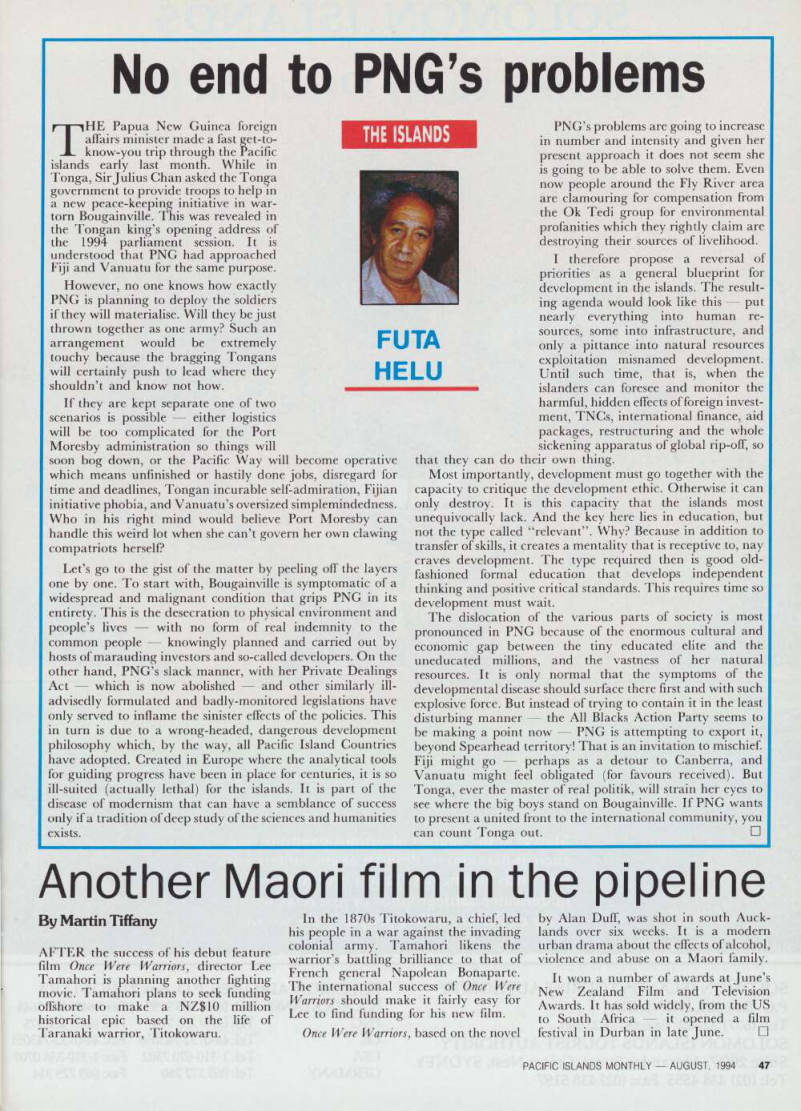
THE Papua New Guinea foreign
affairs minister made a fast get-to
know-you trip through the Pacific
islands early last month. While in Tonga, Sir Julius Chan asked the Tonga government to provide troops to help in a new peace-keeping initiative in war torn Bougainville. This was revealed in
the Tongan king’s opening address of
the 1994 parliament session. It is understood that PNG had approached Fiji and Vanuatu for the same purpose.
However, no one knows how exactly PNG is planning to deploy the soldiers if they will materialise. Will they be just thrown together as one army? Such an arrangement would be extremely
touchy because the bragging Tongans
will certainly push to lead where they shouldn’t and know not how.
If they are kept separate one of two scenarios is possible either logistics will be too complicated for the Port Moresby administration so things will
soon bog down, or the Pacific Way will become operative which means unfinished or hastily done jobs, disregard for time and deadlines, Tongan incurable self-admiration, Fijian initiative phobia, and Vanuatu’s oversized simplemindedness.
Who in his right mind would believe Port Moresby can handle this weird lot when she can’t govern her own clawing
compatriots herself?
Let’s go to the gist of the matter by peeling off the layers one by one. To start with, Bougainville is symptomatic of a widespread and malignant condition that grips PNG in its entirety. This is the desecration to physical environment and people’s lives with no form of real indemnity to the common people knowingly planned and carried out by hosts of marauding investors and so-called developers. On the other hand, PNG’s slack manner, with her Private Dealings Act which is now abolished and other similarly ill
advisedly formulated and badly-monitored legislations have
only served to inflame the sinister effects of the policies. This in turn is due to a wrong-headed, dangerous development philosophy which, by the way, all Pacific Island Countries have adopted. Created in Europe where the analytical tools for guiding progress have been in place for centuries, it is so ill-suited (actually lethal) for the islands. It is part of the disease of modernism that can have a semblance of success only if a tradition of deep study of the sciences and humanities exists.
PNG’s problems are going to increase in number and intensity and given her present approach it does not seem she is going to be able to solve them. Even now people around the Fly River area are clamouring for compensation from the Ok Tedi group for environmental
profanities which they rightly claim are
destroying their sources of livelihood.
I therefore propose a reversal of
priorities as a general blueprint for
development in the islands. The result ing agenda would look like this put nearly everything into human re sources, some into infrastructure, and only a pittance into natural resources
exploitation misnamed development.
Until such time, that is, when the islanders can foresee and monitor the harmful, hidden effects of foreign invest ment, TNCs, international finance, aid packages, restructuring and the whole
sickening apparatus of global rip-off, so
that they can do their own thing.
Most importantly, development must go together with the capacity to critique the development ethic. Otherwise it can only destroy. It is this capacity that the islands most unequivocally lack. And the key here lies in education, but not the type called “relevant”. Why? Because in addition to transfer of skills, it creates a mentality that is receptive to, nay craves development. The type required then is good old fashioned formal education that develops independent thinking and positive critical standards. This requires time so development must wait.
The dislocation of the various parts of society is most pronounced in PNG because of the enormous cultural and economic gap between the tiny educated elite and the uneducated millions, and the vastness of her natural resources. It is only normal that the symptoms of the developmental disease should surface there first and with such explosive force. But instead of trying to contain it in the least disturbing manner the All Blacks Action Party seems to be making a point now PNG is attempting to export it, beyond Spearhead territory! That is an invitation to mischief.
Fiji might go perhaps as a detour to Canberra, and Vanuatu might feel obligated (for favours received). But Tonga, ever the master of real politik, will strain her eyes to see where the big boys stand on Bougainville. If PNG wants to present a united front to the international community, you can count Tonga out. □
The Islands
Futa
Helu
Another Maori film in the pipeline
By Martin Tiffany
AFTER the success of his debut feature film Once Were Warriors, director Lee Tamahori is planning another fighting movie. Tamahori plans to seek funding offshore to make a NZ$lO million historical epic based on the life of Taranaki warrior, Titokowaru.
In the 1870 s Titokowaru, a chief, led his people in a war against the invading colonial army. Tamahori likens the warrior’s battling brilliance to that of
French general Napolean Bonaparte.
The international success of Once Were Warriors should make it fairly easy for Lee to find funding for his new film.
Once Were Warriors, based on the novel
by Alan Duff, was shot in south Auck lands over six weeks. It is a modern urban drama about the effects of alcohol, violence and abuse on a Maori family.
It won a number of awards at June’s New Zealand Film and Television Awards. It has sold widely, from the US to South Africa it opened a film festival in Durban in late June. □
Advertisements & other items, p. 48 (1 item)
Bursting with Discoveries
SOLOMON ISLANDS
A v i .: ; v - .A i / W
■niA
I 4 0 I / r i s 4 -*x s*.. ■ *#PW H sm 3s>
sg*S
v M/
VXV >
Marvel at the sounds of drums, panpipes and ancient harmonies. Wonder at encounters with rare birds and beasts. Take a dive to historic underwater battlegrounds or just relax with some of the friendliest people in the world. fo i;' tm W Sj,
SOLOMON ISLANDS TOURIST AUTHORITY
P.O. Box 321, HONIARA
Tel: (677) 22442 Fax: (677) 23986
SOLOMON ISLANDS TOURIST AUTHORITY
Suite 20/37, Alexander Street, Crows Nest, SYDNEY Tel: (02) 438 4555 Fax: (02) 438 5197
SOLOMON AIRLINES, P.O. Box 23 HONIARA
NZ. AUCKLAND Tel: (649) 308 9198 Fax: (649) 377 5648 Tel: (675) 255 724
PNG
UK
USA
GERMANY
Fax:(675)250975 Tel: 44-0732-743050 Fax:44-0732-74305 Tel: 1-310-670 7302 Fax: 1-310-338 0701 Tel: 069172 260 Fax: 069 729 314
A natural attraction
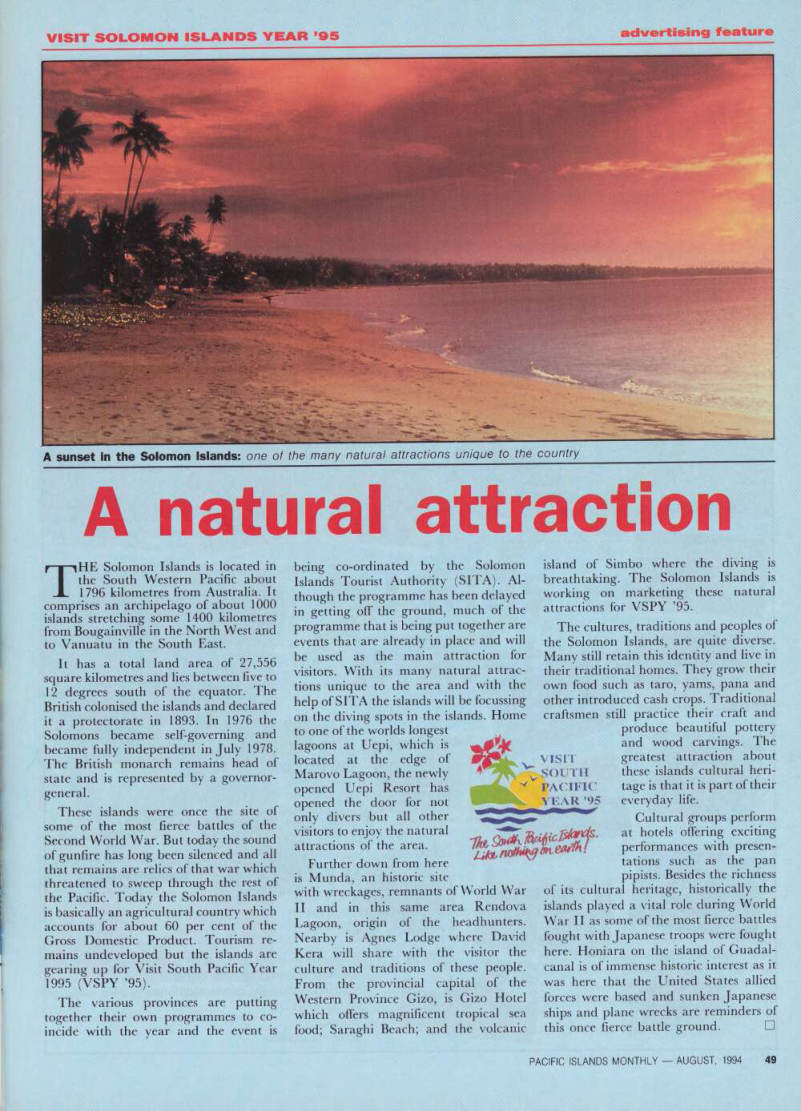
Visit Solomon Islands Year ’95
advertising feature
THE Solomon Islands is located in the South Western Pacific about 1796 kilometres from Australia. It comprises an archipelago of about 1000 islands stretching some 1400 kilometres from Bougainville in the North West and to Vanuatu in the South East. ... square kilometres and liesTcUveen five to 12 degrees south of the equator The British colonised the islands and declared it a protectorate in 1893. In 1976 the Solomons became self-governing and
became fully independent in July 1978.
The British monarch remains head of state and is represented by a governorral F fhese islands were once t ie site o some of the most fierce bait cs o tic Second World War. But today the sound of gunfire has long been Silenced and all that remains are relics of that war which
theTacific.
is basically an agricultural country which accounts for about 60 per cent of the Gross Domestic Product. Tourism remains undeveloped but the islands are gearing up for Visit South Pacific Year
1995 (Vspy ’95).
The various provinces are putting together their own programmes to coincide with the year and the event is
being co-ordinated by the Solomon Islands Tourist Authority (SITA). Al though the programme has been delayed in getting off the ground, much of the programme that is being put together are events that are already in place and will be used as the main attraction for visitors. With its many natural attrac tions unique to the area and with the help of SITA the islands will be focussing on the diving spots in the islands. Home
to one of the worlds longest lagoons at Uepi, which is located at the edge of
Marovo Lagoon, the newly
opened Uepi Resort has
opened the door for not only divers but all other visitors to enjoy the natural attractions of the area.
Further down from here is Munda, an historic site
with wreckages, remnants of World War II and in this same area Rendova Lagoon, origin of the headhunters.
Nearby is Agnes Lodge where David Kera will share with the visitor the culture and traditions of these people.
From the provincial capital of the Western Province Gizo, is Gizo Hotel which offers magnificent tropical sea food; Saraghi Beach; and the volcanic
island of Simbo where the diving is breathtaking. The Solomon Islands is working on marketing these natural attractions for VSPY ’95.
The cultures, traditions and peoples of the Solomon Islands, are quite diverse.
Many still retain this identity and live in their traditional homes. They grow their own food such as taro, yams, pana and other introduced cash crops. Traditional craftsmen still practice their craft and
produce beautiful pottery and wood carvings. The greatest attraction about these islands cultural heri tage is that it is part of their everyday life.
Cultural groups perform at hotels offering exciting performances with presen tations such as the pan pipists. Besides the richness
of its cultural heritage, historically the islands played a vital role during World War II as some of the most fierce battles fought with Japanese troops were fought here. Honiara on the island of Guadal canal is of immense historic interest as it was here that the United States allied forces were based and sunken Japanese ships and plane wrecks are reminders of this once fierce battle ground. □
A sunset in the Solomon islands: one of the many natural attractions unique to the country
Advertisements & other items, p. 50 (1 item)
Visit us through our Stamps.
" Solomon Islands Postal is prepared for the "Visit the South Pacific Year 1995".
It is in the process of preparation for the Commemoration of the event by issuing Special Solo designs for postage stamps and other accessories products. mon Islands The Commemoration stamps issue is scheduled for release early in 1995.
These products will be available in the Philatelic Bureau and Post Offices of Solomon Islands.
PHILATELIC MAP OF SOLOMON IS - $8.00 Forms of Payment Accepted
CREDIT CARDS: REMITTANCE:
1. American Express "Ooraj s „V*n<*^“ dS BR 80 2. Master Card 3. Visa 4. Access Card
BOUGANVILLE
f i * 1. Bank Draft 2. British Postal Orders 3. Personal Cheque 4. Bank notes (of acceptable currencies) by Registered mails.
EXCHANGE RATES TO SI DOLLAR:
SI $1 = US$00.3065
= A$00.4264 , Sk = Pound .2063 $300 E'K s °lomon hi a nds qt BR T..-; I Solomon island 8 R Sol <**onl sli *5 I W* *nds - -WHIP* 111 ' 00 c ««*> j-houh P6# cRM ' 40° 0 C Solomon Islands s r 'c ", $4 ohost orm>
CHOISEUL
SOI.OMOS M- ASPS 30C
SANTA
YSABELA
Solomon Islands * So i 0 mon Islands r, 4*
NEW
GEORGIA
AFC) spotted Wire-
6t)/.PMO.N ISLANDS $1.10
ft Honiara ••• « $V\5 " ’■« Solomon Islands ER $2 SO Sol ;//S a Ms BR
SIS
U 4
Solomon Islands
m BR w ER °°c Mi?
IH f TA’ CBaii
MALAITA
60 l Solomon islands ds ER
GUADALCANAL
SAN CRISTOVAL
HE3 HERMIT CRAB
160 km Solomon Islands sk ER
IS7:AN1»
WD A «WDE PAiNtEDCBAB
llLOXtTN ISLANDS
A For more information on the Stamps of the Solomon Islands write to: Solomon Islands Philatelic Bureau, Ministry of Post & Communications
G.P.O. Box G31,
Honiara, Solomon Islands.
Islands seek
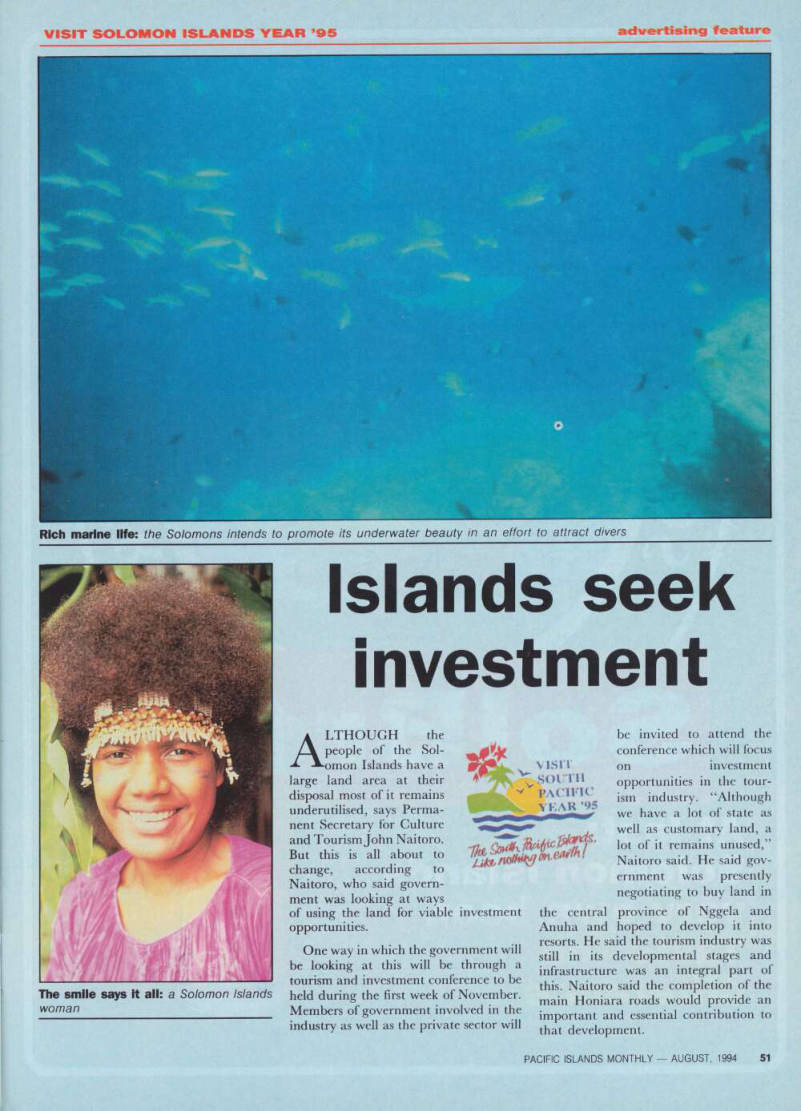

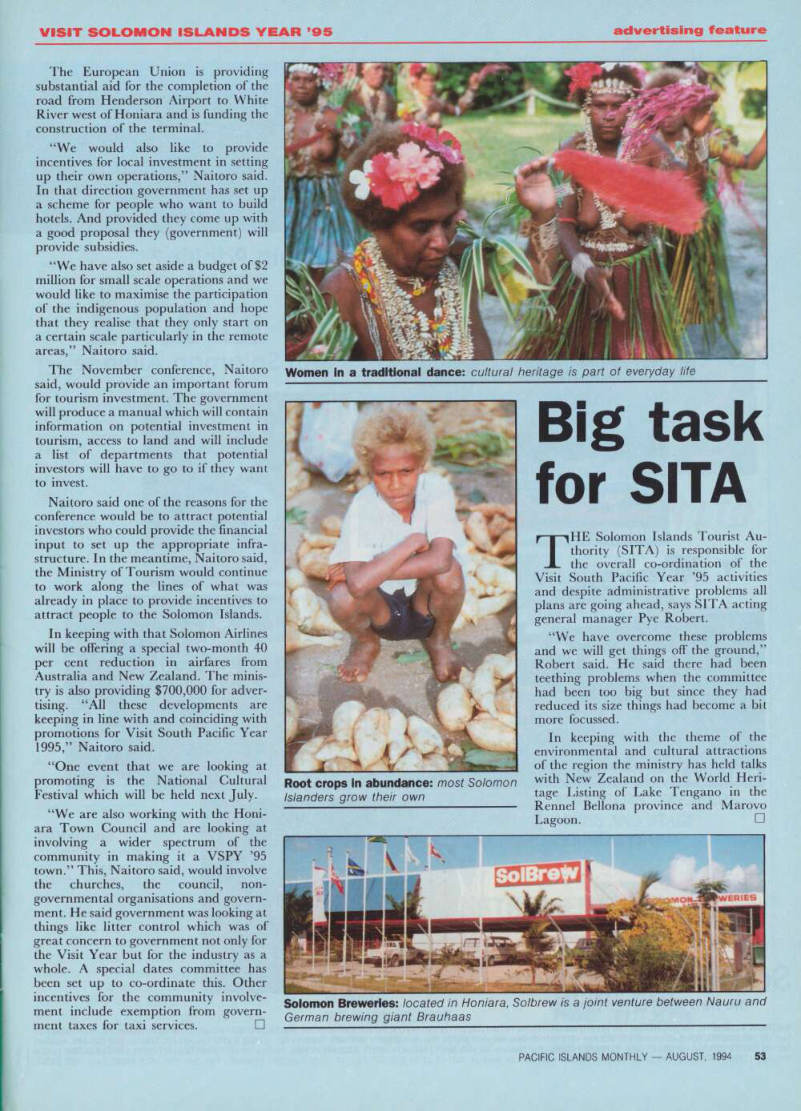
investment
Although the
people of the Sol omon Islands have a large land area at their disposal most of it remains underutilised, says Perma nent Secretary for Culture and Tourism John Naitoro.
But this is all about to change, according to Naitoro, who said govern ment was looking at ways
of using the land for viable investment
opportunities.
One way in which the government will be looking at this will be through a tourism and investment conference to be held during the first week of November.
Members of government involved in the industry as well as the private sector will
be invited to attend the conference which will focus on investment opportunities in the tour
ism industry. “Although
we have a lot of state as well as customary land, a lot of it remains unused,”
Naitoro said. He said gov ernment was presently negotiating to buy land in
the central province of Nggela and Anuha and hoped to develop it into resorts. He said the tourism industry was still in its developmental stages and infrastructure was an integral part of this. Naitoro said the completion of the main Honiara roads would provide an important and essential contribution to
that development.
Rich marine life: the Solomons intends to promote its underwater beauty in an effort to attract divers
The smile says it all: a Solomon Islands woman
The European Union is providing substantial aid for the completion of the road from Henderson Airport to White River west of Honiara and is funding the construction of the terminal.
“We would also like to provide incentives for local investment in setting up their own operations,” Naitoro said.
In that direction government has set up a scheme for people who want to build hotels. And provided they come up with
a good proposal they (government) will
provide subsidies.
“We have also set aside a budget of $2 million for small scale operations and we would like to maximise the participation
of the indigenous population and hope
that they realise that they only start on a certain scale particularly in the remote areas,” Naitoro said.
The November conference, Naitoro said, would provide an important forum for tourism investment. The government will produce a manual which will contain information on potential investment in tourism, access to land and will include a list of departments that potential investors will have to go to if they want to invest.
Naitoro said one of the reasons for the conference would be to attract potential investors who could provide the financial input to set up the appropriate infra structure. In the meantime, Naitoro said, the Ministry of Tourism would continue to work along the lines of what was already in place to provide incentives to attract people to the Solomon Islands.
In keeping with that Solomon Airlines will be offering a special two-month 40 per cent reduction in airfares from Australia and New Zealand. The minis try is also providing $700,000 for adver tising. “All these developments are keeping in line with and coinciding with promotions for Visit South Pacific Year 1995,” Naitoro said.
“One event that we are looking at promoting is the National Cultural Festival which will be held next July.
“We are also working with the Honi ara Town Council and are looking at involving a wider spectrum of the community in making it a VSPY ’95 town.” This, Naitoro said, would involve the churches, the council, non
governmental organisations and govern
ment. He said government was looking at things like litter control which was of great concern to government not only for the Visit Year but for the industry as a whole. A special dates committee has been set up to co-ordinate this. Other incentives for the community involve ment include exemption from govern ment taxes for taxi services. □
Women in a traditional dance: cultural heritage is part of everyday life
Advertisements & other items, pp. 51-52 (2 items)
51
advertising feature
PACIFIC ISLANDS MONTHLY AUGUST, 1994
VISIT SOLOMON ISLANDS YEAR *95
Solßr
At last: Solomon Islands very own beer.
Taste the difference
Big task
for SITA
THE Solomon Islands Tourist Au
thority (SITA) is responsible for
the overall co-ordination of the Visit South Pacific Year ’95 activities and despite administrative problems all plans are going ahead, says SITA acting
general manager Pye Robert.
“We have overcome these problems and we will get things off the ground,”
Robert said. He said there had been teething problems when the committee had been too big but since they had reduced its size things had become a bit more focussed.
In keeping with the theme of the environmental and cultural attractions of the region the ministry has held talks with New Zealand on the World Heri tage Listing of Lake Tengano in the Rennel Bellona province and Marovo
Lagoon. □
Solomon Breweries: located in Honiara, Solbrew is a joint venture between Nauru and German brewing giant Brauhaas
Root crops in abundance: most Solomon Islanders grow their own
Advertisements & other items, pp. 53-54 (2 items)
53
advertising feature
PACIFIC ISLANDS MONTHLY AUGUST, 1994
VISIT SOLOMON ISLANDS YEAR ’95
Solomon Airlines
-W. m *W.~i m - #s
HONIARA
The South Pacific?
with Solomon Airlines
-V V -A ail sn ns h ZZ g as m m m
Solomon Airlines
the new spirit of the pacific AUSTRALIA: Brisbane Tel: +6l (07) 8604342 Fax: +6l (07) 8604351; Cairns Tel: +6l (70) 311120 Fax: +6l (70) 312378; Melbourne Tel: +6l (03) 321 6860 Fax: +6l (03) 3290082; Sydney Tel: +6l (02) 2391722 Fax: +6l (02) 2903306. FIJI: Nadi Tel: +679 722831 Fax: +679 722140; Suva Tel: +679 315755 Fax: +679 305027. GERMANY: Frankfurt Tel; +37 (69) 172260 Fax: +37 (69) 729314. NEW ZEALAND; Auckland Tel: +64 (09) 308 9098 Fax: +64 (09) 3775654. PAPUA NEW GUINEA: Port Moresby Tel: +675 255724 Fax: +675 250975, SOLOMON ISLANDS: Honiara Tel; +677 20031 Fax: +677 23992. UNITED KINGDOM: London Tel: +44 (732) 743050 Fax: +44 (732) 743055. UNITED STATES: Los Angeles Tel: +1 (310) 6707302 Fax: +1 (310) 3380708. VANUATU; Port Vila Tel: +678 23838 Fax: +678 23250.
School to hold its own celebration
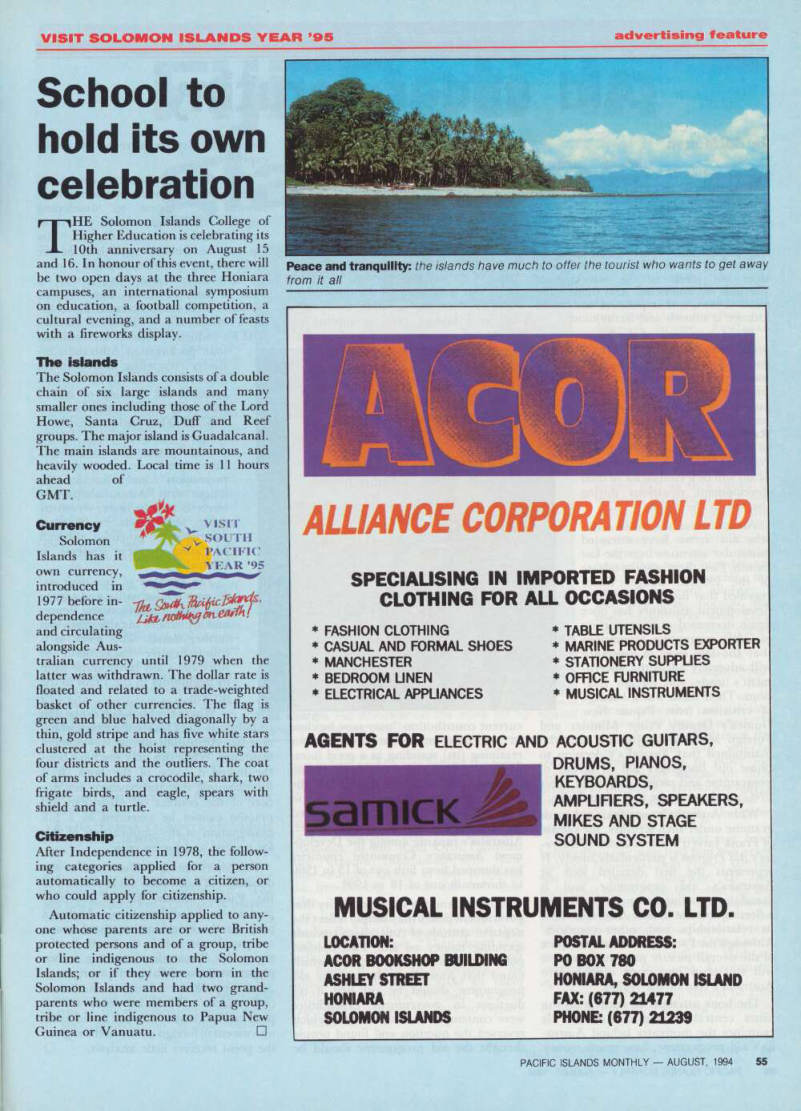
hold its own celebration
THE Solomon Islands College of Higher Education is celebrating its 10th anniversary on August 15 and 16. In honour of this event, there will be two open days at the three Honiara campuses, an international symposium on education, a football competition, a cultural evening, and a number of feasts with a fireworks display.
The islands The Solomon Islands consists of a double chain of six large islands and many smaller ones including those of the Lord Howe, Santa Cruz, Duff and Reef groups. The major island is Guadalcanal.
The main islands are mountainous, and heavily wooded. Local time is 11 hours
ahead of
Gmt.
Currency Solomon Islands has it own currency, introduced in 1977 before in
dependence
and circulating
alongside Aus-
tralian currency until 1979 when the latter was withdrawn. The dollar rate is floated and related to a trade-weighted basket of other currencies. The flag is green and blue halved diagonally by a thin, gold stripe and has five white stars clustered at the hoist representing the four districts and the outliers. The coat of arms includes a crocodile, shark, two frigate birds, and eagle, spears with shield and a turtle.
Citizenship After Independence in 1978, the follow
ing categories applied for a person
automatically to become a citizen, or who could apply for citizenship.
Automatic citizenship applied to any one whose parents are or were British protected persons and of a group, tribe or line indigenous to the Solomon Islands; or if they were born in the Solomon Islands and had two grand parents who were members of a group, tribe or line indigenous to Papua New Guinea or Vanuatu. □
Peace and tranquility: the islands have much to offer the tourist who wants to get away from it all
Advertisements & other items, p. 55 (2 items)
55
advertising feature
PACIFIC ISLANDS MONTHLY AUGUST, 1994
VISIT SOLOMON ISLANDS YEAR ’95
Alliance Corpora Tion Ltd
SPECIALISING IN IMPORTED FASHION
CLOTHING FOR ALL OCCASIONS
* FASHION CLOTHING
* CASUAL AND FORMAL SHOES
* MANCHESTER
* BEDROOM UNEN
* ELECTRICAL APPLIANCES
* TABLE UTENSILS
* MARINE PRODUCTS EXPORTER
* STATIONERY SUPPLIES
* OFFICE FURNITURE
* MUSICAL INSTRUMENTS
AGENTS FOR ELECTRIC AND ACOUSTIC GUITARS,
DRUMS, PIANOS,
KEYBOARDS,
AMPLIFIERS, SPEAKERS,
MIKES AND STAGE
SOUND SYSTEM
MUSICAL INSTRUMENTS CO. LTD.
LOCATION:
ACOR BOOKSHOP BUILDING
ASHLEY STREET
HONIARA
SOLOMON ISLANDS
POSTAL ADDRESS:
PO BOX 780
HONIARA, SOLOMON ISLAND
FAX: (677) 21A77
PHONE: (677) 21239
Aid under scrutiny
Books
By Bill Morton
AS we approach the mid point of the 19905, there is a greater consensus on what the most important issues are which face the region. There is the problem of achieving economic growth which will provide for the requirements of a grow ing population. There is the need to ensure that the exploitation of resources does not result in the wrecking of precious environments. And there is the need to ensure that political and social change is smooth and harmonious.
What is the role of the bigger, richer
and more “developed” nations such as Australia in tackling these issues? One clear role is as a provider of overseas aid, now euphemistically known as “over seas development assistance”.
Reliance on overseas aid is a fact of life for most Pacific island countries. The continued receipt of aid will be a vital factor in their
development equations during
the rest of the 19905.
Australia’s efforts in the over seas aid arena have attracted particular attention over the last month. First there was the release of the 1994/95 budget which revealed that funding for official development assistance has once again decreased as a proportion of GNP, prompting accusations that the low level of assistance will adversely affect the govern ment’s trade and foreign rela tions. Then there was a barrage of criticism from Papua New
Guinea’s Deputy Prime Minister and Foreign Minister Sir Julius Chan who maintained that Australia’s decision to phase out budgetary aid in favour of programme and project aid would affect
PNG’s independence and sovereignty.
With Australia’s overseas aid pro gramme under such scrutiny, the release of Frank Jarrett’s The Evolution of Austra lia’s Aid Program is particularly timely. It represents the first detailed look at Australia’s aid programme and is mandatory reading for anyone with even a fleeting interest in how Australia views its relationships with other countries.
Although the Pacific islands are only part of the overall picture presented, readers
will still gain important insights into
Australia’s role in the region.
The book attempts to address all the issues central to the aid debate. It examines the motivates behind Austra lia’s aid programme, how much money
is spent on, what it is spent on, how programmes are delivered, which countries benefit, and how efficient and effective the aid programme is. In the process it reveals much about the thinking of Australian governments and, to a lesser extent, about Australian people. The result is some extremely uncomplimentary observations about as pects of the aid programme. At the top of the list is criticism of the diminishing priority Australia attaches to overseas aid as a budget item, prompting the damning assessment that Australia’s
current contribution “may now be close to the bare minimum necessary for retaining (its) standing as a good inter national citizen and a significant nation in world affairs”. The figures tell the story overseas aid funding has sunk to 0.36 per cent of GNP in 1992 compared to 0.52 per cent 20 years earlier; Australia’s ranking among the Develop ment Assistance Committee countries has slumped from fifth out of 15 in 1960 to thirteenth out of 18 in 1991.
Equally damning is the possibility that
government policy may simply reflect the negative attitude of Australians towards spending money on aid. Two opinion polls are cited as evidence, one which found that Australians thought the aid programme should be cut first if re ductions in government expenditure were contemplated, and another which reversed the question and found people thought the aid programme should be
last on the list for increases in public expenditure.
The relationship between Australia’s overseas aid and trade is also scrutinised.
Growth in exports to developing countries has far outweighed growth in imports. Jarrett comments that Australia has benefited from the growth in income in developing countries without provid ing a commensurate contribution to trade in these countries. There is also criticism of the controversial Develop ment Important Finance Facility (DIFF), which provides concessional
loan packages to Australian in
dustry competing in developing
economies. The DIFF scheme received aid funding of A 5343 million in the five years between 1987-92. The conclusion is that it
is “questionable whether (DIFF)
should be treated as aid rather than expenditure on export trade promotion” and that in the
longer term “Australia’s trading
interests may be better served by using aids funds to increase
awareness of potential through
educating overseas students in Australia”.
The Evolution of Australia’s Aid Program is informative and easy to read. It is full of facts and figures and a plethora of tables provides further detail. The result is a
comprehensive background to
Australia’s aid programme from its beginnings in the 1950 s to the present.
Where the book falls down is in
its failure to fully tackle the issues which now face Australian official development assistance. While this may not have been the intended scope of the book, it is disappointing that the excellent descrip tion of the context of Australian aid practise cannot be extended to a full examination of the implications of this for present and future policy.
This shortcoming is illustrated in the discussion of Australian aid in relation to the Pacific islands. Jarrett correctly points out the different role Australia plays in the world overseas aid arena compared to its role in the South Pacific region “Australia is but a minor player on the world’s development stage ... but approaches a starring role in our own region.” While he refers to the potential for Australia to use its aid as an instrument of foreign policy in the region, the point receives little analysis. □
giant leap
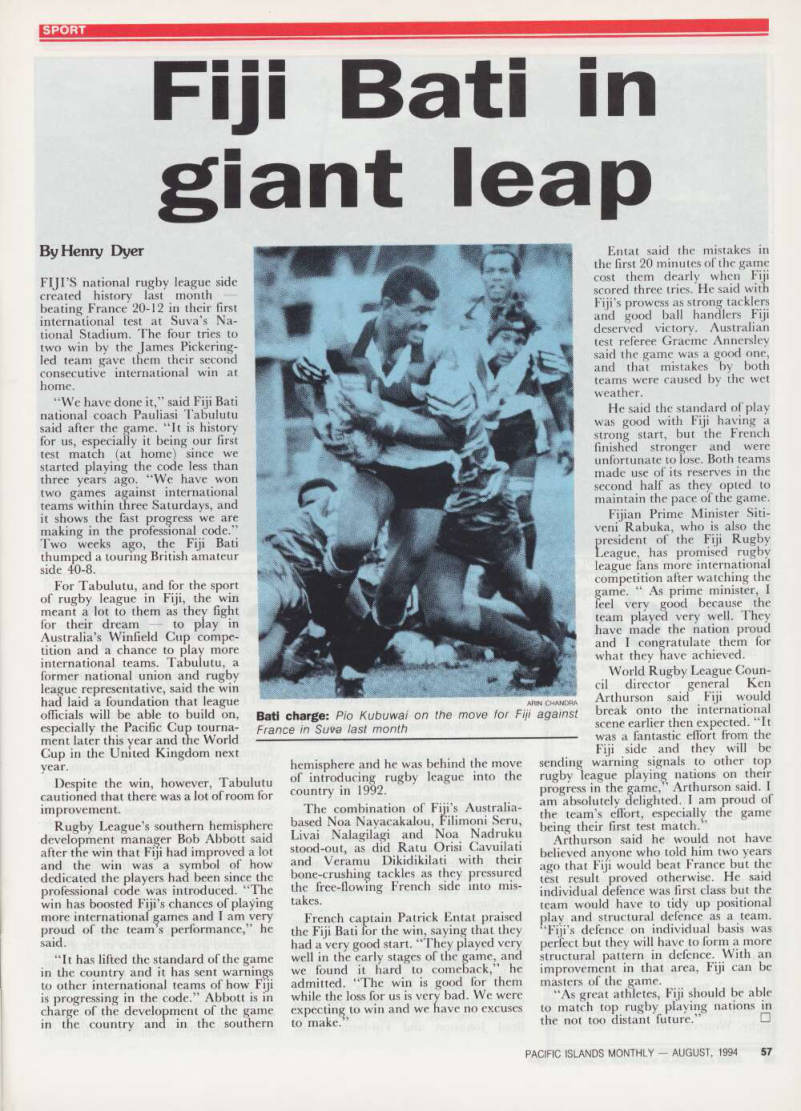
Sport
Fiji Bati in giant leap
By Henry Dyer
FIJI’S national rugby league side
created history last month beating France 20-12 in their first international test at Suva’s Na tional Stadium. The four tries to
two win by the James Pickering
led team gave them their second consecutive international win at home.
“We have done it,” said Fiji Bati national coach Pauliasi Tabulutu said after the game. “It is history for us, especially it being our first test match (at home) since we started playing the code less than three years ago. “We have won two games against international teams within three Saturdays, and it shows the fast progress we are making in the professional code.”
Two weeks ago, the Fiji Bati thumped a touring British amateur side 40-8.
For Tabulutu, and for the sport of rugby league in Fiji, the win meant a lot to them as they fight for their dream to play in Australia’s Winfield Cup compe tition and a chance to play more international teams. Tabulutu, a former national union and rugby league representative, said the win had laid a foundation that league officials will be able to build on, especially the Pacific Cup tourna ment later this year and the World Cup in the United Kingdom next year.
Despite the win, however, Tabulutu cautioned that there was a lot of room for
improvement.
Rugby League’s southern hemisphere
development manager Bob Abbott said after the win that Fiji had improved a lot and the win was a symbol of how dedicated the players had been since the professional code was introduced. “The win has boosted Fiji’s chances of playing more international games and I am very proud of the team’s performance,” he said.
“It has lifted the standard of the game in the country and it has sent warnings to other international teams of how Fiji is progressing in the code.” Abbott is in charge of the development of the game in the country and in the southern
hemisphere and he was behind the move
of introducing rugby league into the
country in 1992.
The combination of Fiji’s Australia based Noa Nayacakalou, Filimoni Seru, Livai Nalagilagi and Noa Nadruku stood-out, as did Ratu Orisi Cavuilati and Veramu Dikidikilati with their
bone-crushing tackles as they pressured
the free-flowing French side into mis takes.
French captain Patrick Entat praised the Fiji Bati for the win, saying that they had a very good start. “They played very well in the early stages of the game, and we found it hard to comeback,” he admitted. “The win is good for them while the loss for us is very bad. We were expecting to win and we have no excuses to make.”
Entat said the mistakes in the first 20 minutes of the game cost them dearly when Fiji scored three tries. He said with Fiji’s prowess as strong tacklers and good ball handlers Fiji deserved victory. Australian test referee Graeme Annersley said the game was a good one, and that mistakes by both teams were caused by the wet weather.
He said the standard of play
was good with Fiji having a
strong start, but the French finished stronger and were unfortunate to lose. Both teams made use of its reserves in the second half as they opted to maintain the pace of the game.
Fijian Prime Minister Siti veni Rabuka, who is also the
president of the Fiji Rugby
League, has promised rugby
league fans more international
competition after watching the
game. “ As prime minister, I feel very good because the team played very well. They have made the nation proud and I congratulate them for what they have achieved.
World Rugby League Coun
cil director general Ken Arthurson said Fiji would break onto the international scene earlier then expected. “It was a fantastic effort from the Fiji side and they will be
sending warning signals to other top
rugby league playing nations on their
progress in the game,” Arthurson said. I am absolutely delighted. I am proud of the team’s effort, especially the game being their first test match.”
Arthurson said he would not have believed anyone who told him two years ago that Fiji would beat France but the test result proved otherwise. He said individual defence was first class but the team would have to tidy up positional play and structural defence as a team.
“Fiji’s defence on individual basis was perfect but they will have to form a more structural pattern in defence. With an improvement in that area, Fiji can be masters of the game.
“As great athletes, Fiji should be able to match top rugby playing nations in the not too distant future.” □
Arin Chandra
Bati charge: Pio Kubuwai on the move for Fiji against France in Suva last month
Tonga emerges champ
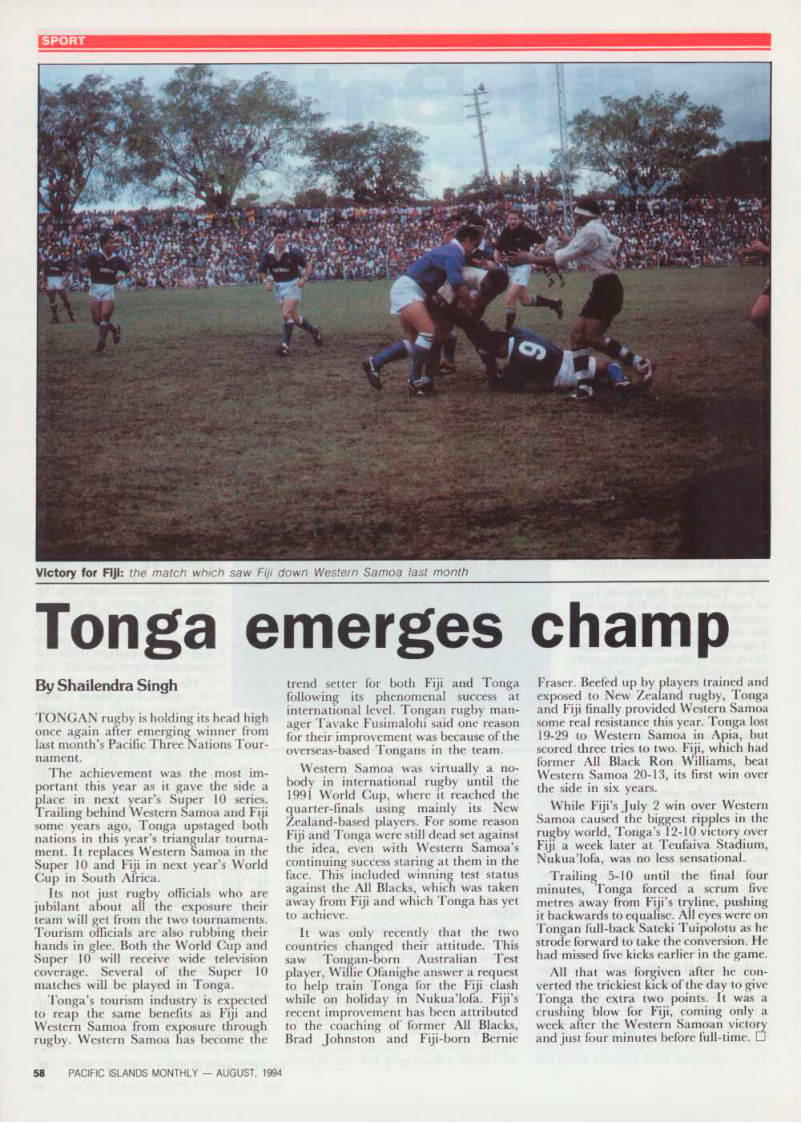
By Shailendra Singh
trend setter for both Fiji and Tonga following its phenomenal success at international level. Tongan rugby man ager Tavake Fusimalohi said one reason for their improvement was because of the overseas-based Tongans in the team.
Western Samoa was virtually a no body in international rugby until the 1991 World Cup, where it reached the
quarter-finals using mainly its New
Zealand-based players. For some reason Fiji and Tonga were still dead set against the idea, even with Western Samoa’s continuing success staring at them in the face. This included winning test status against the All Blacks, which was taken away from Fiji and which Tonga has yet to achieve.
It was only recently that the two countries changed their attitude. This saw Tongan-born Australian Test player, Willie Ofanighe answer a request to help train Tonga for the Fiji clash while on holiday in Nukualofa. Fiji’s recent improvement has been attributed to the coaching of former All Blacks, Brad Johnston and Fiji-born Bernie
Fraser. Beefed up by players trained and
exposed to New Zealand rugby, Tonga
and Fiji finally provided Western Samoa
some real resistance this year. Tonga lost 19-29 to Western Samoa in Apia, but scored three tries to two. Fiji, which had former All Black Ron Williams, beat Western Samoa 20-13, its first win over the side in six years.
While Fiji’s July 2 win over Western Samoa caused the biggest ripples in the
rugby world, Tonga’s 12-10 victory over
Fiji a week later at Teufaiva Stadium, Nukualofa, was no less sensational.
Trailing 5-10 until the final four minutes, Tonga forced a scrum five
metres away from Fiji’s trylinc, pushing
it backwards to equalise. All eyes were on Tongan full-back Sateki Tuipolotu as he strode forward to take the conversion. He had missed five kicks earlier in the game.
All that was forgiven after he con verted the trickiest kick of the day to give Tonga the extra two points. It was a crushing blow for Fiji, coming only a week after the Western Samoan victory and just four minutes before full-time. □
TONGAN rugby is holding its head high once again after emerging winner from last month’s Pacific Three Nations Tour nament.
The achievement was the most im portant this year as it gave the side a place in next year’s Super 10 series.
Trailing behind Western Samoa and Fiji some years ago, Tonga upstaged both nations in this year’s triangular tourna ment. It replaces Western Samoa in the Super 10 and Fiji in next year’s World Cup in South Africa.
Its not just rugby officials who are jubilant about all the exposure their team will get from the two tournaments.
Tourism officials are also rubbing their hands in glee. Both the World Cup and Super 10 will receive wide television coverage. Several of the Super 10 matches will be played in Tonga.
Tonga’s tourism industry is expected
to reap the same benefits as Fiji and Western Samoa from exposure through rugby. Western Samoa has become the
Victory for Fiji: the match which saw Fiji down Western Samoa last month
Super
Solomons
By Shailendra Singh
THE Solomon Islands upset the South Pacific soccer applecart when it beat Fiji in last month’s Melanesian Cup Tourna ment. Its 1-0 victory over the pre tournament favourite on July 7 was as
shocking as Fiji’s Three Nations Rugby
win over Western Samoa a week earlier.
The win over Fiji all but assured the Solomons the cup over the four other nations, even though it still had to beat New Caledonia in its last match. In the end, the French territory was no match for the fired-up Solomons and crashed to a 3-1 loss, which rendered Fiji’s 4-2 win over Vanuatu useless.
Buoyed by 10,000 cheering fans at
Lawson Tama Stadium in Honiara, the Solomons dominated much of the game against Fiji. The win was its first over Fiji in 21 years and 15 internationals. The last time Fiji lost was at the Fifth South Pacific Games in Guam in 1975 where it was pipped 2-3 in the bronze medal playoff. Prior to the Melanesian Cup, their last meeting was at South Pacific Mini Games last December where Fiji won 1-0 in pool play before losing 0-3 to French Polynesia in the final. Perhaps the most heart-breaking loss for the Solomons was during the 1991 South Pacific Games gold medal playoff where Fiji won 5-4 on penalty kicks. Many players shed tears after that encounter in
Lae, Papua New Guinea.
The recent win is significant in more ways than one. It was the Solomon Islands’ first Melanesian Cup victory and coincided with the country’s 16th inde-
Eendence day celebrations. Having
eaten Fiji after so long is also a psychological boost for the side.
Who could blame the Solomons if they thought Fiji was invincible after all those years of draws and defeats. That Fiji dethroned reigning South Pacific soccer king French Polynesia just before the Melanesian Cup gives further credence to the Solomons’ achievement.
Delirious fans celebrated wildly after the game, hugging and kissing players while local officials, sporting wide grins, shook hands and congratulated each
other, knowing fully well with Fiji
beaten, the tournament was won.
Cars and trucks with blaring horns and carrying shouting fans drove around town several several times. The merry making was evidence that soccer is “the” sport in the Solomons. The home team
should now be in the right frame of mind for the 1995 South Pacific Games, where
beating Fiji or French Polynesia won’t
seem like such a far-fetched idea after all.
Solomon Islands coach Wilson Maelaua said the win showed that they are the new soccer force. Maelaua is well known to the Fijians. He played in Fiji while a student at the University of the South Pacific in the Seventies, represent ing Suva in the district competition.
Fijian coach Anand Sami said Fiji, Solomon Islands and French Polynesia would fight it out at the Games. Until it met the Solomons, things looked good for Fiji with 3-1 and 2-0 wins over New Caledonia and Papua New Guinea respectively. The Solomons also had a good start, opening its account with a 2-0 victory over Papua New Guinea before thrashing Vanuatu 4-0. Following this, the two teams clashed. Midfielder Batram Suri, who had been in brilliant form and replacement striker George Kiriau, nicknamed the “Snake Man”, caused Fiji’s demise in the 70th minute.
In typical fashion, Suri, who scored twice against PNG, split the Fiji defence and aimed for goal with the “Snake Man” heading in the rebounder.
The Solomons defence, which had put
on a sterling performance throughout the
tournament, withstood the Fiji pressure following this goal. The Solomons con ceded only one goal in the entire tournament while scoring the highest number of goals.
Another star of the Solomon team was Robert Mark, who played in Fiji in the
early Eighties. Mark helped Suva win
Fiji’s most prestigious domestic tourna ment, the Inter-District, in 1983. Help ing his country win over Fiji clearly beat any other soccer experience for the veteran player. Ironically, the tourna ment had a shaky start with fears that the cash-strapped Solomon Islands FA would not be able to afford it.
The tournament was patronised by record crowds and clearly boosted the local association’s coffers. The next tournament, in 1996, has been given to Papua New Guinea. French Polynesia could also be playing in the tournament in future if some countries have their way. It’s the only soccer power in the South Pacific missing from the tourna ment. □
Erenavula joins
North Sydney
LUKE Erenavula raised eyebrows throughout the Pacific when he joined
the prominent Australian rugby
league club, North Sydney. Tackling
has always been the lanky Fijian
winger’s greatest weakness and there was general belief this would preclude him from ever pursuing a career in league where tackling is an all
important discipline.
However, North Sydney is confi dent an intense training program will iron out this possible Achilles heel. At 28 years of age, Erenavula realised that North’s offer probably presented him with his last chance to make a substantial amount of money from rugby. His decision was also, without doubt, influenced by him being over looked for All Blacks honour (despite having played a major role in New
Zealand’s Hong Kong sevens triumph
in March) and confirmation that, under recently introduced Interna tional Rugby Board regulations, he was now ineligible to play for Fiji again. Erenavula will be hoping to emulate his cousin Noa Nadruku, who has enjoyed immense success with Canberra Raiders since joining them last year. □
Advertisements & other items, p. 59 (1 item)
A- Alfa Laval
A New Era in Sludge
Separation Management
Alfa Laval’s Mobile Dewatering Unit answers all the questions when it comes to compact, highcapacity, ready-to-operate digested sludge Dewatering systems If you require mobility and ease of transportation environmental compatibility minimal installation and running costs efficiency and reliability activated sludge thickening sludge dewatering for incineration water treatment sludge dewatering waste stream clarification, or industrial waste water treatment
A- Alfa Laval
Uniting Vital Technologies Please contact: Carol L’ Heureux Alfa Laval Pty Ltd Address: Private Bag 40, Homebush NSW 2140 Australia Tel; 61 2 746 2744 Fax: 61 2 746 2171
Hawaii
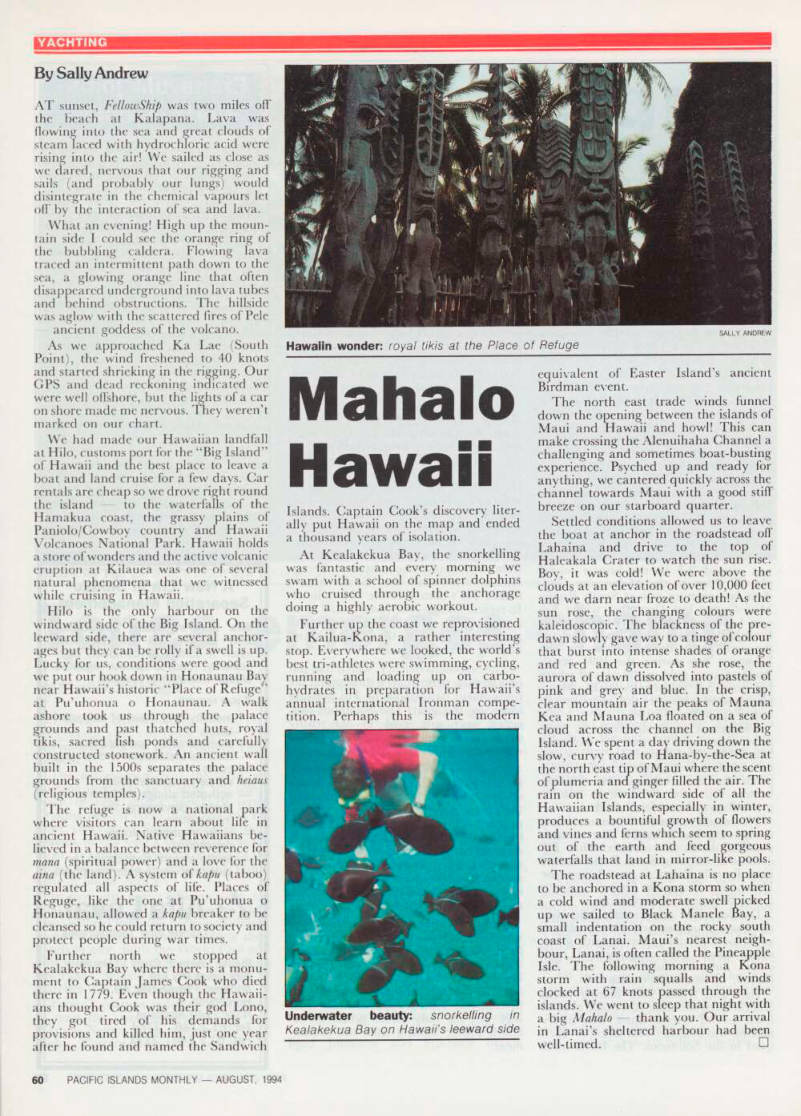
Yachting
Mahalo Hawaii
By Sally Andrew
AT sunset, Fellowship was two miles oil the beach at Kalapana. Lava was {lowing into the sea and great clouds of steam laced with hydrochloric acid were rising into the air! We sailed as close as we dared, nervous that our rigging and sails (and probably our lungs) would disintegrate in the chemical vapours let off by the interaction of sea and lava.
What an evening! High up the moun tain side 1 could see the orange ring of the bubbling caldera. Plowing lava traced an intermittent path down to the sea, a glowing orange line that often disappeared underground into lava tubes and behind obstructions. The hillside was aglow with the scattered fires of Pcle ancient goddess of the volcano.
As we approached Ka Lac (South Point), the wind freshened to 40 knots and started shrieking in the rigging. Our GPS and dead reckoning indicated we were well offshore, but the lights of a car on shore made me nervous. They weren’t marked on our chart.
We had made our Hawaiian landfall at Hilo, customs port for the “Big Island” of Hawaii and the best place to leave a boat and land cruise for a few days. Car rentals are cheap so we drove right round the island to the waterfalls of the Hamakua coast, the grassy plains of Paniolo/Cowboy country and Hawaii Volcanoes National Park. Hawaii holds a store of wonders and the active volcanic eruption at Kilauea was one of several natural phenomena that we witnessed while cruising in Hawaii.
Hilo is the only harbour on the windward side of the Big Island. On the leeward side, there are several anchor ages but they can be roily if a swell is up.
Lucky for us, conditions were good and we put our hook down in Honaunau Bay near Hawaii’s historic “Place of Refuge” at Pu’uhonua o Honaunau. A walk ashore took us through the palace grounds and past thatched huts, royal tikis, sacred fish ponds and carefully constructed stonework. An ancient wall built in the 1500 s separates the palace grounds from the sanctuary and heiaus
(religious temples).
The refuge is now a national park where visitors can learn about life in ancient Hawaii. Native Hawaiians be lieved in a balance between reverence for mana (spiritual power) and a love for the aina (the land). A system o l'kapu (taboo) regulated all aspects of life. Places of Rcgugc, like the one at Pu’uhonua o Honaunau, allowed a kapu breaker to be cleansed so he could return to society and protect people during war times.
Lurther north we stopped at Kealakekua Bay where there is a monu ment to Captain James Cook who died there in 1779. Even though the Hawaii ans thought Cook was their god Lono, they got tired of his demands for provisions and killed him, just one year after he found and named the Sandwich
Islands. Captain Cook’s discovery liter ally put Hawaii on the map and ended a thousand years of isolation.
At Kealakekua Bay, the snorkelling was fantastic and every morning we swam with a school of spinner dolphins who cruised through the anchorage doing a highly aerobic workout.
Lurther up the coast we reprovisioned at Kailua-Kona, a rather interesting stop. Everywhere we looked, the world’s best tri-athletes were swimming, cycling, running and loading up on carbo hydrates in preparation for Hawaii’s annual international Ironman compe tition. Perhaps this is the modern
equivalent of Easter Island’s ancient Birdman event.
The north east trade winds funnel down the opening between the islands of Maui and Hawaii and howl! This can make crossing the Alenuihaha Channel a
challenging and sometimes boat-busting
experience. Psyched up and ready for
anything, we cantered quickly across the channel towards Maui with a good stiff breeze on our starboard quarter.
Settled conditions allowed us to leave the boat at anchor in the roadstead of!
Lahaina and drive to the top of Haleakala Crater to watch the sun rise.
Boy, it was cold! We were above the clouds at an elevation of over 10,000 feet and we darn near froze to death! As the sun rose, the changing colours were kaleidoscopic. The blackness of the pre dawn slowly gave way to a tinge of colour that burst into intense shades of orange and red and green. As she rose, the aurora of dawn dissolved into pastels of pink and grey and blue. In the crisp, clear mountain air the peaks of Mauna Kea and Mauna Loa floated on a sea of cloud across the channel on the Big Island. We spent a day driving down the slow, curvy road to Hana-by-the-Sea at the north east tip of Maui where the scent of plumeria and ginger filled the air. The rain on the windward side of all the Hawaiian Islands, especially in winter, produces a bountiful growth of flowers and vines and ferns which seem to spring out of the earth and feed gorgeous waterfalls that land in mirror-like pools.
The roadstead at Lahaina is no place to be anchored in a Kona storm so when a cold wind and moderate swell picked up we sailed to Black Manele Bay, a small indentation on the rocky south coast of Lanai. Maui’s nearest neigh bour, Lanai, is often called the Pineapple Isle. The following morning a Kona storm with rain squalls and winds clocked at 67 knots passed through the islands. We went to sleep that night with a big Mahalo thank you. Our arrival in Lanai’s sheltered harbour had been well-timed. D
Sally Andrew
Hawaiin wonder: royal tikis at the Place of Refuge
Underwater beauty: snorkelling in Kealakekua Bay on Hawaii’s leeward side
Shipping
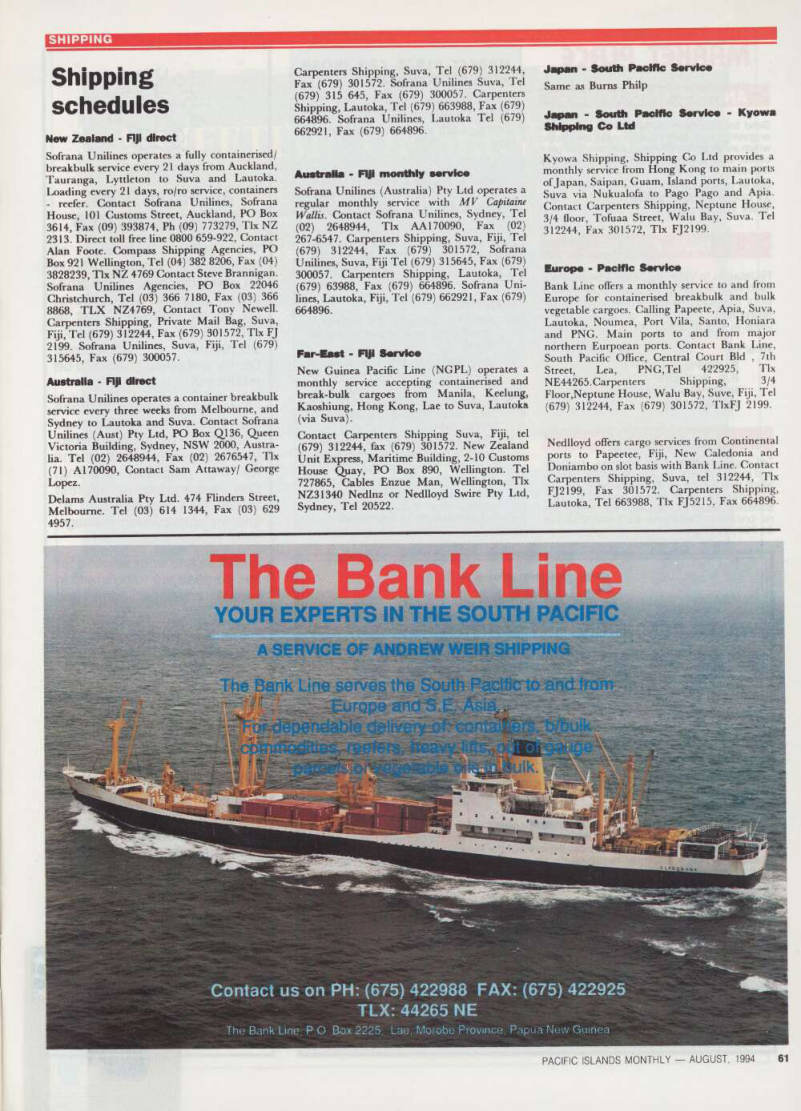
schedules
New Zealand - FIJI direct Sofrana Unilines operates a fully containerised/ breakbulk service every 21 days from Auckland, Tauranga, Lyttleton to Suva and Lautoka.
Loading every 21 days, ro/ro service, containers - reefer. Contact Sofrana Unilines, Sofrana House, 101 Customs Street, Auckland, PO Box 3614, Fax (09) 393874, Ph (09) 773279, Tlx NZ 2313. Direct toll free line 0800 659-922, Contact Alan Foote. Compass Shipping Agencies, PO Box 921 Wellington, Tel (04) 382 8206, Fax (04) 3828239, Tlx NZ 4769 Contact Steve Brannigan.
Sofrana Unilines Agencies, PO Box 22046 Christchurch, Tel (03) 366 7180, Fax (03) 366 8868, TLX NZ4769, Contact Tony Newell.
Carpenters Shipping, Private Mail Bag, Suva, Fiji, Tel (679) 312244, Fax (679) 301572, Tlx FJ 2199. Sofrana Unilines, Suva, Fiji, Tel (679) 315645, Fax (679) 300057.
Australia - Fiji direct Sofrana Unilines operates a container breakbulk service every three weeks from Melbourne, and Sydney to Lautoka and Suva. Contact Sofrana Unilines (Aust) Pty Ltd, PO Box Q 136, Queen Victoria Building, Sydney, NSW 2000, Austra lia. Tel (02) 2648944, Fax (02) 2676547, Tlx (71) A 170090, Contact Sam Attaway/ George Lopez.
Delams Australia Pty Ltd. 474 Flinders Street, Melbourne. Tel (03) 614 1344, Fax (03) 629 4957.
Carpenters Shipping, Suva, Tel (679) 312244, Fax (679) 301572. Sofrana Unilines Suva, Tel (679) 315 645, Fax (679) 300057. Carpenters Shipping, Lautoka, Tel (679) 663988, Fax (679) 664896. Sofrana Unilines, Lautoka Tel (679) 662921, Fax (679) 664896.
Australia - Fiji monthly service Sofrana Unilines (Australia) Pty Ltd operates a regular monthly service with MV Capitaine Wallis. Contact Sofrana Unilines, Sydney, Tel (02) 2648944, Tlx AA170090, Fax (02) 267-6547. Carpenters Shipping, Suva, Fiji, Tel (679) 312244, Fax (679) 301572, Sofrana Unilines, Suva, Fiji Tel (679) 315645, Fax (679) 300057. Carpenters Shipping, Lautoka, Tel (679) 63988, Fax (679) 664896. Sofrana Uni lines, Lautoka, Fiji, Tel (679) 662921, Fax (679) 664896.
Far-East - Fiji Service New Guinea Pacific Line (NGPL) operates a monthly service accepting containerised and break-bulk cargoes from Manila, Keelung, Kaoshiung, Hong Kong, Lae to Suva, Lautoka (via Suva).
Contact Carpenters Shipping Suva, Fiji, tel (679) 312244, fax (679) 301572. New Zealand Unit Express, Maritime Building, 2-10 Customs House Quay, PO Box 890, Wellington. Tel 727865, Cables Enzue Man, Wellington, Tlx NZ31340 Nedlnz or Nedlloyd Swire Pty Ltd, Sydney, Tel 20522.
Japan - South Pacific Sorvico Same as Burns Philp Japan - South Pacific Sorvico • Kyowa Shipping Co Ltd Kyowa Shipping, Shipping Co Ltd provides a monthly service from Hong Kong to main ports ofjapan, Saipan, Guam, Island ports, Lautoka, Suva via Nukualofa to Pago Pago and Apia.
Contact Carpenters Shipping, Neptune House, 3/4 floor, Tofuaa Street, Walu Bay, Suva. Tel 312244, Fax 301572, Tlx FJ2199.
Europe - Pacific Sorvico Bank Line offers a monthly service to and from Europe for containerised breakbulk and bulk vegetable cargoes. Calling Papeete, Apia, Suva, Lautoka, Noumea, Port Vila, Santo, Honiara and PNG. Main ports to and from major northern Eurpoean ports. Contact Bank Line, South Pacific Office, Central Court Bid , 7th Street, Lea, PNG,TeI 422925, Tlx NE4426s.Carpenters Shipping, 3/4 Floor,Neptune House, Walu Bay, Suve, Fiji, Tel (679) 312244, Fax (679) 301572, TIxFJ 2199.
Nedlloyd offers cargo services from Continental ports to Papeetee, Fiji, New Caledonia and Doniambo on slot basis with Bank Line. Contact Carpenters Shipping, Suva, tel 312244, Fix FJ2199, Fax 301572. Carpenters Shipping, Lautoka, Tel 663988, Tlx FJ5215, Fax 664896.
Advertisements & other items, pp. 61-64 (1 item)
The Bank Line
YOUR EXPERTS IN THE SOUTH PACIFIC
m A i V X: ■mz:
iSm:
■ mm.
Lin
> r>l rasa?* 3£sr ■ w 1
|SpBS£
MARKET PLACE
ANTIQUE ENGRAVINGS
Send for catalogue listing antique maps and engravings from early expeditions to the Pacific which are available for sale. Lists of out-of-print books also available. Write stating areas of interest.
COUN HINCHCUFFE
12 QUEENS STAITH MEWS
YORK YOIIHH U.K.
REAL ESTATE
Fiji Islands In Vitilevu ... new 4 bedroom 3 bath house with a 14 acre. 500’ ocean front freehold coastal property. Good for retirement ... farming or small resort.
Price in U.S.A. $200,000.
Write to
S. KRIPL
P.O. BOX 129
KOROVOU TAILEVU
FIJI ISLANDS
SCRAP METAL
Tall ingots operate from Brisbane, Australia and make frequent visits to the Pacific Islands which they have done for twenty-five years. We are buyers of Copper, Brass, Aluminium, Lead, Batteries, Battery Lead, Cable etc. Inspection no problems. Telephone 61 7 8922033 Fax 61 78922077.
MfIRK€T PLRCC CRN IUORK
UIONDCRS FOR VOU ...
Promote your business, or service, sell your household items, cars or heavy machinery etc.
ONLY AUSSI PER WORD.
NO COMPANY LOGO. NO
DISPLAY. NO BOLD TYPE.
Just forward your Advertisement together with payment to: PACIFIC ISLANDS MONTHLY "Market Place", P.O. Box 1167, Suva, Fiji.
CONDITIONS:
1. All Advertisements are subject to acceptance and approval of publisher. 2. Advertisements are published as space permits; we cannot guarantee date of insertion. 3. All advertisements must be prepaid and should be typed or printed clearly. 4. Deadline for receipt of advertisements is the 10th of the month prior to issue.
5. PACIFIC ISLANDS MONTHLY
assumes no responsibility for any service other than publishing paid advertisements in this section.
PACIFIC
ARCHITECTURAL
SERVICES INVITED
The Pacific Conference of Churches is planning to build an office complex on its property at Thurston Street, Suva, Fiji, at an estimated cost of Fijian $3.7 million to house its Secretariat, a Conference Centre and office spaces to be rented out.
Interested architectural firms are invited to express their interest to provide full architectural plans with specifications for the proposed building.
Such expression of interest should also indicate also offers for construction management consultancy.
Enquiries and submissions for this purpose are to be made in sealed envelope addressed to: — The General Secretary, Pacific Conference of Churches, P.O. Box 208, Suva,
FIJI.
Submission to be received by 12.00 noon, Ist August, 1994.
The PCC is a Regional Ecumenical Organisation of Churches and National Councils of Churches in the Pacific.
It is a charitable organisation .registered in Fiji. It serves churches and communities throughout the Pacific region on areas of Christian mission and unity of as issues < ill and develop service de Women anc and Publish! I I
same
WATER RESOURCES and SANITATION PROGRAM
Applications are invited for the SOPAC positions Project Manager, and Hydrogeologist based at the SOPAC Secretariat in Suva, Fiji. The positions are supported under UNDP project “Pacific Water Supply and Sanitation Program” which will be administered by SOPAC. The objectives of this Program are to achieve a sustainable capability in water and sanitation development and management in Pacific Island Countries, through the establishment of a regional support mechanism within SOPAC.
PROJECT MANAGER
A Project Manager will be required to implement the program, to help SOPAC develop a Water Resources and Sanitation Program to develop new proposals for within the Program, and to develop close working relationships with other organisations working in the water sector. Essential requirements are an appropriate degree, with at least 10 years experience preferably in the Pacific region, and with broad experience including management, in the water sector.
HYDROGEOLOGIST
A Hydrogeologist is required to continue hydrogeology work already begun by UNDP, assist in training activities, and continue development of the Program according to participating countries needs. Essential requirements are an appropriate degree, and with at least 5 years experience preferably in the Pacific region.
Applications All applications should be fully documented and include details to work experience and qualifications and the names of at least three referees. Applications to be marked “Project Manager Application” or “Hydrogeologist Application”, as appropriate, should be addressed to the Director of SOPAC, and should reach the following address by 19 August, 1994: SOPAC Secretariat Private Mall Bag, GPO Suva, FIJI.
Further information on the above positions may be obtained from the Director, SOPAC Secretariat, on telephone (679) 381-377 or fax (679) 370-040.
I A LIFETIME OF SERVICES
40 45 Grand Pacific Life Insurance offers you a lifetime of safe, secure products at very competitive rates.
Choose from a full range of products such ais
• Super Ordinary Life
• Super Universal • Nond?anrtcrpatrng Whole Life • 10-Year Level Term • Flexible Premium Annuities • Group Life Insurance
• IRAs
• Graded Premium Whole Life WeVe been dedicated to providing fast, personalized service for more than 35 years through local ownership and management* found Pacific Life Insurance, Ltd Thai's why Grand! Pacific Life is your Family for Life ...throughout the Pacific » 40 3O 35 40 45 50 55 60 ©
Grand Pacific Life Insurance, Ltd.
A member of the Finance Factors Family
FEDERATED STATES
OF MICRONESIA
Actouka Executive Insurance Underwriters P.O. Box 55, Kolonia, Pohnpei, Federated States of Micronesia 96941 Pacific Basin Insurance & General Services, Inc P.O. Box 494, Chuuk State, Federated States of Micronesia 96942
TONGA
Peseti Ma‘afu Ins. & Finance, Ltd.
Private Bag 2, Taumoepeau Bldg.
Nukualofa, Tonga
GUAM
Great National Insurance Underwriters, Inc.
P.O. Box GA, Agana, Guam 96910
AMERICAN SAMOA
Mark Solofa Pacific Insurance & Finance, Inc.
P.O. Box 3149 Pago Pago, American Samoa 96799 Pacific Financial Corporation P.O. Box AT, Agana, Guam 96910 Takagi & Associates, Inc.
GCIC Bldg., Suite 100 414 W. Soledad Ave.
Agana, Guam 96910
MARSHALL ISLANDS
Marshalls Insurance Agency P.O. Box 113, Majuro, Marshall Islands 96960
WESTERN SAMOA
Mark Solofa Pacific Insurance & Finance, Inc.
P.O. Box 3149 Pago Pago, American Samoa 96799
NORTHERN MARIANAS
Pacific Basin Insurance Undenvriters, Inc.
P.O. Box 710 Saipan, Mariana Islands 96950 Pacifica Insurance Undenvriters, Inc.
P.O. Box 168, Saipan, Mariana Islands 96950 Grand Pacific Life Insurance, Ltd. *1164 Bishop Street, sth Floor, Honolulu, HI 96813 Phone: (808) 548-3363 • FAX: (808) 548-5122
The Mitsubishi Lancer: A family sedan that’s practically built to perform.
Lancer leaves the rest of its class in the dust.
Yes, it is a family sedan. Comfortable and practical.
But exciting, too, because Mitsubishi hasn’t forgotten what truly drives you: the pure pleasure of total driving performance.
Its ground-hugging chassis holds comers tight. A self-aligning multi-link suspension adjusts to the road no matter what the driving conditions. And the aggressive, fuel-efficient 16-valve SOHC engine makes Lancer eager and responsive in the passing lane.
All of this performance comes from one very simple idea —our total approach to engineering.
We believe that unless each aspect of a car is fully integrated into the overall design, the result will never exceed the sum of the parts. The difference is self-evident. Behind the wheel.
And on the road.
It is this philosophy that makes every Mitsubishi such a rt ■ v ■>' rewarding driving experience Whether it’s our top-end Mitsubishi Sigma, technologically sophisticated Galant, all-weather 3000 GT sports car, or offroad 4WD Pajero... they’re all driven by the power of positive thinking.
So take the wheel of a Lancer, the family sedan that performs like a thoroughbred.
MITSUBISHI LRNCER
What Drives You. f O
AUG 1994 £)'
dj A AMERICAN SAMOA: PACIFIC MARKETING INC. PO. Box 698, Pago Pago, Tel. 699-9140 / AUSTRALIA: MITSUBISHI MOTORS AUSTRALIA LTD. 1284 South Road, Clovelly Part, South Australia, 5042, Tel (08) 2757297 / Fill: NIVIS MOTOR & MACHINERY CO. LTD. G.P.O. Box 150, Suva, Tel. 383411 / GUAM: TRIPLE J ENTERPRISES INC. PO. Box 6066, Tamuning, Tel. 6469126 / NEW CALEDONIA: SOCIETE DTMPORIWION D'AUTD DU PACIFIQUE SUD SA. PO. Box 438, Noumea, Tel. 272-562 / NEW ZEALAND: MITSUBISHI MOTORS NEW ZEALAND LTD. Private Bag. Porirua, Tel. 237-0109 / NORFOLK ISLAND: BORRY'S PIY LTD. PO. Box 169, Taylors Road, Burnt, Tel. 2114 / PAPUA NEW GUINEA: TOBA MOTORS PTY LTD. PO. Box 503, Port Moresby, Tel. 217-874 / SAIPAN: SAIPAN AUTDWORLD INC. PO. Box 487, Tel. 234-7133 / SOLOMON ISLANDS: HARVEST PACIFIC LTD. G.P.O. Box 888, Honiara, Tel. 30407 / TAHITI: SOPADEP S.A. B.P. 1617, Papeete, Tel. 427393 / TONGA: SITANI MAFI CO., LTD. PO. Box 83 Nuku Alofa, Tel. 24044 / VANUATU: SOCOMETRA VANUATU LTD. B.P. 6 Port-Vila, Tel. 2314 / WESTERN SAMOA: MOTOR DISTRIBUTORS (SAMOA) LTD. PO. Box 576 Apia, Tel. 20967
MITSUBISHI
MOTORS
CREATING TOGETHER