Pacific
Islands
Monthly
t
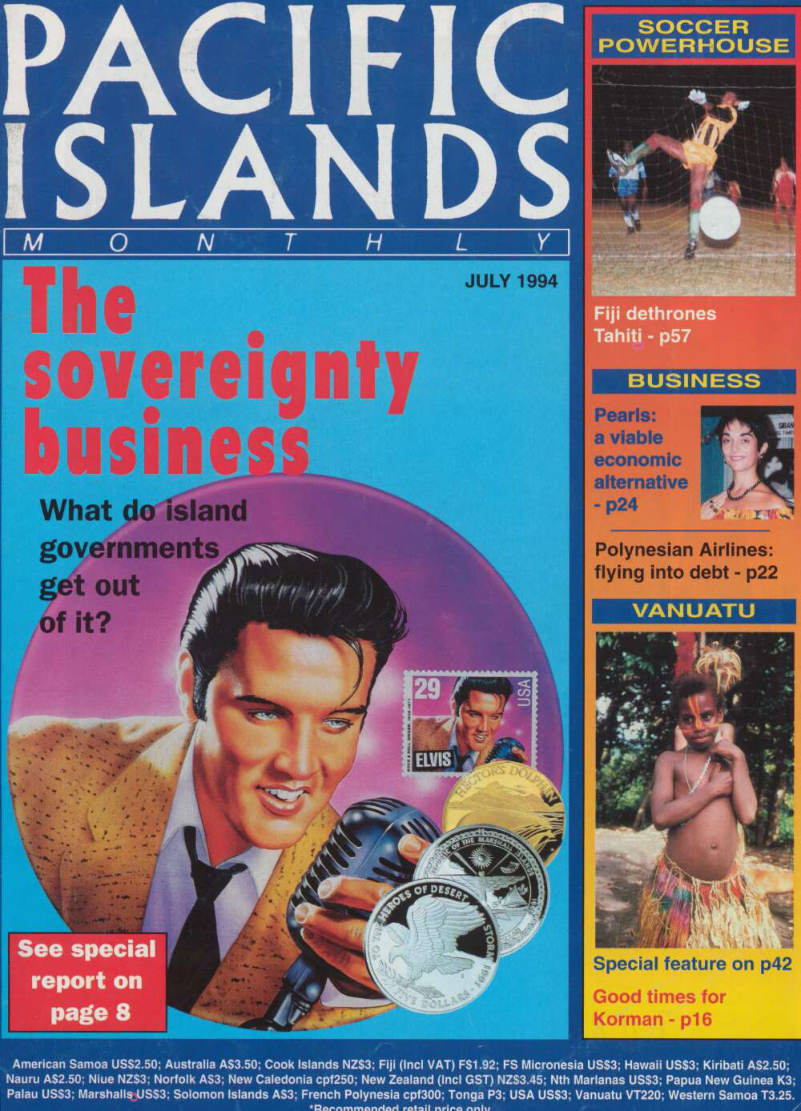
The . sovereignty business
What do island
governments
get out of it?
See Special report on Page 8
Soccer
Powerhouse
Fiji dethrones Tahiti - p 57
Business
Pearls: a viable economic alternative -p24
Polynesian Airlines: flying into debt - p 22
Vanuatu
Special feature on p 42 Good times for Korman - pl 6
American Samoa USS2.SO; Australia A 53.50; Cook Islands NZ$3; Fiji (Incl VAT) F 51.92; FS Micronesia US$3; Hawaii US$3; Kiribati A 52.50; Nauru A 52.50; Niue NZ$3; Norfolk As 3; New Caledonia cpf2so; New Zealand (Incl GST) NZ53.45; Nth Marianas US$3; Papua New Guinea K 3; Palau US$3; Marshalls US$3; Solomon Islands ASS; French Polynesia cpf3oo; Tonga P 3; USA US$3; Vanuatu VT22O; Western Samoa T 3.25. *RornmmonHoH rota SI nrioo on Iw
Advertisements & other items, p. 2 (1 item)
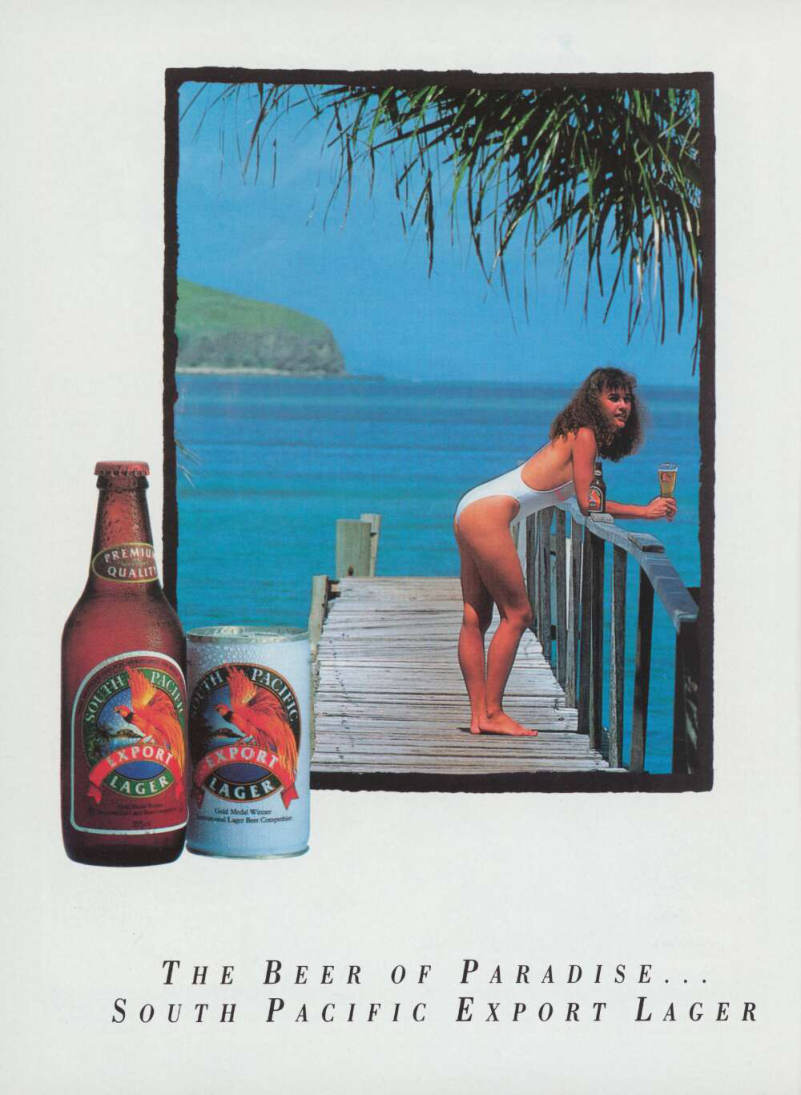
South Pacific Export Lager
/ Y I qua in aw Medal Winner Lapeer B«r
The Beer of Paradise...
Pacific
Islands
Imonthly
Vol 64 NO. 7
The News Magazine
July 1994
Letters 4
Environment
Greenhouse warning 5
Headlines 6
Cover Stories
The sovereignty business 8 Elvis, Marshalls and junk mail 14
Vanuatu
Good times for Korman 16
Fiji
Opposition boycotts parliament 18
Race Relations
Islanders allege racial taunts 19
Business
Flying into debt 22 Business bulletin 23 Pearls ’94 24 Queen of pearls 25
Education
Scholarship boost 29
Issue
Hope for end to war 30 The amazing Joseph 31
Northern Marianas
Tinian home of the A-Bomb Pits3s
The United Nations
Can small islands rely on anyone?
Learning from past mistakes 38
Television
Fiji gets permanent TV 39
Books
The days of old 53
Environment
Fallout of another kind 54 Wildlife worry 55
Pohnpei/ Marshall
Islands
Land a hot issue 56
Sport
The Fijian threat 57 Rugby nightmare 58 No looking back for Luke 59
Yachting
Return to Raga 60
Shipping
Shipping schedules 61
Columnists
Jemima Garrett 17 'Atu Emberson-Bain 27 Alfred Sasako 28 David Barber 40
Publisher: Brian O’Flaherty Acting Editor: Arvind Kumar Senior Writer: Fiona Phillips Correspondents: Christine Hatcher, David North, Ed Rampell, lan Williams. Johnson Honimae, Karen Mangnall, Liz Thompson, Nicholas Rothwell, Pesi Fonua, Wally Hiambohn.
Columnists; David Barber (Wellington), Futa Helu (Tonga, covering the Pacific Islands), Jemima Garrett (Sydney).
Julian Moti (Pacific Law), Alfred Sasako (The Forum).
Advertising Sales: • Regional Sales (South Pacific; Salendra Narayan, Tel (679) 304111, 303244, Fx (679) 303809. • Sydney. Canberra Bob Hill Media Represen tations. Tel (61-2) 4164245. Fx (61-2) 4165064 • Brisbane: Robert Walker. Media House Tel (61-7) 3710533. Fx (61-7) 371-8904 • Adelaide: Hastwell Williamsons Representatives, Tel (61-8) 3799522, Fx (61-8) 3799735. • Melbourne: Brown Orr Fletcher Burrows (Aust).
Pty Ltd. Tel (613) 8265188; Fx: (613) 8265644. • Auckland: McKay & Bowman, International Media Representatives Ltd, Tel (64-9) 4190561 Fx (64-9) 4192243.
• Japan: Universal Media Corporation, Tokyo, Tel (3) 32626741, Cable: UNIMEDIA Tokyo, Fx (3) 32626742.
Founded 1930 (USPS 952480). A Fiji Times Limited production.
Cover prices are recommended retail only. Regis tered by Australia Post, Publication No. NBP 1210. © Copyright Fiji Times Limited, 177 Victoria Parade, Suva. Fiji. Tel (679) 304111, Fx (679)
303809, Tx Fj2124.
Pacific Islands Monthly is published monthly by The Fiji Times Limited, a division of Nationwide News, 2 Holt Street, Surry Hills. Sydney. NSW 2010.
Send address changes to: • Pacific Islands Monthly. PO Box 1167. Suva. Fiji.
Typeset and printed by The Fiji Times Limited, 177 Victoria Parade, Suva, Fiji.
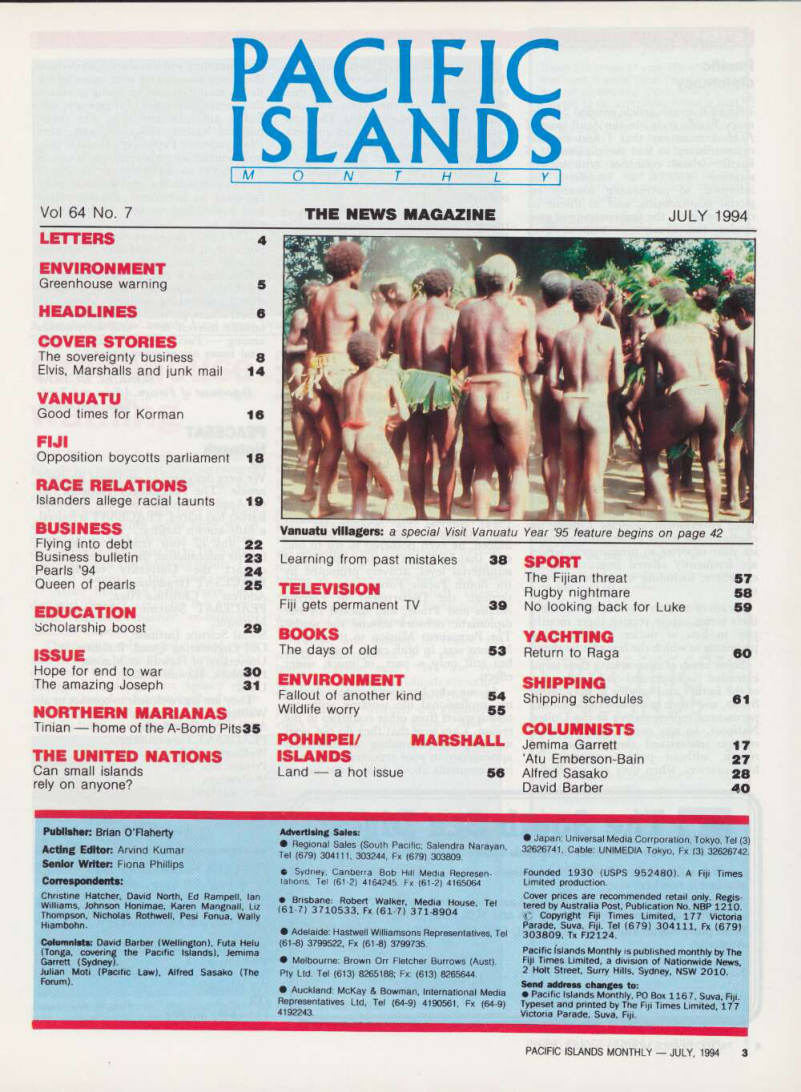
Vanuatu villagers: a special Visit Vanuatu Year '95 feature begins on page 42
diplomacy
Letters
Pacific
Sir, I REFER to the article entitled “Diplo macy Pacific style” in the April issue of PIM. I must say that I find it quite extraordinary to find the diplomacy of Pacific Island countries criticised by someone who is so manifestly ill informed, so patronising towards re gional governments, and so intent on capitalising on the indiscretions of par ticular individuals without even bothering to check his “facts”. Is this Diplomacy PIM style?
As with similar appointments in the diplomatic services of most other countries, Papua New Guinea’s heads of mission are appointed by the principal executive authority in the country, the national executive council. Whether or not they are permanent officers of the Department of Foreign Affairs and Trade, they are accountable to the government-of-the-day, at whose pleasure they serve. In both respects, their situation is like that of many other senior public office holders, including departmental heads (such as myself).
When their terms are complete or their appointments are revoked, permanent civil servants, including heads of mission who have been recently recalled, return to senior positions in the department or other government agencies. Others, in cluding some whose professional obituar ies your reporter so prematurely wrote, are frequently offered important posts elsewhere, including in the private sec tor.
Heads of mission who are called before their terms expire receive three months pay in lieu of notice plus other payments to which the law entitles them.
Some heads of mission have their terms extended (as happened once in the case of the former ambassador to the United States, and twice in the case of the former permanent representative at the United Nations). In any event, most heads of mission understand the position, and return, without public comment, to headquarters, when they are recalled.
All of them are, in fact, briefed in detail, at workshops held over a period of two weeks before they take up their official duties, on the terms and con ditions of their appointments. The com ments attributed to the former ambassa dor in Washington must, therefore, be regarded as indiscreet expressions of unfortunate ignorance or indifference towards longstanding practices and pro cedures.
As for your reporter’s assessment of regional diplomacy in general, and of Papua New Guinea diplomacy in par ticular, the best that can be said is that it is offensive, self-contradictory and based on the uncritical acceptance of others’ self-serving views. Thus, he pro vokes no firm evidence to support the sweeping claim that diplomacy “has never been a strong card for Pacific states”.
In fact, he subsequently cites two major diplomatic achievements: the re inscription of New Caledonia on the United Nations list of non-self-governing territories and the passage of a resolution to appoint a United Nations panel on Papua New Guinea’s initiative of “Op
portunity and Participation”.
But, in doing so, he attributes both successes to particular individuals, who appear to have been his informants.
In relying on such self-interested and self-promoting sources, your reporter
fails completely to acknowledge (if,
indeed, he even bothered to try to find out) that both success were initiated at ministerial level, actively promoted by the South Pacific Forum, co-ordinated through the Department of Foreign Affairs and Trade, and backed by our diplomatic network around the world.
The Permanent Mission to the United Nations was, in both cases, a vital part, but still only a part, of much wider efforts.
As one who has spent quite a deal of my professional life working with my counterparts from other countries in the region, I am sure that they do not need my help in responding as they find
appropriate to your reporter’s disparag
ing comments about them. I am just as
sure that they will not allow him to draw them into controversy over issues which he has manufactured by trying to misuse the normal courtesies of diplomatic life.
But I am also sure that, like many political leaders, colleagues and other PIM readers in Papua New Guinea, they must wonder why a journal which aspires to provide an authoritative record of developments in the region should pub lish such an inaccurate, condescending and misleading version of important events.
The article displays neither diplomacy nor style. It does and says nothing of value for the Pacific.
The region is entitled to expect more reliable, insightful and genuinely thought-provoking writing about re gional affairs, particularly at a time when outside interest in and inter-action among Pacific Island countries over vital issues are growing apace.
Gabriel Dusarya
Department of Foreign Affairs and Trade Papua New Guinea
Peacesat
Network Sir, We were delighted to see David Barber’s article “The PEACESAT Network” in the April 1994 edition of PIM. As David Barber has stated, PEACESAT is indeed a little-known facility.
If any of your readers would like further information, they are welcome to contact the University of Hawaii PEACESAT Headquarters.
Address Christina Higa, PEACESAT Systems and Operations Manager, Social Science Institute, Old Engineering Quad, Building 31, University of Hawaii at Manoa, Honolulu, Hawaii 96822,
Usa.
They are also welcome to contact us at Wellington Polytechnic.
Address Kay Seyb, PEACESAT Co-ordinator, Wellington Polytechnic, Private Box 756, Wellington, New Zealand.
Kay Seyb
PEACESAT Co-ordinator
Advertisements & other items, p. 4 (1 item)
The South Sea Digest
I
The Newsletter on Islands affairs. Every Other Friday.
South Sea Digest has all the latest business news, expectly streamlined and obtainable nowhere else.
Subscriptions: 25 issues SAISO for Australian subscriber; SAI7S overseas, all airmailed. Payment by cheque in $A and SUS, otherwise by bank draft.
Send payment to: The South Sea Digest, GPO Box 4245, Sydney, NSW 2001, Australia.
Name Address:
LETTERS to the Editor must include the writer’s full name, address and home telephone number. All letters may be edited for purposes of clarity and space.
Letters should be addressed to: Editor Pacific Islands Monthly P O Box 1167 Suva
Fiji Islands
OR Fax (679) 303809
warning
Environment
Greenhouse warning
THE Pacific nation of the Marshall Islands has received a chilling warning of what may happen if sea levels rise as a result of global warming.
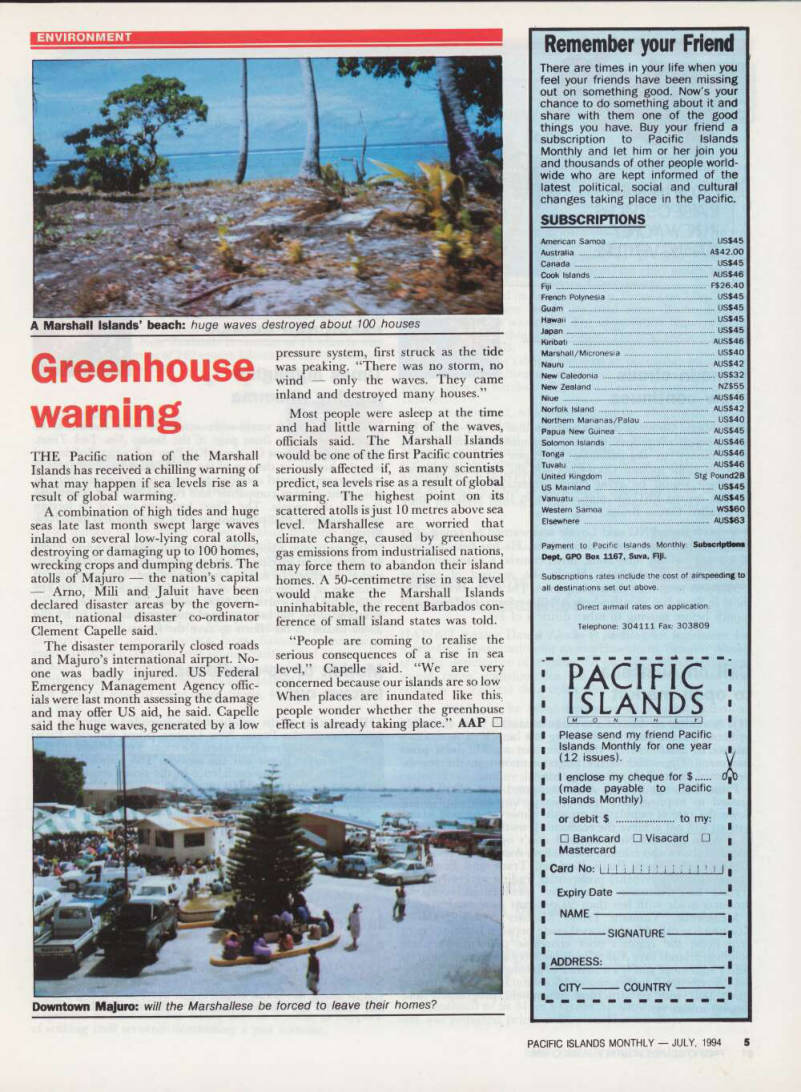
A combination of high tides and huge seas late last month swept large waves inland on several low-lying coral atolls, destroying or damaging up to 100 homes, wrecking crops and dumping debris. The atolls of Majuro the nation’s capital Arno, Mili and Jaluit have been declared disaster areas by the govern ment, national disaster co-ordinator Clement Capelle said.
The disaster temporarily closed roads and Majuro’s international airport. No one was badly injured. US Federal Emergency Management Agency offic ials were last month assessing the damage and may offer US aid, he said. Capelle said the huge waves, generated by a low
pressure system, first struck as the tide was peaking. “There was no storm, no wind only the waves. They came inland and destroyed many houses.”
Most people were asleep at the time and had little warning of the waves, officials said. The Marshall Islands would be one of the first Pacific countries seriously affected if, as many scientists predict, sea levels rise as a result of global
warming. The highest point on its
scattered atolls is just 10 metres above sea level. Marshallese are worried that
climate change, caused by greenhouse
gas emissions from industrialised nations, may force them to abandon their island homes. A 50-centimetre rise in sea level would make the Marshall Islands uninhabitable, the recent Barbados con ference of small island states was told.
“People are coming to realise the serious consequences of a rise in sea level,” Capelle said. “We are very concerned because our islands are so low When places are inundated like this, people wonder whether the greenhouse
effect is already taking place.”
Aap
A Marshall Islands’ beach: huge waves destroyed about 100 houses
Downtown Majuro: will the Marshallese be forced to leave their homes?
Advertisements & other items, pp. 5-6 (1 item)
‘ Pacific
Remember your Friend
There are times in your life when you feel your friends have been missing out on something good. Now’s your chance to do something about it and share with them one of the good things you have. Buy your friend a subscription to Pacific Islands Monthly and let him or her join you and thousands of other people worldwide who are kept informed of the latest political, social and cultural
changes taking place in the Pacific.
SUBSCRIPTIONS
American Samoa US$45 Australia A 542.00 Canada US$45 Cook Islands AUSS46 Fiji F 526.40 French Polynesia US$45 Guam US$45 Hawaii US$45 Japan US$45 Kiribati AUSS46 Marshall/M'cronesia US$4O Nauru AUSS42 New Caledonia US$32 New Zealand NZ$55 Niue AUSS46 Norfolk Island AUSS42 Northern Marianas/Palau US$4O Papua New Guinea AUSS4S Solomon Islands AUSS46 Tonga AUSS46 Tuvalu AUSS46 United Kingdom Stg Pound2B US Mainland US$45 Vanuatu AUSS4S Western Samoa WS$6O Elsewhere AUSS63 Payment to Pacific Islands Monthly: Subscriptions Dept, GPO Box 1167, Suva, Fiji.
Subscriptions rates include the cost of airspeeding to all destinations set out above.
Direct airmail rates on application.
Telephone: 304111 Fax: 303809
‘ PACIFIC
ISLANDS
O H r H L FI
Please send my friend Pacific Islands Monthly for one year
(12 issues).
I enclose my cheque for $ (made payable to Pacific
Islands Monthly)
or debit $ to my: □ Bankcard □ Visacard □ Mastercard Card No: i i ! i M i ! i ! : ! I 1 Expiry Date
NAME
SIGNATURE
ADDRESS:
CITY COUNTRY
COOK ISLANDS
RAISE OSTRICHS
INNEW/ttONEY-
rt\AKIN6 VENTURE
SEE 1 TOP YOU
TNECOWASSISNOT
workihs ms doesn’t
tOOKUKE TT1ECOOK ISLAM®
Samoan circus
Fiji
Samoan circus show continues
THE Magic Circus of Samoa will continue its five-month Fiji tour despite allegations that the ringmaster, Bruno Loyale, owes money to organisations in Papua New Guinea. A spokesman for sponsor Coca-Cola said the company believed the show would be great family entertainment. Magician Loyale, toured PNG for nine months in 1990 with his circus then called Circus Bruno.
Reports from PNG said Loyale was warned by police after he allegedly abandoned a circus there. He has been accused of leaving behind nine lions, three camels, a chimpanzee, a python and an elephant. He is also accused of owning US$BO,OOO to at least three companies. The circus held its first show in Suva last month where it will perform until early this month before moving to other districts of Fiji. ★ ★ ★
Call on Australia
to open market
FIJI has called on Australia to make its market more accessible to South Pacific products following the launch of Australia’s ministerial statement on the region last month. In a press statement, Fiji, which is the largest economy in the region, welcomed Australia’s reform agenda.
Prime Minister Sitiveni Rabuka agreed that island states needed to improve their economic performance and bring down the rate of population growth. However, he said island nations will not achieve the economic growth they are capable of if Australia and New Zealand don’t open their markets wider. Rabuka also reiterated his call on Australia to revise the SPARTECA (South Pacifc Regional Trade and Economic Cooperation Agreement) preferential trading agreement. Fiji argued that Australia should give preferential access to products made with less than 50 per cent local content.
Meanwhile, Vanuatu Prime Minister Maxime Carlot Korman has called for increased trade between island states to help boost the region’s poor economic performance. And Solomon Islands says Australia did not say anything new in its policy statement and it’s a matter of getting down to carrying out the reforms. A spokesman said Solomon Islands was already doing that with its structural adjustment programme and
logging initiatives.
Times highlights
Papua New Guinea
Times highlights logging dilemma
ONE measure of world-wide attention to a matter is its appearance on the front page of the Sunday New York Times. ‘lsolated Papua New Guineans Fall Prey to Foreign Bulldozers’ was the headlie at the top of the Times front page on June 5, as the paper devoted considerable space to a damning story on how some foreign companies had ruined the rain forest and cheated the people. The Times had sent one of its foreign correspondents, Philip Shenon, to Port Moresby and on to New Britain.
Shenon wrote about the threatened disappearance of the rain forest, the logging techniques that prevent reforestation, and of the efforts by some to stop the pillage. The story quoted estimates of payments to villagers of no more than US$l5 million for logs worth US$5OO million. Tim Neville, PNG’s forests minister, has twice escaped murderous assault, which the Times linked to his efforts to save the forests. ★ ★ ★
Motion of no-confidence
thrown out
THE question of the validity of an intended motion of no confidence in the Papua New Guinea prime minister Paias Wingti was finally resolved when the speaker of parliament, Bill Skate, ruled to throw out the motion. The opposition gave notice for a vote of no-confidence in the prime minister, that was to have been moved last month, but lengthy debate on its validity prevented the motion being moved.
National radio NBC said Skate made his ruling in the form of a press statement to the media. In the statement the speaker explained that the prime minister was currently enjoying an 18-month grace period following his snap resignation and immediate re-election last September, whicn means a motion of no-confidence against him would be unconstitutional. ★ ★ ★
Judge attacked,
car smashed
A PAPUA New Guinea national court judge, Maurice Sheehan, narrowly escaped unhurt by some 40 axe-wielding youths along the Okuk Highway, in the Western Highlands, last month. His car was smashed with axes by the youths.
Ostrich ranch
Headlines
Cook Islands
Ostrich ranch plans under way
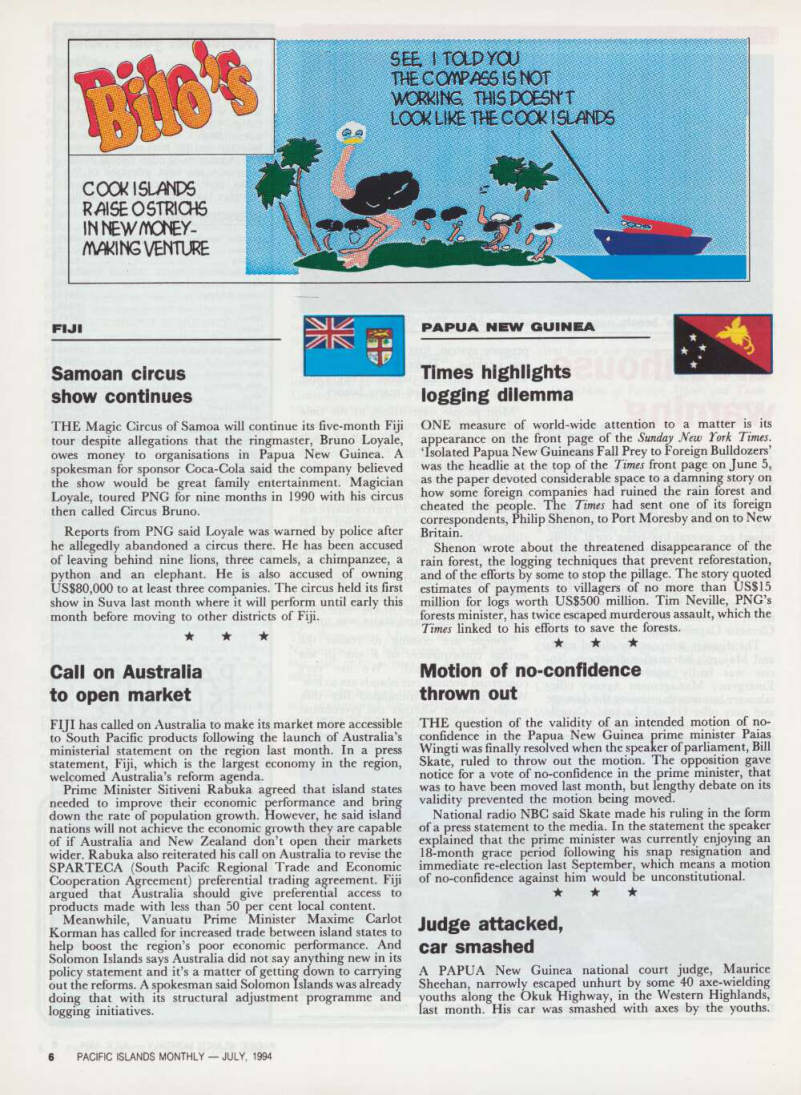
ONE of the world’s smallest countries is preparing a new home for the world’s largest birds. The Cook Islands plans to set up an ostrich ranch and so create a new industry for its tiny economy, now reliant on tourism and offshore banking.
The flightless birds, native to Africa, are bred in various parts of the world for their meat, leather and feathers. The Cook Islands News reported last month that 200 chicks were scheduled to be imported from Africa this month and would be sent to the ranch being built among former pineapple plantations on Mangaia Island.
Government Agriculture Secretary William Hosking said the chicks must pass strict quarantine requirements before being allowed in. The Cook Islands lies about 3000 kilometres north east of Auckland, New Zealand. It consists of 15 islands with a combined land mass of 240 square kilometres and population
of about 18,000.
AP
family of slain brothers
Western Samoa
City settles with family of slain brothers
THE city of Compton, in California, has agreed to pay up to SUS 6 million to the family of two Samoan brothers gunned down by a police officer in 1991, the family’s lawyer said. The settlement was reached in May in the civil rights suit filed by the family of Pouvi Tualaulelei, 34, and his brother Italia, 22, said lawyer Jerry Steering.
The brothers were shot 19 times on February 12, 1991, by Officer Alfred Skiles, who was responding to a domestic disturbance call in the Los Angeles suburb. The shooting angered many in the area’s large Samoan community, especially after a criminal trial against Skiles ended in mis-trial in May 1992. Prosecutors contended that after he felled the brothers with nine shots, Skiles coolly reloaded his firearm and shot them at least 10 more times. Skiles, 46, has retired from the force.
Union wants
Vanuatu
Union wants teachers back on jobs
THE Vanuatu Teachers Union is threatening legal action against the ministry of education if 90 reinstated school teachers are not allowed to return to work. Union general secretary Calo Charles said the teachers had been reinstated by the training service commission and were to have resumed duty on May 23, but had been prevented from doing so by the education minister.
Charles said the decision by the ministry not to allow the teachers to return to work, and to withhold their salaries, was in breach of the Teaching Service Act. He says under the act, only the commission had the power to terminate and reinstate and teachers who had been reinstated by the commission were entitled to their salaries. The 90 were among 700 teachers suspended in February for taking part in a strike in support of striking civil servants demanding a pay increase.
Govt falls, new
Kiribati
Govt falls, new election due soon
A COUNCIL of state took over administration of Kiribati late May following the fall of the government. Kiribati now faces new elections after the ruling National Progressive Party (NPP) was defeated on May 24 in a vote over the alleged misuse of public funds by cabinet ministers.
Parliament was dissolved when the NPP lost an effective vote of confidence by 21 votes to 19. Under the constitution, administration of Kiribati passes to a council of state comprising the speaker of parliament, the chief justice and the chairman of the Public Service Commission.
The council held its first meeting in Tarawa on May 25 and said a new election would be held soon, Radio Kiribati reported. No date was given. The constitution requires a new election be held within three months. The next election was not due until mid-1995.
The government’s defeat followed an opposition move to set up a select committee to investigate allegations of misuse of public funds by Kiribati’s President, Teatao Teannaki, and his cabinet.
The government, which has denied the allegations, instead moved an amendment to set up an independent committee, saying the proposed select committee would be one-sided.
However, the centrist Maurin Kiribati Party combined with the opposition Mwaneaba Party to defeat the government amendment. The NPP has been in power since independence was granted in 1979 to Kiribati, a collection of 33 far-flung
atolls formerly known as the Gilbert Islands.
AP
Senator wants
Hawaii
Senator wants Hawaiians classified
HAWAII senator Daniel Akaka is pushing for legislation for a definitive classification for native Hawaiians. Senator Akaka says the significance of revising the race and ethnic standards would mean guidelines for the measurement of race and ethnicity in Federal data collection.
The standards, he says, determine all Federal activities, including civil rights compliance, statistical reporting and general programme and grant administration. Currently, native Hawaiians are listed as part of the “Asian or Pacific Islander” category. In announcing the hearings, Akaka said native Hawaiians are defined as native Americans in a number of Federal laws, but they constantly fall through the cracks for lack of a consistently inclusive Federal policy.
new Tongan bishop
Tonga
Pope appoints new Tongan bishop
POPE John Paul II has appointed Father Dr Soane Lilo Foliaki of the Society of Mary as the new bishop of the Roman Catholic diocese of Tonga. The bishop-elect was ordained at a special ceremony last month at the Cathedral of the Immaculate Conception of Mary. Father Dr Foliaki studied for the priesthood at St Mary’s Green Meadows in New Zealand and was ordained priest in Napier, Hawkes Bay.
The sovereignty
Cover Stories
Special Report
By David North
So who makes most money out of it?
PALAU’S bare-breasted mermaid coins are apparently a smash hit in the market, but tnat does not mean much financially to the islands. The Swiss-minted discs are said to be the world’s first multi-coloured coins. Though carrying a nominal value of only $1 (Palau uses the US dollar) they were originally sold to collectors, largely in Japan for $l7, and now the promoter is charging $25. How much of the $25 gets to Palau? Ten dollars, $5, or just $1?
Palau gets exactly half a dollar, 50 US cents, for each coin. The other $24.50 (98 per cent of the gross) goes to the E remoter, Japan’s Ben Corporation, en, presumably, pays for the minting, the small royalty to Palau, and the major cost promoting and selling the coins.
Is the Palau coin deal par for the course?
Or do some of the other islands do better in the coin-and-stamp business? We suspect that the answer to the second question is sometimes “yes”.
Virtually everyone in the business traditionally hides the financial aspects of their transactions. But there is just enough of the open-books influence of the US in Palau (the last of the US Trust Territories) for PIM to be able to secure fairly complete financial information.
And when we told senior people in the US coin business the details of the Palau mermaid deal, we got the impression that Palau was doing particularly badly in a field where island governments often do not do well. The big picture is this no island is paid much in this business, and recent years have been worse than earlier ones. The best net income in recent years has apparently gone to the Republic of the Marshall Islands. RMI received a peak net income of about $1,250,000 for both its stamps and its coins in 1991, but expects only $651,000 from these sources in 1994. The long-term trend appears to be downwards for other governments as well, as the accompanying table indi cates. For example, to take two islands with totally different promotional approaches, staid Britain’s Pitcairn and the hang-loose Tonga we find Pitcairn’s income down between 1992 and 1993, and Tonga’s down from the mid-70s to the late eighties. As a matter of fact, back in 1976-77 fully three per cent of Tonga’s governmental income, from all sources, came from the sale of stamps. By 1988-89 the percentage had fallen to one half of one per cent. In the light of this depressing trend, it is useful to look more carefully at the Palau deal.
As is usually the case, the promoter and the island nation are engaged in the sale of a series of coins, not just one. This series celebrates protection of the marine environment. While the dollar coin in the series is made of copper and nickel, like most of the world’s low-value coins, the $5 version is made of silver. For the latter coins, Palau gets $4, while Ben sells them
lat do the following transactions have in mmon? • The Cooks sell commemorative coins. • Vanuatu and the Marshalls license (flag) merchant ships. • Tonga sells passports to the Hong Kong Chinese. • Niue decides to become the latest off shore banking centre. • FIJI rents part of Its army to the United Nations. • All the Islands sell postage stamps to the collectors.
In each case the Island government Is engaging In what we call the Sovereignty Business economic activities that can only be engaged In by nations (or quasi nations), but not by Individuals, corpor ations, or units of local government.
This month PIM covers stamps and coins; a future article will deal with off shore banking, bank notes, flagging ships, Issuing passports and divorces, and work ing with satellites.
in Japan for $BO having raised the Erice from the earlier level, $69. (At the igher price, Palau receives four per cent of the gross). Palau’s government-owned National Development Bank signed the deal for the islands. In return for giving Ben (presumably) a monopoly on Palau’s commemorative coins, Ben made an advance payment of $lOO,OOO to the bank and a loan of $900,000, at a rate of 3.5 per cent a year. (The rate would be favorable in US markets, less so in Japan with its low interest rates).
The royalties from coin sales are supposed to insure the repayment of the loan. They also will assure Ben that no one else for a long time will ever distribute coins for Palau. This is the case because at the current rate of royalty payments Palau will be perpetually in nock to the Japanese firm. The Palau deal also has upper limits on the numbers of coins to be minted; this is a standard procedure, and is designed to assure collectors that there is a limited supply.
Here are the numbers for the marine environment series Palau will receive 50 cents for each of the 50,000 $1 mermaids, and $4 for each of the 6000 $5 coins, or a maximum of $49,000 ($25,000 + $24,000). PIM has a Development Bank document showing that at the end of December, 1993, Ben had chalked up $45,050 to Palau’s account for all of the $5 coins and most of the $1 ones. The document covered payments between June 1992, when the coins went on sale, and the end of December, 1993, a period of 18 months. Unless Ben, or Palau, breaks their word to the coin trade, and mints more of the coins, the marine life protection series is just about over. So, one and a half years have passed, and it looks as if Palau is ahead by $45,000 plus
another $12,000 in retail sales (presum ably within Palau) for $57,000. Not bad for a nation of 15,000. But wait, Palau’s Development Bank must pay $31,500 a year in interest to Ben, or $47,250 in the 18 months; that leaves Palau less than $lO,OOO on the plus side of the ledger.
Meanwhile, Ben apparently grossed somewhere between $1,204,000 and $1,730,000 depending on the price Ben received for the coins we do not know when during the 18 months the prices were increased. In summary Palau received a net of $lO,OOO from one of the more successful coin promotions in recent years, and the promoters’ gross was about $1.5 million. There is the theoreti cal possibility that Palau could simply repay the loan and negotiate with anotner promoter; but development banks in the islands tend to make loans to small businesses that often fail. So Palau probably will be doing business with Ben for a long time to come.
Meanwhile, Palau has apparently se cured a much better deal for its stamps than its coins. (Whether it is a good deal for Palau is another question).
The Palau government agency hand ling off-shore sales of postage stamps is the post office, and the promoter is Inter- Governmental Philatelic Corporation (IGPC) of New York, an organisation active with other (non-Pacific) small nations as well.
Palau’s postal system, according to the US Trust Territory office in Palau, had philatelic sales worth $142,000 in 1991, and $192,000 in 1992. PIM was informed that the New York firm prints, sells and promotes the stamp issues, and sends 40 per cent of all gross revenues to the islands. (All of this is in happy contrast to the $lO,OOO or so actual profit we calculate for Palau’s coins, and a gross of what appears to be two to four per cent.
It was not clear to us whether the Palauans selling coins and those selling stamps ever compared notes on their off shore deals). Palau’s deal may be a little better in the future, as in a new agreement signed in May 1993, IGPC promised a minimum level of royalties of $200,000, which would be a hair above the 1992 actuals. Palau’s postmaster, in a telephone conversation, said he could not divulge actual sales in 1993.
IGPC, which pays 40 per cent of the ?ross, sells Palau s stamps from its New ork office to collectors for their face value, and presumably sells the same stamps to dealers for less. At one point in the past the Cooks were reported to be getting 50 per cent of the gross from its overseas agent, but whether the Cooks stamps were being sold at, or above, face value was not then reported.
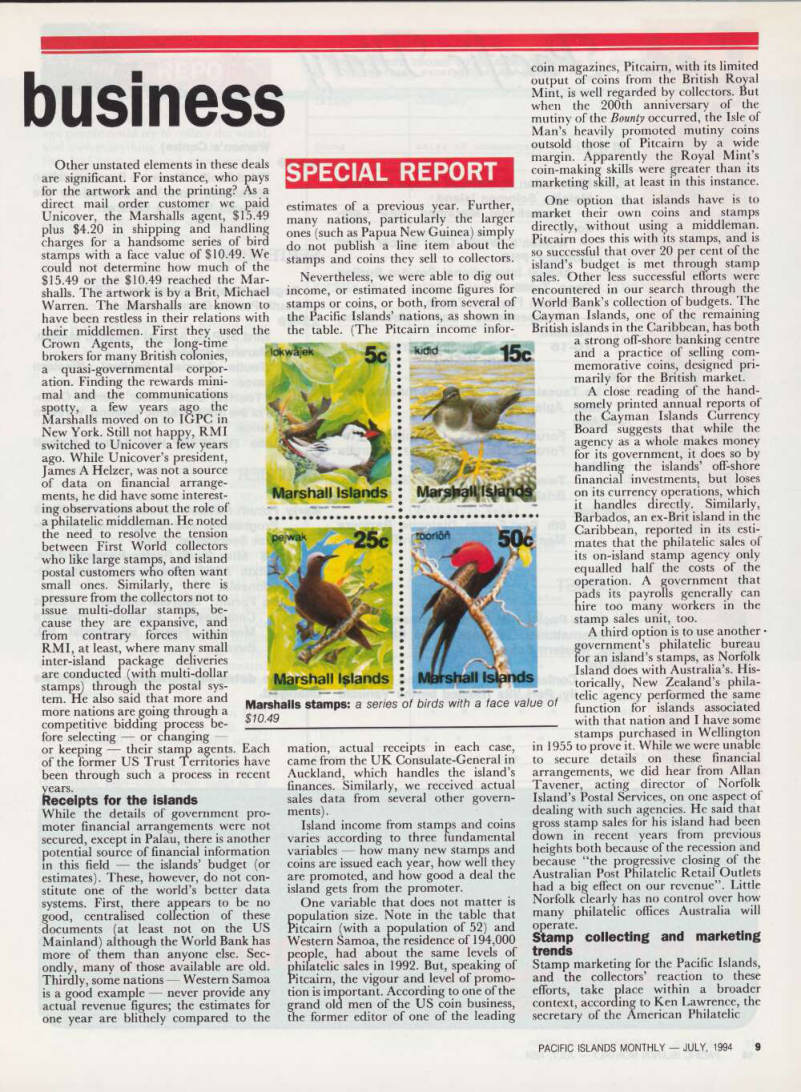
Other unstated elements in these deals are significant. For instance, who pays for the artwork and the printing? As a direct mail order customer we paid Unicover, the Marshalls agent, 515.49 plus 54.20 in shipping and handling charges for a handsome series of bird stamps with a face value of 510.49. We could not determine how much of the 515.49 or the 510.49 reached the Mar shalls. The artwork is by a Brit, Michael Warren. The Marshalls are known to have been restless in their relations with their middlemen. First they used the
Crown Agents, the long-time brokers for many British colonies, a quasi-governmental corpor ation. Finding the rewards mini mal and the communications spotty, a few years ago the Marshalls moved on to IGPC in New York. Still not happy, RMI switched to Unicover a few years ago. While Unicover’s president, James A Helzer, was not a source of data on financial arrange ments, he did have some interest ing observations about the role of a philatelic middleman. He noted the need to resolve the tension between First World collectors who like large stamps, and island postal customers who often want small ones. Similarly, there is pressure from the collectors not to issue multi-dollar stamps, be cause they are expansive, and from contrary forces within RMI, at least, where many small inter-island package deliveries are conducted (with multi-dollar stamps) through the postal sys tem. He also said that more and more nations are going through a competitive bidding process be fore selecting or changing
or keeping their stamp agents. Each of the former US Trust Territories have been through such a process in recent years.
Receipts for the islands While the details of government pro moter financial arrangements were not secured, except in Palau, there is another potential source of financial information m this field the islands’ budget (or estimates). These, however, do not con stitute one of the world’s better data systems. First, there appears to be no good, centralised collection of these documents (at least not on the US Mainland) although the World Bank has more of them than anyone else. Sec ondly, many of those available are old.
Thirdly, some nations Western Samoa is a good example never provide any actual revenue figures; the estimates for one year are blithely compared to the
estimates of a previous year. Further, many nations, particularly the larger ones (such as Papua New Guinea) simply do not publish a line item about the stamps and coins they sell to collectors.
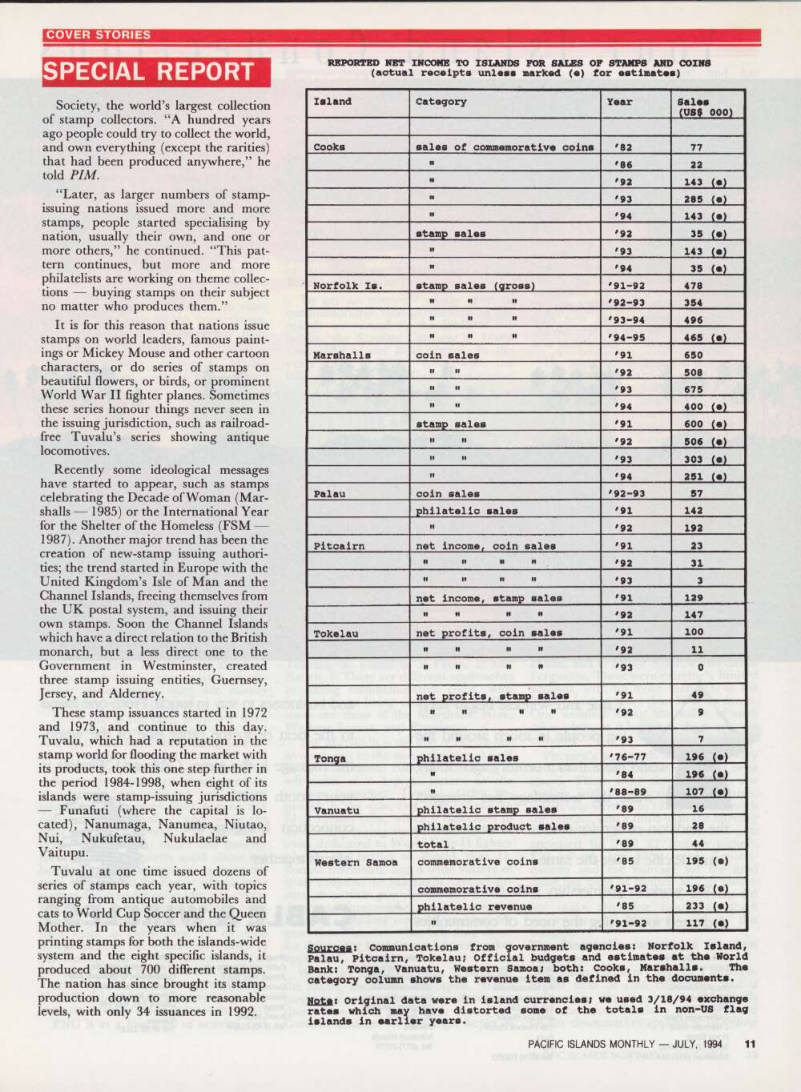
Nevertheless, we were able to dig out income, or estimated income figures for stamps or coins, or both, from several of the Pacific Islands’ nations, as shown in the table. (The Pitcairn income infor-
mation, actual receipts in each case, came from the UK Consulate-General in Auckland, which handles the island’s finances. Similarly, we received actual sales data from several other govern ments).
Island income from stamps and coins varies according to three fundamental variables how many new stamps and coins are issued each year, how well they are promoted, and how good a deal the island gets from the promoter.
One variable that does not matter is population size. Note in the table that Pitcairn (with a population of 52) and Western Samoa, the residence of 194,000 people, had about the same levels of philatelic sales in 1992. But, speaking of Pitcairn, the vigour and level of promo tion is important. According to one of the grand old men of the US coin business, the former editor of one of the leading
coin magazines, Pitcairn, with its limited output of coins from the British Royal Mint, is well regarded by collectors. But when the 200th anniversary of the mutiny of the Bounty occurred, the Isle of Man’s heavily promoted mutiny coins outsold those of Pitcairn by a wide margin. Apparently the Royal Mint’s coin-making skills were greater than its marketing skill, at least in this instance.
One option that islands have is to market their own coins and stamps directly, without using a middleman.
Pitcairn does this with its stamps, and is so successful that over 20 per cent of the island’s budget is met through stamp sales. Other less successful efforts were encountered in our search through the World Bank’s collection of budgets. The Cayman Islands, one of the remaining British islands in the Caribbean, has both
a strong off-shore banking centre and a practice of selling com memorative coins, designed pri marily for the British market.
A close reading of the hand somely printed annual reports of the Cayman Islands Currency Board suggests that while the agency as a whole makes money for its government, it does so by handling the islands’ off-shore financial investments, but loses on its currency operations, which it handles directly. Similarly, Barbados, an ex-Brit island in the Caribbean, reported in its esti mates that the philatelic sales of its on-island stamp agency only equalled half the costs of the operation. A government that pads its payrolls generally can hire too many workers in the stamp sales unit, too.
A third option is to use another
government’s philatelic bureau
for an island’s stamps, as Norfolk Island does with Australia’s. His torically, New Zealand’s phila telic agency performed the same function for islands associated with that nation and I have some stamps purchased in Wellington
in 1955 to prove it. While we were unable to secure details on these financial arrangements, we did hear from Allan Tavener, acting director of Norfolk Island’s Postal Services, on one aspect of dealing with such agencies. He said that gross stamp sales for his island had been down in recent years from previous heights both because of the recession and because “the progressive closing of the Australian Post Philatelic Retail Outlets had a big effect on our revenue”. Little Norfolk clearly has no control over how many philatelic offices Australia will operate.
Stamp collecting and marketing trends Stamp marketing for the Pacific Islands, and the collectors’ reaction to these efforts, take place within a broader context, according to Ken Lawrence, the secretary of the American Philatelic
Marshalls stamps: a series of birds with a face value of $10.49
Society, the world’s largest collection of stamp collectors. “A hundred years ago people could try to collect the world, and own everything (except the rarities) that had been produced anywhere,” he told PIM.
“Later, as larger numbers of stamp issuing nations issued more and more stamps, people started specialising by nation, usually their own, and one or more others,” he continued. “This pat tern continues, but more and more philatelists are working on theme collec tions buying stamps on their subject no matter who produces them.”
It is for this reason that nations issue stamps on world leaders, famous paint ings or Mickey Mouse and other cartoon characters, or do series of stamps on beautiful flowers, or birds, or prominent World War II fighter planes. Sometimes these series honour things never seen in the issuing jurisdiction, such as railroad free Tuvalu’s series showing antique locomotives.
Recently some ideological messages have started to appear, such as stamps celebrating the Decade of Woman (Mar shalls 1985) or the International Year for the Shelter of the Homeless (FSM 1987). Another major trend has been the creation of new-stamp issuing authori ties; the trend started in Europe with the United Kingdom’s Isle of Man and the Channel Islands, freeing themselves from the UK postal system, and issuing their own stamps. Soon the Channel Islands which have a direct relation to the British monarch, but a less direct one to the Government in Westminster, created three stamp issuing entities, Guernsey, Jersey, and Alderney.
These stamp issuances started in 1972 and 1973, and continue to this day.
Tuvalu, which had a reputation in the stamp world for flooding the market with its products, took this one step further in the period 1984-1998, when eight of its islands were stamp-issuing jurisdictions Funafuti (where the capital is lo cated), Nanumaga, Nanumea, Niutao, Nui, Nukufetau, Nukulaelae and
Vaitupu.
Tuvalu at one time issued dozens of series of stamps each year, with topics ranging from antique automobiles and cats to World Cup Soccer and the Queen Mother. In the years when it was printing stamps for both the islands-wide system and the eight specific islands, it produced about 700 different stamps.
The nation has since brought its stamp production down to more reasonable levels, with only 34 issuances in 1992.
REPORTED NET INCOME TO ISLANDS FOR SALES OF STAMPS AND COINS (actual receipts unless marked (e) for estimates)
Sources: Communications from government agencies: Norfolk Island, Palau, Pitcairn, Tokelau; Official budgets and estimates at the World Bank: Tonga, Vanuatu, Western Samoa; both: Cooks, Marshalls. The category column shows the revenue item as defined in the documents.
Note; Original data were in island currencies; we used 3/18/94 exchange rates which may have distorted some of the totals in non-US flag Islands in earlier years.
Island Category Year Sales (US$ 000) Cooks sales of commemorative coins '82 77 H '86 22 N '92 143 (e) n '93 285 (a) II '94 143 (e) stamp sales '92 35 (e) II '93 143 (e) If '94 35 (e) Norfolk Is. stamp sales (gross) '91-92 478
H Ii It
'92-93 354
Ii Ii It
'93-94 496
Ii Ii It
'94-95 465 (e) Marshalls coin sales '91 650
Ii Ii
'92 506
Ii Ii
'93 675
Ii Ii
'94 400 (e) stamp sales '91 600 (•)
Ii Ii
'92 506 (•)
Ii Ii
'93 303 (•) It '94 251 (e) Palau coin sales '92-93 57
philatelic sales
'91 142 It '92 192 Pitcairn net Income, coin sales '91 23 it ti iin '92 31 ii it n ii '93 3 net Income, stamp sales '91 129
Ii Ii Ii Ii
'92 147 Tokelau net profits, coin sales '91 100
N H Un
'92 11
H Ii Un
'93 0 net profits, stamp sales '91 49 It H II »l '92 9 N It It tl '93 7 Tonga
philatelic sales
'76-77 196 (•) II '84 196 C) N '88-89 107 (•) Vanuatu philatelic stamp sales '89 16 philatelic product sales '89 28 total '89 44 Western Samoa commemorative coins '85 195 (e) commemorative coins '91-92 196 (e)
philatelic revenue
'85 233 (e) tl '91-92 117 (•)
“Tuvalu should not be singled out for excessive stamp production,” according to Ken Lawrence. “Its record cannot be compared to ’Ajman, one of the Trucial Sheikdoms, that once issued 4000 stamps in a period of 10 years.” ’Ajman, one of seven small states along the southern shore of the Arabian Gulf, had none of the oil riches of its neighbours, such as Abu Dhabi, and tried to make up for it by way of stamp sales.
Coin collecting and marketing trends Commemorative coins, on a major scale, are a more recent phenomenon than commemorative stamps, and typically involve higher unit costs for collectors and promoters, and higher unit returns for the island nations. (Note in the table that the Marshalls, in the years shown, have always made more money from coins than from stamps).
Stamps, even elaborate, multi coloured ones, can be printed
inexpensively on gummed paper; if they do not sell im mediately, they can, at little cost to the promoters, sit in the vault for years.
Further, out the def erence to children collectors, many of the commemorative stamps carry face values of a few pen nies. Commemorat ive coins are differ ent. First, they are routinely valued in dollars, usually mul
tiple dollars, not pennies. Second, they are legal tender, and are more likely than postage stamps to arrive in the islands in tourists’ pockets. Thirdly, they are more costly to produce, particularly at the higher values where they are usually made from silver and gold.
Since this is the case, coins are often minted only after they have been sold (via mail and other advertising promo tions); this is particularly true of gold coins. Further, as noted before, coins for collectors (as opposed to coins for general circulation) are minted in limited quantities; the upper limit is generally announced in advance, and while the limit may not be reached (if demand is below expectations) mints and govern ments have been pretty good about not breaching the maximum announced runs. Whereas all the Pacific Islands issue stamps designed for collectors, not every one is in the commemorative coins business. Nauru has issued exactly one such coin, a celebration of its own independence; the Federated States of Micronesia, where US currency circu lates, has issued none, nor has Kiribati, Tuvalu or any of the French territories.
Norfolk Island, not previously in the business, is expected to enter it this year.
PNG is at a low level of activity, but
among the dozen gold 100 kina coins issued since 1975 were those bearing the faces of Sir Julius Chan and Michael Somare, both PNG prime ministers.
They are thus two of the few, or perhaps the only two, living Pacific Islands’ politicians to be so honored during their lifetimes. Kings and queens are different, they routinely appear on coinage (and on stamps) while alive. Queen Elizabeth II has appeared (usually in relatively youthful portraits) over the last 40 years, as has, for close to 30, Tonga’s King Taufa’ahau Tupou IV.
To get an overview of the level of commemorative coin production in the islands we turned to the Bible of the hobby, the Standard Catalogue of World Coins, 1994 at our local library. In the years 1986 to 1992, there were the following mintings of commemorative
coins by nation Cooks, 119; Marshalls, 107; Western Samoa, 68; Niue, 48; Tonga, 21; Fiji, 13; Pitcairn, 9; PNG, 8; Tokelau, 8; Vanuatu, 5; Palau, 2; and Nauru, 1. There are different approaches to selling commemorative coins, with four patterns being clear in the Pacific; these are those of the Marshalls, Niue, Western Samoa, and Pitcairn.
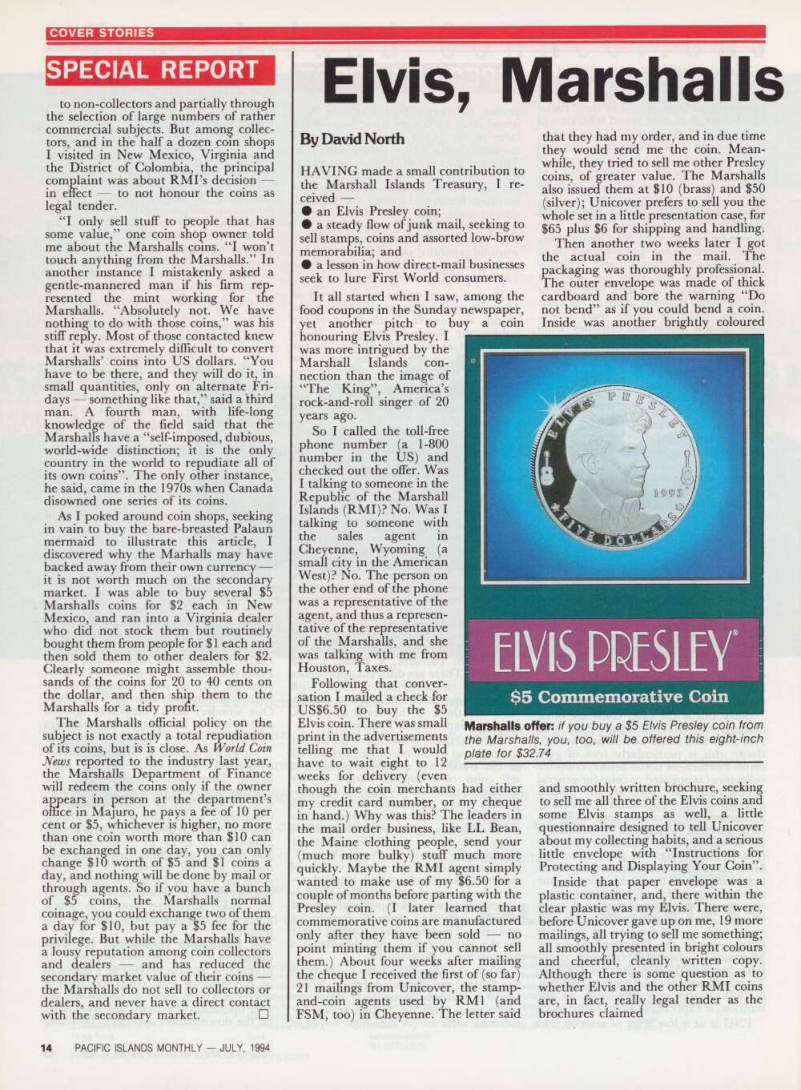
The Marshalls is the first of the islands to reach out to the non-collectors as well as the traditional collectors, seeking to sell coins of a topical nature to the average consumer. Typical of this ap proach is the sale, last year, of the $5 Elvis Presley coin, which is described in an accompanying story. With series of coins dedicated to World War II fighter planes, the battles of World War 11, marine mammals, and a wide variety of space subjects, the Marshalls have adver tised in various popular media, such as American supermarket publications and booklets including cents-off coupons for groceries. The somewhat belittling name for this in the trade is the “downmarket approach”.
While the Marshalls have focussed on the States, and Palau on Japan, Niue’s target is Europe, particularly European sports fans. Niue has a high regard for German athletes (or has high hopes of
selling coins to Germans) and has honoured Boris Becker and Steffi Graf, both tennis players, with copper, silver and gold coins valued at (NZ) $5, $5O, $2OO and $250. The $2OO silver coins for Graf is so large (nearly three inches across) and so heavy (more than half a Cound) that if you dropped it on your are foot you might break a toe. More valuable (if lighter) is the $250 gold coin honouring a German soccer player, previously unknown to me, named Franz Beckenbauer. In sharp contrast to the commercial themes celebrated by Niue and the Marshalls are a line of Western Samoa coins whose designs relate more closely to life in those islands. This distinction was called to my attention by the one American who spends more time with new commemorative coins than anyone else; he is Fred Borgmann, the new issue editor of World Coin News.
He told me in approving terms of recent Western Samoa coins made of
palladium (a valu able metal only re cently used in mint age). There was, for example, a 50 tala coin honoring Kon tiki, a 100 tala one regarding the death of Captain Cook and several in honor of the longest-serving of the German governors, Wilhelm Solf, who held the office between 1900 and 1910. Western Samoa, being a member of the
British Commonwealth, could not resist issuing 1000 tala gold coins in honour of the weddings of Prince Charles and Lady Diana, and of Prince Andrew and Sarah Fergusson. These were extremely limited editions, with no more than 100 of the former, and no more than 50 of the latter.
One wonders about the value of such coins when, as it happens, the marriages collapse.
Pitcairn’s approach to coins is very conservative. Only nine coins have been issued. These were three designs, one dealing with the Pitcairn Constitution, which was written in 1838, another with the mutiny, and a third with the burning of the Bounty (at Pitcairn). Each design appeared in (NZ) SI (copper/nickel), $5O (silver), and $250 (gold) denomi nations and the mintage for the gold coins has been as limited as 250 pieces.
But, as the table indicates, Pitcairn did not make anywhere nearly as much money as the Marshalls did in this business.
The Marshalls renounces its own currency Borgmann, and every one else I talked to in the field of coin collection, had a universally dim view of the Marshalls coin operation. Partially this was based on the downmarket approach, of selling
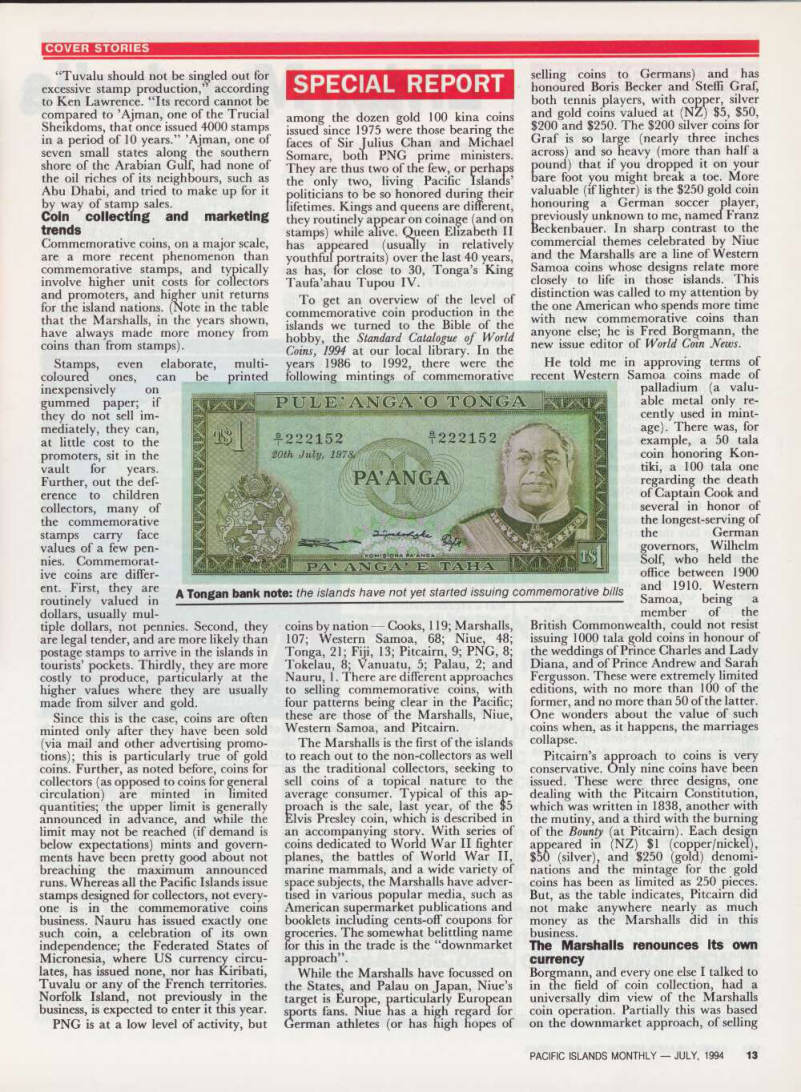
A Tongan bank note: the islands have not yet started issuing commemorative bills
to non-collectors and partially through the selection of large numbers of rather commercial subjects. But among collec tors, and in the half a dozen com shops I visited in New Mexico, Virginia and the District of Colombia, the principal complaint was about RMl’s decision in effect to not honour the coins as
legal tender.
“I only sell stuff to people that has some value,” one coin shop owner told me about the Marshalls coins. “I won’t touch anything from the Marshalls.” In another instance I mistakenly asked a gentle-mannered man if his firm rep resented the mint working for tne Marshalls. “Absolutely not. We have nothing to do with those coins,” was his stiff reply. Most of those contacted knew that it was extremely difficult to convert Marshalls’ coins into US dollars. “You have to be there, and they will do it, in small quantities, only on alternate Fri days something like that,” said a third man. A fourth man, with life-long knowledge of the field said that the Marshalls have a “self-imposed, dubious, world-wide distinction; it is the only country in the world to repudiate all of its own coins”. The only other instance, he said, came in the 1970 s when Canada disowned one series of its coins.
As I poked around coin shops, seeking in vain to buy the bare-breasted Palaun mermaid to illustrate this article, I discovered why the Marhalls may have backed away from their own currency it is not worth much on the secondary market. I was able to buy several $5 Marshalls coins for $2 each in New Mexico, and ran into a Virginia dealer who did not stock them but routinely bought them from people for $ 1 each and then sold them to other dealers for $2.
Clearly someone might assemble thou sands of the coins for 20 to 40 cents on the dollar, and then ship them to the Marshalls for a tidy profit.
The Marshalls official policy on the subject is not exactly a total repudiation of its coins, but is is close. As World Coin News reported to the industry last year, the Marshalls Department of Finance will redeem the coins only if the owner appears in person at the department’s office in Majuro, he pays a fee of 10 per cent or $5, whichever is higher, no more than one coin worth more than $lO can be exchanged in one day, you can only change $lO worth of $5 and $1 coins a day, and nothing will be done by mail or through agents. So if you have a bunch of $5 coins, the Marshalls normal coinage, you could exchange two of them a day for $lO, but pay a $5 fee for the privilege. But while the Marshalls have a lousy reputation among coin collectors and dealers and has reduced the secondary market value of their coins the Marshalls do not sell to collectors or dealers, and never have a direct contact with the secondary market. □
Advertisements & other items, pp. 10-12 (1 item)
£ 'Pacific
t i M * i l y *••• i ft
wru
JULY
11 Melanesian Spearhead Gropu meeting, Malaita, Solomon Island.
International Marathon, New Caledonia.
Women’s World Cup Soccer, Port Moresby, PNG.
Annual International Pro-Am Surfing Open, Tahiti.
Heilala Festival, Tonga.
Independence Day celebrations, Vanuatu. 10-16 Musika (music) Extravaganza, Western Samoa 30 Le Tausala Samoa Pageant (beauty contest), Apia, Western Samoa Jul/Aug Forum Officials Committee Pre- Forum Session, Brisbane, Australia Jul/Aug Twenty-Fifth South Pacific Forum, Brisbane, Australia Jul/Aug 6th Post-Forum Dialogue Partners Meeting, Brisbane, Australia
AUGUST
South Pacific RIM Rugby Tournament, Fiji.
International Outrigger World Championship, Western Samoa. 03-06 Conference on Violence and the Family, Port Vila (Hosted by the Vanuatu Women’s Centre) 08-19 Third Pacific Women’s Documentation Workshop, Port Vila (hosted by the Vanuatu Women’s Centre)
SEPTEMBER
Regatta Week, Musket Cove, Fiji.
South Pacific Games, Tahiti. 22-29 23rd SOPAC Annual Session, Majuro, Marshall Islands 4-10 Teuila Tourism Festival, Western Samoa.
Tourism Conference: Tourism Council of the South Pacific meeting, Western Samoa.
Late 7th SPREP IGM, Tarawa Kiribati
OCTOBER
Early Forum Officials Committee 1994 Work Programme and Budget Session, Forum Secretariat, Suva. 15 Miss South Pacific Pageant, Apia. 18-19 Sixth APEC Ministerial Meeting, Indonesia.
Nov-Dec Forum Secretariat/South Pacific Commission Regional Planners Meeting, Forum Secretariat HQ, Suva. • Some dates are tentative and may be changed.
REPLACEMENT
ST RANGE IN THE ■
* OVER 800 ENGINES AVAILABLE * DIESEL-G TRANSMISSION TO MATCH IF REQUIRED * JAPANES Bedford Cummins * Daihatsu Deutz * Ford Gardner * Hlno Detroit Isuzu * Nissan Perkins Scania * Toyota * Volvo Yanmar.
LINE 10HP TO
MGLISH * EUR
if? m
P.O. BOX 14
GERALDINE, NEW ZEALAND
TELEPHONE: (643)633 8122
FAX; (643) 693 8128
Your Island Connections
■■ m f
Cable and Wireless began keep-
ing people in touch around the
world more than a century ago. Today,
while the technology has changed,
the tradition of service to our customers in the
South Pacific is just the same.
We work in partnership with Governments,
dedicated to meeting the need of communities and businesses to stay in touch. From one island to the next or to the other side of the world, the message is the same: Cable and Wireless is
your South Pacific
connection bringing the
islands together.
CABLE & WIRELESS
Asia Pacific Head Office Cable and Wireless pic Cable and Wireless (Pacific) Limited 22nd Floor Office Tower Convention Plaza 1 Harbour Road Hong Kong Tel: (852) 848 8620 Facsimile: (852) 868 5195 Fiji In association with the Government of Fiji Fiji International Telecommunications Ltd.
PO, Box 59 Mercury House 158 Victoria Parade Suva Fiji Tel: (679) 312933 Solomon Islands In association with the Government of the Solomon Islands Solomon Telekom Company Limited PO. Box 148 Honiara Solomon Islands Tel: (677) 21576 Tonga Cable and Wireless pic Private Mail Bag 4 General Post Office Nuku Alofa Tonga South Pacific Tel: (676) 23499 In association with the Government of Vanuatu and France Cdbies et Radio Telecom Vanuatu Limited P.O. Box 146 Port Vila Vanuatu Tel: (678) 22185
Elvis. Marshalls
By David North
HAVING made a small contribution to the Marshall Islands Treasury, I re ceived an Elvis Presley coin; a steady flow of junk mail, seeking to sell stamps, coins and assorted low-brow memorabilia; and a lesson in how direct-mail businesses seek to lure First World consumers.
It all started when I saw, among the food coupons in the Sunday newspaper, yet another pitch to buy a coin
honouring Elvis Presley. I was more intrigued by the Marshall Islands con nection than the image of “The King”, America’s rock-and-roll singer of 20 years ago.
So I called the toll-free phone number (a 1-800 number in the US) and checked out the offer. Was I talking to someone in the Republic of the Marshall Islands (RMI)? No. Was I talking to someone with the sales agent in Cheyenne, Wyoming (a small city in the American West)? No. The person on the other end of the phone was a representative of the agent, and thus a represen tative of the representative of the Marshalls, and she was talking with me from Houston, Taxes.
Following that conver sation I mailed a check for US$6.5O to buy the $5 Elvis coin. There was small print in the advertisements telling me that I would have to wait eight to 12 weeks for delivery (even
though the coin merchants had either my credit card number, or my cheque in hand.) Why was this? The leaders in the mail order business, like LL Bean, the Maine clothing people, send your (much more bulky) stuff much more quickly. Maybe the RMI agent simply wanted to make use of my $6.50 for a couple of months before parting with the Presley coin. (I later learned that commemorative coins are manufactured only after they have been sold no point minting them if you cannot sell them.) About four weeks after mailing the cheque I received the first of (so far) 21 mailings from Unicover, the stamp and-coin agents used by RMI (and FSM, too) in Cheyenne. The letter said
that they had my order, and in due time they would send me the coin. Mean while, they tried to sell me other Presley coins, of greater value. The Marshalls also issued them at $lO (brass) and $5O (silver); Unicover prefers to sell you the whole set in a little presentation case, for $65 plus $6 for shipping and handling.
Then another two weeks later I got the actual coin in the mail. The
packaging was thoroughly professional.
The outer envelope was made of thick cardboard and bore the warning “Do not bend” as if you could bend a coin.
Inside was another brightly coloured
and smoothly written brochure, seeking to sell me all three of the Elvis coins and some Elvis stamps as well, a little questionnaire designed to tell Unicover about my collecting habits, and a serious little envelope with “Instructions for Protecting and Displaying Your Coin”.
Inside that paper envelope was a plastic container, and, there within the clear plastic was my Elvis. There were, before Unicover gave up on me, 19 more mailings, all trying to sell me something; all smoothly presented in bright colours and cheerful, cleanly written copy.
Although there is some question as to whether Elvis and the other RMI coins are, in fact, really legal tender as the brochures claimed
Marshalls offer: if you buy a $5 Elvis Presley coin from the Marshalls, you, too, will be offered this eight-inch plate for $32.74
there never was an editorial mistake or a printing error in these mailings. They dealt with a multitude of subjects. First, there were mailings that assumed that I was a big fan of Elvis. Twice more I got reminders of the whole series of RMI Elvis coins, one suggesting the set of three coins would make an excellent Christmas present.
There also was the offer of an Elvis coin from another set of tropical islands, the former Portuguese colony of St Thomas and Prince in the Atlantic. Then I was told that I could buy a plate (like a dinner plate) of the singer for $32.74, and it was noted that for me, the brokerage fee would be waived. This offer, which came in an “Urgent mess age” from the Bradford Exchange, in formed me that previous rounds of these plates, which had sold for $24.75, were now trading at $124.00. So I should buy quickly, to make money later. While Unicover often stated that its issues were limited, and spoke of them as collectors’ items, the organisation never explicitly claimed that the commemorative coins would increase in value.
Then there were six more mailing dealing with non-Elvis RMI products; there were offers of attractive RMI stamps, a $5 Desert Storm coin selling for $lO plus $2 for handling, and a $5 space coin, selling for $5 and $ 1.50. But the big push was, understandably, for the RMI series of 12 coins honouring whales and dolphins. (Americans are crazy about dolphins). Unicover and RMI wanted to sell me one $5O coin a month for the next year, each a “Silver Proof’ (i.e. uncirculated and shiny) “numismatically important” disc. The handling fee was $6 each, and I was invited to charge them to the credit card of my choice. The brochure was, as always, slickly produced in blue and silver, with a sheet of parchment-like paper within, as well as two pro environment quotations from Jacques Cousteau. There were to be no more than 25,000 in this series.
I then did a little math, and found that if all 25,000 of each of the 12 coins were sold, at $5O + $6 it would bring someone $16,800,000. Since the Marshalls best year for coin income produced only about $650,000, and Unicover’s most recent total volume, for everything it does, was $17,000,000 a year, it is unlikely that the $16,000,000 target was reached. The whales and dolphins coins also are available at the $lO level. Much of Unicover’s mail to me dealt neither with Elvis nor the Marshalls. It included promotions of plates, and stamps; with themes varying from Christmas to the Old West. The coin mailings were often
about the Isle of Man, which has a very old and strong commemorative coin tradition, as well as Gibraltar. There were coins for cat and dog fanciers, such as one for the Maine Coon Cat, which grows to 30 pounds (and is said to have
some charming, dog-like characteristics.)
The one crown Isle of Man coin was made of “one full troy ounce of .999 pure silver”, and “to assure fair distribution, there is a limit of one coin per order”.
Priced at $5O + $6, the Coon Cat coin is made of silver worth about $5.50.
Then there was Gibraltar’s silver coin, also for $56, with the Queen on one side, and a long-haired dachshund on the other. The advertising gave more prominence to the dog than to the monarch. But, by January Unicover gave up on me. Figuring that if I had not purchased anything after the first coin seven months earlier, I should be struck from the list. I am sure that they lost money on me by that time.
So, to keep the process rolling I
telephoned Unicover, this time reaching
them in Cheyenne, to order some stamps.
The stamps came quickly, and, as with the Elvis coin, they were handsomely packaged, and in this case bearing pictures of Marshall Islands birds with their names in both English and in Marshallese. Nice stamps.
But I blew my connection with Unicover when the lady at the other end of the phone asked me if she could ask me some questions about my collecting preferences. “Yes,” I said, “but for every question you ask me, I want to ask one of you. Is that OK?” She sound surprised, but agreed. I did not say I was a reporter. My first question was innocu ous enough “Where are you working
today?”
“Cheyenne,” she said. She asked her first question, and I replied. Then having heard that Unicover’s operation had moved to the West from New York to reduce its labour costs, I asked “How much do you earn an hour?” College
students conducting telephone opinion
polls sometimes will answer that question it is usually $4.25 an hour (the minimum wage) or $5 but not
Unicover’s lady.
“I do not think that has anything to do with stamps,” she said. We were at a standoff, and no more information was exchanged. But she was in the driver’s seat; she probably told her computer to have nothing more to do with me. And that’s why the interesting flow of junk mail has ceased. □
Advertisements & other items, p. 15 (2 items)
and junk mail
15
PACIFIC ISLANDS MONTHLY JULY, 1994
t
and junk mail
Certificate In Media Studies
ADVERTISEMENT
CERTIFICATE IN JOURNALISM
Manukau Polytechnic in Auckland is taking applications now for the next intake of the Certificate in Pacific Island Journalism Course and the Certificate in Media Studies.
We have trained most of the Pacific Island journalists working in New Zealand, and many of those working in the Pacific.
For full details write now to: The Secretary, Department of Communication Studies, Manukau Polytechnic, PO Box 61066, Otara, City of Manukau, NEW
ZEALAND.
Good times for Korman
Vanuatu
An opposition more divided than ever since Maxime Carlot Korman’s government came to power late 1991, defectors Joining his majority: things have not been too bad for the Vanuatu prime minister in the last four months.
“DIVIDE and rule” seems to have been a fruit-bearing strategy for Vanuatu prime minister Maxime Carlot Korman, especially in the last four months. The first trick was the presidential election.
The Vanuatu electoral college consisting of all 46 members of parliament and presidents of the local government coun cils, twice failed last February to elect a head of state, due to insufficient number of votes from any party to meet the required two-third majority of the 56-seat electoral college.
The third meeting of the college on March 2 finally saw the election of the ruling Union of Moderate Parties (UMP) candidate, Jean-Marie Leye, with the support of Vanuaaku Pad (VP) and two other isolated votes from opposition (Tan Union and Nagriamel).
After the vote, prime minister Korman lured VP, saying it would offer Kalpoka’s party “at least two” ministerial port folios. But after the president was elected, the offer eventually consisted of only one ministry to be created, training and labour, and the parliamentary positions of leader of government business and first deputy speaker.
Kalpokas’ VP rejected the offer made by UMP to enter the Vanuatu govern ment, because it said this was not in line with initial negotiations between the two parties. The VP/UMP negotiations trig gered a hostile reaction from the oppo sition, which saw this as a betrayal and started making moves to dismiss Kalpokas as their official leader. Soon after the negotiations had started, the three remaining opposition parties, Barak Sqpe’s Melanesian Progressive Party (MPP), Vincent Boulekone’s Tan Union (TU) and Franky Steven’s Nagriamel decided they no longer con sidered Kalpokas as being the leader of opposition. Instead, they resolved the new opposition leader was Sope, the deputy leader Boulekone and opposition whip Stevens.
One week later, Korman’s majority welcomed the first crumb from the divided opposition bread late Jimmy Stevens’ son, Franky, the only MP for once secessionist Nagriamel party, crossed the floor to join the government majority in parliament. In return, on March 15, he was offered the position of leader of government business in the House. VP, MPP and Tan Union
opposition parties finally accepted the return of disappointed and repentant Kalpokas as their leader, and made it up with VP during of one these frequent traditional-political “custom” ceremon ies, where pigs, mats and kava are offered in sign of reconciliation.
This left the opposition partly re united, but weakened by the defection of Stevens. The “opposition front” (formed after an agreement signed by VP, MPP, TU and Nagriamel early in 1992) was reconstituted, but was now consisting of 14 MPs. Halfway between the majority and the opposition also stood former prime minister Walter Lini’s National United Party (NUP), which had decided
to break its coalition agreement with UMP last August. Lini could rely on a group of seven out of ten NUP MPs in what he now calls an “independent opposition group”, but his party was now split, with three other NUP members still remaining in the Korman cabinet as deputy prime minister and minister for justice, culture and women’s affairs (Sethy Regenvanu), telecommunications minister (Cecil Sinker) and minister of health (Edward Tabisari).
Attempts of reconciliation between Kalpokas’ VP and Lini’s NUP also failed, after it was announced early in April that a traditional peace-making ceremony would take place for the two parties to reconcile. The move would have ended over two years of bad blood between Lini and Kalpokas, after Lini was expelled in August 1991 from VP presidency and replaced by Kalpokas, then ousted from his prime minister’s seat after a motion of no confidence was voted
against him on September 6, 1991 again by Kalpokas’ VP. After negotiations took Elace last April between the two parties, ini proved too demanding, as he then said he would agree to a closening of ties between his party and VP, but only if all VP members joined his party, a con dition to which VP did not agree.
Lini’s NUP congress, which was held from May 9 to 12 in Panganisu (North Efate, the island where the capital Port Vila is located), made a final decision regarding the three NUP ministers claiming themselves the “NUP govern ment faction” since NUP’s decision to leave UMP in coalition.
A total of 16 NUP members, including the three ministers (Regenvanu, Sinker, and Tabisari) were expelled by the party’s congress. Regenvanu’s reply was not long to come one week later, on May 18, on the eve of the opening of the island state’s first ordinary session of parliament, he announced the creation of a new party, the People’s Democratic Party (rDP), mainly consisting of former NUP members (including those sacked by NUP’s congress). But in the process, he also gained the support of a once repentant former NUP minister, Onneyn Tahi, who, to the observer’s surprise turned up on the day of the signing of the PDP’s constitution. Tahi had resigned in November from his telecommunication ministerial position, in a move of re newed allegiance to Lini. The NUP congress had taken this into account, by not excluding Tahi, but instead putting him on a three-year “probation period” in the party. Now Tahi had finally chosen to join Regenvanu’s party in its ruling body, the so-called PDP Presiden tial Council.
This blow left Lini’s NUP with only six MPs, and further weakened the oppo sition, now reduced to a mere 20 against 26 for Korman’s majority (21 UMP, four PDP and one Nagriamel).
Logically enough, six days later, on May 24, the newly-formed PDP signed a new coalition agreement to jointly rule in the Korman-led government, with eight UMP ministers and three PDP ministers, a “formality”, according to both sides. It was the third coalition agreement signed by UMP since Korman’s election on December 16, 1991. The first agreement was struck with a 10-seat Lini’s NUP on December 10, 1991, the second one with Regenvanu’s four-member “NUP gov ernment faction” in September last year.
The last one definitely excludes Lini’s NUP from power and replaced it by the new PDP. As a result, Korman’s major ity of 26 out of 46 is still narrow but more comfortable during the last ordinary session of parliament, the government easily passed its bills and withstood a motion of no confidence, which was easily defeated. □
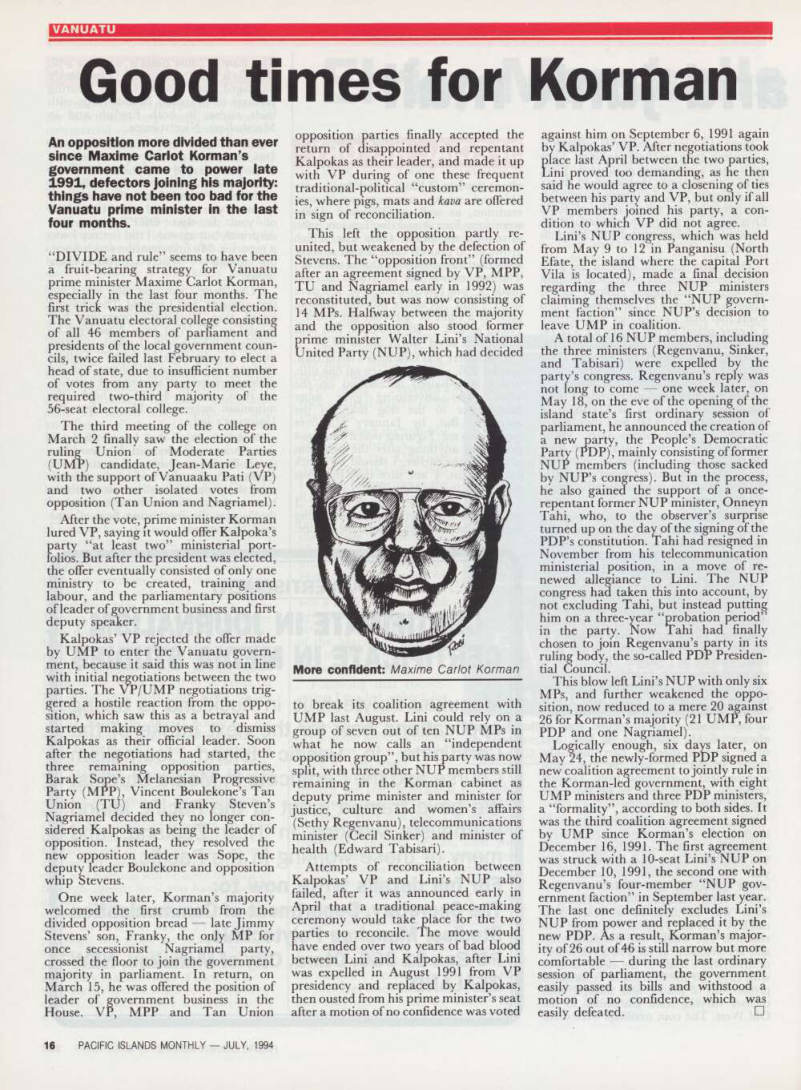
More confident: Maxime Carlot Korman
Bilney’s challenge
WHEN Australia’s prime minis
ter Paul Keating was treasurer, back in the mid-1980s, he brought a storm of controversy down on his head by warning that Australia was set to become a ‘banana republic’.
The reaction to the remark was outrage. While there must have been times when Keating rued the moment he uttered the evocative phrase a decade later Australia has undergone many of the reforms it implied were necessary. For the ruling Labour party, business and unions memories of the painful process of challenging and then relinquishing beliefs and policies which had the status of sacred cows, are now fading. In the lead up to this year’s South Pacific Forum in Brisbane, Aus tralia’s Pacific Islands Affairs Minister Gordon Bilney has issued a similar challenge to island leaders.
In a speech beamed live to eight Pacific capitals Bilney warned leaders urgent action was needed if island nations were not to face the possibility of a truly horrifying future.
He cited World Bank figures which show island economies grew at an average rate of just 0.1 per cent annually over the past 10 years despite generally favourable conditions.
Bilney’s blunt assessment “Whatever policies we’ve been following in the South Pacific and by ‘we’ I mean island countries and donors alike are demonstrably not working and not judged by some alien standard, but by the yardstick of sustainable development we’ve all set ourselves.” Bilney went on “The lack of economic development, when combined by high population growth rates, unsustainable exploitation of natural resources and rapidly rising community expectations, has led to a growing range of social and economic problems, including permanent environmental degradation.”
In explaining what the future might hold Bilney had recourse to the predictions of the Australian National University’s Pacific 2010 Research Project which he said “paints a nightmare vision of mass unemployment, urban slums, unrealisable demands on already stretched govern ment services, growing lawlessness and a degraded environ ment if current high population growth rates remain unchecked”. While Bilney recognised the islands’ special problems he layed the responsibility clearly at governments’ door. What was to have been the first major policy statement since 1988 when Gareth Evans placed Australia island relations on a far more equal footing with his doctrine of “constructive commitment” became a long and carefully worded assessment of the region’s future designed to give Australia a big role in assisting with solutions. Issues on Bilney’s ambitious reform agenda include unsustainable logging and fishing, ecotourism, population control and better management of the islands environmentally sensitive and economically vital coastal zones.
On economic management Bilney treads a predictable path of raising the need for more trade investment and private sector development and goes further to suggest examination of such sacred cows as land tenure and whether
very expensive separate national air lines are still necessary. When pressed on the land issue Bilney stressed sol utions were a matter for island govern ments but highlighted the fact that investors will not invest in tourism facilities, for instance, if their lease on land can be withdrawn just as expensive buildings are completed.
The big risk with Bilney’s approach is that it will be seen as, or will in fact be, just another attempt by Australians to get in and run islanders business for them. It was in an effort to avoid that that Bilney wqs at pains, in the speech, not to propose solutions. In Canberra foreign affairs officials are nervous about how the new approach will be received. Bilney himself is only too aware of the risks. “I do think we could come to be seen, quite easily come to be
seen, if we weren’t careful, as big brother telling people what to do.” But he said “If we did that we’ve lost the plot and we’ve lost the game and I think everyone would be worse off.” There is no doubt that Bilney passionately believes the Pacific is facing a window of opportunity for action but behind his concern is also a more sobering assessment that if the islands fail to meet the challenges of the post-cold war era their problems, in the future, will also be Australia’s problems. With the end of the cold war security issues, which had driven much big power interest in the region, are no longer as relevant and the results of that reduced interest and aid flows from traditional partners such as Britain the US or Europe are already unfolding or foreshadowed.
If the nightmare scenarios come to pass not only will Australia be faced by pockets of human misery on its doorstep but also worrying political instability, calls on Australian resources and even the possibility that it may have to offer safe haven to large numbers of refugees from Pacific difficulties. In the shorter term a perception that Australia’s $400,000,000 Pacific aid programme is failing to deliver benefits for the islands, and the need to find money for the promised fourfold increase in aid to Indochina, could easily lead to the sort of cost cutting that has affected so many other areas of government expenditure. For island leaders Bilney’s reform agenda also holds risks. At this stage it is still a bit waffly and in many ways fails to take account of runs already put on the board by island governments on many of these issues. Quite a few island leaders have trouble enough with the delicately balanced forces which keep them in office without taking action against national sacred cows or vested interests. Here some of Bilney’s resource issues, particularly areas such as fishing royalties and licence fees, might provide an injection of funds which could smooth the path. Island countries currently receive less than half of what many other countries receive for their fish. With half the world’s canning tuna caught in the region a realistic overhaul of the region’s approach may yield tens of millions of dollars of new income.
Bilney has chosen an opportune moment to call for urgent action particularly at a time when the international economic environment thrown up by the post-cold war era is only getting more and more competitive. □
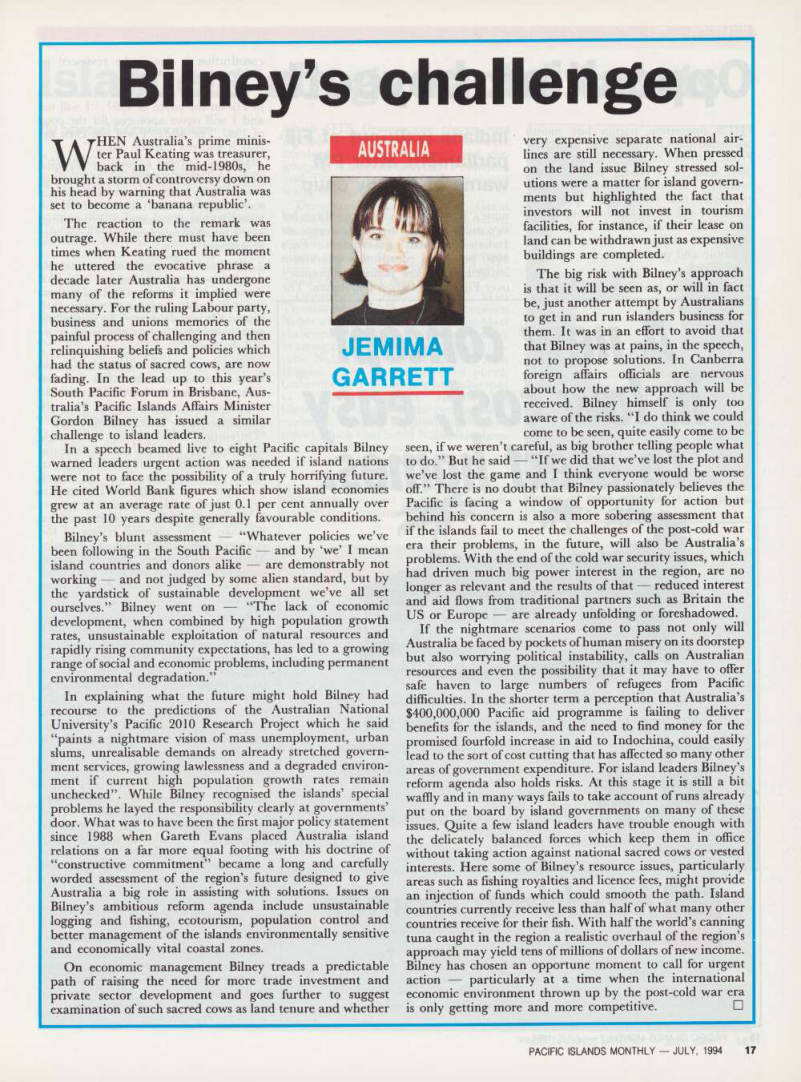
Australia
Jemima
Garrett
Opposition boycott

Politics Fiji
FIJI’S opposition parties last month boycotted parliament for two days after Prime Minister Sitiyeni Rabuka warned there may be a bloody repeat of the country’s 1987 military coups. “I cannot guarantee nor can anyone guarantee that there will not be another coup in this land, the former coup leader told parliament on June 16 during a debate on crime and punishment.
“When that happens, I cannot guarantee that it will be bloodless like
nf |ionQ walk nilt nf Pin iHUlallo Wdll\ UUI. Ul ■ IJI
parliament aft6f PM
WdmS of bloody coup
mine.” Rabuka, then an army officer, led two military coups in 1987 to depose an Indian-dominated government. Fiji’s 1990 post-coup constitution guarantees indigenous Fijians political supremacy over Fiji’s large Indian population. The
constitution is due to be reviewed by 1997.
Rabuka said some blamed lawlessness in Fiji on the coups of 1987. “I will not and I will never apologise for the coup of 1987,” he said. “I will not even say that it will not happen again.”
Members of the opposition National
Federation Party (NFP) and Fiji Labour
Party (FLP) refused to return to parlia ment after the short break which fol lowed Rabuka’s comments. Proceedings in the house of representatives were later abandoned.
“He said a few ugly things and we decided to protest against it,” said FLP deputy leader Krishna Datt. Datt ac cused Rabuka of making an unprovoked threat. “It was a threat he was telling everybody ‘shut up’ or this is what we will do again.”
With that kind of attitude, how could there be a constitution in Fiji that was fair and just for everyone? Datt asked.
Returning to parliament on June 20,
opposition leader Jai Ram Reddy said
“Opposition members felt we’d made our point. The issue was not fundamental
enough to justify an indefinite boycott.
We’ll just carefully have to watch developments.” Reddy said Indian par ties also had decided to end their protest in the interest of Fiji’s economy and for the sake of the planned review of the country’s 1990 constitution. FLP leader Mahendra Chaudhry said the prime minister’s comments had been insensitive and arrogant. “It was our duty to stage
a protest.”
Rabuka’s outburst came during de bate on a bill proposing community work as an alternative to imprisonment in
Fiji’s crowded jails. Some blamed Fiji’s
1990 constitution for the high levels of crime, he said. “Is it the constitution or is it the distribution of wealth in this nation?” Rabuka pointed to a recent speech by Fiji President Ratu Sir Kami sese Mara, who warned poor, urban Fijians could become a destabilising force in Fiji if their situation was not improved.
Fiji’s Indians, while politically disad vantaged, represent the bulk of the business class in Fiji and make up 45 per cent of its population. “Let us look at the distribution of wealth in this country,”
Rabuka told parliament. “Why are
others coming up and rebelling against
society and against the laws of this
country?
“They (Fijians) feel disadvantaged.
They feel they are starving. They may look well but their very soul is starving.
“As long as that happens, I cannot guarantee nor can anyone guarantee that there will not be another coup in this land.” Rabuka later denied he was threatening the Indian community. □
Advertisements & other items, p. 18 (1 item)
in low cost, easy
A new c
to erect homes.
m Maddren's Pacific Panel homes ore possibly the perfect solution to Pacific Island residential housing needs. Constructed from fibre cement and lightweight concrete panels, with special cyclone fastened trusses, these homes combine ease of construction with unprecedented strength.
For a comprehensive brochure, complete and moil the coupon below.
Maddren Homes
PO Box 244, Kumeu, New Zealand, Ph 0-9-412 9070. Fax 0-9-412 7251.
Please mail me your free catalogue.
Name Address
Islanders allege racial taunts
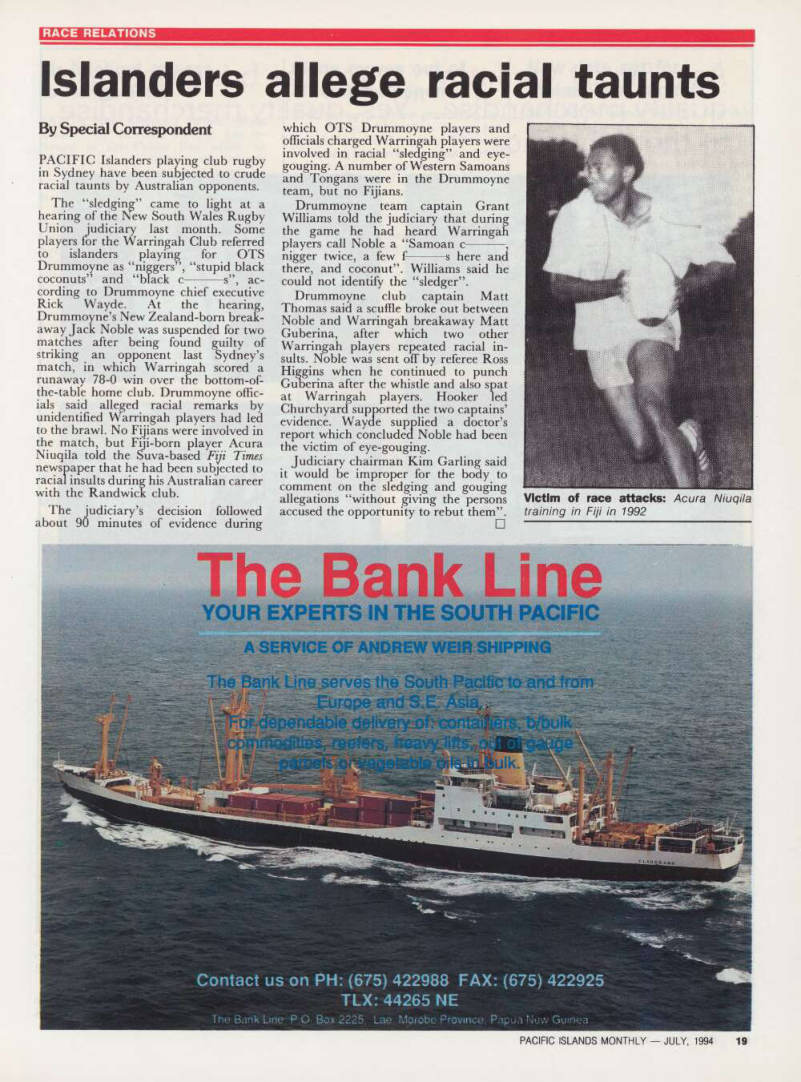
Race Relations
By Special Correspondent
PACIFIC Islanders playing club rugby in Sydney have been subjected to crude racial taunts by Australian opponents.
The “sledging” came to light at a hearing of the New South Wales Rugby Union judiciary last month. Some players for the Warringah Club referred to islanders playing for OTS
Drummoyne as “niggers”, “stupid black
coconuts” and “black c s”, ac cording to Drummoyne chief executive Rick Wayde. At the hearing, Drummoyne’s New Zealand-born break away Jack Noble was suspended for two matches after being found guilty of striking an opponent last Sydney’s match, in which Warringah scored a runaway 78-0 win over the bottom-of the-table home club. Drummoyne offic ials said alleged racial remarks by unidentified Warringah players had led to the brawl. No Fijians were involved in the match, but Fiji-born player Acura Niuqila told the Suva-based Fiji Times newspaper that he had been subjected to racial insults during his Australian career with the Randwick club.
The judiciary’s decision followed about 90 minutes of evidence during
which OTS Drummoyne players and officials charged Warringah players were involved in racial “sledging” and eye gouging. A number of Western Samoans and Tongans were in the Drummoyne team, but no Fijians.
Drummoyne team captain Grant Williams told the judiciary that during the game he had heard Warringah players call Noble a “Samoan c , nigger twice, a few f s here and there, and coconut”. Williams said he could not identify the “sledger”.
Drummoyne club captain Matt Thomas said a scuffle broke out between Noble and Warringah breakaway Matt Guberina, after which two other Warringah players repeated racial in sults. Noble was sent off by referee Ross Higgins when he continued to punch Guberina after the whistle and also spat at Warringah players. Hooker led Churchyard supported the two captains’ evidence. Wayde supplied a doctor’s report which concluded Noble had been the victim of eye-gouging.
Judiciary chairman Kim Garling said it would be improper for the body to comment on the sledging and gouging allegations “without giving the persons accused the opportunity to rebut them”. □
Victim of race attacks: Acura Niuqila training in Fiji in 1992
Advertisements & other items, pp. 19-20 (1 item)
The Bank Line
YOUR EXPERTS IN THE SOUTH PACIFIC
iSi Wmßt '■sS*VSp*Sf& s» SSafe-.i- -'-“A. -Sr^i-S SB®* fmt mimm. m -v“~'Ssy£ ' • •: [»■* Ik i PM Contact us on PH: (675) 422988 FAX: (675) 422925
TLX; 44265 NE
The Bank Line P O Box 2225, Lae, Morobo Province, Papua New Guinea
As a family we know ... and we bring only top
quality merchandise. “Yes, quality merchandise
at the right price.”
■ P *** -wi -a > 4k -.. r & .j* »• »*■ m Sr* , -11, --—- % Sty wmam
Office supplies, Office machines
* Clothing, footwears
* Fragrances, watches/docks * Audio/Video supplies & equipments
* Photographic
supplies & equipments ►
* JOHNSON outboard
engines & parts
m iT- ' m
SHOP
Mi aw k % Grant L. Labaun (Gen. Manager/Owner) and family P.O. Box 957, Majuro, Marshall Islands MH 96960-0957 $ Phone: Oil (692) 625-3133 Oil (692) 625-3965 Fax: Oil (692) 625-3164 Res: Oil (692) 625-3170
DBA:
Mid town Gary's Marine Supplies Bam Bam Bus Service Hair Priority Barber & Beauty Salon Makkije Housings/Apartments Many other items
Bougainville peace
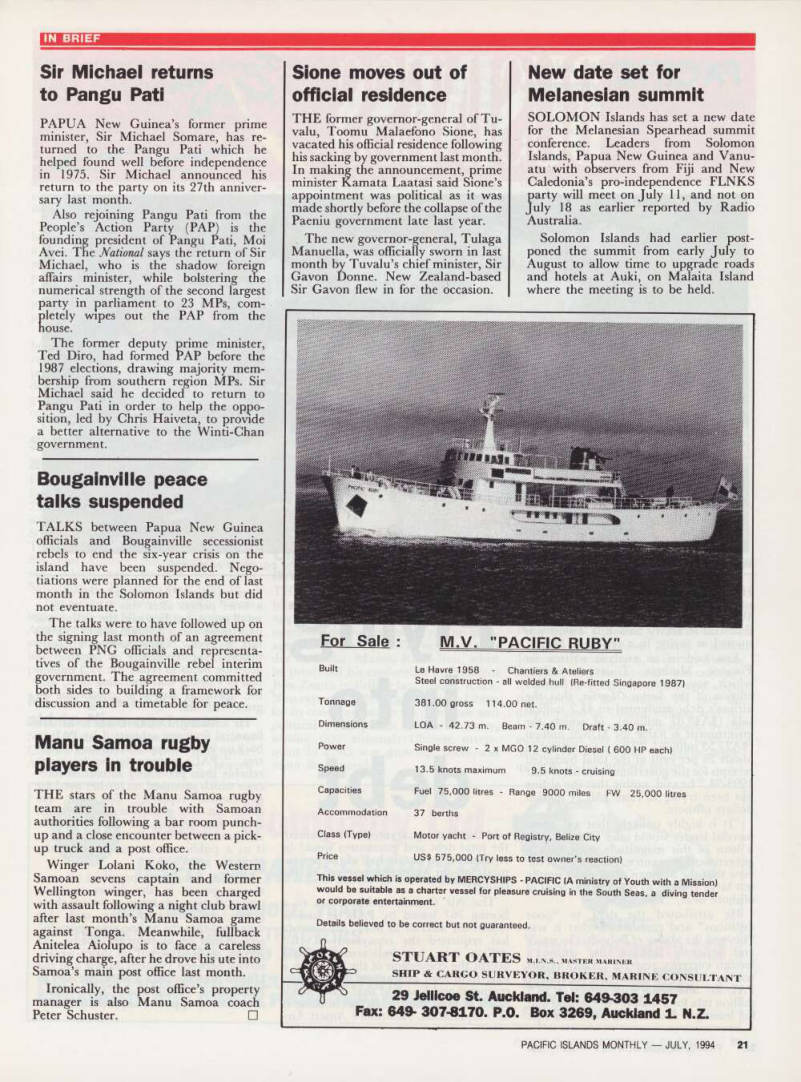
In Brief
Sir Michael returns
to Pangu Rati
PAPUA New Guinea’s former prime minister, Sir Michael Somare, has re turned to the Pangu Pati which he helped found well before independence in 1975. Sir Michael announced his return to the party on its 27th anniver sary last month.
Also rejoining Pangu Pati from the People’s Action Party (PAP) is the founding president of Pangu Pati, Moi Avei. The National says the return of Sir Michael, who is the shadow foreign affairs minister, while bolstering the numerical strength of the second largest party in parliament to 23 MPs, com pletely wipes out the PAP from the house.
The former deputy prime minister, Ted Diro, had formed PAP before the 1987 elections, drawing majority mem bership from southern region MPs. Sir Michael said he decided to return to Pangu Pati in order to help the oppo sition, led by Chris Haiveta, to provide a better alternative to the Winti-Chan government.
Bougainville peace
talks suspended
TALKS between Papua New Guinea officials and Bougainville secessionist rebels to end the six-year crisis on the island have been suspended. Nego tiations were planned for the end of last month in the Solomon Islands but did not eventuate.
The talks were to have followed up on the signing last month of an agreement between PNG officials and representa tives of the Bougainville rebel interim government. The agreement committed both sides to building a framework for discussion and a timetable for peace.
Manu Samoa rugby
players in trouble
THE stars of the Manu Samoa rugby team are in trouble with Samoan authorities following a bar room punch up and a close encounter between a pick up truck and a post office.
Winger Lolani Koko, the Western Samoan sevens captain and former Wellington winger, has been charged with assault following a night club brawl after last month’s Manu Samoa game
against Tonga. Meanwhile, fullback
Anitelea Aiolupo is to face a careless driving charge, after he drove his ute into Samoa’s main post office last month.
Ironically, the post office’s property manager is also Manu Samoa coach Peter Schuster. □
Sione moves out of
official residence
THE former governor-general of Tu valu, Toomu Malaefono Sione, has vacated his official residence following his sacking by government last month.
In making the announcement, prime minister Kamata Laatasi said Sione’s appointment was political as it was made shortly before the collapse of the Paeniu government late last year.
The new governor-general, Tulaga Manuella, was officially sworn in last month by Tuvalu’s chief minister, Sir Gavon Uonne. New Zealand-based Sir Gavon flew in for the occasion.
New date set for
Melanesian summit
SOLOMON Islands has set a new date for the Melanesian Spearhead summit conference. Leaders from Solomon Islands, Papua New Guinea and Vanu atu with observers from Fiji and New Caledonia’s pro-independence FLNKS Jarty will meet on July 11, and not on uly 18 as earlier reported by Radio Australia.
Solomon Islands had earlier post poned the summit from early July to August to allow time to upgrade roads and hotels at Auki, on Malaita Island where the meeting is to be held.
Advertisements & other items, p. 21 (1 item)
For Sale
. i- r .
■F-... * 'W: =i
"rnippaiwii
For Sale
Built ■Ki
M.V. "PACIFIC RUBY'
Tonnage Dimensions Power Speed Capacities Accommodation Class (Type) Price Le Havre 1958 - Chantiers & Ateliers Steel construction - all welded hull (Re-fitted Singapore 1987) 381.00 gross 114.00 net.
LOA - 42.73 m. Beam - 7.40 m. Draft - 3.40 m.
Single screw - 2 x MGO 12 cylinder Diesel ( 600 HP each) 13.5 knots maximum 9.5 knots - cruising Fuel 75,000 litres - Range 9000 miles FW 25,000 litres 37 berths Motor yacht - Port of Registry, Belize City US$ 575,000 (Try less to test owner's reaction) This vessel which is operated by MERCYSHIPS - PACIFIC (A ministry of Youth with a Mission) would be suitable as a charter vessel for pleasure cruising in the South Seas, a diving tender or corporate entertainment.
Details believed to be correct but not guaranteed.
STUART OATES m...n. 5 .. master marker SHIP & CARGO SURVEYOR, BROKER, MARINE CONSULTANT 29 Jellicoe St. Auckland. Tel: 649-303 1457 Fax: 649- 307-8170. P.O. Box 3269, Auckland 1. N.Z.
Pacific
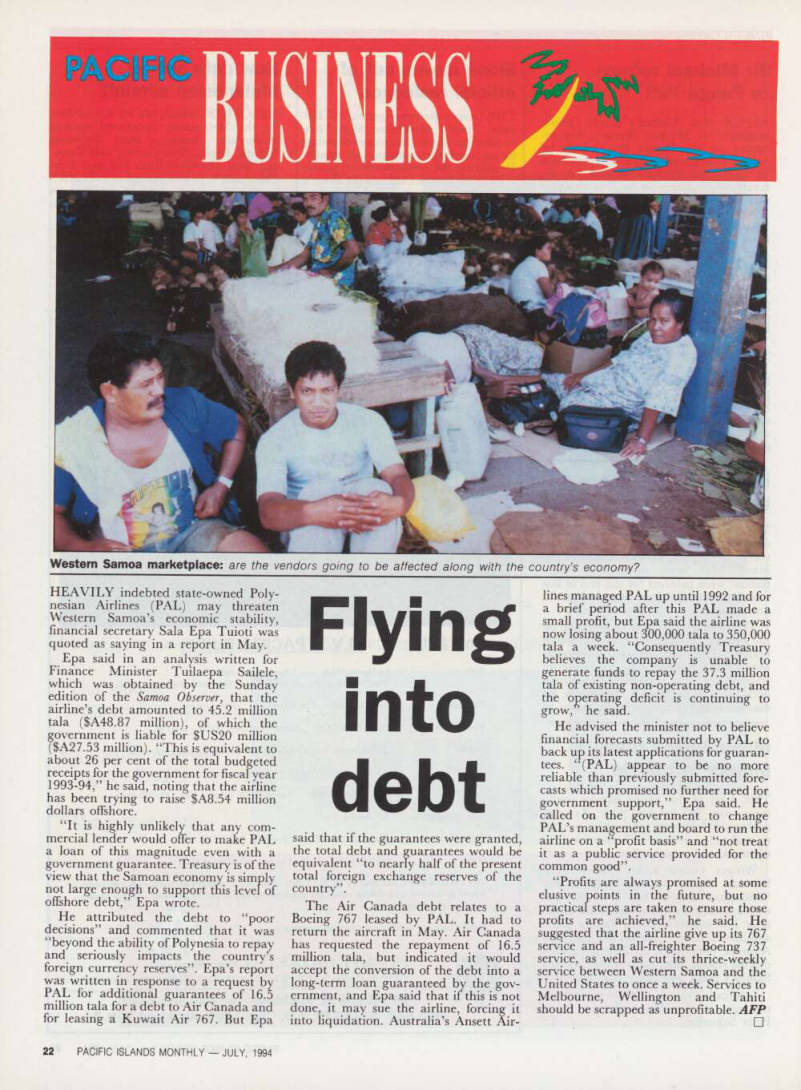

Business
Flying into debt
HEAVILY indebted state-owned Polynesmn Airlines (PAL) may threaten Vvestern Samoa’s economic stability, financial secretary Sala Epa Tuioti was quoted as saying in a report in May.
Epa said in an analysis written for Finance Minister Tuilaepa Sailele, which was obtained by the Sunday edition of the Samoa Observer, that the airline’s debt amounted to 45.2 million tala ($A48.87 million), of which the ?«AOT 1 cQ ent 'M' .®US2O million (SA2 /.53 million). 1 his is equivalent to about 26 per cent of the total budgeted for the government for fiscal year 1993-94, he said, noting that the airline has been trying to raise 5A8.54 million dollars offshore.
“It is highly unlikely that any commercial lender would offer to make PAL a loan of this magnitude even with a government guarantee. Treasury is of the view that the Samoan economy is simply not large enough to support thts levet of offshore debt, Epa wrote.
Fie attributed the debt to “poor decisions and commented that it was beyond the ability of Polynesia to repay and seriously impacts the country’s foreign currency reserves . Epa s report was written in response to a request by PAL for additional guarantees of 16.5 million tala for a debt to Air Canada and for leasing a Kuwait Air 767. But Epa
said that if the guarantees were granted, the total debt and guarantees would be equivalent “to nearly half of the present total foreign exchange reserves of the country The Air Canada debt relates to a Boeing 767 leased by PAL. It had to return the aircraft in May. Air Canada has requested the repayment of 16.5 million tala, but indicated it would accept the conversion of the debt into a long-term loan guaranteed by the gov ernment, and Epa said that if this is not done, it may sue the airline, forcing it into liquidation. Australia’s Ansett Air
lines managed PAL up until 1992 and for a brief period after this PAL made a small profit, but Epa said the airline was now losing about 300,000 tala to 350,000 tala a week. “Consequently Treasury believes the company is unable to generate funds to repay the 37.3 million tala of existing non-operating debt, and the operating deficit is continuing to grow/’ he said.
He advised the minister not to believe financial forecasts submitted by PAL to back up its latest applications for guaran tees. “(PAL) appear to be no more reliable than previously submitted fore casts which promised no further need for government support,” Epa said. He called on the government to change PAL’s management and board to run the airline on a “profit basis” and “not treat it as a public service provided for the common good”.
“Profits are always promised at some elusive points in the future, but no practical steps are taken to ensure those profits are achieved,” he said. He suggested that the airline give up its 767 service and an all-freighter Boeing 737 service, as well as cut its thrice-weekly service between Western Samoa and the United States to once a week. Services to Melbourne, Wellington and Tahiti
should be scrapped as unprofitable.
Afp
Western Samoa marketplace: are the vendors going to be affected along with the country's economy?
Fiji’s economic growth
down, says report
FIJI’S Reserve Bank says the country’s economy remained weak throughout last year as economic growth dropped from 3.1 per cent to 1.7 per cent. The bank’s annual report for last year attributed the weak economy to the slow recovery of the agricultural and subsistence sectors caused by Cyclone Kina at the beginning of the year.
Economic growth dropped despite
increased demand for Fiji’s exports and a domestic stimulus through lower inter est rates., the report said. The consumer price index increased by three per cent while the average annual inflation rate increased from 4.9 per cent in 1992 to 5.2 per cent last year.
The rate of money supply dropped because real income decreased, deposit rates dropped and expenditure on im ports increased. The overall net budget deficit was equal to 3.7 per cent of the gross domestic product at current factor cost.
Solomon Airlines
announces changes
FINANCIALLY troubled Solomon Air lines is giving up the lease on its Boeing 737-400 jet to Qantas. In return, Qantas will lease a smaller Boeing 737-300 to Solomon Airlines for 3'/z days a week.
The deal will mean major changes to Solomon Airlines’ international sched ules which now operate only from
Saturdays to Tuesdays from June 18.
The airline will stop its weekly Cairns service and one of its two Fiji services.
Acting general manager Wilson Gina said the new arrangement would see an improvement in the airline’s financial
position.
NZ to give USs3.sm in
aid to Niue next year
NEW Zealand is to contribute a total of US$3.5 million to Niue next year.
Australia is likely to give around
US$4OO,OOO in the form of technical
assistance and training scholarships.
Niue officials say most of the New Zealand aid will go toward the recurrent budget, and a special US$l.5 million grant will go towards lengthening the
airport runway.
A Radio New Zealand International report said although next year’s aid levels were about the same as previously, Niue faced a budget deficit of around US$3OO,OOO. However, cutbacks in the public service and income from offshore banking and insurance trusts are likely to boost the island’s income.
PNG govt warns
business sector
COMPANIES in Papua New Guinea that fail to adhere to the Companies Act face higher fines and other tough penal
ties approved recently by the PNG
parliament. Commerce and industry
minister David Mai successfully sought the house’s approval on the changes to the act.
He told parliament that outdated laws had proved cumbersome over time and only 25 per cent of the companies operating in the country were adhering to them. Mai said the aim of the amendments was to get the other 75 per cent, which are usually big businesses, to
comply.
Chinese invited to
invest in PNG
THE Papua New Guinea government has invited Chinese investors to aggressively seek out investment opportunities in the country. The mess age was relayed by PNG’s new ambassa dor to China, Maimu Raka-Nou, when he presented his credentials to President Jian Zemin in Beijing last month. Raka- Nou expressed PNG’s gratitude to China for its contributions to the economic and political development of the country, adding that although Chinese invest ment in PNG was growing, there was room for expansion.
Cooks Islands troubled
economy discussed
IN the Cook Islands, a roundtable
meeting is being organised between the
government, the banks and the private sector to discuss the current state of the country’s economy. The summit plan follows concerns from the private sector to the prime minister, Sir Geoffrey Henry, over what they call a credit squeeze.
They complained that the immediate effects of the credit squeeze was less activity, fewer jobs, less income and less turnover in shops which is reported to be down by 25 per cent. Cook Islands News says the recent freeze on most bank loans is one of the first public indications there would be a credit squeeze. Sir Geoffrey says the problems needs to be worked out from a national point of view and not from the specific interest of just one of the groups.
Fiji govt seeks to
raise USsl6om locally
THE Fiji government has proposed to raise US$l6O million loan locally to service its debts due this year and fund
expenditures approved by parliament.
But political leaders have expressed concern that the government should seek such a sum in loans locally within two months of passing the revised 1994
budget.
Opposition leader Jai Ram Reddy said
the proposal was “very unusual”. He said the government should provide for
these things through the budget. Reddy
said he was wary of the repercussions of
the proposal if passed by parliament.
Fijian Association Party leader
Josevata Kamikamica, a former finance minister, said the proposal was contrary to what the government had said about the deficit in the budget. He said the deficit stood at US$93 million and the US$l6O million loan being sought by the government was much higher than the deficit. He warned of the grave conse quences to the private sector. □
Advertisements & other items, p. 23 (1 item)
Trust Company Ltd
USED JAPANESE VEHICLES
ANY MAKE, MODEL, YEAR
* TRUCKS, * CARS, * TRACTORS.
* ENGINE AND TYRES
ALL SHIPPING AND DOCUMENTATION
ARRANGED. BUY DIRECT FROM JAPAN AND SAVE.
"CONTACT'
Trust Company Ltd
KOBAC BLD 3F 3-2-26 NISHIKI,
NAKAU NAGOYA, 460 JAPAN.
PHONE 062-953-5602.
FAX: 005.2-953-5634
Pearls
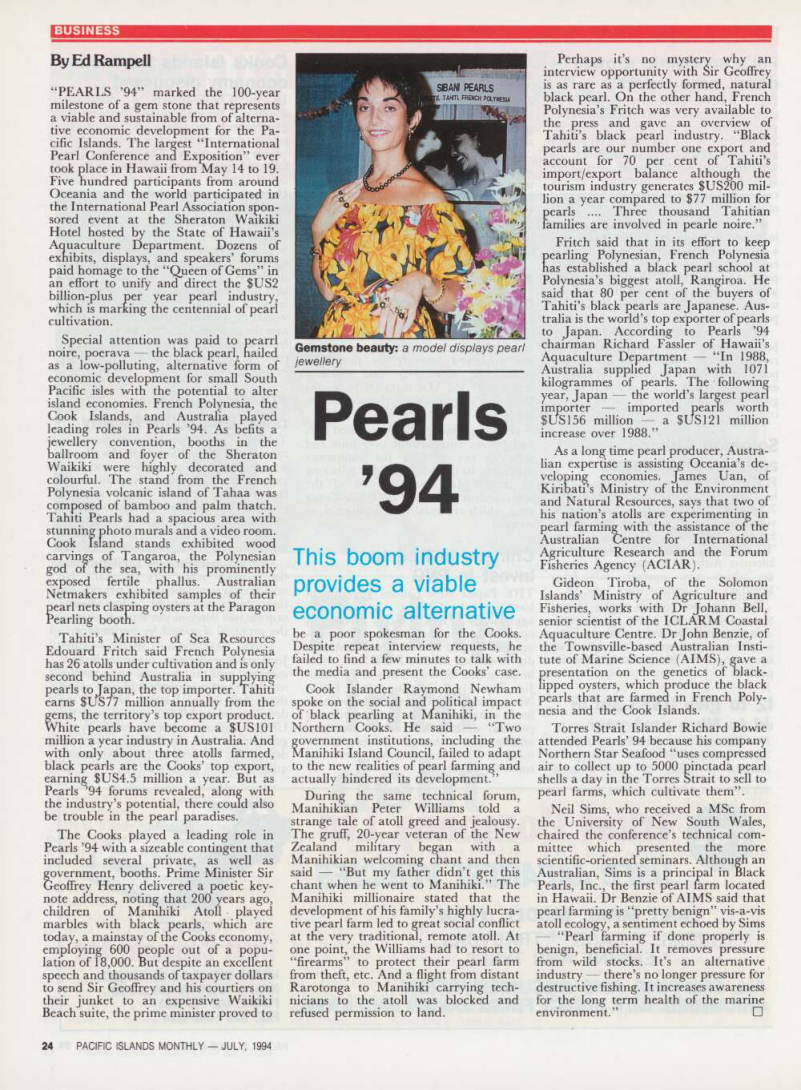
Business
Pearls ’94
By Ed Rampell
“PEARLS ’94” marked the 100-year milestone of a gem stone that represents a viable and sustainable from of alterna tive economic development for the Pa cific Islands. The largest “International Pearl Conference and Exposition” ever took place in Hawaii from May 14 to 19.
Five hundred participants from around Oceania and the world participated in the International Pearl Association spon sored event at the Sheraton Waikiki Hotel hosted by the State of Hawaii’s Aquaculture Department. Dozens of exhibits, displays, and speakers’ forums paid homage to the “Queen of Gems” in an effort to unify and direct the SUS 2
billion-plus per year pearl industry,
which is marking the centennial of pearl cultivation.
Special attention was paid to pearrl noire, poerava the black pearl, nailed as a low-polluting, alternative form of economic development for small South Pacific isles with the potential to alter island economies. French Polynesia, the Cook Islands, and Australia played leading roles in Pearls ’94. As befits a jewellery convention, booths in the ballroom and foyer of the Sheraton Waikiki were highly decorated and colourful. The stand from the French Polynesia volcanic island of Tahaa was composed of bamboo and palm thatch.
Tahiti Pearls had a spacious area with stunning photo murals and a video room.
Cook Island stands exhibited wood carvings of Tangaroa, the Polynesian god of the sea, with his prominently exposed fertile phallus. Australian Netmakers exhibited samples of their gearl nets clasping oysters at the Paragon earling booth.
Tahiti’s Minister of Sea Resources Edouard Fritch said French Polynesia has 26 atolls under cultivation and is only second behind Australia in supplying pearls to Japan, the top importer. Tahiti earns SUS 77 million annually from the gems, the territory’s top export product.
White pearls have become a SUSIOI million a year industry in Australia. And with only about three atolls farmed, black pearls are the Cooks’ top export, earning SUS4.S million a year. But as Pearls ’94 forums revealed, along with the industry’s potential, there could also be trouble in the pearl paradises.
The Cooks played a leading role in Pearls ’94 with a sizeable contingent that included several private, as well as government, booths. Prime Minister Sir
Geoffrey Henry delivered a poetic key
note address, noting that 200 years ago, children of Manihiki Atoll played marbles with black pearls, which are today, a mainstay of the Cooks economy, employing 600 people out of a popu lation of 18,000. But despite an excellent speech and thousands of taxpayer dollars to send Sir Geoffrey and his courtiers on their junket to an expensive Waikiki Beach suite, the prime minister proved to
This boom industry
provides a viable
economic alternative
be a poor spokesman for the Cooks.
Despite repeat interview requests, he failed to find a few minutes to talk with the media and present the Cooks’ case.
Cook Islander Raymond Newham spoke on the social and political impact of black pearling at Manihiki, in the Northern Cooks. He said — “Two government institutions, including the Manihiki Island Council, failed to adapt to the new realities of pearl farming and actually hindered its development.”
During the same technical forum, Manihikian Peter Williams told a strange tale of atoll greed and jealousy.
The gruff, 20-year veteran of the New Zealand military began with a Manihikian welcoming chant and then said — “But my father didn’t get this chant when he went to Manihiki.” The Manihiki millionaire stated that the development of his family’s highly lucra tive pearl farm led to great social conflict at the very traditional, remote atoll. At one point, the Williams had to resort to “firearms” to protect their pearl farm from theft, etc. And a flight from distant Rarotonga to Manihiki carrying tech nicians to the atoll was blocked and refused permission to land.
Perhaps it’s no mystery why an interview opportunity with Sir Geoffrey is as rare as a perfectly formed, natural black pearl. On the other hand, French Polynesia’s Fritch was very available to the press and gave an overview of Tahiti’s black pearl industry. “Black pearls are our number one export and account for 70 per cent of Tahiti’s import/export balance although the tourism industry generates SUS2OO mil lion a year compared to $77 million for f)earls ... Three thousand Tahitian amilies are involved in pearle noire.”
Fritch said that in its effort to keep pearling Polynesian, French Polynesia has established a black pearl school at Polynesia’s biggest atoll, Rangiroa. He said that 80 per cent of the buyers of Tahiti’s black pearls are Japanese. Aus tralia is the world’s top exporter of pearls to Japan. According to Pearls ’94 chairman Richard Fassler of Hawaii’s Aquaculture Department “In 1988, Australia supplied Japan with 1071 kilogrammes of pearls. The following year, Japan the world’s largest pearl importer - imported pearls worth SUSIS6 million a SUSI2I million increase over 1988.”
As a long time pearl producer, Austra lian expertise is assisting Oceania’s de veloping economies. James Uan, of Kiribati’s Ministry of the Environment and Natural Resources, says that two of his nation’s atolls are experimenting in pearl farming with the assistance of the Australian Centre for International Agriculture Research and the Forum Fisheries Agency (ACIAR).
Gideon Tiroba, of the Solomon Islands’ Ministry of Agriculture and Fisheries, works with Dr Johann Bell, senior scientist of the ICLARM Coastal Aquaculture Centre. Dr John Benzie, of the Townsville-based Australian Insti tute of Marine Science (AIMS), gave a presentation on the genetics of black lipped oysters, which produce the black pearls that are farmed in French Poly nesia and the Cook Islands.
Torres Strait Islander Richard Bowie attended Pearls’ 94 because his company Northern Star Seafood “uses compressed air to collect up to 5000 pinctada pearl shells a day in the Torres Strait to sell to pearl farms, which cultivate them”.
Neil Sims, who received a MSc from the University of New South Wales, chaired the conference’s technical com mittee which presented the more scientific-oriented seminars. Although an Australian, Sims is a principal in Black Pearls, Inc., the first pearl farm located in Hawaii. Dr Benzie of AIMS said that pearl farming is “pretty benign” vis-a-vis atoll ecology, a sentiment echoed by Sims “Pearl farming if done properly is benign, beneficial. It removes pressure from wild stocks. It’s an alternative industry there’s no longer pressure for destructive fishing. It increases awareness for the long term health of the marine environment.” □
Gemstone beauty: a model displays pearl jewellery
Queen of pearls
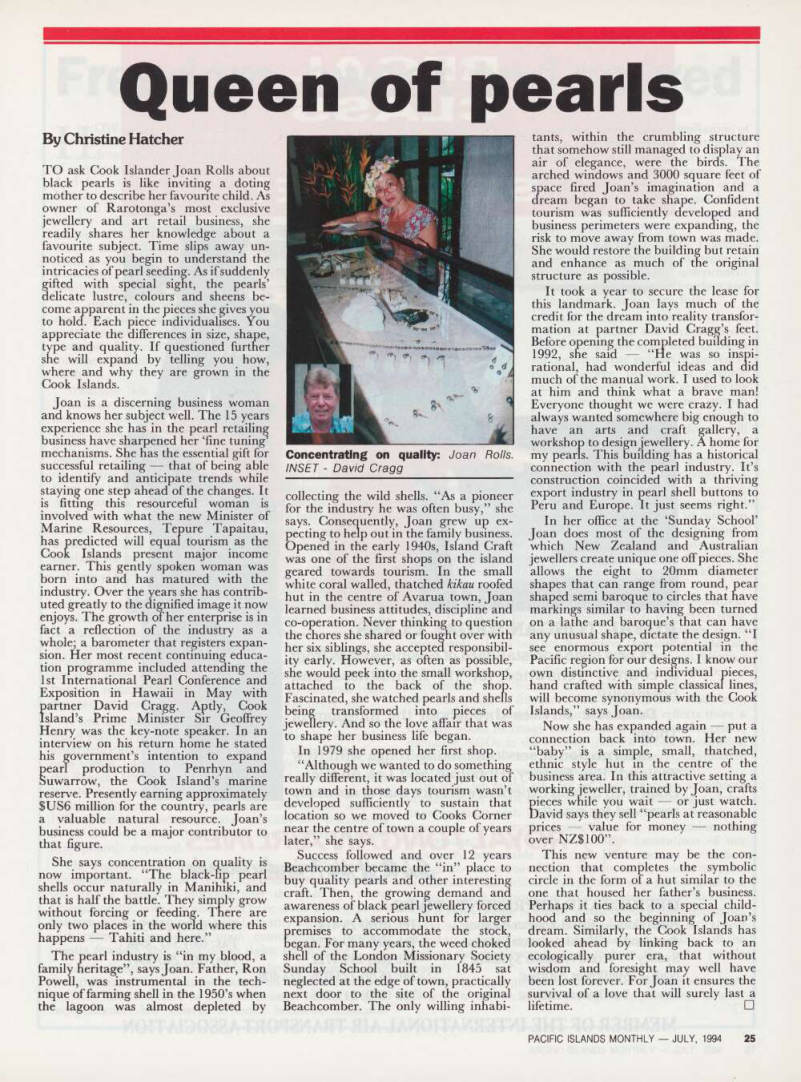
By Christine Hatcher
TO ask Cook Islander Joan Rolls about black pearls is like inviting a doting mother to describe her favourite child. As owner of Rarotonga’s most exclusive jewellery and art retail business, she readily shares her knowledge about a favourite subject. Time slips away un noticed as you begin to understand the intricacies of pearl seeding. As if suddenly gifted with special sight, the pearls’ delicate lustre, colours and sheens be come apparent in the pieces she gives you to hold. Each piece individualises. You appreciate the differences in size, shape, type and quality. If questioned further she will expand by telling you how, where and why they are grown in the Cook Islands.
Joan is a discerning business woman and knows her subject well. The 15 years experience she has in the pearl retailing business have sharpened her ‘fine tuning’ mechanisms. She has the essential gift for successful retailing that of being able to identify and anticipate trends while staying one step ahead of the changes. It is fitting this resourceful woman is involved with what the new Minister of Marine Resources, Tepure Tapaitau, has predicted will equal tourism as the Cook Islands present major income earner. This gently spoken woman was born into and has matured with the industry. Over the years she has contrib uted greatly to the dignified image it now enjoys. The growth of her enterprise is in fact a reflection of the industry as a whole; a barometer that registers expan sion. Her most recent continuing educa tion programme included attending the Ist International Pearl Conference and Exposition in Hawaii in May with
partner David Cragg. Aptly, Cook
Island’s Prime Minister Sir Geoffrey Henry was the key-note speaker. In an interview on his return home he stated his government’s intention to expand pearl production to Penrhyn and Suwarrow, the Cook Island’s marine reserve. Presently earning approximately SUS 6 million for the country, pearls are a valuable natural resource. Joan’s business could be a major contributor to that figure.
She says concentration on quality is now important. “The black-lip pearl shells occur naturally in Manihiki, and that is half the battle. They simply grow without forcing or feeding. There are only two places in the world where this happens Tahiti and here.”
The pearl industry is “in my blood, a family heritage”, says Joan. Father, Ron Powell, was instrumental in the tech nique of farming shell in the 1950’s when the lagoon was almost depleted by
collecting the wild shells. “As a pioneer for the industry he was often busy,” she says. Consequently, Joan grew up ex pecting to help out in the family business.
Opened in the early 19405, Island Craft was one of the first shops on the island geared towards tourism. In the small white coral walled, thatched kikau roofed hut in the centre of Avarua town, Joan learned business attitudes, discipline and
co-operation. Never thinking to question
the chores she shared or fought over with
her six siblings, she accepted responsibil
ity early. However, as often as possible, she would peek into the small workshop, attached to the back of the shop.
Fascinated, she watched pearls and shells being transformed into pieces of jewellery. And so the love affair that was to shape her business life began.
In 1979 she opened her first shop.
“Although we wanted to do something really different, it was located just out of town and in those days tourism wasn’t developed sufficiently to sustain that location so we moved to Cooks Corner near the centre of town a couple of years later,” she says.
Success followed and over 12 years Beachcomber became the “in” place to
buy quality pearls and other interesting
craft. Then, the growing demand and awareness of black pearl jewellery forced expansion. A serious hunt for larger E remises to accommodate the stock, egan. For many years, the weed choked shell of the London Missionary Society Sunday School built in 1845 sat neglected at the edge of town, practically next door to the site of the original Beachcomber. The only willing inhabi
tants, within the crumbling structure that somehow still managed to display an air of elegance, were the birds. The arched windows and 3000 square feet of space fired Joan’s imagination and a dream began to take shape. Confident tourism was sufficiently developed and business perimeters were expanding, the risk to move away from town was made.
She would restore the building but retain and enhance as much of the original structure as possible.
It took a year to secure the lease for this landmark. Joan lays much of the credit for the dream into reality transfor mation at partner David Gragg’s feet.
Before opening the completed building in 1992, she said “He was so inspi rational, had wonderful ideas and did much of the manual work. I used to look at him and think what a brave man!
Everyone thought we were crazy. I had
always wanted somewhere big enough to
have an arts and craft gallery, a workshop to design jewellery. A home for my pearls. This building has a historical connection with the pearl industry. It’s construction coincided with a thriving export industry in pearl shell buttons to Peru and Europe. It just seems right.”
In her office at the ‘Sunday School’
Joan does most of the designing from which New Zealand and Australian jewellers create unique one off pieces. She allows the eight to 20mm diameter shapes that can range from round, pear shaped semi baroque to circles that have markings similar to having been turned on a lathe and baroque’s that can have any unusual shape, dictate the design. “I see enormous export potential in the Pacific region for our designs. I know our own distinctive and individual pieces, hand crafted with simple classical lines, will become synonymous with the Cook Islands,” says Joan.
Now she has expanded again put a connection back into town. Her new “baby” is a simple, small, thatched, ethnic style hut m the centre of the business area. In this attractive setting a
working jeweller, trained by Joan, crafts
pieces while you wait or just watch.
David says they sell “pearls at reasonable prices value for money nothing over NZ$100”.
This new venture may be the con nection that completes the symbolic circle in the form of a hut similar to the one that housed her father’s business.
Perhaps it ties back to a special child hood and so the beginning of Joan’s dream. Similarly, the Cook Islands has looked ahead by linking back to an ecologically purer era, that without wisdom and foresight may well have been lost forever. For Joan it ensures the survival of a love that will surely last a lifetime. □
Concentrating on quality: Joan Rolls.
INSET - David Cragg
Advertisements & other items, p. 26 (1 item)
far# of ihfrttgj/dj/f lUaruU
r r u
ROYAL TONGAN REGAL CLASS
Anew style and standard of business class from a country renowned for its friendliness and
hospitality.
Domestic services throughout the Kingdom of Tonga.
International services linking Tonga with New Zealand, Fiji, Sydney, Honolulu and Los Angeles .
Book with us and experience service that is normally reserved for royalty.
ROYAL TONG AN AIRLINES
far# of ihfrttgj/dj/f lUaruU
OFFICES AND REPRESENTATIVES:
Nukualofa Royal Tongan Airlines: Tel: (676) 23 414 Auckland World Aviation Systems: Sydney World Aviation Systems: Nadi Sunflower Airlines: Suva Sunflower Airlines: Tel: (09) 379 4454 Tel: (02) 239 1722 Tel: (679) 723 016, 723 408 Tel: (679) 315 755 Fax: (676) 24 056 Fax: (09) 377 5648 Fax: (02) 290 3641 MEMBER OF THE INTERNATIONAL AIR TRANSPORT ASSOCIATION
Freedom, sweet and soured
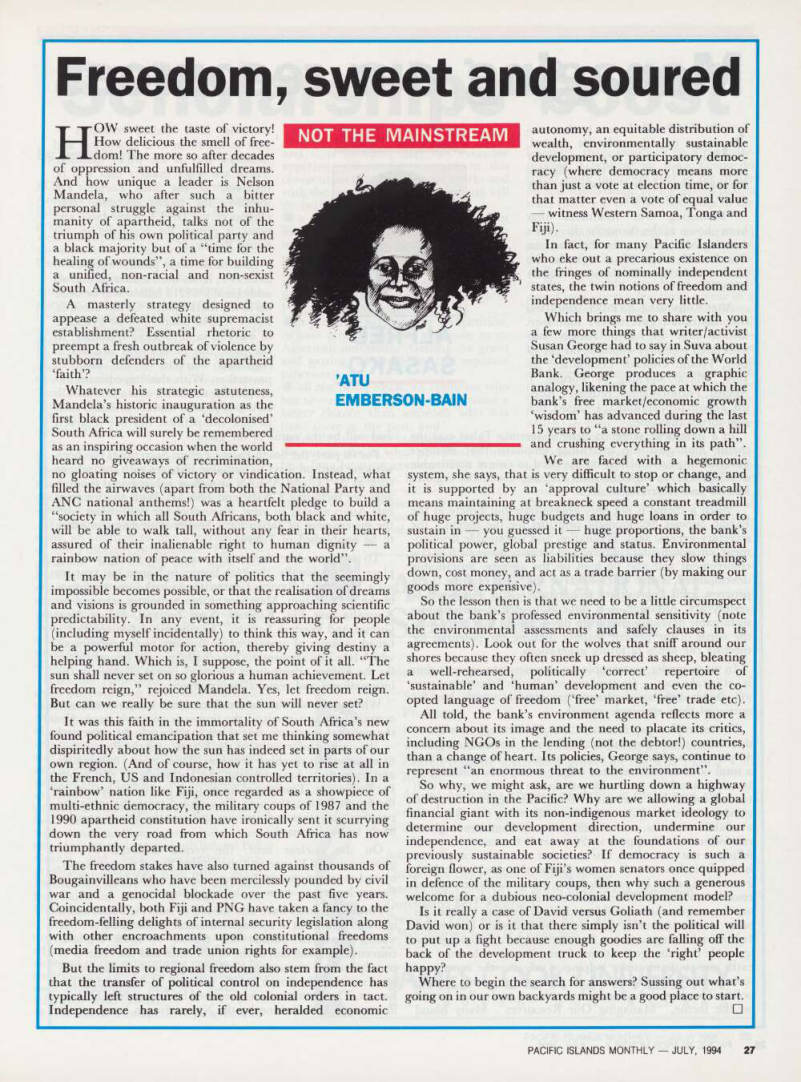
HOW sweet the taste of victory!
How delicious the smell of free dom! The more so after decades of oppression and unfulfilled dreams.
And how unique a leader is Nelson Mandela, who after such a bitter personal struggle against the inhu manity of apartheid, talks not of the triumph of his own political party and a black majority but of a “time for the healing of wounds”, a time for building a unified, non-racial and non-sexist South Africa.
A masterly strategy designed to appease a defeated white supremacist establishment? Essential rhetoric to preempt a fresh outbreak of violence by stubborn defenders of the apartheid ‘faith’?
Whatever his strategic astuteness, Mandela’s historic inauguration as the first black president of a ‘decolonised’
South Africa will surely be remembered as an inspiring occasion when the world heard no giveaways of recrimination,
no gloating noises of victory or vindication. Instead, what filled the airwaves (apart from both the National Party and ANC national anthems!) was a heartfelt pledge to build a “society in which all South Africans, both black and white, will be able to walk tall, without any fear in their hearts, assured of their inalienable right to human dignity a rainbow nation of peace with itself and the world”.
It may be in the nature of politics that the seemingly impossible becomes possible, or tbat the realisation of dreams and visions is grounded in something approaching scientific predictability. In any event, it is reassuring for people (including myself incidentally) to think this way, and it can be a powerful motor for action, thereby giving destiny a helping hand. Which is, I suppose, the point of it all. “The sun shall never set on so glorious a human achievement. Let freedom reign,” rejoiced Mandela. Yes, let freedom reign.
But can we really be sure that the sun will never set?
It was this faith in the immortality of South Africa’s new found political emancipation that set me thinking somewhat dispiritedly about how the sun has indeed set in parts of our own region. (And of course, how it has yet to rise at all in the French, US and Indonesian controlled territories). In a ‘rainbow’ nation like Fiji, once regarded as a showpiece of multi-ethnic democracy, the military coups of 1987 and the 1990 apartheid constitution have ironically sent it scurrying down the very road from which South Africa has now
triumphantly departed.
The freedom stakes have also turned against thousands of Bougainvilleans who have been mercilessly pounded by civil war and a genocidal blockade over the past five years.
Coincidentally, both Fiji and PNG have taken a fancy to the freedom-felling delights of internal security legislation along with other encroachments upon constitutional freedoms (media freedom and trade union rights for example).
But the limits to regional freedom also stem from the fact that the transfer of political control on independence has typically left structures of the old colonial orders in tact.
Independence has rarely, if ever, heralded economic
autonomy, an equitable distribution of wealth, environmentally sustainable
development, or participatory democ
racy (where democracy means more than just a vote at election time, or for that matter even a vote of equal value witness Western Samoa, Tonga and
Fiji)-
In fact, for many Pacific Islanders who eke out a precarious existence on
the fringes of nominally independent
states, the twin notions of freedom and independence mean very little.
Which brings me to share with you a few more things that writer/activist Susan George had to say in Suva about the ‘development’ policies of the World
Bank. George produces a graphic
analogy, likening the pace at which the
bank’s free market/economic growth
‘wisdom’ has advanced during the last 15 years to “a stone rolling down a hill
and crushing everything in its path”.
We are faced with a hegemonic system, she says, that is very difficult to stop or change, and it is supported by an ‘approval culture’ which basically means maintaining at breakneck speed a constant treadmill of huge projects, huge budgets and huge loans in order to sustain in you guessed it huge proportions, the bank’s political power, global prestige and status. Environmental provisions are seen as liabilities because they slow things down, cost money, and act as a trade barrier (by making our
goods more expensive).
So the lesson then is that we need to be a little circumspect about the bank’s professed environmental sensitivity (note the environmental assessments and safely clauses in its agreements). Look out for the wolves that sniff around our shores because they often sneek up dressed as sheep, bleating a well-rehearsed, politically ‘correct’ repertoire of ‘sustainable’ and ‘human’ development and even the co opted language of freedom (‘free’ market, ‘free’ trade etc).
All told, the bank’s environment agenda reflects more a concern about its image and the need to placate its critics, including NGOs in the lending (not the debtor!) countries, than a change of heart. Its policies, George says, continue to represent “an enormous threat to the environment”.
So why, we might ask, are we hurtling down a highway of destruction in the Pacific? Why are we allowing a global financial giant with its non-indigenous market ideology to determine our development direction, undermine our independence, and eat away at the foundations of our previously sustainable societies? If democracy is such a foreign flower, as one of Fiji’s women senators once quipped in defence of the military coups, then why such a generous welcome for a dubious neo-colonial development model?
Is it really a case of David versus Goliath (and remember David won) or is it that there simply isn’t the political will to put up a fight because enough goodies are falling off the back of the development truck to keep the ‘right’ people
happy?
Where to begin the search for answers? Sussing out what’s going on in our own backyards might be a good place to start.
Not The Mainstream
'Atu
Emberson-Bain
Managing our resources
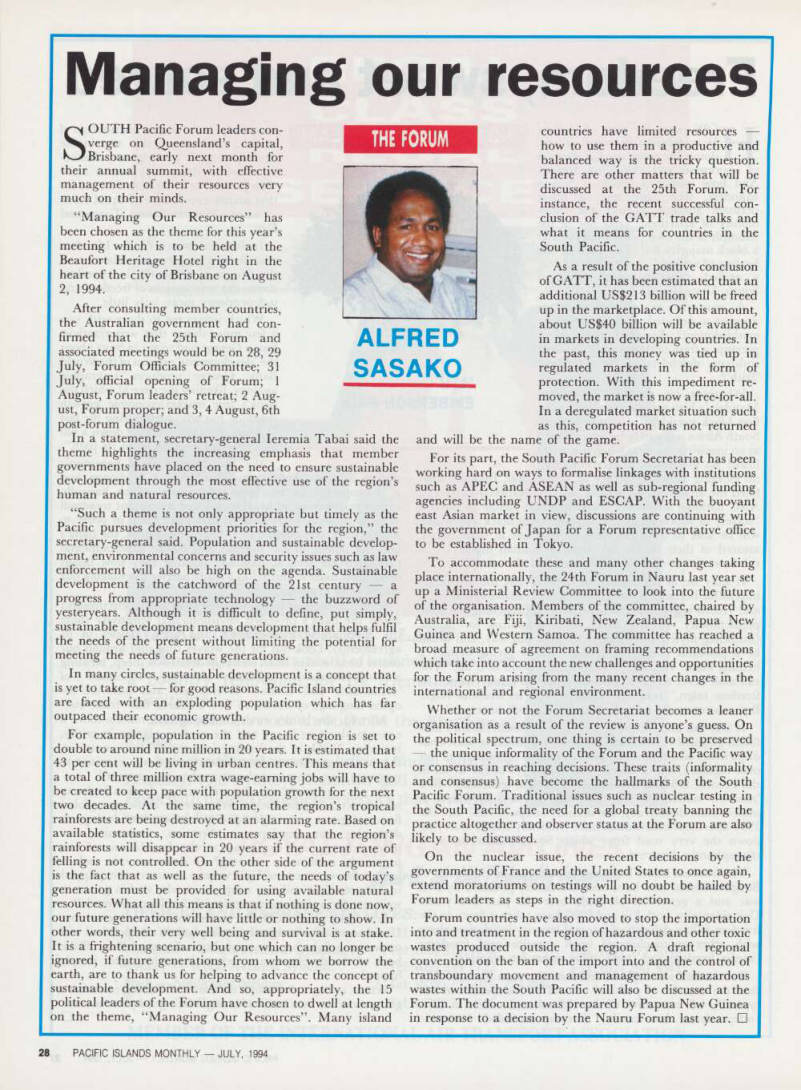
SOUTH Pacific Forum leaders con verge on Queensland’s capital, Brisbane, early next month for their annual summit, with effective management of their resources very much on their minds.
“Managing Our Resources” has been chosen as the theme for this year’s meeting which is to be held at the Beaufort Heritage Hotel right in the heart of the city of Brisbane on August 2, 1994.
After consulting member countries, the Australian government had con firmed that the 25th Forum and associated meetings would be on 28, 29 July, Forum Officials Committee; 31 July, official opening of Forum; 1 August, Forum leaders’ retreat; 2 Aug ust, Forum proper; and 3, 4 August, 6th post-forum dialogue.
In a statement, secretary-general leremia Tabai said the theme highlights the increasing emphasis that member governments have placed on the need to ensure sustainable development through the most effective use of the region’s human and natural resources.
“Such a theme is not only appropriate but timely as the Pacific pursues development priorities for the region,” the
secretary-general said. Population and sustainable develop
ment, environmental concerns and security issues such as law enforcement will also be high on the agenda. Sustainable development is the catchword of the 21st century a progress from appropriate technology the buzzword of yesteryears. Although it is difficult to define, put simply, sustainable development means development that helps fulfil the needs of the present without limiting the potential for meeting the needs of future generations.
In many circles, sustainable development is a concept that is yet to take root for good reasons. Pacific Island countries are faced with an exploding population which has far
outpaced their economic growth.
For example, population in the Pacific region is set to double to around nine million in 20 years. It is estimated that 43 per cent will be living in urban centres. This means that a total of three million extra wage-earning jobs will have to be created to keep pace with population growth for the next two decades. At the same time, the region’s tropical rainforests are being destroyed at an alarming rate. Based on available statistics, some estimates say that the region’s rainforests will disappear in 20 years if the current rate of felling is not controlled. On the other side of the argument is the fact that as well as the future, the needs of today’s generation must be provided for using available natural resources. What all this means is that if nothing is done now, our future generations will have little or nothing to show. In other words, their very well being and survival is at stake.
It is a frightening scenario, but one which can no longer be ignored, if future generations, from whom we borrow the earth, are to thank us for helping to advance the concept of sustainable development. And so, appropriately, the 15 political leaders of the Forum have chosen to dwell at length on the theme, “Managing Our Resources”. Many island
countries have limited resources how to use them in a productive and balanced way is the tricky question.
There are other matters that will be discussed at the 25th Forum. For instance, the recent successful con clusion of the GATT trade talks and what it means for countries in the South Pacific.
As a result of the positive conclusion of GATT, it has been estimated that an additional US$2l3 billion will be freed up in the marketplace. Of this amount, about US$4O billipn will be available in markets in developing countries. In the past, this money was tied up in regulated markets in the form of protection. With this impediment re moved, the market is now a free-for-all.
In a deregulated market situation such as this, competition has not returned
and will be the name of the game.
For its part, the South Pacific Forum Secretariat has been working hard on ways to formalise linkages with institutions such as APEC and ASEAN as well as sub-regional funding agencies including UNDP and ESCAP. With the buoyant east Asian market in view, discussions are continuing with the government of Japan for a Forum representative office to be established in Tokyo.
To accommodate these and many other changes taking place internationally, the 24th Forum in Nauru last year set up a Ministerial Review Committee to look into the future of the organisation. Members of the committee, chaired by Australia, are Fiji, Kiribati, New Zealand, Papua New Guinea and Western Samoa. The committee has reached a broad measure of agreement on framing recommendations which take into account the new challenges and opportunities for the Forum arising from the many recent changes in the international and regional environment.
Whether or not the Forum Secretariat becomes a leaner organisation as a result of the review is anyone’s guess. On the political spectrum, one thing is certain to be preserved the unique informality of the Forum and the Pacific way or consensus in reaching decisions. These traits (informality and consensus) have become the hallmarks of the South Pacific Forum. Traditional issues such as nuclear testing in the South Pacific, the need for a global treaty banning the practice altogether and observer status at the Forum are also likely to be discussed.
On the nuclear issue, the recent decisions by the governments of France and the United States to once again, extend moratoriums on testings will no doubt be hailed by Forum leaders as steps in the right direction.
Forum countries have also moved to stop the importation into and treatment in the region of hazardous and other toxic wastes produced outside the region. A draft regional convention on the ban of the import into and the control of transboundary movement and management of hazardous wastes within the South Pacific will also be discussed at the Forum. The document was prepared by Papua New Guinea in response to a decision by the Nauru Forum last year. □
The Forum
Alfred
Sasako
Scholarships boost
Education
By David North
FORTY or 50 new scholarships for American universities have been estab lished for Pacific islanders. The new grants, which will start in the fall of 1995,
were made possible by legislation pushed
through the Congress by American
Samoa delegate Eni F H Faleomavaega.
The congressman squeezed out SI million out of the tight US budget for this purpose, and secured the needed legislat ive authorisation for the programme, two separate processes in the American political system. The scholarships will be for university students, both graduate and undergraduate, who are from the Cook Islands, Fiji, Kiribati, Niue, Papua New Guinea, the Solomons, Tonga, Tuvalu, Western Samoa and Vanuatu.
Affluent Nauru did not make the list nor did the French colonies.
The programme will be administered by the United States Information Agency (USIA) which also operates the much larger and older Fulbright pro gramme (which paid my way to New Zealand some years ago).
Faleomavaega’s scholarships are, in a sense, an addition to, and a modification of, the Fulbright programme. The con fressman was aware that while the ulbright programme provided the US education for tens of thousands of foreign students over a period of more than 40 years, only 80 of them came from the independent islands of the Pacific. Mean while, despite the presence of the new programme, Pacific islanders remain
eligible for the Fulbright scholarships.
Like the Fulbrights, the new scholar ships will help with travel and education expenses; they can be used at American Mainland universities, as well as in Hawaii and in the American island territories. Unlike the Fulbrights, they will be available to both undergraduates
and to graduate students. (The Fulbright
programme provides no assistance to
undergraduates). In announcing the
firogramme’s passage, and signature into aw, Faleomavaega noted; “In my dis trict, American Samoa, our students are eligible to participate in both federal Pell Grants and local scholarship pro grammes. Students from the South Pacific nations are not so fortunate and few have the means to study in the United States.”
Since the programme is a brand-new one, and will not start funding anyone’s education until September 1995, many elements of the programme remain to be determined. Those who are familiar with such programmes, however, make the
following observations:
this will be a competitive programme,
and it is assumed that not everyone applying will receive a grant; in this competition those with better marks and with the more well-rounded resumes will do better than others; • a reasonably well-qualified student from a lightly-populated area that has not hitherto participated in such a programme (eg. Niue or Tuvalu) would probably get the nod over an equally qualified student who stands tenth on the list from a larger nation (eg. Fiji or
Papua New Guinea);
• it probably helps, in the competition, to have already secured admission to an American university. (Getting the grant and getting admitted are two separate
processes);
• all else being equal, an applicant who has never been to the US should stand a better chance than someone who has lived there in the past; and • finally, the 1995 competition will be the easiest one in what presumably will be a long-term programme. This is the case for two reasons: first, this is a new programme, so there will be no group of alumni who will encourage others to
apply (I learned about Fulbrights from
people who had used the programme);
secondly, there may well be a provision making it possible for some people to spend more than one year in the States on this scholarship. To the extent that is true, there will be fewer openings in the years to come.
One final bit of advice to interested students. US universities, unlike those in the islands, in Australia and in New Zealand, pay close attention to the
results of highly structured, pen-and
pencil tests given a few times a year in a few locations. These are the Scholastic
Aptitude Tests (SATs) for potential
undergraduates, and the Graduate Re cords Examinations (GREs) for those
going to graduate school. People seeking
advanced degrees in law and medicine in the US take other tests. One must apply to take these tests months before submit ting one’s application for admission, which, in turn, can be as long as nine months before the term begins.
Taking the tests, further, may involve an off-island trip. For more information check with counsellors at universities, or write to the Educational Testing Service, Princeton, NJ, 08541, USA. In short, if you are interested in these scholarships, get going right away. □
Advertisements & other items, p. 29 (1 item)
An International
STANDARD MR A
Intensive one year full-time, two year part-time course. □ Staff of international reputation including eight Professors. □ It's challenging, demanding and the ideal choice for those wishing to return to their careers as swiftly as possible. □ Geared towards sustainable growth in the Asia Pacific Region. □ Attend Australia's premier university in the tropics and enjoy the North Queensland lifestyle. □ Course commences 30 January, 1995.
Interested?
Contact the Department of Management, James Cook University of North Queensland, Townsville Queensland 4811. Australia.
Phone 61 77 814 614. Facsimile 61 77 815 444.
E.Mail: Shirley Jones @ jcu.edu.aup
JAMES COOK UNIVERSITY
OF NORTH QUEENSLAND
Hope at last for end
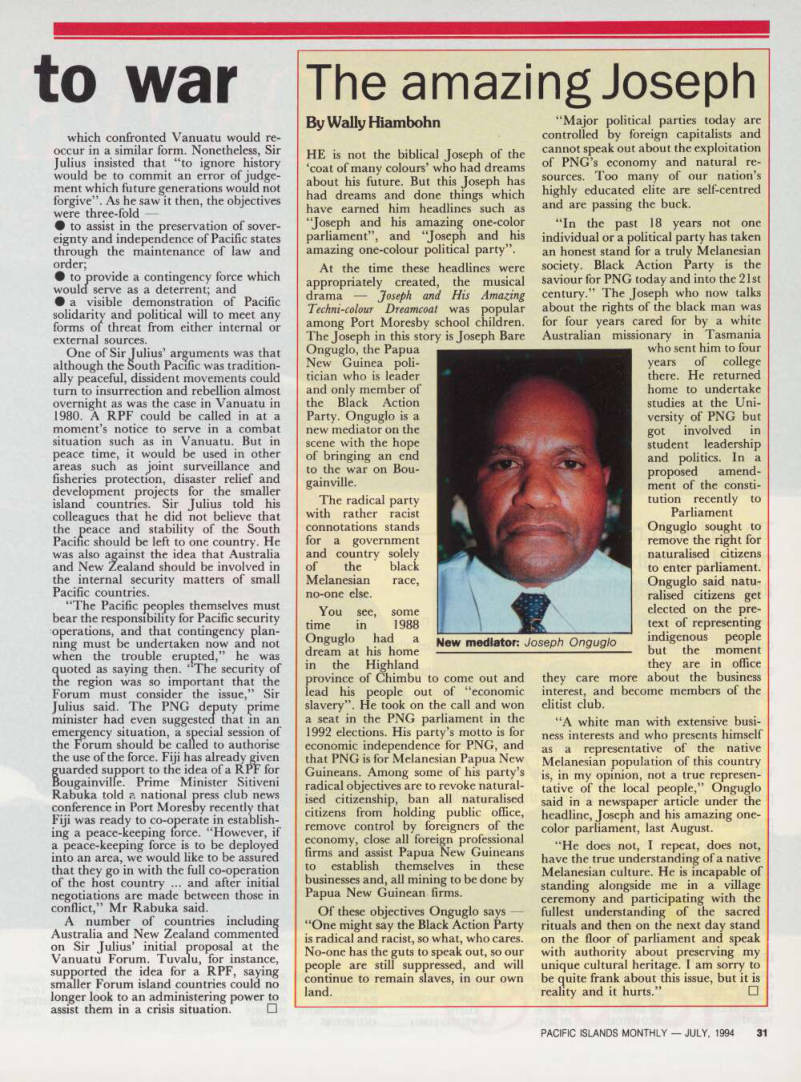
Issue
IT is barely two decades ago when Bougainvilleans fought and won what they wanted provincial government.
It was a not-so-perfect system of govern ment but one nonetheless which had given the locals some form of autonomy.
There is mounting pressure to discard the provincial government system be cause critics say it is a waste of money.
A parliamentary committee is reviewing the system. Despite evidence of wide spread misappropriation of public funds,
Bougainville, officially known as North Solomons Province, was perhaps the only provincial government that had never been subjected to systematic criticisms and allegations of misuse of public money.
In some provinces, administration of the system was so bad that the national government in Port Moresby was forced to intervene from time to time by suspending a number of provincial gov ernments over the past 19 years of its
existence. Today, almost two decades on, Bougainville is once again under the spotlight. The island, northeast of Port Moresby, has been wracked by a seccessionist rebellion, which has claimed many lives and caused untold sufferings to its estimated 160,000 inhabitants.
Papua New Guinea today maintains a military presence on Buka Island, at the northern tip of Bougainville, with con stant sea patrols around the island. The rebels, led by Australian-trained bomb expert, Sam Kauona, rule the interior with the old Panguna copper and gold mine serving as their headquarters. Five years after the uprising, there is no apparent end in sight. One thing, however, is changing. The focus in trying to solve the problem on the war-torn island has shifted. PNG, which until now has told its regional neighbours that the trouble on Bougainville was a domestic issue, is enlisting the support of some Forum members to help solve the groblem. Port Moresby’s idea is for a egional Peacekeeping Force (RPF).
With the concept gaining momentum daily, Bougainville is once again on the verge of giving birth, as it were, to something new as it did the provincial government system 19 years Under the RPF proposal being actively dis cussed in the corridors of power through out the region, military personnel to serve on peace-keeping duties on Bou gainville are likely to be drawn from Fiji, Tonga and Vanuatu.
Australia reportedly has given tacit support to the idea when it was raised recently during formal talks in Canberra.
The proponent of the idea was none other than Sir Julius Chan, PNG’s current deputy prime minister and minister for foreign affairs. Since taking up the foreign affairs portfolio following a Christmas/New Year cabinet reshuffle in Port Moresby, Sir Julius twice visited the South Pacific for discussions with each of the 13 island member countries of the South Pacific Forum.
It was during these trips as recent as last May that he reportedly mooted or rather resurrected the idea for a RPF.
The concept was not new. In fact, as then prime minister of PNG, Sir Julius first raised it at the 12th South Pacific Forum in Port Vila, Vanuatu, in 1981.
Then, as now, details of the proposal are still secret. But Sir Julius told his colleagues then that his primary concern was the security of Small Islana States of the Forum, saying his interest in regional peacekeeping emerged from PNG’s “bit ter experience” with the Vanuatu affair.
PNG troops were sent to Vanuatu in 1980 to quell an externally manipulated insurrection which later turned into rebellion on the township of Santo. Sir Julius explained that it would not always be correct to assume that the situation
which confronted Vanuatu would re occur in a similar form. Nonetheless, Sir Julius insisted that “to ignore history would be to commit an error of judge ment which future generations would not forgive”. As he saw it then, the objectives were three-fold • to assist in the preservation of sover eignty and independence of Pacific states through the maintenance of law and order; • to provide a contingency force which would serve as a deterrent; and • a visible demonstration of Pacific solidarity and political will to meet any forms of threat from either internal or external sources.
One of Sir Julius’ arguments was that although the South Pacific was tradition ally peaceful, dissident movements could turn to insurrection and rebellion almost overnight as was the case in Vanuatu in 1980. A RPF could be called in at a moment’s notice to serve in a combat situation such as in Vanuatu. But in peace time, it would be used in other areas such as joint surveillance and fisheries protection, disaster relief and development projects for the smaller island countries. Sir Julius told his colleagues that he did not believe that the peace and stability of the South Pacific should be left to one country. He was also against the idea that Australia and New Zealand should be involved in the internal security matters of small Pacific countries.
“The Pacific peoples themselves must bear the responsibility for Pacific security
operations, and that contingency plan
ning must be undertaken now and not when the trouble erupted,” he was Quoted as saying then. ‘ The security of the region was so important that the Forum must consider the issue,” Sir Julius said. The PNG deputy prime minister had even suggested that in an emergency situation, a special session of the Forum should be called to authorise the use of the force. Fiji has already given guarded support to the idea of a RPF for Bougainville. Prime Minister Sitiveni Rabuka told a national press club news conference in Port Moresby recently that Fiji was ready to co-operate in establish ing a peace-keeping force. “However, if a peace-keeping force is to be deployed into an area, we would like to be assured that they go in with the full co-operation of the host country ... and after initial negotiations are made between those in conflict,” Mr Rabuka said.
A number of countries including Australia and New Zealand commented on Sir Julius’ initial proposal at the Vanuatu Forum. Tuvalu, for instance, supported the idea for a RPF, saying smaller Forum island countries could no longer look to an administering power to assist them in a crisis situation. □
Advertisements & other items, p. 30 (1 item)
: : The Pacinc Conference Of Churches
pacific (30th May, 1994) invites applications from suitably qualified and experienced Pacific Islanders for the following two (2) positions at its Secretariat, ip Suva, Fiji. (The PCC is a regional church organisation serving Anglican, Churches of Christ, Congregational, Lutheran, Methodist, Presbyterian, Roman Catholic, and United churches, and national councils of churches, throughout the Pacific Region).
Translator/lnterpreter (French-English) Applicants must have a tertiary level education, passed recognized translation/interpretation training, and be fluent in French and English.
The Appointee shall carry out translation & interpretation service for the PCC office and meetings, including those involving travelling within the Region. Experience in serving churches and knowledge of the ecumenical movement in the Region will be an advantage.
Secretary for Women's Desk Applicants must have a tertiary level education, with training and experience in leadership of church women's groups and programme activities (including seminars/workshops); training in theological education and social work, and have basic knowledge of the Pacific Region and the ecumenical movement.
The Appointee shall be responsible for coordinating women's ecumenical programmes among PCC member churches; networking among women’s groups, and facilitating development awareness and solidarity projects (including seminars/workshops).
Appointment for both positions are for 3 years on (renewable) contract to be based in Suva, subject to Fiji work-permit conditions (for non- Fijians). The Appointees shall be entitled to receive FJ$l2,OOO (wages) plus accommodation, 10 days annual leave and 3 months leave (after 3 years), and full medical assistance in Fiji.
Applications must be accompanied by curriculum vitae/bio-data and evidence of educational and employment experience. References from church/community leaders and previous employers will be advantageous. The closing date for the Applications shall be 31st July, 1994.
All applications or Enquiries be addressed to: The General Secretary, Pacific Conference of Churches,
PC Box 208, SUVA. FIJI ISLANDS.
The amazing Joseph
By Wally Hiambohn
HE is not the biblical Joseph of the ‘coat of many colours’ who had dreams about his future. But this Joseph has had dreams and done things which have earned him headlines such as “Joseph and his amazing one-color parliament”, and “Joseph and his
amazing one-colour political party”.
At the time these headlines were appropriately created, the musical drama Joseph and His Amazing Techni-colour Dreamcoat was popular among Port Moresby school children.
The Joseph in this story is Joseph Bare
Onguglo, the Papua New Guinea poli tician who is leader and only member of the Black Action Party. Onguglo is a new mediator on the scene with the hope of bringing an end to the war on Bou gainville.
The radical party with rather racist connotations stands for a government and country solely of the black Melanesian race, no-one else.
You see, some time in 1988 Onguglo had a dream at his home in the Highland
province of Chimbu to come out and lead his people out of “economic slavery”. He took on the call and won a seat in the PNG parliament in the 1992 elections. His party’s motto is for economic independence for PNG, and that PNG is for Melanesian Papua New Guineans. Among some of his party’s radical objectives are to revoke natural ised citizenship, ban all naturalised citizens from holding public office, remove control by foreigners of the economy, close all foreign professional firms and assist Papua New Guineans to establish themselves in these businesses and, all mining to be done by Papua New Guinean firms.
Of these objectives Onguglo says “One might say the Black Action Party is radical and racist, so what, who cares.
No-one has the guts to speak out, so our people are still suppressed, and will continue to remain slaves, in our own land.
“Major political parties today are controlled by foreign capitalists and cannot speak out about the exploitation of PNG’s economy and natural re sources. Too many of our nation’s highly educated elite are self-centred and are passing the buck.
“In the past 18 years not one individual or a political party has taken an honest stand for a truly Melanesian society. Black Action Party is the saviour for PNG today and into the 21st century.” The Joseph who now talks about the rights of the black man was for four years cared for by a white Australian missionary in Tasmania
who sent him to four years of college there. He returned home to undertake studies at the Uni versity of PNG but got involved in student leadership and politics. In a
proposed amend
ment of the consti tution recently to Parliament Onguglo sought to remove the right for naturalised citizens to enter parliament.
Onguglo said natu ralised citizens get elected on the pre text of representing indigenous people but the moment they are in office
they care more about the business interest, and become members of the elitist club.
“A white man with extensive busi ness interests and who presents himself as a representative of the native Melanesian population of this country is, in my opinion, not a true represen tative of the local people,” Onguglo said in a newspaper article under the headline, Joseph and his amazing one color parliament, last August.
“He does not, I repeat, does not, have the true understanding of a native Melanesian culture. He is incapable of standing alongside me in a village ceremony and participating with the fullest understanding of the sacred rituals and then on the next day stand on the floor of parliament and speak with authority about preserving my unique cultural heritage. I am sorry to be quite frank about this issue, but it is reality and it hurts.” □
New mediator: Joseph Onguglo
Advertisements & other items, pp. 32-35 (1 item)
and long-lasting durability.
I • - . iT-r'. rt«jc Vv* .las ... »» n
Toyota Land Cruiser offers you more
rugged reliability, elegant luxury...
and long-lasting durability.
Land Cruiser’s reputation is second to none. No one doubts its rugged constitution. Yet here is a vehicle that rivals the finest limousines where comfort is concerned. And its fit and finish, the attention to detail, and the graceful lines and fine trim are reminiscent of exquisite luxury cars.
Nevertheless, hidden beneath its elegance, Land Cruisers still offer tough ladder frames and suspension engineered to go wherever you wish... in total comfort powered by your choice of 4.5-litre petrol or 4.2-litre diesel engines. And everything is carefully protected from rust and corrosion so it lasts longer.
Toyota Land Cruiser. The best for your world.
Now and forever.
DISTRIBUTORS /DEALERS
AMERICAN SAMOA BURNS PHILP MOTORS PH 633-4281 GUAM & MICRONESIA ATKINS KROLL, INC. PH 646-1876/9 NORFOLK ISLAND BORRY’S PTY LTD. PH 22114
SOLOMON ISLAND ELA MOTORS PH 30746
VANUATU ASCO MOTORS PH 22341
COOK ISLANDS
KIRIBATI
PAPUA NEW GUINEA
TAHITI
WESTERN SAMOA ...
PACIFIC MOTORS LTD PH 20796
TARAWA MOTORS PH 21090
ELA MOTORS PH 229400
NIPPON AUTOMOTO PH 429819
ASCO MOTORS PH 23664
FIJI ASCOMOTORS
NEW CALEDONIA S.I.A.P.
SAIPAN MICROL CORPORATION
TONGA ASCOMOTORS
i fiVfX: ’-Si "" ■; , :<^V 311 . *‘r " “ ■ > : - - I : .. ®3r a sps hfi m *,'**4>.’ : - ■■ 'V--; ».v: SSfcii.
S?-2 2- •■■ =&« ~■ ■ ■ '•;»- 7“ ;» -*x.' ' 3 '- '• 51^. ’•-:•••
-ZS&i
m \^i wm MmSmswmjgs - ■ f ;>ri4 '
HIP*
t a ■
„w J -RK
./r ...
LAND CRUISER
• - Exact features and specifications may vary depending on country of purchase. Please check with your nearest TOYOTA distributor/dealer for details.
PH312666 PH 275562 PH 234-5911 PH 23500
® TOYOTA
FORUM SECRETARIAT
VACANCIES
Applications are invited from suitably qualified and experienced persons, who must be nationals of a member state of the South Pacific Forum*, for the following positions in the Economic & Development and Finance Divisions at the Forum Secretariat.
The Forum Secretariat was established in 1972 by the South Pacific Forum to encourage economic and political cooperation between its member states, and between those states and the more industrialised countries. Under the control of a Secretary General, the Secretariat undertakes activities in a number of areas; economic development, legal and political, civil aviation, energy, maritime, telecommunications and trade. In pursuing these work programmes, the Secretariat works with a range of aid donor countries and organisations including Australia, New Zealand, Japan, France, EC, Canada and the UNDP.
ECONOMIC DEVELOPMENT DIVISION
The Economic Development Division aims to assist Forum Island Countries (FICs) through a comprehensive work programme designed to promote policy and planning capabilities within countries. Its mandate includes enhancing the utilisation of development assistance and investment in the region through more effective cooperation and coordination. Emphasis is placed on bringing about a greater level of consultation between FICs and their development partners which includes both aid donors and investors. A number of assistance programmes, offering direct support to FICs, are also administered by the Division.
DIRECTOR
The Director will be responsible for the overall supervision and direction of the activities of the Division including those aspects relating to the environment; implementation of the work programme recommended by the Committee on Regional Economic Issues and Trade and endorsed by the Forum Officials Committee; the continued development of the contribution made by the Division towards enhanced economic analysis, policy dialogue and development planning capacities in the region; provision of policy advice on measures for improving coordination of development programmes in the region; participation in broader Secretariat policy and management activities specifically aimed at strengthening donor commitments and links with other regional and international organisations. Applicants should possess a sound, working knowledge of the economies of Pacific Island countries, including an appreciation of the problems of both the subsistence and monetised sectors. They should also possess advanced academic qualifications in economics or a related field, as well as proven abilities to work under pressure, to set priorities among a wide range of options and to manage staff effectively.
Familiarity with donor government and agency procedures would be an advantage.
ECONOMIC ADVISER
The Economic Adviser will be responsible to the Deputy Secretary General (Policy & Services) through the Director, Economic Development Division for providing Forum Island Countries with economic advice and analysis, assisting in the design, evaluation and implementation of selected development projects and seeking external aid to enable implementation of high priority projects. In the course of these activities, the appointee will be required to undertake periodic duty travel.
Applicants should be well qualified in economics or a related field and should have a sound knowledge of the South Pacific Island region. Familiarity with donor government and agency procedures in the region would be an advantage. The Secretariat is also looking for a capacity to set clear priorities, to work under pressure, and to present work in a clear, concise and timely manner.
DEVELOPMENT COOPERATION OFFICER
The Development Cooperation Officer will be responsible to the Deputy Secretary General (Policy & Services) through the Director, Economic Development Division in drafting documentation for presentation to a wide range of donors providing assistance to the development programmes implemented by the Secretariat; draft cpmprehensive reviews of project delivery and expenditure for donors to the Secretariat on a six monthly basis; assume day-to-day responsibility for the operations of the Forum Secretariat Fellowship Scheme and the Smaller Island States Shared Financing Facility; assist in other activities relevant to the implementation of the Division’s annual Work Programme.
Applicants should be well qualified in economics or a related field and have a good understanding of development assistance policies and procedures. Familiarity with donor government and agency procedures in the region would be an advantage. The Secretariat is also looking for a capacity to set clear priorities, to work under pressure, and to present work in a clear, concise and timely manner.
FINANCE DIVISION
DIRECTOR
The Finance Division provides a range of financial, accounting and payroll services for management and all Divisions of the Secretariat.
The Director will be responsible for the efficient operation of the Division; recommend and implement a coherent funds management policy; closely supervise the preparation of the annual financial statements and liaise as necessary with Auditor General; co-ordinate the preparation of the Work Programme and Budget; monitor cash flow and funding requirements; ensure the preparation of timely and accurate monthly management operating statements, together with analysis thereof; monitor accounting procedures on a continuing basis and amend, or recommend amendment, as necessary; liase with bankers and recommend appropriate banking strategy for the Secretariat; participate in broader Secretariat policy and management activities particularly as they relate to the finance and administration of the Secretariat.
Applicants should possess an appropriate degree with a major in accounting from a recognised tertiary institution. The applicant must be a member of a recognised professional body with at least 8 years experience in accounting and financial activities at a senior level, and exposure to general management and administration. Experience with computerised financial accounting systems is necessary. Although previous experience in a regional organisation would be an advantage, it is not a prerequisite.
These appointments carry an attractive remuneration package, payable in Fiji dollars. For non-Fiji citizens this is tax-free and includes housing or a housing allowance, education and child allowances where eligible. Other benefits include payments in lieu of the superannuation, and medical, life and personal accident insurance coverage. Appointees will be based at the Secretariat’s headquarters in Suva. Appointments will be for three years initially, and are renewable by mutual agreement.
Applications close on July 31, 1994. They should contain full information on education and career backgrounds and should give names, addresses and telephone numbers of at least three referees with whom the applicant has been associated professionally.
Applications should be addressed to: The Secretary General Forum Secretariat GPO Box 856, Suva, Fiji Telephone 312-600 Telex: 2229FJ Fax: 302-204 Further information is available on request from the Administration Officer, on 312-600 Extension: 335. * Member states of the South Pacific Forum: Australia, Cook islands, Federated States of Micronesia, Fiji, Kiribati, Nauru, New Zealand, Niue, Papua New Guinea, Republic of the Marshall Islands, Solomon Islands, Tonga, Tuvalu, Vanuatu and Western Samoa.
Tinian:
Northern Marianas
Tinian: home of the A-Bomb Pits
KEVIN McQuiston looks away from the cockpit of his Piper Cherokee and draws his finger along a map of the tiny island of Tinian, in the Northern Mariana Islands. “See how everything is named like Manhattan? Here’s Central Park, and Broadway.” His
finger keeps moving north until it
stops just behind a long pair of runways.
“And here’s where you want to go,” he says with a touch of the native’s pride. “The A-bomb Pits.”
After listening to McQuiston’s tales of jungles filled with booby-traps and caves still giving up the dead, it is an eerie drive through the jungles of Tinian to North Field, two long strips of sun-bleached concrete crisscrossed with foliage.
But then again, Tinian is an island of ghosts, an isolated speck on the other side of the world that became the launching point for the final product of the Manhattan Project. The bumpy, narrow road to the pits
passes by dilapidated Japanese
shrines and the concrete skeleton that once served as a military
headquarters.
Then, after turning to dirt, the road opens up onto a broad runway and a small wooden sign that points the way to Pit No. I. That’s where, on the afternoon of August 5, 1945, the four-tonne “Little Boy” bomb was loaded into the belly of a B-29 named Enola Gay.
Three days later, “Fat Man” was loaded onto another B-29, Bock’s Car, from Pit No. 2. Together, the two bombs flattened Hiroshima and Nagasaki, killed hundreds of thou sands of Japanese, hastened the end of World War II and changed the world forever.
But today, the pits give none of that away. From each grows a single plumeria tree festooned with fragrant white blossoms that take some of the edge off the tropical heat. Birds chirp from their branches, lizards rest on the white pebbles in their shade. Welcome to Tinian, say faded, one-metre-tall letters painted across the concrete lot surrounding it all. “Home of the
A-Bomb Pits.”'
AP
Advertisements & other items, pp. 36-37 (1 item)
trust from
Products you can
R est Quality
|f igh Strength
D roven
performance
r: •sr* v A K .4m it.-7- : V - 1
BHP StGGI Strengthening the Pacific
BHP Steel Building Products South Pacific Ltd HEAD OFFICE: 168-169 Lakeba Street, Samabula, P. o. Box 91, Suva, Fiji Phone: (679) 382388/382226, Fax: (679) 370102 LAUTOKA: Bouwalu Street, P.O. Box 702, Phone: (679) 661588/660748, Fax: (679) 663255. LABASAHvi Street, Phone: (679) 812170, Fax: (679) 812460 associated media
Advertisement Pump group targets Pacific
Aust firm promises
total commitment
to the region
A NEW Australian pump group, specialising in the agricultural and contractor end of the industry, is offering the full range of QP heavy duty construction pumps. The company, Australian Pump Industries Pty.
Limited, has a total commitment to provide the South Pacific Island Groups with a range of competitively priced pumps backed by a new level of service and responsiveness.
Australian Pump Industries offers exstock availability on engine driven selfpriming centrifugal pumps and trash pumps in all standard sizes up to 6” inlet/ outlet. A wide variety of power options to suit the South Pacific market including Honda, Briggs and Stratton, Robin and Kubota engines is available.
The product is called Aussie Quick- Prime, abbreviated to QP. The new range of QP pumps offered by Australian Pump Industries represents an evolution of 20 years of continuous improvement in design.
The pumps are popular for water carts, for dewatering of construction sites and for irrigation and village water supply. The product line also offers pumps suitable for any application involving the transfer of solids laden liquids.
Irrigation Pumps
QP irrigation pumps are used for sprinklers and drip irrigation applications as well as doubling as fire fighting and water transfer pumps. They come in
Tank filler: lightweight but sturdy Reliable: Quik-Prime pump 1.5”, 2”, 3” and 4” configurations with a 6” pump suitable for use on super tankers or mining sites, flood mitigation or any application involving the transfer of large quantities of water.
The 6” pump offers a maximum flow of 192,000 litres per hour and the maximum head is 24 metres.
Solids Handling
Aussie QP trash pumps are available in 2”, 3”, 4” and 6” configurations. All units are supplied with hose couplings and strainers as standard and come mounted in a rugged roll frame or, in the case of the 6” pump trailer or skid mounted.
QP trash pumps offer an exclusive feature in the form of a bronze/copper seal that is claimed by the manufacturer to outlast other by up to 6 to 1. A tungsten carbide seal is used in the 6” trash pump.
All trash pumps offer big solids handling capability and are suitable for use by government departments, con-
struction companies, mining companies
and for any application involving the handling of dirty water or slurries. The pumps offer an unique feature in the form of easy dismantling and cleaning out functions. They have heavy duty cast iron volutes and impellers.
Drive options for the complete range include a full line of both petrol and diesel engine drives. The pumps, which are close coupled, are compact and light weight considering their high performance characteristics.
Australian Pump Industries is looking for Distributors throughout the South Pacific and has a full Distributor Prospectus available to interested parties.
Further information is available from Australian Pump Industries Pty. Limited of 131 A Arcadia Rd., Arcadia, NSW 2159, Australia. Fax: 61-02-655 1689.
For further information on this news release contact Margaret Rowley on Phone: 61-02-655 1541 or Fax: 61-02-6551689. Q
It
PUMP
DISTRIBUTORS WANTED
• Biggest range of Self Primers • No. 1 Quality • Spare Parts and Service • 1W to 6” In Trash and Clean Water Pumps • Firefighters and Tanker Pumps • Engine Options Honda, Robin, Briggs, etc.
RELIABLE PUMPS ... RELIABLE PEOPLE
AUSTRALIAN PUMP KWSSS
AUSTRALIAN PUMP INDUSTRIES PTY LIMITED. A.C.N. 06 519 234 Fax: (° 2 ) 655 1389 r
AUSSIE QUIK-PRIME PUMPS ARE
RELIABLE AND STURDY
Can small islands rely on
The United Nations
By lan Williams
a r./"vt TTvrrv i T t • j tvt • , islands have scored one' owngoal and a draw At the UN itself the Pacific was
represented on the stmember
mission for Sustainable Development by Vanuatu, which won the position through its vigorous advocacy of the AOSIS position. This year, according to diplomats, Vanuatu would certainly have become one of the vice-presidents, giving it a very good position to influence the agenda and to progress items of interest to the Pacific and the other Small Island states. However, other diplomats
told PIM that the new ambassador of Vanuatu did not attend a single meeting of the two-week-long session. Needless to electing a newcomer as vice president, but - there waS n ° SU PP° rt * f ° r nommatm g an em P t y chair - Happily his colleagues report that Ravou-Akii is now playing a much more active role in other fields, and was a lead negotiator in Washington for the talks on the composition of the Global Environment Facility (GEF). Indeed Pacific diplomats seem confident that with the arrival of the new Papua New Guinea ambassador, Utula Utuoc Samana, who
presented his credentials to the secretary general in May, there is now full and effective team working.
A. the GEF talks in Washington, the ls i an d s tried to get representation as small islands ' The GEF is now the custodian of the only funds available from all the big promises of the mdustri ahsed nations. As reported in the M^ay issue of PIM there was a successful compromise on the differences between the donor and developing nations over the composition of the governing board, However, that left unresolved the ques tion of the distribution of the developing world’s seats.
Learning
from past mistakes
FOR the past five years the United Nations Development Programme has groduced the Human Development eport which has achieved a near miracle in UN terms by making devel opment issues newsworthy, interesting and even controversial. Its stroke of genius was to rank countries in the equivalent of a sports table.
Across the world, news editors and sports fans, whether their sport is rugby, soccer, cricket or baseball, express their enthusiasm in league tables of one kind or another. So this year, for example, Canadians were mortified when they were edged from first position by the Japanese two years ago. This year the Japanese must recover from the loss of face involved by being pushed down to number three position by the come back Canadians, and the Swiss.
Why bother? Because the Human Development Report in its own subtle way is much more than a newsworthy table of rank. The Human Develop ment Index measures countries’ success at improving the life of its people since it takes into account the health and education of a population, as well as their overall wealth. Some nominally rich countries, like Saudi Arabia, have a high Gross Domestic Product per person, but the wealth is badly distrib uted and social services are poor, so their human development lags behind.
For the first four years, the Pacific has been left behind by this process. Apart from a few of the larger nations like PNG and Fiji, UNDP has not compiled statistics for the Pacific. However, this year it produced a separate Pacific Human Development Report which will be discussed by the Forum summit in Australia next month. UNDP con cludes that the “Pacific Island countries ... are still in a position to avoid the path of development that leads to widespread human deprivation which is now the prevalent condition of many developing countries”. In contrast, they say, “the
quality of life and human welfare in the Pacific is enviable in comparison” with many of those countries.
The problems they identify are an “emerging trend of disparities in in comes and in access to resources, economic opportunities and social ser vices between social groups, people in rural and urban areas, central and outer islands, and men and women in the Pacific Island countries”.
Ironically, it suggests that one of the factors which works to the Pacific’s advantage is something that older indicators would have regarded a sign of backwardness. “A large subsistence sector ensuring a high level of subsistence, and which effectively ab sorbs external shocks; strong cultural identity and traditional values, and the stable social fabric based on tbe village community and extended family sys tem.” These have, of course, been the deliberate or inadvertent choice of most of the world’s modernisers.
The report suggests that by building constructively on the past, the Pacific can reach the future without passing the gruesome present of many developing nations.
Specifically looking at the region, most of the Forum members fall into the medium human development category except for the Solomons and PNG whose low literacy and mortality rates pull them into the low human develop ment category. Ironically, Nauru has
one of the lowest life expectations, presumably because of the “diseases of affluence” caused by their forced and rapid progress from their traditional life
styles.
However, the low economic but high population growth of the Pacific is a major threat to future prosperity, which has been to some extent disguised so far by the emigration of workers and the remittances they send home. As the report coyly points out, a change of policy by nations such as New Zealand, Australia and the US could bring the crisis point forward much more quickly.
Already, some problems are being
seen in oasic services like education where pressure on government budgets has often hit primary education. The report instances PNG which already has one of the lowest literacy rates, but is
having problems supplying textbooks
and poor school buildings. In Vanuatu the legacy of its anomalous colonial history is the high cost of maintaining French and English educational sys tems.
Shakespeare once said that compari sons were odious. In this case they are far from it. By comparing the develop ment of the various Pacific Islands with each other, and then with the rest of the world, planners and people can get some ideas of the successes and weaknesses of existing strategies, both
locally, regionally and internationally.
The conclusion drawn from those statistics may differ, but the Pacific Human Development Report offers a chance for the region to avoid many of the mistakes made by other areas. It gives them ammunition to fight off outside developers who try to force inappropriate models on them as the price of aid or finance.
But as the report itself points out, the debate on development is far too important to be left to politicians.
Unless ordinary people involve them selves in it, then serious mistakes will be made. d
As reported in the May issue of PIM there was a successful compromise on the differences between the donor and de veloping nations over the composition of the governing board. However, that left unresolved the question of the distri bution of the developing world’s seats.
Logically, as the countries most at risk because of changes in the global environ ment, the small islands should have had a grouping of their own. But UN custom and practice is for the regional groupings to allocate seats, which means that the bulk of the AOSIS members would be split between the Asia-Pacific and Latin- America-Caribbean groupings, in each of which the islands would be a minority, although together they would be as big as many regional groupings.
However, at the closed meeting in May in Washington, the Caribbean islands defected from that position, and came to an agreement with their Latin American neighbours on a Caribbean seat. That left the SOPAC countries to confront the mainland masses of the Asia Pacific Group which had a total of six “constituencies” on the GEF council.
The case was put eloquently and el egantly on their behalf by Aloysius Tuuth, Federated State of Micronesia’s minister of finance who invoked the just finished Small Islands Conference to back up the fallback claim for one of those Asia Pacific constituencies to go to the 14 small island developing states of the Pacific. Many of the islands he pointed out were participants in the GEF and other UN agencies, even though they had not joined the UN itself. They had common concerns in protecting the Pacific Ocean, both in its own right and as a carbon sink of vital interest to the globe. In law, the Rio Earth Summit and the Barbados declaration called for recognition of the special interests of small islands.
Unfortunately, according to one ob server, Tuuth’s colleagues seem to have felt that since he presented an irrefutable case, they had no need to back it up.
Unfortunately reason and international agreements were of little consequence in the face of power. The islands ended up with half a constituency. They will share a constituency with Indonesia and the Philippines. These two presented them selves as island nations, which of course they are, if hardly small, and will each serve three years alongside whichever nation the Forum islands pick to rep resent them. Half a constituency is of course better than none. But the affair may help to dispel any lingering illusions that the small island states can rely upon the goodwill of their neighbours and other developing nations. □
Fiji gets permanent TV
Television
By Akanisi Motufaga
FIJI is to have its first permanent television service from this month, after a decade of discussions, proposals and national debates. The new service will be known as Fiji TV and will have three channels one free-to-air service and two pay television services.
The new company will hold an exclusive 12-year licence although gov ernment expects to open up the market after the eighth year of operation. The Fiji Development Bank (FDB) will be the major shareholder with 51 per cent shares followed by Television New Zealand (TVNZ) 15 per cent and Fiji Post and Telecommunications Limited (FPTL) 14 per cent.
The remaining 20 per cent will be open to members of the public who are interested in buying shares. FDB, a statutory organisation owned by the Fiji government, will provide finance and advice on racial issues and tra ditions and will hold the 51 per cent shares on behalf of Fiji’s 14 provincial councils and the Council of Rotuma.
TVNZ, which is owned by the New Zealand government, will provide the programmes, expertise and knowledge.
The company has been providing a temporary television service since 1991.
FPTL, a Fiji government owned tele communications company, will provide the transmission network around the Fiji group. The new company will have an initial paid-up capital of $B.B million with seven board members, three expatriates who will initially hold the top positions and an independent news team, Fiji currently has a temporary television service which is only avail able in the greater part of the capital, Suva, and in areas surrounding Nadi and Lautoka in the Western Division.
The first concrete television develop ment began in the mid-1980s when Channel Nine of Australia was issued with a licence. However, Channel Nine withdrew in 1987 when the Bavadra government was over-thrown in a military coup led by then Lieutenant- Colonel Sitiveni Rabuka, who is now prime minister. TVNZ stepped in in 1991 after being granted a temporary licence. At that time, the temporary service operated with a subsidy from the Fiji government which declined over the years as advertising revenue increased.
According to the Fiji TV business plan which Cabinet approved in late May, the free-to-air and pay TV services will operate as separate busi ness units within the company. It said a five per cent discount would be
adopted as an incentive for prompt advertising payment in order to make the free-to-air service viable.
For the Pay TV service, an initial $3O per month subscription fee will be levied for the two channels. All sub scription payments will be required in advance and incentives will be offered for advertising payment. Channel One of the Pay TV service will be devoted to entertainment where a mix of English and Hindi films will be screened while Channel Two will be devoted to sports. By the end of year one, the Pay TV service is expected to be available ip about 51,000 homes in Fiji. For the free-to-air service, a 10 per cent local production content has been proposed. There will be news, current affairs, documentaries, sport, education for children and adults, children’s programmes, religion, entertainment, drama and art. A Religious Advisory Panel is likely to be set up to provide consultancy advice on the content of religious programmes. Television rights will be secured for Fiji TV through satellite to a range of international news bulletins from United Kingdom and United States.
The service will also have access to news bulletins from Australia and New Zealand. The business plan said the expansion of the free-to-air service and the two Pay TV channels would improve the range of programmes and viewing choice. It said more Pay TV channels would be provided following government’s approved. The Fiji gov ernment is also to benefit from the new service. Fiji TV is expected to pay government $250,000 each year for the first three years of operation. Between the fourth to the sixth year, it is expected to pay $1 million each year.
A review will be conducted later on the amount of operating fees for the sixth to the 12th year. According to the business plan’s financial projections, Fiji TV is expected to lose $8,079,530 for the first five years of operation and gain $5,077,610 between year six to year 12 of the operation. Fiji TV is forecast to lose $3,382,047 in the first year; $1,950,702 in year two; $1,381,633 in year three; $923,998 in year four and $441,150 in year five.
In year six, Fiji TV is forecast to gain $46,088 in profit; $458,943 in year seven; $719,451 in year eight; $846,895 in year nine; $975,422 in year 10; $1,024,240 in year 11 and $1,006,571 in year 12. The business plan said about 40 per cent of the net profit would be paid out in dividends although such payments will not be made out until the company is on a sound financial footing. □
immigration policies
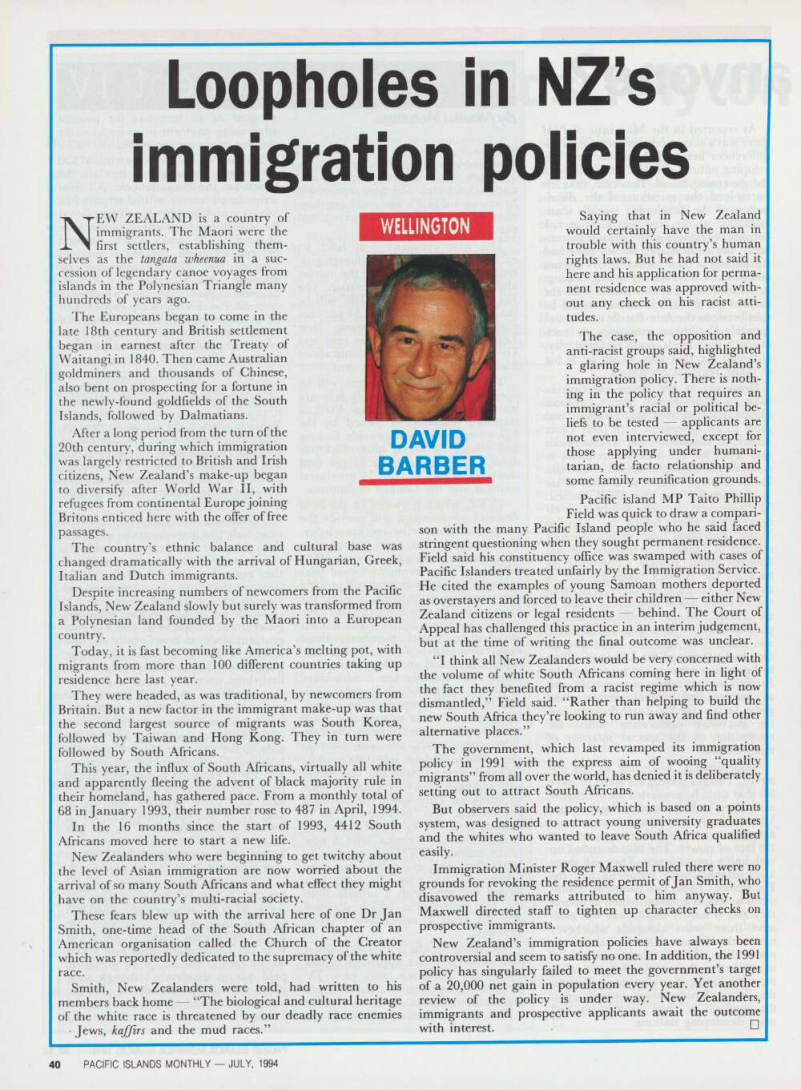
Loopholes in NZ’s immigration policies
NEW ZEALAND is a country of immigrants. The Maori were the first settlers, establishing them selves as the tangata wheenua in a suc cession of legendary canoe voyages from islands in the Polynesian Triangle many hundreds of years ago.
The Europeans began to come in the late 18th century and British settlement began in earnest after the Treaty of Waitangi in 1840. Then came Australian goldminers and thousands of Chinese, also bent on prospecting for a fortune in the newly-found goldfields of the South Islands, followed by Dalmatians.
After a long period from the turn of the 20th century, during which immigration was largely restricted to British and Irish citizens, New Zealand’s make-up began to diversify after World War 11, with
refugees from continental Europe joining
Britons enticed here with the offer of free passages.
The country’s ethnic balance and cultural base was changed dramatically with the arrival of Hungarian, Greek, Italian and Dutch immigrants.
Despite increasing numbers of newcomers from the Pacific Islands, New Zealand slowly but surely was transformed from a Polynesian land founded by the Maori into a European country.
Today, it is fast becoming like America’s melting pot, with migrants from more than 100 different countries taking up residence here last year.
They were headed, as was traditional, by newcomers from Britain. But a new factor in the immigrant make-up was that the second largest source of migrants was South Korea, followed by Taiwan and Hong Kong. They in turn were followed by South Africans.
This year, the influx of South Africans, virtually all white and apparently fleeing the advent of black majority rule in their homeland, has gathered pace. From a monthly total of 68 in January 1993, their number rose to 487 in April, 1994.
In the 16 months since the start of 1993, 4412 South Africans moved here to start a new life.
New Zealanders who were beginning to get twitchy about the level of Asian immigration are now worried about the arrival of so many South Africans and what effect they might have on the country’s multi-racial society.
These fears blew up with the arrival here of one Dr Jan Smith, one-time head of the South African chapter of an American organisation called the Church of the Creator which was reportedly dedicated to the supremacy of the white race.
Smith, New Zealanders were told, had written to his members back home “The biological and cultural heritage of the white race is threatened by our deadly race enemies Jews, kaffirs and the mud races.”
Saying that in New Zealand would certainly have the man in trouble with this country’s human rights laws. But he had not said it here and his application for perma nent residence was approved with out any check on his racist atti tudes.
The case, the opposition and anti-racist groups said, highlighted a glaring hole in New Zealand’s immigration policy. There is noth ing in the policy that requires an immigrant’s racial or political be liefs to be tested applicants are not even interviewed, except for those applying under humani tarian, de facto relationship and
some family reunification grounds.
Pacific island MP Taito Phillip Field was quick to draw a compari
son with the many Pacific Island people who he said faced stringent questioning when they sought permanent residence.
Field said his constituency office was swamped with cases of Pacific Islanders treated unfairly by the Immigration Service.
He cited the examples of young Samoan mothers deported as overstayers and forced to leave their children either New Zealand citizens or legal residents behind. The Court of Appeal has challenged this practice in an interim judgement, but at the time of writing the final outcome was unclear.
“I think all New Zealanders would be very concerned with the volume of white South Africans coming here in light of the fact they benefited from a racist regime which is now dismantled,” Field said. “Rather than helping to build the new South Africa they’re looking to run away and find other
alternative places.”
The government, which last revamped its immigration policy in 1991 with the express aim of wooing “quality migrants” from all over the world, has denied it is deliberately setting out to attract South Africans.
But observers said the policy, which is based on a points system, was designed to attract young university graduates and the whites who wanted to leave South Africa qualified easily.
Immigration Minister Roger Maxwell ruled there were no grounds for revoking the residence permit of Jan Smith, who disavowed the remarks attributed to him anyway. But Maxwell directed staff to tighten up character checks on
prospective immigrants.
New Zealand’s immigration policies have always been controversial and seem to satisfy no one. In addition, the 1991 policy has singularly failed to meet the government’s target of a 20,000 net gain in population every year. Yet another review of the policy is under way. New Zealanders, immigrants and prospective applicants await the outcome with interest.
Wellington
David
Barber
Advertisements & other items, p. 41 (1 item)
kudu's
PREMIUM QUALITY EXPORT BEER
i mm m
READY FOR THE WORLD!
nothing
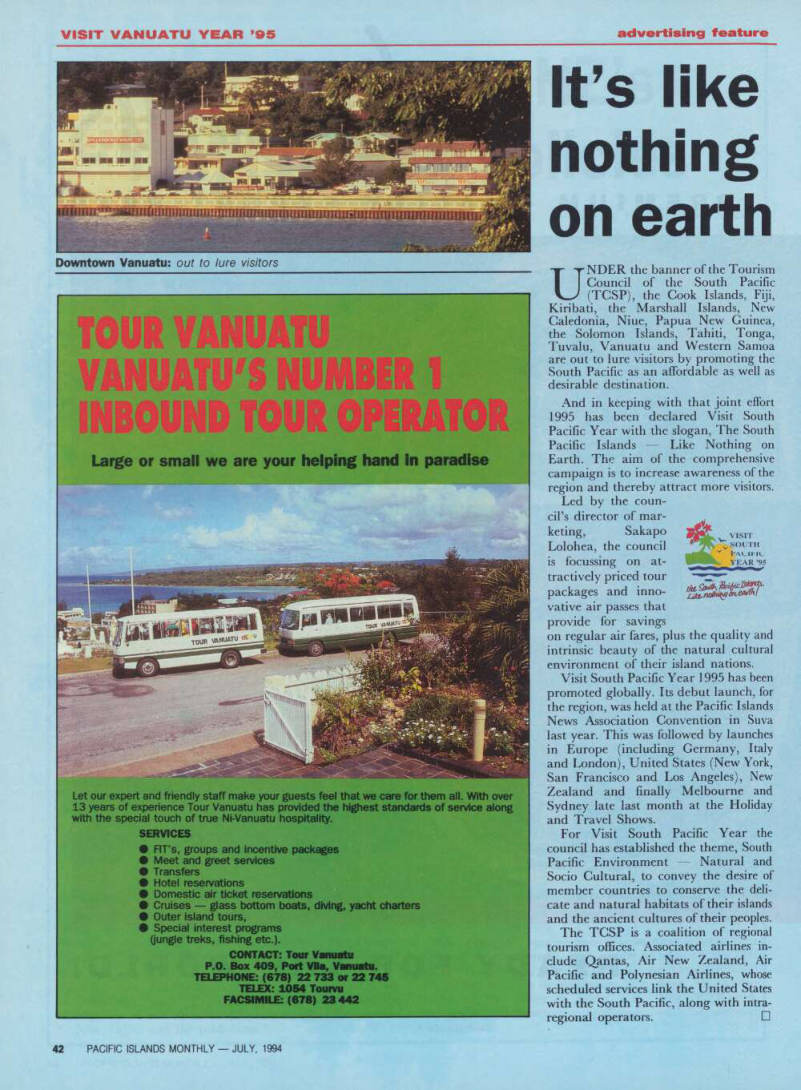
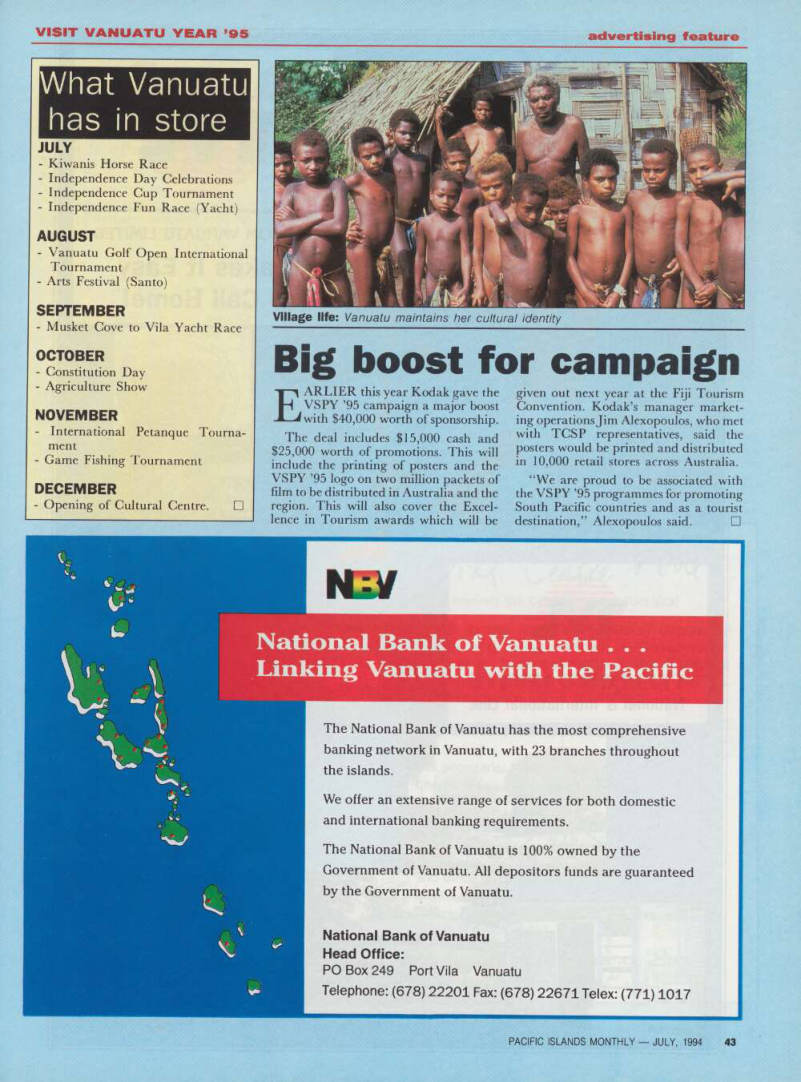
It’s like nothing on earth
UNDER the banner of the Tourism Council of the South Pacific (TCSP), the Cook Islands, Fiji, Kiribati, the Marshall Islands, New Caledonia, Niue, Papua New Guinea, the Solomon Islands, Tahiti, Tonga, Tuvalu, Vanuatu and Western Samoa are out to lure visitors by promoting the South Pacific as an affordable as well as desirable destination.
And in keeping with that joint effort 1995 has been declared Visit South Pacific Year with the slogan, The South Pacific Islands Like Nothing on Earth. The aim of the comprehensive campaign is to increase awareness of the region and thereby attract more visitors.
Led by the coun cil’s director of mar keting, Sakapo Lolohea, the council is focussing on at tractively priced tour packages and inno vative air passes that
provide for savings
on regular air fares, plus the quality and intrinsic beauty of the natural cultural environment of their island nations.
Visit South Pacific Year 1995 has been promoted globally. Its debut launch, for the region, was held at the Pacific Islands News Association Convention in Suva last year. This was followed by launches
in Europe (including Germany, Italy
and London), United States (New York, San Francisco and Los Angeles), New Zealand and finally Melbourne and Sydney late last month at the Holiday and Travel Shows.
For Visit South Pacific Year the council has established the theme, South Pacific Environment Natural and Socio Cultural, to convey the desire of member countries to conserve the deli cate and natural habitats of their islands and the ancient cultures of their peoples.
The TCSP is a coalition of regional tourism offices. Associated airlines in clude Qantas, Air New Zealand, Air Pacific and Polynesian Airlines, whose scheduled services link the United States with the South Pacific, along with intra regional operators. □
Downtown Vanuatu: out to lure visitors
Village life: Vanuatu maintains her cultural identity
Advertisements & other items, pp. 42-43 (2 items)
42
advertising feature
PACIFIC ISLANDS MONTHLY JULY, 1994
VISIT VANUATU YEAR ’95
Large or small we are your helping hand in paradise
SHI
TOUR
■ M
TOUR VftNUWU*__
m i Let our expert and friendly staff make your guests feel that we care for them all. With over 13 years of experience Tour Vanuatu has provided the highest standards of service along with the special touch of true Ni-Vanuatu hospitality.
SERVICES
• FIT'S, groups and incentive packages • Meet and greet services • Transfers • Hotel reservations • Domestic air ticket reservations • Cruises glass bottom boats, diving, yacht charters • Outer island tours, • Special interest programs (jungle treks, fishing etc.).
CONTACT: Tour Vanuatu P.O. Box 409, Port Vila, Vanuatu.
TELEPHONE: (678) 22 733 or 22 745 TELEX: 1054 Tourvu
FACSIMILE: (678) 23442
What Vanuatu
has in store
JULY
- Kiwanis Horse Race - Independence Day Celebrations - Independence Cup Tournament - Independence Fun Race (Yacht)
AUGUST
- Vanuatu Golf Open International Tournament - Arts Festival (Santo)
SEPTEMBER
- Musket Cove to Vila Yacht Race
OCTOBER
- Constitution Day - Agriculture Show
NOVEMBER
- International Petanque Tournament - Game Fishing Tournament
DECEMBER
- Opening of Cultural Centre. □
Big boost for campaign
EARLIER this year Kodak gave the VSPY ’95 campaign a major boost with $40,000 worth of sponsorship.
The deal includes $15,000 cash and $25,000 worth of promotions. This will include the printing of posters and the VSPY ’95 logo on two million packets of film to be distributed in Australia and the region. This will also cover the Excellence in Tourism awards which will be
given out next year at the Fiji Tourism Convention. Kodak’s manager market
ing operations Jim Alexopoulos, who met
with TCSP representatives, said the P osters would be printed and distributed * n 10,000 retail stores across Australia.
“We are proud to be associated with the VSPY ’95 programmes for promoting South Pacific countries and as a tourist destination,” Alexopoulos said. □
Advertisements & other items, pp. 43-44 (2 items)
43
advertising feature
PACIFIC ISLANDS MONTHLY JULY, 1994
VISIT VANUATU YEAR *95
Linking Vanuatu with the Pacific
Hi/ i 1 w > ' National Bank of Vanuatu . . .
The National Bank of Vanuatu has the most comprehensive banking network in Vanuatu, with 23 branches throughout the islands.
We offer an extensive range of services for both domestic and international banking requirements.
The National Bank of Vanuatu is 100% owned by the Government of Vanuatu. All depositors funds are guaranteed by the Government of Vanuatu.
National Bank of Vanuatu Head Office: PO Box 249 Port Vila Vanuatu Telephone: (678) 22201 Fax: (678) 22671 Telex: (771) 1017
TELECOM VANUATU LIMITED
Makes It Easy
to Call Home!
% =■ \\ if * ; , , V « m m y loAWi'’
TELECOM VANUATU
National & International Link
SClgv Sfifi ■ 1
iSWS
-i. i 7 11 ii 11111 ''y 'y ,a -j
Spreading the word
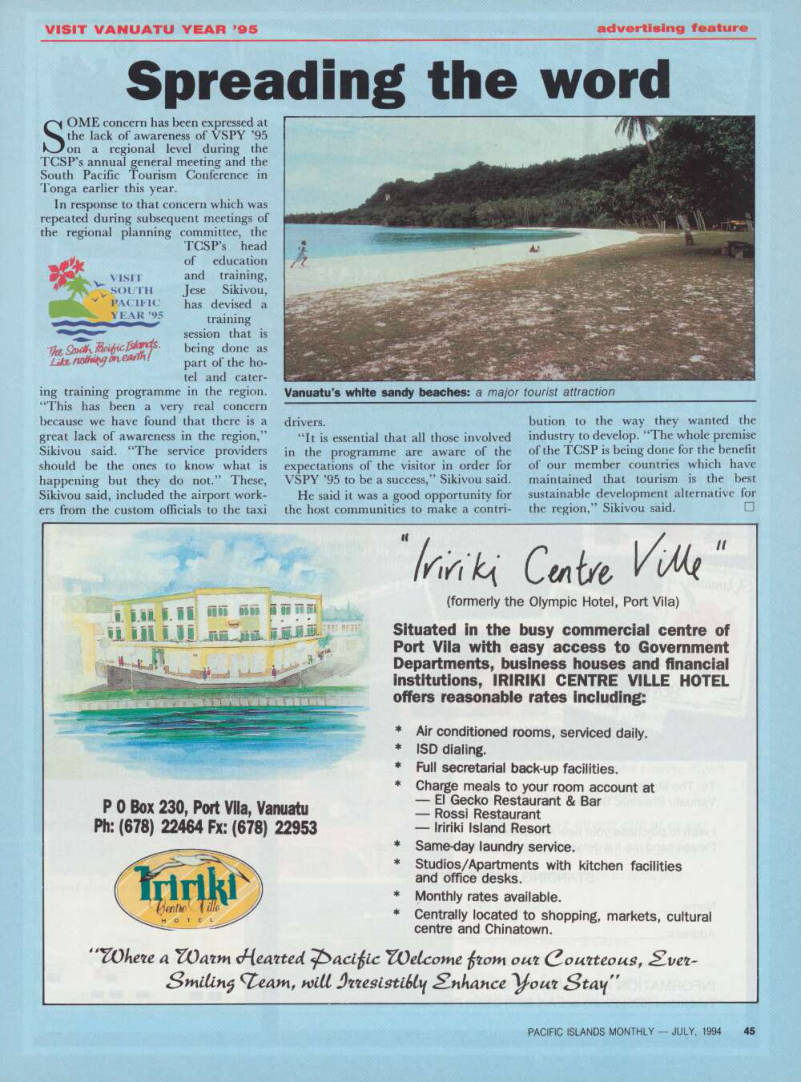
SOME concern has been expressed at the lack of awareness of VSPY ’95 on a regional level during the TCSP’s annual general meeting and the South Pacific Tourism Conference in Tonga earlier this year.
In response to that concern which was
repeated during subsequent meetings of
the regional planning committee, the
TCSP’s head of education and training, Jese Sikivou, has devised a training session that is being done as part of the ho tel and cater
ing training programme in the region.
“This has been a very real concern because we have found that there is a great lack of awareness in the region,”
Sikivou said. “The service providers should be the ones to know what is happening but they do not.” These, Sikivou said, included the airport work ers from the custom officials to the taxi
drivers.
“l t i s essential that all those involved in the programme are aware of the expectations of the visitor in order for VSPY ’95 to be a success,” Sikivou said.
He said it was a good opportunity for the host communities to make a contri-
bution to the way they wanted the
industry to develop. “The whole premise
of the TCSP is being done for the benefit of our member countries which have maintained that tourism is the best sustainable development alternative for the region,” Sikivou said.
Vanuatu’s white sandy beaches: a major tourist attraction
Advertisements & other items, pp. 45-46 (2 items)
45
advertising feature
PACIFIC ISLANDS MONTHLY JULY, 1994
VISIT VANUATU YEAR ’95
Smiting will 3ttcsistiht\[ Enhance Yfout Stay”
■%m I. if ■* ** iiiiisp ,
ul UHL
JL ft? aasi, rTT LiLi P 0 Box 230, Port Vila, Vanuatu
Ph: (678) 22464 Fx: (678) 22953
\ wlk /v/ k\ (formerly the Olympic Hotel, Port Vila) Situated in the busy commercial centre of Port Vila with easy access to Government Departments, business houses and financial institutions, IRIRIKI CENTRE VILLE HOTEL offers reasonable rates including: * Air conditioned rooms, serviced daily. * ISO dialing. * Full secretarial back-up facilities. * Charge meals to your room account at El Gecko Restaurant & Bar Rossi Restaurant Iririki Island Resort * Same-day laundry service. * Studios/Apartments with kitchen facilities and office desks. * Monthly rates available. * Centrally located to shopping, markets, cultural centre and Chinatown.
YOhete u YOutm c/~leAtted acidic YOctcomc faotn out J?Lvet~
Smiting will 3ttcsistiht\[ Enhance Yfout Stay”
w VANUATU
ya? u fsO 1
fl9’ ? i A 6V' im “ ,r " is
u ’lfl n
i Min" 1 .■iMiiWi riIITT
VANUATU
,9 oi
STAMPS
VANUATU
The beautiful and exotic country of Vanuatu has some of the most colourful and fascinating stamps in the world.
They cover a broad spectrum of topics of interest to both new and established collectors. The stamp can be seen as windows to the nation of Vanuatu, revealing its customs and culture, fauna and flora, areas of development and t country's participation in international issues.
The decision to collect the stamps of Vanuatu must be an easy one to make, with a unique past and the birth of a new nation in 1980.
The stamp are of the highest qualj
and individuality.
\P\)anuatUj
' 'A, * □ 150 * 80
Ilf. I A KM R
Q»ria*»sBSJ
VANUATU
V3A^°
VAN
80 '<r ,
VANUATU
MU'• Fishes underwit* (Banks Ot thescemv bo j , - uyanuatu T — MnnhHMe Island* S
Vanuatu tksawjr
li. -.H I • Coconut Trees, Champ mm Vanuatu ihescnnerxi~
OCX)
Barcelona 1992 70
*\i jSfi\ ,
>BO
fPACITO MINI GAMES
VILA DECEMBER 1993
’993 m -1: 75
VA N UAT U
>-?o: To: The Manager Vanuatu Philatelic Bureau, General Post Office, Port Vila, Vanuatu.
I wish to purchase your new stamp issues.
Please send me full details of your next programme and your
STANDING ORDER SERVICE
Name:
PHILATELIC BUREAU
OFFICIAL OPENING HOURS
MONDAY TO FRIDAY
7.30 TO 11.30 AND 13.15 TO 16.30
PORT VILA
Address; r Post Code:
INFORMATION AND ENQUIRIES
Telephone (678) 22000 or FAX (678) 23900 Port Vila, Vanuatu.
islands
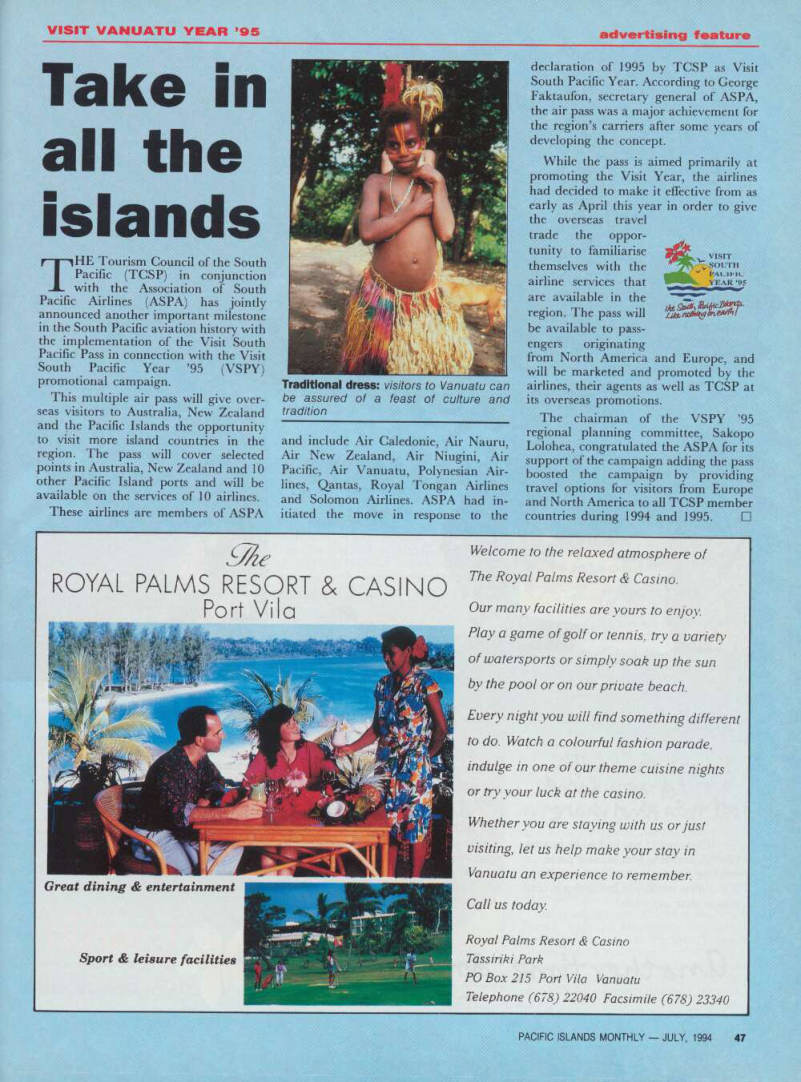
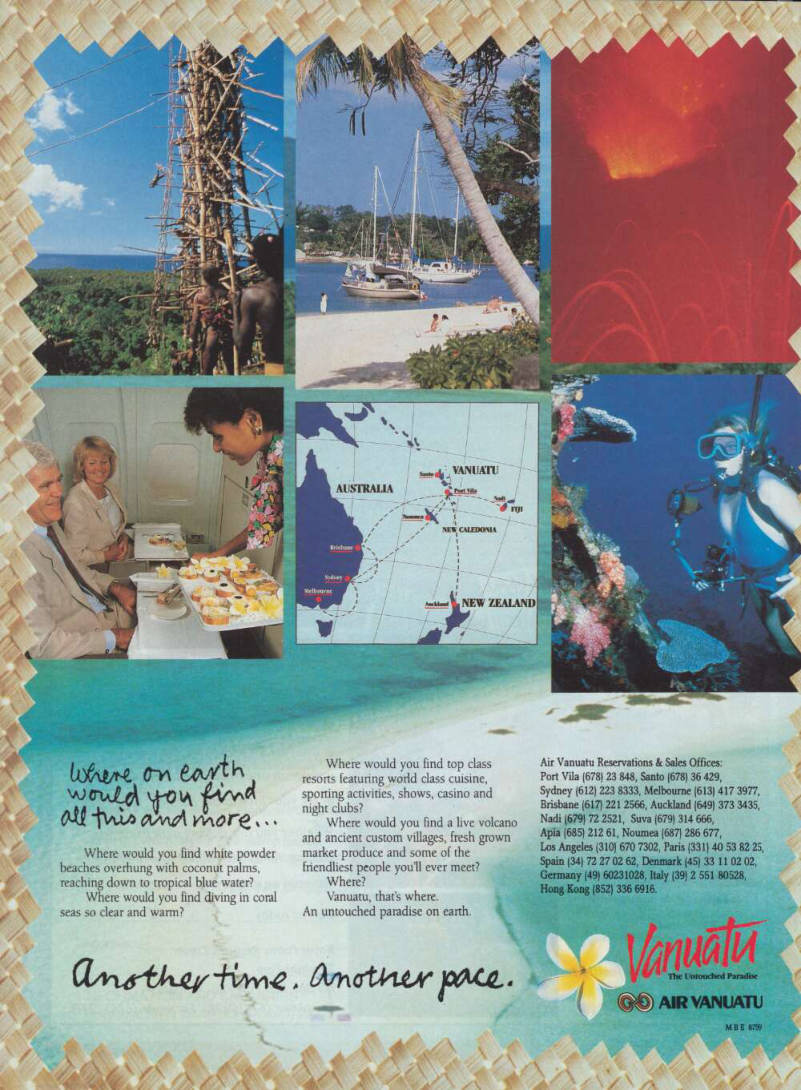
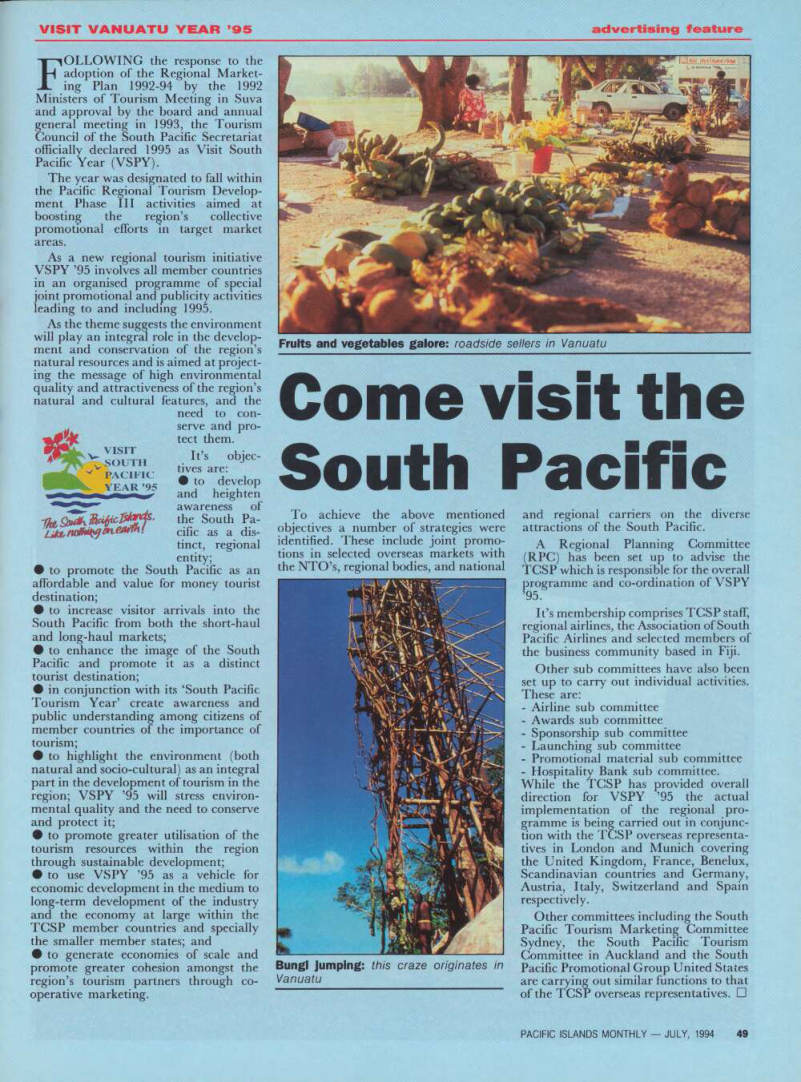
Take in all the islands
THE Tourism Council of the South Pacific (TCSP) in conjunction with the Association of South Pacific Airlines (ASPA) has jointly announced another important milestone in the South Pacific aviation history with the implementation of the Visit South Pacific Pass in connection with the Visit South Pacific Year ’95 (VSPY) promotional campaign.
This multiple air pass will give over seas visitors to Australia, New Zealand and the Pacific Islands the opportunity to visit more island countries in the region. The pass will cover selected points in Australia, New Zealand and 10 other Pacific Island ports and will be available on the services of 10 airlines.
These airlines are members of ASPA
and include Air Caledonie, Air Nauru, Air New Zealand, Air Niugini, Air Pacific, Air Vanuatu, Polynesian Air lines, Qantas, Royal Tongan Airlines and Solomon Airlines. ASPA had in itiated the move in response to the
declaration of 1995 by TCSP as Visit South Pacific Year. According to George Faktaufon, secretary general of ASPA, the air pass was a major achievement for the region’s carriers after some years of developing the concept.
While the pass is aimed primarily at promoting the Visit Year, the airlines had decided to make it effective from as early as April this year in order to give the overseas travel
trade the oppor tunity to familiarise themselves with the airline services that are available in the region. The pass will be available to pass
engers originating
from North America and Europe, and will be marketed and promoted by the airlines, their agents as well as TCSP at its overseas promotions.
The chairman of the VSPY ’95
regional planning committee, Sakopo
Lolohea, congratulated the ASPA for its support of the campaign adding the pass boosted the campaign by providing travel options for visitors from Europe and North America to all TCSP member countries during 1994 and 1995. □
Traditional dress: visitors to Vanuatu can be assured of a feast of culture and tradition
FOLLOWING the response to the adoption of the Regional Market ing Plan 1992-94 by the 1992 Ministers of Tourism Meeting in Suva and approval by the board and annual general meeting in 1993, the Tourism Council of the South Pacific Secretariat officially declared 1995 as Visit South Pacific Year (VSPY).
The year was designated to fall within the Pacific Regional Tourism Develop ment Phase 111 activities aimed at
boosting the region’s collective
promotional efforts in target market areas.
As a new regional tourism initiative VSPY ’95 involves all member countries in an organised programme of special
joint promotional and publicity activities
leading to and including 1995.
As the theme suggests the environment will play an integral role in the develop ment and conservation of the region’s natural resources and is aimed at project ing the message of high environmental quality and attractiveness of the region’s natural and cultural features, and the need to con-
serve and pro tect them.
It’s objec tives are: •to develop and heighten awareness of the South Pa cific as a dis tinct, regional
entity; • to promote the South Pacific as an affordable and value for money tourist destination; • to increase visitor arrivals into the South Pacific from both the short-haul and long-haul markets; • to enhance the image of the South Pacific and promote it as a distinct tourist destination; • in conjunction with its ‘South Pacific Tourism Year’ create awareness and public understanding among citizens of member countries of the importance of tourism; • to highlight the environment (both natural and socio-cultural) as an integral part in the development of tourism in the region; VSPY ’95 will stress environ mental quality and the need to conserve and protect it; • to promote greater utilisation of the tourism resources within the region through sustainable development; • to use VSPY ’95 as a vehicle for economic development in the medium to long-term development of the industry and the economy at large within the TCSP member countries and specially the smaller member states; and • to generate economies of scale and promote greater cohesion amongst the region’s tourism partners through co operative marketing.
Fruits and vegetables galore: roadside sellers in Vanuatu
Advertisements & other items, pp. 47-48 (2 items)
47
advertising feature
PACIFIC ISLANDS MONTHLY JULY, 1994
VISIT VANUATU YEAR '95
Port Vila
(/Ac
ROYAL PALMS RESORT & CASINO
• *mSt> Great dining & entertainment Sport & leisure facilities Welcome to the relaxed atmosphere of The Royal Palms Resort & Casino.
Our many facilities are yours to enjoy.
Play a game of golf or tennis, try a variety of watersports or simply soak up the sun by the pool or on our private beach.
Every night you will find something different to do. Watch a colourful fashion parade , indulge in one of our theme cuisine nights or try your luck at the casino.
Whether you are staying with us or just visiting, let us help make your stay in Vanuatu an experience to remember.
Call us today.
Royal Palms Resort & Casino Tassiriki Park PO Box 215 Port Vila Vanuatu Telephone (678) 22040 Facsimile (678) 23340
/ 4T ■U V. - ■ I a
VANUATU
AUSTRALIA
r > W nji *
NEW CALEDONIA
&V <1 - i
NEW ZEALAND
b&iM
Wl iVvU WkOVQ * *.
Where would you find white powder beaches overhung with coconut palms, reaching down to tropical blue water?
Where would you find diving in coral seas so clear and warm?
Where would you find top class resorts featuring world class cuisine, sporting activities, shows, casino and
night clubs?
Where would you find a live volcano and ancient custom villages, fresh grown market produce and some of the friendliest people you’ll ever meet?
Where?
Vanuatu, that’s where.
An untouched paradise on earth.
Air Vanuatu Reservations & Sales Offices: Port Vila (678) 23 848, Santo (678) 36 429, Sydney (612) 223 8333, Melbourne (613) 417 3977, Brisbane (617) 221 2566, Auckland (649) 373 3435, Nadi (679) 72 2521, Suva (679) 314 666, Apia (685) 212 61, Noumea (687) 286 677, Los Angeles (310) 670 7302, Paris (331) 40 53 82 25, Spain (34) 72 27 02 62, Denmark (45) 33 11 02 02, Germany (49) 60231028, Italy (39) 2 551 80528, Hong Kong (852) 3366916.
\4. (XmaiHty MMjl.
The Untouched Paradise
AIR VANUATU
MBE 8759
South Pacific
Come visit the South Pacific
To achieve the above mentioned objectives a number of strategies were identified. These include joint promo tions in selected overseas markets with the NTO’s, regional bodies, and national
and regional carriers on the diverse attractions of the South Pacific.
A Regional Planning Committee (RPC) has been set up to advise the TCSP which is responsible for the overall programme and co-ordination of VSPY ’95.
It’s membership comprises TCSP staff, regional airlines, the Association of South Pacific Airlines and selected members of the business community based in Fiji.
Other sub committees have also been set up to carry out individual activities.
These are: - Airline sub committee - Awards sub committee - Sponsorship sub committee - Launching sub committee - Promotional material sub committee - Hospitality Bank sub committee.
While the TCSP has provided overall direction for VSPY ’95 the actual implementation of the regional pro gramme is being carried out in conjunc tion with the TCSP overseas representa tives in London and Munich covering the United Kingdom, France, Benelux, Scandinavian countries and Germany, Austria, Italy, Switzerland and Spain
respectively.
Other committees including the South Pacific Tourism Marketing Committee Sydney, the South Pacific Tourism Committee in Auckland and the South Pacific Promotional Group United States are carrying out similar functions to that of the TCSP overseas representatives. □
Bungi jumping: this craze originates in Vanuatu
Advertisements & other items, pp. 49-50 (2 items)
49
advertising feature
PACIFIC ISLANDS MONTHLY JULY, 1994
VISIT VANUATU YEAR >95
hmftU '"Mf/fuMf
10th Europa 94 Yacht Race inday 20th Depart for Caims (Australia) inday 18th fth Annual Musket Cove Yacht Race to Port Vila
February 1995
March John Frum Day rf— Custom Chiefs.
Vila/Noumea’ 1,-' m
VISIT
SOUTH
PACIFIC
YEAR '95/
Ifauafc
What to expect
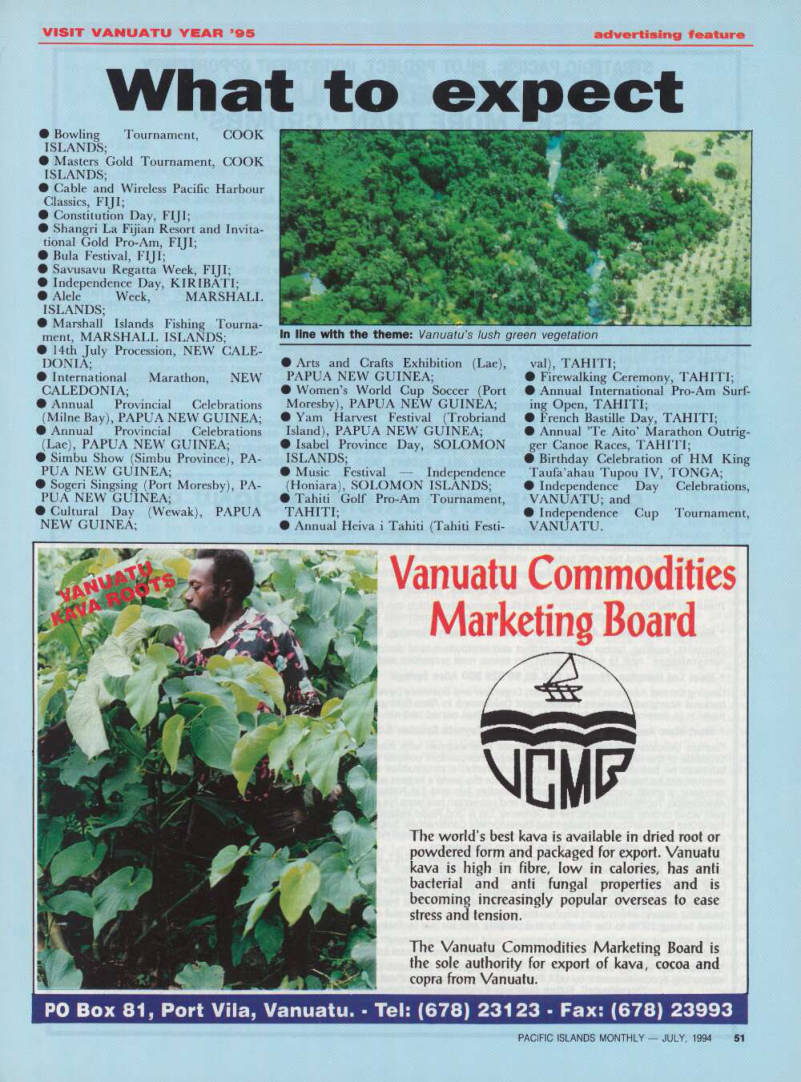
• Bowling Tournament, COOK
Islands;
• Masters Gold Tournament, COOK
Islands;
• Cable and Wireless Pacific Harbour Classics, FIJI; • Constitution Day, FIJI; • Shangri La Fijian Resort and Invita tional Gold Pro-Am, FIJI; • Bula Festival, FIJI; • Savusavu Regatta Week, FIJI; • Independence Day, KIRIBATI; • Aide Week, MARSHALL
Islands;
• Marshall Islands Fishing Tourna
Ment, Marshall Islands;
• 14th July Procession, NEW CALE
Donia;
• International Marathon, NEW
Caledonia;
• Annual Provincial Celebrations
(Milne Bay), Papua New Guinea;
• Annual Provincial Celebrations
(Lae), Papua New Guinea;
• Simbu Show (Simbu Province), PA
Pua New Guinea;
• Sogeri Singsing (Port Moresby), PA
Pua New Guinea;
• Cultural Day (Wewak), PAPUA
New Guinea;
• Arts and Crafts Exhibition (Lae),
Papua New Guinea;
• Women’s World Cup Soccer (Port
Moresby), Papua New Guinea;
• Yam Harvest Festival (Trobriand
Island), Papua New Guinea;
• Isabel Province Day, SOLOMON
Islands;
• Music Festival Independence
(Honiara), Solomon Islands;
• Tahiti Golf Pro-Am Tournament,
Tahiti;
• Annual Heiva i Tahiti (Tahiti Festi
val), TAHITI; • Firewalking Ceremony, TAHITI; • Annual International Pro-Am Surf ing Open, TAHITI; • French Bastille Day, TAHITI; • Annual ’Te Aito’ Marathon Outrig ger Canoe Races, TAHITI; • Birthday Celebration of HM King Taufa’ahau Tupou IV, TONGA; • Independence Day Celebrations,
Vanuatu; And
• Independence Cup Tournament,
Vanuatu.
In line with the theme: Vanuatu’s lush green vegetation
Advertisements & other items, pp. 51-52 (2 items)
51
advertising feature
PACIFIC ISLANDS MONTHLY JULY, 1994
VISIT VANUATU YEAR ’95
Marketing Board
X >- 7 *
Vanuatu Commodities
The world's best kava is available in dried root or powdered form and packaged for export. Vanuatu kava is high in fibre, low in calories, has anti bacterial and anti fungal properties and is becoming increasingly popular overseas to ease stress and tension.
The Vanuatu Commodities Marketing Board is the sole authority for export of kava, cocoa and copra from Vanuatu.
PO Box 81, Port Vila, Vanuatu. - Tel; (678) 23123 - Fax: (678) 23993
STRATEGIC PACIFIC, PILOT PROJECT, INVESTMENT OPPORTUNITY
LEADING FIJIAN VILLAGE
SEEKS MORE THAN “CRUMBS”
There are 200 RJI hotels. None are owned by indigenous Fijians.
THIS iS A PROJECT WHICH PLANS TO CHANGE THAT. IT AIMS TO BE FIJI’S Ist 100% INDIGENOUS OWNED AND MANAGED “SPECIAL
INTEREST-ECOTOURIST-CULTURAL-SAFARI-HOTEL”
THE HOTEL, DURING CONSTRUCTION AND WHEN BUILT WILL OPERATE AS A TEACHING MODEL A $6 million project to restore village to true cultural standard. The project will build next door a sister village with 50 chiefly bures as hotel to provide jobs, profits and keep tourist out of original village habitat. Operate regional tours. Teaching model for all Fiji communities seeking development and ongoing village income which conserves Fijian’s rich heritage, culture and environments.
BACKGROUND TO THE PROJECT WHICH HAS BEEN READY TO START FOR 10 YEARS.
Global interest. Talk of world tourism and heritage conferences. D.A.’s given. Encouraged by FVB, NLTB, Provincial and Fiji Government but Fiji’s Tourism Ministry, apparently oblivious to decline in appeal of old style hotel product and its culturally and environmentally disasterous affects on nearby villages, and the continuing foreign leakage of tourism income, turn their back on this “project for Fiji’s future” and won’t help. Located on magnificent, oceanfront and riverfront site in centre of Fiji’s Coral Coast hotels. Sealed road, water, electricity, phone. Linked to 10 villages who can assist build, operate hotel in authentic cultural way.
REASON THAT OUTSIDE INVESTMENT WILL ASSIST GET THE PROJECT UNDERWAY.
Fiji's hotel fundng institutions, FDB and FNPF retain colonial era rules limiting their lending to 70% of an indigenous project’s cost. Major village has 16% equity in its plans, land and company but lacks 14% cash contribution (equal to hotel’s Ist year’s profits) to meet 30% equity requirement. Its a "chicken and egg situation” since no village has cash to meet requirement to borrow money to build hotel to earn cash to lay “golden egg” to meet FDB requirement. Result no Fijian owned hotels and Fiji’s tourism wealth continues to run away from Fiji & Fijians who enjoy only “crumbs from the tables” in tourism, their biggest industry.
INVESTOR WITH VISION NOW OFFERED OPPORTUNITY TO INVEST $860,000.
On secure & profitable terms. Lifetime free personal hotel usage offered. More business opportunities sure to flow to investor who seek funds this important pilot project. Please help. Vatukarasa Village, after 10 years waiting, deserves a project start.
WRITE MARC AUSSIE-STONE, CHIEF PROJECT CONSULTANT, TOURISM INDUSTRIALISTS PTY LTD.
P.O. BOX 42, STRAWBERRY HILLS, SYDNEY, 2012. PHONE 319 4803. FAX 319 6334.
Pacific “ECOTOURISM DESIGN” 94
SEMINAR WORKSHOP Sydney Aug. 27-28. Cost $250.
Ecoto.urism is the undiscovered "GOLD” for Pacific communities. It’s a low technology, low capital cost, low tourist volume, quality market, giving* high yield and big profit business which Pacific peoples can 100% own and easily run.
Seminar to be opened by Senator Margaret Reynolds, Federal Government Representative, Council for Aboriginal Reconciliation. * Attend & Learn how to design & operate, special Interest, “ECOTOURIST, CULTURAL, SAFARI, HOTELS”.
These are the hotels of the future for Pacific communities which can foster long term visitor friendships and provide local jobs and big profits to repay housing, farm and fishing improvements while conserving culture, heritage and environment. * Meet George Stone. B.Arch, Master Town and Country Planning. Mobile phone 6118165164.
Specialist, exciting, timber lodge architect and ecotourism land planner with a passion to be involved developing timber lodges and “envirovillages” next to national parks, on scenic rural properties and in the Pacific Islands. * Meet Ted Hampton. Phone or FAX 6189 529 800 Alice Springs Leading Central Australia Tours Operator, Organiser and Business Development Consultant. Convenor of the enormously successful IST National Aboriginal Business Development Conference in Alice Springs which attracted 600 Aboriginal business delegates. Ted has a passion to develop Central Australia’s first Aboriginal owned and run special interest, cultural safari hotel. * Meet Marc Aussie-Stone, AAVL Uni of NSW. Keynote Speaker & Seminar Convenor.
Tourism Development Consultant and private businessman with more than 40 years diverse and successful business experience.
Graduate of the Royal Australian Naval College. Independent political candidate against 4 sitting Australian Prime Ministers. In private business he has developed and sold 5 restaurants, a construction company, a sailing school, 6 rural farming properties. In public employment he has been an Account Director for the world’s largest advertising agency, assistant accountant for a large manufacturing company, a credit controller for Colgate Palmolive Aus and Ist National Director of the Australian Motion Picture Production Industry Association. Tourism design, development and promotion has been his main love for forty years and involved him in more than 50 privately paid world circling study tours. He is Convenor Ist & 2nd World Indigenous Business Development Congresses. Convenor of Australia’s Ist & 2nd National Tourism Design and Development Conferences. Speaker on "ecotourist hotels” at 4 recent world heritage and tourism development conferences. Chief Consultant Fiji Pilot Ecotourist Hotel Project. Past President of PATWA, Pacific and Australia Travel Writing Associations, an affiliate of the World Tourism Organisation.
Past Advisor to PNG Minister for Tourism. Past Board Member of FIJET. International Federation of Travel Writing Organisations, an affiliate of UNESCO. Keynote Speaker on “special interest cultural hotels” at Indian Hotel Association’s Congress.
Originator of USA developed, multi billion dollar, ‘time sharing” resort ownership and interval exchange. Tourism Ministry development advisory guest of India, Pakistan, Nepal, Malawi, PNG and Zambia. Publisher and Editor of FUTURE TOURIST an indigenous tourism development design journal. Marc says it’s long overdue to assist Pacific environments build hotels which complement their unique and beautiful culture, which don’t impose the boring, box like, lonely and culturally disruptive, western designs of "yesterdays” hotels and which belong 100% to the Pacific Island peoples and are run by their supporting communities.
SEMINAR aims to fully discuss "ecotourism” and "ecotourist hotels” and introduce busines, tourism, government, finance interests to land owners seeking to build, promote, manage ecotourist, special interest, cultural, safari hotels on their lands.
SEMINAR will identify speakers for 2nd World Indigenous Business Development Congress for New Mexico, USA, June 95, which is supporting egodevelopment by USA Pueblo Indians, Canadian Ul’wat Indians, Indigenous Hawaiians on Kauai, Fijians and Australian "Aboriginals”. Future Business Ecodevelopment Congresses are planned for Hawaii, Fiji, Australia, UK.
HAVE YOUR SAY. PRESENT YOUR CASE. INTERESTED SPEAKERS OR DELEGATES WRITE: “PACIFIC ECOTOURISM DESIGN 94”
P.O BOX 185, STRAWBERRY HILLS, SYDNEY, 2012. PHONE 612 319 4803. FAX 61 2 319 6334.
The days of old
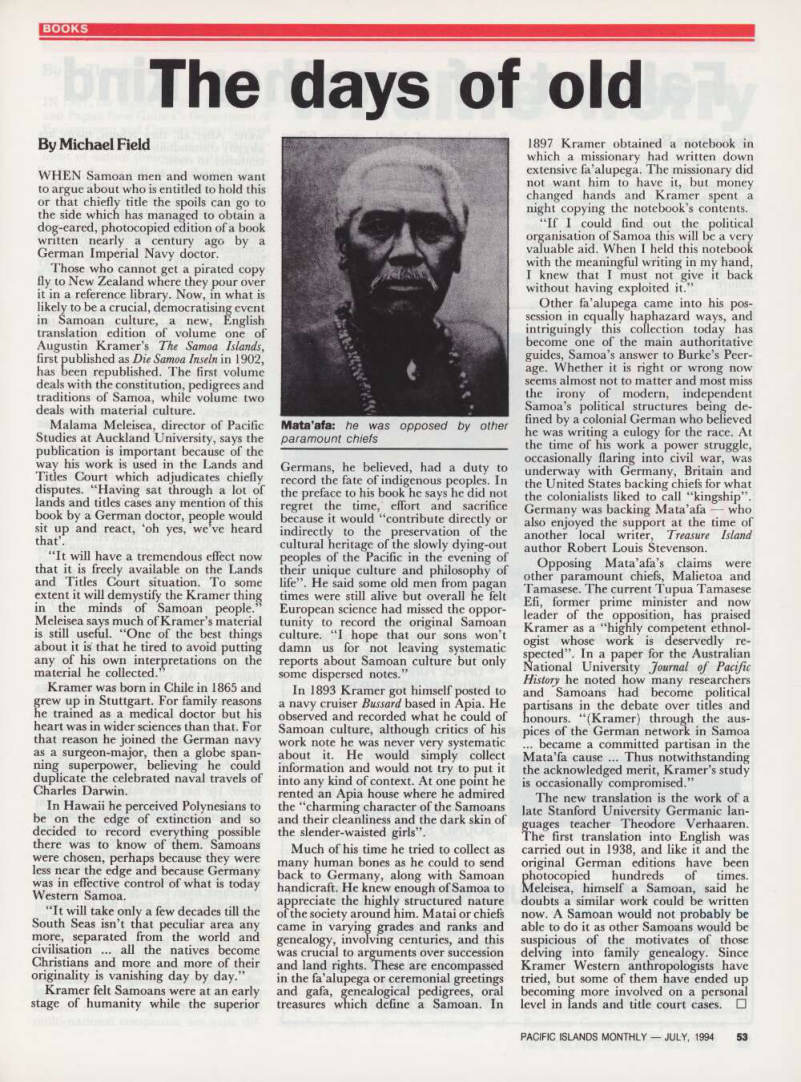
Books
By Michael Field
WHEN Samoan men and women want to argue about who is entitled to hold this or that chiefly title the spoils can go to the side which has managed to obtain a dog-eared, photocopied edition of a book written nearly a century ago by a
German Imperial Navy doctor.
Those who cannot get a pirated copy fly to New Zealand where they pour over it in a reference library. Now, in what is likely to be a crucial, democratising event in Samoan culture, a new, English translation edition of volume one of Augustin Kramer’s The Samoa Islands , first published as Die Samoa Inseln in 1902, has been republished. The first volume deals with the constitution, pedigrees and traditions of Samoa, while volume two deals with material culture.
Malama Meleisea, director of Pacific Studies at Auckland University, says the publication is important because of the way his work is used in the Lands and Titles Court which adjudicates chiefly disputes. “Having sat through a lot of lands and titles cases any mention of this book by a German doctor, people would sit up and react, ‘oh yes, we’ve heard that’.
“It will have a tremendous effect now that it is freely available on the Lands and Titles Court situation. To some extent it will demystify the Kramer thing in the minds of Samoan people.”
Meleisea says much of Kramer’s material is still useful. “One of the best things about it is that he tired to avoid putting any of his own interpretations on the material he collected.”
Kramer was born in Chile in 1865 and grew up in Stuttgart. For family reasons he trained as a medical doctor but his heart was in wider sciences than that. For that reason he joined the German navy as a surgeon-major, then a globe span ning superpower, believing he could duplicate the celebrated naval travels of Charles Darwin.
In Hawaii he perceived Polynesians to be on the edge of extinction and so decided to record everything possible there was to know of them. Samoans were chosen, perhaps because they were less near the edge and because Germany was in effective control of what is today Western Samoa.
“It will take only a few decades till the South Seas isn’t that peculiar area any more, separated from the world and civilisation ... all the natives become Christians and more and more of their originality is vanishing day by day.”
Kramer felt Samoans were at an early stage of humanity while the superior
Germans, he believed, had a duty to record the fate of indigenous peoples. In the preface to his book he says he did not regret the time, effort and sacrifice because it would “contribute directly or indirectly to the preservation of the cultural heritage of the slowly dying-out peoples of the Pacific in the evening of their unique culture and philosophy of life”. He said some old men from pagan times were still alive but overall he felt European science had missed the oppor tunity to record the original Samoan culture. “I hope that our sons won’t damn us for not leaving systematic reports about Samoan culture but only some dispersed notes.”
In 1893 Kramer got himself posted to a navy cruiser Bussard based in Apia. He observed and recorded what he could of Samoan culture, although critics of his work note he was never very systematic about it. He would simply collect information and would not try to put it into any kind of context. At one point he rented an Apia house where he admired the “charming character of the Samoans and their cleanliness and the dark skin of the slender-waisted girls”.
Much of his time he tried to collect as many human bones as he could to send back to Germany, along with Samoan handicraft. He knew enough of Samoa to appreciate the highly structured nature of the society around him. Matai or chiefs came in varying grades and ranks and genealogy, involving centuries, and this was crucial to arguments over succession and land rights. These are encompassed in the fa’alupega or ceremonial greetings and gafa, genealogical pedigrees, oral treasures which define a Samoan. In
1897 Kramer obtained a notebook in which a missionary had written down extensive fa’alupega. The missionary did not want him to have it, but money changed hands and Kramer spent a night copying the notebook’s contents.
“If I could find out the political organisation of Samoa this will be a very valuable aid. When I held this notebook with the meaningful writing in my hand, I knew that I must not give it back without having exploited it.”
Other fa’alupega came into his pos session in equally haphazard ways, and intriguingly this collection today has become one of the main authoritative guides, Samoa’s answer to Burke’s Peer age. Whether it is right or wrong now seems almost not to matter and most miss the irony of modern, independent Samoa’s political structures being de fined by a colonial German who believed he was writing a eulogy for the race. At the time of his work a power struggle, occasionally flaring into civil war, was underway with Germany, Britain and the United States backing chiefs for what the colonialists liked to call “kingship”.
Germany was backing Mata’afa who also enjoyed the support at the time of another local writer, Treasure Island author Robert Louis Stevenson.
Opposing Mata’afa’s claims were other paramount chiefs, Malietoa and Tamasese. The current Tupua Tamasese Efi, former prime minister and now leader of the opposition, has praised Kramer as a “highly competent ethnol ogist whose work is deservedly re spected”. In a paper for the Australian National University Journal of Pacific History he noted how many researchers and Samoans had become political partisans in the debate over titles and honours. “(Kramer) through the aus pices of the German network in Samoa ... became a committed partisan in the Mata’fa cause ... Thus notwithstanding the acknowledged merit, Kramer’s study is occasionally compromised.”
The new translation is the work of a late Stanford University Germanic lan guages teacher Theodore Verhaaren.
The first translation into English was carried out in 1938, and like it and the original German editions have been photocopied hundreds of times.
Meleisea, himself a Samoan, said he doubts a similar work could be written now. A Samoan would not probably be able to do it as other Samoans would be suspicious of the motivates of those delving into family genealogy. Since Kramer Western anthropologists have tried, but some of them have ended up becoming more involved on a personal level in lands and title court cases. □
Mata’afa: he was opposed by other paramount chiefs
Fallout of another kind
Environment
By Barbara Ray
AS the Bikini Islands can attest, political clout, size, and strategic importance are the cards to hold in a world of super powers. The tales uncovered in recently released US classified documents of the now infamous Bravo atomic bombings on Bikini Island, the nuclear experiments on less fortunate American citizens, and failure to warn the downwind
Rongelapese of lethal atomic fallout paint a clear picture. Political trifles have no hand to play. Today, nearly 50 years later, the Marshall Islands, the Johnston Atoll, and others, still marginal in
Washington politics, are experiencing
fallout of another kind.
With fatalistic logic, the islands are being considered as the solution to the world’s nuclear waste problem. Why not, world leaders suggest, use those distant islands as dump sites for the nuclear
waste. After all, they reason, many are already contaminated; uninhabitable for centuries to come.
As incendiary as this sounds, not all the islanders are opposed to such an idea.
Bikini Islanders are being courted by waste management companies and are seriously considering the proposals. In need of a constant stream of money to complete the cleanup of their native island, the Bikinians see the Energy Department’s promise of $5O million a year for 20 years in exchange for storing radioactive material on already contami nated Nam as the optimum solution.
Although the pikinians manage a $lOO million trust fund, set up by the US government to compensate for their loss, total clean-up costs exceed their rev enues. While Bikini makes plans for its future, other Pacific Islands have already been reborn.
Kalama, on Johnston Atoll, remote and uninhabited, falls into the last category. In 1990, US President George Bush and German Chancellor Helmut Kohl agreed to begin moving US chemical weapons out of Germany.
Johnston Atoll was marked as the first site for incineration of these weapons.
The US army today monitors the site on the island of Kalama. Civilian personnel, the majority recruited from Hawaii, man the plant, with no recourse to collective bargaining.
According to Guam delegate Robert Underwood, the move to Johnston angered many in the Pacific, and he has monitored the situation from its incep tion. He recently learned that on March 23, 10 milligrams of nerve gas were accidentally released into the air at Kalama. Department of Defense reports claim that tne release posed no health risk. Underwood notes that the leak was 10 times the level allowed by the Environmental Protection Agency (EPA). However, he is still waiting for the actual data in order to determine the health risk. The leak, according to Underwood, confirms suspicions that the facility was not being adequately moni tored. He has been asking for research into the weapons burning plant on Johnston since May 1993, but none has been forthcoming. At a hearing before the Armed Services Sub-committee on Military Installation in May of 1993, deputy assistant secretary of the army, Lewis Walker, admitted to Underwood that there have been problems with the incinerator, but he could not be specific.
Whether the army will admit to any Eroblems is questionable, according to Fnderwood. f ‘The army is under pres sure to show that Johnston works. If Johnston doesn’t work out, the eight other chemical weapon incinerators planned for the US mainland may meet resistance,” he said. D
Advertisements & other items, p. 54 (1 item)
Alliance Corporation Ltd
SPECIALISING IN IMPORTED FASHION
CLOTHING FOR ALL OCCASIONS
* FASHION CLOTHING
* CASUAL AND FORMAL SHOES
* MANCHESTER
* BEDROOM UNEN
* ELECTRICAL APPLIANCES
♦ TABLE UTENSILS
♦ MARINE PRODUCTS EXPORTER
♦ STATIONERY SUPPLIES
♦ OFFICE FURNITURE
♦ MUSICAL INSTRUMENTS
AGENTS FOR ELECTRIC AND ACOUSTIC GUITARS,
DRUMS, PIANOS,
KEYBOARDS,
AMPLIFIERS, SPEAKERS,
MIKES AND STAGE
SOUND SYSTEM
MUSICAL INSTRUMENTS CO. LTD.
LOCATION:
ACOR BOOKSHOP BUILDING
ASHLEY STREET
HONIARA
SOLOMON ISLANDS
POSTAL ADDRESS:
PO BOX 780
HONIARA, SOLOMON ISLAND
FAX: (677) 21477
PHONE: (677) 21239
Wildlife worry
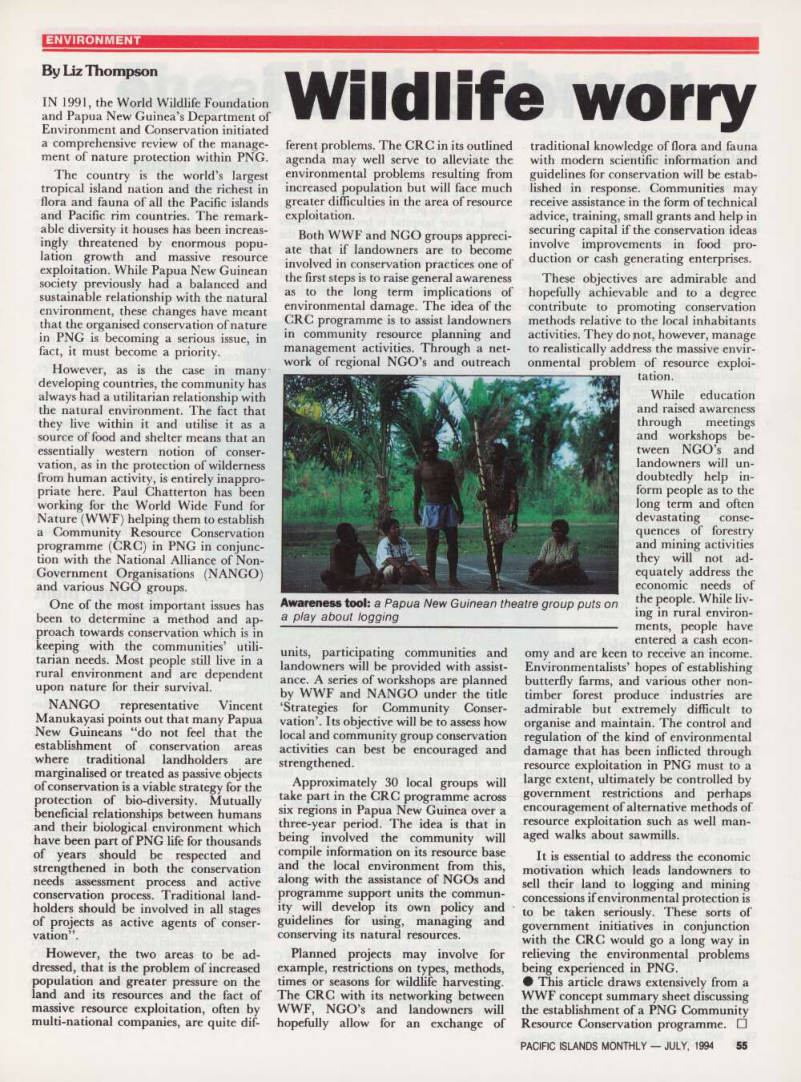
By Liz Thompson
IN 1991, the World Wildlife Foundation and Papua New Guinea’s Department of Environment and Conservation initiated a comprehensive review of the manage ment of nature protection within PNG.
The country is the world’s largest tropical island nation and the richest in flora and fauna of all the Pacific islands and Pacific rim countries. The remark able diversity it houses has been increas ingly threatened by enormous popu lation growth and massive resource exploitation. While Papua New Guinean society previously had a balanced and sustainable relationship with the natural environment, these changes have meant that the organised conservation of nature in PNG is becoming a serious issue, in fact, it must become a priority.
However, as is the case in many developing countries, the community has always had a utilitarian relationship with the natural environment. The fact that they live within it and utilise it as a source of food and shelter means that an essentially western notion of conser vation, as in the protection of wilderness from human activity, is entirely inappro priate here. Paul Chatterton has been working for the World Wide Fund for Nature (WWF) helping them to establish a Community Resource Conservation programme (CRC) in PNG in conjunc tion with the National Alliance of Non-
Government Organisations (NANGO)
and various NGO groups.
One of the most important issues has been to determine a method and ap proach towards conservation which is in keeping with the communities’ utili tarian needs. Most people still live in a rural environment and are dependent upon nature for their survival.
NANGO representative Vincent Manukayasi points out that many Papua New Guineans “do not feel that the establishment of conservation areas where traditional landholders are marginalised or treated as passive objects of conservation is a viable strategy for the
protection of bio-diversity. Mutually
beneficial relationships between humans and their biological environment which have been part of PNG life for thousands of years should be respected and strengthened in both the conservation needs assessment process and active conservation process. Traditional land holders should be involved in all stages of projects as active agents of conser vation”.
However, the two areas to be ad dressed, that is the problem of increased population and greater pressure on the land and its resources and the fact of massive resource exploitation, often by multi-national companies, are quite dif
ferent problems. The CRC in its outlined agenda may well serve to alleviate the
environmental problems resulting from
increased population but will face much greater difficulties in the area of resource
exploitation.
Both WWF and NGO groups appreci ate that if landowners are to become involved in conservation practices one of the first steps is to raise general awareness as to the long term implications of environmental damage. The idea of the CRC programme is to assist landowners in community resource planning and management activities. Through a net work of regional NGO’s and outreach
units, participating communities and landowners will be provided with assist ance. A series of workshops are planned by WWF and NANGO under the title
‘Strategies for Community Conser
vation’. Its objective will be to assess how local and community group conservation activities can best be encouraged and strengthened.
Approximately 30 local groups will take part in the CRC programme across six regions in Papua New Guinea over a three-year period. The idea is that in being involved the community will compile information on its resource base and the local environment from this, along with the assistance of NGOs and programme support units the commun ity will develop its own policy and guidelines for using, managing and conserving its natural resources.
Planned projects may involve for example, restrictions on types, methods, times or seasons for wildlife harvesting.
The CRC with its networking between WWF, NGO’s and landowners will hopefully allow for an exchange of
traditional knowledge of flora and fauna with modern scientific information and guidelines for conservation will be estab lished in response. Communities may receive assistance in the form of technical advice, training, small grants and help in securing capital if the conservation ideas involve improvements in food pro duction or cash generating enterprises.
These objectives are admirable and hopefully achievable and to a degree contribute to promoting conservation methods relative to the local inhabitants activities. They do pot, however, manage to realistically address the massive envir onmental problem of resource exploi
tation.
While education and raised awareness through meetings and workshops be tween NGO’s and landowners will un doubtedly help in form people as to the long term and often devastating conse quences of forestry and mining activities they will not ad equately address the economic needs of the people. While liv ing in rural environ ments, people have entered a cash econ
omy and are keen to receive an income.
Environmentalists’ hopes of establishing butterfly farms, and various other non timber forest produce industries are admirable but extremely difficult to organise and maintain. The control and regulation of the kind of environmental damage that has been inflicted through resource exploitation in PNG must to a large extent, ultimately be controlled by government restrictions and perhaps encouragement of alternative methods of resource exploitation such as well man aged walks about sawmills.
It is essential to address the economic motivation which leads landowners to sell their land to logging and mining concessions if environmental protection is to be taken seriously. These sorts of government initiatives in conjunction with the CRC would go a long way in relieving the environmental problems being experienced in PNG. This article draws extensively from a WWF concept summary sheet discussing the establishment of a PNG Community Resource Conservation programme. □
Awareness tool: a Papua New Guinean theatre group puts on a play about logging
Land: a hot issue
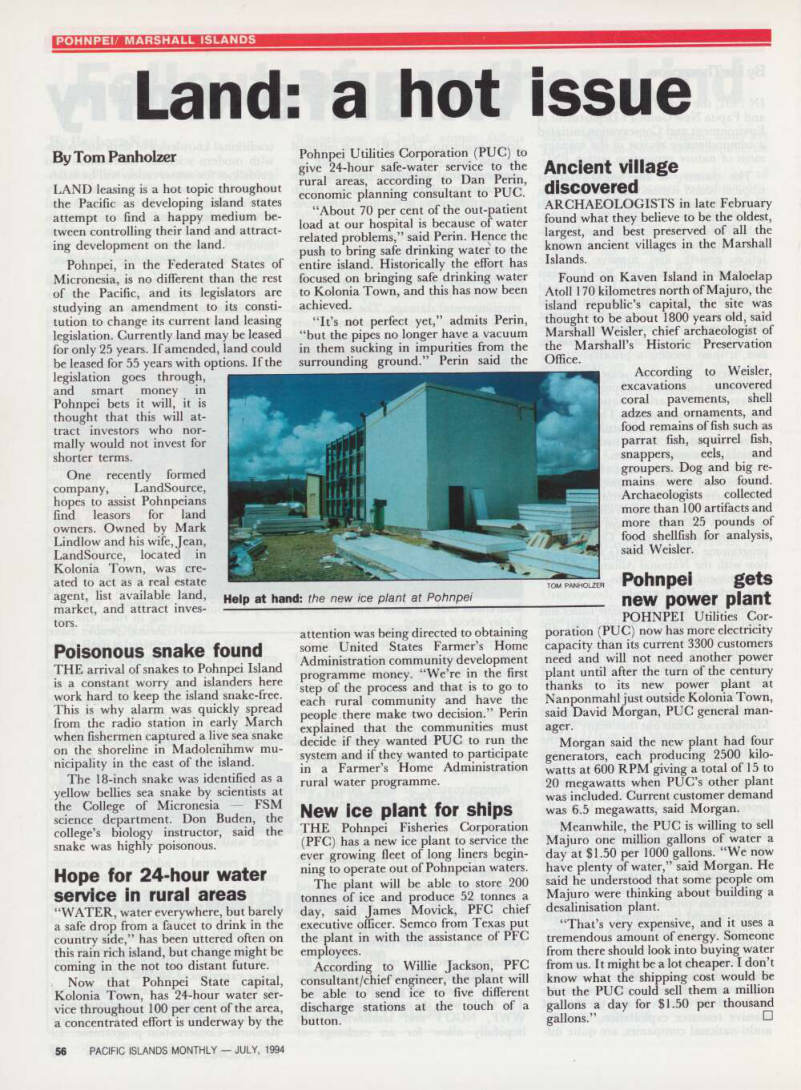
Pohnpei/ Marshall Islands
By Tom Panholzer
LAND leasing is a hot topic throughout the Pacific as developing island states attempt to find a happy medium be tween controlling their land and attract ing development on the land.
Pohnpei, in the Federated States of Micronesia, is no different than the rest of the Pacific, and its legislators are studying an amendment to its consti tution to change its current land leasing legislation. Currently land may be leased for only 25 years. If amended, land could be leased for 55 years with options. If the
legislation goes through,
and smart money in Pohnpei bets it will, it is thought that this will at tract investors who nor mally would not invest for shorter terms.
One recently formed company, Land Source,
hopes to assist Pohnpeians
find leasers for land owners. Owned by Mark Lindlow and his wife, Jean, Land Source, located in Kolonia Town, was cre ated to act as a real estate agent, list available land, market, and attract inves tors.
Poisonous snake found
THE arrival of snakes to Pohnpei Island is a constant worry and islanders here work hard to keep the island snake-free.
This is why alarm was quickly spread from the radio station in early March when fishermen captured a live sea snake on the shoreline in Madolenihmw mu nicipality in the east of the island.
The 18-inch snake was identified as a yellow bellies sea snake by scientists at the College of Micronesia FSM science department. Don Buden, the college’s biology instructor, said the snake was highly poisonous.
Hope for 24-hour water
service in rural areas
“WATER, water everywhere, but barely a safe drop from a faucet to drink in the country side,” has been uttered often on this rain rich island, but change might be coming in the not too distant future.
Now that Pohnpei State capital, Kolonia Town, has 24-hour water ser vice throughout 100 per cent of the area, a concentrated effort is underway by the
Pohnpei Utilities Corporation (PUC) to give 24-hour safe-water service to the rural areas, according to Dan Perin, economic planning consultant to PUC.
“About 70 per cent of the out-patient load at our hospital is because of water related problems,” said Perin. Hence the push to bring safe drinking water to the entire island. Historically the effort has focused on bringing safe drinking water to Kolonia Town, and this has now been achieved.
“It’s not perfect yet,” admits Perin, “but the pipes no longer have a vacuum in them sucking in impurities from the surrounding ground.” Perin said the
attention was being directed to obtaining some United States Farmer’s Home Administration community development programme money. “We’re in the first step of the process and that is to go to each rural community and have the people .there make two decision.” Perin explained that the communities must decide if they wanted PUC to run the system and if they wanted to participate in a Farmer’s Home Administration rural water programme.
New ice plant for ships
THE Pohnpei Fisheries Corporation (PFC) has a new ice plant to service the ever growing fleet of long liners begin ning to operate out of Pohnpeian waters.
The plant will be able to store 200 tonnes of ice and produce 52 tonnes a day, said James Movick, PFC chief executive officer. Semco from Texas put the plant in with the assistance of PFC employees.
According to Willie Jackson, PFC consultant/chief engineer, the plant will be able to send ice to five different discharge stations at the touch of a button.
Ancient village
discovered
ARCHAEOLOGISTS in late February found what they believe to be the oldest, largest, and best preserved of all the known ancient villages in the Marshall Islands.
Found on Kaven Island in Maloelap Atoll 170 kilometres north of Majuro, the island republic’s capital, the site was thought to be about 1800 years old, said Marshall Weisler, chief archaeologist of the Marshall’s Historic Preservation Office.
According to Weisler, excavations uncovered coral pavements, shell adzes and ornaments, and food remains of fish such as parrat fish, squirrel fish, snappers, eels, and groupers. Dog and big re mains were also found.
Archaeologists collected
more than 100 artifacts and more than 25 pounds of food shellfish for analysis, said Weisler.
Pohnpei gets
new power plant
POHNPEI Utilities Cor
poration (PUC) now has more electricity capacity than its current 3300 customers need and will not need another power plant until after the turn of the century thanks to its new power plant at Nanponmahl just outside Kolonia Town, said David Morgan, PUC general man ager.
Morgan said the new plant had four generators, each producing 2500 kilo watts at 600 RPM giving a total of 15 to 20 megawatts when PUC’s other plant was included. Current customer demand was 6.5 megawatts, said Morgan.
Meanwhile, the PUC is willing to sell Majuro one million gallons of water a day at $1.50 per 1000 gallons. “We now have plenty of water,” said Morgan. He said he understood that some people om Majuro were thinking about building a
desalinisation plant.
“That’s very expensive, and it uses a tremendous amount of energy. Someone from there should look into buying water from us. It might be a lot cheaper. I don’t know what the shipping cost would be but the PUC could sell them a million gallons a day for $1.50 per thousand
gallons.” D
Help at hand: the new ice plant at Pohnpei
Tom Panholzer
The Fijian threat
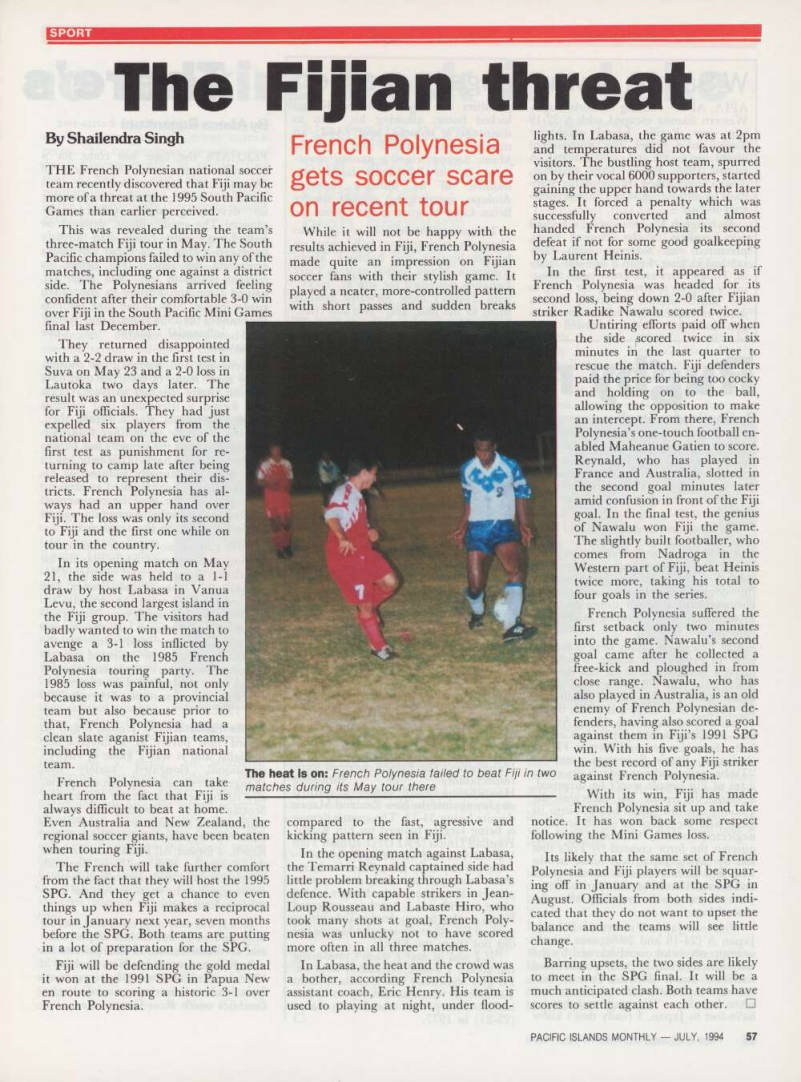
Sport
By Shailendra Singh
THE French Polynesian national soccer team recently discovered that Fiji may be more of a threat at the 1995 South Pacific Games than earlier perceived.
This was revealed during the team’s three-match Fiji tour in May. The South Pacific champions failed to win any of the matches, including one against a district side. The Polynesians arrived feeling confident after their comfortable 3-0 win over Fiji in the South Pacific Mini Games
final last December.
They returned disappointed
with a 2-2 draw in the first test in Suva on May 23 and a 2-0 loss in Lautoka two days later. The result was an unexpected surprise
for Fiji officials. They had just
expelled six players from the national team on the eve of the first test as punishment for re turning to camp late after being released to represent their dis tricts. French Polynesia has al ways had an upper hand over Fiji. The loss was only its second to Fiji and the first one while on tour in the country.
In its opening match on May 21, the side was held to a 1-1 draw by host Labasa in Vanua Levu, the second largest island in the Fiji group. The visitors had badly wanted to win the match to avenge a 3-1 loss inflicted by Labasa on the 1985 French Polynesia touring party. The 1985 loss was painful, not only because it was to a provincial team but also because prior to that, French Polynesia had a clean slate aganist Fijian teams,
including the Fijian national
team.
French Polynesia can take heart from the fact that Fiji is
always difficult to beat at home.
Even Australia and New Zealand, the regional soccer giants, have been beaten
when touring Fiji.
The French will take further comfort from the fact that they will host the 1995 SPG. And they get a chance to even things up when Fiji makes a reciprocal tour in January next year, seven months before the SPG. Both teams are putting in a lot of preparation for the SPG.
Fiji will be defending the gold medal it won at the 1991 SPG in Papua New en route to scoring a historic 3-1 over
French Polynesia.
French Polynesia
gets soccer scare on recent tour
While it will not be happy with the results achieved in Fiji, French Polynesia made quite an impression on Fijian soccer fans with their stylish game. It played a neater, more-controlled pattern with short passes and sudden breaks
compared to the fast, agressive and kicking pattern seen in Fiji.
In the opening match against Labasa, the Temarri Reynald captained side had little problem breaking through Labasa’s defence. With capable strikers in Jean- Loup Rousseau and Labaste Hiro, who took many shots at goal, French Poly nesia was unlucky not to have scored more often in all three matches.
In Labasa, the heat and the crowd was a bother, according French Polynesia assistant coach, Eric Henry. His team is used to playing at night, under flood
lights. In Labasa, the game was at 2pm and temperatures did not favour the visitors. The bustling host team, spurred on by their vocal 6000 supporters, started gaining the upper hand towards the later stages. It forced a penalty which was successfully converted and almost handed French Polynesia its second defeat if not for some good goalkeeping by Laurent Heinis.
In the first test, it appeared as if French Polynesia was headed for its second loss, being down 2-0 after Fijian striker Radike Nawalu scored twice.
Untiring efforts paid off when the side (Scored twice in six minutes in the last quarter to rescue the match. Fiji defenders paid the price for being too cocky and holding on to the ball, allowing the opposition to make an intercept. From there, French Polynesia’s one-touch football en abled Maheanue Gatien to score.
Reynald, who has played in France and Australia, slotted in the second goal minutes later amid confusion in front of the Fiji goal. In the final test, the genius of Nawalu won Fiji the game.
The slightly built footballer, who comes from Nadroga in the Western part of Fiji, beat Heinis twice more, taking his total to four goals in the series.
French Polynesia suffered the first setback only two minutes into the game. Nawalu’s second goal came after he collected a free-kick and ploughed in from close range. Nawalu, who has also played in Australia, is an old enemy of French Polynesian de fenders, having also scored a goal against them in Fiji’s 1991 SPG win. With his five goals, he has the best record of any Fiji striker
against French Polynesia.
With its win, Fiji has made French Polynesia sit up and take
notice. It has won back some respect following the Mini Games loss.
Its likely that the same set of French Polynesia and Fiji players will be squar ing off in January and at the SPG in August. Officials from both sides indi cated that they do not want to upset the balance and the teams will see little
change.
Barring upsets, the two sides are likely to meet in the SPG final. It will be a much anticipated clash. Both teams have scores to settle against each other. □
The heat is on: French Polynesia failed to beat Fiji in two matches during its May tour there
W Samoa downs Tonga in qualifier
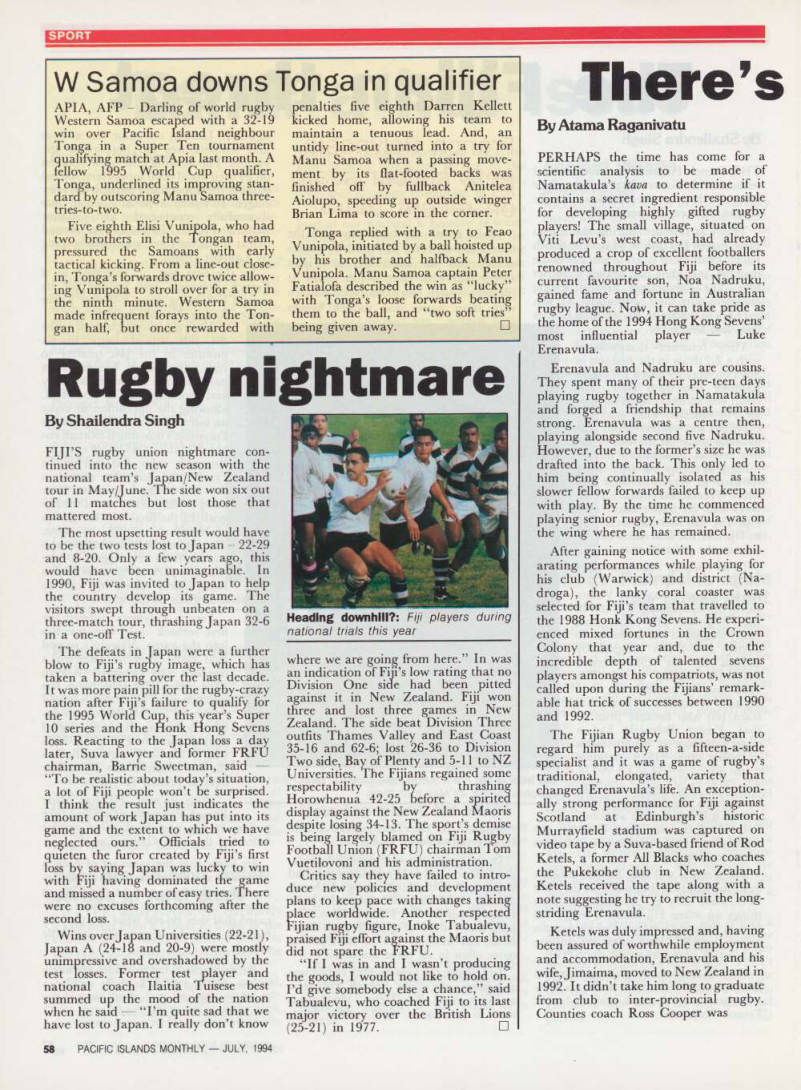
APIA, AFP - Darling of world rugby Western Samoa escaped with a 32-19 win over Pacific Island neighbour Tonga in a Super Ten tournament qualifying match at Apia last month. A fellow 1995 World Cup qualifier, Tonga, underlined its improving standard by outscoring Manu Samoa threetnes-to-two.
Five eighth Elisi Vunipola, who had two brothers in the fongan team, pressured the Samoans with early tactical kicking. From a line-out closein, Tonga’s forwards drove twice allowing Vunipola to stroll over for a try in the ninth minute. Western Samoa made infrequent forays into the Tongan half, but once rewarded with
penalties five eighth Darren Kellett kicked home, allowing his team to maintain a tenuous lead. And, an untidy line-out turned into a try for Manu Samoa when a passing move ment by its flat-footed backs was finished off by fullback Anitelea Aiolupo, speeding up outside winger Brian Lima to score in the corner.
Tonga replied with a try to Feao Vunipola, initiated by a ball hoisted up by his brother and halfback Manu Vunipola. Manu Samoa captain Peter Fatialofa described the win as “lucky” with Tonga’s loose forwards beating them to the ball, and “two soft tries” being given away. □
Rugby nightmare
By Shailendra Singh
FIJI’S rugby union nightmare con tinued into the new season with the national team’s Japan/New Zealand tour in May/June. Tne side won six out of 11 matches but lost those that mattered most.
The most upsetting result would have to be the two tests lost to Japan - 22-29 and 8-20. Only a few years ago, this would have been unimaginable. In 1990, Fiji was invited to Japan to help the country develop its game. The visitors swept through unbeaten on a three-match tour, thrashing Japan 32-6 in a one-off Test.
The defeats in Japan were a further blow to Fiji’s rugby image, which has taken a battering over the last decade.
It was more pain pill for the rugby-crazy nation after Fiji’s failure to qualify for the 1995 World Cup, this year’s Super 10 series and the Honk Flong Sevens loss. Reacting to the Japan loss a day later, Suva lawyer and former FRFU chairman, Barrie Sweetman, said “To be realistic about today’s situation, a lot of Fiji people won’t be surprised.
I think the result just indicates the amount of work Japan has put into its game and the extent to which we have neglected ours.” Officials tried to quieten the furor created by Fiji’s first loss by saying Japan was lucky to win with Fiji having dominated the game and missed a number of easy tries. There were no excuses forthcoming after the second loss.
Wins over Japan Universities (22-21), Japan A (24-18 and 20-9) were mostly unimpressive and overshadowed by the test losses. Former test player and national coach Ilaitia Tuisese best summed up the mood of the nation when he said “I’m quite sad that we have lost to Japan. I really don’t know
where we are going from here.” In was an indication of Fiji’s low rating that no Division One side had been pitted against it in New Zealand. Fiji won three and lost three games in New Zealand. The side beat Division Three outfits Thames Valley and East Coast 35-16 and 62-6; lost 26-36 to Division Two side, Bay of Plenty and 5-11 to NZ Universities. The Fijians regained some respectability by thrashing Horowhenua 42-25 before a spirited display against the New Zealand Maoris despite losing 34-13. The sport’s demise is being largely blamed on Fiji Rugby Football Union (FRFU) chairman Tom Vuetilovoni and his administration.
Critics say they have failed to intro duce new policies and development plans to keep pace with changes taking place worldwide. Another respected Fijian rugby figure, Inoke Tabualevu, praised Fiji effort against the Maoris but did not spare the FRFU.
“If I was in and I wasn’t producing the goods, I would not like to hold on.
I’d give somebody else a chance,” said Tabualevu, who coached Fiji to its last major victory over the British Lions (25-21) in 1977. □
Heading downhill?: Fiji players during national trials this year
There’s
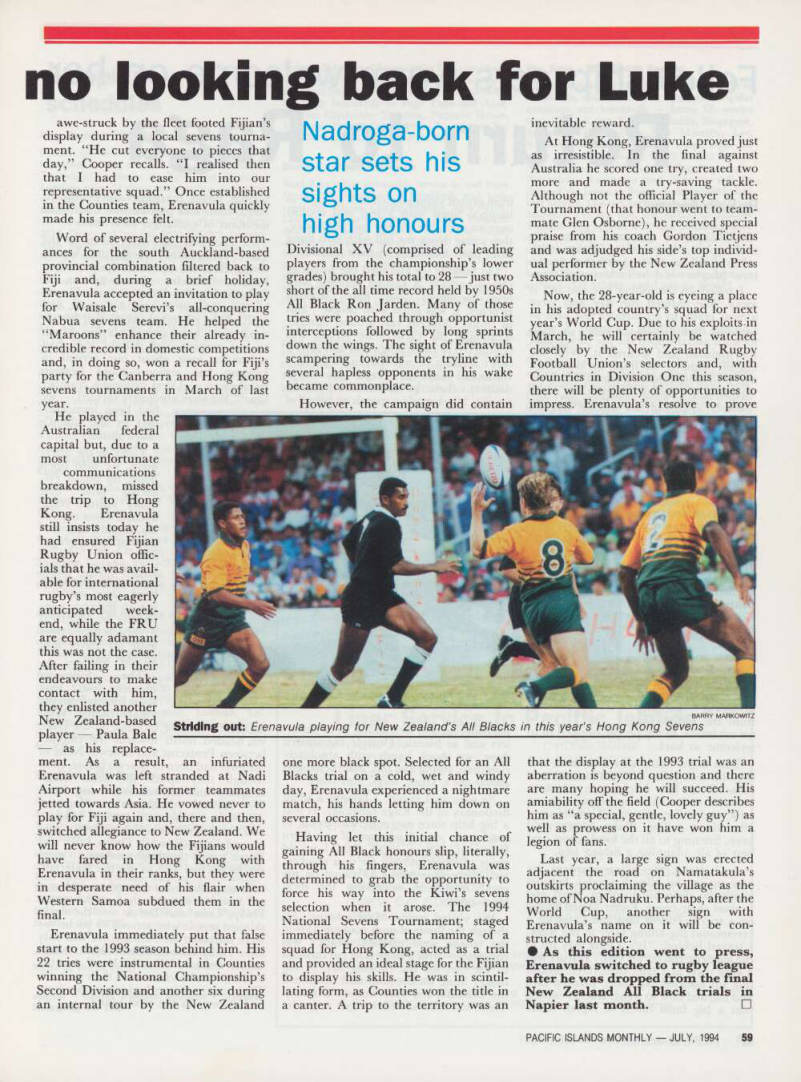
By Atama Raganivatu
PERHAPS the time has come for a scientific analysis to be made of Namatakula’s kava to determine if it contains a secret ingredient responsible for developing highly gifted rugby players! The small village, situated on Viti Levu’s west coast, had already produced a crop of excellent footballers renowned throughout Fiji before its current favourite son, Noa Nadruku, gained fame and fortune in Australian rugby league. NoW, it can take pride as the home of the 1994 Hong Kong Sevens’ most influential player Luke Erenavula.
Erenavula and Nadruku are cousins.
They spent many of their pre-teen days playing rugby together in Namatakula and forged a friendship that remains strong. Erenavula was a centre then, playing alongside second five Nadruku.
However, due to the former’s size he was drafted into the back. This only led to him being continually isolated as his slower fellow forwards failed to keep up with play. By the time he commenced playing senior rugby, Erenavula was on the wing where he has remained.
After gaining notice with some exhil arating performances while playing for his club (Warwick) and district (Na droga), the lanky coral coaster was selected for Fiji’s team that travelled to the 1988 Honk Kong Sevens. He experi enced mixed fortunes in the Crown Colony that year and, due to the incredible depth of talented sevens players amongst his compatriots, was not called upon during the Fijians’ remark able hat trick of successes between 1990 and 1992.
The Fijian Rugby Union began to regard him purely as a fifteen-a-side specialist and it was a game of rugby’s traditional, elongated, variety that changed Erenavula’s life. An exception ally strong performance for Fiji against Scotland at Edinburgh’s historic Murrayfield stadium was captured on video tape by a Suva-based friend of Rod Ketels, a former All Blacks who coaches the Pukekohe club in New Zealand.
Ketels received the tape along with a note suggesting he try to recruit the long striding Erenavula.
Ketels was duly impressed and, having been assured of worthwhile employment and accommodation, Erenavula and his wife, Jimaima, moved to New Zealand in 1992. It didn’t take him long to graduate from club to inter-provincial rugby.
Counties coach Ross Cooper was
awe-struck by the fleet footed Fijian’s display during a local sevens tourna ment. “He cut everyone to pieces that day,” Cooper recalls. “I realised then that I had to ease him into our representative squad.” Once established in the Counties team, Erenavula quickly made his presence felt.
Word of several electrifying perform ances for the south Auckland-based provincial combination filtered back to Fiji and, during a brief holiday, Erenavula accepted an invitation to play for Waisale Serevi’s all-conquering Nabua sevens team. He helped the “Maroons” enhance their already in credible record in domestic competitions and, in doing so, won a recall for Fiji’s party for the Canberra and Hong Kong sevens tournaments in March of last
year.
He played in the Australian federal capital but, due to a most unfortunate communications breakdown, missed the trip to Hong Kong. Erenavula still insists today he had ensured Fijian Rugby Union offic ials that he was avail able for international rugby’s most eagerly anticipated week end, while the FRU are equally adamant this was not the case.
After failing in their endeavours to make contact with him, they enlisted another New Zealand-based player Paula Bale as his replace
ment. As a result, an infuriated Erenavula was left stranded at Nadi Airport while his former teammates jetted towards Asia. He vowed never to play for Fiji again and, there and then, switched allegiance to New Zealand. We will never know how the Fijians would have fared in Hong Kong wtth Erenavula in their ranks, but they were in desperate need of his Hair when Western Samoa subdued them in the final Erenavula immediately put that false start to the 1993 season behind him. His 22 tries were instrumental in Counties winning the National Championship’s Second Division and another six during an internal tour by the New Zealand
Nadroga-born star sets his sights on high honours
Divisional XV (comprised of leading players from the championship’s lower grades) brought his total to 28 —just two short of the all time record held by 1950 s All Black Ron Jarden. Many of those tries were poached through opportunist interceptions followed by long sprints down the wings. The sight of Erenavula scampering towards the tryline with several hapless opponents in his wake became commonplace.
However, the campaign did contain
one more black spot. Selected for an All Blacks trial on a cold, wet and windy
day, Erenavula experienced a nightmare
match, his hands letting him down on several occasions.
Having let this initial chance of
gaining All Black honours slip, literally,
through his fingers, Erenavula was determined to grab the opportunity to force his way into the Kiwi’s sevens selection when it arose. The 1994 National Sevens Tournament; staged immediately before the naming of a squad for Hong Kong, acted as a trial and provided an ideal stage for the Fijian to display his skills. He was in scintil lating form, as Counties won the title in a canter. A trip to the territory was an
inevitable reward.
At Hong Kong, Erenavula proved just
as irresistible. In the final against Australia he scored one try, created two more and made a try-saving tackle.
Although not the official Player of the Tournament (that honour went to team mate Glen Osborne), he received special praise from his coach Gordon Tietjens and was adjudged his side’s top individ ual performer by the New Zealand Press Association.
Now, the 28-year-old is eyeing a place in his adopted country’s squad for next year’s World Cup. Due to his exploits in March, he will certainly be watched
closely by the New Zealand Rugby
Football Union’s selectors and, with Countries in Division One this season, there will be plenty of opportunities to impress. Erenavula’s resolve to prove
that the display at the 1993 trial was an aberration is beyond question and there are many hoping he will succeed. His amiability off the field (Cooper describes him as “a special, gentle, lovely guy”) as well as prowess on it have won him a legion of fans.
Last year, a large sign was erected adjacent the road on Namatakula’s outskirts proclaiming the village as the home of Noa Nadruku. Perhaps, after the World Cup, another sign with Erenavula’s name on it will be con
structed alongside.
• As this edition went to press, Erenavula switched to rugby league after he was dropped from the final New Zealand All Black trials in Napier last month. □
Barry Markowitz
Striding out: Erenavula playing for New Zealand’s All Blacks in this year’s Hong Kong Sevens
Advertisements & other items, p. 59 (1 item)
no looking back for Luke
59
PACIFIC ISLANDS MONTHLY JULY, 1994
Return to Raga
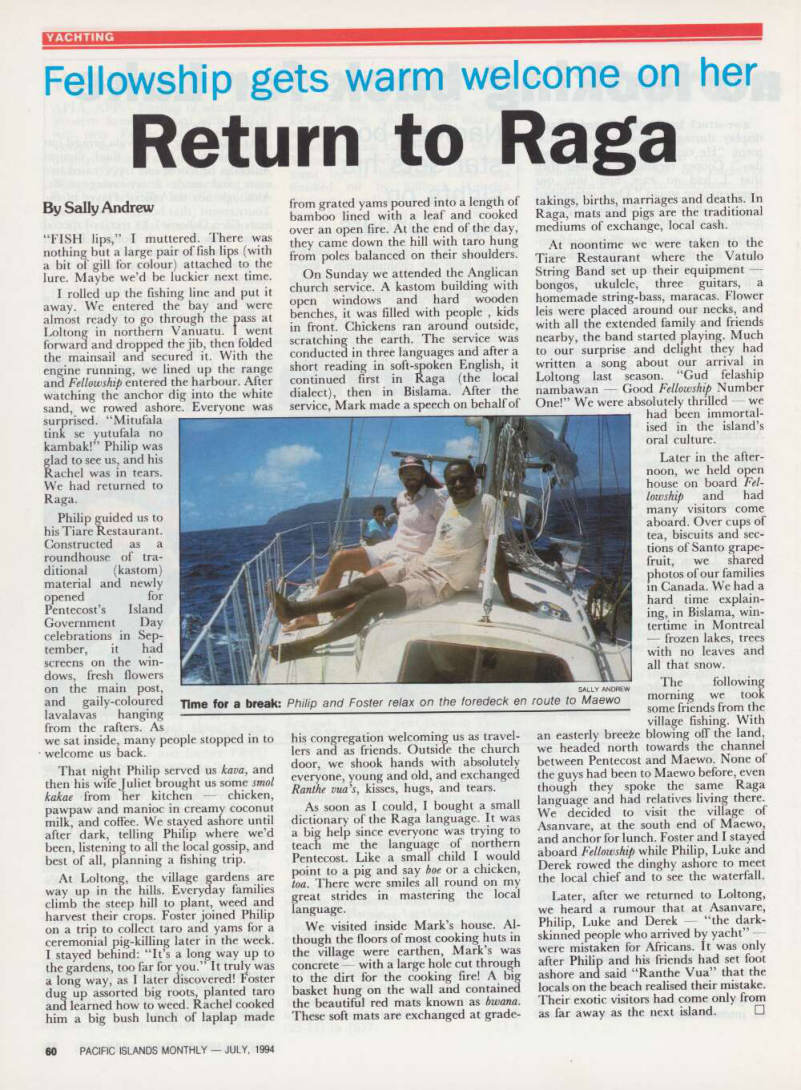
Yachting
Fellowship gets warm welcome on her Return to Raga
By Sally Andrew
“FISH lips,” I muttered. There was nothing but a large pair of fish lips (with a bit of gill for colour) attached to the lure. Maybe we’d be luckier next time.
I rolled up the fishing line and put it away. We entered the bay and were almost ready to go through the pass at Loltong in northern Vanuatu. I went forward and dropped the jib, then folded the mainsail and secured it. With the engine running, we lined up the range and Fellowship entered the harbour. After watching the anchor dig into the white sand, we rowed ashore. Everyone was
surprised. “Mitufala tink se yutufala no kambak!” Philip was glad to see us, and his Rachel was in tears.
We had returned to Raga.
Philip guided us to his Tiare Restaurant.
Constructed as a roundhouse of tra ditional (kastom) material and newly
opened for
Pentecost’s Island Government Day celebrations in Sep tember, it had screens on the win dows, fresh flowers on the main post,
and gaily-coloured
lavalavas hanging from the rafters. As
we sat inside, many people stopped in to welcome us back.
That night Philip served us kava, and then his wife Juliet brought us some smol kakae from her kitchen chicken, pawpaw and manioc in creamy coconut milk, and coffee. We stayed ashore until after dark, telling Philip where we’d been, listening to all the local gossip, and best of all, planning a fishing trip.
At Loltong, the village gardens are way up in the hills. Everyday families climb the steep hill to plant, weed and harvest their crops. Foster joined Philip on a trip to collect taro and yams for a ceremonial pig-killing later in the week.
I stayed behind: “It’s a long way up to the gardens, too far for you.” It truly was a long way, as I later discovered! Foster dug up assorted big roots, planted taro and learned how to weed. Rachel cooked him a big bush lunch of laplap made
from grated yams poured into a length of bamboo lined with a leaf and cooked over an open fire. At the end of the day, they came down the hill with taro hung from poles balanced on their shoulders.
On Sunday we attended the Anglican church service. A kastom building with open windows and hard wooden benches, it was filled with people , kids in front. Chickens ran around outside, scratching the earth. The service was conducted in three languages and after a short reading in soft-spoken English, it continued first in Raga (the local dialect), then in Bislama. After the service, Mark made a speech on behalf of
his congregation welcoming us as travel lers and as friends. Outside the church door, we shook hands with absolutely everyone, young and old, and exchanged Ranthe vua’s, kisses, hugs, and tears.
As soon as I could, I bought a small dictionary of the Raga language. It was a big help since everyone was trying to teach me the language of northern Pentecost. Like a small child I would point to a pig and say boe or a chicken, toa. There were smiles all round on my great strides in mastering the local
language.
We visited inside Mark’s house. Al though the floors of most cooking huts in the village were earthen, Mark’s was concrete with a large hole cut through to the dirt for the cooking fire! A big basket hung on the wall and contained the beautiful red mats known as bwana.
These soft mats are exchanged at grade
takings, births, marriages and deaths. In Raga, mats and pigs are the traditional mediums of exchange, local cash.
At noontime we were taken to the Tiare Restaurant where the Vatulo String Band set up their equipment bongos, ukulele, three guitars, a homemade string-bass, maracas. Flower leis were placed around our necks, and with all the extended family and friends nearby, the band started playing. Much to our surprise and delight they had written a song about our arrival in Loltong last season. “Gud felaship nambawan Good Fellowship Number One!” We were absolutely thrilled we
had been immortal ised in the island’s oral culture.
Later in the after noon, we held open house on board Fel lowship and had many visitors come aboard. Over cups of tea, biscuits and sec tions of Santo grape fruit, we shared photos of our families in Canada. We had a hard time explain ing, in Bislama, win tertime in Montreal frozen lakes, trees with no leaves and all that snow.
The following
morning we took some friends from the village fishing. With
an easterly breeze blowing off the land, we headed north towards the channel between Pentecost and Maewo. None of the guys had been to Maewo before, even
though they spoke the same Raga
language and had relatives living there.
We decided to visit the village of Asanvare, at the south end of Maewo, and anchor for lunch. Foster and I stayed aboard Fellowship while Philip, Luke and Derek rowed the dinghy ashore to meet the local chief and to see the waterfall.
Later, after we returned to Loltong, we heard a rumour that at Asanvare, Philip, Luke and Derek “the dark
skinned people who arrived by yacht”
were mistaken for Africans. It was only after Philip and his friends had set foot ashore and said “Ranthe Vua” that the locals on the beach realised their mistake.
Their exotic visitors had come only from as far away as the next island. □
Sally Andrew
Time for a break: Philip and Foster relax on the foredeck en route to Maewo
Shipping
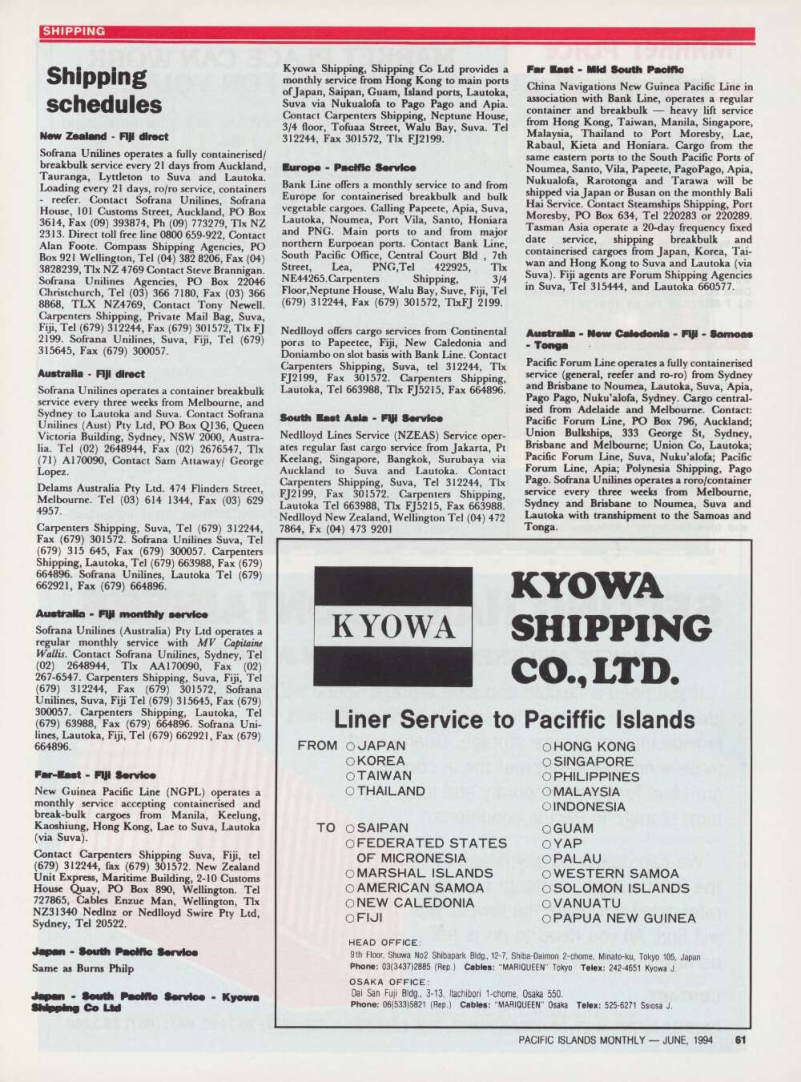
schedules
New Zealand - FIJI direct Sofrana Unilines operates a fully containerised/ breakbulk service every 21 days from Auckland, Tauranga, Lyttleton to Suva and Lautoka.
Loading every 21 days, ro/ro service, containers - reefer. Contact Sofrana Unilines, Sofrana House, 101 Customs Street, Auckland, PO Box 3614, Fax (09) 393874, Ph (09) 773279, Tlx NZ 2313. Direct toll free line 0800 659-922, Contact Alan Foote. Compass Shipping Agencies, PO Box 921 Wellington, Tel (04) 382 8206, Fax (04) 3828239, Tlx NZ 4769 Contact Steve Brannigan.
Sofrana Unilines Agencies, PO Box 22046 Christchurch, Tel (03) 366 7180, Fax (03) 366 8868, TLX NZ4769, Contact Tony Newell.
Carpenters Shipping, Private Mail Bag, Suva, Fiji, Tel (679) 312244, Fax (679) 301572, Tlx FJ 2199. Sofrana Unilines, Suva, Fiji, Tel (679) 315645, Fax (679) 300057.
Australia - FIJI direct Sofrana Unilines operates a container breakbulk service every three weeks from Melbourne, and Sydney to Lautoka and Suva. Contact Sofrana Unilines (Aust) Pty Ltd, PO Box Q 136, Queen Victoria Building, Sydney, NSW 2000, Austra lia. Tel (02) 2648944, Fax (02) 2676547, Tlx (71) A 170090, Contact Sam Attaway/ George Lopez.
Delams Australia Pty Ltd. 474 Flinders Street, Melbourne. Tel (03) 614 1344, Fax (03) 629 4957.
Carpenters Shipping, Suva, Tel (679) 312244, Fax (679) 301572. Sofrana Unilines Suva, Tel (679) 315 645, Fax (679) 300057. Carpenters Shipping, Lautoka, Tel (679) 663988, Fax (679) 664896. Sofrana Unilines, Lautoka Tel (679) 662921, Fax (679) 664896.
Australia - FIJI monthly service Sofrana Unilines (Australia) Pty Ltd operates a regular monthly service with MV Capilaine Wallis. Contact Sofrana Unilines, Sydney, Tel (02) 2648944, Tlx AA170090, Fax (02) 267-6547. Carpenters Shipping, Suva, Fiji, Tel (679) 312244, Fax (679) 301572, Sofrana Unilines, Suva, Fiji Tel (679) 315645, Fax (679) 300057. Carpenters Shipping, Lautoka, Tel (679) 63988, Fax (679) 664896. Sofrana Uni lines, Lautoka, Fiji, Tel (679) 662921, Fax (679) 664896.
Far-Bast - FIJI Service New Guinea Pacific Line (NGPL) operates a monthly service accepting containerised and break-bulk cargoes from Manila, Keelung, Kaoshiung, Hong Kong, Lae to Suva, Lautoka (via Suva).
Contact Carpenters Shipping Suva, Fiji, tel (679) 312244, fax (679) 301572. New Zealand Unit Express, Maritime Building, 2-10 Customs House Quay, PO Box 890, Wellington. Tel 727865, Cables Enzue Man, Wellington, Tlx NZ31340 Nedlnz or Nedlloyd Swire Pty Ltd, Sydney, Tel 20522.
Japan - South Pacific Service Same as Burns Philp Japan ■ Smith Pacific Sendee - Kyowa Shipping Co Ltd
Kyowa Shipping, Shipping Co Ltd provides a monthly service from Hong Kong to main ports ofjapan, Saipan, Guam, Island ports, Lautoka, Suva via Nukualofa to Pago Pago and Apia.
Contact Carpenters Shipping, Neptune House, 3/4 floor, Tofuaa Street, Walu Bay, Suva. Tel 312244, Fax 301572, Tlx FJ2199.
Europe - Pacific Service Bank Line offers a monthly service to and from Europe for containerised breakbulk and bulk vegetable cargoes. Calling Papeete, Apia, Suva, Lautoka, Noumea, Port Vila, Santo, Honiara and PNG. Main ports to and from major northern Eurpoean ports. Contact Bank Line, South Pacific Office, Central Court Bid , 7th Street, Lea, PNG,TeI 422925, Tlx NE4426s.Carpenters Shipping, 3/4 Floor,Neptune House, Walu Bay, Suve, Fiji, Tel (679) 312244, Fax (679) 301572, TIxFJ 2199.
Nedlloyd offers cargo services from Continental ports to Papeetee, Fiji, New Caledonia and Doniambo on slot basis with Bank Line. Contact Carpenters Shipping, Suva, tel 312244, Tlx FJ2199, Fax 301572. Carpenters Shipping, Lautoka, Tel 663988, Tlx FJ5215, Fax 664896.
South Bast Asia - FIJI Service Nedlloyd Lines Service (NZEAS) Service oper ates regular fast cargo service from Jakarta, Pt Keelang, Singapore, Bangkok, Surubaya via Auckland to Suva and Lautoka. Contact Carpenters Shipping, Suva, Tel 312244, Tlx FJ2199, Fax 301572. Carpenters Shipping, Lautoka Tel 663988, Tlx FJ5215, Fax 663988.
Nedlloyd New Zealand, Wellington Tel (04) 472 7864, Fx (04) 473 9201
Far Bast - MM South Pacific China Navigations New Guinea Pacific Line in association with Bank Line, operates a regular container and breakbulk heavy lift service
from Hong Kong, Taiwan, Manila, Singapore,
Malaysia, Thailand to Port Moresby, Lae, Rabaul, Kieta and Honiara. Cargo from the same eastern ports to the South Pacific Ports of
Noumea, Santo, Vila, Papeete, PagoPago, Apia,
Nukualofa, Rarotonga and Tarawa will be shipped via Japan or Busan on the monthly Bali Hai Service. Contact Steamships Shipping, Port Moresby, PO Box 634, Tel 220283 or 220289.
Tasman Asia operate a 20-day frequency fixed date service, shipping breakbulk and containerised cargoes from Japan, Korea, Tai wan and Hong Kong to Suva and Lautoka (via Suva). Fiji agents are Forum Shipping Agencies in Suva, Tel 315444, and Lautoka 660577.
Australia - Haw Caledonia - FIJI - Samoa* - Tanga Pacific Forum Line operates a fully containerised service (general, reefer and ro-ro) from Sydney and Brisbane to Noumea, Lautoka, Suva, Apia,
Pago Pago, Nuku’alofa, Sydney. Cargo central
ised from Adelaide and Melbourne. Contact: Pacific Forum Line, PO Box 796, Auckland;
Union Bulkships, 333 George St, Sydney,
Brisbane and Melbourne; Union Co, Lautoka; Pacific Forum Line, Suva, Nuku’alofa; Pacific
Forum Line, Apia; Polynesia Shipping, Pago
Pago. Sofrana Unilines operates a roro/container service every three weeks from Melbourne, Sydney and Brisbane to Noumea, Suva and Lautoka with transhipment to the Samoas and
Tonga.
Advertisements & other items, pp. 61-64 (1 item)
Co., Ltd.
KYOWA
KYOWA
SHIPPING
CO., LTD.
Liner Service to Paciffic Islands
FROM OJAPAN
OKOREA
©TAIWAN
O THAILAND
TO OSAIPAN
O FEDERATED STATES
OF MICRONESIA
©MARSHAL ISLANDS
©AMERICAN SAMOA
©NEW CALEDONIA
©FIJI
©HONG KONG
©SINGAPORE
©PHILIPPINES
©MALAYSIA
©INDONESIA
©GUAM
©YAP
©PALAU
©WESTERN SAMOA
©SOLOMON ISLANDS
©VANUATU
©PAPUA NEW GUINEA
HEAD OFFICE:
9th Floor, Shuwa No 2 Shibapark Bldg., 12-7, Shiba-Daimon 2-chome, Minato-ku, Tokyo 105, Japan Phone: 03(3437)2885 (Rep.) Cables: “MARIQUEEN” Tokyo Telex: 242-4651 Kyowa J.
OSAKA OFFICE:
Dai San Fuji Bldg., 3-13, Itachibori 1-chome, Osaka 550.
Phone: 06(533)5821 (Rep.) Cables: "MARIQUEEN" Osaka Telex: 525-6271 Ssiosa J.
MfIRK€T PLflC€
HEALTH AND NUTRITION
"You can earn $1 million P.A. MLM ground floor opportunity specialising in Health and Nutrition products. In 16 countries and expanding rapidly. Top products and company support.
Send Sase to AGM 96 Sugaloaf Road Geilston Bay, Australia, 7016 or Fax 61-02-471026.
SCRAP METAL
Tall ingots operate from Brisbane, Australia and make frequent visits to the Pacific Islands which they have done for twenty-five years. We are buyers of Copper, Brass, Aluminium, Lead, Cable etc. Inspection no problems. Telephone 61 7 8922033. Fax 61 78922077.
ANTIQUE ENGRAVINGS
Send for catalogue listing antique maps and engravings from early expeditions to the Pacific which are available for sale. Lists of out-of-print books also available. Write stating areas of interest.
COUN HINCHCUFFE
12 QUEENS STAITH MEWS
YORK YOIIHH U.K.
REAL ESTATE
Fiji Islands Savusavu Freehold 5 acre Rainforest hide away block close to beach and town. For further information. Phone: 850509
MARKET PLACE CAN WORK
WONDERS FOR YOU ...
Promote your business, or service, sell your household items, cars or heavy machinery etc.
ONLY AUSSI PER WORD.
NO COMPANY LOGO. NO
DISPLAY. NO BOLD TYPE.
Just forward your Advertisement together with payment to: PACIFIC ISLANDS MONTHLY “Market Place”, P.O. Box 1167, Suva, Fiji.
CONDITIONS:
1. All Advertisements are subject to acceptance and approval of publisher. 2. Advertisements are published as space permits; we cannot guarantee date of insertion. 3. All advertisements must be pre-paid and should be typed or printed clearly. 4. Deadline for receipt of advertisements is the 10th of the month prior to issue. 5. PACIFIC ISLANDS MONTHLY assumes no responsibility for any service other than publishing paid advertisements in this section.
SECOND HAND CONTAINERS
WHERE AND WHEN YOU WANT THEM IN THE PACIFIC If you need a flexible and safe storage space we have the ideal solution for you. Our second hand containers provide instant secure storage. Guaranteed to be wind and waterproof these containers are ideal for both temporary and longterm storage in Pacific conditions.
We can deliver to any island in the Pacific within a month and our rates have got to be the lowest you will find. All you need to do is tell us how many you want.
CONTACT:
PASCALS MARCONNET, BP 4757 NOUMEA, NEW CALEDONIA. TEL: (687) 28 7450. FAX: (687) 26 3248
Insurance ilk rat Crann 20 25 30 35 40 45 50 55 3 1508 00276694 2
Grand Pacific Life Insurance, Ltd.
A member of the Finance Factors Family
FEDERATED STATES
OF MICRONESIA
Actouka Executive Insurance Underwriters P.O. Box 55, Kolonia, Pohnpei, Federated States of Micronesia 96941 Pacific Basin Insurance & General Services, Inc P.O. Box 494, Chuuk State, Federated States of Micronesia 96942
TONGA
Peseti Ma'afu Ins. & Finance, Ltd.
Private Bag 2, Taumoepeau Bldg.
Nukualofa, Tonga
GUAM
Great National Insurance Underwriters, Inc.
P.O. Box GA, Agana, Guam 96910
AMERICAN SAMOA
Mark Solofa Pacific Insurance & Finance, Inc.
P.O. Box 3149 Pago Pago, American Samoa 96799 Pacific Financial Corporation P.O. Box AT, Agana, Guam 96910 Takagi & Associates, Inc.
GCIC Bldg., Suite 100 414 W. Soledad Ave.
Agana, Guam 96910
MARSHALL ISLANDS
Marshalls Insurance Agency P.O. Box 113, Majuro, Marshall Islands 96960
WESTERN SAMOA
Mark Solofa Pacific Insurance & Finance, Inc.
P.O. Box 3149 Pago Pago, American Samoa 96799
NORTHERN MARIANAS
Pacific Basin Insurance Underwriters, Inc.
P.O. Box 710 Saipan, Mariana Islands 96950 Pacifica Insurance Undenvriters, Inc.
P.O. Box 168, Saipan, Mariana Islands 96950 Grand Pacific Life Insurance, Ltd. • 1164 Bishop Street, sth Floor, Honolulu, HI 96813 Phone: (808) 548-3363 • FAX: (808) 548-5122
WITH THE
CROWD?
The All New Mitsubishi Galant —
The Freedom to Drive as You Choose Imagine... you’re on a long ride home from a long day’s work. You want to get home as soon as possible, but you want to do so effortlessly... or maybe you’re on a winding road, and you have the urge to experience truly sporty driving.
Typically, you would need two different cars to enjoy these two experiences fully. But with the new Mitsubishi Galant, it’s all possible.
The new Galant features an innovative approach to engine efficiency that dramatically expands driving potential. Compared to cars with conventional engines, the Galant has far better combustion efficiency and reduced friction losses.
This allows smoother, more powerful operation with almost no noise or vibration. So whether you want to relax and cruise, or drive more sportily, the Galant gives you exactly what you want — when you need it.
Each of the Galant’s new multi-valve engines gives you the unparalleled freedom to drive as you choose. They are an integral part of Ail Wheel Control, Mitsubishi’s unique approach to car design that gives you total control over the driving experience. With true communication between you and the road, the new Galant ensures total control with quicker, safer and more responsive performance than ever before imaginable.
Discover the meaning of driving freedom with the new Mitsubishi Galant —and feel how All Wheel Control sets you apart from the crowd.
The All New
MITSUBISHI GRLRNT
A AMERICAN SAMOA: PACIFIC MARKETING INC. RQ Box 698, Pago Pago, Tel. 699 9140/ AUSTRALIA: MITSUBISHI MOTORS AUSTRALIA LTD. 1284 South Road, Clovelly Park, South Australia, Tel. (08) 2757297 / FUI; NIVIS MOTOR & MACHINERY CO. LTD. G.RO. Box 150, Suva, Tel. 383411 / GUAM: TRIPPLE J ENTERPRISES INC. RO. Box 6066, Tamuning, Tel. 6469126 / NEW CALEDONIA; SOCIETE DTMPORTATION D'AUTO DU PACIFIQUE SUD S.A. RO. Box 2548, Noumea, Tel. 274-144 /NEW ZEALAND: MITSUBISHI MOTORS NEW ZEALAND LTD. Private Bag. Porirua, Tel. 2370109 /NORFOLK ISLAND: BORRY'S PTY LTD, RO. Box 169, Tel. 2114 /PAPUA NEW GUINEA: TOBA PTY LTD. RO. Box 503, Port Moresby, Tel. 217874/ SAIPAN: AUTO MOTION INC. RO. Box 569, SKV Dist. 4, Tel. 234 3332/ SOLOMON ISLANDS: HARVEST PACIFIC LTD. G.PO. Box 823, Honiara, Tel. 30407 7 TAHITI (FRENCH POLYNESIA): SOPADEP S.A. RO. Box 1617, Papeete, Tel. 427393 1 TONGA: SITANI MAFI CO., LTD RO. Box 83, NukuAlofa, Tel, 24044 /VANUATU: SOCOMETRA VANUATU LTD. B.R 06, Route de Lagon, Port Vila, Tel. 2314 /WESTERN SAMOA: MOTOR DISTRIBUTORS (SAMOA) LTD RO. Box 576, Apia, Tel. 20957
MITSUBISHI
MOTORS
CREATING TOGETER