Tuna’s two-ring ballet
pp. 32-34 · Read in the full issue
• Samoa
A pay rise is put on ice as Pago Pago’s tuna packers face more controversy
By David North
WASHINGTON is making money decisions on some people associated with American Samoa’s tuna industry: • The Republicans in the House of Representatives are arranging a multi million dollar tax break for the founder of StarKist as he gives up his US citi zenship; and • The Clinton Administration, very slowly, is awarding a five-cent an hour wage increase to the Western Samoans who clean and pack the tuna, but who are denied the opportunity to seek US
citizenship.
It’s a complicated, two-ring ballet playing out the old story the rich get richer while the poor stay poor.
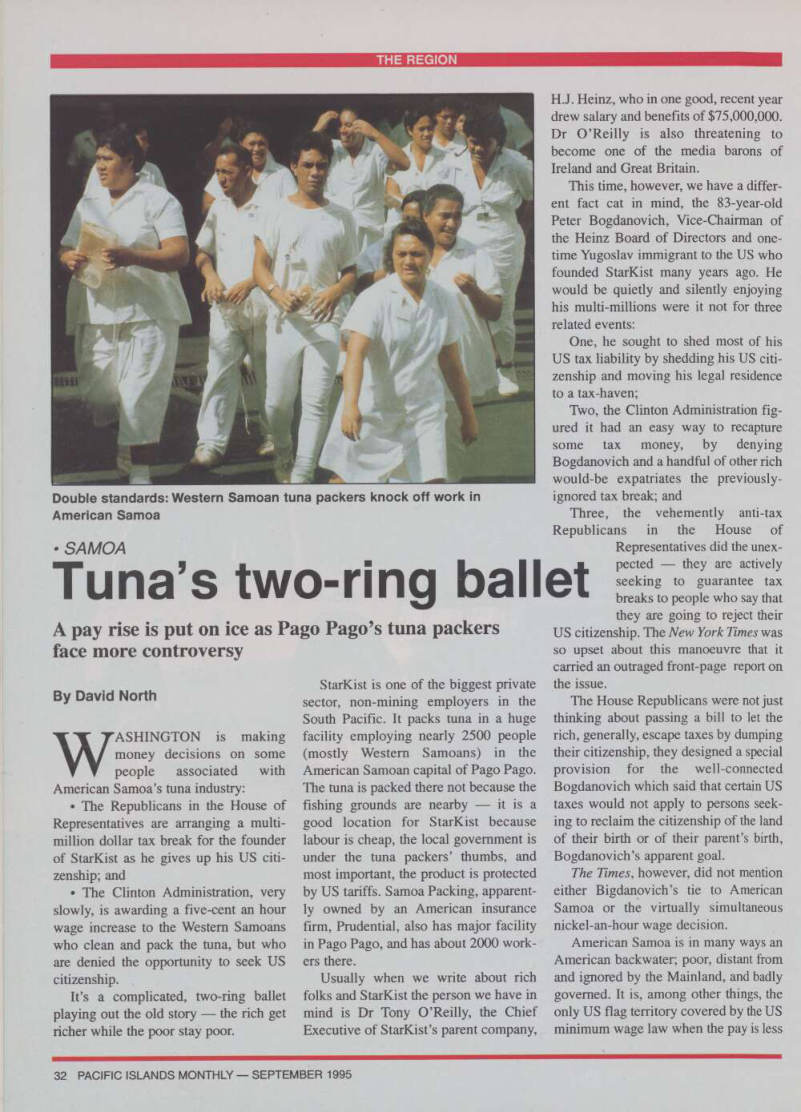
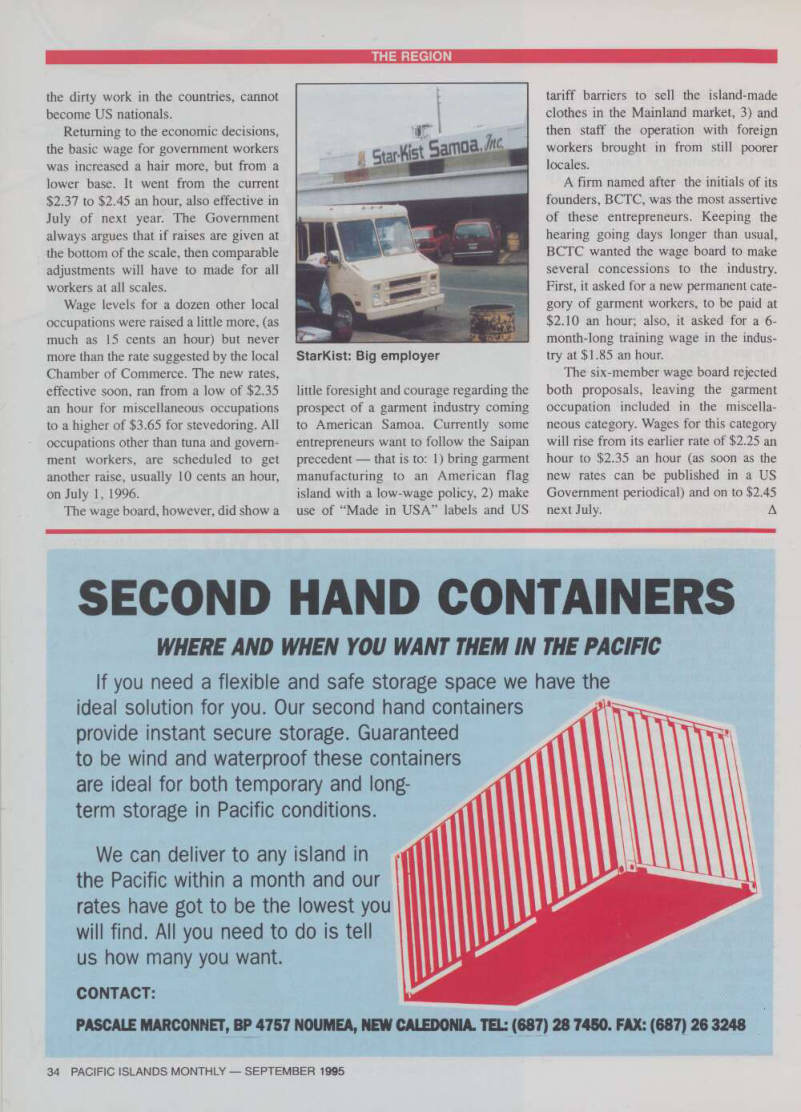
StarKist is one of the biggest private sector, non-mining employers in the South Pacific. It packs tuna in a huge facility employing nearly 2500 people (mostly Western Samoans) in the American Samoan capital of Pago Pago.
The tuna is packed there not because the fishing grounds are nearby it is a good location for StarKist because labour is cheap, the local government is under the tuna packers’ thumbs, and most important, the product is protected by US tariffs. Samoa Packing, apparent ly owned by an American insurance firm, Prudential, also has major facility in Pago Pago, and has about 2000 work ers there.
Usually when we write about rich folks and StarKist the person we have in mind is Dr Tony O’Reilly, the Chief Executive of StarKist’s parent company,
H.J. Heinz, who in one good, recent year drew salary and benefits of $75,000,000.
Dr O’Reilly is also threatening to become one of the media barons of Ireland and Great Britain.
This time, however, we have a differ ent fact cat in mind, the 83-year-old Peter Bogdanovich, Vice-Chairman of the Heinz Board of Directors and one time Yugoslav immigrant to the US who founded StarKist many years ago. He would be quietly and silently enjoying his multi-millions were it not for three related events: One, he sought to shed most of his US tax liability by shedding his US citi zenship and moving his legal residence to a tax-haven; Two, the Clinton Administration fig ured it had an easy way to recapture some tax money, by denying Bogdanovich and a handful of other rich would-be expatriates the previously ignored tax break; and Three, the vehemently anti-tax Republicans in the House of
Representatives did the unex pected they are actively seeking to guarantee tax breaks to people who say that they are going to reject their
US citizenship. The New York Times was so upset about this manoeuvre that it carried an outraged front-page report on the issue.
The House Republicans were not just thinking about passing a bill to let the rich, generally, escape taxes by dumping their citizenship, they designed a special provision for the well-connected Bogdanovich which said that certain US taxes would not apply to persons seek ing to reclaim the citizenship of the land of their birth or of their parent’s birth, Bogdanovich’s apparent goal.
The Times , however, did not mention either Bigdanovich’s tie to American Samoa or the virtually simultaneous nickel-an-hour wage decision.
American Samoa is in many ways an American backwater; poor, distant from and ignored by the Mainland, and badly governed. It is, among other things, the only US flag territory covered by the US minimum wage law when the pay is less
Double standards: Western Samoan tuna packers knock off work in American Samoa
than $4.25 an hour. The minimum wage in American Samoa is set by an awk ward Mainland-Island mechanism. Six board members are appointed, half by the US Department of Labour and half by the islands’ Governor (currently AP Lutali); three of the members are from the Mainland, three from the islands; two members represent labour, two management and two the public.
The system says that four votes are needed for a raise. Historically this has meant that swing (fourth) vote is that of the public member from American Samoa, but since this member is in the Governor’s camp, raises for tuna work ers and for government workers are always very small.
The board is convened every two years, and in its latest incarnation (in June) it decided not to press toward clos ing the gap between Samoa and Mainland minimum wages. It heard the usual pleas of poverty from the flat broke American Samoan Government and from the secretive (but prosperous) tuna industry.
The latter has an option that the American Samoa Government does not it could move its gutting, cleaning and packing operation to some other island, with even more minimum wage laws. The industry keeps threatening to do so, and this keeps the American Samoa Government from doing any thing rash, like raising wages or seeking serious taxes from its principal industry.
Further, when tuna workers get sick, the Government foots the bill at the LBJ Medical Center; Congressman Eni Faleomavaega has sought, in vain, to make the industry provide its people with at least some health insurance.
It was in this setting that the six member board voted to raise the fish cleaners’ wages from $3.05 an hour to $3.10 an hour, but to soften the blow to StarKist and Samoa Packing the new, higher wage rate will not go into effect until July 1, 1996. The labour force in American Samoa, incidentally, is over whelmingly Samoan in ethnicity and language, but there is an
occupational/citizenship division.
Western Samoans, who do most of
the dirty work in the countries, cannot become US nationals.
Returning to the economic decisions, the basic wage for government workers was increased a hair more, but from a lower base. It went from the current $2.37 to $2.45 an hour, also effective in July of next year. The Government always argues that if raises are given at the bottom of the scale, then comparable adjustments will have to made for all workers at all scales.
Wage levels for a dozen other local occupations were raised a little more, (as much as 15 cents an hour) but never more than the rate suggested by the local Chamber of Commerce. The new rates, effective soon, ran from a low of $2.35 an hour for miscellaneous occupations to a higher of $3.65 for stevedoring. All occupations other than tuna and govern ment workers, are scheduled to get another raise, usually 10 cents an hour, on July 1, 1996.
The wage board, however, did show a
little foresight and courage regarding the prospect of a garment industry coming to American Samoa. Currently some entrepreneurs want to follow the Saipan precedent that is to: 1) bring garment manufacturing to an American flag island with a low-wage policy, 2) make use of “Made in USA” labels and US
tariff barriers to sell the island-made clothes in the Mainland market, 3) and then staff the operation with foreign workers brought in from still poorer locales.
A firm named after the initials of its founders, BCTC, was the most assertive of these entrepreneurs. Keeping the hearing going days longer than usual, BCTC wanted the wage board to make several concessions to the industry.
First, it asked for a new permanent cate gory of garment workers, to be paid at $2.10 an hour; also, it asked for a 6month-long training wage in the indus try at $1.85 an hour.
The six-member wage board rejected both proposals, leaving the garment occupation included in the miscella neous category. Wages for this category will rise from its earlier rate of $2.25 an hour to $2.35 an hour (as soon as the new rates can be published in a US Government periodical) and on to $2.45 next July. A
StarKist: Big employer