Elusive dream
p. 15 · Read in the full issue
By Sam Valumu
AS Papua New Guinea celebrates its 20th anniversary of indepen dence this month, the joys of growing up will be tainted by the thought of the failures of successive governments to resolve the seven-year old crisis on the secessionist island of Bougainville. Violence continues to trouble the island with no hope yet in sight of a final solution.
There was hope for peace after the signing of the Honiara Agreement between Papua New Guinea Prime Minister Sir Julius Chan and Bougainville Revolutionary Army (BRA) Commander Sam Kauona on September 3 of the past year.
The signing was significant, in that it was the first time that any high-rank ing BRA representative had agreed to meet and talk peace with a PNG prime minister. In fact, both leaders declared immediate peace after the signing of the agreement. However, that was then.
Now, a year later, peace continues to be an elusive dream as the BRA lead ers continue to seek the setting up of a separate homeland on Bougainville.
Bougainville Transitional Govern ment (BTG) Premier Theodore Miriung has continually sought peace talks , but the BRA has continued to reject his overtures, saying there will be no talks while security forces remain on Bougainville. And the continuing spate of violence are strengthening that stance.
Under the terms of the most recent peace agreement, the Waigani Communique, leaders of the BTG and BRA former North Solomons
Premier Joseph Kabui, Francis Ona, Kauona, Martin Miriori, Moses Avini, Ishmael Toroama and others have been granted unconditional amnesty and pardon from prosecution for trea sonable and other offences they may have committed against the State during the crisis.
The national government said it would also lift all restrictions on travel and cancel the rewards of K 200,000 offered (by the previous Namaliu Government) for the capture and pros-
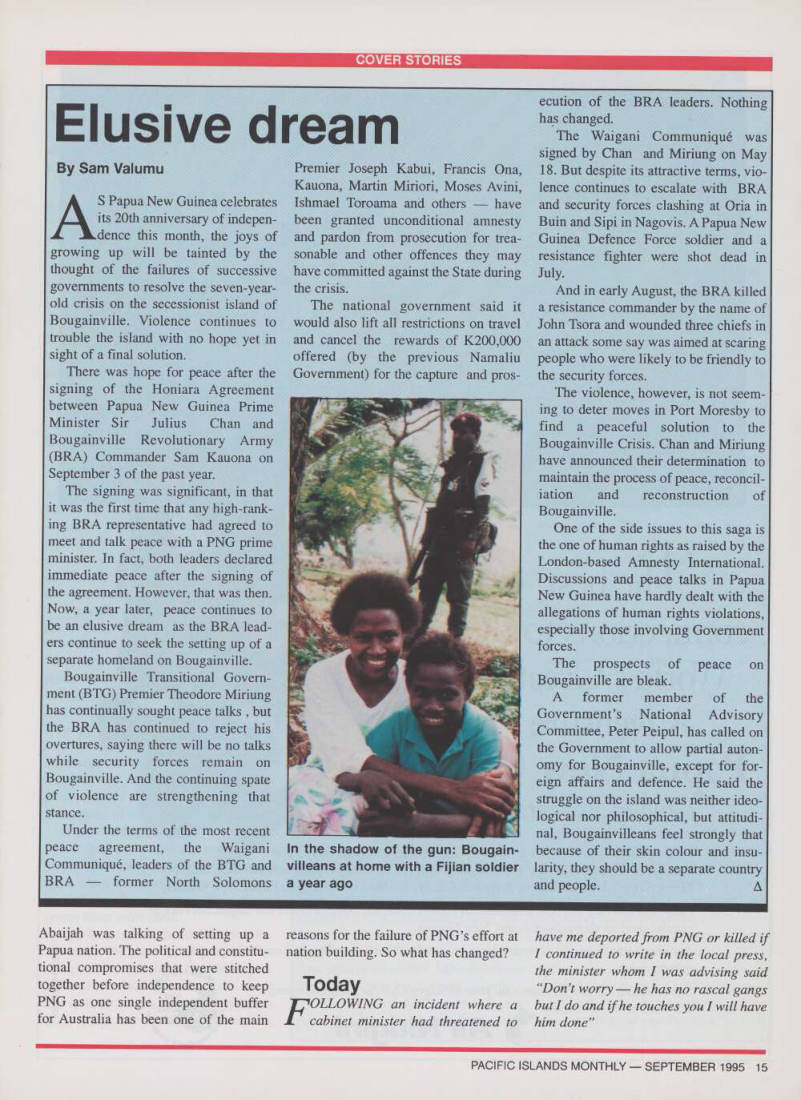
In the shadow of the gun: Bougain viileans at home with a Fijian soldier a year ago
ecution of the BRA leaders. Nothing
has changed.
The Waigani Communique was
signed by Chan and Miriung on May 18. But despite its attractive terms, vio lence continues to escalate with BRA and security forces clashing at Oria in Buin and Sipi in Nagovis. A Papua New Guinea Defence Force soldier and a resistance fighter were shot dead in
July.
And in early August, the BRA killed a resistance commander by the name of John Tsora and wounded three chiefs in an attack some say was aimed at scaring people who were likely to be friendly to the security forces.
The violence, however, is not seem ing to deter moves in Port Moresby to find a peaceful solution to the Bougainville Crisis. Chan and Miriung have announced their determination to maintain the process of peace, reconcil iation and reconstruction of Bougainville.
One of the side issues to this saga is the one of human rights as raised by the London-based Amnesty International.
Discussions and peace talks in Papua New Guinea have hardly dealt with the allegations of human rights violations, especially those involving Government forces.
The prospects of peace on Bougainville are bleak.
A former member of the Government’s National Advisory Committee, Peter Peipul, has called on the Government to allow partial auton omy for Bougainville, except for for eign affairs and defence. He said the struggle on the island was neither ideo logical nor philosophical, but altitudi nal, Bougainvilleans feel strongly that because of their skin colour and insu larity, they should be a separate country and people. A