PNG's age of decline
pp. 12-21 · Read in the full issue
Cover Stories
The past 20 years have been decades of discovery for Papua h
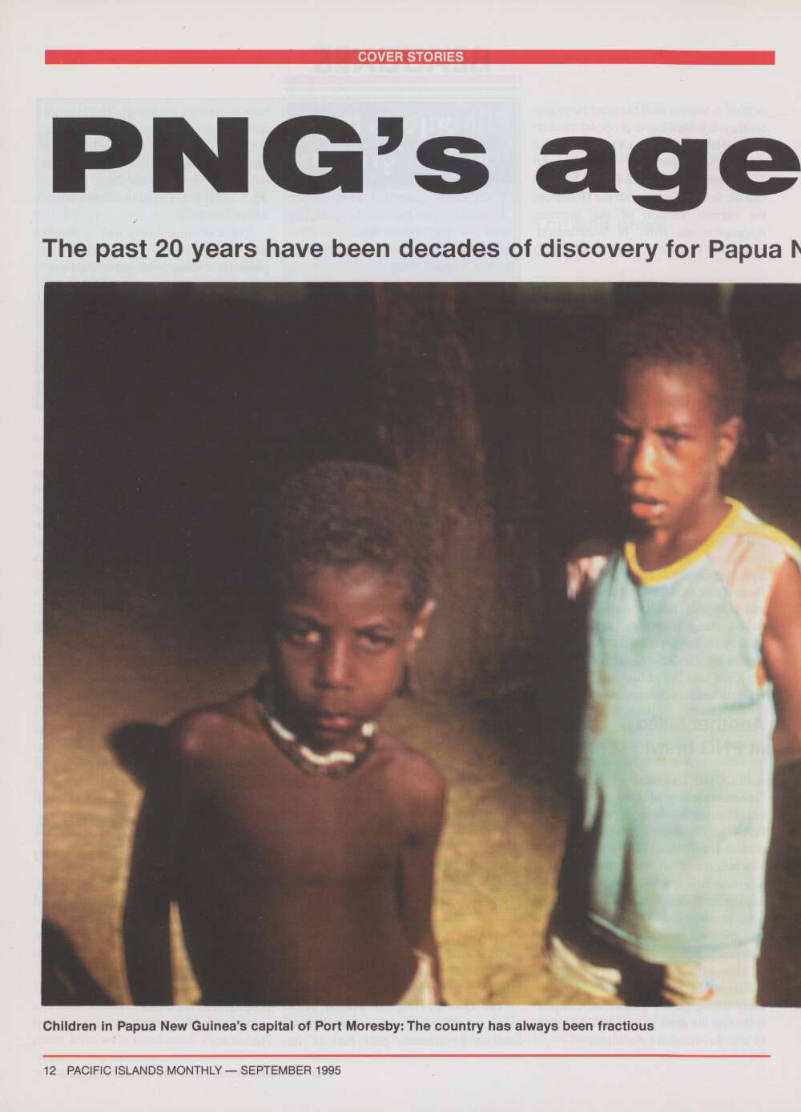
Children in Papua New Guinea’s capital of Port Moresby: The country has always been fractious
sw Guinea. It found freedom, wealth and, unfortunately, trouble
By Dr Roman Grynberg
m iVERY time I used to see this politician in parliament in K J Waigani he used to tell me, “The difference between you white men and we black men is that you are rich when you have things and we are rich when we give them away. ” At first I could not think of a good reply. It took me 10 years and then I realised that the only thing a white man can answer is “... and yes that is why we are rich and you are poor”.
When the Australians lowered their flag in September 1975 in Port Moresby, the late Sir John Guise, the first Governor-General of Papua New Guinea, noted that the flag was being lowered and not tom down.
PNG like almost the entire Pacific had shed no blood for its freedom from colonialism. The reason was that in any strict sense, PNG, much to its own cost, had never really been a colony there had been some settlers but the ‘colonial ism’ that PNG got from its erstwhile master Australia was that of buffer for a xenophobic Australia. PNG was and still remains a geo-political buffer. In the past it was a buffer against German imperialism in the Pacific and later a buffer to Asia. It has never escaped this costly role.
The Australians who colonised PNG had almost no interest in its exploitation, unlike the German, French and British colonialists who had come to dominate other parts of Melanesia after the Conference of Berlin in 1885 which divided up the Pacific into interests that still shape the direction of the region to this day.
Nothing more sadly typified the fail ure of Australian colonialism than an event in 1967, at a school on Yule island in the Gulf of Papua, when Mr Joseph Aoae, who was to be a cabinet minister in a number of post-independence gov ernments, was introduced to the assem bled students as the first Papua New Guinean to ever receive a university degree.
It was probably untrue, there have been other Papua New Guinean who also seek that title but it was close enough to the truth that showed how lit tle Australia had done for the develop ment of PNG. The ‘first’ Papua New Guinean graduate was graduating at least 50 years and sometimes a century after his African counterpart. More importantly he was graduating eight years before independence.
Australia, throughout its 70-year colonial rule over Papua and its mandate over the territory of New Guinea showed little economic interest in its ‘colonies’. It had its own extensive mar gins, its own frontiers to control and dominate and had little time or resources for what remained until the 1950 s a largely unexplored and economically irrelevant island.
PNG has always been fractious a land of 700 languages with a cultural diversity that defies simple classification and while independence came, granted by the Australians, it did not come easi ly. Twenty years ago at independence PNG was facing secession just about everywhere. In the North Solomons young Bougainvilleans wanted no part of the new PNG.
In the islands region there was also talk of secession and in Papua the young firebrand parliamentarian Josephine
Abaijah was talking of setting up a Papua nation. The political and constitutional compromises that were stitched together before independence to keep PNG as one single independent buffer for Australia has been one of the main
reasons for the failure of PNG’s effort at nation building. So what has changed?
Tod3y
PLOWING an incident where a IN cabinet minister had threatened to
have me deported from PNG or killed if I continued to write in the local press, the minister whom I was advising said “Don’t worry he has no rascal gangs but I do and if he touches you I will have him done”
There is a limit to how much anyone can blame the past for the present. On its 20th birthday, it still remains possible to point the finger South, with considerable
justification.
The Australian legacy in New Guinea is appalling. Churches, policemen but few schools. But the political situation that confronts PNG today is of PNG’s own making. But for 20 years PNG has written its own history.
Noone in PNG can today escape the basic fact of life which is that violence and the threat of violence are the most common determinants of day-to-day behaviour for most people, whether expatriate or local.
It was not so in 1975 and there are, just like in Africa many Papua New Guineans who are beginning to look back on the colonial past as almost a ‘golden age’ when it was still possible to walk the streets at night, and when there was some hope of a future. These things are long gone in Port Moresby where the streets are totally deserted after sundown and almost completely gone in the rural areas which were, just 10 years ago, rel atively immune to what was seen as an urban problem.
Ironically it was just before the 10th anniversary that the government of PNG imposed its first curfew in Port Moresby.
Since then things have gone from bad to worse. But what has caused the decline?
Criminologists argue, but a deteriorating and dispirited police force combined with growing income disparities and a local political elite that is seen by many criminals in Port Moresby as a good example that they can look down to as an appropriate role model lie very much at the heart of the problem.
If you actually speak to ‘rascals’ (when they are pointing a gun at you) they will almost invariable tell you the same story they are getting their example and sometimes their direct orders from politicians.
The fact remains that the criminal sit uation in PNG has been permitted to reach the situation that it has because the political elite will do nothing serious to halt it. In Indonesia the government has dealt with the criminal violence in
almost as violent a fashion. How is it possible that PNG the country which has it all gold oil, copper, abundant land and fish resources that are the dream of politicians in other developing countries has allowed the crime situation to deteriorate to the point no one would invest in the place?
PNG has faced over a decade of eco nomic decline directly as a result of a sit uation that could have easily been con trolled had it been attacked seriously 10 years ago. Its people suffer and its politi cians do nothing but utter platitudes and try to stay in office. The reason lies very much at the heart of the political system itself. The political system remains so unstable in PNG that no politician dare try to do anything really tough lest he loses his majority in parliament.
Once I complained bitterly to Bernard Narakobi, former Minister of Justice and recently sacked as Minister of Agriculture, that parliament had 107 parties. Narakobi who was younger and
still willing to consider criticism replied: “You have got it wrong there is only one party in PNG and its called ME Melanesian Ego”.
Therein lies the heart of PNG’s prob lems, a political elite which is commit ted to its own personal, financial and political interests and has no vision of building a nation where, at some point in the future, there is more for everyone to steal. To achieve that it would have to make tough decisions to crush the crim inal gangs it will not and has never done this. There is no quick profit, no slush funds, no back-handers in nation
building so why bother?
The problem is that the PNG political systems is simply unable to reform itself and crime is one of a multitude of seri ous problems that are not being tackled in any serious way. But if the gangs and the violence of PNG society are only one symptom of the nation’s illness, then the fuel for the disease is the sick and rapacious way it has dealt with its abun
dant natural resources.
At the very heart of PNG’s problem is the development path that it has embarked on. The mining, timber and subsequently oil wealth in PNG has cre ated a political elite with wealth and power, and an expatriate community that make it function.
But to those at the bottom of PNG society those living off Six Mile rub bish dump they cannot see and do not care about cause and effect. To them what is happening to PNG is hopeless ness and poverty which is mirrored in the mushrooming glass tower blocks of Port Moresby and in the terrified blue eyes of the rich men who scurry home before the sun sets.
The mineral wealth of PNG, despite being the envy of other nations, is its greatest curse. The reason is simple. The taxation regime in mining oil and log ging was so structured than the first ben eficiary of Porgera and Kutubu is the government. The problem is that gov
Port Moresby: PNG has faced over a decade of economic decline
emment became the first and last benefi ciary. PNG got wealth quickly those who advocated oil and mineral-based development saw this as a way of trans ferring the wealth to develop the renew able sectors of the economy i.e. forestry, agriculture and fisheries. Of course it never happened because the politicians appropriate the wealth for themselves and their projects.
The disaster is no more obvious than
in the fact that two years into what was billed as an “oil boom”, PNG is broke and in the not so loving hands of the International Monetary Fund. The coun try that had it all is now in effect broke and begging. Nothing more typifies the failure of the PNG elite to come to terms with the nation’s problems than the reform of PNG’s 19 largely corrupt and inefficient provincial government a reform which almost everyone had
agreed was essential. This sensible reform in one of the world’s most over governed nations was grabbed by the national political elite in Port Moresby as an opportunity for the national politi cians to take even more power.
The national parliament which is so discredited in the New Guinea Islands is the last place that most people place their trust. Rather than passing power from the inept provincial governments to local governments, the national gov ernment tried to make national politi cians what would in effect be governors of their provinces.
These proposal have lead to an increase in secessionist sentiments in Papua New Guinea a secessionist movement that still may one day destroy what is left of PNG.
Tomorrow Land
in Port Moresby I met a former cabinet minister at the Travelodge quite by accident. He had just recently been released from prison for having had a short affair with the Pacific politician’s favourite mistress ‘Miss Appropriation . He was advising government and he asked me whether I thought PNG should follow the Japanese path to development? I nearly choked on my coffee and after a few polite comments about the fact that it was not possible to walk the streets of Port Moresby let alone invest in it, I left.
Sometimes in Waigani you think you are living in a surreal theme park that is political fantasy land set against a back drop of an endless crime wave.
For anyone who has lived in PNG, that is outside the paranoia on Port Moresby, and has walked the ridges in the Highlands and has gone up the Sepik River, PNG remains impressed indelibly on the mind as the most spectacular nation on earth, one of breathtaking beauty-=and even more dizzying social change. While even today it remains all that, to watch it now is like watching a dear friend die of cancer so painful you just want to walk away. That is all right for a foreigner but Papua New Guineans have nowhere to mn.
So how will the nation solve its prob lem. It has lost so much that only a con genital optimist would believe that it will progress and develop without wash ing its hands in the blood of its children.
Most educated Papua New Guineans who still care for their nation and are honest enough to see it beauty, warts and all will tell you that what it needs is to clear the dual cancers of its politi cal elite and the resource companies that feed them before its people will awake from the post-independence darkness.
They will tell you that what PNG needs is a Lee Kwan Yew a benevo lent dictator. While there is no doubt that PNG is perfectly capable of throw ing up a dictator it is almost inconceiv able that, at this point in PNG’s history, he will be a progressive nation-builder like the former Prime Minister of Singapore. What PNG is like to get is not a Lee but a Marcos or a Mobutu a corrupt and murderous dictator. In fact there are a number of people in PNG who would love to fill the job descrip tion.
The problem is that history is not likely to allow PNG this solution to its internal problems. Colonialism marked PNG’s history poor education, no
forced alienation or even registration of land and none of the exploitative nation building that was so crucial to Africa.
The problem is that in the Pacific the colonialists came not to exploit as the Marxists argued, but because if they did not come some other colonialists would.
To this day PNG’s historical role as buffer to Asia dominates its future and those at the very top of the PNG politi cal structure know it well. Papua New Guineans have always argued that what would save them from a coup is the fact that the ethnic divisions within the Papua New Guinea Defence Force would destroy a coup almost before it started. However, the constraints to a military coup are not only internal. They lie as much in Canberra and Jakarta as they do in Papua or the islands. A coup in Port Moresby or even serious politi cal instability could easily result in a confrontation between Australia and Indonesia, two countries which have substantial geo-political interest in PNG. Would the Australians tolerate an Indonesian military puppet in Port Moresby? Not likely. Would the Indonesians install one? Only if they thought they could get away with it. But at the moment a large part of the
Australian forward defence strategy rests upon PNG. It is however not inconceivable that as PNG degenerates beyond the control of either Canberra, Jarkata or Port Moresby that the foreign powers would find a break-up of the country into weak but governable regions more to their long-term geo political interests than the emerging anarchy.
Things will get worse in PNG before they get better. There is no bright and immediate solution. Only ugliness awaits in the immediate future of PNG.
While this many in part be because of its colonial history, PNG as its name implies is an independent state.
And if independence for developing countries means anything at all, it is the right, within the limits set by your neighbours, to write your own history. It will only be when an elite that cares more for nation-building than immedi ate wealth arises will Papua New Guineans be able to look forward to prosperity and hope that they and their children so richly deserve. A
*Dr Grynberg served as economic advisor to Sir Michael Somare and Rabbie Namaliu along with other ministers of the PNG government.