Land
p. 17 · Read in the full issue
reform worries
THE Papua New Guinea govern ment is discussing the possibili ty of introducing a “land reform” system whereby landowners can register their land, then use it as collateral with banks prepared to give loans against it.
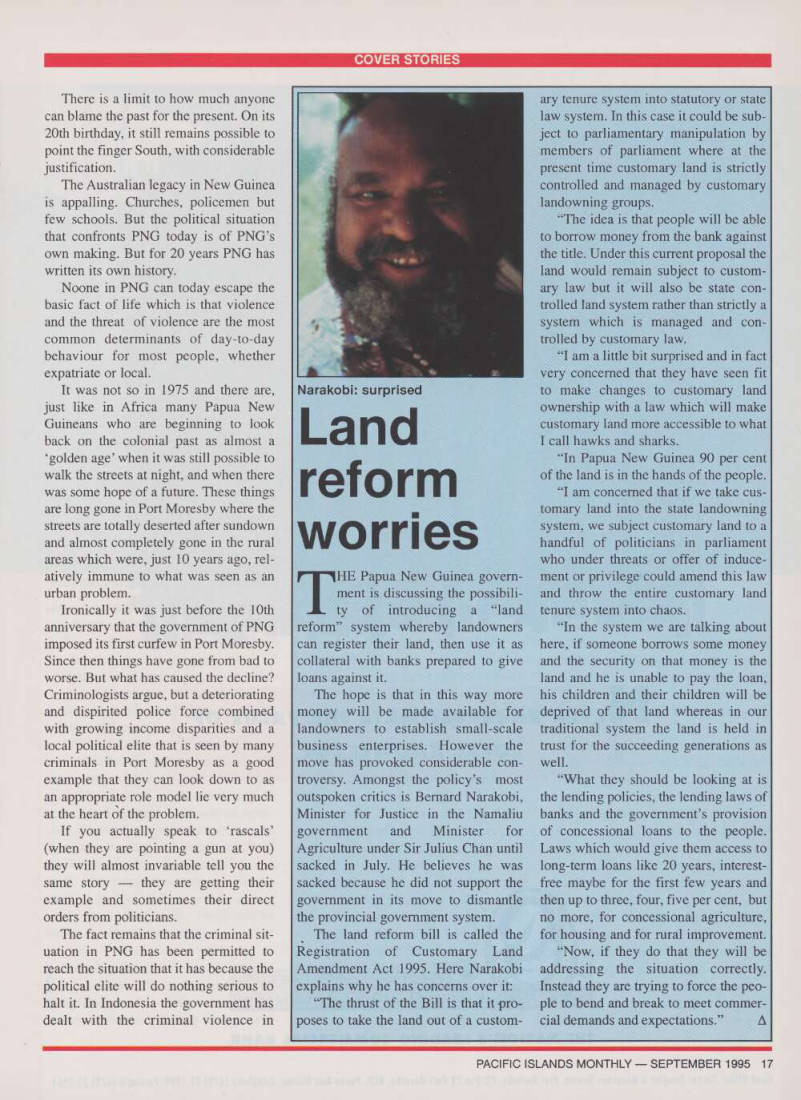
The hope is that in this way more money will be made available for landowners to establish small-scale business enterprises. However the move has provoked considerable con troversy. Amongst the policy’s most outspoken critics is Bernard Narakobi, Minister for Justice in the Namaliu government and Minister for Agriculture under Sir Julius Chan until sacked in July. He believes he was sacked because he did not support the government in its move to dismantle the provincial government system.
The land reform bill is called the Registration of Customary Land Amendment Act 1995. Here Narakobi explains why he has concerns over it: “The thrust of the Bill is that it pro poses to take the land out of a custom
ary tenure system into statutory or state law system. In this case it could be sub
ject to parliamentary manipulation by
members of parliament where at the present time customary land is strictly controlled and managed by customary landowning groups.
“The idea is that people will be able to borrow money from the bank against the title. Under this current proposal the land would remain subject to custom ary law but it will also be state con trolled land system rather than strictly a system which is managed and con trolled by customary law.
“I am a little bit surprised and in fact very concerned that they have seen fit to make changes to customary land ownership with a law which will make customary land more accessible to what I call hawks and sharks.
“In Papua New Guinea 90 per cent of the land is in the hands of the people.
“I am concerned that if we take cus tomary land into the state landowning system, we subject customary land to a handful of politicians in parliament who under threats or offer of induce ment or privilege could amend this law and throw the entire customary land tenure system into chaos.
“In the system we are talking about here, if someone borrows some money and the security on that money is the land and he is unable to pay the loan, his children and their children will be deprived of that land whereas in our traditional system the land is held in trust for the succeeding generations as well.
“What they should be looking at is the lending policies, the lending laws of banks and the government’s provision of concessional loans to the people.
Laws which would give them access to long-term loans like 20 years, interest free maybe for the first few years and then up to three, four, five per cent, but no more, for concessional agriculture, for housing and for rural improvement.
“Now, if they do that they will be addressing the situation correctly.
Instead they are trying to force the peo ple to bend and break to meet commer cial demands and expectations.” A
Narakobi: surprised