golden goose
pp. 43-44 · Read in the full issue
Tourism - the Pacific’s golden goose
Tourism is as economically impor
tant for Polynesia as it is for the rest of the Pacific. Chris Wong, Cook Islands Tourist Authority’s director, says: “Tourism provides the Cooks with more revenue than all other industries combined. The Cooks earned NZ$5O mil lion from tourism in 1994 with 57,000 vis itor arrivals, there are 1000 rooms at venues that range from beachside hotels like the Rarotongan to small locally owned homestays. Outer isles, too, have accom modations - there are currently 80 rooms at lovely Aitutaki and up to another 220 on the way. The long-awaited, troubled 191room Sheraton is still incomplete, despite Wong’s observation that “there’s an 83percent hotel occupancy rate and the Cooks is near saturation”.
Tonga’s Tourism Minister, Tutoatasi Fakafanua, declares; “Tourism is Tonga’s most important industry.” According to Semisi Talimoepeau, the Tonga Visitors Bureau’s tourism director, there were 28,500 air visitors and 15,000 cruise ship passengers in 1994, an increase of 10.5 percent from the previous year. They spent US$ll million, making tourism the largest
foreign exchange earner for the kingdom.
Talimoepeau says the number of visitors to Tonga was growing at a rate of six to 10 percent. Tonga has 600 rooms available, ranging from Nukualofa’s Dateline Hotel
to excellent getaways on islets off Tongatapu, such as the Royal Sunset Island Resort to new, small resorts at
Ha’apai. “Tonga’s most unique feature is
the monarchy,” says Talimoepeau.
Samoa has been less bullish on tourism than the rest of Polynesia. American Samoa belongs to PATA but participated little in its conference. Western Samoa’s Tourism Minister, Tuilaepa Sailele
Malielegaoi, confesses: “Two cyclones
blew us out of a lackadaisical attitude towards tourism.” In 1994, 52,000 people travelled to Western Samoa, which boasts the Pacific’s most legendary hotel, Aggie Grey’s, and romantic hideaways like Samoan Village Resorts. The minister announced a 400-room Marriott and a 36hole golf course will open near Faleolo Airport in 1997 and the Four Seasons and Inter-Continental chains propose opening
properties. Casino gambling is also being
spoken about in Apia. In addition to Faa Samoa, a relatively intact indigenous culture, the minister said Samoa’s attractions include the newly renovated “R.L.
Stevenson mansion, eco-tours, trekking, bird watching, rain forests, sailing, diving.
You name it, we’ve got it.” 1994 was French Polynesia’s best year yet, with a record 170,000 visitors, a 12 percent increase over 1993, earning the territory about US$24O million, up 20 per-
cent from 1993. According to Patrick Robson, Tahiti Tourisme’s Asian/Pacific regional manager, “Tourism is Tahiti’s number one revenue source ...We have a 60-percent occupancy rate, with a total of 2500 rooms, including 600 international standard hotel rooms.” There are superb deluxe accommodations on Tahiti, Bora Bora, Moorea, and Huahine provided by the French Sofitel chain, Hyatt Regency, and the Beachcomber Parkroyals, includ ing those famous over-water fares. The budget conscious can check in to Hotel Tahiti or homestays. Cruise ships like the Aranui, which sails to the Marquesas, give passengers the journey of a lifetime.
French Polynesia may have the most beau tiful islands in the world and its open sen suality is a selling point vis-a-vis more repressed isles that forbid topless bathing, etc. A confident Robson says Tahiti’s opti mum number of rooms is 5000 and pro jects 200,000 visitors in 1995 and 300,000 by the end of the century.
Robson adds Tahiti’s tourism growth is “due to improved air links”. In addition to regional carriers like Air New Zealand and Qantas, French Polynesia deals with South America’s Lan Chile and Asian airlines like Korea’s Asiana and KAL. Air France
has two Tokyo-Tahiti flights weekly,
During PATA’s “Visit South Pacific Year ’95”, Robson says there are special air
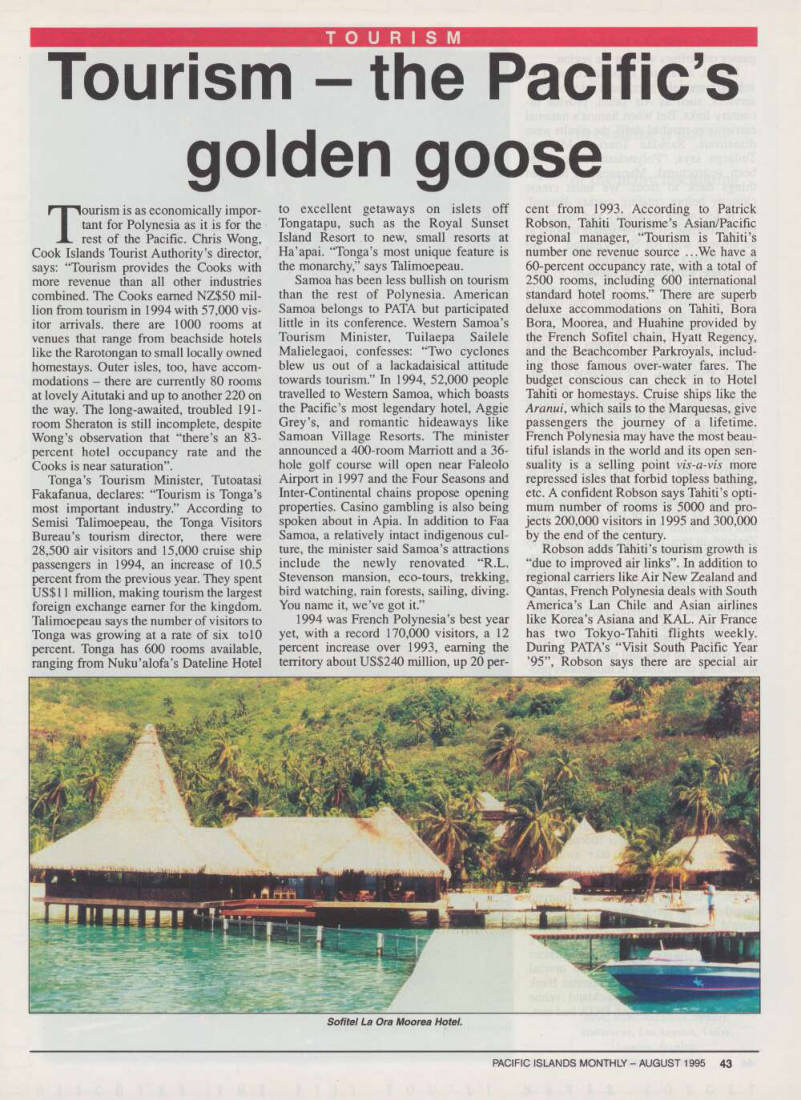
Sofitel La Ora Moorea Hotel.
passes on airlines visiting the region.
Indeed, aviation’s importance can’t be stressed enough. A variety of domesti services, such as Air Tahiti, provide in country links. But when Samoa’s national carrier over-reached itself, the results were disastrous. Samoan Tourism Minister Tuilaepa says, “Polynesian Airlines has been restructured. Management has put things back to front. We must create capacity before creating market demand.
We’re following orthodoxy and things are back to normal... Polynesian is looking at an alliance with Air New Zealand ... We should have a lot of alliances.”
Airline alliances, as opposed to cut throat competition, is a popular aviation trend now. Air New Zealand and Qantas remain the region’s mainstays and Air Pacific provides an important gateway to Nadi. Royal Tonga Airlines connects Sydney, Auckland and other isles with Tonga. Wong says, “We welcome any car rier and have an open-door policy.”
Airports, too, are key. Savaii has a sealed landing strip and a second one is being built, while Japan funds a longer runway at Tonga.
Asian is a growing target market; already, Japan owns major properties in Tahiti and Samoa. Auckland is a hub for Koreans, Taiwanese, and Japanese.
“Almost 30 percent of our overseas visi tors come from Asia,” says Bolger. New Zealand, in turn, provides many visitors to the rest of Polynesia, as do Australia, Europe, and North America, while South Americans spend US$l79B per Tahiti trip.
But there could be problems in paradise for Polynesia’s top foreign exchange earn er such as runway growth and foreign con trol. Tonga’s Minister Fakafanua says: “We want to be slow and sure and develop in the long term. Invest in indigenous peo ple.” Tahiti’s Robson said that early in his career, “I was sent to Hawaii to learn what not to do ... We have to protect what makes Tahiti Tahiti. We don’t want to be another Waikiki.”
Political turmoil has devastated lucra tive hospitality industries in places like Sri Lanka. Recently Tahiti experienced vio lent strikes, but Robson maintains: “Even independentistes are conscious that tourism is important and will become more important if Tahiti is independent.”
Fakafanau says: “If you take away the monarchy, Tonga’s just like any other cow in the paddock, instead of a cow with a crown.” And a New Zealand Tourism Board official said he was “confident there’d be no disruptions” due to Maori protests and land occupations. But just a week later, thousands of demonstrators clashed with police during the annual meeting of the Asian Development Bank at Aotea Centre - the Auckland venue where, only a week earlier, PATA had met.
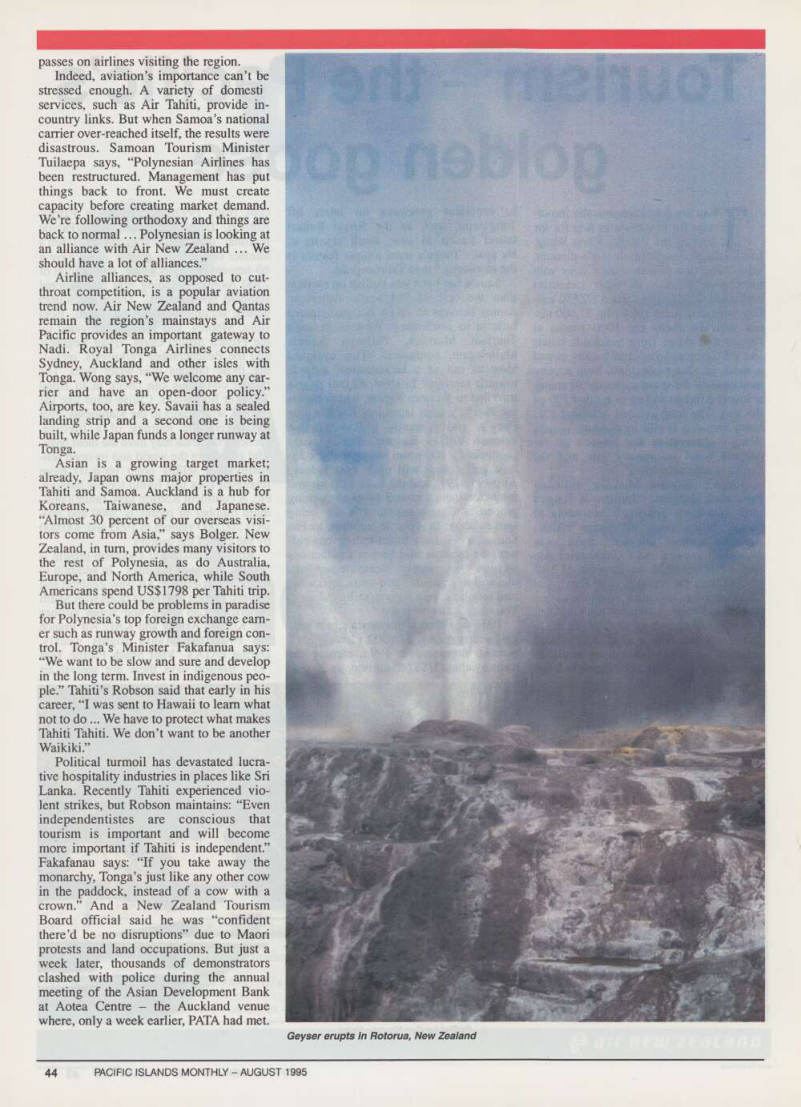
Geyser erupts in Rotorua, New Zealand