Small and rich
p. 46 · Read in the full issue
The Western Pacific was excluded from PATA’s “Visit South Pacific Year ’95”, but with a population smaller than the Solomons, little Micronesia is a tourism giant coming on strong in the Pacific travel industry. Guam has broken the one million mark, with three times the number of visitors Fiji gets and Saipan doubles Fiji’s annual total. In the past decade, Palau’s tourism has grown dramatically, and the Federated States of Micronesia offers a serious alternative in terms of exotic indigenous cultures and wreck-diving. In an interview with PIM, Sonny Ada, the chairman of PATA’s Micronesia chapter and the former chair of the Guam Visitors Bureau, spoke on
tourism, Micro-style.
As to whether Micronesia feels left out of “Visit South Pacific Year ’95”, Ada says “No, not at all,” and notes that even the region’s most developed entity, Guam, does not have a facility comparable to Auckland’s 2200-seat Aotea Centre for hosting conferences. He adds: “And I don’t think we want to be associated with the South Pacific ... because we’re not South Pacific, we’re more mid-Pacific. We take on our own identity of being Micronesia and Guam is the gateway to Micronesia and Asia. I don’t mean that
negatively, but they’re just apples and
oranges...
“The South Pacific offers the true island experience, whereas Guam and Saipan are very mature,” Ada continues.
“Asians want to experience America and we offer a Western life-style in a Pacific island. If you wanted to get away. I’d rec ommend getting out into the smaller Micronesian Islands, or even coming down to the South Pacific ... because Guam is a volume destination.
According to Ada, “In 1994, Guam had 1,089,000 tourists ... There are 6300 hotel rooms, and 1000 more are slated. Tourism is a billion-dollar industry. The whole economy is driven by tourism,” giving Guam more revenue than the Federal gov ernment does. Ada asserts Guam has recovered from the 1993 typhoons and earthquakes which slowed the tourism jug gernaut.
A hundred miles north of Guam in the Marianas chain is Saipan - a small, pleas ant tropical isle, although it is known more for its WWII sites than Guam is. The Commonwealth of the Northern Marinas Islands get about 600,000 visitors a year, Why do the Marianas get so many tourists?
“The Japanese have developed Guam and Saipan and are developing Micronesia,” Ada points out. Because it’s
three to three-and-a-half hours away from Japan geography makes the Marianas East Asia’s equivalent of what the Caribbean is to North America.
Japan, Korea, Taiwan and Hong Kong markets also spill over to the rest of Micronesia. Ada says up to 40,000 tourists a year go to Palau, which has been experi encing a tourism boom. “There are plans for a Hyatt and a Hilton, cottage-style, not high rise,” in the republic which already has the expanding Palau Pacific Resort and other substantial hotels. Palau is a scuba mecca, renowned for some of the best nature diving in the world. Its 200 Rock Islands are a beautiful, unique attraction.
Chuuk State, in the Federated States of Micronesia, gets 12,000 tourists a year.
Most are divers from the East Coast (of USA), oddly enough - because that is the ultimate dive place,” Ada says, referring to the WWII Japanese fleet sunk in Truk Lagoon. Pohnpei state gets up to 15,000 visitors a year, drawn by its natural beauty, many waterfalls and mysterious Nan Madol ruins. Kosrae state also has ancient mins and receives under 10,000 tourists a year, as does Yap, which is known for its traditional culture. According to Ada, FSM is for travellers “who want to get away from the hustle and bustle of the world. They don’t want to see high rises ...
You have some travellers who have been to your Guams and Saipans, don’t play golf, don’t care to shop, they just want to get away from it all.”
Western Pacific aviation is dominated by Continental Micronesia, a subsidiary of Continental US, which is the dominant air line, almost monopolising Micronesia.
They’re looking forward to flying direct to Vietnam and China from Guam, so they’re using Guam as a hub. Guam is currently undergoing a $3OO-million airport expan sion. Even cutbacks in US defence is ben efiting Guam and part of Naval Air Station has been turned over to Guam, which, Ada says, includes “facilities for more airline operations”. Other airlines in Micronesia include Korean Air Lines and Asian.
Yet, as Guam’s tourism grows, local fears include “being blocked out, not being able to participate, big business tak ing over and we’ll all just be labourers,” admits Ada, himself a Chamber.
Ada says, highlighting Micronesia “is definitely what we’re going to be pushing.
We’re talking about it now, we’d like to have a “Visit Micronesia Year” in 2000.
Working with a visit destination theme is not uncommon and many destinations are doing it (PATA has designated 1996 the year to visit Thailand). When the time is appropriate when we can handle and tie-in a PATA congress and conference, that’s when we’ll plan to execute such a theme.”
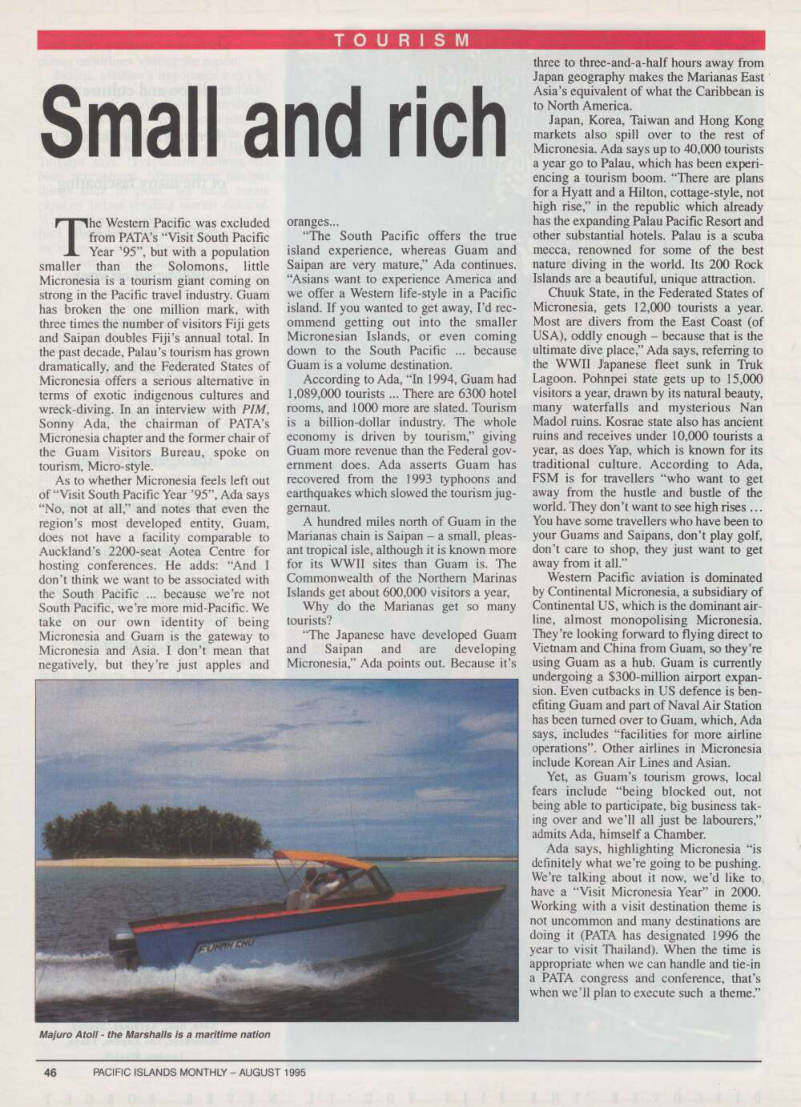
Majuro Atoll - the Marshalls is a maritime nation