Pacific
p. 41 · Read in the full issue
Jewel of the Pacific
Fiji is the crown jewel of South Pacific tourism. With more visi tors than any other island south of the equator (excluding New Zealand), Fiji is by far Melanesia’s travel industry champ. Indeed, with a total of 318,874 arrivals (according to the Ministry of Tourism), Fiji almost doubles the number of visitors to Tahiti, the pacesetter for non
metropolitan Polynesia.
Bill Whiting, Fiji Visitors Bureau’s director of marketing, says; “Six percent of Fiji’s work force is directly employed in hotels and resorts ... 40,000 out of 96,000 workers are indirectly tied to tourism ...
Tourism’s earnings are significantly high er than sugar’s,” the country’s other main
industry.
Fiji’s service may be the Pacific’s best, epitomised by the butler service and tuxe do-clad waitresses in the Port O’Call restaurant at the Sheraton Fiji Resort, unerringly pouring flaming drinks from on high, which was voted the best Sheraton in the Asia-Pacific region.
The 300-isle archipelago has much to offer visitors as a premier travel destina tion. From cruises to outer islet resorts to posh mainland hotels to eco-travel, Fiji has it all, and more.
A highlight is an idyllic Blue Lagoon cruise through the lovely Yasawas, a mini chain located north-west of Viti Levu.
Winding through the Yasawas, stopping here and there at tropical landfalls (includ
ing privately owned Nanuya Lailai), it’s
clear this cruise is aptly named. Indeed, the ship passes near Turtle Island, where Brooke Shields’ The Blue Lagoon was shot. Most passengers are couples, some
are honeymooners and this voyage is a romantic return to nature. The sojourn cul minates with a visit to Somosomo Village, where a yaqona (kava) ceremony, meke (dances) and a native handicraft bazaar take place, introducing Melanesian culture to newcomers.
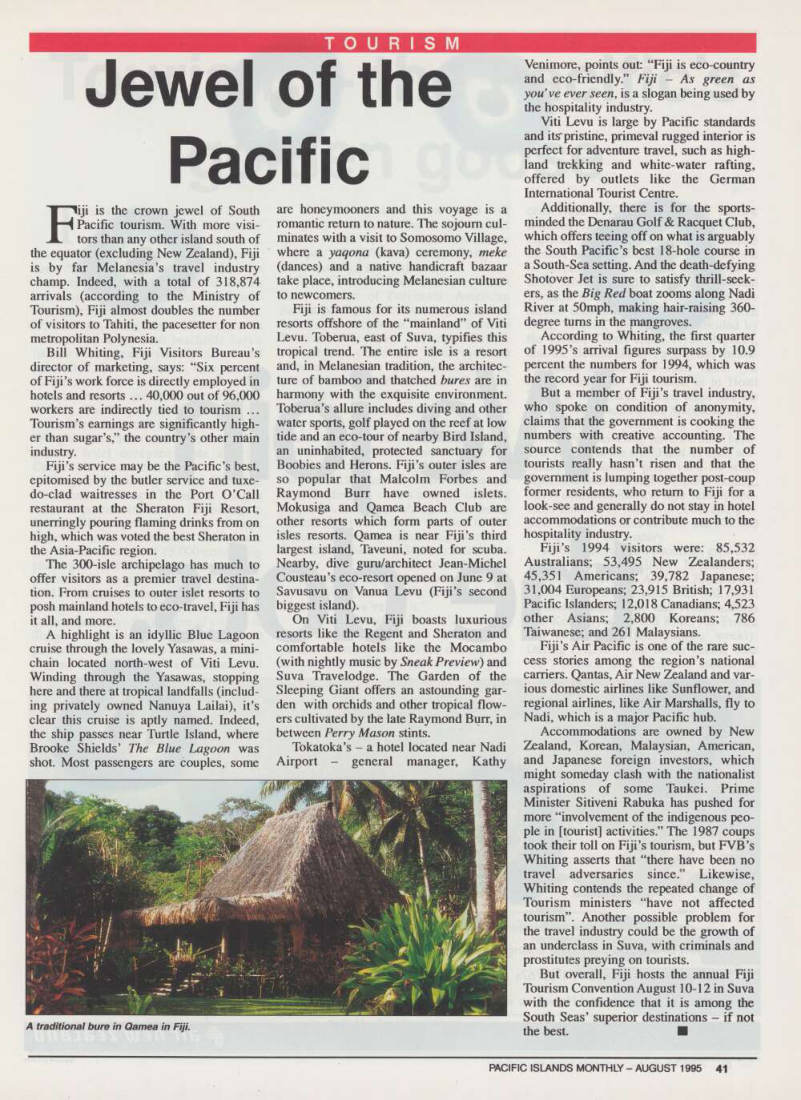
Fiji is famous for its numerous island resorts offshore of the “mainland” of Viti Levu. Toberua, east of Suva, typifies this tropical trend. The entire isle is a resort and, in Melanesian tradition, the architec ture of bamboo and thatched hures are in harmony with the exquisite environment.
Toberua’s allure includes diving and other water sports, golf played on the reef at low tide and an eco-tour of nearby Bird Island, an uninhabited, protected sanctuary for Boobies and Herons. Fiji’s outer isles are so popular that Malcolm Forbes and Raymond Burr have owned islets.
Mokusiga and Qamea Beach Club are other resorts which form parts of outer isles resorts. Qamea is near Fiji’s third largest island, Taveuni, noted for scuba.
Nearby, dive guru/architect Jean-Michel Cousteau’s eco-resort opened on June 9 at Savusavu on Vanua Levu (Fiji’s second biggest island).
On Viti Levu, Fiji boasts luxurious resorts like the Regent and Sheraton and comfortable hotels like the Mocambo (with nightly music by Sneak Preview ) and Suva Travelodge. The Garden of the Sleeping Giant offers an astounding gar den with orchids and other tropical flow ers cultivated by the late Raymond Burr, in between Perry Mason stints.
Tokatoka’s - a hotel located near Nadi Airport - general manager, Kathy
Venimore, points out: “Fiji is eco-country and eco-friendly.” Fiji - As green as you’ve ever seen, is a slogan being used by the hospitality industry.
Viti Levu is large by Pacific standards and its'pristine, primeval rugged interior is perfect for adventure travel, such as high land trekking and white-water rafting, offered by outlets like the German International Tourist Centre.
Additionally, there is for the sports minded the Denarau Golf & Racquet Club, which offers teeing off on what is arguably the South Pacific’s best 18-hole course in a South-Sea setting. And the death-defying Shotover Jet is sure to satisfy thrill-seek ers, as the Big Red boat zooms along Nadi
River at 50mph, making hair-raising 360-
degree turns in the mangroves.
According to Whiting, the first quarter of 1995’s arrival figures surpass by 10.9 percent the numbers for 1994, which was the record year for Fiji tourism.
But a member of Fiji’s travel industry, who spoke on condition of anonymity, claims that the government is cooking the numbers with creative accounting. The source contends that the number of tourists really hasn’t risen and that the government is lumping together post-coup former residents, who return to Fiji for a look-see and generally do not stay in hotel accommodations or contribute much to the hospitality industry.
Fiji’s 1994 visitors were: 85,532 Australians; 53,495 New Zealanders; 45,351 Americans; 39,782 Japanese; 31,004 Europeans; 23,915 British; 17,931 Pacific Islanders; 12,018 Canadians; 4,523 other Asians; 2,800 Koreans; 786 Taiwanese; and 261 Malaysians.
Fiji’s Air Pacific is one of the rare suc cess stories among the region’s national carriers. Qantas, Air New Zealand and var ious domestic airlines like Sunflower, and regional airlines, like Air Marshalls, fly to Nadi, which is a major Pacific hub.
Accommodations are owned by New Zealand, Korean, Malaysian, American, and Japanese foreign investors, which might someday clash with the nationalist aspirations of some Taukei. Prime Minister Sitiveni Rabuka has pushed for more “involvement of the indigenous peo ple in [tourist] activities.” The 1987 coups took their toll on Fiji’s tourism, but FVB’s Whiting asserts that “there have been no travel adversaries since.” Likewise, Whiting contends the repeated change of Tourism ministers “have not affected tourism”. Another possible problem for the travel industry could be the growth of an underclass in Suva, with criminals and
prostitutes preying on tourists.
But overall, Fiji hosts the annual Fiji Tourism Convention August 10-12 in Suva with the confidence that it is among the South Seas’ superior destinations - if not the best. ■
A traditional bure in Qamea in Fiji.