South Sea schizophrenia
p. 35 · Read in the full issue
Proletariat and psychological drama come together in Kneubuhl’s last play
By Ed Rampell
Think of a Garden is the last play of Samoan screenwriter Johnny Kneubuhl who wrote television scripts for Hawaii Five-0 and The Wild Wild West. Garden’s world premier was in American Samoa on February 20, 1992 - the day Kneubuhl died. Subsequently Garden played in Auckland and Wellington and on May 19, 1995, it debuted in Hawaii in Honolulu’s Kuma Kahua Theatre for a run through June.
Set in Leone, American Samoa, in the late 19205, Think of a Garden focuses on the Kreber family. Frank (George O’Hanlon) is a white American business man. His wife Lu’isa (Victoria Kneubuhl,
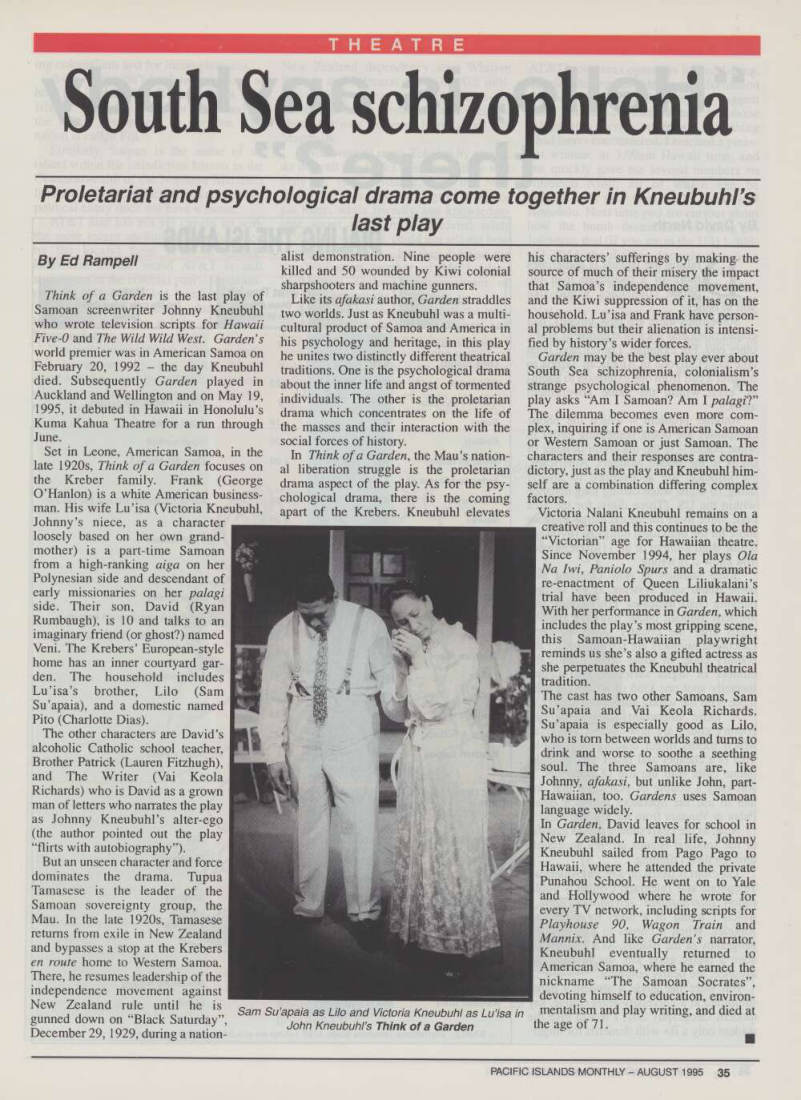
Johnny’s niece, as a character loosely based on her own grand mother) is a part-time Samoan from a high-ranking alga on her Polynesian side and descendant of early missionaries on her palagi side. Their son, David (Ryan Rumbaugh), is 10 and talks to an imaginary friend (or ghost?) named Veni. The Krebers’ European-style home has an inner courtyard gar den. The household includes Lu’isa’s brother, Lilo (Sam Su’apaia), and a domestic named Pito (Charlotte Dias).
The other characters are David’s alcoholic Catholic school teacher.
Brother Patrick (Lauren Fitzhugh), and The Writer (Vai Keola Richards) who is David as a grown man of letters who narrates the play as Johnny Kneubuhl’s alter-ego (the author pointed out the play “flirts with autobiography”).
But an unseen character and force dominates the drama. Tupua Tamasese is the leader of the Samoan sovereignty group, the Mau. In the late 19205, Tamasese returns from exile in New Zealand and bypasses a stop at the Krebers en route home to Western Samoa.
There, he resumes leadership of the
independence movement against
New Zealand rule until he is gunned down on “Black Saturday”, December 29,1929, during a nation
alist demonstration. Nine people were killed and 50 wounded by Kiwi colonial sharpshooters and machine gunners.
Like its afakasi author. Garden straddles two worlds. Just as Kneubuhl was a multi cultural product of Samoa and America in his psychology and heritage, in this play he unites two distinctly different theatrical traditions. One is the psychological drama about the inner life and angst of tormented individuals. The other is the proletarian drama which concentrates on the life of the masses and their interaction with the social forces of history.
In Think of a Garden, the Mau’s nation al liberation struggle is the proletarian drama aspect of the play. As for the psy chological drama, there is the coming apart of the Krebers. Kneubuhl elevates
his characters’ sufferings by making the
source of much of their misery the impact that Samoa’s independence movement, and the Kiwi suppression of it, has on the household. Lu’isa and Frank have person al problems but their alienation is intensi fied by history’s wider forces.
Garden may be the best play ever about South Sea schizophrenia, colonialism’s
strange psychological phenomenon. The
play asks “Am I Samoan? Am I palagiT The dilemma becomes even more com plex, inquiring if one is American Samoan or Western Samoan or just Samoan. The characters and their responses are contra dictory, just as the play and Kneubuhl him self are a combination differing complex factors.
Victoria Nalani Kneubuhl remains on a
■ creative roll and this continues to be the I “Victorian” age for Hawaiian theatre.
I Since November 1994, her plays Ola I Na Iwi, Paniolo Spurs and a dramatic I re-enactment of Queen Liliukalani’s I trial have been produced in Hawaii.
I With her performance in Garden, which I includes the play’s most gripping scene, I this Samoan-Hawaiian playwright I reminds us she’s also a gifted actress as I she perpetuates the Kneubuhl theatrical I tradition.
The cast has two other Samoans, Sam Su’apaia and Vai Keola Richards.
Su’apaia is especially good as Lilo, who is tom between worlds and turns to drink and worse to soothe a seething soul. The three Samoans are, like Johnny, afakasi, but unlike John, part- Hawaiian, too. Gardens uses Samoan language widely.
In Garden, David leaves for school in New Zealand. In real life, Johnny Kneubuhl sailed from Pago Pago to Hawaii, where he attended the private Punahou School. He went on to Yale and Hollywood where he wrote for every TV network, including scripts for Playhouse 90, Wagon Train and Mannix. And like Garden’s narrator, Kneubuhl eventually returned to American Samoa, where he earned the nickname “The Samoan Socrates”, devoting himself to education, environ mentalism and play writing, and died at the age of 71.
Sam Su’apaia as Lilo and Victoria Kneubuhl as Lu’isa in John Kneubuhl’s Think of a Garden