Masterplans to defraud
pp. 33-34 · Read in the full issue
defraud
Central bankers. Commercial bankers. Accounting and Legal Firms, officials of the Ministries of Finance, Trade and Industry and the police, by the nature of their work, are generally the first to become aware of the presence of ‘get rich quick’ operators.
Central banks and Finance Ministry Officials in the Pacific region have a range of past cases which they have had to deal with in their own countries.. Some cases have been repeated in island countries by the same operators. Sharing experiences will be of mutual benefit to the partici pants at the Expert Group Meeting. A number of actual cases are briefly sum marised below: Case One: A group of overseas people visited country Q. The members of this group presented themselves as wealthy experienced businessmen. They negotiated with the management of a large overseas owned company for the purchase of all the shares in that company. The purchase price for the shares was agreed at $6O million.
Of this amount $3O million was to be bor rowed overseas secured by the substantial holdings of property which the company had. This loan was to be retired as soon as part of the company’s property overseas secured by the substantial holding of prop erty which the company had. This loan was to be retired as soon as part of the company’s property be sold off. The other $3O million was to be sought from govern ment as grant to the new shareholders i.e. the group of overseas people of promoters.
The central bank had extreme reserva tions about the promoters and the nature of the proposed scheme. It made contacts with various organisations around the world seeking information about the par ties involved. These inquiries established that the individuals concerned had no funds, had attempted similar schemes in other countries and had records with INTERPOL . These bits of information were formally brought to the attention of the decision makers who were than encouraged to extricate themselves from the position they had dug themselves into.
Approval for the $3O million grant was ultimately withdrawn and the scheme fell through.
Case Two: involved proposed borrow ing, this time by governments through agents or middleman. There have been a number of such cases in the region includ
ing well publicised cases in Australia and New Zealand. But the pattern in the same.
The standard approach of the loan mid dleman is predictable: •He must have the sole mandate to raise external loans for the government. His appointment must be made on paper bear ing the official letter head of the Minister of Finance or Governor of the Central Bank; •The principal is not named but it is not a traditional source such as a well known bank. Anonymity is absolutely important.
The identify of the principal will in fact never be divulged; • Agreement must be concluded urgent ly and quickly; •The loan terms including interest, peri od of repayment and grace period are extremely favourable to the borrower when compared to those of all possible alternative sources; •Discussions and negotiations they will wish to undertake directly with Ministers.
Officials such as Central bankers and Ministry of Finance Officials, who tend to ask awkward questions, should preferably be kept away; •The language of the draft documents is usually couched in pseudo legal jargon aimed at impressing the uninitiated; • The fees for the services provided by the middleman/loan arranger has to be paid up front i.e. before any real work is done. Such fees may go up to 5% of the proposed loan amount. Since the loan amounts bandied about in discussions are usually of the order of hundreds of mil lions the front end fees requested are sub stantial; • Recently middlemen have started talking of sinking funds as part of the pro posed loan packages. This involves setting aside a portion of the loan proceed as a Sinking Fund which will be invested at extremely favourable terms. The income of the Sinking Fund, the middleman will claim, will be sufficient to service the total loan. In other words the amount set aside in the Sinking Fund will effectively be a grant to the borrowing government!
Actually such claims are invariably unworkable. If the very favourable invest ment opportunities of the kind in which the Sinking Fund is to be invested do exist, the middleman would probably decide to undertake the borrowing himself.
Case Three: Two well dressed ‘busi
nessman’ descended on country M. They stayed in an up market hotel. In their pos session were attractively prepared and colourful subdivision maps of choice and prime residential land in the Gold Coast area, Queensland. Advertisements were placed in the local daily newspaper.
Purchasers of plots were required to make contact and pay deposits of only $2,500.
None of the many accountants, lawyers, teachers, doctors and businessmen who rushed in to pay their deposits took the trouble to check whether the subdivision actually existed on the ground as claimed.
Ultimately a number of would-be pur chasers who had paid their deposits became suspicious. They noted that the salesmen were staying for weeks living in style at the expensive hotel and commut ing regularly to and from other countries in the region. One of the would be pur chasers called the Ministry of Finance and reported the matter. The salesman were called in and were advised that their acceptance of deposits violated the exchange control law of the country since it was tantamount to borrowing domesti
cally by non-residents. Consequently they
must return all the deposits to those who had paid them. The legal ground for this instruction was not tested by the salesmen.
They did pay back small proportions of
what they had collected. Simple phone
calls to the relevant authorities and other contacts around the Gold Coast area had established that the two salesmen were selling nothing more than paper subdivi sions!
Case Four: A number of variations of this scheme have also been successfully tried to get rich quick operations in the island countries. One involved the sale of bonds issued by the government of a South American Country! The fake bonds were colourful and attractively printed. The fake bonds, it appeared sold like ‘hot cakes’.
More than $lOO,OOO later the overseas
bond salesman, departed hurriedly leaving
their local associates to answer to the irate buyers and to the authorities. Recently a similar scam was successfully executed in Manila. There a Manila based fdm sold Peso 900 million, about U 5533.3 million, of fake treasury bills to two local banks!
The Governor of the Central Bank of the Philippines, whom the media requested to comment upon the indecent said, “There is now law to prevent suckers.”
National of country E, resident over seas, returns to establish a shopping chain.
Prices in N’s shops, he announced, were to be less than 70% of prices elsewhere in E. But only people who have purchased membership cards in the chain of shops will be allowed to buy from the chain. The membership fee was set at $250. Fifty members signed up and paid up in the first two days. An open factory space with low rental was rented by N and stocks of basic
food items purchased and presented for sale to the members. The prices for the handful of items were indeed lower than 70% of the prices elsewhere. By word of mouth, these favourable prices were broadcast far and wide. Consequently membership reached 1000 within 4 weeks.
Stocks were modestly increased in the shop, but within 10 weeks, N had left the country and disappeared. Rough estimates suggested that N may have netted more than $200,000; a not inconsiderable return for 3 months work!
M lives somewhere in Asia. He has businesses in a number of countries. These businesses are sisters, grandchildren or associates of the mother company in M’s country. M sees quick and substantial profits in logging activated in a number of Pacific island countries. A number of these countries have National Environment
Management Strategies, NEMS, prepared
at great expense and funded by external donors. The NEMS were well publicised as critical components of national devel
opment strategies.
M’s companies, and others, logged away at rates considered by the initiated as well in excess of the sustainable rate. The declared export sales figures suggest that M Was engaging in profit shifting away from the Islands. This takes the form of under-invoicing the export to a sister or associate company resident in a low tax country. Such a company acts only as a booking entity and does not physically handle exported logs which are shipped directly to the point of sale. Under-invoic ing of export proceeds in this case resulted in loss of royalty of export proceeds in this case resulted in loss of royalty to the land owners, revenue to government and for eign exchange receipts to the country.
The authority responsible for discour
aging profit shifting and maintaining opti
mal foreign exchange reserve levels want ed to obtain information from M and his company as it was duty bound to do under the law. This effort was frustrated for some time by higher authorities for reasons that were not immediately clear!
E came to country F (not Tonga). E pro posed to the Prime Minister and Minister for Home Affairs that he be appointed Honorary Consul for country F in Hong Kong and that E and E’s company in Hong Kong be given absolute discretion to issue passports to applicants upon the following conditions: • E to pay $lO,OOO to the government of country F for each passport sold to an applicant. The actual amount paid by the applicant to E is not specified and it to be market determined; •each purchaser of the passport will in
addition buy special high yield bonds
issued by the government of F with total value of $200,000.
E had influential friends in country F.
He had ready access to decision makers.
He talked well and persuasively.
Sumptuous lunches and dinners were organised for important people. In a short period E, an expensive extrovert, was pri vate announcing to all and sundry that the deal was effectively sealed, despite the constitutional and other legislative provi sions which spent out strict conditions for
the acquisition of citizenship. Although E
had not received written confirmation from the Authorities, he was confident enough to seek an appointment with the Central bank to discuss the mechanism for payment to government of its share of the proceeds of passport sales.
E’s proposal manifestly fell outside the area of responsibility of the central bank.
But the central bank was, however, suffi ciently concerned and forthright in its dis approval of it that if promptly informed the Minister responsible in writing.
Following receipt of the letter from the Central bank to the Minister, E started receiving hints that perhaps his proposal was not as attractive as initially thought.
The scheme was ultimately shelved and no more overtures were received from E except for a parting abusive letter from him to the central bank.
How to deal with frauds?
Certain simple procedures could help counter the efforts of “get rich” quick operators. Some are probably in place in the island countries but perhaps need to be more strictly adhered to.
A visiting potential investor calling
upon the Ministry of Trade and Industry, Minister of Finance, Trade and Investment Board or Central Bank should be asked for a banker’s reference. More, he should be encouraged to authorise his banker to talk freely with the government ministry or agency about his financial standing and track record as a investor or business per
son. A genuine investor would not have must difficulty with such a request or might even volunteer it without being
requested. A potential get “rich quick”
operator without funds or with a criminal record will probably retreat very quickly upon being confirmed with such a request.
This proposal has been floating around the region for some time. Central banks are in a position to accumulate informa tion about incoming overseas persons with business interests. As get ‘rich quick’ oper ators tend to move from one country to the next repeating their activities, much could be gained if central banks could share information informally among themselves.
The proposal is to have one central bank say RBNZ maintain a database of all per sons and entitles which engage or have engaged in unconscionable activities in the region. Central banks are to feed informa tion to the data bank. Other organisations
which might usefully participate in feed
ing in feeding into the data bank are the Australian Commonwealth Police, the Comptroller of the Currency in Washington D.C., and the New Zealand Police. The point of contact within a coun try for purposes of initial screening of an incoming investor who looks or ‘smells’ like a possible operator is to be the central bank. Thus an official of the Ministry of Finance or Ministry of Trade and industry would phone the Central bank to check upon T or his company. The central bank would in turn call the data bank to under take a check on TV. This process could be done orally and informally and formal communication by post or facsimile would generally be avoided. ■
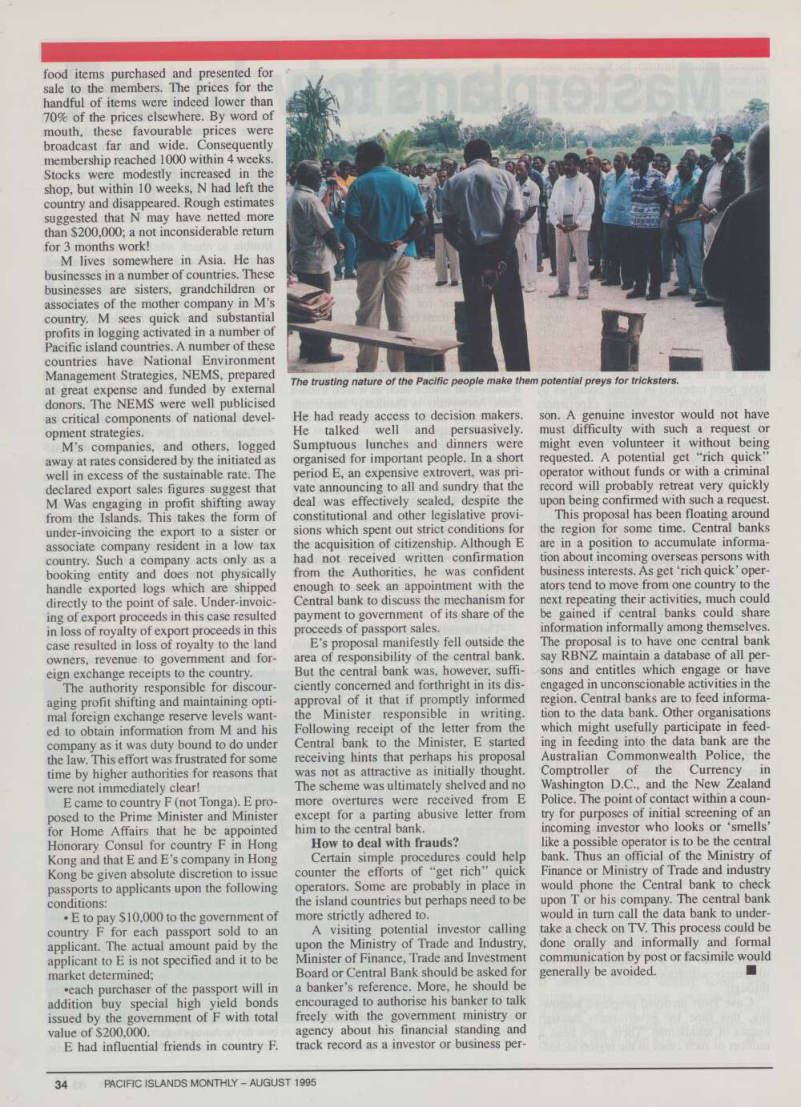
The trusting nature of the Pacific people make them potential preys for tricksters.