should talk
p. 32 · Read in the full issue
Fraud victims should talk
Dr Savenaca Siwatibau, the Fijian Hotel of United Nation’s Vanuatu based Economic and Social Commission for Asia and the Pacific, has been campaigning for serious steps to be taken in order to detect what he calls “get rich quick operators” in the Pacific. He explains what his views are.
P.1.M.: Dr Siwatibau, what sort of scams are you aware of at the moment, that might still be going on in the Pacific region?
D.S.S.: You know about the Nigerians scams (see box), but there is an other one going around, this group of people from Nevada. They come to a country and they say “we will build you a big power plant”.
In one of the cases that has just died actu ally, they said that this power plant would cost 350 million US dollars. That they would build this immediately using new technology, involving hydrogen.
Meanwhile, as soon as the agreement is signed, they say they want the central bank to lent the money. See it’s always the same thing: a lot of promise but some fees up front. And once they get the money up front, they disappear.
P.1.M.: Has this particular scam happened
in some places already and the money
already being lost?
D.S.S.: What countries were they
approaching?
D.S.S.: Well, they claimed in writing that they had done this kind of things in twenty countries all around the world. All the South American countries were mentioned, Israel, Asian countries. And in those coun tries they said they had built and donated power plants worth two to three billion dol lars.
But our countries, when they are confront ed with this, they should check with the government to find if such things have been done. It’s very easy to do those
things.
But generally, we’re not aware of those things, so we don’t bother to check them thoroughly: As far as I know, no one has been caught yet. Because here again, when accurate questions began to be asked to those people, they immediately disap
peared.
P.1.M.: Are there other such operators in the region at the moment?
DS.S.: It’s hard to know, because it’s actu ally the governments that have the infor mation. That’s why we are suggesting this
close network of central banks, because these people ultimately have to come to them for permission. If you can identify them soon enough, then you’re able to pro
tect yourself.
But they do have to talk to other people, like government departments.
D.S.S.: Also, the Cook island letters of guarantee are a good example. These peo ple came to the government of the Cook islands and asked for letters of guarantees.
This was to guarantee two guarantee two companies: one in the Caribbean, the other one in Samoa. They said they trade in the stock exchange. What they also is that with these letters of guarantee, it would enable their limits of trading to be substantially to make al a lot of money. And the profit, they’ll share with the government.
But in fact, they just want the letter of guarantee to be able to raise funds. In this case, it was the US treasury that was alert ed.
You see, if my organisation is guaranteed for 1.2 billion US dollars, I might raise one or two million, somebody might accept in and lend some money. Of course, this case is well-known because it was very highly
publicised.
P.1.M.: Why do you think it works in the Pacific?
D.S.S.: It works everywhere else: for the Nigerian scam, some people in the US have been caught.
One particular victim actually swallowed his pride and reported the whole thing to the Wall Street journal. To his neighbours, he had been taken for a ride, he looked a fool, but he reported this so it was useful.
On other occasions, it was sent through the fax to commercial banks in the region. In some cases, they are using people within the central bank itself who know about this. But of course, they would deny it. And the central bank of Nigeria issued state ments in The Economist denying all involvement in this scam. This caused a great embarrassment to them.
In the Pacific, also, there are financial problems, so everybody is looking for funds ...
P.1.M.: Yes, some ministers also want to make a profit for themselves. They’re not all naive, I’m sad to say. But that’s really where it is. This relates to another issue: corruption within government and public institutions. This is a trend. Most of the politicians in the region are not financially independent, and they want to make the most of it. It’s only human. We should have a pension scheme for former politicians to keep them from these temptations.
But we haven’t reached a stage where it’s as bad in Africa, for example.
If only the fact of talking about these things could generate awareness, this would be a good thing. A public debate should be encouraged, not eliminate this problem, but at least to contend it. ■
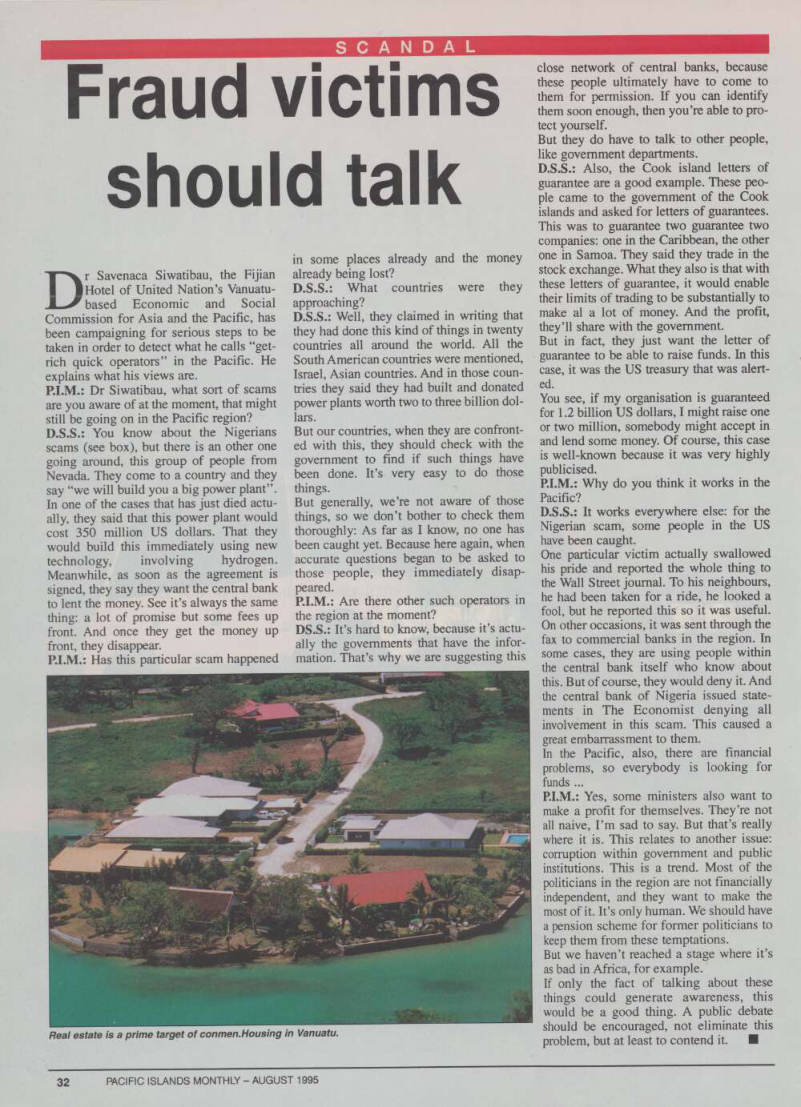
Real estate is a prime target of conmen. Housing in Vanuatu.