Hook, line and sinker
pp. 28-29 · Read in the full issue
Scandal
The proposal of a $2 billion loan forwarded to Vanuatu was lucrative. Paper work had started and Vanuatu was waiting for the money to land on its shores. A curious Attorney-General’s intervention exposed a scandal which could have crippled Vanuatu.
By Patrick Decloitre
It did not work in Vanuatu. Vanuatu government has very nearly been taken for a ride, in a scam that could have ended in the same way as the Cook island’s letter of guarantees scandal. Here, it was the prospect of a two-billion dollar
loan, offered by mysterious companies,
that did the trick. A confidential file tells the whole story in detail of what could have been a major embarrassment to the Vanuatu government. The Attorney- General’s Office was not prepared to com ment. Close-up on an aborted scam.
On 1 July 1993, Vanuatu’s minister of Finance Willie Jimmy signed a power of attorney appointing a certain Dr Hand ALenz with residence at 500 St Manila, Philippines as “the true representative to act on our behalf to arrange, prepare, receive all documents” for an offered loan of 2 billion US dollars with an interest rate “between 4 and 6%. A declaration on intent was also signed.
The deal was to be made through Allen Bristow and Peter Johnston, claiming to be the “both qualified” representatives of a Warratah group of Australia to secure favourable financing sources of the Republic of Vanuatu.
The proposal involved a govemment-to govemment transaction under the auspices of central bank protocols. In this matter, two trust, “Molexa” and “Galaxy’ purport ed to transfer a mature certificate of deposit in the face value of 9.36 billion Canadian dollars to the republic of Van, of which 1.872 billion Canadian dollars (20%) would be available as funding for the government of Vanuatu, while the remaining 80%n would be remitted back to so-called “International Monetary Discretionary Trust” and a “Melwa and Galaxy trust” (MGT).
Vanuatu would have had to repay over a ten-year period at an annual interest rate of 3.3%, provided the sum was guaranteed by Vanuatu as to repayment at term in the form of Ten year state Federal Government repayment obligations i.e.; treasury bonds or any acceptable payment instruments drawn against the central bank of Vanuatu.
The 3 .5% interest was supposed to be
repaid by issuing “central bank treasury
bonds or any acceptable payment instruments drawn against the central bank of Vanuatu.
The 3.5% interest was supposed to be repaid by issuing “central bank treasury bonds or any other acceptable payment instrument”.
It said at the end of a letter sent to the Vanuatu government that “this proposal made in good faith is commended to your earnest consideration and is valid for a period of thirty days from the above date.
A letter dated 12 February 1994 contains such sentences as; “Dear Sir, in acknowledgement of the attached funding proposal as co-ordinated by W group Australia and in respect of the essence and spirit of humanitarianism in which the funding offer is made your government is respectfully requested to give favourable consideration to the following ...”
However, Bristow and Johnston claimed very soon consultants fee payable
at a rate of 0.2% of the principal amount of funding “upon encashment of the said funding Certificate of deposit.”
In this financial maze, other names and soon appeared, like a Milder Elfman Szmerling, a third person supposedly deal ing with Johnston. Szmerling claimed to be dealing with both the commonwealth bank and the Australian government min isters namely Senator the Gareth Evans, and Australian Treasurer, Senator Ralph Willis, MR As the dealings were starting to get to a quite advanced stage, Vanuatu’s British Attorney General, Patrick Ellum, stepped in and started asking more accurate ques tions which soon proved to deter the for eign operators.
In a letter dated 14 March 1994 and sent to another operator, a certain Mr Edison Damanik, Ellum says regarding the offer. he has been asked by the Minister of Finance to request certain information
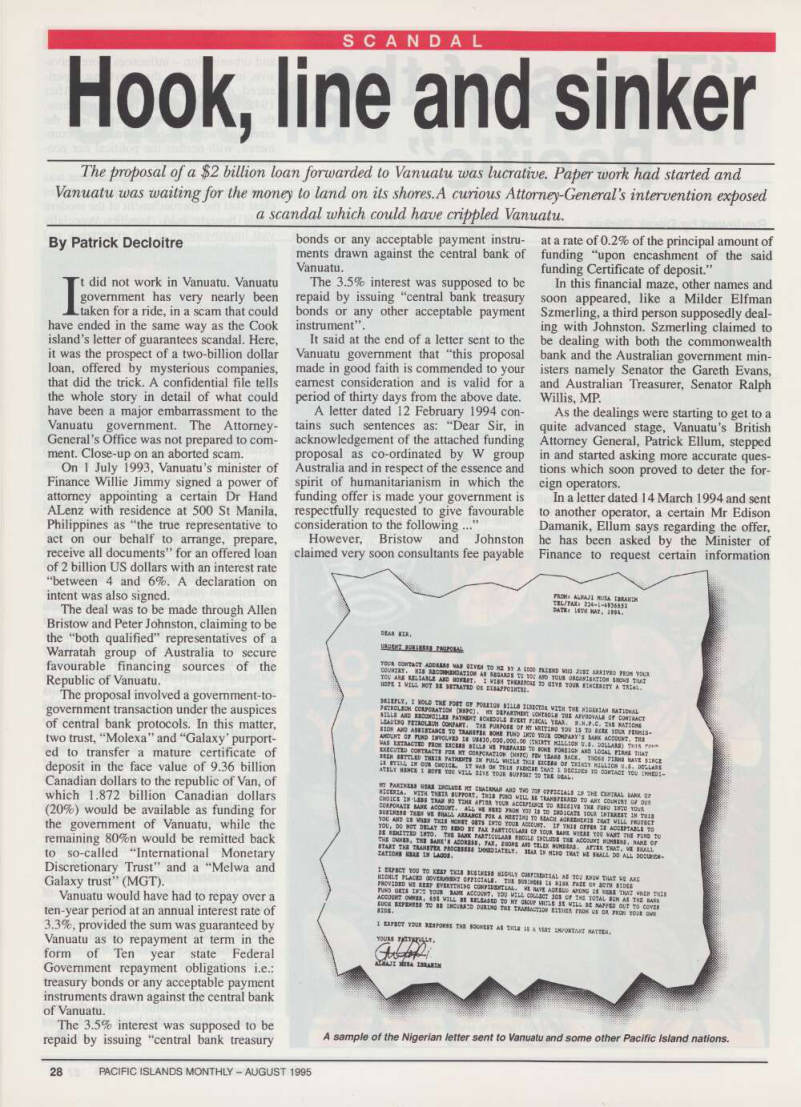
A sample of the Nigerian letter sent to Vanuatu and some other Pacific Island nations.
such as the company’s portfolio, giving
details of the trust, its ownership, manage ment, assets, policy and background.
“We have had some difficulty in under standing the proposed nature of the trans action, and to do so. In particular, our gov ernment had difficulty in understanding why your trust cannot negotiate the certifi cate of deposit directly with the bank con cerned. Please will you assist us in clarify
ing our understanding of this point,”
Ellum wrote.
The response he received two days later from Damanik (Chairman of the Board, PT Galaxy Indonesia Trust) was very vague: “This trust is private discretionary trust located in Indonesia. It hold interna tional assets in large quantities. These assets are under banks, governments and IMF control. The assets are clean and clear and not the result of illegal or unlawful activities. Meanwhile, a letter was sent from the Australian government’s repre sentative in Port Vila, Peter Shannon, to Vanuatu Prime Minister Maxime Carlot.
Shannon said he had been instructed to “emphasize in the clearest possible terms to the government of Van that the Australian government has no involve ment whatsoever in the financial instru ment being offered by the PT Galaxy Indonesia Trust, either directed or through the Warratah group.”
“I’have also been instructed to empha size that the Australian government has no involvement with Johnston or Bristow of the Warrath group. The Australian govern ment has not given authority for any per son or group to act on its behalf in relation to these types of financial transactions. I therefore advise that the linking of the
Australian government to the financial assistance being offered to the Government of Vanuatu is totally without substance,” the letter said.
Letters also came from both Senators Evans and Willis, saying they were “most concerned that parties may be using their names without authority.”
Gareth Evans confirmed he had been asked to assist in the process of authenti cation and verification of a financial instrument being offered by the PT Galaxy Indonesia Trust via the W group: “I wish to advise in the clearest possible terms that the Australian government is unable to authenticate to verify the financial instru ment for financial assistance being offered to Van. I also emphasize that the Australian government has no interest whatsoever in the financial instrument being offered by PT Galaxy Indonesia Trust, either directly or through the W group,” Evans and Willis both said in sep arate letters.
The whole scam seemed then to reach a stage where it was no longer working. At the end of March, Ellum wrote to the Vanuatu Minister of Finance he had received “none of the information we have
been asking.”
“Galaxy avoided giving this informa tion in their reply of 16 March 94. At any meeting of 23 March, Mr Kumar (a new representative of Galaxy) said he would not give any such information. We also asked to understand the proposed transac tion, and Galaxy did not explain it, but instead denied that what Warratah had put to us had come from Galaxy. By now tak ing the position that they cannot discuss the terms and conditions of financial assis
tance, they similarly avoid giving any
information about those transactions,”
Ellum writes.
He further noted that a letter recently received contained “nine spelling use of English errors” and that a fax sent to Vanuatu had its end “cut off so that we cannot tell where the fax came from”
Business cards and letterheads have also changed throughout the process of the correspondence letter heads is different and the logo on the business card is differ ent. This is perhaps unusual for an estab lished trust. (...) My advise is that there is no proposed transaction, no information about terms and conditions, no informa tion about the lender about which I can advise. I would however again advise the most extreme caution,” Ellum wrote.
And he concludes: “Galaxy is therefore a organisation whose introduction arises from someone, Warratah, with a bogus proposal and a second intermediary, Kumar, whose choice, given the impres sion he has made on us, put their judge ment in doubt. They have steadfastly refused to confirm anything of substance in relation to themselves or the proposed transactions and they have produced 5 dif ferent letterheads logos in 6 months.”
The advice was followed and the whole matter finally ended sometime in March 1994. It did not work, at least in Vanuatu.
In a recent update, one of the two pro tagonists of this attempted scam, Johnston, is believed to have been charged earlier this year by the City of London Fraud
Squad. ■
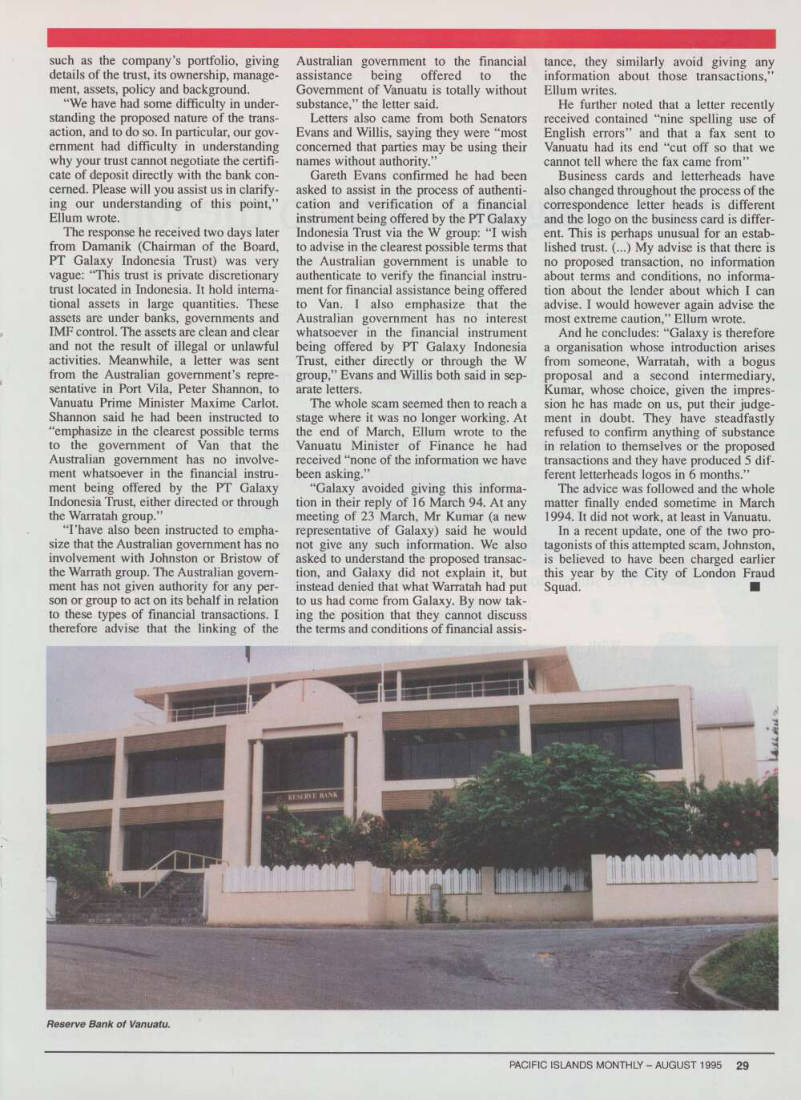
Reserve Bank of Vanuatu.